EP1275411A1 - Oxygen concentrating apparatus - Google Patents
Oxygen concentrating apparatus Download PDFInfo
- Publication number
- EP1275411A1 EP1275411A1 EP01921838A EP01921838A EP1275411A1 EP 1275411 A1 EP1275411 A1 EP 1275411A1 EP 01921838 A EP01921838 A EP 01921838A EP 01921838 A EP01921838 A EP 01921838A EP 1275411 A1 EP1275411 A1 EP 1275411A1
- Authority
- EP
- European Patent Office
- Prior art keywords
- oxygen
- concentrating
- air
- humidifying
- electric current
- Prior art date
- Legal status (The legal status is an assumption and is not a legal conclusion. Google has not performed a legal analysis and makes no representation as to the accuracy of the status listed.)
- Withdrawn
Links
Images




Classifications
-
- B—PERFORMING OPERATIONS; TRANSPORTING
- B01—PHYSICAL OR CHEMICAL PROCESSES OR APPARATUS IN GENERAL
- B01D—SEPARATION
- B01D53/00—Separation of gases or vapours; Recovering vapours of volatile solvents from gases; Chemical or biological purification of waste gases, e.g. engine exhaust gases, smoke, fumes, flue gases, aerosols
- B01D53/02—Separation of gases or vapours; Recovering vapours of volatile solvents from gases; Chemical or biological purification of waste gases, e.g. engine exhaust gases, smoke, fumes, flue gases, aerosols by adsorption, e.g. preparative gas chromatography
- B01D53/04—Separation of gases or vapours; Recovering vapours of volatile solvents from gases; Chemical or biological purification of waste gases, e.g. engine exhaust gases, smoke, fumes, flue gases, aerosols by adsorption, e.g. preparative gas chromatography with stationary adsorbents
- B01D53/047—Pressure swing adsorption
-
- A—HUMAN NECESSITIES
- A61—MEDICAL OR VETERINARY SCIENCE; HYGIENE
- A61M—DEVICES FOR INTRODUCING MEDIA INTO, OR ONTO, THE BODY; DEVICES FOR TRANSDUCING BODY MEDIA OR FOR TAKING MEDIA FROM THE BODY; DEVICES FOR PRODUCING OR ENDING SLEEP OR STUPOR
- A61M16/00—Devices for influencing the respiratory system of patients by gas treatment, e.g. ventilators; Tracheal tubes
- A61M16/10—Preparation of respiratory gases or vapours
- A61M16/1005—Preparation of respiratory gases or vapours with O2 features or with parameter measurement
- A61M16/101—Preparation of respiratory gases or vapours with O2 features or with parameter measurement using an oxygen concentrator
-
- A—HUMAN NECESSITIES
- A61—MEDICAL OR VETERINARY SCIENCE; HYGIENE
- A61M—DEVICES FOR INTRODUCING MEDIA INTO, OR ONTO, THE BODY; DEVICES FOR TRANSDUCING BODY MEDIA OR FOR TAKING MEDIA FROM THE BODY; DEVICES FOR PRODUCING OR ENDING SLEEP OR STUPOR
- A61M16/00—Devices for influencing the respiratory system of patients by gas treatment, e.g. ventilators; Tracheal tubes
- A61M16/10—Preparation of respiratory gases or vapours
- A61M16/14—Preparation of respiratory gases or vapours by mixing different fluids, one of them being in a liquid phase
- A61M16/16—Devices to humidify the respiration air
-
- A—HUMAN NECESSITIES
- A61—MEDICAL OR VETERINARY SCIENCE; HYGIENE
- A61M—DEVICES FOR INTRODUCING MEDIA INTO, OR ONTO, THE BODY; DEVICES FOR TRANSDUCING BODY MEDIA OR FOR TAKING MEDIA FROM THE BODY; DEVICES FOR PRODUCING OR ENDING SLEEP OR STUPOR
- A61M16/00—Devices for influencing the respiratory system of patients by gas treatment, e.g. ventilators; Tracheal tubes
- A61M16/10—Preparation of respiratory gases or vapours
- A61M16/14—Preparation of respiratory gases or vapours by mixing different fluids, one of them being in a liquid phase
- A61M16/16—Devices to humidify the respiration air
- A61M16/161—Devices to humidify the respiration air with means for measuring the humidity
-
- B—PERFORMING OPERATIONS; TRANSPORTING
- B01—PHYSICAL OR CHEMICAL PROCESSES OR APPARATUS IN GENERAL
- B01D—SEPARATION
- B01D53/00—Separation of gases or vapours; Recovering vapours of volatile solvents from gases; Chemical or biological purification of waste gases, e.g. engine exhaust gases, smoke, fumes, flue gases, aerosols
- B01D53/02—Separation of gases or vapours; Recovering vapours of volatile solvents from gases; Chemical or biological purification of waste gases, e.g. engine exhaust gases, smoke, fumes, flue gases, aerosols by adsorption, e.g. preparative gas chromatography
- B01D53/04—Separation of gases or vapours; Recovering vapours of volatile solvents from gases; Chemical or biological purification of waste gases, e.g. engine exhaust gases, smoke, fumes, flue gases, aerosols by adsorption, e.g. preparative gas chromatography with stationary adsorbents
- B01D53/0407—Constructional details of adsorbing systems
-
- A—HUMAN NECESSITIES
- A61—MEDICAL OR VETERINARY SCIENCE; HYGIENE
- A61M—DEVICES FOR INTRODUCING MEDIA INTO, OR ONTO, THE BODY; DEVICES FOR TRANSDUCING BODY MEDIA OR FOR TAKING MEDIA FROM THE BODY; DEVICES FOR PRODUCING OR ENDING SLEEP OR STUPOR
- A61M16/00—Devices for influencing the respiratory system of patients by gas treatment, e.g. ventilators; Tracheal tubes
- A61M16/10—Preparation of respiratory gases or vapours
- A61M16/105—Filters
- A61M16/106—Filters in a path
- A61M16/107—Filters in a path in the inspiratory path
-
- B—PERFORMING OPERATIONS; TRANSPORTING
- B01—PHYSICAL OR CHEMICAL PROCESSES OR APPARATUS IN GENERAL
- B01D—SEPARATION
- B01D2256/00—Main component in the product gas stream after treatment
- B01D2256/12—Oxygen
-
- B—PERFORMING OPERATIONS; TRANSPORTING
- B01—PHYSICAL OR CHEMICAL PROCESSES OR APPARATUS IN GENERAL
- B01D—SEPARATION
- B01D2257/00—Components to be removed
- B01D2257/10—Single element gases other than halogens
- B01D2257/102—Nitrogen
-
- B—PERFORMING OPERATIONS; TRANSPORTING
- B01—PHYSICAL OR CHEMICAL PROCESSES OR APPARATUS IN GENERAL
- B01D—SEPARATION
- B01D2259/00—Type of treatment
- B01D2259/40—Further details for adsorption processes and devices
- B01D2259/40007—Controlling pressure or temperature swing adsorption
-
- B—PERFORMING OPERATIONS; TRANSPORTING
- B01—PHYSICAL OR CHEMICAL PROCESSES OR APPARATUS IN GENERAL
- B01D—SEPARATION
- B01D2259/00—Type of treatment
- B01D2259/40—Further details for adsorption processes and devices
- B01D2259/402—Further details for adsorption processes and devices using two beds
-
- B—PERFORMING OPERATIONS; TRANSPORTING
- B01—PHYSICAL OR CHEMICAL PROCESSES OR APPARATUS IN GENERAL
- B01D—SEPARATION
- B01D2259/00—Type of treatment
- B01D2259/45—Gas separation or purification devices adapted for specific applications
- B01D2259/4533—Gas separation or purification devices adapted for specific applications for medical purposes
-
- B—PERFORMING OPERATIONS; TRANSPORTING
- B01—PHYSICAL OR CHEMICAL PROCESSES OR APPARATUS IN GENERAL
- B01D—SEPARATION
- B01D53/00—Separation of gases or vapours; Recovering vapours of volatile solvents from gases; Chemical or biological purification of waste gases, e.g. engine exhaust gases, smoke, fumes, flue gases, aerosols
- B01D53/02—Separation of gases or vapours; Recovering vapours of volatile solvents from gases; Chemical or biological purification of waste gases, e.g. engine exhaust gases, smoke, fumes, flue gases, aerosols by adsorption, e.g. preparative gas chromatography
- B01D53/04—Separation of gases or vapours; Recovering vapours of volatile solvents from gases; Chemical or biological purification of waste gases, e.g. engine exhaust gases, smoke, fumes, flue gases, aerosols by adsorption, e.g. preparative gas chromatography with stationary adsorbents
- B01D53/0407—Constructional details of adsorbing systems
- B01D53/0446—Means for feeding or distributing gases
Definitions
- the present invention relates to a medical oxygen-concentrating equipment for separating oxygen from air and producing the oxygen-concentrated air.
- the invention relates to an oxygen-concentrating equipment in which a humidifying means using a solid electrolyte membrane to humidify the oxygen-concentrated air is installed, and to the medical oxygen-concentrating equipment with which a user can continuously inhale oxygen without supplying water.
- a medical gas including oxygen is supplied in the form of a compressed gas in a cylinder, a liquefied gas in a cylinder or direct supplying from a purifying-concentrating equipment.
- the concentrating equipment includes equipments based on a low temperature processing method, equipments based on a membrane separation method using a membrane permitting the preferential penetration of only a specific gas component, and equipments based on an adsorption method using an adsorbent such as zeolite.
- the equipments based on the adsorption method especially a pressure swing adsorption method that the inner pressure of an adsorption cylinder filled with a nitrogen-adsorbing agent based on zeolite is continuously changed to carry out adsorption and reactivation operations, are dominant.
- the adsorbent used for the pressure swing adsorption method includes zeolite and molecular sieve carbon, but the equipment using 5A type or 13X type zeolite is a leading one as the oxygen-concentrating equipment. These zeolites have properties for more preferentially adsorbing nitrogen than oxygen. When air is charged into the cylinder in an adsorption process, only nitrogen is selectively adsorbed to leave oxygen as a gas phase component, and the left gas is taken out to obtain the oxygen-concentrated air.
- these zeolites have a property for adsorbing water stronger than oxygen and nitrogen.
- the zeolite adsorbs the water, and the nitrogen-adsorbing capacity of the zeolite is thereby reduced to cause the deterioration of the adsorbent.
- the oxygen is concentrated by the pressure swing adsorption method using the zeolite, it is therefore preferable that the air used as the raw material is in a state that the water is removed as much as possible.
- the oxygen purified with the above-mentioned pressure swing type adsorption equipment is in an absolutely dry state that water is nearly perfectly removed by the water-absorbing property of the zeolite.
- troubles such as the decrease in the ciliary movement of an upper respiratory tract mucous membrane, the loss of water and calorie in the body and the difficulty of expectoration due to the dryness of sputum are caused. It is therefore necessary that the medical gas is preliminarily humidified with a humidifier or the like, before the patient inhales the medical gas.
- the humidifiers based on a method that the product oxygen gas is passed through purified water placed in a container, and based on a method that the oxygen is passed through water in a bubble state, have been often used as humidifiers for humidifying the product oxygen gas.
- the humidifiers since using the water, the humidifiers have problems, for example, the necessity of maintenance such as the periodical supply or exchange of the water because of the propagation of bacteria on the employment of the humidifiers for long periods, and the abnormal supply of the product oxygen gas due to the failure of reassembly on the maintenance.
- a method comprising using a water-transferring membrane, allowing raw material air to flow on one side of the membrane to transfer oxygen to the other side, simultaneously transferring moisture in the raw material air to the product oxygen by the utilization of a steam partial pressure difference, thereby dehumidifying the raw material air and simultaneously humidifying the oxygen, such as an invention described in JPA 2-99113 (1990) (hereinafter, JPA means Japanese Unexamined Patent Publication), is known. Since the humidification degree of the oxygen largely depends on the humidity of the raw material air, the method has the following problems.
- the oxygen when the humidity of the raw material air is low, the oxygen is sufficiently not humidified, while when the humidity is high, the oxygen is excessively humidified, thus forming dew on the inner surface of piping and giving unpleasantness to a patient on his inhalation of the moisture in the form of liquid water.
- a method comprising by-passing the water transfer membrane with disposing a by-pass on a piping for the raw material air or the product oxygen, in such oxygen-concentrating equipments described in JPA 5-49697 (1993) and JPA 8-196635 (1996), has also been considered for controlling the humidification degree.
- the method has problems such as the complication of the piping and the complication of a control mechanism due to a necessity for controlling the valve aperture of the by-bass for the control of the humidification degree.
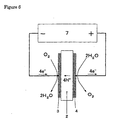
- the dehumidifier has a basic structure having a cathode on one side of a cation-conducting solid polymer electrolyte and an anode on the other side, as shown in Figure 6, and utilizes the following reactions : on the side of the anode : 2H 2 O ⁇ O 2 + 4H + + 4e - on the side of the cathode : O 2 + 4H + + 4e - ⁇ 2H 2 O which are generated on the anode and the cathode, when an electric current is applied.
- the dehumidifier using the solid polymer electrolyte has a defect which comprises producing a dry air layer in the neighborhood of the anode side membrane surface of the solid polymer electrolyte membrane to prevent the supply of wet air to the membrane surface and thereby significantly deteriorating the humidifying capacity of the solid polymer electrolyte membrane, when continuously used.
- the object of the present invention is to provide an oxygen-concentrating equipment installed with a humidifying means, which can dissolve the problems of conventional equipments, does not need periodical maintenance such as the supply of water, can continuously give a sufficient humidification degree, and enables the free and easy setting of the humidification degree.
- the present inventor zealously examined the problem, and consequently found out the following oxygen-concentrating equipment.
- the present invention is to provide the oxygen-concentrating equipment comprising an oxygen-concentrating means for separating oxygen from air to concentrate the oxygen, a humidifying means for humidifying the oxygen-concentrated air produced by said oxygen-concentrating means, and an oxygen-supplying means for supplying the humidified oxygen-concentrated air to a user, characterized in that said humidifying means has at least a cation-conducting solid electrolyte membrane equipped with electrodes on both the sides of the membrane and an electric source for applying an electric current to said electrodes.
- the present invention is to provide the oxygen-concentrating equipment, characterized in that said humidifying means is a means which has, on the anode side, a catalyst layer for electrolyzing water molecule into oxygen molecule and hydrogen ion and has, on the cathode side, a catalyst layer for producing water molecule from the oxygen molecule and the hydrogen ion.
- the present invention is to provide the oxygen-concentrating equipment, characterized in that said oxygen-concentrating means is a pressure swing adsorption type oxygen-concentrating means which has an adsorption cylinder filled with an adsorbent adsorbing nitrogen more selectively than oxygen and a compressor for supplying compressed air to said adsorption cylinder, and said humidifying means has a flow path to flow raw material air, to be supplied to said compressor, on an anode side and a flow path to flow the oxygen-concentrated air, produced by said oxygen-concentrating means, on a cathode side.
- said oxygen-concentrating means is a pressure swing adsorption type oxygen-concentrating means which has an adsorption cylinder filled with an adsorbent adsorbing nitrogen more selectively than oxygen and a compressor for supplying compressed air to said adsorption cylinder
- said humidifying means has a flow path to flow raw material air, to be supplied to said compressor, on an anode side and a flow path to flow the oxygen-concentrated air, produced by said
- the present invention is to provide the oxygen-concentrating equipment, characterized in that said oxygen-concentrating means is a pressure swing adsorption type oxygen-concentrating means which has an adsorption cylinder filled with an adsorbent adsorbing nitrogen more selectively than oxygen and a compressor for supplying compressed air to said adsorption cylinder, and said humidifying means has a flow path to flow cooling air on an anode for cooling the inside of said oxygen-concentrating equipment and a flow path to flow the oxygen-concentrated air, produced by said oxygen-concentrating means, on a cathode side for allowing.
- said oxygen-concentrating means is a pressure swing adsorption type oxygen-concentrating means which has an adsorption cylinder filled with an adsorbent adsorbing nitrogen more selectively than oxygen and a compressor for supplying compressed air to said adsorption cylinder
- said humidifying means has a flow path to flow cooling air on an anode for cooling the inside of said oxygen-concentrating equipment and a flow path to flow the oxygen-concentrated air,
- the present invention is to provide the oxygen-concentrating equipment, characterized in that said oxygen-concentrating means is a pressure swing adsorption type oxygen-concentrating means which has an adsorption cylinder filled with an adsorbent adsorbing nitrogen more selectively than oxygen and a compressor for supplying compressed air to said adsorption cylinder, and said humidifying means has a flow path to flow the air desorbed from the adsorption cylinder on an anode side and a flow path to flow the oxygen-concentrated air, produced by said oxygen-concentrating means, on a cathode side.
- said oxygen-concentrating means is a pressure swing adsorption type oxygen-concentrating means which has an adsorption cylinder filled with an adsorbent adsorbing nitrogen more selectively than oxygen and a compressor for supplying compressed air to said adsorption cylinder
- said humidifying means has a flow path to flow the air desorbed from the adsorption cylinder on an anode side and a flow path to flow the oxygen-concentrated air
- the present invention is to provide the oxygen-concentrating equipment, characterized in that a control means, for controlling the electric current value and/or voltage value of an electric current applied from said electric source to said electrodes, is installed and in that a control means, for controlling the electric current value and/or voltage value of an electric current applied from said electric source to said electrodes so that the electric current value and/or voltage value do not exceed the upper limits, is installed.
- the present invention is to provide the oxygen-concentrating equipment, characterized in that a humidity-measuring means, on the cathode side of said humidifying means or in the downstream on the cathode side of said humidifying means, is installed and a control means, for controlling said measuring means so that the measurement value of said humidity-measuring means is equal to a set value, is installed and in that a control means, for calculating the transfer rate of water on the basis of the flow rate value and temperature value of the oxygen-concentrated air flowing on the cathode side of said humidifying means and then controlling said control means, is installed.
- the oxygen-concentrating equipment in the present invention is an oxygen-concentrating equipment comprising an oxygen-concentrating means for separating oxygen from air to concentrate the oxygen, a humidifying means for humidifying the oxygen-concentrated air produced by said oxygen-concentrating means, and an oxygen-supplying means for supplying the humidified oxygen-concentrated air to a user, wherein said humidifying means has at least a cation-conducting solid electrolyte membrane equipped with electrodes on both the sides of the membrane and an electric source for applying an electric current to said electrodes.
- the humidifying means is preferably a means which has, on the anode side, a catalyst layer for electrolyzing hydrogen molecule into oxygen molecule and hydrogen ion and has, on the cathode side, a catalyst layer for producing water molecule from the oxygen molecule and the hydrogen ion, and the material, that is distributed three-dimensionally with a platinum group metal such as platinum, platinum-carried carbon, ruthenium, indium, or palladium, or their oxides on the surfaces of a cation-conducting solid electrolyte membrane and on the cathode side and the anode side, may concretely be applied.
- a membrane such as NAFION-117 produced by du Pont Co. may be used as the cation-conducting solid electrolyte membrane.
- the solid polymer electrolysis element which is the cation-conducting solid electrolytic membrane equipped with the electrodes on both the sides of the membrane
- the oxygen produced on the anode side is released in the gas on the anode side, and the electrons are transferred from the anode to the electric source via a wiring.
- the hydrogen ions are transferred to the cathode side through the membrane.
- water molecule is produced from the hydrogen ions penetrated from the anode side, the electrons transferred from the electric source, and the oxygen in the gas on the cathode side, and then released in the gas on the cathode side. Consequently, on the anode side, the oxygen is produced and the gas is simultaneously dehumidified, while the oxygen is consumed to humidify the gas on the cathode side.
- FIG. 1 shows the concrete embodiment of the oxygen-concentrating equipment of the present invention.
- Raw material air at first, is taken in from outside air via an inspiration filter 10 and a silencer 11, and flowed through the anode side flow path 6 of a solid polymer electrolysis element 1.
- the raw material air is dehumidified and simultaneously concentrated with oxygen there, pressurized with a compressor 12, and then guided into adsorption cylinders 14 via a switch valve 13.
- the product oxygen is taken out from the opposite side of the adsorption cylinder, and then once stored in a product tank 16 via a check valve 15.
- the product oxygen is further flowed through the anode side flow path 5 of the solid polymer electrolysis element via a pressure control valve 17, a flow rate setter 18, and a product filter 19.
- the product oxygen is humidified in the anode side flow path.
- the humidified oxygen is supplied to a patient via a pipe means.
- the characteristic of this method is to improve the total efficiency of the adsorption device, because the raw material air is dehumidified and also because the oxygen consumed on the humidification of the oxygen is returned to the side of the raw material air and recycled. Furthermore, the problems of the dehumidifier, such as a problem, that the humidifying capacity is remarkably reduced, because the generation of a dry air layer in the neighborhood of the anode side membrane surface of the solid polymer electrolyte membrane on the continuous operation is generated to obstruct the supply of wet air to the membrane surface, can be dissolved by always flowing the raw material air and the product oxygen gas especially even without disposing a ventilation means or the like, in the oxygen-concentrating equipment of the present invention.
- FIG. 2 shows the second concrete embodiment of the oxygen-concentrating equipment of the present invention.
- Raw material air is taken in from outside air via an inspiration filter 10 and a silencer 11, pressurized in a compressor 12, and then supplied to adsorption cylinders 14 via a switch valve 13.
- the switch valve 13 is switched to guide the exhaust gas plentifully containing moisture from the adsorption cylinders 14 to the anode side flow path 6 of the solid polymer electrolysis element 1 via the switch value 13, and then exhausted via a silencer 20.
- oxygen taken out from the opposite sides of the adsorption cylinders 14 is humidified in the same process as in the first embodiment and then is supplied to a patient.
- the gas exhausted in the process for reactivating the adsorption cylinders is a gas from which the dry oxygen is taken out, the exhausted gas contains moisture plentifully.
- this method has an advantage for improving the humidifying capacity of the solid polymer electrolysis element, because the gas plentifully containing the moisture is supplied to the anode side of the solid polymer electrolysis element.
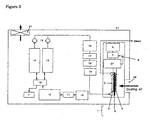
- FIG. 3 shows the third concrete embodiment of the oxygen-concentrating equipment of the present invention.
- a humidification means 9 is placed at an arbitrary place in the housing 21 of the oxygen-concentrating equipment, and the anode side of a solid polymer electrolysis element 1 is opened in said housing. Since the inside of the housing is always ventilated to cool the inside, the dehumidified air is not stayed in the neighborhood of the anode. Since not limiting the position of the humidification means disposed in the housing, this method is effective in the case of simple humidification. But, it is preferable to dispose the humidification means at an air flow-rich place in the housing, because the humidification capacity of the humidification means is improved with the increase of ventilation at a place near to the anode.
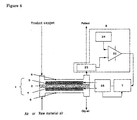
- FIG. 4 shows the first concrete embodiment of a method for controlling an oxygen-humidification degree in the oxygen-concentrating equipment of the present invention.
- the product oxygen is supplied to a patient via the cathode side flow path 5 of a solid polymer electrolysis element 1 and a pipe.
- An electric current flowing from the anode 4 of the solid polymer electrolysis element 1 to the cathode 3 is supplied from an electric source, and the current value is controlled by a humidification control means.
- the humidification control means comprises a humidity sensor 23 disposed on the downstream side of the cathode side flow path 5, a humidity-setting dial 24 and an electric current control means 22.
- the actions of the electric current control means comprises comparing a signal from the humidity sensor 23 with the signal of a set humidity set with the humidity-setting dial 24 and then increasing an electric current flowing in the solid polymer electrolysis element 1, when the humidity value measured with the sensor is lower than the set humidity value, or adversely decreasing the electric current flowing in said element, when the measured humidity value is higher than the set humidity value. Consequently, this electric current control means automatically controls the electric current value so that the optimal electric current for humidifying the product oxygen to the set humidity flows in the element.
- FIG. 5 shows the second concrete embodiment of the method for controlling the oxygen-humidification degree in the oxygen-concentrating equipment of the present invention.
- a humidification degree control means 8 comprises a humidity-setting dial 24, an electric current control means 22, a flow rate sensor 25 for measuring the flow rate of the product oxygen, and a temperature sensor 26 for measuring the temperature of the product oxygen.
- the product oxygen is flowed in the cathode side flow path 5 of the solid polymer electrolysis element 1 via the flow rate sensor 25 and the temperature sensor 26.
- the electric current control means 22 calculates the necessary magnitude of an electric current from the signals of the flow rate sensor 25 and the temperature sensor 26 and then controls the value of electric current flowing in the solid polymer electrolysis element 1.
- Figure 7 shows the deterioration characteristics of the solid polymer electrolysis element 1, when used for a long period.
- the axis of ordinate is the rate of water which really passes through the solid polymer electrolysis element and humidifies the oxygen. It can be understood that the deterioration of the solid polymer electrolysis element 1 is accelerated with the enhancement in the value of the applied voltage. In order to prevent the deterioration of the solid polymer electrolysis element, it is thereby preferable to control the voltage at 4V or below.
- the life of the solid polymer electrolysis element 1 can be elongated by considering a voltage for initiating the electrolysis of water, setting the upper limit of the voltage within a range of 0 to 4V, preferably 2 to 3V, and by feeding back the voltage to the electric current source 7 via a voltage upper limit value-controlling means.
- the life of the solid polymer electrolysis element 1 can also be elongated by setting the upper limit of the electric current value to 0 to 8A, preferably 2 to 6A, and by feeding back the electric current value to the electric current source 7 through an electric current upper limit-controlling means 27, since the resistance value of the solid electrolyte membrane is 0.5 to 1 ⁇ at 23°C and 50 %RH which are the normal temperature environment.
- the oxygen-concentrating equipment in the present invention can provide the equipment installed with the humidifying means which does not need periodic maintenance such as the supply of water, continuously gives a sufficient humidification degree, and can be set freely and easily with the humidification degree, especially the maintenance-free equipment not needing the maintenance of the humidifier by a patient of respiratory disease during the employment of the equipment.
- the oxygen-concentrating equipment in the present invention can also provide the equipment which is friendly for the patient, for example, with which the influence on the humidification degree by the employment environment on the humidification degree can be controlled with the employed electric current, its voltage or the like.
Landscapes
- Health & Medical Sciences (AREA)
- Engineering & Computer Science (AREA)
- Chemical & Material Sciences (AREA)
- Emergency Medicine (AREA)
- General Health & Medical Sciences (AREA)
- Life Sciences & Earth Sciences (AREA)
- Veterinary Medicine (AREA)
- Public Health (AREA)
- Pulmonology (AREA)
- Anesthesiology (AREA)
- Biomedical Technology (AREA)
- Heart & Thoracic Surgery (AREA)
- Hematology (AREA)
- Animal Behavior & Ethology (AREA)
- Chemical Kinetics & Catalysis (AREA)
- Analytical Chemistry (AREA)
- General Chemical & Material Sciences (AREA)
- Oil, Petroleum & Natural Gas (AREA)
- Separation Using Semi-Permeable Membranes (AREA)
- Electrolytic Production Of Non-Metals, Compounds, Apparatuses Therefor (AREA)
- Oxygen, Ozone, And Oxides In General (AREA)
Abstract
Description
on the side of the anode :
- 1.
- Solid polymer electrolysis element
- 2.
- Solid polymer electrolysis membrane
- 3.
- Cathode
- 4.
- Anode
- 5.
- Flow path on the cathode side
- 6.
- Flow path on the anode side
- 7.
- Direct electric current source
- 8.
- Humidification degree control means
- 9.
- Humidification means (humidification-dehumidification means)
- 10.
- Inspiration filter
- 11.
- Silencer
- 12.
- Compressor
- 13.
- Switch valve
- 14.
- Adsorption cylinder
- 15.
- Check valve (back-flow inhibition valve)
- 16.
- Product tank
- 17.
- Pressure control valve
- 18.
- Flow rate setter
- 19.
- Product filter
- 20.
- Silencer
- 21.
- Housing of the oxygen-concentrating equipment
- 22.
- Electric current control means
- 23.
- Humidity sensor
- 24.
- Dial for setting the humidification degree
- 25.
- Flow rate sensor
- 26.
- Temperature sensor
- 27.
- Means for controlling the upper limit of the electric current
- 28.
- Means for controlling the upper limit of the voltage
Claims (9)
- An oxygen-concentrating equipment comprising an oxygen-concentrating means for separating oxygen from air to concentrate the oxygen, a humidifying means for humidifying the oxygen-concentrated air produced by said oxygen-concentrating means, and an oxygen-supplying means for supplying the humidified oxygen-concentrated air to a user, characterized in that said humidifying means has at least a cation-conducting solid electrolyte membrane equipped with electrodes on both the sides of the membrane and an electric source for applying an electric current to said electrodes.
- The oxygen-concentrating equipment according to Claim 1, characterized in that said humidifying means is a means which has, on the anode side, a catalyst layer for electrolyzing water molecule into oxygen molecule and hydrogen ion and has, on the cathode side, a catalyst layer for producing water molecule from the oxygen molecule and the hydrogen ion.
- The oxygen-concentrating equipment according to Claim 2, characterized in that said oxygen-concentrating means is a pressure swing adsorption type oxygen-concentrating means which has an adsorption cylinder filled with an adsorbent adsorbing nitrogen more selectively than oxygen and a compressor for supplying compressed air to said adsorption cylinder, and said humidifying means has a flow path to flow raw material air, to be supplied to said compressor, on an anode side and a flow path to flow the oxygen-concentrated air; produced by said oxygen-concentrating means, on a cathode side.
- The oxygen-concentrating equipment according to Claim 2, characterized in that said oxygen-concentrating means is a pressure swing adsorption type oxygen-concentrating means which has an adsorption cylinder filled with an adsorbent adsorbing nitrogen more selectively than oxygen and a compressor for supplying compressed air to said adsorption cylinder, and said humidifying means has a flow path to flow cooling air on an anode for cooling the inside of said oxygen-concentrating equipment and a flow path to flow the oxygen-concentrated air, produced by said oxygen-concentrating means, on a cathode side for allowing.
- The oxygen-concentrating equipment according to Claim 2, characterized in that said oxygen-concentrating means is a pressure swing adsorption type oxygen-concentrating means which has an adsorption cylinder filled with an adsorbent adsorbing nitrogen more selectively than oxygen and a compressor for supplying compressed air to said adsorption cylinder, and said humidifying means has a flow path to flow the air desorbed from the adsorption cylinder on an anode side and a flow path to flow the oxygen-concentrated air, produced by said oxygen-concentrating means, on a cathode side.
- The oxygen-concentrating equipment according to Claims 1 to 5, characterized in that a control means, for controlling the electric current value and / or voltage value of an electric current applied from said electric source to said electrodes, is installed.
- The oxygen-concentrating equipment according to Claims 1 to 6, characterized in that a control means, for controlling the electric current value and/or voltage value of an electric current applied from said electric source to said electrodes so that the electric current value and/or voltage value do not exceed constant values or more, is installed.
- The oxygen-concentrating equipment according to Claims 6 to 7, characterized in that a humidity-measuring means, on the cathode side of said humidifying means or in the downstream on the cathode side of said humidifying means, is installed and a control means, for controlling said measuring means so that the measurement value of said humidity-measuring means is equal to a set value, is installed.
- The oxygen-concentrating equipment according to Claims 6 to 8, characterized in that a control means, for calculating the transfer rate of water on the basis of the flow rate value and temperature value of the oxygen-concentrated air flowing on the cathode side of said humidifying means and then controlling said control means, is installed.
Applications Claiming Priority (3)
| Application Number | Priority Date | Filing Date | Title |
|---|---|---|---|
| JP2000116348 | 2000-04-18 | ||
| JP2000116348 | 2000-04-18 | ||
| PCT/JP2001/003207 WO2001078820A1 (en) | 2000-04-18 | 2001-04-13 | Oxygen concentrating apparatus |
Publications (2)
| Publication Number | Publication Date |
|---|---|
| EP1275411A1 true EP1275411A1 (en) | 2003-01-15 |
| EP1275411A4 EP1275411A4 (en) | 2006-04-05 |
Family
ID=18627820
Family Applications (1)
| Application Number | Title | Priority Date | Filing Date |
|---|---|---|---|
| EP01921838A Withdrawn EP1275411A4 (en) | 2000-04-18 | 2001-04-13 | Oxygen concentrating apparatus |
Country Status (5)
| Country | Link |
|---|---|
| US (1) | US6695956B2 (en) |
| EP (1) | EP1275411A4 (en) |
| AU (1) | AU780798B2 (en) |
| CA (1) | CA2376873A1 (en) |
| WO (1) | WO2001078820A1 (en) |
Families Citing this family (6)
| Publication number | Priority date | Publication date | Assignee | Title |
|---|---|---|---|---|
| EP1325130B1 (en) | 2000-10-06 | 2010-02-24 | Yale University | Nogo receptor homologs |
| US7431818B2 (en) * | 2004-03-26 | 2008-10-07 | United Technologies Corporation | Electrochemical fuel deoxygenation system |
| US8617672B2 (en) * | 2005-07-13 | 2013-12-31 | Applied Materials, Inc. | Localized surface annealing of components for substrate processing chambers |
| JP5499265B1 (en) * | 2013-08-01 | 2014-05-21 | ブレステクノロジー株式会社 | Oxygen concentrator |
| EP4132621A4 (en) * | 2020-04-06 | 2024-04-24 | Resmed Asia Pte. Ltd. | Oxygen concentrator with moisture management |
| US20240181387A1 (en) * | 2021-06-16 | 2024-06-06 | Skyre, Inc. | Oxygen concentration module |
Family Cites Families (17)
| Publication number | Priority date | Publication date | Assignee | Title |
|---|---|---|---|---|
| AU483086B2 (en) * | 1973-11-12 | 1976-04-29 | Telectronics Pty. Limited | Humidifier |
| JPS63287527A (en) * | 1987-05-19 | 1988-11-24 | Mitsubishi Electric Corp | Humidity regulator |
| US6544404B1 (en) * | 1987-03-13 | 2003-04-08 | Bp Corporation North America Inc. | Oxygen separation process |
| JPS6415068A (en) * | 1987-07-08 | 1989-01-19 | Tadayoshi Noda | Fire extinguishing apparatus of kitchen |
| JPH02299113A (en) | 1989-05-12 | 1990-12-11 | Mitsubishi Electric Corp | Breaker for gas insulation opening/closing device |
| US5053116A (en) * | 1989-11-17 | 1991-10-01 | Modern Controls, Inc. | Device for humidifying gases without changing oxygen content |
| JP3173818B2 (en) | 1991-08-22 | 2001-06-04 | 山陽電子工業株式会社 | Medical PSA oxygen concentrator |
| US5302270A (en) * | 1992-03-12 | 1994-04-12 | Mitsubishi Denki Kabushiki Kaisha | Oxygen concentration or humidity controlling apparatus |
| JP3219610B2 (en) * | 1993-10-05 | 2001-10-15 | 三菱電機株式会社 | Electrochemical element |
| JPH08196635A (en) * | 1994-11-22 | 1996-08-06 | Sumitomo Bakelite Co Ltd | Oxygen supply device for respiration |
| JPH08317983A (en) * | 1995-03-17 | 1996-12-03 | Teijin Ltd | Breathing gas supply device |
| JPH08266631A (en) * | 1995-03-31 | 1996-10-15 | Asahi Glass Co Ltd | Respiratory gas humidifier |
| US5879826A (en) * | 1995-07-05 | 1999-03-09 | Humboldt State University Foundation | Proton exchange membrane fuel cell |
| JP3295306B2 (en) * | 1996-07-05 | 2002-06-24 | 帝人株式会社 | Respiratory gas supply device |
| JP4624500B2 (en) | 1997-02-04 | 2011-02-02 | 株式会社Gsユアサ | Non-aqueous electrolyte battery |
| JPH11300159A (en) * | 1998-04-24 | 1999-11-02 | Toshiba Corp | Dioxin processing equipment |
| JPH11354140A (en) * | 1998-06-10 | 1999-12-24 | Toyota Central Res & Dev Lab Inc | High strength thin film electrolyte |
-
2001
- 2001-04-13 CA CA002376873A patent/CA2376873A1/en not_active Abandoned
- 2001-04-13 US US10/009,814 patent/US6695956B2/en not_active Expired - Fee Related
- 2001-04-13 WO PCT/JP2001/003207 patent/WO2001078820A1/en not_active Ceased
- 2001-04-13 EP EP01921838A patent/EP1275411A4/en not_active Withdrawn
- 2001-04-13 AU AU48763/01A patent/AU780798B2/en not_active Ceased
Also Published As
| Publication number | Publication date |
|---|---|
| EP1275411A4 (en) | 2006-04-05 |
| US20030012704A1 (en) | 2003-01-16 |
| AU780798B2 (en) | 2005-04-21 |
| CA2376873A1 (en) | 2001-10-25 |
| US6695956B2 (en) | 2004-02-24 |
| WO2001078820A1 (en) | 2001-10-25 |
| AU4876301A (en) | 2001-10-30 |
Similar Documents
| Publication | Publication Date | Title |
|---|---|---|
| US8377180B2 (en) | Oxygen concentrator | |
| JP5571697B2 (en) | Oxygen concentrator | |
| CN102665812B (en) | oxygen concentrating device | |
| WO2004054648A1 (en) | Oxygen supply apparatus | |
| US6695956B2 (en) | Oxygen concentrating apparatus | |
| JP2671436B2 (en) | Method for producing medical oxygen-enriched air | |
| JP4616726B2 (en) | Oxygen concentrator | |
| JP2001000553A (en) | Oxygen therapy oxygen concentrator | |
| JP3173818B2 (en) | Medical PSA oxygen concentrator | |
| JP4594581B2 (en) | Humidifier | |
| JP2006087684A (en) | Gas supplier for respiration | |
| JP2023144547A (en) | Humidifiers and oxygen concentrators | |
| JP4922739B2 (en) | Oxygen concentrator | |
| JPWO2001078820A1 (en) | Oxygen concentrator | |
| JP5350994B2 (en) | Oxygen concentrator | |
| JP2000135287A (en) | Oxygen therapy oxygen concentrator | |
| JP2000239004A (en) | Pressure fluctuation adsorption type oxygen concentrator | |
| JP2003180838A (en) | Medical oxygen concentrator | |
| JP3790380B2 (en) | Medical oxygen concentrator | |
| JP2003144551A (en) | Medical oxygen gas supply device | |
| JP2002113105A (en) | Oxygen concentrator | |
| JP2004020121A (en) | Humidifier | |
| JP2007282652A (en) | Oxygen thickener and its oxygen concentration method | |
| JP2001220110A (en) | Medical oxygen generator | |
| JP2004008620A (en) | Humidifier |
Legal Events
| Date | Code | Title | Description |
|---|---|---|---|
| PUAI | Public reference made under article 153(3) epc to a published international application that has entered the european phase |
Free format text: ORIGINAL CODE: 0009012 |
|
| 17P | Request for examination filed |
Effective date: 20020115 |
|
| AK | Designated contracting states |
Kind code of ref document: A1 Designated state(s): AT BE CH CY DE DK ES FI FR GB GR IE IT LI LU MC NL PT SE TR |
|
| AX | Request for extension of the european patent |
Free format text: AL;LT;LV;MK;RO;SI |
|
| RBV | Designated contracting states (corrected) |
Designated state(s): DE FR GB |
|
| A4 | Supplementary search report drawn up and despatched |
Effective date: 20060221 |
|
| RIC1 | Information provided on ipc code assigned before grant |
Ipc: B01D 53/32 20060101ALI20060215BHEP Ipc: A61M 16/10 20060101AFI20011101BHEP |
|
| 17Q | First examination report despatched |
Effective date: 20070530 |
|
| STAA | Information on the status of an ep patent application or granted ep patent |
Free format text: STATUS: THE APPLICATION IS DEEMED TO BE WITHDRAWN |
|
| 18D | Application deemed to be withdrawn |
Effective date: 20091103 |