EP1273707A2 - Method for the deacidification of paper products - Google Patents
Method for the deacidification of paper products Download PDFInfo
- Publication number
- EP1273707A2 EP1273707A2 EP02014697A EP02014697A EP1273707A2 EP 1273707 A2 EP1273707 A2 EP 1273707A2 EP 02014697 A EP02014697 A EP 02014697A EP 02014697 A EP02014697 A EP 02014697A EP 1273707 A2 EP1273707 A2 EP 1273707A2
- Authority
- EP
- European Patent Office
- Prior art keywords
- paper
- deacidification
- diazo derivative
- treated
- formula
- Prior art date
- Legal status (The legal status is an assumption and is not a legal conclusion. Google has not performed a legal analysis and makes no representation as to the accuracy of the status listed.)
- Withdrawn
Links
Images

Classifications
-
- D—TEXTILES; PAPER
- D21—PAPER-MAKING; PRODUCTION OF CELLULOSE
- D21H—PULP COMPOSITIONS; PREPARATION THEREOF NOT COVERED BY SUBCLASSES D21C OR D21D; IMPREGNATING OR COATING OF PAPER; TREATMENT OF FINISHED PAPER NOT COVERED BY CLASS B31 OR SUBCLASS D21G; PAPER NOT OTHERWISE PROVIDED FOR
- D21H25/00—After-treatment of paper not provided for in groups D21H17/00 - D21H23/00
- D21H25/18—After-treatment of paper not provided for in groups D21H17/00 - D21H23/00 of old paper as in books, documents, e.g. restoring
Definitions
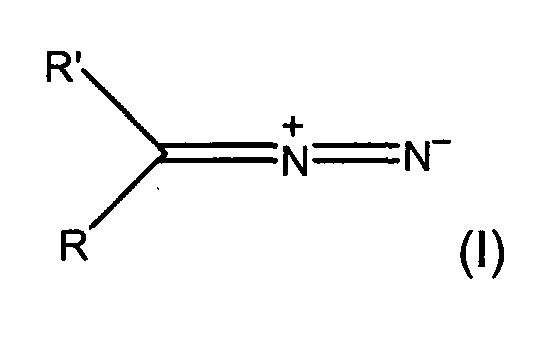
- the present invention concerns a new method for the preservation of paper products which comprises the deacidification of the paper material with the diazo derivatives of general formula (I) hereafter reported.
- the Applicant has found a new method for the preservation of paper products, comprising deacidification of paper by using as deacidifying agent with at least one compound of general formula (I) hereafter reported.
- the method according to the present invention may be applied to any type of paper and has the following advantages:
- R' is chosen from H and methyl
- the present method comprises the following steps:
- the pH of the material can be measured using the surface measurement method ( TAPPI T 529 om-99 method).
- TAPPI T 509 om-96 method cold extraction method
- TAPPI T 435 om-96 method hot extraction method
- the deacidification step B) of the present method is preferably carried out by completely immersing the paper sample in a special glass container, varying in size according to the amount of material to be treated, and which contains an ethereal solution of the compound of formula (I), freshly prepared and kept in the dark until that moment at a temperature of ⁇ -18°C.
- the ratio between the sample weight and the solution volume is about 10 g / 200 ml, with a concentration of the compound of formula (I) that ranges between 0.1 and 0.5 M, depending on the state of the paper to be treated (more concentrated for highly oxidised and acid paper and less concentrated for slightly deteriorated papers).
- the container is then closed though not sealed, to avoid a dangerous increase in pressure inside it, and should be preferably kept at 4°C for a period of 24 to 96 hours (depending on the state of the original material). After this time, the system should be returned to room temperature and the paper is extracted.
- the preferred deacidifying agent according to the invention is 2-(1-piperidine)diazoethane, i.e. the formula (I) compound in which R is H, R 1 and R 2 , taken together, form with N a piperidine ring, and n is 1.
- the diazo derivatives of formula (I) used in the deacidification method of the invention can be prepared by the process that is the subject of the co-pending patent application in the name of the Applicant.
- the deacidifying agent of formula (I) is applied as steam, by creating a specific chamber in which a propelled vacuum is applied, that is able to create a saturated atmosphere in a short time.
- step C) of the present method the removal of the washing solvent is preferably carried out by drying the paper washed material under strong aspiration at room temperature on a glass surface for about 6 hours.
- the removal of the solvent can be speeded up via the application of a pressure that is lower than atmospheric pressure (vacuum).
- the preferred washing solvent to be used is diethyl ether.
- Paper treated in this way can then undergo a conditioning step D), for example via storage for 1 week in a insulated container (T 23°C, 50% R.H.) in order to restore the normal content of water in the paper.
- a conditioning step D for example via storage for 1 week in a insulated container (T 23°C, 50% R.H.) in order to restore the normal content of water in the paper.
- Figure 1 shows the pH trend before treatment (dotted line) and after treatment (continuous line).
Landscapes
- Paper (AREA)
Abstract
Description
- unlike most of the known methods, no preliminary dehydration phase for the samples to be treated, with a consequent reduction in costs for a possible industrial process;
- after treatment, the pH values remain over 8.5-9.0 in all samples. Even in the case of badly deteriorated papers, that have an initial pH of 2-3 units, the present method guarantees a suitable neutralisation;
- homogeneous distribution of the deacidifying agent over all the sample, assisted by the high impregnation capacity of the solvent;
- the solvent is easy to remove as it has a low boiling point and low evaporation heat, with consequent reduction in costs for a possible industrial process ;
- protection, as a result of the present method, from atmospheric acid pollutants (SO2 and NO2) ;
- long-term protection effect;
- the organic solvent used cannot dissolve any water-soluble substances (colorants, pigments, inks, etc).

| sample | pH before treatment | pH after 1 day | pH after 1 month | pH after 2 months | pH after 3 months |
| 1 - NalO4 | 4.5 | 9.0 | 8.8 | 9.0 | 8.9 |
| 1 - NaOCI | 5.0 | 8.5 | 8.7 | 8.5 | 8.5 |
| 1 - HClO2 | 3.5 | 9.5 | 9.3 | 9.2 | 9.0 |
| 1 - H2SO4 | 3.0 | 9.2 | 9.3 | 8.9 | 9.1 |
| 2 | 5.2 | 9.4 | 9.2 | 9.3 | 9.0 |
| 3 | 4.2 | 10.3 | 10.0 | 9.7 | 9.4 |
Claims (11)
- Method for the deacidification of paper comprising a deacidification step wherein at least one diazo derivative of general formula (I) is used as deacidifying agentwherein R' is chosen from H and methyl, and R is the group
 where n = 1, 2, 3, 4, 5 ; and R1 and R2, equal to one another, are chosen from methyl and ethyl, or R1 and R2, taken together, form with N a piperidine ring or a 4-morpholine ring.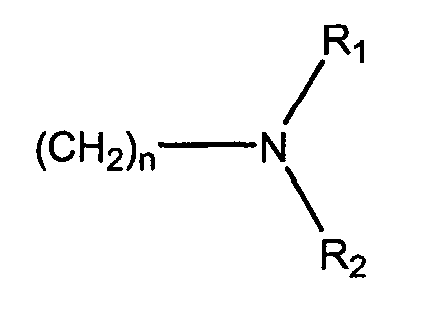
- The method according to claim 1, comprising the following steps:A) pre-treatment step, comprising a preliminary and rough removal of any dust or foreign matter from the surface of the paper sheet, by means of compressed air jets;B) deacidification step wherein at least one diazo derivative of general formula (I) as defined in claim 1, is used as deacidifying agent;C) washing step, possibly repeated, of the paper coming from step B), and removal of the washing solvent;D) possible conditioning step.
- The method according to claim 2, wherein the said deacidification step B) is carried out by complete immersion of the paper to be treated in a container containing an ethereal solution of the diazo derivative of formula (I) as described in claim 1.
- The method according to claim 3, wherein the ratio between the weight of the paper to be treated and the volume of the said ethereal solution is about 10 g/ 200 ml, and the concentration of the diazo derivative (I) in the ethereal solution ranges between 0.1 and 0.5 M.
- The method according to claim 3, wherein the paper to be treated is maintained at a temperature of 4°C for a period of time from 24 to 96 hours, and then returned to room temperature before extracting the paper.
- The method according to claim 2, wherein said deacidification step B) is carried out by the application of the diazo derivative of formula (I) as steam onto the paper to be treated, placed inside a vacuum chamber.
- The method according to claim 2, wherein the said washing solvent in step C) is diethyl ether.
- The method according to claim 2, wherein the said removal of the washing solvent is carried out by drying the samples under aspiration at room temperature for 6 hours.
- The method according to claim 2, wherein said conditioning step D) is carried out by storing the paper coming from step C) for 1 week in an insulated container (T 23°C, 50% R.H.).
- The method according to claims 1-9, wherein the said diazo derivative is the compound of formula (I) in which R' is H, n is 1, and R1 and R2, taken together, form with N a piperidine ring.
- Paper deacidificated according to a method comprising a deacidification step wherein at least one diazo derivative of general formula (I) as described in claims 1-10, is used as deacidifying agent.
Applications Claiming Priority (2)
| Application Number | Priority Date | Filing Date | Title |
|---|---|---|---|
| ITMI20011413 | 2001-07-04 | ||
| IT2001MI001413A ITMI20011413A1 (en) | 2001-07-04 | 2001-07-04 | METHOD OF CONSERVATIVE TREATMENT OF PAPER MATERIAL |
Publications (2)
| Publication Number | Publication Date |
|---|---|
| EP1273707A2 true EP1273707A2 (en) | 2003-01-08 |
| EP1273707A3 EP1273707A3 (en) | 2004-10-13 |
Family
ID=11447993
Family Applications (1)
| Application Number | Title | Priority Date | Filing Date |
|---|---|---|---|
| EP02014697A Withdrawn EP1273707A3 (en) | 2001-07-04 | 2002-07-03 | Method for the deacidification of paper products |
Country Status (4)
| Country | Link |
|---|---|
| US (1) | US20030059337A1 (en) |
| EP (1) | EP1273707A3 (en) |
| CA (1) | CA2392553A1 (en) |
| IT (1) | ITMI20011413A1 (en) |
Cited By (2)
| Publication number | Priority date | Publication date | Assignee | Title |
|---|---|---|---|---|
| EP1273568A3 (en) * | 2001-07-04 | 2003-08-06 | Consiglio Nazionale Delle Ricerche | Novel diazo derivatives and process for their preparation |
| RU2472891C1 (en) * | 2011-06-15 | 2013-01-20 | Учреждение Российской академии наук Институт высокомолекулярных соединений РАН | Method to restore missing parts of paper sheets |
Families Citing this family (1)
| Publication number | Priority date | Publication date | Assignee | Title |
|---|---|---|---|---|
| CN115787350B (en) * | 2022-11-04 | 2024-05-31 | 国家图书馆 | Fluorine-containing deacidification liquid for paper |
Family Cites Families (13)
| Publication number | Priority date | Publication date | Assignee | Title |
|---|---|---|---|---|
| GB1129648A (en) * | 1965-08-27 | 1968-10-09 | William Herbert Langwell | Prevention of deterioration of documents, books, maps and like records |
| US3676182A (en) * | 1970-08-31 | 1972-07-11 | Richard Daniel Smith | Treatment of cellulosic materials |
| US3771958A (en) * | 1971-12-30 | 1973-11-13 | Research Corp | Gaseous diffusion paper deacidification |
| US3837804A (en) * | 1973-08-15 | 1974-09-24 | Council On Library Res Inc | Process for deacidifying a book which has a pyroxylin-containing cover |
| US3939091A (en) * | 1975-02-14 | 1976-02-17 | The United States Of America As Represented By The Librarian Of Congress | Composition for use in deacidification of paper |
| GB2208397B (en) * | 1987-08-04 | 1991-05-29 | Hillary Mervyn Sharpe | Vapour phase deacidification of cellulosic fibre webs |
| NL9201387A (en) * | 1992-07-01 | 1994-02-01 | Cornelis Jan Stadig | Method and device for preserving paper documents and books |
| US5433827A (en) * | 1993-12-21 | 1995-07-18 | Pulp And Paper Research Institute Of Canada | Method for the deacidification of papers and books |
| US5537760A (en) * | 1994-11-22 | 1996-07-23 | The United States Of America As Represented By The Librarian Of Congress | System of low-temperature low-humidity preservation storage and accelerated retrieval of books and other papers |
| WO1997029097A1 (en) * | 1996-02-09 | 1997-08-14 | Smithkline Beecham Plc | Sulfonamide derivatives as 5ht7 receptor antagonists |
| WO2000006307A1 (en) * | 1998-07-30 | 2000-02-10 | Aktsionernoe Obschestvo Zakritogo Tipa | Method for preserving porous materials |
| US6214165B1 (en) * | 1999-07-13 | 2001-04-10 | Joseph Zicherman | Method for deacidification of papers and books by fluidizing a bed of dry alkaline particles |
| ITMI20011412A1 (en) * | 2001-07-04 | 2003-01-04 | Consiglio Nazionale Ricerche | NEW DIAZODERIVATI AND PROCESS FOR THEIR PREPARATION |
-
2001
- 2001-07-04 IT IT2001MI001413A patent/ITMI20011413A1/en unknown
-
2002
- 2002-07-03 US US10/189,694 patent/US20030059337A1/en not_active Abandoned
- 2002-07-03 EP EP02014697A patent/EP1273707A3/en not_active Withdrawn
- 2002-07-04 CA CA002392553A patent/CA2392553A1/en not_active Abandoned
Cited By (3)
| Publication number | Priority date | Publication date | Assignee | Title |
|---|---|---|---|---|
| EP1273568A3 (en) * | 2001-07-04 | 2003-08-06 | Consiglio Nazionale Delle Ricerche | Novel diazo derivatives and process for their preparation |
| US6740741B2 (en) | 2001-07-04 | 2004-05-25 | Consiglio Nazionale Delle Ricerche | Diazo derivatives and process for their preparation |
| RU2472891C1 (en) * | 2011-06-15 | 2013-01-20 | Учреждение Российской академии наук Институт высокомолекулярных соединений РАН | Method to restore missing parts of paper sheets |
Also Published As
| Publication number | Publication date |
|---|---|
| US20030059337A1 (en) | 2003-03-27 |
| CA2392553A1 (en) | 2003-01-04 |
| ITMI20011413A0 (en) | 2001-07-04 |
| ITMI20011413A1 (en) | 2003-01-04 |
| EP1273707A3 (en) | 2004-10-13 |
Similar Documents
| Publication | Publication Date | Title |
|---|---|---|
| Curling et al. | Experimental method to quantify progressive stages of decay of wood by basidiomycete fungi | |
| US4522843A (en) | Deacidification of library materials | |
| US3898356A (en) | Method of deacidifying paper | |
| US20030059337A1 (en) | Method for the preservation of paper products | |
| US3771958A (en) | Gaseous diffusion paper deacidification | |
| DE3166236D1 (en) | Process for the preservation of flatbed printing formes in their developed state for printing | |
| Van Zyl | Notes on the spectrophotometric determination of lignin in wood samples | |
| Minogue | The repair and preservation of records | |
| US6020027A (en) | Method of conserving waterlogged materials | |
| Jenssen | Conservation of wet organic artefacts excluding wood | |
| EP0377817A1 (en) | Process for the impregnation of wood | |
| US3837804A (en) | Process for deacidifying a book which has a pyroxylin-containing cover | |
| AU706860B2 (en) | Cleaning composition | |
| Strzelczyk et al. | Biodeterioration of archeological leather | |
| Müller-Beck et al. | A method for wood preservation using Arigal C | |
| Searle | 20—THE ROTTING OF TEXTILES BY MICRO-ORGANISMS. 1—A LABORATORY TEST | |
| Payton | The conservation of an eighth century BC table from Gordion | |
| Hackney et al. | The applicability of alkaline reserves to painting canvases | |
| Berovič | Biodeterioration studies on pastels and oil-based paintings | |
| Chahine et al. | Artificial Ageing | |
| Szczepanowska et al. | Fungal stains on paper—their removal and prevention | |
| US2715571A (en) | Process of developing fingerprints | |
| Curling et al. | Experimental method to quantify progressive stages of decay | |
| Wheatley | Investigations into the ecology of biofilms in waste treatment using scanning electron microscopy | |
| RU2672138C1 (en) | Method of increasing shell life expiration of books based on paper materials |
Legal Events
| Date | Code | Title | Description |
|---|---|---|---|
| PUAI | Public reference made under article 153(3) epc to a published international application that has entered the european phase |
Free format text: ORIGINAL CODE: 0009012 |
|
| AK | Designated contracting states |
Kind code of ref document: A2 Designated state(s): AT BE BG CH CY CZ DE DK EE ES FI FR GB GR IE IT LI LU MC NL PT SE SK TR |
|
| AX | Request for extension of the european patent |
Free format text: AL;LT;LV;MK;RO;SI |
|
| RIN1 | Information on inventor provided before grant (corrected) |
Inventor name: VERARDO, GIANCARLO Inventor name: GIUMANINI, ANGELO Inventor name: GORASSINI, ANDREA Inventor name: ZAPPALA, ANTONIO |
|
| PUAL | Search report despatched |
Free format text: ORIGINAL CODE: 0009013 |
|
| AK | Designated contracting states |
Kind code of ref document: A3 Designated state(s): AT BE BG CH CY CZ DE DK EE ES FI FR GB GR IE IT LI LU MC NL PT SE SK TR |
|
| AX | Request for extension of the european patent |
Extension state: AL LT LV MK RO SI |
|
| AKX | Designation fees paid | ||
| REG | Reference to a national code |
Ref country code: DE Ref legal event code: 8566 |
|
| STAA | Information on the status of an ep patent application or granted ep patent |
Free format text: STATUS: THE APPLICATION IS DEEMED TO BE WITHDRAWN |
|
| 18D | Application deemed to be withdrawn |
Effective date: 20050414 |