EP1271233A1 - A speed addendum for photographic emulsions - Google Patents
A speed addendum for photographic emulsions Download PDFInfo
- Publication number
- EP1271233A1 EP1271233A1 EP02077241A EP02077241A EP1271233A1 EP 1271233 A1 EP1271233 A1 EP 1271233A1 EP 02077241 A EP02077241 A EP 02077241A EP 02077241 A EP02077241 A EP 02077241A EP 1271233 A1 EP1271233 A1 EP 1271233A1
- Authority
- EP
- European Patent Office
- Prior art keywords
- emulsion
- grains
- sample
- formate
- silver
- Prior art date
- Legal status (The legal status is an assumption and is not a legal conclusion. Google has not performed a legal analysis and makes no representation as to the accuracy of the status listed.)
- Withdrawn
Links
- 239000000839 emulsion Substances 0.000 title claims abstract description 91
- BDAGIHXWWSANSR-UHFFFAOYSA-M Formate Chemical compound [O-]C=O BDAGIHXWWSANSR-UHFFFAOYSA-M 0.000 claims abstract description 26
- 229910052709 silver Inorganic materials 0.000 claims abstract description 19
- 239000004332 silver Substances 0.000 claims abstract description 19
- -1 silver halide Chemical class 0.000 claims abstract description 17
- SQGYOTSLMSWVJD-UHFFFAOYSA-N silver(1+) nitrate Chemical compound [Ag+].[O-]N(=O)=O SQGYOTSLMSWVJD-UHFFFAOYSA-N 0.000 claims description 34
- 238000000034 method Methods 0.000 claims description 18
- 229910001961 silver nitrate Inorganic materials 0.000 claims description 17
- 239000004280 Sodium formate Substances 0.000 claims description 8
- HLBBKKJFGFRGMU-UHFFFAOYSA-M sodium formate Chemical compound [Na+].[O-]C=O HLBBKKJFGFRGMU-UHFFFAOYSA-M 0.000 claims description 8
- 235000019254 sodium formate Nutrition 0.000 claims description 8
- CPELXLSAUQHCOX-UHFFFAOYSA-M Bromide Chemical compound [Br-] CPELXLSAUQHCOX-UHFFFAOYSA-M 0.000 claims description 7
- 230000001235 sensitizing effect Effects 0.000 claims description 7
- ADZWSOLPGZMUMY-UHFFFAOYSA-M silver bromide Chemical compound [Ag]Br ADZWSOLPGZMUMY-UHFFFAOYSA-M 0.000 claims description 4
- NINIDFKCEFEMDL-UHFFFAOYSA-N Sulfur Chemical compound [S] NINIDFKCEFEMDL-UHFFFAOYSA-N 0.000 claims description 3
- 229910052717 sulfur Inorganic materials 0.000 claims description 3
- 239000011593 sulfur Substances 0.000 claims description 3
- PCHJSUWPFVWCPO-UHFFFAOYSA-N gold Chemical compound [Au] PCHJSUWPFVWCPO-UHFFFAOYSA-N 0.000 claims description 2
- 229910052737 gold Inorganic materials 0.000 claims description 2
- 239000010931 gold Substances 0.000 claims description 2
- ZUNKMNLKJXRCDM-UHFFFAOYSA-N silver bromoiodide Chemical compound [Ag].IBr ZUNKMNLKJXRCDM-UHFFFAOYSA-N 0.000 claims description 2
- 239000001045 blue dye Substances 0.000 claims 1
- JHJLBTNAGRQEKS-UHFFFAOYSA-M sodium bromide Chemical compound [Na+].[Br-] JHJLBTNAGRQEKS-UHFFFAOYSA-M 0.000 description 14
- 206010070834 Sensitisation Diseases 0.000 description 13
- 230000008313 sensitization Effects 0.000 description 13
- 239000000975 dye Substances 0.000 description 12
- 239000000126 substance Substances 0.000 description 11
- 230000003595 spectral effect Effects 0.000 description 10
- 108010010803 Gelatin Proteins 0.000 description 9
- 239000008273 gelatin Substances 0.000 description 9
- 229920000159 gelatin Polymers 0.000 description 9
- 235000019322 gelatine Nutrition 0.000 description 9
- 235000011852 gelatine desserts Nutrition 0.000 description 9
- 239000010410 layer Substances 0.000 description 9
- 238000011160 research Methods 0.000 description 9
- 230000000694 effects Effects 0.000 description 8
- MUBZPKHOEPUJKR-UHFFFAOYSA-N Oxalic acid Chemical compound OC(=O)C(O)=O MUBZPKHOEPUJKR-UHFFFAOYSA-N 0.000 description 7
- 229940039748 oxalate Drugs 0.000 description 7
- FOIXSVOLVBLSDH-UHFFFAOYSA-N Silver ion Chemical compound [Ag+] FOIXSVOLVBLSDH-UHFFFAOYSA-N 0.000 description 6
- 239000000203 mixture Substances 0.000 description 6
- 230000004044 response Effects 0.000 description 6
- 238000013459 approach Methods 0.000 description 5
- 230000008901 benefit Effects 0.000 description 5
- 239000011248 coating agent Substances 0.000 description 5
- 238000000576 coating method Methods 0.000 description 5
- 239000012153 distilled water Substances 0.000 description 5
- 239000000463 material Substances 0.000 description 5
- 238000002360 preparation method Methods 0.000 description 5
- 230000008569 process Effects 0.000 description 5
- ZNCPFRVNHGOPAG-UHFFFAOYSA-L sodium oxalate Chemical compound [Na+].[Na+].[O-]C(=O)C([O-])=O ZNCPFRVNHGOPAG-UHFFFAOYSA-L 0.000 description 5
- 229940039790 sodium oxalate Drugs 0.000 description 5
- XLYOFNOQVPJJNP-UHFFFAOYSA-N water Chemical compound O XLYOFNOQVPJJNP-UHFFFAOYSA-N 0.000 description 5
- QGZKDVFQNNGYKY-UHFFFAOYSA-N Ammonia Chemical compound N QGZKDVFQNNGYKY-UHFFFAOYSA-N 0.000 description 4
- BQCADISMDOOEFD-UHFFFAOYSA-N Silver Chemical compound [Ag] BQCADISMDOOEFD-UHFFFAOYSA-N 0.000 description 4
- 239000002019 doping agent Substances 0.000 description 4
- XMBWDFGMSWQBCA-UHFFFAOYSA-N hydrogen iodide Chemical compound I XMBWDFGMSWQBCA-UHFFFAOYSA-N 0.000 description 4
- 238000012545 processing Methods 0.000 description 4
- 230000005855 radiation Effects 0.000 description 4
- 238000006243 chemical reaction Methods 0.000 description 3
- 150000001875 compounds Chemical class 0.000 description 3
- 238000010438 heat treatment Methods 0.000 description 3
- 230000003993 interaction Effects 0.000 description 3
- 230000003287 optical effect Effects 0.000 description 3
- JKFYKCYQEWQPTM-UHFFFAOYSA-N 2-azaniumyl-2-(4-fluorophenyl)acetate Chemical compound OC(=O)C(N)C1=CC=C(F)C=C1 JKFYKCYQEWQPTM-UHFFFAOYSA-N 0.000 description 2
- DGAQECJNVWCQMB-PUAWFVPOSA-M Ilexoside XXIX Chemical compound C[C@@H]1CC[C@@]2(CC[C@@]3(C(=CC[C@H]4[C@]3(CC[C@@H]5[C@@]4(CC[C@@H](C5(C)C)OS(=O)(=O)[O-])C)C)[C@@H]2[C@]1(C)O)C)C(=O)O[C@H]6[C@@H]([C@H]([C@@H]([C@H](O6)CO)O)O)O.[Na+] DGAQECJNVWCQMB-PUAWFVPOSA-M 0.000 description 2
- ZLMJMSJWJFRBEC-UHFFFAOYSA-N Potassium Chemical compound [K] ZLMJMSJWJFRBEC-UHFFFAOYSA-N 0.000 description 2
- 229910021612 Silver iodide Inorganic materials 0.000 description 2
- 229910021529 ammonia Inorganic materials 0.000 description 2
- 230000015572 biosynthetic process Effects 0.000 description 2
- 210000000988 bone and bone Anatomy 0.000 description 2
- 229920002301 cellulose acetate Polymers 0.000 description 2
- 239000003795 chemical substances by application Substances 0.000 description 2
- 239000013078 crystal Substances 0.000 description 2
- 238000000586 desensitisation Methods 0.000 description 2
- 238000011161 development Methods 0.000 description 2
- BDAGIHXWWSANSR-UHFFFAOYSA-N methanoic acid Natural products OC=O BDAGIHXWWSANSR-UHFFFAOYSA-N 0.000 description 2
- 239000003607 modifier Substances 0.000 description 2
- 239000004848 polyfunctional curative Substances 0.000 description 2
- 229910052700 potassium Inorganic materials 0.000 description 2
- 238000001556 precipitation Methods 0.000 description 2
- 150000003839 salts Chemical class 0.000 description 2
- 229940045105 silver iodide Drugs 0.000 description 2
- 239000002356 single layer Substances 0.000 description 2
- 229910052708 sodium Inorganic materials 0.000 description 2
- 238000001228 spectrum Methods 0.000 description 2
- 239000003381 stabilizer Substances 0.000 description 2
- 238000004381 surface treatment Methods 0.000 description 2
- 125000001494 2-propynyl group Chemical group [H]C#CC([H])([H])* 0.000 description 1
- JSIAIROWMJGMQZ-UHFFFAOYSA-N 2h-triazol-4-amine Chemical class NC1=CNN=N1 JSIAIROWMJGMQZ-UHFFFAOYSA-N 0.000 description 1
- OSWFIVFLDKOXQC-UHFFFAOYSA-N 4-(3-methoxyphenyl)aniline Chemical compound COC1=CC=CC(C=2C=CC(N)=CC=2)=C1 OSWFIVFLDKOXQC-UHFFFAOYSA-N 0.000 description 1
- QGZKDVFQNNGYKY-UHFFFAOYSA-O Ammonium Chemical compound [NH4+] QGZKDVFQNNGYKY-UHFFFAOYSA-O 0.000 description 1
- VHUUQVKOLVNVRT-UHFFFAOYSA-N Ammonium hydroxide Chemical compound [NH4+].[OH-] VHUUQVKOLVNVRT-UHFFFAOYSA-N 0.000 description 1
- 101001053401 Arabidopsis thaliana Acid beta-fructofuranosidase 3, vacuolar Proteins 0.000 description 1
- VEXZGXHMUGYJMC-UHFFFAOYSA-M Chloride anion Chemical compound [Cl-] VEXZGXHMUGYJMC-UHFFFAOYSA-M 0.000 description 1
- RYGMFSIKBFXOCR-UHFFFAOYSA-N Copper Chemical compound [Cu] RYGMFSIKBFXOCR-UHFFFAOYSA-N 0.000 description 1
- 206010034960 Photophobia Diseases 0.000 description 1
- BUGBHKTXTAQXES-UHFFFAOYSA-N Selenium Chemical compound [Se] BUGBHKTXTAQXES-UHFFFAOYSA-N 0.000 description 1
- 238000005299 abrasion Methods 0.000 description 1
- 238000007754 air knife coating Methods 0.000 description 1
- 239000000783 alginic acid Substances 0.000 description 1
- 235000010443 alginic acid Nutrition 0.000 description 1
- 229960001126 alginic acid Drugs 0.000 description 1
- 229920000615 alginic acid Polymers 0.000 description 1
- 150000004781 alginic acids Chemical class 0.000 description 1
- 239000000908 ammonium hydroxide Substances 0.000 description 1
- 230000003466 anti-cipated effect Effects 0.000 description 1
- 229910052797 bismuth Inorganic materials 0.000 description 1
- JCXGWMGPZLAOME-UHFFFAOYSA-N bismuth atom Chemical compound [Bi] JCXGWMGPZLAOME-UHFFFAOYSA-N 0.000 description 1
- 238000004061 bleaching Methods 0.000 description 1
- 229910052793 cadmium Inorganic materials 0.000 description 1
- BDOSMKKIYDKNTQ-UHFFFAOYSA-N cadmium atom Chemical compound [Cd] BDOSMKKIYDKNTQ-UHFFFAOYSA-N 0.000 description 1
- 150000001768 cations Chemical class 0.000 description 1
- 229910052798 chalcogen Inorganic materials 0.000 description 1
- 150000001787 chalcogens Chemical class 0.000 description 1
- 229910052729 chemical element Inorganic materials 0.000 description 1
- 238000012993 chemical processing Methods 0.000 description 1
- AGOYDEPGAOXOCK-KCBOHYOISA-N clarithromycin Chemical compound O([C@@H]1[C@@H](C)C(=O)O[C@@H]([C@@]([C@H](O)[C@@H](C)C(=O)[C@H](C)C[C@](C)([C@H](O[C@H]2[C@@H]([C@H](C[C@@H](C)O2)N(C)C)O)[C@H]1C)OC)(C)O)CC)[C@H]1C[C@@](C)(OC)[C@@H](O)[C@H](C)O1 AGOYDEPGAOXOCK-KCBOHYOISA-N 0.000 description 1
- 230000001427 coherent effect Effects 0.000 description 1
- 239000000084 colloidal system Substances 0.000 description 1
- 229910052802 copper Inorganic materials 0.000 description 1
- 239000010949 copper Substances 0.000 description 1
- 238000007766 curtain coating Methods 0.000 description 1
- 238000003618 dip coating Methods 0.000 description 1
- 238000001035 drying Methods 0.000 description 1
- 238000010894 electron beam technology Methods 0.000 description 1
- 238000011156 evaluation Methods 0.000 description 1
- 238000007765 extrusion coating Methods 0.000 description 1
- 235000019253 formic acid Nutrition 0.000 description 1
- 150000002344 gold compounds Chemical class 0.000 description 1
- 150000002429 hydrazines Chemical class 0.000 description 1
- 230000006872 improvement Effects 0.000 description 1
- 238000011534 incubation Methods 0.000 description 1
- 238000002329 infrared spectrum Methods 0.000 description 1
- CBEQRNSPHCCXSH-UHFFFAOYSA-N iodine monobromide Chemical compound IBr CBEQRNSPHCCXSH-UHFFFAOYSA-N 0.000 description 1
- 238000009940 knitting Methods 0.000 description 1
- 208000013469 light sensitivity Diseases 0.000 description 1
- 239000006249 magnetic particle Substances 0.000 description 1
- 238000004519 manufacturing process Methods 0.000 description 1
- 239000011159 matrix material Substances 0.000 description 1
- 239000006224 matting agent Substances 0.000 description 1
- 229910052751 metal Inorganic materials 0.000 description 1
- 239000002184 metal Substances 0.000 description 1
- 150000002739 metals Chemical class 0.000 description 1
- 238000006386 neutralization reaction Methods 0.000 description 1
- 229910000510 noble metal Inorganic materials 0.000 description 1
- 230000006911 nucleation Effects 0.000 description 1
- 238000010899 nucleation Methods 0.000 description 1
- 239000002245 particle Substances 0.000 description 1
- 229920006290 polyethylene naphthalate film Polymers 0.000 description 1
- 239000011591 potassium Substances 0.000 description 1
- KWYUFKZDYYNOTN-UHFFFAOYSA-M potassium hydroxide Substances [OH-].[K+] KWYUFKZDYYNOTN-UHFFFAOYSA-M 0.000 description 1
- KYEKHFSRAXRJBR-UHFFFAOYSA-M potassium;selenocyanate Chemical compound [K+].[Se-]C#N KYEKHFSRAXRJBR-UHFFFAOYSA-M 0.000 description 1
- 230000001376 precipitating effect Effects 0.000 description 1
- 230000001681 protective effect Effects 0.000 description 1
- 230000009467 reduction Effects 0.000 description 1
- 229910052711 selenium Inorganic materials 0.000 description 1
- 239000011669 selenium Substances 0.000 description 1
- 239000011734 sodium Substances 0.000 description 1
- HEMHJVSKTPXQMS-UHFFFAOYSA-M sodium hydroxide Substances [OH-].[Na+] HEMHJVSKTPXQMS-UHFFFAOYSA-M 0.000 description 1
- VGTPCRGMBIAPIM-UHFFFAOYSA-M sodium thiocyanate Chemical compound [Na+].[S-]C#N VGTPCRGMBIAPIM-UHFFFAOYSA-M 0.000 description 1
- 238000003756 stirring Methods 0.000 description 1
- 150000003458 sulfonic acid derivatives Chemical class 0.000 description 1
- 229910052714 tellurium Inorganic materials 0.000 description 1
- PORWMNRCUJJQNO-UHFFFAOYSA-N tellurium atom Chemical compound [Te] PORWMNRCUJJQNO-UHFFFAOYSA-N 0.000 description 1
- 229910052716 thallium Inorganic materials 0.000 description 1
- BKVIYDNLLOSFOA-UHFFFAOYSA-N thallium Chemical compound [Tl] BKVIYDNLLOSFOA-UHFFFAOYSA-N 0.000 description 1
- 150000003585 thioureas Chemical class 0.000 description 1
- 230000007704 transition Effects 0.000 description 1
- 229910052723 transition metal Inorganic materials 0.000 description 1
- 150000003624 transition metals Chemical class 0.000 description 1
- 150000003918 triazines Chemical class 0.000 description 1
- 238000000108 ultra-filtration Methods 0.000 description 1
- 238000001429 visible spectrum Methods 0.000 description 1
- 238000005406 washing Methods 0.000 description 1
Classifications
-
- G—PHYSICS
- G03—PHOTOGRAPHY; CINEMATOGRAPHY; ANALOGOUS TECHNIQUES USING WAVES OTHER THAN OPTICAL WAVES; ELECTROGRAPHY; HOLOGRAPHY
- G03C—PHOTOSENSITIVE MATERIALS FOR PHOTOGRAPHIC PURPOSES; PHOTOGRAPHIC PROCESSES, e.g. CINE, X-RAY, COLOUR, STEREO-PHOTOGRAPHIC PROCESSES; AUXILIARY PROCESSES IN PHOTOGRAPHY
- G03C1/00—Photosensitive materials
- G03C1/005—Silver halide emulsions; Preparation thereof; Physical treatment thereof; Incorporation of additives therein
- G03C1/015—Apparatus or processes for the preparation of emulsions
-
- G—PHYSICS
- G03—PHOTOGRAPHY; CINEMATOGRAPHY; ANALOGOUS TECHNIQUES USING WAVES OTHER THAN OPTICAL WAVES; ELECTROGRAPHY; HOLOGRAPHY
- G03C—PHOTOSENSITIVE MATERIALS FOR PHOTOGRAPHIC PURPOSES; PHOTOGRAPHIC PROCESSES, e.g. CINE, X-RAY, COLOUR, STEREO-PHOTOGRAPHIC PROCESSES; AUXILIARY PROCESSES IN PHOTOGRAPHY
- G03C1/00—Photosensitive materials
- G03C1/005—Silver halide emulsions; Preparation thereof; Physical treatment thereof; Incorporation of additives therein
- G03C1/06—Silver halide emulsions; Preparation thereof; Physical treatment thereof; Incorporation of additives therein with non-macromolecular additives
- G03C1/08—Sensitivity-increasing substances
- G03C1/10—Organic substances
Definitions
- This invention relates to photographic elements. It particularly relates to an improved silver halide obtained by surface treatment with formate.
- Another aspect of utilizing an addendum to alter emulsion speed is the point of addition. If the emulsion can be treated after it is prepared and fully sensitized, the building of a particular color record in a film is greatly simplified. Photographic film contains many chemical elements that can interact in unpredictable ways making film building very much an empirical or "trial and error" process. It is often impossible to predict the exact photographic speed required of a given emulsion. Rather, the emulsion is preferably first manufactured and placed in the complex milieu of the multi-layered photographic film to determine its effect. For instance, in the development of a new film much effort is expended in obtaining a linear response to light over a wide exposure latitude.
- an emulsion comprising chemically and spectrally sensitized silver halide grains having formate on the surface of said grains.
- the invention provides a means of obtaining silver halide emulsions with increased photoefficiency. This is accomplished through the use of an addendum that is inexpensive, readily available, and chemically simple.
- the addendum can be used after the emulsion is made and spectrally sensitized thereby simplifying and reducing the cost of producing a new film.
- the increased photoefficiency of the emulsion is accompanied by minimal side effects such as increased fog or degraded keeping.
- the invention has numerous advantages over prior methods of preparing photographic emulsions.
- the invention provides emulsions with increased photoefficiency that can be used to manufacture photographic film having greater photographic speed and/or improved granularity.
- the addendum producing the increased photoefficiency is added to fully made and spectrally sensitized emulsions which simplifies the building of film layers containing multiple emulsions. Because of the empirical or "trial and error" method of selecting emulsions with the correct speed, the ability to alter the speed of an emulsion without having to remake and resensitize it provides a great savings in the cost of building a new photographic film.
- the addendum is inexpensive and readily available. It is one of the simplest of all organic chemicals leading one to expect few unwanted and unpredictable interactions with the many chemical components found in photographic film.
- the invention utilizes the addition of formate following the addition of silver ion to a previously spectrally sensitized emulsion of a type commonly employed in color negative applications.
- the photographic emulsions of this invention are generally prepared by precipitating silver halide crystals in a colloidal matrix by methods conventional in the art.
- the colloid is typically a hydrophilic film forming agent such as gelatin, alginic acid, or derivatives thereof.
- the silver halide emulsions may consist of chloride, bromide, and iodide and combinations thereof with the most useful emulsions consisting of silver bromoiodide since this combination generally produces the most efficient photographic emulsion.
- the crystals formed in the precipitation step are washed and then chemically and spectrally sensitized by adding spectral sensitizing dyes and chemical sensitizers, and by providing a heating step during which the emulsion temperature is raised, typically from 40 °C to 70 °C, and maintained for a period of time.
- the precipitation and spectral and chemical sensitization methods utilized in preparing the emulsions employed in the invention can be those methods known in the art.
- Spectral sensitization is effected with one or more dyes, which are designed for the wavelength range of interest within the visible or infrared spectrum. It is known to add such dyes both before and after heat treatment.
- Typical chemical sensitizations are performed with conventional middle chalcogen (i.e., sulfur, selenium, tellurium) sensitizers and/or noble metal sensitizers such as gold compounds.
- middle chalcogen i.e., sulfur, selenium, tellurium
- noble metal sensitizers such as gold compounds.
- Reduction sensitizers employed individually or in combination, are specifically contemplated.
- dopants such as compounds of copper, thallium, lead, bismuth, cadmium and Group VIII nobel metals, can be present during process of the present invention or during preparation of silver halide grains employed in the emulsion layers of the photographic element.
- Other dopants include transition metal complexes as described in US Patents 4,981,781; 4,937,180; and 4,933,272.
- the fully sensitized emulsion can then be treated with varying amounts of formate derived from any of a number of sources such as the sodium, potassium, ammonium, or other salts containing a suitable cation. It is contemplated that formic acid could be utilized followed by neutralization with an appropriate base such as sodium, potassium, or ammonium hydroxide.
- Treatment of the sensitized emulsion is accomplished under conditions where the formate is added to the surface of the emulsion. This can be done by treating the stirred emulsion with silver ion from any suitable source such as a silver nitrate solution, adding the formate, and treating the emulsion with a suitable bromide source such as sodium bromide solution.
- the formate could be added before the silver ion. It is further anticipated that excess bromide could first be added followed by formate and then silver ion, but in any case formate is preferably present when silver halide is deposited on the emulsion grains. The process of surface treatment in the presence of formate could be conducted in several steps. However, the silver ion addition needs to be conducted within certain limits to avoid formation of metallic silver which would fog the emulsion.
- the bromide concentration as measured by the pBr should not be greater than 10.5.
- a preferred operating range is a pBr of from 3.55 to 8.69.
- the photographic emulsions may be incorporated into color negative or reversal photographic elements.
- the photographic element may also comprise a transparent magnetic recording layer such as a layer containing magnetic particles on the underside of a transparent support, as described in Research Disclosure, November 1992, Item 34390 published by Kenneth Mason Publications, Ltd., Dudley Annex, 12a North Street, Emsworth, Hampshire PO10 7DQ, ENGLAND.
- the element will have a total thickness (excluding the support) of from 5 to 30 ⁇ m.
- the photographic elements may have an annealed polyethylene naphthalate film base such as described in Hatsumei Kyoukai Koukai Gihou No.
- Photographic elements and methods of processing such elements particularly suitable for use with this invention are described in Research Disclosure, February 1995, Item 37038, published by Kenneth Mason Publications, Ltd., Dudley Annex, 12a North Street, Emsworth, Hampshire PO10 7DQ, ENGLAND. Reference Section Subject Matter 1 I, II Grain composition, morphology and preparation. Emulsion preparation including hardeners, coating aids, addenda, etc.
- the photographic elements can be incorporated into exposure structures intended for repeated use or exposure structures intended for limited use, variously referred to as single use cameras, lens with film, or photosensitive material package units.
- the photographic elements can be exposed with various forms of energy which encompass the ultraviolet, visible, and infrared regions of the electromagnetic spectrum, as well as the electron beam, beta radiation, gamma radiation, X-ray, alpha particle, neutron radiation, and other forms of corpuscular and wave-like radiant energy in either noncoherent (random phase) forms or coherent (in phase) forms, as produced by lasers.
- the photographic elements can include features found in conventional radiographic elements.
- the photographic elements are preferably exposed to actinic radiation, typically in the visible region of the spectrum, to form a latent image, and then processed to form a visible dye image. Development is typically followed by the conventional steps of bleaching, fixing, or bleach-fixing to remove silver or silver halide, washing, and drying.
- the emulsion is coated on a support.
- Various coating techniques include dip coating, air knife coating, curtain coating, and extrusion coating.
- the emulsion is a tabular, dump iodide, bromoiodide type in which all of the iodide was added abruptly at about 68% of the make by dumping into the reaction vessel a silver iodide seed emulsion and then performing a silver over-run.
- a 0.84 M silver nitrate solution was added at the rate of 350 mL/min for 7.5 min into a reaction vessel with good stirring and containing 184 g of oxidized, lime-processed, bone gelatin, 322 g sodium bromide, and antifoamant in 46 L of distilled water maintained at 40 °C. Following nucleation, an ammonia digest was performed with 4.5 moles of ammonia at pH 10 for 1 min.
- Excess salt was removed by ultrafiltration to yield 125.5 moles of emulsion containing an average of 4.5% iodide with a grain size of 0.78 x 0.099 ⁇ m and a surface area of 550 m 2 /mole.
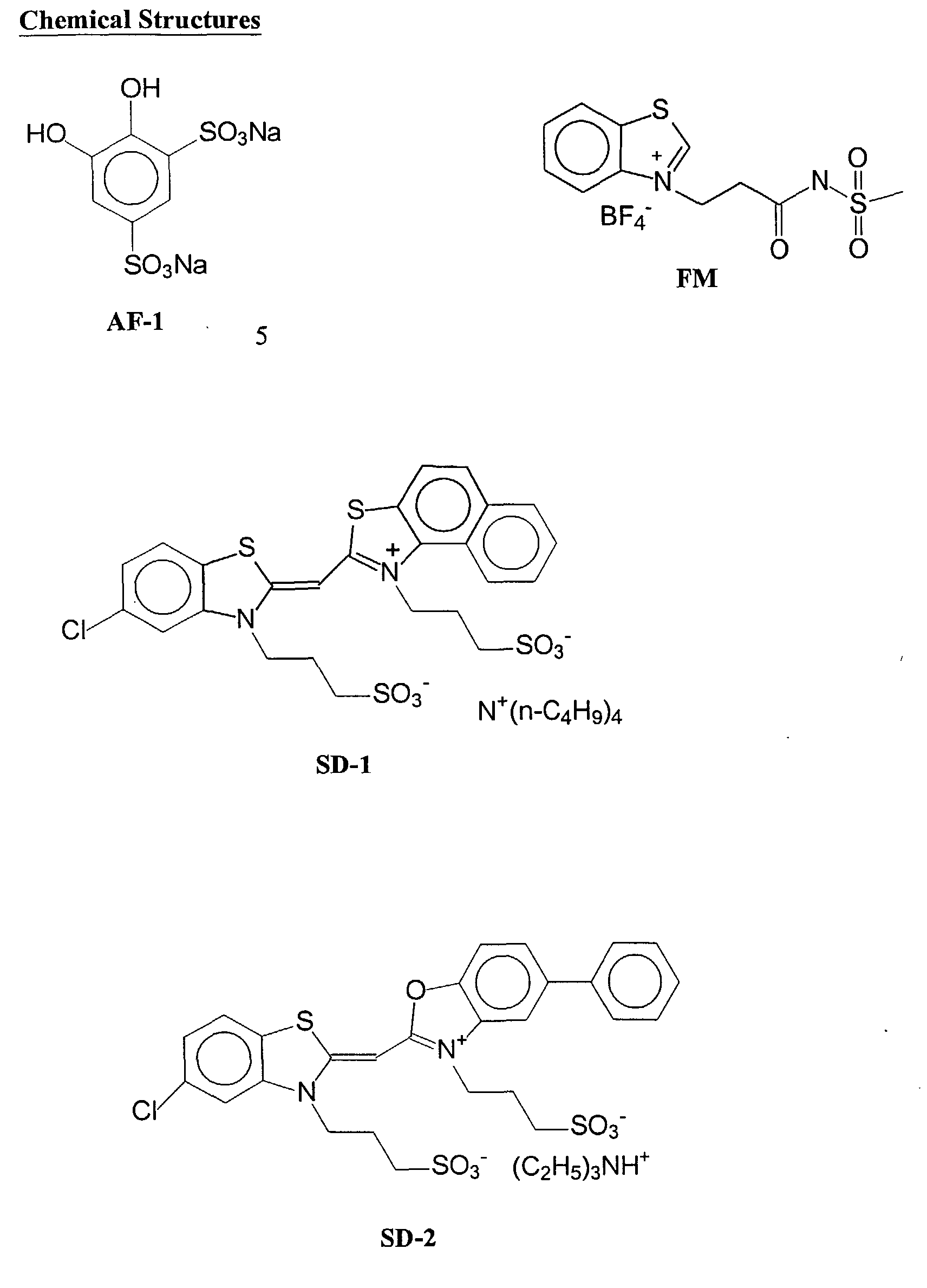
- the emulsion was treated sequentially with antifoggant, AF-1; sodium thiocyanate; finish modifier, FM; yellow spectral sensitizing dyes, SD-1 and SD-2, in the molar ratio of 1 to 3; sulfur sensitizer, SS-1; gold sensitizer, GS-1; then was heated to 55 °C for 20 min, cooled to 40 °C, and antifoggant AF-2 was added. The final pBr measured at 40 °C was 3.38.
- This Sample was treated the same as Sample 4 except 100 mg/Ag mole of sodium oxalate (1.36 ⁇ mol/m 2 of emulsion surface) was added immediately following the treatment with silver nitrate.
- This Sample was treated the same as Sample 4 except 1000 mg/Ag mole of sodium oxalate (13.6 ⁇ mol/m 2 of emulsion surface) was added immediately following the treatment with silver nitrate.
- This Sample was treated the same as Sample 4 except 100 mg/Ag mole of sodium formate (2.68 ⁇ mol/m 2 of emulsion surface) was added immediately following the treatment with silver nitrate.
- This Sample was treated the same as Sample 4 except 1000 mg/Ag mole of sodium formate (26.8 ⁇ mol/m 2 of emulsion surface) was added immediately following the treatment with silver nitrate.
- This Sample was treated the same as Sample 4 except the pBr was adjusted to 8.68. This procedure deposited 10.5 ⁇ mol/m 2 silver bromide on the surface of the emulsion.
- This Sample was treated the same as Sample 9 except 100 mg/Ag mole of sodium oxalate (1.36 ⁇ mol/m 2 of emulsion surface) was added immediately following the treatment with silver nitrate.
- This Sample was treated the same as Sample 9 except 1000 mg/Ag mole of sodium oxalate (13.6 ⁇ mol/m 2 of emulsion surface) was added immediately following the treatment with silver nitrate.
- This Sample was treated the same as Sample 9 except 100 mg/Ag mole of sodium formate (2.68 ⁇ mol/m 2 of emulsion surface) was added immediately following the treatment with silver nitrate.
- This Sample was treated the same as Sample 9 except 1000 mg/Ag mole of sodium formate (26.8 ⁇ mol/m 2 of emulsion surface) was added immediately following the treatment with silver nitrate.
- the sensitized emulsion samples were coated in a simple single layer format which consisted of a pad of gelatin on a cellulose acetate film support with an antihalation backing covered by a layer containing the emulsion and the image forming coupler, C-1.
- the emulsion layer was protected from abrasion by a gelatin overcoat containing hardener. A detailed description of the layered structure is described in following table.
- Accelerated keeping studies were performed by holding film strips at 100 °C and 50% RH for 1 week.
- Raw stock performance was measured by exposing the strip after incubation and processing immediately.
- Latent image performance was measured by first exposing the strip and then incubating. In each case the performance of the incubated strip was referenced against a strip held at 0 °C and 50% RH.
- Sample 8 removed the latent image speed loss seen for the control, Sample 1, while Sample 12 brought both the raw stock and the latent image speed changes to nearly zero.
- Sample pBr Formate (mg/mol) Incubated Response Raw Stock Latent Image delta D-min delta Speed delta D-min delta Speed 1 Comparison 3.38 0 0.068 26 0.061 -14 7 Comparison 6.97 100 0.056 19 0.048 -8 8 Invention 6.97 1000 0.122 29 0.15 2 12 Invention 8.68 100 0.079 -2 0.072 -4 13 Comparison 8.68 1000 0.332 -34 0.278 -13
Landscapes
- Chemical & Material Sciences (AREA)
- Physics & Mathematics (AREA)
- Chemical Kinetics & Catalysis (AREA)
- Engineering & Computer Science (AREA)
- Materials Engineering (AREA)
- General Physics & Mathematics (AREA)
- Spectroscopy & Molecular Physics (AREA)
- Silver Salt Photography Or Processing Solution Therefor (AREA)
Abstract
The invention relates to an emulsion comprising chemically and
spectrally sensitized silver halide grains having formate on the surface of said
grains.
Description
- This invention relates to photographic elements. It particularly relates to an improved silver halide obtained by surface treatment with formate.
- The photographic industry is constantly experimenting with methods of increasing film speed and at the same time reducing granularity. The most direct approach to increasing photographic speed in a silver halide based system is to increase the light sensitivity of the silver halide grains by making the grains larger. However, such an approach leads directly to increased granularity which the customer can find objectionable. If, on the other hand, the inherent photoefficiency of the emulsion grains can be increased without changing grain size, greater speeds can be obtained without added granularity.
- Another aspect of utilizing an addendum to alter emulsion speed is the point of addition. If the emulsion can be treated after it is prepared and fully sensitized, the building of a particular color record in a film is greatly simplified. Photographic film contains many chemical elements that can interact in unpredictable ways making film building very much an empirical or "trial and error" process. It is often impossible to predict the exact photographic speed required of a given emulsion. Rather, the emulsion is preferably first manufactured and placed in the complex milieu of the multi-layered photographic film to determine its effect. For instance, in the development of a new film much effort is expended in obtaining a linear response to light over a wide exposure latitude. Under these conditions it is most preferable to be able to obtain an emulsion with exactly the right photographic speed to combine with either a slower or faster emulsion or both and extend the exposure range. This process is called "knitting the curve" and relates to the shape of the curve obtained when optical density is plotted versus the log of the exposure for the color record of interest. The aim here is to produce a linear transition between the effective ranges of the individual emulsions and thereby provide consist tone reproduction. If one is able to alter the speed of an emulsion without remaking or resensitizing it, the cost of developing a new film is greatly reduced.
- Many materials have been examined for their ability to increase photoefficiency. Notable examples are thioureas (USP 3,458,318), sulfonic acid derivatives (USP 2,937,089 and 3,706,567), triazine compounds (USP 2,875,058 and 3,695,888), mercapto compounds (USP 3,457,078), pyrmidine derivatives (USP 3,615,632), dihyrodpyridine compounds (USP 5,192,654), aminotriazoles (5,306,612), hydrazines (USP 2,419,975, 5,459,052and 4,971,890 and EP Application No. 554,856 A1, propargyl and butynyl benzoxazoles (USP 4,378,426, 4,451,557, and 5,500,333), fragmentable electron donors (USP 5,747,235, 5,747,236, and 6,010,841), and organic hole-trapping dopants (EP Application 0922994 A2). Disadvantages in the use of these compounds include relatively small speed effects, fog increases, loss in emulsion stability, exorbitant cost, the need to treat the emulsion either during making or during sensitizing, and undesirable interactions resulting from the relatively complex chemical structure of the addendum.
- Thus, there continues to be a need for more photoefficient emulsions that can be obtained utilizing an inexpensive, readily available, chemically simple addendum. The addendum should produce substantial speed gains with minimal fog effects and few undesirable interactions. Further benefits can be realized if the emulsion can be treated after it is fully prepared and spectrally sensitized.
- It is an object of the invention to provide more photoefficient emulsions through the use of an inexpensive, readily available, chemically simple addendum.
- It is another object to provide an addendum that has few undesirable side effects such as increased fog or poorer keeping properties of the emulsion.
- It is a further object to provide an addendum that can be utilized with a fully prepared and spectrally sensitized emulsion.
- These and other objects of the invention are accomplished by an emulsion comprising chemically and spectrally sensitized silver halide grains having formate on the surface of said grains.
- The invention provides a means of obtaining silver halide emulsions with increased photoefficiency. This is accomplished through the use of an addendum that is inexpensive, readily available, and chemically simple. The addendum can be used after the emulsion is made and spectrally sensitized thereby simplifying and reducing the cost of producing a new film. The increased photoefficiency of the emulsion is accompanied by minimal side effects such as increased fog or degraded keeping.
- The invention has numerous advantages over prior methods of preparing photographic emulsions. The invention provides emulsions with increased photoefficiency that can be used to manufacture photographic film having greater photographic speed and/or improved granularity. The addendum producing the increased photoefficiency is added to fully made and spectrally sensitized emulsions which simplifies the building of film layers containing multiple emulsions. Because of the empirical or "trial and error" method of selecting emulsions with the correct speed, the ability to alter the speed of an emulsion without having to remake and resensitize it provides a great savings in the cost of building a new photographic film. Furthermore, the addendum is inexpensive and readily available. It is one of the simplest of all organic chemicals leading one to expect few unwanted and unpredictable interactions with the many chemical components found in photographic film. These and other advantages will be apparent from the detailed description below.
- The invention utilizes the addition of formate following the addition of silver ion to a previously spectrally sensitized emulsion of a type commonly employed in color negative applications.
- Other approaches to this problem such as that described by Mydlarz et al in US Patent 5,849,470 use materials which slow the emulsion speed with the consequence of a loss of photoefficiency. Furthermore, these materials like those described by De Keyzer et al is preferably be utilized prior to or during the sensitization process. In contrast, the present invention provides a means of altering photographic speed by increasing the photoefficiency of a sensitized emulsion fully prepared for use. By using lesser or greater amounts of the addenda, the speed of a fully sensitized emulsion can be tuned to the correct speed thereby providing a linear curve shape. This approach teaches away from that of De Keyzer et al in EP Application 0922994 A2 in which formate is utilized as a dopant and is added to the emulsion during its formation.
- The photographic emulsions of this invention are generally prepared by precipitating silver halide crystals in a colloidal matrix by methods conventional in the art. The colloid is typically a hydrophilic film forming agent such as gelatin, alginic acid, or derivatives thereof. The silver halide emulsions may consist of chloride, bromide, and iodide and combinations thereof with the most useful emulsions consisting of silver bromoiodide since this combination generally produces the most efficient photographic emulsion.
- The crystals formed in the precipitation step are washed and then chemically and spectrally sensitized by adding spectral sensitizing dyes and chemical sensitizers, and by providing a heating step during which the emulsion temperature is raised, typically from 40 °C to 70 °C, and maintained for a period of time. The precipitation and spectral and chemical sensitization methods utilized in preparing the emulsions employed in the invention can be those methods known in the art.
- Spectral sensitization is effected with one or more dyes, which are designed for the wavelength range of interest within the visible or infrared spectrum. It is known to add such dyes both before and after heat treatment.
- Typical chemical sensitizations are performed with conventional middle chalcogen (i.e., sulfur, selenium, tellurium) sensitizers and/or noble metal sensitizers such as gold compounds. Reduction sensitizers, employed individually or in combination, are specifically contemplated.
- A general summary of conventional approaches to chemical sensitizations can be found in Research Disclosure, Item 38957, Section III. Chemical Sensitization. Kofron et al in US Patent 4,439,520 illustrates the application of these sensitizations to tabular grain emulsions, as well as describing advantages for "dye in the finish" sensitizations, which are those that introduce the spectral sensitizing dye into the emulsion prior to the heating step (finish) that results in chemical sensitization. A more general summary of useful spectral sensitizing dyes is provided by Research Disclosure, December 1989, Item 38957, Section IV. Spectral sensitization and desensitization, A. Spectral sensitizing dyes.
- Specific dopants, such as compounds of copper, thallium, lead, bismuth, cadmium and Group VIII nobel metals, can be present during process of the present invention or during preparation of silver halide grains employed in the emulsion layers of the photographic element. Other dopants include transition metal complexes as described in US Patents 4,981,781; 4,937,180; and 4,933,272.
- The fully sensitized emulsion can then be treated with varying amounts of formate derived from any of a number of sources such as the sodium, potassium, ammonium, or other salts containing a suitable cation. It is contemplated that formic acid could be utilized followed by neutralization with an appropriate base such as sodium, potassium, or ammonium hydroxide. Treatment of the sensitized emulsion is accomplished under conditions where the formate is added to the surface of the emulsion. This can be done by treating the stirred emulsion with silver ion from any suitable source such as a silver nitrate solution, adding the formate, and treating the emulsion with a suitable bromide source such as sodium bromide solution. Alternatively, the formate could be added before the silver ion. It is further anticipated that excess bromide could first be added followed by formate and then silver ion, but in any case formate is preferably present when silver halide is deposited on the emulsion grains. The process of surface treatment in the presence of formate could be conducted in several steps. However, the silver ion addition needs to be conducted within certain limits to avoid formation of metallic silver which would fog the emulsion. When silver ion is being added, the bromide concentration as measured by the pBr (-log[bromide concentration]) should not be greater than 10.5. A preferred operating range is a pBr of from 3.55 to 8.69.
- The photographic emulsions may be incorporated into color negative or reversal photographic elements. The photographic element may also comprise a transparent magnetic recording layer such as a layer containing magnetic particles on the underside of a transparent support, as described in Research Disclosure, November 1992, Item 34390 published by Kenneth Mason Publications, Ltd., Dudley Annex, 12a North Street, Emsworth, Hampshire PO10 7DQ, ENGLAND. Typically, the element will have a total thickness (excluding the support) of from 5 to 30 µm. Further, the photographic elements may have an annealed polyethylene naphthalate film base such as described in Hatsumei Kyoukai Koukai Gihou No. 94-6023, published March 15, 1994 (Patent Office of Japan and Library of Congress of Japan) and may be utilized in a small format system, such as described in Research Disclosure, June 1994, Item 36230 published by Kenneth Mason Publications, Ltd., Dudley Annex, 12a North Street, Emsworth, Hampshire PO10 7DQ, ENGLAND, and such as the Advanced Photo System, particularly the Kodak ADVANTIX films or cameras.
In the following Table, reference will be made to (1) Research Disclosure, December 1978, Item 17643, (2) Research Disclosure, December 1989, Item 308119, (3) Research Disclosure, September 1994, Item 36544, and (4) Research Disclosure, September 1996, Item 38957, all published by Kenneth Mason Publications, Ltd., Dudley Annex, 12a North Street, Emsworth, Hampshire PO10 7DQ, ENGLAND. The Table and the references cited in the Table are to be read as describing particular components suitable for use in the elements used in the invention. The Table and its cited references also describe suitable ways of preparing, exposing, processing and manipulating the elements, and the images contained therein. Photographic elements and methods of processing such elements particularly suitable for use with this invention are described in Research Disclosure, February 1995, Item 37038, published by Kenneth Mason Publications, Ltd., Dudley Annex, 12a North Street, Emsworth, Hampshire PO10 7DQ, ENGLAND.Reference Section Subject Matter 1 I, II Grain composition, morphology and preparation. Emulsion preparation including hardeners, coating aids, addenda, etc. 2 I, II, IX, X, XI, XII, XIV, XV I, II, III, IX 3 & 4 A & B 1 III, IV Chemical sensitization and spectral sensitization/desensitization 2 III, IV 3 & 4 IV, V 1 V UV dyes, optical brighteners, 2 V luminescent dyes 3 & 4 VI 1 VI Antifoggants and stabilizers 2 VI 3 & 4 VII 1 VIII Absorbing and scattering materials; Antistatic layers; matting agents 2 VIII, XIII, XVI 3 & 4 VIII, IX C & D 1 VII Image-couplers and image-modifying couplers; Wash-out couplers; Dye stabilizers and hue modifiers 2 VII 3 & 4 X 1 XVII Supports 2 XVII 3 & 4 XV 3 & 4 XI Specific layer arrangements 3 & 4 XII, XIII Negative working emulsions;
Direct positive emulsions2 XVIII Exposure 3 & 4 XVI 1 XIX, XX Chemical processing;
Developing agents2 XIX, XX, XXII 3 & 4 XVIII, XIX, XX 3 & 4 XIV Scanning and digital
processing procedures - The photographic elements can be incorporated into exposure structures intended for repeated use or exposure structures intended for limited use, variously referred to as single use cameras, lens with film, or photosensitive material package units.
- The photographic elements can be exposed with various forms of energy which encompass the ultraviolet, visible, and infrared regions of the electromagnetic spectrum, as well as the electron beam, beta radiation, gamma radiation, X-ray, alpha particle, neutron radiation, and other forms of corpuscular and wave-like radiant energy in either noncoherent (random phase) forms or coherent (in phase) forms, as produced by lasers. When the photographic elements are intended to be exposed by X-rays, they can include features found in conventional radiographic elements.
- The photographic elements are preferably exposed to actinic radiation, typically in the visible region of the spectrum, to form a latent image, and then processed to form a visible dye image. Development is typically followed by the conventional steps of bleaching, fixing, or bleach-fixing to remove silver or silver halide, washing, and drying.
- The following examples illustrate the practice of this invention. They are not intended to be exhaustive of all possible variations used in the invention. Parts and percentages are by weight unless otherwise indicated.
- After spectral and chemical sensitization, the emulsion is coated on a support. Various coating techniques include dip coating, air knife coating, curtain coating, and extrusion coating.
- The following examples illustrate the practice of this invention. They are not intended to be exhaustive of all possible variations used in the invention. Parts and percentages are by weight unless otherwise indicated.
- The emulsion is a tabular, dump iodide, bromoiodide type in which all of the iodide was added abruptly at about 68% of the make by dumping into the reaction vessel a silver iodide seed emulsion and then performing a silver over-run. A 0.84 M silver nitrate solution was added at the rate of 350 mL/min for 7.5 min into a reaction vessel with good stirring and containing 184 g of oxidized, lime-processed, bone gelatin, 322 g sodium bromide, and antifoamant in 46 L of distilled water maintained at 40 °C. Following nucleation, an ammonia digest was performed with 4.5 moles of ammonia at pH 10 for 1 min. An additional 2220 g of oxidized, lime-processed, bone gelatin together with 114 g of sodium bromide and additional antifoamant in 30 L of distilled water was added and the pH was adjusted to 5.8. Growth was initiated by the addition of 0.84 M silver nitrate along with an equilmolar amount of sodium bromide solution in a double-jet mode maintaining a pBr of 1.71. The silver nitrate flow rate began at 73 mL/min and was increased to 262 mL/min over a period of 15 min. The silver nitrate solution was then changed to 3.0 M and growth was continued for 46 min ramping the flow from 73 to 1533 mL/min. 128 µg K4Ru(CN)6 was added to the reaction vessel during the last minute of growth. Flow was stopped while 4 L of 3.7 M sodium bromide was added, followed by 24.9 mg of KSeCN and 5.65 mol of silver iodide seeds. A silver over-run was performed by adding 3.0 M silver nitrate at the rate of 400 mL/min for 28.2 min. A balancing flow of sodium bromide was used to limit the drop in bromide concentration to a pBr of 2.70. Excess salt was removed by ultrafiltration to yield 125.5 moles of emulsion containing an average of 4.5% iodide with a grain size of 0.78 x 0.099 µm and a surface area of 550 m2/mole.
- The emulsion was treated sequentially with antifoggant, AF-1; sodium thiocyanate; finish modifier, FM; yellow spectral sensitizing dyes, SD-1 and SD-2, in the molar ratio of 1 to 3; sulfur sensitizer, SS-1; gold sensitizer, GS-1; then was heated to 55 °C for 20 min, cooled to 40 °C, and antifoggant AF-2 was added. The final pBr measured at 40 °C was 3.38.
- To Sample 1 which was melted and stirred at 40°C was added 1000 mg/Ag mole of sodium oxalate. The mixture was stirred an additional 5 min then diluted with distilled water and prepared for coating.
- To Sample 1 which was melted and stirred at 40 °C was added 1000 mg/Ag mole of sodium formate. The mixture was stirred an additional 5 min then diluted with distilled water and prepared for coating.
- The pBr of Sample 1 which was melted and stirred at 40 °C was adjusted to 6.97 with silver nitrate. The mixture was stirred an additional 5 min then returned to the starting pBr by the addition of sodium bromide. This procedure deposited 6.98 µmol/m2 silver bromide on the surface of the emulsion. Finally, the mixture was diluted with distilled water and prepared for coating.
- This Sample was treated the same as Sample 4 except 100 mg/Ag mole of sodium oxalate (1.36 µmol/m2 of emulsion surface) was added immediately following the treatment with silver nitrate.
- This Sample was treated the same as Sample 4 except 1000 mg/Ag mole of sodium oxalate (13.6 µmol/m2 of emulsion surface) was added immediately following the treatment with silver nitrate.
- This Sample was treated the same as Sample 4 except 100 mg/Ag mole of sodium formate (2.68 µmol/m2 of emulsion surface) was added immediately following the treatment with silver nitrate.
- This Sample was treated the same as Sample 4 except 1000 mg/Ag mole of sodium formate (26.8 µmol/m2 of emulsion surface) was added immediately following the treatment with silver nitrate.
- This Sample was treated the same as Sample 4 except the pBr was adjusted to 8.68. This procedure deposited 10.5 µmol/m2 silver bromide on the surface of the emulsion.
- This Sample was treated the same as Sample 9 except 100 mg/Ag mole of sodium oxalate (1.36 µmol/m2 of emulsion surface) was added immediately following the treatment with silver nitrate.
- This Sample was treated the same as Sample 9 except 1000 mg/Ag mole of sodium oxalate (13.6 µmol/m2 of emulsion surface) was added immediately following the treatment with silver nitrate.
- This Sample was treated the same as Sample 9 except 100 mg/Ag mole of sodium formate (2.68 µmol/m2 of emulsion surface) was added immediately following the treatment with silver nitrate.
- This Sample was treated the same as Sample 9 except 1000 mg/Ag mole of sodium formate (26.8 µmol/m2 of emulsion surface) was added immediately following the treatment with silver nitrate.

- The sensitized emulsion samples were coated in a simple single layer format which consisted of a pad of gelatin on a cellulose acetate film support with an antihalation backing covered by a layer containing the emulsion and the image forming coupler, C-1. The emulsion layer was protected from abrasion by a gelatin overcoat containing hardener. A detailed description of the layered structure is described in following table.
Single Layer Format Coated Layer Composition Protective Overcoat 2.69 g/m2 gelatin Emulsion/Coupler 3.23 g/m2 gelatin 0.81 g/m2 Ag 0.007 g/m2 antifoggant AF-3 1.61 g/m2 coupler C-1 Gelatin Pad 4.89 g/m2 gelatin Support Cellulose Acetate - Accelerated keeping studies were performed by holding film strips at 100 °C and 50% RH for 1 week. Raw stock performance was measured by exposing the strip after incubation and processing immediately. Latent image performance was measured by first exposing the strip and then incubating. In each case the performance of the incubated strip was referenced against a strip held at 0 °C and 50% RH.
- This example illustrates that oxalate and formate are ineffective when used to treat the emulsion at a relatively low pBr.
Sample pBr Oxalate
(mg/mol)Formate
(mg/mol)Fresh Response D-min Speed delta
D-mindelta
Speed1
Comparison3.38 0 0 0.055 235 NA NA 2
Comparison3.38 1000 0 0.054 238 -
0.0013 3
Comparison3.38 0 1000 0.057 239 0.002 4 D-min is the minimum optical density measured in an unexposed region of the film. Speeds were measured as 100(1-logH) where H is the exposure in lux-sec necessary to produce a density 0.15 above D-min. - This example illustrates that at a moderately high pBr, formate can be effective at increasing photographic speed with very little effect on D-min. Note that at this pBr a high concentration of formate is required to get the speed effect. Also, even at the high concentration of oxalate, essentially no effect on speed is observed.
Sample pBr Oxalate
(mg/mol)Formate
(mg/mol)Fresh Response D-min Speed delta
D-mindelta
Speed4
Comparison6.97 0 0 0.098 239 0.043 4 5
Comparison6.97 100 0 0.057 237 -
0.041-2 6
Comparison6.97 1000 0 0.054 237 -
0.044-2 7
Comparison6.97 0 100 0.058 239 -
0.0400 8
Invention6.97 0 1000 0.064 266 -
0.03427 Note that Sample 4 is referenced against Sample 1 for calculating delta values while the other Samples in the table are referenced against Sample 4. - This example illustrates that formate but not oxalate is very effective when used to treat the emulsion following a larger pBr adjustment. Note that at this pBr a low concentration of formate is effective while a high concentration causes excessive fog. Oxalate continues to be ineffective.
Sample pBr Oxalate
(mg/mol)Formate
(mg/mol)Fresh Response D-min Speed delta
D-mindelta
Speed9
Comparison8.68 0 0 0.065 244 0.010 9 10
Comparison8.68 100 0 0.065 243 0.000 -1 11
Comparison8.68 1000 0 0.084 244 0.019 0 12
Invention8.68 0 100 0.106 274 0.041 30 13
Comparison8.68 0 1000 0.554 282 0.489 38 Note that Sample 9 is referenced against Sample 1 for calculating delta values while the other Samples in the table are referenced against Sample 9. - From the above examples, it is clear that formate provides a unique opportunity for the improvement of emulsion efficiency when used under a prescribed set of conditions.
- In this example we tabulate the response of various samples incubated under accelerated keeping conditions to further illustrate the utility of the invention. Sample 8 removed the latent image speed loss seen for the control, Sample 1, while Sample 12 brought both the raw stock and the latent image speed changes to nearly zero. Thus, formate not only can provide fresh speed increases but can also offer keeping benefits as well.
Sample pBr Formate
(mg/mol)Incubated Response Raw Stock Latent Image delta
D-mindelta
Speeddelta
D-mindelta
Speed1
Comparison3.38 0 0.068 26 0.061 -14 7
Comparison6.97 100 0.056 19 0.048 -8 8
Invention6.97 1000 0.122 29 0.15 2 12
Invention8.68 100 0.079 -2 0.072 -4 13
Comparison8.68 1000 0.332 -34 0.278 -13
Claims (10)
- An emulsion comprising chemically and spectrally sensitized silver halide grains having formate on the surface of said grains.
- The emulsion of Claim 1 wherein silver halide grains comprise silver bromoiodide.
- The emulsion of Claim 1 wherein sodium formate is present in an amount of between 1 and 50 µmol/m2 on the surface of said grains.
- The emulsion of Claim 3 wherein said grain further comprises additional silver bromide on the surface with said sodium formate.
- The emulsion of Claim 1 wherein the grains are chemically sensitized with sulfur and gold.
- The emulsion of Claim 5 wherein said grains are spectrally sensitized with blue dye.
- The emulsion of Claim 4 wherein additional silver bromide is present on the surface in an amount of between 1 and 100 µmol/m2.
- The emulsion of Claim 1 wherein said formate comprises sodium formate.
- A method of forming silver halide emulsions according to Claims 1 through 8 comprising providing an emulsion with silver halide grains, treating to finish said grains by chemically and spectrally sensitizing said grains, recovering an emulsion of finished grains, in order applying silver nitrate to the emulsion of finished grains, applying formate to said emulsion, and applying bromide to said emulsion.
- The method of Claim 9 wherein said applying silver nitrate to said emulsion of finished grains is in an amount of between 1 and 100 µmol/m2.
Applications Claiming Priority (2)
| Application Number | Priority Date | Filing Date | Title |
|---|---|---|---|
| US885751 | 2001-06-20 | ||
| US09/885,751 US6514682B1 (en) | 2001-06-20 | 2001-06-20 | Speed addendum for photographic emulsions |
Publications (1)
| Publication Number | Publication Date |
|---|---|
| EP1271233A1 true EP1271233A1 (en) | 2003-01-02 |
Family
ID=25387611
Family Applications (1)
| Application Number | Title | Priority Date | Filing Date |
|---|---|---|---|
| EP02077241A Withdrawn EP1271233A1 (en) | 2001-06-20 | 2002-06-10 | A speed addendum for photographic emulsions |
Country Status (3)
| Country | Link |
|---|---|
| US (1) | US6514682B1 (en) |
| EP (1) | EP1271233A1 (en) |
| JP (1) | JP2003015248A (en) |
Families Citing this family (1)
| Publication number | Priority date | Publication date | Assignee | Title |
|---|---|---|---|---|
| US7390748B2 (en) * | 2004-08-05 | 2008-06-24 | International Business Machines Corporation | Method of forming a polishing inhibiting layer using a slurry having an additive |
Citations (6)
| Publication number | Priority date | Publication date | Assignee | Title |
|---|---|---|---|---|
| US3801330A (en) * | 1970-12-21 | 1974-04-02 | Agfa Gevaert Nv | Photographic silver halide recording material |
| US4128428A (en) * | 1974-04-10 | 1978-12-05 | Fuji Photo Film Co., Ltd. | Heat developable light-sensitive material |
| JPH0227327A (en) * | 1988-07-18 | 1990-01-30 | Konica Corp | Silver halide photographic sensitive material |
| US5166044A (en) * | 1989-12-18 | 1992-11-24 | Fuji Photo Film Co., Ltd. | Silver halide emulsion and photographic material using same |
| US5763151A (en) * | 1997-01-24 | 1998-06-09 | Eastman Kodak Company | Robust process for preparing high Br low COV tabular grain emulsions |
| EP0922994A2 (en) * | 1997-12-11 | 1999-06-16 | Agfa-Gevaert N.V. | A photosensitive silver halide element with increased photosensitivity |
Family Cites Families (19)
| Publication number | Priority date | Publication date | Assignee | Title |
|---|---|---|---|---|
| US2419975A (en) | 1943-08-26 | 1947-05-06 | Eastman Kodak Co | Increasing speed and contrast of photographic emulsions |
| US2875058A (en) | 1955-10-12 | 1959-02-24 | Eastman Kodak Co | Supersensitization of photographic emulsions using triazines |
| BE556149A (en) | 1956-03-30 | |||
| DE1447577B1 (en) | 1964-03-11 | 1970-05-14 | Agfa Ag | Stabilized supersensitization of halogen silver emulsions |
| US3458318A (en) | 1965-08-02 | 1969-07-29 | Eastman Kodak Co | Supersensitized silver halide emulsions |
| US3547638A (en) | 1967-06-20 | 1970-12-15 | Eastman Kodak Co | N,n-disubstituted amino-methylthiocarboxylic acids and use thereof as antifoggants in photographic emulsions |
| US3695888A (en) | 1970-05-28 | 1972-10-03 | Eastman Kodak Co | Photographic supersensitized silver halide emulsions |
| US3706567A (en) | 1970-11-17 | 1972-12-19 | Eastman Kodak Co | Supersensitized photographic emulsions |
| US4378426A (en) | 1981-11-12 | 1983-03-29 | Eastman Kodak Company | Photographic speed increasing and latent image stabilizing compounds, silver halide emulsions, and photographic elements |
| JP2724590B2 (en) | 1988-05-11 | 1998-03-09 | 富士写真フイルム株式会社 | Silver halide photographic material |
| US5306612A (en) | 1988-10-18 | 1994-04-26 | Minnesota Mining And Manufacturing Company | Supersensitization of red sensitized, silver halide emulsions with 5-substituted-amino-1,2,3,4-thiatriazoles |
| US5192654A (en) | 1989-04-11 | 1993-03-09 | Fuji Photo Film Co., Ltd. | Silver halide photographic emulsions |
| EP0545999B1 (en) | 1990-08-20 | 1997-06-04 | Novo Nordisk A/S | Process for the preparation of biologically active IGF-1 using IGF-1 having an amino-terminal extension |
| JP2787630B2 (en) | 1992-02-06 | 1998-08-20 | 富士写真フイルム株式会社 | Silver halide photosensitive material |
| US5500333A (en) | 1993-12-16 | 1996-03-19 | Eastman Kodak Company | Class of compounds which increases and stabilizes photographic speed |
| US5747235A (en) | 1996-01-26 | 1998-05-05 | Eastman Kodak Company | Silver halide light sensitive emulsion layer having enhanced photographic sensitivity |
| US6010841A (en) | 1996-01-26 | 2000-01-04 | Eastman Kodak Company | Silver halide light sensitive emulsion layer having enhanced photographic sensitivity |
| US5747236A (en) | 1996-01-26 | 1998-05-05 | Eastman Kodak Company | Silver halide light sensitive emulsion layer having enhanced photographic sensitivity |
| US6277549B1 (en) * | 1997-12-11 | 2001-08-21 | Agfa-Gevaert | Photosensitive silver halide element with increased photosensitivity |
-
2001
- 2001-06-20 US US09/885,751 patent/US6514682B1/en not_active Expired - Fee Related
-
2002
- 2002-06-10 EP EP02077241A patent/EP1271233A1/en not_active Withdrawn
- 2002-06-19 JP JP2002178704A patent/JP2003015248A/en active Pending
Patent Citations (6)
| Publication number | Priority date | Publication date | Assignee | Title |
|---|---|---|---|---|
| US3801330A (en) * | 1970-12-21 | 1974-04-02 | Agfa Gevaert Nv | Photographic silver halide recording material |
| US4128428A (en) * | 1974-04-10 | 1978-12-05 | Fuji Photo Film Co., Ltd. | Heat developable light-sensitive material |
| JPH0227327A (en) * | 1988-07-18 | 1990-01-30 | Konica Corp | Silver halide photographic sensitive material |
| US5166044A (en) * | 1989-12-18 | 1992-11-24 | Fuji Photo Film Co., Ltd. | Silver halide emulsion and photographic material using same |
| US5763151A (en) * | 1997-01-24 | 1998-06-09 | Eastman Kodak Company | Robust process for preparing high Br low COV tabular grain emulsions |
| EP0922994A2 (en) * | 1997-12-11 | 1999-06-16 | Agfa-Gevaert N.V. | A photosensitive silver halide element with increased photosensitivity |
Non-Patent Citations (3)
| Title |
|---|
| "CHEMICAL IMAGE PROBLEM HAS SENSITIVE SOLUTION", CHEMISTRY AND INDUSTRY. CHEMISTRY AND INDUSTRY REVIEW, CHEMICAL SOCIETY. LETCHWORTH, GB, no. 1, 10 January 2000 (2000-01-10), pages 5, XP000902486, ISSN: 0009-3068 * |
| BELLONI J ET AL: "Enhanced field of photoinduced electrons in doped silver halide crystals", NATURE, 23-30 DEC. 1999, MACMILLAN MAGAZINES, UK, vol. 402, no. 6764, pages 865 - 867, XP002216003, ISSN: 0028-0836 * |
| DATABASE WPI Section Ch Week 199011, Derwent World Patents Index; Class G06, AN 1990-077789, XP002216004 * |
Also Published As
| Publication number | Publication date |
|---|---|
| US6514682B1 (en) | 2003-02-04 |
| JP2003015248A (en) | 2003-01-15 |
Similar Documents
| Publication | Publication Date | Title |
|---|---|---|
| JPH0220855A (en) | Silver halide photographic emulsion | |
| JPH0444256B2 (en) | ||
| US4806462A (en) | Silver halide photographic material comprising doped divalent metal | |
| US6514682B1 (en) | Speed addendum for photographic emulsions | |
| US5561038A (en) | Silver halide black and white photographic lightsensitive material | |
| JPS63226638A (en) | Very rapidly processable silver halide photographic sensitive material | |
| GB2053499A (en) | Photographic silver halide emulsion and process for preparing same | |
| US5077189A (en) | Light-sensitive silver halide photographic material | |
| US5968724A (en) | Silver halide photographic elements with reduced fog | |
| JPH08328182A (en) | Radiation -sensitive emulsion | |
| JPS6343734B2 (en) | ||
| JPH08339047A (en) | Photographic element | |
| EP0376500B1 (en) | Process for the spectral sensitisation of a silver halide emulsion | |
| US6214529B1 (en) | Method of suppressing fog in silver halide emulsions | |
| JPH03241336A (en) | Silver halide photographic sensitive material | |
| US20020076640A1 (en) | Film/screen system and image-forming system for use in direct X-ray applications | |
| US6727055B1 (en) | High bromide cubic grain emulsions | |
| DE69119834T2 (en) | Silver halide photographic light-sensitive materials | |
| EP0424923B1 (en) | A silver halide photographic light-sensitive material having a high sensitivity and capable of forming an image with an excellent quality and gradation | |
| US5733717A (en) | Silver halide photographic elements containing aryliodonium compounds | |
| EP1195641B1 (en) | Film/Screen system and image-forming system for use in direct X-ray applications | |
| EP0650084B1 (en) | Silver halide photographic emulsion comprising grains having faces (100) with cavities | |
| JPH0320742B2 (en) | ||
| EP0775936B1 (en) | Silver halide photographic elements containing dioxide compounds as stabilizers | |
| JP3116974B2 (en) | Silver halide photographic emulsion |
Legal Events
| Date | Code | Title | Description |
|---|---|---|---|
| PUAI | Public reference made under article 153(3) epc to a published international application that has entered the european phase |
Free format text: ORIGINAL CODE: 0009012 |
|
| AK | Designated contracting states |
Kind code of ref document: A1 Designated state(s): AT BE CH CY DE DK ES FI FR GB GR IE IT LI LU MC NL PT SE TR |
|
| AX | Request for extension of the european patent |
Free format text: AL;LT;LV;MK;RO;SI |
|
| 17P | Request for examination filed |
Effective date: 20030528 |
|
| AKX | Designation fees paid |
Designated state(s): DE FR GB |
|
| STAA | Information on the status of an ep patent application or granted ep patent |
Free format text: STATUS: THE APPLICATION HAS BEEN WITHDRAWN |
|
| 18W | Application withdrawn |
Effective date: 20051024 |