EP1270805B1 - Reduction of organically bound chlorine formed in chlorine dioxide bleaching - Google Patents
Reduction of organically bound chlorine formed in chlorine dioxide bleaching Download PDFInfo
- Publication number
- EP1270805B1 EP1270805B1 EP02076282A EP02076282A EP1270805B1 EP 1270805 B1 EP1270805 B1 EP 1270805B1 EP 02076282 A EP02076282 A EP 02076282A EP 02076282 A EP02076282 A EP 02076282A EP 1270805 B1 EP1270805 B1 EP 1270805B1
- Authority
- EP
- European Patent Office
- Prior art keywords
- bleaching
- chlorine dioxide
- stage
- chlorine
- pulp
- Prior art date
- Legal status (The legal status is an assumption and is not a legal conclusion. Google has not performed a legal analysis and makes no representation as to the accuracy of the status listed.)
- Revoked
Links
Images


Classifications
-
- D—TEXTILES; PAPER
- D21—PAPER-MAKING; PRODUCTION OF CELLULOSE
- D21C—PRODUCTION OF CELLULOSE BY REMOVING NON-CELLULOSE SUBSTANCES FROM CELLULOSE-CONTAINING MATERIALS; REGENERATION OF PULPING LIQUORS; APPARATUS THEREFOR
- D21C9/00—After-treatment of cellulose pulp, e.g. of wood pulp, or cotton linters ; Treatment of dilute or dewatered pulp or process improvement taking place after obtaining the raw cellulosic material and not provided for elsewhere
- D21C9/10—Bleaching ; Apparatus therefor
- D21C9/12—Bleaching ; Apparatus therefor with halogens or halogen-containing compounds
- D21C9/14—Bleaching ; Apparatus therefor with halogens or halogen-containing compounds with ClO2 or chlorites
- D21C9/142—Bleaching ; Apparatus therefor with halogens or halogen-containing compounds with ClO2 or chlorites with ClO2/Cl2 in a multistage process involving ClO2/Cl2 exclusively
-
- D—TEXTILES; PAPER
- D21—PAPER-MAKING; PRODUCTION OF CELLULOSE
- D21C—PRODUCTION OF CELLULOSE BY REMOVING NON-CELLULOSE SUBSTANCES FROM CELLULOSE-CONTAINING MATERIALS; REGENERATION OF PULPING LIQUORS; APPARATUS THEREFOR
- D21C9/00—After-treatment of cellulose pulp, e.g. of wood pulp, or cotton linters ; Treatment of dilute or dewatered pulp or process improvement taking place after obtaining the raw cellulosic material and not provided for elsewhere
- D21C9/10—Bleaching ; Apparatus therefor
- D21C9/12—Bleaching ; Apparatus therefor with halogens or halogen-containing compounds
- D21C9/14—Bleaching ; Apparatus therefor with halogens or halogen-containing compounds with ClO2 or chlorites
- D21C9/144—Bleaching ; Apparatus therefor with halogens or halogen-containing compounds with ClO2 or chlorites with ClO2/Cl2 and other bleaching agents in a multistage process
Definitions
- the present invention is related to the formation of chlorinated organic matter in chlorine dioxide bleaching of kraft pulp, and how to reduce the amount of organically bound chlorine in pulp (OCI) and/or reduce the amount of organically bound chlorine compounds (measured as e.g. AOX or TOCI) in the waste water.
- OCI organically bound chlorine in pulp
- TOCI organically bound chlorine compounds
- ECF concept Elemental Chlorine Free
- bleaching without the use of any elemental chlorine or hypochlorite was introduced.
- the chemical normally replacing the elemental chlorine is chlorine dioxide, which had been used for final brightening of pulp and for obtaining a good cleanliness, e.g. due to its excellent capability of removal of extractives.
- the chlorinated structures e.g. formed in chlorine bleaching, are denoted AOX (adsorbable organic halogene compounds) when found in the bleach effluents and OCl (organically bound chlorine) when stuck in the pulp.
- AOX adsorbable organic halogene compounds
- OCl organically bound chlorine
- hypochlorous acid in equilibrium with chlorine is formed, both of which are able to act as chlorinating agents. Also during manufacturing of chlorine dioxide at the mill site some elemental chlorine is produced, typically in the order of 1-4%, most often below 5% elemental chlorine, all dependent on the type of chlorine dioxide forming process used.
- the first chlorine dioxide stage be pH profiled by means of a short-term reaction at low pH followed by an increase to alkaline conditions
- Ljunggren, S., Bergnor-Gidnert, E. and Kolar, J. (1996): Chlorine Dioxide Bleaching with a Two-step Low-to-High pH Profile, Tappi J. 79: 12, pp. 152-160.).
- This approach has many similarities with the Ultim-O process (no washing between D0 and E).
- Improvments in Chlorine Dioxide stages have been made for several purposes.
- a modification of the conventional D-stage is suggested.
- US 6.235.154 is disclosed an improvement in ECF bleaching, where an aldehyd compound is added in an amount from 0,02%-5% to the first D-stage.
- the objectives is to reach higher brightness and/or increased delignification for any given charge of chlorine dioxide, and examples use conventional time and temperature combinations such as 50°C/30 minutes or 70°C/30 minutes in the first D-stage (i.e. reaction factor of 1500-2100), and charge factor about 1.0 or below.
- the main objectives with the present invention is to reduce the total amount of chlorinated organic matter leaving a chlorine dioxide stage, and especially the total amount of AOX and OCl, where at least a substantial reduction in AOX levels is obtained, and this while being able to operate chlorine dioxide stages with higher charges of chlorine dioxide than "ECF light".
- Another objective is that the overall operating costs for pulp bleaching could be kept low if the delignification effect from chlorine dioxide is utilised in full in the first chlorine dioxide stage in the bleaching sequence, whereby charges of other more expensive bleaching chemicals, in cost per kg or per bleaching effect, could be kept at lower levels.
- Another objective according to the invention is that an intial chlorine dioxide stage run at high temperature for long time is shown to be an efficient means ofreducing the overall discharge of AOX by about 50 percent, presumably through a forced degradation of the chlorinated structures formed in the stage.
- sulphamic acid to a final D-stage is presented as an efficient tool for reducing the total amount of AOX and OCl, with substantial decrease of the OCl content of an bleached pulp, preferably ECF bleached pulp, since sulphamic acid captures in situ formed elemental chlorine. Said substantial decrease amounting to about 50 percent in a final D-stage operating at similar charge of chlorine dioxide.
- the invention as described in claim 1 is based upon the origin of OCl and ways to decrease it, without necessarily reducing the use of chlorine dioxide and still reaching the same final brightness.
- the distribution of OCl in ECF-bleached pulp is playing an important role.
- D* denotes a D-stage run at high temperature (90 °C) and long time (120 min)
- S denotes the presence of sulphamic acid.
- E stages were performed according to above.
- D1 and D2 stages were performed at 75 °C and 120 min.
- the temperature 90°C per se is lower than the temperature as defined in claim 1.
- Kappa number, viscosity and ISO brightness were analysed using the respective SCAN standards.
- SCAN standard CM 52:94 Pulps, papers and boards - organic chlorine" was used to determine the content of OCl in the pulp after different stages.
- A is performed as a hot acid treatment for long duration at e.g . 90-100 °C and 120 min according to concepts like GB 1.062.734.
- this acid treatment at pH 2.25, temperature 100°C and during 120 minutes was implemented in order to reduce brightness reversion.
- the extreme A-stage was followed by a conventional D0-stage at some 60°C without intermediate washing.
- an (AD) approach gives a potential to reduce the overall need for chlorine dioxide in the bleaching of especially HW kraft pulp, although D* has been shown to have a greater potential in this respect.
- D* can of course be utilised in any position in the bleaching sequence irrespective of the number of D-stages in the bleaching line.
- D0 position i.e. the first stage using chlorine dioxide.
- sulphamic acid should be added in a continous manner during the bleaching process in the chlorine dioxide stage, i.e. so that sulphamic acid is present during the consumption of chlorine dioxide in the chlorine dioxode stage.
- the sulphamic acid could be added to the pulp before, after or during addition of the chlorine dioxode in a chlorine dioxide mixer.
- the two concepts D* and (SD) could also be utilised in the same sequence, thus enabling the manufacture of a pulp with low OCl content at the same time as the AOX discharges are kept low, as shown in Tab. 1.
- a 50 percent reduction of the overall AOX discharge of a DEDED sequence can be obtained by using a D*-stage instead of a conventional D-stage in D0 position.
- the OCl content can also be fighted and decreased by about 50 percent even in an existing bleaching line by changing the last D-stage to operation with sulphamic acid addition in a (SD)-stage.
Landscapes
- Life Sciences & Earth Sciences (AREA)
- Engineering & Computer Science (AREA)
- Wood Science & Technology (AREA)
- Paper (AREA)
- Detergent Compositions (AREA)
Abstract
Description
- The present invention is related to the formation of chlorinated organic matter in chlorine dioxide bleaching of kraft pulp, and how to reduce the amount of organically bound chlorine in pulp (OCI) and/or reduce the amount of organically bound chlorine compounds (measured as e.g. AOX or TOCI) in the waste water.
- The most efficient and inexpensive bleaching chemical so far known is elemental chlorine, the use of it has in most parts of the world come to an end during the last decade. The driving forces in this development has been environmental, expressed either as market demands or as environmental standards set by governments or a combination of the two. The negative environmental impact connected to the use of elemental chlorine is primarily the formation of chlorinated organic structures.
- Following a massive introduction of oxygen delignification systems, the work needed in the subsequent bleaching could be significantly reduced and the ECF concept (Elemental Chlorine Free), i.e. bleaching without the use of any elemental chlorine or hypochlorite, was introduced. The chemical normally replacing the elemental chlorine is chlorine dioxide, which had been used for final brightening of pulp and for obtaining a good cleanliness, e.g. due to its excellent capability of removal of extractives.
- The chlorinated structures, e.g. formed in chlorine bleaching, are denoted AOX (adsorbable organic halogene compounds) when found in the bleach effluents and OCl (organically bound chlorine) when stuck in the pulp. The amount of both AOX and OCl were largely reduced upon conversion to ECF bleaching, but a zero level was not reached and in fact a significant amount of OCl is still found in ECF bleached pulps and AOX in the effluents from chlorine dioxide stages.
The levels are also significantly higher than those arising from TCF (Totally Chlorine Free) bleaching operations. This is due to the fact that when chlorine dioxide reacts with the lignin in pulp, hypochlorous acid in equilibrium with chlorine is formed, both of which are able to act as chlorinating agents. Also during manufacturing of chlorine dioxide at the mill site some elemental chlorine is produced, typically in the order of 1-4%, most often below 5% elemental chlorine, all dependent on the type of chlorine dioxide forming process used. - Considering AOX in effluents it is urgent to keep in mind that although the discharges per ton of pulp produced have decreased significantly when switching to ECF-bleaching, the mills have simultaneuosly grown too, meaning that the total AOX load to the specific recipient need not have changed very much and thus still constituting a potential problem. In figure 1 is shown how the total amount of AOX in effluents may be constant even tough the AOX level per BDt pulp have decreased over time, due to that production volumes have increased.
A pulp having been bleached using chlorine dioxide in an ECF sequence is still easily identified due to its content of OCl, which hinders it from being used in certain paper products or at certain markets. For several mills producing market pulp this is a crucial fact, since it means certain customers will not be interested in a high OCl pulp. - For various reasons, a massive conversion to TCF bleaching has so far not occured, leaving the field open for innovative ways to approach the OCl and AOX problems in ECF-bleaching.
- The obvious way, to reduce the overall charge of chlorine dioxide, has in several cases been entered upon in, what is often called "ECF-light" concepts, using a rather small charge of chlorine dioxide in the D-stage, often a charge factor of active chlorine as chlorine dioxide of below 1.
At the Tappi Pulping Conference Oct.22-25, 1989, two papers where presented where solutions to the AOX problem was presented. Lowering of the delignification in the D-stage (or C- or C/D-stage), by using a lower charge factor of active chlorine as chlorine dioxide (i.e. kappa factor) was identified as methods for decreasing AOX, and where compensation for the lower delignification effect in D-stages is made by higher charges in other stages. One paper was presented by J.Basta, L.Holtinger, J.Hook and P.Lundgren with the titel "LOW AOX, POSSIBIILITES AND CONSEQUNCES"(pp. 427-436), and the second paper was presented by H.Suss, W.Eul, N.Nimmerfroh and J.Meier, all from Degussa AG/Corp, with the titel "ENVIRONMENTAL ASPECTS OF SHORT-SEQUENCE BLEACHING" (pp. 527-537). The main approach in these papers, when AOX-reduction is the objective in ECF-bleaching, is to decrease the use of chlorine dioxide at the expense of higher charges of hydrogen peroxide.
This approach is shown in EP,B,500813, where a charge factor of active chlorine as chlorine dioxide below 2.0 is used in the D0 stage(i.e. the first D-stage in a multiple sequence D-E-D... etc.), and where following P-stage (P=peroxide) use at least 3.0 kg of hydrogen peroxide per ton dry pulp, and having chlorine dioxide charges in following D-stages less or equal than the charge used in D0, i.e. from 20-100% of the D0 charge. - In addition to this approach it has been proposed the first chlorine dioxide stage be pH profiled by means of a short-term reaction at low pH followed by an increase to alkaline conditions (Ljunggren, S., Bergnor, E. and Kolar, J. (1994): Modified Modem ClO2-Bleaching, International Pulp Bleaching Conference (IPBC), Vancouver, Canada, Vol. 1: 169-176. and Ljunggren, S., Bergnor-Gidnert, E. and Kolar, J. (1996): Chlorine Dioxide Bleaching with a
Two-step Low-to-High pH Profile, Tappi J. 79: 12, pp. 152-160.).
This approach has many similarities with the Ultim-O process (no washing between D0 and E). Although this approach indeed enabled significant reductions in the AOX discharges, the OCl content was less affected and most important, the need for alkali increased largely, making it less attractive.
Lately, a reductive alkaline post-treatment has been proposed as a way of significantly reducing the OCl content of a pulp,(see Ljunggren, S., Johansson, E. and Pettersson, B. (1998): Dechlorination of ODEDD Bleached Kraft Pulps, 5th European Workshop on Lignocellulosics and Pulp (EWLP), Aveiro, Portugal, pp. 437-440), which is a somewhat refined way of utilising the well-known fact that an alkali extraction undoubtedly is a very efficient way for the removal of OCl.
Although efficient, such a post-treatment of the pulp requires both additional washing equipment and additional bleaching towers, making also this approach less attractive for mill implementation. - Improvments in Chlorine Dioxide stages have been made for several purposes. In a paper presented by Lachenal, D. and Chirat, C. (1998): High Temperature Chlorine Dioxide Delignification: A Breakthrough in ECF Bleaching of Hardwood Kraft Pulps, Pulping Conference, Atlanta, U.S.A., Vol. 2.pp. 601-604.), a modification of the conventional D-stage is suggested. With the objective to make the D-stage more efficient, and reduce charges of chlorine dioxide, it is proposed to modify the conventional 45° C D-stage to a high temperature (90-100°C) D-stage having long retention time (1.5-4 hrs). An alternative modification achieving the same improvement was proposed where instead this high temperature is implemented after, "at the exit of", the D-stage when the chlorine dioxide have been consumed, during which process position the high temperature could not affect the break-down process of chlorine dioxide in the D-stage. This paper also indicates that the change from chlorine to chlorine dioxide bleaching will solve the AOX-problem.
- Further improvements in chlorine dioxide bleaching have been proposed in US 3.622.444, WO 98/00602 and US 6.235.154.
- In US 3.622.444 is disclosed an improvement in a bleaching sequence using chlorine in early stages, i.e. not a ECF sequence, and in subsequent D-stages is small charges of 0.45-0.6% chlorine dioxide used, i.e. about 4,5-6 kg per tonne of pulp.
- In WO 98/00602 is the principle of higher temperature in chlorine dioxide stages shown, with the objective to decrease necessary retention times enabling smaller and less expensive reaction vessels, i.e. combining a temperature of 90-110 with 15-30 minutes (reaction factor of 30 * 110 = 3300 at the most).
- In US 6.235.154 is disclosed an improvement in ECF bleaching, where an aldehyd compound is added in an amount from 0,02%-5% to the first D-stage. The objectives is to reach higher brightness and/or increased delignification for any given charge of chlorine dioxide, and examples use conventional time and temperature combinations such as 50°C/30 minutes or 70°C/30 minutes in the first D-stage (i.e. reaction factor of 1500-2100), and charge factor about 1.0 or below.
- The main objectives with the present invention is to reduce the total amount of chlorinated organic matter leaving a chlorine dioxide stage, and especially the total amount of AOX and OCl, where at least a substantial reduction in AOX levels is obtained, and this while being able to operate chlorine dioxide stages with higher charges of chlorine dioxide than "ECF light".
- Another objective is that the overall operating costs for pulp bleaching could be kept low if the delignification effect from chlorine dioxide is utilised in full in the first chlorine dioxide stage in the bleaching sequence, whereby charges of other more expensive bleaching chemicals, in cost per kg or per bleaching effect, could be kept at lower levels.
- Another objective according to the invention is that an intial chlorine dioxide stage run at high temperature for long time is shown to be an efficient means ofreducing the overall discharge of AOX by about 50 percent, presumably through a forced degradation of the chlorinated structures formed in the stage. This high reduction of AOX by about 50% at a given overall chlorine dioxide charge compared to operation of said initial chlorine dioxide stage at conventional conditions, i.e. some 60-70°C and 20-60 minutes.
- Moreover, a further addition of sulphamic acid to a final D-stage is presented as an efficient tool for reducing the total amount of AOX and OCl, with substantial decrease of the OCl content of an bleached pulp, preferably ECF bleached pulp, since sulphamic acid captures in situ formed elemental chlorine. Said substantial decrease amounting to about 50 percent in a final D-stage operating at similar charge of chlorine dioxide.
- The invention as described in
claim 1 is based upon the origin of OCl and ways to decrease it, without necessarily reducing the use of chlorine dioxide and still reaching the same final brightness.
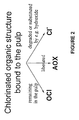
The distribution of OCl in ECF-bleached pulp is playing an important role. - It is important to understand the correspondence between AOX and OCl. In Fig. 2, the three major possible faiths of a chlorinated substance in the pulp are summarised. Following a chlorination there are thus three alternatives, either that the chlorinated structure sticks to the final pulp becoming OCl, or that it is liberated during subsequent bleaching stages becoming AOX, or that the structure is substituted/degraded so that the chlorine atoms form harmless chloride ions.
Important to keep in mind is hence that there is no direct correspondance between AOX and OCl telling e.g. that a high AOX discharge means a low OCl content in the pulp at a certain chlorine dioxide charge. - In a series of trials the standard ECF bleaching sequence of DEDED, using an overall chlorine dioxide charge of 29.6 kg a Cl/BDt, was used to bleach the oxygen delignified HW kraft pulp from the second series of trials (kappa 9.8) to full brightness (above 89 % ISO). 19.6 kg a Cl/BDt was used in D0, and 5 kg a Cl/BDt in each of D1 and D2.
The charge factor of active chlorine as chlorine dioxide in D0 equaling (19.6/9.8=) 2.0.
This standard sequence was compared with three modified sequences, D*EDED, DEDE(SD) and D*EDE(SD).
D* denotes a D-stage run at high temperature (90 °C) and long time (120 min) "S" denotes the presence of sulphamic acid. E stages were performed according to above. D1 and D2 stages were performed at 75 °C and 120 min. - The reaction factor (time/min * temp/°C) in the D*-stage of the examples equals 120 *90 = 10.800, exceeding that of lowest reaction factor covered in claims, i.e. 91*90 = 8.100. The temperature 90°C per se is lower than the temperature as defined in
claim 1. - Kappa number, viscosity and ISO brightness were analysed using the respective SCAN standards. In addition, SCAN standard CM 52:94 "Pulps, papers and boards - organic chlorine" was used to determine the content of OCl in the pulp after different stages.
- All bleaching experiments were performed at 10 percent pulp consistency in plastic bags, which after intense kneeding were placed in heated water baths. The charge of sulphamic acid should be somewhat higher, i.e. on a molar basis, than the charge of active chlorine, in this investigation meaning 1.0 mmol sulphamic acid/BDt.
- In those stages to which sulphamic acid addition was made, the charge of active chlorine was increased in order to compensate for the decreased oxidising capacity of the stage when the reduction of chlorine dioxide to chloride ion is broken at the level of elemental chlorine. The oxidising capacity of chlorine dioxide is decreased by 20 percent in the presence of sulphamic acid, which captures intermediately formed elemental chlorine, and following reaction pattern is developed with and without sulphamic acid.


- In practise this means that 4 out of 5 electrons are used when chlorine dioxide bleaching in the presence of sulphamic acid is used and thus the charge of active chlorine to such stages were increased by 25 percent. This way, all the pulps were subjected to identical charges of "active" active chlorine.
- Results from the 5-stage bleaching study on HW mill oxygen delignified kraft pulp are given in following table 1.
Table 1 Trial DEDED D*EDED DEDE(SD) D*EDE(SD) final kappa 2.1 0.6 2.5 1.2 final viscosity [ml/g] 975 937 939 911 ISO brightness [%] 89.4 89.9 89.4 89.5 total a Cl charge [kg/ADt] 27 27 27 27 total OCl [mg/kg) 152 158 88 116 total AOX [kg/ADt] 0.41 0.23 0.39 0.21 - From the results it is clear that the AOX discharge could be reduced with about 50 percent using D* instead of D as the first bleaching stage. It should be noted that this result is obtained when comparing sequences with identical overall charge of chlorine dioxide. In addition to this reduction of AOX, the value can be even further reduced when the chlorine dioxide saving effect of the D*, (as e.g. noted by Lachenal, D. and Chirat, C. (1998): High Temperature Chlorine Dioxide Delignification: A Breakthrough in ECF Bleaching of Hardwood Kraft Pulps, Pulping Conference, Atlanta, U.S.A., Vol. 2: 601-604.) is taken into account, here instead recorded as a higher final brightness.
- This finding was very unexpected. One would else have anticipated that if the AOX levels experienced a decrease, then the OCl would increase by a similar order. However, the findings showed that the AOX-levels was decreased without a similar order of increase in OCl.
The interpretation of the result should not be that less chlorination takes place or that less AOX is formed in a D*-stage than in a conventional D-stage. On the contrary it seems appropriate to suppose that under the tough conditions of the D* stage, a substantial part of the AOX formed in the stage is further degraded to e.g. harmless chloride ions.
With this knowledge in mind it is interesting to compare D* with (AD), i.e. where A is performed as a hot acid treatment for long duration at e.g. 90-100 °C and 120 min according to concepts like GB 1.062.734. In GB 1.062.734 this acid treatment at pH 2.25, temperature 100°C and during 120 minutes was implemented in order to reduce brightness reversion. The extreme A-stage was followed by a conventional D0-stage at some 60°C without intermediate washing. In conformity with D*, an (AD) approach gives a potential to reduce the overall need for chlorine dioxide in the bleaching of especially HW kraft pulp, although D* has been shown to have a greater potential in this respect. However, in contradiction to D*, an (AD) approach will not enable any reduction of the AOX according to the mechanisms presented Theoretically, D* can of course be utilised in any position in the bleaching sequence irrespective of the number of D-stages in the bleaching line. Although in general it is likely that the benefits of the stage primarily motivates its utilisation in the D0 position, i.e. the first stage using chlorine dioxide. - From the results in Tabel. 1 it is also clear that the presence of sulphamic acid in the final D stage is an efficient means of reducing the OCl content of the pulp. Having the OCl pattern shown in Fig. 3 in mind, it is easily concluded that the largest effect to the lowest charge of sulphamic acid is obtained when sulphamic acid addition is made to the last D-stage, although a larger effect of course can be obtained using it in all D-stages. Although sulphamic acid already today is commonly used in pulp mills, e.g. for the removal of scales in machinery upon shut-downs, its use in continous bleaching processes for obtaining low OCl pulp is new. The addition of sulphamic acid should be added in a continous manner during the bleaching process in the chlorine dioxide stage, i.e. so that sulphamic acid is present during the consumption of chlorine dioxide in the chlorine dioxode stage. The sulphamic acid could be added to the pulp before, after or during addition of the chlorine dioxode in a chlorine dioxide mixer.
- It should be added that the chlorine dioxide charge in a (SD) stage has to be increased by some 15-30%, typically 25 percent, in order to compensate for the reduced oxidising power lost due to the capture of elemental chlorine by sulphamic acid. However, when utilised in D2-position, or in the final D-stage, this means a very moderate additional need for chlorine dioxide in this last stage.
- The two concepts D* and (SD) could also be utilised in the same sequence, thus enabling the manufacture of a pulp with low OCl content at the same time as the AOX discharges are kept low, as shown in Tab. 1.
- It can be concluded that a 50 percent reduction of the overall AOX discharge of a DEDED sequence can be obtained by using a D*-stage instead of a conventional D-stage in D0 position.
The OCl content can also be fighted and decreased by about 50 percent even in an existing bleaching line by changing the last D-stage to operation with sulphamic acid addition in a (SD)-stage.
Claims (11)
- A process for reducing the amount of organically bound chlorine formed in ECF bleaching of kraft pulp using several bleaching stages and wherein at least one of the stages is a bleaching stage using chlorine dioxide as bleaching chemical, said bleaching stages forming a bleaching sequence characterised in that the first chlorine dioxide bleaching stage used during the bleaching sequence is having a charge factor of 1,5 or above and operated at a temperature above 91°C and at a retention time more than 90 minutes, whereby the resulting AOX content in the effluent from the bleaching line is reduced more than 25 % compared with bleaching sequences with identical overall charge of chlorine dioxide.
- A process according to claim 1, characterised in that the first chlorine dioxide bleaching stage used during the bleaching sequence is operated at a temperature above 95°C up to 120°C at the most and at a retention time more than 90 minutes up to 300 minutes at the most, and preferably about 200 minutes, and that the first chlorine dioxide bleaching stage is pressurised to a pressure exceeding the vapour saturation pressure for the temperature in the stage by at least 20%.
- A process according to claim 1 or 2, characterised in that the charge factor in the first chlorine dioxide bleaching stage is in the range 1.5-3.0.
- A process according to any of claims 1-3, characterised in that the pulp concentration during the the first chlorine dioxide bleaching stage is in the medium consistency range, i.e. between 7-25%.
- A process according to any of claims 1-4, characterised in that the pulp being bleached in the first chlorine dioxide bleaching stage is delignified to a kappa number below 20, and preferably below kappa 15 prior to bleaching in the first chlorine dioxide bleaching stage.
- A process according to claim 5, characterised in that sulphamic acid is added to at least one chlorine dioxide bleaching stage in the bleaching sequence, which sulphamic acid captures intermediately formed chlorine, or hypochlorite, during the chlorine dioxide bleaching stage forming chlorosulphamic acid according to the reaction process.
- A process according to claim 6, characterised in that sulphamic acid is added to at least one chlorine dioxide bleaching stage in the bleaching sequence in an amount exceeding that of the charge of active chlorine based upon a mmol relation.
- A process according to claim 6, characterised in that sulphamic acid is added to at least one chlorine dioxide bleaching stage in the bleaching sequence in an amount exceeding 1.0 mmol sulphamic acid/BDt of pulp.
- A process according to claim 6, characterised in that the major part, i.e. more than 80% of total charge and preferably 100%, of the total charge of of sulphamic acid added to the bleaching sequence is added to the last chlorine dioxide bleaching stage.
- A process according to claim 9, characterised in that the last chlorine dioxide bleaching stage is at least a D2 stage, i.e. a chlorine dioxide stage preceeded by at least a D0 stage, i.e. the first chlorine dioxide stage, and a D1 stage, having extraction stages between chlorine dioxide stages, i.e. according to a D0-E-D1-E-D2 bleaching sequence.
- A process according to claim 8,9 or 10 characterised in that the charge of chlorine dioxide used in the stage where sulphamic acid is added is increased by at least 10%, preferably increased 20%, as compared to a charge of chlorine dioxide used in this stage without addition of sulphamic acid and resulting in a final pulp brigthness in the same order of ISO brightness, i.e. the same order of ISO brightness corresponing to ±1% in final ISO brightness.
Applications Claiming Priority (2)
| Application Number | Priority Date | Filing Date | Title |
|---|---|---|---|
| WOPCT/SE01/01262 | 2001-06-06 | ||
| PCT/SE2001/001262 WO2002099186A1 (en) | 2001-06-06 | 2001-06-06 | Reduction of organically bound chlorine formed in chlorine dioxide bleaching |
Publications (3)
| Publication Number | Publication Date |
|---|---|
| EP1270805A2 EP1270805A2 (en) | 2003-01-02 |
| EP1270805A3 EP1270805A3 (en) | 2003-02-26 |
| EP1270805B1 true EP1270805B1 (en) | 2006-04-26 |
Family
ID=20283731
Family Applications (1)
| Application Number | Title | Priority Date | Filing Date |
|---|---|---|---|
| EP02076282A Revoked EP1270805B1 (en) | 2001-06-06 | 2002-04-03 | Reduction of organically bound chlorine formed in chlorine dioxide bleaching |
Country Status (6)
| Country | Link |
|---|---|
| EP (1) | EP1270805B1 (en) |
| JP (1) | JP2004522008A (en) |
| AT (1) | ATE324485T1 (en) |
| BR (1) | BR0202504A (en) |
| DE (1) | DE60210867T2 (en) |
| WO (1) | WO2002099186A1 (en) |
Families Citing this family (4)
| Publication number | Priority date | Publication date | Assignee | Title |
|---|---|---|---|---|
| US20050051288A1 (en) * | 2003-09-09 | 2005-03-10 | Caifang Yin | Extended retention and medium consistency pulp treatment |
| WO2008044988A1 (en) * | 2006-10-11 | 2008-04-17 | Akzo Nobel N.V. | Bleaching of pulp |
| US8920603B2 (en) | 2006-10-11 | 2014-12-30 | Akzo Nobel N.V. | Bleaching of pulp |
| CN112908423B (en) * | 2021-01-07 | 2022-10-11 | 广西大学 | A method for reducing AOX emission in ECF bleaching process |
Family Cites Families (7)
| Publication number | Priority date | Publication date | Assignee | Title |
|---|---|---|---|---|
| SE334286B (en) * | 1968-12-05 | 1971-04-19 | Mo Och Domsjoe Ab | |
| CA864409A (en) * | 1969-04-14 | 1971-02-23 | H. Andrews Douglas | Pulp bleaching process |
| SE9000340L (en) * | 1990-01-31 | 1991-08-01 | Eka Nobel Ab | PROCEDURES FOR BLACKING OF LIGNOCELLULOSALLY MATERIAL |
| SE506938C3 (en) * | 1996-06-28 | 1998-04-20 | Sunds Defibrator Ind Ab | Pressurized chlorine dioxide bleaching with chlorine dioxide recovery |
| JPH1181173A (en) * | 1997-09-01 | 1999-03-26 | Oji Paper Co Ltd | Method for producing bleached pulp |
| AU2822099A (en) * | 1998-03-16 | 1999-10-11 | Pulp And Paper Research Institute Of Canada | Chlorine dioxide bleaching with additives |
| BR9901291B1 (en) * | 1999-04-27 | 2011-11-01 | process for bleaching low consistency chemical pulps. |
-
2001
- 2001-06-06 WO PCT/SE2001/001262 patent/WO2002099186A1/en not_active Ceased
- 2001-06-06 JP JP2003502286A patent/JP2004522008A/en active Pending
-
2002
- 2002-04-03 DE DE60210867T patent/DE60210867T2/en not_active Revoked
- 2002-04-03 AT AT02076282T patent/ATE324485T1/en not_active IP Right Cessation
- 2002-04-03 EP EP02076282A patent/EP1270805B1/en not_active Revoked
- 2002-06-06 BR BR0202504-3A patent/BR0202504A/en not_active IP Right Cessation
Also Published As
| Publication number | Publication date |
|---|---|
| BR0202504A (en) | 2003-04-01 |
| WO2002099186A1 (en) | 2002-12-12 |
| DE60210867D1 (en) | 2006-06-01 |
| EP1270805A2 (en) | 2003-01-02 |
| JP2004522008A (en) | 2004-07-22 |
| EP1270805A3 (en) | 2003-02-26 |
| DE60210867T2 (en) | 2007-05-10 |
| ATE324485T1 (en) | 2006-05-15 |
Similar Documents
| Publication | Publication Date | Title |
|---|---|---|
| EP1040222B1 (en) | Bleaching of chemical pulp with peracid | |
| CA1259456A (en) | Enhanced oxidative extraction | |
| EP0670928B1 (en) | Process for delignification of lignocellulose-containing pulp | |
| NZ233884A (en) | Peroxide bleaching of ligno-cellulose-containing pulp: pretreatment with a complexing agent for trace metals | |
| CA2121387C (en) | Method for bleaching lignocellulose-containing pulp | |
| ES2166398T3 (en) | METHOD FOR THE COMPREHENSIVE PAPER PASTE TREATMENT JOINT WITH A CHLORINE DIOXIDE STAGE. | |
| FI105213B (en) | Method for production of bleached pulp from lignocellulose material | |
| EP2247782B1 (en) | Method of bleaching a pulp | |
| US20150240423A1 (en) | Effect of low dose xylanase on pulp in prebleach treatment process | |
| US20030056295A1 (en) | Reduction of organically bound chlorine formed in chlorine dioxide bleaching | |
| CA2074715C (en) | Process for bleaching of ligno-cellulosic material | |
| US20090277596A1 (en) | Bleaching process of chemical pulp | |
| CA2669032C (en) | An improved bleaching process with at least one extraction stage | |
| EP1270805A2 (en) | Reduction of organically bound chlorine formed in chlorine dioxide bleaching | |
| WO2008076268A2 (en) | A process in a (d) stage bleaching of hardwood pulps in a presence of mg(oh)2 | |
| US20050045291A1 (en) | Reduction of organically bound chlorine formed in chlorine dioxide bleaching | |
| EP0576541B1 (en) | High efficiency chlorine dioxide pulp bleaching process | |
| KR102531578B1 (en) | Method for bleaching paper pulp | |
| WO2002099187A1 (en) | Reduction of organically bound chlorine formed in chlorine dioxide bleaching | |
| EP0496782A1 (en) | HIGH PERFORMANCE METHOD FOR BLEACHING CELLULAR WITH CHLORDIOXYD. | |
| US6325891B1 (en) | Method of bleaching pulp without using chlorine chemicals in a (QP)Z bleaching sequence | |
| EP1180172B1 (en) | Process for bleaching chemical pulps with low organic halogen compounds content | |
| US6325892B1 (en) | Method of delignifying sulphite pulp with oxygen and borohydride | |
| JP4645093B2 (en) | Method for producing bleached pulp | |
| Milanez et al. | Optimal conditions for bleaching eucalyptus kraft pulp with three stage sequence |
Legal Events
| Date | Code | Title | Description |
|---|---|---|---|
| PUAI | Public reference made under article 153(3) epc to a published international application that has entered the european phase |
Free format text: ORIGINAL CODE: 0009012 |
|
| AK | Designated contracting states |
Kind code of ref document: A2 Designated state(s): AT BE CH CY DE DK ES FI FR GB GR IE IT LI LU MC NL PT SE TR |
|
| AX | Request for extension of the european patent |
Free format text: AL;LT;LV;MK;RO;SI |
|
| PUAL | Search report despatched |
Free format text: ORIGINAL CODE: 0009013 |
|
| AK | Designated contracting states |
Kind code of ref document: A3 Designated state(s): AT BE CH CY DE DK ES FI FR GB GR IE IT LI LU MC NL PT SE TR |
|
| AX | Request for extension of the european patent |
Extension state: AL LT LV MK RO SI |
|
| 17P | Request for examination filed |
Effective date: 20030826 |
|
| AKX | Designation fees paid |
Designated state(s): AT BE CH CY DE DK ES FI FR GB GR IE IT LI LU MC NL PT SE TR |
|
| 17Q | First examination report despatched |
Effective date: 20040420 |
|
| GRAP | Despatch of communication of intention to grant a patent |
Free format text: ORIGINAL CODE: EPIDOSNIGR1 |
|
| GRAS | Grant fee paid |
Free format text: ORIGINAL CODE: EPIDOSNIGR3 |
|
| GRAA | (expected) grant |
Free format text: ORIGINAL CODE: 0009210 |
|
| AK | Designated contracting states |
Kind code of ref document: B1 Designated state(s): AT BE CH CY DE DK ES FI FR GB GR IE IT LI LU MC NL PT SE TR |
|
| PG25 | Lapsed in a contracting state [announced via postgrant information from national office to epo] |
Ref country code: IT Free format text: LAPSE BECAUSE OF FAILURE TO SUBMIT A TRANSLATION OF THE DESCRIPTION OR TO PAY THE FEE WITHIN THE PRESCRIBED TIME-LIMIT;WARNING: LAPSES OF ITALIAN PATENTS WITH EFFECTIVE DATE BEFORE 2007 MAY HAVE OCCURRED AT ANY TIME BEFORE 2007. THE CORRECT EFFECTIVE DATE MAY BE DIFFERENT FROM THE ONE RECORDED. Effective date: 20060426 Ref country code: LI Free format text: LAPSE BECAUSE OF FAILURE TO SUBMIT A TRANSLATION OF THE DESCRIPTION OR TO PAY THE FEE WITHIN THE PRESCRIBED TIME-LIMIT Effective date: 20060426 Ref country code: BE Free format text: LAPSE BECAUSE OF FAILURE TO SUBMIT A TRANSLATION OF THE DESCRIPTION OR TO PAY THE FEE WITHIN THE PRESCRIBED TIME-LIMIT Effective date: 20060426 Ref country code: CH Free format text: LAPSE BECAUSE OF FAILURE TO SUBMIT A TRANSLATION OF THE DESCRIPTION OR TO PAY THE FEE WITHIN THE PRESCRIBED TIME-LIMIT Effective date: 20060426 Ref country code: NL Free format text: LAPSE BECAUSE OF FAILURE TO SUBMIT A TRANSLATION OF THE DESCRIPTION OR TO PAY THE FEE WITHIN THE PRESCRIBED TIME-LIMIT Effective date: 20060426 |
|
| REG | Reference to a national code |
Ref country code: GB Ref legal event code: FG4D |
|
| REG | Reference to a national code |
Ref country code: IE Ref legal event code: FG4D |
|
| REF | Corresponds to: |
Ref document number: 60210867 Country of ref document: DE Date of ref document: 20060601 Kind code of ref document: P |
|
| PG25 | Lapsed in a contracting state [announced via postgrant information from national office to epo] |
Ref country code: DK Free format text: LAPSE BECAUSE OF FAILURE TO SUBMIT A TRANSLATION OF THE DESCRIPTION OR TO PAY THE FEE WITHIN THE PRESCRIBED TIME-LIMIT Effective date: 20060726 |
|
| PG25 | Lapsed in a contracting state [announced via postgrant information from national office to epo] |
Ref country code: ES Free format text: LAPSE BECAUSE OF FAILURE TO SUBMIT A TRANSLATION OF THE DESCRIPTION OR TO PAY THE FEE WITHIN THE PRESCRIBED TIME-LIMIT Effective date: 20060806 |
|
| REG | Reference to a national code |
Ref country code: SE Ref legal event code: TRGR |
|
| PG25 | Lapsed in a contracting state [announced via postgrant information from national office to epo] |
Ref country code: PT Free format text: LAPSE BECAUSE OF FAILURE TO SUBMIT A TRANSLATION OF THE DESCRIPTION OR TO PAY THE FEE WITHIN THE PRESCRIBED TIME-LIMIT Effective date: 20060926 |
|
| REG | Reference to a national code |
Ref country code: CH Ref legal event code: PL |
|
| NLV1 | Nl: lapsed or annulled due to failure to fulfill the requirements of art. 29p and 29m of the patents act | ||
| PLBI | Opposition filed |
Free format text: ORIGINAL CODE: 0009260 |
|
| PLAX | Notice of opposition and request to file observation + time limit sent |
Free format text: ORIGINAL CODE: EPIDOSNOBS2 |
|
| 26 | Opposition filed |
Opponent name: ANDRITZ OY Effective date: 20070123 Opponent name: METSO PAPER SUNDSVALL AB Effective date: 20070123 |
|
| PGFP | Annual fee paid to national office [announced via postgrant information from national office to epo] |
Ref country code: AT Payment date: 20070419 Year of fee payment: 6 |
|
| PGFP | Annual fee paid to national office [announced via postgrant information from national office to epo] |
Ref country code: SE Payment date: 20070427 Year of fee payment: 6 |
|
| PGFP | Annual fee paid to national office [announced via postgrant information from national office to epo] |
Ref country code: FI Payment date: 20070430 Year of fee payment: 6 |
|
| EN | Fr: translation not filed | ||
| PGFP | Annual fee paid to national office [announced via postgrant information from national office to epo] |
Ref country code: DE Payment date: 20070531 Year of fee payment: 6 |
|
| PLAF | Information modified related to communication of a notice of opposition and request to file observations + time limit |
Free format text: ORIGINAL CODE: EPIDOSCOBS2 |
|
| RAP2 | Party data changed (patent owner data changed or rights of a patent transferred) |
Owner name: GL&V MANAGEMENT HUNGARY KFT |
|
| PLBB | Reply of patent proprietor to notice(s) of opposition received |
Free format text: ORIGINAL CODE: EPIDOSNOBS3 |
|
| RAP2 | Party data changed (patent owner data changed or rights of a patent transferred) |
Owner name: GL&V MANAGEMENT HUNGARY KFT, LUXEMBOURG BRANCH |
|
| GBPC | Gb: european patent ceased through non-payment of renewal fee |
Effective date: 20070403 |
|
| PG25 | Lapsed in a contracting state [announced via postgrant information from national office to epo] |
Ref country code: FR Free format text: LAPSE BECAUSE OF FAILURE TO SUBMIT A TRANSLATION OF THE DESCRIPTION OR TO PAY THE FEE WITHIN THE PRESCRIBED TIME-LIMIT Effective date: 20070309 Ref country code: GR Free format text: LAPSE BECAUSE OF FAILURE TO SUBMIT A TRANSLATION OF THE DESCRIPTION OR TO PAY THE FEE WITHIN THE PRESCRIBED TIME-LIMIT Effective date: 20060727 Ref country code: GB Free format text: LAPSE BECAUSE OF NON-PAYMENT OF DUE FEES Effective date: 20070403 |
|
| PG25 | Lapsed in a contracting state [announced via postgrant information from national office to epo] |
Ref country code: IE Free format text: LAPSE BECAUSE OF NON-PAYMENT OF DUE FEES Effective date: 20070403 |
|
| RDAF | Communication despatched that patent is revoked |
Free format text: ORIGINAL CODE: EPIDOSNREV1 |
|
| RDAG | Patent revoked |
Free format text: ORIGINAL CODE: 0009271 |
|
| STAA | Information on the status of an ep patent application or granted ep patent |
Free format text: STATUS: PATENT REVOKED |
|
| 27W | Patent revoked |
Effective date: 20080627 |
|
| PG25 | Lapsed in a contracting state [announced via postgrant information from national office to epo] |
Ref country code: FR Free format text: LAPSE BECAUSE OF FAILURE TO SUBMIT A TRANSLATION OF THE DESCRIPTION OR TO PAY THE FEE WITHIN THE PRESCRIBED TIME-LIMIT Effective date: 20060426 |
|
| REG | Reference to a national code |
Ref country code: SE Ref legal event code: ECNC |
|
| PG25 | Lapsed in a contracting state [announced via postgrant information from national office to epo] |
Ref country code: MC Free format text: LAPSE BECAUSE OF NON-PAYMENT OF DUE FEES Effective date: 20070430 |
|
| PG25 | Lapsed in a contracting state [announced via postgrant information from national office to epo] |
Ref country code: LU Free format text: LAPSE BECAUSE OF FAILURE TO SUBMIT A TRANSLATION OF THE DESCRIPTION OR TO PAY THE FEE WITHIN THE PRESCRIBED TIME-LIMIT Effective date: 20070403 Ref country code: CY Free format text: LAPSE BECAUSE OF FAILURE TO SUBMIT A TRANSLATION OF THE DESCRIPTION OR TO PAY THE FEE WITHIN THE PRESCRIBED TIME-LIMIT Effective date: 20060426 |
|
| PG25 | Lapsed in a contracting state [announced via postgrant information from national office to epo] |
Ref country code: TR Free format text: LAPSE BECAUSE OF FAILURE TO SUBMIT A TRANSLATION OF THE DESCRIPTION OR TO PAY THE FEE WITHIN THE PRESCRIBED TIME-LIMIT Effective date: 20060426 |