EP1270783A1 - Knit wear knitting method - Google Patents
Knit wear knitting method Download PDFInfo
- Publication number
- EP1270783A1 EP1270783A1 EP01949012A EP01949012A EP1270783A1 EP 1270783 A1 EP1270783 A1 EP 1270783A1 EP 01949012 A EP01949012 A EP 01949012A EP 01949012 A EP01949012 A EP 01949012A EP 1270783 A1 EP1270783 A1 EP 1270783A1
- Authority
- EP
- European Patent Office
- Prior art keywords
- sleeves
- sleeve
- stitches
- knitting
- knitted
- Prior art date
- Legal status (The legal status is an assumption and is not a legal conclusion. Google has not performed a legal analysis and makes no representation as to the accuracy of the status listed.)
- Granted
Links
Images





Classifications
-
- D—TEXTILES; PAPER
- D04—BRAIDING; LACE-MAKING; KNITTING; TRIMMINGS; NON-WOVEN FABRICS
- D04B—KNITTING
- D04B7/00—Flat-bed knitting machines with independently-movable needles
- D04B7/30—Flat-bed knitting machines with independently-movable needles specially adapted for knitting goods of particular configuration
-
- D—TEXTILES; PAPER
- D04—BRAIDING; LACE-MAKING; KNITTING; TRIMMINGS; NON-WOVEN FABRICS
- D04B—KNITTING
- D04B1/00—Weft knitting processes for the production of fabrics or articles not dependent on the use of particular machines; Fabrics or articles defined by such processes
- D04B1/22—Weft knitting processes for the production of fabrics or articles not dependent on the use of particular machines; Fabrics or articles defined by such processes specially adapted for knitting goods of particular configuration
- D04B1/24—Weft knitting processes for the production of fabrics or articles not dependent on the use of particular machines; Fabrics or articles defined by such processes specially adapted for knitting goods of particular configuration wearing apparel
- D04B1/246—Upper torso garments, e.g. sweaters, shirts, leotards
Definitions
- the present invention relates to a method of knitting knitwear whose sleeves and body are joined by using a flat knitting machine.
- the knitting method of joining together knitted fabrics knitted in different regions on the flat knitting machine in the course of the knitting process can eliminate or simplify the tail end sewing process.
- the application of this knitting method to the knitting of sweater and the like enables the knitting of knitwear which is called a non-sewing knitted fabric.
- the front and back bodies are knitted into a tubular body continuously joined at each end thereof.
- the right and left sleeves situated at each side of the body are each knitted into a tubular form and shifted to the body side, so that the sleeves and the body are overlapped and joined together in a joining region extending from the underarm to the shoulder.
- the sleeves and the body are joined together to have a proper angle ⁇ formed by the sleeve and the body joined together (hereinafter it is referred to as "the sleeve attaching angle").
- This sleeve attaching angle ⁇ can be adjusted by changing a course number ratio between the sleeve and the body after the start of knitting of joining together the sleeve and the body.
- FIGS. 12A and 12B the knitting method of adjusting the sleeve attaching angle ⁇ will be described.
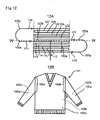
- FIG. 12A shows the knitting sequence for the process of joining together the sleeves and the body.
- FIG. 12B shows sweater 101 whose sleeves and body are joined together in accordance with the knitting sequence of FIG. 12A.
- the line W-W represents the boundary between a front fabric comprising a right front sleeve 105a, a front body 103 and a left front sleeve 107a and a back fabric comprising a right back sleeve 105b, a back body 103b and a left back sleeve 107b.
- a single yarn feeder is used for knitting both of the front fabric and the back fabric.
- the right front sleeve 105a and the front body 103a After the yarn is continuously fed to the right front sleeve 105a and the front body 103a, the right front sleeve 105a and the left front sleeve 107a are shifted to the body, respectively, to be joined to the front body.
- the knitting that whenever the front fabric is knitted in one course, the right front sleeve 105a and the left front sleeve 107a are shifted to and joined to the front body 103a is repeated five times.
- the knitting that whenever the back fabric is knitted in one course, the right back sleeve 105b and the left back sleeve 107b are shifted to and joined to the back body 103b is repeated five times.
- the course 129 after the back body 103b and the right back sleeve 105b are continuously knitted, the right back sleeve 105b and the left back sleeve 107b are shifted to the body, so that the sleeves and the back body are joined together.
- the sleeve attaching angle ⁇ varies depending on the course number ratio of the sleeve to the body after the start of the joining knit to join together the sleeve and the body.
- the sleeve attaching angle ⁇ increases and comes nearer to a right angle.
- the sleeve attaching angle ⁇ reduces and comes nearer to a parallel with the body.
- JP Laid-open (Unexamined) Patent Publication No. A-2000-256947 the knitting method using an elastic yarn for joining together the sleeves and the body.
- This knitting method comprises the step that while the sleeves and the body are both knitted, the sleeves are shifted to the body and joined to it; the step that the knitting of the body is suspended, during which the knitting of sleeve caps of the sleeves is continued in a flechage knitting, and then the last course of the sleeves is knitted by using the elastic yarn; and the step that the knitting of the body is restarted, so that the sleeves and the body are joined together along the sleeve caps by transferring stitches whenever a predetermined number of courses of the body are knitted.
- the sleeves and the body are joined together.
- the sleeve caps are knitted into a desired shape in the flechage knitting and since after completion of this flechage knitting, the sleeves are joined to the body along their sleeve caps without knitting the sleeve caps, the shape of the sleeves and the sleeve attaching angle can both be freely set.
- the last course of the sleeves is formed by using the elastic yarn, even when the same stitch is transferred sequentially, there is little fear of causing yarn breakage or stringing out the stitches.
- It is the object of the present invention to disclose a knitwear knitting method comprising the step that tubular sleeves are knitted at each side of a tubular body; and the step that the sleeves are shifted to and joined to the body in a joining region in which the sleeves and the body are to be joined together, wherein the knitwear having a good-looking joining line along which the sleeves and the body are joined together can be knitted at any selective sleeve attaching angle. It is another object of the present invention to disclose a knitting method of knitting knitwear that requires no special yarn, such as an elastic yarn, for joining together the sleeves and the body at a large sleeve attaching angle close to right angle.
- the present invention provides a method of knitting knitwear, comprising a body knitted into a tubular fabric whose front body and back body are overlapped with each other in front and back; and right and left sleeves situated at each side of the body and each formed into a tubular fabric whose front sleeve and back sleeve are overlapped with each other in front and back, by using a flat knitting machine comprising at least a pair of first and second needle beds each having a number of needles, which are placed opposite in front and back and at least either of which can be racked laterally; yarn feeders for feeding yarn to the needles of the first needle bed and second needle bed; and a cam unit, the method comprising the joining knit step that whenever a predetermined number of courses of the body is knitted in a joining region extending from an underarm to a shoulder, the sleeves are shifted to the body to allow the stitches of the last course of the sleeves to be laid over the stitches of the body, so as to join together the sleeves and the body, the joining
- This knitting is taken as unit of repeated knitting operations. In the step 2, this unit of repeated knitting operations is repeated to join together the sleeves and the body. Subsequently, the step 1 and the step 2 are repeatedly taken in an alternate order to join together the sleeves and the body.
- a course number ratio of the sleeve to the body after the start of the joining knit of the sleeve and the body is set so that a course number ratio of the body can be higher than 1:4.
- This construction of the present invention can produce the knitwear having the sleeves joined to the body at a large sleeve attaching angle.
- FIG. 1A shows sweater after the completion of joining of the sleeves and the body; and FIG. 1B shows sweater before the start of joining of the sleeves and the body.
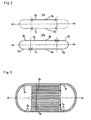
- FIG. 2A shows the track of a yarn feeder in the step 1; and FIG. 2B shows the track of the yarn feeder in the step 2.
- FIG. 3 shows a knitting sequence.
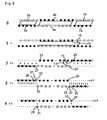
- FIG. 4 is a knitting course diagram of the step 1.
- FIG. 5 is a knitting course diagram of the step 1.
- FIG. 6 is a knitting course diagram of the step 2.
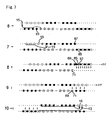
- FIG. 7 is a knitting course diagram of the step 2.
- FIG. 8 is a knitting course diagram of the step 2.
- FIG. 9 is a knitting course diagram of the step 2.
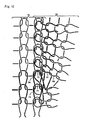
- FIG. 10 is a loop diagram in a joining region where a front body and a left front sleeve are joined together.
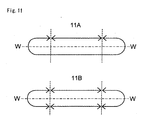
- FIG. 11A show another embodiment; and FIG. 11B shows still another embodiment.
- FIG. 12A shows a knitting sequence of a conventional knitting method; and FIG. 12B shows a knit
- knitwear knitted in the form of sweater having set-in sleeves of a plain knit structure knitted by using a two-bed flat knitting machine may be knitted to have another knit structure, such as jacquard and rib, or may be knitted by using a four-bed flat knitting machine.
- This knitwear can be knitted by using a general flat knitting machine comprising a pair of horizontally extending front and back needle beds which are arranged to confront each other in front and back and have a number of needles thereon. At least one of the front and back needle beds is racked laterally so that stitch transfer can be performed therebetween.
- the back needle bed is racked relative to the front needle bed, and the needles for knitting a front knitted fabric and the needles for knitting a back knitted fabric are arranged in alternate position on the needle beds.
- the alternately arranged needles are used for knitting the front knitted fabric and the back knitted fabric, respectively, and empty needles are reserved for stitch transfer on the opposed needle beds. This arrangement enables the stitches on the needle bed to be shifted laterally in the process of knitting a tubular knitted fabric.
- the needles on the needle beds can all be used for knitting by using the needles on its upper needle bed, without any need to reserve the empty needles for stitch transfer between the alternately arranged knitting needles.
- the needles on the needle beds can all be used for knitting by using the needles on its upper needle bed, without any need to reserve the empty needles for stitch transfer between the alternately arranged knitting needles.
- the sweater 1 comprises a body 3, a right sleeve 5 and a left sleeve 7.
- the body 3 and the right and left sleeves 5, 7 are knitted into a tubular form.
- the body 3 comprises a front body 3a and a back body 3b;
- the right sleeve 5 comprises a right front sleeve 5a and a left back sleeve 5b;
- the left sleeve 7 comprises a left front sleeve 7a and a left back sleeve 7b.
- the right and left sleeves 5, 7 are joined to the body 3 in the joining region extending from underarms of the body 3 to shoulders of the same.
- the front body 3a and the back body 3b are joined to the body at the shoulders 9a, 9b and then are bound off to prevent from loosening of stitches in a known bind-off process.
- a neckline opening 11 is formed in the front body 3a. From the start of formation of the neckline opening 11, the front body 3a is forked into a right side and a left side to confront each other across the neckline opening 11.
- the sleeves 5, 7 and the body 3 are joined together in an alternating succession of the step 1 that each time when the front body 3a and the back body 3b are knitted in one course, the sleeves 5, 7 are shifted to and joined to the bodies 3a, 3b and the step 2 that the sleeves 5, 7 and the bodies 3a, 3b are both knitted to be joined together.
- the right sleeve 5 and the left sleeve 7 shown in FIG. 1A include parts 12a, 12b formed in the step 2, respectively.
- the knitting to join together the sleeves 5, 7 and the bodies 3a, 3b is repeated ten times in a row in the step 1 and then the knitting to join together the sleeves 5, 7 and the bodies 3a, 3b is repeated twice in the step 2, whereby a sweater having a course number ratio of the sleeve to the body of 1:6 is knitted.
- the sweater 1 knitted comes to have a large sleeve attaching angle ⁇ as shown in FIG. 1A. Knitwear having a smaller sleeve-attaching angle ⁇ may be knitted by changing the course number ratio of sleeve to body.
- the tracks of yarn feeders and the knitting sequence of the knitting method of the illustrated embodiment are described with reference to FIGS. 2 and 3. While two yarn feeders are used in the illustrated embodiment, mote than two yarn feeders may be used for knitting.
- the line W-W of FIGS. 2 and 3 represents the boundary between a front fabric comprising the front body 3a, the right front sleeve 5a and the left front sleeve 7a and a back fabric comprising the back body 3b, the right back sleeve 5b, and the left back sleeve 7b.
- the body 3 is knitted in each of the steps 1 and 2, and the sleeves 5 and 7 are knitted in the step 2 only. In the step 1, as shown in FIG.
- the yarn feeder 13 is used to knit the front body 3a
- the yarn feeder 15 is used to knit the back body 3b.
- the yarn feeder 13 is turned back at both ends of the front body 3a to knit the front body 3a in a flechage knitting.
- the yarn feeder 15 is turned back at both ends of the back body 3b to knit the back body 3b in the flechage knitting.
- step 2 as shown in FIG.
- the yarn feeder 13 is used to knit the front body 3a and the left sleeve 7 in the shuttlewise knitting order of the front body 3a ⁇ the left front sleeve 7a ⁇ the left back sleeve 7b ⁇ the left back sleeve 7b ⁇ the left front sleeve 7a ⁇ the front body 3a
- the yarn feeder 15 is used to knit the back body 3b and the right sleeve 5 in the shuttlewise order of the back body 3b ⁇ the right back sleeve 5b ⁇ the right front sleeve 5a ⁇ the right front sleeve 5a ⁇ the right back sleeve 5b ⁇ the back body 3b.
- the course 0 shows the state before the joining of the sleeves 5, 7 to the body 3.
- the right front sleeve 5a and right back sleeve 5b, and the left front sleeve 7a and left back sleeve 7b are retained at both outsides of the front body 3a and the back body 3b.
- the front body 3a and the back body 3b; the right front sleeve 5a and the right back sleeve 5b; and the left front sleeve 7a and the left back sleeve 7b are knitted into tubular bodies, respectively.
- the front knitted fabric comprising the front body 3a, the right front sleeve 5a and the left front sleeve 7a and the back knitted fabric comprising the back body 3b, the right back body 5b and the left back sleeve 7b are knitted to be continuous to each other at each end thereof, so as to be knitted into a large tubular fabric.
- the yarn feeder 13 is used for the front body 3a and the yarn feeder 15 is used for the back body 3b, and the front body 3a is knitted by a leading cam system and the back body 3b is knitted by a trailing cam system.
- the yarn feeders 13, 15 are kicked back to the left side, the stitches of the right back sleeve 5b are transferred to the front needle bed and the stitches of the front sleeve 7a are transferred to the back needle bed.
- the stitches of the right front sleeve 5a and the right back sleeve 5b are transferred to the front needle bed, and the stitches of the left front sleeve 7a and the left back sleeve 7b are transferred to the back needle bed.
- the stitch 37 at the side end of the right front sleeve 5a is laid over the stitch 39 of the front body 3a and the stitch 41 at the side end of the left back sleeve 7b is laid over the stitch 43 of the back body 3b.
- the step 2 will be described, starting at the point of time the knitting of the step 1 up to the course 5 of FIG. 5 is completed.
- the sleeve and the body are both previously knitted and joined together at one sleeve side, e.g. at the right sleeve 5 side, and the other sleeve and the body are joined together at the left sleeve 7 side without knitting the other sleeve 7, first.
- the other sleeve and the body are both knitted and joined together at the left sleeve 7 side, while the one sleeve and the body are joined together, without knitting the one sleeve 5.
- the stitch 53 is laid over the stitch 57 of the back body 3b.
- the yarn feeder 15 is reversed in direction at the left end of the right sleeve 5
- the yarn is fed to the right front sleeve 5a to form the stitches of the next course and also a split knit is provided for the stitch 59 at the side end of the right front sleeve 5a next to be laid over the stitch of the front body 3a.
- the stitch 59 is transferred on to the back needle bed and also an additional stitch 61 is formed.
- the stitch 59 is laid over the stitch 63 at the side end of the front body 3a.
- the stitches of the left front sleeve 7a and the left back sleeve 7b are transferred to the back needle bed, and the stitch 65 at the side end of the left back sleeve 7b are laid over the stitch 67 of the back body 3b.
- the stitches of the left front sleeve 7a are transferred to the front needle bed, and the stitch 69 at the side end of the left front sleeve 7a is laid over the stitch 71 of the front body 3a.
- the yarn feeders 13, 15 are kicked back to the left side, they are racked rightwards. Then, the front body 3a and the back body 3b are knitted via the yarn feeder 13 and the yarn feeder 15, respectively, and also the stitches of the right back sleeve 5b are transferred to the front needle bed.
- the yarn feeders 13, 15 are kicked back to the left side. Then, when the yarn is fed to the left front sleeve 7a by the yarn feeder 13, a split knit is provided by the needle retaining thereon the stitch 71 of the left front sleeve 7a next to be laid over the stitch of the body and an additional stitch 73 is formed. The knitting is performed by other needles than that needle to form stitches of the next course in the left front sleeve 7a. In the course 12, after the back needle bed is racked leftwards two pitches, the stitch 71 is laid over the stitch 75 of the front body.
- the yarn feeder 13 is reversed in direction, to form the stitches of the next course in the left back sleeve 7b and also a split knit is provided for the stitch 77 at the side end and an additional stitch 79 is formed.
- the stitch 77 is laid over the stitch 81 of the front body 3a.
- the yarn feeder 13 is reversed in direction at the left end of the left sleeve 7, to form the stitches of the next course in the left back sleeve 7b, except the stitch 79 for which the split knit was provided in the course 13.
- the needle retaining thereon the additional stitch 73 additionally formed in the course 11 is missed, and the stitches of the next course are formed on the other stitches of the left front sleeve 7a than that stitch.
- the stitches of the left back sleeve 7b are transferred to the front needle bed.
- the stitches of the right front sleeve 5a and the right back sleeve 5b are transferred to the back needle bed, and the stitch 81 at the side end of the left back sleeve 7b is laid over the stitch 83 of the back body 3b.
- the stitch 85 at the side end of the right front sleeve 5a is laid over the stitch 87 of the front body 3a.
- the stitches of the next course are formed in the front body 3a and the back body 3b.
- the knitting of the courses 2-20 of FIG. 6-9 taken as the unit of repeated knitting operations is repeatedly performed. In the illustrated embodiment, the knitting is not repeated but is returned to the knitting of the step 1 from the course 6 of FIG. 5, in order to reduce the course number ratio of the sleeve.
- the stitches 55, 61, 73 and 79 formed by the split knit are laid over the stitches of the front and back bodies 3a, 3b.
- the knitting operations of the step 1 and the knitting operations of the step 2 are alternately performed to join together the sleeves and the body.
- a yarn feeder used for the left side of the neckline opening 11 is added so that the two parts of the knitwear at the right and left sides of the neckline opening 11 can be knitted by the different yarn feeders, respectively.
- the front body 3a and the back body 3b are joined together at their shoulder portions 9a, 9b to complete the sweater 1.
- FIG. 10 The loop diagram at the joining part of the left front sleeve 7a and the front body 3a of the sweater 1 knitted in the knitting method mentioned above is shown in FIG. 10.
- the stitches formed in the knitting of the step 2 are represented by a bold line.
- the sleeves and the body are joined together by the stitches of the last course of the left front sleeve 7a being laid over the stitches at the end of the front body 3a.
- the sleeves and the body can be joined together without any difference in knitting width between the front knitted fabric and the back knitted fabric that may cause yarn rupture or stretched stitch.
- the split knit is provided for the stitch 71 at the side end in the sleeve knitting course, to form the additional stitch 73 and then the stitches 71 and 73 are joined to the stitches 75 and 89 in the different courses of the front body 3a.
- the stitch 73 formed by the split knit is formed in a smaller stitch form than the usual one, such that it draws in surrounding stitches 91, 93, and as such can allow the sleeves and the body to be joined together closely without leaving any undesirable space therebetween, thus producing a good-looking joining line.
- the body is overlapped with the sleeves whenever the body is knitted in one course
- the body may be overlapped with the sleeves whenever the body is knitted in two courses or more.
- such modification may be made that the front body 3a and the right and the left sleeves 5, 7 may be knitted by the same yarn feeder, while only the back body 3b may be knitted by another yarn feeder, as shown in FIG. 11A.
- the front body 3a, the back body 3b, the right sleeve 5 and the left sleeve 7 may be knitted by their respective yarn feeders, as shown in FIG. 11B.
- the knitting method has been described above, taking the sweater as one example of the knitwear, the present invention is applicable to the knitting of cardigan or other knitwear. Further, the course number ratio of the sleeve to the body may be changed within the joining region of the sleeves and the body.
- the knitwear having a good-looking joining line along which the sleeves and the body are joined together can be knitted at any selective sleeve attaching angle. Also, since the course for only the body to be knitted to join together the sleeves and the body is increased in course number as compared with the course for both the sleeves and the body to be knitted to join together the sleeves and the body, the knitwear having the sleeves which are joined to the body at nearly right angle can be knitted without using any special yarn such as an elastic yarn.
Landscapes
- Engineering & Computer Science (AREA)
- Textile Engineering (AREA)
- Knitting Machines (AREA)
- Knitting Of Fabric (AREA)
- Outer Garments And Coats (AREA)
- Braiding, Manufacturing Of Bobbin-Net Or Lace, And Manufacturing Of Nets By Knotting (AREA)
Abstract
Description
- The present invention relates to a method of knitting knitwear whose sleeves and body are joined by using a flat knitting machine.
- The knitting method of joining together knitted fabrics knitted in different regions on the flat knitting machine in the course of the knitting process can eliminate or simplify the tail end sewing process. The application of this knitting method to the knitting of sweater and the like enables the knitting of knitwear which is called a non-sewing knitted fabric.
- When sweater is knitted in the form of the non-sewing knitted fabric, the front and back bodies are knitted into a tubular body continuously joined at each end thereof. In parallel with this, the right and left sleeves situated at each side of the body are each knitted into a tubular form and shifted to the body side, so that the sleeves and the body are overlapped and joined together in a joining region extending from the underarm to the shoulder.
- The sleeves and the body are joined together to have a proper angle formed by the sleeve and the body joined together (hereinafter it is referred to as "the sleeve attaching angle"). This sleeve attaching angle can be adjusted by changing a course number ratio between the sleeve and the body after the start of knitting of joining together the sleeve and the body. With reference to FIGS. 12A and 12B, the knitting method of adjusting the sleeve attaching angle will be described. FIG. 12A shows the knitting sequence for the process of joining together the sleeves and the body. FIG. 12B shows
sweater 101 whose sleeves and body are joined together in accordance with the knitting sequence of FIG. 12A. The line W-W represents the boundary between a front fabric comprising a rightfront sleeve 105a, a front body 103 and aleft front sleeve 107a and a back fabric comprising aright back sleeve 105b, aback body 103b and aleft back sleeve 107b. - In the knitting method of FIG. 12, a single yarn feeder is used for knitting both of the front fabric and the back fabric. In the
course 111, after the yarn is continuously fed to the rightfront sleeve 105a and thefront body 103a, the rightfront sleeve 105a and the leftfront sleeve 107a are shifted to the body, respectively, to be joined to the front body. Sequentially, in the courses 113-117, the knitting that whenever the front fabric is knitted in one course, the rightfront sleeve 105a and the leftfront sleeve 107a are shifted to and joined to thefront body 103a is repeated five times. In thecourse 119, after thefront body 103a and theleft front sleeve 107a are continuously knitted, the rightfront sleeve 105a and theleft front sleeve 107a are shifted to thefront body 103a, so that the sleeves and the front body are joined together. Then, the knitting goes on to the knitting of the back fabric. In thecourse 121, after theleft back sleeve 107b and theback body 103b are continuously knitted, theright back sleeve 105b and theleft back sleeve 107b are shifted to the body, respectively, to be joined to the back body. Sequentially, in the courses 123-127, the knitting that whenever the back fabric is knitted in one course, theright back sleeve 105b and theleft back sleeve 107b are shifted to and joined to theback body 103b is repeated five times. In thecourse 129, after theback body 103b and theright back sleeve 105b are continuously knitted, theright back sleeve 105b and theleft back sleeve 107b are shifted to the body, so that the sleeves and the back body are joined together. The sleeve attaching angle varies depending on the course number ratio of the sleeve to the body after the start of the joining knit to join together the sleeve and the body. As the course number ratio of the body to the sleeve is increased, the sleeve attaching angle increases and comes nearer to a right angle. On the other hand, as the course number ratio of the body is reduced, the sleeve attaching angle reduces and comes nearer to a parallel with the body. - In the knitting method mentioned above, in the courses 113-117 and 123-127, the knitting of the sleeves 105, 107 is suspended and the knitting to join either of the front and back bodies and the sleeves is continuously performed. During this course knitting, only either of the front knitted fabric and the back knitted fabric is reduced in knitting width. When this knitting wherein the knitting of the sleeves is suspended and the joining knit to continuously join the sleeves and the body of either of the front knitted fabric and the back knitted fabric is repeated five consecutive times, as shown in FIG. 12, the stitches on the edge of the front knitted fabric and the stitches on the edge of the back knitted fabric will be moved away from each other by five stitches. This may cause the problems of causing yarn rupture in the yarn extending between the stitch on the edge of the front knitted fabric and the stitch on the edge of the back knitted fabric, thus interrupting the knitting operation and of generating in the knitwear an undesirable knitted line to significantly spoil the commercial value of the product. If the sleeves are not knitted but are shifted to and joined to the body repeatedly, in order to bring the sleeve attaching angle closer to right angle, then the same stitch will be transferred over and over again by the time the knitting of the sleeves suspended is restarted. As a result of this, the stitch laid over the stitch of the body is strung out. This may cause an undesirable hole in the joining
line - Meanwhile, the applicant discloses in JP Laid-open (Unexamined) Patent Publication No. A-2000-256947 the knitting method using an elastic yarn for joining together the sleeves and the body. This knitting method comprises the step that while the sleeves and the body are both knitted, the sleeves are shifted to the body and joined to it; the step that the knitting of the body is suspended, during which the knitting of sleeve caps of the sleeves is continued in a flechage knitting, and then the last course of the sleeves is knitted by using the elastic yarn; and the step that the knitting of the body is restarted, so that the sleeves and the body are joined together along the sleeve caps by transferring stitches whenever a predetermined number of courses of the body are knitted. After these steps, the sleeves and the body are joined together. In this knitting method, since the sleeve caps are knitted into a desired shape in the flechage knitting and since after completion of this flechage knitting, the sleeves are joined to the body along their sleeve caps without knitting the sleeve caps, the shape of the sleeves and the sleeve attaching angle can both be freely set. In addition, since the last course of the sleeves is formed by using the elastic yarn, even when the same stitch is transferred sequentially, there is little fear of causing yarn breakage or stringing out the stitches.
- It is the object of the present invention to disclose a knitwear knitting method comprising the step that tubular sleeves are knitted at each side of a tubular body; and the step that the sleeves are shifted to and joined to the body in a joining region in which the sleeves and the body are to be joined together, wherein the knitwear having a good-looking joining line along which the sleeves and the body are joined together can be knitted at any selective sleeve attaching angle. It is another object of the present invention to disclose a knitting method of knitting knitwear that requires no special yarn, such as an elastic yarn, for joining together the sleeves and the body at a large sleeve attaching angle close to right angle.
- To solve the problems mentioned above, the present invention provides a method of knitting knitwear, comprising a body knitted into a tubular fabric whose front body and back body are overlapped with each other in front and back; and right and left sleeves situated at each side of the body and each formed into a tubular fabric whose front sleeve and back sleeve are overlapped with each other in front and back, by using a flat knitting machine comprising at least a pair of first and second needle beds each having a number of needles, which are placed opposite in front and back and at least either of which can be racked laterally; yarn feeders for feeding yarn to the needles of the first needle bed and second needle bed; and a cam unit, the method comprising the joining knit step that whenever a predetermined number of courses of the body is knitted in a joining region extending from an underarm to a shoulder, the sleeves are shifted to the body to allow the stitches of the last course of the sleeves to be laid over the stitches of the body, so as to join together the sleeves and the body,
the joining knit step comprising: - a) the step that whenever an adequate number of courses of the front body and the back body are knitted by using different yarn feeders, the right and left sleeves are shifted to the body side and joined together; and
- b) the step that when the front body and the back body are knitted by the different feed yarns, respectively, and the yarn is fed to either of the right and left sleeves to form stitches in the next course, split knit is provided for stitches of the front sleeves and back sleeves at side ends thereof on the body side and then each of the split stitches are laid over the stitches of the different courses in the bodies to join together the sleeves and the body.
-
- According to the construction of the present invention, the knitting that the body and the right and left sleeves are each knitted into a tubular form up to underarm; different yarn feeders are used for knitting the front body and the back body in the joining region extending from the underarm to the shoulder; the yarn feeders are reversed in direction at each end of the body to perform the flechage knitting; and whenever an adequate number of courses of the body are knitted, the right and left sleeves are shifted to the body side so the front sleeves and the front body can be overlapped with the back sleeves and the back body to be joined together is taken as unit of repeated knitting operations. In the
step 1, this unit of repeated knitting operations is repeated to join together the sleeves and the body. Sequentially, the knitting that when the front body and the back body are knitted by using the different yarn feeders and the yarn is fed to either of the right and left sleeves to form stitches of the next course in the sleeves, the split knit is provided for the stitches of the front and back sleeves at side ends thereof on the body side; one of a split stitch and an added stitch provided by the split knit is laid over the stitch of the body to form the stitch of the next course in the body; and the other of the split stitch and the added stitch is laid over the stitch of the body to form the stitch of the next course in the body is alternately made for the right and left sleeves. This knitting is taken as unit of repeated knitting operations. In thestep 2, this unit of repeated knitting operations is repeated to join together the sleeves and the body. Subsequently, thestep 1 and thestep 2 are repeatedly taken in an alternate order to join together the sleeves and the body. - In the method of knitting knitwear of the present invention, a course number ratio of the sleeve to the body after the start of the joining knit of the sleeve and the body is set so that a course number ratio of the body can be higher than 1:4. This construction of the present invention can produce the knitwear having the sleeves joined to the body at a large sleeve attaching angle.
- FIG. 1A shows sweater after the completion of joining of the sleeves and the body; and FIG. 1B shows sweater before the start of joining of the sleeves and the body. FIG. 2A shows the track of a yarn feeder in the
step 1; and FIG. 2B shows the track of the yarn feeder in thestep 2. FIG. 3 shows a knitting sequence. FIG. 4 is a knitting course diagram of thestep 1. FIG. 5 is a knitting course diagram of thestep 1. FIG. 6 is a knitting course diagram of thestep 2. FIG. 7 is a knitting course diagram of thestep 2. FIG. 8 is a knitting course diagram of thestep 2. FIG. 9 is a knitting course diagram of thestep 2. FIG. 10 is a loop diagram in a joining region where a front body and a left front sleeve are joined together. FIG. 11A show another embodiment; and FIG. 11B shows still another embodiment. FIG. 12A shows a knitting sequence of a conventional knitting method; and FIG. 12B shows a knitted fabric knitted in accordance with the knitting sequence of FIG. 12A. - A certain preferred embodiment of the present invention will be described with reference to the accompanying drawings. It is to be noted that the terms "right" and "left" in the right side and left side of
sweater 1 appearing in the following description are intended to mean the right-hand part and the left-hand part ofsweater 1 when viewing from the a wearer who wears the sweater. Also, in the course knitting diagrams of FIGS. 4-9, the numerals at the left side indicate the serial number of the courses; the vertical arrows at right side thereof indicate the stitch transfer direction; and the horizontal arrows indicate the knitting direction. - In the following, reference is made to knitwear knitted in the form of sweater having set-in sleeves of a plain knit structure knitted by using a two-bed flat knitting machine. The knitwear may be knitted to have another knit structure, such as jacquard and rib, or may be knitted by using a four-bed flat knitting machine. This knitwear can be knitted by using a general flat knitting machine comprising a pair of horizontally extending front and back needle beds which are arranged to confront each other in front and back and have a number of needles thereon. At least one of the front and back needle beds is racked laterally so that stitch transfer can be performed therebetween. In the flat knitting machine used in the illustrated embodiment, the back needle bed is racked relative to the front needle bed, and the needles for knitting a front knitted fabric and the needles for knitting a back knitted fabric are arranged in alternate position on the needle beds. The alternately arranged needles are used for knitting the front knitted fabric and the back knitted fabric, respectively, and empty needles are reserved for stitch transfer on the opposed needle beds. This arrangement enables the stitches on the needle bed to be shifted laterally in the process of knitting a tubular knitted fabric. On the other hand, when a four-bed flat knitting machine is used, the needles on the needle beds can all be used for knitting by using the needles on its upper needle bed, without any need to reserve the empty needles for stitch transfer between the alternately arranged knitting needles. In the following description, for better understanding of explanation, a fewer number of needles used for the knitting than the actual number of needles is illustrated.
- The
sweater 1 comprises abody 3, aright sleeve 5 and aleft sleeve 7. Thebody 3 and the right and leftsleeves body 3 comprises afront body 3a and aback body 3b; theright sleeve 5 comprises a rightfront sleeve 5a and aleft back sleeve 5b; and theleft sleeve 7 comprises a leftfront sleeve 7a and aleft back sleeve 7b. The right and leftsleeves body 3 in the joining region extending from underarms of thebody 3 to shoulders of the same. Thefront body 3a and theback body 3b are joined to the body at theshoulders 9a, 9b and then are bound off to prevent from loosening of stitches in a known bind-off process. Aneckline opening 11 is formed in thefront body 3a. From the start of formation of theneckline opening 11, thefront body 3a is forked into a right side and a left side to confront each other across theneckline opening 11. - In the illustrated embodiment, the
sleeves body 3 are joined together in an alternating succession of thestep 1 that each time when thefront body 3a and theback body 3b are knitted in one course, thesleeves bodies step 2 that thesleeves bodies right sleeve 5 and theleft sleeve 7 shown in FIG. 1A includeparts step 2, respectively. In the illustrated embodiment, the knitting to join together thesleeves bodies step 1 and then the knitting to join together thesleeves bodies step 2, whereby a sweater having a course number ratio of the sleeve to the body of 1:6 is knitted. In the illustrated embodiment, since the course number ratio of the sleeve to the body is set to be 1:6, thesweater 1 knitted comes to have a large sleeve attaching angle as shown in FIG. 1A. Knitwear having a smaller sleeve-attaching angle may be knitted by changing the course number ratio of sleeve to body. The higher the course number ratio of the body to the sleeve becomes, the larger the sleeve attaching angle becomes. On the other hand, the lower the course number ratio of the body to the sleeve becomes, the smaller the sleeve attaching angle becomes. - The tracks of yarn feeders and the knitting sequence of the knitting method of the illustrated embodiment are described with reference to FIGS. 2 and 3. While two yarn feeders are used in the illustrated embodiment, mote than two yarn feeders may be used for knitting. The line W-W of FIGS. 2 and 3 represents the boundary between a front fabric comprising the
front body 3a, the rightfront sleeve 5a and the leftfront sleeve 7a and a back fabric comprising theback body 3b, the right backsleeve 5b, and the left backsleeve 7b. Thebody 3 is knitted in each of thesteps sleeves step 2 only. In thestep 1, as shown in FIG. 2A, theyarn feeder 13 is used to knit thefront body 3a, and theyarn feeder 15 is used to knit theback body 3b. Theyarn feeder 13 is turned back at both ends of thefront body 3a to knit thefront body 3a in a flechage knitting. Theyarn feeder 15 is turned back at both ends of theback body 3b to knit theback body 3b in the flechage knitting. In thestep 2, as shown in FIG. 2B, theyarn feeder 13 is used to knit thefront body 3a and theleft sleeve 7 in the shuttlewise knitting order of thefront body 3a → the leftfront sleeve 7a → the left backsleeve 7b → the left backsleeve 7b → the leftfront sleeve 7a → thefront body 3a, and theyarn feeder 15 is used to knit theback body 3b and theright sleeve 5 in the shuttlewise order of theback body 3b → the right backsleeve 5b → the rightfront sleeve 5a → the rightfront sleeve 5a → the right backsleeve 5b → theback body 3b. - Now, the
step 1 will be described, starting at thecourse 0 of FIG. 4. Thecourse 0 shows the state before the joining of thesleeves body 3. In thecourse 0, the rightfront sleeve 5a and right backsleeve 5b, and the leftfront sleeve 7a and left backsleeve 7b are retained at both outsides of thefront body 3a and theback body 3b. In the knitting before thecourse 0, thefront body 3a and theback body 3b; the rightfront sleeve 5a and the right backsleeve 5b; and the leftfront sleeve 7a and the left backsleeve 7b are knitted into tubular bodies, respectively. After the start of joining of thesleeves bodies front body 3a, the rightfront sleeve 5a and the leftfront sleeve 7a and the back knitted fabric comprising theback body 3b, the right backbody 5b and the left backsleeve 7b are knitted to be continuous to each other at each end thereof, so as to be knitted into a large tubular fabric. - In the
course 1, theyarn feeder 13 is used for thefront body 3a and theyarn feeder 15 is used for theback body 3b, and thefront body 3a is knitted by a leading cam system and theback body 3b is knitted by a trailing cam system. In thecourse 2, after theyarn feeders sleeve 5b are transferred to the front needle bed and the stitches of thefront sleeve 7a are transferred to the back needle bed. In thecourse 3, after the back needle bed is racked leftwards two pitches, the stitches of the rightfront sleeve 5a and the right backsleeve 5b are transferred to the back needle bed, and the stitches of the leftfront sleeve 7a and the left backsleeve 7b are transferred to the front needle bed. Then, thestitch 21 at the side end of the right backsleeve 5b is laid over thestitch 23 of theback body 3b and thestitch 25 at the side end of the leftfront sleeve 7a is laid over thestitch 27 of thefront body 3a. In the course 4, after the back needle bed is racked rightwards two pitches, thestitch 29 at the side end of the rightfront sleeve 5a is laid over thestitch 31 of thefront body 3a and thestitch 33 at the side end of the leftfront sleeve 7a is laid over thestitch 35 of theback body 3b. - Then, in the
course 5 of FIG. 5, after theyarn feeders front body 3a is knitted via theyarn feeder 13, and theback body 3b is knitted via theyarn feeder 15. In the knitting from thecourse 2 of FIG. 4 to thecourse 5 of FIG. 5, the stitches of the rightfront sleeve 5a and the leftfront sleeve 7a are laid over the stitches of thefront body 3a and also the stitches of the back sleeves are laid over the stitches of theback body 3b, whereby the sleeves and the body are joined together. In thecourse 6, after theyarn feeders front sleeve 5a and the right backsleeve 5b are transferred to the front needle bed, and the stitches of the leftfront sleeve 7a and the left backsleeve 7b are transferred to the back needle bed. Then, thestitch 37 at the side end of the rightfront sleeve 5a is laid over thestitch 39 of thefront body 3a and thestitch 41 at the side end of the left backsleeve 7b is laid over thestitch 43 of theback body 3b. In thecourse 7, after the back needle bed is racked leftwards two pitches, thestitch 45 at the side end of the right backsleeve 5b is laid over thestitch 47 of theback body 3b and thestitch 49 at the side end of the leftfront sleeve 7a is laid over thestitch 51 of thefront body 3a. In thecourse 8, after theyarn feeders front body 3a and theback body 3b. After the knitting mentioned above, the joining of two stitches of each of the rightfront sleeve 5a, the right backsleeve 5b, the leftfront sleeve 7a and the left backsleeve 7b to the body is completed from the state of thecourse 0 of FIG. 4. When the knitting of the courses 2-5 of FIGS. 4-5 wherein thefront body 3a and theback body 3b are knitted to the right side to be joined together and the knitting of the courses 6-8 of FIG. 5 wherein thefront body 3a and theback body 3b are knitted to the left side to be joined together are taken as unit of repeated knitting operations, the unit of repeated knitting operations is repeated five times to complete the knitting of thestep 1. - Then, the
step 2 will be described, starting at the point of time the knitting of thestep 1 up to thecourse 5 of FIG. 5 is completed. In thestep 2, the sleeve and the body are both previously knitted and joined together at one sleeve side, e.g. at theright sleeve 5 side, and the other sleeve and the body are joined together at theleft sleeve 7 side without knitting theother sleeve 7, first. Then, after thefront body 3a and theback body 3b are knitted, the other sleeve and the body are both knitted and joined together at theleft sleeve 7 side, while the one sleeve and the body are joined together, without knitting the onesleeve 5. In thecourse 1 of FIG. 6, after theyarn feeders front sleeve 5a are transferred to the front needle bed. In thecourse 2, when the yarn is fed to the right backsleeve 5b by theyarn feeder 15 used for the knitting of theback body 3b in thestep 1, a split knit is provided by the needle retaining thereon the stitch 53 positioned at the side end of the right backsleeve 5b next to be laid over the stitch of the body. Then, the stitch 53 is transferred on to the opposite needle bed and also anadditional stitch 55 is additionally formed. The knitting is performed by other needles than that needle to form stitches of the next course in the right backsleeve 5b. In thecourse 3, after the back needle bed is racked leftwards two pitches, the stitch 53 is laid over thestitch 57 of theback body 3b. In the course 4, after theyarn feeder 15 is reversed in direction at the left end of theright sleeve 5, the yarn is fed to the rightfront sleeve 5a to form the stitches of the next course and also a split knit is provided for thestitch 59 at the side end of the rightfront sleeve 5a next to be laid over the stitch of thefront body 3a. Then, thestitch 59 is transferred on to the back needle bed and also anadditional stitch 61 is formed. In thecourse 5, after the back needle bed is racked rightwards two pitches, thestitch 59 is laid over thestitch 63 at the side end of thefront body 3a. - In the
course 6 of FIG. 7, after theyarn feeder 15 is reversed in direction at the right end of the rightfront sleeve 3a, the yarn is fed to the rightfront sleeve 5a again. At this point of time, the needle retaining thereon thestitch 61 for which the split knit was provided in the course 4 is missed. The yarn is fed to the other needles than that needle to form the stitches of the next course in the rightfront sleeve 5a. In thecourse 7, as is the case with thecourse 6, the needle retaining thereon thestitch 55 for which the split knit was provided in thecourse 2 is missed, and the stitches of the next course are formed on the other stitches of the right backsleeve 5b than thatstitch 55. In thecourse 8, after the back needle bed is racked rightwards two pitches, the stitches of the leftfront sleeve 7a and the left backsleeve 7b are transferred to the back needle bed, and thestitch 65 at the side end of the left backsleeve 7b are laid over thestitch 67 of theback body 3b. In the course 9, after the back needle bed is racked leftwards two pitches, the stitches of the leftfront sleeve 7a are transferred to the front needle bed, and thestitch 69 at the side end of the leftfront sleeve 7a is laid over thestitch 71 of thefront body 3a. In the course 10, theyarn feeders front body 3a and theback body 3b are knitted via theyarn feeder 13 and theyarn feeder 15, respectively, and also the stitches of the right backsleeve 5b are transferred to the front needle bed. - In the
course 11 of FIG. 8, theyarn feeders front sleeve 7a by theyarn feeder 13, a split knit is provided by the needle retaining thereon thestitch 71 of the leftfront sleeve 7a next to be laid over the stitch of the body and anadditional stitch 73 is formed. The knitting is performed by other needles than that needle to form stitches of the next course in the leftfront sleeve 7a. In thecourse 12, after the back needle bed is racked leftwards two pitches, thestitch 71 is laid over thestitch 75 of the front body. In thecourse 13, after the back needle bed is racked rightwards two pitches, theyarn feeder 13 is reversed in direction, to form the stitches of the next course in the left backsleeve 7b and also a split knit is provided for thestitch 77 at the side end and anadditional stitch 79 is formed. In the course 14, after the back needle bed is racked rightwards two pitches, thestitch 77 is laid over thestitch 81 of thefront body 3a. In thesubsequent course 15, after the back needle bed is racked leftwards two pitches, theyarn feeder 13 is reversed in direction at the left end of theleft sleeve 7, to form the stitches of the next course in the left backsleeve 7b, except thestitch 79 for which the split knit was provided in thecourse 13. - In the
course 16 of FIG. 9, the needle retaining thereon theadditional stitch 73 additionally formed in thecourse 11 is missed, and the stitches of the next course are formed on the other stitches of the leftfront sleeve 7a than that stitch. In thecourse 17, the stitches of the left backsleeve 7b are transferred to the front needle bed. In the course 18, after the back needle bed is racked leftwards two pitches, the stitches of the rightfront sleeve 5a and the right backsleeve 5b are transferred to the back needle bed, and thestitch 81 at the side end of the left backsleeve 7b is laid over thestitch 83 of theback body 3b. In thecourse 19, after the back needle bed is racked rightwards four pitches, thestitch 85 at the side end of the rightfront sleeve 5a is laid over thestitch 87 of thefront body 3a. In thecourse 20, after theyarn feeders front body 3a and theback body 3b. In thestep 2, the knitting of the courses 2-20 of FIG. 6-9 taken as the unit of repeated knitting operations is repeatedly performed. In the illustrated embodiment, the knitting is not repeated but is returned to the knitting of thestep 1 from thecourse 6 of FIG. 5, in order to reduce the course number ratio of the sleeve. In the subsequent knitting, thestitches back bodies step 1 and the knitting operations of thestep 2 are alternately performed to join together the sleeves and the body. In the area where theneckline opening 11 is formed, a yarn feeder used for the left side of theneckline opening 11 is added so that the two parts of the knitwear at the right and left sides of theneckline opening 11 can be knitted by the different yarn feeders, respectively. After the joining of thesleeves body 3 is completed in the knitting method mentioned above, thefront body 3a and theback body 3b are joined together at theirshoulder portions 9a, 9b to complete thesweater 1. - The loop diagram at the joining part of the left
front sleeve 7a and thefront body 3a of thesweater 1 knitted in the knitting method mentioned above is shown in FIG. 10. In FIG. 10, the stitches formed in the knitting of thestep 2 are represented by a bold line. In thesweater 1, the sleeves and the body are joined together by the stitches of the last course of the leftfront sleeve 7a being laid over the stitches at the end of thefront body 3a. In the embodiment of the present invention, since the knitting of thefront body 3a and the knitting of theback body 3b are concurrently performed and the joining of thefront sleeves front body 3a and the joining of theback sleeves back body 3b are concurrently performed by using a plurality of yarn feeders, the sleeves and the body can be joined together without any difference in knitting width between the front knitted fabric and the back knitted fabric that may cause yarn rupture or stretched stitch. In addition, in the embodiment of the present invention, the split knit is provided for thestitch 71 at the side end in the sleeve knitting course, to form theadditional stitch 73 and then thestitches stitches front body 3a. Thestitch 73 formed by the split knit is formed in a smaller stitch form than the usual one, such that it draws in surroundingstitches - While in the embodiment of the present invention, the body is overlapped with the sleeves whenever the body is knitted in one course, the body may be overlapped with the sleeves whenever the body is knitted in two courses or more. Also, such modification may be made that the
front body 3a and the right and theleft sleeves back body 3b may be knitted by another yarn feeder, as shown in FIG. 11A. Alternatively, thefront body 3a, theback body 3b, theright sleeve 5 and theleft sleeve 7 may be knitted by their respective yarn feeders, as shown in FIG. 11B. Although the knitting method has been described above, taking the sweater as one example of the knitwear, the present invention is applicable to the knitting of cardigan or other knitwear. Further, the course number ratio of the sleeve to the body may be changed within the joining region of the sleeves and the body. - As evidence from the foregoing, according to the present invention, the knitwear having a good-looking joining line along which the sleeves and the body are joined together can be knitted at any selective sleeve attaching angle. Also, since the course for only the body to be knitted to join together the sleeves and the body is increased in course number as compared with the course for both the sleeves and the body to be knitted to join together the sleeves and the body, the knitwear having the sleeves which are joined to the body at nearly right angle can be knitted without using any special yarn such as an elastic yarn.
Claims (2)
- A method of knitting knitwear, comprising a body knitted into a tubular fabric whose front body and back body are overlapped with each other in front and back; and right and left sleeves situated at each side of the body and each formed into a tubular fabric whose front sleeve and back sleeve are overlapped with each other in front and back, by using a flat knitting machine comprising at least a pair of first and second needle beds each having a number of needles, which are placed opposite in front and back and at least either of which can be racked laterally; yarn feeders for feeding yarn to the needles of the first needle bed and second needle bed; and a cam unit, the method comprising the joining knit step that whenever a predetermined number of courses of the body is knitted in a joining region extending from an underarm to a shoulder, the sleeves are shifted to the body to allow the stitches of the last course of the sleeves to be laid over the stitches of the body, so as to join together the sleeves and the body,
the joining knit step comprising:a) the step that whenever an adequate number of courses of the front body and the back body are knitted by using different yarn feeders, the right and left sleeves are shifted to the body side and joined together; andb) the step that when the front body and the back body are knitted by the different feed yarns, respectively, and the yarn is fed to either of the right and left sleeves to form stitches in the next course, split knit is provided for stitches of the front sleeves and back sleeves at side ends thereof on the body side and then each of the split stitches are laid over the stitches of the different courses in the bodies to join together the sleeves and the body. - The method of knitting knitwear according to Claim 1, wherein a course number ratio of the sleeve to the body after the start of the joining knit of the sleeve and the body is set so that a course number ratio of the body can be higher than 1:4.
Applications Claiming Priority (3)
| Application Number | Priority Date | Filing Date | Title |
|---|---|---|---|
| JP2000027221 | 2000-01-31 | ||
| JP2000027221 | 2000-01-31 | ||
| PCT/JP2001/000488 WO2001057299A1 (en) | 2000-01-31 | 2001-01-24 | Knit wear knitting method |
Publications (3)
| Publication Number | Publication Date |
|---|---|
| EP1270783A1 true EP1270783A1 (en) | 2003-01-02 |
| EP1270783A4 EP1270783A4 (en) | 2006-03-22 |
| EP1270783B1 EP1270783B1 (en) | 2009-06-10 |
Family
ID=18552819
Family Applications (1)
| Application Number | Title | Priority Date | Filing Date |
|---|---|---|---|
| EP01949012A Expired - Lifetime EP1270783B1 (en) | 2000-01-31 | 2001-01-24 | Knit wear knitting method |
Country Status (9)
| Country | Link |
|---|---|
| US (1) | US6581417B2 (en) |
| EP (1) | EP1270783B1 (en) |
| JP (1) | JP3888899B2 (en) |
| KR (1) | KR100643538B1 (en) |
| CN (1) | CN1250792C (en) |
| AU (1) | AU2001228816A1 (en) |
| DE (1) | DE60138946D1 (en) |
| TW (1) | TW538161B (en) |
| WO (1) | WO2001057299A1 (en) |
Cited By (1)
| Publication number | Priority date | Publication date | Assignee | Title |
|---|---|---|---|---|
| EP2226417A4 (en) * | 2007-12-28 | 2015-01-14 | Shima Seiki Mfg | METHOD FOR KNITTING TISSUE, AND FABRIC |
Families Citing this family (18)
| Publication number | Priority date | Publication date | Assignee | Title |
|---|---|---|---|---|
| DE60232712D1 (en) | 2001-02-02 | 2009-08-06 | Shima Seiki Mfg | METHOD FOR PRODUCING TUBULAR KNITTING PATTERNS IN KNITTED HOSES |
| US6748770B2 (en) * | 2001-02-02 | 2004-06-15 | Shima Seiki Mfg., Ltd. | Method of linking tubular knitted fabrics together and knitted fabric therefor |
| KR100833521B1 (en) * | 2001-10-05 | 2008-05-29 | 가부시키가이샤 시마세이키 세이사쿠쇼 | Forming method of side bar and knitwear formed by side bar |
| RU2203989C1 (en) * | 2002-05-24 | 2003-05-10 | Московский государственный университет сервиса | Method for vertical connecting of article parts on flat double-rib knitting machine |
| KR100992063B1 (en) | 2003-02-14 | 2010-11-04 | 가부시키가이샤 시마세이키 세이사쿠쇼 | How to knit and wear knitwear |
| JP4336155B2 (en) * | 2003-06-30 | 2009-09-30 | 株式会社島精機製作所 | Knit clothing knitting method, knit clothing and knit design device |
| JP4233409B2 (en) * | 2003-08-01 | 2009-03-04 | 株式会社島精機製作所 | Knitting design apparatus and knit design apparatus |
| JP4353765B2 (en) * | 2003-10-10 | 2009-10-28 | 株式会社島精機製作所 | A method for knitting a tubular knitted fabric having a protrusion and a tubular knitted fabric having a protrusion. |
| JP4374309B2 (en) * | 2004-11-29 | 2009-12-02 | 株式会社島精機製作所 | Knitwear knitted by a flat knitting machine and its knitting method |
| RU2326996C1 (en) * | 2006-12-13 | 2008-06-20 | Государственное образовательное учреждение высшего профессионального образования "Московский государственный текстильный университет им. А.Н. Косыгина" | Method of hose-type items knitting on flat rib machine |
| RU2326998C1 (en) * | 2006-12-13 | 2008-06-20 | Государственное образовательное учреждение высшего профессионального образования "Московский государственный текстильный университет им. А.Н. Косыгина" | Method of item knitting on flat rib machine |
| RU2326997C1 (en) * | 2006-12-13 | 2008-06-20 | Государственное образовательное учреждение высшего профессионального образования "Московский государственный текстильный университет им. А.Н. Косыгина" | Method of knitting of tubular knit item on flat knitting rib machine |
| RU2495169C2 (en) * | 2011-12-30 | 2013-10-10 | Наталья Николаевна Муранова | Method of knitting knitwear with hood |
| US20130213094A1 (en) * | 2012-02-20 | 2013-08-22 | Ansell Limited | Zonal cut resistant glove |
| JP2014114513A (en) | 2012-12-07 | 2014-06-26 | Shima Seiki Mfg Ltd | Method of knitting cylindrical knitted fabric, and cylindrical knitted fabric |
| JP6738788B2 (en) * | 2017-11-27 | 2020-08-12 | 株式会社島精機製作所 | Knitwear knitting method |
| CN112760796B (en) * | 2019-10-21 | 2022-05-13 | 智能针织软件(深圳)有限公司 | Method and device for splicing two double-layer pieces of trocars |
| KR102115448B1 (en) * | 2020-03-11 | 2020-05-26 | 윤여성 | Knit mask |
Family Cites Families (9)
| Publication number | Priority date | Publication date | Assignee | Title |
|---|---|---|---|---|
| US3636733A (en) * | 1968-07-22 | 1972-01-25 | Courtaulds Ltd | Knitting method |
| JPH0772384B2 (en) * | 1990-06-05 | 1995-08-02 | 株式会社島精機製作所 | Knitted fabric joining method and knitted fabric with beautiful joint |
| JPH0819606B2 (en) * | 1990-08-06 | 1996-02-28 | 株式会社島精機製作所 | Knitting method of one garment knitted by multiple carriages |
| JPH06235148A (en) * | 1993-02-12 | 1994-08-23 | Shima Seiki Mfg Ltd | Production of sweater having sleeves on body |
| US5826445A (en) * | 1996-02-09 | 1998-10-27 | Shima Seiki Manufacturing Ltd. | Knitting method on a flat knitting machine and a knit fabric thus produced |
| DE19704646B4 (en) * | 1997-02-07 | 2005-02-03 | H. Stoll Gmbh & Co. | A method of making a sleeved garment on a twin flat knitting machine |
| JP3164528B2 (en) * | 1997-02-17 | 2001-05-08 | 株式会社島精機製作所 | Joint knitting method of knitted fabric by flat knitting machine |
| TW446774B (en) * | 1998-08-28 | 2001-07-21 | Shima Seiki Mfg | Knitwear knitting method |
| JP4025453B2 (en) * | 1999-03-12 | 2007-12-19 | 株式会社島精機製作所 | Knitwear knitting method with flat knitting machine |
-
2001
- 2001-01-17 TW TW090101014A patent/TW538161B/en not_active IP Right Cessation
- 2001-01-24 WO PCT/JP2001/000488 patent/WO2001057299A1/en not_active Ceased
- 2001-01-24 EP EP01949012A patent/EP1270783B1/en not_active Expired - Lifetime
- 2001-01-24 AU AU2001228816A patent/AU2001228816A1/en not_active Abandoned
- 2001-01-24 CN CNB018042902A patent/CN1250792C/en not_active Expired - Fee Related
- 2001-01-24 US US10/169,730 patent/US6581417B2/en not_active Expired - Fee Related
- 2001-01-24 JP JP2001555921A patent/JP3888899B2/en not_active Expired - Fee Related
- 2001-01-24 KR KR1020027009427A patent/KR100643538B1/en not_active Expired - Fee Related
- 2001-01-24 DE DE60138946T patent/DE60138946D1/en not_active Expired - Lifetime
Non-Patent Citations (2)
| Title |
|---|
| No further relevant documents disclosed * |
| See also references of WO0157299A1 * |
Cited By (1)
| Publication number | Priority date | Publication date | Assignee | Title |
|---|---|---|---|---|
| EP2226417A4 (en) * | 2007-12-28 | 2015-01-14 | Shima Seiki Mfg | METHOD FOR KNITTING TISSUE, AND FABRIC |
Also Published As
| Publication number | Publication date |
|---|---|
| US6581417B2 (en) | 2003-06-24 |
| AU2001228816A1 (en) | 2001-08-14 |
| US20030010068A1 (en) | 2003-01-16 |
| KR20020065937A (en) | 2002-08-14 |
| CN1250792C (en) | 2006-04-12 |
| EP1270783B1 (en) | 2009-06-10 |
| WO2001057299A1 (en) | 2001-08-09 |
| CN1396969A (en) | 2003-02-12 |
| KR100643538B1 (en) | 2006-11-10 |
| TW538161B (en) | 2003-06-21 |
| EP1270783A4 (en) | 2006-03-22 |
| JP3888899B2 (en) | 2007-03-07 |
| DE60138946D1 (en) | 2009-07-23 |
Similar Documents
| Publication | Publication Date | Title |
|---|---|---|
| EP1270783B1 (en) | Knit wear knitting method | |
| US6651462B2 (en) | Method of knitting neck portion of knit wear by using flat knitting machine, and the knitwear | |
| EP0826808B1 (en) | Method of knitting a collar | |
| CN101395313B (en) | Method of knitting tubular knitted fabric and tubular knitted fabric | |
| EP0839940A2 (en) | A method of knitting tubular fabric having 2 x 1 rib stitch | |
| US6668593B2 (en) | Knit wear neck part knitting method and knit wear | |
| US6672113B2 (en) | Method of knitting neck of knit wear by weft knitting machine and knit designing device for producing the method of knitting the neck | |
| US6658899B2 (en) | Method of knitting neck of knit wear by weft knitting machine and the knit wear | |
| EP1288361B1 (en) | Method of knitting neck portion of knit wear by flat knitting machine | |
| CN101395312B (en) | Method of forming increase and knitted fabric where increases are formed inner side of knitting width direction end of knitted fabric | |
| US6655175B1 (en) | Method for joining knitted fabrics and joined knitted fabrics | |
| JPWO2001057299A1 (en) | Knitwear knitting method | |
| JP3121283B2 (en) | Knitting method of tubular knitted fabric | |
| EP0940491B1 (en) | A widening method | |
| US6668594B2 (en) | Tubular fabric plating method using four-bed flat knitting machine | |
| EP2392708A1 (en) | Method for knitting knitwear with collar having v-neck point and knitted fabric | |
| EP1260623B1 (en) | Method of knitting neck of knit wear by weft knitting machine and the knit wear | |
| JPH09143843A (en) | Knitting increased stitch in cylindrical knitting |
Legal Events
| Date | Code | Title | Description |
|---|---|---|---|
| PUAI | Public reference made under article 153(3) epc to a published international application that has entered the european phase |
Free format text: ORIGINAL CODE: 0009012 |
|
| 17P | Request for examination filed |
Effective date: 20020829 |
|
| AK | Designated contracting states |
Kind code of ref document: A1 Designated state(s): AT BE CH CY DE DK ES FI FR GB GR IE IT LI LU MC NL PT SE TR |
|
| AX | Request for extension of the european patent |
Free format text: AL;LT;LV;MK;RO;SI |
|
| RBV | Designated contracting states (corrected) |
Designated state(s): DE ES FR GB IT |
|
| A4 | Supplementary search report drawn up and despatched |
Effective date: 20060206 |
|
| 17Q | First examination report despatched |
Effective date: 20080110 |
|
| GRAP | Despatch of communication of intention to grant a patent |
Free format text: ORIGINAL CODE: EPIDOSNIGR1 |
|
| GRAS | Grant fee paid |
Free format text: ORIGINAL CODE: EPIDOSNIGR3 |
|
| GRAA | (expected) grant |
Free format text: ORIGINAL CODE: 0009210 |
|
| AK | Designated contracting states |
Kind code of ref document: B1 Designated state(s): DE ES FR GB IT |
|
| REG | Reference to a national code |
Ref country code: GB Ref legal event code: FG4D |
|
| REF | Corresponds to: |
Ref document number: 60138946 Country of ref document: DE Date of ref document: 20090723 Kind code of ref document: P |
|
| PG25 | Lapsed in a contracting state [announced via postgrant information from national office to epo] |
Ref country code: ES Free format text: LAPSE BECAUSE OF FAILURE TO SUBMIT A TRANSLATION OF THE DESCRIPTION OR TO PAY THE FEE WITHIN THE PRESCRIBED TIME-LIMIT Effective date: 20090921 |
|
| PLBE | No opposition filed within time limit |
Free format text: ORIGINAL CODE: 0009261 |
|
| STAA | Information on the status of an ep patent application or granted ep patent |
Free format text: STATUS: NO OPPOSITION FILED WITHIN TIME LIMIT |
|
| 26N | No opposition filed |
Effective date: 20100311 |
|
| GBPC | Gb: european patent ceased through non-payment of renewal fee |
Effective date: 20100124 |
|
| REG | Reference to a national code |
Ref country code: FR Ref legal event code: ST Effective date: 20100930 |
|
| PG25 | Lapsed in a contracting state [announced via postgrant information from national office to epo] |
Ref country code: FR Free format text: LAPSE BECAUSE OF NON-PAYMENT OF DUE FEES Effective date: 20100201 |
|
| PG25 | Lapsed in a contracting state [announced via postgrant information from national office to epo] |
Ref country code: GB Free format text: LAPSE BECAUSE OF NON-PAYMENT OF DUE FEES Effective date: 20100124 |
|
| PGFP | Annual fee paid to national office [announced via postgrant information from national office to epo] |
Ref country code: DE Payment date: 20180110 Year of fee payment: 18 |
|
| PGFP | Annual fee paid to national office [announced via postgrant information from national office to epo] |
Ref country code: IT Payment date: 20180122 Year of fee payment: 18 |
|
| REG | Reference to a national code |
Ref country code: DE Ref legal event code: R119 Ref document number: 60138946 Country of ref document: DE |
|
| PG25 | Lapsed in a contracting state [announced via postgrant information from national office to epo] |
Ref country code: DE Free format text: LAPSE BECAUSE OF NON-PAYMENT OF DUE FEES Effective date: 20190801 |
|
| PG25 | Lapsed in a contracting state [announced via postgrant information from national office to epo] |
Ref country code: IT Free format text: LAPSE BECAUSE OF NON-PAYMENT OF DUE FEES Effective date: 20190124 |