EP1270649A1 - Method of curing fluoropolymer - Google Patents
Method of curing fluoropolymer Download PDFInfo
- Publication number
- EP1270649A1 EP1270649A1 EP00944428A EP00944428A EP1270649A1 EP 1270649 A1 EP1270649 A1 EP 1270649A1 EP 00944428 A EP00944428 A EP 00944428A EP 00944428 A EP00944428 A EP 00944428A EP 1270649 A1 EP1270649 A1 EP 1270649A1
- Authority
- EP
- European Patent Office
- Prior art keywords
- polymer
- atom
- group
- fluorine
- carbon atoms
- Prior art date
- Legal status (The legal status is an assumption and is not a legal conclusion. Google has not performed a legal analysis and makes no representation as to the accuracy of the status listed.)
- Granted
Links
- 238000000034 method Methods 0.000 title claims abstract description 16
- 229920002313 fluoropolymer Polymers 0.000 title abstract 2
- 239000004811 fluoropolymer Substances 0.000 title abstract 2
- 229920000642 polymer Polymers 0.000 claims abstract description 36
- 229910052731 fluorine Inorganic materials 0.000 claims abstract description 20
- QGZKDVFQNNGYKY-UHFFFAOYSA-N Ammonia Chemical compound N QGZKDVFQNNGYKY-UHFFFAOYSA-N 0.000 claims abstract description 19
- 125000002947 alkylene group Chemical group 0.000 claims abstract description 10
- 125000004432 carbon atom Chemical group C* 0.000 claims abstract description 10
- 125000000524 functional group Chemical group 0.000 claims abstract description 10
- 239000000178 monomer Substances 0.000 claims abstract description 9
- 229910021529 ammonia Inorganic materials 0.000 claims abstract description 8
- 125000001183 hydrocarbyl group Chemical group 0.000 claims abstract description 8
- 229930195735 unsaturated hydrocarbon Chemical group 0.000 claims abstract description 8
- 125000004018 acid anhydride group Chemical group 0.000 claims abstract description 7
- 125000004430 oxygen atom Chemical group O* 0.000 claims abstract description 7
- 229910052801 chlorine Inorganic materials 0.000 claims abstract description 6
- -1 polyol compounds Chemical class 0.000 claims abstract description 6
- 125000000217 alkyl group Chemical group 0.000 claims abstract description 5
- 229910052740 iodine Inorganic materials 0.000 claims abstract description 5
- 229920005862 polyol Polymers 0.000 claims abstract description 5
- 150000004985 diamines Chemical class 0.000 claims abstract description 4
- 238000004132 cross linking Methods 0.000 claims abstract description 3
- 125000001153 fluoro group Chemical group F* 0.000 claims description 10
- YCKRFDGAMUMZLT-UHFFFAOYSA-N Fluorine atom Chemical compound [F] YCKRFDGAMUMZLT-UHFFFAOYSA-N 0.000 claims description 9
- 239000011737 fluorine Substances 0.000 claims description 9
- 125000004435 hydrogen atom Chemical group [H]* 0.000 claims description 8
- 125000001309 chloro group Chemical group Cl* 0.000 claims description 5
- ZCYVEMRRCGMTRW-UHFFFAOYSA-N 7553-56-2 Chemical group [I] ZCYVEMRRCGMTRW-UHFFFAOYSA-N 0.000 claims description 4
- WKBOTKDWSSQWDR-UHFFFAOYSA-N Bromine atom Chemical group [Br] WKBOTKDWSSQWDR-UHFFFAOYSA-N 0.000 claims description 4
- 150000001875 compounds Chemical class 0.000 claims description 4
- 125000000962 organic group Chemical group 0.000 claims description 4
- 239000003431 cross linking reagent Substances 0.000 abstract description 4
- 229920005989 resin Polymers 0.000 abstract description 2
- 239000011347 resin Substances 0.000 abstract description 2
- 229920006352 transparent thermoplastic Polymers 0.000 abstract description 2
- 125000004093 cyano group Chemical group *C#N 0.000 description 17
- ZMANZCXQSJIPKH-UHFFFAOYSA-N Triethylamine Chemical compound CCN(CC)CC ZMANZCXQSJIPKH-UHFFFAOYSA-N 0.000 description 9
- 238000010438 heat treatment Methods 0.000 description 7
- 238000010521 absorption reaction Methods 0.000 description 6
- IJGRMHOSHXDMSA-UHFFFAOYSA-N Atomic nitrogen Chemical compound N#N IJGRMHOSHXDMSA-UHFFFAOYSA-N 0.000 description 5
- 238000006243 chemical reaction Methods 0.000 description 5
- JYEUMXHLPRZUAT-UHFFFAOYSA-N 1,2,3-triazine Chemical group C1=CN=NN=C1 JYEUMXHLPRZUAT-UHFFFAOYSA-N 0.000 description 4
- 150000001412 amines Chemical class 0.000 description 4
- 229920006254 polymer film Polymers 0.000 description 4
- 229920001519 homopolymer Polymers 0.000 description 3
- 229910052757 nitrogen Inorganic materials 0.000 description 3
- 238000006116 polymerization reaction Methods 0.000 description 3
- COAUHYBSXMIJDK-UHFFFAOYSA-N 3,3-dichloro-1,1,1,2,2-pentafluoropropane Chemical compound FC(F)(F)C(F)(F)C(Cl)Cl COAUHYBSXMIJDK-UHFFFAOYSA-N 0.000 description 2
- LFQSCWFLJHTTHZ-UHFFFAOYSA-N Ethanol Chemical compound CCO LFQSCWFLJHTTHZ-UHFFFAOYSA-N 0.000 description 2
- JUJWROOIHBZHMG-UHFFFAOYSA-N Pyridine Chemical compound C1=CC=NC=C1 JUJWROOIHBZHMG-UHFFFAOYSA-N 0.000 description 2
- FAPWRFPIFSIZLT-UHFFFAOYSA-M Sodium chloride Chemical compound [Na+].[Cl-] FAPWRFPIFSIZLT-UHFFFAOYSA-M 0.000 description 2
- 238000004458 analytical method Methods 0.000 description 2
- 230000015572 biosynthetic process Effects 0.000 description 2
- 238000000354 decomposition reaction Methods 0.000 description 2
- 230000003247 decreasing effect Effects 0.000 description 2
- 238000000113 differential scanning calorimetry Methods 0.000 description 2
- 230000009477 glass transition Effects 0.000 description 2
- 239000000463 material Substances 0.000 description 2
- 239000000203 mixture Substances 0.000 description 2
- 235000002639 sodium chloride Nutrition 0.000 description 2
- 239000011780 sodium chloride Substances 0.000 description 2
- 239000002904 solvent Substances 0.000 description 2
- 238000003786 synthesis reaction Methods 0.000 description 2
- XLYOFNOQVPJJNP-UHFFFAOYSA-N water Substances O XLYOFNOQVPJJNP-UHFFFAOYSA-N 0.000 description 2
- BOSAWIQFTJIYIS-UHFFFAOYSA-N 1,1,1-trichloro-2,2,2-trifluoroethane Chemical compound FC(F)(F)C(Cl)(Cl)Cl BOSAWIQFTJIYIS-UHFFFAOYSA-N 0.000 description 1
- BQCIDUSAKPWEOX-UHFFFAOYSA-N 1,1-Difluoroethene Chemical compound FC(F)=C BQCIDUSAKPWEOX-UHFFFAOYSA-N 0.000 description 1
- STZGJBQNIMZOOD-UHFFFAOYSA-N 2-chloro-1,3,4,4,5,6,6,6-octafluoro-5-(trifluoromethyl)hex-1-ene Chemical compound FC(C(C(F)(F)F)(C(C(C(=CF)Cl)F)(F)F)F)(F)F STZGJBQNIMZOOD-UHFFFAOYSA-N 0.000 description 1
- OKTJSMMVPCPJKN-UHFFFAOYSA-N Carbon Chemical group [C] OKTJSMMVPCPJKN-UHFFFAOYSA-N 0.000 description 1
- 235000002597 Solanum melongena Nutrition 0.000 description 1
- 244000061458 Solanum melongena Species 0.000 description 1
- 150000008065 acid anhydrides Chemical class 0.000 description 1
- 230000009435 amidation Effects 0.000 description 1
- 238000007112 amidation reaction Methods 0.000 description 1
- 150000001409 amidines Chemical class 0.000 description 1
- 238000005576 amination reaction Methods 0.000 description 1
- RBHJBMIOOPYDBQ-UHFFFAOYSA-N carbon dioxide;propan-2-one Chemical compound O=C=O.CC(C)=O RBHJBMIOOPYDBQ-UHFFFAOYSA-N 0.000 description 1
- 238000001816 cooling Methods 0.000 description 1
- 125000004122 cyclic group Chemical group 0.000 description 1
- 125000003709 fluoroalkyl group Chemical group 0.000 description 1
- 239000011521 glass Substances 0.000 description 1
- 125000002887 hydroxy group Chemical group [H]O* 0.000 description 1
- 238000006358 imidation reaction Methods 0.000 description 1
- 239000011261 inert gas Substances 0.000 description 1
- 238000009413 insulation Methods 0.000 description 1
- 238000004519 manufacturing process Methods 0.000 description 1
- QJGQUHMNIGDVPM-UHFFFAOYSA-N nitrogen group Chemical group [N] QJGQUHMNIGDVPM-UHFFFAOYSA-N 0.000 description 1
- 230000003287 optical effect Effects 0.000 description 1
- 239000013307 optical fiber Substances 0.000 description 1
- 229960004624 perflexane Drugs 0.000 description 1
- ZJIJAJXFLBMLCK-UHFFFAOYSA-N perfluorohexane Chemical compound FC(F)(F)C(F)(F)C(F)(F)C(F)(F)C(F)(F)C(F)(F)F ZJIJAJXFLBMLCK-UHFFFAOYSA-N 0.000 description 1
- 239000003505 polymerization initiator Substances 0.000 description 1
- 150000003077 polyols Chemical class 0.000 description 1
- UMJSCPRVCHMLSP-UHFFFAOYSA-N pyridine Natural products COC1=CC=CN=C1 UMJSCPRVCHMLSP-UHFFFAOYSA-N 0.000 description 1
- 239000007870 radical polymerization initiator Substances 0.000 description 1
- 238000007789 sealing Methods 0.000 description 1
- BFKJFAAPBSQJPD-UHFFFAOYSA-N tetrafluoroethene Chemical group FC(F)=C(F)F BFKJFAAPBSQJPD-UHFFFAOYSA-N 0.000 description 1
- 238000005979 thermal decomposition reaction Methods 0.000 description 1
- 229920005992 thermoplastic resin Polymers 0.000 description 1
- IMFACGCPASFAPR-UHFFFAOYSA-N tributylamine Chemical compound CCCCN(CCCC)CCCC IMFACGCPASFAPR-UHFFFAOYSA-N 0.000 description 1
- 125000000391 vinyl group Chemical group [H]C([*])=C([H])[H] 0.000 description 1
Classifications
-
- C—CHEMISTRY; METALLURGY
- C08—ORGANIC MACROMOLECULAR COMPOUNDS; THEIR PREPARATION OR CHEMICAL WORKING-UP; COMPOSITIONS BASED THEREON
- C08F—MACROMOLECULAR COMPOUNDS OBTAINED BY REACTIONS ONLY INVOLVING CARBON-TO-CARBON UNSATURATED BONDS
- C08F8/00—Chemical modification by after-treatment
Definitions
- the present invention relates to a method for curing a fluorine-containing polymer.
- the present invention relates to a method for curing a curable fluorine-containing polymer having functional groups on side chains, which is curable at room temperature.
- Transparent fluororesins having a cyclic structure are disclosed as transparent fluororesins in US Patent No. 3,978,030, JP-B-5-49692, JP-A-5-117418, JP-A-63-238111, JP-A-63-238115, etc.
- those fluororesins are all thermoplastic resins and their heat resistance has its own limit.
- US Patent Nos. 3,546,186 and 3,933,767 disclose a method for producing a crosslinked rubber by introducing a fluorinated cyano group to a side chain and trimerizing it.
- One object of the present invention is to provide a method for curing a fluorine-containing polymer at room temperature to form a transparent fluororesin having better heat resistance than conventional transparent thermoplastic resins.
- a fluorine containing allyl ether nitrile of the formula (III) in which A is -CN and R is a fluorinated alkylene group containing an oxygen atom is a known compound and disclosed in JP-A-10-237130 together with the synthesis process thereof.
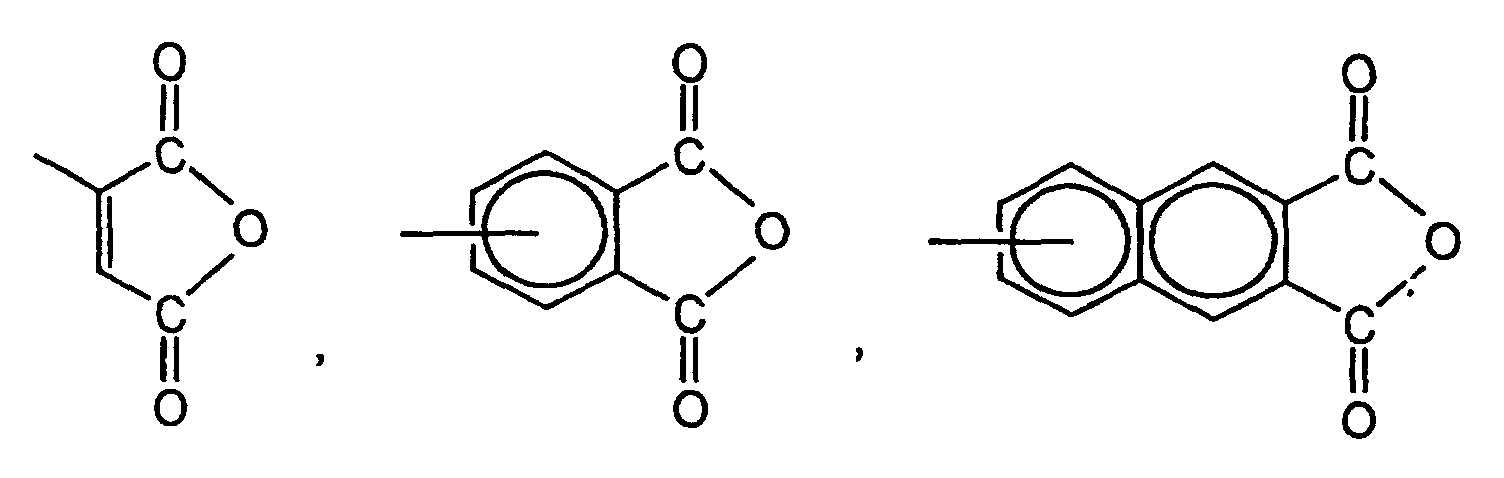
- the monomer of the formula (II), in which A is a functional group other than -CN, that is, A being -NCO, -COOR', an acid anhydride group or an unsaturated hydrocarbon group, is a known compound or may be easily prepared by a known synthesis process.
- Preferred examples of the fluorinated alkylene group represented by R include -[CF 2 OCF(CF 3 )] a , -(CF 2 OCF 2 CE 3 ) a wherein a is a number of 1 to 4, -(CF 2 ) b wherein b is a number of 1 to 20, etc.
- the comonomer M which constitutes the structure of the formula (I) may be any monomer copolymerizable with the monomer (II).
- Preferred examples of the comonomer include vinylidene fluoride, tetrafluoroethylene, hexafluoropropylene, chlorotrifluoroethylene, vinyl fluoride, trifluoroethylene, tetrafluoropropylene, trifluoropropylene, ethylene, propylene, etc.
- the polymer to be cured by the method of the present invention has at least one functional group selected from the group consisting of -CN, -NCO, -COOR', an acid anhydride group and an unsaturated hydrocarbon group in the molecule, preferably -CN (cyano group).
- J. Org. Chem., Vol. 32, 2237 describes that a cyano group readily reacts with ammonia to form an amidine or an imidoylamidine.
- the present invention utilizes this reaction to cure the fluorine-containing polymer of the formula (I).
- the curing reaction proceeds by the addition of an alcohol or an amine to -NCO, amination through the reaction of -CODA' with an amine, amidation or imidation through the reaction of the acid anhydride with an amin, or the addition of an alcohol or an amine to the unsaturated hydrocarbon group.
- Examples of a diamine to be used as a crosslinking agent include H 2 N-R"-NH 2 wherein R" is an alkylene group having 1 to 20 carbon atoms, etc.
- polyol compound examples include HO-CH 2 -Rf-CH 2 -OH wherein Rf is a fluoroalkyl group having 1 to 20 carbon atoms.
- the amount of the crosslinking agent to be used is half an equivalent of the functional group A in the case of ammonia or an amine, or the hydroxyl group of the polyol is equivalent to the functional group A.
- the cured product will form a triazine ring, etc. by further heating when the functional group A is a cyano group and the crosslinking agent is ammonia.
- the curing of the polymer further proceeds and the heat resistance of the cured product is improved.
- the polymer of the formula (II) can be cured at room temperature in the presence of a base such as triethylamine, tributylamine, pyridine, etc.
- the base may be compounded in the polymer, or allowed in contact with the cast film of the polymer.
- the cured product obtained by such a method is also colorless and transparent.
- the hardness of the cured product may be freely adjusted by the adjustment of the amount of the base to be used.
- the cured product obtained in such a way will form a triazine ring by heating like the above case so that the curing of the polymer further proceeds and the heat resistance of the cured product is improved.
- Examples of the fluorinated alkylene group represented by R 1 or R 2 in the formula (II) are the same as those of R.
- Examples of the organic group other than -CN represented by E include the functional groups represented by A (except a cyano group), and also other organic groups such as straight or branched alkyl groups having 1 to 20 carbon groups in which a part or all of the hydrogen atoms may be substituted with a chlorine atom or a fluorine atom, or the alkyl chair may contain an oxygen atom.
- the heating temperature is usually at least 100°C, preferably at least 150°C. In general, the heating temperature may not be higher than 300°C.
- the heating atmosphere is not limited.
- the heating may be carried out in an air or an atmosphere of an inert gas such as nitrogen.
- the cured product obtained from the polymer according to the present invention may be used as a material for producing a sheath of an optical fiber, an antireflection film, an interlaminar insulation film, etc. in the electronic field or the optical field.
- CH 2 CFCF 2 OCF(CF 3 )CF 2 OCF(CF 3 )CN (5.01 g) and a 8 wt.% solution of [H(CF 2 CF 2 ) 3 COO] 2 (herein referred to as "DHP") in perfluorohexane (0.5 g) as a radical polymerization initiator were charged and cooled with a dry ice-acetone mixture. Then, the atmosphere in the flask was evacuated and replaced with nitrogen three times, and finally pressurized to atmospheric pressure with nitrogen. After sealing the flask, the content in the flask was stirred at 20°C for 24 hours to carry out polymerization.
- DHP perfluorohexane
- the viscosity [ ⁇ ] of the solution of this homopolymer in dichloropentafluoroethane was 0.067 at 35°C.
- the glass transition temperature of the homopolymer was 7.5°C according to DSC analysis.
- the absorption at 2250 cm -1 assigned to the cyano group decreased while the absorption peaks assigned to imidoylamidine were found around 1640 cm -1 , 1605 cm -1 , 1520 cm -1 , 3490 cm -1 and 3340 cm -1 .
- the film was peeled from the rock salt plate, the colorless, transparent and hard film with elasticity was obtained.
- Example 1 The film obtained in Example 1 was further heated in an air at 150°C for 2 days. Then, in the IR chart, the absorption at 2250 cm -1 assigned to the cyano group further decreased, and the absorption assigned to the triazine ring newly appeared around 1550 cm -1 .
- the thermal decomposition starting temperature of this cured film in the air was 302.1°C, the 10% decomposition temperature was 350°C, and the 50% decomposition temperature was 392°C.
- Example 2 The polymer obtained in Example 1 (0.3 g) was dissolved in dichloropentafluoropropane (5 ml), and the solution was poured in a laboratory dish having a diameter of about 4.3 cm, which was placed on a horizontal plate. Then, the solvent was evaporated off to obtain a polymer film having a thickness of about 100 ⁇ m. This film was treated with ammonia gas in the same way as in Example 1 to obtain a colorless, transparent and hard film with elasticity.
- a contact angle of water on this cured film was 98.5 degrees.
- the modulus of elasticity was 1.45 x 10 10 dyn/cm 2 at 33.7°C, 1.97 x 10 7 dyn/cm 2 at 254.6°C, and 1.50 x 10 7 dyn/cm 2 at 226.8°C
- a contact angle of water on this cured film after heating was 99.2 degrees.
- Triethylamine (10 mg) was added to the polymer obtained in Example 1 (about 1 g) and mixed with a spatula. After the mixture was kept standing at room temperature for 1 day, a cured material was obtained.
- Triethylamine was applied on the uncured polymer film obtained in Example 3 (thickness: about 100 ⁇ m), and kept standing one day. Then, a colorless transparent film was obtained.
- the glass transition temperature of this polymer was -34.5°C according to DSC analysis.
- the polymer obtained (0.3 g) was dissolved in dichloropentafluoropropane and poured in a laboratory dish having a diameter of about 4.3 cm, which was placed on a horizontal plate. Then, the solvent was evaporated in the air at room temperature to obtain a polymer film having a thickness of about 100 ⁇ m. This film was treated with ammonia gas in the same way as in Example 1 to obtain a colorless, transparent and hard film with elasticity.
Landscapes
- Chemical & Material Sciences (AREA)
- General Chemical & Material Sciences (AREA)
- Health & Medical Sciences (AREA)
- Chemical Kinetics & Catalysis (AREA)
- Medicinal Chemistry (AREA)
- Polymers & Plastics (AREA)
- Organic Chemistry (AREA)
- Addition Polymer Or Copolymer, Post-Treatments, Or Chemical Modifications (AREA)
- Macromolecular Compounds Obtained By Forming Nitrogen-Containing Linkages In General (AREA)
- Processes Of Treating Macromolecular Substances (AREA)
Abstract
Description







Claims (5)
- A method for curing a fluorine-containing polymer having a structure of the formula:wherein X, Y and Z represent independently each other a hydrogen atom, a fluorine atom, a chlorine atom, a bromine atom or an iodine atom, provided that at least one of X, Y and Z is a fluorine atom; R represents a straight or branched fluorinated alkylene group having 1 to 20 carbon atoms which may contain an oxygen atom; x and y represent mole percentages and x is from 1 to 100 % by mole; A is -CN, -NCO, -COOR' in which R' is a hydrogen atom or an alkyl group having 1 to 10 carbon atoms, an acid anhydride group or an unsaturated hydrocarbon group; and M is a repeating unit derived from a copolymerizable monomer comprising treating said polymer with at least one compound selected from the group consisting of ammonia, diamines and polyol compounds and crosslinking said polymer through the side functional groups of said polymer.

- The method according to claim 1, wherein said polymer cured is further heated at a temperature of at least 100°C.
- A method for curing a fluorine-containing polymer having a structure of the formula:wherein X, Y, Z, X', Y' and Z' represent independently each other a hydrogen atom, a fluorine atom, a chlorine atom, a bromine atom or an iodine atom, provided that at least one of X, Y and Z is a fluorine atom; R1 and R2 represent independently each other a straight or branched fluorinated alkylene group having 1 to 20 carbon atoms which may contain an oxygen atom; z and w represent mole percentages and z is from 1 to 100 % by mole; and E is an organic group other than -CN comprising curing said polymer in the presence of a base.
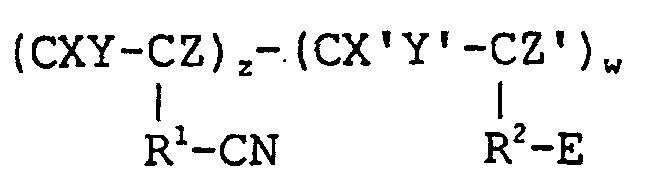
- The method according to claim 3, wherein X and Y are hydrogen atoms, Z is a fluorine atom, and R1 is a group of the formula:
- The method according to claim 3 or 4, wherein said polymer cured is further heated at a temperature of at least 100°C.
Applications Claiming Priority (3)
| Application Number | Priority Date | Filing Date | Title |
|---|---|---|---|
| JP20026699 | 1999-07-14 | ||
| JP20026699A JP4547735B2 (en) | 1999-07-14 | 1999-07-14 | Method for curing fluorine-containing polymer |
| PCT/JP2000/004698 WO2001005881A1 (en) | 1999-07-14 | 2000-07-13 | Method of curing fluoropolymer |
Publications (3)
| Publication Number | Publication Date |
|---|---|
| EP1270649A1 true EP1270649A1 (en) | 2003-01-02 |
| EP1270649A4 EP1270649A4 (en) | 2004-06-16 |
| EP1270649B1 EP1270649B1 (en) | 2007-09-05 |
Family
ID=16421485
Family Applications (1)
| Application Number | Title | Priority Date | Filing Date |
|---|---|---|---|
| EP00944428A Expired - Lifetime EP1270649B1 (en) | 1999-07-14 | 2000-07-13 | Method of curing fluoropolymer |
Country Status (5)
| Country | Link |
|---|---|
| US (1) | US6835782B1 (en) |
| EP (1) | EP1270649B1 (en) |
| JP (1) | JP4547735B2 (en) |
| DE (1) | DE60036310T2 (en) |
| WO (1) | WO2001005881A1 (en) |
Families Citing this family (6)
| Publication number | Priority date | Publication date | Assignee | Title |
|---|---|---|---|---|
| RU2319717C1 (en) * | 2006-07-10 | 2008-03-20 | Федеральное государственное унитарное предприятие "Научно-исследовательский институт синтетического каучука имени академика С.В. Лебедева" | Composition based on copolymer of terafluoroethylene and perfluoroalkyl vinyl ethers |
| EP2385936B1 (en) | 2009-01-07 | 2015-03-04 | Henkel US IP LLC | Hydrogen peroxide complexes and their use in the cure system of anaerobic adhesives |
| EP2681257B1 (en) | 2011-03-04 | 2019-02-13 | 3M Innovative Properties Company | Triazine containing fluoropolyether elastomers having low glass transition temperature |
| WO2015126949A1 (en) | 2014-02-19 | 2015-08-27 | 3M Innovative Properties Company | Hybrid fluoroelastomer composition, curable composition, and methods of making and using the same |
| GB2531717B (en) | 2014-10-24 | 2016-10-05 | Henkel IP & Holding GmbH | Anaerobic curable compositions |
| EP4050040A1 (en) | 2021-02-26 | 2022-08-31 | Henkel AG & Co. KGaA | One component (1k) curable adhesive composition |
Family Cites Families (23)
| Publication number | Priority date | Publication date | Assignee | Title |
|---|---|---|---|---|
| GB1145445A (en) | 1966-02-16 | 1969-03-12 | Du Pont | Fluorinated perfluorovinylethers, their preparation and copolymers thereof |
| US3933767A (en) | 1972-06-14 | 1976-01-20 | E. I. Du Pont De Nemours And Company | Cyanoperfluoroether acid fluorides and copolymers derived therefrom |
| US3978030A (en) | 1973-08-01 | 1976-08-31 | E. I. Du Pont De Nemours And Company | Polymers of fluorinated dioxoles |
| US4399264A (en) | 1981-11-19 | 1983-08-16 | E. I. Du Pont De Nemours & Co. | Perfluorodioxole and its polymers |
| US4431786A (en) | 1982-05-06 | 1984-02-14 | E. I. Du Pont De Nemours And Company | Novel fluorodioxoles and fluorodioxole polymers |
| DE3243710A1 (en) | 1982-11-25 | 1984-05-30 | Delma, elektro- und medizinische Apparatebau GmbH, 7200 Tuttlingen | OPERATION LIGHT |
| US4525539A (en) * | 1982-12-02 | 1985-06-25 | E. I. Du Pont De Nemours And Company | Vulcanizable nitrile-containing perfluoroelastomer |
| JPS63238111A (en) | 1987-03-27 | 1988-10-04 | Asahi Glass Co Ltd | Production of fluorine-containing polymer having cyclic structure |
| JPS63238115A (en) | 1987-03-27 | 1988-10-04 | Asahi Glass Co Ltd | Production of fluorine-containing copolymer having cyclic structure |
| JP3134876B2 (en) | 1989-11-17 | 2001-02-13 | イー・アイ・デユポン・デ・ニモアス・アンド・カンパニー | Curable perfluoroelastomer composition |
| JP2593962B2 (en) | 1990-06-07 | 1997-03-26 | イー・アイ・デユポン・ドウ・ヌムール・アンド・カンパニー | Irradiation curing of perfluoroelastomers |
| JPH05230151A (en) * | 1991-08-06 | 1993-09-07 | Asahi Glass Co Ltd | Fluoropolymers and cured products |
| JP3037793B2 (en) | 1991-08-23 | 2000-05-08 | 多木化学株式会社 | Material for treating periodontal disease |
| JP2850943B2 (en) | 1994-10-21 | 1999-01-27 | 日本メクトロン株式会社 | Vulcanizing agent for fluoroelastomer composed of bisamidrazone compound |
| JP3398492B2 (en) * | 1994-10-21 | 2003-04-21 | 日本メクトロン株式会社 | Fluorine-containing elastomer composition |
| JP2770769B2 (en) * | 1995-02-16 | 1998-07-02 | 日本メクトロン株式会社 | Bisamidoxime compound, process for producing the same, and fluorine-containing elastomer composition containing the same |
| JP3958813B2 (en) * | 1996-10-01 | 2007-08-15 | イー・アイ・デュポン・ドウ・ヌムール・アンド・カンパニー | Room temperature curable low molecular weight vinylidene fluoride copolymer and process for producing the same |
| TW416260B (en) * | 1997-01-31 | 2000-12-21 | Asahi Glass Co Ltd | Electronic components having fluorine polymer thin film |
| JP3713870B2 (en) * | 1997-02-21 | 2005-11-09 | ダイキン工業株式会社 | Fluorine-containing nitrile and its polymer |
| JPH11302394A (en) * | 1998-04-16 | 1999-11-02 | Asahi Glass Co Ltd | Molded article of crosslinked fluoropolymer and method for producing the same |
| US6559238B1 (en) * | 1998-06-29 | 2003-05-06 | E. I. Du Pont De Nemours And Company | Thermally cross-linked fluoropolymer |
| US6221970B1 (en) * | 1998-08-10 | 2001-04-24 | E.I. Dupont De Nemours And Company | Curable perfluoroelastomer composition |
| US6281296B1 (en) * | 1998-08-10 | 2001-08-28 | Dupont Dow Elastomers L.L.C. | Curable perfluoroelastomer composition |
-
1999
- 1999-07-14 JP JP20026699A patent/JP4547735B2/en not_active Expired - Fee Related
-
2000
- 2000-07-13 DE DE60036310T patent/DE60036310T2/en not_active Expired - Lifetime
- 2000-07-13 WO PCT/JP2000/004698 patent/WO2001005881A1/en not_active Ceased
- 2000-07-13 EP EP00944428A patent/EP1270649B1/en not_active Expired - Lifetime
- 2000-07-13 US US10/030,914 patent/US6835782B1/en not_active Expired - Lifetime
Also Published As
| Publication number | Publication date |
|---|---|
| JP2001026654A (en) | 2001-01-30 |
| DE60036310T2 (en) | 2008-05-29 |
| EP1270649B1 (en) | 2007-09-05 |
| DE60036310D1 (en) | 2007-10-18 |
| JP4547735B2 (en) | 2010-09-22 |
| US6835782B1 (en) | 2004-12-28 |
| WO2001005881A1 (en) | 2001-01-25 |
| EP1270649A4 (en) | 2004-06-16 |
Similar Documents
| Publication | Publication Date | Title |
|---|---|---|
| JP3868594B2 (en) | Fluorocyanate and fluorocarbamate monomers and polymers thereof | |
| CN1252103C (en) | Fluoropolymers having pendant imidate structures | |
| US11254638B2 (en) | Nitrileoxide compound | |
| JP5550993B2 (en) | Bisaminophenyl-based curing agents and accelerators and amidine-based curing agents and accelerators for perfluoroelastomer compositions | |
| US9518009B2 (en) | Multifunctional nitrileoxide compound | |
| CN1063742C (en) | Bisamidrazone compound and vulcanizing agent for fluorine-containing elastomer comprising the same | |
| JP3597200B2 (en) | Blends of nitrile-containing perfluoropolyether-perfluoroelastomer | |
| JP5192621B2 (en) | Copolymer of fluoroalkanesulfonyl azide monomer | |
| JP2004526000A (en) | Elastomer that has a low glass transition point Tg, is a polymer of a nitrile compound mainly composed of a vinylidene fluoride, and contains a fluorinated sulfonic acid group, and a method for producing the same | |
| EP1270649B1 (en) | Method of curing fluoropolymer | |
| US7300985B2 (en) | Fluoropolymers having pendant amidoxime or amidrazone structures | |
| JP3713870B2 (en) | Fluorine-containing nitrile and its polymer | |
| CN104619732A (en) | Fluoroelastomer | |
| EP1629043B1 (en) | Fluoroelastomer composition having excellent low temperature properties | |
| JP3210000B2 (en) | Manufacturing method of high modulus fluororesin | |
| JPH11302394A (en) | Molded article of crosslinked fluoropolymer and method for producing the same | |
| JPH06248026A (en) | Curable fluorine-containing copolymer composition | |
| JPH06340710A (en) | New perfluoropolymer | |
| JPS5930167B2 (en) | Manufacturing method of fluorine-containing elastomer | |
| JPS624228B2 (en) | ||
| JPH06179721A (en) | Fluoroalkyl group-containing cationic polymer and its production | |
| JPH1110653A (en) | Release film | |
| KR20190075975A (en) | Fluoroelastomer composition |
Legal Events
| Date | Code | Title | Description |
|---|---|---|---|
| PUAI | Public reference made under article 153(3) epc to a published international application that has entered the european phase |
Free format text: ORIGINAL CODE: 0009012 |
|
| 17P | Request for examination filed |
Effective date: 20020213 |
|
| AK | Designated contracting states |
Kind code of ref document: A1 Designated state(s): AT BE CH CY DE DK ES FI FR GB GR IE IT LI LU MC NL PT SE |
|
| RBV | Designated contracting states (corrected) |
Designated state(s): DE FR GB IT |
|
| A4 | Supplementary search report drawn up and despatched |
Effective date: 20040507 |
|
| 17Q | First examination report despatched |
Effective date: 20040826 |
|
| GRAP | Despatch of communication of intention to grant a patent |
Free format text: ORIGINAL CODE: EPIDOSNIGR1 |
|
| RIC1 | Information provided on ipc code assigned before grant |
Ipc: C08F 16/24 20060101ALI20070316BHEP Ipc: C08J 3/24 20060101AFI20070316BHEP |
|
| GRAS | Grant fee paid |
Free format text: ORIGINAL CODE: EPIDOSNIGR3 |
|
| GRAA | (expected) grant |
Free format text: ORIGINAL CODE: 0009210 |
|
| AK | Designated contracting states |
Kind code of ref document: B1 Designated state(s): DE FR GB IT |
|
| REG | Reference to a national code |
Ref country code: GB Ref legal event code: FG4D |
|
| REF | Corresponds to: |
Ref document number: 60036310 Country of ref document: DE Date of ref document: 20071018 Kind code of ref document: P |
|
| ET | Fr: translation filed | ||
| PLBE | No opposition filed within time limit |
Free format text: ORIGINAL CODE: 0009261 |
|
| STAA | Information on the status of an ep patent application or granted ep patent |
Free format text: STATUS: NO OPPOSITION FILED WITHIN TIME LIMIT |
|
| 26N | No opposition filed |
Effective date: 20080606 |
|
| REG | Reference to a national code |
Ref country code: FR Ref legal event code: PLFP Year of fee payment: 17 |
|
| PGFP | Annual fee paid to national office [announced via postgrant information from national office to epo] |
Ref country code: FR Payment date: 20160613 Year of fee payment: 17 |
|
| PGFP | Annual fee paid to national office [announced via postgrant information from national office to epo] |
Ref country code: IT Payment date: 20160720 Year of fee payment: 17 Ref country code: GB Payment date: 20160713 Year of fee payment: 17 Ref country code: DE Payment date: 20160705 Year of fee payment: 17 |
|
| REG | Reference to a national code |
Ref country code: DE Ref legal event code: R119 Ref document number: 60036310 Country of ref document: DE |
|
| GBPC | Gb: european patent ceased through non-payment of renewal fee |
Effective date: 20170713 |
|
| REG | Reference to a national code |
Ref country code: FR Ref legal event code: ST Effective date: 20180330 |
|
| PG25 | Lapsed in a contracting state [announced via postgrant information from national office to epo] |
Ref country code: DE Free format text: LAPSE BECAUSE OF NON-PAYMENT OF DUE FEES Effective date: 20180201 Ref country code: GB Free format text: LAPSE BECAUSE OF NON-PAYMENT OF DUE FEES Effective date: 20170713 |
|
| PG25 | Lapsed in a contracting state [announced via postgrant information from national office to epo] |
Ref country code: FR Free format text: LAPSE BECAUSE OF NON-PAYMENT OF DUE FEES Effective date: 20170731 |
|
| PG25 | Lapsed in a contracting state [announced via postgrant information from national office to epo] |
Ref country code: IT Free format text: LAPSE BECAUSE OF NON-PAYMENT OF DUE FEES Effective date: 20170713 |