EP1270585A1 - Peptide derivative - Google Patents
Peptide derivative Download PDFInfo
- Publication number
- EP1270585A1 EP1270585A1 EP01915695A EP01915695A EP1270585A1 EP 1270585 A1 EP1270585 A1 EP 1270585A1 EP 01915695 A EP01915695 A EP 01915695A EP 01915695 A EP01915695 A EP 01915695A EP 1270585 A1 EP1270585 A1 EP 1270585A1
- Authority
- EP
- European Patent Office
- Prior art keywords
- amino acid
- peptide
- substituted
- mentioned
- group
- Prior art date
- Legal status (The legal status is an assumption and is not a legal conclusion. Google has not performed a legal analysis and makes no representation as to the accuracy of the status listed.)
- Granted
Links
Classifications
-
- C—CHEMISTRY; METALLURGY
- C07—ORGANIC CHEMISTRY
- C07K—PEPTIDES
- C07K7/00—Peptides having 5 to 20 amino acids in a fully defined sequence; Derivatives thereof
- C07K7/04—Linear peptides containing only normal peptide links
- C07K7/06—Linear peptides containing only normal peptide links having 5 to 11 amino acids
-
- A—HUMAN NECESSITIES
- A61—MEDICAL OR VETERINARY SCIENCE; HYGIENE
- A61P—SPECIFIC THERAPEUTIC ACTIVITY OF CHEMICAL COMPOUNDS OR MEDICINAL PREPARATIONS
- A61P1/00—Drugs for disorders of the alimentary tract or the digestive system
-
- A—HUMAN NECESSITIES
- A61—MEDICAL OR VETERINARY SCIENCE; HYGIENE
- A61P—SPECIFIC THERAPEUTIC ACTIVITY OF CHEMICAL COMPOUNDS OR MEDICINAL PREPARATIONS
- A61P1/00—Drugs for disorders of the alimentary tract or the digestive system
- A61P1/18—Drugs for disorders of the alimentary tract or the digestive system for pancreatic disorders, e.g. pancreatic enzymes
-
- A—HUMAN NECESSITIES
- A61—MEDICAL OR VETERINARY SCIENCE; HYGIENE
- A61P—SPECIFIC THERAPEUTIC ACTIVITY OF CHEMICAL COMPOUNDS OR MEDICINAL PREPARATIONS
- A61P15/00—Drugs for genital or sexual disorders; Contraceptives
-
- A—HUMAN NECESSITIES
- A61—MEDICAL OR VETERINARY SCIENCE; HYGIENE
- A61P—SPECIFIC THERAPEUTIC ACTIVITY OF CHEMICAL COMPOUNDS OR MEDICINAL PREPARATIONS
- A61P25/00—Drugs for disorders of the nervous system
-
- A—HUMAN NECESSITIES
- A61—MEDICAL OR VETERINARY SCIENCE; HYGIENE
- A61P—SPECIFIC THERAPEUTIC ACTIVITY OF CHEMICAL COMPOUNDS OR MEDICINAL PREPARATIONS
- A61P25/00—Drugs for disorders of the nervous system
- A61P25/28—Drugs for disorders of the nervous system for treating neurodegenerative disorders of the central nervous system, e.g. nootropic agents, cognition enhancers, drugs for treating Alzheimer's disease or other forms of dementia
-
- A—HUMAN NECESSITIES
- A61—MEDICAL OR VETERINARY SCIENCE; HYGIENE
- A61P—SPECIFIC THERAPEUTIC ACTIVITY OF CHEMICAL COMPOUNDS OR MEDICINAL PREPARATIONS
- A61P3/00—Drugs for disorders of the metabolism
-
- A—HUMAN NECESSITIES
- A61—MEDICAL OR VETERINARY SCIENCE; HYGIENE
- A61P—SPECIFIC THERAPEUTIC ACTIVITY OF CHEMICAL COMPOUNDS OR MEDICINAL PREPARATIONS
- A61P3/00—Drugs for disorders of the metabolism
- A61P3/08—Drugs for disorders of the metabolism for glucose homeostasis
- A61P3/10—Drugs for disorders of the metabolism for glucose homeostasis for hyperglycaemia, e.g. antidiabetics
-
- A—HUMAN NECESSITIES
- A61—MEDICAL OR VETERINARY SCIENCE; HYGIENE
- A61P—SPECIFIC THERAPEUTIC ACTIVITY OF CHEMICAL COMPOUNDS OR MEDICINAL PREPARATIONS
- A61P31/00—Antiinfectives, i.e. antibiotics, antiseptics, chemotherapeutics
- A61P31/12—Antivirals
- A61P31/14—Antivirals for RNA viruses
- A61P31/18—Antivirals for RNA viruses for HIV
-
- A—HUMAN NECESSITIES
- A61—MEDICAL OR VETERINARY SCIENCE; HYGIENE
- A61P—SPECIFIC THERAPEUTIC ACTIVITY OF CHEMICAL COMPOUNDS OR MEDICINAL PREPARATIONS
- A61P37/00—Drugs for immunological or allergic disorders
- A61P37/02—Immunomodulators
-
- A—HUMAN NECESSITIES
- A61—MEDICAL OR VETERINARY SCIENCE; HYGIENE
- A61P—SPECIFIC THERAPEUTIC ACTIVITY OF CHEMICAL COMPOUNDS OR MEDICINAL PREPARATIONS
- A61P9/00—Drugs for disorders of the cardiovascular system
-
- A—HUMAN NECESSITIES
- A61—MEDICAL OR VETERINARY SCIENCE; HYGIENE
- A61P—SPECIFIC THERAPEUTIC ACTIVITY OF CHEMICAL COMPOUNDS OR MEDICINAL PREPARATIONS
- A61P9/00—Drugs for disorders of the cardiovascular system
- A61P9/14—Vasoprotectives; Antihaemorrhoidals; Drugs for varicose therapy; Capillary stabilisers
-
- C—CHEMISTRY; METALLURGY
- C07—ORGANIC CHEMISTRY
- C07K—PEPTIDES
- C07K14/00—Peptides having more than 20 amino acids; Gastrins; Somatostatins; Melanotropins; Derivatives thereof
- C07K14/435—Peptides having more than 20 amino acids; Gastrins; Somatostatins; Melanotropins; Derivatives thereof from animals; from humans
- C07K14/46—Peptides having more than 20 amino acids; Gastrins; Somatostatins; Melanotropins; Derivatives thereof from animals; from humans from vertebrates
- C07K14/47—Peptides having more than 20 amino acids; Gastrins; Somatostatins; Melanotropins; Derivatives thereof from animals; from humans from vertebrates from mammals
-
- C—CHEMISTRY; METALLURGY
- C07—ORGANIC CHEMISTRY
- C07K—PEPTIDES
- C07K7/00—Peptides having 5 to 20 amino acids in a fully defined sequence; Derivatives thereof
- C07K7/04—Linear peptides containing only normal peptide links
- C07K7/08—Linear peptides containing only normal peptide links having 12 to 20 amino acids
-
- A—HUMAN NECESSITIES
- A61—MEDICAL OR VETERINARY SCIENCE; HYGIENE
- A61K—PREPARATIONS FOR MEDICAL, DENTAL OR TOILETRY PURPOSES
- A61K38/00—Medicinal preparations containing peptides
Definitions
- G protein-coupled receptor proteins have been found one after another by random sequencing of genomic DNA or cDNA (Nomura, N., et al., DNA Research, 1, 27-35, 1994).
- the general means of determining ligands for these orphan G protein-coupled receptor proteins depended conventionally on mere estimation from homology in the primary structure of the G protein-coupled receptor protein.
- APJ As one of reported organ G protein-coupled receptors, there is APJ (O'Dowd, B.F., et al., Gene, 436, 355-359, 1993). APJ has low homology to angiotensin receptor (AT1). A naturally occurring ligand for APJ, and its partial peptides, are described in Biochemical and Biophysical Research Communications, 251, 471-476 (1998), WO 99/33976 (Japanese Patent Application No.
- a peptide prepared by artificially modifying a naturally occurring ligand for APJ that is an orphan G protein-coupled receptor expressed in the central nervous system, circulatory organ system, generative organ system, immune system, digestive organ system, etc. is considered more useful as a pharmaceutical preparation, etc. than the naturally occurring ligand, but the structure and functions of such a peptide more useful as a pharmaceutical preparation, etc. than the naturally occurring ligand have still not been revealed.
- the present invention provides:
- the present invention provides (23) the pharmaceutical preparation according to the above-mentioned (17), which is a prophylactic and/or therapeutic agent for dementia, melancholia, attention deficit hyperactivity (minimal brain disease) syndrome, mental confusion, anxiety, schizophrenia, psychasthenia, an obstacle in growth hormone secretion, bulimia, overeating, hypercholesterolemia, hyperglyceridemia, hyperlipemia, hyperprolactinemia, diabetes, cancers, pancreatitis, renal diseases, Turner's syndrome, neurosis, rheumatic arthritis, spinal damage, transitory cerebral ischemia paroxysm, amyotrophic lateral sclerosis, acute myocardial infarction, spinal cerebellum degeneration, bone fracture, wounds, atopic dermatitis, osteoporosis, asthma, epilepsy, sterility, arteriosclerosis, pulmonary emphysema, lung edema, imperfect lactation, or the like.
- hypercholesterolemia hyperglyceridemia
- the amino acid residue in the present invention refers to a structure excluding its N- or C-terminus, wherein the amino acid has lost a water molecule to form a peptide linkage through which it has been incorporated into a protein or a peptide.
- the ⁇ -amino acid residue refers to the structure -HNC(R 0 )(R 1 )CO- excluding its N- or C-terminus, wherein the ⁇ -amino acid (H 2 NC(R 0 )(R 1 )COOH wherein R 0 and R 1 are the same or different and represent an arbitrary substituent group) has lost a water molecule to form a peptide linkage through which it has been incorporated into a protein or a peptide.
- the N-terminal amino acid residue is represented by H 2 NC(R 0 )(R 1 )CO- and the C-terminal amino acid residue by -HNC(R 0 )(R 1 )COOH.
- the ⁇ -amino acid residue refers to the structure -HNC(R 0 )(R 1 )C(R 2 )(R 3 )CO- excluding its N- or C-terminus, wherein the ⁇ -amino acid (H 2 NC(R 0 )(R 1 )C(R 2 )(R 3 )COOH wherein R 0 , R 1 , R 2 and R 3 are the same or different and represent an arbitrary substituent group) has lost a water molecule to form a peptide linkage through which it has been incorporated into a protein or a peptide.
- the N-terminal amino acid residue is represented by H 2 NC(R 0 )(R 1 )C(R 2 )(R 3 )CO- and the C-terminal amino acid residue by -NHC(R 0 )(R 1 )C(R 2 )(R 3 )COOH.
- the ⁇ -amino acid residue refers to the structure -NHC(R 0 )(R 1 )C(R 2 )(R 3 )C(R 4 )(R 5 )CO- excluding its N- or C-terminus, wherein the ⁇ -amino acid (H 2 NC(R 0 )(R 1 )C(R 2 )(R 3 )C(R 4 )(R 5 )COOH wherein R 0 , R 1 , R 2 , R 3 R 4 and R 5 are the same or different and represent an arbitrary substituent group) has lost a water molecule to form a peptide linkage through which it has been incorporated into a protein or a peptide.
- the ⁇ -amino acid residue refers to the structure -NHC(R 0 )(R 1 )C(R 2 )(R 3 )C(R 4 )(R 5 )C(R 6 )(R 7 )C(R 8 )(R 9 )CO- excluding its N- or C-terminus, wherein the ⁇ -amino acid (H 2 NC(R 0 )(R 1 )C(R 2 )(R 3 )C(R 4 )(R 5 )C(R 6 )(R 7 )C(R 8 )(R 9 )COOH wherein R 0 , R 1 , R 2 , R 3 R 4 , R 5 , R 6 , R 7 , R 8 and R 9 are the same or different and represent an arbitrary substituent group) has lost a water molecule to form a peptide linkage through which it has been incorporated into a protein or a peptide.
- the amino acid may be any of natural or non-natural, D- or L- and ⁇ -, ⁇ -, ⁇ - or ⁇ -amino acids.
- the group forming a side chain of ⁇ -amino acid, ⁇ -amino acid, ⁇ -amino acid and ⁇ -amino acid includes, for example, (1) a C 1-6 alkyl group (e.g., methyl, ethyl, n-propyl, isopropyl, n-butyl, isobutyl, sec-butyl, tert-butyl, n-pentyl, etc., preferably C 1-3 alkyl, etc.), (2) a cyano group, (3) a halogen (e.g., fluorine, chlorine, bromine, iodine, etc.), (4) a hydroxy-C 1-6 alkyl group (e.g., hydroxymethyl, hydroxyethyl, etc.), (5) a C 1-6 alkoxy group (e.g., methoxy, ethoxy, n-propoxy, isopropoxy, n-butoxy, tert-butoxy
- the side chain forming an amino acid residue may be bound to a nitrogen atom to form a ring (e.g., proline etc.), or 2 side chains are bound to each other to form a ring (e.g., 3-aminonorbomanecarboxylic acid etc.).
- ⁇ -amino acid examples include, for example, glycine, alanine, valine, leucine, isoleucine, serine, threonine, cysteine, methionine, aspartic acid, glutamic acid, lysine, arginine, phenylalanine, tyrosine, histidine, tryptophan, asparagine, glutamine, proline, pipecolic acid, norleucine, ⁇ -methylleucine, tert-leucine, norvaline, homoarginine, homoserine, ⁇ -aminoisobutyric acid, ⁇ -aminobutyric acid, ornithine, ⁇ -aminoadipic acid, phenylglycine, thienylglycine, cyclohexylglycine, cyclohexylalanine, thienylalanine, naphthylalanine, biphenylalanine, p-phosphon
- ⁇ -amino acid examples include, for example, ⁇ -alanine, ⁇ -aminobutyric acid, isoasparagine, 3-aminoadipic acid, 3-aminophenylpropionic acid, 3-amino-2-hydroxy-4-phenylbutyric acid, 3-aminonorbornanecarboxylic acid, 3-aminobicyloheptanecarboxylic acid etc.
- ⁇ -amino acid examples include, for example, ⁇ -aminobutyric acid, isoglutamine, statine, 4-amino-3-hydroxy-5-cyclohexylpentanoic acid, 4-amino-3-hydroxy-5-phenylpentanoic acid, 6-aminopenicillaminic acid, 3-aminoadmantane-1-carboxylic acid etc.
- ⁇ -amino acid examples include, for example, ⁇ -aminocaproic acid, 4-aminomethyl-cyclohexanecarboxylic acid etc.
- the natural amino acid includes glycine, alanine, valine, leucine, isoleucine, serine, threonine, cysteine, cystine, methionine, aspartic acid, glutamic acid, lysine, arginine, phenylalanine, tyrosine, histidine, tryptophan, asparagine, glutamine, proline, ornithine, citrulline etc.
- the non-natural amino acid includes N-methylated amino acids derived from norleucine, ⁇ -methylleucine, tert-leucine, norvaline, homoarginine, homoserine, aminoisobutyric acid, aminoadipic acid (e.g., ⁇ -aminoadipic acid), phenylglycine, thienylglycine, cyclohexylglycine, aminobutyric acid, ⁇ -alanine, cyclohexylalanine, thienylalanine, naphthylalanine, adamantylalanine, benzothienylalanine, pyridylalanine, piperidylalanine, pyridylalanine, quinolylalanine, thiazolylalanine, isoasparagine, isoglutamine, homocysteine, homophenylalanine, homocitrulline, oxyproline (hydroxyproline), diaminopropi
- substituent groups with which (side chains of) these amino acid residues may be substituted include (1) a C 1-6 alkyl group (e.g., methyl, ethyl, n-propyl, isopropyl, n-butyl, isobutyl, sec-butyl, tert-butyl, n-pentyl etc., preferably C 1-3 alkyl etc.), (2) a cyano group, (3) a halogen (e.g., fluorine, chlorine, bromine, iodine etc.), (4) a hydroxy-C 1-6 alkyl group (e.g., hydroxymethyl, hydroxyethyl etc.), (5) a C 1-6 alkoxy group (e.g., methoxy, ethoxy, n-propoxy, isopropoxy, n-butoxy, tert-butoxy etc., preferably C 1-3 alkoxy etc.), (6) a C 1-6 alkoxy-carbony
- the neutral substituent group includes (1) a C 1-6 alkyl group (e.g., methyl, ethyl, n-propyl, isopropyl, n-butyl, isobutyl, sec-butyl, tert-butyl, n-pentyl etc., preferably C 1-3 alkyl etc.), (2) a cyano group, (3) a halogen (e.g., fluorine, chlorine, bromine, iodine etc.), (4) a hydroxy-C 1-6 alkyl group (e.g., hydroxymethyl, hydroxyethyl etc.), (5) a hydroxy group, (6) a carbamoyl group, (7) a mercapto group, (8) a group represented by the formula: -S(O)a-R 21 wherein each symbol has the same meaning as defined above, (9) a C 6-10 aryl group (e.g., phenyl, naphthyl, indeny
- the acidic substituent group includes a C 1-4 alkyl group, a C 6-10 aryl group such as phenyl and naphthyl, a C 7-15 aralkyl group such as benzyl, and a carbonyl group, each of which is substituted with a carboxyl group, sulfo group, tetrazolyl group etc.
- the basic substituent group includes (1) an amino-C 1-6 alkyl group (aminomethyl, aminoethyl etc.), (2) an aminoallyl group, (3) a pyridyl group, (4) a pyradyl group, (5) a pyrazinyl group, (6) a pyridazinyl group, (7) an imidazolyl group, (8) a pyrazolyl group, (9) a pyrazolyl group, (10) a morpholinyl group, (11) an amino group, (12) a C 1-4 alkyl group substituted with a substituent group described in the items (3) to (10) above, (13) a C 7-15 aralkyl group such as benzyl substituted with a substituent group described in the items (1) to (11) above, (14) a C 6-10 aryl group such as phenyl, naphthyl etc. substituted with a substituent group described in the items (1) to (11) above, (15) an arginyl group
- the acidic amino acid is specifically an amino acid having an acidic group such as carboxyl group, sulfo group or tetrazolyl group in a side chain thereof.
- an acidic group such as carboxyl group, sulfo group or tetrazolyl group in a side chain thereof.
- examples thereof include glutamic acid, pyroglutamic acid, aspartic acid, cysteic acid, homocysteic acid, 3-(5-tetrazolyl) alanine, 2-amino-4-(5-tetrazolyl) butyric acid etc.
- the basic amino acid includes, for example, histidine, arginine, ornithine, lysine, diaminopropionic acid, diaminobutyric acid, homoarginine etc.
- Examples of the basic amino acid (residue) whose side chain has been substituted include, for example, N ⁇ -acetylarginine, N ⁇ -tosylarginine, N ⁇ -acetyllysine, N ⁇ -methyllysine, N ⁇ -tosyllysine etc.
- the neutral amino acid is specifically an amino acid such as alanine, valine, norvaline, leucine, isoleucine, alloisoleucine, norleucine, tertiary leucine, ⁇ -methylleucine, proline, phenylglycine, phenylalanine, glutamine, asparagine, serine, threonine, glycine, cysteine, methionine, tryptophan, oxyproline (hydroxyproline), cyclohexylalanine and naphthylalanine.
- amino acid such as alanine, valine, norvaline, leucine, isoleucine, alloisoleucine, norleucine, tertiary leucine, ⁇ -methylleucine, proline, phenylglycine, phenylalanine, glutamine, asparagine, serine, threonine, glycine, cysteine, methionine, tryptophan,
- the amino acid (residue) having an aromatic side chain include, for example, tryptophan, phenylalanine, tyrosine, 1-naphthylalanine, 2-naphthylalanine, 2-thienylalanine, histidine, pyridylalanine (2-pyridylalanine), o-methyltyrosine etc.
- the amino acid (residue) having an aromatic side chain which has been substituted includes, for example, 3-iodotyrosine, p-phosphonomethylphenylalanine, o-phosphotyrosine etc.
- the amino acid (residue) having a hydroxy group in a side chain thereof includes, for example, serine, threonine, tyrosine, oxyproline (hydroxyproline) etc.
- the peptide and peptide chain in this specification are represented in accordance with the conventional way of describing peptides, that is, the N-terminus (amino terminus) at the left hand and the C-terminus (carboxyl terminus) at the right hand.
- the C-terminus is usually in the form of a carboxyl group (-COOH) or a carboxylate (-COO - ) but may be in the form of an amide (-CONH 2 ) or an ester (-COOR).
- ester group shown by R examples include a C 1-6 alkyl group such as methyl, ethyl, n-propyl, isopropyl, n-butyl, etc.; a C 3-8 cycloalkyl group such as cyclopentyl, cyclohexyl, etc.; a C 6-12 aryl group such as phenyl, ⁇ -naphthyl, etc.; a C 7-14 aralkyl group such as a phenyl-C 1-2 -alkyl group, e.g., benzyl, phenethyl, benzhydryl etc., or an ⁇ -naphthyl-C 1-2 -alkyl group such as ⁇ -naphthylmethyl, etc.; and the like.
- pivaloyloxymethyl or the like which is used widely as an ester for oral administration, may also be used.
- the peptide of the present invention contains a carboxyl group or a carboxylate at a position other than the C-terminus, it may be amidated or esterified, and such an amide or ester is also included within the polypeptide of the present invention.
- ester for example the C-terminal ester described above or the like is used.
- examples of the peptide or peptide chains of the present invention include those peptide or peptide chains, wherein the amino group at the N-terminal amino acid residue of the peptide or peptide chain is protected with a substituent group (for example, [1] a C 1-8 acyl group such as a C 2-6 alkanoyl group, e.g., formyl group and acetyl, guanidinoacetyl, thienylacrylyl, pyridylacetyl etc., [2] a C 1-6 alkyl group such as methyl, ethyl, propyl, isopropyl, butyl, isobutyl, sec-butyl, tert-butyl, pentyl, hexyl etc., [3] a C 6-10 aryl group such as phenyl, naphthyl etc.
- a substituent group for example, [1] a C 1-8 acyl group
- a C 7-16 aralkyl group such as benzyl, phenethyl etc., [4] a tosyl group, [5] a benzyloxycarbonyl group, [6] a group (e.g., methylthio, methanesulfinyl, methanesulfonyl, ethylthio, ethanesulfinyl, ethanesulfonyl etc.) represented by the formula: -S(O)a-R 22 wherein a is an integer of 0 to 2, and R 22 is a C 1-6 alkyl (which is specifically the same as described above), [7] a t-butoxycarbonyl group, [8] a N-9-fluorenyl methoxycarbonyl group etc.); those wherein the N-terminal region is cleaved in vivo and the glutamyl group thus formed is pyroglutaminated; those wherein a substituent (
- each amino acid residue may be substituted, and the substituent group includes those described above.
- P1, Q1 and R1 represent "a hydrogen atom or amino acid residue, or a peptide chain, consisting of 1 to 25 amino acids which may be the same or different and whose side chain may be substituted".
- the substituent groups on the "1 to 25 amino acids whose side chain may be substituted" include, for example, those identical with the "substituent groups with which side chains of these amino acid residues may be substituted".
- P1, Q1 and R1 represent the "amino acids whose side chain may be substituted", preferable examples thereof include, for example, optionally substituted pyroglutamic acid or glutamine whose side chain may be substituted, more preferably pyroglutamic acid or glutamine.
- amino acid residues whose side chain may be substituted include, for example, those identical with the "substituent groups with which side chains of these amino acid residues may be substituted".
- a benzyloxycaronyl group or the like is exemplified.
- P1, Q1 and R1 represent the "peptide chain consisting of 2 to 25 amino acids which may be the same or different and whose side chain may be substituted"
- examples thereof include, for example, peptides represented by the formula: Y 1 -Y 2 wherein Y 1 represents amino acid residues, or a peptide chain, consisting of 1 to 17 amino acids which may be the same or different and whose side chain may be substituted, and Y 2 represents amino acid residues, or a peptide chain, consisting of 1 to 8 amino acids which may be the same or different and whose side chain may be substituted.
- the substituent groups on side chains of amino acid residues, or of amino acid residues in a peptide chain, represented by the above-mentioned Y 1 and Y 2 include, for example, those identical with the "substituent groups with which side chains of these amino acid residues may be substituted".
- Y 1 examples include, for example, amino acid residues or peptide chains represented by:
- a 1 represents an amino acid residue whose side chain may be substituted, preferably an amino acid residue having an aromatic side chain, more preferably an L-amino acid residue having an aromatic side chain, still more preferably L-tyrosine.
- a 2 and A 3 are the same or different, and represent an amino acid residue whose side chain may be substituted, preferably a neutral amino acid residue whose side chain may be substituted, more preferably a neutral L-amino acid residue whose side chain may be substituted, and still more preferably A 2 is L-leucine or the like and A 3 is L-valine or the like.
- a 4 represents an amino acid residue whose side chain may be substituted, preferably a neutral or basic amino acid residue whose side chain may be substituted, more preferably a neutral or basic L-amino acid residue whose side chain may be substituted, still more preferably L-lysine or N ⁇ -acetyllysine.
- a 5 represents an amino acid residue whose side chain may be substituted, preferably a neutral amino acid residue whose side chain may be substituted, more preferably optionally substituted L-proline, still more preferably L-proline or the like.
- a 7 and A 10 are the same or different, and represent an amino acid residue whose side chain may be substituted, preferably an amino acid residue having a hydroxy group in a side chain thereof or a neutral amino acid residue whose side chain may be substituted.
- a 7 optionally substituted glycine, particularly glycine or the like, is preferably used.
- a 8 represents an amino acid residue whose side chain may be substituted, preferably L-proline and an amino acid residue having a hydroxy group in a side chain thereof, more preferably L-serine, L-proline or oxyproline (hydroxyproline).
- a 10 represents an amino acid residue having a hydroxy group in a side chain thereof or a neutral amino acid residue whose side chain may be substituted, more preferably serine, threonine, asparagine etc.
- a 11 and A 14 are the same or different, and represent an amino acid residue whose side chain may be substituted, preferably a neutral amino acid residue whose side chain may be substituted, and more preferably A 11 is glycine, A 12 is L-proline, A 13 is glycine, A 14 is L-alanine, L-proline or the like.
- a 15 represents an amino acid residue whose side chain may be substituted, preferably an amino acid residue having an aromatic side chain, more preferably an L-amino acid residue having an aromatic side chain, still more preferably L-tryptophan.
- a 16 represents an amino acid residue whose side chain may be substituted, preferably a neutral amino acid residue whose side chain may be substituted, more preferably a neutral L-amino acid residue having a carbamoyl group, still more preferably L-glutamine.
- the neutral L-amino acid residue having a carbamoyl group includes, for example, L-glutamine, L-asparagine etc.
- a 17 represents an amino acid residue whose side chain may be substituted, preferably a neutral amino acid residue whose side chain may be substituted, more preferably glycine etc.
- Y 2 examples include, for example, amino acid residues or peptide chains represented by:
- the above-mentioned B 1 represents an amino acid residue whose side chain may be substituted, preferably a neutral amino acid residue whose side chain may be substituted, more preferably a neutral L-amino acid residue whose side chain may be substituted, still more preferably optionally substituted glycine, most preferably glycine.
- B 2 to B 4 are the same or different, and represent an amino acid residue whose side chain may be substituted, preferably a basic amino acid residue whose side chain may be substituted, more preferably a basic L-amino acid residue whose side chain may be substituted, and still more preferably B 2 is L-arginine, B 3 is L-arginine, and B 4 is L-lysine.
- the above-mentioned B 5 represents an amino acid residue whose side chain may be substituted, preferably an amino acid residue having an aromatic side chain, more preferably an L-amino acid residue having an aromatic side chain, still more preferably L-phenylalanine.
- B 6 and B 7 are the same or different, and represent an amino acid residue whose side chain may be substituted, preferably a basic amino acid residue whose side chain may be substituted, more preferably a basic L-amino acid residue whose side chain may be substituted, further more preferably L-arginine.
- the above-mentioned B 8 represents an amino acid residue whose side chain may be substituted, preferably glutamine whose side chain may be substituted, more preferably L-glutamine.
- Combinations of Y 1 and Y 2 include:
- P1, Q1 and R1 Preferable examples of P1, Q1 and R1 include:
- P1 is more preferably a hydrogen atom, pGlu or Arg-Arg-Gln
- Q1 is more preferably a hydrogen atom, pGlu or Arg-Arg-Gln
- R1 is more preferably a hydrogen atom, pGlu or Arg-Arg-Gln (still more preferably a hydrogen atom or Arg-Arg-Gln).
- P2 represents a neutral amino acid residue whose side chain may be substituted or a basic amino acid residue whose side chain may be substituted, preferably L-alanine which may be substituted (in a side chain thereof), L-histidine which may be substituted (in a side chain thereof), etc.
- the C 1-4 acyl group includes, for example, a C 1-4 acyl group such as formyl, acetyl, propionyl and butyryl and C 2-4 alkanoyl group.
- the C 1-6 alkyl group includes, for example, methyl, ethyl, propyl, isopropyl, butyl, isobutyl, sec-butyl, tert-butyl, pentyl, hexyl etc.
- P3 and Q2 are optionally substituted L-arginine or optionally substituted L-lysine.
- P4 and Q3 represent a bond, a neutral amino acid whose side chain may be substituted or an aromatic amino acid residue whose side chain may be substituted.
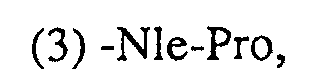
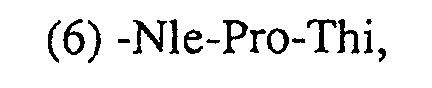
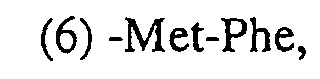
- Each of P4 and Q3 is preferably a bond, L-norleucine whose side chain may be substituted, L-methionine whose side chain may be substituted, L-methionine sulfoxide whose side chain may be substituted or L-alanine whose side chain may be substituted, more preferably a bond, L-norleucine, L-methionine, L-methionine sulfoxide or L-cyclohexylalanine.
- P4 is particularly preferably L-norleucine, L-methionine or L-cyclohexylalanine.
- Q3 is particularly preferably a bond, L-methionine or L-cyclohexylalanine.
- Each of P5 and Q4 is preferably [1] an amino acid residue whose side chain may be substituted, or its amino acid derivative wherein the C-terminal carboxyl group has been reduced to a hydroxymethyl group or formyl group, [2] a hydroxyl group or [3] a dipeptide chain formed by binding a neutral amino acid residue whose side chain may be substituted, to an amino acid residue having an aromatic side group which may be substituted, or its peptide derivative wherein the C-terminal carboxyl group has been reduced to a hydroxymethyl group or formyl group.
- Each of P5 and Q4 is more preferably [1] L-proline whose side chain may be substituted, or its amino acid derivative wherein the C-terminal carboxyl group has been reduced to a hydroxymethyl group or formyl group, [2] 4-chlorophenylalanine whose side chain may be substituted, or its amino acid derivative wherein the C-terminal carboxyl group has been reduced to a hydroxymethyl group or formyl group, [3] 2-naphthylalanine whose side chain may be substituted, or its amino acid derivative wherein the C-terminal carboxyl group has been reduced to a hydroxymethyl group or formyl group, [4] cyclohexylalanine whose side chain may be substituted, or its amino acid derivative wherein the C-terminal carboxyl group has been reduced to a hydroxymethyl group or formyl group, [5] a hydroxyl group, or [6] a dipeptide chain formed by binding optionally substituted L-proline to (a)
- Each of P5 and Q4 is still more preferably (1) L-proline or its amino acid derivative wherein the C-terminal carboxyl group has been reduced to a hydroxymethyl group or formyl group, (2) 4-chlorophenylalanine or its amino acid derivative wherein the C-terminal carboxyl group has been reduced to a hydroxymethyl group or formyl group, (3) 2-naphthylalanine or its amino acid derivative wherein the C-terminal carboxyl group has been reduced to a hydroxymethyl group or formyl group, (4) cyclohexylalanine or its amino acid derivative wherein the C-terminal carboxyl group has been reduced to a hydroxymethyl group or formyl group, (5) a hydroxyl group, (6) a dipeptide chain formed by binding L-proline to L-phenylalanine, or its peptide derivative wherein the C-terminal carboxyl group of the dipeptide has been reduced to a hydroxymethyl group or formyl group, (7) a dipeptid
- Q5 represents a neutral amino acid residue whose side chain may be substituted, preferably optionally substituted L-proline, optionally substituted L-glycine or optionally substituted L-alanine.
- Q5 is particularly preferably L-proline, L-glycine or L-alanine.
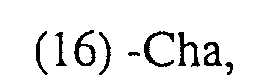
- R2 represents optionally substituted L-cyclohexylalanine, preferably L-cyclohexylalanine.
- R3 represents optionally substituted L-phenylalanine, optionally substituted L-2-naphthylalanine, optionally substituted L-cyclohexylalanine or optionally substituted tyrosine, preferably L-4-chlorophenylalanine, L-2-naphthylalanine, L-cyclohexylalanine, L-phenylalanine or L-tyrosine.
- the peptides of the present invention include, for example: and
- the peptide represented by the above formula or esters thereof or salts thereof include peptides represented by: or esters thereof or salts thereof.
- the peptide represented by the above formula or esters thereof or salts thereof include peptides represented by: or or esters thereof or salts thereof.
- the peptide represented by the above formula or esters thereof or salts thereof include peptides represented by: or esters thereof or salts thereof.
- the present invention relates to peptides represented by: or or esters thereof or salts thereof.
- the salts of the peptide of the present invention are used.
- physiologically acceptable bases for example alkali metal etc.
- acids organic acid, inorganic acid
- physiologically acceptable acid addition salts are preferred.
- the salts include salts with, for example, inorganic acids (e.g., hydrochloric acid, phosphoric acid, hydrobromic acid, sulfuric acid); salts with organic acids (e.g., acetic acid, formic acid, propionic acid, fumaric acid, maleic acid, succinic acid, tartaric acid, citric acid, malic acid, oxalic acid, benzoic acid, methanesulfonic acid, benzenesulfonic acid) and the like.
- inorganic acids e.g., hydrochloric acid, phosphoric acid, hydrobromic acid, sulfuric acid
- organic acids e.g., acetic acid, formic acid, propionic acid, fumaric acid, maleic acid, succinic acid, tartaric acid
- tissues or cells of humans or warm-blooded animals are homogenized, then extracted with an acid or the like, and the extract is isolated and purified by a combination of salting-out, dialysis and chromatographic techniques such as gel filtration, reverse phase chromatography, ion exchange chromatography, affinity chromatography and the like.
- the naturally occurring ligand can be obtained according to a method described in e.g. WO 99/33976 (Japanese Patent Application No, 220853/1998).
- the peptide of the present invention can be manufactured by publicly known methods for peptide synthesis.
- methods for peptide synthesis for example, either solid phase synthesis or liquid phase synthesis may be used. That is, the partial peptide or amino acids that can construct the peptide of the present invention are condensed with the remaining part, and where the product contains protecting groups, these protecting groups can be eliminated to give the desired peptide.
- Publicly known methods for condensation and elimination of the protecting groups are described in [1] -[5] below.
- the peptide of the present invention may be purified and isolated by a combination of conventional purification methods such as solvent extraction, distillation, column chromatography, liquid chromatography and recrystallization.
- the peptide obtained by the above methods is in a free form, the peptide can be converted into an appropriate salt by a publicly known method; when the protein is obtained in a salt form, it can be converted into a free form by a publicly known method.
- trisphosphonium, tetramethyluronium and carbodiimides are particularly preferable.
- the trisphosphonium includes benzotriazol-1-yloxytrispirolidinophosphonium hexafluorophosphate (PyBOP), bromotrispirolidinophosphonium hexafluorophosphate (PyBroP) etc.
- the tetramethyluronium includes 2-(1H-benzotriazol-1-y1)-1,1,3,3,-tetramethyluronium tetrafluoroborate, 2-(5-norbornane-2,3-dicarboxyimide)-1,1,3,3-tetramethyluronium tetrafluoroborate, O-(N-succimidyl)-1,1,3,3-tetramethyluronium tetrafluroborate etc., and the carbodi
- the reaction temperature is appropriately chosen from the range known to be applicable to peptide binding reactions and is usually selected in the range of approximately -20 °C to 50 °C.
- the activated amino acid derivatives are used generally in an excess of 1.5 to 4 times.
- the condensation is examined by a test using the ninhydrin reaction; when the condensation is insufficient, the condensation can be completed by repeating the condensation reaction without removal of the protecting groups. When the condensation is yet insufficient even after repeating the reaction, unreacted amino acids are acetylated with acetic anhydride or acetylimidazole, whereby the subsequent reactions can not be adversely affected.
- Examples of groups used to protect the indolyl moiety of tryptophan include formyl (For), Z, Boc, Mts, Mtr, etc.
- Examples of groups used to protect asparagine and glutamine include Trt, xanthyl (Xan), 4,4'-dimethoxybenzhydryl (Mbh), 2,4,6-trimethoxybenzyl (Tmob), etc.
- Examples of the activated carboxyl groups in the starting compounds include the corresponding acid anhydrides, azides, activated esters [esters with alcohols, e.g., pentachlorophenol, 2,4,5-trichlorophenol, 2,4-dinitrophenol, cyanomethyl alcohol, p-nitrophenol, HONB, N-hydroxysuccimide, 1-hydroxybenzotriazole, (HOBt))].
- activated amino acids in which the amino groups are activated in the starting material, the corresponding phosphorous amides are employed.
- the elimination reaction by the acid treatment described above is carried out generally at a temperature of -20°C to 40°C, and in the acid treatment, it is efficient to add a cation scavenger such as anisole, phenol, thioanisole, m-cresol or p-cresol, as well as dimethylsulfide, 1,4-butanedithiol or 1,2-ethanedithiol.
- a cation scavenger such as anisole, phenol, thioanisole, m-cresol or p-cresol
- a method for obtaining the amides of the peptide for example, solid phase synthesis is carried out using a resin for synthesis of amides, or the ⁇ -carboxyl group of the carboxy terminal amino acid is amidated, then the peptide chain is extended from the amino group side to a desired length, a peptide in which only the protecting group of the N-terminal ⁇ -amino group in the peptide chain has been eliminated from the peptide and a peptide (or amino acids) in which only the protecting group of the C-terminal carboxyl group has been eliminated are prepared, and the two peptides are condensed in a mixture of the solvents described above.
- the details of the condensation reaction are the same as described above.
- esterified peptide for example, the ⁇ -carboxyl group of the carboxy terminal amino acid is condensed with a desired alcohol to prepare the amino acid ester, which is followed by procedure similar to the preparation of the amidated peptide above to give the ester form of the desired peptide.
- the peptide of the present invention may also be a fusion protein with a protein whose functions or properties are well known.
- the peptide of the present invention can be used in [1] searching for the physiological action of the peptide of the present invention, [2] development of a receptor binding assay system using the expression system of the recombinant receptor protein and screening of candidates for pharmaceutical compounds, and [3] development of pharmaceutical preparations such as a neutral nerve function regulator, a circulatory function regulator, a cardiac function regulator, an immune function regulator, a digestive organ function regulator, a metabolic function regulator or a generative organ regulator.
- G protein-coupled receptor protein agonists or antagonists specific to warm-blooded animals such as humans can be screened, and the agonists or antagonists can be used as prophylactic and/or therapeutic agents for various diseases.
- the peptide of the present invention is recognized as a ligand by the G protein-coupled receptor protein (e.g., APJ) expressed in the central nervous system, circulatory organ system, heart, immune system, digestive organ system, metabolic system or generative organ system and is thus useful as a safe and low-toxic pharmaceutical agent.
- G protein-coupled receptor protein e.g., APJ
- the peptide of the present invention is involved in a neutral nerve function-regulating action, a circulatory function-regulating action, a cardiac function-regulating action, an immune function-regulating action, a digestive organ function-regulating action, a metabolic function-regulating action or a generative organ function-regulating action, so the peptide can be used as a prophylactic and/or therapeutic agent for diseases such as senile dementia, cerebrovascular dementia, dementia attributable to degenerative diseases of system degenerative type (for example, Alzheimer's disease, Parkinson's disease, Pick' disease, Huntington's disease etc.), dementia attributable to infectious diseases (for example, delayed viral infections such as Creutzfeldt-Jakob disease etc.), dementia attributable to endocrine, metabolic and poisoning diseases (for example, hypothyroidism, vitamin B12 deficiency, alcoholism, poisoning due to various chemicals, metallic or organic compounds etc.), dementia attributable to tumor diseases (for example, brain tumor), dementia attributable to traumatic diseases (for example, chronic hema
- the peptide can be used as a prophylactic and/or therapeutic agent for HIV infections and AIDS (acquired immune deficiency syndrome).
- the peptide of the present invention can be prepared into a pharmaceutical composition in a conventional manner.
- the peptide can be used orally, for example, in the form of tablets which may be coated with sugar or an enteric coating if necessary and desired, capsules, elixirs, microcapsules etc., or parenterally in the form of injections such as a sterile solution and a suspension in water or with other pharmaceutically acceptable liquid.
- these preparations can be manufactured by mixing the compound or a salt thereof with a physiologically acceptable carrier, a flavoring agent, an excipient, a vehicle, an antiseptic agent, a stabilizer, a binder, etc. in a unit dosage form required in a generally accepted manner that is applied to making pharmaceutical preparations.
- the effective component in the preparation is controlled in such a dose that an appropriate dose is obtained within the specified range given.
- Additives miscible with tablets, capsules, etc. include a binder such as gelatin, corn starch, tragacanth gum, and gum arabic, an excipient such as crystalline cellulose, a swelling agent such as corn starch, gelatin and alginic acid, a lubricant such as magnesium stearate, a sweetening agent such as sucrose, lactose and saccharin, and a flavoring agent such as peppermint, akamono oil and cherry.
- a binder such as gelatin, corn starch, tragacanth gum, and gum arabic
- an excipient such as crystalline cellulose
- a swelling agent such as corn starch, gelatin and alginic acid
- a lubricant such as magnesium stearate
- a sweetening agent such as sucrose, lactose and saccharin
- a flavoring agent such as peppermint, akamono oil and cherry.
- liquid carriers such as oils and fats may further be used together
- the prophylactic/therapeutic agent described above may further be formulated with a buffer (e.g., phosphate buffer, sodium acetate buffer, etc.), a soothing agent (e.g., benzalkonium chloride, procaine hydrochloride, etc.), a stabilizer (e.g., human serum albumin, polyethylene glycol, etc.), a preservative (e.g., benzyl alcohol, phenol, etc.), an antioxidant, etc.
- a buffer e.g., phosphate buffer, sodium acetate buffer, etc.
- a soothing agent e.g., benzalkonium chloride, procaine hydrochloride, etc.
- a stabilizer e.g., human serum albumin, polyethylene glycol, etc.
- a preservative e.g., benzyl alcohol, phenol, etc.
- an antioxidant e.g., benzyl alcohol, phenol, etc.
- the dose of the peptide of the present invention varies depending on conditions etc.; in oral administration, e.g., for the patient with HIV infections, the dose is normally about 0.1 mg to about 100 mg, preferably about 1.0 to about 50 mg, and more preferably about 1.0 to about 20 mg per day (as 60 kg body weight).
- the single dose varies depending on subject to be administered, target organ, conditions, routes for administration, etc. but it is advantageous, e.g., for the patient with HIV infections, to administer the active ingredient intravenously in a daily dose of about 0.01 to about 30 mg, preferably about 0.1 to about 20 mg, and more preferably about 0.1 to about 10 mg (as 60 kg body weight).
- the corresponding dose as converted per 60 kg body weight can be administered.
- the G protein-coupled receptor protein to the peptide of the present invention described above is a G protein-coupled receptor protein which is derived from any cells or tissues (e.g., thymus, spleen, brain, kidney, lever, gonad, thyroid, gall-bladder, bone marrow, adrenal gland, skin, muscle, lung, digestive tract, blood vessel, heart etc.) from human and warm-blooded animals (for example, warm-blooded mammalians (e.g., rabbits, sheep, goats, rats, mice, guinea pigs, bovine, horses, swine), birds (e.g., chickens, pigeons, ducks, geese, quails) etc.), and which has an amino acid sequence that has the same or substantially the same amino acid sequence as that represented by SEQ ID NO:19.
- cells or tissues e.g., thymus, spleen, brain, kidney, lever, gonad, thyroid, gall-bladder
- the G protein-coupled receptor protein includes not only a protein containing the amino acid sequence represented by SEQ ID NO:19 in this specification, but also a protein containing an amino acid sequence having at least about 90 to 99.9 % homology to the amino acid sequence represented by SEQ ID NO:19 in this specification and having the activity substantially equivalent to that of the protein containing the amino acid sequence represented by SEQ ID NO: 19 in this specification.
- the substantially equivalent activity of these proteins includes, for example, a ligand binding activity, a signal transduction activity, etc.
- the term "substantially equivalent” is used to mean that the nature of the ligand binding activity etc. is the same. Therefore, quantitative factors such as level of the ligand binding activity, the molecular weight of the receptor protein, etc. may differ.
- the G protein-coupled receptor protein includes those wherein the N-terminal Met is protected with a protecting group (for example, a C 1-6 acyl group such as a C 2-6 alkanoyl group, e.g., formyl, acetyl etc.), those wherein the N-terminal region of Gln is cleaved in vivo and the Gln is pyroglutaminated, and those wherein a side chain of the amino acid residue in the molecule is protected with a suitable protecting group (e.g., a C 1-6 acyl group such as formyl group, acetyl group, etc.), or conjugated proteins such as glycoproteins bound to sugar chains.
- a protecting group for example, a C 1-6 acyl group such as a C 2-6 alkanoyl group, e.g., formyl, acetyl etc.
- a suitable protecting group e.g., a C 1-6 acyl group such as formyl
- the salt of the G protein-coupled receptor protein includes the same salt as that of the peptide described above.
- the G protein-coupled receptor protein, salts thereof or partial peptides thereof may be manufactured by a publicly known method used to purify a protein from human or other mammalian cells or tissues, or by the above-described method for synthesizing peptides.
- the partial peptides of the G protein-coupled receptor protein for example those domains in the G protein-coupled receptor protein molecule which are exposed to the outside of a cell membrane are used. That is, the partial peptide is a peptide containing the parts analyzed to be extracellular domains (hydrophilic domains) in the hydrophobic plotting analysis of the G protein-coupled receptor protein. Further, a peptide containing a hydrophobic domain in part can be used as well. In addition, the peptide may contain each domain separately or plural domains together.
- DNA encoding the G protein-coupled receptor protein containing the amino acid sequence represented by SEQ ID NO:19 in this specification e.g. DNA having the nucleotide sequence shown by SEQ ID NO:20 in this specification is used.
- the peptide of the present invention or salts thereof (hereinafter sometimes referred to as the peptide etc. of the present invention) are specifically described for the use or applications.
- the peptide etc. of the present invention can also be used as a prophylactic/therapeutic agent for a deficiency of the ligand peptide or G protein-coupled receptor protein.
- the physiological actions of the ligand a neutral nerve function-regulating action, a circulatory function-regulating action, a cardiac function-regulating action, an immune function-regulating action, a digestive organ function-regulating action, a metabolic function-regulating action or a generative organ function-regulating action
- the amount of the ligand peptide in the body of the patient can be increased and the actions of the ligand peptide can be sufficiently exhibited by administering the peptide etc. of the present invention into the patient.
- the peptide etc. of the present invention can be used as a safe and low-toxic prophylactic/therapeutic agent for a deficiency of the ligand peptide.
- the peptide etc. of the present invention have a property of binding to the G protein-coupled receptor protein (APJ) or a salt thereof or a partial peptide of the receptor protein or a salt thereof, the concentration of the G protein-coupled receptor protein (APJ) or a salt thereof, or a partial peptide of the receptor protein, an amide thereof, an ester thereof or a salt thereof in the body can be quantified with good sensitivity.
- the partial peptide of the G protein-coupled receptor protein for example, those domains in the G protein-coupled receptor protein (APJ) molecule which are exposed to the outside of a cell membrane are used. That is, the partial peptide is a peptide containing the parts analyzed to be extracellular domains (hydrophilic domains) in the hydrophobic plotting analysis of the G protein-coupled receptor protein (APJ). Further, a peptide containing a hydrophobic domain in part can be used as well. In addition, the peptide may contain each domain separately or plural domains together.
- quantification methods of the present invention can be used in combination with, for example, a competitive method.
- the concentration of the G protein-coupled receptor protein (APJ) or a salt thereof, or a partial peptide of the G protein-coupled receptor protein (APJ), an amide thereof, an ester thereof or a salt thereof in a test sample can be measured by contacting the test sample to the peptide etc. of the present invention.
- the methods can be used by following, for example, the methods described in (1) and (2) below or its modified methods.
- G protein-coupled receptor protein a salt thereof, a partial peptide thereof, or an amide, ester or salt of the partial peptide, or using the receptor binding assay system of the expression system constructed using the recombinant receptor protein (APJ), compounds (e.g., peptides, proteins, non-peptide compounds, synthetic compounds, fermentation products, etc.) or salt forms thereof that alter the binding property between the peptide etc, of the present invention and the G protein-coupled receptor protein (APJ) can be efficiently screened.
- compounds e.g., peptides, proteins, non-peptide compounds, synthetic compounds, fermentation products, etc.
- Such compounds include compounds that have the G protein-coupled receptor (APJ)-mediated cell stimulating activities (e.g., activities that promote or suppress arachidonic acid release, acetylcholine release, intracellular Ca 2+ release, intracellular cAMP production, intracellular cGMP production, inositol phosphate production, changes in cell membrane potential, phosphorylation of intracellular proteins, activation of c-fos, pH reduction, etc.) (so-called agonists to the G protein-coupled receptor) and compounds that do not have the cell stimulating activity (so-called antagonists to the G protein-coupled receptor).
- the terms "alter the binding property" encompass both inhibition of binding to the peptide etc. of the present invention and promotion of binding to the peptide etc. of the present invention.
- the present invention provides methods of screening compounds or their salt forms that alter the binding property between the peptide etc. of the present invention and the G protein-coupled receptor protein (APJ), characterized by comparing (i) the case wherein the peptide etc. of the present invention are brought into contact with the G protein-coupled receptor protein (APJ), a salt thereof, a partial peptide thereof, or a salt of the partial peptide, with (ii) the case wherein the peptide etc. of the present invention and a test compound are brought into contact with the G protein-coupled receptor protein (APJ), a salt thereof, a partial peptide thereof, or an amide, ester or salt of the partial peptide.
- G protein-coupled receptor protein characterized by comparing (i) the case wherein the peptide etc. of the present invention are brought into contact with the G protein-coupled receptor protein (APJ), a salt thereof, a partial peptide thereof, or an amide, ester or salt of the partial peptide.
- the screening methods of the present invention are characterized by assaying, for example, the amount of the peptide etc. of the present invention bound to the G protein-coupled receptor protein (APJ) or a partial peptide of the receptor protein, the cell stimulating activity, etc., and comparing the property between (i) the case wherein the peptide etc. of the present invention are brought into contact with the G protein-coupled receptor protein (APJ) or a partial peptide of the receptor protein and (ii) the case wherein the peptide etc. of the present invention and a test compound are brought into contact with the G protein-coupled receptor protein (APJ) or a partial peptide of the receptor protein.
- the present invention provides the following screening methods:
- any substance may be used so long as it contains the G protein-coupled receptor protein described above or a partial peptide of the G protein-coupled receptor protein, and the cell membrane fraction from human or mammalian organs is preferred.
- the G protein-coupled receptor protein (APJ) produced in a large amount using a recombinant for the screening because human-derived organs are hardly obtainable.
- the preparation method described later when cells containing the G protein-coupled receptor protein or the membrane fraction of the cells is used, the preparation method described later may be followed.
- the cells may be fixed using glutaraldehyde, formalin, etc.
- the fixation can be made by a publicly known method.
- the cells containing the G protein-coupled receptor protein are host cells that express the G protein-coupled receptor protein, and for the host cells, Escherichia coli, Bacillus subtilis, yeast, insects, insect cells, animal cells and the like are used.
- bacteria belonging to the genus Escherichia include Escherichia coli K12 DH1 (Proc. Natl. Acad. Sci. U.S.A., 60, 160 (1968)), JM103 (Nucleic Acids Research, 9, 309 (1981)), JA221 (Journal of Molecular Biology, 120, 517 (1978)), HB101 (Journal of Molecular Biology, 41, 459 (1969)), C600 (Genetics, 39, 440 (1954)), etc.
- Bacillus subtilis MI114 Gene, 24, 255 (1983)
- 207-21 Journal of Biochemistry, 95, 87 (1984)
- yeast examples include Saccharomyces cereviseae AH22, AH22R - , NA87-11A, DKD-5D, 20B-12, etc.
- insect cells examples include, for the virus AcNPV, Spodoptera frugiperda cells (Sf cells), MG1 cells derived from mid-intestine of Trichoplusia ni, High FiveTM cells derived from egg of Trichoplusia ni, cells derived from Mamestra brassicae, cells derived from Estigmena acrea, etc.; and for the virus BmNPV, Bombyx mori N cells (BmN cells), etc. are used.
- Sf cell which can be used are Sf9 cells (ATCC CRL1711) and Sf21 cells (both cells are described in Vaughn, J. L. et al., In Vivo, 13, 213-217 (1977).
- animal cells examples include monkey cells COS-7, Vero cells, Chinese hamster cells CHO, DHFR gene deficient Chinese hamster cells CHO (CHO (dhfr - ) cell), mouse L cells, mouse 3T3 cells, mouse myeloma cells, human HEK293 cells, human FL cells, 293 cells, C127 cells, BALB3T3 cells, SP-2/O cells, etc.
- the G protein-coupled receptor fraction is preferably a fraction of naturally occurring G protein-coupled receptor or a recombinant G protein-coupled receptor fraction having an activity equivalent to that of the natural protein.
- the term "equivalent activity" is intended to mean a ligand binding activity or the like that is equivalent to that possessed by the naturally occurring receptor protein.
- a labeled ligand and a labeled ligand analogue are used for example, ligands labeled with [ 3 H], [ 125 I], [ 14 C], [ 35 S], etc. are used.
- the receptor protein standard is prepared by suspending cells or cell membrane fraction containing the G protein-coupled receptor protein in a buffer appropriate for the screening.
- a buffer any buffer that does not interfere with the binding of the ligand to the receptor is usable and examples of such a buffer are phosphate buffer, Tris-hydrochloride buffer, etc., having pH of 4 to 10 (preferably pH of 6 to 8).
- a surfactant such as CHAPS, Tween-80TM (Kao-Atlas Co.), digitonin, deoxycholate, etc. may be added to the buffer.
- the G protein-coupled receptor protein-mediated cell stimulating activities e.g., the activities that promote or suppress arachidonic acid release, acetylcholine release, intracellular Ca 2+ release, intracellular cAMP production, intracellular cGMP production, inositol phosphate production, change in cell membrane potential, phosphorylation of intracellular proteins, activation of c-fos, pH reduction, etc.
- the G protein-coupled receptor protein-mediated cell stimulating activities may be determined by a publicly known method, or using an assay kit commercially available. Specifically, cells containing the G protein-coupled receptor protein are first cultured on a multi-well plate, etc.
- test compound for example, peptides, proteins, non-peptide compounds, synthetic compounds, fermentation products, cell extracts, plant extracts, and animal tissue extracts are used, and these compounds may be novel or known compounds.
- kits for screening the compounds or their salts that alter the binding property between the peptide etc. the present invention and the G protein-coupled receptor protein comprise the G protein-coupled receptor protein or a salt thereof, a partial peptide of the G protein-coupled receptor protein or an amide, ester or salt thereof, cells containing the G protein-coupled receptor protein or the membrane fraction of cells containing the G protein-coupled receptor protein, and the peptide etc. of the present invention.
- CHO cells expressing the G protein-coupled receptor protein are passaged in a 12-well plate at a density of 5 ⁇ 10 5 cells/well followed by culturing at 37°C under 5% CO 2 and 95% air for 2 days.
- AJ G protein-coupled receptor protein
- the compounds or salts thereof which are obtainable using the screening methods or the screening kits of the present invention, are the compounds that alter (suppress or promote) the binding property between the peptide etc. of the present invention and the G protein-coupled receptor (APJ), and specifically these compounds are compounds that have the G protein-coupled receptor-mediated cell stimulating activity (so-called agonists to the G protein-coupled receptor) or compounds having no cell stimulating activity (so-called antagonists to the G protein-coupled receptor).
- the compounds may be peptides, proteins, non-peptide compounds, synthetic compounds, fermentation products, and may be novel or known compounds.
- salts of the compounds obtained by the screening method or screening kit described above for example, pharmaceutically acceptable salts etc. are used.
- the salts with inorganic bases, the salts with organic bases, the salts with inorganic acids, the salts with organic acids, or the salts with basic or acidic amino acids are exemplified.
- salts with inorganic bases include, for example, alkali metal salts such as sodium salt, potassium salt and the like, alkaline earth metal salts such as calcium salt, magnesium salt and the like, and an aluminum salt, ammonium salt and the like.
- salts with inorganic acids include, for examples, salts with hydrochloric acid, hydrobromic acid, sulfuric acid, phosphoric acid and the like.
- salts with organic acids include, for examples, salts with formic acid, acetic acid, propionic acid, fumaric acid, oxalic acid, tartaric acid, maleic acid, citric acid, succinic acid, malic acid, methanesulfonic acid, benzenesulfonic acid, benzoic acid and the like.
- salts with basic amino acids include, for examples, salts with arginine, lysine, ornithine and the like
- salts with acidic amino acids include, for examples, salts with aspartic acid, glutamic acid and the like.
- the compounds or salts thereof obtained by the screening method or the screening kit of the present invention are used as the above-described pharmaceutical preparations, they can be used in the same manner as in use of the peptide etc. of the present invention in the pharmaceutical preparations described above.
- sequence identification numbers in the sequence listing of the specification indicates the following sequence, respectively.
- This resin 200 mg (39.8 mmol), was stirred in 3 ml mixed solution of TFA, thioanisole, m-cresol, H 2 O, ethanedithiol and triisopropylsilane (80 : 5 : 5 : 5 : 2.5 : 2.5) at room temperature for 2 hours, and ether was added to the reaction solution to precipitate white powder which was separated by centrifugation, and the supernatant was removed; these procedures were repeated 3 times. The residue was extracted with water and lyophilized to give 91.7 mg white powder.
- the resultant crude peptide 52.2 mg, was subjected to preparative HPLC on a TSK GEL ODS 120T column (20 ⁇ 300 mm) and eluted with a linear gradient of solution A (0.1 % TFA-water)/solution B (acetonitrile containing 0.1 % TFA) (60 minutes) from 81/19 to 71/29, and the desired fractions were collected lyophilized to give 15.5 mg white powder.
- Example 2 the compounds in Examples 2 to 16 and Reference Example 1 were obtained by the same solid phase synthesis, de-protection and purification as in Example 1.
- the (M+H) + value (found value and theoretical value) of each compound by mass spectrometric analysis and the HPLC retention time (min.) are shown in Table 1.
- Example 17 to 19 The compounds in Examples 17 to 19, Examples 21 to 46, and Examples 48 to 50 were obtained by the same solid phase synthesis, de-protection and purification as in Example 1.
- the (M+H) + value (found value and theoretical value) of each compound by mass spectrometric analysis and the HPLC retention time (min.) are shown in Table 2.
- the residue was extracted with water, lyophilized, and passed through a Sephadex G-25 gel filtration column with 50 % aqueous acetic acid, and major fractions were heated at 70 °C for 2 hours in 80 % AcOH, and the solution was diluted with water and lyophilized.
- the resultant crude peptide was subjected to preparative HPLC on a TSK GEL ODS 120T column (20 ⁇ 300 mm) and eluted with a linear gradient of solution A (0.1 %TFA-water)/solution B (acetonitrile containing 0.1 % TFA) (60 minutes) from 85/15 to 75/25, and the fractions containing the desired product were collected and lyophilized to give 29.18 mg white powder.
- the resin was washed with DMF and MeOH, dried and treated with piperidine, and the absorbance of free Fmoc group was measured, and 1.0496 g (Fmoc-Gly content: 0.295 mmol/g) of Fmoc-Gly-4-sulfamylbutyryl AM resin was obtained.
- Example 2 Using the Fmoc-Gly-4-sulfamylbutyryl AM resin, the same solid phase synthesis as in Example 1 was carried out, and after the final Arg was introduced, the Fmoc group was replaced by a Boc group.
- This resin was activated with ICH 2 CN and DIEA in NMP and then treated with 50 % aqueous NHMe 2 to cut off the protected peptide.
- the peptide was treated with a mixture of TFA, thioanisole, m-cresol, H 2 O, ethanedithiol, triisopropylsilane (80 : 5 : 5 : 5 : 2.5 : 2.5) in the same manner as in Example 1 and purified by HPLC in the same manner to give the objective product.
- Example 65 The resin obtained in Example 65 was treated with 1 % TFA/5 % triisopropylsilane/94 % DCM, whereby only the protecting group Mmt for the side chain of Dap was removed, and the resin was acetylated with acetic anhydride, then treated and purified in the same manner as in Example 65, to give the objective product.
- the objective product was obtained in the same manner as in Example 66 except that the amino group was modified with hexanoic acid and DIPCDI in place of acetic anhydride.
- the objective product was obtained by using adipic acid in place of hexanoic acid in Example 67.
- CHO-A10 clone 6 cells described in Example 7 in WO 99/33976 Japanese Patent Application No. 220853/1998) were inoculated at a density of 3 ⁇ 10 5 cells/well on a 24-well tissue culture plate and cultured overnight.
- HBSS Hanks' balanced salt solution
- IBMX 3-isobutyl-1-methylxanthine
- bovine serum albumin was prepared as an assay buffer, and each well was washed twice with 500 ⁇ l assay buffer and pre-incubated at 37 °C for 30 minutes.
- each well was washed once with 500 ⁇ l assay buffer, and a sample dissolved in the assay buffer containing 1 ⁇ M forskolin was added at a volume of 500 ⁇ l/well and incubated at 37 °C for 30 minutes.
- Wells incubated with the assay buffer not containing forskolin were prepared in the same manner in order to determine the basal level of cellular cAMP production, while wells incubated with the assay buffer containing forskolin were also prepared in order to determine the maximum level of cAMP production stimulated with forskolin.
- Table 4 shows the activities of the compounds in Examples 1 to 16 as determined in the method in Experimental Example 1
- Table 5 shows the activities of the compounds in Examples 17 to 50 as determined in the method in Experimental Example 1
- Table 6 shows the activities of the compounds in Examples 51 to 68 as determined in the method in Experimental Example 1.
- Compounds EC 50 (nM) Compound in Ex. 1 0.39 Compound in Ex. 2 0.53 Compound in Ex. 3 0.32 Compound in Ex. 4 0.65 Compound in Ex. 5 0.51 Compound in Ex. 6 0.55 Compound in Ex. 7 0.41 Compound in Ex. 8 0.34 Compound in Ex. 9 0.35 Compound in Ex. 10 0.61 Compound in Ex. 11 0.59 Compound in Ex. 12 1.2 Compound in Ex. 13 1 Compound in Ex.
- Binding assay was carried out under the following conditions. 100 ⁇ m solution containing 0.25 ⁇ g of the membrane fraction, the 125 I-labeled compound at a final concentration of 100 pM, a test sample and an assay buffer were put onto each well of a 96-well polypropylene plate, and incubated at room temperature for 1.5 hours. Measurement of non-specific binding was carried out using a well containing 1 ⁇ M unlabeled compound in place of the test sample. After the incubation was finished, a cell harvester (Packard) adapted to 96 wells and a filter unit (GF/C, Packard) were used for separation thereby capturing the membrane fraction on the filter.
- Packard Packard
- GF/C GF/C, Packard
Landscapes
- Health & Medical Sciences (AREA)
- Chemical & Material Sciences (AREA)
- Organic Chemistry (AREA)
- Life Sciences & Earth Sciences (AREA)
- General Health & Medical Sciences (AREA)
- Medicinal Chemistry (AREA)
- Bioinformatics & Cheminformatics (AREA)
- Engineering & Computer Science (AREA)
- Veterinary Medicine (AREA)
- Animal Behavior & Ethology (AREA)
- General Chemical & Material Sciences (AREA)
- Public Health (AREA)
- Nuclear Medicine, Radiotherapy & Molecular Imaging (AREA)
- Chemical Kinetics & Catalysis (AREA)
- Pharmacology & Pharmacy (AREA)
- Molecular Biology (AREA)
- Biochemistry (AREA)
- Biophysics (AREA)
- Genetics & Genomics (AREA)
- Proteomics, Peptides & Aminoacids (AREA)
- Diabetes (AREA)
- Biomedical Technology (AREA)
- Neurosurgery (AREA)
- Neurology (AREA)
- Cardiology (AREA)
- Zoology (AREA)
- Heart & Thoracic Surgery (AREA)
- Immunology (AREA)
- Gastroenterology & Hepatology (AREA)
- Toxicology (AREA)
- Endocrinology (AREA)
- Hematology (AREA)
- Obesity (AREA)
- Virology (AREA)
- Psychiatry (AREA)
- Communicable Diseases (AREA)
- Hospice & Palliative Care (AREA)
- Tropical Medicine & Parasitology (AREA)
- AIDS & HIV (AREA)
- Emergency Medicine (AREA)
Abstract
Description

an ester thereof or an amide thereof, or a salt thereof,








or an ester thereof or an amide thereof, or a salt thereof,


















an ester thereof or an amide thereof, or a salt thereof,


































- the case of the formula represented by the above-mentioned (a) + the formula represented by the above-mentioned [1],
- the case of the formula represented by the above-mentioned (b) + the formula represented by the above-mentioned [1],
- the case of the formula represented by the above-mentioned (c) + the formula represented by the above-mentioned [1],
- the case of the formula represented by the above-mentioned (d) + the formula represented by the above-mentioned [1],
- the case of the formula represented by the above-mentioned (e) + the formula represented by the above-mentioned [1],
- the case of the formula represented by the above-mentioned (f) + the formula represented by the above-mentioned [1],
- the case of the formula represented by the above-mentioned (g) + the formula represented by the above-mentioned [1],
- the case of the formula represented by the above-mentioned (h) + the formula represented by the above-mentioned [1],
- the case of the formula represented by the above-mentioned (i) + the formula represented by the above-mentioned [1],
- the case of the formula represented by the above-mentioned (j) + the formula represented by the above-mentioned [1],
- the case of the formula represented by the above-mentioned (k) + the formula represented by the above-mentioned [1],
- the case of the formula represented by the above-mentioned (l) + the formula represented by the above-mentioned [1],
- the case of the formula represented by the above-mentioned (m) + the formula represented by the above-mentioned [1],
- the case of the formula represented by the above-mentioned (n) + the formula represented by the above-mentioned [1],
- the case of the formula represented by the above-mentioned (o) + the formula represented by the above-mentioned [1],
- the case of the formula represented by the above-mentioned (p) + the formula represented by the above-mentioned [1], and
- the case of the formula represented by the above-mentioned (q) + the formula represented by the above-mentioned [1].
A2-A3-A4-A5-A6-A7-A8-A9-A10-A11-A12-A13-A14-A15-A16-A17-B1-B2-B3-B4-B5-B6-B7-B8 wherein A2 to A17 and B1 to B8 have the same meaning as defined above, and in preferable examples in this case,
A2 and A3 are the same or different, and represent a neutral L-amino acid residue whose side chain may be substituted, and preferably A2 is L-leucine or the like and A3 is L-valine or the like,
A4 is a neutral or basic L-amino acid residue whose side chain may be substituted, preferably L-glutamine, L-lysine or Nε-acetyllysine,
A5 is L-proline whose side chain may be substituted, preferably L-proline or the like,
A6 and A9 are the same or different, and represent a basic L-amino acid residue whose side chain may be substituted, preferably L-arginine,
A7 is optionally substituted glycine, preferably glycine or the like,
A8 is L-proline or an amino acid residue having a hydroxy group in a side chain thereof, preferably L-serine, L-proline or oxyproline (hydroxyproline),
A10 is an amino acid residue having a hydroxy group in a side chain thereof or a neutral amino acid residue whose side chain may be substituted, preferably L-serine, L-threonine, L-asparagine or the like,
A11 is glycine, A12 is L-proline, A13 is glycine, and A14 is L-alanine or L-proline,
A15 is an L-amino acid residue having an aromatic side chain, preferably L-tryptophan or the like,
A16 is a neutral L-amino acid residue having a carbamoyl group, preferably L-glutamine,
A17 is a neutral amino acid residue, preferably glycine,
B1 is a neutral L-amino acid residue whose side chain may be substituted, preferably optionally substituted glycine, more preferably glycine or the like,
B2 and B4 are the same or different, and represent a basic L-amino acid residue whose side chain may be substituted, and preferably B2 is L-arginine, B3 is L-arginine, and B4 is L-lysine,
B5 is an L-amino acid residue having an aromatic side chain, preferably L-phenylalanine or the like,
B6 and B7 are the same or different, and represent a basic L-amino acid residue whose side chain may be substituted, preferably L-arginine or the like, and
B8 is glutamine whose side chain may be substituted, preferably L-glutamine or the like.
A1-A2-A3-A4-A5-A6-A7-A8-A9-A10-A11-A12-A13-A14-A15-A16-A17-B1-B2-B3-B4-B5-B6-B7-B8 wherein A1 to A17 and B1 to B8 have the same meaning as defined above, and in preferable examples in this case,
A1 is an L-amino acid residue having an aromatic side chain, more preferably L-tyrosine or the like,
A2 and A3 are the same or different, and represent a neutral L-amino acid-residue whose side chain may be substituted, and preferably A2 is L-leucine or the like, and A3 is L-valine or the like,
A4 is a neutral or basic L-amino acid residue whose side chain may be substituted, preferably L-glutamine, L-α-aminoadipic acid, L-lysine or Nε-acetyllysine,
A5 is L-proline whose side chain may be substituted, preferably L-proline or the like,
A6 and A9 are the same or different, and represent a basic L-amino acid residue whose side chain may be substituted, preferably L-arginine or the like,
A7 is optionally substituted glycine, preferably glycine or the like,
A8 is L-proline or an amino acid residue having a hydroxy group in a side chain thereof, preferably L-serine, L-proline or oxyproline (hydroxyproline),
A10 is an amino acid residue having a hydroxy group in a side chain thereof or a neutral amino acid residue whose side chain may be substituted, preferably L-serine, L-threonine, L-asparagine or the like,
A11 is glycine, A12 is L-proline, A13 is glycine, and A14 is L-alanine or L-proline,
A15 is an L-amino acid residue having an aromatic side chain, preferably L-tryptophan or the like,
A16 is a neutral L-amino acid residue having a carbamoyl group, preferably L-glutamine or the like,
A17 is a neutral amino acid residue, preferably glycine or the like,
B1 is a neutral L-amino acid residue whose side chain may be substituted, preferably optionally substituted glycine, more preferably glycine or the like,
B2 and B4 are the same or different, and represent a basic L-amino acid residue whose side chain may be substituted, and preferably B2 is L-arginine, B3 is L-arginine, and B4 is L-lysine,
B5 is an L-amino acid residue having an aromatic side chain, preferably L-phenylalanine or the like,
B6 and B7 are the same or different, and represent a basic L-amino acid residue whose side chain may be substituted, preferably L-arginine or the like, and
B8 is glutamine whose side chain may be substituted, preferably L-glutamine-L-pyroglutamic acid or the like.





























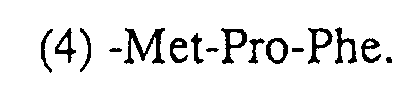







































































































- DNA
- : deoxyribonucleic acid
- cDNA
- : complementary deoxyribonucleic acid
- A
- : adenine
- T
- : thymine
- G
- : guanine
- C
- : cytosine
- Y
- : thymine or cytosine
- N
- : thymine, cytosine, adenine or guanine
- R
- : adenine or guanine
- M
- : cytosine or adenine
- W
- ; thymine or adenine
- S
- : cytosine or guanine
- RNA
- : ribonucleic acid
- mRNA
- : messenger ribonucleic acid
- dATP
- : deoxyadenosine triphosphate
- dTTP
- : deoxythymidine triphosphate
- dGTP
- : deoxyguanosine triphosphate
- dCTP
- : deoxycytidine triphosphate
- ATP
- : adenosine triphosphate
- EDTA
- : ethylenediaminetetraacetic acid
- SDS
- : sodium dodecyl sulfate
- EIA
- : enzyme immunoassay
- Gly or G
- : glycine
- Ala or A
- : alanine
- Val or V
- : valine
- Leu or L
- : leucine
- Ile or I
- : isoleucine
- Ser or S
- : serine
- Thr or T
- : threonine
- Cys or C
- : cysteine
- Met or M
- : methionine
- Glu or E
- : glutamic acid
- Asp or D
- : aspartic acid
- Lys or K
- : lysine
- Arg or R
- : arginine
- His or H
- : histidine
- Phe or F
- : phenylalanine
- Tyr or Y
- : tyrosine
- Trp or W
- : tryptophan
- Pro or P
- : proline
- Asn or N
- : asparagine
- Gln or Q
- : glutamine
- PGlu
- : pyroglutamic acid
- Me
- : methyl group
- Et
- : ethyl group
- Bu
- : butyl group
- Ph
- : phenyl group
- Nle
- : norleucine
- Thi
- : 2-thienylalanine
- Phg
- : phenylglycine
- Pya (2)
- : 2-pyridylalanine
- Adi (NH2)
- : 2-aminoadipic acid-6 amide
- Hyp
- : oxyproline (hydroxyproline)
- Ac-Arg
- : Nα-acetylarginine
- Lys (Ac)
- : Nε-acetyllysine
- Lys (Me)
- : Nε-methyllysine
- Lys (Tos)
- : Nε-tosyllysine
- Arg (Tos)
- : Nε-tosylarginine
- Phe (Cl)
- : 4-chlorophenylalanine
- Nal (2)
- : 2-naphthylalanine
- Cha
- : cyclohexylalanine
- Met (O)
- : methionine sulfoxide
- Tyr (Me)
- : O-methyltyrosine
- Tyr (I)
- : 3-iodotyrosine
- Tos
- : p-toluenesulfonyl
- HON
- : N-hydroxy-5-norbornane-2,3-dicarboxyimide
- Bzl
- : benzyl
- Z
- : benzyloxycarbonyl
- Br-Z
- : 2-bromobenzyloxycarbonyl
- Cl-Z
- : 2-chlorobenzyloxycarbonyl
- Boc
- : t-butoxycarbonyl
- HOBt
- : 1-hydroxybenztriazole
- DCC
- : N,N'-dicylohexylcarbodiimide
- TFA
- : trifluoroacetic acid
- Fmoc
- : N-9-fluorenylmethoxycarbonyl
- DNP
- : dinitrophenyl
- Bum
- : tertiary butoxymethyl
- Trt
- : trityl
- Pbf
- : 2,2,4,6,7-pentamethyl dihydrobenzofurane-5-sulfonyl
- HOOBt
- : 3-hydroxy-4-oxo-3,4-dihydro-1,2,3-benzotriazine
- TFE
- : trifluoroethanol
- HOAt
- : 1-hydroxy-7-azabenzotriazole
- PyBrop
- : bromotrispirolidinophosphonium hexafluorophosphate
- TMS-Br
- : trimethylsilyl bromide
- TC
- : thiazolidine-4(R)-carboxamide group
- Bom
- : benzyloxymethyl
- NMP
- : N-methylpyrrolidone
- PAM
- : phenylacetoamide methyl
- DCM
- : dichloromethane
- DMF
- : N,N-dimethylformamide
- DIEA
- : N,N-diisopropylethylamine
- Clt
- : 2-chlorotrityl
- For
- : formyl
- Lys (Arg-Arg)
- : Nε-arginyl arginyl lysine
- AM
- : aminomethyl
- Pyn
- : 1-pyrenylalanine
- Mor
- : morpholine
- N-MeAl
- : N-methylalanine
- Lys (Me)2
- : Nε-dimethyllysine
- Dap
- : diaminopropionic acid
- Mmt
- : 4-methoxytrityl
- Adi
- : adipoyl
- Dap (C6)
- : Nβ-hexanoyldiaminopropionic acid
- DIPCDI
- : N,N'-diisopropylcarbodiimide
- NME2
- : dimethylarnine
- Dap (Ac)
- : Nβ-acetyldiaminopropionic acid
- Dap (Adi)
- : Nβ-adipoyldiaminopropionic acid

(M+H)+ by mass spectrometric analysis: 1858.7 (theoretical 1859.0)
HPLC elution time: 19.7 minutes
Elution conditions
Column: YMC ODS AM-301, S-5 µm, 120 A (4.6×100 mm)
Eluent: elution with a linear gradient (25 minutes) of solution A (0.1 % TFA-water)/solution B (acetonitrile containing 0.1 % TFA) from 100/0 to 50/50.
Flow rate: 1.0 ml/min.
















| M+H+ (Measured) | M+H+ (Calculated) | HPLC Retention Time (min.) under the same conditions as Ex. 1 | |
| Compound in Ex. 2 | 1919.7 | 1919.1 | 21.5 |
| Compound in Ex. 3 | 1418.4 | 1418.7 | 20.2 |
| Compound in Ex. 4 | 1343.7 | 1343.7 | 22.2 |
| Compound in Ex. 5 | 1440.7 | 1440.8 | 22.8 |
| Compound in Ex. 6 | 1602.6 | 1603.0 | 18.4 |
| Compound in Ex. 7 | 1478.5 | 1478.8 | 22.3 |
| Compound in Ex. 8 | 1456.5 | 1456.7 | 19.7 |
| Compound in Ex. 9 | 1555.8 | 1555.9 | 21.4 |
| Compound in Ex. 10 | 1567.7 | 1567.8 | 19.8 |
| Compound in Ex. 11 | 1406.5 | 1406.8 | 21.6 |
| Compound in Ex. 12 | 1500.5 | 1500.8 | 24.2 |
| Compound in Ex. 13 | 1538.7 | 1538.9 | 22.8 |
| Compound in Ex. 14 | 1860.9 | 1861.1 | 16.8 |
| Compound in Ex. 15 | 1504.7 | 1504.9 | 22.1 |
| Compound in Ex. 16 | 1516.6 | 1516.8 | 20.6 |
| Compound in Ref. Ex. 1 | 4193.6 | 4194.6 | 17.5 |


























| M+H+ (Measured) | M+H+ (Calculated) | HPLC Retention Time (min.) under the same conditions as Ex. 1 | |
| Compound in Ex. 17 | 1825.1 | 1825.0 | 18.43 |
| Compound in Ex. 18 | 1581.0 | 1580.9 | 15.22 |
| Compound in Ex. 19 | 1449.6 | 1449.9 | 14.09 |
| Compound in Ex. 21 | 2175.9 | 2175.3 | 17.46 |
| Compound in Ex. 22 | 1890.9 | 1891.1 | 17.55 |
| Compound in Ex. 23 | 1863.1 | 1863.1 | 17.32 |
| Compound in Ex. 24 | 1384.8 | 1384.8 | 18.74 |
| Compound in Ex. 25 | 1805.9 | 1806.0 | 17.73 |
| Compound in Ex. 26 | 1495.7 | 1495.8 | 19.10 |
| Compound in Ex. 27 | 1140.8 | 1140.6 | 15.16 |
| Compound in Ex. 28 | 1359.6 | 1359.7 | 19.32 |
| Compound in Ex. 29 | 1467.7 | 1467.8 | 18.86 |
| Compound in Ex. 30 | 1522.7 | 1522.9 | 18.34 |
| Compound in Ex. 31 | 1444.6 | 1444.8 | 20.92 |
| Compound in Ex. 32 | 1472.6 | 1472.8 | 20.48 |
| Compound in Ex. 33 | 1883.4 | 1883.0 | 18.05 |
| Compound in Ex. 34 | 1561.8 | 1561.8 | 18.40 |
| Compound in Ex. 35 | 1471.0 | 1470.7 | 19.39 |
| Compound in Ex. 36 | 1331.5 | 1331.8 | 19.22 |
| Compound in Ex. 37 | 1441.8 | 1441.8 | 22.38 |
| Compound in Ex. 38 | 1509.7 | 1509.8 | 20.46 |
| Compound in Ex. 39 | 1583.6 | 1583.8 | 20.83 |
| Compound in Ex. 40 | 1375.5 | 1375.7 | 20.35 |
| Compound in Ex. 41 | 1580.7 | 1580.9 | 18.51 |
| Compound in Ex. 42 | 1641.5 | 1641.9 | 20.15 |
| Compound in Ex. 43 | 1543.6 | 1543.8 | 20.87 |
| Compound in Ex. 44 | 1593.7 | 1593.8 | 19.70 |
| Compound in Ex. 45 | 1442.5 | 1442.8 | 19.88 |
| Compound in Ex. 46 | 1486.6 | 1486.8 | 20.26 |
| Compound in Ex. 48 | 1522.7 | 1522.8 | 21.14 |
| Compound in Ex. 49 | 1428.7 | 1428.8 | 19.41 |
| Compound in Ex. 50 | 1515.9 | 1515.8 | 20.71 |

(M+H)+ by mass spectrometric analysis: 1634.9 (theoretical 1634.9)
HPLC elution time: 14.03 minutes
Elution conditions
Column: Wakosil5C18T (4.6×100 mm)
Eluent: elution with a linear gradient (25 minutes) of solution A (0.1 %TFA-water)/solution B (acetonitrile containing 0.1 % TFA) from 55/95 to 55/45.
Flow rate: 1.0 ml/min.

(M+H)+ by mass spectrometric analysis: 1347.5 (theoretical 1347.7)
HPLC elution time: 15.81 minutes
Elution conditions
Column: YMC ODS AM-301, S-5 µm, 120 A (4.6×100 mm)
Eluent: elution with a linear gradient (25 minutes) of solution A (0.1 % TFA-water)/solution B (acetonitrile containing 0.1 % TFA) from 10/90 to 60/40.
Flow rate: 1.0 ml/min.

(M+H)+ by mass spectrometric analysis: 1532.0 (theoretical 1531.9)
HPLC elution time: 14.6 minutes
Elution conditions
Column: Wakosil 5C18T (4.6×100 mm)
Eluent: elution with a linear gradient (25 minutes) of solution A (0.1 %TFA-water)/solution B (acetonitrile containing 0.1 % TFA) from 95/5 to 45/55.
Flow rate: 1.0 ml/min.
















| M+H+ (Measured) | M+H+ (Calculated) | HPLC Retention Time (min.) under the same conditions as Ex. 1 | |
| Compound in Ex. 51 | 1379.9 | 1379.9 | 13.44 |
| Compound in Ex. 52 | 1421.8 | 1421.9 | 13.38 |
| Compound in Ex. 53 | 1358.6 | 1358.7 | 18.78 |
| Compound in Ex. 54 | 1378.6 | 1378.7 | 19.44 |
| Compound in Ex. 55 | 1406.6 | 1406.7 | 20.21 |
| Compound in Ex. 56 | 1421.8 | 1421.8 | 22.87 |
| Compound in Ex. 57 | 1436.4 | 1436.8 | 21.61 |
| Compound in Ex. 58 | 1393.4 | 1393.8 | 22.42 |
| Compound in Ex. 59 | 1859.0 | 1859.0 | 19.00 |
| Compound in Ex. 60 | 1433.6 | 1433.8 | 25.20 |
| Compound in Ex. 61 | 1530.9 | 1530.9 | 25.96 |
| Compound in Ex. 62 | 1563.1 | 1562.8 | 17.39 |
| Compound in Ex. 63 | 1384.5 | 1384.8 | 18.40 |
| Compound in Ex. 64 | 1384.5 | 1384.8 | 18.43 |
| Compound in Ex. 65 | 1455.6 | 1455.8 | 22.12 |
| Compound in Ex. 66 | 1497.6 | 1497.8 | 22.68 |
| Compound in Ex. 67 | 1553.8 | 1553.9 | 20.13 |
| Compound in Ex. 68 | 1583.6 | 1583.8 | 22.76 |
| Compounds | EC50(nM) |
| Compound in Ex. 1 | 0.39 |
| Compound in Ex. 2 | 0.53 |
| Compound in Ex. 3 | 0.32 |
| Compound in Ex. 4 | 0.65 |
| Compound in Ex. 5 | 0.51 |
| Compound in Ex. 6 | 0.55 |
| Compound in Ex. 7 | 0.41 |
| Compound in Ex. 8 | 0.34 |
| Compound in Ex. 9 | 0.35 |
| Compound in Ex. 10 | 0.61 |
| Compound in Ex. 11 | 0.59 |
| Compound in Ex. 12 | 1.2 |
| Compound in Ex. 13 | 1 |
| Compound in Ex. 14 | 0.28 |
| Compound in Ex. 15 | 0.46 |
| Compound in Ex. 16 | 0.38 |
| Compounds | EC50 (nM) |
| Compound in Ex. 17 | 0.39 |
| Compound in Ex. 18 | 0.18 |
| Compound in Ex. 19 | 0.26 |
| Compound in Ex. 20 | 0.48 |
| Compound in Ex. 21 | 0.57 |
| Compound in Ex. 22 | 0.32 |
| Compound in Ex. 23 | 0.31 |
| Compound in Ex. 24 | 0.25 |
| Compound in Ex. 25 | 0.25 |
| Compound in Ex. 26 | 0.17 |
| Compound in Ex. 27 | 0.093 |
| Compound in Ex. 28 | 0.16 |
| Compound in Ex. 29 | 0.22 |
| Compound in Ex. 30 | 0.081 |
| Compound in Ex. 31 | 0.14 |
| Compound in Ex. 32 | 0.1 |
| Compound in Ex. 33 | 1.1 |
| Compound in Ex. 34 | 0.2 |
| Compound in Ex. 35 | 0.43 |
| Compound in Ex. 36 | 0.22 |
| Compound in Ex. 37 | 0.43 |
| Compound in Ex. 38 | 0.16 |
| Compound in Ex. 39 | 0.4 |
| Compound in Ex. 40 | 0.37 |
| Compound in Ex. 41 | 0.069 |
| Compound in Ex. 42 | 0.15 |
| Compound in Ex. 43 | 0.24 |
| Compound in Ex. 44 | 0.22 |
| Compound in Ex. 45 | 0.3 |
| Compound in Ex. 46 | 0.52 |
| Compound in Ex. 47 | 0.36 |
| Compound in Ex. 48 | 0.3 |
| Compound in Ex. 49 | 0.71 |
| Compound in Ex. 50 | 0.16 |
| EC50 (nM) | |
| Compound in Ex. 51 | 0.49 |
| Compound in Ex. 52 | 1.2 |
| Compound in Ex. 53 | 0.37 |
| Compound in Ex. 54 | 0.19 |
| Compound in Ex. 55 | 0.27 |
| Compound in Ex. 56 | 0.58 |
| Compound in Ex. 57 | 0.52 |
| Compound in Ex. 58 | 0.41 |
| Compound in Ex. 59 | 0.32 |
| Compound in Ex. 60 | 1.1 |
| Compound in Ex. 61 | 2.2 |
| Compound in Ex. 62 | 0.23 |
| Compound in Ex. 63 | 0.33 |
| Compound in Ex. 64 | 0.38 |
| Compound in Ex. 65 | 0.52 |
| Compound in Ex. 66 | 0.69 |
| Compound in Ex. 67 | 1.1 |
| Compound in Ex. 68 | 0.42 |
| Compounds | IC50(nM) |
| Compound in Ex. 1 | 0.2 |
| Compound in Ex. 2 | 0.47 |
| Compound in Ex. 3 | 0.91 |
| Compound in Ex. 4 | 1 |
| Compound in Ex. 5 | 1.2 |
| Compound in Ex. 6 | 1.4 |
| Compound in Ex. 7 | 1.4 |
| Compound in Ex. 8 | 13 |
| Compound in Ex. 9 | 13 |
| Compound in Ex. 10 | 15 |
| Compound in Ex. 11 | 2.2 |
| Compound in Ex. 12 | 2.3 |
| Compound in Ex. 13 | 2.7 |
| Compound in Ex. 14 | 2.7 |
| Compound in Ex. 15 | 8 |
| Compound in Ex. 16 | 8 |
| Compounds | IC50 (nM) |
| Compound in Ex. 17 | 0.75 |
| Compound in Ex. 18 | 2.5 |
| Compound in Ex. 21 | 2.9 |
| Compound in Ex. 22 | 6.7 |
| Compound in Ex. 23 | 9.2 |
| Compound in Ex. 24 | 27 |
| Compound in Ex. 25 | 34 |
| Compound in Ex. 26 | 37 |
| IC50 (nM) | |
| Compound in Ex. 53 | 0.37 |
| Compound in Ex. 55 | 0.27 |
| Compound in Ex. 56 | 0.58 |
| Compound in Ex. 57 | 0.52 |
| Compound in Ex. 58 | 0.41 |
| Compound in Ex. 59 | 0.32 |
| Compound in Ex. 60 | 1.1 |
| Compound in Ex. 61 | 2.2 |
| Compound in Ex. 62 | 0.23 |
| Compound in Ex. 63 | 0.33 |
| Compound in Ex. 64 | 0.38 |
| Compound in Ex. 65 | 0.52 |
| Compound in Ex. 66 | 0.69 |
| Compound in Ex. 67 | 1.1 |
| Compound in Ex. 68 | 0.42 |
| Compounds | IC50(nM) |
| Compound in Ex. 1 | 0.1 |
| Compound in Ex. 2 | 0.33 |
| Compound in Ex. 3 | 0.036 |
| Compound in Ex. 4 | 0.1 |
| Compound in Ex. 5 | 0.13 |
| Compound in Ex. 6 | 0.046 |
| Compound in Ex. 7 | 0.12 |
| Compound in Ex. 8 | 0.039 |
| Compound in Ex. 9 | 0.16 |
| Compound in Ex. 10 | 0.071 |
| Compound in Ex. 11 | 0.084 |
| Compound in Ex. 12 | 0.38 |
| Compound in Ex. 13 | 0.29 |
| Compound in Ex. 14 | 0.027 |
| Compound in Ex. 15 | 0.13 |
| Compound in Ex. 16 | 0.066 |
| Compounds | IC50 (nM) |
| Compound in Ex. 17 | 0.036 |
| Compound in Ex. 18 | 0.023 |
| Compound in Ex. 19 | 0.071 |
| Compound in Ex. 20 | 0.62 |
| Compound in Ex. 21 | 0.84 |
| Compound in Ex. 22 | 0.12 |
| Compound in Ex. 23 | 0.09 |
| Compound in Ex. 24 | 0.057 |
| Compound in Ex. 25 | 0.067 |
| Compound in Ex. 26 | 0.12 |
| Compound in Ex. 27 | 0.11 |
| Compound in Ex. 28 | 0.17 |
| Compound in Ex. 29 | 0.21 |
| Compound in Ex. 30 | 0.23 |
| Compound in Ex. 31 | 0.27 |
| Compound in Ex. 32 | 0.35 |
| Compound in Ex. 33 | 0.37 |
| Compound in Ex. 34 | 0.4 |
| Compound in Ex. 35 | 0.48 |
| Compound in Ex. 36 | 0.51 |
| Compound in Ex. 37 | 0.54 |
| Compound in Ex. 38 | 0.59 |
| Compound in Ex. 39 | 0.6 |
| Compound in Ex. 40 | 0.61 |
| Compound in Ex. 41 | 0.73 |
| Compound in Ex. 42 | 0.81 |
| Compound in Ex. 43 | 0.95 |
| Compound in Ex. 44 | 0.99 |
| Compound in Ex. 45 | 1.3 |
| Compound in Ex. 46 | 1.4 |
| Compound in Ex. 47 | 1.8 |
| Compound in Ex. 48 | 2.6 |
| Compound in Ex. 49 | 3.5 |
| Compound in Ex. 50 | 3.6 |
| IC50 (nM) | |
| Compound in Ex. 51 | 0.16 |
| Compound in Ex. 52 | 0.26 |
| Compound in Ex. 53 | 0.064 |
| Compound in Ex. 54 | 0.29 |
| Compound in Ex. 55 | 0.09 |
| Compound in Ex. 56 | 0.22 |
| Compound in Ex. 57 | 0.17 |
| Compound in Ex. 58 | 0.15 |
| Compound in Ex. 59 | 0.18 |
| Compound in Ex. 60 | 0.8 |
| Compound in Ex. 61 | 0.56 |
| Compound in Ex. 62 | 0.14 |
| Compound in Ex. 63 | 0.074 |
| Compound in Ex. 64 | 0.096 |
| Compound in Ex. 65 | 0.26 |
| Compound in Ex. 66 | 0.11 |
| Compound in Ex. 67 | 0.45 |
| Compound in Ex. 68 | 0.13 |
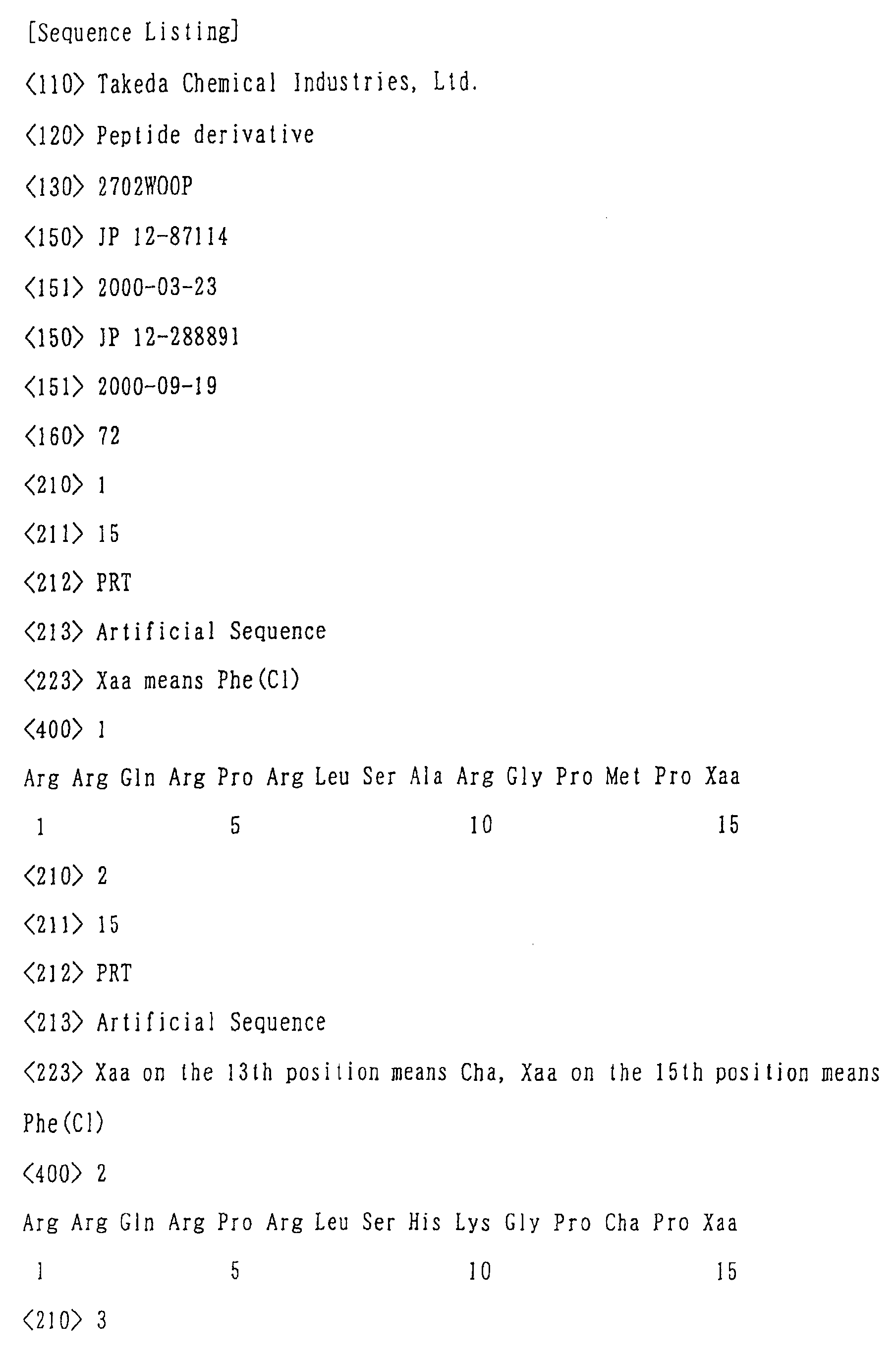


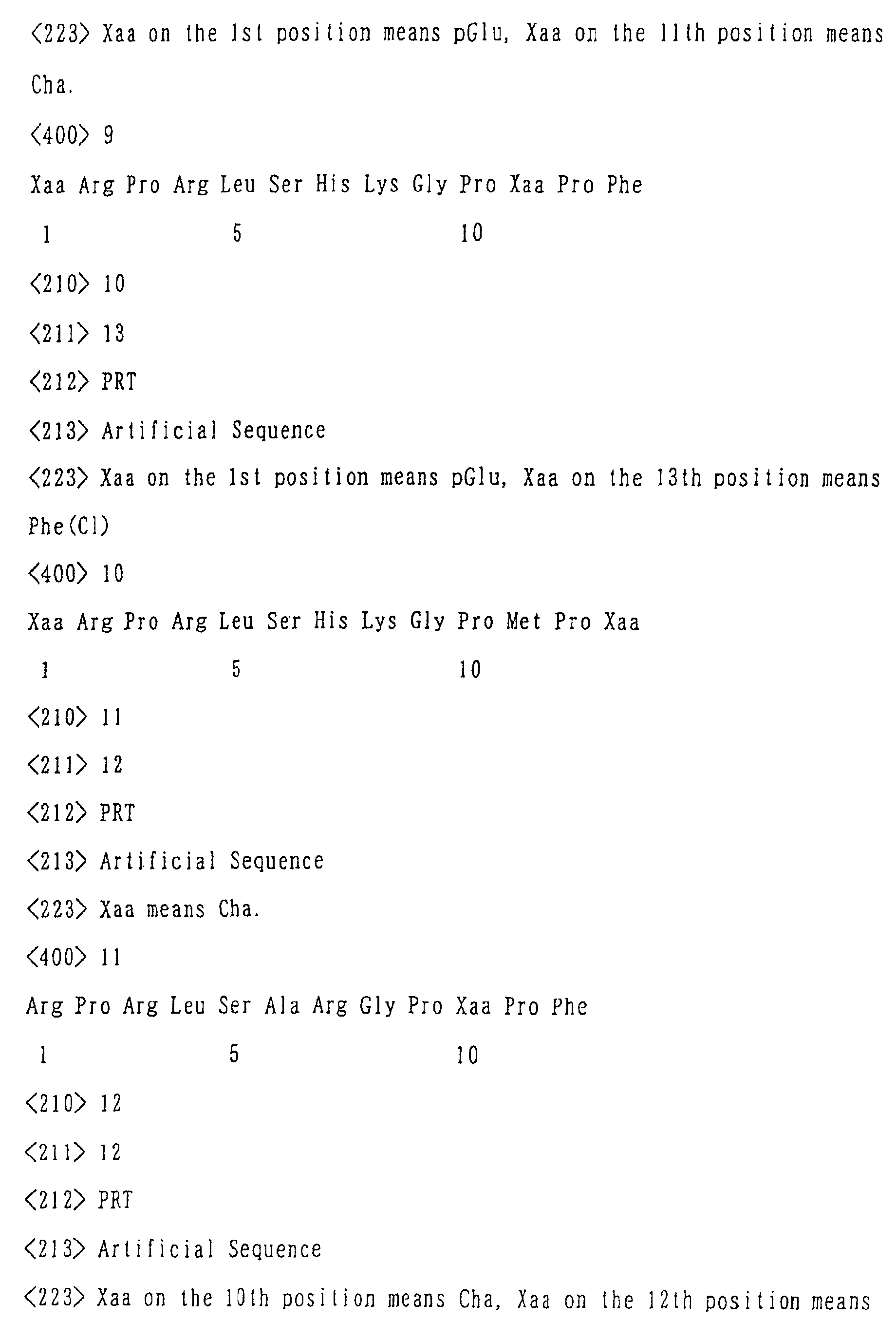
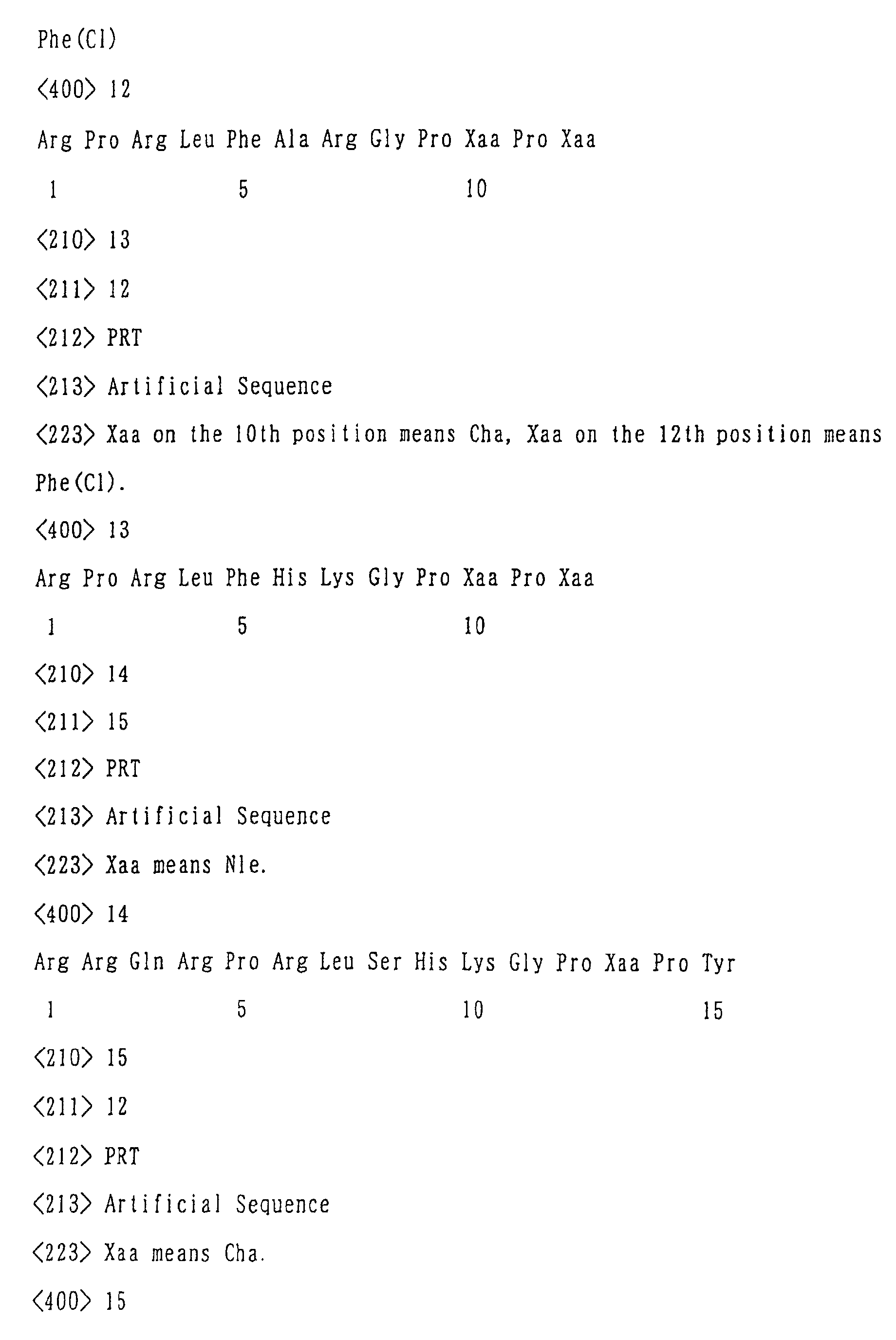


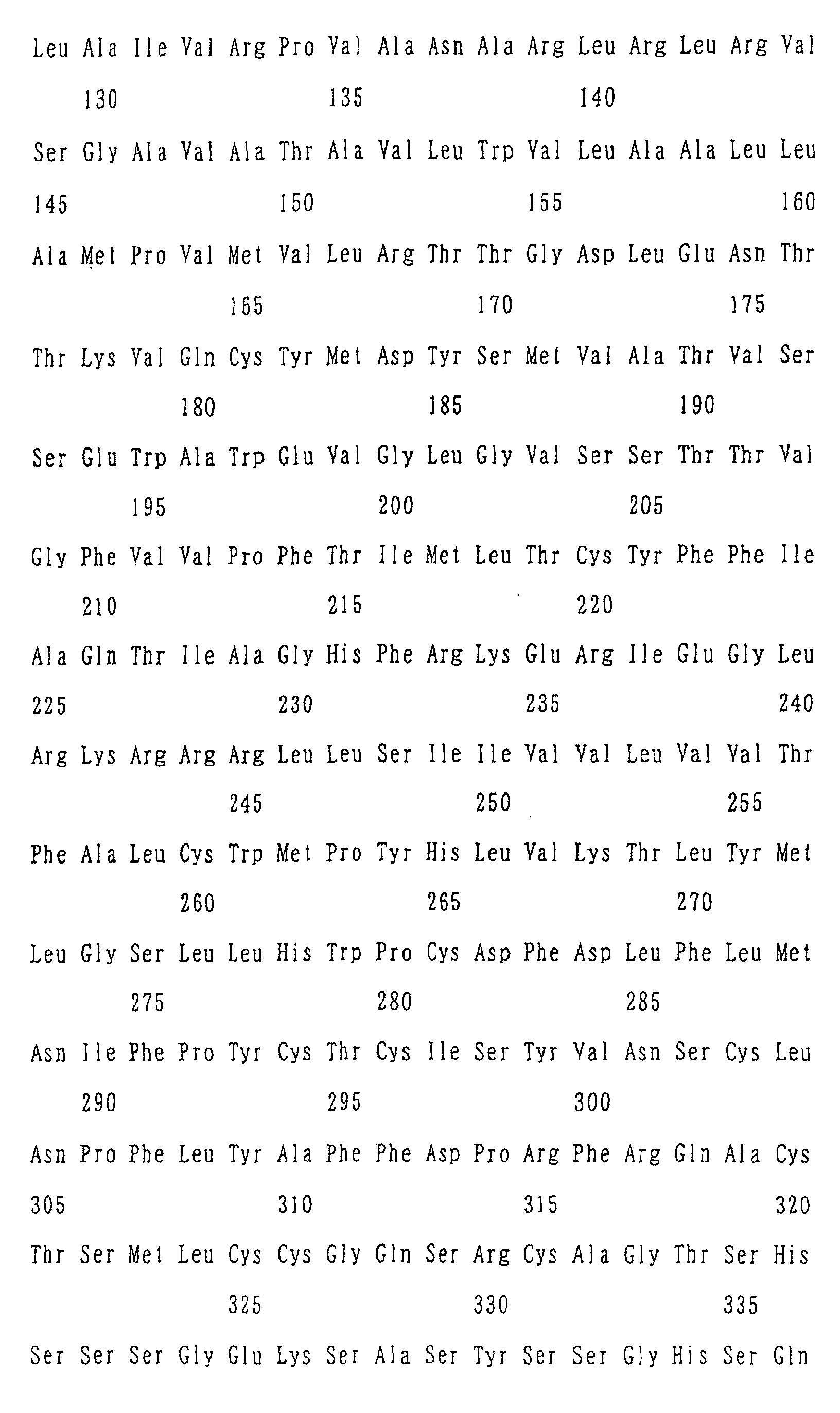
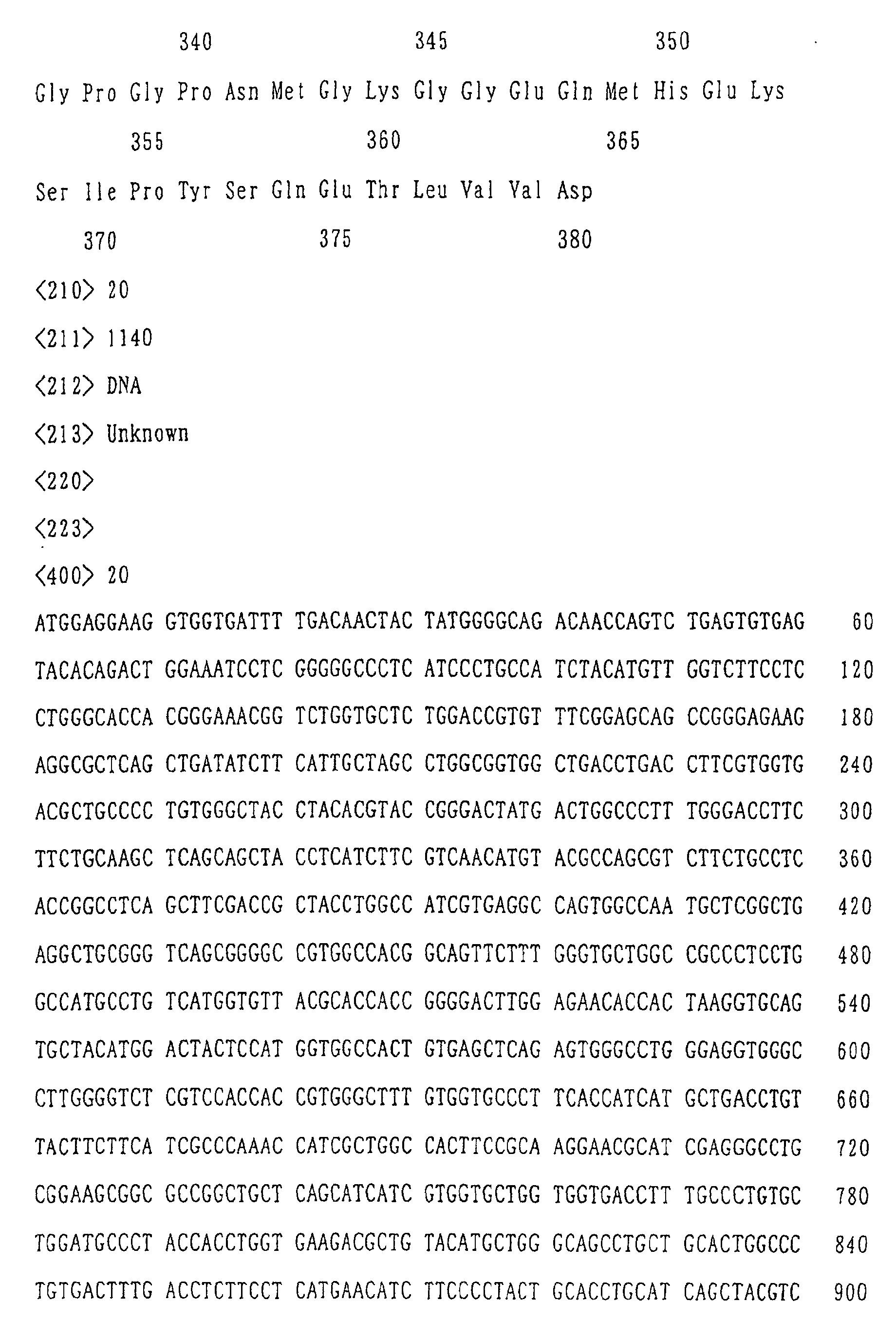
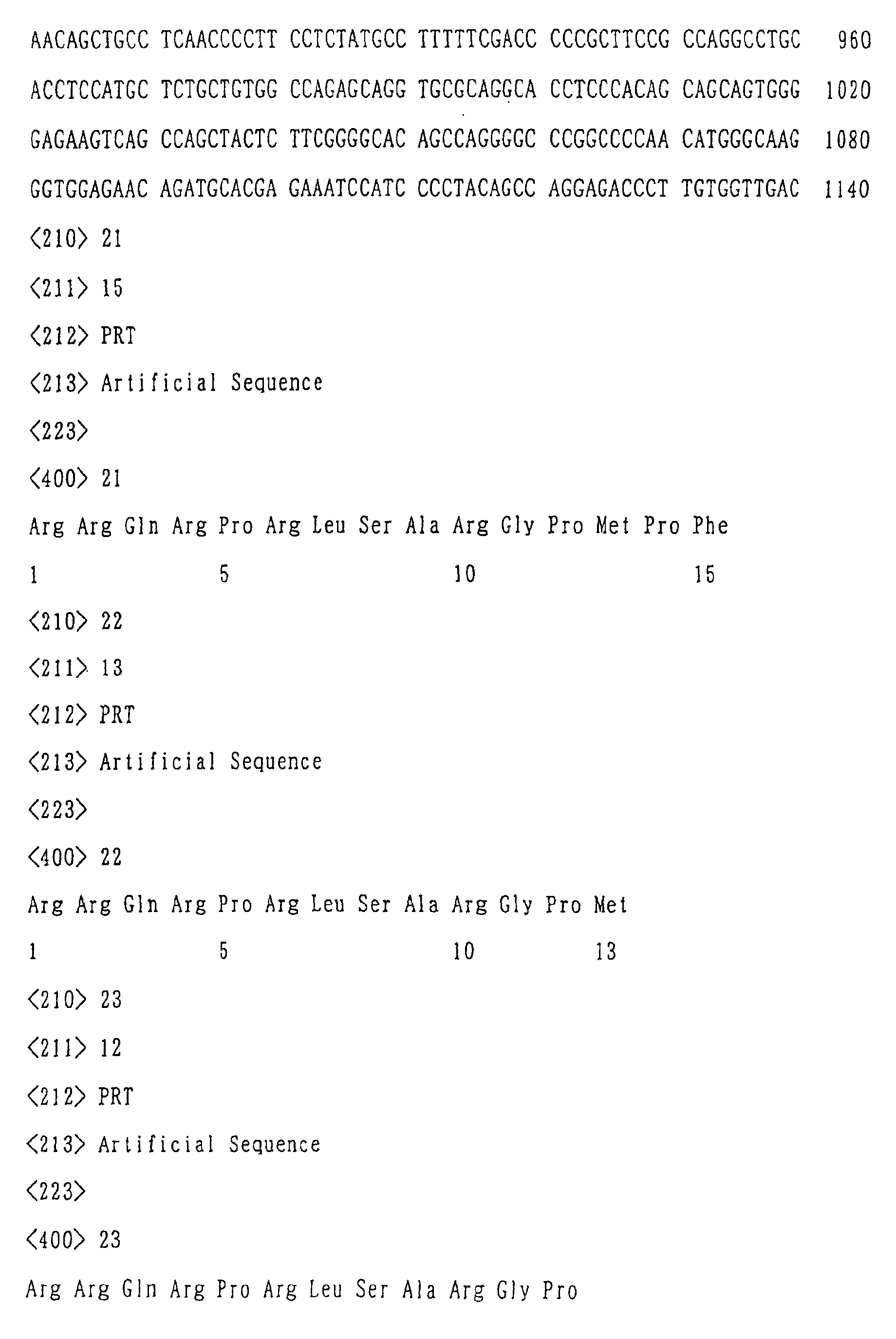

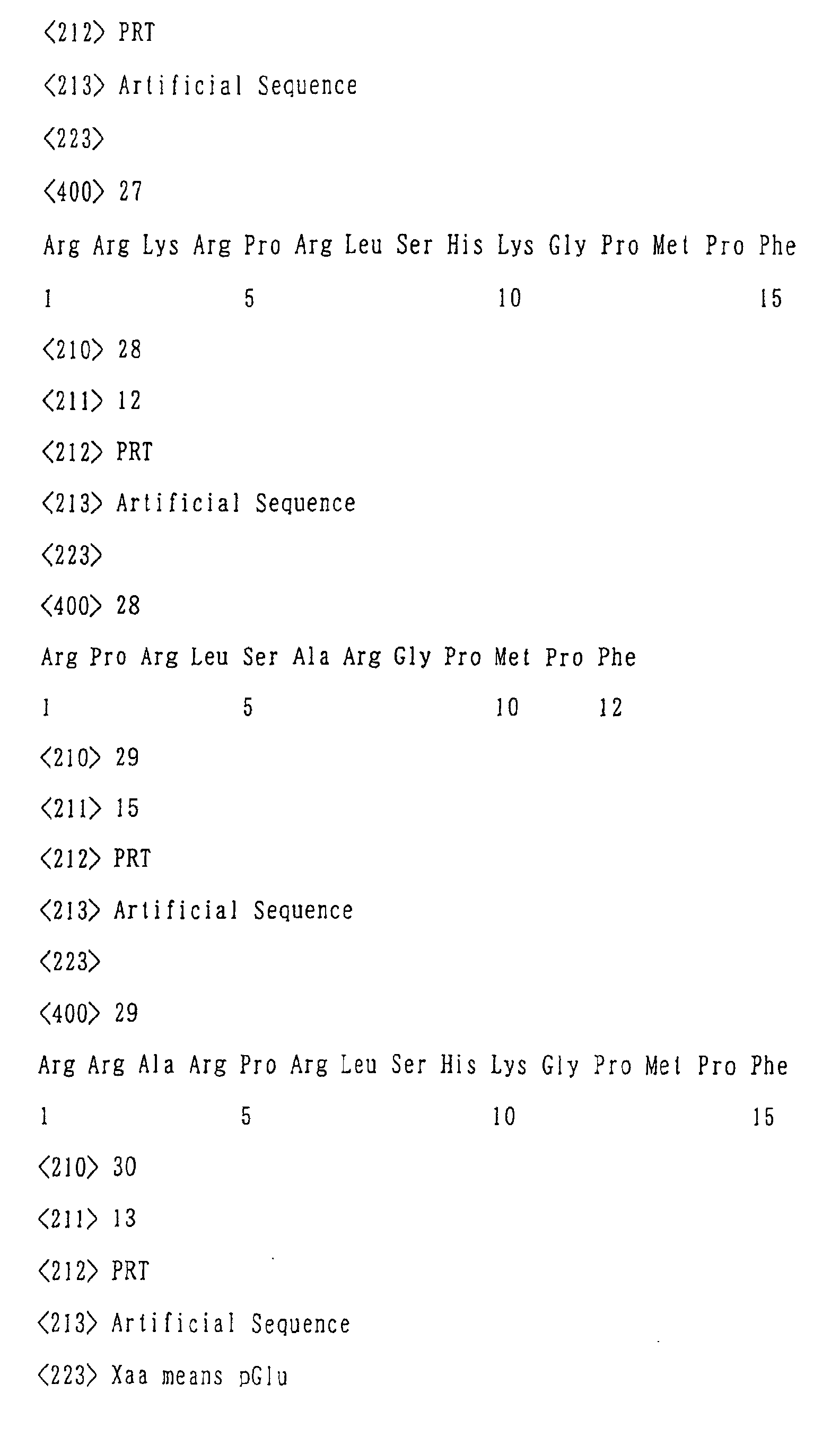
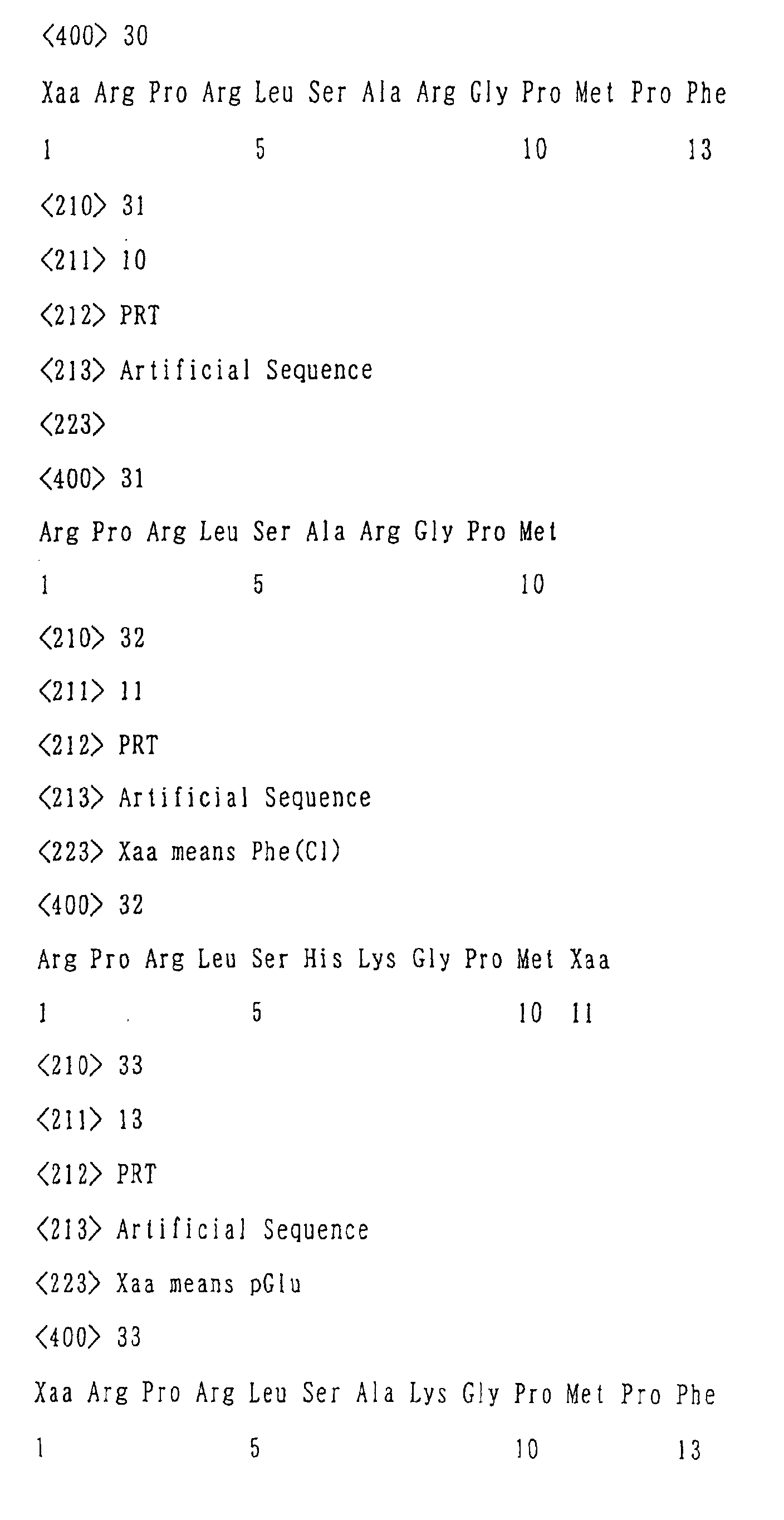
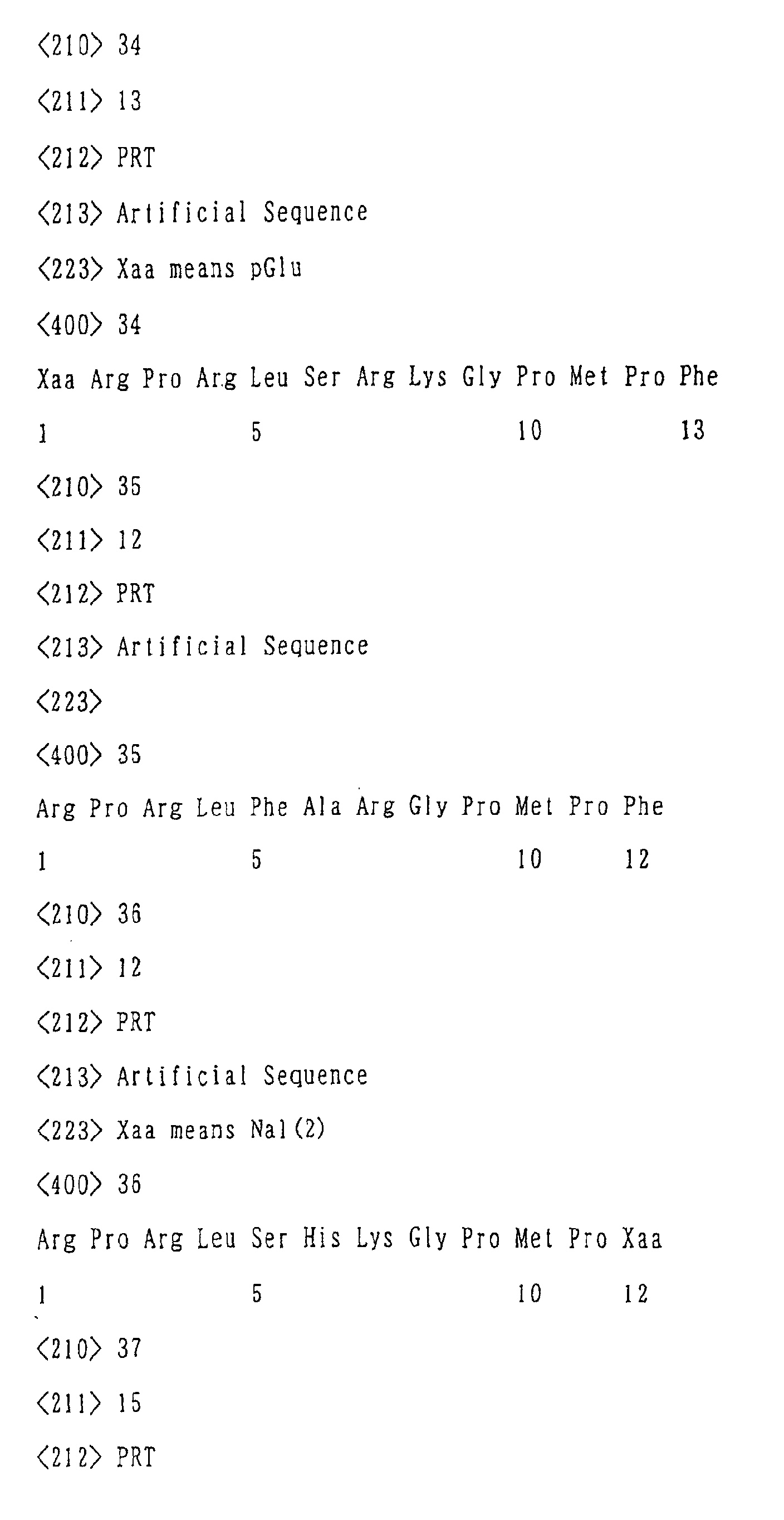

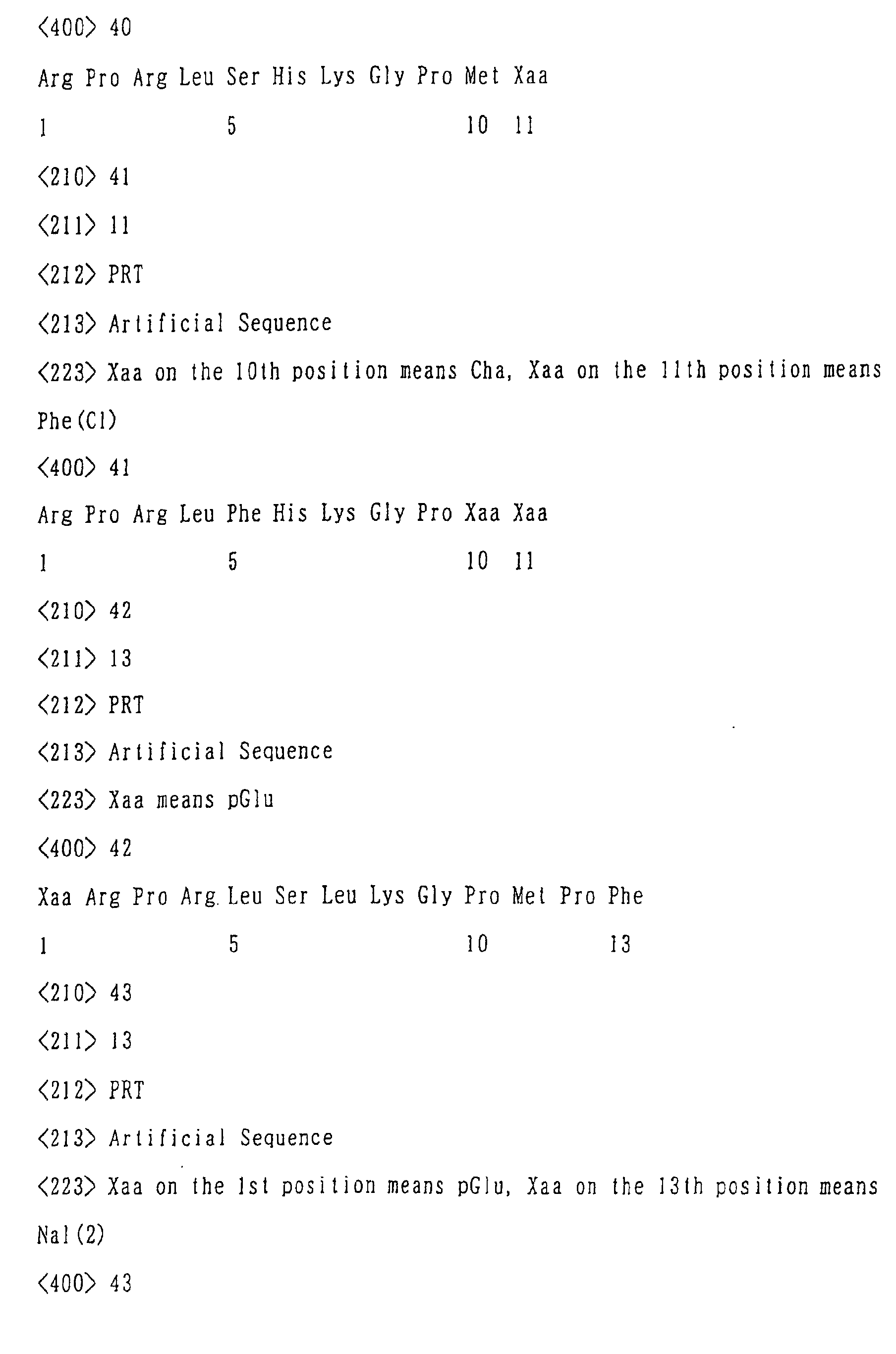
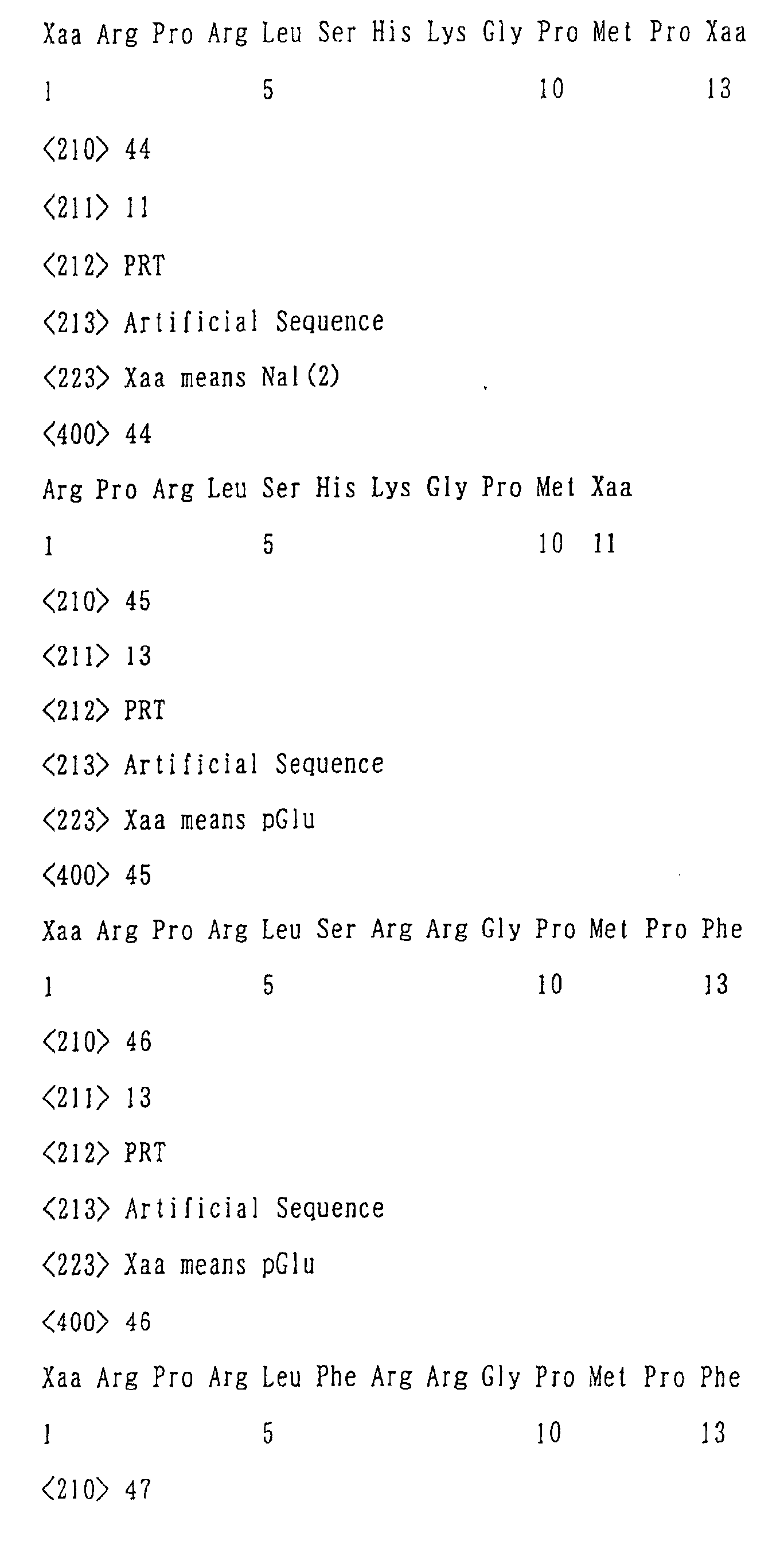
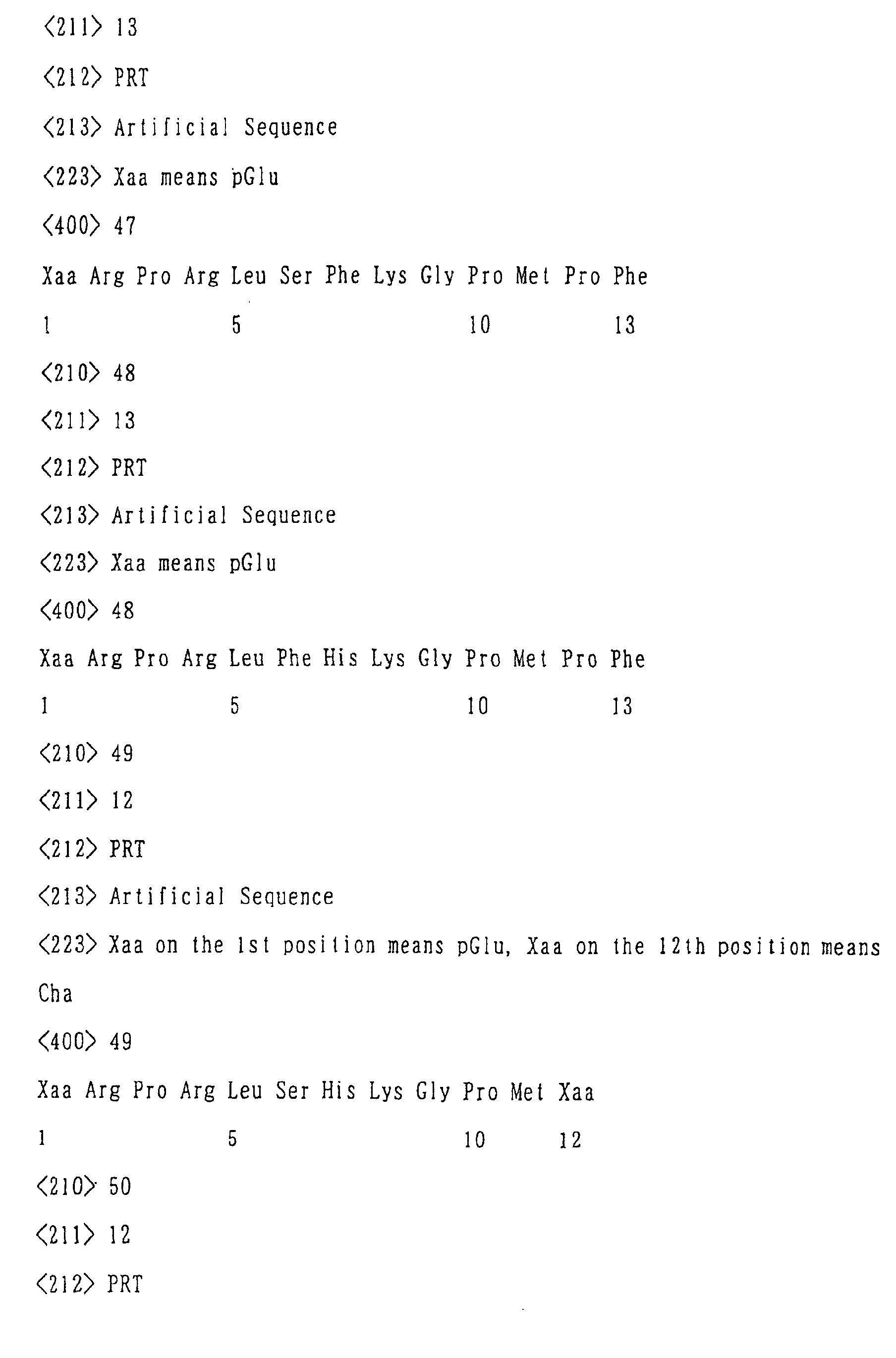

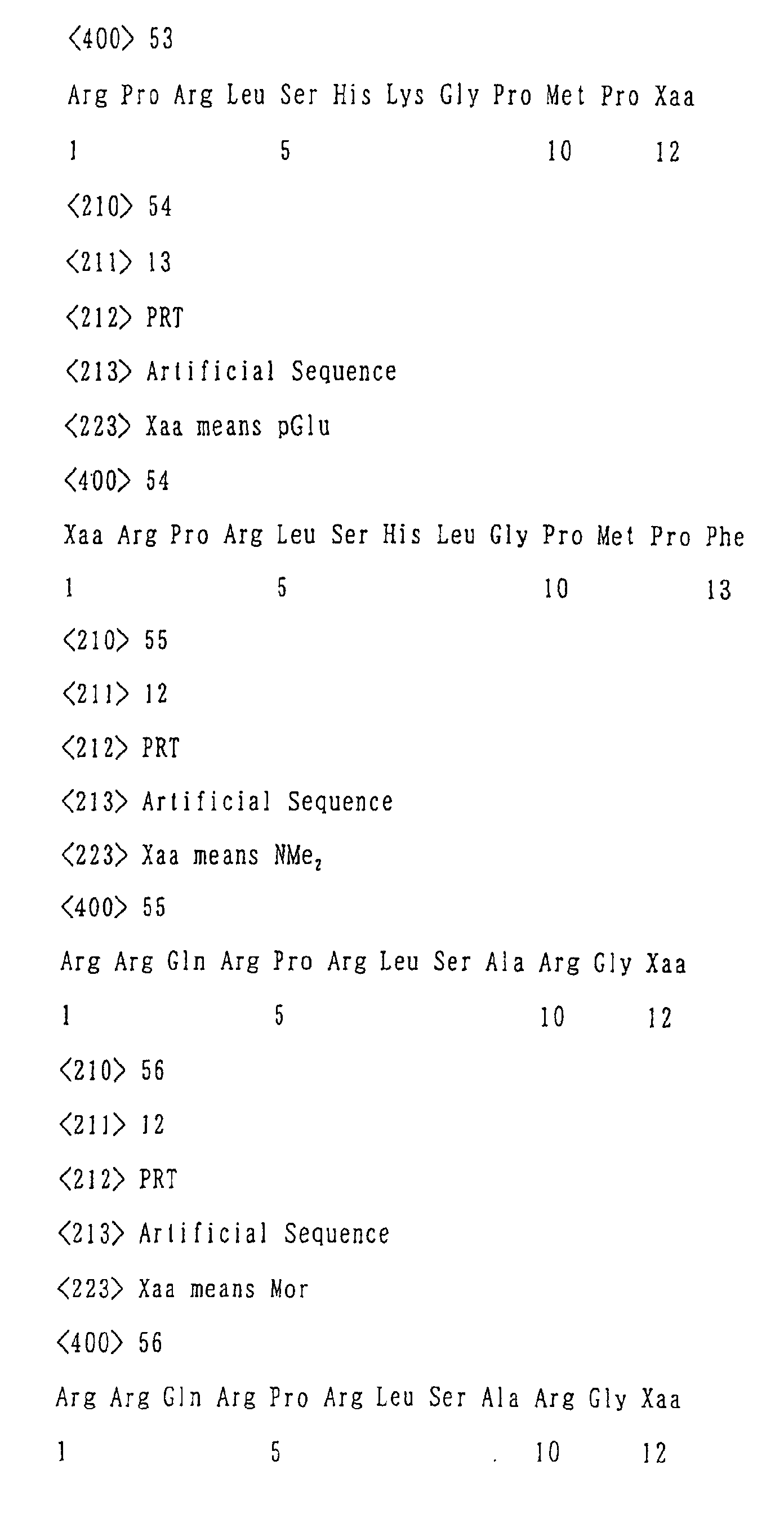


Claims (21)

an ester thereof or an amide thereof, or a salt thereof.





an ester thereof or an amide thereof, or a salt thereof.

















an ester thereof or an amide thereof, or a salt thereof.
























Applications Claiming Priority (5)
| Application Number | Priority Date | Filing Date | Title |
|---|---|---|---|
| JP2000087114 | 2000-03-23 | ||
| JP2000087114 | 2000-03-23 | ||
| JP2000288891 | 2000-09-19 | ||
| JP2000288891 | 2000-09-19 | ||
| PCT/JP2001/002278 WO2001070769A1 (en) | 2000-03-23 | 2001-03-22 | Peptide derivative |
Publications (3)
| Publication Number | Publication Date |
|---|---|
| EP1270585A1 true EP1270585A1 (en) | 2003-01-02 |
| EP1270585A4 EP1270585A4 (en) | 2004-12-15 |
| EP1270585B1 EP1270585B1 (en) | 2006-05-17 |
Family
ID=26588465
Family Applications (1)
| Application Number | Title | Priority Date | Filing Date |
|---|---|---|---|
| EP01915695A Expired - Lifetime EP1270585B1 (en) | 2000-03-23 | 2001-03-22 | Peptide derivative |
Country Status (10)
| Country | Link |
|---|---|
| US (1) | US7635751B2 (en) |
| EP (1) | EP1270585B1 (en) |
| JP (1) | JP4786047B2 (en) |
| KR (1) | KR20020081466A (en) |
| CN (1) | CN1419563A (en) |
| AT (1) | ATE326478T1 (en) |
| AU (1) | AU2001242749A1 (en) |
| CA (1) | CA2403447A1 (en) |
| DE (1) | DE60119714T2 (en) |
| WO (1) | WO2001070769A1 (en) |
Cited By (2)
| Publication number | Priority date | Publication date | Assignee | Title |
|---|---|---|---|---|
| EP1903052A3 (en) * | 2006-07-28 | 2008-04-02 | Faust Pharmaceuticals SA | APJ receptor ligands and uses thereof |
| EP1967210A4 (en) * | 2005-12-20 | 2009-11-11 | Takeda Pharmaceutical | NEW APPLICATION OF APELIN |
Families Citing this family (27)
| Publication number | Priority date | Publication date | Assignee | Title |
|---|---|---|---|---|
| WO2003063892A1 (en) * | 2002-01-29 | 2003-08-07 | Takeda Chemical Industries, Ltd. | Use of apelin |
| US8673848B2 (en) | 2012-01-27 | 2014-03-18 | Novartis Ag | Synthetic apelin mimetics for the treatment of heart failure |
| RU2303454C1 (en) * | 2006-06-22 | 2007-07-27 | Общество С Ограниченной Ответственностью "Сиа Пептайдс" | Preparation for normalizing female reproductive function and method for its obtaining |
| WO2013050441A1 (en) | 2011-10-05 | 2013-04-11 | INSERM (Institut National de la Santé et de la Recherche Médicale) | Methods and pharmaceutical composition for inhibiting or preventing platelet aggregation |
| US9381229B2 (en) | 2011-11-28 | 2016-07-05 | Inserm (Institut National De La Sante Et De La Recherche Medicale) | Pharmaceutical composition for use in the treatment of dysfunction associated with aging |
| CN104254540A (en) * | 2012-01-09 | 2014-12-31 | 安科治疗公司 | APJ receptor compounds |
| US8921307B2 (en) | 2012-11-20 | 2014-12-30 | Novartis Ag | Synthetic linear apelin mimetics for the treatment of heart failure |
| UY35144A (en) | 2012-11-20 | 2014-06-30 | Novartis Ag | APELINE SYNTHETIC LINEAR MIMETICS FOR THE CARDIAC INSUFFICIENCY TREATMENT |
| US20160067347A1 (en) | 2012-12-20 | 2016-03-10 | Amgen Inc. | Apj receptor agonists and uses thereof |
| KR20160031551A (en) | 2013-07-25 | 2016-03-22 | 노파르티스 아게 | Cyclic polypeptides for the treatment of heart failure |
| HK1218252A1 (en) | 2013-07-25 | 2017-02-10 | Novartis Ag | Bioconjugates of synthetic apelin polypeptides |
| CN104436158A (en) * | 2013-09-22 | 2015-03-25 | 华中科技大学 | Application of Apelin-13 to treatment of diabetic nephropathy |
| GB201407532D0 (en) * | 2014-04-29 | 2014-06-11 | Univ Ulster | Apelin analogues |
| MA41580A (en) | 2015-01-23 | 2017-11-29 | Novartis Ag | SYNTHETIC APELIN FATTY ACID CONJUGATES WITH IMPROVED HALF-LIFE |
| US10426818B2 (en) | 2015-03-24 | 2019-10-01 | Inserm (Institut National De La Sante Et De La Recherche Medicale) | Method and pharmaceutical composition for use in the treatment of diabetes |
| HUE050317T2 (en) | 2015-05-20 | 2020-11-30 | Amgen Inc | Triazole agonists of the apj receptor |
| ES2930077T3 (en) | 2016-02-15 | 2022-12-07 | Inst Nat Sante Rech Med | Apelin for use in the treatment of postoperative cognitive dysfunction |
| US9988369B2 (en) | 2016-05-03 | 2018-06-05 | Amgen Inc. | Heterocyclic triazole compounds as agonists of the APJ receptor |
| US11046680B1 (en) | 2016-11-16 | 2021-06-29 | Amgen Inc. | Heteroaryl-substituted triazoles as APJ receptor agonists |
| WO2018093579A1 (en) | 2016-11-16 | 2018-05-24 | Amgen Inc. | Triazole phenyl compounds as agonists of the apj receptor |
| US10736883B2 (en) | 2016-11-16 | 2020-08-11 | Amgen Inc. | Triazole furan compounds as agonists of the APJ receptor |
| WO2018093576A1 (en) | 2016-11-16 | 2018-05-24 | Amgen Inc. | Alkyl substituted triazole compounds as agonists of the apj receptor |
| WO2018093577A1 (en) | 2016-11-16 | 2018-05-24 | Amgen Inc. | Cycloalkyl substituted triazole compounds as agonists of the apj receptor |
| EP3541803B1 (en) | 2016-11-16 | 2020-12-23 | Amgen Inc. | Triazole pyridyl compounds as agonists of the apj receptor |
| MA50509A (en) | 2017-11-03 | 2021-06-02 | Amgen Inc | APJ RECEPTOR FUSED TRIAZOLE AGONISTS |
| US11807624B2 (en) | 2018-05-01 | 2023-11-07 | Amgen Inc. | Substituted pyrimidinones as agonists of the APJ receptor |
| WO2026007692A1 (en) * | 2024-07-05 | 2026-01-08 | 浙江大学 | Apelin-13 polypeptide mutant |
Family Cites Families (4)
| Publication number | Priority date | Publication date | Assignee | Title |
|---|---|---|---|---|
| ES2118372T3 (en) * | 1992-11-17 | 1998-09-16 | Icos Corp | NEW RECEIVERS SEVEN TRANSMEMBRANA V28. |
| KR20010033601A (en) * | 1997-12-24 | 2001-04-25 | 다케다 야쿠힌 고교 가부시키가이샤 | Polypeptide, their production and use |
| US6475718B2 (en) * | 1998-09-08 | 2002-11-05 | Schering Aktiengesellschaft | Methods and compositions for modulating the interaction between the APJ receptor and the HIV virus |
| AU5759399A (en) * | 1998-09-25 | 2000-04-17 | Takeda Chemical Industries Ltd. | Peptide derivative |
-
2001
- 2001-03-22 EP EP01915695A patent/EP1270585B1/en not_active Expired - Lifetime
- 2001-03-22 WO PCT/JP2001/002278 patent/WO2001070769A1/en not_active Ceased
- 2001-03-22 US US10/239,321 patent/US7635751B2/en not_active Expired - Fee Related
- 2001-03-22 AU AU2001242749A patent/AU2001242749A1/en not_active Abandoned
- 2001-03-22 KR KR1020027012331A patent/KR20020081466A/en not_active Withdrawn
- 2001-03-22 CN CN01807077A patent/CN1419563A/en active Pending
- 2001-03-22 DE DE60119714T patent/DE60119714T2/en not_active Expired - Lifetime
- 2001-03-22 AT AT01915695T patent/ATE326478T1/en not_active IP Right Cessation
- 2001-03-22 CA CA002403447A patent/CA2403447A1/en not_active Abandoned
- 2001-03-23 JP JP2001084010A patent/JP4786047B2/en not_active Expired - Fee Related
Cited By (2)
| Publication number | Priority date | Publication date | Assignee | Title |
|---|---|---|---|---|
| EP1967210A4 (en) * | 2005-12-20 | 2009-11-11 | Takeda Pharmaceutical | NEW APPLICATION OF APELIN |
| EP1903052A3 (en) * | 2006-07-28 | 2008-04-02 | Faust Pharmaceuticals SA | APJ receptor ligands and uses thereof |
Also Published As
| Publication number | Publication date |
|---|---|
| EP1270585A4 (en) | 2004-12-15 |
| US7635751B2 (en) | 2009-12-22 |
| EP1270585B1 (en) | 2006-05-17 |
| JP4786047B2 (en) | 2011-10-05 |
| KR20020081466A (en) | 2002-10-26 |
| JP2002167397A (en) | 2002-06-11 |
| CN1419563A (en) | 2003-05-21 |
| DE60119714D1 (en) | 2006-06-22 |
| WO2001070769A1 (en) | 2001-09-27 |
| DE60119714T2 (en) | 2006-09-07 |
| ATE326478T1 (en) | 2006-06-15 |
| CA2403447A1 (en) | 2001-09-27 |
| US20040116336A1 (en) | 2004-06-17 |
| AU2001242749A1 (en) | 2001-10-03 |
Similar Documents
| Publication | Publication Date | Title |
|---|---|---|
| EP1270585B1 (en) | Peptide derivative | |
| EP1302542B1 (en) | Novel physiologically active peptide and use thereof | |
| EP1126028B1 (en) | Novel g protein-coupled receptor proteins, dnas thereof and ligands to the same | |
| EP1116727B1 (en) | Peptide derivative | |
| EP1143000B1 (en) | Screening method | |
| CA2387711A1 (en) | Novel g protein-coupled receptor protein and dna thereof | |
| DE69428292T2 (en) | RECOMBINANT C140 RECEPTOR, ITS AGONISTS AND ANTAGONISTS | |
| EP1298439B1 (en) | Method for screening mch receptor antagonist/agonist | |
| JP2008013436A (en) | Angiogenesis promoter | |
| MXPA06011286A (en) | Prokineticin 2beta peptide and its use. | |
| EP1550720B1 (en) | Mutated androgen receptor, cancer cells expressing the same, method of constructing the same and use thereof | |
| CA2401946A1 (en) | Rfrp-containing prolactin secretion regulatory agent | |
| WO2000032627A1 (en) | Novel physiologically active substance, process for producing the same and utilization thereof | |
| JP4242028B2 (en) | Screening method | |
| JP2000159795A (en) | Peptide derivative | |
| WO2001004298A1 (en) | Novel physiologically active substance, process for producing the same and use thereof | |
| JPWO2000018793A1 (en) | Peptide Derivatives | |
| JP4780365B2 (en) | MCH receptor antagonist / agonist screening method | |
| CA2252369A1 (en) | Peptide antagonists derived from the transmembrane domains of g protein-coupled receptors | |
| EP1227105A1 (en) | Ghsr ligand polypeptides and dnas thereof | |
| JPWO2000040725A1 (en) | Screening Method | |
| JPWO2000032627A1 (en) | Novel physiologically active substances, their production methods and uses | |
| ZA200103152B (en) | G Protein-coupled receptor proteins, DNAS thereof and ligands to the same. | |
| JPWO2001004298A1 (en) | Novel physiologically active substances, their production methods and uses |
Legal Events
| Date | Code | Title | Description |
|---|---|---|---|
| PUAI | Public reference made under article 153(3) epc to a published international application that has entered the european phase |
Free format text: ORIGINAL CODE: 0009012 |
|
| 17P | Request for examination filed |
Effective date: 20021004 |
|
| AK | Designated contracting states |
Kind code of ref document: A1 Designated state(s): AT BE CH CY DE DK ES FI FR GB GR IE IT LI LU MC NL PT SE TR |
|
| AX | Request for extension of the european patent |
Free format text: AL;LT;LV;MK;RO;SI |
|
| A4 | Supplementary search report drawn up and despatched |
Effective date: 20041022 |
|
| 17Q | First examination report despatched |
Effective date: 20050103 |
|
| GRAP | Despatch of communication of intention to grant a patent |
Free format text: ORIGINAL CODE: EPIDOSNIGR1 |
|
| GRAS | Grant fee paid |
Free format text: ORIGINAL CODE: EPIDOSNIGR3 |
|
| GRAA | (expected) grant |
Free format text: ORIGINAL CODE: 0009210 |
|
| AK | Designated contracting states |
Kind code of ref document: B1 Designated state(s): AT BE CH CY DE DK ES FI FR GB GR IE IT LI LU MC NL PT SE TR |
|
| PG25 | Lapsed in a contracting state [announced via postgrant information from national office to epo] |
Ref country code: IT Free format text: LAPSE BECAUSE OF FAILURE TO SUBMIT A TRANSLATION OF THE DESCRIPTION OR TO PAY THE FEE WITHIN THE PRESCRIBED TIME-LIMIT;WARNING: LAPSES OF ITALIAN PATENTS WITH EFFECTIVE DATE BEFORE 2007 MAY HAVE OCCURRED AT ANY TIME BEFORE 2007. THE CORRECT EFFECTIVE DATE MAY BE DIFFERENT FROM THE ONE RECORDED. Effective date: 20060517 Ref country code: NL Free format text: LAPSE BECAUSE OF FAILURE TO SUBMIT A TRANSLATION OF THE DESCRIPTION OR TO PAY THE FEE WITHIN THE PRESCRIBED TIME-LIMIT Effective date: 20060517 Ref country code: BE Free format text: LAPSE BECAUSE OF FAILURE TO SUBMIT A TRANSLATION OF THE DESCRIPTION OR TO PAY THE FEE WITHIN THE PRESCRIBED TIME-LIMIT Effective date: 20060517 Ref country code: AT Free format text: LAPSE BECAUSE OF FAILURE TO SUBMIT A TRANSLATION OF THE DESCRIPTION OR TO PAY THE FEE WITHIN THE PRESCRIBED TIME-LIMIT Effective date: 20060517 Ref country code: FI Free format text: LAPSE BECAUSE OF FAILURE TO SUBMIT A TRANSLATION OF THE DESCRIPTION OR TO PAY THE FEE WITHIN THE PRESCRIBED TIME-LIMIT Effective date: 20060517 |
|
| REG | Reference to a national code |
Ref country code: GB Ref legal event code: FG4D |
|
| REG | Reference to a national code |
Ref country code: CH Ref legal event code: EP |
|
| REG | Reference to a national code |
Ref country code: IE Ref legal event code: FG4D |
|
| REF | Corresponds to: |
Ref document number: 60119714 Country of ref document: DE Date of ref document: 20060622 Kind code of ref document: P |
|
| PG25 | Lapsed in a contracting state [announced via postgrant information from national office to epo] |
Ref country code: SE Free format text: LAPSE BECAUSE OF FAILURE TO SUBMIT A TRANSLATION OF THE DESCRIPTION OR TO PAY THE FEE WITHIN THE PRESCRIBED TIME-LIMIT Effective date: 20060817 Ref country code: DK Free format text: LAPSE BECAUSE OF FAILURE TO SUBMIT A TRANSLATION OF THE DESCRIPTION OR TO PAY THE FEE WITHIN THE PRESCRIBED TIME-LIMIT Effective date: 20060817 |
|
| PG25 | Lapsed in a contracting state [announced via postgrant information from national office to epo] |
Ref country code: ES Free format text: LAPSE BECAUSE OF FAILURE TO SUBMIT A TRANSLATION OF THE DESCRIPTION OR TO PAY THE FEE WITHIN THE PRESCRIBED TIME-LIMIT Effective date: 20060828 |
|
| REG | Reference to a national code |
Ref country code: CH Ref legal event code: NV Representative=s name: A. BRAUN, BRAUN, HERITIER, ESCHMANN AG PATENTANWAE |
|
| PG25 | Lapsed in a contracting state [announced via postgrant information from national office to epo] |
Ref country code: PT Free format text: LAPSE BECAUSE OF FAILURE TO SUBMIT A TRANSLATION OF THE DESCRIPTION OR TO PAY THE FEE WITHIN THE PRESCRIBED TIME-LIMIT Effective date: 20061017 |
|
| NLV1 | Nl: lapsed or annulled due to failure to fulfill the requirements of art. 29p and 29m of the patents act | ||
| ET | Fr: translation filed | ||
| PLBE | No opposition filed within time limit |
Free format text: ORIGINAL CODE: 0009261 |
|
| STAA | Information on the status of an ep patent application or granted ep patent |
Free format text: STATUS: NO OPPOSITION FILED WITHIN TIME LIMIT |
|
| 26N | No opposition filed |
Effective date: 20070220 |
|
| PG25 | Lapsed in a contracting state [announced via postgrant information from national office to epo] |
Ref country code: MC Free format text: LAPSE BECAUSE OF NON-PAYMENT OF DUE FEES Effective date: 20070331 Ref country code: IE Free format text: LAPSE BECAUSE OF NON-PAYMENT OF DUE FEES Effective date: 20070322 |
|
| PG25 | Lapsed in a contracting state [announced via postgrant information from national office to epo] |
Ref country code: GR Free format text: LAPSE BECAUSE OF FAILURE TO SUBMIT A TRANSLATION OF THE DESCRIPTION OR TO PAY THE FEE WITHIN THE PRESCRIBED TIME-LIMIT Effective date: 20060818 |
|
| REG | Reference to a national code |
Ref country code: CH Ref legal event code: PFA Owner name: TAKEDA CHEMICAL INDUSTRIES, LTD. Free format text: TAKEDA CHEMICAL INDUSTRIES, LTD.#1-1 DOSHOMACHI 4-CHOME, CHUO-KU#OSAKA-SHI, OSAKA 541-0045 (JP) -TRANSFER TO- TAKEDA CHEMICAL INDUSTRIES, LTD.#1-1 DOSHOMACHI 4-CHOME, CHUO-KU#OSAKA-SHI, OSAKA 541-0045 (JP) |
|
| PG25 | Lapsed in a contracting state [announced via postgrant information from national office to epo] |
Ref country code: LU Free format text: LAPSE BECAUSE OF NON-PAYMENT OF DUE FEES Effective date: 20070322 Ref country code: CY Free format text: LAPSE BECAUSE OF FAILURE TO SUBMIT A TRANSLATION OF THE DESCRIPTION OR TO PAY THE FEE WITHIN THE PRESCRIBED TIME-LIMIT Effective date: 20060517 |
|
| PG25 | Lapsed in a contracting state [announced via postgrant information from national office to epo] |
Ref country code: TR Free format text: LAPSE BECAUSE OF FAILURE TO SUBMIT A TRANSLATION OF THE DESCRIPTION OR TO PAY THE FEE WITHIN THE PRESCRIBED TIME-LIMIT Effective date: 20060517 |
|
| REG | Reference to a national code |
Ref country code: CH Ref legal event code: PCAR Free format text: NEW ADDRESS: HOLBEINSTRASSE 36-38, 4051 BASEL (CH) |
|
| REG | Reference to a national code |
Ref country code: FR Ref legal event code: PLFP Year of fee payment: 15 |
|
| PGFP | Annual fee paid to national office [announced via postgrant information from national office to epo] |
Ref country code: DE Payment date: 20150317 Year of fee payment: 15 Ref country code: CH Payment date: 20150313 Year of fee payment: 15 |
|
| PGFP | Annual fee paid to national office [announced via postgrant information from national office to epo] |
Ref country code: GB Payment date: 20150318 Year of fee payment: 15 Ref country code: FR Payment date: 20150309 Year of fee payment: 15 |
|
| REG | Reference to a national code |
Ref country code: DE Ref legal event code: R119 Ref document number: 60119714 Country of ref document: DE |
|
| REG | Reference to a national code |
Ref country code: CH Ref legal event code: PL |
|
| GBPC | Gb: european patent ceased through non-payment of renewal fee |
Effective date: 20160322 |
|
| REG | Reference to a national code |
Ref country code: FR Ref legal event code: ST Effective date: 20161130 |
|
| PG25 | Lapsed in a contracting state [announced via postgrant information from national office to epo] |
Ref country code: CH Free format text: LAPSE BECAUSE OF NON-PAYMENT OF DUE FEES Effective date: 20160331 Ref country code: DE Free format text: LAPSE BECAUSE OF NON-PAYMENT OF DUE FEES Effective date: 20161001 Ref country code: LI Free format text: LAPSE BECAUSE OF NON-PAYMENT OF DUE FEES Effective date: 20160331 Ref country code: GB Free format text: LAPSE BECAUSE OF NON-PAYMENT OF DUE FEES Effective date: 20160322 Ref country code: FR Free format text: LAPSE BECAUSE OF NON-PAYMENT OF DUE FEES Effective date: 20160331 |