EP1270558A1 - "Compound for the treatment of atherosclerotic-thrombotic pathological conditions" - Google Patents
"Compound for the treatment of atherosclerotic-thrombotic pathological conditions" Download PDFInfo
- Publication number
- EP1270558A1 EP1270558A1 EP01830413A EP01830413A EP1270558A1 EP 1270558 A1 EP1270558 A1 EP 1270558A1 EP 01830413 A EP01830413 A EP 01830413A EP 01830413 A EP01830413 A EP 01830413A EP 1270558 A1 EP1270558 A1 EP 1270558A1
- Authority
- EP
- European Patent Office
- Prior art keywords
- trans
- pyridinylmethyl
- methoxy
- benzenedicarboxamide
- acid
- Prior art date
- Legal status (The legal status is an assumption and is not a legal conclusion. Google has not performed a legal analysis and makes no representation as to the accuracy of the status listed.)
- Granted
Links
- 230000001575 pathological effect Effects 0.000 title claims abstract description 19
- 238000011282 treatment Methods 0.000 title claims abstract description 19
- 150000001875 compounds Chemical class 0.000 title claims description 31
- ZMNSOGLWUGECOE-UHFFFAOYSA-N 1-(pyridin-3-ylmethyl)cyclohexa-3,5-diene-1,3-dicarboxamide Chemical compound C1C(C(=O)N)=CC=CC1(C(N)=O)CC1=CC=CN=C1 ZMNSOGLWUGECOE-UHFFFAOYSA-N 0.000 claims abstract description 57
- 239000002253 acid Substances 0.000 claims abstract description 23
- 150000003839 salts Chemical class 0.000 claims abstract description 17
- 150000007522 mineralic acids Chemical class 0.000 claims abstract description 15
- 150000007524 organic acids Chemical class 0.000 claims abstract description 15
- 239000008194 pharmaceutical composition Substances 0.000 claims abstract description 12
- MWUXSHHQAYIFBG-UHFFFAOYSA-N Nitric oxide Chemical compound O=[N] MWUXSHHQAYIFBG-UHFFFAOYSA-N 0.000 claims description 53
- OKKJLVBELUTLKV-UHFFFAOYSA-N Methanol Chemical compound OC OKKJLVBELUTLKV-UHFFFAOYSA-N 0.000 claims description 30
- DSNBHJFQCNUKMA-SCKDECHMSA-N thromboxane A2 Chemical compound OC(=O)CCC\C=C/C[C@@H]1[C@@H](/C=C/[C@@H](O)CCCCC)O[C@@H]2O[C@H]1C2 DSNBHJFQCNUKMA-SCKDECHMSA-N 0.000 claims description 23
- JIICYHFLIOGGHE-UHFFFAOYSA-N 4-methoxybenzene-1,3-dicarboxylic acid Chemical compound COC1=CC=C(C(O)=O)C=C1C(O)=O JIICYHFLIOGGHE-UHFFFAOYSA-N 0.000 claims description 20
- 238000000034 method Methods 0.000 claims description 18
- 230000002792 vascular Effects 0.000 claims description 15
- IMLXLGZJLAOKJN-UHFFFAOYSA-N 4-aminocyclohexan-1-ol Chemical group NC1CCC(O)CC1 IMLXLGZJLAOKJN-UHFFFAOYSA-N 0.000 claims description 9
- GRYLNZFGIOXLOG-UHFFFAOYSA-N Nitric acid Chemical compound O[N+]([O-])=O GRYLNZFGIOXLOG-UHFFFAOYSA-N 0.000 claims description 8
- 229910017604 nitric acid Inorganic materials 0.000 claims description 8
- 230000008569 process Effects 0.000 claims description 8
- HDOUGSFASVGDCS-UHFFFAOYSA-N pyridin-3-ylmethanamine Chemical compound NCC1=CC=CN=C1 HDOUGSFASVGDCS-UHFFFAOYSA-N 0.000 claims description 8
- PFKFTWBEEFSNDU-UHFFFAOYSA-N carbonyldiimidazole Chemical group C1=CN=CN1C(=O)N1C=CN=C1 PFKFTWBEEFSNDU-UHFFFAOYSA-N 0.000 claims description 7
- 238000004519 manufacturing process Methods 0.000 claims description 7
- 208000007536 Thrombosis Diseases 0.000 claims description 6
- 208000006673 asthma Diseases 0.000 claims description 6
- 239000007822 coupling agent Substances 0.000 claims description 6
- 150000003946 cyclohexylamines Chemical class 0.000 claims description 6
- 206010012601 diabetes mellitus Diseases 0.000 claims description 6
- 208000006545 Chronic Obstructive Pulmonary Disease Diseases 0.000 claims description 5
- 230000000112 colonic effect Effects 0.000 claims description 5
- 239000004615 ingredient Substances 0.000 claims description 5
- 230000002401 inhibitory effect Effects 0.000 claims description 5
- OJURWUUOVGOHJZ-UHFFFAOYSA-N methyl 2-[(2-acetyloxyphenyl)methyl-[2-[(2-acetyloxyphenyl)methyl-(2-methoxy-2-oxoethyl)amino]ethyl]amino]acetate Chemical compound C=1C=CC=C(OC(C)=O)C=1CN(CC(=O)OC)CCN(CC(=O)OC)CC1=CC=CC=C1OC(C)=O OJURWUUOVGOHJZ-UHFFFAOYSA-N 0.000 claims description 5
- 208000002815 pulmonary hypertension Diseases 0.000 claims description 5
- 206010009900 Colitis ulcerative Diseases 0.000 claims description 4
- 208000011231 Crohn disease Diseases 0.000 claims description 4
- 208000007342 Diabetic Nephropathies Diseases 0.000 claims description 4
- 206010012689 Diabetic retinopathy Diseases 0.000 claims description 4
- 201000006704 Ulcerative Colitis Diseases 0.000 claims description 4
- 208000033679 diabetic kidney disease Diseases 0.000 claims description 4
- 208000015768 polyposis Diseases 0.000 claims description 4
- 230000001856 erectile effect Effects 0.000 claims description 3
- 230000000982 vasogenic effect Effects 0.000 claims description 3
- URGWIJFYXZYYLQ-IZLXSQMJSA-N N[C@H]1CC[C@H](O[N+]([O-])=O)CC1 Chemical group N[C@H]1CC[C@H](O[N+]([O-])=O)CC1 URGWIJFYXZYYLQ-IZLXSQMJSA-N 0.000 claims description 2
- 150000001263 acyl chlorides Chemical class 0.000 claims description 2
- 230000003301 hydrolyzing effect Effects 0.000 claims description 2
- 208000019553 vascular disease Diseases 0.000 abstract description 5
- 230000015572 biosynthetic process Effects 0.000 description 27
- 238000003786 synthesis reaction Methods 0.000 description 23
- 239000000243 solution Substances 0.000 description 21
- 230000005764 inhibitory process Effects 0.000 description 18
- 239000000203 mixture Substances 0.000 description 18
- YMWUJEATGCHHMB-UHFFFAOYSA-N Dichloromethane Chemical compound ClCCl YMWUJEATGCHHMB-UHFFFAOYSA-N 0.000 description 17
- 210000001772 blood platelet Anatomy 0.000 description 16
- 230000000144 pharmacologic effect Effects 0.000 description 14
- 230000009471 action Effects 0.000 description 13
- KAQKFAOMNZTLHT-OZUDYXHBSA-N prostaglandin I2 Chemical compound O1\C(=C/CCCC(O)=O)C[C@@H]2[C@@H](/C=C/[C@@H](O)CCCCC)[C@H](O)C[C@@H]21 KAQKFAOMNZTLHT-OZUDYXHBSA-N 0.000 description 13
- XEKOWRVHYACXOJ-UHFFFAOYSA-N Ethyl acetate Chemical compound CCOC(C)=O XEKOWRVHYACXOJ-UHFFFAOYSA-N 0.000 description 12
- VEXZGXHMUGYJMC-UHFFFAOYSA-N Hydrochloric acid Chemical compound Cl VEXZGXHMUGYJMC-UHFFFAOYSA-N 0.000 description 12
- YZXBAPSDXZZRGB-DOFZRALJSA-N arachidonic acid Chemical class CCCCC\C=C/C\C=C/C\C=C/C\C=C/CCCC(O)=O YZXBAPSDXZZRGB-DOFZRALJSA-N 0.000 description 12
- 229960001123 epoprostenol Drugs 0.000 description 12
- XLYOFNOQVPJJNP-UHFFFAOYSA-N water Substances O XLYOFNOQVPJJNP-UHFFFAOYSA-N 0.000 description 12
- 230000000694 effects Effects 0.000 description 11
- 210000004623 platelet-rich plasma Anatomy 0.000 description 11
- BSYNRYMUTXBXSQ-UHFFFAOYSA-N Aspirin Chemical compound CC(=O)OC1=CC=CC=C1C(O)=O BSYNRYMUTXBXSQ-UHFFFAOYSA-N 0.000 description 10
- HEDRZPFGACZZDS-UHFFFAOYSA-N Chloroform Chemical compound ClC(Cl)Cl HEDRZPFGACZZDS-UHFFFAOYSA-N 0.000 description 10
- IAZDPXIOMUYVGZ-WFGJKAKNSA-N Dimethyl sulfoxide Chemical compound [2H]C([2H])([2H])S(=O)C([2H])([2H])[2H] IAZDPXIOMUYVGZ-WFGJKAKNSA-N 0.000 description 10
- UIIMBOGNXHQVGW-UHFFFAOYSA-M Sodium bicarbonate Chemical compound [Na+].OC([O-])=O UIIMBOGNXHQVGW-UHFFFAOYSA-M 0.000 description 10
- 230000001225 therapeutic effect Effects 0.000 description 10
- ZMANZCXQSJIPKH-UHFFFAOYSA-N Triethylamine Chemical compound CCN(CC)CC ZMANZCXQSJIPKH-UHFFFAOYSA-N 0.000 description 9
- 238000013459 approach Methods 0.000 description 9
- PMZURENOXWZQFD-UHFFFAOYSA-L Sodium Sulfate Chemical compound [Na+].[Na+].[O-]S([O-])(=O)=O PMZURENOXWZQFD-UHFFFAOYSA-L 0.000 description 8
- 102000003938 Thromboxane Receptors Human genes 0.000 description 8
- 108090000300 Thromboxane Receptors Proteins 0.000 description 8
- 229960001138 acetylsalicylic acid Drugs 0.000 description 8
- 230000008901 benefit Effects 0.000 description 8
- 238000003756 stirring Methods 0.000 description 8
- 239000000725 suspension Substances 0.000 description 8
- HEMHJVSKTPXQMS-UHFFFAOYSA-M Sodium hydroxide Chemical compound [OH-].[Na+] HEMHJVSKTPXQMS-UHFFFAOYSA-M 0.000 description 7
- 210000004027 cell Anatomy 0.000 description 7
- 238000006243 chemical reaction Methods 0.000 description 7
- 150000002066 eicosanoids Chemical class 0.000 description 7
- RZWIIPASKMUIAC-VQTJNVASSA-N thromboxane Chemical compound CCCCCCCC[C@H]1OCCC[C@@H]1CCCCCCC RZWIIPASKMUIAC-VQTJNVASSA-N 0.000 description 7
- WFDIJRYMOXRFFG-UHFFFAOYSA-N Acetic anhydride Chemical compound CC(=O)OC(C)=O WFDIJRYMOXRFFG-UHFFFAOYSA-N 0.000 description 6
- 210000004369 blood Anatomy 0.000 description 6
- 239000008280 blood Substances 0.000 description 6
- 210000002889 endothelial cell Anatomy 0.000 description 6
- 239000007787 solid Substances 0.000 description 6
- 208000010110 spontaneous platelet aggregation Diseases 0.000 description 6
- RTZKZFJDLAIYFH-UHFFFAOYSA-N Diethyl ether Chemical compound CCOCC RTZKZFJDLAIYFH-UHFFFAOYSA-N 0.000 description 5
- OAKJQQAXSVQMHS-UHFFFAOYSA-N Hydrazine Chemical compound NN OAKJQQAXSVQMHS-UHFFFAOYSA-N 0.000 description 5
- 239000004480 active ingredient Substances 0.000 description 5
- 210000000056 organ Anatomy 0.000 description 5
- 229940094443 oxytocics prostaglandins Drugs 0.000 description 5
- SHZKQBHERIJWAO-AATRIKPKSA-N ozagrel Chemical compound C1=CC(/C=C/C(=O)O)=CC=C1CN1C=NC=C1 SHZKQBHERIJWAO-AATRIKPKSA-N 0.000 description 5
- 239000000843 powder Substances 0.000 description 5
- 238000002360 preparation method Methods 0.000 description 5
- 150000003180 prostaglandins Chemical class 0.000 description 5
- 229910000030 sodium bicarbonate Inorganic materials 0.000 description 5
- 235000017557 sodium bicarbonate Nutrition 0.000 description 5
- 238000012360 testing method Methods 0.000 description 5
- 238000002560 therapeutic procedure Methods 0.000 description 5
- 210000001519 tissue Anatomy 0.000 description 5
- IULOBWFWYDMECP-UHFFFAOYSA-N 2-[4-[2-[(4-chlorophenyl)sulfonylamino]ethyl]phenyl]acetic acid Chemical compound C1=CC(CC(=O)O)=CC=C1CCNS(=O)(=O)C1=CC=C(Cl)C=C1 IULOBWFWYDMECP-UHFFFAOYSA-N 0.000 description 4
- 102000008186 Collagen Human genes 0.000 description 4
- 108010035532 Collagen Proteins 0.000 description 4
- 108010037464 Cyclooxygenase 1 Proteins 0.000 description 4
- 108010037462 Cyclooxygenase 2 Proteins 0.000 description 4
- 102100038277 Prostaglandin G/H synthase 1 Human genes 0.000 description 4
- 102100038280 Prostaglandin G/H synthase 2 Human genes 0.000 description 4
- QAOWNCQODCNURD-UHFFFAOYSA-N Sulfuric acid Chemical compound OS(O)(=O)=O QAOWNCQODCNURD-UHFFFAOYSA-N 0.000 description 4
- WYURNTSHIVDZCO-UHFFFAOYSA-N Tetrahydrofuran Chemical compound C1CCOC1 WYURNTSHIVDZCO-UHFFFAOYSA-N 0.000 description 4
- 108010069102 Thromboxane-A synthase Proteins 0.000 description 4
- 230000004913 activation Effects 0.000 description 4
- 230000002776 aggregation Effects 0.000 description 4
- 238000004220 aggregation Methods 0.000 description 4
- 239000005557 antagonist Substances 0.000 description 4
- 229940114079 arachidonic acid Drugs 0.000 description 4
- 235000021342 arachidonic acid Nutrition 0.000 description 4
- 239000002775 capsule Substances 0.000 description 4
- 239000003795 chemical substances by application Substances 0.000 description 4
- 229920001436 collagen Polymers 0.000 description 4
- 229950008150 daltroban Drugs 0.000 description 4
- 238000011161 development Methods 0.000 description 4
- VYLTWLWJTAJDSS-UHFFFAOYSA-N dimethyl-4-methoxyisophthalate Natural products COC(=O)C1=CC=C(OC)C(C(=O)OC)=C1 VYLTWLWJTAJDSS-UHFFFAOYSA-N 0.000 description 4
- 239000002552 dosage form Substances 0.000 description 4
- 239000005457 ice water Substances 0.000 description 4
- 230000001965 increasing effect Effects 0.000 description 4
- 125000001160 methoxycarbonyl group Chemical group [H]C([H])([H])OC(*)=O 0.000 description 4
- 229950003837 ozagrel Drugs 0.000 description 4
- 230000010118 platelet activation Effects 0.000 description 4
- 238000000425 proton nuclear magnetic resonance spectrum Methods 0.000 description 4
- QZAYGJVTTNCVMB-UHFFFAOYSA-N serotonin Chemical compound C1=C(O)C=C2C(CCN)=CNC2=C1 QZAYGJVTTNCVMB-UHFFFAOYSA-N 0.000 description 4
- 229910052938 sodium sulfate Inorganic materials 0.000 description 4
- 235000011152 sodium sulphate Nutrition 0.000 description 4
- 239000001117 sulphuric acid Substances 0.000 description 4
- 235000011149 sulphuric acid Nutrition 0.000 description 4
- FYSNRJHAOHDILO-UHFFFAOYSA-N thionyl chloride Chemical compound ClS(Cl)=O FYSNRJHAOHDILO-UHFFFAOYSA-N 0.000 description 4
- 230000001732 thrombotic effect Effects 0.000 description 4
- BSYNRYMUTXBXSQ-FOQJRBATSA-N 59096-14-9 Chemical compound CC(=O)OC1=CC=CC=C1[14C](O)=O BSYNRYMUTXBXSQ-FOQJRBATSA-N 0.000 description 3
- 208000037260 Atherosclerotic Plaque Diseases 0.000 description 3
- 206010020772 Hypertension Diseases 0.000 description 3
- 102000004005 Prostaglandin-endoperoxide synthases Human genes 0.000 description 3
- 108090000459 Prostaglandin-endoperoxide synthases Proteins 0.000 description 3
- 150000001412 amines Chemical class 0.000 description 3
- 230000000479 anti-thromboxane effect Effects 0.000 description 3
- 238000007796 conventional method Methods 0.000 description 3
- 201000010099 disease Diseases 0.000 description 3
- 208000037265 diseases, disorders, signs and symptoms Diseases 0.000 description 3
- 230000003511 endothelial effect Effects 0.000 description 3
- 239000000066 endothelium dependent relaxing factor Substances 0.000 description 3
- 150000002148 esters Chemical group 0.000 description 3
- 238000010438 heat treatment Methods 0.000 description 3
- -1 i.e. Chemical compound 0.000 description 3
- 239000003112 inhibitor Substances 0.000 description 3
- 230000003993 interaction Effects 0.000 description 3
- 239000007788 liquid Substances 0.000 description 3
- 239000002207 metabolite Substances 0.000 description 3
- MJSPJUMZCHSSQK-UHFFFAOYSA-N methyl 4-methoxy-3-(pyridin-3-ylmethylcarbamoyl)benzoate Chemical compound COC(=O)C1=CC=C(OC)C(C(=O)NCC=2C=NC=CC=2)=C1 MJSPJUMZCHSSQK-UHFFFAOYSA-N 0.000 description 3
- 238000002156 mixing Methods 0.000 description 3
- 239000012074 organic phase Substances 0.000 description 3
- 239000002831 pharmacologic agent Substances 0.000 description 3
- 239000002244 precipitate Substances 0.000 description 3
- 239000002243 precursor Substances 0.000 description 3
- 239000000047 product Substances 0.000 description 3
- 102000005962 receptors Human genes 0.000 description 3
- 108020003175 receptors Proteins 0.000 description 3
- 230000002829 reductive effect Effects 0.000 description 3
- 239000002904 solvent Substances 0.000 description 3
- 238000002834 transmittance Methods 0.000 description 3
- 230000002455 vasospastic effect Effects 0.000 description 3
- JIWBFQWPLSWTBT-UHFFFAOYSA-N 4-methoxy-3-methoxycarbonylbenzoic acid Chemical compound COC(=O)C1=CC(C(O)=O)=CC=C1OC JIWBFQWPLSWTBT-UHFFFAOYSA-N 0.000 description 2
- KYWCWBXGRWWINE-UHFFFAOYSA-N 4-methoxy-N1,N3-bis(3-pyridinylmethyl)benzene-1,3-dicarboxamide Chemical compound COC1=CC=C(C(=O)NCC=2C=NC=CC=2)C=C1C(=O)NCC1=CC=CN=C1 KYWCWBXGRWWINE-UHFFFAOYSA-N 0.000 description 2
- KFGOFTHODYBSGM-IJCBKZNRSA-N 6-Keto-prostaglandin F1a Chemical compound CCCCC[C@H](O)C=C[C@H]1[C@H](O)C[C@H](O)[C@@H]1CC(=O)CCCCC(O)=O KFGOFTHODYBSGM-IJCBKZNRSA-N 0.000 description 2
- 201000001320 Atherosclerosis Diseases 0.000 description 2
- GUBGYTABKSRVRQ-QKKXKWKRSA-N Lactose Natural products OC[C@H]1O[C@@H](O[C@H]2[C@H](O)[C@@H](O)C(O)O[C@@H]2CO)[C@H](O)[C@@H](O)[C@H]1O GUBGYTABKSRVRQ-QKKXKWKRSA-N 0.000 description 2
- 229920000168 Microcrystalline cellulose Polymers 0.000 description 2
- 238000005481 NMR spectroscopy Methods 0.000 description 2
- 241000208125 Nicotiana Species 0.000 description 2
- 235000002637 Nicotiana tabacum Nutrition 0.000 description 2
- VYPSYNLAJGMNEJ-UHFFFAOYSA-N Silicium dioxide Chemical compound O=[Si]=O VYPSYNLAJGMNEJ-UHFFFAOYSA-N 0.000 description 2
- 208000006011 Stroke Diseases 0.000 description 2
- HEDRZPFGACZZDS-MICDWDOJSA-N Trichloro(2H)methane Chemical compound [2H]C(Cl)(Cl)Cl HEDRZPFGACZZDS-MICDWDOJSA-N 0.000 description 2
- 230000001154 acute effect Effects 0.000 description 2
- 230000002411 adverse Effects 0.000 description 2
- 230000004075 alteration Effects 0.000 description 2
- 150000001408 amides Chemical class 0.000 description 2
- 230000003276 anti-hypertensive effect Effects 0.000 description 2
- 230000003143 atherosclerotic effect Effects 0.000 description 2
- 125000006297 carbonyl amino group Chemical group [H]N([*:2])C([*:1])=O 0.000 description 2
- 125000003178 carboxy group Chemical group [H]OC(*)=O 0.000 description 2
- 230000001413 cellular effect Effects 0.000 description 2
- 230000002860 competitive effect Effects 0.000 description 2
- 239000006071 cream Substances 0.000 description 2
- 230000003247 decreasing effect Effects 0.000 description 2
- 238000004821 distillation Methods 0.000 description 2
- 230000002526 effect on cardiovascular system Effects 0.000 description 2
- 230000002255 enzymatic effect Effects 0.000 description 2
- 230000032050 esterification Effects 0.000 description 2
- 238000005886 esterification reaction Methods 0.000 description 2
- 238000001704 evaporation Methods 0.000 description 2
- 230000008020 evaporation Effects 0.000 description 2
- 238000002474 experimental method Methods 0.000 description 2
- 239000000284 extract Substances 0.000 description 2
- 230000002349 favourable effect Effects 0.000 description 2
- 239000000796 flavoring agent Substances 0.000 description 2
- 235000013355 food flavoring agent Nutrition 0.000 description 2
- 230000006870 function Effects 0.000 description 2
- 230000002496 gastric effect Effects 0.000 description 2
- 230000006698 induction Effects 0.000 description 2
- 230000001939 inductive effect Effects 0.000 description 2
- 230000002427 irreversible effect Effects 0.000 description 2
- 230000000302 ischemic effect Effects 0.000 description 2
- 239000008101 lactose Substances 0.000 description 2
- 230000007246 mechanism Effects 0.000 description 2
- 230000001404 mediated effect Effects 0.000 description 2
- 125000002496 methyl group Chemical group [H]C([H])([H])* 0.000 description 2
- 235000019813 microcrystalline cellulose Nutrition 0.000 description 2
- 239000008108 microcrystalline cellulose Substances 0.000 description 2
- 229940016286 microcrystalline cellulose Drugs 0.000 description 2
- 239000002840 nitric oxide donor Substances 0.000 description 2
- 239000000041 non-steroidal anti-inflammatory agent Substances 0.000 description 2
- 229940021182 non-steroidal anti-inflammatory drug Drugs 0.000 description 2
- 239000002674 ointment Substances 0.000 description 2
- 229940082615 organic nitrates used in cardiac disease Drugs 0.000 description 2
- 230000037361 pathway Effects 0.000 description 2
- 230000010412 perfusion Effects 0.000 description 2
- 239000003208 petroleum Substances 0.000 description 2
- 239000000244 polyoxyethylene sorbitan monooleate Substances 0.000 description 2
- 235000010482 polyoxyethylene sorbitan monooleate Nutrition 0.000 description 2
- 229920000053 polysorbate 80 Polymers 0.000 description 2
- 229940068968 polysorbate 80 Drugs 0.000 description 2
- BWHMMNNQKKPAPP-UHFFFAOYSA-L potassium carbonate Chemical compound [K+].[K+].[O-]C([O-])=O BWHMMNNQKKPAPP-UHFFFAOYSA-L 0.000 description 2
- 230000035755 proliferation Effects 0.000 description 2
- SGUKUZOVHSFKPH-YNNPMVKQSA-N prostaglandin G2 Chemical compound C1[C@@H]2OO[C@H]1[C@H](/C=C/[C@@H](OO)CCCCC)[C@H]2C\C=C/CCCC(O)=O SGUKUZOVHSFKPH-YNNPMVKQSA-N 0.000 description 2
- YIBNHAJFJUQSRA-YNNPMVKQSA-N prostaglandin H2 Chemical compound C1[C@@H]2OO[C@H]1[C@H](/C=C/[C@@H](O)CCCCC)[C@H]2C\C=C/CCCC(O)=O YIBNHAJFJUQSRA-YNNPMVKQSA-N 0.000 description 2
- 239000002599 prostaglandin synthase inhibitor Substances 0.000 description 2
- 238000003127 radioimmunoassay Methods 0.000 description 2
- 238000011084 recovery Methods 0.000 description 2
- 238000010992 reflux Methods 0.000 description 2
- 230000000241 respiratory effect Effects 0.000 description 2
- 210000002345 respiratory system Anatomy 0.000 description 2
- 239000000741 silica gel Substances 0.000 description 2
- 229910002027 silica gel Inorganic materials 0.000 description 2
- 239000000779 smoke Substances 0.000 description 2
- 230000000638 stimulation Effects 0.000 description 2
- 239000012258 stirred mixture Substances 0.000 description 2
- 239000000829 suppository Substances 0.000 description 2
- 230000001629 suppression Effects 0.000 description 2
- YLQBMQCUIZJEEH-UHFFFAOYSA-N tetrahydrofuran Natural products C=1C=COC=1 YLQBMQCUIZJEEH-UHFFFAOYSA-N 0.000 description 2
- 210000005167 vascular cell Anatomy 0.000 description 2
- 229940124549 vasodilator Drugs 0.000 description 2
- 239000003071 vasodilator agent Substances 0.000 description 2
- SFLSHLFXELFNJZ-QMMMGPOBSA-N (-)-norepinephrine Chemical compound NC[C@H](O)C1=CC=C(O)C(O)=C1 SFLSHLFXELFNJZ-QMMMGPOBSA-N 0.000 description 1
- MFYSUUPKMDJYPF-UHFFFAOYSA-N 2-[(4-methyl-2-nitrophenyl)diazenyl]-3-oxo-n-phenylbutanamide Chemical compound C=1C=CC=CC=1NC(=O)C(C(=O)C)N=NC1=CC=C(C)C=C1[N+]([O-])=O MFYSUUPKMDJYPF-UHFFFAOYSA-N 0.000 description 1
- XEOVONVMDYDZRL-UHFFFAOYSA-N 4-amino-3-methoxycarbonylbenzoic acid Chemical compound COC(=O)C1=CC(C(O)=O)=CC=C1N XEOVONVMDYDZRL-UHFFFAOYSA-N 0.000 description 1
- RKTQEVMZBCBOSB-UHFFFAOYSA-N 4-aminocyclohexan-1-ol;hydron;chloride Chemical compound Cl.NC1CCC(O)CC1 RKTQEVMZBCBOSB-UHFFFAOYSA-N 0.000 description 1
- IQLLXILTKNLHQU-UHFFFAOYSA-N 4-methoxy-3-(pyridin-3-ylmethylcarbamoyl)benzoic acid Chemical compound COC1=CC=C(C(O)=O)C=C1C(=O)NCC1=CC=CN=C1 IQLLXILTKNLHQU-UHFFFAOYSA-N 0.000 description 1
- ROCZGYNDFZEUJK-UHFFFAOYSA-N 5-[[5-pyridin-2-yl-5-(trifluoromethyl)cyclohexa-1,3-dien-1-yl]methylideneamino]oxypentanoic acid Chemical compound C1C(C=NOCCCCC(=O)O)=CC=CC1(C(F)(F)F)C1=CC=CC=N1 ROCZGYNDFZEUJK-UHFFFAOYSA-N 0.000 description 1
- 239000005541 ACE inhibitor Substances 0.000 description 1
- 206010002388 Angina unstable Diseases 0.000 description 1
- 241000283690 Bos taurus Species 0.000 description 1
- 208000024172 Cardiovascular disease Diseases 0.000 description 1
- VEXZGXHMUGYJMC-UHFFFAOYSA-M Chloride anion Chemical compound [Cl-] VEXZGXHMUGYJMC-UHFFFAOYSA-M 0.000 description 1
- 208000019399 Colonic disease Diseases 0.000 description 1
- 206010011224 Cough Diseases 0.000 description 1
- QOSSAOTZNIDXMA-UHFFFAOYSA-N Dicylcohexylcarbodiimide Chemical compound C1CCCCC1N=C=NC1CCCCC1 QOSSAOTZNIDXMA-UHFFFAOYSA-N 0.000 description 1
- 239000012591 Dulbecco’s Phosphate Buffered Saline Substances 0.000 description 1
- 239000004150 EU approved colour Substances 0.000 description 1
- 208000005189 Embolism Diseases 0.000 description 1
- 102000004190 Enzymes Human genes 0.000 description 1
- 108090000790 Enzymes Proteins 0.000 description 1
- 208000031226 Hyperlipidaemia Diseases 0.000 description 1
- KLDXJTOLSGUMSJ-JGWLITMVSA-N Isosorbide Chemical compound O[C@@H]1CO[C@@H]2[C@@H](O)CO[C@@H]21 KLDXJTOLSGUMSJ-JGWLITMVSA-N 0.000 description 1
- ODKSFYDXXFIFQN-BYPYZUCNSA-N L-arginine Chemical compound OC(=O)[C@@H](N)CCCN=C(N)N ODKSFYDXXFIFQN-BYPYZUCNSA-N 0.000 description 1
- 229930064664 L-arginine Natural products 0.000 description 1
- 235000014852 L-arginine Nutrition 0.000 description 1
- 102000003960 Ligases Human genes 0.000 description 1
- 108090000364 Ligases Proteins 0.000 description 1
- 229910002651 NO3 Inorganic materials 0.000 description 1
- DFPAKSUCGFBDDF-UHFFFAOYSA-N Nicotinamide Chemical compound NC(=O)C1=CC=CN=C1 DFPAKSUCGFBDDF-UHFFFAOYSA-N 0.000 description 1
- NHNBFGGVMKEFGY-UHFFFAOYSA-N Nitrate Chemical compound [O-][N+]([O-])=O NHNBFGGVMKEFGY-UHFFFAOYSA-N 0.000 description 1
- SNIOPGDIGTZGOP-UHFFFAOYSA-N Nitroglycerin Chemical compound [O-][N+](=O)OCC(O[N+]([O-])=O)CO[N+]([O-])=O SNIOPGDIGTZGOP-UHFFFAOYSA-N 0.000 description 1
- 239000000006 Nitroglycerin Substances 0.000 description 1
- 241000283973 Oryctolagus cuniculus Species 0.000 description 1
- 208000037273 Pathologic Processes Diseases 0.000 description 1
- 208000001647 Renal Insufficiency Diseases 0.000 description 1
- 206010038563 Reocclusion Diseases 0.000 description 1
- FAPWRFPIFSIZLT-UHFFFAOYSA-M Sodium chloride Chemical compound [Na+].[Cl-] FAPWRFPIFSIZLT-UHFFFAOYSA-M 0.000 description 1
- 102000007637 Soluble Guanylyl Cyclase Human genes 0.000 description 1
- 108010007205 Soluble Guanylyl Cyclase Proteins 0.000 description 1
- 229930006000 Sucrose Natural products 0.000 description 1
- CZMRCDWAGMRECN-UGDNZRGBSA-N Sucrose Chemical compound O[C@H]1[C@H](O)[C@@H](CO)O[C@@]1(CO)O[C@@H]1[C@H](O)[C@@H](O)[C@H](O)[C@@H](CO)O1 CZMRCDWAGMRECN-UGDNZRGBSA-N 0.000 description 1
- 102000004887 Transforming Growth Factor beta Human genes 0.000 description 1
- 108090001012 Transforming Growth Factor beta Proteins 0.000 description 1
- 208000007814 Unstable Angina Diseases 0.000 description 1
- 206010053648 Vascular occlusion Diseases 0.000 description 1
- 206010047139 Vasoconstriction Diseases 0.000 description 1
- 206010047163 Vasospasm Diseases 0.000 description 1
- 230000004931 aggregating effect Effects 0.000 description 1
- 230000001476 alcoholic effect Effects 0.000 description 1
- 238000005904 alkaline hydrolysis reaction Methods 0.000 description 1
- 238000002399 angioplasty Methods 0.000 description 1
- 229940044094 angiotensin-converting-enzyme inhibitor Drugs 0.000 description 1
- 230000003042 antagnostic effect Effects 0.000 description 1
- 239000003146 anticoagulant agent Substances 0.000 description 1
- 229960004676 antithrombotic agent Drugs 0.000 description 1
- 239000008346 aqueous phase Substances 0.000 description 1
- 208000021328 arterial occlusion Diseases 0.000 description 1
- 238000003556 assay Methods 0.000 description 1
- 230000009286 beneficial effect Effects 0.000 description 1
- WPYMKLBDIGXBTP-UHFFFAOYSA-N benzoic acid Chemical compound OC(=O)C1=CC=CC=C1 WPYMKLBDIGXBTP-UHFFFAOYSA-N 0.000 description 1
- 210000000601 blood cell Anatomy 0.000 description 1
- 230000008081 blood perfusion Effects 0.000 description 1
- 230000036772 blood pressure Effects 0.000 description 1
- 238000009835 boiling Methods 0.000 description 1
- 230000007883 bronchodilation Effects 0.000 description 1
- 239000000872 buffer Substances 0.000 description 1
- 239000006227 byproduct Substances 0.000 description 1
- 238000004364 calculation method Methods 0.000 description 1
- 125000003917 carbamoyl group Chemical group [H]N([H])C(*)=O 0.000 description 1
- 150000001718 carbodiimides Chemical class 0.000 description 1
- 239000002327 cardiovascular agent Substances 0.000 description 1
- 229940125692 cardiovascular agent Drugs 0.000 description 1
- 210000000748 cardiovascular system Anatomy 0.000 description 1
- 239000000969 carrier Substances 0.000 description 1
- 230000004663 cell proliferation Effects 0.000 description 1
- 230000008614 cellular interaction Effects 0.000 description 1
- 238000001311 chemical methods and process Methods 0.000 description 1
- 239000003153 chemical reaction reagent Substances 0.000 description 1
- 238000005352 clarification Methods 0.000 description 1
- 238000004040 coloring Methods 0.000 description 1
- 230000008602 contraction Effects 0.000 description 1
- 239000012050 conventional carrier Substances 0.000 description 1
- 210000004351 coronary vessel Anatomy 0.000 description 1
- 238000005859 coupling reaction Methods 0.000 description 1
- 230000006378 damage Effects 0.000 description 1
- XEYBRNLFEZDVAW-ARSRFYASSA-N dinoprostone Chemical compound CCCCC[C@H](O)\C=C\[C@H]1[C@H](O)CC(=O)[C@@H]1C\C=C/CCCC(O)=O XEYBRNLFEZDVAW-ARSRFYASSA-N 0.000 description 1
- 231100000673 dose–response relationship Toxicity 0.000 description 1
- 239000008298 dragée Substances 0.000 description 1
- 229940079593 drug Drugs 0.000 description 1
- 239000003814 drug Substances 0.000 description 1
- 239000003937 drug carrier Substances 0.000 description 1
- 230000009977 dual effect Effects 0.000 description 1
- 230000008846 dynamic interplay Effects 0.000 description 1
- 230000004064 dysfunction Effects 0.000 description 1
- 235000006694 eating habits Nutrition 0.000 description 1
- 239000003995 emulsifying agent Substances 0.000 description 1
- 239000000839 emulsion Substances 0.000 description 1
- 230000009843 endothelial lesion Effects 0.000 description 1
- 125000001495 ethyl group Chemical group [H]C([H])([H])C([H])([H])* 0.000 description 1
- 238000003818 flash chromatography Methods 0.000 description 1
- 238000009472 formulation Methods 0.000 description 1
- 239000000499 gel Substances 0.000 description 1
- 239000007903 gelatin capsule Substances 0.000 description 1
- 229960003711 glyceryl trinitrate Drugs 0.000 description 1
- 239000003102 growth factor Substances 0.000 description 1
- 230000001976 improved effect Effects 0.000 description 1
- 238000000338 in vitro Methods 0.000 description 1
- 238000011534 incubation Methods 0.000 description 1
- 239000000411 inducer Substances 0.000 description 1
- 230000008595 infiltration Effects 0.000 description 1
- 238000001764 infiltration Methods 0.000 description 1
- 238000011221 initial treatment Methods 0.000 description 1
- 230000000977 initiatory effect Effects 0.000 description 1
- 150000002484 inorganic compounds Chemical class 0.000 description 1
- 229910010272 inorganic material Inorganic materials 0.000 description 1
- 239000002198 insoluble material Substances 0.000 description 1
- 201000004332 intermediate coronary syndrome Diseases 0.000 description 1
- 229960002479 isosorbide Drugs 0.000 description 1
- 201000006370 kidney failure Diseases 0.000 description 1
- 230000000670 limiting effect Effects 0.000 description 1
- 230000007774 longterm Effects 0.000 description 1
- 210000004698 lymphocyte Anatomy 0.000 description 1
- CXKWCBBOMKCUKX-UHFFFAOYSA-M methylene blue Chemical compound [Cl-].C1=CC(N(C)C)=CC2=[S+]C3=CC(N(C)C)=CC=C3N=C21 CXKWCBBOMKCUKX-UHFFFAOYSA-M 0.000 description 1
- 229960000907 methylthioninium chloride Drugs 0.000 description 1
- 239000011812 mixed powder Substances 0.000 description 1
- 239000012452 mother liquor Substances 0.000 description 1
- 210000002464 muscle smooth vascular Anatomy 0.000 description 1
- 230000003387 muscular Effects 0.000 description 1
- 208000010125 myocardial infarction Diseases 0.000 description 1
- 229930014626 natural product Natural products 0.000 description 1
- 230000007935 neutral effect Effects 0.000 description 1
- 150000002823 nitrates Chemical class 0.000 description 1
- IOVCWXUNBOPUCH-UHFFFAOYSA-M nitrite group Chemical group N(=O)[O-] IOVCWXUNBOPUCH-UHFFFAOYSA-M 0.000 description 1
- 229960002748 norepinephrine Drugs 0.000 description 1
- SFLSHLFXELFNJZ-UHFFFAOYSA-N norepinephrine Natural products NCC(O)C1=CC=C(O)C(O)=C1 SFLSHLFXELFNJZ-UHFFFAOYSA-N 0.000 description 1
- 150000002894 organic compounds Chemical class 0.000 description 1
- 230000003204 osmotic effect Effects 0.000 description 1
- AICOOMRHRUFYCM-ZRRPKQBOSA-N oxazine, 1 Chemical compound C([C@@H]1[C@H](C(C[C@]2(C)[C@@H]([C@H](C)N(C)C)[C@H](O)C[C@]21C)=O)CC1=CC2)C[C@H]1[C@@]1(C)[C@H]2N=C(C(C)C)OC1 AICOOMRHRUFYCM-ZRRPKQBOSA-N 0.000 description 1
- 230000020477 pH reduction Effects 0.000 description 1
- 230000009054 pathological process Effects 0.000 description 1
- 230000002093 peripheral effect Effects 0.000 description 1
- 239000000546 pharmaceutical excipient Substances 0.000 description 1
- 239000012071 phase Substances 0.000 description 1
- WLJVXDMOQOGPHL-UHFFFAOYSA-N phenylacetic acid Chemical compound OC(=O)CC1=CC=CC=C1 WLJVXDMOQOGPHL-UHFFFAOYSA-N 0.000 description 1
- 230000000704 physical effect Effects 0.000 description 1
- 230000035790 physiological processes and functions Effects 0.000 description 1
- 229960001006 picotamide Drugs 0.000 description 1
- 210000002381 plasma Anatomy 0.000 description 1
- 229910000027 potassium carbonate Inorganic materials 0.000 description 1
- 230000001376 precipitating effect Effects 0.000 description 1
- 239000003755 preservative agent Substances 0.000 description 1
- 230000002265 prevention Effects 0.000 description 1
- 230000000207 pro-atherogenic effect Effects 0.000 description 1
- 230000000770 proinflammatory effect Effects 0.000 description 1
- 230000002062 proliferating effect Effects 0.000 description 1
- 108010064377 prostacyclin synthetase Proteins 0.000 description 1
- 150000003815 prostacyclins Chemical class 0.000 description 1
- BHMBVRSPMRCCGG-OUTUXVNYSA-N prostaglandin D2 Chemical compound CCCCC[C@H](O)\C=C\[C@@H]1[C@@H](C\C=C/CCCC(O)=O)[C@@H](O)CC1=O BHMBVRSPMRCCGG-OUTUXVNYSA-N 0.000 description 1
- 230000001681 protective effect Effects 0.000 description 1
- 230000003331 prothrombotic effect Effects 0.000 description 1
- 230000002685 pulmonary effect Effects 0.000 description 1
- 230000009257 reactivity Effects 0.000 description 1
- 230000009467 reduction Effects 0.000 description 1
- 230000002040 relaxant effect Effects 0.000 description 1
- 210000005084 renal tissue Anatomy 0.000 description 1
- 238000009877 rendering Methods 0.000 description 1
- 208000037803 restenosis Diseases 0.000 description 1
- GLLPUTYLZIKEGF-HAVVHWLPSA-N ridogrel Chemical compound C=1C=CC(C(F)(F)F)=CC=1C(=N/OCCCCC(=O)O)\C1=CC=CN=C1 GLLPUTYLZIKEGF-HAVVHWLPSA-N 0.000 description 1
- 229950006674 ridogrel Drugs 0.000 description 1
- 239000012047 saturated solution Substances 0.000 description 1
- 229940076279 serotonin Drugs 0.000 description 1
- 210000002966 serum Anatomy 0.000 description 1
- 239000011780 sodium chloride Substances 0.000 description 1
- 239000001509 sodium citrate Substances 0.000 description 1
- NLJMYIDDQXHKNR-UHFFFAOYSA-K sodium citrate Chemical compound O.O.[Na+].[Na+].[Na+].[O-]C(=O)CC(O)(CC([O-])=O)C([O-])=O NLJMYIDDQXHKNR-UHFFFAOYSA-K 0.000 description 1
- DDMGAAYEUNWXSI-XVSDJDOKSA-M sodium;(5z,8z,11z,14z)-icosa-5,8,11,14-tetraenoate Chemical compound [Na+].CCCCC\C=C/C\C=C/C\C=C/C\C=C/CCCC([O-])=O DDMGAAYEUNWXSI-XVSDJDOKSA-M 0.000 description 1
- 239000003381 stabilizer Substances 0.000 description 1
- 239000008174 sterile solution Substances 0.000 description 1
- 239000000126 substance Substances 0.000 description 1
- 125000001424 substituent group Chemical group 0.000 description 1
- 239000005720 sucrose Substances 0.000 description 1
- 239000006228 supernatant Substances 0.000 description 1
- 238000001356 surgical procedure Methods 0.000 description 1
- 238000013268 sustained release Methods 0.000 description 1
- 239000012730 sustained-release form Substances 0.000 description 1
- 208000024891 symptom Diseases 0.000 description 1
- 230000002195 synergetic effect Effects 0.000 description 1
- 239000003826 tablet Substances 0.000 description 1
- ZRKFYGHZFMAOKI-QMGMOQQFSA-N tgfbeta Chemical compound C([C@H](NC(=O)[C@H](C(C)C)NC(=O)CNC(=O)[C@H](CCC(O)=O)NC(=O)[C@H](CCCNC(N)=N)NC(=O)[C@H](CC(N)=O)NC(=O)[C@H](CC(C)C)NC(=O)[C@H]([C@@H](C)O)NC(=O)[C@H](CCC(O)=O)NC(=O)[C@H]([C@@H](C)O)NC(=O)[C@H](CC(C)C)NC(=O)CNC(=O)[C@H](C)NC(=O)[C@H](CO)NC(=O)[C@H](CCC(N)=O)NC(=O)[C@@H](NC(=O)[C@H](C)NC(=O)[C@H](C)NC(=O)[C@@H](NC(=O)[C@H](CC(C)C)NC(=O)[C@@H](N)CCSC)C(C)C)[C@@H](C)CC)C(=O)N[C@@H]([C@@H](C)O)C(=O)N[C@@H](C(C)C)C(=O)N[C@@H](CC=1C=CC=CC=1)C(=O)N[C@@H](C)C(=O)N1[C@@H](CCC1)C(=O)N[C@@H]([C@@H](C)O)C(=O)N[C@@H](CC(N)=O)C(=O)N[C@@H](CCC(O)=O)C(=O)N[C@@H](C)C(=O)N[C@@H](CC=1C=CC=CC=1)C(=O)N[C@@H](CCCNC(N)=N)C(=O)N[C@@H](C)C(=O)N[C@@H](CC(C)C)C(=O)N1[C@@H](CCC1)C(=O)N1[C@@H](CCC1)C(=O)N[C@@H](CCCNC(N)=N)C(=O)N[C@@H](CCC(O)=O)C(=O)N[C@@H](CCCNC(N)=N)C(=O)N[C@@H](CO)C(=O)N[C@@H](CCCNC(N)=N)C(=O)N[C@@H](CC(C)C)C(=O)N[C@@H](CC(C)C)C(O)=O)C1=CC=C(O)C=C1 ZRKFYGHZFMAOKI-QMGMOQQFSA-N 0.000 description 1
- 230000002537 thrombolytic effect Effects 0.000 description 1
- 150000003591 thromboxane A2 derivatives Chemical class 0.000 description 1
- 230000037317 transdermal delivery Effects 0.000 description 1
- 201000010875 transient cerebral ischemia Diseases 0.000 description 1
- 230000006441 vascular event Effects 0.000 description 1
- 208000021331 vascular occlusion disease Diseases 0.000 description 1
- 210000004509 vascular smooth muscle cell Anatomy 0.000 description 1
- 230000025033 vasoconstriction Effects 0.000 description 1
- 230000024883 vasodilation Effects 0.000 description 1
Images

Classifications
-
- C—CHEMISTRY; METALLURGY
- C07—ORGANIC CHEMISTRY
- C07D—HETEROCYCLIC COMPOUNDS
- C07D213/00—Heterocyclic compounds containing six-membered rings, not condensed with other rings, with one nitrogen atom as the only ring hetero atom and three or more double bonds between ring members or between ring members and non-ring members
- C07D213/02—Heterocyclic compounds containing six-membered rings, not condensed with other rings, with one nitrogen atom as the only ring hetero atom and three or more double bonds between ring members or between ring members and non-ring members having three double bonds between ring members or between ring members and non-ring members
- C07D213/04—Heterocyclic compounds containing six-membered rings, not condensed with other rings, with one nitrogen atom as the only ring hetero atom and three or more double bonds between ring members or between ring members and non-ring members having three double bonds between ring members or between ring members and non-ring members having no bond between the ring nitrogen atom and a non-ring member or having only hydrogen or carbon atoms directly attached to the ring nitrogen atom
- C07D213/24—Heterocyclic compounds containing six-membered rings, not condensed with other rings, with one nitrogen atom as the only ring hetero atom and three or more double bonds between ring members or between ring members and non-ring members having three double bonds between ring members or between ring members and non-ring members having no bond between the ring nitrogen atom and a non-ring member or having only hydrogen or carbon atoms directly attached to the ring nitrogen atom with substituted hydrocarbon radicals attached to ring carbon atoms
- C07D213/36—Radicals substituted by singly-bound nitrogen atoms
- C07D213/40—Acylated substituent nitrogen atom
-
- A—HUMAN NECESSITIES
- A61—MEDICAL OR VETERINARY SCIENCE; HYGIENE
- A61P—SPECIFIC THERAPEUTIC ACTIVITY OF CHEMICAL COMPOUNDS OR MEDICINAL PREPARATIONS
- A61P1/00—Drugs for disorders of the alimentary tract or the digestive system
-
- A—HUMAN NECESSITIES
- A61—MEDICAL OR VETERINARY SCIENCE; HYGIENE
- A61P—SPECIFIC THERAPEUTIC ACTIVITY OF CHEMICAL COMPOUNDS OR MEDICINAL PREPARATIONS
- A61P1/00—Drugs for disorders of the alimentary tract or the digestive system
- A61P1/04—Drugs for disorders of the alimentary tract or the digestive system for ulcers, gastritis or reflux esophagitis, e.g. antacids, inhibitors of acid secretion, mucosal protectants
-
- A—HUMAN NECESSITIES
- A61—MEDICAL OR VETERINARY SCIENCE; HYGIENE
- A61P—SPECIFIC THERAPEUTIC ACTIVITY OF CHEMICAL COMPOUNDS OR MEDICINAL PREPARATIONS
- A61P11/00—Drugs for disorders of the respiratory system
-
- A—HUMAN NECESSITIES
- A61—MEDICAL OR VETERINARY SCIENCE; HYGIENE
- A61P—SPECIFIC THERAPEUTIC ACTIVITY OF CHEMICAL COMPOUNDS OR MEDICINAL PREPARATIONS
- A61P11/00—Drugs for disorders of the respiratory system
- A61P11/06—Antiasthmatics
-
- A—HUMAN NECESSITIES
- A61—MEDICAL OR VETERINARY SCIENCE; HYGIENE
- A61P—SPECIFIC THERAPEUTIC ACTIVITY OF CHEMICAL COMPOUNDS OR MEDICINAL PREPARATIONS
- A61P13/00—Drugs for disorders of the urinary system
- A61P13/12—Drugs for disorders of the urinary system of the kidneys
-
- A—HUMAN NECESSITIES
- A61—MEDICAL OR VETERINARY SCIENCE; HYGIENE
- A61P—SPECIFIC THERAPEUTIC ACTIVITY OF CHEMICAL COMPOUNDS OR MEDICINAL PREPARATIONS
- A61P15/00—Drugs for genital or sexual disorders; Contraceptives
- A61P15/10—Drugs for genital or sexual disorders; Contraceptives for impotence
-
- A—HUMAN NECESSITIES
- A61—MEDICAL OR VETERINARY SCIENCE; HYGIENE
- A61P—SPECIFIC THERAPEUTIC ACTIVITY OF CHEMICAL COMPOUNDS OR MEDICINAL PREPARATIONS
- A61P27/00—Drugs for disorders of the senses
- A61P27/02—Ophthalmic agents
-
- A—HUMAN NECESSITIES
- A61—MEDICAL OR VETERINARY SCIENCE; HYGIENE
- A61P—SPECIFIC THERAPEUTIC ACTIVITY OF CHEMICAL COMPOUNDS OR MEDICINAL PREPARATIONS
- A61P3/00—Drugs for disorders of the metabolism
- A61P3/08—Drugs for disorders of the metabolism for glucose homeostasis
- A61P3/10—Drugs for disorders of the metabolism for glucose homeostasis for hyperglycaemia, e.g. antidiabetics
-
- A—HUMAN NECESSITIES
- A61—MEDICAL OR VETERINARY SCIENCE; HYGIENE
- A61P—SPECIFIC THERAPEUTIC ACTIVITY OF CHEMICAL COMPOUNDS OR MEDICINAL PREPARATIONS
- A61P43/00—Drugs for specific purposes, not provided for in groups A61P1/00-A61P41/00
-
- A—HUMAN NECESSITIES
- A61—MEDICAL OR VETERINARY SCIENCE; HYGIENE
- A61P—SPECIFIC THERAPEUTIC ACTIVITY OF CHEMICAL COMPOUNDS OR MEDICINAL PREPARATIONS
- A61P7/00—Drugs for disorders of the blood or the extracellular fluid
- A61P7/02—Antithrombotic agents; Anticoagulants; Platelet aggregation inhibitors
-
- A—HUMAN NECESSITIES
- A61—MEDICAL OR VETERINARY SCIENCE; HYGIENE
- A61P—SPECIFIC THERAPEUTIC ACTIVITY OF CHEMICAL COMPOUNDS OR MEDICINAL PREPARATIONS
- A61P9/00—Drugs for disorders of the cardiovascular system
- A61P9/10—Drugs for disorders of the cardiovascular system for treating ischaemic or atherosclerotic diseases, e.g. antianginal drugs, coronary vasodilators, drugs for myocardial infarction, retinopathy, cerebrovascula insufficiency, renal arteriosclerosis
-
- A—HUMAN NECESSITIES
- A61—MEDICAL OR VETERINARY SCIENCE; HYGIENE
- A61P—SPECIFIC THERAPEUTIC ACTIVITY OF CHEMICAL COMPOUNDS OR MEDICINAL PREPARATIONS
- A61P9/00—Drugs for disorders of the cardiovascular system
- A61P9/12—Antihypertensives
-
- A—HUMAN NECESSITIES
- A61—MEDICAL OR VETERINARY SCIENCE; HYGIENE
- A61P—SPECIFIC THERAPEUTIC ACTIVITY OF CHEMICAL COMPOUNDS OR MEDICINAL PREPARATIONS
- A61P9/00—Drugs for disorders of the cardiovascular system
- A61P9/14—Vasoprotectives; Antihaemorrhoidals; Drugs for varicose therapy; Capillary stabilisers
Definitions
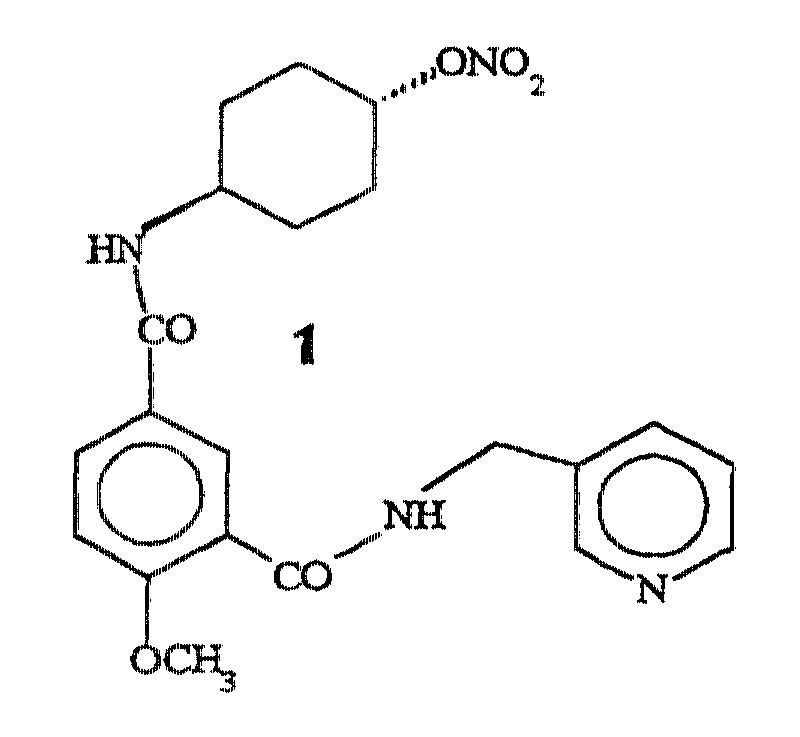
- the present invention relates to 4-methoxy-N 1 -(4- trans -nitrooxycyclohexyl)-N 3 -(3-pyridinylmethyl)-1,3-benzenedicarboxamide (formula 1 in Figure 1) as a pharmacologically active compound in the treatment of vascular diseases.
- this invention relates to 4-methoxy-N 1 -(4- trans -nitrooxycyclohexyl)-N 3 -(3-pyridinylmethyl)-1,3-benzenedicarboxamide as well as the acid addition salts thereof with pharmaceutically acceptable organic or inorganic acids as pharmacologically active compounds in the treatment of atherosclerotic-thrombotic pathological conditions and other pathological conditions which can benefit from the inhibition of thromboxane A 2 and from a pharmacological supply of nitric oxide (NO).
- NO nitric oxide
- the invention also relates to processes for the preparation of 4-methoxy-N 1 -(4- trans- nitrooxycyclohexyl)-N 3 -(3-pyridinylmethyl)-1,3-benzenedicarboxamide and the acid addition salts thereof with pharmaceutically acceptable organic or inorganic acids.
- the invention relates to a pharmaceutical composition
- a pharmaceutical composition comprising 4-methoxy-N 1 -(4- trans -nitrooxycyclohexyl)-N 3 -(3-pyridinylmethyl)-1,3-benzenedicarboxamide or an acid addition salt thereof with pharmaceutically acceptable organic or inorganic acids, as an active ingredient, together with at least a pharmaceutically acceptable ingredient.
- the invention also relates to a method of use of both said compound and said pharmaceutical composition in the treatment of said conditions.
- Blood and vascular wall exert mutual influences in their physiological functions, which are mediated by the contact of blood cells (including platelets, which differ from other cells by lacking the cellular nucleus) with the vascular endothelial and smooth muscular cells, via mechanisms of adhesion and infiltration, and by the exchange of a number of biochemical mediators.
- the role played by activated platelets has special relevance, since the present advancement of knowledge indicates that the pro-thrombotic and pro-atherogenic role of platelet activation is not limited to the initiation of the formation of thrombi starting from platelet aggregates, but it involves adhesion and the mutual interchange of biochemical mediators with the vascular wall, especially when the latter is pathologically altered, as in the case of endothelial lesions and of atherosclerotic plaques (R Ross, NE J Med 340 (1999) 115-126; B Osterud, Thromb Res 85 (1997) 1-22).
- Platelet-released mediators have a role in vasospasms, a critical mechanism of various ischemic conditions, and in the proliferation of vascular smooth muscle, an essential step of the atherosclerotic process (AA Weber, K Schror, Thromb Haemost 80 (1998) 207-208; T Grosser et al, Eur J Pharmacol 319 (1997) 327-332 ; R Pakala et al, Circulation 96 (1997) 2280-2286; A Sachinidis et al, Hypertension 26 (1995) 771-780), which in turn, by the alteration of the vascular surface and the rupture of plaques contributes to platelet activation and has an immediate causative role in acute thrombotic and ischemic events.
- thromboxane A 2 Among the mediators released by platelets, thromboxane A 2 , serotonin, and growth factors, such as PDGF and TGF- ⁇ 1 are the most pathologically relevant.
- the endothelial lining of the vascular wall when not pathologically altered, opposes the actions of activated platelets by the release of mediators (DA Jones et al, Mol Pharmacol 48 (1995) 890-896; PM Vanhoutte, JV Mombouli, Progress in Cardiovascular Diseases 39 (1996) 229-238) such as EDRF (the endothelial derived relaxing factor, identified as NO, nitric oxide), and as prostacyclin.
- mediators DA Jones et al, Mol Pharmacol 48 (1995) 890-896; PM Vanhoutte, JV Mombouli, Progress in Cardiovascular Diseases 39 (1996) 229-238)
- EDRF the endothelial derived relaxing factor, identified as NO, nitric oxide
- Important amount of endoperoxides are formed in platelet and in endothelial cells under the influence of cyclooxygenase-1. These amount predominate in normal conditions, over those produced in other cells, such as lymphocytes (including the monocyte-macrophage type) and vascular smooth muscle cells.
- endoperoxides can however be amplified, in pathological situations, by the induction, in all the above cells, but not in platelets, of the formation of large amounts of cyclooxygenase-2.
- the induction is mediated by pro-inflammatory stimuli, and is marked in atherosclerosis-damaged tissues (JA Rimarachin et al, Arterioscler Thromb 14 (1994) 1021-1031; D Bishop-Bailey et al, ibid, 18 (1998) 1655-1661).
- eicosanoids generation via cyclooxygenase-1 and/or cyclooxygenase-2 has important physiological and pathological roles, in addition to those elicited within the circulatory system, in various body organs.
- platelets are abundantly endowed with thromboxane synthetase, as endothelial cells are with prostacyclin synthetase.
- Thromboxane A 2 acting as an inducer of irreversible platelet aggregation and also representing an amplifying signal of platelet activation, has a key role in platelet-vascular wall interactions not only because of its direct action, but also for the stimulation of the release of the other vasospastic and proliferative mediators generated by platelets and for the progression of the fissuring of atherosclerotic plaques, leading to occlusive vascular events.
- the efforts of developing clinical applications of drugs acting by inhibition of thromboxane A 2 have been enacted by different approaches.
- the first therapeutic approach directed to the inhibition of the synthesis of thromboxane A 2 has been based on the use of acetylsalicylic acid, which is now known to be able to inhibit cyclooxygenase- 1 selectively and irreversibly; the therapeutic usefulness has been clinically demonstrated, but the blockade of the first, common step of the synthesis of the eicosanoids brings together the inhibition the synthesis of physiologically beneficial prostaglandins in the circulatory system, in particular prostacyclin, and also of prostaglandins performing a protective role in gastric and renal tissues by maintaining perfusion and cytoprotection.
- acetylsalicylic acid proved to be unable to inhibit the inducible cyclooxygenase-2, therefore leaving an open way to the productions of thromboxane A 2 in inflamed tissues of the circulatory and respiratory system and in other body organs.
- a second pharmacological approach has been targeted to the suppression of the synthesis of thromboxane A 2 by specific inhibition of thromboxane synthetase, without hindering the synthesis of the other eicosanoids, and in particular prostacyclin (J Nowak, GA FitzGerald, J Clin Invest 83 (1989) 380-385).
- TP receptors thromboxane receptors
- Organic nitrates such as nitroglycerin or isosorbide mono and dinitrate
- EDRF endothelium derived relaxing factor
- the NO-donors may interact with pharmacological agents acting on the cascade of the metabolites of arachidonic acid, either in counteracting stimuli of platelet activation, vasoconstriction, and vascular cell proliferation (M Emerson et al, Thromb Haemost 81 (1999) 961-966; E Bassenge, Basic Res Cardiol 86 (suppl 2, 1990) 69-76), or by a direct modulation of the synthesis of eicosanoids (D Salvemini et al, J Clin Invest 97 (1996) 2562-2568).
- It is still another object of this invention to provide a pharmaceutical composition comprising the compound having the above mentioned properties as an active ingredient together with at least a pharmaceutically acceptable ingredient.
- a vascular pathological condition such as atherosclerotic-thrombotic diseases
- Figure 1 shows some synthetic pathways for the preparation of 4-methoxy-N 1 -(4- trans -nitrooxycyclohexyl)-N 3 -(3-pyridinylmethyl)-1,3-benzenedicarboxamide of formula 1.
- the compound of the invention is effective and advantageous in the treatment of atherosclerotic-thrombotic conditions affecting the vascular system and in the treatment of other pathological conditions which can benefit from the inhibition of thromboxane A 2 and from a pharmacological supply of nitric oxide, or NO.
- the compound of the invention is endowed with a novel pharmacological profile particularly suitable to the treatment of the said pathological conditions, being able to exert a combination of pharmacological actions related to a) the inhibition of the synthesis of thromboxane A 2 , b) the inhibition of the effects exerted by thromboxane A 2 and by some other metabolites of arachidonic acid through the activation of specific receptors (TP receptors), and c) the release of nitric oxide.
- TP receptors specific receptors
- this invention provides 4-methoxy -N 1 -(4- trans -nitrooxy cyclohexyl)-N 3 -(3-pyridinylmethyl)-1,3-benzenedicarboxamide and acid addition salts thereof with pharmaceutically acceptable organic and inorganic acids.
- the invention also provides a process for preparing 4-methoxy-N 1 -(4- trans -nitrooxycyclohexyl)-N 3 -(3-pyridinylmethyl)-1,3-benzenedicarboxamide comprising:
- the coupling agent is carbonyldiimidazole.
- step c) the cyclohexylamine derivative is trans -4-nitrooxycyclohexylamine, thus yielding 4-methoxy-N 1 -(4- trans -nitrooxycyclohexyl)-N 3 -(3-pyridinylmethyl)-1,3-benzenedicarboxamide.
- step c) the cyclohexylamine derivative is trans -4-hydroxy cyclohexylamine, thus yielding the N 1 -4- trans -hydroxycyclohexyl-N 3 -(3-pyridinylmethyl)-1,3-benzenedicarboxamide, which is then reacted with nitric acid to yield 4-methoxy-N 1 -(4- trans -nitrooxycyclohexyl)-N 3 -(3-pyridinylmethyl)-1,3-benzenedicarboxamide.
- the present invention further provides another process for preparing 4-methoxy-N 1 -(4- trans -nitrooxycyclohexyl)-N 3 -(3-pyridinylmethyl)-1,3-benzenedicarboxamide comprising:
- this invention provides a pharmaceutical composition
- a pharmaceutical composition comprising 4-methoxy-N 1 -(4- trans -nitrooxycyclohexyl)-N 3 -(3-pyridinyl methyl)-1,3-benzenedicarboxamide or an acid addition salt thereof with a pharmaceutically acceptable organic or inorganic acid together with at least a pharmaceutically acceptable ingredient.
- the present invention also provides a method of treatment comprising administering to a human being suffering from a pathological condition which can benefit from the inhibition of thromboxane A 2 and from a supply of nitric oxide, or NO, an effective amount of 4-methoxy-N 1 -(4-trans-nitrooxycyclohexyl)-N 3 -(3-pyridinylmethyl)-1,3-benzenedicarboxamide or an acid addition salt thereof with a pharmaceutically acceptable organic or inorganic acid.
- said pathological conditions include vascular atherosclerotic-thrombotic diseases, diabetic vasculopathies, diabetic nephropathy, diabetic retinopathy, male vasculogenic erectile disfunctions, pulmonary hypertension, asthma, chronic obstructive pulmonary disease, ulcerative colitis, Crohn's disease, colonic polyposis.
- the compound of this invention is endowed with a novel pharmacological profile particularly suitable to the treatment of atherosclerotic-thrombotic pathological conditions, being able to exert a combination of pharmacological actions related to a) the inhibition of the synthesis of thromboxane A 2 , b) the inhibition of the effects exerted by thromboxane A 2 and by some other metabolites of arachidonic acid through the activation of specific receptors (TP receptors), and c) the release of nitric oxide, or NO.
- TP receptors specific receptors
- the compound of this invention exerts favourable effects on the cardiovascular system and in other organ by exploiting the synergic actions of a) decreasing the synthesis of thromboxane A 2 in cells endowed with either cyclooxygenase- 1 or -2 without hindering the synthesis of prostacyclin and the other prostaglandins, and on the contrary making the intermediate endoperoxides available for the synthesis of these eicosanoids, b) inhibiting the actions of any residual thromboxane A 2 , as well as those of the endoperoxides, exerted through the stimulation of the TP receptors, and c) releasing nitric oxide and thus implementing the action of prostacyclin and other prostaglandins on platelets, on the circulatory system and on other organs.
- vascular diseases which involve atherosclerotic-thrombotic pathological conditions
- other pathological conditions which can be improved by the inhibition of thromboxane A 2 and by pharmacologically supplying nitric oxide, such as diabetic vasculopathies, diabetic nephropathy, diabetic retinopathy, male vasculogenic erectile disfunctions, pulmonary hypertension, asthma, chronic obstructive pulmonary disease, ulcerative colitis, Crohn's disease, colonic polyposis.
- nitric oxide such as diabetic vasculopathies, diabetic nephropathy, diabetic retinopathy, male vasculogenic erectile disfunctions, pulmonary hypertension, asthma, chronic obstructive pulmonary disease, ulcerative colitis, Crohn's disease, colonic polyposis.
- Platelet aggregation experiments were performed on platelet-rich plasma (PRP) prepared from blood of healthy human subjects, who had not taken cyclooxygenase inhibitors (acetylsalicylic acid, non-steroidal antiinflammatory agents) for at least two weeks. Blood was collected in test tubes containing a 3.2 % sodium citrate solution (1/10 of blood volume) and immediately centrifuged at 150 x g for 15 minutes. Samples of PRP were further centrifuged at 12,000 x g in order to obtain platelet-poor plasma (PPP), used for calibration of light transmittance of the double-channel aggregometer, fixing the transmittance of PRP as 10 % and that of PPP as 90 %.
- PPP platelet-poor plasma
- Platelet aggregation in PRP of each subject was tested measuring the percent increase in transmittance under the addition of increasing amounts of sodium arachidonate, in concentrations in the range from 300 to 900 ⁇ M, or of collagen, in concentrations in the range from 0.5 to 2.5 ⁇ g/ml, or of U-46619, in concentrations in the range from 0.2 to 1.6 ⁇ M.
- U-46619 i.e., 9,11-dideoxy-1 1 ⁇ ,9 ⁇ -epoxymethano-prostaglandin F 2 ⁇ is an active synthetic analogue of thromboxane A 2 and it is chemically stable, at difference from the natural compound; it is therefore used as a substitute in pharmacological experiments).
- the threshold concentration i.e., the concentration inducing a submaximal irreversible aggregation was assessed in each subject with the three agents.
- PRP samples of subjects not responding to the maximal concentrations were discarded.
- the threshold concentrations were applied to induce aggregation on samples of PRP of each subject, after the addition, followed by 10 min incubation, of the compounds to be tested in a series of concentrations in the range from 10 -7 M to 10 -3 M.
- the individual values of percent inhibition from 4-6 subjects were used in the calculation of the IC 50 .
- the ability to counteract platelet aggregation by arachidonic acid in these experimental conditions was shared by various agents, including an inhibitor of cyclooxygenase, such as acetylsalycilic acid, an inhibitor of thromboxane synthetase, such as ozagrel, i.e., ( E )-3-[4-(1H-imidazol-1-ylmethyl)-phenyl]-2-propenoic acid (Merck Index, 11th ed, 6935) and an antagonist of the TP receptor, such as daltroban, i.e., p-[2-(p-chlorobenzenesulfonamido) ethyl]phenylacetic (Merck Index, 11th ed, 2807).
- an inhibitor of cyclooxygenase such as acetylsalycilic acid
- an inhibitor of thromboxane synthetase such as ozagrel, i
- Test compounds were added in a series of concentrations ranging from 10 -7 M to 10 -3 M to samples of blood from healthy human subjects, who had not taken cyclooxygenase inhibitors (acetylsalicylic acid, non-steroidal antiinflammatory agents) for at least two weeks.
- the blood samples were allowed to clot for 60 min in a bath at 37°C, and then centrifuged at 2500 x g for 10 min.
- the serum was separated and kept frozen at -20°C for the determination of TxB 2 by radioimmunoassay.
- TxB 2 is the stable metabolite into which thromboxane A 2 is rapidly converted.
- the effects on the transcellular synthesis of prostacyclin from endoperoxides generated in platelets were assessed by layering platelet rich plasma (PRP), obtained from healthy human subjects as described above, on cultured bovine endothelial cells (5 x 10 5 cells/well).
- PRP platelet rich plasma
- bovine endothelial cells 5 x 10 5 cells/well.
- the endothelial cells were pretreated with acetylsalicylic acid (10 -4 M) in order to inhibit the direct synthesis of endoperoxides, and washed twice with Dulbecco's phosphate buffered saline.
- 6-Keto-prostaglandin F 1 ⁇ is a stable metabolite into which prostacyclin is rapidly converted.
- Daltroban a competitive antagonist of thromboxane receptor, did not stimulate the synthesis of prostacyclin in this test.
- the compound of this invention finds its main therapeutic application in pathological conditions involving thrombotic and atherosclerotic alterations in various stages of development, as a primary or a secondary treatment.
- a primary treatment it can be administered to patients assessed for pathological symptoms and/or signs of cardiovascular risks, such as hypertension, diabetes, hyperlipidemias, along with unhealthy habits, such as alimentary, alcoholic, or tobacco smoke excesses, in order to prevent the progression of the disease and the frequently occurring cardiovascular and cerebrovascular accidents and disfunctions, which include vasospastic and thrombotic arterial obstructions, unstable angina, myocardial infarction, transient cerebral ischemia, stroke, diabetic vasculopathies, peripheral vascular occlusions, pulmonary thrombotic embolism, pulmonary hypertension, diabetic nephropathy, renal failure, diabetic retinopathy.
- a secondary treatment it can be administered to patients having suffered from the above mentioned accidents and disfunctions, in order to resolve the sequelae and to prevent their reoccurrence. It can also be administered during and following medical and surgical procedures aimed at restoring blood perfusion of affected organs, such as thrombolysis, balloon angioplasty and stenting, and coronary artery by-pass, in order to increase the probability of success of the procedures and to avoid late restenosis and reocclusion.
- the therapeutic use of the compound of this invention appears to be even more advantageous and preferable in those patients in which the use acetylsalicylic acid has to be avoided because of the occurrence, or risk, of adverse effects such as gastric damage, reduction of renal perfusion, or asthmatic attacks. It is also advantageous in those patients in which the atherosclerotic-thrombotic disease is concomitant with elevated blood pressure or with respiratory dysfunctions of the respiratory system, such as pulmonary hypertension, chronic obstructive pulmonary disease, and asthma. In these patients the suppression of thromboxane action, while preserving prostacyclin synthesis, and the vasodilation and bronchodilation induced by NO can beneficially combine with the pharmacological action of other specific treatments. In particular, it can be mentioned that the adverse effect of cough, frequently induced by antihypertensive ACE inhibitors can be suppressed, thus rendering the antihypertensive treatment sustainable and effective.
- the compound of this invention can be administered to patients suffering from other diseases which can benefit from the inhibition of thromboxane and a supply of nitric oxide, such as patients suffering from respiratory ailments, such as asthma and chronic obstructive pulmonary disease, or patients suffering from colonic diseases such as ulcerative colitis, Crohn's disease, colonic polyposis.
- diseases which can benefit from the inhibition of thromboxane and a supply of nitric oxide such as patients suffering from respiratory ailments, such as asthma and chronic obstructive pulmonary disease, or patients suffering from colonic diseases such as ulcerative colitis, Crohn's disease, colonic polyposis.
- 4-methoxy-N 1 -(4- trans -nitrooxycyclohexyl)-N 3 -(3-pyridinylmethyl)-1,3-benzenedicarboxamide and the acid addition salts thereof with pharmaceutically acceptable organic or inorganic acids may be administered as they are, but it will be preferred to administer them as pharmaceutical compositions.
- These compositions will contain a therapeutic amount 4-methoxy-N 1 -(4- trans -nitrooxycyclohexyl)-N 3 -(3-pyridinylmethyl)-1,3-benzenedicarboxamide or an equivalent amount of an acid addition salts thereof with a pharmaceutically acceptable organic or inorganic acids, together with liquid or solid pharmaceutical carriers.
- compositions of this invention may also contain other compatible active ingredients, whose contemporaneous administration is therapeutically useful.
- the dosage forms of the pharmaceutical compositions of this invention may be solid, such as tablets, sugar-coated pills, capsules, powders, or semi-liquid, such as creams and ointments, or liquid, such as solutions, suspensions and emulsions. Further dosage forms are patches for transdermal delivery, suppositories and microenemas for rectal and colonic delivery, and inhalers for bronchial delivery of powders, or suspensions or solutions.
- compositions of this invention may contain other suitable pharmaceutical additives, such as preservatives, stabilizers, emulsifiers, salts to regulate osmotic pressure, organic or inorganic compound as solubilizers or buffers, colouring and flavouring agents.
- suitable pharmaceutical additives such as preservatives, stabilizers, emulsifiers, salts to regulate osmotic pressure, organic or inorganic compound as solubilizers or buffers, colouring and flavouring agents.
- the preferred mode of administration being conveniently applicable in simple dose schedules both in short and long term therapeutic treatments in most patients, is the oral route, including the peroral or sublingual route.
- Preferred formulations are tablets or capsule for oral administration, granulated powders for extemporaneous suspension for oral administration, or tablets for sublingual administration. It is also possible, however, to resort to other routes of administration, as required by the conditions of the patients to be treated, such as the transdermal route, the parenteral route, the bronchial route, or the rectal route, suitably preparing transdermal ointments, creams, gels, or patches, sterile solution or suspension for parenteral use, powders or suspensions or solution for bronchial inhalation, and suppositories or microenemas for rectal administration.
- routes of administration as required by the conditions of the patients to be treated, such as the transdermal route, the parenteral route, the bronchial route, or the rectal route, suitably preparing transdermal ointments, creams, gels, or patches, sterile solution or suspension for parenteral use, powders or suspensions or solution for bronchial inhalation, and s
- the effective amount of 4-methoxy-N 1 -(4- trans -nitrooxycyclohexyl)-N 3 -(3-pyridinylmethyl)-1,3-benzenedicarboxamide can vary depending on various factors such as the particular therapy required, the pharmaceutical composition, and the method of administration.
- a dosage form of this invention suitable for single or multiple daily administration, will contain from 10 to 600 mg of 4-methoxy-N 1 -(4- trans -nitrooxycyclohexyl)-N 3 -(3-pyridinylmethyl)-1,3-benzenedicarboxamide or the equivalent amount of an acid addition salt thereof.
- the total daily dosage will be of from 10 to 1800 mg and, even preferably of from 50 to 600 mg.
- the optimal effective amount for single administration and/or for the total daily dosage can be adjusted by simple routine procedures, according to the need of the therapy and of the individual patient.
- compositions of this invention can be prepared according to conventional techniques known to the person skilled in the art, which comprise admixing, granulating and compressing, when necessary, or variously mixing or dissolving the active ingredients, together with suitable carriers, when appropriate to obtain the desired result.
- Figure 1 shows some preparation pathways of 4-methoxy-N 1 -(4- trans -nitrooxy cyclohexyl)-N 3 -(3-pyridinylmethyl)-1,3-benzenedicarboxamide of formula 1 starting from 4-methoxy-1,3-benzenedicarboxylic acid (formula 2) and providing for the regioselective introduction of two different amidic substituents on the 1- and 3-carboxyl groups.
- the dimethyl ester of this acid having formula 3, which can be easily obtained from the acid, preferably and in high yield by boiling in methanol in the presence of sulphuric acid, can be regioselectively converted the 3-N-sustituted amide 1-monoester of formula 4 by reaction with 3-pyridinylmethylamine.
- the reaction is preferably carried out by heating at from 50 and 80°C in the presence of an excess of the amine, which can be easily recovered.
- acid-amide having formula 5 which can be obtained from compound 4 with conventional methods by alkaline hydrolysis of the ester function, can be transformed into the N 1 ,N 3 -disubstituted amide of formula 6 by activation of the carboxylic function followed by reaction with trans -4-hydroxycyclohexyl amine; the activation is achieved by adding a coupling agent, preferably carbonyldiimidazole, or alternatively a carbodiimide, such as dicyclohexylcarbodiimide, or a clorocarbonate ester, such as methyl chloroformiate.
- a coupling agent preferably carbonyldiimidazole, or alternatively a carbodiimide, such as dicyclohexylcarbodiimide, or a clorocarbonate ester, such as methyl chloroformiate.
- the reaction can be carried out at room temperature in a non-reactive solvent, and the desired diamide can be easily purified with good yields.
- the diamide 6 can thereafter be transformed into the compound of formula 1 by esterification with nitric acid in mild conditions, a preferred method being the interaction with a reactive mixture of nitric acid and acetic anhydride at 0°C.
- trans -4-hydroxycyclohexylamine can be preliminarily converted into the corresponding nitric ester, and then the coupling reaction of the latter with acid 5, previously activated using carbonyldiimidazole as a preferred coupling agent, leads directly to the desired compound 1.
- a second regioselective synthetic approach to the key intermediate diamide of formula 6 can also be used, since it has been found that the 3-monomethyl ester of 4-methoxy-1,3-benzenedicarboxylic acid, having formula 7, can be directly and selectively obtained by esterification of the acid with sulphuric acid in methanol at room temperature in a yield of over 50%, and furthermore the by-products of the reaction, which are the dimethyl ester of formula 3 and unreacted 4-methoxy-1,3-benzenedicarboxylic acid, are easily separated from the product and almost quantitatively recovered for further use.
- 4-methoxy-N 1 -(4- trans -nitrooxycyclohexyl)-N 3 -(3-pyridinylmethyl)-1,3-benzenedicarboxamide may be incorporated in pharmaceutical compositions as it is or following its combination in an acid addition salts with a pharmaceutically acceptable organic or inorganic acid.
- the above acid was dissolved in 250 ml of pure, dried methylene choride and treated with 24 g of carbonyldiimidazole. The mixture was stirred for one hour at room temperature, resulting in a solution to which 22 g of the hydrochloride of trans -4-hydroxycyclohexylamine and 20 ml of triethylamine were added. The mixture was stirred at room temperature for 20 hours, then 200 ml of a 2% solution of sodium hydroxyde was added with stirring. The desired diamide separated as a white precipitate, and was collected, washed with water and dried. A further amount was obtained by evaporation of the separated methylene chloride fase, and was also washed with water and dried.
- 4-Methoxy-1,3-benzenedicarboxylic acid 3-monomethyl ester (formula 7) was prepared by adding at 20 °C under stirring 12 ml of concentrated sulphuric acid, d 1.84, to a suspension of 50 g of 4-methoxyisophthalic acid in 400 ml of methanol; stirring was then continued for 1 hour and then the mixture was poured into ice-water (400 ml). The precipitate was collected and stirred with a saturated solution of sodium hydrogen carbonate; the insoluble residue (15 g) was constituted by 4-methoxy-1,3-benzenedicarboxylic acid dimethyl ester.
- the filtered solution was adjusted to pH 4.8 by adding 6N hydrochloric acid, thus precipitating the desired monoester, which was collected and washed with water, yielding 28.1 g (52.5%) of white solid.
- 6N hydrochloric acid By further acidification of the mother liquor unreacted 4-methoxy-1,3-benzenedicarboxylic acid (9 g) was precipitated and collected. In this way a total recovery of 44.2% was obtained by summing together the recovery of the acid and the dimethyl ester, thus allowing a useful yield of 96.7%.
- the monoester (21 g) and 100 ml of thionyl chloride were boiled at reflux for 3 hours.
- the excess thionyl chloride was evaporated and the residue was dissolved in 60 ml of tetrahydrofuran and gradually added to a stirred mixture of triethylamine (20 ml) and trans -4-hydroxycyclohexylamine hydrochloride (17 g) in 100 ml of tetrahydrofuran, while keeping the temperature at 15°C.
- the mixture was stirred overnight at room temperature, and then diluted with water and stirred for 2 hours at room temperature and extracted with methylene chloride.
- Nitric acid (d 1.49, 25 ml) was added under stirring at 0°C to 100 ml acetic anhydride. After a few minutes, 31.5 g of 4-methoxy-N 1 -4- trans -hydroxycyclohexyl-N 3 -(3-pyridinylmethyl)-1,3-benzenedicarboxamide were gradually added in portion at the same temperature. At the end the stirring was continued for 10 minutes, and then the solution was poured with caution in a mixture of ice-water and sodium hydrogen carbonate, keeping pH at a neutral value. The light-yellow precipitated was collected, and dissolved in ethyl acetate.
- trans -4-Hydroxycyclohexylamine (21 g) was gradually added at -15°C to 45 ml of nitric acid, d 1.51. The mixture was stirred at 0°C for 1.5 hours, and then poured into 300 ml of cooled diethyl ether. The separated nitrate salt was washed with ether, and then added in portions to a cooled and stirred mixture of 15 g of potassium carbonate, 15 ml of water and 200 ml of methylene chloride.
- the saline phase was extracted with methylene chloride and the combined organic phase was dried with anhydrous sodium sulphate and evaporated under reduce pressure to a residual volume of 100 ml, consisting in a solution of trans -4-nitrooxyclohexylamine
- Lactose, 9.6 kg, and microcrystalline cellulose, 5 kg are mixed, then polysorbate 80, 0.4 kg, is added while mixing.
- the two powder mixtures are combined, mixed together and sieved through a 20 mesh mechanical sieve, then filled into size 1 gelatin capsules
- polysorbate 80 0.500 kg, is slowly added while mixing to lactose, 24.5 kg, which is then mixed with 4-methoxy-N 1 -(4- trans -nitrooxycyclohexyl)-N 3 -(3-pyridinylmethyl)-1,3-benzenedicarboxamide, 15 kg.
- the mixed powders are added to sucrose, 159 kg, and orange flavouring agent, 1 kg, and thoroughly mixed.
- Sachets are then filled with 2 g portions of the mixed ingredients and sealed.
- the sachet are suitable for the preparation of an instantaneous suspension in water for oral administration.
Landscapes
- Health & Medical Sciences (AREA)
- Chemical & Material Sciences (AREA)
- Organic Chemistry (AREA)
- Engineering & Computer Science (AREA)
- Bioinformatics & Cheminformatics (AREA)
- Animal Behavior & Ethology (AREA)
- Pharmacology & Pharmacy (AREA)
- Chemical Kinetics & Catalysis (AREA)
- General Chemical & Material Sciences (AREA)
- Medicinal Chemistry (AREA)
- Nuclear Medicine, Radiotherapy & Molecular Imaging (AREA)
- Veterinary Medicine (AREA)
- Public Health (AREA)
- Life Sciences & Earth Sciences (AREA)
- General Health & Medical Sciences (AREA)
- Diabetes (AREA)
- Pulmonology (AREA)
- Cardiology (AREA)
- Heart & Thoracic Surgery (AREA)
- Urology & Nephrology (AREA)
- Hematology (AREA)
- Endocrinology (AREA)
- Vascular Medicine (AREA)
- Ophthalmology & Optometry (AREA)
- Emergency Medicine (AREA)
- Obesity (AREA)
- Gynecology & Obstetrics (AREA)
- Reproductive Health (AREA)
- Pyridine Compounds (AREA)
- Pharmaceuticals Containing Other Organic And Inorganic Compounds (AREA)
- Low-Molecular Organic Synthesis Reactions Using Catalysts (AREA)
Abstract
Description
- The present invention relates to 4-methoxy-N1-(4-trans-nitrooxycyclohexyl)-N3-(3-pyridinylmethyl)-1,3-benzenedicarboxamide (
formula 1 in Figure 1) as a pharmacologically active compound in the treatment of vascular diseases. - More particularly, this invention relates to 4-methoxy-N1-(4-trans-nitrooxycyclohexyl)-N3-(3-pyridinylmethyl)-1,3-benzenedicarboxamide as well as the acid addition salts thereof with pharmaceutically acceptable organic or inorganic acids as pharmacologically active compounds in the treatment of atherosclerotic-thrombotic pathological conditions and other pathological conditions which can benefit from the inhibition of thromboxane A2 and from a pharmacological supply of nitric oxide (NO).
- The invention also relates to processes for the preparation of 4-methoxy-N1-(4-trans-nitrooxycyclohexyl)-N3-(3-pyridinylmethyl)-1,3-benzenedicarboxamide and the acid addition salts thereof with pharmaceutically acceptable organic or inorganic acids.
- Furthermore, the invention relates to a pharmaceutical composition comprising 4-methoxy-N1-(4-trans-nitrooxycyclohexyl)-N3-(3-pyridinylmethyl)-1,3-benzenedicarboxamide or an acid addition salt thereof with pharmaceutically acceptable organic or inorganic acids, as an active ingredient, together with at least a pharmaceutically acceptable ingredient.
- The invention also relates to a method of use of both said compound and said pharmaceutical composition in the treatment of said conditions.
- Evidence is growing for a dynamic interplay between the processes of thrombosis and atherosclerosis in the vascular system, starting from the initial development of vascular diseases and continuing in the dramatic events that are the cause of death and disability in a large section of the population. Diabetes, hypertension, tobacco smoke and unhealthy dietary habits are among the leading causes of these diseases.
- Blood and vascular wall exert mutual influences in their physiological functions, which are mediated by the contact of blood cells (including platelets, which differ from other cells by lacking the cellular nucleus) with the vascular endothelial and smooth muscular cells, via mechanisms of adhesion and infiltration, and by the exchange of a number of biochemical mediators.
- Most of these interactions are also involved in pathological processes, such as the development of acute vasospastic conditions, the formation of occlusive thrombi and the development of atherosclerotic plaques.
- The role played by activated platelets has special relevance, since the present advancement of knowledge indicates that the pro-thrombotic and pro-atherogenic role of platelet activation is not limited to the initiation of the formation of thrombi starting from platelet aggregates, but it involves adhesion and the mutual interchange of biochemical mediators with the vascular wall, especially when the latter is pathologically altered, as in the case of endothelial lesions and of atherosclerotic plaques (R Ross, NE J Med 340 (1999) 115-126; B Osterud, Thromb Res 85 (1997) 1-22).
- Platelet-released mediators have a role in vasospasms, a critical mechanism of various ischemic conditions, and in the proliferation of vascular smooth muscle, an essential step of the atherosclerotic process (AA Weber, K Schror, Thromb Haemost 80 (1998) 207-208; T Grosser et al, Eur J Pharmacol 319 (1997) 327-332 ; R Pakala et al, Circulation 96 (1997) 2280-2286; A Sachinidis et al, Hypertension 26 (1995) 771-780), which in turn, by the alteration of the vascular surface and the rupture of plaques contributes to platelet activation and has an immediate causative role in acute thrombotic and ischemic events.
- Among the mediators released by platelets, thromboxane A2, serotonin, and growth factors, such as PDGF and TGF-
β 1 are the most pathologically relevant. - On the other hand, the endothelial lining of the vascular wall, when not pathologically altered, opposes the actions of activated platelets by the release of mediators (DA Jones et al, Mol Pharmacol 48 (1995) 890-896; PM Vanhoutte, JV Mombouli, Progress in Cardiovascular Diseases 39 (1996) 229-238) such as EDRF (the endothelial derived relaxing factor, identified as NO, nitric oxide), and as prostacyclin. Both induce relaxation and reduce proliferation of the arterial wall, and counteract platelet aggregation and adhesion (U Forstermann et al, Circulation Res 63 (1988) 306-312; MW Radomski et al, Br J Pharmacol 92 (1987) 639- 646).
- Cellular interactions of platelets, blood cells, and vascular cells have special relevance in the synthesis of a cascade of metabolites of arachidonic acid, the eicosanoids (J Maclouf et al, Thromb Haemost. 79 (1998) 691-705). Arachidonic acid is converted by the enzymatic action of the cyclooxygenases, into the endoperoxides PGG2 and PGH2. These metabolites are further converted into thromboxane A2 and into prostacyclin PGI2, as wells as into PGE2, PGD2 and other prostaglandins, by the enzymatic action of specific synthetases.
- Owing to the different cellular locations of these enzymes, the transcellular exchange of the precursor arachidonic acid (which is also carried by fragmented platelets) and, most importantly, of the endoperoxides PGG2 and PGH2 exerts significant influence in the generation of the biologically active eicosanoids, and among them thromboxane A2 and prostacyclin. Important amount of endoperoxides are formed in platelet and in endothelial cells under the influence of cyclooxygenase-1. These amount predominate in normal conditions, over those produced in other cells, such as lymphocytes (including the monocyte-macrophage type) and vascular smooth muscle cells.
- The synthesis of endoperoxides can however be amplified, in pathological situations, by the induction, in all the above cells, but not in platelets, of the formation of large amounts of cyclooxygenase-2. The induction is mediated by pro-inflammatory stimuli, and is marked in atherosclerosis-damaged tissues (JA Rimarachin et al, Arterioscler Thromb 14 (1994) 1021-1031; D Bishop-Bailey et al, ibid, 18 (1998) 1655-1661). It has to be noted that eicosanoids generation, via cyclooxygenase-1 and/or cyclooxygenase-2 has important physiological and pathological roles, in addition to those elicited within the circulatory system, in various body organs.
- According to their respective physiological role, platelets are abundantly endowed with thromboxane synthetase, as endothelial cells are with prostacyclin synthetase.
- Thromboxane A2, acting as an inducer of irreversible platelet aggregation and also representing an amplifying signal of platelet activation, has a key role in platelet-vascular wall interactions not only because of its direct action, but also for the stimulation of the release of the other vasospastic and proliferative mediators generated by platelets and for the progression of the fissuring of atherosclerotic plaques, leading to occlusive vascular events.
- The efforts of developing clinical applications of drugs acting by inhibition of thromboxane A2 have been enacted by different approaches. The first therapeutic approach directed to the inhibition of the synthesis of thromboxane A2 has been based on the use of acetylsalicylic acid, which is now known to be able to inhibit cyclooxygenase- 1 selectively and irreversibly; the therapeutic usefulness has been clinically demonstrated, but the blockade of the first, common step of the synthesis of the eicosanoids brings together the inhibition the synthesis of physiologically beneficial prostaglandins in the circulatory system, in particular prostacyclin, and also of prostaglandins performing a protective role in gastric and renal tissues by maintaining perfusion and cytoprotection.
- The benefit of this pharmacological approach is thus limited by undesirable effects. Furthermore, acetylsalicylic acid proved to be unable to inhibit the inducible cyclooxygenase-2, therefore leaving an open way to the productions of thromboxane A2 in inflamed tissues of the circulatory and respiratory system and in other body organs.
- A second pharmacological approach has been targeted to the suppression of the synthesis of thromboxane A2 by specific inhibition of thromboxane synthetase, without hindering the synthesis of the other eicosanoids, and in particular prostacyclin (J Nowak, GA FitzGerald, J Clin Invest 83 (1989) 380-385).
- Furthermore, a third approach has been also explored, not aimed at inhibiting the synthesis of thromboxane, but at hindering its effect on platelets and on vascular tissue by using agents able to exert an antagonistic action at thromboxane receptors (TP receptors).
- These latter two approaches (J Vermylen, H Deckmyn, Cardiovascular Drugs and Therapy, 6 (1992) 29-33) have led to a number of clinical studies, but have not yet offered a valid alternative to the use of acetylsalicylic acid.
- It has been reasoned that competitive antagonists are probably not adequate to fully antagonize the large amount of thromboxane A2 produced by aggregating platelets, while on the other hand, during thromboxane synthetase inhibition at the endoperoxide stage, the increased concentrations of intermediate endoperoxides exerted on tromboxane receptors effects similar to those of thromboxane itself. Therefore, the possible benefits of the combination of these two pharmacological approaches in single pharmacological agents exerting a dual action, such as picotamide (4-methoxy-N1,N3-bis-(3-pyridinylmethyl)-1,3-benzenedicarboxamide) or ridogrel (5-[3-pyridinyl-3-(trifluoromethyl) phenylmethyleneaminooxy]pentanoic acid), have also been suggested (P Gresele et al, Trends Pharmacol Sci 12 (1991) 158-163).
- In conclusion, the proposed pharmacological agents aaddressed to the direct inhibition of thromboxane have not yet reached general acceptance in medical practice, and only acetylsalicylic acid has an established and consolidated use as an antithrombotic agent, notwithstanding its limitations and unwanted effects.
- Organic nitrates, such as nitroglycerin or isosorbide mono and dinitrate, have a well established clinical use, which is however confined to the exploitation of their vasodilator properties. In recent years, a better understanding of the pharmacological action of various precursors of NO on platelets and on the vascular wall has been achieved, following the identification of EDRF (endothelium derived relaxing factor) as nitric oxide, NO, and the clarification of its physiological role. This advancement of knowledge has been applied both to organic nitrates, and to new NO-donors, carrying nitrate or nitrite functions, or other chemical function easily converted to NO, and also to the biochemical precursor of endogenous NO, L-arginine. The advancement has led to the suggestion that, in addition to their known vasodilator action, the NO-donors may interact with pharmacological agents acting on the cascade of the metabolites of arachidonic acid, either in counteracting stimuli of platelet activation, vasoconstriction, and vascular cell proliferation (M Emerson et al, Thromb Haemost 81 (1999) 961-966; E Bassenge, Basic Res Cardiol 86 (
suppl 2, 1990) 69-76), or by a direct modulation of the synthesis of eicosanoids (D Salvemini et al, J Clin Invest 97 (1996) 2562-2568). - Therefore a strong medical need still exists of increasedly effective antithromboxane agents for the prevention and the therapy of vascular atherosclerotic-thrombotic diseases and of other pathological conditions. The inventors perceived that more favourable therapeutic effects can be achieved by decreasing the synthesis of thromboxane A2, while at the same time inhibiting its actions, and also pharmacologically supplying nitric oxide.
- It is therefore an object of this invention to provide a compound useful in the treatment of vascular diseases.
- It is another object of this invention to provide a compound useful in the treatment of atherosclerotic-thrombotic pathological conditions.
- It is yet another object of this invention to provide a compound having both antithromboxane and NO-donor action.
- It is a further object of this invention to provide processes for the preparation of the compound having the above mentioned properties.
- It is still another object of this invention to provide a pharmaceutical composition comprising the compound having the above mentioned properties as an active ingredient together with at least a pharmaceutically acceptable ingredient.
- It is a further object of this invention to provide a method of treatment comprising administering to a human being suffering from a vascular pathological condition, such as atherosclerotic-thrombotic diseases, and of other conditions which can benefit from inhibition of thromboxane A2 and from a pharmacological supply of nitric oxide, an effective amount of a compound having the above mentioned properties.
- These and other objects of the invention are achieved by 4-methoxy-N1-(4-trans-nitrooxycyclohexyl)-N3-(3-pyridinylmethyl)-1,3-benzenedicarboxamide and the acid addition salts thereof with pharmaceutically acceptable organic or inorganic acids.
- Figure 1 shows some synthetic pathways for the preparation of 4-methoxy-N1-(4-trans-nitrooxycyclohexyl)-N3-(3-pyridinylmethyl)-1,3-benzenedicarboxamide of
formula 1. - The inventors have found that 4-methoxy-N1-(4-trans-nitrooxycyclohexyl)-N3-(3-pyridinylmethyl)-1,3-benzenedicarboxamide of
formula 1 and the acid addition salts thereof with pharmaceutically acceptable organic or inorganic acids are endowed with both antithromboxane and NO-donor action. - Furthermore, it has been found that the compound of the invention is effective and advantageous in the treatment of atherosclerotic-thrombotic conditions affecting the vascular system and in the treatment of other pathological conditions which can benefit from the inhibition of thromboxane A2 and from a pharmacological supply of nitric oxide, or NO.
- More particularly the compound of the invention is endowed with a novel pharmacological profile particularly suitable to the treatment of the said pathological conditions, being able to exert a combination of pharmacological actions related to a) the inhibition of the synthesis of thromboxane A2, b) the inhibition of the effects exerted by thromboxane A2 and by some other metabolites of arachidonic acid through the activation of specific receptors (TP receptors), and c) the release of nitric oxide.
- Accordingly, this invention provides 4-methoxy -N1-(4-trans-nitrooxy cyclohexyl)-N3-(3-pyridinylmethyl)-1,3-benzenedicarboxamide and acid addition salts thereof with pharmaceutically acceptable organic and inorganic acids.
- The invention also provides a process for preparing 4-methoxy-N1-(4-trans-nitrooxycyclohexyl)-N3-(3-pyridinylmethyl)-1,3-benzenedicarboxamide comprising:
- a) reacting the dimethyl ester of 4-methoxy-1,3-benzene dicarboxylic acid with 3-pyridinylmethylamine to yield regioselectively the corresponding 3-monoamide- 1-ester;
- b) hydrolyzing in an alkaline medium said 3-monoamide-1-ester to the corresponding 3-monoamide-1-carboxylic acid;
- c) reacting said 3-monoamide-1-carboxylic acid with an coupling agent and a cyclohexylamine derivative and, when required, converting the thus obtained compound into 4-methoxy-N1-(4-trans-nitrooxy cyclohexyl)-N3-(3-pyridinylmethyl)-1,3-benzenedicarboxamide.
-
- Typically, in step c) the coupling agent is carbonyldiimidazole.
- Furthermore, in step c) the cyclohexylamine derivative is trans-4-nitrooxycyclohexylamine, thus yielding 4-methoxy-N1-(4-trans-nitrooxycyclohexyl)-N3-(3-pyridinylmethyl)-1,3-benzenedicarboxamide.
- Alternatively, in step c) the cyclohexylamine derivative is trans-4-hydroxy cyclohexylamine, thus yielding the N1-4-trans-hydroxycyclohexyl-N3-(3-pyridinylmethyl)-1,3-benzenedicarboxamide, which is then reacted with nitric acid to yield 4-methoxy-N1-(4-trans-nitrooxycyclohexyl)-N3-(3-pyridinylmethyl)-1,3-benzenedicarboxamide.
- The present invention further provides another process for preparing 4-methoxy-N1-(4-trans-nitrooxycyclohexyl)-N3-(3-pyridinylmethyl)-1,3-benzenedicarboxamide comprising:
- a) reacting 4-methoxy-1,3-benzenedicarboxylic acid with methanol in the presence of sulphuric in mild conditions to yield regioselectively the corresponding 3-monomethyl ester 1-carboxylic acid;
- b) converting said 3-monomethyl ester 1-carboxylic acid into the corresponding acyl chloride and reacting with trans-4-hydroxycyclohexylamine to yield the corresponding 1-amide-3-ester;
- c) reacting the thus obtained 1-amide-3-ester with 3-pyridinylmethylamine to yield N1-4-trans-hydroxycyclohexyl-N3-(3-pyridinylmethyl)-1,3-benzenedicarboxamide;
- d) reacting N1-4-trans-hydroxycyclohexyl-N3-(3-pyridinylmethyl)-1,3-benzenedicarboxamide with nitric acid to yield 4-methoxy-N1-(4-trans-nitrooxy cyclohexyl)-N3-(3-pyridinylmethyl)-1,3-benzenedicarboxamide.
-
- Furthermore, this invention provides a pharmaceutical composition comprising 4-methoxy-N1-(4-trans-nitrooxycyclohexyl)-N3-(3-pyridinyl methyl)-1,3-benzenedicarboxamide or an acid addition salt thereof with a pharmaceutically acceptable organic or inorganic acid together with at least a pharmaceutically acceptable ingredient.
- The present invention also provides a method of treatment comprising administering to a human being suffering from a pathological condition which can benefit from the inhibition of thromboxane A2 and from a supply of nitric oxide, or NO, an effective amount of 4-methoxy-N1-(4-trans-nitrooxycyclohexyl)-N3-(3-pyridinylmethyl)-1,3-benzenedicarboxamide or an acid addition salt thereof with a pharmaceutically acceptable organic or inorganic acid.
- Tipically, said pathological conditions include vascular atherosclerotic-thrombotic diseases, diabetic vasculopathies, diabetic nephropathy, diabetic retinopathy, male vasculogenic erectile disfunctions, pulmonary hypertension, asthma, chronic obstructive pulmonary disease, ulcerative colitis, Crohn's disease, colonic polyposis.
- Indeed, the compound of this invention is endowed with a novel pharmacological profile particularly suitable to the treatment of atherosclerotic-thrombotic pathological conditions, being able to exert a combination of pharmacological actions related to a) the inhibition of the synthesis of thromboxane A2, b) the inhibition of the effects exerted by thromboxane A2 and by some other metabolites of arachidonic acid through the activation of specific receptors (TP receptors), and c) the release of nitric oxide, or NO.
- Accordingly, the compound of this invention exerts favourable effects on the cardiovascular system and in other organ by exploiting the synergic actions of a) decreasing the synthesis of thromboxane A2 in cells endowed with either cyclooxygenase- 1 or -2 without hindering the synthesis of prostacyclin and the other prostaglandins, and on the contrary making the intermediate endoperoxides available for the synthesis of these eicosanoids, b) inhibiting the actions of any residual thromboxane A2, as well as those of the endoperoxides, exerted through the stimulation of the TP receptors, and c) releasing nitric oxide and thus implementing the action of prostacyclin and other prostaglandins on platelets, on the circulatory system and on other organs.
- These properties can find useful therapeutic application in vascular diseases which involve atherosclerotic-thrombotic pathological conditions, and also can find application in other pathological conditions which can be improved by the inhibition of thromboxane A2 and by pharmacologically supplying nitric oxide, such as diabetic vasculopathies, diabetic nephropathy, diabetic retinopathy, male vasculogenic erectile disfunctions, pulmonary hypertension, asthma, chronic obstructive pulmonary disease, ulcerative colitis, Crohn's disease, colonic polyposis.
- Platelet aggregation experiments were performed on platelet-rich plasma (PRP) prepared from blood of healthy human subjects, who had not taken cyclooxygenase inhibitors (acetylsalicylic acid, non-steroidal antiinflammatory agents) for at least two weeks. Blood was collected in test tubes containing a 3.2 % sodium citrate solution (1/10 of blood volume) and immediately centrifuged at 150 x g for 15 minutes. Samples of PRP were further centrifuged at 12,000 x g in order to obtain platelet-poor plasma (PPP), used for calibration of light transmittance of the double-channel aggregometer, fixing the transmittance of PRP as 10 % and that of PPP as 90 %. Platelet aggregation in PRP of each subject was tested measuring the percent increase in transmittance under the addition of increasing amounts of sodium arachidonate, in concentrations in the range from 300 to 900 µM, or of collagen, in concentrations in the range from 0.5 to 2.5 µg/ml, or of U-46619, in concentrations in the range from 0.2 to 1.6 µM. (U-46619, i.e., 9,11-dideoxy-1 1α,9α-epoxymethano-prostaglandin F2α is an active synthetic analogue of thromboxane A2 and it is chemically stable, at difference from the natural compound; it is therefore used as a substitute in pharmacological experiments). In this way the threshold concentration, i.e., the concentration inducing a submaximal irreversible aggregation was assessed in each subject with the three agents.
- PRP samples of subjects not responding to the maximal concentrations were discarded. The threshold concentrations were applied to induce aggregation on samples of PRP of each subject, after the addition, followed by 10 min incubation, of the compounds to be tested in a series of concentrations in the range from 10-7 M to 10-3 M. The individual values of percent inhibition from 4-6 subjects were used in the calculation of the IC50.
- 4-Methoxy-N1-(4-trans-nitrooxycyclohexyl)-N3-(3-pyridinylmethyl)-1,3-benzenedicarboxamide showed IC50 respectively of 12 x 10-6 M for arachidonic acid, 22 x 10-6 M for collagen, and 33 x 10-6 M for U-46619. The ability to counteract platelet aggregation by arachidonic acid in these experimental conditions was shared by various agents, including an inhibitor of cyclooxygenase, such as acetylsalycilic acid, an inhibitor of thromboxane synthetase, such as ozagrel, i.e., (E)-3-[4-(1H-imidazol-1-ylmethyl)-phenyl]-2-propenoic acid (Merck Index, 11th ed, 6935) and an antagonist of the TP receptor, such as daltroban, i.e., p-[2-(p-chlorobenzenesulfonamido) ethyl]phenylacetic (Merck Index, 11th ed, 2807). On the contrary, the abilitity to counteract the aggregation by U-46619 was shared only by daltroban, and not by acetylsalicylic acid or ozagrel. Furthermore, ozagrel up to 10-3 M concentrations did not show any significant inhibitory activity in the aggregation induced by collagen.
- Test compounds were added in a series of concentrations ranging from 10-7 M to 10-3 M to samples of blood from healthy human subjects, who had not taken cyclooxygenase inhibitors (acetylsalicylic acid, non-steroidal antiinflammatory agents) for at least two weeks. The blood samples were allowed to clot for 60 min in a bath at 37°C, and then centrifuged at 2500 x g for 10 min. The serum was separated and kept frozen at -20°C for the determination of TxB2 by radioimmunoassay. TxB2 is the stable metabolite into which thromboxane A2 is rapidly converted. Compound 4-methoxy-N1-(4-trans-nitrooxycyclohexyl)-N3-(3-pyridinylmethyl)-1,3-benzenedicarboxamide was shown to inhibit thromboxane synthesis with an IC50 of 18 x 10-6 M. In this assay an antagonist of thromboxane receptors, such as daltroban, did not show any effect, at difference from acetylsalicylic acid and ozagrel.
- The effects on the transcellular synthesis of prostacyclin from endoperoxides generated in platelets were assessed by layering platelet rich plasma (PRP), obtained from healthy human subjects as described above, on cultured bovine endothelial cells (5 x 10⁵ cells/well). The endothelial cells were pretreated with acetylsalicylic acid (10-4 M) in order to inhibit the direct synthesis of endoperoxides, and washed twice with Dulbecco's phosphate buffered saline. Then to individual samples of endothelial cells there were added at 37°C while shaking on an oscillating platform, 0.5 ml of PRP samples pretreated with the test compounds in various concentrations, ranging from 10-7 M to 10-3 M. Collagen (0.5 µg/ml) was then added to each sample. After 2 minutes of contact at 37°C, PRP was removed and centrifuged at 12,000 x g, and the supernatant was frozen and kept at -20°C for the determination of 6-keto-prostaglandin F1α by radioimmunoassay.
- 6-Keto-prostaglandin F1α is a stable metabolite into which prostacyclin is rapidly converted. 4-Methoxy-N1-(4-trans-nitrooxycyclohexyl)-N3-(3-pyridinylmethyl)-1,3-benzenedicarboxamide, starting from 10-6 M concentration, markedly increased the production of the prostacyclin metabolite, which was completely inhibited in acetylsalicylic acid-treated cells, up to 800-1600 pg/ml, a level 8-16 times higher of the amount produced in basal conditions by endothelial cells not submitted to cyclooxygenase inhibition with acetylsalycilic acid. Daltroban, a competitive antagonist of thromboxane receptor, did not stimulate the synthesis of prostacyclin in this test.
- The ability to induce vascular relaxation by acting as a donor of nitric oxide was tested in vitro on rabbit aortae. Rings of aortae were suspended in a Krebs-Henseleit solution at 37°C, submitted to a 1 g tension and connected to a force transducer. Tissue contraction was induced with norepinephrine (10-6 M) and the test compounds were added in increasing concentrations in the range from 10-8 M to 10-3 M. Compound 4-methoxy-N1-(4-trans-nitrooxycyclohexyl)-N3-(3-pyridinylmethyl)-1,3-benzenedicarboxamide induced a complete relaxation of the aortic ring at a concentration of 10-4 M, with a calculated EC50 of 3.2 x 10⁻⁶ M.
- When methylene blue, an inhibitor of soluble guanylate cyclase able to counteract the effects of nitric oxide, was added to the bath in 10-5 M concentration, the compound was still able to relax the aortic tissue, but the concentration-response curve appeared to be shifted toward higher concentrations, with a calculated EC50 of 55 x 10-6 M. The compound was shown to be similarly able to produce relaxation in aortic rings contracted with 5-hydroxytryptamine or with U-46619.
- Owing to its pharmacological properties the compound of this invention finds its main therapeutic application in pathological conditions involving thrombotic and atherosclerotic alterations in various stages of development, as a primary or a secondary treatment. As a primary treatment it can be administered to patients assessed for pathological symptoms and/or signs of cardiovascular risks, such as hypertension, diabetes, hyperlipidemias, along with unhealthy habits, such as alimentary, alcoholic, or tobacco smoke excesses, in order to prevent the progression of the disease and the frequently occurring cardiovascular and cerebrovascular accidents and disfunctions, which include vasospastic and thrombotic arterial obstructions, unstable angina, myocardial infarction, transient cerebral ischemia, stroke, diabetic vasculopathies, peripheral vascular occlusions, pulmonary thrombotic embolism, pulmonary hypertension, diabetic nephropathy, renal failure, diabetic retinopathy. As a secondary treatment it can be administered to patients having suffered from the above mentioned accidents and disfunctions, in order to resolve the sequelae and to prevent their reoccurrence. It can also be administered during and following medical and surgical procedures aimed at restoring blood perfusion of affected organs, such as thrombolysis, balloon angioplasty and stenting, and coronary artery by-pass, in order to increase the probability of success of the procedures and to avoid late restenosis and reocclusion.
- The therapeutic use of the compound of this invention appears to be even more advantageous and preferable in those patients in which the use acetylsalicylic acid has to be avoided because of the occurrence, or risk, of adverse effects such as gastric damage, reduction of renal perfusion, or asthmatic attacks. It is also advantageous in those patients in which the atherosclerotic-thrombotic disease is concomitant with elevated blood pressure or with respiratory dysfunctions of the respiratory system, such as pulmonary hypertension, chronic obstructive pulmonary disease, and asthma. In these patients the suppression of thromboxane action, while preserving prostacyclin synthesis, and the vasodilation and bronchodilation induced by NO can beneficially combine with the pharmacological action of other specific treatments. In particular, it can be mentioned that the adverse effect of cough, frequently induced by antihypertensive ACE inhibitors can be suppressed, thus rendering the antihypertensive treatment sustainable and effective.
- Furthermore the compound of this invention can be administered to patients suffering from other diseases which can benefit from the inhibition of thromboxane and a supply of nitric oxide, such as patients suffering from respiratory ailments, such as asthma and chronic obstructive pulmonary disease, or patients suffering from colonic diseases such as ulcerative colitis, Crohn's disease, colonic polyposis.
- For practical purposes 4-methoxy-N1-(4-trans-nitrooxycyclohexyl)-N3-(3-pyridinylmethyl)-1,3-benzenedicarboxamide and the acid addition salts thereof with pharmaceutically acceptable organic or inorganic acids may be administered as they are, but it will be preferred to administer them as pharmaceutical compositions.
These compositions will contain a therapeutic amount 4-methoxy-N1-(4-trans-nitrooxycyclohexyl)-N3-(3-pyridinylmethyl)-1,3-benzenedicarboxamide or an equivalent amount of an acid addition salts thereof with a pharmaceutically acceptable organic or inorganic acids, together with liquid or solid pharmaceutical carriers. If required for a particular therapy, the compositions of this invention may also contain other compatible active ingredients, whose contemporaneous administration is therapeutically useful.
The dosage forms of the pharmaceutical compositions of this invention may be solid, such as tablets, sugar-coated pills, capsules, powders, or semi-liquid, such as creams and ointments, or liquid, such as solutions, suspensions and emulsions. Further dosage forms are patches for transdermal delivery, suppositories and microenemas for rectal and colonic delivery, and inhalers for bronchial delivery of powders, or suspensions or solutions. - These dosage forms can be compounded for oral, peroral, sublingual, transdermal, parenteral, rectal or bronchial administration, and furthermore they can be compounded for the prompt release, or for the sustained release, of the active ingredient.
In addition to conventional carriers, the compositions of this invention may contain other suitable pharmaceutical additives, such as preservatives, stabilizers, emulsifiers, salts to regulate osmotic pressure, organic or inorganic compound as solubilizers or buffers, colouring and flavouring agents.
The preferred mode of administration, being conveniently applicable in simple dose schedules both in short and long term therapeutic treatments in most patients, is the oral route, including the peroral or sublingual route. Preferred formulations are tablets or capsule for oral administration, granulated powders for extemporaneous suspension for oral administration, or tablets for sublingual administration. It is also possible, however, to resort to other routes of administration, as required by the conditions of the patients to be treated, such as the transdermal route, the parenteral route, the bronchial route, or the rectal route, suitably preparing transdermal ointments, creams, gels, or patches, sterile solution or suspension for parenteral use, powders or suspensions or solution for bronchial inhalation, and suppositories or microenemas for rectal administration. - For therapeutic purposes the effective amount of 4-methoxy-N1-(4-trans-nitrooxycyclohexyl)-N3-(3-pyridinylmethyl)-1,3-benzenedicarboxamide can vary depending on various factors such as the particular therapy required, the pharmaceutical composition, and the method of administration.
- Preferably, a dosage form of this invention, suitable for single or multiple daily administration, will contain from 10 to 600 mg of 4-methoxy-N1-(4-trans-nitrooxycyclohexyl)-N3-(3-pyridinylmethyl)-1,3-benzenedicarboxamide or the equivalent amount of an acid addition salt thereof.
- Advantageously, the total daily dosage will be of from 10 to 1800 mg and, even preferably of from 50 to 600 mg.
- Nevertheless, the optimal effective amount for single administration and/or for the total daily dosage can be adjusted by simple routine procedures, according to the need of the therapy and of the individual patient.
- The pharmaceutical compositions of this invention can be prepared according to conventional techniques known to the person skilled in the art, which comprise admixing, granulating and compressing, when necessary, or variously mixing or dissolving the active ingredients, together with suitable carriers, when appropriate to obtain the desired result.
- Figure 1 shows some preparation pathways of 4-methoxy-N1-(4-trans-nitrooxy cyclohexyl)-N3-(3-pyridinylmethyl)-1,3-benzenedicarboxamide of
formula 1 starting from 4-methoxy-1,3-benzenedicarboxylic acid (formula 2) and providing for the regioselective introduction of two different amidic substituents on the 1- and 3-carboxyl groups. - It has been found that the dimethyl ester of this acid, having
formula 3, which can be easily obtained from the acid, preferably and in high yield by boiling in methanol in the presence of sulphuric acid, can be regioselectively converted the 3-N-sustituted amide 1-monoester of formula 4 by reaction with 3-pyridinylmethylamine. The reaction is preferably carried out by heating at from 50 and 80°C in the presence of an excess of the amine, which can be easily recovered. - Furthermore, it has been found that acid-
amide having formula 5, which can be obtained from compound 4 with conventional methods by alkaline hydrolysis of the ester function, can be transformed into the N1,N3-disubstituted amide offormula 6 by activation of the carboxylic function followed by reaction with trans-4-hydroxycyclohexyl amine; the activation is achieved by adding a coupling agent, preferably carbonyldiimidazole, or alternatively a carbodiimide, such as dicyclohexylcarbodiimide, or a clorocarbonate ester, such as methyl chloroformiate. By employing carbonyldiimidazole, the reaction can be carried out at room temperature in a non-reactive solvent, and the desired diamide can be easily purified with good yields. Thediamide 6 can thereafter be transformed into the compound offormula 1 by esterification with nitric acid in mild conditions, a preferred method being the interaction with a reactive mixture of nitric acid and acetic anhydride at 0°C. - As an alternative, trans-4-hydroxycyclohexylamine can be preliminarily converted into the corresponding nitric ester, and then the coupling reaction of the latter with
acid 5, previously activated using carbonyldiimidazole as a preferred coupling agent, leads directly to the desiredcompound 1. - A second regioselective synthetic approach to the key intermediate diamide of
formula 6 can also be used, since it has been found that the 3-monomethyl ester of 4-methoxy-1,3-benzenedicarboxylic acid, havingformula 7, can be directly and selectively obtained by esterification of the acid with sulphuric acid in methanol at room temperature in a yield of over 50%, and furthermore the by-products of the reaction, which are the dimethyl ester offormula 3 and unreacted 4-methoxy-1,3-benzenedicarboxylic acid, are easily separated from the product and almost quantitatively recovered for further use. Previously 4-methoxy-1,3-benzenedicarboxylic acid 3-monomethyl ester had been obtained mixed with the corresponding 1-monomethylester or by complex methods, e.g, via 4-amino-1,3-benzenedicarboxylic acid 3-monomethyl ester (U.S. Patent 3,725,417). The monoester offormula 7 can be converted into the chloride by conventional methods and then into the amide-ester offormula 8 by reaction with trans-4-hydroxycyclohexylamine. From the amide-ester offormula 8, the diamide offormula 6 can again be obtained by taking advantage of the reactivity of the 3-carboxylic ester function with 3-pyridinylmethylamine, in similar conditions to those already defined for the formation of compound 4. - The production of 4-methoxy-N1-(4-trans-nitrooxycyclohexyl)-N3-(3-pyridinylmethyl)-1,3-benzenedicarboxamide according the synthetic approaches of this invention outlined in Figure 1 may also be enacted by changing one or more of the reagent and one of more of the reaction conditions described above and in the following examples, by using chemical techniques which are well known to the expert of the art. Furthermore, 4-methoxy-N1-(4-trans-nitrooxycyclohexyl)-N3-(3-pyridinylmethyl)-1,3-benzenedicarboxamide may be incorporated in pharmaceutical compositions as it is or following its combination in an acid addition salts with a pharmaceutically acceptable organic or inorganic acid.
- The following examples are intended to further illustrate this invention without, however, limiting it in any way.
- To 50 g of 4-methoxy-1,3-benzenedicarboxylic acid (formula 2) dissolved in 400 ml of methanol there were added 18 ml of concentrated sulphuric acid, d 1.84, and the mixture was boiled at reflux for 7 hours. The mixture was poured into 600 ml of ice-water. The precipitated 4-methoxy-1,3-benzenedicarboxylic acid dimethyl ester (formula 3) was collected, washed by suspending in a solution of sodium hydrogen carbonate and then in water, and dried, yielding 52 g (91%) of compound 4 as a white solid, m.p. 96-97°C. It showed in 1-NMR in DMSO-d6 δ 3.84 (s, 3H, COOMe); 3.95 (s, 3H, PhOMe); 3.96 (s, 3H, COOMe); 7.28 (d, 1H, Ha ); 8.1 (dd, 1H, Hb ); 8.2 (d. 1H, Hc )
- It was then dissolved in 150 ml of 3-pyridinylmethylamine and heated at 70°C for 40 hours. Thereafter most of the excess amine was recovered by distillation in a vacuum. The residue was mixed with ice-water, acidified (pH 5) with diluted hydrochloric acid and extracted with chloroform. The extracts were dried with anhydrous sodium sulphate and evaporated, and the residue was taken up with light petroleum, b.p. 70-80°C, yielding 43.8 g(63 %) of methyl 4-methoxy-3-(3-pyridinylmethylaminocarbonyl)benzoate (formula 4) as a white solid, the 1H-NMR spectrum of which in CDCl3 showed signals at δ 3.91 (s, 3H, COOMe), 4.03 (s, 3H, PhOMe), 4.72 (d, 2H, PyCH2 ); 7.05 (d, 1H, Ha); 7.31 (m, 1H, Hb,Py ); 7.74 (m, 1H, Hc,Py ); 8.1 (broad t, 1H, CONH); 8.19 (dd, 1H, Hb ); 8.55 (broad m, 1H, Ha,Py ); 8.62 (broad m, 1H, Hd,Py ); 8.9 (d, 1H, Hc ).
- To a solution of 42 g of methyl 4-methoxy-3-(3-pyridinylmethylaminocarbonyl)benzoate (formula 4) in 150 ml of methanol there were added under stirring at 20°C 100 ml of a 10% solution of sodium hydroxide. The mixture was stirred at 20°C for 3 hours, then 50 ml of water were added. The solution was washed with ethyl acetate, and thereafter it was kept under reduced pressure in order to remove methanol by evaporation. The pH was adjusted to 6 by adding 6N hydrochloric acid, and the precipitate was collected, dried and triturated in chloroform, yielding 36 g (90%) of the corresponding acid, m.p. 192-193°C, showing in the 1H-NMR spectrum in DMSO-d6 signals at δ 3.98 (s, 3H, PhOMe), 4.52 (d, 2H, PyCH2 ); 7.23 (d, 1H, Ha); 7.38 (m, 1H, Hb,Py ); 7.72 (m, 1H, Hc,Py ); 8.04 (dd, 1H, Hb ); 8.27(d, 1H, Hc ); 8.46 (m, 1H, Ha,Py ); 8.56 (m, 1H, Hd,Py ); 8.87 (broad t, 1H, CONH); 12.86 (broad s, 1H, COOH) (previously described in U.S. Patent 4,698,354 via a different method; physical properties were not reported).
- The above acid was dissolved in 250 ml of pure, dried methylene choride and treated with 24 g of carbonyldiimidazole. The mixture was stirred for one hour at room temperature, resulting in a solution to which 22 g of the hydrochloride of trans-4-hydroxycyclohexylamine and 20 ml of triethylamine were added. The mixture was stirred at room temperature for 20 hours, then 200 ml of a 2% solution of sodium hydroxyde was added with stirring. The desired diamide separated as a white precipitate, and was collected, washed with water and dried. A further amount was obtained by evaporation of the separated methylene chloride fase, and was also washed with water and dried. The two fractions were combined and recristallized from chloroform, yielding 36.2 g (75%) of 4-methoxy-N1-4-trans-hydroxycyclohexyl-N3-(3-pyridinylmethyl)-1,3-benzenedicarboxamide (formula 6), m.p. 183-184°C.
- The 1H-NMR spectrum in DMSO-d6 showed signals at δ 1.4 (m., 4H); 2.1 (m, 5H); 3.69 (m, 1H, CHOH); 4.0 (m, 4H, PhOMe and CHNH); 4.7 (d, 2H, PyCH2 ); 6.1 (broad d, CONHcy); 7.1 (d, 1H, Ha); 7.3 (m, 1H, Hb,Py ); 7.71 (m, 1H, Hc,Py ); 8.15 (dd, 1H, Hb ); 8.25 (broad t, 1H, CONHPy); 8.48(d, 1H, Hc ); 8.55 and 8.65(each m, 1H, Ha,Py and Hd,Py )
- 4-Methoxy-1,3-benzenedicarboxylic acid 3-monomethyl ester (formula 7) was prepared by adding at 20 °C under stirring 12 ml of concentrated sulphuric acid, d 1.84, to a suspension of 50 g of 4-methoxyisophthalic acid in 400 ml of methanol; stirring was then continued for 1 hour and then the mixture was poured into ice-water (400 ml). The precipitate was collected and stirred with a saturated solution of sodium hydrogen carbonate; the insoluble residue (15 g) was constituted by 4-methoxy-1,3-benzenedicarboxylic acid dimethyl ester. The filtered solution was adjusted to pH 4.8 by adding 6N hydrochloric acid, thus precipitating the desired monoester, which was collected and washed with water, yielding 28.1 g (52.5%) of white solid. By further acidification of the mother liquor unreacted 4-methoxy-1,3-benzenedicarboxylic acid (9 g) was precipitated and collected. In this way a total recovery of 44.2% was obtained by summing together the recovery of the acid and the dimethyl ester, thus allowing a useful yield of 96.7%.
- The monomethylester showed in 1-NMR in DMSO-d6 δ 3.8 (s, 3H, COOMe); 3.91 (s, 3H, PhOMe); 7.28 (d, 1H, Ha ), 8.1 (dd, 1H, Hb ), 8.23 (d, 1H, Hc ), 12.9 (s, broad, 1H, COOH)
- The monoester (21 g) and 100 ml of thionyl chloride were boiled at reflux for 3 hours. The excess thionyl chloride was evaporated and the residue was dissolved in 60 ml of tetrahydrofuran and gradually added to a stirred mixture of triethylamine (20 ml) and trans-4-hydroxycyclohexylamine hydrochloride (17 g) in 100 ml of tetrahydrofuran, while keeping the temperature at 15°C. The mixture was stirred overnight at room temperature, and then diluted with water and stirred for 2 hours at room temperature and extracted with methylene chloride. The organic phase was washed with water and evaporated under reduced pressure; the residue was taken up in 250 ml of 1N hydrochloric acid and triturated, and then washed with water, collected and dried, yielding 24.5 g of crude methyl 2-methoxy-5-[(trans-4-hydroxycyclohexyl) aminocarbonyl] benzoate (formula 8), which was directly dissolved in 100 ml of 3-pyridinylmethylamine by heating at 70°C. Heating with stirring was continued for 40 hours. Most of the excess amine was recovered by distillation in a vacuum. The residue was taken up in water, and the mixture was adjusted to
pH 6 with 6N hydrochloric acid. The aqueous phase was discarded, the product was dissolved in 500 ml of 1N hydrochloric acid. The solution was filtered from some insoluble material, adjusted to pH 9 with a 10% solution of sodium hydroxide, and extracted with chloroform/methanol (9:1). The extracts were submitted to flash chromatography on silica gel. The appropriate fractions (checked by tlc on silica gel F254 plates, CHCl3:MeOH = 85: 15, UV light) were combined and evaporated. The residue was taken up in chloroform-light petroleum, yielding 17.3 g (45 %) of 4-methoxy-N1-4-trans-hydroxycyclohexyl-N3-(3-pyridinylmethyl)-1,3-benzenedicarboxamide, m.p. 182-183°C. - Nitric acid (d 1.49, 25 ml) was added under stirring at 0°C to 100 ml acetic anhydride. After a few minutes, 31.5 g of 4-methoxy-N1-4-trans-hydroxycyclohexyl-N3-(3-pyridinylmethyl)-1,3-benzenedicarboxamide were gradually added in portion at the same temperature. At the end the stirring was continued for 10 minutes, and then the solution was poured with caution in a mixture of ice-water and sodium hydrogen carbonate, keeping pH at a neutral value. The light-yellow precipitated was collected, and dissolved in ethyl acetate. The solution was washed with a 5% solution of sodium hydrogen carbonate, dried with anhydrous sodium sulphate and evaporated under reduce pressure. The residual solid was taken up in a small volume of ethyl acetate, cooled and collected, yielding 26.7 g (76%) of 4-methoxy-N1-(4-trans-nitrooxycyclohexyl)-N3-(3-pyridinylmethyl)-1,3-benzenedicarboxamide, m.p. 153-154°C. The 1H-NMR spectrum in DMSO-d6 showed signals at δ 1.5 (m., 4H); 2.2 (m, 4H); 4.0 (s, 3H, PhOMe + m, 1H); 4.65 (d, 2H, PyCH2 ); 4.9 (m, 1H, CHONO2 ); 6.45 (broad d, CONHcy); 7.05 (d, 1H, Ha); 7.1 (m, 1H, HPy ); 7.7 (m, 1H, HPy ); 8.1 (dd, 1H, Hb ); 8.3 (broad t, 1H, CONHPy); 8.5 (m, 2H) and 8.6 (m, 1H, HPy )
- trans-4-Hydroxycyclohexylamine (21 g) was gradually added at -15°C to 45 ml of nitric acid, d 1.51. The mixture was stirred at 0°C for 1.5 hours, and then poured into 300 ml of cooled diethyl ether. The separated nitrate salt was washed with ether, and then added in portions to a cooled and stirred mixture of 15 g of potassium carbonate, 15 ml of water and 200 ml of methylene chloride. The saline phase was extracted with methylene chloride and the combined organic phase was dried with anhydrous sodium sulphate and evaporated under reduce pressure to a residual volume of 100 ml, consisting in a solution of trans-4-nitrooxyclohexylamine
- 4-Methoxy-3-(3-pyridinylmethylaminocarbonyl)benzoic acid (36 g) was dissolved in 180 ml of pure, dried methylene choride and treated with 24 g of carbonyldiimidazole. The mixture was stirred for one hour at room temperature. To the resulting solution there were added 15 ml of triethylamine and the solution of trans-4-nitrooxyclohexylamine. The mixture was stirred at room temperature for 20 hours, then 200 ml of a 5% solution of sodium hydrogen carbonate were added with stirring. The organic phase was separated and evaporated under reduced pressure; the residue was triturated in cold water, then dissolved again in methylene chloride, and dried on anhydrous sodium sulphate. The solvent was evaporated under reduce pressure and the product was taken up in a small amount of cold ethyl acetate, yielding 28.5 g (53 %) of 4-methoxy-N1-(4-trans-nitrooxycyclohexyl)-N3-(3-pyridinylmethyl)-1,3-benzenedicarboxamide, m.p. 152-153°C.
- For a batch of 200,000 capsules, 4-methoxy-N1-(4-trans-nitrooxycyclohexyl)-N3-(3-pyridinylmethyl)-1,3-benzenedicarboxamide, 20 kg, is thoroughly mixed with microcrystalline cellulose, 5 kg.
- Lactose, 9.6 kg, and microcrystalline cellulose, 5 kg are mixed, then polysorbate 80, 0.4 kg, is added while mixing. The two powder mixtures are combined, mixed together and sieved through a 20 mesh mechanical sieve, then filled into
size 1 gelatin capsules - For a batch of 100,000 sachets, polysorbate 80, 0.500 kg, is slowly added while mixing to lactose, 24.5 kg, which is then mixed with 4-methoxy-N1-(4-trans-nitrooxycyclohexyl)-N3-(3-pyridinylmethyl)-1,3-benzenedicarboxamide, 15 kg. The mixed powders are added to sucrose, 159 kg, and orange flavouring agent, 1 kg, and thoroughly mixed. Sachets are then filled with 2 g portions of the mixed ingredients and sealed. The sachet are suitable for the preparation of an instantaneous suspension in water for oral administration.
Claims (9)
- 4-Methoxy-N1-(4-trans-nitrooxycyclohexyl)-N3-(3-pyridinylmethyl)-1,3-benzenedicarboxamide and acid addition salts thereof with pharmaceutically acceptable organic and inorganic acids.
- A process for preparing 4-methoxy-N1-(4-trans-nitrooxycyclohexyl)-N3-(3-pyridinylmethyl)-1,3-benzenedicarboxamide comprising:a. reacting the dimethyl ester of 4-methoxy-1,3-benzene dicarboxylic acid with 3-pyridinylmethylamine to yield regioselectively the corresponding 3-monoamide-1-ester;b. hydrolyzing in an alkaline medium said 3-monoamide-1-ester to the corresponding 3-monoamide-1-carboxylic acid;c. reacting said 3-monoamide-1-carboxylic acid with an coupling agent and a cyclohexylamine derivative and, when required, converting the thus obtained compound into 4-methoxy-N1-(4-trans-nitrooxy cyclohexyl)-N3-(3-pyridinylmethyl)-1,3-benzenedicarboxamide.
- A process according to claim 2, wherein in step c) the coupling agent is carbonyldiimidazole.
- A process according to claim 2, wherein in step c) the cyclohexylamine derivative is trans-4-nitrooxycyclohexylamine, thus yielding 4-methoxy-N1-(4-trans-nitrooxycyclohexyl)-N3-(3-pyridinylmethyl)-1,3-benzene dicarboxamide.
- A process according to claim 2, wherein in step c) the cyclohexylamine derivative is trans-4-hydroxycyclohexylamine, thus yielding N1-4-trans-hydroxycyclohexyl-N3-(3-pyridinylmethyl)-1,3-benzenedicarboxamide.
- A process according to claim 2, wherein N1-4-trans-hydroxycyclohexyl-N3-(3-pyridinylmethyl)-1,3-benzenedicarboxamide is reacted with nitric acid to yield 4-methoxy-N1-(4-trans-nitrooxycyclohexyl)-N3-(3-pyridinylmethyl)-1,3-benzenedicarboxamide.
- A process for preparing 4-methoxy-N1-(4-trans-nitrooxycyclohexyl)-N3-(3-pyridinylmethyl)-1,3-benzenedicarboxamide comprising:a. reacting 4-methoxy-1,3-benzenedicarboxylic acid with methanol in the presence of sulphuric in mild conditions to yield regioselectively the corresponding 3-monomethyl ester 1-carboxylic acid;b. converting said 3-monomethyl ester 1-carboxylic acid into the corresponding acyl chloride and reacting with trans-4-hydroxycyclohexylamine to yield the corresponding 1-amide-3-ester;c. reacting the thus obtained 1-amide-3-ester with 3-pyridinylmethylamine to yield N1-4-trans-hydroxycyclohexyl-N3-(3-pyridinylmethyl)-1,3-benzenedicarboxamide;d. reacting N1-4-trans-hydroxycyclohexyl-N3-(3-pyridinylmethyl)-1,3-benzenedicarboxamide with nitric acid to yield 4-methoxy-N1-(4-trans-nitrooxy cyclohexyl)-N3-(3-pyridinylmethyl)-1,3-benzenedicarboxamide.
- A pharmaceutical composition comprising 4-methoxy-N1-(4-trans-nitro oxycyclohexyl)-N3-(3-pyridinylmethyl)-1,3-benzenedicarboxamide or an acid addition salt thereof with a pharmaceutically acceptable organic or inorganic acid together with a pharmaceutically acceptable ingredient.
- A method of treatment comprising inhibiting thromboxane A2 and supplying nitric oxide in a human being suffering from a pathological condition selected from the group consisting of vascular atherosclerotic-thrombotic diseases, diabetic vasculopathies, diabetic nephropathy, diabetic retinopathy, male vasculogenic erectile disfunctions, pulmonary hypertension, asthma, chronic obstructive pulmonary disease, ulcerative colitis, Crohn's disease, colonic polyposis, wherein it is administered an effective amount of 4-methoxy-N1-(4-trans-nitrooxycyclohexyl)-N3-(3-pyridinylmethyl)-1,3-benzenedicarboxamide or an acid addition salt thereof with a pharmaceutically acceptable organic or inorganic acid.
Priority Applications (6)
| Application Number | Priority Date | Filing Date | Title |
|---|---|---|---|
| EP01830413A EP1270558B1 (en) | 2001-06-21 | 2001-06-21 | "Compound for the treatment of atherosclerotic-thrombotic pathological conditions" |
| AT01830413T ATE360614T1 (en) | 2001-06-21 | 2001-06-21 | COMPOUND FOR THE TREATMENT OF ATHEROSCLEROTIC AND THROMBOTIC DISEASES |
| ES01830413T ES2286089T3 (en) | 2001-06-21 | 2001-06-21 | COMPOSITE FOR THE TREATMENT OF ATEROSCLEROTIC-THROMBOTIC PATHOLOGICAL STATES. |
| DE60128077T DE60128077T2 (en) | 2001-06-21 | 2001-06-21 | Compound for the treatment of atherosclerotic and thrombotic diseases |
| CA002390966A CA2390966A1 (en) | 2001-06-21 | 2002-06-19 | Compound for the treatment of atherosclerotic-thrombotic pathological conditions |
| JP2002181343A JP4343494B2 (en) | 2001-06-21 | 2002-06-21 | Atherosclerotic stroke-compound for the treatment of thrombotic pathology |
Applications Claiming Priority (1)
| Application Number | Priority Date | Filing Date | Title |
|---|---|---|---|
| EP01830413A EP1270558B1 (en) | 2001-06-21 | 2001-06-21 | "Compound for the treatment of atherosclerotic-thrombotic pathological conditions" |
Publications (2)
| Publication Number | Publication Date |
|---|---|
| EP1270558A1 true EP1270558A1 (en) | 2003-01-02 |
| EP1270558B1 EP1270558B1 (en) | 2007-04-25 |
Family
ID=8184582
Family Applications (1)
| Application Number | Title | Priority Date | Filing Date |
|---|---|---|---|
| EP01830413A Expired - Lifetime EP1270558B1 (en) | 2001-06-21 | 2001-06-21 | "Compound for the treatment of atherosclerotic-thrombotic pathological conditions" |
Country Status (6)
| Country | Link |
|---|---|
| EP (1) | EP1270558B1 (en) |
| JP (1) | JP4343494B2 (en) |
| AT (1) | ATE360614T1 (en) |
| CA (1) | CA2390966A1 (en) |
| DE (1) | DE60128077T2 (en) |
| ES (1) | ES2286089T3 (en) |
Cited By (2)
| Publication number | Priority date | Publication date | Assignee | Title |
|---|---|---|---|---|
| CN103787980A (en) * | 2014-01-21 | 2014-05-14 | 济南信和缘科技有限公司 | Preparation method for ozagrel intermediate |
| WO2019089667A1 (en) | 2017-11-01 | 2019-05-09 | Bristol-Myers Squibb Company | Bridged bicyclic compounds as farnesoid x receptor modulators |
Citations (3)
| Publication number | Priority date | Publication date | Assignee | Title |
|---|---|---|---|---|
| US3973026A (en) * | 1975-02-05 | 1976-08-03 | Societa Italo-Britannica L. Manetti-H. Roberts & C. | Inhibitor of blood plate aggregation |
| US4294833A (en) * | 1977-09-06 | 1981-10-13 | Societa Italo-Britannica | Substituted 4-hydroxy-isophthalic acid picolylamides having a pharmaceutical activity in thromboembolic disorders |
| EP0219468A2 (en) * | 1985-10-10 | 1987-04-22 | Società Italo-Britannica L. Manetti - H. Roberts & C. | 4-methoxy-isophthalic acid derivative having a pharmacological activity in thromboembolic disorders and a process for the preparation thereof |
-
2001
- 2001-06-21 DE DE60128077T patent/DE60128077T2/en not_active Expired - Lifetime
- 2001-06-21 EP EP01830413A patent/EP1270558B1/en not_active Expired - Lifetime
- 2001-06-21 ES ES01830413T patent/ES2286089T3/en not_active Expired - Lifetime
- 2001-06-21 AT AT01830413T patent/ATE360614T1/en not_active IP Right Cessation
-
2002
- 2002-06-19 CA CA002390966A patent/CA2390966A1/en not_active Abandoned
- 2002-06-21 JP JP2002181343A patent/JP4343494B2/en not_active Expired - Fee Related
Patent Citations (3)
| Publication number | Priority date | Publication date | Assignee | Title |
|---|---|---|---|---|
| US3973026A (en) * | 1975-02-05 | 1976-08-03 | Societa Italo-Britannica L. Manetti-H. Roberts & C. | Inhibitor of blood plate aggregation |
| US4294833A (en) * | 1977-09-06 | 1981-10-13 | Societa Italo-Britannica | Substituted 4-hydroxy-isophthalic acid picolylamides having a pharmaceutical activity in thromboembolic disorders |
| EP0219468A2 (en) * | 1985-10-10 | 1987-04-22 | Società Italo-Britannica L. Manetti - H. Roberts & C. | 4-methoxy-isophthalic acid derivative having a pharmacological activity in thromboembolic disorders and a process for the preparation thereof |
Cited By (2)
| Publication number | Priority date | Publication date | Assignee | Title |
|---|---|---|---|---|
| CN103787980A (en) * | 2014-01-21 | 2014-05-14 | 济南信和缘科技有限公司 | Preparation method for ozagrel intermediate |
| WO2019089667A1 (en) | 2017-11-01 | 2019-05-09 | Bristol-Myers Squibb Company | Bridged bicyclic compounds as farnesoid x receptor modulators |
Also Published As
| Publication number | Publication date |
|---|---|
| JP4343494B2 (en) | 2009-10-14 |
| DE60128077T2 (en) | 2008-01-10 |
| ATE360614T1 (en) | 2007-05-15 |
| ES2286089T3 (en) | 2007-12-01 |
| DE60128077D1 (en) | 2007-06-06 |
| EP1270558B1 (en) | 2007-04-25 |
| JP2003026660A (en) | 2003-01-29 |
| CA2390966A1 (en) | 2002-12-21 |
Similar Documents
| Publication | Publication Date | Title |
|---|---|---|
| AU2018258159B2 (en) | Ultrapure tetrahydrocannabinol-11-oic acids | |
| JPH01279866A (en) | Quinoline-based mevalonolactones | |
| IL187713A (en) | 3-aminocarbazole compounds, pharmaceutical compositions containing the same and method for the preparation thereof | |
| TW201040178A (en) | Indolizine derivative and use thereof for medical purposes | |
| JPH02196770A (en) | Di-tert-butylhydroxyphenylthio derivative | |
| JPH0739369B2 (en) | Phenylpropionic acid derivative, method for producing the same and drug containing the same as an active ingredient | |
| WO2003080556A1 (en) | Amine derivative with potassium channel regulatory function, its preparation and use | |
| US4694018A (en) | Substituted 1,5-diphenyl-2-pyrrolepropionic acids and derivatives | |
| JP2000515161A (en) | Novel carbocyclic diarylmethylene derivatives, process for their preparation and their therapeutic use | |
| EP1270558B1 (en) | "Compound for the treatment of atherosclerotic-thrombotic pathological conditions" | |
| US6525078B1 (en) | Compound for the treatment of atherosclerotic-thrombotic pathological conditions | |
| JPS6097946A (en) | Carboxamide derivative, its production and remedy containing said derivative | |
| IE920880A1 (en) | Tetronic and thiotetronic acid derivatives | |
| US3725470A (en) | Amino acid derivatives | |
| CA2089349C (en) | New pyrolidine derivatives, process for their preparation and pharmaceutical composition holding same | |
| JPS63258854A (en) | Carboxystyrene derivatives and drugs containing them as active ingredients | |
| JPH03218346A (en) | Tetrahydronaphthalene derivative, its preparation and intermediate for synthesizing the same | |
| JPS60116657A (en) | Aniline derivative, its production, and remedy containing said derivative as active component | |
| JPH02184662A (en) | Glycine derivative and production thereof | |
| JPS60146855A (en) | Aniline derivative, its preparation, and drug containing same as active ingredient | |
| JPH02215764A (en) | Leucotriene antagonist | |
| JP4183045B2 (en) | Thiazolidin-4-one derivative, process for its preparation and pharmaceutical composition containing it | |
| US20250387375A1 (en) | Sofalcone derivatives and medical use thereof | |
| JPH056534B2 (en) | ||
| JPS62230760A (en) | Condensed benzamide, production thereof and 5-lipoxygenase inhibitor containing same as active ingredient |
Legal Events
| Date | Code | Title | Description |
|---|---|---|---|
| PUAI | Public reference made under article 153(3) epc to a published international application that has entered the european phase |
Free format text: ORIGINAL CODE: 0009012 |
|
| AK | Designated contracting states |
Kind code of ref document: A1 Designated state(s): AT BE CH CY DE DK ES FI FR GB GR IE IT LI LU MC NL PT SE TR |
|
| AX | Request for extension of the european patent |
Free format text: AL;LT;LV;MK;RO;SI |
|
| 17P | Request for examination filed |
Effective date: 20030603 |
|
| AKX | Designation fees paid |
Designated state(s): AT BE CH CY DE DK ES FI FR GB GR IE IT LI LU MC NL PT SE TR |
|
| GRAP | Despatch of communication of intention to grant a patent |
Free format text: ORIGINAL CODE: EPIDOSNIGR1 |
|
| GRAS | Grant fee paid |
Free format text: ORIGINAL CODE: EPIDOSNIGR3 |
|
| GRAA | (expected) grant |
Free format text: ORIGINAL CODE: 0009210 |
|
| AK | Designated contracting states |
Kind code of ref document: B1 Designated state(s): AT BE CH CY DE DK ES FI FR GB GR IE IT LI LU MC NL PT SE TR |
|
| PG25 | Lapsed in a contracting state [announced via postgrant information from national office to epo] |
Ref country code: FI Free format text: LAPSE BECAUSE OF FAILURE TO SUBMIT A TRANSLATION OF THE DESCRIPTION OR TO PAY THE FEE WITHIN THE PRESCRIBED TIME-LIMIT Effective date: 20070425 |
|
| REG | Reference to a national code |
Ref country code: GB Ref legal event code: FG4D |
|
| REG | Reference to a national code |
Ref country code: IE Ref legal event code: FG4D |
|
| REG | Reference to a national code |
Ref country code: CH Ref legal event code: EP |
|
| REF | Corresponds to: |
Ref document number: 60128077 Country of ref document: DE Date of ref document: 20070606 Kind code of ref document: P |
|
| PG25 | Lapsed in a contracting state [announced via postgrant information from national office to epo] |
Ref country code: SE Free format text: LAPSE BECAUSE OF FAILURE TO SUBMIT A TRANSLATION OF THE DESCRIPTION OR TO PAY THE FEE WITHIN THE PRESCRIBED TIME-LIMIT Effective date: 20070725 |
|
| REG | Reference to a national code |
Ref country code: CH Ref legal event code: NV Representative=s name: E. BLUM & CO. AG PATENT- UND MARKENANWAELTE VSP |
|
| REG | Reference to a national code |
Ref country code: GR Ref legal event code: EP Ref document number: 20070402275 Country of ref document: GR |
|
| PG25 | Lapsed in a contracting state [announced via postgrant information from national office to epo] |
Ref country code: PT Free format text: LAPSE BECAUSE OF FAILURE TO SUBMIT A TRANSLATION OF THE DESCRIPTION OR TO PAY THE FEE WITHIN THE PRESCRIBED TIME-LIMIT Effective date: 20070925 |
|
| ET | Fr: translation filed | ||
| REG | Reference to a national code |
Ref country code: ES Ref legal event code: FG2A Ref document number: 2286089 Country of ref document: ES Kind code of ref document: T3 |
|
| PG25 | Lapsed in a contracting state [announced via postgrant information from national office to epo] |
Ref country code: MC Free format text: LAPSE BECAUSE OF NON-PAYMENT OF DUE FEES Effective date: 20070630 Ref country code: DK Free format text: LAPSE BECAUSE OF FAILURE TO SUBMIT A TRANSLATION OF THE DESCRIPTION OR TO PAY THE FEE WITHIN THE PRESCRIBED TIME-LIMIT Effective date: 20070425 |
|
| PLBE | No opposition filed within time limit |
Free format text: ORIGINAL CODE: 0009261 |
|
| STAA | Information on the status of an ep patent application or granted ep patent |
Free format text: STATUS: NO OPPOSITION FILED WITHIN TIME LIMIT |
|
| 26N | No opposition filed |
Effective date: 20080128 |
|
| PG25 | Lapsed in a contracting state [announced via postgrant information from national office to epo] |
Ref country code: CY Free format text: LAPSE BECAUSE OF FAILURE TO SUBMIT A TRANSLATION OF THE DESCRIPTION OR TO PAY THE FEE WITHIN THE PRESCRIBED TIME-LIMIT Effective date: 20070425 |
|
| PGFP | Annual fee paid to national office [announced via postgrant information from national office to epo] |
Ref country code: IE Payment date: 20090612 Year of fee payment: 9 Ref country code: NL Payment date: 20090616 Year of fee payment: 9 |
|
| PG25 | Lapsed in a contracting state [announced via postgrant information from national office to epo] |
Ref country code: LU Free format text: LAPSE BECAUSE OF NON-PAYMENT OF DUE FEES Effective date: 20070621 |
|
| PGFP | Annual fee paid to national office [announced via postgrant information from national office to epo] |
Ref country code: AT Payment date: 20090625 Year of fee payment: 9 Ref country code: TR Payment date: 20090612 Year of fee payment: 9 |
|
| PGFP | Annual fee paid to national office [announced via postgrant information from national office to epo] |
Ref country code: BE Payment date: 20090630 Year of fee payment: 9 |
|
| PGFP | Annual fee paid to national office [announced via postgrant information from national office to epo] |
Ref country code: CH Payment date: 20090629 Year of fee payment: 9 |
|
| PGFP | Annual fee paid to national office [announced via postgrant information from national office to epo] |
Ref country code: GR Payment date: 20090615 Year of fee payment: 9 |
|
| PGFP | Annual fee paid to national office [announced via postgrant information from national office to epo] |
Ref country code: IT Payment date: 20100625 Year of fee payment: 10 |
|
| PGFP | Annual fee paid to national office [announced via postgrant information from national office to epo] |
Ref country code: ES Payment date: 20100630 Year of fee payment: 10 |
|
| PGFP | Annual fee paid to national office [announced via postgrant information from national office to epo] |
Ref country code: DE Payment date: 20100630 Year of fee payment: 10 Ref country code: FR Payment date: 20100721 Year of fee payment: 10 |
|
| BERE | Be: lapsed |
Owner name: CASAGRANDE, CESARE Effective date: 20100630 |
|
| PGFP | Annual fee paid to national office [announced via postgrant information from national office to epo] |
Ref country code: GB Payment date: 20100709 Year of fee payment: 10 |
|
| REG | Reference to a national code |
Ref country code: NL Ref legal event code: V1 Effective date: 20110101 |
|
| REG | Reference to a national code |
Ref country code: CH Ref legal event code: PL |
|
| PG25 | Lapsed in a contracting state [announced via postgrant information from national office to epo] |
Ref country code: CH Free format text: LAPSE BECAUSE OF NON-PAYMENT OF DUE FEES Effective date: 20100630 Ref country code: IE Free format text: LAPSE BECAUSE OF NON-PAYMENT OF DUE FEES Effective date: 20100621 Ref country code: LI Free format text: LAPSE BECAUSE OF NON-PAYMENT OF DUE FEES Effective date: 20100630 |
|
| PG25 | Lapsed in a contracting state [announced via postgrant information from national office to epo] |
Ref country code: NL Free format text: LAPSE BECAUSE OF NON-PAYMENT OF DUE FEES Effective date: 20110101 Ref country code: AT Free format text: LAPSE BECAUSE OF NON-PAYMENT OF DUE FEES Effective date: 20100621 |
|
| PG25 | Lapsed in a contracting state [announced via postgrant information from national office to epo] |
Ref country code: BE Free format text: LAPSE BECAUSE OF NON-PAYMENT OF DUE FEES Effective date: 20100630 Ref country code: GR Free format text: LAPSE BECAUSE OF NON-PAYMENT OF DUE FEES Effective date: 20110104 |
|
| GBPC | Gb: european patent ceased through non-payment of renewal fee |
Effective date: 20110621 |
|
| PG25 | Lapsed in a contracting state [announced via postgrant information from national office to epo] |
Ref country code: IT Free format text: LAPSE BECAUSE OF NON-PAYMENT OF DUE FEES Effective date: 20110621 |
|
| REG | Reference to a national code |
Ref country code: FR Ref legal event code: ST Effective date: 20120229 |
|
| REG | Reference to a national code |
Ref country code: DE Ref legal event code: R119 Ref document number: 60128077 Country of ref document: DE Effective date: 20120103 |
|
| PG25 | Lapsed in a contracting state [announced via postgrant information from national office to epo] |
Ref country code: FR Free format text: LAPSE BECAUSE OF NON-PAYMENT OF DUE FEES Effective date: 20110630 Ref country code: DE Free format text: LAPSE BECAUSE OF NON-PAYMENT OF DUE FEES Effective date: 20120103 |
|
| PG25 | Lapsed in a contracting state [announced via postgrant information from national office to epo] |
Ref country code: GB Free format text: LAPSE BECAUSE OF NON-PAYMENT OF DUE FEES Effective date: 20110621 |
|
| REG | Reference to a national code |
Ref country code: ES Ref legal event code: FD2A Effective date: 20121116 |
|
| PG25 | Lapsed in a contracting state [announced via postgrant information from national office to epo] |
Ref country code: TR Free format text: LAPSE BECAUSE OF NON-PAYMENT OF DUE FEES Effective date: 20100621 |
|
| PG25 | Lapsed in a contracting state [announced via postgrant information from national office to epo] |
Ref country code: ES Free format text: LAPSE BECAUSE OF NON-PAYMENT OF DUE FEES Effective date: 20110622 |
|
| REG | Reference to a national code |
Ref country code: GR Ref legal event code: ML Ref document number: 20070402275 Country of ref document: GR Effective date: 20110104 |