EP1270352A1 - A traction control system - Google Patents
A traction control system Download PDFInfo
- Publication number
- EP1270352A1 EP1270352A1 EP02253853A EP02253853A EP1270352A1 EP 1270352 A1 EP1270352 A1 EP 1270352A1 EP 02253853 A EP02253853 A EP 02253853A EP 02253853 A EP02253853 A EP 02253853A EP 1270352 A1 EP1270352 A1 EP 1270352A1
- Authority
- EP
- European Patent Office
- Prior art keywords
- engine
- brakes
- torque output
- wheels
- vehicle
- Prior art date
- Legal status (The legal status is an assumption and is not a legal conclusion. Google has not performed a legal analysis and makes no representation as to the accuracy of the status listed.)
- Granted
Links
Images

Classifications
-
- B—PERFORMING OPERATIONS; TRANSPORTING
- B60—VEHICLES IN GENERAL
- B60W—CONJOINT CONTROL OF VEHICLE SUB-UNITS OF DIFFERENT TYPE OR DIFFERENT FUNCTION; CONTROL SYSTEMS SPECIALLY ADAPTED FOR HYBRID VEHICLES; ROAD VEHICLE DRIVE CONTROL SYSTEMS FOR PURPOSES NOT RELATED TO THE CONTROL OF A PARTICULAR SUB-UNIT
- B60W10/00—Conjoint control of vehicle sub-units of different type or different function
- B60W10/04—Conjoint control of vehicle sub-units of different type or different function including control of propulsion units
- B60W10/06—Conjoint control of vehicle sub-units of different type or different function including control of propulsion units including control of combustion engines
-
- B—PERFORMING OPERATIONS; TRANSPORTING
- B60—VEHICLES IN GENERAL
- B60K—ARRANGEMENT OR MOUNTING OF PROPULSION UNITS OR OF TRANSMISSIONS IN VEHICLES; ARRANGEMENT OR MOUNTING OF PLURAL DIVERSE PRIME-MOVERS IN VEHICLES; AUXILIARY DRIVES FOR VEHICLES; INSTRUMENTATION OR DASHBOARDS FOR VEHICLES; ARRANGEMENTS IN CONNECTION WITH COOLING, AIR INTAKE, GAS EXHAUST OR FUEL SUPPLY OF PROPULSION UNITS IN VEHICLES
- B60K28/00—Safety devices for propulsion-unit control, specially adapted for, or arranged in, vehicles, e.g. preventing fuel supply or ignition in the event of potentially dangerous conditions
- B60K28/10—Safety devices for propulsion-unit control, specially adapted for, or arranged in, vehicles, e.g. preventing fuel supply or ignition in the event of potentially dangerous conditions responsive to conditions relating to the vehicle
- B60K28/16—Safety devices for propulsion-unit control, specially adapted for, or arranged in, vehicles, e.g. preventing fuel supply or ignition in the event of potentially dangerous conditions responsive to conditions relating to the vehicle responsive to, or preventing, spinning or skidding of wheels
-
- B—PERFORMING OPERATIONS; TRANSPORTING
- B60—VEHICLES IN GENERAL
- B60T—VEHICLE BRAKE CONTROL SYSTEMS OR PARTS THEREOF; BRAKE CONTROL SYSTEMS OR PARTS THEREOF, IN GENERAL; ARRANGEMENT OF BRAKING ELEMENTS ON VEHICLES IN GENERAL; PORTABLE DEVICES FOR PREVENTING UNWANTED MOVEMENT OF VEHICLES; VEHICLE MODIFICATIONS TO FACILITATE COOLING OF BRAKES
- B60T8/00—Arrangements for adjusting wheel-braking force to meet varying vehicular or ground-surface conditions, e.g. limiting or varying distribution of braking force
- B60T8/17—Using electrical or electronic regulation means to control braking
- B60T8/175—Brake regulation specially adapted to prevent excessive wheel spin during vehicle acceleration, e.g. for traction control
-
- B—PERFORMING OPERATIONS; TRANSPORTING
- B60—VEHICLES IN GENERAL
- B60W—CONJOINT CONTROL OF VEHICLE SUB-UNITS OF DIFFERENT TYPE OR DIFFERENT FUNCTION; CONTROL SYSTEMS SPECIALLY ADAPTED FOR HYBRID VEHICLES; ROAD VEHICLE DRIVE CONTROL SYSTEMS FOR PURPOSES NOT RELATED TO THE CONTROL OF A PARTICULAR SUB-UNIT
- B60W10/00—Conjoint control of vehicle sub-units of different type or different function
- B60W10/04—Conjoint control of vehicle sub-units of different type or different function including control of propulsion units
-
- B—PERFORMING OPERATIONS; TRANSPORTING
- B60—VEHICLES IN GENERAL
- B60W—CONJOINT CONTROL OF VEHICLE SUB-UNITS OF DIFFERENT TYPE OR DIFFERENT FUNCTION; CONTROL SYSTEMS SPECIALLY ADAPTED FOR HYBRID VEHICLES; ROAD VEHICLE DRIVE CONTROL SYSTEMS FOR PURPOSES NOT RELATED TO THE CONTROL OF A PARTICULAR SUB-UNIT
- B60W10/00—Conjoint control of vehicle sub-units of different type or different function
- B60W10/18—Conjoint control of vehicle sub-units of different type or different function including control of braking systems
-
- B—PERFORMING OPERATIONS; TRANSPORTING
- B60—VEHICLES IN GENERAL
- B60W—CONJOINT CONTROL OF VEHICLE SUB-UNITS OF DIFFERENT TYPE OR DIFFERENT FUNCTION; CONTROL SYSTEMS SPECIALLY ADAPTED FOR HYBRID VEHICLES; ROAD VEHICLE DRIVE CONTROL SYSTEMS FOR PURPOSES NOT RELATED TO THE CONTROL OF A PARTICULAR SUB-UNIT
- B60W30/00—Purposes of road vehicle drive control systems not related to the control of a particular sub-unit, e.g. of systems using conjoint control of vehicle sub-units
- B60W30/18—Propelling the vehicle
- B60W30/18172—Preventing, or responsive to skidding of wheels
-
- B—PERFORMING OPERATIONS; TRANSPORTING
- B60—VEHICLES IN GENERAL
- B60W—CONJOINT CONTROL OF VEHICLE SUB-UNITS OF DIFFERENT TYPE OR DIFFERENT FUNCTION; CONTROL SYSTEMS SPECIALLY ADAPTED FOR HYBRID VEHICLES; ROAD VEHICLE DRIVE CONTROL SYSTEMS FOR PURPOSES NOT RELATED TO THE CONTROL OF A PARTICULAR SUB-UNIT
- B60W30/00—Purposes of road vehicle drive control systems not related to the control of a particular sub-unit, e.g. of systems using conjoint control of vehicle sub-units
- B60W30/18—Propelling the vehicle
- B60W30/1819—Propulsion control with control means using analogue circuits, relays or mechanical links
-
- B—PERFORMING OPERATIONS; TRANSPORTING
- B60—VEHICLES IN GENERAL
- B60W—CONJOINT CONTROL OF VEHICLE SUB-UNITS OF DIFFERENT TYPE OR DIFFERENT FUNCTION; CONTROL SYSTEMS SPECIALLY ADAPTED FOR HYBRID VEHICLES; ROAD VEHICLE DRIVE CONTROL SYSTEMS FOR PURPOSES NOT RELATED TO THE CONTROL OF A PARTICULAR SUB-UNIT
- B60W2510/00—Input parameters relating to a particular sub-units
- B60W2510/06—Combustion engines, Gas turbines
- B60W2510/0638—Engine speed
-
- B—PERFORMING OPERATIONS; TRANSPORTING
- B60—VEHICLES IN GENERAL
- B60W—CONJOINT CONTROL OF VEHICLE SUB-UNITS OF DIFFERENT TYPE OR DIFFERENT FUNCTION; CONTROL SYSTEMS SPECIALLY ADAPTED FOR HYBRID VEHICLES; ROAD VEHICLE DRIVE CONTROL SYSTEMS FOR PURPOSES NOT RELATED TO THE CONTROL OF A PARTICULAR SUB-UNIT
- B60W2510/00—Input parameters relating to a particular sub-units
- B60W2510/06—Combustion engines, Gas turbines
- B60W2510/0657—Engine torque
Definitions
- This invention relates to traction control systems used on motor vehicles and which is an enhancement to brakes only traction control systems.
- BTCS Brakes traction control systems
- BTCS Brakes traction control systems
- BTCS Brakes traction control systems
- the BTCS monitors the rotational speed of the wheels via wheel speed sensors and each wheel is provided with an independent braking actuator.
- the information from the sensors is fed to a brake system controller where the information is processed and the brakes to the wheels operated with the aim of improving traction.
- the vehicle If the vehicle is being driven on a non-homogenous surface and sufficient driving torque is applied it is possible for a wheel having a lower surface adhesion to loose grip and spin. In this situation, this wheel will require a relatively low torque, as compared with the other wheel, to cause it to "over spin".
- the axle has a conventional differential, then the differential will permit only this same low torque to be transmitted to the non-spinning wheel. This level of torque may not be sufficient to maintain vehicle movement.
- the BTCS causes the brake actuator associated with the spinning wheel to apply the associated brake and increase its torque output in order to transfer torque across the differential to the non-spinning wheel. The non-spinning wheel then gains sufficient torque to achieve vehicle movement and its speed of rotation increases.
- the BTCS controls both wheels until their rotational speeds equalise.
- a problem with this type of BTCS is that if the vehicle does not accelerate quickly, the brakes when applied to the spinning wheel may cause engine stall.
- Some BTCS are programmed to recognise engine stall and implement strategies to prevent this happening. This may leave the vehicle immobilised with the engine held in low revs and unable to supply the necessary torque to move the vehicle. Such a situation may be experienced with vehicles having small engines when driven off-road.
- a vehicle brakes traction control system for a vehicle having at least one drive axle with a differential operable between wheels at the two ends of the axle, and brakes for each respective wheel operable by a brake controller, characterised in that the traction control system includes wheel speed sensors which sense the rotational speed of said wheels, an engine torque demand sensor and an engine torque output monitor, the brake system controller receiving signals from said sensors and said monitor and being operable to apply the brakes to equalise the rotational speed of said wheels when the engine torque output is less than a desired torque output for a given torque demand.
- the torque demand sensor may be a throttle opening sensor such as an accelerator pedal position sensor and the torque output monitor may include a torque output map.
- the engine speed at which maximum torque output is targeted may be altered in relation to the rate of change of torque demand in particular so that the rate of torque build up at the wheels is proportional to the rate of change of torque demand.
- the brake system controller When the control system is for use in a vehicle having an engine management system (EMS) with an engine map stored therein which includes information relating to the engine speed at which the maximum torque is available for a given torque demand e.g. throttle opening, the brake system controller operates the vehicle brakes only when excess rotational speed is detected for one of said wheels and when in receipt of a signal from the EMS indicating that the engine speed is above that required for maximum torque output.
- EMS engine management system
- the brakes controller has an engine map stored therein which includes information relating to the engine speed at which the maximum torque is available for given throttle openings, wherein the brake system controller operates the vehicle brakes when excess rotational speed is detected for one of said wheels and when the engine speed is above that required for maximum torque output.
- the engine torque output may be measured as a function of rotational speed of the engine.
- a vehicle brakes traction control system for a vehicle having at least one drive axle with a differential operable between wheels at the two ends of the axle, wherein the system is operable to apply the vehicle brakes to equalise the rotational speed of said wheels only when the engine torque output is less than a desired torque output for a given engine torque demand.
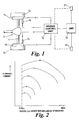
- a vehicle drive axle 11 of a vehicle having a brake traction control system according to the present invention.
- the axle 11 has a wheel 12, 13 located at each end of the axle 11.
- the wheels 12 & 13 are driven via a differential gearing unit 17.
- the rotational speed of each wheel is monitored by a wheel speed sensor 14.
- the vehicle has a braking system including a brake 15,16 associated with each wheel 12 & 13 respectively.
- the brakes 15 & 16 are operated through a brake system controller 18 which is connected to the vehicle engine management system (EMS) 19.
- EMS vehicle engine management system
- the EMS is connected to a large number of sensors on the vehicle which monitor the condition of respective engine parameters.
- the sensors include an engine torque demand sensor 21 which may sense for example the accelerator pedal position, or the position of the butterfly valve in the fuel intake, and an engine torque output sensor 22 which may read directly from the rotational speed of the engine flywheel, or some other suitable type of engine speed monitor, or may be deduced from an engine map.
- the EMS 19 may be pre-programmed with an engine map which includes the information relating the engine rpm to the maximum torque available at given throttle demands.
- the EMS 19 creates an engine speed message designated MD_Max which is an indication of the engine speed required to achieve maximum torque output in relation to the driver's torque demand i.e. accelerator pedal position.
- the EMS 19 also creates an engine speed message N_MOT and is operational so that a message passes to the brakes controller 19 to apply the brakes only when N_MOT>MD_MAX.
- the traction algorithm is self tuning for any EMS.
- Fig. 2 illustrates possible torque curves for an engine under braking conditions.
- the different curves represent different throttle openings. For a given throttle opening, if an engine is braked its rpm (rotational speed) will reduce and its flywheel torque characteristic may change in a non-linear fashion. The precise characteristics will depend upon engine type and design, for example petrol or diesel type, whether boosted or normally aspirated, and engine fuel control strategy etc.. The torque characteristics are used in the operation of the traction control system disclosed herein.
- Fig. 3 is a flow diagram for the operation of the brakes system controller 18.
- step 31 the controller monitors the wheel speeds through sensors 14 and if the controller detects an over-spinning wheel then a signal B passes to step 32.
- step 32 when there is a spinning wheel, that is a low ⁇ wheel ( ⁇ being the coefficient of friction) and a high ⁇ wheel, and the controller 18 is receiving a CAN message from the EMS 19 then the signal B passes to step 33. If no CAN message is detected i.e. N_MOT ⁇ MD_MAX then the signal B' is passed to step 34 and since there is no need for any brake intervention the controller 18 does not react. Hence if the engine is already delivering maximum torque for a given throttle setting there will be no brake intervention.
- step 35 the controller also assesses if there is a difference in speed across the axle as detected by the sensors 14. If so the controller modulates the brakes 14 and or 16. Hence maximum available engine torque is always transferred to the high ⁇ wheel. As the high ⁇ wheel gains speed the engine output is maintained at maximum torque by brake modulation of the low ⁇ wheel. As the low ⁇ wheel slows down, the high ⁇ wheel speed up with the engine torque output held a maximum for given driver (throttle) demand. This torque being supplied to the high ⁇ wheel.
- step 36 the wheel speeds are monitored and when the speed equalize the brake modulation is faded out and the brakes are released. Whilst the speeds differ significantly the signal is fed back to step 35 and the controller 18 continues to modulate the brakes.
- controller 18 may be connected directly to sensors 21 22, and the brakes controller 18 itself programmed with the engine map as described for the EMS 19.
- the torque output curve is flat rather than peaked.
- the maximum torque available at a particular throttle opening may not be specific but may extend over a range of engine rpm. In such cases it is preferable if the maximum torque output is related to the rate of change of the throttle opening. If the throttle is applied slowly the system can target maximum torque at low rpm, and if applied quickly the system could target maximum torque at high rpm. This should provide the driver with improved control over the speed of the vehicle response to the throttle when the traction control system is operated.
Landscapes
- Engineering & Computer Science (AREA)
- Chemical & Material Sciences (AREA)
- Combustion & Propulsion (AREA)
- Transportation (AREA)
- Mechanical Engineering (AREA)
- Automation & Control Theory (AREA)
- Control Of Vehicle Engines Or Engines For Specific Uses (AREA)
- Regulating Braking Force (AREA)
- Control Of Driving Devices And Active Controlling Of Vehicle (AREA)
Abstract
Description
- This invention relates to traction control systems used on motor vehicles and which is an enhancement to brakes only traction control systems.
- Brakes traction control systems (BTCS) are typically used when driving off-road. BTCS in its most basic form acts as an electronically controlled variable slip differential lock for a drive axle on a vehicle in which torque is applied to wheels at opposite end of the axle via a conventional differential unit. The BTCS monitors the rotational speed of the wheels via wheel speed sensors and each wheel is provided with an independent braking actuator. The information from the sensors is fed to a brake system controller where the information is processed and the brakes to the wheels operated with the aim of improving traction.
- If the vehicle is being driven on a non-homogenous surface and sufficient driving torque is applied it is possible for a wheel having a lower surface adhesion to loose grip and spin. In this situation, this wheel will require a relatively low torque, as compared with the other wheel, to cause it to "over spin". If the axle has a conventional differential, then the differential will permit only this same low torque to be transmitted to the non-spinning wheel. This level of torque may not be sufficient to maintain vehicle movement. The BTCS causes the brake actuator associated with the spinning wheel to apply the associated brake and increase its torque output in order to transfer torque across the differential to the non-spinning wheel. The non-spinning wheel then gains sufficient torque to achieve vehicle movement and its speed of rotation increases. The BTCS controls both wheels until their rotational speeds equalise.
- A problem with this type of BTCS is that if the vehicle does not accelerate quickly, the brakes when applied to the spinning wheel may cause engine stall. Some BTCS are programmed to recognise engine stall and implement strategies to prevent this happening. This may leave the vehicle immobilised with the engine held in low revs and unable to supply the necessary torque to move the vehicle. Such a situation may be experienced with vehicles having small engines when driven off-road.
- According to the present invention there is provided a vehicle brakes traction control system for a vehicle having at least one drive axle with a differential operable between wheels at the two ends of the axle, and brakes for each respective wheel operable by a brake controller, characterised in that the traction control system includes wheel speed sensors which sense the rotational speed of said wheels, an engine torque demand sensor and an engine torque output monitor, the brake system controller receiving signals from said sensors and said monitor and being operable to apply the brakes to equalise the rotational speed of said wheels when the engine torque output is less than a desired torque output for a given torque demand.
- The torque demand sensor may be a throttle opening sensor such as an accelerator pedal position sensor and the torque output monitor may include a torque output map.
- The engine speed at which maximum torque output is targeted may be altered in relation to the rate of change of torque demand in particular so that the rate of torque build up at the wheels is proportional to the rate of change of torque demand. When the control system is for use in a vehicle having an engine management system (EMS) with an engine map stored therein which includes information relating to the engine speed at which the maximum torque is available for a given torque demand e.g. throttle opening, the brake system controller operates the vehicle brakes only when excess rotational speed is detected for one of said wheels and when in receipt of a signal from the EMS indicating that the engine speed is above that required for maximum torque output. Such a system is self tuning for any EMS.
- Alternatively, the brakes controller has an engine map stored therein which includes information relating to the engine speed at which the maximum torque is available for given throttle openings, wherein the brake system controller operates the vehicle brakes when excess rotational speed is detected for one of said wheels and when the engine speed is above that required for maximum torque output.
- The engine torque output may be measured as a function of rotational speed of the engine.
- Also according to the present invention there is provided a method of operation of a vehicle brakes traction control system for a vehicle having at least one drive axle with a differential operable between wheels at the two ends of the axle, wherein the system is operable to apply the vehicle brakes to equalise the rotational speed of said wheels only when the engine torque output is less than a desired torque output for a given engine torque demand.
- The invention will be described by way of example only and with reference to the accompanying drawings in which:
- Fig. 1 is a schematic diagram of a traction control system according to the present invention,
- Fig. 2 is a graph showing a possible engine torque characteristic under braking at given throttle openings, and
- Fig. 3 is a logic system for the controller used in the system shown in Fig.1.
-
- With reference to Fig. 1 there is shown a
vehicle drive axle 11 of a vehicle having a brake traction control system according to the present invention. Theaxle 11 has awheel axle 11. Thewheels 12 & 13 are driven via adifferential gearing unit 17. The rotational speed of each wheel is monitored by awheel speed sensor 14. - The vehicle has a braking system including a
brake wheel 12 & 13 respectively. Thebrakes 15 & 16 are operated through abrake system controller 18 which is connected to the vehicle engine management system (EMS) 19. The EMS is connected to a large number of sensors on the vehicle which monitor the condition of respective engine parameters. - The sensors include an engine
torque demand sensor 21 which may sense for example the accelerator pedal position, or the position of the butterfly valve in the fuel intake, and an enginetorque output sensor 22 which may read directly from the rotational speed of the engine flywheel, or some other suitable type of engine speed monitor, or may be deduced from an engine map. - The EMS 19 may be pre-programmed with an engine map which includes the information relating the engine rpm to the maximum torque available at given throttle demands. For the present purposes, the EMS 19 creates an engine speed message designated MD_Max which is an indication of the engine speed required to achieve maximum torque output in relation to the driver's torque demand i.e. accelerator pedal position. The EMS 19 also creates an engine speed message N_MOT and is operational so that a message passes to the
brakes controller 19 to apply the brakes only when N_MOT>MD_MAX. - Provided that the messages MD_MAX and N_MOT are available the traction algorithm is self tuning for any EMS.
- In order for a better understanding of the invention, reference is now made to Fig. 2 which illustrates possible torque curves for an engine under braking conditions. The different curves represent different throttle openings. For a given throttle opening, if an engine is braked its rpm (rotational speed) will reduce and its flywheel torque characteristic may change in a non-linear fashion. The precise characteristics will depend upon engine type and design, for example petrol or diesel type, whether boosted or normally aspirated, and engine fuel control strategy etc.. The torque characteristics are used in the operation of the traction control system disclosed herein.
- The operation of the system will now be described with reference also to Fig. 3 which is a flow diagram for the operation of the
brakes system controller 18. - Initially at
step 31 the controller monitors the wheel speeds throughsensors 14 and if the controller detects an over-spinning wheel then a signal B passes tostep 32. - In
step 32, when there is a spinning wheel, that is a low µ wheel ( µ being the coefficient of friction) and a high µ wheel, and thecontroller 18 is receiving a CAN message from the EMS 19 then the signal B passes tostep 33. If no CAN message is detected i.e. N_MOT≤MD_MAX then the signal B' is passed tostep 34 and since there is no need for any brake intervention thecontroller 18 does not react. Hence if the engine is already delivering maximum torque for a given throttle setting there will be no brake intervention. - In
step 33 thecontroller 18 assesses if brake intervention would modulate thebrakes step 35, if no the signal B" passes tostep 34 and then brake intervention would not be permitted and the brakes controller does not react to modulate the brakes. - Hence maximum available engine torque is always transferred to the high µ wheel. As the high µ wheel gains speed the engine output is maintained at maximum torque by brake modulation of the low µ wheel.
- In
step 35 the controller also assesses if there is a difference in speed across the axle as detected by thesensors 14. If so the controller modulates thebrakes - In
step 36 the wheel speeds are monitored and when the speed equalize the brake modulation is faded out and the brakes are released. Whilst the speeds differ significantly the signal is fed back to step 35 and thecontroller 18 continues to modulate the brakes. - In a variation the
controller 18 may be connected directly tosensors 21 22, and thebrakes controller 18 itself programmed with the engine map as described for theEMS 19. - In a further variation, for diesel engines and some petrol engines the torque output curve is flat rather than peaked. In this situation the maximum torque available at a particular throttle opening may not be specific but may extend over a range of engine rpm. In such cases it is preferable if the maximum torque output is related to the rate of change of the throttle opening. If the throttle is applied slowly the system can target maximum torque at low rpm, and if applied quickly the system could target maximum torque at high rpm. This should provide the driver with improved control over the speed of the vehicle response to the throttle when the traction control system is operated.
- In such systems as described above the engine is less likely to stall than in conventional BTCS and in situations where the over-spinning wheel is delivering maximum torque for given driver demand (throttle opening) there will be no un-necessary brakes intervention making the operation of the vehicle more environmentally friendly.
Claims (12)
- A vehicle brakes traction control system for a vehicle having at least one drive axle (11) with a differential (17) operable between wheels (12,13) at each end of the axle (11) and brakes (15,16) for each respective wheel (12,13) operable by a brake controller (18), characterised in that the traction control system includes wheel speed sensors (14) which sense the rotational speed of said wheels, an engine torque demand sensor (21) and an engine torque output monitor (22), the brake system controller (18) receiving signals from said sensors (14,21) and monitor (22) and being operable to apply the brakes (15,16) to equalise the rotational speed of said wheels (12,13) when the engine torque output is less than a desired torque output for a given torque demand.
- A control system as claimed in Claim 1 characterised in that the desired torque output is substantially the maximum torque output for a given torque demand.
- A control system as claimed in Claim 2 characterised in that, for a given torque demand, the engine speed at which maximum torque output is targeted may be altered in relation to the rate of change of torque demand.
- A control system as claimed in any one of Claims 1 to 3 for use in a vehicle having an engine management system (EMS) (19) with an engine map stored therein which includes information relating to the engine speed MD_MAX at which maximum torque is available for given throttle openings, characterised in that the brake system controller (18) operates the vehicle brakes (15,16) when excess rotational speed is detected for one of said wheels (12 or 13) and when in receipt of a signal N_MOT from the EMS (19) indicating that the engine speed is above that required for maximum torque output.
- A control system as claimed in any one of Claims 1 to 3 in which the brakes controller (18) has an engine map stored therein which includes information relating to the engine speed MD_Max at which maximum torque is available for given throttle openings, characterised in that the brake system controller (18) operates the vehicle brakes (15, 16) when excess rotational speed is detected for one of said wheels (12 or 13) and when the engine speed is above that required for maximum torque output.
- A control system as claimed in Claim 4 or Claim 5 characterised in that the system is self tuning, having an engine map creating CAN signals MD_MAX and N_MOT where N_MOT is a CAN message for engine speed and MD_MAX is the engine speed required for maximum torque output for a given torque demand, brakes being operational only when N_MOT>MD_MAX.
- A control system as claimed in any one of Claims 1 to 6 characterised in that the torque demand sensor (21) is a throttle opening sensor.
- A method of operation of a vehicle brakes traction control system for a vehicle having at least one drive axle (11) with a differential (17) operable between wheels (12,13) at each end of the axle, brakes (15,16) and wheel speed sensors (14) for each respective wheel characterised in that in said method the system is operable to apply the vehicle brakes (15,16) to equalise the rotational speed of said wheels (12,13) only when the engine torque output is less than a desired torque output for a given throttle opening.
- A method as claimed in Claim 8 characterised in that the desired torque output is substantially the maximum output.
- A method as claimed in Claim 9 characterised in that, for a given torque demand, the engine speed at which maximum torque output is targeted is to be altered in relation to the rate of change of torque demand.
- A method as claimed in any one of Claims 8 to 10 for use in a vehicle having an engine management system (EMS) (19) with an engine map stored therein which includes information relating to the engine speed at which the maximum torque is available for given throttle openings, characterised in that the brake system controller (18) operates the vehicle brakes (15 16) when excess rotational speed is detected for one of said wheels (12 or 13) and when in receipt of a signal from the EMS indicating that the engine speed is above that required for maximum torque output.
- A method as claimed in Claim 11 characterised in that the system is self tuning, the engine map creating CAN signals MD_MAX and N_MOT, where N_MOT is a CAN message for engine speed and MD_MAX is the engine speed required for maximum torque output for a given torque demand, the brakes being operational only when N_MOT>MD_MAX.
Applications Claiming Priority (2)
| Application Number | Priority Date | Filing Date | Title |
|---|---|---|---|
| GB0115032 | 2001-06-20 | ||
| GBGB0115032.5A GB0115032D0 (en) | 2001-06-20 | 2001-06-20 | A traction control system |
Publications (2)
| Publication Number | Publication Date |
|---|---|
| EP1270352A1 true EP1270352A1 (en) | 2003-01-02 |
| EP1270352B1 EP1270352B1 (en) | 2006-05-10 |
Family
ID=9916968
Family Applications (1)
| Application Number | Title | Priority Date | Filing Date |
|---|---|---|---|
| EP02253853A Expired - Lifetime EP1270352B1 (en) | 2001-06-20 | 2002-05-31 | A traction control system |
Country Status (4)
| Country | Link |
|---|---|
| US (1) | US6755488B2 (en) |
| EP (1) | EP1270352B1 (en) |
| DE (1) | DE60211252T2 (en) |
| GB (2) | GB0115032D0 (en) |
Cited By (1)
| Publication number | Priority date | Publication date | Assignee | Title |
|---|---|---|---|---|
| WO2005012025A1 (en) * | 2003-07-30 | 2005-02-10 | Toyota Jidosha Kabushiki Kaisha | Vehicle control method |
Families Citing this family (12)
| Publication number | Priority date | Publication date | Assignee | Title |
|---|---|---|---|---|
| JP2002248831A (en) | 2000-12-22 | 2002-09-03 | Ricoh Co Ltd | Image forming apparatus, image forming method, and computer program |
| JP4526792B2 (en) * | 2003-07-30 | 2010-08-18 | 株式会社アドヴィックス | Traction control device |
| US7966113B2 (en) | 2005-08-25 | 2011-06-21 | Robert Bosch Gmbh | Vehicle stability control system |
| US7641014B2 (en) * | 2006-01-31 | 2010-01-05 | Robert Bosch Gmbh | Traction control system and method |
| US7389682B2 (en) * | 2006-03-17 | 2008-06-24 | Gm Global Technology Operations, Inc. | Method and apparatus for engine torque sensing |
| GB2505668B (en) * | 2012-09-06 | 2017-04-12 | Jaguar Land Rover Ltd | Vehicle recovery system |
| EP2982537B1 (en) * | 2013-04-01 | 2020-09-09 | Pioneer Corporation | Traction control device and traction control method |
| JP6213020B2 (en) * | 2013-07-31 | 2017-10-18 | 株式会社アドヴィックス | Vehicle control device |
| JP6905412B2 (en) | 2017-08-09 | 2021-07-21 | 日立Astemo株式会社 | Vehicle control device, vehicle control system and vehicle control method |
| US11059533B2 (en) * | 2018-09-26 | 2021-07-13 | Bombardier Recreational Products Inc. | Vehicle with brake traction control and method for controlling traction of a vehicle |
| CN112455447B (en) * | 2021-01-28 | 2021-05-14 | 天津所托瑞安汽车科技有限公司 | Vehicle antiskid control method and device, electronic equipment and medium |
| CN112874320B (en) * | 2021-02-22 | 2023-01-24 | 北京车和家信息技术有限公司 | Differential active protection control method, device, equipment and storage medium |
Citations (7)
| Publication number | Priority date | Publication date | Assignee | Title |
|---|---|---|---|---|
| DE3635095A1 (en) * | 1985-10-24 | 1987-04-30 | Volkswagen Ag | Method and device for the drive control of a motor vehicle so as to prevent undesirable spinning of the driven vehicle wheels |
| DE4011974C1 (en) * | 1990-04-12 | 1991-09-12 | Lucas Industries P.L.C., Birmingham, West Midlands, Gb | Preventing spin of driven wheels of motor vehicle - detecting speed of rotation and/or acceleration of wheels and comparing with threshold values |
| US5164902A (en) * | 1986-10-08 | 1992-11-17 | Robert Bosch Gmbh | Drive slip control system |
| US5573315A (en) * | 1992-10-24 | 1996-11-12 | Robert Bosch Gmbh | System for preventing slip of driven wheels |
| US5597215A (en) * | 1994-05-28 | 1997-01-28 | Mercedes-Benz Ag | Method for increasing drive torque with controlled brake engagement |
| DE19837521A1 (en) * | 1998-08-19 | 2000-02-24 | Bosch Gmbh Robert | Procedure for drive slip control has engine speed control taking place in starting regime whose setpoint is specified by operating parameters and drive unit |
| WO2000078584A1 (en) * | 1999-06-17 | 2000-12-28 | Continental Teves Ag & Co. Ohg | Method and device for controlling traction slip |
Family Cites Families (8)
| Publication number | Priority date | Publication date | Assignee | Title |
|---|---|---|---|---|
| US3981545A (en) * | 1975-07-30 | 1976-09-21 | Aspro, Incorporated | Traction control apparatus |
| US4765430A (en) | 1985-10-24 | 1988-08-23 | Volkswagen Ag | Method and arrangement for propulsion regulation of an automobile |
| JP2504009B2 (en) * | 1986-12-13 | 1996-06-05 | トヨタ自動車株式会社 | Acceleration slip control device |
| JP2502633B2 (en) * | 1987-11-16 | 1996-05-29 | 日産自動車株式会社 | Vehicle drive force control device |
| JPH0729558B2 (en) * | 1989-04-10 | 1995-04-05 | 日産自動車株式会社 | Drive force distribution controller for four-wheel drive vehicle |
| US5018595A (en) * | 1989-07-11 | 1991-05-28 | Nippondenso Co., Ltd. | Traction control system |
| JPH04293652A (en) * | 1991-03-22 | 1992-10-19 | Japan Electron Control Syst Co Ltd | Vehicle control device |
| JP4187918B2 (en) * | 2000-10-11 | 2008-11-26 | 富士重工業株式会社 | Vehicle behavior control device |
-
2001
- 2001-06-20 GB GBGB0115032.5A patent/GB0115032D0/en not_active Ceased
-
2002
- 2002-05-31 EP EP02253853A patent/EP1270352B1/en not_active Expired - Lifetime
- 2002-05-31 DE DE60211252T patent/DE60211252T2/en not_active Expired - Lifetime
- 2002-05-31 GB GB0212628A patent/GB2377279B/en not_active Expired - Lifetime
- 2002-06-19 US US10/176,125 patent/US6755488B2/en not_active Expired - Lifetime
Patent Citations (7)
| Publication number | Priority date | Publication date | Assignee | Title |
|---|---|---|---|---|
| DE3635095A1 (en) * | 1985-10-24 | 1987-04-30 | Volkswagen Ag | Method and device for the drive control of a motor vehicle so as to prevent undesirable spinning of the driven vehicle wheels |
| US5164902A (en) * | 1986-10-08 | 1992-11-17 | Robert Bosch Gmbh | Drive slip control system |
| DE4011974C1 (en) * | 1990-04-12 | 1991-09-12 | Lucas Industries P.L.C., Birmingham, West Midlands, Gb | Preventing spin of driven wheels of motor vehicle - detecting speed of rotation and/or acceleration of wheels and comparing with threshold values |
| US5573315A (en) * | 1992-10-24 | 1996-11-12 | Robert Bosch Gmbh | System for preventing slip of driven wheels |
| US5597215A (en) * | 1994-05-28 | 1997-01-28 | Mercedes-Benz Ag | Method for increasing drive torque with controlled brake engagement |
| DE19837521A1 (en) * | 1998-08-19 | 2000-02-24 | Bosch Gmbh Robert | Procedure for drive slip control has engine speed control taking place in starting regime whose setpoint is specified by operating parameters and drive unit |
| WO2000078584A1 (en) * | 1999-06-17 | 2000-12-28 | Continental Teves Ag & Co. Ohg | Method and device for controlling traction slip |
Cited By (2)
| Publication number | Priority date | Publication date | Assignee | Title |
|---|---|---|---|---|
| WO2005012025A1 (en) * | 2003-07-30 | 2005-02-10 | Toyota Jidosha Kabushiki Kaisha | Vehicle control method |
| US7451847B2 (en) | 2003-07-30 | 2008-11-18 | Toyota Jidosha Kabushiki Kaisha | Vehicle control method |
Also Published As
| Publication number | Publication date |
|---|---|
| GB0212628D0 (en) | 2002-07-10 |
| DE60211252T2 (en) | 2007-03-29 |
| US6755488B2 (en) | 2004-06-29 |
| DE60211252D1 (en) | 2006-06-14 |
| GB2377279A (en) | 2003-01-08 |
| GB0115032D0 (en) | 2001-08-08 |
| US20020195873A1 (en) | 2002-12-26 |
| GB2377279B (en) | 2004-11-24 |
| EP1270352B1 (en) | 2006-05-10 |
Similar Documents
| Publication | Publication Date | Title |
|---|---|---|
| US7909732B2 (en) | Selectable drivetrain control for a vehicle | |
| US6283240B1 (en) | Vehicle | |
| EP1270352B1 (en) | A traction control system | |
| EP0507466B1 (en) | Motor vehicle hill holder system | |
| US6250448B1 (en) | Motor vehicle with an automatically actuated clutch | |
| US5529548A (en) | Vehicle launch engine fuel control | |
| US20090192018A1 (en) | Method and Control Unit for Controlling a Drivetrain Which has a Dual-clutch Transmission | |
| US20080234906A1 (en) | Torque distribution control in a motor vehicle | |
| JPH106818A (en) | Apparatus and method for controlling torque transmission system | |
| US6769399B2 (en) | Vehicle speed control system | |
| JPH0723070B2 (en) | Vehicle anti-slip device | |
| US6656085B2 (en) | Method for controlling an automatic transmission | |
| US6269297B1 (en) | Traction control apparatus and method for vehicles | |
| JPH11500685A (en) | Control system | |
| US4979931A (en) | Differential gear and control system for motor vehicles having a single driven axle and at least one undriven axle | |
| US6171213B1 (en) | Automatic clutch | |
| JP3467973B2 (en) | Driving force distribution control device | |
| JP3105045B2 (en) | Vehicle slip control device | |
| CN210618108U (en) | Anti-cascading lock device | |
| JP2505260B2 (en) | Vehicle traction control device | |
| JPH0280858A (en) | Engine brake control device of car with automatic transmission | |
| JP3314551B2 (en) | Braking force control device | |
| JP3184277B2 (en) | Vehicle slip control device | |
| JP2830133B2 (en) | Throttle drive control device | |
| JP3397844B2 (en) | Vehicle differential limiting control device |
Legal Events
| Date | Code | Title | Description |
|---|---|---|---|
| PUAI | Public reference made under article 153(3) epc to a published international application that has entered the european phase |
Free format text: ORIGINAL CODE: 0009012 |
|
| AK | Designated contracting states |
Kind code of ref document: A1 Designated state(s): AT BE CH CY DE DK ES FI FR GB GR IE IT LI LU MC NL PT SE TR |
|
| AX | Request for extension of the european patent |
Free format text: AL;LT;LV;MK;RO;SI |
|
| RIN1 | Information on inventor provided before grant (corrected) |
Inventor name: FAWKES, PAUL ANTONY Inventor name: DUNNING, SIMON MICHAEL |
|
| RIN1 | Information on inventor provided before grant (corrected) |
Inventor name: FAWKES, PAUL ANTONY Inventor name: DUNNING, SIMON MICHAEL |
|
| RIN1 | Information on inventor provided before grant (corrected) |
Inventor name: DUNNING, EMMA-CLAIRE Inventor name: FAWKES, PAUL ANTONY |
|
| AKX | Designation fees paid | ||
| 17P | Request for examination filed |
Effective date: 20030705 |
|
| RBV | Designated contracting states (corrected) |
Designated state(s): DE FR |
|
| REG | Reference to a national code |
Ref country code: DE Ref legal event code: 8566 |
|
| 17Q | First examination report despatched |
Effective date: 20031015 |
|
| GRAP | Despatch of communication of intention to grant a patent |
Free format text: ORIGINAL CODE: EPIDOSNIGR1 |
|
| GRAS | Grant fee paid |
Free format text: ORIGINAL CODE: EPIDOSNIGR3 |
|
| GRAA | (expected) grant |
Free format text: ORIGINAL CODE: 0009210 |
|
| AK | Designated contracting states |
Kind code of ref document: B1 Designated state(s): DE FR |
|
| REF | Corresponds to: |
Ref document number: 60211252 Country of ref document: DE Date of ref document: 20060614 Kind code of ref document: P |
|
| ET | Fr: translation filed | ||
| PLBE | No opposition filed within time limit |
Free format text: ORIGINAL CODE: 0009261 |
|
| STAA | Information on the status of an ep patent application or granted ep patent |
Free format text: STATUS: NO OPPOSITION FILED WITHIN TIME LIMIT |
|
| 26N | No opposition filed |
Effective date: 20070213 |
|
| REG | Reference to a national code |
Ref country code: DE Ref legal event code: R082 Ref document number: 60211252 Country of ref document: DE Representative=s name: ANDRAE WESTENDORP PATENTANWAELTE PARTNERSCHAFT, DE |
|
| REG | Reference to a national code |
Ref country code: FR Ref legal event code: PLFP Year of fee payment: 15 |
|
| REG | Reference to a national code |
Ref country code: FR Ref legal event code: PLFP Year of fee payment: 16 |
|
| REG | Reference to a national code |
Ref country code: FR Ref legal event code: PLFP Year of fee payment: 17 |
|
| REG | Reference to a national code |
Ref country code: DE Ref legal event code: R082 Ref document number: 60211252 Country of ref document: DE Ref country code: DE Ref legal event code: R082 Ref document number: 60211252 Country of ref document: DE Representative=s name: BARDEHLE PAGENBERG PARTNERSCHAFT MBB PATENTANW, DE |
|
| REG | Reference to a national code |
Ref country code: DE Ref legal event code: R082 Ref document number: 60211252 Country of ref document: DE Representative=s name: BARDEHLE PAGENBERG PARTNERSCHAFT MBB PATENTANW, DE |
|
| PGFP | Annual fee paid to national office [announced via postgrant information from national office to epo] |
Ref country code: DE Payment date: 20210421 Year of fee payment: 20 Ref country code: FR Payment date: 20210421 Year of fee payment: 20 |
|
| REG | Reference to a national code |
Ref country code: DE Ref legal event code: R071 Ref document number: 60211252 Country of ref document: DE |