EP1270252A2 - Method for preparing an ink jet recording element - Google Patents
Method for preparing an ink jet recording element Download PDFInfo
- Publication number
- EP1270252A2 EP1270252A2 EP20020077361 EP02077361A EP1270252A2 EP 1270252 A2 EP1270252 A2 EP 1270252A2 EP 20020077361 EP20020077361 EP 20020077361 EP 02077361 A EP02077361 A EP 02077361A EP 1270252 A2 EP1270252 A2 EP 1270252A2
- Authority
- EP
- European Patent Office
- Prior art keywords
- particles
- layer
- dispersion
- coagulant
- porous
- Prior art date
- Legal status (The legal status is an assumption and is not a legal conclusion. Google has not performed a legal analysis and makes no representation as to the accuracy of the status listed.)
- Granted
Links
- 238000000034 method Methods 0.000 title claims abstract description 27
- 239000010410 layer Substances 0.000 claims abstract description 80
- 239000002245 particle Substances 0.000 claims abstract description 71
- 238000000576 coating method Methods 0.000 claims abstract description 26
- 239000000701 coagulant Substances 0.000 claims abstract description 25
- 239000006185 dispersion Substances 0.000 claims abstract description 25
- 239000011248 coating agent Substances 0.000 claims abstract description 21
- 238000001035 drying Methods 0.000 claims abstract description 14
- 239000011241 protective layer Substances 0.000 claims abstract description 10
- JOYRKODLDBILNP-UHFFFAOYSA-N Ethyl urethane Chemical compound CCOC(N)=O JOYRKODLDBILNP-UHFFFAOYSA-N 0.000 claims description 9
- 125000004432 carbon atom Chemical group C* 0.000 claims description 6
- VEXZGXHMUGYJMC-UHFFFAOYSA-N Hydrochloric acid Chemical compound Cl VEXZGXHMUGYJMC-UHFFFAOYSA-N 0.000 claims description 5
- 229920005862 polyol Polymers 0.000 claims description 5
- 150000003077 polyols Chemical class 0.000 claims description 5
- QAOWNCQODCNURD-UHFFFAOYSA-N Sulfuric acid Chemical compound OS(O)(=O)=O QAOWNCQODCNURD-UHFFFAOYSA-N 0.000 claims description 4
- 125000000217 alkyl group Chemical group 0.000 claims description 4
- 150000007942 carboxylates Chemical group 0.000 claims description 4
- 239000003792 electrolyte Substances 0.000 claims description 4
- 229910052500 inorganic mineral Inorganic materials 0.000 claims description 4
- 239000011707 mineral Substances 0.000 claims description 4
- 239000002253 acid Substances 0.000 claims description 3
- 238000005054 agglomeration Methods 0.000 claims description 3
- 230000002776 aggregation Effects 0.000 claims description 3
- 150000001768 cations Chemical class 0.000 claims description 3
- 150000007524 organic acids Chemical class 0.000 claims description 3
- UEZVMMHDMIWARA-UHFFFAOYSA-M phosphonate Chemical group [O-]P(=O)=O UEZVMMHDMIWARA-UHFFFAOYSA-M 0.000 claims description 3
- 150000003839 salts Chemical class 0.000 claims description 3
- 125000003118 aryl group Chemical group 0.000 claims description 2
- 150000007522 mineralic acids Chemical class 0.000 claims description 2
- 125000001273 sulfonato group Chemical group [O-]S(*)(=O)=O 0.000 claims description 2
- BDHFUVZGWQCTTF-UHFFFAOYSA-M sulfonate Chemical compound [O-]S(=O)=O BDHFUVZGWQCTTF-UHFFFAOYSA-M 0.000 claims 1
- 239000000976 ink Substances 0.000 description 25
- XLYOFNOQVPJJNP-UHFFFAOYSA-N water Substances O XLYOFNOQVPJJNP-UHFFFAOYSA-N 0.000 description 23
- ZWEHNKRNPOVVGH-UHFFFAOYSA-N 2-Butanone Chemical compound CCC(C)=O ZWEHNKRNPOVVGH-UHFFFAOYSA-N 0.000 description 18
- XEKOWRVHYACXOJ-UHFFFAOYSA-N Ethyl acetate Chemical compound CCOC(C)=O XEKOWRVHYACXOJ-UHFFFAOYSA-N 0.000 description 18
- -1 ethylene glycol Chemical class 0.000 description 17
- 239000000499 gel Substances 0.000 description 12
- 239000011230 binding agent Substances 0.000 description 10
- 239000004814 polyurethane Substances 0.000 description 8
- 229920002635 polyurethane Polymers 0.000 description 8
- 239000007788 liquid Substances 0.000 description 7
- 229920000642 polymer Polymers 0.000 description 7
- 239000007787 solid Substances 0.000 description 7
- KWYUFKZDYYNOTN-UHFFFAOYSA-M Potassium hydroxide Chemical compound [OH-].[K+] KWYUFKZDYYNOTN-UHFFFAOYSA-M 0.000 description 6
- 239000002216 antistatic agent Substances 0.000 description 6
- 239000000975 dye Substances 0.000 description 6
- 239000000203 mixture Substances 0.000 description 6
- 229920005989 resin Polymers 0.000 description 6
- 239000011347 resin Substances 0.000 description 6
- 239000002904 solvent Substances 0.000 description 6
- PTBDIHRZYDMNKB-UHFFFAOYSA-N 2,2-Bis(hydroxymethyl)propionic acid Chemical compound OCC(C)(CO)C(O)=O PTBDIHRZYDMNKB-UHFFFAOYSA-N 0.000 description 5
- 229920002451 polyvinyl alcohol Polymers 0.000 description 5
- 238000003756 stirring Methods 0.000 description 5
- XLOMVQKBTHCTTD-UHFFFAOYSA-N Zinc monoxide Chemical compound [Zn]=O XLOMVQKBTHCTTD-UHFFFAOYSA-N 0.000 description 4
- 239000003795 chemical substances by application Substances 0.000 description 4
- 239000013256 coordination polymer Substances 0.000 description 4
- 239000000945 filler Substances 0.000 description 4
- 238000004519 manufacturing process Methods 0.000 description 4
- 239000004417 polycarbonate Substances 0.000 description 4
- 229920000515 polycarbonate Polymers 0.000 description 4
- 239000000243 solution Substances 0.000 description 4
- 150000005846 sugar alcohols Polymers 0.000 description 4
- 239000004094 surface-active agent Substances 0.000 description 4
- LYCAIKOWRPUZTN-UHFFFAOYSA-N Ethylene glycol Chemical compound OCCO LYCAIKOWRPUZTN-UHFFFAOYSA-N 0.000 description 3
- 239000005058 Isophorone diisocyanate Substances 0.000 description 3
- WYURNTSHIVDZCO-UHFFFAOYSA-N Tetrahydrofuran Chemical compound C1CCOC1 WYURNTSHIVDZCO-UHFFFAOYSA-N 0.000 description 3
- UKLDJPRMSDWDSL-UHFFFAOYSA-L [dibutyl(dodecanoyloxy)stannyl] dodecanoate Chemical compound CCCCCCCCCCCC(=O)O[Sn](CCCC)(CCCC)OC(=O)CCCCCCCCCCC UKLDJPRMSDWDSL-UHFFFAOYSA-L 0.000 description 3
- 239000000654 additive Substances 0.000 description 3
- PNEYBMLMFCGWSK-UHFFFAOYSA-N aluminium oxide Inorganic materials [O-2].[O-2].[O-2].[Al+3].[Al+3] PNEYBMLMFCGWSK-UHFFFAOYSA-N 0.000 description 3
- 239000003963 antioxidant agent Substances 0.000 description 3
- 235000006708 antioxidants Nutrition 0.000 description 3
- ZFVMWEVVKGLCIJ-UHFFFAOYSA-N bisphenol AF Chemical compound C1=CC(O)=CC=C1C(C(F)(F)F)(C(F)(F)F)C1=CC=C(O)C=C1 ZFVMWEVVKGLCIJ-UHFFFAOYSA-N 0.000 description 3
- 239000003054 catalyst Substances 0.000 description 3
- 229920001577 copolymer Polymers 0.000 description 3
- 239000012975 dibutyltin dilaurate Substances 0.000 description 3
- MTHSVFCYNBDYFN-UHFFFAOYSA-N diethylene glycol Chemical compound OCCOCCO MTHSVFCYNBDYFN-UHFFFAOYSA-N 0.000 description 3
- 150000002009 diols Chemical class 0.000 description 3
- IQPQWNKOIGAROB-UHFFFAOYSA-N isocyanate group Chemical group [N-]=C=O IQPQWNKOIGAROB-UHFFFAOYSA-N 0.000 description 3
- NIMLQBUJDJZYEJ-UHFFFAOYSA-N isophorone diisocyanate Chemical compound CC1(C)CC(N=C=O)CC(C)(CN=C=O)C1 NIMLQBUJDJZYEJ-UHFFFAOYSA-N 0.000 description 3
- 239000000463 material Substances 0.000 description 3
- 239000011146 organic particle Substances 0.000 description 3
- 229920000728 polyester Polymers 0.000 description 3
- 238000002360 preparation method Methods 0.000 description 3
- 238000007639 printing Methods 0.000 description 3
- 239000011541 reaction mixture Substances 0.000 description 3
- IJGRMHOSHXDMSA-UHFFFAOYSA-N Atomic nitrogen Chemical compound N#N IJGRMHOSHXDMSA-UHFFFAOYSA-N 0.000 description 2
- VTYYLEPIZMXCLO-UHFFFAOYSA-L Calcium carbonate Chemical compound [Ca+2].[O-]C([O-])=O VTYYLEPIZMXCLO-UHFFFAOYSA-L 0.000 description 2
- 108010010803 Gelatin Proteins 0.000 description 2
- AFVFQIVMOAPDHO-UHFFFAOYSA-N Methanesulfonic acid Chemical compound CS(O)(=O)=O AFVFQIVMOAPDHO-UHFFFAOYSA-N 0.000 description 2
- 239000004793 Polystyrene Substances 0.000 description 2
- VYPSYNLAJGMNEJ-UHFFFAOYSA-N Silicium dioxide Chemical compound O=[Si]=O VYPSYNLAJGMNEJ-UHFFFAOYSA-N 0.000 description 2
- UIIMBOGNXHQVGW-UHFFFAOYSA-M Sodium bicarbonate Chemical compound [Na+].OC([O-])=O UIIMBOGNXHQVGW-UHFFFAOYSA-M 0.000 description 2
- FAPWRFPIFSIZLT-UHFFFAOYSA-M Sodium chloride Chemical compound [Na+].[Cl-] FAPWRFPIFSIZLT-UHFFFAOYSA-M 0.000 description 2
- GWEVSGVZZGPLCZ-UHFFFAOYSA-N Titan oxide Chemical compound O=[Ti]=O GWEVSGVZZGPLCZ-UHFFFAOYSA-N 0.000 description 2
- 238000010521 absorption reaction Methods 0.000 description 2
- WNLRTRBMVRJNCN-UHFFFAOYSA-N adipic acid Chemical compound OC(=O)CCCCC(O)=O WNLRTRBMVRJNCN-UHFFFAOYSA-N 0.000 description 2
- VSCWAEJMTAWNJL-UHFFFAOYSA-K aluminium trichloride Chemical compound Cl[Al](Cl)Cl VSCWAEJMTAWNJL-UHFFFAOYSA-K 0.000 description 2
- TZCXTZWJZNENPQ-UHFFFAOYSA-L barium sulfate Chemical compound [Ba+2].[O-]S([O-])(=O)=O TZCXTZWJZNENPQ-UHFFFAOYSA-L 0.000 description 2
- WERYXYBDKMZEQL-UHFFFAOYSA-N butane-1,4-diol Chemical compound OCCCCO WERYXYBDKMZEQL-UHFFFAOYSA-N 0.000 description 2
- 125000002091 cationic group Chemical group 0.000 description 2
- 239000003093 cationic surfactant Substances 0.000 description 2
- 239000001913 cellulose Substances 0.000 description 2
- 229920002678 cellulose Polymers 0.000 description 2
- 235000010980 cellulose Nutrition 0.000 description 2
- 239000004927 clay Substances 0.000 description 2
- 150000001875 compounds Chemical class 0.000 description 2
- 239000003431 cross linking reagent Substances 0.000 description 2
- 238000010790 dilution Methods 0.000 description 2
- 239000012895 dilution Substances 0.000 description 2
- 239000000839 emulsion Substances 0.000 description 2
- 230000002708 enhancing effect Effects 0.000 description 2
- 239000012530 fluid Substances 0.000 description 2
- 239000008273 gelatin Substances 0.000 description 2
- 229920000159 gelatin Polymers 0.000 description 2
- 235000019322 gelatine Nutrition 0.000 description 2
- 235000011852 gelatine desserts Nutrition 0.000 description 2
- 229920001477 hydrophilic polymer Polymers 0.000 description 2
- 238000007641 inkjet printing Methods 0.000 description 2
- 239000010954 inorganic particle Substances 0.000 description 2
- 239000004816 latex Substances 0.000 description 2
- 229920000126 latex Polymers 0.000 description 2
- 235000010755 mineral Nutrition 0.000 description 2
- 229910052757 nitrogen Inorganic materials 0.000 description 2
- BDJRBEYXGGNYIS-UHFFFAOYSA-N nonanedioic acid Chemical compound OC(=O)CCCCCCCC(O)=O BDJRBEYXGGNYIS-UHFFFAOYSA-N 0.000 description 2
- 230000003287 optical effect Effects 0.000 description 2
- 239000011368 organic material Substances 0.000 description 2
- 239000000049 pigment Substances 0.000 description 2
- 229920002223 polystyrene Polymers 0.000 description 2
- 229920002689 polyvinyl acetate Polymers 0.000 description 2
- 239000011118 polyvinyl acetate Substances 0.000 description 2
- 239000003755 preservative agent Substances 0.000 description 2
- CXMXRPHRNRROMY-UHFFFAOYSA-N sebacic acid Chemical compound OC(=O)CCCCCCCCC(O)=O CXMXRPHRNRROMY-UHFFFAOYSA-N 0.000 description 2
- TYFQFVWCELRYAO-UHFFFAOYSA-N suberic acid Chemical compound OC(=O)CCCCCCC(O)=O TYFQFVWCELRYAO-UHFFFAOYSA-N 0.000 description 2
- 229920001169 thermoplastic Polymers 0.000 description 2
- 239000011787 zinc oxide Substances 0.000 description 2
- FCTDKZOUZXYHNA-UHFFFAOYSA-N 1,4-dioxane-2,2-diol Chemical compound OC1(O)COCCO1 FCTDKZOUZXYHNA-UHFFFAOYSA-N 0.000 description 1
- LBLYYCQCTBFVLH-UHFFFAOYSA-N 2-Methylbenzenesulfonic acid Chemical compound CC1=CC=CC=C1S(O)(=O)=O LBLYYCQCTBFVLH-UHFFFAOYSA-N 0.000 description 1
- QWGRWMMWNDWRQN-UHFFFAOYSA-N 2-methylpropane-1,3-diol Chemical compound OCC(C)CO QWGRWMMWNDWRQN-UHFFFAOYSA-N 0.000 description 1
- 239000004925 Acrylic resin Substances 0.000 description 1
- 229920000178 Acrylic resin Polymers 0.000 description 1
- UXVMQQNJUSDDNG-UHFFFAOYSA-L Calcium chloride Chemical compound [Cl-].[Cl-].[Ca+2] UXVMQQNJUSDDNG-UHFFFAOYSA-L 0.000 description 1
- 239000004215 Carbon black (E152) Substances 0.000 description 1
- 229920000742 Cotton Polymers 0.000 description 1
- BRLQWZUYTZBJKN-UHFFFAOYSA-N Epichlorohydrin Chemical compound ClCC1CO1 BRLQWZUYTZBJKN-UHFFFAOYSA-N 0.000 description 1
- LFQSCWFLJHTTHZ-UHFFFAOYSA-N Ethanol Chemical compound CCO LFQSCWFLJHTTHZ-UHFFFAOYSA-N 0.000 description 1
- UFHFLCQGNIYNRP-UHFFFAOYSA-N Hydrogen Chemical compound [H][H] UFHFLCQGNIYNRP-UHFFFAOYSA-N 0.000 description 1
- OFOBLEOULBTSOW-UHFFFAOYSA-N Malonic acid Chemical compound OC(=O)CC(O)=O OFOBLEOULBTSOW-UHFFFAOYSA-N 0.000 description 1
- 229920001890 Novodur Polymers 0.000 description 1
- 239000004677 Nylon Substances 0.000 description 1
- YGYAWVDWMABLBF-UHFFFAOYSA-N Phosgene Chemical compound ClC(Cl)=O YGYAWVDWMABLBF-UHFFFAOYSA-N 0.000 description 1
- 239000004721 Polyphenylene oxide Substances 0.000 description 1
- 239000004372 Polyvinyl alcohol Substances 0.000 description 1
- GOOHAUXETOMSMM-UHFFFAOYSA-N Propylene oxide Chemical compound CC1CO1 GOOHAUXETOMSMM-UHFFFAOYSA-N 0.000 description 1
- 229920000297 Rayon Polymers 0.000 description 1
- AWMVMTVKBNGEAK-UHFFFAOYSA-N Styrene oxide Chemical compound C1OC1C1=CC=CC=C1 AWMVMTVKBNGEAK-UHFFFAOYSA-N 0.000 description 1
- KDYFGRWQOYBRFD-UHFFFAOYSA-N Succinic acid Natural products OC(=O)CCC(O)=O KDYFGRWQOYBRFD-UHFFFAOYSA-N 0.000 description 1
- ORLQHILJRHBSAY-UHFFFAOYSA-N [1-(hydroxymethyl)cyclohexyl]methanol Chemical class OCC1(CO)CCCCC1 ORLQHILJRHBSAY-UHFFFAOYSA-N 0.000 description 1
- 239000002250 absorbent Substances 0.000 description 1
- 239000006096 absorbing agent Substances 0.000 description 1
- 150000007513 acids Chemical class 0.000 description 1
- 150000003926 acrylamides Chemical class 0.000 description 1
- 150000001252 acrylic acid derivatives Chemical class 0.000 description 1
- 239000001361 adipic acid Substances 0.000 description 1
- 235000011037 adipic acid Nutrition 0.000 description 1
- 230000032683 aging Effects 0.000 description 1
- 238000007605 air drying Methods 0.000 description 1
- 125000000129 anionic group Chemical group 0.000 description 1
- 239000003945 anionic surfactant Substances 0.000 description 1
- 239000002518 antifoaming agent Substances 0.000 description 1
- 239000007864 aqueous solution Substances 0.000 description 1
- 239000011324 bead Substances 0.000 description 1
- KDYFGRWQOYBRFD-NUQCWPJISA-N butanedioic acid Chemical compound O[14C](=O)CC[14C](O)=O KDYFGRWQOYBRFD-NUQCWPJISA-N 0.000 description 1
- 229910000019 calcium carbonate Inorganic materials 0.000 description 1
- 239000001110 calcium chloride Substances 0.000 description 1
- 229910001628 calcium chloride Inorganic materials 0.000 description 1
- 238000003490 calendering Methods 0.000 description 1
- 230000015556 catabolic process Effects 0.000 description 1
- 229920006317 cationic polymer Polymers 0.000 description 1
- 239000000919 ceramic Substances 0.000 description 1
- 238000010382 chemical cross-linking Methods 0.000 description 1
- 238000005352 clarification Methods 0.000 description 1
- 229910052570 clay Inorganic materials 0.000 description 1
- 239000008199 coating composition Substances 0.000 description 1
- 239000007771 core particle Substances 0.000 description 1
- 238000007766 curtain coating Methods 0.000 description 1
- IFDVQVHZEKPUSC-UHFFFAOYSA-N cyclohex-3-ene-1,2-dicarboxylic acid Chemical compound OC(=O)C1CCC=CC1C(O)=O IFDVQVHZEKPUSC-UHFFFAOYSA-N 0.000 description 1
- 238000006731 degradation reaction Methods 0.000 description 1
- 239000008367 deionised water Substances 0.000 description 1
- 229910021641 deionized water Inorganic materials 0.000 description 1
- 239000003599 detergent Substances 0.000 description 1
- FFQUUCADLBSLBR-UHFFFAOYSA-L disodium;2-dodecyl-2-sulfobutanedioate Chemical compound [Na+].[Na+].CCCCCCCCCCCCC(S(O)(=O)=O)(C([O-])=O)CC([O-])=O FFQUUCADLBSLBR-UHFFFAOYSA-L 0.000 description 1
- 239000002270 dispersing agent Substances 0.000 description 1
- 239000012153 distilled water Substances 0.000 description 1
- GVGUFUZHNYFZLC-UHFFFAOYSA-N dodecyl benzenesulfonate;sodium Chemical compound [Na].CCCCCCCCCCCCOS(=O)(=O)C1=CC=CC=C1 GVGUFUZHNYFZLC-UHFFFAOYSA-N 0.000 description 1
- 238000005516 engineering process Methods 0.000 description 1
- 230000007613 environmental effect Effects 0.000 description 1
- 230000032050 esterification Effects 0.000 description 1
- 238000005886 esterification reaction Methods 0.000 description 1
- 239000007850 fluorescent dye Substances 0.000 description 1
- NBVXSUQYWXRMNV-UHFFFAOYSA-N fluoromethane Chemical compound FC NBVXSUQYWXRMNV-UHFFFAOYSA-N 0.000 description 1
- 238000001879 gelation Methods 0.000 description 1
- 238000010438 heat treatment Methods 0.000 description 1
- XXMIOPMDWAUFGU-UHFFFAOYSA-N hexane-1,6-diol Chemical compound OCCCCCCO XXMIOPMDWAUFGU-UHFFFAOYSA-N 0.000 description 1
- 239000003906 humectant Substances 0.000 description 1
- 229930195733 hydrocarbon Natural products 0.000 description 1
- 150000002430 hydrocarbons Chemical class 0.000 description 1
- 238000003384 imaging method Methods 0.000 description 1
- 238000011065 in-situ storage Methods 0.000 description 1
- 239000011256 inorganic filler Substances 0.000 description 1
- 229910003475 inorganic filler Inorganic materials 0.000 description 1
- 229920000554 ionomer Polymers 0.000 description 1
- 238000003475 lamination Methods 0.000 description 1
- 239000004611 light stabiliser Substances 0.000 description 1
- 239000000314 lubricant Substances 0.000 description 1
- 150000002734 metacrylic acid derivatives Chemical class 0.000 description 1
- 229940098779 methanesulfonic acid Drugs 0.000 description 1
- 235000019813 microcrystalline cellulose Nutrition 0.000 description 1
- 239000008108 microcrystalline cellulose Substances 0.000 description 1
- 229940016286 microcrystalline cellulose Drugs 0.000 description 1
- 239000012046 mixed solvent Substances 0.000 description 1
- SLCVBVWXLSEKPL-UHFFFAOYSA-N neopentyl glycol Chemical compound OCC(C)(C)CO SLCVBVWXLSEKPL-UHFFFAOYSA-N 0.000 description 1
- 229920001778 nylon Polymers 0.000 description 1
- OEIJHBUUFURJLI-UHFFFAOYSA-N octane-1,8-diol Chemical compound OCCCCCCCCO OEIJHBUUFURJLI-UHFFFAOYSA-N 0.000 description 1
- 235000005985 organic acids Nutrition 0.000 description 1
- 239000003960 organic solvent Substances 0.000 description 1
- 230000020477 pH reduction Effects 0.000 description 1
- 230000000704 physical effect Effects 0.000 description 1
- 239000004014 plasticizer Substances 0.000 description 1
- 229920003229 poly(methyl methacrylate) Polymers 0.000 description 1
- 238000006068 polycondensation reaction Methods 0.000 description 1
- 229920000867 polyelectrolyte Polymers 0.000 description 1
- 229920000570 polyether Polymers 0.000 description 1
- 239000002491 polymer binding agent Substances 0.000 description 1
- 239000004926 polymethyl methacrylate Substances 0.000 description 1
- 229920000915 polyvinyl chloride Polymers 0.000 description 1
- XAEFZNCEHLXOMS-UHFFFAOYSA-M potassium benzoate Chemical compound [K+].[O-]C(=O)C1=CC=CC=C1 XAEFZNCEHLXOMS-UHFFFAOYSA-M 0.000 description 1
- 238000009700 powder processing Methods 0.000 description 1
- 230000001737 promoting effect Effects 0.000 description 1
- 150000003242 quaternary ammonium salts Chemical class 0.000 description 1
- 239000002964 rayon Substances 0.000 description 1
- 230000000717 retained effect Effects 0.000 description 1
- 239000010420 shell particle Substances 0.000 description 1
- 239000000377 silicon dioxide Substances 0.000 description 1
- 235000012239 silicon dioxide Nutrition 0.000 description 1
- 235000017557 sodium bicarbonate Nutrition 0.000 description 1
- 229910000030 sodium bicarbonate Inorganic materials 0.000 description 1
- 239000011780 sodium chloride Substances 0.000 description 1
- APSBXTVYXVQYAB-UHFFFAOYSA-M sodium docusate Chemical compound [Na+].CCCCC(CC)COC(=O)CC(S([O-])(=O)=O)C(=O)OCC(CC)CCCC APSBXTVYXVQYAB-UHFFFAOYSA-M 0.000 description 1
- 159000000000 sodium salts Chemical class 0.000 description 1
- 230000003068 static effect Effects 0.000 description 1
- 239000000758 substrate Substances 0.000 description 1
- 239000000725 suspension Substances 0.000 description 1
- 239000000454 talc Substances 0.000 description 1
- 229910052623 talc Inorganic materials 0.000 description 1
- YLQBMQCUIZJEEH-UHFFFAOYSA-N tetrahydrofuran Natural products C=1C=COC=1 YLQBMQCUIZJEEH-UHFFFAOYSA-N 0.000 description 1
- UFDHBDMSHIXOKF-UHFFFAOYSA-N tetrahydrophthalic acid Natural products OC(=O)C1=C(C(O)=O)CCCC1 UFDHBDMSHIXOKF-UHFFFAOYSA-N 0.000 description 1
- 229920005992 thermoplastic resin Polymers 0.000 description 1
- 239000004416 thermosoftening plastic Substances 0.000 description 1
- 230000008719 thickening Effects 0.000 description 1
- 239000002562 thickening agent Substances 0.000 description 1
- 239000004408 titanium dioxide Substances 0.000 description 1
- 239000004034 viscosity adjusting agent Substances 0.000 description 1
- 229920003169 water-soluble polymer Polymers 0.000 description 1
- 238000004078 waterproofing Methods 0.000 description 1
- 239000002759 woven fabric Substances 0.000 description 1
- PAPBSGBWRJIAAV-UHFFFAOYSA-N ε-Caprolactone Chemical compound O=C1CCCCCO1 PAPBSGBWRJIAAV-UHFFFAOYSA-N 0.000 description 1
Classifications
-
- B—PERFORMING OPERATIONS; TRANSPORTING
- B41—PRINTING; LINING MACHINES; TYPEWRITERS; STAMPS
- B41M—PRINTING, DUPLICATING, MARKING, OR COPYING PROCESSES; COLOUR PRINTING
- B41M5/00—Duplicating or marking methods; Sheet materials for use therein
- B41M5/50—Recording sheets characterised by the coating used to improve ink, dye or pigment receptivity, e.g. for ink-jet or thermal dye transfer recording
- B41M5/52—Macromolecular coatings
-
- B—PERFORMING OPERATIONS; TRANSPORTING
- B41—PRINTING; LINING MACHINES; TYPEWRITERS; STAMPS
- B41M—PRINTING, DUPLICATING, MARKING, OR COPYING PROCESSES; COLOUR PRINTING
- B41M5/00—Duplicating or marking methods; Sheet materials for use therein
- B41M5/50—Recording sheets characterised by the coating used to improve ink, dye or pigment receptivity, e.g. for ink-jet or thermal dye transfer recording
- B41M5/502—Recording sheets characterised by the coating used to improve ink, dye or pigment receptivity, e.g. for ink-jet or thermal dye transfer recording characterised by structural details, e.g. multilayer materials
- B41M5/506—Intermediate layers
-
- B—PERFORMING OPERATIONS; TRANSPORTING
- B41—PRINTING; LINING MACHINES; TYPEWRITERS; STAMPS
- B41M—PRINTING, DUPLICATING, MARKING, OR COPYING PROCESSES; COLOUR PRINTING
- B41M5/00—Duplicating or marking methods; Sheet materials for use therein
- B41M5/50—Recording sheets characterised by the coating used to improve ink, dye or pigment receptivity, e.g. for ink-jet or thermal dye transfer recording
- B41M5/502—Recording sheets characterised by the coating used to improve ink, dye or pigment receptivity, e.g. for ink-jet or thermal dye transfer recording characterised by structural details, e.g. multilayer materials
- B41M5/508—Supports
-
- B—PERFORMING OPERATIONS; TRANSPORTING
- B41—PRINTING; LINING MACHINES; TYPEWRITERS; STAMPS
- B41M—PRINTING, DUPLICATING, MARKING, OR COPYING PROCESSES; COLOUR PRINTING
- B41M5/00—Duplicating or marking methods; Sheet materials for use therein
- B41M5/50—Recording sheets characterised by the coating used to improve ink, dye or pigment receptivity, e.g. for ink-jet or thermal dye transfer recording
- B41M5/52—Macromolecular coatings
- B41M5/5218—Macromolecular coatings characterised by inorganic additives, e.g. pigments, clays
-
- B—PERFORMING OPERATIONS; TRANSPORTING
- B41—PRINTING; LINING MACHINES; TYPEWRITERS; STAMPS
- B41M—PRINTING, DUPLICATING, MARKING, OR COPYING PROCESSES; COLOUR PRINTING
- B41M5/00—Duplicating or marking methods; Sheet materials for use therein
- B41M5/50—Recording sheets characterised by the coating used to improve ink, dye or pigment receptivity, e.g. for ink-jet or thermal dye transfer recording
- B41M5/52—Macromolecular coatings
- B41M5/5236—Macromolecular coatings characterised by the use of natural gums, of proteins, e.g. gelatins, or of macromolecular carbohydrates, e.g. cellulose
-
- B—PERFORMING OPERATIONS; TRANSPORTING
- B41—PRINTING; LINING MACHINES; TYPEWRITERS; STAMPS
- B41M—PRINTING, DUPLICATING, MARKING, OR COPYING PROCESSES; COLOUR PRINTING
- B41M5/00—Duplicating or marking methods; Sheet materials for use therein
- B41M5/50—Recording sheets characterised by the coating used to improve ink, dye or pigment receptivity, e.g. for ink-jet or thermal dye transfer recording
- B41M5/52—Macromolecular coatings
- B41M5/5245—Macromolecular coatings characterised by the use of polymers containing cationic or anionic groups, e.g. mordants
-
- B—PERFORMING OPERATIONS; TRANSPORTING
- B41—PRINTING; LINING MACHINES; TYPEWRITERS; STAMPS
- B41M—PRINTING, DUPLICATING, MARKING, OR COPYING PROCESSES; COLOUR PRINTING
- B41M5/00—Duplicating or marking methods; Sheet materials for use therein
- B41M5/50—Recording sheets characterised by the coating used to improve ink, dye or pigment receptivity, e.g. for ink-jet or thermal dye transfer recording
- B41M5/52—Macromolecular coatings
- B41M5/5254—Macromolecular coatings characterised by the use of polymers obtained by reactions only involving carbon-to-carbon unsaturated bonds, e.g. vinyl polymers
-
- B—PERFORMING OPERATIONS; TRANSPORTING
- B41—PRINTING; LINING MACHINES; TYPEWRITERS; STAMPS
- B41M—PRINTING, DUPLICATING, MARKING, OR COPYING PROCESSES; COLOUR PRINTING
- B41M5/00—Duplicating or marking methods; Sheet materials for use therein
- B41M5/50—Recording sheets characterised by the coating used to improve ink, dye or pigment receptivity, e.g. for ink-jet or thermal dye transfer recording
- B41M5/52—Macromolecular coatings
- B41M5/5263—Macromolecular coatings characterised by the use of polymers obtained otherwise than by reactions only involving carbon-to-carbon unsaturated bonds
- B41M5/5281—Polyurethanes or polyureas
-
- Y—GENERAL TAGGING OF NEW TECHNOLOGICAL DEVELOPMENTS; GENERAL TAGGING OF CROSS-SECTIONAL TECHNOLOGIES SPANNING OVER SEVERAL SECTIONS OF THE IPC; TECHNICAL SUBJECTS COVERED BY FORMER USPC CROSS-REFERENCE ART COLLECTIONS [XRACs] AND DIGESTS
- Y10—TECHNICAL SUBJECTS COVERED BY FORMER USPC
- Y10T—TECHNICAL SUBJECTS COVERED BY FORMER US CLASSIFICATION
- Y10T428/00—Stock material or miscellaneous articles
- Y10T428/31504—Composite [nonstructural laminate]
- Y10T428/31855—Of addition polymer from unsaturated monomers
- Y10T428/3188—Next to cellulosic
- Y10T428/31895—Paper or wood
Definitions
- ink droplets are ejected from a nozzle at high speed towards a recording element or medium to produce an image on the medium.
- the ink droplets, or recording liquid generally comprise a recording agent, such as a dye or pigment, and a large amount of solvent.
- the solvent, or carrier liquid typically is made up of water, an organic material such as a monohydric alcohol, a polyhydric alcohol or mixtures thereof.
- An ink jet recording element typically comprises a support having on at least one surface thereof an ink-receiving or image-forming layer.
- the ink-receiving layer is either a porous layer that imbibes the ink via capillary action or a polymer layer that swells to absorb the ink.
- Ink jet prints prepared by printing onto ink jet recording elements, are subject to environmental degradation. They are especially vulnerable to water smearing and light fade.
- ink jet dyes are water-soluble, they can migrate from their location in the image layer when water comes in contact with the receiver after imaging.
- Highly swellable hydrophilic layers can take an undesirably long time to dry slowing printing speed, and will dissolve when left in contact with water, destroying printed images.
- Porous layers speed the absorption of the ink vehicle, but often suffer from insufficient gloss and severe light fade.
- the coated fluid should have sufficient viscosity or mechanical integrity so that impingement of air during the drying process does not disturb the uniformity of the coated layer.
- hydrophilic polymers that either boost viscosity such as polyvinyl alcohol, or polymers that can be gelled by chilling such as gelatin.
- EP 0 858 905 A1 discloses a process for preparing an ink jet recording element by forming a porous outermost layer by heat treatment of a particulate thermoplastic resin.
- the coated layer does not set when coated, so that the layer may not always be uniform.
- U. S. Patent 5,925,712 discloses a coating composition of a powdered thermoplastic polymer, a water-soluble cationic polymer and a nonionic or cationic latex binder.
- a coating composition of a powdered thermoplastic polymer, a water-soluble cationic polymer and a nonionic or cationic latex binder discloses a coating composition of a powdered thermoplastic polymer, a water-soluble cationic polymer and a nonionic or cationic latex binder.
- water-soluble polymers degrade the water resistance of the layer containing them.
- a porous, ink jet recording element is obtained that has a uniformly thick protective layer upon fusing.
- Particles which are capable of forming a particle gel with a coagulant which may be used in the invention include those which have ionic functionalities on their surfaces, such as ionomer particles, particles which have adsorbed anionic or cationic surfactants, polyelectrolytes, etc.
- the particles are anionomer particles.
- the anionomer particles are urethane anionomer particles.
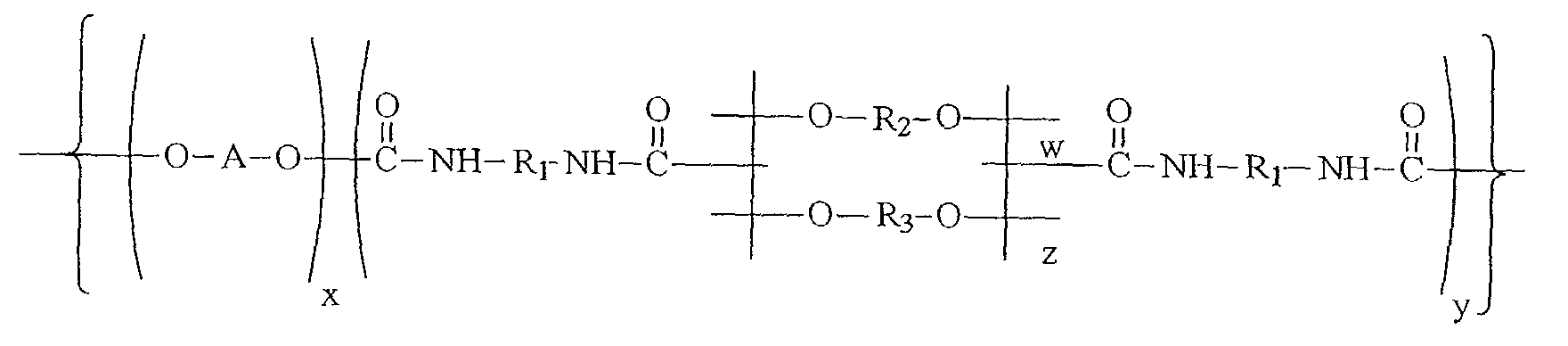
- Urethane anionomer particles which may be used in the process of the invention can be water-dispersible, segmented polyurethanes having the following formula: wherein:
- the polyurethane has a number average molecular weight of from 5,000 to 100,000, more preferably from 10,000 to 50,000.
- the water-dispersible polyurethane employed in the invention may be prepared as described in "Polyurethane Handbook", Hanser Publishers, Kunststoff Vienna, 1985.
- a porous, image-receiving layer is one which is usually composed of inorganic or organic particles bonded together by a binder.
- the amount of particles in this type of coating is often far above the critical particle volume concentration, which results in high porosity in the coating.
- porous coatings allow a fast "drying" of the ink and produce a smear-resistant image.
- the porous image-receiving layer comprises from 20% to 100% of particles and from 0% to 80% of a polymeric binder, preferably from 80% to 95% of particles and from 20% to 5% of a polymeric binder, such as poly(vinyl alcohol), poly(vinyl pyrrolidinone), poly(vinyl acetate) or copolymers thereof or gelatin.
- a polymeric binder such as poly(vinyl alcohol), poly(vinyl pyrrolidinone), poly(vinyl acetate) or copolymers thereof or gelatin.
- the porous, image-receiving layer can also contain polymer micro-porous structures without inorganic filler particles as shown in U.S. Patents 5,374,475 and 4,954,395.
- organic particles which may be used in the image-receiving layer employed in the process of the invention include core/shell particles such as those disclosed in U.S.S.N. 09 / 609 / 969 of Kapusniak et al., filed June 30, 2000 , and homogeneous particles such as those disclosed in EP 01202331.1.
- organic particles which may be used include acrylic resins, styrenic resins, cellulose derivatives, polyvinyl resins, ethylene-allyl copolymers and polycondensation polymers such as polyesters.
- inorganic particles which may be used in the image-receiving layer employed in the invention include silica, alumina, titanium dioxide, clay, calcium carbonate, barium sulfate, or zinc oxide.
- the image-receiving layer may be present in a dry thickness of 5 to 60 ⁇ m, preferably 8 to 45 ⁇ m.
- the porous, image-receiving layer contains a diffusible coagulant.
- a diffusible coagulant may be defined as an electrolyte that will cause the agglomeration in the dispersion of the particles, such as anionomer particles.
- a spanning network of particles i.e., a particle gel is formed.
- the urethane anionomer particles used in the process of the invention form an electrostatically stabilized suspension in water by virtue of negatively charged functionality on the particle surface such as a carboxylate.
- a coagulant neutralizes or suppresses the negative surface charge on the particles leading to agglomeration.
- the electrolyte is a mineral or organic acid or a salt of a monovalent or multivalent cation.
- mineral acids include hydrochloric acid or sulfuric acid.
- organic acids that may be used include toluene sulfonic acid or methanesulfonic acid.
- Salts of monovalent and multivalent cations include sodium chloride, calcium chloride and aluminum chloride. Additional suitable coagulants and methods to generate them in-situ are described in "Novel Powder-Processing Methods for Advanced Ceramics" J. Am Ceram.Soc., 83 [7], 1557-74 (2000).
- the coagulant diffuses into the image-receiving layer and the layer sets to form a particle gel.
- the element is then dried for 5 minutes at a temperature of from 20°C to 90°C using conventional drying equipment such as forced air drying.
- a uniform top layer is formed since the coagulant diffuses uniformly up to the top layer from the under layer evenly setting the top layer, which upon drying, forms a layer of uniform thickness.
- the layers described above may be coated by conventional coating means onto a support material commonly used in this art.
- Suitable coating methods include, but are not limited to, wound wire rod coating, slot coating, slide hopper coating, gravure, curtain coating and the like. Some of these methods allow for simultaneous coatings of both layers, which is preferred from a manufacturing economic perspective.
- the surface of the support may be corona discharge-treated prior to applying the image-receiving layer to the support.
- the image-receiving and overcoat layers employed in the invention may contain addenda for enhancing its physical and optical properties such as anti-oxidants, surfactants, light stabilizers, anti-static agents, chemical crosslinking agents, cationic mordants and the like.
- any support or substrate may be used in the recording element employed in the invention.
- the support is resin-coated paper.
- the support usually has a thickness of from 12 to 500 ⁇ m, preferably from 75 to 300 ⁇ m.
- Antioxidants, antistatic agents, plasticizers and other known additives may be incorporated into the support, if desired.
- an additional backing layer or coating may be applied to the backside of a support (i.e., the side of the support opposite the side on which the image-recording layer is coated) for the purposes of improving the machine-handling properties of the recording element, controlling the friction and resistivity thereof, and the like.
- the backing layer may comprise a binder and a filler.
- Typical fillers include amorphous and crystalline silicas, poly(methyl methacrylate), hollow sphere polystyrene beads, micro-crystalline cellulose, zinc oxide, talc, and the like.
- the filler loaded in the backing layer is generally less than 2 percent by weight of the binder component and the average particle size of the filler material is in the range of 5 to 15 ⁇ m, preferably 5 to 10 ⁇ m.
- Typical binders used in the backing layer are polymers such as acrylates, methacrylates, polystyrenes, acrylamides, poly(vinyl chloride)-poly(vinyl acetate) co-polymers, poly(vinyl alcohol), cellulose derivatives, and the like.
- an antistatic agent also can be included in the backing layer to prevent static hindrance of the recording element.
- antistatic agents are compounds such as dodecylbenzenesulfonate sodium salt, octylsulfonate potassium salt, oligostyrenesulfonate sodium salt, laurylsulfosuccinate sodium salt, and the like.
- the antistatic agent may be added to the binder composition in an amount of 0.1 to 15 percent by weight, based on the weight of the binder.
- the droplets pass through the porous layer containing particles and into the image-receiving layer where most of the dyes in the ink are retained.
- the ink jet inks used to image the recording elements of the present invention are well-known in the art.
- the ink compositions used in ink jet printing typically are liquid compositions comprising a solvent or carrier liquid, dyes or pigments, humectants, organic solvents, detergents, thickeners, preservatives, and the like.
- the solvent or carrier liquid can be solely water or can be water mixed with other water-miscible solvents such as polyhydric alcohols.
- Inks in which organic materials such as polyhydric alcohols are the predominant carrier or solvent liquid may also be used. Particularly useful are mixed solvents of water and polyhydric alcohols.
- the dyes used in such compositions are typically water-soluble direct or acid type dyes.
- Such liquid compositions have been described extensively in the prior art including, for example, U.S. Patents 4,381,946; 4,239,543 and 4,781,758.
- the image-receiving layer used in the recording elements of the present invention can also contain various known additives, such as surfactants such as non-ionic, hydrocarbon or fluorocarbon surfactants or cationic surfactants, such as quaternary ammonium salts for the purpose of improving the aging behavior of the ink-absorbent resin or layer, promoting the absorption and drying of a subsequently applied ink thereto, enhancing the surface uniformity of the ink-receiving layer and adjusting the surface tension of the dried coating; fluorescent dyes; pH controllers; anti-foaming agents; lubricants; preservatives; viscosity modifiers; dye-fixing agents; waterproofing agents; dispersing agents; UV- absorbing agents; mildew-proofing agents; mordants; antistatic agents, anti-oxidants, optical brighteners, and the like.
- additives can be selected from known compounds or materials in accordance with the objects to be achieved.
- An element having a porous particle layer with a diffusible coagulant was prepared by coating on a resin-coated paper support a first 38 ⁇ m underlayer of 87% fumed alumina, 9% poly(vinyl alcohol), and 4% dihydroxydioxane crosslinking agent. On this layer was coated a second 2 ⁇ m layer of 87% fumed alumina, an 8% 100nm colloidal latex dispersion of divinylbenzene-co-N-vinylbenzyl-N,N,N-trimethylammonium chloride, 6% poly(vinyl alcohol), and 1% Zonyl ®FSN surfactant (DuPont Corp.).
- the level of diffusible coagulant was determined to be 2.7 meq [H+]/m 2 determined by rinsing the layer with water and titrating the extract potentiometrically.
- a surface pH 3.3 was measured with a flat bottom pH electrode after placing several drops of water on the surface of the layer.
- a 14% solids dispersion of particles P1 in water was prepared by dilution with deionized water.
- control particles CP 14% solids dispersion of control particles CP in water was prepared by dilution.
- the above particle dispersions were hopper-coated on Element 1 and Control Element 1 at a laydown of 65ml/m 2 at a coating speed of 1 cm/s and allowed to air dry.
- the coated layers were then fused with a belt fuser at 150° C and cross-sectioned at the center and edges of the coating with the results reported in Table 2 below.
- the "set time” was recorded as the time the coated layer was no longer fluid, with shorter set times preferred.
- the "drying" profile records the directional nature of the observed drying with uniform drying preferred.
- the % ⁇ records the percent difference in thickness between the height of the fused layer in the center vs. the edge of the coating, with no difference preferred.
- the following results were obtained: Particles Results Layers L1 Control Layer P1 Set time ⁇ 1 min >10 min Drying Uniform Edge in % ⁇ 0 50 CP Set time > 10 min > 10 min Drying Edge in Edge in % ⁇
Landscapes
- Ink Jet Recording Methods And Recording Media Thereof (AREA)
- Ink Jet (AREA)
Abstract
Description
- In a typical ink jet recording or printing system, ink droplets are ejected from a nozzle at high speed towards a recording element or medium to produce an image on the medium. The ink droplets, or recording liquid, generally comprise a recording agent, such as a dye or pigment, and a large amount of solvent. The solvent, or carrier liquid, typically is made up of water, an organic material such as a monohydric alcohol, a polyhydric alcohol or mixtures thereof.
- An ink jet recording element typically comprises a support having on at least one surface thereof an ink-receiving or image-forming layer. Again typically, the ink-receiving layer is either a porous layer that imbibes the ink via capillary action or a polymer layer that swells to absorb the ink.
- Ink jet prints, prepared by printing onto ink jet recording elements, are subject to environmental degradation. They are especially vulnerable to water smearing and light fade. For example, since ink jet dyes are water-soluble, they can migrate from their location in the image layer when water comes in contact with the receiver after imaging. Highly swellable hydrophilic layers can take an undesirably long time to dry slowing printing speed, and will dissolve when left in contact with water, destroying printed images. Porous layers speed the absorption of the ink vehicle, but often suffer from insufficient gloss and severe light fade.
- In order to reduce the vulnerability of ink jet prints to water damage without resorting to a costly and time-consuming lamination step, receivers with a fusible porous particle topcoat and processes to produce them have been developed. In order to obtain uniform coatings, the coated fluid should have sufficient viscosity or mechanical integrity so that impingement of air during the drying process does not disturb the uniformity of the coated layer. This has generally been accomplished by using hydrophilic polymers that either boost viscosity such as polyvinyl alcohol, or polymers that can be gelled by chilling such as gelatin. There is a problem with this technique, however, in that upon fusing the layer, the hydrophilic binder impairs water resistance.
EP 0 858 905 A1 discloses a process for preparing an ink jet recording element by forming a porous outermost layer by heat treatment of a particulate thermoplastic resin. However, there is a problem with this process in that the coated layer does not set when coated, so that the layer may not always be uniform. - U. S. Patent 5,925,712 discloses a coating composition of a powdered thermoplastic polymer, a water-soluble cationic polymer and a nonionic or cationic latex binder. However, there is a problem with this element in that water-soluble polymers degrade the water resistance of the layer containing them.
- It is an object of this invention to provide a process for preparing an ink jet recording element that has an uppermost porous, ink-transporting layer that can be coated from an aqueous solution. It is a further object to provide a process wherein a coated particle dispersion will gel uniformly upon coating prior to the drying stage. Another object is to provide a process for forming a uniform coated layer of particles without the need for a gelling or thickening hydrophilic polymer binder. Still another object is to provide a process for producing a coated porous pass-through layer of thermoplastic particles that will provide a uniformly thick protective layer upon fusing.
- These and other objects are achieved in accordance with the invention comprising a method for making a porous ink jet recording element having a uniform, protective layer comprising coating on a support the following layers in order:
- a) a porous, image-receiving layer containing a diffusible coagulant; and
- b) a layer containing a dispersion of particles which are capable of forming a particle gel with a coagulant;
- c) the diffusible coagulant thereby diffusing into the layer containing the dispersion of particles, causing the layer to set to a particle gel; and
- d) drying the element to obtain a uniform, protective layer on top of the porous, image-receiving layer.
-
- By use of the invention, a porous, ink jet recording element is obtained that has a uniformly thick protective layer upon fusing.
- Particles which are capable of forming a particle gel with a coagulant which may be used in the invention include those which have ionic functionalities on their surfaces, such as ionomer particles, particles which have adsorbed anionic or cationic surfactants, polyelectrolytes, etc. In a preferred embodiment of the invention, the particles are anionomer particles. In yet another preferred embodiment, the anionomer particles are urethane anionomer particles.
- Urethane anionomer particles which may be used in the process of the invention can be water-dispersible, segmented polyurethanes having the following formula:wherein:

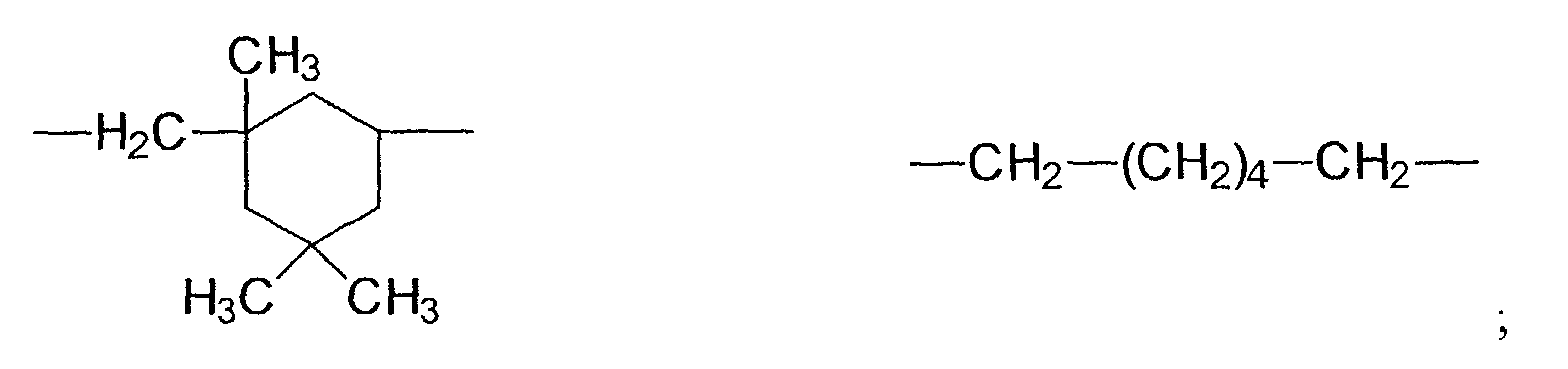
- R1 is represented by one or more of the following structures:


- A is derived from a polyol, such as a) a dihydroxy polyester obtained by esterification of a dicarboxylic acid, such as succinic acid, adipic acid, suberic acid, azelaic acid, sebacic acid, phthalic, isophthalic, terephthalic, tetrahydrophthalic acid, and the like, and a diol, such as ethylene glycol, propylene-1,2-glycol, propylene-1,3-glycol, diethylene glycol, butane-1,4-diol, hexane-1,6-diol, octane-1,8-diol, neopentyl glycol, 2-methyl propane-1,3-diol, or the various isomeric bis-hydroxymethylcyclohexanes; b) a dihydroxy polylactone, such as polymers of ε-caprolactone and one of the above mentioned diols; c) a dihydroxy polycarbonate obtained, for example, by reacting one of the above-mentioned diols with diaryl carbonates or phosgene; or d) a dihydroxy polyether, such as a polymer or copolymer of styrene oxide, propylene oxide, tetrahydrofuran, butylene oxide or epichlorohydrin;
- R2 represents a substituted or unsubstituted alkyl group of from 1 to 12 carbon atoms or a substituted or unsubstituted aryl group of from 6 to 24 carbon atoms;
- R3 represents an alkyl group of from 1 to 12 carbon atoms substituted with phosphonate, carboxylate or sulfonate groups, such as dimethylol propionic acid;
- w is an integer of from 10 to 60 weight %;
- x is an integer of from 20 to 40 weight %;
- y is an integer of from 50 to 80 weight %; and
- z is an integer of from 0 to 10 weight %.
-
- In a preferred embodiment of the invention, the polyurethane has a number average molecular weight of from 5,000 to 100,000, more preferably from 10,000 to 50,000. The water-dispersible polyurethane employed in the invention may be prepared as described in "Polyurethane Handbook", Hanser Publishers, Munich Vienna, 1985.
- As used herein, a porous, image-receiving layer is one which is usually composed of inorganic or organic particles bonded together by a binder. The amount of particles in this type of coating is often far above the critical particle volume concentration, which results in high porosity in the coating. During the ink jet printing process, ink droplets are rapidly absorbed into the coating through capillary action and the image is dry-to-touch right after it comes out of the printer. Therefore, porous coatings allow a fast "drying" of the ink and produce a smear-resistant image.
- In a preferred embodiment of the invention, the porous image-receiving layer comprises from 20% to 100% of particles and from 0% to 80% of a polymeric binder, preferably from 80% to 95% of particles and from 20% to 5% of a polymeric binder, such as poly(vinyl alcohol), poly(vinyl pyrrolidinone), poly(vinyl acetate) or copolymers thereof or gelatin. The porous, image-receiving layer can also contain polymer micro-porous structures without inorganic filler particles as shown in U.S. Patents 5,374,475 and 4,954,395.
- Examples of organic particles which may be used in the image-receiving layer employed in the process of the invention include core/shell particles such as those disclosed in U.S.S.N. 09/609/969 of Kapusniak et al., filed June 30, 2000, and homogeneous particles such as those disclosed in EP 01202331.1. Examples of organic particles which may be used include acrylic resins, styrenic resins, cellulose derivatives, polyvinyl resins, ethylene-allyl copolymers and polycondensation polymers such as polyesters.
- Examples of inorganic particles which may be used in the image-receiving layer employed in the invention include silica, alumina, titanium dioxide, clay, calcium carbonate, barium sulfate, or zinc oxide.
- In general, the image-receiving layer may be present in a dry thickness of 5 to 60 µm, preferably 8 to 45 µm.
- As described above, the porous, image-receiving layer contains a diffusible coagulant. A diffusible coagulant may be defined as an electrolyte that will cause the agglomeration in the dispersion of the particles, such as anionomer particles. For clarification of the nomenclature, see "The Use of Nomenclature in Dispersion Science and Technology" NIST Recommended Practice Guide, Special Publication 960-3 U.S. Department of Commerce, February 2001).
- When the concentration of the agglomerates is sufficient, a spanning network of particles, i.e., a particle gel is formed. For example, the urethane anionomer particles used in the process of the invention form an electrostatically stabilized suspension in water by virtue of negatively charged functionality on the particle surface such as a carboxylate. A coagulant neutralizes or suppresses the negative surface charge on the particles leading to agglomeration.
- In a preferred embodiment of the invention, the electrolyte is a mineral or organic acid or a salt of a monovalent or multivalent cation. Examples of such mineral acids include hydrochloric acid or sulfuric acid. Examples of organic acids that may be used include toluene sulfonic acid or methanesulfonic acid. Salts of monovalent and multivalent cations include sodium chloride, calcium chloride and aluminum chloride. Additional suitable coagulants and methods to generate them in-situ are described in "Novel Powder-Processing Methods for Advanced Ceramics" J. Am Ceram.Soc., 83 [7], 1557-74 (2000).
- After coating a support with the porous, image-receiving layer containing a diffusible coagulant and the layer containing the dispersion of particles which are capable of forming a particle gel with a coagulant, the coagulant diffuses into the image-receiving layer and the layer sets to form a particle gel. The element is then dried for 5 minutes at a temperature of from 20°C to 90°C using conventional drying equipment such as forced air drying.
- A uniform top layer is formed since the coagulant diffuses uniformly up to the top layer from the under layer evenly setting the top layer, which upon drying, forms a layer of uniform thickness.
- The layers described above may be coated by conventional coating means onto a support material commonly used in this art. Suitable coating methods include, but are not limited to, wound wire rod coating, slot coating, slide hopper coating, gravure, curtain coating and the like. Some of these methods allow for simultaneous coatings of both layers, which is preferred from a manufacturing economic perspective.
- If desired in order to improve the adhesion of the image-receiving layer to the support, the surface of the support may be corona discharge-treated prior to applying the image-receiving layer to the support.
- The image-receiving and overcoat layers employed in the invention may contain addenda for enhancing its physical and optical properties such as anti-oxidants, surfactants, light stabilizers, anti-static agents, chemical crosslinking agents, cationic mordants and the like.
- Any support or substrate may be used in the recording element employed in the invention. There may be used, for example, calendered or uncalendered pulp-based paper, cast coated or clay coated papers, and woven fabrics such as cotton, nylon, polyester, rayon, and the like. In a preferred embodiment of the invention, the support is resin-coated paper. The support usually has a thickness of from 12 to 500 µm, preferably from 75 to 300 µm. Antioxidants, antistatic agents, plasticizers and other known additives may be incorporated into the support, if desired.
- Optionally, an additional backing layer or coating may be applied to the backside of a support (i.e., the side of the support opposite the side on which the image-recording layer is coated) for the purposes of improving the machine-handling properties of the recording element, controlling the friction and resistivity thereof, and the like. Typically, the backing layer may comprise a binder and a filler. Typical fillers include amorphous and crystalline silicas, poly(methyl methacrylate), hollow sphere polystyrene beads, micro-crystalline cellulose, zinc oxide, talc, and the like. The filler loaded in the backing layer is generally less than 2 percent by weight of the binder component and the average particle size of the filler material is in the range of 5 to 15 µm, preferably 5 to 10 µm. Typical binders used in the backing layer are polymers such as acrylates, methacrylates, polystyrenes, acrylamides, poly(vinyl chloride)-poly(vinyl acetate) co-polymers, poly(vinyl alcohol), cellulose derivatives, and the like. Additionally, an antistatic agent also can be included in the backing layer to prevent static hindrance of the recording element. Particularly suitable antistatic agents are compounds such as dodecylbenzenesulfonate sodium salt, octylsulfonate potassium salt, oligostyrenesulfonate sodium salt, laurylsulfosuccinate sodium salt, and the like. The antistatic agent may be added to the binder composition in an amount of 0.1 to 15 percent by weight, based on the weight of the binder.
- In the present invention, when the ink is ejected from the nozzle of the ink jet printer in the form of individual droplets, the droplets pass through the porous layer containing particles and into the image-receiving layer where most of the dyes in the ink are retained.
- Ink jet inks used to image the recording elements of the present invention are well-known in the art. The ink compositions used in ink jet printing typically are liquid compositions comprising a solvent or carrier liquid, dyes or pigments, humectants, organic solvents, detergents, thickeners, preservatives, and the like. The solvent or carrier liquid can be solely water or can be water mixed with other water-miscible solvents such as polyhydric alcohols. Inks in which organic materials such as polyhydric alcohols are the predominant carrier or solvent liquid may also be used. Particularly useful are mixed solvents of water and polyhydric alcohols. The dyes used in such compositions are typically water-soluble direct or acid type dyes. Such liquid compositions have been described extensively in the prior art including, for example, U.S. Patents 4,381,946; 4,239,543 and 4,781,758.
- The image-receiving layer used in the recording elements of the present invention can also contain various known additives, such as surfactants such as non-ionic, hydrocarbon or fluorocarbon surfactants or cationic surfactants, such as quaternary ammonium salts for the purpose of improving the aging behavior of the ink-absorbent resin or layer, promoting the absorption and drying of a subsequently applied ink thereto, enhancing the surface uniformity of the ink-receiving layer and adjusting the surface tension of the dried coating; fluorescent dyes; pH controllers; anti-foaming agents; lubricants; preservatives; viscosity modifiers; dye-fixing agents; waterproofing agents; dispersing agents; UV- absorbing agents; mildew-proofing agents; mordants; antistatic agents, anti-oxidants, optical brighteners, and the like. Such additives can be selected from known compounds or materials in accordance with the objects to be achieved.
- The following examples are provided to illustrate the invention.
- In a 2 liter resin flask equipped with thermometer, stirrer, water condenser and a vacuum outlet, 107.5g (0.125 mole) polycarbonate polyol PC1733, Mw = 860, (Stahl Co.) was melted and dewatered under vacuum at 100° C. The vacuum was released and then at 40° C, 10.2g (0.076 mole) dimethylol propionic acid, 100.52g (0.299 mole) bisphenol AF, and 75g methyl ethyl ketone were added. Then 20 drops dibutyltin dilaurate (catalyst) was added while stirring. The temperature was adjusted to 75° C and maintained until a homogeneous reaction mixture was obtained. Slowly, 111.2g (0.50 mole) isophorone diisocyanate was added followed by 10 g methyl ethyl ketone. The temperature was raised to 85° C and maintained until the isocyanate functionality was reduced to substantially nil. While stirring, a stoichiometric amount of potassium hydroxide based on dimethylol propionic acid was added, and maintained for 5 minutes. An amount of water 5 times the amount of methyl ethyl ketone was added with rapid stirring to form a milky white aqueous dispersion. The mean particle size was 6.1 µm as determined using a Horiba LA-920 Particle Size Analyzer.
- In a 2 liter resin flask equipped with thermometer, stirrer, water condenser and a vacuum outlet, 111.8g (0.130 mole) polycarbonate polyol PC1733, was melted and dewatered under vacuum at 100° C. The vacuum was released and then at 40°C, 5.1g (0.038 mole) dimethylol propionic acid, 112.96g (0.336 mole) bisphenol AF and 75g methyl ethyl ketone was added followed by 20 drops dibutyltin dilaurate (catalyst) while stirring. The temperature was adjusted to 80° C and maintained until a homogeneous reaction mixture was obtained. Slowly, 111.2g (0.50 mole) isophorone diisocyanate was added followed by 20 g methyl ethyl ketone. The temperature was adjusted to 85° C and maintained until the isocyanate functionality was reduced to substantially nil. A stoichiometric amount of potassium hydroxide based on dimethylol propionic acid was added and maintained for 5 minutes. An amount of water 5 times the amount of methyl ethyl ketone under was added under high shear to form a stable aqueous dispersion. The mean particle size was 26 microns.
- In a 2 liter resin flask equipped with thermometer, stirrer, water condenser and a vacuum outlet, 107.5g (0.125 mole) polycarbonate polyol PC1733, was melted and dewatered under vacuum at 100° C. The vacuum was then released and at 40° C, 126.08g (0.375 mole) bisphenol AF and 100g ethyl acetate was added followed by 20 drops dibutyltin dilaurate (catalyst) while stirring. The temperature was adjusted to 75° C and maintained until a homogeneous reaction mixture was obtained. Slowly, 111.2g (0.50 mole) isophorone diisocyanate was added followed by 10g ethyl acetate. The temperature was maintained at 75° C until the isocyanate functionality was reduced to substantially nil.
- Then, to 16.3g of the above polyurethane at 58% solids in ethyl acetate was added an additional 11.4g of ethyl acetate and 0.5g of 15% Aerosol OT® in ethyl acetate. This solution was added slowly to 200ml of distilled water in a Silverson mixer at 5,000 rev/min and emulsified for 2 minutes and then passed once through a Microfluidizer (Microfluidics Manufacturing model 110T) to further reduce the emulsion droplet size. The emulsion was stirred overnight under a nitrogen sweep to evaporate the ethyl acetate. There was obtained an 8.6% solids dispersion of urethane particles. The mean particle size was 3.5 µm. The particles were allowed to settle and sufficient water decanted to produce a 28% solids dispersion.
- The fluidity of 10g samples of the above particle dispersions adjusted to 25% solids and 45% solids was determined before and after acidification with 1N HCl. The results are shown in Table 1 below where LV denotes a low viscosity particle dispersion that settles over minutes, HV a high viscosity dispersion that settles over hours, and Gel a particle dispersion that does not settle. The following results were obtained:
Particles pH = 8.0 pH = 5.0 25% 45% 25% 45% P1 LV LV Gel Gel P2 LV LV HV Gel CP (Control) LV LV LV LV - The above results show that urethane anionomer particles employed in the process of the invention will gel or build significant viscosity when acidified and that [H+] is a suitable coagulant.
- An element having a porous particle layer with a diffusible coagulant was prepared by coating on a resin-coated paper support a first 38 µm underlayer of 87% fumed alumina, 9% poly(vinyl alcohol), and 4% dihydroxydioxane crosslinking agent. On this layer was coated a second 2µm layer of 87% fumed alumina, an 8% 100nm colloidal latex dispersion of divinylbenzene-co-N-vinylbenzyl-N,N,N-trimethylammonium chloride, 6% poly(vinyl alcohol), and 1% Zonyl ®FSN surfactant (DuPont Corp.). The level of diffusible coagulant was determined to be 2.7 meq [H+]/m2 determined by rinsing the layer with water and titrating the extract potentiometrically. A surface pH = 3.3 was measured with a flat bottom pH electrode after placing several drops of water on the surface of the layer.
- A sample of Element 1 was washed with 100cc of 1% sodium bicarbonate solution and allowed to dry. A surface pH = 8.0 was found.
- A 14% solids dispersion of particles P1 in water was prepared by dilution with deionized water.
- A 14% solids dispersion of control particles CP in water was prepared by dilution.
- The above particle dispersions were hopper-coated on Element 1 and Control Element 1 at a laydown of 65ml/m2 at a coating speed of 1 cm/s and allowed to air dry. The coated layers were then fused with a belt fuser at 150° C and cross-sectioned at the center and edges of the coating with the results reported in Table 2 below. The "set time" was recorded as the time the coated layer was no longer fluid, with shorter set times preferred. The "drying" profile records the directional nature of the observed drying with uniform drying preferred. The %Δ records the percent difference in thickness between the height of the fused layer in the center vs. the edge of the coating, with no difference preferred. The following results were obtained:
Particles Results Layers L1 Control Layer P1 Set time <1 min >10 min Drying Uniform Edge in % Δ 0 50 CP Set time > 10 min > 10 min Drying Edge in Edge in % Δ - The above results show that urethane anionomer particles, P1, when coated on a layer with a diffusible coagulant, L1, rapidly set and dried evenly to give a uniform protective layer on fusing, whereas the control coatings dried slowly and non-uniformly leading to an uneven protection layer upon fusing.
Claims (10)
- A method for making a porous ink jet recording element having a uniform, protective layer comprising coating on a support the following layers in order:a) a porous, image-receiving layer containing a diffusible coagulant; andb) a layer containing a dispersion of particles which are capable of forming a particle gel with a coagulant;c) said diffusible coagulant thereby diffusing into said layer containing said dispersion of particles, causing said layer to set to a particle gel; andd) drying said element to obtain a uniform, protective layer on top of said porous, image-receiving layer.
- The process of Claim 1 wherein said particles comprise anionomer particles.
- The process of Claim 1 wherein said uniform, protective layer is fusible.
- The process of Claim 2 wherein said dispersion of anionomer particles is a dispersion of urethane anionomer particles.
- The process of Claim 4 wherein said urethane anionomer particles have the formula:wherein:
 R1 is represented by one or more of the following structures:
 A is derived from a polyol;R2 represents a substituted or unsubstituted alkyl group of from 1 to 12 carbon atoms or a substituted or unsubstituted aryl group of from 6 to 24 carbon atoms;R3 represents an alkyl group of from 1 to 12 carbon atoms substituted with phosphonate, carboxylate or sulfonate groups;w is an integer of from 10 to 60 weight %;x is an integer of from 20 to 40 weight %;y is an integer of from 50 to 80 weight %; andz is an integer of from 0 to 10 weight %.
 - The process of Claim 4 wherein said urethane anionomer particles have a negatively-charged functionality on their surfaces.
- The process of Claim 5 wherein said negatively-charged functionality is carboxylate, sulfonate or phosphonate.
- The process of Claim 1 wherein said diffusible coagulant is an electrolyte that will cause the agglomeration of said dispersion of particles.
- The process of Claim 8 wherein said electrolyte is a mineral or organic acid or a salt of a monovalent or multivalent cation.
- The process of Claim 9 wherein said mineral acid is hydrochloric acid or sulfuric acid.
Applications Claiming Priority (2)
| Application Number | Priority Date | Filing Date | Title |
|---|---|---|---|
| US896696 | 2001-06-29 | ||
| US09/896,696 US6399156B1 (en) | 2001-06-29 | 2001-06-29 | Method for preparing an ink jet recording element |
Publications (3)
| Publication Number | Publication Date |
|---|---|
| EP1270252A2 true EP1270252A2 (en) | 2003-01-02 |
| EP1270252A3 EP1270252A3 (en) | 2003-11-05 |
| EP1270252B1 EP1270252B1 (en) | 2006-04-12 |
Family
ID=25406657
Family Applications (1)
| Application Number | Title | Priority Date | Filing Date |
|---|---|---|---|
| EP20020077361 Expired - Lifetime EP1270252B1 (en) | 2001-06-29 | 2002-06-17 | Method for preparing an ink jet recording element |
Country Status (4)
| Country | Link |
|---|---|
| US (1) | US6399156B1 (en) |
| EP (1) | EP1270252B1 (en) |
| JP (2) | JP2003034075A (en) |
| DE (1) | DE60210540T2 (en) |
Families Citing this family (4)
| Publication number | Priority date | Publication date | Assignee | Title |
|---|---|---|---|---|
| US6679979B2 (en) * | 2001-12-12 | 2004-01-20 | Ballard Power Systems Inc. | Aqueous ionomeric gels and products and methods related thereto |
| US6861114B2 (en) * | 2002-11-07 | 2005-03-01 | Eastman Kodak Company | Ink jet recording element |
| US6869178B2 (en) | 2002-11-07 | 2005-03-22 | Eastman Kodak Company | Ink jet printing method |
| US6945647B2 (en) * | 2002-12-20 | 2005-09-20 | Eastman Kodak Company | Method for increasing the diameter of an ink jet ink dot |
Citations (8)
| Publication number | Priority date | Publication date | Assignee | Title |
|---|---|---|---|---|
| US4239543A (en) | 1979-02-09 | 1980-12-16 | Gould Inc. | Non-crusting jet ink and method of making same |
| US4381946A (en) | 1980-02-25 | 1983-05-03 | Konishiroku Photo Industry Co., Ltd. | Ink composition for ink-jet recording |
| US4781758A (en) | 1987-10-22 | 1988-11-01 | International Business Machines Corporation | Ink composition for drop-on-demand ink jet |
| US4954395A (en) | 1987-04-10 | 1990-09-04 | Canon Kabushiki Kaisha | Recording medium |
| US5374475A (en) | 1992-06-20 | 1994-12-20 | Celfa Ag | Record carrier for the receipt of coloring materials |
| EP0858905A1 (en) | 1997-02-18 | 1998-08-19 | Canon Kabushiki Kaisha | Recording medium, ink-jet recording therewith, and process for production thereof |
| US5925712A (en) | 1996-08-16 | 1999-07-20 | Kimberly-Clark Worldwide, Inc. | Fusible printable coating for durable images |
| EP1167056A1 (en) | 2000-06-30 | 2002-01-02 | Eastman Kodak Company | Ink-jet recording element containing porous particles |
Family Cites Families (8)
| Publication number | Priority date | Publication date | Assignee | Title |
|---|---|---|---|---|
| JPS635572A (en) * | 1986-06-25 | 1988-01-11 | Nec Corp | Manufacture of junction type fieldeffect transistor |
| JP2930287B2 (en) * | 1994-11-08 | 1999-08-03 | 日本製紙株式会社 | Recording paper and its manufacturing method |
| JPH08230311A (en) * | 1995-02-27 | 1996-09-10 | Canon Inc | Recording medium and image forming method |
| US5605750A (en) * | 1995-12-29 | 1997-02-25 | Eastman Kodak Company | Microporous ink-jet recording elements |
| JP3831527B2 (en) * | 1998-02-23 | 2006-10-11 | 三菱製紙株式会社 | Inkjet recording sheet |
| US6190843B1 (en) * | 2000-04-11 | 2001-02-20 | Eastman Kodak Company | Hydrolyzed water-resistant protective overcoat for an imaging element |
| US6268101B1 (en) * | 2000-04-13 | 2001-07-31 | Eastman Kodak Company | Water-resistant polyurethane overcoat for imaging materials |
| US6312858B1 (en) * | 2000-12-22 | 2001-11-06 | Eastman Kodak Company | Protective polycarbonate-polyurethane overcoat for image recording elements |
-
2001
- 2001-06-29 US US09/896,696 patent/US6399156B1/en not_active Expired - Fee Related
-
2002
- 2002-06-17 DE DE2002610540 patent/DE60210540T2/en not_active Expired - Lifetime
- 2002-06-17 EP EP20020077361 patent/EP1270252B1/en not_active Expired - Lifetime
- 2002-07-01 JP JP2002192338A patent/JP2003034075A/en not_active Withdrawn
-
2008
- 2008-07-23 JP JP2008190145A patent/JP4643688B2/en not_active Expired - Fee Related
Patent Citations (8)
| Publication number | Priority date | Publication date | Assignee | Title |
|---|---|---|---|---|
| US4239543A (en) | 1979-02-09 | 1980-12-16 | Gould Inc. | Non-crusting jet ink and method of making same |
| US4381946A (en) | 1980-02-25 | 1983-05-03 | Konishiroku Photo Industry Co., Ltd. | Ink composition for ink-jet recording |
| US4954395A (en) | 1987-04-10 | 1990-09-04 | Canon Kabushiki Kaisha | Recording medium |
| US4781758A (en) | 1987-10-22 | 1988-11-01 | International Business Machines Corporation | Ink composition for drop-on-demand ink jet |
| US5374475A (en) | 1992-06-20 | 1994-12-20 | Celfa Ag | Record carrier for the receipt of coloring materials |
| US5925712A (en) | 1996-08-16 | 1999-07-20 | Kimberly-Clark Worldwide, Inc. | Fusible printable coating for durable images |
| EP0858905A1 (en) | 1997-02-18 | 1998-08-19 | Canon Kabushiki Kaisha | Recording medium, ink-jet recording therewith, and process for production thereof |
| EP1167056A1 (en) | 2000-06-30 | 2002-01-02 | Eastman Kodak Company | Ink-jet recording element containing porous particles |
Also Published As
| Publication number | Publication date |
|---|---|
| JP4643688B2 (en) | 2011-03-02 |
| DE60210540T2 (en) | 2007-03-01 |
| JP2008296590A (en) | 2008-12-11 |
| DE60210540D1 (en) | 2006-05-24 |
| US6399156B1 (en) | 2002-06-04 |
| EP1270252A3 (en) | 2003-11-05 |
| EP1270252B1 (en) | 2006-04-12 |
| JP2003034075A (en) | 2003-02-04 |
Similar Documents
| Publication | Publication Date | Title |
|---|---|---|
| DE69731490T2 (en) | COATINGS, MICROPOROUS, INK ROLLING MEDIA AND METHOD OF CHECKING THE POINT DIAM | |
| US6497480B1 (en) | Ink jet printing method | |
| EP0983866B1 (en) | Melt-fusible ink-jet recording elements and inks | |
| DE60014597T2 (en) | PICTURE RECEIVING MATERIAL WITH HEATED MELTING LAYER, METHOD FOR THE PRODUCTION AND USE THEREOF | |
| US6677008B2 (en) | Ink jet recording element | |
| US6475603B1 (en) | Ink jet recording element | |
| EP1184195B1 (en) | Ink jet printing method | |
| EP0728593B1 (en) | Hot melt ink thermal transfer recording sheet | |
| EP1002659A2 (en) | Method for preparing an ink jet recording element | |
| JP4643688B2 (en) | Method for preparing an ink jet recording element | |
| US6723397B2 (en) | Ink jet recording element | |
| US6866384B2 (en) | Ink jet printing method | |
| US6800342B2 (en) | Ink recording element containing a laminate adhesion promoting inner layer | |
| DE60220239T2 (en) | Ink jet recording element and printing method | |
| EP1293356B1 (en) | Ink jet recording element and printing method | |
| EP1567361B1 (en) | Ink-jet recording medium | |
| US7264856B2 (en) | Fusible inkjet recording element and printing method | |
| DE60211631T2 (en) | Ink jet recording medium and printing method | |
| JPH11198555A (en) | Melt transfer type ink receiving sheet and method of manufacturing the same | |
| JP2001322347A (en) | Inkjet printing method | |
| JP3990238B2 (en) | Inkjet recording element and printing method | |
| JP2003191634A (en) | Inkjet recording element and inkjet printing method | |
| JP3407250B2 (en) | Recording medium | |
| JP4005554B2 (en) | Method for producing inkjet recording sheet | |
| JP4154321B2 (en) | Method for producing inkjet recording sheet |
Legal Events
| Date | Code | Title | Description |
|---|---|---|---|
| PUAI | Public reference made under article 153(3) epc to a published international application that has entered the european phase |
Free format text: ORIGINAL CODE: 0009012 |
|
| AK | Designated contracting states |
Kind code of ref document: A2 Designated state(s): AT BE CH CY DE DK ES FI FR GB GR IE IT LI LU MC NL PT SE TR |
|
| AX | Request for extension of the european patent |
Free format text: AL;LT;LV;MK;RO;SI |
|
| PUAL | Search report despatched |
Free format text: ORIGINAL CODE: 0009013 |
|
| AK | Designated contracting states |
Kind code of ref document: A3 Designated state(s): AT BE CH CY DE DK ES FI FR GB GR IE IT LI LU MC NL PT SE TR |
|
| AX | Request for extension of the european patent |
Extension state: AL LT LV MK RO SI |
|
| 17P | Request for examination filed |
Effective date: 20040405 |
|
| AKX | Designation fees paid |
Designated state(s): DE FR GB |
|
| 17Q | First examination report despatched |
Effective date: 20041221 |
|
| GRAP | Despatch of communication of intention to grant a patent |
Free format text: ORIGINAL CODE: EPIDOSNIGR1 |
|
| GRAS | Grant fee paid |
Free format text: ORIGINAL CODE: EPIDOSNIGR3 |
|
| GRAA | (expected) grant |
Free format text: ORIGINAL CODE: 0009210 |
|
| AK | Designated contracting states |
Kind code of ref document: B1 Designated state(s): DE FR GB |
|
| REG | Reference to a national code |
Ref country code: GB Ref legal event code: FG4D |
|
| REF | Corresponds to: |
Ref document number: 60210540 Country of ref document: DE Date of ref document: 20060524 Kind code of ref document: P |
|
| ET | Fr: translation filed | ||
| PLBE | No opposition filed within time limit |
Free format text: ORIGINAL CODE: 0009261 |
|
| STAA | Information on the status of an ep patent application or granted ep patent |
Free format text: STATUS: NO OPPOSITION FILED WITHIN TIME LIMIT |
|
| 26N | No opposition filed |
Effective date: 20070115 |
|
| PGFP | Annual fee paid to national office [announced via postgrant information from national office to epo] |
Ref country code: FR Payment date: 20120614 Year of fee payment: 11 Ref country code: GB Payment date: 20120525 Year of fee payment: 11 |
|
| PGFP | Annual fee paid to national office [announced via postgrant information from national office to epo] |
Ref country code: DE Payment date: 20120629 Year of fee payment: 11 |
|
| GBPC | Gb: european patent ceased through non-payment of renewal fee |
Effective date: 20130617 |
|
| REG | Reference to a national code |
Ref country code: FR Ref legal event code: ST Effective date: 20140228 |
|
| REG | Reference to a national code |
Ref country code: DE Ref legal event code: R119 Ref document number: 60210540 Country of ref document: DE Effective date: 20140101 |
|
| PG25 | Lapsed in a contracting state [announced via postgrant information from national office to epo] |
Ref country code: DE Free format text: LAPSE BECAUSE OF NON-PAYMENT OF DUE FEES Effective date: 20140101 Ref country code: GB Free format text: LAPSE BECAUSE OF NON-PAYMENT OF DUE FEES Effective date: 20130617 |
|
| PG25 | Lapsed in a contracting state [announced via postgrant information from national office to epo] |
Ref country code: FR Free format text: LAPSE BECAUSE OF NON-PAYMENT OF DUE FEES Effective date: 20130701 |