EP1268488B1 - A process for preparing cephalosporin derivatives using new thiazole compound - Google Patents
A process for preparing cephalosporin derivatives using new thiazole compound Download PDFInfo
- Publication number
- EP1268488B1 EP1268488B1 EP01912531A EP01912531A EP1268488B1 EP 1268488 B1 EP1268488 B1 EP 1268488B1 EP 01912531 A EP01912531 A EP 01912531A EP 01912531 A EP01912531 A EP 01912531A EP 1268488 B1 EP1268488 B1 EP 1268488B1
- Authority
- EP
- European Patent Office
- Prior art keywords
- acid
- group
- formula
- solvent
- compound
- Prior art date
- Legal status (The legal status is an assumption and is not a legal conclusion. Google has not performed a legal analysis and makes no representation as to the accuracy of the status listed.)
- Expired - Lifetime
Links
- -1 thiazole compound Chemical class 0.000 title claims abstract description 29
- 229940124587 cephalosporin Drugs 0.000 title claims abstract description 16
- 229930186147 Cephalosporin Natural products 0.000 title claims abstract description 15
- 150000001780 cephalosporins Chemical class 0.000 title claims abstract description 13
- 238000004519 manufacturing process Methods 0.000 title abstract description 8
- 238000000034 method Methods 0.000 claims abstract description 35
- VEXZGXHMUGYJMC-UHFFFAOYSA-N Hydrochloric acid Chemical compound Cl VEXZGXHMUGYJMC-UHFFFAOYSA-N 0.000 claims abstract description 17
- 239000002253 acid Substances 0.000 claims abstract description 14
- QTBSBXVTEAMEQO-UHFFFAOYSA-N Acetic acid Chemical compound CC(O)=O QTBSBXVTEAMEQO-UHFFFAOYSA-N 0.000 claims abstract description 12
- 150000007524 organic acids Chemical class 0.000 claims abstract description 12
- 229950003476 aminothiazole Drugs 0.000 claims abstract description 9
- 239000003242 anti bacterial agent Substances 0.000 claims abstract description 8
- 229940088710 antibiotic agent Drugs 0.000 claims abstract description 8
- BDAGIHXWWSANSR-UHFFFAOYSA-N methanoic acid Natural products OC=O BDAGIHXWWSANSR-UHFFFAOYSA-N 0.000 claims abstract description 8
- 150000003839 salts Chemical class 0.000 claims abstract description 8
- HSHGZXNAXBPPDL-HZGVNTEJSA-N 7beta-aminocephalosporanic acid Chemical class S1CC(COC(=O)C)=C(C([O-])=O)N2C(=O)[C@@H]([NH3+])[C@@H]12 HSHGZXNAXBPPDL-HZGVNTEJSA-N 0.000 claims abstract description 6
- 125000000391 vinyl group Chemical group [H]C([*])=C([H])[H] 0.000 claims abstract description 5
- 229920002554 vinyl polymer Polymers 0.000 claims abstract description 5
- OSWFIVFLDKOXQC-UHFFFAOYSA-N 4-(3-methoxyphenyl)aniline Chemical compound COC1=CC=CC(C=2C=CC(N)=CC=2)=C1 OSWFIVFLDKOXQC-UHFFFAOYSA-N 0.000 claims abstract description 4
- WKBOTKDWSSQWDR-UHFFFAOYSA-N Bromine atom Chemical group [Br] WKBOTKDWSSQWDR-UHFFFAOYSA-N 0.000 claims abstract description 4
- GDTBXPJZTBHREO-UHFFFAOYSA-N bromine Chemical group BrBr GDTBXPJZTBHREO-UHFFFAOYSA-N 0.000 claims abstract description 4
- 229910052794 bromium Chemical group 0.000 claims abstract description 4
- 239000000460 chlorine Substances 0.000 claims abstract description 4
- 229910052801 chlorine Inorganic materials 0.000 claims abstract description 4
- 125000001309 chloro group Chemical group Cl* 0.000 claims abstract description 4
- 235000019253 formic acid Nutrition 0.000 claims abstract description 4
- 150000007522 mineralic acids Chemical class 0.000 claims abstract description 4
- 238000005917 acylation reaction Methods 0.000 claims description 23
- YMWUJEATGCHHMB-UHFFFAOYSA-N Dichloromethane Chemical group ClCCl YMWUJEATGCHHMB-UHFFFAOYSA-N 0.000 claims description 15
- 238000002360 preparation method Methods 0.000 claims description 11
- 239000002904 solvent Substances 0.000 claims description 11
- CSCPPACGZOOCGX-UHFFFAOYSA-N Acetone Chemical compound CC(C)=O CSCPPACGZOOCGX-UHFFFAOYSA-N 0.000 claims description 9
- WEVYAHXRMPXWCK-UHFFFAOYSA-N Acetonitrile Chemical compound CC#N WEVYAHXRMPXWCK-UHFFFAOYSA-N 0.000 claims description 9
- 239000007864 aqueous solution Substances 0.000 claims description 8
- 239000000243 solution Substances 0.000 claims description 8
- UIIMBOGNXHQVGW-UHFFFAOYSA-M Sodium bicarbonate Chemical compound [Na+].OC([O-])=O UIIMBOGNXHQVGW-UHFFFAOYSA-M 0.000 claims description 7
- 238000006243 chemical reaction Methods 0.000 claims description 7
- AFVFQIVMOAPDHO-UHFFFAOYSA-N Methanesulfonic acid Chemical compound CS(O)(=O)=O AFVFQIVMOAPDHO-UHFFFAOYSA-N 0.000 claims description 6
- OKKJLVBELUTLKV-UHFFFAOYSA-N Methanol Chemical compound OC OKKJLVBELUTLKV-UHFFFAOYSA-N 0.000 claims description 6
- ZMXDDKWLCZADIW-UHFFFAOYSA-N N,N-Dimethylformamide Chemical compound CN(C)C=O ZMXDDKWLCZADIW-UHFFFAOYSA-N 0.000 claims description 6
- HEMHJVSKTPXQMS-UHFFFAOYSA-M Sodium hydroxide Chemical compound [OH-].[Na+] HEMHJVSKTPXQMS-UHFFFAOYSA-M 0.000 claims description 6
- QAOWNCQODCNURD-UHFFFAOYSA-N Sulfuric acid Chemical compound OS(O)(=O)=O QAOWNCQODCNURD-UHFFFAOYSA-N 0.000 claims description 6
- DTQVDTLACAAQTR-UHFFFAOYSA-N Trifluoroacetic acid Chemical compound OC(=O)C(F)(F)F DTQVDTLACAAQTR-UHFFFAOYSA-N 0.000 claims description 6
- 125000004432 carbon atom Chemical group C* 0.000 claims description 6
- XBDQKXXYIPTUBI-UHFFFAOYSA-N dimethylselenoniopropionate Natural products CCC(O)=O XBDQKXXYIPTUBI-UHFFFAOYSA-N 0.000 claims description 6
- VLTRZXGMWDSKGL-UHFFFAOYSA-N perchloric acid Chemical compound OCl(=O)(=O)=O VLTRZXGMWDSKGL-UHFFFAOYSA-N 0.000 claims description 6
- LFQSCWFLJHTTHZ-UHFFFAOYSA-N Ethanol Chemical compound CCO LFQSCWFLJHTTHZ-UHFFFAOYSA-N 0.000 claims description 5
- JUJWROOIHBZHMG-UHFFFAOYSA-N Pyridine Chemical compound C1=CC=NC=C1 JUJWROOIHBZHMG-UHFFFAOYSA-N 0.000 claims description 5
- HEDRZPFGACZZDS-UHFFFAOYSA-N Chloroform Chemical compound ClC(Cl)Cl HEDRZPFGACZZDS-UHFFFAOYSA-N 0.000 claims description 4
- JGFZNNIVVJXRND-UHFFFAOYSA-N N,N-Diisopropylethylamine (DIPEA) Chemical compound CCN(C(C)C)C(C)C JGFZNNIVVJXRND-UHFFFAOYSA-N 0.000 claims description 4
- CDBYLPFSWZWCQE-UHFFFAOYSA-L Sodium Carbonate Chemical compound [Na+].[Na+].[O-]C([O-])=O CDBYLPFSWZWCQE-UHFFFAOYSA-L 0.000 claims description 4
- WYURNTSHIVDZCO-UHFFFAOYSA-N Tetrahydrofuran Chemical compound C1CCOC1 WYURNTSHIVDZCO-UHFFFAOYSA-N 0.000 claims description 4
- IJOOHPMOJXWVHK-UHFFFAOYSA-N chlorotrimethylsilane Chemical compound C[Si](C)(C)Cl IJOOHPMOJXWVHK-UHFFFAOYSA-N 0.000 claims description 4
- LULXBAGMGMJJRW-UHFFFAOYSA-N n,2-bis(trimethylsilyl)acetamide Chemical compound C[Si](C)(C)CC(=O)N[Si](C)(C)C LULXBAGMGMJJRW-UHFFFAOYSA-N 0.000 claims description 4
- 239000003960 organic solvent Substances 0.000 claims description 4
- 229910000030 sodium bicarbonate Inorganic materials 0.000 claims description 4
- XLYOFNOQVPJJNP-UHFFFAOYSA-N water Substances O XLYOFNOQVPJJNP-UHFFFAOYSA-N 0.000 claims description 4
- BMYNFMYTOJXKLE-UHFFFAOYSA-N 3-azaniumyl-2-hydroxypropanoate Chemical compound NCC(O)C(O)=O BMYNFMYTOJXKLE-UHFFFAOYSA-N 0.000 claims description 3
- 125000000217 alkyl group Chemical group 0.000 claims description 3
- SRSXLGNVWSONIS-UHFFFAOYSA-N benzenesulfonic acid Chemical compound OS(=O)(=O)C1=CC=CC=C1 SRSXLGNVWSONIS-UHFFFAOYSA-N 0.000 claims description 3
- 229940092714 benzenesulfonic acid Drugs 0.000 claims description 3
- 125000000753 cycloalkyl group Chemical group 0.000 claims description 3
- 229940098779 methanesulfonic acid Drugs 0.000 claims description 3
- 150000007530 organic bases Chemical class 0.000 claims description 3
- 235000019260 propionic acid Nutrition 0.000 claims description 3
- 229940095574 propionic acid Drugs 0.000 claims description 3
- IUVKMZGDUIUOCP-BTNSXGMBSA-N quinbolone Chemical compound O([C@H]1CC[C@H]2[C@H]3[C@@H]([C@]4(C=CC(=O)C=C4CC3)C)CC[C@@]21C)C1=CCCC1 IUVKMZGDUIUOCP-BTNSXGMBSA-N 0.000 claims description 3
- 235000017557 sodium bicarbonate Nutrition 0.000 claims description 3
- SCYULBFZEHDVBN-UHFFFAOYSA-N 1,1-Dichloroethane Chemical compound CC(Cl)Cl SCYULBFZEHDVBN-UHFFFAOYSA-N 0.000 claims description 2
- XBPCUCUWBYBCDP-UHFFFAOYSA-N Dicyclohexylamine Chemical compound C1CCCCC1NC1CCCCC1 XBPCUCUWBYBCDP-UHFFFAOYSA-N 0.000 claims description 2
- 239000002671 adjuvant Substances 0.000 claims description 2
- 150000007529 inorganic bases Chemical class 0.000 claims description 2
- 239000011259 mixed solution Substances 0.000 claims description 2
- 239000011736 potassium bicarbonate Substances 0.000 claims description 2
- 229910000028 potassium bicarbonate Inorganic materials 0.000 claims description 2
- 235000015497 potassium bicarbonate Nutrition 0.000 claims description 2
- TYJJADVDDVDEDZ-UHFFFAOYSA-M potassium hydrogencarbonate Chemical compound [K+].OC([O-])=O TYJJADVDDVDEDZ-UHFFFAOYSA-M 0.000 claims description 2
- 229940086066 potassium hydrogencarbonate Drugs 0.000 claims description 2
- UMJSCPRVCHMLSP-UHFFFAOYSA-N pyridine Natural products COC1=CC=CN=C1 UMJSCPRVCHMLSP-UHFFFAOYSA-N 0.000 claims description 2
- 229910000029 sodium carbonate Inorganic materials 0.000 claims description 2
- 235000017550 sodium carbonate Nutrition 0.000 claims description 2
- 235000011121 sodium hydroxide Nutrition 0.000 claims description 2
- YLQBMQCUIZJEEH-UHFFFAOYSA-N tetrahydrofuran Natural products C=1C=COC=1 YLQBMQCUIZJEEH-UHFFFAOYSA-N 0.000 claims description 2
- IMFACGCPASFAPR-UHFFFAOYSA-N tributylamine Chemical compound CCCCN(CCCC)CCCC IMFACGCPASFAPR-UHFFFAOYSA-N 0.000 claims description 2
- 239000005051 trimethylchlorosilane Substances 0.000 claims description 2
- CSRZQMIRAZTJOY-UHFFFAOYSA-N trimethylsilyl iodide Chemical compound C[Si](C)(C)I CSRZQMIRAZTJOY-UHFFFAOYSA-N 0.000 claims description 2
- ZMANZCXQSJIPKH-UHFFFAOYSA-N Triethylamine Chemical compound CCN(CC)CC ZMANZCXQSJIPKH-UHFFFAOYSA-N 0.000 claims 3
- GWVAZBQKSXXJFH-ACAGNQJTSA-N 2-[(z)-[1-(2-amino-1,3-thiazol-4-yl)-2-chloro-2-oxoethylidene]amino]oxy-2-methylpropanoic acid Chemical compound OC(=O)C(C)(C)O\N=C(/C(Cl)=O)C1=CSC(N)=N1 GWVAZBQKSXXJFH-ACAGNQJTSA-N 0.000 claims 1
- 125000002496 methyl group Chemical group [H]C([H])([H])* 0.000 claims 1
- AJFDBNQQDYLMJN-UHFFFAOYSA-N n,n-diethylacetamide Chemical compound CCN(CC)C(C)=O AJFDBNQQDYLMJN-UHFFFAOYSA-N 0.000 claims 1
- 229960002129 cefixime Drugs 0.000 abstract description 5
- 229960000484 ceftazidime Drugs 0.000 abstract description 4
- 125000004178 (C1-C4) alkyl group Chemical group 0.000 abstract 1
- 125000006555 (C3-C5) cycloalkyl group Chemical group 0.000 abstract 1
- OKBVVJOGVLARMR-QSWIMTSFSA-N cefixime Chemical compound S1C(N)=NC(C(=N\OCC(O)=O)\C(=O)N[C@@H]2C(N3C(=C(C=C)CS[C@@H]32)C(O)=O)=O)=C1 OKBVVJOGVLARMR-QSWIMTSFSA-N 0.000 abstract 1
- NMVPEQXCMGEDNH-TZVUEUGBSA-N ceftazidime pentahydrate Chemical compound O.O.O.O.O.S([C@@H]1[C@@H](C(N1C=1C([O-])=O)=O)NC(=O)\C(=N/OC(C)(C)C(O)=O)C=2N=C(N)SC=2)CC=1C[N+]1=CC=CC=C1 NMVPEQXCMGEDNH-TZVUEUGBSA-N 0.000 abstract 1
- 150000001875 compounds Chemical class 0.000 description 21
- NGNBDVOYPDDBFK-UHFFFAOYSA-N 2-[2,4-di(pentan-2-yl)phenoxy]acetyl chloride Chemical compound CCCC(C)C1=CC=C(OCC(Cl)=O)C(C(C)CCC)=C1 NGNBDVOYPDDBFK-UHFFFAOYSA-N 0.000 description 12
- 125000003277 amino group Chemical group 0.000 description 7
- 125000006239 protecting group Chemical group 0.000 description 7
- 125000003178 carboxy group Chemical group [H]OC(*)=O 0.000 description 6
- FZWLAAWBMGSTSO-UHFFFAOYSA-N Thiazole Chemical group C1=CSC=N1 FZWLAAWBMGSTSO-UHFFFAOYSA-N 0.000 description 5
- 230000010933 acylation Effects 0.000 description 5
- 238000007792 addition Methods 0.000 description 5
- IPYWNMVPZOAFOQ-NABDTECSSA-N (6r,7r)-7-[[(2z)-2-(2-amino-1,3-thiazol-4-yl)-2-(carboxymethoxyimino)acetyl]amino]-3-ethenyl-8-oxo-5-thia-1-azabicyclo[4.2.0]oct-2-ene-2-carboxylic acid;trihydrate Chemical compound O.O.O.S1C(N)=NC(C(=N\OCC(O)=O)\C(=O)N[C@@H]2C(N3C(=C(C=C)CS[C@@H]32)C(O)=O)=O)=C1 IPYWNMVPZOAFOQ-NABDTECSSA-N 0.000 description 4
- 239000006227 byproduct Substances 0.000 description 4
- 239000013078 crystal Substances 0.000 description 4
- 238000010511 deprotection reaction Methods 0.000 description 4
- 150000002148 esters Chemical class 0.000 description 4
- 0 *C(*)(**=C(C([C@@](CC(C1[C@@]2C(*)=C(*)C*1)C2=O)I*)=O)C(N=C)=C*C*N)C(O)=O Chemical compound *C(*)(**=C(C([C@@](CC(C1[C@@]2C(*)=C(*)C*1)C2=O)I*)=O)C(N=C)=C*C*N)C(O)=O 0.000 description 3
- RAIPHJJURHTUIC-UHFFFAOYSA-N 1,3-thiazol-2-amine Chemical class NC1=NC=CS1 RAIPHJJURHTUIC-UHFFFAOYSA-N 0.000 description 3
- RTZKZFJDLAIYFH-UHFFFAOYSA-N Diethyl ether Chemical compound CCOCC RTZKZFJDLAIYFH-UHFFFAOYSA-N 0.000 description 3
- KFZMGEQAYNKOFK-UHFFFAOYSA-N Isopropanol Chemical compound CC(C)O KFZMGEQAYNKOFK-UHFFFAOYSA-N 0.000 description 3
- 239000012346 acetyl chloride Substances 0.000 description 3
- ORFOPKXBNMVMKC-DWVKKRMSSA-N ceftazidime Chemical compound S([C@@H]1[C@@H](C(N1C=1C([O-])=O)=O)NC(=O)\C(=N/OC(C)(C)C(O)=O)C=2N=C(N)SC=2)CC=1C[N+]1=CC=CC=C1 ORFOPKXBNMVMKC-DWVKKRMSSA-N 0.000 description 3
- JUJWROOIHBZHMG-UHFFFAOYSA-O pyridinium Chemical group C1=CC=[NH+]C=C1 JUJWROOIHBZHMG-UHFFFAOYSA-O 0.000 description 3
- HOKIDJSKDBPKTQ-UHFFFAOYSA-N 3-(acetyloxymethyl)-7-[(5-amino-5-carboxypentanoyl)amino]-8-oxo-5-thia-1-azabicyclo[4.2.0]oct-2-ene-2-carboxylic acid Chemical class S1CC(COC(=O)C)=C(C(O)=O)N2C(=O)C(NC(=O)CCCC(N)C(O)=O)C12 HOKIDJSKDBPKTQ-UHFFFAOYSA-N 0.000 description 2
- IAZDPXIOMUYVGZ-WFGJKAKNSA-N Dimethyl sulfoxide Chemical compound [2H]C([2H])([2H])S(=O)C([2H])([2H])[2H] IAZDPXIOMUYVGZ-WFGJKAKNSA-N 0.000 description 2
- 229910052739 hydrogen Inorganic materials 0.000 description 2
- 239000001257 hydrogen Substances 0.000 description 2
- XHXFXVLFKHQFAL-UHFFFAOYSA-N phosphoryl trichloride Chemical compound ClP(Cl)(Cl)=O XHXFXVLFKHQFAL-UHFFFAOYSA-N 0.000 description 2
- 125000002924 primary amino group Chemical group [H]N([H])* 0.000 description 2
- 239000007787 solid Substances 0.000 description 2
- FYSNRJHAOHDILO-UHFFFAOYSA-N thionyl chloride Chemical compound ClS(Cl)=O FYSNRJHAOHDILO-UHFFFAOYSA-N 0.000 description 2
- GQLGFBRMCCVQLU-XCGJVMPOSA-N (6r)-7-amino-3-ethenyl-8-oxo-5-thia-1-azabicyclo[4.2.0]oct-2-ene-2-carboxylic acid Chemical compound S1CC(C=C)=C(C(O)=O)N2C(=O)C(N)[C@H]21 GQLGFBRMCCVQLU-XCGJVMPOSA-N 0.000 description 1
- JLZLIGALAZXURA-ZYMGEXDGSA-N (6r,7r)-7-[[(2z)-2-(2-amino-1,3-thiazol-4-yl)-2-(2-carboxylatopropan-2-yloxyimino)acetyl]amino]-8-oxo-3-(pyridin-1-ium-1-ylmethyl)-5-thia-1-azabicyclo[4.2.0]oct-2-ene-2-carboxylate;hydron;dihydrochloride Chemical compound Cl.Cl.S([C@@H]1[C@@H](C(N1C=1C([O-])=O)=O)NC(=O)\C(=N/OC(C)(C)C(O)=O)C=2N=C(N)SC=2)CC=1C[N+]1=CC=CC=C1 JLZLIGALAZXURA-ZYMGEXDGSA-N 0.000 description 1
- PBQRAIXVXLKIFX-UHFFFAOYSA-N 2-amino-3h-1,3-thiazole-2-carboxylic acid Chemical compound OC(=O)C1(N)NC=CS1 PBQRAIXVXLKIFX-UHFFFAOYSA-N 0.000 description 1
- ZAFNJMIOTHYJRJ-UHFFFAOYSA-N Diisopropyl ether Chemical compound CC(C)OC(C)C ZAFNJMIOTHYJRJ-UHFFFAOYSA-N 0.000 description 1
- UFHFLCQGNIYNRP-UHFFFAOYSA-N Hydrogen Chemical group [H][H] UFHFLCQGNIYNRP-UHFFFAOYSA-N 0.000 description 1
- FXHOOIRPVKKKFG-UHFFFAOYSA-N N,N-Dimethylacetamide Chemical compound CN(C)C(C)=O FXHOOIRPVKKKFG-UHFFFAOYSA-N 0.000 description 1
- 125000000738 acetamido group Chemical group [H]C([H])([H])C(=O)N([H])[*] 0.000 description 1
- WETWJCDKMRHUPV-UHFFFAOYSA-N acetyl chloride Chemical compound CC(Cl)=O WETWJCDKMRHUPV-UHFFFAOYSA-N 0.000 description 1
- 150000008065 acid anhydrides Chemical class 0.000 description 1
- 150000001408 amides Chemical class 0.000 description 1
- 150000001732 carboxylic acid derivatives Chemical class 0.000 description 1
- 238000000354 decomposition reaction Methods 0.000 description 1
- 229960004132 diethyl ether Drugs 0.000 description 1
- 125000005982 diphenylmethyl group Chemical group [H]C1=C([H])C([H])=C(C([H])=C1[H])C([H])(*)C1=C([H])C([H])=C([H])C([H])=C1[H] 0.000 description 1
- 238000004090 dissolution Methods 0.000 description 1
- 238000001914 filtration Methods 0.000 description 1
- 125000004435 hydrogen atom Chemical group [H]* 0.000 description 1
- 238000002955 isolation Methods 0.000 description 1
- 239000000463 material Substances 0.000 description 1
- 238000002844 melting Methods 0.000 description 1
- 230000008018 melting Effects 0.000 description 1
- 239000000203 mixture Substances 0.000 description 1
- 230000004048 modification Effects 0.000 description 1
- 238000012986 modification Methods 0.000 description 1
- LQNUZADURLCDLV-UHFFFAOYSA-N nitrobenzene Chemical compound [O-][N+](=O)C1=CC=CC=C1 LQNUZADURLCDLV-UHFFFAOYSA-N 0.000 description 1
- UHZYTMXLRWXGPK-UHFFFAOYSA-N phosphorus pentachloride Chemical compound ClP(Cl)(Cl)(Cl)Cl UHZYTMXLRWXGPK-UHFFFAOYSA-N 0.000 description 1
- 230000035484 reaction time Effects 0.000 description 1
- 229920006395 saturated elastomer Polymers 0.000 description 1
- 239000007858 starting material Substances 0.000 description 1
- 238000006467 substitution reaction Methods 0.000 description 1
Classifications
-
- C—CHEMISTRY; METALLURGY
- C07—ORGANIC CHEMISTRY
- C07D—HETEROCYCLIC COMPOUNDS
- C07D513/00—Heterocyclic compounds containing in the condensed system at least one hetero ring having nitrogen and sulfur atoms as the only ring hetero atoms, not provided for in groups C07D463/00, C07D477/00 or C07D499/00 - C07D507/00
-
- C—CHEMISTRY; METALLURGY
- C07—ORGANIC CHEMISTRY
- C07D—HETEROCYCLIC COMPOUNDS
- C07D501/00—Heterocyclic compounds containing 5-thia-1-azabicyclo [4.2.0] octane ring systems, i.e. compounds containing a ring system of the formula:, e.g. cephalosporins; Such ring systems being further condensed, e.g. 2,3-condensed with an oxygen-, nitrogen- or sulfur-containing hetero ring
Definitions
- the present invention relates in general to a new, simple, and easy process for preparing cephalosporin antibiotics including ceftazidime, cefixime, and the like. More particularly, the present invention relates to a process for the preparation of cephalosporin antibiotics of the following formula (I), in which a 7-amino cephalosporanic acid derivative of the following formula (III) is acylated by reaction with a new crystalline aminothiazole derivative of the following formula (II) in a solvent: wherein R 1 and R 2 are the same or different and independently represent H, an alkyl group of 1 to 4 carbon atoms, or a cycloalkyl group of 3 to 5 carbon atoms, etc., R 4 represents acetoxymethyl, pyridiniummethyl, or vinyl, and X represents chlorine or bromine.
- R 1 and R 2 are the same or different and independently represent H, an alkyl group of 1 to 4 carbon atoms, or a cycloalkyl group of 3 to
- the acid in the acid addition salt as shown in the formula (II) represents an inorganic acid, such as hydrochloric acid, hydrobromic acid, sulfuric acid, or perchloric acid, etc., or an organic acid, such as formic acid, acetic acid, trifluoroacetic acid, propionic acid, methanesulfonic acid, or benzenesulfonic acid, etc.
- an inorganic acid such as hydrochloric acid, hydrobromic acid, sulfuric acid, or perchloric acid, etc.
- an organic acid such as formic acid, acetic acid, trifluoroacetic acid, propionic acid, methanesulfonic acid, or benzenesulfonic acid, etc.
- cephalosporin antibiotics of the above formula (I), including ceftazidime and cefixime were disclosed in several literatures and patents, for example, US Patent No. 4,258,041 ; Austrian Patent Publication Nos. 86-2427 and 86-2428 ; J. of Antibiotics, Vol.38, pp. 1738, 1985 ; and Korean Patent Publication Nos. 84-1827 , 84-1987 , 84-1988 , 84-1989 , 84-1990 , 87-1807 , and 93-7810 .
- an amino group of a 3-cephem compound represented by the following formula (I-1) is acylated by reaction with a 2-aminothiazol carboxylic acid of the following formula (I-2) or a salt or reactive derivative thereof to produce the cephalosporin derivative of the formula (I):
- R 1 , R 2 , and R 4 have the same meanings as described above
- R 3 is a carboxy protecting group
- R a is hydrogen or an amino protecting group
- R b is hydrogen or a carboxy protecting group, such as diphenylmethyl or p-nitrobenzene.
- EP 0 661 286 A1 discloses processes for preparing cephalosporin compounds employing protective groups in the thiazole ring and the carboxy group.
- these processes have disadvantages in that they are carried out under strict reaction condition, and further require a step of protecting the amino group of the thiazole ring and a step of removing the protecting group on the amino group.
- another drawback with these processes is that the aminothiazole compound activated with unstable acid chloride is acylated as such without being subjected to an isolation step, such that by-products are significantly produced during the acylation reaction owing to the unstable acid chloride.
- Austrian Patent Publication Nos. 86-2427 and 86-2428 , and WO 98/31685 disclose processes in which a reactive ester of the organic acid (I-2) is prepared and acylated.
- the reactive ester of the organic acid (I-2) may be reacted with the 7-aminocephalosporin derivative without the protecting group on the amino group of its thiazole ring.
- the present invention achieves said object by providing a teaching according to the main claim, in particular providing a process for the preparation of cephalosporin antibiotics represented by the following formula (I), in which an acid addition salt of a crystalline aminothiazole compound represented by the following formula (II) is acylated by reaction with a 7-aminocephalosporanic acid derivative represented by the following formula (III) in a solvent: wherein R 1 and R 2 are the same or different and independently represent H, an alkyl group of 1 to 4 carbon atoms, or a cycloalkyl group of 3 to 5 carbon atoms, R 4 represents acetoxymethyl, pyridiniummethyl, or vinyl, X represents chlorine or bromine, and the acid in the acid addition salt represents an inorganic acid selected from the group consisting of hydrochloric acid, hydrobromic acid, sulfuric acid, and perchloric acid, or an organic acid selected from the group consisting of formic acid, acetic acid, trifluoroacetic acid, propionic
- the aminothiazole compound of the formula (II) used as the starting material in the practice of the present invention is a new material and a reactive derivative in the form of a crystalline acid chloride. Thus, this is more stable and can be stored over a lengthy period of time at a low temperature and room temperature, as compared with the conventional acid chloride. Moreover, the process of the present invention produces little or no by-products in the acylation reaction of the 7-aminocephalosporin derivative with the compound of the formula (II), and is also relatively short in reaction time. Additionally, the process of the present invention employing this compound of the formula (II) does not require the removal of the protecting group after the acylation, and allows the desired compound to be directly obtained after the acylation. As a result, the process of the present invention makes the acylation reaction more economical and also simple and easy.
- the new aminothiazole derivative of the formula (II) is described in WO 01/66532 , which is prior art under Art. 54 (3) and (4) EPC.
- a 3-vinyl-7-aminocephalosporanic acid and a 3-pyridiniummethyl-7-aminocephalosporanic acid mentioned herein are known compounds and described in detail in several literatures, for example, US Patent No. 4,423,213 , Korean Patent No. 127,113 , and British Patent No. 2,052,990 , the disclosure of which is incorporated herein by reference.
- the compound of the formula (II) is used in the amount of 1.0 to 2.0 equivalents, and preferably 1.2 to 1.4 equivalents, relative to the compound of the formula (III).
- the solvent which can be used in the practice of the present invention includes, for example, dichloromethane under consideration of the disclaimer used in the main claim, dichloroethane, chloroform, acetonitrile, tetrahydrofuran, N,N-dimethylacetamide, N,N-dimethylformamide, methanol, ethanol, or a combination thereof.
- a solution adjuvant such as N,O-bistrimethylsilylacetamide, trimethylchloro silane, or trimethyliodosilane, etc., may also be used in combination with the solvent in the present invention depending on the kind of the 7-cephalosporin derivative.
- the solvent is used in the amount of 5 ml to 30 ml, and preferably 10 ml to 15 ml, relative to 1 g of the compound of the formula (II).
- the acylation reaction according to the present invention is preferably carried out at a temperature of -10 °C to 30 °C.
- the acylation reaction of the present invention is generally carried out without the use of a base, although an organic or inorganic base may also be used depending on the 7-aminocephalosporin derivative. If used, the base is used in the amount of 1.0 to 3.0 equivalents.
- the organic base which can be used in the present invention include tri-(n-butyl)amine, diisopropylethylamine, pyridine, dicyclohexylamine, and the like.
- the acylation reaction may also be carried out in a mixed solution of a basic aqueous solution and the organic solvent, with the basic aqueous solution being preferably an aqueous solution of sodium hydrogen carbonate, potassium hydrogen carbonate, sodium carbonate, or sodium hydroxide, etc.
- water and the organic solvent are preferably used in the volume of 10 times to 20 times relative to the compound of the formula (II), with the volume ratio of water to the organic solvent being 1/4 to 1/10.
- the process for the preparation of the cephalosporin derivative is characterized in that the compound of the formula (III) is reacted with the new thiazole compound of the formula (II), as the reactive organic acid derivative, to give the cephalosporin derivative of the formula (I).
- the reactive acid derivative used in the process of the present invention is the acid chloride of the stable crystalline form
- the acylation reaction with the compound of the formula (II) can be completed clean in a quantitative view with little or no production of by-products.
- the compound of the formula (II) can be stored in the form of acid chloride and is thus easy to use.
- the present invention provides the more inexpensive and new acylation process for the preparation of the cephalosporin derivatives having the compound of the formula (II) at a 7-position.
- Example 1 Preparation of 7-(2-(2-aminothiazol-4-yl)-2-(Z)-(2-carboxyprop-2-oxyimino)acetamido)-3-(1-pyridinium methyl)-ceph-3-em-4-carboxylate dihydrochloride (ceftazi dime dihy drochloride)
- the present invention provides the process for the preparation of the cephalosporin derivative, wherein the compound of the formula (III) is reacted with the new thiazole compound of the formula (II), as the reactive organic acid derivative, to give the cephalosporine derivative of the formula (I).
- the reactive organic acid derivative used in the process of the present invention is the acid chloride of the stable crystalline form, it allows the acylation reaction with the compound of the formula (III) to be completed clean in a quantitative view with little or no production of by-products.
- the compound of the formula (II) can be stored in the form of acid chloride and is thus easy to use.
- the present invention provides the more inexpensive and new acylation process for the preparation of the cephalosporine derivatives having the compound of the formula (II) at a 7-position.
Landscapes
- Chemical & Material Sciences (AREA)
- Organic Chemistry (AREA)
- Cephalosporin Compounds (AREA)
Abstract
Description
- The present invention relates in general to a new, simple, and easy process for preparing cephalosporin antibiotics including ceftazidime, cefixime, and the like. More particularly, the present invention relates to a process for the preparation of cephalosporin antibiotics of the following formula (I), in which a 7-amino cephalosporanic acid derivative of the following formula (III) is acylated by reaction with a new crystalline aminothiazole derivative of the following formula (II) in a solvent:

- Processes for the preparation of cephalosporin antibiotics of the above formula (I), including ceftazidime and cefixime, were disclosed in several literatures and patents, for example,
US Patent No. 4,258,041 ; Austrian Patent Publication Nos.86-2427 86-2428 84-1827 84-1987 84-1988 84-1989 84-1990 87-1807 93-7810 - In the above prior processes, an amino group of a 3-cephem compound represented by the following formula (I-1) is acylated by reaction with a 2-aminothiazol carboxylic acid of the following formula (I-2) or a salt or reactive derivative thereof to produce the cephalosporin derivative of the formula (I):

-
US Patent No. 4,258,041 , and Korean Patent Publication No.84-2827 EP 0 661 286 A1 discloses processes for preparing cephalosporin compounds employing protective groups in the thiazole ring and the carboxy group. However, these processes have disadvantages in that they are carried out under strict reaction condition, and further require a step of protecting the amino group of the thiazole ring and a step of removing the protecting group on the amino group. In addition, another drawback with these processes is that the aminothiazole compound activated with unstable acid chloride is acylated as such without being subjected to an isolation step, such that by-products are significantly produced during the acylation reaction owing to the unstable acid chloride. - Austrian Patent Publication Nos.
86-2427 86-2428 WO 98/31685 - In addition, there are also known other processes employing a reactive amide or a mixed acid anhydride, but they have drawbacks similar to those in the above processes.
- Therefore, in the case of carrying out the acylation reaction using the reactive derivative (e.g., the acid chloride) as described above, the amino and carboxyl groups of the compound of the formula (I-2) must be protected with Ra and R3, respectively, before the acylation reaction. On the other hand, in the case of using the reactive ester, the preparation of the reactive ester must be carried out in a state where the amino group is not protected, but the carboxyl group is protected with R3. As a result, all the processes according to the prior art have a drawback in that the deprotection must be carried out after the acylation reaction.
- We have discovered that, when an aminothiazole compound represented by the following formula II was acylated by reaction with a 7-amino cephalosporanic acid derivative represented by the following formula (III) in a solvent as indicated in the following reaction scheme, a desired compound could be directly obtained in a high yield in a simple and easy way without a need of the deprotection after the acylation reaction, whereby we have perfected the present invention based on this discovery:

- It is therefore an object of the present invention to provide a process for preparing cephalosporin antibiotics including ceftazidime and cefixime, etc., using a new aminothiazole compound represented by the formula (II).
- The present invention achieves said object by providing a teaching according to the main claim, in particular providing a process for the preparation of cephalosporin antibiotics represented by the following formula (I), in which an acid addition salt of a crystalline aminothiazole compound represented by the following formula (II) is acylated by reaction with a 7-aminocephalosporanic acid derivative represented by the following formula (III) in a solvent:
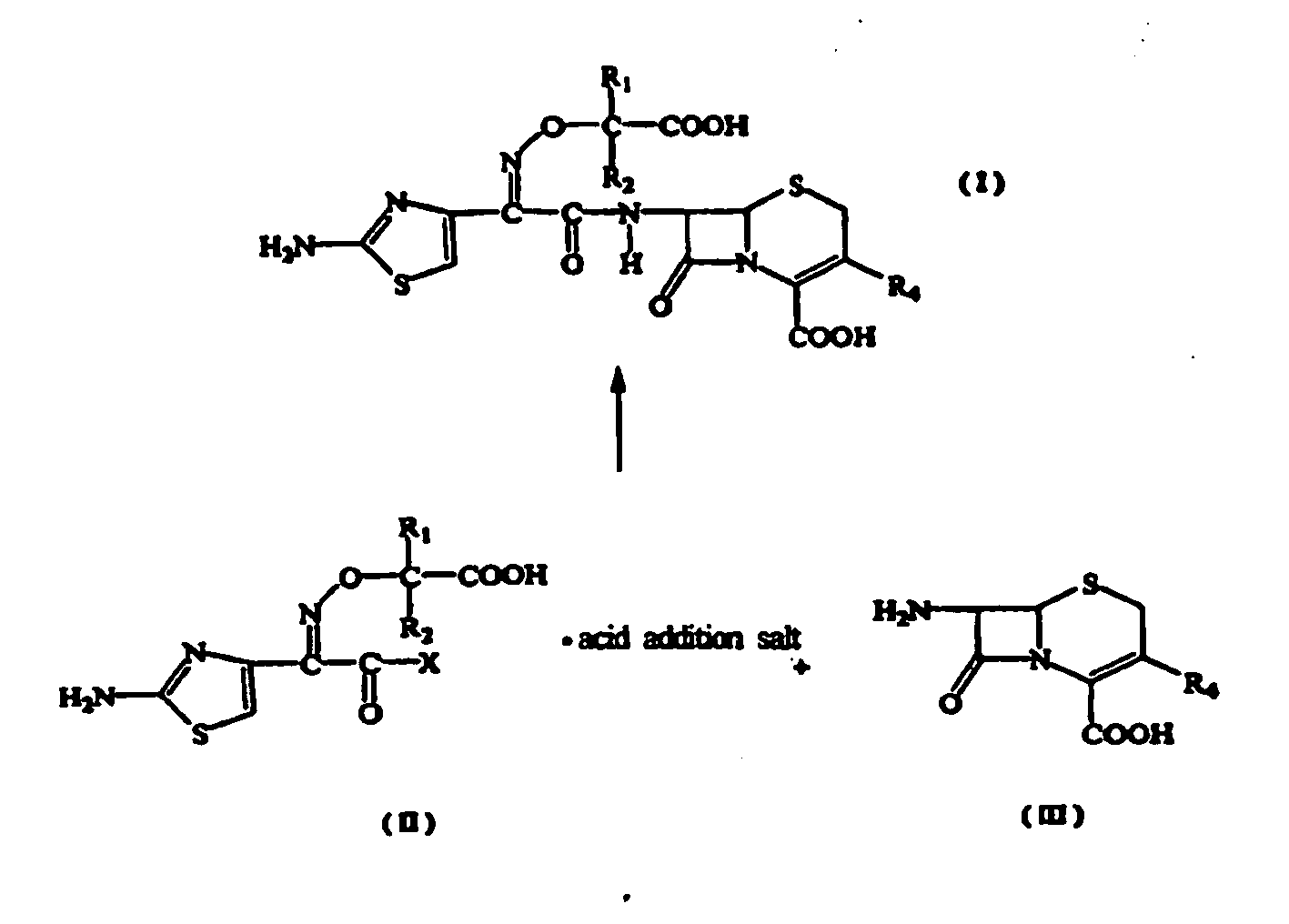
- The foregoing and other objects, features and advantages of the invention will be apparent to those skilled in the art to which the present invention relates from reading the following specification.
- The aminothiazole compound of the formula (II) used as the starting material in the practice of the present invention is a new material and a reactive derivative in the form of a crystalline acid chloride. Thus, this is more stable and can be stored over a lengthy period of time at a low temperature and room temperature, as compared with the conventional acid chloride. Moreover, the process of the present invention produces little or no by-products in the acylation reaction of the 7-aminocephalosporin derivative with the compound of the formula (II), and is also relatively short in reaction time. Additionally, the process of the present invention employing this compound of the formula (II) does not require the removal of the protecting group after the acylation, and allows the desired compound to be directly obtained after the acylation. As a result, the process of the present invention makes the acylation reaction more economical and also simple and easy.
- The new aminothiazole derivative of the formula (II) is described in
WO 01/66532 US Patent No. 4,423,213 , Korean Patent No.127,113 2,052,990 - In the acylation reaction according to the present invention, the compound of the formula (II) is used in the amount of 1.0 to 2.0 equivalents, and preferably 1.2 to 1.4 equivalents, relative to the compound of the formula (III). The solvent which can be used in the practice of the present invention includes, for example, dichloromethane under consideration of the disclaimer used in the main claim, dichloroethane, chloroform, acetonitrile, tetrahydrofuran, N,N-dimethylacetamide, N,N-dimethylformamide, methanol, ethanol, or a combination thereof. However, a solution adjuvant, such as N,O-bistrimethylsilylacetamide, trimethylchloro silane, or trimethyliodosilane, etc., may also be used in combination with the solvent in the present invention depending on the kind of the 7-cephalosporin derivative.
- The solvent is used in the amount of 5 ml to 30 ml, and preferably 10 ml to 15 ml, relative to 1 g of the compound of the formula (II). The acylation reaction according to the present invention is preferably carried out at a temperature of -10 °C to 30 °C.
- The acylation reaction of the present invention is generally carried out without the use of a base, although an organic or inorganic base may also be used depending on the 7-aminocephalosporin derivative. If used, the base is used in the amount of 1.0 to 3.0 equivalents. Examples of the organic base which can be used in the present invention include tri-(n-butyl)amine, diisopropylethylamine, pyridine, dicyclohexylamine, and the like. Moreover, the acylation reaction may also be carried out in a mixed solution of a basic aqueous solution and the organic solvent, with the basic aqueous solution being preferably an aqueous solution of sodium hydrogen carbonate, potassium hydrogen carbonate, sodium carbonate, or sodium hydroxide, etc.
- In this acylation reaction, water and the organic solvent are preferably used in the volume of 10 times to 20 times relative to the compound of the formula (II), with the volume ratio of water to the organic solvent being 1/4 to 1/10.
- As described above, the process for the preparation of the cephalosporin derivative is characterized in that the compound of the formula (III) is reacted with the new thiazole compound of the formula (II), as the reactive organic acid derivative, to give the cephalosporin derivative of the formula (I). Such a process does not require the deprotection step and is reduced in production step, as compared with the processes according to the prior art. Furthermore, as the reactive acid derivative used in the process of the present invention is the acid chloride of the stable crystalline form, the acylation reaction with the compound of the formula (II) can be completed clean in a quantitative view with little or no production of by-products. In addition, the compound of the formula (II) can be stored in the form of acid chloride and is thus easy to use. As a result, the present invention provides the more inexpensive and new acylation process for the preparation of the cephalosporin derivatives having the compound of the formula (II) at a 7-position.
- The following examples are for illustration purposes only and in no way limit the scope of this invention.
- To 100 ml of acetonitrile which was cooled down to 0 to 5°C, 10g of 7-amino-3-(1-pyridiniummethyl)-ceph-3-em-carboxylate dihydrochloride was added, and 5 ml of N,O-bistrimethylsilylacetamide was then slowly added dropwise over 30 minutes. After adding 9.4g of (Z)-(2-carboxyprop-2-oxyimino)-2-aminothiazole-4-yl)-acetylchloride monohydrochloride, the resulting solution was stirred for 30 minutes, and 20 ml of 35% concentrated hydrochloric acid was then added to the stirred solution, followed by adding 50 ml of diethylether. Next, the solution was stirred for 10 minutes, and an aqueous layer was then separated and collected. After 100 ml of acetone was added to the aqueous layer and the mixture was stirred at room temperature for 5 to 6 hours, the deposited crystal was filtered. The filtered crystal was washed with 50 ml of isopropyl alcohol, and then with 20 ml of acetone, and dried, thereby giving 12.4 g (84% yield) of the title compound as a white solid.
1NHR :(d, DMSO-d6) : 9.6(d, 1H, -CONH-), 9.0(d, 2H, pyridinium proton), 8.6(t, 2H, pyridinium proton), 8.2(t, 2H, pyridinium proton), 6.8(s, 1H, aminothiazole proton), 5.9 (dd, 1H, C7-H), 5.6(ABq, 2H, -CH2-), 5.2(d, 1H, C6-H), 3.5(ABq, 2H, C2-H), 1.4(s, 6H, -C(CH3)2) - 10 g of 7-amino-3-vinyl-3-cephem-4-carboxylic acid was suspended in 100 ml of dichloromethane, and to which, 10 ml of N,O-bistrimethylsilylacetamide was added dropwise to ensure the dissolution of the carboxylic acid. At a temperature of 20 to 30 °C, 14 g of (Z)-2-(2-carboxymethoxyimino)-2-(2-aminothiazole-4-yl)acetylchlo ride monohydrochloride was added in parts and the resulting solution was stirred. After this, 50 ml of a saturated aqueous solution of sodium hydrogen carbonate and 100 ml of isopropylether were sequentially added, and the resulting solution was stirred for 10 minutes and separated into two layers, the aqueous layer of which was collected. The aqueous solution was adjusted to pH 2.0-2.5 with 6 N-hydrochloric acid solution and left to cool at a temperature of 0 to 5 °C for one hour, followed by filtering the deposited crystal. The filtered crystal was washed with 150 ml of cold water and 200 ml of acetone, in sequence, and then dried, thereby giving 19.5 g (87% yield) of the title compound as a pale yellow solid.
Melting Point(°C) . 200-230(decomposition)
1NHR : (d, D2O-NaHCO3) ; 3.7(s, 2H), 4.8-5.8(m, 5H), 6.9(dd, 1H, J=12Hz, 18Hz) - As apparent from the above description and Examples, the present invention provides the process for the preparation of the cephalosporin derivative, wherein the compound of the formula (III) is reacted with the new thiazole compound of the formula (II), as the reactive organic acid derivative, to give the cephalosporine derivative of the formula (I). Such a process does not require the deprotection step and is reduced in production step, as compared with the processes according to the prior art. Furthermore, as the reactive organic acid derivative used in the process of the present invention is the acid chloride of the stable crystalline form, it allows the acylation reaction with the compound of the formula (III) to be completed clean in a quantitative view with little or no production of by-products. In addition, the compound of the formula (II) can be stored in the form of acid chloride and is thus easy to use. As a result, the present invention provides the more inexpensive and new acylation process for the preparation of the cephalosporine derivatives having the compound of the formula (II) at a 7-position.
- Although the preferred embodiments of the invention have been disclosed for illustrative purposes, those skilled in the art will appreciate that various modifications, additions and substitutions are possible, without departing from the scope and spirit of the invention as disclosed in the accompanying claims.
Claims (7)
- A process for the preparation of cephalosporin antibiotics represented by the following formula (I), in which an acid addition salt of a crystalline aminothiazole compound represented by the following formule(11) is acylated by reaction with a 7-aminocephalosporanic acid derivative represented by the following formula(III) in a solvent:

- The method of Claim 1, wherein R4 is (1-pyridinium) methyl.
- The method of Claim 1, wherein R4 is vinyl.
- The method of Claim 1, wherein the solvent is selected from the group consisting of dichloroethane, chloroform, tetrahydrofuran,N, N-diethylacetamide, dichloro methane, acetonitrile, N, N-dimethylformamide, acetone, water, methanol, ethanol, and a combination thereof.
- The method of Claim 4, wherein the solvent is used in a combination with a solution adjuvant selected from the group consisting of N, O-bistrimethylsilylacetamide, trimethylchloro silane, and trimethyliodosilane.
- The method of Claim 1, wherein the acylation reaction is carried out in the presence of an additional organic base selected from the group consisting of triethylamine, tri- (n-butyl) amine, dicyclohexylamine, pyridine, and diisopropyl ethylamine.
- The method of Claim 4, wherein the acylation reaction is carried out in a mixed solution of a basic aqueous solution and the organic solvent, with the basic aqueous solution being an aqueous solution of an inorganic base selected from the group consisting of sodium hydrogen carbonate, potassium hydrogen carbonate, sodium carbonate, and sodium hydroxide.
Applications Claiming Priority (3)
| Application Number | Priority Date | Filing Date | Title |
|---|---|---|---|
| KR2000014076 | 2000-03-20 | ||
| KR10-2000-0014076A KR100392409B1 (en) | 2000-03-20 | 2000-03-20 | A process for preparing cephalosporine derivatives using new thiazole compound |
| PCT/KR2001/000347 WO2001070749A1 (en) | 2000-03-20 | 2001-03-07 | A process for preparing cephalosporin derivatives using new thiazole compound |
Publications (3)
| Publication Number | Publication Date |
|---|---|
| EP1268488A1 EP1268488A1 (en) | 2003-01-02 |
| EP1268488A4 EP1268488A4 (en) | 2004-02-04 |
| EP1268488B1 true EP1268488B1 (en) | 2010-06-09 |
Family
ID=19656811
Family Applications (1)
| Application Number | Title | Priority Date | Filing Date |
|---|---|---|---|
| EP01912531A Expired - Lifetime EP1268488B1 (en) | 2000-03-20 | 2001-03-07 | A process for preparing cephalosporin derivatives using new thiazole compound |
Country Status (6)
| Country | Link |
|---|---|
| US (1) | US6384212B1 (en) |
| EP (1) | EP1268488B1 (en) |
| JP (1) | JP3927808B2 (en) |
| KR (1) | KR100392409B1 (en) |
| DE (1) | DE60142329D1 (en) |
| WO (1) | WO2001070749A1 (en) |
Families Citing this family (7)
| Publication number | Priority date | Publication date | Assignee | Title |
|---|---|---|---|---|
| KR100392409B1 (en) * | 2000-03-20 | 2003-07-22 | 한미정밀화학주식회사 | A process for preparing cephalosporine derivatives using new thiazole compound |
| ITMI20012364A1 (en) * | 2001-11-09 | 2003-05-09 | Antibioticos Spa | SUMMARY PROCESS OF CEFIXIMA VIA ALCHIL-O ARILSOLFONATI |
| MX2007007476A (en) * | 2004-12-21 | 2007-08-15 | Lupin Ltd | Process for the preparation of cefixime. |
| CN1312158C (en) * | 2005-05-20 | 2007-04-25 | 天津市医药集团技术发展有限公司 | Method for preparing cefixime |
| CN102516262A (en) * | 2011-12-20 | 2012-06-27 | 浙江国邦药业有限公司 | Method for crystallizing cefixime trihydrate |
| WO2016142902A1 (en) * | 2015-03-11 | 2016-09-15 | Lupin Limited | Cefixime with reduced surface area and high stability |
| CN104892638B (en) * | 2015-05-28 | 2017-08-01 | 齐鲁安替制药有限公司 | The method that one kettle way prepares cefotaxime |
Family Cites Families (19)
| Publication number | Priority date | Publication date | Assignee | Title |
|---|---|---|---|---|
| AR228726A1 (en) | 1978-05-26 | 1983-04-15 | Glaxo Group Ltd | PROCEDURE FOR THE PREPARATION OF ANTIBIOTIC (6R, 7R) -7 - ((Z) -2- (2-AMINOTIAZOL-4-IL) -2- (2-CARBOXIPROP-2-OXIIMINO) ACETAMIDO) -3- (1- PIRIDINIOMETIL) CEF-3-EM-4-CARBOXILATO |
| FR2457295A1 (en) | 1979-05-25 | 1980-12-19 | Glaxo Group Ltd | INTERMEDIATE COMPOUNDS FOR THE PREPARATION OF CEPHALOSPORINS |
| US4409214A (en) | 1979-11-19 | 1983-10-11 | Fujisawa Pharmaceutical, Co., Ltd. | 7-Acylamino-3-vinylcephalosporanic acid derivatives and processes for the preparation thereof |
| KR840001827B1 (en) | 1980-07-14 | 1984-10-22 | 후지사와 야꾸힝 고오교오 가부시기 가이샤 | Method for preparing 7-acylamino-3-vinyl cephalosporan acid derivative |
| JPS5877886A (en) * | 1981-11-02 | 1983-05-11 | Toyama Chem Co Ltd | Novel cephalosporin |
| DE3375013D1 (en) * | 1982-04-29 | 1988-02-04 | Glaxo Group Ltd | Thiazole derivative, process for its preparation and use in the preparation of beta-lactam antibiotics |
| JPS60208986A (en) * | 1984-03-31 | 1985-10-21 | Toyama Chem Co Ltd | Novel cephalosporin |
| JPH0662635B2 (en) * | 1984-04-26 | 1994-08-17 | 富山化学工業株式会社 | New production method of cefalosporins |
| KR870001807B1 (en) | 1985-09-07 | 1987-10-13 | 주식회사 종근당 | Process for preparing 3-vinyl-cephalosporin derivatives |
| GB8611823D0 (en) * | 1986-05-15 | 1986-06-25 | Ici Plc | Process |
| GB8800295D0 (en) * | 1988-01-07 | 1988-02-10 | Fujisawa Pharmaceutical Co | Process for preparation of 7-(2-amino-thiazol-4-y)-2-hydroxyimino-acetanidol-3-cephem compounds |
| KR930007810B1 (en) | 1991-05-04 | 1993-08-20 | 주식회사 중외제약 | Method for preparing 7-acylamino-3-vinyl separosporonic acid |
| US5587372A (en) * | 1991-12-12 | 1996-12-24 | Roussel Uclaf | Cephalosporins |
| KR100257129B1 (en) * | 1993-09-11 | 2000-05-15 | 성재갑 | Novel cephalosphorine antibiotics |
| KR0127113B1 (en) | 1994-01-28 | 1998-04-01 | 임성기 | A process for prepairing 3-vinylcephem derivative |
| TW538045B (en) | 1997-01-16 | 2003-06-21 | Biochemie Gmbh | Process for purifying cefixime |
| KR100342600B1 (en) * | 2000-03-06 | 2002-07-04 | 한미정밀화학주식회사 | New Thiazole compounds and their preparations |
| KR100392409B1 (en) * | 2000-03-20 | 2003-07-22 | 한미정밀화학주식회사 | A process for preparing cephalosporine derivatives using new thiazole compound |
| JP2004149412A (en) * | 2000-06-21 | 2004-05-27 | Fujisawa Pharmaceut Co Ltd | Method for producing 7-[2-(2-aminothiazol-4-yl)-2-lower alkoxycarbonylmethoxyiminoacetamido]-3-cephem compound |
-
2000
- 2000-03-20 KR KR10-2000-0014076A patent/KR100392409B1/en not_active Expired - Fee Related
- 2000-05-04 US US09/564,980 patent/US6384212B1/en not_active Expired - Fee Related
-
2001
- 2001-03-07 WO PCT/KR2001/000347 patent/WO2001070749A1/en not_active Ceased
- 2001-03-07 EP EP01912531A patent/EP1268488B1/en not_active Expired - Lifetime
- 2001-03-07 JP JP2001568950A patent/JP3927808B2/en not_active Expired - Lifetime
- 2001-03-07 DE DE60142329T patent/DE60142329D1/en not_active Expired - Lifetime
Also Published As
| Publication number | Publication date |
|---|---|
| JP3927808B2 (en) | 2007-06-13 |
| DE60142329D1 (en) | 2010-07-22 |
| WO2001070749A1 (en) | 2001-09-27 |
| KR20010092130A (en) | 2001-10-24 |
| EP1268488A1 (en) | 2003-01-02 |
| JP2003528105A (en) | 2003-09-24 |
| KR100392409B1 (en) | 2003-07-22 |
| US6384212B1 (en) | 2002-05-07 |
| EP1268488A4 (en) | 2004-02-04 |
Similar Documents
| Publication | Publication Date | Title |
|---|---|---|
| CA1272714A (en) | Cephalosporin compounds and the production thereof | |
| JP2004520336A (en) | New thiazolylacetic acid thioester derivatives and their use for the preparation of cephalosporin compounds | |
| US6458949B1 (en) | Ceftiofur, its intermediate and a process for the preparation of the same | |
| US6384215B1 (en) | Preparation of new intermediates and their use in manufacturing of cephalosporin compounds | |
| US6384212B1 (en) | Process for preparing cephalosporin antibiotics using new thiazole compound | |
| US4316024A (en) | Dioxo piperazine compounds | |
| EP0175814B1 (en) | Process for preparing cephem derivatives | |
| US5567813A (en) | Process for preparing cephalosporin compounds from reactive organic acid derivatives | |
| US5869649A (en) | Process for producing cephalosporin antibiotics | |
| AU654384B2 (en) | Preparation of a cephalosporin antibiotic using the syn-isomer of a thiazolyl intermediate | |
| AU690482B2 (en) | Process for producing cephalosporin antibiotics | |
| EP1028118B1 (en) | Process for producing 3-cephem compounds | |
| EP0045717B1 (en) | New cephalosporin derivatives, their production and their use | |
| EP0019067B1 (en) | 5,10-dioxo-5,10-dihydrodiimidazo(1,5-a,1',5'-d)pyrazine-1,6-dicarboxylic acid and a process for producing imidazoledicarboxylic acid amido-derivatives | |
| US20020016457A1 (en) | Process for preparing cephalosporin antibiotics using new thiazole compound | |
| US5594130A (en) | Preparation of a cephalosporin antibiotic using the syn-isomer of a thiazolyl intermediate | |
| US4358448A (en) | N-substituted thiazolyl derivatives of oxy-imino-substituted cephalosporins useful as anti-bacterial agents | |
| JPS62103092A (en) | Beta-lactam derivative | |
| KR0129567B1 (en) | Method for preparing cephalosporin compound from reactive organic acid derivative | |
| GB2195334A (en) | 1-Methanesulfonyloxy-6-trifluoromethyl-1H-benzotriazole and its use in preparing cephalosporin derivatives | |
| US5162522A (en) | Method for producing cephem compounds | |
| KR970005893B1 (en) | Method for preparing cephalosporin compound from reactive organic acid derivative | |
| US4665168A (en) | Cephalosporin intermediate | |
| EP0146626A1 (en) | Cephem compounds | |
| KR100243540B1 (en) | Active Triazine Derivatives of Thiazolyl Acetate and Methods for Preparing the Same |
Legal Events
| Date | Code | Title | Description |
|---|---|---|---|
| PUAI | Public reference made under article 153(3) epc to a published international application that has entered the european phase |
Free format text: ORIGINAL CODE: 0009012 |
|
| 17P | Request for examination filed |
Effective date: 20021021 |
|
| AK | Designated contracting states |
Kind code of ref document: A1 Designated state(s): AT BE CH CY DE DK ES FI FR GB GR IE IT LI LU MC NL PT SE TR |
|
| RIN1 | Information on inventor provided before grant (corrected) |
Inventor name: LEE, MYOUNG, KI Inventor name: YOON, DAE, CHUL Inventor name: SONG, YOON, SEOK Inventor name: YOO, SEUNG, WON Inventor name: OH, SANG, MI Inventor name: LEE, JU, CHEOL Inventor name: PARK, MI, SOON Inventor name: LEE, YOON, SEOK Inventor name: SHIN, DONG, GYUN |
|
| A4 | Supplementary search report drawn up and despatched |
Effective date: 20031223 |
|
| RIC1 | Information provided on ipc code assigned before grant |
Ipc: 7C 07D 513/00 A Ipc: 7C 07D 501/06 B |
|
| RBV | Designated contracting states (corrected) |
Designated state(s): DE DK ES FR GB IT |
|
| 17Q | First examination report despatched |
Effective date: 20061127 |
|
| 17Q | First examination report despatched |
Effective date: 20061127 |
|
| GRAP | Despatch of communication of intention to grant a patent |
Free format text: ORIGINAL CODE: EPIDOSNIGR1 |
|
| GRAS | Grant fee paid |
Free format text: ORIGINAL CODE: EPIDOSNIGR3 |
|
| RBV | Designated contracting states (corrected) |
Designated state(s): DE ES FR GB IT |
|
| GRAA | (expected) grant |
Free format text: ORIGINAL CODE: 0009210 |
|
| AK | Designated contracting states |
Kind code of ref document: B1 Designated state(s): DE ES FR GB IT |
|
| REF | Corresponds to: |
Ref document number: 60142329 Country of ref document: DE Date of ref document: 20100722 Kind code of ref document: P |
|
| PG25 | Lapsed in a contracting state [announced via postgrant information from national office to epo] |
Ref country code: IT Free format text: LAPSE BECAUSE OF FAILURE TO SUBMIT A TRANSLATION OF THE DESCRIPTION OR TO PAY THE FEE WITHIN THE PRESCRIBED TIME-LIMIT Effective date: 20100609 |
|
| PLBE | No opposition filed within time limit |
Free format text: ORIGINAL CODE: 0009261 |
|
| STAA | Information on the status of an ep patent application or granted ep patent |
Free format text: STATUS: NO OPPOSITION FILED WITHIN TIME LIMIT |
|
| 26N | No opposition filed |
Effective date: 20110310 |
|
| REG | Reference to a national code |
Ref country code: DE Ref legal event code: R097 Ref document number: 60142329 Country of ref document: DE Effective date: 20110309 |
|
| REG | Reference to a national code |
Ref country code: FR Ref legal event code: ST Effective date: 20111130 |
|
| PG25 | Lapsed in a contracting state [announced via postgrant information from national office to epo] |
Ref country code: FR Free format text: LAPSE BECAUSE OF NON-PAYMENT OF DUE FEES Effective date: 20110331 Ref country code: DE Free format text: LAPSE BECAUSE OF NON-PAYMENT OF DUE FEES Effective date: 20111001 |
|
| REG | Reference to a national code |
Ref country code: DE Ref legal event code: R119 Ref document number: 60142329 Country of ref document: DE Effective date: 20111001 |
|
| PGFP | Annual fee paid to national office [announced via postgrant information from national office to epo] |
Ref country code: GB Payment date: 20120322 Year of fee payment: 12 |
|
| PG25 | Lapsed in a contracting state [announced via postgrant information from national office to epo] |
Ref country code: ES Free format text: LAPSE BECAUSE OF FAILURE TO SUBMIT A TRANSLATION OF THE DESCRIPTION OR TO PAY THE FEE WITHIN THE PRESCRIBED TIME-LIMIT Effective date: 20100920 |
|
| GBPC | Gb: european patent ceased through non-payment of renewal fee |
Effective date: 20130307 |
|
| PG25 | Lapsed in a contracting state [announced via postgrant information from national office to epo] |
Ref country code: GB Free format text: LAPSE BECAUSE OF NON-PAYMENT OF DUE FEES Effective date: 20130307 |