EP1267359A2 - Composite type electroconductive polymer and process of producing an aromatic compound - Google Patents
Composite type electroconductive polymer and process of producing an aromatic compound Download PDFInfo
- Publication number
- EP1267359A2 EP1267359A2 EP02013471A EP02013471A EP1267359A2 EP 1267359 A2 EP1267359 A2 EP 1267359A2 EP 02013471 A EP02013471 A EP 02013471A EP 02013471 A EP02013471 A EP 02013471A EP 1267359 A2 EP1267359 A2 EP 1267359A2
- Authority
- EP
- European Patent Office
- Prior art keywords
- group
- backbone
- naphthylene
- composite type
- conductive polymer
- Prior art date
- Legal status (The legal status is an assumption and is not a legal conclusion. Google has not performed a legal analysis and makes no representation as to the accuracy of the status listed.)
- Withdrawn
Links
Images


Classifications
-
- H—ELECTRICITY
- H01—ELECTRIC ELEMENTS
- H01B—CABLES; CONDUCTORS; INSULATORS; SELECTION OF MATERIALS FOR THEIR CONDUCTIVE, INSULATING OR DIELECTRIC PROPERTIES
- H01B1/00—Conductors or conductive bodies characterised by the conductive materials; Selection of materials as conductors
- H01B1/06—Conductors or conductive bodies characterised by the conductive materials; Selection of materials as conductors mainly consisting of other non-metallic substances
- H01B1/12—Conductors or conductive bodies characterised by the conductive materials; Selection of materials as conductors mainly consisting of other non-metallic substances organic substances
- H01B1/124—Intrinsically conductive polymers
- H01B1/128—Intrinsically conductive polymers comprising six-membered aromatic rings in the main chain, e.g. polyanilines, polyphenylenes
Definitions
- This invention relates to a composite type conductive polymer, more particularly a composite type conductive polymer having a phenylene vinylene backbone.
- the present invention also relates to a process of producing an aromatic compound which can be used as a monomer for synthesizing the composite type conductive polymer.
- Conductive polymers are useful in the electric and electronic industries as various conductive materials or optical materials providing parts demanding high processability, such as electrodes, sensors, electronic display devices, nonlinear optical devices, and photoelectric devices, antistatic agents, automotive parts, electromagnetic shields, and the like.
- PPVs Poly(phenylene vinylene)s
- PPVs are polymers having a phenylene vinylene skeleton (structure) in the main chain.
- PPVs On being doped with a dopant, PPVs form a charge transfer complex which exhibits electric conductivity and maintains high conductivity of at least about 10 1 S/cm.
- conductive PPVs reduce the conductivity below a practical level on about one day standing in the air probably because the dopant is released or deteriorated by the influences of the air.
- PPVs having a 1,4-phenylene chain poly(para-phenylene vinylene)s
- PPVs having a 1,4-phenylene chain in particular, have a rigid linear molecular structure which tends to refuse a dopant's entering between molecules so that a dopant once accepted is liable to be released or deteriorated.
- PPVs possess so strong an intermolecular force that they are insoluble in most solvents. For the same reason, PPVs have no melting point. In other words, such insoluble and non-melting PPVs have poor processability and poor molding properties.
- the present invention provides a composite type conductive polymer having a phenylene vinylene backbone with a condensed hydrocarbon ring system introduced into the backbone to form a bend in the linear structure of the backbone.
- Such a modified structure has reduced rigidity so that an external dopant enters between polymer molecules easily. Further, because the bend in the backbone reduces the intermolecular force, the polymer gains solvent solubility and satisfactory processability.
- the condensed hydrocarbon ring system which can be introduced into the linear structure preferably includes those derived from naphthalene derivatives and anthracene derivatives.
- the present invention provides a composite type conductive polymer having from 1 to 9999 of a phenylene vinylene backbone and from 1 to 9999 of a naphthylene vinylene backbone, wherein a total number of the phenylene vinylene backbone and the naphthylene vinylene backbone is from 10 to 10000.
- the naphthylene group in the preferred embodiment is desirably selected from a 1,5-naphthylene group, a 1,6-naphthylene group, a 2,5-naphthylene group, a 2,6-naphthylene group, and a 2,7-naphthylene group, which will make an appreciable bend in the backbone.
- the ratio of the phenylene vinylene backbone to the naphthylene vinylene backbone in the above structure of the preferred embodiment be from about 3:7 to 7:3.
- Too high a proportion of the phenylene vinylene backbone it is difficult to get much effect in protecting a dopant and improving the processability. Too high a proportion of the naphthylene vinylene backbone, on the other hand, tends to compromise the characteristics inherent to PPVs.
- the present invention also provides a process of producing an aromatic compound as a monomer for synthesizing the composite conductive PPV of the invention. That is, the invention provides a process of producing an aromatic compound having a halomethyl group bonded to the benzene nucleus thereof, which starts with an aromatic compound having a carbon atom bonded to the benzene nucleus and comprises forming a halomethyl group through a substitution reaction on the carbon atom. According to the process, a desired aromatic compound can be obtained in good yield. This will make it possible to synthesize the composite type conductive polymer of the invention efficiently.
- an aromatic compound having a carboxyl group bonded to the benzene nucleus is used as a starting material, and the process comprises:
- an aromatic compound having a methyl group on the benzene nucleus thereof is used as a starting material, and the process comprises substituting one of the hydrogen atoms of the methyl group with a halogen.
- Fig. 1 is a graph showing conductivity change with time of the conductive polymers prepared in Examples and Comparative Examples.
- Fig. 2 is a DSC thermogram of the composite type conductive polymer of Example 1.
- Fig. 3 is a graph showing the change of conductivity of the PPV polymers of Examples 3 and 4 and a comparative PPV with time.
- the composite type conductive polymer of the present invention is of the type having a phenylene vinylene chain as a backbone and is characterized by having a bend (or a steric strain as it is called) introduced into the linear structure of the backbone.
- the bend formed in the backbone reduces the rigidity of the backbone and assists a dopant to enter between the polymer molecules. Compared with rigid linear molecules, the molecules having the bending backbone wraps a dopant having once entered thereby giving a dopant protection. Further, since the bend reduces the intermolecular force of the polymer, the polymer easily dissolves in a solvent and possesses a melting point to exhibit improved processability.
- the effect of the present invention is particularly pronounced where applied to a PPV having a 1,4-phenylene bond, which is the most linear and rigid of the other phenylene bonds.
- the condensed hydrocarbon ring system includes a bicyclic structure, such as a naphthalene derivative, a tricyclic structure, such as an anthracene derivative, a polycyclic structure, such as a polypyrene system, a polyazulene system or a polyfluorene system, various heterocyclic structures having aromaticity and containing N, S or O as a hetero atom, and a phenanthrene derivative.
- naphthalene derivatives or anthracene derivatives preferred are those derived from naphthalene derivatives or anthracene derivatives .
- derivatives as used herein is intended to include naphthalene or anthracene having a substituent(s), such as an alkyl group, an alkoxy group, an alkyl ester group, a halogen atom, a nitro group, a cyano group, an amino group, a trihalomethyl group, and a phenyl group, on the condensed rings.
- the condensed hydrocarbon ring system can be introduced into the linear backbone by copolymerizing a monomer having a phenylene vinylene skeleton (hereinafter referred to as a PV monomer) with a monomer having a condensed hydrocarbon ring system capable of providing a bend in the resulting polymer chain, such as a monomer having a naphthalene vinylene skeleton (hereinafter referred to as an NV monomer).
- a PV monomer a monomer having a phenylene vinylene skeleton
- an NV monomer naphthalene vinylene skeleton
- Any copolymerization mode including alternate copolymerization, partial block copolymerization, and random copolymerization can be adopted as long as a bend is introduced into the phenylene vinylene backbone.
- the composite type conductive polymer of the invention includes a composite type conductive polymer having from 1 to 9999 of a phenylene vinylene backbone and from 1 to 9999 of a naphthylene vinylene backbone, wherein a total number of the phenylene vinylene backbone and the naphthylene vinylene backbone is from 10 to 10000.
- the other bond must be at the 5-, 6-, 7- or 8-position. That is, the two bonds must be on different rings.
- the copolymer is structurally asymmetric and has a kink in the backbone.
- the intermolecular force attributed to a rigid linear structure decreases so that an external dopant enters between molecules easily.
- a dopant having once entered is embraced by the bending molecular chains and therefore protected against release and deterioration.
- the polymer with this bending backbone gains in flexibility, showing satisfactory thermal melting properties and improved processability.
- the naphthylene group be selected from 2,5-naphthylene, 2,6-naphthylene, 2,7-naphthylene, 1,5-naphthylene, and 1,6-naphthylene. These naphthylene groups make an appreciable bend in the backbone to ensure protection for a dopant and improvement of processability. It is more desirable that the naphthylene group be selected from 2,6-naphthylene and 2,7-naphthylene.
- the ratio of the phenylene vinylene backbone to the naphthylene vinylene backbone in the conductive polymer of the invention be from about 3:7 to 7:3.
- Too high a proportion of the phenylene vinylene backbone it is difficult to get much effect in protecting a dopant and improving the processability. Too high a proportion of the naphthylene vinylene backbone, on the other hand, tends to compromise the characteristics inherent to PPVs.
- Any electron-donating substance or electron-accepting substance can be used as a dopant in the present invention.
- suitable dopants are alkoxysulfonic acids, hydrogen borofluoride, carboxylic acids, sulfonic acids, and nitro compounds.
- the composite type conductive polymer can have a self-doping group.
- a self-doping group is a functional group serving as a dopant which is covalently bonded to the polymer either directly or via a spacer so as to give the polymer controlled conductivity.
- a composite type conductive polymer having a self-doping group is free from dopant's release and deterioration and undergoes reduced reduction in conductivity in the air.
- the alkoxysulfonic acid group can be bonded to the phenylene group at opposing positions, for example, 2,5-positions or 3,6-positions of a 1,4-phenylene group, in a usual manner.
- An initial conductivity of the composite type conductive polymer is at least 10 -2 S/cm, preferably 10 -1 S/cm.
- the composite type conductive polymer of the invention is synthesized by copolymerizing aromatic compounds having a halomethyl group as a polymerizable group. Copolymerization of aromatic compounds having a halomethyl group is carried out in a conventional manner as described later.
- the aromatic compounds having a halomethyl group on the benzene nucleus thereof could be prepared by a known process comprising substituting hydrogen (-H) or a halogen (-R) directly bonded to the aromatic ring (e.g., a naphthalene nucleus) of a starting aromatic compound, e.g., naphthalene or a dihalonaphthalene, to form a halomethyl group, as illustrated by the following reaction schemes: R: Cl or Br
- the aromatic compounds are preferably prepared by the process provided by the present invention.
- the process of the invention is characterized by starting with an aromatic compound having a carbon atom bonded to the benzene nucleus and comprising forming a halomethyl group through a substitution reaction on that carbon atom.
- the process of the invention provides a desired aromatic compound in high yield with easy control of the position where a halomethyl group is introduced because the reactions involved are only substitution reactions on the carbon atom bonded to the benzene nucleus .
- the composite type conductive polymer of the present invention can be synthesized efficiently.
- a benzene nucleus as referred to herein includes one present in condensed benzene rings, such as naphthalene and anthracene, and one present independently. Both of them are applicable to the process of the invention.
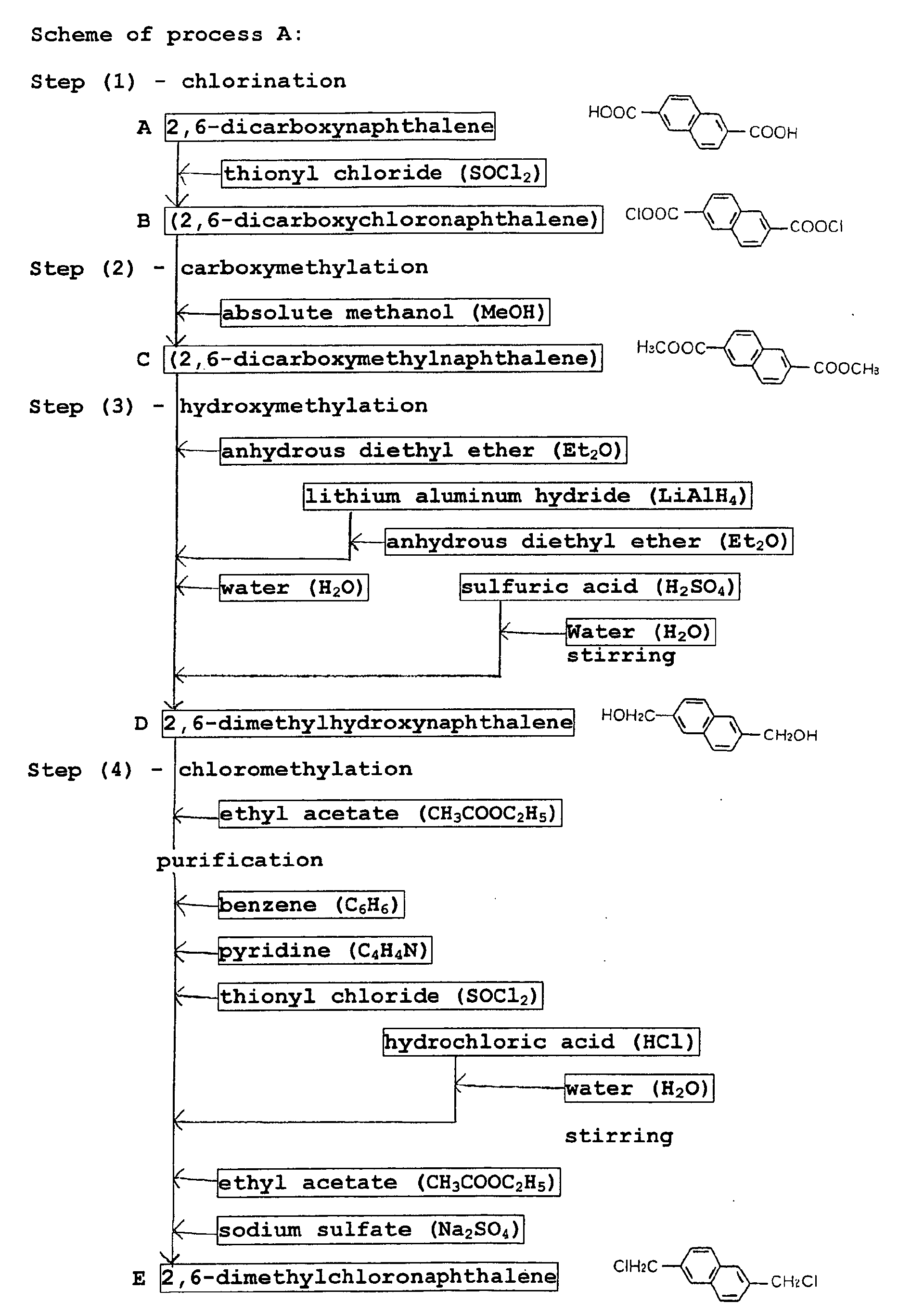
- the process of producing the aromatic compound having a halomethyl group according to the invention includes the following processes A and B.
- Process A starts with an aromatic compound having a carboxyl group bonded to the benzene nucleus and comprises:
- Process B starts with an aromatic compound having a methyl group on the benzene nucleus thereof and comprises substituting one of the hydrogen atoms of the methyl group with a halogen.
- Process B utilizes Wohl-Ziegler reaction for halogenating methylene hydrogen adjacent to an aromatic ring or a double bond.
- a halomethyl group acts as a polymerizable group.
- Monomers having a halomethyl group at different positions provide polymers having different steric structures and therefore exhibiting different physical properties as described above.
- the process of the present invention is very effective for controllability of the position of a halomethyl group.
- solvents can be selected from water, sulfuric acid, fuming sulfuric acid, forming acid, acetic acid, propionic acid, acetic anhydride, ethers (e.g., tetrahydrofuran, dioxane, and diethyl ether), polar solvents (e.g., dimethylformamide, acetonitrile, benzonitrile, N-methylpyrrolidone, and dimethyl sulfoxide), esters (e.g., ethyl acetate and butyl acetate), non-aromatic chlorine-containing solvents (e.g., chloroform and methylene chloride), and mixtures of two or more thereof.
- ethers e.g., tetrahydrofuran, dioxane, and diethyl ether
- polar solvents e.g., dimethylformamide, acetonitrile, benzonitrile, N-methylpyrrolidone, and dimethyl sul
- 2,6-Dicarboxynaphthalene having carboxyl groups bonded to a naphthalene nucleus designated compound A
- compound A 2,6-Dicarboxynaphthalene having carboxyl groups bonded to a naphthalene nucleus
- Two moles of thionyl chloride is added to one mole of compound A, and the mixture is heated to about 75 to 90°C, preferably about 80°C, with stirring in a nitrogen atmosphere. Then the stirring force is diminished, and the reaction mixture is refluxed for about 6 to 18 hours, desirably about 10 to 12 hours.
- the bath temperature is set at about 90 to 100°C, at which unreacted thionyl chloride is removed by evaporation over about 2 hours to obtain 2,6-dicarboxychloronaphthalene, designated compound B.
- This reaction is substitution of hydrogen of the carboxyl group with halogen.
- the starting material is not limited to the naphthalene derivative as chosen above, and other aromatic compounds, such as benzene derivatives and heterocyclic compounds, having a carboxyl group bonded to a benzene ring are usable.
- Compound B being labile at room temperature, is kept cooled in an ice bath.
- This step is substitution of the halogen of the carboxylic acid halide obtained in step (1) with a methyl group.
- compound B cooled in an ice bath
- absolute methanol that has sufficiently been cooled in an ice bath.
- the system is stirred in an ice bath to dissolve compound B and then refluxed in an oil bath at about 75 to 90°C, preferably about 80°C, for about 0.5 to 2 hours , preferably about 1 to 1.5 hours.
- Unreacted methanol was evaporated in an oil bath at about 80 to 100°C, preferably about 90°C, for about 1 to 3 hours.
- the reaction mixture is dried in vacuo (about -98 kPa; gauge pressure) at about 20°C until no methanol is detected (for about 1 to 3 hours) to obtain 2,6-dicarboxymethylnaphthalene, designated compound C.
- This step is reduction of the carboxymethyl group of compound C to a hydroxymethyl group.
- compound C 1000 ml of anhydrous diethyl ether at ambient temperature in a nitrogen atmosphere.
- compound C 1000 ml of anhydrous diethyl ether at ambient temperature in a nitrogen atmosphere.
- lithium aluminum hydride reducing agent
- the compound C solution is added dropwise to the lithium aluminum hydride solution at ambient temperature over at least about 5 hours, followed by stirring for about 5 hours.
- the reaction mixture is refluxed in an oil bath at about 45 to 55°C, preferably about 50°C, in a nitrogen atmosphere.
- water ambient temperature
- Diluted sulfuric acid about 20%
- the precipitated white crystals are collected by suction filtration, dried in vacuo (at about -760 mmHg) at about 20°C for about 1 to 6 hours to obtain a white solid.
- the crude product is dissolved in ethyl acetate by heating at about 60 to 80°C, preferably about 70°C, and the solution is allowed to stand in a sealed container at about -5°C or below for about 6 to 24 hours.
- the precipitated white crystals are collected by suction filtration and dried in vacuo (at about -760 mmHg) at about 20°C for about 1 to 3 hours to give 2,6-dimethylhydroxynaphthalene (compound D).
- This step is substitution of the hydroxyl moiety of the hydroxymethyl group in compound D with halogen to form a halomethyl group.
- compound D To about 1 mol of compound D are added about 900 ml of benzene and about 180 ml of pyridine, and the mixture is stirred at ambient temperature for about 30 minutes in a moisture-free condition.
- about2 mol of thionyl chloride is added to the mixture, followed by refluxing with stirring at about 70 to 90°C, preferably about 80°C, for about 12 to 24 hours, preferably about 18 to 20 hours.
- a hydrochloric acid aqueous solution (containing hydrochloric acid in excess over pyridine) is added to the reaction mixture, followed by stirring for about 20 minutes to carry out neutralization.
- An adequate amount of ethyl acetate is added to the reaction mixture, followed by stirring at ambient temperature for about 30 minutes.
- the precipitated solid is filtered off by suction.
- the filtrate is agitated in a separatory funnel, and the organic layer (ethyl acetate layer) is recovered. Water is added again, and the mixture is agitated and separated by means of a separator funnel three times in total to remove the aqueous layer.
- the organic layer is dried over an adequate amount of sodium sulfate and filtered.
- the solvent (ethyl acetate) of the filtrate is evaporated under reduced pressure in a water bath at about 35 to 45°C, preferably about 40°C, to give a solid.
- the resulting solid is dissolved in an appropriate amount of ethanol under heat with stirring, and the solution is allowed to stand at about 10 to 30°C, preferably about 15 to 20°C, for about 24 to 48 hours in a sealed container for recrystallization.
- the solid thus precipitated is collected by suction filtration and dried in vacuo to yield dichloromethylnaphthalene (compound E) as a white powder in a yield of about 50% or higher.
- This process comprises substituting one of the hydrogen atoms of the methyl group with a halogen to form a halomethyl group.
- 2,6-dimethylnaphthalene compound F having methyl groups bonded to the naphthalene nucleus is chosen.
- compound F 2,6-dimethylnaphthalene
- compound G N-chlorosuccinimide
- benzoyl peroxide as a catalyst
- the halogenating agent (chlorinating agent in this example) is used in an advisable amount of 1 to about 1.5 mol per mole of the alkyl groups of the starting compound (methyl groups in this example).
- the catalyst is used in an advisable amount of about 1/40 to 1/20 mol per mole of the halogenating agent.
- the solid thus precipitated is collected by filtration by suction and dried in vacuo.
- the resulting white crystal powder is washed with water to remove the halogenating agent, filtered by suction, and dried in vacuo.
- the solid is further washed with pentane to remove any unreacted material, filtered by suction, and dried in vacuo to give compound E in a yield of about 90% or higher.
- the starting material is not limited to the naphthalene derivative chosen above, and other aromatic compounds, such as benzene derivatives and aromatic heterocyclic compounds, having a methyl group bonded to a benzene ring are usable.
- the halogenating agent is not limited to n-chlorosuccinimide used above.
- n-bromosuccinimide results in formation of a bromomethylated compound, which can be used as a monomer similarly to the chloromethylated compound.
- dichloro-p-xylene can be synthesized from terephthalic acid, which is copolymerized with 2,6-dichloromethylnaphthalene synthesized above to prepare the composite type conductive polymer represented by formula (I-b).
- Polymerization of the above-described aromatic compounds can be carried out by, for example, process C involving dehydrohalogenation or process D involving conversion to a sulfonium salt.
- process C involving dehydrohalogenation
- process D involving conversion to a sulfonium salt.
- JP-W-8-510489 the term "JP-W” as used herein means an "a published Japanese national stage of international application”).
- THF tetrahydrofuran
- compound E 2,6-dichloromethylnaphthalene
- compound H dichloro-p-xylene
- a solution prepared by dissolving about 3 mol of potassium t-butoxide as a polymerization initiator in an adequate amount of THF at ambient temperature is added dropwise to the cold monomer solution while stirring over about 10 minutes, and the stirring is continued in an ice bath for about 8 to 12 hours, preferably about 10 hours, to give poly(1,4-phenylene vinylene-2,6-naphthalene vinylene) (compound I) in a yield of about 90% or higher.
- the resulting composite type conductive polymer usually has a molecular weight of 20,000 to 50,000.
- Process D comprises adding a sulfonium salt (e.g., dimethyl sulfide or tetrahydrothiophene (THT)) to the chloromethyl groups of the monomers (step (1)), polycondensing the addition products to form a solubilized intermediate polymer (step (2)), and forming vinylene bonds to obtain compound I (step (3)).
- a sulfonium salt e.g., dimethyl sulfide or tetrahydrothiophene (THT)
- the reagent to be used for sulfonium salt addition is not limited to THT.
- dialkyl sulfides such as dimethyl sulfide and diethyl sulfide are also useful. It is desirable to select such a sulfonium salt that is easily releasable in the subsequent heating in vacuo step at a temperature that does not influence the alkoxysulfonic acid moiety.
- Step (2) polycondensation of sulfonium salt
- the alkali solution used for polymerization reaction is not limited to the sodium hydroxide solution used above.
- other alkali metal hydroxides e.g., KOH
- alkaline earth metal hydroxides e.g., Ba(OH) 2 and Ca(OH) 2
- the cut-off molecular weight of the dialysis tube is subject to alteration according to the purpose.
- An aqueous solution of the polycondensate obtained in step (2) is cast into film.
- the cast film is heated in vacuo at about 180 to 250°C, preferably about 200 to 220°C, for about 6 to 24 hours, preferably about 12 to 18 hours, whereby the sulfonium salt is released to form compound I having a phenylene vinylene backbone and a naphthylene vinylene backbone.
- the form of compound I includes not only film but powder, etc.
- the heat treating temperature in step (3) is subject to variation depending on the kinds of the alkoxy moiety and the sulfonium salt, the sample size, and the like.
- the resulting copolymer is a composite type conductive polymer exhibiting a satisfactory effect of dopant protection and excellent processability.
- the composite type conductive polymer according to the present invention has bends in the backbone thereby exhibiting reduced molecular rigidity.
- an external dopant is ready to enter between molecules and, after once having entered, is given better protection by the bending and therefore wrapping backbone than by linear and rigid molecules.
- the polymer since the polymer has its intermolecular force reduced by the bends, it is solubilized in a solvent and has a melting point to exhibit improved processability.
- the process of producing aromatic compounds according to the invention enables introduction of a halomethyl group only to desired sites on the benzene nucleus of an aromatic compound (naphthalene derivatives, anthracene derivatives, benzene derivatives, and the like) to provide desired compounds with high purity in high yield.
- Compound I was synthesized by process D involving addition of a sulfonium salt (Example 1) or process C involving dehydrohalogenation (Example 2).
- the polymer of Example 1 synthesized by process D had an average molecular weight of 106,000 and a phenylene vinylene backbone to naphthylene vinylene backbone ratio of 1:1.
- the polymer of Example 2 synthesized by process C had an average molecular weight of 112,000 and a phenylene vinylene backbone to naphthylene vinylene backbone ratio of 1:1.
- PPV was used as a comparative conductive polymer.
- Hydrogen borofluoride (HBF 4 ) was used as an external dopant.
- the average molecular weight of the polymers was measured by gel-permeation chromatography using polyethylene glycol standards available from Wako Pure Chemical Industries, Ltd.
- the conductivity of the conductive polymers was measured with a resistance meter Low Rester GP, supplied by Mitsubishi Chemical Corp., with a four-point probe array according to JIS K7194. The results obtained are shown in Fig. 1. As can be seen from Fig. 1, while all the conductive polymers of Examples and Comparative Examples reach a satisfactory conductivity, the reduction in conductivity with time shown by the composite PPVs of Examples 1 and 2 is apparently smaller than that shown by the comparative PPVs, proving that introduction of a bend into the polymer backbone makes it possible to obtain satisfactory conductivity for an extended period of time.
- Example 2 Further, the composite type conductive polymer of Example 1 was subjected to differential thermal analysis with a differential scanning calorimeter DSC K20, supplied by Shimadzu Corp., to measure the glass transition point. The resulting DSC thermogram is shown in Fig. 2. A glass transition point (a temperature at which polymer molecules begin to have motion) appears in the vicinity of 200°C, which suggests that the polymer can be softened to exhibit good processability and possibly shows flexibility for protecting a dopant.
- DSC K20 differential scanning calorimeter
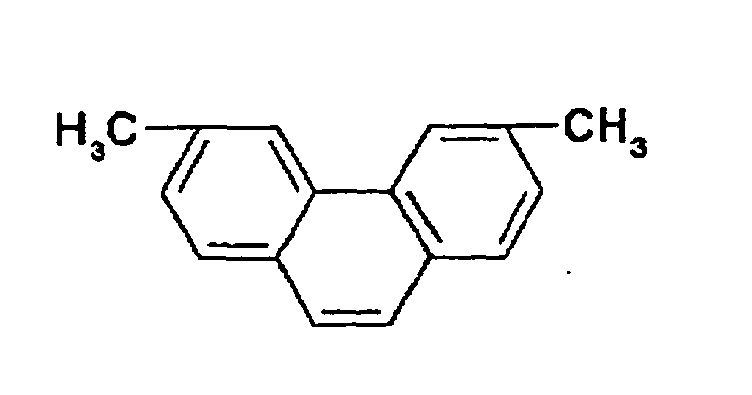
- 3,6-Dimethylphenanthrene (produced by Tokyo Kasei Kogyo Co., Ltd.) represented by the following formula is subjected to halogenation and conversion to sulfonium salt in the same manner as in the synthesis of naphthalene derivative to synthesize a phenanthrene derivative monomer.
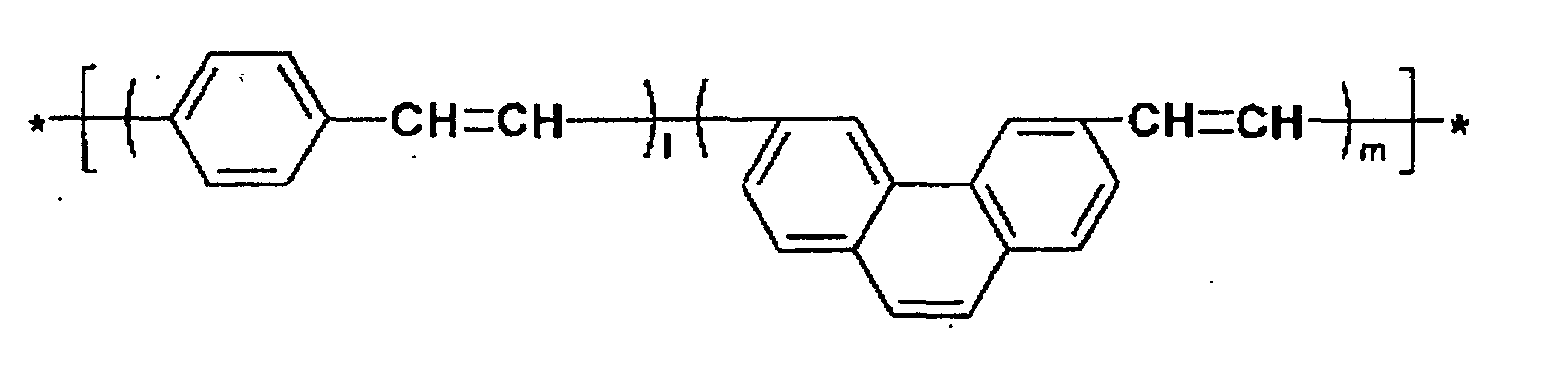
- the phenanthrene derivative monomer thus synthesized is mixed with the phenylene derivative monomer, and then subjected to condensation polymerization and vinylation to obtain a phenanthrene-composite conductive polymer represented by the following formula:
- the phenanthrene-composite conductive polymer of Example 3 comprises a phenylene vinylene backbone and a phenanthrene vinylene backbone at a ratio of 7 : 3.
- Example 3 The same phenanthrene-composite conductive polymer as used in Example 3 was used. As a dopant there was used H 2 SO 4 .
- the phenanthrene-composite PPV polymers of Examples 3 and 4 each exhibit a good conductivity and a conductivity change with time which is obviously smaller than that of the comparative PPV.
Landscapes
- Physics & Mathematics (AREA)
- Spectroscopy & Molecular Physics (AREA)
- Polyoxymethylene Polymers And Polymers With Carbon-To-Carbon Bonds (AREA)
- Battery Electrode And Active Subsutance (AREA)
Abstract
Description



Claims (11)
- A composite type conductive polymer having a phenylene vinylene backbone with a condensed hydrocarbon ring system introduced into the backbone to form a bend in a linear structure of the phenylene vinylene backbone.
- The composite type conductive polymer according to claim 1, wherein the condensed hydrocarbon ring system is one of a naphthalene derivative, an anthracene derivative and a phenanthrene derivative.
- The composite type conductive polymer according to claim 2, which has an initial conductivity of at least 10-2 S/cm.
- A composite type conductive polymer having from 1 to 9999 of a phenylene vinylene backbone and from 1 to 9999 of a naphthylene vinylene backbone, wherein a total number of the phenylene vinylene backbone and the naphthylene vinylene backbone is from 10 to 10000.
- The composite type conductive polymer according to claim 4 , wherein the naphthylene group in the naphthylene vinylene backbone is a 1,5-naphthylene group, a 1,6-naphthylene group, a 2,5-naphthylene group, a 2,6-naphthylene group or a 2,7-naphthylene group.
- The composite type conductive polymer according to claim 4, wherein a ratio of the phenylene vinylene backbone to said naphthylene vinylene backbone is from about 3:7 to 7:3.
- A process of producing an aromatic compound having a halomethyl group bonded to the benzene nucleus thereof, the process comprising forming a halomethyl group through a substitution reaction on a carbon atom of an aromatic compound having the carbon atom bonded to a benzene nucleus thereof.
- The process of producing the aromatic compound according to claim 7, which comprises:(1) a halogenating step in which a hydrogen of a carboxyl group of an aromatic compound having the carboxyl group bonded to a benzene nucleus thereof is substituted by a halogen to form a carboxyl halide;(2) a carboxymethylating step in which a halogen of the carboxyl halide is substituted with a methyl group to form a carboxymethyl group;(3) a hydroxymethylating step in which the carboxymethyl group is reduced to a hydroxymethyl group; and(4) a halomethylating step in which a hydroxyl moiety of the hydroxymethyl group is substituted with a halogen to form a halomethyl group.
- The process of producing the aromatic compound according to claim 7, which comprises substituting one of hydrogen atoms of a methyl group of an aromatic compound having the methyl group bonded to a benzene nucleus thereof with a halogen.
- A process of producing a composite type conductive polymer having from 1 to 9999 of a phenylene vinylene backbone and from 1 to 9999 of a naphthylene vinylene backbone, wherein a total number of the phenylene vinylene backbone and the naphthylene vinylene backbone is from 10 to 10000, the process compring using an aromatic compound produced by the process according to claim 8 as a monomer.
- A process of producing a composite type conductive polymer having from 1 to 9999 of a phenylene vinylene backbone and from 1 to 9999 of a naphthylene vinylene backbone, wherein a total number of the phenylene vinylene backbone and the naphthylene vinylene backbone is from 10 to 10000, the process compring using an aromatic compound produced by the process according to claim 9 as a monomer.
Applications Claiming Priority (2)
| Application Number | Priority Date | Filing Date | Title |
|---|---|---|---|
| JP2001182368A JP2002371126A (en) | 2001-06-15 | 2001-06-15 | Method for producing composite conductive polymer and aromatic compound |
| JP2001182368 | 2001-06-15 |
Publications (2)
| Publication Number | Publication Date |
|---|---|
| EP1267359A2 true EP1267359A2 (en) | 2002-12-18 |
| EP1267359A3 EP1267359A3 (en) | 2004-08-25 |
Family
ID=19022485
Family Applications (1)
| Application Number | Title | Priority Date | Filing Date |
|---|---|---|---|
| EP02013471A Withdrawn EP1267359A3 (en) | 2001-06-15 | 2002-06-14 | Composite type electroconductive polymer and process of producing an aromatic compound |
Country Status (3)
| Country | Link |
|---|---|
| US (1) | US6632916B2 (en) |
| EP (1) | EP1267359A3 (en) |
| JP (1) | JP2002371126A (en) |
Families Citing this family (2)
| Publication number | Priority date | Publication date | Assignee | Title |
|---|---|---|---|---|
| WO2007035849A2 (en) * | 2005-09-21 | 2007-03-29 | Ohio State University | Electrical stimulation of cell and tissue growth with two-and-three-dimensionally patterned electrodes |
| CN103547611B (en) * | 2011-03-25 | 2016-06-08 | 住友化学株式会社 | Polymer compound and light emitting device formed using same |
Family Cites Families (3)
| Publication number | Priority date | Publication date | Assignee | Title |
|---|---|---|---|---|
| JPH08134189A (en) | 1994-11-11 | 1996-05-28 | Katsumi Yoshino | Pi-conjugated polymer |
| US5817430A (en) * | 1996-11-13 | 1998-10-06 | Xerox Corporation | Electroluminescent polymer compositions and processes thereof |
| AU7251898A (en) * | 1997-04-17 | 1998-11-11 | California Institute Of Technology | Substituted poly(phenylenevinylene)s and poly(napthalenevinylene)s |
-
2001
- 2001-06-15 JP JP2001182368A patent/JP2002371126A/en active Pending
-
2002
- 2002-06-13 US US10/167,432 patent/US6632916B2/en not_active Expired - Fee Related
- 2002-06-14 EP EP02013471A patent/EP1267359A3/en not_active Withdrawn
Also Published As
| Publication number | Publication date |
|---|---|
| EP1267359A3 (en) | 2004-08-25 |
| JP2002371126A (en) | 2002-12-26 |
| US6632916B2 (en) | 2003-10-14 |
| US20030092878A1 (en) | 2003-05-15 |
Similar Documents
| Publication | Publication Date | Title |
|---|---|---|
| JP2668060B2 (en) | Polymer conductor with self-doping function | |
| TWI300419B (en) | Process for the preparation of neutral polyethylenedioxythiophene, and corresponding polyethlenedioxythiophenes | |
| US6172152B1 (en) | Sol-gel compositions and polymeric ion conductive film prepared therefrom | |
| US5367041A (en) | Self-doped zwitterionic polymers | |
| JP4269113B2 (en) | Aromatic amine derivatives and soluble conductive compounds | |
| US6632916B2 (en) | Composite type conductive polymer and process of producing aromatic compound | |
| US20070270571A1 (en) | Catalyst free polymerization of 3,4-alkylenedioxypyrrole and 3.4-alkylenedioxyfuran | |
| JP2704587B2 (en) | Polyaniline-polyether block copolymer and method for producing the same | |
| US6825357B2 (en) | Benzodioxinothiophenes, their preparation and use | |
| US6660183B2 (en) | Self-doped conductive polymer, monomer for synthesizing self-doped conductive polymer, and processes of producing the same | |
| JPH0574467A (en) | Macromolecular solid electrolyte | |
| JP3164671B2 (en) | Arylene vinylene polymer and method for producing the same | |
| US5104948A (en) | Substituted extensively conjugated ionic polyacetylenes | |
| US5037916A (en) | Substituted extensively conjugated ionic polyacetylenes | |
| US20030197158A1 (en) | Self-arrayed hole-carryable polymers used for organic photo-refractive materials and photo-refractive mixture containing them | |
| JP3058735B2 (en) | Polypyrrole derivative and method for producing the same | |
| JP3536546B2 (en) | Water-soluble conductive polymer and method for producing the same | |
| JP2612524B2 (en) | Polyaniline derivative and method for producing the same | |
| JP2982088B2 (en) | Method for producing polyaniline derivative | |
| JP2607411B2 (en) | Polyaniline derivative and method for producing the same | |
| JP2024008007A (en) | Polythiophene derivatives and their production method | |
| JPH07238150A (en) | Aqueous solution of self-doped conductive polymer and its production | |
| JP3058737B2 (en) | Polypyrrole derivative and method for producing the same | |
| Ren et al. | A new π-conjugated star-shaped polymer comprising of full fluorene units: An efficient blue emitter without reduction of color purity undergoing an annealing | |
| JPH04372623A (en) | Polyaniline derivative and its production |
Legal Events
| Date | Code | Title | Description |
|---|---|---|---|
| PUAI | Public reference made under article 153(3) epc to a published international application that has entered the european phase |
Free format text: ORIGINAL CODE: 0009012 |
|
| 17P | Request for examination filed |
Effective date: 20020614 |
|
| AK | Designated contracting states |
Kind code of ref document: A2 Designated state(s): AT BE CH CY DE DK ES FI FR GB GR IE IT LI LU MC NL PT SE TR |
|
| AX | Request for extension of the european patent |
Free format text: AL;LT;LV;MK;RO;SI |
|
| RIC1 | Information provided on ipc code assigned before grant |
Ipc: 7C 08G 61/02 B Ipc: 7H 01B 1/12 A |
|
| PUAL | Search report despatched |
Free format text: ORIGINAL CODE: 0009013 |
|
| AK | Designated contracting states |
Kind code of ref document: A3 Designated state(s): AT BE CH CY DE DK ES FI FR GB GR IE IT LI LU MC NL PT SE TR |
|
| AX | Request for extension of the european patent |
Extension state: AL LT LV MK RO SI |
|
| STAA | Information on the status of an ep patent application or granted ep patent |
Free format text: STATUS: THE APPLICATION HAS BEEN WITHDRAWN |
|
| 18W | Application withdrawn |
Effective date: 20041109 |