EP1266881A1 - Process for producing cyclic compound - Google Patents
Process for producing cyclic compound Download PDFInfo
- Publication number
- EP1266881A1 EP1266881A1 EP01904559A EP01904559A EP1266881A1 EP 1266881 A1 EP1266881 A1 EP 1266881A1 EP 01904559 A EP01904559 A EP 01904559A EP 01904559 A EP01904559 A EP 01904559A EP 1266881 A1 EP1266881 A1 EP 1266881A1
- Authority
- EP
- European Patent Office
- Prior art keywords
- optionally substituted
- group
- process according
- formula
- salt
- Prior art date
- Legal status (The legal status is an assumption and is not a legal conclusion. Google has not performed a legal analysis and makes no representation as to the accuracy of the status listed.)
- Withdrawn
Links
Classifications
-
- C—CHEMISTRY; METALLURGY
- C07—ORGANIC CHEMISTRY
- C07D—HETEROCYCLIC COMPOUNDS
- C07D225/00—Heterocyclic compounds containing rings of more than seven members having one nitrogen atom as the only ring hetero atom
- C07D225/04—Heterocyclic compounds containing rings of more than seven members having one nitrogen atom as the only ring hetero atom condensed with carbocyclic rings or ring systems
- C07D225/06—Heterocyclic compounds containing rings of more than seven members having one nitrogen atom as the only ring hetero atom condensed with carbocyclic rings or ring systems condensed with one six-membered ring
-
- C—CHEMISTRY; METALLURGY
- C07—ORGANIC CHEMISTRY
- C07D—HETEROCYCLIC COMPOUNDS
- C07D313/00—Heterocyclic compounds containing rings of more than six members having one oxygen atom as the only ring hetero atom
- C07D313/02—Seven-membered rings
- C07D313/06—Seven-membered rings condensed with carbocyclic rings or ring systems
- C07D313/08—Seven-membered rings condensed with carbocyclic rings or ring systems condensed with one six-membered ring
-
- C—CHEMISTRY; METALLURGY
- C07—ORGANIC CHEMISTRY
- C07D—HETEROCYCLIC COMPOUNDS
- C07D313/00—Heterocyclic compounds containing rings of more than six members having one oxygen atom as the only ring hetero atom
- C07D313/16—Eight-membered rings
- C07D313/20—Eight-membered rings condensed with carbocyclic rings or ring systems
Definitions
- the present invention relates to a process for producing cyclic compounds useful as medicines, agricultural chemicals, foods, cosmetics and chemical products, or intermediates thereof.
- cyclic compounds especially cyclic alkene derivatives, which can be easily converted to a variety of derivatives including, e.g., cyclic ketone derivatives or cyclic acrylic acid derivatives, due to their characteristic chemical structure.
- a cyclic alkene derivative can be produced inexpensively and conveniently by using an activated methylene derivative as a reaction intermediate and by conducting a cyclization reaction in the presence of a carbonic diester, and on the basis of this knowledge, after further studies, completed the present invention.
- the present invention provides
- Examples of "electron-withdrawing group” used in the present specification include (i) a carboxyl group which may be optionally esterified or amidated, (ii) a group represented by the formula: -(CO)R 4 (wherein, R 4 is a hydrogen atom or an optionally substituted hydrocarbon group), (iii) nitrile group, (iv) nitro group, (v) a group represented by the formula: -(SO m )R 5 ( wherein, m is an integer of 1 or 2, and R 5 is an optionally substituted hydrocarbon group ), (vi) a group represented by the formula: -PR 6 R 7 (wherein, R 6 and R 7 each are an optionally substituted hydrocarbon group), (vii) a group represented by the formula:-(PO) (OR 8 ) (OR 9 ) (wherein, R 8 and R 9 each are a hydrogen or an optionally substituted hydrocarbon group), (viii) an optionally substituted aryl group, (ix) an optionally substitute
- the "carboxyl group which is esterified” in the “carboxyl group which may be optionally esterified or amidated” of (i) above include a group represented by the formula: -(CO)OR 10 (wherein, R 10 is an optionally substituted hydrocarbon group), while the "carboxyl group which is amidated” include a group represented by the formula: -(CO)NR 11 R 12 (wherein, R 11 and R 12 are, respectively, a hydrogen atom or an optionally substituted hydrocarbon group, and R 11 and R 12 may be bound to each other to form a 5- to 7-membered (preferably, 5- to 6-membered) cyclic amino group together with a neighboring nitrogen atom (e.g., tetrahydropyrrole, piperazine, piperidine, morpholine, thiomorpholine, pyrrole, imidazole, etc.)).
- a neighboring nitrogen atom e.g., tetrahydropyrrole, piperazine
- aryl group in the optionally substituted aryl group of (viii) above include, for example, C 6-14 aryl groups such as phenyl, naphthyl, etc., preferably, C 6-10 aryl groups, etc., more preferably, phenyl, etc.
- the aryl group may have 1 to 3 substituent groups similar to those of the "optionally substituted hydrocarbon group " described below.
- alkenyl groups in the optionally substituted alkenyl group of (ix) above include, for example, alkenyl groups having 2 to 10 carbon atoms such as vinyl, allyl, crotyl, 2-pentenyl, 3-hexenyl, etc., and the like, preferably, lower (C 2-6 ) alkenyl groups, etc., more preferably, vinyl, etc.
- the alkenyl group may have 1 to 3 substituent groups similar to those of the "optionally substituted hydrocarbon group" described below.
- hydrocarbon group in the “optionally substituted hydrocarbon group” used in the present specification include;
- Said hydrocarbon group may have substituent groups, including, for example, a halogen atom (e.g., fluorine, chlorine, bromine, iodine, etc.), nitro, cyano, hydroxy, an optionally substituted thiol group (e.g., thiol, C 1-4 alkylthio, etc.), an optionally substituted amino group (e.g., amino, monoC 1-4 alkylamino, diC 1-4 alkylamino, 5- to 6-membered cyclic amino groups such as tetrahydropyrrole, piperazine, piperidine, morpholine, thiomorpholine, pyrrole, imidazole and the like), a carboxyl group which may be optionally esterified or amidated (e.g., carboxyl, C 1-4 alkoxycarbonyl, carbamoyl, monoC 1-4 alkylcarbamoyl, diC 1-4 alkylcarbamoyl, etc.
- the substituent groups may be bound to each other to form an optionally substituted ring.
- R 1 and R 2 may be bound to each other to form an optionally substituted ring.
- examples of the optionally substituted ring are those similar to an optionally substituted ring as ring A described below (preferably, an optionally substituted benzene ring and the like).
- halogen atom represented by R 1 and R 2 in the formula above include fluorine, chlorine, bromine, iodine, etc.
- Examples of the "optionally substituted amino group" represented by R 1 and R 2 in the formula above include amino groups which may be optionally substituted by the "optionally substituted hydrocarbon groups” mentioned above.
- the number of substituent groups may be any of 0 to 2. When two substituent groups are present, the two substituent groups may be the same or different. Further, the two substituent groups may be bound to each other to form a 5-to 7-membered (preferably, 5- to 6-membered) cyclic amino group together with neighboring nitrogen atoms (e.g., tetrahydropyrrole, piperazine, piperidine, morpholine, thiomorpholine, pyrrole, imidazole, etc.).
- neighboring nitrogen atoms e.g., tetrahydropyrrole, piperazine, piperidine, morpholine, thiomorpholine, pyrrole, imidazole, etc.
- R 1 and R 2 in the formula above examples include hydroxy groups which may be optionally substituted by the "optionally substituted hydrocarbon groups" mentioned above.
- the optionally substituted thiol group represented by R 1 and R 2 in the formula above include thiol groups which may be optionally substituted by the "optionally substituted hydrocarbon groups" mentioned above.
- examples of the "heterocyclic ring" in the “optionally substituted heterocyclic group” represented by R 1 and R 2 include 5- to 7-memberd aromatic heterocyclic rings and saturated or unsaturated non-aromatic heterocyclic rings (aliphatic heterocyclic rings), containing at least one (preferably, 1 to 4, more preferably 1 to 2) hetero atoms of 1 to 3 (preferably, 1 to 2) hetero atoms selected from the group consisting of oxygen atom, sulfur atom, nitrogen atom and other atoms.
- examples of the "aromatic heterocyclic ring” include 5- to 6-membered aromatic monocyclic heterocyclic rings (e.g., furan, thiophene, pyrrole, oxazole, isoxazole, thiazole, isothiazole, imidazole, pyrazole, 1,2,3-oxadiazole, 1,2,4-oxadiazole, 1,3,4-oxadiazole, furazan, 1,2,3-thiadiazole, 1,2,4-thiadiazole, 1,3,4-thiadiazole, 1,2,3-triazole, 1,2,4-triazole, tetrazole, pyridine, pyridazine, pyrimidine, pyrazine, triazine, etc.).
- aromatic monocyclic heterocyclic rings e.g., furan, thiophene, pyrrole, oxazole, isoxazole, thiazole, isothiazole, imidazole,
- non-aromatic heterocyclic ring examples include 5-to 7-membered (preferably, 5- to 6-membered) saturated or unsaturated (preferably, saturated) non-aromatic heterocyclic rings (aliphatic heterocyclic rings) such as pyrrolidine, tetrahydrofuran, thiolane, piperidine, tetrahydropyran, morpholine, thiomorpholine, piperazine, pyran, etc., and 5- to 6-membered non-aromatic heterocyclic rings wherein all or a part of double bonds in the aforementioned aromatic monocyclic heterocyclic rings are saturated.
- the heterocyclic ring is preferably a 5- to 6-membered aromatic ring, and more preferably furan, thiophene, pyrrole, or pyridine (preferably a 6-membered ring).
- substituent groups which may be possessed by the heterocyclic ring include substituent groups exemplified as the substituent groups on the "optionally substituted hydrocarbon group" described above, and the number of the substituent groups is 1 to 3.
- Z is preferably an esterified carboxyl group
- R 3 is preferably a hydrogen atom
- R 1 and R 2 each is preferably a hydrogen atom or an optionally substituted hydrocarbon group, more preferably a hydrogen atom, and it is also preferable that R 1 and R 2 are bound to each other to form an optionally substituted benzene ring.
- the substituent groups which may be possessed by the "optionally substituted benzene ring" used in the present specification include substituent groups exemplified as the substituent groups on the "optionally substituted hydrocarbon group” described above; the afore-described "optionally substituted aryl groups", which may be bound via a spacer (e.g., a divalent group having 1 to 4 atoms in the straight-chain moiety thereof) (preferably, afore-described "optionally substituted aryl groups which is directly bound), and particularly preferably electron-donating groups.
- the number of the substituent groups is 1 to 4.
- imino group e.g., imino groups which
- Examples of the ring formed by binding R 1 and R 2 and the "optionally substituted ring" represented by A in the formula above include 5- to 7-membered (preferably, 5- to 6-membered) saturated or unsaturated alicyclic hydrocarbons such as C 5-7 cycloalkanes (e.g., cyclopentane, cyclohexane, cycloheptane, etc.), C 5-7 cycloalkenes (e.g., 1-cyclopentene, 2-cyclopentene, 3- cyclopentene, 2-cylcohexene, 3-cylcohexene, etc.), and C 5-6 cycloalkadienes (e.g., 2,4-cyclopentadiene, 2,4-cyclohexadiene, 2,5-cyclohexadiene, etc); 6- to 14-membered aromatic hydrocarbons such as benzene, naphthalene, azulene, acenaphthylene, etc
- aromatic heterocyclic ring examples include 5- to 6-membered aromatic monocyclic heterocyclic rings (e.g., furan, thiophene, pyrrole, oxazole, isoxazole, thiazole, isothiazole, imidazole, pyrazole, 1,2,3-oxadiazole, 1,2,3-thiadiazole, 1,2,3-triazole, pyridine, pyridazine, pyrimidine, pyrazine, etc.), and examples of the "non-aromatic heterocyclic ring” include 5- to 7-membered (preferably 5- to 6-membered) saturated or unsaturated non-aromatic monocyclic heterocyclic rings (aliphatic heterocyclic rings) such as pyrrolidine, tetrahydrofuran, thiolane, piperidine, morpholine, thiomorpholine, tetrahydropyran, piperazine, pyran etc., or 5- to 6-membered aromatic monocycl
- the ring formed by binding R 1 and R 2 , and the "optionally substituted ring" represented by A in the formula above may form a fused ring wherein 2 to 3 (preferably, 2) monocyclic rings described above are condensed.
- the fused ring include fused rings of two same or different heterocyclic rings (preferably, one heterocyclic ring and one aromatic heterocyclic ring, more preferably, two same or different aromatic heterocyclic rings); and fused rings of a heterocyclic ring and a homocyclic ring (preferably, a heterocyclic ring and a benzene ring, more preferably, an aromatic heterocyclic ring and a benzene ring).
- fused ring examples include indole, benzothiophene, benzofuran, benzimidazole, imidazo[1,2 - a]pyridine, quinoline, isoquinoline, cinnoline, etc.
- the ring formed by binding R 1 and R 2 , and the "optionally substituted ring" represented by A in the formula above is preferably a 5- to 6-membered aromatic ring, more preferably benzene, furan, thiophene, pyrrole, or pyridine (preferably, a 6-membered ring), and particularly preferably benzene.
- the ring formed by binding R 1 and R 2 , and the ring A may have substituent groups, examples thereof include those similar to the substituent groups which may be possessed by the "benzene ring" in the "optionally substituted benzene ring” described above. 1 to 3 same or different substituent groups may substitute at any position of the ring where substitution is possible.
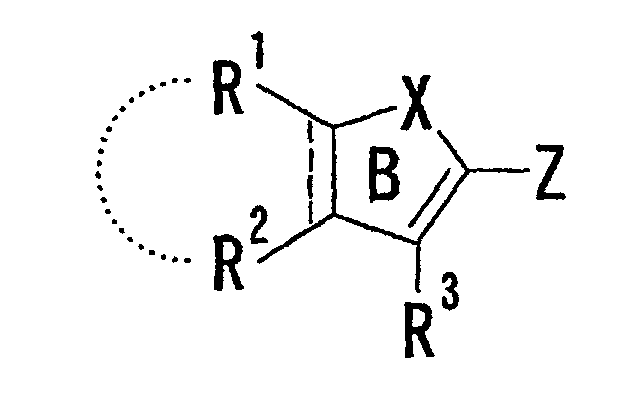
- the "divalent group" represented by X is preferably a divalent group having 3 or more atoms in the straight-chain moiety thereof, and, for example, any group may be employed whichever ring B in the following formula can form a 5- to 16-membered ring (preferably 5- to 12-membered ring, more preferably 7- to 10-membered ring, particularly preferably 8- to 10-membered ring): the formula the formula or the formula That is, X may be any of divalent groups having 1 to 12 atoms in the straight-chain moiety thereof (preferably 1 to 8, more preferably 3 to 6, and particularly preferably 4 to 6), and specific examples of the divalent group include
- the divalent group may have substituent groups, and said substituent groups may be any group which can be bound to the divalent group, including, for example, a halogen atom, an optionally substituted amino group, an optionally substituted hydroxy group, an optionally substituted thiol group, an optionally substituted hydrocarbon group and an optionally substituted heterocyclic group exemplified as R 1 and R 2 .
- the substituent groups may be bound to each other to form a ring with the divalent group, and such rings include those exemplified as the rings formed by binding R 1 and R 2 .
- an atom constituting the straight chain moiety is a sulfur atom in the "divalent group" represented by X above
- the sulfur atom may be oxidized, and may be any of -S-, -SO- or -SO 2 -.
- R 1 and a substituent group on X or R 2 and R 3 may be bound to each other to form an optionally substituted ring, and examples of such ring include those exemplified as the optionally substituted rings formed by binding R 1 and R 2 .
- a substituent group on the first to third (preferably the first to second, more preferably the first) atom in the straight chain moiety of X bound to the ethylene or vinylene is preferably bound to R 1 .
- a substituent group on the "ethylene” or “vinylene” of the "optionally substituted ethylene” or “optionally substituted vinylene” represented by W may be bound to a substituent group of X or R 3 to form an optionally substituted ring, and examples of such ring include those exemplified as the optionally substituted rings formed by binding R 1 and R 2 .
- the combined line of "broken line and solid line” indicates a single bond or a double bond (preferably double bond).
- the compound When a compound having a substituent group is a basic compound depending on the kind of the substituent group exemplified above, the compound may be converted to a salt thereof by using an acid according to usual methods. Any acid may be used if the acid does not interfere with the reaction, and examples of the acid include inorganic acids such as hydrochloric acid, hydrobromic acid, phosphoric acid, sulfuric acid, nitric acid, sulfamic acid etc., organic acids such as formic acid, acetic acid, trifluoroacetic acid, tartaric acid, citric acid, fumaric acid, maleic acid, succinic acid, malic acid, p-toluenesulfonic acid, methanesulfonic acid, benzenesulfonic acid etc., and acidic amino acids such as aspartic acid, glutamic acid etc. When an obtained compound is a salt, the compound may be converted to a free base according to usual methods.
- the compound when a compound having a substituent group is an acidic compound depending on the kind of the substituent group exemplified above, the compound may be converted to a salt thereof by using a base according to usual methods.
- a base may be used if the base does not interfere with the reaction, and examples of such salts include salts with inorganic bases, organic bases, basic amino acids, etc.
- the salt with an inorganic base include alkali metal salts such as sodium salt, potassium salt, etc.; alkali-earth metal salts such as calcium salt, magnesium salt, etc.; and aluminum salt, ammonium salt, etc.
- the salt with an organic base include salts with trimethylamine, triethylamine, pyridine, picoline, ethanolamine, diethanolamine, triethanolamine, dicyclohexylamine, N,N'-dibenzylethylenediamine, etc.
- Preferable examples of the salt with a basic amino acid include salts with arginine, lysine, ornithine, etc.
- the reaction above-mentioned (1) is conducted, for example, under a following reaction condition.
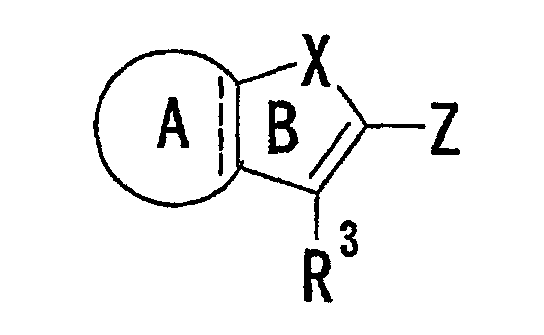
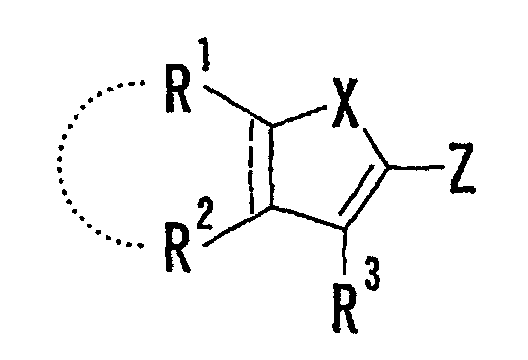
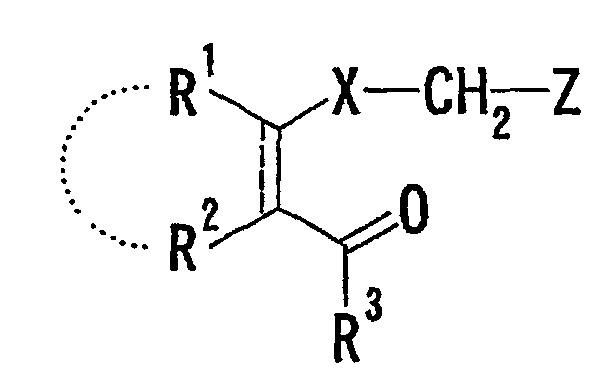
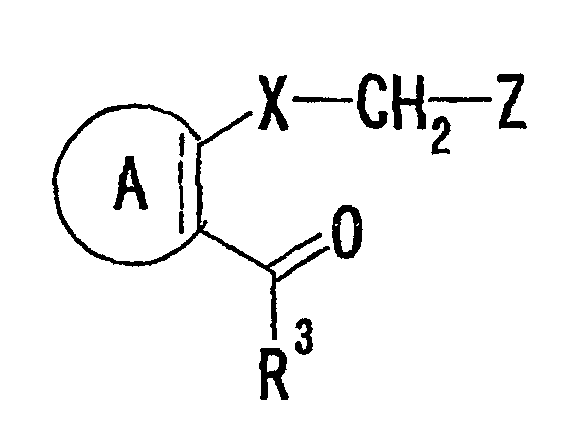
- the compound represented by the formula: [wherein each symbol has the same meaning described above] or a salt thereof is produced by subjecting a compound represented by the formula: [wherein each symbol has the same meaning described above] or a salt thereof to cyclization reaction in a solvent containing carbonic diester.
- the reaction above-mentioned (1) is preferably conducted in the presence of a base
- a base examples of such base include metal hydride compounds (e.g., alkali metal hydrides such as sodium hydride, potassium hydride, etc.), metal hydrocarbons (e.g., compounds having direct chemical bond between alkali metal and C 1-4 alkyl group such as n-butyllithium, etc.), alcoholates (e.g., compounds in which a hydroxy hydrogen of C 1-4 alcohols is replaced by a alkali metal such as sodium methoxide, sodium ethoxide, sodium t-butoxide, potassium methoxide, potassium ethoxide, potassium t-butoxide, lithium methoxide, lithium ethoxide, lithium t-butoxide, etc.), alkali metal hydroxides (e.g., NaOH, KOH, etc.), basic carbonates (e.g., alkali metal salts of carbonate such as sodium salt, potassium salt, etc.
- the amount of base used for the reaction above-mentioned (1) is about 0.1 to 100 equivalents, preferably 1 to 5 equivalents.
- the reaction solvent may be any solvent if only it contains carbonic diester, for example, a carbonic diester alone, a mixture of 2 or more carbonic diesters or a mixed solvent of carbonic diesters and a solvent except carbonic diesters.
- the carbonic diester is a compound represented by the formula, Z"-O(CO)O-Z', [wherein, Z" and Z' each are an optionally substituted hydrocarbon group (preferably an optionally substituted alkyl group)].
- Z" and Z' are preferably the same, and preferable examples of the carbonic diester are dialkyl carbonates, and di C 1-4 alkyl carbonates such as dimethyl carbonate, diethyl carbonate are preferably used.
- the "solvent except carbonic diesters" used in combination with one or more kinds of carbonic diesters may be any solvent if the solvent does not interfere with the reaction, and includes, for example, halogenated solvents (e.g., methylene chloride, dichloroethane, chloroform, etc.), aliphatic hydrocarbons (e.g., n-hexane, etc.), aromatic hydrocarbons (e.g., benzene, toluene, etc.), ethers (e.g., tetrahydrofuran (THF), diethylether, etc.), polar solvents (e.g., dimethylformamide (DMF), dimethylsulfoxide (DMSO), etc.), alcohols (e.g., methanol, ethanol, propanol, isopropanol, n-butanol, 2-methoxyethanol, etc.), formic acid esters (e.g., C 1-4 alkyl formate, etc.),
- the reaction may be conducted in an appropriate mixed solvent, preferably in a solvent containing carbonic diester (preferably, dimethyl carbonate or diethyl carbonate).
- a solvent containing carbonic diester preferably, dimethyl carbonate or diethyl carbonate.
- the reaction temperature is usually about -20 to 200°C, preferably about 10 to 100°C, and the reaction period is usually about 0.1 to 100 hours, preferably about 0.5 to 50 hours.
- the reaction above-mentioned (7) is conducted, for example, under a following reaction condition.
- the compound represented by the formula: [wherein each symbol has the same meaning described above] or a salt thereof is produced by subjecting a compound represented by the formula: [wherein each symbol has the same meaning described above] or a salt thereof to a cyclization reaction in a solvent containing a carbonic diester.
- reaction above-mentioned (7) may be conducted under a similar condition to that for the reaction above-mentioned (1).
- reaction above-mentioned (13) is conducted for example under a following reaction condition.
- the compound represented by the formula: [wherein each symbol has the same meaning described above] or a salt thereof is produced by subjecting a compound represented by the formula: [wherein each symbol has the same meaning described above] or a salt thereof to a cyclization reaction in a solvent containing a carbonic diester.
- the reaction above-mentioned (13) may be conducted under a condition similar to those for the reaction above-mentioned (1).
- the compounds represented by the formula: [wherein, each symbol has the same meaning described above] or a salt thereof obtained in the reaction above-mentioned (1) are useful as medicines, agricultural chemicals, foods, cosmetics and chemicals, or intermediates therefor.
- useful medicines such as an osteogenesis promoter, a Na-H exchange inhibitor, treating agent for pollakiuria and incontinence of urine, edema treating agent and treating agent for central nervous system diseases can be produced according to the methods known in the art (e.g., methods described in JP-A 8-73476, WO99/55690, JP-A 11-302267, JP-A 11-302270, WO99/51242, etc.).
- Ethyl 4-bromobutyrate (6.6ml) was added to a suspension of salicyl aldehyde (5.0g) and potassium carbonate (6.2g) in DMF(15ml), and the mixture was stirred at 90°C for 1 hour. The mixture was allowed to cool to room temperature, and neutralized with 1N hydrochloric acid. After extraction with ethyl acetate, the organic layer was washed with saturated salt water, dried over anhydrous sodium sulfate, and concentrated.
- the precipitated crystal obtained was redissolved in isopropylether [IPE] (20ml) under heating, and the solution was allowed to cool to room temperature, and stirred for 1 hour at 0°C.
- the crystal obtained was filtered and washed with IPE. Drying under reduced pressure (40°C, 1 hour) gave yellow crystal of 5-(4-bromo-2-formyl-N-methylanilino)pentanoic acid (4.0g, yield 57%). mp. 72-73°C.
- the precipitated crystal was washed with IPE and collected by filtration. Drying under reduced pressure (40°C, 1 hour) gave yellow crystal of 8-bromo-1-methyl-1,2,3,4-tetrahydro-1-benzazocin-5-carboxylic acid methylester (0.9g, yield 31%). mp. 88-89°C.
- reaction mixture was allowed to warm to room temperature and tetrakistriphenylphosphine palladium (115mg), 5-bromo-2-hydroxybenzaldehyde (2.0g) and an aqueous solution of tripotassium phosphate (11.1g) in water (15ml) were added, and the resulting mixture was stirred under reflux for 1 hour. After the mixture was allowed to cool to room temperature, 6N hydrochloric acid (20ml) was added dropwise, and then toluene(20ml) was added. After separation, the aqueous phase was further extracted with toluene (30ml).
- the present invention provides a process suitable for mass production wherein cyclic compounds can be produced safely through a short step.
Landscapes
- Chemical & Material Sciences (AREA)
- Organic Chemistry (AREA)
- Plural Heterocyclic Compounds (AREA)
- Organic Low-Molecular-Weight Compounds And Preparation Thereof (AREA)
- Low-Molecular Organic Synthesis Reactions Using Catalysts (AREA)
Abstract

Description




(ix) an optionally substituted alkenyl group, (x) a halogen atom ( e.g., fluorine, chlorine, bromine, iodine, etc.) and (xi) a nitroso group and the like, preferably, a carboxyl group which may be optionally esterified or amidated, a group represented by the formula: -(CO)R4, nitrile group, nitro group, a group represented by the formula: -(SOm)R5, a group represented by the formula: -PR6 R7, a group represented by the formula: -(PO) (OR8) (OR9), more preferably, a carboxyl group which is esterified (e.g., a carboxyl group which is esterified by a C1-4 alkyl such as methoxycarbonyl, ethoxycarbonyl, t-butoxycarbonyl, etc.) and the like.
the formula





1H-NMR(CDCl3, δ, 300MHz): 1.27(3H, t, J=7.1Hz), 2.14-2.23(2H, m), 2.54(2H, t, J=7.2Hz), 4.11-4.18(4H, m), 6,96-7.04(2H, m), 7.52(1H, dt, J=1.7, 7.1Hz), 7.82(1H, dd, J=1.7, 7.7Hz), 10.49(1H, s).
IR(neat, cm-1) : 1733, 1687, 1598, 1243.
mp. 72-73°C. 1H-NMR (CDCl3, δ, 300MHz): 1.61-1.69(4H, m), 2.36(2H, t, J=6.7Hz), 2.87(3H, s), 3.13(2H, t, J=6.9Hz), 6.97(1H, d, J=8.8Hz), 7.54(1H, dd, J=8.8, 2.5Hz), 7.86(1H, d, J=2.5Hz), 10.17(1H, s). Anal. Calcd for C13 H16 NO3 Br: C,49.70; H,5.13; N,4.46; Br,25.43, Found: C,49.75; H,5.16; N,4.45; Br,25.40. IR(KBr, cm-1) : 1731, 1648.
IR(neat, cm-1) : 1708, 1683.
IR(neat, cm-1) : 1708, 1683.
1H-NMR(CDCl3, δ, 300MHz): 1.36(3H, t, J=7.1Hz), 2.97-3.00(2H, m), 4.26-4.31(4H, m), 6.96-7.04(2H, m), 7.21-7.27(1H, m), 7.32-7.35(1H, m), 7.58(1H, s). IR (neat, cm-1) : 1700, 1249.
1H-NMR(CDCl3, δ, 300MHz): 1.58-1.64 (4H, m) , 2.28(2H, t, J=6.8Hz), 2.83(3H, s), 3.09(2H, t, J=6.8Hz), 3.63(3H, s), 6.95(1H, d, J=8.8Hz), 7.51(1H, dd, J=8.8, 2.4Hz), 7,83(1H, d, J=2.4Hz), 10.14(1H, s). FAB-MS ([M+Na]+): 350. IR(neat, cm-1) : 1735, 1681.
IR (neat, cm-1) : 1735, 1685, 1159.
IR(neat, cm-1) : 1704, 1495, 1087.
IR(neat, cm-1) : 1708, 1494.
mp. 94-95°C.
Anal Calcd. for C15 H14 O3 : C,74.36; H,5.82. Found: C,74.61; H,5.80.
IR(KBr, cm-1) : 1660, 1473, 1276, 1245, 1047, 831.
1H-NMR(CDCl3, 300MHz) δ 1.44(3H, t, J=7.0Hz), 4.07(2H, q, J=7.0Hz), 6.96(2H, dd, J=1.9, 6.7Hz), 7.04(1H, d, J=8.4Hz), 7.45(2H, dd, J=1.9, 6.7Hz), 7.68-7.77(2H, m), 9.95(1H, s), 10.95(1H, s).
Anal Calcd. for C21 H24 O5 : C,70.77; H,6.79. Found: C,70.91; H,7.08.
IR (KBr, cm-1) 1683, 1606, 1471, 1270, 1240, 1187, 1047.
1H-NMR(CDCl3, 300MHz) δ 1.26(3H, t, J=7.1Hz), 1.43(3H, t, J=7.0Hz), 2.18-2.25(2H, m), 2.56(2H, t, J=7.1Hz), 4.04-4.20(6H, m), 6.94(2H, dd, J=1.9, 6.7Hz), 7.03(1H, d, J=8.7Hz), 7.47(2H, dd, J=1.9, 6.7Hz), 7.72(1H, dd, J=8.7, 2.5Hz), 8.02(1H, d, J=2.5Hz), 10.53(1H, s).
mp. 128-129°C. Anal Calcd. for C21 H22 O4 : C,74.54; H,6.55. Found: C,74.32; H,6.46.
IR(KBr, cm-1), 1702, 1496, 1251, 1213.
1H-NMR(CDCl3, 300MHz) δ 1.37(3H, t, J=7.1Hz), 1.44(3H, t, J=7.0Hz), 2.99-3.02(2H, m), 4.07(2H, q, J=7.0Hz), 4.26-4.32(4H, m), 6.95(2H, dd, J=1.9, 6.7Hz), 7.00(1H, d, J=8.4Hz), 7.41-7.51(4H, m), 7.65(1H, s).
Claims (19)
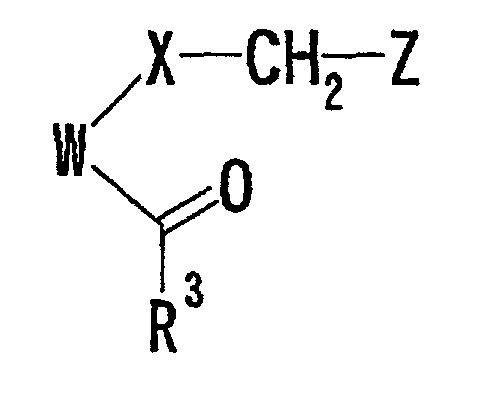
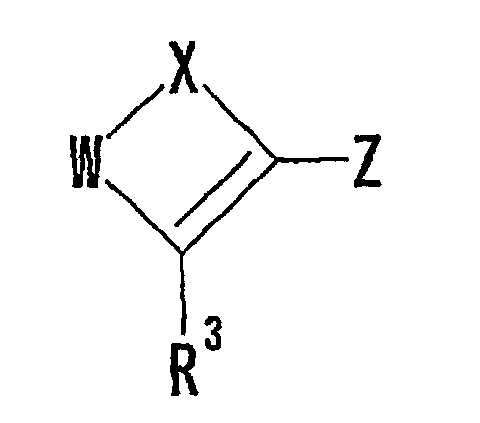
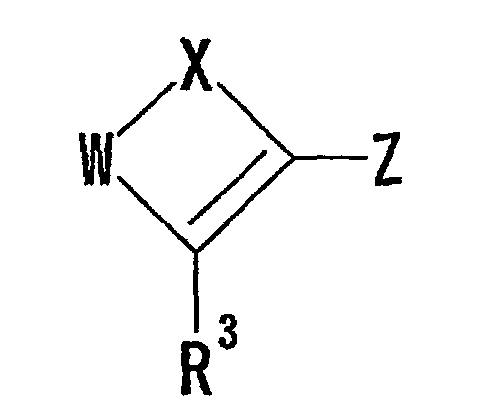
- A process for producing a compound represented by the formula:[wherein, Z is an electron-withdrawing group; W is an optionally substituted ethylene or an optionally substituted vinylene, and when the ethylene or the vinylene has two substituent groups, said substituent groups may be bound to each other to form an optionally substituted ring; R3 is a hydrogen atom or an optionally substituted hydrocarbon group; and X is a divalent group(however, when W is an optionally substituted vinylene, -X-CH2-Z is not -X1-X2-CH2-Z (wherein, X1 is a sulfur atom or an optionally substituted nitrogen atom; X2 is an optionally substituted ethylene))] or a salt thereof, which comprises subjecting a compound represented by the formula:
 [wherein, each symbol has the same meaning described as above] or a salt thereof to a cyclization reaction in a solvent containing a carbonic diester.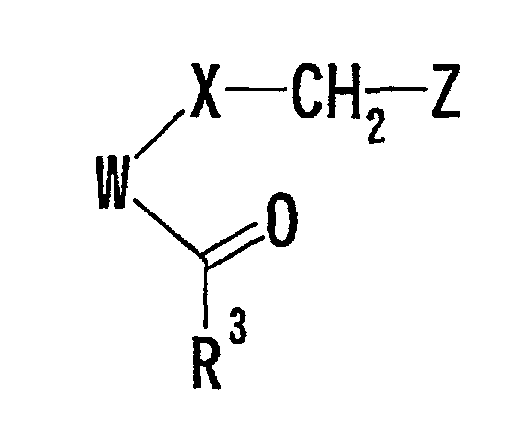
- The process according to claim 1, wherein X is a divalent group having 1 to 12 atoms in the straight-chain moiety thereof.
- The process according to claim 1, wherein Z is a carboxyl group which is esterified.
- A process according to claim 1, wherein R3 is a hydrogen atom.
- A process according to claim 1, which comprises the reaction being carried out in the presence of a base.
- A process according to claim 5, wherein the base is an alcoholate.
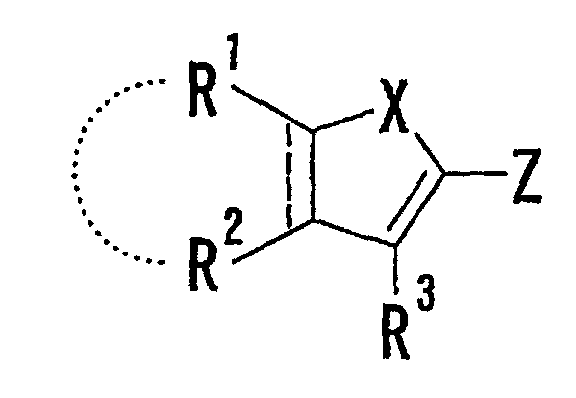
- A process for producing a compound represented by the formula:[wherein, z is an electron-withdrawing group; R1 and R2 each are a hydrogen atom, a halogen atom, an optionally substituted amino group, an optionally substituted hydroxy group, an optionally substituted thiol group, an optionally substituted hydrocarbon group or an optionally substituted heterocyclic group; R1 and R2 may be bound to each other to form an optionally substituted ring; R3 is a hydrogen atom or an optionally substituted hydrocarbon group; the combined line of a broken line and a solid line is a single bond or a double bond; and X is a divalent group (however, when the combined line of a broken line and a solid line is a double bond, -X-CH2-Z is not -X1-X2-CH2-Z (wherein, X1 is a sulfur atom or an optionally substituted nitrogen atom, X2 is an optionally substituted ethylene))] or a salt thereof, which comprises subjecting a compound represented by the formula:
 [wherein, each symbol has the same meaning described as above] or a salt thereof to a cyclization reaction in a solvent containing a carbonic diester.
- The process according to claim 7, wherein X is a divalent group having 1 to 12 atoms in the straight-chain moiety thereof.
- The process according to claim 7, wherein Z is a carboxyl group which is esterified.
- The process according to claim 7, wherein R3 is a hydrogen atom.
- The process according to claim 7, which comprises the reaction being carried out in the presence of a base.
- The process according to claim 11, wherein the base is an alcoholate.
- A process for producing a compound represented by the formula:[wherein, Z is an electron-withdrawing group; R3 is a hydrogen atom or an optionally substituted hydrocarbon group; the combined line of a broken line and a solid line is a single bond or a double bond; ring A is an optionally substituted ring; and X is a divalent group (however, when the ring A is an optionally substituted benzene ring and the combined line of a broken line and a solid line is a double bond, -X-CH2-Z is not -X1-X2-CH2-Z ( wherein, X1 is sulfur atom or an optionally substituted nitrogen atom ; X2 is an optionally substituted ethylene))] or a salt thereof, which comprises subjecting a compound represented by the formula:
 [wherein, each symbol has the same meaning described as above] or a salt thereof to a cyclization reaction in a solvent containing a carbonic diester.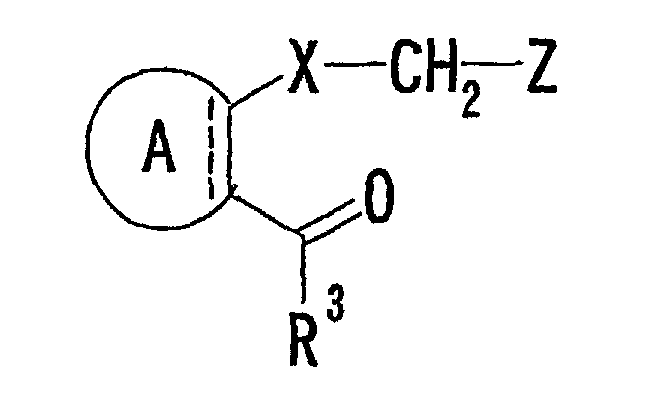
- The process according to claim 13, wherein X is a divalent group having 1 to 12 atoms in the straight-chain moiety thereof.
- The process according to claim 13, wherein Z is a carboxyl group which is esterified.
- The process according to claim 13, wherein R3 is a hydrogen atom.
- The process according to claim 13, which comprises the reaction being carried out in the presence of a base.
- The process according to claim 17, wherein the base is an alcoholate.
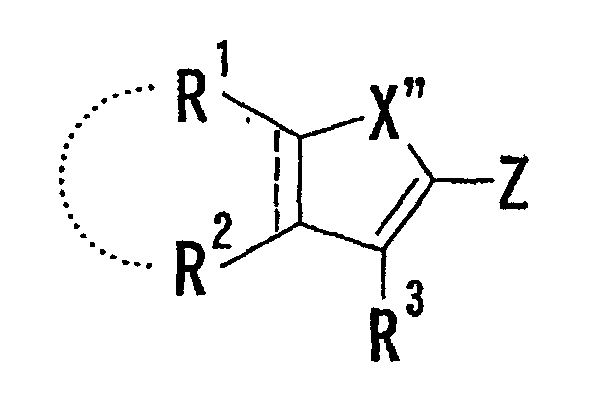
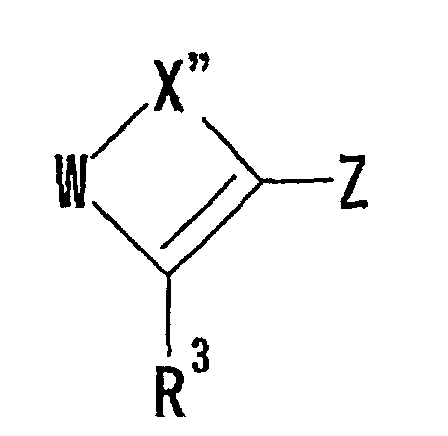
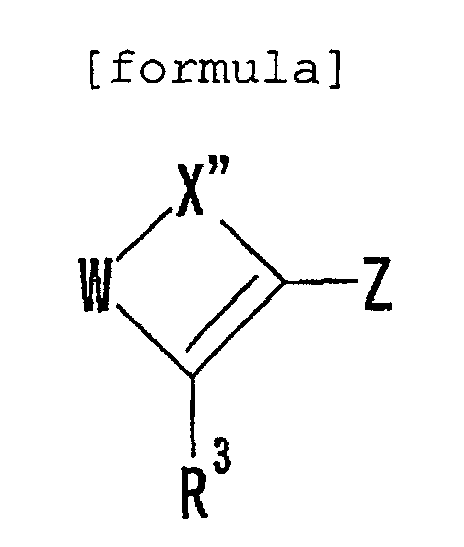
- A compound represented by the formula:[wherein, Z is an electron-withdrawing group; W is an optionally substituted ethylene or an optionally substituted vinylene and when the ethylene or the vinylene has two substituent groups, said substituent groups may be bound to each other to form an optionally substituted ring; R3 is a hydrogen atom or an optionally substituted hydrocarbon group; and X" is a divalent group having 4 or more atoms in the straight-chain moiety thereof] or a salt thereof.
Priority Applications (1)
| Application Number | Priority Date | Filing Date | Title |
|---|---|---|---|
| EP05077898A EP1760054A3 (en) | 2000-02-21 | 2001-02-20 | Process for producing cyclic compound |
Applications Claiming Priority (3)
| Application Number | Priority Date | Filing Date | Title |
|---|---|---|---|
| JP2000048929 | 2000-02-21 | ||
| JP2000048929 | 2000-02-21 | ||
| PCT/JP2001/001190 WO2001060768A1 (en) | 2000-02-21 | 2001-02-20 | Process for producing cyclic compound |
Related Child Applications (1)
| Application Number | Title | Priority Date | Filing Date |
|---|---|---|---|
| EP05077898A Division EP1760054A3 (en) | 2000-02-21 | 2001-02-20 | Process for producing cyclic compound |
Publications (2)
| Publication Number | Publication Date |
|---|---|
| EP1266881A1 true EP1266881A1 (en) | 2002-12-18 |
| EP1266881A4 EP1266881A4 (en) | 2003-05-07 |
Family
ID=18570940
Family Applications (2)
| Application Number | Title | Priority Date | Filing Date |
|---|---|---|---|
| EP01904559A Withdrawn EP1266881A4 (en) | 2000-02-21 | 2001-02-20 | METHOD FOR PRODUCING CYCLIC CONNECTIONS |
| EP05077898A Withdrawn EP1760054A3 (en) | 2000-02-21 | 2001-02-20 | Process for producing cyclic compound |
Family Applications After (1)
| Application Number | Title | Priority Date | Filing Date |
|---|---|---|---|
| EP05077898A Withdrawn EP1760054A3 (en) | 2000-02-21 | 2001-02-20 | Process for producing cyclic compound |
Country Status (7)
| Country | Link |
|---|---|
| US (2) | US6864367B2 (en) |
| EP (2) | EP1266881A4 (en) |
| KR (1) | KR20030005202A (en) |
| CN (1) | CN1404461A (en) |
| AU (1) | AU2001232347A1 (en) |
| CA (1) | CA2400979A1 (en) |
| WO (1) | WO2001060768A1 (en) |
Families Citing this family (2)
| Publication number | Priority date | Publication date | Assignee | Title |
|---|---|---|---|---|
| US6740676B2 (en) * | 2002-03-19 | 2004-05-25 | Allergan, Inc. | 4-[(8-ethynyl, 8-vinyl or 8-ethynyl-methyl)-6-chromanoyl]-benzoic and 2-[4-[(8-ethynyl, 8-vinyl or 8-ethynyl-methyl)-6-chromanoyl]-phenyl]-acetic acid, their esters and salts having cytochrome p450rai inhibitory activity |
| AU2005280639A1 (en) * | 2004-02-17 | 2006-03-09 | Billy T. Fowler | Methods, compositions, and apparatuses for forming macrocyclic compounds |
Family Cites Families (13)
| Publication number | Priority date | Publication date | Assignee | Title |
|---|---|---|---|---|
| US4952573A (en) | 1988-03-23 | 1990-08-28 | Laboratoirs Alcon S.A. | Compounds having GABA like activity, and use of same in tissue irrigating solutions |
| DE4239000A1 (en) | 1992-11-19 | 1994-05-26 | Bayer Ag | Multistage prepn. of Toltrazuril without isolating intermediates - starting from 4-tri:fluoromethyl- mercapto-phenol, 2-chloro-5- nitrotoluene, phosgene and N-methyl urea |
| US5663376A (en) | 1994-07-27 | 1997-09-02 | Eisai Co., Ltd. | Process for the preparation of α-tocopherol |
| JP2002502414A (en) | 1997-06-02 | 2002-01-22 | 藤沢薬品工業株式会社 | Guanidine derivatives as inhibitors of Na ++ / H ++ exchange in cells |
| EP1039899A2 (en) * | 1997-12-19 | 2000-10-04 | Takeda Chemical Industries, Ltd. | Pharmaceutical composition for antagonizing ccr5 comprising anilide derivative |
| US6346527B1 (en) * | 1998-04-24 | 2002-02-12 | Fujisawa Pharmaceutical Co., Ltd. | Guanidine derivatives |
| TW462964B (en) * | 1998-05-26 | 2001-11-11 | Sumitomo Pharma | Guanidine derivatives for the treatment and prevention of disorders caused by inhibiting hyperactivity of Na/H exchange transport system and process for producing the same |
| AU5301599A (en) * | 1998-08-20 | 2000-03-14 | Takeda Chemical Industries Ltd. | Quaternary ammonium salts and their use |
| WO2000069845A1 (en) * | 1999-05-18 | 2000-11-23 | Takeda Chemical Industries, Ltd. | Processes for the preparation of 2,3-dihydrothiepine derivatives |
| AU5426500A (en) | 1999-06-16 | 2001-01-02 | Takeda Chemical Industries Ltd. | Benzazepine derivatives, process for the preparation of the same and uses thereof |
| DE60045033D1 (en) | 1999-08-06 | 2010-11-11 | Takeda Pharmaceutical | SUBSTITUTED AROMATIC RING COMPOUNDS, PROCESS FOR THEIR PREPARATION AND THEIR USE |
| AU6870500A (en) | 1999-09-06 | 2001-04-10 | Takeda Chemical Industries Ltd. | Process for the preparation of 2,3-dihydroazepine derivatives |
| WO2001017947A1 (en) | 1999-09-06 | 2001-03-15 | Takeda Chemical Industries, Ltd. | Process for the preparation of 2,3-dihydroazepine compounds |
-
2001
- 2001-02-20 WO PCT/JP2001/001190 patent/WO2001060768A1/en not_active Ceased
- 2001-02-20 CA CA002400979A patent/CA2400979A1/en not_active Abandoned
- 2001-02-20 EP EP01904559A patent/EP1266881A4/en not_active Withdrawn
- 2001-02-20 AU AU2001232347A patent/AU2001232347A1/en not_active Abandoned
- 2001-02-20 US US10/204,315 patent/US6864367B2/en not_active Expired - Fee Related
- 2001-02-20 EP EP05077898A patent/EP1760054A3/en not_active Withdrawn
- 2001-02-20 CN CN01805369A patent/CN1404461A/en active Pending
- 2001-02-20 KR KR1020027010898A patent/KR20030005202A/en not_active Ceased
-
2004
- 2004-12-10 US US11/010,215 patent/US7038042B2/en not_active Expired - Fee Related
Also Published As
| Publication number | Publication date |
|---|---|
| US7038042B2 (en) | 2006-05-02 |
| AU2001232347A1 (en) | 2001-08-27 |
| EP1760054A3 (en) | 2009-12-30 |
| WO2001060768A1 (en) | 2001-08-23 |
| CA2400979A1 (en) | 2001-08-23 |
| EP1266881A4 (en) | 2003-05-07 |
| US20050096475A1 (en) | 2005-05-05 |
| US6864367B2 (en) | 2005-03-08 |
| EP1760054A2 (en) | 2007-03-07 |
| US20030040632A1 (en) | 2003-02-27 |
| CN1404461A (en) | 2003-03-19 |
| KR20030005202A (en) | 2003-01-17 |
Similar Documents
| Publication | Publication Date | Title |
|---|---|---|
| Reddy et al. | Total synthesis and revision of the absolute configuration of seimatopolide B | |
| ES2875551T3 (en) | Method for preparing optically pure (R) -4-n-propyl-dihydrofuran-2 (3H) -one | |
| Ihara et al. | Asymmetric total synthesis of naturally occurring (R)-(–)-enantiomer of tylophorine via intramolecular double Michael reaction | |
| US6864367B2 (en) | Process for producing cyclic compound | |
| Nishiyama et al. | Total syntheses of sterically locked phycocyanobilin derivatives bearing a 15 Z-anti or a 15 E-anti CD-ring component | |
| EP1211239A1 (en) | Process for the preparation of 2,3-dihydroazepine compounds | |
| JP2001316370A (en) | Method of producing cyclic compound | |
| Bezergiannidou‐Balouctsi et al. | Reactions of 7‐(methoxyimino)‐4‐methyl‐2H‐chromene‐2, 8 (7H)‐dione with Phosphorus Ylides. Synthesis of 2‐substituted 6‐methyl‐8H‐benzopyrano [7, 8‐d] oxazol‐8‐ones | |
| Bartels et al. | Stereoselective Diazoalkane Cycloadditions to Chiral 5-Alkylidene-1, 3-dioxan-4-ones and 3-Benzylidene-β-lactones | |
| US6566535B1 (en) | Processes for the preparation of 2,3-dihydrothiepine derivatives | |
| Toth et al. | Synthesis of Vinca Alkaloids and Related Compounds. Part 106. An Efficient Convergent Synthetic Pathway to Build Up the Ibophyllidine Skeleton II. Total Synthesis of | |
| Thiemann et al. | One pot Suzuki coupling–Wittig olefination reactions | |
| Shiotani et al. | Furopyridines. IX. Syntheses and properties of 3‐ethoxy derivatives of furo [2, 3‐b]‐, furo [3, 2‐b]‐, furo [2, 3‐c]‐and furo [3, 2‐c] pyridine | |
| Görth et al. | Decagram‐Scale Synthesis of the Neocarzinostatin Carboxylic Acid | |
| Planas et al. | New synthetic entries to (±)-andirolactone | |
| Moldvai et al. | Chemistry of indoles carrying a basic function. Part VII. A new aspect of Stobbe reaction | |
| Moritani et al. | A highly stereoselective synthesis of 3-hydroxy-1-aryltetralin lignans based on the stereoselective hydroxylation of α, β-dibenzyl-γ-butyro-lactones: the first synthesis of (±)-cycloolivil | |
| Cahill et al. | Furanyl spiroketals: thermodynamic control of remote asymmetry | |
| Vuppalapati et al. | A formal enantioselective synthesis of (+)-dodoneine via cyclic sulfate methodology. | |
| Honda et al. | Synthesis and structure of 1-methyl-2, 6-bis (electron-withdrawing group)-substituted selenabenzenes | |
| Takagi et al. | Stereoselective syntheses of (+)-rhopaloic acid A and (–)-ent-and (±)-rac-rhopaloic acid A | |
| CA2145735A1 (en) | Process for producing 5-oxaspiro[2.4]heptan-6-one and novel intermediate products obtained therein | |
| Yonezawa et al. | Total syntheses of naturally occurring bis (methylthio) silvatin and its three stereoisomers | |
| KAMETANI et al. | Studies on the Syntheses of Heterocyclic and Natural Compounds. CMXLVI. Stereocontrolled Total Synthesis of a Thromboxane A2 Analog,(±)-9a-Homo-(11, 12)-deoxathromboxane A2 | |
| Garzino et al. | A New Synthesis of Fused Oxa‐and Thiacrown Ethers–Thiophene/Furan Oligomers |
Legal Events
| Date | Code | Title | Description |
|---|---|---|---|
| PUAI | Public reference made under article 153(3) epc to a published international application that has entered the european phase |
Free format text: ORIGINAL CODE: 0009012 |
|
| 17P | Request for examination filed |
Effective date: 20020809 |
|
| AK | Designated contracting states |
Kind code of ref document: A1 Designated state(s): AT BE CH CY DE DK ES FI FR GB GR IE IT LI LU MC NL PT SE TR |
|
| AX | Request for extension of the european patent |
Free format text: AL;LT;LV;MK;RO;SI |
|
| A4 | Supplementary search report drawn up and despatched |
Effective date: 20030326 |
|
| 17Q | First examination report despatched |
Effective date: 20030620 |
|
| RAP1 | Party data changed (applicant data changed or rights of an application transferred) |
Owner name: TAKEDA PHARMACEUTICAL COMPANY LIMITED |
|
| STAA | Information on the status of an ep patent application or granted ep patent |
Free format text: STATUS: THE APPLICATION IS DEEMED TO BE WITHDRAWN |
|
| 18D | Application deemed to be withdrawn |
Effective date: 20110901 |