EP1264833A2 - 1,2-Phenylenediboronic acid reagents and complexes - Google Patents
1,2-Phenylenediboronic acid reagents and complexes Download PDFInfo
- Publication number
- EP1264833A2 EP1264833A2 EP02010866A EP02010866A EP1264833A2 EP 1264833 A2 EP1264833 A2 EP 1264833A2 EP 02010866 A EP02010866 A EP 02010866A EP 02010866 A EP02010866 A EP 02010866A EP 1264833 A2 EP1264833 A2 EP 1264833A2
- Authority
- EP
- European Patent Office
- Prior art keywords
- group
- general formula
- bioconjugate
- species
- moiety
- Prior art date
- Legal status (The legal status is an assumption and is not a legal conclusion. Google has not performed a legal analysis and makes no representation as to the accuracy of the status listed.)
- Withdrawn
Links
- 0 *C(CC1)=C(*)C=C1ON* Chemical compound *C(CC1)=C(*)C=C1ON* 0.000 description 5
Images



Classifications
-
- C—CHEMISTRY; METALLURGY
- C07—ORGANIC CHEMISTRY
- C07J—STEROIDS
- C07J1/00—Normal steroids containing carbon, hydrogen, halogen or oxygen, not substituted in position 17 beta by a carbon atom, e.g. estrane, androstane
-
- C—CHEMISTRY; METALLURGY
- C07—ORGANIC CHEMISTRY
- C07C—ACYCLIC OR CARBOCYCLIC COMPOUNDS
- C07C229/00—Compounds containing amino and carboxyl groups bound to the same carbon skeleton
- C07C229/38—Compounds containing amino and carboxyl groups bound to the same carbon skeleton having amino groups bound to acyclic carbon atoms and carboxyl groups bound to carbon atoms of six-membered aromatic rings of the same carbon skeleton
-
- C—CHEMISTRY; METALLURGY
- C07—ORGANIC CHEMISTRY
- C07C—ACYCLIC OR CARBOCYCLIC COMPOUNDS
- C07C233/00—Carboxylic acid amides
- C07C233/01—Carboxylic acid amides having carbon atoms of carboxamide groups bound to hydrogen atoms or to acyclic carbon atoms
- C07C233/45—Carboxylic acid amides having carbon atoms of carboxamide groups bound to hydrogen atoms or to acyclic carbon atoms having the nitrogen atom of at least one of the carboxamide groups bound to a carbon atom of a hydrocarbon radical substituted by carboxyl groups
- C07C233/46—Carboxylic acid amides having carbon atoms of carboxamide groups bound to hydrogen atoms or to acyclic carbon atoms having the nitrogen atom of at least one of the carboxamide groups bound to a carbon atom of a hydrocarbon radical substituted by carboxyl groups with the substituted hydrocarbon radical bound to the nitrogen atom of the carboxamide group by an acyclic carbon atom
- C07C233/49—Carboxylic acid amides having carbon atoms of carboxamide groups bound to hydrogen atoms or to acyclic carbon atoms having the nitrogen atom of at least one of the carboxamide groups bound to a carbon atom of a hydrocarbon radical substituted by carboxyl groups with the substituted hydrocarbon radical bound to the nitrogen atom of the carboxamide group by an acyclic carbon atom having the carbon atom of the carboxamide group bound to a carbon atom of an acyclic unsaturated carbon skeleton
-
- C—CHEMISTRY; METALLURGY
- C07—ORGANIC CHEMISTRY
- C07C—ACYCLIC OR CARBOCYCLIC COMPOUNDS
- C07C233/00—Carboxylic acid amides
- C07C233/01—Carboxylic acid amides having carbon atoms of carboxamide groups bound to hydrogen atoms or to acyclic carbon atoms
- C07C233/45—Carboxylic acid amides having carbon atoms of carboxamide groups bound to hydrogen atoms or to acyclic carbon atoms having the nitrogen atom of at least one of the carboxamide groups bound to a carbon atom of a hydrocarbon radical substituted by carboxyl groups
- C07C233/46—Carboxylic acid amides having carbon atoms of carboxamide groups bound to hydrogen atoms or to acyclic carbon atoms having the nitrogen atom of at least one of the carboxamide groups bound to a carbon atom of a hydrocarbon radical substituted by carboxyl groups with the substituted hydrocarbon radical bound to the nitrogen atom of the carboxamide group by an acyclic carbon atom
- C07C233/51—Carboxylic acid amides having carbon atoms of carboxamide groups bound to hydrogen atoms or to acyclic carbon atoms having the nitrogen atom of at least one of the carboxamide groups bound to a carbon atom of a hydrocarbon radical substituted by carboxyl groups with the substituted hydrocarbon radical bound to the nitrogen atom of the carboxamide group by an acyclic carbon atom having the carbon atom of the carboxamide group bound to an acyclic carbon atom of a carbon skeleton containing six-membered aromatic rings
-
- C—CHEMISTRY; METALLURGY
- C07—ORGANIC CHEMISTRY
- C07C—ACYCLIC OR CARBOCYCLIC COMPOUNDS
- C07C237/00—Carboxylic acid amides, the carbon skeleton of the acid part being further substituted by amino groups
- C07C237/02—Carboxylic acid amides, the carbon skeleton of the acid part being further substituted by amino groups having the carbon atoms of the carboxamide groups bound to acyclic carbon atoms of the carbon skeleton
- C07C237/04—Carboxylic acid amides, the carbon skeleton of the acid part being further substituted by amino groups having the carbon atoms of the carboxamide groups bound to acyclic carbon atoms of the carbon skeleton the carbon skeleton being acyclic and saturated
- C07C237/12—Carboxylic acid amides, the carbon skeleton of the acid part being further substituted by amino groups having the carbon atoms of the carboxamide groups bound to acyclic carbon atoms of the carbon skeleton the carbon skeleton being acyclic and saturated having the nitrogen atom of at least one of the carboxamide groups bound to an acyclic carbon atom of a hydrocarbon radical substituted by carboxyl groups
-
- C—CHEMISTRY; METALLURGY
- C07—ORGANIC CHEMISTRY
- C07C—ACYCLIC OR CARBOCYCLIC COMPOUNDS
- C07C237/00—Carboxylic acid amides, the carbon skeleton of the acid part being further substituted by amino groups
- C07C237/02—Carboxylic acid amides, the carbon skeleton of the acid part being further substituted by amino groups having the carbon atoms of the carboxamide groups bound to acyclic carbon atoms of the carbon skeleton
- C07C237/22—Carboxylic acid amides, the carbon skeleton of the acid part being further substituted by amino groups having the carbon atoms of the carboxamide groups bound to acyclic carbon atoms of the carbon skeleton having nitrogen atoms of amino groups bound to the carbon skeleton of the acid part, further acylated
-
- C—CHEMISTRY; METALLURGY
- C07—ORGANIC CHEMISTRY
- C07C—ACYCLIC OR CARBOCYCLIC COMPOUNDS
- C07C255/00—Carboxylic acid nitriles
- C07C255/01—Carboxylic acid nitriles having cyano groups bound to acyclic carbon atoms
- C07C255/11—Carboxylic acid nitriles having cyano groups bound to acyclic carbon atoms containing cyano groups and singly-bound oxygen atoms bound to the same saturated acyclic carbon skeleton
- C07C255/13—Carboxylic acid nitriles having cyano groups bound to acyclic carbon atoms containing cyano groups and singly-bound oxygen atoms bound to the same saturated acyclic carbon skeleton containing cyano groups and etherified hydroxy groups bound to the carbon skeleton
-
- C—CHEMISTRY; METALLURGY
- C07—ORGANIC CHEMISTRY
- C07C—ACYCLIC OR CARBOCYCLIC COMPOUNDS
- C07C259/00—Compounds containing carboxyl groups, an oxygen atom of a carboxyl group being replaced by a nitrogen atom, this nitrogen atom being further bound to an oxygen atom and not being part of nitro or nitroso groups
- C07C259/04—Compounds containing carboxyl groups, an oxygen atom of a carboxyl group being replaced by a nitrogen atom, this nitrogen atom being further bound to an oxygen atom and not being part of nitro or nitroso groups without replacement of the other oxygen atom of the carboxyl group, e.g. hydroxamic acids
- C07C259/10—Compounds containing carboxyl groups, an oxygen atom of a carboxyl group being replaced by a nitrogen atom, this nitrogen atom being further bound to an oxygen atom and not being part of nitro or nitroso groups without replacement of the other oxygen atom of the carboxyl group, e.g. hydroxamic acids having carbon atoms of hydroxamic groups bound to carbon atoms of six-membered aromatic rings
-
- C—CHEMISTRY; METALLURGY
- C07—ORGANIC CHEMISTRY
- C07C—ACYCLIC OR CARBOCYCLIC COMPOUNDS
- C07C271/00—Derivatives of carbamic acids, i.e. compounds containing any of the groups, the nitrogen atom not being part of nitro or nitroso groups
- C07C271/06—Esters of carbamic acids
- C07C271/08—Esters of carbamic acids having oxygen atoms of carbamate groups bound to acyclic carbon atoms
- C07C271/10—Esters of carbamic acids having oxygen atoms of carbamate groups bound to acyclic carbon atoms with the nitrogen atoms of the carbamate groups bound to hydrogen atoms or to acyclic carbon atoms
- C07C271/22—Esters of carbamic acids having oxygen atoms of carbamate groups bound to acyclic carbon atoms with the nitrogen atoms of the carbamate groups bound to hydrogen atoms or to acyclic carbon atoms to carbon atoms of hydrocarbon radicals substituted by carboxyl groups
-
- C—CHEMISTRY; METALLURGY
- C07—ORGANIC CHEMISTRY
- C07C—ACYCLIC OR CARBOCYCLIC COMPOUNDS
- C07C281/00—Derivatives of carbonic acid containing functional groups covered by groups C07C269/00 - C07C279/00 in which at least one nitrogen atom of these functional groups is further bound to another nitrogen atom not being part of a nitro or nitroso group
- C07C281/02—Compounds containing any of the groups, e.g. carbazates
-
- C—CHEMISTRY; METALLURGY
- C07—ORGANIC CHEMISTRY
- C07D—HETEROCYCLIC COMPOUNDS
- C07D207/00—Heterocyclic compounds containing five-membered rings not condensed with other rings, with one nitrogen atom as the only ring hetero atom
- C07D207/02—Heterocyclic compounds containing five-membered rings not condensed with other rings, with one nitrogen atom as the only ring hetero atom with only hydrogen or carbon atoms directly attached to the ring nitrogen atom
- C07D207/44—Heterocyclic compounds containing five-membered rings not condensed with other rings, with one nitrogen atom as the only ring hetero atom with only hydrogen or carbon atoms directly attached to the ring nitrogen atom having three double bonds between ring members or between ring members and non-ring members
- C07D207/444—Heterocyclic compounds containing five-membered rings not condensed with other rings, with one nitrogen atom as the only ring hetero atom with only hydrogen or carbon atoms directly attached to the ring nitrogen atom having three double bonds between ring members or between ring members and non-ring members having two doubly-bound oxygen atoms directly attached in positions 2 and 5
- C07D207/448—Heterocyclic compounds containing five-membered rings not condensed with other rings, with one nitrogen atom as the only ring hetero atom with only hydrogen or carbon atoms directly attached to the ring nitrogen atom having three double bonds between ring members or between ring members and non-ring members having two doubly-bound oxygen atoms directly attached in positions 2 and 5 with only hydrogen atoms or radicals containing only hydrogen and carbon atoms directly attached to other ring carbon atoms, e.g. maleimide
- C07D207/452—Heterocyclic compounds containing five-membered rings not condensed with other rings, with one nitrogen atom as the only ring hetero atom with only hydrogen or carbon atoms directly attached to the ring nitrogen atom having three double bonds between ring members or between ring members and non-ring members having two doubly-bound oxygen atoms directly attached in positions 2 and 5 with only hydrogen atoms or radicals containing only hydrogen and carbon atoms directly attached to other ring carbon atoms, e.g. maleimide with hydrocarbon radicals, substituted by hetero atoms, directly attached to the ring nitrogen atom
-
- C—CHEMISTRY; METALLURGY
- C07—ORGANIC CHEMISTRY
- C07D—HETEROCYCLIC COMPOUNDS
- C07D207/00—Heterocyclic compounds containing five-membered rings not condensed with other rings, with one nitrogen atom as the only ring hetero atom
- C07D207/46—Heterocyclic compounds containing five-membered rings not condensed with other rings, with one nitrogen atom as the only ring hetero atom with hetero atoms directly attached to the ring nitrogen atom
-
- C—CHEMISTRY; METALLURGY
- C07—ORGANIC CHEMISTRY
- C07D—HETEROCYCLIC COMPOUNDS
- C07D213/00—Heterocyclic compounds containing six-membered rings, not condensed with other rings, with one nitrogen atom as the only ring hetero atom and three or more double bonds between ring members or between ring members and non-ring members
- C07D213/02—Heterocyclic compounds containing six-membered rings, not condensed with other rings, with one nitrogen atom as the only ring hetero atom and three or more double bonds between ring members or between ring members and non-ring members having three double bonds between ring members or between ring members and non-ring members
- C07D213/04—Heterocyclic compounds containing six-membered rings, not condensed with other rings, with one nitrogen atom as the only ring hetero atom and three or more double bonds between ring members or between ring members and non-ring members having three double bonds between ring members or between ring members and non-ring members having no bond between the ring nitrogen atom and a non-ring member or having only hydrogen or carbon atoms directly attached to the ring nitrogen atom
- C07D213/60—Heterocyclic compounds containing six-membered rings, not condensed with other rings, with one nitrogen atom as the only ring hetero atom and three or more double bonds between ring members or between ring members and non-ring members having three double bonds between ring members or between ring members and non-ring members having no bond between the ring nitrogen atom and a non-ring member or having only hydrogen or carbon atoms directly attached to the ring nitrogen atom with hetero atoms or with carbon atoms having three bonds to hetero atoms with at the most one bond to halogen, e.g. ester or nitrile radicals, directly attached to ring carbon atoms
- C07D213/62—Oxygen or sulfur atoms
- C07D213/70—Sulfur atoms
- C07D213/71—Sulfur atoms to which a second hetero atom is attached
-
- C—CHEMISTRY; METALLURGY
- C07—ORGANIC CHEMISTRY
- C07F—ACYCLIC, CARBOCYCLIC OR HETEROCYCLIC COMPOUNDS CONTAINING ELEMENTS OTHER THAN CARBON, HYDROGEN, HALOGEN, OXYGEN, NITROGEN, SULFUR, SELENIUM OR TELLURIUM
- C07F5/00—Compounds containing elements of Groups 3 or 13 of the Periodic Table
- C07F5/02—Boron compounds
- C07F5/025—Boronic and borinic acid compounds
-
- G—PHYSICS
- G01—MEASURING; TESTING
- G01N—INVESTIGATING OR ANALYSING MATERIALS BY DETERMINING THEIR CHEMICAL OR PHYSICAL PROPERTIES
- G01N33/00—Investigating or analysing materials by specific methods not covered by groups G01N1/00 - G01N31/00
- G01N33/48—Biological material, e.g. blood, urine; Haemocytometers
- G01N33/50—Chemical analysis of biological material, e.g. blood, urine; Testing involving biospecific ligand binding methods; Immunological testing
- G01N33/53—Immunoassay; Biospecific binding assay; Materials therefor
- G01N33/531—Production of immunochemical test materials
-
- G—PHYSICS
- G01—MEASURING; TESTING
- G01N—INVESTIGATING OR ANALYSING MATERIALS BY DETERMINING THEIR CHEMICAL OR PHYSICAL PROPERTIES
- G01N33/00—Investigating or analysing materials by specific methods not covered by groups G01N1/00 - G01N31/00
- G01N33/48—Biological material, e.g. blood, urine; Haemocytometers
- G01N33/50—Chemical analysis of biological material, e.g. blood, urine; Testing involving biospecific ligand binding methods; Immunological testing
- G01N33/53—Immunoassay; Biospecific binding assay; Materials therefor
- G01N33/543—Immunoassay; Biospecific binding assay; Materials therefor with an insoluble carrier for immobilising immunochemicals
- G01N33/54353—Immunoassay; Biospecific binding assay; Materials therefor with an insoluble carrier for immobilising immunochemicals with ligand attached to the carrier via a chemical coupling agent
-
- Y—GENERAL TAGGING OF NEW TECHNOLOGICAL DEVELOPMENTS; GENERAL TAGGING OF CROSS-SECTIONAL TECHNOLOGIES SPANNING OVER SEVERAL SECTIONS OF THE IPC; TECHNICAL SUBJECTS COVERED BY FORMER USPC CROSS-REFERENCE ART COLLECTIONS [XRACs] AND DIGESTS
- Y10—TECHNICAL SUBJECTS COVERED BY FORMER USPC
- Y10S—TECHNICAL SUBJECTS COVERED BY FORMER USPC CROSS-REFERENCE ART COLLECTIONS [XRACs] AND DIGESTS
- Y10S530/00—Chemistry: natural resins or derivatives; peptides or proteins; lignins or reaction products thereof
- Y10S530/81—Carrier - bound or immobilized peptides or proteins and the preparation thereof, e.g. biological cell or cell fragment as carrier
-
- Y—GENERAL TAGGING OF NEW TECHNOLOGICAL DEVELOPMENTS; GENERAL TAGGING OF CROSS-SECTIONAL TECHNOLOGIES SPANNING OVER SEVERAL SECTIONS OF THE IPC; TECHNICAL SUBJECTS COVERED BY FORMER USPC CROSS-REFERENCE ART COLLECTIONS [XRACs] AND DIGESTS
- Y10—TECHNICAL SUBJECTS COVERED BY FORMER USPC
- Y10S—TECHNICAL SUBJECTS COVERED BY FORMER USPC CROSS-REFERENCE ART COLLECTIONS [XRACs] AND DIGESTS
- Y10S530/00—Chemistry: natural resins or derivatives; peptides or proteins; lignins or reaction products thereof
- Y10S530/81—Carrier - bound or immobilized peptides or proteins and the preparation thereof, e.g. biological cell or cell fragment as carrier
- Y10S530/812—Peptides or proteins is immobilized on, or in, an organic carrier
- Y10S530/815—Carrier is a synthetic polymer
- Y10S530/816—Attached to the carrier via a bridging agent
Definitions
- the present invention relates to the field of bioconjugate preparation, and more particularly, to a novel class of 1,2-phenylenediboronic acid (1,2-PDBA) reagents useful for the conjugation of biological macromolecules, and the method of making and using such reagents.
- 1,2-phenylenediboronic acid (1,2-PDBA) reagents useful for the conjugation of biological macromolecules, and the method of making and using such reagents.
- Bioconjugation is a descriptive term for the joining of two or more different molecular species by chemical or biological means, in which at least one of the molecular species is a biological macromolecule. This includes, but is not limited to, conjugation of proteins, peptides, polysaccharides, hormones, nucleic acids, liposomes and cells, with each other or with any other molecular species that add useful properties, including, but not limited to, drugs, radionuclides, toxins, haptens, inhibitors, chromophores, fluorophores, ligands, etc.
- Immobilization of biological macromolecules is also considered a special case of bioconjugation in which the macromolecule is conjugated, either reversibly or irreversibly, to an insoluble support including a chromatographic support.
- Bioconjugation is utilized extensively in biochemical, immuno-chemical and molecular biological research. Major applications of bioconjugation include, but are not limited to, detection of gene probes, enzyme-linked immunological solid-phase assay, monoclonal antibody drug targeting and medical imaging.
- Bioconjugates are generally classified as either direct or indirect conjugates.
- Direct conjugates encompass those in which two or more components are joined by direct covalent chemical linkages.
- indirect conjugates encompass those in which two or more components are joined via an intermediary complex involving a biological macromolecule.
- the Avidin-Biotin system has been utilized extensively for enzyme-linked immuno-logical solid-phase assay (ELISA), in which an enzyme-Avidin conjugate (useful for detection by reaction with the enzyme's substrate to afford a colored or chemiluminescent product) is employed to detect the presence of a biotinylated antibody, after first binding the antibody to an immobilized antigen or hapten.
- ELISA enzyme-linked immuno-logical solid-phase assay
- the high specificity of the various anti -Digoxigenin antibodies affords low backgrounds and eliminates the non-specific binding observed in Avidin-Biotin systems.
- Digoxigenin-labeled DNA and RNA probes can detect single-copy sequences in human genomic Southern blots.
- the development of the Digoxigenin anti -Digoxigenin system has recently been reviewed. See Kessler, C. (1990) in Advances in Mutagenesis Research (Obe, G. ed.) pp. 105-152, Springer-Verlag, Berlin and Heidelberg.
- the Digoxigenin anti -Digoxigenin system is the most recent representative of several hapten-antibody systems now routinely utilized for bioconjugation.
- Phenylboronic acids are known to interact with a wide range of polar molecules having certain requisite functionalities. Complexes of varying stability, involving 1,2-diols, 1,3-diols, 1,2-hydroxy acids, 1,3-hydroxy acids, 1,2-hydroxylamines, 1,3-hydroxylamines, 1,2-diketones and 1,3-diketones, are known to form with either neutral phenylboronic acid or the phenylboronate anion. Consequently, immobilized phenylboronic acids have been exploited as chromatographic supports to selectively retain, from diverse biological samples, those molecular species having the requisite functionalities.
- transition-metal catalyzed cross coupling reactions have been developed to produce phenylboronic acids from aryl halides and alkoxydiboron, see Ishiyama, T., Murata, M. and Miyaura, N., J. Org. Chem. (1995), 60 , 7508-7510; Giroux, A., Han, Y. and Prasit, P., Tetrahedran Lett. (1997), 38 , 3841-3844, or dialkoxyhydroborane, see Murata, M.; Watanabe, S.; Masuda, Y., J. Org. Chem.
- 1,2 -phenylenediboronic acid has been previously described on only one occasion (Clement, R., Thiais, F., Hebd. Seances Acad. Sci., Ser. C (1966), 263 , 1398-400.
- 2-Acetamidophenylboronic acids have been proposed as potential linkers for selective bioconjugation via the vicinal diol moieties of the carbohydrate residues associated with glycoproteins. See Cai, S. X. and Keana, J. F. W., Bioconjugate Chem. (1991), 2, 317-322.
- Phenylboronic acid bioconjugates derived from 3-isothiocyanatophenylboronic acid have been successfully utilized for appending radioactive technetium dioxime complexes to monoclonal antibodies for use in medical imaging. See Linder, K. E., Wen, M. D., Nowotnik, D. P., Malley, M. F., Gougoutas, J.
- 3-Aminophenylboronic acid has been covalently appended to proteins by a variety of chemical methods and the resulting phenylboronic acid bioconjugates tested for their binding of D-sorbitol, D-mannose and glycated hemoglobin (GHb).
- the interactions proved to be reversible and of very low affinity rendering the bioconjugates of very limited practical use.
- an Alkaline Phosphatase-phenylboronate bioconjugate used in an attempted enzyme-linked assay for the detection of GHb failed to detect the presence of glycated protein. See Frantzen, F., Grimsrud, K., Heggli, D. and Sunfitagen, E., Journal of Chromatography B (1995), 670 , 37-45.
- phenylboronic acid reagents In addition to attempts to utilize immobilized phenylboronates for chromatographic separation of biological molecules having the requisite functionalities, a novel class of phenylboronic acid reagents, phenyldiboronic acid reagents, and boronic and diboronic compound complexing reagents have been developed for conjugating biologically active species (or bioactive species) and exploiting indirect bioconjugation through reversible formation of a boronic acid complex. These reagents and associated conjugates may be used in a manner analogous to Avidin-Biotin and Digoxigenin- anti -Digoxigenin systems.
- the bioconjugate formed through the boron complex is generally insensitive to significant variations in ionic strength, temperature, the presence of organic solvents, and the presence of chaotropic agents (protein and nucleic acid denaturants).
- Phenylboronic acid reagents and boronic compound complexing reagents, their conjugates and bioconjugates as well as methods for their preparation and use are the subject of United States Patent Nos.
- Phosphoramidite reagents containing protected 1,2 -phenylenediboronic acid moieties for the preparation of modified synthetic oligonucleotides are the subject of United States Patent No. 6,031,117.
- Oligonucleotides and polynucleotides containing 1,2 -phenylenediboronic acid moieties, prepared from the aforementioned phosphoramidite reagents, are the subject of United States Patent No. 6,013,783.
- the present invention relates to a novel class of 1,2-phenylenediboronic acid (1,2-PDBA) reagents useful for the preparation of bioconjugates, and the method of making and using such reagents.
- the 1,2-PDBA reagents of the present invention are preferably complexed with boronic compound complexing reagents derived from salicylhydroxamic acid (SHA), or derivatives thereof.
- the 1,2-PDBA reagents of the present invention are preferably complexed with boronic compound complexing reagents derived from 2,6-dihydroxybenzohydroxamic acid (DHBHA), or derivatives thereof.
- Bioconjugate preparation often involves the conjugation of several components including, but not limited to, proteins, peptides, polysaccharides, hormones, nucleic acids, liposomes and cells, with each other or with any other molecular species that add useful properties, including, but not limited to, drugs, radionuclides, toxins, haptens, inhibitors, fluorophores, ligands, and solid-phase supports including chromatographic supports.
- These various components utilized in bioconjugate preparation will collectively and individually be termed biologically active species or bioactive species.
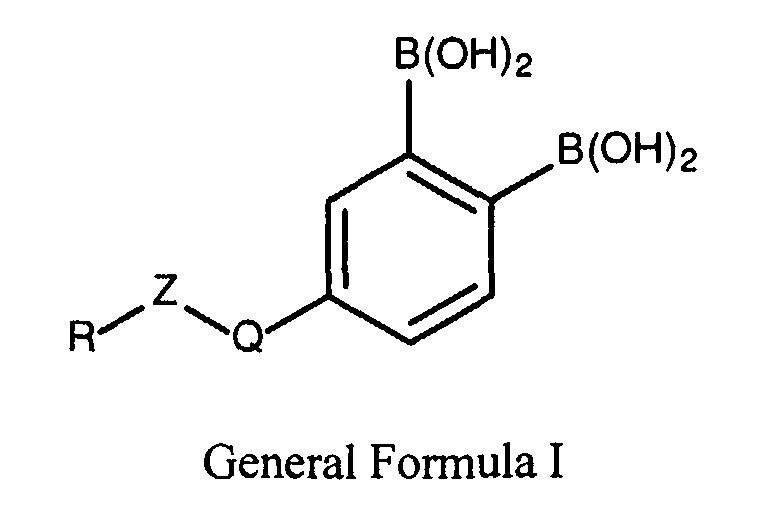
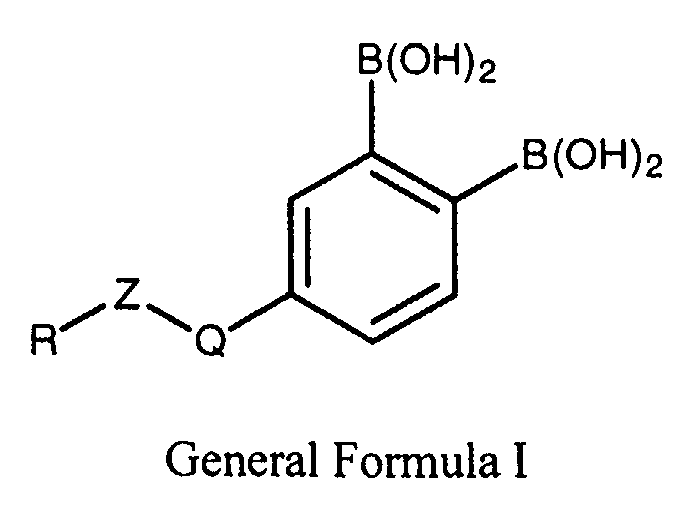
- Reagents suitable for the modification of a bioactive species for the purpose of incorporating one or more 1,2-phenylenediboronic acid moieties for subsequent conjugation to a different (or the same) bioactive species having one or more pendant boronic compound complexing moieties are of General Formula I, wherein group R is a reactive electrophilic or nucleophilic moiety suitable for reaction of the 1,2 -phenylenediboronic acid reagent with a bioactive species.
- Group Z is a spacer and group Q is an optional linkage that includes one of amide, ether and thioether moieties.
- Reagents of General Formula I exhibit superior properties when compared to prior art phenylboronic acid reagents, in that, they incorporate two equivalents of boronic acid per reactive group R, and afford complexes in conjunction with boronic compound complexing reagents that exhibit superior stability in aqueous systems.
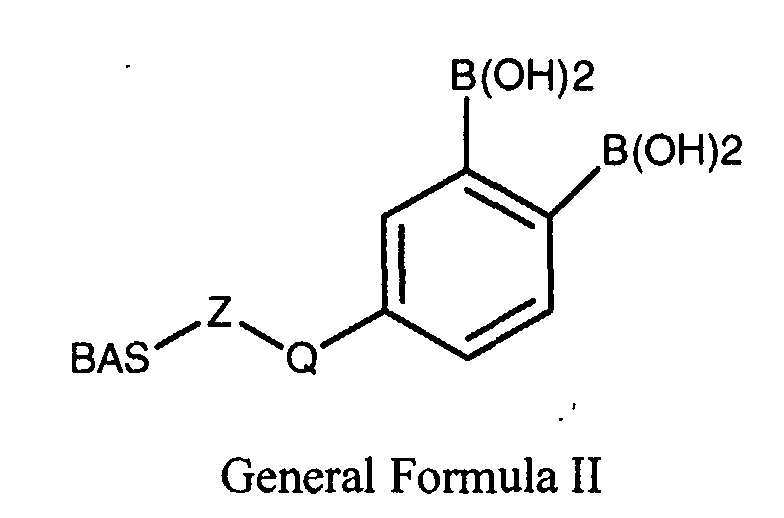
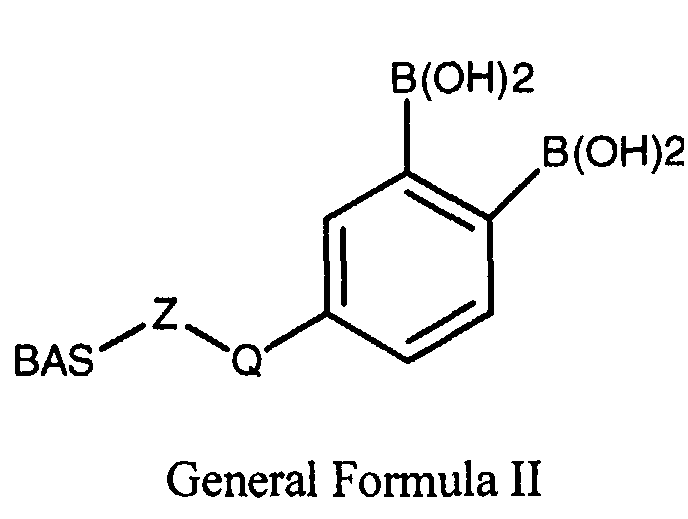
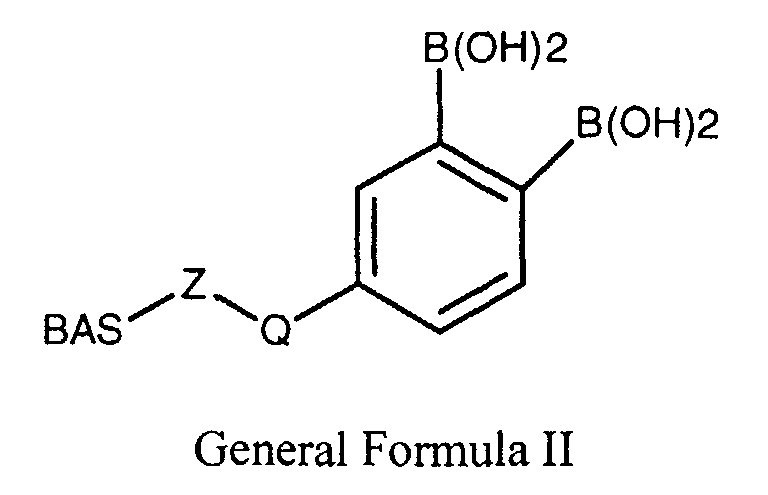
- Reaction of a reagent of General Formula I with a bioactive species affords a conjugate having pendant 1,2-phenylenediboronic acid moieties (one or more) of General Formula II, wherein the symbol labeled BAS represents a biologically active species (or bioactive species) that may or may not contain a portion of a reactive moiety (which may itself have a spacer) used to attach the bioactive species to the reagent.
- Group Z in General Formula II is a spacer and group Q is an optional linkage that includes one of amide, ether and thioether moieties. It will be appreciated that, in many embodiments, several identical reagents of the general formula of General Formula I will react with a single BAS molecule.
- a representative illustration of multiple 1,2-PDBA reagents reacted with a biologically active species (or bioactive species) includes the following:
- Conjugates of General Formula II exhibit reduced hydrophobic secondary properties as compared to phenylboronic acid conjugates known in the prior art. This reduction in hydrophobic secondary properties lowers the extent of nonspecific binding, which is known to be a problem associated with bioactive species that have been conjugated with several hydrophobic moieties.
- the conjugate of General Formula II may be complexed with a boronic compound complexing conjugate.
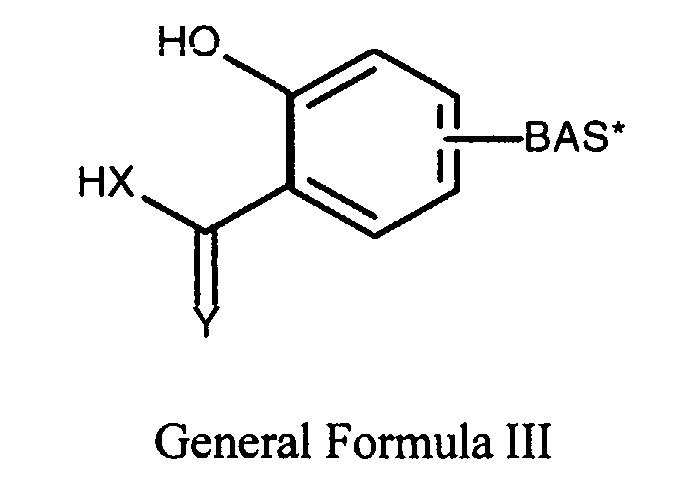
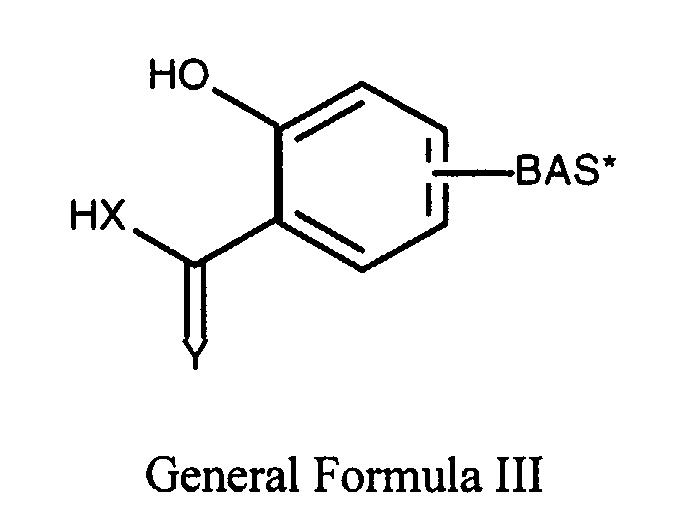
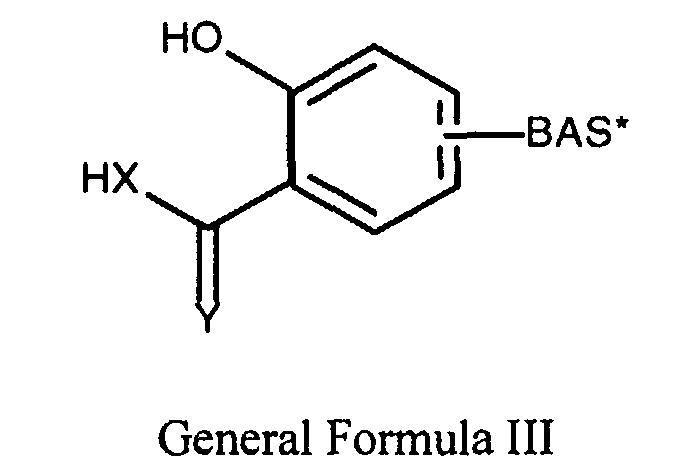
- boronic compound complexing reagents may be appended to a biologically active species to afford a conjugate having pendant boronic compound complexing moieties (one or more) of the general formula of General Formula III, wherein the symbol labeled BAS* represents a second bioactive species, that may include a linker portion and that may differ from the bioactive species labeled BAS.
- the BAS* may also include a portion of a reactive moiety used to attach the bioactive species to the boronic compound complexing reagent.
- Group X is an acidic electron pair donating species
- group Y is selected from one of O, S and NH.
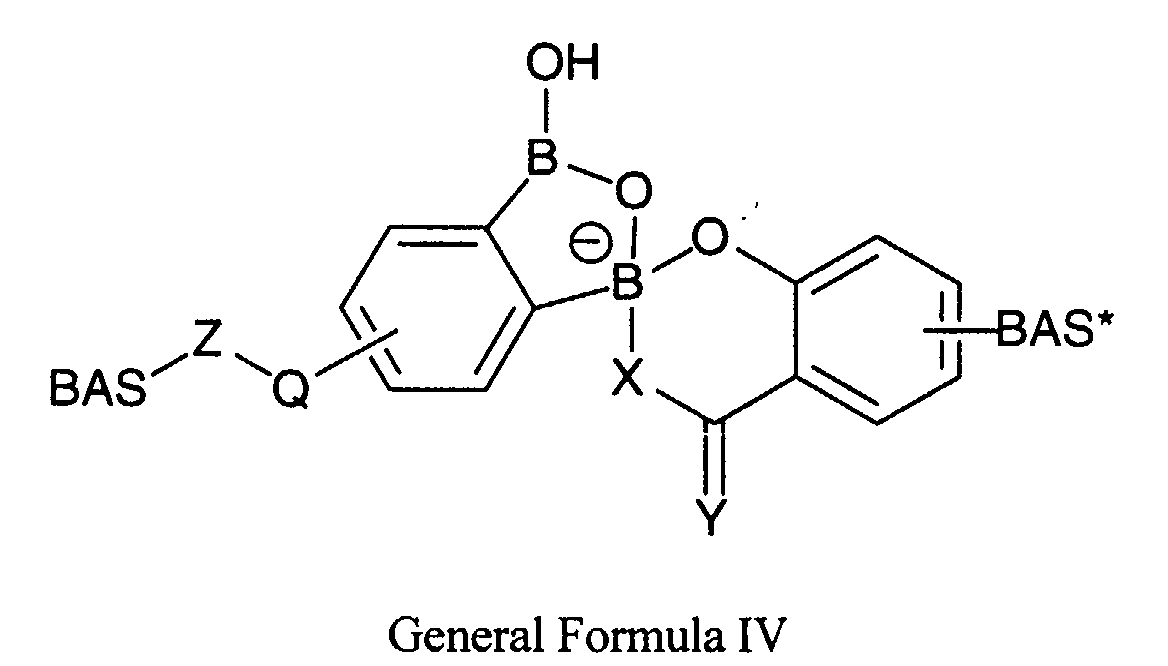
- a conjugate of General Formula II with at least one biologically active species and having pendent 1,2-phenylenediboronic acid moieties (one or more), may be complexed with one or more conjugates of General Formula III, prepared from a second bioactive species BAS* , and having pendant boronic compound complexing moieties (one or more), to afford, for example, a bioconjugate of General Formula IV, wherein the symbols labeled BAS and BAS* , and groups Z and Q are as were previously defined.
- Group X is an acidic electron pair donating species
- group Y is selected from one of O, S and NH.
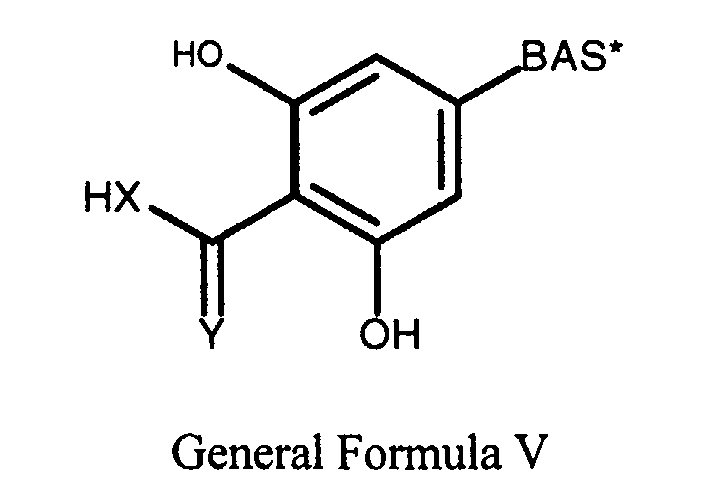
- boronic compound complexing reagents may be appended to a biologically active species to afford a conjugate having pendant boronic compound complexing moieties (one or more) of General Formula V, wherein the symbol labeled BAS* represents a second bioactive species, that may include a linker portion and that may differ from the bioactive species labeled BAS.
- the BAS* may also include a portion of a reactive moiety used to attach the bioactive species to the boronic compound complexing reagent.
- Group X is an acidic electron pair donating species
- group Y is selected from one of O, S and NH.
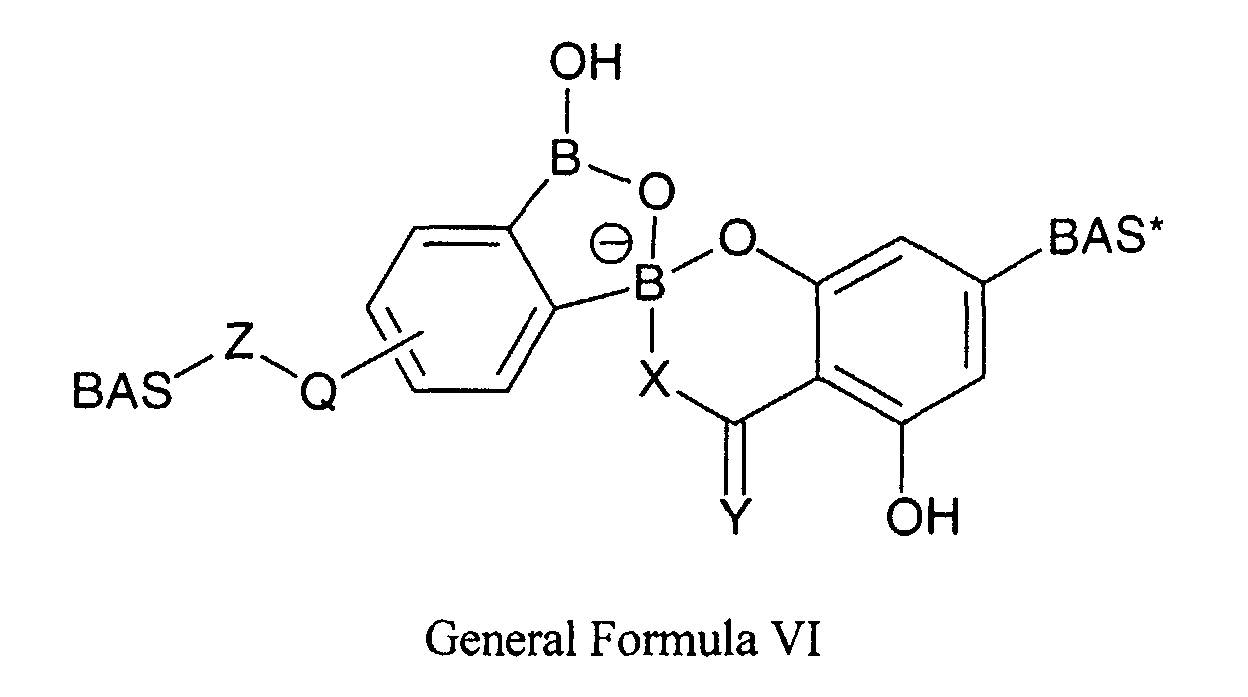
- a conjugate of General Formula II with at least one biologically active species and having pendent 1,2-phenylenediboronic acid moieties (one or more), may be complexed with one or more conjugates of General Formula V, prepared from a second bioactive species BAS* , and having pendant boronic compound complexing moieties (one or more), to afford, for example, a bioconjugate of General Formula VI, wherein the symbols labeled BAS and BAS* , and groups Z and Q are as were previously defined.
- Group X is an acidic electron pair donating species
- group Y is selected from one of O, S and NH.
- Bioconjugates of General Formulas IV and VI may be prepared in buffered aqueous solution or organic solvents.
- the bioconjugate is formed within a few minutes over a range of temperatures of from about 4°C to 70°C.
- the stability of the bioconjugate in aqueous solution at a given pH and temperature is significantly influenced by groups X and Y.
- bioconjugation reaction (boronic acid complexation) is generally insensitive to significant variations in ionic strength, the presence of organic solvents, the presence of detergents, and the presence of chaotropic agents (protein denaturants), which are incompatible with prior art indirect labeling systems wherein the structure of a biological macromolecule must be maintained to preserve requisite binding properties.
- chaotropic agents protein denaturants
- Reagents suitable for the modification of a bioactive species for the purpose of incorporating one or more 1,2-phenylenediboronic acid moieties for subsequent conjugation to a different (or the same) bioactive species having one or more pendant boronic compound complexing moieties are of General Formula I, wherein group R is a reactive electrophilic or nucleophilic moiety suitable for reaction of the 1,2-phenylenediboronic acid reagent with a bioactive species.
- Group Z is a spacer selected from a saturated or unsaturated aliphatic chain up to about 0 to 6 carbon equivalents in length, an unbranched saturated or unsaturated aliphatic chain of from about 6 to 18 carbon equivalents in length with at least one intermediate amide or disulfide moiety, and a polyethylene glycol chain of from about 3 to 12 carbon equivalents in length.
- Group Q is an optional linkage that includes one of amide, methyl amide, methylene, ether, thioether, methyl ether and methyl thioether moieties.
- Group R is preferably selected from, but not limited to, one of amino, acrylamido, bromo, bromoacetamido, chloro, chloroacetamido, dithiopyridyl, hydrazido, N -hydroxysuccinimido ester, N -hydroxysulfosuccinimido ester, imido ester, imidazolo, iodo, iodoacetamido, maleimido and thiol moieties.
- Group Q is preferably selected from, with reference to the aromatic ring (Ar) to which the linkage is appended, one of ArCONH, ArNHCO, ArCH 2 , ArCH 2 CONH, ArCH 2 NHCO, ArNHCOCH 2 , CONHCH 2 , ArO, ArCH 2 O, ArOCH 2 , ArS, ArCH 2 S moieties.
- Reagents of General Formula I exhibit superior properties when compared to prior art phenylboronic acid reagents, in that, they incorporate two equivalents of boronic acid per reactive group R, and afford complexes in conjunction with boronic compound complexing reagents that exhibit superior stability in aqueous systems.
- Reaction of a reagent of General Formula I with a bioactive species affords a conjugate having pendant 1,2 -phenylenediboronic acid moieties (one or more) of General Formula II, wherein the symbol labeled BAS represents a biologically active species (or bioactive species) that may or may not contain a portion of a reactive moiety (which may itself have a spacer) used to attach the bioactive species to the reagent.
- BAS represents a biologically active species (or bioactive species) that may or may not contain a portion of a reactive moiety (which may itself have a spacer) used to attach the bioactive species to the reagent.
- Group Z in General Formula II is a spacer selected from an aliphatic chain, such as a saturated or unsaturated chain up to about 0 to 6 carbon equivalents in length, an unbranched saturated or unsaturated aliphatic chain of from about 6 to 18 carbon equivalents in length with at least one intermediate amide and disulfide moieties, and a polyethylene glycol chain of from about 3 to 12 carbon equivalents in length.
- Group Q is an optional linkage that includes one of amide, methyl amide, methylene, ether, thioether, methyl ether and methyl thioether moieties.
- Conjugates of General Formula II exhibit reduced hydrophobic secondary properties as compared to phenylboronic acid conjugates known in the prior art. This reduction in hydrophobic secondary properties lowers the extent of nonspecific binding, which is known to be a problem associated with bioactive species that have been conjugated with several hydrophobic moieties.
- the conjugate of General Formula II may be complexed with a boronic compound complexing conjugate.
- boronic compound complexing reagents may be appended to a biologically active species to afford a conjugate having pendant boronic compound complexing moieties (one or more) of the general formula of General Formula III, wherein the symbol labeled BAS* represents a second bioactive species, that may include a linker portion and that may differ from the bioactive species labeled BAS (for example, in General Formula II).
- the BAS* may also include a portion of a reactive moiety used to attach the bioactive species to the boronic compound complexing reagent.
- Group X is selected from one of O, NH, NR', NOH, and NOR", in which R' is selected from either an alkyl (e.g., methyl, ethyl, etc.), aryl (e.g., phenyl), alkylaryl (e.g., CH 2 C 6 H 5 ) and a lower alkylene (e.g., methylene, ethylene) bearing an electronegative substituent (e.g., CH 2 CN, CH 2 COOH, etc.).
- Group R" is selected from one of CH 3 , CH 2 CH 3 , CH 2 CN, CH 2 CH 2 OH, CH 2 COOH, CH 2 CONH 2 and CH 2 OCH 3 .
- Group Y is selected from one of O, S, and NH, and is preferably O.
- a conjugate of General Formula II with at least one biologically active species and having pendent 1,2 -phenylenediboronic acid moieties (one or more), may be complexed with one or more conjugates of General Formula III, prepared from a second bioactive species BAS* , and having pendant boronic compound complexing moieties (one or more), to afford, for example, a bioconjugate of General Formula IV, wherein the symbols labeled BAS and BAS* , and groups Z and Q are as were previously defined.
- Group X is selected from one of O, NH, NR', NOH, and NOR", in which R' is selected from either an alkyl (e.g., methyl, ethyl, etc.), aryl (e.g., phenyl), alkylaryl (e.g., CH 2 C 6 H 5 ) and a methylene or ethylene bearing an electronegative substituent (e.g., CH 2 CN, CH 2 COOH, etc.).
- Group R" is preferably selected from one of CH 3 , CH 2 CH 3 , CH 2 CN, CH 2 CH 2 OH, CH 2 COOH, CH 2 CONH 2 and CH 2 OCH 3 .
- Group Y is selected from one of O, S, and NH, and is preferably O.
- biological macromolecules may be conjugated to one another or with other functionalities that impart useful properties.
- boronic compound complexing reagents may be appended to a biologically active species to afford a conjugate having pendant boronic compound complexing moieties (one or more) of General Formula V, wherein the symbol labeled BAS* represents a second bioactive species, that may include a linker portion and that may differ from the bioactive species labeled BAS (for example, in General Formula II).
- the BAS* may also include a portion of a reactive moiety used to attach the bioactive species to the boronic compound complexing reagent.
- Group X is selected from one of O, NH, NR', NOH, and NOR", in which R' is selected from either an alkyl (e.g., methyl, ethyl, etc.), aryl (e.g., phenyl), alkylaryl (e.g., CH 2 C 6 H 5 ) and a methylene or ethylene bearing an electronegative substituent (e.g., CH 2 CN, CH 2 COOH, etc.).
- Group R" is selected from one of CH 3 , CH 2 CH 3 , CH 2 CN, CH 2 CH 2 OH, CH 2 COOH, CH 2 CONH 2 and CH 2 OCH 3 .
- Group Y is selected from one of O, S, and NH, and is preferably O.
- a conjugate of General Formula II with at least one biologically active species and having pendent 1,2-phenylenediboronic acid moieties (one or more), may be complexed with one or more conjugates of General Formula V, prepared from a second bioactive species BAS* , and having pendant boronic compound complexing moieties (one or more), to afford, for example, a bioconjugate of General Formula VI, wherein the symbols labeled BAS and BAS* , and groups Z and Q are as were previously defined.
- Group X is selected from one of O, NH, NR', NOH, and NOR", in which R' is selected from either an alkyl (e.g., methyl, ethyl, etc.), aryl (e.g., phenyl), alkylaryl (e.g., CH 2 C 6 H 5 ) and a methylene or ethylene bearing an electronegative substituent (e.g., CH 2 CN, CH 2 COOH, etc.).
- Group R" is preferably selected from one of CH 3 , CH 2 CH 3 , CH 2 CN, CH 2 CH 2 OH, CH 2 COOH, CH 2 CONH 2 and CH 2 OCH 3 .
- Group Y is selected from one of O, S, and NH, and is preferably O. In this manner, biological macromolecules may be conjugated to one another or with other functionalities that impart useful properties.
- Bioconjugates of General Formulas IV and VI, derived form 1,2-phenylenediboronic acids differ structurally from those obtained by reaction of boronic compound complexing reagents with either phenylboronic acids, 1,3-phenylenediboronic acids or 1,4-phenylene-diboronic acids, in that the boronic acid complex is significantly stabilized, with respect to both alkaline- and acid-catalyzed hydrolysis, by an elimination reaction whereby the free hydroxyl group appended to boron that is normally associated with the boronic acid complex is esterified to the adjacent 1,2-boronic acid group resulting in formation of a five-member ring fused to the aryl ring and containing the fragment B-O-B, wherein the complexed boronic acid is in the tetrahedral anionic form and the adjacent boronic acid is in the trigonal neutral form.
- Phosphoramidite reagents containing protected 1,2- and 1,3-phenylenediboronic acid moieties for the preparation of modified synthetic oligonucleotides, and oligonucleotides and polynucleotides containing 1,2- and 1,3-phenylenediboronic acid moieties prepared from the aforementioned phosphoramidite reagents are the subject of United States Patents Nos. 6,031,117 and 6,013,783, respectively.
- Reagents prepared from 1,3- and 1,4-phenylenediboronic acids are described in U.S. Patent Nos. 6,075,126 and 6,124,471, titled "Phenyldiboronic Acid Reagents and Complexes," filed Aug. 21, 1998, and Sep. 28, 1999, respectively, which are incorporated herein by reference.
- Bioconjugates of General Formulas IV and VI may be prepared in buffered aqueous solution or organic solvents.
- Preferred buffers include acetate, citrate, phosphate, carbonate and diglycine.
- Borate buffers should be avoided due to their ability to complex with the boronic compound complexing moiety.
- Tris(hydroxymethyl)aminomethane, ⁇ -hydroxyamine and ⁇ -hydroxyacid buffers should be avoided due to their ability to competitively complex with the 1,2 -phenylenediboronic acid.
- the bioconjugate is formed within a few minutes over a range of temperatures of from about 4°C to 70°C.
- the stability of the bioconjugate in aqueous solution at a given pH and temperature is significantly influenced by groups X and Y.
- bioconjugates of General Formula IV wherein X is NOH and Y is O (derived from salicylhydroxamic acid), are stable in aqueous solutions of approximate pH greater than 4.5 and less than 12.5.
- Bioconjugates of General Formula VI wherein X is NOH and Y is O (derived from 2,6-dihydroxybenzohydroxamic acid), are stable in aqueous solutions of approximate pH greater than 2.5 and less than 12.5. Consequently, bioconjugates of General Formula VI are preferred when working in buffered aqueous solutions at low pH.
- bioconjugation reaction (boronic acid complexation) is insensitive to significant variations in ionic strength, the presence of organic solvents, the presence of detergents, and the presence of chaotropic agents (protein denaturants), which are incompatible with prior art indirect labeling systems wherein the structure of a biological macromolecule must be maintained to preserve requisite binding properties.
- chaotropic agents protein denaturants
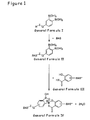
- 1,2-phenylenediboronic acid reagents of General Formula I for the preparation of bioconjugates is summarized in Figure 1.
- a 1,2-phenylenediboronic acid reagent of General Formula I is selected that is comprised of an appropriate reactive electrophilic or nucleophilic group R, suitable for reaction with a desired biologically active species (or bioactive species).
- Group R is a reactive electrophilic or nucleophilic moiety suitable for reaction of the 1,2-phenylenediboronic acid reagent with a bioactive species, and is preferably selected from, but not limited to, one of amino, acrylamido, bromo, bromoacetamido, chloro, chloroacetamido, dithiopyridyl, hydrazido, N -hydroxysuccinimido ester, N -hydroxysulfosuccinimido ester, imido ester, imidazolo, iodo, iodoacetamid, maleimid and thiol moieties.
- Group Z is a spacer, and group Q is an optional linkage that, when present, includes one of amide, methyl amide, methylene, ether, thioether, methyl ether and methyl thioether moieties.
- the 1,2-phenylenediboronic acid reagent of General Formula I is condensed with the bioactive species to yield an 1,2-phenylenediboronic acid conjugate of General Formula II, wherein the symbol labeled BAS represents a biologically active species (or bioactive species) that may or may not contain a portion of a reactive moiety (which may itself have a spacer) used to attach the bioactive species to the reagent.
- BAS represents a biologically active species (or bioactive species) that may or may not contain a portion of a reactive moiety (which may itself have a spacer) used to attach the bioactive species to the reagent.
- BAS represents a biologically active species (or bioactive species) that may or may not contain a portion of a reactive moiety (which may itself have a spacer) used to attach the bioactive species to the reagent.
- BAS represents a biologically active species (or bioactive species) that may or may not contain a portion of a reactive moiety (which may itself have
- the 1,2-phenylenediboronic acid conjugate of General Formula II is complexed with a boronic compound complexing conjugate.
- a suitable boronic compound complexing conjugate is derived from salicylhydroxamic acid (SHA) and is of the general formula of General Formula III, wherein the symbol labeled BAS* represents a second biologically active species, that may include a linker portion and differ from the biologically active species labeled BAS of the complexing reagent.
- the BAS * may also include a portion of a reactive moiety used to attach the bioactive species to the boronic compound complexing reagent.
- Group X is selected from one of O, NH, NR', NOH, and NOR", in which R' is selected from either an alkyl (e.g., methyl, ethyl, etc.), aryl (e.g., phenyl), alkylaryl (e.g., CH 2 C 6 H 5 ) and a methylene or ethylene bearing an electronegative substituent (e.g., CH 2 CN, CH 2 COOH, etc.).
- R' is selected from either an alkyl (e.g., methyl, ethyl, etc.), aryl (e.g., phenyl), alkylaryl (e.g., CH 2 C 6 H 5 ) and a methylene or ethylene bearing an electronegative substituent (e.g., CH 2 CN, CH 2 COOH, etc.).
- Group R" is selected from one of CH 3 , CH 2 CH 3 , CH 2 CN, CH 2 CH 2 OH, CH 2 COOH, CH 2 CONH 2 and CH 2 OCH 3 .
- Group Y is selected from one of O, S, and NH, and is preferably O.
- Group X is selected from one of O, NH, NR', NOH, and NOR", in which R' is selected from either an alkyl (e.g., methyl, ethyl, etc.), aryl (e.g., phenyl), alkylaryl (e.g., CH 2 C 6 H 5 ) and a methylene or ethylene bearing an electronegative substituent (e.g., CH 2 CN, CH 2 COOH, etc.).
- Group R" is selected from one of CH 3 , CH 2 CH 3 , CH 2 CN, CH 2 CH 2 OH, CH 2 COOH, CH 2 CONH 2 and CH 2 OCH 3 .
- Group Y is selected from one of O, S, and NH, and is preferably O.
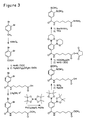
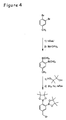
- 3,4-Dibromobenzoic Acid A saturated aqueous solution of potassium permanganate (61.3 g, 388 mmol) was added in portions to a well stirred solution of 3,4-dibromotoluene (40.4 g, 162 mmol) in acetic acid (700 mL) while maintaining the temperature between 70 and 80 °C. After addition, the suspension was stirred for an additional 4 hours at 80 °C. The solution was concentrated on a rotary evaporator, the residue treated with 5 N NaOH (700 mL) and heated under reflux for 2 hours. The MnO 2 cake was filtered from solution and washed thoroughly with hot water.
- N-(3,4-Dibromobenzoyl)-6-aminohexanoic Acid Added N -hydroxysuccinimide (0.69 g, 6 mmol) followed by 1,3-dicyclohexylcarbodiimide (1.24 g, 6 mmol) to a stirred solution of 3,4-dibromobenzoic acid (1.4 g, 5 mmol) in anhydrous dioxane (40 mL). Stirred suspension for 6 hours at room temperature. Filtered precipitate from solution and washed with dioxane (3 ⁇ 5 mL). Combined filtrate and washes and concentrated in vacuo to afford a white solid.
- N-[3,4-Bis(dihydroxyboryl)]benzoyl-6-aminohexanoic Acid Heated a mixture of methyl N -(3,4-dibromobenzoyl)-6-aminohexanoate (1.66 g, 4.08 mmol), diboron pinacol diester (2.49 g, 9.79 mmol), anhydrous potassium acetate (2.40 g, 24.48 mmol), [1,1'-bis(diphenylphosphino)-ferrocene]dichloropalladium (II) (0.60 g, 0.73 mmol) and anhydrous dimethyl sulfoxide (25 mL) under nitrogen for 24 hours at 90°C.
- Assayed enzymatic activity with 4-nitrophenylphosphate (pNPP) substrate Prepared stock solution by dissolving 15 mg of pNPP in 15 mL of 1 ⁇ DEA buffer (1 M diethanolamine, 1mM MgCl 2 , 0.1 mM ZnSO 4 , pH 10.2). Diluted five 100 ⁇ L aliquots of each of the four conjugates to 0.05 ⁇ g/mL with 1 ⁇ TBS buffer (10 mM tris(hydroxymethyl)aminomethane, 140 mM NaCl, pH 8.0) in a multiwell plate, and assayed for AP activity by adding 100 ⁇ L of pNPP stock solution to each well and incubating at 37°C for 10 min.
- 1 ⁇ DEA buffer 1 M diethanolamine, 1mM MgCl 2 , 0.1 mM ZnSO 4 , pH 10.2
- TBS buffer 10 mM tris(hydroxymethyl)aminomethane, 140 mM NaCl, pH 8.0
- PDBA-conjugate Incorporation ratio (PDBA:AP) Capacity ( ⁇ mol SHA/mL) AP retained (%) 1,2-PDBA-AP 5.8:1 1.2 20 1,2-PDBA-AP 8.5:1 1.2 48 1,3-PDBA-AP 3.3:1 1.2 78 1,3-PDBA-AP 6.3:1 1.2 96 1,2-PDBA-AP 5.8:1 5.2 82 1,2-PDBA-AP 8.5:1 5.2 89 1,3-PDBA-AP 3.3:1 5.2 91 1,3-PDBA-AP 6.2:1 5.2 95
- ⁇ AP rabbit anti -Alkaline Phosphatase
- Adjusted fraction to pH 8-9 by addition of 1 drop of 10 N NaOH. Determined protein content in each of the fractions from A 280 .
- Figure 9 illustrates SDS-PAGE analyses of both the high pH and low pH fractions recovered from the high capacity 1,2-PDBA-AP•SHA-X-Sepharose and 1,3-PDBA-AP•SHA-X-Sepharose columns.
- Analysis A represents fractions recovered at pH 11.0.
- Analysis B represents fractions recovered at pH 2.5.
- 1,3-PDBA-AP conjugates were found to be present as contaminants in both the low pH and high pH fractions recovered from the low capacity SHA-X-Sepharose columns ( Figure 8 ) as well as the high capacity SHA-X-Sepharose column prepared from the 1,3-PDBA-AP conjugate with the 3.3:1 incorporation ratio ( Figure 9 ).
Landscapes
- Chemical & Material Sciences (AREA)
- Organic Chemistry (AREA)
- Health & Medical Sciences (AREA)
- Immunology (AREA)
- Life Sciences & Earth Sciences (AREA)
- Engineering & Computer Science (AREA)
- Hematology (AREA)
- Molecular Biology (AREA)
- Biomedical Technology (AREA)
- Urology & Nephrology (AREA)
- General Health & Medical Sciences (AREA)
- Medicinal Chemistry (AREA)
- Microbiology (AREA)
- Cell Biology (AREA)
- Food Science & Technology (AREA)
- Biotechnology (AREA)
- Physics & Mathematics (AREA)
- Analytical Chemistry (AREA)
- Biochemistry (AREA)
- General Physics & Mathematics (AREA)
- Pathology (AREA)
- Medicinal Preparation (AREA)
- Pharmaceuticals Containing Other Organic And Inorganic Compounds (AREA)
Abstract
Description







| Preparation and enzymatic activity of Alkaline Phosphatase conjugates. | |||
| PDBA-conjugate | Reagent molar excess | Incorporation ratio (PDBA:AP) | Enzymatic activity (%) |
| 1,2-PDBA-AP | 5× | 5.0:1 | 71 |
| 1,2-PDBA-AP | 10× | 7.4:1 | 67 |
| 1,3-PDBA-AP | 5× | 3.4:1 | 85 |
| 1,3-PDBA-AP | 10× | 6.3:1 | 65 |
| Immobilization of Alkaline Phosphatase by PDBA-AP•SHA-X-Sepharose complex formation involving either 1,2-PDBA-AP or 1,3-PDBA-AP Conjugates. | |||
| PDBA-conjugate | Incorporation ratio (PDBA:AP) | Capacity (µmol SHA/mL) | AP retained (%) |
| 1,2-PDBA-AP | 5.8:1 | 1.2 | 20 |
| 1,2-PDBA-AP | 8.5:1 | 1.2 | 48 |
| 1,3-PDBA-AP | 3.3:1 | 1.2 | 78 |
| 1,3-PDBA-AP | 6.3:1 | 1.2 | 96 |
| 1,2-PDBA-AP | 5.8:1 | 5.2 | 82 |
| 1,2-PDBA-AP | 8.5:1 | 5.2 | 89 |
| 1,3-PDBA-AP | 3.3:1 | 5.2 | 91 |
| 1,3-PDBA-AP | 6.2:1 | 5.2 | 95 |
| Affinity Chromatography of anti-Alkaline Phosphatase on 1,2-PDBA-AP•SHA-X-Sepharose and 1,3-PDBA-AP•SHA-X-Sepharose | |||||
| PDBA-conjugate | Incorporation ratio (PDBA:AP) | Capacity (µmol SHA/mL) | αAP high pH recovery (%) | αAP low pH recovery (%) | αAP total recovery (%) |
| 1,2-PDBA-AP | 5.8:1 | 1.2 | 30 | 32 | 62 |
| 1,2-PDBA-AP | 8.5:1 | 1.2 | 33 | 25 | 58 |
| 1,3-PDBA-AP | 3.3:1 | 1.2 | 50 | 58 | 107 |
| 1,3-PDBA-AP | 6.2:1 | 1.2 | 45 | 57 | 102 |
| 1,2-PDBA-AP | 5.8:1 | 5.2 | 59 | 18 | 76 |
| 1,2-PDBA-AP | 8.5:1 | 5.2 | 35 | 12 | 47 |
| 1,3-PDBA-AP | 3.3:1 | 5.2 | 145 | 51 | 197 |
| 1,3-PDBA-AP | 6.2:1 | 5.2 | 54 | 18 | 72 |
Claims (27)
- A reagent having the general formula of General Formula I:wherein group Z comprises a spacer selected from an aliphatic chain up to about 6 carbon equivalents in length, an unbranched aliphatic chain of from about 6 to 18 carbon equivalents in length with at least one of an intermediate amide and a disulfide moiety, and a polyethylene glycol chain of from about 3 to 12 carbon equivalents in length;

wherein group R is an electrophilic or nucleophilic moiety suitable for reaction of the reagent with a biologically active species; and
wherein group Q is one of nothing at all, an amide, a methyl amide, a methylene, an ether, a thioether, a methyl ether, and a methyl thioether moiety. - The reagent of claim 1, wherein group R is preferably selected from one of acrylamide, bromo, bromoacetamide, chloro, chloroacetamide, dithiopyridyl, hydrazide, N-hydroxy-succinimidyl ester, N-hydroxysulfosuccinimidyl ester, imidate ester, imidazolide, iodo, iodoacetamide, maleimide, amino and thiol moieties.
- The reagent of claim 1, wherein group Z is an unbranched alkyl chain of the general formula (CH2)n, wherein n = 1 to 6.
- The reagent of claim 1, wherein group Q is selected from one of NHCO, CONH, CH2, CH2CONH2, CH2NHCO, NHCOCH2, CONHCH2, O, CH2O, S, and CH2S moieties.
- A conjugate of a biologically active species with a reagent, the conjugate having the general formula of General Formula II:wherein group Z comprises a spacer selected from an aliphatic chain up to about 6 carbon equivalents in length, an unbranched aliphatic chain of from about 6 to 18 carbon equivalents in length with at least one of an intermediate amide and disulfide moiety, and a polyethylene glycol chain of from about 3 to 12 carbon equivalents in length;

wherein group R is an electrophilic or nucleophilic moiety suitable for reaction of the reagent with a biologically active species; and
wherein group Q is one of nothing at all, an amide, a methyl amide, a methylene, an ether, a thioether, a methyl ether, and a methyl thioether moiety; and
wherein BAS is a biologically active species. - The conjugate of claim 5, wherein group Z is an unbranched alkyl chain of the general formula (CH2)n, wherein n = 1 to 6.
- The conjugate of claim 5, wherein group Q is selected from one of NHCO, CONH, CH2, CH2CONH2, CH2NHCO, NHCOCH2, CONHCH2, O, CH2O, S, and CH2S moieties.
- A bioconjugate comprising a phenylenediboronic acid conjugate bonded through a boronic acid complex to a boronic compound complexing conjugate, the bioconjugate having the general formula of General Formula IV:wherein group Z comprises a spacer selected from a saturated or unsaturated chain up to about 0 to 6 carbon equivalents in length, an unbranched saturated or unsaturated aliphatic chain of from about 6 to 18 carbon equivalents in length with at least one of an intermediate amide and a disulfide moiety, and a polyethylene glycol chain of from about 3 to 12 carbon equivalents in length;

wherein group Q is selected from one of nothing at all, an amide, a methyl amide, a methylene, an ether, a thioether, a methyl ether, and a methyl thioether moiety;
wherein group X is selected from one of O, NH, NR', NOH, and NOR", in which R' is selected from one of an alkyl, aryl, alkylaryl, and lower alkylene bearing an electronegative substituent, and in which R" is selected from one of CH3, CH2CH3, CH2CN, CH2CH2OH, CH2COOH, CH2CONH2 and CH2OCH3;
wherein group Y is selected from one of O, S, and NH; and
wherein BAS and BAS* are biologically active species. - The bioconjugate of claim 8, wherein group Z is an unbranched alkyl chain of the general formula (CH2)n, wherein n = 1 to 6.
- The bioconjugate of claim 8, wherein group Q is selected from one of NHCO, CONH, CH2, CH2CONH2, CH2NHCO, NHCOCH2, CONHCH2, O, CH2O, S, and CH2S moieties.
- The bioconjugate of claim 8, wherein group X is NOH.
- The bioconjugate of claim 11, wherein group Y is O.
- The bioconjugate of claim 8, wherein BAS and BAS* are different biologically active species.
- A bioconjugate comprising a phenylenediboronic acid conjugate bonded through a boronic acid complex to a boronic compound complexing conjugate, the bioconjugate having the general formula of General Formula VI:wherein group Z comprises a spacer selected from a saturated or unsaturated chain up to about 6 carbon equivalents in length, an unbranched saturated or unsaturated aliphatic chain of from about 6 to 18 carbon equivalents in length with at least one of an intermediate amide and a disulfide moiety, and a polyethylene glycol chain of from about 3 to 12 carbon equivalents in length;

wherein group Q is selected from one of nothing at all, an amide, a methyl amide, a methylene, an ether, a thioether, a methyl ether, and a methyl thioether moiety;
wherein group X is selected from one of O, NH, NR', NOH, and NOR", in which R' is selected from one of an alkyl, aryl, alkylaryl, and lower alkylene bearing an electronegative substituent, and in which R" is selected from one of CH3, CH2CH3, CH2CN, CH2CH2OH, CH2COOH, CH2CONH2 and CH2OCH3;
wherein group Y is selected from one of O, S, and NH; and
wherein BAS and BAS* are biologically active species. - The bioconjugate of claim 14, wherein group Z is an unbranched alkyl chain of the general formula (CH2)n, wherein n = 1 to 6.
- The bioconjugate of claim 14, wherein group Q is selected from one of NHCO, CONH, CH2, CH2CONH2, CH2NHCO, NHCOCH2, CONHCH2, O, CH2O, S, and CH2S moieties.
- The bioconjugate of claim 14, wherein group X is NOH.
- The bioconjugate of claim 17, wherein group Y is O.
- The bioconjugate of claim 14, wherein BAS and BAS* are different biologically active species.
- A method comprising:conjugating a 1,2-phenylenediboronic acid molecule and a first bioacive species;conjugating a boronic compound complexing moiety and a second bioactive species; andconjugating the 1,2-phenylenediboronic acid molecule and the boronic compound complexing moiety.
- The method of claim 20, wherein the first and second bioactive species are different.
- The method of claim 20, wherein the first bioactive species is selected from a group consisting of proteins, polysaccarides, hormones, nucleic acids, liposomes, cells, drugs, radionuclides, toxins, haptens, inhibitors, fluorophores, ligands, and solid-phase supports.
- The method of claim 21, wherein conjugating the phenylenediboronic acid and the first bioacive species comprises conjugating a plurality of phenylenediboronic acid molecules to the first bioactive species.
- A method of conjugating a bioactive species from a medium comprising;contacting a 1,2-phenylenediboronic acid molecule with the medium;conjugating the 1,2-phenylenediboronic acid with at least one bioactive species in the medium at a first site on the phenylenediboronic acid molecule; andconjugating the 1,2-phenylenediboronic acid with a boronic compound complexing moiety at a second site on the 1,2-phenyldiboronic acid molecule.
- The method of claim 24, wherein the method comprises separating a bioactive species selected from a group consisting of proteins, polysaccarides, hormones, nucleic acids, liposomes, cells, drugs, radionuclides, toxins, haptens, inhibitors, fluorophores, ligands, and solid-phase supports.
- The method of claim 25, wherein at least one bioactive species is a first bioactive species, and the method further comprising conjugating the boronic compound complexing moiety with at least one second bioactive species.
- The method of claim 26, wherein the at least one second bioactive species is different from the at least one first bioactive species.
Applications Claiming Priority (2)
| Application Number | Priority Date | Filing Date | Title |
|---|---|---|---|
| US874633 | 2001-06-04 | ||
| US09/874,633 US6630577B2 (en) | 1996-08-05 | 2001-06-04 | 1,2-Phenylenediboronic acid reagents and complexes |
Publications (2)
| Publication Number | Publication Date |
|---|---|
| EP1264833A2 true EP1264833A2 (en) | 2002-12-11 |
| EP1264833A3 EP1264833A3 (en) | 2003-10-15 |
Family
ID=25364209
Family Applications (1)
| Application Number | Title | Priority Date | Filing Date |
|---|---|---|---|
| EP02010866A Withdrawn EP1264833A3 (en) | 2001-06-04 | 2002-05-15 | 1,2-Phenylenediboronic acid reagents and complexes |
Country Status (6)
| Country | Link |
|---|---|
| US (1) | US6630577B2 (en) |
| EP (1) | EP1264833A3 (en) |
| AU (1) | AU784355B2 (en) |
| CA (1) | CA2386600A1 (en) |
| NO (1) | NO20022626L (en) |
| RU (1) | RU2002114592A (en) |
Cited By (1)
| Publication number | Priority date | Publication date | Assignee | Title |
|---|---|---|---|---|
| CN106008577A (en) * | 2016-06-03 | 2016-10-12 | 南开大学 | Succinimide ester containing phenylboric acid function group and preparation method thereof |
Families Citing this family (9)
| Publication number | Priority date | Publication date | Assignee | Title |
|---|---|---|---|---|
| US7053051B2 (en) * | 2003-10-28 | 2006-05-30 | Medtronic, Inc. | Methods of preparing crosslinked materials and bioprosthetic devices |
| US7399645B2 (en) * | 2004-05-12 | 2008-07-15 | Applera Corporation | Constrained cis-diol-borate bioconjugation system |
| WO2006044275A2 (en) * | 2004-10-12 | 2006-04-27 | Luminex Corporation | Methods for altering surface characteristics of microspheres |
| US8747870B2 (en) | 2006-04-20 | 2014-06-10 | University Of Utah Research Foundation | Polymeric compositions and methods of making and using thereof |
| AU2007240613B2 (en) * | 2006-04-20 | 2013-11-28 | University Of Utah Research Foundation | Polymeric compositions and methods of making and using thereof |
| US8236783B2 (en) * | 2006-08-15 | 2012-08-07 | Duke University | ROS-sensitive iron chelators and methods of using the same |
| KR101016367B1 (en) | 2008-06-30 | 2011-02-21 | 금호타이어 주식회사 | Tire rubber composition with improved anti-aging characteristics |
| US9085590B2 (en) | 2013-03-14 | 2015-07-21 | Wisconsin Alumni Research Foundation | Protecting groups for boronic acids |
| TWI793782B (en) | 2021-09-29 | 2023-02-21 | 國立中山大學 | Method of sugar-guided modifying glycosylated polypeptide and application of the same |
Family Cites Families (13)
| Publication number | Priority date | Publication date | Assignee | Title |
|---|---|---|---|---|
| US5594111A (en) | 1994-01-28 | 1997-01-14 | Prolinx, Inc. | Phenylboronic acid complexes for bioconjugate preparation |
| US5852178A (en) | 1994-01-28 | 1998-12-22 | Prolinx, Inc. | Phenylboronic acid complexing reagents for conjugating biologically active molecules |
| US5837878A (en) | 1994-01-28 | 1998-11-17 | Prolinx, Inc. | Boronic compound complexing reagents and highly stable complexes |
| US5623055A (en) | 1994-01-28 | 1997-04-22 | Prolinx, Inc. | Phenylboronic acid complexes derived from aminosalicylic acid for bioconjugate preparation |
| US5777148A (en) | 1994-01-28 | 1998-07-07 | Prolinx, Inc. | Boronic compound complexing reagents and highly stable complexes |
| US5594151A (en) | 1994-01-28 | 1997-01-14 | Prolinx, Inc. | Phenylboronic acid complexing reagents derived from aminosalicylic acid |
| US5847192A (en) | 1994-01-28 | 1998-12-08 | Prolinx, Inc. | Boronic compound complexing reagents and complexes |
| US5744627A (en) | 1994-01-28 | 1998-04-28 | Prolinx, Inc. | Boronic compound complexing reagents and complexes |
| NO179651C (en) | 1994-03-07 | 1996-11-20 | Sinvent As | Pressure gauge |
| US5831046A (en) | 1996-08-05 | 1998-11-03 | Prolinx, Incorporated | Boronic acid-contaning nucleic acid monomers |
| US6075126A (en) * | 1996-08-05 | 2000-06-13 | Prolinx, Inc. | Phenyldiboronic acid reagents and complexes |
| US6013783A (en) | 1999-03-19 | 2000-01-11 | Prolinx Incorporated | Boronic acid containing oligonucleotides and polynucleotides |
| US6031117A (en) | 1999-03-19 | 2000-02-29 | Prolinx Incorporated | Boronic acid containing phosphoramidite reagents |
-
2001
- 2001-06-04 US US09/874,633 patent/US6630577B2/en not_active Expired - Fee Related
-
2002
- 2002-05-15 CA CA002386600A patent/CA2386600A1/en not_active Abandoned
- 2002-05-15 EP EP02010866A patent/EP1264833A3/en not_active Withdrawn
- 2002-05-21 AU AU42416/02A patent/AU784355B2/en not_active Ceased
- 2002-06-03 NO NO20022626A patent/NO20022626L/en not_active Application Discontinuation
- 2002-06-03 RU RU2002114592/04A patent/RU2002114592A/en not_active Application Discontinuation
Cited By (1)
| Publication number | Priority date | Publication date | Assignee | Title |
|---|---|---|---|---|
| CN106008577A (en) * | 2016-06-03 | 2016-10-12 | 南开大学 | Succinimide ester containing phenylboric acid function group and preparation method thereof |
Also Published As
| Publication number | Publication date |
|---|---|
| RU2002114592A (en) | 2003-12-10 |
| NO20022626L (en) | 2002-12-05 |
| US6630577B2 (en) | 2003-10-07 |
| AU4241602A (en) | 2002-12-05 |
| CA2386600A1 (en) | 2002-12-04 |
| AU784355B2 (en) | 2006-03-16 |
| US20020038004A1 (en) | 2002-03-28 |
| NO20022626D0 (en) | 2002-06-03 |
| EP1264833A3 (en) | 2003-10-15 |
Similar Documents
| Publication | Publication Date | Title |
|---|---|---|
| US5668258A (en) | Phenylboronic acid complexing reagents derived from aminosalicylcic acid | |
| US5677431A (en) | Phenylboronic acid complexes for bioconjugate preparation | |
| US5744627A (en) | Boronic compound complexing reagents and complexes | |
| US5623055A (en) | Phenylboronic acid complexes derived from aminosalicylic acid for bioconjugate preparation | |
| US6462179B1 (en) | Phenyldiboronic acid reagents and complexes | |
| US5877297A (en) | Boronic compound complexing reagents and highly stable complexes | |
| US6630577B2 (en) | 1,2-Phenylenediboronic acid reagents and complexes | |
| US6156884A (en) | Bifunctional boronic compound complexing reagents and complexes | |
| EP0741734B1 (en) | Phenylboronic acid complexes | |
| CA2262451C (en) | Boronic compound complexing reagents and complexes | |
| US5872224A (en) | Boronic compound complexing reagents and highly stable complexes | |
| EP0915832B1 (en) | Boronic compound complexing reagents and highly stable complexes | |
| US5852178A (en) | Phenylboronic acid complexing reagents for conjugating biologically active molecules | |
| US5869623A (en) | Boronic compound complexing reagents and complexes | |
| US4360592A (en) | Process for the detection of antibodies |
Legal Events
| Date | Code | Title | Description |
|---|---|---|---|
| PUAI | Public reference made under article 153(3) epc to a published international application that has entered the european phase |
Free format text: ORIGINAL CODE: 0009012 |
|
| AK | Designated contracting states |
Kind code of ref document: A2 Designated state(s): AT BE CH CY DE DK ES FI FR GB GR IE IT LI LU MC NL PT SE TR |
|
| AX | Request for extension of the european patent |
Free format text: AL;LT;LV;MK;RO;SI |
|
| RIN1 | Information on inventor provided before grant (corrected) |
Inventor name: WILEY, JEAN P. Inventor name: LI, GIUSHENG Inventor name: STOLOWITZ, MARK L. |
|
| PUAL | Search report despatched |
Free format text: ORIGINAL CODE: 0009013 |
|
| AK | Designated contracting states |
Kind code of ref document: A3 Designated state(s): AT BE CH CY DE DK ES FI FR GB GR IE IT LI LU MC NL PT SE TR |
|
| AX | Request for extension of the european patent |
Extension state: AL LT LV MK RO SI |
|
| 17P | Request for examination filed |
Effective date: 20040315 |
|
| 19U | Interruption of proceedings before grant |
Effective date: 20030327 |
|
| 19W | Proceedings resumed before grant after interruption of proceedings |
Effective date: 20040901 |
|
| 19W | Proceedings resumed before grant after interruption of proceedings |
Effective date: 20050901 |
|
| 17Q | First examination report despatched |
Effective date: 20050705 |
|
| RAP1 | Party data changed (applicant data changed or rights of an application transferred) |
Owner name: AGILENT TECHNOLOGIES, INC. |
|
| RAP1 | Party data changed (applicant data changed or rights of an application transferred) |
Owner name: CAMBREX BIO SCIENCE ROCKLAND, INC. |
|
| AKX | Designation fees paid |
Designated state(s): AT BE CH CY DE DK ES FI FR GB GR IE IT LI LU MC NL PT SE TR |
|
| 17Q | First examination report despatched |
Effective date: 20050929 |
|
| GRAP | Despatch of communication of intention to grant a patent |
Free format text: ORIGINAL CODE: EPIDOSNIGR1 |
|
| STAA | Information on the status of an ep patent application or granted ep patent |
Free format text: STATUS: THE APPLICATION IS DEEMED TO BE WITHDRAWN |
|
| 18D | Application deemed to be withdrawn |
Effective date: 20090723 |