EP1263802B1 - Hydrogel biomedical articles - Google Patents
Hydrogel biomedical articles Download PDFInfo
- Publication number
- EP1263802B1 EP1263802B1 EP01916614A EP01916614A EP1263802B1 EP 1263802 B1 EP1263802 B1 EP 1263802B1 EP 01916614 A EP01916614 A EP 01916614A EP 01916614 A EP01916614 A EP 01916614A EP 1263802 B1 EP1263802 B1 EP 1263802B1
- Authority
- EP
- European Patent Office
- Prior art keywords
- hydrogel
- groups
- macromers
- biomedical article
- hydrogel biomedical
- Prior art date
- Legal status (The legal status is an assumption and is not a legal conclusion. Google has not performed a legal analysis and makes no representation as to the accuracy of the status listed.)
- Expired - Lifetime
Links
- 239000000017 hydrogel Substances 0.000 title claims abstract description 56
- -1 polyvinyl alcohol Chemical class 0.000 claims abstract description 74
- 229920002451 polyvinyl alcohol Polymers 0.000 claims abstract description 43
- 150000000185 1,3-diols Chemical group 0.000 claims abstract description 7
- 150000000180 1,2-diols Chemical class 0.000 claims abstract description 6
- 238000004132 cross linking Methods 0.000 claims description 27
- 125000004432 carbon atom Chemical group C* 0.000 claims description 24
- 239000004005 microsphere Substances 0.000 claims description 24
- 229920000642 polymer Polymers 0.000 claims description 24
- 239000013543 active substance Substances 0.000 claims description 23
- 125000002947 alkylene group Chemical group 0.000 claims description 14
- 239000002872 contrast media Substances 0.000 claims description 11
- 229920001577 copolymer Polymers 0.000 claims description 10
- 239000001257 hydrogen Substances 0.000 claims description 9
- 229910052739 hydrogen Inorganic materials 0.000 claims description 9
- 125000004435 hydrogen atom Chemical group [H]* 0.000 claims description 7
- 150000003254 radicals Chemical class 0.000 claims description 7
- 125000004169 (C1-C6) alkyl group Chemical group 0.000 claims description 4
- 125000000753 cycloalkyl group Chemical group 0.000 claims description 4
- 238000010526 radical polymerization reaction Methods 0.000 claims description 4
- DHKHKXVYLBGOIT-UHFFFAOYSA-N acetaldehyde Diethyl Acetal Natural products CCOC(C)OCC DHKHKXVYLBGOIT-UHFFFAOYSA-N 0.000 claims description 3
- 239000011859 microparticle Substances 0.000 claims description 3
- 238000002601 radiography Methods 0.000 claims description 2
- 239000000560 biocompatible material Substances 0.000 claims 1
- 239000003607 modifier Substances 0.000 abstract description 14
- 239000004372 Polyvinyl alcohol Substances 0.000 abstract description 3
- 239000000243 solution Substances 0.000 description 29
- XLYOFNOQVPJJNP-UHFFFAOYSA-N water Substances O XLYOFNOQVPJJNP-UHFFFAOYSA-N 0.000 description 18
- 238000006116 polymerization reaction Methods 0.000 description 17
- 125000002348 vinylic group Chemical group 0.000 description 17
- WSLDOOZREJYCGB-UHFFFAOYSA-N 1,2-Dichloroethane Chemical compound ClCCCl WSLDOOZREJYCGB-UHFFFAOYSA-N 0.000 description 15
- 238000000034 method Methods 0.000 description 15
- 239000000203 mixture Substances 0.000 description 15
- CSCPPACGZOOCGX-UHFFFAOYSA-N Acetone Chemical compound CC(C)=O CSCPPACGZOOCGX-UHFFFAOYSA-N 0.000 description 12
- 238000001879 gelation Methods 0.000 description 12
- 230000002209 hydrophobic effect Effects 0.000 description 11
- 239000004971 Cross linker Substances 0.000 description 10
- 239000002904 solvent Substances 0.000 description 10
- 229920006217 cellulose acetate butyrate Polymers 0.000 description 9
- 239000003921 oil Substances 0.000 description 9
- 235000019198 oils Nutrition 0.000 description 9
- 239000000047 product Substances 0.000 description 9
- 238000003756 stirring Methods 0.000 description 9
- 125000000217 alkyl group Chemical group 0.000 description 8
- 239000003381 stabilizer Substances 0.000 description 8
- 125000004178 (C1-C4) alkyl group Chemical group 0.000 description 7
- LFQSCWFLJHTTHZ-UHFFFAOYSA-N Ethanol Chemical compound CCO LFQSCWFLJHTTHZ-UHFFFAOYSA-N 0.000 description 7
- WHNWPMSKXPGLAX-UHFFFAOYSA-N N-Vinyl-2-pyrrolidone Chemical compound C=CN1CCCC1=O WHNWPMSKXPGLAX-UHFFFAOYSA-N 0.000 description 7
- 239000003795 chemical substances by application Substances 0.000 description 7
- 125000002887 hydroxy group Chemical group [H]O* 0.000 description 7
- 239000003999 initiator Substances 0.000 description 7
- 150000002734 metacrylic acid derivatives Chemical class 0.000 description 7
- 125000002496 methyl group Chemical group [H]C([H])([H])* 0.000 description 7
- 239000012188 paraffin wax Substances 0.000 description 7
- CIWBSHSKHKDKBQ-JLAZNSOCSA-N Ascorbic acid Chemical compound OC[C@H](O)[C@H]1OC(=O)C(O)=C1O CIWBSHSKHKDKBQ-JLAZNSOCSA-N 0.000 description 6
- IJGRMHOSHXDMSA-UHFFFAOYSA-N Atomic nitrogen Chemical compound N#N IJGRMHOSHXDMSA-UHFFFAOYSA-N 0.000 description 6
- IMROMDMJAWUWLK-UHFFFAOYSA-N Ethenol Chemical compound OC=C IMROMDMJAWUWLK-UHFFFAOYSA-N 0.000 description 6
- OKKJLVBELUTLKV-UHFFFAOYSA-N Methanol Chemical compound OC OKKJLVBELUTLKV-UHFFFAOYSA-N 0.000 description 6
- PPBRXRYQALVLMV-UHFFFAOYSA-N Styrene Chemical compound C=CC1=CC=CC=C1 PPBRXRYQALVLMV-UHFFFAOYSA-N 0.000 description 6
- XTXRWKRVRITETP-UHFFFAOYSA-N Vinyl acetate Chemical compound CC(=O)OC=C XTXRWKRVRITETP-UHFFFAOYSA-N 0.000 description 6
- 210000004027 cell Anatomy 0.000 description 6
- 238000000108 ultra-filtration Methods 0.000 description 6
- AOJJSUZBOXZQNB-TZSSRYMLSA-N Doxorubicin Chemical compound O([C@H]1C[C@@](O)(CC=2C(O)=C3C(=O)C=4C=CC=C(C=4C(=O)C3=C(O)C=21)OC)C(=O)CO)[C@H]1C[C@H](N)[C@H](O)[C@H](C)O1 AOJJSUZBOXZQNB-TZSSRYMLSA-N 0.000 description 5
- 239000007864 aqueous solution Substances 0.000 description 5
- 125000003178 carboxy group Chemical group [H]OC(*)=O 0.000 description 5
- 238000006243 chemical reaction Methods 0.000 description 5
- 239000003638 chemical reducing agent Substances 0.000 description 5
- 125000001495 ethyl group Chemical group [H]C([H])([H])C([H])([H])* 0.000 description 5
- 239000002245 particle Substances 0.000 description 5
- 239000007787 solid Substances 0.000 description 5
- IKHGUXGNUITLKF-UHFFFAOYSA-N Acetaldehyde Chemical group CC=O IKHGUXGNUITLKF-UHFFFAOYSA-N 0.000 description 4
- VGGSQFUCUMXWEO-UHFFFAOYSA-N Ethene Chemical compound C=C VGGSQFUCUMXWEO-UHFFFAOYSA-N 0.000 description 4
- 239000005977 Ethylene Substances 0.000 description 4
- MHAJPDPJQMAIIY-UHFFFAOYSA-N Hydrogen peroxide Chemical compound OO MHAJPDPJQMAIIY-UHFFFAOYSA-N 0.000 description 4
- BAPJBEWLBFYGME-UHFFFAOYSA-N Methyl acrylate Chemical compound COC(=O)C=C BAPJBEWLBFYGME-UHFFFAOYSA-N 0.000 description 4
- NWIBSHFKIJFRCO-WUDYKRTCSA-N Mytomycin Chemical compound C1N2C(C(C(C)=C(N)C3=O)=O)=C3[C@@H](COC(N)=O)[C@@]2(OC)[C@@H]2[C@H]1N2 NWIBSHFKIJFRCO-WUDYKRTCSA-N 0.000 description 4
- 150000001252 acrylic acid derivatives Chemical class 0.000 description 4
- XXROGKLTLUQVRX-UHFFFAOYSA-N allyl alcohol Chemical compound OCC=C XXROGKLTLUQVRX-UHFFFAOYSA-N 0.000 description 4
- 239000002246 antineoplastic agent Substances 0.000 description 4
- 230000015556 catabolic process Effects 0.000 description 4
- 229940127089 cytotoxic agent Drugs 0.000 description 4
- 238000006731 degradation reaction Methods 0.000 description 4
- 229960000878 docusate sodium Drugs 0.000 description 4
- 239000000839 emulsion Substances 0.000 description 4
- 125000004185 ester group Chemical group 0.000 description 4
- 125000000524 functional group Chemical group 0.000 description 4
- 230000000977 initiatory effect Effects 0.000 description 4
- FQPSGWSUVKBHSU-UHFFFAOYSA-N methacrylamide Chemical class CC(=C)C(N)=O FQPSGWSUVKBHSU-UHFFFAOYSA-N 0.000 description 4
- 239000000178 monomer Substances 0.000 description 4
- 239000007800 oxidant agent Substances 0.000 description 4
- 235000019422 polyvinyl alcohol Nutrition 0.000 description 4
- 125000001436 propyl group Chemical group [H]C([*])([H])C([H])([H])C([H])([H])[H] 0.000 description 4
- 239000012966 redox initiator Substances 0.000 description 4
- 150000003839 salts Chemical class 0.000 description 4
- APSBXTVYXVQYAB-UHFFFAOYSA-M sodium docusate Chemical compound [Na+].CCCCC(CC)COC(=O)CC(S([O-])(=O)=O)C(=O)OCC(CC)CCCC APSBXTVYXVQYAB-UHFFFAOYSA-M 0.000 description 4
- 125000000391 vinyl group Chemical group [H]C([*])=C([H])[H] 0.000 description 4
- 125000000229 (C1-C4)alkoxy group Chemical group 0.000 description 3
- KWVGIHKZDCUPEU-UHFFFAOYSA-N 2,2-dimethoxy-2-phenylacetophenone Chemical compound C=1C=CC=CC=1C(OC)(OC)C(=O)C1=CC=CC=C1 KWVGIHKZDCUPEU-UHFFFAOYSA-N 0.000 description 3
- QTBSBXVTEAMEQO-UHFFFAOYSA-M Acetate Chemical compound CC([O-])=O QTBSBXVTEAMEQO-UHFFFAOYSA-M 0.000 description 3
- CWYNVVGOOAEACU-UHFFFAOYSA-N Fe2+ Chemical class [Fe+2] CWYNVVGOOAEACU-UHFFFAOYSA-N 0.000 description 3
- ZMXDDKWLCZADIW-UHFFFAOYSA-N N,N-Dimethylformamide Chemical compound CN(C)C=O ZMXDDKWLCZADIW-UHFFFAOYSA-N 0.000 description 3
- 244000028419 Styrax benzoin Species 0.000 description 3
- 235000000126 Styrax benzoin Nutrition 0.000 description 3
- 235000008411 Sumatra benzointree Nutrition 0.000 description 3
- ZMANZCXQSJIPKH-UHFFFAOYSA-N Triethylamine Chemical compound CCN(CC)CC ZMANZCXQSJIPKH-UHFFFAOYSA-N 0.000 description 3
- 125000003342 alkenyl group Chemical group 0.000 description 3
- 125000005250 alkyl acrylate group Chemical group 0.000 description 3
- 125000003118 aryl group Chemical group 0.000 description 3
- 125000000732 arylene group Chemical group 0.000 description 3
- 229940072107 ascorbate Drugs 0.000 description 3
- 235000010323 ascorbic acid Nutrition 0.000 description 3
- 239000011668 ascorbic acid Substances 0.000 description 3
- WURBFLDFSFBTLW-UHFFFAOYSA-N benzil Chemical compound C=1C=CC=CC=1C(=O)C(=O)C1=CC=CC=C1 WURBFLDFSFBTLW-UHFFFAOYSA-N 0.000 description 3
- ISAOCJYIOMOJEB-UHFFFAOYSA-N benzoin Chemical compound C=1C=CC=CC=1C(O)C(=O)C1=CC=CC=C1 ISAOCJYIOMOJEB-UHFFFAOYSA-N 0.000 description 3
- 230000015572 biosynthetic process Effects 0.000 description 3
- 125000000484 butyl group Chemical group [H]C([*])([H])C([H])([H])C([H])([H])C([H])([H])[H] 0.000 description 3
- 150000001735 carboxylic acids Chemical class 0.000 description 3
- 230000001413 cellular effect Effects 0.000 description 3
- 150000001875 compounds Chemical group 0.000 description 3
- 230000000694 effects Effects 0.000 description 3
- 239000000945 filler Substances 0.000 description 3
- 235000019382 gum benzoic Nutrition 0.000 description 3
- 229910052736 halogen Inorganic materials 0.000 description 3
- 150000002367 halogens Chemical class 0.000 description 3
- RAXXELZNTBOGNW-UHFFFAOYSA-N imidazole Natural products C1=CNC=N1 RAXXELZNTBOGNW-UHFFFAOYSA-N 0.000 description 3
- 238000010348 incorporation Methods 0.000 description 3
- 230000003993 interaction Effects 0.000 description 3
- 239000000463 material Substances 0.000 description 3
- VLKZOEOYAKHREP-UHFFFAOYSA-N n-Hexane Chemical compound CCCCCC VLKZOEOYAKHREP-UHFFFAOYSA-N 0.000 description 3
- 229910052757 nitrogen Inorganic materials 0.000 description 3
- 125000001997 phenyl group Chemical group [H]C1=C([H])C([H])=C(*)C([H])=C1[H] 0.000 description 3
- 125000000843 phenylene group Chemical group C1(=C(C=CC=C1)*)* 0.000 description 3
- 229920000191 poly(N-vinyl pyrrolidone) Polymers 0.000 description 3
- 229920001610 polycaprolactone Polymers 0.000 description 3
- 238000000746 purification Methods 0.000 description 3
- 239000000126 substance Substances 0.000 description 3
- 210000001519 tissue Anatomy 0.000 description 3
- 229920002554 vinyl polymer Polymers 0.000 description 3
- SPEUIVXLLWOEMJ-UHFFFAOYSA-N 1,1-dimethoxyethane Chemical compound COC(C)OC SPEUIVXLLWOEMJ-UHFFFAOYSA-N 0.000 description 2
- VXNZUUAINFGPBY-UHFFFAOYSA-N 1-Butene Chemical compound CCC=C VXNZUUAINFGPBY-UHFFFAOYSA-N 0.000 description 2
- BVQVLAIMHVDZEL-UHFFFAOYSA-N 1-phenyl-1,2-propanedione Chemical compound CC(=O)C(=O)C1=CC=CC=C1 BVQVLAIMHVDZEL-UHFFFAOYSA-N 0.000 description 2
- SMZOUWXMTYCWNB-UHFFFAOYSA-N 2-(2-methoxy-5-methylphenyl)ethanamine Chemical compound COC1=CC=C(C)C=C1CCN SMZOUWXMTYCWNB-UHFFFAOYSA-N 0.000 description 2
- XMLYCEVDHLAQEL-UHFFFAOYSA-N 2-hydroxy-2-methyl-1-phenylpropan-1-one Chemical compound CC(C)(O)C(=O)C1=CC=CC=C1 XMLYCEVDHLAQEL-UHFFFAOYSA-N 0.000 description 2
- NJWGQARXZDRHCD-UHFFFAOYSA-N 2-methylanthraquinone Chemical compound C1=CC=C2C(=O)C3=CC(C)=CC=C3C(=O)C2=C1 NJWGQARXZDRHCD-UHFFFAOYSA-N 0.000 description 2
- 125000003903 2-propenyl group Chemical group [H]C([*])([H])C([H])=C([H])[H] 0.000 description 2
- VVBLNCFGVYUYGU-UHFFFAOYSA-N 4,4'-Bis(dimethylamino)benzophenone Chemical compound C1=CC(N(C)C)=CC=C1C(=O)C1=CC=C(N(C)C)C=C1 VVBLNCFGVYUYGU-UHFFFAOYSA-N 0.000 description 2
- QTBSBXVTEAMEQO-UHFFFAOYSA-N Acetic acid Chemical group CC(O)=O QTBSBXVTEAMEQO-UHFFFAOYSA-N 0.000 description 2
- KWOLFJPFCHCOCG-UHFFFAOYSA-N Acetophenone Chemical compound CC(=O)C1=CC=CC=C1 KWOLFJPFCHCOCG-UHFFFAOYSA-N 0.000 description 2
- HRPVXLWXLXDGHG-UHFFFAOYSA-N Acrylamide Chemical compound NC(=O)C=C HRPVXLWXLXDGHG-UHFFFAOYSA-N 0.000 description 2
- NIXOWILDQLNWCW-UHFFFAOYSA-M Acrylate Chemical compound [O-]C(=O)C=C NIXOWILDQLNWCW-UHFFFAOYSA-M 0.000 description 2
- NLHHRLWOUZZQLW-UHFFFAOYSA-N Acrylonitrile Chemical compound C=CC#N NLHHRLWOUZZQLW-UHFFFAOYSA-N 0.000 description 2
- 239000004342 Benzoyl peroxide Substances 0.000 description 2
- OMPJBNCRMGITSC-UHFFFAOYSA-N Benzoylperoxide Chemical compound C=1C=CC=CC=1C(=O)OOC(=O)C1=CC=CC=C1 OMPJBNCRMGITSC-UHFFFAOYSA-N 0.000 description 2
- KAKZBPTYRLMSJV-UHFFFAOYSA-N Butadiene Chemical compound C=CC=C KAKZBPTYRLMSJV-UHFFFAOYSA-N 0.000 description 2
- IAZDPXIOMUYVGZ-UHFFFAOYSA-N Dimethylsulphoxide Chemical compound CS(C)=O IAZDPXIOMUYVGZ-UHFFFAOYSA-N 0.000 description 2
- JIGUQPWFLRLWPJ-UHFFFAOYSA-N Ethyl acrylate Chemical compound CCOC(=O)C=C JIGUQPWFLRLWPJ-UHFFFAOYSA-N 0.000 description 2
- VZCYOOQTPOCHFL-OWOJBTEDSA-N Fumaric acid Chemical compound OC(=O)\C=C\C(O)=O VZCYOOQTPOCHFL-OWOJBTEDSA-N 0.000 description 2
- 108010010803 Gelatin Proteins 0.000 description 2
- SIKJAQJRHWYJAI-UHFFFAOYSA-N Indole Chemical compound C1=CC=C2NC=CC2=C1 SIKJAQJRHWYJAI-UHFFFAOYSA-N 0.000 description 2
- XEEYBQQBJWHFJM-UHFFFAOYSA-N Iron Chemical compound [Fe] XEEYBQQBJWHFJM-UHFFFAOYSA-N 0.000 description 2
- CERQOIWHTDAKMF-UHFFFAOYSA-N Methacrylic acid Chemical compound CC(=C)C(O)=O CERQOIWHTDAKMF-UHFFFAOYSA-N 0.000 description 2
- GYCMBHHDWRMZGG-UHFFFAOYSA-N Methylacrylonitrile Chemical compound CC(=C)C#N GYCMBHHDWRMZGG-UHFFFAOYSA-N 0.000 description 2
- IMNFDUFMRHMDMM-UHFFFAOYSA-N N-Heptane Chemical compound CCCCCCC IMNFDUFMRHMDMM-UHFFFAOYSA-N 0.000 description 2
- MWUXSHHQAYIFBG-UHFFFAOYSA-N Nitric oxide Chemical compound O=[N] MWUXSHHQAYIFBG-UHFFFAOYSA-N 0.000 description 2
- AUNGANRZJHBGPY-SCRDCRAPSA-N Riboflavin Chemical compound OC[C@@H](O)[C@@H](O)[C@@H](O)CN1C=2C=C(C)C(C)=CC=2N=C2C1=NC(=O)NC2=O AUNGANRZJHBGPY-SCRDCRAPSA-N 0.000 description 2
- FAPWRFPIFSIZLT-UHFFFAOYSA-M Sodium chloride Chemical compound [Na+].[Cl-] FAPWRFPIFSIZLT-UHFFFAOYSA-M 0.000 description 2
- BZHJMEDXRYGGRV-UHFFFAOYSA-N Vinyl chloride Chemical compound ClC=C BZHJMEDXRYGGRV-UHFFFAOYSA-N 0.000 description 2
- 150000008062 acetophenones Chemical class 0.000 description 2
- 230000002378 acidificating effect Effects 0.000 description 2
- 239000000654 additive Substances 0.000 description 2
- 125000003545 alkoxy group Chemical group 0.000 description 2
- 150000001412 amines Chemical group 0.000 description 2
- TZCXTZWJZNENPQ-UHFFFAOYSA-L barium sulfate Chemical compound [Ba+2].[O-]S([O-])(=O)=O TZCXTZWJZNENPQ-UHFFFAOYSA-L 0.000 description 2
- 229960002130 benzoin Drugs 0.000 description 2
- 239000012965 benzophenone Substances 0.000 description 2
- 235000019400 benzoyl peroxide Nutrition 0.000 description 2
- 229920001400 block copolymer Polymers 0.000 description 2
- ZTQSAGDEMFDKMZ-UHFFFAOYSA-N butyric aldehyde Natural products CCCC=O ZTQSAGDEMFDKMZ-UHFFFAOYSA-N 0.000 description 2
- 150000001720 carbohydrates Chemical class 0.000 description 2
- 238000010382 chemical cross-linking Methods 0.000 description 2
- 239000003426 co-catalyst Substances 0.000 description 2
- 238000012718 coordination polymerization Methods 0.000 description 2
- 239000000495 cryogel Substances 0.000 description 2
- 125000004956 cyclohexylene group Chemical group 0.000 description 2
- VFHVQBAGLAREND-UHFFFAOYSA-N diphenylphosphoryl-(2,4,6-trimethylphenyl)methanone Chemical compound CC1=CC(C)=CC(C)=C1C(=O)P(=O)(C=1C=CC=CC=1)C1=CC=CC=C1 VFHVQBAGLAREND-UHFFFAOYSA-N 0.000 description 2
- 238000009826 distribution Methods 0.000 description 2
- 239000003814 drug Substances 0.000 description 2
- FJKIXWOMBXYWOQ-UHFFFAOYSA-N ethenoxyethane Chemical compound CCOC=C FJKIXWOMBXYWOQ-UHFFFAOYSA-N 0.000 description 2
- FYUWIEKAVLOHSE-UHFFFAOYSA-N ethenyl acetate;1-ethenylpyrrolidin-2-one Chemical compound CC(=O)OC=C.C=CN1CCCC1=O FYUWIEKAVLOHSE-UHFFFAOYSA-N 0.000 description 2
- 229920000159 gelatin Polymers 0.000 description 2
- 239000008273 gelatin Substances 0.000 description 2
- 235000019322 gelatine Nutrition 0.000 description 2
- 235000011852 gelatine desserts Nutrition 0.000 description 2
- 239000003102 growth factor Substances 0.000 description 2
- 229920000591 gum Polymers 0.000 description 2
- 230000007062 hydrolysis Effects 0.000 description 2
- 238000006460 hydrolysis reaction Methods 0.000 description 2
- 238000001727 in vivo Methods 0.000 description 2
- QWTDNUCVQCZILF-UHFFFAOYSA-N isopentane Chemical compound CCC(C)C QWTDNUCVQCZILF-UHFFFAOYSA-N 0.000 description 2
- 125000001449 isopropyl group Chemical group [H]C([H])([H])C([H])(*)C([H])([H])[H] 0.000 description 2
- VNWKTOKETHGBQD-UHFFFAOYSA-N methane Chemical compound C VNWKTOKETHGBQD-UHFFFAOYSA-N 0.000 description 2
- 125000001570 methylene group Chemical group [H]C([H])([*:1])[*:2] 0.000 description 2
- 229960004857 mitomycin Drugs 0.000 description 2
- 238000002156 mixing Methods 0.000 description 2
- CMMYGCUEJWTBCG-UHFFFAOYSA-N n-(2,2-dimethoxyethyl)prop-2-enamide Chemical compound COC(OC)CNC(=O)C=C CMMYGCUEJWTBCG-UHFFFAOYSA-N 0.000 description 2
- OFBQJSOFQDEBGM-UHFFFAOYSA-N n-pentane Natural products CCCCC OFBQJSOFQDEBGM-UHFFFAOYSA-N 0.000 description 2
- 231100000252 nontoxic Toxicity 0.000 description 2
- 230000003000 nontoxic effect Effects 0.000 description 2
- PNJWIWWMYCMZRO-UHFFFAOYSA-N pent‐4‐en‐2‐one Natural products CC(=O)CC=C PNJWIWWMYCMZRO-UHFFFAOYSA-N 0.000 description 2
- 239000012071 phase Substances 0.000 description 2
- BASFCYQUMIYNBI-UHFFFAOYSA-N platinum Chemical compound [Pt] BASFCYQUMIYNBI-UHFFFAOYSA-N 0.000 description 2
- 229920001308 poly(aminoacid) Polymers 0.000 description 2
- 229920002689 polyvinyl acetate Polymers 0.000 description 2
- 238000001556 precipitation Methods 0.000 description 2
- 238000006798 ring closing metathesis reaction Methods 0.000 description 2
- 238000007142 ring opening reaction Methods 0.000 description 2
- 229920006395 saturated elastomer Polymers 0.000 description 2
- 238000000935 solvent evaporation Methods 0.000 description 2
- 238000001694 spray drying Methods 0.000 description 2
- 239000007858 starting material Substances 0.000 description 2
- 125000001424 substituent group Chemical group 0.000 description 2
- 230000008961 swelling Effects 0.000 description 2
- 231100000419 toxicity Toxicity 0.000 description 2
- 230000001988 toxicity Effects 0.000 description 2
- VZCYOOQTPOCHFL-UHFFFAOYSA-N trans-butenedioic acid Natural products OC(=O)C=CC(O)=O VZCYOOQTPOCHFL-UHFFFAOYSA-N 0.000 description 2
- 238000012546 transfer Methods 0.000 description 2
- RIOQSEWOXXDEQQ-UHFFFAOYSA-N triphenylphosphine Chemical compound C1=CC=CC=C1P(C=1C=CC=CC=1)C1=CC=CC=C1 RIOQSEWOXXDEQQ-UHFFFAOYSA-N 0.000 description 2
- HGBOYTHUEUWSSQ-UHFFFAOYSA-N valeric aldehyde Natural products CCCCC=O HGBOYTHUEUWSSQ-UHFFFAOYSA-N 0.000 description 2
- 229920001567 vinyl ester resin Polymers 0.000 description 2
- QRWAIZJYJNLOPG-UHFFFAOYSA-N (2-oxo-1,2-diphenylethyl) acetate Chemical compound C=1C=CC=CC=1C(OC(=O)C)C(=O)C1=CC=CC=C1 QRWAIZJYJNLOPG-UHFFFAOYSA-N 0.000 description 1
- JNYAEWCLZODPBN-JGWLITMVSA-N (2r,3r,4s)-2-[(1r)-1,2-dihydroxyethyl]oxolane-3,4-diol Chemical compound OC[C@@H](O)[C@H]1OC[C@H](O)[C@H]1O JNYAEWCLZODPBN-JGWLITMVSA-N 0.000 description 1
- PVPBBTJXIKFICP-UHFFFAOYSA-N (7-aminophenothiazin-3-ylidene)azanium;chloride Chemical compound [Cl-].C1=CC(=[NH2+])C=C2SC3=CC(N)=CC=C3N=C21 PVPBBTJXIKFICP-UHFFFAOYSA-N 0.000 description 1
- 125000004846 (C1-C4) allyl group Chemical group 0.000 description 1
- 125000004209 (C1-C8) alkyl group Chemical group 0.000 description 1
- 229920002818 (Hydroxyethyl)methacrylate Polymers 0.000 description 1
- JMCRDEBJJPRTPV-OWOJBTEDSA-N (e)-ethene-1,2-diol Chemical group O\C=C\O JMCRDEBJJPRTPV-OWOJBTEDSA-N 0.000 description 1
- FMQPBWHSNCRVQJ-UHFFFAOYSA-N 1,1,1,3,3,3-hexafluoropropan-2-yl 2-methylprop-2-enoate Chemical compound CC(=C)C(=O)OC(C(F)(F)F)C(F)(F)F FMQPBWHSNCRVQJ-UHFFFAOYSA-N 0.000 description 1
- LCPUCXXYIYXLJY-UHFFFAOYSA-N 1,1,2,4,4,4-hexafluorobutyl 2-methylprop-2-enoate Chemical compound CC(=C)C(=O)OC(F)(F)C(F)CC(F)(F)F LCPUCXXYIYXLJY-UHFFFAOYSA-N 0.000 description 1
- SCYULBFZEHDVBN-UHFFFAOYSA-N 1,1-Dichloroethane Chemical compound CC(Cl)Cl SCYULBFZEHDVBN-UHFFFAOYSA-N 0.000 description 1
- MSAHTMIQULFMRG-UHFFFAOYSA-N 1,2-diphenyl-2-propan-2-yloxyethanone Chemical compound C=1C=CC=CC=1C(OC(C)C)C(=O)C1=CC=CC=C1 MSAHTMIQULFMRG-UHFFFAOYSA-N 0.000 description 1
- VDFVNEFVBPFDSB-UHFFFAOYSA-N 1,3-dioxane Chemical compound C1COCOC1 VDFVNEFVBPFDSB-UHFFFAOYSA-N 0.000 description 1
- 125000001989 1,3-phenylene group Chemical group [H]C1=C([H])C([*:1])=C([H])C([*:2])=C1[H] 0.000 description 1
- RKDVKSZUMVYZHH-UHFFFAOYSA-N 1,4-dioxane-2,5-dione Chemical compound O=C1COC(=O)CO1 RKDVKSZUMVYZHH-UHFFFAOYSA-N 0.000 description 1
- 125000001140 1,4-phenylene group Chemical group [H]C1=C([H])C([*:2])=C([H])C([H])=C1[*:1] 0.000 description 1
- BOCJQSFSGAZAPQ-UHFFFAOYSA-N 1-chloroanthracene-9,10-dione Chemical compound O=C1C2=CC=CC=C2C(=O)C2=C1C=CC=C2Cl BOCJQSFSGAZAPQ-UHFFFAOYSA-N 0.000 description 1
- CTXUTPWZJZHRJC-UHFFFAOYSA-N 1-ethenylpyrrole Chemical compound C=CN1C=CC=C1 CTXUTPWZJZHRJC-UHFFFAOYSA-N 0.000 description 1
- VOCDJQSAMZARGX-UHFFFAOYSA-N 1-ethenylpyrrolidine-2,5-dione Chemical compound C=CN1C(=O)CCC1=O VOCDJQSAMZARGX-UHFFFAOYSA-N 0.000 description 1
- 239000012956 1-hydroxycyclohexylphenyl-ketone Substances 0.000 description 1
- KWKAKUADMBZCLK-UHFFFAOYSA-N 1-octene Chemical group CCCCCCC=C KWKAKUADMBZCLK-UHFFFAOYSA-N 0.000 description 1
- YIYBRXKMQFDHSM-UHFFFAOYSA-N 2,2'-Dihydroxybenzophenone Chemical class OC1=CC=CC=C1C(=O)C1=CC=CC=C1O YIYBRXKMQFDHSM-UHFFFAOYSA-N 0.000 description 1
- QTKPMCIBUROOGY-UHFFFAOYSA-N 2,2,2-trifluoroethyl 2-methylprop-2-enoate Chemical compound CC(=C)C(=O)OCC(F)(F)F QTKPMCIBUROOGY-UHFFFAOYSA-N 0.000 description 1
- CERJZAHSUZVMCH-UHFFFAOYSA-N 2,2-dichloro-1-phenylethanone Chemical compound ClC(Cl)C(=O)C1=CC=CC=C1 CERJZAHSUZVMCH-UHFFFAOYSA-N 0.000 description 1
- LNBMZFHIYRDKNS-UHFFFAOYSA-N 2,2-dimethoxy-1-phenylethanone Chemical compound COC(OC)C(=O)C1=CC=CC=C1 LNBMZFHIYRDKNS-UHFFFAOYSA-N 0.000 description 1
- CTTJWXVQRJUJQW-UHFFFAOYSA-N 2,2-dioctyl-3-sulfobutanedioic acid Chemical compound CCCCCCCCC(C(O)=O)(C(C(O)=O)S(O)(=O)=O)CCCCCCCC CTTJWXVQRJUJQW-UHFFFAOYSA-N 0.000 description 1
- XMNIXWIUMCBBBL-UHFFFAOYSA-N 2-(2-phenylpropan-2-ylperoxy)propan-2-ylbenzene Chemical compound C=1C=CC=CC=1C(C)(C)OOC(C)(C)C1=CC=CC=C1 XMNIXWIUMCBBBL-UHFFFAOYSA-N 0.000 description 1
- JAHNSTQSQJOJLO-UHFFFAOYSA-N 2-(3-fluorophenyl)-1h-imidazole Chemical compound FC1=CC=CC(C=2NC=CN=2)=C1 JAHNSTQSQJOJLO-UHFFFAOYSA-N 0.000 description 1
- OEPOKWHJYJXUGD-UHFFFAOYSA-N 2-(3-phenylmethoxyphenyl)-1,3-thiazole-4-carbaldehyde Chemical compound O=CC1=CSC(C=2C=C(OCC=3C=CC=CC=3)C=CC=2)=N1 OEPOKWHJYJXUGD-UHFFFAOYSA-N 0.000 description 1
- 229920000536 2-Acrylamido-2-methylpropane sulfonic acid Polymers 0.000 description 1
- GOXQRTZXKQZDDN-UHFFFAOYSA-N 2-Ethylhexyl acrylate Chemical compound CCCCC(CC)COC(=O)C=C GOXQRTZXKQZDDN-UHFFFAOYSA-N 0.000 description 1
- GJKGAPPUXSSCFI-UHFFFAOYSA-N 2-Hydroxy-4'-(2-hydroxyethoxy)-2-methylpropiophenone Chemical compound CC(C)(O)C(=O)C1=CC=C(OCCO)C=C1 GJKGAPPUXSSCFI-UHFFFAOYSA-N 0.000 description 1
- XHZPRMZZQOIPDS-UHFFFAOYSA-N 2-Methyl-2-[(1-oxo-2-propenyl)amino]-1-propanesulfonic acid Chemical compound OS(=O)(=O)CC(C)(C)NC(=O)C=C XHZPRMZZQOIPDS-UHFFFAOYSA-N 0.000 description 1
- NIXOWILDQLNWCW-UHFFFAOYSA-N 2-Propenoic acid Natural products OC(=O)C=C NIXOWILDQLNWCW-UHFFFAOYSA-N 0.000 description 1
- 125000004974 2-butenyl group Chemical group C(C=CC)* 0.000 description 1
- KMNCBSZOIQAUFX-UHFFFAOYSA-N 2-ethoxy-1,2-diphenylethanone Chemical compound C=1C=CC=CC=1C(OCC)C(=O)C1=CC=CC=C1 KMNCBSZOIQAUFX-UHFFFAOYSA-N 0.000 description 1
- SJEBAWHUJDUKQK-UHFFFAOYSA-N 2-ethylanthraquinone Chemical compound C1=CC=C2C(=O)C3=CC(CC)=CC=C3C(=O)C2=C1 SJEBAWHUJDUKQK-UHFFFAOYSA-N 0.000 description 1
- QPXVRLXJHPTCPW-UHFFFAOYSA-N 2-hydroxy-2-methyl-1-(4-propan-2-ylphenyl)propan-1-one Chemical compound CC(C)C1=CC=C(C(=O)C(C)(C)O)C=C1 QPXVRLXJHPTCPW-UHFFFAOYSA-N 0.000 description 1
- OMIGHNLMNHATMP-UHFFFAOYSA-N 2-hydroxyethyl prop-2-enoate Chemical compound OCCOC(=O)C=C OMIGHNLMNHATMP-UHFFFAOYSA-N 0.000 description 1
- HBBOMTPSSVKNES-UHFFFAOYSA-L 2-hydroxypropanoate;iron(2+);dihydrate Chemical compound O.O.[Fe+2].CC(O)C([O-])=O.CC(O)C([O-])=O HBBOMTPSSVKNES-UHFFFAOYSA-L 0.000 description 1
- BQZJOQXSCSZQPS-UHFFFAOYSA-N 2-methoxy-1,2-diphenylethanone Chemical compound C=1C=CC=CC=1C(OC)C(=O)C1=CC=CC=C1 BQZJOQXSCSZQPS-UHFFFAOYSA-N 0.000 description 1
- UMWZLYTVXQBTTE-UHFFFAOYSA-N 2-pentylanthracene-9,10-dione Chemical compound C1=CC=C2C(=O)C3=CC(CCCCC)=CC=C3C(=O)C2=C1 UMWZLYTVXQBTTE-UHFFFAOYSA-N 0.000 description 1
- AXYQEGMSGMXGGK-UHFFFAOYSA-N 2-phenoxy-1,2-diphenylethanone Chemical compound C=1C=CC=CC=1C(=O)C(C=1C=CC=CC=1)OC1=CC=CC=C1 AXYQEGMSGMXGGK-UHFFFAOYSA-N 0.000 description 1
- YTPSFXZMJKMUJE-UHFFFAOYSA-N 2-tert-butylanthracene-9,10-dione Chemical compound C1=CC=C2C(=O)C3=CC(C(C)(C)C)=CC=C3C(=O)C2=C1 YTPSFXZMJKMUJE-UHFFFAOYSA-N 0.000 description 1
- KGIGUEBEKRSTEW-UHFFFAOYSA-N 2-vinylpyridine Chemical compound C=CC1=CC=CC=N1 KGIGUEBEKRSTEW-UHFFFAOYSA-N 0.000 description 1
- ZIFLDVXQTMSDJE-UHFFFAOYSA-N 3-[[dimethyl-[3-(2-methylprop-2-enoyloxy)propyl]silyl]oxy-dimethylsilyl]propyl 2-methylprop-2-enoate Chemical compound CC(=C)C(=O)OCCC[Si](C)(C)O[Si](C)(C)CCCOC(=O)C(C)=C ZIFLDVXQTMSDJE-UHFFFAOYSA-N 0.000 description 1
- NWBTXZPDTSKZJU-UHFFFAOYSA-N 3-[dimethyl(trimethylsilyloxy)silyl]propyl 2-methylprop-2-enoate Chemical compound CC(=C)C(=O)OCCC[Si](C)(C)O[Si](C)(C)C NWBTXZPDTSKZJU-UHFFFAOYSA-N 0.000 description 1
- IICCLYANAQEHCI-UHFFFAOYSA-N 4,5,6,7-tetrachloro-3',6'-dihydroxy-2',4',5',7'-tetraiodospiro[2-benzofuran-3,9'-xanthene]-1-one Chemical compound O1C(=O)C(C(=C(Cl)C(Cl)=C2Cl)Cl)=C2C21C1=CC(I)=C(O)C(I)=C1OC1=C(I)C(O)=C(I)C=C21 IICCLYANAQEHCI-UHFFFAOYSA-N 0.000 description 1
- SATHPVQTSSUFFW-UHFFFAOYSA-N 4-[6-[(3,5-dihydroxy-4-methoxyoxan-2-yl)oxymethyl]-3,5-dihydroxy-4-methoxyoxan-2-yl]oxy-2-(hydroxymethyl)-6-methyloxane-3,5-diol Chemical compound OC1C(OC)C(O)COC1OCC1C(O)C(OC)C(O)C(OC2C(C(CO)OC(C)C2O)O)O1 SATHPVQTSSUFFW-UHFFFAOYSA-N 0.000 description 1
- KFDVPJUYSDEJTH-UHFFFAOYSA-N 4-ethenylpyridine Chemical compound C=CC1=CC=NC=C1 KFDVPJUYSDEJTH-UHFFFAOYSA-N 0.000 description 1
- 125000002373 5 membered heterocyclic group Chemical group 0.000 description 1
- IRLPACMLTUPBCL-KQYNXXCUSA-N 5'-adenylyl sulfate Chemical compound C1=NC=2C(N)=NC=NC=2N1[C@@H]1O[C@H](COP(O)(=O)OS(O)(=O)=O)[C@@H](O)[C@H]1O IRLPACMLTUPBCL-KQYNXXCUSA-N 0.000 description 1
- 125000004070 6 membered heterocyclic group Chemical group 0.000 description 1
- 244000215068 Acacia senegal Species 0.000 description 1
- 229920001817 Agar Polymers 0.000 description 1
- 229920000936 Agarose Polymers 0.000 description 1
- VHUUQVKOLVNVRT-UHFFFAOYSA-N Ammonium hydroxide Chemical compound [NH4+].[OH-] VHUUQVKOLVNVRT-UHFFFAOYSA-N 0.000 description 1
- 229920000945 Amylopectin Polymers 0.000 description 1
- 235000011514 Anogeissus latifolia Nutrition 0.000 description 1
- 244000106483 Anogeissus latifolia Species 0.000 description 1
- 229920000189 Arabinogalactan Polymers 0.000 description 1
- 239000001904 Arabinogalactan Substances 0.000 description 1
- IYMAXBFPHPZYIK-BQBZGAKWSA-N Arg-Gly-Asp Chemical class NC(N)=NCCC[C@H](N)C(=O)NCC(=O)N[C@@H](CC(O)=O)C(O)=O IYMAXBFPHPZYIK-BQBZGAKWSA-N 0.000 description 1
- 239000004475 Arginine Substances 0.000 description 1
- 241000416162 Astragalus gummifer Species 0.000 description 1
- FERIUCNNQQJTOY-UHFFFAOYSA-M Butyrate Chemical compound CCCC([O-])=O FERIUCNNQQJTOY-UHFFFAOYSA-M 0.000 description 1
- FERIUCNNQQJTOY-UHFFFAOYSA-N Butyric acid Natural products CCCC(O)=O FERIUCNNQQJTOY-UHFFFAOYSA-N 0.000 description 1
- BVKZGUZCCUSVTD-UHFFFAOYSA-L Carbonate Chemical compound [O-]C([O-])=O BVKZGUZCCUSVTD-UHFFFAOYSA-L 0.000 description 1
- 229920001661 Chitosan Polymers 0.000 description 1
- 102000008186 Collagen Human genes 0.000 description 1
- 108010035532 Collagen Proteins 0.000 description 1
- AUNGANRZJHBGPY-UHFFFAOYSA-N D-Lyxoflavin Natural products OCC(O)C(O)C(O)CN1C=2C=C(C)C(C)=CC=2N=C2C1=NC(=O)NC2=O AUNGANRZJHBGPY-UHFFFAOYSA-N 0.000 description 1
- 229920002307 Dextran Polymers 0.000 description 1
- OTMSDBZUPAUEDD-UHFFFAOYSA-N Ethane Chemical compound CC OTMSDBZUPAUEDD-UHFFFAOYSA-N 0.000 description 1
- 241001428166 Eucheuma Species 0.000 description 1
- 102000016359 Fibronectins Human genes 0.000 description 1
- 108010067306 Fibronectins Proteins 0.000 description 1
- 229920000855 Fucoidan Polymers 0.000 description 1
- 229920000084 Gum arabic Polymers 0.000 description 1
- 239000001922 Gum ghatti Substances 0.000 description 1
- UFHFLCQGNIYNRP-UHFFFAOYSA-N Hydrogen Chemical compound [H][H] UFHFLCQGNIYNRP-UHFFFAOYSA-N 0.000 description 1
- WOBHKFSMXKNTIM-UHFFFAOYSA-N Hydroxyethyl methacrylate Chemical compound CC(=C)C(=O)OCCO WOBHKFSMXKNTIM-UHFFFAOYSA-N 0.000 description 1
- 241001428259 Hypnea Species 0.000 description 1
- DGAQECJNVWCQMB-PUAWFVPOSA-M Ilexoside XXIX Chemical compound C[C@@H]1CC[C@@]2(CC[C@@]3(C(=CC[C@H]4[C@]3(CC[C@@H]5[C@@]4(CC[C@@H](C5(C)C)OS(=O)(=O)[O-])C)C)[C@@H]2[C@]1(C)O)C)C(=O)O[C@H]6[C@@H]([C@H]([C@@H]([C@H](O6)CO)O)O)O.[Na+] DGAQECJNVWCQMB-PUAWFVPOSA-M 0.000 description 1
- HJOVHMDZYOCNQW-UHFFFAOYSA-N Isophorone Natural products CC1=CC(=O)CC(C)(C)C1 HJOVHMDZYOCNQW-UHFFFAOYSA-N 0.000 description 1
- ODKSFYDXXFIFQN-BYPYZUCNSA-P L-argininium(2+) Chemical compound NC(=[NH2+])NCCC[C@H]([NH3+])C(O)=O ODKSFYDXXFIFQN-BYPYZUCNSA-P 0.000 description 1
- 229920001543 Laminarin Polymers 0.000 description 1
- 108090001090 Lectins Proteins 0.000 description 1
- 102000004856 Lectins Human genes 0.000 description 1
- 239000004472 Lysine Substances 0.000 description 1
- VVQNEPGJFQJSBK-UHFFFAOYSA-N Methyl methacrylate Chemical compound COC(=O)C(C)=C VVQNEPGJFQJSBK-UHFFFAOYSA-N 0.000 description 1
- BAQCROVBDNBEEB-UBYUBLNFSA-N Metrizamide Chemical compound CC(=O)N(C)C1=C(I)C(NC(C)=O)=C(I)C(C(=O)N[C@@H]2[C@H]([C@H](O)[C@@H](CO)OC2O)O)=C1I BAQCROVBDNBEEB-UBYUBLNFSA-N 0.000 description 1
- KWYHDKDOAIKMQN-UHFFFAOYSA-N N,N,N',N'-tetramethylethylenediamine Chemical compound CN(C)CCN(C)C KWYHDKDOAIKMQN-UHFFFAOYSA-N 0.000 description 1
- MBBZMMPHUWSWHV-BDVNFPICSA-N N-methylglucamine Chemical compound CNC[C@H](O)[C@@H](O)[C@H](O)[C@H](O)CO MBBZMMPHUWSWHV-BDVNFPICSA-N 0.000 description 1
- HLJYBXJFKDDIBI-UHFFFAOYSA-N O=[PH2]C(=O)C1=CC=CC=C1 Chemical class O=[PH2]C(=O)C1=CC=CC=C1 HLJYBXJFKDDIBI-UHFFFAOYSA-N 0.000 description 1
- 229920002732 Polyanhydride Polymers 0.000 description 1
- 229920002873 Polyethylenimine Polymers 0.000 description 1
- 229920000954 Polyglycolide Polymers 0.000 description 1
- 229920001710 Polyorthoester Polymers 0.000 description 1
- OFOBLEOULBTSOW-UHFFFAOYSA-N Propanedioic acid Natural products OC(=O)CC(O)=O OFOBLEOULBTSOW-UHFFFAOYSA-N 0.000 description 1
- 102000016611 Proteoglycans Human genes 0.000 description 1
- 108010067787 Proteoglycans Proteins 0.000 description 1
- XUIMIQQOPSSXEZ-UHFFFAOYSA-N Silicon Chemical compound [Si] XUIMIQQOPSSXEZ-UHFFFAOYSA-N 0.000 description 1
- 229920002125 Sokalan® Polymers 0.000 description 1
- 229920001615 Tragacanth Polymers 0.000 description 1
- GSEJCLTVZPLZKY-UHFFFAOYSA-N Triethanolamine Chemical compound OCCN(CCO)CCO GSEJCLTVZPLZKY-UHFFFAOYSA-N 0.000 description 1
- QYKIQEUNHZKYBP-UHFFFAOYSA-N Vinyl ether Chemical class C=COC=C QYKIQEUNHZKYBP-UHFFFAOYSA-N 0.000 description 1
- 229920004482 WACKER® Polymers 0.000 description 1
- IAXXETNIOYFMLW-COPLHBTASA-N [(1s,3s,4s)-4,7,7-trimethyl-3-bicyclo[2.2.1]heptanyl] 2-methylprop-2-enoate Chemical compound C1C[C@]2(C)[C@@H](OC(=O)C(=C)C)C[C@H]1C2(C)C IAXXETNIOYFMLW-COPLHBTASA-N 0.000 description 1
- FQUIJBQJVGXLOF-UHFFFAOYSA-N [1,1,2,3,3,4,4,5,5,6,6,7,7,8,8,8-hexadecafluoro-2-[fluoro(2,2,3,3,3-pentafluoropropanethioyl)amino]octyl] 2-methylprop-2-enoate Chemical compound CC(=C)C(=O)OC(F)(F)C(F)(N(F)C(=S)C(F)(F)C(F)(F)F)C(F)(F)C(F)(F)C(F)(F)C(F)(F)C(F)(F)C(F)(F)F FQUIJBQJVGXLOF-UHFFFAOYSA-N 0.000 description 1
- 235000010489 acacia gum Nutrition 0.000 description 1
- 239000000205 acacia gum Substances 0.000 description 1
- 150000001241 acetals Chemical class 0.000 description 1
- MCDLETWIOVSGJT-UHFFFAOYSA-N acetic acid;iron Chemical compound [Fe].CC(O)=O.CC(O)=O MCDLETWIOVSGJT-UHFFFAOYSA-N 0.000 description 1
- 125000000641 acridinyl group Chemical class C1(=CC=CC2=NC3=CC=CC=C3C=C12)* 0.000 description 1
- 150000003926 acrylamides Chemical class 0.000 description 1
- 125000002252 acyl group Chemical group 0.000 description 1
- 230000000996 additive effect Effects 0.000 description 1
- 239000002318 adhesion promoter Substances 0.000 description 1
- 229940009456 adriamycin Drugs 0.000 description 1
- 239000008272 agar Substances 0.000 description 1
- 150000001298 alcohols Chemical class 0.000 description 1
- 150000001299 aldehydes Chemical class 0.000 description 1
- 235000010443 alginic acid Nutrition 0.000 description 1
- 229920000615 alginic acid Polymers 0.000 description 1
- 150000001335 aliphatic alkanes Chemical class 0.000 description 1
- 238000005904 alkaline hydrolysis reaction Methods 0.000 description 1
- 150000001336 alkenes Chemical class 0.000 description 1
- 150000001408 amides Chemical class 0.000 description 1
- 125000003277 amino group Chemical group 0.000 description 1
- 239000000908 ammonium hydroxide Substances 0.000 description 1
- 239000004037 angiogenesis inhibitor Substances 0.000 description 1
- 150000008064 anhydrides Chemical class 0.000 description 1
- 238000010539 anionic addition polymerization reaction Methods 0.000 description 1
- 150000004056 anthraquinones Chemical class 0.000 description 1
- 229940027998 antiseptic and disinfectant acridine derivative Drugs 0.000 description 1
- 239000008346 aqueous phase Substances 0.000 description 1
- 239000007900 aqueous suspension Substances 0.000 description 1
- 235000019312 arabinogalactan Nutrition 0.000 description 1
- ODKSFYDXXFIFQN-UHFFFAOYSA-N arginine Natural products OC(=O)C(N)CCCNC(N)=N ODKSFYDXXFIFQN-UHFFFAOYSA-N 0.000 description 1
- 108010072041 arginyl-glycyl-aspartic acid Proteins 0.000 description 1
- XKRFYHLGVUSROY-UHFFFAOYSA-N argon Substances [Ar] XKRFYHLGVUSROY-UHFFFAOYSA-N 0.000 description 1
- 229910052786 argon Inorganic materials 0.000 description 1
- 125000004429 atom Chemical group 0.000 description 1
- RWCCWEUUXYIKHB-UHFFFAOYSA-N benzophenone Chemical compound C=1C=CC=CC=1C(=O)C1=CC=CC=C1 RWCCWEUUXYIKHB-UHFFFAOYSA-N 0.000 description 1
- 150000008366 benzophenones Chemical class 0.000 description 1
- 238000006065 biodegradation reaction Methods 0.000 description 1
- JVASZXZJOJUKDT-UHFFFAOYSA-N bis(1-aminocyclohexa-2,4-dien-1-yl)methanone Chemical class C1C=CC=CC1(N)C(=O)C1(N)CC=CC=C1 JVASZXZJOJUKDT-UHFFFAOYSA-N 0.000 description 1
- CQAIBOSCGCTHPV-UHFFFAOYSA-N bis(1-hydroxycyclohexa-2,4-dien-1-yl)methanone Chemical class C1C=CC=CC1(O)C(=O)C1(O)CC=CC=C1 CQAIBOSCGCTHPV-UHFFFAOYSA-N 0.000 description 1
- MQDJYUACMFCOFT-UHFFFAOYSA-N bis[2-(1-hydroxycyclohexyl)phenyl]methanone Chemical compound C=1C=CC=C(C(=O)C=2C(=CC=CC=2)C2(O)CCCCC2)C=1C1(O)CCCCC1 MQDJYUACMFCOFT-UHFFFAOYSA-N 0.000 description 1
- 238000002725 brachytherapy Methods 0.000 description 1
- IAQRGUVFOMOMEM-UHFFFAOYSA-N butene Natural products CC=CC IAQRGUVFOMOMEM-UHFFFAOYSA-N 0.000 description 1
- 159000000007 calcium salts Chemical class 0.000 description 1
- 235000014633 carbohydrates Nutrition 0.000 description 1
- 229910052799 carbon Inorganic materials 0.000 description 1
- 150000003857 carboxamides Chemical class 0.000 description 1
- 235000010418 carrageenan Nutrition 0.000 description 1
- 239000000679 carrageenan Substances 0.000 description 1
- 229920001525 carrageenan Polymers 0.000 description 1
- 229940113118 carrageenan Drugs 0.000 description 1
- 125000002091 cationic group Chemical group 0.000 description 1
- 229920006317 cationic polymer Polymers 0.000 description 1
- 238000010538 cationic polymerization reaction Methods 0.000 description 1
- 230000021164 cell adhesion Effects 0.000 description 1
- 230000010261 cell growth Effects 0.000 description 1
- 239000013043 chemical agent Substances 0.000 description 1
- 239000007795 chemical reaction product Substances 0.000 description 1
- HGAZMNJKRQFZKS-UHFFFAOYSA-N chloroethene;ethenyl acetate Chemical compound ClC=C.CC(=O)OC=C HGAZMNJKRQFZKS-UHFFFAOYSA-N 0.000 description 1
- YACLQRRMGMJLJV-UHFFFAOYSA-N chloroprene Chemical compound ClC(=C)C=C YACLQRRMGMJLJV-UHFFFAOYSA-N 0.000 description 1
- DQLATGHUWYMOKM-UHFFFAOYSA-L cisplatin Chemical compound N[Pt](N)(Cl)Cl DQLATGHUWYMOKM-UHFFFAOYSA-L 0.000 description 1
- 229960004316 cisplatin Drugs 0.000 description 1
- 239000011248 coating agent Substances 0.000 description 1
- 238000000576 coating method Methods 0.000 description 1
- MPMSMUBQXQALQI-UHFFFAOYSA-N cobalt phthalocyanine Chemical class [Co+2].C12=CC=CC=C2C(N=C2[N-]C(C3=CC=CC=C32)=N2)=NC1=NC([C]1C=CC=CC1=1)=NC=1N=C1[C]3C=CC=CC3=C2[N-]1 MPMSMUBQXQALQI-UHFFFAOYSA-N 0.000 description 1
- 229920001436 collagen Polymers 0.000 description 1
- 230000000295 complement effect Effects 0.000 description 1
- 238000010668 complexation reaction Methods 0.000 description 1
- 238000009833 condensation Methods 0.000 description 1
- 230000005494 condensation Effects 0.000 description 1
- 239000000470 constituent Substances 0.000 description 1
- 238000013270 controlled release Methods 0.000 description 1
- 238000007334 copolymerization reaction Methods 0.000 description 1
- 210000004087 cornea Anatomy 0.000 description 1
- 230000008878 coupling Effects 0.000 description 1
- 238000010168 coupling process Methods 0.000 description 1
- 238000005859 coupling reaction Methods 0.000 description 1
- 229920006037 cross link polymer Polymers 0.000 description 1
- 125000000113 cyclohexyl group Chemical group [H]C1([H])C([H])([H])C([H])([H])C([H])(*)C([H])([H])C1([H])[H] 0.000 description 1
- KBLWLMPSVYBVDK-UHFFFAOYSA-N cyclohexyl prop-2-enoate Chemical compound C=CC(=O)OC1CCCCC1 KBLWLMPSVYBVDK-UHFFFAOYSA-N 0.000 description 1
- 230000003247 decreasing effect Effects 0.000 description 1
- 229920006237 degradable polymer Polymers 0.000 description 1
- 238000004807 desolvation Methods 0.000 description 1
- LSXWFXONGKSEMY-UHFFFAOYSA-N di-tert-butyl peroxide Chemical compound CC(C)(C)OOC(C)(C)C LSXWFXONGKSEMY-UHFFFAOYSA-N 0.000 description 1
- 239000000032 diagnostic agent Substances 0.000 description 1
- 229940039227 diagnostic agent Drugs 0.000 description 1
- 238000000502 dialysis Methods 0.000 description 1
- 235000014113 dietary fatty acids Nutrition 0.000 description 1
- 238000009792 diffusion process Methods 0.000 description 1
- AFABGHUZZDYHJO-UHFFFAOYSA-N dimethyl butane Natural products CCCC(C)C AFABGHUZZDYHJO-UHFFFAOYSA-N 0.000 description 1
- 150000002009 diols Chemical class 0.000 description 1
- 125000005066 dodecenyl group Chemical group C(=CCCCCCCCCCC)* 0.000 description 1
- 229960004679 doxorubicin Drugs 0.000 description 1
- 229940079593 drug Drugs 0.000 description 1
- 238000012377 drug delivery Methods 0.000 description 1
- 239000000975 dye Substances 0.000 description 1
- 239000012039 electrophile Substances 0.000 description 1
- 210000002889 endothelial cell Anatomy 0.000 description 1
- 230000007613 environmental effect Effects 0.000 description 1
- YQGOJNYOYNNSMM-UHFFFAOYSA-N eosin Chemical compound [Na+].OC(=O)C1=CC=CC=C1C1=C2C=C(Br)C(=O)C(Br)=C2OC2=C(Br)C(O)=C(Br)C=C21 YQGOJNYOYNNSMM-UHFFFAOYSA-N 0.000 description 1
- IINNWAYUJNWZRM-UHFFFAOYSA-L erythrosin B Chemical compound [Na+].[Na+].[O-]C(=O)C1=CC=CC=C1C1=C2C=C(I)C(=O)C(I)=C2OC2=C(I)C([O-])=C(I)C=C21 IINNWAYUJNWZRM-UHFFFAOYSA-L 0.000 description 1
- 150000002148 esters Chemical class 0.000 description 1
- KRWWZDVIEFSIOT-UHFFFAOYSA-N ethenyl acetate;furan-2,5-dione Chemical compound CC(=O)OC=C.O=C1OC(=O)C=C1 KRWWZDVIEFSIOT-UHFFFAOYSA-N 0.000 description 1
- MEGHWIAOTJPCHQ-UHFFFAOYSA-N ethenyl butanoate Chemical compound CCCC(=O)OC=C MEGHWIAOTJPCHQ-UHFFFAOYSA-N 0.000 description 1
- BLZSRIYYOIZLJL-UHFFFAOYSA-N ethenyl pentanoate Chemical compound CCCCC(=O)OC=C BLZSRIYYOIZLJL-UHFFFAOYSA-N 0.000 description 1
- UIWXSTHGICQLQT-UHFFFAOYSA-N ethenyl propanoate Chemical compound CCC(=O)OC=C UIWXSTHGICQLQT-UHFFFAOYSA-N 0.000 description 1
- 125000005670 ethenylalkyl group Chemical group 0.000 description 1
- SUPCQIBBMFXVTL-UHFFFAOYSA-N ethyl 2-methylprop-2-enoate Chemical compound CCOC(=O)C(C)=C SUPCQIBBMFXVTL-UHFFFAOYSA-N 0.000 description 1
- UKZQEOHHLOYJLY-UHFFFAOYSA-M ethyl eosin Chemical compound [K+].CCOC(=O)C1=CC=CC=C1C1=C2C=C(Br)C(=O)C(Br)=C2OC2=C(Br)C([O-])=C(Br)C=C21 UKZQEOHHLOYJLY-UHFFFAOYSA-M 0.000 description 1
- 239000005038 ethylene vinyl acetate Substances 0.000 description 1
- 238000000605 extraction Methods 0.000 description 1
- 239000000194 fatty acid Substances 0.000 description 1
- 229930195729 fatty acid Natural products 0.000 description 1
- 235000013924 ferrous gluconate Nutrition 0.000 description 1
- 239000004222 ferrous gluconate Substances 0.000 description 1
- 229960001645 ferrous gluconate Drugs 0.000 description 1
- 229910001448 ferrous ion Inorganic materials 0.000 description 1
- 210000002950 fibroblast Anatomy 0.000 description 1
- 238000001914 filtration Methods 0.000 description 1
- 239000010419 fine particle Substances 0.000 description 1
- GNBHRKFJIUUOQI-UHFFFAOYSA-N fluorescein Chemical compound O1C(=O)C2=CC=CC=C2C21C1=CC=C(O)C=C1OC1=CC(O)=CC=C21 GNBHRKFJIUUOQI-UHFFFAOYSA-N 0.000 description 1
- 229960002143 fluorescein Drugs 0.000 description 1
- 230000008014 freezing Effects 0.000 description 1
- 238000007710 freezing Methods 0.000 description 1
- 239000001530 fumaric acid Substances 0.000 description 1
- 238000001415 gene therapy Methods 0.000 description 1
- 238000007429 general method Methods 0.000 description 1
- 239000011521 glass Substances 0.000 description 1
- 150000004676 glycans Chemical class 0.000 description 1
- PCHJSUWPFVWCPO-UHFFFAOYSA-N gold Chemical compound [Au] PCHJSUWPFVWCPO-UHFFFAOYSA-N 0.000 description 1
- 239000010931 gold Substances 0.000 description 1
- 229910052737 gold Inorganic materials 0.000 description 1
- 229920000578 graft copolymer Polymers 0.000 description 1
- 230000012010 growth Effects 0.000 description 1
- 235000019314 gum ghatti Nutrition 0.000 description 1
- 125000006038 hexenyl group Chemical group 0.000 description 1
- 125000004051 hexyl group Chemical group [H]C([H])([H])C([H])([H])C([H])([H])C([H])([H])C([H])([H])C([H])([H])* 0.000 description 1
- 125000001165 hydrophobic group Chemical group 0.000 description 1
- 150000001261 hydroxy acids Chemical class 0.000 description 1
- 150000002466 imines Chemical class 0.000 description 1
- 239000007943 implant Substances 0.000 description 1
- 238000011065 in-situ storage Methods 0.000 description 1
- PZOUSPYUWWUPPK-UHFFFAOYSA-N indole Natural products CC1=CC=CC2=C1C=CN2 PZOUSPYUWWUPPK-UHFFFAOYSA-N 0.000 description 1
- RKJUIXBNRJVNHR-UHFFFAOYSA-N indolenine Natural products C1=CC=C2CC=NC2=C1 RKJUIXBNRJVNHR-UHFFFAOYSA-N 0.000 description 1
- NBQNWMBBSKPBAY-UHFFFAOYSA-N iodixanol Chemical compound IC=1C(C(=O)NCC(O)CO)=C(I)C(C(=O)NCC(O)CO)=C(I)C=1N(C(=O)C)CC(O)CN(C(C)=O)C1=C(I)C(C(=O)NCC(O)CO)=C(I)C(C(=O)NCC(O)CO)=C1I NBQNWMBBSKPBAY-UHFFFAOYSA-N 0.000 description 1
- 229960004359 iodixanol Drugs 0.000 description 1
- NTHXOOBQLCIOLC-UHFFFAOYSA-N iohexol Chemical compound OCC(O)CN(C(=O)C)C1=C(I)C(C(=O)NCC(O)CO)=C(I)C(C(=O)NCC(O)CO)=C1I NTHXOOBQLCIOLC-UHFFFAOYSA-N 0.000 description 1
- 230000005865 ionizing radiation Effects 0.000 description 1
- XQZXYNRDCRIARQ-LURJTMIESA-N iopamidol Chemical compound C[C@H](O)C(=O)NC1=C(I)C(C(=O)NC(CO)CO)=C(I)C(C(=O)NC(CO)CO)=C1I XQZXYNRDCRIARQ-LURJTMIESA-N 0.000 description 1
- 229960004647 iopamidol Drugs 0.000 description 1
- 229910052742 iron Inorganic materials 0.000 description 1
- BAUYGSIQEAFULO-UHFFFAOYSA-L iron(2+) sulfate (anhydrous) Chemical compound [Fe+2].[O-]S([O-])(=O)=O BAUYGSIQEAFULO-UHFFFAOYSA-L 0.000 description 1
- VRIVJOXICYMTAG-IYEMJOQQSA-L iron(ii) gluconate Chemical compound [Fe+2].OC[C@@H](O)[C@@H](O)[C@H](O)[C@@H](O)C([O-])=O.OC[C@@H](O)[C@@H](O)[C@H](O)[C@@H](O)C([O-])=O VRIVJOXICYMTAG-IYEMJOQQSA-L 0.000 description 1
- 229940119545 isobornyl methacrylate Drugs 0.000 description 1
- NNPPMTNAJDCUHE-UHFFFAOYSA-N isobutane Chemical compound CC(C)C NNPPMTNAJDCUHE-UHFFFAOYSA-N 0.000 description 1
- 125000002510 isobutoxy group Chemical group [H]C([H])([H])C([H])(C([H])([H])[H])C([H])([H])O* 0.000 description 1
- 239000012948 isocyanate Substances 0.000 description 1
- 150000002513 isocyanates Chemical class 0.000 description 1
- JJTUDXZGHPGLLC-UHFFFAOYSA-N lactide Chemical compound CC1OC(=O)C(C)OC1=O JJTUDXZGHPGLLC-UHFFFAOYSA-N 0.000 description 1
- DBTMGCOVALSLOR-VPNXCSTESA-N laminarin Chemical compound O[C@@H]1[C@@H](O)[C@H](O)[C@@H](CO)OC1O[C@@H]1[C@@H](O)C(O[C@H]2[C@@H]([C@@H](CO)OC(O)[C@@H]2O)O)O[C@H](CO)[C@H]1O DBTMGCOVALSLOR-VPNXCSTESA-N 0.000 description 1
- 239000002523 lectin Substances 0.000 description 1
- 239000007788 liquid Substances 0.000 description 1
- 229940057995 liquid paraffin Drugs 0.000 description 1
- 230000007774 longterm Effects 0.000 description 1
- 238000002595 magnetic resonance imaging Methods 0.000 description 1
- VZCYOOQTPOCHFL-UPHRSURJSA-N maleic acid Chemical compound OC(=O)\C=C/C(O)=O VZCYOOQTPOCHFL-UPHRSURJSA-N 0.000 description 1
- 239000011976 maleic acid Substances 0.000 description 1
- 238000004519 manufacturing process Methods 0.000 description 1
- 238000005259 measurement Methods 0.000 description 1
- 229960003194 meglumine Drugs 0.000 description 1
- 239000012528 membrane Substances 0.000 description 1
- HNEGQIOMVPPMNR-NSCUHMNNSA-N mesaconic acid Chemical compound OC(=O)C(/C)=C/C(O)=O HNEGQIOMVPPMNR-NSCUHMNNSA-N 0.000 description 1
- 239000002207 metabolite Substances 0.000 description 1
- 229910021645 metal ion Inorganic materials 0.000 description 1
- CERQOIWHTDAKMF-UHFFFAOYSA-M methacrylate group Chemical group C(C(=C)C)(=O)[O-] CERQOIWHTDAKMF-UHFFFAOYSA-M 0.000 description 1
- CRVGTESFCCXCTH-UHFFFAOYSA-N methyl diethanolamine Chemical compound OCCN(C)CCO CRVGTESFCCXCTH-UHFFFAOYSA-N 0.000 description 1
- CXKWCBBOMKCUKX-UHFFFAOYSA-M methylene blue Chemical compound [Cl-].C1=CC(N(C)C)=CC2=[S+]C3=CC(N(C)C)=CC=C3N=C21 CXKWCBBOMKCUKX-UHFFFAOYSA-M 0.000 description 1
- LVHBHZANLOWSRM-UHFFFAOYSA-N methylenebutanedioic acid Natural products OC(=O)CC(=C)C(O)=O LVHBHZANLOWSRM-UHFFFAOYSA-N 0.000 description 1
- HNEGQIOMVPPMNR-UHFFFAOYSA-N methylfumaric acid Natural products OC(=O)C(C)=CC(O)=O HNEGQIOMVPPMNR-UHFFFAOYSA-N 0.000 description 1
- 229960000907 methylthioninium chloride Drugs 0.000 description 1
- 229960000554 metrizamide Drugs 0.000 description 1
- 210000000663 muscle cell Anatomy 0.000 description 1
- IFVGFQAONSKBCR-UHFFFAOYSA-N n-[bis(aziridin-1-yl)phosphoryl]pyrimidin-2-amine Chemical compound C1CN1P(N1CC1)(=O)NC1=NC=CC=N1 IFVGFQAONSKBCR-UHFFFAOYSA-N 0.000 description 1
- 125000004108 n-butyl group Chemical group [H]C([H])([H])C([H])([H])C([H])([H])C([H])([H])* 0.000 description 1
- 125000004123 n-propyl group Chemical group [H]C([H])([H])C([H])([H])C([H])([H])* 0.000 description 1
- KKFHAJHLJHVUDM-UHFFFAOYSA-N n-vinylcarbazole Chemical compound C1=CC=C2N(C=C)C3=CC=CC=C3C2=C1 KKFHAJHLJHVUDM-UHFFFAOYSA-N 0.000 description 1
- 239000002077 nanosphere Substances 0.000 description 1
- 229920001206 natural gum Polymers 0.000 description 1
- 239000012038 nucleophile Substances 0.000 description 1
- TVMXDCGIABBOFY-UHFFFAOYSA-N octane Chemical compound CCCCCCCC TVMXDCGIABBOFY-UHFFFAOYSA-N 0.000 description 1
- 125000004365 octenyl group Chemical group C(=CCCCCCC)* 0.000 description 1
- 125000002347 octyl group Chemical group [H]C([*])([H])C([H])([H])C([H])([H])C([H])([H])C([H])([H])C([H])([H])C([H])([H])C([H])([H])[H] 0.000 description 1
- 239000012053 oil suspension Substances 0.000 description 1
- 150000001451 organic peroxides Chemical class 0.000 description 1
- 239000003960 organic solvent Substances 0.000 description 1
- 150000002905 orthoesters Chemical class 0.000 description 1
- 230000003647 oxidation Effects 0.000 description 1
- 238000007254 oxidation reaction Methods 0.000 description 1
- 230000001590 oxidative effect Effects 0.000 description 1
- BPUBBGLMJRNUCC-UHFFFAOYSA-N oxygen(2-);tantalum(5+) Chemical compound [O-2].[O-2].[O-2].[O-2].[O-2].[Ta+5].[Ta+5] BPUBBGLMJRNUCC-UHFFFAOYSA-N 0.000 description 1
- 239000001814 pectin Substances 0.000 description 1
- 229920001277 pectin Polymers 0.000 description 1
- 235000010987 pectin Nutrition 0.000 description 1
- UCUUFSAXZMGPGH-UHFFFAOYSA-N penta-1,4-dien-3-one Chemical compound C=CC(=O)C=C UCUUFSAXZMGPGH-UHFFFAOYSA-N 0.000 description 1
- 125000003538 pentan-3-yl group Chemical group [H]C([H])([H])C([H])([H])C([H])(*)C([H])([H])C([H])([H])[H] 0.000 description 1
- 125000001147 pentyl group Chemical group C(CCCC)* 0.000 description 1
- 150000002978 peroxides Chemical class 0.000 description 1
- JRKICGRDRMAZLK-UHFFFAOYSA-L peroxydisulfate Chemical compound [O-]S(=O)(=O)OOS([O-])(=O)=O JRKICGRDRMAZLK-UHFFFAOYSA-L 0.000 description 1
- 125000001791 phenazinyl group Chemical class C1(=CC=CC2=NC3=CC=CC=C3N=C12)* 0.000 description 1
- 125000000914 phenoxymethylpenicillanyl group Chemical group CC1(S[C@H]2N([C@H]1C(=O)*)C([C@H]2NC(COC2=CC=CC=C2)=O)=O)C 0.000 description 1
- 239000003504 photosensitizing agent Substances 0.000 description 1
- 229940063179 platinol Drugs 0.000 description 1
- 229910052697 platinum Inorganic materials 0.000 description 1
- 229920000083 poly(allylamine) Polymers 0.000 description 1
- 229920001042 poly(δ-valerolactone) Polymers 0.000 description 1
- 229920001515 polyalkylene glycol Polymers 0.000 description 1
- 229920000867 polyelectrolyte Polymers 0.000 description 1
- 229920001223 polyethylene glycol Polymers 0.000 description 1
- 229920001282 polysaccharide Polymers 0.000 description 1
- 239000005017 polysaccharide Substances 0.000 description 1
- 229920002223 polystyrene Polymers 0.000 description 1
- 239000011118 polyvinyl acetate Substances 0.000 description 1
- 239000010491 poppyseed oil Substances 0.000 description 1
- 239000012286 potassium permanganate Substances 0.000 description 1
- USHAGKDGDHPEEY-UHFFFAOYSA-L potassium persulfate Chemical compound [K+].[K+].[O-]S(=O)(=O)OOS([O-])(=O)=O USHAGKDGDHPEEY-UHFFFAOYSA-L 0.000 description 1
- 238000002360 preparation method Methods 0.000 description 1
- 125000002924 primary amino group Chemical group [H]N([H])* 0.000 description 1
- 108090000765 processed proteins & peptides Proteins 0.000 description 1
- HJWLCRVIBGQPNF-UHFFFAOYSA-N prop-2-enylbenzene Chemical compound C=CCC1=CC=CC=C1 HJWLCRVIBGQPNF-UHFFFAOYSA-N 0.000 description 1
- LYBIZMNPXTXVMV-UHFFFAOYSA-N propan-2-yl prop-2-enoate Chemical compound CC(C)OC(=O)C=C LYBIZMNPXTXVMV-UHFFFAOYSA-N 0.000 description 1
- 230000000069 prophylactic effect Effects 0.000 description 1
- NHARPDSAXCBDDR-UHFFFAOYSA-N propyl 2-methylprop-2-enoate Chemical compound CCCOC(=O)C(C)=C NHARPDSAXCBDDR-UHFFFAOYSA-N 0.000 description 1
- PNXMTCDJUBJHQJ-UHFFFAOYSA-N propyl prop-2-enoate Chemical compound CCCOC(=O)C=C PNXMTCDJUBJHQJ-UHFFFAOYSA-N 0.000 description 1
- 125000001453 quaternary ammonium group Chemical group 0.000 description 1
- 150000003252 quinoxalines Chemical class 0.000 description 1
- 230000005855 radiation Effects 0.000 description 1
- 230000002285 radioactive effect Effects 0.000 description 1
- 229920013730 reactive polymer Polymers 0.000 description 1
- 230000004044 response Effects 0.000 description 1
- 230000004043 responsiveness Effects 0.000 description 1
- 235000019192 riboflavin Nutrition 0.000 description 1
- 239000002151 riboflavin Substances 0.000 description 1
- 229960002477 riboflavin Drugs 0.000 description 1
- 229940081623 rose bengal Drugs 0.000 description 1
- 229930187593 rose bengal Natural products 0.000 description 1
- STRXNPAVPKGJQR-UHFFFAOYSA-N rose bengal A Natural products O1C(=O)C(C(=CC=C2Cl)Cl)=C2C21C1=CC(I)=C(O)C(I)=C1OC1=C(I)C(O)=C(I)C=C21 STRXNPAVPKGJQR-UHFFFAOYSA-N 0.000 description 1
- 238000004621 scanning probe microscopy Methods 0.000 description 1
- 125000002914 sec-butyl group Chemical group [H]C([H])([H])C([H])([H])C([H])(*)C([H])([H])[H] 0.000 description 1
- 238000007493 shaping process Methods 0.000 description 1
- 238000007873 sieving Methods 0.000 description 1
- 229910052710 silicon Inorganic materials 0.000 description 1
- 239000010703 silicon Substances 0.000 description 1
- 229910052708 sodium Inorganic materials 0.000 description 1
- 239000011734 sodium Substances 0.000 description 1
- 239000011780 sodium chloride Substances 0.000 description 1
- MNCGMVDMOKPCSQ-UHFFFAOYSA-M sodium;2-phenylethenesulfonate Chemical compound [Na+].[O-]S(=O)(=O)C=CC1=CC=CC=C1 MNCGMVDMOKPCSQ-UHFFFAOYSA-M 0.000 description 1
- XZNXVSDNACTASG-RZNNTOFGSA-M sodium;3,5-diacetamido-2,4,6-triiodobenzoate;3,5-diacetamido-2,4,6-triiodobenzoic acid;(2r,3r,4r,5s)-6-(methylamino)hexane-1,2,3,4,5-pentol Chemical compound [Na+].CNC[C@H](O)[C@@H](O)[C@H](O)[C@H](O)CO.CC(=O)NC1=C(I)C(NC(C)=O)=C(I)C(C(O)=O)=C1I.CC(=O)NC1=C(I)C(NC(C)=O)=C(I)C(C([O-])=O)=C1I XZNXVSDNACTASG-RZNNTOFGSA-M 0.000 description 1
- WCIMWHNSWLLELS-UHFFFAOYSA-M sodium;3-acetamido-2,4,6-triiodo-5-(methylcarbamoyl)benzoate Chemical compound [Na+].CNC(=O)C1=C(I)C(NC(C)=O)=C(I)C(C([O-])=O)=C1I WCIMWHNSWLLELS-UHFFFAOYSA-M 0.000 description 1
- BWYYYTVSBPRQCN-UHFFFAOYSA-M sodium;ethenesulfonate Chemical compound [Na+].[O-]S(=O)(=O)C=C BWYYYTVSBPRQCN-UHFFFAOYSA-M 0.000 description 1
- 238000000638 solvent extraction Methods 0.000 description 1
- 238000009987 spinning Methods 0.000 description 1
- 230000002269 spontaneous effect Effects 0.000 description 1
- 210000000130 stem cell Anatomy 0.000 description 1
- 125000005504 styryl group Chemical group 0.000 description 1
- 239000000758 substrate Substances 0.000 description 1
- 239000004094 surface-active agent Substances 0.000 description 1
- 239000000725 suspension Substances 0.000 description 1
- 238000010557 suspension polymerization reaction Methods 0.000 description 1
- 238000003786 synthesis reaction Methods 0.000 description 1
- 238000010189 synthetic method Methods 0.000 description 1
- 229920001059 synthetic polymer Polymers 0.000 description 1
- 229910052715 tantalum Inorganic materials 0.000 description 1
- GUVRBAGPIYLISA-UHFFFAOYSA-N tantalum atom Chemical compound [Ta] GUVRBAGPIYLISA-UHFFFAOYSA-N 0.000 description 1
- 229910001936 tantalum oxide Inorganic materials 0.000 description 1
- CIHOLLKRGTVIJN-UHFFFAOYSA-N tert‐butyl hydroperoxide Chemical compound CC(C)(C)OO CIHOLLKRGTVIJN-UHFFFAOYSA-N 0.000 description 1
- 125000000383 tetramethylene group Chemical group [H]C([H])([*:1])C([H])([H])C([H])([H])C([H])([H])[*:2] 0.000 description 1
- 229940124597 therapeutic agent Drugs 0.000 description 1
- 230000001225 therapeutic effect Effects 0.000 description 1
- 150000003567 thiocyanates Chemical class 0.000 description 1
- 150000003573 thiols Chemical class 0.000 description 1
- 230000000451 tissue damage Effects 0.000 description 1
- 231100000827 tissue damage Toxicity 0.000 description 1
- 230000008467 tissue growth Effects 0.000 description 1
- WFKWXMTUELFFGS-UHFFFAOYSA-N tungsten Chemical compound [W] WFKWXMTUELFFGS-UHFFFAOYSA-N 0.000 description 1
- 229910052721 tungsten Inorganic materials 0.000 description 1
- 239000010937 tungsten Substances 0.000 description 1
- 150000003673 urethanes Chemical class 0.000 description 1
- 238000012800 visualization Methods 0.000 description 1
- 239000007762 w/o emulsion Substances 0.000 description 1
- 238000010792 warming Methods 0.000 description 1
- 238000005406 washing Methods 0.000 description 1
- 229920001285 xanthan gum Polymers 0.000 description 1
- 150000007964 xanthones Chemical class 0.000 description 1
- UHVMMEOXYDMDKI-JKYCWFKZSA-L zinc;1-(5-cyanopyridin-2-yl)-3-[(1s,2s)-2-(6-fluoro-2-hydroxy-3-propanoylphenyl)cyclopropyl]urea;diacetate Chemical compound [Zn+2].CC([O-])=O.CC([O-])=O.CCC(=O)C1=CC=C(F)C([C@H]2[C@H](C2)NC(=O)NC=2N=CC(=CC=2)C#N)=C1O UHVMMEOXYDMDKI-JKYCWFKZSA-L 0.000 description 1
- PAPBSGBWRJIAAV-UHFFFAOYSA-N ε-Caprolactone Chemical compound O=C1CCCCCO1 PAPBSGBWRJIAAV-UHFFFAOYSA-N 0.000 description 1
Classifications
-
- C—CHEMISTRY; METALLURGY
- C08—ORGANIC MACROMOLECULAR COMPOUNDS; THEIR PREPARATION OR CHEMICAL WORKING-UP; COMPOSITIONS BASED THEREON
- C08L—COMPOSITIONS OF MACROMOLECULAR COMPOUNDS
- C08L51/00—Compositions of graft polymers in which the grafted component is obtained by reactions only involving carbon-to-carbon unsaturated bonds; Compositions of derivatives of such polymers
- C08L51/003—Compositions of graft polymers in which the grafted component is obtained by reactions only involving carbon-to-carbon unsaturated bonds; Compositions of derivatives of such polymers grafted on to macromolecular compounds obtained by reactions only involving unsaturated carbon-to-carbon bonds
-
- A—HUMAN NECESSITIES
- A61—MEDICAL OR VETERINARY SCIENCE; HYGIENE
- A61B—DIAGNOSIS; SURGERY; IDENTIFICATION
- A61B17/00—Surgical instruments, devices or methods
- A61B17/12—Surgical instruments, devices or methods for ligaturing or otherwise compressing tubular parts of the body, e.g. blood vessels or umbilical cord
- A61B17/12022—Occluding by internal devices, e.g. balloons or releasable wires
-
- A—HUMAN NECESSITIES
- A61—MEDICAL OR VETERINARY SCIENCE; HYGIENE
- A61B—DIAGNOSIS; SURGERY; IDENTIFICATION
- A61B17/00—Surgical instruments, devices or methods
- A61B17/12—Surgical instruments, devices or methods for ligaturing or otherwise compressing tubular parts of the body, e.g. blood vessels or umbilical cord
- A61B17/12022—Occluding by internal devices, e.g. balloons or releasable wires
- A61B17/12099—Occluding by internal devices, e.g. balloons or releasable wires characterised by the location of the occluder
-
- A—HUMAN NECESSITIES
- A61—MEDICAL OR VETERINARY SCIENCE; HYGIENE
- A61B—DIAGNOSIS; SURGERY; IDENTIFICATION
- A61B17/00—Surgical instruments, devices or methods
- A61B17/12—Surgical instruments, devices or methods for ligaturing or otherwise compressing tubular parts of the body, e.g. blood vessels or umbilical cord
- A61B17/12022—Occluding by internal devices, e.g. balloons or releasable wires
- A61B17/12099—Occluding by internal devices, e.g. balloons or releasable wires characterised by the location of the occluder
- A61B17/12122—Occluding by internal devices, e.g. balloons or releasable wires characterised by the location of the occluder within the heart
-
- A—HUMAN NECESSITIES
- A61—MEDICAL OR VETERINARY SCIENCE; HYGIENE
- A61B—DIAGNOSIS; SURGERY; IDENTIFICATION
- A61B17/00—Surgical instruments, devices or methods
- A61B17/12—Surgical instruments, devices or methods for ligaturing or otherwise compressing tubular parts of the body, e.g. blood vessels or umbilical cord
- A61B17/12022—Occluding by internal devices, e.g. balloons or releasable wires
- A61B17/12131—Occluding by internal devices, e.g. balloons or releasable wires characterised by the type of occluding device
- A61B17/12181—Occluding by internal devices, e.g. balloons or releasable wires characterised by the type of occluding device formed by fluidized, gelatinous or cellular remodelable materials, e.g. embolic liquids, foams or extracellular matrices
- A61B17/12186—Occluding by internal devices, e.g. balloons or releasable wires characterised by the type of occluding device formed by fluidized, gelatinous or cellular remodelable materials, e.g. embolic liquids, foams or extracellular matrices liquid materials adapted to be injected
-
- A—HUMAN NECESSITIES
- A61—MEDICAL OR VETERINARY SCIENCE; HYGIENE
- A61B—DIAGNOSIS; SURGERY; IDENTIFICATION
- A61B17/00—Surgical instruments, devices or methods
- A61B17/12—Surgical instruments, devices or methods for ligaturing or otherwise compressing tubular parts of the body, e.g. blood vessels or umbilical cord
- A61B17/12022—Occluding by internal devices, e.g. balloons or releasable wires
- A61B17/12131—Occluding by internal devices, e.g. balloons or releasable wires characterised by the type of occluding device
- A61B17/12181—Occluding by internal devices, e.g. balloons or releasable wires characterised by the type of occluding device formed by fluidized, gelatinous or cellular remodelable materials, e.g. embolic liquids, foams or extracellular matrices
- A61B17/1219—Occluding by internal devices, e.g. balloons or releasable wires characterised by the type of occluding device formed by fluidized, gelatinous or cellular remodelable materials, e.g. embolic liquids, foams or extracellular matrices expandable in contact with liquids
-
- A—HUMAN NECESSITIES
- A61—MEDICAL OR VETERINARY SCIENCE; HYGIENE
- A61L—METHODS OR APPARATUS FOR STERILISING MATERIALS OR OBJECTS IN GENERAL; DISINFECTION, STERILISATION OR DEODORISATION OF AIR; CHEMICAL ASPECTS OF BANDAGES, DRESSINGS, ABSORBENT PADS OR SURGICAL ARTICLES; MATERIALS FOR BANDAGES, DRESSINGS, ABSORBENT PADS OR SURGICAL ARTICLES
- A61L15/00—Chemical aspects of, or use of materials for, bandages, dressings or absorbent pads
- A61L15/16—Bandages, dressings or absorbent pads for physiological fluids such as urine or blood, e.g. sanitary towels, tampons
- A61L15/22—Bandages, dressings or absorbent pads for physiological fluids such as urine or blood, e.g. sanitary towels, tampons containing macromolecular materials
- A61L15/24—Macromolecular compounds obtained by reactions only involving carbon-to-carbon unsaturated bonds; Derivatives thereof
-
- A—HUMAN NECESSITIES
- A61—MEDICAL OR VETERINARY SCIENCE; HYGIENE
- A61L—METHODS OR APPARATUS FOR STERILISING MATERIALS OR OBJECTS IN GENERAL; DISINFECTION, STERILISATION OR DEODORISATION OF AIR; CHEMICAL ASPECTS OF BANDAGES, DRESSINGS, ABSORBENT PADS OR SURGICAL ARTICLES; MATERIALS FOR BANDAGES, DRESSINGS, ABSORBENT PADS OR SURGICAL ARTICLES
- A61L24/00—Surgical adhesives or cements; Adhesives for colostomy devices
- A61L24/001—Use of materials characterised by their function or physical properties
- A61L24/0031—Hydrogels or hydrocolloids
-
- A—HUMAN NECESSITIES
- A61—MEDICAL OR VETERINARY SCIENCE; HYGIENE
- A61L—METHODS OR APPARATUS FOR STERILISING MATERIALS OR OBJECTS IN GENERAL; DISINFECTION, STERILISATION OR DEODORISATION OF AIR; CHEMICAL ASPECTS OF BANDAGES, DRESSINGS, ABSORBENT PADS OR SURGICAL ARTICLES; MATERIALS FOR BANDAGES, DRESSINGS, ABSORBENT PADS OR SURGICAL ARTICLES
- A61L24/00—Surgical adhesives or cements; Adhesives for colostomy devices
- A61L24/04—Surgical adhesives or cements; Adhesives for colostomy devices containing macromolecular materials
- A61L24/06—Surgical adhesives or cements; Adhesives for colostomy devices containing macromolecular materials obtained by reactions only involving carbon-to-carbon unsaturated bonds
-
- A—HUMAN NECESSITIES
- A61—MEDICAL OR VETERINARY SCIENCE; HYGIENE
- A61L—METHODS OR APPARATUS FOR STERILISING MATERIALS OR OBJECTS IN GENERAL; DISINFECTION, STERILISATION OR DEODORISATION OF AIR; CHEMICAL ASPECTS OF BANDAGES, DRESSINGS, ABSORBENT PADS OR SURGICAL ARTICLES; MATERIALS FOR BANDAGES, DRESSINGS, ABSORBENT PADS OR SURGICAL ARTICLES
- A61L27/00—Materials for grafts or prostheses or for coating grafts or prostheses
- A61L27/14—Macromolecular materials
- A61L27/16—Macromolecular materials obtained by reactions only involving carbon-to-carbon unsaturated bonds
-
- A—HUMAN NECESSITIES
- A61—MEDICAL OR VETERINARY SCIENCE; HYGIENE
- A61L—METHODS OR APPARATUS FOR STERILISING MATERIALS OR OBJECTS IN GENERAL; DISINFECTION, STERILISATION OR DEODORISATION OF AIR; CHEMICAL ASPECTS OF BANDAGES, DRESSINGS, ABSORBENT PADS OR SURGICAL ARTICLES; MATERIALS FOR BANDAGES, DRESSINGS, ABSORBENT PADS OR SURGICAL ARTICLES
- A61L27/00—Materials for grafts or prostheses or for coating grafts or prostheses
- A61L27/28—Materials for coating prostheses
- A61L27/34—Macromolecular materials
-
- A—HUMAN NECESSITIES
- A61—MEDICAL OR VETERINARY SCIENCE; HYGIENE
- A61L—METHODS OR APPARATUS FOR STERILISING MATERIALS OR OBJECTS IN GENERAL; DISINFECTION, STERILISATION OR DEODORISATION OF AIR; CHEMICAL ASPECTS OF BANDAGES, DRESSINGS, ABSORBENT PADS OR SURGICAL ARTICLES; MATERIALS FOR BANDAGES, DRESSINGS, ABSORBENT PADS OR SURGICAL ARTICLES
- A61L27/00—Materials for grafts or prostheses or for coating grafts or prostheses
- A61L27/50—Materials characterised by their function or physical properties, e.g. injectable or lubricating compositions, shape-memory materials, surface modified materials
- A61L27/52—Hydrogels or hydrocolloids
-
- A—HUMAN NECESSITIES
- A61—MEDICAL OR VETERINARY SCIENCE; HYGIENE
- A61L—METHODS OR APPARATUS FOR STERILISING MATERIALS OR OBJECTS IN GENERAL; DISINFECTION, STERILISATION OR DEODORISATION OF AIR; CHEMICAL ASPECTS OF BANDAGES, DRESSINGS, ABSORBENT PADS OR SURGICAL ARTICLES; MATERIALS FOR BANDAGES, DRESSINGS, ABSORBENT PADS OR SURGICAL ARTICLES
- A61L29/00—Materials for catheters, medical tubing, cannulae, or endoscopes or for coating catheters
- A61L29/04—Macromolecular materials
- A61L29/041—Macromolecular materials obtained by reactions only involving carbon-to-carbon unsaturated bonds
-
- A—HUMAN NECESSITIES
- A61—MEDICAL OR VETERINARY SCIENCE; HYGIENE
- A61L—METHODS OR APPARATUS FOR STERILISING MATERIALS OR OBJECTS IN GENERAL; DISINFECTION, STERILISATION OR DEODORISATION OF AIR; CHEMICAL ASPECTS OF BANDAGES, DRESSINGS, ABSORBENT PADS OR SURGICAL ARTICLES; MATERIALS FOR BANDAGES, DRESSINGS, ABSORBENT PADS OR SURGICAL ARTICLES
- A61L29/00—Materials for catheters, medical tubing, cannulae, or endoscopes or for coating catheters
- A61L29/08—Materials for coatings
- A61L29/085—Macromolecular materials
-
- A—HUMAN NECESSITIES
- A61—MEDICAL OR VETERINARY SCIENCE; HYGIENE
- A61L—METHODS OR APPARATUS FOR STERILISING MATERIALS OR OBJECTS IN GENERAL; DISINFECTION, STERILISATION OR DEODORISATION OF AIR; CHEMICAL ASPECTS OF BANDAGES, DRESSINGS, ABSORBENT PADS OR SURGICAL ARTICLES; MATERIALS FOR BANDAGES, DRESSINGS, ABSORBENT PADS OR SURGICAL ARTICLES
- A61L31/00—Materials for other surgical articles, e.g. stents, stent-grafts, shunts, surgical drapes, guide wires, materials for adhesion prevention, occluding devices, surgical gloves, tissue fixation devices
- A61L31/04—Macromolecular materials
- A61L31/048—Macromolecular materials obtained by reactions only involving carbon-to-carbon unsaturated bonds
-
- A—HUMAN NECESSITIES
- A61—MEDICAL OR VETERINARY SCIENCE; HYGIENE
- A61L—METHODS OR APPARATUS FOR STERILISING MATERIALS OR OBJECTS IN GENERAL; DISINFECTION, STERILISATION OR DEODORISATION OF AIR; CHEMICAL ASPECTS OF BANDAGES, DRESSINGS, ABSORBENT PADS OR SURGICAL ARTICLES; MATERIALS FOR BANDAGES, DRESSINGS, ABSORBENT PADS OR SURGICAL ARTICLES
- A61L31/00—Materials for other surgical articles, e.g. stents, stent-grafts, shunts, surgical drapes, guide wires, materials for adhesion prevention, occluding devices, surgical gloves, tissue fixation devices
- A61L31/08—Materials for coatings
- A61L31/10—Macromolecular materials
-
- C—CHEMISTRY; METALLURGY
- C08—ORGANIC MACROMOLECULAR COMPOUNDS; THEIR PREPARATION OR CHEMICAL WORKING-UP; COMPOSITIONS BASED THEREON
- C08F—MACROMOLECULAR COMPOUNDS OBTAINED BY REACTIONS ONLY INVOLVING CARBON-TO-CARBON UNSATURATED BONDS
- C08F261/00—Macromolecular compounds obtained by polymerising monomers on to polymers of oxygen-containing monomers as defined in group C08F16/00
-
- C—CHEMISTRY; METALLURGY
- C08—ORGANIC MACROMOLECULAR COMPOUNDS; THEIR PREPARATION OR CHEMICAL WORKING-UP; COMPOSITIONS BASED THEREON
- C08F—MACROMOLECULAR COMPOUNDS OBTAINED BY REACTIONS ONLY INVOLVING CARBON-TO-CARBON UNSATURATED BONDS
- C08F261/00—Macromolecular compounds obtained by polymerising monomers on to polymers of oxygen-containing monomers as defined in group C08F16/00
- C08F261/02—Macromolecular compounds obtained by polymerising monomers on to polymers of oxygen-containing monomers as defined in group C08F16/00 on to polymers of unsaturated alcohols
- C08F261/04—Macromolecular compounds obtained by polymerising monomers on to polymers of oxygen-containing monomers as defined in group C08F16/00 on to polymers of unsaturated alcohols on to polymers of vinyl alcohol
-
- C—CHEMISTRY; METALLURGY
- C08—ORGANIC MACROMOLECULAR COMPOUNDS; THEIR PREPARATION OR CHEMICAL WORKING-UP; COMPOSITIONS BASED THEREON
- C08F—MACROMOLECULAR COMPOUNDS OBTAINED BY REACTIONS ONLY INVOLVING CARBON-TO-CARBON UNSATURATED BONDS
- C08F271/00—Macromolecular compounds obtained by polymerising monomers on to polymers of nitrogen-containing monomers as defined in group C08F26/00
- C08F271/02—Macromolecular compounds obtained by polymerising monomers on to polymers of nitrogen-containing monomers as defined in group C08F26/00 on to polymers of monomers containing heterocyclic nitrogen
-
- C—CHEMISTRY; METALLURGY
- C08—ORGANIC MACROMOLECULAR COMPOUNDS; THEIR PREPARATION OR CHEMICAL WORKING-UP; COMPOSITIONS BASED THEREON
- C08F—MACROMOLECULAR COMPOUNDS OBTAINED BY REACTIONS ONLY INVOLVING CARBON-TO-CARBON UNSATURATED BONDS
- C08F277/00—Macromolecular compounds obtained by polymerising monomers on to polymers of carbocyclic or heterocyclic monomers as defined respectively in group C08F32/00 or in group C08F34/00
-
- C—CHEMISTRY; METALLURGY
- C08—ORGANIC MACROMOLECULAR COMPOUNDS; THEIR PREPARATION OR CHEMICAL WORKING-UP; COMPOSITIONS BASED THEREON
- C08F—MACROMOLECULAR COMPOUNDS OBTAINED BY REACTIONS ONLY INVOLVING CARBON-TO-CARBON UNSATURATED BONDS
- C08F290/00—Macromolecular compounds obtained by polymerising monomers on to polymers modified by introduction of aliphatic unsaturated end or side groups
-
- C—CHEMISTRY; METALLURGY
- C08—ORGANIC MACROMOLECULAR COMPOUNDS; THEIR PREPARATION OR CHEMICAL WORKING-UP; COMPOSITIONS BASED THEREON
- C08F—MACROMOLECULAR COMPOUNDS OBTAINED BY REACTIONS ONLY INVOLVING CARBON-TO-CARBON UNSATURATED BONDS
- C08F290/00—Macromolecular compounds obtained by polymerising monomers on to polymers modified by introduction of aliphatic unsaturated end or side groups
- C08F290/08—Macromolecular compounds obtained by polymerising monomers on to polymers modified by introduction of aliphatic unsaturated end or side groups on to polymers modified by introduction of unsaturated side groups
- C08F290/12—Polymers provided for in subclasses C08C or C08F
-
- C—CHEMISTRY; METALLURGY
- C08—ORGANIC MACROMOLECULAR COMPOUNDS; THEIR PREPARATION OR CHEMICAL WORKING-UP; COMPOSITIONS BASED THEREON
- C08F—MACROMOLECULAR COMPOUNDS OBTAINED BY REACTIONS ONLY INVOLVING CARBON-TO-CARBON UNSATURATED BONDS
- C08F290/00—Macromolecular compounds obtained by polymerising monomers on to polymers modified by introduction of aliphatic unsaturated end or side groups
- C08F290/08—Macromolecular compounds obtained by polymerising monomers on to polymers modified by introduction of aliphatic unsaturated end or side groups on to polymers modified by introduction of unsaturated side groups
- C08F290/14—Polymers provided for in subclass C08G
-
- C—CHEMISTRY; METALLURGY
- C08—ORGANIC MACROMOLECULAR COMPOUNDS; THEIR PREPARATION OR CHEMICAL WORKING-UP; COMPOSITIONS BASED THEREON
- C08F—MACROMOLECULAR COMPOUNDS OBTAINED BY REACTIONS ONLY INVOLVING CARBON-TO-CARBON UNSATURATED BONDS
- C08F8/00—Chemical modification by after-treatment
- C08F8/30—Introducing nitrogen atoms or nitrogen-containing groups
-
- C—CHEMISTRY; METALLURGY
- C08—ORGANIC MACROMOLECULAR COMPOUNDS; THEIR PREPARATION OR CHEMICAL WORKING-UP; COMPOSITIONS BASED THEREON
- C08L—COMPOSITIONS OF MACROMOLECULAR COMPOUNDS
- C08L51/00—Compositions of graft polymers in which the grafted component is obtained by reactions only involving carbon-to-carbon unsaturated bonds; Compositions of derivatives of such polymers
- C08L51/08—Compositions of graft polymers in which the grafted component is obtained by reactions only involving carbon-to-carbon unsaturated bonds; Compositions of derivatives of such polymers grafted on to macromolecular compounds obtained otherwise than by reactions only involving unsaturated carbon-to-carbon bonds
-
- A—HUMAN NECESSITIES
- A61—MEDICAL OR VETERINARY SCIENCE; HYGIENE
- A61L—METHODS OR APPARATUS FOR STERILISING MATERIALS OR OBJECTS IN GENERAL; DISINFECTION, STERILISATION OR DEODORISATION OF AIR; CHEMICAL ASPECTS OF BANDAGES, DRESSINGS, ABSORBENT PADS OR SURGICAL ARTICLES; MATERIALS FOR BANDAGES, DRESSINGS, ABSORBENT PADS OR SURGICAL ARTICLES
- A61L2430/00—Materials or treatment for tissue regeneration
- A61L2430/36—Materials or treatment for tissue regeneration for embolization or occlusion, e.g. vaso-occlusive compositions or devices
Definitions
- the invention relates to biomedical articles. More specifically, the invention relates to hydrogel biomedical articles formed from crosslinkable macromonomers (referred to herein as macromers).
- Poly(vinyl alcohol) hydrogels have been proposed as medical devices, however many of the proposed devices have suffered either from inferior mechanical strength or from tissue damage resulting from the use of chemical agents to harden them.
- Tanabe US 4,734,097
- Ku US 5,981,826
- cryogels are not covalently crosslinked and hence are not suitable for long-term contact with tissues and cannot be formed in vivo.
- Bao (US 5,047,055) proposes the use of PVA hydrogels as a prosthetic nucleus for a vertebral disc bat he also does not form these hydrogels by covalent crosslinking, rather he crystallizes a solution of PVA at a temperature of-10° C or below.
- Nambu (US 4,808,353) makes artificial biological membranes of PVA solutions by a similar freezing process.
- Capecchi (US 5,108,428) describes UV cured PVA hydrogel cornea implants, but these are first pressed into sheets at 191° C for two minutes and then solvolyzed in 10% methanolic ammonium hydroxide before final application.
- the invention relates to hydrogel biomedical articles which are microspheres formed from macromers having a polymeric backbone comprising units having a 1,2-diol and/or 1,3-diol structure.
- Such polymers include polyhydroxy polymers such as poly(vinyl alcohol) (PVA) and hydrolyzed copolymers of vinyl acetate, for example, copolymers with vinyl chloride, N-vinylpyrrolidone, etc.
- PVA poly(vinyl alcohol)
- the backbone polymer contains pendant chains bearing crosslinkable groups and, optionally, other modifiers. When crosslinked, the macromers form hydrogels having many properties advantageous for use as biomedical articles.
- Methods for making hydrogel biomedical articles are also Provided using the crosslinkable macromers.
- the methods involve dissolving the macromers in solution and crosslinking the macromers to form the desired article.
- the macromer solution may be free formed into the article, formed onto a substrate, or a mold may be used.
- Crosslinking of the macromers is generally accomplished by exposing the macromers to a crosslinking initiator. This can be done after the macromer solution is formed into the desired shape or before or during the shaping.
- the invention relates to hydrogel biomedical article which are microspheres made from macromers having a backbone of a polyhydroxy polymer and having at least two pendant chains including a crosslinkable group and optionally other pendant chains containing modifiers.
- the hydrogel biomedical articles can be produced very simply and efficiently due to a number of factors. Firstly, the starting materials, such as the polyhydroxy polymer backbones, are inexpensive to obtain or prepare. Secondly, the macromers are stable, so that they can be subjected to very substantial purification. The crosslinking can therefore be carried out using a macromer that is highly pure, containing substantially no unpolymerized constituents. Furthermore, the crosslinking can be carried out in purely aqueous solutions. Aldehyde is not requited.
- the macromers have a backbone of a polymer comprising units having a 1,2-diol or 1,3-diol structure, such as a polyhydroxy polymer.
- a polyhydroxy polymer such as polyvinyl alcohol (PVA) or copolymers of vinyl alcohol contain a 1,3-diol skeleton.
- the backbone can also contain hydroxyl groups in the form of 1,2-glycols, such as copolymer units of 1,2-dihydroxyethylene. These can be obtained, for example, by alkaline hydrolysis of vinyl acetate-vinylene carbonate copolymers.
- Other polymeric diols can be used, such as saccharides.
- the macromers can also contain small proportions, for example, up to 20%, preferably up to 5%, of comonomer units of ethylene, propylene, acrylamide, methactylamide, dimethacrylamide, hydroxyethyl methacrylate, alkyl methacrylates, alkyl methacrylates which are substituted by hydrophilic groups, such as hydroxyl, carboxyl or amino groups, methyl acrylate, ethyl acrylate, vinylpyrrolidone, hydroxyethyl acrylate, allyl alcohol, styrene, polyalkylene glycols, or similar comonomers usually used.
- hydrophilic groups such as hydroxyl, carboxyl or amino groups, methyl acrylate, ethyl acrylate, vinylpyrrolidone, hydroxyethyl acrylate, allyl alcohol, styrene, polyalkylene glycols, or similar comonomers usually used.
- Polyvinyl alcohols that can be used as macromer backbones include commercially available PVAs, for example Vinol® 107 from Air Products (MW 22,000 to 31,000,98 to 98.8% hydrolyzed), Polysciences 4397 (MW 25,000, 98.5% hydrolyzed), BF 14 from Chan Chun, Elvanol® 90-50 from DuPont and UF-120 from Unitika.
- Other producers are, for example, Nippon Gohsei (Gohsenol®), Monsanto (Gelvatol®, Wacker (Polyviol®), Kuraray, Deriki, and Shin-Etsu.
- Mowiol® products from Hoechst in particular those of the 3-83, 4-88, 4-98, 6-88, 6-98, 8-88, 8-98,10-98, 20-98, 26-88, and 40-88 types.
- copolymers of hydrolyzed or partially hydrolyzed vinyl acetate which are obtainable, for example, as hydrolyzed ethylene-vinyl acetate (EVA), or vinyl chloride-vinyl acetate, N-vinylpyrrolidone-vinyl acetate, and maleic anhydride-vinyl acetate.
- EVA hydrolyzed ethylene-vinyl acetate
- vinyl chloride-vinyl acetate vinyl chloride-vinyl acetate
- N-vinylpyrrolidone-vinyl acetate N-vinylpyrrolidone-vinyl acetate
- maleic anhydride-vinyl acetate maleic anhydride-vinyl acetate.
- the macromer backbones are, for example, copolymers of vinyl acetate and vinylpyrrolidone
- commercially available copolymers for example the commercial products available under the name Luviskol® from BASF.
- Poly(vinyl alcohols) that can be derivatized as described herein preferably have a molecular weight of at least about 2,000.
- the PVA may have a molecular weight of up to 1,000,000.
- the PVA has a molecular weight of up to 300,000, especially up to approximately 130,000, and especially preferably up to approximately 60,000.
- the PVA usually has a poly(2-hydroxy)ethylene structure.
- the PVA derivatized in accordance with the disclosure may, however, also comprise hydroxy groups in the form of 1,2-glycols.
- the PVA system can be a fully hydrolyzed PVA, with all repeating groups being - CH 2 -CH(OH), or a partially hydrolyzed PVA with varying proportions (1% to 25%) of pendant ester groups.
- PVA with pendant ester groups have repeating groups of the structure CH 2 -CH(OR) where R is COCH 3 group or longer alkyls, as long as the water solubility of the PVA is preserved.
- the ester groups can also be substituted by acetaldehyde or butyraldehyde acetals that impart a certain degree of hydrophobicity and strength to the PVA.
- the commercially available PVA can be broken down by NaIO 4 -KMnO 4 oxidation to yield a small molecular weight (2000 to 4000) PVA.
- the PVA is prepared by basic or acidic, partial or virtually complete hydrolysis of polyvinyl acetate.
- the PVA comprises less than 50% of vinyl acetate units, especially less than about 25% of vinyl acetate units.
- Preferred amounts of residual acetate units in the PVA, based on the sum of vinyl alcohol units and acetate units, are approximately from 3 to 25%.
- the macromers have at least two pendant chains containing groups that can be crosslinked.
- the term group includes single polymerizable moieties, such as an acrylate, as well as larger crosslinkable regions, such as oligomeric or polymeric regions.
- the crosslinkers are desirably present in an amount of from approximately 0.01 to 10 milliequivalents of crosslinker per gram of backbone (meq/g), more desirably about 0.05 to 1.5 meq/g.
- the macromers can contain more than one type of crosslinkable group.
- the pendant chains are attached via the hydroxyl groups of the backbone.
- the pendant chains having crosslinkable groups are attached via cyclic acetal linkages to the 1,2-diol or 1,3-diol hydroxyl groups.
- Crosslinking of the macromers may be via any of a number of means, such as physical crosslinking or chemical crosslinking.
- Physical crosslinking includes, but is not limited to, complexation, hydrogen bonding, desolvation, Van der wals interactions, and ionic bonding.
- Chemical crosslinking can be accomplished by a number of means including, but not limited to, chain reaction (addition) polymerization, step reaction (condensation) polymerization and other methods of increasing the molecular weight of polymers/oligomers to very high molecular weights.
- Chain reaction polymerization includes, but is not limited to, free radical polymerization (thermal, photo, redox, atom transfer polymerization, etc.), cationic polymerization (including onium), anionic polymerization (including group transfer polymerization), certain types of coordination polymerization, certain types of ring opening and metathesis polymerizations, etc.
- Step reaction polymerizations include all polymerizations which follow step growth kinetics including but not limited to reactions of nucleophiles with electrophiles, certain types of coordination polymerization, certain types of ring opening and metathesis polymerizations, etc.
- Other methods of increasing molecular weight of polymers/oligomers include but are not limited to polyelectrolyte formation, grafting, ionic crosslinking, etc.
- hydrogels can be formed by the ionic interaction of divalent cationic metal ions (such as Ca +2 and Mg +2 ) with ionic polysaccharides such as alginates, xanthan gums, natural gum, agar, agarose, carrageenan, fucoidan, furcellaran, laminaran, hypnea, eucheuma, gum arabic, gum ghatti, gum kataya, gum tragacanth, locust beam gum, arabinogalactan, pectin, and amylopectin.
- divalent cationic metal ions such as Ca +2 and Mg +2
- ionic polysaccharides such as alginates, xanthan gums, natural gum, agar, agarose, carrageenan, fucoidan, furcellaran, laminaran, hypnea, eucheuma, gum arabic, gum ghatti, gum kataya, gum
- Multifunctional cationic polymers such as poly(1-lysine), poly(allylamine), poly(ethyleneimine), poly(guanidine), poly(vinyl amine), which contain a plurality of amine functionalities along the backbone, may be used to further induce ionic crosslinks.
- Block and graft copolymers of water soluble and insoluble polymers exhibit such effects, for example, poly(oxyethylene)-poly(oxypropylene) block copolymers, copolymers of poly(oxyethylene) with poly(styrene), poly(caprolactone), poly(butadiene), etc.
- Solutions of other synthetic polymers such as poly(N-alkylacrylamides) also form hydrogels that exhibit thermoreversible behavior and exhibit weak physical crosslinks on warming.
- a two component aqueous solution system may be selected so that the first component (among other components) consists of poly(acrylic acid) or poly(methacrylic acid) at an elevated pH of around 8-9 and the other component consists of (among other components) a solution of poly(ethylene glycol) at an acidic pH, such that the two solutions on being combined in situ result in an immediate increase in viscosity due to physical crosslinking.
- macromers that contain groups that demonstrate activity towards functional groups such as amines, imines, thiols, carboxyls, isocyanates, urethanes, amides, thiocyanates, hydroxyls, etc., which may be naturally present in, on, or around tissue.
- functional groups such as amines, imines, thiols, carboxyls, isocyanates, urethanes, amides, thiocyanates, hydroxyls, etc.
- functional groups optionally may be provided in some of the macromers of the composition. In this case, no external initiators of polymerization are needed and polymerization proceeds spontaneously when two complementary reactive functional groups containing moieties interact at the application site.
- Desirable crosslinkable groups include (meth)acrylamide, (meth)acrylate, styryl, vinyl ester, vinyl ketone, vinyl ethers, etc. Particularly desirable are ethylenically unsaturated functional groups.
- Ethylenically unsaturated groups can be crosslinked via free radical polymerization, including via photoinitiation, redox initiation, and thermal initiation. Systems employing these means of initiation are well known to those skilled in the art.
- a two part redox system is employed.
- One part of the system contains a reducing agent such as a ferrous salt.
- a ferrous salt can be used, such as, for example, ferrous gluconate dihydrate, ferrous lactate dihydrate, or ferrous acetate.
- the other half of the solution contains an oxidizing agent such as hydrogen peroxide.
- Either or both of the redox solutions can contain macromer, or it may be in a third solution. The two solutions are combined to initiate the crosslinking.
- reducing agents can be used, such as, but not limited to, cuprous salts, cerous salts, cobaltous salts, permanganate, and manganous salts.
- Ascorbate for example, can be used as a coreductant to recycle the reductant and reduce the amount needed. This can reduce the toxicity of a ferrous based system.
- Other oxidizing agents that can be used include, but are not limited to, t-butyl hydroperoxide, t-butyl peroxide, benzoyl peroxide, cumyl peroxide, etc.
- units containing a crosslinkable group conform, in particular, to the formula I in which R is a linear or branched C 1 -C 8 alkylene or a linear or branched C 1 -C 12 alkane.
- Suitable alkylene examples include octylene, hexylene, pentylene, butylene, propylene, ethylene, methylene, 2-propylene, 2-butylene and 3-pentylene.
- Preferably lower alkylene R has up to 6 and especially preferably up to 4 carbon atoms.
- the groups ethylene and butylene are especially preferred.
- Alkanes include, in particular, methane, ethane, n- or isopropane, n-, sec- or tert-butane, n- or isopentane, hexane, heptane, or octane.
- Preferred groups contain one to four carbon atoms, in particular one carbon atom.
- R 1 is hydrogen, a C 1 -C 6 alkyl, or a cycloalkyl, for example, methyl, ethyl, propyl or butyl and R 2 is hydrogen or a C 1 -C 6 alkyl, for example, methyl, ethyl, propyl or butyl.
- R 1 and R 2 are preferably each hydrogen.
- R 3 is an olefinically unsaturated electron attracting copolymerizable radical having up to 25 carbon atoms.
- R 5 is hydrogen or C 1 -C 4 alkyl, for example, n-butyl, n- or isopropyl, ethyl, or methyl;
- n is zero or 1, preferably zero;
- R 6 and R 7 independently of one another, are hydrogen, a linear or branched C 1 -C 8 alkyl, aryl or cyclohexyl, for example one of the following: octyl, hexyl, pentyl, butyl, propyl, ethyl, methyl, 2-propyl, 2-butyl or 3-pentyl.
- R 6 is preferably hydrogen or the CH 3 group
- R 7 is preferably a C 1 -C 4 alky
- R 3 is an olefinically unsaturated acyl group of formula R 8 -CO-, in which R 8 is an olefinically unsaturated copolymerizable group having from 2 to 24 carbon atoms, preferably from 2 to 8 carbon atoms, especially preferably from 2 to 4 carbon atoms.
- the olefinically unsaturated copolymerizable radical R 8 having from 2 to 24 carbon atoms is preferably alkenyl having from 2 to 24 carbon atoms, especially alkenyl having from 2 to 8 carbon atoms and especially preferably alkenyl having from 2 to 4 carbon atoms, for example ethenyl, 2-propenyl, 3-propenyl, 2-butenyl, hexenyl, octenyl or dodecenyl.
- the groups ethenyl and 2-propenyl are preferred, so that the group -CO-R 8 is the acyl radical of acrylic or methacrylic acid.
- the group R 3 is a radical of formula -[CO-NH-(R 9 -NH-CO-O) q -R 10 -O] p -CO-R 8 wherein p and q are zero or one and R 9 and R 10 are each independently lower alkylene having from 2 to 8 carbon atoms, arylene having from 6 to 12 carbon atoms, a saturated divalent cycloaliphatic group having from 6 to 10 carbon atoms, arylenealkylene or alkylenearylene having from 7 to 14 carbon atoms or arylenealkylenearylene having from 13 to 16 carbon atoms, and R 8 is as defined above.
- Lower alkylene R 9 or R 10 preferably has from 2 to 6 carbon atoms and is especially straight-chained. Suitable examples include propylene, butylene, hexylene, dimethylethylene and, especially preferably, ethylene.
- Arylene R 9 or R 10 is preferably phenylene that is unsubstituted or is substituted by lower alkyl or lower alkoxy, especially 1,3-phenylene or 1,4-phenylene or methyl-1,4-phenylene.
- a saturated divalent cycloaliphatic group R 9 or Rio is preferably cyclohexylene or cyclohexylene-lower alkylene, for example cyclohexylenemethylene, that is unsubstituted or is substituted by one or more methyl groups, such as, for example, trimethylcyclohexylenemethylene, for example the divalent isophorone radical.
- the arylene unit of alkylenearylene or arylenealkylene R 9 or R 10 is preferably phenylene, unsubstituted or substituted by lower alkyl or lower alkoxy, and the alkylene unit thereof is preferably lower alkylene, such as methylene or ethylene, especially methylene.
- Such radicals R 9 or R 10 are therefore preferably phenylenemethylene or methylenephenylene.
- Arylenealkylenearylene R 9 or R 10 is preferably phenylene-lower alkylene-phenylene having up to 4 carbon atoms in the alkylene unit, for example phenyleneethylenephenylene.
- the radicals R 9 and R 10 are each independently preferably lower alkylene having from 2 to 6 carbon atoms, phenylene, unsubstituted or substituted by lower alkyl, cyclohexylene or cyclohexylene-lower alkylene, unsubstituted or substituted by lower alkyl, phenylene-lower alkylene, lower alkylene-phenylene or phenylene-lower alkylene-phenylene.
- the group -R 9 -NH-CO-O- is present when q is one and absent when q is zero. Macromers in which q is zero are preferred.
- the group -CO-NH-(R 9 -NH-CO-O) q -R 10 -O- is present when p is one and absent when p is zero. Macromers in which p is zero are preferred.
- q is preferably zero.
- Macromers in which p is one, q is zero, and R 10 is lower alkylene are especially preferred.
- C 1 -C 4 alkyl such as methyl, ethyl or propyl, -COOH, -OH, -SH, C 1 -C 4 alkoxy (such as methoxy, ethoxy, propoxy, butoxy, or isobutoxy), -NO 2 , -NH 2 , -NH(C 1 -C 4 ), -NH-CO-NH 2 , -N(C 1 -C 4 alkyl) 2 , phenyl (unsubstituted or substituted by, for example, -OH or halogen, such as Cl, Br or especially I), -S(C 1 -C 4 alkyl), a 5- or 6-membered heterocyclic ring, such as, in particular, indole or imidazole, -NH-C(NH)-NH 2 , phenoxyphenyl (unsub
- Preferred substituents are lower alkyl, which here, as elsewhere in this description, is preferably C 1 -C 4 allyl, C 1 -C 4 alkoxy, COOH, SH, -NH 2 , -NH(C 1 -C 4 alkyl), -N(C 1 -C 4 alkyl) 2 or halogen. Particular preference is given to C 1 -C 4 alkyl, C 1 -C 4 alkoxy, COOH and SH.
- cycloalkyl is, in particular, cycloalkyl
- aryl is, in particular, phenyl, unsubstituted or substituted as described above.
- the macromers can include further modifier groups and crosslinkable groups. Some such groups are described in U.S. Patent Nos. 5,508,317, 5,665,840, 5,807,927, 5,849,841, 5,932,674, 5,939,489, and 6,011,077.
- Crosslinkable groups and the optional further modifier groups can be bonded to the macromer backbone in various ways, for example through a certain percentage of the 1,3-diol units being modified to give a 1,3-dioxane, which contains a crosslinkable group, or a further modifier, in the 2-position.
- Modifiers that might be attached to the backbone include those to modify the hydrophobicity, active agents or groups to allow attachment of active agents, photoinitiators, modifiers to enhance or reduce adhesiveness, modifiers to impart thermoresponsiveness, modifiers to impart other types of responsiveness, and additional crosslinking groups. These modifiers may be attached to the backbone, or to other monomeric units included in the backbone.
- Attaching a cellular adhesion promoter to the macromers can enhance cellular attachment or adhesiveness of the biomedical articles.
- These agents are well known to those skilled in the art and include carboxymethyl dextran, proteoglycans, collagen, gelatin, glucosaminoglycans, fibronectin, lectins, polycations, and natural or synthetic biological cell adhesion agents such as RGD peptides.
- Having pendant ester groups that are substituted by acetaldehyde or butyraldehyde acetals, for example, can increase the hydrophobicity of the macromers and the formed hydrogel.
- Hydrophobic groups can desirably be present in an amount from about 0 to 25%.
- a molecule that allows visualization of the biomedical article examples include dyes and molecules visualizable by magnetic resonance imaging.
- the macromers can form a hydrogel that is degradable. Suitable degradable systems are described in U.S. Patent Application Serial No. 09/714,700, titled “Degradable Poly(Vinyl Alcohol) Hydrogels" and filed on November 15, 2000.
- the macromers include a degradable region in the backbone or on a pendant chain.
- the degradable region is preferably degradable under in vivo conditions by hydrolysis.
- the degradable region can be enzymatically degradable.
- the degradable region may be polymers and oligomers of glycolide, lactide, ⁇ -caprolactone, other hydroxy acids, and other biologically degradable polymers that yield materials that are non-toxic or present as normal metabolites in the body.
- Preferred poly( ⁇ -hydroxy acids) are poly(glycolic acid), poly(DL-lactic acid) and poly(L-lactic acid).
- Other useful materials include poly(amino acids), poly(anhydrides), poly(orthoesters), poly(phosphazines), and poly(phosphoesters).
- Polylactones such as poly( ⁇ -caprolactone), poly( ⁇ -caprolactone), poly( ⁇ -valerolactone) and poly(y-butyrolactone), for example, are also useful.
- Enzymatically degradable linkages include poly(amino acids), gelatin, chitosan, and carbohydrates.
- the biodegradable regions may have a degree of polymerization ranging from one up to values that would yield a product that was not substantially water soluble. Thus, monomeric, dimeric, trimeric, oligomeric, and polymeric regions may be used.
- the biodegradable region could, for example, be a single methacrylate group.
- Biodegradable regions can be constructed from polymers or monomers using linkages susceptible to biodegradation, such as ester, acetal, carbonate, peptide, anhydride, orthoester, phosphazine, and phosphoester bonds. As described therein, the biodegradable regions may be arranged within the macromers such that the formed hydrogel has a range of degradability, both in terms of extent of degradation, whether complete or partial, and in terms of time to complete or partial degradation.
- linkages susceptible to biodegradation such as ester, acetal, carbonate, peptide, anhydride, orthoester, phosphazine, and phosphoester bonds.
- the biodegradable regions may be arranged within the macromers such that the formed hydrogel has a range of degradability, both in terms of extent of degradation, whether complete or partial, and in terms of time to complete or partial degradation.
- the macromers can be made by general synthetic methods known to those skilled in the art.
- the specific macromers discussed above can be made as described in U.S. Patent Nos. 5,508,317, 5,665,840, 5,807,927, 5,849,841, 5,932,674, 5,939,489, and 6,011,077.
- the specific macromers described above are extraordinarily stable. Spontaneous crosslinking by homopolymerization does not typically occur.
- the macromers can furthermore be purified in a manner known per se, for example by precipitation with organic solvents, such as acetone, extraction in a suitable solvent, washing, dialysis, filtration, or ultrafiltration. Ultrafiltration is especially preferred.
- the macromers can be obtained in extremely pure form, for example in the form of concentrated aqueous solutions that are free, or at least substantially free, from reaction products, such as salts, and from starting materials.
- the preferred purification process for the macromers of the invention can be carried out in a manner known per se. It is possible for the ultrafiltration to be carried out repeatedly, for example from two to ten times. Alternatively, the ultrafiltration can be carried out continuously until the selected degree of purity is attained.
- the selected degree of purity can in principle be as high as desired.
- a suitable measure for the degree of purity is, for example, the sodium chloride content of the solution, which can be determined simply in a known manner, such as by conductivity measurements.
- the macromers are crosslinkable in an extremely effective and controlled manner.
- the process for polymerization of the macromers may comprise, for example, crosslinking a macromer comprising units of formula I, especially in substantially pure form, that is to say, for example, after single or repeated ultrafiltration, preferably in solution, especially in aqueous solution, in the absence or presence of an additional vinylic comonomer.
- the vinylic comonomer may be hydrophilic or hydrophobic, or a mixture of a hydrophobic and a hydrophilic vinylic monomer. Generally, approximately from 0.01 to 80 units of a typical vinylic comonomer react per unit of formula I, especially from 1 to 30 units per unit of formula I, and especially preferably from 5 to 20 units per unit of formula I.
- the crosslinked polymers according to the invention preferably comprise approximately from 1 to 15 percent, especially preferably approximately from 3 to 8 percent, of units of formula I or III, based on the number of hydroxy groups of the polyvinyl alcohol, which are reacted with approximately from 0.1 to 80 units of the vinylic monomer.
- hydrophobic vinylic comonomer or a mixture of a hydrophobic vinylic comonomer with a hydrophilic vinylic comonomer, the mixture comprising at least 50 percent by weight of a hydrophobic vinylic comonomer.
- hydrophobic vinylic comonomers and conventional hydrophilic vinylic comonomers are suitable for copolymerization with the macromer.
- Suitable hydrophobic vinylic comonomers include, without the list being exhaustive, C 1 -C 18 alkyl acrylates and methacrylates, C 3 - C 18 alkyl acrylamides and methacrylamides, acrylonitrile, methacrylonitrile, vinyl-C 1 - C 18 alkanoates, C 2 - C 18 alkenes, C 2 - C 18 haloalkenes, styrene, C 1 - C 6 alkylstyrene, vinyl alkyl ethers, in which the alkyl moiety contains from 1 to 6 carbon atoms, C 2 -C 10 perfluoroalkyl acrylates and methacrylates or correspondingly partially fluorinated acrylates and methacrylates, C 3 -C 12 perfluoroalkyl-ethylthiocarbonylaminoethyl acrylates and methacrylates, acryloxy- and methacryloxy-alkylsiloxanes, N
- Suitable hydrophobic vinylic comonomers include methyl acrylate, ethyl acrylate, propyl acrylate, isopropyl acrylate, cyclohexyl acrylate, 2-ethylhexyl acrylate, methyl methacrylate, ethyl methacrylate, propyl methacrylate, vinyl acetate, vinyl propionate, vinyl butyrate, vinyl valerate, styrene, chloroprene, vinyl chloride, vinylidene chloride, acrylonitrile, 1-butene, butadiene, methacrylonitrile, vinyltoluene, vinyl ethyl ether, perfluorohexylethylthiocarbonylaminoethyl methacrylate, isobornyl methacrylate, trifluoroethyl methacrylate, hexafluoroisopropyl methacrylate, hexafluorobutyl meth
- Suitable hydrophilic vinylic comonomers include, without the list being exhaustive, hydroxy-substituted lower alkyl acrylates and methacrylates, acrylamide, methacrylamide, lower alkyl acrylamides and methacrylamides, ethoxylated acrylates and methacrylates, hydroxy-substituted lower alkyl acrylamides and methacrylamides, hydroxy-substituted lower alkyl vinyl ethers, sodium ethylenesulfonate, sodium styrenesulfonate, 2-acrylamido-2-methylpropanesulfonic acid (AMPS® monomer from Lubrizol Corporation), N-vinylpyrrole, N-vinylsuccinimide, N-vinylpyrrolidone, 2- or 4-vinylpyridine, acrylic acid, methacrylic acid, amino- (the term "amino" also including quaternary ammonium), mono-lower alkylamino- or di-lower alky
- Hydroxy-substituted C 2 -C 4 alkyl(meth)acrylates five- to seven-membered N-vinyl lactams, N,N-di-C 1 -C 4 alkyl(meth)acrylamides and vinylically unsaturated carboxylic acids having a total of from 3 to 5 carbon atoms, for example, are preferred.
- a contrast agent is a biocompatible (non-toxic) material capable of being monitored by, for example, radiography.
- the contrast agent can be water soluble or water insoluble.
- water soluble contrast agents include metrizamide, iopamidol, iothalamate sodium, iodomide sodium, and meglumine.
- Iodinated liquid contrast agents include Omnipaque®, Visipaque®, and Hypaque-76®.
- water insoluble contrast agents are tantalum, tantalum oxide, barium sulfate, gold, tungsten, and platinum. These are commonly available as particles preferably having a size of about 10 ⁇ m or less.
- a contrast agent can be added to the biomedical article during manufacture, so that the contrast agent is incorporated into the article.
- the article can be coated with the contrast agent.
- an effective amount of one or more biologically active agents can be included in the biomedical articles. It may be desirable to deliver the active agent from the articles. Biologically active agents that it may be desirable to deliver include prophylactic, therapeutic, and diagnostic agents (collectively referred to herein as an "active agent” or "drug").
- active agent prophylactic, therapeutic, and diagnostic agents
- a wide variety of active agents can be incorporated into the hydrogel including organic and inorganic molecules and cells. Release of the incorporated additive from the hydrogel is achieved by diffusion of the agent from the hydrogel, degradation of the hydrogel, and/or degradation of a chemical link coupling the agent to the polymer.
- an "effective amount” refers to the amount of active agent required to obtain the desired effect.
- active agents examples include, but are not limited to, anti-angiogenic agents, chemotherapeutic agents, growth factors, nitric oxide, radiation delivery devices, such as radioactive seeds for brachytherapy, and gene therapy compositions.
- Chemotherapeutic agents that can be incorporated include water soluble chemotherapeutic agents, such as cisplatin (platinol), doxorubicin (adriamycin, rubex), or mitomycin C (mutamycin).
- Other chemotherapeutic agents include iodinated fatty acid ethyl esters of poppy seed oil, such as lipiodol.
- Cells can be incorporated into the biomedical articles, including cells to encourage tissue growth or cells to secrete a desired active agent.
- cells that can be incorporated include fibroblasts, endothelial cells, muscle cells, stem cells, etc.
- Cells can be modified to secrete active agents such as growth factors.
- Active agents can be incorporated into the biomedical articles simply by mixing the agent with the macromers prior to crosslinking. The active agent will then be entrapped in the hydrogel.
- the active agent can be in compound form or can be in the form of degradable or nondegradable nano or microspheres. It some cases, it may be possible and desirable to attach the active agent to the article after the article is formed.
- the active agent may also be coated onto the surface of the article. The active agent may be released from the hydrogel over time or in response to an environmental condition.
- fillers in the biomedical articles such as fillers that leach out of the hydrogel over a period of time and cause the hydrogel to become porous. Such may be desirable, for example, where cellular growth is desired.
- Appropriate fillers include calcium salts, for example.
- the polymer backbones can include comonomers to add desired properties, such as, for example, thermoresponsiveness, degradability, gelation speed, and hydrophobicity.
- Modifiers can be attached to the polymer backbone (or to pendant groups) to add desired properties, such as, for example, thermoresponsiveness, degradability, hydrophobicity, flexibility, and adhesiveness.
- Active agents can also be attached to the polymer backbone using the free hydroxyl groups, or can be attached to pendant groups.
- the gelation time of the compositions can be varied from about 0.5 seconds to as long as 10 minutes, and longer if desired.
- the gelation time will generally be affected by, and can be modified by changing at least the following variables: the initiator system, crosslinker density, macromer molecular weight, macromer concentration (solids content), and type of crosslinker.
- a higher crosslinker density will provide faster gelation time; a lower molecular weight will provide a slower gelation time.
- a higher solids content will provide faster gelation time.
- the gelation time can be designed by varying the concentrations of the redox components. Higher reductant and higher oxidant will provide faster gelation, higher buffer concentration and lower pH will provide faster gelation.
- the firmness of the formed hydrogel will be determined in part by the hydrophilic/hydrophobic balance, where a higher hydrophobic percent provides a fumer hydrogel. The firmness will also be determined by the crosslinker density (higher density provides firmer hydrogel), the macromer molecular weight (lower MW provides firmer hydrogel), and the length of the crosslinker (a shorter crosslinker provides a firmer hydrogel).
- the swelling of the hydrogel is inversely proportional to the crosslinker density. Generally, no or minimal swelling is desired, desirably less than about 10 percent.
- Elasticity of the formed hydrogel can be increased by increasing the size of the backbone between crosslinks and decreasing the crosslinker density. Incomplete crosslinking will also provide a more elastic hydrogel. In many cases, the elasticity of the hydrogel desirably substantially matches the elasticity of the tissue to which the composition is to administered or implanted.
- photocrosslinking it may be appropriate to add a photoinitiator that is capable of initiating free radical crosslinking.
- the crosslinking can then be initiated by actinic or ionizing radiation.
- An equally advantageous method of crosslinking is via redox initiation.
- redox initiated crosslinking it may be appropriate to divide the prepolymer solution. The oxidizing agent of the redox initiation system is added to one part of the prepolymer solution and the reducing agent component of the redox initiation system is added to the other part. The crosslinking can then be initiated by mixing the two solutions together.
- the crosslinking is carried out in a suitable solvent.
- suitable solvents are in principle all those which dissolve the prepolymer and any vinylic comonomers additionally used, for example water, alcohols, such as lower alkanols, for example ethanol or methanol, furthermore carboxamides, such as dimethylformamide or dimethyl sulfoxide, likewise mixtures of suitable solvents, for example mixtures of water with an alcohol, for example a water/ethanol or water/methanol mixture.
- an initiator that is capable of initiating free-radical crosslinking and is readily soluble in water.
- suitable photoinitiators which may be mentioned specifically arc benzoins, such as benzoin, benzoin ethers, such as benzoin methyl ether, benzoin ethyl ether, benzoin isopropyl ether and benzoin phenyl ether, and benzoin acetate; acetophenones, such as acetophenone, 2,2-dimethoxyacetophenone and 1,1-dichloroacetophenone; benzil, benzil ketals, such as benzil dimethyl ketal and benzil diethyl ketal, anthraquinones, such as 2-methylanthraquinone, 2-ethylanthraquinone, 2-tert-butylanthraquinone, 1-chloroanth
- Particularly suitable photonitiators which are usually used in combination with UV lamps as light source, are acetophenones, such as 2,2-dialkoxybenzophenones and hydroxyphenyl ketones, for example the initiators obtainable under the names Lucirin® TPO, IRGACURE.®2959 and IRGACURE®1173.
- an initiator or photosensitizer and co-catalyst are used.
- suitable initiators are ethyl eosin, eosin, erythrosin, riboflavin, fluorescein, rose bengal, methylene blue, thionine, 5,7-diiodo-3-butoxy-6-fluorone, 2,4,6-trimethyl-benzoyldiphenylophosphine oxide and the like
- suitable co-catalysts are triethanolamine, arginine, methyldiethanol amine, triethylamine, or an organic peroxide (e.g., benzoyl peroxide) and the like.
- Another class of photoinitiators usually employed when argon ion lasers are used is benzil ketals, for example benzil dimethyl ketal.
- the photoinitiators are added in effective amounts, expediently in amounts of from about 0.1 to about 2.0% by weight, in particular from 0.3 to 0.5% by weight, based on the total amount of the prepolymer.
- the desired amounts of the components will be determined by concerns related to gelation speed, toxicity, extent of gelation desired, and stability.
- concentration of iron will be about 20 to 1000 ppm
- concentration of hydrogen peroxide will be about 10 to 1000 ppm
- the pH will be about 3 to 7
- the buffer concentration will be about 10 to 200 mM
- ascorbate concentration will be about 10 to 40 mM.
- microparticles such as for drug delivery.
- Microparticles can be made by a number of techniques known to those skilled in the art, such as single and double emulsion, suspension polymerization, solvent evaporation, spray drying, and solvent extraction. Methods for making microspheres are described in the literature, for example, in Mathiowitz and Langer, J. Controlled Release 5:13-22 (1987); Mathiowitz et al., Reactive Polymers 6:275-283 (1987); Mathiowitz et al., J. Appl. Polymer Sci. 35:755-774 (1988), Mathiowitz et al., Scanning Microscopy 4:329-340 (1990); Mathiowitz et al., J. Appl. Polymer Sci., 45:125-134 (1992); and Benita et al., J. Pharm. Sci. 73:1721-1724 (1984).
- the macromers are dissolved in a solvent.
- an agent to be incorporated either in soluble form or dispersed as fine particles, is added to the macromer solution, and the mixture is suspended in an aqueous phase that contains a surface active agent.
- the resulting emulsion is stirred until most of the solvent evaporates, leaving solid microspheres, which may be washed with water and dried overnight in a lyophilizer.
- the microspheres are polymerized, for example, by exposure to light.
- the macromers are dissolved in a solvent.
- the mixture can then be suspended in oil, such as silicon oil, by stirring, to form an emulsion.
- oil such as silicon oil
- the emulsion droplets harden into solid polymer microspheres.
- the microspheres can be polymerized by exposure to light, for example.
- Spray drying is implemented by passing the polymerizable macromers used to form the hydrogel through a nozzle, spinning disk or equivalent device to atomize the mixture to form fine droplets.
- the polymerizable macromers may be provided in a solution or suspension, such as an aqueous solution.
- the fine droplets are exposed to light, for example, to cause polymerization of the macromer and formation of the hydrogel microspheres.
- hydrogel particles are prepared by a water-in-oil emulsion or suspension process, wherein the polymerizable macromers and the substance to be incorporated, if desired, are suspended in a water-in-oil suspension and exposed to light to polymerize the macromers to form hydrogel particles incorporating the substance, such as a biologically active agent.
- microspheres can be formed by atomizing macromer solution into oil, followed by polymerization.
- the amount and type of stabilizer will control the particle size and reduce coalescing of the particles during crosslinking.
- the oil can be a water-insoluble oil such as liquid paraffin, but water-insoluble halogenated solvents such as dichloroethane are commonly used.
- the ratio of water to oil is also important and desirably ranges from about 1:1 to 1:4.
- Microspheres can be made in sizes ranging from about 10 microns to 2000 microns. In must applications it will be desirable to have a small size range of microspheres.
- the process used to make the microspheres can be controlled to achieve a particular desired size range of microspheres. Other methods, such as sieving, can be used to even more tightly control the size range of the microspheres.
- Active agents can be included in the microspheres as described above. It may be desirable to coat the microspheres in modifiers or active agents, such as, for example, agents to increase cellular attachment. Such coating can be done by methods known to those skilled in the art.
- DCE 1,2-dichloroethane
- paraffin 1,2-dichloroethane
- Stabilizer was added (either cellulose acetate butyrate (CAB) or dioctyl sulfosuccinate (DOS) (the percent reported is based on the amount of DCE used)) while stirring until dissolved. Once all of the stabilizer was dissolved, stirring was ceased, and nitrogen was bubbled through the solution for 10 minutes.
- CAB cellulose acetate butyrate
- DOS dioctyl sulfosuccinate
- the macromer solution as described in Table 1 (between 10-30% solids) was placed in a 100 ml flat-bottomed flask and stirred. 0.5% potassium persulfate was added (based on amount of DCE or paraffin used) to the macromer while stirring. Once the persulfate was dissolved, nitrogen was bubbled through the solution for 5 minutes.
- the macromer solution was added to the DCE or paraffin solution dropwise, while stirring at 400 rpm. Once all of the macromer solution was added, a small positive pressure of nitrogen was applied. 0.5% N,N,N,N tetramethylethylenediamine (based on amount of DCE or paraffin used) was added to the solution. The solution was lowered into an oil bath at a temperature of 55°C and allowed to react for three hours.
- the heat was removed and stirring was continued.
- the DCE or paraffin was vacuum filtered off, and the product was washed with DCE and acetone.
- the product was soaked in acetone for 30 minutes, the acetone was decanted off, and the product was soaked in water for at least 30 minutes.
- the water was vacuum filtered off the product.
- the microspheres were sonicated for 30 minutes and sieved into the desired size ranges of greater than 850 microns, between 850 and 500 microns, between 500 and 250 microns, and smaller than 250 microns.
- the macromer used in samples A through G had a PVA backbone (14 kDa, 12% acetate incorporation) modified with 0.45 meq/g N-acrylamidoacetaldehyde dimethyl acetal pendant polymerizable groups (about 6.3 crosslinks per chain).
- the macromer used in sample H had a backbone of PVA 8-88 (67 kDa, 12% acetate incorporation) modified with N-acrylamidoaetaldehyde dimethyl acetal pendant polymerizable groups (about 7 crosslinks per chain).
- the macromer used in sample I had a backbone of PVA 4-88 (31 kDa, 12% acetate incorporation) modified with N-acrylamidoacetaldehyde dimethyl acetal pendant polymerizable groups (about 7 crossslinks per chain).
- the stir speed was 400 rpm except for sample G which was 350 rpm.
- microsphere products had very little aggregates (except for sample D) and were mostly or all spherical.
Landscapes
- Health & Medical Sciences (AREA)
- Chemical & Material Sciences (AREA)
- Life Sciences & Earth Sciences (AREA)
- Chemical Kinetics & Catalysis (AREA)
- Public Health (AREA)
- General Health & Medical Sciences (AREA)
- Animal Behavior & Ethology (AREA)
- Veterinary Medicine (AREA)
- Surgery (AREA)
- Medicinal Chemistry (AREA)
- Epidemiology (AREA)
- Organic Chemistry (AREA)
- Polymers & Plastics (AREA)
- Engineering & Computer Science (AREA)
- Heart & Thoracic Surgery (AREA)
- Vascular Medicine (AREA)
- Molecular Biology (AREA)
- Biomedical Technology (AREA)
- Medical Informatics (AREA)
- Reproductive Health (AREA)
- Nuclear Medicine, Radiotherapy & Molecular Imaging (AREA)
- Transplantation (AREA)
- Oral & Maxillofacial Surgery (AREA)
- Dermatology (AREA)
- Materials Engineering (AREA)
- Dispersion Chemistry (AREA)
- Cardiology (AREA)
- Hematology (AREA)
- General Chemical & Material Sciences (AREA)
- Macromonomer-Based Addition Polymer (AREA)
- Materials For Medical Uses (AREA)
- Addition Polymer Or Copolymer, Post-Treatments, Or Chemical Modifications (AREA)
- Medicines Containing Antibodies Or Antigens For Use As Internal Diagnostic Agents (AREA)
- Processes Of Treating Macromolecular Substances (AREA)
- Medicinal Preparation (AREA)
- Biological Depolymerization Polymers (AREA)
- Pharmaceuticals Containing Other Organic And Inorganic Compounds (AREA)
- External Artificial Organs (AREA)
- Compositions Of Macromolecular Compounds (AREA)
- Prostheses (AREA)
Abstract
Description
- The invention relates to biomedical articles. More specifically, the invention relates to hydrogel biomedical articles formed from crosslinkable macromonomers (referred to herein as macromers).
- Poly(vinyl alcohol) (PVA) hydrogels have been proposed as medical devices, however many of the proposed devices have suffered either from inferior mechanical strength or from tissue damage resulting from the use of chemical agents to harden them. To overcome this problem, Tanabe (US 4,734,097) and Ku (US 5,981,826) have proposed the use of cryogels. However these cryogels are not covalently crosslinked and hence are not suitable for long-term contact with tissues and cannot be formed in vivo. Bao (US 5,047,055) proposes the use of PVA hydrogels as a prosthetic nucleus for a vertebral disc bat he also does not form these hydrogels by covalent crosslinking, rather he crystallizes a solution of PVA at a temperature of-10° C or below. Nambu (US 4,808,353) makes artificial biological membranes of PVA solutions by a similar freezing process. Capecchi (US 5,108,428) describes UV cured PVA hydrogel cornea implants, but these are first pressed into sheets at 191° C for two minutes and then solvolyzed in 10% methanolic ammonium hydroxide before final application.
- The invention relates to hydrogel biomedical articles which are microspheres formed from macromers having a polymeric backbone comprising units having a 1,2-diol and/or 1,3-diol structure. Such polymers include polyhydroxy polymers such as poly(vinyl alcohol) (PVA) and hydrolyzed copolymers of vinyl acetate, for example, copolymers with vinyl chloride, N-vinylpyrrolidone, etc. The backbone polymer contains pendant chains bearing crosslinkable groups and, optionally, other modifiers. When crosslinked, the macromers form hydrogels having many properties advantageous for use as biomedical articles.
- Methods for making hydrogel biomedical articles are also Provided using the crosslinkable macromers. The methods involve dissolving the macromers in solution and crosslinking the macromers to form the desired article. The macromer solution may be free formed into the article, formed onto a substrate, or a mold may be used. Crosslinking of the macromers is generally accomplished by exposing the macromers to a crosslinking initiator. This can be done after the macromer solution is formed into the desired shape or before or during the shaping.
- The invention relates to hydrogel biomedical article which are microspheres made from macromers having a backbone of a polyhydroxy polymer and having at least two pendant chains including a crosslinkable group and optionally other pendant chains containing modifiers.
- The hydrogel biomedical articles can be produced very simply and efficiently due to a number of factors. Firstly, the starting materials, such as the polyhydroxy polymer backbones, are inexpensive to obtain or prepare. Secondly, the macromers are stable, so that they can be subjected to very substantial purification. The crosslinking can therefore be carried out using a macromer that is highly pure, containing substantially no unpolymerized constituents. Furthermore, the crosslinking can be carried out in purely aqueous solutions. Aldehyde is not requited.
- The macromers have a backbone of a polymer comprising units having a 1,2-diol or 1,3-diol structure, such as a polyhydroxy polymer. For example, polyvinyl alcohol (PVA) or copolymers of vinyl alcohol contain a 1,3-diol skeleton. The backbone can also contain hydroxyl groups in the form of 1,2-glycols, such as copolymer units of 1,2-dihydroxyethylene. These can be obtained, for example, by alkaline hydrolysis of vinyl acetate-vinylene carbonate copolymers. Other polymeric diols can be used, such as saccharides.
- In addition, the macromers can also contain small proportions, for example, up to 20%, preferably up to 5%, of comonomer units of ethylene, propylene, acrylamide, methactylamide, dimethacrylamide, hydroxyethyl methacrylate, alkyl methacrylates, alkyl methacrylates which are substituted by hydrophilic groups, such as hydroxyl, carboxyl or amino groups, methyl acrylate, ethyl acrylate, vinylpyrrolidone, hydroxyethyl acrylate, allyl alcohol, styrene, polyalkylene glycols, or similar comonomers usually used.
- Polyvinyl alcohols that can be used as macromer backbones include commercially available PVAs, for example Vinol® 107 from Air Products (MW 22,000 to 31,000,98 to 98.8% hydrolyzed), Polysciences 4397 (MW 25,000, 98.5% hydrolyzed), BF 14 from Chan Chun, Elvanol® 90-50 from DuPont and UF-120 from Unitika. Other producers are, for example, Nippon Gohsei (Gohsenol®), Monsanto (Gelvatol®, Wacker (Polyviol®), Kuraray, Deriki, and Shin-Etsu. In some cases it is advantageous to use Mowiol® products from Hoechst, in particular those of the 3-83, 4-88, 4-98, 6-88, 6-98, 8-88, 8-98,10-98, 20-98, 26-88, and 40-88 types.
- It is also possible to use copolymers of hydrolyzed or partially hydrolyzed vinyl acetate, which are obtainable, for example, as hydrolyzed ethylene-vinyl acetate (EVA), or vinyl chloride-vinyl acetate, N-vinylpyrrolidone-vinyl acetate, and maleic anhydride-vinyl acetate. If the macromer backbones are, for example, copolymers of vinyl acetate and vinylpyrrolidone, it is again possible to use commercially available copolymers, for example the commercial products available under the name Luviskol® from BASF. Particular examples are Luviskol VA 37 HM, Luviskol VA 37 E and Luviskol VA 28. If the macromer backbones are polyvinyl acetates, Mowilith 30 from Hoechst is particularly suitable.
- Poly(vinyl alcohols) that can be derivatized as described herein preferably have a molecular weight of at least about 2,000. As an upper limit, the PVA may have a molecular weight of up to 1,000,000. Preferably, the PVA has a molecular weight of up to 300,000, especially up to approximately 130,000, and especially preferably up to approximately 60,000.
- The PVA usually has a poly(2-hydroxy)ethylene structure. The PVA derivatized in accordance with the disclosure may, however, also comprise hydroxy groups in the form of 1,2-glycols.
- The PVA system can be a fully hydrolyzed PVA, with all repeating groups being - CH2-CH(OH), or a partially hydrolyzed PVA with varying proportions (1% to 25%) of pendant ester groups. PVA with pendant ester groups have repeating groups of the structure CH2-CH(OR) where R is COCH3 group or longer alkyls, as long as the water solubility of the PVA is preserved. The ester groups can also be substituted by acetaldehyde or butyraldehyde acetals that impart a certain degree of hydrophobicity and strength to the PVA. For an application that requires an oxidatively stable PVA, the commercially available PVA can be broken down by NaIO4-KMnO4 oxidation to yield a small molecular weight (2000 to 4000) PVA.
- The PVA is prepared by basic or acidic, partial or virtually complete hydrolysis of polyvinyl acetate. In a preferred embodiment, the PVA comprises less than 50% of vinyl acetate units, especially less than about 25% of vinyl acetate units. Preferred amounts of residual acetate units in the PVA, based on the sum of vinyl alcohol units and acetate units, are approximately from 3 to 25%.
- The macromers have at least two pendant chains containing groups that can be crosslinked. The term group includes single polymerizable moieties, such as an acrylate, as well as larger crosslinkable regions, such as oligomeric or polymeric regions. The crosslinkers are desirably present in an amount of from approximately 0.01 to 10 milliequivalents of crosslinker per gram of backbone (meq/g), more desirably about 0.05 to 1.5 meq/g. The macromers can contain more than one type of crosslinkable group.
- The pendant chains are attached via the hydroxyl groups of the backbone. Desirably, the pendant chains having crosslinkable groups are attached via cyclic acetal linkages to the 1,2-diol or 1,3-diol hydroxyl groups.
- Crosslinking of the macromers may be via any of a number of means, such as physical crosslinking or chemical crosslinking. Physical crosslinking includes, but is not limited to, complexation, hydrogen bonding, desolvation, Van der wals interactions, and ionic bonding. Chemical crosslinking can be accomplished by a number of means including, but not limited to, chain reaction (addition) polymerization, step reaction (condensation) polymerization and other methods of increasing the molecular weight of polymers/oligomers to very high molecular weights. Chain reaction polymerization includes, but is not limited to, free radical polymerization (thermal, photo, redox, atom transfer polymerization, etc.), cationic polymerization (including onium), anionic polymerization (including group transfer polymerization), certain types of coordination polymerization, certain types of ring opening and metathesis polymerizations, etc. Step reaction polymerizations include all polymerizations which follow step growth kinetics including but not limited to reactions of nucleophiles with electrophiles, certain types of coordination polymerization, certain types of ring opening and metathesis polymerizations, etc. Other methods of increasing molecular weight of polymers/oligomers include but are not limited to polyelectrolyte formation, grafting, ionic crosslinking, etc.
- Various crosslinkable groups are known to those skilled in the art and can be used, according to what type of crosslinking is desired. For example, hydrogels can be formed by the ionic interaction of divalent cationic metal ions (such as Ca+2 and Mg+2) with ionic polysaccharides such as alginates, xanthan gums, natural gum, agar, agarose, carrageenan, fucoidan, furcellaran, laminaran, hypnea, eucheuma, gum arabic, gum ghatti, gum kataya, gum tragacanth, locust beam gum, arabinogalactan, pectin, and amylopectin. Multifunctional cationic polymers, such as poly(1-lysine), poly(allylamine), poly(ethyleneimine), poly(guanidine), poly(vinyl amine), which contain a plurality of amine functionalities along the backbone, may be used to further induce ionic crosslinks.
- Hydrophobic interactions are often able to induce physical entanglement, especially in polymers, that induces increases in viscosity, precipitation, or gelation of polymeric solutions. Block and graft copolymers of water soluble and insoluble polymers exhibit such effects, for example, poly(oxyethylene)-poly(oxypropylene) block copolymers, copolymers of poly(oxyethylene) with poly(styrene), poly(caprolactone), poly(butadiene), etc.
- Solutions of other synthetic polymers such as poly(N-alkylacrylamides) also form hydrogels that exhibit thermoreversible behavior and exhibit weak physical crosslinks on warming. A two component aqueous solution system may be selected so that the first component (among other components) consists of poly(acrylic acid) or poly(methacrylic acid) at an elevated pH of around 8-9 and the other component consists of (among other components) a solution of poly(ethylene glycol) at an acidic pH, such that the two solutions on being combined in situ result in an immediate increase in viscosity due to physical crosslinking.
- Other means for polymerization of the macromers also may be advantageously used with macromers that contain groups that demonstrate activity towards functional groups such as amines, imines, thiols, carboxyls, isocyanates, urethanes, amides, thiocyanates, hydroxyls, etc., which may be naturally present in, on, or around tissue. Alternatively, such functional groups optionally may be provided in some of the macromers of the composition. In this case, no external initiators of polymerization are needed and polymerization proceeds spontaneously when two complementary reactive functional groups containing moieties interact at the application site.
- Desirable crosslinkable groups include (meth)acrylamide, (meth)acrylate, styryl, vinyl ester, vinyl ketone, vinyl ethers, etc. Particularly desirable are ethylenically unsaturated functional groups.
- Ethylenically unsaturated groups can be crosslinked via free radical polymerization, including via photoinitiation, redox initiation, and thermal initiation. Systems employing these means of initiation are well known to those skilled in the art. In one embodiment, a two part redox system is employed. One part of the system contains a reducing agent such as a ferrous salt. Various ferrous salts can be used, such as, for example, ferrous gluconate dihydrate, ferrous lactate dihydrate, or ferrous acetate. The other half of the solution contains an oxidizing agent such as hydrogen peroxide. Either or both of the redoxsolutions can contain macromer, or it may be in a third solution. The two solutions are combined to initiate the crosslinking.

- Other reducing agents can be used, such as, but not limited to, cuprous salts, cerous salts, cobaltous salts, permanganate, and manganous salts. Ascorbate, for example, can be used as a coreductant to recycle the reductant and reduce the amount needed. This can reduce the toxicity of a ferrous based system. Other oxidizing agents that can be used include, but are not limited to, t-butyl hydroperoxide, t-butyl peroxide, benzoyl peroxide, cumyl peroxide, etc.
- Specific macromers that are suitable for use in forming the hydrogel biomedical articles are disclosed in U.S. Patent Nos. 5,508,317, 5,665,840, 5,807,927, 5,849,841, 5,932,674, 5,939,489, and 6,011,077.
- In one embodiment, units containing a crosslinkable group conform, in particular, to the formula Iin which R is a linear or branched C1-C8 alkylene or a linear or branched C1-C12 alkane. Suitable alkylene examples include octylene, hexylene, pentylene, butylene, propylene, ethylene, methylene, 2-propylene, 2-butylene and 3-pentylene. Preferably lower alkylene R has up to 6 and especially preferably up to 4 carbon atoms. The groups ethylene and butylene are especially preferred. Alkanes include, in particular, methane, ethane, n- or isopropane, n-, sec- or tert-butane, n- or isopentane, hexane, heptane, or octane. Preferred groups contain one to four carbon atoms, in particular one carbon atom.
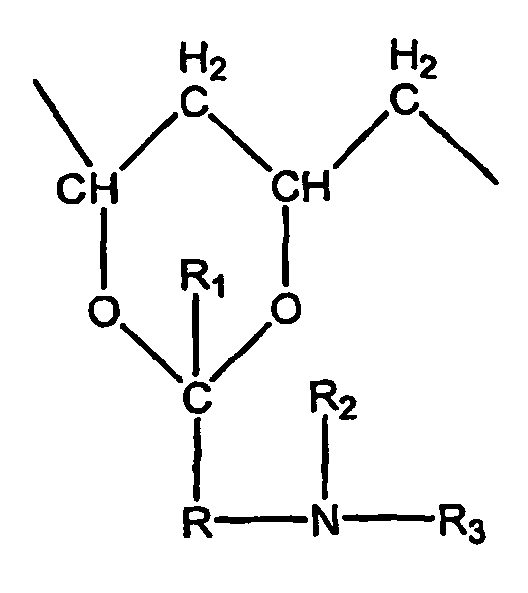
- R1 is hydrogen, a C1-C6 alkyl, or a cycloalkyl, for example, methyl, ethyl, propyl or butyl and R2 is hydrogen or a C1-C6 alkyl, for example, methyl, ethyl, propyl or butyl. R1 and R2 are preferably each hydrogen.
- R3 is an olefinically unsaturated electron attracting copolymerizable radical having up to 25 carbon atoms. In one embodiment, R3 has the structure
where R4 is thegroup if n=zero, or the bridge if n=1;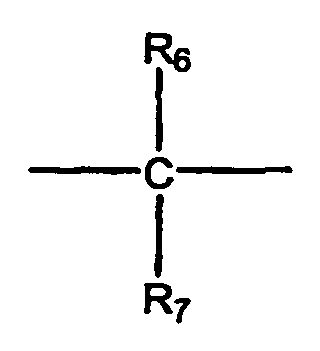
R5 is hydrogen or C1-C4 alkyl, for example, n-butyl, n- or isopropyl, ethyl, or methyl;
n is zero or 1, preferably zero; and
R6 and R7, independently of one another, are hydrogen, a linear or branched C1-C8 alkyl, aryl or cyclohexyl, for example one of the following: octyl, hexyl, pentyl, butyl, propyl, ethyl, methyl, 2-propyl, 2-butyl or 3-pentyl. R6 is preferably hydrogen or the CH3 group, and R7 is preferably a C1-C4 alkyl group. R6 and R7 as aryl are preferably phenyl. - In another embodiment, R3 is an olefinically unsaturated acyl group of formula R8-CO-, in which R8 is an olefinically unsaturated copolymerizable group having from 2 to 24 carbon atoms, preferably from 2 to 8 carbon atoms, especially preferably from 2 to 4 carbon atoms. The olefinically unsaturated copolymerizable radical R8 having from 2 to 24 carbon atoms is preferably alkenyl having from 2 to 24 carbon atoms, especially alkenyl having from 2 to 8 carbon atoms and especially preferably alkenyl having from 2 to 4 carbon atoms, for example ethenyl, 2-propenyl, 3-propenyl, 2-butenyl, hexenyl, octenyl or dodecenyl. The groups ethenyl and 2-propenyl are preferred, so that the group -CO-R8 is the acyl radical of acrylic or methacrylic acid.
- In another embodiment, the group R3 is a radical of formula
R9 and R10 are each independently lower alkylene having from 2 to 8 carbon atoms, arylene having from 6 to 12 carbon atoms, a saturated divalent cycloaliphatic group having from 6 to 10 carbon atoms, arylenealkylene or alkylenearylene having from 7 to 14 carbon atoms or arylenealkylenearylene having from 13 to 16 carbon atoms, and
R8 is as defined above. - Lower alkylene R9 or R10 preferably has from 2 to 6 carbon atoms and is especially straight-chained. Suitable examples include propylene, butylene, hexylene, dimethylethylene and, especially preferably, ethylene.
- Arylene R9 or R10 is preferably phenylene that is unsubstituted or is substituted by lower alkyl or lower alkoxy, especially 1,3-phenylene or 1,4-phenylene or methyl-1,4-phenylene.
- A saturated divalent cycloaliphatic group R9 or Rio is preferably cyclohexylene or cyclohexylene-lower alkylene, for example cyclohexylenemethylene, that is unsubstituted or is substituted by one or more methyl groups, such as, for example, trimethylcyclohexylenemethylene, for example the divalent isophorone radical.
- The arylene unit of alkylenearylene or arylenealkylene R9 or R10 is preferably phenylene, unsubstituted or substituted by lower alkyl or lower alkoxy, and the alkylene unit thereof is preferably lower alkylene, such as methylene or ethylene, especially methylene. Such radicals R9 or R10 are therefore preferably phenylenemethylene or methylenephenylene.
- Arylenealkylenearylene R9 or R10 is preferably phenylene-lower alkylene-phenylene having up to 4 carbon atoms in the alkylene unit, for example phenyleneethylenephenylene.
- The radicals R9 and R10 are each independently preferably lower alkylene having from 2 to 6 carbon atoms, phenylene, unsubstituted or substituted by lower alkyl, cyclohexylene or cyclohexylene-lower alkylene, unsubstituted or substituted by lower alkyl, phenylene-lower alkylene, lower alkylene-phenylene or phenylene-lower alkylene-phenylene.
- The group -R9-NH-CO-O- is present when q is one and absent when q is zero. Macromers in which q is zero are preferred.
- The group -CO-NH-(R9-NH-CO-O)q-R10-O- is present when p is one and absent when p is zero. Macromers in which p is zero are preferred.
- In macromers in which p is one, q is preferably zero. Macromers in which p is one, q is zero, and R10 is lower alkylene are especially preferred.
- All of the above groups can be monosubstituted or polysubstituted, examples of suitable substituents being the following: C1-C4 alkyl, such as methyl, ethyl or propyl, -COOH, -OH, -SH, C1-C4 alkoxy (such as methoxy, ethoxy, propoxy, butoxy, or isobutoxy), -NO2, -NH2, -NH(C1-C4), -NH-CO-NH2, -N(C1-C4 alkyl)2, phenyl (unsubstituted or substituted by, for example, -OH or halogen, such as Cl, Br or especially I), -S(C1-C4 alkyl), a 5- or 6-membered heterocyclic ring, such as, in particular, indole or imidazole, -NH-C(NH)-NH2, phenoxyphenyl (unsubstituted or substituted by, for example, -OH or halogen, such as Cl, Br or especially I), an olefinic group, such as ethylene or vinyl, and CO-NH-C(NH)-NH2.
- Preferred substituents are lower alkyl, which here, as elsewhere in this description, is preferably C1-C4 allyl, C1-C4 alkoxy, COOH, SH, -NH2, -NH(C1-C4 alkyl), -N(C1-C4 alkyl)2 or halogen. Particular preference is given to C1-C4 alkyl, C1-C4 alkoxy, COOH and SH.
- For the purposes of this invention, cycloalkyl is, in particular, cycloalkyl, and aryl is, in particular, phenyl, unsubstituted or substituted as described above.
- The macromers can include further modifier groups and crosslinkable groups. Some such groups are described in U.S. Patent Nos. 5,508,317, 5,665,840, 5,807,927, 5,849,841, 5,932,674, 5,939,489, and 6,011,077. Crosslinkable groups and the optional further modifier groups can be bonded to the macromer backbone in various ways, for example through a certain percentage of the 1,3-diol units being modified to give a 1,3-dioxane, which contains a crosslinkable group, or a further modifier, in the 2-position. Modifiers that might be attached to the backbone include those to modify the hydrophobicity, active agents or groups to allow attachment of active agents, photoinitiators, modifiers to enhance or reduce adhesiveness, modifiers to impart thermoresponsiveness, modifiers to impart other types of responsiveness, and additional crosslinking groups. These modifiers may be attached to the backbone, or to other monomeric units included in the backbone.
- Attaching a cellular adhesion promoter to the macromers can enhance cellular attachment or adhesiveness of the biomedical articles. These agents are well known to those skilled in the art and include carboxymethyl dextran, proteoglycans, collagen, gelatin, glucosaminoglycans, fibronectin, lectins, polycations, and natural or synthetic biological cell adhesion agents such as RGD peptides.
- Having pendant ester groups that are substituted by acetaldehyde or butyraldehyde acetals, for example, can increase the hydrophobicity of the macromers and the formed hydrogel. Hydrophobic groups can desirably be present in an amount from about 0 to 25%.
- It may also be desirable to include in the macromer a molecule that allows visualization of the biomedical article. Examples include dyes and molecules visualizable by magnetic resonance imaging.
- The macromers can form a hydrogel that is degradable. Suitable degradable systems are described in U.S. Patent Application Serial No. 09/714,700, titled "Degradable Poly(Vinyl Alcohol) Hydrogels" and filed on November 15, 2000. In the degradable systems described in that application, the macromers include a degradable region in the backbone or on a pendant chain. The degradable region is preferably degradable under in vivo conditions by hydrolysis. The degradable region can be enzymatically degradable. For example, the degradable region may be polymers and oligomers of glycolide, lactide, ε-caprolactone, other hydroxy acids, and other biologically degradable polymers that yield materials that are non-toxic or present as normal metabolites in the body. Preferred poly(α-hydroxy acids) are poly(glycolic acid), poly(DL-lactic acid) and poly(L-lactic acid). Other useful materials include poly(amino acids), poly(anhydrides), poly(orthoesters), poly(phosphazines), and poly(phosphoesters). Polylactones such as poly(ε-caprolactone), poly(ε-caprolactone), poly(δ-valerolactone) and poly(y-butyrolactone), for example, are also useful. Enzymatically degradable linkages include poly(amino acids), gelatin, chitosan, and carbohydrates. The biodegradable regions may have a degree of polymerization ranging from one up to values that would yield a product that was not substantially water soluble. Thus, monomeric, dimeric, trimeric, oligomeric, and polymeric regions may be used. The biodegradable region could, for example, be a single methacrylate group.
- Biodegradable regions can be constructed from polymers or monomers using linkages susceptible to biodegradation, such as ester, acetal, carbonate, peptide, anhydride, orthoester, phosphazine, and phosphoester bonds. As described therein, the biodegradable regions may be arranged within the macromers such that the formed hydrogel has a range of degradability, both in terms of extent of degradation, whether complete or partial, and in terms of time to complete or partial degradation.
- The macromers can be made by general synthetic methods known to those skilled in the art. The specific macromers discussed above can be made as described in U.S. Patent Nos. 5,508,317, 5,665,840, 5,807,927, 5,849,841, 5,932,674, 5,939,489, and 6,011,077.
- The specific macromers described above are extraordinarily stable. Spontaneous crosslinking by homopolymerization does not typically occur. The macromers can furthermore be purified in a manner known per se, for example by precipitation with organic solvents, such as acetone, extraction in a suitable solvent, washing, dialysis, filtration, or ultrafiltration. Ultrafiltration is especially preferred. By means of the purification process the macromers can be obtained in extremely pure form, for example in the form of concentrated aqueous solutions that are free, or at least substantially free, from reaction products, such as salts, and from starting materials.
- The preferred purification process for the macromers of the invention, ultrafiltration, can be carried out in a manner known per se. It is possible for the ultrafiltration to be carried out repeatedly, for example from two to ten times. Alternatively, the ultrafiltration can be carried out continuously until the selected degree of purity is attained. The selected degree of purity can in principle be as high as desired. A suitable measure for the degree of purity is, for example, the sodium chloride content of the solution, which can be determined simply in a known manner, such as by conductivity measurements.
- The macromers are crosslinkable in an extremely effective and controlled manner.
- The process for polymerization of the macromers may comprise, for example, crosslinking a macromer comprising units of formula I, especially in substantially pure form, that is to say, for example, after single or repeated ultrafiltration, preferably in solution, especially in aqueous solution, in the absence or presence of an additional vinylic comonomer.
- The vinylic comonomer may be hydrophilic or hydrophobic, or a mixture of a hydrophobic and a hydrophilic vinylic monomer. Generally, approximately from 0.01 to 80 units of a typical vinylic comonomer react per unit of formula I, especially from 1 to 30 units per unit of formula I, and especially preferably from 5 to 20 units per unit of formula I.
- If a vinylic comonomer is used, the crosslinked polymers according to the invention preferably comprise approximately from 1 to 15 percent, especially preferably approximately from 3 to 8 percent, of units of formula I or III, based on the number of hydroxy groups of the polyvinyl alcohol, which are reacted with approximately from 0.1 to 80 units of the vinylic monomer.
- It is also preferable to use a hydrophobic vinylic comonomer or a mixture of a hydrophobic vinylic comonomer with a hydrophilic vinylic comonomer, the mixture comprising at least 50 percent by weight of a hydrophobic vinylic comonomer. In that manner the mechanical properties of the polymer can be improved without the water content falling substantially. In principle, however, both conventional hydrophobic vinylic comonomers and conventional hydrophilic vinylic comonomers are suitable for copolymerization with the macromer.
- Suitable hydrophobic vinylic comonomers include, without the list being exhaustive, C1 -C18 alkyl acrylates and methacrylates, C3 - C18 alkyl acrylamides and methacrylamides, acrylonitrile, methacrylonitrile, vinyl-C1 - C18 alkanoates, C2 - C18 alkenes, C2 - C18 haloalkenes, styrene, C1 - C6 alkylstyrene, vinyl alkyl ethers, in which the alkyl moiety contains from 1 to 6 carbon atoms, C2 -C10 perfluoroalkyl acrylates and methacrylates or correspondingly partially fluorinated acrylates and methacrylates, C3-C12 perfluoroalkyl-ethylthiocarbonylaminoethyl acrylates and methacrylates, acryloxy- and methacryloxy-alkylsiloxanes, N-vinylcarbazole, C3-C12 alkyl esters of maleic acid, fumaric acid, itaconic acid, mesaconic acid and the like. C1-C4 alkyl esters of vinylically unsaturated carboxylic acids having from 3 to 5 carbon atoms or vinyl esters of carboxylic acids having up to 5 carbon atoms, for example, are preferred.
- Examples of suitable hydrophobic vinylic comonomers include methyl acrylate, ethyl acrylate, propyl acrylate, isopropyl acrylate, cyclohexyl acrylate, 2-ethylhexyl acrylate, methyl methacrylate, ethyl methacrylate, propyl methacrylate, vinyl acetate, vinyl propionate, vinyl butyrate, vinyl valerate, styrene, chloroprene, vinyl chloride, vinylidene chloride, acrylonitrile, 1-butene, butadiene, methacrylonitrile, vinyltoluene, vinyl ethyl ether, perfluorohexylethylthiocarbonylaminoethyl methacrylate, isobornyl methacrylate, trifluoroethyl methacrylate, hexafluoroisopropyl methacrylate, hexafluorobutyl methacrylate, tris-trimethylsilyloxy-silyl-propyl methacrylate, 3-methacryloxypropylpentamethyldisiloxane and bis(methacryloxypropyl)tetramethyldisiloxane.
- Suitable hydrophilic vinylic comonomers include, without the list being exhaustive, hydroxy-substituted lower alkyl acrylates and methacrylates, acrylamide, methacrylamide, lower alkyl acrylamides and methacrylamides, ethoxylated acrylates and methacrylates, hydroxy-substituted lower alkyl acrylamides and methacrylamides, hydroxy-substituted lower alkyl vinyl ethers, sodium ethylenesulfonate, sodium styrenesulfonate, 2-acrylamido-2-methylpropanesulfonic acid (AMPS® monomer from Lubrizol Corporation), N-vinylpyrrole, N-vinylsuccinimide, N-vinylpyrrolidone, 2- or 4-vinylpyridine, acrylic acid, methacrylic acid, amino- (the term "amino" also including quaternary ammonium), mono-lower alkylamino- or di-lower alkylamino-lower alkyl acrylates and methacrylates, allyl alcohol and the like. Hydroxy-substituted C2-C4 alkyl(meth)acrylates, five- to seven-membered N-vinyl lactams, N,N-di-C1-C4 alkyl(meth)acrylamides and vinylically unsaturated carboxylic acids having a total of from 3 to 5 carbon atoms, for example, are preferred.
- It may be desirable to include a contrast agent in the biomedical articles. A contrast agent is a biocompatible (non-toxic) material capable of being monitored by, for example, radiography. The contrast agent can be water soluble or water insoluble. Examples of water soluble contrast agents include metrizamide, iopamidol, iothalamate sodium, iodomide sodium, and meglumine. Iodinated liquid contrast agents include Omnipaque®, Visipaque®, and Hypaque-76®. Examples of water insoluble contrast agents are tantalum, tantalum oxide, barium sulfate, gold, tungsten, and platinum. These are commonly available as particles preferably having a size of about 10 µm or less.
- A contrast agent can be added to the biomedical article during manufacture, so that the contrast agent is incorporated into the article. Alternatively, the article can be coated with the contrast agent.
- An effective amount of one or more biologically active agents can be included in the biomedical articles. It may be desirable to deliver the active agent from the articles. Biologically active agents that it may be desirable to deliver include prophylactic, therapeutic, and diagnostic agents (collectively referred to herein as an "active agent" or "drug"). A wide variety of active agents can be incorporated into the hydrogel including organic and inorganic molecules and cells. Release of the incorporated additive from the hydrogel is achieved by diffusion of the agent from the hydrogel, degradation of the hydrogel, and/or degradation of a chemical link coupling the agent to the polymer. In this context, an "effective amount" refers to the amount of active agent required to obtain the desired effect.
- Examples of active agents that can be incorporated include, but are not limited to, anti-angiogenic agents, chemotherapeutic agents, growth factors, nitric oxide, radiation delivery devices, such as radioactive seeds for brachytherapy, and gene therapy compositions.
- Chemotherapeutic agents that can be incorporated include water soluble chemotherapeutic agents, such as cisplatin (platinol), doxorubicin (adriamycin, rubex), or mitomycin C (mutamycin). Other chemotherapeutic agents include iodinated fatty acid ethyl esters of poppy seed oil, such as lipiodol.
- Cells can be incorporated into the biomedical articles, including cells to encourage tissue growth or cells to secrete a desired active agent. For example, cells that can be incorporated include fibroblasts, endothelial cells, muscle cells, stem cells, etc. Cells can be modified to secrete active agents such as growth factors.
- Active agents can be incorporated into the biomedical articles simply by mixing the agent with the macromers prior to crosslinking. The active agent will then be entrapped in the hydrogel. The active agent can be in compound form or can be in the form of degradable or nondegradable nano or microspheres. It some cases, it may be possible and desirable to attach the active agent to the article after the article is formed. The active agent may also be coated onto the surface of the article. The active agent may be released from the hydrogel over time or in response to an environmental condition.
- It may be desirable to include fillers in the biomedical articles, such as fillers that leach out of the hydrogel over a period of time and cause the hydrogel to become porous. Such may be desirable, for example, where cellular growth is desired. Appropriate fillers include calcium salts, for example.
- It may be desirable to include other types of macromers in the biomedical article.
- A number of characteristics of the hydrogel can be easily modified, making the hydrogels suitable for a number of applications. For example, as discussed above, the polymer backbones can include comonomers to add desired properties, such as, for example, thermoresponsiveness, degradability, gelation speed, and hydrophobicity. Modifiers can be attached to the polymer backbone (or to pendant groups) to add desired properties, such as, for example, thermoresponsiveness, degradability, hydrophobicity, flexibility, and adhesiveness. Active agents can also be attached to the polymer backbone using the free hydroxyl groups, or can be attached to pendant groups.
- The gelation time of the compositions can be varied from about 0.5 seconds to as long as 10 minutes, and longer if desired. The gelation time will generally be affected by, and can be modified by changing at least the following variables: the initiator system, crosslinker density, macromer molecular weight, macromer concentration (solids content), and type of crosslinker. A higher crosslinker density will provide faster gelation time; a lower molecular weight will provide a slower gelation time. A higher solids content will provide faster gelation time. For redox systems the gelation time can be designed by varying the concentrations of the redox components. Higher reductant and higher oxidant will provide faster gelation, higher buffer concentration and lower pH will provide faster gelation.
- The firmness of the formed hydrogel will be determined in part by the hydrophilic/hydrophobic balance, where a higher hydrophobic percent provides a fumer hydrogel. The firmness will also be determined by the crosslinker density (higher density provides firmer hydrogel), the macromer molecular weight (lower MW provides firmer hydrogel), and the length of the crosslinker (a shorter crosslinker provides a firmer hydrogel).
- The swelling of the hydrogel is inversely proportional to the crosslinker density. Generally, no or minimal swelling is desired, desirably less than about 10 percent.
- Elasticity of the formed hydrogel can be increased by increasing the size of the backbone between crosslinks and decreasing the crosslinker density. Incomplete crosslinking will also provide a more elastic hydrogel. In many cases, the elasticity of the hydrogel desirably substantially matches the elasticity of the tissue to which the composition is to administered or implanted.
- In the case of photocrosslinking, it may be appropriate to add a photoinitiator that is capable of initiating free radical crosslinking. The crosslinking can then be initiated by actinic or ionizing radiation.
An equally advantageous method of crosslinking is via redox initiation. In the case of redox initiated crosslinking, it may be appropriate to divide the prepolymer solution. The oxidizing agent of the redox initiation system is added to one part of the prepolymer solution and the reducing agent component of the redox initiation system is added to the other part. The crosslinking can then be initiated by mixing the two solutions together. - The crosslinking is carried out in a suitable solvent. Such solvents are in principle all those which dissolve the prepolymer and any vinylic comonomers additionally used, for example water, alcohols, such as lower alkanols, for example ethanol or methanol, furthermore carboxamides, such as dimethylformamide or dimethyl sulfoxide, likewise mixtures of suitable solvents, for example mixtures of water with an alcohol, for example a water/ethanol or water/methanol mixture.
- In the case of photocrosslinking, it is expedient to add an initiator that is capable of initiating free-radical crosslinking and is readily soluble in water. Examples thereof arc known to the person skilled in the art, suitable photoinitiators which may be mentioned specifically arc benzoins, such as benzoin, benzoin ethers, such as benzoin methyl ether, benzoin ethyl ether, benzoin isopropyl ether and benzoin phenyl ether, and benzoin acetate; acetophenones, such as acetophenone, 2,2-dimethoxyacetophenone and 1,1-dichloroacetophenone; benzil, benzil ketals, such as benzil dimethyl ketal and benzil diethyl ketal, anthraquinones, such as 2-methylanthraquinone, 2-ethylanthraquinone, 2-tert-butylanthraquinone, 1-chloroanthraquinone and 2-amylanthraquinone; furthermore triphenylphosphine, benzoylphosphine oxides, for example 2,4,6-trimethylbenzoyldiphenylphosphine oxide, benzophenones, such as benzophenone and 4,4'-bis(N,N-dimethylamino)benzophenone; thioxanthones and xanthones; acridine derivatives; phenazine derivatives; quinoxaline derivatives and 1-phenyl-1,2 propanedione 2-O-benzoyl oxime; 1-aminophenyl ketones and 1-hydroxyphenyl ketones, such as 1-hydroxycyclohexylphenyl ketone, phenyl 1-hydroxyisopropyl ketone, 4-isopropylphenyl 1-hydroxyisopropyl ketone, 2-hydroxy-1-[4-(2-hydroxyethoxy)phenyl]-2-methylpropan-1-one, 1-phenyl-2-hydroxy-2-methylpropan-1-one, and 2,2-dimethoxy-1,2-diphenylethanone, all of which are known compounds.
- Particularly suitable photonitiators, which are usually used in combination with UV lamps as light source, are acetophenones, such as 2,2-dialkoxybenzophenones and hydroxyphenyl ketones, for example the initiators obtainable under the names Lucirin® TPO, IRGACURE.®2959 and IRGACURE®1173.
- For visible light polymerization, an initiator or photosensitizer and co-catalyst are used. Examples of suitable initiators are ethyl eosin, eosin, erythrosin, riboflavin, fluorescein, rose bengal, methylene blue, thionine, 5,7-diiodo-3-butoxy-6-fluorone, 2,4,6-trimethyl-benzoyldiphenylophosphine oxide and the like; examples of suitable co-catalysts are triethanolamine, arginine, methyldiethanol amine, triethylamine, or an organic peroxide (e.g., benzoyl peroxide) and the like. Another class of photoinitiators usually employed when argon ion lasers are used is benzil ketals, for example benzil dimethyl ketal.
- The photoinitiators are added in effective amounts, expediently in amounts of from about 0.1 to about 2.0% by weight, in particular from 0.3 to 0.5% by weight, based on the total amount of the prepolymer.
- In a redox system employing ferrous ion, peroxide, and ascorbate, the desired amounts of the components will be determined by concerns related to gelation speed, toxicity, extent of gelation desired, and stability. Very generally, the concentration of iron will be about 20 to 1000 ppm; the concentration of hydrogen peroxide will be about 10 to 1000 ppm; the pH will be about 3 to 7; the buffer concentration will be about 10 to 200 mM; and ascorbate concentration will be about 10 to 40 mM.
- The biomedical articles are microparticles, such as for drug delivery. Microparticles can be made by a number of techniques known to those skilled in the art, such as single and double emulsion, suspension polymerization, solvent evaporation, spray drying, and solvent extraction. Methods for making microspheres are described in the literature, for example, in Mathiowitz and Langer, J. Controlled Release 5:13-22 (1987); Mathiowitz et al., Reactive Polymers 6:275-283 (1987); Mathiowitz et al., J. Appl. Polymer Sci. 35:755-774 (1988), Mathiowitz et al., Scanning Microscopy 4:329-340 (1990); Mathiowitz et al., J. Appl. Polymer Sci., 45:125-134 (1992); and Benita et al., J. Pharm. Sci. 73:1721-1724 (1984).
- In solvent evaporation, described for example in Mathiowitz et al., (1990), Benita et al. (1984), and U.S. Pat. No. 4,272,398, the macromers are dissolved in a solvent. If desired, an agent to be incorporated, either in soluble form or dispersed as fine particles, is added to the macromer solution, and the mixture is suspended in an aqueous phase that contains a surface active agent. The resulting emulsion is stirred until most of the solvent evaporates, leaving solid microspheres, which may be washed with water and dried overnight in a lyophilizer. The microspheres are polymerized, for example, by exposure to light.
- In solvent removal, the macromers are dissolved in a solvent. The mixture can then be suspended in oil, such as silicon oil, by stirring, to form an emulsion. As the solvent diffuses into the oil phase, the emulsion droplets harden into solid polymer microspheres. The microspheres can be polymerized by exposure to light, for example.
- Spray drying is implemented by passing the polymerizable macromers used to form the hydrogel through a nozzle, spinning disk or equivalent device to atomize the mixture to form fine droplets. The polymerizable macromers may be provided in a solution or suspension, such as an aqueous solution. The fine droplets are exposed to light, for example, to cause polymerization of the macromer and formation of the hydrogel microspheres.
- In another embodiment, hydrogel particles are prepared by a water-in-oil emulsion or suspension process, wherein the polymerizable macromers and the substance to be incorporated, if desired, are suspended in a water-in-oil suspension and exposed to light to polymerize the macromers to form hydrogel particles incorporating the substance, such as a biologically active agent.
- In another embodiment microspheres can be formed by atomizing macromer solution into oil, followed by polymerization.
- There arc many variables that affect the size, size distribution, and quality of the microspheres formed, such as stabilizer, stir speed, reactor geometry. An important variable is the choice of stabilizer. Good stabilizers have an HLB number from 1 to 4 and have some solubility in the oil phase. Some appropriate stabilizers include cellulose acetate butyrate (with 17% butyrate), sorbitan oleates, and dioctylsulphosuccinate. The amount and type of stabilizer will control the particle size and reduce coalescing of the particles during crosslinking. The oil can be a water-insoluble oil such as liquid paraffin, but water-insoluble halogenated solvents such as dichloroethane are commonly used. The ratio of water to oil is also important and desirably ranges from about 1:1 to 1:4.
- Microspheres can be made in sizes ranging from about 10 microns to 2000 microns. In must applications it will be desirable to have a small size range of microspheres. The process used to make the microspheres can be controlled to achieve a particular desired size range of microspheres. Other methods, such as sieving, can be used to even more tightly control the size range of the microspheres.
- Active agents can be included in the microspheres as described above. It may be desirable to coat the microspheres in modifiers or active agents, such as, for example, agents to increase cellular attachment. Such coating can be done by methods known to those skilled in the art.
- The examples below serve to further illustrate the invention, to provide those of ordinary skill in the art with a complete disclosure and description of how the compounds, compositions, articles, devices, and/or methods claimed herein are made and evaluated. In the examples, unless expressly stated otherwise, amounts and percentages are by weight, temperature is in degrees Celsius or is at ambient temperature, and pressure is at or near atmospheric. The examples are not intended to restrict the scope of the invention.
- 300 ml of 1,2-dichloroethane (DCE) or paraffin was placed into a 500 ml dented kettle and stirred with a glass stir rod. Stabilizer was added (either cellulose acetate butyrate (CAB) or dioctyl sulfosuccinate (DOS) (the percent reported is based on the amount of DCE used)) while stirring until dissolved. Once all of the stabilizer was dissolved, stirring was ceased, and nitrogen was bubbled through the solution for 10 minutes.
- The macromer solution as described in Table 1 (between 10-30% solids) was placed in a 100 ml flat-bottomed flask and stirred. 0.5% potassium persulfate was added (based on amount of DCE or paraffin used) to the macromer while stirring. Once the persulfate was dissolved, nitrogen was bubbled through the solution for 5 minutes.
- The macromer solution was added to the DCE or paraffin solution dropwise, while stirring at 400 rpm. Once all of the macromer solution was added, a small positive pressure of nitrogen was applied. 0.5% N,N,N,N tetramethylethylenediamine (based on amount of DCE or paraffin used) was added to the solution. The solution was lowered into an oil bath at a temperature of 55°C and allowed to react for three hours.
- After three hours, the heat was removed and stirring was continued. Once cooled, the DCE or paraffin was vacuum filtered off, and the product was washed with DCE and acetone. The product was soaked in acetone for 30 minutes, the acetone was decanted off, and the product was soaked in water for at least 30 minutes. The water was vacuum filtered off the product. The microspheres were sonicated for 30 minutes and sieved into the desired size ranges of greater than 850 microns, between 850 and 500 microns, between 500 and 250 microns, and smaller than 250 microns. The macromer used in samples A through G had a PVA backbone (14 kDa, 12% acetate incorporation) modified with 0.45 meq/g N-acrylamidoacetaldehyde dimethyl acetal pendant polymerizable groups (about 6.3 crosslinks per chain). The macromer used in sample H had a backbone of PVA 8-88 (67 kDa, 12% acetate incorporation) modified with N-acrylamidoaetaldehyde dimethyl acetal pendant polymerizable groups (about 7 crosslinks per chain). The macromer used in sample I had a backbone of PVA 4-88 (31 kDa, 12% acetate incorporation) modified with N-acrylamidoacetaldehyde dimethyl acetal pendant polymerizable groups (about 7 crossslinks per chain). The stir speed was 400 rpm except for sample G which was 350 rpm.
Preparation of Microspheres Sample Macromer (%) Stabilizer Yield (%) Size Distribution (microns) >850 850-500 500-250 <250 A 20 0.8% CAD in DCE 101 0 3 80 17 B 20 0.5% CAB in DCE 115 34 41 19 6 C 30 1% DOS in paraffin 41 nd nd nd nd D 30 1% DOS in paraffin 134 16 60 19 5 E 20 1% CAB in DCE 96 0 14 72 13 F 20 0-8% CAB in DCE 96 0 32 57 11 G 10 0.8% CAB in DCE 96 3 0 22 76 H 11 0.8% CAB in DCE 150 0 10 84 6 I 20 0.8% CAB in DCE 92 6 60 31 3 - The microsphere products had very little aggregates (except for sample D) and were mostly or all spherical.
Claims (12)
- A hydrogel biomedical article formed by crosslinking macromers having a polymeric backbone comprising units having a 1,2-diol or 1,3-diol structure and at least two pendant chains bearing crosslinkable groups, characterised in that the article is a microsphere.
- The hydrogel biomedical article of claim 1, wherein the backbone polymer is a polyhydroxy polymer.
- The hydrogel biomedical article of claim 1, wherein the pendant chains are attached to the backbone via the 1,2-diol or 1,3-diol groups.
- The hydrogel biomedical article of claim 1, wherein the pendant chains bearing crosslinkable groups are attached to the backbone via cyclic acetal linkages.
- The hydrogel biomedical article of claim 1, wherein the backbone polymer comprises poly(vinyl alcohol) (PVA) and copolymers thereof.
- The microparticle of claim 1, wherein the macromer has the formula:in which R is a linear or branched C1-C8 alkylene or a linear or branched C1-C12 alkane; R1 is hydrogen, a C1-C6 alkyl, or a cycloalkyl; R2 is hydrogen or a C1-C6 alkyl; and R3 is an olefinically unsaturated electron attracting copolymerizable radical having up to 25 carbon atoms.

- The hydrogel biomedical article of claim 1, further comprising a biologically active agent.
- The hydrogel biomedical article of claim 1, wherein the hydrogel is biodegradable.
- The hydrogel biomedical article of claim 1, further comprising a contrast agent, which is a biocompatible material capable of being monitored by radiography.
- The hydrogel biomedical article of claim 1, wherein the crosslinkable groups are crosslinked via free radical polymerization.
- The hydrogel biomedical article of claim 10, wherein the free radical polymerization is redox initiated.
- The hydrogel biomedical article of claim 11, wherein the crosslinkable groups are olefinically unsaturated groups.
Applications Claiming Priority (3)
| Application Number | Priority Date | Filing Date | Title |
|---|---|---|---|
| US18897500P | 2000-03-13 | 2000-03-13 | |
| US188975P | 2000-03-13 | ||
| PCT/US2001/008008 WO2001068722A1 (en) | 2000-03-13 | 2001-03-13 | Hydrogel biomedical articles |
Publications (2)
| Publication Number | Publication Date |
|---|---|
| EP1263802A1 EP1263802A1 (en) | 2002-12-11 |
| EP1263802B1 true EP1263802B1 (en) | 2005-11-23 |
Family
ID=22695355
Family Applications (2)
| Application Number | Title | Priority Date | Filing Date |
|---|---|---|---|
| EP01916599A Expired - Lifetime EP1263801B1 (en) | 2000-03-13 | 2001-03-13 | Tissue bulking and coating compositions |
| EP01916614A Expired - Lifetime EP1263802B1 (en) | 2000-03-13 | 2001-03-13 | Hydrogel biomedical articles |
Family Applications Before (1)
| Application Number | Title | Priority Date | Filing Date |
|---|---|---|---|
| EP01916599A Expired - Lifetime EP1263801B1 (en) | 2000-03-13 | 2001-03-13 | Tissue bulking and coating compositions |
Country Status (9)
| Country | Link |
|---|---|
| US (1) | US7070809B2 (en) |
| EP (2) | EP1263801B1 (en) |
| JP (3) | JP5025873B2 (en) |
| AT (2) | ATE327262T1 (en) |
| AU (4) | AU4360301A (en) |
| CA (2) | CA2402773C (en) |
| DE (2) | DE60115212T2 (en) |
| ES (1) | ES2253360T3 (en) |
| WO (2) | WO2001068721A1 (en) |
Families Citing this family (76)
| Publication number | Priority date | Publication date | Assignee | Title |
|---|---|---|---|---|
| US6652883B2 (en) * | 2000-03-13 | 2003-11-25 | Biocure, Inc. | Tissue bulking and coating compositions |
| US20020122771A1 (en) * | 2000-09-23 | 2002-09-05 | Troy Holland | Spray hydrogel wound dressings |
| WO2002072166A1 (en) * | 2001-03-13 | 2002-09-19 | Biocure, Inc. | Compositions for drug delivery |
| US6656506B1 (en) * | 2001-05-09 | 2003-12-02 | Advanced Cardiovascular Systems, Inc. | Microparticle coated medical device |
| US8101196B2 (en) * | 2001-06-26 | 2012-01-24 | Biointeractions, Ltd. | Polysaccharide biomaterials and methods of use thereof |
| US6713646B2 (en) | 2002-04-12 | 2004-03-30 | Biosphere Medical | Degradable crosslinkers, and degradable crosslinked hydrogels comprising them |
| US6884905B2 (en) | 2002-07-23 | 2005-04-26 | Biosphere Medical | Degradable carbamate-containing bis(acryloyl) crosslinkers, and degradable crosslinked hydrogels comprising them |
| US7511083B2 (en) * | 2002-10-02 | 2009-03-31 | Coloplast A/S | Hydrogel |
| US8034361B2 (en) * | 2002-11-12 | 2011-10-11 | Advanced Cardiovascular Systems, Inc. | Stent coatings incorporating nanoparticles |
| EP1594421A4 (en) * | 2003-01-17 | 2006-02-08 | Psinergi Corp | Artificial nucleus pulposus and method of injecting same |
| US20040161466A1 (en) | 2003-02-14 | 2004-08-19 | Biocompatibles Uk Limited | Chemoembolisation |
| PL1603603T3 (en) | 2003-02-28 | 2015-07-31 | Biointeractions Ltd | Polymeric network system for medical devices and methods of use |
| AU2005245017A1 (en) * | 2004-05-21 | 2005-12-01 | Synthes Gmbh | Replacement of nucleus pulposus using a hydrogel |
| AU2005260646A1 (en) | 2004-06-29 | 2006-01-12 | Bruktawit T. Asfaw | Biomaterial |
| EP1761244A4 (en) * | 2004-06-30 | 2009-12-09 | Tyco Healthcare | Isocyanate-based compositions and their use |
| WO2006026731A1 (en) * | 2004-08-30 | 2006-03-09 | Spineovations, Inc. | Method of treating spinal internal disk derangement |
| US7402320B2 (en) | 2004-08-31 | 2008-07-22 | Vnus Medical Technologies, Inc. | Apparatus, material compositions, and methods for permanent occlusion of a hollow anatomical structure |
| JP4959583B2 (en) | 2005-01-25 | 2012-06-27 | タイコ ヘルスケア グループ リミテッド パートナーシップ | Structure for permanent occlusion of hollow anatomical structures |
| US7795359B2 (en) * | 2005-03-04 | 2010-09-14 | Novartis Ag | Continuous process for production of polymeric materials |
| KR20140090270A (en) | 2005-05-09 | 2014-07-16 | 바이오스피어 메디칼 에스.에이. | Compositions and methods using microspheres and non-ionic contrast agents |
| EP1948096A2 (en) * | 2005-10-26 | 2008-07-30 | BioCure, Inc. | Hydrogel spinal disc implants with swellable articles |
| US20070244544A1 (en) * | 2006-04-14 | 2007-10-18 | Medtronic Vascular, Inc. | Seal for Enhanced Stented Valve Fixation |
| US9017361B2 (en) | 2006-04-20 | 2015-04-28 | Covidien Lp | Occlusive implant and methods for hollow anatomical structure |
| WO2007127785A2 (en) * | 2006-04-25 | 2007-11-08 | William Marsh Rice University | Novel injectable macromonomers for the fabrication of hydrogels |
| EP2059227A2 (en) * | 2006-09-26 | 2009-05-20 | Aeris Therapeutics, Inc. | Polymer systems for lung volume reduction therapy |
| US20080114096A1 (en) * | 2006-11-09 | 2008-05-15 | Hydromer, Inc. | Lubricious biopolymeric network compositions and methods of making same |
| US20080260833A1 (en) * | 2007-04-20 | 2008-10-23 | Thomas Hirt | Drug delivery vehicle containing vesicles in a hydrogel base |
| US8480651B2 (en) * | 2007-08-02 | 2013-07-09 | Covidien Lp | Cannula system |
| AU2008284042B2 (en) | 2007-08-03 | 2013-06-27 | Scion NeuroStim, Inc. | Vestibular stimulation apparatus and associated methods of use |
| EP2026063A1 (en) * | 2007-08-06 | 2009-02-18 | Marcella Chiari | Electrophoresis matrix based on cross-linked double network hydrogel |
| US20090092547A1 (en) * | 2007-10-05 | 2009-04-09 | Boston Scientific Scimed, Inc. | Injectable Particles |
| US8283384B2 (en) * | 2008-01-24 | 2012-10-09 | University Of Utah Research Foundation | Adhesive complex coacervates and methods of making and using thereof |
| CA2712843A1 (en) | 2008-01-24 | 2009-07-30 | University Of Utah Research Foundation | Adhesive complex coacervates and methods of making and using thereof |
| WO2009100422A2 (en) * | 2008-02-08 | 2009-08-13 | Zimmer, Inc. | Drug delivery system comprising microparticles and gelation system |
| CA2722425A1 (en) * | 2008-04-28 | 2009-11-05 | Surmodics, Inc. | Poly-.alpha.(1-4)glucopyranose-based matrices with hydrazide crosslinking |
| WO2010083039A1 (en) * | 2009-01-14 | 2010-07-22 | Cornell University | Preparing biodgradable hydrogel for biomedical application |
| US7955301B1 (en) | 2010-01-27 | 2011-06-07 | Warsaw Orthopedic, Inc. | Injection shut off valve with pressure actuator for delivery of compositions |
| US9050274B2 (en) * | 2010-01-28 | 2015-06-09 | Warsaw Orthopedic, Inc. | Compositions and methods for treating an intervertebral disc using bulking agents or sealing agents |
| US9125902B2 (en) * | 2010-01-28 | 2015-09-08 | Warsaw Orthopedic, Inc. | Methods for treating an intervertebral disc using local analgesics |
| US9486500B2 (en) | 2010-01-28 | 2016-11-08 | Warsaw Orthopedic, Inc. | Osteoimplant and methods for making |
| WO2011149907A1 (en) | 2010-05-24 | 2011-12-01 | University Of Utah Research Foundation | Reinforced adhesive complex coacervates and methods of making and using thereof |
| US9232805B2 (en) | 2010-06-29 | 2016-01-12 | Biocure, Inc. | In-situ forming hydrogel wound dressings containing antimicrobial agents |
| US9173971B2 (en) | 2010-11-12 | 2015-11-03 | University Of Utah Research Foundation | Simple adhesive coacervates and methods of making and using thereof |
| US9511077B2 (en) | 2011-04-25 | 2016-12-06 | Warsaw Orthopedic, Inc. | Medical devices and methods comprising an anabolic agent for wound healing |
| US9592243B2 (en) | 2011-04-25 | 2017-03-14 | Warsaw Orthopedic, Inc. | Medical devices and methods comprising an anabolic agent for treatment of an injury |
| WO2013025504A1 (en) * | 2011-08-15 | 2013-02-21 | Vivek Shenoy | Device, composition and method for prevention of bone fracture and pain |
| EP2953992B1 (en) | 2013-02-06 | 2021-11-24 | 3M Innovative Properties Company | Polymers, preparation and use thereof |
| GB2519738A (en) | 2013-09-06 | 2015-05-06 | Biocompatibles Uk Ltd | Radiopaque polymers |
| GB2521997A (en) * | 2013-09-06 | 2015-07-15 | Biocompatibles Uk Ltd | Radiopaque polymers |
| KR102323637B1 (en) * | 2013-09-16 | 2021-11-08 | 바이오컴페터블즈 유케이 리미티드 | Oily compositions |
| KR102340388B1 (en) | 2013-09-19 | 2021-12-17 | 마이크로벤션, 인코포레이티드 | Polymer films |
| CN105814120B (en) | 2013-09-19 | 2019-07-05 | 泰尔茂株式会社 | polymer particles |
| EP3065719A4 (en) | 2013-11-08 | 2017-08-09 | Terumo Corporation | Polymer particles |
| CN103977458B (en) * | 2014-05-28 | 2016-10-05 | 苏州恒瑞迦俐生生物医药科技有限公司 | Polyhydroxy polycarboxylic zoarium embolism microball and preparation technology thereof |
| JP6742297B2 (en) | 2014-07-14 | 2020-08-19 | ユニヴァーシティ オブ ユタ リサーチ ファンデーション | In-situ coagulated composite coacervate and method of making and using same |
| US9764122B2 (en) | 2014-07-25 | 2017-09-19 | Warsaw Orthopedic, Inc. | Drug delivery device and methods having an occluding member |
| US9775978B2 (en) | 2014-07-25 | 2017-10-03 | Warsaw Orthopedic, Inc. | Drug delivery device and methods having a retaining member |
| CA2973727A1 (en) | 2015-01-16 | 2016-07-21 | Spineovations, Inc. | Method of treating spinal disk |
| WO2016154592A1 (en) | 2015-03-26 | 2016-09-29 | Microvention, Inc. | Embiolic particles |
| MX370083B (en) * | 2015-05-06 | 2019-11-29 | Zoetis Services Llc | Hydrogel formulation with mild adhesion. |
| US10076650B2 (en) | 2015-11-23 | 2018-09-18 | Warsaw Orthopedic, Inc. | Enhanced stylet for drug depot injector |
| USD802755S1 (en) | 2016-06-23 | 2017-11-14 | Warsaw Orthopedic, Inc. | Drug pellet cartridge |
| KR101823490B1 (en) * | 2016-09-08 | 2018-01-30 | 한국과학기술연구원 | Oxamide nanogel, a preparation method of the same and use thereof |
| AU2017336785B2 (en) | 2016-09-28 | 2019-12-05 | Terumo Corporation | Polymer particles |
| US10434261B2 (en) | 2016-11-08 | 2019-10-08 | Warsaw Orthopedic, Inc. | Drug pellet delivery system and method |
| US11896234B2 (en) | 2018-01-26 | 2024-02-13 | Fluidx Medical Technology, Llc | Apparatus and method of using in situ solidifying complex coacervates for vascular occlusion |
| CN108210992A (en) * | 2018-01-30 | 2018-06-29 | 张思东 | A kind of preparation method of the medical aquogel eluted and its aerogel dressing |
| EP3536402A1 (en) | 2018-03-09 | 2019-09-11 | Ibidi Gmbh | Sample chamber |
| WO2020003147A2 (en) | 2018-06-29 | 2020-01-02 | Biocompatibles Uk Limited | Radiopaque polymers |
| US12043706B2 (en) | 2018-11-21 | 2024-07-23 | Kuraray Co., Ltd. | Monodisperse hydrogel particles |
| PL3735903T3 (en) * | 2019-05-06 | 2026-02-23 | F. Hoffmann-La Roche Ag | Method of manufacturing a membrane for coating an analyte sensor |
| CN114099442B (en) * | 2020-08-25 | 2024-01-30 | 复旦大学 | Multifunctional microsphere preparation for tumor chemoradiotherapy embolism treatment and image and preparation method thereof |
| WO2024176915A1 (en) * | 2023-02-22 | 2024-08-29 | 株式会社クラレ | Dry hydrogel-forming article, hydrogel, and method for producing dry hydrogel-forming article |
| WO2024211904A2 (en) | 2023-04-06 | 2024-10-10 | 33 Medical, Inc. | Minimally invasive compliant devices for total lumbar disc replacement |
| US20240335250A1 (en) * | 2023-04-07 | 2024-10-10 | Mineral City Biotechnologies, LLC | Systems and Devices for Enhancing Visibility of Internal Connection Mechanisms |
| KR20260021016A (en) | 2023-06-02 | 2026-02-12 | 33 메디칼, 인크. | Composition for the treatment of intervertebral disc pain, and method for its preparation and use |
Family Cites Families (48)
| Publication number | Priority date | Publication date | Assignee | Title |
|---|---|---|---|---|
| JPS6317904A (en) * | 1986-07-09 | 1988-01-25 | Mitsubishi Chem Ind Ltd | Production of crosslinked porous polyvinyl alcohol particle |
| DE3841401A1 (en) | 1988-12-08 | 1990-06-13 | Martin Lemperle | ALLOPLASTIC IMPLANT |
| DD294729A5 (en) * | 1990-05-28 | 1991-10-10 | Zentralinstitut Fuer Molekularbiologie,De | PROCESS FOR THE PRODUCTION OF IMMOBILISATES WITH BIOLOGICALLY ACTIVE, MACROMOLECULAR COMPOUNDS |
| DE69114782T2 (en) | 1990-08-08 | 1996-04-18 | Takeda Chemical Industries Ltd | Intravascular embolizing agent containing an angiogenesis inhibitor. |
| US5529914A (en) * | 1990-10-15 | 1996-06-25 | The Board Of Regents The Univeristy Of Texas System | Gels for encapsulation of biological materials |
| US5410016A (en) | 1990-10-15 | 1995-04-25 | Board Of Regents, The University Of Texas System | Photopolymerizable biodegradable hydrogels as tissue contacting materials and controlled-release carriers |
| US5047055A (en) | 1990-12-21 | 1991-09-10 | Pfizer Hospital Products Group, Inc. | Hydrogel intervertebral disc nucleus |
| FR2676927B1 (en) | 1991-05-29 | 1995-06-23 | Ibf | MICROSPHERES FOR USE IN THERAPEUTIC VASCULAR OCCLUSIONS AND INJECTABLE SOLUTIONS CONTAINING THEM. |
| NZ249770A (en) * | 1992-02-28 | 1996-09-25 | Univ Texas | Biodegradable, polymerisable, substantially water soluble macromer comprising at least one water soluble region, at least one degradable region and at least two free radical polymerisable regions separated by at least one degradable region |
| JPH0685669B2 (en) * | 1992-05-13 | 1994-11-02 | フジライト工業株式会社 | Granules for excrement disposal |
| DK172393B1 (en) * | 1992-06-10 | 1998-05-18 | Maersk Medical As | Process for producing an article having friction-reducing surface coating, coating material for use in the manufacture of such article, and using an osmolality-increasing compound in slurry or emulsified form in the coating material |
| US5514379A (en) | 1992-08-07 | 1996-05-07 | The General Hospital Corporation | Hydrogel compositions and methods of use |
| TW272976B (en) * | 1993-08-06 | 1996-03-21 | Ciba Geigy Ag | |
| CA2202511A1 (en) | 1994-10-12 | 1996-04-25 | Laurence A. Roth | Targeted delivery via biodegradable polymers |
| TW425410B (en) * | 1995-02-03 | 2001-03-11 | Novartis Ag | Preparation of the crosslinked tinted polymers and their moldings |
| TW349967B (en) * | 1995-02-03 | 1999-01-11 | Novartis Ag | Process for producing contact lenses and a cross-linkable polyvinylalcohol used therefor |
| AU4438696A (en) * | 1995-02-03 | 1996-08-21 | Novartis Ag | Crosslinked polymers |
| ES2161825T3 (en) | 1995-03-07 | 2001-12-16 | Ethicon Inc | MEANS TO INCREASE THE FUNCTION OF THE CONTROLLED EXPANSION SPHINTER. |
| EP0842209B1 (en) | 1995-07-28 | 2006-10-11 | Genzyme Corporation | Multiblock biodegradable hydrogels for use as controlled release agents for drugs and tissue treatment agents |
| PT876165E (en) | 1995-12-18 | 2006-10-31 | Angiotech Biomaterials Corp | COMPOSITIONS OF RETICULATED POLYMERS AND PROCESSES FOR THEIR USE |
| JPH1072509A (en) * | 1995-12-22 | 1998-03-17 | Kuraray Co Ltd | Novel polyvinyl alcohol polymer |
| US5902599A (en) | 1996-02-20 | 1999-05-11 | Massachusetts Institute Of Technology | Biodegradable polymer networks for use in orthopedic and dental applications |
| US6060534A (en) | 1996-07-11 | 2000-05-09 | Scimed Life Systems, Inc. | Medical devices comprising ionically and non-ionically crosslinked polymer hydrogels having improved mechanical properties |
| AR008108A1 (en) * | 1996-08-01 | 1999-12-09 | Novartis Ag | A METHOD FOR FORMING A RADIATION ABSORBENT POLYMERIC ARTICLE, A POLYMERIC ARTICLE SO FORMED, AND A METHOD FOR FORMING A POLYMERIC DYE |
| ZA978537B (en) | 1996-09-23 | 1998-05-12 | Focal Inc | Polymerizable biodegradable polymers including carbonate or dioxanone linkages. |
| US5981826A (en) | 1997-05-05 | 1999-11-09 | Georgia Tech Research Corporation | Poly(vinyl alcohol) cryogel |
| TR200001021T2 (en) | 1997-07-18 | 2000-09-21 | Infimed Inc. | Biodegradable macromers for controlled release of active substances. |
| US6265509B1 (en) * | 1997-07-30 | 2001-07-24 | Novartis Ag | Crosslinked polymers |
| US5854382A (en) | 1997-08-18 | 1998-12-29 | Meadox Medicals, Inc. | Bioresorbable compositions for implantable prostheses |
| WO1999012577A1 (en) | 1997-09-05 | 1999-03-18 | Nycomed Imaging As | Polymer particles made of polyvinyl alcohol and comprising a contrast agent for chemoembolization |
| US6660301B1 (en) | 1998-03-06 | 2003-12-09 | Biosphere Medical, Inc. | Injectable microspheres for dermal augmentation and tissue bulking |
| EP1059943B1 (en) | 1998-03-06 | 2004-12-01 | Biosepra Medical Inc. | Implantable particles for tissue bulking and the treatment of gastroesophageal reflux disease, urinary incontinence, and skin wrinkles |
| US6007833A (en) * | 1998-03-19 | 1999-12-28 | Surmodics, Inc. | Crosslinkable macromers bearing initiator groups |
| US6632457B1 (en) | 1998-08-14 | 2003-10-14 | Incept Llc | Composite hydrogel drug delivery systems |
| US6152943A (en) | 1998-08-14 | 2000-11-28 | Incept Llc | Methods and apparatus for intraluminal deposition of hydrogels |
| CA2341519C (en) * | 1998-08-27 | 2007-08-21 | Eidgenossisch Technische Hochschule Zurich | Gels and multilayer surface structures from boronic acid containing polymers |
| FR2784580B1 (en) | 1998-10-16 | 2004-06-25 | Biosepra Inc | POLYVINYL-ALCOHOL MICROSPHERES AND METHODS OF MAKING THE SAME |
| AU2584199A (en) | 1999-02-05 | 2000-08-25 | Regents Of The University Of California, The | Thermo-reversible polymer for intralumenal implant |
| AU3503700A (en) | 1999-02-25 | 2000-09-14 | Scimed Life Systems, Inc. | Medical devices comprising hydrogel polymers having improved mechanical properties |
| CA2384585C (en) | 1999-09-10 | 2009-04-21 | Focal, Inc. | Hydrogels for orthopedic repair |
| WO2001044307A2 (en) * | 1999-11-15 | 2001-06-21 | Biocure, Inc. | Degradable poly(vinyl alcohol) hydrogels |
| KR100335866B1 (en) | 2000-01-06 | 2002-05-10 | 박호군 | Microspheric Embolic Materials Having Duel Structure of Poly(Vinyl Acetate) Core/Poly(Vinyl Alcohol) Shell, and Method for Preparing The Same |
| MXPA02007281A (en) | 2000-01-28 | 2002-12-09 | Infimed Therapeutics Inc | Slow release protein polymers. |
| WO2001070289A2 (en) | 2000-03-20 | 2001-09-27 | Biosphere Medical, Inc. | Injectable and swellable microspheres for tissue bulking |
| US6436424B1 (en) | 2000-03-20 | 2002-08-20 | Biosphere Medical, Inc. | Injectable and swellable microspheres for dermal augmentation |
| AU2001247507A1 (en) | 2000-03-20 | 2001-10-03 | Biosphere Medical, Inc. | Injectable microspheres for tissue construction |
| EP1267839B1 (en) | 2000-03-24 | 2007-10-03 | Biosphere Medical, Inc. | Microspheres for active embolization |
| WO2002016443A1 (en) | 2000-08-23 | 2002-02-28 | Phairson Medical Inc. | Novel polymer compounds |
-
2001
- 2001-03-13 CA CA2402773A patent/CA2402773C/en not_active Expired - Lifetime
- 2001-03-13 DE DE60115212T patent/DE60115212T2/en not_active Expired - Lifetime
- 2001-03-13 ES ES01916614T patent/ES2253360T3/en not_active Expired - Lifetime
- 2001-03-13 EP EP01916599A patent/EP1263801B1/en not_active Expired - Lifetime
- 2001-03-13 AT AT01916599T patent/ATE327262T1/en not_active IP Right Cessation
- 2001-03-13 AU AU4360301A patent/AU4360301A/en active Pending
- 2001-03-13 AU AU2001243603A patent/AU2001243603B9/en not_active Expired
- 2001-03-13 WO PCT/US2001/007941 patent/WO2001068721A1/en not_active Ceased
- 2001-03-13 AU AU2001243616A patent/AU2001243616B2/en not_active Expired
- 2001-03-13 WO PCT/US2001/008008 patent/WO2001068722A1/en not_active Ceased
- 2001-03-13 JP JP2001567809A patent/JP5025873B2/en not_active Expired - Lifetime
- 2001-03-13 JP JP2001567810A patent/JP5460939B2/en not_active Expired - Lifetime
- 2001-03-13 DE DE60119906T patent/DE60119906T2/en not_active Expired - Lifetime
- 2001-03-13 CA CA2402774A patent/CA2402774C/en not_active Expired - Lifetime
- 2001-03-13 AU AU4361601A patent/AU4361601A/en active Pending
- 2001-03-13 EP EP01916614A patent/EP1263802B1/en not_active Expired - Lifetime
- 2001-03-13 US US09/805,483 patent/US7070809B2/en not_active Expired - Lifetime
- 2001-03-13 AT AT01916614T patent/ATE310752T1/en active
-
2013
- 2013-09-06 JP JP2013185157A patent/JP2014012851A/en active Pending
Also Published As
| Publication number | Publication date |
|---|---|
| JP2003527172A (en) | 2003-09-16 |
| DE60119906T2 (en) | 2007-01-11 |
| ES2253360T3 (en) | 2006-06-01 |
| WO2001068721A1 (en) | 2001-09-20 |
| AU4361601A (en) | 2001-09-24 |
| DE60115212D1 (en) | 2005-12-29 |
| US7070809B2 (en) | 2006-07-04 |
| JP2003527173A (en) | 2003-09-16 |
| AU2001243616B2 (en) | 2005-11-17 |
| AU2001243603B2 (en) | 2006-06-15 |
| CA2402774A1 (en) | 2001-09-20 |
| CA2402774C (en) | 2011-09-06 |
| DE60115212T2 (en) | 2006-07-27 |
| WO2001068722A1 (en) | 2001-09-20 |
| ATE310752T1 (en) | 2005-12-15 |
| CA2402773C (en) | 2011-10-11 |
| CA2402773A1 (en) | 2001-09-20 |
| EP1263801B1 (en) | 2006-05-24 |
| EP1263801A1 (en) | 2002-12-11 |
| JP5460939B2 (en) | 2014-04-02 |
| US20010056301A1 (en) | 2001-12-27 |
| ATE327262T1 (en) | 2006-06-15 |
| DE60119906D1 (en) | 2006-06-29 |
| AU2001243603B9 (en) | 2006-09-07 |
| JP2014012851A (en) | 2014-01-23 |
| JP5025873B2 (en) | 2012-09-12 |
| EP1263802A1 (en) | 2002-12-11 |
| AU4360301A (en) | 2001-09-24 |
Similar Documents
| Publication | Publication Date | Title |
|---|---|---|
| US7070809B2 (en) | Hydrogel biomedical articles | |
| USRE48302E1 (en) | Embolic compositions | |
| US6652883B2 (en) | Tissue bulking and coating compositions | |
| US20100074953A1 (en) | Methods for intiating in situ formation of hydrogels | |
| EP1250361A2 (en) | Degradable poly(vinyl alcohol) hydrogels | |
| JP2008507302A (en) | Spinal disc nucleus pulposus graft | |
| JP2012506478A (en) | Polymer matrix having swellability and biodegradability and method for producing the same | |
| WO2002072166A1 (en) | Compositions for drug delivery |
Legal Events
| Date | Code | Title | Description |
|---|---|---|---|
| PUAI | Public reference made under article 153(3) epc to a published international application that has entered the european phase |
Free format text: ORIGINAL CODE: 0009012 |
|
| 17P | Request for examination filed |
Effective date: 20021007 |
|
| AK | Designated contracting states |
Kind code of ref document: A1 Designated state(s): AT BE CH CY DE DK ES FI FR GB GR IE IT LI LU MC NL PT SE TR |
|
| AX | Request for extension of the european patent |
Free format text: AL;LT;LV;MK;RO;SI |
|
| RIN1 | Information on inventor provided before grant (corrected) |
Inventor name: LATINI, LUCAS Inventor name: GOODRICH, STEPHEN, D. Inventor name: GOUPIL, DENNIS, W. Inventor name: HOLLAND, TOY Inventor name: ASFAW, BRUKTAWIT, T. Inventor name: CHAOUK, HASSAN |
|
| 17Q | First examination report despatched |
Effective date: 20040428 |
|
| GRAP | Despatch of communication of intention to grant a patent |
Free format text: ORIGINAL CODE: EPIDOSNIGR1 |
|
| GRAS | Grant fee paid |
Free format text: ORIGINAL CODE: EPIDOSNIGR3 |
|
| GRAA | (expected) grant |
Free format text: ORIGINAL CODE: 0009210 |
|
| AK | Designated contracting states |
Kind code of ref document: B1 Designated state(s): AT BE CH CY DE DK ES FI FR GB GR IE IT LI LU MC NL PT SE TR |
|
| PG25 | Lapsed in a contracting state [announced via postgrant information from national office to epo] |
Ref country code: FI Free format text: LAPSE BECAUSE OF FAILURE TO SUBMIT A TRANSLATION OF THE DESCRIPTION OR TO PAY THE FEE WITHIN THE PRESCRIBED TIME-LIMIT Effective date: 20051123 Ref country code: BE Free format text: LAPSE BECAUSE OF FAILURE TO SUBMIT A TRANSLATION OF THE DESCRIPTION OR TO PAY THE FEE WITHIN THE PRESCRIBED TIME-LIMIT Effective date: 20051123 Ref country code: NL Free format text: LAPSE BECAUSE OF FAILURE TO SUBMIT A TRANSLATION OF THE DESCRIPTION OR TO PAY THE FEE WITHIN THE PRESCRIBED TIME-LIMIT Effective date: 20051123 |
|
| REG | Reference to a national code |
Ref country code: GB Ref legal event code: FG4D |
|
| REG | Reference to a national code |
Ref country code: CH Ref legal event code: EP |
|
| REF | Corresponds to: |
Ref document number: 60115212 Country of ref document: DE Date of ref document: 20051229 Kind code of ref document: P |
|
| REG | Reference to a national code |
Ref country code: IE Ref legal event code: FG4D |
|
| PG25 | Lapsed in a contracting state [announced via postgrant information from national office to epo] |
Ref country code: SE Free format text: LAPSE BECAUSE OF FAILURE TO SUBMIT A TRANSLATION OF THE DESCRIPTION OR TO PAY THE FEE WITHIN THE PRESCRIBED TIME-LIMIT Effective date: 20060223 Ref country code: DK Free format text: LAPSE BECAUSE OF FAILURE TO SUBMIT A TRANSLATION OF THE DESCRIPTION OR TO PAY THE FEE WITHIN THE PRESCRIBED TIME-LIMIT Effective date: 20060223 Ref country code: GR Free format text: LAPSE BECAUSE OF FAILURE TO SUBMIT A TRANSLATION OF THE DESCRIPTION OR TO PAY THE FEE WITHIN THE PRESCRIBED TIME-LIMIT Effective date: 20060223 |
|
| PG25 | Lapsed in a contracting state [announced via postgrant information from national office to epo] |
Ref country code: MC Free format text: LAPSE BECAUSE OF NON-PAYMENT OF DUE FEES Effective date: 20060331 Ref country code: LU Free format text: LAPSE BECAUSE OF NON-PAYMENT OF DUE FEES Effective date: 20060331 |
|
| PG25 | Lapsed in a contracting state [announced via postgrant information from national office to epo] |
Ref country code: PT Free format text: LAPSE BECAUSE OF FAILURE TO SUBMIT A TRANSLATION OF THE DESCRIPTION OR TO PAY THE FEE WITHIN THE PRESCRIBED TIME-LIMIT Effective date: 20060424 |
|
| NLV1 | Nl: lapsed or annulled due to failure to fulfill the requirements of art. 29p and 29m of the patents act | ||
| REG | Reference to a national code |
Ref country code: ES Ref legal event code: FG2A Ref document number: 2253360 Country of ref document: ES Kind code of ref document: T3 |
|
| ET | Fr: translation filed | ||
| PLBE | No opposition filed within time limit |
Free format text: ORIGINAL CODE: 0009261 |
|
| STAA | Information on the status of an ep patent application or granted ep patent |
Free format text: STATUS: NO OPPOSITION FILED WITHIN TIME LIMIT |
|
| 26N | No opposition filed |
Effective date: 20060824 |
|
| PG25 | Lapsed in a contracting state [announced via postgrant information from national office to epo] |
Ref country code: TR Free format text: LAPSE BECAUSE OF FAILURE TO SUBMIT A TRANSLATION OF THE DESCRIPTION OR TO PAY THE FEE WITHIN THE PRESCRIBED TIME-LIMIT Effective date: 20051123 |
|
| PG25 | Lapsed in a contracting state [announced via postgrant information from national office to epo] |
Ref country code: CY Free format text: LAPSE BECAUSE OF FAILURE TO SUBMIT A TRANSLATION OF THE DESCRIPTION OR TO PAY THE FEE WITHIN THE PRESCRIBED TIME-LIMIT Effective date: 20051123 |
|
| REG | Reference to a national code |
Ref country code: CH Ref legal event code: PUE Owner name: BIOCOMPATIBLES UK LIMITED Free format text: BIOCURE, INC.#2975 GATEWAY DRIVE, SUITE 100#NORCROSS, GEORGIA 30071 (US) -TRANSFER TO- BIOCOMPATIBLES UK LIMITED#CHAPMAN HOUSE FARNHAM BUSINESS PARK WEYDON LANE#FARNHAM, SURREY GU9 8QL (GB) |
|
| REG | Reference to a national code |
Ref country code: GB Ref legal event code: 732E Free format text: REGISTERED BETWEEN 20100923 AND 20100929 |
|
| REG | Reference to a national code |
Ref country code: FR Ref legal event code: TP |
|
| REG | Reference to a national code |
Ref country code: ES Ref legal event code: PC2A Owner name: BIOCOMPATIBLES UK LIMITED Effective date: 20110613 |
|
| REG | Reference to a national code |
Ref country code: FR Ref legal event code: PLFP Year of fee payment: 16 |
|
| REG | Reference to a national code |
Ref country code: FR Ref legal event code: PLFP Year of fee payment: 17 |
|
| PGFP | Annual fee paid to national office [announced via postgrant information from national office to epo] |
Ref country code: AT Payment date: 20170227 Year of fee payment: 17 |
|
| REG | Reference to a national code |
Ref country code: FR Ref legal event code: PLFP Year of fee payment: 18 |
|
| REG | Reference to a national code |
Ref country code: AT Ref legal event code: MM01 Ref document number: 310752 Country of ref document: AT Kind code of ref document: T Effective date: 20180313 |
|
| PG25 | Lapsed in a contracting state [announced via postgrant information from national office to epo] |
Ref country code: AT Free format text: LAPSE BECAUSE OF NON-PAYMENT OF DUE FEES Effective date: 20180313 |
|
| PGFP | Annual fee paid to national office [announced via postgrant information from national office to epo] |
Ref country code: DE Payment date: 20200303 Year of fee payment: 20 Ref country code: IE Payment date: 20200309 Year of fee payment: 20 Ref country code: IT Payment date: 20200221 Year of fee payment: 20 Ref country code: GB Payment date: 20200304 Year of fee payment: 20 |
|
| PGFP | Annual fee paid to national office [announced via postgrant information from national office to epo] |
Ref country code: CH Payment date: 20200313 Year of fee payment: 20 |
|
| PGFP | Annual fee paid to national office [announced via postgrant information from national office to epo] |
Ref country code: FR Payment date: 20200214 Year of fee payment: 20 |
|
| PGFP | Annual fee paid to national office [announced via postgrant information from national office to epo] |
Ref country code: ES Payment date: 20200401 Year of fee payment: 20 |
|
| REG | Reference to a national code |
Ref country code: DE Ref legal event code: R071 Ref document number: 60115212 Country of ref document: DE |
|
| REG | Reference to a national code |
Ref country code: CH Ref legal event code: PL |
|
| REG | Reference to a national code |
Ref country code: GB Ref legal event code: PE20 Expiry date: 20210312 |
|
| REG | Reference to a national code |
Ref country code: IE Ref legal event code: MK9A |
|
| PG25 | Lapsed in a contracting state [announced via postgrant information from national office to epo] |
Ref country code: GB Free format text: LAPSE BECAUSE OF EXPIRATION OF PROTECTION Effective date: 20210312 |
|
| PG25 | Lapsed in a contracting state [announced via postgrant information from national office to epo] |
Ref country code: IE Free format text: LAPSE BECAUSE OF EXPIRATION OF PROTECTION Effective date: 20210313 |
|
| REG | Reference to a national code |
Ref country code: ES Ref legal event code: FD2A Effective date: 20220127 |
|
| PG25 | Lapsed in a contracting state [announced via postgrant information from national office to epo] |
Ref country code: ES Free format text: LAPSE BECAUSE OF EXPIRATION OF PROTECTION Effective date: 20210314 |