EP1263076A2 - Electrolyte and lithium ion secondary battery - Google Patents
Electrolyte and lithium ion secondary battery Download PDFInfo
- Publication number
- EP1263076A2 EP1263076A2 EP01122042A EP01122042A EP1263076A2 EP 1263076 A2 EP1263076 A2 EP 1263076A2 EP 01122042 A EP01122042 A EP 01122042A EP 01122042 A EP01122042 A EP 01122042A EP 1263076 A2 EP1263076 A2 EP 1263076A2
- Authority
- EP
- European Patent Office
- Prior art keywords
- battery
- electrolyte
- ionic conductivity
- compound
- solution
- Prior art date
- Legal status (The legal status is an assumption and is not a legal conclusion. Google has not performed a legal analysis and makes no representation as to the accuracy of the status listed.)
- Pending
Links
Images
Classifications
-
- H—ELECTRICITY
- H01—ELECTRIC ELEMENTS
- H01M—PROCESSES OR MEANS, e.g. BATTERIES, FOR THE DIRECT CONVERSION OF CHEMICAL ENERGY INTO ELECTRICAL ENERGY
- H01M10/00—Secondary cells; Manufacture thereof
- H01M10/05—Accumulators with non-aqueous electrolyte
- H01M10/052—Li-accumulators
- H01M10/0525—Rocking-chair batteries, i.e. batteries with lithium insertion or intercalation in both electrodes; Lithium-ion batteries
-
- H—ELECTRICITY
- H01—ELECTRIC ELEMENTS
- H01M—PROCESSES OR MEANS, e.g. BATTERIES, FOR THE DIRECT CONVERSION OF CHEMICAL ENERGY INTO ELECTRICAL ENERGY
- H01M10/00—Secondary cells; Manufacture thereof
- H01M10/05—Accumulators with non-aqueous electrolyte
- H01M10/056—Accumulators with non-aqueous electrolyte characterised by the materials used as electrolytes, e.g. mixed inorganic/organic electrolytes
- H01M10/0564—Accumulators with non-aqueous electrolyte characterised by the materials used as electrolytes, e.g. mixed inorganic/organic electrolytes the electrolyte being constituted of organic materials only
- H01M10/0565—Polymeric materials, e.g. gel-type or solid-type
-
- H—ELECTRICITY
- H01—ELECTRIC ELEMENTS
- H01M—PROCESSES OR MEANS, e.g. BATTERIES, FOR THE DIRECT CONVERSION OF CHEMICAL ENERGY INTO ELECTRICAL ENERGY
- H01M6/00—Primary cells; Manufacture thereof
- H01M6/14—Cells with non-aqueous electrolyte
- H01M6/18—Cells with non-aqueous electrolyte with solid electrolyte
- H01M6/188—Processes of manufacture
-
- Y—GENERAL TAGGING OF NEW TECHNOLOGICAL DEVELOPMENTS; GENERAL TAGGING OF CROSS-SECTIONAL TECHNOLOGIES SPANNING OVER SEVERAL SECTIONS OF THE IPC; TECHNICAL SUBJECTS COVERED BY FORMER USPC CROSS-REFERENCE ART COLLECTIONS [XRACs] AND DIGESTS
- Y02—TECHNOLOGIES OR APPLICATIONS FOR MITIGATION OR ADAPTATION AGAINST CLIMATE CHANGE
- Y02E—REDUCTION OF GREENHOUSE GAS [GHG] EMISSIONS, RELATED TO ENERGY GENERATION, TRANSMISSION OR DISTRIBUTION
- Y02E60/00—Enabling technologies; Technologies with a potential or indirect contribution to GHG emissions mitigation
- Y02E60/10—Energy storage using batteries
Definitions
- the present invention relates to an electrolyte having a high ionic conductivity and a lithium ion secondary battery having superior charge and discharge characteristics.
- a liquid electrolyte has been used as an electrolyte constituting electrochemical devices such as a battery, a capacitor and a sensor, from a viewpoint of its ionic conductivity.
- electrochemical devices such as a battery, a capacitor and a sensor
- organic polymers are generally superior in their processability and moldability, and capable of providing an electrolyte having flexibility as well as bending processability, whereby the devices to which the electrolyte is applied enjoy increased design freedom.
- organic polymers as mentioned above are inferior in their ionic conductivity to other materials.
- the present invention has been attained under these circumstances, and an object thereof is to provide an electrolyte having a high ionic conductivity, and further provide a lithium ion secondary battery having superior charge and discharge characteristics by using such an electrolyte.
- the present invention for accomplishing the above-mentioned objects is characterized by providing an electrolyte, which comprises a first compound having at least one methylene group adjacent to an oxygen atom in the molecule, a perfluoroisopropenyl ester-carrying second compound represented by the following formula (1), wherein R is and an electrolytic salt, the first compound and the second compound having been polymerized with each other.
- the present invention is characterized in that the first compound comprises at least one compound selected from the group consisting of diethyl carbonate, 1,4-dioxane, polyethylene glycol, ethylene carbonate and dimethyl carbonate. Still further, the present invention is characterized by providing a lithium ion secondary battery comprising a positive electrode capable of occluding and discharging lithium ion, a negative electrode capable of occluding and discharging lithium ion and an electrolyte containing lithium ion, which electrolyte comprises a first compound having at least one methylene group adjacent to an oxygen atom in the molecule, a perfluoroisopropenyl ester-carrying second compound represented by the above formula (1), and an electrolytic salt, the first compound and the second compound having been polymerized with each other.
- a lithium ion secondary battery comprising a positive electrode capable of occluding and discharging lithium ion, a negative electrode capable of occluding and dis
- the methylene group in the present invention means the structure of -CH 2 -.
- the first compound (a) having at least one methylene group adjacent to an oxygen atom in the molecule refers to a compound with at least one methylene group in the molecule in which at least one of the two atoms bonded to one or more of the at least one methylene group is an oxygen atom.
- the compound having at least one methylene group adjacent to an oxygen atom in the molecule is not particularly limited. Preferred examples thereof are diethyl carbonate, 1,4-dioxane, polyethylene glycol, ethylene carbonate and dimethyl carbonate.
- the perfluoroisopropenyl ester-carrying second compound (b) means a dipentafluoroisopropenyl compound represented by the foregoing formula (1).
- a radical polymerization initiator can be used for the polymerization reaction between compounds (a) and (b).
- Typical initiators include, but are not limited to, organic peroxides and azo compounds.
- the organic peroxides include benzoyl peroxide and the azo compounds include 2,2'-azobisisobutylonitrile, respectively.
- the initiator in the present invention can be used in an amount of from 0.1 mol% inclusive to 50 mol% inclusive, preferably from 10 mol% inclusive to 40 mol% inclusive, relative to the perfluoroisopropenyl group in compound (b).
- the form of the electrolyte in the present invention is not particularly limited, and may be gel and solid.
- the electrolytic salt (c) in the present invention refers to any salt provided that it is usable as an electrolytic salt for a lithium ion secondary battery. Specific examples thereof are LiPF 6 , LiN(CF 3 SO 3 ) 2 , LiCF 3 SO 3 , LiClO 4 , LiBF 4 , LiASF 6 , LiI, LiBr, LiSCN, Li 2 B 10 Cl 10 , LiCF 3 CO 2 , compounds represented by a lithium salt of a lower aliphatic carboxylic acid and a mixture thereof.
- the negative electrode capable of reversibly occluding and discharging a lithium ion which can be used in the present invention, includes products produced by subjecting easily graphitizable materials obtained from natural graphite, petroleum coke, coal pitch coke or the like, to heat treatment at a high temperature such as 2500°C or higher; meso phase carbon; amorphous carbon; carbon fiber; metals capable of forming alloys with lithium; and materials which is a metal supported on the surface of carbon particles. Specific examples are metals selected from lithium, aluminum, tin, indium, gallium and magnesium, silicon and their alloys.
- said metals, silicon and their oxides can be used as the negative electrode.
- the lithium ion secondary battery in accordance with the present invention is not particularly limited in its applications.
- it can be used, for example, as a power supply for IC cards, personal computers, large-sized computers, notebook type personal computers, pen-inputting personal computers, notebook type word processors, portable telephones, pocket cards, wrist watches, cameras, electric shavers, cordless telephones, facsimiles, videos, video cameras, electronic pocketbooks, desk-top computers, electronic pocketbooks provided with a means of communication, portable copying machines, televisions provided with a liquid crystal display, electromotive tools, cleaners, game-playing machines provided with a function of virtual reality, toys, electromotive bicycles, walking aids for medical care use, wheelchairs for medical care use, mobile beds for medical care use, escalators, elevators, forklifts, golf carts, power supplies provided against emergencies, road conditioners and electric-power storing systems.
- it can be applied for munition use and for space use.
- a mixture of Cell Seed, lithium cobaltate manufactured by Nippon Chemical Industrial Co., Ltd.; SP 270, graphite manufactured by Nippon Graphite Industrial, Ltd. and KF 1120, polyvinylidene fluoride manufactured by Kureha Chemical Industry Co., Ltd., in a weight ratio of 80 : 10 : 10 was added to N-methyl-2-pyrrolidone to mix with one another, thereby obtaining a slurry.
- the slurry was coated on an aluminum foil having a thickness of 20 ⁇ m using a doctor blade and then dried.
- the slurry was coated in an amount of 150 g/m 2 .
- the dried foil was pressed so that the bulk density of the coating be 3.0 g/cm 3 and cut into a 1 cm ⁇ 1 cm size to obtain a positive electrode.
- a mixture of Carbotron PE, amorphous carbon manufactured by Kureha Chemical Industry Co., Ltd.; and KF 1120, polyvinylidene fluoride manufactured by Kureha Chemical Industry Co., Ltd. in a weight ratio of 90 : 10 was added to N-methyl-2-pyrrolidone to mix with one another, thereby obtaining a slurry.
- the slurry was coated on a copper foil having a thickness of 20 ⁇ m using a doctor blade and then dried.
- the slurry was coated in an amount of 70 g/m 2 .
- the dried foil was pressed so that the bulk density of the coating be 1.0 g/cm 3 and cut into a 1.2 cm ⁇ 1.2 cm size to obtain a negative electrode.
- the measurement of the ionic conductivity was conducted according to an alternating impedance method wherein a polymer electrolyte was sandwiched between stainless steel electrodes at 25°C to form an electrochemical cell, and an alternating current was applied between the electrodes to measure an electric resistance, followed by calculation using a real impedance section of Cole-Cole plot.
- Charging and discharging were conducted at a temperature of 25°C and a current density of 0.5 mA/cm 2 using TOSCAT 3000, a charger-discharger manufactured by TOYO SYSTEM Co., Ltd.
- a fixed current charging was carried out until the voltage reached 4.2 V, and thereafter a fixed voltage charging was carried out for additional 12 hours. Further, a fixed current discharging was carried out to the discharge terminating voltage of 3.5 V.
- the capacity determined by the first discharging was defined as an initial discharging capacity.
- the cycle of one charging and one discharging under the conditions mentioned above was repeated until the capacity is reduced to not more than 70% of the initial discharging capacity, and the number of repetition therefor was defined as cycle characteristic.
- the disk was sandwiched between a pair of stainless steel electrodes, followed by measurement of the ionic conductivity at 25°C according to the above-mentioned ionic conductivity measurement method.
- the ionic conductivity was found to be 0.08 mS/cm. Thus the ionic conductivity higher than that in Comparative Example 1 as described below could be achieved.
- the disk was sandwiched between a pair of stainless steel electrodes, followed by measurement of the ionic conductivity at 25°C according to the above-mentioned ionic conductivity measurement method.
- the ionic conductivity was found to be 0.08 mS/cm. Thus the ionic conductivity higher than that in Comparative Example 1 as described below could be achieved.
- the disk was sandwiched between a pair of stainless steel electrodes, followed by measurement of the ionic conductivity at 25°C according to the above-mentioned ionic conductivity measurement method.
- the ionic conductivity was found to be 0.09 mS/cm. Thus the ionic conductivity higher than that in Comparative Example 1 as described below could be achieved.
- the disk was sandwiched between a pair of stainless steel electrodes, followed by measurement of the ionic conductivity at 25°C according to the above-mentioned ionic conductivity measurement method.
- the ionic conductivity was found to be 0.09 mS/cm. Thus the ionic conductivity higher than that in Comparative Example 1 as described below could be achieved.
- the disk was sandwiched between a pair of stainless steel electrodes, followed by measurement of the ionic conductivity at 25°C according to the above-mentioned ionic conductivity measurement method.
- the ionic conductivity was found to be 0.1 mS/cm. Thus the ionic conductivity higher than that in Comparative Example 1 as described below could be achieved.
- the disk was sandwiched between a pair of stainless steel electrodes, followed by measurement of the ionic conductivity at 25°C according to the above-mentioned ionic conductivity measurement method.
- the ionic conductivity was found to be 0.3 mS/cm. Thus the ionic conductivity higher than that in Comparative Example 1 as described below could be achieved.
- the disk was sandwiched between a pair of stainless steel electrodes, followed by measurement of the ionic conductivity at 25°C according to the above-mentioned ionic conductivity measurement method.
- the ionic conductivity was found to be 0.3 mS/cm. Thus the ionic conductivity higher than that in Comparative Example 1 as described below could be achieved.
- the disk was sandwiched between a pair of stainless steel electrodes, followed by measurement of the ionic conductivity at 25°C according to the above-mentioned ionic conductivity measurement method.
- the ionic conductivity was found to be 0.4 mS/cm. Thus the ionic conductivity higher than that in Comparative Example 1 as described below could be achieved.
- the disk was sandwiched between a pair of stainless steel electrodes, followed by measurement of ion conductivity at 25°C according to the above-mentioned ionic conductivity measurement method.
- the ionic conductivity was found to be 0.5 mS/cm. Thus the ionic conductivity higher than that in Comparative Example 1 as described below could be achieved.
- the disk was sandwiched between a pair of stainless steel electrodes, followed by measurement of the ionic conductivity at 25°C according to the above-mentioned ionic conductivity measurement method.
- the ionic conductivity was found to be 0.5 mS/cm. Thus the ionic conductivity higher than that in Comparative Example 1 as described below could be achieved.
- the disk was sandwiched between a pair of stainless steel electrodes, followed by measurement of the ionic conductivity at 25°C according to the above-mentioned ionic conductivity measurement method.
- the ionic conductivity was found to be 0.5 mS/cm. Thus the ionic conductivity higher than that in Comparative Example 1 as described below could be achieved.
- the disk was sandwiched between a pair of stainless steel electrodes, followed by measurement of the ionic conductivity at 25°C according to the above-mentioned ionic conductivity measurement method.
- the ionic conductivity was found to be 0.5 mS/cm. Thus the ionic conductivity higher than that in Comparative Example 1 as described below could be achieved.
- Example 11 The same procedure as in Example 11 was repeated except that LiPF 6 was replaced with LiCF 3 SO 3 to obtain a solution M. Successively, the solution M was coated on a glass using a bar coater, and kept at 80°C for 3 days to obtain a solid electrolyte M having a thickness of 100 ⁇ m. The thus obtained electrolyte film was cut to obtain a disk having a diameter of 1 cm. The disk was sandwiched between a pair of stainless steel electrodes, followed by measurement of the ionic conductivity at 25°C according to the above-mentioned ionic conductivity measurement method. The ionic conductivity was found to be 0.6 mS/cm. Thus the ionic conductivity higher than that in Comparative Example 1 as described below could be achieved.
- Example 12 The same procedure as in Example 12 was repeated except that LiCF 3 SO 3 was replaced with LiN(CF 3 SO 3 ) 2 to obtain a solution N. Successively, the solution N was coated on a glass using a bar coater, and kept at 80°C for 3 days to obtain a solid electrolyte N having a thickness of 100 ⁇ m. The thus obtained electrolyte film was cut to obtain a disk having a diameter of 1 cm. The disk was sandwiched between a pair of stainless steel electrodes, followed by measurement of the ionic conductivity at 25°C according to the above-mentioned ionic conductivity measurement method. The ionic conductivity was found to be 0.7 mS/cm. Thus the ionic conductivity higher than that in Comparative Example 1 as described below could be achieved.
- Example Ionic conductivity mScm -1
- Initial discharging capacity mAh Cycle characteristic High-speed charge-discharge characteristics % 1 0.08 - - - 2 0.08 - - - 3 0.09 - - - 4 0.09 - - - 5 0.1 - - - 6 0.3 - - - 7 0.3 - - - 8 0.4 - - - 9 0.5 - - - 10 0.5 - - - 11 0.5 - - - 12 0.6 - - - 13 0.7 - - - 14 0.8 - - - 15 - 0.6 30 40 16 - 0.6 30 40 17 - 0.7 35 45 18 - 0.7 40 50 19 - 0.7 40 50 20 - 0.7 40 50 21 - 0.8 45 55 22 - 0.8 45 55 23 - 0.8 45 55 24 - 0.9 50 60 25 - 0.9 50
- a non-woven fabric was placed between a positive electrode 1 and a negative electrode 3, which electrodes had been obtained according to the above-mentioned method, and a load of 0.1 MPa was applied thereto to obtain a laminate.
- stainless steel terminals 5 and 6 were mounted to the positive electrode and the negative electrode, respectively, and the entire assembly was inserted into a folder-like aluminum-laminated film 7.
- the solution A obtained in Example 1 was injected into the non-woven fabric, and the ends of the folder-like aluminum-laminated film were heat-welded to complete a hermetic seal.
- the resultant assembly was kept in a constant temperature bath of 80°C for 15 hours, thereby obtaining a battery A.
- the initial discharging capacity of the obtained battery A was found to be 0.6 mAh, and the cycle characteristic thereof was found to be 30 times. Further, the high-speed charge-discharge characteristic thereof was found to be 40%. Thus, a battery superior in its initial discharging capacity, cycle characteristic and high-speed charge-discharge characteristic as compared with the battery of Comparative Example 2 described below could be achieved. Performances of the obtained battery A are as shown in Table 1. Furthermore, when the aluminum-laminated film of the obtained battery was peeled, no fluidity of the electrolyte was observed inside of the battery.
- Example 15 The same procedure as in Example 15 was repeated except that the solution A was replaced with the solution B obtained in Example 2, thereby obtaining a battery B.
- the initial discharging capacity, cycle characteristic and high-speed charge-discharge characteristic of the obtained battery B were found to be 0.6 mAh, 30 times, and 30%, respectively.
- Performances of the obtained battery B are as shown in Table 1. Furthermore, when the aluminum-laminated film of the obtained battery was peeled, no fluidity of the electrolyte was observed inside of the battery.
- Example 15 The same procedure as in Example 15 was repeated except that the solution A was replaced with the solution C obtained in Example 3, thereby obtaining a battery C.
- the initial discharging capacity, cycle characteristic and high-speed charge-discharge characteristic of the obtained battery C were found to be 0.7 mAh, 35 times, and 45%, respectively.
- Performances of the obtained battery C are as shown in Table 1. Furthermore, when the aluminum-laminated film of the obtained battery was peeled, no fluidity of the electrolyte was observed inside of the battery.
- Example 15 The same procedure as in Example 15 was repeated except that the solution A was replaced with the solution D obtained in Example 4, thereby obtaining a battery D.
- the initial discharging capacity, cycle characteristic and high-speed charge-discharge characteristic of the obtained battery D were found to be 0.7 mAh, 40 times, and 50%, respectively.
- Performances of the obtained battery D are as shown in Table 1. Furthermore, when the aluminum-laminated film of the obtained battery was peeled, no fluidity of the electrolyte was observed inside of the battery.
- Example 15 The same procedure as in Example 15 was repeated except that the solution A was replaced with the solution E obtained in Example 5, thereby obtaining a battery E.
- the initial discharging capacity, cycle characteristic and high-speed charge-discharge characteristic of the obtained battery E were found to be 0.7 mAh, 40 times, and 50%, respectively.
- Performances of the obtained battery E are as shown in Table 1. Furthermore, when the aluminum-laminated film of the obtained battery was peeled, no fluidity of the electrolyte was observed inside of the battery.
- Example 15 The same procedure as in Example 15 was repeated except that the solution A was replaced with the solution F obtained in Example 6, thereby obtaining a battery F.
- the initial discharging capacity, cycle characteristic and high-speed charge-discharge characteristic of the obtained battery F were found to be 0.7 mAh, 40 times, and 50%, respectively.
- Performances of the obtained battery F are as shown in Table 1. Furthermore, when the aluminum-laminated film of the obtained battery was peeled, no fluidity of the electrolyte was observed inside of the battery.
- Example 15 The same procedure as in Example 15 was repeated except that the solution A was replaced with the solution G obtained in Example 7, thereby obtaining a battery G.
- the initial discharging capacity, cycle characteristic and high-speed charge-discharge characteristic of the obtained battery G were found to be 0.8 mAh, 45 times, and 55%, respectively.
- Performances of the obtained battery G are as shown in Table 1. Furthermore, when the aluminum-laminated film of the obtained battery was peeled, no fluidity of the electrolyte was observed inside of the battery.
- Example 15 The same procedure as in Example 15 was repeated except that the solution A was replaced with the solution H obtained in Example 8, thereby obtaining a battery H.
- the initial discharging capacity, cycle characteristic and high-speed charge-discharge characteristic of the obtained battery H were found to be 0.8 mAh, 45 times, and 55%, respectively.
- Performances of the obtained battery H are as shown in Table 1. Furthermore, when the aluminum-laminated film of the obtained battery was peeled, no fluidity of the electrolyte was observed inside of the battery.
- Example 15 The same procedure as in Example 15 was repeated except that the solution A was replaced with the solution I obtained in Example 9, thereby obtaining a battery I.
- the initial discharging capacity, cycle characteristic and high-speed charge-discharge characteristic of the obtained battery I were found to be 0.8 mAh, 45 times, and 55%, respectively.
- Performances of the obtained battery I are as shown in Table 1. Furthermore, when the aluminum-laminated film of the obtained battery was peeled, no fluidity of the electrolyte was observed inside of the battery.
- Example 15 The same procedure as in Example 15 was repeated except that the solution A was replaced with the solution J obtained in Example 10, thereby obtaining a battery J.
- the initial discharging capacity, cycle characteristic and high-speed charge-discharge characteristic of the obtained battery J were found to be 0.9 mAh, 50 times, and 60%, respectively.
- Performances of the obtained battery J are as shown in Table 1. Furthermore, when the aluminum-laminated film of the obtained battery was peeled, no fluidity of the electrolyte was observed inside of the battery.
- Example 15 The same procedure as in Example 15 was repeated except that the solution A was replaced with the solution K obtained in Example 11, thereby obtaining a battery K.
- the initial discharging capacity, cycle characteristic and high-speed charge-discharge characteristic of the obtained battery K were found to be 0.9 mAh, 50 times, and 60%, respectively.
- Performances of the obtained battery K are as shown in Table 1. Furthermore, when the aluminum-laminated film of the obtained battery was peeled, no fluidity of the electrolyte was observed inside of the battery.
- Example 15 The same procedure as in Example 15 was repeated except that the solution A was replaced with the solution L obtained in Example 12, thereby obtaining a battery L.
- the initial discharging capacity, cycle characteristic and high-speed charge-discharge characteristic of the obtained battery L were found to be 1.0 mAh, 60 times, and 65%, respectively.
- Performances of the obtained battery L are as shown in Table 1. Furthermore, when the aluminum-laminated film of the obtained battery was peeled, no fluidity of the electrolyte was observed inside of the battery.
- Example 15 The same procedure as in Example 15 was repeated except that the solution A was replaced with the solution M obtained in Example 13, thereby obtaining a battery M.
- the initial discharging capacity, cycle characteristic and high-speed charge-discharge characteristic of the obtained battery M were found to be 1.1 mAh, 70 times, and 70%, respectively.
- Performances of the obtained battery M are as shown in Table 1. Furthermore, when the aluminum-laminated film of the obtained battery was peeled, no fluidity of the electrolyte was observed inside of the battery.
- Example 15 The same procedure as in Example 15 was repeated except that the solution A was replaced with the solution N obtained in Example 14, thereby obtaining a battery N.
- the initial discharging capacity, cycle characteristic and high-speed charge-discharge characteristic of the obtained battery N were found to be 1.2 mAh, 80 times, and 80%, respectively.
- Performances of the obtained battery N are as shown in Table 1. Furthermore, when the aluminum-laminated film of the obtained battery was peeled, no fluidity of the electrolyte was observed inside of the battery.
- a mixture of 3.7 g of a copolymer of ethylene oxide (80 mol%) and 2-(2-methoxyethoxy)ethyl glycidyl ether (20 mol%) and 0.66 g of LiPF 6 as an electrolytic salt was added to acetonitrile to obtain a solution O. Successively, the resulting solution was coated on a glass using a bar coater, and kept at 80°C for 3 days to obtain a solid electrolyte O having a thickness of 100 ⁇ m. The thus obtained electrolyte film was cut to obtain a disk having a diameter of 1 cm.
- the disk was sandwiched between a pair of stainless steel electrodes, followed by measurement of the ionic conductivity at 25°C according to the above-mentioned ionic conductivity measurement method.
- the ionic conductivity was found to be 0.00006 mS/cm.
- the slurry was coated on an aluminum foil having a thickness of 20 ⁇ m using a doctor blade and then dried.
- the slurry was coated in an amount of 150 g/m 2 .
- the dried foil was pressed so that the bulk density of the coating be 3.0 g/cm 3 and cut into a 1 cm ⁇ 1 cm size to obtain a positive electrode A.
- a mixture of 39.2 g of Carbotron PE, amorphous carbon manufactured by Kureha Chemical Industry Co., Ltd.; 3.7 g of a copolymer of ethylene oxide (80 mol%) and 2-(2-methoxyethoxy)ethyl glycidyl ether (20 mol%) and 0.66 g of LiPF 6 as an electrolytic salt was added to acetonitrile to mix with one another, thereby obtaining a slurry.
- the slurry was coated on a copper foil having a thickness of 20 ⁇ m using a doctor blade and then dried.
- the slurry was coated in an amount of 70 g/m 2 .
- the dried foil was pressed so that the bulk density of the coating be 1.0 g/cm 3 and cut into a 1.2 cm ⁇ 1.2 cm size to obtain a negative electrode A.
- a non-woven fabric was placed between the positive electrode A and the negative electrode B obtained above, and a load of 0.1 MPa was applied thereto to obtain a laminate.
- stainless steel terminals were mounted to the positive electrode and the negative electrode, respectively, and the entire assembly was inserted into a folder-like aluminum-laminated film.
- the solution O was injected into the non-woven fabric, and the ends of the folder-like aluminum-laminated film was heat-welded to complete a hermetic seal.
- the resultant assembly was kept in a constant temperature bath of 80°C for 15 hours, thereby obtaining a battery O.
- the initial discharging capacity of the obtained battery O was found to be 0.003 mAh, and the cycle characteristic thereof was found to be 10 times. Further, the high-speed charge-discharge characteristic thereof was found to be 10%.
- the aluminum-laminated film of the obtained battery was peeled, no fluidity of the electrolyte was observed inside of the battery.
- an electrolyte exhibiting a high ionic conductivity, and a lithium ion secondary battery exhibiting superior charge and discharge characteristics can be obtained.
Landscapes
- Chemical & Material Sciences (AREA)
- Engineering & Computer Science (AREA)
- General Chemical & Material Sciences (AREA)
- Manufacturing & Machinery (AREA)
- Chemical Kinetics & Catalysis (AREA)
- Electrochemistry (AREA)
- Materials Engineering (AREA)
- Physics & Mathematics (AREA)
- Condensed Matter Physics & Semiconductors (AREA)
- Dispersion Chemistry (AREA)
- General Physics & Mathematics (AREA)
- Inorganic Chemistry (AREA)
- Secondary Cells (AREA)
Abstract
An electrolyte, which comprises (a) a compound having at least one methylene group adjacent to an oxygen atom in the molecule, (b) a compound represented by the following formula (1), <CHEM> wherein R is <CHEM> and (c) an electrolytic salt, compounds (a) and (b) having been polymerized with each other, exhibits a high ionic conductivity, and a lithium ion secondary battery incorporating said electrolyte exhibits superior charge and discharge characteristics. <IMAGE>
Description
The present invention relates to an electrolyte
having a high ionic conductivity and a lithium ion
secondary battery having superior charge and discharge
characteristics.
A liquid electrolyte has been used as an
electrolyte constituting electrochemical devices such
as a battery, a capacitor and a sensor, from a viewpoint
of its ionic conductivity. However, there has
been left a problem such that the devices are liable to
suffer damage from leakage of the liquid.
While, a secondary battery incorporating a
solid electrolyte such as inorganic crystalline
substances, inorganic glass and organic polymers has
recently been proposed.
In contrast to the use of a conventional
liquid electrolyte, use of such a solid electrolyte
permits improvement in reliability and safety of the
devices due to no liquid leakage and decrease in possibility
of firing to the electrolyte.
In addition, the development of organic
polymers is awaited from a viewpoint that organic
polymers are generally superior in their processability
and moldability, and capable of providing an electrolyte
having flexibility as well as bending processability,
whereby the devices to which the electrolyte is
applied enjoy increased design freedom.
However, it is true that the organic polymers
as mentioned above are inferior in their ionic conductivity
to other materials. For example, as well known,
it has been attempted to incorporate a specific alkali
metal salt into polyethylene oxide to obtain a polymer
electrolyte, but the conductivity thereof has not come
to meet a practically sufficient degree.
A copolymer of a fluorine compound having a
double bond in the molecule and 1,4-dioxane was
reported in Macromol. Rapid Commun. 19(1998)485,
Macromol. Chem. Phys. 201(2000)201). But, it is no
more than a disclosure of such a copolymer, and there
is entirely no suggestion to apply the copolymer to a
polymer electrolyte.
The present invention has been attained under
these circumstances, and an object thereof is to
provide an electrolyte having a high ionic conductivity,
and further provide a lithium ion secondary
battery having superior charge and discharge characteristics
by using such an electrolyte.
The present invention for accomplishing the
above-mentioned objects is characterized by providing
an electrolyte, which comprises a first compound having
at least one methylene group adjacent to an oxygen atom
in the molecule, a perfluoroisopropenyl ester-carrying
second compound represented by the following formula
(1),
 wherein R is
 and an electrolytic salt, the first compound and the
second compound having been polymerized with each
other.
and an electrolytic salt, the first compound and the
second compound having been polymerized with each
other.
Further, the present invention is characterized
in that the first compound comprises at least one
compound selected from the group consisting of diethyl
carbonate, 1,4-dioxane, polyethylene glycol, ethylene
carbonate and dimethyl carbonate.
Still further, the present invention is characterized
by providing a lithium ion secondary battery comprising
a positive electrode capable of occluding and discharging
lithium ion, a negative electrode capable of
occluding and discharging lithium ion and an electrolyte
containing lithium ion, which electrolyte
comprises a first compound having at least one methylene
group adjacent to an oxygen atom in the molecule, a
perfluoroisopropenyl ester-carrying second compound
represented by the above formula (1), and an electrolytic
salt, the first compound and the second compound
having been polymerized with each other.
The present invention is explained in detail
as follows.
The methylene group in the present invention
means the structure of -CH2-. The first compound (a)
having at least one methylene group adjacent to an
oxygen atom in the molecule refers to a compound with
at least one methylene group in the molecule in which
at least one of the two atoms bonded to one or more of
the at least one methylene group is an oxygen atom.
The compound having at least one methylene group
adjacent to an oxygen atom in the molecule is not
particularly limited. Preferred examples thereof are
diethyl carbonate, 1,4-dioxane, polyethylene glycol,
ethylene carbonate and dimethyl carbonate.
The perfluoroisopropenyl ester-carrying
second compound (b) means a dipentafluoroisopropenyl
compound represented by the foregoing formula (1).
In the present invention, a radical polymerization
initiator can be used for the polymerization
reaction between compounds (a) and (b). Typical
initiators include, but are not limited to, organic
peroxides and azo compounds. For example, the organic
peroxides include benzoyl peroxide and the azo
compounds include 2,2'-azobisisobutylonitrile, respectively.
The initiator in the present invention can be
used in an amount of from 0.1 mol% inclusive to 50 mol%
inclusive, preferably from 10 mol% inclusive to 40 mol%
inclusive, relative to the perfluoroisopropenyl group
in compound (b).
The form of the electrolyte in the present
invention is not particularly limited, and may be gel
and solid.
The electrolytic salt (c) in the present
invention refers to any salt provided that it is usable
as an electrolytic salt for a lithium ion secondary
battery. Specific examples thereof are LiPF6,
LiN(CF3SO3)2, LiCF3SO3, LiClO4, LiBF4, LiASF6, LiI, LiBr,
LiSCN, Li2B10Cl10, LiCF3CO2, compounds represented by a
lithium salt of a lower aliphatic carboxylic acid and a
mixture thereof.
The positive electrode capable of reversibly
occluding and discharging lithium ion, which can be
used in the present invention, includes mixtures of
layer compounds such as lithium cobaltate (LiCoO2) and
lithium nickelate (LiNiO2); those substituted with at
least one transition metal; lithium manganates (Li1+xMn2-
xO4 (x = 0 to 0.33), Li1+xMn2-x-yMyO4 (M is at least one
metal selected from the group consisting of Ni, Co, Cr,
Cu, Fe, Al and Mg, x = 0 to 0.33, y = 0 to 1.0, and 2-x-y
> 0), LiMnO3, LiMn2O3, LiMnO2, LiMn2-xMxO2 (wherein M
is at least one metal selected from the group consisting
of Co, Ni, Fe, Cr, Zn and Ta, and x= 0.01 to 0.1),
and Li2Mn3MO8 (wherein M is at least one metal selected
from the group consisting of Fe, Co, Ni, Cu and Zn);
copper-lithium oxide (Li2CuO2); LiFe3O4; vanadium oxides
such as LiV3O8, V2O5 and Cu2V2O7; disulfide compounds; and
Fe2(MoO4)3.
The negative electrode capable of reversibly
occluding and discharging a lithium ion, which can be
used in the present invention, includes products
produced by subjecting easily graphitizable materials
obtained from natural graphite, petroleum coke, coal
pitch coke or the like, to heat treatment at a high
temperature such as 2500°C or higher; meso phase carbon;
amorphous carbon; carbon fiber; metals capable of forming
alloys with lithium; and materials which is a metal
supported on the surface of carbon particles. Specific
examples are metals selected from lithium, aluminum,
tin, indium, gallium and magnesium, silicon and their
alloys.
In addition, said metals, silicon and their
oxides can be used as the negative electrode.
The lithium ion secondary battery in accordance
with the present invention is not particularly
limited in its applications. For example, it can be
used, for example, as a power supply for IC cards,
personal computers, large-sized computers, notebook
type personal computers, pen-inputting personal computers,
notebook type word processors, portable telephones,
pocket cards, wrist watches, cameras, electric
shavers, cordless telephones, facsimiles, videos, video
cameras, electronic pocketbooks, desk-top computers,
electronic pocketbooks provided with a means of communication,
portable copying machines, televisions
provided with a liquid crystal display, electromotive
tools, cleaners, game-playing machines provided with a
function of virtual reality, toys, electromotive
bicycles, walking aids for medical care use, wheelchairs
for medical care use, mobile beds for medical
care use, escalators, elevators, forklifts, golf carts,
power supplies provided against emergencies, road
conditioners and electric-power storing systems.
Besides for such civil use, it can be applied for
munition use and for space use.
The present invention is explained in more
detail with reference to the following Examples, which
are not intended to limit the scope of the present
invention.
A mixture of Cell Seed, lithium cobaltate
manufactured by Nippon Chemical Industrial Co., Ltd.;
SP 270, graphite manufactured by Nippon Graphite
Industrial, Ltd. and KF 1120, polyvinylidene fluoride
manufactured by Kureha Chemical Industry Co., Ltd., in
a weight ratio of 80 : 10 : 10 was added to N-methyl-2-pyrrolidone
to mix with one another, thereby obtaining
a slurry. The slurry was coated on an aluminum foil
having a thickness of 20 µm using a doctor blade and
then dried. The slurry was coated in an amount of 150
g/m2. The dried foil was pressed so that the bulk
density of the coating be 3.0 g/cm3 and cut into a 1 cm
× 1 cm size to obtain a positive electrode.
A mixture of Carbotron PE, amorphous carbon
manufactured by Kureha Chemical Industry Co., Ltd.; and
KF 1120, polyvinylidene fluoride manufactured by Kureha
Chemical Industry Co., Ltd. in a weight ratio of 90 :
10 was added to N-methyl-2-pyrrolidone to mix with one
another, thereby obtaining a slurry. The slurry was
coated on a copper foil having a thickness of 20 µm
using a doctor blade and then dried. The slurry was
coated in an amount of 70 g/m2. The dried foil was
pressed so that the bulk density of the coating be 1.0
g/cm3 and cut into a 1.2 cm × 1.2 cm size to obtain a
negative electrode.
The measurement of the ionic conductivity was
conducted according to an alternating impedance method
wherein a polymer electrolyte was sandwiched between
stainless steel electrodes at 25°C to form an electrochemical
cell, and an alternating current was applied
between the electrodes to measure an electric resistance,
followed by calculation using a real impedance
section of Cole-Cole plot.
Charging and discharging were conducted at a
temperature of 25°C and a current density of 0.5 mA/cm2
using TOSCAT 3000, a charger-discharger manufactured by
TOYO SYSTEM Co., Ltd. A fixed current charging was
carried out until the voltage reached 4.2 V, and thereafter
a fixed voltage charging was carried out for
additional 12 hours. Further, a fixed current
discharging was carried out to the discharge terminating
voltage of 3.5 V. The capacity determined by the
first discharging was defined as an initial discharging
capacity. The cycle of one charging and one discharging
under the conditions mentioned above was repeated
until the capacity is reduced to not more than 70% of
the initial discharging capacity, and the number of
repetition therefor was defined as cycle characteristic.
On the other hand, a fixed current charging was
carried out at a current density of 1 mA/cm2 until the
voltage reached 4.2 V, and thereafter a fixed voltage
charging was carried out for additional 12 hours.
Further, a fixed current discharging was carried out to
the discharge terminating voltage of 3.5 V. The
capacity determined in this way was compared with the
initial cycle capacity determined in the above-mentioned
charging-discharging cycle, and the ratio
thereof was defined as a high-speed charge-discharge
characteristic.
Examples are given as follows.
2.14 Grams (5 mmol) of
bis(pentafluoroisopropenyl) terephthalate (FDFT), 12 g
(40 mmol) of polyethylene glycol (number average
molecular weight: 300), 0.242 g (1 mmol) of benzoyl
peroxide and LiPF6 as an electrolytic salt were mixed to
obtain a solution A having an electrolytic salt concentration
of 1 mol/dm3. Successively, the solution A was
coated on a glass using a bar coater, and kept at 80°C
for 3 days to obtain a solid electrolyte A having a
thickness of 100 µm. The thus obtained electrolyte
film was cut to obtain a disk having a diameter of 1
cm. The disk was sandwiched between a pair of
stainless steel electrodes, followed by measurement of
the ionic conductivity at 25°C according to the above-mentioned
ionic conductivity measurement method. The
ionic conductivity was found to be 0.08 mS/cm. Thus
the ionic conductivity higher than that in Comparative
Example 1 as described below could be achieved.
2.03 Grams (5 mmol) of bis(pentafluoroisopropenyl)
adipate (FDFA), 12 g (40 mmol) of
polyethylene glycol (number average molecular weight:
300), 0.242 g (1 mmol) of benzoyl peroxide and LiPF6 as
an electrolytic salt were mixed to obtain a solution B
having an electrolytic salt concentration of 1 mol/dm3.
Successively, the solution B was coated on a glass
using a bar coater, and kept at 80°C for 3 days to
obtain a solid electrolyte B having a thickness of 100
µm. The thus obtained electrolyte film was cut to
obtain a disk having a diameter of 1 cm. The disk was
sandwiched between a pair of stainless steel
electrodes, followed by measurement of the ionic
conductivity at 25°C according to the above-mentioned
ionic conductivity measurement method. The ionic
conductivity was found to be 0.08 mS/cm. Thus the
ionic conductivity higher than that in Comparative
Example 1 as described below could be achieved.
2.16 Grams (5 mmol) of bis(pentafluoroisopropenyl)
cyclohexane-1,4-dicarboxylate (FDFC), 12 g
(40 mmol) of polyethylene glycol (number average
molecular weight: 300), 0.242 g (1 mmol) of benzoyl
peroxide and LiPF6 as an electrolytic salt were mixed to
obtain a solution C having an electrolytic salt
concentration of 1 mol/dm3. Successively, the solution
C was coated on a glass using a bar coater, and kept at
80°C for 3 days to obtain a solid electrolyte C having a
thickness of 100 µm. The thus obtained electrolyte
film was cut to obtain a disk having a diameter of 1
cm. The disk was sandwiched between a pair of
stainless steel electrodes, followed by measurement of
the ionic conductivity at 25°C according to the above-mentioned
ionic conductivity measurement method. The
ionic conductivity was found to be 0.09 mS/cm. Thus
the ionic conductivity higher than that in Comparative
Example 1 as described below could be achieved.
2.14 Grams (5 mmol) of bis(pentafluoroisopropenyl)
terephthalate (FDFT), 3.68 g (40 mmol) of
1,4-dioxane, 0.242 g (1 mmol) of benzoyl peroxide and
LiPF6 as an electrolytic salt were mixed to obtain a
solution D having an electrolytic salt concentration of
1 mol/dm3. Successively, the solution D was coated on a
glass using a bar coater, and kept at 80°C for 3 days to
obtain a solid electrolyte D having a thickness of 100
µm. The thus obtained electrolyte film was cut to
obtain a disk having a diameter of 1 cm. The disk was
sandwiched between a pair of stainless steel
electrodes, followed by measurement of the ionic
conductivity at 25°C according to the above-mentioned
ionic conductivity measurement method. The ionic
conductivity was found to be 0.09 mS/cm. Thus the
ionic conductivity higher than that in Comparative
Example 1 as described below could be achieved.
2.03 Grams (5 mmol) of bis(pentafluoroisopropenyl)
adipate (FDFA), 3.68 g (40 mmol) of 1,4-dioxane,
0.242 g (1 mmol) of benzoyl peroxide and LiPF6
as an electrolytic salt were mixed to obtain a solution
E having an electrolytic salt concentration of 1
mol/dm3. Successively, the solution E was coated on a
glass using a bar coater, and kept at 80°C for 3 days to
obtain a solid electrolyte E having a thickness of 100
µm. The thus obtained electrolyte film was cut to
obtain a disk having a diameter of 1 cm. The disk was
sandwiched between a pair of stainless steel
electrodes, followed by measurement of the ionic
conductivity at 25°C according to the above-mentioned
ionic conductivity measurement method. The ionic
conductivity was found to be 0.1 mS/cm. Thus the ionic
conductivity higher than that in Comparative Example 1
as described below could be achieved.
2.16 Grams (5 mmol) of bis(pentafluoroisopropenyl)
cyclohexane-1,4-dicarboxylate (FDFC), 3.68 g
(40 mmol) of 1,4-dioxane, 0.242 g (1 mmol) of benzoyl
peroxide and LiPF6 as an electrolytic salt were mixed to
obtain a solution F having an electrolytic salt
concentration of 1 mol/dm3. Successively, the solution
F was coated on a glass using a bar coater, and kept at
80°C for 3 days to obtain a solid electrolyte F having a
thickness of 100 µm. The thus obtained electrolyte
film was cut to obtain a disk having a diameter of 1
cm. The disk was sandwiched between a pair of
stainless steel electrodes, followed by measurement of
the ionic conductivity at 25°C according to the above-mentioned
ionic conductivity measurement method. The
ionic conductivity was found to be 0.3 mS/cm. Thus the
ionic conductivity higher than that in Comparative
Example 1 as described below could be achieved.
2.14 Grams (5 mmol) of bis(pentafluoroisopropenyl)
terephthalate (FDFT), 3.6 g (40 mmol) of
dimethyl carbonate, 0.242 g (1 mmol) of benzoyl
peroxide and LiPF6 as an electrolytic salt were mixed to
obtain a solution G having an electrolytic saltconcentration
of 1 mol/dm3. Successively, the solution
G was coated on a glass using a bar coater, and kept at
80°C for 3 days to obtain a solid electrolyte G having a
thickness of 100 µm. The thus obtained electrolyte film
was cut to obtain a disk having a diameter of 1 cm.
The disk was sandwiched between a pair of stainless
steel electrodes, followed by measurement of the ionic
conductivity at 25°C according to the above-mentioned
ionic conductivity measurement method. The ionic
conductivity was found to be 0.3 mS/cm. Thus the ionic
conductivity higher than that in Comparative Example 1
as described below could be achieved.
2.03 Grams (5 mmol) of bis(pentafluoroisopropenyl)
adipate (FDFA), 3.6 g (40 mmol) of dimethyl
carbonate, 0.242 g (1 mmol) of benzoyl peroxide and
LiPF6 as an electrolytic salt were mixed to obtain a
solution H having an electrolytic salt concentration of
1 mol/dm3. Successively, the solution H was coated on a
glass using a bar coater, and kept at 80°C for 3 days to
obtain a solid electrolyte H having a thickness of 100
µm. The thus obtained electrolyte film was cut to
obtain a disk having a diameter of 1 cm. The disk was
sandwiched between a pair of stainless steel
electrodes, followed by measurement of the ionic
conductivity at 25°C according to the above-mentioned
ionic conductivity measurement method. The ionic
conductivity was found to be 0.4 mS/cm. Thus the ionic
conductivity higher than that in Comparative Example 1
as described below could be achieved.
2.16 Grams (5 mmol) of bis(pentafluoroisopropenyl)
cyclohexane-1,4-dicarboxylate (FDFC), 3.6 g
(40 mmol) of dimethyl carbonate, 0.242 g (1 mmol) of
benzoyl peroxide and LiPF6 as an electrolytic salt were
mixed to obtain a solution I having an electrolytic
salt concentration of 1 mol/dm3. Successively, the
solution I was coated on a glass using a bar coater,
and kept at 80°C for 3 days to obtain a solid
electrolyte I having a thickness of 100 µm. The thus
obtained electrolyte film was cut to obtain a disk
having a diameter of 1 cm. The disk was sandwiched
between a pair of stainless steel electrodes, followed
by measurement of ion conductivity at 25°C according to
the above-mentioned ionic conductivity measurement
method. The ionic conductivity was found to be 0.5
mS/cm. Thus the ionic conductivity higher than that in
Comparative Example 1 as described below could be
achieved.
2.14 Grams (5 mmol) of bis(pentafluoroisopropenyl)
terephthalate (FDFT), 4.72 g (40 mmol) of
diethyl carbonate, 0.242 g (1 mmol) of benzoyl peroxide
and LiPF6 as an electrolytic salt were mixed to obtain a
solution J having an electrolytic salt concentration of
1 mol/dm3. Successively, the solution J was coated on a
glass using a bar coater, and kept at 80°C for 3 days to
obtain a solid electrolyte J having a thickness of 100
µm. The thus obtained electrolyte film was cut to
obtain a disk having a diameter of 1 cm. The disk was
sandwiched between a pair of stainless steel
electrodes, followed by measurement of the ionic
conductivity at 25°C according to the above-mentioned
ionic conductivity measurement method. The ionic
conductivity was found to be 0.5 mS/cm. Thus the ionic
conductivity higher than that in Comparative Example 1
as described below could be achieved.
2.14 Grams (5 mmol) of bis(pentafluoroisopropenyl)
terephthalate (FDFT), 3.52 g (40 mmol) of
ethylene carbonate, 0.242 g (1 mmol) of benzoyl
peroxide and LiPF6 as an electrolytic salt were mixed to
obtain a solution K having an electrolytic salt
concentration of 1 mol/dm3. Successively, the solution
K was coated on a glass using a bar coater, and kept at
80°C for 3 days to obtain a solid electrolyte K having a
thickness of 100 µm. The thus obtained electrolyte
film was cut to obtain a disk having a diameter of 1
cm. The disk was sandwiched between a pair of
stainless steel electrodes, followed by measurement of
the ionic conductivity at 25°C according to the above-mentioned
ionic conductivity measurement method. The
ionic conductivity was found to be 0.5 mS/cm. Thus the
ionic conductivity higher than that in Comparative
Example 1 as described below could be achieved.
2.14 Grams (5 mmol) of bis(pentafluoroisopropenyl)
terephthalate (FDFT), 3.6 g (20 mmol) of
diethyl carbonate, 1.76 g (20 mmol) of ethylene
carbonate, 0.242 g (1 mmol) of benzoyl peroxide and
LiPF6 as an electrolytic salt were mixed to obtain a
solution L having an electrolytic salt concentration of
1 mol/dm3. Successively, the solution L was coated on a
glass using a bar coater, and kept at 80°C for 3 days to
obtain a solid electrolyte L having a thickness of 100
µm. The thus obtained electrolyte film was cut to
obtain a disk having a diameter of 1 cm. The disk was
sandwiched between a pair of stainless steel
electrodes, followed by measurement of the ionic
conductivity at 25°C according to the above-mentioned
ionic conductivity measurement method. The ionic
conductivity was found to be 0.5 mS/cm. Thus the ionic
conductivity higher than that in Comparative Example 1
as described below could be achieved.
The same procedure as in Example 11 was
repeated except that LiPF6 was replaced with LiCF3SO3 to
obtain a solution M. Successively, the solution M was
coated on a glass using a bar coater, and kept at 80°C
for 3 days to obtain a solid electrolyte M having a
thickness of 100 µm. The thus obtained electrolyte
film was cut to obtain a disk having a diameter of 1
cm. The disk was sandwiched between a pair of
stainless steel electrodes, followed by measurement of
the ionic conductivity at 25°C according to the above-mentioned
ionic conductivity measurement method. The
ionic conductivity was found to be 0.6 mS/cm. Thus the
ionic conductivity higher than that in Comparative
Example 1 as described below could be achieved.
The same procedure as in Example 12 was
repeated except that LiCF3SO3 was replaced with
LiN(CF3SO3)2 to obtain a solution N. Successively, the
solution N was coated on a glass using a bar coater,
and kept at 80°C for 3 days to obtain a solid electrolyte
N having a thickness of 100 µm. The thus obtained
electrolyte film was cut to obtain a disk having a
diameter of 1 cm. The disk was sandwiched between a
pair of stainless steel electrodes, followed by
measurement of the ionic conductivity at 25°C according
to the above-mentioned ionic conductivity measurement
method. The ionic conductivity was found to be 0.7
mS/cm. Thus the ionic conductivity higher than that in
Comparative Example 1 as described below could be
achieved.
Table 1 summarizes the ionic conductivity
obtained in each of Examples 1 to 14 described above.
| Example | Ionic conductivity mScm-1 | Initial discharging capacity mAh | Cycle characteristic | High-speed charge-discharge characteristics % |
| 1 | 0.08 | - | - | - |
| 2 | 0.08 | - | - | - |
| 3 | 0.09 | - | - | - |
| 4 | 0.09 | - | - | - |
| 5 | 0.1 | - | - | - |
| 6 | 0.3 | - | - | - |
| 7 | 0.3 | - | - | - |
| 8 | 0.4 | - | - | - |
| 9 | 0.5 | - | - | - |
| 10 | 0.5 | - | - | - |
| 11 | 0.5 | - | - | - |
| 12 | 0.6 | - | - | - |
| 13 | 0.7 | - | - | - |
| 14 | 0.8 | - | - | - |
| 15 | - | 0.6 | 30 | 40 |
| 16 | - | 0.6 | 30 | 40 |
| 17 | - | 0.7 | 35 | 45 |
| 18 | - | 0.7 | 40 | 50 |
| 19 | - | 0.7 | 40 | 50 |
| 20 | - | 0.7 | 40 | 50 |
| 21 | - | 0.8 | 45 | 55 |
| 22 | - | 0.8 | 45 | 55 |
| 23 | - | 0.8 | 45 | 55 |
| 24 | - | 0.9 | 50 | 60 |
| 25 | - | 0.9 | 50 | 60 |
| 26 | - | 1.0 | 60 | 65 |
| 27 | - | 1.1 | 70 | 70 |
| 28 | - | 1.2 | 80 | 80 |
| (Comparative Example 1) | 0.0006 | - | - | - |
| (Comparative Example 2 | - | 0.003 | 10 | 10 |
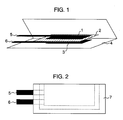
As shown in Fig. 1 and Fig. 2, a non-woven
fabric was placed between a positive electrode 1 and a
negative electrode 3, which electrodes had been
obtained according to the above-mentioned method, and a
load of 0.1 MPa was applied thereto to obtain a
laminate. Successively, stainless steel terminals 5
and 6 were mounted to the positive electrode and the
negative electrode, respectively, and the entire assembly
was inserted into a folder-like aluminum-laminated
film 7. Further, the solution A obtained in Example 1
was injected into the non-woven fabric, and the ends of
the folder-like aluminum-laminated film were heat-welded
to complete a hermetic seal. Successively, the
resultant assembly was kept in a constant temperature
bath of 80°C for 15 hours, thereby obtaining a battery
A. The initial discharging capacity of the obtained
battery A was found to be 0.6 mAh, and the cycle
characteristic thereof was found to be 30 times.
Further, the high-speed charge-discharge characteristic
thereof was found to be 40%. Thus, a battery superior
in its initial discharging capacity, cycle characteristic
and high-speed charge-discharge characteristic as
compared with the battery of Comparative Example 2
described below could be achieved. Performances of
the obtained battery A are as shown in Table 1.
Furthermore, when the aluminum-laminated film of the
obtained battery was peeled, no fluidity of the
electrolyte was observed inside of the battery.
The same procedure as in Example 15 was
repeated except that the solution A was replaced with
the solution B obtained in Example 2, thereby obtaining
a battery B. The initial discharging capacity, cycle
characteristic and high-speed charge-discharge characteristic
of the obtained battery B were found to be 0.6
mAh, 30 times, and 30%, respectively. Thus, a battery
superior in its initial discharging capacity, cycle
characteristic and high-speed charge-discharge characteristic
as compared with the battery of Comparative
Example 2 described below could be achieved. Performances
of the obtained battery B are as shown in Table
1. Furthermore, when the aluminum-laminated film of
the obtained battery was peeled, no fluidity of the
electrolyte was observed inside of the battery.
The same procedure as in Example 15 was
repeated except that the solution A was replaced with
the solution C obtained in Example 3, thereby obtaining
a battery C. The initial discharging capacity, cycle
characteristic and high-speed charge-discharge characteristic
of the obtained battery C were found to be 0.7
mAh, 35 times, and 45%, respectively. Thus, a battery
superior in its initial discharging capacity, cycle
characteristic and high-speed charge-discharge characteristic
as compared with the battery of Comparative
Example 2 described below could be achieved. Performances
of the obtained battery C are as shown in Table
1. Furthermore, when the aluminum-laminated film of
the obtained battery was peeled, no fluidity of the
electrolyte was observed inside of the battery.
The same procedure as in Example 15 was
repeated except that the solution A was replaced with
the solution D obtained in Example 4, thereby obtaining
a battery D. The initial discharging capacity, cycle
characteristic and high-speed charge-discharge characteristic
of the obtained battery D were found to be 0.7
mAh, 40 times, and 50%, respectively. Thus, a battery
superior in its initial discharging capacity, cycle
characteristic and high-speed charge-discharge characteristic
as compared with the battery of Comparative
Example 2 described below could be achieved. Performances
of the obtained battery D are as shown in Table
1. Furthermore, when the aluminum-laminated film of
the obtained battery was peeled, no fluidity of the
electrolyte was observed inside of the battery.
The same procedure as in Example 15 was
repeated except that the solution A was replaced with
the solution E obtained in Example 5, thereby obtaining
a battery E. The initial discharging capacity, cycle
characteristic and high-speed charge-discharge characteristic
of the obtained battery E were found to be 0.7
mAh, 40 times, and 50%, respectively. Thus, a battery
superior in its initial discharging capacity, cycle
characteristic and high-speed charge-discharge characteristic
as compared with the battery of Comparative
Example 2 described below could be achieved. Performances
of the obtained battery E are as shown in Table
1. Furthermore, when the aluminum-laminated film of
the obtained battery was peeled, no fluidity of the
electrolyte was observed inside of the battery.
The same procedure as in Example 15 was
repeated except that the solution A was replaced with
the solution F obtained in Example 6, thereby obtaining
a battery F. The initial discharging capacity, cycle
characteristic and high-speed charge-discharge characteristic
of the obtained battery F were found to be 0.7
mAh, 40 times, and 50%, respectively. Thus, a battery
superior in its initial discharging capacity, cycle
characteristic and high-speed charge-discharge characteristic
as compared with the battery of Comparative
Example 2 described below could be achieved. Performances
of the obtained battery F are as shown in Table
1. Furthermore, when the aluminum-laminated film of
the obtained battery was peeled, no fluidity of the
electrolyte was observed inside of the battery.
The same procedure as in Example 15 was
repeated except that the solution A was replaced with
the solution G obtained in Example 7, thereby obtaining
a battery G. The initial discharging capacity, cycle
characteristic and high-speed charge-discharge characteristic
of the obtained battery G were found to be 0.8
mAh, 45 times, and 55%, respectively. Thus, a battery
superior in its initial discharging capacity, cycle
characteristic and high-speed charge-discharge characteristic
as compared with the battery of Comparative
Example 2 described below could be achieved. Performances
of the obtained battery G are as shown in Table
1. Furthermore, when the aluminum-laminated film of
the obtained battery was peeled, no fluidity of the
electrolyte was observed inside of the battery.
The same procedure as in Example 15 was
repeated except that the solution A was replaced with
the solution H obtained in Example 8, thereby obtaining
a battery H. The initial discharging capacity, cycle
characteristic and high-speed charge-discharge characteristic
of the obtained battery H were found to be 0.8
mAh, 45 times, and 55%, respectively. Thus, a battery
superior in its initial discharging capacity, cycle
characteristic and high-speed charge-discharge characteristic
as compared with the battery of Comparative
Example 2 described below could be achieved. Performances
of the obtained battery H are as shown in Table
1. Furthermore, when the aluminum-laminated film of
the obtained battery was peeled, no fluidity of the
electrolyte was observed inside of the battery.
The same procedure as in Example 15 was
repeated except that the solution A was replaced with
the solution I obtained in Example 9, thereby obtaining
a battery I. The initial discharging capacity, cycle
characteristic and high-speed charge-discharge characteristic
of the obtained battery I were found to be 0.8
mAh, 45 times, and 55%, respectively. Thus, a battery
superior in its initial discharging capacity, cycle
characteristic and high-speed charge-discharge characteristic
as compared with the battery of Comparative
Example 2 described below could be achieved. Performances
of the obtained battery I are as shown in Table
1. Furthermore, when the aluminum-laminated film of
the obtained battery was peeled, no fluidity of the
electrolyte was observed inside of the battery.
The same procedure as in Example 15 was
repeated except that the solution A was replaced with
the solution J obtained in Example 10, thereby obtaining
a battery J. The initial discharging capacity,
cycle characteristic and high-speed charge-discharge
characteristic of the obtained battery J were found to
be 0.9 mAh, 50 times, and 60%, respectively. Thus, a
battery superior in its initial discharging capacity,
cycle characteristic and high-speed charge-discharge
characteristic as compared with the battery of Comparative
Example 2 described below could be achieved.
Performances of the obtained battery J are as shown in
Table 1. Furthermore, when the aluminum-laminated film
of the obtained battery was peeled, no fluidity of the
electrolyte was observed inside of the battery.
The same procedure as in Example 15 was
repeated except that the solution A was replaced with
the solution K obtained in Example 11, thereby obtaining
a battery K. The initial discharging capacity,
cycle characteristic and high-speed charge-discharge
characteristic of the obtained battery K were found to
be 0.9 mAh, 50 times, and 60%, respectively. Thus, a
battery superior in its initial discharging capacity,
cycle characteristic and high-speed charge-discharge
characteristic as compared with the battery of Comparative
Example 2 described below could be achieved.
Performances of the obtained battery K are as shown in
Table 1. Furthermore, when the aluminum-laminated film
of the obtained battery was peeled, no fluidity of the
electrolyte was observed inside of the battery.
The same procedure as in Example 15 was
repeated except that the solution A was replaced with
the solution L obtained in Example 12, thereby obtaining
a battery L. The initial discharging capacity,
cycle characteristic and high-speed charge-discharge
characteristic of the obtained battery L were found to
be 1.0 mAh, 60 times, and 65%, respectively. Thus, a
battery superior in its initial discharging capacity,
cycle characteristic and high-speed charge-discharge
characteristic as compared with the battery of Comparative
Example 2 described below could be achieved.
Performances of the obtained battery L are as shown in
Table 1. Furthermore, when the aluminum-laminated film
of the obtained battery was peeled, no fluidity of the
electrolyte was observed inside of the battery.
The same procedure as in Example 15 was
repeated except that the solution A was replaced with
the solution M obtained in Example 13, thereby obtaining
a battery M. The initial discharging capacity,
cycle characteristic and high-speed charge-discharge
characteristic of the obtained battery M were found to
be 1.1 mAh, 70 times, and 70%, respectively. Thus, a
battery superior in its initial discharging capacity,
cycle characteristic and high-speed charge-discharge
characteristic as compared with the battery of Comparative
Example 2 described below could be achieved.
Performances of the obtained battery M are as shown in
Table 1. Furthermore, when the aluminum-laminated film
of the obtained battery was peeled, no fluidity of the
electrolyte was observed inside of the battery.
The same procedure as in Example 15 was
repeated except that the solution A was replaced with
the solution N obtained in Example 14, thereby obtaining
a battery N. The initial discharging capacity,
cycle characteristic and high-speed charge-discharge
characteristic of the obtained battery N were found to
be 1.2 mAh, 80 times, and 80%, respectively. Thus, a
battery superior in its initial discharging capacity,
cycle characteristic and high-speed charge-discharge
characteristic as compared with the battery of Comparative
Example 2 described below could be achieved.
Performances of the obtained battery N are as shown in
Table 1. Furthermore, when the aluminum-laminated film
of the obtained battery was peeled, no fluidity of the
electrolyte was observed inside of the battery.
Comparative Examples are given as follows.
A mixture of 3.7 g of a copolymer of ethylene
oxide (80 mol%) and 2-(2-methoxyethoxy)ethyl glycidyl
ether (20 mol%) and 0.66 g of LiPF6 as an electrolytic
salt was added to acetonitrile to obtain a solution O.
Successively, the resulting solution was coated on a
glass using a bar coater, and kept at 80°C for 3 days to
obtain a solid electrolyte O having a thickness of 100
µm. The thus obtained electrolyte film was cut to
obtain a disk having a diameter of 1 cm. The disk was
sandwiched between a pair of stainless steel
electrodes, followed by measurement of the ionic
conductivity at 25°C according to the above-mentioned
ionic conductivity measurement method. The ionic
conductivity was found to be 0.00006 mS/cm.
A mixture of 34 g of Cell Seed, lithium
cobaltate manufactured by Nippon Chemical Industrial
Co., Ltd.; 4.3 g of SP 270, graphite manufactured by
Nippon Graphite Industrial, Ltd.; 3.7 g of a copolymer
of ethylene oxide (80 mol%) and 2-(2-methoxyethoxy)-ethyl
glycidyl ether (20 mol%) and 0.66 g of LiPF6 as an
electrolytic salt was added to acetonitrile to mix with
one another, thereby obtaining a slurry. The slurry
was coated on an aluminum foil having a thickness of 20
µm using a doctor blade and then dried. The slurry was
coated in an amount of 150 g/m2. The dried foil was
pressed so that the bulk density of the coating be 3.0
g/cm3 and cut into a 1 cm × 1 cm size to obtain a
positive electrode A.
A mixture of 39.2 g of Carbotron PE,
amorphous carbon manufactured by Kureha Chemical
Industry Co., Ltd.; 3.7 g of a copolymer of ethylene
oxide (80 mol%) and 2-(2-methoxyethoxy)ethyl glycidyl
ether (20 mol%) and 0.66 g of LiPF6 as an electrolytic
salt was added to acetonitrile to mix with one another,
thereby obtaining a slurry. The slurry was coated on a
copper foil having a thickness of 20 µm using a doctor
blade and then dried. The slurry was coated in an
amount of 70 g/m2. The dried foil was pressed so that
the bulk density of the coating be 1.0 g/cm3 and cut
into a 1.2 cm × 1.2 cm size to obtain a negative
electrode A.
Thereafter, a non-woven fabric was placed
between the positive electrode A and the negative
electrode B obtained above, and a load of 0.1 MPa was
applied thereto to obtain a laminate. Successively,
stainless steel terminals were mounted to the positive
electrode and the negative electrode, respectively, and
the entire assembly was inserted into a folder-like
aluminum-laminated film. Further, the solution O was
injected into the non-woven fabric, and the ends of the
folder-like aluminum-laminated film was heat-welded to
complete a hermetic seal. Successively, the resultant
assembly was kept in a constant temperature bath of 80°C
for 15 hours, thereby obtaining a battery O. The
initial discharging capacity of the obtained battery O
was found to be 0.003 mAh, and the cycle characteristic
thereof was found to be 10 times. Further, the high-speed
charge-discharge characteristic thereof was found
to be 10%. Furthermore, when the aluminum-laminated
film of the obtained battery was peeled, no fluidity of
the electrolyte was observed inside of the battery.
With respect to all Examples and Comparative
Examples mentioned above, components contained in the
electrolyte and amounts thereof are summarized in Table
2.
| Example | FDFTmmol | FDFA /mmol | FDFC /mmol | BPO/mmol | PEG/mmol | DiOX/mmol | DMC/mmol | DEC/mmol | EC/mmol | LiPF6 /mol dm-3 | LiCF3SO3 /mol dm-3 | LiN(CF3SO3)2 /mol dm-3 |
| 1 | 5 | - | - | 1 | 40 | - | - | - | - | 1 | - | - |
| 2 | - | 5 | - | 1 | 40 | - | - | - | - | 1 | - | - |
| 3 | - | - | 5 | 1 | 40 | - | - | - | - | 1 | - | - |
| 4 | 5 | - | - | 1 | - | 40 | - | - | - | 1 | - | - |
| 5 | - | 5 | - | 1 | - | 40 | - | - | - | 1 | - | - |
| 6 | - | - | 5 | 1 | - | 40 | - | - | - | 1 | - | - |
| 7 | 5 | - | - | 1 | - | - | 40 | - | - | 1 | - | - |
| 8 | - | 5 | - | 1 | - | - | 40 | - | - | 1 | - | - |
| 9 | - | - | 5 | 1 | - | - | 40 | - | - | 1 | - | - |
| 10 | 5 | - | - | 1 | - | - | - | 40 | - | 1 | - | - |
| 11 | 5 | - | - | 1 | - | - | - | - | 40 | 1 | - | - |
| 12 | 5 | - | - | 1 | - | - | - | 20 | 20 | 1 | - | - |
| 13 | 5 | - | - | 1 | - | - | - | 20 | 20 | - | 1 | - |
| 14 | 5 | - | - | 1 | - | - | - | 20 | 20 | - | - | 1 |
| 15 | 5 | - | - | 1 | 40 | - | - | - | - | 1 | - | - |
| 16 | - | 5 | - | 1 | 40 | - | - | - | - | 1 | - | - |
| 17 | - | - | 5 | 1 | 40 | - | - | - | - | 1 | - | - |
| 18 | 5 | - | - | 1 | - | 40 | - | - | - | 1 | - | - |
| 19 | - | 5 | - | 1 | - | 40 | - | - | - | 1 | - | - |
| 20 | - | - | 5 | 1 | - | 40 | - | - | - | 1 | - | - |
| 21 | 5 | - | - | 1 | - | - | 40 | - | - | 1 | - | - |
| 22 | - | 5 | - | 1 | - | - | 40 | - | - | 1 | - | - |
| 23 | - | - | 5 | 1 | - | - | 40 | - | - | 1 | - | - |
| 24 | 5 | - | - | 1 | - | - | - | 40 | - | 1 | - | - |
| 25 | 5 | - | - | 1 | - | - | - | - | 40 | 1 | - | - |
| 26 | 5 | - | - | 1 | - | - | - | 20 | 20 | 1 | - | - |
| 27 | 5 | - | - | 1 | - | - | - | 20 | 20 | - | 1 | - |
| 28 | 5 | - | - | 1 | - | - | - | 20 | 20 | - | - | 1 |
According to the present invention, an
electrolyte exhibiting a high ionic conductivity, and a
lithium ion secondary battery exhibiting superior
charge and discharge characteristics can be obtained.
Claims (4)
- An electrolyte, which comprises a first compound having at least one methylene group adjacent to an oxygen atom in the molecule, a perfluoroisopropenyl ester-carrying second compound represented by the following formula (1),wherein R is
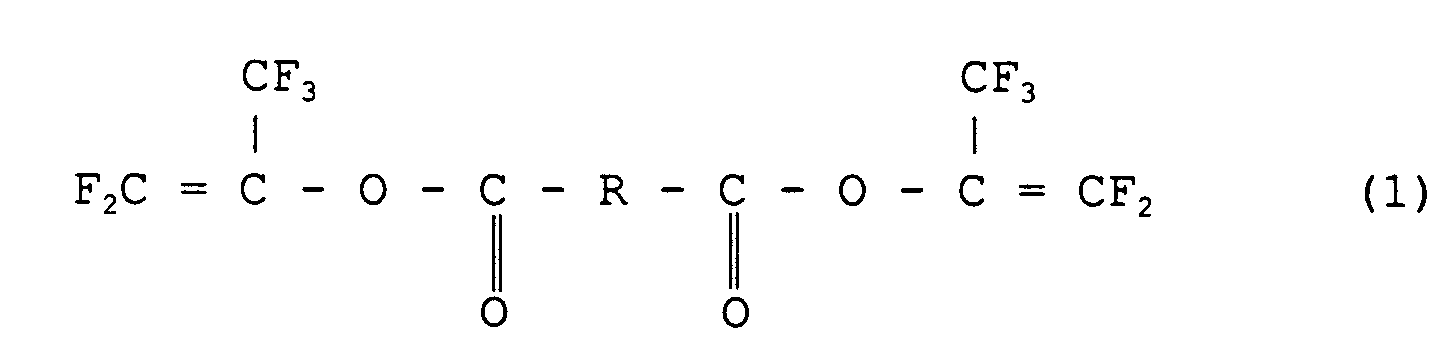 and an electrolytic salt, the first compound and the second compound having been polymerized with each other.
- The electrolyte according to Claim 1, wherein the first compound comprises at least one compound selected from the group consisting of diethyl carbonate, 1,4-dioxane, polyethylene glycol, ethylene carbonate and dimethyl carbonate.
- A lithium ion secondary battery comprising a positive electrode capable of occluding and discharging lithium ion, a negative electrode capable of occluding and discharging lithium ion and an electrolyte, wherein the electrolyte comprises a first compound having at least one methylene group adjacent to an oxygen atom in the molecule, a perfluoroisopropenyl ester-carrying second compound represented by the following formula (1),wherein R is
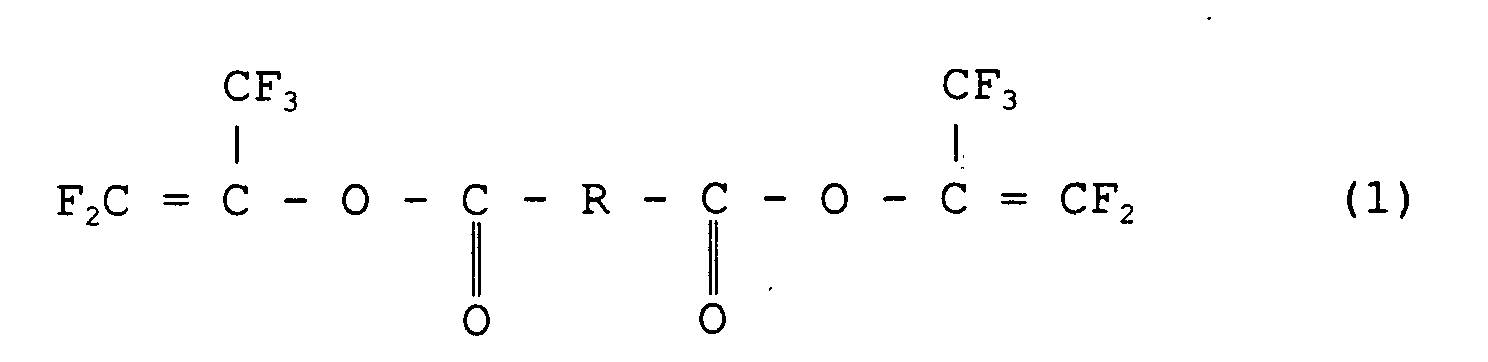 and an electrolytic salt, the first compound and the second compound having been polymerized with each other.
- The lithium ion secondary battery according to Claim 3, wherein the first compound comprises at least one compound selected from the group consisting of diethyl carbonate, 1,4-dioxane, polyethylene glycol, ethylene carbonate and dimethyl carbonate.
Applications Claiming Priority (2)
| Application Number | Priority Date | Filing Date | Title |
|---|---|---|---|
| JP2001161587A JP2002352856A (en) | 2001-05-30 | 2001-05-30 | Electrolyte and lithium ion secondary battery |
| JP2001161587 | 2001-05-30 |
Publications (1)
| Publication Number | Publication Date |
|---|---|
| EP1263076A2 true EP1263076A2 (en) | 2002-12-04 |
Family
ID=19004842
Family Applications (1)
| Application Number | Title | Priority Date | Filing Date |
|---|---|---|---|
| EP01122042A Pending EP1263076A2 (en) | 2001-05-30 | 2001-09-13 | Electrolyte and lithium ion secondary battery |
Country Status (3)
| Country | Link |
|---|---|
| US (1) | US20030031932A1 (en) |
| EP (1) | EP1263076A2 (en) |
| JP (1) | JP2002352856A (en) |
Families Citing this family (4)
| Publication number | Priority date | Publication date | Assignee | Title |
|---|---|---|---|---|
| CN1894822B (en) * | 2003-12-15 | 2010-06-02 | 日本电气株式会社 | Secondary battery |
| JP5083146B2 (en) * | 2008-09-26 | 2012-11-28 | 新神戸電機株式会社 | Electrolyte for lithium secondary battery and lithium secondary battery using the same |
| JP5396185B2 (en) * | 2009-07-31 | 2014-01-22 | 日立ビークルエナジー株式会社 | Lithium ion secondary battery |
| US10367228B2 (en) | 2017-04-07 | 2019-07-30 | Seeo, Inc. | Diester-based polymer electrolytes for high voltage lithium ion batteries |
-
2001
- 2001-05-30 JP JP2001161587A patent/JP2002352856A/en active Pending
- 2001-09-13 EP EP01122042A patent/EP1263076A2/en active Pending
- 2001-09-20 US US09/956,344 patent/US20030031932A1/en not_active Abandoned
Also Published As
| Publication number | Publication date |
|---|---|
| US20030031932A1 (en) | 2003-02-13 |
| JP2002352856A (en) | 2002-12-06 |
Similar Documents
| Publication | Publication Date | Title |
|---|---|---|
| EP0796510B1 (en) | A non-aqueous electrolyte system for use in batteries, capacitors or electrochromic devices and a method for the preparation thereof | |
| JPH1167274A (en) | Lithium secondary battery, polymer gel electrolyte, and binder for lithium secondary battery | |
| JP3507926B2 (en) | Solid-state battery | |
| KR100946527B1 (en) | Lithium secondary battery | |
| US20100081063A1 (en) | Non-aqueous electrolyte secondary battery | |
| JP2009302022A (en) | Nonaqueous electrolyte secondary battery | |
| US7923580B2 (en) | Polymerizable boric compounds, methods of producing the same, polymerizable compositions and ionic-conductive polymeric electrolytes | |
| JPWO2006088002A1 (en) | Electrolyte and battery | |
| JP2003173782A (en) | Lithium secondary battery and positive electrode | |
| EP1263076A2 (en) | Electrolyte and lithium ion secondary battery | |
| US6395425B1 (en) | Non-aqueous electrolyte secondary battery with a lithium copper titanium oxide electrode | |
| JP2011096551A (en) | Positive electrode for nonaqueous electrolyte battery, nonaqueous electrolyte battery, and manufacturing method of nonaqueous electrolyte battery | |
| US20050260501A1 (en) | Electrolyte and lithium secondary battery | |
| JP2002216844A (en) | Lithium secondary battery | |
| JP2005044704A (en) | Solid electrolyte | |
| US8518580B2 (en) | Lithium ion secondary battery and overcharge inhibitor for same | |
| US20120028093A1 (en) | Ionic conductive side-chain-type polymer electrolyte, precursor thereof, and lithium secondary battery | |
| JP2007134245A (en) | Electrolyte and battery | |
| US7709158B1 (en) | Guanidine derivatives as cations for ambient temperature molten sales in electrochemical power sources | |
| US20120142880A1 (en) | Lithium secondary battery | |
| JP4941696B2 (en) | Lithium ion secondary battery | |
| JP2005050687A (en) | Electrolyte and lithium secondary battery | |
| JP5600559B2 (en) | Lithium secondary battery | |
| JP2003243035A (en) | Electrolyte and lithium ion secondary battery using it | |
| WO2006088001A1 (en) | Electrolyte solution and battery |
Legal Events
| Date | Code | Title | Description |
|---|---|---|---|
| PUAI | Public reference made under article 153(3) epc to a published international application that has entered the european phase |
Free format text: ORIGINAL CODE: 0009012 |
|
| STAA | Information on the status of an ep patent application or granted ep patent |
Free format text: STATUS: THE APPLICATION HAS BEEN PUBLISHED |
|
| AK | Designated contracting states |
Kind code of ref document: A2 Designated state(s): AT BE CH CY DE DK ES FI FR GB GR IE IT LI LU MC NL PT SE TR |
|
| AX | Request for extension of the european patent |
Free format text: AL;LT;LV;MK;RO;SI |