EP1262508A2 - Novel polyhydroxyalkanoate that comprises unit having substituted or unsubstituted (phenylmethyl) sulfanyl structure in side chain thereof and process for producing the same - Google Patents
Novel polyhydroxyalkanoate that comprises unit having substituted or unsubstituted (phenylmethyl) sulfanyl structure in side chain thereof and process for producing the same Download PDFInfo
- Publication number
- EP1262508A2 EP1262508A2 EP02012096A EP02012096A EP1262508A2 EP 1262508 A2 EP1262508 A2 EP 1262508A2 EP 02012096 A EP02012096 A EP 02012096A EP 02012096 A EP02012096 A EP 02012096A EP 1262508 A2 EP1262508 A2 EP 1262508A2
- Authority
- EP
- European Patent Office
- Prior art keywords
- polyhydroxyalkanoate
- group
- chemical formula
- sulfanyl
- acid
- Prior art date
- Legal status (The legal status is an assumption and is not a legal conclusion. Google has not performed a legal analysis and makes no representation as to the accuracy of the status listed.)
- Granted
Links
- 229920000903 polyhydroxyalkanoate Polymers 0.000 title claims abstract description 331
- 239000005014 poly(hydroxyalkanoate) Substances 0.000 title claims abstract description 303
- 238000000034 method Methods 0.000 title claims description 49
- -1 (phenylmethyl) sulfanyl structure Chemical group 0.000 title description 11
- 239000000126 substance Substances 0.000 claims abstract description 109
- 125000005843 halogen group Chemical group 0.000 claims abstract description 37
- 229910052739 hydrogen Inorganic materials 0.000 claims abstract description 36
- 125000001424 substituent group Chemical group 0.000 claims abstract description 24
- 125000003118 aryl group Chemical group 0.000 claims abstract description 21
- 125000000956 methoxy group Chemical group [H]C([H])([H])O* 0.000 claims abstract description 18
- 229910052700 potassium Inorganic materials 0.000 claims abstract description 18
- 229910052708 sodium Inorganic materials 0.000 claims abstract description 18
- HEDRZPFGACZZDS-UHFFFAOYSA-N Chloroform Chemical compound ClC(Cl)Cl HEDRZPFGACZZDS-UHFFFAOYSA-N 0.000 claims description 84
- 244000005700 microbiome Species 0.000 claims description 57
- 239000001963 growth medium Substances 0.000 claims description 56
- IJGRMHOSHXDMSA-UHFFFAOYSA-N Atomic nitrogen Chemical compound N#N IJGRMHOSHXDMSA-UHFFFAOYSA-N 0.000 claims description 46
- WQZGKKKJIJFFOK-GASJEMHNSA-N Glucose Natural products OC[C@H]1OC(O)[C@H](O)[C@@H](O)[C@@H]1O WQZGKKKJIJFFOK-GASJEMHNSA-N 0.000 claims description 36
- WQZGKKKJIJFFOK-VFUOTHLCSA-N beta-D-glucose Chemical compound OC[C@H]1O[C@@H](O)[C@H](O)[C@@H](O)[C@@H]1O WQZGKKKJIJFFOK-VFUOTHLCSA-N 0.000 claims description 36
- 239000000284 extract Substances 0.000 claims description 36
- 125000004432 carbon atom Chemical group C* 0.000 claims description 35
- 241001508466 Pseudomonas cichorii Species 0.000 claims description 31
- 150000001875 compounds Chemical class 0.000 claims description 31
- NAWXUBYGYWOOIX-SFHVURJKSA-N (2s)-2-[[4-[2-(2,4-diaminoquinazolin-6-yl)ethyl]benzoyl]amino]-4-methylidenepentanedioic acid Chemical compound C1=CC2=NC(N)=NC(N)=C2C=C1CCC1=CC=C(C(=O)N[C@@H](CC(=C)C(O)=O)C(O)=O)C=C1 NAWXUBYGYWOOIX-SFHVURJKSA-N 0.000 claims description 23
- NDEAVZOESRFIAX-UHFFFAOYSA-N 5-[(4-fluorophenyl)methylsulfanyl]-3-hydroxypentanoic acid Chemical compound OC(=O)CC(O)CCSCC1=CC=C(F)C=C1 NDEAVZOESRFIAX-UHFFFAOYSA-N 0.000 claims description 23
- 229910052757 nitrogen Inorganic materials 0.000 claims description 23
- 239000002253 acid Substances 0.000 claims description 22
- 235000002639 sodium chloride Nutrition 0.000 claims description 22
- PYCDBXXHVJMKMJ-UHFFFAOYSA-N 5-benzylsulfanyl-3-hydroxypentanoic acid Chemical compound OC(=O)CC(O)CCSCC1=CC=CC=C1 PYCDBXXHVJMKMJ-UHFFFAOYSA-N 0.000 claims description 21
- 150000003839 salts Chemical class 0.000 claims description 18
- ADZOSHVPWYFMMO-UHFFFAOYSA-N 5-[(4-fluorophenyl)methylsulfanyl]pentanoic acid Chemical compound OC(=O)CCCCSCC1=CC=C(F)C=C1 ADZOSHVPWYFMMO-UHFFFAOYSA-N 0.000 claims description 17
- KIKDXOYXLUVHFK-UHFFFAOYSA-N 4-[(4-fluorophenyl)methylsulfanyl]-3-hydroxybutanoic acid Chemical compound OC(=O)CC(O)CSCC1=CC=C(F)C=C1 KIKDXOYXLUVHFK-UHFFFAOYSA-N 0.000 claims description 16
- IKCMTEJPJAABMO-UHFFFAOYSA-N OC(=O)CC(O)CSCC1=CC=CC=C1 Chemical compound OC(=O)CC(O)CSCC1=CC=CC=C1 IKCMTEJPJAABMO-UHFFFAOYSA-N 0.000 claims description 16
- AKJYYMZJBSAQRW-UHFFFAOYSA-N 5-benzylsulfanylpentanoic acid Chemical compound OC(=O)CCCCSCC1=CC=CC=C1 AKJYYMZJBSAQRW-UHFFFAOYSA-N 0.000 claims description 15
- 239000002904 solvent Substances 0.000 claims description 15
- 150000001720 carbohydrates Chemical class 0.000 claims description 12
- 239000008103 glucose Substances 0.000 claims description 10
- YYAARBZLUAMMHV-UHFFFAOYSA-N 4-[(4-fluorophenyl)methylsulfanyl]butanoic acid Chemical compound OC(=O)CCCSCC1=CC=C(F)C=C1 YYAARBZLUAMMHV-UHFFFAOYSA-N 0.000 claims description 9
- PEDCQBHIVMGVHV-UHFFFAOYSA-N Glycerine Chemical compound OCC(O)CO PEDCQBHIVMGVHV-UHFFFAOYSA-N 0.000 claims description 9
- 241001300822 Pseudomonas jessenii Species 0.000 claims description 9
- SRBFZHDQGSBBOR-UHFFFAOYSA-N beta-D-Pyranose-Lyxose Natural products OC1COC(O)C(O)C1O SRBFZHDQGSBBOR-UHFFFAOYSA-N 0.000 claims description 9
- KRKNYBCHXYNGOX-UHFFFAOYSA-N citric acid Chemical compound OC(=O)CC(O)(C(O)=O)CC(O)=O KRKNYBCHXYNGOX-UHFFFAOYSA-N 0.000 claims description 9
- RGHNJXZEOKUKBD-SQOUGZDYSA-N D-gluconic acid Chemical compound OC[C@@H](O)[C@@H](O)[C@H](O)[C@@H](O)C(O)=O RGHNJXZEOKUKBD-SQOUGZDYSA-N 0.000 claims description 8
- 150000007524 organic acids Chemical class 0.000 claims description 8
- XQRBQCBPBNFYDX-UHFFFAOYSA-N CC1=CC=C(CSCCC(O)CC(O)=O)C=C1 Chemical compound CC1=CC=C(CSCCC(O)CC(O)=O)C=C1 XQRBQCBPBNFYDX-UHFFFAOYSA-N 0.000 claims description 7
- WQZGKKKJIJFFOK-QTVWNMPRSA-N D-mannopyranose Chemical compound OC[C@H]1OC(O)[C@@H](O)[C@@H](O)[C@@H]1O WQZGKKKJIJFFOK-QTVWNMPRSA-N 0.000 claims description 7
- 239000012138 yeast extract Substances 0.000 claims description 7
- OWEGMIWEEQEYGQ-UHFFFAOYSA-N 100676-05-9 Natural products OC1C(O)C(O)C(CO)OC1OCC1C(O)C(O)C(O)C(OC2C(OC(O)C(O)C2O)CO)O1 OWEGMIWEEQEYGQ-UHFFFAOYSA-N 0.000 claims description 6
- IBLXLPXUVKDGNI-UHFFFAOYSA-N 4-benzylsulfanylbutanoic acid Chemical compound OC(=O)CCCSCC1=CC=CC=C1 IBLXLPXUVKDGNI-UHFFFAOYSA-N 0.000 claims description 6
- CSCPPACGZOOCGX-UHFFFAOYSA-N Acetone Chemical compound CC(C)=O CSCPPACGZOOCGX-UHFFFAOYSA-N 0.000 claims description 6
- WEVYAHXRMPXWCK-UHFFFAOYSA-N Acetonitrile Chemical compound CC#N WEVYAHXRMPXWCK-UHFFFAOYSA-N 0.000 claims description 6
- SRBFZHDQGSBBOR-IOVATXLUSA-N D-xylopyranose Chemical compound O[C@@H]1COC(O)[C@H](O)[C@H]1O SRBFZHDQGSBBOR-IOVATXLUSA-N 0.000 claims description 6
- YMWUJEATGCHHMB-UHFFFAOYSA-N Dichloromethane Chemical compound ClCCl YMWUJEATGCHHMB-UHFFFAOYSA-N 0.000 claims description 6
- IAJILQKETJEXLJ-UHFFFAOYSA-N Galacturonsaeure Natural products O=CC(O)C(O)C(O)C(O)C(O)=O IAJILQKETJEXLJ-UHFFFAOYSA-N 0.000 claims description 6
- GUBGYTABKSRVRQ-PICCSMPSSA-N Maltose Natural products O[C@@H]1[C@@H](O)[C@H](O)[C@@H](CO)O[C@@H]1O[C@@H]1[C@@H](CO)OC(O)[C@H](O)[C@H]1O GUBGYTABKSRVRQ-PICCSMPSSA-N 0.000 claims description 6
- LCTONWCANYUPML-UHFFFAOYSA-N Pyruvic acid Chemical compound CC(=O)C(O)=O LCTONWCANYUPML-UHFFFAOYSA-N 0.000 claims description 6
- BJEPYKJPYRNKOW-UHFFFAOYSA-N alpha-hydroxysuccinic acid Natural products OC(=O)C(O)CC(O)=O BJEPYKJPYRNKOW-UHFFFAOYSA-N 0.000 claims description 6
- PYMYPHUHKUWMLA-UHFFFAOYSA-N arabinose Natural products OCC(O)C(O)C(O)C=O PYMYPHUHKUWMLA-UHFFFAOYSA-N 0.000 claims description 6
- GUBGYTABKSRVRQ-QUYVBRFLSA-N beta-maltose Chemical compound OC[C@H]1O[C@H](O[C@H]2[C@H](O)[C@@H](O)[C@H](O)O[C@@H]2CO)[C@H](O)[C@@H](O)[C@@H]1O GUBGYTABKSRVRQ-QUYVBRFLSA-N 0.000 claims description 6
- 229940041514 candida albicans extract Drugs 0.000 claims description 6
- JVTAAEKCZFNVCJ-UHFFFAOYSA-N lactic acid Chemical compound CC(O)C(O)=O JVTAAEKCZFNVCJ-UHFFFAOYSA-N 0.000 claims description 6
- KDYFGRWQOYBRFD-UHFFFAOYSA-N succinic acid Chemical compound OC(=O)CCC(O)=O KDYFGRWQOYBRFD-UHFFFAOYSA-N 0.000 claims description 5
- CSSYPYQACZLMPS-UHFFFAOYSA-N 5-[(4-methylphenyl)methylsulfanyl]pentanoic acid Chemical compound CC1=CC=C(CSCCCCC(O)=O)C=C1 CSSYPYQACZLMPS-UHFFFAOYSA-N 0.000 claims description 4
- RGHNJXZEOKUKBD-UHFFFAOYSA-N D-gluconic acid Natural products OCC(O)C(O)C(O)C(O)C(O)=O RGHNJXZEOKUKBD-UHFFFAOYSA-N 0.000 claims description 4
- 229930091371 Fructose Natural products 0.000 claims description 4
- RFSUNEUAIZKAJO-ARQDHWQXSA-N Fructose Chemical compound OC[C@H]1O[C@](O)(CO)[C@@H](O)[C@@H]1O RFSUNEUAIZKAJO-ARQDHWQXSA-N 0.000 claims description 4
- 239000005715 Fructose Substances 0.000 claims description 4
- 241000589516 Pseudomonas Species 0.000 claims description 4
- WYURNTSHIVDZCO-UHFFFAOYSA-N Tetrahydrofuran Chemical compound C1CCOC1 WYURNTSHIVDZCO-UHFFFAOYSA-N 0.000 claims description 4
- 235000001014 amino acid Nutrition 0.000 claims description 4
- 150000001413 amino acids Chemical class 0.000 claims description 4
- 239000000174 gluconic acid Substances 0.000 claims description 4
- 235000012208 gluconic acid Nutrition 0.000 claims description 4
- BJEPYKJPYRNKOW-REOHCLBHSA-N (S)-malic acid Chemical compound OC(=O)[C@@H](O)CC(O)=O BJEPYKJPYRNKOW-REOHCLBHSA-N 0.000 claims description 3
- GUBGYTABKSRVRQ-XLOQQCSPSA-N Alpha-Lactose Chemical compound O[C@@H]1[C@@H](O)[C@@H](O)[C@@H](CO)O[C@H]1O[C@@H]1[C@@H](CO)O[C@H](O)[C@H](O)[C@H]1O GUBGYTABKSRVRQ-XLOQQCSPSA-N 0.000 claims description 3
- YTBSYETUWUMLBZ-UHFFFAOYSA-N D-Erythrose Natural products OCC(O)C(O)C=O YTBSYETUWUMLBZ-UHFFFAOYSA-N 0.000 claims description 3
- YTBSYETUWUMLBZ-IUYQGCFVSA-N D-erythrose Chemical compound OC[C@@H](O)[C@@H](O)C=O YTBSYETUWUMLBZ-IUYQGCFVSA-N 0.000 claims description 3
- MNQZXJOMYWMBOU-VKHMYHEASA-N D-glyceraldehyde Chemical compound OC[C@@H](O)C=O MNQZXJOMYWMBOU-VKHMYHEASA-N 0.000 claims description 3
- 239000004386 Erythritol Substances 0.000 claims description 3
- UNXHWFMMPAWVPI-UHFFFAOYSA-N Erythritol Natural products OCC(O)C(O)CO UNXHWFMMPAWVPI-UHFFFAOYSA-N 0.000 claims description 3
- 206010056474 Erythrosis Diseases 0.000 claims description 3
- GUBGYTABKSRVRQ-QKKXKWKRSA-N Lactose Natural products OC[C@H]1O[C@@H](O[C@H]2[C@H](O)[C@@H](O)C(O)O[C@@H]2CO)[C@H](O)[C@@H](O)[C@H]1O GUBGYTABKSRVRQ-QKKXKWKRSA-N 0.000 claims description 3
- CZMRCDWAGMRECN-UGDNZRGBSA-N Sucrose Chemical compound O[C@H]1[C@H](O)[C@@H](CO)O[C@@]1(CO)O[C@@H]1[C@H](O)[C@@H](O)[C@H](O)[C@@H](CO)O1 CZMRCDWAGMRECN-UGDNZRGBSA-N 0.000 claims description 3
- 229930006000 Sucrose Natural products 0.000 claims description 3
- TVXBFESIOXBWNM-UHFFFAOYSA-N Xylitol Natural products OCCC(O)C(O)C(O)CCO TVXBFESIOXBWNM-UHFFFAOYSA-N 0.000 claims description 3
- IAJILQKETJEXLJ-RSJOWCBRSA-N aldehydo-D-galacturonic acid Chemical compound O=C[C@H](O)[C@@H](O)[C@@H](O)[C@H](O)C(O)=O IAJILQKETJEXLJ-RSJOWCBRSA-N 0.000 claims description 3
- IAJILQKETJEXLJ-QTBDOELSSA-N aldehydo-D-glucuronic acid Chemical compound O=C[C@H](O)[C@@H](O)[C@H](O)[C@H](O)C(O)=O IAJILQKETJEXLJ-QTBDOELSSA-N 0.000 claims description 3
- WQZGKKKJIJFFOK-PHYPRBDBSA-N alpha-D-galactose Chemical compound OC[C@H]1O[C@H](O)[C@H](O)[C@@H](O)[C@H]1O WQZGKKKJIJFFOK-PHYPRBDBSA-N 0.000 claims description 3
- PYMYPHUHKUWMLA-WDCZJNDASA-N arabinose Chemical compound OC[C@@H](O)[C@@H](O)[C@H](O)C=O PYMYPHUHKUWMLA-WDCZJNDASA-N 0.000 claims description 3
- 235000015165 citric acid Nutrition 0.000 claims description 3
- UNXHWFMMPAWVPI-ZXZARUISSA-N erythritol Chemical compound OC[C@H](O)[C@H](O)CO UNXHWFMMPAWVPI-ZXZARUISSA-N 0.000 claims description 3
- 229940009714 erythritol Drugs 0.000 claims description 3
- 235000019414 erythritol Nutrition 0.000 claims description 3
- 229930182830 galactose Natural products 0.000 claims description 3
- 229940097043 glucuronic acid Drugs 0.000 claims description 3
- 235000011187 glycerol Nutrition 0.000 claims description 3
- 239000004310 lactic acid Substances 0.000 claims description 3
- 235000014655 lactic acid Nutrition 0.000 claims description 3
- 239000008101 lactose Substances 0.000 claims description 3
- 239000001630 malic acid Substances 0.000 claims description 3
- 235000011090 malic acid Nutrition 0.000 claims description 3
- HEBKCHPVOIAQTA-UHFFFAOYSA-N meso ribitol Natural products OCC(O)C(O)C(O)CO HEBKCHPVOIAQTA-UHFFFAOYSA-N 0.000 claims description 3
- 229940107700 pyruvic acid Drugs 0.000 claims description 3
- 239000005720 sucrose Substances 0.000 claims description 3
- 239000000811 xylitol Substances 0.000 claims description 3
- HEBKCHPVOIAQTA-SCDXWVJYSA-N xylitol Chemical compound OC[C@H](O)[C@@H](O)[C@H](O)CO HEBKCHPVOIAQTA-SCDXWVJYSA-N 0.000 claims description 3
- 229960002675 xylitol Drugs 0.000 claims description 3
- 235000010447 xylitol Nutrition 0.000 claims description 3
- RYHBNJHYFVUHQT-UHFFFAOYSA-N 1,4-Dioxane Chemical compound C1COCCO1 RYHBNJHYFVUHQT-UHFFFAOYSA-N 0.000 claims description 2
- WHUUTDBJXJRKMK-UHFFFAOYSA-N Glutamic acid Natural products OC(=O)C(N)CCC(O)=O WHUUTDBJXJRKMK-UHFFFAOYSA-N 0.000 claims description 2
- CKLJMWTZIZZHCS-REOHCLBHSA-N L-aspartic acid Chemical compound OC(=O)[C@@H](N)CC(O)=O CKLJMWTZIZZHCS-REOHCLBHSA-N 0.000 claims description 2
- WHUUTDBJXJRKMK-VKHMYHEASA-N L-glutamic acid Chemical compound OC(=O)[C@@H](N)CCC(O)=O WHUUTDBJXJRKMK-VKHMYHEASA-N 0.000 claims description 2
- 235000003704 aspartic acid Nutrition 0.000 claims description 2
- 239000011324 bead Substances 0.000 claims description 2
- OQFSQFPPLPISGP-UHFFFAOYSA-N beta-carboxyaspartic acid Natural products OC(=O)C(N)C(C(O)=O)C(O)=O OQFSQFPPLPISGP-UHFFFAOYSA-N 0.000 claims description 2
- 239000011521 glass Substances 0.000 claims description 2
- 235000013922 glutamic acid Nutrition 0.000 claims description 2
- 239000004220 glutamic acid Substances 0.000 claims description 2
- 238000000227 grinding Methods 0.000 claims description 2
- 238000000265 homogenisation Methods 0.000 claims description 2
- YLQBMQCUIZJEEH-UHFFFAOYSA-N tetrahydrofuran Natural products C=1C=COC=1 YLQBMQCUIZJEEH-UHFFFAOYSA-N 0.000 claims description 2
- 238000010257 thawing Methods 0.000 claims description 2
- 238000001665 trituration Methods 0.000 claims description 2
- 239000001384 succinic acid Substances 0.000 claims 2
- 235000011044 succinic acid Nutrition 0.000 claims 2
- 238000004519 manufacturing process Methods 0.000 abstract description 28
- OKKJLVBELUTLKV-UHFFFAOYSA-N Methanol Chemical compound OC OKKJLVBELUTLKV-UHFFFAOYSA-N 0.000 description 204
- 210000004027 cell Anatomy 0.000 description 132
- 208000037534 Progressive hemifacial atrophy Diseases 0.000 description 129
- 238000012017 passive hemagglutination assay Methods 0.000 description 128
- 239000000178 monomer Substances 0.000 description 95
- REKYPYSUBKSCAT-UHFFFAOYSA-N 3-hydroxypentanoic acid Chemical compound CCC(O)CC(O)=O REKYPYSUBKSCAT-UHFFFAOYSA-N 0.000 description 70
- 239000002609 medium Substances 0.000 description 55
- WHBMMWSBFZVSSR-UHFFFAOYSA-N 3-hydroxybutyric acid Chemical compound CC(O)CC(O)=O WHBMMWSBFZVSSR-UHFFFAOYSA-N 0.000 description 54
- 238000005119 centrifugation Methods 0.000 description 53
- 238000005481 NMR spectroscopy Methods 0.000 description 52
- 238000000425 proton nuclear magnetic resonance spectrum Methods 0.000 description 42
- 230000010354 integration Effects 0.000 description 38
- 239000012528 membrane Substances 0.000 description 34
- 239000008188 pellet Substances 0.000 description 34
- 229920000642 polymer Polymers 0.000 description 34
- 239000011148 porous material Substances 0.000 description 34
- 239000002244 precipitate Substances 0.000 description 34
- 239000000758 substrate Substances 0.000 description 23
- NLXLAEXVIDQMFP-UHFFFAOYSA-N Ammonia chloride Chemical compound [NH4+].[Cl-] NLXLAEXVIDQMFP-UHFFFAOYSA-N 0.000 description 20
- WHBMMWSBFZVSSR-UHFFFAOYSA-M 3-hydroxybutyrate Chemical compound CC(O)CC([O-])=O WHBMMWSBFZVSSR-UHFFFAOYSA-M 0.000 description 18
- 229920006395 saturated elastomer Polymers 0.000 description 16
- 150000004671 saturated fatty acids Chemical class 0.000 description 16
- 235000003441 saturated fatty acids Nutrition 0.000 description 16
- 150000004670 unsaturated fatty acids Chemical class 0.000 description 16
- 235000021122 unsaturated fatty acids Nutrition 0.000 description 16
- 125000002496 methyl group Chemical group [H]C([H])([H])* 0.000 description 15
- 125000003396 thiol group Chemical group [H]S* 0.000 description 14
- HEDRZPFGACZZDS-MICDWDOJSA-N Trichloro(2H)methane Chemical compound [2H]C(Cl)(Cl)Cl HEDRZPFGACZZDS-MICDWDOJSA-N 0.000 description 12
- 238000005227 gel permeation chromatography Methods 0.000 description 10
- FAPWRFPIFSIZLT-UHFFFAOYSA-M Sodium chloride Chemical compound [Na+].[Cl-] FAPWRFPIFSIZLT-UHFFFAOYSA-M 0.000 description 8
- 125000001797 benzyl group Chemical group [H]C1=C([H])C([H])=C(C([H])=C1[H])C([H])([H])* 0.000 description 8
- FBUKVWPVBMHYJY-UHFFFAOYSA-N nonanoic acid Chemical compound CCCCCCCCC(O)=O FBUKVWPVBMHYJY-UHFFFAOYSA-N 0.000 description 8
- WWZKQHOCKIZLMA-UHFFFAOYSA-N octanoic acid Chemical compound CCCCCCCC(O)=O WWZKQHOCKIZLMA-UHFFFAOYSA-N 0.000 description 8
- DAEPDZWVDSPTHF-UHFFFAOYSA-M sodium pyruvate Chemical compound [Na+].CC(=O)C([O-])=O DAEPDZWVDSPTHF-UHFFFAOYSA-M 0.000 description 8
- 230000007062 hydrolysis Effects 0.000 description 7
- 238000006460 hydrolysis reaction Methods 0.000 description 7
- 230000000813 microbial effect Effects 0.000 description 7
- FBPFZTCFMRRESA-KVTDHHQDSA-N D-Mannitol Chemical compound OC[C@@H](O)[C@@H](O)[C@H](O)[C@H](O)CO FBPFZTCFMRRESA-KVTDHHQDSA-N 0.000 description 6
- SIKJAQJRHWYJAI-UHFFFAOYSA-N Indole Chemical compound C1=CC=C2NC=CC2=C1 SIKJAQJRHWYJAI-UHFFFAOYSA-N 0.000 description 6
- NQPDZGIKBAWPEJ-UHFFFAOYSA-N valeric acid Chemical compound CCCCC(O)=O NQPDZGIKBAWPEJ-UHFFFAOYSA-N 0.000 description 6
- 239000004793 Polystyrene Substances 0.000 description 5
- 241000589781 Pseudomonas oleovorans Species 0.000 description 5
- 241000589776 Pseudomonas putida Species 0.000 description 5
- 239000000499 gel Substances 0.000 description 5
- 239000000203 mixture Substances 0.000 description 5
- 125000001037 p-tolyl group Chemical group [H]C1=C([H])C(=C([H])C([H])=C1*)C([H])([H])[H] 0.000 description 5
- 125000001997 phenyl group Chemical group [H]C1=C([H])C([H])=C(*)C([H])=C1[H] 0.000 description 5
- 230000000704 physical effect Effects 0.000 description 5
- 229920002223 polystyrene Polymers 0.000 description 5
- 230000035755 proliferation Effects 0.000 description 5
- 238000005160 1H NMR spectroscopy Methods 0.000 description 4
- FERIUCNNQQJTOY-UHFFFAOYSA-N Butyric acid Chemical compound CCCC(O)=O FERIUCNNQQJTOY-UHFFFAOYSA-N 0.000 description 4
- OBETXYAYXDNJHR-UHFFFAOYSA-N alpha-ethylcaproic acid Natural products CCCCC(CC)C(O)=O OBETXYAYXDNJHR-UHFFFAOYSA-N 0.000 description 4
- 230000000721 bacterilogical effect Effects 0.000 description 4
- 238000001460 carbon-13 nuclear magnetic resonance spectrum Methods 0.000 description 4
- PXEDJBXQKAGXNJ-QTNFYWBSSA-L disodium L-glutamate Chemical compound [Na+].[Na+].[O-]C(=O)[C@@H](N)CCC([O-])=O PXEDJBXQKAGXNJ-QTNFYWBSSA-L 0.000 description 4
- 239000004615 ingredient Substances 0.000 description 4
- 235000013923 monosodium glutamate Nutrition 0.000 description 4
- 239000011780 sodium chloride Substances 0.000 description 4
- 229940073490 sodium glutamate Drugs 0.000 description 4
- 229940054269 sodium pyruvate Drugs 0.000 description 4
- 241000894007 species Species 0.000 description 4
- ONPCOUSOOPCZNI-UHFFFAOYSA-N 3-hydroxy-4-phenoxybutanoic acid Chemical group OC(=O)CC(O)COC1=CC=CC=C1 ONPCOUSOOPCZNI-UHFFFAOYSA-N 0.000 description 3
- MGVJVFCUYBCCTR-UHFFFAOYSA-N 3-hydroxy-6-phenoxyhexanoic acid Chemical group OC(=O)CC(O)CCCOC1=CC=CC=C1 MGVJVFCUYBCCTR-UHFFFAOYSA-N 0.000 description 3
- PLXMOAALOJOTIY-FPTXNFDTSA-N Aesculin Natural products OC[C@@H]1[C@@H](O)[C@H](O)[C@@H](O)[C@H](O)[C@H]1Oc2cc3C=CC(=O)Oc3cc2O PLXMOAALOJOTIY-FPTXNFDTSA-N 0.000 description 3
- 229920001817 Agar Polymers 0.000 description 3
- 108010082340 Arginine deiminase Proteins 0.000 description 3
- 102100026189 Beta-galactosidase Human genes 0.000 description 3
- 102000016938 Catalase Human genes 0.000 description 3
- 108010053835 Catalase Proteins 0.000 description 3
- WNBCMONIPIJTSB-BGNCJLHMSA-N Cichoriin Natural products O([C@H]1[C@H](O)[C@@H](O)[C@@H](O)[C@@H](CO)O1)c1c(O)cc2c(OC(=O)C=C2)c1 WNBCMONIPIJTSB-BGNCJLHMSA-N 0.000 description 3
- 108010010803 Gelatin Proteins 0.000 description 3
- 238000003794 Gram staining Methods 0.000 description 3
- SRBFZHDQGSBBOR-HWQSCIPKSA-N L-arabinopyranose Chemical compound O[C@H]1COC(O)[C@H](O)[C@H]1O SRBFZHDQGSBBOR-HWQSCIPKSA-N 0.000 description 3
- OVRNDRQMDRJTHS-UHFFFAOYSA-N N-acelyl-D-glucosamine Natural products CC(=O)NC1C(O)OC(CO)C(O)C1O OVRNDRQMDRJTHS-UHFFFAOYSA-N 0.000 description 3
- OVRNDRQMDRJTHS-FMDGEEDCSA-N N-acetyl-beta-D-glucosamine Chemical compound CC(=O)N[C@H]1[C@H](O)O[C@H](CO)[C@@H](O)[C@@H]1O OVRNDRQMDRJTHS-FMDGEEDCSA-N 0.000 description 3
- 229910002651 NO3 Inorganic materials 0.000 description 3
- NHNBFGGVMKEFGY-UHFFFAOYSA-N Nitrate Chemical compound [O-][N+]([O-])=O NHNBFGGVMKEFGY-UHFFFAOYSA-N 0.000 description 3
- 102000004316 Oxidoreductases Human genes 0.000 description 3
- 108090000854 Oxidoreductases Proteins 0.000 description 3
- 229920000331 Polyhydroxybutyrate Polymers 0.000 description 3
- HLCFGWHYROZGBI-JJKGCWMISA-M Potassium gluconate Chemical compound [K+].OC[C@@H](O)[C@@H](O)[C@H](O)[C@@H](O)C([O-])=O HLCFGWHYROZGBI-JJKGCWMISA-M 0.000 description 3
- 108010046334 Urease Proteins 0.000 description 3
- 238000009825 accumulation Methods 0.000 description 3
- IPBVNPXQWQGGJP-UHFFFAOYSA-N acetic acid phenyl ester Natural products CC(=O)OC1=CC=CC=C1 IPBVNPXQWQGGJP-UHFFFAOYSA-N 0.000 description 3
- WNLRTRBMVRJNCN-UHFFFAOYSA-L adipate(2-) Chemical compound [O-]C(=O)CCCCC([O-])=O WNLRTRBMVRJNCN-UHFFFAOYSA-L 0.000 description 3
- 239000008272 agar Substances 0.000 description 3
- QVGXLLKOCUKJST-UHFFFAOYSA-N atomic oxygen Chemical compound [O] QVGXLLKOCUKJST-UHFFFAOYSA-N 0.000 description 3
- 108010005774 beta-Galactosidase Proteins 0.000 description 3
- 229920001577 copolymer Polymers 0.000 description 3
- 238000012258 culturing Methods 0.000 description 3
- GHVNFZFCNZKVNT-UHFFFAOYSA-N decanoic acid Chemical compound CCCCCCCCCC(O)=O GHVNFZFCNZKVNT-UHFFFAOYSA-N 0.000 description 3
- 238000005516 engineering process Methods 0.000 description 3
- XHCADAYNFIFUHF-TVKJYDDYSA-N esculin Chemical compound O[C@@H]1[C@@H](O)[C@H](O)[C@@H](CO)O[C@H]1OC(C(=C1)O)=CC2=C1OC(=O)C=C2 XHCADAYNFIFUHF-TVKJYDDYSA-N 0.000 description 3
- 229940093496 esculin Drugs 0.000 description 3
- AWRMZKLXZLNBBK-UHFFFAOYSA-N esculin Natural products OC1OC(COc2cc3C=CC(=O)Oc3cc2O)C(O)C(O)C1O AWRMZKLXZLNBBK-UHFFFAOYSA-N 0.000 description 3
- 239000008273 gelatin Substances 0.000 description 3
- 229920000159 gelatin Polymers 0.000 description 3
- 235000019322 gelatine Nutrition 0.000 description 3
- 235000011852 gelatine desserts Nutrition 0.000 description 3
- PZOUSPYUWWUPPK-UHFFFAOYSA-N indole Natural products CC1=CC=CC2=C1C=CN2 PZOUSPYUWWUPPK-UHFFFAOYSA-N 0.000 description 3
- RKJUIXBNRJVNHR-UHFFFAOYSA-N indolenine Natural products C1=CC=C2CC=NC2=C1 RKJUIXBNRJVNHR-UHFFFAOYSA-N 0.000 description 3
- 229920002521 macromolecule Polymers 0.000 description 3
- 235000010355 mannitol Nutrition 0.000 description 3
- 230000000877 morphologic effect Effects 0.000 description 3
- 229950006780 n-acetylglucosamine Drugs 0.000 description 3
- 235000015097 nutrients Nutrition 0.000 description 3
- 235000005985 organic acids Nutrition 0.000 description 3
- 230000001590 oxidative effect Effects 0.000 description 3
- 229910052760 oxygen Inorganic materials 0.000 description 3
- 239000001301 oxygen Substances 0.000 description 3
- 229940049953 phenylacetate Drugs 0.000 description 3
- WLJVXDMOQOGPHL-UHFFFAOYSA-N phenylacetic acid Chemical compound OC(=O)CC1=CC=CC=C1 WLJVXDMOQOGPHL-UHFFFAOYSA-N 0.000 description 3
- 230000001766 physiological effect Effects 0.000 description 3
- 239000000049 pigment Substances 0.000 description 3
- 239000004224 potassium gluconate Substances 0.000 description 3
- 229960003189 potassium gluconate Drugs 0.000 description 3
- 235000013926 potassium gluconate Nutrition 0.000 description 3
- 239000001509 sodium citrate Substances 0.000 description 3
- NLJMYIDDQXHKNR-UHFFFAOYSA-K sodium citrate Chemical compound O.O.[Na+].[Na+].[Na+].[O-]C(=O)CC(O)(CC([O-])=O)C([O-])=O NLJMYIDDQXHKNR-UHFFFAOYSA-K 0.000 description 3
- 230000028070 sporulation Effects 0.000 description 3
- 238000012360 testing method Methods 0.000 description 3
- 229940005605 valeric acid Drugs 0.000 description 3
- GQEZCXVZFLOKMC-UHFFFAOYSA-N 1-hexadecene Chemical compound CCCCCCCCCCCCCCC=C GQEZCXVZFLOKMC-UHFFFAOYSA-N 0.000 description 2
- SVCWRQUTOZJFFP-UHFFFAOYSA-N 11-benzylsulfanylundecanoic acid Chemical compound OC(=O)CCCCCCCCCCSCC1=CC=CC=C1 SVCWRQUTOZJFFP-UHFFFAOYSA-N 0.000 description 2
- BPYSWIMKOZCXIH-UHFFFAOYSA-N 11-phenylsulfanylundecanoic acid Chemical compound OC(=O)CCCCCCCCCCSC1=CC=CC=C1 BPYSWIMKOZCXIH-UHFFFAOYSA-N 0.000 description 2
- ZKPPNJNGKKHGLI-UHFFFAOYSA-N 3-hydroxy-5-phenoxypentanoic acid Chemical group OC(=O)CC(O)CCOC1=CC=CC=C1 ZKPPNJNGKKHGLI-UHFFFAOYSA-N 0.000 description 2
- 230000005526 G1 to G0 transition Effects 0.000 description 2
- CSNNHWWHGAXBCP-UHFFFAOYSA-L Magnesium sulfate Chemical compound [Mg+2].[O-][S+2]([O-])([O-])[O-] CSNNHWWHGAXBCP-UHFFFAOYSA-L 0.000 description 2
- 229920001397 Poly-beta-hydroxybutyrate Polymers 0.000 description 2
- 150000007513 acids Chemical class 0.000 description 2
- 125000000217 alkyl group Chemical group 0.000 description 2
- 229940024606 amino acid Drugs 0.000 description 2
- 238000013459 approach Methods 0.000 description 2
- 238000012365 batch cultivation Methods 0.000 description 2
- 229920000704 biodegradable plastic Polymers 0.000 description 2
- 230000015572 biosynthetic process Effects 0.000 description 2
- WERYXYBDKMZEQL-UHFFFAOYSA-N butane-1,4-diol Chemical compound OCCCCO WERYXYBDKMZEQL-UHFFFAOYSA-N 0.000 description 2
- 238000012786 cultivation procedure Methods 0.000 description 2
- DCAYPVUWAIABOU-UHFFFAOYSA-N hexadecane Chemical compound CCCCCCCCCCCCCCCC DCAYPVUWAIABOU-UHFFFAOYSA-N 0.000 description 2
- 239000007788 liquid Substances 0.000 description 2
- 238000011084 recovery Methods 0.000 description 2
- 239000011734 sodium Substances 0.000 description 2
- 239000000725 suspension Substances 0.000 description 2
- 230000004102 tricarboxylic acid cycle Effects 0.000 description 2
- 229940070710 valerate Drugs 0.000 description 2
- WRIDQFICGBMAFQ-UHFFFAOYSA-N (E)-8-Octadecenoic acid Natural products CCCCCCCCCC=CCCCCCCC(O)=O WRIDQFICGBMAFQ-UHFFFAOYSA-N 0.000 description 1
- IMMRMPAXYUIDLR-UHFFFAOYSA-N (R)-3-Hydroxy-5-phenylpentanoic acid Chemical compound OC(=O)CC(O)CCC1=CC=CC=C1 IMMRMPAXYUIDLR-UHFFFAOYSA-N 0.000 description 1
- KNRCBASNXNXUQQ-UHFFFAOYSA-N 11-hydroxyundecanoic acid Chemical compound OCCCCCCCCCCC(O)=O KNRCBASNXNXUQQ-UHFFFAOYSA-N 0.000 description 1
- FRSQLPPSRJNREN-UHFFFAOYSA-N 11-phenoxyundecanoic acid Chemical class OC(=O)CCCCCCCCCCOC1=CC=CC=C1 FRSQLPPSRJNREN-UHFFFAOYSA-N 0.000 description 1
- 238000001644 13C nuclear magnetic resonance spectroscopy Methods 0.000 description 1
- ZNYLVQULGFDEOI-UHFFFAOYSA-N 2-benzylsulfanyl-3-hydroxypentanoic acid Chemical group CCC(O)C(C(O)=O)SCC1=CC=CC=C1 ZNYLVQULGFDEOI-UHFFFAOYSA-N 0.000 description 1
- LQJBNNIYVWPHFW-UHFFFAOYSA-N 20:1omega9c fatty acid Natural products CCCCCCCCCCC=CCCCCCCCC(O)=O LQJBNNIYVWPHFW-UHFFFAOYSA-N 0.000 description 1
- LMBJAVFTESEKLJ-UHFFFAOYSA-N 3-hydroxy-5-phenylsulfanylpentanoic acid Chemical compound OC(=O)CC(O)CCSC1=CC=CC=C1 LMBJAVFTESEKLJ-UHFFFAOYSA-N 0.000 description 1
- PGCWOTKQXIBVBQ-UHFFFAOYSA-N 3-hydroxy-6-(4-nitrophenoxy)hexanoic acid Chemical compound OC(=O)CC(O)CCCOC1=CC=C([N+]([O-])=O)C=C1 PGCWOTKQXIBVBQ-UHFFFAOYSA-N 0.000 description 1
- JZGUUXCNURSYJV-UHFFFAOYSA-N 3-hydroxy-7-phenoxyheptanoic acid Chemical group OC(=O)CC(O)CCCCOC1=CC=CC=C1 JZGUUXCNURSYJV-UHFFFAOYSA-N 0.000 description 1
- JARUSASQYWCYLJ-UHFFFAOYSA-N 3-hydroxy-7-phenylsulfanylheptanoic acid Chemical compound OC(=O)CC(O)CCCCSC1=CC=CC=C1 JARUSASQYWCYLJ-UHFFFAOYSA-N 0.000 description 1
- RVHALYHLQUSEMQ-UHFFFAOYSA-N 3-hydroxy-8-phenoxyoctanoic acid Chemical group OC(=O)CC(O)CCCCCOC1=CC=CC=C1 RVHALYHLQUSEMQ-UHFFFAOYSA-N 0.000 description 1
- AAPYQLZXVZEIAM-UHFFFAOYSA-N 3-hydroxy-9-phenoxynonanoic acid Chemical group OC(=O)CC(O)CCCCCCOC1=CC=CC=C1 AAPYQLZXVZEIAM-UHFFFAOYSA-N 0.000 description 1
- HPMGFDVTYHWBAG-UHFFFAOYSA-N 3-hydroxyhexanoic acid Chemical compound CCCC(O)CC(O)=O HPMGFDVTYHWBAG-UHFFFAOYSA-N 0.000 description 1
- SJZRECIVHVDYJC-UHFFFAOYSA-M 4-hydroxybutyrate Chemical compound OCCCC([O-])=O SJZRECIVHVDYJC-UHFFFAOYSA-M 0.000 description 1
- ZEKCHPZLXIJPFI-UHFFFAOYSA-N 6-(4-cyanophenoxy)-3-hydroxyhexanoic acid Chemical class OC(=O)CC(O)CCCOC1=CC=C(C#N)C=C1 ZEKCHPZLXIJPFI-UHFFFAOYSA-N 0.000 description 1
- DSBGMWIYDOZJNL-UHFFFAOYSA-N 6-(4-cyanophenoxy)hexanoic acid Chemical compound OC(=O)CCCCCOC1=CC=C(C#N)C=C1 DSBGMWIYDOZJNL-UHFFFAOYSA-N 0.000 description 1
- SSFHTIKBQWULIU-UHFFFAOYSA-N 6-(4-nitrophenoxy)hexanoic acid Chemical compound OC(=O)CCCCCOC1=CC=C([N+]([O-])=O)C=C1 SSFHTIKBQWULIU-UHFFFAOYSA-N 0.000 description 1
- KJWBACOFHDCTDI-UHFFFAOYSA-N 6-phenoxyhexanoic acid Chemical class OC(=O)CCCCCOC1=CC=CC=C1 KJWBACOFHDCTDI-UHFFFAOYSA-N 0.000 description 1
- OREIERLPMAUXLB-UHFFFAOYSA-N 7-benzylsulfanyl-3-hydroxyheptanoic acid Chemical group OC(=O)CC(O)CCCCSCC1=CC=CC=C1 OREIERLPMAUXLB-UHFFFAOYSA-N 0.000 description 1
- WXBSZFQIKPSFNJ-UHFFFAOYSA-N 8-phenoxyoctanoic acid Chemical compound OC(=O)CCCCCCCOC1=CC=CC=C1 WXBSZFQIKPSFNJ-UHFFFAOYSA-N 0.000 description 1
- QSBYPNXLFMSGKH-UHFFFAOYSA-N 9-Heptadecensaeure Natural products CCCCCCCC=CCCCCCCCC(O)=O QSBYPNXLFMSGKH-UHFFFAOYSA-N 0.000 description 1
- 241000607516 Aeromonas caviae Species 0.000 description 1
- 241000588810 Alcaligenes sp. Species 0.000 description 1
- WKBOTKDWSSQWDR-UHFFFAOYSA-N Bromine atom Chemical compound [Br] WKBOTKDWSSQWDR-UHFFFAOYSA-N 0.000 description 1
- BOUWDBVZWVMGJZ-UHFFFAOYSA-N CC1=CC=C(CSCCC(O)(O)CC(O)=O)C=C1 Chemical compound CC1=CC=C(CSCCC(O)(O)CC(O)=O)C=C1 BOUWDBVZWVMGJZ-UHFFFAOYSA-N 0.000 description 1
- UXVMQQNJUSDDNG-UHFFFAOYSA-L Calcium chloride Chemical compound [Cl-].[Cl-].[Ca+2] UXVMQQNJUSDDNG-UHFFFAOYSA-L 0.000 description 1
- OKTJSMMVPCPJKN-UHFFFAOYSA-N Carbon Chemical group [C] OKTJSMMVPCPJKN-UHFFFAOYSA-N 0.000 description 1
- ZAMOUSCENKQFHK-UHFFFAOYSA-N Chlorine atom Chemical compound [Cl] ZAMOUSCENKQFHK-UHFFFAOYSA-N 0.000 description 1
- 229910021580 Cobalt(II) chloride Inorganic materials 0.000 description 1
- 241000252867 Cupriavidus metallidurans Species 0.000 description 1
- KCXVZYZYPLLWCC-UHFFFAOYSA-N EDTA Chemical compound OC(=O)CN(CC(O)=O)CCN(CC(O)=O)CC(O)=O KCXVZYZYPLLWCC-UHFFFAOYSA-N 0.000 description 1
- 102000004190 Enzymes Human genes 0.000 description 1
- 108090000790 Enzymes Proteins 0.000 description 1
- 238000012366 Fed-batch cultivation Methods 0.000 description 1
- PXGOKWXKJXAPGV-UHFFFAOYSA-N Fluorine Chemical compound FF PXGOKWXKJXAPGV-UHFFFAOYSA-N 0.000 description 1
- 239000007836 KH2PO4 Substances 0.000 description 1
- 241000589309 Methylobacterium sp. Species 0.000 description 1
- 102000016943 Muramidase Human genes 0.000 description 1
- 108010014251 Muramidase Proteins 0.000 description 1
- 108010062010 N-Acetylmuramoyl-L-alanine Amidase Proteins 0.000 description 1
- 229910004619 Na2MoO4 Inorganic materials 0.000 description 1
- 229910021586 Nickel(II) chloride Inorganic materials 0.000 description 1
- 239000005642 Oleic acid Substances 0.000 description 1
- ZQPPMHVWECSIRJ-UHFFFAOYSA-N Oleic acid Natural products CCCCCCCCC=CCCCCCCCC(O)=O ZQPPMHVWECSIRJ-UHFFFAOYSA-N 0.000 description 1
- 229910019142 PO4 Inorganic materials 0.000 description 1
- 241000589598 Paracoccus sp. Species 0.000 description 1
- 241000589774 Pseudomonas sp. Species 0.000 description 1
- UCKMPCXJQFINFW-UHFFFAOYSA-N Sulphide Chemical compound [S-2] UCKMPCXJQFINFW-UHFFFAOYSA-N 0.000 description 1
- 230000002411 adverse Effects 0.000 description 1
- 238000005273 aeration Methods 0.000 description 1
- 238000013019 agitation Methods 0.000 description 1
- 150000001323 aldoses Chemical class 0.000 description 1
- 235000019270 ammonium chloride Nutrition 0.000 description 1
- 150000003863 ammonium salts Chemical class 0.000 description 1
- 238000005842 biochemical reaction Methods 0.000 description 1
- KGBXLFKZBHKPEV-UHFFFAOYSA-N boric acid Chemical compound OB(O)O KGBXLFKZBHKPEV-UHFFFAOYSA-N 0.000 description 1
- GDTBXPJZTBHREO-UHFFFAOYSA-N bromine Substances BrBr GDTBXPJZTBHREO-UHFFFAOYSA-N 0.000 description 1
- 229910052794 bromium Inorganic materials 0.000 description 1
- KDYFGRWQOYBRFD-NUQCWPJISA-N butanedioic acid Chemical compound O[14C](=O)CC[14C](O)=O KDYFGRWQOYBRFD-NUQCWPJISA-N 0.000 description 1
- 239000001110 calcium chloride Substances 0.000 description 1
- 229910001628 calcium chloride Inorganic materials 0.000 description 1
- 230000001413 cellular effect Effects 0.000 description 1
- 210000003850 cellular structure Anatomy 0.000 description 1
- 239000000460 chlorine Substances 0.000 description 1
- 229910052801 chlorine Inorganic materials 0.000 description 1
- ARUVKPQLZAKDPS-UHFFFAOYSA-L copper(II) sulfate Chemical compound [Cu+2].[O-][S+2]([O-])([O-])[O-] ARUVKPQLZAKDPS-UHFFFAOYSA-L 0.000 description 1
- 229910000366 copper(II) sulfate Inorganic materials 0.000 description 1
- 125000004093 cyano group Chemical group *C#N 0.000 description 1
- 238000011161 development Methods 0.000 description 1
- 230000018109 developmental process Effects 0.000 description 1
- 235000014113 dietary fatty acids Nutrition 0.000 description 1
- 150000002016 disaccharides Chemical class 0.000 description 1
- BNIILDVGGAEEIG-UHFFFAOYSA-L disodium hydrogen phosphate Chemical compound [Na+].[Na+].OP([O-])([O-])=O BNIILDVGGAEEIG-UHFFFAOYSA-L 0.000 description 1
- 229910000397 disodium phosphate Inorganic materials 0.000 description 1
- 230000000694 effects Effects 0.000 description 1
- 229940088598 enzyme Drugs 0.000 description 1
- 150000002118 epoxides Chemical class 0.000 description 1
- 125000004185 ester group Chemical group 0.000 description 1
- 238000000605 extraction Methods 0.000 description 1
- 229930195729 fatty acid Natural products 0.000 description 1
- 239000000194 fatty acid Substances 0.000 description 1
- 230000004136 fatty acid synthesis Effects 0.000 description 1
- 150000004665 fatty acids Chemical class 0.000 description 1
- 229910052731 fluorine Inorganic materials 0.000 description 1
- 239000011737 fluorine Substances 0.000 description 1
- 125000000524 functional group Chemical group 0.000 description 1
- 229920001002 functional polymer Polymers 0.000 description 1
- 229960005150 glycerol Drugs 0.000 description 1
- 150000008282 halocarbons Chemical class 0.000 description 1
- BHEPBYXIRTUNPN-UHFFFAOYSA-N hydridophosphorus(.) (triplet) Chemical compound [PH] BHEPBYXIRTUNPN-UHFFFAOYSA-N 0.000 description 1
- 229930195733 hydrocarbon Natural products 0.000 description 1
- 150000002430 hydrocarbons Chemical class 0.000 description 1
- BAUYGSIQEAFULO-UHFFFAOYSA-L iron(2+) sulfate (anhydrous) Chemical compound [Fe+2].[O-]S([O-])(=O)=O BAUYGSIQEAFULO-UHFFFAOYSA-L 0.000 description 1
- 229910000359 iron(II) sulfate Inorganic materials 0.000 description 1
- QXJSBBXBKPUZAA-UHFFFAOYSA-N isooleic acid Natural products CCCCCCCC=CCCCCCCCCC(O)=O QXJSBBXBKPUZAA-UHFFFAOYSA-N 0.000 description 1
- 229960000274 lysozyme Drugs 0.000 description 1
- 239000004325 lysozyme Substances 0.000 description 1
- 235000010335 lysozyme Nutrition 0.000 description 1
- 229910052943 magnesium sulfate Inorganic materials 0.000 description 1
- SQQMAOCOWKFBNP-UHFFFAOYSA-L manganese(II) sulfate Chemical compound [Mn+2].[O-]S([O-])(=O)=O SQQMAOCOWKFBNP-UHFFFAOYSA-L 0.000 description 1
- 229910000357 manganese(II) sulfate Inorganic materials 0.000 description 1
- 235000013372 meat Nutrition 0.000 description 1
- 238000010128 melt processing Methods 0.000 description 1
- 229910000402 monopotassium phosphate Inorganic materials 0.000 description 1
- QMMRZOWCJAIUJA-UHFFFAOYSA-L nickel dichloride Chemical compound Cl[Ni]Cl QMMRZOWCJAIUJA-UHFFFAOYSA-L 0.000 description 1
- 150000002823 nitrates Chemical class 0.000 description 1
- MGFYIUFZLHCRTH-UHFFFAOYSA-N nitrilotriacetic acid Chemical compound OC(=O)CN(CC(O)=O)CC(O)=O MGFYIUFZLHCRTH-UHFFFAOYSA-N 0.000 description 1
- 239000006916 nutrient agar Substances 0.000 description 1
- ZQPPMHVWECSIRJ-KTKRTIGZSA-N oleic acid Chemical compound CCCCCCCC\C=C/CCCCCCCC(O)=O ZQPPMHVWECSIRJ-KTKRTIGZSA-N 0.000 description 1
- 239000004006 olive oil Substances 0.000 description 1
- 235000008390 olive oil Nutrition 0.000 description 1
- 239000003960 organic solvent Substances 0.000 description 1
- 238000007254 oxidation reaction Methods 0.000 description 1
- 125000000951 phenoxy group Chemical group [H]C1=C([H])C([H])=C(O*)C([H])=C1[H] 0.000 description 1
- 235000021317 phosphate Nutrition 0.000 description 1
- 150000003013 phosphoric acid derivatives Chemical class 0.000 description 1
- 229920003023 plastic Polymers 0.000 description 1
- 239000004033 plastic Substances 0.000 description 1
- 229920000070 poly-3-hydroxybutyrate Polymers 0.000 description 1
- 229920000728 polyester Polymers 0.000 description 1
- 229920001223 polyethylene glycol Polymers 0.000 description 1
- 238000006116 polymerization reaction Methods 0.000 description 1
- 235000010482 polyoxyethylene sorbitan monooleate Nutrition 0.000 description 1
- 229920000053 polysorbate 80 Polymers 0.000 description 1
- GRLPQNLYRHEGIJ-UHFFFAOYSA-J potassium aluminium sulfate Chemical compound [Al+3].[K+].[O-]S([O-])(=O)=O.[O-]S([O-])(=O)=O GRLPQNLYRHEGIJ-UHFFFAOYSA-J 0.000 description 1
- GNSKLFRGEWLPPA-UHFFFAOYSA-M potassium dihydrogen phosphate Chemical compound [K+].OP(O)([O-])=O GNSKLFRGEWLPPA-UHFFFAOYSA-M 0.000 description 1
- 238000002360 preparation method Methods 0.000 description 1
- 150000003138 primary alcohols Chemical class 0.000 description 1
- 239000000047 product Substances 0.000 description 1
- 238000011160 research Methods 0.000 description 1
- 239000011684 sodium molybdate Substances 0.000 description 1
- TVXXNOYZHKPKGW-UHFFFAOYSA-N sodium molybdate (anhydrous) Chemical compound [Na+].[Na+].[O-][Mo]([O-])(=O)=O TVXXNOYZHKPKGW-UHFFFAOYSA-N 0.000 description 1
- 239000007779 soft material Substances 0.000 description 1
- 239000007787 solid Substances 0.000 description 1
- 238000000638 solvent extraction Methods 0.000 description 1
- 150000005846 sugar alcohols Chemical class 0.000 description 1
- 125000004434 sulfur atom Chemical group 0.000 description 1
- 239000004094 surface-active agent Substances 0.000 description 1
- 230000004083 survival effect Effects 0.000 description 1
- 238000003786 synthesis reaction Methods 0.000 description 1
- 230000002194 synthesizing effect Effects 0.000 description 1
- 229920001059 synthetic polymer Polymers 0.000 description 1
- 229930195735 unsaturated hydrocarbon Natural products 0.000 description 1
- 238000009423 ventilation Methods 0.000 description 1
- XLYOFNOQVPJJNP-UHFFFAOYSA-N water Substances O XLYOFNOQVPJJNP-UHFFFAOYSA-N 0.000 description 1
- NWONKYPBYAMBJT-UHFFFAOYSA-L zinc sulfate Chemical compound [Zn+2].[O-]S([O-])(=O)=O NWONKYPBYAMBJT-UHFFFAOYSA-L 0.000 description 1
- 229910000368 zinc sulfate Inorganic materials 0.000 description 1
- 239000011686 zinc sulphate Substances 0.000 description 1
Images



Classifications
-
- C—CHEMISTRY; METALLURGY
- C08—ORGANIC MACROMOLECULAR COMPOUNDS; THEIR PREPARATION OR CHEMICAL WORKING-UP; COMPOSITIONS BASED THEREON
- C08G—MACROMOLECULAR COMPOUNDS OBTAINED OTHERWISE THAN BY REACTIONS ONLY INVOLVING UNSATURATED CARBON-TO-CARBON BONDS
- C08G63/00—Macromolecular compounds obtained by reactions forming a carboxylic ester link in the main chain of the macromolecule
- C08G63/02—Polyesters derived from hydroxycarboxylic acids or from polycarboxylic acids and polyhydroxy compounds
- C08G63/06—Polyesters derived from hydroxycarboxylic acids or from polycarboxylic acids and polyhydroxy compounds derived from hydroxycarboxylic acids
-
- C—CHEMISTRY; METALLURGY
- C12—BIOCHEMISTRY; BEER; SPIRITS; WINE; VINEGAR; MICROBIOLOGY; ENZYMOLOGY; MUTATION OR GENETIC ENGINEERING
- C12P—FERMENTATION OR ENZYME-USING PROCESSES TO SYNTHESISE A DESIRED CHEMICAL COMPOUND OR COMPOSITION OR TO SEPARATE OPTICAL ISOMERS FROM A RACEMIC MIXTURE
- C12P11/00—Preparation of sulfur-containing organic compounds
-
- C—CHEMISTRY; METALLURGY
- C08—ORGANIC MACROMOLECULAR COMPOUNDS; THEIR PREPARATION OR CHEMICAL WORKING-UP; COMPOSITIONS BASED THEREON
- C08G—MACROMOLECULAR COMPOUNDS OBTAINED OTHERWISE THAN BY REACTIONS ONLY INVOLVING UNSATURATED CARBON-TO-CARBON BONDS
- C08G63/00—Macromolecular compounds obtained by reactions forming a carboxylic ester link in the main chain of the macromolecule
- C08G63/68—Polyesters containing atoms other than carbon, hydrogen and oxygen
- C08G63/688—Polyesters containing atoms other than carbon, hydrogen and oxygen containing sulfur
- C08G63/6882—Polyesters containing atoms other than carbon, hydrogen and oxygen containing sulfur derived from hydroxy carboxylic acids
-
- C—CHEMISTRY; METALLURGY
- C12—BIOCHEMISTRY; BEER; SPIRITS; WINE; VINEGAR; MICROBIOLOGY; ENZYMOLOGY; MUTATION OR GENETIC ENGINEERING
- C12P—FERMENTATION OR ENZYME-USING PROCESSES TO SYNTHESISE A DESIRED CHEMICAL COMPOUND OR COMPOSITION OR TO SEPARATE OPTICAL ISOMERS FROM A RACEMIC MIXTURE
- C12P7/00—Preparation of oxygen-containing organic compounds
- C12P7/62—Carboxylic acid esters
- C12P7/625—Polyesters of hydroxy carboxylic acids
Definitions
- the present invention relates to a polyhydroxyalkanoate (hereinafter, also referred to as "PHA" for short) that comprises a novel structural unit and a process for producing the same. More particularly, the present invention relates to a novel biodegradable PHA that comprises 3-hydroxyalkanoic acid units having a substituted or unsubstituted (phenylmethyl)sulfanyl group at the end of the side chain thereof, and to a process for producing PHAs from an alkanoic acid having a substituted or unsubstituted (phenylmethyl)sulfanyl group at the end of the side chain thereof by using a microorganism capable of producing PHA and accumulating it in the cell.
- PHA polyhydroxyalkanoate
- PHA poly-3-hydroxybutyrate
- these polymers may be utilized for production of various products by, for example, melt processing as with conventional plastics, but unlike many conventional synthetic polymer compounds, these polymers do not cause pollution in the natural environment because they are biodegradable, i.e., they are completely degraded by microorganisms in the natural world. Furthermore, they have good biocompatibility and their applications in the medical field as soft materials are expected.
- Microbial PHAs are known to have different compositions and/or structures depending on, for example, the type of the microorganism, compositions of the culture medium, and culture conditions. Thus, studies have been done to control the composition and structure to improve physical properties of PHA.
- Alcaligenes eutrophus H16 (ATCC No. 17699) and mutants thereof are known to produce copolymers of 3-hydroxybutyrate and 3-hydroxyvalerate (hereinafter, abbreviated as 3HV) with various composition ratios (Japanese Patent Publication No. 6-15604 and Japanese Patent Publication Nos. 7-14352 and 8-19227.)
- Japanese Patent No. 2642937 discloses production of PHA of C 6 to C 12 3-hydroxyalkanoate monomer units by feeding acyclic aliphatic hydrocarbon compounds as substrates to Pseudomonas oleovorans (ATCC No. 29347).
- Japanese Patent Application Laid-Open No. 5-7492 discloses a process for producing a copolymer of 3HB and 3HV using a microorganism such as Methylobacterium sp., Paracoccus sp., Alcaligenes sp., and Pseudomonas sp. in contact with C 3 to C 7 primary alcohol.
- Japanese Patent Application Laid-Open No. 5-93049 and Japanese Patent Application Laid-Open No. 7-265065 disclose production of two-component copolymers of 3HB and 3-hydroxyhexanate by cultivating Aeromonas caviae with oleic acid or olive oil as a substrate.
- Japanese Patent Application Laid-Open No. 9-191893 discloses that Comamonans acidovorans IFO 13852 produces polyester containing 3HB and 4-hydroxybutyrate as the monomer units when it is cultivated in the presence of gluconic acid and 1,4-butanediol as substrates.
- PHAs are "usual PHAs" including monomer units having an alkyl group as the side chain thereof, synthesized by microorganisms via ⁇ -oxidation of hydrocarbons etc. or via fatty acid synthesis from saccharides.
- substituents examples include unsaturated hydrocarbons, ester groups, cyano groups, halogenated hydrocarbons, epoxides, and those containing an aromatic ring or rings. Of these, PHAs having an aromatic ring have been studied actively.
- Pseudomonas oleovorans produces from 11-phenoxyundecanoic acids PHA made with monomer units of 3-hydroxy-5-phenoxyvalerate and 3-hydroxy-9-phenoxynonanoate (Macromol. Chem. Phys., 195, 1665-1672 (1994)).
- Macromolecules, 29, 3432-3435 reports production of PHA having monomer units of 3-hydroxy-4-phenoxybutyrate and 3-hydroxy-6-phenoxyhexanoate from 6-phenoxyhexanoic acids; production of PHA having units of 3-hydroxy-4-phenoxybutyrate, 3-hydroxy-6-phenoxyhexanoate, 3-hydroxy-4-phenoxybutyrate, 3-hydroxy-6-phenoxyhexanoate and 3-hydroxy-8-phenoxyoctanoate from 8-phenoxyoctanoic acid; and production of PHA made with units of 3-hydroxy-5-phenoxyvaleric acid and 3-hydroxy-7-phenoxyheptanoic acid from 11-hydroxyundecanoic acid, by using Pseudomonas oleovorans .
- the Pseudomonas putida 27N01 is pre-cultured in a culture medium containing octanoic acid only as the growth substrate, and then transferred to a culture medium that contains only 11-(phenylsulfanyl)undecanoic acid as a substrate.
- Pseudomonas putida 27N01 is precultured in a culture medium that contains only octanoic acid as the growth substrate, and then transferred to a culture medium that contains only 11-[(phenylmethyl)sulfanyl]undecanoic acid.
- the polymer production is conducted by culturing the microorganism in a culture medium containing only ⁇ -[(phenylmethyl)sulfanyl]alkanoic acid having a long carbon chain as the substrate, where ⁇ -[(phenylmethyl)sulfanyl]alkanoic acid is also used as the growth substrate. Therefore, it is difficult to control the structure of the polymer.
- PHAs containing a substituted 3-hydroxy- ⁇ - ⁇ [(substituted phenyl)methyl]sulfanyl ⁇ alkanoic acid unit that has a substituent such as various functional groups on the benzene ring of (phenylmethyl)sulfanyl group at the end of the side chain are PHAs having novel functionalities, and improvement in physical properties of such PHAs is predicted.
- Application of such PHAs will be expanded to novel fields where conventional PHAs have not been applicable. Thus, development of an efficient process for producing such PHAs is desired.
- An object of the present invention is to provide a novel PHA and a process for producing the same, in which the PHA comprises a novel unit having a (phenylmethyl)sulfanyl structure in a substituted or unsubstituted side chain thereof.
- a polyhydroxyalkanoate comprising a unit represented by the following chemical formula (1): wherein R1 is a substituent of an aromatic ring selected from the group consisting of H, CH 3 , C 2 H 5 , CH 3 CH 2 CH 2 , (CH 3 ) 2 CH, (CH 3 ) 3 C, a halogen atom, CN, NO 2 , COOR', and SO 2 R", wherein R' is selected from the group consisting of H, Na, K, CH 3 , and C 2 H 5 , and R" is selected from the group consisting of OH, a halogen atom, ONa, OK, OCH 3 , and OC 2 H 5 ; and x represents an integer of 1 to 8 being the same or different each other in the polyhydroxyalkanoate, with the proviso that the polyhydroxyalkanoate does not consist of two units represented by the following chemical formulae (2) and (3):
- a process for producing a polyhydroxyalkanoate that comprises a unit represented by the chemical formula (1) comprising the step of cultivating a microorganism in a culture medium containing a compound represented by the following chemical formula (10): wherein R2 is a substituent of an aromatic ring and selected the group consisting of H, CH 3 , C 2 H 5 , CH 3 CH 2 CH 2 , (CH 3 ) 2 CH, (CH 3 ) 3 C, a halogen atom, CN, NO 2 , COOR' and SO 2 R", wherein R' is selected from the group consisting of H, Na, K, CH 3 , and C 2 H 5 , and R" is selected from the group consisting of OH, a halogen atom, ONa, OK, OCH 3 , and OC 2 H 5 ; and k represents an integer of 1 to 8.
- a novel polyhydroxyalkanoate according to the present invention has a substituted or unsubstituted (phenylmethyl)sulfanyl structure on the side chain of a unit hydroxyalkanoic acid. This structure provides physical and chemical properties that are significantly different from those of known microbial polyhydroxyalkanoates.
- the novel polyhydroxyalkanoate according to the present invention can be produced by the steps of: culturing a PHA producing microorganism in a culture medium containing a growth substrate and a substituted or unsubstituted ⁇ -[(phenylmethyl)sulfanyl]alkanoic acid as a feedstock; and recovering polyhydroxyalkanoate containing units having a substituted or unsubstituted (phenylmethyl)sulfanyl group at the end of the side chain thereof, the polyhydroxyalkanoates being produced by accumulated in the microorganism during the cultivation step.
- the carbons at the 3 position of all 3-hydroxyalkanoic acid units including those represented by the chemical formula (1) are asymmetric carbons whose absolute configuration is R, indicating the biodegradability thereof.
- Examples of the halogen atom in the substituent R on the benzene ring in the above general formulae (1) and (10) include fluorine, chlorine, and bromine.
- any microorganisms can be used to produce PHA containing a unit having a substituted or unsubstituted (phenylmethyl)sulfanyl group at the end of the side chain thereof represented by the chemical formula (1) (hereinafter referred to as the subject PHA) so long as it can produce the subject PHA and accumulate it in the cells when cultivated in a culture medium containing a corresponding ⁇ -[(phenylmethyl)sulfanyl]alkanoic acid represented by the chemical formula (10) as the source compound.
- the microorganisms may be those belonging to the genus Pseudomonas having PHA-producing capabilities.
- suitable microorganisms of genus Pseudomonas include the following three strains: Pseudomonas cichorii YN2 (FERM BP-7375), Pseudomonas cichorii H45 (FERM BP-7374), and Pseudomonas jessenii P161 (FERM BP-7376).
- PHA production method of the present invention by culturing the above-mentioned microorganism capable of producing PHA in a culture medium containing ⁇ -[(phenylmethyl)sulfanyl]alkanoic acid represented by the above chemical formula (10) as a feedstock, PHA represented by the chemical formula (1) containing 3-hydroxyalkanate units having a substituted or unsubstituted (phenylmethyl)sulfanyl group at the end of the side chain thereof is produced by and accumulated in the cells.
- culture media are selected to contain ingredients necessary for the proliferation of the microorganisms used.
- any one of known culture media such as typical natural culture media (e.g., nutrient broth, yeast extract) and synthetic culture media supplemented with nutrients, may be used as long as the culture medium does not adversely affect the growth and survival of the microorganisms.
- Cultivation conditions such as temperature, aeration and agitation are appropriately selected depending on the microorganisms used.
- an inorganic culture medium may be used that contains at least a growth substrate for the microorganism and a compound represented by the above chemical formula (10) corresponding to the monomer unit as the feedstock for PHA production. It is desirable that the compound represented by the above chemical formula (10) be contained in an amount of 0.01% to 1% (w/v), and more preferably 0.02% to 0.2%, per a culture medium.
- the compound represented by the chemical formula (10) does not always have good water solubility. However, with the microorganisms indicated herein, suspension would cause no trouble.
- the feedstock compound represented by the chemical formula (10) may be, in some cases, added to the culture medium as a solution or suspension in a solvent such as 1-hexadecene or n-hexadecane in order to improve dispersibility.
- a solvent such as 1-hexadecene or n-hexadecane
- the concentration of the solvent is required to be equal to or lower than 3% (v/v) relative to the solution of the culture medium.
- a growth substrate for microbial proliferation to the culture medium separately.
- nutrients such as yeast extracts, polypeptone, and meat extract may be used.
- the growth substrate may be selected based on the usefulness as the substrate to the strain to be used, from saccharides, organic acids generated in the TCA cycle, organic acids or salts thereof generated from the biochemical reactions one or two steps later than the TCA cycle, amino acids or salts thereof, C 4 to C 12 straight chain alkanoic acids or salts thereof.
- One or more saccharides may suitably be used selected from aldose such as glyceraldehyde, erythrose, arabinose, xylose, glucose, galactose, mannose, and fructose; alditol such as glycerol, erythritol, and xylitol; aldonic acids such as gluconic acid; uronic acid such as glucuronic acid and galacturonic acid; and disaccharide such as maltose, sucrose, and lactose.
- aldose such as glyceraldehyde, erythrose, arabinose, xylose, glucose, galactose, mannose, and fructose
- alditol such as glycerol, erythritol, and xylitol
- aldonic acids such as gluconic acid
- uronic acid such as glucuronic acid and galacturonic acid
- disaccharide such as
- one or more compounds may suitably be selected from pyruvic acid, malic acid, lactic acid, citric acid, succinic acid, and salts thereof.
- amino acids or salts thereof one or more compounds may suitably be selected from glutamic acid, aspartic acid, and salts thereof.
- polypeptone and saccharides are preferable.
- saccharides include at least one selected from glucose, fructose, and mannose.
- the substrate is contained in an amount of 0.1% to 5% (w/v), and more preferably 0.2% to 2% in the culture medium.
- the microbial PHA productivity is improved when the microorganism is fully grown and then transferred to a culture medium in which nitrogen source such as ammonium chloride is limited and a compound serving as a substrate for PHA is added.
- nitrogen source such as ammonium chloride
- a compound serving as a substrate for PHA is added.
- a multi-step approach may be used that performs two or more steps successively under different cultivation conditions.
- a microorganism is grown in a culture medium that contains a compound represented by the chemical formula (10) and polypeptone until from late logarithmic phase to stationary phase (step 1-1), and then collected by using, for example, centrifugation.
- the microorganism cultivated in the step 1 is further cultivated in a culture medium that contains a compound represented by the chemical formula (10) and an organic acid or a salt thereof as described above (preferably without a nitrogen source) (step 1-2).
- the microorganism is cultured in a culture medium that contains a compound represented by the chemical formula (10) and a saccharide as described above until from late logarithmic phase to stationary phase (step 1-3), and collected by using, for example, centrifugation.
- the microorganism grown in the step 1 is further cultivated in a culture medium that contains the compound represented by the chemical formula (10) and a saccharide as described above (preferably without a nitrogen source) (step 1-4).
- the cells are allowed to proliferate while producing the subject PHA from the feedstock compound represented by the above general formula (10).
- the well-proliferated cells continue PHA production in the culture medium containing no nitrogen source to increase the amount of the PHA accumulated in the cells.
- the cultivation temperature should be a temperature at which the above-mentioned strains can proliferate well.
- the cultivation temperature may be 15°C to 40°C, preferably 20°C to 35°C, and more preferably 20°C to 30°C.
- the cultivation may be performed by any suitable cultivation techniques such as liquid or solid cultivation, with which the above-mentioned microorganisms can proliferate to produce polyhydroxyalkanoates.
- the type of the cultivation is not limited as long as oxygen is supplied properly. Examples include batch cultivation, fed batch cultivation, semi-continuous cultivation, and continuous cultivation.
- the oxygen may be supplied while shaking the content of a shake flask.
- the oxygen may be supplied by means of an agitation-ventilation method using a jar fermenter.
- any culture medium may be used that contains ingredients that are required for the proliferation of the microorganisms, such as a phosphorous source (e.g., phosphates) and a nitrogen source (e.g., ammonium salts, nitrates).
- a phosphorous source e.g., phosphates
- a nitrogen source e.g., ammonium salts, nitrates
- MSB medium and M9 medium may be used.
- M9 medium The composition of an inorganic culture medium (M9 medium) that is used in a process according to the present invention is given below.
- M9 Medium Na 2 HPO 4 6.2 g KH 2 PO 4 3.0 g NaCl 0.5 g NH 4 Cl 1.0 g (in 1 liter culture medium; pH 7.0)
- the microorganism used in the present invention produces and accumulates the subject PHA in the cell. Therefore, in the PHA production process of the present invention, a step of recovering the subject PHA from the cells is provided after the cultivation.
- a solvent extraction technique for the purpose of recovering the PHA from the cells, a solvent extraction technique is used, in which a solubilized polyhydroxyalkanoate is separated from insoluble cell components.
- a standard chloroform extraction technique is the most convenient and simple but a solvent other than chloroform may be used such as dichloromethane, dioxane, tetrahydrofuran, acetonitrile, and acetone.
- components of the strains other than the polyhydroxyalkanoates are removed by treating with, for example, a surfactant such as SDS, with an enzyme such as lysozyme, or with EDTA and cellular components are removed to recover only the polyhydroxyalkanoates.
- a surfactant such as SDS
- an enzyme such as lysozyme
- EDTA EDTA
- cell disruption treatment such as ultrasonic disruption, homogenization, pressure disruption, disruption with glass beads, trituration, grinding and freeze-thawing to separate and recover the polyhydroxyalkanoates accumulated in the cells.
- the cultivation of the microorganisms of the present invention, the production of the polyhydroxyalkanoates by the microorganisms of the present invention and accumulation of the polyhydroxyalkanoates in the cell, and the recovery of the polyhydroxyalkanoates from the cell are not limited to the above-mentioned techniques and procedures.
- the polyhydroxyalkanoates that are produced by the microorganisms according to the process of the present invention may comprise, in addition to the units represented by the chemical formula (1), 3-hydroxyalkanoic acid units represented by the chemical formula (4) or 3-hydroxyalk-5-enoic acid units represented by the chemical formula (5) that is biosynthesized through a fatty acid synthesizing system by using a proliferation substrate to be added to the culture medium.
- the carbons at the 3 position of all 3-hydroxyalkanoic acid units contained are asymmetric carbons whose absolute configuration is R, indicating the biodegradability thereof.
- the presence of the (phenylmethyl)sulfanyl group in the units represented by the chemical formula (1) and the presence of the various substituents positioned on the benzene ring thereof provide new physical and chemical properties to the polymers. Improvements in physical properties of such polymers are expected.
- the polymers can be expanded to the fields to which they were not applicable in the past.
- Pseudomonas cichorii YN2 was inoculated to 200 mL of M9 medium containing 0.5% of D-glucose and 0.1% of 5-[(phenylmethyl)sulfanyl]valeric acid, and cultured with shaking at 125 strokes/min at 30°C for 48 hours. Then, the cells were collected by centrifugation, re-suspended in 200 mL of M9 medium containing 0.5% of D-glucose and 0.1% of 5-[(phenylmethyl)sulfanyl]valeric acid but no nitrogen source (NH 4 Cl), and cultured at 30°C with shaking at 125 strokes/min for 48 hours. After that, the cells were collected by centrifugation, washed once with cold methanol, and lyophilized.
- the lyophilized pellet was suspended in 20 mL of chloroform and stirred at 60°C for 20 hours to extract polyhydroxyalkanoate.
- the extract was filtered through a membrane filter of a pore size of 0.45 ⁇ m and concentrated by a rotary evaporator.
- the concentrated solution was precipitated with cold methanol.
- the precipitate was recovered and dried in vacuum to yield 159 mg of polyhydroxyalkanoate.
- the polyhydroxyalkanoate was subjected to NMR analysis under the following conditions.
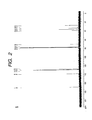
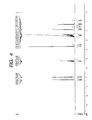
- FIGS. 1 and 2 show 1 H-NMR spectra and 13 C-NMR spectra, respectively, of the polyhydroxyalkanoate. Identification results thereof are given in Tables 1 and 2 below.
- the polyhydroxyalkanoate is one represented by the following chemical formula (16) containing, as the monomer units, 3-hydroxy-5-[(phenylmethyl)sulfanyl]valerate, and 3-hydroxyalkanoates and/or 3-hydroxyalkenoates corresponding to saturated/unsaturated fatty acids having 4 to 12 carbon atoms such as 3-hydroxybutyric acid and 3-hydroxyvaleric acid.
- the integration of the 1 H-NMR spectra indicated that the polyhydroxyalkanoate contains 3-hydroxy-5-[(phenylmethyl)sulfanyl]valerate by 85.9 mol%.
- the molecular weight of the polyhydroxyalkanoate was determined by gel permeation chromatography (GPC; TOSOH HLC-8220, column; TOSOH TSK-GEL SuperHM-H (trade name), solvent; chloroform, polystyrene equivalent). As a result, Mn was 14,400 and Mw was 56,700.
- Pseudomonas cichorii H45 was inoculated to 200 mL of M9 medium containing 0.5% of D-glucose and 0.1% of 5-[(phenylmethyl)sulfanyl]valeric acid, and cultured with shaking at 125 strokes/min at 30°C for 48 hours. Then, the cells were collected by centrifugation, re-suspended in 200 mL of M9 medium containing 0.5% of D-glucose and 0.1% of 5-[(phenylmethyl)sulfanyl]valeric acid but no nitrogen source (NH 4 Cl), and cultured at 30°C with shaking at 125 strokes/min for 48 hours. After that, the cells were collected by centrifugation, washed once with cold methanol, and lyophilized.
- the lyophilized pellet was suspended in 20 mL of chloroform and stirred at 60°C for 20 hours to extract polyhydroxyalkanoate.
- the extract was filtered through a membrane filter of a pore size of 0.45 ⁇ m and concentrated by a rotary evaporator.
- the concentrated solution was precipitated with cold methanol.
- the precipitate was recovered and dried in vacuum to yield 138 mg of polyhydroxyalkanoate.
- polyhydroxyalkanoate obtained was subjected to NMR analysis under the same conditions as in the Example 1. As a result, it was revealed that this polyhydroxyalkanoate is one represented by the chemical formula (16) containing, as the monomer units, 3-hydroxy-5-[(phenylmethyl)sulfanyl]valerate, and 3-hydroxyalkanoates and/or 3-hydroxyalkenoates corresponding to saturated/unsaturated fatty acids having 4 to 12 carbon atoms such as 3-hydroxybutyric acid and 3-hydroxyvaleric acid.
- the integration of the 1 H-NMR spectra indicated that the polyhydroxyalkanoate contains 3-hydroxy-5-[(phenylmethyl)sulfanyl]valerate by 95.2 mol%.
- Pseudomonas jessenii P161 was inoculated to 200 mL of M9 medium containing 0.5% of D-glucose and 0.1% of 5-[(phenylmethyl)sulfanyl]valeric acid, and cultured with shaking at 125 strokes/min at 30°C for 48 hours. Then, the cells were collected by centrifugation, re-suspended in 200 mL of M9 medium containing 0.5% of D-glucose and 0.1% of 5-[(phenylmethyl)sulfanyl]valeric acid but no nitrogen source (NH 4 Cl), and cultured at 30°C with shaking at 125 strokes/min for 47 hours. After that, the cells were collected by centrifugation, washed once with cold methanol, and lyophilized.
- the lyophilized pellet was suspended in 20 mL of chloroform and stirred at 60°C for 20 hours to extract polyhydroxyalkanoate.
- the extract was filtered through a membrane filter of a pore size of 0.45 ⁇ m and concentrated by a rotary evaporator.
- the concentrated solution was precipitated with cold methanol.
- the precipitate was recovered and dried in vacuum to yield 164 mg of polyhydroxyalkanoate.
- polyhydroxyalkanoate obtained was subjected to NMR analysis under the same conditions as in the Example 1. As a result, it was revealed that this polyhydroxyalkanoate is one represented by the chemical formula (16) containing, as the monomer units, 3-hydroxy-5-[(phenylmethyl)sulfanyl]valerate, and 3-hydroxyalkanoates and/or 3-hydroxyalkenoates corresponding to saturated/unsaturated fatty acids having 4 to 12 carbon atoms such as 3-hydroxybutyric acid and 3-hydroxyvaleric acid.
- the integration of the 1 H-NMR spectra indicated that the polyhydroxyalkanoate contains 3-hydroxy-5-[(phenylmethyl)sulfanyl]valerate by 96.7 mol%.
- Pseudomonas cichorii YN2 was inoculated to 200 mL of M9 medium containing 0.5% of polypeptone (Wako Pure Chemical Industries, Ltd.) and 0.1% of 5-[(phenylmethyl)sulfanyl]valeric acid, and cultured with shaking at 125 strokes/min at 30°C for 48 hours. Then, the cells were collected by centrifugation, washed once with cold methanol, and lyophilized.
- the lyophilized pellet was suspended in 20 mL of chloroform and stirred at 60°C for 20 hours to extract polyhydroxyalkanoate.
- the extract was filtered through a membrane filter of a pore size of 0.45 ⁇ m and concentrated by a rotary evaporator.
- the concentrated solution was precipitated with cold methanol.
- the precipitate was recovered and dried in vacuum to yield 161 mg of polyhydroxyalkanoate.
- polyhydroxyalkanoate obtained was subjected to NMR analysis under the same conditions as in the Example 1. As a result, it was revealed that this polyhydroxyalkanoate is one represented by the chemical formula (16) containing, as the monomer units, 3-hydroxy-5-[(phenylmethyl)sulfanyl]valerate, and 3-hydroxyalkanoates and/or 3-hydroxyalkenoates corresponding to saturated/unsaturated fatty acids having 4 to 12 carbon atoms such as 3-hydroxybutyric acid and 3-hydroxyvaleric acid.
- the integration of the 1 H-NMR spectra indicated that the polyhydroxyalkanoate contains 3-hydroxy-5-[(phenylmethyl)sulfanyl]valerate by 83.8 mol%.
- Pseudomonas cichorii H45 was inoculated to 200 mL of M9 medium containing 0.5% of polypeptone (Wako Pure Chemical Industries, Ltd.) and 0.1% of 5-[(phenylmethyl)sulfanyl]valeric acid, and cultured with shaking at 125 strokes/min at 30°C for 48 hours. Then, the cells were collected by centrifugation, washed once with cold methanol, and lyophilized.
- the lyophilized pellet was suspended in 20 mL of chloroform and stirred at 60°C for 20 hours to extract polyhydroxyalkanoate.
- the extract was filtered through a membrane filter of a pore size of 0.45 ⁇ m and concentrated by a rotary evaporator.
- the concentrated solution was precipitated with cold methanol.
- the precipitate was recovered and dried in vacuum to yield 113 mg of polyhydroxyalkanoate.
- polyhydroxyalkanoate obtained was subjected to NMR analysis under the same conditions as in the Example 1. As a result, it was revealed that this polyhydroxyalkanoate is one represented by the chemical formula (16) containing, as the monomer units, 3-hydroxy-5-[(phenylmethyl)sulfanyl]valerate, and 3-hydroxyalkanoates and/or 3-hydroxyalkenoates corresponding to saturated/unsaturated fatty acids having 4 to 12 carbon atoms such as 3-hydroxybutyric acid and 3-hydroxyvaleric acid.
- the integration of the 1 H-NMR spectra indicated that the polyhydroxyalkanoate contains 3-hydroxy-5-[(phenylmethyl)sulfanyl]valerate by 96.2 mol%.
- Pseudomonas jessenii P161 was inoculated to 200 mL of M9 medium containing 0.5% of polypeptone (Wako Pure Chemical Industries, Ltd.) and 0.1% of 5-[(phenylmethyl)sulfanyl]valeric acid, and cultured with shaking at 125 strokes/min at 30°C for 48 hours. Then, the cells were collected by centrifugation, washed once with cold methanol, and lyophilized.
- the lyophilized pellet was suspended in 20 mL of chloroform and stirred at 60°C for 20 hours to extract polyhydroxyalkanoate.
- the extract was filtered through a membrane filter of a pore size of 0.45 ⁇ m and concentrated by a rotary evaporator.
- the concentrated solution was precipitated with cold methanol.
- the precipitate was recovered and dried in vacuum to yield 126 mg of polyhydroxyalkanoate.
- polyhydroxyalkanoate obtained was subjected to NMR analysis under the same conditions as in the Example 1. As a result, it was revealed that this polyhydroxyalkanoate is one represented by the chemical formula (16) containing, as the monomer units, 3-hydroxy-5-[(phenylmethyl)sulfanyl]valerate, and 3-hydroxyalkanoates and/or 3-hydroxyalkenoates corresponding to saturated/unsaturated fatty acids having 4 to 12 carbon atoms such as 3-hydroxybutyric acid and 3-hydroxyvaleric acid.
- the integration of the 1 H-NMR spectra indicated that the polyhydroxyalkanoate contains 3-hydroxy-5-[(phenylmethyl)sulfanyl]valerate by 89.8 mol%.
- Pseudomonas cichorii YN2 was inoculated to 200 mL of M9 medium containing 0.1% of nonanoic acid and 0.1% of 5-[(phenylmethyl)sulfanyl]valeric acid, and cultured with shaking at 125 strokes/min at 30°C for 48 hours. Then, the cells were collected by centrifugation, washed once with cold methanol, and lyophilized.
- the lyophilized pellet was suspended in 20 mL of chloroform and stirred at 60°C for 20 hours to extract polyhydroxyalkanoate.
- the extract was filtered through a membrane filter of a pore size of 0.45 ⁇ m and concentrated by a rotary evaporator.
- the concentrated solution was precipitated with cold methanol. The precipitate was recovered and dried in vacuum to yield 90 mg of polyhydroxyalkanoate.
- polyhydroxyalkanoate obtained was subjected to NMR analysis under the same conditions as in the Example 1. As a result, it was revealed that this polyhydroxyalkanoate is one represented by the chemical formula (16) containing, as the monomer units, 3-hydroxy-5-[(phenylmethyl)sulfanyl]valerate, and 3-hydroxyalkanoates and/or 3-hydroxyalkenoates corresponding to saturated/unsaturated fatty acids having 4 to 12 carbon atoms such as 3-hydroxybutyric acid and 3-hydroxyvaleric acid.
- the integration of the 1 H-NMR spectra indicated that the polyhydroxyalkanoate contains 3-hydroxy-5-[(phenylmethyl)sulfanyl]valerate by 29.2 mol%.
- Pseudomonas cichorii YN2 was inoculated to 200 mL of M9 medium containing 0.5% of yeast extract, and 0.1% of 5-[(phenylmethyl)sulfanyl]valeric acid, and cultured with shaking at 125 strokes/min at 30°C for 48 hours. Then, the cells were collected by centrifugation, washed once with cold methanol, and lyophilized.
- the lyophilized pellet was suspended in 20 mL of chloroform and stirred at 60°C for 20 hours to extract polyhydroxyalkanoate.
- the extract was filtered through a membrane filter of a pore size of 0.45 ⁇ m and concentrated by a rotary evaporator.
- the concentrated solution was precipitated with cold methanol.
- the precipitate was recovered and dried in vacuum to yield 103 mg of polyhydroxyalkanoate.
- polyhydroxyalkanoate obtained was subjected to NMR analysis under the same conditions as in the Example 1. As a result, it was revealed that this polyhydroxyalkanoate is one represented by the chemical formula (16) containing, as the monomer units, 3-hydroxy-5-[(phenylmethyl)sulfanyl]valerate, and 3-hydroxyalkanoates and/or 3-hydroxyalkenoates corresponding to saturated/unsaturated fatty acids having 4 to 12 carbon atoms such as 3-hydroxybutyric acid and 3-hydroxyvaleric acid.
- the integration of the 1 H-NMR spectra indicated that the polyhydroxyalkanoate contains 3-hydroxy-5-[(phenylmethyl)sulfanyl]valerate by 96.0 mol%.
- Pseudomonas cichorii YN2 was inoculated to 200 mL of M9 medium containing 0.5% of sodium glutamate and 0.1% of 5-[(phenylmethyl)sulfanyl]valeric acid, and cultured with shaking at 125 strokes/min at 30°C for 48 hours. Then, the cells were collected by centrifugation, washed once with cold methanol, and lyophilized.
- the lyophilized pellet was suspended in 20 mL of chloroform and stirred at 60°C for 20 hours to extract polyhydroxyalkanoate.
- the extract was filtered through a membrane filter of a pore size of 0.45 ⁇ m and concentrated by a rotary evaporator.
- the concentrated solution was precipitated with cold methanol.
- the precipitate was recovered and dried in vacuum to yield 87 mg of polyhydroxyalkanoate.
- polyhydroxyalkanoate obtained was subjected to NMR analysis under the same conditions as in the Example 1. As a result, it was revealed that this polyhydroxyalkanoate is one represented by the chemical formula (16) containing, as the monomer units, 3-hydroxy-5-[(phenylmethyl)sulfanyl]valerate, and 3-hydroxyalkanoates and/or 3-hydroxyalkenoates corresponding to saturated/unsaturated fatty acids having 4 to 12 carbon atoms such as 3-hydroxybutyric acid and 3-hydroxyvaleric acid.
- the integration of the 1 H-NMR spectra indicated that the polyhydroxyalkanoate contains 3-hydroxy-5-[(phenylmethyl)sulfanyl]valerate by 86.4 mol%.
- Table 3 shows the dry weight of the cells, the dry weight of the polymer, the ratio of the polymer to the cells by dry weight, and the amount (mol%) of the 3-hydroxy-5-[(phenylmethyl)sulfanyl]valerate (abbreviated as "3HBzyTV") unit in the resulting polymer in Examples 1-9.
- Example 1 1070 795 74.3 85.9
- Example 2 875 690 78.9 95.2
- Example 3 1015 820 80.8 96.7
- Example 4 1070 805 75.2 83.8
- Example 5 710 565 79.6 96.2
- Example 6 940 630 67.0 89.8
- Example 7 705 450 63.8 29.2
- Example 8 815 515 63.2 96.0
- Example 9 995 435 43.7 86.4
- Pseudomonas cichorii YN2 was inoculated to 200 mL of M9 medium containing 0.5% of yeast extract and 0.1% of 4-[(phenylmethyl)sulfanyl]butyric acid, and cultured at 30°C with shaking at 125 strokes/min for 48 hours. Then, the cells were collected by centrifugation, washed once with cold methanol, and lyophilized. The weight of the lyophilized cells (dry weight of the cells) was weighed.
- the lyophilized pellet was suspended in 20 mL of chloroform and stirred at 60°C for 20 hours to extract polyhydroxyalkanoate.
- the extract was filtered through a membrane filter of a pore size of 0.45 ⁇ m and concentrated by a rotary evaporator.
- the concentrated solution was precipitated with cold methanol. The precipitate was recovered and dried in vacuum to yield 39 mg of polyhydroxyalkanoate.
- the average molecular weight of the resulting PHA was determined by gel permeation chromatography (GPC: TOSOH HLC-8220 (trade name), column: TOSOH TSK-GEL SuperHM-H (trade name), solvent: chloroform, polystyrene equivalent).
- GPC gel permeation chromatography
- Mn the number average molecular weight was 44,500 and the weight average molecular weight Mw was 106,800.
- the PHA was subjected to NMR analysis under the following conditions.
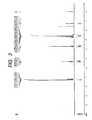
- FIG. 3 shows measured 1 H-NMR spectra and identification results thereof are given in Table 4 below.
- Chemical shift (ppm) Integration Splitting pattern Identification 2.48-2.71 4H m B5, d5 3.68 2H m e5 5.27 1H m c5 7.18 1H m i5 7.25 4H m g5, k5, h5, j5
- Pseudomonas cichorii YN2 was inoculated to 200 mL of M9 medium containing 0.1% of nonanoic acid and 0.1% of 4-[(phenylmethyl)sulfanyl]butyric acid, and cultured at 30°C with shaking at 125 strokes/min for 48 hours. Then, the cells were collected by centrifugation, washed once with cold methanol, and lyophilized. The weight of the lyophilized cells was measured (dry weight of the cells).
- the lyophilized pellet was suspended in 20 mL of chloroform and stirred at 60°C for 20 hours to extract polyhydroxyalkanoate.
- the extract was filtered through a membrane filter of a pore size of 0.45 ⁇ m and concentrated by a rotary evaporator.
- the concentrated solution was precipitated with cold methanol.
- the precipitate was recovered and dried in vacuum to yield 68 mg of polyhydroxyalkanoate.
- polyhydroxyalkanoate obtained was subjected to NMR analysis under the same conditions as in the Example 10. As a result, it was revealed that this polyhydroxyalkanoate is one represented by the chemical formula (17) containing a monomer unit of 3-hydroxy-4-[(phenylmethyl)sulfanyl]butyrate, and other monomer units of 3-hydroxyalkanoates and/or 3-hydroxyalkenoates corresponding to saturated/unsaturated fatty acids having 4 to 12 carbon atoms such as 3-hydroxybutyric acid or 3-hydroxyvaleric acid.
- the integration of the 1 H-NMR spectra indicated that the polyhydroxyalkanoate contains 3-hydroxy-4-[(phenylmethyl)sulfanyl]butyrate by 27.7 mol%.
- Pseudomonas cichorii YN2 was inoculated to 200 mL of M9 medium containing 0.5% of sodium glutamate and 0.1% of 4-[(phenylmethyl)sulfanyl]butyric acid, and cultured at 30°C with shaking at 125 strokes/min for 48 hours. Then, the cells were collected by centrifugation, washed once with cold methanol, and lyophilized. The weight of the lyophilized cells was weighed (dry weight of the cells).
- the lyophilized pellet was suspended in 20 mL of chloroform and stirred at 60°C for 20 hours to extract polyhydroxyalkanoate.
- the extract was filtered through a membrane filter of a pore size of 0.45 ⁇ m and concentrated by a rotary evaporator.
- the concentrated solution was precipitated with cold methanol. The precipitate was recovered and dried in vacuum to yield 72 mg of polyhydroxyalkanoate.
- the polyhydroxyalkanoate obtained was subjected to NMR analysis under the conditions as set forth in the Example 10. As a result, it was revealed that this polyhydroxyalkanoate is one represented by the chemical formula (17).
- the polyhydroxyalkanoate comprises a monomer unit of 3-hydroxy-4-[(phenylmethyl)sulfanyl]butyrate and other monomer units of 3-hydroxyalkanoates and/or 3-hydroxyalkenoates having 4 to 12 carbon atoms such as 3-hydroxybutyrate and 3-hydroxyvaleric acid.
- the integration of the 1 H-NMR spectra indicated that the resulting polyhydroxyalkanoate contains 50.3 mol% of 3-hydroxy-4-[(phenylmethyl)sulfanyl]butyrate monomer unit.
- Pseudomonas cichorii YN2 was inoculated to 200 mL of M9 medium containing 0.5% of D-glucose and 0.1% of 4-[(phenylmethyl)sulfanyl]butyric acid, and cultured with shaking at 125 strokes/min at 30°C for 48 hours. Then, the cells were collected by centrifugation, re-suspended in 200 mL of M9 medium containing 0.5% of D-glucose and 0.1% of 4-[(phenylmethyl)sulfanyl]butyric acid but no nitrogen source (NH 4 Cl), and cultured at 30°C with shaking at 125 strokes/min for 48 hours. After that, the cells were collected by centrifugation, washed once with cold methanol, and lyophilized. The lyophilized cells were weighed (cell dry weight).
- the lyophilized pellet was suspended in 20 mL of chloroform and stirred at 60°C for 20 hours to extract polyhydroxyalkanoate.
- the extract was filtered through a membrane filter of a pore size of 0.45 ⁇ m and concentrated by a rotary evaporator.
- the concentrated solution was precipitated with cold methanol.
- the precipitate was recovered and dried in vacuum to yield 148 mg of polyhydroxyalkanoate.
- the polyhydroxyalkanoate obtained was subjected to NMR analysis under the conditions as set forth in the Example 10. As a result, it was revealed that this polyhydroxyalkanoate is the polyhydroxyalkanoate that is represented by the chemical formula (17).
- the polyhydroxyalkanoate comprises a monomer unit of 3-hydroxy-4-[(phenylmethyl)sulfanyl]butyrate and other monomer units of 3-hydroxyalkanoicates and/or 3-hydroxyalkenoates having 4 to 12 carbon atoms such as 3-hydroxybutyrate and 3-hydroxyvalerate.
- the integration of the 1 H-NMR spectra indicated that the resulting polyhydroxyalkanoate contains 66.7 mol% of the 3-hydroxy-4-[(phenylmethyl)sulfanyl]butyrate monomer unit.
- Pseudomonas cichorii H45 was inoculated to 200 mL of M9 medium containing 0.5% of polypeptone (Wako Pure Chemical Industries, Ltd.) and 0.1% of 5-[(phenylmethyl)sulfanyl]butyric acid, and cultured with shaking at 125 strokes/min at 30°C for 48 hours. Then, the cells were collected by centrifugation, washed once with cold methanol, and lyophilized. The weight of the lyophilized cells was weighed (dry weight of the cells).
- the lyophilized pellet was suspended in 20 mL of chloroform and stirred at 60°C for 20 hours to extract polyhydroxyalkanoate.
- the extract was filtered through a membrane filter of a pore size of 0.45 ⁇ m and concentrated by a rotary evaporator.
- the concentrated solution was precipitated with cold methanol. The precipitate was recovered and dried in vacuum to yield 20 mg of polyhydroxyalkanoate.
- the polyhydroxyalkanoate obtained was subjected to NMR analysis under the conditions as set forth in the Example 10. As a result, it was revealed that this polyhydroxyalkanoate is one represented by the chemical formula (17).
- the polyhydroxyalkanoate comprises a monomer unit of 3-hydroxy-4-[(phenylmethyl)sulfanyl]butyrate and other monomer units of 3-hydroxyalkanoates and/or 3-hydroxyalkenoates corresponding to saturated/unsaturated fatty acids having 4 to 12 carbon atoms such as 3-hydroxybutyric acid and 3-hydroxyvaleric acid.
- the integration of the 1 H-NMR spectra indicated that the resulting polyhydroxyalkanoate contains 57.2 mol% of 3-hydroxy-4-[(phenylmethyl)sulfanyl]butyrate monomer unit.
- Pseudomonas jessenii P161 was inoculated to 200 mL of M9 medium containing 0.5% of D-glucose and 0.1% of 5-[(phenylmethyl)sulfanyl]valeric acid, and cultured with shaking at 125 strokes/min at 30°C for 48 hours. Then, the cells were collected by centrifugation, re-suspended in 200 mL of M9 medium containing 0.5% of D-glucose and 0.1% of 5-[(phenylmethyl)sulfanyl]valeric acid but no nitrogen source (NH 4 Cl), and cultured at 30°C with shaking at 125 strokes/min for 48 hours. After that, the cells were collected by centrifugation, washed once with cold methanol, and lyophilized. The weight of the lyophilized cells was weighed (the cell dry weight).
- the lyophilized pellet was suspended in 20 mL of chloroform and stirred at 60°C for 20 hours to extract polyhydroxyalkanoate.
- the extract was filtered through a membrane filter of a pore size of 0.45 ⁇ m and concentrated by a rotary evaporator.
- the concentrated solution was precipitated with cold methanol.
- the precipitate was recovered and dried in vacuum to yield 64 mg of polyhydroxyalkanoate.
- the polyhydroxyalkanoate obtained was subjected to NMR analysis under the conditions as set forth in the Example 10. As a result, it was revealed that this polyhydroxyalkanoate is one represented by the chemical formula (17).
- the polyhydroxyalkanoate comprises a monomer unit of 3-hydroxy-4-[(phenylmethyl)sulfanyl]butyrate and other monomer units of 3-hydroxyalkanoates and/or 3-hydroxyalkenoates corresponding to saturated/unsaturated fatty acids having 4 to 12 carbon atoms such as 3-hydroxybutyric acid and 3-hydroxyvaleric acid.
- the integration of the 1 H-NMR spectra indicated that the resulting polyhydroxyalkanoate contains 31.6 mol% of 3-hydroxy-4-[(phenylmethyl)sulfanyl]butyrate monomer unit.
- Table 5 shows the dry weight of the cells, the dry weight of the polymer, the dry weight ratio of the polymer to the cells, and the amount (mol%) of 3-hydroxy-4-[(phenylmethyl)sulfanyl]butyrate (abbreviated as "3HBzyTB” units) in the resulting polymer in Examples 10 - 15. Cell Dry Weight (mg/L) Polymer Dry Weight (mg/L) Polymer Weight/ Cell Weight (%) 3HBzyTB Unit mol% Example 10 1040 195 18.8 85.4 Example 11 655 340 51.9 27.7 Example 12 955 360 37.7 50.3 Example 13 1370 740 54.0 66.7 Example 14 580 100 17.2 57.2 Example 15 915 320 35.0 31.6
- Pseudomonas cichorii YN2 was inoculated to 200 mL of M9 medium containing 0.5% of D-glucose and 0.1% of 5-[[(4-methylphenyl)methyl]sulfanyl]valeric acid, and cultured with shaking at 125 strokes/min at 30°C for 48 hours. Then, the cells were collected by centrifugation, re-suspended in 200 mL of M9 medium containing 0.5% of D-glucose and 0.1% of 5-[[4-methylphenyl)methyl]sulfanyl]valeric acid but no nitrogen source (NH 4 Cl), and cultured at 30°C with shaking at 125 strokes/min for 48 hours. After that, the cells were collected by centrifugation, washed once with cold methanol, and lyophilized.
- the lyophilized pellet was suspended in 20 mL of chloroform and stirred at 60°C for 20 hours to extract polyhydroxyalkanoate.
- the extract was filtered through a membrane filter of a pore size of 0.45 ⁇ m and concentrated by a rotary evaporator.
- the concentrated solution was precipitated with cold methanol.
- the precipitate was recovered and dried in vacuum to yield 96 mg of polyhydroxyalkanoate.
- the polyhydroxyalkanoate obtained was subjected to NMR analysis under the conditions as set forth in Example 10. As a result, it was revealed that this polyhydroxyalkanoate is one represented by the chemical formula (18).
- the polyhydroxyalkanoate comprises a monomer unit of 3-hydroxy-5-[[(4-methylphenyl)methyl]sulfanyl]valerate and other monomer units of 3-hydroxyalkanoates and/or 3-hydroxyalkenoates corresponding to saturated/unsaturated fatty acids having 4 to 12 carbon atoms such as 3-hydroxybutyric acid and 3-hydroxyvaleric acid.
- the integration of the 1 H-NMR spectra indicated that the resulting polyhydroxyalkanoate contains 41.0 mol% of 3-hydroxy-5- ⁇ [(4-methylphenyl)methyl]sulfanyl ⁇ valerate monomer unit.
- the molecular weight of the resulting polyhydroxyalkanoate was determined by gel permeation chromatography (GPC; TOSOH HLC-8220, column; TOSOH TSK-GEL SuperHM-H, solvent; chloroform, polystyrene equivalent). As a result, Mn was 21,500 and Mw was 83,200.
- Pseudomonas cichorii H45 was inoculated to 200 mL of M9 medium containing 0.5% of D-glucose and 0.1% of 5-[[(4-methylphenyl)methyl]sulfanyl]valeric acid, and cultured with shaking at 125 strokes/min at 30°C for 48 hours. Then, the cells were collected by centrifugation, re-suspended in 200 mL of M9 medium containing 0.5% of D-glucose and 0.1% of 5-[[4-methylphenyl)methyl]sulfanyl]valeric acid but no nitrogen source (NH 4 Cl), and cultured at 30°C with shaking at 125 strokes/min for 48 hours. After that, the cells were collected by centrifugation, washed once with cold methanol, and lyophilized.
- the lyophilized pellet was suspended in 20 mL of chloroform and stirred at 60°C for 20 hours to extract polyhydroxyalkanoate.
- the extract was filtered through a membrane filter of a pore size of 0.45 ⁇ m and concentrated by a rotary evaporator.
- the concentrated solution was precipitated with cold methanol.
- the precipitate was recovered and dried in vacuum to yield 82 mg of polyhydroxyalkanoate.
- the polyhydroxyalkanoate obtained was subjected to NMR analysis under the conditions as set forth in Example 10. As a result, it was revealed that this polyhydroxyalkanoate is one represented by the chemical formula (18).
- the polyhydroxyalkanoate comprises a monomer unit of 3-hydroxy-5-[[(4-methylphenyl)methyl]sulfanyl]valerate and other monomer units of 3-hydroxyalkanoates and/or 3-hydroxyalkenoates corresponding to saturated/unsaturated fatty acids having 4 to 12 carbon atoms such as 3-hydroxybutyric acid and 3-hydroxyvaleric acid.
- the integration of the 1 H-NMR spectra indicated that the resulting polyhydroxyalkanoate contains 56.2 mol% of 3-hydroxy-5-[[(4-methylphenyl)methyl]sulfanyl]valerate monomer unit.
- Pseudomonas jessenii P161 was inoculated to 200 mL of M9 medium containing 0.5% of D-glucose and 0.1% of 5-[[(4-methylphenyl)methyl]sulfanyl]valeric acid, and cultured with shaking at 125 strokes/min at 30°C for 48 hours. Then, the cells were collected by centrifugation, re-suspended in 200 mL of M9 medium containing 0.5% of D-glucose and 0.1% of 5-[[4-methylphenyl)methyl]sulfanyl]valeric acid but no nitrogen source (NH 4 Cl), and cultured at 30°C with shaking at 125 strokes/min for 48 hours. After that, the cells were collected by centrifugation, washed once with cold methanol, and lyophilized.
- the lyophilized pellet was suspended in 20 mL of chloroform and stirred at 60°C for 20 hours to extract polyhydroxyalkanoate.
- the extract was filtered through a membrane filter of a pore size of 0.45 ⁇ m and concentrated by a rotary evaporator.
- the concentrated solution was precipitated with cold methanol. The precipitate was recovered and dried in vacuum to yield 75 mg of polyhydroxyalkanoate.
- the polyhydroxyalkanoate obtained was subjected to NMR analysis under the conditions as set forth in Example 10. As a result, it was revealed that this polyhydroxyalkanoate is one represented by the chemical formula (18).
- the polyhydroxyalkanoate comprises a monomer unit of 3-hydroxy-5-[[(4-methylphenyl)methyl]sulfanyl]valerate and other monomer units of 3-hydroxyalkanoates and/or 3-hydroxyalkenoates corresponding to saturated/unsaturated fatty acids having 4 to 12 carbon atoms such as 3-hydroxybutyric acid and 3-hydroxyvaleric acid.
- the integration of the 1 H-NMR spectra indicated that the resulting polyhydroxyalkanoate contains 38.8 mol% of 3-hydroxy-5-[[(4-methylphenyl)methyl]sulfanyl ⁇ valerate monomer unit.
- Table 6 shows the dry weight of the cells, the dry weight of the polymer, the dry weight ratio of the polymer to the cells, and the amount (mol%) of the 3-hydroxy-3-hydroxy-5- ⁇ [(4-methylphenyl)methyl]sulfanyl ⁇ valerate (abbreviated as "3HMBzyTV” in the resulting polymer in Examples 16 - 18.
- Example 18 710 377 53.1 38.8
- Pseudomonas cichorii YN2 was inoculated to 200 mL of M9 medium containing 0.5% of polypeptone (Wako Pure Chemical Industries, Ltd.) and 0.1% of 5- ⁇ [(4-fluorophenyl)methyl]sulfanyl ⁇ valeric acid, and cultured with shaking at 125 strokes/min at 30°C for 48 hours. Then, the cells were collected by centrifugation, washed once with cold methanol, and lyophilized. The weight of the lyophilized cells was weighed (dry weight of the cells).
- the lyophilized pellet was suspended in 20 mL of chloroform and stirred at 60°C for 20 hours to extract polyhydroxyalkanoate.
- the extract was filtered through a membrane filter of a pore size of 0.45 ⁇ m and concentrated by a rotary evaporator.
- the concentrated solution was precipitated with cold methanol.
- the sole precipitate was recovered and dried in vacuum to yield 106 mg of polyhydroxyalkanoate.
- the average molecular weight of the resulting PHA was determined by gel permeation chromatography (GPC; TOSOH HLC-8220, column; TOSOH TSK-GEL SuperHM-H, solvent; chloroform, polystyrene equivalent).
- GPC gel permeation chromatography
- TOSOH HLC-8220 column
- TOSOH TSK-GEL SuperHM-H solvent
- chloroform polystyrene equivalent
- the PHA was subjected to NMR analysis under the following conditions.
- FIG. 4 shows measured 1 H-NMR spectra. Identification results thereof are given in Table 7 below.
- FIG. 5 shows measured 13 C-NMR spectra. Identification results thereof are given in Table 8 below.
- the PHA comprises a monomer unit of 3-hydroxy-5- ⁇ [(4-fluorophenyl)methyl]sulfanyl ⁇ valerate, and other monomer units of 3-hydroxyalkanoates and/or 3-hydroxyalkenoates having 4 to 12 carbon atoms such as 3-hydroxybutyric acid and 3-hydroxyvaleric acid. More specifically, the PHA has a structure represented by the following chemical formula (19):
- Pseudomonas cichorii YN2 was inoculated to 200 mL of M9 medium that contains 0.1% of nonanoic acid and 0.1% of 5- ⁇ [(4-fluorophenyl)methyl]sulfanyl ⁇ valeric acid and cultured with shaking at 125 strokes/min at 30°C for 48 hours. Then, the cells were collected by centrifugation, washed once with cold methanol, and lyophilized. The weight of the lyophilized cells was weighed (dry weight of the cells).
- the lyophilized pellet was suspended in 20 mL of chloroform and stirred at 60°C for 20 hours to extract polyhydroxyalkanoate.
- the extract was filtered through a membrane filter of a pore size of 0.45 ⁇ m and concentrated by a rotary evaporator.
- the concentrated solution was precipitated with cold methanol.
- the precipitate was recovered and dried in vacuum to yield 89 mg of polyhydroxyalkanoate.
- the PHA obtained was subjected to NMR analysis and average molecular weight determination under the conditions as in Example 19. From the results of the NMR analysis, it was revealed that the PHA in this example comprises a monomer unit of 3-hydroxy-5- ⁇ [(4-fluorophenyl)methyl]sulfanyl ⁇ valerate and other monomer units of 3-hydroxyalkanoates and/or 3-hydroxyalkenoates having 4 to 12 carbon atoms such as 3-hydroxybutyrate and 3-hydroxyvalerate to confirm that it has a constitution represented by the chemical formula (19). The integration of the 1 H-NMR spectra indicated that the PHA of this example contains 27.0 mol% of 3-hydroxy-5- ⁇ [(4-fluorophenyl)methyl]sulfanyl ⁇ valerate monomer unit.
- Pseudomonas cichorii YN2 was inoculated to 200 mL of M9 medium containing 0.5% of yeast extract (DIFCO) and 0.1% of 5- ⁇ [(4-fluorophenyl)methyl]sulfanyl ⁇ valeric acid, and cultured with shaking at 125 strokes/min at 30°C for 48 hours. Then, the cells were collected by centrifugation, washed once with cold methanol, and lyophilized. The weight of the lyophilized cells was weighed (dry weight of the cells).
- yeast extract DIFCO
- the lyophilized pellet was suspended in 20 mL of chloroform and stirred at 60°C for 20 hours to extract polyhydroxyalkanoate.
- the extract was filtered through a membrane filter of a pore size of 0.45 ⁇ m and concentrated by a rotary evaporator.
- the concentrated solution was precipitated with cold methanol.
- the precipitate was recovered and dried in vacuum to yield 69 mg of polyhydroxyalkanoate in this Example.
- the PHA obtained was subjected to NMR analysis and average molecular weight determination under the conditions as set forth in the Example 19. From the results of the NMR analysis, it was revealed that the PHA in this example comprises a monomer unit of 3-hydroxy-5- ⁇ [(4-fluorophenyl)methyl]sulfanyl ⁇ valerate and other monomer units of 3-hydroxyalkanoates and/or 3-hydroxyalkenoates having 4 to 12 carbon atoms such as 3-hydroxybutyrate and 3-hydroxyvalerate to confirm that it has a constitution represented by the above chemical formula (19). The integration of the 1 H-NMR spectra indicated that the PHA of this example contains 76.7 mol% of 3-hydroxy-5- ⁇ [(4-fluorophenyl)methyl]sulfanyl ⁇ valerate monomer unit.
- Pseudomonas cichorii YN2 was inoculated to 200 mL of M9 medium containing 0.5% of sodium glutamate and 0.1% of 5- ⁇ [(4-fluorophenyl)methyl]sulfanyl ⁇ valeric acid, and cultured with shaking at 125 strokes/min at 30°C for 48 hours. Then, the cells were collected by centrifugation, washed once with cold methanol, and lyophilized. The weight of the lyophilized cells was weighed (dry weight of the cells).
- the lyophilized pellet was suspended in 20 mL of chloroform and stirred at 60°C for 20 hours to extract polyhydroxyalkanoate.
- the extract was filtered through a membrane filter of a pore size of 0.45 ⁇ m and concentrated by a rotary evaporator.
- the concentrated solution was precipitated with cold methanol.
- the precipitate was recovered and dried in vacuum to yield 68 mg of polyhydroxyalkanoate in this Example.
- the PHA obtained was subjected to NMR analysis and average molecular weight determination under the same conditions as set forth in Example 19. From the results of the NMR analysis, it was revealed that the PHA in this example comprises a monomer unit of 3-hydroxy-5- ⁇ [(4-fluorophenyl)methyl]sulfanyl ⁇ valerate and other monomer units of 3-hydroxyalkanoates and/or 3-hydroxyalkenoates having 4 to 12 carbon atoms, such as 3-hydroxybutyrate and 3-hydroxyvalerate, confirming that it has a constitution represented by the chemical formula (19). The integration of the 1 H-NMR spectra indicated that the PHA of this example contains 90.3 mol% of 3-hydroxy-5- ⁇ [(4-fluorophenyl)methyl]sulfanyl ⁇ valerate monomer unit.
- Pseudomonas cichorii YN2 was inoculated to 200 mL of M9 medium containing 0.5% of D-glucose and 0.1% of 5- ⁇ [(4-fluorophenyl)methyl]sulfanyl ⁇ valeric acid, and cultured with shaking at 125 strokes/min at 30°C for 48 hours. Then, the cells were collected by centrifugation, re-suspended in 200 mL of M9 medium containing 0.5% of D-glucose and 0.1% of 5- ⁇ [(4-fluorophenyl)methyl]sulfanyl ⁇ valeric acid but no nitrogen source (NH 4 Cl), and cultured at 30°C with shaking at 125 strokes/min for 48 hours. After that, the cells were collected by centrifugation, washed once with cold methanol, and lyophilized. The weight of the lyophilized cells was weighed (dry weight of the cells).
- the lyophilized pellet was suspended in 20 mL of chloroform and stirred at 60°C for 20 hours to extract polyhydroxyalkanoate.
- the extract was filtered through a membrane filter of a pore size of 0.45 ⁇ m and concentrated by a rotary evaporator.
- the concentrated solution was precipitated with cold methanol.
- the precipitate was recovered and dried in vacuum to yield 164 mg of polyhydroxyalkanoate.
- the PHA obtained was subjected to NMR analysis, and the average molecular weight determination under the conditions as set forth in Example 19.
- the results of the NMR analysis show that the PHA in this example comprises a monomer unit of 3-hydroxy-5- ⁇ [(4-fluorophenyl)methyl]sulfanyl ⁇ valerate and other monomer units of 3-hydroxyalkanoates and/or 3-hydroxyalkenoates having 4 to 12 carbon atoms, such as 3-hydroxybutyrate and 3-hydroxyvalerate to confirm that it has a constitution represented by the chemical formula (19).
- the integration of the 1 H-NMR spectra indicated that the PHA of this example contains 85.9 mol% of 3-hydroxy-5- ⁇ [(4-fluorophenyl)methyl]sulfanyl ⁇ valerate monomer unit.
- Pseudomonas cichorii H45 was inoculated to 200 mL of M9 medium containing 0.5% of D-glucose and 0.1% of 5- ⁇ [(4-fluorophenyl)methyl]sulfanyl ⁇ valeric acid and cultured with shaking at 125 strokes/min at 30°C for 48 hours. Then, the cells were collected by centrifugation, re-suspended in 200 mL of M9 medium containing 0.5% of D-glucose and 0.1% of 5- ⁇ [(4-fluorophenyl)methyl]sulfanyl ⁇ valeric acid but no nitrogen source (NH 4 Cl), and cultured at 30°C with shaking at 125 strokes/min for 48 hours. After that, the cells were collected by centrifugation, washed once with cold methanol, and lyophilized. The weight of the lyophilized cells was weighed (dry weight of the cells).
- the lyophilized pellet was suspended in 20 mL of chloroform and stirred at 60°C for 20 hours to extract polyhydroxyalkanoate.
- the extract was filtered through a membrane filter of a pore size of 0.45 ⁇ m and concentrated by a rotary evaporator.
- the concentrated solution was precipitated with cold methanol.
- the precipitate was recovered and dried in vacuum to yield 138 mg of polyhydroxyalkanoate.
- the PHA obtained was subjected to NMR analysis, and the average molecular weight determination under the conditions as set forth in Example 19.
- the results of the NMR analysis show that the PHA in this example comprises a monomer unit of 3-hydroxy-5- ⁇ [(4-fluorophenyl)methyl]sulfanyl ⁇ valerate and other monomer units of 3-hydroxyalkanoates and/or 3-hydroxyalkenoates having 4 to 12 carbon atoms, such as 3-hydroxybutyrate and 3-hydroxyvalerate to confirm that it has a constitution represented by the chemical formula (19).
- the integration of the 1 H-NMR spectra indicated that the PHA of this example contains 90.7 mol% of 3-hydroxy-5- ⁇ [(4-fluorophenyl)methyl]sulfanyl ⁇ valerate monomer unit.
- Pseudomonas jessenii P161 was inoculated to 200 mL of M9 medium containing 0.5% of D-glucose and 0.1% of 5- ⁇ [(4-fluorophenyl)methyl]sulfanyl ⁇ valeric acid, and cultured with shaking at 125 strokes/min at 30°C for 48 hours. Then, the cells were collected by centrifugation, re-suspended in 200 mL of M9 medium containing 0.5% of D-glucose and 0.1% of 5- ⁇ [(4-fluorophenyl)methyl]sulfanyl ⁇ valeric acid but no nitrogen source (NH 4 Cl), and cultured at 30°C with shaking at 125 strokes/min for 48 hours. After that, the cells were collected by centrifugation, washed once with cold methanol, and lyophilized. The weight of the lyophilized cells was weighed (the cell dry weight).
- the lyophilized pellet was suspended in 20 mL of chloroform and stirred at 60°C for 20 hours to extract polyhydroxyalkanoate.
- the extract was filtered through a membrane filter of a pore size of 0.45 ⁇ m and concentrated by a rotary evaporator.
- the concentrated solution was precipitated with cold methanol.
- the precipitate was recovered and dried in vacuum to yield 138 mg of polyhydroxyalkanoate.
- the PHA obtained was subjected to NMR analysis, and the average molecular weight determination under the conditions as set forth in Example 19.
- the results of the NMR analysis show that the PHA in this example comprises a monomer unit of 3-hydroxy-5- ⁇ [(4-fluorophenyl)methyl]sulfanyl ⁇ valerate and other monomer units of 3-hydroxyalkanoates and/or 3-hydroxyalkenoates having 4 to 12 carbon atoms, such as 3-hydroxybutyrate or 3-hydroxyvalerate to confirm that it has a constitution represented by the chemical formula (19).
- the integration of the 1 H-NMR spectra indicated that the PHA of this example contains 88.5 mol% of 3-hydroxy-5- ⁇ [(4-fluorophenyl)methyl]sulfanyl ⁇ valerate monomer unit..
- Pseudomonas cichorii YN2 was inoculated to 200 mL of M9 medium containing 0.5% of polypeptone (Wako Pure Chemical Industries, Ltd.) and 0.1% of 5- ⁇ [(4-fluorophenyl)methyl]sulfanyl ⁇ valeric acid and cultured with shaking at 125 strokes/min at 30°C for 48 hours.
- the cells were collected by centrifugation, re-suspended in 200 mL of M9 medium containing 0.5% of sodium pyruvate and 0.1% of 5- ⁇ [(4-fluorophenyl)methyl]sulfanyl ⁇ valeric acid but no nitrogen source (NH 4 Cl), and cultured at 30°C with shaking at 125 strokes/min for 48 hours. After that, the cells were collected by centrifugation, washed once with cold methanol, and lyophilized. The weight of the lyophilized cells was weighed (the cell dry weight).
- the lyophilized pellet was suspended in 20 mL of chloroform and stirred at 60°C for 20 hours to extract polyhydroxyalkanoate.
- the extract was filtered through a membrane filter of a pore size of 0.45 ⁇ m and concentrated by a rotary evaporator.
- the concentrated solution was precipitated with cold methanol.
- the precipitate was recovered and dried in vacuum to yield 125 mg of polyhydroxyalkanoate.
- the PHA obtained was subjected to NMR analysis, and the average molecular weight determination under the conditions as set forth in Example 19.
- the results of the NMR analysis show that the PHA in this example comprises a monomer unit of 3-hydroxy-5- ⁇ [(4-fluorophenyl)methyl]sulfanyl ⁇ valerate and other monomer units of 3-hydroxyalkanoates and/or 3-hydroxyalkenoates having 4 to 12 carbon atoms, such as 3-hydroxybutyrate or 3-hydroxyvalerate to confirm that it has a constitution represented by the chemical formula (19).
- the integration of the 1 H-NMR spectra indicated that the PHA of this example contains 89.5 mol% of 3-hydroxy-5- ⁇ [(4-fluorophenyl)methyl]sulfanyl ⁇ valerate monomer unit.
- Pseudomonas cichorii H45 was inoculated to 200 mL of M9 medium containing 0.5% of polypeptone (Wako Pure Chemical Industries, Ltd.) and 0.1% of 5- ⁇ [(4-fluorophenyl)methyl]sulfanyl ⁇ valeric acid and cultured with shaking at 125 strokes/min at 30°C for 48 hours.
- the cells were collected by centrifugation, re-suspended in 200 mL of M9 medium containing 0.5% of sodium pyruvate and 0.1% of 5- ⁇ [(4-fluorophenyl)methyl]sulfanyl ⁇ valeric acid but no nitrogen source (NH 4 Cl), and cultured at 30°C with shaking at 125 strokes/min for 48 hours. After that, the cells were collected by centrifugation, washed once with cold methanol, and lyophilized. The weight of the lyophilized cells was weighed (the cell dry weight).
- the lyophilized pellet was suspended in 20 mL of chloroform and stirred at 60°C for 20 hours to extract polyhydroxyalkanoate.
- the extract was filtered through a membrane filter of a pore size of 0.45 ⁇ m and concentrated by a rotary evaporator.
- the concentrated solution was precipitated with cold methanol.
- the precipitate was recovered and dried in vacuum to yield 154 mg of polyhydroxyalkanoate.
- the PHA obtained was subjected to NMR analysis, and the average molecular weight determination under the conditions as set forth in Example 19.
- the results of the NMR analysis show that the PHA in this example comprises a monomer unit of 3-hydroxy-5- ⁇ [(4-fluorophenyl)methyl]sulfanyl ⁇ valerate and other monomer units of 3-hydroxyalkanoates and/or 3-hydroxyalkenoates having 4 to 12 carbon atoms, such as 3-hydroxybutyrate or 3-hydroxyvalerate to confirm that it has a constitution represented by the chemical formula (19).
- the integration of the 1 H-NMR spectra indicated that the PHA of this example contains 97.9 mol% of 3-hydroxy-5- ⁇ [(4-fluorophenyl)methyl]sulfanyl ⁇ valerate monomer unit.
- Pseudomonas jessenii P161 was inoculated to 200 mL of M9 medium containing 0.5% of polypeptone (Wako Pure Chemical Industries, Ltd.) and 0.1% of 5- ⁇ [(4-fluorophenyl)methyl]sulfanyl ⁇ valeric acid and cultured with shaking at 125 strokes/min at 30°C for 48 hours.
- the cells were collected by centrifugation, re-suspended in 200 mL of M9 medium containing 0.5% of sodium pyruvate and 0.1% of 5- ⁇ [(4-fluorophenyl)methyl]sulfanyl ⁇ valeric acid but no nitrogen source (NH 4 Cl), and cultured at 30°C with shaking at 125 strokes/min for 48 hours. After that, the cells were collected by centrifugation, washed once with cold methanol, and lyophilized. The weight of the lyophilized cells was weighed (the cell dry weight).
- the lyophilized pellet was suspended in 20 mL of chloroform and stirred at 60°C for 20 hours to extract polyhydroxyalkanoate.
- the extract was filtered through a membrane filter of a pore size of 0.45 ⁇ m and concentrated by a rotary evaporator.
- the concentrated solution was precipitated with cold methanol.
- the precipitate was recovered and dried in vacuum to yield 158 mg of polyhydroxyalkanoate.
- the PHA obtained was subjected to NMR analysis, and the average molecular weight determination under the conditions as set forth in Example 19.
- the results of the NMR analysis show that the PHA in this example comprises a monomer unit of 3-hydroxy-5- ⁇ [(4-fluorophenyl)methyl]sulfanyl ⁇ valerate and other monomer units of 3-hydroxyalkanoates and/or 3-hydroxyalkenoates having 4 to 12 carbon atoms, such as 3-hydroxybutyrate or 3-hydroxyvalerate to confirm that it has a constitution represented by the chemical formula (19).
- the integration of the 1 H-NMR spectra indicated that the PHA of this example contains 91.6 mol% of 3-hydroxy-5- ⁇ [(4-fluorophenyl)methyl]sulfanyl ⁇ valerate monomer unit.
- Table 9 shows the dry weight of the cells, the dry weight of the polymer, the dry weight ratio of the polymer to the cells, and the amount in mol% of the 3-hydroxy-5- ⁇ [(4-fluorophenyl)methyl]sulfanyl ⁇ valerate unit (abbreviated as "3HFBzyTV") in the resulting PHA polymer in Examples 19 to 28.
- 3HFBzyTV 3-hydroxy-5- ⁇ [(4-fluorophenyl)methyl]sulfanyl ⁇ valerate unit
- Example 19 945 530 56.1 76.7
- Example 20 680 445 65.4 27.0
- Example 21 915 345 37.7 76.7
- Example 22 740 340 45.9 90.3
- Example 23 1120 820 73.2 85.9
- Example 24 940 690 73.4 90.7
- Example 25 955 690 72.3 88.5
- Example 26 1015 625 61.6 89.5
- Example 27 1125 770 68.4 97.9
- Example 28 1215 790 65.0 91.6
- Pseudomonas cichorii YN2 was inoculated to 200 mL of M9 medium containing 0.5% of yeast extract (DIFCO) and 0.1% of 4- ⁇ [(4-fluorophenyl)methyl]sulfanyl ⁇ butyric acid, and cultured with shaking at 125 strokes/min at 30°C for 48 hours. Then, the cells were collected by centrifugation, washed once with cold methanol, and lyophilized. The weight of the lyophilized cells was weighed (dry weight of the cells).
- yeast extract DIFCO
- the lyophilized pellet was suspended in 20 mL of chloroform and stirred at 60°C for 20 hours to extract polyhydroxyalkanoate.
- the extract was filtered through a membrane filter of a pore size of 0.45 ⁇ m and concentrated by a rotary evaporator.
- the concentrated solution was precipitated with cold methanol. The precipitate was recovered and dried in vacuum to yield 41 mg of polyhydroxyalkanoate.
- the average molecular weight of the resulting PHA was determined by gel permeation chromatography (GPC; TOSOH HLC-8220, column; TOSOH TSK-GEL SuperHM-H, solvent; chloroform, polystyrene equivalent).
- GPC gel permeation chromatography
- TOSOH HLC-8220 column
- TOSOH TSK-GEL SuperHM-H solvent
- chloroform polystyrene equivalent
- the PHA was subjected to NMR analysis under the following conditions.
- FIG. 6 shows measured 1 H-NMR spectra. Identification results thereof are given in Table 10 below. Chemical shifts (ppm) Integration Splitting patterns Identification 2.40-2.72 4H m b1, d1 3.65 2H m e1 5.27 1H m c1 6.95 2H m h1, j1 7.23 2H m g1, k1
- the subject PHA comprises a monomer unit of 3-hydroxy-4- ⁇ [(4-fluorophenyl)methyl]sulfanyl ⁇ butyrate and other monomer units of 3-hydroxyalkanoates and/or 3-hydroxyalkenoates having 4 to 12 carbon atoms, such as 3-hydroxybutyrate or 3-hydroxyvalerate. More specifically, the PHA has a structure represented by the following chemical formula (20).
- Pseudomonas cichorii YN2 was inoculated to 200 mL of M9 medium containing 0.1% of nonanoic acid and 0.1% of 4- ⁇ [(4-fluorophenyl)methyl]sulfanyl ⁇ butyric acid and cultured with shaking at 125 strokes/min at 30°C for 48 hours. Then the cells were collected by centrifugation, washed once with cold methanol, and lyophilized and weighed to determine dried cell weight.
- the lyophilized pellet was suspended in 20 mL of chloroform and stirred at 60°C for 20 hours to extract polyhydroxyalkanoate.
- the extract was filtered through a membrane filter of a pore size of 0.45 ⁇ m and concentrated by a rotary evaporator.
- the concentrated solution was precipitated with cold methanol. The precipitate was recovered and dried in vacuum to yield 45 mg of polyhydroxyalkanoate.
- the PHA obtained was subjected to NMR analysis, and the average molecular weight determination under the conditions as set forth in Example 29.
- the results of the NMR analysis show that the PHA in this example comprises a monomer unit of 3-hydroxy-4- ⁇ [(4-fluorophenyl)methyl]sulfanyl ⁇ butyrate and other monomer units of 3-hydroxyalkanoates and/or 3-hydroxyalkenoates having 4 to 12 carbon atoms, such as 3-hydroxybutyrate or 3-hydroxyvalerate to confirm that it has a constitution represented by the chemical formula (20).
- the integration of the 1 H-NMR spectra indicated that the PHA of this example contains 10.6 mol% of 3-hydroxy-4- ⁇ [(4-fluorophenyl)methyl]sulfanyl ⁇ butyrate monomer unit.
- Pseudomonas cichorii YN2 was inoculated to 200 mL of M9 medium containing 0.5% of sodium glutamate and 0.1% of 4- ⁇ [(4-fluorophenyl)methyl]sulfanyl ⁇ butyric acid and cultured with shaking at 125 strokes/min at 30°C for 48 hours. Then, the cells were collected by centrifugation, washed once with cold methanol, lyophilized and weighed.
- the lyophilized pellet was suspended in 20 mL of chloroform and stirred at 60°C for 20 hours to extract polyhydroxyalkanoate.
- the extract was filtered through a membrane filter of a pore size of 0.45 ⁇ m and concentrated by a rotary evaporator.
- the concentrated solution was precipitated with cold methanol. The precipitate was recovered and dried in vacuum to yield 11 mg of polyhydroxyalkanoate.
- the PHA obtained was subjected to NMR analysis, and the average molecular weight determination under the conditions as set forth in Example 29.
- the results of the NMR analysis show that the PHA in this example comprises a monomer unit of 3-hydroxy-4- ⁇ [(4-fluorophenyl)methyl]sulfanyl ⁇ butyrate and other monomer units of 3-hydroxyalkanoates and/or 3-hydroxyalkenoates having 4 to 12 carbon atoms, such as 3-hydroxybutyrate or 3-hydroxyvalerate to confirm that it has a constitution represented by the chemical formula (20).
- the integration of the 1 H-NMR spectra indicated that the PHA of this example contains 84.1 mol% of 3-hydroxy-4- ⁇ [(4-fluorophenyl)methyl]sulfanyl ⁇ butyrate monomer unit.
- Pseudomonas cichorii YN2 was inoculated to 200 mL of M9 medium containing 0.5% of D-glucose and 0.1% of 4- ⁇ [(4-fluorophenyl)methyl]sulfanyl ⁇ butyric acid and cultured with shaking at 125 strokes/min at 30°C for 48 hours. Then, the cells were collected by centrifugation, re-suspended in 200 mL of M9 medium containing 0.5% of D-glucose and 0.1% of 4- ⁇ [[4-fluoromethyl]phenyl]methyl ⁇ sulfanyl]butyric acid but no nitrogen source (NH 4 Cl), and cultured at 30°C with shaking at 125 strokes/min for 48 hours. After that, the cells were collected by centrifugation, washed once with cold methanol, lyophilized and weighed as the dry cell weight.
- the lyophilized pellet was suspended in 20 mL of chloroform and stirred at 60°C for 20 hours to extract polyhydroxyalkanoate.
- the extract was filtered through a membrane filter of a pore size of 0.45 ⁇ m and concentrated by a rotary evaporator.
- the concentrated solution was precipitated with cold methanol.
- the precipitate was recovered and dried in vacuum to yield 153 mg of polyhydroxyalkanoate.
- the PHA obtained was subjected to NMR analysis, and the average molecular weight determination under the conditions as set forth in Example 29.
- the results of the NMR analysis show that the PHA in this example comprises a monomer unit of 3-hydroxy-4- ⁇ [(4-fluorophenyl)methyl]sulfanyl ⁇ butyrate and other monomer units of 3-hydroxyalkanoates and/or 3-hydroxyalkenoates having 4 to 12 carbon atoms, such as 3-hydroxybutyrate or 3-hydroxyvalerate to confirm that it has a constitution represented by the chemical formula (20).
- the integration of the 1 H-NMR spectra indicated that the PHA of this example contains 68.5 mol% of 3-hydroxy-4- ⁇ [(4-fluorophenyl)methyl]sulfanyl ⁇ butyrate monomer unit.
- Pseudomonas cichorii H45 was inoculated to 200 mL of M9 medium containing 0.5% of polypeptone (Wako Pure Chemical Industries, Ltd.) and 0.1% of 4- ⁇ [(4-fluorophenyl)methyl]sulfanyl ⁇ butyric acid, and cultured with shaking at 125 strokes/min at 30°C for 48 hours.
- the cells were collected by centrifugation, re-suspended in 200 mL of M9 medium containing 0.5% of sodium pyruvate and 0.1% of 4- ⁇ [(4-fluorophenyl)methyl]sulfanyl ⁇ butyric acid but no nitrogen source (NH 4 Cl), and cultured at 30°C with shaking at 125 strokes/min for 48 hours. After that, the cells were collected by centrifugation, washed once with cold methanol, and lyophilized. The weight of the lyophilized cells was weighed (the cell dry weight).
- the lyophilized pellet was suspended in 20 mL of chloroform and stirred at 60°C for 20 hours to extract polyhydroxyalkanoate.
- the extract was filtered through a membrane filter of a pore size of 0.45 ⁇ m and concentrated by a rotary evaporator.
- the concentrated solution was precipitated with cold methanol. The precipitate was recovered and dried in vacuum to yield 38 mg of polyhydroxyalkanoate.
- the PHA obtained was subjected to NMR analysis, and the average molecular weight determination under the conditions as set forth in Example 29.
- the results of the NMR analysis show that the PHA in this example comprises a monomer unit of 3-hydroxy-4- ⁇ [(4-fluorophenyl)methyl]sulfanyl ⁇ butyrate and other monomer units of 3-hydroxyalkanoates and/or 3-hydroxyalkenoates having 4 to 12 carbon atoms, such as 3-hydroxybutyrate or 3-hydroxyvalerate to confirm that it has a constitution represented by the chemical formula (20).
- the integration of the 1 H-NMR spectra indicated that the PHA of this example contains 43.1 mol% of 3-hydroxy-4- ⁇ [(4-fluorophenyl)methyl]sulfanyl ⁇ butyrate monomer unit.
- Pseudomonas jessenii P161 was inoculated to 200 mL of M9 medium containing 0.5% of D-glucose and 0.1% of 4- ⁇ [(4-fluorophenyl)methyl]sulfanyl ⁇ butyric acid, and cultured with shaking at 125 strokes/min at 30°C for 48 hours. Then, the cells were collected by centrifugation, re-suspended in 200 mL of M9 medium containing 0.5% of D-glucose and 0.1% of 4- ⁇ [(4-fluorophenyl)methyl]sulfanyl ⁇ butyric acid but no nitrogen source (NH 4 Cl), and cultured at 30°C with shaking at 125 strokes/min for 48 hours. After that, the cells were collected by centrifugation, washed once with cold methanol, and lyophilized. The weight of the lyophilized cells was weighed (the cell dry weight).
- the lyophilized pellet was suspended in 20 mL of chloroform and stirred at 60°C for 20 hours to extract polyhydroxyalkanoate.
- the extract was filtered through a membrane filter of a pore size of 0.45 ⁇ m and concentrated by a rotary evaporator.
- the concentrated solution was precipitated with cold methanol. The precipitate was recovered and dried in vacuum to yield 47 mg of polyhydroxyalkanoate.
- the PHA obtained was subjected to NMR analysis, and the average molecular weight determination under the conditions as set forth in Example 29.
- the results of the NMR analysis show that the PHA in this example comprises a monomer unit of 3-hydroxy-4- ⁇ [(4-fluorophenyl)methyl]sulfanyl ⁇ butyrate and other monomer units of 3-hydroxyalkanoates and/or 3-hydroxyalkenoates having 4 to 12 carbon atoms, such as 3-hydroxybutyrate or 3-hydroxyvalerate to confirm that it has a constitution represented by the chemical formula (20).
- the integration of the 1 H-NMR spectra indicated that the PHA of this example contains 48.7 mol% of 3-hydroxy-4- ⁇ [(4-fluorophenyl)methyl]sulfanyl ⁇ butyrate monomer unit.
- Table 11 shows the dry weight of the cells, the dry weight of the polymer, the dry weight ratio of the polymer to the cells, and the amount in mol% of 3-hydroxy-4- ⁇ [(4-fluorophenyl)methyl]sulfanyl ⁇ butyrate unit (abbreviated as "3HFBzyTB") in the resulting PHA polymer in Examples 29 to 34.
- Example 29 975 205 21.0 89.8
- Example 30 515 225 43.7 10.6
- Example 31 955 55 5.8 84.1
- Example 32 1365 765 56.0 68.5
- Example 33 515 190 30.1 43.1
- Example 34 780 235 36.9 48.7
Landscapes
- Chemical & Material Sciences (AREA)
- Organic Chemistry (AREA)
- Zoology (AREA)
- Wood Science & Technology (AREA)
- Life Sciences & Earth Sciences (AREA)
- Engineering & Computer Science (AREA)
- Health & Medical Sciences (AREA)
- Chemical Kinetics & Catalysis (AREA)
- Microbiology (AREA)
- General Chemical & Material Sciences (AREA)
- Biotechnology (AREA)
- Biochemistry (AREA)
- Bioinformatics & Cheminformatics (AREA)
- General Engineering & Computer Science (AREA)
- General Health & Medical Sciences (AREA)
- Genetics & Genomics (AREA)
- Polymers & Plastics (AREA)
- Medicinal Chemistry (AREA)
- Preparation Of Compounds By Using Micro-Organisms (AREA)
- Micro-Organisms Or Cultivation Processes Thereof (AREA)
- Polyesters Or Polycarbonates (AREA)
Abstract

Description

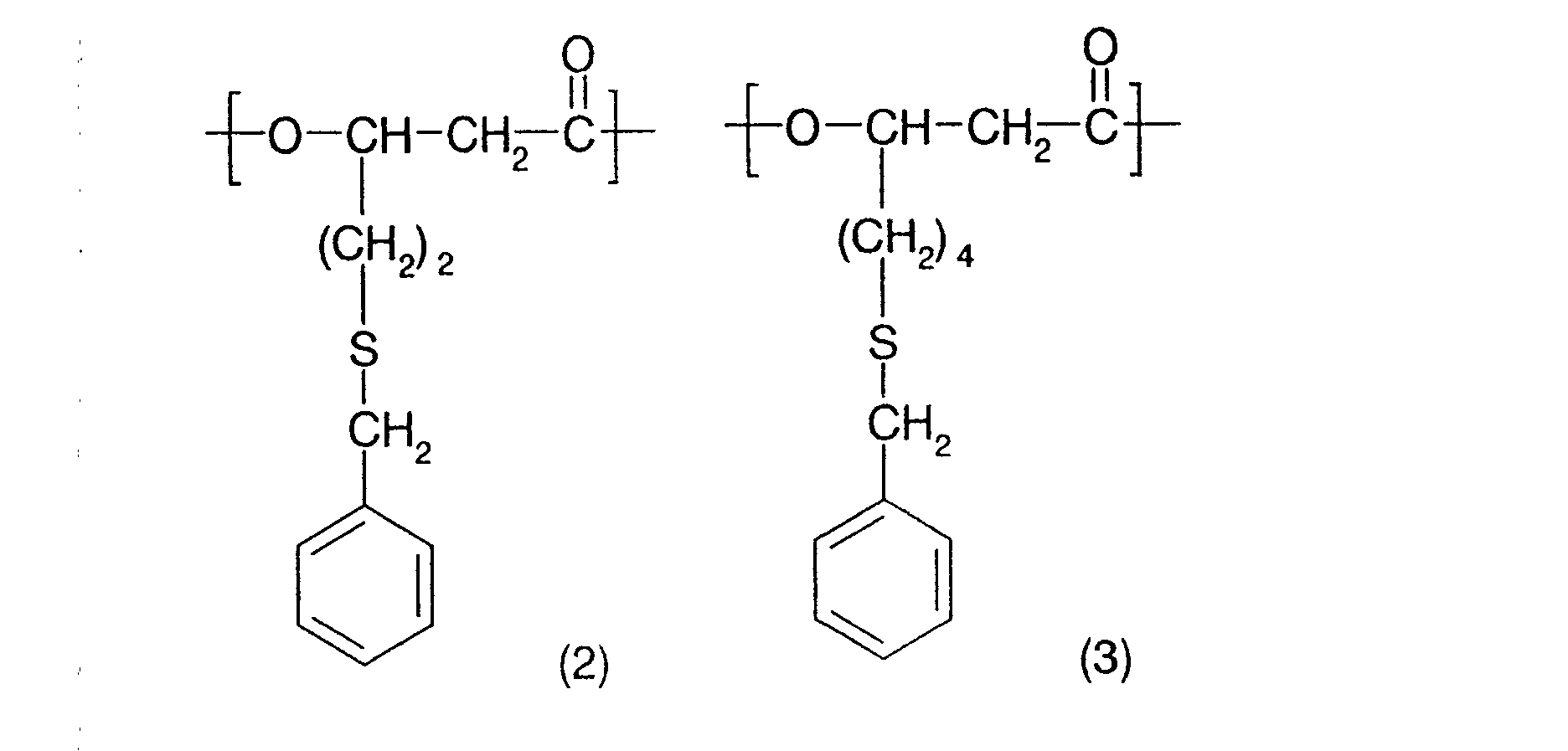

For example, the microorganisms may be those belonging to the genus Pseudomonas having PHA-producing capabilities.
| (M9 Medium) | |
| Na2HPO4 | 6.2 g |
| KH2PO4 | 3.0 g |
| NaCl | 0.5 g |
| NH4Cl | 1.0 g |
| (Trace Ingredient Solution) |
| Nitrilotriacetic Acid: 1.5 g; MgSO4: 3.0 g; |
| MnSO4: 0.5 g; NaCl: 1.0 g; FeSO4: 0.1 g; |
| CaCl2: 0.1 g; CoCl2: 0.1 g; ZnSO4: 0.1 g; |
| CuSO4: 0.1 g; AlK(SO4)2: 0.1 g; |
| H3BO3: 0.1 g; Na2MoO4: 0.1 g; NiCl2: 0.1 g |
| Chemical shifts (ppm) | Integration | Splitting patterns | Identification |
| 1.83 | 2H | qurt | d1 |
| 2.36-2.54 | 4H | m | b1, c1 |
| 3.67 | 2H | s | f1 |
| 5.20 | 1H | quint | c1 |
| 7.20 | 1H | m | j1 |
| 7.25-7.28 | 4H | m | h1, l1 & i1, k1 |
| Chemical shifts (ppm) | Identification |
| 26.6 | d1 |
| 33.0 | e1 |
| 35.9 | f1 |
| 38.6 | bl |
| 69.7 | c1 |
| 126.9 | j1 |
| 128.4 | h, l |
| 128.8 | i, k |
| 138.0 | g1 |
| 168.9 | a1 |
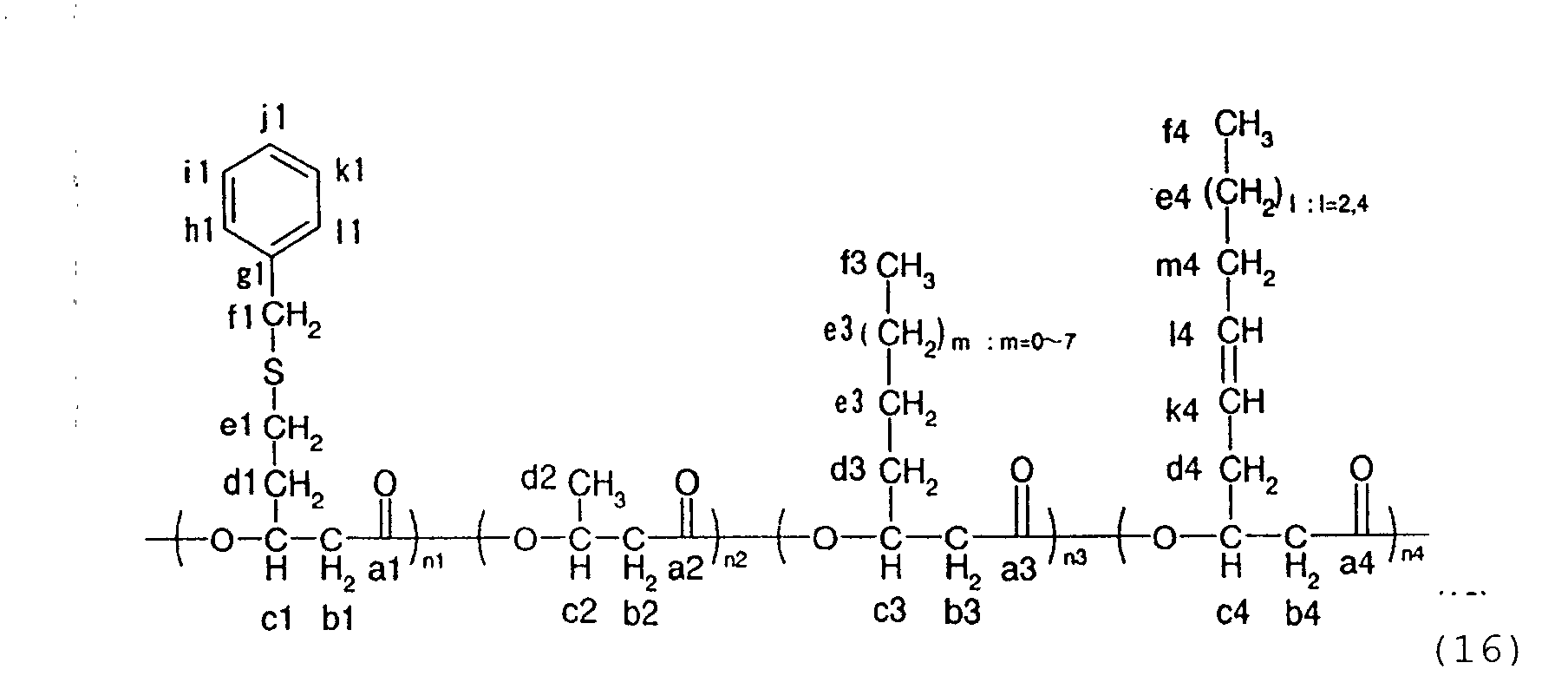
| Cell Dry Weight (mg/L) | Polymer Dry Weight (mg/L) | Polymer Weight/ Cell Weight (%) | 3HBzyTV Unit mol% | |
| Example 1 | 1070 | 795 | 74.3 | 85.9 |
| Example 2 | 875 | 690 | 78.9 | 95.2 |
| Example 3 | 1015 | 820 | 80.8 | 96.7 |
| Example 4 | 1070 | 805 | 75.2 | 83.8 |
| Example 5 | 710 | 565 | 79.6 | 96.2 |
| Example 6 | 940 | 630 | 67.0 | 89.8 |
| Example 7 | 705 | 450 | 63.8 | 29.2 |
| Example 8 | 815 | 515 | 63.2 | 96.0 |
| Example 9 | 995 | 435 | 43.7 | 86.4 |
| Chemical shift (ppm) | Integration | Splitting pattern | Identification |
| 2.48-2.71 | 4H | m | B5, d5 |
| 3.68 | 2H | m | e5 |
| 5.27 | 1H | m | c5 |
| 7.18 | 1H | m | i5 |
| 7.25 | 4H | m | g5, k5, h5, j5 |

| Cell Dry Weight (mg/L) | Polymer Dry Weight (mg/L) | Polymer Weight/ Cell Weight (%) | 3HBzyTB Unit mol% | |
| Example 10 | 1040 | 195 | 18.8 | 85.4 |
| Example 11 | 655 | 340 | 51.9 | 27.7 |
| Example 12 | 955 | 360 | 37.7 | 50.3 |
| Example 13 | 1370 | 740 | 54.0 | 66.7 |
| Example 14 | 580 | 100 | 17.2 | 57.2 |
| Example 15 | 915 | 320 | 35.0 | 31.6 |

| Cell Dry Weight (mg/L) | Polymer Dry Weight (mg/L) | Polymer Weight/ Cell Weight (%) | 3HMBzyTV Unit mol% | |
| Example 16 | 805 | 481 | 59.8 | 41.0 |
| Example 17 | 625 | 408 | 65.3 | 56.2 |
| Example 18 | 710 | 377 | 53.1 | 38.8 |
| Chemical shifts (ppm) | Integration | Splitting patterns | Identification |
| 1.83 | 2H | qurt | d1 |
| 2.35-2.58 | 4H | m | b1, e1 |
| 3.64 | 2H | s | f1 |
| 5.20 | 1H | m | c1 |
| 6.92-6.98 | 2H | m | j1, k1 |
| 7.23-7.26 | 2H | m | h1, l1 |
| Chemical shifts (ppm) | Identification |
| 26.7 | d1 |
| 33.2 | e1 |
| 35.3 | f1 |
| 38.6 | b1 |
| 69.7 | c1 |
| 115.1 & 115.4 | i1, k1 |
| 130.3 & 130.3 | h1, l1 |
| 133.7 | g1 |
| 160.6 & 163.0 | i1 |
| 168.9 | a1 |
More specifically, the PHA has a structure represented by the following chemical formula (19):
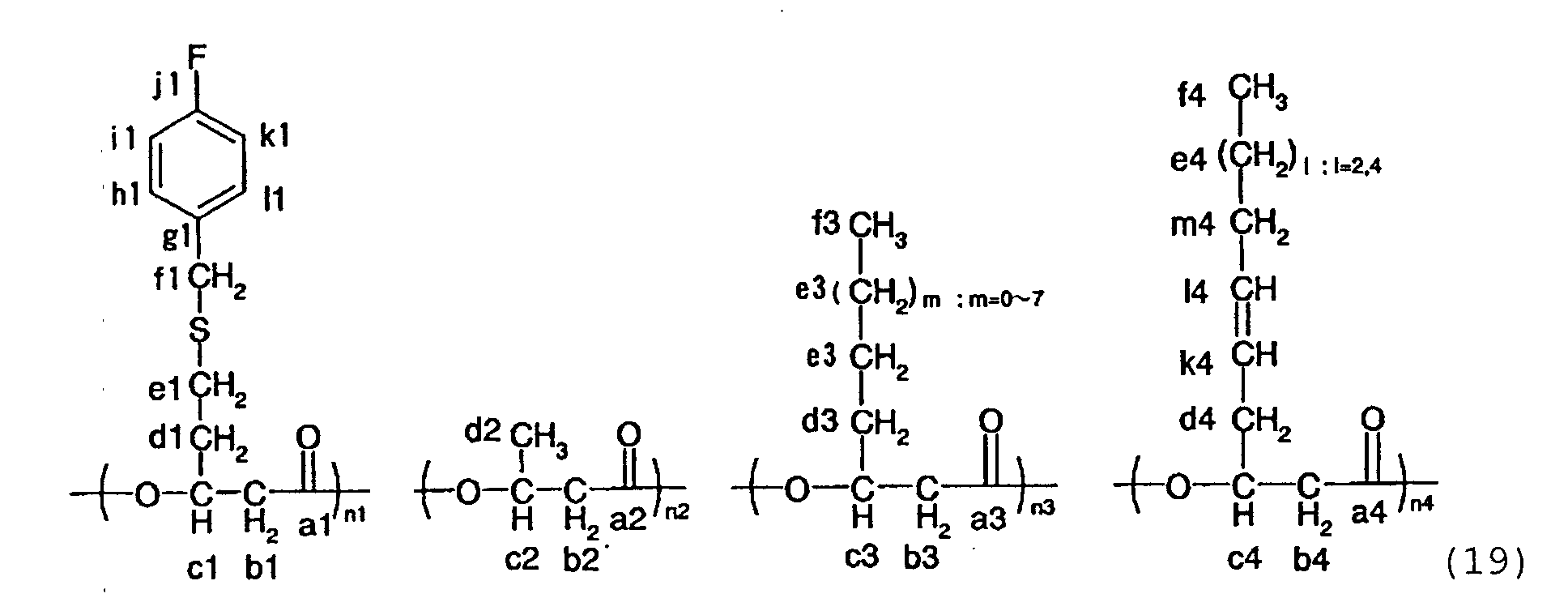
| Cell Dry Weight (mg/L) | Polymer Dry Weight (mg/L) | Polymer Weight/ Cell Weight (%) | 3HFBzyTV Unit mol% | |
| Example 19 | 945 | 530 | 56.1 | 76.7 |
| Example 20 | 680 | 445 | 65.4 | 27.0 |
| Example 21 | 915 | 345 | 37.7 | 76.7 |
| Example 22 | 740 | 340 | 45.9 | 90.3 |
| Example 23 | 1120 | 820 | 73.2 | 85.9 |
| Example 24 | 940 | 690 | 73.4 | 90.7 |
| Example 25 | 955 | 690 | 72.3 | 88.5 |
| Example 26 | 1015 | 625 | 61.6 | 89.5 |
| Example 27 | 1125 | 770 | 68.4 | 97.9 |
| Example 28 | 1215 | 790 | 65.0 | 91.6 |
| Chemical shifts (ppm) | Integration | Splitting patterns | Identification |
| 2.40-2.72 | 4H | m | b1, d1 |
| 3.65 | 2H | m | e1 |
| 5.27 | 1H | m | c1 |
| 6.95 | 2H | m | h1, j1 |
| 7.23 | 2H | m | g1, k1 |
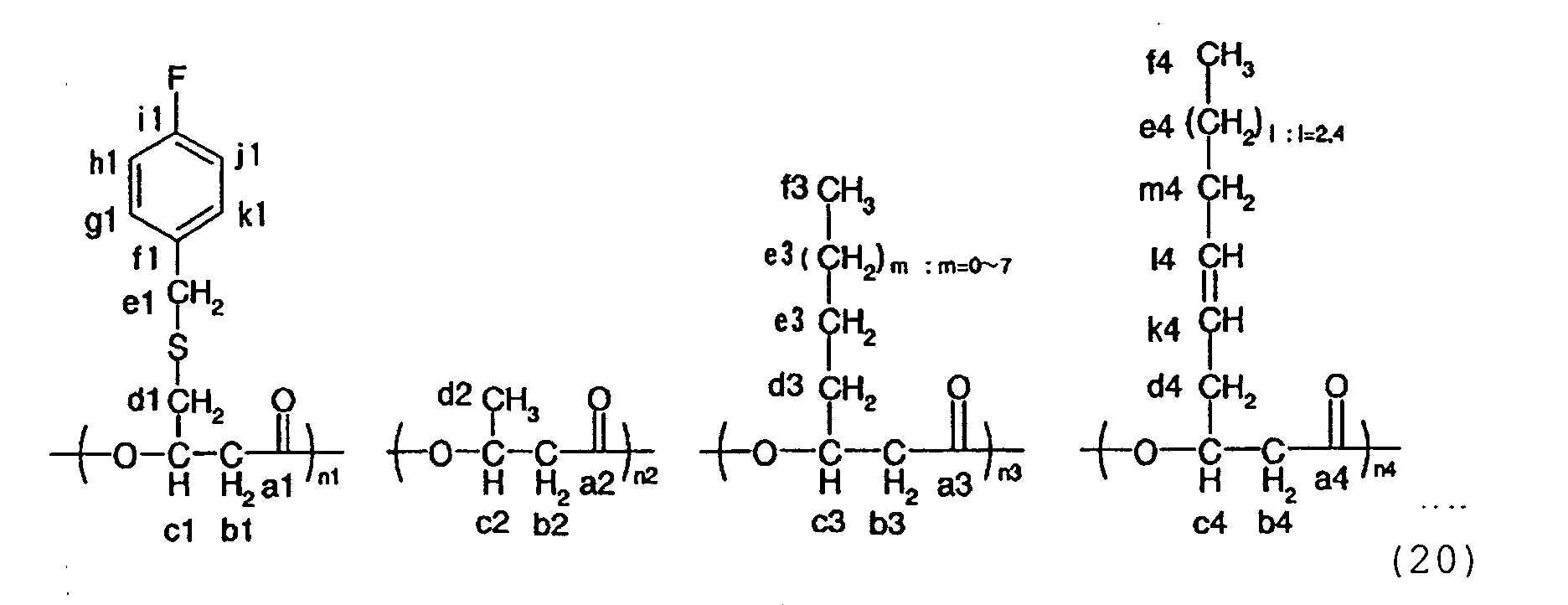
| Cell Dry Weight (mg/L) | Polymer Dry Weight (mg/L) | Polymer Weight/ Cell Weight (%) | 3HFBzyTB Unit mol% | |
| Example 29 | 975 | 205 | 21.0 | 89.8 |
| Example 30 | 515 | 225 | 43.7 | 10.6 |
| Example 31 | 955 | 55 | 5.8 | 84.1 |
| Example 32 | 1365 | 765 | 56.0 | 68.5 |
| Example 33 | 515 | 190 | 30.1 | 43.1 |
| Example 34 | 780 | 235 | 36.9 | 48.7 |
Claims (37)
- A polyhydroxyalkanoate comprising a unit represented by the following chemical formula (1):wherein R1 is a substituent of an aromatic ring selected from the group consisting of H, CH3, C2H5, CH3CH2CH2, (CH3)2CH, (CH3)3C, a halogen atom, CN, NO2, COOR', and SO2R", wherein R' is selected from the group consisting of H, Na, K, CH3, and C2H5, and R" is selected from the group consisting of OH, a halogen atom, ONa, OK, OCH3, and OC2H5; and x represents an integer of 1 to 8 being the same or different each other in the polyhydroxyalkanoate, with the proviso that the polyhydroxyalkanoate does not consist of two units represented by the following chemical formulae (2) and (3):
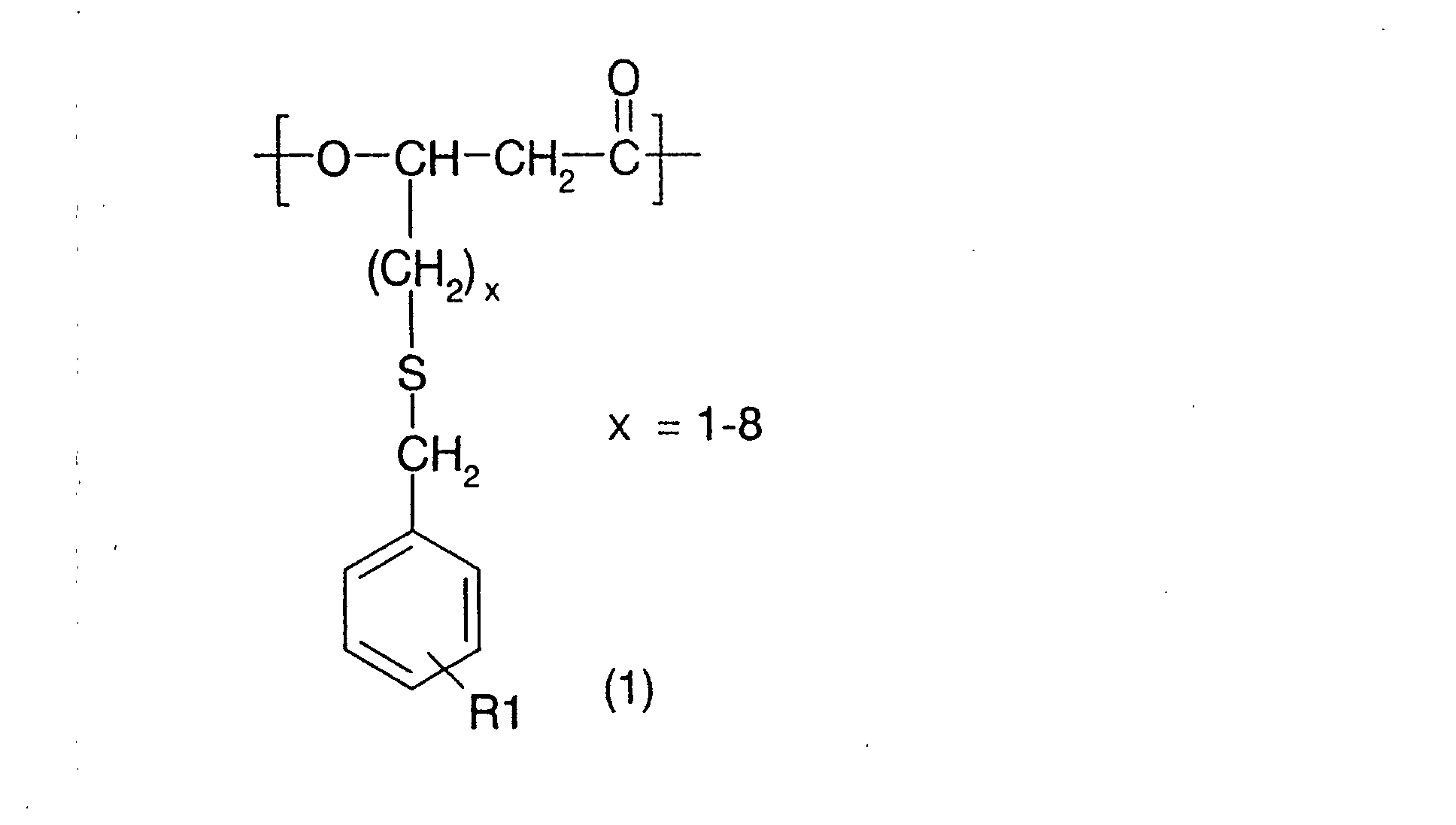

- The polyhydroxyalkanoate according to claim 1, wherein the polyhydroxyalkanoate further comprises one or more units selected from the group consisting of units represented by the following chemical formulae (4) and (5):wherein y is an integer of 0 - 8, and z is an integer of 3 or 5.

- The polyhydroxyalkanoate according to claim 1, wherein the polyhydroxyalkanoate comprises a unit of 3-hydroxy-5-[(phenylmethyl)sulfanyl]valerate represented by the following chemical formula (2):
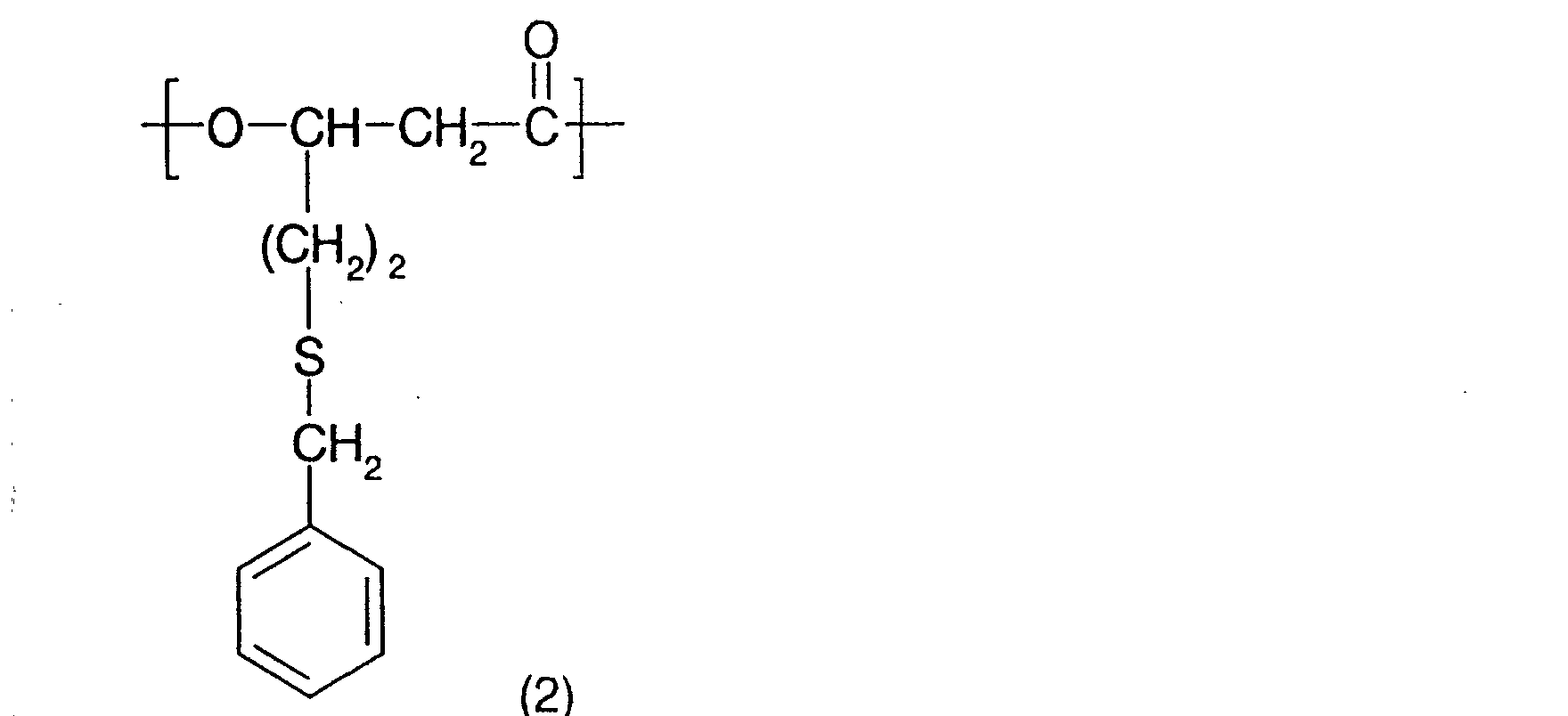
- The polyhydroxyalkanoate according to claim 1, wherein the polyhydroxyalkanoate comprises a unit of 3-hydroxy-4-[(phenylmethyl)sulfanyl]butyrate represented by the following chemical formula (6):
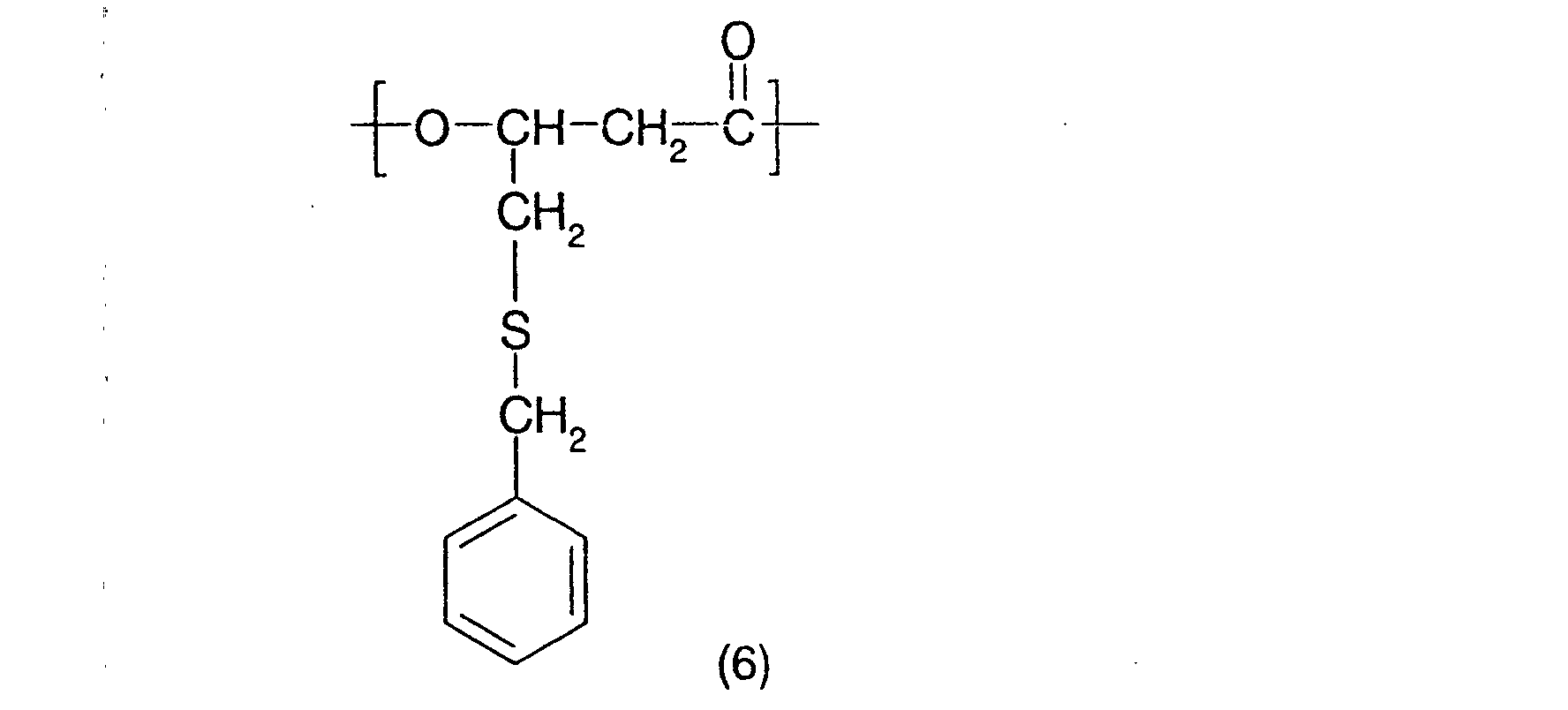
- The polyhydroxyalkanoate according to claim 1, the polyhydroxyalkanoate comprises a unit of 3-hydroxy-5-{[(4-methylphenyl)methyl]sulfanyl}valerate represented by the following chemical formula (7):
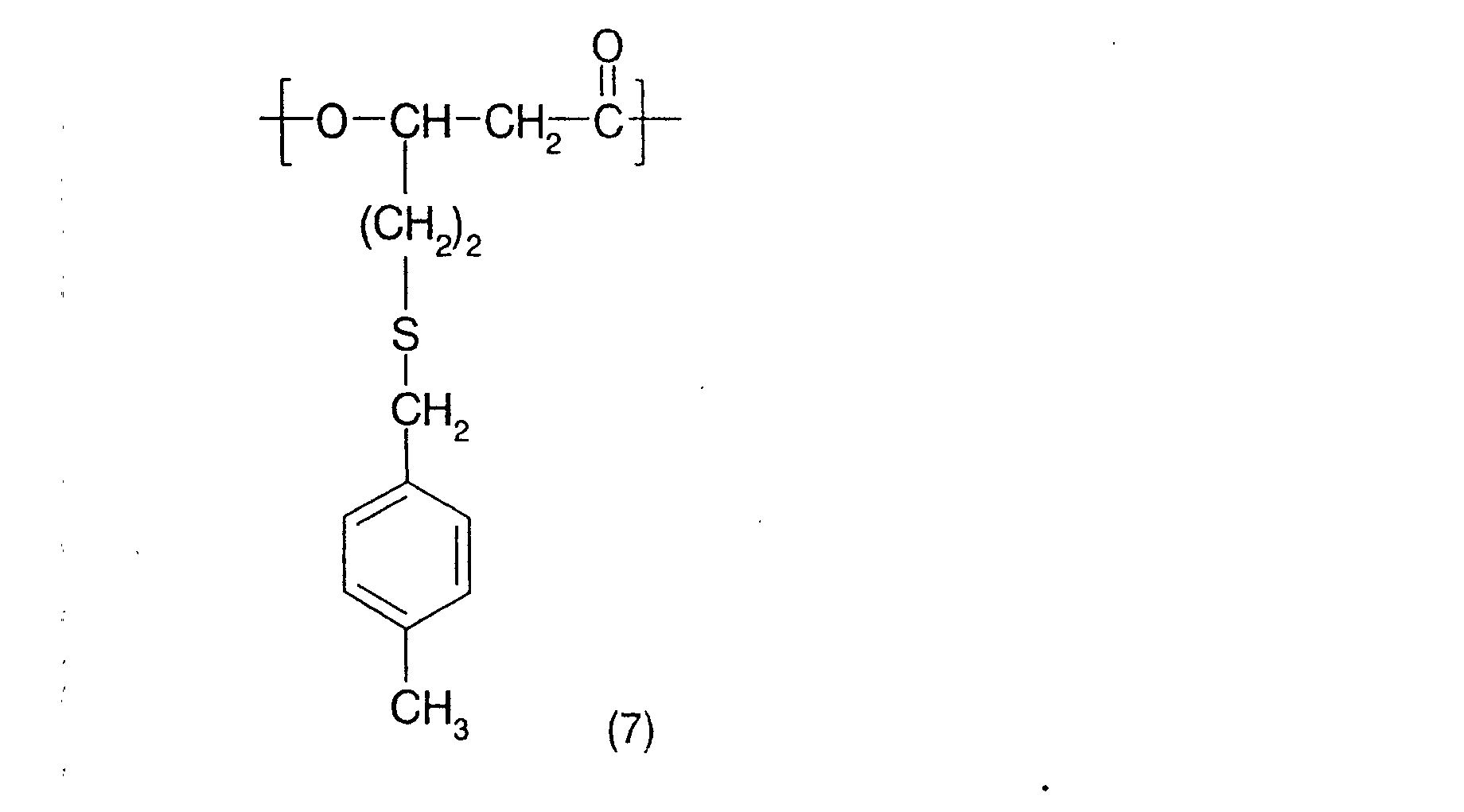
- The polyhydroxyalkanoate according to claim 1, wherein the polyhydroxyalkanoate comprises a unit of 3-hydroxy-5-{[(4-fluorophenyl)methyl]sulfanyl}valerate represented by the following general formula (8):
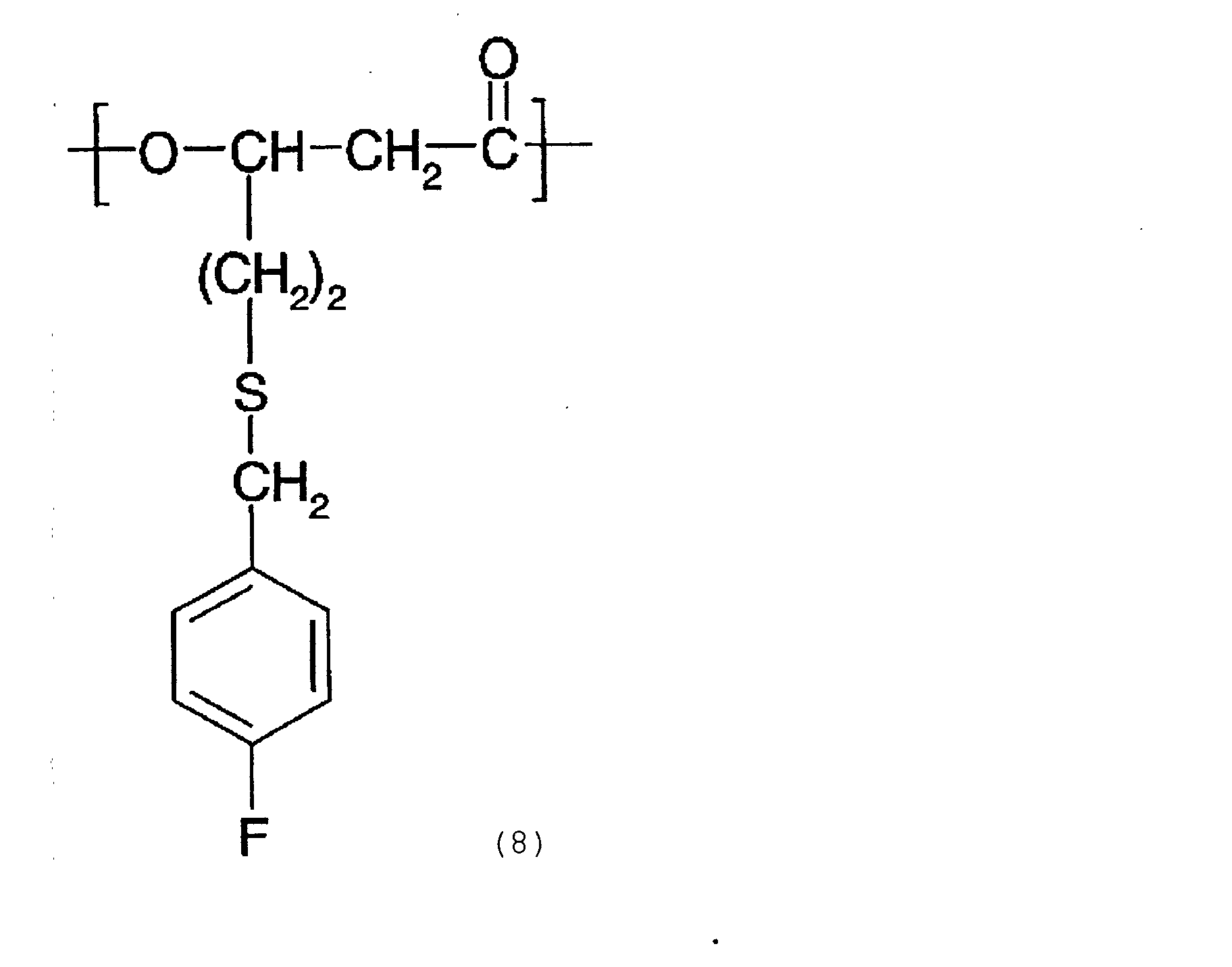
- The polyhydroxyalkanoate according to claim 1, wherein the polyhydroxyalkanoate comprises a unit of 3-hydroxy-4-{[(4-fluorophenyl)methyl]sulfanyl}butyrate represented by the following chemical formula (9):

- The polyhydroxyalkanoate according to claim 1, wherein the polyhydroxyalkanoate has a number average molecular weight within a range of 5,000 to 300,000.
- A process for producing a polyhydroxyalkanoate that comprises a unit represented by the following chemical formula (1):wherein R1 is a substituent of an aromatic ring selected from the group consisting of H, CH3, C2H5, CH3CH2CH2, (CH3)2CH, (CH3)3C, a halogen atom, CN, NO2, COOR', and SO2R", wherein R' is selected from the group consisting of H, Na, K, CH3, and C2H5, and R" is selected from the group consisting of OH, a halogen atom, ONa, OK, OCH3, and OC2H5; and x represents an integer of 1 to 8 being the same or different each other in the polyhydroxyalkanoate,
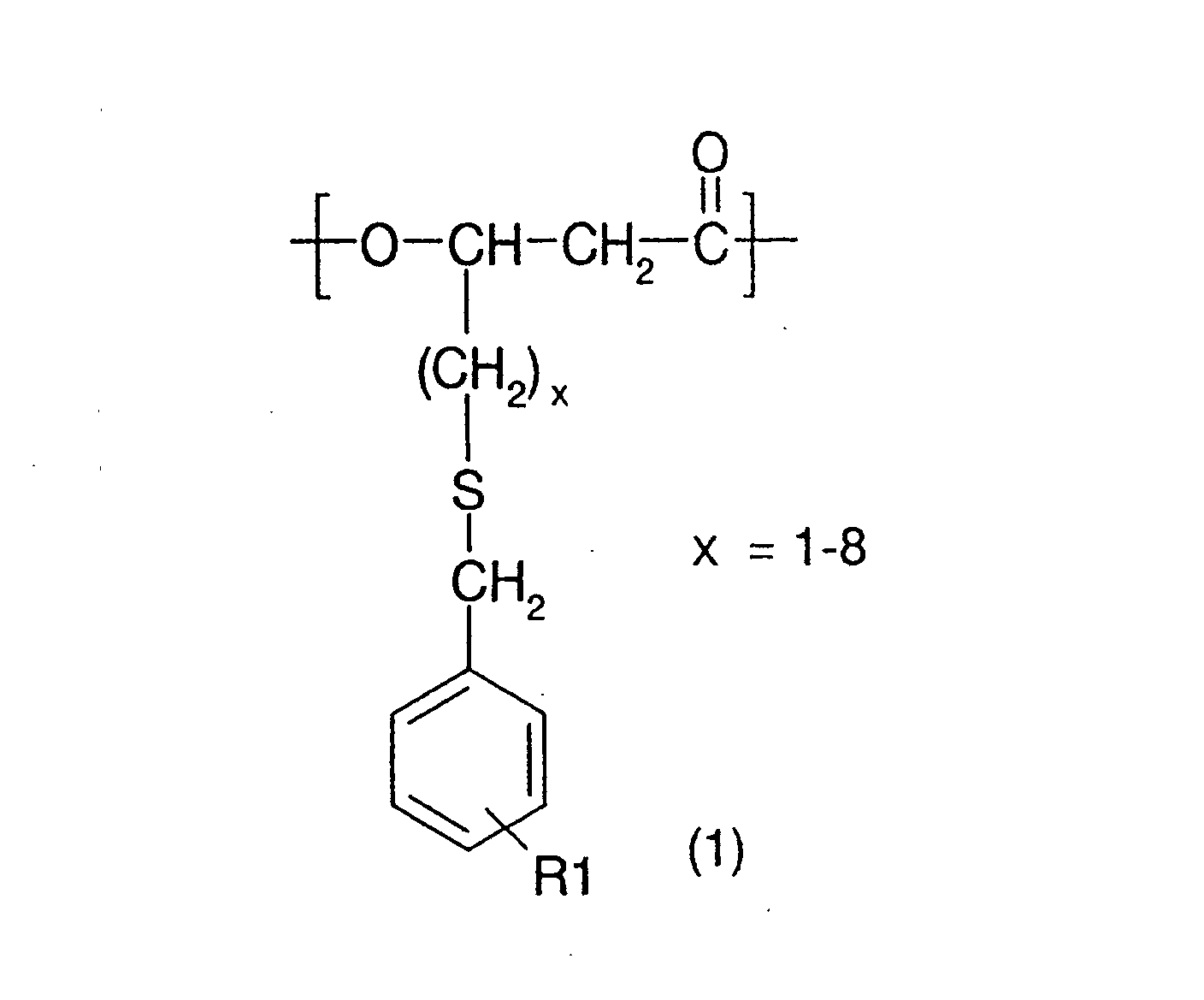
comprising the step of:wherein R2 is a substituent of an aromatic ring and selected the group consisting of H, CH3, C2H5, CH3CH2CH2, (CH3)2CH, (CH3)3C, a halogen atom, CN, NO2, COOR' and SO2R", wherein R' is selected from the group consisting of H, Na, K, CH3, and C2H5, and R" is selected from the group consisting of OH, a halogen atom, ONa, OK, OCH3, and OC2H5; and k represents an integer of 1 to 8.cultivating a microorganism in a culture medium containing a compound represented by the following chemical formula (10):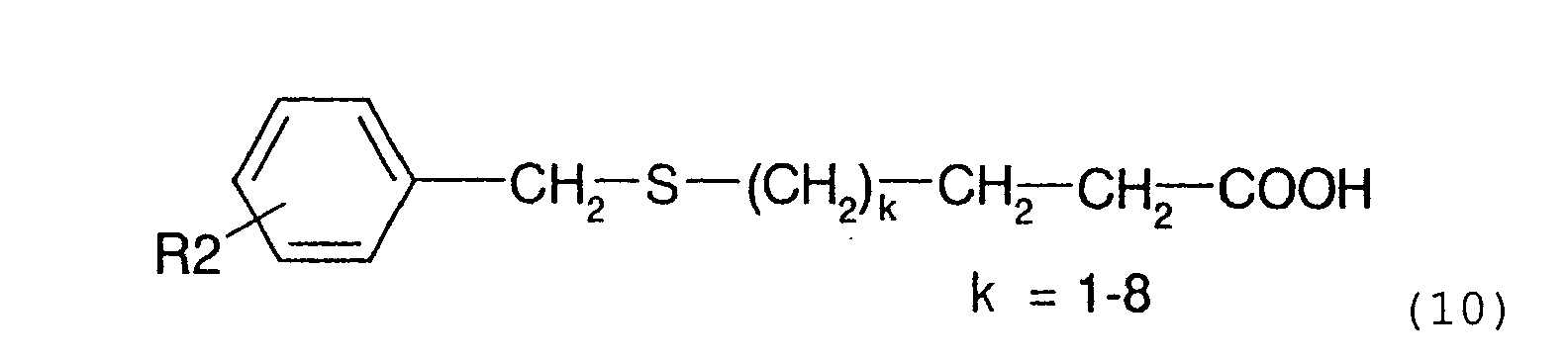
- The process according to claim 9, wherein the polyhydroxyalkanoate further comprises one or more units selected from the group consisting of units represented by the following chemical formulae (4) and (5):wherein y is an integer of 0 - 8, and z is an integer of 3 or 5.

- A process for producing a polyhydroxyalkanoate that comprises a unit represented by the following chemical formula (1):wherein R1 is a substituent of an aromatic ring selected from the group consisting of H, CH3, C2H5, CH3CH2CH2, (CH3)2CH, (CH3)3C, a halogen atom, CN, NO2, COOR', and SO2R", wherein R' is selected from the group consisting of H, Na, K, CH3, and C2H5, and R" is selected from the group consisting of OH, a halogen atom, ONa, OK, OCH3, and OC2H5; and x represents an integer of 1 to 8 being the same or different each other in the polyhydroxyalkanoate,
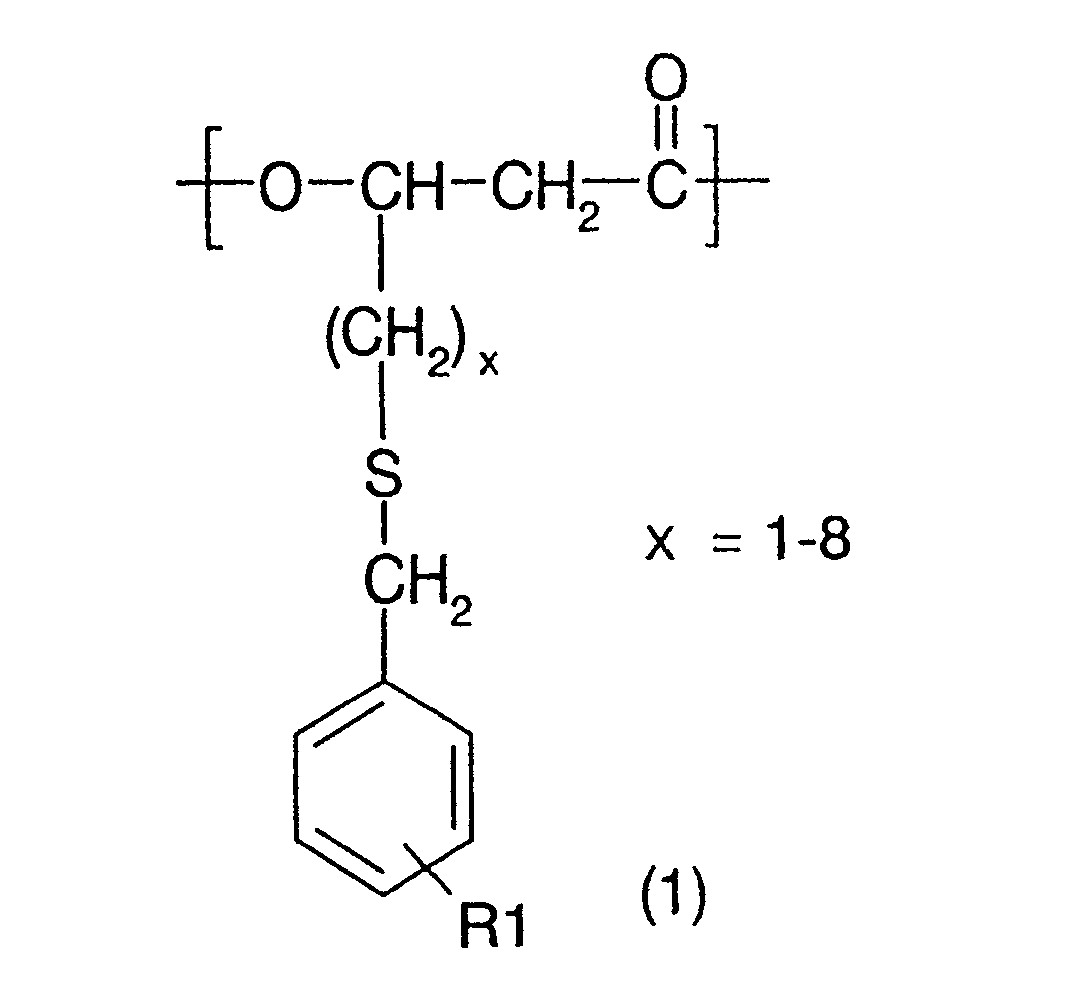
comprising the step of:wherein R2 is a substituent of an aromatic ring and selected the group consisting of H, CH3, C2H5, CH3CH2CH2, (CH3)2CH, (CH3)3C, a halogen atom, CN, NO2, COOR' and SO2R", wherein R' is selected from the group consisting of H, Na, K, CH3, and C2H5, and R" is selected from the group consisting of OH, a halogen atom, ONa, OK, OCH3, and OC2H5; and k represents an integer of 1 to 8, wherein the culture medium further contains polypeptone.cultivating a microorganism in a culture medium containing a compound represented by the following chemical formula (10):
- A process for producing a polyhydroxyalkanoate that comprises a unit represented by the following chemical formula (1):wherein R1 is a substituent of an aromatic ring selected from the group consisting of H, CH3, C2H5, CH3CH2CH2, (CH3)2CH, (CH3)3C, a halogen atom, CN, NO2, COOR', and SO2R", wherein R' is selected from the group consisting of H, Na, K, CH3, and C2H5, and R" is selected from the group consisting of OH, a halogen atom, ONa, OK, OCH3, and OC2H5; and x represents an integer of 1 to 8 being the same or different each other in the polyhydroxyalkanoate,
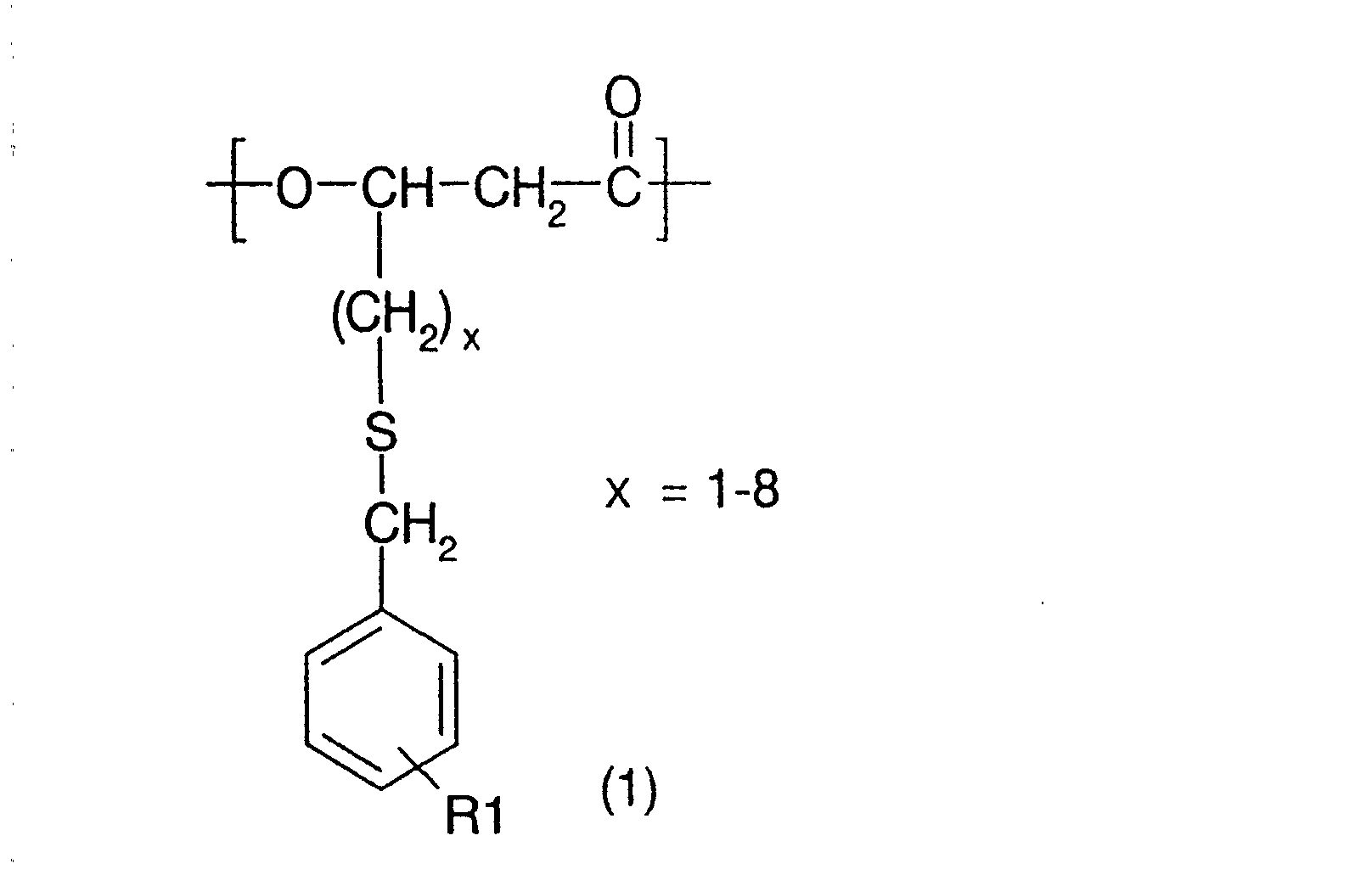
comprising the step of:wherein R2 is a substituent of an aromatic ring and selected the group consisting of H, CH3, C2H5, CH3CH2CH2, (CH3)2CH, (CH3)3C, a halogen atom, CN, NO2, COOR' and SO2R", wherein R' is selected from the group consisting of H, Na, K, CH3, and C2H5, and R" is selected from the group consisting of OH, a halogen atom, ONa, OK, OCH3, and OC2H5; and k represents an integer of 1 to 8, wherein the culture medium further contains yeast extract.cultivating a microorganism in a culture medium containing a compound represented by the following chemical formula (10):
- A process for producing a polyhydroxyalkanoate that comprises a unit represented by the following chemical formula (1) :wherein R1 is a substituent of an aromatic ring selected from the group consisting of H, CH3, C2H5, CH3CH2CH2, (CH3)2CH, (CH3)3C, a halogen atom, CN, NO2, COOR', and SO2R", wherein R' is selected from the group consisting of H, Na, K, CH3, and C2H5, and R" is selected from the group consisting of OH, a halogen atom, ONa, OK, OCH3, and OC2H5; and x represents an integer of 1 to 8 being the same or different each other in the polyhydroxyalkanoate,
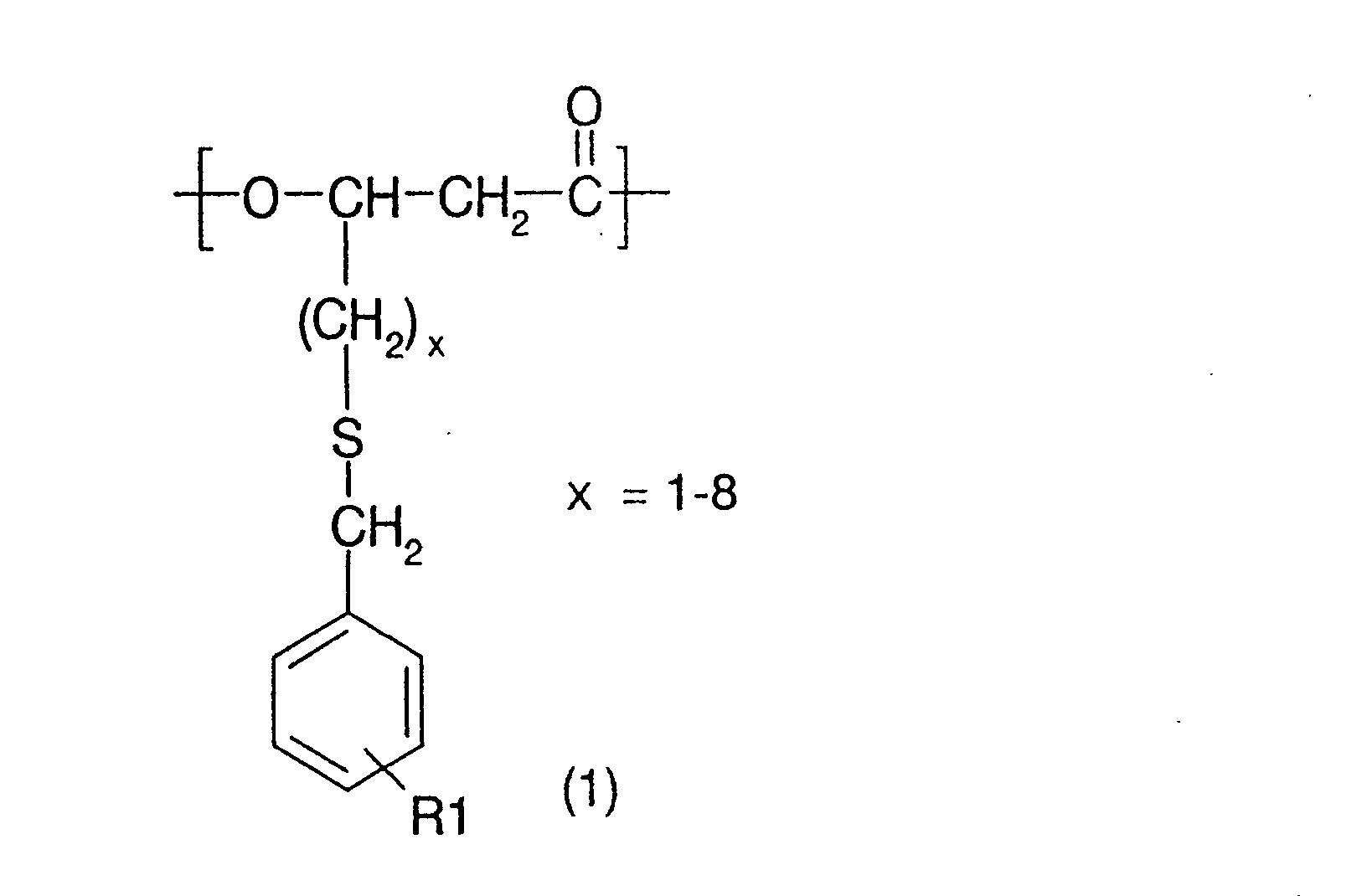
comprising the step of:wherein R2 is a substituent of an aromatic ring and selected the group consisting of H, CH3, C2H5, CH3CH2CH2, (CH3)2CH, (CH3)3C, a halogen atom, CN, NO2, COOR' and SO2R", wherein R' is selected from the group consisting of H, Na, K, CH3, and C2H5, and R" is selected from the group consisting of OH, a halogen atom, ONa, OK, OCH3, and OC2H5; and k represents an integer of 1 to 8, wherein the culture medium further contains a saccharide.cultivating a microorganism in a culture medium containing a compound represented by the following chemical formula (10):
- The process according to claim 13, wherein the saccharide is one or more compounds selected from the group consisting of glyceraldehyde, erythrose, arabinose, xylose, glucose, galactose, mannose, fructose, glycerol, erythritol, xylitol, gluconic acid, glucuronic acid, galacturonic acid, maltose, sucrose, and lactose.
- A process for producing a polyhydroxyalkanoate that comprises a unit represented by the following chemical formula (1):wherein R1 is a substituent of an aromatic ring selected from the group consisting of H, CH3, C2H5, CH3CH2CH2, (CH3)2CH, (CH3)3C, a halogen atom, CN, NO2, COOR', and SO2R", wherein R' is selected from the group consisting of H, Na, K, CH3, and C2H5, and R" is selected from the group consisting of OH, a halogen atom, ONa, OK, OCH3, and OC2H5; and x represents an integer of 1 to 8 being the same or different each other in the polyhydroxyalkanoate,

comprising the step of:wherein R2 is a substituent of an aromatic ring and selected the group consisting of H, CH3, C2H5, CH3CH2CH2, (CH3)2CH, (CH3)3C, a halogen atom, CN, NO2, COOR' and SO2R", wherein R' is selected from the group consisting of H, Na, K, CH3, and C2H5, and R" is selected from the group consisting of OH, a halogen atom, ONa, OK, OCH3, and OC2H5; and k represents an integer of 1 to 8, wherein the culture medium further contains an organic acid or a salt thereof.cultivating a microorganism in a culture medium containing a compound represented by the following chemical formula (10):
- The process according to claim 15, wherein the organic acid or a salt thereof is one or more compounds selected from the group consisting of pyruvic acid, malic acid, lactic acid, citric acid, succinic acid and salts thereof.
- A process for producing a polyhydroxyalkanoate that comprises a unit represented by the following chemical formula (1):wherein R1 is a substituent of an aromatic ring selected from the group consisting of H, CH3, C2H5, CH3CH2CH2, (CH3)2CH, (CH3)3C, a halogen atom, CN, NO2, COOR', and SO2R", wherein R' is selected from the group consisting of H, Na, K, CH3, and C2H5, and R" is selected from the group consisting of OH, a halogen atom, ONa, OK, OCH3, and OC2H5; and x represents an integer of 1 to 8 being the same or different each other in the polyhydroxyalkanoate,

comprising the step of:wherein R2 is a substituent of an aromatic ring and selected the group consisting of H, CH3, C2H5, CH3CH2CH2, (CH3)2CH, (CH3)3C, a halogen atom, CN, NO2, COOR' and SO2R", wherein R' is selected from the group consisting of H, Na, K, CH3, and C2H5, and R" is selected from the group consisting of OH, a halogen atom, ONa, OK, OCH3, and OC2H5; and k represents an integer of 1 to 8, wherein the culture medium further contains an amino acid or a salt thereof.cultivating a microorganism in a culture medium containing a compound represented by the following chemical formula (10):
- The process according to claim 17, wherein the amino acid or a salt thereof is one or more compounds selected from the group consisting of glutamic acid, aspartic acid, and salts thereof.
- A process for producing a polyhydroxyalkanoate that comprises a unit represented by the following chemical formula (1):wherein R1 is a substituent of an aromatic ring selected from the group consisting of H, CH3, C2H5, CH3CH2CH2, (CH3)2CH, (CH3)3C, a halogen atom, CN, NO2, COOR', and SO2R", wherein R' is selected from the group consisting of H, Na, K, CH3, and C2H5, and R" is selected from the group consisting of OH, a halogen atom, ONa, OK, OCH3, and OC2H5; and x represents an integer of 1 to 8 being the same or different each other in the polyhydroxyalkanoate,

comprising the step of:wherein R2 is a substituent of an aromatic ring and selected the group consisting of H, CH3, C2H5, CH3CH2CH2, (CH3)2CH, (CH3)3C, a halogen atom, CN, NO2, COOR' and SO2R", wherein R' is selected from the group consisting of H, Na, K, CH3, and C2H5, and R" is selected from the group consisting of OH, a halogen atom, ONa, OK, OCH3, and OC2H5; and k represents an integer of 1 to 8, wherein the culture medium further contains a straight chain alkanoic acid having 4 to 12 carbon atoms, or a salt thereof.cultivating a microorganism in a culture medium containing a compound represented by the following chemical formula (10):
- The process according to claim 9, wherein cultivation of the microorganism comprises two or more cultivation steps.
- The process according to claim 20, wherein the culture medium in the steps later than the first step contains no nitrogen source.
- The process according to claim 20, wherein the cultivation step comprises the steps of:(1-1) cultivating the microorganism in a culture medium that contains at least one compound represented by the chemical formula (10) and polypeptone;(1-2) further cultivating the microorganism from the step 1-1 in a culture medium containing the compound represented by the chemical formula (10) and an organic acid or a salt thereof.
- The process according to claim 22, wherein the organic acid or a salt thereof is one or more compounds selected from the group consisting of pyruvic acid, malic acid, lactic acid, citric acid, succinic acid and salts thereof.
- The process according to claim 20, wherein the cultivation step comprises the steps of:(1-3) cultivating the microorganism in a culture medium containing at least one compound represented by the chemical formula (10) and a saccharide, and(1-4) cultivating the microorganism from the step 1-3 in a culture medium containing the compound represented by the chemical formula (10) and a saccharide.
- The process according to claim 24, wherein the saccharide is one or more compounds selected from the group consisting of glyceraldehyde, erythrose, arabinose, xylose, glucose, galactose, mannose, fructose, glycerol, erythritol, xylitol, gluconic acid, glucuronic acid, galacturonic acid, maltose, sucrose, and lactose.
- The process according to claim 9, wherein the microorganism is cultivated in a culture medium containing 5-[(phenylmethyl)sulfanyl]valeric acid represented by the following chemical formula (11) to produce a polyhydroxyalkanoate comprising a unit of 3-hydroxy-5-[(phenylmethyl)sulfanyl]valerate represented by the following chemical formula (2):

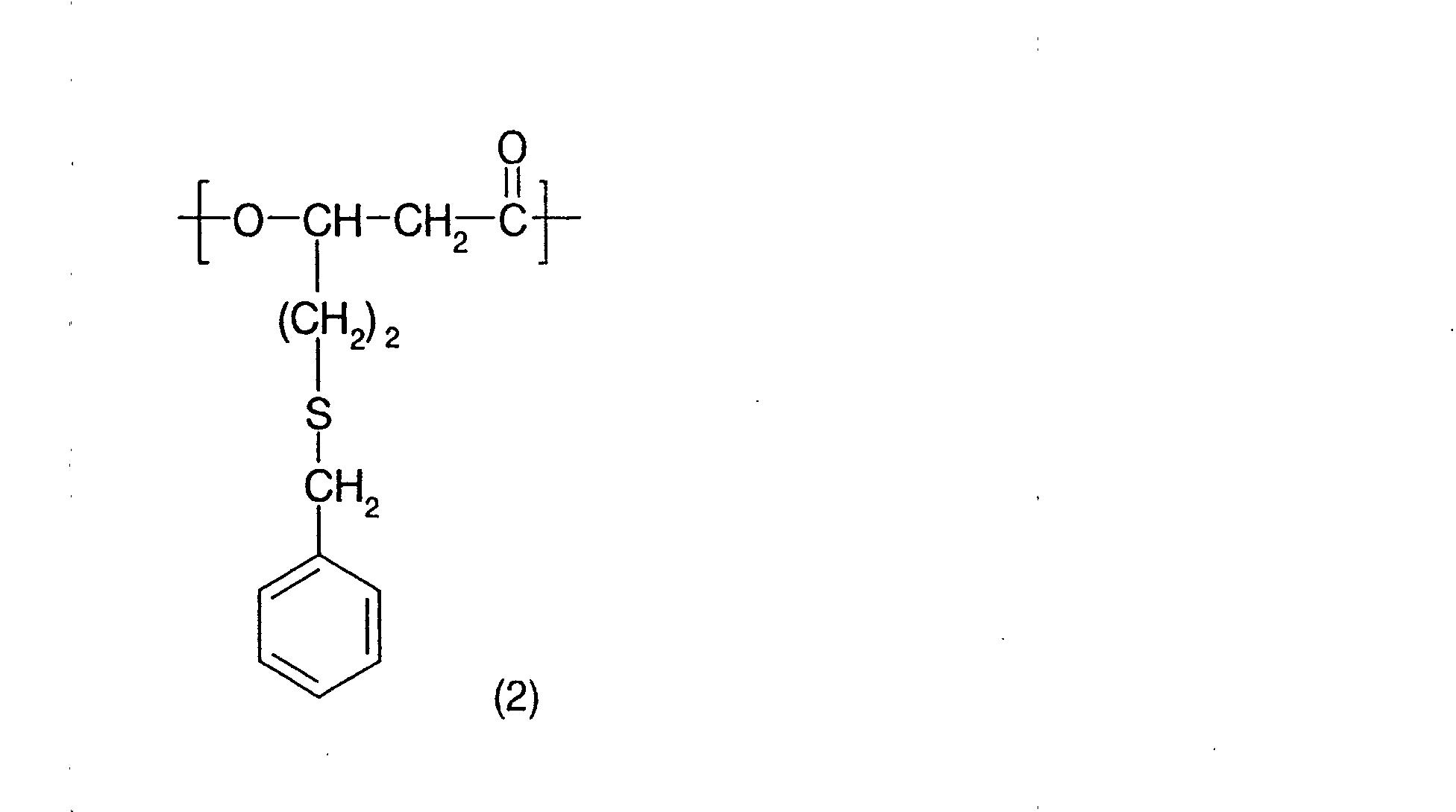
- The process according to any one of claims 9 to 17, wherein the microorganism is cultivated in a culture medium containing 4-[(phenylmethyl)sulfanyl]butyric acid represented by the following chemical formula (12) to produce a polyhydroxyalkanoate comprising a unit of 3-hydroxy-4-[(phenylmethyl)sulfanyl]butyrate represented by the following chemical formula (6):


- The process according to claim 9, wherein the microorganism is cultivated in a culture medium containing 5-{[(4-methylphenyl)methyl]sulfanyl}valeric acid represented by the following chemical formula (13) to produce a polyhydroxyalkanoate comprising a unit of 3-hydroxy-5-{[(4-methylphenyl)methyl]sulfanyl}valerate represented by the following chemical formula (7):


- The process according to claim 9, wherein the microorganism is cultivated in a culture medium that contains 5-{[(4-fluorophenyl)methyl]sulfanyl}valeric acid represented by the following chemical formula (14):to produce a polyhydroxyalkanoate comprising a unit of 3-hydroxy-5-{[(4-fluorophenyl)methyl]sulfanyl}valerate represented by the following chemical formula (8):

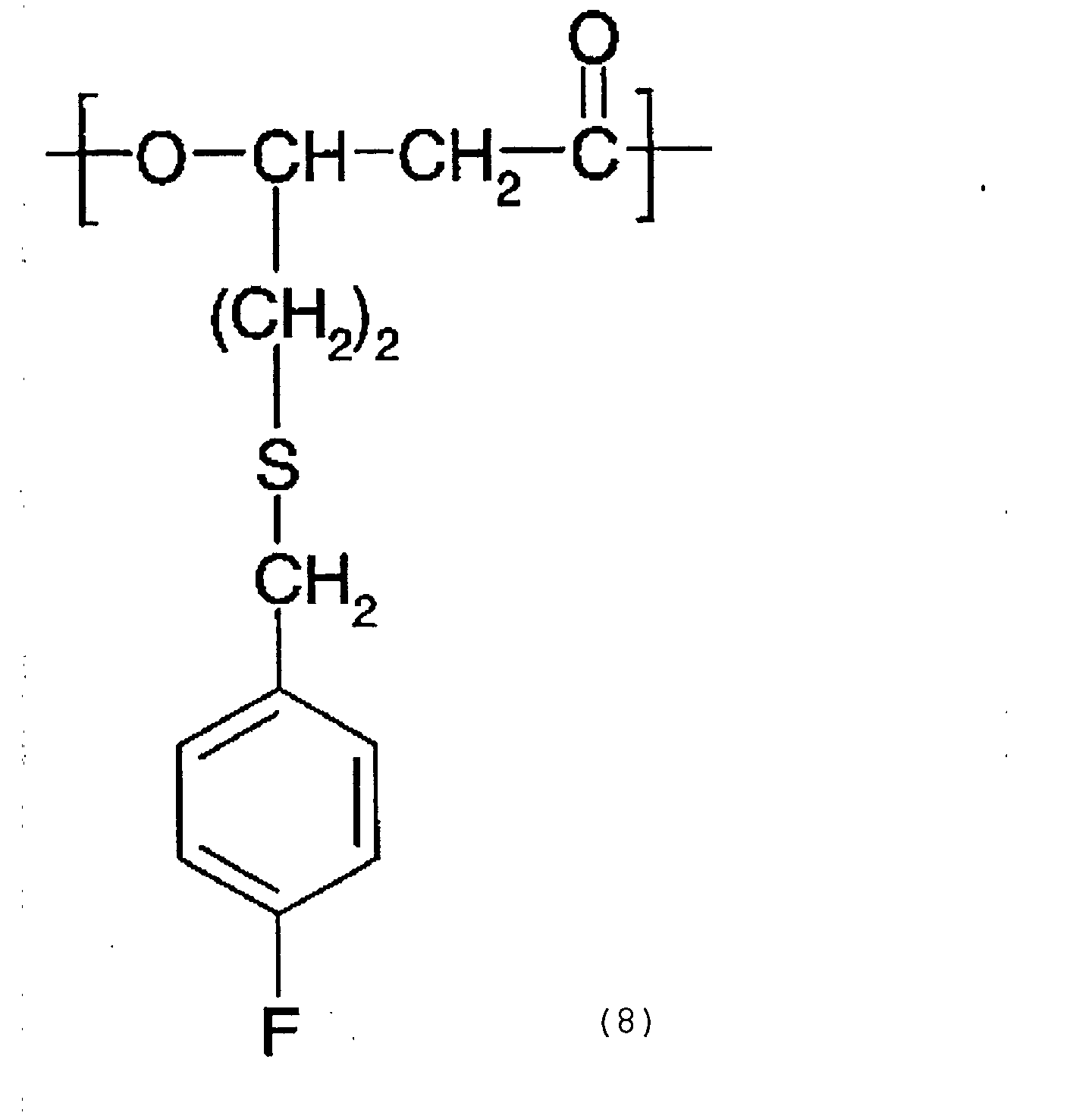
- The process according to claim 9, wherein the microorganism is cultivated in a culture medium containing 4-{[(4-fluorophenyl)methyl]sulfanyl}butyric acid represented by the following chemical formula (15):to produce a polyhydroxyalkanoate comprising a unit of 3-hydroxy-4-{[(4-fluorophenyl)methyl]sulfanyl}butyrate represented by the following chemical formula (9):


- The process according to claim 9, further comprising the step of isolating the polyhydroxyalkanoate from cells of the microorganism cultivated in the cultivation step.
- The process according to claim 31, wherein the step of isolating the polyhydroxyalkanoate comprises the step of treating with a solvent to solubilize and extract the polyhydroxyalkanoate accumulated in the cells of the microorganism cultivated in the cultivation step.
- The process according to claim 32, wherein the solvent is one or more solvents selected from the group consisting of chloroform, dichloromethane, dioxane, tetrahydrofuran, acetonitrile, and acetone.
- The process according to claim 31, wherein the step of isolating the polyhydroxyalkanoate comprises the step of disrupting cells of the microorganism.
- The process according to claim 34, wherein the cells are disrupted by ultrasonic disruption, homogenization, pressure disruption, disruption with glass beads, trituration, grinding or freeze-thawing.
- The process according to claim 9, wherein the microorganism belongs to genus Pseudomonas.
- The process according to claim 36, wherein the microorganism that belongs to genus Pseudomonas is selected from the group consisting of Pseudomonas cichorii YN2 (FERM BP-7375), Pseudomonas cichorii H45 (FERM PB-7374), and Pseudomonas jessenii P161 (FERM BP-7376).
Applications Claiming Priority (10)
| Application Number | Priority Date | Filing Date | Title |
|---|---|---|---|
| JP2001165239 | 2001-05-31 | ||
| JP2001165357 | 2001-05-31 | ||
| JP2001165239 | 2001-05-31 | ||
| JP2001165357 | 2001-05-31 | ||
| JP2001210039A JP4812061B2 (en) | 2001-05-31 | 2001-07-10 | Novel polyhydroxyalkanoate containing unit having [(substituted phenyl) methyl] sulfanyl structure in side chain and method for producing the same |
| JP2001209898 | 2001-07-10 | ||
| JP2001210039 | 2001-07-10 | ||
| JP2001209898 | 2001-07-10 | ||
| JP2002039259A JP3720774B2 (en) | 2001-05-31 | 2002-02-15 | NOVEL POLYHYDROXYALKANOATE CONTAINING UNIT HAVING (PHENYLMETHYL) SULFANIL STRUCTURE IN SIDE CHAIN AND PROCESS FOR PRODUCING THE SAME |
| JP2002039259 | 2002-02-15 |
Publications (3)
| Publication Number | Publication Date |
|---|---|
| EP1262508A2 true EP1262508A2 (en) | 2002-12-04 |
| EP1262508A3 EP1262508A3 (en) | 2003-02-26 |
| EP1262508B1 EP1262508B1 (en) | 2007-08-08 |
Family
ID=27531911
Family Applications (1)
| Application Number | Title | Priority Date | Filing Date |
|---|---|---|---|
| EP02012096A Expired - Lifetime EP1262508B1 (en) | 2001-05-31 | 2002-05-31 | Novel polyhydroxyalkanoate that comprises unit having substituted (phenylmethyl) sulfanyl structure in side chain thereof and process for producing the same |
Country Status (5)
| Country | Link |
|---|---|
| US (1) | US6911521B2 (en) |
| EP (1) | EP1262508B1 (en) |
| KR (1) | KR100491307B1 (en) |
| CN (1) | CN1184250C (en) |
| DE (1) | DE60221603T2 (en) |
Cited By (4)
| Publication number | Priority date | Publication date | Assignee | Title |
|---|---|---|---|---|
| EP1340776A1 (en) * | 2002-02-28 | 2003-09-03 | Canon Kabushiki Kaisha | Method for controlling molecular weight of polyhydroxyalkanoate constituted of units containing residue of phenyl-, thienyl-, or cyclohexyl-structure in side chain of molecule |
| US6911521B2 (en) | 2001-05-31 | 2005-06-28 | Canon Kabushiki Kaisha | Polyhydroxyalkanoate that comprises unit having substituted or unsubstituted (phenylmethyl) sulfanyl structure in side chain thereof and process for producing the same |
| US7056708B2 (en) | 2002-04-26 | 2006-06-06 | Canon Kabushiki Kaisha | Method of producing polyhydroxyalkanoate from alkane having residue containing aromatic ring in its molecule |
| US7135540B2 (en) | 2002-02-15 | 2006-11-14 | Canon Kabushiki Kaisha | Polyhydroxyalkanoate copolymer including unit having bromo group in side chain and method for producing the same |
Families Citing this family (11)
| Publication number | Priority date | Publication date | Assignee | Title |
|---|---|---|---|---|
| JP3673711B2 (en) * | 1999-12-27 | 2005-07-20 | キヤノン株式会社 | Polyhydroxyalkanoate and its production method using microorganism |
| JP3880566B2 (en) * | 2002-10-24 | 2007-02-14 | キヤノン株式会社 | NOVEL POLYHYDROXYALKANOATE CONTAINING UNIT HAVING (PHENYLMETHYL) OXY STRUCTURE IN SIDE CHAIN AND PROCESS FOR PRODUCING THE SAME |
| JP4502363B2 (en) * | 2002-10-24 | 2010-07-14 | キヤノン株式会社 | NOVEL POLYHYDROXYALKANOATE COPOLYMERS CONTAINING UNITS HAVING VINYL GROUPS IN SIDE CHAINS, NOVEL POLYHYDROXYALKANOATE COPOLYMERS CONTAINING UNITS HAVING CARBOXY GROUPS IN SIDE CHAINS, Method |
| JP4027297B2 (en) * | 2002-10-24 | 2007-12-26 | キヤノン株式会社 | NOVEL POLYHYDROXYALKANOATE AND METHOD FOR PRODUCING THE SAME; RESIN COMPOSITION CONTAINING THE SAME; NOVEL POLYHYDROXYALKANOATE-CONTAINING CHARGE CONTROL AGENT, ELECTROSTATIC IMAGE DEVELOPING TONER AND Binder Resin Composition |
| US20070003975A1 (en) * | 2003-05-02 | 2007-01-04 | Canon Kabushiki Kaisha | Structured construct and producing method therefor |
| JP2004331750A (en) * | 2003-05-02 | 2004-11-25 | Canon Inc | Magnetic structure containing polyhydroxyalkanoate, method for producing the same, and use thereof |
| WO2008049099A1 (en) * | 2006-10-21 | 2008-04-24 | Polyone Corporation | Thermoplastic polyhydroxyalkanoate compounds |
| KR100991645B1 (en) * | 2007-07-10 | 2010-11-02 | 청호나이스 주식회사 | Air Purifier with Humidification |
| US20100018674A1 (en) * | 2008-07-22 | 2010-01-28 | Donald John Enzinna | Reservoir with moveable partition for quick recovery |
| CN108485976B (en) * | 2018-03-16 | 2020-12-08 | 华中科技大学 | A screening method for heavy metal resistant microorganisms |
| WO2025179473A1 (en) * | 2024-02-28 | 2025-09-04 | 香港纺织及成衣研发中心有限公司 | Poly(3-hydroxybutyrate) polymer derivative and preparation thereof, and antimicrobial product |
Family Cites Families (39)
| Publication number | Priority date | Publication date | Assignee | Title |
|---|---|---|---|---|
| DE2911498C2 (en) | 1979-03-23 | 1987-01-29 | Fa. Andreas Stihl, 7050 Waiblingen | Portable chainsaw |
| DE3168826D1 (en) | 1980-11-18 | 1985-03-21 | Ici Plc | Polymer blends |
| US4477654A (en) | 1981-07-07 | 1984-10-16 | Imperial Chemical Industries Plc | 3-Hydroxybutyrate polymers |
| JPH0231681B2 (en) | 1983-04-14 | 1990-07-16 | Japan Synthetic Rubber Co Ltd | TETORAKARUBON SANNOSEIZOHOHO |
| NL8603073A (en) | 1986-12-02 | 1988-07-01 | Rijksuniversiteit | METHOD FOR PREPARING POLYESTERS BY FERMENTATION; METHOD FOR PREPARING OPTICALLY ACTIVE CARBONIC ACIDS AND ESTERS; POLYESTER INCLUDING PRODUCTS. |
| US4876331A (en) | 1987-08-18 | 1989-10-24 | Mitsubishi Kasei Corporation | Copolyester and process for producing the same |
| US5191016A (en) | 1990-07-19 | 1993-03-02 | Manssur Yalpani | Functionalized poly(hydroxyalkanoates) and method of manufacturing same |
| EP0475785A3 (en) | 1990-09-14 | 1993-04-14 | Mitsubishi Gas Chemical Company, Inc. | Process for preparation of copolymer |
| JPH057492A (en) | 1990-09-14 | 1993-01-19 | Mitsubishi Gas Chem Co Inc | Method for producing copolymer |
| JP2777757B2 (en) | 1991-09-17 | 1998-07-23 | 鐘淵化学工業株式会社 | Copolymer and method for producing the same |
| JPH0814967B2 (en) | 1993-02-15 | 1996-02-14 | 九州日立マクセル株式会社 | Disk cleaner |
| JPH07265065A (en) | 1994-03-29 | 1995-10-17 | Kanegafuchi Chem Ind Co Ltd | Method for producing transformant and copolymer with synthetic gene of copolymer |
| JPH0819227A (en) | 1994-06-30 | 1996-01-19 | Toshiba Corp | Coil block cutting method and cutting device therefor |
| WO1997007153A1 (en) | 1995-08-14 | 1997-02-27 | University Of Massachusetts Medical Center | Methods of controlling microbial polyester structure |
| JPH09191893A (en) | 1996-01-22 | 1997-07-29 | Taisei Corp | Method for producing hydroxyalkanoic acid copolymer |
| US5811272A (en) | 1996-07-26 | 1998-09-22 | Massachusetts Institute Of Technology | Method for controlling molecular weight of polyhydroxyalkanoates |
| US6156852A (en) | 1997-04-21 | 2000-12-05 | Monsanto Company | Hydroxy-terminated polyhydroxyalkanoates |
| JP3684150B2 (en) | 1999-12-27 | 2005-08-17 | キヤノン株式会社 | Polyhydroxyalkanoate |
| JP2001178487A (en) | 1999-12-27 | 2001-07-03 | Canon Inc | Method for producing microbial polyester |
| JP2001178484A (en) | 1999-12-27 | 2001-07-03 | Canon Inc | Method for producing polyhydroxyalkanoic acid |
| JP3673711B2 (en) | 1999-12-27 | 2005-07-20 | キヤノン株式会社 | Polyhydroxyalkanoate and its production method using microorganism |
| EP1130043B1 (en) | 2000-02-29 | 2006-01-25 | Canon Kabushiki Kaisha | Polyhydroxyalkanoate containing 3-hydroxythienylalkanoic acid as monomer unit and method for producing the same |
| US6861550B2 (en) | 2000-02-29 | 2005-03-01 | Canon Kabushiki Kaisha | Polyhydroxyalkanoate containing 3-hydroxybenzoylalkanoic acid as monomer unit, and method for producing the same |
| US6495152B2 (en) | 2000-08-18 | 2002-12-17 | Tepha, Inc. | Sulfur containing polyhydroxyalkanoate compositions and method of production |
| JP3740358B2 (en) | 2000-08-31 | 2006-02-01 | キヤノン株式会社 | Method for producing polyester having epoxy group in side chain and method for producing crosslinked polymer |
| KR100462543B1 (en) | 2000-09-14 | 2004-12-17 | 캐논 가부시끼가이샤 | Polyhydroxyalkanoate and manufacturing method thereof |
| JP3720779B2 (en) | 2001-02-28 | 2005-11-30 | キヤノン株式会社 | NOVEL POLYHYDROXYALKANOATE TYPE POLYESTER HAVING VINYLPHENYL STRUCTURE IN SIDE CHAIN AND PROCESS FOR PRODUCING THE SAME |
| JP3748537B2 (en) | 2001-03-01 | 2006-02-22 | キヤノン株式会社 | POLYHYDROXYALKANOATE AND PROCESS FOR PRODUCING THE SAME, AND ω- (2-THIENYLSULFANYL) ALKANOIC ACID AND PROCESS FOR PRODUCING THE SAME |
| US7045321B2 (en) | 2001-03-01 | 2006-05-16 | Canon Kabushiki Kaisha | Polyhydroxyalkanoate containing unit with phenylsulfanyl structure in the side chain, process for its production, charge control agent, toner binder and toner which contain novel polyhydroxyalkanoate, and image-forming method and image-forming apparatus which make use of the toner |
| US6777153B2 (en) | 2001-03-27 | 2004-08-17 | Canon Kabushiki Kaisha | Polyhydroxyalkanoate containing unit with thienyl structure in the side chain, process for its production, charge control agent, toner binder and toner which contain this polyhydroxyalkanoate, and image-forming method and image-forming apparatus which make use of the toner |
| KR100528749B1 (en) | 2001-04-27 | 2005-11-15 | 캐논 가부시끼가이샤 | Novel polyhydroxyalkanoates having in its side chain phenylsulfinyl structure and/or phenyl sulfonyl structure and production process therefor, charge control agent, toner binder and toner containing same, and image forming method and image forming apparatus using the toner |
| KR100461511B1 (en) | 2001-04-27 | 2004-12-14 | 캐논 가부시끼가이샤 | Novel polyhydroxyalkanoate, its production method, charge control agent containing the polyhydroxyalkanoate, toner binder and toner, and image forming method image forming apparatus using the toner |
| US6911521B2 (en) | 2001-05-31 | 2005-06-28 | Canon Kabushiki Kaisha | Polyhydroxyalkanoate that comprises unit having substituted or unsubstituted (phenylmethyl) sulfanyl structure in side chain thereof and process for producing the same |
| JP3990880B2 (en) | 2001-07-10 | 2007-10-17 | キヤノン株式会社 | Method for producing polyhydroxyalkanoate-coated liposome |
| US6869782B2 (en) | 2001-07-10 | 2005-03-22 | Canon Kabushiki Kaisha | Polyhydroxyalkanoate that comprises unit having (methylsulfanyl) phenoxy structure in side chain thereof and process for producing the same |
| JP3754956B2 (en) | 2002-02-15 | 2006-03-15 | キヤノン株式会社 | NOVEL POLYHYDROXYALKANOATE COPOLYMER CONTAINING UNIT HAVING BROMO GROUP IN SIDE CHAIN AND METHOD FOR PRODUCING THE SAME |
| JP3689700B2 (en) | 2002-02-28 | 2005-08-31 | キヤノン株式会社 | NOVEL POLYHYDROXYALKANOATE COPOLYMER CONTAINING UNIT COMPRISING VINYLPHENYL STRUCTURE IN SIDE CHAIN AND METHOD FOR PRODUCING THE SAME |
| JP2003319792A (en) | 2002-02-28 | 2003-11-11 | Canon Inc | Method for controlling molecular weight of polyhydroxyalkanoate in which units containing phenyl, thienyl or cyclohexyl structure-having residues in side chains are contained, and polyhydroxyalkanoate |
| JP2003310292A (en) | 2002-04-26 | 2003-11-05 | Canon Inc | Method for producing polyhydroxyalkanoate from alkane having residue containing aromatic ring in molecule |
-
2002
- 2002-05-30 US US10/157,142 patent/US6911521B2/en not_active Expired - Fee Related
- 2002-05-30 KR KR10-2002-0030338A patent/KR100491307B1/en not_active Expired - Fee Related
- 2002-05-31 CN CNB02160617XA patent/CN1184250C/en not_active Expired - Fee Related
- 2002-05-31 EP EP02012096A patent/EP1262508B1/en not_active Expired - Lifetime
- 2002-05-31 DE DE60221603T patent/DE60221603T2/en not_active Expired - Lifetime
Non-Patent Citations (2)
| Title |
|---|
| STEINBÜCHEL ET AL.: "Diversity of bacterial polyhydroxyalkanoic acids" FEMS MICROBIOLOGY LETTERS, vol. 128, 1995, pages 219-228, XP002224106 * |
| TAKAGI ET AL.: "Biosynthesis of Polyhydroxyalkanoate with a Thiophenoxy Side Group Obtained from Pseudomonas putida" MACROMOLECULES, vol. 32, 1999, pages 8315-8318, XP002224104 * |
Cited By (5)
| Publication number | Priority date | Publication date | Assignee | Title |
|---|---|---|---|---|
| US6911521B2 (en) | 2001-05-31 | 2005-06-28 | Canon Kabushiki Kaisha | Polyhydroxyalkanoate that comprises unit having substituted or unsubstituted (phenylmethyl) sulfanyl structure in side chain thereof and process for producing the same |
| US7135540B2 (en) | 2002-02-15 | 2006-11-14 | Canon Kabushiki Kaisha | Polyhydroxyalkanoate copolymer including unit having bromo group in side chain and method for producing the same |
| EP1340776A1 (en) * | 2002-02-28 | 2003-09-03 | Canon Kabushiki Kaisha | Method for controlling molecular weight of polyhydroxyalkanoate constituted of units containing residue of phenyl-, thienyl-, or cyclohexyl-structure in side chain of molecule |
| US6649380B1 (en) | 2002-02-28 | 2003-11-18 | Canon Kabushiki Kaisha | Method for controlling molecular weight of polyhydroxyalkanote constituted on units containing residue of pheynyl-, thienyl-, or cyclohexyl-structure in side chain of molecule |
| US7056708B2 (en) | 2002-04-26 | 2006-06-06 | Canon Kabushiki Kaisha | Method of producing polyhydroxyalkanoate from alkane having residue containing aromatic ring in its molecule |
Also Published As
| Publication number | Publication date |
|---|---|
| KR100491307B1 (en) | 2005-05-24 |
| US6911521B2 (en) | 2005-06-28 |
| US20030096384A1 (en) | 2003-05-22 |
| EP1262508A3 (en) | 2003-02-26 |
| KR20020091824A (en) | 2002-12-06 |
| DE60221603T2 (en) | 2007-12-27 |
| CN1184250C (en) | 2005-01-12 |
| DE60221603D1 (en) | 2007-09-20 |
| EP1262508B1 (en) | 2007-08-08 |
| CN1424337A (en) | 2003-06-18 |
Similar Documents
| Publication | Publication Date | Title |
|---|---|---|
| US6869782B2 (en) | Polyhydroxyalkanoate that comprises unit having (methylsulfanyl) phenoxy structure in side chain thereof and process for producing the same | |
| US6479621B2 (en) | Polyhydroxyalkanoate containing 3-hydroxythienylalkanoic acid as monomer unit and method for producing the same | |
| US6686439B2 (en) | Polyhydroxyalkanoate and method of producing same, and ω-(2-thienylsulfanyl) alkanoic acid and method of producing same | |
| US6861550B2 (en) | Polyhydroxyalkanoate containing 3-hydroxybenzoylalkanoic acid as monomer unit, and method for producing the same | |
| US6803444B2 (en) | Polyhydroxyalkanoate polyester having vinyl phenyl structure in the side chain and its production method | |
| US6867023B2 (en) | Production method of polyhydroxyalkanoate from substituted fatty acid ester as raw material | |
| EP1262508B1 (en) | Novel polyhydroxyalkanoate that comprises unit having substituted (phenylmethyl) sulfanyl structure in side chain thereof and process for producing the same | |
| JP2002080571A (en) | Polyhydroxyalkanoate, method for producing the same, and microorganism used for the method | |
| EP1188782B1 (en) | Polyhydroxyalkanoate and manufacturing method thereof | |
| EP1367078B1 (en) | Method of producing polyhydroxyalkanoate from alkane having residue containing aromatic ring in its molecule | |
| EP1336634B1 (en) | Polyhydroxyalkanoate copolymer including unit having bromo group in side chain and method for producing the same | |
| JP2001316462A (en) | Polyhydroxyalkanoate containing 3-hydroxythienylalkanoic acid as a monomer unit and method for producing the same | |
| JP3720774B2 (en) | NOVEL POLYHYDROXYALKANOATE CONTAINING UNIT HAVING (PHENYLMETHYL) SULFANIL STRUCTURE IN SIDE CHAIN AND PROCESS FOR PRODUCING THE SAME | |
| JP3880473B2 (en) | NOVEL POLYHYDROXYALKANOATES CONTAINING UNITS HAVING (METHYLSULFANYL) PHENOXY STRUCTURES IN SIDE CHAIN | |
| JP2004162045A (en) | Novel polyhydroxyalkanoate containing a unit having a (phenylmethyl) oxy structure in the side chain and a method for producing the same | |
| JP4812061B2 (en) | Novel polyhydroxyalkanoate containing unit having [(substituted phenyl) methyl] sulfanyl structure in side chain and method for producing the same | |
| JP2005097633A (en) | Polyhydroxyalkanoate, method for producing the same, and microorganism used therefor | |
| JP2002256064A (en) | Novel polyhydroxyalkanoate containing 3-hydroxy-5-phenoxyvaleric acid unit and 3-hydroxy-5- (4-cyanophenoxy) valeric acid unit, and method for producing the same |
Legal Events
| Date | Code | Title | Description |
|---|---|---|---|
| PUAI | Public reference made under article 153(3) epc to a published international application that has entered the european phase |
Free format text: ORIGINAL CODE: 0009012 |
|
| AK | Designated contracting states |
Kind code of ref document: A2 Designated state(s): AT BE CH CY DE DK ES FI FR GB GR IE IT LI LU MC NL PT SE TR |
|
| AX | Request for extension of the european patent |
Free format text: AL;LT;LV;MK;RO;SI |
|
| PUAL | Search report despatched |
Free format text: ORIGINAL CODE: 0009013 |
|
| AK | Designated contracting states |
Kind code of ref document: A3 Designated state(s): AT BE CH CY DE DK ES FI FR GB GR IE IT LI LU MC NL PT SE TR |
|
| AX | Request for extension of the european patent |
Extension state: AL LT LV MK RO SI |
|
| 17P | Request for examination filed |
Effective date: 20030710 |
|
| AKX | Designation fees paid |
Designated state(s): DE FR GB |
|
| 17Q | First examination report despatched |
Effective date: 20031022 |
|
| 17Q | First examination report despatched |
Effective date: 20031022 |
|
| GRAP | Despatch of communication of intention to grant a patent |
Free format text: ORIGINAL CODE: EPIDOSNIGR1 |
|
| RTI1 | Title (correction) |
Free format text: NOVEL POLYHYDROXYALKANOATE THAT COMPRISES UNIT HAVING SUBSTITUTED (PHENYLMETHYL) SULFANYL STRUCTURE IN SIDE CHAIN THEREOF AND PROCESS FOR PRODUCING THE SAME |
|
| GRAS | Grant fee paid |
Free format text: ORIGINAL CODE: EPIDOSNIGR3 |
|
| GRAA | (expected) grant |
Free format text: ORIGINAL CODE: 0009210 |
|
| AK | Designated contracting states |
Kind code of ref document: B1 Designated state(s): DE FR GB |
|
| REG | Reference to a national code |
Ref country code: GB Ref legal event code: FG4D |
|
| REF | Corresponds to: |
Ref document number: 60221603 Country of ref document: DE Date of ref document: 20070920 Kind code of ref document: P |
|
| EN | Fr: translation not filed | ||
| PLBE | No opposition filed within time limit |
Free format text: ORIGINAL CODE: 0009261 |
|
| STAA | Information on the status of an ep patent application or granted ep patent |
Free format text: STATUS: NO OPPOSITION FILED WITHIN TIME LIMIT |
|
| 26N | No opposition filed |
Effective date: 20080509 |
|
| PGFP | Annual fee paid to national office [announced via postgrant information from national office to epo] |
Ref country code: DE Payment date: 20120531 Year of fee payment: 11 |
|
| PG25 | Lapsed in a contracting state [announced via postgrant information from national office to epo] |
Ref country code: FR Free format text: LAPSE BECAUSE OF FAILURE TO SUBMIT A TRANSLATION OF THE DESCRIPTION OR TO PAY THE FEE WITHIN THE PRESCRIBED TIME-LIMIT Effective date: 20080404 |
|
| PGFP | Annual fee paid to national office [announced via postgrant information from national office to epo] |
Ref country code: GB Payment date: 20120517 Year of fee payment: 11 |
|
| GBPC | Gb: european patent ceased through non-payment of renewal fee |
Effective date: 20130531 |
|
| PG25 | Lapsed in a contracting state [announced via postgrant information from national office to epo] |
Ref country code: DE Free format text: LAPSE BECAUSE OF NON-PAYMENT OF DUE FEES Effective date: 20131203 |
|
| REG | Reference to a national code |
Ref country code: DE Ref legal event code: R119 Ref document number: 60221603 Country of ref document: DE Effective date: 20131203 |
|
| PG25 | Lapsed in a contracting state [announced via postgrant information from national office to epo] |
Ref country code: GB Free format text: LAPSE BECAUSE OF NON-PAYMENT OF DUE FEES Effective date: 20130531 |