EP1262506A1 - Photocationic initiator combinations - Google Patents
Photocationic initiator combinations Download PDFInfo
- Publication number
- EP1262506A1 EP1262506A1 EP01112078A EP01112078A EP1262506A1 EP 1262506 A1 EP1262506 A1 EP 1262506A1 EP 01112078 A EP01112078 A EP 01112078A EP 01112078 A EP01112078 A EP 01112078A EP 1262506 A1 EP1262506 A1 EP 1262506A1
- Authority
- EP
- European Patent Office
- Prior art keywords
- mixture
- lacquers
- initiator
- salt
- photocationic initiator
- Prior art date
- Legal status (The legal status is an assumption and is not a legal conclusion. Google has not performed a legal analysis and makes no representation as to the accuracy of the status listed.)
- Granted
Links
Classifications
-
- C—CHEMISTRY; METALLURGY
- C08—ORGANIC MACROMOLECULAR COMPOUNDS; THEIR PREPARATION OR CHEMICAL WORKING-UP; COMPOSITIONS BASED THEREON
- C08G—MACROMOLECULAR COMPOUNDS OBTAINED OTHERWISE THAN BY REACTIONS ONLY INVOLVING UNSATURATED CARBON-TO-CARBON BONDS
- C08G59/00—Polycondensates containing more than one epoxy group per molecule; Macromolecules obtained by polymerising compounds containing more than one epoxy group per molecule using curing agents or catalysts which react with the epoxy groups
- C08G59/18—Macromolecules obtained by polymerising compounds containing more than one epoxy group per molecule using curing agents or catalysts which react with the epoxy groups ; e.g. general methods of curing
- C08G59/68—Macromolecules obtained by polymerising compounds containing more than one epoxy group per molecule using curing agents or catalysts which react with the epoxy groups ; e.g. general methods of curing characterised by the catalysts used
-
- C—CHEMISTRY; METALLURGY
- C09—DYES; PAINTS; POLISHES; NATURAL RESINS; ADHESIVES; COMPOSITIONS NOT OTHERWISE PROVIDED FOR; APPLICATIONS OF MATERIALS NOT OTHERWISE PROVIDED FOR
- C09D—COATING COMPOSITIONS, e.g. PAINTS, VARNISHES OR LACQUERS; FILLING PASTES; CHEMICAL PAINT OR INK REMOVERS; INKS; CORRECTING FLUIDS; WOODSTAINS; PASTES OR SOLIDS FOR COLOURING OR PRINTING; USE OF MATERIALS THEREFOR
- C09D163/00—Coating compositions based on epoxy resins; Coating compositions based on derivatives of epoxy resins
-
- G—PHYSICS
- G03—PHOTOGRAPHY; CINEMATOGRAPHY; ANALOGOUS TECHNIQUES USING WAVES OTHER THAN OPTICAL WAVES; ELECTROGRAPHY; HOLOGRAPHY
- G03F—PHOTOMECHANICAL PRODUCTION OF TEXTURED OR PATTERNED SURFACES, e.g. FOR PRINTING, FOR PROCESSING OF SEMICONDUCTOR DEVICES; MATERIALS THEREFOR; ORIGINALS THEREFOR; APPARATUS SPECIALLY ADAPTED THEREFOR
- G03F7/00—Photomechanical, e.g. photolithographic, production of textured or patterned surfaces, e.g. printing surfaces; Materials therefor, e.g. comprising photoresists; Apparatus specially adapted therefor
- G03F7/004—Photosensitive materials
- G03F7/0045—Photosensitive materials with organic non-macromolecular light-sensitive compounds not otherwise provided for, e.g. dissolution inhibitors
-
- G—PHYSICS
- G03—PHOTOGRAPHY; CINEMATOGRAPHY; ANALOGOUS TECHNIQUES USING WAVES OTHER THAN OPTICAL WAVES; ELECTROGRAPHY; HOLOGRAPHY
- G03F—PHOTOMECHANICAL PRODUCTION OF TEXTURED OR PATTERNED SURFACES, e.g. FOR PRINTING, FOR PROCESSING OF SEMICONDUCTOR DEVICES; MATERIALS THEREFOR; ORIGINALS THEREFOR; APPARATUS SPECIALLY ADAPTED THEREFOR
- G03F7/00—Photomechanical, e.g. photolithographic, production of textured or patterned surfaces, e.g. printing surfaces; Materials therefor, e.g. comprising photoresists; Apparatus specially adapted therefor
- G03F7/004—Photosensitive materials
- G03F7/038—Macromolecular compounds which are rendered insoluble or differentially wettable
Definitions
- the present invention relates to a photocationic initiator ' combination, a UV-crosslinkable epoxide mixture containing this initiator combination, as well as its use as a lacquer, printing ink or adhesive.
- the photocationic crosslinking of difunctional and polyfunctional epoxides and vinyl ethers is employed for light-hardening lacquers and printing inks since the crosslinking takes place without any problem in the presence of atmospheric oxygen, in contrast to the photoradical crosslinking of acrylates, and lacquers, above all those based on cycloaliphatic epoxides, exhibit on account of their low degree of shrinkage a very good adhesion to various substrates such as tinplate, aluminium, and to many types of plastics materials.
- the low level of odour development and the low vapour pressure of the cycloaliphatic epoxides that are principally used is also an advantage.
- Suitable initiators for the photocationic crosslinking are onium salts with complex, non-nucleophilic anions, in which connection triarylsulfonium salts and diaryliodonium salts in particular with hexafluorophosphate, hexafluoroarsenate or hexafluoroantimonate anions, as are described by J. Crivello and various co-authors in, inter alia, J. of Polym. Sc., Polym. Chem. Ed., 18, 2677-2695 (1980); in J. Radiation Curing 10 (1), 6-13 (1983) and in USP 4,058,400, 4,102,687, 4,161,478 and 4,423,136, have been introduced in industry.
- HPF 6 , HSbF 6 or HAsF 6 that are thereby formed then constitute the actual initiators for the ring-opening polymerisation of epoxides, preferably epoxycyclohexyl compounds, and the chain polymerisation of high electron density olefins, such as for example vinyl ethers.
- Epoxycyclohexyl compounds in particular 3,4-epoxycyclohexyl-3,4-epoxycyclohexylmethyl ester, are on account of their substantially higher crosslinking rate with respect to aliphatic and aromatic glycidyl ethers and their lower toxicity, the industrially preferred materials for photocationically crosslinkable lacquers.
- polyfunctional aliphatic and aromatic glycidyl ethers may also contain in minor amounts of in each case up to 20 wt.%, polyfunctional aliphatic and aromatic glycidyl ethers, olefin diepoxides and OH-containing compounds as co-reactants in order to influence the lacquer properties. Higher weight proportions of such additives reduce the crosslinking rate however.
- the triarylsulphonium salts preferably used in industry are mixtures of various aromatic sulfonium salts and are employed as fifty per cent solutions in propylene carbonate or ⁇ -butyrolactone.
- Their hexafluorophosphates are particularly preferred on account of their lower toxicity, although they give rise to lower crosslinking rates than the corresponding hexafluoroantimonates and hexafluoroarsenates. For this reason a mixture of hexafluorophosphates and hexafluoroantimonates is often employed in the case of lacquers that have to harden rapidly but do not come into contact with foodstuffs.
- the concentration of the photocationic initiator solutions in the case of lacquers and printing inks with wet film thicknesses of 5 and 25 ⁇ m is between 2 and 10 wt.%.
- a further significant disadvantage of the industrially used triarylsulfonium salt photoinitiators is the emission of unpleasantly odiferous and toxic photolysis products such as aromatic sulfides and benzene.
- the object of the present invention is accordingly to provide a photocationic initiator system whose UV absorption significantly better overlaps the emission range of the metal-doped medium-pressure and high-pressure mercury vapour lamps that are mainly used industrially, between 350 and 420 nm, and that is also suitable for crosslinking pigmented epoxide lacquers.
- the present invention accordingly provides a photocationic initiator combination that includes the following components:
- the invention is based on the surprising finding that the photocationic initiator combination according to the invention can very rapidly crosslink unpigmented as well as pigmented epoxide lacquers accompanied by complete decolouration, on irradiation with UV light in the wavelength range from 320 to 420 nm.
- 2,4,6-triarylpyrylium salts exhibit very strong UV absorptions with molar decadic extinction coefficients of 27-30,000 l/mole ⁇ cm between 350 and 450 nm and their solutions in organic solvents and also in cycloaliphatic epoxides are intensely coloured and strongly fluoresce.
- radicals such as organic dialkyl, diaryl and diacyl peroxides, peresters and hydroperoxides and radical-forming azo compounds are suitable as components of the initiator combinations according to the invention containing 2,4,6-triarylpyrylium salts.
- X - in the aforementioned formula (I) preferably denotes PF 6 - , SbF 6 - , AsF 6 - or [B(C 6 F 5 ) 4 ] - .
- the initiator combinations according to the invention in contrast to the known photocationic initiators, do not generate any H + ions, but instead organic carbocations, which moreover can also initiate the thermally and photochemically activated cationic epoxide polymerisation and crosslinking.
- the formation of the initiation-active carbocations is based on a photoelectron transfer between the pyrylium salts excited by light in the wavelength range between 300 and 500 nm and radicals photochemically formed in the same wavelength range from photoradical initiators, the said radicals then being oxidised to carbocations, or on the oxidation of aromatic olefins and aromatic carbonyl compounds by photoelectron transfer to the excited pyrylium salt.
- the aforementioned compounds to be oxidised should not exhibit any light absorption in the aforementioned wavelength range.
- 2,4,6-triarylpyranyl radicals are formed by the photoelectron transfer process, which then quickly react further to form colourless products and thus effect the decolouration of the crosslinking lacquer layers.
- Combinations found to be particularly effective in practice comprise a 2,4,6-triarylpyrylium salt having an absorption between 350 and 450 nm, a photoradical initiator whose absorption spectrum should exhibit only a slight overlap with the absorption spectrum of the chosen pyrylium salt, and an aromatic olefin and an aromatic carbonyl compound whose absorption spectrum does not overlap with that of the pyrylium salt or of the photoradical initiator.
- Such initiator combinations may be added in amounts of 2-8 wt.% to liquid cycloaliphatic epoxides or mixtures containing 50-90 wt.% of the latter, wherein the triarylpyrylium salt component alone accounts for only 0.5 to 2 wt.%, the photoradical initiator accounts for 1-5 wt.% and the aromatic olefin or carbonyl component accounts for 1-5 wt.% of the total mixture.
- the solvent fraction that is required to dissolve the triphenylpyrylium salt.
- the lacquers formulated in this way can be crosslinked at a high crosslinking rate using conventional industrial irradiation equipment to form hard and colourless lacquer films having a high surface quality and good resistance to chemicals.
- the low odour level of the lacquers and crosslinked films is also advantageous.
- the initiator combinations according to the invention can be particularly advantageously used to crosslink pigmented epoxy lacquers, those lacquers pigmented white with TiO 2 being particularly preferred, whose pigment/binder ratio may be between 5 and 50 wt.%, preferably between 15 and 35 wt.%, and which may additionally also contain conventional additives such as flow improvers, defoaming agents, UV absorbers and friction resins.
- the lacquers obtained after the crosslinking are white and have a good gloss, high surface quality and good resistance to chemicals.
- Suitable 2,4,6-triarylpyrylium salts for the initiator mixtures according to the invention are for example 2,4,6-triphenylpyrylium hexafluorophosphate, 2,4,6-(4-methylphenyl)pyrylium hexafluorophosphate, 2,6-diphenyl-4-(biphenylyl)pyrylium hexafluorophosphate, 2,4,6-biphenylyl-pyrylium hexafluorophosphate, 2,6-(4-(methoxyphenyl)-4-phenyl-pyrylium hexafluorophosphate, 2,6-diphenyl-4-(4-methoxyphenyl)pyrylium hexafluorophosphate, 2,6-diphenyl-4-(4-dodecylphenyl)pyrylium hexafluorophosphate, 2,6-diphenyl-4-(octyloxyphenyl
- 2,4,6-triarylpyrylium salts may be carried out according to various methods.
- the pyrylium-tetrafluoroborates obtained in this way can be converted by ion exchange with aqueous alkali metal or ammonium hexafluorophosphates, hexafluoroantimonates or tetrakis-(pentafluorophenyl)borate solutions into the corresponding initiator-active 2,4,6-triarylpyrylium salts.
- Suitable photoradical initiators are preferably those that under the action of light form radicals by Norrish-1 cleavage, for example: 2-hydroxy-2-methylacetophenone (Darocure-1173TM), 1-(4-isopropylphenyl)-2-hydroxy-2-methylacetophenone (Darocure-1116TM), 1-hydroxycyclohexylphenyl ketone (Irgacure-184TM), 2,2-dimethoxy-2-phenylacetophenone (Irgacure-651TM), 2,2-diethoxy-2-phenylacetophenone, benzoin ethyl ether, benzil dimethyl ketal, ⁇ , ⁇ -diethoxyacetophenone.
- Darocure-1173TM 2-hydroxy-2-methylacetophenone
- Darocure-1116TM 1-(4-isopropylphenyl)-2-hydroxy-2-methylacetophenone
- 1-hydroxycyclohexylphenyl ketone Irgacure-184
- photoradical initiators whose UV absorption strongly overlaps that of the pyrylium salts, such as for example diphenyl(2,4,6-trimethylbenzoyl)phosphine oxide (Lucirin-TPOTM).
- Suitable aromatic olefins are those having at least two unsubstituted or substituted phenyl rings, such as for example 1,1-diphenylethylene, trans- and cis-stilbene, 1,1,2-triphenylethylene, tetraphenylethylene and their singly or multiply substituted alkyl and alkoxy derivatives having 1-12 C atoms in the substituents.
- Suitable aromatic carbonyl compounds are those having at least two unsubstituted or substituted phenyl rings, for example diphenylacetaldehyde, 2,2,-diphenylacetophenone, 2,2,2,-triphenylacetophenone and their singly or multiply substituted alkyl and alkoxy derivatives having 1-12 C atoms in the substituents.
- Suitable organic peroxy compounds are for example tert.-butyl hydroperoxide, di-tert.-butyl hydroperoxide, dibenzoyl peroxide, dicumyl peroxide, tert.-butyl perbenzoate and tert.-butyl perdiethyl acetate.
- Suitable organic azo compounds are for example 2,2'-azo-bis-(isobutyro-nitrile) and 1,1'-azo-bis-(1-cyclohexanecarbonitrile).
- Epoxide mixtures can be effectively crosslinked accompanied by decolouration, by initiator combinations consisting of 0.5-2 wt.% of 2,4,6-triarylpyrylium salt and 1-5 wt.% of one or more organic per or azo compounds, tert.-butyl perbenzoate being preferred, referred to the total mixture.
- Suitable epoxides for the crosslinking by the initiator combinations according to the invention are for example 3,4-epoxycyclohexyl-(3,4-epoxycyclohexylmethyl ester), adipic acid bis-(3,4-epoxycyclohexylmethyl ester), epoxycyclohexyl esters of polycaprolactone triols, olefin peroxides such as for example vinylcyclohexene oxide, limonene dioxide, butadiene diepoxide, 1,2,7,8-diepoxyoctane, epoxidized polybutadiene, aromatic and aliphatic diglycidyl ethers and polyglycidyl ethers, such as for example bisphenol A diglycidyl ether, and its oligomers extended with bisphenol A, hexanediol-1,6-diglycidyl ether, trimethylolpropanetriglycidyl ether and polydimethyl
- the initiator combinations according to the invention are however also able to crosslink other non-cycloaliphatic epoxides, such as aliphatic or aromatic glycidyl ethers and their mixtures with olefin epoxides.
- the initiator mixtures according to the invention can crosslink clear lacquers containing 50-90 wt.% of one or more cycloaliphatic diepoxides, preferably 3,4-epoxycyclohexyl-(3,4-epoxycyclohexylmethyl ester), and optionally containing additions of aromatic or aliphatic diglycidyl ethers and polyglycidyl ethers, olefin diepoxides such as for example vinylcyclohexene dioxide, limonene dioxide, butadiene diepoxide, 1,2,7,8-diepoxyoctane, epoxidized polybutadiene and OH-functional compounds, preferably diols such as for example propanediol-1,2 and -1,3, dipropylene glycol, diethylene, triethylene and tetraethylene glycol, butanediol-1,3 and -1,4, oligomeric tetramethylene glycols, hex
- the initiator mixtures used for this purpose consist of or include, referred to the clear lacquer composition, 0.5-2 wt.% of one or more 2,4,6-triarylpyrylium salts, preferably their hexafluorophosphates, and 0.5-6 wt.% of one or more photoradical initiators whose absorption maximum is below 350 nm, 2-hydroxy-2-methylacetophenone (Darocure-1173TM) being particularly preferred.
- Darocure-1173TM 2-hydroxy-2-methylacetophenone
- mixtures consisting of or comprising 0.5-2 wt.% of one or more 2,4,6-triarylpyrylium salts, preferably their hexafluorophosphates, and 0.5-5 wt.% of one or more aromatic olefins, 1,1-diphenylethylene being preferred, and 0.5-5 wt.% of one or more aromatic carbonyl compounds, diphenylacetaldehyde being preferred.
- Those combinations are advantageous and preferred that include 0.5-2 wt.% of one or more 2,4,6-triarylpyrylium salts, preferably hexafluorophosphates, and 0.5-6 wt.% of one or more photoradical initiators whose absorption maximum lies below 350 nm, 2-hydroxy-2-methylacetophenone (Darocure-1173TM) being particularly preferred, and 0.5-5 wt.% of one or more aromatic olefins, 1,1-diphenylethylene being particularly preferred.
- the initiator mixtures are added to the clear lacquers, advantageously in the form of a solution in a polar-aprotic solvent, such as for example N,N-dimethylacetamide, propylene carbonate, tetramethyl urea, N,N'-diethylimid-azolidinone, or ⁇ -butyrolactone, wherein the proportion of the initiator solution in the clear lacquer should not be more than 10 wt.%, and should preferably be between 4 and 6 wt.%.
- a polar-aprotic solvent such as for example N,N-dimethylacetamide, propylene carbonate, tetramethyl urea, N,N'-diethylimid-azolidinone, or ⁇ -butyrolactone
- initiator combinations containing 0.7-1.5 wt.% of 2,4,6-triphenylpyrylium hexafluorophosphate, 1-2 wt.% of Darocure-1173TM, 1-2 wt.% of 1,1-diphenylethylene and 5 wt.% of one of the aforementioned solvents, referred to the whole lacquer mixture.
- a clear lacquer mixture consisting of 77.5 parts of 3,4-epoxycyclohexyl-(3,4-epoxycyclohexyl-methyl ester) and 15 parts of limonene dioxide is crosslinked with 7.5 parts of an initiator solution that contains, referred to the whole lacquer, one part of 2,4,6-triphenylpyrylium hexafluorophosphate, 1.5 parts of Darocure-1173TM, 1.5 parts of 1,1-diphenyethylene and 4 parts of ⁇ -butyrolactone, completely in one pass using a Fe-doped medium-pressure mercury vapour lamp having an emission output of 300 W (FUSION SYSTEMSTM) in a wet film thickness of 12 ⁇ m and a belt velocity of 50 m/min, to form a hard, solvent-resistant and colourless film, which corresponds to an irradiation dose of 80 mJ/cm 2 .
- an initiator solution that contains, referred to the whole lacquer, one part of
- the initiator systems according to the invention for UV crosslinking of pigmented epoxide lacquers in particular white lacquers pigmented with TiO 2 .
- pigmented epoxide lacquers in particular white lacquers pigmented with TiO 2 .
- TiO 2 pigments below 400 nm for the rutile modification and below 370 nm for the anatase modification, it is not possible to crosslink photocationically epoxide lacquers pigmented in this way, especially in layer thicknesses of more than 5 ⁇ m, using conventional triarylsulfonium salt solutions.
- sensitisers that have a better light absorption in the main emission region of the industrially used medium-pressure and high-pressure mercury vapour lamps and that can transmit energy to the triarylsulfonium salts no longer absorbing in this region, for example polycyclic aromatic compounds such as anthracene or pyrene and/or their polymer-bound derivatives and thioxanthones, such as in particular isopropylthioxanthone, is for many applications excluded on account of their possible toxicity or on account of the danger of yellowing.
- 2,4,6-triarylpyrylium salts in particular 2,4,6-triphenylpyrylium hexafluorophosphate, also absorb above the absorption edges of the TiO 2 modifications and extending into the visible region of the spectrum. They can therefore also absorb in pigmented lacquers light from the preferably employed Fe-doped and Ga-doped medium-pressure and high-pressure mercury vapour lamps and take part in photoelectron transfer reactions with the electron donors of the initiator combinations according to the invention, to form initiating cations.
- Pigmented mixtures that can be photo-crosslinked with the initiator combinations according to the invention are characterised in that they contain between 1 and 45 parts of one or more pigments, preferably TiO 2 in its rutile or anatase modification, 50 to 95 parts of a binder or 50 to 95 parts of a binder mixture based on one or more cycloaliphatic epoxides, and 5 to 10 parts of a solution of the initiator combinations according to the invention.
- Binders for pigmented photocationically crosslinkable layers include the aforementioned cycloaliphatic diepoxides, preferably 3,4-epoxycyclohexyl-(3,4-epoxycyclohexylmethyl esters) and may optionally contain additions of aromatic or aliphatic diglycidyl ethers and polyglycidyl ethers, olefin diepoxides such as for example vinylcyclohexene dioxide, limonene dioxide, butadiene diepoxide, 1,2,7,8-diepoxyoctane, epoxidized polybutadiene and OH-functional compounds, preferably diols such as for example propanediol-1,2 and -1,3, dipropylene glycol, di-, tri- and tetraethylene glycol, butanediol-1,3 and -1,4, oligomeric tetramethylene glycols, hexanediol-1,6 or
- the initiator mixtures used for pigmented lacquers comprise, referred to the whole lacquer composition, 0.7-2 wt.% of one or more 2,4,6-triarylpyrylium salts, preferably their hexafluorophosphates, and 1-10, preferably 2-8 wt.% of one or more photoradical initiators, 2-hydroxy-2-methylacetophenone (Darocure-1173TM) being particularly preferred.
- mixtures consisting of 0.7-2 wt.% of one or more 2,4,6-triarylpyrylium salts, preferably their hexafluorophosphates, and 0.5-8 wt.% of one or more aromatic olefins, 1,1-diphenylethylene being preferred, or 0.5-5 wt.% of one or more aromatic carbonyl compounds, such as for example diphenylacetaldehyde.
- Those combinations are advantageous and preferred that include 0.7-2 wt.% of one or more 2,4,6-triarylpyrylium salts, preferably hexafluorophosphates, and 1-6 wt.% of one or more photoradical initiators whose absorption maximum lies below 350 nm, 2-hydroxy-2-methylacetophenone (Darocure-1173TM) being particularly preferred, and 0.5-5 wt.% of one or more aromatic olefins, 1,1-diphenylethylene being particularly preferred.
- 2,4,6-triarylpyrylium salts preferably hexafluorophosphates
- 1-6 wt.% of one or more photoradical initiators whose absorption maximum lies below 350 nm 2-hydroxy-2-methylacetophenone (Darocure-1173TM) being particularly preferred
- 0.5-5 wt.% of one or more aromatic olefins, 1,1-diphenylethylene being particularly preferred.
- the initiator mixtures are added to the pigmented lacquers, advantageously in the form of a solution in a polar-aprotic solvent such as for example N,N-dimethylacetamide, propylene carbonate, tetramethyl urea, N,N'-diethylimid-azolidinone, or ⁇ -butyrolactone, wherein the proportion of the initiator solution in the lacquer should not exceed 10 wt.%, and should preferably be between 4 and 6 wt.%.
- a polar-aprotic solvent such as for example N,N-dimethylacetamide, propylene carbonate, tetramethyl urea, N,N'-diethylimid-azolidinone, or ⁇ -butyrolactone
- initiator solutions containing 0.7-2 wt.% of 2,4,6-triphenylpyrylium hexafluorophosphate, 2-6 wt.% of Darocure-1173TM and 1-2 wt.% of 1,1-diphenylethylene, and 5 wt.% of one of the aforementioned solvents, referred to the whole lacquer mixture.
- composition of the initiator combinations is governed in the case of pigmented lacquers by the layer thickness to be applied, the pigment/binder ratio, and the absorption behaviour of the pigment that is used, so that also higher concentrations of constituents of the initiator combination can be employed.
- pigmented lacquers that contain the initiator combinations according to the invention may be carried out according to processes known to the person skilled in the art, for example by dispersing the pigments in a binder using a high-speed rotating disperser, or grinding in a triple roll mill or in a ball mill.
- the solution of the initiator combination is added and mixed in only after the pigments have been incorporated into the mixtures.
- conventional additives such as for example defoaming agents, thixotropic agents, flow-control agents, coupling agents, antioxidants and UV stabilisers, in the amounts conventionally used for the relevant application and that are known to the person skilled in the art.
- the application of the pigmented mixtures containing the initiator combinations according to the invention, to the substrates to be coated, such as steel, tinplate, aluminium, paperboard, cardboard, paper, glass and various plastics in film, foil or sheet form may be effected by the conventional and known processes such as rolling, spraying or dipping.
- the photocationically crosslinkable unpigmented and pigmented mixtures based on cycloaliphatic epoxides and containing the initiator combinations according to the invention may be employed, after hardening by suitable light sources, preferably medium-pressure and high-pressure mercury vapour lamps with a main emission in the wavelength region above 320 nm, as lacquers for packaging materials, automobile parts, domestic appliances, housings and furniture, for producing lacquered steel and aluminium strips, as printing inks on metal, plastics, paper and paperboard, and as UV-hardenable adhesives, the composition of the binders being able to be adapted in each case to the relevant requirements.
- suitable light sources preferably medium-pressure and high-pressure mercury vapour lamps with a main emission in the wavelength region above 320 nm
- lacquers for packaging materials, automobile parts, domestic appliances, housings and furniture, for producing lacquered steel and aluminium strips, as printing inks on metal, plastics, paper and paperboard, and as UV-hardenable adhesives
- Pigmented and unpigmented mixtures based on cycloaliphatic epoxides containing the initiator combinations according to the invention may particularly advantageously be applied to metallic substrates, to which they firmly adhere on account of the low tendency of the epoxide binders to shrink, and due to the high extinction coefficients of the 2,4,6-triarylpyrylium salts they can be UV-crosslinked in layer thicknesses of 1 to 150 ⁇ m.
- the main technical advantages of the initiator combinations according to the invention are based on the broad UV-absorption range of the 2,4,6-triarylpyrylium salts that are used, which depending on the substitution of the phenyl substituents extends far into the visible region of the spectrum and overlaps extremely well the emission range of the industrially used lamps, as well as on the high molecular decadic extinction coefficients of the pyrylium compounds that are used, and the very low amounts of these compounds in the epoxide mixtures to be crosslinked means that it is also possible to crosslink pigmented lacquers and printing inks, accompanied by the complete decolouration of the pyrylium salts, with the result that no colour falsifications occur and the crosslinked layers have a negligible odour and do not emit any troublesome or toxic components.
- Such photocationically hardenable unpigmented and pigmented systems containing the initiator combinations according to the invention can advantageously be used for the coating of metal and plastics substrates after appropriate preliminary treatment of the surface, and as printing inks for paper, paperboard, and aluminium and plastics sheets, foils and films.
- a particular advantage is the possibility of also being able to through-harden substantially thicker layers of up to 150 ⁇ m, so that areas of application in which these higher coating thicknesses are required can also be exploited.
- Liquid lacquer mixtures were applied in wet film thicknesses of 76 ⁇ m or 50 ⁇ m using lacquer applicators to glass plates (18x12x0.2 cm) and exposed to a UV irradiation apparatus (FUSION SYSTEMS, Gaithersburg, MD, USA) consisting of a F-300 lamp with a Fe-doped high-pressure mercury burner (D bulb) having a main emission between 350 and 420 nm and an LC-6 conveyor device with a variable velocity between 15 and 75 m/min operating at a belt velocity of 16 m/min, until the lacquer layer was through-hardened and its surface was tack-free.
- FUSION SYSTEMS Fe-doped high-pressure mercury burner
- the incident UV intensity in mJ/cm 2 between 320 and 450 nm during an exposure pass was measured with a UVICURE radiometer (EIT, Sterling, Va., USA) at different belt velocities, the measurement values were plotted against the belt velocities on a diagram, and the resulting calibration curve was used to determine the minimum UV dose required to produce a tack-free lacquer surface and a through-hardened lacquer layer.
- the incident dose at a velocity of 10x16 m/min was 1.8 J/cm 2 , at 1x5 m/min was 550 mJ/cm 2 , at 1x16 m/min was 190 mJ/cm 2 , and at 1x50 m/min was 60 mJ/cm 2 .
- the exposed lacquer films were rubbed with an absorbent paper impregnated with methyl ethyl ketone (MEK).
- MEK methyl ethyl ketone
- TPP-PF 6 2,4,6-triphenylpyrylium hexafluorophosphate
- the lacquer substrate was also decoloured and hard, as was established by tests on glass plates.
- the resulting lacquers had cured to soft, only slightly scratch-resistant white lacquers having a matt surface.
- the resistance to MEK was ⁇ 30 double strokes before surface abrasion occurred.
- the lacquer mixture was also crosslinked in the form of a 12 ⁇ m thick layer on glass and steel sheet, and had already hardened and was white after 3x16 m/min.
- the resulting lacquers had hardened to form hard, scratch-resistant white lacquers having a matt surface.
- the resistance to MEK was >75 double strokes before any surface abrasion occurred.
- lacquer surface was white and the substrate had hardened after 6 passes.
- the lacquer mixture was also crosslinked in the form of a 12 ⁇ m thick layer on glass and steel sheet, and had hardened and was white after 3x16 m/min.
- the resulting lacquers had hardened to form hard, scratch-resistant white lacquers with a high-gloss, defect-free surface.
- the resistance to MEK was >75 double strokes before any surface abrasion occurred.
Landscapes
- Chemical & Material Sciences (AREA)
- Organic Chemistry (AREA)
- Health & Medical Sciences (AREA)
- Materials Engineering (AREA)
- Wood Science & Technology (AREA)
- Engineering & Computer Science (AREA)
- Life Sciences & Earth Sciences (AREA)
- Chemical Kinetics & Catalysis (AREA)
- Medicinal Chemistry (AREA)
- Polymers & Plastics (AREA)
- Epoxy Resins (AREA)
- Paints Or Removers (AREA)
- Application Of Or Painting With Fluid Materials (AREA)
- Adhesives Or Adhesive Processes (AREA)
- Inks, Pencil-Leads, Or Crayons (AREA)
Abstract
Description
- The present invention relates to a photocationic initiator ' combination, a UV-crosslinkable epoxide mixture containing this initiator combination, as well as its use as a lacquer, printing ink or adhesive.
- The photocationic crosslinking of difunctional and polyfunctional epoxides and vinyl ethers is employed for light-hardening lacquers and printing inks since the crosslinking takes place without any problem in the presence of atmospheric oxygen, in contrast to the photoradical crosslinking of acrylates, and lacquers, above all those based on cycloaliphatic epoxides, exhibit on account of their low degree of shrinkage a very good adhesion to various substrates such as tinplate, aluminium, and to many types of plastics materials. The low level of odour development and the low vapour pressure of the cycloaliphatic epoxides that are principally used is also an advantage.
- Suitable initiators for the photocationic crosslinking are onium salts with complex, non-nucleophilic anions, in which connection triarylsulfonium salts and diaryliodonium salts in particular with hexafluorophosphate, hexafluoroarsenate or hexafluoroantimonate anions, as are described by J. Crivello and various co-authors in, inter alia, J. of Polym. Sc., Polym. Chem. Ed., 18, 2677-2695 (1980); in J. Radiation Curing 10 (1), 6-13 (1983) and in USP 4,058,400, 4,102,687, 4,161,478 and 4,423,136, have been introduced in industry.
- These initiators decompose under irradiation with light of a wavelength range <350 nm first of all into radicals that then release protons in secondary reactions with the solvent or the monomer, as has been shown by S.P. Pappas in J. of Imaging Technology 11 (4), 146-157 (1985) and by J.L. Dektar and N. P. Hacker in J. Am. Chem. Soc. 112, 6004-6015 (1990). The strong acids HPF6, HSbF6 or HAsF6 that are thereby formed then constitute the actual initiators for the ring-opening polymerisation of epoxides, preferably epoxycyclohexyl compounds, and the chain polymerisation of high electron density olefins, such as for example vinyl ethers.
- The light-induced crosslinking initiated by the protons is adversely affected only by acidic and, above all, basic impurities and by high atmospheric humidity, but not by atmospheric oxygen. Epoxycyclohexyl compounds, in particular 3,4-epoxycyclohexyl-3,4-epoxycyclohexylmethyl ester, are on account of their substantially higher crosslinking rate with respect to aliphatic and aromatic glycidyl ethers and their lower toxicity, the industrially preferred materials for photocationically crosslinkable lacquers. In addition they may also contain in minor amounts of in each case up to 20 wt.%, polyfunctional aliphatic and aromatic glycidyl ethers, olefin diepoxides and OH-containing compounds as co-reactants in order to influence the lacquer properties. Higher weight proportions of such additives reduce the crosslinking rate however.
- The triarylsulphonium salts preferably used in industry are mixtures of various aromatic sulfonium salts and are employed as fifty per cent solutions in propylene carbonate or γ-butyrolactone. Their hexafluorophosphates are particularly preferred on account of their lower toxicity, although they give rise to lower crosslinking rates than the corresponding hexafluoroantimonates and hexafluoroarsenates. For this reason a mixture of hexafluorophosphates and hexafluoroantimonates is often employed in the case of lacquers that have to harden rapidly but do not come into contact with foodstuffs. The concentration of the photocationic initiator solutions in the case of lacquers and printing inks with wet film thicknesses of 5 and 25 µm is between 2 and 10 wt.%.
- Major disadvantages of the photocationic lacquers based on cycloaliphatic epoxides and triarylsulfonium-hexafluorophosphates are their significantly lower crosslinking rate with respect to photoradically crosslinkable acrylate lacquers, and the relatively weak UV absorption of the triarylsulfonium salts and diaryliodonium salts above 320 nm, with the result that they overlap only slightly between 350 and 420 nm with the main emission maxima of the industrially preferred high-pressure mercury vapour lamps. Although this can be compensated by adding photosensitisers such as anthracene or thioxanthones, in particular isopropylthioxanthone, which absorb in the aforementioned wavelength region, the resulting lacquers however then either contain toxicologically harmful polycyclic aromatic hydrocarbons or exhibit a tendency to yellowing.
- A further significant disadvantage of the industrially used triarylsulfonium salt photoinitiators is the emission of unpleasantly odiferous and toxic photolysis products such as aromatic sulfides and benzene.
- On account of the short wavelength UV maxima of the aforementioned initiators it has therefore hitherto also not been possible to crosslink pigmented epoxide lacquers photocationically since titanium dioxide in its preferred rutile modification completely absorbs light below 400 nm, and also the anatase form with its higher transmission between 350 and 400 nm largely overlaps the absorption of the initiators. At best, only thin pigmented layers a few microns thick, such as are present in printing inks, can be photocationically crosslinked.
- The object of the present invention is accordingly to provide a photocationic initiator system whose UV absorption significantly better overlaps the emission range of the metal-doped medium-pressure and high-pressure mercury vapour lamps that are mainly used industrially, between 350 and 420 nm, and that is also suitable for crosslinking pigmented epoxide lacquers.
- The present invention accordingly provides a photocationic initiator combination that includes the following components:
- (a) at least one 2,4,6-triarylpyrylium salt of the general
formula (I)
wherein X- denotes a non-nucleophilic anion and Ar1, Ar2 and Ar3 independently of one another in each case denote a phenyl group of the general formula (II) or a biphenyl group of the general formula (III),

 wherein R1 to R8 independently of one another in each case denote hydrogen or an alkyl or alkoxy group with 1 to 12 carbon atoms, and
- (b) at least one electron donor that forms cations under
the action of light in the presence of the
aforementioned 2,4,6-triarylpyrylium salt,
wherein the electron donor is - (i) a combination of an aromatic olefin and an aromatic carbonyl compound with in each case at least two unsubstituted phenyl groups or C1-C12-alkyl or C1-C12-alkoxy substituted phenyl groups and/or
- (ii) a radical-forming peroxy or azo compound.
-
- The invention is based on the surprising finding that the photocationic initiator combination according to the invention can very rapidly crosslink unpigmented as well as pigmented epoxide lacquers accompanied by complete decolouration, on irradiation with UV light in the wavelength range from 320 to 420 nm.
- This finding is all the more surprising since 2,4,6-triarylpyrylium salts exhibit very strong UV absorptions with molar decadic extinction coefficients of 27-30,000 l/mole·cm between 350 and 450 nm and their solutions in organic solvents and also in cycloaliphatic epoxides are intensely coloured and strongly fluoresce.
- It is particularly preferred to use such 2,4,6-triarylpyrylium salts in the photocationic photoinitiator combination according to the invention whose long wavelength UV absorption maxima lie between 350 and 420 nm.
- Compounds that can generate radicals, such as organic dialkyl, diaryl and diacyl peroxides, peresters and hydroperoxides and radical-forming azo compounds are suitable as components of the initiator combinations according to the invention containing 2,4,6-triarylpyrylium salts.
- X- in the aforementioned formula (I) preferably denotes PF6 -, SbF6 -, AsF6 - or [B(C6F5)4]-.
- The initiator combinations according to the invention, in contrast to the known photocationic initiators, do not generate any H+ ions, but instead organic carbocations, which moreover can also initiate the thermally and photochemically activated cationic epoxide polymerisation and crosslinking.
- The formation of the initiation-active carbocations is based on a photoelectron transfer between the pyrylium salts excited by light in the wavelength range between 300 and 500 nm and radicals photochemically formed in the same wavelength range from photoradical initiators, the said radicals then being oxidised to carbocations, or on the oxidation of aromatic olefins and aromatic carbonyl compounds by photoelectron transfer to the excited pyrylium salt. In this connection the aforementioned compounds to be oxidised should not exhibit any light absorption in the aforementioned wavelength range. 2,4,6-triarylpyranyl radicals are formed by the photoelectron transfer process, which then quickly react further to form colourless products and thus effect the decolouration of the crosslinking lacquer layers.
- Combinations found to be particularly effective in practice comprise a 2,4,6-triarylpyrylium salt having an absorption between 350 and 450 nm, a photoradical initiator whose absorption spectrum should exhibit only a slight overlap with the absorption spectrum of the chosen pyrylium salt, and an aromatic olefin and an aromatic carbonyl compound whose absorption spectrum does not overlap with that of the pyrylium salt or of the photoradical initiator. Such initiator combinations may be added in amounts of 2-8 wt.% to liquid cycloaliphatic epoxides or mixtures containing 50-90 wt.% of the latter, wherein the triarylpyrylium salt component alone accounts for only 0.5 to 2 wt.%, the photoradical initiator accounts for 1-5 wt.% and the aromatic olefin or carbonyl component accounts for 1-5 wt.% of the total mixture. In addition there is the solvent fraction that is required to dissolve the triphenylpyrylium salt. The lacquers formulated in this way can be crosslinked at a high crosslinking rate using conventional industrial irradiation equipment to form hard and colourless lacquer films having a high surface quality and good resistance to chemicals. The low odour level of the lacquers and crosslinked films is also advantageous.
- The initiator combinations according to the invention can be particularly advantageously used to crosslink pigmented epoxy lacquers, those lacquers pigmented white with TiO2 being particularly preferred, whose pigment/binder ratio may be between 5 and 50 wt.%, preferably between 15 and 35 wt.%, and which may additionally also contain conventional additives such as flow improvers, defoaming agents, UV absorbers and friction resins. The lacquers obtained after the crosslinking are white and have a good gloss, high surface quality and good resistance to chemicals.
- Suitable 2,4,6-triarylpyrylium salts for the initiator mixtures according to the invention are for example 2,4,6-triphenylpyrylium hexafluorophosphate, 2,4,6-(4-methylphenyl)pyrylium hexafluorophosphate, 2,6-diphenyl-4-(biphenylyl)pyrylium hexafluorophosphate, 2,4,6-biphenylyl-pyrylium hexafluorophosphate, 2,6-(4-(methoxyphenyl)-4-phenyl-pyrylium hexafluorophosphate, 2,6-diphenyl-4-(4-methoxyphenyl)pyrylium hexafluorophosphate, 2,6-diphenyl-4-(4-dodecylphenyl)pyrylium hexafluorophosphate, 2,6-diphenyl-4-(octyloxyphenyl)pyrylium hexafluorophosphate, 2,6-diphenyl-4-(2-methylphenyl)pyrylium hexafluorophosphate, 2,6-diphenyl-4-(2,4,6-trimethylphenyl)pyrylium hexafluorophosphate, and the corresponding hexafluoroarsenates, hexafluoroantimonates and tetrakis(pentafluorophenyl)borates. Such salts have absorption spectra that overlap well the conventional technical UV/VIS irradiation devices between 350 and 550 nm. Particularly preferred are those salts whose absorption maxima lie between 350 and 420 nm.
- The synthesis of such 2,4,6-triarylpyrylium salts may be carried out according to various methods. The condensation of chalcones with unsubstituted or substituted acetophenones in the presence of a trityl salt in ethereal HBF4 solution, as described by K. Dimroth, C. Reichardt and K. Vogel in Organic Synthesis, Coll. Vol. 5, p. 1135, as well as the condensation of acetophenones with benzaldehydes according to the procedure of R. Lombard and J.P. Stephan in Bull. Soc. Chim. Fr. 1458 (1958) have both proved to be particularly suitable.
- The pyrylium-tetrafluoroborates obtained in this way can be converted by ion exchange with aqueous alkali metal or ammonium hexafluorophosphates, hexafluoroantimonates or tetrakis-(pentafluorophenyl)borate solutions into the corresponding initiator-active 2,4,6-triarylpyrylium salts.
- Suitable photoradical initiators, whose n-π* absorption should lie between 320 and 380 nm, are preferably those that under the action of light form radicals by Norrish-1 cleavage, for example:
2-hydroxy-2-methylacetophenone (Darocure-1173™), 1-(4-isopropylphenyl)-2-hydroxy-2-methylacetophenone (Darocure-1116™), 1-hydroxycyclohexylphenyl ketone (Irgacure-184™), 2,2-dimethoxy-2-phenylacetophenone (Irgacure-651™), 2,2-diethoxy-2-phenylacetophenone, benzoin ethyl ether, benzil dimethyl ketal, ω,ω-diethoxyacetophenone. Less suitable, but nevertheless still usable in combination with other photoradical initiators, are those photoradical initiators whose UV absorption strongly overlaps that of the pyrylium salts, such as for example diphenyl(2,4,6-trimethylbenzoyl)phosphine oxide (Lucirin-TPO™). - Suitable aromatic olefins are those having at least two unsubstituted or substituted phenyl rings, such as for example 1,1-diphenylethylene, trans- and cis-stilbene, 1,1,2-triphenylethylene, tetraphenylethylene and their singly or multiply substituted alkyl and alkoxy derivatives having 1-12 C atoms in the substituents.
- Suitable aromatic carbonyl compounds are those having at least two unsubstituted or substituted phenyl rings, for example diphenylacetaldehyde, 2,2,-diphenylacetophenone, 2,2,2,-triphenylacetophenone and their singly or multiply substituted alkyl and alkoxy derivatives having 1-12 C atoms in the substituents.
- Suitable organic peroxy compounds are for example tert.-butyl hydroperoxide, di-tert.-butyl hydroperoxide, dibenzoyl peroxide, dicumyl peroxide, tert.-butyl perbenzoate and tert.-butyl perdiethyl acetate.
- Suitable organic azo compounds are for example 2,2'-azo-bis-(isobutyro-nitrile) and 1,1'-azo-bis-(1-cyclohexanecarbonitrile). Epoxide mixtures can be effectively crosslinked accompanied by decolouration, by initiator combinations consisting of 0.5-2 wt.% of 2,4,6-triarylpyrylium salt and 1-5 wt.% of one or more organic per or azo compounds, tert.-butyl perbenzoate being preferred, referred to the total mixture.
- Suitable epoxides for the crosslinking by the initiator combinations according to the invention are for example 3,4-epoxycyclohexyl-(3,4-epoxycyclohexylmethyl ester), adipic acid bis-(3,4-epoxycyclohexylmethyl ester), epoxycyclohexyl esters of polycaprolactone triols, olefin peroxides such as for example vinylcyclohexene oxide, limonene dioxide, butadiene diepoxide, 1,2,7,8-diepoxyoctane, epoxidized polybutadiene, aromatic and aliphatic diglycidyl ethers and polyglycidyl ethers, such as for example bisphenol A diglycidyl ether, and its oligomers extended with bisphenol A, hexanediol-1,6-diglycidyl ether, trimethylolpropanetriglycidyl ether and polydimethylsiloxanediglycidyl ether, among them the cycloaliphatic diepoxides are particularly preferred and should be present as the main constituent. In contrast to commercially available triarylsulfonium salt and diaryliodonium salt initiators, the initiator combinations according to the invention are however also able to crosslink other non-cycloaliphatic epoxides, such as aliphatic or aromatic glycidyl ethers and their mixtures with olefin epoxides.
- The initiator mixtures according to the invention can crosslink clear lacquers containing 50-90 wt.% of one or more cycloaliphatic diepoxides, preferably 3,4-epoxycyclohexyl-(3,4-epoxycyclohexylmethyl ester), and optionally containing additions of aromatic or aliphatic diglycidyl ethers and polyglycidyl ethers, olefin diepoxides such as for example vinylcyclohexene dioxide, limonene dioxide, butadiene diepoxide, 1,2,7,8-diepoxyoctane, epoxidized polybutadiene and OH-functional compounds, preferably diols such as for example propanediol-1,2 and -1,3, dipropylene glycol, diethylene, triethylene and tetraethylene glycol, butanediol-1,3 and -1,4, oligomeric tetramethylene glycols, hexanediol-1,6 or also polyester polyols and polyacrylate polyols with OH numbers of between 30 and 150 KOH/g polymer, the total amount of the aforementioned optional additives not exceeding 40 wt.% in the lacquer, in lacquer layers of 1 to 150 µm wet film thickness rapidly and with complete decolouration by irradiation with medium-pressure and high-pressure mercury vapour lamps that may in addition also be doped with metal ions such as Fe or Ga in order to broaden their emission range in the near-UV and visible spectra, the radiation doses required to produced tack-free surfaces being between 50 and 500 mJ/cm2 for 50 µm-thick wet films.
- The initiator mixtures used for this purpose consist of or include, referred to the clear lacquer composition, 0.5-2 wt.% of one or more 2,4,6-triarylpyrylium salts, preferably their hexafluorophosphates, and 0.5-6 wt.% of one or more photoradical initiators whose absorption maximum is below 350 nm, 2-hydroxy-2-methylacetophenone (Darocure-1173™) being particularly preferred.
- There may also be used mixtures consisting of or comprising 0.5-2 wt.% of one or more 2,4,6-triarylpyrylium salts, preferably their hexafluorophosphates, and 0.5-5 wt.% of one or more aromatic olefins, 1,1-diphenylethylene being preferred, and 0.5-5 wt.% of one or more aromatic carbonyl compounds, diphenylacetaldehyde being preferred.
- Those combinations are advantageous and preferred that include 0.5-2 wt.% of one or more 2,4,6-triarylpyrylium salts, preferably hexafluorophosphates, and 0.5-6 wt.% of one or more photoradical initiators whose absorption maximum lies below 350 nm, 2-hydroxy-2-methylacetophenone (Darocure-1173™) being particularly preferred, and 0.5-5 wt.% of one or more aromatic olefins, 1,1-diphenylethylene being particularly preferred.
- The initiator mixtures are added to the clear lacquers, advantageously in the form of a solution in a polar-aprotic solvent, such as for example N,N-dimethylacetamide, propylene carbonate, tetramethyl urea, N,N'-diethylimid-azolidinone, or γ-butyrolactone, wherein the proportion of the initiator solution in the clear lacquer should not be more than 10 wt.%, and should preferably be between 4 and 6 wt.%.
- Particularly advantageous for achieving a high crosslinking rate, complete through-hardening, good surface quality and complete decolouration of even thick layers, are initiator combinations containing 0.7-1.5 wt.% of 2,4,6-triphenylpyrylium hexafluorophosphate, 1-2 wt.% of Darocure-1173™, 1-2 wt.% of 1,1-diphenylethylene and 5 wt.% of one of the aforementioned solvents, referred to the whole lacquer mixture.
- By way of example a clear lacquer mixture consisting of 77.5 parts of 3,4-epoxycyclohexyl-(3,4-epoxycyclohexyl-methyl ester) and 15 parts of limonene dioxide is crosslinked with 7.5 parts of an initiator solution that contains, referred to the whole lacquer, one part of 2,4,6-triphenylpyrylium hexafluorophosphate, 1.5 parts of Darocure-1173™, 1.5 parts of 1,1-diphenyethylene and 4 parts of γ-butyrolactone, completely in one pass using a Fe-doped medium-pressure mercury vapour lamp having an emission output of 300 W (FUSION SYSTEMS™) in a wet film thickness of 12 µm and a belt velocity of 50 m/min, to form a hard, solvent-resistant and colourless film, which corresponds to an irradiation dose of 80 mJ/cm2.
- In contrast to photocationic lacquer hardening by commercial triarylsulfonium hexafluorophosphate initiator solutions, when using the initiator combinations according to the invention in photocationically crosslinkable epoxide lacquer mixtures no environmentally harmful and toxic odiferous emissions that pollute the working environment are formed. The low amounts, due to the high molar extinction coefficients, of the 2,4,6-triarylpyrylium salts that are employed in the lacquers are also advantageous.
- Particularly effective are the initiator systems according to the invention for UV crosslinking of pigmented epoxide lacquers, in particular white lacquers pigmented with TiO2. On account of the intrinsic absorption of TiO2 pigments below 400 nm for the rutile modification and below 370 nm for the anatase modification, it is not possible to crosslink photocationically epoxide lacquers pigmented in this way, especially in layer thicknesses of more than 5 µm, using conventional triarylsulfonium salt solutions. The use of sensitisers that have a better light absorption in the main emission region of the industrially used medium-pressure and high-pressure mercury vapour lamps and that can transmit energy to the triarylsulfonium salts no longer absorbing in this region, for example polycyclic aromatic compounds such as anthracene or pyrene and/or their polymer-bound derivatives and thioxanthones, such as in particular isopropylthioxanthone, is for many applications excluded on account of their possible toxicity or on account of the danger of yellowing.
- On the other hand 2,4,6-triarylpyrylium salts, in particular 2,4,6-triphenylpyrylium hexafluorophosphate, also absorb above the absorption edges of the TiO2 modifications and extending into the visible region of the spectrum. They can therefore also absorb in pigmented lacquers light from the preferably employed Fe-doped and Ga-doped medium-pressure and high-pressure mercury vapour lamps and take part in photoelectron transfer reactions with the electron donors of the initiator combinations according to the invention, to form initiating cations. Apart from the particularly preferred white pigment TiO2 in its rutile and anatase modifications, other colour pigments that exhibit an often only slight light permeability in the wavelength region between 350 and 500 nm can be used either alone or mixed with one of the aforementioned TiO2 modifications for the pigmenting.
- Pigmented mixtures that can be photo-crosslinked with the initiator combinations according to the invention are characterised in that they contain between 1 and 45 parts of one or more pigments, preferably TiO2 in its rutile or anatase modification, 50 to 95 parts of a binder or 50 to 95 parts of a binder mixture based on one or more cycloaliphatic epoxides, and 5 to 10 parts of a solution of the initiator combinations according to the invention.
- Binders for pigmented photocationically crosslinkable layers include the aforementioned cycloaliphatic diepoxides, preferably 3,4-epoxycyclohexyl-(3,4-epoxycyclohexylmethyl esters) and may optionally contain additions of aromatic or aliphatic diglycidyl ethers and polyglycidyl ethers, olefin diepoxides such as for example vinylcyclohexene dioxide, limonene dioxide, butadiene diepoxide, 1,2,7,8-diepoxyoctane, epoxidized polybutadiene and OH-functional compounds, preferably diols such as for example propanediol-1,2 and -1,3, dipropylene glycol, di-, tri- and tetraethylene glycol, butanediol-1,3 and -1,4, oligomeric tetramethylene glycols, hexanediol-1,6 or also polyester polyols and polyacrylate polyols with OH numbers between 30 and 150 g KOH/g polymer, wherein the total amount of the aforementioned optional additives should not exceed 40 wt.% in the binder mixture.
- The initiator mixtures used for pigmented lacquers comprise, referred to the whole lacquer composition, 0.7-2 wt.% of one or more 2,4,6-triarylpyrylium salts, preferably their hexafluorophosphates, and 1-10, preferably 2-8 wt.% of one or more photoradical initiators, 2-hydroxy-2-methylacetophenone (Darocure-1173™) being particularly preferred.
- Furthermore there may also be used mixtures consisting of 0.7-2 wt.% of one or more 2,4,6-triarylpyrylium salts, preferably their hexafluorophosphates, and 0.5-8 wt.% of one or more aromatic olefins, 1,1-diphenylethylene being preferred, or 0.5-5 wt.% of one or more aromatic carbonyl compounds, such as for example diphenylacetaldehyde.
- Those combinations are advantageous and preferred that include 0.7-2 wt.% of one or more 2,4,6-triarylpyrylium salts, preferably hexafluorophosphates, and 1-6 wt.% of one or more photoradical initiators whose absorption maximum lies below 350 nm, 2-hydroxy-2-methylacetophenone (Darocure-1173™) being particularly preferred, and 0.5-5 wt.% of one or more aromatic olefins, 1,1-diphenylethylene being particularly preferred.
- The initiator mixtures are added to the pigmented lacquers, advantageously in the form of a solution in a polar-aprotic solvent such as for example N,N-dimethylacetamide, propylene carbonate, tetramethyl urea, N,N'-diethylimid-azolidinone, or γ-butyrolactone, wherein the proportion of the initiator solution in the lacquer should not exceed 10 wt.%, and should preferably be between 4 and 6 wt.%. Particularly advantageous for a high crosslinking rate, complete through-hardening, good surface quality and complete decolouration of even thick layers pigmented with TiO2 are initiator solutions containing 0.7-2 wt.% of 2,4,6-triphenylpyrylium hexafluorophosphate, 2-6 wt.% of Darocure-1173™ and 1-2 wt.% of 1,1-diphenylethylene, and 5 wt.% of one of the aforementioned solvents, referred to the whole lacquer mixture. The composition of the initiator combinations is governed in the case of pigmented lacquers by the layer thickness to be applied, the pigment/binder ratio, and the absorption behaviour of the pigment that is used, so that also higher concentrations of constituents of the initiator combination can be employed.
- The production of pigmented lacquers that contain the initiator combinations according to the invention may be carried out according to processes known to the person skilled in the art, for example by dispersing the pigments in a binder using a high-speed rotating disperser, or grinding in a triple roll mill or in a ball mill. Advantageously the solution of the initiator combination is added and mixed in only after the pigments have been incorporated into the mixtures. In the production of the crosslinking mixtures there may also be added conventional additives such as for example defoaming agents, thixotropic agents, flow-control agents, coupling agents, antioxidants and UV stabilisers, in the amounts conventionally used for the relevant application and that are known to the person skilled in the art.
- The application of the pigmented mixtures containing the initiator combinations according to the invention, to the substrates to be coated, such as steel, tinplate, aluminium, paperboard, cardboard, paper, glass and various plastics in film, foil or sheet form may be effected by the conventional and known processes such as rolling, spraying or dipping.
- The photocationically crosslinkable unpigmented and pigmented mixtures based on cycloaliphatic epoxides and containing the initiator combinations according to the invention may be employed, after hardening by suitable light sources, preferably medium-pressure and high-pressure mercury vapour lamps with a main emission in the wavelength region above 320 nm, as lacquers for packaging materials, automobile parts, domestic appliances, housings and furniture, for producing lacquered steel and aluminium strips, as printing inks on metal, plastics, paper and paperboard, and as UV-hardenable adhesives, the composition of the binders being able to be adapted in each case to the relevant requirements.
- Pigmented and unpigmented mixtures based on cycloaliphatic epoxides containing the initiator combinations according to the invention may particularly advantageously be applied to metallic substrates, to which they firmly adhere on account of the low tendency of the epoxide binders to shrink, and due to the high extinction coefficients of the 2,4,6-triarylpyrylium salts they can be UV-crosslinked in layer thicknesses of 1 to 150 µm.
- The main technical advantages of the initiator combinations according to the invention are based on the broad UV-absorption range of the 2,4,6-triarylpyrylium salts that are used, which depending on the substitution of the phenyl substituents extends far into the visible region of the spectrum and overlaps extremely well the emission range of the industrially used lamps, as well as on the high molecular decadic extinction coefficients of the pyrylium compounds that are used, and the very low amounts of these compounds in the epoxide mixtures to be crosslinked means that it is also possible to crosslink pigmented lacquers and printing inks, accompanied by the complete decolouration of the pyrylium salts, with the result that no colour falsifications occur and the crosslinked layers have a negligible odour and do not emit any troublesome or toxic components.
- Such photocationically hardenable unpigmented and pigmented systems containing the initiator combinations according to the invention can advantageously be used for the coating of metal and plastics substrates after appropriate preliminary treatment of the surface, and as printing inks for paper, paperboard, and aluminium and plastics sheets, foils and films. A particular advantage is the possibility of also being able to through-harden substantially thicker layers of up to 150 µm, so that areas of application in which these higher coating thicknesses are required can also be exploited.
- The action of the initiator combinations according to the invention in the photocationic crosslinking of epoxide binders can be demonstrated with the aid of the following examples.
- Liquid lacquer mixtures were applied in wet film thicknesses of 76 µm or 50 µm using lacquer applicators to glass plates (18x12x0.2 cm) and exposed to a UV irradiation apparatus (FUSION SYSTEMS, Gaithersburg, MD, USA) consisting of a F-300 lamp with a Fe-doped high-pressure mercury burner (D bulb) having a main emission between 350 and 420 nm and an LC-6 conveyor device with a variable velocity between 15 and 75 m/min operating at a belt velocity of 16 m/min, until the lacquer layer was through-hardened and its surface was tack-free.
- The incident UV intensity in mJ/cm2 between 320 and 450 nm during an exposure pass was measured with a UVICURE radiometer (EIT, Sterling, Va., USA) at different belt velocities, the measurement values were plotted against the belt velocities on a diagram, and the resulting calibration curve was used to determine the minimum UV dose required to produce a tack-free lacquer surface and a through-hardened lacquer layer. The incident dose at a velocity of 10x16 m/min was 1.8 J/cm2, at 1x5 m/min was 550 mJ/cm2, at 1x16 m/min was 190 mJ/cm2, and at 1x50 m/min was 60 mJ/cm2. The exposed lacquer films were rubbed with an absorbent paper impregnated with methyl ethyl ketone (MEK). A MEK-resistance of ≥75 double strokes (DS) without the film dissolving or swelling, or the surface suffering abrasion, is regarded as very good.
- All percentages in the examples refer to the whole lacquer mixtures.
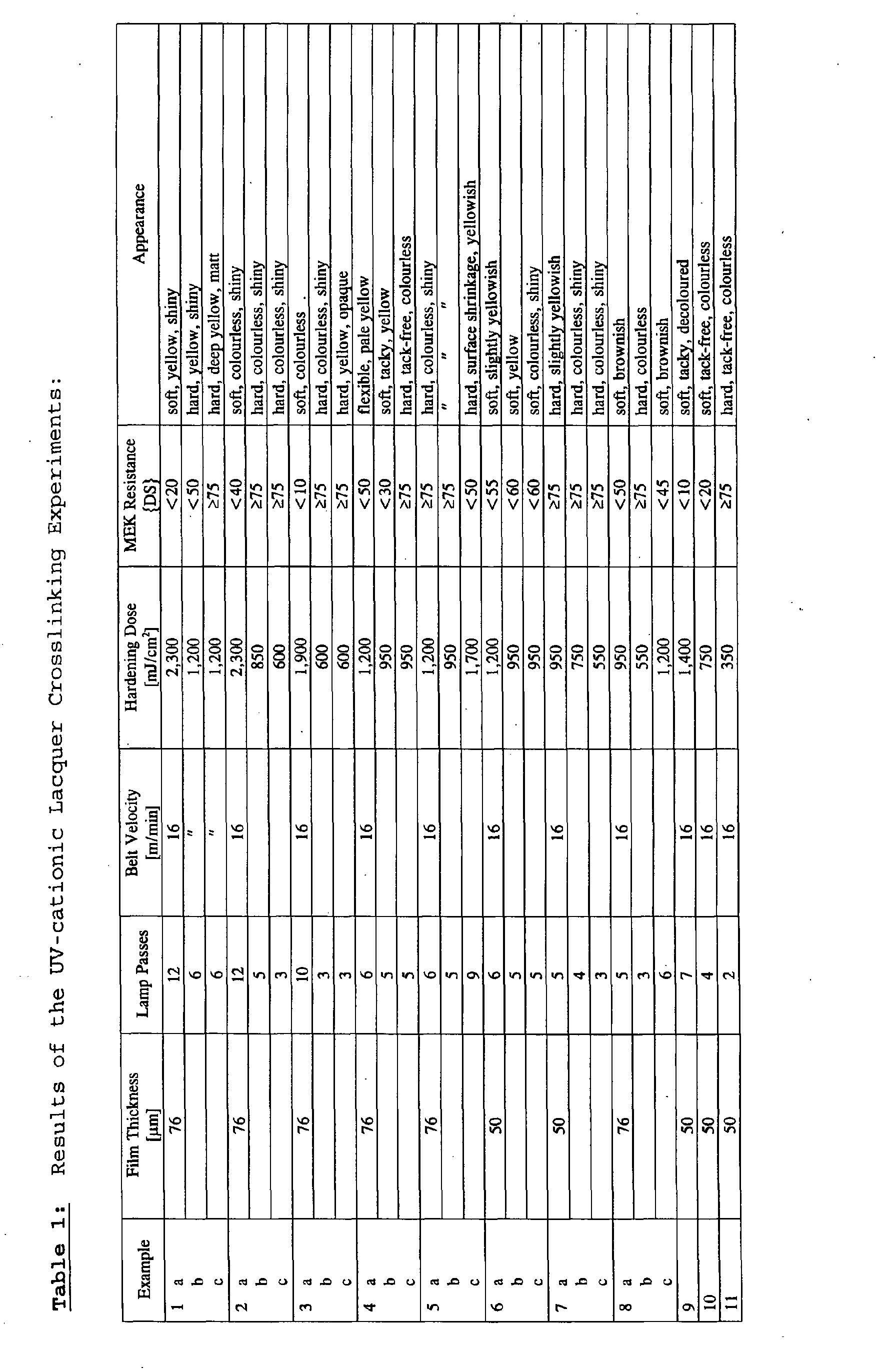
- a.) 0.1 g, b.) 0.4 g and c.) 1 g of a 2,4,6-triphenylpyrylium hexafluorophosphate (TPP-PF6) solution (25% in γ-butyrolactone) were added to separate mixtures of 4 g of 3,4-epoxycyclohexyl-3,4-epoxycyclohexylmethyl ester) and 1 g of limonene dioxide, and the whole was thoroughly mixed. The TPP-PF6 initiator salt concentration in a.) was 0.5 wt.%, in b.) was 2 wt.%, and in c.) was 5 wt.%. The lacquers were applied, UV-crosslinked and tested as described in the test methods. The results are shown in Table 1.
- a.) 0.1 g (0.5 wt.% of salt), b.) 0.4 g (2 wt.%) and c.) 1 g (5 wt.%) of a TPP-PF6 solution (25% in γ-butyrolactone) as well as in each case 0.8 wt.% of 2-hydroxy-2-methylacetophenone (Darocure-1173™) were added to separate mixtures of 4 g of 3,4-epoxycyclohexyl-3,4-epoxycyclohexylmethyl ester) and 1 g of limonene dioxide, and the whole was thoroughly mixed. The lacquers were applied, UV-crosslinked and tested as described in the test methods. The results are shown in Table 1.
- a.) 0.1 g (0.5 wt.%), b.) 0.4 g (2 wt.%) and c.) 1 g (5 wt.%) of TPP-PF6 solution (25% in γ-butyrolactone) as well as in each case 4.0 wt.% of 2-hydroxy-2-methylacetophenone (Darocure-1173™) were added to separate mixtures of 4 g of 3,4-epoxycyclohexyl-3,4-epoxycyclohexylmethyl ester) and 1 g of limonene dioxide, and the whole was thoroughly mixed. The lacquers were applied, UV-crosslinked and tested as described in the test methods. The results are shown in Table 1.
- 0.30 g of TPP-PF6 solution (25% in γ-butyrolactone) = 1.4 wt.% of initiator salt and a.) 0.075 g (1.4 wt.%) of ω,ω-diethoxyacetophenone, b.) 0.1 g (1.8 wt.%) of diphenyl-(2,4,6-trimethylbenzoyl)phosphine oxide (Lucirin-TPO™) and c.) 0.075 g (1.3 wt.%) of diphenyl(2,4,6-trimethylbenzoyl)phosphine oxide + 0.11 g (2.0 wt.%) of 2-hydroxy-2-methylacetophenone were added to separate mixtures of 4 g of 3,4-epoxycyclohexyl-(3,4-epoxycyclohexylmethyl ester) and 1 g of limonene dioxide, and the whole was thoroughly mixed. The lacquers were applied, UV-crosslinked and tested as described in the test methods. The results are shown in Table 1.
- 0.30 g of a TPP-PF6 solution (25% in γ-butyrolactone) = 1.5 wt.% of initiator salt and a.) 0.1 g (2.0 wt.%) of diphenylacetaldehyde, b.) 0.075 g (1.5 wt.%) of 1,1-diphenylacetone and c.) 0.10 g (2.0 wt.%) of triphenylacetophenone were added to separate mixtures of 4 g of 3,4-epoxycyclohexyl-(3,4-epoxycyclohexylmethyl ester) and 1 g of limonene dioxide, and the whole was thoroughly mixed. The lacquers were applied, UV-crosslinked and tested as described in the test methods. The results are shown in Table 1.
- 0.20 g of a TPP-PF6 solution (25% in γ-butyrolactone) = 1.0 wt.% of initiator salt referred to the lacquer, and a.) 0.075 g (1.5 wt.%) of triphenylethylene, b.) 0.075 g (1.5 wt.%) of trans-stilbene and c.) 0.075 g (1.5 wt.%) of 1,1-diphenylethylene were added to separate lots of 5 g of 3,4-epoxycyclohexyl-(3,4-epoxycyclohexylmethyl ester), and the whole was thoroughly mixed. The lacquers were applied, UV-crosslinked and tested as described in the test methods. The results are shown in Table 1.
- 0.15 g of a TPP-PF6 solution (25% in γ-butyrolactone) = 0.75 wt.% of initiator salt and 0.075 g (1.4 wt.%) of 2-hydroxy-2-methylacetophenone and a.) 0.075 g (1.4 wt.%) of triphenylethylene, b.) 0.075 g (1.4 wt.%) of trans-stilbene = 1.5 wt.%, and c.) 0.075 g (1.4 wt.%) of 1,1-diphenylethylene were added to separate lots of 5 g of 3,4-epoxycyclohexyl-(3,4-epoxycyclohexylmethyl ester), and the whole was thoroughly mixed. The lacquers were applied, UV-crosslinked and tested as described in the test methods. The results are shown in Table 1.
- 0.35 g of a TPP-PF6 solution (25% in γ-butyrolactone) = 1.3 wt.% of initiator salt and a.) 0.08 g (1.5 wt.%) of tert.-butyl hydroperoxide, b.) 0.08 g (1.5 wt.%) of tert.-butyl perbenzoate and c.) 0.075 g (1.4 wt.%) of dicumyl peroxide were added to separate mixtures of 4 g of 3,4-epoxycyclo-hexyl-(3,4-epoxycyclohexylmethyl ester) and 1 g of limonene dioxide, and the whole was thoroughly mixed. The lacquers were applied, UV-crosslinked and tested as described in the test methods. The results are shown in Table 1.
- 0.30 g of a solution of 2,4,6-tris-(4,4'-biphenylyl)-pyrylium hexafluorophosphate (TBP-PF6) (10% in γ-butyrolactone) = 0.6 wt.% of initiator salt was added to a mixture of 4 g of 3,4-epoxycyclohexyl-(3,4-epoxycyclohexylmethyl ester) and 1 g of limonene dioxide, and the whole was thoroughly mixed. The lacquers were applied, UV-crosslinked and tested as described in the test methods. The results are shown in Table 1.
- 0.30 g of a solution of 2,4,6-tris-(4,4'-biphenylyl)-pyrylium hexafluorophosphate (TBP-PF6) (10% in γ-butyrolactone) = 0.6 wt.% of initiator salt and 0.2 g (3.6 wt.%) of 2-hydroxy-2-methylacetophenone were added to a mixture of 4 g of 3,4-epoxycyclohexyl-(3,4-epoxycyclohexylmethyl ester) and 1 g of limonene dioxide, and the whole was thoroughly mixed. The lacquers were applied, UV-crosslinked and tested as described in the test methods. The results are shown in Table 1.
- 0.50 g of a solution of 2,4,6-tris-(1,1'-biphenyl-4-yl)-pyrylium hexafluorophosphate (TBP-PF6) (10% in propylene carbonate/limonene dioxide 2:3)) = 1.0 wt.% of initiator salt, 0.2 g (3.5 wt.%) of 2-hydroxy-2-methylacetophenone and 0.1 g (1.9 wt.%) of 1,1-diphenylethylene were added to a mixture of 4 g of 3,4-epoxycyclohexyl-(3,4-epoxycyclohexylmethyl ester) and 1 g of limonene dioxide, and the whole was thoroughly mixed. The lacquers were applied, UV-crosslinked and tested as described in the test methods. The results are shown in Table 1.
-
- a.) 0.25 g of a TPP-PF6 solution (25% in γ-butyrolactone) = 1.1 wt.% of initiator salt and 0.22 g (4.0 wt.%) of 2-hydroxy-2-methylacetophenone were added to 5 g of limonene dioxide, UV-irradiated and tested.
- b.) 0.30 g of a TPP-PF6 solution (25% in γ-butyrolactone) = 1.3 wt.% of initiator salt, 0.075 g (1.3 wt.%) of 2-hydroxy-2-methylacetophenone and 0.075 g (1.3 wt.%) of 1,1-diphenylethylene were added to 5 g of limonene dioxide, UV-irradiated and tested.
- c.) For purposes of comparison 5 g of limonene dioxide were mixed with 0.30 g of a triarylsulfonium hexafluorophosphate solution (UVI-6990™, 50% in γ-butyrolactone), UV-irradiated and tested. The results are shown in Table 2.
-
- In the case of a.) and b.) elastic tack-free films had formed that were completely soluble in MEK, which indicates that only one epoxide group of the limonene dioxide had undergone polymerisation. Gel chromatography against polystyrene standards of polymer samples of films a.) and b.) dissolved in THF showed a number average MN of the resultant polymers of 2-3,000 g/mole. The lacquer c.) was liquid even at 10 x 16 m/min.
- 0.38 g of a solution of TPP-PF6 (25% in γ-butyrolactone) = 1.5 wt.% of initiator salt, 0.075 g (1.3 wt.%) of 2-hydroxy-2-methylacetophenone, and 0.075 g (1.3 wt.%) of 1,1-diphenylethylene = 1.5 wt.% referred to the lacquer, were added to 5 g of hexanediol-1,6 diglycidyl ether, and the mixture was UV-crosslinked and tested. The results are shown in Table 2.
- 5 g of 1,2,7,8-diepoxyoctane were UV-crosslinked with 0.30 g of TPP-PF6 solution (25% in γ-butyrolactone) = 1.3 wt.% of initiator salt, 0.09 g (1.5 wt.%) of 2-hydroxy-2-methylacetophenone, and 0.075 g (1.3 wt.%) of 1,1-diphenylethylene, and tested. The results are shown in Table 2.
- 0.13 g of TPP-PF6 solution (25% in γ-butyrolactone) = 0.5 wt.% of initiator salt, 0.11 g (2.0 wt.%) of 2-hydroxy-2-methylacetophenone, and 0.11 g (2.0 wt.%) of 1,1-diphenylethylene were added to a mixture of 4 g of 3,4-epoxycyclohexyl-(3,4-epoxycyclohexylmethyl ester) and 1 g of limonene dioxide, and the whole was thoroughly mixed. The lacquers were applied, UV-crosslinked and tested as described in the test methods. The results are shown in Table 2.
- 0.20 g of a TPP-PF6 solution (25% in γ-butyrolactone) = 1.1 wt.% of initiator salt, 0.09 g (2.0 wt.%) of 2-hydroxy-2-methylacetophenone, and 0.09 g (2.0 wt.%) of trans-stilbene were added to a mixture of 1 g of 3,4-epoxycyclohexyl-(3,4-epoxycyclohexylmethyl ester) and 3 g bisphenol-A diglycidyl ether, and the whole was thoroughly mixed. The lacquers were applied, UV-crosslinked and tested as described in the test methods. The results are shown in Table 2.
- 0.18 g of a TPP-PF6 solution (25% in γ-butyrolactone) = 0.9 wt.% of initiator salt, 0.09 g (1.8 wt.%) of 2-hydroxy-2-methylacetophenone, and 0.09 g (1.8 wt.%) of 1,1-diphenyl-ethylene were added to a mixture of 2 g of hexanediol-1,6- diglycidyl ether and 2 g of limonene dioxide, and the whole was thoroughly mixed. The lacquers were applied, UV-crosslinked and tested as described in the test methods. The results are shown in Table 2.
- 0.15 g of a TPP-PF6 solution (25% in γ-butyrolactone) = 0.75 wt.% of initiator salt, 0.09 g (2.0 wt.%) of 2-hydroxy-2-methylacetophenone, and 0.09 g (2.0 wt.%) of 1,1-diphenylethylene were added to a mixture of 2 g of bisphenol-A diglycidyl ether and 2 g of limonene dioxide, and the whole was thoroughly mixed. The lacquers were applied, UV-crosslinked and tested as described in the test methods. The results are shown in Table 2.
- 0.25 g of a TPP-PF6 solution (25% in γ-butyrolactone) = 1.15 wt.% of initiator salt and 0.1 g (1.9 wt.%) of triphenylacetophenone were added to a mixture of 4.0 g of 3,4-epoxycyclohexyl-(3,4-epoxycyclohexylmethyl ester) and 1.0 g of a polycaprolactone triol (OH no.: 85 mg KOH/g), and the whole was thoroughly mixed. The lacquers were applied, UV-crosslinked and tested as described in the test methods. The results are shown in Table 2.
- 0.15 g of a TPP-PF6 solution (20% in γ-butyrolactone) = 0.7 wt.% of initiator salt, 0.02 g (0.5 wt.%) of 2-hydroxy-2-methylacetophenone and 0.02 g (0.5 wt.%) of 1,1-diphenylethylene were added to a mixture of 3.6 g of 3,4-epoxycyclohexyl-(3,4-epoxycyclohexylmethyl ester) and 0.4 g butanediol-1,3, and the whole was thoroughly mixed. The lacquers were applied, UV-crosslinked and tested as described in the test methods. The results are shown in Table 2.
- 0.15 g of a TPP-PF6 solution (20% in γ-butyrolactone) = 0.7 wt.% of initiator salt, 0.02 g (0.5 wt.%) of 2-hydroxy-2-methylacetophenone and 0.02 g (0.5 wt.%) of 1,1-diphenylethylene were added to a mixture of 2.8 g of 3,4-epoxycyclohexyl-(3,4-epoxycyclohexylmethyl ester) and 1.2 g of epoxycyclohexylmethanol, and the whole was thoroughly mixed. The lacquers were applied, UV-crosslinked and tested as described in the test methods. The results are shown in Table 2.
- 4 g (16.2 wt.%) of TiO2 (anatase) (KRONOS 1071) were dispersed for 10 minutes at 2-5,000 r.p.m. in 15 g of 3,4-epoxycyclohexyl-(3,4-epoxycyclohexylmethyl ester) by means of a disperser (VGA Getzmann) in a 250 ml beaker. A solution of 5 g of 3,4-epoxycyclohexyl-(3,4-epoxycyclohexylmethyl ester), 0.60 g of a TPP-PF6 solution (20% in γ-butyrolactone) = 0.61 wt.%, and 0.12 g (0.5 wt.%) of 1,1-diphenylethylene was then added thereto, the white lacquer was homogenised to a yellow dispersion at a low rotational speed, was applied as 75 µm thick layers to glass plates and deep-drawing sheets (18x10x0.1 cm), UV-crosslinked by 10 lamp passes at 16 m/min, and tested. Already after two passes the lacquer surfaces were white due to decolouration. After 6-8 passes the lacquer substrate was also decoloured and hard, as was established by tests on glass plates. The resulting lacquers had cured to soft, only slightly scratch-resistant white lacquers having a matt surface. The resistance to MEK was <30 double strokes before surface abrasion occurred.
- 4 g (12.8 wt.%) of TiO2 (anatase) (KRONOS 1071) were dispersed for 10 minutes at 2-5,000 r.p.m. in 14.5 g 3,4-epoxycyclohexyl-(3,4-epoxycyclohexylmethyl ester) by means of a disperser (VGA Getzmann) in a 250 ml beaker. A solution of 5 g of 3,4-epoxycyclohexyl-(3,4-epoxycyclohexylmethyl ester), 0.60 g of a TPP-PF6 solution (20% in γ-butyrolactone) = 0.5 wt.%, and 0.2 g (0.7 wt.%) of 2-hydroxy-2-methylacetophenone and 6.3 g of a solution of 1.3 g of polycaprolactone triol (OH No.: 85 mg KOH/g) in 5 g of 3,4-epoxycyclohexyl-(3,4-epoxycyclohexylmethyl ester) were then added thereto, the white lacquer was homogenised to a yellow dispersion at a low rotational speed, was applied as 75 µm thick layers to glass plates and deep-drawing sheets (18x10x0.1 cm), UV-crosslinked by 10 lamp passes at 16 m/min, and tested. Already after two passes the lacquer layers were white due to decolouration. After the exposure the lacquers were post-treated for 10 minutes at 100°C. The resulting lacquers had cured to form soft white lacquers having a glossy surface. The scratch resistance of the surface was better than in example 23. The resistance to MEK was <40 double strokes before surface abrasion occurred.
- 10 g (17.8 wt.%) of TiO2 (anatase) (KRONOS 1071) were dispersed for 10 minutes at 2-5,000 r.p.m. by means of a disperser (VGA Getzmann) in 30 g of 3,4-epoxycyclohexyl-(3,4-epoxycyclo-hexylmethyl ester), in a 250 ml beaker. A solution of 10 g of 3,4-epoxycyclohexyl-(3,4-epoxycyclo-hexylmethyl ester), 2.50 g of a TPP-PF6 solution (25% in γ-butyrolactone) = 1.1 wt.% and 3.6 g (8.9 wt.%) of 2-hydroxy-2-methylacetophenone was then added thereto, the white lacquer was homogenised to a yellow dispersion at a low rotational speed, and was applied as 76 µm thick layers to glass plates and deep-drawing sheets (18x10x0.1 cm), UV-crosslinked by 10 lamp passes at 16 m/min, and tested. Already after one pass the lacquer surface was white and the substrate was decolourised after 7 passes. The lacquer mixture was also crosslinked in the form of a 12 µm thick layer on glass and steel sheet, and had already hardened and was white after 3x16 m/min. The resulting lacquers had hardened to form hard, scratch-resistant white lacquers having a matt surface. The resistance to MEK was >75 double strokes before any surface abrasion occurred.
- 10 g (19.1 wt.%) of TiO2 (anatase) (KRONOS 1071) were dispersed for 10 minutes at 2-5,000 r.p.m. by means of a disperser (VGA Getzmann) in 30 g of 3,4-epoxycyclohexyl-(3,4-epoxycyclohexylmethyl ester), in a 250 ml beaker. A solution of 10 g of 3,4-epoxycyclohexyl-(3,4-epoxycyclo-hexylmethyl ester), 3.5 g (5.8 wt.%) of epoxycyclohexylmethanol, 2.40 g of a TPP-PF6 solution (25% in γ-butyrolactone) = 1.0 wt.%, 3.6 g (5.8 wt.%) of 2-hydroxy-2-methylacetophenone and 0.6 g (1.0 wt.%) of 1,1-diphenylethylene was then added thereto, the white lacquer was homogenised to a yellow dispersion at a low rotational speed, and was applied as 76 µm thick layers to glass plates and deep-drawing sheets (18x10x0.1 cm), crosslinked by 10 lamp passes at 16 m/min, and tested. Even after one pass the lacquer surface was white and the substrate had hardened after 6 passes. The lacquer mixture was also crosslinked in the form of a 12 µm thick layer on glass and steel sheet, and had hardened and was white after 3x16 m/min. The resulting lacquers had hardened to form hard, scratch-resistant white lacquers with a high-gloss, defect-free surface. The resistance to MEK was >75 double strokes before any surface abrasion occurred.

Claims (14)
- Photocationic initiator combination, characterised in that it containswherein the electron donor is(a) at least one 2,4,6-triarylpyrylium salt of the general formula (I)wherein X- denotes a non-nucleophilic anion and Ar1, Ar2 and Ar3 independently of one another in each case denote a phenyl group of the general formula (II) or a biphenyl group of the general formula (III),

 wherein R1 to R8 independently of one another in each case denote hydrogen or an alkyl or alkoxy group with 1 to 12 carbon atoms, and
 (b) at least one electron donor that forms cations under the action of light in the presence of the aforementioned 2,4,6-triarylpyrylium salt,(i) a combination of an aromatic olefin and an aromatic carbonyl compound with in each case at least two unsubstituted phenyl groups or C1-C12-alkyl or C1-C12-alkoxy substituted phenyl groups and/or(ii) a radical forming peroxy or azo compound.
 - Photocationic initiator combination according to claim 1, characterised in that X- denotes PF6 -, SbF6 -, AsF6- or [B(C6F5)4]-.
- Photocationic initiator combination according to either claim 1 or 2, characterised in that the long wavelength UV-absorption maxima of the 2,4,6-triarylpyrylium salt(s) lie between 350 and 420 nm.
- Photocationic initiator combination according to claim 1, characterised in that this contains as further electron donor, one or more photoradical initiators that form radicals under the action of light.
- UV-crosslinkable epoxide mixture, characterised in that it contains a photocationic initiator combination according to one of claims 1 to 4.
- UV-crosslinkable epoxide mixture according to claim 5, characterised in that it contains a photocationic initiator combination according to claim 1 in an amount of 2 to 8 wt.% referred to the total amount of the mixture, the amount of the 2,4,6-triarylpyrylium salt being 0.5 to 2 wt.% referred to the total amount of the mixture.
- UV-crosslinkable epoxide mixture according to claim 5, characterised in that it contains a photocationic initiator combination according to claim 4, the amount of the 2,4,6-triarylpyrylium salt being 0.5 to 2 wt.%, of the photoradical initiator being 0.5 to 6 wt.%, and of the olefin being 0.5 to 5 wt.%, in each case referred to the total amount of the mixture.
- UV-crosslinkable epoxide mixture according to claim 5, characterised in that it contains a photocationic initiator combination according to claim 1, the amount of the 2,4,6-triarylpyrylium salt being 0.5 to 2 wt.% and of the peroxy compound(s) or azo compound(s) being 1 to 5 wt.%, in each case referred to the total amount of the mixture.
- UV-crosslinkable epoxide mixture according to one of claims 5 to 8, characterised in that it contains 50 to 90 wt.% of one or more cycloaliphatic diepoxides and 0 to 40 wt.% of additional olefin epoxides or hydroxyfunctional low molecular weight or high molecular weight compounds, in each case referred to the total amount of the mixture.
- UV-crosslinkable epoxide mixture according to one of claims 5 to 9, characterised in that it contains one or more pigments.
- UV-crosslinkable epoxide mixture according to claim 10, characterised in that the pigment is TiO2.
- Use of a UV-crosslinkable epoxide mixture according to one of claims 5 to 11 as a lacquer, printing ink or adhesive.
- Process for printing or lacquering a substrate, characterised in that it comprises the following stages:(a) application of a film of a UV-crosslinkable epoxide mixture according to one of claims 5 to 11 to the substrate, and(b) irradiation with UV light of the film formed in stage (a).
- Process according to claim 13, characterised in that it additionally comprises a thermal post-treatment stage.
Priority Applications (6)
| Application Number | Priority Date | Filing Date | Title |
|---|---|---|---|
| ES01112078T ES2273761T3 (en) | 2001-05-28 | 2001-05-28 | COMBINATIONS OF PHOTOCATIONIC INITIATORS. |
| EP01112078A EP1262506B1 (en) | 2001-05-28 | 2001-05-28 | Photocationic initiator combinations |
| DE60124078T DE60124078T2 (en) | 2001-05-28 | 2001-05-28 | Photopolymerizable initiator combination |
| CA002387389A CA2387389C (en) | 2001-05-28 | 2002-05-23 | Photocationic initiator combinations |
| US10/155,220 US6770686B2 (en) | 2001-05-28 | 2002-05-28 | Photocationic initiator combinations |
| JP2002153784A JP3981876B2 (en) | 2001-05-28 | 2002-05-28 | Photocationic polymerization initiator, UV curable composition, and method for forming cured coating film |
Applications Claiming Priority (1)
| Application Number | Priority Date | Filing Date | Title |
|---|---|---|---|
| EP01112078A EP1262506B1 (en) | 2001-05-28 | 2001-05-28 | Photocationic initiator combinations |
Publications (2)
| Publication Number | Publication Date |
|---|---|
| EP1262506A1 true EP1262506A1 (en) | 2002-12-04 |
| EP1262506B1 EP1262506B1 (en) | 2006-10-25 |
Family
ID=8177455
Family Applications (1)
| Application Number | Title | Priority Date | Filing Date |
|---|---|---|---|
| EP01112078A Expired - Lifetime EP1262506B1 (en) | 2001-05-28 | 2001-05-28 | Photocationic initiator combinations |
Country Status (6)
| Country | Link |
|---|---|
| US (1) | US6770686B2 (en) |
| EP (1) | EP1262506B1 (en) |
| JP (1) | JP3981876B2 (en) |
| CA (1) | CA2387389C (en) |
| DE (1) | DE60124078T2 (en) |
| ES (1) | ES2273761T3 (en) |
Cited By (4)
| Publication number | Priority date | Publication date | Assignee | Title |
|---|---|---|---|---|
| EP1295899A2 (en) * | 2001-09-06 | 2003-03-26 | Brother Kogyo Kabushiki Kaisha | Active energy beam-curable composition, ink containing the same, and printer accommodating the same ink |
| ES2289905A1 (en) * | 2005-11-24 | 2008-02-01 | Exotech, S.L. | Chemical composition for use as photoinitiator, includes photoactive compound made up of salts of pyryl, thiopyryl, and coinitiator made up of iodine, phosphate and sulphur salts |
| WO2012177122A1 (en) * | 2011-06-23 | 2012-12-27 | Holland Novochem Technical Coatings B.V. | Composition to protect surfaces and its coating method |
| DE102004018067B4 (en) * | 2003-04-11 | 2015-11-12 | Henkel Ag & Co. Kgaa | Method for applying and curing a cationically curable pressure-sensitive adhesive |
Families Citing this family (6)
| Publication number | Priority date | Publication date | Assignee | Title |
|---|---|---|---|---|
| DE10305666A1 (en) * | 2003-02-12 | 2004-09-09 | Basf Coatings Ag | Composition curable with actinic radiation, process for its preparation and its use |
| JP3797348B2 (en) * | 2003-02-24 | 2006-07-19 | コニカミノルタホールディングス株式会社 | Active energy ray curable composition |
| US20080085450A1 (en) * | 2006-10-05 | 2008-04-10 | Depalma Christopher L | End cap seal assembly for an electrochemical cell |
| FR3018077B1 (en) * | 2014-02-28 | 2017-06-30 | A Et A Mader | DUAL-CURE-CATIONIC POLYMERIZABLE COMPOSITION AND PROCESS FOR PRODUCING A COATING OR COMPOSITE MATERIAL USING THE SAME |
| CN113717666A (en) * | 2021-08-20 | 2021-11-30 | 江苏斯迪克新材料科技股份有限公司 | OCA optical glue, adhesive film and preparation method thereof |
| CN116496693A (en) * | 2022-09-09 | 2023-07-28 | 广东希贵光固化材料有限公司 | A UV curing hardening solution with high oxygen resistance and polymerization inhibition |
Citations (5)
| Publication number | Priority date | Publication date | Assignee | Title |
|---|---|---|---|---|
| JPS59142205A (en) * | 1983-02-02 | 1984-08-15 | Nippon Oil & Fats Co Ltd | Highly sensitive photoinitiator composition |
| US4474868A (en) * | 1982-09-07 | 1984-10-02 | Nippon Oil And Fats Co., Ltd. | Photo polymerization initiator compositions having high sensitivity |
| EP0213893A2 (en) * | 1985-09-02 | 1987-03-11 | Loctite (Ireland) Limited | Photopolymerisable compositions containing substituted pyrylium salts as photoinitiators; and novel pyrylium salts for use therein |
| JPH01216383A (en) * | 1988-02-24 | 1989-08-30 | Fujitsu Ltd | Holographic recording material |
| JPH07316262A (en) * | 1994-05-30 | 1995-12-05 | Nippon Kayaku Co Ltd | Stereolithographic resin composition and cured product thereof |
Family Cites Families (2)
| Publication number | Priority date | Publication date | Assignee | Title |
|---|---|---|---|---|
| DE3135636A1 (en) * | 1981-09-09 | 1983-03-17 | Basf Ag, 6700 Ludwigshafen | CURABLE EPOXY RESINS |
| US4746685A (en) * | 1984-08-31 | 1988-05-24 | Nippon Oil And Fats Co., Ltd. | Light curable dental composition |
-
2001
- 2001-05-28 ES ES01112078T patent/ES2273761T3/en not_active Expired - Lifetime
- 2001-05-28 EP EP01112078A patent/EP1262506B1/en not_active Expired - Lifetime
- 2001-05-28 DE DE60124078T patent/DE60124078T2/en not_active Expired - Fee Related
-
2002
- 2002-05-23 CA CA002387389A patent/CA2387389C/en not_active Expired - Fee Related
- 2002-05-28 US US10/155,220 patent/US6770686B2/en not_active Expired - Fee Related
- 2002-05-28 JP JP2002153784A patent/JP3981876B2/en not_active Expired - Fee Related
Patent Citations (5)
| Publication number | Priority date | Publication date | Assignee | Title |
|---|---|---|---|---|
| US4474868A (en) * | 1982-09-07 | 1984-10-02 | Nippon Oil And Fats Co., Ltd. | Photo polymerization initiator compositions having high sensitivity |
| JPS59142205A (en) * | 1983-02-02 | 1984-08-15 | Nippon Oil & Fats Co Ltd | Highly sensitive photoinitiator composition |
| EP0213893A2 (en) * | 1985-09-02 | 1987-03-11 | Loctite (Ireland) Limited | Photopolymerisable compositions containing substituted pyrylium salts as photoinitiators; and novel pyrylium salts for use therein |
| JPH01216383A (en) * | 1988-02-24 | 1989-08-30 | Fujitsu Ltd | Holographic recording material |
| JPH07316262A (en) * | 1994-05-30 | 1995-12-05 | Nippon Kayaku Co Ltd | Stereolithographic resin composition and cured product thereof |
Non-Patent Citations (3)
| Title |
|---|
| DATABASE WPI Section Ch Week 198941, Derwent World Patents Index; Class A14, AN 1989-295500, XP002178516 * |
| PATENT ABSTRACTS OF JAPAN vol. 008, no. 266 (C - 255) 6 December 1984 (1984-12-06) * |
| PATENT ABSTRACTS OF JAPAN vol. 1996, no. 04 30 April 1996 (1996-04-30) * |
Cited By (7)
| Publication number | Priority date | Publication date | Assignee | Title |
|---|---|---|---|---|
| EP1295899A2 (en) * | 2001-09-06 | 2003-03-26 | Brother Kogyo Kabushiki Kaisha | Active energy beam-curable composition, ink containing the same, and printer accommodating the same ink |
| DE102004018067B4 (en) * | 2003-04-11 | 2015-11-12 | Henkel Ag & Co. Kgaa | Method for applying and curing a cationically curable pressure-sensitive adhesive |
| ES2289905A1 (en) * | 2005-11-24 | 2008-02-01 | Exotech, S.L. | Chemical composition for use as photoinitiator, includes photoactive compound made up of salts of pyryl, thiopyryl, and coinitiator made up of iodine, phosphate and sulphur salts |
| ES2289905B1 (en) * | 2005-11-24 | 2009-04-01 | Exotech, S.L. | COMPOSITION THAT INCLUDES A PHOTOACTIVE COMPOUND AND A COINICIATOR AND ITS USE AS A PHOTOINIATOR. |
| WO2012177122A1 (en) * | 2011-06-23 | 2012-12-27 | Holland Novochem Technical Coatings B.V. | Composition to protect surfaces and its coating method |
| NL1038884C2 (en) * | 2011-06-23 | 2013-01-02 | Holland Novochem Technical Coatings B V | Protective polymer layers. |
| NL1039699A (en) * | 2011-06-23 | 2013-01-02 | Holland Novochem Technical Coatings B V | Protective polymer layers. |
Also Published As
| Publication number | Publication date |
|---|---|
| CA2387389A1 (en) | 2002-11-28 |
| DE60124078T2 (en) | 2007-05-03 |
| US20030027882A1 (en) | 2003-02-06 |
| JP2005041888A (en) | 2005-02-17 |
| CA2387389C (en) | 2007-07-03 |
| EP1262506B1 (en) | 2006-10-25 |
| DE60124078D1 (en) | 2006-12-07 |
| JP3981876B2 (en) | 2007-09-26 |
| US6770686B2 (en) | 2004-08-03 |
| ES2273761T3 (en) | 2007-05-16 |
Similar Documents
| Publication | Publication Date | Title |
|---|---|---|
| EP1657268B1 (en) | Photosensitive composition and cured product thereof | |
| KR101486692B1 (en) | Photosensitive composition | |
| CN101932614B (en) | Process for preparing hard films or coatings from cationically crosslinkable/cationically polymerizable compositions containing iodonium borate and emitting acceptable odor | |
| US4287228A (en) | Photopolymerizable epoxide coating compositions containing titanium dioxide pigment and method of polymerization using same | |
| US6770686B2 (en) | Photocationic initiator combinations | |
| JPS6039707B2 (en) | Solvent-free photopolymerizable coating composition | |
| CA2028259A1 (en) | Tacky photopolymerizable adhesive compositions | |
| JPH08231938A (en) | Active energy ray curing type adhesive composition for laminate | |
| BE1010656A4 (en) | MONOMERS, AND POLYMER GROUP OLIGOMERS oxiranes TERMINAL, METHOD OF PREPARATION AND CATIONIC POLYMERIZATION IN RADIATION. | |
| JP3273016B2 (en) | Photocurable coating composition for printable basecoat | |
| JP5574153B2 (en) | Photo-cationic polymerizable composition | |
| JP2021528674A (en) | Method for manufacturing polarizing plate and adhesive composition for polarizing plate | |
| JPH10120766A (en) | Energy beam-curable composition and cured product therefrom | |
| CN103153620B (en) | Process for producing films for security and/or value documents | |
| JP5234562B2 (en) | Photosensitive composition | |
| KR100748149B1 (en) | Cationically photopolymerizable resin composition and optical disk surface protection material | |
| JP2006063261A (en) | Photosensitive composition | |
| JP2000273399A (en) | Ultraviolet-curable film-forming composition | |
| JP2004352980A (en) | Cationically photopolymerizable resin composition and optical disk surface protecting material | |
| JPH11217518A (en) | Ultraviolet light-curable coating composition for white coat | |
| TW201910447A (en) | Monomer mixture and hardenable composition comprising the same | |
| JP4837187B2 (en) | Active energy ray-curable resin composition | |
| JPH0940708A (en) | Resin composition and cured product thereof | |
| JPS6160720A (en) | Resin composition | |
| JPH0462557A (en) | Photosensitive composition |
Legal Events
| Date | Code | Title | Description |
|---|---|---|---|
| PUAI | Public reference made under article 153(3) epc to a published international application that has entered the european phase |
Free format text: ORIGINAL CODE: 0009012 |
|
| AK | Designated contracting states |
Kind code of ref document: A1 Designated state(s): AT BE CH CY DE DK ES FI FR GB GR IE IT LI LU MC NL PT SE TR |
|
| AX | Request for extension of the european patent |
Free format text: AL;LT;LV;MK;RO;SI |
|
| 17P | Request for examination filed |
Effective date: 20030506 |
|
| AKX | Designation fees paid |
Designated state(s): BE DE ES FR GB |
|
| 17Q | First examination report despatched |
Effective date: 20050118 |
|
| GRAP | Despatch of communication of intention to grant a patent |
Free format text: ORIGINAL CODE: EPIDOSNIGR1 |
|
| GRAS | Grant fee paid |
Free format text: ORIGINAL CODE: EPIDOSNIGR3 |
|
| GRAA | (expected) grant |
Free format text: ORIGINAL CODE: 0009210 |
|
| AK | Designated contracting states |
Kind code of ref document: B1 Designated state(s): BE DE ES FR GB |
|
| REG | Reference to a national code |
Ref country code: GB Ref legal event code: FG4D |
|
| REF | Corresponds to: |
Ref document number: 60124078 Country of ref document: DE Date of ref document: 20061207 Kind code of ref document: P |
|
| REG | Reference to a national code |
Ref country code: ES Ref legal event code: FG2A Ref document number: 2273761 Country of ref document: ES Kind code of ref document: T3 |
|
| ET | Fr: translation filed | ||
| PLBE | No opposition filed within time limit |
Free format text: ORIGINAL CODE: 0009261 |
|
| STAA | Information on the status of an ep patent application or granted ep patent |
Free format text: STATUS: NO OPPOSITION FILED WITHIN TIME LIMIT |
|
| 26N | No opposition filed |
Effective date: 20070726 |
|
| PGFP | Annual fee paid to national office [announced via postgrant information from national office to epo] |
Ref country code: DE Payment date: 20080411 Year of fee payment: 8 Ref country code: ES Payment date: 20080409 Year of fee payment: 8 |
|
| PGFP | Annual fee paid to national office [announced via postgrant information from national office to epo] |
Ref country code: BE Payment date: 20080428 Year of fee payment: 8 |
|
| PGFP | Annual fee paid to national office [announced via postgrant information from national office to epo] |
Ref country code: GB Payment date: 20080410 Year of fee payment: 8 |
|
| BERE | Be: lapsed |
Owner name: DAINIPPON INK AND CHEMICALS, INC. Effective date: 20090531 |
|
| GBPC | Gb: european patent ceased through non-payment of renewal fee |
Effective date: 20090528 |
|
| REG | Reference to a national code |
Ref country code: FR Ref legal event code: ST Effective date: 20100129 |
|
| PG25 | Lapsed in a contracting state [announced via postgrant information from national office to epo] |
Ref country code: FR Free format text: LAPSE BECAUSE OF NON-PAYMENT OF DUE FEES Effective date: 20090602 |
|
| PGFP | Annual fee paid to national office [announced via postgrant information from national office to epo] |
Ref country code: FR Payment date: 20080429 Year of fee payment: 8 |
|
| PG25 | Lapsed in a contracting state [announced via postgrant information from national office to epo] |
Ref country code: GB Free format text: LAPSE BECAUSE OF NON-PAYMENT OF DUE FEES Effective date: 20090528 |
|
| PG25 | Lapsed in a contracting state [announced via postgrant information from national office to epo] |
Ref country code: DE Free format text: LAPSE BECAUSE OF NON-PAYMENT OF DUE FEES Effective date: 20091201 Ref country code: BE Free format text: LAPSE BECAUSE OF NON-PAYMENT OF DUE FEES Effective date: 20090531 |
|
| REG | Reference to a national code |
Ref country code: ES Ref legal event code: FD2A Effective date: 20090529 |
|
| PG25 | Lapsed in a contracting state [announced via postgrant information from national office to epo] |
Ref country code: ES Free format text: LAPSE BECAUSE OF NON-PAYMENT OF DUE FEES Effective date: 20090529 |