EP1262234A2 - Hydrogenation catalyst for aromatic hydrocarbons contained in hydrocarbon oils - Google Patents
Hydrogenation catalyst for aromatic hydrocarbons contained in hydrocarbon oils Download PDFInfo
- Publication number
- EP1262234A2 EP1262234A2 EP02009047A EP02009047A EP1262234A2 EP 1262234 A2 EP1262234 A2 EP 1262234A2 EP 02009047 A EP02009047 A EP 02009047A EP 02009047 A EP02009047 A EP 02009047A EP 1262234 A2 EP1262234 A2 EP 1262234A2
- Authority
- EP
- European Patent Office
- Prior art keywords
- catalyst
- range
- pores
- volume
- measured
- Prior art date
- Legal status (The legal status is an assumption and is not a legal conclusion. Google has not performed a legal analysis and makes no representation as to the accuracy of the status listed.)
- Granted
Links
Classifications
-
- C—CHEMISTRY; METALLURGY
- C10—PETROLEUM, GAS OR COKE INDUSTRIES; TECHNICAL GASES CONTAINING CARBON MONOXIDE; FUELS; LUBRICANTS; PEAT
- C10G—CRACKING HYDROCARBON OILS; PRODUCTION OF LIQUID HYDROCARBON MIXTURES, e.g. BY DESTRUCTIVE HYDROGENATION, OLIGOMERISATION, POLYMERISATION; RECOVERY OF HYDROCARBON OILS FROM OIL-SHALE, OIL-SAND, OR GASES; REFINING MIXTURES MAINLY CONSISTING OF HYDROCARBONS; REFORMING OF NAPHTHA; MINERAL WAXES
- C10G45/00—Refining of hydrocarbon oils using hydrogen or hydrogen-generating compounds
- C10G45/44—Hydrogenation of the aromatic hydrocarbons
- C10G45/46—Hydrogenation of the aromatic hydrocarbons characterised by the catalyst used
- C10G45/52—Hydrogenation of the aromatic hydrocarbons characterised by the catalyst used containing platinum group metals or compounds thereof
-
- B—PERFORMING OPERATIONS; TRANSPORTING
- B01—PHYSICAL OR CHEMICAL PROCESSES OR APPARATUS IN GENERAL
- B01J—CHEMICAL OR PHYSICAL PROCESSES, e.g. CATALYSIS OR COLLOID CHEMISTRY; THEIR RELEVANT APPARATUS
- B01J21/00—Catalysts comprising the elements, oxides, or hydroxides of magnesium, boron, aluminium, carbon, silicon, titanium, zirconium, or hafnium
- B01J21/14—Silica and magnesia
-
- B—PERFORMING OPERATIONS; TRANSPORTING
- B01—PHYSICAL OR CHEMICAL PROCESSES OR APPARATUS IN GENERAL
- B01J—CHEMICAL OR PHYSICAL PROCESSES, e.g. CATALYSIS OR COLLOID CHEMISTRY; THEIR RELEVANT APPARATUS
- B01J23/00—Catalysts comprising metals or metal oxides or hydroxides, not provided for in group B01J21/00
- B01J23/38—Catalysts comprising metals or metal oxides or hydroxides, not provided for in group B01J21/00 of noble metals
- B01J23/40—Catalysts comprising metals or metal oxides or hydroxides, not provided for in group B01J21/00 of noble metals of the platinum group metals
-
- B—PERFORMING OPERATIONS; TRANSPORTING
- B01—PHYSICAL OR CHEMICAL PROCESSES OR APPARATUS IN GENERAL
- B01J—CHEMICAL OR PHYSICAL PROCESSES, e.g. CATALYSIS OR COLLOID CHEMISTRY; THEIR RELEVANT APPARATUS
- B01J35/00—Catalysts, in general, characterised by their form or physical properties
- B01J35/60—Catalysts, in general, characterised by their form or physical properties characterised by their surface properties or porosity
-
- B—PERFORMING OPERATIONS; TRANSPORTING
- B01—PHYSICAL OR CHEMICAL PROCESSES OR APPARATUS IN GENERAL
- B01J—CHEMICAL OR PHYSICAL PROCESSES, e.g. CATALYSIS OR COLLOID CHEMISTRY; THEIR RELEVANT APPARATUS
- B01J35/00—Catalysts, in general, characterised by their form or physical properties
- B01J35/60—Catalysts, in general, characterised by their form or physical properties characterised by their surface properties or porosity
- B01J35/61—Surface area
- B01J35/615—100-500 m2/g
-
- B—PERFORMING OPERATIONS; TRANSPORTING
- B01—PHYSICAL OR CHEMICAL PROCESSES OR APPARATUS IN GENERAL
- B01J—CHEMICAL OR PHYSICAL PROCESSES, e.g. CATALYSIS OR COLLOID CHEMISTRY; THEIR RELEVANT APPARATUS
- B01J35/00—Catalysts, in general, characterised by their form or physical properties
- B01J35/60—Catalysts, in general, characterised by their form or physical properties characterised by their surface properties or porosity
- B01J35/63—Pore volume
- B01J35/635—0.5-1.0 ml/g
-
- B—PERFORMING OPERATIONS; TRANSPORTING
- B01—PHYSICAL OR CHEMICAL PROCESSES OR APPARATUS IN GENERAL
- B01J—CHEMICAL OR PHYSICAL PROCESSES, e.g. CATALYSIS OR COLLOID CHEMISTRY; THEIR RELEVANT APPARATUS
- B01J35/00—Catalysts, in general, characterised by their form or physical properties
- B01J35/60—Catalysts, in general, characterised by their form or physical properties characterised by their surface properties or porosity
- B01J35/64—Pore diameter
- B01J35/643—Pore diameter less than 2 nm
-
- B—PERFORMING OPERATIONS; TRANSPORTING
- B01—PHYSICAL OR CHEMICAL PROCESSES OR APPARATUS IN GENERAL
- B01J—CHEMICAL OR PHYSICAL PROCESSES, e.g. CATALYSIS OR COLLOID CHEMISTRY; THEIR RELEVANT APPARATUS
- B01J35/00—Catalysts, in general, characterised by their form or physical properties
- B01J35/60—Catalysts, in general, characterised by their form or physical properties characterised by their surface properties or porosity
- B01J35/64—Pore diameter
- B01J35/647—2-50 nm
-
- B—PERFORMING OPERATIONS; TRANSPORTING
- B01—PHYSICAL OR CHEMICAL PROCESSES OR APPARATUS IN GENERAL
- B01J—CHEMICAL OR PHYSICAL PROCESSES, e.g. CATALYSIS OR COLLOID CHEMISTRY; THEIR RELEVANT APPARATUS
- B01J35/00—Catalysts, in general, characterised by their form or physical properties
- B01J35/60—Catalysts, in general, characterised by their form or physical properties characterised by their surface properties or porosity
- B01J35/64—Pore diameter
- B01J35/651—50-500 nm
Definitions
- the present invention relates to a hydrogenation catalyst for aromatic hydrocarbons contained in hydrocarbon oils, and relates particularly to a hydrogenation catalyst for aromatic hydrocarbons contained in hydrocarbon oils which has a low hydrocracking ratio, high resistance to poisoning by sulfur hydrocarbons and the like, and high hydrogenation activity.
- the light gas oil used for fuel in diesel engines is prepared as a blend of mainly a light gas oil obtained by performing hydrodesulfurization and denitrogentation processing on a straight run light gas oil fraction having a specific boiling point range obtained by atmospheric distillation of crude oil, and a light gas oil fraction obtained by vacuum distillation.
- the light cycle oil contains a large amount of aromatic hydrocarbons
- adding the light cycle oil with these characteristics directly to the straight run light gas oil fraction causes the cetane index of the thus obtained light gas oil to be lowered substantially.
- the aromatic hydrocarbon content be reduced by performing catalytic hydrogenation on the light cycle oil.
- the sulfur compound content of light cycle oil is low compared with straight run light gas oil fractions, but the hydrogen sulfide produced during hydrogenation of the sulfur compound in there oils may cause a deterioration in activity by inhibiting the hydrogenation of the aromatic hydrocarbons and poisoning active sites of the hydroprocessing catalyst. Consequently, a hydrogenation catalyst for light cycle oil must have high hydrogenation activity and sulfur resistance with respect to aromatic hydrocarbons, and also have desulfurization capabilities.
- catalysts wherein a Group VIII metal is supported by a carrier such as alumina generally have high hydrogenation activity and are effective catalysts, but they suffer in that they deactivate early by being poisoned by the sulfur compounds and the like in the hydrocarbon oils.
- a catalyst containing zeolite in the carrier is described in Japanese Patent Publication No. Toku Kai Sho 64-66292, and Japanese Patent Publication No. Toku Hyo Hei 8-509999.
- zeolite is a catalyst with high hydrocracking activity, in hydroprocessing, a hydrocracking occurs at the same time.
- the liquid yield of the light gas oil fraction decreases if a hydrocracking occurs during the hydroprocessing of light cycle oil, it is necessary to suppress hydrocracking activity as much as possible.
- the catalyst is poisoned by the high concentration of sulfur compounds and the like contained in the crude oil, and the hydrogenation activity with respect to the aromatic hydrocarbons remains unsatisfactory.
- catalysts are formed with either comparatively large pores of greater than several dozen nm, or conversely with small pores of less than several dozen nm, and/or with a combination of comparatively large pores of greater than several dozen nm and small pores of less than several dozen nm.
- the balance of these pore capacities has a large influence on the targeted hydrogenation activity.
- the pore characteristics are measured using a mercury porosimetry method for sizes ranging from 4 to 46800 nm, a nitrogen adsorption-DH method for sizes ranging from 2 to 200 nm, and a nitrogen adsorption-t-plot method for sizes ranging from 0.7 to 2 nm.
- the nitrogen adsorption-DH method and the nitrogen adsorption-t-plot-method are analysis methods based on adsorption isotherms obtained by nitrogen adsorption measurements, and the term "measurement" in the present specification includes obtaining physical properties by means of this type of analysis.
- the pore characteristics of the catalyst for example, the total volume of pores sized from 0.7 to 2 nm contained in 1g of catalyst is referred to as "the 0.7 to 2 nm pore volume” and is expressed in units of ml/g.
- An object of the present invention is to provide a catalyst which resolves the problems described above associated with conventional catalysts, which is suitable for hydrogenation of hydrocarbon oils containing sulfur compounds and the like, and particularly light gas oil fractions, to reduce the aromatic hydrocarbon content, and which has high resistance to sulfur compounds, high hydrogenation activity, and moreover produces an oil product with a high liquid yield.
- a hydrogenation catalyst of the present invention is a hydrogenation catalyst for hydrocarbon oils containing aromatic hydrocarbons, wherein the catalyst comprises a carrier and an active metal, and the pore characteristics of the catalyst are such that the volume of pores with a pore size of at least 4 nm as measured by a mercury porosimetry method is within a range from 0.3 to 0.6 ml/g, the volume of pores with a pore size of at least 200 nm is no more than 0.05 ml/g, the volume of pores with a pore size from 0.7 to 2 nm as measured by a nitrogen adsorption-t-plot method is within a range from 0.2 to 0.3 ml/g, and the volume of pores with a pore size from 2 to 4 nm as measured by a nitrogen adsorption-DH method is within a range from 0.15 to 0.2 ml/g.
- the hydrocarbon oil contains 80 weight percent or more of a fraction with a boiling point of 170 to 390°C.
- the hydrogenation catalyst for hydrocarbon oils containing aromatic hydrocarbons comprises a carrier and an active metal, wherein the carrier is composed of silica-magnesia, the active metal is a noble metal selected from the group VIII of the periodic table, and the magnesia content of the silica-magnesia is within a range from 25 to 50 weight percent, calculated in terms of the metal oxide.
- the proportion of the noble metal selected from the group VIII of the periodic table is within a range from 0.1 to 2 weight percent, calculated in terms of the metal.
- the catalyst comprises a carrier and an active metal
- the effective pore size distribution of the catalyst is composed of pore sizes within a range from 4 to 200 nm, and pore sizes within a range from 0.7 to 4 nm, wherein the volume of pores with a pore size in the range from 4 to 200 nm is 0.3 to 0.6 ml/g, and the volume of pores with a pore size in the range from 0.7 to 4 nm is 0.35 to 0.5 ml/g.
- the inventors of the present invention as a result of investigating inorganic oxides which form the substrate of a catalyst, discovered a silica-magnesia composition for use as a carrier material, and investigated the performance of a catalyst formed by the conventional process of supporting a noble metal from the group VIII of the periodic table by this silica-magnesia composition.
- the inventors discovered that in terms of the composition ratio of the silica-magnesia compound, a preferred specific range exists which is suitable for lowering the amount of aromatic hydrocarbons in the light gas oil fraction by hydrogenation and is satisfactorily resistant to sulfur hydrocarbons and the like, and also discovered that a suitable range exists with regard to the amount of active metal, and proposed these findings in Japanese Patent Application No.
- the inventors of the present invention developed the present invention as a result of conducting intensive research into lowering the amount of aromatic hydrocarbons.
- the silica-magnesia composition utilizes an amorphous material
- the present invention provides a hydrogenation catalyst for the aromatic hydrocarbons included in hydrocarbon oils.
- the catalyst has a silica-magnesia composition as the carrier, and comprises a silica-magnesia oxide carrier with a magnesia content within a range from 25 to 50 weight percent calculated in terms of the metal oxide, to which a noble metal selected from among the group VIII metals of the periodic table has been added as the active component.
- the pore characteristics of the catalyst are such that the volume of pores with a pore size of at least 4 nm as measured by a mercury porosimetry method is within the range from 0.3 to 0.6 ml/g, the volume of pores with a pore size of at least 200 nm is no more than 0.05 ml/g, the volume of pores with a pore size from 0.7 to 2 nm as measured by nitrogen adsorption-t-plot method is within the range from 0.2 to 0.3 ml/g, and the volume of pores with a pore size from 2 to 4 nm as measured by nitrogen adsorption-DH method is within the range from 0.15 to 0.2 ml/g.
- the hydrocarbon oil contains a fraction with a boiling point of 170 to 390°C by an amount of 80 weight percent or more.
- the hydrogenation catalyst for hydrocarbon oils containing aromatic hydrocarbons comprises a carrier and an active metal, wherein the carrier is formed from silica-magnesia, the active metal is a noble metal selected from the group VIII of the periodic table, and the magnesia content of the silica-magnesia is within a range from 25 to 50 weight percent, calculated in terms of the metal oxide.
- the silica-magnesia oxide carrier is produced using a silica-magnesia hydrate gel as a basic raw material.
- the proportion of the noble metal selected from the group VIII of the periodic table is within a range from 0.1 to 2 weight percent, calculated in terms of the metal.
- a catalyst of the present invention is prepared by adding a salt solution of the noble metal selected from the group VIII of the periodic table to the carrier comprising a silica-magnesia hydrate gel and/or silica-magnesia oxide carrier, using either a co-mixing method or an impregnation method, and then following drying, performing a calcination.
- the silica-magnesia hydrate gel becomes silica-magnesia oxide carrier through the calcination.
- the salt solution of the noble metal selected from the group VIII of the periodic table is added to the silica-magnesia hydrate gel which has a magnesia content, calculated in terms of the metal oxide, of between 25 and 50 weight percent, and the mixture is then kneaded and extruded, and after drying, is calcined (co-mixing method).
- a silica-magnesia oxide carrier obtained by kneading and extruding the silica-magnesia hydrate gel with a magnesia content, calculated in terms of the metal oxide, of between 25 and 50 weight percent, drying and subsequent calcination is impregnated with a salt solution of the noble metal selected from the group VIII of the periodic table, and then after drying, is subjected to calcination (impregnation method).
- Common hydrolysis methods for manufacturing the silica-magnesia hydrate gel with a magnesia content, calculated in terms of the metal oxide, of between 25 and 50 weight percent include a coprecipitation method, a deposition method, and a sol-gel process, although the coprecipitation method is preferred.
- hydrolysis is performed using a method wherein a sodium silicate aqueous solution, and a magnesium chloride aqueous solution with an amount of magnesium, calculated in terms of the oxide MgO, within a range from 25 to 50 weight percent, are added dropwise concurrently or approximately concurrently into a reaction vessel at a hydrolysis temperature within a range from 40°C to 60°C, and the thus produced silica-magnesia hydrate slurry is then filtered, washed, and filtered again to obtain a silica-magnesia hydrate gel.
- the reason the magnesia content in the silica-magnesia oxide carrier, calculated in terms of the metal oxide, is limited to a value within the range from 25 to 50 weight percent is that outside this range, the hydrogenation catalyst does not function sufficiently well to fulfill the object of the present invention, because the amount of solid acid in the silica-magnesia reduces and/or the amount of solid base increases.
- reaction temperature during hydrolysis is set to a value within the range from 40°C to 60°C is that outside this temperature range, the requirements for the pore characteristics for the hydrogenation catalyst of the present invention cannot be satisfied.
- silica raw material which can be used in the manufacture of the aforementioned silica-magnesia hydrate gel
- water soluble salts such as a No. 1 sodium silicate solution, a No. 2 sodium silicate solution and a No. 3 sodium silicate solution.
- water soluble salts such as magnesium chloride, magnesium sulfate, magnesium nitrate and magnesium acetate can be used as the magnesia raw material.
- the shape of the extruded product may be any desired shape such as cylindrical, two leaf, four leaf, or spherical.
- the extruded object is dried evenly, drying should not present any particular problems, and for reasons of efficiency and simplicity, the extruded object should be dried at a temperature within a range from 80°C to 120°C.
- the calcination temperature should normally be between 350°C and 600°C, and preferably between 400°C and 500°C. If the calcination temperature is below 350°C an oxide state is not attained, and if the calcination temperature exceeds 600°C, the specific surface area decreases markedly.
- the active component or the active metal is selected from metals such as ruthenium, rhodium, palladium or platinum from the group VIII of the periodic table, and a combination of palladium and platinum is especially favorable.
- the metal salt of the noble metal used in the present invention may be any salt provided that it is a water soluble salt, and suitable examples include a nitrate, a chloride, an acetate or an ammine complex.
- support methods include ion exchange methods, impregnation methods, gas phase methods and co-mixing methods, although the impregnation method and/or the co-mixing method, which are the most representative conventional catalyst preparation methods, are the most convenient. Furthermore, after being supported on the carrier, drying and calcination are then performed to fix the active metal component to the metal oxide carrier.
- the pore characteristics of the hydrogenation catalyst obtained in this manner are preferably such that the volume of pores with a pore size of at least 4 nm as measured by the mercury porosimetry method is within a range from 0.3 to 0.6 ml/g, the volume of pores with a pore size of at least 200 nm is up to 0.05 ml/g, the volume of pores with a pore size from 0.7 to 2 nm as measured by the nitrogen adsorption-t-plot method is within a range from 0.2 to 0.3 ml/g, and the volume of pores with a pore size from 2 to 4 nm as measured by the nitrogen adsorption-DH method is within a range from 0.15 to 0.2 ml/g.
- the nitrogen adsorption-t-plot method is suitable for measuring the range between 0.7 to 2 nm. Furthermore, the nitrogen adsorption-DH method is capable of measuring pore sizes from 2 to 200 nm, although in this application this is limited to pore sizes from 2 to 4 nm. Furthermore, it is preferable that the specific surface area measured using the nitrogen adsorption-BET method is within a range from 350 to 460 m 2 /g.
- the volume of pores with a pore size of at least 4 nm as measured by the mercury porosimetry method is kept within the range from 0.3 to 0.6 ml/g, because at less than 0.3 ml/g, the resistance to diffusion of the hydrocarbon oil (reaction material) through the pores of the catalyst is large, and it becomes difficult for the hydrocarbon oil (reaction material) to penetrate to the inside of the pores, and consequently the dearomatizing rate, the desulfurization rate and the denitrogentation rate deteriorate.
- the volume of pores with a pore size of at least 200 nm as measured by the mercury porosimetry method is restricted to no more than 0.05 ml/g because at volumes exceeding 0.05 ml/g, in addition to the catalyst losing its usefulness as an industrial catalyst due to a deterioration in the crushing strength of the catalyst, the stability of the catalytic activity deteriorates, and the catalyst deactivates prematurely, which is undesirable.
- the volume of pores with a pore size in the range from 0.7 to 2 nm as measured by the nitrogen adsorption-t-plot method are kept within the range from 0.2 to 0.3 ml/g for the following reasons. Namely, if the volume of pores with a pore size in the range from 0.7 to 2 nm as measured by the nitrogen adsorption-t-plot method is less than 0.2 ml/g, the supported active metal agglomerates more easily, the dispersability of the active metal particles deteriorates, and the dearomatizing rate, the desulfurization rate and the denitrogentation rate fall. Conversely, if the volume of pores with a pore size from 0.7 to 2 nm is larger than 0.3 ml/g, a hydrocracking is more likely to occur, coke deposits form inside the pores, and the catalyst deactivates prematurely.
- the volume of pores with a pore size in the range from 2 to 4 nm as measured by the nitrogen adsorption-DH method is kept within the range from 0.15 to 0.2 ml/g in order to achieve a balance between the volume of pores with a pore size in the range from 0.7 to 2 nm and the volume of pores with a pore size in the range from 4 to 200 nm which is favorable for hydrogenation activity.
- the hydrocarbon oil contains 80 weight percent or more of a fraction with a boiling point of 170 to 390°C.
- Light gas oil, kerosene, and jet fuel are examples of hydrocarbon oils that fall within this range.
- the crushing strength of an industrial catalyst carrier varies according to the shape of the catalyst, but generally, a value of at least 1.0 kg/mm is required for a 1.5 mm cylindrical catalyst.
- the specific surface area as measured by the nitrogen adsorption-BET method is set within the range from 350 to 460 m 2 /g because if the specific surface area is either too small or too large, the catalytic hydrogenation does not proceed efficiently.
- the catalyst of the present invention has high hydrogenation activity for aromatic hydrocarbons contained in hydrocarbon oils and yet is highly resistant to poisoning by sulfur hydrocarbons and the like because the targeted reaction proceeds very efficiently due to the specific pore structure and high specific surface area of the catalyst.
- the volume of pores with a pore size from 0.7 to 2 nm is calculated by the nitrogen adsorption-t-plot method (Coloid Interface Sci., 21, 405 (1996)), the volume of pores with a pore size from 2 to 4 nm is calculated by the nitrogen adsorption-DH method (Kelvin Equation), and the specific surface area is calculated by the nitrogen adsorption-BET method.
- the aromatic hydrocarbons in the oil processed to evaluate the performance of the catalyst is determined using a High Performance Liquid Chromatograph (manufactured by Shimazu Corporation), the sulfur content is determined using a Total Sulfur Analyzer (made by Mitsubishi Chemical Corporation (Ltd.)), and the nitrogen content is determined using a Total Nitrogen Analyzer (made by Mitsubishi Chemical Corporation (Ltd.)).
- the slurry was filtered and washed until a Na 2 O concentration of less than 0.2 weight percent was achieved, and yielded a silica-magnesia hydrate gel with a MgO content of 35 weight percent.
- silica-magnesia hydrate gel 360 g of SiO 2 -MgO
- 5.51 g of a platinum tetraammine nitrate solution containing 5,5 weight percent of Pt 5.51 g of a platinum tetraammine nitrate solution containing 5,5 weight percent of Pt
- 15.04 g of a palladium tetraammine nitrate solution containing 4.7 weight percent of Pd were plasticized inside a kneader provided with a heating jacket.
- This plastic substance was subsequently extruded using an extruder, and following drying for 15 hours at a temperature of 110°C, was calcined at 500°C in an electric furnace for 2 hours to yield a silica magnesia catalyst A with a diameter of 1.4 mm.
- the pore characteristics (4 nm or larger) as measured by the mercury porosimetry method, the pore volume (0.7 to 4 nm) and the specific surface area as measured by nitrogen gas adsorption methods, respectively, and the composition of the obtained catalyst A are shown in Table 1.
- the nitrogen gas adsorption used the t-plot method was used to measure the range from 0.7 to 2 nm, and the DH method was used to measure the range from 2 to 4 nm.
- a straight run light gas oil with properties including a sulfur concentration of 414 ppm, a nitrogen concentration of 37 ppm, total aromatics of 28.6 weight percent, polycyclic aromatics of 2.8 weight percent, and a 90% distillation temperature of 367°C was processed under reaction conditions including a reaction pressure of 5.0 MPa, a hydrogen/oil ratio of 600 NI/l, a LHSV value of 2.0, and a reaction temperature of 320°C, and the dearomatization rate, and the desulfurization and denitrogentation reaction activity of the processed oil after 100 hours and after 300 hours of reaction were determined.
- the results obtained are shown in Table 2.
- Example 1 A 35-65 0.3/0.7 Example 2 B 35-65 0.3/0.7 Example 3 C 25-75 0.3/0.7 Example 3 D 50-50 0.3/0.7 Example 4 E 35-65 0.15/0.35
- Example 4 F 35-65 0.6/1.4 C-Example 1 G
- 35-65 0.3/0.7 C-Example 1 H 35-65 0.3/0.7 C-Example 2
- Catalyst B was obtained in the same manner as the Example 1-(1), with the exception that the hydrolysis temperature used to generate the silica-magnesia hydrate was altered to 60°C.
- the pore characteristics as measured by the mercury porosimetry method, the pore volume and the specific surface area as measured by nitrogen gas adsorption methods, and the composition of the obtained catalyst B are shown in Table 1.
- Catalysts C and D were obtained in the same manner as the Example 1-(1), with the exception that in the hydrolysis used to generate the silica-magnesia hydrate, the amount of the sodium silicate solution with a SiO 2 concentration of 9.2 weight percent added dropwise to the reaction vessel was altered so as to generate 75 weight percent and 50 weight percent of SiO 2 respectively.
- the pore characteristics as measured by the mercury porosimetry method, the pore volume and the specific surface area as measured by nitrogen gas adsorption methods, and the composition of the obtained catalysts C and D are shown in Table 1.
- Catalysts E and F were obtained in the same manner as the Example 1-(1), with the exception that in using the silica-magnesia hydrate gel prepared in Example 1-(1), the amount of active metal added was altered to 0.15 weight percent of Pt and 0.35 weight percent of Pd for the catalyst E, and altered to 0.6 weight percent of Pt and 1.40 weight percent of Pd for the catalyst F.
- the pore characteristics as measured by the mercury porosimetry method, the pore capacity and the specific surface area as measured by nitrogen gas adsorption methods, and the composition of the obtained catalysts E and F are shown in Table 1.
- Catalysts G and H were obtained in the same manner as the Example 1-(1), with the exception that the hydrolysis temperature used to generate the silica-magnesia hydrate was altered to 25°C and 80°C respectively.
- the pore characteristics as measured by the mercury porosimetry method, the pore volume and the specific surface area as measured by nitrogen gas adsorption methods, and the composition of the obtained catalysts G and H are shown in Table 1.
- a catalyst I was obtained by calcining a portion of the extruded and dried product prepared in the Example 1-(1), at 700°C.
- the pore characteristics as measured by the mercury porosimetry method, the pore volume and the specific surface area as measured by nitrogen gas adsorption methods, and the composition of the obtained catalyst I are shown in Table 1.
- Catalysts J and K were obtained in the same manner as in the Example 1-(1), with the exception that in the hydrolysis used to generate the silica-magnesia hydrate, the amount of the sodium silicate solution with a SiO 2 concentration of 9.2 weight percent added dropwise to the reaction vessel was altered so as to generate 85 weight percent and 40 weight percent of SiO 2 respectively
- the pore characteristics as measured by the mercury porosimetry method, the pore volume and the specific surface area as measured by nitrogen gas adsorption methods, and the composition of the obtained catalysts J and K are shown in Table 1.
- the catalysts A, B, C, D, E and F from Example 1 through Example 4 satisfy the requirements of the present invention with regard to the silica-magnesia composition, and the amount of active noble metal, the pore characteristics and the specific surface area of the catalyst, and each shows a high dearomatization activity, high desulfurization activity and denitrogentation activity.
- the silica-magnesia composition and the active noble metal content of the catalyst G of the Comparative Example 1 are within the ranges specified in the present invention
- the pore characteristics including the volume of pores with a pore size of at least 4 nm, the volume of pores from 0.7 to 2 nm and the volume of pores from 2 to 4 nm, and the specific surface area of the catalyst G are markedly smaller than the ranges specified in the present invention, and the dearomatization activity, desulfurization activity and denitrogentation activity show a lower value, respectively.
- the silica-magnesia composition and the active noble metal content of the catalyst H of the Comparative Example 1 fall within the ranges specified in the present invention, the catalyst has a high volume of pores with a pore size at least 200 nm, and while the initial dearomatization activity, desulfurization activity and denitrogentation activity are high, the catalyst deactivates quickly, and these activities deteriorate considerably.
- the silica-magnesia composition and the active noble metal content of the catalyst I of the Comparative Example 2 fall within the ranges specified in the present invention
- the pore characteristics including the volume of pores with a pore size of at least 4 nm, the volume of pores from 0.7 to 2 nm and the volume of pores with a pore size from 2 to 4 nm, as well as the specific surface area of the catalyst G are small, and the dearomatization activity, desulfurization activity and denitrogentation activity show a low value, respectively.
- the active noble metal content and the pore characteristics and specific surface area of the catalysts J and K of the Comparative Example 3 fall within the ranges specified in the present invention
- the silica-magnesia composition is outside the range specified in the present invention, and the dearomatization activity, the desulfurization activity and denitrogentation activity show a low value, respectively.
- the catalysts A, B, C, D, E, F of the present invention maintain high activity even after 300 hours, indicating clearly that the catalytic activity of the catalysts is also stable.
- silica-magnesia hydrate gel with a MgO content of 35 weight percent.
- 1865 g of the aforementioned silica-magnesia hydrate gel (360 g of SiO 2 -MgO) was plasticized inside a kneader provided with a heating jacket.
- This plastic substance was subsequently extruded using an extruder, and following drying for 15 hours at a temperature of 110°C, was calcined at 500°C in an electric furnace for 2 hours to yield a silica magnesia oxide carrier j with a diameter of 1.4 mm.
- a straight run light gas oil with properties including a sulfur concentration of 414 ppm, a nitrogen concentration of 37 ppm, total aromatics of 28.6 weight percent, polycyclic aromatics of 2.8 weight percent, and a 90% distillation temperature of 367°C was processed under reaction conditions including a reaction pressure of 5.0 MPa, a hydrogen/oil ratio of 600 NI/l, a LHSV value of 2.0 hr -1 , and a reaction temperature of 320°C, and the dearomatization rate, and the desulfurization activity and denitrogentation activity of the processed oil after 100 hours and after 300 hours of reaction were determined, respectively.
- the results obtained are shown in Table 4.
- An oxide carrier k was obtained in the same manner as the Example 5-(1), with the exception that the hydrolysis temperature used to generate the silica-magnesia hydrate was altered to 60°C.
- a catalyst M was obtained in the same manner as the Example 5-(2), with the exception that the oxide carrier k obtained in (1) was used.
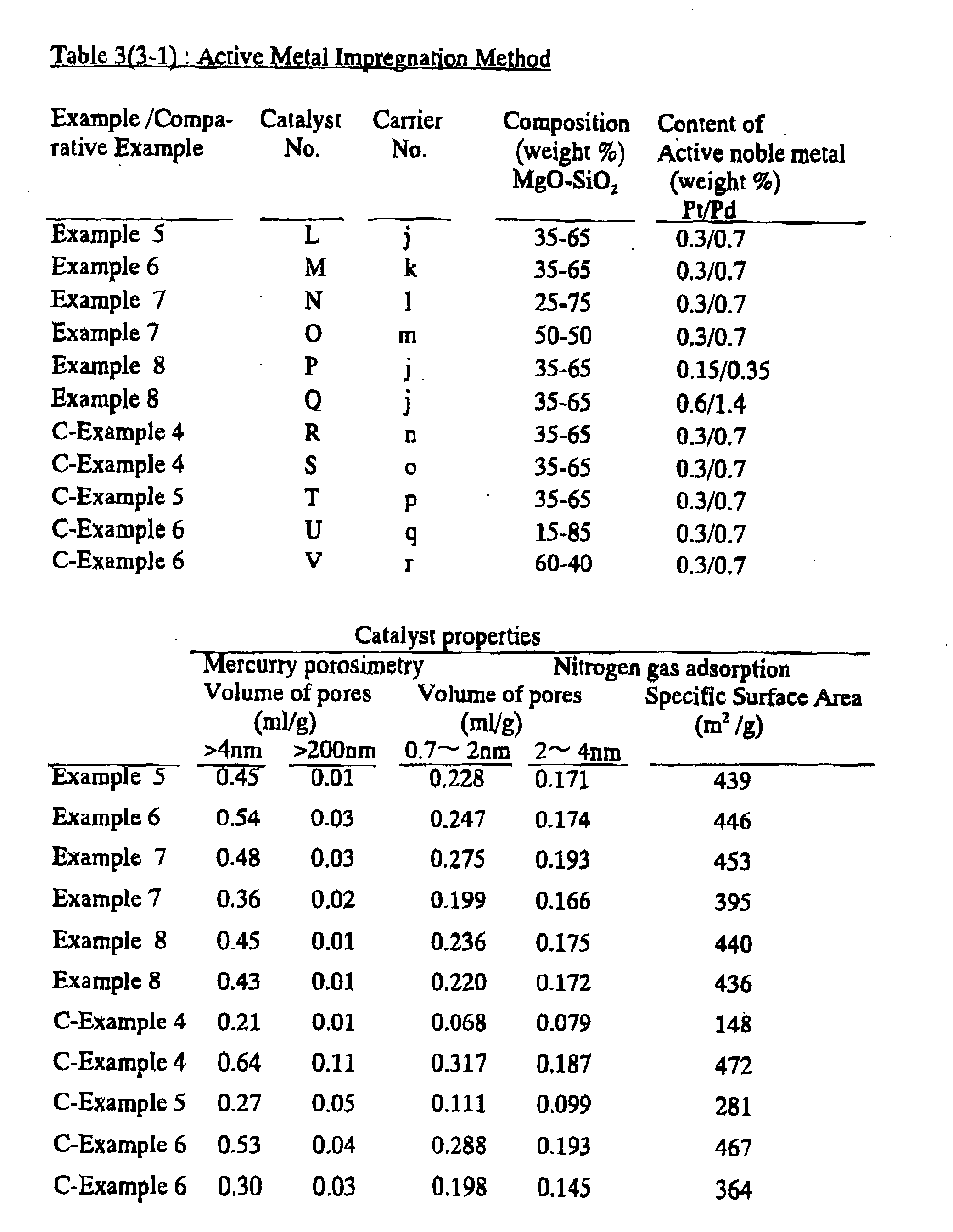
- the pore characteristics as measured by the mercury porosimetry method, the pore volume and the specific surface area as measured by nitrogen gas adsorption methods, and the composition of the obtained catalyst M are shown in Table 3.
- Oxide carriers I and m were obtained in the same manner as the Example 5-(1), with the exception that in the hydrolysis used to generate the silica-magnesia hydrate, the amount of the sodium silicate solution with a SiO 2 concentration of 9.2 weight percent added dropwise to the reaction vessel was altered so as to generate 75 weight percent and 50 weight percent of SiO 2 respectively.
- Catalysts N and O were obtained in the same manner as the Example 5-(2), with the exception that the oxide carriers I and m obtained in (1) were used.
- the pore characteristics as measured by the mercury porosimetry method, the pore volume and the specific surface area as measured by nitrogen gas adsorption methods, and the composition of the obtained catalysts N and O are shown in Table 3.
- Catalysts P and Q were obtained in the same manner as the Example 5-(2), with the exceptions that the oxide carrier j prepared in the Example 5-(1) was used, and the active metal carrier amount was altered to 0.15 weight percent of Pt and 0.35 weight percent of Pd for the catalyst P, and altered to 0.6 weight percent of Pt and 1.40 weight percent of Pd for the catalyst Q.
- the pore characteristics as measured by the mercury porosimetry method, the pore volume and the specific surface area as measured by nitrogen gas adsorption methods, and the composition of the obtained catalysts P and Q are shown in Table 3.
- the results of evaluating the performance of the catalysts in the same manner as in the Example 5-(3) are shown in Table 4.
- Oxide carriers n and o were obtained in the same manner as the Example 5-(1), with the exception that the hydrolysis temperatures used to generate the silica-magnesia hydrate were altered to 25°C and 80°C respectively.
- Catalysts R and S were obtained in the same manner as the Example 5-(2), with the exception that the oxide carriers n and o obtained in (1) were used.
- the pore characteristics as measured by the mercury porosimetry method, the pore volume and the specific surface area as measured by nitrogen gas adsorption methods, and the composition of the obtained catalysts R and S are shown in Table 3.
- An oxide carrier p was obtained by calcining a portion of the extruded and dried product prepared in the Example 5-(1), at 700°C.
- a catalyst T was obtained in the same manner as the Example 5-(2), with the exception that the oxide carrier p obtained in (1) was used.
- the pore characteristics as measured by the mercury porosimetry method, the pore volume and the specific surface area as measured by nitrogen gas adsorption methods, and the composition of the obtained catalyst T are shown in Table 3.
- Oxide carriers q and r were obtained in the same manner as the Example 5-(1), with the exception that in the hydrolysis used to generate the silica-magnesia hydrate, the amount of the sodium silicate solution with a SiO 2 concentration of 9.2 weight percent added dropwise to the reaction vessel was altered so as to generate 85 weight percent and 40 weight percent of SiO 2 respectively.
- Catalysts U and V were obtained in the same manner as the Example 5-(2), with the exception that the oxide carriers q and r obtained in (1) were used.
- the pore characteristics as measured by the mercury porosimetry method, the pore volume and the specific surface area as measured by nitrogen gas adsorption methods, and the composition of the obtained catalysts U and V are shown in Table 3.
- Example 8 the catalysts L, M, N, O, P and Q from Example 5 through Example 8 satisfy the requirements of the present invention with regard to the silica-magnesia composition of the oxide carrier, as well as the pore characteristics, the specific surface area and the amount of active noble metal supported in the catalyst, and show high dearomatization activity, desulfurization activity and denitrogentation activity, respectively.
- the silica-magnesia composition of the oxide carrier and the amount of active noble metal supported in the catalyst fall within the ranges specified in the present invention
- the pore characteristics of the catalyst including the pore volume of pores with a pore size of at least 4 nm, the volume of pores with a pore size from 0.7 to 2 nm, and the volume of pores with a pore size from 2 to 4 nm, together with the specific surface area of the catalyst are markedly smaller than the ranges specified, and the dearomatization activity, desulfurization activity and denitrogentation activity show a low value, respectively.
- the catalyst has a high pore volume of pores with a pore size of at least 200 nm, and while the initial deatomatization activity, desulfurization activity and denitrogentation activity are high, the catalyst deactivates quickly, and these activities deteriorate considerably.
- the pore characteristics of the catalyst including the volume of pores with a pore size of at least 4 nm, the pore volume of pores from 0.7 to 2 nm, and the volume of pores from 2 to 4 nm, together with the specific surface area of the catalyst are markedly smaller than the ranges specified, and the dearomatization activity, desulfurization activity and denitrogentation activity show a low value.
- the silica-magnesia composition of the oxide carrier is outside the range specified in the present invention, and dearomatization activity, and desulfurization and denitrogentation activity show a low value.
- the catalysts L, M, N, O, P and Q of the present invention maintain high activity even after 300 hours, indicating clearly that the catalytic activity of the catalysts is stable.
- a catalyst of the present invention with specific pore characteristics, formed by supporting 0.1 to 2 weight percent, calculated in terms of the metal, of a noble metal from the group VIII of the periodic table, on an oxide carrier comprising a specific silica-magnesia composition, has high dearomatization activity for hydrogenating aromatic hydrocarbons contained in hydrocarbon oils containing sulfur compounds and the like, has superior activity in relation to sulfur compounds and nitrogen hydrocarbons, and moreover can maintain high activity for long periods of time. Accordingly, if a catalyst of the present invention is used in place of conventional catalysts, a light gas oil having a low aromatic content, sulfur content and nitrogen content can be produced.
Landscapes
- Chemical & Material Sciences (AREA)
- Engineering & Computer Science (AREA)
- Chemical Kinetics & Catalysis (AREA)
- Organic Chemistry (AREA)
- Materials Engineering (AREA)
- Oil, Petroleum & Natural Gas (AREA)
- General Chemical & Material Sciences (AREA)
- Production Of Liquid Hydrocarbon Mixture For Refining Petroleum (AREA)
- Catalysts (AREA)
Abstract
Description
| Active Metal Co-Mixing Method | |||
| Example/Comparative Example | Catalyst No. | Composition (weight %) MgO-SiO2 | Content of Active noble metal (weight %) Pr/Pd |
| Example 1 | A | 35-65 | 0.3/0.7 |
| Example 2 | B | 35-65 | 0.3/0.7 |
| Example 3 | C | 25-75 | 0.3/0.7 |
| Example 3 | D | 50-50 | 0.3/0.7 |
| Example 4 | E | 35-65 | 0.15/0.35 |
| Example 4 | F | 35-65 | 0.6/1.4 |
| C-Example 1 | G | 35-65 | 0.3/0.7 |
| C-Example 1 | H | 35-65 | 0.3/0.7 |
| C-Example 2 | I | 35-65 | 0.3/0.7 |
| C-Example 3 | J | 15-85 | 0.3/0.7 |
| C-Example 3 | K | 60-40 | 0.3/0.7 |
| (C-Example= Comparative Example) |

| Example/Comparative Example | Catalyst No. (%) | Dearomatization Rate(%) | Desulfurization Rate(%) | Denitrogentation Rate(%) | |||
| 100h | 300h | 100h | 300h | 100h | 300h | ||
| Example 1 | A | 89 | 90 | 75 | 75 | 84 | 83 |
| Example 2 | B | 90 | 90 | 75 | 75 | 83 | 83 |
| Example 3 | C | 76 | 75 | 72 | 72 | 76 | 76 |
| Example 3 | D | 75 | 75 | 71 | 70 | 75 | 75 |
| Example 4 | E | 70 | 70 | 67 | 67 | 72 | 71 |
| Example 4 | F | 93 | 94 | 78 | 78 | 85 | 85 |
| C-Example 1 | G | 24 | 24 | 22 | 22 | 26 | 26 |
| C-Example 1 | H | 70 | 51 | 62 | 48 | 61 | 50 |
| C-Example 2 | I | 36 | 35 | 31 | 33 | 36 | 34 |
| C-Example 3 | J | 53 | 50 | 48 | 46 | 51 | 51 |
| C-Example 3 | K | 58 | 55 | 52 | 52 | 55 | 52 |
| Hydrolysis temp. (°C) | Catalyst Calcination temp. (°C) | |
| Example 5 | 40 | 500 |
| Example 6 | 60 | 500 |
| Example 7 | 40 | 500 |
| Example 7 | 40 | 500 |
| Example 8 | 40 | 500 |
| Example 8 | 40 | 500 |
| C-Example 4 | 25 | 500 |
| C-Example 4 | 80 | 500 |
| C-Example 5 | 40 | 700 |
| C-Example 6 | 40 | 500 |
| C-Example 6 | 40 | 500 |
| Example/Comparative Example | Catalyst No.(%) | Dearomatization Rate(%) | Desulfurization Rate(%) | Denitrogentation Rate(%) | |||
| 100h | 300h | 100h | 300h | 100h | 300h | ||
| Example 5 | L | 88 | 90 | 75 | 75 | 83 | 83 |
| Example 6 | M | 90 | 89 | 74 | 75 | 83 | 82 |
| Example 7 | N | 78 | 76 | 71 | 71 | 76 | 76 |
| Example 7 | O | 75 | 75 | 72 | 72 | 75 | 75 |
| Example 8 | P | 70 | 71 | 68 | 68 | 73 | 73 |
| Example 8 | Q | 93 | 93 | 76 | 75 | 85 | 85 |
| C-Example 4 | R | 24 | 24 | 22 | 22 | 26 | 24 |
| C-Example 4 | S | 69 | 52 | 61 | 48 | 64 | 50 |
| C-Example 5 | T | 35 | 35 | 31 | 33 | 36 | 34 |
| C-Example 6 | U | 51 | 50 | 48 | 46 | 51 | 51 |
| C-Example 6 | V | 58 | 55 | 51 | 51 | 54 | 52 |
Claims (5)
- A hydrogenation catalyst for hydrocarbon oil containing aromatic hydrocarbons, the catalyst comprising a carrier and an active metal wherein the pore characteristics of the catalyst are such that the volume of pores with a pore size of at least 4 nm as measured by a mercury porosimetry method is within the range from 0.3 to 0.6 ml/g, the volume of pores with a pore size of at least 200 nm as measured by a mercury porosimetry method is no more than 0.05 ml/g, the volume of pores with a pore size from 0.7 to 2 nm as measured by nitrogen adsorption-t-plot method is within the range from 0.2 to 0.3 ml/g, and the volume of pores with a pore size from 2 to 4 nm as measured by nitrogen adsorption-DH method is within the range from 0.15 to 0.2 ml/g.
- The hydrogenation catalyst of Claim 1, wherein the hydrocarbon oil contains a fraction with a boiling point of 170 to 390°C by an amount of at least 80 weight percent.
- The hydrogenation catalyst of one of Claim 1 and 2, wherein the carrier is formed from silica-magnesia, wherein the active metal is a noble metal selected from the group VIII of the periodic table, and wherein the magnesia content of the silica-magnesia is within a range from 25 to 50 weight percent, calculated in terms of the metal oxide.
- The hydrogenation catalyst of Claim 3, wherein the proportion of the noble metal selected from the group VIII of the periodic table is within a range from 0.1 to 2 weight percent, calculated in terms of the metal.
- The hydrogenation catalyst for hydrocarbon oil containing aromatic hydrocarbons, the catalyst comprising a carrier and an active metal, wherein the pore size distribution of the catalyst is substantially composed of pore sizes within a range from 4 to 200 nm, and pore sizes within a range from 0.7 to 4 nm, and wherein the volume of pores with a pore size in the range from 4 to 200 nm is 0.3 to 0.6 ml/g, and wherein the volume of pores with a pore size in the range from 0.7 to 4 nm is 0.35 to 0.5 ml/g.
Applications Claiming Priority (4)
| Application Number | Priority Date | Filing Date | Title |
|---|---|---|---|
| JP2001160904 | 2001-05-29 | ||
| JP2001160904 | 2001-05-29 | ||
| JP2001396375 | 2001-12-27 | ||
| JP2001396375A JP3786007B2 (en) | 2001-05-29 | 2001-12-27 | Catalyst for hydrotreating aromatic compounds in hydrocarbon oils |
Publications (3)
| Publication Number | Publication Date |
|---|---|
| EP1262234A2 true EP1262234A2 (en) | 2002-12-04 |
| EP1262234A3 EP1262234A3 (en) | 2003-11-05 |
| EP1262234B1 EP1262234B1 (en) | 2008-05-21 |
Family
ID=26615877
Family Applications (1)
| Application Number | Title | Priority Date | Filing Date |
|---|---|---|---|
| EP02009047A Expired - Lifetime EP1262234B1 (en) | 2001-05-29 | 2002-04-23 | Hydrogenation catalyst for aromatic hydrocarbons contained in hydrocarbon oils |
Country Status (7)
| Country | Link |
|---|---|
| US (1) | US6524993B2 (en) |
| EP (1) | EP1262234B1 (en) |
| JP (1) | JP3786007B2 (en) |
| AT (1) | ATE395974T1 (en) |
| DE (1) | DE60226664D1 (en) |
| DK (1) | DK1262234T3 (en) |
| SG (1) | SG100792A1 (en) |
Cited By (15)
| Publication number | Priority date | Publication date | Assignee | Title |
|---|---|---|---|---|
| US7816565B2 (en) | 2008-07-31 | 2010-10-19 | Celanese International Corporation | Direct and selective production of acetaldehyde from acetic acid utilizing a supported metal catalyst |
| WO2011053367A1 (en) * | 2009-10-26 | 2011-05-05 | Celanese International Corporation | Catalysts for making ethyl acetate from acetic acid |
| US8071821B2 (en) | 2008-07-31 | 2011-12-06 | Celanese International Corporation | Direct and selective production of ethanol from acetic acid utilizing a platinum/ tin catalyst |
| US8178715B2 (en) | 2008-12-31 | 2012-05-15 | Celanese International Corporation | Integrated process for the production of vinyl acetate from acetic acid via acetaldehyde |
| US8450535B2 (en) | 2009-07-20 | 2013-05-28 | Celanese International Corporation | Ethanol production from acetic acid utilizing a cobalt catalyst |
| US8455702B1 (en) | 2011-12-29 | 2013-06-04 | Celanese International Corporation | Cobalt and tin catalysts for producing ethanol |
| US8487143B2 (en) | 2008-07-31 | 2013-07-16 | Celanese International Corporation | Ethanol production from acetic acid utilizing a cobalt catalyst |
| US8518851B2 (en) | 2007-10-19 | 2013-08-27 | Shell Oil Company | Catalyst for the hydrogenation of unsaturated hydrocarbons and process for its preparation |
| US8536383B1 (en) | 2012-03-14 | 2013-09-17 | Celanese International Corporation | Rhodium/tin catalysts and processes for producing ethanol |
| US8575406B2 (en) | 2011-12-22 | 2013-11-05 | Celanese International Corporation | Catalysts having promoter metals and process for producing ethanol |
| US8802588B2 (en) | 2012-01-23 | 2014-08-12 | Celanese International Corporation | Bismuth catalyst composition and process for manufacturing ethanol mixture |
| US8822368B2 (en) | 2009-05-07 | 2014-09-02 | Shell Oil Company | Hydrogenation of aromatics and other unsaturated organic compounds |
| US8927786B2 (en) | 2012-03-13 | 2015-01-06 | Celanese International Corporation | Ethanol manufacturing process over catalyst having improved radial crush strength |
| US9073042B2 (en) | 2012-03-14 | 2015-07-07 | Celanese International Corporation | Acetic acid hydrogenation over a group VIII metal calcined catalyst having a secondary promoter |
| US9126194B2 (en) | 2012-02-29 | 2015-09-08 | Celanese International Corporation | Catalyst having support containing tin and process for manufacturing ethanol |
Families Citing this family (44)
| Publication number | Priority date | Publication date | Assignee | Title |
|---|---|---|---|---|
| US7341977B2 (en) * | 2003-06-20 | 2008-03-11 | Nanoscale Corporation | Method of sorbing sulfur compounds using nanocrystalline mesoporous metal oxides |
| US8598060B2 (en) * | 2006-07-31 | 2013-12-03 | Basf Se | Method of regenerating ruthenium catalysts for the ring hydrogenation of phthalates |
| US8501652B2 (en) | 2008-07-31 | 2013-08-06 | Celanese International Corporation | Catalysts for making ethanol from acetic acid |
| US8637714B2 (en) | 2008-07-31 | 2014-01-28 | Celanese International Corporation | Process for producing ethanol over catalysts containing platinum and palladium |
| US8680317B2 (en) | 2008-07-31 | 2014-03-25 | Celanese International Corporation | Processes for making ethyl acetate from acetic acid |
| US8309772B2 (en) | 2008-07-31 | 2012-11-13 | Celanese International Corporation | Tunable catalyst gas phase hydrogenation of carboxylic acids |
| US8338650B2 (en) | 2008-07-31 | 2012-12-25 | Celanese International Corporation | Palladium catalysts for making ethanol from acetic acid |
| US8546622B2 (en) | 2008-07-31 | 2013-10-01 | Celanese International Corporation | Process for making ethanol from acetic acid using acidic catalysts |
| US8471075B2 (en) | 2008-07-31 | 2013-06-25 | Celanese International Corporation | Processes for making ethanol from acetic acid |
| US20100197486A1 (en) * | 2008-07-31 | 2010-08-05 | Celanese International Corporation | Catalysts for making ethyl acetate from acetic acid |
| US8680321B2 (en) | 2009-10-26 | 2014-03-25 | Celanese International Corporation | Processes for making ethanol from acetic acid using bimetallic catalysts |
| US8710277B2 (en) | 2009-10-26 | 2014-04-29 | Celanese International Corporation | Process for making diethyl ether from acetic acid |
| US20110189589A1 (en) * | 2010-01-29 | 2011-08-04 | The Johns Hopkins University | Composite porous catalysts |
| US8575403B2 (en) | 2010-05-07 | 2013-11-05 | Celanese International Corporation | Hydrolysis of ethyl acetate in ethanol separation process |
| US8728179B2 (en) | 2010-02-02 | 2014-05-20 | Celanese International Corporation | Ethanol compositions |
| US8222466B2 (en) | 2010-02-02 | 2012-07-17 | Celanese International Corporation | Process for producing a water stream from ethanol production |
| US8747492B2 (en) | 2010-02-02 | 2014-06-10 | Celanese International Corporation | Ethanol/fuel blends for use as motor fuels |
| US8541633B2 (en) | 2010-02-02 | 2013-09-24 | Celanese International Corporation | Processes for producing anhydrous ethanol compositions |
| US8858659B2 (en) | 2010-02-02 | 2014-10-14 | Celanese International Corporation | Processes for producing denatured ethanol |
| US8314272B2 (en) | 2010-02-02 | 2012-11-20 | Celanese International Corporation | Process for recovering ethanol with vapor separation |
| US8460405B2 (en) | 2010-02-02 | 2013-06-11 | Celanese International Corporation | Ethanol compositions |
| US8668750B2 (en) | 2010-02-02 | 2014-03-11 | Celanese International Corporation | Denatured fuel ethanol compositions for blending with gasoline or diesel fuel for use as motor fuels |
| US8932372B2 (en) | 2010-02-02 | 2015-01-13 | Celanese International Corporation | Integrated process for producing alcohols from a mixed acid feed |
| US8350098B2 (en) | 2011-04-04 | 2013-01-08 | Celanese International Corporation | Ethanol production from acetic acid utilizing a molybdenum carbide catalyst |
| US9073816B2 (en) | 2011-04-26 | 2015-07-07 | Celanese International Corporation | Reducing ethyl acetate concentration in recycle streams for ethanol production processes |
| US8895786B2 (en) | 2011-08-03 | 2014-11-25 | Celanese International Corporation | Processes for increasing alcohol production |
| US8658843B2 (en) | 2011-10-06 | 2014-02-25 | Celanese International Corporation | Hydrogenation catalysts prepared from polyoxometalate precursors and process for using same to produce ethanol while minimizing diethyl ether formation |
| US8536382B2 (en) | 2011-10-06 | 2013-09-17 | Celanese International Corporation | Processes for hydrogenating alkanoic acids using catalyst comprising tungsten |
| US8703868B2 (en) | 2011-11-28 | 2014-04-22 | Celanese International Corporation | Integrated process for producing polyvinyl alcohol or a copolymer thereof and ethanol |
| US9333496B2 (en) | 2012-02-29 | 2016-05-10 | Celanese International Corporation | Cobalt/tin catalyst for producing ethanol |
| US9079172B2 (en) | 2012-03-13 | 2015-07-14 | Celanese International Corporation | Promoters for cobalt-tin catalysts for reducing alkanoic acids |
| WO2013103399A1 (en) | 2012-01-06 | 2013-07-11 | Celanese International Corporation | Hydrogenation catalysts with cobalt-modified supports |
| US8981164B2 (en) | 2012-01-06 | 2015-03-17 | Celanese International Corporation | Cobalt and tin hydrogenation catalysts |
| US9051235B2 (en) | 2012-02-07 | 2015-06-09 | Celanese International Corporation | Process for producing ethanol using a molar excess of hydrogen |
| US9050585B2 (en) | 2012-02-10 | 2015-06-09 | Celanese International Corporation | Chemisorption of ethyl acetate during hydrogenation of acetic acid to ethanol |
| CN102614868B (en) * | 2012-02-22 | 2015-03-25 | 西安凯立化工有限公司 | Supported noble metal hydrogenation catalyst and preparation method thereof |
| JP2014031441A (en) * | 2012-08-03 | 2014-02-20 | Bridgestone Corp | Rubber composition and tire |
| US8772553B2 (en) | 2012-10-26 | 2014-07-08 | Celanese International Corporation | Hydrogenation reaction conditions for producing ethanol |
| CN107573967B (en) * | 2016-07-04 | 2019-08-16 | 中国石油化工股份有限公司 | A kind of hydrocracking method for producing jet fuel |
| JP6858055B2 (en) * | 2017-03-30 | 2021-04-14 | 水澤化学工業株式会社 | Lead adsorbent |
| JP6930897B2 (en) * | 2017-10-31 | 2021-09-01 | 水澤化学工業株式会社 | Anion adsorbent |
| JP2019171337A (en) * | 2018-03-29 | 2019-10-10 | Jxtgエネルギー株式会社 | Hydrogenation catalyst and method for producing low aromatic solvent |
| EP4527499A1 (en) | 2023-09-19 | 2025-03-26 | Indian Oil Corporation Limited | A catalyst for hydrogenation of unsaturated hydrocarbons and a method for preparation thereof |
| WO2025187474A1 (en) * | 2024-03-05 | 2025-09-12 | 日揮触媒化成株式会社 | Catalyst for hydrogenating aromatic compound |
Family Cites Families (22)
| Publication number | Priority date | Publication date | Assignee | Title |
|---|---|---|---|---|
| US4920089A (en) * | 1987-05-08 | 1990-04-24 | Unilever Patent Holdings B.V. | Hydrogenation catalyst |
| EP0987220A1 (en) * | 1998-09-17 | 2000-03-22 | Technische Universiteit Delft | Mesoporous amorphous silicate materials and process for the preparation thereof |
| JPH03202152A (en) | 1989-12-28 | 1991-09-03 | Japan Synthetic Rubber Co Ltd | Hydrogenating catalyst |
| US5188996A (en) * | 1991-05-22 | 1993-02-23 | Mobil Oil Corp. | Redispersion of noble metal on low acidity support |
| CA2079924A1 (en) * | 1991-10-18 | 1993-04-19 | Kazushi Usui | Catalyst composition for hydrotreating of hydrocarbon oils and process for manufacturing the same |
| US5221656A (en) * | 1992-03-25 | 1993-06-22 | Amoco Corporation | Hydroprocessing catalyst |
| CA2093412C (en) * | 1992-04-20 | 2002-12-31 | Gerald Verdell Nelson | Novel hydroconversion process employing catalyst with specified pore size distribution |
| US5827421A (en) * | 1992-04-20 | 1998-10-27 | Texaco Inc | Hydroconversion process employing catalyst with specified pore size distribution and no added silica |
| EP0568913A3 (en) * | 1992-05-03 | 1995-03-22 | Dalian Chemical Physics Inst | Process for the conversion of methanol to light olefins and catalysts used therefor. |
| US5358633A (en) * | 1993-05-28 | 1994-10-25 | Texaco Inc. | Hydrodesulfurization of cracked naphtha with low levels of olefin saturation |
| US5389595A (en) | 1993-09-30 | 1995-02-14 | Union Oil Company Of California | Hydroprocessing catalyst, its use, and method of preparation |
| US5514273A (en) * | 1993-10-01 | 1996-05-07 | Texaco Inc. | Hydroconversion process employing catalyst with specified pore size distribution |
| US5928499A (en) * | 1993-10-01 | 1999-07-27 | Texaco Inc | Hydroconversion process employing catalyst with specified pore size distribution, median pore diameter by surface area, and pore mode by volume |
| US5403469A (en) | 1993-11-01 | 1995-04-04 | Union Oil Company Of California | Process for producing FCC feed and middle distillate |
| JP3959107B2 (en) * | 1994-05-13 | 2007-08-15 | サイテク・テクノロジー・コーポレーシヨン | Highly active catalyst |
| DE4424775A1 (en) * | 1994-07-05 | 1996-01-11 | Grace Gmbh | Antiblocking agent and process for its manufacture |
| US5538710A (en) * | 1994-12-14 | 1996-07-23 | Energy Mines And Resources-Canada | Synthesis of mesoporous catalytic materials |
| JP3553258B2 (en) | 1995-02-14 | 2004-08-11 | 新日本石油株式会社 | Method for hydrogenating aromatic hydrocarbons in hydrocarbon oil and catalyst used therefor |
| DE19533718A1 (en) * | 1995-09-12 | 1997-03-13 | Basf Ag | Process for the hydrogenation of aromatic compounds in which at least one amino group is bonded to an aromatic nucleus |
| JP3658703B2 (en) | 1998-11-06 | 2005-06-08 | 住友金属鉱山株式会社 | Hydrocarbon oil hydrotreating catalyst and hydrotreating method |
| JP2001003064A (en) | 1999-06-24 | 2001-01-09 | Sumitomo Metal Mining Co Ltd | Hydrorefining method of hydrocarbon oil and catalyst used in this method |
| JP3844044B2 (en) | 2000-01-21 | 2006-11-08 | 住友金属鉱山株式会社 | Catalyst for hydrotreating aromatic compounds in hydrocarbon oil and process for producing the same |
-
2001
- 2001-12-27 JP JP2001396375A patent/JP3786007B2/en not_active Expired - Fee Related
-
2002
- 2002-04-23 DE DE60226664T patent/DE60226664D1/en not_active Expired - Lifetime
- 2002-04-23 AT AT02009047T patent/ATE395974T1/en not_active IP Right Cessation
- 2002-04-23 EP EP02009047A patent/EP1262234B1/en not_active Expired - Lifetime
- 2002-04-23 DK DK02009047T patent/DK1262234T3/en active
- 2002-05-03 US US10/139,796 patent/US6524993B2/en not_active Expired - Lifetime
- 2002-05-23 SG SG200203113A patent/SG100792A1/en unknown
Cited By (23)
| Publication number | Priority date | Publication date | Assignee | Title |
|---|---|---|---|---|
| US8841498B2 (en) | 2007-10-19 | 2014-09-23 | Shell Oil Company | Catalyst for the hydrogenation of unsaturated hydrocarbons and process for its preparation |
| US8518851B2 (en) | 2007-10-19 | 2013-08-27 | Shell Oil Company | Catalyst for the hydrogenation of unsaturated hydrocarbons and process for its preparation |
| US8487143B2 (en) | 2008-07-31 | 2013-07-16 | Celanese International Corporation | Ethanol production from acetic acid utilizing a cobalt catalyst |
| US8889923B2 (en) | 2008-07-31 | 2014-11-18 | Celanese International Corporation | Synthesis of ethanol from biomass |
| US7994368B2 (en) | 2008-07-31 | 2011-08-09 | Celanese International Corporation | Direct and selective production of acetaldehyde from acetic acid utilizing a supported metal catalyst |
| US8071821B2 (en) | 2008-07-31 | 2011-12-06 | Celanese International Corporation | Direct and selective production of ethanol from acetic acid utilizing a platinum/ tin catalyst |
| US7816565B2 (en) | 2008-07-31 | 2010-10-19 | Celanese International Corporation | Direct and selective production of acetaldehyde from acetic acid utilizing a supported metal catalyst |
| US8227644B2 (en) | 2008-07-31 | 2012-07-24 | Celanese International Corporation | Direct and selective production of acetaldehyde from acetic acid utilizing a supported metal catalyst |
| US8669400B2 (en) | 2008-07-31 | 2014-03-11 | Celanese International Corporation | Direct and selective production of ethanol from acetic acid utilizing a platinum/ tin catalyst |
| US8461395B2 (en) | 2008-07-31 | 2013-06-11 | Celanese International Corporation | Synthesis of acetaldehyde from a carbon source |
| US8178715B2 (en) | 2008-12-31 | 2012-05-15 | Celanese International Corporation | Integrated process for the production of vinyl acetate from acetic acid via acetaldehyde |
| US8822368B2 (en) | 2009-05-07 | 2014-09-02 | Shell Oil Company | Hydrogenation of aromatics and other unsaturated organic compounds |
| US9073807B2 (en) | 2009-05-07 | 2015-07-07 | Shell Oil Company | Hydrogenation of aromatics and other unsaturated organic compounds |
| US8450535B2 (en) | 2009-07-20 | 2013-05-28 | Celanese International Corporation | Ethanol production from acetic acid utilizing a cobalt catalyst |
| CN102300638A (en) * | 2009-10-26 | 2011-12-28 | 国际人造丝公司 | Catalysts for making ethyl acetate from acetic acid |
| WO2011053367A1 (en) * | 2009-10-26 | 2011-05-05 | Celanese International Corporation | Catalysts for making ethyl acetate from acetic acid |
| US8575406B2 (en) | 2011-12-22 | 2013-11-05 | Celanese International Corporation | Catalysts having promoter metals and process for producing ethanol |
| US8455702B1 (en) | 2011-12-29 | 2013-06-04 | Celanese International Corporation | Cobalt and tin catalysts for producing ethanol |
| US8802588B2 (en) | 2012-01-23 | 2014-08-12 | Celanese International Corporation | Bismuth catalyst composition and process for manufacturing ethanol mixture |
| US9126194B2 (en) | 2012-02-29 | 2015-09-08 | Celanese International Corporation | Catalyst having support containing tin and process for manufacturing ethanol |
| US8927786B2 (en) | 2012-03-13 | 2015-01-06 | Celanese International Corporation | Ethanol manufacturing process over catalyst having improved radial crush strength |
| US8536383B1 (en) | 2012-03-14 | 2013-09-17 | Celanese International Corporation | Rhodium/tin catalysts and processes for producing ethanol |
| US9073042B2 (en) | 2012-03-14 | 2015-07-07 | Celanese International Corporation | Acetic acid hydrogenation over a group VIII metal calcined catalyst having a secondary promoter |
Also Published As
| Publication number | Publication date |
|---|---|
| DK1262234T3 (en) | 2008-09-15 |
| US6524993B2 (en) | 2003-02-25 |
| EP1262234A3 (en) | 2003-11-05 |
| JP3786007B2 (en) | 2006-06-14 |
| SG100792A1 (en) | 2003-12-26 |
| DE60226664D1 (en) | 2008-07-03 |
| ATE395974T1 (en) | 2008-06-15 |
| EP1262234B1 (en) | 2008-05-21 |
| US20030004057A1 (en) | 2003-01-02 |
| JP2003047860A (en) | 2003-02-18 |
Similar Documents
| Publication | Publication Date | Title |
|---|---|---|
| US6524993B2 (en) | Hydrogenation catalyst for aromatic hydrocarbons contained in hydrocarbon oils | |
| EP0669162B1 (en) | Silica-alumina carriers preparation, hydrogenation catalysts preparation therewith and their use for aromatics hydrogenation | |
| US8772196B2 (en) | Aromatics hydrogenation catalyst and a method of making and using such catalyst | |
| US4218308A (en) | Hydrogenation catalyst | |
| AU643146B2 (en) | Hydrogenation catalyst and process | |
| CN101347734B (en) | Large hole nickel-based catalyst | |
| WO1990013615A1 (en) | Hydrocracking catalyst and process | |
| CN103666555B (en) | A kind of method for hydrogen cracking increasing production intermediate oil | |
| JPS5857221B2 (en) | Suisokashiyokubai | |
| JP2009541035A (en) | Aromatic compound hydrogenation catalyst containing noble metal with sulfur tolerance and method for producing and using such catalyst | |
| EP1027156B1 (en) | Hydrocracking catalyst, producing method thereof, and hydrocracking method | |
| JP3658703B2 (en) | Hydrocarbon oil hydrotreating catalyst and hydrotreating method | |
| KR100521912B1 (en) | Process for hydrogenation, hydroisomerization and/or hydrodesulfurization of a sulfur contaminant containing feedstock | |
| JP3537979B2 (en) | Catalyst for hydrotreating hydrocarbon oil and method for hydrotreating light oil | |
| JP4485625B2 (en) | Aromatic hydrocarbon hydrogenation catalyst composition | |
| JP3770679B2 (en) | Hydrocarbon hydrotreating catalyst and gas oil hydrotreating method | |
| JP2022074937A (en) | Hydrogenation treatment catalyst of heavy hydrocarbon oil and manufacturing method thereof as well as hydrogenation treatment method | |
| JP3844044B2 (en) | Catalyst for hydrotreating aromatic compounds in hydrocarbon oil and process for producing the same | |
| JP2003047847A (en) | Catalyst for hydrotreating hydrocarbon oil and method for producing the same | |
| JP2001205084A (en) | Catalyst for hydrotreating aromatic compounds in hydrocarbon oils | |
| JPH11309372A (en) | Catalyst composition for hydrogenation of aromatic hydrocarbons | |
| JP3512326B2 (en) | Hydroprocessing of gas oil | |
| JPH10235198A (en) | Catalyst for hydrotreating hydrocarbon oil and method for hydrotreating light oil | |
| JPH01224049A (en) | Hydrocracking catalyst for residual oil | |
| JPH10180100A (en) | Catalyst for hydrotreating hydrocarbon oil and method for hydrotreating light oil |
Legal Events
| Date | Code | Title | Description |
|---|---|---|---|
| PUAI | Public reference made under article 153(3) epc to a published international application that has entered the european phase |
Free format text: ORIGINAL CODE: 0009012 |
|
| 17P | Request for examination filed |
Effective date: 20020423 |
|
| AK | Designated contracting states |
Kind code of ref document: A2 Designated state(s): AT BE CH CY DE DK ES FI FR GB GR IE IT LI LU MC NL PT SE TR |
|
| AX | Request for extension of the european patent |
Free format text: AL;LT;LV;MK;RO;SI |
|
| PUAL | Search report despatched |
Free format text: ORIGINAL CODE: 0009013 |
|
| AK | Designated contracting states |
Kind code of ref document: A3 Designated state(s): AT BE CH CY DE DK ES FI FR GB GR IE IT LI LU MC NL PT SE TR |
|
| AX | Request for extension of the european patent |
Extension state: AL LT LV MK RO SI |
|
| AKX | Designation fees paid |
Designated state(s): AT BE CH CY DE DK ES FI FR GB GR IE IT LI LU MC NL PT SE TR |
|
| 17Q | First examination report despatched |
Effective date: 20040715 |
|
| 17Q | First examination report despatched |
Effective date: 20040715 |
|
| GRAP | Despatch of communication of intention to grant a patent |
Free format text: ORIGINAL CODE: EPIDOSNIGR1 |
|
| GRAS | Grant fee paid |
Free format text: ORIGINAL CODE: EPIDOSNIGR3 |
|
| GRAA | (expected) grant |
Free format text: ORIGINAL CODE: 0009210 |
|
| AK | Designated contracting states |
Kind code of ref document: B1 Designated state(s): AT BE CH CY DE DK ES FI FR GB GR IE IT LI LU MC NL PT SE TR |
|
| REG | Reference to a national code |
Ref country code: GB Ref legal event code: FG4D |
|
| REG | Reference to a national code |
Ref country code: CH Ref legal event code: EP |
|
| REF | Corresponds to: |
Ref document number: 60226664 Country of ref document: DE Date of ref document: 20080703 Kind code of ref document: P |
|
| REG | Reference to a national code |
Ref country code: IE Ref legal event code: FG4D |
|
| REG | Reference to a national code |
Ref country code: SE Ref legal event code: TRGR |
|
| REG | Reference to a national code |
Ref country code: DK Ref legal event code: T3 |
|
| PG25 | Lapsed in a contracting state [announced via postgrant information from national office to epo] |
Ref country code: ES Free format text: LAPSE BECAUSE OF FAILURE TO SUBMIT A TRANSLATION OF THE DESCRIPTION OR TO PAY THE FEE WITHIN THE PRESCRIBED TIME-LIMIT Effective date: 20080901 |
|
| PG25 | Lapsed in a contracting state [announced via postgrant information from national office to epo] |
Ref country code: AT Free format text: LAPSE BECAUSE OF FAILURE TO SUBMIT A TRANSLATION OF THE DESCRIPTION OR TO PAY THE FEE WITHIN THE PRESCRIBED TIME-LIMIT Effective date: 20080521 |
|
| PG25 | Lapsed in a contracting state [announced via postgrant information from national office to epo] |
Ref country code: PT Free format text: LAPSE BECAUSE OF FAILURE TO SUBMIT A TRANSLATION OF THE DESCRIPTION OR TO PAY THE FEE WITHIN THE PRESCRIBED TIME-LIMIT Effective date: 20081021 |
|
| PLBE | No opposition filed within time limit |
Free format text: ORIGINAL CODE: 0009261 |
|
| STAA | Information on the status of an ep patent application or granted ep patent |
Free format text: STATUS: NO OPPOSITION FILED WITHIN TIME LIMIT |
|
| 26N | No opposition filed |
Effective date: 20090224 |
|
| PG25 | Lapsed in a contracting state [announced via postgrant information from national office to epo] |
Ref country code: IT Free format text: LAPSE BECAUSE OF FAILURE TO SUBMIT A TRANSLATION OF THE DESCRIPTION OR TO PAY THE FEE WITHIN THE PRESCRIBED TIME-LIMIT Effective date: 20080521 |
|
| REG | Reference to a national code |
Ref country code: CH Ref legal event code: PL |
|
| PG25 | Lapsed in a contracting state [announced via postgrant information from national office to epo] |
Ref country code: CH Free format text: LAPSE BECAUSE OF NON-PAYMENT OF DUE FEES Effective date: 20090430 Ref country code: LI Free format text: LAPSE BECAUSE OF NON-PAYMENT OF DUE FEES Effective date: 20090430 |
|
| REG | Reference to a national code |
Ref country code: IE Ref legal event code: MM4A |
|
| PG25 | Lapsed in a contracting state [announced via postgrant information from national office to epo] |
Ref country code: MC Free format text: LAPSE BECAUSE OF NON-PAYMENT OF DUE FEES Effective date: 20090430 Ref country code: IE Free format text: LAPSE BECAUSE OF NON-PAYMENT OF DUE FEES Effective date: 20090423 |
|
| PG25 | Lapsed in a contracting state [announced via postgrant information from national office to epo] |
Ref country code: GR Free format text: LAPSE BECAUSE OF FAILURE TO SUBMIT A TRANSLATION OF THE DESCRIPTION OR TO PAY THE FEE WITHIN THE PRESCRIBED TIME-LIMIT Effective date: 20080822 |
|
| PG25 | Lapsed in a contracting state [announced via postgrant information from national office to epo] |
Ref country code: LU Free format text: LAPSE BECAUSE OF NON-PAYMENT OF DUE FEES Effective date: 20090423 |
|
| PG25 | Lapsed in a contracting state [announced via postgrant information from national office to epo] |
Ref country code: TR Free format text: LAPSE BECAUSE OF FAILURE TO SUBMIT A TRANSLATION OF THE DESCRIPTION OR TO PAY THE FEE WITHIN THE PRESCRIBED TIME-LIMIT Effective date: 20080521 |
|
| PG25 | Lapsed in a contracting state [announced via postgrant information from national office to epo] |
Ref country code: CY Free format text: LAPSE BECAUSE OF FAILURE TO SUBMIT A TRANSLATION OF THE DESCRIPTION OR TO PAY THE FEE WITHIN THE PRESCRIBED TIME-LIMIT Effective date: 20080521 |
|
| REG | Reference to a national code |
Ref country code: FR Ref legal event code: PLFP Year of fee payment: 14 |
|
| REG | Reference to a national code |
Ref country code: FR Ref legal event code: PLFP Year of fee payment: 15 |
|
| REG | Reference to a national code |
Ref country code: FR Ref legal event code: PLFP Year of fee payment: 16 |
|
| PGFP | Annual fee paid to national office [announced via postgrant information from national office to epo] |
Ref country code: NL Payment date: 20170320 Year of fee payment: 16 Ref country code: FR Payment date: 20170313 Year of fee payment: 16 |
|
| PGFP | Annual fee paid to national office [announced via postgrant information from national office to epo] |
Ref country code: BE Payment date: 20170313 Year of fee payment: 16 |
|
| PGFP | Annual fee paid to national office [announced via postgrant information from national office to epo] |
Ref country code: DE Payment date: 20170420 Year of fee payment: 16 Ref country code: GB Payment date: 20170419 Year of fee payment: 16 Ref country code: DK Payment date: 20170411 Year of fee payment: 16 |
|
| PGFP | Annual fee paid to national office [announced via postgrant information from national office to epo] |
Ref country code: SE Payment date: 20170411 Year of fee payment: 16 Ref country code: FI Payment date: 20170410 Year of fee payment: 16 |
|
| REG | Reference to a national code |
Ref country code: DE Ref legal event code: R119 Ref document number: 60226664 Country of ref document: DE |
|
| REG | Reference to a national code |
Ref country code: DK Ref legal event code: EBP Effective date: 20180430 |
|
| REG | Reference to a national code |
Ref country code: SE Ref legal event code: EUG |
|
| REG | Reference to a national code |
Ref country code: NL Ref legal event code: MM Effective date: 20180501 |
|
| REG | Reference to a national code |
Ref country code: BE Ref legal event code: MM Effective date: 20180430 |
|
| GBPC | Gb: european patent ceased through non-payment of renewal fee |
Effective date: 20180423 |
|
| PG25 | Lapsed in a contracting state [announced via postgrant information from national office to epo] |
Ref country code: NL Free format text: LAPSE BECAUSE OF NON-PAYMENT OF DUE FEES Effective date: 20180501 Ref country code: FI Free format text: LAPSE BECAUSE OF NON-PAYMENT OF DUE FEES Effective date: 20180423 Ref country code: SE Free format text: LAPSE BECAUSE OF NON-PAYMENT OF DUE FEES Effective date: 20180424 Ref country code: DE Free format text: LAPSE BECAUSE OF NON-PAYMENT OF DUE FEES Effective date: 20181101 |
|
| PG25 | Lapsed in a contracting state [announced via postgrant information from national office to epo] |
Ref country code: BE Free format text: LAPSE BECAUSE OF NON-PAYMENT OF DUE FEES Effective date: 20180430 Ref country code: GB Free format text: LAPSE BECAUSE OF NON-PAYMENT OF DUE FEES Effective date: 20180423 |
|
| PG25 | Lapsed in a contracting state [announced via postgrant information from national office to epo] |
Ref country code: FR Free format text: LAPSE BECAUSE OF NON-PAYMENT OF DUE FEES Effective date: 20180430 |
|
| PG25 | Lapsed in a contracting state [announced via postgrant information from national office to epo] |
Ref country code: DK Free format text: LAPSE BECAUSE OF NON-PAYMENT OF DUE FEES Effective date: 20180430 |