EP1260887A1 - Procédé de réalisation d'un coeur de commande-contrôle - Google Patents
Procédé de réalisation d'un coeur de commande-contrôle Download PDFInfo
- Publication number
- EP1260887A1 EP1260887A1 EP02352011A EP02352011A EP1260887A1 EP 1260887 A1 EP1260887 A1 EP 1260887A1 EP 02352011 A EP02352011 A EP 02352011A EP 02352011 A EP02352011 A EP 02352011A EP 1260887 A1 EP1260887 A1 EP 1260887A1
- Authority
- EP
- European Patent Office
- Prior art keywords
- command
- computer
- bricks
- functions
- control core
- Prior art date
- Legal status (The legal status is an assumption and is not a legal conclusion. Google has not performed a legal analysis and makes no representation as to the accuracy of the status listed.)
- Granted
Links
Images
Classifications
-
- G—PHYSICS
- G05—CONTROLLING; REGULATING
- G05B—CONTROL OR REGULATING SYSTEMS IN GENERAL; FUNCTIONAL ELEMENTS OF SUCH SYSTEMS; MONITORING OR TESTING ARRANGEMENTS FOR SUCH SYSTEMS OR ELEMENTS
- G05B19/00—Program-control systems
- G05B19/02—Program-control systems electric
- G05B19/04—Program control other than numerical control, i.e. in sequence controllers or logic controllers
- G05B19/042—Program control other than numerical control, i.e. in sequence controllers or logic controllers using digital processors
- G05B19/0426—Programming the control sequence
-
- G—PHYSICS
- G05—CONTROLLING; REGULATING
- G05B—CONTROL OR REGULATING SYSTEMS IN GENERAL; FUNCTIONAL ELEMENTS OF SUCH SYSTEMS; MONITORING OR TESTING ARRANGEMENTS FOR SUCH SYSTEMS OR ELEMENTS
- G05B2219/00—Program-control systems
- G05B2219/20—Pc systems
- G05B2219/23—Pc programming
- G05B2219/23252—High level language HLL, basic, control language
-
- G—PHYSICS
- G05—CONTROLLING; REGULATING
- G05B—CONTROL OR REGULATING SYSTEMS IN GENERAL; FUNCTIONAL ELEMENTS OF SUCH SYSTEMS; MONITORING OR TESTING ARRANGEMENTS FOR SUCH SYSTEMS OR ELEMENTS
- G05B2219/00—Program-control systems
- G05B2219/20—Pc systems
- G05B2219/23—Pc programming
- G05B2219/23258—GUI graphical user interface, icon, function bloc editor, labview
-
- G—PHYSICS
- G05—CONTROLLING; REGULATING
- G05B—CONTROL OR REGULATING SYSTEMS IN GENERAL; FUNCTIONAL ELEMENTS OF SUCH SYSTEMS; MONITORING OR TESTING ARRANGEMENTS FOR SUCH SYSTEMS OR ELEMENTS
- G05B2219/00—Program-control systems
- G05B2219/20—Pc systems
- G05B2219/23—Pc programming
- G05B2219/23261—Use control template library
Definitions
- the present invention relates to a method for producing a computer which implements command-control functions. More in particular, the invention relates to a method of designing part of the calculator, that allowing the realization of these functions.
- Such computers can be used on board vehicles automobiles, satellites or planes to control various organs or equipment necessary for the proper functioning of the vehicle or by extension during the mission assigned to the system.
- Such calculators can also be in an industrial or home automation installation having to manage resources of a building or set of buildings.
- These computers are characterized by the fact that they fill, between others, the following functions: communication with another local computer or remote via a network, organ or equipment monitoring for which he is responsible, orders these bodies according to orders received via the network and depending on the system state and anomalies detected.
- the proposed method is based on the grouping of the set of these functions in an entity called "command-control core". So the computer is divided into three layers: communication layer and interface, command-control core, application.
- the layer of communication and interface allows both to manage the interfaces with the organs to control and with the communication network.
- the application layer implements specific processing (for example in a satellite the processing of scientific data from a sensor). Between these two layers, is the layer containing the command-control core which acts so as an "intelligent filter" between the interface layer and communication and the application layer.
- EP-0 881 553 discloses an autonomous control system for a space vehicle. This system incorporates a structure close to that described above.
- command-control core appears as part of the computer can be made up of hardware or software or both depending on the constraints of realization of the computer.
- the "command-control core” exchanges, via the interface layer and communication, data packets with a remote user. These packages allow the user to send orders or receive information on the state of the system managed by the "command-control core” ". They also make it possible to modify the internal parameters of the “core of command-control "such as the watch list or thresholds triggering of alarms.
- the “command-control core” also has the function of generating actuations / acquisitions with equipment controlled by the computer in which it is integrated. He then controls the operational modes of these organs and ensures the acquisition of monitoring parameters.
- the command-control core monitors the application as well as the equipment for which it is responsible. In the event of an anomaly, messages are sent through the interface and communication layer to the user in order to allow him to decide on the necessary actions
- a computer as described above comprising a core of command-control has its origins in computer developments on board satellites.
- an Earth observation satellite in low orbit implements a computer architecture in which each payload (radar altimeter, imaging radar, recorder, etc.) is managed from independently by a dedicated computer.
- the object of the present invention is therefore to provide a method allowing to automate the creation of a command-control core, whether it is implemented in software or hardware form. It will allow advantageously reduce the development and certification times of a new app. Preferably, this realization of a command-control core will be done with a high degree of autonomy and security.
- the configuration of the basic bricks written for example in the form of software modules in C ++ language consists for example in defining the content interface data for these modules.
- This process has the advantage of being able to be automated and implemented works with computers but it can of course also be used implemented manually. Even when used manually, this process would facilitate the task of programmers who so far program new software for each new application. They use certainly already existing programs or pieces of these programs but they must adapt them each time and repeat the entire program of the beginning to end to ensure the consistency of the whole thus produced.
- an integrated circuit can be produced from the plan obtained after synthesis of the VHDL code obtained.
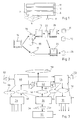
- FIG. 1 schematically represents a computer organized in layers. As can be seen in this figure, this calculator has three layers.
- the first layer is an interface and communication layer which allows both to manage the local actuation / acquisition interfaces and to communicate with a remote user.
- This first layer has everything first an actuation / acquisition interface 2 which allows the computer to communicate and interact with equipment 4.
- This interface layer and also includes a communication interface 6 allowing the computer to communicate with the user 8 via of a network.
- the second layer constitutes the command-control core 10 of the computer.
- the latter acts as an intelligent filter to separate the applications of irrelevant external events (management of the communication, management of actuations / acquisitions, configuration by the user of the command-control core, ).
- the third layer implements specific processing, for example image data processing, etc.
- command-control 10 can thus be defined as an operating system which manages resources external to the computer while an operating system classical computing manages the internal resource of the computer constituted by the processor.
- the command-control core 10 uses specific resources processing and memorization. Its coupling with the application layer 12 is very small and limited as much as possible to a shared memory area and well delimited when the computer was designed.
- the command-control core 10 allows the exchange of information with the user 8. So the user can send requests operational and receive system status information.
- the heart of command-control also decodes the commands intended for it. These commands thus interpreted allow the generation of sequences action / acquisition from equipment 4 as well as modification possible operational parameters of the command-control function itself.
- the command-control core 10 monitors the equipment 4 in order to detect operating anomalies (parameter outside limit, duration exceeded, ...) and order backup actions in case of problems.
- An error message can be sent to user 8 in order to allow the reconfiguration of the system after detection of an anomaly.
- FIG. 2 schematically illustrates the different stages of a variant embodiment of a method according to the invention.
- this figure is in particular represented a set of IT tools that can be implemented work for the realization of this alternative embodiment of the method according to the invention.
- This computer 14 builds a database 16 which completely characterizes the command-control application that we want to develop.
- This computer 14 also makes it possible to check the consistency and the completeness of the needs expressed by a designer communicating with this computer 14.
- this first computer 14 makes it possible to acquire a set of functional scenarios 17 subsequently used to carry out validations by simulation.
- a second computer 18 is intended for managing the parameters of configuration. It works from the database 16 generated by the first computer 14 as well as from a library 20 in which there are basic bricks available. Depending on the data collected in the database data 16 and bricks available in library 20, computer 18 configure each basic brick necessary to carry out the core program command-control 10 and assemble all the basic bricks as well parameterized to form the architecture of the command-control core 10. A once all the basic bricks set up and assembled, the second computer 18 generates source code 22.
- This source code 22 is used with functional scenarios 17 by a third computer 24, or simulation computer.
- This computer tool allows to evaluate from the initial stages of a project the use of the resources of the computer from the point of view of command-control, that is to say communication, memorization, processing, etc.
- This 24 simulation computer allows also to validate mission scenarios taking into account the behaviors of communication protocols and mechanisms process control.
- test references 26 functional entering the final certification process of the system using the command-control core 10 are obtained.
- Source code 22 is also compiled to provide software.
- a computer 28 for compilation is then provided for this purpose. We then obtain software 30.
- Source code 22 can also be processed by the compilation computer 28 to obtain the plans of a microprocessor 32 filling the same functions than software 30.
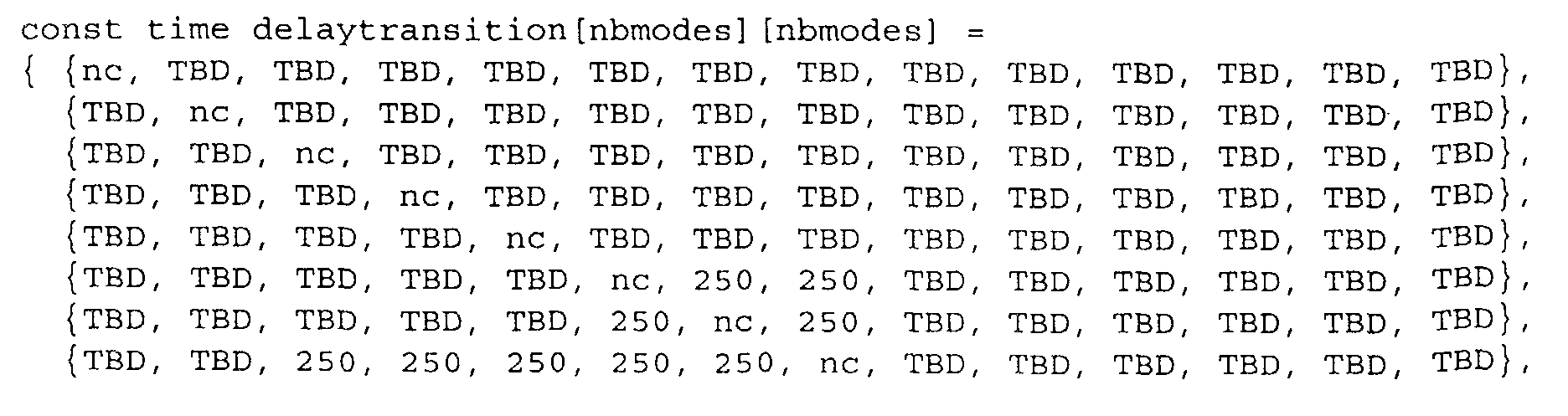
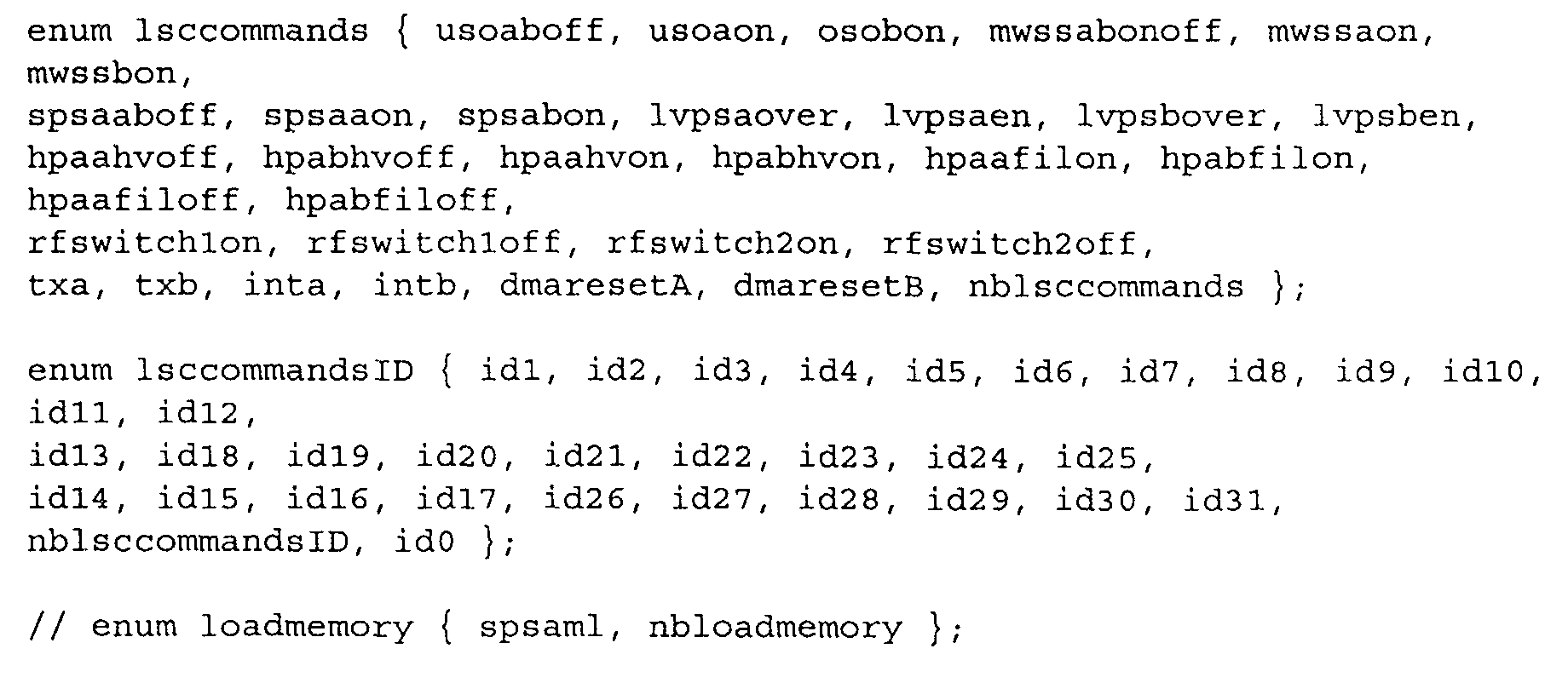
- transitionmode [nbmodes] [nbra] ⁇ standby, warmup0, standby, warmup10ff, warmup2on, warmup2off, standby, standby, standby, biteon, standby, ⁇ , ... List of equipment commands and telemetry acquisitions between each mode transition. enum sequences ⁇ null, seq1, seq2, seq3, seq4, seq5, seq6, seq7, seq8, seq9, seq10, seq11, seq12, seq13, List of macro-commands that can be interpreted by the command-control core.
- Library 20 has a number of basic bricks can be interconnected according to an architectural principle predefined by generic table structures that are configured based on the content of the database 16.
- the bricks present in the library must cover all the needs that may arise, or all of the less the greater part of these needs.
- VHDL Very High Speed Integrated Circuit
- the basic bricks are written in a parameterized manner and also so that we can connect with other bricks to form a whole coherent.
- the second computer 18 makes it possible to choose from the library the bricks of base which will be necessary for the realization of the command-control core 10. These bricks are completed to adapt them to the data present in the database 16 and are assembled.
- This second computer 18 also makes it possible to verify the feasibility of an implementation. Configuration parameters are managed in the sense wide since computer 18 manages operational configuration as well relating to the mission described by the designer that the configuration of the bricks of basic (configuration of software / hardware products, and that the configuration of the architecture obtained, that is to say the architecture of the command-control core 10).
- the source code 22 obtained from the second computer 18 is a behavioral model of the command-control core 10 which is the basis for the realization of this command-control core.
- This source code is for example also written in C ++ computer language.
- the compilation computer 28 realizes interface with micro-electronic design tools or software design.
- the source code 22 makes it possible to carry out a ASIC (for Application-Specific Integrated Circuit or integrated circuit for a specific application).
- ASIC for Application-Specific Integrated Circuit or integrated circuit for a specific application.
- computer-aided design for the creation of an integrated circuit specific to an application.
- Such software is known to those skilled in the art. They make it possible to carry out the plans of a microprocessor then this one can be made using these plans.
- the source codes are then found in the final ASIC basic bricks used with their specific configuration.
- the source code 22 is compiled to obtain a software.
- the command-control application will be implemented in purely software, purely hardware or well in mixed form, that is to say partly hardware and partly software.
- the hardware / software sharing depends on the field of application and constraints implementation. In some cases, the hardware platform is imposed and it it is therefore a question of producing software only. In other cases, it is adequate to develop all or part of the material in the form of a complex chip. In the latter case, the command-control core 10 is a subset of this complex chip.
- Figure 3 shows an example of a command-control core architecture 10. This example can for example be adapted to a command-control core on board a satellite payload. This figure shows the flow data in the command-control core 10.
- the "acquisition management" function 34 must ensure the acquisition cyclic of a list of parameters accessible via the interface with equipment 4. Possible parameters are for example: measurement of a value analog (temperature, current, voltage, ...), state of a relay (open / closed, numerical value, etc.). Acquisitions are made from the addresses of parameters 46 which is a list of addresses to browse to get the measurements necessary for the proper functioning of the command-control core 10.
- This "acquisitions management" function generates an acquisitions table 48 in which for each address are indicated the measured values. This table of acquisitions 48 is dated. The acquisition of the different measures is made of cyclically. This cycle can be variable and for example between 125 ms and 16 seconds in the case of a satellite payload. Measurements must be consistent over time and the list of acquisitions is made in burst at the beginning cycle.
- Actuations are elementary events that give rise to activation of an interface to equipment 4 to control an element external such as a relay.
- Actuation management ensures execution sequential actuations from a predefined table: this is the table of actuations 50. Each entry in table 50 corresponds to an event on the interfaces.
- the "actuation management" 38 function performs step by step the events entered in the actuation table.
- the start of table execution 50 can be done at a preset time on board.
- An action table contains by example a maximum number of events equal to 30.
- a stopwatch is associated with the total duration of execution of the table and in case of exceeding one predetermined time an error message is generated. For the acquisition of commands from the user (36), it is planned to use a user interface communication 52.
- Order packets received from user 8 contain a field which corresponds to the date of execution. This date is either immediate (upon receipt) is equal to one deferred hour. In the case of a delayed time, the package is inserted in a queue and will be activated on the date maturity.
- a storage buffer 54 is provided between the function block 36 and the communication interface 52.
- the monitoring function represented schematically by the block 40 allows the generation of alarms. From the 48 measurements provided by management acquisitions 34 the monitoring function compares each measurement by versus thresholds (minimum and maximum) or expected values. If there is an overshoot or an anomaly, an alarm is generated.
- the monitored system is either in an operational mode or in transition between two operational modes is still in a state of anomalies.
- the anomaly detection is done by comparing the state in which the system with the state it is in.
- a filtering process for example by taking several measurements, must make it possible not to trigger alarms inadvertently, for example triggering an alarm following a measurement abnormal (noise).
- the data entering block 40 comes from the tables of acquisitions 48 generated by block 34 and also from a database 62 grouping the thresholds (minimum / maximum) and the expected values.
- the generated alarms by this monitoring block 40 are directed to the decision block 44.
- Block 44 representing the decision function receives, as indicated above, messages from the interpretation function 42 and from the function monitoring 40.
- the decision logic is for example that summarized in the table above: Monitoring status State interpretation Action Taken Unchanged Unchanged Any Alarm Unchanged Activates the reconfiguration table corresponding to the current mode and the alarm Alarm Package execution Refuse packet execution (mcmd refuse mode) and activate the reconfiguration table corresponding to the current mode and the alarm Unchanged Package execution Activates the mode change table corresponding to the macro-command contained in the package
- the decision function At the output, the decision function generates an event table 50 and produces a history 64 of decisions to inform the user 8.
- command-control core significantly reduces the costs of development, integration and validation of a new system.
- the functions fulfilled by the command-control core appear in numerous embedded applications, not only in the space sector, but also in the automotive, home automation, industrial processes, etc.
- the method according to the invention provides the application designer with command-control a corresponding predefined development environment to its field of application and allowing the automatic generation of command-control functions.
- the approach to be followed by the designer is all quite different from his own when he manually develops the command-control functions. It suffices here to carefully fill in the predefined tables to express his needs and he then obtains a code source that it can use industrially.
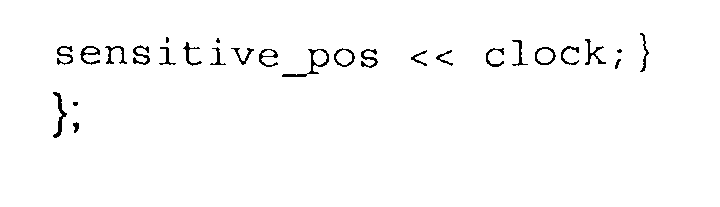
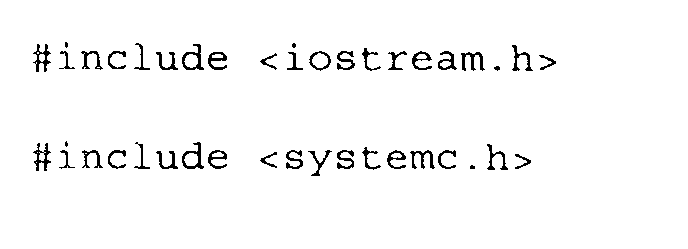
- command-control core and bricks basic in C ++ language is given below.
- the “macro” module analyzes and manages macro-commands formatted in from the communication layer. Each macro command is analyzed (header verification) then executed when the time comes.
- a macro-command leads according to the type of macro-command either to a change of mode, or to the configuration of elements of the system such as for example the telemetry thresholds.
- a change of mode leads to the execution of a sequence of micro-commands.
- LOADMACRO triggered by LOADMACRO. test the header fields. increment of the anomaly counter in the event of an error. insert the new macro in FIFO and advance its pointers. determination of the category of the macro according to its identifier in its header. reset if conflict between current macro and new macro.
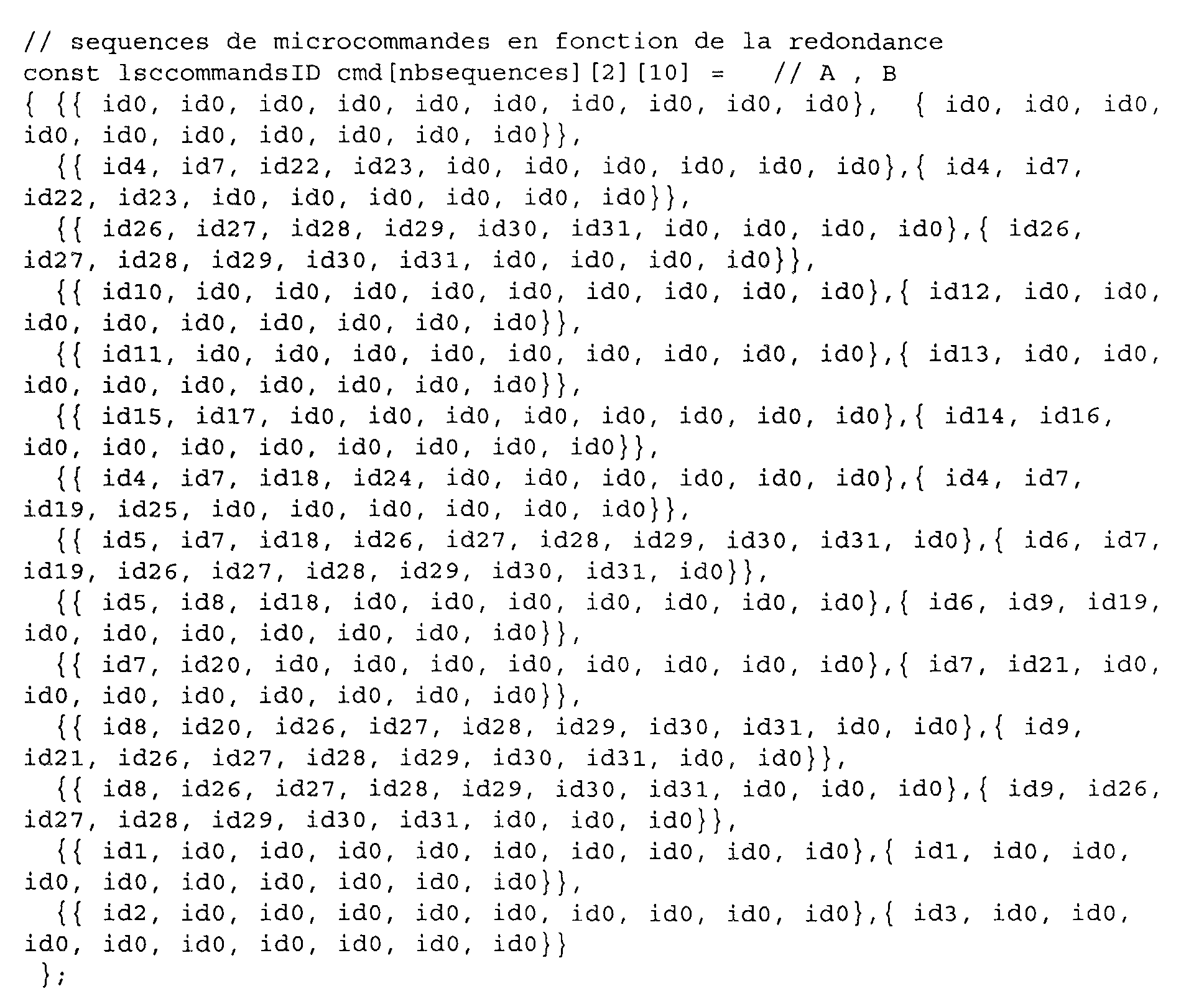
- the actuation module is only responsible for executing the sequences of microcontrollers controlling the outputs (external commands). These sequences are provided by the macro module, either during a mode change or does macro-command analysis.
- This module is responsible for generating pulses on the outputs according to micro-commands whose sequence depends on the operating mode of the system. This module runs a sequence and for each microcontroller and controls the corresponding outputs.
Landscapes
- Physics & Mathematics (AREA)
- General Physics & Mathematics (AREA)
- Engineering & Computer Science (AREA)
- Automation & Control Theory (AREA)
- Stored Programmes (AREA)
- Molds, Cores, And Manufacturing Methods Thereof (AREA)
- Paper (AREA)
- Casting Devices For Molds (AREA)
- Control By Computers (AREA)
- Crystals, And After-Treatments Of Crystals (AREA)
- Processes Of Treating Macromolecular Substances (AREA)
Abstract
- entrée de données spécifiques au dispositif recevant le calculateur, pour créer une base de données (16) caractérisant les fonctions à exécuter par le dispositif,
- choix dans une bibliothèque (20) de briques de base paramétrées, chaque brique étant formée par un logiciel préalablement écrit de telle manière qu'il puisse s'interconnecter avec d'autres briques,
- assemblage des briques selon un principe architectural prédéfini,
- compilation de l'ensemble obtenu afin de produire un code source (22).
Description
- entrée de données spécifiques au dispositif recevant le calculateur, pour créer une base de données caractérisant les fonctions à exécuter par le dispositif,
- choix dans une bibliothèque de briques de base paramétrées, chaque brique étant formée par un logiciel préalablement écrit de telle manière qu'il puisse s'interconnecter avec d'autres briques,
- assemblage des briques selon un principe architectural prédéfini,
- compilation de l'ensemble obtenu afin de produire un code source.
- à partir du code source obtenu, à l'aide d'un logiciel de conception assistée par ordinateur, réalisation d'un plan d'un circuit intégré pour une application spécifique (ASIC) implémentant tout ou partie des fonctions du coeur de commande-contrôle. Dans ce cas les briques de base écrites dans le langage C++ seront par exemple converties en langage VHDL.
| Nature des paramètres | Exemple de structures de données |
| Liste des modes opérationnels du sous-système géré par le coeur de commande contrôle | enum modes {standby, standbyoff, warmup0, warmup1on, warmup1off, warmup2on, warmup2off, pause,biteon, ..... ...., nbmodes}; |
| Liste des durées min et max de chaque transition entre les modes et Liste des durées min/max de chaque mode | const time delaytransition[nbmodes][nbmodes] = { {nc, 10, 50, 20, 300, ....}, {30, 30, 200,..... |
| Matrice des transitions de mode autorisées et liste des commandes permettant d'effectuer ces transitions | const modes transitionmode[nbmodes][nbra] = {standby, warmup0, standby, warmup10ff, warmup2on, warmup2off, standby, standby, standby, biteon, standby, },... |
| Liste des commandes équipement et des acquisitions de télémétries entre chaque transition de mode. | enum sequences { nul, seq1, seq2, seq3, seq4, seq5, seq6, seq7, seq8, seq9, seq10, seq11, seq12, seq13, |
| Liste des macro-commandes pouvant être interprétées par le coeur de commande-contrôle. | enum statusmacro {go_standby, go_warmup0, go_warmup1on, go_warmup1off, ....) |
| Liste des acquisitions élémentaires (télémétries) | enum telemetries { icutemp, icuvoltage, temp1, temp2, mwssvoltagepluscinq, mwssvoltagemoinscinq,usovoltage, spsavoltagepluscinq, spsavoltagemoinscinq, |
| Matrice de l'état des équipements dans chaque mode (ON/OFF) et seuils de surveillance (min/max) des acquisitions élémentaires pour chaque mode | const minvalue [nbmodes][nbtelemeties] = { {nc, 10, 50, 20, 300, ....}, |
| Liste des actuations élémentaires (commandes) | enum Isccommands { usoaboff, usoaon, osobon, mwssabonoff, mwssaon, mwssbon, spsaaboff, spsaaon, spsabon, lvpsaover, lvpsaen, lvpsbover, lvpsben, |
- des fonctions de gestion des interfaces externes : acquisition cyclique des paramètres à surveiller (bloc 34), acquisition des macrocommandes provenant de l'utilisateur (bloc 36) et exécution des actuations vers les équipements (bloc 38)
- des fonctions de haut niveau : surveillance du sytème et analyse des anomalies (bloc 40), interprétation des commandes utilisateur (bloc 42) et prise de décision pour la génération d'actuations (bloc 44).
- changement de mode : cette commande est éxécutée par le coeur de commande-contrôle et il lui correspond à l'activation de la table d'actuation correspondante,
- changement de paramètre du coeur commande-contrôle ou activation/désactivation de fonction, et
- données 58 à destination de la couche application 12.
| Etat surveillance | Etat interprétation | Action prise |
| Inchangé | Inchangé | Aucune |
| Alarme | Inchangé | Active la table de reconfiguration correspondant au mode actuel et à l'alarme |
| Alarme | Exécution paquet | Refuse l'exécution paquet (mcmd refuse mode) et active la table de reconfiguration correspondant au mode actuel et à l'alarme |
| Inchangé | Exécution paquet | Active la table de changement de mode correspondant à la macro-commande contenue dans le paquet |


- la validité des états possibles de la valeurs lue
- le dépassement d'un seuil
- l'appartenance à un domaine de valeurs
- le dépassement d'un double seuil avec changement de mode pour le second seuil

tester les champs de l'entête.
incrément du compteur d'anomalies en cas d'erreur.
insérer la nouvelle macro dans la FIFO et faire progresser ses pointeurs.
détermination de la catégorie de la macro en fonction de son identificateur dans son entête.
reset si conflit entre macro en cours et nouvelle macro.
parcours de la FIFO a la recherche de la prochaine macro a exécuter (en fonction de sa date d'exécution).
si macro trouvée, l'indiquer dans l'historique, la retirer de la FIFO et l'exécuter.
selon l'identificateur de l'entête de la macro, exécuter:
- set monitoring : définition des paramètres des entrées à scruter
- inhibit/enable monitoring : validation/invalidation de la scrutation
- switch-down enable/inhibit
- reset history
- complément de redondance entre A et B
- direct command : microcommande directe
- time-code (resynchronisation): mise a jour de DATE
- enable non-nominal telemetries : définition du taux de stockage des échantillons
- inhibit non-nominal telemetries
- event macrocommands : changement de mode
changement effectif de mode et mise a jour de l'historique.
- CLOCK SEQ(in)
- // séquence de microcommandes à exécuter
- USERCMD(in)
- // 1 microcommande à exécuter
- REDDEFA(in)
- // définition de la redondance entre instruments A et B
- STARTSEQ(in)
- // déclenche une séquence de microcommandes
- STARTCMD(in)
- // déclenche 1 microcommande
- SOUT(out)
- // tableau de signaux de commande externes








Claims (6)
- Procédé de réalisation d'un coeur de commande-contrôle (10) pour un calculateur embarqué dans un dispositif destiné à exécuter des fonctions à partir de commandes d'un utilisateur (8) ou en fonction de paramètres mesurés par exemple par des capteurs (4), caractérisé en ce qu'il comporte les étapes suivantes :entrée de données spécifiques au dispositif recevant le calculateur, pour créer une base de données (16) caractérisant les fonctions à exécuter par le dispositif,choix dans une bibliothèque (20) de briques de base paramétrées, chaque brique étant formée par un logiciel préalablement écrit de telle manière qu'il puisse s'interconnecter avec d'autres briques,assemblage des briques selon un principe architectural prédéfini,compilation de l'ensemble obtenu afin de produire un code source (22).
- Procédé de réalisation selon la revendication 1, caractérisé en ce qu'il comporte en outre l'étape suivante :à partir du code source (22) obtenu, à l'aide d'un logiciel de conception assistée par ordinateur, réalisation d'un plan d'un circuit intégré pour une application spécifique (ASIC) implémentant tout ou partie des fonctions du coeur de commande-contrôle.
- Procédé de réalisation selon la revendication 2, caractérisé en ce qu'un circuit intégré est réalisé à partir du plan obtenu.
- Procédé de réalisation selon l'une des revendications 1 à 3, caractérisé en ce qu'après l'entrée des données, la cohérence et la complétude de l'ensemble de celles-ci sont validées.
- Procédé de réalisation selon l'une des revendications 1 à 4, caractérisé en ce que les briques de base sont sous forme VHDL.
- Procédé de réalisation selon l'une des revendications 1 à 5, caractérisé en ce qu'un scénario d'utilisation (17) du coeur de commande-contrôle (10) est créé et en ce que le comportement d'un code source obtenu après configuration et assemblage des briques est simulé.
Applications Claiming Priority (2)
| Application Number | Priority Date | Filing Date | Title |
|---|---|---|---|
| FR0104017 | 2001-03-26 | ||
| FR0104017A FR2822558B1 (fr) | 2001-03-26 | 2001-03-26 | Procede de realisation d'un coeur de commande-controle |
Publications (2)
| Publication Number | Publication Date |
|---|---|
| EP1260887A1 true EP1260887A1 (fr) | 2002-11-27 |
| EP1260887B1 EP1260887B1 (fr) | 2006-05-24 |
Family
ID=8861521
Family Applications (1)
| Application Number | Title | Priority Date | Filing Date |
|---|---|---|---|
| EP02352011A Expired - Lifetime EP1260887B1 (fr) | 2001-03-26 | 2002-03-25 | Procédé de réalisation d'un coeur de commande-contrôle |
Country Status (4)
| Country | Link |
|---|---|
| EP (1) | EP1260887B1 (fr) |
| AT (1) | ATE327527T1 (fr) |
| DE (1) | DE60211594D1 (fr) |
| FR (1) | FR2822558B1 (fr) |
Cited By (1)
| Publication number | Priority date | Publication date | Assignee | Title |
|---|---|---|---|---|
| EP1548527A1 (fr) * | 2003-12-22 | 2005-06-29 | Siemens Aktiengesellschaft | Commande pour une machine-outil ou machine de production |
Citations (5)
| Publication number | Priority date | Publication date | Assignee | Title |
|---|---|---|---|---|
| US5612866A (en) * | 1994-06-24 | 1997-03-18 | Integrated Systems, Inc. | Code generation system to construct an asynchronous real-time controller for a real-time system |
| EP0881553A1 (fr) * | 1997-05-29 | 1998-12-02 | TRW Inc. | Méthode et système pour le contrÔle autonome d'un véhicule spatiale |
| EP0899670A1 (fr) * | 1997-08-26 | 1999-03-03 | Boris Shapiro | Dispositif et procédé pour la conception et mise en oeuvre d'un processus de fabrication |
| US5920479A (en) * | 1996-09-23 | 1999-07-06 | National Instruments Corporation | System and method for performing interface independent virtual instrumentation functions in a graphical data flow program |
| US5933356A (en) * | 1990-04-06 | 1999-08-03 | Lsi Logic Corporation | Method and system for creating and verifying structural logic model of electronic design from behavioral description, including generation of logic and timing models |
-
2001
- 2001-03-26 FR FR0104017A patent/FR2822558B1/fr not_active Expired - Fee Related
-
2002
- 2002-03-25 AT AT02352011T patent/ATE327527T1/de not_active IP Right Cessation
- 2002-03-25 DE DE60211594T patent/DE60211594D1/de not_active Expired - Lifetime
- 2002-03-25 EP EP02352011A patent/EP1260887B1/fr not_active Expired - Lifetime
Patent Citations (5)
| Publication number | Priority date | Publication date | Assignee | Title |
|---|---|---|---|---|
| US5933356A (en) * | 1990-04-06 | 1999-08-03 | Lsi Logic Corporation | Method and system for creating and verifying structural logic model of electronic design from behavioral description, including generation of logic and timing models |
| US5612866A (en) * | 1994-06-24 | 1997-03-18 | Integrated Systems, Inc. | Code generation system to construct an asynchronous real-time controller for a real-time system |
| US5920479A (en) * | 1996-09-23 | 1999-07-06 | National Instruments Corporation | System and method for performing interface independent virtual instrumentation functions in a graphical data flow program |
| EP0881553A1 (fr) * | 1997-05-29 | 1998-12-02 | TRW Inc. | Méthode et système pour le contrÔle autonome d'un véhicule spatiale |
| EP0899670A1 (fr) * | 1997-08-26 | 1999-03-03 | Boris Shapiro | Dispositif et procédé pour la conception et mise en oeuvre d'un processus de fabrication |
Non-Patent Citations (1)
| Title |
|---|
| HAJJAR M N ET AL: "LES OBJETS, AVENIR DU CONTROLE DE PROCEDES", MESURES REGULATION AUTOMATISME, CFE. PARIS, FR, vol. 60, no. 682, 1 February 1996 (1996-02-01), pages 81 - 83, XP000556561, ISSN: 0755-219X * |
Cited By (2)
| Publication number | Priority date | Publication date | Assignee | Title |
|---|---|---|---|---|
| EP1548527A1 (fr) * | 2003-12-22 | 2005-06-29 | Siemens Aktiengesellschaft | Commande pour une machine-outil ou machine de production |
| US7574267B2 (en) | 2003-12-22 | 2009-08-11 | Siemens Aktiengesellschaft | Controller for a machine-tool or production machine |
Also Published As
| Publication number | Publication date |
|---|---|
| FR2822558B1 (fr) | 2003-08-08 |
| FR2822558A1 (fr) | 2002-09-27 |
| DE60211594D1 (de) | 2006-06-29 |
| EP1260887B1 (fr) | 2006-05-24 |
| ATE327527T1 (de) | 2006-06-15 |
Similar Documents
| Publication | Publication Date | Title |
|---|---|---|
| CN102799755B (zh) | 用于配置基于状况的健康维护系统的系统和方法 | |
| CN113407327A (zh) | 一种建模任务和数据分析的方法、装置、电子设备及系统 | |
| CN109218048A (zh) | 对部署在云上的一个工业系统的性能测试方法和装置 | |
| EP3588215B1 (fr) | Système de commande | |
| EP2592558B1 (fr) | Système et procédé de conception de circuit numérique à capteur d'activité | |
| FR2990547A1 (fr) | Systeme de maintenance centralisee parametrable destine a un aeronef | |
| Bickelhaupt et al. | Challenges and opportunities of future vehicle diagnostics in software-defined vehicles | |
| EP3827368A1 (fr) | Outil et procédé de conception et de validation d'un système flots de données par un modèle formel | |
| EP1260887B1 (fr) | Procédé de réalisation d'un coeur de commande-contrôle | |
| EP1846824B1 (fr) | Systeme et procede de traitements embarques d'essais en vol | |
| US20230161336A1 (en) | Real-time high-speed clock signal for industrial network emulation | |
| Hoffmann et al. | Using formal methods to specify data-driven cyber-physical systems | |
| WO2008141953A1 (fr) | Systeme automatise aux temps de reponse deterministes | |
| FR2973131A1 (fr) | Procede et dispositif de detection d'incompatibilites d'interfaces logiques d'equipements de systemes embarques | |
| EP4170442A1 (fr) | Application de bord pour la découverte et traduction d'objets de machine d'état dans des contrôleurs d'automatisation pour des applications mes et dcs | |
| WO2003107185A1 (fr) | Procede et systeme de gestion des evenements____________________ | |
| FR3101669A1 (fr) | Dispositif, procédé et programme d’ordinateur de suivi de moteur d’aéronef | |
| EP0777355B1 (fr) | Procédé de sécurisation d'une action et dispositif de mise en oeuvre utilisant le protocole ARINC 629 | |
| WO2020128363A1 (fr) | Système de supervision formelle de communications | |
| FR2927181A1 (fr) | Procede et dispositif de commande securises pour terminal de maintenance deporte. | |
| FR2781584A1 (fr) | Systeme de validation par simulation de la specification formalisee des fonctions de systemes complexes | |
| EP1269377B1 (fr) | Dispositif d'intercommunication selective de terminaux mobiles en proximite physique, egalement relies par des reseaux globaux | |
| FR3106907A1 (fr) | Dispositif electronique de calcul de diffusion centralises d'etat(s) d'un aeronef, ensemble avionique, procede, et programme d'ordinateur associes | |
| FR3142822A1 (fr) | Système de déploiement et de test d’un composant fonctionnel d’une fonction logiciel sur un ensemble de ressources matérielles | |
| Schmidt et al. | Same Priority for Functionality and Timing Requirements |
Legal Events
| Date | Code | Title | Description |
|---|---|---|---|
| PUAI | Public reference made under article 153(3) epc to a published international application that has entered the european phase |
Free format text: ORIGINAL CODE: 0009012 |
|
| AK | Designated contracting states |
Kind code of ref document: A1 Designated state(s): AT BE CH CY DE DK ES FI FR GB GR IE IT LI LU MC NL PT SE TR |
|
| AX | Request for extension of the european patent |
Free format text: AL;LT;LV;MK;RO;SI |
|
| 17P | Request for examination filed |
Effective date: 20030210 |
|
| AKX | Designation fees paid |
Designated state(s): AT BE CH CY DE DK ES FI FR GB GR IE IT LI LU MC NL PT SE TR |
|
| 17Q | First examination report despatched |
Effective date: 20040524 |
|
| GRAP | Despatch of communication of intention to grant a patent |
Free format text: ORIGINAL CODE: EPIDOSNIGR1 |
|
| GRAS | Grant fee paid |
Free format text: ORIGINAL CODE: EPIDOSNIGR3 |
|
| GRAA | (expected) grant |
Free format text: ORIGINAL CODE: 0009210 |
|
| AK | Designated contracting states |
Kind code of ref document: B1 Designated state(s): AT BE CH CY DE DK ES FI FR GB GR IE IT LI LU MC NL PT SE TR |
|
| PG25 | Lapsed in a contracting state [announced via postgrant information from national office to epo] |
Ref country code: IT Free format text: LAPSE BECAUSE OF FAILURE TO SUBMIT A TRANSLATION OF THE DESCRIPTION OR TO PAY THE FEE WITHIN THE PRESCRIBED TIME-LIMIT;WARNING: LAPSES OF ITALIAN PATENTS WITH EFFECTIVE DATE BEFORE 2007 MAY HAVE OCCURRED AT ANY TIME BEFORE 2007. THE CORRECT EFFECTIVE DATE MAY BE DIFFERENT FROM THE ONE RECORDED. Effective date: 20060524 Ref country code: NL Free format text: LAPSE BECAUSE OF FAILURE TO SUBMIT A TRANSLATION OF THE DESCRIPTION OR TO PAY THE FEE WITHIN THE PRESCRIBED TIME-LIMIT Effective date: 20060524 Ref country code: AT Free format text: LAPSE BECAUSE OF FAILURE TO SUBMIT A TRANSLATION OF THE DESCRIPTION OR TO PAY THE FEE WITHIN THE PRESCRIBED TIME-LIMIT Effective date: 20060524 Ref country code: IE Free format text: LAPSE BECAUSE OF FAILURE TO SUBMIT A TRANSLATION OF THE DESCRIPTION OR TO PAY THE FEE WITHIN THE PRESCRIBED TIME-LIMIT Effective date: 20060524 Ref country code: GB Free format text: LAPSE BECAUSE OF FAILURE TO SUBMIT A TRANSLATION OF THE DESCRIPTION OR TO PAY THE FEE WITHIN THE PRESCRIBED TIME-LIMIT Effective date: 20060524 Ref country code: FI Free format text: LAPSE BECAUSE OF FAILURE TO SUBMIT A TRANSLATION OF THE DESCRIPTION OR TO PAY THE FEE WITHIN THE PRESCRIBED TIME-LIMIT Effective date: 20060524 |
|
| REG | Reference to a national code |
Ref country code: GB Ref legal event code: FG4D Free format text: NOT ENGLISH |
|
| REG | Reference to a national code |
Ref country code: CH Ref legal event code: EP |
|
| REG | Reference to a national code |
Ref country code: IE Ref legal event code: FG4D Free format text: LANGUAGE OF EP DOCUMENT: FRENCH |
|
| REF | Corresponds to: |
Ref document number: 60211594 Country of ref document: DE Date of ref document: 20060629 Kind code of ref document: P |
|
| PG25 | Lapsed in a contracting state [announced via postgrant information from national office to epo] |
Ref country code: SE Free format text: LAPSE BECAUSE OF FAILURE TO SUBMIT A TRANSLATION OF THE DESCRIPTION OR TO PAY THE FEE WITHIN THE PRESCRIBED TIME-LIMIT Effective date: 20060824 Ref country code: DK Free format text: LAPSE BECAUSE OF FAILURE TO SUBMIT A TRANSLATION OF THE DESCRIPTION OR TO PAY THE FEE WITHIN THE PRESCRIBED TIME-LIMIT Effective date: 20060824 |
|
| PG25 | Lapsed in a contracting state [announced via postgrant information from national office to epo] |
Ref country code: DE Free format text: LAPSE BECAUSE OF FAILURE TO SUBMIT A TRANSLATION OF THE DESCRIPTION OR TO PAY THE FEE WITHIN THE PRESCRIBED TIME-LIMIT Effective date: 20060825 |
|
| PG25 | Lapsed in a contracting state [announced via postgrant information from national office to epo] |
Ref country code: ES Free format text: LAPSE BECAUSE OF FAILURE TO SUBMIT A TRANSLATION OF THE DESCRIPTION OR TO PAY THE FEE WITHIN THE PRESCRIBED TIME-LIMIT Effective date: 20060904 |
|
| PG25 | Lapsed in a contracting state [announced via postgrant information from national office to epo] |
Ref country code: PT Free format text: LAPSE BECAUSE OF FAILURE TO SUBMIT A TRANSLATION OF THE DESCRIPTION OR TO PAY THE FEE WITHIN THE PRESCRIBED TIME-LIMIT Effective date: 20061024 |
|
| NLV1 | Nl: lapsed or annulled due to failure to fulfill the requirements of art. 29p and 29m of the patents act | ||
| GBV | Gb: ep patent (uk) treated as always having been void in accordance with gb section 77(7)/1977 [no translation filed] |
Effective date: 20060524 |
|
| REG | Reference to a national code |
Ref country code: IE Ref legal event code: FD4D |
|
| PLBE | No opposition filed within time limit |
Free format text: ORIGINAL CODE: 0009261 |
|
| STAA | Information on the status of an ep patent application or granted ep patent |
Free format text: STATUS: NO OPPOSITION FILED WITHIN TIME LIMIT |
|
| 26N | No opposition filed |
Effective date: 20070227 |
|
| REG | Reference to a national code |
Ref country code: CH Ref legal event code: PL |
|
| PG25 | Lapsed in a contracting state [announced via postgrant information from national office to epo] |
Ref country code: MC Free format text: LAPSE BECAUSE OF NON-PAYMENT OF DUE FEES Effective date: 20070331 |
|
| PG25 | Lapsed in a contracting state [announced via postgrant information from national office to epo] |
Ref country code: LI Free format text: LAPSE BECAUSE OF NON-PAYMENT OF DUE FEES Effective date: 20070331 Ref country code: CH Free format text: LAPSE BECAUSE OF NON-PAYMENT OF DUE FEES Effective date: 20070331 |
|
| PG25 | Lapsed in a contracting state [announced via postgrant information from national office to epo] |
Ref country code: GR Free format text: LAPSE BECAUSE OF FAILURE TO SUBMIT A TRANSLATION OF THE DESCRIPTION OR TO PAY THE FEE WITHIN THE PRESCRIBED TIME-LIMIT Effective date: 20060825 |
|
| PG25 | Lapsed in a contracting state [announced via postgrant information from national office to epo] |
Ref country code: LU Free format text: LAPSE BECAUSE OF NON-PAYMENT OF DUE FEES Effective date: 20070325 Ref country code: CY Free format text: LAPSE BECAUSE OF FAILURE TO SUBMIT A TRANSLATION OF THE DESCRIPTION OR TO PAY THE FEE WITHIN THE PRESCRIBED TIME-LIMIT Effective date: 20060524 |
|
| PG25 | Lapsed in a contracting state [announced via postgrant information from national office to epo] |
Ref country code: TR Free format text: LAPSE BECAUSE OF FAILURE TO SUBMIT A TRANSLATION OF THE DESCRIPTION OR TO PAY THE FEE WITHIN THE PRESCRIBED TIME-LIMIT Effective date: 20060524 |
|
| REG | Reference to a national code |
Ref country code: FR Ref legal event code: PLFP Year of fee payment: 15 |
|
| REG | Reference to a national code |
Ref country code: FR Ref legal event code: PLFP Year of fee payment: 16 |
|
| REG | Reference to a national code |
Ref country code: FR Ref legal event code: PLFP Year of fee payment: 17 |
|
| PGFP | Annual fee paid to national office [announced via postgrant information from national office to epo] |
Ref country code: FR Payment date: 20190308 Year of fee payment: 18 |
|
| PGFP | Annual fee paid to national office [announced via postgrant information from national office to epo] |
Ref country code: BE Payment date: 20190329 Year of fee payment: 18 |
|
| REG | Reference to a national code |
Ref country code: BE Ref legal event code: MM Effective date: 20200331 |
|
| PG25 | Lapsed in a contracting state [announced via postgrant information from national office to epo] |
Ref country code: FR Free format text: LAPSE BECAUSE OF NON-PAYMENT OF DUE FEES Effective date: 20200331 |
|
| PG25 | Lapsed in a contracting state [announced via postgrant information from national office to epo] |
Ref country code: BE Free format text: LAPSE BECAUSE OF NON-PAYMENT OF DUE FEES Effective date: 20200331 |