EP1260516A1 - Method for producing a beta-D-ribofuranose derivative or an optical isomer thereof - Google Patents
Method for producing a beta-D-ribofuranose derivative or an optical isomer thereof Download PDFInfo
- Publication number
- EP1260516A1 EP1260516A1 EP02251937A EP02251937A EP1260516A1 EP 1260516 A1 EP1260516 A1 EP 1260516A1 EP 02251937 A EP02251937 A EP 02251937A EP 02251937 A EP02251937 A EP 02251937A EP 1260516 A1 EP1260516 A1 EP 1260516A1
- Authority
- EP
- European Patent Office
- Prior art keywords
- optical isomer
- ribofuranose
- substituent
- benzyl
- benzene ring
- Prior art date
- Legal status (The legal status is an assumption and is not a legal conclusion. Google has not performed a legal analysis and makes no representation as to the accuracy of the status listed.)
- Withdrawn
Links
- 230000003287 optical effect Effects 0.000 title claims abstract description 74
- 238000004519 manufacturing process Methods 0.000 title claims description 26
- HMFHBZSHGGEWLO-TXICZTDVSA-N beta-D-ribose Chemical class OC[C@H]1O[C@@H](O)[C@H](O)[C@@H]1O HMFHBZSHGGEWLO-TXICZTDVSA-N 0.000 title abstract description 16
- MBBBSHXQRFAIPA-DDHJBXDOSA-N (2r,3s,4r,5r)-2-(hydroxymethyl)-5-phenylmethoxyoxolane-3,4-diol Chemical compound O[C@@H]1[C@H](O)[C@@H](CO)O[C@H]1OCC1=CC=CC=C1 MBBBSHXQRFAIPA-DDHJBXDOSA-N 0.000 claims abstract description 34
- 238000000034 method Methods 0.000 claims abstract description 28
- 239000003377 acid catalyst Substances 0.000 claims abstract description 19
- IHNHAHWGVLXCCI-FDYHWXHSSA-N [(2r,3r,4r,5s)-3,4,5-triacetyloxyoxolan-2-yl]methyl acetate Chemical compound CC(=O)OC[C@H]1O[C@@H](OC(C)=O)[C@H](OC(C)=O)[C@@H]1OC(C)=O IHNHAHWGVLXCCI-FDYHWXHSSA-N 0.000 claims abstract description 17
- KLDPDRCSPYFUSF-BRSBDYLESA-N [(2r,3r,4r,5r)-3,4-diacetyloxy-5-phenylmethoxyoxolan-2-yl]methyl acetate Chemical compound CC(=O)O[C@@H]1[C@H](OC(C)=O)[C@@H](COC(=O)C)O[C@H]1OCC1=CC=CC=C1 KLDPDRCSPYFUSF-BRSBDYLESA-N 0.000 claims abstract description 16
- 235000019445 benzyl alcohol Nutrition 0.000 claims abstract description 11
- 230000003301 hydrolyzing effect Effects 0.000 claims abstract description 3
- 125000001424 substituent group Chemical group 0.000 claims description 53
- 125000001997 phenyl group Chemical group [H]C1=C([H])C([H])=C(*)C([H])=C1[H] 0.000 claims description 43
- HJYUVZIJKRXUAH-GFQSEFKGSA-N (3ar,4r,6s,6as)-2,2-dimethyl-4-phenylmethoxy-3a,4,6,6a-tetrahydrofuro[3,4-d][1,3]dioxole-6-carboxylic acid Chemical compound O([C@H]1[C@@H]2OC(O[C@@H]2[C@H](O1)C(O)=O)(C)C)CC1=CC=CC=C1 HJYUVZIJKRXUAH-GFQSEFKGSA-N 0.000 claims description 26
- CSCPPACGZOOCGX-UHFFFAOYSA-N Acetone Chemical compound CC(C)=O CSCPPACGZOOCGX-UHFFFAOYSA-N 0.000 claims description 24
- WVDDGKGOMKODPV-UHFFFAOYSA-N Benzyl alcohol Chemical compound OCC1=CC=CC=C1 WVDDGKGOMKODPV-UHFFFAOYSA-N 0.000 claims description 24
- 125000004432 carbon atom Chemical group C* 0.000 claims description 22
- 125000004435 hydrogen atom Chemical group [H]* 0.000 claims description 19
- 150000001875 compounds Chemical class 0.000 claims description 18
- 125000000217 alkyl group Chemical group 0.000 claims description 16
- FYSNRJHAOHDILO-UHFFFAOYSA-N thionyl chloride Chemical compound ClS(Cl)=O FYSNRJHAOHDILO-UHFFFAOYSA-N 0.000 claims description 12
- HEWZVZIVELJPQZ-UHFFFAOYSA-N 2,2-dimethoxypropane Chemical compound COC(C)(C)OC HEWZVZIVELJPQZ-UHFFFAOYSA-N 0.000 claims description 10
- 229910052739 hydrogen Inorganic materials 0.000 claims description 9
- 239000001257 hydrogen Substances 0.000 claims description 9
- 150000001412 amines Chemical class 0.000 claims description 8
- HERHAFPZQYDFSX-GFQSEFKGSA-N (3aR,4R,6S,6aS)-2,2-dimethyl-4-phenylmethoxy-3a,4,6,6a-tetrahydrofuro[3,4-d][1,3]dioxole-6-carboxamide Chemical class O([C@H]1[C@@H]2OC(O[C@@H]2[C@H](O1)C(N)=O)(C)C)CC1=CC=CC=C1 HERHAFPZQYDFSX-GFQSEFKGSA-N 0.000 claims description 6
- DNIAPMSPPWPWGF-GSVOUGTGSA-N (R)-(-)-Propylene glycol Chemical compound C[C@@H](O)CO DNIAPMSPPWPWGF-GSVOUGTGSA-N 0.000 claims description 6
- 230000001590 oxidative effect Effects 0.000 claims description 6
- 239000000543 intermediate Substances 0.000 abstract description 5
- 150000003938 benzyl alcohols Chemical class 0.000 abstract description 3
- XEKOWRVHYACXOJ-UHFFFAOYSA-N Ethyl acetate Chemical compound CCOC(C)=O XEKOWRVHYACXOJ-UHFFFAOYSA-N 0.000 description 54
- 239000000243 solution Substances 0.000 description 48
- VLKZOEOYAKHREP-UHFFFAOYSA-N n-Hexane Chemical compound CCCCCC VLKZOEOYAKHREP-UHFFFAOYSA-N 0.000 description 27
- UIIMBOGNXHQVGW-UHFFFAOYSA-M Sodium bicarbonate Chemical compound [Na+].OC([O-])=O UIIMBOGNXHQVGW-UHFFFAOYSA-M 0.000 description 25
- OKKJLVBELUTLKV-UHFFFAOYSA-N Methanol Chemical compound OC OKKJLVBELUTLKV-UHFFFAOYSA-N 0.000 description 24
- 238000006243 chemical reaction Methods 0.000 description 24
- 239000007787 solid Substances 0.000 description 16
- 239000012044 organic layer Substances 0.000 description 15
- 125000002887 hydroxy group Chemical group [H]O* 0.000 description 13
- YXFVVABEGXRONW-UHFFFAOYSA-N Toluene Chemical compound CC1=CC=CC=C1 YXFVVABEGXRONW-UHFFFAOYSA-N 0.000 description 12
- 239000010410 layer Substances 0.000 description 12
- 229910000030 sodium bicarbonate Inorganic materials 0.000 description 12
- 235000017557 sodium bicarbonate Nutrition 0.000 description 12
- QGZKDVFQNNGYKY-UHFFFAOYSA-N Ammonia Chemical compound N QGZKDVFQNNGYKY-UHFFFAOYSA-N 0.000 description 11
- 238000013019 agitation Methods 0.000 description 11
- 239000013078 crystal Substances 0.000 description 11
- -1 nucleic acid compounds Chemical class 0.000 description 11
- 238000007254 oxidation reaction Methods 0.000 description 10
- 239000011541 reaction mixture Substances 0.000 description 10
- 150000001732 carboxylic acid derivatives Chemical class 0.000 description 9
- 230000003647 oxidation Effects 0.000 description 9
- 239000002994 raw material Substances 0.000 description 9
- 230000035484 reaction time Effects 0.000 description 9
- AFVFQIVMOAPDHO-UHFFFAOYSA-N Methanesulfonic acid Chemical compound CS(O)(=O)=O AFVFQIVMOAPDHO-UHFFFAOYSA-N 0.000 description 8
- 102000039446 nucleic acids Human genes 0.000 description 8
- 108020004707 nucleic acids Proteins 0.000 description 8
- 239000003960 organic solvent Substances 0.000 description 8
- 238000000926 separation method Methods 0.000 description 8
- VEXZGXHMUGYJMC-UHFFFAOYSA-N Hydrochloric acid Chemical compound Cl VEXZGXHMUGYJMC-UHFFFAOYSA-N 0.000 description 7
- 150000007523 nucleic acids Chemical class 0.000 description 7
- 239000002904 solvent Substances 0.000 description 7
- WQDUMFSSJAZKTM-UHFFFAOYSA-N Sodium methoxide Chemical compound [Na+].[O-]C WQDUMFSSJAZKTM-UHFFFAOYSA-N 0.000 description 6
- 230000009435 amidation Effects 0.000 description 6
- 238000007112 amidation reaction Methods 0.000 description 6
- 239000002585 base Substances 0.000 description 6
- 238000000605 extraction Methods 0.000 description 6
- 238000002844 melting Methods 0.000 description 6
- 230000008018 melting Effects 0.000 description 6
- JIAARYAFYJHUJI-UHFFFAOYSA-L zinc dichloride Chemical compound [Cl-].[Cl-].[Zn+2] JIAARYAFYJHUJI-UHFFFAOYSA-L 0.000 description 6
- 125000000654 isopropylidene group Chemical group C(C)(C)=* 0.000 description 5
- 239000000203 mixture Substances 0.000 description 5
- XLYOFNOQVPJJNP-UHFFFAOYSA-N water Substances O XLYOFNOQVPJJNP-UHFFFAOYSA-N 0.000 description 5
- 0 CC(C)(O)OI(C)C(C1*)[C@@](C(OC)=O)O*1OCC1=CCN(C)CC=C1 Chemical compound CC(C)(O)OI(C)C(C1*)[C@@](C(OC)=O)O*1OCC1=CCN(C)CC=C1 0.000 description 4
- LFQSCWFLJHTTHZ-UHFFFAOYSA-N Ethanol Chemical compound CCO LFQSCWFLJHTTHZ-UHFFFAOYSA-N 0.000 description 4
- CDBYLPFSWZWCQE-UHFFFAOYSA-L Sodium Carbonate Chemical compound [Na+].[Na+].[O-]C([O-])=O CDBYLPFSWZWCQE-UHFFFAOYSA-L 0.000 description 4
- 239000005708 Sodium hypochlorite Substances 0.000 description 4
- QAOWNCQODCNURD-UHFFFAOYSA-N Sulfuric acid Chemical compound OS(O)(=O)=O QAOWNCQODCNURD-UHFFFAOYSA-N 0.000 description 4
- 150000003973 alkyl amines Chemical class 0.000 description 4
- 229910021529 ammonia Inorganic materials 0.000 description 4
- 229940098779 methanesulfonic acid Drugs 0.000 description 4
- IOLCXVTUBQKXJR-UHFFFAOYSA-M potassium bromide Chemical compound [K+].[Br-] IOLCXVTUBQKXJR-UHFFFAOYSA-M 0.000 description 4
- 238000010898 silica gel chromatography Methods 0.000 description 4
- 239000002002 slurry Substances 0.000 description 4
- SUKJFIGYRHOWBL-UHFFFAOYSA-N sodium hypochlorite Chemical compound [Na+].Cl[O-] SUKJFIGYRHOWBL-UHFFFAOYSA-N 0.000 description 4
- GEHJYWRUCIMESM-UHFFFAOYSA-L sodium sulfite Chemical compound [Na+].[Na+].[O-]S([O-])=O GEHJYWRUCIMESM-UHFFFAOYSA-L 0.000 description 4
- JOXIMZWYDAKGHI-UHFFFAOYSA-N toluene-4-sulfonic acid Chemical compound CC1=CC=C(S(O)(=O)=O)C=C1 JOXIMZWYDAKGHI-UHFFFAOYSA-N 0.000 description 4
- VNDYJBBGRKZCSX-UHFFFAOYSA-L zinc bromide Chemical compound Br[Zn]Br VNDYJBBGRKZCSX-UHFFFAOYSA-L 0.000 description 4
- ZWEHNKRNPOVVGH-UHFFFAOYSA-N 2-Butanone Chemical compound CCC(C)=O ZWEHNKRNPOVVGH-UHFFFAOYSA-N 0.000 description 3
- QTBSBXVTEAMEQO-UHFFFAOYSA-N Acetic acid Chemical compound CC(O)=O QTBSBXVTEAMEQO-UHFFFAOYSA-N 0.000 description 3
- UHOVQNZJYSORNB-UHFFFAOYSA-N Benzene Chemical compound C1=CC=CC=C1 UHOVQNZJYSORNB-UHFFFAOYSA-N 0.000 description 3
- HMFHBZSHGGEWLO-SOOFDHNKSA-N D-ribofuranose Chemical group OC[C@H]1OC(O)[C@H](O)[C@@H]1O HMFHBZSHGGEWLO-SOOFDHNKSA-N 0.000 description 3
- ZMXDDKWLCZADIW-UHFFFAOYSA-N N,N-Dimethylformamide Chemical compound CN(C)C=O ZMXDDKWLCZADIW-UHFFFAOYSA-N 0.000 description 3
- KWYUFKZDYYNOTN-UHFFFAOYSA-M Potassium hydroxide Chemical compound [OH-].[K+] KWYUFKZDYYNOTN-UHFFFAOYSA-M 0.000 description 3
- FAPWRFPIFSIZLT-UHFFFAOYSA-M Sodium chloride Chemical compound [Na+].[Cl-] FAPWRFPIFSIZLT-UHFFFAOYSA-M 0.000 description 3
- HEMHJVSKTPXQMS-UHFFFAOYSA-M Sodium hydroxide Chemical compound [OH-].[Na+] HEMHJVSKTPXQMS-UHFFFAOYSA-M 0.000 description 3
- ZMANZCXQSJIPKH-UHFFFAOYSA-N Triethylamine Chemical compound CCN(CC)CC ZMANZCXQSJIPKH-UHFFFAOYSA-N 0.000 description 3
- 230000029936 alkylation Effects 0.000 description 3
- 238000005804 alkylation reaction Methods 0.000 description 3
- 230000015572 biosynthetic process Effects 0.000 description 3
- 238000001816 cooling Methods 0.000 description 3
- 230000006196 deacetylation Effects 0.000 description 3
- 238000003381 deacetylation reaction Methods 0.000 description 3
- 238000010438 heat treatment Methods 0.000 description 3
- 230000007062 hydrolysis Effects 0.000 description 3
- 238000006460 hydrolysis reaction Methods 0.000 description 3
- 150000007522 mineralic acids Chemical class 0.000 description 3
- 150000007524 organic acids Chemical class 0.000 description 3
- 235000005985 organic acids Nutrition 0.000 description 3
- 238000003786 synthesis reaction Methods 0.000 description 3
- 239000011592 zinc chloride Substances 0.000 description 3
- 235000005074 zinc chloride Nutrition 0.000 description 3
- CFEBPRXFUJGAFY-KAZBKCHUSA-N (2r,3s,4r,5s)-2-(hydroxymethyl)-5-methylperoxyoxolane-3,4-diol Chemical compound COO[C@@H]1O[C@H](CO)[C@@H](O)[C@H]1O CFEBPRXFUJGAFY-KAZBKCHUSA-N 0.000 description 2
- HEDRZPFGACZZDS-UHFFFAOYSA-N Chloroform Chemical compound ClC(Cl)Cl HEDRZPFGACZZDS-UHFFFAOYSA-N 0.000 description 2
- 229940126062 Compound A Drugs 0.000 description 2
- IAZDPXIOMUYVGZ-UHFFFAOYSA-N Dimethylsulphoxide Chemical compound CS(C)=O IAZDPXIOMUYVGZ-UHFFFAOYSA-N 0.000 description 2
- QUSNBJAOOMFDIB-UHFFFAOYSA-N Ethylamine Chemical compound CCN QUSNBJAOOMFDIB-UHFFFAOYSA-N 0.000 description 2
- NLDMNSXOCDLTTB-UHFFFAOYSA-N Heterophylliin A Natural products O1C2COC(=O)C3=CC(O)=C(O)C(O)=C3C3=C(O)C(O)=C(O)C=C3C(=O)OC2C(OC(=O)C=2C=C(O)C(O)=C(O)C=2)C(O)C1OC(=O)C1=CC(O)=C(O)C(O)=C1 NLDMNSXOCDLTTB-UHFFFAOYSA-N 0.000 description 2
- 238000005684 Liebig rearrangement reaction Methods 0.000 description 2
- BAVYZALUXZFZLV-UHFFFAOYSA-N Methylamine Chemical compound NC BAVYZALUXZFZLV-UHFFFAOYSA-N 0.000 description 2
- NBIIXXVUZAFLBC-UHFFFAOYSA-N Phosphoric acid Chemical compound OP(O)(O)=O NBIIXXVUZAFLBC-UHFFFAOYSA-N 0.000 description 2
- JUJWROOIHBZHMG-UHFFFAOYSA-N Pyridine Chemical compound C1=CC=NC=C1 JUJWROOIHBZHMG-UHFFFAOYSA-N 0.000 description 2
- 238000010521 absorption reaction Methods 0.000 description 2
- 239000002253 acid Substances 0.000 description 2
- 125000003545 alkoxy group Chemical group 0.000 description 2
- VSCWAEJMTAWNJL-UHFFFAOYSA-K aluminium trichloride Chemical compound Cl[Al](Cl)Cl VSCWAEJMTAWNJL-UHFFFAOYSA-K 0.000 description 2
- 230000002862 amidating effect Effects 0.000 description 2
- 239000003637 basic solution Substances 0.000 description 2
- HMFHBZSHGGEWLO-FCAWWPLPSA-N beta-L-ribose Chemical class OC[C@@H]1O[C@H](O)[C@@H](O)[C@H]1O HMFHBZSHGGEWLO-FCAWWPLPSA-N 0.000 description 2
- HQABUPZFAYXKJW-UHFFFAOYSA-N butan-1-amine Chemical compound CCCCN HQABUPZFAYXKJW-UHFFFAOYSA-N 0.000 description 2
- 230000008878 coupling Effects 0.000 description 2
- 238000010168 coupling process Methods 0.000 description 2
- 238000005859 coupling reaction Methods 0.000 description 2
- 238000004821 distillation Methods 0.000 description 2
- 230000008030 elimination Effects 0.000 description 2
- 238000003379 elimination reaction Methods 0.000 description 2
- ZSIAUFGUXNUGDI-UHFFFAOYSA-N hexan-1-ol Chemical compound CCCCCCO ZSIAUFGUXNUGDI-UHFFFAOYSA-N 0.000 description 2
- 238000004128 high performance liquid chromatography Methods 0.000 description 2
- 125000000956 methoxy group Chemical group [H]C([H])([H])O* 0.000 description 2
- 230000001035 methylating effect Effects 0.000 description 2
- 239000000825 pharmaceutical preparation Substances 0.000 description 2
- 229940127557 pharmaceutical product Drugs 0.000 description 2
- BWHMMNNQKKPAPP-UHFFFAOYSA-L potassium carbonate Chemical compound [K+].[K+].[O-]C([O-])=O BWHMMNNQKKPAPP-UHFFFAOYSA-L 0.000 description 2
- BDERNNFJNOPAEC-UHFFFAOYSA-N propan-1-ol Chemical compound CCCO BDERNNFJNOPAEC-UHFFFAOYSA-N 0.000 description 2
- WGYKZJWCGVVSQN-UHFFFAOYSA-N propylamine Chemical compound CCCN WGYKZJWCGVVSQN-UHFFFAOYSA-N 0.000 description 2
- 125000006239 protecting group Chemical group 0.000 description 2
- 238000000746 purification Methods 0.000 description 2
- 229920006395 saturated elastomer Polymers 0.000 description 2
- 229910000029 sodium carbonate Inorganic materials 0.000 description 2
- 235000010265 sodium sulphite Nutrition 0.000 description 2
- 239000007858 starting material Substances 0.000 description 2
- VZGDMQKNWNREIO-UHFFFAOYSA-N tetrachloromethane Chemical compound ClC(Cl)(Cl)Cl VZGDMQKNWNREIO-UHFFFAOYSA-N 0.000 description 2
- ILJSQTXMGCGYMG-UHFFFAOYSA-N triacetic acid Chemical compound CC(=O)CC(=O)CC(O)=O ILJSQTXMGCGYMG-UHFFFAOYSA-N 0.000 description 2
- 229940102001 zinc bromide Drugs 0.000 description 2
- TWDXDXQUBYXANJ-BYPJNBLXSA-N (3ar,4r,6s,6as)-4-methoxy-2,2-dimethyl-3a,4,6,6a-tetrahydrofuro[3,4-d][1,3]dioxole-6-carboxamide Chemical compound O1C(C)(C)O[C@H]2[C@H](OC)O[C@H](C(N)=O)[C@H]21 TWDXDXQUBYXANJ-BYPJNBLXSA-N 0.000 description 1
- BMVXCPBXGZKUPN-UHFFFAOYSA-N 1-hexanamine Chemical compound CCCCCCN BMVXCPBXGZKUPN-UHFFFAOYSA-N 0.000 description 1
- FCZOVUJWOBSMSS-UHFFFAOYSA-N 5-[(6-aminopurin-9-yl)methyl]-5-methyl-3-methylideneoxolan-2-one Chemical compound C1=NC2=C(N)N=CN=C2N1CC1(C)CC(=C)C(=O)O1 FCZOVUJWOBSMSS-UHFFFAOYSA-N 0.000 description 1
- ZCYVEMRRCGMTRW-UHFFFAOYSA-N 7553-56-2 Chemical compound [I] ZCYVEMRRCGMTRW-UHFFFAOYSA-N 0.000 description 1
- WKBOTKDWSSQWDR-UHFFFAOYSA-N Bromine atom Chemical compound [Br] WKBOTKDWSSQWDR-UHFFFAOYSA-N 0.000 description 1
- ZAMOUSCENKQFHK-UHFFFAOYSA-N Chlorine atom Chemical compound [Cl] ZAMOUSCENKQFHK-UHFFFAOYSA-N 0.000 description 1
- 239000002841 Lewis acid Substances 0.000 description 1
- CSNNHWWHGAXBCP-UHFFFAOYSA-L Magnesium sulfate Chemical compound [Mg+2].[O-][S+2]([O-])([O-])[O-] CSNNHWWHGAXBCP-UHFFFAOYSA-L 0.000 description 1
- AMQJEAYHLZJPGS-UHFFFAOYSA-N N-Pentanol Chemical compound CCCCCO AMQJEAYHLZJPGS-UHFFFAOYSA-N 0.000 description 1
- CTQNGGLPUBDAKN-UHFFFAOYSA-N O-Xylene Chemical compound CC1=CC=CC=C1C CTQNGGLPUBDAKN-UHFFFAOYSA-N 0.000 description 1
- QYTDEUPAUMOIOP-UHFFFAOYSA-N TEMPO Chemical group CC1(C)CCCC(C)(C)N1[O] QYTDEUPAUMOIOP-UHFFFAOYSA-N 0.000 description 1
- MJOQJPYNENPSSS-XQHKEYJVSA-N [(3r,4s,5r,6s)-4,5,6-triacetyloxyoxan-3-yl] acetate Chemical group CC(=O)O[C@@H]1CO[C@@H](OC(C)=O)[C@H](OC(C)=O)[C@H]1OC(C)=O MJOQJPYNENPSSS-XQHKEYJVSA-N 0.000 description 1
- 125000002777 acetyl group Chemical group [H]C([H])([H])C(*)=O 0.000 description 1
- 230000000397 acetylating effect Effects 0.000 description 1
- 150000007513 acids Chemical class 0.000 description 1
- 239000005456 alcohol based solvent Substances 0.000 description 1
- 125000004453 alkoxycarbonyl group Chemical group 0.000 description 1
- 229910000147 aluminium phosphate Inorganic materials 0.000 description 1
- 150000004945 aromatic hydrocarbons Chemical class 0.000 description 1
- 238000005574 benzylation reaction Methods 0.000 description 1
- 230000000903 blocking effect Effects 0.000 description 1
- 238000009835 boiling Methods 0.000 description 1
- GDTBXPJZTBHREO-UHFFFAOYSA-N bromine Substances BrBr GDTBXPJZTBHREO-UHFFFAOYSA-N 0.000 description 1
- 229910052794 bromium Inorganic materials 0.000 description 1
- 229910052801 chlorine Inorganic materials 0.000 description 1
- 239000000460 chlorine Substances 0.000 description 1
- AOGYCOYQMAVAFD-UHFFFAOYSA-N chlorocarbonic acid Chemical compound OC(Cl)=O AOGYCOYQMAVAFD-UHFFFAOYSA-N 0.000 description 1
- 125000004093 cyano group Chemical group *C#N 0.000 description 1
- 150000002148 esters Chemical class 0.000 description 1
- JEAJRXBOMOLMPM-UHFFFAOYSA-N ethyl acetate;formamide Chemical compound NC=O.CCOC(C)=O JEAJRXBOMOLMPM-UHFFFAOYSA-N 0.000 description 1
- 150000008282 halocarbons Chemical class 0.000 description 1
- 125000005843 halogen group Chemical group 0.000 description 1
- 239000012535 impurity Substances 0.000 description 1
- 238000011835 investigation Methods 0.000 description 1
- 229910052740 iodine Inorganic materials 0.000 description 1
- 239000011630 iodine Substances 0.000 description 1
- 150000002576 ketones Chemical class 0.000 description 1
- 150000007517 lewis acids Chemical class 0.000 description 1
- 125000000449 nitro group Chemical group [O-][N+](*)=O 0.000 description 1
- 150000007530 organic bases Chemical class 0.000 description 1
- 239000012450 pharmaceutical intermediate Substances 0.000 description 1
- 229910000027 potassium carbonate Inorganic materials 0.000 description 1
- NNFCIKHAZHQZJG-UHFFFAOYSA-N potassium cyanide Chemical compound [K+].N#[C-] NNFCIKHAZHQZJG-UHFFFAOYSA-N 0.000 description 1
- TYJJADVDDVDEDZ-UHFFFAOYSA-M potassium hydrogencarbonate Chemical compound [K+].OC([O-])=O TYJJADVDDVDEDZ-UHFFFAOYSA-M 0.000 description 1
- 239000012286 potassium permanganate Substances 0.000 description 1
- 239000003379 purinergic P1 receptor agonist Substances 0.000 description 1
- UMJSCPRVCHMLSP-UHFFFAOYSA-N pyridine Natural products COC1=CC=CN=C1 UMJSCPRVCHMLSP-UHFFFAOYSA-N 0.000 description 1
- 239000000376 reactant Substances 0.000 description 1
- 239000011780 sodium chloride Substances 0.000 description 1
- QDRKDTQENPPHOJ-UHFFFAOYSA-N sodium ethoxide Chemical compound [Na+].CC[O-] QDRKDTQENPPHOJ-UHFFFAOYSA-N 0.000 description 1
- 239000006188 syrup Substances 0.000 description 1
- 235000020357 syrup Nutrition 0.000 description 1
- 239000008096 xylene Substances 0.000 description 1
Classifications
-
- C—CHEMISTRY; METALLURGY
- C07—ORGANIC CHEMISTRY
- C07H—SUGARS; DERIVATIVES THEREOF; NUCLEOSIDES; NUCLEOTIDES; NUCLEIC ACIDS
- C07H15/00—Compounds containing hydrocarbon or substituted hydrocarbon radicals directly attached to hetero atoms of saccharide radicals
- C07H15/18—Acyclic radicals, substituted by carbocyclic rings
-
- C—CHEMISTRY; METALLURGY
- C07—ORGANIC CHEMISTRY
- C07H—SUGARS; DERIVATIVES THEREOF; NUCLEOSIDES; NUCLEOTIDES; NUCLEIC ACIDS
- C07H15/00—Compounds containing hydrocarbon or substituted hydrocarbon radicals directly attached to hetero atoms of saccharide radicals
- C07H15/02—Acyclic radicals, not substituted by cyclic structures
- C07H15/04—Acyclic radicals, not substituted by cyclic structures attached to an oxygen atom of the saccharide radical
-
- C—CHEMISTRY; METALLURGY
- C07—ORGANIC CHEMISTRY
- C07H—SUGARS; DERIVATIVES THEREOF; NUCLEOSIDES; NUCLEOTIDES; NUCLEIC ACIDS
- C07H19/00—Compounds containing a hetero ring sharing one ring hetero atom with a saccharide radical; Nucleosides; Mononucleotides; Anhydro-derivatives thereof
- C07H19/02—Compounds containing a hetero ring sharing one ring hetero atom with a saccharide radical; Nucleosides; Mononucleotides; Anhydro-derivatives thereof sharing nitrogen
- C07H19/04—Heterocyclic radicals containing only nitrogen atoms as ring hetero atom
- C07H19/16—Purine radicals
Definitions
- the present invention relates to a method for producing ⁇ -D-ribofuranose derivative as one of the structural components of nucleic acid compounds, or the optical isomers of the derivative. More specifically, the invention relates to a method for producing ⁇ -D-ribofuranose derivatives represented by the following general formulas (1), (3) and (6) (including ⁇ -L-ribofuranose derivatives as the optical isomers thereof) from the starting material ⁇ -D-ribofuranose-1,2,3,5-tetraacetate or an optical isomer thereof, and a method for producing a series of these synthetic intermediates.
- R 1 represents hydrogen atom or a substituent and "n" represents an integer of 1 to 5.
- R 1 and “n” represent the same meanings as described above and R 2 represents hydrogen atom or an alkyl group with one to 6 carbon atoms.
- R 2 represents the same meaning as described above, and R 3 represents an alkyl group with one to 6 carbon atoms.
- the present inventors have focused their attention to the possibility that the compound represented by the general formula (A) may be synthetically prepared by coupling the nucleic acid base moiety B with ⁇ -D-ribofuranose derivative represented by the general formula (C), totally unlike the synthetic process described above.
- the synthetic process using coupling the sugar moiety which is readily eliminated from nucleic acid under acid conditions is introduced at the final stage, so only the nucleic acid base moiety can be synthetically prepared, separately, under various reaction conditions.
- the process is more convenient for the synthesis of compounds with various modified nucleic acid base moieties than the previous process is.
- Ac represents acetyl group
- B and R 2 individually represent the same meanings as described above.
- the ⁇ -D-ribofuranose derivative represented by the general formula (C) can be readily prepared from the carboxylic acid compound with the structure of the general formula (1), synthetically, by amidating of the carboxylic acid compound into amide compounds (3) and (6) and then triacetylating the amide compounds.
- the compounds of the structures of the general formulas (1), (3) and (6) will possibly be important intermediates of pharmaceutical products with the backbone of the general formula (A). Additionally, the optical isomers of these compounds will also be promising as pharmaceutical intermediates.
- the compound of the structure of the general formula (6) has previously been prepared, synthetically, as described mainly about such compound with methoxy group at 1-position in for example "Liebigs Ann. Chem. 1974, 1856-63", by methylating the hydroxyl group at 1-position in the starting material ⁇ -D-ribofuranose, protecting the hydroxyl group at 2-and 3-positions of the resulting 1-O-methoxy- ⁇ -D-ribofuranose with isopropylidene and the like, and then oxidizing the hydroxyl group at 5-position.
- the synthetic route is as follows.
- the oxidation of a compound prepared by substituting the hydroxyl group at 2- and 3-positions in 1-O-methoxy- ⁇ -D-ribofuranose with isopropylidene is a reaction essential for the synthesis of a carboxylic acid compound of the structure of the general formula (3).
- oxidation using potassium permanganate Liebigs Ann. Chem. 1974, 1856-63
- TEMPO 2,2,6,6-tetramethylpiperidinyl-1-oxy
- the raw materials are so syrupy that the raw materials are purified with much difficulty.
- the oxidations have been problematic in terms of high reproducibility, since many examples have been known about the blocking of the progress of the oxidation reactions in the presence of even a trace amount of impurities.
- 1-O-benzyl- ⁇ -D-ribofuranose-2,3,5-triacetate can be produced at a high efficiency, by preliminarily acetylating the hydroxyl group at 1-, 2-, 3, and 5-positions of ⁇ -D-ribofuranose into ⁇ -D-ribofuranose-1,2,3,5-tetracetate, and allowing the resulting tetraacetate form to react with benzyl alcohols in the presence of acids to benzylate the 1-position of the ribofuranose backbone at a high yield and in a highly ⁇ -selective manner. Additionally, the inventors have found a method for synthetically preparing 1-O-benzyl- ⁇ -D-ribofuranose at a high yield by subsequent hydrolysis of the resulting benzyl compound.
- the inventors have also found that because not only 1-O-benzyl- ⁇ -D-ribofuranose but also a compound prepared by protecting the hydroxyl group at 2- and 3-positions in the ribofuranose with isopropylidene group can be recovered in crystal, additionally, the purification thereof can be readily done; and that the reaction control of the TEMPO oxidation of the raw material 1-O-benzyl-2,3-isopropylidene- ⁇ -D-ribofuranose detectable via ultraviolet absorption by HPLC analysis can be carried out readily and the reaction progresses at a high yield.
- the inventors have successfully prepared the compounds represented by the general formulas (1), (3) and (6) synthetically from the raw material ⁇ -D-ribofuranose-1,2,3,5-tetraacetate at high yields.
- the invention can be used for the production of optical isomers of these compounds.
- the invention in the first aspect relates to a method for producing 1-O-benzyl- ⁇ -D-ribofuranose-2,3,5-triacetate optionally having a substituent on the benzene ring or an optical isomer thereof, comprising allowing ⁇ -D-ribofuranose-1,2,3,5-tetraacetate or an optical isomer thereof to react with benzyl alcohol optionally having a substituent on the benzene ring in the presence of an acid catalyst;
- the invention in the second aspect relates to a method for producing 1-O-benzyl- ⁇ -D-ribofuranose optionally having a substituent on the benzene ring or an optical isomer thereof, comprising recovering 1-O-benzyl- ⁇ -D-ribofuranose-2,3,5-triacetate optionally having a substituent on the benzene ring or an optical isomer thereof by a method according to the first aspect and hydrolyzing the resulting 1-O-benzyl- ⁇ -D-ribofura
- the ⁇ -ribofuranose-1,2,3,5-tetracetate includes ⁇ -D-ribofuranose-1,2,3,5-tetraacetate and ⁇ -L-ribofuranose-1,2,3,5-tetraacetate.
- the reaction temperature is not necessarily constant, depending on the alcohol type, the solvent type and other conditions. Generally, the reaction temperature is ambient temperature to 150°C, preferably ambient temperature to 80°C.
- the reaction time varies, depending on the reaction temperature, so it is not defined uniformly. However, generally, the reaction time is one to 24 hours, preferably 2 to 14 hours.
- the reaction temperature is generally ambient temperature to 100°C, preferably ambient temperature to 50°C.
- the reaction time varies, depending on the reaction temperature, so it is not defined uniformly. Generally, however, the reaction time is 0.5 to 24 hours, preferably one to 4 hours.
- reaction mixture thus recovered is distilled under reduced pressure, and the resulting oil is purified by silica gel column chromatography, if necessary, to recover the crystal of 1-O-benzyl- ⁇ -D-ribofuranose (or 1-O-benzyl- ⁇ -L-ribofuranose).
- the reaction temperature generally is ambient temperature to 100°C, preferably ambient temperature to 50°C.
- the reaction time varies, depending on the reaction temperature, so it is not defined uniformly. However, generally, the reaction time is 0.5 to 24 hours, preferably one to 4 hours.
- aliphatic alcohols with one to 6 carbon atoms for example, methanol, ethanol, n-propanol, amyl alcohol, and n-hexanol
- inorganic acids or organic acids are added at 0.001 to 0.5 equivalent, preferably 0.01 to 0.1 equivalent to one equivalent of the carboxylic acid so as to promote the alkylation.
- the reaction temperature varies depending on the type of an aliphatic alcohol, but generally, the temperature is selected from the range of 40°C to the boiling point of the aliphatic alcohol used. In case of methanol, the temperature is 40 to 70°C, preferably 50 to 60°C, while the reaction time is 10 to 48 hours, preferably 20 to 30 hours.
- the reaction solution is concentrated under reduced pressure for the purpose of complementing the elimination; and the resulting residue is isopropylidated, using 2,2-dimethoxypropane at one to 10 equivalents, preferably one to 2 equivalents (to one equivalent of the carboxylic acid initially used) as a non-protonic organic solvent or using acetone as the solvent.
- aqueous 28 % ammonia at one to 20 equivalents, preferably one to 10 equivalents, or an alkyl amine with one to 6 carbon atoms at one to 10 equivalents, preferably one to 3 equivalents is added to the resulting reaction mixture for amidation.
- the reaction temperature for both the isopropylidenation and amidation is ambient temperature to 70°C, preferably ambient temperature to 40°C, while the reaction time for the both is one to 24 hours, preferably one to 14 hours.
- the organic layer separated by water addition to the reaction mixture is concentrated under reduced pressure, to recover a white crystal, which is then rinsed in hexane/ethyl acetate, to recover the aimed (3aS, 4S, 6R, 6aR)-6-alkoxy-2,2-dimethyltetrahydro-furo[3,4-d][1,3]dioxole-4-carboxylic acid amide or an optical isomer thereof in crystal.
- Benzyl alcohol (0.57 mL, 5.5 mmol) was added to a solution of ⁇ -D-ribofuranose-1,2,3,5-tetraacetate (1.59 g, 5 mmol) and zinc chloride (681.4 mg, 5 mmol) in ethyl acetate (8 mL), for agitation under heating at 60°C for 2 hours. After cooling the mixture to ambient temperature, water (2 mL) was added to the resulting solution, for layer separation. The resulting organic layer was rinsed twice in aqueous 7 % sodium hydrogen carbonate solution (2 mL) for subsequent concentration under reduced pressure.
- Benzyl alcohol (2.07 mL, 20 mmol) was added to a solution of ⁇ -D-ribofuranose-1,2,3,5-tetraacetate (3.18 g, 10 mmol) and zinc bromide (2.25 g, 10 mmol) in toluene (31.8 mL), for agitation at ambient temperature for 20 hours.
- aqueous saturated sodium hydrogen carbonate solution (31.8 mL)
- To the resulting aqueous layer was added toluene (31.8 mL) for extraction.
- the resulting two organic layers were combined together, rinsed in aqueous saturated sodium chloride solution (10 mL), dried over anhydrous magnesium sulfate, and concentrated under reduced pressure.
- Benzyl alcohol (1.14 mL, 11 mmol) was added to a solution of ⁇ -D-ribofuranose-1,2,3,5-tetraacetate (3.18 g, 10 mmol) and zinc chloride (1.36 g, 10 mmol) in ethyl acetate (16 mL), for agitation at 60°C for 2 hours. After cooling the reaction mixture to ambient temperature, water (4 mL) was added to the resulting solution, for layer separation, and the resulting organic layer was rinsed twice in aqueous 7 % sodium hydrogen carbonate solution (4 mL), for concentration under reduced pressure.
- reaction solution was raised to ambient temperature, for agitation for 30 minutes.
- aqueous 10 % sodium sulfite solution 120 mL
- aqueous 7 % sodium hydrogen carbonate solution 80 mL
- the resulting two aqueous layers were combined together, and the resulting solution was adjusted to pH 2, using aqueous 6M hydrochloric acid solution, followed by extraction twice in ethyl acetate (230 mL).
- the resulting organic layer was concentrated under reduced pressure.
- Aqueous 7% sodium hydrogen carbonate solution (0.5 mL) was added for layer separation, and the resulting organic layer was concentrated under reduced pressure, to which was added aqueous 28 % ammonia (1.2 mL, 20 mmol) for agitation at ambient temperature for 14 hours.
- aqueous 28 % ammonia (1.2 mL, 20 mmol) for agitation at ambient temperature for 14 hours.
- ethyl acetate 3 mL
- the organic layer was concentrated under reduced pressure.
- To the resulting solid was added a hexane/ethyl acetate (3:1) solution (3 mL) for rinsing in slurry at ambient temperature for 2 hours. Subsequently, the solid was filtered and rinsed in a hexane/ethyl acetate (3:1) solution (0.5 mL).
- the reaction of the form of ⁇ -D-ribofuranose-1,2,3,5-tetraacetate ( ⁇ -L-ribofuranose-1,2,3,5-tetraacetate) with benzyl alcohols in the presence of acid catalyst can yield 1-O-benzyl- ⁇ -D-ribofuranose-2,3,5-triacetate (or 1-O-benzyl- ⁇ -L-ribofuranose-2,3,5-triacetate), where the 1-position of the ribofuranose structure has been benzylated at a high yield and a highly ⁇ -selective manner; subsequent hydrolysis thereof can quantitatively convert the triacetate into 1-O-benzyl- ⁇ -D-ribofuranose (or 1-O-benzyl- ⁇ -L-ribofuranose).
- 1-O-benzyl- ⁇ -D-ribofuranose or 1-O-benzyl- ⁇ -L-ribofuranose
- compounds prepared by protecting the hydroxyl group at the 2- and 3-positions therein with isopropylidene group can be recovered in crystal, they can be readily purified; additionally, TEMPO oxidation of the raw material 1-O-benzyl-2,3-isopropylidene- ⁇ -D-ribofuranose (or 1-O-benzyl-2,3-isopropylidene- ⁇ -L-ribofuranose) detectable via ultraviolet absorption by HPLC analysis can be progressed under ready controls to a final high yield.
- the carboxylic acid generated via the oxidation can readily be converted further into carboxylic acid amide derivatives and the like, so the inventive methods are extremely meaningful as industrial processes of producing ⁇ -D-ribofuranose (or ⁇ -L-ribofuranose) derivatives useful as a synthetic intermediate of pharmaceutical nucleic acid-series products.
Landscapes
- Chemical & Material Sciences (AREA)
- Organic Chemistry (AREA)
- Biotechnology (AREA)
- Life Sciences & Earth Sciences (AREA)
- Engineering & Computer Science (AREA)
- Biochemistry (AREA)
- Health & Medical Sciences (AREA)
- General Health & Medical Sciences (AREA)
- Genetics & Genomics (AREA)
- Molecular Biology (AREA)
- Crystallography & Structural Chemistry (AREA)
- Organic Low-Molecular-Weight Compounds And Preparation Thereof (AREA)
- Low-Molecular Organic Synthesis Reactions Using Catalysts (AREA)
- Saccharide Compounds (AREA)
Abstract
Description
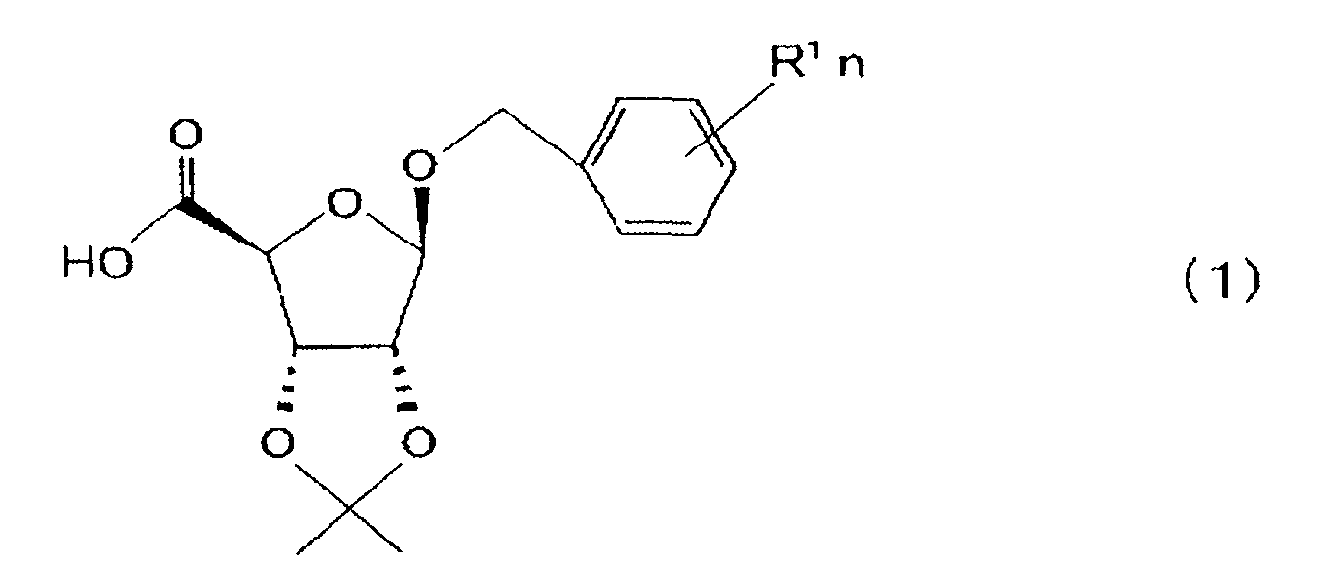
- The present invention relates to a method for producing β-D-ribofuranose derivative as one of the structural components of nucleic acid compounds, or the optical isomers of the derivative. More specifically, the invention relates to a method for producing β-D-ribofuranose derivatives represented by the following general formulas (1), (3) and (6) (including β-L-ribofuranose derivatives as the optical isomers thereof) from the starting material β-D-ribofuranose-1,2,3,5-tetraacetate or an optical isomer thereof, and a method for producing a series of these synthetic intermediates.(In the formula, R1 represents hydrogen atom or a substituent and "n" represents an integer of 1 to 5.)
 (In the formula, R1 and "n" represent the same meanings as described above and R2 represents hydrogen atom or an alkyl group with one to 6 carbon atoms.)
 (In the formula, R2 represents the same meaning as described above, and R3 represents an alkyl group with one to 6 carbon atoms.)
- Compound A prepared by substituting the hydroxyl group at 5' position of the sugar moiety (β-D-ribofuranose) of nucleic acid with carboxylic acid amide as represented by the following formula (A), has been reported in the forms of numerous pharmaceutical products of adenosine agonist, recently, as described in USP 4968697, the International Publication Nos. WO 9502604, WO 9314102, WO 9518817, WO 9423723 and WO 9417090.(In the formula, B represents nucleic acid base such as adenine derivative; R2 represents hydrogen or an alkyl group with one to 6 carbon atoms.)

- By the following synthesis scheme, so far, such Compound A has been synthetically prepared by protecting the hydroxyl group at 2'- and 3'- positions of the β-D-ribofuranose of nucleic acid with isopropylidene and the like, oxidizing the hydroxyl group at 5'-position, amidating the resulting carboxylic acid, and subsequently eliminating the protective groups.

- Meanwhile, the present inventors have focused their attention to the possibility that the compound represented by the general formula (A) may be synthetically prepared by coupling the nucleic acid base moiety B with β-D-ribofuranose derivative represented by the general formula (C), totally unlike the synthetic process described above. By the synthetic process using coupling, the sugar moiety which is readily eliminated from nucleic acid under acid conditions is introduced at the final stage, so only the nucleic acid base moiety can be synthetically prepared, separately, under various reaction conditions. Thus, the process is more convenient for the synthesis of compounds with various modified nucleic acid base moieties than the previous process is.(In the formula, Ac represents acetyl group; B and R2 individually represent the same meanings as described above.)

- It is suggested that the β-D-ribofuranose derivative represented by the general formula (C) can be readily prepared from the carboxylic acid compound with the structure of the general formula (1), synthetically, by amidating of the carboxylic acid compound into amide compounds (3) and (6) and then triacetylating the amide compounds. Hence, the compounds of the structures of the general formulas (1), (3) and (6) will possibly be important intermediates of pharmaceutical products with the backbone of the general formula (A). Additionally, the optical isomers of these compounds will also be promising as pharmaceutical intermediates.

- The compound of the structure of the general formula (6) has previously been prepared, synthetically, as described mainly about such compound with methoxy group at 1-position in for example "Liebigs Ann. Chem. 1974, 1856-63", by methylating the hydroxyl group at 1-position in the starting material β-D-ribofuranose, protecting the hydroxyl group at 2-and 3-positions of the resulting 1-O-methoxy-β-D-ribofuranose with isopropylidene and the like, and then oxidizing the hydroxyl group at 5-position. The synthetic route is as follows.

- The known process however is at a low total yield from the raw material β-D-ribofuranose. Because both the α form and β form are essentially produced in methylating the hydroxyl group at 1-position in β-D-ribofuranose in the presence of acid catalysts, the reduction of the yield is unavoidable while the purification is difficult. The reaction for benzylation of the hydroxyl group at 1-position in β-D-ribofuranose is also at a yield as low as 38 % (see J. Am. Chem. Soc. 1954, 76, 763-767). Accordingly, no reaction has been known for introducing alkoxyl group into the 1-position of the β-D-ribofuranose backbone at a high yield and in a highly β-selective manner.
- Additionally, the oxidation of a compound prepared by substituting the hydroxyl group at 2- and 3-positions in 1-O-methoxy-β-D-ribofuranose with isopropylidene is a reaction essential for the synthesis of a carboxylic acid compound of the structure of the general formula (3). For the compound with methoxy group at 1-position, therefore, oxidation using potassium permanganate (Liebigs Ann. Chem. 1974, 1856-63) and oxidation using 2,2,6,6-tetramethylpiperidinyl-1-oxy (TEMPO) (WO 9828319) have been known. In any of the oxidations, however, the raw materials are so syrupy that the raw materials are purified with much difficulty. The oxidations have been problematic in terms of high reproducibility, since many examples have been known about the blocking of the progress of the oxidation reactions in the presence of even a trace amount of impurities.
- It is one purpose of the invention to provide methods for producing the compounds of the general formulas (1), (3) and (6) or optical isomers thereof at high yields.
- It is the other purpose of the invention to provide methods for producing a series of intermediates at high yields, for producing the compounds of the general formulas (1), (3) and (6) or optical isomers thereof.
- The inventors have made investigations so as to overcome the problems. Consequently, the inventors have found that 1-O-benzyl-β-D-ribofuranose-2,3,5-triacetate can be produced at a high efficiency, by preliminarily acetylating the hydroxyl group at 1-, 2-, 3, and 5-positions of β-D-ribofuranose into β-D-ribofuranose-1,2,3,5-tetracetate, and allowing the resulting tetraacetate form to react with benzyl alcohols in the presence of acids to benzylate the 1-position of the ribofuranose backbone at a high yield and in a highly β-selective manner. Additionally, the inventors have found a method for synthetically preparing 1-O-benzyl-β-D-ribofuranose at a high yield by subsequent hydrolysis of the resulting benzyl compound.
- The inventors have also found that because not only 1-O-benzyl-β-D-ribofuranose but also a compound prepared by protecting the hydroxyl group at 2- and 3-positions in the ribofuranose with isopropylidene group can be recovered in crystal, additionally, the purification thereof can be readily done; and that the reaction control of the TEMPO oxidation of the raw material 1-O-benzyl-2,3-isopropylidene-β-D-ribofuranose detectable via ultraviolet absorption by HPLC analysis can be carried out readily and the reaction progresses at a high yield.
- Based on these two key reactions, the inventors have successfully prepared the compounds represented by the general formulas (1), (3) and (6) synthetically from the raw material β-D-ribofuranose-1,2,3,5-tetraacetate at high yields. Thus, the invention has been achieved. The invention can be used for the production of optical isomers of these compounds.
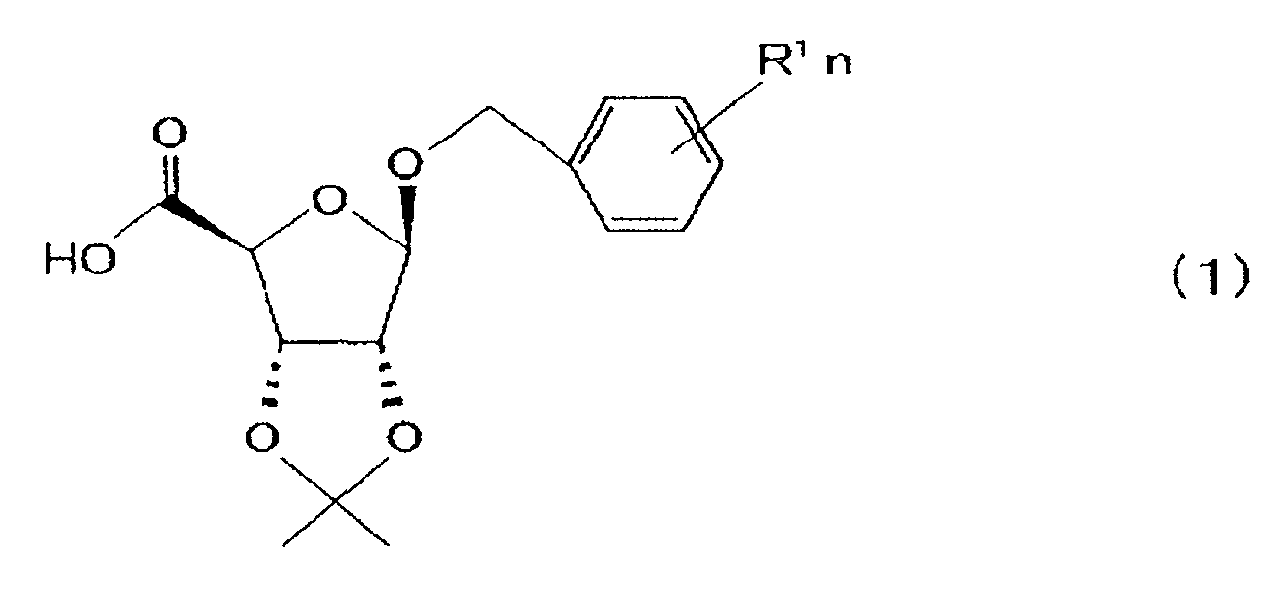
- More specifically, the invention in the first aspect relates to a method for producing 1-O-benzyl-β-D-ribofuranose-2,3,5-triacetate optionally having a substituent on the benzene ring or an optical isomer thereof, comprising allowing β-D-ribofuranose-1,2,3,5-tetraacetate or an optical isomer thereof to react with benzyl alcohol optionally having a substituent on the benzene ring in the presence of an acid catalyst; the invention in the second aspect relates to a method for producing 1-O-benzyl-β-D-ribofuranose optionally having a substituent on the benzene ring or an optical isomer thereof, comprising recovering 1-O-benzyl-β-D-ribofuranose-2,3,5-triacetate optionally having a substituent on the benzene ring or an optical isomer thereof by a method according to the first aspect and hydrolyzing the resulting 1-O-benzyl-β-D-ribofuranose-2,3,5-triacetate or an optical isomer thereof; the invention in the third aspect relates to a method for producing 1-O-benzyl-2,3-isopropylidene-β-D-ribofuranose optionally having a substituent on the benzene ring or an optical isomer thereof, comprising recovering 1-O-benzyl-β-D-ribofuranose optionally having a substituent on the benzene ring or an optical isomer thereof by a method according to the second aspect and allowing the resulting 1-O-benzyl-β-D-ribofuranose or an optical isomer thereof to react with 2,2-dimethoxypropane or acetone in the presence of an acid catalyst; the invention in the fourth aspect relates to a method for producing (3aS, 4S, 6R, 6aR)-6-benzyloxy-2,2-dimethyltetrahydro-furo[3,4-d][1,3]dioxole -4-carboxylic acid optionally having a substituent on the benzene ring, as represented by the general formula (1):(wherein R1 represents hydrogen atom or a substituent; and "n" represents an integer of 1 to 5), or an optical isomer thereof, comprising recovering 1-O-benzyl-2,3-isopropylidene-β-D-ribofuranose optionally having a substituent on the benzene ring or an optical isomer thereof by a method according to the third aspect, and oxidizing the resulting 1-O-benzyl-2,3-isopropylidene-β-D-ribofuranose or an optical isomer thereof with 2,2,6,6-tetramethylpiperidinyl-1-oxy; the invention in the fifth aspect relates to a method for producing (3aS, 4S, 6R, 6aR)-6-benzyloxy-2,2-dimethyltetrahydro-furo[3,4-d][1,3]dioxole-4-carboxylic acid amide derivative optionally having a substituent on the benzene ring, as represented by the general formula (3):
 (wherein R1 represents hydrogen atom or a substituent; "n" represents an integer of 1 to 5; and R2 represents hydrogen or an alkyl group with one to 6 carbon atoms), or an optical isomer thereof,
comprising recovering (3aS, 4S, 6R, 6aR)-6-benzyloxy-2,2-dimethyltetrahydro-furo[3,4-d][1,3]dioxole-4-carboxylic acid optionally having a substituent on the benzene ring or an optical isomer thereof by a method according to the fourth aspect and allowing the recovered (3aS, 4S, 6R, 6aR) -6-benzyloxy-2,2-dimethyltetrahydro-furo[3,4-d][1,3]dioxole-4-carboxylic acid or an optical isomer thereof to react with thionyl chloride and then to react with an amine represented by the general formula (2):(wherein R2 represents hydrogen or an alkyl group with one to 6 carbon atoms and R3 represents an alkyl group with one to 6 carbon atoms) or an optical isomer thereof,
comprising recovering (3aS, 4S, 6R, 6aR)-6-benzyloxy-2,2-dimethyltetrahydro-furo[3,4-d][1,3]dioxole-4-carboxylic acid optionally having a substituent on the benzene ring or an optical isomer thereof by a method according to the fourth aspect and allowing the recovered (3aS, 4S, 6R, 6aR)-6-benzyloxy-2,2-dimethyltetrahydro-furo[3,4-d][1,3]dioxole -4-carboxylic acid or an optical isomer thereof to react with an aliphatic alcohol represented by the general formula (4):(wherein R3 represents the same meaning as described above) or an optical isomer thereof, which is subsequently allowed to react with an amine represented by the general formula (2): (wherein R1 represents hydrogen atom or a substituent; and "n" represents an integer of 1 to 5), or an optical isomer thereof, comprising oxidizing 1-O-benzyl-2,3-isopropylidene-β-D-ribofuranose optionally having a substituent on the benzene ring or an optical isomer thereof with 2,2,6,6-tetramethyl-piperidinyl-1-oxy; the invention in the eighth aspect relates to a method for producing (3aS, 4S, 6R, 6aR)-6-benzyloxy-2,2-dimethyltetrahydro-furo[3,4-d][1,3]dioxole-4-carboxylic acid amide derivative optionally having a substituent on the benzene ring as represented by the general formula (3):
 (wherein R1 represents hydrogen atom or a substituent; "n" represents an integer of 1 to 5; and R2 represents hydrogen or an alkyl group with one to 6 carbon atoms), or an optical isomer thereof,
comprising recovering (3aS, 4S, 6R, 6aR)-6-benzyloxy-2,2-dimethyltetrahydro-furo[3,4-d][1,3]dioxole-4-carboxylic acid optionally having a substituent on the benzene ring or an optical isomer thereof by a method according to the seventh aspect, and allowing the resulting (3aS, 4S, 6R, 6aR)-6-benzyloxy-2,2-dimethyltetrahydro-furo[3,4-d][1,3]dioxole -4-carboxylic acid or an optical isomer thereof with thionyl chloride and then to react with an amine represented by the general formula (2):(wherein R2 represents hydrogen or an alkyl group with one to 6 carbon atoms and R3 represents an alkyl group with one to 6 carbon atoms), or an optical isomer thereof or an optical isomer thereof,
comprising recovering (3aS, 4S, 6R, 6aR)-6-benzyloxy-2,2-dimethyltetrahydro-furo[3,4-d][1,3]dioxole-4-carboxylic acid optionally having a substituent on the benzene ring or an optical isomer thereof by a method according to the seventh aspect, allowing the resulting (3aS, 4S, 6R, 6aR)-6-benzyloxy-2,2-dimethyltetrahydro-furo[3,4-d][1,3]dioxole -4-carboxylic acid or an optical isomer thereof to react with an aliphatic alcohol represented by the general formula (4):(in the formula, R3 represents the same meaning as described above) or an optical isomer thereof, which is then allowed to react with an amine represented by the general formula (2):
- Preferred embodiments of the invention are now discussed in some more detail.
- In accordance with the invention, the β-ribofuranose-1,2,3,5-tetracetate includes β-D-ribofuranose-1,2,3,5-tetraacetate and β-L-ribofuranose-1,2,3,5-tetraacetate.
- Hereinbelow, the process using β-D-ribofuranose-1,2,3,5-tetraacetate is mainly described as an example, but the same is absolutely true with the process using β-L-ribofuranose-1,2,3,5-tetraacetate.
- The production process flow of the β-D-ribofuranose derivatives represented by the general formulas (1), (3) and (6) from the raw material β-D-ribofuranose-1,2,3,5-tetraacetate in accordance with the invention will be illustrated in the chemical reaction scheme hereinbelow.

- The series of the production process is now sequentially described below.
- (1) First, the ribosylation (1-benzyloxylation) reaction of β-D-ribofuranose-1,2,3,5-tetraacetate (or β-L-ribofuranose-1,2,3,5-tetraacetate) with benzyl alcohol optionally having a substituent on the benzene ring is progressed in the presence of an acid catalyst in a non-protonic organic solvent. For the benzyl alcohol optionally having a substituent on the benzene ring thereof, the substituent includes for example an alkyl group with one to 6 carbon atoms, an alkoxyl group with one to 6 carbon atoms, nitro group, halogen atoms (chlorine, bromine, iodine and the like), an alkoxycarbonyl group with one to 7 carbon atoms, cyano group and hydroxyl group. Such benzyl alcohol optionally having a substituent on the benzene ring is used at an amount of one to 10 equivalents, preferably one to 2 equivalents to one equivalent of the raw material β-D-ribofuranose-1,2,3,5-tetraacetate (or β-L-ribofuranose-1,2,3,5-tetraacetate). Further, the acid catalyst includes for example Lewis acids (for example, zinc bromide, zinc chloride and aluminum chloride), inorganic acids (for example, hydrochloric acid, sulfuric acid and phosphoric acid) or organic acids (for example, acetic acid, p-toluenesulfonic acid, and methanesulfonic acid). The acid catalyst is used at an amount of 0.5 to 4 equivalents, preferably one to 2 equivalents to one equivalent of the raw material β-D-ribofuranose-1,2,3,5-tetraacetate (or β-L-ribofuranose-1,2,3,5-tetraacetate). The non-protonic organic solvent includes for example aromatic hydrocarbons such as benzene, toluene, and xylene; halogenated hydrocarbons such as chloroform and carbon tetrachloride; ketones such as acetone and methyl ethyl ketone; esters such as ethyl acetate; and N,N-dimethylformamide and dimethyl sulfoxide.
-
- The reaction temperature is not necessarily constant, depending on the alcohol type, the solvent type and other conditions. Generally, the reaction temperature is ambient temperature to 150°C, preferably ambient temperature to 80°C. The reaction time varies, depending on the reaction temperature, so it is not defined uniformly. However, generally, the reaction time is one to 24 hours, preferably 2 to 14 hours.
- So as to isolate 1-O-benzyl-β-D-ribofuranose-2,3,5-triacetate optionally having a substituent on the benzene ring (or 1-O-benzyl-β-L-ribofuranose-2,3,5-triacetate) from the reaction mixture thus prepared, first, an aqueous layer is separated by adding saturated aqueous sodium hydrogen carbonate solution to the reaction mixture; organic solvents such as toluene are then used for extraction; and then, the resulting extract is rinsed in saturated aqueous sodium chloride solution, followed by distillation under reduced pressure; the resulting matter in syrup is purified, if necessary, by silica gel column chromatography, to recover 1-O-benzyl-β-D-ribofuranose-2,3,5-triacetate (or 1-O-benzyl-β-L-ribofuranose -2,3,5-triacetate)in crystal. The product can also be identified, as such, by further deacetylation thereof to give 1-O-benzyl-β-D-ribofuranose (or 1-O-benzyl-β-L-ribofuranose) quantitatively.
- (2) The deacetylation (hydrolysis) of 1-O-benzyl-β-D-ribofuranose-2,3,5-triacetate (or 1-O-benzyl-β-L-ribofuranose-2,3,5-triacetate) optionally having a substituent on the benzene ring thereof is not particularly difficult. The deacetylation is promoted by adding a base or potassium cyanide at 0.01 to 3 equivalents, preferably 0.1 to one equivalent to one equivalent of the triacetate in the presence of lower alcohol solvents, for example methanol. As the base, use is made of organic bases such as sodium methoxide, sodium ethoxide, pyridine and triethylamine; sodium hydroxide, potassium hydroxide, sodium carbonate, potassium carbonate, sodium hydrogen carbonate, ammonia and the like.
-
- The reaction temperature is generally ambient temperature to 100°C, preferably ambient temperature to 50°C. The reaction time varies, depending on the reaction temperature, so it is not defined uniformly. Generally, however, the reaction time is 0.5 to 24 hours, preferably one to 4 hours.
- The reaction mixture thus recovered is distilled under reduced pressure, and the resulting oil is purified by silica gel column chromatography, if necessary, to recover the crystal of 1-O-benzyl-β-D-ribofuranose (or 1-O-benzyl-β-L-ribofuranose).
- (3) The isopropylidenation of 1-O-benzyl-β-D-ribofuranose (or 1-O-benzyl-β-L-ribofuranose) optionally having a substituent on the benzene ring is progressed, by adding acid catalysts such as inorganic acids including hydrochloric acid or sulfuric acid or organic acids including methanesulfonic acid or p-toluenesulfonic acid at 0.01 to one equivalent, preferably 0.01 to 0.2 equivalent along with 2,2-dimethoxypropane at one to 10 equivalents, preferably one to 2 equivalents to one equivalent of the 1-O-benzyl-β-D-ribofuranose (or 1-O-benzyl-β-L-ribofuranose), in a non-protonic organic solvent, or in acetone used as the solvent.
-
- The reaction temperature generally is ambient temperature to 100°C, preferably ambient temperature to 50°C. The reaction time varies, depending on the reaction temperature, so it is not defined uniformly. However, generally, the reaction time is 0.5 to 24 hours, preferably one to 4 hours.
- To the resulting reaction mixture is added aqueous sodium hydrogen carbonate solution to separate an organic layer, which is concentrated under reduced pressure, to recover 1-O-benzyl-2,3-isopropylidene-β-D-ribofuranose (or 1-O-benzyl-2,3-isopropylidene-β-L-ribofuranose) in white crystal. The white crystal is rinsed with a hexane/ethyl acetate mixture solvent in slurry to high purity.
- (4) The TEMPO oxidation of 1-O-benzyl-2,3-isopropylidene -β-D-ribofuranose (or 1-O-benzyl-2,3-isopropylidene-β-L-ribofuranose) optionally having a substituent on the benzene ring is progressed in aqueous basic solutions such as aqueous sodium hydrogen carbonate solution, aqueous sodium carbonate solution and aqueous potassium carbonate solution or mixture solvents of such aqueous basic solutions with non-protonic organic solvents. Using 2 to 20 equivalents (preferably 2 to 8 equivalents) of aqueous 10 to 15 % sodium hypochlorite solution, 0.0001 to 0.1 equivalent (preferably 0.001 to 0.01 equivalent) of TEMPO (2,2,6,6-tetramethyl piperidinyl -1-oxy) and 0.05 to one equivalent (preferably 0.1 to 0.5 equivalent) of potassium bromide to one equivalent of the 1-O-benzyl-2,3-isopropylidene-β-D-ribofuranose (or 1-O-benzyl-2,3-isopropylidene-β-L-ribofuranose), reaction procedures are carried out, comprising charging the reactants and the solvents except for the aqueous sodium hypochlorite solution, and dropwise adding the aqueous sodium hypochlorite solution while adjusting the inner temperature to 10°C or less and adjusting the pH to 12 or more. After the completion of the dropwise addition, the reaction temperature is maintained to 0°C to 40°C, preferably 0°C to ambient temperature. The reaction time is one to 5 hours, preferably one to 2 hours. So as to separate and purify (3aS, 4S, 6R, 6aR)-6-benzyloxy-2,2-dimethyltetrahydro-furo[3,4-d][1,3]dioxole-4-carboxylic acid or an optical isomer thereof produced from the reaction mixture, for example, an organic layer is separated by adding aqueous 10 % sodium sulfite solution to the reaction mixture, to which is then added aqueous 7 % sodium hydrogen carbonate solution, for reverse extraction; the resulting aqueous layer is adjusted to pH 2, using dilute hydrochloric acid, followed by extraction with organic solvents such as ethyl acetate and distillation of the organic layer under reduced pressure, to recover the (3aS, 4S, 6R, 6aR)-6-benzyloxy-2,2-dimethyltetrahydro-furo[3,4-d] [1,3] dioxole-4-carboxylic acid or an optical isomer thereof in crystal at high purity.
- (5) The amidation of (3aS, 4S, 6R, 6aR)-6-benzyloxy-2,2-dimethyltetrahydro-furo[3,4-d][1,3]dioxole-4-carboxylic acid optionally having a substituent on the benzene ring thereof or an optical isomer thereof with ammonia or an alkylamine with one to 6 carbon atoms comprises adding one to 3 equivalents, preferably one to 1.5 equivalents of thionyl chloride to one equivalent of the carboxylic acid in a non-protonic organic solvent to convert the carboxylic acid into carboxyl chloride. The reaction in this case is satisfactorily effected at ambient temperature to 100°C, preferably 40 to 70°C for one hour to 5 hours, preferably one hour to 2 hours. Then, ammonia gas is continuously purged therein until the inner temperature reaches 55°C. The organic layer separated by water addition to the reaction mixture is concentrated under reduced pressure, to recover a white crystal, which is then rinsed in hexane/ethyl acetate to recover (3aS, 4S, 6R, 6aR)-6-benzyloxy-2,2-dimethyl-tetrahydro-furo[3,4-d][1,3]dioxole-4-carboxylic acid amide or an optical isomer thereof in crystal. When an alkyl amine with one to 6 carbon atoms, for example methylamine, ethylamine, n-propylamine, butylamine, and hexylamine, is allowed to react instead of ammonia gas, the amidation is attained by adding the alkyl amine at one to 10 equivalents, preferably one to 3 equivalents to one equivalent of the carboxylic acid, while the temperature is maintained at ambient temperature to 100°C, preferably 40 to 70°C.
- (6) Alkylation, isopropylidenation and amidation of (3aS, 4S, 6R, 6aR)-6-benzyloxy-2,2-dimethyltetrahydro-furo[3,4-d][1,3] dioxole-4-carboxylic acid optionally having a substituent on the benzene ring or an optical isomer thereof
-
- Using aliphatic alcohols with one to 6 carbon atoms (for example, methanol, ethanol, n-propanol, amyl alcohol, and n-hexanol) as the solvent for the amidation, first, inorganic acids or organic acids are added at 0.001 to 0.5 equivalent, preferably 0.01 to 0.1 equivalent to one equivalent of the carboxylic acid so as to promote the alkylation. The reaction temperature varies depending on the type of an aliphatic alcohol, but generally, the temperature is selected from the range of 40°C to the boiling point of the aliphatic alcohol used. In case of methanol, the temperature is 40 to 70°C, preferably 50 to 60°C, while the reaction time is 10 to 48 hours, preferably 20 to 30 hours.
- Because of a partial elimination of the protective groups at 2- and 3-positions under the alkylation conditions, the reaction solution is concentrated under reduced pressure for the purpose of complementing the elimination; and the resulting residue is isopropylidated, using 2,2-dimethoxypropane at one to 10 equivalents, preferably one to 2 equivalents (to one equivalent of the carboxylic acid initially used) as a non-protonic organic solvent or using acetone as the solvent. Then, aqueous 28 % ammonia at one to 20 equivalents, preferably one to 10 equivalents, or an alkyl amine with one to 6 carbon atoms at one to 10 equivalents, preferably one to 3 equivalents is added to the resulting reaction mixture for amidation. The reaction temperature for both the isopropylidenation and amidation is ambient temperature to 70°C, preferably ambient temperature to 40°C, while the reaction time for the both is one to 24 hours, preferably one to 14 hours. The organic layer separated by water addition to the reaction mixture is concentrated under reduced pressure, to recover a white crystal, which is then rinsed in hexane/ethyl acetate, to recover the aimed (3aS, 4S, 6R, 6aR)-6-alkoxy-2,2-dimethyltetrahydro-furo[3,4-d][1,3]dioxole-4-carboxylic acid amide or an optical isomer thereof in crystal.
- Embodiments of the invention will be described more specifically in the examples, by way of illustration only. The invention is not limited to the examples.
- Benzyl alcohol (0.57 mL, 5.5 mmol) was added to a solution of β-D-ribofuranose-1,2,3,5-tetraacetate (1.59 g, 5 mmol) and zinc chloride (681.4 mg, 5 mmol) in ethyl acetate (8 mL), for agitation under heating at 60°C for 2 hours. After cooling the mixture to ambient temperature, water (2 mL) was added to the resulting solution, for layer separation. The resulting organic layer was rinsed twice in aqueous 7 % sodium hydrogen carbonate solution (2 mL) for subsequent concentration under reduced pressure. The resulting oil was purified by silica gel column chromatography, to recover the aimed 1-O-benzyl-β-D-ribofuranose-2,3,5-triacetate (1.56 g; yield of 85.1 %) in colorless solid. Melting point: 65°C.
- Benzyl alcohol (2.07 mL, 20 mmol) was added to a solution of β-D-ribofuranose-1,2,3,5-tetraacetate (3.18 g, 10 mmol) and zinc bromide (2.25 g, 10 mmol) in toluene (31.8 mL), for agitation at ambient temperature for 20 hours. To the resulting solution was added aqueous saturated sodium hydrogen carbonate solution (31.8 mL), for layer separation. To the resulting aqueous layer was added toluene (31.8 mL) for extraction. The resulting two organic layers were combined together, rinsed in aqueous saturated sodium chloride solution (10 mL), dried over anhydrous magnesium sulfate, and concentrated under reduced pressure. To the resulting oily 1-O-benzyl- β-D-ribofuranose-2,3,5-triacetate were added methanol (31.8 mL) and a solution of 28 % sodium methoxide in methanol (0.2 mL, 1 mmol), for agitation at ambient temperature for 2 hours, and the resulting mixture was concentrated under reduced pressure. The resulting oily matter was purified by silica gel column chromatography, to recover the aimed 1-O-benzyl-β-D-ribofuranose (2.24 g; yield of 93.2 %) in white solid. Melting point: 95°C.
- Benzyl alcohol (1.14 mL, 11 mmol) was added to a solution of β-D-ribofuranose-1,2,3,5-tetraacetate (3.18 g, 10 mmol) and zinc chloride (1.36 g, 10 mmol) in ethyl acetate (16 mL), for agitation at 60°C for 2 hours. After cooling the reaction mixture to ambient temperature, water (4 mL) was added to the resulting solution, for layer separation, and the resulting organic layer was rinsed twice in aqueous 7 % sodium hydrogen carbonate solution (4 mL), for concentration under reduced pressure. To the resulting oily 1-O-benzyl-β-D-ribofuranose-2,3,5-triacetate were added methanol (16 mL) and a solution of 28 % sodium methoxide in methanol (0.3 mL, 1.5 mmol), for agitation at ambient temperature for 2 hours. The resulting organic layer was concentrated under reduced pressure. To the resulting oily 1-O-benzyl-β-D-ribofuranose were added ethyl acetate (16 mL), 2,2-dimethoxypropane (1.48 mL, 12 mmol) and methanesulfonic acid (0.13 mL, 2.0 mmol), for agitation at ambient temperature for 15 hours. To the solution was added aqueous 7 % sodium hydrogen carbonate solution (4 mL), for layer separation, and the resulting organic layer was concentrated under reduced pressure. To the resulting white solid was added a hexane/ethyl acetate (5:1) solution (6 mL) for rinsing in slurry at ambient temperature for 2 hours. Subsequently, the solid was filtered and rinsed in a hexane/ethyl acetate (5:1) solution (1 mL). The solid was dried under reduced pressure to recover 1-O-benzyl-2,3-isopropylidene-β-D-ribofuranose (2.43 g; yield of 86.7 %) in white solid. Melting point: 108°C.
- To a solution of 1-O-benzyl-2,3-isopropylidene-β-D-ribofuranose (44.9 g, 160 mmol) in ethyl acetate (225 mL) were added aqueous 7 % sodium hydrogen carbonate solution (240 mL), sodium hydrogen carbonate (11.7 g, 140 mmol), potassium bromide (2.87 g, 24 mmol) and 2,2,6,6-tetramethyl-1-piperidinyloxy (0.1 g, 0.64 mmol), and the resulting mixture was cooled to 0°C. To the solution was dropwise added aqueous 12 % sodium hypochlorite solution (450 mL), while adjusting the inner temperature to 5°C or less. After dropwise addition, the temperature of the reaction solution was raised to ambient temperature, for agitation for 30 minutes. To the solution was added aqueous 10 % sodium sulfite solution (120 mL) for layer separation, and to the resulting organic layer was added aqueous 7 % sodium hydrogen carbonate solution (80 mL) for reverse extraction. The resulting two aqueous layers were combined together, and the resulting solution was adjusted to pH 2, using aqueous 6M hydrochloric acid solution, followed by extraction twice in ethyl acetate (230 mL). The resulting organic layer was concentrated under reduced pressure. The resulting solid was dried under reduced pressure, to recover (3aS, 4S, 6R, 6aR)-6-benzyloxy-2,2-dimethyltetrahydro-furo[3,4-d] [1,3]dioxole-4-carboxylic acid (42.7 g; yield of 90.7 %) in white solid. Melting point: 79°C.
- To a solution of (3aS, 4S, 6R, 6aR)-6-benzyloxy-2,2-dimethyltetrahydro-furo[3,4-d][1,3]dioxole-4-carboxylic acid (35.3 g, 120 mmol) in ethyl acetate (350 mL) was added thionyl chloride (13.1 mL, 180 mmol), for agitation under heating at 50°C for one hour. After the solution was cooled to ambient temperature, ammonia gas was purged therein over 30 minutes. After cooling the solution at ambient temperature, water (120 mL) was added for layer separation, and the resulting organic layer was concentrated under reduced pressure. To the resulting solid was added a hexane/ethyl acetate (5:1) solution (200 mL) for rinsing in slurry at ambient temperature for 14 hours. Subsequently, the solid was filtered and rinsed in a hexane/ethyl acetate (5:1) solution (20 mL). The solid was dried under reduced pressure to recover (3aS, 4S, 6R, 6aR)-6-benzyloxy-2,2-dimethyltetrahydro-furo[3,4-d][1,3]dioxole-4-carboxylic acid amide (29.8 g; yield of 84.3 %) in pale yellow solid. Melting point: 78°C.
- To a solution of (3aS, 4S, 6R, 6aR)-6-benzyloxy-2,2-dimethyltetrahydro-furo[3,4-d][1,3]dioxole-4-carboxylic acid (588.6 mg, 2 mmol) in methanol (8.8 mL) was added methanesulfonic acid (0.007 mL, 0.1 mmol), for agitation under heating at 60°C for 24 hours. After the solution was dried under reduced pressure, ethyl acetate (2.9 mL) and 2,2-dimethoxypropane (0.17 mL, 1.4 mmoL) were added to the resulting oil, for 2-hr agitation at ambient temperature. Aqueous 7% sodium hydrogen carbonate solution (0.5 mL) was added for layer separation, and the resulting organic layer was concentrated under reduced pressure, to which was added aqueous 28 % ammonia (1.2 mL, 20 mmol) for agitation at ambient temperature for 14 hours. To the resulting solution was added ethyl acetate (3 mL) for layer separation, and the organic layer was concentrated under reduced pressure. To the resulting solid was added a hexane/ethyl acetate (3:1) solution (3 mL) for rinsing in slurry at ambient temperature for 2 hours. Subsequently, the solid was filtered and rinsed in a hexane/ethyl acetate (3:1) solution (0.5 mL). The solid was dried under reduced pressure to recover (3aS, 4S, 6R, 6aR)-6-methoxy-2,2-dimethyltetrahydro-furo[3,4-d][1,3]dioxol-4-carboxylic acid amide (278.7 mg; yield of 64.2 %) in white solid. Melting point: 136°C.
- As described above, in accordance with the invention, the reaction of the form of β-D-ribofuranose-1,2,3,5-tetraacetate (β-L-ribofuranose-1,2,3,5-tetraacetate) with benzyl alcohols in the presence of acid catalyst can yield 1-O-benzyl-β-D-ribofuranose-2,3,5-triacetate (or 1-O-benzyl-β-L-ribofuranose-2,3,5-triacetate), where the 1-position of the ribofuranose structure has been benzylated at a high yield and a highly β-selective manner; subsequent hydrolysis thereof can quantitatively convert the triacetate into 1-O-benzyl-β-D-ribofuranose (or 1-O-benzyl-β-L-ribofuranose). Because 1-O-benzyl-β-D-ribofuranose (or 1-O-benzyl-β-L-ribofuranose) and compounds prepared by protecting the hydroxyl group at the 2- and 3-positions therein with isopropylidene group can be recovered in crystal, they can be readily purified; additionally, TEMPO oxidation of the raw material 1-O-benzyl-2,3-isopropylidene-β-D-ribofuranose (or 1-O-benzyl-2,3-isopropylidene-β-L-ribofuranose) detectable via ultraviolet absorption by HPLC analysis can be progressed under ready controls to a final high yield. The carboxylic acid generated via the oxidation can readily be converted further into carboxylic acid amide derivatives and the like, so the inventive methods are extremely meaningful as industrial processes of producing β-D-ribofuranose (or β-L-ribofuranose) derivatives useful as a synthetic intermediate of pharmaceutical nucleic acid-series products.
Claims (9)
- A method for producing 1-O-benzyl-β-D-ribofuranose -2,3,5-triacetate optionally having a substituent on the benzene ring or an optical isomer thereof, comprising allowing β-D-ribofuranose-1,2,3,5-tetraacetate or an optical isomer thereof to react with benzyl alcohol optionally having a substituent on the benzene ring in the presence of an acid catalyst.
- A method for producing 1-O-benzyl-β-D-ribofuranose optionally having a substituent on the benzene ring or an optical isomer thereof, comprising recovering 1-O-benzyl-β-D-ribofuranose-2,3,5-triacetate optionally having a substituent on the benzene ring or an optical isomer thereof by a method according to claim 1 and hydrolyzing the resulting 1-O-benzyl-β-D-ribofuranose-2,3,5-triacetate or an optical isomer thereof.
- A method for producing 1-O-benzyl-2, 3-isopropylidene-β-D-ribofuranose optionally having a substituent on the benzene ring or an optical isomer thereof, comprising recovering 1-O-benzyl-β-D-ribofuranose optionally having a substituent on the benzene ring or an optical isomer thereof by a method according to claim 2 and allowing the resulting 1-O-benzyl-β-D-ribofuranose or an optical isomer thereof to react with 2, 2-dimethoxypropane or acetone in the presence of an acid catalyst.
- A method for producing (3aS, 4S, 6R, 6aR)-6-benzyloxy-2,2-dimethyltetrahydro-furo[3,4-d][1,3]dioxole -4-carboxylic acid optionally having a substituent on the benzene ring, as represented by the general formula (1):(wherein R1 represents hydrogen atom or a substituent; and "n" represents an integer of 1 to 5), or an optical isomer thereof, comprising recovering 1-O-benzyl-2,3-isopropylidene-β-D-ribofuranose optionally having a substituent on the benzene ring or an optical isomer thereof by a method according to claim 3, and oxidizing the resulting 1-O-benzyl-2,3-isopropylidene-β-D-ribofuranose or an optical isomer thereof with 2,2,6,6-tetramethylpiperidinyl-1-oxy.

- A method for producing (3aS, 4S, 6R, 6aR)-6-benzyloxy-2,2-dimethyltetrahydro-furo[3,4-d][1,3]dioxole -4-carboxylic acid amide derivative optionally having a substituent on the benzene ring, as represented by the general formula (3):(wherein R1 represents hydrogen atom or a substituent; "n" represents an integer of 1 to 5; and R2 represents hydrogen or an alkyl group with one to 6 carbon atoms), or an optical isomer thereof,

comprising recovering (3aS, 4S, 6R, 6aR)-6-benzyloxy-2,2-dimethyltetrahydro-furo[3,4-d][1,3]dioxole-4-carboxylic acid optionally having a substituent on the benzene ring or an optical isomer thereof by a method according to claim 4 and allowing the resulting (3aS, 4S, 6R, 6aR)-6-benzyloxy-2,2-dimethyltetrahydro-furo[3,4-d][1,3]dioxole-4-carboxylic acid or an optical isomer thereof to react with thionyl chloride and then to react with an amine represented by the general formula (2): - A method for producing (3aS, 4S, 6R, 6aR)-6-alkoxy-2,2-dimethyltetrahydro-furo[3,4-d][1,3]dioxole-4-carboxylic acid amide derivative optionally having a substituent on the benzene ring, as represented by the general formula (6):(wherein R2 represents hydrogen or an alkyl group with one to 6 carbon atoms and R3 represents an alkyl group with one to 6 carbon atoms) or an optical isomer thereof,

comprising recovering (3aS, 4S, 6R, 6aR)-6-benzyloxy-2,2-dimethyltetrahydro-furo[3,4-d][1,3]dioxole-4-carboxylic acid optionally having a substituent on the benzene ring or an optical isomer thereof by a method according to claim 4 and allowing the recovered (3aS, 4S, 6R, 6aR)-6-benzyloxy-2,2-dimethyltetrahydro-furo[3,4-d][1,3]dioxole-4-carboxylic acid or an optical isomer thereof to react with an aliphatic alcohol represented by the general formula (4):(wherein R3 represents the same meaning as described above) or an optical isomer thereof, which is subsequently allowed to react with an amine represented by the general formula (2):
- A method for producing (3aS, 4S, 6R, 6aR)-6-benzyloxy-2,2-dimethyltetrahydro-furo[3,4-d][1,3]dioxole -4-carboxylic acid optionally having a substituent on the benzene ring, as represented by the general formula (1):(wherein R1 represents hydrogen atom or a substituent; and "n" represents an integer of 1 to 5), or an optical isomer thereof, comprising oxidizing 1-O-benzyl-2,3-isopropylidene-β-D-ribofuranose optionally having a substituent on the benzene ring or an optical isomer thereof with 2,2,6,6-tetramethylpiperidinyl-1-oxy.
- A method for producing (3aS, 4S, 6R, 6aR)-6-benzyloxy-2,2-dimethyltetrahydro-furo[3,4-d][1,3]dioxol-4-carboxylic acid amide derivative optionally having a substituent on the benzene ring as represented by the general formula (3):(wherein R1 represents hydrogen atom or a substituent; "n" represents an integer of 1 to 5; and R2 represents hydrogen or an alkyl group with one to 6 carbon atoms), or an optical isomer thereof,

comprising recovering (3aS, 4S, 6R, 6aR)-6-benzyloxy-2,2-dimethyltetrahydro-furo[3,4-d][1,3]dioxole-4-carboxylic acid optionally having a substituent on the benzene ring or an optical isomer thereof by a method according to claim 7, and allowing the resulting (3aS, 4S, 6R, 6aR)-6-benzyloxy-2,2-dimethyltetrahydro-furo[3,4-d][1,3]dioxole-4-carboxylic acid or an optical isomer thereof with thionyl chloride and then to react with an amine represented by the general formula (2): - A method for producing (3aS, 4S, 6R, 6aR)-6-alkoxy-2,2-dimethyltetrahydro-furo[3,4-d][1,3]dioxole-4-carboxylic acid amide derivative represented by the general formula (6):(wherein R2 represents hydrogen or an alkyl group with one to 6 carbon atoms and R3 represents an alkyl group with one to 6 carbon atoms), or an optical isomer thereof or an optical isomer thereof,
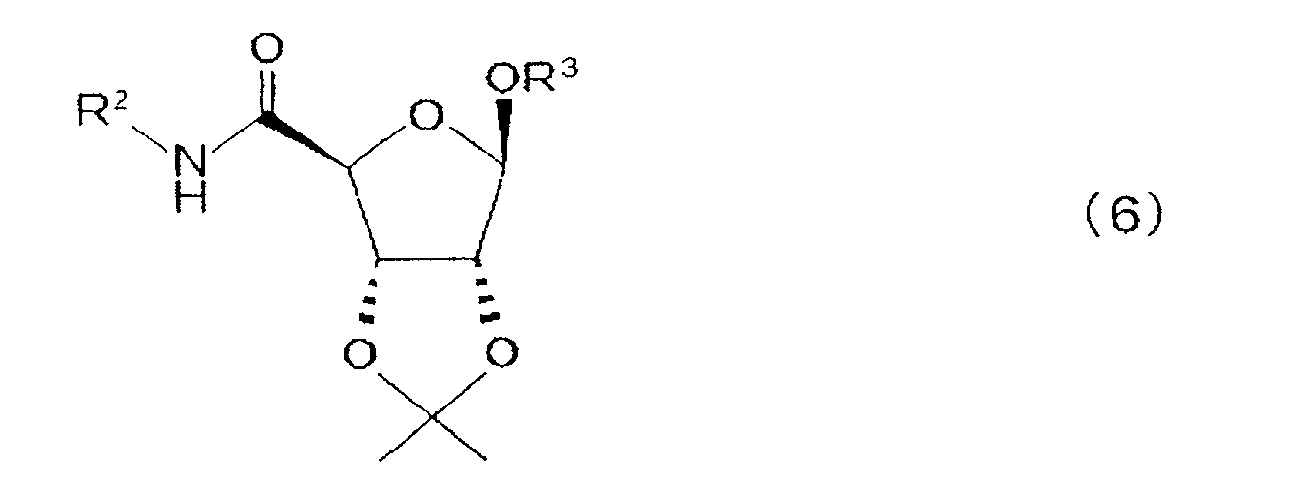
comprising recovering (3aS, 4S, 6R, 6aR)-6-benzyloxy-2,2-dimethyltetrahydro-furo[3,4-d][1,3]dioxoe-4-carboxylic acid optionally having a substituent on the benzene ring or an optical isomer thereof by a method according to claim 7, allowing the resulting (3aS, 4S, 6R, 6aR)-6-benzyloxy-2,2-dimethyltetrahydro-furo[3,4-d][1,3]dioxole-4-carboxylic acid or an optical isomer thereof to react with an aliphatic alcohol represented by the general formula (4):(in the formula, R3 represents the same meaning as described above) or an optical isomer thereof, which is then allowed to react with an amine represented by the general formula (2):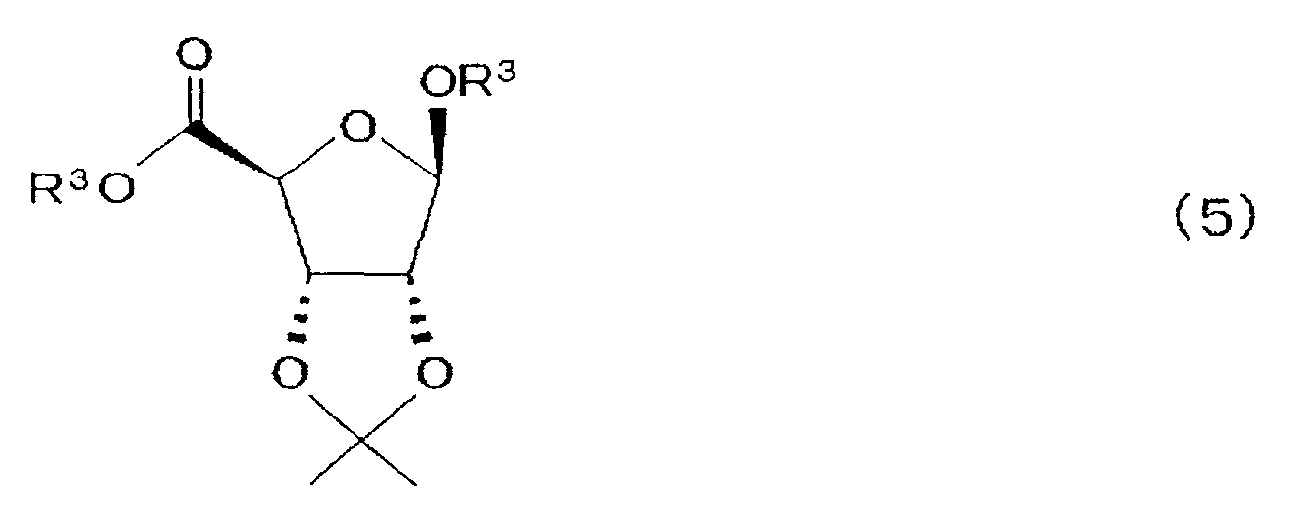
Applications Claiming Priority (2)
| Application Number | Priority Date | Filing Date | Title |
|---|---|---|---|
| JP2001152336 | 2001-05-22 | ||
| JP2001152336A JP2002338593A (en) | 2001-05-22 | 2001-05-22 | Method for producing β-D-ribofuranose derivative or optical isomer thereof |
Publications (1)
| Publication Number | Publication Date |
|---|---|
| EP1260516A1 true EP1260516A1 (en) | 2002-11-27 |
Family
ID=18997030
Family Applications (1)
| Application Number | Title | Priority Date | Filing Date |
|---|---|---|---|
| EP02251937A Withdrawn EP1260516A1 (en) | 2001-05-22 | 2002-03-18 | Method for producing a beta-D-ribofuranose derivative or an optical isomer thereof |
Country Status (3)
| Country | Link |
|---|---|
| US (1) | US6800742B2 (en) |
| EP (1) | EP1260516A1 (en) |
| JP (1) | JP2002338593A (en) |
Families Citing this family (1)
| Publication number | Priority date | Publication date | Assignee | Title |
|---|---|---|---|---|
| JP2014505059A (en) * | 2011-01-18 | 2014-02-27 | ジェネラル アトミクス | Hydrolase enzyme substrate and use thereof |
Citations (2)
| Publication number | Priority date | Publication date | Assignee | Title |
|---|---|---|---|---|
| WO1995002604A1 (en) * | 1993-07-13 | 1995-01-26 | The United States Of America, Represented By The Secretary, Department Of Health And Human Services | A3 adenosine receptor agonists |
| WO1998028319A1 (en) * | 1996-12-24 | 1998-07-02 | Glaxo Group Limited | 2-(purin-9-yl)-tetrahydrofuran-3,4-diol derivatives |
-
2001
- 2001-05-22 JP JP2001152336A patent/JP2002338593A/en not_active Withdrawn
-
2002
- 2002-03-18 EP EP02251937A patent/EP1260516A1/en not_active Withdrawn
- 2002-03-20 US US10/100,909 patent/US6800742B2/en not_active Expired - Fee Related
Patent Citations (2)
| Publication number | Priority date | Publication date | Assignee | Title |
|---|---|---|---|---|
| WO1995002604A1 (en) * | 1993-07-13 | 1995-01-26 | The United States Of America, Represented By The Secretary, Department Of Health And Human Services | A3 adenosine receptor agonists |
| WO1998028319A1 (en) * | 1996-12-24 | 1998-07-02 | Glaxo Group Limited | 2-(purin-9-yl)-tetrahydrofuran-3,4-diol derivatives |
Non-Patent Citations (4)
| Title |
|---|
| MIZUTANI, K. ET AL.: "N.M.R. SPECTRAL STUDY OF ALPHA- AND BETA-L-ARABINOFURANOSIDES", CARBOHYDRATE RESEARCH, vol. 185, 1989, pages 27 - 38, XP002205967 * |
| SCHMIDT, RICHARD R. ET AL: "Functional riburonic acid derivatives", CHEM. BER. (1978), 111(10), 3311-24, XP002205968 * |
| SCHWOGLER, ANJA ET AL: "Synthesis and properties of flavin ribofuranosides and flavin ribopyranosides", HELVETICA CHIMICA ACTA (2000), 83(9), 2452-2463, XP002205966 * |
| WATANABE K.A. ET AL, J. MED. CHEM., vol. 24, 1981, pages 893 - 897 * |
Also Published As
| Publication number | Publication date |
|---|---|
| US20020187942A1 (en) | 2002-12-12 |
| US6800742B2 (en) | 2004-10-05 |
| JP2002338593A (en) | 2002-11-27 |
Similar Documents
| Publication | Publication Date | Title |
|---|---|---|
| US20080300401A1 (en) | Novel chlorination process for preparing sucralose | |
| EP1281715B1 (en) | Process for the preparation of ribavirin | |
| JP3042073B2 (en) | Nucleoside derivative and method for producing the same | |
| JPH06509334A (en) | Method for producing demethylepipodophyllotoxin | |
| EP0638586B1 (en) | Nucleoside derivatives and methods for producing them | |
| US6858726B2 (en) | Synthesis of allofuranose | |
| KR100908363B1 (en) | Stereoselective preparation method of tri-O-acetyl-5-deoxy-β-D-ribofuranose and separation method thereof | |
| US6800742B2 (en) | Method for producing β-D-ribofuranose derivatives or optical isomers thereof | |
| US5130472A (en) | Total synthesis of erbstatin analogs | |
| EP1305284B1 (en) | Process and intermediate compounds for the preparation of pyrrolidines | |
| Buchanan et al. | C-Nucleoside studies-15: Synthesis of 3-β-D-arabinofuranosylpyrazoles and the D-arabinofuranosyl analogue of formycin | |
| CA2196932C (en) | Process for the glycosidation of colchicine derivatives and products o btained | |
| Yeh et al. | Sydnone compounds. 18. Schmidt reaction of 4-acetyl-3-arylsydnones | |
| JPH02289595A (en) | Production of 2'-deoxy-5-trifluoromethyl-uridine | |
| US20080058508A1 (en) | Process for Preparing Sucrose-6-ester | |
| US7361745B2 (en) | Process for the preparation of 1-chloro-3,5-di-o-acyl-2-deoxy-l-ribofuranoside derivatives | |
| EP1397373B1 (en) | Improved synthesis of allofuranose | |
| CA2552591A1 (en) | Improved synthesis of 2-substituted adenosines | |
| US6043364A (en) | Regiospecific process for synthesis of acyclic nucleosides | |
| WO2004065403A1 (en) | Processes for production of nucleosides | |
| JPH03227997A (en) | Production of nucleoside derivative | |
| CA2381367A1 (en) | Method for purifying 5'-protected 2'-deoxypurine nucleosides | |
| EP1451178A1 (en) | Processes for preparing beta-d-ribofuranose derivatives | |
| CN113004330A (en) | Preparation method of high-purity Reidesvir | |
| JPH0560477B2 (en) |
Legal Events
| Date | Code | Title | Description |
|---|---|---|---|
| PUAI | Public reference made under article 153(3) epc to a published international application that has entered the european phase |
Free format text: ORIGINAL CODE: 0009012 |
|
| AK | Designated contracting states |
Kind code of ref document: A1 Designated state(s): AT BE CH CY DE DK ES FI FR GB GR IE IT LI LU MC NL PT SE TR |
|
| AX | Request for extension of the european patent |
Free format text: AL;LT;LV;MK;RO;SI |
|
| 17P | Request for examination filed |
Effective date: 20030416 |
|
| AKX | Designation fees paid |
Designated state(s): BE CH DE FR GB IT LI |
|
| 17Q | First examination report despatched |
Effective date: 20040730 |
|
| GRAP | Despatch of communication of intention to grant a patent |
Free format text: ORIGINAL CODE: EPIDOSNIGR1 |
|
| STAA | Information on the status of an ep patent application or granted ep patent |
Free format text: STATUS: THE APPLICATION IS DEEMED TO BE WITHDRAWN |
|
| 18D | Application deemed to be withdrawn |
Effective date: 20080711 |