EP1260385A1 - Pneumatic tyre - Google Patents
Pneumatic tyre Download PDFInfo
- Publication number
- EP1260385A1 EP1260385A1 EP01304611A EP01304611A EP1260385A1 EP 1260385 A1 EP1260385 A1 EP 1260385A1 EP 01304611 A EP01304611 A EP 01304611A EP 01304611 A EP01304611 A EP 01304611A EP 1260385 A1 EP1260385 A1 EP 1260385A1
- Authority
- EP
- European Patent Office
- Prior art keywords
- cord
- carcass
- cords
- fibre
- aliphatic polyketone
- Prior art date
- Legal status (The legal status is an assumption and is not a legal conclusion. Google has not performed a legal analysis and makes no representation as to the accuracy of the status listed.)
- Withdrawn
Links
- 125000001931 aliphatic group Chemical group 0.000 claims abstract description 45
- 229920001470 polyketone Polymers 0.000 claims abstract description 45
- 239000000835 fiber Substances 0.000 claims abstract description 43
- 239000011324 bead Substances 0.000 claims abstract description 11
- 238000012360 testing method Methods 0.000 description 21
- 229920000728 polyester Polymers 0.000 description 12
- 230000007423 decrease Effects 0.000 description 11
- 229910000831 Steel Inorganic materials 0.000 description 10
- 239000004760 aramid Substances 0.000 description 10
- 229920003235 aromatic polyamide Polymers 0.000 description 10
- 239000010959 steel Substances 0.000 description 10
- 150000001336 alkenes Chemical group 0.000 description 6
- 238000004519 manufacturing process Methods 0.000 description 6
- 239000004677 Nylon Substances 0.000 description 5
- 229920001971 elastomer Polymers 0.000 description 5
- 238000000034 method Methods 0.000 description 5
- 229920001778 nylon Polymers 0.000 description 5
- UGFAIRIUMAVXCW-UHFFFAOYSA-N Carbon monoxide Chemical group [O+]#[C-] UGFAIRIUMAVXCW-UHFFFAOYSA-N 0.000 description 4
- VGGSQFUCUMXWEO-UHFFFAOYSA-N Ethene Chemical compound C=C VGGSQFUCUMXWEO-UHFFFAOYSA-N 0.000 description 4
- 239000005977 Ethylene Substances 0.000 description 4
- 229920001577 copolymer Polymers 0.000 description 4
- 239000000463 material Substances 0.000 description 4
- 239000013585 weight reducing agent Substances 0.000 description 4
- 229910002091 carbon monoxide Inorganic materials 0.000 description 3
- 230000003247 decreasing effect Effects 0.000 description 3
- 230000000694 effects Effects 0.000 description 3
- 230000003014 reinforcing effect Effects 0.000 description 3
- 239000000126 substance Substances 0.000 description 3
- 238000005452 bending Methods 0.000 description 2
- 238000007598 dipping method Methods 0.000 description 2
- 239000000446 fuel Substances 0.000 description 2
- 230000005484 gravity Effects 0.000 description 2
- 238000010438 heat treatment Methods 0.000 description 2
- JRZJOMJEPLMPRA-UHFFFAOYSA-N olefin Natural products CCCCCCCC=C JRZJOMJEPLMPRA-UHFFFAOYSA-N 0.000 description 2
- 238000004804 winding Methods 0.000 description 2
- VXNZUUAINFGPBY-UHFFFAOYSA-N 1-Butene Chemical compound CCC=C VXNZUUAINFGPBY-UHFFFAOYSA-N 0.000 description 1
- DGXAGETVRDOQFP-UHFFFAOYSA-N 2,6-dihydroxybenzaldehyde Chemical compound OC1=CC=CC(O)=C1C=O DGXAGETVRDOQFP-UHFFFAOYSA-N 0.000 description 1
- 229920001875 Ebonite Polymers 0.000 description 1
- 239000004593 Epoxy Substances 0.000 description 1
- 229920002302 Nylon 6,6 Polymers 0.000 description 1
- 229920000297 Rayon Polymers 0.000 description 1
- 239000000853 adhesive Substances 0.000 description 1
- 230000001070 adhesive effect Effects 0.000 description 1
- 125000003118 aryl group Chemical group 0.000 description 1
- IAQRGUVFOMOMEM-UHFFFAOYSA-N butene Natural products CC=CC IAQRGUVFOMOMEM-UHFFFAOYSA-N 0.000 description 1
- 150000001875 compounds Chemical class 0.000 description 1
- 230000007613 environmental effect Effects 0.000 description 1
- 239000004816 latex Substances 0.000 description 1
- 229920000126 latex Polymers 0.000 description 1
- 238000002074 melt spinning Methods 0.000 description 1
- YWAKXRMUMFPDSH-UHFFFAOYSA-N pentene Chemical compound CCCC=C YWAKXRMUMFPDSH-UHFFFAOYSA-N 0.000 description 1
- QQONPFPTGQHPMA-UHFFFAOYSA-N propylene Natural products CC=C QQONPFPTGQHPMA-UHFFFAOYSA-N 0.000 description 1
- 125000004805 propylene group Chemical group [H]C([H])([H])C([H])([*:1])C([H])([H])[*:2] 0.000 description 1
- 239000002964 rayon Substances 0.000 description 1
- 238000000926 separation method Methods 0.000 description 1
- 238000010008 shearing Methods 0.000 description 1
- 238000004073 vulcanization Methods 0.000 description 1
Images

Classifications
-
- D—TEXTILES; PAPER
- D02—YARNS; MECHANICAL FINISHING OF YARNS OR ROPES; WARPING OR BEAMING
- D02G—CRIMPING OR CURLING FIBRES, FILAMENTS, THREADS, OR YARNS; YARNS OR THREADS
- D02G3/00—Yarns or threads, e.g. fancy yarns; Processes or apparatus for the production thereof, not otherwise provided for
- D02G3/44—Yarns or threads characterised by the purpose for which they are designed
- D02G3/48—Tyre cords
-
- B—PERFORMING OPERATIONS; TRANSPORTING
- B60—VEHICLES IN GENERAL
- B60C—VEHICLE TYRES; TYRE INFLATION; TYRE CHANGING; CONNECTING VALVES TO INFLATABLE ELASTIC BODIES IN GENERAL; DEVICES OR ARRANGEMENTS RELATED TO TYRES
- B60C9/00—Reinforcements or ply arrangement of pneumatic tyres
- B60C9/0042—Reinforcements made of synthetic materials
-
- B—PERFORMING OPERATIONS; TRANSPORTING
- B60—VEHICLES IN GENERAL
- B60C—VEHICLE TYRES; TYRE INFLATION; TYRE CHANGING; CONNECTING VALVES TO INFLATABLE ELASTIC BODIES IN GENERAL; DEVICES OR ARRANGEMENTS RELATED TO TYRES
- B60C9/00—Reinforcements or ply arrangement of pneumatic tyres
- B60C9/02—Carcasses
- B60C9/04—Carcasses the reinforcing cords of each carcass ply arranged in a substantially parallel relationship
- B60C9/08—Carcasses the reinforcing cords of each carcass ply arranged in a substantially parallel relationship the cords extend transversely from bead to bead, i.e. radial ply
-
- B—PERFORMING OPERATIONS; TRANSPORTING
- B60—VEHICLES IN GENERAL
- B60C—VEHICLE TYRES; TYRE INFLATION; TYRE CHANGING; CONNECTING VALVES TO INFLATABLE ELASTIC BODIES IN GENERAL; DEVICES OR ARRANGEMENTS RELATED TO TYRES
- B60C9/00—Reinforcements or ply arrangement of pneumatic tyres
- B60C9/18—Structure or arrangement of belts or breakers, crown-reinforcing or cushioning layers
- B60C9/20—Structure or arrangement of belts or breakers, crown-reinforcing or cushioning layers built-up from rubberised plies each having all cords arranged substantially parallel
-
- B—PERFORMING OPERATIONS; TRANSPORTING
- B60—VEHICLES IN GENERAL
- B60C—VEHICLE TYRES; TYRE INFLATION; TYRE CHANGING; CONNECTING VALVES TO INFLATABLE ELASTIC BODIES IN GENERAL; DEVICES OR ARRANGEMENTS RELATED TO TYRES
- B60C9/00—Reinforcements or ply arrangement of pneumatic tyres
- B60C9/18—Structure or arrangement of belts or breakers, crown-reinforcing or cushioning layers
- B60C9/20—Structure or arrangement of belts or breakers, crown-reinforcing or cushioning layers built-up from rubberised plies each having all cords arranged substantially parallel
- B60C9/2003—Structure or arrangement of belts or breakers, crown-reinforcing or cushioning layers built-up from rubberised plies each having all cords arranged substantially parallel characterised by the materials of the belt cords
- B60C9/2009—Structure or arrangement of belts or breakers, crown-reinforcing or cushioning layers built-up from rubberised plies each having all cords arranged substantially parallel characterised by the materials of the belt cords comprising plies of different materials
-
- B—PERFORMING OPERATIONS; TRANSPORTING
- B60—VEHICLES IN GENERAL
- B60C—VEHICLE TYRES; TYRE INFLATION; TYRE CHANGING; CONNECTING VALVES TO INFLATABLE ELASTIC BODIES IN GENERAL; DEVICES OR ARRANGEMENTS RELATED TO TYRES
- B60C9/00—Reinforcements or ply arrangement of pneumatic tyres
- B60C9/18—Structure or arrangement of belts or breakers, crown-reinforcing or cushioning layers
- B60C9/20—Structure or arrangement of belts or breakers, crown-reinforcing or cushioning layers built-up from rubberised plies each having all cords arranged substantially parallel
- B60C9/22—Structure or arrangement of belts or breakers, crown-reinforcing or cushioning layers built-up from rubberised plies each having all cords arranged substantially parallel the plies being arranged with all cords disposed along the circumference of the tyre
-
- D—TEXTILES; PAPER
- D01—NATURAL OR MAN-MADE THREADS OR FIBRES; SPINNING
- D01F—CHEMICAL FEATURES IN THE MANUFACTURE OF ARTIFICIAL FILAMENTS, THREADS, FIBRES, BRISTLES OR RIBBONS; APPARATUS SPECIALLY ADAPTED FOR THE MANUFACTURE OF CARBON FILAMENTS
- D01F6/00—Monocomponent artificial filaments or the like of synthetic polymers; Manufacture thereof
- D01F6/28—Monocomponent artificial filaments or the like of synthetic polymers; Manufacture thereof from copolymers obtained by reactions only involving carbon-to-carbon unsaturated bonds
- D01F6/30—Monocomponent artificial filaments or the like of synthetic polymers; Manufacture thereof from copolymers obtained by reactions only involving carbon-to-carbon unsaturated bonds comprising olefins as the major constituent
-
- Y—GENERAL TAGGING OF NEW TECHNOLOGICAL DEVELOPMENTS; GENERAL TAGGING OF CROSS-SECTIONAL TECHNOLOGIES SPANNING OVER SEVERAL SECTIONS OF THE IPC; TECHNICAL SUBJECTS COVERED BY FORMER USPC CROSS-REFERENCE ART COLLECTIONS [XRACs] AND DIGESTS
- Y10—TECHNICAL SUBJECTS COVERED BY FORMER USPC
- Y10T—TECHNICAL SUBJECTS COVERED BY FORMER US CLASSIFICATION
- Y10T152/00—Resilient tires and wheels
- Y10T152/10—Tires, resilient
- Y10T152/10495—Pneumatic tire or inner tube
Definitions
- polyester cords are widely employed in the carcass of a passenger car radial tyre for example.
- the polyester cords are poor in adhesion properties to rubber. Therefore, in order to obtain sufficient adhesion to the surrounding rubber, an epoxy dipping process and resorcinol-formaldehyde/latex dipping process are indispensable. These processes hinder improvements in tyre production efficiency and tyre production cost.
- the breaker 7 comprises at least two crossed plies 7A and 7B each made of high modulus breaker cords laid parallel with each other at an angle in the range of from 10 to 35 degrees with respect to the tyre circumferential direction.
- the breaker 7 extends across substantially the entire width of the tread portion 2.
- the aliphatic polyketone fibre cord in the band has a twist coefficient N of from 1500 to 2000, a tensile strength of not less than 9.8 g/d, a standard elongation of not more than 5.0%, and the sum of the standard elongation and dry heat shrinkage is not more than 9%.
- the dry heat shrinkage is not more than 6.0%.
- the total denier number D of the band cord 10 is in a range of from 2000 to 4500 deniers.
Landscapes
- Engineering & Computer Science (AREA)
- Mechanical Engineering (AREA)
- Textile Engineering (AREA)
- Chemical & Material Sciences (AREA)
- Chemical Kinetics & Catalysis (AREA)
- General Chemical & Material Sciences (AREA)
- Tires In General (AREA)
Abstract
A pneumatic tyre comprises a carcass (6) extending between bead portions (4)
through a tread portion (2) and sidewall portions (3), and a belt disposed
radially outside the carcass (6) in the tread portion (2), wherein at least one of
the carcass and the belt is reinforced with aliphatic polyketone fibre cords
having specific characteristics.
Description
The present invention relates to a pneumatic tyre reinforced with aliphatic
polyketone fibre cords.
In general, a pneumatic tyre is provided with a carcass and a belt which are
reinforced with carcass cords and belt cords, respectively. In the case of
organic cords, for example, polyester, nylon, and aromatic polyamide are
widely used as materials for such tyre reinforcing cords.
In order to improve high speed durability of passenger car radial tyres for
example, usually the belt includes a breaker and a band disposed on the
radially outer side of the breaker, and nylon cords are widely used as the band
cords. Further, aromatic polyamide cords are also used. Aromatic polyamide
cords are well known as being desirable to accomplish the purpose of the band
(namely hooping) because of the excellent strength and high elastic modulus.
In the case of a nylon cord band, when the tyre is made to withstand very high
speed rotation, the amount of nylon cord is inevitably increased. As a result,
tyre weight increases undesirably in a radially outermost part of the tyre. This
problem may be solved by employing an aromatic polyamide cord band. In
the case of aromatic polyamide cords, however, there is another problem
which is the relatively high material cost. Further, aromatic polyamide cords
are relatively weak in fatigue especially bending deformation.
On the other hand, polyester cords are widely employed in the carcass of a
passenger car radial tyre for example. The polyester cords are poor in
adhesion properties to rubber. Therefore, in order to obtain sufficient
adhesion to the surrounding rubber, an epoxy dipping process and resorcinol-formaldehyde/latex
dipping process are indispensable. These processes hinder
improvements in tyre production efficiency and tyre production cost.
In laid-open Japanese patent application JP-A-9-324377, an aliphatic
polyketone tyre cord is disclosed and the use in a carcass of a radial tyre is
suggested, wherein the tyre cord is formed by twisting aliphatic polyketone
filaments each having a tensile strength of not less than 10.0 g/d and an initial
modulus of not less than 120 g/d, and the twist coefficient is in a range of from
1300 to 2200. As to characteristics of the finished cord, only the bending
rigidity is disclosed which is in a range of from 10 to 80 g.
It is therefore, an object of the present invention to provide a pneumatic tyre,
in which, by employing aliphatic polyketone cords having specific
characteristics, the above-mentioned problems are solved.
According to the present invention, a pneumatic tyre comprises a carcass
extending between bead portions through a tread portion and sidewall portions
and a belt disposed radially outside the carcass in the tread portion, and at least
one of the carcass and the belt is reinforced with aliphatic polyketone fibre
cords.
In the case of the belt, it is preferable that the aliphatic polyketone fibre cords
each have a tensile strength of not less than 9.8 g/d, a standard elongation of
not more than 5.0%, and a dry heat shrinkage of not more than 6.0%, and the
sum of the standard elongation and the dry heat shrinkage is not more than
9%, and the twist coefficient is in a range of from 1500 to 2000. The aliphatic
polyketone fibre may be used for the breaker and the bandage.
In the case of the carcass, it is preferable that the aliphatic polyketone fibre
carcass cords each have a tensile strength of not less than 15.0 g/d, a standard
elongation of not more than 3.0%, and a dry heat shrinkage of not more than
3.0%, and the sum of the standard elongation and the dry heat shrinkage is not
more than 5.5%.
The tensile strength of a cord is the load at rupture per denier which
is measured according to the Japanese Industrial Standard L1017 - Testing
Methods for Chemical Fibre Tyre Cords, 7. - Testing Method, 7.5 - Tensile
Strength and Elongation Percentage, 7.5.1 - Test in Standard Condition.
Standard elongation is an elongation in percent under a load of 2.25
gram/denier which is measured according to the Japanese Industrial Standard
L1017 - Testing Methods for Chemical Fibre Tyre Cords, 7. - Testing Method,
7.7 - Elongation Percentage in Constant Load, 7.7.1 - Test in Standard
Condition.
Dry heat shrinkage is a shrinkage in percent after heating at 180 degrees C for
30 minutes which is measured according to the Japanese Industrial Standard
L1017 - Testing Methods for Chemical Fibre Tyre Cords, 7. - Testing Method,
7.10 - Hot-dry Shrinkage Percentage, 7.10.2 - Method B (Hot-dry Shrinkage
Percentage after Heating).
The twist coefficient is the product of the square root √D of the total denier
number D of the cord multiplied by a cord twist number T (turns pre 10 cm) of
the cord.
Embodiments of the present invention will now be described in detail in
conjunction with the accompanying drawings in which:
In Fig.1, a radial tyre 1 comprises a tread portion 2, a pair of sidewall portions
3, a pair of bead portions 4, a carcass 6 extending between the bead portions 4,
and a belt disposed radially outside the carcass 6 in the tread portion 2.
The carcass 6 comprises at least one ply 6A of carcass cords arranged radially
at an angle of from 75 to 90 degrees with respect to the tyre circumferential
direction. The carcass ply 6A extends between the bead portions 4 through the
tread portion 2 and sidewall portions 3 and is turned up around a bead core 5
in each bead portion 4 so as to form a pair of turned up portions 6b and a main
portion 6a therebetween.
Each bead portion 4 is provided between the carcass ply main portion 6a and
turned up portion 6b with a bead apex 8 made of a hard rubber compound
tapering radially outwards from the bead core 5.
The belt can include a breaker 7 disposed on the radially outside of the carcass
6 and a band 9 disposed on the radially outside of the breaker 7. The major
difference between the breaker and band is the cord angle.
The breaker 7 comprises at least two crossed plies 7A and 7B each made of
high modulus breaker cords laid parallel with each other at an angle in the
range of from 10 to 35 degrees with respect to the tyre circumferential
direction. The breaker 7 extends across substantially the entire width of the
tread portion 2.
The band 9 comprises at least one layer 11 of band cords 10 whose cord angle
is less than 10 degrees, usually not more than 5 degrees, preferably
substantially 0 degrees, with respect to the tyre circumferential direction. The
band 9 extends at least in the edge portions 7E of the breaker 7 to prevent
these portions from being lifted by centrifugal force during high-speed
running. Thus, the band 9 may be (a) a full width band 11B extending across
the entire width of the breaker, (b) an edge band 11A extending in the edge
portions only, or (c) a combination of the edge band 11A and full width band
11B as shown in Fig.1. The layer 11 can be made by spirally winding a
narrow tape of rubber in which several band cords 10, for example 5 to 15
cords, are embedded along the length thereof. Also the layer 11 can be made
by winding one around the tyre a wider strip of rubberised cords 10.
According to the present invention, an aliphatic polyketone fibre cord is
utilised as tyre reinforcing cords such as the carcass cords, belt (breaker, band)
cords and the like.
The aliphatic polyketone fibre cord is formed by twisting aliphatic polyketone
fibres together at a specified cord twist number T in turns/10 cm. As to the
twist structure, a regular lay, Lang's lay, open lay, and compact lay or parallel
lay may be utilised. In the following embodiments, a regular lay cord
structure is employed. That is, the direction of twist in the strands is opposite
to the direction of twist in the cord.
The aliphatic polyketone fibre is made of at least one kind of copolymer
consisting of repeated linked units which are alternating carbon monoxide
units and olefin units (A) as shown in the following structural formula:
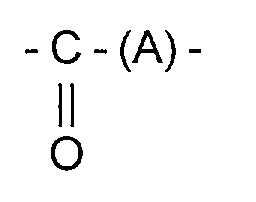
As the olefin units (A), ethylene is mainly used, but it is possible to include
other olefins such as propylene, butene, pentene, etc. are included. The mole
percentage of ethylene to the total of olefin is not less than 90 mol%,
preferably not less than 94 mol%, more preferably 100 mol%. If less than 90
mol%, it is difficult to obtain the strength and tensile elastic modulus which
are necessary for tyre reinforcing cord. That is, the aliphatic polyketone fibre
is made of a copolymer of carbon monoxide and one kind of olefin (or
ethylene) and optional copolymer(s) of carbon monoxide and two or more
kinds of olefins. Preferably, the aliphatic polyketone has the following
structure:

In this example, a copolymer of carbon monoxide and substantially 100%
ethylene is used, namely, n=0.
In manufacturing the aliphatic polyketone fibres, it is preferable for
environmental and economical aspects to use a melt spinning method.
In this embodiment, an aliphatic polyketone fibre cord is used as the
band cords 10.
The aliphatic polyketone fibre cord in the band has a twist coefficient N of
from 1500 to 2000, a tensile strength of not less than 9.8 g/d, a standard
elongation of not more than 5.0%, and the sum of the standard elongation and
dry heat shrinkage is not more than 9%. The dry heat shrinkage is not more
than 6.0%. Preferably, the total denier number D of the band cord 10 is in a
range of from 2000 to 4500 deniers.
If the tensile strength is less than 9.8 g/d, it is necessary to increase the number
of the cords in order to maintain the breaking strength of the tyre.
Accordingly, it becomes difficult to provide a light-weight low-cost tyre.
If the standard elongation is more than 5.0%, and/or the dry heat shrinkage is
more than 6.0%, and/or the sum of the standard elongation and dry heat
shrinkage is more than 9%, then the band cords have a large elongation due to
the internal heat build-up in the tread portion and the centrifugal force during
high speed running. In other words, the hooping effect of the band becomes
insufficient, and the high-speed durability is not improved.
If the twist coefficient N is less than 1500, the fatigue resistance and strength
of the cord decreases are liable to decrease. If the twist coefficient N is more
than 2000, the tensile elastic modulus decreases and the hooping effect of the
band decreases and the high-speed durability is not improved.
As described above, a regular lay cord structure is used in this embodiment.
However, a parallel lay cord structure may be employed in the aliphatic
polyketone fibre band cord to further reduce the quantity and thereby to reduce
the weight and cost. In this case, the twist coefficient N may be set in a range
of from 150 to 750.
On the other hand, the breaker in this example is made of steel cords. But,
high modulus organic fibre cords such as aromatic polyamide fibre cords,
aromatic polyester fibre cords and the like, or the aliphatic polyketone fibre
cords may be also used.
The carcass in this example is made of polyester fibre cords. However, other
organic fibre cords, e.g. nylon, rayon, aromatic polyamide, aliphatic
polyketone and the like, and further steel cords may be used according to the
use, size, etc.
Test tyres of size P165/70R13 having the structure shown in Fig.1
and specifications shown in Table 1 were made and tested for high-speed
durability
Using a tyre test drum, the test tyre mounted on a standard wheel
rim (size 5JX13), inflated to standard pressure of 280 kPa, and loaded with
normal load of 437 kgf which is 80% of the maximum pressure which are
specified by Japan Automobile Tyre Manufacturers Association was run at an
ambient temperature of 25 plus/minus 5 degrees C. The running speed was
increased every ten minutes in steps of 10 km/h from 170 km/h. The running
was continued until any damage occurred and the running distance was
measured. The results are indicated by an index based on Ref.A1 being 100,
wherein the larger the index number, the better the high-speed durability.
| Tyre | Ref.A1 | Ref.A2 | Ex.A1 |
| Band | |||
| Cord | Aromatic polyamide | nylon 66 | aliphatic polyketone |
| 1500d/2 | 1500d/2 | 1500d/2 | |
| Total denier D | 3000 | 3000 | 3000 |
| Twist T (turns/10cm) | 30 | 30 | 30 |
| Twist coefficient N | 1643 | 1643 | 1643 |
| Tensile strength (g/d) | 17.3 | 8 | 13.3 |
| Standard elongation (%) | 0.9 | 12.7 | 3.8 |
| Dry-heat shrinkage (%) | 0 | 5 | 1.8 |
| Sum (%) | 0.9 | 17.7 | 5.6 |
| Cord count/5cm | 30 | 49 | 40 |
| Material cost | high | low | low |
| Breaker | |||
| Cord | steel | steel | steel |
| 1X1X0.42 | 1X1X0.42 | 1X1X0.42 | |
| No. of | 2 | 2 | 2 |
| Cord count/5cm | 40 | 40 | 40 |
| Cord angle (deg.) | -1 | -1 | -1 |
| Carcass | |||
| Cord | polyester | polyester | polyester |
| 1500d/2 | 1500d/2 | 1500d/2 | |
| Cord count/5cm | 50 | 50 | 50 |
| No. of ply | 1 | 1 | 1 |
| Cord angle (deg.) | 90 | 90 | 90 |
| High-speed durability | 101 | 100 | 106 |
From the test results, it was confirmed that, by using the aliphatic polyketone
fibre cords in the band, the high-speed durability was improved more than
with the aromatic polyamide fibre cord, without increasing the cost.
In this embodiment, an aliphatic polyketone fibre cord is utilised as
the carcass cords.
The aliphatic polyketone fibre cord in the carcass has a tensile strength of not
less than 15.0 g/d, a standard elongation of not more than 3.0%, and a dry heat
shrinkage of not more than 3.0%, and the sum of the standard elongation and
dry heat shrinkage is not more than 5.5%. The total denier number D of the
carcass cord is in a rage of from 2000 to 4500 deniers. The twist coefficient N
of the carcass cord is in a range of from 1000 to 2500. The cord count of the
carcass ply is in a range of from 30 to 50 /5 cm width.
By setting the tensile strength in the range of not less than 15.0 g/d, the
strength of the carcass 6 is improved. Further, as the specific gravity is 1.24
which is less than the specific gravity (=1.38) of polyester, a corresponding
weight reduction is possible. Weight reduction can be further achieved by
decreasing the cord count of the carcass and/or the total denier number of the
cord in comparison with the polyester cord, while maintaining the strength.
And the fuel consumption is improved. If the tensile strength is less than 15.0
g/d, these advantageous effects can not be obtained.
By setting the standard elongation in the range of not more than 3.0%, the tyre
rigidity is improved or maintained and the steering stability is improved.
Further, a growth in the tyre diameter due to high speed rotation is controlled
and the high-speed durability is improved.
If the dry heat shrinkage is more than 3.0%, or if the sum of the standard
elongation and dry heat shrinkage is more than 5.5%, the tyre shrinks after the
vulcanisation, and the tyre uniformity is disturbed. Therefore, in order to
avoid this drawback, so called post cure inflation (PCI) is necessitated. That
is, after the vulcanised mould is took out from the mould, it is necessary to
inflate the tyre to a higher pressure than atmospheric pressure until the tyre
gets cold to prevent the shrinkage of the carcass cords and the resultant
deformation. Accordingly, the production efficiency decreases and production
cost increases.
As the aliphatic polyketone fibre cord has a high strength and a high modulus,
the cord count (30 to 50 /5 cm) can be decreased in comparison with the cord
count (45 to 55 /5 cm) using polyester fibre cord. Thus, the tyre weight can be
decreased. If the cord count is less than 30 /5 cm, the strength of the carcass 6
is lowered. If more than 50 /5 cm, the rubber between the cords becomes
short, and adhesive failure between the cords and rubber is liable to occur.
If the twist coefficient N is less than 1000, the fatigue resistance and strength
of the cord decreases are liable to decrease. If the twist coefficient N is more
than 2500, the tensile elastic modulus decreases and the tyre rigidity decreases
and the steering stability and high-speed durability can not be improved.
If the total denier number D is less than 2000 deniers, it is necessary to
increase the cord count which decreases the production efficiency. If more
than 4500 deniers, the resistance to external injure decreases and the tyre
weight increases.
In this embodiment, in addition to the carcass, aliphatic polyketone fibre cords
are employed in the belt. The belt in this example consists of the breaker 7,
and at least one of the breaker plies 7A and 7B, for example the radially inner
breaker ply 7A is made of aliphatic polyketone fibre cords but the radially
outer breaker ply 7B is made of steel cords. From the point of view of
puncture resistance, it may be preferable that the radially outermost ply is a
steel cord ply rather than an aliphatic polyketone fibre cord ply.
The aliphatic polyketone fibre cord used in the breaker has a tensile strength
of not less than 15.0 g/d, a standard elongation of not more than 3.0%, and a
dry heat shrinkage of not more than 3.0%. The total denier number D is in a
range of from 2000 to 4500 deniers. The twist coefficient N is in a range of
from 1000 to 2500. The sum of the standard elongation and dry heat
shrinkage is not more than 5.5%. In this example, a cord identical with the
carcass cord is used in the breaker.
As the aliphatic polyketone fibre cords are used in both of the carcass and
breaker, a remarkable weight reduction is possible. Further, a shearing stress
between the carcass ply and breaker ply is mitigated to prevent breaker edge
separation. The improvements in the high-speed durability, steering stability
and ride comfort due to the use of the aliphatic polyketone fibre cords in the
carcass may be further promoted.
Test tyres of size P165/70R13 having the structure shown in Fig.1
and specifications shown in Table 2 were made and tested as follows.
Same as above.
During running a 1600cc FF passenger car provided on all the four wheels with the test tyres, the steering stability and ride comfort were evaluated by the test driver into five ranks (Ref.B1=3) wherein the larger the rank number, the better the performance.
| Tyre | Ref.B1 | Ex.B1 | Ex.B2 | Ex.B3 |
| Carcass | ||||
| Cord | polyester | aliphatic polyketone | aliphatic polyketone | aliphatic polyketone |
| 1500d/2 | 1500d/2 | 1500d/2 | 1500d/2 | |
| Total denier D | 3000 | 3000 | 3000 | 3000 |
| Twist coefficient N | 1643 | 1643 | 1643 | 1643 |
| Tensile strength (g/d) | 7.8 | 16.8 | 16.8 | 16.8 |
| Standard elongation (%) | 4.5 | 2 | 2 | 2 |
| Dry-heat shrinkage (%) | 3.5 | 1.5 | 1.5 | 1.5 |
| Elongation+Shrinkage (%) | 8 | 3.5 | 3.5 | 3.5 |
| Cord count (/5cm) | 50 | 40 | 40 | 40 |
| Number of ply | 1 | 1 | 1 | 1 |
| Cord angle (deg.) | 89 | 89 | 89 | 89 |
| Breaker | ||||
| Outer ply | ||||
| Cord | steel | Steel | Steel | steel |
| 1X3X0.27 | 1X3X0.27 | 1X3X0.27 | 1X3X0.27 | |
| Cord count (/5cm) | 40 | 40 | 40 | 40 |
| Cord angle (deg.) | 20 | 20 | 20 | 20 |
| Inner ply | ||||
| Cord | steel | Steel | Steel | aliphatic polyketone |
| 1X3X0.27 | 1X3X0.27 | 1X3X0.27 | 1500d/2 | |
| same as carcass | ||||
| Core count (/5cm) | 40 | 40 | 40 | 40 |
| Cord angle (deg.) | -20 | -20 | -20 | -20 |
| Tyre weight difference (g) | 0 | -106 | -106 | -132 |
| Material cost | C | B | B | A |
| High-speed durability | 100 | 105 | 106 | 104 |
| Steering stability | 3 | 3.4 | 3.4 | 3.3 |
| Ride comfort | 3 | 3.1 | 3.1 | 3.3 |
| Fuel consumption | C | B | B | A |
| PCI | R | N | R | N |
Claims (7)
- A pneumatic tyre comprising a carcass (6) extending between bead portions (4) through a tread portion (2) and sidewall portions (3), and a belt (7) disposed radially outside the carcass (6) in the tread portion (2), characterised in that at least one of the carcass (6) and the belt is reinforced with aliphatic polyketone fibre cords.
- A pneumatic tyre according to claim 1, characterised in that the belt comprises a breaker (7) disposed on the radially outside of the carcass, and a band (10) disposed on the radially outside of the breaker, and the band (10) comprises the aliphatic polyketone fibre cords whose cord angles are not more than 5 degrees with respect to the tyre circumferential direction.
- A pneumatic tyre according to claim 2, characterised in that the aliphatic polyketone fibre cords each have a tensile strength of not less than 9.8 g/d, a standard elongation of not more than 5.0%, and a dry heat shrinkage of not more than 6.0%, the sum of the standard elongation and the dry heat shrinkage is not more than 9%, and a twist coefficient N is in a range of from 1500 to 2000, where the twist coefficient N is the product (Tx√D) of the square root of total denier number D of the cord and the twist number T (turns/10 cm) of the cord.
- A pneumatic tyre according to claim 1, characterised in that the carcass (6) comprises at least one ply of aliphatic polyketone fibre cords arranged radially at an angle of from 75 to 90 degrees with respect to the circumferential direction of the tyre, the aliphatic polyketone fibre carcass cords each have a tensile strength of not less than 15.0 g/d, a standard elongation of not more than 3.0%, a dry heat shrinkage of not more than 3.0%, and the sum of the standard elongation and the dry heat shrinkage is not more than 5.5%.
- A pneumatic tyre according to claim 4, characterised in that the aliphatic polyketone fibre carcass cords each have a total denier number D in a range of from 2000 to 4500 deniers, and a twist coefficient N in a range of from 1000 to 2500, where the twist coefficient N is the product (Tx√D) of the square root of the total denier number D and the twist number T (turns/10 cm) of the cord.
- A pneumatic tyre according to any of claims 1 to 5, characterised in that the belt comprises a breaker (7) comprising at least one ply of aliphatic polyketone fibre cords laid at an angle in a range of from 10 to 35 degrees with respect to the circumferential direction of the tyre.
- A pneumatic tyre according to claim 6, characterised in that the aliphatic polyketone fibre cord used in the breaker (7) has a tensile strength of not less than 15.0 g/d, a standard elongation of not more than 3.0%, and a dry heat shrinkage of not more than 3.0%, the sum of the standard elongation and dry heat shrinkage is not more than 5.5%, the total denier number of the cord is in a range of from 2000 to 4500 deniers, and the twist coefficient is in a range of from 1000 to 2500.
Applications Claiming Priority (4)
| Application Number | Priority Date | Filing Date | Title |
|---|---|---|---|
| JP2000160498A JP4173270B2 (en) | 2000-05-30 | 2000-05-30 | Pneumatic radial tire |
| JP2000160497A JP2001334811A (en) | 2000-05-30 | 2000-05-30 | Pneumatic radial tire |
| JP2000160497 | 2000-05-30 | ||
| JP2000160498 | 2000-05-30 |
Publications (2)
| Publication Number | Publication Date |
|---|---|
| EP1260385A1 true EP1260385A1 (en) | 2002-11-27 |
| EP1260385A8 EP1260385A8 (en) | 2003-01-15 |
Family
ID=26592921
Family Applications (1)
| Application Number | Title | Priority Date | Filing Date |
|---|---|---|---|
| EP01304611A Withdrawn EP1260385A1 (en) | 2000-05-30 | 2001-05-24 | Pneumatic tyre |
Country Status (2)
| Country | Link |
|---|---|
| US (2) | US20020017351A1 (en) |
| EP (1) | EP1260385A1 (en) |
Cited By (5)
| Publication number | Priority date | Publication date | Assignee | Title |
|---|---|---|---|---|
| EP1167003A3 (en) * | 2000-06-26 | 2003-06-18 | Sumitomo Rubber Industries, Ltd. | Method of making a pneumatic tire having a tread belt |
| EP2184184A1 (en) * | 2008-11-07 | 2010-05-12 | The Goodyear Tire & Rubber Company | Tire with component containing polyketone short fiber and epoxidized polyisoprene |
| EP2189306A1 (en) * | 2008-11-07 | 2010-05-26 | The Goodyear Tire & Rubber Company | Tire with component containing polyketone short fiber and polyethyleneimine |
| EP1609623A4 (en) * | 2003-04-02 | 2010-08-04 | Bridgestone Corp | Rubberized fibrous material and pneumatic tire |
| CN101448653B (en) * | 2006-05-23 | 2010-12-01 | 株式会社普利司通 | Pneumatic tire |
Families Citing this family (31)
| Publication number | Priority date | Publication date | Assignee | Title |
|---|---|---|---|---|
| JP4262915B2 (en) * | 2001-11-12 | 2009-05-13 | 横浜ゴム株式会社 | Pneumatic radial tire |
| JP5072368B2 (en) * | 2005-01-21 | 2012-11-14 | 株式会社ブリヂストン | Pneumatic radial tire |
| US20070012394A1 (en) * | 2005-07-13 | 2007-01-18 | The Yokohama Rubber Co., Ltd. | Pneumatic radial tire |
| JP2007063735A (en) * | 2005-08-05 | 2007-03-15 | Bridgestone Corp | Fibrous reinforcing material for air spring and the air spring |
| JP5155876B2 (en) * | 2005-12-23 | 2013-03-06 | ピレリ・タイヤ・ソチエタ・ペル・アツィオーニ | Heavy duty vehicle tire |
| EP1967388B1 (en) * | 2005-12-26 | 2012-04-25 | Bridgestone Corporation | Pneumatic tire |
| JP4953636B2 (en) * | 2006-01-17 | 2012-06-13 | 株式会社ブリヂストン | Pneumatic radial tire for aircraft and manufacturing method thereof |
| JP4832133B2 (en) * | 2006-03-23 | 2011-12-07 | 株式会社ブリヂストン | Pneumatic safety tire |
| JP2007283896A (en) * | 2006-04-17 | 2007-11-01 | Bridgestone Corp | Pneumatic tire |
| JP5052040B2 (en) * | 2006-05-23 | 2012-10-17 | 株式会社ブリヂストン | Pneumatic tire |
| JP4963878B2 (en) * | 2006-06-06 | 2012-06-27 | 株式会社ブリヂストン | Pneumatic run-flat radial tire |
| JP4849983B2 (en) * | 2006-07-19 | 2012-01-11 | 株式会社ブリヂストン | Run flat tire |
| CN101516649B (en) * | 2006-09-22 | 2012-05-30 | 横滨橡胶株式会社 | Pneumatic radial tire |
| EP2156967B1 (en) * | 2007-05-16 | 2014-05-28 | Bridgestone Corporation | Radial tire for aircraft |
| DE102007044153A1 (en) | 2007-09-15 | 2009-03-26 | Continental Aktiengesellschaft | Reinforcing layer of hybrid cords for elastomeric products |
| US20090107609A1 (en) * | 2007-10-31 | 2009-04-30 | Walter Kevin Westgate | High Extensible Cut-Resistant Barrier |
| EP2246201B1 (en) * | 2008-01-18 | 2012-08-29 | Bridgestone Corporation | Pneumatic radial tire |
| US20100018625A1 (en) * | 2008-07-22 | 2010-01-28 | Serge Julien Auguste Imhoff | Pneumatic tire with polyketone belt structure |
| US20100018626A1 (en) * | 2008-07-22 | 2010-01-28 | Serge Julien Auguste Imhoff | Pneumatic tire with a polyketone chipper and/or flipper |
| US20100116404A1 (en) * | 2008-11-11 | 2010-05-13 | Annette Lechtenboehmer | Tire with component containing polyketone short fiber and functionalized elastomer |
| US20120312440A1 (en) * | 2011-06-13 | 2012-12-13 | Kiyoshi Ueyoko | Reduced weight aircraft tire |
| CN104053558B (en) * | 2012-01-16 | 2017-07-21 | 米其林集团总公司 | Tire construction with flat tire top and circumferential reinforcement |
| BR112021003424B1 (en) * | 2018-09-13 | 2023-10-10 | Compagnie Generale Des Etablissements Michelin | TRIM ARMOR OF A TIRE FOR HEAVY CIVIL ENGINEERING VEHICLE |
| JP7353902B2 (en) * | 2019-10-04 | 2023-10-02 | 株式会社ブリヂストン | pneumatic tires |
| JP6915720B1 (en) * | 2020-04-07 | 2021-08-04 | 横浜ゴム株式会社 | Pneumatic tires |
| JP6915719B1 (en) * | 2020-04-07 | 2021-08-04 | 横浜ゴム株式会社 | Pneumatic tires |
| KR20230079088A (en) * | 2020-10-09 | 2023-06-05 | 꽁빠니 제네날 드 에따블리세망 미쉘린 | Tires with two carcass layers |
| KR20230084164A (en) * | 2020-10-09 | 2023-06-12 | 꽁빠니 제네날 드 에따블리세망 미쉘린 | Tires with two carcass layers |
| EP4225593A1 (en) * | 2020-10-09 | 2023-08-16 | Compagnie Generale Des Etablissements Michelin | Mounted assembly including a pneumatic tyre |
| WO2022177031A1 (en) * | 2021-02-22 | 2022-08-25 | 横浜ゴム株式会社 | Tire |
| JP7755134B2 (en) * | 2021-09-17 | 2025-10-16 | 横浜ゴム株式会社 | tire |
Citations (8)
| Publication number | Priority date | Publication date | Assignee | Title |
|---|---|---|---|---|
| JPH09324377A (en) * | 1996-06-06 | 1997-12-16 | Kuraray Co Ltd | Tire code |
| EP0916521A2 (en) * | 1997-11-17 | 1999-05-19 | Bridgestone Corporation | Pneumatic tire for passenger cars |
| JPH11336957A (en) * | 1998-05-28 | 1999-12-07 | Yokohama Rubber Co Ltd:The | Fiber reinforced molding |
| JPH11334313A (en) * | 1998-05-28 | 1999-12-07 | Yokohama Rubber Co Ltd:The | Pneumatic radial tire |
| WO2000009611A1 (en) * | 1998-08-10 | 2000-02-24 | Asahi Kasei Kogyo Kabushiki Kaisha | Polyketone solution |
| JP2000142024A (en) * | 1998-11-16 | 2000-05-23 | Bridgestone Corp | Pneumatic radial tire for motorcycle |
| JP2000185512A (en) * | 1998-12-24 | 2000-07-04 | Bridgestone Corp | Pneumatic radial tire for heavy load |
| EP1111103A1 (en) * | 1999-12-20 | 2001-06-27 | Acordis Industrial Fibers BV | Dipped cord made of melt spun filament yarns of an alternating copolymer and a process for manufacturing said cord |
Family Cites Families (3)
| Publication number | Priority date | Publication date | Assignee | Title |
|---|---|---|---|---|
| US5194210A (en) * | 1990-05-09 | 1993-03-16 | Akzo Nv | Process for making polyketone fibers |
| US5192210A (en) * | 1991-09-27 | 1993-03-09 | Thomas Darrell E | Training apparatus for cattle roping |
| JP3777210B2 (en) * | 1995-01-24 | 2006-05-24 | 横浜ゴム株式会社 | Pneumatic radial tire |
-
2001
- 2001-05-14 US US09/853,614 patent/US20020017351A1/en not_active Abandoned
- 2001-05-24 EP EP01304611A patent/EP1260385A1/en not_active Withdrawn
-
2005
- 2005-02-04 US US11/049,738 patent/US20050126673A1/en not_active Abandoned
Patent Citations (8)
| Publication number | Priority date | Publication date | Assignee | Title |
|---|---|---|---|---|
| JPH09324377A (en) * | 1996-06-06 | 1997-12-16 | Kuraray Co Ltd | Tire code |
| EP0916521A2 (en) * | 1997-11-17 | 1999-05-19 | Bridgestone Corporation | Pneumatic tire for passenger cars |
| JPH11336957A (en) * | 1998-05-28 | 1999-12-07 | Yokohama Rubber Co Ltd:The | Fiber reinforced molding |
| JPH11334313A (en) * | 1998-05-28 | 1999-12-07 | Yokohama Rubber Co Ltd:The | Pneumatic radial tire |
| WO2000009611A1 (en) * | 1998-08-10 | 2000-02-24 | Asahi Kasei Kogyo Kabushiki Kaisha | Polyketone solution |
| JP2000142024A (en) * | 1998-11-16 | 2000-05-23 | Bridgestone Corp | Pneumatic radial tire for motorcycle |
| JP2000185512A (en) * | 1998-12-24 | 2000-07-04 | Bridgestone Corp | Pneumatic radial tire for heavy load |
| EP1111103A1 (en) * | 1999-12-20 | 2001-06-27 | Acordis Industrial Fibers BV | Dipped cord made of melt spun filament yarns of an alternating copolymer and a process for manufacturing said cord |
Non-Patent Citations (4)
| Title |
|---|
| PATENT ABSTRACTS OF JAPAN vol. 1998, no. 04 31 March 1998 (1998-03-31) * |
| PATENT ABSTRACTS OF JAPAN vol. 2000, no. 03 30 March 2000 (2000-03-30) * |
| PATENT ABSTRACTS OF JAPAN vol. 2000, no. 08 6 October 2000 (2000-10-06) * |
| PATENT ABSTRACTS OF JAPAN vol. 2000, no. 10 17 November 2000 (2000-11-17) * |
Cited By (5)
| Publication number | Priority date | Publication date | Assignee | Title |
|---|---|---|---|---|
| EP1167003A3 (en) * | 2000-06-26 | 2003-06-18 | Sumitomo Rubber Industries, Ltd. | Method of making a pneumatic tire having a tread belt |
| EP1609623A4 (en) * | 2003-04-02 | 2010-08-04 | Bridgestone Corp | Rubberized fibrous material and pneumatic tire |
| CN101448653B (en) * | 2006-05-23 | 2010-12-01 | 株式会社普利司通 | Pneumatic tire |
| EP2184184A1 (en) * | 2008-11-07 | 2010-05-12 | The Goodyear Tire & Rubber Company | Tire with component containing polyketone short fiber and epoxidized polyisoprene |
| EP2189306A1 (en) * | 2008-11-07 | 2010-05-26 | The Goodyear Tire & Rubber Company | Tire with component containing polyketone short fiber and polyethyleneimine |
Also Published As
| Publication number | Publication date |
|---|---|
| US20020017351A1 (en) | 2002-02-14 |
| EP1260385A8 (en) | 2003-01-15 |
| US20050126673A1 (en) | 2005-06-16 |
Similar Documents
| Publication | Publication Date | Title |
|---|---|---|
| EP1260385A1 (en) | Pneumatic tyre | |
| EP1209009B1 (en) | Pneumatic tire | |
| KR101869147B1 (en) | Hybrid cord and tire using the same | |
| EP2098385B1 (en) | Pneumatic tire | |
| EP2604448B1 (en) | Composite cord and overlay ply for a pneumatic tire | |
| US7188654B2 (en) | Ply with strength carriers embedded in a rubber mixture and vehicle pneumatic tires with a belt bandage thereof | |
| EP2810791B1 (en) | Pneumatic tire and hybrid cord for such a pneumatic tire | |
| US6926053B2 (en) | Pneumatic tire variable elasticity modules metallic band cord | |
| WO1997007995A1 (en) | Pneumatic tire having a single carcass ply reinforced with metallic cords, a high ending ply, turnup and locked bead construction | |
| JP4173270B2 (en) | Pneumatic radial tire | |
| US20130146199A1 (en) | Dual modulus ply for a pneumatic tire | |
| EP0016114B1 (en) | A composite reinforcement cord for reinforcing elastomeric articles and method of making a highly stretchable radial tire | |
| EP0542567B1 (en) | Pneumatic tyre | |
| US20120085475A1 (en) | Pneumatic tire with a knitted flipper | |
| US20120298278A1 (en) | Carcass ply structure for a pneumatic tire | |
| US20120043002A1 (en) | Pneumatic aircraft tire | |
| US20140150948A1 (en) | Overlay ply for a pneumatic tire | |
| WO2007023640A1 (en) | Pneumatic tire | |
| JP4523702B2 (en) | Pneumatic radial tire | |
| US4745955A (en) | Pneumatic tire for passenger car | |
| EP2380755B1 (en) | Overlay ply covering the belt ply for a pneumatic tire | |
| JP4268365B2 (en) | Pneumatic radial tire | |
| JP2699098B2 (en) | Pneumatic radial tire | |
| JP2824653B2 (en) | Pneumatic radial tire | |
| JP4471242B2 (en) | Pneumatic radial tire |
Legal Events
| Date | Code | Title | Description |
|---|---|---|---|
| PUAI | Public reference made under article 153(3) epc to a published international application that has entered the european phase |
Free format text: ORIGINAL CODE: 0009012 |
|
| AK | Designated contracting states |
Kind code of ref document: A1 Designated state(s): AT BE CH CY DE DK ES FI FR GB GR IE IT LI LU MC NL PT SE TR |
|
| AX | Request for extension of the european patent |
Free format text: AL;LT;LV;MK;RO;SI |
|
| 17P | Request for examination filed |
Effective date: 20030506 |
|
| AKX | Designation fees paid |
Designated state(s): DE FR GB |
|
| 17Q | First examination report despatched |
Effective date: 20070319 |
|
| STAA | Information on the status of an ep patent application or granted ep patent |
Free format text: STATUS: THE APPLICATION IS DEEMED TO BE WITHDRAWN |
|
| 18D | Application deemed to be withdrawn |
Effective date: 20081001 |