EP1258800A1 - Method and system for distributing program, server and client terminals for executing program, device for obtaining program, and recording medium - Google Patents
Method and system for distributing program, server and client terminals for executing program, device for obtaining program, and recording medium Download PDFInfo
- Publication number
- EP1258800A1 EP1258800A1 EP01901404A EP01901404A EP1258800A1 EP 1258800 A1 EP1258800 A1 EP 1258800A1 EP 01901404 A EP01901404 A EP 01901404A EP 01901404 A EP01901404 A EP 01901404A EP 1258800 A1 EP1258800 A1 EP 1258800A1
- Authority
- EP
- European Patent Office
- Prior art keywords
- program
- service
- server
- request
- function
- Prior art date
- Legal status (The legal status is an assumption and is not a legal conclusion. Google has not performed a legal analysis and makes no representation as to the accuracy of the status listed.)
- Withdrawn
Links
Images




Classifications
-
- H—ELECTRICITY
- H04—ELECTRIC COMMUNICATION TECHNIQUE
- H04L—TRANSMISSION OF DIGITAL INFORMATION, e.g. TELEGRAPHIC COMMUNICATION
- H04L63/00—Network architectures or network communication protocols for network security
- H04L63/10—Network architectures or network communication protocols for network security for controlling access to devices or network resources
-
- G—PHYSICS
- G06—COMPUTING OR CALCULATING; COUNTING
- G06F—ELECTRIC DIGITAL DATA PROCESSING
- G06F21/00—Security arrangements for protecting computers, components thereof, programs or data against unauthorised activity
- G06F21/10—Protecting distributed programs or content, e.g. vending or licensing of copyrighted material ; Digital rights management [DRM]
- G06F21/12—Protecting executable software
- G06F21/121—Restricting unauthorised execution of programs
-
- G—PHYSICS
- G06—COMPUTING OR CALCULATING; COUNTING
- G06F—ELECTRIC DIGITAL DATA PROCESSING
- G06F8/00—Arrangements for software engineering
- G06F8/60—Software deployment
- G06F8/61—Installation
-
- H—ELECTRICITY
- H04—ELECTRIC COMMUNICATION TECHNIQUE
- H04L—TRANSMISSION OF DIGITAL INFORMATION, e.g. TELEGRAPHIC COMMUNICATION
- H04L63/00—Network architectures or network communication protocols for network security
- H04L63/14—Network architectures or network communication protocols for network security for detecting or protecting against malicious traffic
-
- H—ELECTRICITY
- H04—ELECTRIC COMMUNICATION TECHNIQUE
- H04L—TRANSMISSION OF DIGITAL INFORMATION, e.g. TELEGRAPHIC COMMUNICATION
- H04L67/00—Network arrangements or protocols for supporting network services or applications
- H04L67/01—Protocols
-
- H—ELECTRICITY
- H04—ELECTRIC COMMUNICATION TECHNIQUE
- H04L—TRANSMISSION OF DIGITAL INFORMATION, e.g. TELEGRAPHIC COMMUNICATION
- H04L67/00—Network arrangements or protocols for supporting network services or applications
- H04L67/01—Protocols
- H04L67/10—Protocols in which an application is distributed across nodes in the network
-
- H—ELECTRICITY
- H04—ELECTRIC COMMUNICATION TECHNIQUE
- H04L—TRANSMISSION OF DIGITAL INFORMATION, e.g. TELEGRAPHIC COMMUNICATION
- H04L67/00—Network arrangements or protocols for supporting network services or applications
- H04L67/34—Network arrangements or protocols for supporting network services or applications involving the movement of software or configuration parameters
Definitions
- the present invention is related to a program distribution system, a distribution method, a server and client terminals for executing these, a program procurement apparatus, and a recording medium.
- the procured information when there is the case of data, there is also the case of programs. Further, in order to execute a chat or the like, it is necessary to carry out execution after downloading an application program for carrying out such chat to the terminals in advance. Namely, there are various kinds of procured programs including those used at the downloading terminals such as functional improvements of the terminals or applications used by the users of the terminals, and programs for information exchange with a plurality of terminals, and the like.
- the portable phone is a relatively compact and low-priced apparatus even among other portable terminals
- the usable functions of such apparatus are installed in advance at the maker side, and the user is almost never able to make additions after purchase.
- many functions become installed in portable terminals at the manufacturing step.
- the program distribution method is a program distribution method for distributing a program from a server to client terminals. Further, said client terminals make a request for a service ID to the server before program distribution, said server transmits a server ID to said client terminals in accordance with the requests from said client terminals, said client terminals make a request for the distribution of a program attached with the acquired service ID to said server, said server transmits a program attached with a service ID to said server in accordance with the requests from said client terminals, and said client terminals execute the previously received program in the case where the service ID sent in together with the received program matches the previously acquired service ID, and destroys the received program in the case where there is no match.
- the program distribution system is an example of a system applied for executing this distribution system.
- This system is a program distribution system which distributes a program from a server to client terminals.
- said server and said client terminals are provided with an agent system, and the distribution of said program is carried out by the agent system.
- said server has a function which transmits a service ID uniquely determined inside the distribution system before the transmission of said program, and a function which, in the case where there is an acquisition request for a program attached with a transmitted service ID, transmits said program together with the service ID to said client terminal making the acquisition request.
- said client terminals are equipped with a function which makes a request for the issuing of a service ID before the request of a required program, a function which acquires the service ID transmitted in from said server, and issues an acquisition request for the program attached with the acquired service ID, and a function which authorizes the execution of a program only in the case where the received program is attached with a service ID matching the service ID attached at the time of said acquisition request.
- the "function which transmits a service ID” corresponds to the ID acquisition function portion 15b and the ID issuing function portion 15a in the embodiments.
- the “function which transmits said program together with the service ID” corresponds to the "service program acquisition function portion 14b" in the embodiments.
- the “function which makes a request for the issuing of a service ID” corresponds to the ID acquisition function portion 25a in the embodiments.
- the “function which issues a program acquisition request” and the “function which authorizes the execution of a program” correspond to the service program acquisition function portion 24b in the embodiments.
- the server according to this invention is a server equipped with an agent system for distributing a program to client terminals. Furthermore, said server is equipped with a function which transmits a service ID uniquely determined inside the distribution system before the transmission of said program, and a function which, in the case where there is an acquisition request for a program attached with a transmitted service ID, transmits said program together with the service ID to the client terminal making the acquisition request.
- the program procurement apparatus is a program procurement apparatus equipped with an agent system which receives the distribution of a program from a server. Further, this apparatus is equipped with a function which makes a request for the issuing of a service ID before the request of a program, a function which acquires the service ID transmitted in from said server, and issues an acquisition request for the program attached with the acquired service ID, and a function which authorizes the execution of a program only in the case where the received program is attached with a service ID matching the service ID attached at the time of said acquisition request.
- the client terminal according to this invention is a client terminal which receives the distribution of a program from a server, and is equipped with the program procurement apparatus described above, wherein the acquisition of a program distributed from said server is carried out by the program procurement apparatus.
- a program distribution using an agent system is carried out in order to plan the simplification of the input process.
- the provision of the program and also the execution of the program after provision are carried out automatically, the user process is simplified, and operability is improved. Accordingly, it is possible to ensure a smooth process even in terminals such as portable terminals where the input apparatus is compact and there is trouble with operability.
- the provision of a service ID from the server to a client terminal is carried out before the provision of the actual program.
- the server is arranged to send a program (attached with a service ID) only in the case where there is a program acquisition request together with the service ID from the client terminal.
- the client terminal is arranged to check the service ID attached to the received program, and execute the program only in the case of a correct service ID, then in the case where the received program has the wrong service ID or no service ID, such program is destroyed as a malicious program, and the risk of infection by a virus is eliminated.
- the server side by judging a program request that has no service ID or the wrong service ID to be an illegal request and stopping the transmission of the program, the provision of programs is carried out only to legitimate client terminals. Furthermore, by making it possible to receive only programs having the correct service ID, it is possible to suppress illegal copying between client terminals.
- the recording medium of the present invention is a recording medium which is readable by a computer and which stores a program for a program distribution system which includes a command for the computer to execute a process which transmits a service ID uniquely determined inside the distribution system before the transmission of a program, and a process which, in the case where an acquisition request for a program attached with the transmitted service ID is received, transmits said program together with the service ID to the client terminal making the acquisition request.
- Each of the means and functions that form the various apparatuses according to the present invention can be achieved by dedicated hardware circuits, or they can also be achieved by a programmed computer.
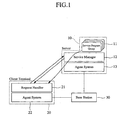
- Fig. 1 shows a preferred embodiment of the present invention.
- a server 10 which provides a program distribution service and client terminals 20 which receive programs distributed from the server 10 are connected via communication lines.
- the server 10 and the client terminals 20 are connected via a base station 30.
- the client terminals 20 in this example are, for example, portable phones or PHS or the like, but they can be applied to PDA or other various terminals.
- the provided service programs can be assumed to be various items, for example, communication programs for executing a chat, programs for functional improvement of each portable terminal, programs and the like for execution by the portable terminals, and various other items.
- items called programs are agents, the essential contents may be various data.
- the portable terminal is a portable phone or the like
- the various functions established in advance in the prior art are held in the server 10 as agent programs (service programs), and the user may download only required functions.
- agent programs service programs
- unnecessary functions for the user do not exist in the portable terminal. Accordingly, it is possible to solve the complexity of the operability due to the presence of multiple unnecessary functions in the portable terminal, and the required memory capacity increase and the like which formed prior art problems.
- service programs (SP) required for executing various services are stored in a service program memory portion 11 of the server 10. Further, the client terminals 20 request the required service programs (SP), and receive the service programs (SP) sent in from the server 10, after which execution is carried out inside the client terminals 20. Further, the acquisition operation of such service programs SP is executed by the agent system.
- the present embodiment is a system for implementing a program (agent) distribution service based on an agent system. Further, the agent system transfers programs (agents), and in order for such programs to be executed automatically at the transfer destination, the security of the transferred-in programs (agents) needs to be ensured. Namely, the reason for this is that if a virus is included in a sent-in program, the malicious program (agent) that includes this virus is loaded into the client terminals 20 and simultaneously executed, whereby the terminals become infected by the virus. In this regard, the present embodiment is equipped with functions that make it possible to acquire only legitimate programs.
- the transmission and reception of information is carried out between a request handler 21 provided in the client terminals 20 and a service manager 12 provided in the server 10, and the server 10 (service manager 12) provides service programs after confirming requests from legitimate client terminals 20. Further, the client terminals 20 (client handler 21) finally carry out acquisition after confirmation of a legitimate program. In this way, it is possible to prevent the acquisition of malicious programs (ensuring of security).
- a uniquely determined service ID is established inside the system, and before a service program is acquired, the client terminals 20 acquire the service ID, and then a request for the service program set by the service ID is carried out.
- the server 10 receives a request to issue a service ID from the client terminals, issues a service ID, and stores the issued service ID correlated with the service program.
- the service program is distributed only in the case where there is a match with the combined contents (service ID + service program) stored as described above.
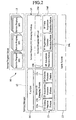
- the server 10 (in particular, the service manager 12) for implementing the process functions described above has the internal structure shown in Fig. 2.
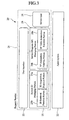
- the client terminals 20 (in particular, the request handler 21) have the internal structure shown in Fig. 3.
- the server 10 in addition to the service program memory portion 11 which stores service programs for implementing the actual service, the server 10 is equipped with the service manager 12 which provides service in accordance with service acquisition requests from the client terminals 20, and an agent system 13 which transfers programs between server and client terminals, and provides messaging features.
- the service manager 12 which provides service in accordance with service acquisition requests from the client terminals 20, and an agent system 13 which transfers programs between server and client terminals, and provides messaging features.
- the service manager 12 is equipped with a service program managing portion 14 which manages the service programs (SP) stored in the service program memory portion 11 and provides prescribed service programs to the client terminals 20, and a user list memory portion 16 which stores service IDs that manage service IDs, and the correlation of the service IDs and the service programs.
- SP service programs
- the data structure of the user list memory portion 16 is shown in Fig. 4. Namely, the user list memory portion 16 stores information related to the service programs managed (distributed) by the server 10, and the issued service IDs, the service program names and the used addresses of the client terminals are correlated and registered. Further, the used addresses are IP addresses in the example of the drawing, but it is possible to use telephone numbers and other various information and the like which make it possible to identify client terminals. The registration, updating and deletion of this user list is carried out by a service ID managing portion 15.
- the service ID managing portion 15 is equipped with an ID issuing function portion 15a, an ID acquisition function portion 15b and an ID deletion function portion 15c.
- the ID issuing function portion 15a issues service IDs that have been uniquely determined inside the system, and issues one service ID in accordance with an issue request from the ID acquisition function portion 15b.
- various methods may be used, such as a method in which an ID creation/managing server is established to create unique serial numbers inside the system, and the issuing of an ID is requested to this ID creation/managing server and acquired, or a method in which IDs guaranteed to be unique by third party means such as IP addresses or domain names are held in advance, with these being read in as needed, or the like.
- third party means such as the latter is used, it is possible to operate the present system even in an environment where many unspecified servers are included such as the Internet or the like.
- the ID acquisition function portion 15b procures service IDs in accordance with service ID acquisition requests (service program names + used addresses) from the client terminals 20, and sends service IDs to the client terminals 20. Further, the ID acquisition function portion 15b also has a function which correlates and registers the service program names that have been issued service IDs and the used addresses in the user list memory portion 16.
- the portable terminals are portable phones or the like, and because the series of issuing processes are carried out between the server and clients in a state where they are connected by telephone lines, by only sending the service ID, the client terminal 20 side that receives the service ID can easily know which service program is correlated with the service ID. Further, because the telephone lines maintain a connected state, it is possible to transmit the service ID without confirming the used address or the like.
- the acquired service ID is correlated with the service program name and the used address received from the client terminal 20, and a process for registration as a new item in the user list memory portion 16 is also carried out.
- the ID deletion function portion 15c deletes prescribed data registered in the user list memory portion 16, namely, when the three items of information of the service ID, the service program and the used address are received together with a deletion request, the user list memory portion 16 is accessed, and a judgment of whether or not there is data matching such three items of information is carried out. Then, when matching data is detected, such data is deleted. Further, in the case where there is no matching data, an error process is carried out.
- the service program managing portion 14 is equipped with a service program list memory portion 14a, a service program acquisition function portion 14b, a service program registration/deletion function portion 14c, and a service program table acquisition function portion 14d.
- the service program list memory portion 14a forms a table which correlates the service program names and the reference names (e.g., file names) of the physical programs. Further, information related to programs capable of service stored in the service program memory portion 11 is stored in this service program list memory portion 14a.
- the three function portions 14b ⁇ 14d execute various processes based on the list stored in this service program list memory portion 14a, namely, when a request from a client terminal 20 is received, first the service program table acquisition function portion 14d extracts the service program list stored in the service program list memory portion 14a, and sends this as a table to the client terminal 20 that made the request.
- the service program acquisition function portion 14b accesses the user list memory portion 16, and a check of the presence or absence of related data is carried out. Then, in the case where such data is present, the service program list memory portion 14a is accessed, and the file name corresponding to the service program name is acquired. Then, an operation is carried out to correlate and send the service ID and the service program to the client terminal 20.
- the service program registration/deletion function portion 14c carries out registration and deletion for the service program list memory portion 14a. Now, in the case where registration is carried out, when the service program name and the reference name of the physical program are received, these are correlated and registered in the list. Further, in the case where deletion is carried out, when a deletion request is received from at least one of the service program name and the reference name of the physical program, the corresponding list is deleted.
- the client terminal 20 is equipped with the request handler 21 which carries out transmission and reception of information required for acquisition of service programs with the server 10 in accordance with requests from the user, and an agent system 22 which transfers programs between the server 10 and the client terminal 20, and provides messaging features.
- the request handler 21 is equipped with a user interface 23 for carrying out transmission and reception of information with the user a service program managing portion 24 for carrying out transmission and reception of information related to service programs, a service ID managing portion 25 which manages the service IDs issued from the server, and a service list memory portion 26 which stores a list (service list) of the service programs held by itself.
- the service list memory portion 26 forms a table which correlates the service IDs and the service program names.
- the user interface 23 there are man-machine interfaces, and in accordance with a service program acquisition request inputted from control buttons or the like not shown in the drawings, the displaying of a table of the service programs on a display is carried out, and there are interfaces and the like for receiving the input of acquisition requests of required service programs from those displayed in such table.
- the service ID managing portion 25 has an ID acquisition function portion 25a and an ID retrieval function portion 25b.
- the ID acquisition function portion 25a has a function which issues a service ID acquisition request to the server 10 in a state where the IP address of itself (used address of itself) is attached. Further, as described above, because a service ID is sent back as a return value when the server 10 receives a service ID acquisition request, when the sent back service ID is received, there is a function that correlates and stores the received service ID and the requested service program name in the service list memory portion 26, and provides such information to a service program acquisition function portion 24b of the service program managing portion 24.
- the ID retrieval function portion 25b searches the service ID column of the service list memory portion 26, and carries out a judgment of whether or not there is a matching item. Then, there is a function that, in the case where a matching item is detected, sends back the service program name correlated with this, and in the case where there is no matching item, carries out an error process (e.g., notification that such item is not present). Specifically, a retrieval process is carried out in accordance with a request from the service program acquisition function portion 24b, and a reply is made to the service program acquisition function portion 24b.
- the service program managing portion 24 is equipped with a service program table acquisition function portion 24a, and the service program acquisition function portion 24b.
- the service program table acquisition function portion 24a has a function that receives a table acquisition request from the user provided via the user interface 23, and issues a service program table acquisition request to the server 10. Then, because the server 10 receives this request and sends back a service program table, there is also a function that receives the reply, and outputs and displays such service program table to the user via the user interface 23.
- the service program acquisition function portion 24b When the service program name and the service ID that should be acquired sent in from the ID acquisition function portion 25a are received, the service program acquisition function portion 24b has a function that transmits the three items of information attached with the IP address of itself (used address of itself) to the server 10, and issues a service program acquisition request. Furthermore, because the service ID, the service program name and the service program are sent back from the server 10 in accordance with this issued request, the received service ID is transferred to the ID retrieval function portion 25b. Then, the service program name sent back from the ID retrieval function portion 25b and the service ID sent in from the server 10 are compared, and the service program is downloaded only in the case of a match. Then, after loading, the loaded program (agent) is executed automatically.
- the storage of the service ID and the service program name is carried out after the service ID is acquired. Because this is carried out during one telephone call connected by telephone lines or the like, the service ID sent back from the server can be identified as a univocally determined service program name (the item requested by the terminal), and there isn't much difference partway.
- the present invention is not limited to this, and as shown in Fig. 7 for example, in the case where a service program name is registered in the service program name column of the service list (Fig. 7(a) ) when a request for a service ID is issued, and a service ID is sent back, the acquired service ID may be stored in the service ID column corresponding to the service program name (Fig. 7(b)).
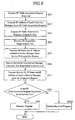
- Fig. 8 is a flowchart showing the processing function of the request handler 21
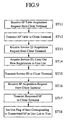
- Fig. 9 is a flowchart showing the processing function of the service manager 12.
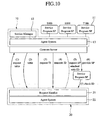
- Fig. 10 shows the operation order between the server 10 and a client terminal 20.
- the service program table acquisition function portion 24a of the service program managing portion 24 receives this request via the user interface 23 (ST1).
- the service program table acquisition function portion 24a issues a table acquisition request to the server 10 (service manager 12) (ST2: (1) in Fig. 10).
- the service manager 12 (service program table acquisition function portion 14d) that receives this table acquisition request (ST11) accesses the service program list memory portion 14a, acquires a table, and transmits the service program table to the client terminal 20 (ST12: (2) in Fig. 10).
- the client terminal 20 (service program table acquisition function portion 24a) that acquires the service program table displays this table to the user via the user interface 23 (ST3).
- the selection is received by the ID acquisition function portion 25a via the user interface 23 (ST4), and a service ID acquisition request is issued to the service manager 12 (ST5: (3) in Fig. 10).
- This request is received by the ID acquisition function portion 15b of the service manager 12 (ST13), and then the service ID created by operating the ID issuing function portion 15a is stored together with the service program name and the used address in the user list memory portion 16 (ST14). Then, the service ID is transmitted to the communicating client terminal 20 (ST15: (4) in Fig. 10).
- This transmitted-in service ID is received by the ID acquisition function portion 25a of the client terminal 20, and this service ID and the service program name are correlated and registered in the service list memory portion 26 (ST6).
- the ID acquisition function portion 25a transfers the acquired information (service program name + service ID) to the service program acquisition function portion 24b, and the service program acquisition function portion 24b that received this information issues a service program acquisition request to the server 10 (ST7: (5) in Fig. 10).
- This acquisition request is received by the service program acquisition function portion 14b of the server 10 (ST16), and then the requested service program is transmitted together with the service ID to the communicating client terminal 20 only in the case where the acquired service ID, the service program name and the used address match (ST17: (6), (7) in Fig. 10).
- the data structure of the user list shown in Fig. 4 correlates the three items of information of the service ID, the service program name and the used address, but a use flag of whether or not transmission to the user (client terminal 20) has been actually executed is also provided, and such use flag may be raised (ST18). In this way, in the case where program distribution is executed as a business, during registration in the user list, those items having raised use flags can be used for accounting as actual sold items.
- the service program acquisition function portion 14b of the client terminal 20 that received the service program attached with a service ID judges whether or not there is a legitimate item (ST8), and in the case of a legitimate item, the received program is preserved (ST9), and in the case of an illegal item, the received program is destroyed (ST10).
- steps 1 - 3 are the processing functions of the service program table acquisition function portion 24a
- steps 4 ⁇ 6 and part of step 7 are the processing functions of the ID acquisition function portion 25a
- part of step 7 and steps 8 ⁇ 10 are the processing functions of the service program acquisition function portion 24b.
- steps 11 and 12 are the processing functions of the service program table acquisition function portion 14d
- steps 13 ⁇ 15 are the processing functions of the ID acquisition function portion 15b
- steps 16 ⁇ 18 are the processing functions of the service program acquisition function portion 14b.
- the input process of the user is completed merely by inputting a service program table display request, and then inputting the service program name to be used (purchased) from those in the table, and because the request to issue a service ID for security, the management of issued service IDs and the check of the program finally sent in are all executed at the system side, processing becomes simple.
- the two processes described above can be carried out practically by the simple process of inputting a number, or scrolling the cursor and executing selection at a required position.
- the service programs (SP) provided to the client terminals 20 are agents, they are automatically executed after being transferred to the client terminals 20.
- the principle (process) of automatic execution is as follows below.
- an agent transmission portion 13a of the agent system 13 of the server 10 transmits a related service program (SP) to the client terminal 20, this is received by an agent receiving portion 22a of the agent system 22 of the client terminal 20.
- SP related service program
- the agent receiving portion 22a restores the received agent (service program (SP) ) to an executable state, and carries out storage in a prescribed memory area of the client terminal 20.
- This restored agent (service program (SP) ) has an automatic execution portion a and a normal execution portion b.
- the automatic execution portion a carries out program initialization and system setup immediately after downloading, and the normal execution portion b executes the actual service (the original process required by the user).
- an automatic execution process portion 22b of the agent system 22 executes the automatic execution portion a of the transferred and restored service program SP.
- the service program (SP) is automatically executed without receiving an execution command from the user.
- operations are also automatically continued for the normal execution portion b.
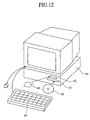
- the recording medium includes a floppy disk (FD) 40 and a CD-ROM 41 and the like, and the program stored on such recording medium 40, 41 is installed in a (built-in) HD unit 45 connected to a computer 44 via a FD drive 42 or a CD-ROM drive 43, and in this way, the computer 44 forms the server 10 described in the embodiments described above.
- FD floppy disk
- CD-ROM 41 CD-ROM
- the service manager 12, the agent system 13 and the like in the embodiments are installed in the HD unit 45, and these are transferred from the HD unit 45 to an internal memory 46 with each use for example, and it is possible to carry out various processes therein at high speed.
- the service program memory portion 11 is achieved by the HD unit 45 and the like.
- the symbol 47 in the drawings is a keyboard, and inputs received from this keyboard operate the service program registration/deletion function portion 14c, whereby the registration/deletion of the service program list is executed.
Landscapes
- Engineering & Computer Science (AREA)
- Computer Security & Cryptography (AREA)
- General Engineering & Computer Science (AREA)
- Software Systems (AREA)
- Computer Networks & Wireless Communication (AREA)
- Signal Processing (AREA)
- Theoretical Computer Science (AREA)
- Computer Hardware Design (AREA)
- Computing Systems (AREA)
- Physics & Mathematics (AREA)
- General Physics & Mathematics (AREA)
- Technology Law (AREA)
- Multimedia (AREA)
- Information Transfer Between Computers (AREA)
- Computer And Data Communications (AREA)
Abstract
The distribution of a program is carried out by an agent
system. The server (10) has a function ( (4) ) which transmits a
service ID uniquely determined inside the distribution system,
and a function ( (6) ) which, in the case where there is an
acquisition request for a program attached with the transmitted
service ID, transmits the program together with the service ID to
the client terminal making the acquisition request; and the client
terminals (20) are equipped with a function ( (3)) which makes a
request for the issuing of a service ID before the request of a
required program, a function ( (5) ) which acquires the service
ID transmitted from the server, and makes an acquisition request
for the program attached with the acquired service ID, and a
function which authorizes the execution of a program only in the
case where the received program matches the service ID attached
at the time of said acquisition request.
Description
The present invention is related to a program distribution
system, a distribution method, a server and client terminals for
executing these, a program procurement apparatus, and a
recording medium.
Due to recent developments of the Internet, it has become
possible to easily carry out the procurement of various
information from a terminal on hand. Further, it is possible for
fellow people existing at different locations to connect to a host
computer via various terminals to carry out an online
conversation service in personal computer communication called
a chat or the like. In this way, by using the Internet, it has
become possible to use various services.
As for the procured information, when there is the case of
data, there is also the case of programs. Further, in order to
execute a chat or the like, it is necessary to carry out execution
after downloading an application program for carrying out such
chat to the terminals in advance. Namely, there are various
kinds of procured programs including those used at the
downloading terminals such as functional improvements of the
terminals or applications used by the users of the terminals, and
programs for information exchange with a plurality of terminals,
and the like.
Incidentally, in accordance with the spread and functional
improvements of portable terminals, there are many situations
where the various services described above are used from such
portable terminals. A problem of this case is the operability of
the portable terminals. Namely, common personal computers and
other desktop-type computers have relatively large keyboards and
do not have problems with inputting various data. However,
because the entire apparatus of a portable terminal needs to be
compact, the inputting of data becomes complicated.
Furthermore, recently it has become possible to connect to
the Internet and receive various services even using a portable
phone which is one type of portable terminal. When this is done,
the complexity of the input operations described above becomes
increasingly notable.
Further, in contrast with personal computers and the like, in
the case where the portable phone is a relatively compact and
low-priced apparatus even among other portable terminals, the
usable functions of such apparatus are installed in advance at the
maker side, and the user is almost never able to make additions
after purchase. As a result, many functions become installed in
portable terminals at the manufacturing step.
Then, such multifunction apparatus must be operated by
using a few operation buttons, and operations become
complicated. Moreover, these multiple functions are not limited
to those that will necessarily all be used by users. Accordingly,
because unnecessary functions are installed, there is the problem
that the operability for the necessary functions is degraded.
It is an object of the present invention to provide a program
distribution system, a server and client terminals for executing
this, a program procurement apparatus and a recording medium
which are highly reliable and which make it possible to easily
carry out downloading and the like of programs and various other
information to client terminals.
The program distribution method according to this invention
is a program distribution method for distributing a program from
a server to client terminals. Further, said client terminals make
a request for a service ID to the server before program
distribution, said server transmits a server ID to said client
terminals in accordance with the requests from said client
terminals, said client terminals make a request for the
distribution of a program attached with the acquired service ID
to said server, said server transmits a program attached with a
service ID to said server in accordance with the requests from
said client terminals, and said client terminals execute the
previously received program in the case where the service ID
sent in together with the received program matches the
previously acquired service ID, and destroys the received
program in the case where there is no match.
Further, the program distribution system according to this
invention is an example of a system applied for executing this
distribution system. This system is a program distribution
system which distributes a program from a server to client
terminals. Further, said server and said client terminals are
provided with an agent system, and the distribution of said
program is carried out by the agent system. Furthermore, said
server has a function which transmits a service ID uniquely
determined inside the distribution system before the transmission
of said program, and a function which, in the case where there is
an acquisition request for a program attached with a transmitted
service ID, transmits said program together with the service ID
to said client terminal making the acquisition request. Further,
said client terminals are equipped with a function which makes a
request for the issuing of a service ID before the request of a
required program, a function which acquires the service ID
transmitted in from said server, and issues an acquisition request
for the program attached with the acquired service ID, and a
function which authorizes the execution of a program only in the
case where the received program is attached with a service ID
matching the service ID attached at the time of said acquisition
request.
In this regard, the "function which transmits a service ID"
corresponds to the ID acquisition function portion 15b and the ID
issuing function portion 15a in the embodiments. The "function
which transmits said program together with the service ID"
corresponds to the "service program acquisition function portion
14b" in the embodiments. The "function which makes a request
for the issuing of a service ID" corresponds to the ID acquisition
function portion 25a in the embodiments. The "function which
issues a program acquisition request" and the "function which
authorizes the execution of a program" correspond to the service
program acquisition function portion 24b in the embodiments.
Further, the server according to this invention is a server
equipped with an agent system for distributing a program to
client terminals. Furthermore, said server is equipped with a
function which transmits a service ID uniquely determined inside
the distribution system before the transmission of said program,
and a function which, in the case where there is an acquisition
request for a program attached with a transmitted service ID,
transmits said program together with the service ID to the client
terminal making the acquisition request.
Furthermore, the program procurement apparatus according
to this invention is a program procurement apparatus equipped
with an agent system which receives the distribution of a
program from a server. Further, this apparatus is equipped with
a function which makes a request for the issuing of a service ID
before the request of a program, a function which acquires the
service ID transmitted in from said server, and issues an
acquisition request for the program attached with the acquired
service ID, and a function which authorizes the execution of a
program only in the case where the received program is attached
with a service ID matching the service ID attached at the time of
said acquisition request.
Moreover, the client terminal according to this invention is
a client terminal which receives the distribution of a program
from a server, and is equipped with the program procurement
apparatus described above, wherein the acquisition of a program
distributed from said server is carried out by the program
procurement apparatus.
In accordance with this invention, a program distribution
using an agent system is carried out in order to plan the
simplification of the input process. In this way, because the
provision of the program and also the execution of the program
after provision are carried out automatically, the user process is
simplified, and operability is improved. Accordingly, it is
possible to ensure a smooth process even in terminals such as
portable terminals where the input apparatus is compact and there
is trouble with operability.
Incidentally, in a terminal that exhibits the merit of being
able to carry out automatic execution by converting a program to
an agent, in the case where it is assumed that a virus or the like
is included in an acquired program, there is the risk that the
malicious program including such virus will be automatically
executed and infect the client terminal.
With regard to this malicious program, the same problem
arises even in the case where a program is downloaded and
procured via the Internet in accordance with commands from an
ordinary user. However, in ordinary cases, the decision of
whether or not to finally download and the command to execute
that after downloading are basically carried out in accordance
with inputs from the user. Accordingly, in the case where the
terminal is charged with a certain degree of self-responsibility,
and a malicious program is noticed partway, it is possible to
prevent the execution of the malicious program from happening.
However, in the case where execution is carried out by the agent
system presumed in the present invention, because programs are
automatically acquired, and the acquired programs are
automatically executed, such arrangement is unsuitable to the
principle of self-responsibility described above.
In this regard, using the concept of a service ID, the
provision of a service ID from the server to a client terminal is
carried out before the provision of the actual program. Further,
the server is arranged to send a program (attached with a service
ID) only in the case where there is a program acquisition request
together with the service ID from the client terminal. In this
way, when the client terminal is arranged to check the service ID
attached to the received program, and execute the program only
in the case of a correct service ID, then in the case where the
received program has the wrong service ID or no service ID, such
program is destroyed as a malicious program, and the risk of
infection by a virus is eliminated.
Further, for the server side, by judging a program request
that has no service ID or the wrong service ID to be an illegal
request and stopping the transmission of the program, the
provision of programs is carried out only to legitimate client
terminals. Furthermore, by making it possible to receive only
programs having the correct service ID, it is possible to suppress
illegal copying between client terminals.
Furthermore, the recording medium of the present invention
is a recording medium which is readable by a computer and which
stores a program for a program distribution system which
includes a command for the computer to execute a process which
transmits a service ID uniquely determined inside the
distribution system before the transmission of a program, and a
process which, in the case where an acquisition request for a
program attached with the transmitted service ID is received,
transmits said program together with the service ID to the client
terminal making the acquisition request. By having a computer
read this recording medium, the server according to the present
invention is formed.
Each of the means and functions that form the various
apparatuses according to the present invention can be achieved
by dedicated hardware circuits, or they can also be achieved by a
programmed computer.
The present invention will be described in detail with
reference to the appended drawings.
Fig. 1 shows a preferred embodiment of the present
invention. As shown in Fig. 1, in the present embodiment, a
server 10 which provides a program distribution service and
client terminals 20 which receive programs distributed from the
server 10 are connected via communication lines. Actually, the
server 10 and the client terminals 20 are connected via a base
station 30. The client terminals 20 in this example are, for
example, portable phones or PHS or the like, but they can be
applied to PDA or other various terminals. Further, the provided
service programs can be assumed to be various items, for
example, communication programs for executing a chat, programs
for functional improvement of each portable terminal, programs
and the like for execution by the portable terminals, and various
other items. Furthermore, because items called programs are
agents, the essential contents may be various data. Further, in
the case where the portable terminal is a portable phone or the
like, the various functions established in advance in the prior art
are held in the server 10 as agent programs (service programs),
and the user may download only required functions. In this way,
unnecessary functions for the user do not exist in the portable
terminal. Accordingly, it is possible to solve the complexity of
the operability due to the presence of multiple unnecessary
functions in the portable terminal, and the required memory
capacity increase and the like which formed prior art problems.
In this system, service programs (SP) required for executing
various services are stored in a service program memory portion
11 of the server 10. Further, the client terminals 20 request the
required service programs (SP), and receive the service programs
(SP) sent in from the server 10, after which execution is carried
out inside the client terminals 20. Further, the acquisition
operation of such service programs SP is executed by the agent
system.
In short, the present embodiment is a system for
implementing a program (agent) distribution service based on an
agent system. Further, the agent system transfers programs
(agents), and in order for such programs to be executed
automatically at the transfer destination, the security of the
transferred-in programs (agents) needs to be ensured. Namely,
the reason for this is that if a virus is included in a sent-in
program, the malicious program (agent) that includes this virus
is loaded into the client terminals 20 and simultaneously
executed, whereby the terminals become infected by the virus.
In this regard, the present embodiment is equipped with functions
that make it possible to acquire only legitimate programs.
Namely, the transmission and reception of information is
carried out between a request handler 21 provided in the client
terminals 20 and a service manager 12 provided in the server 10,
and the server 10 (service manager 12) provides service programs
after confirming requests from legitimate client terminals 20.
Further, the client terminals 20 (client handler 21) finally carry
out acquisition after confirmation of a legitimate program. In
this way, it is possible to prevent the acquisition of malicious
programs (ensuring of security).
Further, as described below, even for the service provider
of the program distribution service, because service programs are
provided only to legitimate client terminals, it is possible to
deter transferring (illegal copying) to third parties.
Accordingly, in the case where a program distribution service is
executed as a business, it is possible to reliably carry out
accounting, and a stable business development can be carried out.
Further, the specifics are as follows below.
First, in the present embodiment, a uniquely determined
service ID is established inside the system, and before a service
program is acquired, the client terminals 20 acquire the service
ID, and then a request for the service program set by the service
ID is carried out. On the other hand, the server 10 receives a
request to issue a service ID from the client terminals, issues a
service ID, and stores the issued service ID correlated with the
service program. In this way, next, in the case where there is a
service program request having an attached service ID from a
client terminal, the service program is distributed only in the
case where there is a match with the combined contents (service
ID + service program) stored as described above.
In this way, by not providing a service program in the case
where there is no service ID or a different service ID, it is
possible to prevent illegal copying. Further, for the client
terminals 20, by loading only a service program sent in together
with a correct service ID, even when a service program with no
service ID or a different service ID is provided, this is assumed
to be a malicious program, and rejection can be carried out.
Furthermore, when only programs having an attached service ID
are acquired in this way, even if an attempt is made to transfer
an acquired service program, because there is no service ID, the
secondary effect of preventing illegal copying is also exhibited.
Further, the server 10 (in particular, the service manager
12) for implementing the process functions described above has
the internal structure shown in Fig. 2. Further, the client
terminals 20 (in particular, the request handler 21) have the
internal structure shown in Fig. 3.
First, as shown in Fig. 2, in addition to the service program
memory portion 11 which stores service programs for
implementing the actual service, the server 10 is equipped with
the service manager 12 which provides service in accordance
with service acquisition requests from the client terminals 20,
and an agent system 13 which transfers programs between server
and client terminals, and provides messaging features.
Further, the service manager 12 is equipped with a service
program managing portion 14 which manages the service
programs (SP) stored in the service program memory portion 11
and provides prescribed service programs to the client terminals
20, and a user list memory portion 16 which stores service IDs
that manage service IDs, and the correlation of the service IDs
and the service programs.
The data structure of the user list memory portion 16 is
shown in Fig. 4. Namely, the user list memory portion 16 stores
information related to the service programs managed
(distributed) by the server 10, and the issued service IDs, the
service program names and the used addresses of the client
terminals are correlated and registered. Further, the used
addresses are IP addresses in the example of the drawing, but it
is possible to use telephone numbers and other various
information and the like which make it possible to identify client
terminals. The registration, updating and deletion of this user
list is carried out by a service ID managing portion 15.
The service ID managing portion 15 is equipped with an ID
issuing function portion 15a, an ID acquisition function portion
15b and an ID deletion function portion 15c. The ID issuing
function portion 15a issues service IDs that have been uniquely
determined inside the system, and issues one service ID in
accordance with an issue request from the ID acquisition function
portion 15b. Further, as for the concrete ID issuing method,
various methods may be used, such as a method in which an ID
creation/managing server is established to create unique serial
numbers inside the system, and the issuing of an ID is requested
to this ID creation/managing server and acquired, or a method in
which IDs guaranteed to be unique by third party means such as
IP addresses or domain names are held in advance, with these
being read in as needed, or the like. In particular; when a third
party means such as the latter is used, it is possible to operate
the present system even in an environment where many
unspecified servers are included such as the Internet or the like.
The ID acquisition function portion 15b procures service
IDs in accordance with service ID acquisition requests (service
program names + used addresses) from the client terminals 20,
and sends service IDs to the client terminals 20. Further, the ID
acquisition function portion 15b also has a function which
correlates and registers the service program names that have been
issued service IDs and the used addresses in the user list memory
portion 16.
Specifically, when a service ID acquisition request from a
client terminal 20 is received, first the issuing of an ID is
requested to the ID issuing function portion 15a, and when a
service ID is received from the ID issuing function portion 15a,
the service ID created by the ID issuing function portion 15a is
sent to the client terminal 20 that made the acquisition request.
At this time, in the present embodiment the portable terminals
are portable phones or the like, and because the series of issuing
processes are carried out between the server and clients in a state
where they are connected by telephone lines, by only sending the
service ID, the client terminal 20 side that receives the service
ID can easily know which service program is correlated with the
service ID. Further, because the telephone lines maintain a
connected state, it is possible to transmit the service ID without
confirming the used address or the like. Furthermore, in the case
where communication is cut off partway in the present
embodiment, it becomes impossible to provide a program, and all
the data up to that point is immediately deleted. Then, execution
is carried out again from the beginning. In this way, because all
processes are reliably carried out by one telephone call, the
security is improved.
Further, even in the case of connections to the Internet
where the line has been cut off once, by confirming the used
address, and then correlating and sending the service program
name and the service ID to the address destination, it is possible
to ensure a certain degree of security.
Further, the acquired service ID is correlated with the
service program name and the used address received from the
client terminal 20, and a process for registration as a new item in
the user list memory portion 16 is also carried out.
Furthermore, because the ID deletion function portion 15c
deletes prescribed data registered in the user list memory portion
16, namely, when the three items of information of the service
ID, the service program and the used address are received
together with a deletion request, the user list memory portion 16
is accessed, and a judgment of whether or not there is data
matching such three items of information is carried out. Then,
when matching data is detected, such data is deleted. Further, in
the case where there is no matching data, an error process is
carried out.
When a function for deleting from the user list is provided
in this way, there are the following results. Namely, for example
in the case where a system that collects usage fees every base
period (e.g., every month or every year or the like) is used as an
accounting system of distributed programs instead of taking an
accounting for each distribution, for example when reference is
made to the data stored in the user list memory portion 16, and
an accounting is billed to the registered used addresses, by using
this deletion function to delete the user list, it is possible to stop
future accounting.
On the other hand, the service program managing portion 14
is equipped with a service program list memory portion 14a, a
service program acquisition function portion 14b, a service
program registration/deletion function portion 14c, and a service
program table acquisition function portion 14d. As shown in Fig.
4, the service program list memory portion 14a forms a table
which correlates the service program names and the reference
names (e.g., file names) of the physical programs. Further,
information related to programs capable of service stored in the
service program memory portion 11 is stored in this service
program list memory portion 14a.
The three function portions 14b ∼ 14d execute various
processes based on the list stored in this service program list
memory portion 14a, namely, when a request from a client
terminal 20 is received, first the service program table
acquisition function portion 14d extracts the service program list
stored in the service program list memory portion 14a, and sends
this as a table to the client terminal 20 that made the request.
When the three items of information of the service program
name, the service ID and the used address are received from a
client terminal 20, the service program acquisition function
portion 14b accesses the user list memory portion 16, and a
check of the presence or absence of related data is carried out.
Then, in the case where such data is present, the service program
list memory portion 14a is accessed, and the file name
corresponding to the service program name is acquired. Then, an
operation is carried out to correlate and send the service ID and
the service program to the client terminal 20.
The service program registration/deletion function portion
14c carries out registration and deletion for the service program
list memory portion 14a. Now, in the case where registration is
carried out, when the service program name and the reference
name of the physical program are received, these are correlated
and registered in the list. Further, in the case where deletion is
carried out, when a deletion request is received from at least one
of the service program name and the reference name of the
physical program, the corresponding list is deleted.
On the other hand, as shown in Fig. 1 and Fig. 3, the client
terminal 20 is equipped with the request handler 21 which carries
out transmission and reception of information required for
acquisition of service programs with the server 10 in accordance
with requests from the user, and an agent system 22 which
transfers programs between the server 10 and the client terminal
20, and provides messaging features.
Further, as shown in Fig. 3, the request handler 21 is
equipped with a user interface 23 for carrying out transmission
and reception of information with the user a service program
managing portion 24 for carrying out transmission and reception
of information related to service programs, a service ID
managing portion 25 which manages the service IDs issued from
the server, and a service list memory portion 26 which stores a
list (service list) of the service programs held by itself. As
shown in Fig. 6, the service list memory portion 26 forms a table
which correlates the service IDs and the service program names.
As for the user interface 23, there are man-machine
interfaces, and in accordance with a service program acquisition
request inputted from control buttons or the like not shown in the
drawings, the displaying of a table of the service programs on a
display is carried out, and there are interfaces and the like for
receiving the input of acquisition requests of required service
programs from those displayed in such table.
The service ID managing portion 25 has an ID acquisition
function portion 25a and an ID retrieval function portion 25b.
First, when the input of the service program name acquired via
the user interface 23 is received, the ID acquisition function
portion 25a has a function which issues a service ID acquisition
request to the server 10 in a state where the IP address of itself
(used address of itself) is attached. Further, as described above,
because a service ID is sent back as a return value when the
server 10 receives a service ID acquisition request, when the sent
back service ID is received, there is a function that correlates
and stores the received service ID and the requested service
program name in the service list memory portion 26, and
provides such information to a service program acquisition
function portion 24b of the service program managing portion 24.
When the input of the service ID is received, the ID
retrieval function portion 25b searches the service ID column of
the service list memory portion 26, and carries out a judgment of
whether or not there is a matching item. Then, there is a
function that, in the case where a matching item is detected,
sends back the service program name correlated with this, and in
the case where there is no matching item, carries out an error
process (e.g., notification that such item is not present).
Specifically, a retrieval process is carried out in accordance with
a request from the service program acquisition function portion
24b, and a reply is made to the service program acquisition
function portion 24b.
On the other hand, the service program managing portion 24
is equipped with a service program table acquisition function
portion 24a, and the service program acquisition function portion
24b. The service program table acquisition function portion 24a
has a function that receives a table acquisition request from the
user provided via the user interface 23, and issues a service
program table acquisition request to the server 10. Then,
because the server 10 receives this request and sends back a
service program table, there is also a function that receives the
reply, and outputs and displays such service program table to the
user via the user interface 23.
When the service program name and the service ID that
should be acquired sent in from the ID acquisition function
portion 25a are received, the service program acquisition
function portion 24b has a function that transmits the three items
of information attached with the IP address of itself (used
address of itself) to the server 10, and issues a service program
acquisition request. Furthermore, because the service ID, the
service program name and the service program are sent back from
the server 10 in accordance with this issued request, the received
service ID is transferred to the ID retrieval function portion 25b.
Then, the service program name sent back from the ID retrieval
function portion 25b and the service ID sent in from the server
10 are compared, and the service program is downloaded only in
the case of a match. Then, after loading, the loaded program
(agent) is executed automatically.
Further, in the case where there is no match, the data that
was sent in from the server is destroyed. Accordingly,
downloading is not carried out in the case where the service ID
is not registered in the service list, in the case where the wrong
service ID is sent in from the server 10 such as in the case where
registration is correlated with a different service program name,
and in the case where a program with no service ID is sent in.
Accordingly, the risk of automatic execution of malicious
programs is eliminated.
Further, in the embodiment described above, as for the
timing of the ID acquisition function portion 25a storing in the
service list memory portion 26, the storage of the service ID and
the service program name is carried out after the service ID is
acquired. Because this is carried out during one telephone call
connected by telephone lines or the like, the service ID sent back
from the server can be identified as a univocally determined
service program name (the item requested by the terminal), and
there isn't much difference partway. However, the present
invention is not limited to this, and as shown in Fig. 7 for
example, in the case where a service program name is registered
in the service program name column of the service list (Fig.
7(a) ) when a request for a service ID is issued, and a service ID
is sent back, the acquired service ID may be stored in the service
ID column corresponding to the service program name (Fig.
7(b)).
At this time, when a service ID correlated with a service
program name is sent back from the server, because a check of
whether or not there is a match with the requested service
program name can be carried out, there is even higher security.
Further, this check of the service program name can be applied
even to the case where the service program name and the service
ID are simultaneously stored as in the embodiment described
above.
Next, a description will be given for the operating principle
(the embodiment of the method of the present invention) of the
embodiment described above. Fig. 8 is a flowchart showing the
processing function of the request handler 21, and Fig. 9 is a
flowchart showing the processing function of the service manager
12. Further, Fig. 10 shows the operation order between the
server 10 and a client terminal 20.
As shown in the drawings, when the user inputs a service
program table acquisition request to the client terminal 20, the
service program table acquisition function portion 24a of the
service program managing portion 24 receives this request via
the user interface 23 (ST1). In accordance with the receipt of
this request, the service program table acquisition function
portion 24a issues a table acquisition request to the server 10
(service manager 12) (ST2: (1) in Fig. 10).
The service manager 12 (service program table acquisition
function portion 14d) that receives this table acquisition request
(ST11) accesses the service program list memory portion 14a,
acquires a table, and transmits the service program table to the
client terminal 20 (ST12: (2) in Fig. 10).
The client terminal 20 (service program table acquisition
function portion 24a) that acquires the service program table
displays this table to the user via the user interface 23 (ST3).
Because the user selects (purchases) a required service
program from the displayed table, the selection is received by the
ID acquisition function portion 25a via the user interface 23
(ST4), and a service ID acquisition request is issued to the
service manager 12 (ST5: (3) in Fig. 10).
This request is received by the ID acquisition function
portion 15b of the service manager 12 (ST13), and then the
service ID created by operating the ID issuing function portion
15a is stored together with the service program name and the
used address in the user list memory portion 16 (ST14). Then,
the service ID is transmitted to the communicating client
terminal 20 (ST15: (4) in Fig. 10).
This transmitted-in service ID is received by the ID
acquisition function portion 25a of the client terminal 20, and
this service ID and the service program name are correlated and
registered in the service list memory portion 26 (ST6). Next, the
ID acquisition function portion 25a transfers the acquired
information (service program name + service ID) to the service
program acquisition function portion 24b, and the service
program acquisition function portion 24b that received this
information issues a service program acquisition request to the
server 10 (ST7: (5) in Fig. 10).
This acquisition request is received by the service program
acquisition function portion 14b of the server 10 (ST16), and
then the requested service program is transmitted together with
the service ID to the communicating client terminal 20 only in
the case where the acquired service ID, the service program name
and the used address match (ST17: (6), (7) in Fig. 10). Further,
although it is not mentioned in the flowcharts, in the case where
there is no match, an error process is carried out, and the
transmission of the service program is not carried out. Further,
the data structure of the user list shown in Fig. 4 correlates the
three items of information of the service ID, the service program
name and the used address, but a use flag of whether or not
transmission to the user (client terminal 20) has been actually
executed is also provided, and such use flag may be raised
(ST18). In this way, in the case where program distribution is
executed as a business, during registration in the user list, those
items having raised use flags can be used for accounting as
actual sold items.
On the other hand, the service program acquisition function
portion 14b of the client terminal 20 that received the service
program attached with a service ID judges whether or not there is
a legitimate item (ST8), and in the case of a legitimate item, the
received program is preserved (ST9), and in the case of an illegal
item, the received program is destroyed (ST10).
Further, when a correspondence of each processing portion
is attached to each processing step described above, steps 1 - 3
are the processing functions of the service program table
acquisition function portion 24a, steps 4 ∼ 6 and part of step 7
are the processing functions of the ID acquisition function
portion 25a, and part of step 7 and steps 8 ∼ 10 are the
processing functions of the service program acquisition function
portion 24b. Further, steps 11 and 12 are the processing
functions of the service program table acquisition function
portion 14d, steps 13 ~ 15 are the processing functions of the ID
acquisition function portion 15b, and steps 16 ∼ 18 are the
processing functions of the service program acquisition function
portion 14b.
Further, as is clear from the embodiment described above,
the input process of the user is completed merely by inputting a
service program table display request, and then inputting the
service program name to be used (purchased) from those in the
table, and because the request to issue a service ID for security,
the management of issued service IDs and the check of the
program finally sent in are all executed at the system side,
processing becomes simple. Moreover, the two processes
described above can be carried out practically by the simple
process of inputting a number, or scrolling the cursor and
executing selection at a required position.
Furthermore, in the present embodiment, because the
service programs (SP) provided to the client terminals 20 are
agents, they are automatically executed after being transferred to
the client terminals 20. The principle (process) of automatic
execution is as follows below.
Namely, as shown in Fig. 11, because an agent transmission
portion 13a of the agent system 13 of the server 10 transmits a
related service program (SP) to the client terminal 20, this is
received by an agent receiving portion 22a of the agent system 22
of the client terminal 20.
Then, the agent receiving portion 22a restores the received
agent (service program (SP) ) to an executable state, and carries
out storage in a prescribed memory area of the client terminal
20. This restored agent (service program (SP) ) has an automatic
execution portion a and a normal execution portion b. The
automatic execution portion a carries out program initialization
and system setup immediately after downloading, and the normal
execution portion b executes the actual service (the original
process required by the user).
Next, an automatic execution process portion 22b of the
agent system 22 executes the automatic execution portion a of
the transferred and restored service program SP. In this way, the
service program (SP) is automatically executed without receiving
an execution command from the user. Further, in the case where,
for example, there is also an execution command of the normal
execution portion b in the process of the automatic execution
portion a, operations are also automatically continued for the
normal execution portion b.
Each of the embodiments described above were described
with the assumption that they are all in an installed state in an
apparatus, but a program can be arranged to have a computer
execute each of the processes (e.g., the processes for executing
the flowchart shown in Fig. 9) in the server 10 described above,
and such program may be provided by being recorded on a
prescribed recording medium.
Namely, as shown in Fig. 12 and Fig. 13, the recording
medium includes a floppy disk (FD) 40 and a CD-ROM 41 and the
like, and the program stored on such recording medium 40, 41 is
installed in a (built-in) HD unit 45 connected to a computer 44
via a FD drive 42 or a CD-ROM drive 43, and in this way, the
computer 44 forms the server 10 described in the embodiments
described above.
Specifically, the service manager 12, the agent system 13
and the like in the embodiments are installed in the HD unit 45,
and these are transferred from the HD unit 45 to an internal
memory 46 with each use for example, and it is possible to carry
out various processes therein at high speed. Further, the service
program memory portion 11 is achieved by the HD unit 45 and
the like. Further, the symbol 47 in the drawings is a keyboard,
and inputs received from this keyboard operate the service
program registration/deletion function portion 14c, whereby the
registration/deletion of the service program list is executed.
In this invention, by providing a program distribution
system which uses an agent system, it is possible to easily carry
out downloading and the like of programs and other information
to terminals. Furthermore, in this invention, in the distribution
of programs, a service ID is used, and because the provision and
acquisition of programs are carried out on the condition that a
correct service ID is attached, security is also improved.
Claims (6)
- A program distribution system which distributes a program from a server to client terminals, wherein:said server and said client terminals are provided with an agent system, and the distribution of said program is carried out by the agent system;said server has a function which transmits a service ID uniquely determined inside the distribution system before the transmission of said program, and a function which, in the case where there is an acquisition request for a program attached with the transmitted service ID, transmits said program together with the service ID to said client terminal making the acquisition request; andsaid client terminals are equipped with a function which makes a request for the issuing of a service ID before the request of a required program, a function which acquires the service ID transmitted in from said server, and issues an acquisition request for the program attached with the acquired service ID, and a function which authorizes the execution of a program only in the case where the received program is attached with a service ID matching the service ID attached at the time of said acquisition request.
- A server equipped with an agent system for distributing a program to client terminals, wherein:said server is equipped with a function which transmits a service ID uniquely determined inside the distribution system before the transmission of said program, anda function which, in the case where there is an acquisition request for a program attached with the transmitted service ID, transmits said program together with the service ID to the client terminal making the acquisition request.
- A program procurement apparatus equipped with an agent system which receives the distribution of a program from a server, comprising:a function which makes a request for the issuing of a service ID before the request of a program;a function which acquires the service ID transmitted in from said server, and issues an acquisition request for the program attached with the acquired service ID; anda function which authorizes the execution of a program only in the case where the received program is attached with a service ID matching the service ID attached at the time of said acquisition request.
- A client terminal which receives the distribution of a program from a server, comprising:the program procurement apparatus described in Claim 3, wherein the acquisition of a program distributed from said server is carried out by the program procurement apparatus.
- A recording medium which is readable by a computer and which stores a program for a program distribution system which includes a command for the computer to execute:a process which transmits a service ID uniquely determined inside the distribution system before the transmission of a program; anda process which, in the case where an acquisition request for a program attached with the transmitted service ID is received, transmits said program together with the service ID to the client terminal making the acquisition request.
- A program distribution method for distributing a program from a server to client terminals, wherein:said client terminals make a request for a service ID to the server before program distribution;said server transmits a server ID to said client terminals in accordance with the requests from said client terminals;said client terminals make a request for the distribution of a program attached with the acquired service ID to said server;said server transmits a program attached with a service ID to said server in accordance with the requests from said client terminals; andsaid client terminals execute the previously received program in the case where the service ID sent in together with the received program matches the previously acquired service ID, and destroys the received program in the case where there is no match.
Applications Claiming Priority (3)
| Application Number | Priority Date | Filing Date | Title |
|---|---|---|---|
| JP2000018841 | 2000-01-27 | ||
| JP2000018841 | 2000-01-27 | ||
| PCT/JP2001/000278 WO2001055841A1 (en) | 2000-01-27 | 2001-01-18 | Method and system for distributing program, server and client terminals for executing program, device for obtaining program, and recording medium |
Publications (2)
| Publication Number | Publication Date |
|---|---|
| EP1258800A1 true EP1258800A1 (en) | 2002-11-20 |
| EP1258800A4 EP1258800A4 (en) | 2007-08-29 |
Family
ID=18545631
Family Applications (1)
| Application Number | Title | Priority Date | Filing Date |
|---|---|---|---|
| EP01901404A Withdrawn EP1258800A4 (en) | 2000-01-27 | 2001-01-18 | Method and system for distributing program, server and client terminals for executing program, device for obtaining program, and recording medium |
Country Status (4)
| Country | Link |
|---|---|
| US (1) | US20030005456A1 (en) |
| EP (1) | EP1258800A4 (en) |
| AU (1) | AU2001227053A1 (en) |
| WO (1) | WO2001055841A1 (en) |
Cited By (1)
| Publication number | Priority date | Publication date | Assignee | Title |
|---|---|---|---|---|
| CN102340693A (en) * | 2011-03-23 | 2012-02-01 | 重庆三峡学院 | Information push method in CMMB |
Families Citing this family (12)
| Publication number | Priority date | Publication date | Assignee | Title |
|---|---|---|---|---|
| PT1264478E (en) * | 2000-01-13 | 2008-10-30 | Broadband Royalty Corp | Method and apparatus for identifying a signal route for delivery of video-on-demand to a subscriber terminal |
| JP2003308211A (en) * | 2002-04-15 | 2003-10-31 | Mitsubishi Electric Corp | Mobile terminal, service distribution server and service distribution system |
| US20030220960A1 (en) * | 2002-05-21 | 2003-11-27 | Demoff Jeff S. | System and method for processing data over a distributed network |
| JP2004062783A (en) * | 2002-07-31 | 2004-02-26 | Sony Corp | Television receiver and method for acquiring and executing software of television receiver |
| JP4257783B2 (en) | 2003-10-23 | 2009-04-22 | 株式会社日立製作所 | Logically partitionable storage device and storage device system |
| JP2005267008A (en) * | 2004-03-17 | 2005-09-29 | Hitachi Ltd | Storage management method and storage management system |
| JP4336735B1 (en) * | 2008-09-18 | 2009-09-30 | 株式会社三菱東京Ufj銀行 | Service processing apparatus, system, program, and recording medium |
| JP4401425B1 (en) * | 2008-09-18 | 2010-01-20 | 株式会社三菱東京Ufj銀行 | Service processing apparatus, system, program, and recording medium |
| US20100118663A1 (en) * | 2008-11-07 | 2010-05-13 | Samsung Electronics Co., Ltd. | Method and apparatus for processing request from application in home network |
| KR20130081459A (en) * | 2012-01-09 | 2013-07-17 | 삼성전자주식회사 | Device for partitioning memory area for application preloading in a portable terminal |
| JP6786892B2 (en) * | 2016-06-09 | 2020-11-18 | 富士ゼロックス株式会社 | Server equipment, information processing systems and programs |
| JP6922293B2 (en) * | 2017-03-17 | 2021-08-18 | 日本電気株式会社 | Information processing device |
Family Cites Families (4)
| Publication number | Priority date | Publication date | Assignee | Title |
|---|---|---|---|---|
| KR100286008B1 (en) * | 1995-12-30 | 2001-04-16 | 윤종용 | Software program automatic update method |
| JP3431463B2 (en) * | 1997-08-28 | 2003-07-28 | 株式会社エヌ・ティ・ティ・ドコモ | Mobile communication system, service providing method, and mobile station |
| JPH11161165A (en) * | 1997-11-27 | 1999-06-18 | Hitachi Ltd | Information processing device |
| JP4634547B2 (en) * | 1998-06-30 | 2011-02-16 | 株式会社東芝 | Real-time information distribution method |
-
2001
- 2001-01-18 WO PCT/JP2001/000278 patent/WO2001055841A1/en not_active Ceased
- 2001-01-18 EP EP01901404A patent/EP1258800A4/en not_active Withdrawn
- 2001-01-18 US US10/181,801 patent/US20030005456A1/en not_active Abandoned
- 2001-01-18 AU AU2001227053A patent/AU2001227053A1/en not_active Abandoned
Cited By (1)
| Publication number | Priority date | Publication date | Assignee | Title |
|---|---|---|---|---|
| CN102340693A (en) * | 2011-03-23 | 2012-02-01 | 重庆三峡学院 | Information push method in CMMB |
Also Published As
| Publication number | Publication date |
|---|---|
| WO2001055841A1 (en) | 2001-08-02 |
| EP1258800A4 (en) | 2007-08-29 |
| AU2001227053A1 (en) | 2001-08-07 |
| US20030005456A1 (en) | 2003-01-02 |
Similar Documents
| Publication | Publication Date | Title |
|---|---|---|
| US9009265B2 (en) | System and method for automatic transfer of data from one device to another | |
| US8015253B1 (en) | System and method for controlling inter-device media exchanges | |
| US20090204858A1 (en) | Server management program, system, and method, and mail server management program | |
| CN101494620B (en) | Method and system for improving control of an instant message delivery system | |
| US8606927B2 (en) | Multi-device communication method and system | |
| US20020047868A1 (en) | Electronic bulletin board and bulletin board system | |
| US20070056043A1 (en) | Remote cell phone auto destruct | |
| US20030005456A1 (en) | Method and system for distributing program, server and client terminals for executing program, device for obtaining program, and recording medium | |
| EP1302056A2 (en) | A system and method for providing a private communication portal | |
| CN101129057A (en) | Method and apparatus for data management on handheld devices | |
| US20080056458A1 (en) | Message system for conducting message | |
| CN110704190A (en) | Virtual resource processing method, device, equipment and storage medium | |
| US20010030960A1 (en) | Electronic mail system | |
| CN101371556A (en) | Advantageously utilize the structure of the ERP system on the mobile terminal device | |
| US8141103B2 (en) | Solution for modifying a queue manager to support smart aliasing which permits extensible software to execute against queued data without application modifications | |
| EP1088422A1 (en) | A telecommunication controller messaging system | |
| US20070162597A1 (en) | Service notification system | |
| JP2009070020A (en) | Online service provision system, personal terminal, management server, online service providing method and program | |
| US20070073812A1 (en) | Terminal device | |
| US20030028617A1 (en) | Communication within a communication network | |
| US8302203B2 (en) | Content transmission system, transmission server, communication terminal, and content transmission method | |
| KR100692790B1 (en) | Data storage service device for user-specific information and method | |
| US8751608B2 (en) | Service shifting method, shift management server, terminal, service server, service shift program and service shift system | |
| JP2002342497A (en) | Personal information management method, personal information management device, personal information management system, personal information management program, computer-readable recording medium recording personal information management program | |
| KR20010039759A (en) | System and method of managing a remote mail server |
Legal Events
| Date | Code | Title | Description |
|---|---|---|---|
| PUAI | Public reference made under article 153(3) epc to a published international application that has entered the european phase |
Free format text: ORIGINAL CODE: 0009012 |
|
| 17P | Request for examination filed |
Effective date: 20020808 |
|
| AK | Designated contracting states |
Kind code of ref document: A1 Designated state(s): AT BE CH CY DE DK ES FI FR GB GR IE IT LI LU MC NL PT SE TR |
|
| AX | Request for extension of the european patent |
Free format text: AL;LT;LV;MK;RO;SI |
|
| A4 | Supplementary search report drawn up and despatched |
Effective date: 20070731 |
|
| STAA | Information on the status of an ep patent application or granted ep patent |
Free format text: STATUS: THE APPLICATION IS DEEMED TO BE WITHDRAWN |
|
| 18D | Application deemed to be withdrawn |
Effective date: 20070828 |