EP1256598A2 - Clear barrier coating and coated film - Google Patents
Clear barrier coating and coated film Download PDFInfo
- Publication number
- EP1256598A2 EP1256598A2 EP02010308A EP02010308A EP1256598A2 EP 1256598 A2 EP1256598 A2 EP 1256598A2 EP 02010308 A EP02010308 A EP 02010308A EP 02010308 A EP02010308 A EP 02010308A EP 1256598 A2 EP1256598 A2 EP 1256598A2
- Authority
- EP
- European Patent Office
- Prior art keywords
- film
- coating
- oxygen barrier
- coatings
- present
- Prior art date
- Legal status (The legal status is an assumption and is not a legal conclusion. Google has not performed a legal analysis and makes no representation as to the accuracy of the status listed.)
- Granted
Links
Classifications
-
- B—PERFORMING OPERATIONS; TRANSPORTING
- B32—LAYERED PRODUCTS
- B32B—LAYERED PRODUCTS, i.e. PRODUCTS BUILT-UP OF STRATA OF FLAT OR NON-FLAT, e.g. CELLULAR OR HONEYCOMB, FORM
- B32B27/00—Layered products comprising a layer of synthetic resin
- B32B27/06—Layered products comprising a layer of synthetic resin as the main or only constituent of a layer, which is next to another layer of the same or of a different material
- B32B27/08—Layered products comprising a layer of synthetic resin as the main or only constituent of a layer, which is next to another layer of the same or of a different material of synthetic resin
-
- B—PERFORMING OPERATIONS; TRANSPORTING
- B32—LAYERED PRODUCTS
- B32B—LAYERED PRODUCTS, i.e. PRODUCTS BUILT-UP OF STRATA OF FLAT OR NON-FLAT, e.g. CELLULAR OR HONEYCOMB, FORM
- B32B27/00—Layered products comprising a layer of synthetic resin
- B32B27/30—Layered products comprising a layer of synthetic resin comprising vinyl (co)polymers; comprising acrylic (co)polymers
-
- B—PERFORMING OPERATIONS; TRANSPORTING
- B32—LAYERED PRODUCTS
- B32B—LAYERED PRODUCTS, i.e. PRODUCTS BUILT-UP OF STRATA OF FLAT OR NON-FLAT, e.g. CELLULAR OR HONEYCOMB, FORM
- B32B27/00—Layered products comprising a layer of synthetic resin
- B32B27/30—Layered products comprising a layer of synthetic resin comprising vinyl (co)polymers; comprising acrylic (co)polymers
- B32B27/306—Layered products comprising a layer of synthetic resin comprising vinyl (co)polymers; comprising acrylic (co)polymers comprising vinyl acetate or vinyl alcohol (co)polymers
-
- C—CHEMISTRY; METALLURGY
- C08—ORGANIC MACROMOLECULAR COMPOUNDS; THEIR PREPARATION OR CHEMICAL WORKING-UP; COMPOSITIONS BASED THEREON
- C08J—WORKING-UP; GENERAL PROCESSES OF COMPOUNDING; AFTER-TREATMENT NOT COVERED BY SUBCLASSES C08B, C08C, C08F, C08G or C08H
- C08J7/00—Chemical treatment or coating of shaped articles made of macromolecular substances
- C08J7/04—Coating
- C08J7/0427—Coating with only one layer of a composition containing a polymer binder
-
- C—CHEMISTRY; METALLURGY
- C08—ORGANIC MACROMOLECULAR COMPOUNDS; THEIR PREPARATION OR CHEMICAL WORKING-UP; COMPOSITIONS BASED THEREON
- C08J—WORKING-UP; GENERAL PROCESSES OF COMPOUNDING; AFTER-TREATMENT NOT COVERED BY SUBCLASSES C08B, C08C, C08F, C08G or C08H
- C08J7/00—Chemical treatment or coating of shaped articles made of macromolecular substances
- C08J7/04—Coating
- C08J7/043—Improving the adhesiveness of the coatings per se, e.g. forming primers
-
- C—CHEMISTRY; METALLURGY
- C08—ORGANIC MACROMOLECULAR COMPOUNDS; THEIR PREPARATION OR CHEMICAL WORKING-UP; COMPOSITIONS BASED THEREON
- C08J—WORKING-UP; GENERAL PROCESSES OF COMPOUNDING; AFTER-TREATMENT NOT COVERED BY SUBCLASSES C08B, C08C, C08F, C08G or C08H
- C08J7/00—Chemical treatment or coating of shaped articles made of macromolecular substances
- C08J7/04—Coating
- C08J7/048—Forming gas barrier coatings
-
- B—PERFORMING OPERATIONS; TRANSPORTING
- B32—LAYERED PRODUCTS
- B32B—LAYERED PRODUCTS, i.e. PRODUCTS BUILT-UP OF STRATA OF FLAT OR NON-FLAT, e.g. CELLULAR OR HONEYCOMB, FORM
- B32B2307/00—Properties of the layers or laminate
- B32B2307/70—Other properties
- B32B2307/724—Permeability to gases, adsorption
- B32B2307/7242—Non-permeable
- B32B2307/7244—Oxygen barrier
-
- B—PERFORMING OPERATIONS; TRANSPORTING
- B32—LAYERED PRODUCTS
- B32B—LAYERED PRODUCTS, i.e. PRODUCTS BUILT-UP OF STRATA OF FLAT OR NON-FLAT, e.g. CELLULAR OR HONEYCOMB, FORM
- B32B2307/00—Properties of the layers or laminate
- B32B2307/70—Other properties
- B32B2307/724—Permeability to gases, adsorption
- B32B2307/7242—Non-permeable
- B32B2307/7246—Water vapor barrier
-
- B—PERFORMING OPERATIONS; TRANSPORTING
- B32—LAYERED PRODUCTS
- B32B—LAYERED PRODUCTS, i.e. PRODUCTS BUILT-UP OF STRATA OF FLAT OR NON-FLAT, e.g. CELLULAR OR HONEYCOMB, FORM
- B32B2439/00—Containers; Receptacles
- B32B2439/70—Food packaging
-
- C—CHEMISTRY; METALLURGY
- C08—ORGANIC MACROMOLECULAR COMPOUNDS; THEIR PREPARATION OR CHEMICAL WORKING-UP; COMPOSITIONS BASED THEREON
- C08J—WORKING-UP; GENERAL PROCESSES OF COMPOUNDING; AFTER-TREATMENT NOT COVERED BY SUBCLASSES C08B, C08C, C08F, C08G or C08H
- C08J2403/00—Characterised by the use of starch, amylose or amylopectin or of their derivatives or degradation products
-
- C—CHEMISTRY; METALLURGY
- C08—ORGANIC MACROMOLECULAR COMPOUNDS; THEIR PREPARATION OR CHEMICAL WORKING-UP; COMPOSITIONS BASED THEREON
- C08J—WORKING-UP; GENERAL PROCESSES OF COMPOUNDING; AFTER-TREATMENT NOT COVERED BY SUBCLASSES C08B, C08C, C08F, C08G or C08H
- C08J2429/00—Characterised by the use of homopolymers or copolymers of compounds having one or more unsaturated aliphatic radicals, each having only one carbon-to-carbon double bond, and at least one being terminated by an alcohol, ether, aldehydo, ketonic, acetal, or ketal radical; Hydrolysed polymers of esters of unsaturated alcohols with saturated carboxylic acids; Derivatives of such polymer
-
- Y—GENERAL TAGGING OF NEW TECHNOLOGICAL DEVELOPMENTS; GENERAL TAGGING OF CROSS-SECTIONAL TECHNOLOGIES SPANNING OVER SEVERAL SECTIONS OF THE IPC; TECHNICAL SUBJECTS COVERED BY FORMER USPC CROSS-REFERENCE ART COLLECTIONS [XRACs] AND DIGESTS
- Y02—TECHNOLOGIES OR APPLICATIONS FOR MITIGATION OR ADAPTATION AGAINST CLIMATE CHANGE
- Y02P—CLIMATE CHANGE MITIGATION TECHNOLOGIES IN THE PRODUCTION OR PROCESSING OF GOODS
- Y02P20/00—Technologies relating to chemical industry
- Y02P20/50—Improvements relating to the production of bulk chemicals
- Y02P20/582—Recycling of unreacted starting or intermediate materials
-
- Y—GENERAL TAGGING OF NEW TECHNOLOGICAL DEVELOPMENTS; GENERAL TAGGING OF CROSS-SECTIONAL TECHNOLOGIES SPANNING OVER SEVERAL SECTIONS OF THE IPC; TECHNICAL SUBJECTS COVERED BY FORMER USPC CROSS-REFERENCE ART COLLECTIONS [XRACs] AND DIGESTS
- Y10—TECHNICAL SUBJECTS COVERED BY FORMER USPC
- Y10T—TECHNICAL SUBJECTS COVERED BY FORMER US CLASSIFICATION
- Y10T428/00—Stock material or miscellaneous articles
- Y10T428/26—Web or sheet containing structurally defined element or component, the element or component having a specified physical dimension
- Y10T428/263—Coating layer not in excess of 5 mils thick or equivalent
- Y10T428/264—Up to 3 mils
- Y10T428/265—1 mil or less
-
- Y—GENERAL TAGGING OF NEW TECHNOLOGICAL DEVELOPMENTS; GENERAL TAGGING OF CROSS-SECTIONAL TECHNOLOGIES SPANNING OVER SEVERAL SECTIONS OF THE IPC; TECHNICAL SUBJECTS COVERED BY FORMER USPC CROSS-REFERENCE ART COLLECTIONS [XRACs] AND DIGESTS
- Y10—TECHNICAL SUBJECTS COVERED BY FORMER USPC
- Y10T—TECHNICAL SUBJECTS COVERED BY FORMER US CLASSIFICATION
- Y10T428/00—Stock material or miscellaneous articles
- Y10T428/31504—Composite [nonstructural laminate]
- Y10T428/31786—Of polyester [e.g., alkyd, etc.]
- Y10T428/31797—Next to addition polymer from unsaturated monomers
-
- Y—GENERAL TAGGING OF NEW TECHNOLOGICAL DEVELOPMENTS; GENERAL TAGGING OF CROSS-SECTIONAL TECHNOLOGIES SPANNING OVER SEVERAL SECTIONS OF THE IPC; TECHNICAL SUBJECTS COVERED BY FORMER USPC CROSS-REFERENCE ART COLLECTIONS [XRACs] AND DIGESTS
- Y10—TECHNICAL SUBJECTS COVERED BY FORMER USPC
- Y10T—TECHNICAL SUBJECTS COVERED BY FORMER US CLASSIFICATION
- Y10T428/00—Stock material or miscellaneous articles
- Y10T428/31504—Composite [nonstructural laminate]
- Y10T428/31855—Of addition polymer from unsaturated monomers
- Y10T428/31909—Next to second addition polymer from unsaturated monomers
- Y10T428/31928—Ester, halide or nitrile of addition polymer
-
- Y—GENERAL TAGGING OF NEW TECHNOLOGICAL DEVELOPMENTS; GENERAL TAGGING OF CROSS-SECTIONAL TECHNOLOGIES SPANNING OVER SEVERAL SECTIONS OF THE IPC; TECHNICAL SUBJECTS COVERED BY FORMER USPC CROSS-REFERENCE ART COLLECTIONS [XRACs] AND DIGESTS
- Y10—TECHNICAL SUBJECTS COVERED BY FORMER USPC
- Y10T—TECHNICAL SUBJECTS COVERED BY FORMER US CLASSIFICATION
- Y10T428/00—Stock material or miscellaneous articles
- Y10T428/31504—Composite [nonstructural laminate]
- Y10T428/31855—Of addition polymer from unsaturated monomers
- Y10T428/31935—Ester, halide or nitrile of addition polymer
-
- Y—GENERAL TAGGING OF NEW TECHNOLOGICAL DEVELOPMENTS; GENERAL TAGGING OF CROSS-SECTIONAL TECHNOLOGIES SPANNING OVER SEVERAL SECTIONS OF THE IPC; TECHNICAL SUBJECTS COVERED BY FORMER USPC CROSS-REFERENCE ART COLLECTIONS [XRACs] AND DIGESTS
- Y10—TECHNICAL SUBJECTS COVERED BY FORMER USPC
- Y10T—TECHNICAL SUBJECTS COVERED BY FORMER US CLASSIFICATION
- Y10T428/00—Stock material or miscellaneous articles
- Y10T428/31504—Composite [nonstructural laminate]
- Y10T428/31855—Of addition polymer from unsaturated monomers
- Y10T428/31938—Polymer of monoethylenically unsaturated hydrocarbon
-
- Y—GENERAL TAGGING OF NEW TECHNOLOGICAL DEVELOPMENTS; GENERAL TAGGING OF CROSS-SECTIONAL TECHNOLOGIES SPANNING OVER SEVERAL SECTIONS OF THE IPC; TECHNICAL SUBJECTS COVERED BY FORMER USPC CROSS-REFERENCE ART COLLECTIONS [XRACs] AND DIGESTS
- Y10—TECHNICAL SUBJECTS COVERED BY FORMER USPC
- Y10T—TECHNICAL SUBJECTS COVERED BY FORMER US CLASSIFICATION
- Y10T428/00—Stock material or miscellaneous articles
- Y10T428/31504—Composite [nonstructural laminate]
- Y10T428/31971—Of carbohydrate
Definitions
- the present invention relates generally to a method for creating a clear barrier film, typically a polymer film, by means of coating the product with a clear barrier coating containing polyvinyl alcohol and starch.
- the clear barrier coating is also disclosed.
- Barrier coatings are desirable for many applications, such as food packaging. These barrier coatings limit transmission of oxygen and/or water vapor through the coated substrate. For many end uses, it is desirable for the coating to be clear. When the substrate is also clear, as in a transparent polymer film, view through the substrate is not obstructed.
- known barrier coatings have suffered from numerous limitations, including high cost, inadequate transparency and limited barrier properties. There is a need for barrier coatings that address one or more of these problems. A need also exists for barrier coatings that are adapted for application to polymer film substrates. Coatings adapted for in-line application during film manufacture are also desirable.
- barrier coatings include polyvinylidene chloride-based coatings. These coatings are solvent based, which may render their coating processes environmentally hazardous. In addition, because of possible solvent residue in the coating, they may pose some risk when used to package food items. These coatings also are not reclaimable, and decompose to give off HCI vapors if recycled. Furthermore, such coatings are coated off-line after film orientation is complete. This requires thick coatings that are not economically optimal, and additional processing steps that render the coated film more expensive. Other known barrier films are polyvinyl alcohol based. However, these coatings do not perform well at high humidity levels. Off-line coatings using polyvinyl alcohol are also known.
- the present invention has accomplished these objectives by providing in a preferred embodiment a coated polymer film having a coating that includes a polyvinyl alcohol and starch, and optionally a surfactant and plasticizer.
- This coating is applied thinly via in-line coating methods to achieve a thin coating that provides good oxygen barrier properties.
- the present inventor has surprisingly found that excellent oxygen barrier properties are provided by a coating that includes an aqueous solution of polyvinyl alcohol, starch and surfactant when applied thinly to polymer film.
- a coating that includes an aqueous solution of polyvinyl alcohol, starch and surfactant when applied thinly to polymer film.
- Such coatings are known and commercially available for direct application to food products such as fruits and vegetables. Such application, via spray, dip, waterfall or other food coating methods, results in a thick coating.
- the present inventor has surprisingly found that good oxygen barrier properties are also obtained by a dramatically thinner coating applied to a base film such as polyester film. It is also believed that orientation of the film after application of the coating provides improved barrier properties than is provided by the unoriented coating.
- preferred barrier coatings of the present invention are disclosed in detail in U.S. Patent No. 6,165,529, the disclosure of which is incorporated herein in its entirety by reference.
- preferred coatings include polyvinyl alcohol and starch.
- the polyvinyl alcohol is a substantially hydrolyzed cold water insoluble polyvinyl alcohol.
- the degree to which the polyvinyl alcohol is hydrolyzed is preferably greater than about 90%, especially preferred greater than about 95% and even more preferred greater than about 98%.
- the starch is preferably a cold water soluble starch.
- a surfactant is preferably added to the coating.
- Such a coating is commercially available as FreshSeal coating from Planet Polymer Technologies, Inc. of San Diego, CA.
- a preferred coating solution includes about 1 to about 20 percent by weight of polyvinyl alcohol, about 0.1 to about 10 percent by weight of starch, and optionally about 0.03 to about 5 percent by weight of surfactant (all percentages based on the coating solution).
- Preferred starches include maltodextrin.
- Preferred surfactants include lecithin, dioctyl sodium sulfosuccinate and combinations thereof.
- Antimicrobials, such as triclosan or methylparaben can also be included.
- Plasticizers, such as glycerin may also be added to the coatings of the present invention.
- An alternate preferred coating includes about 2 to about 7 percent by weight polyvinyl alcohol, about 0.5 percent by weight maltodextrin starch, about 0.05 percent by weight dioctyl sodium sulfosuccinate surfactant and about 0.05 percent by weight methylparaben antimicrobial (all percentages based on the coating solution).
- the ingredients of the clear barrier coating are preferably formulated as a dispersion in water or a water-containing solvent. Alternatively, alcohols or other suitable organic solvents can be employed, alone or in combination with water.
- the solids level is preferably up to about 50 weight percent, alternatively about 0.01 to about 30 weight percent, more preferably about 1 to about 6 weight percent.
- the FreshSeal coating is available at a 10 percent solids level. It has been found that dilution to about 2 to about 3 weight percent provides the minimum coating thickness that gives good oxygen barrier properties, namely a thickness in the range of about 300 to about 400 Angstroms (3 to 4 ⁇ m). In an alternate preferred embodiment, coating thickness is preferably from about 0.001 to about 5 ⁇ m, alternately about 0.03 to about 2 ⁇ m, or about 0.05 to about 0.5 ⁇ m.
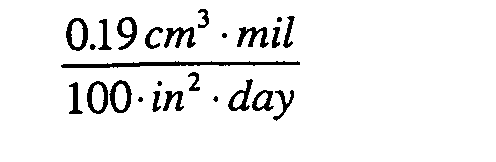
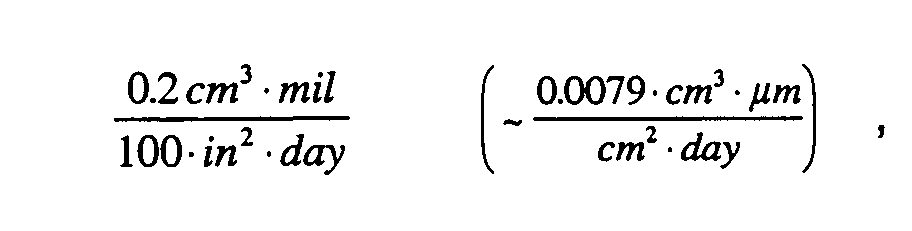
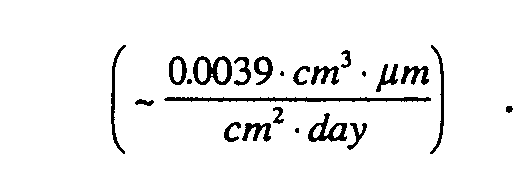
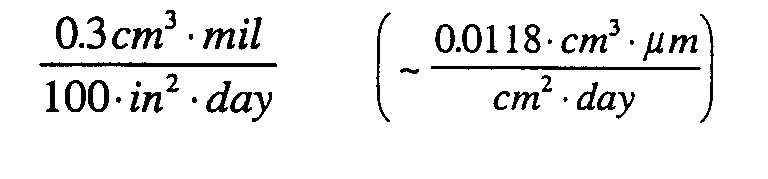
- Oxygen barrier properties are typically measured in
- Oxygen barrier properties of about are generally targeted for good barrier properties. Coatings of the present invention preferably provide even lower transmission rates of down to about and below. Preferred oxygen transmission rates are below about alternatively below about
- the coated polymer film preferably polyester film
- polyethylene films such as those known to provide good water barrier properties.
- the films of the present invention are preferably transparent, and are referred to frequently as clear, the coatings and/or film substrates of the present invention do not need to be clear and may in various embodiments be opaque. Nonetheless, for many applications, transparent films and coatings are preferred.
- Total haze is a preferred method of measuring the clarity of a polyester film, which can determine its suitability for such films as clear barrier film. Haze is measured based on ASTM Method D1003-61, Procedure A, "Haze and Luminous Transmittance of Transparent Plastics", using a BYK Gardner "Haze Gard Plus” instrument.
- pigments, other colorants, stabilizers, antistatic agents, adhesion promoters, antioxidants, delusterants, fillers, plasticizers and the like can be included in the clear barrier coatings of the present invention.
- pigments, other colorants, stabilizers, antistatic agents, adhesion promoters, antioxidants, delusterants, fillers, plasticizers and the like can be included in the clear barrier coatings of the present invention.
- the clear barrier coatings of the present invention are suitable for application at much higher levels, and for co-extrusion.
- the coating compositions of the present invention can be formulated by simply combining the desired coating components. Agitation may be used to insure an even dispersion or solution.
- the coating compositions of the present invention provide numerous benefits over known barrier coatings.
- the coating compositions of the present invention can be, and preferably are, formed without use of organic solvents.
- the coating composition and the dried coating can be substantially free of organic solvents.
- the organic solvent is preferably present at less than about 2 weight percent, especially preferred less than about 0.5 weight percent and even more preferred 0 weight percent.
- the coating compositions of the present invention can be, and preferably are, used without a metal-containing layer.
- the coating composition and the coated film can be substantially free of metal, or alternatively the layer adjacent to the coating of the present invention can be substantially free of metal.
- metal is preferably present at less than about 1 weight percent, especially preferred less than about 0.1 weight percent and even more preferred less than about 0.01 weight percent in the coating layer or adjacent layer.
- the coating compositions of the present invention typically do not include other known barrier coating components such as poly(meth)acrylic acids. Excellent barrier properties are achieved without such additives.
- the coating composition and the dried coating can be substantially free of poly(meth)acrylic acid.
- substantially free shall mean containing less than an effective amount.
- poly(meth)acrylic acid is preferably present at less than about 1 weight percent, especially preferred less than about 0.05 weight percent and even more preferred less than about 0.01 weight percent.
- a polymer film substrate is most useful. It provides a lightweight, substantially transparent, inexpensive, disposable or recyclable substrate that accommodates many of the end uses of fog resistant materials.
- the coated polymer film can also easily be laminated by heat bonding or by adhesives to various other substrates.
- the barrier coatings and coating methods of the present invention are applicable to anypolymeric film capable of acting as a substrate for a barrier coating.
- the present invention is applicable to polymeric films such as those made from polyamides exemplified by nylon; polyolefins such as polypropylene and polyethylene; polyester such as polyethylene terephthalate; polyacetal; polycarbonate; and the like.
- the invention is particularly applicable to polyester, most preferably polyethylene terephthalate, polyethylene naphthalate or polybutylene terephthalate.
- the present invention is also applicable to polymeric films including copolyesters such as polyethylene terephthalate isophthalate.
- a preferred process for forming a base film is set forth in U.S.
- any polyester film based on a polymer resulting from polycondensation of a glycol or diol with a dicarboxylic acid (or its ester equivalents) such as terephthalic acid, isophthalic acid, sebacic acid, malonic, adipic, azelaic, glutaric, suberic, succinic acids and the like, of mixtures of two or more of the foregoing, are preferred for use in the present invention.
- Suitable glycols include ethylene glycol, diethylene glycol, polyethylene glycol, and polyols such as butanediol and the like. Mixtures of two or more of the foregoing are also suitable.
- any of the above base polymer films can contain conventional additives such as antioxidants, delusterants, pigments, fillers such as silica, calcium carbonate, kaolin, titanium dioxide, antistatic agents and the like, or mixtures thereof, all of which are well known in the art.
- the base polymer film may be a polymer laminate.
- Such laminates include polymer-polymer laminates like polyester-polyolefin or polyester-adhesive-polyolefin, polymer-metallic laminates such as polyester-aluminum, or polymer-paper or polymer-adhesive-paper laminates. Coated polymer films or film laminates can also be used. Primer coatings used to enhance wet-out or coating adhesion are preferred examples of such coatings.
- the films may be produced by any well known technique in the art.
- polyester is typically melted and extruded as an amorphous sheet onto a polished revolving casting drum to form a cast sheet of the polymer.
- the sheet is quickly cooled and then stretch oriented in one or more directions to impart strength and toughness to the film.
- the sheet is typically stretched from about two to about four times the original cast sheet dimension, in one or both directions. Biaxial orientation is most preferred, with monoaxial orientation being less preferred.
- stretching occurs in a temperature range from about the second order transition temperature of the polymer to below the temperature at which the polymer softens and melts.
- the film is heat treated after stretching to "lock-in" the properties by further crystallizing the film. The crystallization imparts stability and good tensile properties to the film.
- Such heat treatment for polyester film is generally conducted at about 190°C to about 240°C.
- orientation of the coated extruded polymer acts to improve the barrier properties of the film.
- the coatings and methods of reducing oxygen transmission of the present invention are not limited to use on polymer film bases.
- Alternate substrates such as metals, glass, polymeric articles and the like can be coated according to the teachings of the present invention.
- polymer films coated with the coatings of the present invention can also be applied to other surfaces, including irregular surfaces, to provide clear barrier properties to those surfaces.
- the film may be heat bonded or adhered to the surface, or can be mechanically attached via fasteners, clips and the like.
- In-line coating of the base polymer layer in which the coatings are applied during the film manufacturing process and before it is heat-set, is the preferred method for use of the coatings disclosed herein.
- the base polymer film is coated after corona treatment and prior to the stretch orientation of the film as described in British Patent No. 1,411,564, or coated between drawing steps (when biaxially oriented film is produced) as taught by U.S. Patent Number 4,571,363, or coated post-draw as taught by U.S. Patent Number 3,322,553.
- one or more of the coatings of the present invention may be off-line coated (after manufacturing and heat setting the film), preferably after conventional surface modification of the polymeric substrate has occurred.
- the coating and method of the present invention are also intended for use where, for example, the base polymer film is produced and later coated off-line with one or more coatings of the present invention.
- one or more coatings can be applied in-line, with the remainder being applied off-line.
- Conventional off-line coating processes include roll coating, reverse roll coating, gravure roll coating, reverse gravure roll coating, brush coating, wire-wound rod (Meyer rod) coating, spray coating, air knife coating, meniscus coating or dipping.
- corona treatment is the most common and most preferred procedure for modifying the surface of the polymer base film to enhance coating adhesion.
- the corona treatment or other surface modification should be sufficient to permit wetting out of the coating.
- Corona treatment of about 1.0 watt per square foot per minute ( ⁇ 0.09 watt per m 2 per minute) is typically sufficient to achieve the desired results.
- primer or other intermediate layers can optionally be used between the polymer film and the clear barrier coating.
- a preferred method of controlling oxygen transmission through polymer film is provided herein.
- one or both faces of a base polymer film are coated with a barrier coating of the present invention.
- this coating can occur before, after or at the same time the opposite face of the base polymer film is coated with an alternate coating.
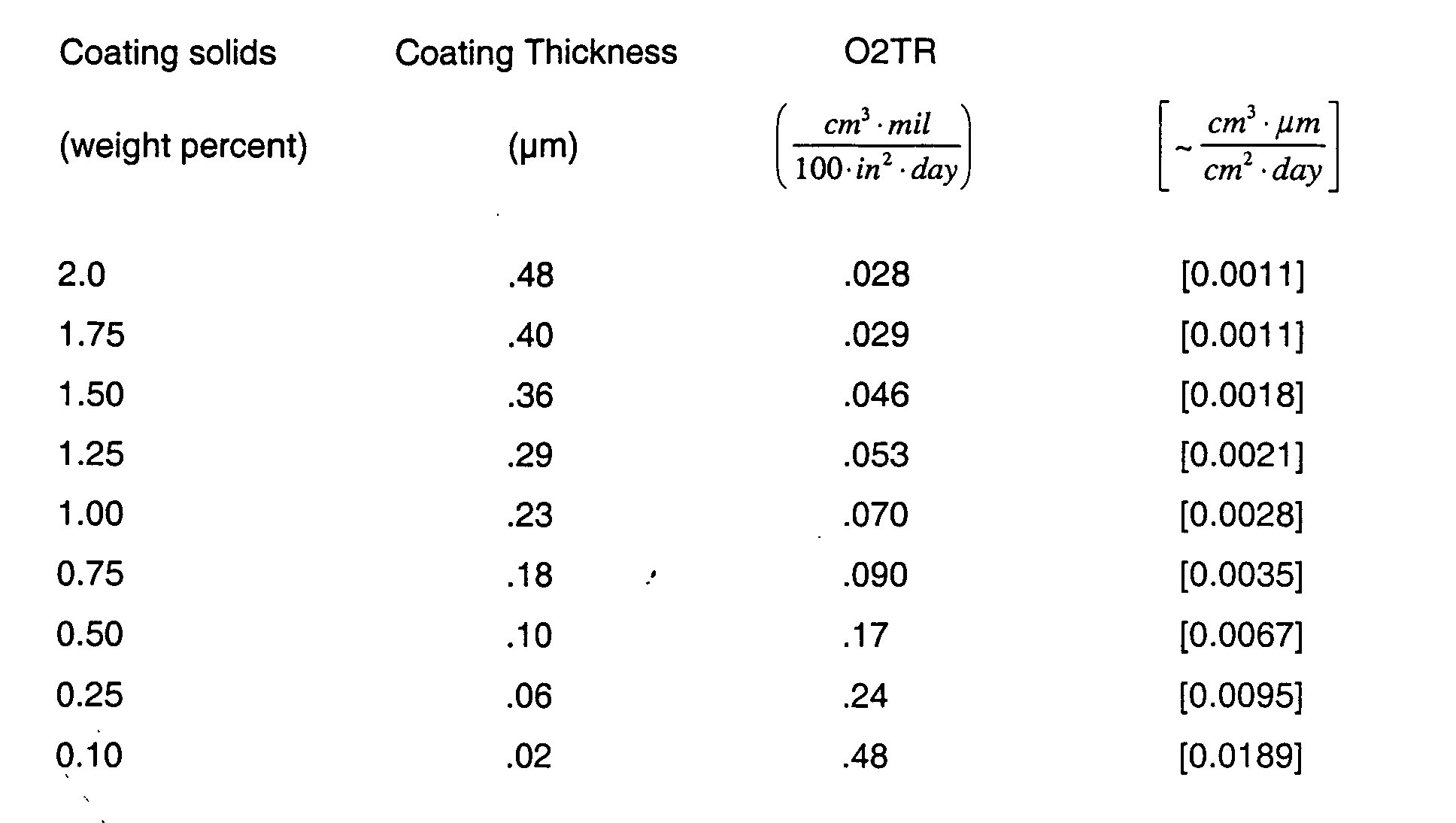
- Biaxially oriented polyester film was coated off-line with the commercially available Fresh Seal polyvinyl alcohol and starch coating at the solids levels indicated, to the following thicknesses.
- Oxygen transmission was measured using ASTM D3985 standard conditions of 23 degrees Celsius and 0% relative humidity.
Landscapes
- Chemical & Material Sciences (AREA)
- Health & Medical Sciences (AREA)
- Chemical Kinetics & Catalysis (AREA)
- Medicinal Chemistry (AREA)
- Polymers & Plastics (AREA)
- Organic Chemistry (AREA)
- Laminated Bodies (AREA)
- Coating Of Shaped Articles Made Of Macromolecular Substances (AREA)
- Application Of Or Painting With Fluid Materials (AREA)
- Paints Or Removers (AREA)
Abstract
Description





Claims (23)
- An oxygen barrier film comprising:wherein said oxygen barrier layer comprises a polyvinyl alcohol and a starch.a polymer film layer; andan oxygen barrier coating on said polymer film layer,
- The film of claim 1, wherein said oxygen barrier coating is transparent.
- The method of claim 1 or 2, wherein said coating contains 1 to 20 percent by weight of polyvinyl alcohol.
- The method of claim 1,2 or 3, wherein said coating contains 0.1 to 10 percent by weight of starch.
- The method of claim one or more of claims 1 to 4, wherein said coating has a solids level of up to 50 weight percent.
- The film of one or more of claims 1 to 5, wherein said oxygen barrier coating is substantially free of organic solvents.
- The film of one or more of claims 1 to 6, wherein said oxygen barrier coating is substantially free of polyvinylidene chloride.
- The film of one or more of claims 1 to 7, wherein said oxygen barrier layer is substantially free of poly(meth)acrylic acid.
- The film of one or more of claims 1 to 8, wherein said film is substantially free of metal.
- The film of one or more of claims 1 to 6, wherein said polyvinyl alcohol is substantially hydrolyzed.
- The film of one or more of claims 1 to 10, wherein said polyvinyl alcohol is cold water soluble.
- The film of one or more of claims 1 to 11, wherein said oxygen barrier coating further comprises a surfactant.
- The method of claim 12, wherein said coating contains 0.03 to 5 percent by weight of surfactant.
- The film of claim 12 or 13, wherein said surfactant is selected from the group consisting of lecithin, dioctyl sodium sulfosuccinate and combinations thereof.
- The film of 1 to 14, wherein said starch is maltodextrin.
- The film of one or more of claims 1 to 15, wherein said coating has a thickness of 0.001 to 5 µm.
- The film of one or more of claims 1 to 16, wherein said film has oxygen transmission rates ofor less.
- The film of one or more of claims 1 to 17, wherein said polymer film layer is a polyester film.
- The film of one or more of claims 1 to 18, further comprising a polyethylene film layer.
- The film of one or more of claims 1 to 19, wherein said polymer film layer is transparent.
- A method of forming an oxygen barrier film, comprising the steps of:applying an oxygen barrier coating according to claim 1 to a polymer film layer:
- The method of claim 21, wherein said coating is applied via an in-line coating method.
- The method of claim 21 or 22, wherein said polymer film layer is oriented in at least one direction after the coating is applied.
Applications Claiming Priority (2)
| Application Number | Priority Date | Filing Date | Title |
|---|---|---|---|
| US28961401P | 2001-05-08 | 2001-05-08 | |
| US289614P | 2001-05-08 |
Publications (3)
| Publication Number | Publication Date |
|---|---|
| EP1256598A2 true EP1256598A2 (en) | 2002-11-13 |
| EP1256598A3 EP1256598A3 (en) | 2003-05-14 |
| EP1256598B1 EP1256598B1 (en) | 2007-07-25 |
Family
ID=23112291
Family Applications (1)
| Application Number | Title | Priority Date | Filing Date |
|---|---|---|---|
| EP02010308A Expired - Lifetime EP1256598B1 (en) | 2001-05-08 | 2002-05-07 | Clear barrier coating and coated film |
Country Status (4)
| Country | Link |
|---|---|
| US (1) | US6911255B2 (en) |
| EP (1) | EP1256598B1 (en) |
| JP (1) | JP2003064205A (en) |
| DE (1) | DE60221317T2 (en) |
Cited By (2)
| Publication number | Priority date | Publication date | Assignee | Title |
|---|---|---|---|---|
| ITMI20090126A1 (en) * | 2009-02-03 | 2010-08-04 | Metalvuoto S P A | NATURAL MACROMOLECULAR LACQUER WITH BARRIER EFFECT MODULATED IN SITU GAS AND RELATED PREPARATION METHODS |
| EP3098070A1 (en) * | 2015-05-29 | 2016-11-30 | Lenzing Plastics GmbH & Co KG | Packaging element |
Families Citing this family (11)
| Publication number | Priority date | Publication date | Assignee | Title |
|---|---|---|---|---|
| US20040031167A1 (en) * | 2002-06-13 | 2004-02-19 | Stein Nathan D. | Single wafer method and apparatus for drying semiconductor substrates using an inert gas air-knife |
| CA2583945A1 (en) * | 2004-10-18 | 2006-04-27 | Plantic Technologies Ltd | Barrier film |
| US20070004299A1 (en) * | 2005-06-17 | 2007-01-04 | Toray Plastics (America), Inc. Lumirror Division | Barrier film with enhanced adhesive properties |
| JP2008273028A (en) * | 2007-04-27 | 2008-11-13 | Nippon Shokubai Co Ltd | Laminated body |
| US7681732B2 (en) | 2008-01-11 | 2010-03-23 | Cryovac, Inc. | Laminated lidstock |
| EP2344698B1 (en) | 2008-10-10 | 2017-02-15 | Dow Global Technologies LLC | Multilayer coating for paper based substrate |
| US20150158985A1 (en) | 2013-12-05 | 2015-06-11 | Toray Plastics (America), Inc. | Mineral oil barrier film with high oxygen diffusion properties |
| US10674738B2 (en) * | 2014-12-31 | 2020-06-09 | Toray Plastics (America), Inc. | Starch coated polyester film for release of canned meat products |
| EP3833710A4 (en) * | 2018-08-09 | 2022-04-06 | Polyplex Corporation Limited | BIAXIALLY ORIENTATED FORMABLE POLYESTER FILM |
| US10954131B2 (en) * | 2018-10-03 | 2021-03-23 | International Business Machines Corporation | Biocidal janus particles |
| US20240059853A1 (en) * | 2022-08-21 | 2024-02-22 | Nano And Advanced Materials Institute Limited | Oxygen barrier coating composition and coating solution, coating layer, and product comprising the same |
Family Cites Families (26)
| Publication number | Priority date | Publication date | Assignee | Title |
|---|---|---|---|---|
| DE1571022C3 (en) | 1963-11-14 | 1976-01-08 | Hoechst Ag, 6000 Frankfurt | Process for the continuous coating of thermoplastic polyester films |
| GB1115464A (en) | 1964-06-29 | 1968-05-29 | Staley Mfg Co A E | Multiply film |
| GB1411564A (en) | 1972-04-27 | 1975-10-29 | Impeial Chemical Ind Ltd | Coated polyester films |
| IT1038615B (en) | 1974-06-10 | 1979-11-30 | Ici Ltd | ANTISTATIC COATED FILM AND PROCESS FOR ITS PRODUCTION |
| US4186015A (en) * | 1978-04-04 | 1980-01-29 | Polaroid Corporation | Silver diffusion transfer receiving layer comprising gelatin and polyvinyl alcohol |
| US4571363A (en) | 1983-12-12 | 1986-02-18 | American Hoechst Corporation | Polyester film primed with crosslinked acrylic polymers |
| GB8617535D0 (en) | 1986-07-17 | 1986-08-28 | Du Pont Canada | Gas barrier structures |
| US5350601A (en) | 1991-11-06 | 1994-09-27 | Hoechst Celanese Corporation | Process for making and using polymeric film coated with primer coating for silicone release applications |
| JP3340780B2 (en) | 1993-01-27 | 2002-11-05 | 呉羽化学工業株式会社 | Gas barrier film and method for producing the same |
| JP2736600B2 (en) | 1993-09-27 | 1998-04-02 | 呉羽化学工業株式会社 | Gas barrier film and method for producing the same |
| JP3203287B2 (en) | 1994-01-26 | 2001-08-27 | 呉羽化学工業株式会社 | Gas barrier laminate and method for producing the same |
| FR2718078B1 (en) | 1994-03-31 | 1996-05-03 | Rhone Poulenc Films | Composite polyester films with barrier properties. |
| JP2832876B2 (en) | 1994-07-27 | 1998-12-09 | 呉羽化学工業株式会社 | Composite vapor-deposited film and method for producing the same |
| US5764262A (en) | 1995-11-22 | 1998-06-09 | E. I. Du Pont De Nemours And Company | Process for providing durable images on a printed medium |
| EP0782931B1 (en) | 1995-12-07 | 1999-10-13 | E.I. Du Pont De Nemours And Company | Receptor sheet for recording by ink-jet |
| US5861216A (en) * | 1996-06-28 | 1999-01-19 | The United States Of America As Represented By The Secretary Of Agriculture | Biodegradable polyester and natural polymer laminates |
| US6168857B1 (en) * | 1996-04-09 | 2001-01-02 | E. Khashoggi Industries, Llc | Compositions and methods for manufacturing starch-based compositions |
| US5972472A (en) | 1996-10-07 | 1999-10-26 | E. I. Du Pont De Nemours And Company | Process of forming controlled gloss fluoropolymer films |
| US6569539B2 (en) * | 1996-10-30 | 2003-05-27 | Tetra Level Holdings & Finance S.A. | Gas barrier packaging laminate method for production thereof and packaging containers |
| WO1998022550A1 (en) | 1996-11-18 | 1998-05-28 | E.I. Du Pont De Nemours And Company | A method for providing and determining antifogging characteristics |
| FR2764895B1 (en) | 1997-06-19 | 2000-02-11 | Toray Plastics Europ Sa | METALLIC COMPOSITE BARRIER FILMS |
| US6143408A (en) | 1997-10-24 | 2000-11-07 | Mitsubishi Polyester Film Corporation | White laminated polyester film and imaging medium |
| EP1058697B1 (en) | 1998-03-05 | 2008-11-26 | E.I. Du Pont De Nemours And Company | Polymeric films having controlled viscosity response to temperature and shear |
| JP4154069B2 (en) | 1998-04-15 | 2008-09-24 | 株式会社クレハ | Gas barrier film |
| US6165529A (en) | 1999-01-13 | 2000-12-26 | Planet Polymer Technologies, Inc. | Process for preventing fresh produce and coating composition therefor |
| US20020015854A1 (en) * | 2000-05-10 | 2002-02-07 | Billmers Robert L. | Paper coating composition comprising a blend of modified high amylose starch and polyvinyl alcohol |
-
2002
- 2002-05-06 US US10/139,773 patent/US6911255B2/en not_active Expired - Fee Related
- 2002-05-07 EP EP02010308A patent/EP1256598B1/en not_active Expired - Lifetime
- 2002-05-07 JP JP2002131273A patent/JP2003064205A/en active Pending
- 2002-05-07 DE DE60221317T patent/DE60221317T2/en not_active Expired - Lifetime
Cited By (3)
| Publication number | Priority date | Publication date | Assignee | Title |
|---|---|---|---|---|
| ITMI20090126A1 (en) * | 2009-02-03 | 2010-08-04 | Metalvuoto S P A | NATURAL MACROMOLECULAR LACQUER WITH BARRIER EFFECT MODULATED IN SITU GAS AND RELATED PREPARATION METHODS |
| WO2010089787A1 (en) * | 2009-02-03 | 2010-08-12 | Mirante S.R.L. | Coatings from natural macromolecules, with gas barrier properties tailored in situ, and related preparation method |
| EP3098070A1 (en) * | 2015-05-29 | 2016-11-30 | Lenzing Plastics GmbH & Co KG | Packaging element |
Also Published As
| Publication number | Publication date |
|---|---|
| DE60221317T2 (en) | 2008-04-10 |
| DE60221317D1 (en) | 2007-09-06 |
| EP1256598B1 (en) | 2007-07-25 |
| US20020187340A1 (en) | 2002-12-12 |
| JP2003064205A (en) | 2003-03-05 |
| US6911255B2 (en) | 2005-06-28 |
| EP1256598A3 (en) | 2003-05-14 |
Similar Documents
| Publication | Publication Date | Title |
|---|---|---|
| EP1451008B1 (en) | Oxygen barrier coating and coated film | |
| EP1910451B1 (en) | Coated polymeric film with oxygen barrier properties | |
| JP5221829B2 (en) | Anti-fog treatment and anti-fog treatment film | |
| AU2018208577B2 (en) | Extrudable antifog copolyester heat seal resins | |
| JP4092941B2 (en) | Antistatic polymer film | |
| EP1256598B1 (en) | Clear barrier coating and coated film | |
| JP2000052523A (en) | Matte coextruded laminated polyester film, method for producing the same and use thereof | |
| JP2012012617A (en) | Antibacterial polymer film | |
| KR20200022351A (en) | Polyester film with coating | |
| KR20020048290A (en) | Hot-Sterilizable, Biaxially Oriented Polyester Film with Good Metal Adhesion, its Use and Process for its Production | |
| US7141307B2 (en) | Extrusion-coatable polyester film comprising poly(m-xyleneadipamide) | |
| JP2006009023A (en) | Biaxially stretched polyester film and method for producing the same | |
| EP1919708B1 (en) | Coating composition for adhering metallized layers to polymeric films | |
| JP4530670B2 (en) | Anti-fogging polylactic acid biaxially stretched film and method for producing the same | |
| JP2792110B2 (en) | Evaporated polyester film | |
| JP2005060618A (en) | Polyester film | |
| JP2007197526A (en) | Heat shrinkable polyester film, its manufacturing method and heat shrinkable lid material |
Legal Events
| Date | Code | Title | Description |
|---|---|---|---|
| PUAI | Public reference made under article 153(3) epc to a published international application that has entered the european phase |
Free format text: ORIGINAL CODE: 0009012 |
|
| AK | Designated contracting states |
Kind code of ref document: A2 Designated state(s): AT BE CH CY DE DK ES FI FR GB GR IE IT LI LU MC NL PT SE TR |
|
| AX | Request for extension of the european patent |
Free format text: AL;LT;LV;MK;RO;SI |
|
| PUAL | Search report despatched |
Free format text: ORIGINAL CODE: 0009013 |
|
| AK | Designated contracting states |
Designated state(s): AT BE CH CY DE DK ES FI FR GB GR IE IT LI LU MC NL PT SE TR |
|
| AX | Request for extension of the european patent |
Extension state: AL LT LV MK RO SI |
|
| 17P | Request for examination filed |
Effective date: 20031114 |
|
| AKX | Designation fees paid |
Designated state(s): DE FR GB IT LU NL |
|
| RAP1 | Party data changed (applicant data changed or rights of an application transferred) |
Owner name: MITSUBISHI POLYESTER FILM, INC. |
|
| GRAP | Despatch of communication of intention to grant a patent |
Free format text: ORIGINAL CODE: EPIDOSNIGR1 |
|
| RIC1 | Information provided on ipc code assigned before grant |
Ipc: C08J 7/04 20060101AFI20070103BHEP Ipc: C09D 103/02 20060101ALI20070103BHEP Ipc: C09D 129/04 20060101ALI20070103BHEP |
|
| GRAS | Grant fee paid |
Free format text: ORIGINAL CODE: EPIDOSNIGR3 |
|
| GRAA | (expected) grant |
Free format text: ORIGINAL CODE: 0009210 |
|
| RBV | Designated contracting states (corrected) |
Designated state(s): DE FR GB IT LU |
|
| AK | Designated contracting states |
Kind code of ref document: B1 Designated state(s): DE FR GB IT LU |
|
| REG | Reference to a national code |
Ref country code: GB Ref legal event code: FG4D |
|
| REF | Corresponds to: |
Ref document number: 60221317 Country of ref document: DE Date of ref document: 20070906 Kind code of ref document: P |
|
| ET | Fr: translation filed | ||
| PLBE | No opposition filed within time limit |
Free format text: ORIGINAL CODE: 0009261 |
|
| STAA | Information on the status of an ep patent application or granted ep patent |
Free format text: STATUS: NO OPPOSITION FILED WITHIN TIME LIMIT |
|
| 26N | No opposition filed |
Effective date: 20080428 |
|
| PGFP | Annual fee paid to national office [announced via postgrant information from national office to epo] |
Ref country code: DE Payment date: 20120531 Year of fee payment: 11 Ref country code: LU Payment date: 20120531 Year of fee payment: 11 |
|
| PGFP | Annual fee paid to national office [announced via postgrant information from national office to epo] |
Ref country code: GB Payment date: 20120426 Year of fee payment: 11 Ref country code: FR Payment date: 20120510 Year of fee payment: 11 |
|
| PGFP | Annual fee paid to national office [announced via postgrant information from national office to epo] |
Ref country code: IT Payment date: 20120516 Year of fee payment: 11 |
|
| GBPC | Gb: european patent ceased through non-payment of renewal fee |
Effective date: 20130507 |
|
| PG25 | Lapsed in a contracting state [announced via postgrant information from national office to epo] |
Ref country code: DE Free format text: LAPSE BECAUSE OF NON-PAYMENT OF DUE FEES Effective date: 20131203 |
|
| REG | Reference to a national code |
Ref country code: DE Ref legal event code: R119 Ref document number: 60221317 Country of ref document: DE Effective date: 20131203 |
|
| PG25 | Lapsed in a contracting state [announced via postgrant information from national office to epo] |
Ref country code: IT Free format text: LAPSE BECAUSE OF NON-PAYMENT OF DUE FEES Effective date: 20130507 |
|
| REG | Reference to a national code |
Ref country code: FR Ref legal event code: ST Effective date: 20140131 |
|
| PG25 | Lapsed in a contracting state [announced via postgrant information from national office to epo] |
Ref country code: GB Free format text: LAPSE BECAUSE OF NON-PAYMENT OF DUE FEES Effective date: 20130507 |
|
| PG25 | Lapsed in a contracting state [announced via postgrant information from national office to epo] |
Ref country code: FR Free format text: LAPSE BECAUSE OF NON-PAYMENT OF DUE FEES Effective date: 20130531 |
|
| PG25 | Lapsed in a contracting state [announced via postgrant information from national office to epo] |
Ref country code: LU Free format text: LAPSE BECAUSE OF NON-PAYMENT OF DUE FEES Effective date: 20130507 |