EP1256339A1 - Transdermal therapeutic system for Parkinson's disease inducing high plasma levels of rotigotine - Google Patents
Transdermal therapeutic system for Parkinson's disease inducing high plasma levels of rotigotine Download PDFInfo
- Publication number
- EP1256339A1 EP1256339A1 EP01111109A EP01111109A EP1256339A1 EP 1256339 A1 EP1256339 A1 EP 1256339A1 EP 01111109 A EP01111109 A EP 01111109A EP 01111109 A EP01111109 A EP 01111109A EP 1256339 A1 EP1256339 A1 EP 1256339A1
- Authority
- EP
- European Patent Office
- Prior art keywords
- rotigotine
- silicone
- transdermal therapeutic
- therapeutic system
- parkinson
- Prior art date
- Legal status (The legal status is an assumption and is not a legal conclusion. Google has not performed a legal analysis and makes no representation as to the accuracy of the status listed.)
- Granted
Links
- KFQYTPMOWPVWEJ-INIZCTEOSA-N rotigotine Chemical compound CCCN([C@@H]1CC2=CC=CC(O)=C2CC1)CCC1=CC=CS1 KFQYTPMOWPVWEJ-INIZCTEOSA-N 0.000 title claims abstract description 53
- 229960003179 rotigotine Drugs 0.000 title claims abstract description 53
- 230000036470 plasma concentration Effects 0.000 title claims abstract description 48
- 230000001225 therapeutic effect Effects 0.000 title claims abstract description 45
- 208000018737 Parkinson disease Diseases 0.000 title claims description 28
- 230000001939 inductive effect Effects 0.000 title 1
- 229920001296 polysiloxane Polymers 0.000 claims abstract description 57
- 239000003814 drug Substances 0.000 claims abstract description 33
- 238000002360 preparation method Methods 0.000 claims abstract description 9
- 239000004480 active ingredient Substances 0.000 claims abstract description 5
- 230000000648 anti-parkinson Effects 0.000 claims abstract description 4
- 239000000939 antiparkinson agent Substances 0.000 claims abstract description 4
- 239000000853 adhesive Substances 0.000 claims description 18
- 230000001070 adhesive effect Effects 0.000 claims description 17
- 239000011159 matrix material Substances 0.000 claims description 13
- 208000037265 diseases, disorders, signs and symptoms Diseases 0.000 claims description 8
- 239000013464 silicone adhesive Substances 0.000 claims description 8
- 239000002904 solvent Substances 0.000 claims description 7
- 201000010099 disease Diseases 0.000 claims description 6
- 229920000036 polyvinylpyrrolidone Polymers 0.000 claims description 6
- 239000001267 polyvinylpyrrolidone Substances 0.000 claims description 6
- 235000013855 polyvinylpyrrolidone Nutrition 0.000 claims description 6
- 229910052909 inorganic silicate Inorganic materials 0.000 claims description 5
- 238000000034 method Methods 0.000 claims description 3
- 229940079593 drug Drugs 0.000 description 29
- VYFYYTLLBUKUHU-UHFFFAOYSA-N dopamine Chemical compound NCCC1=CC=C(O)C(O)=C1 VYFYYTLLBUKUHU-UHFFFAOYSA-N 0.000 description 24
- NIXOWILDQLNWCW-UHFFFAOYSA-M Acrylate Chemical compound [O-]C(=O)C=C NIXOWILDQLNWCW-UHFFFAOYSA-M 0.000 description 15
- 229960003638 dopamine Drugs 0.000 description 12
- 239000000203 mixture Substances 0.000 description 12
- 208000024891 symptom Diseases 0.000 description 10
- 230000000694 effects Effects 0.000 description 9
- 239000000243 solution Substances 0.000 description 9
- LFQSCWFLJHTTHZ-UHFFFAOYSA-N Ethanol Chemical compound CCO LFQSCWFLJHTTHZ-UHFFFAOYSA-N 0.000 description 8
- 239000003136 dopamine receptor stimulating agent Substances 0.000 description 7
- PEDCQBHIVMGVHV-UHFFFAOYSA-N Glycerine Chemical compound OCC(O)CO PEDCQBHIVMGVHV-UHFFFAOYSA-N 0.000 description 6
- IMNFDUFMRHMDMM-UHFFFAOYSA-N N-Heptane Chemical compound CCCCCCC IMNFDUFMRHMDMM-UHFFFAOYSA-N 0.000 description 6
- NIXOWILDQLNWCW-UHFFFAOYSA-N acrylic acid group Chemical group C(C=C)(=O)O NIXOWILDQLNWCW-UHFFFAOYSA-N 0.000 description 6
- 230000002411 adverse Effects 0.000 description 6
- 239000012458 free base Substances 0.000 description 6
- WTDRDQBEARUVNC-LURJTMIESA-N L-DOPA Chemical compound OC(=O)[C@@H](N)CC1=CC=C(O)C(O)=C1 WTDRDQBEARUVNC-LURJTMIESA-N 0.000 description 5
- WTDRDQBEARUVNC-UHFFFAOYSA-N L-Dopa Natural products OC(=O)C(N)CC1=CC=C(O)C(O)=C1 WTDRDQBEARUVNC-UHFFFAOYSA-N 0.000 description 5
- 239000004820 Pressure-sensitive adhesive Substances 0.000 description 5
- 230000004907 flux Effects 0.000 description 5
- 150000001412 amines Chemical class 0.000 description 4
- 230000008901 benefit Effects 0.000 description 4
- CEXBONHIOKGWNU-NTISSMGPSA-N hydron;(6s)-6-[propyl(2-thiophen-2-ylethyl)amino]-5,6,7,8-tetrahydronaphthalen-1-ol;chloride Chemical compound [Cl-].CCC[NH+]([C@@H]1CC2=CC=CC(O)=C2CC1)CCC1=CC=CS1 CEXBONHIOKGWNU-NTISSMGPSA-N 0.000 description 4
- 239000000126 substance Substances 0.000 description 4
- 238000002560 therapeutic procedure Methods 0.000 description 4
- XLYOFNOQVPJJNP-UHFFFAOYSA-N water Substances O XLYOFNOQVPJJNP-UHFFFAOYSA-N 0.000 description 4
- 108050004812 Dopamine receptor Proteins 0.000 description 3
- 102000015554 Dopamine receptor Human genes 0.000 description 3
- 241000282414 Homo sapiens Species 0.000 description 3
- VEXZGXHMUGYJMC-UHFFFAOYSA-N Hydrochloric acid Chemical compound Cl VEXZGXHMUGYJMC-UHFFFAOYSA-N 0.000 description 3
- HEMHJVSKTPXQMS-UHFFFAOYSA-M Sodium hydroxide Chemical compound [OH-].[Na+] HEMHJVSKTPXQMS-UHFFFAOYSA-M 0.000 description 3
- 150000001875 compounds Chemical class 0.000 description 3
- 230000007850 degeneration Effects 0.000 description 3
- 238000013461 design Methods 0.000 description 3
- 238000009472 formulation Methods 0.000 description 3
- 239000002050 international nonproprietary name Substances 0.000 description 3
- -1 polydimethylsiloxane Polymers 0.000 description 3
- IJGRMHOSHXDMSA-UHFFFAOYSA-N Atomic nitrogen Chemical compound N#N IJGRMHOSHXDMSA-UHFFFAOYSA-N 0.000 description 2
- 239000011627 DL-alpha-tocopherol Substances 0.000 description 2
- 235000001815 DL-alpha-tocopherol Nutrition 0.000 description 2
- RTZKZFJDLAIYFH-UHFFFAOYSA-N Diethyl ether Chemical compound CCOCC RTZKZFJDLAIYFH-UHFFFAOYSA-N 0.000 description 2
- 229940098778 Dopamine receptor agonist Drugs 0.000 description 2
- 208000012661 Dyskinesia Diseases 0.000 description 2
- 208000006083 Hypokinesia Diseases 0.000 description 2
- QAQJMLQRFWZOBN-LAUBAEHRSA-N L-ascorbyl-6-palmitate Chemical compound CCCCCCCCCCCCCCCC(=O)OC[C@H](O)[C@H]1OC(=O)C(O)=C1O QAQJMLQRFWZOBN-LAUBAEHRSA-N 0.000 description 2
- 239000011786 L-ascorbyl-6-palmitate Substances 0.000 description 2
- VYPSYNLAJGMNEJ-UHFFFAOYSA-N Silicium dioxide Chemical compound O=[Si]=O VYPSYNLAJGMNEJ-UHFFFAOYSA-N 0.000 description 2
- XTXRWKRVRITETP-UHFFFAOYSA-N Vinyl acetate Chemical compound CC(=O)OC=C XTXRWKRVRITETP-UHFFFAOYSA-N 0.000 description 2
- 235000010385 ascorbyl palmitate Nutrition 0.000 description 2
- 238000003556 assay Methods 0.000 description 2
- 230000009286 beneficial effect Effects 0.000 description 2
- 210000004556 brain Anatomy 0.000 description 2
- 239000011248 coating agent Substances 0.000 description 2
- 238000000576 coating method Methods 0.000 description 2
- 229920001577 copolymer Polymers 0.000 description 2
- GVJHHUAWPYXKBD-UHFFFAOYSA-N d-alpha-tocopherol Natural products OC1=C(C)C(C)=C2OC(CCCC(C)CCCC(C)CCCC(C)C)(C)CCC2=C1C GVJHHUAWPYXKBD-UHFFFAOYSA-N 0.000 description 2
- 230000007812 deficiency Effects 0.000 description 2
- 239000004205 dimethyl polysiloxane Substances 0.000 description 2
- 208000035475 disorder Diseases 0.000 description 2
- 239000006185 dispersion Substances 0.000 description 2
- 229940052760 dopamine agonists Drugs 0.000 description 2
- 239000012535 impurity Substances 0.000 description 2
- 238000000338 in vitro Methods 0.000 description 2
- 238000001727 in vivo Methods 0.000 description 2
- 229960004502 levodopa Drugs 0.000 description 2
- 239000007788 liquid Substances 0.000 description 2
- 238000001294 liquid chromatography-tandem mass spectrometry Methods 0.000 description 2
- 230000000144 pharmacologic effect Effects 0.000 description 2
- 229920000435 poly(dimethylsiloxane) Polymers 0.000 description 2
- 229920000642 polymer Polymers 0.000 description 2
- 230000000750 progressive effect Effects 0.000 description 2
- 238000011002 quantification Methods 0.000 description 2
- 108020003175 receptors Proteins 0.000 description 2
- 102000005962 receptors Human genes 0.000 description 2
- 210000003523 substantia nigra Anatomy 0.000 description 2
- 238000012360 testing method Methods 0.000 description 2
- 229960000984 tocofersolan Drugs 0.000 description 2
- 229940117958 vinyl acetate Drugs 0.000 description 2
- GVJHHUAWPYXKBD-IEOSBIPESA-N α-tocopherol Chemical compound OC1=C(C)C(C)=C2O[C@@](CCC[C@H](C)CCC[C@H](C)CCCC(C)C)(C)CCC2=C1C GVJHHUAWPYXKBD-IEOSBIPESA-N 0.000 description 2
- KFQYTPMOWPVWEJ-UHFFFAOYSA-N 6-{propyl[2-(thiophen-2-yl)ethyl]amino}-5,6,7,8-tetrahydronaphthalen-1-ol Chemical compound C1CC2=C(O)C=CC=C2CC1N(CCC)CCC1=CC=CS1 KFQYTPMOWPVWEJ-UHFFFAOYSA-N 0.000 description 1
- 206010001541 Akinesia Diseases 0.000 description 1
- 206010006100 Bradykinesia Diseases 0.000 description 1
- 206010010774 Constipation Diseases 0.000 description 1
- 101150049660 DRD2 gene Proteins 0.000 description 1
- 206010012289 Dementia Diseases 0.000 description 1
- 229940096895 Dopamine D2 receptor agonist Drugs 0.000 description 1
- VGGSQFUCUMXWEO-UHFFFAOYSA-N Ethene Chemical compound C=C VGGSQFUCUMXWEO-UHFFFAOYSA-N 0.000 description 1
- 239000005977 Ethylene Substances 0.000 description 1
- 206010017577 Gait disturbance Diseases 0.000 description 1
- 206010019233 Headaches Diseases 0.000 description 1
- 208000001089 Multiple system atrophy Diseases 0.000 description 1
- 208000002740 Muscle Rigidity Diseases 0.000 description 1
- 206010028813 Nausea Diseases 0.000 description 1
- 206010031127 Orthostatic hypotension Diseases 0.000 description 1
- 239000002202 Polyethylene glycol Substances 0.000 description 1
- 229920003082 Povidone K 90 Polymers 0.000 description 1
- BKRGVLQUQGGVSM-KBXCAEBGSA-N Revanil Chemical compound C1=CC(C=2[C@H](N(C)C[C@H](C=2)NC(=O)N(CC)CC)C2)=C3C2=CNC3=C1 BKRGVLQUQGGVSM-KBXCAEBGSA-N 0.000 description 1
- DWAQJAXMDSEUJJ-UHFFFAOYSA-M Sodium bisulfite Chemical compound [Na+].OS([O-])=O DWAQJAXMDSEUJJ-UHFFFAOYSA-M 0.000 description 1
- 206010041349 Somnolence Diseases 0.000 description 1
- 206010044565 Tremor Diseases 0.000 description 1
- 206010047700 Vomiting Diseases 0.000 description 1
- 230000005856 abnormality Effects 0.000 description 1
- OIPILFWXSMYKGL-UHFFFAOYSA-N acetylcholine Chemical compound CC(=O)OCC[N+](C)(C)C OIPILFWXSMYKGL-UHFFFAOYSA-N 0.000 description 1
- 229960004373 acetylcholine Drugs 0.000 description 1
- 150000001252 acrylic acid derivatives Chemical class 0.000 description 1
- 239000013543 active substance Substances 0.000 description 1
- 125000003277 amino group Chemical group 0.000 description 1
- 229960004046 apomorphine Drugs 0.000 description 1
- VMWNQDUVQKEIOC-CYBMUJFWSA-N apomorphine Chemical compound C([C@H]1N(C)CC2)C3=CC=C(O)C(O)=C3C3=C1C2=CC=C3 VMWNQDUVQKEIOC-CYBMUJFWSA-N 0.000 description 1
- 238000013459 approach Methods 0.000 description 1
- 239000007864 aqueous solution Substances 0.000 description 1
- 230000002567 autonomic effect Effects 0.000 description 1
- 210000000467 autonomic pathway Anatomy 0.000 description 1
- 239000002585 base Substances 0.000 description 1
- 230000008499 blood brain barrier function Effects 0.000 description 1
- 210000001218 blood-brain barrier Anatomy 0.000 description 1
- 210000001159 caudate nucleus Anatomy 0.000 description 1
- 210000004027 cell Anatomy 0.000 description 1
- 239000003795 chemical substances by application Substances 0.000 description 1
- 238000003759 clinical diagnosis Methods 0.000 description 1
- 230000000052 comparative effect Effects 0.000 description 1
- 239000000470 constituent Substances 0.000 description 1
- 230000007547 defect Effects 0.000 description 1
- 230000006735 deficit Effects 0.000 description 1
- 235000014113 dietary fatty acids Nutrition 0.000 description 1
- LRCFXGAMWKDGLA-UHFFFAOYSA-N dioxosilane;hydrate Chemical compound O.O=[Si]=O LRCFXGAMWKDGLA-UHFFFAOYSA-N 0.000 description 1
- 229910000397 disodium phosphate Inorganic materials 0.000 description 1
- 239000002270 dispersing agent Substances 0.000 description 1
- 239000002288 dopamine 2 receptor stimulating agent Substances 0.000 description 1
- 210000005064 dopaminergic neuron Anatomy 0.000 description 1
- 238000001035 drying Methods 0.000 description 1
- 239000003995 emulsifying agent Substances 0.000 description 1
- 238000001704 evaporation Methods 0.000 description 1
- 230000008020 evaporation Effects 0.000 description 1
- 239000000194 fatty acid Substances 0.000 description 1
- 229930195729 fatty acid Natural products 0.000 description 1
- 238000001914 filtration Methods 0.000 description 1
- 238000011010 flushing procedure Methods 0.000 description 1
- 239000011888 foil Substances 0.000 description 1
- PCHJSUWPFVWCPO-UHFFFAOYSA-N gold Chemical compound [Au] PCHJSUWPFVWCPO-UHFFFAOYSA-N 0.000 description 1
- 231100000869 headache Toxicity 0.000 description 1
- CEXBONHIOKGWNU-UHFFFAOYSA-N hydron;6-[propyl(2-thiophen-2-ylethyl)amino]-5,6,7,8-tetrahydronaphthalen-1-ol;chloride Chemical compound Cl.C1CC2=C(O)C=CC=C2CC1N(CCC)CCC1=CC=CS1 CEXBONHIOKGWNU-UHFFFAOYSA-N 0.000 description 1
- 230000002209 hydrophobic effect Effects 0.000 description 1
- 229920001600 hydrophobic polymer Polymers 0.000 description 1
- 125000002887 hydroxy group Chemical group [H]O* 0.000 description 1
- 230000003483 hypokinetic effect Effects 0.000 description 1
- 230000006872 improvement Effects 0.000 description 1
- 238000010874 in vitro model Methods 0.000 description 1
- 238000001802 infusion Methods 0.000 description 1
- 238000001990 intravenous administration Methods 0.000 description 1
- 238000011835 investigation Methods 0.000 description 1
- 230000000670 limiting effect Effects 0.000 description 1
- 229960003587 lisuride Drugs 0.000 description 1
- 238000011068 loading method Methods 0.000 description 1
- 230000007246 mechanism Effects 0.000 description 1
- 230000003340 mental effect Effects 0.000 description 1
- 230000037230 mobility Effects 0.000 description 1
- 230000008450 motivation Effects 0.000 description 1
- 230000008693 nausea Effects 0.000 description 1
- 210000001577 neostriatum Anatomy 0.000 description 1
- 230000001537 neural effect Effects 0.000 description 1
- 230000004770 neurodegeneration Effects 0.000 description 1
- 239000002858 neurotransmitter agent Substances 0.000 description 1
- 229910052757 nitrogen Inorganic materials 0.000 description 1
- 231100000344 non-irritating Toxicity 0.000 description 1
- 230000001314 paroxysmal effect Effects 0.000 description 1
- 239000002245 particle Substances 0.000 description 1
- 230000037361 pathway Effects 0.000 description 1
- 230000035699 permeability Effects 0.000 description 1
- 239000000546 pharmaceutical excipient Substances 0.000 description 1
- 239000000902 placebo Substances 0.000 description 1
- 229940068196 placebo Drugs 0.000 description 1
- 229920000191 poly(N-vinyl pyrrolidone) Polymers 0.000 description 1
- 229920000728 polyester Polymers 0.000 description 1
- 229920001223 polyethylene glycol Polymers 0.000 description 1
- 239000002861 polymer material Substances 0.000 description 1
- 229920001451 polypropylene glycol Polymers 0.000 description 1
- 239000002243 precursor Substances 0.000 description 1
- 230000002028 premature Effects 0.000 description 1
- 230000001681 protective effect Effects 0.000 description 1
- 208000020016 psychiatric disease Diseases 0.000 description 1
- 230000002829 reductive effect Effects 0.000 description 1
- 239000011347 resin Substances 0.000 description 1
- 229920005989 resin Polymers 0.000 description 1
- 230000004044 response Effects 0.000 description 1
- 230000000717 retained effect Effects 0.000 description 1
- 150000003839 salts Chemical class 0.000 description 1
- 230000028327 secretion Effects 0.000 description 1
- 230000001235 sensitizing effect Effects 0.000 description 1
- 229960004029 silicic acid Drugs 0.000 description 1
- 239000000377 silicon dioxide Substances 0.000 description 1
- HRZFUMHJMZEROT-UHFFFAOYSA-L sodium disulfite Chemical compound [Na+].[Na+].[O-]S(=O)S([O-])(=O)=O HRZFUMHJMZEROT-UHFFFAOYSA-L 0.000 description 1
- 235000010267 sodium hydrogen sulphite Nutrition 0.000 description 1
- 229940001584 sodium metabisulfite Drugs 0.000 description 1
- 235000010262 sodium metabisulphite Nutrition 0.000 description 1
- 229910000162 sodium phosphate Inorganic materials 0.000 description 1
- 239000012064 sodium phosphate buffer Substances 0.000 description 1
- 239000007787 solid Substances 0.000 description 1
- 208000027765 speech disease Diseases 0.000 description 1
- 210000005070 sphincter Anatomy 0.000 description 1
- 230000000638 stimulation Effects 0.000 description 1
- 239000004094 surface-active agent Substances 0.000 description 1
- 208000011580 syndromic disease Diseases 0.000 description 1
- 230000001256 tonic effect Effects 0.000 description 1
- 238000011200 topical administration Methods 0.000 description 1
- 230000008673 vomiting Effects 0.000 description 1
Classifications
-
- A—HUMAN NECESSITIES
- A61—MEDICAL OR VETERINARY SCIENCE; HYGIENE
- A61K—PREPARATIONS FOR MEDICAL, DENTAL OR TOILETRY PURPOSES
- A61K9/00—Medicinal preparations characterised by special physical form
- A61K9/70—Web, sheet or filament bases ; Films; Fibres of the matrix type containing drug
-
- A—HUMAN NECESSITIES
- A61—MEDICAL OR VETERINARY SCIENCE; HYGIENE
- A61K—PREPARATIONS FOR MEDICAL, DENTAL OR TOILETRY PURPOSES
- A61K9/00—Medicinal preparations characterised by special physical form
- A61K9/70—Web, sheet or filament bases ; Films; Fibres of the matrix type containing drug
- A61K9/7023—Transdermal patches and similar drug-containing composite devices, e.g. cataplasms
- A61K9/703—Transdermal patches and similar drug-containing composite devices, e.g. cataplasms characterised by shape or structure; Details concerning release liner or backing; Refillable patches; User-activated patches
- A61K9/7038—Transdermal patches of the drug-in-adhesive type, i.e. comprising drug in the skin-adhesive layer
- A61K9/7046—Transdermal patches of the drug-in-adhesive type, i.e. comprising drug in the skin-adhesive layer the adhesive comprising macromolecular compounds
- A61K9/7053—Transdermal patches of the drug-in-adhesive type, i.e. comprising drug in the skin-adhesive layer the adhesive comprising macromolecular compounds obtained by reactions only involving carbon to carbon unsaturated bonds, e.g. polyvinyl, polyisobutylene, polystyrene
- A61K9/7061—Polyacrylates
-
- A—HUMAN NECESSITIES
- A61—MEDICAL OR VETERINARY SCIENCE; HYGIENE
- A61K—PREPARATIONS FOR MEDICAL, DENTAL OR TOILETRY PURPOSES
- A61K31/00—Medicinal preparations containing organic active ingredients
- A61K31/33—Heterocyclic compounds
- A61K31/38—Heterocyclic compounds having sulfur as a ring hetero atom
- A61K31/381—Heterocyclic compounds having sulfur as a ring hetero atom having five-membered rings
-
- A—HUMAN NECESSITIES
- A61—MEDICAL OR VETERINARY SCIENCE; HYGIENE
- A61K—PREPARATIONS FOR MEDICAL, DENTAL OR TOILETRY PURPOSES
- A61K9/00—Medicinal preparations characterised by special physical form
- A61K9/70—Web, sheet or filament bases ; Films; Fibres of the matrix type containing drug
- A61K9/7023—Transdermal patches and similar drug-containing composite devices, e.g. cataplasms
- A61K9/703—Transdermal patches and similar drug-containing composite devices, e.g. cataplasms characterised by shape or structure; Details concerning release liner or backing; Refillable patches; User-activated patches
- A61K9/7038—Transdermal patches of the drug-in-adhesive type, i.e. comprising drug in the skin-adhesive layer
- A61K9/7046—Transdermal patches of the drug-in-adhesive type, i.e. comprising drug in the skin-adhesive layer the adhesive comprising macromolecular compounds
- A61K9/7069—Transdermal patches of the drug-in-adhesive type, i.e. comprising drug in the skin-adhesive layer the adhesive comprising macromolecular compounds obtained otherwise than by reactions only involving carbon to carbon unsaturated bonds, e.g. polysiloxane, polyesters, polyurethane, polyethylene oxide
-
- A—HUMAN NECESSITIES
- A61—MEDICAL OR VETERINARY SCIENCE; HYGIENE
- A61P—SPECIFIC THERAPEUTIC ACTIVITY OF CHEMICAL COMPOUNDS OR MEDICINAL PREPARATIONS
- A61P25/00—Drugs for disorders of the nervous system
- A61P25/14—Drugs for disorders of the nervous system for treating abnormal movements, e.g. chorea, dyskinesia
- A61P25/16—Anti-Parkinson drugs
-
- A—HUMAN NECESSITIES
- A61—MEDICAL OR VETERINARY SCIENCE; HYGIENE
- A61P—SPECIFIC THERAPEUTIC ACTIVITY OF CHEMICAL COMPOUNDS OR MEDICINAL PREPARATIONS
- A61P25/00—Drugs for disorders of the nervous system
- A61P25/28—Drugs for disorders of the nervous system for treating neurodegenerative disorders of the central nervous system, e.g. nootropic agents, cognition enhancers, drugs for treating Alzheimer's disease or other forms of dementia
-
- A—HUMAN NECESSITIES
- A61—MEDICAL OR VETERINARY SCIENCE; HYGIENE
- A61P—SPECIFIC THERAPEUTIC ACTIVITY OF CHEMICAL COMPOUNDS OR MEDICINAL PREPARATIONS
- A61P43/00—Drugs for specific purposes, not provided for in groups A61P1/00-A61P41/00
Definitions
- the present invention relates to an effective method for treating or alleviating symptoms of Parkinson's Disease, and the use of a Transdermal Therapeutic System (TTS) for delivering the dopamine receptor agonist rotigotine (INN) in a sufficient amount and at a sufficient rate to provide therapeutically effective treatment or alleviation of symptoms of Parkinson's disease.
- TTS Transdermal Therapeutic System
- Parkinson's disease is believed to be primarily caused by the degeneration of dopaminergic neurons in the substantia nigra. This, in effect, results in loss of tonic dopamine secretion and dopamine-related modulation of neuronal activity in the caudate nucleus, and thus in a deficiency of dopamine in certain brain regions. The resulting imbalance of neurotransmitters acetylcholine and dopamine eventually results in disease related symptoms. Although usually regarded as a motor system disorder, Parkinson's Disease is now considered to be a more complex disorder that involves both motor and nonmotor systems.
- This debilitating disease is characterized by major clinical features including tremor, bradykinesia, rigidity, dyskinesia, gait disturbances, and speech disorders. In some patients, dementia may accompany these symptoms. Involvement of the autonomic nerve system may produce orthostatic hypotension, paroxysmal flushing, problems with thermal regulation, constipation, and loss of bladder and sphincter control.
- Parkinson's Disease is primarily a disease of middle age and beyond, and it affects both men and women equally.
- the highest rate of occurrence of Parkinson's Disease is in the age group over 70 years old, where Parkinson's Disease exists in 1.5 to 2.5% of that population.
- the mean age at onset is between 58 and 62 years of age, and most patients develop Parkinson's Disease between the ages of 50 and 79. There are approximately 800,000 people in the United States alone with Parkinson's Disease.
- Parkinson's Disease Early motor deficits of Parkinson's Disease can be traced to incipient degeneration of nigral dopamine-releasing cells. This neuronal degeneration produces a defect in the dopamineric pathway that connects the substantia nigra to the striatum. As the disease progresses, refractory motor, autonomic, and mental abnormalities may develop, which implies that there is progressive degeneration of striatal receptor mechanisms.
- Parkinson's Disease The clinical diagnosis of Parkinson's Disease is based on the presence of characteristic physical signs. The disease is known to be gradual in onset, slowly progressive, and variable in clinical manifestation. Evidence suggests that the striatal dopamine content declines to 20% below levels found in age-matched controls before symptoms occur.
- L-dopa levodopa
- Levodopa passes the blood-brain barrier as a precursor for dopamine and is then converted into dopamine in the brain.
- L-dopa improves the symptoms of Parkinson's Disease but may cause severe side effects.
- the drug tends to lose its effectiveness after the first two to three years of treatment. After five to six years, only 25% to 50% of patients maintain improvement.
- Dopamine receptor agonists are substances which, while structurally different from dopamine, bind to different subtypes of dopamine receptors and trigger an effect which is comparable to that of dopamine. Due to the reduced side-effects, it is advantageous when the substances selectively bind to a subgroup of dopamine receptors, i.e. the D2 receptors.
- Rotigotine is the International Non-Proprietary Name (INN) of the compound (-)-5,6,7,8-tetrahydro-6-[propyl-[2-(2-thienyl)ethyl]-amino]-1-naphthalenol having the structure shown below
- WO 94/07568 discloses a transdermal therapeutic system containing rotigotine hydrochloride as active substance in a two-phase matrix which is essentially formed by a hydrophobic polymer material as the continuous phase and a disperse hydrophilic phase contained therein and mainly containing the drug and hydrated silica.
- the silica enhances the maximum possible loading of the TTS with the hydrophilic salt.
- the formulation of WO 94/07568 usually contains additional hydrophobic solvents, permeation-promoting substances, dispersing agents and, in particular, an emulsifier which is required to emulsify the aqueous solution of the active principle in the lipophilic polymer phase.
- a TTS prepared by using such a system, has been tested in healthy subjects and Parkinson patients. The average drug plasma levels obtained by using this system were around 0.15 ng/ml with a 20 cm 2 patch containing 10 mg rotigotine. This level must be considered as too low to achieve a truly efficacious treatment or alleviation of symptoms related to Parkinson's disease.
- the TTS used in this patent application comprise a backing layer, inert with respect to the constituents of the matrix, a self-adhesive matrix layer containing an effective quantity of rotigotine or rotigotine hydrochloride and a protective film which is to be removed before use.
- the matrix system is composed of a non-aqueous polymer adhesive system, based on acrylate or silicone, with a solubility of rotigotine of at least 5% w/w. Said matrix is essentially free of inorganic silicate particles.
- two transdermal therapeutic systems are compared.
- Figure 1 of WO 99/49852 shows that a silicone patch releases about the same amount of active principle through skin as an acrylate patch. This has been demonstrated by the almost identical drug flux rates in an in vitro model, independent of the adhesive test system employed. Therefore an identical flux rate through human skin was expected.
- the drug content of the silicone patch used in WO 99/49852 was lower than the drug content used in the acrylate patch.
- this merely reflects the difference in solubility of the drug in the respective polymeric silicone and acrylate adhesives used in Examples 1 and 2, respectively.
- the TTS used in both examples contained the drug at about its saturation solubility in the respective adhesive systems.
- the acrylate system is able to dissolve more drug than the silicone system, silicone in turn allows for a better release of the drug to skin.
- the acrylate and the silicone system as used in WO 99/49852 are about equivalent in the obtainable drug plasma levels and, hence, in therapeutic efficacy.
- the acrylate-based TTS of Example 1 of WO 99/49852 has been subjected to clinical tests (safety and pharmacokinetic studies).
- the mean steady flux rate across human skin in vitro of this TTS amounted to 15.3 ⁇ g/cm 2 /h.
- the plasma levels obtained using this TTS still is unsatisfactory and too low to allow for a really efficacious treatment of Parkinson's Disease.
- a 30 mg (20 cm 2 ) patch only yielded a mean maximum plasma concentration of 0.12 ng/ml, while a 5 cm 2 patch containing 7.5 mg yielded a mean maximum plasma concentration of 0.068 ng/ml.
- a transdermal therapeutic system containing rotigotine in free base form in a silicone matrix could not only provide unexpectedly high plasma levels of rotigotine but also a significant therapeutic progress in the treatment of Parkinson's Disease.
- a silicone-based TTS containing rotigotine in the free base form provides mean maximum drug plasma levels in the range of almost 0.5 ng/ml for a 20 cm 2 silicone patch containing 9 mg of rotigotine. This is more than three times as much as could be expected from previous investigations.
- Such plasma values are sufficient to allow for a reasonable expectation that an effective treatment of Parkinson's Disease with less side effects can be provided. It should be understood that the term "treatment” in the context of this application is meant to designate a treatment or alleviation of the symptoms of Parkinson's Disease, rather than a real causative treatment leading to a complete cure.
- the present invention provides the use of a silicone-based transdermal therapeutic system having an area of 10 to 40 cm 2 and containing 0.1 to 3.15 mg / cm 2 of rotigotine as active ingredient, for the preparation of an anti-Parkinson medicament which induces a mean plasma concentration of rotigotine in the range of 0.4 to 2 ng/ml 24 h after administration.
- the silicone-based transdermal therapeutic system as used in the present invention must contain at least one amine resistant silicone compound as the main component.
- the silicone compound will be a pressure sensitive adhesive or a mixture thereof and will form a matrix in which the other components of the TTS are embedded.
- the adhesive(s) should preferably be pharmaceutically acceptable in a sense that it is biocompatible, non-sensitizing and non-irritating to skin.
- Particularly advantageous silicone adhesives for use in the present invention should further meet the following requirements:
- pressure sensitive adhesives of the type forming a soluble polycondensed polydimethylsiloxane (PDMS) / resin network, wherein the hydroxy endgroups are capped with e.g. trimethylsilyl (TMS) groups are particularly useful in the practice of the present invention.
- Preferred adhesives of this kind are the BIO-PSA silicone pressure sensitive adhesives manufactured by Dow Corning, particularly the Q7-4201 and Q7-4301 qualities. However, other silicone adhesives may likewise be used.
- the present invention also provides a silicone-based transdermal therapeutic system comprising two or more silicone adhesives as the main adhesive components for such use. It can be advantageous if such a mixture of silicone adhesives comprises at least one high tack and at least one medium tack adhesive to provide for the optimum balance between good adhesion and little cold flux. Excessive cold flux may result in a too soft patch which easily adheres to the package or to patient garments. Moreover, such a mixture of adhesives seems to be particularly useful for obtaining high plasma levels. A mixture of the aforementioned Q7-4201 (medium tack) and Q7-4301 (high tack) amine resistant silicone pressure sensitive adhesives in about equal amounts proved to be particularly useful in the practice of this invention.
- the silicone-based transdermal therapeutic system further includes a solubilizer.
- a solubilizer Several surfactant or amphiphilic substances may be used as solubilizers. They should be pharmaceutically acceptable and approved for use in medicaments.
- a particularly preferred example of such a solubilizer is soluble polyvinylpyrrolidone.
- Polyvinylpyrrolidone is commercially available, e.g. under the trademark Kollidon® (Bayer AG).
- Other examples include copolymers of polyvinylpyrrolidone and vinyl acetate, polyethyleneglycol, polypropyleneglycol, glycerol and fatty acid esters of glycerol or copolymers of ethylene and vinylacetate.
- the silicone-based transdermal therapeutic system for use according to the present invention preferably contains less than 1 wt% of inorganic silicates, most preferably it is completely free from inorganic silicates.
- the water content in the transdermal therapeutic systems for use in the present invention is preferably low enough so that no evaporation of water during preparation of the TTS is necessary.
- the water content in a freshly prepared patch is below 2%, more preferably 1 wt% or lower.
- the transdermal therapeutic system has a surface area of 10 to 30 cm 2 , more preferably 20 to 30 cm 2 . It goes without saying that a TTS having a surface area of, say, 20 cm 2 is pharmacologically equivalent to and may be exchanged by two 10 cm 2 patches or four 5 cm 2 patches having the same drug content per cm 2 . Thus, the surface areas as indicated in this application should be understood to refer to the total surface of all TTS simultaneously administered to a patient.
- Providing and applying one or several transdermal therapeutic systems according to the invention has the pharmacological advantage over oral therapy that the attending physician can titrate the optimum dose for the individual patient relatively quickly and accurately, e.g. by simply increasing the number or size of patches given to the patient.
- the optimum individual dosage can often be determined after a time period of only about 3 weeks with low side effects.
- a preferred content of rotigotine per patch is in the range of 0.1 to 2.0 mg / cm 2 . Still more preferred are 0.4 to 1.5 mg rotigotine per cm 2 . If a 7 day patch is desired, higher drug contents will generally be required.
- a rotigotine content in the range of about 0.4 to 0.5 wt% has been found to be particularly advantageous in that it provides the optimum usage of the drug contained in the TTS, i.e. there is only very little residual drug content in the TTS after administration.
- the apparent dose administered by using such a TTS usually is 50% or more and may be as high as 80-90% of the drug amount originally contained in the TTS.
- silicone-based transdermal therapeutic system described in this invention is able to provide a significant therapeutic effect against symptoms of Parkinson's Disease and high plasma levels of 0.4 ng/ml and more even at surface areas of 10 to 30 cm 2 and particularly as little as 10 or 20 cm 2 and at low drug contents of about 0.4 to 0.5 mg/cm 2 , particularly about 0.45 g/cm 2 , must be considered as a further particular benefit provided by the present invention.
- transdermal therapeutic system used in the present invention usually is a patch having a continuous adhesive matrix in at least its center portion containing the drug.
- transdermal equivalents to such patches are likewise comprised by the present invention, e.g. an embodiment where the drug is in an inert but non-adhesive silicone matrix in the center portion of the TTS and is surrounded by an adhesive portion along the patch edges.
- this invention relates to a method of treating Parkinson's Disease by applying on a patient in need thereof a silicone-based transdermal therapeutic system having an area of 10 to 40 cm 2 and containing 0.1 to 3.15 mg / cm 2 of rotigotine as active ingredient, wherein said transdermal therapeutic system induces a mean plasma concentration of rotigotine in the range of 0.4 to 2 ng/ml 24 h after administration.
- any references to rotigotine in the context of this invention and the claims of this application mean rotigotine in the form of its free base.
- traces of rotigotine hydrochloride may be contained in a rotigotine preparation but these traces typically do not exceed 5 wt%, based on the amount of the free base.
- the content of hydrochloride impurities should be less than 2 wt%, even more preferably less than 1% and most preferably the rotigotine used in the present invention contains less than 0.1 wt% or no hydrochloride impurities at all.
- the study revealed an approximately linear relationship between the drug amount administered to the subjects and the observed mean plasma concentrations of rotigotine.
- the plasma concentrations increased by a factor of about 2 to 0.951 ⁇ 0.309 ng/ml within 24 h.
- the plasma levels obtainable according to the present invention are, by and large, maintained in vivo upon further (normally once daily) administration of the same transdermal therapeutic system for several weeks.
- the mean plasma level obtained following a 3 months administration of a 20 cm 2 patch according to the present invention containing 9 mg rotigotine proved to be 0.49 ⁇ 0.23 ng/ml.
- the plasma levels as indicated herein with reference to a single administration and measured 24 hours thereafter can be considered to represent steady state values.
- obtaining and maintaining high plasma levels of rotigotine for an extended period of time represents a further aspect of the present invention.
- the high steady-state concentration provided by the TTS according to the present invention is effective to avoid the on-off-fluctuations which typically accompany oral treatment.
- a transdermal therapeutic system using a combination of silicone-type pressure sensitive adhesives was prepared as follows.
- the Rotigotine free base solution (346.4 g) in ethanol (35% w/w) was mixed with 36.2 g ethanol (96%).
- the resulting solution was mixed with 109 g of an ethanolic solution containing 25 wt% polyvinylpyrrolidone (KOLLIDON® 90F), 0.077 wt% aqueous sodium bisulfite solution (10 wt%), 0.25 wt% ascorbyl palmitate, and 0.63 wt% DL-alpha-tocopherol until homogenous.
- KLLIDON® 90F polyvinylpyrrolidone
- aqueous sodium bisulfite solution 10 wt%
- 0.25 wt% ascorbyl palmitate 0.63 wt% DL-alpha-tocopherol
- the dispersion was coated onto a suitable polyester release liner (SCOTCHPAK® 1022) with a suitable doctor knife and the solvents were continuously removed in a drying oven at temperatures up to 80°C for about 30 min to obtain a drug-containing adhesive matrix of 50 g/m 2 coating weight.
- the dried matrix film was laminated with a polyester-type backing foil (SCOTCHPAK® 1109).
- the individual patches were punched out of the complete laminate in the desired sizes (e.g. 10 cm 2 , 20 cm 2 , 30 cm 2 ) and sealed into pouches under the flow of nitrogen.
- compositions in mg/20 cm 2 of a transdermal therapeutic system according to the present invention containing a combination of two silicone-type PSA Composition Components Amount (mg) Rotigotine Base 9.00 Polyvinylpyrrolidone 2.00 Silicone BIO-PSA® Q7-4301 44.47 Silicone BIO-PSA® Q7-4201 44.46 Ascorbyl palmitate 0.02 DL-alpha Tocopherol 0.05 Sodium metabisulfite 0.0006 Matrix coating weight 50 g/m 2
- the above described transdermal therapeutic system was tested in a pharmacokinetic study for the comparative bioavailability and dose-proportionality after a single administration.
- the study involved 14 healthy male subjects who received one or two silicone-based or one acrylic-based transdermal preparations of rotigotine, respectively. 11 subjects completed the trial.
- the study design involved the use of 20 cm 2 silicone patches each containing 9 mg rotigotine. This dosage was chosen based on the earlier experiences with the acrylate transdermal therapeutic system of WO 99/49852, because the same plasma levels as obtained using this acrylate patch were expected. The dosage level was approved by the Ethikkommission of the ⁇ chtborn Nordrhein. The subjects participating in the trial were advised before administration that no severe adverse effects which could be attributed to treatment with rotigotine had been observed in earlier clinical studies.
- the silicone based transdermal therapeutic systems were compared with the acrylate TTS according to example 1 of WO 99/49852 including a 20 cm 2 patch containing 30 mg rotigotine.
- the study design was an open, partly randomised, three-way cross-over study involving a single administration according to the following schedule: Treatment I Treatment II Treatment III Day 1 Day 8 Day 15 non-randomized randomized randomized one silicone TTS two silicone TTS or one acrylate TTS two silicone TTS or one acrylate TTS;
- the mean plasma levels increased up to 0.473 ⁇ 0.116 ng/ml within 24 h.
- the approximated lag time was 3 h.
- the maximum of mean measured plasma concentration after administration of one silicone patch was 0.491 ⁇ 0.151 ng/ml 23 h after start of administration.
- the individual maximal plasma concentration was 0.562 ⁇ 0.191 ng/ml and calculated AUC(0-t) was 11.12 ⁇ 4.05 ng/ml.
- the terminal half-life after removal of one silicone patch was 5.3 ⁇ 0.7 h.
- the plasma concentrations increased to 0.951 ⁇ 0.309 ng/ml within 24 h.
- the approximated lag time was 3 h.
- the maximum of mean measured plasma concentration after administration of two silicone patches was 1.076 ⁇ 0.37 ng/ml 15 h after start of administration.
- the individual maximal plasma concentration was 1.187 ⁇ 0.349 ng/ml and calculated AUC(0-t) was 23.73 ⁇ 8.51 ng/ml h.
- the terminal half life of rotigotine after removal of two silicone patches was 5.1 ⁇ 0.4 h.
- the plasma concentrations increased up to 0.197 ⁇ 0.079 ng/ml within 24 h.
- the approximated lagtime was 4 h.
- the maximum of mean measured rotigotine plasma concentration after administration of one acrylic patch was 0.202 ⁇ 0.095 ng/ml 23 h after start of the administration.
- the individual maximal plasma concentration was 0.228 ⁇ 0.109 ng/ml and calculated AUC(0-t) was 4.15 ⁇ 2.17 ng/ml . h.
- the terminal half life of rotigotine after removal of one acrylic patch was 4.9 ⁇ 1.5 h.
- the apparent dose measured after administration of one silicone patch was 5.18 ⁇ 1.23 mg.
- Corresponding doses after two silicone patches were 10.24 ⁇ 2.74 mg, after one acrylic patch 2.56 ⁇ 1.27 mg per 24 h.
- the parameters C max or AUL(0-t) with the apparent dose show good correlation, i.e. there is an approximately linear relationship between the drug amount administered to the subjects and the observed mean plasma concentrations of rotigotine.
Landscapes
- Health & Medical Sciences (AREA)
- Bioinformatics & Cheminformatics (AREA)
- Engineering & Computer Science (AREA)
- Animal Behavior & Ethology (AREA)
- Chemical & Material Sciences (AREA)
- Veterinary Medicine (AREA)
- Public Health (AREA)
- Medicinal Chemistry (AREA)
- General Health & Medical Sciences (AREA)
- Pharmacology & Pharmacy (AREA)
- Life Sciences & Earth Sciences (AREA)
- Neurosurgery (AREA)
- Biomedical Technology (AREA)
- Neurology (AREA)
- Epidemiology (AREA)
- Dermatology (AREA)
- Nuclear Medicine, Radiotherapy & Molecular Imaging (AREA)
- Organic Chemistry (AREA)
- General Chemical & Material Sciences (AREA)
- Chemical Kinetics & Catalysis (AREA)
- Psychology (AREA)
- Hospice & Palliative Care (AREA)
- Psychiatry (AREA)
- Medicinal Preparation (AREA)
- Pharmaceuticals Containing Other Organic And Inorganic Compounds (AREA)
- Steroid Compounds (AREA)
- Optical Elements Other Than Lenses (AREA)
- Radiation-Therapy Devices (AREA)
Abstract
Description
- The present invention relates to an effective method for treating or alleviating symptoms of Parkinson's Disease, and the use of a Transdermal Therapeutic System (TTS) for delivering the dopamine receptor agonist rotigotine (INN) in a sufficient amount and at a sufficient rate to provide therapeutically effective treatment or alleviation of symptoms of Parkinson's disease.
- Parkinson's disease is believed to be primarily caused by the degeneration of dopaminergic neurons in the substantia nigra. This, in effect, results in loss of tonic dopamine secretion and dopamine-related modulation of neuronal activity in the caudate nucleus, and thus in a deficiency of dopamine in certain brain regions. The resulting imbalance of neurotransmitters acetylcholine and dopamine eventually results in disease related symptoms. Although usually regarded as a motor system disorder, Parkinson's Disease is now considered to be a more complex disorder that involves both motor and nonmotor systems. This debilitating disease is characterized by major clinical features including tremor, bradykinesia, rigidity, dyskinesia, gait disturbances, and speech disorders. In some patients, dementia may accompany these symptoms. Involvement of the autonomic nerve system may produce orthostatic hypotension, paroxysmal flushing, problems with thermal regulation, constipation, and loss of bladder and sphincter control.
- Psychological disorders such as loss of motivation and depression may also accompany Parkinson's Disease.
- Parkinson's Disease is primarily a disease of middle age and beyond, and it affects both men and women equally. The highest rate of occurrence of Parkinson's Disease is in the age group over 70 years old, where Parkinson's Disease exists in 1.5 to 2.5% of that population. The mean age at onset is between 58 and 62 years of age, and most patients develop Parkinson's Disease between the ages of 50 and 79. There are approximately 800,000 people in the United States alone with Parkinson's Disease.
- Early motor deficits of Parkinson's Disease can be traced to incipient degeneration of nigral dopamine-releasing cells. This neuronal degeneration produces a defect in the dopamineric pathway that connects the substantia nigra to the striatum. As the disease progresses, refractory motor, autonomic, and mental abnormalities may develop, which implies that there is progressive degeneration of striatal receptor mechanisms.
- The clinical diagnosis of Parkinson's Disease is based on the presence of characteristic physical signs. The disease is known to be gradual in onset, slowly progressive, and variable in clinical manifestation. Evidence suggests that the striatal dopamine content declines to 20% below levels found in age-matched controls before symptoms occur.
- Treatment of Parkinson's disease has been attempted with, inter alia, L-dopa (levodopa), which still is the gold standard for the therapy of Parkinson's Disease. Levodopa passes the blood-brain barrier as a precursor for dopamine and is then converted into dopamine in the brain. L-dopa improves the symptoms of Parkinson's Disease but may cause severe side effects. Moreover, the drug tends to lose its effectiveness after the first two to three years of treatment. After five to six years, only 25% to 50% of patients maintain improvement.
- Furthermore a major drawback of currently utilized therapies for Parkinson's Disease is the eventual manifestation of the "fluctuation syndrome", resulting in "all-or-none" conditions characterized by alternating "on" periods of mobility with dyskinesias and "off" periods with hypokinesia or akinesia. Patients who display unpredictable or erratic "on-off" phenomena with oral anti-Parkinson therapy have a predictable beneficial response to i.v. administration of L-dopa and other dopamine agonists, suggesting that fluctuations in plasma concentrations of drug are responsible for the "on-off" phenomena. The frequency of "on-off" fluctuations has also been improved by continuous infusions of the dopamine receptor agonists apomorphine and lisuride. However, this mode of administration is inconvenient. Therefore, other modes of administration providing a more constant plasma level, such as topical administration, are beneficial and have been suggested in the past.
- As mentioned above, one treatment approach for Parkinson's disease involves dopamine receptor agonists. Dopamine receptor agonists (sometimes also referred to as dopamine agonists) are substances which, while structurally different from dopamine, bind to different subtypes of dopamine receptors and trigger an effect which is comparable to that of dopamine. Due to the reduced side-effects, it is advantageous when the substances selectively bind to a subgroup of dopamine receptors, i.e. the D2 receptors.
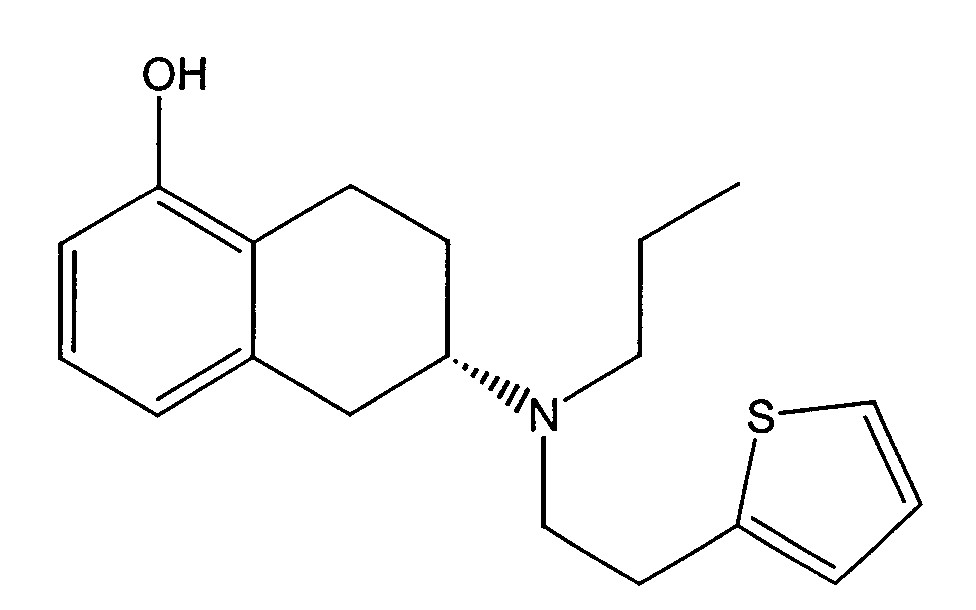
- One dopamine receptor agonist which has been used to treat the symptoms of Parkinson's Disease is rotigotine. It has mostly been tested in the form of its hydrochloride. Rotigotine is the International Non-Proprietary Name (INN) of the compound (-)-5,6,7,8-tetrahydro-6-[propyl-[2-(2-thienyl)ethyl]-amino]-1-naphthalenol having the structure shown below
- To date, various transdermal therapeutic systems (TTS) for the administration of rotigotine have been described. WO 94/07568 discloses a transdermal therapeutic system containing rotigotine hydrochloride as active substance in a two-phase matrix which is essentially formed by a hydrophobic polymer material as the continuous phase and a disperse hydrophilic phase contained therein and mainly containing the drug and hydrated silica. The silica enhances the maximum possible loading of the TTS with the hydrophilic salt. Moreover, the formulation of WO 94/07568 usually contains additional hydrophobic solvents, permeation-promoting substances, dispersing agents and, in particular, an emulsifier which is required to emulsify the aqueous solution of the active principle in the lipophilic polymer phase. A TTS, prepared by using such a system, has been tested in healthy subjects and Parkinson patients. The average drug plasma levels obtained by using this system were around 0.15 ng/ml with a 20 cm2 patch containing 10 mg rotigotine. This level must be considered as too low to achieve a truly efficacious treatment or alleviation of symptoms related to Parkinson's disease.
- Various further transdermal therapeutic systems have been described in WO 99/49852. The TTS used in this patent application comprise a backing layer, inert with respect to the constituents of the matrix, a self-adhesive matrix layer containing an effective quantity of rotigotine or rotigotine hydrochloride and a protective film which is to be removed before use. The matrix system is composed of a non-aqueous polymer adhesive system, based on acrylate or silicone, with a solubility of rotigotine of at least 5% w/w. Said matrix is essentially free of inorganic silicate particles. In Examples 1 and 2 and in Figure 1 of WO 99/49852 two transdermal therapeutic systems are compared. These are based on acrylate or silicone adhesives, respectively.
Figure 1 of WO 99/49852 shows that a silicone patch releases about the same amount of active principle through skin as an acrylate patch. This has been demonstrated by the almost identical drug flux rates in an in vitro model, independent of the adhesive test system employed. Therefore an identical flux rate through human skin was expected. - It should be noted that the drug content of the silicone patch used in WO 99/49852 was lower than the drug content used in the acrylate patch. However, this merely reflects the difference in solubility of the drug in the respective polymeric silicone and acrylate adhesives used in Examples 1 and 2, respectively. The TTS used in both examples contained the drug at about its saturation solubility in the respective adhesive systems. While the acrylate system is able to dissolve more drug than the silicone system, silicone in turn allows for a better release of the drug to skin. As these two effects compensate each other, it has been thought that the acrylate and the silicone system as used in WO 99/49852 are about equivalent in the obtainable drug plasma levels and, hence, in therapeutic efficacy.
- Considering the rather discouraging experiences made with the silicone formulation of WO 94/07568, the acrylate-based TTS of Example 1 of WO 99/49852 has been subjected to clinical tests (safety and pharmacokinetic studies). The mean steady flux rate across human skin in vitro of this TTS amounted to 15.3 µg/cm2/h. However, it turned out that the plasma levels obtained using this TTS still is unsatisfactory and too low to allow for a really efficacious treatment of Parkinson's Disease. A 30 mg (20 cm2) patch only yielded a mean maximum plasma concentration of 0.12 ng/ml, while a 5 cm2 patch containing 7.5 mg yielded a mean maximum plasma concentration of 0.068 ng/ml. Again, such values have to be considered as too low to provide a real therapeutic progress in the treatment of Parkinson's Disease. Thus, in summary, both the 20 cm2 silicone patch of WO 94/07568 and the 20 cm2 acrylate patch of WO 99/49852 failed to evoke sufficient drug plasma levels to provide a satisfactory therapeutic effectiveness.
- In view of these experiences, it has been very surprising that a transdermal therapeutic system containing rotigotine in free base form in a silicone matrix could not only provide unexpectedly high plasma levels of rotigotine but also a significant therapeutic progress in the treatment of Parkinson's Disease. In particular, it has been observed that a silicone-based TTS containing rotigotine in the free base form provides mean maximum drug plasma levels in the range of almost 0.5 ng/ml for a 20 cm2 silicone patch containing 9 mg of rotigotine. This is more than three times as much as could be expected from previous investigations.
- Such plasma values are sufficient to allow for a reasonable expectation that an effective treatment of Parkinson's Disease with less side effects can be provided. It should be understood that the term "treatment" in the context of this application is meant to designate a treatment or alleviation of the symptoms of Parkinson's Disease, rather than a real causative treatment leading to a complete cure.
- The present invention provides the use of a silicone-based transdermal therapeutic system having an area of 10 to 40 cm2 and containing 0.1 to 3.15 mg / cm2 of rotigotine as active ingredient, for the preparation of an anti-Parkinson medicament which induces a mean plasma concentration of rotigotine in the range of 0.4 to 2 ng/ml 24 h after administration.
- The silicone-based transdermal therapeutic system as used in the present invention must contain at least one amine resistant silicone compound as the main component. Usually, the silicone compound will be a pressure sensitive adhesive or a mixture thereof and will form a matrix in which the other components of the TTS are embedded. Moreover, the adhesive(s) should preferably be pharmaceutically acceptable in a sense that it is biocompatible, non-sensitizing and non-irritating to skin. Particularly advantageous silicone adhesives for use in the present invention should further meet the following requirements:
- Retained adhesive and cohesive properties in the presence of moisture or perspiration, under normal temperature variations,
- good compatibility with rotigotine as well as with the further excipients used in the formulation; in particular, the adhesive should not react with the amino group contained in rotigotine.
- It has been shown that pressure sensitive adhesives of the type forming a soluble polycondensed polydimethylsiloxane (PDMS) / resin network, wherein the hydroxy endgroups are capped with e.g. trimethylsilyl (TMS) groups, are particularly useful in the practice of the present invention. Preferred adhesives of this kind are the BIO-PSA silicone pressure sensitive adhesives manufactured by Dow Corning, particularly the Q7-4201 and Q7-4301 qualities. However, other silicone adhesives may likewise be used.
- In further and preferred aspects the present invention also provides a silicone-based transdermal therapeutic system comprising two or more silicone adhesives as the main adhesive components for such use. It can be advantageous if such a mixture of silicone adhesives comprises at least one high tack and at least one medium tack adhesive to provide for the optimum balance between good adhesion and little cold flux. Excessive cold flux may result in a too soft patch which easily adheres to the package or to patient garments. Moreover, such a mixture of adhesives seems to be particularly useful for obtaining high plasma levels. A mixture of the aforementioned Q7-4201 (medium tack) and Q7-4301 (high tack) amine resistant silicone pressure sensitive adhesives in about equal amounts proved to be particularly useful in the practice of this invention.
- In a further preferred embodiment, the silicone-based transdermal therapeutic system further includes a solubilizer. Several surfactant or amphiphilic substances may be used as solubilizers. They should be pharmaceutically acceptable and approved for use in medicaments. A particularly preferred example of such a solubilizer is soluble polyvinylpyrrolidone. Polyvinylpyrrolidone is commercially available, e.g. under the trademark Kollidon® (Bayer AG). Other examples include copolymers of polyvinylpyrrolidone and vinyl acetate, polyethyleneglycol, polypropyleneglycol, glycerol and fatty acid esters of glycerol or copolymers of ethylene and vinylacetate.
- The silicone-based transdermal therapeutic system for use according to the present invention preferably contains less than 1 wt% of inorganic silicates, most preferably it is completely free from inorganic silicates.
- The water content in the transdermal therapeutic systems for use in the present invention is preferably low enough so that no evaporation of water during preparation of the TTS is necessary. Typically, the water content in a freshly prepared patch is below 2%, more preferably 1 wt% or lower.
- In a particularly preferred embodiment of the present invention, the transdermal therapeutic system has a surface area of 10 to 30 cm2, more preferably 20 to 30 cm2. It goes without saying that a TTS having a surface area of, say, 20 cm2 is pharmacologically equivalent to and may be exchanged by two 10 cm2 patches or four 5 cm2 patches having the same drug content per cm2. Thus, the surface areas as indicated in this application should be understood to refer to the total surface of all TTS simultaneously administered to a patient.
- Providing and applying one or several transdermal therapeutic systems according to the invention has the pharmacological advantage over oral therapy that the attending physician can titrate the optimum dose for the individual patient relatively quickly and accurately, e.g. by simply increasing the number or size of patches given to the patient. Thus, the optimum individual dosage can often be determined after a time period of only about 3 weeks with low side effects.
- A preferred content of rotigotine per patch is in the range of 0.1 to 2.0 mg / cm2. Still more preferred are 0.4 to 1.5 mg rotigotine per cm2. If a 7 day patch is desired, higher drug contents will generally be required. A rotigotine content in the range of about 0.4 to 0.5 wt% has been found to be particularly advantageous in that it provides the optimum usage of the drug contained in the TTS, i.e. there is only very little residual drug content in the TTS after administration. The apparent dose administered by using such a TTS usually is 50% or more and may be as high as 80-90% of the drug amount originally contained in the TTS.
- The fact that the silicone-based transdermal therapeutic system described in this invention is able to provide a significant therapeutic effect against symptoms of Parkinson's Disease and high plasma levels of 0.4 ng/ml and more even at surface areas of 10 to 30 cm2 and particularly as little as 10 or 20 cm2 and at low drug contents of about 0.4 to 0.5 mg/cm2, particularly about 0.45 g/cm2, must be considered as a further particular benefit provided by the present invention.
- The transdermal therapeutic system used in the present invention usually is a patch having a continuous adhesive matrix in at least its center portion containing the drug. However, transdermal equivalents to such patches are likewise comprised by the present invention, e.g. an embodiment where the drug is in an inert but non-adhesive silicone matrix in the center portion of the TTS and is surrounded by an adhesive portion along the patch edges.
- In a further aspect, this invention relates to a method of treating Parkinson's Disease by applying on a patient in need thereof a silicone-based transdermal therapeutic system having an area of 10 to 40 cm2 and containing 0.1 to 3.15 mg / cm2 of rotigotine as active ingredient, wherein said transdermal therapeutic system induces a mean plasma concentration of rotigotine in the range of 0.4 to 2 ng/ml 24 h after administration.
- Unless expressly indicated otherwise, any references to rotigotine in the context of this invention and the claims of this application mean rotigotine in the form of its free base. In some cases traces of rotigotine hydrochloride may be contained in a rotigotine preparation but these traces typically do not exceed 5 wt%, based on the amount of the free base. More preferably the content of hydrochloride impurities should be less than 2 wt%, even more preferably less than 1% and most preferably the rotigotine used in the present invention contains less than 0.1 wt% or no hydrochloride impurities at all.
- As a result of the present invention it has been possible to achieve plasma levels which allow for a constant receptor stimulation of the dopamine receptors of Parkinson patients. In one embodiment of the invention, using one 20 cm2 silicone patch prepared according to the preparation example below and containing 9 mg rotigotine resulted in a mean maximal plasma concentration of 0.491 ± 0.151 ng/ml at 23 h after start of administration. After 24 h, the mean plasma concentration was 0.473 ± 0.116 ng/ml. The individual maximal plasma concentration measured was 0.562 ± 0.191 ng/ml and calculated AUC(0-t) was 11.12 ± 4.05 ng/ml.
- These parameters were determined in a pilot study involving 14 healthy male subjects who were administered either one or two of the silicone based transdermal therapeutic systems as described in the Preparatory Example, or an acrylic transdermal preparation according to WO 99/49852, respectively, in a single-center, open-label, single administration, three-way cross-over, partly randomized design. Individual drug plasma levels were determined by a validated routine LC-MS-MS assay, i.e. by a liquid chromatographic system equipped with a Tandem Mass Spectrometer having a limit of quantification of 10 pg/ml. The pharmacokinetic variables were the measured maximal concentration (Cmax), the time of the observed maximum (tmax) and AUC(0-tz), i.e. the area under the concentration/time curve calculated by the linear trapezoidal rule up to the last sample with a quantifiable concentration. Based on the results in individual subjects, mean concentration, standard deviation, median and range were then determined and used for descriptive statistics of each parameter.
- Moreover, the study revealed an approximately linear relationship between the drug amount administered to the subjects and the observed mean plasma concentrations of rotigotine. After administration of two silicone patches of the same kind as described above, the plasma concentrations increased by a factor of about 2 to 0.951 ± 0.309 ng/ml within 24 h.
- This experimental study of which further details are given in the Examples below, confirms that it is realistic to expect mean plasma levels of rotigotine in the range of 0.4 to 2.0 ng/ml 24 h after administration of a silicone based transdermal therapeutic system having an area of 10 to 40 cm2 and including 0.1 to 3.15 g/cm2 rotigotine.
- Additional clinical studies in male healthy volunteers have shown that the plasma levels obtainable according to the present invention are, by and large, maintained in vivo upon further (normally once daily) administration of the same transdermal therapeutic system for several weeks. For example, the mean plasma level obtained following a 3 months administration of a 20 cm2 patch according to the present invention containing 9 mg rotigotine proved to be 0.49 ± 0.23 ng/ml. Thus the plasma levels as indicated herein with reference to a single administration and measured 24 hours thereafter, can be considered to represent steady state values. Thus, obtaining and maintaining high plasma levels of rotigotine for an extended period of time represents a further aspect of the present invention. The high steady-state concentration provided by the TTS according to the present invention is effective to avoid the on-off-fluctuations which typically accompany oral treatment.
- The invention and the best mode for carrying it out will be explained in more detail in the following non-limiting examples.
- A transdermal therapeutic system using a combination of silicone-type pressure sensitive adhesives was prepared as follows.
- (-)-5,6,7,8-tetrahydro-6-[propyl-[2-(2-thienyl)ethyl]-amino]1-naphthalenol hydrochloride (rotigotine hydrochloride, 150 g) was added to a solution of 17.05 g NaOH in 218 g ethanol (96%). The resulting mixture was stirred for approximately 10 minutes. Then 23.7 g of sodium phosphate buffer solution (8.35 g Na2HPO4x2H2O and 16.07 g NaH2PO4x2H2O in 90.3 g water) was added. Insoluble or precipitated solids were separated from the mixture by filtration. The filter was rinsed with 60.4 g ethanol (96%) to obtain a particle-free ethanolic solution of Rotigotine in the form of the free base.
- The Rotigotine free base solution (346.4 g) in ethanol (35% w/w) was mixed with 36.2 g ethanol (96%). The resulting solution was mixed with 109 g of an ethanolic solution containing 25 wt% polyvinylpyrrolidone (KOLLIDON® 90F), 0.077 wt% aqueous sodium bisulfite solution (10 wt%), 0.25 wt% ascorbyl palmitate, and 0.63 wt% DL-alpha-tocopherol until homogenous. To the mixture, 817.2 g of an amine resistant high tack silicone adhesive (BIO-PSA® Q7-4301 mfd. by Dow Corning) (74 wt% solution in heptane), 851.8 g of an amine resistant medium tack silicone adhesive (BIO-PSA® Q7-4201 mfd. by Dow Corning) (71 wt% solution in heptane), and 205.8 g petrol ether (heptane) were added, and all components were stirred until a homogenous dispersion was obtained.
- The dispersion was coated onto a suitable polyester release liner (SCOTCHPAK® 1022) with a suitable doctor knife and the solvents were continuously removed in a drying oven at temperatures up to 80°C for about 30 min to obtain a drug-containing adhesive matrix of 50 g/m2 coating weight. The dried matrix film was laminated with a polyester-type backing foil (SCOTCHPAK® 1109). The individual patches were punched out of the complete laminate in the desired sizes (e.g. 10 cm2, 20 cm2, 30 cm2) and sealed into pouches under the flow of nitrogen.
- The following table shows the composition in mg/20 cm2 of a transdermal therapeutic system according to the present invention containing a combination of two silicone-type PSA.
Composition Components Amount (mg) Rotigotine Base 9.00 Polyvinylpyrrolidone 2.00 Silicone BIO-PSA® Q7-4301 44.47 Silicone BIO-PSA® Q7-4201 44.46 Ascorbyl palmitate 0.02 DL-alpha Tocopherol 0.05 Sodium metabisulfite 0.0006 Matrix coating weight 50 g/m2 - The above described transdermal therapeutic system was tested in a pharmacokinetic study for the comparative bioavailability and dose-proportionality after a single administration. The study involved 14 healthy male subjects who received one or two silicone-based or one acrylic-based transdermal preparations of rotigotine, respectively. 11 subjects completed the trial.
- The study design involved the use of 20 cm2 silicone patches each containing 9 mg rotigotine. This dosage was chosen based on the earlier experiences with the acrylate transdermal therapeutic system of WO 99/49852, because the same plasma levels as obtained using this acrylate patch were expected. The dosage level was approved by the Ethikkommission of the Ärztekammer Nordrhein. The subjects participating in the trial were advised before administration that no severe adverse effects which could be attributed to treatment with rotigotine had been observed in earlier clinical studies.
- The silicone based transdermal therapeutic systems were compared with the acrylate TTS according to example 1 of WO 99/49852 including a 20 cm2 patch containing 30 mg rotigotine. The study design was an open, partly randomised, three-way cross-over study involving a single administration according to the following schedule:
Treatment I Treatment II Treatment III Day 1 Day 8 Day 15 non-randomized randomized randomized one silicone TTS two silicone TTS or one acrylate TTS two silicone TTS or one acrylate TTS - No placebo was given in this study. Whether treatment II and III involved administration of two silicone patches or one acrylate patch was determined at random.
- Individual drug plasma levels were determined by a validated routine LC-MS-MS assay, i.e. by a liquid chromatographic system equipped with a Tandem Mass Spectrometer having a limit of quantification of 10 pg/ml. The pharmacokinetic variables were the measured maximal concentration (Cmax), the time of the observed maximum (tmax) and AUC(0-tz), i.e. the area under the concentration/time curve calculated by the linear trapezoidal rule up to the last sample with a quantifiable concentration. Based on the results in individual subjects, mean concentration, standard deviation, median and range were then determined and used for descriptive statistics of each parameter.
- Using one silicone patch the mean plasma levels increased up to 0.473 ± 0.116 ng/ml within 24 h. The approximated lag time was 3 h. The maximum of mean measured plasma concentration after administration of one silicone patch was 0.491 ± 0.151 ng/ml 23 h after start of administration. The individual maximal plasma concentration was 0.562 ± 0.191 ng/ml and calculated AUC(0-t) was 11.12 ± 4.05 ng/ml. The terminal half-life after removal of one silicone patch was 5.3 ± 0.7 h.
- After administration of two silicone patches the plasma concentrations increased to 0.951 ± 0.309 ng/ml within 24 h. The approximated lag time was 3 h. The maximum of mean measured plasma concentration after administration of two silicone patches was 1.076 ± 0.37 ng/ml 15 h after start of administration. The individual maximal plasma concentration was 1.187 ± 0.349 ng/ml and calculated AUC(0-t) was 23.73 ± 8.51 ng/ml h. The terminal half life of rotigotine after removal of two silicone patches was 5.1 ± 0.4 h.
- Using one acrylic patch the plasma concentrations increased up to 0.197 ± 0.079 ng/ml within 24 h. The approximated lagtime was 4 h. The maximum of mean measured rotigotine plasma concentration after administration of one acrylic patch was 0.202 ± 0.095 ng/ml 23 h after start of the administration. The individual maximal plasma concentration was 0.228 ± 0.109 ng/ml and calculated AUC(0-t) was 4.15 ± 2.17 ng/ml.h. The terminal half life of rotigotine after removal of one acrylic patch was 4.9 ± 1.5 h.
- The apparent dose measured after administration of one silicone patch (by determining the residual concentration in the patch after use) was 5.18 ± 1.23 mg. Corresponding doses after two silicone patches were 10.24 ± 2.74 mg, after one acrylic patch 2.56 ± 1.27 mg per 24 h. The parameters Cmax or AUL(0-t) with the apparent dose show good correlation, i.e. there is an approximately linear relationship between the drug amount administered to the subjects and the observed mean plasma concentrations of rotigotine.
- Due to the apparent equivalence, in the drug permeability across skin under in vitro conditions, of the 20 cm2 silicone and acrylate patches tested in WO 99/49852, the much higher in vivo plasma concentrations obtained by using the silicone patches used in the present study must be considered as surprising.
- The significantly higher plasma levels to which the present invention pertains are expected to have a pharmacological relevance. This became manifest in the study described above, even though only healthy volunteers, i.e. subjects with normal dopamine levels, participated who by definition could not benefit from this treatment. To the contrary, it became apparent that the treated healthy individuals experienced much more drug-related adverse events than was expected when the study was designed. In fact, each volunteer experienced at least one adverse event, most experienced several ones. All adverse events were of mild to severe intensity and were completely resolved at study end. However, in two of the 14 volunteers, adverse events were the reason for premature study termination. The most frequent adverse events observed were drowsiness, somnolescence, nausea, vomiting, and headache.
- Had one known before that the silicone patch used in the study according to the present invention could or would result in such high plasma levels as were finally observed, the dose regimen in the above reported healthy volunteer study would have been selected much lower to avoid such adverse effects. On the other hand, Parkinson patients who suffer from a deficiency in dopamine levels, will easily tolerate and, in fact, benefit from such high plasma levels of a specific dopamine D2-receptor agonist such as rotigotine. Therefore, the increased plasma level of rotigotine obtained when using the silicone TTS, which forms a central aspect of the present invention, also bears a therapeutic significance. This result was subsequently confirmed in clinical trials involving Parkinson patients.
Claims (11)
- The use of a silicone-based transdermal therapeutic system having an area of 10 to 40 cm2 and containing 0.1 to 3.15 mg / cm2 of rotigotine as active ingredient, for the preparation of an anti-Parkinson medicament which induces a mean plasma concentration of rotigotine in the range of 0.4 to 2 ng/ml 24 h after administration.
- The use according to claim 1 wherein the silicone-based transdermal therapeutic system comprises two or more silicone adhesives as the main adhesive components.
- The use according to claim 1 or 2 wherein the silicone-based transdermal therapeutic system further includes a solubilizer.
- The use according to claim 3 wherein the solubilizer is polyvinylpyrrolidone.
- The use according to any of the preceding claims wherein the silicone-based transdermal therapeutic system contains less than 1 wt% of inorganic silicates.
- The use according to claim 5 wherein the silicone-based transdermal therapeutic system is free from inorganic silicates.
- The use according to any of the preceding claims wherein the transdermal therapeutic system has an area of 10 to 30 cm2.
- The use according to any of the preceding claims wherein the transdermal therapeutic system contains 0.1 to 1.5 mg / cm2 of rotigotine.
- The use according to claim 1 wherein the transdermal therapeutic system is a patch having an area of 10 to 30 cm2 and a content of rotigotine of 0.4 to 0.5 mg/cm2 in an adhesive silicone-based matrix.
- The use according to any of the preceding claims wherein the mean plasma concentration of rotigotine in the range of 0.4 to 2 ng/ml is maintained for at least 14 days upon continuous further administration of said transdermal therapeutic system.
- A method of treating Parkinson's Disease by applying on a patient suffering from this disease a silicone-based transdermal therapeutic system having an area of 10 to 40 cm2 and containing 0.1 to 3.15 mg / cm2 of rotigotine as active ingredient, wherein said transdermal therapeutic system induces a mean plasma concentration of rotigotine in the range of 0.4 to 2 ng/ml 24 h after administration.
Priority Applications (26)
| Application Number | Priority Date | Filing Date | Title |
|---|---|---|---|
| DE60100994T DE60100994T2 (en) | 2001-05-08 | 2001-05-08 | Transdermal therapeutic system for the achievement of high plasma levels of rotigotine in the therapy of Parkinson's disease |
| EP03013353A EP1344522A1 (en) | 2001-05-08 | 2001-05-08 | Transdermal therapeutic system for Parkinson's disease inducing high plasma levels of rotigotine |
| TR2003/01916T TR200301916T4 (en) | 2001-05-08 | 2001-05-08 | Transdermal therapeutic system for parkinson's disease including high plasma levels of rotigotine. |
| ES01111109T ES2204780T3 (en) | 2001-05-08 | 2001-05-08 | TRANSDERMAL THERAPEUTIC SYSTEM FOR PARKINSON'S DISEASE THAT INDUCES HIGH LEVELS OF ROTIGOTINE IN PLASMA. |
| EP01111109A EP1256339B1 (en) | 2001-05-08 | 2001-05-08 | Transdermal therapeutic system for Parkinson's disease inducing high plasma levels of rotigotine |
| DK01111109T DK1256339T3 (en) | 2001-05-08 | 2001-05-08 | Transdermal therapeutic system for obtaining high plasma levels of rotigotine in the treatment of Parkinson's disease |
| PT01111109T PT1256339E (en) | 2001-05-08 | 2001-05-08 | TRANSDERMIC THERAPEUTIC SYSTEM FOR PARKINSON'S DISEASE INDUCING HIGH PLASMATIC NORMS OF ROTIGOTINE |
| AT01111109T ATE251901T1 (en) | 2001-05-08 | 2001-05-08 | TRANSDERMAL THERAPEUTIC SYSTEM FOR ACHIEVEMENT OF HIGH PLASMA LEVELS OF ROTIGOTIN IN THE THERAPY OF PARKINSON'S DISEASE |
| DE60233898T DE60233898D1 (en) | 2001-05-08 | 2002-05-06 | TRANSDERMAL THERAPEUTIC SYSTEM FOR PARKINSON DISEASE WITH HIGH ROTIGOTINE PLASMAS MIRRORS |
| CNA028015401A CN1606435A (en) | 2001-05-08 | 2002-05-06 | Transdermal therapeutic system for the treatment of Parkinson's disease eliciting plasma levels of gorotigotine |
| AT02740569T ATE444061T1 (en) | 2001-05-08 | 2002-05-06 | TRANSDERMAL THERAPEUTIC SYSTEM FOR PARKINSON'S DISEASE WITH HIGH ROTIGOTINE PLASMA LEVELS |
| HU0500525A HU229350B1 (en) | 2001-05-08 | 2002-05-06 | Transdermal therapeutic system for parkinson's disease inducing high plasma levels of rotigotine |
| CN2011100516651A CN102172351B (en) | 2001-05-08 | 2002-05-06 | Transdermal therapeutic system for parkinson's disease inducing high plasma levels of rotigotine |
| ES02740569T ES2331787T3 (en) | 2001-05-08 | 2002-05-06 | TRANSDERMAL THERAPEUTIC SYSTEM FOR PARKINSON'S DISEASE THAT INDUCES HIGH LEVELS OF ROTIGOTINE IN PLASMA. |
| PT02740569T PT1471892E (en) | 2001-05-08 | 2002-05-06 | Transdermal therapeutic system for parkinson`s disease inducing high plasma levels of rotigotine |
| PCT/EP2002/004976 WO2002089778A2 (en) | 2001-05-08 | 2002-05-06 | Transdermal therapeutic system for parkinson's disease inducing high plasma levels of rotigotine |
| DK02740569T DK1471892T3 (en) | 2001-05-08 | 2002-05-06 | Transdermal therapeutic system for Parkinson's disease that induces high rotigotine plasma levels |
| RU2003133217/15A RU2272625C2 (en) | 2001-05-08 | 2002-05-06 | Percutaneous therapeutic system for treatment of parkinson's disease inducing high rotigotin plasma level |
| JP2002586915A JP5026656B2 (en) | 2001-05-08 | 2002-05-06 | A transdermal therapeutic system for Parkinson's disease that induces high plasma levels of rotigotine |
| EP02740569A EP1471892B1 (en) | 2001-05-08 | 2002-05-06 | Transdermal therapeutic system for parkinson's disease inducing high plasma levels of rotigotine |
| KR1020037000143A KR100974974B1 (en) | 2001-05-08 | 2002-05-06 | Percutaneous preparations for Parkinson's disease that induce high plasma levels of rotigotine |
| US10/140,096 US20030026830A1 (en) | 2001-05-08 | 2002-05-07 | Transdermal therapeutic system for parkinson's disease inducing high plasma levels of rotigotine |
| ZA200209982A ZA200209982B (en) | 2001-05-08 | 2002-12-10 | Transdermal therapeutic system for parkinson's disease inducing high plasma levels of rotogotine. |
| HK03101599.0A HK1049444B (en) | 2001-05-08 | 2003-03-04 | Transdermal therapeutic system for parkinson's disease inducing high plasma levels of rotigotine |
| CY20091101150T CY1109861T1 (en) | 2001-05-08 | 2009-11-05 | INTERDERATIVE THERAPEUTIC SYSTEM FOR PARKINI DISEASE Causing High Plasma Rotigotine Level |
| JP2010002209A JP2010106037A (en) | 2001-05-08 | 2010-01-07 | A transdermal therapeutic system for Parkinson's disease that induces high plasma levels of rotigotine |
Applications Claiming Priority (1)
| Application Number | Priority Date | Filing Date | Title |
|---|---|---|---|
| EP01111109A EP1256339B1 (en) | 2001-05-08 | 2001-05-08 | Transdermal therapeutic system for Parkinson's disease inducing high plasma levels of rotigotine |
Related Child Applications (1)
| Application Number | Title | Priority Date | Filing Date |
|---|---|---|---|
| EP03013353A Division EP1344522A1 (en) | 2001-05-08 | 2001-05-08 | Transdermal therapeutic system for Parkinson's disease inducing high plasma levels of rotigotine |
Publications (2)
| Publication Number | Publication Date |
|---|---|
| EP1256339A1 true EP1256339A1 (en) | 2002-11-13 |
| EP1256339B1 EP1256339B1 (en) | 2003-10-15 |
Family
ID=8177356
Family Applications (3)
| Application Number | Title | Priority Date | Filing Date |
|---|---|---|---|
| EP01111109A Expired - Lifetime EP1256339B1 (en) | 2001-05-08 | 2001-05-08 | Transdermal therapeutic system for Parkinson's disease inducing high plasma levels of rotigotine |
| EP03013353A Withdrawn EP1344522A1 (en) | 2001-05-08 | 2001-05-08 | Transdermal therapeutic system for Parkinson's disease inducing high plasma levels of rotigotine |
| EP02740569A Revoked EP1471892B1 (en) | 2001-05-08 | 2002-05-06 | Transdermal therapeutic system for parkinson's disease inducing high plasma levels of rotigotine |
Family Applications After (2)
| Application Number | Title | Priority Date | Filing Date |
|---|---|---|---|
| EP03013353A Withdrawn EP1344522A1 (en) | 2001-05-08 | 2001-05-08 | Transdermal therapeutic system for Parkinson's disease inducing high plasma levels of rotigotine |
| EP02740569A Revoked EP1471892B1 (en) | 2001-05-08 | 2002-05-06 | Transdermal therapeutic system for parkinson's disease inducing high plasma levels of rotigotine |
Country Status (15)
| Country | Link |
|---|---|
| EP (3) | EP1256339B1 (en) |
| JP (2) | JP5026656B2 (en) |
| KR (1) | KR100974974B1 (en) |
| CN (2) | CN102172351B (en) |
| AT (2) | ATE251901T1 (en) |
| CY (1) | CY1109861T1 (en) |
| DE (2) | DE60100994T2 (en) |
| DK (2) | DK1256339T3 (en) |
| ES (2) | ES2204780T3 (en) |
| HK (1) | HK1049444B (en) |
| HU (1) | HU229350B1 (en) |
| PT (2) | PT1256339E (en) |
| RU (1) | RU2272625C2 (en) |
| WO (1) | WO2002089778A2 (en) |
| ZA (1) | ZA200209982B (en) |
Cited By (7)
| Publication number | Priority date | Publication date | Assignee | Title |
|---|---|---|---|---|
| DE10361258A1 (en) * | 2003-12-24 | 2005-07-28 | Schwarz Pharma Ag | Use of substituted 2-aminotetralins for the preventive treatment of Parkinson's disease |
| DE10361259A1 (en) * | 2003-12-24 | 2005-07-28 | Schwarz Pharma Ag | Use of Rotigotine in Early Stage Parkinson's Disease to Prevent Further Neuronal Loss |
| CN100430050C (en) * | 2003-07-26 | 2008-11-05 | 施瓦茨制药有限公司 | Use of rotigotine for the manufacture of medicaments for the treatment of depression |
| US7683040B2 (en) | 2003-12-23 | 2010-03-23 | Srz Properties, Inc. | Intranasal formulation of rotigotine |
| US7872041B2 (en) | 2004-03-24 | 2011-01-18 | Ucb Pharma Gmbh | Use of rotigotine for treating and preventing Parkinson's plus syndrome |
| WO2011076879A1 (en) | 2009-12-22 | 2011-06-30 | Ucb Pharma Gmbh | Polyvinylpyrrolidone for the stabilization of a solid dispersion of the non-crystalline form of rotigotine |
| US8980308B2 (en) | 2003-08-20 | 2015-03-17 | Lts Lohmann Therapie-Systeme Ag | Transdermal pharmaceutical preparation containing active substance combinations, for treating Parkinson's disease |
Families Citing this family (21)
| Publication number | Priority date | Publication date | Assignee | Title |
|---|---|---|---|---|
| DE10041478A1 (en) | 2000-08-24 | 2002-03-14 | Sanol Arznei Schwarz Gmbh | New pharmaceutical composition |
| ATE246919T1 (en) * | 2001-05-08 | 2003-08-15 | Sanol Arznei Schwarz Gmbh | IMPROVED TRANSDERMAL THERAPEUTIC SYSTEM FOR THE TREATMENT OF PARKINSON'S DISEASE |
| DE10220230A1 (en) * | 2002-05-06 | 2003-11-27 | Sanol Arznei Schwarz Gmbh | Use of Rotigotine to treat restless leg syndrome |
| DE10261696A1 (en) * | 2002-12-30 | 2004-07-15 | Schwarz Pharma Ag | Device for the transdermal administration of rotigotine base |
| DE10334187A1 (en) * | 2003-07-26 | 2005-03-03 | Schwarz Pharma Ag | Substituted 2-aminotetralins for the treatment of depression |
| DE10359528A1 (en) | 2003-12-18 | 2005-07-28 | Schwarz Pharma Ag | (S) -2-N-propylamino-5-hydroxytetralin as a D3 agonist therapeutic |
| JP2008514376A (en) * | 2004-09-29 | 2008-05-08 | シュウォーツ ファーマ インコーポレイテッド | Transdermal therapeutic system for Parkinson's disease |
| CN101147739B (en) * | 2007-07-06 | 2010-12-08 | 北京康倍得医药技术开发有限公司 | Composition containing rotigotine and its use and transdermal patch containing the composition |
| DE102008060203A1 (en) | 2008-12-07 | 2010-06-10 | Dietrich Wilhelm Schacht | Sheet-like device, useful for transdermal administration of e.g. rotigotine to treat Parkinson's disease, comprises an active ingredient containing layer, an active agent impermeable backing layer and a removable protective layer |
| EP2201941A1 (en) | 2008-12-29 | 2010-06-30 | UCB Pharma GmbH | Plaster production technology |
| EP2490673A2 (en) * | 2009-10-19 | 2012-08-29 | Actavis Group Ptc Ehf | Amorphous rotigotine co-precipitates |
| TW201431570A (en) * | 2012-11-22 | 2014-08-16 | Ucb Pharma Gmbh | Multi-day patch for the transdermal administration of rotigotine |
| CA2916183C (en) | 2013-07-03 | 2022-03-29 | Lts Lohmann Therapie-Systeme Ag | Transdermal therapeutic system with electronic component |
| JP6573913B2 (en) | 2014-05-20 | 2019-09-11 | エルテーエス ローマン テラピー−ジステーメ アーゲー | Transdermal delivery system containing rotigotine |
| JP6895755B2 (en) | 2014-05-20 | 2021-06-30 | エルテーエス ローマン テラピー−ジステーメ アーゲー | Methods for regulating the release of active agents in a transdermal delivery system |
| EP4238580A3 (en) | 2014-05-20 | 2023-10-25 | LTS Lohmann Therapie-Systeme AG | Transdermal delivery system including an interface mediator |
| KR102364378B1 (en) * | 2014-05-21 | 2022-02-16 | 에스케이케미칼 주식회사 | Transdermal composition comprising rotigotine with improved the stability |
| DE102014114282A1 (en) | 2014-10-01 | 2016-04-07 | Neuraxpharm Arzneimittel Gmbh | Transdermal therapeutic system with rotigotine for the treatment of Parkinson's disease |
| JP6865235B2 (en) * | 2016-12-28 | 2021-04-28 | 久光製薬株式会社 | Butorphanol-containing patch |
| DE102018120505A1 (en) * | 2017-10-20 | 2019-04-25 | Amw Gmbh | Preventing the crystallization of drugs in transdermal delivery systems |
| PL3854388T3 (en) | 2020-01-24 | 2024-02-26 | Luye Pharma Switzerland Ag | Transdermal therapeutic system comprising rotigotine and at least one non-amine-resistant silicone adhesive |
Citations (2)
| Publication number | Priority date | Publication date | Assignee | Title |
|---|---|---|---|---|
| WO1999049852A1 (en) * | 1998-03-30 | 1999-10-07 | Lts Lohmann Therapie-Systeme Ag | Transdermal therapeutic system which contains a d2 agonist and which is provided for treating parkinsonism, and a method for the production thereof |
| DE19940238A1 (en) * | 1999-08-25 | 2001-03-01 | Lohmann Therapie Syst Lts | Therapeutic system containing active ingredients for application to the skin with at least two polymer-containing layers |
Family Cites Families (5)
| Publication number | Priority date | Publication date | Assignee | Title |
|---|---|---|---|---|
| JPH0751515B2 (en) * | 1986-09-10 | 1995-06-05 | 明治製菓株式会社 | Transdermal formulation |
| US5656286A (en) * | 1988-03-04 | 1997-08-12 | Noven Pharmaceuticals, Inc. | Solubility parameter based drug delivery system and method for altering drug saturation concentration |
| US5474783A (en) * | 1988-03-04 | 1995-12-12 | Noven Pharmaceuticals, Inc. | Solubility parameter based drug delivery system and method for altering drug saturation concentration |
| US5989586A (en) * | 1992-10-05 | 1999-11-23 | Cygnus, Inc. | Two-phase matrix for sustained release drug delivery device |
| FR2732223B1 (en) * | 1995-03-30 | 1997-06-13 | Sanofi Sa | PHARMACEUTICAL COMPOSITION FOR TRANSDERMAL ADMINISTRATION |
-
2001
- 2001-05-08 EP EP01111109A patent/EP1256339B1/en not_active Expired - Lifetime
- 2001-05-08 ES ES01111109T patent/ES2204780T3/en not_active Expired - Lifetime
- 2001-05-08 DE DE60100994T patent/DE60100994T2/en not_active Expired - Lifetime
- 2001-05-08 DK DK01111109T patent/DK1256339T3/en active
- 2001-05-08 PT PT01111109T patent/PT1256339E/en unknown
- 2001-05-08 EP EP03013353A patent/EP1344522A1/en not_active Withdrawn
- 2001-05-08 AT AT01111109T patent/ATE251901T1/en active
-
2002
- 2002-05-06 HU HU0500525A patent/HU229350B1/en unknown
- 2002-05-06 RU RU2003133217/15A patent/RU2272625C2/en active IP Right Revival
- 2002-05-06 AT AT02740569T patent/ATE444061T1/en active
- 2002-05-06 CN CN2011100516651A patent/CN102172351B/en not_active Expired - Lifetime
- 2002-05-06 WO PCT/EP2002/004976 patent/WO2002089778A2/en not_active Ceased
- 2002-05-06 DK DK02740569T patent/DK1471892T3/en active
- 2002-05-06 ES ES02740569T patent/ES2331787T3/en not_active Expired - Lifetime
- 2002-05-06 EP EP02740569A patent/EP1471892B1/en not_active Revoked
- 2002-05-06 JP JP2002586915A patent/JP5026656B2/en not_active Expired - Lifetime
- 2002-05-06 PT PT02740569T patent/PT1471892E/en unknown
- 2002-05-06 KR KR1020037000143A patent/KR100974974B1/en not_active Expired - Lifetime
- 2002-05-06 CN CNA028015401A patent/CN1606435A/en active Pending
- 2002-05-06 DE DE60233898T patent/DE60233898D1/en not_active Expired - Lifetime
- 2002-12-10 ZA ZA200209982A patent/ZA200209982B/en unknown
-
2003
- 2003-03-04 HK HK03101599.0A patent/HK1049444B/en unknown
-
2009
- 2009-11-05 CY CY20091101150T patent/CY1109861T1/en unknown
-
2010
- 2010-01-07 JP JP2010002209A patent/JP2010106037A/en active Pending
Patent Citations (2)
| Publication number | Priority date | Publication date | Assignee | Title |
|---|---|---|---|---|
| WO1999049852A1 (en) * | 1998-03-30 | 1999-10-07 | Lts Lohmann Therapie-Systeme Ag | Transdermal therapeutic system which contains a d2 agonist and which is provided for treating parkinsonism, and a method for the production thereof |
| DE19940238A1 (en) * | 1999-08-25 | 2001-03-01 | Lohmann Therapie Syst Lts | Therapeutic system containing active ingredients for application to the skin with at least two polymer-containing layers |
Cited By (11)
| Publication number | Priority date | Publication date | Assignee | Title |
|---|---|---|---|---|
| CN100430050C (en) * | 2003-07-26 | 2008-11-05 | 施瓦茨制药有限公司 | Use of rotigotine for the manufacture of medicaments for the treatment of depression |
| US8980308B2 (en) | 2003-08-20 | 2015-03-17 | Lts Lohmann Therapie-Systeme Ag | Transdermal pharmaceutical preparation containing active substance combinations, for treating Parkinson's disease |
| US7683040B2 (en) | 2003-12-23 | 2010-03-23 | Srz Properties, Inc. | Intranasal formulation of rotigotine |
| DE10361258A1 (en) * | 2003-12-24 | 2005-07-28 | Schwarz Pharma Ag | Use of substituted 2-aminotetralins for the preventive treatment of Parkinson's disease |
| DE10361259A1 (en) * | 2003-12-24 | 2005-07-28 | Schwarz Pharma Ag | Use of Rotigotine in Early Stage Parkinson's Disease to Prevent Further Neuronal Loss |
| AU2004308649B2 (en) * | 2003-12-24 | 2010-08-26 | Ucb Pharma Gmbh | Use of substituted 2-aminotetralines for the preventative treatment of Parkinson's disease |
| US8283376B2 (en) | 2003-12-24 | 2012-10-09 | Ucb Pharma Gmbh | Use of substituted 2-aminotetralins for preventive treatment of parkinson's disease |
| US7872041B2 (en) | 2004-03-24 | 2011-01-18 | Ucb Pharma Gmbh | Use of rotigotine for treating and preventing Parkinson's plus syndrome |
| WO2011076879A1 (en) | 2009-12-22 | 2011-06-30 | Ucb Pharma Gmbh | Polyvinylpyrrolidone for the stabilization of a solid dispersion of the non-crystalline form of rotigotine |
| EP3257504A1 (en) | 2009-12-22 | 2017-12-20 | UCB Biopharma SPRL | Polyvinylpyrrolidone for the stabilization of a solid dispersion of the non-crystalline form of rotigotine |
| EP4403172A2 (en) | 2009-12-22 | 2024-07-24 | UCB Biopharma SRL | Polyvinylpyrrolidone for the stabilization of a solid dispersion of the non-crystalline form of rotigotine |
Also Published As
| Publication number | Publication date |
|---|---|
| WO2002089778A2 (en) | 2002-11-14 |
| CN102172351A (en) | 2011-09-07 |
| CN102172351B (en) | 2013-07-17 |
| DE60233898D1 (en) | 2009-11-12 |
| ATE444061T1 (en) | 2009-10-15 |
| HUP0500525A2 (en) | 2005-09-28 |
| DK1471892T3 (en) | 2009-12-07 |
| JP5026656B2 (en) | 2012-09-12 |
| HK1049444A1 (en) | 2003-05-16 |
| HU229350B1 (en) | 2013-11-28 |
| DE60100994T2 (en) | 2004-07-22 |
| EP1471892A2 (en) | 2004-11-03 |
| DE60100994D1 (en) | 2003-11-20 |
| ATE251901T1 (en) | 2003-11-15 |
| KR100974974B1 (en) | 2010-08-09 |
| WO2002089778A3 (en) | 2004-08-19 |
| RU2272625C2 (en) | 2006-03-27 |
| ES2331787T3 (en) | 2010-01-15 |
| CN1606435A (en) | 2005-04-13 |
| ES2204780T3 (en) | 2004-05-01 |
| PT1256339E (en) | 2004-02-27 |
| DK1256339T3 (en) | 2004-02-09 |
| JP2004536054A (en) | 2004-12-02 |
| EP1344522A1 (en) | 2003-09-17 |
| HK1049444B (en) | 2004-03-19 |
| JP2010106037A (en) | 2010-05-13 |
| KR20030016373A (en) | 2003-02-26 |
| RU2003133217A (en) | 2005-04-20 |
| EP1471892B1 (en) | 2009-09-30 |
| ZA200209982B (en) | 2003-03-24 |
| EP1256339B1 (en) | 2003-10-15 |
| CY1109861T1 (en) | 2014-09-10 |
| PT1471892E (en) | 2009-12-23 |
Similar Documents
| Publication | Publication Date | Title |
|---|---|---|
| EP1256339B1 (en) | Transdermal therapeutic system for Parkinson's disease inducing high plasma levels of rotigotine | |
| US20030026830A1 (en) | Transdermal therapeutic system for parkinson's disease inducing high plasma levels of rotigotine | |
| EP1256340B1 (en) | Improved transdermal therapeutic system for the treatment of Parkinson's disease | |
| US8617591B2 (en) | Transdermal delivery system for the administration of rotigotine | |
| EP1524975B9 (en) | Improved transdermal delivery system for the administration of rotigotine | |
| US20030027793A1 (en) | Transdermal treatment of parkinson's disease | |
| US20060263419A1 (en) | Transdermal therapeutic system for Parkinson's Disease | |
| EP1386604A1 (en) | Improved transdermal delivery system | |
| US20060216336A1 (en) | Transdermal therapeutic system for Parkinson's Disease | |
| AU2002314043B2 (en) | Transdermal therapeutic system for Parkinson's disease inducing high plasma levels of rotigotine | |
| AU2002314043A1 (en) | Transdermal therapeutic system for Parkinson's disease inducing high plasma levels of rotigotine | |
| EP1796610A2 (en) | Transdermal therapeutic system for parkinson's disease | |
| AU2005242160B2 (en) | Improved transdermal therapeutic system for the treatment of parkinson's disease | |
| HK1072541B (en) | Trans-epicutaneous administration form for treating restless leg syndrome | |
| HK1072541A1 (en) | Trans-epicutaneous administration form for treating restless leg syndrome | |
| HK1083458B (en) | Improved transdermal delivery system |
Legal Events
| Date | Code | Title | Description |
|---|---|---|---|
| PUAI | Public reference made under article 153(3) epc to a published international application that has entered the european phase |
Free format text: ORIGINAL CODE: 0009012 |
|
| 17P | Request for examination filed |
Effective date: 20010508 |
|
| AK | Designated contracting states |
Kind code of ref document: A1 Designated state(s): AT BE CH CY DE DK ES FI FR GB GR IE IT LI LU MC NL PT SE TR |
|
| AX | Request for extension of the european patent |
Free format text: AL;LT;LV;MK;RO;SI |
|
| GRAH | Despatch of communication of intention to grant a patent |
Free format text: ORIGINAL CODE: EPIDOS IGRA |
|
| AKX | Designation fees paid |
Designated state(s): AT BE CH CY DE DK ES FI FR GB GR IE IT LI LU MC NL PT SE TR |
|
| GRAS | Grant fee paid |
Free format text: ORIGINAL CODE: EPIDOSNIGR3 |
|
| GRAA | (expected) grant |
Free format text: ORIGINAL CODE: 0009210 |
|
| AK | Designated contracting states |
Kind code of ref document: B1 Designated state(s): AT BE CH CY DE DK ES FI FR GB GR IE IT LI LU MC NL PT SE TR |
|
| REG | Reference to a national code |
Ref country code: CH Ref legal event code: EP Ref country code: GB Ref legal event code: FG4D |
|
| REG | Reference to a national code |
Ref country code: IE Ref legal event code: FG4D |
|
| REF | Corresponds to: |
Ref document number: 60100994 Country of ref document: DE Date of ref document: 20031120 Kind code of ref document: P |
|
| REG | Reference to a national code |
Ref country code: CH Ref legal event code: NV Representative=s name: E. BLUM & CO. PATENTANWAELTE |
|
| REG | Reference to a national code |
Ref country code: SE Ref legal event code: TRGR |
|
| REG | Reference to a national code |
Ref country code: GR Ref legal event code: EP Ref document number: 20030404908 Country of ref document: GR |
|
| REG | Reference to a national code |
Ref country code: DK Ref legal event code: T3 |
|
| REG | Reference to a national code |
Ref country code: ES Ref legal event code: FG2A Ref document number: 2204780 Country of ref document: ES Kind code of ref document: T3 |
|
| ET | Fr: translation filed | ||
| PLBE | No opposition filed within time limit |
Free format text: ORIGINAL CODE: 0009261 |
|
| STAA | Information on the status of an ep patent application or granted ep patent |
Free format text: STATUS: NO OPPOSITION FILED WITHIN TIME LIMIT |
|
| 26N | No opposition filed |
Effective date: 20040716 |
|
| REG | Reference to a national code |
Ref country code: CH Ref legal event code: PFA Owner name: SCHWARZ PHARMA AG Free format text: SCHWARZ PHARMA AG#ALFRED-NOBEL-STRASSE 10#40789 MONHEIM (DE) $ LTS LOHMANN THERAPIE-SYSTEME AG#LOHMANNSTRASSE 2#56626 ANDERNACH (DE) -TRANSFER TO- SCHWARZ PHARMA AG#ALFRED-NOBEL-STRASSE 10#40789 MONHEIM (DE) $ LTS LOHMANN THERAPIE-SYSTEME AG#LOHMANNSTRASSE 2#56626 ANDERNACH (DE) |
|
| REG | Reference to a national code |
Ref country code: CH Ref legal event code: PFA Owner name: LTS LOHMANN THERAPIE-SYSTEME AG Free format text: SCHWARZ PHARMA AG#ALFRED-NOBEL-STRASSE 10#40789 MONHEIM (DE) $ LTS LOHMANN THERAPIE-SYSTEME AG#LOHMANNSTRASSE 2#56626 ANDERNACH (DE) -TRANSFER TO- LTS LOHMANN THERAPIE-SYSTEME AG#LOHMANNSTRASSE 2#56626 ANDERNACH (DE) $ UCB PHARMA GMBH#ALFRED-NOBEL-STRASSE 10#40789 MONHEIM (DE) |
|
| REG | Reference to a national code |
Ref country code: FR Ref legal event code: CD Ref country code: FR Ref legal event code: CJ |
|
| REG | Reference to a national code |
Ref country code: NL Ref legal event code: TD Effective date: 20101112 |
|
| REG | Reference to a national code |
Ref country code: ES Ref legal event code: PC2A Owner name: UCB PHARMA GMBH Effective date: 20110315 |
|
| REG | Reference to a national code |
Ref country code: FR Ref legal event code: PLFP Year of fee payment: 16 |
|
| REG | Reference to a national code |
Ref country code: FR Ref legal event code: PLFP Year of fee payment: 17 |
|
| REG | Reference to a national code |
Ref country code: FR Ref legal event code: PLFP Year of fee payment: 18 |
|
| PGFP | Annual fee paid to national office [announced via postgrant information from national office to epo] |
Ref country code: DE Payment date: 20200428 Year of fee payment: 20 Ref country code: PT Payment date: 20200511 Year of fee payment: 20 Ref country code: LU Payment date: 20200424 Year of fee payment: 20 Ref country code: NL Payment date: 20200513 Year of fee payment: 20 Ref country code: GR Payment date: 20200409 Year of fee payment: 20 Ref country code: FR Payment date: 20200414 Year of fee payment: 20 Ref country code: DK Payment date: 20200512 Year of fee payment: 20 Ref country code: IE Payment date: 20200513 Year of fee payment: 20 Ref country code: FI Payment date: 20200511 Year of fee payment: 20 Ref country code: ES Payment date: 20200601 Year of fee payment: 20 Ref country code: MC Payment date: 20200430 Year of fee payment: 20 Ref country code: CH Payment date: 20200515 Year of fee payment: 20 Ref country code: TR Payment date: 20200507 Year of fee payment: 20 |
|
| PGFP | Annual fee paid to national office [announced via postgrant information from national office to epo] |
Ref country code: IT Payment date: 20200414 Year of fee payment: 20 Ref country code: BE Payment date: 20200416 Year of fee payment: 20 Ref country code: SE Payment date: 20200512 Year of fee payment: 20 Ref country code: GB Payment date: 20200429 Year of fee payment: 20 |
|
| PGFP | Annual fee paid to national office [announced via postgrant information from national office to epo] |
Ref country code: AT Payment date: 20200428 Year of fee payment: 20 |
|
| PGFP | Annual fee paid to national office [announced via postgrant information from national office to epo] |
Ref country code: CY Payment date: 20200506 Year of fee payment: 20 |
|
| REG | Reference to a national code |
Ref country code: DE Ref legal event code: R071 Ref document number: 60100994 Country of ref document: DE |
|
| REG | Reference to a national code |
Ref country code: DK Ref legal event code: EUP Expiry date: 20210508 |
|
| REG | Reference to a national code |
Ref country code: CH Ref legal event code: PL |
|
| REG | Reference to a national code |
Ref country code: GB Ref legal event code: PE20 Expiry date: 20210507 |
|
| REG | Reference to a national code |
Ref country code: AT Ref legal event code: MK07 Ref document number: 251901 Country of ref document: AT Kind code of ref document: T Effective date: 20210508 Ref country code: FI Ref legal event code: MAE |
|
| REG | Reference to a national code |
Ref country code: NL Ref legal event code: MK Effective date: 20210507 |
|
| REG | Reference to a national code |
Ref country code: BE Ref legal event code: MK Effective date: 20210508 |
|
| REG | Reference to a national code |
Ref country code: IE Ref legal event code: MK9A |
|
| REG | Reference to a national code |
Ref country code: SE Ref legal event code: EUG |
|
| PG25 | Lapsed in a contracting state [announced via postgrant information from national office to epo] |
Ref country code: PT Free format text: LAPSE BECAUSE OF EXPIRATION OF PROTECTION Effective date: 20210519 |
|
| PG25 | Lapsed in a contracting state [announced via postgrant information from national office to epo] |
Ref country code: GB Free format text: LAPSE BECAUSE OF EXPIRATION OF PROTECTION Effective date: 20210507 Ref country code: IE Free format text: LAPSE BECAUSE OF EXPIRATION OF PROTECTION Effective date: 20210508 |
|
| REG | Reference to a national code |
Ref country code: ES Ref legal event code: FD2A Effective date: 20211029 |
|
| PG25 | Lapsed in a contracting state [announced via postgrant information from national office to epo] |
Ref country code: ES Free format text: LAPSE BECAUSE OF EXPIRATION OF PROTECTION Effective date: 20210509 |
|
| PG25 | Lapsed in a contracting state [announced via postgrant information from national office to epo] |
Ref country code: TR Free format text: LAPSE BECAUSE OF NON-PAYMENT OF DUE FEES Effective date: 20210508 |