EP1254650A2 - Hair dye composition - Google Patents
Hair dye composition Download PDFInfo
- Publication number
- EP1254650A2 EP1254650A2 EP02008285A EP02008285A EP1254650A2 EP 1254650 A2 EP1254650 A2 EP 1254650A2 EP 02008285 A EP02008285 A EP 02008285A EP 02008285 A EP02008285 A EP 02008285A EP 1254650 A2 EP1254650 A2 EP 1254650A2
- Authority
- EP
- European Patent Office
- Prior art keywords
- hair
- dye composition
- dyeing
- dye
- salt
- Prior art date
- Legal status (The legal status is an assumption and is not a legal conclusion. Google has not performed a legal analysis and makes no representation as to the accuracy of the status listed.)
- Granted
Links
- 0 *C1c(cc(c(O)c2)O)c2N(*)C1* Chemical compound *C1c(cc(c(O)c2)O)c2N(*)C1* 0.000 description 1
Images

Classifications
-
- A—HUMAN NECESSITIES
- A61—MEDICAL OR VETERINARY SCIENCE; HYGIENE
- A61K—PREPARATIONS FOR MEDICAL, DENTAL OR TOILETRY PURPOSES
- A61K8/00—Cosmetics or similar toiletry preparations
- A61K8/18—Cosmetics or similar toiletry preparations characterised by the composition
- A61K8/30—Cosmetics or similar toiletry preparations characterised by the composition containing organic compounds
- A61K8/49—Cosmetics or similar toiletry preparations characterised by the composition containing organic compounds containing heterocyclic compounds
- A61K8/4906—Cosmetics or similar toiletry preparations characterised by the composition containing organic compounds containing heterocyclic compounds with one nitrogen as the only hetero atom
- A61K8/4913—Cosmetics or similar toiletry preparations characterised by the composition containing organic compounds containing heterocyclic compounds with one nitrogen as the only hetero atom having five membered rings, e.g. pyrrolidone carboxylic acid
- A61K8/492—Cosmetics or similar toiletry preparations characterised by the composition containing organic compounds containing heterocyclic compounds with one nitrogen as the only hetero atom having five membered rings, e.g. pyrrolidone carboxylic acid having condensed rings, e.g. indol
-
- A—HUMAN NECESSITIES
- A61—MEDICAL OR VETERINARY SCIENCE; HYGIENE
- A61Q—SPECIFIC USE OF COSMETICS OR SIMILAR TOILETRY PREPARATIONS
- A61Q5/00—Preparations for care of the hair
- A61Q5/10—Preparations for permanently dyeing the hair
Definitions
- the present invention relates to one-pack type hair dye compositions capable of dyeing the hair, with excellent dyeing ability, in a desired color shade ranging from a natural chestnut color to a black color without a reddish cast by making use of oxygen in the air.
- indoline derivatives or indole derivatives substituted, at each of the 5- and/or 6-position thereof, with a hydroxyl group are converted to a melanin dye by oxygen in the air.
- This reaction is used for hair dye compositions.
- use of 5,6-dihydroxyindoline as an oxidation dye for keratinous fibers is proposed and according to the patent, this compound can oxidatively produce color when exposed to oxygen in the air.
- Japanese Patent Publication No. 2710589 proposed is a method of dyeing the hair in an intense coloring by applying thereto (A) a hair dye composition containing an indole or indoline compound and a manganese salt and (B) a composition containing a basifying agent in two stages.
- An object of the present invention is to provide a one-pack type hair dye composition which has excellent dyeing ability, is suited for covering gray or white hair of those having naturally black hair, and permits easy hair dyeing into a color shade ranging from a natural chestnut color to a black color without a reddish cast without using an oxidizing agent harmful for the hair and by using only an indoline compound as a dye precursor.
- the present inventors have found that by using an indoline derivative or salt thereof in combination with a specific amine or salt thereof and regulating a pH to a specific range, air-oxidative, one-pack type hair dye having excellent dyeing ability and capable of dyeing the hair into a black color without a reddish cast is available; and coexistence of the amine with ammonia at a proper ratio makes it possible to produce a desired color shade ranging from a natural chestnut color to a black color without a reddish cast.
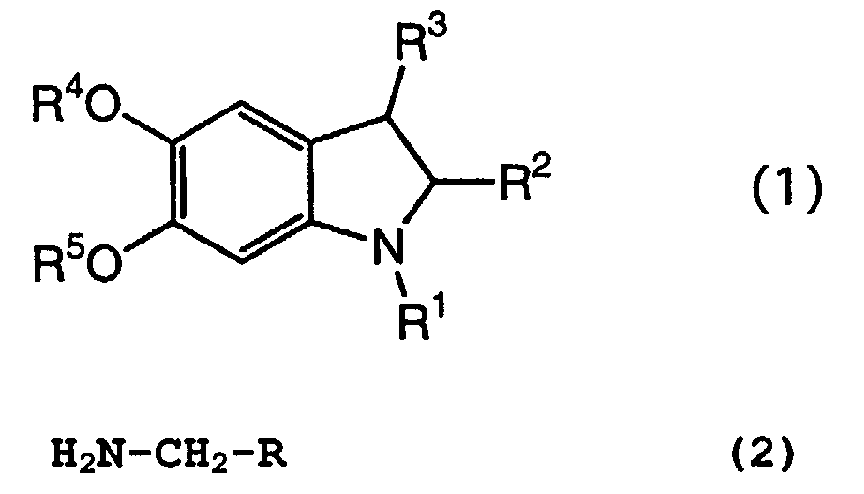
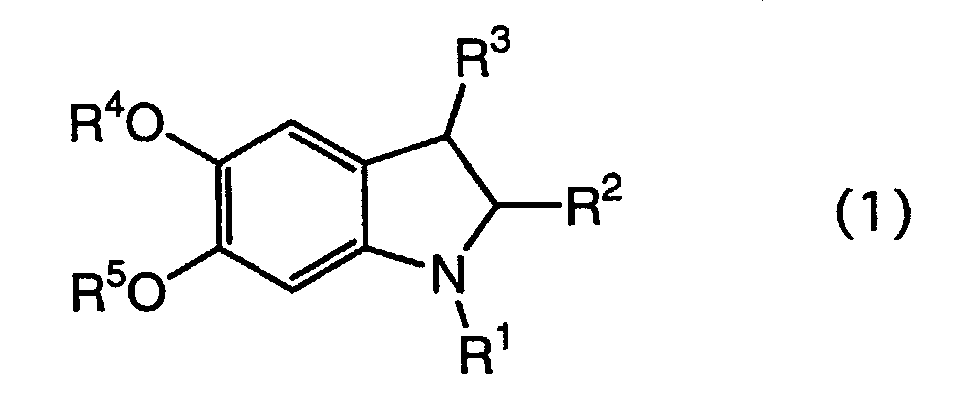
- an air-oxidative, one-pack type hair dye composition comprising an indoline derivative represented by the following formula (1): wherein, R 1 , R 4 and R 5 each independently represents a hydrogen atom, a C 1-4 alkyl group or a C 2-20 acyl group, and R 2 and R 3 each independently represents a hydrogen atom or a C 1-4 alkyl group, or salt thereof, and an amine represented by the following formula (2): H 2 N-CH 2 -R (2) wherein, R represents a hydrogen atom, a C 1-5 alkyl group which may be substituted with a hydroxyl group or a phenyl group which may have a substituent, or salt thereof; and has a pH ranging from 8.5 to 11.
- R 1 , R 4 and R 5 each independently represents a hydrogen atom, a C 1-4 alkyl group or a C 2-20 acyl group
- R 2 and R 3 each independently represents a hydrogen atom or a C 1-4 alkyl group, or salt thereof
- the hair dye composition of the present invention containing only an indoline derivative as a dye precursor has excellent dyeing ability, is capable of easily dyeing the hair into a color shade ranging from a natural chestnut color to a black color without a reddish cast so that it is particularly suited for covering gray or white hair of those having naturally black hair.
- FIG. 1 illustrates a difference in dyeing ability, depending on the kind of an alkali agent used in combination with the indoline derivative.
- Examples of the indoline derivative (1) usable in the present invention include 5,6-dihydroxyindoline, N-methyl-5,6-dihydroxyindoline, N-ethyl-5,6-dihydroxyindoline, N-butyl-5,6-dihydroxyindoline, 5-methoxy-6-hydroxyindoline, 2-methyl-5,6-dihydroxyindoline, 3-methyl-5,6-dihydroxyindoline, and 5-hydroxy-6-methoxyindoline. Of these, 5,6-dihydroxyindoline is preferred.
- Examples of the salts of these indoline derivatives include hydrochloride, hydrobromide, sulfate, phosphate, acetate, propionate, lactate and citrate. Of these, hydrobromide is preferred. Most preferred as the indoline derivative (1) or salt thereof is 5,6-dihydroxyindoline hydrobromide. This 5,6-dihydroxyindoline may be formed by incorporating it in the form of 5,6-diacyloxyindoline to a hair dye composition and then hydrolyzing the mixture under basic conditions.
- At least two of the above-described indoline derivatives (1) or salts thereof may be used in combination.
- Its (their) content is preferably 0.01 to 10 wt.%, especially 0.1 to 5 wt.% based on the whole composition (the whole composition except a propellant when the composition is in the aerosol form containing the propellant) in order to dye the hair into a shade ranging from a natural chestnut color to a black color without a reddish cast, which shade is suited for covering gray or white hair of those having naturally black hair.
- Examples of the amine (2) usable in the present invention include monoethanolamine, isopropanolamine, butylamine, and benzylamine.
- Examples of its salt include hydrochloride, hydrobromide, sulfate, phosphate, acetate, propionate, lactate and citrate.
- monoethanolamine and isopropanolamine are particularly preferred from the viewpoint of odor. At least two of these amines and salts thereof may be used in combination.
- amine (2) or salt thereof When the amine (2) or salt thereof is used alone as an alkali agent, hair can be dyed in a black color without a reddish cast.
- Use of ammonia in combination as the alkali agent makes it possible to dye the hair in a shade ranging from a natural chestnut color to a black color without a reddish cast.
- a dye containing only ammonia as an alkali agent hair is dyed in a shade inclining to red so such a dye is not effective for covering gray or white hair of those having naturally black hair.
- a weight ratio of the amine (2) or salt thereof to ammonia is preferably 1:99 to 100:0, more preferably 15:85 to 100:0, especially 15:85 to 99:1.
- hair can be dyed in a shade ranging from a natural chestnut color to a black color without a reddish cast which shade is suited for covering gray or white hair of those having naturally black hair.
- the greater the weight ratio of the amine (2) or salt thereof relative to ammonia the more the shade inclines to black.
- the total content of the alkali agent including the amine (2) or salt thereof and ammonia is preferably 0.01 to 20 wt.%, especially 0.1 to 10 wt.% based on the whole composition. Within this range, the composition has sufficient dyeing ability and is mild to skin.
- an antioxidant in order to prevent a deterioration in dyeing ability with the passage of time due to oxidation of the indoline derivative (1) or salt thereof.
- Preferred examples include sodium sulfite, ascorbic acid, thioglycolic acid and salts thereof, L-cysteine and salts thereof, and N-acetyl-L-cysteine and salts thereof.
- Sodium sulfite is especially preferred, because it not only contributes to stabilization of a dye precursor but also improves the dyeing ability.
- At least two of these antioxidants may be used in combination. Its (their) content is preferably 0.01 to 2 wt.%, especially 0.05 to 1 wt.% based on the whole composition. Within this range, hair can be dyed in a shade ranging from a natural chestnut color to a black color without a reddish cast, which shade is suited for covering gray or white hair of those having naturally black hair.
- the hair dye composition of the invention provides light touch when it is not thickened. Use of a thickener, on the other hand, can dispel the fear of sagging without damaging the dyeing ability.
- the viscosity of the hair dye composition is preferably 50 to 50000 mm 2 /s.
- thickener examples include cellulose derivatives such as hydroxyethyl cellulose, hydroxyethyl-cellulose-glycidyl trimethyl ammonium chloride ether, methyl cellulose and carboxymethyl cellulose; natural gums such as xanthan gum and guar gum; and synthetic polymers such as polyvinylpyrrolidone, crosslinked polyacrylic acid and salts thereof, polyacrylic acid and salts thereof and polyacrylamide.
- cellulose derivatives such as hydroxyethyl cellulose, hydroxyethyl-cellulose-glycidyl trimethyl ammonium chloride ether, methyl cellulose and carboxymethyl cellulose
- natural gums such as xanthan gum and guar gum
- synthetic polymers such as polyvinylpyrrolidone, crosslinked polyacrylic acid and salts thereof, polyacrylic acid and salts thereof and polyacrylamide.
- the indoline derivative (1) or salt thereof can be converted into a melanin dye, when reacted with oxygen in the air under basic conditions.
- the pH of the hair dye composition of the present invention to 8.5 to 11, preferably 9 to 10.5 when the composition contains the amine (2) or salt thereof as an alkali agent, the composition has improved dyeing ability and moreover, can dye the hair in a shade ranging from a natural chestnut color to a black color without a reddish cast which shade is effective for covering gray or white hair of those having naturally black hair.
- pH regulators such as inorganic or organic basic compounds such as sodium hydroxide, potassium hydroxide, sodium carbonate, sodium bicarbonate, arginine, lysine, histidine and guanidine; and inorganic or organic acids such as hydrochloric acid, sulfuric acid, phosphoric acid, citric acid and lactic acid are usable as needed.
- the hair dye composition of the present invention can be prepared in various forms such as cream, gel, lotion and foam. Of these, aerosol is preferred, because this form improves the dyeing ability of the composition and even after repeated use, it does not deteriorate the dyeing ability.
- the hair dye composition of the present invention in the aerosol form can be prepared by filling a pressure container (aerosol can or the like) with a propellant together with the composition except the propellant.
- the propellant compressed gas and liquefied gas which are ordinarily employed for aerosol products are usable.
- the compressed gas include nitrogen gas, carbon dioxide gas, and argon gas
- those of the liquefied gas include liquefied petroleum gas, saturated lower hydrocarbons, and dimethyl ether.
- At least two of these propellants may be used in combination. It is (or they are) incorporated in the aerosol type hair dye composition (including it or them) preferably in an amount of 1 to 20 wt.%, especially 3 to 15 wt.% in order to attain a sufficient jet rate.
- the internal pressure of an aerosol can filled with the composition is preferably adjusted to 3 to 5 kg/cm 2 G (25°C).
- crimping and deaeration are carried out simultaneously to reduce the air remaining inside the container.
- Such deaeration is effective for stabilizing the composition in the container.
- deaeration under pressure not greater than 48 kPa is preferred.
- the hair dye composition of the invention in the aerosol form preferably contains a nonionic surfactant as a foaming agent and/or homogenizing agent.
- the nonionic surfactant include polyoxyethylene alkyl ethers such as polyoxyethylene oleyl ether and polyoxyethylene stearyl ether; polyoxyethylene alkyl phenyl ethers such as polyoxyethylene nonylphenyl ether and polyoxyethylene octylphenyl ether; polyoxyethylene sorbitan fatty acid esters, fatty acid alkylolamides, and polyoxyethylene-sec-tetradecyl ether.
- the nonionic surfactant is preferably added in an amount of 0.01 to 30 wt.%, especially 0.1 to 10 wt.%, based on the whole composition except the propellant.
- the hair dye composition of the invention it is possible to add components, which are ordinarily employed for hair dyes, such as surfactant other than the above-described ones, stabilizer, buffer, perfume, touch improver, chelating agent, solubilizing agent, and antiseptic as needed, depending on the purpose.
- the hair dye composition of the invention For hair dyeing with the hair dye composition of the invention, it may be applied to hair, followed by oxidation of the indoline derivative (1) or salt thereof by oxygen in the air.
- the hair dye composition of the invention is also usable as a gradual hair dye. For example, after application of it to gray or white hair, the hair is allowed to stand for 1 to 10 minutes. When this operation is repeated twice or several times, the gray or white hair can be covered gradually without being noticed by someone.
- the hair dye composition of the invention can be used at room temperature, but its dyeing ability can be improved by feeding the dyed hair with heat and oxygen by a drier.
- Example 1 Comparison in dyeing ability among dye solutions containing different alkali agents -
- Dye solutions were prepared by mixing 1 wt.% of 5,6-dihydroxyindoline hydrobromide and, as an alkali agent, ammonia, monoethanolamine, isopropanolamine, 2-amino-2-methylpropanol, sodium carbonate and potassium carbonate, respectively, so as to adjust the concentration of each of the alkali agent to 0.1, 0.25, 0.5, 1 or 2 mol/kg.
- an alkali agent ammonia, monoethanolamine, isopropanolamine, 2-amino-2-methylpropanol, sodium carbonate and potassium carbonate, respectively, so as to adjust the concentration of each of the alkali agent to 0.1, 0.25, 0.5, 1 or 2 mol/kg.
- To the tress of goat hair 1 g of the dye solution was applied. After dyeing at 30°C for 15 minutes, the tress was washed with water, shampooed, rinsed and then dried.
- Dye solutions having the compositions as shown in Tables 1 to 3 were prepared and applied to gray or white hair. After dyeing at 30°C for 15 minutes, the hair was washed with water, shampooed, rinsed and then dried.
- the shade of the dyed hair was evaluated in accordance with the following standards.
- Dye solutions having the compositions as shown in Tables 4 and 5 were prepared and in a similar manner and similar standards to those employed for Examples 2 to 4 and Comparative Examples 1 to 8, the shade of the dyed hair was evaluated. (wt.%) Comp. Ex. Examples 9 5 6 7 5,6-Dihydroxyindoline hydrobromide 1 1 1 1 Monoethanolamine 3 3 3 3 10 wt.% Sulfuric acid q.s. for pH regulation q.s. for pH regulation q.s. for pH regulation q.s..
- Dye solutions having the compositions as shown in Table 6 were prepared and applied to gray or white hair. After dyeing at 30°C for 15 minutes, the hair was washed with water, shampooed, rinsed and then dried. A series of these operations was repeated five times and the shade of the dyed hair was evaluated by the following standards: (Evaluation standards)
- Example 17 Dyeing method by feeding the dyed hair with heat and oxygen by a drier -
Landscapes
- Life Sciences & Earth Sciences (AREA)
- Health & Medical Sciences (AREA)
- Animal Behavior & Ethology (AREA)
- General Health & Medical Sciences (AREA)
- Public Health (AREA)
- Veterinary Medicine (AREA)
- Birds (AREA)
- Epidemiology (AREA)
- Cosmetics (AREA)
Abstract
Description
| (wt.%) | |||
| Examples | |||
| 2 | 3 | 4 | |
| 5,6- |
1 | 1 | 1 |
| Monoethanolamine | 3.1 | - | - |
| Isopropanolamine | - | 3.8 | - |
| Benzylamine | - | - | 5.4 |
| Water | Balance | Balance | Balance |
| pH | 10.3 | 10.4 | 10.5 |
| Shade of dyed hair | A | A | A |
| (wt.%) | ||||
| Comparative Examples | ||||
| 1 | 2 | 3 | 4 | |
| 5,6- |
1 | 1 | 1 | 1 |
| 2-Amino-2-methylpropanol | 4.5 | - | - | - |
| 2-Amino-2-methyl-1,3-propanediol | - | 5.3 | - | - |
| Morpholine | - | - | 4.4 | |
| Guanidine carbonate | - | - | - | 4.5 |
| Water | Balance | Balance | Balance | Balance |
| pH | 10.5 | 9.7 | 9.5 | 10.1 |
| Shade of dyed hair | B | B | B | B |
| (wt.%) | ||||
| Comparative Examples | ||||
| 5 | 6 | 7 | 8 | |
| 5,6- |
1 | 1 | 1 | 1 |
| 28 wt.% aqueous ammonia | 3 | - | - | - |
| Sodium carbonate | - | 2.7 | - | - |
| Potassium carbonate | - | - | 3.5 | |
| Arginine | - | - | - | 8.7 |
| Water | Balance | Balance | Balance | Balance |
| pH | 10.1 | 10.1 | 10.2 | 10.0 |
| Shade of dyed hair | D | C | C | C |
| (wt.%) | ||||
| Comp. Ex. | Examples | |||
| 9 | 5 | 6 | 7 | |
| 5,6- | 1 | 1 | 1 | 1 |
| Monoethanolamine | 3 | 3 | 3 | 3 |
| 10 wt.% Sulfuric acid | q.s. for pH regulation | q.s. for pH regulation | q.s. for pH regulation | q.s. for pH regulation |
| Water | Balance | Balance | | Balance |
| pH | ||||
| 8 | 8.5 | 9 | 10 | |
| Shade of dyed hair | C | B | A | A |
| (wt.%) | ||||
| Comparative Examples | ||||
| 10 | 11 | 12 | 13 | |
| 5,6- | 1 | 1 | 1 | 1 |
| 28 wt.% Aqueous ammonia | 3 | 3 | 3 | 3 |
| 10 wt.% Sulfuric acid | q.s. for pH regulation | q.s. for pH regulation | q.s. for pH regulation | q.s. for pH regulation |
| Water | Balance | Balance | | Balance |
| pH | ||||
| 8 | 8.5 | 9 | 10 | |
| Shade of dyed hair | D | D | D | D |
(Evaluation standards)
| (wt.%) | ||
| Example 8 | Comp. Ex. 14 | |
| 5,6-Dihydroxyindoline hydrobromide | 0.1 | 0.1 |
| Monoethanolamine | 0.3 | - |
| 28 wt.% aqueous ammonia | - | 0.3 |
| Water | Balance | Balance |
| pH | 10.3 | 10.0 |
| Shade of hair dyed 5 times | B | D |
| (wt.%) | ||||
| Examples | Comp. Ex. | |||
| 9 | 10 | 11 | 15 | |
| 5,6- | 1 | 1 | 1 | 1 |
| Monoethanolamine | 2.7 | 1.5 | 0.6 | - |
| 28 wt.% Aqueous ammonia | 0.3 | 1.5 | 2.4 | 3.0 |
| Sodium sulfite | 0.1 | 0.1 | 0.1 | 0.1 |
| | 1 | 1 | 1 | 1 |
| Water | Balance | Balance | Balance | Balance |
| pH | 10.3 | 10.2 | 10.1 | 10.0 |
| Shade of dyed hair | Black | Dark chestnut | Chestnut | Chestnut strongly tinged with red |
| (wt.%) | ||||
| Examples | Comp. Ex. | |||
| 12 | 13 | 14 | 16 | |
| 5,6-Dihydroxyindoline hydrobromide | 0.1 | 0.1 | 0.1 | 0.1 |
| Monoethanolamine | 0.27 | 0.15 | 0.06 | - |
| 28 wt.% Aqueous ammonia | 0.03 | 0.15 | 0.24 | 0.3 |
| Sodium sulfite | 0.1 | 0.1 | 0.1 | 0.1 |
| | 1 | 1 | 1 | 1 |
| Water | Balance | Balance | Balance | Balance |
| pH | 10.3 | 10.2 | 10.1 | 10.0 |
| Shade of hair dyed 5 times | Black | Dark chestnut | Chestnut | Chestnut strongly tinged with red |
| Composition (wt.%) | Examples (aerosol) | Comp. Ex. (creany) | ||
| 15 | 16 | 17 | 18 | |
| 5,6-Dihydroxyindoline hydrobromide | 0.35 | 0.35 | ||
| Softanol 90 | 0.1 | - | ||
| Monoethanolamine | 3 | - | ||
| Monoethanolamine hydrochloride | Amount to adjust pH to 9 | - | ||
| Xantan gum | 1 | - | ||
| Cetyl/stearyl alcohol (30:70) | - | 6 | ||
| Coconut oil fatty alcohol | - | 2 | ||
| Cetyl/stearyl alcohol (30:70) polyglycol ether (20EO) | - | 2 | ||
| 28 wt.% aqueous ammonia | - | 3 | ||
| Ammonium sulfate | - | Amount to adjust pH to 9 | ||
| Sodium sulfite | 0.1 | - | 0.1 | - |
| Ascorbic acid | - | 0.1 | - | 0.1 |
| Water | Balance | Balance | ||
| Color difference (ΔE) before and after dyeing | 45 | 43 | 35 | 35 |
Claims (6)
- An air-oxidative, one-pack type hair dye composition comprising an indoline derivative represented by the following formula (1):wherein, R1, R4 and R5 each independently represents a hydrogen atom, a C1-4 alkyl group or a C2-20 acyl group, and R2 and R3 each independently represents a hydrogen atom or a C1-4 alkyl group, or salt thereof, and an amine represented by the following formula (2):

- A one-pack type hair dye composition of Claim 1, further comprising ammonia.
- A one-pack type hair dye composition in the aerosol form, which comprises a stock solution containing a composition of Claim 1 or 2 and an antioxidant; and a propellant.
- A hair dyeing method, which comprises applying a one-pack type hair dye composition of any one of Claims 1 to 3 to the hair.
- A hair dyeing method, which comprises applying a one-pack type hair dye composition of any one of Claims 1 to 3 to the hair and feeding the dyed hair with heat and oxygen by a drier.
- A hair dyeing method of Claim 4 or 5, further comprising adjusting a weight ratio, in the hair dye composition, of the amine of the formula (2) or salt thereof to ammonia, whereby the hair is dyed in a desired shade ranging from chestnut to black.
Applications Claiming Priority (6)
| Application Number | Priority Date | Filing Date | Title |
|---|---|---|---|
| JP2001124258A JP4886117B2 (en) | 2001-04-23 | 2001-04-23 | Aerosol hair dye composition |
| JP2001124256A JP4800502B2 (en) | 2001-04-23 | 2001-04-23 | Hair dye composition |
| JP2001124257A JP5002091B2 (en) | 2001-04-23 | 2001-04-23 | Hair dye composition |
| JP2001124258 | 2001-04-23 | ||
| JP2001124257 | 2001-04-23 | ||
| JP2001124256 | 2001-04-23 |
Publications (3)
| Publication Number | Publication Date |
|---|---|
| EP1254650A2 true EP1254650A2 (en) | 2002-11-06 |
| EP1254650A3 EP1254650A3 (en) | 2004-01-07 |
| EP1254650B1 EP1254650B1 (en) | 2007-07-18 |
Family
ID=27346588
Family Applications (1)
| Application Number | Title | Priority Date | Filing Date |
|---|---|---|---|
| EP20020008285 Expired - Lifetime EP1254650B1 (en) | 2001-04-23 | 2002-04-22 | Hair dye composition |
Country Status (2)
| Country | Link |
|---|---|
| EP (1) | EP1254650B1 (en) |
| DE (1) | DE60221179T2 (en) |
Cited By (9)
| Publication number | Priority date | Publication date | Assignee | Title |
|---|---|---|---|---|
| WO2006097167A1 (en) * | 2005-03-18 | 2006-09-21 | Henkel Kommanditgesellschaft Auf Aktien | Ammonia-free oxidation dye for dyeing keratin fibers with atmospheric oxygen serving as the sole oxidizing agent |
| WO2007141918A1 (en) * | 2006-06-07 | 2007-12-13 | Kao Corporation | One-pack hair dye composition |
| WO2007141920A1 (en) * | 2006-06-07 | 2007-12-13 | Kao Corporation | One-pack hair dye composition |
| WO2007141164A3 (en) * | 2006-06-02 | 2008-01-31 | Henkel Kgaa | Application device for using an application liquid on keratin fibers |
| WO2008151858A2 (en) | 2007-06-13 | 2008-12-18 | Henkel Ag & Co. Kgaa | Oxidation dyes for dyeing fibres containing keratin using atmospheric oxygen as the only oxidation agent |
| US7862625B2 (en) | 2006-06-07 | 2011-01-04 | Kao Corporation | One-part hair dye composition |
| WO2011086285A1 (en) * | 2009-12-23 | 2011-07-21 | L'oreal | Composition for dyeing keratin fibres including at least one ortho-diphenol derivative, and oxidising agent, a clay and an alkalising agent |
| EP3714870A4 (en) * | 2017-11-20 | 2021-09-01 | Kao Corporation | HAIR COSMETIC PRODUCT |
| KR20250149864A (en) | 2024-04-10 | 2025-10-17 | (주) 에프엔지리서치 | Hair dyeing composition |
Families Citing this family (1)
| Publication number | Priority date | Publication date | Assignee | Title |
|---|---|---|---|---|
| FR2950054B1 (en) * | 2009-09-16 | 2011-10-07 | Chanel Parfums Beaute | COSMETIC COMPOSITION COMPRISING A LEUCODOPACHROME DERIVATIVE |
Family Cites Families (5)
| Publication number | Priority date | Publication date | Assignee | Title |
|---|---|---|---|---|
| FR2662701B1 (en) * | 1990-05-31 | 1997-07-18 | Oreal | TINCTORIAL COMPOSITION BASED ON 5,6-DIHYDROXYINDOLINES AND METHOD FOR DYEING KERATINIC FIBERS. |
| DE4208297A1 (en) * | 1992-03-16 | 1993-09-23 | Henkel Kgaa | COLORING KERATINIC FIBERS WITH INDOLINES UNDER METAL CATALYSIS |
| FR2769835B1 (en) * | 1997-10-22 | 1999-11-26 | Oreal | KERATINIC FIBER OXIDATION DYE COMPOSITION AND DYEING METHOD USING THE SAME |
| BR9806825A (en) * | 1997-10-22 | 2000-04-25 | Oreal | Ready-to-use composition, keratin fibers dyeing process and multi-compartment device |
| DE19827000A1 (en) * | 1998-06-23 | 1999-12-30 | Henkel Kgaa | Intensifying and/or imparting nuances to color obtained on dyeing keratinic fibers, especially hair, with oxidation dye containing indoline or indole derivative |
-
2002
- 2002-04-22 DE DE2002621179 patent/DE60221179T2/en not_active Expired - Lifetime
- 2002-04-22 EP EP20020008285 patent/EP1254650B1/en not_active Expired - Lifetime
Cited By (18)
| Publication number | Priority date | Publication date | Assignee | Title |
|---|---|---|---|---|
| WO2006097167A1 (en) * | 2005-03-18 | 2006-09-21 | Henkel Kommanditgesellschaft Auf Aktien | Ammonia-free oxidation dye for dyeing keratin fibers with atmospheric oxygen serving as the sole oxidizing agent |
| WO2007141164A3 (en) * | 2006-06-02 | 2008-01-31 | Henkel Kgaa | Application device for using an application liquid on keratin fibers |
| US7857862B2 (en) | 2006-06-07 | 2010-12-28 | Kao Corporation | One-part hair dye composition |
| WO2007141918A1 (en) * | 2006-06-07 | 2007-12-13 | Kao Corporation | One-pack hair dye composition |
| WO2007141920A1 (en) * | 2006-06-07 | 2007-12-13 | Kao Corporation | One-pack hair dye composition |
| CN101460137B (en) * | 2006-06-07 | 2011-04-27 | 花王株式会社 | One-pack type hair dye composition |
| US7862625B2 (en) | 2006-06-07 | 2011-01-04 | Kao Corporation | One-part hair dye composition |
| US7857863B2 (en) | 2006-06-07 | 2010-12-28 | Kao Corporation | One-part hair dye composition |
| WO2008151858A2 (en) | 2007-06-13 | 2008-12-18 | Henkel Ag & Co. Kgaa | Oxidation dyes for dyeing fibres containing keratin using atmospheric oxygen as the only oxidation agent |
| WO2008151858A3 (en) * | 2007-06-13 | 2010-01-07 | Henkel Ag & Co. Kgaa | Oxidation dyes for dyeing fibres containing keratin using atmospheric oxygen as the only oxidation agent |
| DE102007027856A1 (en) | 2007-06-13 | 2008-12-24 | Henkel Ag & Co. Kgaa | Oxidation colorant for coloring keratin-containing fibers with atmospheric oxygen as the sole oxidant |
| WO2011086285A1 (en) * | 2009-12-23 | 2011-07-21 | L'oreal | Composition for dyeing keratin fibres including at least one ortho-diphenol derivative, and oxidising agent, a clay and an alkalising agent |
| FR2962032A1 (en) * | 2009-12-23 | 2012-01-06 | Oreal | COMPOSITION FOR COLORING KERATIN FIBERS COMPRISING AT LEAST ONE ORTHODIPHENOL DERIVATIVE, AN OXIDIZING AGENT, A CLAY AND AN ALKALINIZING AGENT |
| CN102781412A (en) * | 2009-12-23 | 2012-11-14 | 莱雅公司 | Composition for dyeing keratin fibres including at least one ortho-diphenol derivative, and oxidising agent, a clay and an alkalising agent |
| CN102781412B (en) * | 2009-12-23 | 2016-05-11 | 莱雅公司 | Derivative, oxidant, clay and the basifier that comprises at least one catechol for dyeing keratin fibres composition |
| EP3714870A4 (en) * | 2017-11-20 | 2021-09-01 | Kao Corporation | HAIR COSMETIC PRODUCT |
| US11229593B2 (en) | 2017-11-20 | 2022-01-25 | Kao Corporation | Hair cosmetic |
| KR20250149864A (en) | 2024-04-10 | 2025-10-17 | (주) 에프엔지리서치 | Hair dyeing composition |
Also Published As
| Publication number | Publication date |
|---|---|
| DE60221179D1 (en) | 2007-08-30 |
| EP1254650A3 (en) | 2004-01-07 |
| EP1254650B1 (en) | 2007-07-18 |
| DE60221179T2 (en) | 2008-03-20 |
Similar Documents
| Publication | Publication Date | Title |
|---|---|---|
| US5752983A (en) | Composition for oxidation dyeing of keratinous fibres comprising an oxidation base, a coupler, and 4-hydroxyindole as coupler and dyeing process with this composition | |
| US5785717A (en) | Composition for the oxidation dyeing of keratin fibers, comprising a diaminopyrazole derivative and a heterocyclic coupler, and dyeing process | |
| KR0175948B1 (en) | Oxidation colorants for keratin fires | |
| KR100336679B1 (en) | Composition for dyeing keratin fibres and dyeing method using the same | |
| US4208183A (en) | Process for improving the storage stability of indole dyestuffs | |
| US5609650A (en) | Dyeing of keratin fibres with indolines using metal salts as catalysts | |
| KR19980064476A (en) | Compositions for oxidative dyeing of keratin fibers and dyeing methods using the same | |
| US20010009044A1 (en) | Oxidative hair dye precursor compositions containing 4-5-diaminopyrazole, 5-amino-2-methylphenol and m-phenylenediamine compounds and method of dyeing hair | |
| US5741337A (en) | Process for the oxidative dyeing of keratinous fibres with a composition which contains an oxidation dye precursor, a coupler, and an oxidant at an acidic pH | |
| HU221065B1 (en) | Composition for the oxidation dyeing of keratinous fibres and dyeing process for using this composition | |
| EP1254650B1 (en) | Hair dye composition | |
| US5900028A (en) | Oxidation dye composition for keratin fibres comprising 2-amino-3-hydroxypyridine and a P-phenylenediamine or P-aminophenol oxidation base, and dyeing process | |
| US6740127B2 (en) | Agent and method for coloring keratin fibres | |
| US5180399A (en) | Process for dyeing keratinous fibres with oxidation bases combined with an iodide and dyeing composition employed | |
| EP1442735B1 (en) | Hair dye composition | |
| US5620484A (en) | Compositions and processes for dyeing keratin fibres with 6-hydroxyindoline and oxidation bases at acid pH's | |
| JP4886117B2 (en) | Aerosol hair dye composition | |
| US5814106A (en) | Composition for the oxidation dyeing of keratin fibres contains a 4-hydroxyindoline coupler at an acidic pH and dyeing process using this composition | |
| JPH05500224A (en) | Level dyeing oxidation hair dye | |
| US5873910A (en) | Process for the two-stage oxidation dyeing of keratin fibers with a manganese complex or salt and a 4-substituted 1-naphthol, and dyeing kit | |
| HU220148B (en) | Composition for the oxidative dyeing of keratinic fibers and dyeing process applying them | |
| EP1142561A1 (en) | Hair dye compositions | |
| US5089026A (en) | Dyeing composition for keratin fiber | |
| AU641560B2 (en) | Compositions containing nitroaniline dyes having a carbamide substituent group | |
| US5968206A (en) | Compositions and processes for the oxidative dyeing of keratin fibers with para-phenylenediamine derivatives and 4-hydroxyindule at basic ph's |
Legal Events
| Date | Code | Title | Description |
|---|---|---|---|
| PUAI | Public reference made under article 153(3) epc to a published international application that has entered the european phase |
Free format text: ORIGINAL CODE: 0009012 |
|
| AK | Designated contracting states |
Kind code of ref document: A2 Designated state(s): AT BE CH CY DE DK ES FI FR GB GR IE IT LI LU MC NL PT SE TR |
|
| AX | Request for extension of the european patent |
Free format text: AL;LT;LV;MK;RO;SI |
|
| PUAL | Search report despatched |
Free format text: ORIGINAL CODE: 0009013 |
|
| AK | Designated contracting states |
Kind code of ref document: A3 Designated state(s): AT BE CH CY DE DK ES FI FR GB GR IE IT LI LU MC NL PT SE TR |
|
| AX | Request for extension of the european patent |
Extension state: AL LT LV MK RO SI |
|
| 17P | Request for examination filed |
Effective date: 20040623 |
|
| AKX | Designation fees paid |
Designated state(s): DE FR GB |
|
| GRAP | Despatch of communication of intention to grant a patent |
Free format text: ORIGINAL CODE: EPIDOSNIGR1 |
|
| RIC1 | Information provided on ipc code assigned before grant |
Ipc: A61Q 5/10 20060101AFI20061222BHEP Ipc: A61K 8/49 20060101ALI20061222BHEP Ipc: A61K 8/41 20060101ALI20061222BHEP |
|
| GRAS | Grant fee paid |
Free format text: ORIGINAL CODE: EPIDOSNIGR3 |
|
| GRAA | (expected) grant |
Free format text: ORIGINAL CODE: 0009210 |
|
| AK | Designated contracting states |
Kind code of ref document: B1 Designated state(s): DE FR GB |
|
| REG | Reference to a national code |
Ref country code: GB Ref legal event code: FG4D |
|
| REF | Corresponds to: |
Ref document number: 60221179 Country of ref document: DE Date of ref document: 20070830 Kind code of ref document: P |
|
| ET | Fr: translation filed | ||
| PLBE | No opposition filed within time limit |
Free format text: ORIGINAL CODE: 0009261 |
|
| STAA | Information on the status of an ep patent application or granted ep patent |
Free format text: STATUS: NO OPPOSITION FILED WITHIN TIME LIMIT |
|
| 26N | No opposition filed |
Effective date: 20080421 |
|
| REG | Reference to a national code |
Ref country code: FR Ref legal event code: PLFP Year of fee payment: 15 |
|
| REG | Reference to a national code |
Ref country code: FR Ref legal event code: PLFP Year of fee payment: 16 |
|
| REG | Reference to a national code |
Ref country code: FR Ref legal event code: PLFP Year of fee payment: 17 |
|
| PGFP | Annual fee paid to national office [announced via postgrant information from national office to epo] |
Ref country code: FR Payment date: 20210309 Year of fee payment: 20 |
|
| PGFP | Annual fee paid to national office [announced via postgrant information from national office to epo] |
Ref country code: GB Payment date: 20210331 Year of fee payment: 20 |
|
| PGFP | Annual fee paid to national office [announced via postgrant information from national office to epo] |
Ref country code: DE Payment date: 20210323 Year of fee payment: 20 |
|
| REG | Reference to a national code |
Ref country code: DE Ref legal event code: R071 Ref document number: 60221179 Country of ref document: DE |
|
| REG | Reference to a national code |
Ref country code: GB Ref legal event code: PE20 Expiry date: 20220421 |
|
| PG25 | Lapsed in a contracting state [announced via postgrant information from national office to epo] |
Ref country code: GB Free format text: LAPSE BECAUSE OF EXPIRATION OF PROTECTION Effective date: 20220421 |