EP1253196A2 - Substratum for cell culture, production of the same, cell culture method and cell culture apparatus using the same - Google Patents
Substratum for cell culture, production of the same, cell culture method and cell culture apparatus using the same Download PDFInfo
- Publication number
- EP1253196A2 EP1253196A2 EP02007010A EP02007010A EP1253196A2 EP 1253196 A2 EP1253196 A2 EP 1253196A2 EP 02007010 A EP02007010 A EP 02007010A EP 02007010 A EP02007010 A EP 02007010A EP 1253196 A2 EP1253196 A2 EP 1253196A2
- Authority
- EP
- European Patent Office
- Prior art keywords
- substratum
- cell
- substance
- culture
- area
- Prior art date
- Legal status (The legal status is an assumption and is not a legal conclusion. Google has not performed a legal analysis and makes no representation as to the accuracy of the status listed.)
- Granted
Links
- 238000004113 cell culture Methods 0.000 title claims abstract description 105
- 238000004519 manufacturing process Methods 0.000 title description 28
- 239000000126 substance Substances 0.000 claims abstract description 214
- 239000007788 liquid Substances 0.000 claims abstract description 34
- 230000035755 proliferation Effects 0.000 claims abstract description 30
- 230000004069 differentiation Effects 0.000 claims abstract description 27
- 230000006907 apoptotic process Effects 0.000 claims abstract description 23
- 238000012423 maintenance Methods 0.000 claims abstract description 23
- 230000004083 survival effect Effects 0.000 claims abstract description 23
- 239000000758 substrate Substances 0.000 claims abstract description 18
- 230000003100 immobilizing effect Effects 0.000 claims abstract description 13
- 238000000034 method Methods 0.000 claims description 64
- 239000001963 growth medium Substances 0.000 claims description 39
- 230000008569 process Effects 0.000 claims description 33
- 230000004663 cell proliferation Effects 0.000 claims description 19
- 238000012258 culturing Methods 0.000 claims description 19
- 230000024245 cell differentiation Effects 0.000 claims description 17
- 125000000524 functional group Chemical group 0.000 claims description 10
- 230000001678 irradiating effect Effects 0.000 claims description 2
- 150000001875 compounds Chemical class 0.000 claims 1
- 230000006870 function Effects 0.000 abstract description 18
- NOESYZHRGYRDHS-UHFFFAOYSA-N insulin Chemical compound N1C(=O)C(NC(=O)C(CCC(N)=O)NC(=O)C(CCC(O)=O)NC(=O)C(C(C)C)NC(=O)C(NC(=O)CN)C(C)CC)CSSCC(C(NC(CO)C(=O)NC(CC(C)C)C(=O)NC(CC=2C=CC(O)=CC=2)C(=O)NC(CCC(N)=O)C(=O)NC(CC(C)C)C(=O)NC(CCC(O)=O)C(=O)NC(CC(N)=O)C(=O)NC(CC=2C=CC(O)=CC=2)C(=O)NC(CSSCC(NC(=O)C(C(C)C)NC(=O)C(CC(C)C)NC(=O)C(CC=2C=CC(O)=CC=2)NC(=O)C(CC(C)C)NC(=O)C(C)NC(=O)C(CCC(O)=O)NC(=O)C(C(C)C)NC(=O)C(CC(C)C)NC(=O)C(CC=2NC=NC=2)NC(=O)C(CO)NC(=O)CNC2=O)C(=O)NCC(=O)NC(CCC(O)=O)C(=O)NC(CCCNC(N)=N)C(=O)NCC(=O)NC(CC=3C=CC=CC=3)C(=O)NC(CC=3C=CC=CC=3)C(=O)NC(CC=3C=CC(O)=CC=3)C(=O)NC(C(C)O)C(=O)N3C(CCC3)C(=O)NC(CCCCN)C(=O)NC(C)C(O)=O)C(=O)NC(CC(N)=O)C(O)=O)=O)NC(=O)C(C(C)CC)NC(=O)C(CO)NC(=O)C(C(C)O)NC(=O)C1CSSCC2NC(=O)C(CC(C)C)NC(=O)C(NC(=O)C(CCC(N)=O)NC(=O)C(CC(N)=O)NC(=O)C(NC(=O)C(N)CC=1C=CC=CC=1)C(C)C)CC1=CN=CN1 NOESYZHRGYRDHS-UHFFFAOYSA-N 0.000 description 141
- 210000004027 cell Anatomy 0.000 description 135
- 229940125396 insulin Drugs 0.000 description 71
- 102000004877 Insulin Human genes 0.000 description 70
- 108090001061 Insulin Proteins 0.000 description 70
- 239000000243 solution Substances 0.000 description 32
- 102000016359 Fibronectins Human genes 0.000 description 19
- 108010067306 Fibronectins Proteins 0.000 description 19
- LFQSCWFLJHTTHZ-UHFFFAOYSA-N Ethanol Chemical compound CCO LFQSCWFLJHTTHZ-UHFFFAOYSA-N 0.000 description 17
- -1 polyethylene terephthalate Polymers 0.000 description 17
- 239000000853 adhesive Substances 0.000 description 15
- 230000001070 adhesive effect Effects 0.000 description 15
- 239000008055 phosphate buffer solution Substances 0.000 description 15
- 230000021164 cell adhesion Effects 0.000 description 13
- 238000011282 treatment Methods 0.000 description 13
- VBEQCZHXXJYVRD-GACYYNSASA-N uroanthelone Chemical compound C([C@@H](C(=O)N[C@H](C(=O)N[C@@H](CS)C(=O)N[C@@H](CC(N)=O)C(=O)N[C@@H](CS)C(=O)N[C@H](C(=O)N[C@@H]([C@@H](C)CC)C(=O)NCC(=O)N[C@@H](CC=1C=CC(O)=CC=1)C(=O)N[C@@H](CO)C(=O)NCC(=O)N[C@@H](CC(O)=O)C(=O)N[C@@H](CCCNC(N)=N)C(=O)N[C@@H](CS)C(=O)N[C@@H](CCC(N)=O)C(=O)N[C@@H]([C@@H](C)O)C(=O)N[C@@H](CCCNC(N)=N)C(=O)N[C@@H](CC(O)=O)C(=O)N[C@@H](CC(C)C)C(=O)N[C@@H](CCCNC(N)=N)C(=O)N[C@@H](CC=1C2=CC=CC=C2NC=1)C(=O)N[C@@H](CC=1C2=CC=CC=C2NC=1)C(=O)N[C@@H](CCC(O)=O)C(=O)N[C@@H](CC(C)C)C(=O)N[C@@H](CCCNC(N)=N)C(O)=O)C(C)C)[C@@H](C)O)NC(=O)[C@H](CO)NC(=O)[C@H](CC(O)=O)NC(=O)[C@H](CC(C)C)NC(=O)[C@H](CO)NC(=O)[C@H](CCC(O)=O)NC(=O)[C@@H](NC(=O)[C@H](CC=1NC=NC=1)NC(=O)[C@H](CCSC)NC(=O)[C@H](CS)NC(=O)[C@@H](NC(=O)CNC(=O)CNC(=O)[C@H](CC(N)=O)NC(=O)[C@H](CC(C)C)NC(=O)[C@H](CS)NC(=O)[C@H](CC=1C=CC(O)=CC=1)NC(=O)CNC(=O)[C@H](CC(O)=O)NC(=O)[C@H](CC=1C=CC(O)=CC=1)NC(=O)[C@H](CO)NC(=O)[C@H](CO)NC(=O)[C@H]1N(CCC1)C(=O)[C@H](CS)NC(=O)CNC(=O)[C@H]1N(CCC1)C(=O)[C@H](CC=1C=CC(O)=CC=1)NC(=O)[C@H](CO)NC(=O)[C@@H](N)CC(N)=O)C(C)C)[C@@H](C)CC)C1=CC=C(O)C=C1 VBEQCZHXXJYVRD-GACYYNSASA-N 0.000 description 13
- 239000011521 glass Substances 0.000 description 12
- XLYOFNOQVPJJNP-UHFFFAOYSA-N water Substances O XLYOFNOQVPJJNP-UHFFFAOYSA-N 0.000 description 12
- 102000009024 Epidermal Growth Factor Human genes 0.000 description 11
- 101800003838 Epidermal growth factor Proteins 0.000 description 11
- 229940116977 epidermal growth factor Drugs 0.000 description 11
- KFZMGEQAYNKOFK-UHFFFAOYSA-N Isopropanol Chemical compound CC(C)O KFZMGEQAYNKOFK-UHFFFAOYSA-N 0.000 description 10
- 238000000206 photolithography Methods 0.000 description 10
- YBJHBAHKTGYVGT-ZKWXMUAHSA-N (+)-Biotin Chemical compound N1C(=O)N[C@@H]2[C@H](CCCCC(=O)O)SC[C@@H]21 YBJHBAHKTGYVGT-ZKWXMUAHSA-N 0.000 description 8
- 102000000589 Interleukin-1 Human genes 0.000 description 8
- 108010002352 Interleukin-1 Proteins 0.000 description 8
- 108010025020 Nerve Growth Factor Proteins 0.000 description 8
- 102000015336 Nerve Growth Factor Human genes 0.000 description 8
- 230000003915 cell function Effects 0.000 description 8
- 235000019441 ethanol Nutrition 0.000 description 8
- 229940053128 nerve growth factor Drugs 0.000 description 8
- 229920000729 poly(L-lysine) polymer Polymers 0.000 description 8
- 230000000630 rising effect Effects 0.000 description 8
- 229920002799 BoPET Polymers 0.000 description 7
- LYCAIKOWRPUZTN-UHFFFAOYSA-N Ethylene glycol Chemical compound OCCO LYCAIKOWRPUZTN-UHFFFAOYSA-N 0.000 description 7
- 229920002125 Sokalan® Polymers 0.000 description 7
- 210000002950 fibroblast Anatomy 0.000 description 7
- 239000004584 polyacrylic acid Substances 0.000 description 7
- 235000018102 proteins Nutrition 0.000 description 7
- 102000004169 proteins and genes Human genes 0.000 description 7
- 108090000623 proteins and genes Proteins 0.000 description 7
- PEDCQBHIVMGVHV-UHFFFAOYSA-N Glycerine Chemical compound OCC(O)CO PEDCQBHIVMGVHV-UHFFFAOYSA-N 0.000 description 6
- OKKJLVBELUTLKV-UHFFFAOYSA-N Methanol Chemical compound OC OKKJLVBELUTLKV-UHFFFAOYSA-N 0.000 description 6
- ZMXDDKWLCZADIW-UHFFFAOYSA-N N,N-Dimethylformamide Chemical compound CN(C)C=O ZMXDDKWLCZADIW-UHFFFAOYSA-N 0.000 description 6
- 102000004338 Transferrin Human genes 0.000 description 6
- 108090000901 Transferrin Proteins 0.000 description 6
- 125000000852 azido group Chemical group *N=[N+]=[N-] 0.000 description 6
- 230000010261 cell growth Effects 0.000 description 6
- 210000001787 dendrite Anatomy 0.000 description 6
- MTHSVFCYNBDYFN-UHFFFAOYSA-N diethylene glycol Chemical compound OCCOCCO MTHSVFCYNBDYFN-UHFFFAOYSA-N 0.000 description 6
- 230000012010 growth Effects 0.000 description 6
- 210000001519 tissue Anatomy 0.000 description 6
- 239000012581 transferrin Substances 0.000 description 6
- 108090001008 Avidin Proteins 0.000 description 5
- 230000008859 change Effects 0.000 description 5
- 238000006243 chemical reaction Methods 0.000 description 5
- 239000007795 chemical reaction product Substances 0.000 description 5
- 238000011161 development Methods 0.000 description 5
- 230000018109 developmental process Effects 0.000 description 5
- 238000001035 drying Methods 0.000 description 5
- 239000003102 growth factor Substances 0.000 description 5
- 239000002609 medium Substances 0.000 description 5
- 229920000139 polyethylene terephthalate Polymers 0.000 description 5
- 239000005020 polyethylene terephthalate Substances 0.000 description 5
- 239000008213 purified water Substances 0.000 description 5
- QOSSAOTZNIDXMA-UHFFFAOYSA-N Dicylcohexylcarbodiimide Chemical compound C1CCCCC1N=C=NC1CCCCC1 QOSSAOTZNIDXMA-UHFFFAOYSA-N 0.000 description 4
- WYURNTSHIVDZCO-UHFFFAOYSA-N Tetrahydrofuran Chemical compound C1CCOC1 WYURNTSHIVDZCO-UHFFFAOYSA-N 0.000 description 4
- 150000005215 alkyl ethers Chemical class 0.000 description 4
- 229960002685 biotin Drugs 0.000 description 4
- 235000020958 biotin Nutrition 0.000 description 4
- 239000011616 biotin Substances 0.000 description 4
- 239000012531 culture fluid Substances 0.000 description 4
- 210000004748 cultured cell Anatomy 0.000 description 4
- 230000000694 effects Effects 0.000 description 4
- 210000000663 muscle cell Anatomy 0.000 description 4
- 229920002120 photoresistant polymer Polymers 0.000 description 4
- BASFCYQUMIYNBI-UHFFFAOYSA-N platinum Chemical compound [Pt] BASFCYQUMIYNBI-UHFFFAOYSA-N 0.000 description 4
- 230000005855 radiation Effects 0.000 description 4
- 238000003860 storage Methods 0.000 description 4
- 238000009281 ultraviolet germicidal irradiation Methods 0.000 description 4
- CSCPPACGZOOCGX-UHFFFAOYSA-N Acetone Chemical compound CC(C)=O CSCPPACGZOOCGX-UHFFFAOYSA-N 0.000 description 3
- LRHPLDYGYMQRHN-UHFFFAOYSA-N N-Butanol Chemical compound CCCCO LRHPLDYGYMQRHN-UHFFFAOYSA-N 0.000 description 3
- NQTADLQHYWFPDB-UHFFFAOYSA-N N-Hydroxysuccinimide Chemical compound ON1C(=O)CCC1=O NQTADLQHYWFPDB-UHFFFAOYSA-N 0.000 description 3
- DNIAPMSPPWPWGF-UHFFFAOYSA-N Propylene glycol Chemical compound CC(O)CO DNIAPMSPPWPWGF-UHFFFAOYSA-N 0.000 description 3
- DKGAVHZHDRPRBM-UHFFFAOYSA-N Tert-Butanol Chemical compound CC(C)(C)O DKGAVHZHDRPRBM-UHFFFAOYSA-N 0.000 description 3
- HSFWRNGVRCDJHI-UHFFFAOYSA-N alpha-acetylene Natural products C#C HSFWRNGVRCDJHI-UHFFFAOYSA-N 0.000 description 3
- 150000001718 carbodiimides Chemical class 0.000 description 3
- 230000004956 cell adhesive effect Effects 0.000 description 3
- 239000011248 coating agent Substances 0.000 description 3
- 238000000576 coating method Methods 0.000 description 3
- 238000012136 culture method Methods 0.000 description 3
- 239000008367 deionised water Substances 0.000 description 3
- 229910021641 deionized water Inorganic materials 0.000 description 3
- 238000010790 dilution Methods 0.000 description 3
- 239000012895 dilution Substances 0.000 description 3
- 235000011187 glycerol Nutrition 0.000 description 3
- 125000005647 linker group Chemical group 0.000 description 3
- 239000000463 material Substances 0.000 description 3
- 239000000203 mixture Substances 0.000 description 3
- 210000002569 neuron Anatomy 0.000 description 3
- 229920002492 poly(sulfone) Polymers 0.000 description 3
- 230000002062 proliferating effect Effects 0.000 description 3
- 238000003756 stirring Methods 0.000 description 3
- 150000005846 sugar alcohols Polymers 0.000 description 3
- SVTBMSDMJJWYQN-UHFFFAOYSA-N 2-methylpentane-2,4-diol Chemical compound CC(O)CC(C)(C)O SVTBMSDMJJWYQN-UHFFFAOYSA-N 0.000 description 2
- PQXPAFTXDVNANI-UHFFFAOYSA-N 4-azidobenzoic acid Chemical compound OC(=O)C1=CC=C(N=[N+]=[N-])C=C1 PQXPAFTXDVNANI-UHFFFAOYSA-N 0.000 description 2
- 241000283690 Bos taurus Species 0.000 description 2
- 108090000695 Cytokines Proteins 0.000 description 2
- 102000004127 Cytokines Human genes 0.000 description 2
- BWGNESOTFCXPMA-UHFFFAOYSA-N Dihydrogen disulfide Chemical compound SS BWGNESOTFCXPMA-UHFFFAOYSA-N 0.000 description 2
- 239000004593 Epoxy Substances 0.000 description 2
- 108050007372 Fibroblast Growth Factor Proteins 0.000 description 2
- 102000018233 Fibroblast Growth Factor Human genes 0.000 description 2
- KRHYYFGTRYWZRS-UHFFFAOYSA-N Fluorane Chemical compound F KRHYYFGTRYWZRS-UHFFFAOYSA-N 0.000 description 2
- XEEYBQQBJWHFJM-UHFFFAOYSA-N Iron Chemical compound [Fe] XEEYBQQBJWHFJM-UHFFFAOYSA-N 0.000 description 2
- SECXISVLQFMRJM-UHFFFAOYSA-N N-Methylpyrrolidone Chemical compound CN1CCCC1=O SECXISVLQFMRJM-UHFFFAOYSA-N 0.000 description 2
- 229920003171 Poly (ethylene oxide) Polymers 0.000 description 2
- 239000004793 Polystyrene Substances 0.000 description 2
- 239000006087 Silane Coupling Agent Substances 0.000 description 2
- XLOMVQKBTHCTTD-UHFFFAOYSA-N Zinc monoxide Chemical compound [Zn]=O XLOMVQKBTHCTTD-UHFFFAOYSA-N 0.000 description 2
- UCTWMZQNUQWSLP-UHFFFAOYSA-N adrenaline Chemical compound CNCC(O)C1=CC=C(O)C(O)=C1 UCTWMZQNUQWSLP-UHFFFAOYSA-N 0.000 description 2
- 125000005907 alkyl ester group Chemical group 0.000 description 2
- 239000000427 antigen Substances 0.000 description 2
- 102000036639 antigens Human genes 0.000 description 2
- 108091007433 antigens Proteins 0.000 description 2
- 239000007864 aqueous solution Substances 0.000 description 2
- 230000008901 benefit Effects 0.000 description 2
- 230000015572 biosynthetic process Effects 0.000 description 2
- 238000006664 bond formation reaction Methods 0.000 description 2
- BTANRVKWQNVYAZ-UHFFFAOYSA-N butan-2-ol Chemical compound CCC(C)O BTANRVKWQNVYAZ-UHFFFAOYSA-N 0.000 description 2
- 238000005266 casting Methods 0.000 description 2
- 230000017455 cell-cell adhesion Effects 0.000 description 2
- 238000011109 contamination Methods 0.000 description 2
- 238000005516 engineering process Methods 0.000 description 2
- 210000003754 fetus Anatomy 0.000 description 2
- 229940126864 fibroblast growth factor Drugs 0.000 description 2
- OHMBHFSEKCCCBW-UHFFFAOYSA-N hexane-2,5-diol Chemical compound CC(O)CCC(C)O OHMBHFSEKCCCBW-UHFFFAOYSA-N 0.000 description 2
- 238000000338 in vitro Methods 0.000 description 2
- AMGQUBHHOARCQH-UHFFFAOYSA-N indium;oxotin Chemical compound [In].[Sn]=O AMGQUBHHOARCQH-UHFFFAOYSA-N 0.000 description 2
- 229910052809 inorganic oxide Inorganic materials 0.000 description 2
- 238000011835 investigation Methods 0.000 description 2
- 238000002372 labelling Methods 0.000 description 2
- 125000005439 maleimidyl group Chemical group C1(C=CC(N1*)=O)=O 0.000 description 2
- 229910052751 metal Inorganic materials 0.000 description 2
- 239000002184 metal Substances 0.000 description 2
- 230000000813 microbial effect Effects 0.000 description 2
- 210000004940 nucleus Anatomy 0.000 description 2
- 239000005022 packaging material Substances 0.000 description 2
- 230000000704 physical effect Effects 0.000 description 2
- 229910052697 platinum Inorganic materials 0.000 description 2
- 229920003213 poly(N-isopropyl acrylamide) Polymers 0.000 description 2
- 229920002401 polyacrylamide Polymers 0.000 description 2
- 239000002861 polymer material Substances 0.000 description 2
- 229920002223 polystyrene Polymers 0.000 description 2
- 239000000047 product Substances 0.000 description 2
- 230000001737 promoting effect Effects 0.000 description 2
- BDERNNFJNOPAEC-UHFFFAOYSA-N propan-1-ol Chemical compound CCCO BDERNNFJNOPAEC-UHFFFAOYSA-N 0.000 description 2
- 150000003839 salts Chemical class 0.000 description 2
- 238000012216 screening Methods 0.000 description 2
- 210000002966 serum Anatomy 0.000 description 2
- 239000002904 solvent Substances 0.000 description 2
- 239000013589 supplement Substances 0.000 description 2
- 230000001629 suppression Effects 0.000 description 2
- 239000004094 surface-active agent Substances 0.000 description 2
- YLQBMQCUIZJEEH-UHFFFAOYSA-N tetrahydrofuran Natural products C=1C=COC=1 YLQBMQCUIZJEEH-UHFFFAOYSA-N 0.000 description 2
- JLGLQAWTXXGVEM-UHFFFAOYSA-N triethylene glycol monomethyl ether Chemical compound COCCOCCOCCO JLGLQAWTXXGVEM-UHFFFAOYSA-N 0.000 description 2
- 239000003021 water soluble solvent Substances 0.000 description 2
- PUPZLCDOIYMWBV-UHFFFAOYSA-N (+/-)-1,3-Butanediol Chemical compound CC(O)CCO PUPZLCDOIYMWBV-UHFFFAOYSA-N 0.000 description 1
- WYTZZXDRDKSJID-UHFFFAOYSA-N (3-aminopropyl)triethoxysilane Chemical compound CCO[Si](OCC)(OCC)CCCN WYTZZXDRDKSJID-UHFFFAOYSA-N 0.000 description 1
- ZWVMLYRJXORSEP-UHFFFAOYSA-N 1,2,6-Hexanetriol Chemical compound OCCCCC(O)CO ZWVMLYRJXORSEP-UHFFFAOYSA-N 0.000 description 1
- RYHBNJHYFVUHQT-UHFFFAOYSA-N 1,4-Dioxane Chemical compound C1COCCO1 RYHBNJHYFVUHQT-UHFFFAOYSA-N 0.000 description 1
- SBASXUCJHJRPEV-UHFFFAOYSA-N 2-(2-methoxyethoxy)ethanol Chemical compound COCCOCCO SBASXUCJHJRPEV-UHFFFAOYSA-N 0.000 description 1
- XNWFRZJHXBZDAG-UHFFFAOYSA-N 2-METHOXYETHANOL Chemical compound COCCO XNWFRZJHXBZDAG-UHFFFAOYSA-N 0.000 description 1
- COBPKKZHLDDMTB-UHFFFAOYSA-N 2-[2-(2-butoxyethoxy)ethoxy]ethanol Chemical compound CCCCOCCOCCOCCO COBPKKZHLDDMTB-UHFFFAOYSA-N 0.000 description 1
- WFSMVVDJSNMRAR-UHFFFAOYSA-N 2-[2-(2-ethoxyethoxy)ethoxy]ethanol Chemical compound CCOCCOCCOCCO WFSMVVDJSNMRAR-UHFFFAOYSA-N 0.000 description 1
- POAOYUHQDCAZBD-UHFFFAOYSA-N 2-butoxyethanol Chemical compound CCCCOCCO POAOYUHQDCAZBD-UHFFFAOYSA-N 0.000 description 1
- ZNQVEEAIQZEUHB-UHFFFAOYSA-N 2-ethoxyethanol Chemical compound CCOCCO ZNQVEEAIQZEUHB-UHFFFAOYSA-N 0.000 description 1
- FERWBXLFSBWTDE-UHFFFAOYSA-N 3-aminobutan-2-ol Chemical compound CC(N)C(C)O FERWBXLFSBWTDE-UHFFFAOYSA-N 0.000 description 1
- ROFCEKALFOKSNJ-UHFFFAOYSA-N 4-azidobenzoic acid;1-hydroxypyrrolidine-2,5-dione Chemical compound ON1C(=O)CCC1=O.OC(=O)C1=CC=C(N=[N+]=[N-])C=C1 ROFCEKALFOKSNJ-UHFFFAOYSA-N 0.000 description 1
- HRPVXLWXLXDGHG-UHFFFAOYSA-N Acrylamide Chemical compound NC(=O)C=C HRPVXLWXLXDGHG-UHFFFAOYSA-N 0.000 description 1
- 239000004215 Carbon black (E152) Substances 0.000 description 1
- 102000008186 Collagen Human genes 0.000 description 1
- 108010035532 Collagen Proteins 0.000 description 1
- 241000699802 Cricetulus griseus Species 0.000 description 1
- 239000006145 Eagle's minimal essential medium Substances 0.000 description 1
- 102000016942 Elastin Human genes 0.000 description 1
- 108010014258 Elastin Proteins 0.000 description 1
- 102000004190 Enzymes Human genes 0.000 description 1
- 108090000790 Enzymes Proteins 0.000 description 1
- 101710186630 Insulin-1 Proteins 0.000 description 1
- 102000007547 Laminin Human genes 0.000 description 1
- 108010085895 Laminin Proteins 0.000 description 1
- 241001465754 Metazoa Species 0.000 description 1
- FXHOOIRPVKKKFG-UHFFFAOYSA-N N,N-Dimethylacetamide Chemical compound CN(C)C(C)=O FXHOOIRPVKKKFG-UHFFFAOYSA-N 0.000 description 1
- 239000002202 Polyethylene glycol Substances 0.000 description 1
- 229920001214 Polysorbate 60 Polymers 0.000 description 1
- BLRPTPMANUNPDV-UHFFFAOYSA-N Silane Chemical compound [SiH4] BLRPTPMANUNPDV-UHFFFAOYSA-N 0.000 description 1
- BQCADISMDOOEFD-UHFFFAOYSA-N Silver Chemical compound [Ag] BQCADISMDOOEFD-UHFFFAOYSA-N 0.000 description 1
- QAOWNCQODCNURD-UHFFFAOYSA-N Sulfuric acid Chemical class OS(O)(=O)=O QAOWNCQODCNURD-UHFFFAOYSA-N 0.000 description 1
- GWEVSGVZZGPLCZ-UHFFFAOYSA-N Titan oxide Chemical compound O=[Ti]=O GWEVSGVZZGPLCZ-UHFFFAOYSA-N 0.000 description 1
- 239000002253 acid Substances 0.000 description 1
- 230000002411 adverse Effects 0.000 description 1
- 125000001931 aliphatic group Chemical group 0.000 description 1
- 125000005233 alkylalcohol group Chemical group 0.000 description 1
- 125000002947 alkylene group Chemical group 0.000 description 1
- 150000001408 amides Chemical class 0.000 description 1
- 229920006318 anionic polymer Polymers 0.000 description 1
- 239000003945 anionic surfactant Substances 0.000 description 1
- 230000002421 anti-septic effect Effects 0.000 description 1
- 239000002518 antifoaming agent Substances 0.000 description 1
- IVRMZWNICZWHMI-UHFFFAOYSA-N azide group Chemical group [N-]=[N+]=[N-] IVRMZWNICZWHMI-UHFFFAOYSA-N 0.000 description 1
- 230000027455 binding Effects 0.000 description 1
- 239000012620 biological material Substances 0.000 description 1
- 239000007853 buffer solution Substances 0.000 description 1
- 229910052799 carbon Inorganic materials 0.000 description 1
- 125000004432 carbon atom Chemical group C* 0.000 description 1
- 125000002091 cationic group Chemical group 0.000 description 1
- 229920006317 cationic polymer Polymers 0.000 description 1
- 210000003855 cell nucleus Anatomy 0.000 description 1
- 210000004978 chinese hamster ovary cell Anatomy 0.000 description 1
- 229920001436 collagen Polymers 0.000 description 1
- 229920001940 conductive polymer Polymers 0.000 description 1
- 238000010276 construction Methods 0.000 description 1
- 230000008878 coupling Effects 0.000 description 1
- 238000010168 coupling process Methods 0.000 description 1
- 238000005859 coupling reaction Methods 0.000 description 1
- 239000003431 cross linking reagent Substances 0.000 description 1
- SWXVUIWOUIDPGS-UHFFFAOYSA-N diacetone alcohol Chemical compound CC(=O)CC(C)(C)O SWXVUIWOUIDPGS-UHFFFAOYSA-N 0.000 description 1
- 235000014113 dietary fatty acids Nutrition 0.000 description 1
- 229940028356 diethylene glycol monobutyl ether Drugs 0.000 description 1
- XXJWXESWEXIICW-UHFFFAOYSA-N diethylene glycol monoethyl ether Chemical compound CCOCCOCCO XXJWXESWEXIICW-UHFFFAOYSA-N 0.000 description 1
- 229940075557 diethylene glycol monoethyl ether Drugs 0.000 description 1
- 238000007865 diluting Methods 0.000 description 1
- QKIUAMUSENSFQQ-UHFFFAOYSA-N dimethylazanide Chemical compound C[N-]C QKIUAMUSENSFQQ-UHFFFAOYSA-N 0.000 description 1
- 201000010099 disease Diseases 0.000 description 1
- 208000037265 diseases, disorders, signs and symptoms Diseases 0.000 description 1
- 239000002612 dispersion medium Substances 0.000 description 1
- 229920002549 elastin Polymers 0.000 description 1
- 210000002889 endothelial cell Anatomy 0.000 description 1
- 150000002170 ethers Chemical class 0.000 description 1
- 229930195729 fatty acid Natural products 0.000 description 1
- 239000000194 fatty acid Substances 0.000 description 1
- 239000010419 fine particle Substances 0.000 description 1
- 238000007667 floating Methods 0.000 description 1
- PCHJSUWPFVWCPO-UHFFFAOYSA-N gold Chemical compound [Au] PCHJSUWPFVWCPO-UHFFFAOYSA-N 0.000 description 1
- 229910052737 gold Inorganic materials 0.000 description 1
- 239000010931 gold Substances 0.000 description 1
- 230000005484 gravity Effects 0.000 description 1
- 230000012447 hatching Effects 0.000 description 1
- 238000010438 heat treatment Methods 0.000 description 1
- 229940051250 hexylene glycol Drugs 0.000 description 1
- 229940088597 hormone Drugs 0.000 description 1
- 239000005556 hormone Substances 0.000 description 1
- 229930195733 hydrocarbon Natural products 0.000 description 1
- WGCNASOHLSPBMP-UHFFFAOYSA-N hydroxyacetaldehyde Natural products OCC=O WGCNASOHLSPBMP-UHFFFAOYSA-N 0.000 description 1
- 238000001727 in vivo Methods 0.000 description 1
- 150000002500 ions Chemical group 0.000 description 1
- 229910052742 iron Inorganic materials 0.000 description 1
- 150000002576 ketones Chemical class 0.000 description 1
- 230000002503 metabolic effect Effects 0.000 description 1
- 150000002739 metals Chemical class 0.000 description 1
- 238000002156 mixing Methods 0.000 description 1
- 230000004048 modification Effects 0.000 description 1
- 238000012986 modification Methods 0.000 description 1
- 239000002736 nonionic surfactant Substances 0.000 description 1
- 102000039446 nucleic acids Human genes 0.000 description 1
- 108020004707 nucleic acids Proteins 0.000 description 1
- 150000007523 nucleic acids Chemical class 0.000 description 1
- 230000003287 optical effect Effects 0.000 description 1
- 210000000056 organ Anatomy 0.000 description 1
- 239000003960 organic solvent Substances 0.000 description 1
- 230000002611 ovarian Effects 0.000 description 1
- JCGNDDUYTRNOFT-UHFFFAOYSA-N oxolane-2,4-dione Chemical compound O=C1COC(=O)C1 JCGNDDUYTRNOFT-UHFFFAOYSA-N 0.000 description 1
- INAAIJLSXJJHOZ-UHFFFAOYSA-N pibenzimol Chemical compound C1CN(C)CCN1C1=CC=C(N=C(N2)C=3C=C4NC(=NC4=CC=3)C=3C=CC(O)=CC=3)C2=C1 INAAIJLSXJJHOZ-UHFFFAOYSA-N 0.000 description 1
- 229920003023 plastic Polymers 0.000 description 1
- 239000004033 plastic Substances 0.000 description 1
- 239000002985 plastic film Substances 0.000 description 1
- 229920001197 polyacetylene Polymers 0.000 description 1
- 229920001515 polyalkylene glycol Polymers 0.000 description 1
- 229920000767 polyaniline Polymers 0.000 description 1
- 229920001223 polyethylene glycol Polymers 0.000 description 1
- 229920000642 polymer Polymers 0.000 description 1
- 229920006254 polymer film Polymers 0.000 description 1
- 229920001451 polypropylene glycol Polymers 0.000 description 1
- 229920000128 polypyrrole Polymers 0.000 description 1
- 229920000123 polythiophene Polymers 0.000 description 1
- 238000002360 preparation method Methods 0.000 description 1
- 238000012545 processing Methods 0.000 description 1
- 125000001436 propyl group Chemical group [H]C([*])([H])C([H])([H])C([H])([H])[H] 0.000 description 1
- HNJBEVLQSNELDL-UHFFFAOYSA-N pyrrolidin-2-one Chemical compound O=C1CCCN1 HNJBEVLQSNELDL-UHFFFAOYSA-N 0.000 description 1
- 230000009467 reduction Effects 0.000 description 1
- 230000008929 regeneration Effects 0.000 description 1
- 238000011069 regeneration method Methods 0.000 description 1
- 230000001846 repelling effect Effects 0.000 description 1
- 238000012827 research and development Methods 0.000 description 1
- 229910000077 silane Inorganic materials 0.000 description 1
- 229910052709 silver Inorganic materials 0.000 description 1
- 239000004332 silver Substances 0.000 description 1
- 150000003384 small molecules Chemical class 0.000 description 1
- 238000001179 sorption measurement Methods 0.000 description 1
- 238000004528 spin coating Methods 0.000 description 1
- 238000004544 sputter deposition Methods 0.000 description 1
- 238000010186 staining Methods 0.000 description 1
- 238000007447 staining method Methods 0.000 description 1
- 210000000130 stem cell Anatomy 0.000 description 1
- 230000001954 sterilising effect Effects 0.000 description 1
- 238000004659 sterilization and disinfection Methods 0.000 description 1
- WPLOVIFNBMNBPD-ATHMIXSHSA-N subtilin Chemical compound CC1SCC(NC2=O)C(=O)NC(CC(N)=O)C(=O)NC(C(=O)NC(CCCCN)C(=O)NC(C(C)CC)C(=O)NC(=C)C(=O)NC(CCCCN)C(O)=O)CSC(C)C2NC(=O)C(CC(C)C)NC(=O)C1NC(=O)C(CCC(N)=O)NC(=O)C(CC(C)C)NC(=O)C(NC(=O)C1NC(=O)C(=C/C)/NC(=O)C(CCC(N)=O)NC(=O)C(CC(C)C)NC(=O)C(C)NC(=O)CNC(=O)C(NC(=O)C(NC(=O)C2NC(=O)CNC(=O)C3CCCN3C(=O)C(NC(=O)C3NC(=O)C(CC(C)C)NC(=O)C(=C)NC(=O)C(CCC(O)=O)NC(=O)C(NC(=O)C(CCCCN)NC(=O)C(N)CC=4C5=CC=CC=C5NC=4)CSC3)C(C)SC2)C(C)C)C(C)SC1)CC1=CC=CC=C1 WPLOVIFNBMNBPD-ATHMIXSHSA-N 0.000 description 1
- 230000002195 synergetic effect Effects 0.000 description 1
- 238000003786 synthesis reaction Methods 0.000 description 1
- 230000008646 thermal stress Effects 0.000 description 1
- YODZTKMDCQEPHD-UHFFFAOYSA-N thiodiglycol Chemical compound OCCSCCO YODZTKMDCQEPHD-UHFFFAOYSA-N 0.000 description 1
- 229950006389 thiodiglycol Drugs 0.000 description 1
- OGIDPMRJRNCKJF-UHFFFAOYSA-N titanium oxide Inorganic materials [Ti]=O OGIDPMRJRNCKJF-UHFFFAOYSA-N 0.000 description 1
- ZIBGPFATKBEMQZ-UHFFFAOYSA-N triethylene glycol Chemical compound OCCOCCOCCO ZIBGPFATKBEMQZ-UHFFFAOYSA-N 0.000 description 1
- JSPLKZUTYZBBKA-UHFFFAOYSA-N trioxidane Chemical class OOO JSPLKZUTYZBBKA-UHFFFAOYSA-N 0.000 description 1
- 238000001291 vacuum drying Methods 0.000 description 1
- 210000003556 vascular endothelial cell Anatomy 0.000 description 1
- 238000005303 weighing Methods 0.000 description 1
- 239000011787 zinc oxide Substances 0.000 description 1
Images



Classifications
-
- C—CHEMISTRY; METALLURGY
- C12—BIOCHEMISTRY; BEER; SPIRITS; WINE; VINEGAR; MICROBIOLOGY; ENZYMOLOGY; MUTATION OR GENETIC ENGINEERING
- C12N—MICROORGANISMS OR ENZYMES; COMPOSITIONS THEREOF; PROPAGATING, PRESERVING, OR MAINTAINING MICROORGANISMS; MUTATION OR GENETIC ENGINEERING; CULTURE MEDIA
- C12N5/00—Undifferentiated human, animal or plant cells, e.g. cell lines; Tissues; Cultivation or maintenance thereof; Culture media therefor
- C12N5/0068—General culture methods using substrates
-
- C—CHEMISTRY; METALLURGY
- C12—BIOCHEMISTRY; BEER; SPIRITS; WINE; VINEGAR; MICROBIOLOGY; ENZYMOLOGY; MUTATION OR GENETIC ENGINEERING
- C12N—MICROORGANISMS OR ENZYMES; COMPOSITIONS THEREOF; PROPAGATING, PRESERVING, OR MAINTAINING MICROORGANISMS; MUTATION OR GENETIC ENGINEERING; CULTURE MEDIA
- C12N2533/00—Supports or coatings for cell culture, characterised by material
- C12N2533/30—Synthetic polymers
-
- C—CHEMISTRY; METALLURGY
- C12—BIOCHEMISTRY; BEER; SPIRITS; WINE; VINEGAR; MICROBIOLOGY; ENZYMOLOGY; MUTATION OR GENETIC ENGINEERING
- C12N—MICROORGANISMS OR ENZYMES; COMPOSITIONS THEREOF; PROPAGATING, PRESERVING, OR MAINTAINING MICROORGANISMS; MUTATION OR GENETIC ENGINEERING; CULTURE MEDIA
- C12N2535/00—Supports or coatings for cell culture characterised by topography
- C12N2535/10—Patterned coating
Definitions
- the present invention relates to substrata to be employed for culturing cells controlling at least one of the cellular functions, i.e., adhesion, proliferation, differentiation, survival, maintenance of undifferentiated state, and apoptosis.
- the present invention also relates to production methods of the same, cell culture methods and cell culture apparatuses using the same. More particularly, the invention relates to a substratum onto which a substance that affects at least one of the above cellular functions is immobilized by means for ejecting fine droplets, a production method of the same, and a method for cell culture using the same.
- the invention relates to a method of cell culture controlling cell proliferation or differentiation using a substance that affects at least one of them, as well as to a substratum for cell culture suitable to be used for this method, a production method of the substratum and a cell culture apparatus.
- USP 5108926 discloses a cell positioning method to form patterns of cell-adhesion proteins on a substrate with an ink jet printer, and apparatuses for it.
- Japanese Patent Application Laid-Open No. 2000-512009 discloses a method of cell screening by immobilizing substances that affect cell adhesion properties on a substrate. It teaches that reactive functional groups are introduced onto the substrate and the cell-adhesion substance is immobilized to the substrate via a divalent cross-linking agent. Photolithography was used to bond the functional group and the cell-adhesive substance.
- an object of the present invention is to solve the problems of the above-mentioned prior arts.
- the present invention provides a substratum for cell culture that is produced by simple process and enables cell culture controlling at least one cellular function selected from cell adhesion, proliferation, differentiation, survival, maintenance of undifferentiated state and apoptosis, and a production method thereof.
- the present invention aims at providing a basic technology for further development of cell engineering and for production of a variety of devices utilizing cells.
- Another object of the invention is to provide a cell culture method capable of controlling at least one function selected from adhesion, proliferation, differentiation, survival, maintenance of undifferentiated state and apoptosis.
- the invention provides, in one aspect, a substratum for culturing cells provided with an area where a cell-culture controlling substance is immobilized thereon, the substance being involved in at least one function selected from the group consisting of adhesion, proliferation, differentiation, survival, maintenance of undifferentiated state and apoptosis of cells, wherein the area is formed by applying a liquid containing the substance to a base with an apparatus that ejects a liquid in the form of small droplet, and immobilizing the substance to the base.
- the invention includes a process for producing a substratum for culturing a cell, comprising the steps of:
- the present invention provides a substratum for culturing cells provided with an area where a cell-culture controlling substance is arranged in a pattern of strip or dot, the substance being involved in at least one function for adhesion, proliferation, differentiation, survival, maintenance of undifferentiated state and apoptosis of cells, wherein the width of the pattern of the area is equal or smaller than that of a cell to be cultured on the substratum.
- the invention includes A process for producing a substratum for culturing cells, the substratum being provided with an area where a cell-culture controlling substance is immobilized thereon, the substance being involved in at least one function selected from the group consisting of adhesion, proliferation, differentiation, survival, maintenance of undifferentiated state and apoptosis of cells, the process comprising a step of: applying the substance to a base so that the area or areas are formed in a pattern of strip, or in dotted pattern, wherein the width of the pattern is equal to or smaller than that of a cell to be cultured on the substratum.
- the invention includes A process for producing a substratum of claim 21 or 22, the process comprising the steps of:
- the invention provides a process for culturing cells comprising the steps of:
- the invention provides a substratum for use in controlled cell proliferation or cell differentiation, provided with areas where a cell-culture controlling substance is attached the cell-culture controlling substance being involved in at least one function selected from the group consisting of adhesion, proliferation, differentiation, survival, maintenance of undifferentiated state and apoptosis of cells, the area being formed by applying a liquid containing the cell-culture controlling substance with an apparatus that ejects the liquid in a form of a droplet, so that the area is in a pattern of a strip or in dotted pattern, wherein the width of the pattern is equal to or smaller than that of a cell to be cultured on the substratum.
- the invention provides an apparatus for cell culture, comprising a means for culturing cells in a state where the cell culture controlling substance carried with the substratum of claim 1, 21 or 22 is brought into contact with a culture medium.
- the present invention provides a substrate for cell culture having an area where a substance that affects at least one function selected from cell adhesion, proliferation, differentiation, survival, maintenance of undifferentiated state and apoptosis (hereinafter referred to as a controlling substance) is immobilized.
- the area is formed by applying a liquid containing the controlling substance by microdroplet ejection means.
- the substratum for cell culture (hereinafter may be referred to as the substratum) is described with reference to FIG. 1 showing the cross-sectional view of the substratum.
- the substratum 1 has an immobilization area 12 where the controlling substance is disposed in desired positions and immobilized on a base 11 so that the controlling substance may not escape into the culture fluid to loose the function during cultivation. Being immobilized to the base 11, the controlling substance will not be eluted even when the surface of the substratum comes into contact with the flow of culture medium. Further, as described later, the controlling substance is prevented from being taken by cells during cultivation. Therefore, as described later, the substance stimulates cells constantly. As a result, influence of the controlling substance to the cell culture continues, with advantage such as the improved growth efficiency.
- the controlling substance includes substances affecting at least one function selected from cell adhesion to the substratum 1, cell proliferation (promotion and suppression), differentiation (promotion and suppression), survival, maintenance of undifferentiated state and apoptosis.
- substances include extracellular substrata proteins and antibodies and cytokines that specifically bind to, for example, cell surface, chemical substances that bind to or are taken by the cell to affect the proliferation and differentiation of cell.
- the examples of the extracellular substrata proteins include collagen, elastin, fibronectin, laminin, and the like.
- the cytokines include hormones such as insulin and adrenaline and cell growth factors such as nerve growth factor (NGF), epidermal growth factor (EGF), and fibroblast growth factor (FGF).
- NGF nerve growth factor
- EGF epidermal growth factor
- FGF fibroblast growth factor
- the controlling substance immobilized in one immobilization area of a substratum may be one than one type. For example, immobilizing two or more types of controlling substances having different functions in one immobilization area enables more advanced control of cellular functions.
- the controlling substances can be immobilized to a substratum considering their types, chemical and physical properties, and disposition patterns.
- the controlling substances immobilized in a plurality of separate immobilization areas need not to be the same, may be different depending to the purpose of the cell culture.
- the combination of the controlling substances may be the same or different between separate immobilization areas. Even when the combination of the controlling substances is the same between separate immobilization areas, it may be useful to vary concentrations thereof.
- cells can be cultured under different conditions to control at least one function selected from adhesion, proliferation, differentiation, survival, maintenance of undifferentiated state and apoptosis.
- information about the environment that affects the cell culture most may be obtained by changing the combination and concentration of the controlling substances in a plurality of immobilization areas.
- Immobilization of the controlling substances on a base 11 may be carried out through the covalent bond, the electrostatic attraction, or affinity.
- the controlling substance is immobilized on the base 11 through a covalent bond, it is immobilized by a strong force to form stable immobilization areas on the base and the bonding is hardly affected by the cells and the culture medium.
- the linker-attached insulin is applied to a base such as a polyethylene terephthalate (PET) base, using an ink jet printer.
- a base such as a polyethylene terephthalate (PET) base
- PET polyethylene terephthalate
- the azide group of the linker is cleaved to form an amide bond with a carbon atom of the PET base, so that insulin is covalently bonded to the base surface as shown below.
- the inventors of the present invention have found that the growth rate of cells cultured with a substratum on which insulin is immobilized is much higher than that of the cells cultured in a culture medium containing insulin in a dissolved state. The reason is not clear yet, but is considered that when insulin is immobilized on a base, insulin is hardly consumed by cells and cells are continuously stimulated by the insulin, whereas when insulin is dissolved in the medium, it is taken by cells and consumed.
- the immobilization areas can be formed on the base 11 without chemical treatment so that possible modification of the controlling substance due to the chemical treatment can be avoided. Further, when the immobilization areas are formed on the base 11 utilizing biological affinity, the immobilization treatment of the controlling substance is relatively easy enabling stable immobilization.
- the material and the shape of the base 11 may be optional as long as the base can immobilize the controlling substances stably on it. Practically, a glass substrate, a plastic plate, a plastic sheet, a polymer film, paper and the like are preferable to be used. Further, the base 11 may be transparent, light-shielding or colored. Further, in order to immobilize the controlling substances on the base 11 or to increase the stability of the controlling substance on the base 11, a part of or entire surface of the base 11 may be treated chemically or with radiation.
- the area 12 in which the controlling substance is immobilized may be formed singly or in plurality in a sunken part formed on the base surface. This allows easy application of droplets by microdroplet ejection means to prescribed positions of the substrate, and further it allows to culture cells using different culture fluids in respective wells.
- the area 12 singly or in plural may be surrounded by a wall-like structure.
- a wall-like structure This allows easy application of droplets by microdroplet ejection means to prescribed positions of the substratum, and further it allows to culture cells using different culture fluids in respective wells.
- a wall-like structure on the base 11 can be made by photolithography, which enables easy construction of fine wall-like structure.
- employment of the photolithography is to form the wall-like structure and would not lead to any consumption of controlling substances.
- a base 11 may be subjected to the above-described pretreatment. Practically, the base 11 may be washed to remove undesired substances or it may be subjected to various chemical or physical treatments such as radiation exposure including UV irradiation, corona discharge and the like. Also, if necessary, a polymer material or a silane coupling agent may be applied to the entire or part of surface of the base 11.
- the controlling substance is positioned on the base 11.
- droplet ejecting means 13 may be employed.
- the microdroplet ejection means ejects droplets of very small volume, e.g., 100 pl or less, more practically, about 2 to 4 pl, including micropipets, microdispensers, and ink-jet apparatuses.
- the ink-jet system is preferable, and especially the thermal ink jet method and the piezoelectric ink jet method are preferable.
- the ejection apparatus by the thermal ink jet system has advantages that the minute processing of the ejection orifice is easy, and it can eject liquid to prescribed positions in a high density, so that the controlling substance can be located on the substratum precisely.
- deformation of a piezoelectric element generates ejection energy, so that the liquid containing the controlling substance 12 is ejected stably without thermal stress.
- the controlling substance is dissolved or dispersed in a proper solvent for ejection.
- any solvent or dispersion medium may be employed as long as it can stably dissolve or disperse the controlling substance, but water is preferable to be used. It is preferable to use ion exchanged water (deionized water) and various buffer solutions to stably dissolve the controlling substance 12.
- a water-soluble solvent may be used. Any water-soluble solvent is usable as long as it dissolves in water, for examples, alkyl alcohols of 1 to 4 carbons such as methyl alcohol, ethyl alcohol, n-propyl alcohol, isopropyl alcohol, n-butyl alcohol, sec-butyl alcohol and tert-butyl alcohol; amides such as dimethylamide and dimethylacetamide; ketones or ketoalcohols such as acetone and diacetone; ethers such as tetrahydrofuran and dioxane; polyalkylene glycols such as polyethylene glycol and polypropylene glycol; alkylene glycols containing an alkylene group of 2 to 6 carbons such as ethylene glycol, propylene glycol, butylene glycol, triethylene glycol, 1,2,6-hexanetriol, thiodiglycol, hexylene glycol and diethylene glycol; glycerin; lower alkyl alcohols of 1
- the liquid containing the substance 12 according to the invention may contain a surfactant, a defoaming agent, an antiseptic, an inorganic or organic salt and the like according to necessity to confer the liquid desired physical properties.
- Any surfactant may be used as long as it does not have adverse effect on storage stability of the controlling substance 12, for example, anionic surfactants such as fatty acid salts, higher alcohol sulfuric acid esters, liquid aliphatic oil sulfuric acid esters, alkylarylsulfonic acid salts and the like; and nonionic surfactants of such as polyoxyethylene alkyl ethers; polyoxyethylene alkyl esters, polyoxyethylene sorbitan alkyl esters, acetylene alcohol, acetylene glycol and the like and one or more of them may be properly selected and used.
- anionic surfactants such as fatty acid salts, higher alcohol sulfuric acid esters, liquid aliphatic oil sulfuric acid esters, alkylarylsulfonic acid salts and the like
- nonionic surfactants of such as polyoxyethylene alkyl ethers; polyoxyethylene alkyl esters, polyoxyethylene sorbitan alkyl esters, acetylene alcohol, acetylene glycol and
- the controlling substance is immobilized at desired positions on the base 11 when or after it is disposed on the base by the microdroplet ejection means.
- the controlling substance or the base may be subjected to necessary pretreatment for immobilization.
- the pretreatment of the controlling substance includes introduction of functional groups for covalent bond formation such as amino, carboxyl, disulfide, epoxy, carbodiimide, maleimide groups and the like, or bonding of chargeable substance such as metals, fine particles of inorganic oxide and cationic or anionic polymers, to the substance 12.
- functional groups for covalent bond formation such as amino, carboxyl, disulfide, epoxy, carbodiimide, maleimide groups and the like
- chargeable substance such as metals, fine particles of inorganic oxide and cationic or anionic polymers
- the pretreatment of the base also includes introduction of functional groups for covalent bond formation such as amino, carboxyl, disulfide, epoxy, carbodiimide, maleimide groups and the like after coating the base surface with a polymer or a silane coupling agent.
- an electroconductive or semiconductive layer may be formed on the base surface to charge the surface by applying metal such as gold, silver, platinum, iron and the like; inorganic oxide such as indium tin oxide, titanium oxide, zinc oxide and the like; and further, electrically conductive polymer such as polyacetylene, polypyrrole, polyaniline, polythiophene and the like.
- materials having binding activity to the pretreated controlling substance by biological affinity such as biotin, avidin, antibodies, antigens, protein A that binds to antibodies may be provided on the surface of the base 11. Introduction of these substances allows firm bonding between the surface of the base 11 and the controlling substance 12.
- energy may be applied from outside, for example, by light irradiation or heating. This promotes bonding of the surface of the base 11 and the controlling substance 12.
- Substratum 1 can be produced as described above.
- the cell culture method using the above-described substratum 1 is described.
- cells By culturing cells in a state that the culture fluid is in contact with at least the immobilization area of the substratum 1, cells can be cultured in such a manner that at least one of cell adhesion, proliferation, differentiation, survival, maintenance of undifferentiated state and cell apoptosis is controlled.
- Cells are not particularly limited, but preferably such cells that the immobilized substance can affect any of the functions described above.
- the substratum 1 can be sterilized by UV irradiation to avoid undesirable microbial contamination.
- cell culture may be carried out by immersing the whole substratum 1 in the culture medium, it is possible to culture cells controlling at least one of the above-described cellular functions if the culture medium is in contact with at least the immobilization area of the controlling substance.
- cell culture may be carried out by contacting the flow of the culture medium to the controlling substance, that is, by circulating the culture medium.
- the cultured cells may be removed from the substratum. This enables repeated use of the substratum or utilization of the removed cells as an artificial tissue or part thereof.
- microdroplet ejection means as employed in the above first embodiment and cell culture substata that provide highly precise control of cell proliferation and differentiation can be obtained.
- the cell culture substratum bears a pattern of the controlling substance formed by microdroplet ejection means on it, where the pattern is of a band or dot shape and its width is equal to or smaller than that of the cell to be cultured.
- the term “equal to” means being the same to less than 2 fold, preferably being the same to less than 1.5 fold.
- the width of the pattern is preferably smaller than 2 fold of the cell size.
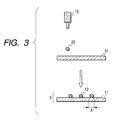
- the reference numeral 31 denotes a base
- the reference numeral 13 denotes an ink jet recording head
- the reference numeral 22 denotes a droplet of a liquid containing a controlling substance 12 ejected from the head 13.
- Application of the droplet to the surface of the base 31 provides a substratum 3 for cell culture.
- the width (X) of respective isolated areas of the attached controlling substance 12 is preferably such that two or more cells to be cultured cannot attach together on it, and practically the width X is less than two fold of the cell width.
- the size of the cell depends on the cell type, generally it is in an order of micron.
- the volume of the droplets ejected from the ink jet recording head is, for example, not larger than 100 pl, preferably not larger than 10 pl, and more preferably not larger than 4 pl.
- the volume of the droplets in such a range cells can be more precisely controlled during the culture process.
- dots about 10 to 30 ⁇ m in diameter are formed on the base, although it depends on the type and the surface state of the base.
- a substratum to which the controlling substance is attached in such a size is extremely suitable for controlled cell culture.
- the controlling substance attached to the base is immobilized by one of the methods described in the first embodiment in detail.
- the same controlling substances and bases as used in the first embodiment can be used, so that explanation is omitted.
- the substratum according to the second embodiment may have a plurality of different patterns, for example a first pattern and a second pattern on the same substratum.
- the controlling substance may be the same or different between patterns.
- the first pattern and the second pattern may respectively contain a plurality of types of controlling substances (for example, a first controlling substance and a second controlling substance).
- the combinations of the first and the second controlling substances contained respectively in the first and the second patterns may be the same or different.
- the ratios of the first and the second controlling substances in the first pattern and the second pattern may be different.
- by adjusting the types of controlling substances contained in a plurality of patterns arranged on the substratum it may be possible to differentiate and grow cells of different functions on a single substratum.
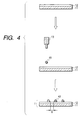
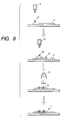
- FIG. 4 is an illustration of another production method of a substratum according to the second embodiment.
- the substratum is prepared by disposing a substance to which cells cannot adhere (hereinafter referred to as non-adhesive substance) on the surface so as to make the width of a pattern of the controlling substance on the surface equal to or smaller than the width of cells to be cultured.
- non-adhesive substance a substance to which cells cannot adhere
- a layer of the controlling substance 12 is formed on the entire surface of the base 11 and then droplets 41 of a solution of a non-adhesive substance are applied by using microdroplet ejection means 13 to dispose the non cell adhesive substance 42 on the layer of the controlling substance 12 in such a manner that the pattern width of the exposed controlling substance 12 is equal to or smaller than that of the cells to be cultured thereon to produce the cell culture substratum according to the second embodiment.
- This method can cut down consumption of the non-adhesive substance 42.
- the non-adhesive substance 42 may be a polymer material or a low molecular weight compound, not restricted to biological substances.
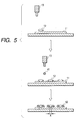
- the method shown in FIG. 4 forms a layer of the controlling substance 12 on the surface of the base 11 beforehand, but it is also possible, as shown in FIG. 5, to apply droplets containing the controlling substance 12 first, and then the droplets 41 containing the non-adhesive substance 42 are applied by using microdroplet ejection means. At this time, the substance 42 is arranged so as to be adjacent to or overlapping the controlling substance area to make the width of the area where the controlling substance is exposed equal to or smaller than that of the cells to be cultured.
- FIG. 6 is a schematic view illustrating another embodiment of such a cell culture substratum and a production method thereof.
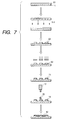
- This method comprises the step of forming a rising portion 62 of the non-adhesive substance 42 and the step of applying the droplets containing the controlling substance 12 to the area surrounded by the rising portion to dispose the substance 12 thereto.
- a plurality of patterns of the controlling substance can be formed on a substrate in such a manner that patterns are isolated from one another by the rising portion. Practically, as shown in FIG.
- a photoresist layer 61 is formed on the base 11 and selectively exposed and developed to form rising portions 62 made of the non-adhesive substance 42 on the base 11 and then the controlling substance 12 is supplied to the areas surrounded by the rising portions 62 by the microdroplet ejection means 13, so that the cell culture substratum 1 according to this embodiment can be obtained. Since the droplets 22 containing the controlling substance 12 are applied to areas that have been restricted by the non-adhesive substance 42, the controlling substance 12 can be disposed with precise size control. Further, the surface of the rising portions 62 may be subjected to water repelling treatment 71, as shown in FIG. 7, before droplets containing the controlling substance 12 are ejected to the base 11.
- the non-adhesive substance 42 can be disposed after the controlling substance 12 was disposed on the base 11 by the microdroplet ejection means.
- the adhesion and orientation of the individual cells can be controlled and also at least one of cell proliferation and differentiation can be controlled. Consequently, the cells proliferate or differentiate while the orientation of the individual cells is controlled, which has not been achieved in tissue culture, and enables production of tissues similar to those in the living body.
- Cells to be cultured are not particularly limited and any cells can be cultured.
- the substratum 1 can be sterilized by UV irradiation to avoid undesirable microbial contamination.
- cell culture may be carried out by immersing the whole substratum 1 in the culture medium, it is possible to culture cells controlling at least one of the above-described cellular functions if the culture medium is in contact with at least the immobilization area of the controlling substance.
- cell culture may be carried out by contacting the flow of the culture medium to the controlling substance, that is, by circulating the culture medium.
- the cultured cells may be removed from the substratum. This enables repeated use of the substratum or utilization of the removed cells as an artificial tissue or part thereof.
- the reference numeral 901 denotes a storage chamber for a base 11 of the cell culture substratum 1.
- the base 11 is sterilized there and then transported to a production chamber 902 to produce the cell culture substratum.
- the cell culture substratum bearing the controlling substance on the surface is produced by any method described above referring to FIG. 1 to FIG. 8.
- the substratum is transported to a culture chamber 903 and cells are cultured as described above. Then, the obtained products of the culture are transported to the chamber 904 and taken out.
- FIG. 10 is a detailed illustration covering from the storage chamber 901 to the substratum production chamber 902.
- the base 11 is set in a stocker 1003 and fed to a belt conveyer 1007 by a transporting apparatus 1005 and fed to a tray 1009.
- the reference numeral 1011 denote an auxiliary roll for feeding.
- the base 11 fed to the tray 1009 is firmly adsorbed and fixed on the tray by suction force by a pump 1013.
- the base 11 on the tray 1009 is fed to an area where a first treatment step is carried out.
- the reference numeral 1015 is a UV/O 3 lamp to carry out pretreatment of the base 11.
- a cell screening apparatus may be a different style other than that described above and is not particularly restricted if the apparatus is capable of achieving the above-described purposes.
- N-hydroxysuccinimido group was introduced into insulin by the following method: 1-ethyl-3-(3-dimethylamino)propyl)carbodiimide (WSC) dissolved in deionized water was added dropwise to 60 mmol of of N-hydroxysuccinimide dissolved in deionized water and stirred at 4°C for 24 hours. Successively, the foregoing reaction solution was added dropwise to 60 mmol of insulin dissolved in an isotonic phosphate buffer solution and stirred at 4°C for 24 hours. Then the reaction product was dialyzed with the isotonic phosphate buffer solution to remove unreacted substances to obtain a solution of N-hydroxysuccinimidized insulin.
- WSC 1-ethyl-3-(3-dimethylamino)propyl)carbodiimide
- an ink cartridge of which is an ink jet printer (BJF 870, manufactured by Canon, a thermal ink jet printer) was fully washed with the isotonic phosphate buffer solution.
- the dialyzed insulin solution prepared above was diluted to 50 ⁇ g/ml with an aqueous solution of 50% ethanol.
- the diluted insulin solution was loaded in the ink cartridge and disposed onto the base by the ink jet printer.
- the print pattern was controlled by a personal computer connected to the printer and the size of one droplet was controlled to be about 4 pl.
- the base was dried at room temperature and then incubated at 35°C for 1 hour to carry out immobilization reaction of the insulin on the base. After immobilization, the base was washed with the isotonic phosphate buffer solution to remove the unreacted insulin. In such a manner, a substratum for promoting growth by insulin was produced.
- mouse fibroblast STO was cultured.
- DMEM Dens Modified Eagles minimum essential medium
- the substratum was put in a glass petri dish and culture was carried out at 37°C for 24 hours under humid air (95 to 100% RH) with 5% of CO 2 .
- the morphology of the cells on the substratum was observed by an optical microscope. As a result, in the areas where insulin was immobilized, dense proliferation of mouse fibroblast STO cells was observed.
- a substratum to which fibronectin and insulin were immobilized was produced.
- Fibronectin was immobilized on the base in the same manner as in Example 1.
- Insulin was biotinylated using a biotin-labeling kit (Dojin Kagaku Co.). Biotin was also introduced to the base surface using the biotin-labeling kit.
- avidin was disposed onto the base surface using a piezo-type ink jet printer (PM 900C, Seiko Epson Corp) to immobilize avidin by biological affinity.
- biotin-labeled insulin was disposed by the ink jet printer PM 900C to immobilized it by reaction with the avidin immobilized on the base.
- Mouse fibroblast STO cells were cultured on the substratum with a culture medium of DMEM at 37°C for 24 hours in a humid air (95-100%RH) containing 5% CO 2 . After cultivation, the change of the cell number was measured by staining and counting the cell nuclei. The substratum was taken out of the culture medium, washed with the isotonic phosphate buffer solution, and immersed in methanol for 30 minutes to fix cells on the substratum. Separately, a 10,000 fold dilution of Hoechst 33258 was applied to the substratum and then reacted for 5 minutes.
- the substratum was washed with the isotonic phosphate buffer solution and observed under a fluorescent microscope to count the number of the stained nuclei.
- the cell density was 10,000/mm 2 .
- the area where only insulin was immobilized no cell was observed, and in the area where only fibronectin was immobilized, cell growth was not so active with a cell density of about 10/mm 2 .
- Example 2 In the same manner as in Example 1, a substratum on which insulin was immobilized was prepared except that the dot density was changed area by area. To change the density, hatching patterns with different densities of dots were drawn using a drawing software and the drawing data of the patterns were transmitted to the printer from a personal computer to produce patterns with different dot densities according to the position on the substratum. Specifically, areas of 50%, 30, and 10% and 2% dot area per unit surface area were formed respectively.
- the density of cells increased as the density of insulin increased.
- the density of cells was measured by the nucleus staining method as in Example 2, the number of cells was 10,000/mm 2 in the 50%-dot area, 3,000/mm 2 in the 30%-dot area, 300/mm 2 in the 10%-dot area, and 100/mm 2 in the 2%-dot area.
- ITO indium tin oxide
- Untreated insulin was disposed on the base by an ink jet printer.
- a culture medium similar to one used in Example 1 was kept at pH 7.0 and a voltage was applied between the ITO layer on the base and a platinum electrode as a counter electrode to charge the base surface positive. Since the isoelectric point of insulin is about pH 5.3, insulin was charged negative in the vicinity of pH 7.0 to be immobilized onto the base.
- a photoresist OFPR-800 (Tokyo Ohka Kogyo Co., Ltd.) was applied to a glass base and a fine resist pattern was formed by a photolithographic process.
- the base was then immersed in a hydrofluoric acid solution to etch the glass surface where the resist was removed and to form sunken areas on the surface.
- the wells were patterned not to communicate each other to prevent mixing of the culture medium.
- mouse fibroblast STO cells were cultured.
- DMEM bovine fetus serum culture medium
- DMEM bovine fetus serum culture medium
- DMEM supplemented with 10 ⁇ g/ml of transferrin DMEM supplemented with 10 ⁇ g/ml of transferrin and 1% insulin
- bovine fetus serum culture medium bovine fetus serum culture medium
- DMEM supplemented with 10 ⁇ g/ml of transferrin and 1% insulin were used for respective areas.
- EGF epidermal growth factor
- THF tetrehydrofuran
- DCC dicyclohexylcarbodiimide
- 4-azidobenzenecarboxylic acid was added dropwise to a THF solution containing 50 mmol N-hydroxysuccinimide and 45 mmol 4-azidobenzenecarboxylic acid and reacted at 4°C for 24 hours with stirring.
- the reaction product was recrystallized from an isopropanol/diisopropanol solution and purified.
- the resulting reaction product was dissolved in dimethylformamide and EGF dissolved in an isotonic phosphate buffer solution (pH 7.0) was added dropwise and stirred at 4°C for 48 hours to introduce azido group into EGF.
- a photoresist OFPR-800 (Tokyo Ohka Kogyo Co., Ltd.) was applied to a polysulfone base to form wall-like structure by a photolithographic process.
- a solution of the above azido-EGF was ejected by an ink jet printer. After drying, EGF-immobilized areas were formed by irradiating at 200 mJ/cm 2 using a UV lamp. Unreacted EGF was washed out by the isotonic phosphate buffer solution to obtain the substratum for cell culture.
- PC 12 cells were cultured with the same culture medium as in Example 1. PC 12 cells did not proliferate but differentiated growing dendrites.
- PC 12 cells were cultured in DMEM medium. After 48 hours from starting the culture, EGF was added to an immobilization area 1, nerve growth factor (NGF) to an immobilization area 2, and no addition to an immobilization area 3.
- NGF nerve growth factor
- Example 6 a layer of poly(N-isopropylacrylamide) gel was formed on a polystyrene base by casting.
- azido group was introduced to insulin by the method employed in Example 6.
- a solution of the insulin having azido group was ejected and immobilized in the same manner as in Example 1 to obtain a substratum for cell culture.
- mouse muscle cells C2C12 were cultured in DMEM medium. Along the pattern of immobilized insulin, the C2C12 cells proliferated.
- the culture substratum was cooled to 30°C to decrease the adhesion of the polyacrylamide gel layer to the substratum so that the cell mass came up into the culture medium from the substratum.
- the floating cell mass was taken out and pulse potential was applied to the cell mass at both ends, the cell mass contracted.
- the acrylamide gel layer was formed on the base from which cultured cells had been released, and when cells were cultured on the regenerated substratum, cell proliferation was observed. It implies that the substratum is reusable.
- an insulin substratum a cell culture substratum 1 was prepared by ejecting insulin, a culture control substance 12, was ejected from an ink jet head 13 onto a polyethylene terephthalate (PET) film 11, by using a thermal ink jet printer (trade name BJF 870; manufactured by Canon).
- PET polyethylene terephthalate
- the ink cartridge of the ink jet printer was fully washed with an isotonic phosphate buffer solution (pH 7.0).
- an insulin solution in an isotonic phosphate buffer solution (pH 7.0) was with an aqueous 50% ethanol solution to a 50 ⁇ g/ml insulin concentration. Then the dilution was charged in the ink cartridge.
- a fine line pattern of insulin was formed on the PET film 11.
- the volume of each droplet ejected by the printer in this case was measured as follows.
- the weight of the ejected solution was measured by weighing the ink cartridge before and after 1,000,000 dot-ejection. Also, the specific gravity of the ink was measured and the volume per one drop of the ink was calculated to find it was 3.5 pl.
- the produced insulin substratum had a thin line pattern of insulin with a width of 10 ⁇ m.
- the insulin substratum was sterilized using a sterilization lamp, and put in a glass petri dish to culture mouse muscle cells C2C12 on it.
- a culture medium DMEM medium containing 10 ⁇ g/ml of transferrin was employed.
- Mouse muscle cells C2C12 were inoculated and cultured at 37°C for 24 hours under 5% CO 2 humid air (95 to 100% RH). When the cell morphology was observed, cells were proliferating in one line along the thin line pattern of insulin, showing the controlled growth and orientation on the insulin substratum. The width of the cells was 9 ⁇ m.
- an aqueous solution of 1% poly L-lysine, being a controlling substance 12 was applied to a glass base 11 by spin coating to form a 10 nm-thick poly L-lysine coating on the base 11.
- Poly L-lysine promotes cell adhesion.
- an ink cartridge of a piezoelectric ink jet printer (trade name: PM900C; manufactured by Seiko Epson Corp.) was washed with purified water and charged with a solution containing polyacrylic acid (Table 1).
- Polyacrylic acid is a non-adhesive substance 42. Content Composition ratio (wt.%) Polyacrylic acid 5
- the treated glass base was placed on a CD-R print kit (manufactured by Seiko Epson Corp.) and an ink jet printer was connected to a computer to eject the solution in the cartridge from the ink jet head 13 as to form a pattern of polyacrylic acid, using an image drawing software of the computer.
- a CD-R print kit manufactured by Seiko Epson Corp.
- an ink jet printer was connected to a computer to eject the solution in the cartridge from the ink jet head 13 as to form a pattern of polyacrylic acid, using an image drawing software of the computer.
- a pattern of polyacrylic acid was formed on the poly L-lysine layer on the base in such a manner that the width of the area where poly L-lysine was exposed was 7 ⁇ m or less.
- mouse DRG cells a nerve cell
- a nerve cell were cultured on the poly L-lysine substratum in a glass petri dish, using the same culture medium as in Example 1 but supplemented with nerve growth factor. Culture was carried out at 37°C for 48 hours in a humid air (95 to 100% RH) containing 5% of CO 2 . As a result, DRG cells were growing dendrites along the poly L-lysine area. The size of the cells was 8 ⁇ m.
- a substratum 1 for controlled cell culture was produced by disposing insulin, a controlling substance 12, on a PET film 11.
- a solution of a water-repellant was prepared by diluting Unidyne TG 991 (produced by Daikin Industries, Ltd.) to 30 wt.% with purified water.
- an ink cartridge of an ink jet printer washed with purified water was charged with the water-repellant solution.
- the ink cartridge, an ink jet head 13 connected with the cartridge and a control substrate of an ink jet printer were dismounted and arranged in such a manner that droplets are ejected from the nozzle of the head under computer control, and the head can be located at desired positions over the base 11.
- the PET film was fixed on a stage and placed under the ejection orifice of the head. In such a manner, a pattern of the non-adhesive substance 42 was formed on the PET film.
- a functional group was introduced to insulin by the following method.
- a tetrahydrofuran (THF) solution of 50 mmol dicyclohexylcarbodiimide (DCC) was added dropwise to a THF solution containing 50 mmol of N-hydroxysuccinimide and 45 mmol of 4-azidobenzenecarboxylic acid and reacted at 4°C for 24 hours with stirring. After vacuum-drying, the reaction product was recrystallized in an isopropanol/diisopropanol solution to be refined.
- reaction product was dissolved in dimethylformamide, to which insulin dissolved in an isotonic phosphate buffer solution (pH 7.0) was added dropwise. Reaction was carried out at 4°C for 48 hours with stirring to introduce azido group to insulin.
- the insulin solution was ejected from the head 13 to the PET film base 11, on which a pattern of non-adhesive substance 42 had been formed.
- the base was UV irradiated using an ultraviolet lamp to immobilize the insulin on the PET film.
- the pattern of insulin was formed in the vicinity of the pattern of the water-repellant.
- the width of the insulin pattern was 7 ⁇ m.
- a culture substratum 1 was produced by immobilizing interleukin-1 and fibronectin on a base 11 of PET film.
- interleukin-1 and fibronectin, control substances 12 were introduced to both interleukin-1 and fibronectin, control substances 12, by the same method as in Example 11.
- the interleukin-1 and fibronectin were diluted to 50 ⁇ g/ml with an aqueous 50% ethanol solution.
- the dilutions were loaded separately to different ink cartridges previously washed with an isotonic phosphate buffer solution, and ejected to the base 11 from the ink jet heads 13 using an ink jet printer.
- FIG. 5 for convenience, the same reference numeral is assigned to interleukin-1 and fibronectin, culture control substance 12.
- Example 11 After drying, ultraviolet rays were radiated to the base 11 in the same manner as in Example 11 to immobilize interleukin-1 and fibronectin.
- the same solution of polyacrylic acid (non-adhesive substance 42) as employed in Example 10 was charged into an ink cartridge of the ink jet printer, and ejected onto the base 11 to make the width of the exposed area of interleukin-1 and fibronectin 8 ⁇ m.
- an interleukin-1 and fibronectin substratum 1 was produced, where the polyacrylic acid coating was formed so as to partly cover the areas where interleukin-1 and fibronectin were immobilized.
- Cell culture on the culture substratum 1 was carried out as follows.
- the produced interleukin-1-fibronectin substratum was immersed in the same culture medium as used in Example 9 in a glass petri dish and mouse vascular endothelial cells were inoculated to it.
- Culture was carried out at 37°C for 48 hours in a humid air (95 to 100% RH, 5% of CO 2 ) and the mouse endothelial cells proliferated along the interleukin-1-fibronectin pattern in one line.
- the size of the cells was 8 ⁇ m.
- EGF epidermal growth factor
- photoresist OFPR-800 (Tokyo Ohka Kogyo Co., Ltd.) was applied to a base 11 made of polysulfone to form wall-like structures made of a non-adhesive substance 42 by photolithography.
- the height of the wall-like structures was adjusted to 1 ⁇ m and the width of the area surrounded by the wall-like structure was adjusted to 10 ⁇ m.
- a solution containing EGF into which azido group had been introduced was ejected from an ink jet head 13 using an ink jet printer. After drying, the base was irradiated with ultraviolet rays at 200 mJ/cm 2 using an ultraviolet radiation lamp. The unreacted EGF was washed out with an isotonic phosphate buffer solution to obtain substratum 1 for controlled cell culture.
- PC 12 cells were cultured on the substratum 1 for cell culture. The same culture medium as used in Example 9 was employed. When culture was carried out on the substratum 1, PC 12 cells did not proliferate but differentiated growing dendrites along the pattern.
- the functional group was introduced into EGF in the same method as described in Example 6.
- wall-like structures made of a non-adhesive substance 14 were formed on a polysulfone base 11 in the same manner as in Example 13. Then, the base was put in a reaction vessel, the pressure of the vessel was adjusted to 10 mPa by a vacuum pump, and a fluoro hydrocarbon gas was introduced to the vessel to carry out water-repelling treatment of the surface of the wall-like structures.
- the azido-EGF solution prepared above was ejected to each area surrounded by the wall-like structure on the base 11 using an ink jet printer. After drying, ultraviolet rays of 200 mJ/cm 2 were radiated using an ultraviolet radiation lamp. The unreacted EGF was washed out with an isotonic phosphate buffer solution to obtain the substratum 1 for controlled cell culture.
- the droplets ejected by the ink jet printer were disposed without fail in the areas surrounded by wall-like structures.
- PC 12 cells were cultured on the substratum 1 for controlled cell culture. The same culture medium as used in Example 1 was employed. When culture was carried out on the substratum 1, PC 12 cells did not proliferate but differentiated growing dendrites along the pattern.
- PC 12 cells were cultured in the same culture medium as that of Example 9 in two glass petri dishes. After 48 hours from starting the culture, a nerve growth factor (NGF) was added to the culture medium in one glass petri dish A and an EGF was added to the culture medium in the other petri dish B.
- NGF nerve growth factor
- a layer of poly(N-isopropylacrylamide) gel was formed on a polystyrene base by casting.
- insulin having azido group was immobilized in the same manner as described in Example 11 to obtain a substratum for cell culture.
- mouse muscle cells C2C12 were cultured in the same culture medium as that of Example 9. Along the immobilized insulin pattern, the C2C12 cells proliferated.
- the culture substratum was cooled to 30°C to decrease the adhesion of the polyacrylamide gel layer to the substratum and the cell mass aligned in one line came up from the substratum in the culture medium.
- the cell mass was taken out from the medium and a potential was applied to the both ends of the cell mass, the cell mass contracted.
- a culture controlling substance can be immobilized at desired positions on a culture substratum by simple steps, which enables culturing cells on the substratum controlling at least one of cell adhesion, proliferation, and differentiation.
- a variety of cells can be cultured on one substratum and cells can be cultured with various substances on one substratum.
- a substratum for controlled cell culture allows cell proliferation and/or differentiation controlling adhesion and orientation of the cells by culture control substances arranged on the base, thus it enables cell culture under environments similar to in vivo, and is especially useful for in vitro production of tissues having functions almost equal to those in a living body.
- the immobilized culture-controlling substances on a base can stimulate cells continuously, cell proliferation and differentiation can be promoted so as to form a cell constitution having a similar structure as the tissues in the living body on a substratum.
Landscapes
- Life Sciences & Earth Sciences (AREA)
- Engineering & Computer Science (AREA)
- Health & Medical Sciences (AREA)
- Chemical & Material Sciences (AREA)
- Biomedical Technology (AREA)
- Biotechnology (AREA)
- Organic Chemistry (AREA)
- Bioinformatics & Cheminformatics (AREA)
- Genetics & Genomics (AREA)
- Wood Science & Technology (AREA)
- Zoology (AREA)
- Microbiology (AREA)
- Biochemistry (AREA)
- General Engineering & Computer Science (AREA)
- General Health & Medical Sciences (AREA)
- Cell Biology (AREA)
- Micro-Organisms Or Cultivation Processes Thereof (AREA)
- Apparatus Associated With Microorganisms And Enzymes (AREA)
- Immobilizing And Processing Of Enzymes And Microorganisms (AREA)
Abstract
Description
wherein the area is formed by applying a liquid containing the substance to a base with an apparatus that ejects a liquid in the form of small droplet, and immobilizing the substance to the base.


| Content | Composition ratio (wt.%) |
| Polyacrylic acid | 5 |
| Purified water | 73 |
| 2-amino-1-methylpropanol | 2 |
| Glycerin | 20 |
| Content | Composition ratio (wt.%) |
| | 1 |
| Isotonic phosphate buffer solution | 59 |
| Glycerin | 20 |
| Ethylene glycol | 20 |
Claims (43)
- A substratum for culturing cells provided with an area where a cell-culture controlling substance is immobilized thereon, the substance being involved in at least one function selected from the group consisting of adhesion, proliferation, differentiation, survival, maintenance of undifferentiated state and apoptosis of cells, wherein the area is formed by applying a liquid containing the substance to a base with an apparatus that ejects a liquid in the form of small droplet, and immobilizing the substance to the base.
- The substratum according to claim 1, wherein at least two kinds of substance are immobilized in the area.
- The substratum according to claim 1 or 2, having a first area where the substance is immobilized, and a second area where the substrate is immobilized, wherein the first and the second areas are spaced out.
- The substratum according to claim 3, wherein the substance immobilized in the first area and the substance immobilized in the second area, are different from each other.
- The substratum according to claim 3, wherein the first area contains a plurality of the substances and the second area contains a plurality of the substances, and combination of the substance in the first area is different from that in the second area.
- The substratum according to claim 3, wherein the first and the second areas contain the substances with different densities.
- The substratum according to any one of claims 1 to 6, wherein the area is formed in a well formed on the surface of the substrate.
- The substratum according to any one of claims 1 to 7, wherein the area is surrounded by a wall.
- The substratum according to any one of claims 1 to 8, wherein the substance is immobilized to the based by a covalent bond.
- The substratum according to any one of claims 1 to 8, wherein the substance is immobilized to the base by electrostatic bond.
- The substratum according to any one of claims 1 to 8, wherein the substance is immobilized to the base with biological affinity.
- The substratum according to any one of claims 1 to 11, wherein the area is in the form of strip, and the width thereof is equal to or smaller than that of the cell to be cultured with substratum.
- The substratum according to claim 12, wherein the substance is involved in at least one function selected from proliferation and differentiation of cells.
- The substratum according to claim 3, wherein the areas are in the form of dotted-pattern, and the width of the dot is equal to or smaller than that of the cell to be cultured on the substratum.
- The substratum according to claim 12 or 13, wherein the substances are involved in at least one function selected from proliferation and differentiation of cells.
- A process for producing a substratum for culturing a cell, comprising the steps of:(a) applying a liquid containing a cell-culture controlling substance involved in at least one function for adhesion, proliferation, differentiation, survival, maintenance of undifferentiated state and apoptosis of cells with an apparatus the ejects a liquid in the form of droplet to a base; and(b) immobilizing the substance in the liquid applied on the based in the step (a).
- The process according to claim 16, wherein the step (a) comprises a sub-step of ejecting the liquid in the form of a droplet by applying thermal energy to the liquid.
- The process according to claim 16, wherein the substance and the base have a functional group or a compound for immobilization.
- The process according to claim 16, wherein the step (b) comprises a sub-step of irradiating the base resulting from the step (a) with energy.
- The process according to claim 19, wherein the energy is light.
- A substratum for culturing cells provided with an area where a cell-culture controlling substance is arranged in a pattern of strip, the substance being involved in at least one function for adhesion, proliferation, differentiation, survival, maintenance of undifferentiated state and apoptosis of cells, wherein the width of the pattern of the area is equal or smaller than that of a cell to be cultured on the substratum.
- A substratum for culturing cells provided with areas where a cell-culture controlling substance is arranged in the form of dotted-pattern, the substance being involved in at least one function for adhesion, proliferation, differentiation, survival, maintenance of undifferentiated state and apoptosis of cells, wherein the width of the dot is equal to or smaller than that of a cell to be cultured.
- The substratum according to claim 21 or 22, wherein the pattern is formed by arranging a cell-nonadhesive substance on the cell-culture controlling substance on the base.
- The substratum according to claim 21 or 22, wherein the pattern is formed by arranging a cell-nonadhesive substance in the vicinity of the cell-culture controlling substance.
- The substratum according to claim 21 or 22, having a plurality of the patterns.
- The substratum according to claim 25, wherein the patterns are spaced out with a wall.
- The substratum according to any one of claims 21, wherein the area contains at least two kinds of cell-culture controlling substances.
- The substratum according to claim 22, wherein at least one area constituting the dotted pattern, contains at least two kinds of cell-culture controlling substance.
- The substratum according to claim 25, wherein the plurality of patterns have different kind of cell-culture controlling substances, or have different combinations of cell-culture controlling substances.
- A process for producing a substratum for culturing cells, the substratum being provided with an area where a cell-culture controlling substance is immobilized thereon, the substance being involved in at least one function selected from the group consisting of adhesion, proliferation, differentiation, survival, maintenance of undifferentiated state and apoptosis of cells, the process comprising a step of: applying the substance to a base so that the area or areas are formed in a pattern of strip, or in dotted pattern, wherein the width of the pattern is equal to or smaller than that of a cell to be cultured on the substratum.
- A process for producing a substratum of claim 21 or 22, the process comprising the steps of:(a) applying the cell-culture controlling substance on a base; and(b) applying a liquid containing cell-nonadhesive substance to the base with an apparatus that ejects the liquid in the form of a droplet so that the pattern is formed.
- The process according to claim 30, wherein the step (i) comprises a sub-step of applying the cell-culture controlling substance on the whole surface of the base.
- The process according to claim 30, wherein the step (i) comprises the sub-steps of:forming a well on the base; andapplying the cell-culture controlling substance in the well.
- A process for culturing cells comprising the steps of:(i) providing the substratum of claim 1, 21 or 22; and(ii) culturing cells on the substratum so that culture medium contacts with the area of the substratum.
- The process according to claim 34, wherein the step (ii) comprises a sub-step of supplying a substance necessary for cell-culture to the culture medium.
- The process according to claim 34, wherein the step (ii) is performed so that the area is in the stream of the culture medium.
- The process according to claim 34, further comprising a step of recovering cells from the substratum as a step (iii).
- A substratum provided with areas where a cell-culture controlling substance is immobilized thereon respectively, the substance being involved in at least one function selected from the group consisting of adhesion, proliferation, differentiation, survival, maintenance of undifferentiated state and apoptosis of cells, each of the areas being formed by applying a liquid containing the cell-culture controlling substance with an apparatus that ejects the liquid in the form of a droplet, the areas being spaced out, wherein cells are attached to at least one of the areas.
- A substratum for use in controlled cell proliferation or cell differentiation, provided with areas where a cell-culture controlling substance is attached the cell-culture controlling substance being involved in at least one function selected from the group consisting of adhesion, proliferation, differentiation, survival, maintenance of undifferentiated state and apoptosis of cells, the area being formed by applying a liquid containing the cell-culture controlling substance with an apparatus that ejects the liquid in a form of a droplet, so that the area is in a pattern of a strip or in dotted pattern, wherein the width of the pattern is equal to or smaller than that of a cell to be cultured on the substratum.
- An apparatus for cell culture, comprising a means for culturing cells in a state where the cell culture controlling substance carried with the substratum of claim 1, 21 or 22 is brought into contact with a culture medium.
- The apparatus according to claim 40, further comprising the substratum producing means.
- The apparatus according to claim 41, wherein the substratum producing means comprises a container holding a base, and an apparatus that ejects a liquid containing the cell-culture controlling substance.
- The apparatus according to claim 42, wherein the substratum producing means further comprises immobilizing means for immobilizing the cell-culture controlling substance to the base.
Applications Claiming Priority (4)
| Application Number | Priority Date | Filing Date | Title |
|---|---|---|---|
| JP2001096993 | 2001-03-29 | ||
| JP2001097219 | 2001-03-29 | ||
| JP2001097219 | 2001-03-29 | ||
| JP2001096993 | 2001-03-29 |
Publications (3)
| Publication Number | Publication Date |
|---|---|
| EP1253196A2 true EP1253196A2 (en) | 2002-10-30 |
| EP1253196A3 EP1253196A3 (en) | 2003-05-14 |
| EP1253196B1 EP1253196B1 (en) | 2009-09-02 |
Family
ID=26612606
Family Applications (1)
| Application Number | Title | Priority Date | Filing Date |
|---|---|---|---|
| EP02007010A Expired - Lifetime EP1253196B1 (en) | 2001-03-29 | 2002-03-27 | Substratum for cell culture, production of the same, cell culture method |
Country Status (3)
| Country | Link |
|---|---|
| US (1) | US7846727B2 (en) |
| EP (1) | EP1253196B1 (en) |
| DE (1) | DE60233542D1 (en) |
Cited By (1)
| Publication number | Priority date | Publication date | Assignee | Title |
|---|---|---|---|---|
| US7419820B2 (en) | 2003-12-16 | 2008-09-02 | Canon Kabushiki Kaisha | Transfer sheet for transferring biologically active substance to culture plate |
Families Citing this family (9)
| Publication number | Priority date | Publication date | Assignee | Title |
|---|---|---|---|---|
| EP1248108B1 (en) * | 2001-03-29 | 2011-08-31 | Canon Kabushiki Kaisha | method of cellular screening and substrates suitable for it |
| US7517494B2 (en) * | 2003-04-30 | 2009-04-14 | Hewlett-Packard Development Company, L.P. | Test tray and test system for determining response of a biological sample |
| JP4632400B2 (en) * | 2003-12-16 | 2011-02-16 | キヤノン株式会社 | Cell culture substrate, method for producing the same, and cell screening method using the same |
| WO2005103227A1 (en) * | 2004-04-26 | 2005-11-03 | Dai Nippon Printing Co., Ltd. | Patterning substrate for cell culture and process for producing the same |
| JP4147235B2 (en) * | 2004-09-27 | 2008-09-10 | キヤノン株式会社 | Discharge liquid, discharge method, droplet forming method, liquid discharge cartridge, and discharge apparatus |
| JP4689340B2 (en) * | 2005-05-02 | 2011-05-25 | キヤノン株式会社 | Liquid pharmaceutical composition for discharge |
| US8129188B2 (en) * | 2005-09-29 | 2012-03-06 | Industrial Technology Research Institute | Cell culture apparatus and method of fabricating the apparatus |
| WO2010074326A1 (en) | 2008-12-25 | 2010-07-01 | Canon Kabushiki Kaisha | Probe for a biological specimen and labelling method and screening method using the probe |
| WO2011141512A2 (en) * | 2010-05-11 | 2011-11-17 | Artelis S.A. | Apparatus and methods for cell culture |
Family Cites Families (6)
| Publication number | Priority date | Publication date | Assignee | Title |
|---|---|---|---|---|
| US510926A (en) * | 1893-12-19 | Gin-saw-filing machine | ||
| US5108926A (en) * | 1987-09-08 | 1992-04-28 | Board Of Regents, The University Of Texas System | Apparatus for the precise positioning of cells |
| US5776748A (en) * | 1993-10-04 | 1998-07-07 | President And Fellows Of Harvard College | Method of formation of microstamped patterns on plates for adhesion of cells and other biological materials, devices and uses therefor |
| US6103479A (en) * | 1996-05-30 | 2000-08-15 | Cellomics, Inc. | Miniaturized cell array methods and apparatus for cell-based screening |
| AU734704B2 (en) | 1996-05-30 | 2001-06-21 | Cellomics, Inc. | Miniaturized cell array methods and apparatus for cell-based screening |
| EP1248108B1 (en) * | 2001-03-29 | 2011-08-31 | Canon Kabushiki Kaisha | method of cellular screening and substrates suitable for it |
-
2002
- 2002-03-27 EP EP02007010A patent/EP1253196B1/en not_active Expired - Lifetime
- 2002-03-27 DE DE60233542T patent/DE60233542D1/en not_active Expired - Lifetime
- 2002-03-29 US US10/108,470 patent/US7846727B2/en not_active Expired - Fee Related
Cited By (2)
| Publication number | Priority date | Publication date | Assignee | Title |
|---|---|---|---|---|
| US7419820B2 (en) | 2003-12-16 | 2008-09-02 | Canon Kabushiki Kaisha | Transfer sheet for transferring biologically active substance to culture plate |
| US7960168B2 (en) | 2003-12-16 | 2011-06-14 | Canon Kabushiki Kaisha | Biologically active substance transfer sheet, cell culture kit constituted of cell culture plate and biologically active substance transfer sheet, producing method thereof and method for screening cell culture conditions utilizing the same |
Also Published As
| Publication number | Publication date |
|---|---|
| US20020182721A1 (en) | 2002-12-05 |
| DE60233542D1 (en) | 2009-10-15 |
| EP1253196A3 (en) | 2003-05-14 |
| US7846727B2 (en) | 2010-12-07 |
| EP1253196B1 (en) | 2009-09-02 |
Similar Documents
| Publication | Publication Date | Title |
|---|---|---|
| US8709744B2 (en) | Manufacturing process for cellular screening substratum, resultant substratum, and method and apparatus for screening | |
| Folch et al. | Microengineering of cellular interactions | |
| US7919305B2 (en) | Method for manufacturing cell culture substrate | |
| JP4148500B2 (en) | Cell culture substrate, process for producing the same, cell culture method and cell culture apparatus using the same | |
| US9034648B2 (en) | Artificial tissue construct and method for producing the same | |
| US8148153B2 (en) | Substrate for cell culture, producing method thereof and screening method for cell culture conditions utilizing the same | |
| US7846727B2 (en) | Substratum having a pattern of cell-culture controlling substance | |
| US7960168B2 (en) | Biologically active substance transfer sheet, cell culture kit constituted of cell culture plate and biologically active substance transfer sheet, producing method thereof and method for screening cell culture conditions utilizing the same | |
| JP5164156B2 (en) | Patterning cells on a substrate using inkjet printing technology | |
| US20110091974A1 (en) | Conductive Substrate and Method for Introducing Nucleic Acid | |
| JP4378069B2 (en) | Cell screening substrate and manufacturing method thereof, cell screening method and cell screening apparatus using the same | |
| US20020119305A1 (en) | Controlled release composition | |
| JP4797396B2 (en) | Method for producing cell culture substrate | |
| JPH0779772A (en) | Cell culture solution and preparation of spheroid using said cell culture solution | |
| JP4930544B2 (en) | Method for producing carrier for cell culture | |
| JP4148516B2 (en) | Cell culture kit comprising cell culture substrate and bioactive substance transfer sheet, production method thereof, and cell screening method using the same | |
| JP4148515B2 (en) | Biologically active substance transfer sheet, manufacturing method thereof, and cell screening method using the same | |
| US20190322784A1 (en) | Material for cell patterning use | |
| KR20260015140A (en) | Post-processing of biological scaffolds | |
| Derby | Applications for ink jet printing in biology and medicine | |
| JPH07274953A (en) | Cell culture base material and its preparation |
Legal Events
| Date | Code | Title | Description |
|---|---|---|---|
| PUAI | Public reference made under article 153(3) epc to a published international application that has entered the european phase |
Free format text: ORIGINAL CODE: 0009012 |
|
| AK | Designated contracting states |
Kind code of ref document: A2 Designated state(s): AT BE CH CY DE DK ES FI FR GB GR IE IT LI LU MC NL PT SE TR |
|
| AX | Request for extension of the european patent |
Free format text: AL;LT;LV;MK;RO;SI |
|
| PUAL | Search report despatched |
Free format text: ORIGINAL CODE: 0009013 |
|
| RIC1 | Information provided on ipc code assigned before grant |
Ipc: 7C 12N 3/00 B Ipc: 7C 12N 5/06 B Ipc: 7C 12M 3/00 B Ipc: 7C 12N 5/00 A |
|
| AK | Designated contracting states |
Designated state(s): AT BE CH CY DE DK ES FI FR GB GR IE IT LI LU MC NL PT SE TR |
|
| AX | Request for extension of the european patent |
Extension state: AL LT LV MK RO SI |
|
| 17P | Request for examination filed |
Effective date: 20030930 |
|
| 17Q | First examination report despatched |
Effective date: 20031110 |
|
| AKX | Designation fees paid |
Designated state(s): DE FR GB IT |
|
| GRAP | Despatch of communication of intention to grant a patent |
Free format text: ORIGINAL CODE: EPIDOSNIGR1 |
|
| RTI1 | Title (correction) |
Free format text: SUBSTRATUM FOR CELL CULTURE, PRODUCTION OF THE SAME, CELL CULTURE METHOD |
|
| RIN1 | Information on inventor provided before grant (corrected) |
Inventor name: NISHIGUCHI, KENJI Inventor name: MIYAZAKI, TAKESHI Inventor name: WATANABE, KOHEI Inventor name: MATSUDA, RYOICHI |
|
| GRAS | Grant fee paid |
Free format text: ORIGINAL CODE: EPIDOSNIGR3 |
|
| GRAA | (expected) grant |
Free format text: ORIGINAL CODE: 0009210 |
|
| AK | Designated contracting states |
Kind code of ref document: B1 Designated state(s): DE FR GB IT |
|
| REF | Corresponds to: |
Ref document number: 60233542 Country of ref document: DE Date of ref document: 20091015 Kind code of ref document: P |
|
| PLBE | No opposition filed within time limit |
Free format text: ORIGINAL CODE: 0009261 |
|
| STAA | Information on the status of an ep patent application or granted ep patent |
Free format text: STATUS: NO OPPOSITION FILED WITHIN TIME LIMIT |
|
| 26N | No opposition filed |
Effective date: 20100603 |
|
| PG25 | Lapsed in a contracting state [announced via postgrant information from national office to epo] |
Ref country code: IT Free format text: LAPSE BECAUSE OF FAILURE TO SUBMIT A TRANSLATION OF THE DESCRIPTION OR TO PAY THE FEE WITHIN THE PRESCRIBED TIME-LIMIT Effective date: 20090902 |
|
| REG | Reference to a national code |
Ref country code: FR Ref legal event code: PLFP Year of fee payment: 14 |
|
| PGFP | Annual fee paid to national office [announced via postgrant information from national office to epo] |
Ref country code: FR Payment date: 20150325 Year of fee payment: 14 Ref country code: GB Payment date: 20150316 Year of fee payment: 14 |
|
| GBPC | Gb: european patent ceased through non-payment of renewal fee |
Effective date: 20160327 |
|
| REG | Reference to a national code |
Ref country code: FR Ref legal event code: ST Effective date: 20161130 |
|
| PG25 | Lapsed in a contracting state [announced via postgrant information from national office to epo] |
Ref country code: FR Free format text: LAPSE BECAUSE OF NON-PAYMENT OF DUE FEES Effective date: 20160331 Ref country code: GB Free format text: LAPSE BECAUSE OF NON-PAYMENT OF DUE FEES Effective date: 20160327 |
|
| PGFP | Annual fee paid to national office [announced via postgrant information from national office to epo] |
Ref country code: DE Payment date: 20170331 Year of fee payment: 16 |
|
| REG | Reference to a national code |
Ref country code: DE Ref legal event code: R119 Ref document number: 60233542 Country of ref document: DE |
|
| PG25 | Lapsed in a contracting state [announced via postgrant information from national office to epo] |
Ref country code: DE Free format text: LAPSE BECAUSE OF NON-PAYMENT OF DUE FEES Effective date: 20181002 |