EP1251847B1 - Novel use of prodigiosin for treating diabetes mellitus - Google Patents
Novel use of prodigiosin for treating diabetes mellitus Download PDFInfo
- Publication number
- EP1251847B1 EP1251847B1 EP00952026A EP00952026A EP1251847B1 EP 1251847 B1 EP1251847 B1 EP 1251847B1 EP 00952026 A EP00952026 A EP 00952026A EP 00952026 A EP00952026 A EP 00952026A EP 1251847 B1 EP1251847 B1 EP 1251847B1
- Authority
- EP
- European Patent Office
- Prior art keywords
- prodigiosin
- diabetes mellitus
- diabetes
- cells
- insulin
- Prior art date
- Legal status (The legal status is an assumption and is not a legal conclusion. Google has not performed a legal analysis and makes no representation as to the accuracy of the status listed.)
- Expired - Lifetime
Links
- TWFGRJUTAULJPZ-USZBIXTISA-N prodigiosin Chemical compound N1=C(C)C(CCCCC)=C\C1=C/C1=NC(C=2[N]C=CC=2)=C[C]1OC TWFGRJUTAULJPZ-USZBIXTISA-N 0.000 title claims abstract description 84
- HCOLPNRPCMFHOH-UHFFFAOYSA-N Prodigiosin Natural products CCCCCC1C=C(C=C/2N=C(C=C2OC)c3ccc[nH]3)N=C1C HCOLPNRPCMFHOH-UHFFFAOYSA-N 0.000 title claims abstract description 83
- 206010012601 diabetes mellitus Diseases 0.000 title claims abstract description 66
- 241000607715 Serratia marcescens Species 0.000 claims description 8
- 238000004519 manufacturing process Methods 0.000 claims description 4
- SGPGESCZOCHFCL-UHFFFAOYSA-N Tilisolol hydrochloride Chemical compound [Cl-].C1=CC=C2C(=O)N(C)C=C(OCC(O)C[NH2+]C(C)(C)C)C2=C1 SGPGESCZOCHFCL-UHFFFAOYSA-N 0.000 claims 1
- 239000008194 pharmaceutical composition Substances 0.000 claims 1
- 230000000694 effects Effects 0.000 abstract description 16
- 241000699670 Mus sp. Species 0.000 description 40
- 210000000227 basophil cell of anterior lobe of hypophysis Anatomy 0.000 description 14
- NOESYZHRGYRDHS-UHFFFAOYSA-N insulin Chemical compound N1C(=O)C(NC(=O)C(CCC(N)=O)NC(=O)C(CCC(O)=O)NC(=O)C(C(C)C)NC(=O)C(NC(=O)CN)C(C)CC)CSSCC(C(NC(CO)C(=O)NC(CC(C)C)C(=O)NC(CC=2C=CC(O)=CC=2)C(=O)NC(CCC(N)=O)C(=O)NC(CC(C)C)C(=O)NC(CCC(O)=O)C(=O)NC(CC(N)=O)C(=O)NC(CC=2C=CC(O)=CC=2)C(=O)NC(CSSCC(NC(=O)C(C(C)C)NC(=O)C(CC(C)C)NC(=O)C(CC=2C=CC(O)=CC=2)NC(=O)C(CC(C)C)NC(=O)C(C)NC(=O)C(CCC(O)=O)NC(=O)C(C(C)C)NC(=O)C(CC(C)C)NC(=O)C(CC=2NC=NC=2)NC(=O)C(CO)NC(=O)CNC2=O)C(=O)NCC(=O)NC(CCC(O)=O)C(=O)NC(CCCNC(N)=N)C(=O)NCC(=O)NC(CC=3C=CC=CC=3)C(=O)NC(CC=3C=CC=CC=3)C(=O)NC(CC=3C=CC(O)=CC=3)C(=O)NC(C(C)O)C(=O)N3C(CCC3)C(=O)NC(CCCCN)C(=O)NC(C)C(O)=O)C(=O)NC(CC(N)=O)C(O)=O)=O)NC(=O)C(C(C)CC)NC(=O)C(CO)NC(=O)C(C(C)O)NC(=O)C1CSSCC2NC(=O)C(CC(C)C)NC(=O)C(NC(=O)C(CCC(N)=O)NC(=O)C(CC(N)=O)NC(=O)C(NC(=O)C(N)CC=1C=CC=CC=1)C(C)C)CC1=CN=CN1 NOESYZHRGYRDHS-UHFFFAOYSA-N 0.000 description 14
- 206010067584 Type 1 diabetes mellitus Diseases 0.000 description 13
- 102000004127 Cytokines Human genes 0.000 description 12
- 108090000695 Cytokines Proteins 0.000 description 12
- WQZGKKKJIJFFOK-GASJEMHNSA-N Glucose Natural products OC[C@H]1OC(O)[C@H](O)[C@@H](O)[C@@H]1O WQZGKKKJIJFFOK-GASJEMHNSA-N 0.000 description 12
- 239000008103 glucose Substances 0.000 description 12
- 208000035408 type 1 diabetes mellitus 1 Diseases 0.000 description 12
- 210000002540 macrophage Anatomy 0.000 description 11
- 230000006378 damage Effects 0.000 description 10
- 210000004698 lymphocyte Anatomy 0.000 description 10
- 230000002265 prevention Effects 0.000 description 10
- 241000699666 Mus <mouse, genus> Species 0.000 description 9
- 230000008595 infiltration Effects 0.000 description 9
- 238000001764 infiltration Methods 0.000 description 9
- 230000007423 decrease Effects 0.000 description 8
- 102000004877 Insulin Human genes 0.000 description 7
- 108090001061 Insulin Proteins 0.000 description 7
- 108010002350 Interleukin-2 Proteins 0.000 description 7
- 102000000588 Interleukin-2 Human genes 0.000 description 7
- 210000004369 blood Anatomy 0.000 description 7
- 239000008280 blood Substances 0.000 description 7
- 229940125396 insulin Drugs 0.000 description 7
- 210000002700 urine Anatomy 0.000 description 7
- 102000003814 Interleukin-10 Human genes 0.000 description 6
- 108090000174 Interleukin-10 Proteins 0.000 description 6
- 102000013462 Interleukin-12 Human genes 0.000 description 6
- 108010065805 Interleukin-12 Proteins 0.000 description 6
- OKKJLVBELUTLKV-UHFFFAOYSA-N Methanol Chemical compound OC OKKJLVBELUTLKV-UHFFFAOYSA-N 0.000 description 6
- 210000000447 Th1 cell Anatomy 0.000 description 6
- 210000001151 cytotoxic T lymphocyte Anatomy 0.000 description 6
- 230000001506 immunosuppresive effect Effects 0.000 description 6
- 208000024891 symptom Diseases 0.000 description 6
- 208000023275 Autoimmune disease Diseases 0.000 description 5
- 102100037850 Interferon gamma Human genes 0.000 description 5
- 108010074328 Interferon-gamma Proteins 0.000 description 5
- 210000001744 T-lymphocyte Anatomy 0.000 description 5
- 230000006472 autoimmune response Effects 0.000 description 5
- 210000004027 cell Anatomy 0.000 description 5
- 230000001965 increasing effect Effects 0.000 description 5
- 210000003734 kidney Anatomy 0.000 description 5
- 210000000277 pancreatic duct Anatomy 0.000 description 5
- 239000000126 substance Substances 0.000 description 5
- WZUVPPKBWHMQCE-UHFFFAOYSA-N Haematoxylin Chemical compound C12=CC(O)=C(O)C=C2CC2(O)C1C1=CC=C(O)C(O)=C1OC2 WZUVPPKBWHMQCE-UHFFFAOYSA-N 0.000 description 4
- 102000004388 Interleukin-4 Human genes 0.000 description 4
- 108090000978 Interleukin-4 Proteins 0.000 description 4
- 102000004889 Interleukin-6 Human genes 0.000 description 4
- 108090001005 Interleukin-6 Proteins 0.000 description 4
- 230000033228 biological regulation Effects 0.000 description 4
- 230000016396 cytokine production Effects 0.000 description 4
- 201000010099 disease Diseases 0.000 description 4
- 208000037265 diseases, disorders, signs and symptoms Diseases 0.000 description 4
- 230000006870 function Effects 0.000 description 4
- 231100000957 no side effect Toxicity 0.000 description 4
- 230000001629 suppression Effects 0.000 description 4
- XEKOWRVHYACXOJ-UHFFFAOYSA-N Ethyl acetate Chemical compound CCOC(C)=O XEKOWRVHYACXOJ-UHFFFAOYSA-N 0.000 description 3
- 206010062016 Immunosuppression Diseases 0.000 description 3
- 241001465754 Metazoa Species 0.000 description 3
- VYPSYNLAJGMNEJ-UHFFFAOYSA-N Silicium dioxide Chemical compound O=[Si]=O VYPSYNLAJGMNEJ-UHFFFAOYSA-N 0.000 description 3
- 239000000427 antigen Substances 0.000 description 3
- 102000036639 antigens Human genes 0.000 description 3
- 108091007433 antigens Proteins 0.000 description 3
- 239000003814 drug Substances 0.000 description 3
- 210000004185 liver Anatomy 0.000 description 3
- CSNNHWWHGAXBCP-UHFFFAOYSA-L magnesium sulphate Substances [Mg+2].[O-][S+2]([O-])([O-])[O-] CSNNHWWHGAXBCP-UHFFFAOYSA-L 0.000 description 3
- 108020004999 messenger RNA Proteins 0.000 description 3
- 230000001575 pathological effect Effects 0.000 description 3
- 238000011160 research Methods 0.000 description 3
- 238000012360 testing method Methods 0.000 description 3
- GVJHHUAWPYXKBD-UHFFFAOYSA-N (±)-α-Tocopherol Chemical compound OC1=C(C)C(C)=C2OC(CCCC(C)CCCC(C)CCCC(C)C)(C)CCC2=C1C GVJHHUAWPYXKBD-UHFFFAOYSA-N 0.000 description 2
- 210000002237 B-cell of pancreatic islet Anatomy 0.000 description 2
- HEDRZPFGACZZDS-UHFFFAOYSA-N Chloroform Chemical compound ClC(Cl)Cl HEDRZPFGACZZDS-UHFFFAOYSA-N 0.000 description 2
- WSFSSNUMVMOOMR-UHFFFAOYSA-N Formaldehyde Chemical compound O=C WSFSSNUMVMOOMR-UHFFFAOYSA-N 0.000 description 2
- OGBPBDMDXNFPCS-UHFFFAOYSA-N Prodigiosin-25C Natural products C1=CC(CCCCCCCCCCC)=NC1=CC1=C(OC)C=C(C=2NC=CC=2)N1 OGBPBDMDXNFPCS-UHFFFAOYSA-N 0.000 description 2
- FAPWRFPIFSIZLT-UHFFFAOYSA-M Sodium chloride Chemical compound [Na+].[Cl-] FAPWRFPIFSIZLT-UHFFFAOYSA-M 0.000 description 2
- 238000010171 animal model Methods 0.000 description 2
- 239000003242 anti bacterial agent Substances 0.000 description 2
- 230000003915 cell function Effects 0.000 description 2
- 230000008859 change Effects 0.000 description 2
- 239000003795 chemical substances by application Substances 0.000 description 2
- YQGOJNYOYNNSMM-UHFFFAOYSA-N eosin Chemical compound [Na+].OC(=O)C1=CC=CC=C1C1=C2C=C(Br)C(=O)C(Br)=C2OC2=C(Br)C(O)=C(Br)C=C21 YQGOJNYOYNNSMM-UHFFFAOYSA-N 0.000 description 2
- 230000004153 glucose metabolism Effects 0.000 description 2
- 210000002865 immune cell Anatomy 0.000 description 2
- 230000036737 immune function Effects 0.000 description 2
- 230000028993 immune response Effects 0.000 description 2
- 239000003018 immunosuppressive agent Substances 0.000 description 2
- 229940125721 immunosuppressive agent Drugs 0.000 description 2
- 239000007928 intraperitoneal injection Substances 0.000 description 2
- 210000005229 liver cell Anatomy 0.000 description 2
- 210000004072 lung Anatomy 0.000 description 2
- 229910052943 magnesium sulfate Inorganic materials 0.000 description 2
- 230000007246 mechanism Effects 0.000 description 2
- 239000006151 minimal media Substances 0.000 description 2
- 210000000663 muscle cell Anatomy 0.000 description 2
- 230000007302 negative regulation of cytokine production Effects 0.000 description 2
- 231100000956 nontoxicity Toxicity 0.000 description 2
- -1 oxygen free radical Chemical class 0.000 description 2
- 150000003254 radicals Chemical class 0.000 description 2
- 238000003757 reverse transcription PCR Methods 0.000 description 2
- 239000002689 soil Substances 0.000 description 2
- 238000010186 staining Methods 0.000 description 2
- 229940124597 therapeutic agent Drugs 0.000 description 2
- 230000001225 therapeutic effect Effects 0.000 description 2
- LWIHDJKSTIGBAC-UHFFFAOYSA-K tripotassium phosphate Chemical compound [K+].[K+].[K+].[O-]P([O-])([O-])=O LWIHDJKSTIGBAC-UHFFFAOYSA-K 0.000 description 2
- HIYSWASSDOXZLC-HKOYGPOVSA-N undecylprodigiosin Chemical compound N1C(CCCCCCCCCCC)=CC=C1\C=C\1C(OC)=CC(C=2NC=CC=2)=N/1 HIYSWASSDOXZLC-HKOYGPOVSA-N 0.000 description 2
- GAABJUNZYPATIQ-UHFFFAOYSA-N 2,6-ditert-butyl-4-[(3,5-ditert-butyl-4-hydroxyphenyl)sulfanylmethylsulfanyl]phenol Chemical compound CC(C)(C)C1=C(O)C(C(C)(C)C)=CC(SCSC=2C=C(C(O)=C(C=2)C(C)(C)C)C(C)(C)C)=C1 GAABJUNZYPATIQ-UHFFFAOYSA-N 0.000 description 1
- JTNGSVGIECDKCP-UHFFFAOYSA-N 2-[[4-[3-(ethylamino)pyridin-2-yl]piperazin-1-yl]methyl]-2,5,7,8-tetramethyl-3,4-dihydrochromen-6-ol;hydrochloride Chemical compound Cl.CCNC1=CC=CN=C1N1CCN(CC2(C)OC3=C(C)C(C)=C(O)C(C)=C3CC2)CC1 JTNGSVGIECDKCP-UHFFFAOYSA-N 0.000 description 1
- 208000009746 Adult T-Cell Leukemia-Lymphoma Diseases 0.000 description 1
- 206010001413 Adult T-cell lymphoma/leukaemia Diseases 0.000 description 1
- 229920001817 Agar Polymers 0.000 description 1
- 208000037663 Best vitelliform macular dystrophy Diseases 0.000 description 1
- 201000004569 Blindness Diseases 0.000 description 1
- UXVMQQNJUSDDNG-UHFFFAOYSA-L Calcium chloride Chemical compound [Cl-].[Cl-].[Ca+2] UXVMQQNJUSDDNG-UHFFFAOYSA-L 0.000 description 1
- 208000024172 Cardiovascular disease Diseases 0.000 description 1
- 108010078777 Colistin Proteins 0.000 description 1
- CMSMOCZEIVJLDB-UHFFFAOYSA-N Cyclophosphamide Chemical compound ClCCN(CCCl)P1(=O)NCCCO1 CMSMOCZEIVJLDB-UHFFFAOYSA-N 0.000 description 1
- 229930105110 Cyclosporin A Natural products 0.000 description 1
- PMATZTZNYRCHOR-CGLBZJNRSA-N Cyclosporin A Chemical compound CC[C@@H]1NC(=O)[C@H]([C@H](O)[C@H](C)C\C=C\C)N(C)C(=O)[C@H](C(C)C)N(C)C(=O)[C@H](CC(C)C)N(C)C(=O)[C@H](CC(C)C)N(C)C(=O)[C@@H](C)NC(=O)[C@H](C)NC(=O)[C@H](CC(C)C)N(C)C(=O)[C@H](C(C)C)NC(=O)[C@H](CC(C)C)N(C)C(=O)CN(C)C1=O PMATZTZNYRCHOR-CGLBZJNRSA-N 0.000 description 1
- 108010036949 Cyclosporine Proteins 0.000 description 1
- 206010011906 Death Diseases 0.000 description 1
- 206010018429 Glucose tolerance impaired Diseases 0.000 description 1
- 206010067125 Liver injury Diseases 0.000 description 1
- 206010028980 Neoplasm Diseases 0.000 description 1
- 206010033645 Pancreatitis Diseases 0.000 description 1
- 241000700159 Rattus Species 0.000 description 1
- 241000607720 Serratia Species 0.000 description 1
- 101000794822 Serratia marcescens Anthranilate synthase component 1 Proteins 0.000 description 1
- 101000847781 Serratia marcescens Anthranilate synthase component 2 Proteins 0.000 description 1
- 241000187747 Streptomyces Species 0.000 description 1
- QJJXYPPXXYFBGM-LFZNUXCKSA-N Tacrolimus Chemical compound C1C[C@@H](O)[C@H](OC)C[C@@H]1\C=C(/C)[C@@H]1[C@H](C)[C@@H](O)CC(=O)[C@H](CC=C)/C=C(C)/C[C@H](C)C[C@H](OC)[C@H]([C@H](C[C@H]2C)OC)O[C@@]2(O)C(=O)C(=O)N2CCCC[C@H]2C(=O)O1 QJJXYPPXXYFBGM-LFZNUXCKSA-N 0.000 description 1
- 210000004241 Th2 cell Anatomy 0.000 description 1
- 229930003427 Vitamin E Natural products 0.000 description 1
- DFPAKSUCGFBDDF-ZQBYOMGUSA-N [14c]-nicotinamide Chemical compound N[14C](=O)C1=CC=CN=C1 DFPAKSUCGFBDDF-ZQBYOMGUSA-N 0.000 description 1
- 230000005856 abnormality Effects 0.000 description 1
- 230000003213 activating effect Effects 0.000 description 1
- 230000004913 activation Effects 0.000 description 1
- 239000013543 active substance Substances 0.000 description 1
- 230000001154 acute effect Effects 0.000 description 1
- 210000001789 adipocyte Anatomy 0.000 description 1
- 239000008272 agar Substances 0.000 description 1
- BFNBIHQBYMNNAN-UHFFFAOYSA-N ammonium sulfate Chemical compound N.N.OS(O)(=O)=O BFNBIHQBYMNNAN-UHFFFAOYSA-N 0.000 description 1
- 229910052921 ammonium sulfate Inorganic materials 0.000 description 1
- 235000011130 ammonium sulphate Nutrition 0.000 description 1
- 230000000078 anti-malarial effect Effects 0.000 description 1
- 229940088710 antibiotic agent Drugs 0.000 description 1
- 239000003963 antioxidant agent Substances 0.000 description 1
- 235000006708 antioxidants Nutrition 0.000 description 1
- 230000003115 biocidal effect Effects 0.000 description 1
- 230000037396 body weight Effects 0.000 description 1
- 239000001110 calcium chloride Substances 0.000 description 1
- 229910001628 calcium chloride Inorganic materials 0.000 description 1
- 201000011510 cancer Diseases 0.000 description 1
- 229940041514 candida albicans extract Drugs 0.000 description 1
- 230000007969 cellular immunity Effects 0.000 description 1
- 229960001265 ciclosporin Drugs 0.000 description 1
- 229960003346 colistin Drugs 0.000 description 1
- 238000004440 column chromatography Methods 0.000 description 1
- 150000001875 compounds Chemical class 0.000 description 1
- 239000012043 crude product Substances 0.000 description 1
- 229960004397 cyclophosphamide Drugs 0.000 description 1
- 230000009849 deactivation Effects 0.000 description 1
- 230000003247 decreasing effect Effects 0.000 description 1
- 230000001419 dependent effect Effects 0.000 description 1
- ZPWVASYFFYYZEW-UHFFFAOYSA-L dipotassium hydrogen phosphate Chemical compound [K+].[K+].OP([O-])([O-])=O ZPWVASYFFYYZEW-UHFFFAOYSA-L 0.000 description 1
- 229910000396 dipotassium phosphate Inorganic materials 0.000 description 1
- 229940079593 drug Drugs 0.000 description 1
- 238000002474 experimental method Methods 0.000 description 1
- 238000000605 extraction Methods 0.000 description 1
- WIGCFUFOHFEKBI-UHFFFAOYSA-N gamma-tocopherol Natural products CC(C)CCCC(C)CCCC(C)CCCC1CCC2C(C)C(O)C(C)C(C)C2O1 WIGCFUFOHFEKBI-UHFFFAOYSA-N 0.000 description 1
- 239000003862 glucocorticoid Substances 0.000 description 1
- 239000001963 growth medium Substances 0.000 description 1
- 208000019622 heart disease Diseases 0.000 description 1
- 210000002443 helper t lymphocyte Anatomy 0.000 description 1
- 231100000234 hepatic damage Toxicity 0.000 description 1
- 201000001421 hyperglycemia Diseases 0.000 description 1
- 230000002519 immonomodulatory effect Effects 0.000 description 1
- 239000002955 immunomodulating agent Substances 0.000 description 1
- 238000002650 immunosuppressive therapy Methods 0.000 description 1
- 238000009169 immunotherapy Methods 0.000 description 1
- 230000006698 induction Effects 0.000 description 1
- 230000001939 inductive effect Effects 0.000 description 1
- 208000015181 infectious disease Diseases 0.000 description 1
- 230000005764 inhibitory process Effects 0.000 description 1
- 210000004153 islets of langerhan Anatomy 0.000 description 1
- 208000017169 kidney disease Diseases 0.000 description 1
- 230000002147 killing effect Effects 0.000 description 1
- 230000000670 limiting effect Effects 0.000 description 1
- 230000008818 liver damage Effects 0.000 description 1
- 230000007774 longterm Effects 0.000 description 1
- 235000019341 magnesium sulphate Nutrition 0.000 description 1
- 238000000034 method Methods 0.000 description 1
- 244000005700 microbiome Species 0.000 description 1
- 239000000203 mixture Substances 0.000 description 1
- 238000010172 mouse model Methods 0.000 description 1
- JORAUNFTUVJTNG-BSTBCYLQSA-N n-[(2s)-4-amino-1-[[(2s,3r)-1-[[(2s)-4-amino-1-oxo-1-[[(3s,6s,9s,12s,15r,18s,21s)-6,9,18-tris(2-aminoethyl)-3-[(1r)-1-hydroxyethyl]-12,15-bis(2-methylpropyl)-2,5,8,11,14,17,20-heptaoxo-1,4,7,10,13,16,19-heptazacyclotricos-21-yl]amino]butan-2-yl]amino]-3-h Chemical compound CC(C)CCCCC(=O)N[C@@H](CCN)C(=O)N[C@H]([C@@H](C)O)CN[C@@H](CCN)C(=O)N[C@H]1CCNC(=O)[C@H]([C@@H](C)O)NC(=O)[C@H](CCN)NC(=O)[C@H](CCN)NC(=O)[C@H](CC(C)C)NC(=O)[C@@H](CC(C)C)NC(=O)[C@H](CCN)NC1=O.CCC(C)CCCCC(=O)N[C@@H](CCN)C(=O)N[C@H]([C@@H](C)O)CN[C@@H](CCN)C(=O)N[C@H]1CCNC(=O)[C@H]([C@@H](C)O)NC(=O)[C@H](CCN)NC(=O)[C@H](CCN)NC(=O)[C@H](CC(C)C)NC(=O)[C@@H](CC(C)C)NC(=O)[C@H](CCN)NC1=O JORAUNFTUVJTNG-BSTBCYLQSA-N 0.000 description 1
- 229960000210 nalidixic acid Drugs 0.000 description 1
- MHWLWQUZZRMNGJ-UHFFFAOYSA-N nalidixic acid Chemical compound C1=C(C)N=C2N(CC)C=C(C(O)=O)C(=O)C2=C1 MHWLWQUZZRMNGJ-UHFFFAOYSA-N 0.000 description 1
- 231100000417 nephrotoxicity Toxicity 0.000 description 1
- 210000000056 organ Anatomy 0.000 description 1
- 239000012074 organic phase Substances 0.000 description 1
- 150000002926 oxygen Chemical class 0.000 description 1
- 229910052760 oxygen Inorganic materials 0.000 description 1
- 239000001301 oxygen Substances 0.000 description 1
- 210000000496 pancreas Anatomy 0.000 description 1
- 230000008506 pathogenesis Effects 0.000 description 1
- 239000012466 permeate Substances 0.000 description 1
- XDJYMJULXQKGMM-UHFFFAOYSA-N polymyxin E1 Natural products CCC(C)CCCCC(=O)NC(CCN)C(=O)NC(C(C)O)C(=O)NC(CCN)C(=O)NC1CCNC(=O)C(C(C)O)NC(=O)C(CCN)NC(=O)C(CCN)NC(=O)C(CC(C)C)NC(=O)C(CC(C)C)NC(=O)C(CCN)NC1=O XDJYMJULXQKGMM-UHFFFAOYSA-N 0.000 description 1
- KNIWPHSUTGNZST-UHFFFAOYSA-N polymyxin E2 Natural products CC(C)CCCCC(=O)NC(CCN)C(=O)NC(C(C)O)C(=O)NC(CCN)C(=O)NC1CCNC(=O)C(C(C)O)NC(=O)C(CCN)NC(=O)C(CCN)NC(=O)C(CC(C)C)NC(=O)C(CC(C)C)NC(=O)C(CCN)NC1=O KNIWPHSUTGNZST-UHFFFAOYSA-N 0.000 description 1
- 229910000160 potassium phosphate Inorganic materials 0.000 description 1
- 235000011009 potassium phosphates Nutrition 0.000 description 1
- 238000002360 preparation method Methods 0.000 description 1
- FYPMFJGVHOHGLL-UHFFFAOYSA-N probucol Chemical compound C=1C(C(C)(C)C)=C(O)C(C(C)(C)C)=CC=1SC(C)(C)SC1=CC(C(C)(C)C)=C(O)C(C(C)(C)C)=C1 FYPMFJGVHOHGLL-UHFFFAOYSA-N 0.000 description 1
- 229960003912 probucol Drugs 0.000 description 1
- 239000013587 production medium Substances 0.000 description 1
- 230000000750 progressive effect Effects 0.000 description 1
- 238000000746 purification Methods 0.000 description 1
- ZAHRKKWIAAJSAO-UHFFFAOYSA-N rapamycin Natural products COCC(O)C(=C/C(C)C(=O)CC(OC(=O)C1CCCCN1C(=O)C(=O)C2(O)OC(CC(OC)C(=CC=CC=CC(C)CC(C)C(=O)C)C)CCC2C)C(C)CC3CCC(O)C(C3)OC)C ZAHRKKWIAAJSAO-UHFFFAOYSA-N 0.000 description 1
- 230000002829 reductive effect Effects 0.000 description 1
- 230000012121 regulation of immune response Effects 0.000 description 1
- 238000000926 separation method Methods 0.000 description 1
- 239000000741 silica gel Substances 0.000 description 1
- 229910002027 silica gel Inorganic materials 0.000 description 1
- 239000000377 silicon dioxide Substances 0.000 description 1
- 229960001866 silicon dioxide Drugs 0.000 description 1
- 229960002930 sirolimus Drugs 0.000 description 1
- QFJCIRLUMZQUOT-HPLJOQBZSA-N sirolimus Chemical compound C1C[C@@H](O)[C@H](OC)C[C@@H]1C[C@@H](C)[C@H]1OC(=O)[C@@H]2CCCCN2C(=O)C(=O)[C@](O)(O2)[C@H](C)CC[C@H]2C[C@H](OC)/C(C)=C/C=C/C=C/[C@@H](C)C[C@@H](C)C(=O)[C@H](OC)[C@H](O)/C(C)=C/[C@@H](C)C(=O)C1 QFJCIRLUMZQUOT-HPLJOQBZSA-N 0.000 description 1
- 239000011780 sodium chloride Substances 0.000 description 1
- 239000000243 solution Substances 0.000 description 1
- 210000000952 spleen Anatomy 0.000 description 1
- 208000011580 syndromic disease Diseases 0.000 description 1
- 229940037128 systemic glucocorticoids Drugs 0.000 description 1
- QJJXYPPXXYFBGM-SHYZHZOCSA-N tacrolimus Natural products CO[C@H]1C[C@H](CC[C@@H]1O)C=C(C)[C@H]2OC(=O)[C@H]3CCCCN3C(=O)C(=O)[C@@]4(O)O[C@@H]([C@H](C[C@H]4C)OC)[C@@H](C[C@H](C)CC(=C[C@@H](CC=C)C(=O)C[C@H](O)[C@H]2C)C)OC QJJXYPPXXYFBGM-SHYZHZOCSA-N 0.000 description 1
- 238000002560 therapeutic procedure Methods 0.000 description 1
- 238000004809 thin layer chromatography Methods 0.000 description 1
- 210000001519 tissue Anatomy 0.000 description 1
- 230000001988 toxicity Effects 0.000 description 1
- 231100000419 toxicity Toxicity 0.000 description 1
- 230000007704 transition Effects 0.000 description 1
- 238000002054 transplantation Methods 0.000 description 1
- 210000005239 tubule Anatomy 0.000 description 1
- 208000001072 type 2 diabetes mellitus Diseases 0.000 description 1
- 235000019165 vitamin E Nutrition 0.000 description 1
- 229940046009 vitamin E Drugs 0.000 description 1
- 239000011709 vitamin E Substances 0.000 description 1
- 201000007790 vitelliform macular dystrophy Diseases 0.000 description 1
- 208000020938 vitelliform macular dystrophy 2 Diseases 0.000 description 1
- 239000012138 yeast extract Substances 0.000 description 1
Images


Classifications
-
- A—HUMAN NECESSITIES
- A61—MEDICAL OR VETERINARY SCIENCE; HYGIENE
- A61K—PREPARATIONS FOR MEDICAL, DENTAL OR TOILETRY PURPOSES
- A61K31/00—Medicinal preparations containing organic active ingredients
- A61K31/33—Heterocyclic compounds
- A61K31/395—Heterocyclic compounds having nitrogen as a ring hetero atom, e.g. guanethidine or rifamycins
- A61K31/40—Heterocyclic compounds having nitrogen as a ring hetero atom, e.g. guanethidine or rifamycins having five-membered rings with one nitrogen as the only ring hetero atom, e.g. sulpiride, succinimide, tolmetin, buflomedil
-
- A—HUMAN NECESSITIES
- A61—MEDICAL OR VETERINARY SCIENCE; HYGIENE
- A61K—PREPARATIONS FOR MEDICAL, DENTAL OR TOILETRY PURPOSES
- A61K31/00—Medicinal preparations containing organic active ingredients
- A61K31/33—Heterocyclic compounds
- A61K31/395—Heterocyclic compounds having nitrogen as a ring hetero atom, e.g. guanethidine or rifamycins
- A61K31/40—Heterocyclic compounds having nitrogen as a ring hetero atom, e.g. guanethidine or rifamycins having five-membered rings with one nitrogen as the only ring hetero atom, e.g. sulpiride, succinimide, tolmetin, buflomedil
- A61K31/4025—Heterocyclic compounds having nitrogen as a ring hetero atom, e.g. guanethidine or rifamycins having five-membered rings with one nitrogen as the only ring hetero atom, e.g. sulpiride, succinimide, tolmetin, buflomedil not condensed and containing further heterocyclic rings, e.g. cromakalim
-
- A—HUMAN NECESSITIES
- A61—MEDICAL OR VETERINARY SCIENCE; HYGIENE
- A61P—SPECIFIC THERAPEUTIC ACTIVITY OF CHEMICAL COMPOUNDS OR MEDICINAL PREPARATIONS
- A61P3/00—Drugs for disorders of the metabolism
- A61P3/08—Drugs for disorders of the metabolism for glucose homeostasis
- A61P3/10—Drugs for disorders of the metabolism for glucose homeostasis for hyperglycaemia, e.g. antidiabetics
Definitions
- the present invention relates to a novel prodigiosin from Serratia marcescens for treating diabetes mellitus.
- Diabetes mellitus and its complications are diseases with a high fatality rate in the world, together with cancer and cardiovascular diseases. According to a report issued by the National Commission on Diabetes, the fatality rate of diabetes is still continuously increasing. Diabetic patients, compared to normal persons, are highly susceptible to suffer from such complications as blindness, kidney disease and heart disease. Now, by the insulin therapy the acute or fatal symptoms of diabetes can be controlled, but the long-term complications reduce life expectancy. Diabetes mellitus is classified into insulin-dependent diabetes mellitus (Type 1) and non-insulin-dependent diabetes mellitus (Type 2). Insulin-dependent diabetes mellitus is caused by damage of insulin-producing pancreatic beta cells, which leads to decrease of the amount of insulin and finally results in hyperglycemia.
- Type 1 insulin-dependent diabetes mellitus
- Type 2 non-insulin-dependent diabetes mellitus
- Insulin-dependent diabetes mellitus is the consequence of progressive beta-cell destruction during an asymptomatic period, often extending over many years. In the prediabetic period, circulating islet-cell autoantibodies and insulin autoantibodies may be detected. Insulin-dependent diabetes mellitus has been regarded as an autoimmune disease, and this hypothesis has been strengthened by the studies on the nonobese diabetic (NOD) mice and the BioBreeding (BB) rats. Both of these animals develop insulin-dependent diabetes mellitus spontaneously and their diabetic syndromes share many pathological features with that of humans with insulin-dependent diabetes mellitus.
- NOD nonobese diabetic
- BB BioBreeding
- NOD mice which can naturally fall into insulin-dependent diabetes mellitus, may usually start to expose the symptoms of diabetes in 12 ⁇ 14 weeks, and 80% of all mice have the symptoms.
- Immunocytes may be activated by unknown factors, and permeate into pancreatic ducts. In the islet, the immunocytes destroy beta cells and then bring about diabetes. Insulin acts on muscle, liver or fat cells to promote glucose metabolism and to lessen the level of glucose in blood. The diminution of insulin in blood by destruction of beta cells leads to deactivation of glucose metabolism in muscle or liver cell, resulting in diabetes mellitus.
- beta cell antigen a major structural protein of beta cells
- macrophages a major structural protein of beta cells
- helper T cells cytotoxic T cells
- CTLs cytotoxic T cells
- the genus, Streptomyces or Serratia can produce a red substance of pyrrolylpyromethene skeleton, which is one of following substances: prodigiosin, metacycleprodigiosin, prodigiosen, desmethoxy prodigiosin, and prodigiosin 25-C. These substances have been known to have an antibiotic and anti-malarial effect, especially for prodigiosin 25-C to show immunosuppressing activity. The separation method of prodigiosin has already been reported by the present inventors (KR Application No. 47869, 1997.9.20).
- Soil sample which was collected at the beach of Mokpo, Jeollanamdo in Korea, was washed and diluted with DW, and then some microorganism was isolated from the soil sample using the minimal media (Yeast extract 0.1%, polypeptone 0.5%, K 2 HPO 4 0.05%, MgSO 4 7H 2 O 0.02%, Agar 1-5%, pH 7.2).
- the minimal media also contained 1 ml of antibiotics (colistin 5 mg/L DW) and 1 ml of nalidixic acid (10 mg/L methanol) in 1L of media.
- the isolated strain was denominated as Serratia marcescens B-1231 and deposited in Korean Collection for Type Cultures (KCTC 0386BP) on Sep. 19, 1997.
- Serratia marcescens B-1231 was cultured with 100 ml of the production media (soluble search 1%, phamamedia 0.5%, glucose 0.2%, ammonium sulfate 0.1%, potassium phosphate 0-1%, magnesium sulfate 0.05%, calcium chloride 0.1%, sodium chloride 0.3%, initial pH 7.0) in 1L- Erlenmeyer flask at 28°C for 62 hrs.
- the production media soluble search 1%, phamamedia 0.5%, glucose 0.2%, ammonium sulfate 0.1%, potassium phosphate 0-1%, magnesium sulfate 0.05%, calcium chloride 0.1%, sodium chloride 0.3%, initial pH 7.0
- ethyl acetate equivalent with the culture media was added and the mixture was stirred for 30 minutes, and then the organic phase was decompressed and concentrated to produce an oillike red substance.
- the crude product was separated and purified using silica column chromatography with chloroform: methanol solution, and further purification
- WO 99/15690 discloses the use of this prodigiosin as being useful as an immunosuppressive in various fields, including the treatment of the diseases requiring immunosuppression and the basic research for the diseases, the transplantation of the organs or tissues, and the immune cells. However, this document does not disclose any specific activity as regards diabetes mellitus.
- WO 99/40069 discloses benzoloxy prodigiosin compounds as an immunomodulating agent, in particular for treating adult-T-cell leukemia-lymphoma. There is no particular disclosure of the compound of the present invention.
- Diabetes research has been directed toward prevention and cure of insulin-dependent diabetes mellitus.
- Studies on prevention of insulitis and treatment of diabetes has mainly utilized the experimental models of diseases in laboratory animals such as NOD mice, and most therapeutic strategies for treatment of diabetes mellitus are directed to suppression and regulation of autoimmune response in order to prevent beta-cell destruction.
- Autoimmune disease, insulin-dependent diabetes mellitus results from increasing abnormalities of cellular immunity.
- Neonatal thymectomy is the method of suppressing the outbreak of diabetes mellitus in NOD mi ce by killing T lymphocytes. Also, it has been known that depletion of macrophages or T cells using antibodies to T cell-dependent antigens represses diabetes. Some reports discloses that diabetes mellitus can be prevented by controlling production and reaction of free radical, for example, NO released from immunocytes by antioxidants such as nicotinamide, vitamin E, probucol, MDL29311, and U78518F, as has been reported.
- antioxidants such as nicotinamide, vitamin E, probucol, MDL29311, and U78518F
- the present inventors achieved this invention, proving that the prodigiosin from Serratia marcescens as a novel immunosuppressive agent prevents and cures autoimmune diseases with no side effect.
- the present invention provides a novel prodigiosin as an active component for preventing and treating diabetes mellitus.
- the purpose of this invention was achieved by proving efficiency of the prodigiosin on prevention and cure of diabetes mellitus by administering prodigiosin from Serratia marcescens to NOD mice; examining inhibition of cytokine production; and confirming that the diabetes-suppressing effect of the prodigiosin originates from its regulation of immune responses.
- the present invention consists of following steps:
- the inventors have examined therapeutic effects of prodigiosin from Serratia marcescens on diabetes mellitus.
- Doses of the inventive prodigiosin were 10 mg/kg/day every other day with intraperitoneal injection.
- the dose level, route, and schedule of administration may vary depending on the condition of the subject.
- Prodigiosin suppressed completely crisis of diabetes mellitus of NOD mice. Prevention and cure of diabetes mellitus by the prodigiosin was examined by the test, in which the urine or blood glucose level had been compared to that of control and significant drop was observed. Prodigiosin inhibited lymphocyte infiltration into pancreatic ducts, to suppress insulitis.
- IL-2 and IFN-gamma which are cytokines from Th1 cells, have significant effects on induction of diabetes mellitus.
- IL-2 promotes destruction of beta cells by activating cytotoxic T cells (CTLs).
- CTLs cytotoxic T cells
- IFN-gamma can activate macrophages, and the activated macrophages amplify the antigen presenting function to increase autoimmune responses.
- free radicals such as activated oxygen may be increased, resulting in destruction of beta cells.
- Increase of IL-10 or IL-4 expression by cytokines from Th2 leads to inhibition of function of Th1 cell and consequently decline in autoimmune responses.
- IL-6 and IL12 are cytokines expressed by macrophages. Particularly, IL-12, which stimulates Th1 cells to enhance the production of IL-2, performs an important function in inducing autoimmune diseases such as diabetes mellitus. Prodigiosin inhibited expression of such cytokines as IL-2, IFN-gamma, IL-10, IL-6 or IL-12, which play an important part in the occurrence of diabetes mellitus of NOD mice. This regulation of the prodigiosin works as a major factor of suppressing diabetes mellitus.
- the inventive prodigiosin was proved to treat diabetes mellitus without any side effect. Because of diabetes, NOD mice have their weight decrease and come to die in 2 weeks after symptoms of diabetes. NOD mice, receiving prodigiosin, have their weight not decrease and any mice were not found dead. This result addresses that the prodigiosin removed diabetes and prevented the death of the mice, as well as has no side effect in animal treatment. Prodigiosin has no toxicity to kidney, liver and lung.
- NOD mice are the best disease animal models in studies on insulin-dependent diabetes. NOD mice can naturally fall into insulin-dependent diabetes mellitus and the symptoms are very similar with those of human. The effects of prodigiosin on preventing and treating of diabetes were examined using the NOD mouse model and following examples is presenting more detailed description.
- Prodigiosin was intraperitoneally injected in 10 mg/kg from 8 weeks to 24 weeks of age, and the urine glucose was measured with uropaper (Eiken Chemical Co. Ltd., Japan) every week.
- uropaper Eiken Chemical Co. Ltd., Japan
- the urine glucose was first detected from 15 weeks of age, and at 24 weeks, 80% of the mice had the urine glucose detected (FIG. 2).
- Experimental group of NOD mice with administration of prodigiosin had the urine glucose not detected, and these results show complete suppression of clinical diabetes by administration of prodigiosin.
- insulitis may be induced by lymphocyte infiltration into pancreatic ducts and destruction of beta cells thereby.
- Macrophages and T cells are the major infiltrating lymphocytes, and these immune cells destroy beta cells.
- the pancreas from both the prodigiosin-injected and the non-injected NOD mice were preserved in formalin and to preparation. After the hematoxylin/eosin staining, the lymphocyte infiltration level was measured. 1, 2, and 3 point were respectively given to 25, 50, and 75% of insulitis progression, and the average value of insulitis progression was calculated (FIG. 4).
- FIG. 5 shows the result of pathological tests: A indicates the condition of insulitis of non-prodigiosin-injected mice, showing that most of pancreatic ducts were infiltrated by lymphocytes; B, C, and D show that lymphocyte infiltration was reduced by administration of prodigiosin. This experiment demonstrated that the prodigiosin suppresses insulitis, resulting in prevention of occurrence of diabetes mellitus.
- Th cells and macrophages have been known to play an important role in the pathogenesis of diabetes mellitus. According to unknown mechanism, macrophages are activated, and the activated cells produce IL-12. Then IL-12 activates Th1 cells to promote generation of IL-2 and IFN-gamma, and these cytokines activate CTLs and macrophages. The activated CTLs and macrophages destroy beta cells and reduce production of insulin, resulting in occurrence of diabetes mellitus. In this manner, beta cells are disrupted through multi-steps of various mechanisms. Cytokines have a significant part in these immune responses, and control of cytokine production is expected to be prevention and cure of diabetes mellitus. FIG.
- FIG. 6 illustrates the change of cytokine expression of lymphocytes by the prodigiosin.
- Prodigiosin was intraperitoneally administered to NOD mice from 8 weeks age every other day.
- the cytokine mRNA expression level was measured using RT-PCR (the reverse transcription polymerase chain reaction).
- A is of 6-week-old mouse
- B is of 11-week-old one
- C denotes the cytokine expression of 11-week-old mouse receiving prodigiosin.
- 6-week-old one is of normal condition without the symptoms of diabetes or insulitis
- 11-week-old one is of starting point of insulitis.
- the 11-week-old mouse is in the situation that the immunologic functions are abnormally activated and the infiltration is started.
- the immunologic functions of mouse's lien cells and their regulation by the prodigiosin were measured.
- mRNA expression of IL-2, IL-10, and IL-6 increased intensively, and by administration of prodigiosin, the expression of IL-2, IFN-gamma, IL-10, IL-6, and IL-12 was strongly suppressed.
- the drop of cytokine production results in suppression of its autoimmune responses to beta cells, to cure diabetes mellitus.
- IL-4 and IL-10 expressed by Th2 cells can weaken the cell function of Th1 cells.
- the increased expression of IL-4 by the prodigiosin was assumed to inhibit Th1 cell function relating to occurrence of diabetes mellitus.
- the reason of the difference between the expression of IL-10 and that of IL-4 has not been proved. From above results, it becomes clear that the prodigiosin regulates the cytokine production of lymphocytes, resulting in suppressing the occurrence of diabetes mellitus.
- prodigiosin of the present invention is an preventing and curing agent for diabetes mellitus to prevent destruction of beta cells by suppressing autoimmune responses.
- prodigiosin from Serratia marcescens is a therapeutic agent for prevention and cure of diabetes mellitus without any side effect. Therefore, the present invention is greatly useful for the medical and pharmaceutical industries relating to prevention and cure of diabetes mellitus.
Landscapes
- Health & Medical Sciences (AREA)
- Medicinal Chemistry (AREA)
- Veterinary Medicine (AREA)
- Public Health (AREA)
- General Health & Medical Sciences (AREA)
- Animal Behavior & Ethology (AREA)
- Chemical & Material Sciences (AREA)
- Life Sciences & Earth Sciences (AREA)
- Pharmacology & Pharmacy (AREA)
- Diabetes (AREA)
- Epidemiology (AREA)
- Hematology (AREA)
- Engineering & Computer Science (AREA)
- Organic Chemistry (AREA)
- General Chemical & Material Sciences (AREA)
- Chemical Kinetics & Catalysis (AREA)
- Obesity (AREA)
- Bioinformatics & Cheminformatics (AREA)
- Nuclear Medicine, Radiotherapy & Molecular Imaging (AREA)
- Endocrinology (AREA)
- Emergency Medicine (AREA)
- Pharmaceuticals Containing Other Organic And Inorganic Compounds (AREA)
- Preparation Of Compounds By Using Micro-Organisms (AREA)
- Nitrogen And Oxygen Or Sulfur-Condensed Heterocyclic Ring Systems (AREA)
- Plural Heterocyclic Compounds (AREA)
Abstract
Description
- The present invention relates to a novel prodigiosin from Serratia marcescens for treating diabetes mellitus.
- Diabetes mellitus and its complications are diseases with a high fatality rate in the world, together with cancer and cardiovascular diseases. According to a report issued by the National Commission on Diabetes, the fatality rate of diabetes is still continuously increasing. Diabetic patients, compared to normal persons, are highly susceptible to suffer from such complications as blindness, kidney disease and heart disease. Now, by the insulin therapy the acute or fatal symptoms of diabetes can be controlled, but the long-term complications reduce life expectancy. Diabetes mellitus is classified into insulin-dependent diabetes mellitus (Type 1) and non-insulin-dependent diabetes mellitus (Type 2). Insulin-dependent diabetes mellitus is caused by damage of insulin-producing pancreatic beta cells, which leads to decrease of the amount of insulin and finally results in hyperglycemia.
- Most insulin-dependent diabetes mellitus is the consequence of progressive beta-cell destruction during an asymptomatic period, often extending over many years. In the prediabetic period, circulating islet-cell autoantibodies and insulin autoantibodies may be detected. Insulin-dependent diabetes mellitus has been regarded as an autoimmune disease, and this hypothesis has been strengthened by the studies on the nonobese diabetic (NOD) mice and the BioBreeding (BB) rats. Both of these animals develop insulin-dependent diabetes mellitus spontaneously and their diabetic syndromes share many pathological features with that of humans with insulin-dependent diabetes mellitus. NOD mice, which can naturally fall into insulin-dependent diabetes mellitus, may usually start to expose the symptoms of diabetes in 12 ~ 14 weeks, and 80% of all mice have the symptoms. Immunocytes may be activated by unknown factors, and permeate into pancreatic ducts. In the islet, the immunocytes destroy beta cells and then bring about diabetes. Insulin acts on muscle, liver or fat cells to promote glucose metabolism and to lessen the level of glucose in blood. The diminution of insulin in blood by destruction of beta cells leads to deactivation of glucose metabolism in muscle or liver cell, resulting in diabetes mellitus. It has been reported in many studies that beta cell antigen, macrophages, helper T cells, cytotoxic T cells (CTLs), and the like are concerned with the outbreak of diabetes mellitus, and that oxygen free radical or cytokine from immunocytes are responsible for destruction of beta cells.
- The genus, Streptomyces or Serratia can produce a red substance of pyrrolylpyromethene skeleton, which is one of following substances: prodigiosin, metacycleprodigiosin, prodigiosen, desmethoxy prodigiosin, and prodigiosin 25-C. These substances have been known to have an antibiotic and anti-malarial effect, especially for prodigiosin 25-C to show immunosuppressing activity. The separation method of prodigiosin has already been reported by the present inventors (KR Application No. 47869, 1997.9.20). Soil sample, which was collected at the beach of Mokpo, Jeollanamdo in Korea, was washed and diluted with DW, and then some microorganism was isolated from the soil sample using the minimal media (Yeast extract 0.1%, polypeptone 0.5%, K2HPO4 0.05%, MgSO47H2O 0.02%, Agar 1-5%, pH 7.2). The minimal media also contained 1 ml of antibiotics (colistin 5 mg/L DW) and 1 ml of nalidixic acid (10 mg/L methanol) in 1L of media. The isolated strain was denominated as Serratia marcescens B-1231 and deposited in Korean Collection for Type Cultures (KCTC 0386BP) on Sep. 19, 1997. To produce immunosuppressive substances, Serratia marcescens B-1231 was cultured with 100 ml of the production media (
soluble search 1%, phamamedia 0.5%, glucose 0.2%, ammonium sulfate 0.1%, potassium phosphate 0-1%, magnesium sulfate 0.05%, calcium chloride 0.1%, sodium chloride 0.3%, initial pH 7.0) in 1L- Erlenmeyer flask at 28°C for 62 hrs. For extraction of active substance, ethyl acetate equivalent with the culture media was added and the mixture was stirred for 30 minutes, and then the organic phase was decompressed and concentrated to produce an oillike red substance. The crude product was separated and purified using silica column chromatography with chloroform: methanol solution, and further purification was performed using silica-gel thin layer chromatography, resulting in a pure prodingionsin (Fig. 1). - WO 99/15690 discloses the use of this prodigiosin as being useful as an immunosuppressive in various fields, including the treatment of the diseases requiring immunosuppression and the basic research for the diseases, the transplantation of the organs or tissues, and the immune cells. However, this document does not disclose any specific activity as regards diabetes mellitus.
- US 5,691,334 disclosed that prodigiosin derivatives have immunomodulating activity, however fails to disclose that the above prodigiosin has specific activity for treating diabetes mellitus.
- WO 99/40069 discloses benzoloxy prodigiosin compounds as an immunomodulating agent, in particular for treating adult-T-cell leukemia-lymphoma. There is no particular disclosure of the compound of the present invention.
- Diabetes research has been directed toward prevention and cure of insulin-dependent diabetes mellitus. Studies on prevention of insulitis and treatment of diabetes has mainly utilized the experimental models of diseases in laboratory animals such as NOD mice, and most therapeutic strategies for treatment of diabetes mellitus are directed to suppression and regulation of autoimmune response in order to prevent beta-cell destruction. Autoimmune disease, insulin-dependent diabetes mellitus results from increasing abnormalities of cellular immunity.
- Various immunotherapies for preventing destruction of pancreatic beta-cells have been attempted. Neonatal thymectomy is the method of suppressing the outbreak of diabetes mellitus in NOD mi ce by killing T lymphocytes. Also, it has been known that depletion of macrophages or T cells using antibodies to T cell-dependent antigens represses diabetes. Some reports discloses that diabetes mellitus can be prevented by controlling production and reaction of free radical, for example, NO released from immunocytes by antioxidants such as nicotinamide, vitamin E, probucol, MDL29311, and U78518F, as has been reported.
- To date, researches on immunosuppressive therapy are continued. However, treatment of diabetes mellitus utilizing glucocorticoids and cyclophosphamide has proved to be largely unsuccessful. Although studies on the use of cyclosporin A, rapamycin, and FK506 in diabetes appear to be encouraging, the generalized immunosuppression involves potential complications including infections and drug-induced kidney and liver damage. Recently, many researchers are making efforts to find and develop a therapeutic agent for insulin-dependent diabetes mellitus without any side effect. Although diabetes can be prevented or treated with immunosuppressive agents, these agents can cause some side effects such as immunosuppression and toxicity to liver or kidney.
- The present inventors achieved this invention, proving that the prodigiosin from Serratia marcescens as a novel immunosuppressive agent prevents and cures autoimmune diseases with no side effect.
- The present invention provides a novel prodigiosin as an active component for preventing and treating diabetes mellitus.
- The purpose of this invention was achieved by proving efficiency of the prodigiosin on prevention and cure of diabetes mellitus by administering prodigiosin from Serratia marcescens to NOD mice; examining inhibition of cytokine production; and confirming that the diabetes-suppressing effect of the prodigiosin originates from its regulation of immune responses.
- The present invention consists of following steps:
- the step of comparing the urine glucose level of prodigiosin-injected NOD mice with that of control group, not receiving prodigiosin, in order to verify the diabetes-suppressive effect of prodigiosin from Serratia marcescens, the step of observing the transition of pancreatitis to insulitis in prodigiosin-injected NOD mice, comparing to the case of control group, to verify the insulitis-suppressive effect of prodigiosin; the step of measuring the expression level of cytokine mRNA in the separated spleen of NOD mice after a two-day intraperitoneal injection of the inventive prodigiosin, to confirm the diabetes-suppressive activity of the prodigiosin based on its regulation of the cytokine production; the step of transplanting lienal cells of non-prodigiosin-injected mice to NOD.Scid mice and measuring the occurring level of diabetes, to confirm that the inventive prodigiosin regulates immune responses and suppresses the outbreak of diabetes; and the step of examining their weight and mortality to investigate the side effects of the prodigiosin on NOD mice.
- The inventors have examined therapeutic effects of prodigiosin from Serratia marcescens on diabetes mellitus. Doses of the inventive prodigiosin were 10 mg/kg/day every other day with intraperitoneal injection. The dose level, route, and schedule of administration, however may vary depending on the condition of the subject.
- Prodigiosin suppressed completely crisis of diabetes mellitus of NOD mice. Prevention and cure of diabetes mellitus by the prodigiosin was examined by the test, in which the urine or blood glucose level had been compared to that of control and significant drop was observed. Prodigiosin inhibited lymphocyte infiltration into pancreatic ducts, to suppress insulitis.
- Activation of T lymphocytes and macrophages plays an important role in autoimmune disease system. IL-2 and IFN-gamma, which are cytokines from Th1 cells, have significant effects on induction of diabetes mellitus. IL-2 promotes destruction of beta cells by activating cytotoxic T cells (CTLs). IFN-gamma can activate macrophages, and the activated macrophages amplify the antigen presenting function to increase autoimmune responses. Simultaneously, free radicals such as activated oxygen may be increased, resulting in destruction of beta cells. Increase of IL-10 or IL-4 expression by cytokines from Th2 leads to inhibition of function of Th1 cell and consequently decline in autoimmune responses. IL-6 and IL12 are cytokines expressed by macrophages. Particularly, IL-12, which stimulates Th1 cells to enhance the production of IL-2, performs an important function in inducing autoimmune diseases such as diabetes mellitus. Prodigiosin inhibited expression of such cytokines as IL-2, IFN-gamma, IL-10, IL-6 or IL-12, which play an important part in the occurrence of diabetes mellitus of NOD mice. This regulation of the prodigiosin works as a major factor of suppressing diabetes mellitus.
- The inventive prodigiosin was proved to treat diabetes mellitus without any side effect. Because of diabetes, NOD mice have their weight decrease and come to die in 2 weeks after symptoms of diabetes. NOD mice, receiving prodigiosin, have their weight not decrease and any mice were not found dead. This result addresses that the prodigiosin removed diabetes and prevented the death of the mice, as well as has no side effect in animal treatment. Prodigiosin has no toxicity to kidney, liver and lung.
- NOD mice are the best disease animal models in studies on insulin-dependent diabetes. NOD mice can naturally fall into insulin-dependent diabetes mellitus and the symptoms are very similar with those of human. The effects of prodigiosin on preventing and treating of diabetes were examined using the NOD mouse model and following examples is presenting more detailed description.
-
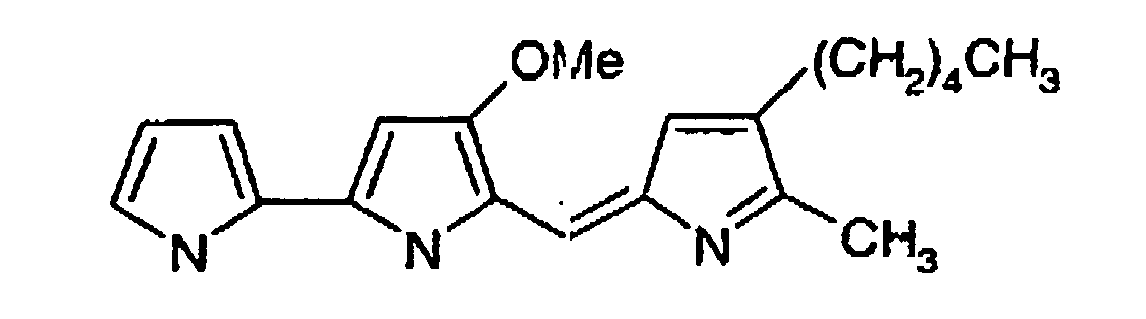
- FIG. 1 illustrates the structure of the prodigiosin.
- FIG. 2 illustrates prevention and cure of diabetes mellitus by administration of prodigiosin. Diabetic mice were selected according to the urine glucose level, and the percentage is based on the total mice (10 heads). Open circles (○) are of control NOD mice and closed circles (●) are of NOD mice receiving prodigiosin.
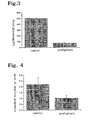
- FIG. 3 illustrates decrease of the blood glucose by administration of prodigiosin. After we isolated plasma from NOD mouse, the blood glucose was measured with the blood biochemical analyzer (Cibacorning, USA).
- FIG. 4 illustrates decline of insulitis by administration of prodigiosin.
- FIG. 5 illustrates decline of insulitis by administration of prodigiosin. Control NOD mice (A) suffered from severe insulitis, but NOD mice receiving prodigiosin (B, C, D) had their insulitis decreased.
- FIG. 6 shows change of expression pattern of lymphocyte's cytokines by administration of prodigiosin. A is of 6-week-old NOD mouse without diabetes, B is of 11-week-old NOD mouse with diabetes, and C is of 11-week-old NOD mouse receiving prodigiosin.
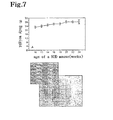
- FIG. 7 illustrates that the prodigiosin has no side effect. NOD mice receiving prodigiosin showed no drop of their weight (A), not suffer from toxicity to kidney (B), and anyone was not led to death.
- The following examples are offered to illustrate this invention and are not meant to be construed in any way as limiting the scope of this invention.
- Prodigiosin was intraperitoneally injected in 10 mg/kg from 8 weeks to 24 weeks of age, and the urine glucose was measured with uropaper (Eiken Chemical Co. Ltd., Japan) every week. In control group of NOD mice, not receiving prodigiosin, the urine glucose was first detected from 15 weeks of age, and at 24 weeks, 80% of the mice had the urine glucose detected (FIG. 2). Experimental group of NOD mice with administration of prodigiosin had the urine glucose not detected, and these results show complete suppression of clinical diabetes by administration of prodigiosin. Average blood glucose of non-prodigiosin-injected NOD mice was 500 mg/dl, which means diabetes mellitus crisis, and that of prodigiosin-injected NOD mice was 100 mg/dl, which means the normal condition (FIG. 3). Consequently, it was proved that the prodigiosin could prevent clinical diabetes in NOD mice completely.
- In insulin-dependent diabetes mellitus, insulitis may be induced by lymphocyte infiltration into pancreatic ducts and destruction of beta cells thereby. Macrophages and T cells are the major infiltrating lymphocytes, and these immune cells destroy beta cells. The pancreas from both the prodigiosin-injected and the non-injected NOD mice were preserved in formalin and to preparation. After the hematoxylin/eosin staining, the lymphocyte infiltration level was measured. 1, 2, and 3 point were respectively given to 25, 50, and 75% of insulitis progression, and the average value of insulitis progression was calculated (FIG. 4). The NOD mice, not receiving prodigiosin, had more than 2 point, or over 50% of infiltration, while the infiltration level of the prodigiosin-injected mice was about 1 point, or under 20% of infiltration. This result showed that the prodigiosin could suppress the lymphocyte infiltration into pancreatic ducts to debilitate insulitis. FIG. 5 shows the result of pathological tests: A indicates the condition of insulitis of non-prodigiosin-injected mice, showing that most of pancreatic ducts were infiltrated by lymphocytes; B, C, and D show that lymphocyte infiltration was reduced by administration of prodigiosin. This experiment demonstrated that the prodigiosin suppresses insulitis, resulting in prevention of occurrence of diabetes mellitus.
- Th cells and macrophages have been known to play an important role in the pathogenesis of diabetes mellitus. According to unknown mechanism, macrophages are activated, and the activated cells produce IL-12. Then IL-12 activates Th1 cells to promote generation of IL-2 and IFN-gamma, and these cytokines activate CTLs and macrophages. The activated CTLs and macrophages destroy beta cells and reduce production of insulin, resulting in occurrence of diabetes mellitus. In this manner, beta cells are disrupted through multi-steps of various mechanisms. Cytokines have a significant part in these immune responses, and control of cytokine production is expected to be prevention and cure of diabetes mellitus. FIG. 6 illustrates the change of cytokine expression of lymphocytes by the prodigiosin. Prodigiosin was intraperitoneally administered to NOD mice from 8 weeks age every other day. In lienal cells from 11-week-old mice, the cytokine mRNA expression level was measured using RT-PCR (the reverse transcription polymerase chain reaction). A is of 6-week-old mouse, B is of 11-week-old one, and C denotes the cytokine expression of 11-week-old mouse receiving prodigiosin. 6-week-old one is of normal condition without the symptoms of diabetes or insulitis, and 11-week-old one is of starting point of insulitis. In other words, the 11-week-old mouse is in the situation that the immunologic functions are abnormally activated and the infiltration is started. At the age of 11 weeks when the functions are brisk, the immunologic functions of mouse's lien cells and their regulation by the prodigiosin were measured. In 11-week-old mouse, mRNA expression of IL-2, IL-10, and IL-6 increased intensively, and by administration of prodigiosin, the expression of IL-2, IFN-gamma, IL-10, IL-6, and IL-12 was strongly suppressed. As you see, the drop of cytokine production results in suppression of its autoimmune responses to beta cells, to cure diabetes mellitus. IL-4 and IL-10 expressed by Th2 cells can weaken the cell function of Th1 cells. The increased expression of IL-4 by the prodigiosin was assumed to inhibit Th1 cell function relating to occurrence of diabetes mellitus. However, the reason of the difference between the expression of IL-10 and that of IL-4 has not been proved. From above results, it becomes clear that the prodigiosin regulates the cytokine production of lymphocytes, resulting in suppressing the occurrence of diabetes mellitus.
- In NOD mice receiving prodigiosin from 8 weeks to 24 weeks age, the negative effects of the prodigiosin were examined (FIG. 7). After administration of prodigiosin, their body weight didn't decrease and this result means that the prodigiosin has no side effect (FIG. 7A). After their liver, kidney, and lung had been extracted from the prodigiosin-injected NOD mice, a pathological test was performed using the hematoxylin/eosin staining. Since the glomerulus and nephric tubule were of normal condition as shown in FIG. 7B, the prodigiosin was proved to have no toxicity to kidney.
- By the above examples, it has been verified that prodigiosin of the present invention is an preventing and curing agent for diabetes mellitus to prevent destruction of beta cells by suppressing autoimmune responses.
- Through the aforementioned examples, it has been illustrated that prodigiosin from Serratia marcescens is a therapeutic agent for prevention and cure of diabetes mellitus without any side effect. Therefore, the present invention is greatly useful for the medical and pharmaceutical industries relating to prevention and cure of diabetes mellitus.
Claims (3)
- Use of the prodigiosin of following structure
- Use according to claim 1 wherein the said prodigiosin is obtained from Serratia marcescens.
- Use according to daim 1 or 2 wherein the prodigiosin is used in a concentration of 10 mg/kg/day.
Applications Claiming Priority (3)
| Application Number | Priority Date | Filing Date | Title |
|---|---|---|---|
| KR1020000007139A KR20010081515A (en) | 2000-02-15 | 2000-02-15 | Novel use of prodigiosin for treating diabetes mellitus |
| KR2000007139 | 2000-02-15 | ||
| PCT/KR2000/000881 WO2001060361A1 (en) | 2000-02-15 | 2000-08-10 | Novel use of prodigiosin for treating diabetes mellitus |
Publications (3)
| Publication Number | Publication Date |
|---|---|
| EP1251847A1 EP1251847A1 (en) | 2002-10-30 |
| EP1251847A4 EP1251847A4 (en) | 2004-11-10 |
| EP1251847B1 true EP1251847B1 (en) | 2007-02-21 |
Family
ID=19646694
Family Applications (1)
| Application Number | Title | Priority Date | Filing Date |
|---|---|---|---|
| EP00952026A Expired - Lifetime EP1251847B1 (en) | 2000-02-15 | 2000-08-10 | Novel use of prodigiosin for treating diabetes mellitus |
Country Status (7)
| Country | Link |
|---|---|
| US (1) | US6638968B1 (en) |
| EP (1) | EP1251847B1 (en) |
| KR (2) | KR20010081515A (en) |
| AT (1) | ATE354361T1 (en) |
| AU (1) | AU6479000A (en) |
| DE (1) | DE60033569T2 (en) |
| WO (1) | WO2001060361A1 (en) |
Cited By (1)
| Publication number | Priority date | Publication date | Assignee | Title |
|---|---|---|---|---|
| DE102013006341A1 (en) | 2013-04-15 | 2014-10-16 | Yoen Ok Roth | Pharmaceutical product for the treatment of eye diseases |
Families Citing this family (6)
| Publication number | Priority date | Publication date | Assignee | Title |
|---|---|---|---|---|
| US20040014987A1 (en) * | 2000-01-26 | 2004-01-22 | Gemin X Biotechnologies Inc. | Pyrrole-Type compounds, compositions, and methods for treating cancer or viral diseases |
| KR100392225B1 (en) * | 2001-04-19 | 2003-07-22 | 한국생명공학연구원 | Prodigiosin composition for the treatment of rheumatic arthritis |
| ATE378329T1 (en) * | 2001-07-18 | 2007-11-15 | Gemin X Biotechnologies Inc | PYRROLE-TYPE COMPOUNDS, COMPOSITIONS AND METHODS FOR TREATING CANCER, TREATING VIRAL DISEASES AND SUPPRESSING IMMUNE RESPONSE |
| US10654801B2 (en) | 2016-04-08 | 2020-05-19 | Institute For Cancer Research | Prodigiosin analogs |
| US10870640B2 (en) | 2016-04-08 | 2020-12-22 | Institute For Cancer Research | Prodigiosin analogs and methods of use |
| KR101995768B1 (en) * | 2019-03-13 | 2019-07-03 | (주)엔솔바이오사이언스 | A novel peptide and use thereof |
Family Cites Families (4)
| Publication number | Priority date | Publication date | Assignee | Title |
|---|---|---|---|---|
| GB9326284D0 (en) * | 1993-12-23 | 1994-02-23 | Erba Carlo Spa | Pyrrolydenemethyl-derivatives and process for their preparation |
| GB9603212D0 (en) * | 1996-02-15 | 1996-04-17 | Pharmacia Spa | Process for the preparation of 2,2'-bipyrrolyl-pyrromethane derivatives |
| KR100252197B1 (en) | 1997-09-20 | 2000-04-15 | 박호군 | Prodigiosin purified from culture broth of serratia marcescens strain for immun inhibition agent |
| GB9802745D0 (en) * | 1998-02-09 | 1998-04-08 | Pharmacia & Upjohn Spa | Benzyloxy prodigiosine compounds |
-
2000
- 2000-02-15 KR KR1020000007139A patent/KR20010081515A/en active Pending
- 2000-08-10 US US10/149,139 patent/US6638968B1/en not_active Expired - Lifetime
- 2000-08-10 WO PCT/KR2000/000881 patent/WO2001060361A1/en not_active Ceased
- 2000-08-10 DE DE60033569T patent/DE60033569T2/en not_active Expired - Lifetime
- 2000-08-10 EP EP00952026A patent/EP1251847B1/en not_active Expired - Lifetime
- 2000-08-10 AU AU64790/00A patent/AU6479000A/en not_active Abandoned
- 2000-08-10 AT AT00952026T patent/ATE354361T1/en not_active IP Right Cessation
- 2000-08-10 KR KR10-2001-7009042A patent/KR100406848B1/en not_active Expired - Lifetime
Cited By (1)
| Publication number | Priority date | Publication date | Assignee | Title |
|---|---|---|---|---|
| DE102013006341A1 (en) | 2013-04-15 | 2014-10-16 | Yoen Ok Roth | Pharmaceutical product for the treatment of eye diseases |
Also Published As
| Publication number | Publication date |
|---|---|
| EP1251847A4 (en) | 2004-11-10 |
| ATE354361T1 (en) | 2007-03-15 |
| KR100406848B1 (en) | 2003-11-21 |
| DE60033569T2 (en) | 2007-10-31 |
| KR20010081515A (en) | 2001-08-29 |
| AU6479000A (en) | 2001-08-27 |
| DE60033569D1 (en) | 2007-04-05 |
| WO2001060361A1 (en) | 2001-08-23 |
| KR20010108108A (en) | 2001-12-07 |
| US6638968B1 (en) | 2003-10-28 |
| EP1251847A1 (en) | 2002-10-30 |
Similar Documents
| Publication | Publication Date | Title |
|---|---|---|
| Barry et al. | A new series of phenazines (rimino-compounds) with high antituberculosis activity | |
| KR100235782B1 (en) | Compositions for the prevention and/or treatment of pathological processes | |
| EP4126905B1 (en) | Cyclophilin inhibitors and uses thereof | |
| EP0586512A1 (en) | Use of rapamycin prodrugs as immunosuppressant agents | |
| MX2011001426A (en) | Methods of treating thalassemia. | |
| EP0283139B1 (en) | Anticancer compounds | |
| JP2008510799A (en) | Diphenoyl structural compounds for the treatment of immune diseases | |
| US6638968B1 (en) | Use of prodigiosin for treating diabetes mellitus | |
| CN112316150B (en) | Pharmaceutical composition for preventing or treating metabolic or injury related diseases | |
| Teunissen et al. | Influence of 9-hydroxyellipticine and 3-methylcholanthrene treatment on antipyrine metabolite formation in rats in vivo | |
| JP2010520913A (en) | Rooibos anti-diabetic extract | |
| CN117942324A (en) | Application of phenolic compounds in inhibiting cell ferroptosis and preventing and treating ferroptosis-related diseases | |
| US6809084B1 (en) | Compositions containing polysaccharides from phellinus linteus and methods for treating diabetes mellitus using same | |
| US5962480A (en) | Drug for ameliorating brain diseases | |
| JP3251673B2 (en) | How to control nitric oxide production | |
| Alam et al. | Alloxan induced diabetes in rabbits | |
| Kitson | On the probability of implanted disulfiram's causing a reaction to ethanol. | |
| AU618838B2 (en) | Use of castanospermine as an anti-inflammatory and immunosuppressant agent | |
| JPH08506117A (en) | Rapamycin derivative, production method and use thereof | |
| KR20110073877A (en) | New Uses of Ide Solid | |
| CN115650944B (en) | A class of compounds that can lower uric acid | |
| CN115844916A (en) | Pharmaceutical use of jujuboside A | |
| US20040266739A1 (en) | Composition comprising minocycline as an effective component for prevention and treatment of dementia, and learning and memory impairments | |
| US6214357B1 (en) | Treatment of diabetes | |
| SU1628077A1 (en) | Method of modeling alcoholic visceropathy |
Legal Events
| Date | Code | Title | Description |
|---|---|---|---|
| PUAI | Public reference made under article 153(3) epc to a published international application that has entered the european phase |
Free format text: ORIGINAL CODE: 0009012 |
|
| 17P | Request for examination filed |
Effective date: 20020613 |
|
| AK | Designated contracting states |
Kind code of ref document: A1 Designated state(s): AT BE CH CY DE DK ES FI FR GB GR IE IT LI LU MC NL PT SE |
|
| AX | Request for extension of the european patent |
Free format text: AL;LT;LV;MK;RO;SI |
|
| A4 | Supplementary search report drawn up and despatched |
Effective date: 20040923 |
|
| RIC1 | Information provided on ipc code assigned before grant |
Ipc: 7A 61K 35/74 B Ipc: 7A 61K 31/4025 B Ipc: 7A 61K 31/40 A Ipc: 7A 61P 3/10 B |
|
| 17Q | First examination report despatched |
Effective date: 20050114 |
|
| GRAP | Despatch of communication of intention to grant a patent |
Free format text: ORIGINAL CODE: EPIDOSNIGR1 |
|
| GRAS | Grant fee paid |
Free format text: ORIGINAL CODE: EPIDOSNIGR3 |
|
| GRAA | (expected) grant |
Free format text: ORIGINAL CODE: 0009210 |
|
| AK | Designated contracting states |
Kind code of ref document: B1 Designated state(s): AT BE CH CY DE DK ES FI FR GB GR IE IT LI LU MC NL PT SE |
|
| PG25 | Lapsed in a contracting state [announced via postgrant information from national office to epo] |
Ref country code: DK Free format text: LAPSE BECAUSE OF FAILURE TO SUBMIT A TRANSLATION OF THE DESCRIPTION OR TO PAY THE FEE WITHIN THE PRESCRIBED TIME-LIMIT Effective date: 20070221 Ref country code: CH Free format text: LAPSE BECAUSE OF FAILURE TO SUBMIT A TRANSLATION OF THE DESCRIPTION OR TO PAY THE FEE WITHIN THE PRESCRIBED TIME-LIMIT Effective date: 20070221 Ref country code: FI Free format text: LAPSE BECAUSE OF FAILURE TO SUBMIT A TRANSLATION OF THE DESCRIPTION OR TO PAY THE FEE WITHIN THE PRESCRIBED TIME-LIMIT Effective date: 20070221 Ref country code: LI Free format text: LAPSE BECAUSE OF FAILURE TO SUBMIT A TRANSLATION OF THE DESCRIPTION OR TO PAY THE FEE WITHIN THE PRESCRIBED TIME-LIMIT Effective date: 20070221 Ref country code: BE Free format text: LAPSE BECAUSE OF FAILURE TO SUBMIT A TRANSLATION OF THE DESCRIPTION OR TO PAY THE FEE WITHIN THE PRESCRIBED TIME-LIMIT Effective date: 20070221 Ref country code: AT Free format text: LAPSE BECAUSE OF FAILURE TO SUBMIT A TRANSLATION OF THE DESCRIPTION OR TO PAY THE FEE WITHIN THE PRESCRIBED TIME-LIMIT Effective date: 20070221 Ref country code: NL Free format text: LAPSE BECAUSE OF FAILURE TO SUBMIT A TRANSLATION OF THE DESCRIPTION OR TO PAY THE FEE WITHIN THE PRESCRIBED TIME-LIMIT Effective date: 20070221 |
|
| REG | Reference to a national code |
Ref country code: GB Ref legal event code: FG4D |
|
| REG | Reference to a national code |
Ref country code: CH Ref legal event code: EP |
|
| REF | Corresponds to: |
Ref document number: 60033569 Country of ref document: DE Date of ref document: 20070405 Kind code of ref document: P |
|
| REG | Reference to a national code |
Ref country code: IE Ref legal event code: FG4D |
|
| PG25 | Lapsed in a contracting state [announced via postgrant information from national office to epo] |
Ref country code: SE Free format text: LAPSE BECAUSE OF FAILURE TO SUBMIT A TRANSLATION OF THE DESCRIPTION OR TO PAY THE FEE WITHIN THE PRESCRIBED TIME-LIMIT Effective date: 20070521 |
|
| PG25 | Lapsed in a contracting state [announced via postgrant information from national office to epo] |
Ref country code: ES Free format text: LAPSE BECAUSE OF FAILURE TO SUBMIT A TRANSLATION OF THE DESCRIPTION OR TO PAY THE FEE WITHIN THE PRESCRIBED TIME-LIMIT Effective date: 20070601 |
|
| PG25 | Lapsed in a contracting state [announced via postgrant information from national office to epo] |
Ref country code: PT Free format text: LAPSE BECAUSE OF FAILURE TO SUBMIT A TRANSLATION OF THE DESCRIPTION OR TO PAY THE FEE WITHIN THE PRESCRIBED TIME-LIMIT Effective date: 20070723 |
|
| NLV1 | Nl: lapsed or annulled due to failure to fulfill the requirements of art. 29p and 29m of the patents act | ||
| ET | Fr: translation filed | ||
| REG | Reference to a national code |
Ref country code: CH Ref legal event code: PL |
|
| PLBE | No opposition filed within time limit |
Free format text: ORIGINAL CODE: 0009261 |
|
| STAA | Information on the status of an ep patent application or granted ep patent |
Free format text: STATUS: NO OPPOSITION FILED WITHIN TIME LIMIT |
|
| 26N | No opposition filed |
Effective date: 20071122 |
|
| PG25 | Lapsed in a contracting state [announced via postgrant information from national office to epo] |
Ref country code: MC Free format text: LAPSE BECAUSE OF NON-PAYMENT OF DUE FEES Effective date: 20070831 Ref country code: GR Free format text: LAPSE BECAUSE OF FAILURE TO SUBMIT A TRANSLATION OF THE DESCRIPTION OR TO PAY THE FEE WITHIN THE PRESCRIBED TIME-LIMIT Effective date: 20070522 |
|
| PG25 | Lapsed in a contracting state [announced via postgrant information from national office to epo] |
Ref country code: IE Free format text: LAPSE BECAUSE OF NON-PAYMENT OF DUE FEES Effective date: 20070810 |
|
| PG25 | Lapsed in a contracting state [announced via postgrant information from national office to epo] |
Ref country code: CY Free format text: LAPSE BECAUSE OF FAILURE TO SUBMIT A TRANSLATION OF THE DESCRIPTION OR TO PAY THE FEE WITHIN THE PRESCRIBED TIME-LIMIT Effective date: 20070221 |
|
| PG25 | Lapsed in a contracting state [announced via postgrant information from national office to epo] |
Ref country code: LU Free format text: LAPSE BECAUSE OF NON-PAYMENT OF DUE FEES Effective date: 20070810 |
|
| REG | Reference to a national code |
Ref country code: FR Ref legal event code: PLFP Year of fee payment: 17 |
|
| REG | Reference to a national code |
Ref country code: FR Ref legal event code: PLFP Year of fee payment: 18 |
|
| REG | Reference to a national code |
Ref country code: FR Ref legal event code: PLFP Year of fee payment: 19 |
|
| PGFP | Annual fee paid to national office [announced via postgrant information from national office to epo] |
Ref country code: DE Payment date: 20190730 Year of fee payment: 20 Ref country code: FR Payment date: 20190730 Year of fee payment: 20 Ref country code: IT Payment date: 20190821 Year of fee payment: 20 |
|
| PGFP | Annual fee paid to national office [announced via postgrant information from national office to epo] |
Ref country code: GB Payment date: 20190808 Year of fee payment: 20 |
|
| REG | Reference to a national code |
Ref country code: DE Ref legal event code: R071 Ref document number: 60033569 Country of ref document: DE |
|
| REG | Reference to a national code |
Ref country code: GB Ref legal event code: PE20 Expiry date: 20200809 |
|
| PG25 | Lapsed in a contracting state [announced via postgrant information from national office to epo] |
Ref country code: GB Free format text: LAPSE BECAUSE OF EXPIRATION OF PROTECTION Effective date: 20200809 |