EP1251154A1 - Ink compositions for inkjet recording - Google Patents
Ink compositions for inkjet recording Download PDFInfo
- Publication number
- EP1251154A1 EP1251154A1 EP20020008394 EP02008394A EP1251154A1 EP 1251154 A1 EP1251154 A1 EP 1251154A1 EP 20020008394 EP20020008394 EP 20020008394 EP 02008394 A EP02008394 A EP 02008394A EP 1251154 A1 EP1251154 A1 EP 1251154A1
- Authority
- EP
- European Patent Office
- Prior art keywords
- group
- dye
- formula
- mol
- invention product
- Prior art date
- Legal status (The legal status is an assumption and is not a legal conclusion. Google has not performed a legal analysis and makes no representation as to the accuracy of the status listed.)
- Granted
Links
- 239000000203 mixture Substances 0.000 title claims abstract description 42
- 150000001875 compounds Chemical class 0.000 claims abstract description 201
- 125000000623 heterocyclic group Chemical group 0.000 claims abstract description 102
- 239000012736 aqueous medium Substances 0.000 claims abstract description 16
- 239000000987 azo dye Substances 0.000 claims abstract description 16
- 230000008878 coupling Effects 0.000 claims abstract description 10
- 238000010168 coupling process Methods 0.000 claims abstract description 10
- 238000005859 coupling reaction Methods 0.000 claims abstract description 10
- 239000000975 dye Substances 0.000 claims description 312
- -1 thiocarbamoyl group Chemical group 0.000 claims description 149
- 239000002245 particle Substances 0.000 claims description 108
- 125000003118 aryl group Chemical group 0.000 claims description 77
- 125000001424 substituent group Chemical group 0.000 claims description 67
- 125000001931 aliphatic group Chemical group 0.000 claims description 59
- 125000004435 hydrogen atom Chemical group [H]* 0.000 claims description 40
- XLYOFNOQVPJJNP-UHFFFAOYSA-N water Substances O XLYOFNOQVPJJNP-UHFFFAOYSA-N 0.000 claims description 40
- 238000000034 method Methods 0.000 claims description 33
- 239000003960 organic solvent Substances 0.000 claims description 31
- 125000000217 alkyl group Chemical group 0.000 claims description 30
- 125000002252 acyl group Chemical group 0.000 claims description 29
- 125000003917 carbamoyl group Chemical group [H]N([H])C(*)=O 0.000 claims description 24
- 125000000472 sulfonyl group Chemical group *S(*)(=O)=O 0.000 claims description 24
- 125000004390 alkyl sulfonyl group Chemical group 0.000 claims description 19
- 125000004391 aryl sulfonyl group Chemical group 0.000 claims description 19
- 125000001820 oxy group Chemical group [*:1]O[*:2] 0.000 claims description 17
- 125000003545 alkoxy group Chemical group 0.000 claims description 16
- 125000004453 alkoxycarbonyl group Chemical group 0.000 claims description 16
- 125000003277 amino group Chemical group 0.000 claims description 16
- 125000005740 oxycarbonyl group Chemical group [*:1]OC([*:2])=O 0.000 claims description 16
- 125000004423 acyloxy group Chemical group 0.000 claims description 15
- 125000004397 aminosulfonyl group Chemical group NS(=O)(=O)* 0.000 claims description 14
- 125000005161 aryl oxy carbonyl group Chemical group 0.000 claims description 14
- 125000004442 acylamino group Chemical group 0.000 claims description 13
- 125000005843 halogen group Chemical group 0.000 claims description 13
- 125000002887 hydroxy group Chemical group [H]O* 0.000 claims description 13
- 125000004104 aryloxy group Chemical group 0.000 claims description 12
- 125000004093 cyano group Chemical group *C#N 0.000 claims description 11
- 125000004466 alkoxycarbonylamino group Chemical group 0.000 claims description 10
- 125000005162 aryl oxy carbonyl amino group Chemical group 0.000 claims description 10
- 230000008569 process Effects 0.000 claims description 10
- 125000006296 sulfonyl amino group Chemical group [H]N(*)S(*)(=O)=O 0.000 claims description 10
- 125000005194 alkoxycarbonyloxy group Chemical group 0.000 claims description 9
- 125000004644 alkyl sulfinyl group Chemical group 0.000 claims description 9
- 125000005200 aryloxy carbonyloxy group Chemical group 0.000 claims description 9
- 125000001951 carbamoylamino group Chemical group C(N)(=O)N* 0.000 claims description 9
- 125000003178 carboxy group Chemical group [H]OC(*)=O 0.000 claims description 9
- 125000004149 thio group Chemical group *S* 0.000 claims description 9
- 125000005135 aryl sulfinyl group Chemical group 0.000 claims description 8
- 125000000475 sulfinyl group Chemical group [*:2]S([*:1])=O 0.000 claims description 8
- 125000000020 sulfo group Chemical group O=S(=O)([*])O[H] 0.000 claims description 8
- 239000000463 material Substances 0.000 claims description 7
- 125000000449 nitro group Chemical group [O-][N+](*)=O 0.000 claims description 7
- 125000004656 alkyl sulfonylamino group Chemical group 0.000 claims description 6
- 125000004657 aryl sulfonyl amino group Chemical group 0.000 claims description 6
- 125000004469 siloxy group Chemical group [SiH3]O* 0.000 claims description 6
- 125000002373 5 membered heterocyclic group Chemical group 0.000 claims description 5
- 239000001023 inorganic pigment Substances 0.000 claims description 4
- 229910052757 nitrogen Inorganic materials 0.000 claims description 4
- 125000004433 nitrogen atom Chemical group N* 0.000 claims description 4
- 125000004414 alkyl thio group Chemical group 0.000 claims description 3
- 125000005110 aryl thio group Chemical group 0.000 claims description 2
- 239000000047 product Substances 0.000 description 276
- 239000000976 ink Substances 0.000 description 121
- 230000000052 comparative effect Effects 0.000 description 37
- 239000010410 layer Substances 0.000 description 26
- 125000004432 carbon atom Chemical group C* 0.000 description 24
- MTHSVFCYNBDYFN-UHFFFAOYSA-N diethylene glycol Chemical compound OCCOCCO MTHSVFCYNBDYFN-UHFFFAOYSA-N 0.000 description 24
- 239000003921 oil Substances 0.000 description 24
- 238000007639 printing Methods 0.000 description 20
- 239000006185 dispersion Substances 0.000 description 19
- 239000000123 paper Substances 0.000 description 18
- 230000000740 bleeding effect Effects 0.000 description 17
- 239000003795 chemical substances by application Substances 0.000 description 17
- PEDCQBHIVMGVHV-UHFFFAOYSA-N Glycerine Chemical compound OCC(O)CO PEDCQBHIVMGVHV-UHFFFAOYSA-N 0.000 description 15
- 239000000049 pigment Substances 0.000 description 15
- 229920000642 polymer Polymers 0.000 description 15
- 239000004094 surface-active agent Substances 0.000 description 14
- 229920003171 Poly (ethylene oxide) Polymers 0.000 description 13
- 238000004945 emulsification Methods 0.000 description 11
- 239000000654 additive Substances 0.000 description 10
- 235000014113 dietary fatty acids Nutrition 0.000 description 10
- 239000000839 emulsion Substances 0.000 description 10
- 239000000194 fatty acid Substances 0.000 description 10
- 229930195729 fatty acid Natural products 0.000 description 10
- XEKOWRVHYACXOJ-UHFFFAOYSA-N Ethyl acetate Chemical compound CCOC(C)=O XEKOWRVHYACXOJ-UHFFFAOYSA-N 0.000 description 9
- 239000004372 Polyvinyl alcohol Substances 0.000 description 9
- KWYUFKZDYYNOTN-UHFFFAOYSA-M Potassium hydroxide Chemical compound [OH-].[K+] KWYUFKZDYYNOTN-UHFFFAOYSA-M 0.000 description 9
- VYPSYNLAJGMNEJ-UHFFFAOYSA-N Silicium dioxide Chemical compound O=[Si]=O VYPSYNLAJGMNEJ-UHFFFAOYSA-N 0.000 description 9
- 238000009835 boiling Methods 0.000 description 9
- 238000011161 development Methods 0.000 description 9
- 239000003995 emulsifying agent Substances 0.000 description 9
- 235000011187 glycerol Nutrition 0.000 description 9
- 229920002451 polyvinyl alcohol Polymers 0.000 description 9
- LYCAIKOWRPUZTN-UHFFFAOYSA-N Ethylene glycol Chemical compound OCCO LYCAIKOWRPUZTN-UHFFFAOYSA-N 0.000 description 8
- CBENFWSGALASAD-UHFFFAOYSA-N Ozone Chemical compound [O-][O+]=O CBENFWSGALASAD-UHFFFAOYSA-N 0.000 description 8
- XSQUKJJJFZCRTK-UHFFFAOYSA-N Urea Chemical compound NC(N)=O XSQUKJJJFZCRTK-UHFFFAOYSA-N 0.000 description 8
- 125000001997 phenyl group Chemical group [H]C1=C([H])C([H])=C(*)C([H])=C1[H] 0.000 description 8
- LFQSCWFLJHTTHZ-UHFFFAOYSA-N Ethanol Chemical compound CCO LFQSCWFLJHTTHZ-UHFFFAOYSA-N 0.000 description 7
- KFZMGEQAYNKOFK-UHFFFAOYSA-N Isopropanol Chemical compound CC(C)O KFZMGEQAYNKOFK-UHFFFAOYSA-N 0.000 description 7
- LRHPLDYGYMQRHN-UHFFFAOYSA-N N-Butanol Chemical compound CCCCO LRHPLDYGYMQRHN-UHFFFAOYSA-N 0.000 description 7
- 239000011230 binding agent Substances 0.000 description 7
- 125000002091 cationic group Chemical group 0.000 description 7
- 239000012071 phase Substances 0.000 description 7
- 0 *N(*)N(c1ccccc1)c1ccccc1 Chemical compound *N(*)N(c1ccccc1)c1ccccc1 0.000 description 6
- PAYRUJLWNCNPSJ-UHFFFAOYSA-N Aniline Chemical compound NC1=CC=CC=C1 PAYRUJLWNCNPSJ-UHFFFAOYSA-N 0.000 description 6
- VTYYLEPIZMXCLO-UHFFFAOYSA-L Calcium carbonate Chemical compound [Ca+2].[O-]C([O-])=O VTYYLEPIZMXCLO-UHFFFAOYSA-L 0.000 description 6
- ZMXDDKWLCZADIW-UHFFFAOYSA-N N,N-Dimethylformamide Chemical compound CN(C)C=O ZMXDDKWLCZADIW-UHFFFAOYSA-N 0.000 description 6
- ISWSIDIOOBJBQZ-UHFFFAOYSA-N Phenol Chemical compound OC1=CC=CC=C1 ISWSIDIOOBJBQZ-UHFFFAOYSA-N 0.000 description 6
- DNIAPMSPPWPWGF-UHFFFAOYSA-N Propylene glycol Chemical compound CC(O)CO DNIAPMSPPWPWGF-UHFFFAOYSA-N 0.000 description 6
- PPBRXRYQALVLMV-UHFFFAOYSA-N Styrene Chemical compound C=CC1=CC=CC=C1 PPBRXRYQALVLMV-UHFFFAOYSA-N 0.000 description 6
- GWEVSGVZZGPLCZ-UHFFFAOYSA-N Titan oxide Chemical compound O=[Ti]=O GWEVSGVZZGPLCZ-UHFFFAOYSA-N 0.000 description 6
- XLOMVQKBTHCTTD-UHFFFAOYSA-N Zinc monoxide Chemical compound [Zn]=O XLOMVQKBTHCTTD-UHFFFAOYSA-N 0.000 description 6
- 239000003429 antifungal agent Substances 0.000 description 6
- 229940121375 antifungal agent Drugs 0.000 description 6
- 125000001769 aryl amino group Chemical group 0.000 description 6
- 239000011362 coarse particle Substances 0.000 description 6
- 239000008367 deionised water Substances 0.000 description 6
- 229910021641 deionized water Inorganic materials 0.000 description 6
- DOIRQSBPFJWKBE-UHFFFAOYSA-N dibutyl phthalate Chemical compound CCCCOC(=O)C1=CC=CC=C1C(=O)OCCCC DOIRQSBPFJWKBE-UHFFFAOYSA-N 0.000 description 6
- 125000001495 ethyl group Chemical group [H]C([H])([H])C([H])([H])* 0.000 description 6
- RAXXELZNTBOGNW-UHFFFAOYSA-N imidazole Natural products C1=CNC=N1 RAXXELZNTBOGNW-UHFFFAOYSA-N 0.000 description 6
- 238000011160 research Methods 0.000 description 6
- 229920005989 resin Polymers 0.000 description 6
- 239000011347 resin Substances 0.000 description 6
- 238000003860 storage Methods 0.000 description 6
- 229920003169 water-soluble polymer Polymers 0.000 description 6
- SECXISVLQFMRJM-UHFFFAOYSA-N N-Methylpyrrolidone Chemical compound CN1CCCC1=O SECXISVLQFMRJM-UHFFFAOYSA-N 0.000 description 5
- 229920002472 Starch Polymers 0.000 description 5
- GSEJCLTVZPLZKY-UHFFFAOYSA-N Triethanolamine Chemical compound OCCN(CCO)CCO GSEJCLTVZPLZKY-UHFFFAOYSA-N 0.000 description 5
- 230000000996 additive effect Effects 0.000 description 5
- 150000001412 amines Chemical class 0.000 description 5
- 239000008346 aqueous phase Substances 0.000 description 5
- IOJUPLGTWVMSFF-UHFFFAOYSA-N benzothiazole Chemical group C1=CC=C2SC=NC2=C1 IOJUPLGTWVMSFF-UHFFFAOYSA-N 0.000 description 5
- QRUDEWIWKLJBPS-UHFFFAOYSA-N benzotriazole Chemical compound C1=CC=C2N[N][N]C2=C1 QRUDEWIWKLJBPS-UHFFFAOYSA-N 0.000 description 5
- 239000012964 benzotriazole Substances 0.000 description 5
- 230000000694 effects Effects 0.000 description 5
- ZLTPDFXIESTBQG-UHFFFAOYSA-N isothiazole Chemical group C=1C=NSC=1 ZLTPDFXIESTBQG-UHFFFAOYSA-N 0.000 description 5
- 239000002736 nonionic surfactant Substances 0.000 description 5
- 239000007787 solid Substances 0.000 description 5
- 239000003381 stabilizer Substances 0.000 description 5
- 239000008107 starch Substances 0.000 description 5
- 235000019698 starch Nutrition 0.000 description 5
- 239000012463 white pigment Substances 0.000 description 5
- AZQWKYJCGOJGHM-UHFFFAOYSA-N 1,4-benzoquinone Chemical compound O=C1C=CC(=O)C=C1 AZQWKYJCGOJGHM-UHFFFAOYSA-N 0.000 description 4
- IAZDPXIOMUYVGZ-UHFFFAOYSA-N Dimethylsulphoxide Chemical compound CS(C)=O IAZDPXIOMUYVGZ-UHFFFAOYSA-N 0.000 description 4
- YCKRFDGAMUMZLT-UHFFFAOYSA-N Fluorine atom Chemical compound [F] YCKRFDGAMUMZLT-UHFFFAOYSA-N 0.000 description 4
- NBIIXXVUZAFLBC-UHFFFAOYSA-N Phosphoric acid Chemical compound OP(O)(O)=O NBIIXXVUZAFLBC-UHFFFAOYSA-N 0.000 description 4
- 235000010724 Wisteria floribunda Nutrition 0.000 description 4
- 150000001298 alcohols Chemical class 0.000 description 4
- 125000003368 amide group Chemical group 0.000 description 4
- 239000003945 anionic surfactant Substances 0.000 description 4
- 230000002421 anti-septic effect Effects 0.000 description 4
- 239000002518 antifoaming agent Substances 0.000 description 4
- 125000003710 aryl alkyl group Chemical group 0.000 description 4
- TZCXTZWJZNENPQ-UHFFFAOYSA-L barium sulfate Chemical compound [Ba+2].[O-]S([O-])(=O)=O TZCXTZWJZNENPQ-UHFFFAOYSA-L 0.000 description 4
- DMSMPAJRVJJAGA-UHFFFAOYSA-N benzo[d]isothiazol-3-one Chemical compound C1=CC=C2C(=O)NSC2=C1 DMSMPAJRVJJAGA-UHFFFAOYSA-N 0.000 description 4
- OSGAYBCDTDRGGQ-UHFFFAOYSA-L calcium sulfate Chemical compound [Ca+2].[O-]S([O-])(=O)=O OSGAYBCDTDRGGQ-UHFFFAOYSA-L 0.000 description 4
- 239000004202 carbamide Substances 0.000 description 4
- 150000001768 cations Chemical class 0.000 description 4
- 229920001577 copolymer Polymers 0.000 description 4
- XLLIQLLCWZCATF-UHFFFAOYSA-N ethylene glycol monomethyl ether acetate Natural products COCCOC(C)=O XLLIQLLCWZCATF-UHFFFAOYSA-N 0.000 description 4
- 239000010419 fine particle Substances 0.000 description 4
- 229910052731 fluorine Inorganic materials 0.000 description 4
- 239000011737 fluorine Substances 0.000 description 4
- 239000003906 humectant Substances 0.000 description 4
- 239000004816 latex Substances 0.000 description 4
- 229920000126 latex Polymers 0.000 description 4
- 229910052751 metal Inorganic materials 0.000 description 4
- 239000002184 metal Substances 0.000 description 4
- 125000002496 methyl group Chemical group [H]C([H])([H])* 0.000 description 4
- 125000001624 naphthyl group Chemical group 0.000 description 4
- 125000003226 pyrazolyl group Chemical group 0.000 description 4
- 239000000126 substance Substances 0.000 description 4
- 229910002029 synthetic silica gel Inorganic materials 0.000 description 4
- 239000006097 ultraviolet radiation absorber Substances 0.000 description 4
- KJCVRFUGPWSIIH-UHFFFAOYSA-N 1-naphthol Chemical compound C1=CC=C2C(O)=CC=CC2=C1 KJCVRFUGPWSIIH-UHFFFAOYSA-N 0.000 description 3
- HIXDQWDOVZUNNA-UHFFFAOYSA-N 2-(3,4-dimethoxyphenyl)-5-hydroxy-7-methoxychromen-4-one Chemical compound C=1C(OC)=CC(O)=C(C(C=2)=O)C=1OC=2C1=CC=C(OC)C(OC)=C1 HIXDQWDOVZUNNA-UHFFFAOYSA-N 0.000 description 3
- ZWEHNKRNPOVVGH-UHFFFAOYSA-N 2-Butanone Chemical compound CCC(C)=O ZWEHNKRNPOVVGH-UHFFFAOYSA-N 0.000 description 3
- COBPKKZHLDDMTB-UHFFFAOYSA-N 2-[2-(2-butoxyethoxy)ethoxy]ethanol Chemical compound CCCCOCCOCCOCCO COBPKKZHLDDMTB-UHFFFAOYSA-N 0.000 description 3
- 125000004105 2-pyridyl group Chemical group N1=C([*])C([H])=C([H])C([H])=C1[H] 0.000 description 3
- NECRQCBKTGZNMH-UHFFFAOYSA-N 3,5-dimethylhex-1-yn-3-ol Chemical compound CC(C)CC(C)(O)C#C NECRQCBKTGZNMH-UHFFFAOYSA-N 0.000 description 3
- QTBSBXVTEAMEQO-UHFFFAOYSA-N Acetic acid Chemical compound CC(O)=O QTBSBXVTEAMEQO-UHFFFAOYSA-N 0.000 description 3
- CSCPPACGZOOCGX-UHFFFAOYSA-N Acetone Chemical compound CC(C)=O CSCPPACGZOOCGX-UHFFFAOYSA-N 0.000 description 3
- WEVYAHXRMPXWCK-UHFFFAOYSA-N Acetonitrile Chemical compound CC#N WEVYAHXRMPXWCK-UHFFFAOYSA-N 0.000 description 3
- UHOVQNZJYSORNB-UHFFFAOYSA-N Benzene Chemical compound C1=CC=CC=C1 UHOVQNZJYSORNB-UHFFFAOYSA-N 0.000 description 3
- WVDDGKGOMKODPV-UHFFFAOYSA-N Benzyl alcohol Chemical compound OCC1=CC=CC=C1 WVDDGKGOMKODPV-UHFFFAOYSA-N 0.000 description 3
- 229920002134 Carboxymethyl cellulose Polymers 0.000 description 3
- 108010010803 Gelatin Proteins 0.000 description 3
- WMFOQBRAJBCJND-UHFFFAOYSA-M Lithium hydroxide Chemical compound [Li+].[OH-] WMFOQBRAJBCJND-UHFFFAOYSA-M 0.000 description 3
- OKKJLVBELUTLKV-UHFFFAOYSA-N Methanol Chemical compound OC OKKJLVBELUTLKV-UHFFFAOYSA-N 0.000 description 3
- 239000004952 Polyamide Substances 0.000 description 3
- WTKZEGDFNFYCGP-UHFFFAOYSA-N Pyrazole Chemical compound C=1C=NNC=1 WTKZEGDFNFYCGP-UHFFFAOYSA-N 0.000 description 3
- HEMHJVSKTPXQMS-UHFFFAOYSA-M Sodium hydroxide Chemical compound [OH-].[Na+] HEMHJVSKTPXQMS-UHFFFAOYSA-M 0.000 description 3
- 125000002777 acetyl group Chemical group [H]C([H])([H])C(*)=O 0.000 description 3
- 239000002253 acid Substances 0.000 description 3
- NIXOWILDQLNWCW-UHFFFAOYSA-N acrylic acid group Chemical group C(C=C)(=O)O NIXOWILDQLNWCW-UHFFFAOYSA-N 0.000 description 3
- 150000005215 alkyl ethers Chemical class 0.000 description 3
- 150000008051 alkyl sulfates Chemical class 0.000 description 3
- PNEYBMLMFCGWSK-UHFFFAOYSA-N aluminium oxide Inorganic materials [O-2].[O-2].[O-2].[Al+3].[Al+3] PNEYBMLMFCGWSK-UHFFFAOYSA-N 0.000 description 3
- 239000003963 antioxidant agent Substances 0.000 description 3
- BTANRVKWQNVYAZ-UHFFFAOYSA-N butan-2-ol Chemical compound CCC(C)O BTANRVKWQNVYAZ-UHFFFAOYSA-N 0.000 description 3
- 229910000019 calcium carbonate Inorganic materials 0.000 description 3
- 235000010948 carboxy methyl cellulose Nutrition 0.000 description 3
- 239000005018 casein Substances 0.000 description 3
- BECPQYXYKAMYBN-UHFFFAOYSA-N casein, tech. Chemical compound NCCCCC(C(O)=O)N=C(O)C(CC(O)=O)N=C(O)C(CCC(O)=N)N=C(O)C(CC(C)C)N=C(O)C(CCC(O)=O)N=C(O)C(CC(O)=O)N=C(O)C(CCC(O)=O)N=C(O)C(C(C)O)N=C(O)C(CCC(O)=N)N=C(O)C(CCC(O)=N)N=C(O)C(CCC(O)=N)N=C(O)C(CCC(O)=O)N=C(O)C(CCC(O)=O)N=C(O)C(COP(O)(O)=O)N=C(O)C(CCC(O)=N)N=C(O)C(N)CC1=CC=CC=C1 BECPQYXYKAMYBN-UHFFFAOYSA-N 0.000 description 3
- 235000021240 caseins Nutrition 0.000 description 3
- ZBCBWPMODOFKDW-UHFFFAOYSA-N diethanolamine Chemical compound OCCNCCO ZBCBWPMODOFKDW-UHFFFAOYSA-N 0.000 description 3
- 239000002270 dispersing agent Substances 0.000 description 3
- 230000001804 emulsifying effect Effects 0.000 description 3
- RTZKZFJDLAIYFH-UHFFFAOYSA-N ether Substances CCOCC RTZKZFJDLAIYFH-UHFFFAOYSA-N 0.000 description 3
- 229920000159 gelatin Polymers 0.000 description 3
- 239000008273 gelatin Substances 0.000 description 3
- 235000019322 gelatine Nutrition 0.000 description 3
- 235000011852 gelatine desserts Nutrition 0.000 description 3
- DMEGYFMYUHOHGS-UHFFFAOYSA-N heptamethylene Natural products C1CCCCCC1 DMEGYFMYUHOHGS-UHFFFAOYSA-N 0.000 description 3
- 238000005259 measurement Methods 0.000 description 3
- 125000004170 methylsulfonyl group Chemical group [H]C([H])([H])S(*)(=O)=O 0.000 description 3
- 230000035515 penetration Effects 0.000 description 3
- 150000002989 phenols Chemical class 0.000 description 3
- 125000003170 phenylsulfonyl group Chemical group C1(=CC=CC=C1)S(=O)(=O)* 0.000 description 3
- 229920002647 polyamide Polymers 0.000 description 3
- 239000004848 polyfunctional curative Substances 0.000 description 3
- 229920000036 polyvinylpyrrolidone Polymers 0.000 description 3
- 239000001267 polyvinylpyrrolidone Substances 0.000 description 3
- 235000013855 polyvinylpyrrolidone Nutrition 0.000 description 3
- 239000011148 porous material Substances 0.000 description 3
- 238000002360 preparation method Methods 0.000 description 3
- HNJBEVLQSNELDL-UHFFFAOYSA-N pyrrolidin-2-one Chemical compound O=C1CCCN1 HNJBEVLQSNELDL-UHFFFAOYSA-N 0.000 description 3
- 238000001454 recorded image Methods 0.000 description 3
- 150000003839 salts Chemical class 0.000 description 3
- 239000002904 solvent Substances 0.000 description 3
- 125000003107 substituted aryl group Chemical group 0.000 description 3
- 150000005846 sugar alcohols Polymers 0.000 description 3
- HXJUTPCZVOIRIF-UHFFFAOYSA-N sulfolane Chemical compound O=S1(=O)CCCC1 HXJUTPCZVOIRIF-UHFFFAOYSA-N 0.000 description 3
- 229910052717 sulfur Inorganic materials 0.000 description 3
- 125000000999 tert-butyl group Chemical group [H]C([H])([H])C(*)(C([H])([H])[H])C([H])([H])[H] 0.000 description 3
- 238000004078 waterproofing Methods 0.000 description 3
- 239000011787 zinc oxide Substances 0.000 description 3
- UGUHFDPGDQDVGX-UHFFFAOYSA-N 1,2,3-thiadiazole Chemical group C1=CSN=N1 UGUHFDPGDQDVGX-UHFFFAOYSA-N 0.000 description 2
- CYSGHNMQYZDMIA-UHFFFAOYSA-N 1,3-Dimethyl-2-imidazolidinon Chemical compound CN1CCN(C)C1=O CYSGHNMQYZDMIA-UHFFFAOYSA-N 0.000 description 2
- BCMCBBGGLRIHSE-UHFFFAOYSA-N 1,3-benzoxazole Chemical compound C1=CC=C2OC=NC2=C1 BCMCBBGGLRIHSE-UHFFFAOYSA-N 0.000 description 2
- ABDDQTDRAHXHOC-QMMMGPOBSA-N 1-[(7s)-5,7-dihydro-4h-thieno[2,3-c]pyran-7-yl]-n-methylmethanamine Chemical compound CNC[C@@H]1OCCC2=C1SC=C2 ABDDQTDRAHXHOC-QMMMGPOBSA-N 0.000 description 2
- WNWHHMBRJJOGFJ-UHFFFAOYSA-N 16-methylheptadecan-1-ol Chemical compound CC(C)CCCCCCCCCCCCCCCO WNWHHMBRJJOGFJ-UHFFFAOYSA-N 0.000 description 2
- WMVJWKURWRGJCI-UHFFFAOYSA-N 2,4-bis(2-methylbutan-2-yl)phenol Chemical compound CCC(C)(C)C1=CC=C(O)C(C(C)(C)CC)=C1 WMVJWKURWRGJCI-UHFFFAOYSA-N 0.000 description 2
- HZAXFHJVJLSVMW-UHFFFAOYSA-N 2-Aminoethan-1-ol Chemical compound NCCO HZAXFHJVJLSVMW-UHFFFAOYSA-N 0.000 description 2
- HVCNXQOWACZAFN-UHFFFAOYSA-N 4-ethylmorpholine Chemical compound CCN1CCOCC1 HVCNXQOWACZAFN-UHFFFAOYSA-N 0.000 description 2
- 125000000339 4-pyridyl group Chemical group N1=C([H])C([H])=C([*])C([H])=C1[H] 0.000 description 2
- CNGYZEMWVAWWOB-VAWYXSNFSA-N 5-[[4-anilino-6-[bis(2-hydroxyethyl)amino]-1,3,5-triazin-2-yl]amino]-2-[(e)-2-[4-[[4-anilino-6-[bis(2-hydroxyethyl)amino]-1,3,5-triazin-2-yl]amino]-2-sulfophenyl]ethenyl]benzenesulfonic acid Chemical compound N=1C(NC=2C=C(C(\C=C\C=3C(=CC(NC=4N=C(N=C(NC=5C=CC=CC=5)N=4)N(CCO)CCO)=CC=3)S(O)(=O)=O)=CC=2)S(O)(=O)=O)=NC(N(CCO)CCO)=NC=1NC1=CC=CC=C1 CNGYZEMWVAWWOB-VAWYXSNFSA-N 0.000 description 2
- KCBWAFJCKVKYHO-UHFFFAOYSA-N 6-(4-cyclopropyl-6-methoxypyrimidin-5-yl)-1-[[4-[1-propan-2-yl-4-(trifluoromethyl)imidazol-2-yl]phenyl]methyl]pyrazolo[3,4-d]pyrimidine Chemical compound C1(CC1)C1=NC=NC(=C1C1=NC=C2C(=N1)N(N=C2)CC1=CC=C(C=C1)C=1N(C=C(N=1)C(F)(F)F)C(C)C)OC KCBWAFJCKVKYHO-UHFFFAOYSA-N 0.000 description 2
- 239000005995 Aluminium silicate Substances 0.000 description 2
- QGZKDVFQNNGYKY-UHFFFAOYSA-N Ammonia Chemical compound N QGZKDVFQNNGYKY-UHFFFAOYSA-N 0.000 description 2
- ZAMOUSCENKQFHK-UHFFFAOYSA-N Chlorine atom Chemical compound [Cl] ZAMOUSCENKQFHK-UHFFFAOYSA-N 0.000 description 2
- RGSFGYAAUTVSQA-UHFFFAOYSA-N Cyclopentane Chemical compound C1CCCC1 RGSFGYAAUTVSQA-UHFFFAOYSA-N 0.000 description 2
- BRLQWZUYTZBJKN-UHFFFAOYSA-N Epichlorohydrin Chemical compound ClCC1CO1 BRLQWZUYTZBJKN-UHFFFAOYSA-N 0.000 description 2
- WSFSSNUMVMOOMR-UHFFFAOYSA-N Formaldehyde Chemical compound O=C WSFSSNUMVMOOMR-UHFFFAOYSA-N 0.000 description 2
- ZHNUHDYFZUAESO-UHFFFAOYSA-N Formamide Chemical compound NC=O ZHNUHDYFZUAESO-UHFFFAOYSA-N 0.000 description 2
- VEXZGXHMUGYJMC-UHFFFAOYSA-N Hydrochloric acid Chemical compound Cl VEXZGXHMUGYJMC-UHFFFAOYSA-N 0.000 description 2
- 239000004354 Hydroxyethyl cellulose Substances 0.000 description 2
- 239000005909 Kieselgur Substances 0.000 description 2
- 229920000877 Melamine resin Polymers 0.000 description 2
- YNAVUWVOSKDBBP-UHFFFAOYSA-N Morpholine Chemical compound C1COCCN1 YNAVUWVOSKDBBP-UHFFFAOYSA-N 0.000 description 2
- CWNSVVHTTQBGQB-UHFFFAOYSA-N N,N-Diethyldodecanamide Chemical compound CCCCCCCCCCCC(=O)N(CC)CC CWNSVVHTTQBGQB-UHFFFAOYSA-N 0.000 description 2
- AMQJEAYHLZJPGS-UHFFFAOYSA-N N-Pentanol Chemical compound CCCCCO AMQJEAYHLZJPGS-UHFFFAOYSA-N 0.000 description 2
- 229930192627 Naphthoquinone Natural products 0.000 description 2
- NQRYJNQNLNOLGT-UHFFFAOYSA-N Piperidine Chemical compound C1CCNCC1 NQRYJNQNLNOLGT-UHFFFAOYSA-N 0.000 description 2
- 239000004698 Polyethylene Substances 0.000 description 2
- 239000002202 Polyethylene glycol Substances 0.000 description 2
- 229920002873 Polyethylenimine Polymers 0.000 description 2
- 229920001214 Polysorbate 60 Polymers 0.000 description 2
- 229920001131 Pulp (paper) Polymers 0.000 description 2
- KYQCOXFCLRTKLS-UHFFFAOYSA-N Pyrazine Chemical compound C1=CN=CC=N1 KYQCOXFCLRTKLS-UHFFFAOYSA-N 0.000 description 2
- JUJWROOIHBZHMG-UHFFFAOYSA-N Pyridine Chemical compound C1=CC=NC=C1 JUJWROOIHBZHMG-UHFFFAOYSA-N 0.000 description 2
- CDBYLPFSWZWCQE-UHFFFAOYSA-L Sodium Carbonate Chemical compound [Na+].[Na+].[O-]C([O-])=O CDBYLPFSWZWCQE-UHFFFAOYSA-L 0.000 description 2
- UIIMBOGNXHQVGW-UHFFFAOYSA-M Sodium bicarbonate Chemical compound [Na+].OC([O-])=O UIIMBOGNXHQVGW-UHFFFAOYSA-M 0.000 description 2
- 239000002174 Styrene-butadiene Substances 0.000 description 2
- ULUAUXLGCMPNKK-UHFFFAOYSA-N Sulfobutanedioic acid Chemical class OC(=O)CC(C(O)=O)S(O)(=O)=O ULUAUXLGCMPNKK-UHFFFAOYSA-N 0.000 description 2
- QAOWNCQODCNURD-UHFFFAOYSA-N Sulfuric acid Chemical compound OS(O)(=O)=O QAOWNCQODCNURD-UHFFFAOYSA-N 0.000 description 2
- YSMRWXYRXBRSND-UHFFFAOYSA-N TOTP Chemical compound CC1=CC=CC=C1OP(=O)(OC=1C(=CC=CC=1)C)OC1=CC=CC=C1C YSMRWXYRXBRSND-UHFFFAOYSA-N 0.000 description 2
- DKGAVHZHDRPRBM-UHFFFAOYSA-N Tert-Butanol Chemical compound CC(C)(C)O DKGAVHZHDRPRBM-UHFFFAOYSA-N 0.000 description 2
- WYURNTSHIVDZCO-UHFFFAOYSA-N Tetrahydrofuran Chemical compound C1CCOC1 WYURNTSHIVDZCO-UHFFFAOYSA-N 0.000 description 2
- FZWLAAWBMGSTSO-UHFFFAOYSA-N Thiazole Chemical group C1=CSC=N1 FZWLAAWBMGSTSO-UHFFFAOYSA-N 0.000 description 2
- ZFOZVQLOBQUTQQ-UHFFFAOYSA-N Tributyl citrate Chemical compound CCCCOC(=O)CC(O)(C(=O)OCCCC)CC(=O)OCCCC ZFOZVQLOBQUTQQ-UHFFFAOYSA-N 0.000 description 2
- DTQVDTLACAAQTR-UHFFFAOYSA-N Trifluoroacetic acid Chemical compound OC(=O)C(F)(F)F DTQVDTLACAAQTR-UHFFFAOYSA-N 0.000 description 2
- 229920001807 Urea-formaldehyde Polymers 0.000 description 2
- 229910021536 Zeolite Inorganic materials 0.000 description 2
- FMRLDPWIRHBCCC-UHFFFAOYSA-L Zinc carbonate Chemical compound [Zn+2].[O-]C([O-])=O FMRLDPWIRHBCCC-UHFFFAOYSA-L 0.000 description 2
- 239000005083 Zinc sulfide Substances 0.000 description 2
- YKTSYUJCYHOUJP-UHFFFAOYSA-N [O--].[Al+3].[Al+3].[O-][Si]([O-])([O-])[O-] Chemical compound [O--].[Al+3].[Al+3].[O-][Si]([O-])([O-])[O-] YKTSYUJCYHOUJP-UHFFFAOYSA-N 0.000 description 2
- 125000003668 acetyloxy group Chemical group [H]C([H])([H])C(=O)O[*] 0.000 description 2
- 230000002378 acidificating effect Effects 0.000 description 2
- DZBUGLKDJFMEHC-UHFFFAOYSA-N acridine Chemical compound C1=CC=CC2=CC3=CC=CC=C3N=C21 DZBUGLKDJFMEHC-UHFFFAOYSA-N 0.000 description 2
- 230000010933 acylation Effects 0.000 description 2
- 238000005917 acylation reaction Methods 0.000 description 2
- 229910052783 alkali metal Inorganic materials 0.000 description 2
- 150000001340 alkali metals Chemical class 0.000 description 2
- 125000003342 alkenyl group Chemical group 0.000 description 2
- 150000003973 alkyl amines Chemical class 0.000 description 2
- 125000003282 alkyl amino group Chemical group 0.000 description 2
- 230000029936 alkylation Effects 0.000 description 2
- 238000005804 alkylation reaction Methods 0.000 description 2
- 125000000304 alkynyl group Chemical group 0.000 description 2
- HSFWRNGVRCDJHI-UHFFFAOYSA-N alpha-acetylene Natural products C#C HSFWRNGVRCDJHI-UHFFFAOYSA-N 0.000 description 2
- WNROFYMDJYEPJX-UHFFFAOYSA-K aluminium hydroxide Chemical compound [OH-].[OH-].[OH-].[Al+3] WNROFYMDJYEPJX-UHFFFAOYSA-K 0.000 description 2
- 229910000147 aluminium phosphate Inorganic materials 0.000 description 2
- 235000012211 aluminium silicate Nutrition 0.000 description 2
- 150000001408 amides Chemical class 0.000 description 2
- 239000002280 amphoteric surfactant Substances 0.000 description 2
- 150000001448 anilines Chemical class 0.000 description 2
- 125000002490 anilino group Chemical group [H]N(*)C1=C([H])C([H])=C([H])C([H])=C1[H] 0.000 description 2
- 239000001000 anthraquinone dye Substances 0.000 description 2
- 239000003242 anti bacterial agent Substances 0.000 description 2
- 230000000844 anti-bacterial effect Effects 0.000 description 2
- 230000003078 antioxidant effect Effects 0.000 description 2
- 150000001555 benzenes Chemical class 0.000 description 2
- 125000003236 benzoyl group Chemical group [H]C1=C([H])C([H])=C(C([H])=C1[H])C(*)=O 0.000 description 2
- 230000015572 biosynthetic process Effects 0.000 description 2
- BJQHLKABXJIVAM-UHFFFAOYSA-N bis(2-ethylhexyl) phthalate Chemical compound CCCCC(CC)COC(=O)C1=CC=CC=C1C(=O)OCC(CC)CCCC BJQHLKABXJIVAM-UHFFFAOYSA-N 0.000 description 2
- 229920001400 block copolymer Polymers 0.000 description 2
- MTAZNLWOLGHBHU-UHFFFAOYSA-N butadiene-styrene rubber Chemical compound C=CC=C.C=CC1=CC=CC=C1 MTAZNLWOLGHBHU-UHFFFAOYSA-N 0.000 description 2
- 125000000484 butyl group Chemical group [H]C([*])([H])C([H])([H])C([H])([H])C([H])([H])[H] 0.000 description 2
- 239000000378 calcium silicate Substances 0.000 description 2
- 229910052918 calcium silicate Inorganic materials 0.000 description 2
- OYACROKNLOSFPA-UHFFFAOYSA-N calcium;dioxido(oxo)silane Chemical compound [Ca+2].[O-][Si]([O-])=O OYACROKNLOSFPA-UHFFFAOYSA-N 0.000 description 2
- 125000005626 carbonium group Chemical group 0.000 description 2
- 239000001768 carboxy methyl cellulose Substances 0.000 description 2
- 239000008112 carboxymethyl-cellulose Substances 0.000 description 2
- 239000003093 cationic surfactant Substances 0.000 description 2
- 239000002738 chelating agent Substances 0.000 description 2
- 238000006243 chemical reaction Methods 0.000 description 2
- 239000000460 chlorine Substances 0.000 description 2
- 229910052801 chlorine Inorganic materials 0.000 description 2
- 239000008119 colloidal silica Substances 0.000 description 2
- 239000003086 colorant Substances 0.000 description 2
- 150000004696 coordination complex Chemical class 0.000 description 2
- JHIVVAPYMSGYDF-UHFFFAOYSA-N cyclohexanone Chemical compound O=C1CCCCC1 JHIVVAPYMSGYDF-UHFFFAOYSA-N 0.000 description 2
- HGCIXCUEYOPUTN-UHFFFAOYSA-N cyclohexene Chemical compound C1CCC=CC1 HGCIXCUEYOPUTN-UHFFFAOYSA-N 0.000 description 2
- 230000007547 defect Effects 0.000 description 2
- SWXVUIWOUIDPGS-UHFFFAOYSA-N diacetone alcohol Chemical compound CC(=O)CC(C)(C)O SWXVUIWOUIDPGS-UHFFFAOYSA-N 0.000 description 2
- 229940028356 diethylene glycol monobutyl ether Drugs 0.000 description 2
- XBDQKXXYIPTUBI-UHFFFAOYSA-N dimethylselenoniopropionate Natural products CCC(O)=O XBDQKXXYIPTUBI-UHFFFAOYSA-N 0.000 description 2
- HNPSIPDUKPIQMN-UHFFFAOYSA-N dioxosilane;oxo(oxoalumanyloxy)alumane Chemical compound O=[Si]=O.O=[Al]O[Al]=O HNPSIPDUKPIQMN-UHFFFAOYSA-N 0.000 description 2
- CZZYITDELCSZES-UHFFFAOYSA-N diphenylmethane Chemical compound C=1C=CC=CC=1CC1=CC=CC=C1 CZZYITDELCSZES-UHFFFAOYSA-N 0.000 description 2
- 238000007599 discharging Methods 0.000 description 2
- 239000000986 disperse dye Substances 0.000 description 2
- 238000001035 drying Methods 0.000 description 2
- 238000002296 dynamic light scattering Methods 0.000 description 2
- FKRCODPIKNYEAC-UHFFFAOYSA-N ethyl propionate Chemical compound CCOC(=O)CC FKRCODPIKNYEAC-UHFFFAOYSA-N 0.000 description 2
- 125000002534 ethynyl group Chemical group [H]C#C* 0.000 description 2
- 238000011156 evaluation Methods 0.000 description 2
- 238000011049 filling Methods 0.000 description 2
- 238000001914 filtration Methods 0.000 description 2
- 150000002222 fluorine compounds Chemical class 0.000 description 2
- 230000009477 glass transition Effects 0.000 description 2
- 238000010438 heat treatment Methods 0.000 description 2
- ZSIAUFGUXNUGDI-UHFFFAOYSA-N hexan-1-ol Chemical compound CCCCCCO ZSIAUFGUXNUGDI-UHFFFAOYSA-N 0.000 description 2
- 235000019447 hydroxyethyl cellulose Nutrition 0.000 description 2
- 125000002883 imidazolyl group Chemical group 0.000 description 2
- 239000003112 inhibitor Substances 0.000 description 2
- JEIPFZHSYJVQDO-UHFFFAOYSA-N iron(III) oxide Inorganic materials O=[Fe]O[Fe]=O JEIPFZHSYJVQDO-UHFFFAOYSA-N 0.000 description 2
- ZXEKIIBDNHEJCQ-UHFFFAOYSA-N isobutanol Chemical compound CC(C)CO ZXEKIIBDNHEJCQ-UHFFFAOYSA-N 0.000 description 2
- NLYAJNPCOHFWQQ-UHFFFAOYSA-N kaolin Chemical compound O.O.O=[Al]O[Si](=O)O[Si](=O)O[Al]=O NLYAJNPCOHFWQQ-UHFFFAOYSA-N 0.000 description 2
- ZADYMNAVLSWLEQ-UHFFFAOYSA-N magnesium;oxygen(2-);silicon(4+) Chemical compound [O-2].[O-2].[O-2].[Mg+2].[Si+4] ZADYMNAVLSWLEQ-UHFFFAOYSA-N 0.000 description 2
- 230000007246 mechanism Effects 0.000 description 2
- DZVCFNFOPIZQKX-LTHRDKTGSA-M merocyanine Chemical compound [Na+].O=C1N(CCCC)C(=O)N(CCCC)C(=O)C1=C\C=C\C=C/1N(CCCS([O-])(=O)=O)C2=CC=CC=C2O\1 DZVCFNFOPIZQKX-LTHRDKTGSA-M 0.000 description 2
- 125000001434 methanylylidene group Chemical group [H]C#[*] 0.000 description 2
- 125000001160 methoxycarbonyl group Chemical group [H]C([H])([H])OC(*)=O 0.000 description 2
- CRVGTESFCCXCTH-UHFFFAOYSA-N methyl diethanolamine Chemical compound OCCN(C)CCO CRVGTESFCCXCTH-UHFFFAOYSA-N 0.000 description 2
- 150000007522 mineralic acids Chemical class 0.000 description 2
- 150000002791 naphthoquinones Chemical class 0.000 description 2
- PXHVJJICTQNCMI-UHFFFAOYSA-N nickel Substances [Ni] PXHVJJICTQNCMI-UHFFFAOYSA-N 0.000 description 2
- 150000002815 nickel Chemical class 0.000 description 2
- 229910052755 nonmetal Inorganic materials 0.000 description 2
- 125000002347 octyl group Chemical group [H]C([*])([H])C([H])([H])C([H])([H])C([H])([H])C([H])([H])C([H])([H])C([H])([H])C([H])([H])[H] 0.000 description 2
- 150000007524 organic acids Chemical class 0.000 description 2
- 235000005985 organic acids Nutrition 0.000 description 2
- 150000007530 organic bases Chemical class 0.000 description 2
- 150000002892 organic cations Chemical class 0.000 description 2
- 239000012860 organic pigment Substances 0.000 description 2
- 125000003854 p-chlorophenyl group Chemical group [H]C1=C([H])C(*)=C([H])C([H])=C1Cl 0.000 description 2
- 125000006678 phenoxycarbonyl group Chemical group 0.000 description 2
- 239000002985 plastic film Substances 0.000 description 2
- 229920006255 plastic film Polymers 0.000 description 2
- 229920000233 poly(alkylene oxides) Polymers 0.000 description 2
- 229920002401 polyacrylamide Polymers 0.000 description 2
- 229920000768 polyamine Polymers 0.000 description 2
- 229920000573 polyethylene Polymers 0.000 description 2
- 229920001223 polyethylene glycol Polymers 0.000 description 2
- 229920000098 polyolefin Polymers 0.000 description 2
- 238000001556 precipitation Methods 0.000 description 2
- JEXVQSWXXUJEMA-UHFFFAOYSA-N pyrazol-3-one Chemical compound O=C1C=CN=N1 JEXVQSWXXUJEMA-UHFFFAOYSA-N 0.000 description 2
- 230000001105 regulatory effect Effects 0.000 description 2
- 238000000926 separation method Methods 0.000 description 2
- RMAQACBXLXPBSY-UHFFFAOYSA-N silicic acid Chemical compound O[Si](O)(O)O RMAQACBXLXPBSY-UHFFFAOYSA-N 0.000 description 2
- 235000012239 silicon dioxide Nutrition 0.000 description 2
- 238000003756 stirring Methods 0.000 description 2
- 239000011115 styrene butadiene Substances 0.000 description 2
- 229920003048 styrene butadiene rubber Polymers 0.000 description 2
- 125000000547 substituted alkyl group Chemical group 0.000 description 2
- 239000000454 talc Substances 0.000 description 2
- 229910052623 talc Inorganic materials 0.000 description 2
- YODZTKMDCQEPHD-UHFFFAOYSA-N thiodiglycol Chemical compound OCCSCCO YODZTKMDCQEPHD-UHFFFAOYSA-N 0.000 description 2
- 229950006389 thiodiglycol Drugs 0.000 description 2
- 239000004408 titanium dioxide Substances 0.000 description 2
- JLGLQAWTXXGVEM-UHFFFAOYSA-N triethylene glycol monomethyl ether Chemical compound COCCOCCOCCO JLGLQAWTXXGVEM-UHFFFAOYSA-N 0.000 description 2
- 125000002023 trifluoromethyl group Chemical group FC(F)(F)* 0.000 description 2
- AAAQKTZKLRYKHR-UHFFFAOYSA-N triphenylmethane Chemical compound C1=CC=CC=C1C(C=1C=CC=CC=1)C1=CC=CC=C1 AAAQKTZKLRYKHR-UHFFFAOYSA-N 0.000 description 2
- 229920002554 vinyl polymer Polymers 0.000 description 2
- 239000001018 xanthene dye Substances 0.000 description 2
- 239000010457 zeolite Substances 0.000 description 2
- 239000011667 zinc carbonate Substances 0.000 description 2
- 235000004416 zinc carbonate Nutrition 0.000 description 2
- 229910000010 zinc carbonate Inorganic materials 0.000 description 2
- NWONKYPBYAMBJT-UHFFFAOYSA-L zinc sulfate Chemical compound [Zn+2].[O-]S([O-])(=O)=O NWONKYPBYAMBJT-UHFFFAOYSA-L 0.000 description 2
- 229960001763 zinc sulfate Drugs 0.000 description 2
- 229910000368 zinc sulfate Inorganic materials 0.000 description 2
- 229910052984 zinc sulfide Inorganic materials 0.000 description 2
- DRDVZXDWVBGGMH-UHFFFAOYSA-N zinc;sulfide Chemical compound [S-2].[Zn+2] DRDVZXDWVBGGMH-UHFFFAOYSA-N 0.000 description 2
- PUPZLCDOIYMWBV-UHFFFAOYSA-N (+/-)-1,3-Butanediol Chemical compound CC(O)CCO PUPZLCDOIYMWBV-UHFFFAOYSA-N 0.000 description 1
- QGKMIGUHVLGJBR-UHFFFAOYSA-M (4z)-1-(3-methylbutyl)-4-[[1-(3-methylbutyl)quinolin-1-ium-4-yl]methylidene]quinoline;iodide Chemical compound [I-].C12=CC=CC=C2N(CCC(C)C)C=CC1=CC1=CC=[N+](CCC(C)C)C2=CC=CC=C12 QGKMIGUHVLGJBR-UHFFFAOYSA-M 0.000 description 1
- 125000004400 (C1-C12) alkyl group Chemical group 0.000 description 1
- MOWXJLUYGFNTAL-DEOSSOPVSA-N (s)-[2-chloro-4-fluoro-5-(7-morpholin-4-ylquinazolin-4-yl)phenyl]-(6-methoxypyridazin-3-yl)methanol Chemical compound N1=NC(OC)=CC=C1[C@@H](O)C1=CC(C=2C3=CC=C(C=C3N=CN=2)N2CCOCC2)=C(F)C=C1Cl MOWXJLUYGFNTAL-DEOSSOPVSA-N 0.000 description 1
- JYEUMXHLPRZUAT-UHFFFAOYSA-N 1,2,3-triazine Chemical compound C1=CN=NN=C1 JYEUMXHLPRZUAT-UHFFFAOYSA-N 0.000 description 1
- ZWVMLYRJXORSEP-UHFFFAOYSA-N 1,2,6-Hexanetriol Chemical compound OCCCCC(O)CO ZWVMLYRJXORSEP-UHFFFAOYSA-N 0.000 description 1
- CSNIZNHTOVFARY-UHFFFAOYSA-N 1,2-benzothiazole Chemical group C1=CC=C2C=NSC2=C1 CSNIZNHTOVFARY-UHFFFAOYSA-N 0.000 description 1
- IAUKWGFWINVWKS-UHFFFAOYSA-N 1,2-di(propan-2-yl)naphthalene Chemical compound C1=CC=CC2=C(C(C)C)C(C(C)C)=CC=C21 IAUKWGFWINVWKS-UHFFFAOYSA-N 0.000 description 1
- 229940015975 1,2-hexanediol Drugs 0.000 description 1
- 125000000355 1,3-benzoxazolyl group Chemical group O1C(=NC2=C1C=CC=C2)* 0.000 description 1
- RYHBNJHYFVUHQT-UHFFFAOYSA-N 1,4-Dioxane Chemical compound C1COCCO1 RYHBNJHYFVUHQT-UHFFFAOYSA-N 0.000 description 1
- 150000005208 1,4-dihydroxybenzenes Chemical class 0.000 description 1
- RWNUSVWFHDHRCJ-UHFFFAOYSA-N 1-butoxypropan-2-ol Chemical compound CCCCOCC(C)O RWNUSVWFHDHRCJ-UHFFFAOYSA-N 0.000 description 1
- DLNPJWYSCKUGHI-UHFFFAOYSA-N 1-hydroxypyridine-2-thione;sodium Chemical compound [Na].ON1C=CC=CC1=S DLNPJWYSCKUGHI-UHFFFAOYSA-N 0.000 description 1
- ARXJGSRGQADJSQ-UHFFFAOYSA-N 1-methoxypropan-2-ol Chemical compound COCC(C)O ARXJGSRGQADJSQ-UHFFFAOYSA-N 0.000 description 1
- JUXXCHAGQCBNTI-UHFFFAOYSA-N 1-n,1-n,2-n,2-n-tetramethylpropane-1,2-diamine Chemical compound CN(C)C(C)CN(C)C JUXXCHAGQCBNTI-UHFFFAOYSA-N 0.000 description 1
- RWKSBJVOQGKDFZ-UHFFFAOYSA-N 16-methylheptadecyl 2-hydroxypropanoate Chemical compound CC(C)CCCCCCCCCCCCCCCOC(=O)C(C)O RWKSBJVOQGKDFZ-UHFFFAOYSA-N 0.000 description 1
- HYZJCKYKOHLVJF-UHFFFAOYSA-N 1H-benzimidazole Chemical compound C1=CC=C2NC=NC2=C1 HYZJCKYKOHLVJF-UHFFFAOYSA-N 0.000 description 1
- VILCJCGEZXAXTO-UHFFFAOYSA-N 2,2,2-tetramine Chemical compound NCCNCCNCCN VILCJCGEZXAXTO-UHFFFAOYSA-N 0.000 description 1
- YQTCQNIPQMJNTI-UHFFFAOYSA-N 2,2-dimethylpropan-1-one Chemical group CC(C)(C)[C]=O YQTCQNIPQMJNTI-UHFFFAOYSA-N 0.000 description 1
- ATCRIUVQKHMXSH-UHFFFAOYSA-M 2,4-dichlorobenzoate Chemical compound [O-]C(=O)C1=CC=C(Cl)C=C1Cl ATCRIUVQKHMXSH-UHFFFAOYSA-M 0.000 description 1
- 125000001917 2,4-dinitrophenyl group Chemical group [H]C1=C([H])C(=C([H])C(=C1*)[N+]([O-])=O)[N+]([O-])=O 0.000 description 1
- SBASXUCJHJRPEV-UHFFFAOYSA-N 2-(2-methoxyethoxy)ethanol Chemical compound COCCOCCO SBASXUCJHJRPEV-UHFFFAOYSA-N 0.000 description 1
- YEVQZPWSVWZAOB-UHFFFAOYSA-N 2-(bromomethyl)-1-iodo-4-(trifluoromethyl)benzene Chemical compound FC(F)(F)C1=CC=C(I)C(CBr)=C1 YEVQZPWSVWZAOB-UHFFFAOYSA-N 0.000 description 1
- VTIMKVIDORQQFA-UHFFFAOYSA-N 2-Ethylhexyl-4-hydroxybenzoate Chemical compound CCCCC(CC)COC(=O)C1=CC=C(O)C=C1 VTIMKVIDORQQFA-UHFFFAOYSA-N 0.000 description 1
- XNWFRZJHXBZDAG-UHFFFAOYSA-N 2-METHOXYETHANOL Chemical compound COCCO XNWFRZJHXBZDAG-UHFFFAOYSA-N 0.000 description 1
- IZXIZTKNFFYFOF-UHFFFAOYSA-N 2-Oxazolidone Chemical compound O=C1NCCO1 IZXIZTKNFFYFOF-UHFFFAOYSA-N 0.000 description 1
- WFSMVVDJSNMRAR-UHFFFAOYSA-N 2-[2-(2-ethoxyethoxy)ethoxy]ethanol Chemical compound CCOCCOCCOCCO WFSMVVDJSNMRAR-UHFFFAOYSA-N 0.000 description 1
- JTXMVXSTHSMVQF-UHFFFAOYSA-N 2-acetyloxyethyl acetate Chemical compound CC(=O)OCCOC(C)=O JTXMVXSTHSMVQF-UHFFFAOYSA-N 0.000 description 1
- BJCIHMAOTRVTJI-UHFFFAOYSA-N 2-butoxy-n,n-dibutyl-5-(2,4,4-trimethylpentan-2-yl)aniline Chemical compound CCCCOC1=CC=C(C(C)(C)CC(C)(C)C)C=C1N(CCCC)CCCC BJCIHMAOTRVTJI-UHFFFAOYSA-N 0.000 description 1
- POAOYUHQDCAZBD-UHFFFAOYSA-N 2-butoxyethanol Chemical compound CCCCOCCO POAOYUHQDCAZBD-UHFFFAOYSA-N 0.000 description 1
- 125000004182 2-chlorophenyl group Chemical group [H]C1=C([H])C(Cl)=C(*)C([H])=C1[H] 0.000 description 1
- 125000001731 2-cyanoethyl group Chemical group [H]C([H])(*)C([H])([H])C#N 0.000 description 1
- ZNQVEEAIQZEUHB-UHFFFAOYSA-N 2-ethoxyethanol Chemical compound CCOCCO ZNQVEEAIQZEUHB-UHFFFAOYSA-N 0.000 description 1
- SVONRAPFKPVNKG-UHFFFAOYSA-N 2-ethoxyethyl acetate Chemical compound CCOCCOC(C)=O SVONRAPFKPVNKG-UHFFFAOYSA-N 0.000 description 1
- UADWUILHKRXHMM-UHFFFAOYSA-N 2-ethylhexyl benzoate Chemical compound CCCCC(CC)COC(=O)C1=CC=CC=C1 UADWUILHKRXHMM-UHFFFAOYSA-N 0.000 description 1
- 229940106004 2-ethylhexyl benzoate Drugs 0.000 description 1
- 125000002941 2-furyl group Chemical group O1C([*])=C([H])C([H])=C1[H] 0.000 description 1
- OGJDIJKJFYOENF-UHFFFAOYSA-N 2-hexyldecyl tetradecanoate Chemical compound CCCCCCCCCCCCCC(=O)OCC(CCCCCC)CCCCCCCC OGJDIJKJFYOENF-UHFFFAOYSA-N 0.000 description 1
- QWGRWMMWNDWRQN-UHFFFAOYSA-N 2-methylpropane-1,3-diol Chemical compound OCC(C)CO QWGRWMMWNDWRQN-UHFFFAOYSA-N 0.000 description 1
- QCDWFXQBSFUVSP-UHFFFAOYSA-N 2-phenoxyethanol Chemical compound OCCOC1=CC=CC=C1 QCDWFXQBSFUVSP-UHFFFAOYSA-N 0.000 description 1
- 125000003903 2-propenyl group Chemical group [H]C([*])([H])C([H])=C([H])[H] 0.000 description 1
- 125000000175 2-thienyl group Chemical group S1C([*])=C([H])C([H])=C1[H] 0.000 description 1
- IPFDTWHBEBJTLE-UHFFFAOYSA-N 2h-acridin-1-one Chemical compound C1=CC=C2C=C3C(=O)CC=CC3=NC2=C1 IPFDTWHBEBJTLE-UHFFFAOYSA-N 0.000 description 1
- XBNVWXKPFORCRI-UHFFFAOYSA-N 2h-naphtho[2,3-f]quinolin-1-one Chemical compound C1=CC=CC2=CC3=C4C(=O)CC=NC4=CC=C3C=C21 XBNVWXKPFORCRI-UHFFFAOYSA-N 0.000 description 1
- QCAHUFWKIQLBNB-UHFFFAOYSA-N 3-(3-methoxypropoxy)propan-1-ol Chemical compound COCCCOCCCO QCAHUFWKIQLBNB-UHFFFAOYSA-N 0.000 description 1
- YLNKRLLYLJYWEN-UHFFFAOYSA-N 4-(2,2-dibutoxyethoxy)-4-oxobutanoic acid Chemical compound CCCCOC(OCCCC)COC(=O)CCC(O)=O YLNKRLLYLJYWEN-UHFFFAOYSA-N 0.000 description 1
- 125000000242 4-chlorobenzoyl group Chemical group ClC1=CC=C(C(=O)*)C=C1 0.000 description 1
- FHXJDKPJCDJBEM-UHFFFAOYSA-N 4-dodecoxyphenol Chemical compound CCCCCCCCCCCCOC1=CC=C(O)C=C1 FHXJDKPJCDJBEM-UHFFFAOYSA-N 0.000 description 1
- 125000004172 4-methoxyphenyl group Chemical group [H]C1=C([H])C(OC([H])([H])[H])=C([H])C([H])=C1* 0.000 description 1
- 125000004070 6 membered heterocyclic group Chemical group 0.000 description 1
- UJUCBOIXAMPUQL-UHFFFAOYSA-N 7-aminothieno[2,3-b]pyrazine-6-carboxylic acid Chemical compound C1=CN=C2C(N)=C(C(O)=O)SC2=N1 UJUCBOIXAMPUQL-UHFFFAOYSA-N 0.000 description 1
- CLENKVQTZCLNQS-UHFFFAOYSA-N 9-propylheptadecan-9-yl dihydrogen phosphate Chemical compound CCCCCCCCC(CCC)(OP(O)(O)=O)CCCCCCCC CLENKVQTZCLNQS-UHFFFAOYSA-N 0.000 description 1
- HRPVXLWXLXDGHG-UHFFFAOYSA-N Acrylamide Chemical compound NC(=O)C=C HRPVXLWXLXDGHG-UHFFFAOYSA-N 0.000 description 1
- 229920002972 Acrylic fiber Polymers 0.000 description 1
- NLHHRLWOUZZQLW-UHFFFAOYSA-N Acrylonitrile Chemical compound C=CC#N NLHHRLWOUZZQLW-UHFFFAOYSA-N 0.000 description 1
- 102100031260 Acyl-coenzyme A thioesterase THEM4 Human genes 0.000 description 1
- QGZKDVFQNNGYKY-UHFFFAOYSA-O Ammonium Chemical compound [NH4+] QGZKDVFQNNGYKY-UHFFFAOYSA-O 0.000 description 1
- DKPFZGUDAPQIHT-UHFFFAOYSA-N Butyl acetate Natural products CCCCOC(C)=O DKPFZGUDAPQIHT-UHFFFAOYSA-N 0.000 description 1
- XSKYFTLJWWCINN-PLNGDYQASA-N C/C=C\c([nH]1)c(C)nc1N(C)O Chemical compound C/C=C\c([nH]1)c(C)nc1N(C)O XSKYFTLJWWCINN-PLNGDYQASA-N 0.000 description 1
- CBOHBSQNVPQGOW-UHFFFAOYSA-N CCC(C)(C)c(cc1C(C)(C)CC)ccc1OCCCNNC(N(C)O)=O Chemical compound CCC(C)(C)c(cc1C(C)(C)CC)ccc1OCCCNNC(N(C)O)=O CBOHBSQNVPQGOW-UHFFFAOYSA-N 0.000 description 1
- VETHREXFBVHLJJ-UHFFFAOYSA-N CN(C)NC(NCCCCCCNC(NN(C)C)=O)=O Chemical compound CN(C)NC(NCCCCCCNC(NN(C)C)=O)=O VETHREXFBVHLJJ-UHFFFAOYSA-N 0.000 description 1
- YSEXZDWVNMHZLT-UHFFFAOYSA-N CN(c1ncccn1)O Chemical compound CN(c1ncccn1)O YSEXZDWVNMHZLT-UHFFFAOYSA-N 0.000 description 1
- GAWIXWVDTYZWAW-UHFFFAOYSA-N C[CH]O Chemical group C[CH]O GAWIXWVDTYZWAW-UHFFFAOYSA-N 0.000 description 1
- XDTMQSROBMDMFD-UHFFFAOYSA-N Cyclohexane Chemical compound C1CCCCC1 XDTMQSROBMDMFD-UHFFFAOYSA-N 0.000 description 1
- 239000004803 Di-2ethylhexylphthalate Substances 0.000 description 1
- PGIBJVOPLXHHGS-UHFFFAOYSA-N Di-n-decyl phthalate Chemical compound CCCCCCCCCCOC(=O)C1=CC=CC=C1C(=O)OCCCCCCCCCC PGIBJVOPLXHHGS-UHFFFAOYSA-N 0.000 description 1
- MQIUGAXCHLFZKX-UHFFFAOYSA-N Di-n-octyl phthalate Natural products CCCCCCCCOC(=O)C1=CC=CC=C1C(=O)OCCCCCCCC MQIUGAXCHLFZKX-UHFFFAOYSA-N 0.000 description 1
- VOWAEIGWURALJQ-UHFFFAOYSA-N Dicyclohexyl phthalate Chemical compound C=1C=CC=C(C(=O)OC2CCCCC2)C=1C(=O)OC1CCCCC1 VOWAEIGWURALJQ-UHFFFAOYSA-N 0.000 description 1
- RPNUMPOLZDHAAY-UHFFFAOYSA-N Diethylenetriamine Chemical compound NCCNCCN RPNUMPOLZDHAAY-UHFFFAOYSA-N 0.000 description 1
- ASMQGLCHMVWBQR-UHFFFAOYSA-N Diphenyl phosphate Chemical compound C=1C=CC=CC=1OP(=O)(O)OC1=CC=CC=C1 ASMQGLCHMVWBQR-UHFFFAOYSA-N 0.000 description 1
- KCXVZYZYPLLWCC-UHFFFAOYSA-N EDTA Chemical compound OC(=O)CN(CC(O)=O)CCN(CC(O)=O)CC(O)=O KCXVZYZYPLLWCC-UHFFFAOYSA-N 0.000 description 1
- 239000004593 Epoxy Substances 0.000 description 1
- JOYRKODLDBILNP-UHFFFAOYSA-N Ethyl urethane Chemical compound CCOC(N)=O JOYRKODLDBILNP-UHFFFAOYSA-N 0.000 description 1
- PIICEJLVQHRZGT-UHFFFAOYSA-N Ethylenediamine Chemical compound NCCN PIICEJLVQHRZGT-UHFFFAOYSA-N 0.000 description 1
- PYVHTIWHNXTVPF-UHFFFAOYSA-N F.F.F.F.C=C Chemical compound F.F.F.F.C=C PYVHTIWHNXTVPF-UHFFFAOYSA-N 0.000 description 1
- 101000638510 Homo sapiens Acyl-coenzyme A thioesterase THEM4 Proteins 0.000 description 1
- 229920000663 Hydroxyethyl cellulose Polymers 0.000 description 1
- 235000000177 Indigofera tinctoria Nutrition 0.000 description 1
- NTIZESTWPVYFNL-UHFFFAOYSA-N Methyl isobutyl ketone Chemical compound CC(C)CC(C)=O NTIZESTWPVYFNL-UHFFFAOYSA-N 0.000 description 1
- UIHCLUNTQKBZGK-UHFFFAOYSA-N Methyl isobutyl ketone Natural products CCC(C)C(C)=O UIHCLUNTQKBZGK-UHFFFAOYSA-N 0.000 description 1
- FXHOOIRPVKKKFG-UHFFFAOYSA-N N,N-Dimethylacetamide Chemical compound CN(C)C(C)=O FXHOOIRPVKKKFG-UHFFFAOYSA-N 0.000 description 1
- WHNWPMSKXPGLAX-UHFFFAOYSA-N N-Vinyl-2-pyrrolidone Chemical compound C=CN1CCCC1=O WHNWPMSKXPGLAX-UHFFFAOYSA-N 0.000 description 1
- UEEJHVSXFDXPFK-UHFFFAOYSA-N N-dimethylaminoethanol Chemical compound CN(C)CCO UEEJHVSXFDXPFK-UHFFFAOYSA-N 0.000 description 1
- AKNUHUCEWALCOI-UHFFFAOYSA-N N-ethyldiethanolamine Chemical compound OCCN(CC)CCO AKNUHUCEWALCOI-UHFFFAOYSA-N 0.000 description 1
- CGSLYBDCEGBZCG-UHFFFAOYSA-N Octicizer Chemical compound C=1C=CC=CC=1OP(=O)(OCC(CC)CCCC)OC1=CC=CC=C1 CGSLYBDCEGBZCG-UHFFFAOYSA-N 0.000 description 1
- ZCQWOFVYLHDMMC-UHFFFAOYSA-N Oxazole Chemical compound C1=COC=N1 ZCQWOFVYLHDMMC-UHFFFAOYSA-N 0.000 description 1
- 229910019142 PO4 Inorganic materials 0.000 description 1
- TZRXHJWUDPFEEY-UHFFFAOYSA-N Pentaerythritol Tetranitrate Chemical compound [O-][N+](=O)OCC(CO[N+]([O-])=O)(CO[N+]([O-])=O)CO[N+]([O-])=O TZRXHJWUDPFEEY-UHFFFAOYSA-N 0.000 description 1
- 239000000026 Pentaerythritol tetranitrate Substances 0.000 description 1
- PCNDJXKNXGMECE-UHFFFAOYSA-N Phenazine Natural products C1=CC=CC2=NC3=CC=CC=C3N=C21 PCNDJXKNXGMECE-UHFFFAOYSA-N 0.000 description 1
- 239000004793 Polystyrene Substances 0.000 description 1
- 229920002396 Polyurea Polymers 0.000 description 1
- NPYPAHLBTDXSSS-UHFFFAOYSA-N Potassium ion Chemical compound [K+] NPYPAHLBTDXSSS-UHFFFAOYSA-N 0.000 description 1
- CZPWVGJYEJSRLH-UHFFFAOYSA-N Pyrimidine Chemical compound C1=CN=CN=C1 CZPWVGJYEJSRLH-UHFFFAOYSA-N 0.000 description 1
- FKNQFGJONOIPTF-UHFFFAOYSA-N Sodium cation Chemical compound [Na+] FKNQFGJONOIPTF-UHFFFAOYSA-N 0.000 description 1
- 239000004288 Sodium dehydroacetate Substances 0.000 description 1
- DBMJMQXJHONAFJ-UHFFFAOYSA-M Sodium laurylsulphate Chemical compound [Na+].CCCCCCCCCCCCOS([O-])(=O)=O DBMJMQXJHONAFJ-UHFFFAOYSA-M 0.000 description 1
- BCKXLBQYZLBQEK-KVVVOXFISA-M Sodium oleate Chemical compound [Na+].CCCCCCCC\C=C/CCCCCCCC([O-])=O BCKXLBQYZLBQEK-KVVVOXFISA-M 0.000 description 1
- 229920002125 Sokalan® Polymers 0.000 description 1
- PJANXHGTPQOBST-VAWYXSNFSA-N Stilbene Natural products C=1C=CC=CC=1/C=C/C1=CC=CC=C1 PJANXHGTPQOBST-VAWYXSNFSA-N 0.000 description 1
- NINIDFKCEFEMDL-UHFFFAOYSA-N Sulfur Chemical compound [S] NINIDFKCEFEMDL-UHFFFAOYSA-N 0.000 description 1
- LSNNMFCWUKXFEE-UHFFFAOYSA-N Sulfurous acid Chemical compound OS(O)=O LSNNMFCWUKXFEE-UHFFFAOYSA-N 0.000 description 1
- DHXVGJBLRPWPCS-UHFFFAOYSA-N Tetrahydropyran Chemical compound C1CCOCC1 DHXVGJBLRPWPCS-UHFFFAOYSA-N 0.000 description 1
- YPWFISCTZQNZAU-UHFFFAOYSA-N Thiane Chemical group C1CCSCC1 YPWFISCTZQNZAU-UHFFFAOYSA-N 0.000 description 1
- ZJCCRDAZUWHFQH-UHFFFAOYSA-N Trimethylolpropane Chemical compound CCC(CO)(CO)CO ZJCCRDAZUWHFQH-UHFFFAOYSA-N 0.000 description 1
- QYKIQEUNHZKYBP-UHFFFAOYSA-N Vinyl ether Chemical compound C=COC=C QYKIQEUNHZKYBP-UHFFFAOYSA-N 0.000 description 1
- 101100020289 Xenopus laevis koza gene Proteins 0.000 description 1
- 239000006096 absorbing agent Substances 0.000 description 1
- 150000007513 acids Chemical class 0.000 description 1
- 229910001413 alkali metal ion Inorganic materials 0.000 description 1
- 150000001336 alkenes Chemical class 0.000 description 1
- VXAUWWUXCIMFIM-UHFFFAOYSA-M aluminum;oxygen(2-);hydroxide Chemical compound [OH-].[O-2].[Al+3] VXAUWWUXCIMFIM-UHFFFAOYSA-M 0.000 description 1
- HPTYUNKZVDYXLP-UHFFFAOYSA-N aluminum;trihydroxy(trihydroxysilyloxy)silane;hydrate Chemical compound O.[Al].[Al].O[Si](O)(O)O[Si](O)(O)O HPTYUNKZVDYXLP-UHFFFAOYSA-N 0.000 description 1
- 125000006598 aminocarbonylamino group Chemical group 0.000 description 1
- 229910021529 ammonia Inorganic materials 0.000 description 1
- ZZTCCAPMZLDHFM-UHFFFAOYSA-N ammonium thioglycolate Chemical compound [NH4+].[O-]C(=O)CS ZZTCCAPMZLDHFM-UHFFFAOYSA-N 0.000 description 1
- 229940075861 ammonium thioglycolate Drugs 0.000 description 1
- 125000000129 anionic group Chemical group 0.000 description 1
- PYKYMHQGRFAEBM-UHFFFAOYSA-N anthraquinone Natural products CCC(=O)c1c(O)c2C(=O)C3C(C=CC=C3O)C(=O)c2cc1CC(=O)OC PYKYMHQGRFAEBM-UHFFFAOYSA-N 0.000 description 1
- 150000004056 anthraquinones Chemical class 0.000 description 1
- 239000004599 antimicrobial Substances 0.000 description 1
- 229940064004 antiseptic throat preparations Drugs 0.000 description 1
- 239000002216 antistatic agent Substances 0.000 description 1
- 150000004646 arylidenes Chemical group 0.000 description 1
- 125000000751 azo group Chemical group [*]N=N[*] 0.000 description 1
- IRERQBUNZFJFGC-UHFFFAOYSA-L azure blue Chemical compound [Na+].[Na+].[Na+].[Na+].[Na+].[Na+].[Na+].[Na+].[Al+3].[Al+3].[Al+3].[Al+3].[Al+3].[Al+3].[S-]S[S-].[O-][Si]([O-])([O-])[O-].[O-][Si]([O-])([O-])[O-].[O-][Si]([O-])([O-])[O-].[O-][Si]([O-])([O-])[O-].[O-][Si]([O-])([O-])[O-].[O-][Si]([O-])([O-])[O-] IRERQBUNZFJFGC-UHFFFAOYSA-L 0.000 description 1
- 230000008901 benefit Effects 0.000 description 1
- UADWUILHKRXHMM-ZDUSSCGKSA-N benzoflex 181 Natural products CCCC[C@H](CC)COC(=O)C1=CC=CC=C1 UADWUILHKRXHMM-ZDUSSCGKSA-N 0.000 description 1
- 125000000499 benzofuranyl group Chemical class O1C(=CC2=C1C=CC=C2)* 0.000 description 1
- 150000001558 benzoic acid derivatives Chemical class 0.000 description 1
- RWCCWEUUXYIKHB-UHFFFAOYSA-N benzophenone Chemical compound C=1C=CC=CC=1C(=O)C1=CC=CC=C1 RWCCWEUUXYIKHB-UHFFFAOYSA-N 0.000 description 1
- 239000012965 benzophenone Substances 0.000 description 1
- 150000008366 benzophenones Chemical class 0.000 description 1
- 125000003354 benzotriazolyl group Chemical class N1N=NC2=C1C=CC=C2* 0.000 description 1
- 125000001231 benzoyloxy group Chemical group C(C1=CC=CC=C1)(=O)O* 0.000 description 1
- 235000019445 benzyl alcohol Nutrition 0.000 description 1
- 125000001797 benzyl group Chemical group [H]C1=C([H])C([H])=C(C([H])=C1[H])C([H])([H])* 0.000 description 1
- 125000000649 benzylidene group Chemical group [H]C(=[*])C1=C([H])C([H])=C([H])C([H])=C1[H] 0.000 description 1
- 150000001602 bicycloalkyls Chemical group 0.000 description 1
- WMNULTDOANGXRT-UHFFFAOYSA-N bis(2-ethylhexyl) butanedioate Chemical compound CCCCC(CC)COC(=O)CCC(=O)OCC(CC)CCCC WMNULTDOANGXRT-UHFFFAOYSA-N 0.000 description 1
- SEBKNCYVSZUHCC-UHFFFAOYSA-N bis(3-ethylpentan-3-yl) benzene-1,2-dicarboxylate Chemical compound CCC(CC)(CC)OC(=O)C1=CC=CC=C1C(=O)OC(CC)(CC)CC SEBKNCYVSZUHCC-UHFFFAOYSA-N 0.000 description 1
- UEJPXAVHAFEXQR-UHFFFAOYSA-N bis[2,4-bis(2-methylbutan-2-yl)phenyl] benzene-1,3-dicarboxylate Chemical compound CCC(C)(C)C1=CC(C(C)(C)CC)=CC=C1OC(=O)C1=CC=CC(C(=O)OC=2C(=CC(=CC=2)C(C)(C)CC)C(C)(C)CC)=C1 UEJPXAVHAFEXQR-UHFFFAOYSA-N 0.000 description 1
- KYNFOMQIXZUKRK-UHFFFAOYSA-N bishydroxyethyldisulfide Natural products OCCSSCCO KYNFOMQIXZUKRK-UHFFFAOYSA-N 0.000 description 1
- 150000001639 boron compounds Chemical class 0.000 description 1
- 125000001246 bromo group Chemical group Br* 0.000 description 1
- 238000003490 calendering Methods 0.000 description 1
- 230000021235 carbamoylation Effects 0.000 description 1
- 229910052799 carbon Inorganic materials 0.000 description 1
- 150000004649 carbonic acid derivatives Chemical class 0.000 description 1
- 150000001735 carboxylic acids Chemical class 0.000 description 1
- 229920003090 carboxymethyl hydroxyethyl cellulose Polymers 0.000 description 1
- 150000001767 cationic compounds Chemical class 0.000 description 1
- 229920002678 cellulose Polymers 0.000 description 1
- 235000010980 cellulose Nutrition 0.000 description 1
- 150000001851 cinnamic acid derivatives Chemical class 0.000 description 1
- 239000004927 clay Substances 0.000 description 1
- 239000011248 coating agent Substances 0.000 description 1
- 238000000576 coating method Methods 0.000 description 1
- 229910017052 cobalt Inorganic materials 0.000 description 1
- 239000010941 cobalt Substances 0.000 description 1
- GUTLYIVDDKVIGB-UHFFFAOYSA-N cobalt atom Chemical compound [Co] GUTLYIVDDKVIGB-UHFFFAOYSA-N 0.000 description 1
- 239000000084 colloidal system Substances 0.000 description 1
- 238000012790 confirmation Methods 0.000 description 1
- 229910052802 copper Inorganic materials 0.000 description 1
- 125000004122 cyclic group Chemical group 0.000 description 1
- 125000000392 cycloalkenyl group Chemical group 0.000 description 1
- 125000000753 cycloalkyl group Chemical group 0.000 description 1
- HPXRVTGHNJAIIH-UHFFFAOYSA-N cyclohexanol Chemical compound OC1CCCCC1 HPXRVTGHNJAIIH-UHFFFAOYSA-N 0.000 description 1
- 125000000113 cyclohexyl group Chemical group [H]C1([H])C([H])([H])C([H])([H])C([H])(*)C([H])([H])C1([H])[H] 0.000 description 1
- WJTCGQSWYFHTAC-UHFFFAOYSA-N cyclooctane Chemical compound C1CCCCCCC1 WJTCGQSWYFHTAC-UHFFFAOYSA-N 0.000 description 1
- 239000004914 cyclooctane Substances 0.000 description 1
- 229960002887 deanol Drugs 0.000 description 1
- 230000003247 decreasing effect Effects 0.000 description 1
- 230000006866 deterioration Effects 0.000 description 1
- SEGLCEQVOFDUPX-UHFFFAOYSA-N di-(2-ethylhexyl)phosphoric acid Chemical compound CCCCC(CC)COP(O)(=O)OCC(CC)CCCC SEGLCEQVOFDUPX-UHFFFAOYSA-N 0.000 description 1
- ZFAKTZXUUNBLEB-UHFFFAOYSA-N dicyclohexylazanium;nitrite Chemical compound [O-]N=O.C1CCCCC1[NH2+]C1CCCCC1 ZFAKTZXUUNBLEB-UHFFFAOYSA-N 0.000 description 1
- 125000001664 diethylamino group Chemical group [H]C([H])([H])C([H])([H])N(*)C([H])([H])C([H])([H])[H] 0.000 description 1
- 238000007865 diluting Methods 0.000 description 1
- GQOKIYDTHHZSCJ-UHFFFAOYSA-M dimethyl-bis(prop-2-enyl)azanium;chloride Chemical compound [Cl-].C=CC[N+](C)(C)CC=C GQOKIYDTHHZSCJ-UHFFFAOYSA-M 0.000 description 1
- 239000012972 dimethylethanolamine Substances 0.000 description 1
- VJHINFRRDQUWOJ-UHFFFAOYSA-N dioctyl sebacate Chemical compound CCCCC(CC)COC(=O)CCCCCCCCC(=O)OCC(CC)CCCC VJHINFRRDQUWOJ-UHFFFAOYSA-N 0.000 description 1
- 235000019329 dioctyl sodium sulphosuccinate Nutrition 0.000 description 1
- PPSZHCXTGRHULJ-UHFFFAOYSA-N dioxazine Chemical compound O1ON=CC=C1 PPSZHCXTGRHULJ-UHFFFAOYSA-N 0.000 description 1
- ASMQGLCHMVWBQR-UHFFFAOYSA-M diphenyl phosphate Chemical compound C=1C=CC=CC=1OP(=O)([O-])OC1=CC=CC=C1 ASMQGLCHMVWBQR-UHFFFAOYSA-M 0.000 description 1
- SZXQTJUDPRGNJN-UHFFFAOYSA-N dipropylene glycol Chemical compound OCCCOCCCO SZXQTJUDPRGNJN-UHFFFAOYSA-N 0.000 description 1
- YHAIUSTWZPMYGG-UHFFFAOYSA-L disodium;2,2-dioctyl-3-sulfobutanedioate Chemical compound [Na+].[Na+].CCCCCCCCC(C([O-])=O)(C(C([O-])=O)S(O)(=O)=O)CCCCCCCC YHAIUSTWZPMYGG-UHFFFAOYSA-L 0.000 description 1
- 238000010494 dissociation reaction Methods 0.000 description 1
- 230000005593 dissociations Effects 0.000 description 1
- 239000012153 distilled water Substances 0.000 description 1
- 238000009826 distribution Methods 0.000 description 1
- 150000002019 disulfides Chemical class 0.000 description 1
- 229960000878 docusate sodium Drugs 0.000 description 1
- BAYSQTBAJQRACX-UHFFFAOYSA-N dodecyl 4-hydroxybenzoate Chemical compound CCCCCCCCCCCCOC(=O)C1=CC=C(O)C=C1 BAYSQTBAJQRACX-UHFFFAOYSA-N 0.000 description 1
- DLAHAXOYRFRPFQ-UHFFFAOYSA-N dodecyl benzoate Chemical compound CCCCCCCCCCCCOC(=O)C1=CC=CC=C1 DLAHAXOYRFRPFQ-UHFFFAOYSA-N 0.000 description 1
- 229940106055 dodecyl benzoate Drugs 0.000 description 1
- KWKXNDCHNDYVRT-UHFFFAOYSA-N dodecylbenzene Chemical compound CCCCCCCCCCCCC1=CC=CC=C1 KWKXNDCHNDYVRT-UHFFFAOYSA-N 0.000 description 1
- 238000005516 engineering process Methods 0.000 description 1
- 150000002148 esters Chemical class 0.000 description 1
- 150000002170 ethers Chemical class 0.000 description 1
- 125000003754 ethoxycarbonyl group Chemical group C(=O)(OCC)* 0.000 description 1
- 125000006627 ethoxycarbonylamino group Chemical group 0.000 description 1
- 239000004403 ethyl p-hydroxybenzoate Substances 0.000 description 1
- 235000010228 ethyl p-hydroxybenzoate Nutrition 0.000 description 1
- 229940043351 ethyl-p-hydroxybenzoate Drugs 0.000 description 1
- NUVBSKCKDOMJSU-UHFFFAOYSA-N ethylparaben Chemical compound CCOC(=O)C1=CC=C(O)C=C1 NUVBSKCKDOMJSU-UHFFFAOYSA-N 0.000 description 1
- 238000001704 evaporation Methods 0.000 description 1
- 230000008020 evaporation Effects 0.000 description 1
- 239000004744 fabric Substances 0.000 description 1
- 238000005187 foaming Methods 0.000 description 1
- NVVZQXQBYZPMLJ-UHFFFAOYSA-N formaldehyde;naphthalene-1-sulfonic acid Chemical compound O=C.C1=CC=C2C(S(=O)(=O)O)=CC=CC2=C1 NVVZQXQBYZPMLJ-UHFFFAOYSA-N 0.000 description 1
- 239000007789 gas Substances 0.000 description 1
- 150000004676 glycans Chemical class 0.000 description 1
- 150000002334 glycols Chemical class 0.000 description 1
- 229910052621 halloysite Inorganic materials 0.000 description 1
- 125000005842 heteroatom Chemical group 0.000 description 1
- TZMQHOJDDMFGQX-UHFFFAOYSA-N hexane-1,1,1-triol Chemical compound CCCCCC(O)(O)O TZMQHOJDDMFGQX-UHFFFAOYSA-N 0.000 description 1
- ACCCMOQWYVYDOT-UHFFFAOYSA-N hexane-1,1-diol Chemical compound CCCCCC(O)O ACCCMOQWYVYDOT-UHFFFAOYSA-N 0.000 description 1
- FHKSXSQHXQEMOK-UHFFFAOYSA-N hexane-1,2-diol Chemical compound CCCCC(O)CO FHKSXSQHXQEMOK-UHFFFAOYSA-N 0.000 description 1
- FUZZWVXGSFPDMH-UHFFFAOYSA-N hexanoic acid Chemical compound CCCCCC(O)=O FUZZWVXGSFPDMH-UHFFFAOYSA-N 0.000 description 1
- 150000002429 hydrazines Chemical class 0.000 description 1
- 230000002209 hydrophobic effect Effects 0.000 description 1
- 150000004679 hydroxides Chemical class 0.000 description 1
- 150000002443 hydroxylamines Chemical class 0.000 description 1
- 238000010348 incorporation Methods 0.000 description 1
- 150000002468 indanes Chemical class 0.000 description 1
- 229940097275 indigo Drugs 0.000 description 1
- COHYTHOBJLSHDF-UHFFFAOYSA-N indigo powder Natural products N1C2=CC=CC=C2C(=O)C1=C1C(=O)C2=CC=CC=C2N1 COHYTHOBJLSHDF-UHFFFAOYSA-N 0.000 description 1
- 239000001013 indophenol dye Substances 0.000 description 1
- 230000006698 induction Effects 0.000 description 1
- 229910001411 inorganic cation Inorganic materials 0.000 description 1
- 150000002500 ions Chemical class 0.000 description 1
- 230000001788 irregular Effects 0.000 description 1
- 125000001449 isopropyl group Chemical group [H]C([H])([H])C([H])(*)C([H])([H])[H] 0.000 description 1
- 150000002576 ketones Chemical class 0.000 description 1
- ZLNQQNXFFQJAID-UHFFFAOYSA-L magnesium carbonate Chemical compound [Mg+2].[O-]C([O-])=O ZLNQQNXFFQJAID-UHFFFAOYSA-L 0.000 description 1
- 239000001095 magnesium carbonate Substances 0.000 description 1
- 229910000021 magnesium carbonate Inorganic materials 0.000 description 1
- 229940031958 magnesium carbonate hydroxide Drugs 0.000 description 1
- VTHJTEIRLNZDEV-UHFFFAOYSA-L magnesium dihydroxide Chemical compound [OH-].[OH-].[Mg+2] VTHJTEIRLNZDEV-UHFFFAOYSA-L 0.000 description 1
- 239000000347 magnesium hydroxide Substances 0.000 description 1
- 229910001862 magnesium hydroxide Inorganic materials 0.000 description 1
- 239000000391 magnesium silicate Substances 0.000 description 1
- 229910052919 magnesium silicate Inorganic materials 0.000 description 1
- 235000019792 magnesium silicate Nutrition 0.000 description 1
- 238000004519 manufacturing process Methods 0.000 description 1
- 239000006224 matting agent Substances 0.000 description 1
- 239000002609 medium Substances 0.000 description 1
- LVWZTYCIRDMTEY-UHFFFAOYSA-N metamizole Chemical compound O=C1C(N(CS(O)(=O)=O)C)=C(C)N(C)N1C1=CC=CC=C1 LVWZTYCIRDMTEY-UHFFFAOYSA-N 0.000 description 1
- FQPSGWSUVKBHSU-UHFFFAOYSA-N methacrylamide Chemical compound CC(=C)C(N)=O FQPSGWSUVKBHSU-UHFFFAOYSA-N 0.000 description 1
- 125000000956 methoxy group Chemical group [H]C([H])([H])O* 0.000 description 1
- 125000000250 methylamino group Chemical group [H]N(*)C([H])([H])[H] 0.000 description 1
- 125000002816 methylsulfanyl group Chemical group [H]C([H])([H])S[*] 0.000 description 1
- 239000003094 microcapsule Substances 0.000 description 1
- 239000012046 mixed solvent Substances 0.000 description 1
- 238000002156 mixing Methods 0.000 description 1
- 125000006093 n-propyl sulfinyl group Chemical group 0.000 description 1
- PSZYNBSKGUBXEH-UHFFFAOYSA-M naphthalene-1-sulfonate Chemical compound C1=CC=C2C(S(=O)(=O)[O-])=CC=CC2=C1 PSZYNBSKGUBXEH-UHFFFAOYSA-M 0.000 description 1
- 229910052759 nickel Inorganic materials 0.000 description 1
- QJGQUHMNIGDVPM-UHFFFAOYSA-N nitrogen group Chemical group [N] QJGQUHMNIGDVPM-UHFFFAOYSA-N 0.000 description 1
- 125000000018 nitroso group Chemical group N(=O)* 0.000 description 1
- PDDANVVLWYOEPS-UHFFFAOYSA-N nitrous acid;n-propan-2-ylpropan-2-amine Chemical compound [O-]N=O.CC(C)[NH2+]C(C)C PDDANVVLWYOEPS-UHFFFAOYSA-N 0.000 description 1
- 150000002843 nonmetals Chemical group 0.000 description 1
- 125000005447 octyloxy group Chemical group [H]C([H])([H])C([H])([H])C([H])([H])C([H])([H])C([H])([H])C([H])([H])C([H])([H])C([H])([H])O* 0.000 description 1
- JRZJOMJEPLMPRA-UHFFFAOYSA-N olefin Natural products CCCCCCCC=C JRZJOMJEPLMPRA-UHFFFAOYSA-N 0.000 description 1
- 230000010355 oscillation Effects 0.000 description 1
- 230000001590 oxidative effect Effects 0.000 description 1
- JCGNDDUYTRNOFT-UHFFFAOYSA-N oxolane-2,4-dione Chemical compound O=C1COC(=O)C1 JCGNDDUYTRNOFT-UHFFFAOYSA-N 0.000 description 1
- 229910052760 oxygen Inorganic materials 0.000 description 1
- 125000004430 oxygen atom Chemical group O* 0.000 description 1
- 125000001037 p-tolyl group Chemical group [H]C1=C([H])C(=C([H])C([H])=C1*)C([H])([H])[H] 0.000 description 1
- 229910052763 palladium Inorganic materials 0.000 description 1
- 239000013054 paper strength agent Substances 0.000 description 1
- 230000036961 partial effect Effects 0.000 description 1
- 229960004321 pentaerithrityl tetranitrate Drugs 0.000 description 1
- UWJJYHHHVWZFEP-UHFFFAOYSA-N pentane-1,1-diol Chemical compound CCCCC(O)O UWJJYHHHVWZFEP-UHFFFAOYSA-N 0.000 description 1
- 125000000951 phenoxy group Chemical group [H]C1=C([H])C([H])=C(O*)C([H])=C1[H] 0.000 description 1
- 229960005323 phenoxyethanol Drugs 0.000 description 1
- 125000003356 phenylsulfanyl group Chemical group [*]SC1=C([H])C([H])=C([H])C([H])=C1[H] 0.000 description 1
- 235000021317 phosphate Nutrition 0.000 description 1
- 125000005328 phosphinyl group Chemical group [PH2](=O)* 0.000 description 1
- 150000003008 phosphonic acid esters Chemical class 0.000 description 1
- 150000003021 phthalic acid derivatives Chemical class 0.000 description 1
- 239000001007 phthalocyanine dye Substances 0.000 description 1
- 230000000704 physical effect Effects 0.000 description 1
- 229920003023 plastic Polymers 0.000 description 1
- 239000004033 plastic Substances 0.000 description 1
- 229910052697 platinum Inorganic materials 0.000 description 1
- 239000002798 polar solvent Substances 0.000 description 1
- 229920000058 polyacrylate Polymers 0.000 description 1
- 239000004584 polyacrylic acid Substances 0.000 description 1
- 229920001083 polybutene Polymers 0.000 description 1
- 229920000515 polycarbonate Polymers 0.000 description 1
- 239000004417 polycarbonate Substances 0.000 description 1
- 125000003367 polycyclic group Chemical group 0.000 description 1
- 229920000139 polyethylene terephthalate Polymers 0.000 description 1
- 239000005020 polyethylene terephthalate Substances 0.000 description 1
- 238000006116 polymerization reaction Methods 0.000 description 1
- 229920001451 polypropylene glycol Polymers 0.000 description 1
- 229920001282 polysaccharide Polymers 0.000 description 1
- 239000005017 polysaccharide Substances 0.000 description 1
- 229920002223 polystyrene Polymers 0.000 description 1
- 229920002635 polyurethane Polymers 0.000 description 1
- 239000004814 polyurethane Substances 0.000 description 1
- 229910001414 potassium ion Inorganic materials 0.000 description 1
- 230000003449 preventive effect Effects 0.000 description 1
- 150000003141 primary amines Chemical class 0.000 description 1
- BDERNNFJNOPAEC-UHFFFAOYSA-N propan-1-ol Chemical compound CCCO BDERNNFJNOPAEC-UHFFFAOYSA-N 0.000 description 1
- 235000019260 propionic acid Nutrition 0.000 description 1
- USPWKWBDZOARPV-UHFFFAOYSA-N pyrazolidine Chemical compound C1CNNC1 USPWKWBDZOARPV-UHFFFAOYSA-N 0.000 description 1
- MCSKRVKAXABJLX-UHFFFAOYSA-N pyrazolo[3,4-d]triazole Chemical compound N1=NN=C2N=NC=C21 MCSKRVKAXABJLX-UHFFFAOYSA-N 0.000 description 1
- PBMFSQRYOILNGV-UHFFFAOYSA-N pyridazine Chemical compound C1=CC=NN=C1 PBMFSQRYOILNGV-UHFFFAOYSA-N 0.000 description 1
- UMJSCPRVCHMLSP-UHFFFAOYSA-N pyridine Natural products COC1=CC=CN=C1 UMJSCPRVCHMLSP-UHFFFAOYSA-N 0.000 description 1
- JUJWROOIHBZHMG-UHFFFAOYSA-O pyridinium Chemical compound C1=CC=[NH+]C=C1 JUJWROOIHBZHMG-UHFFFAOYSA-O 0.000 description 1
- QEIQICVPDMCDHG-UHFFFAOYSA-N pyrrolo[2,3-d]triazole Chemical compound N1=NC2=CC=NC2=N1 QEIQICVPDMCDHG-UHFFFAOYSA-N 0.000 description 1
- 125000001453 quaternary ammonium group Chemical group 0.000 description 1
- 150000003242 quaternary ammonium salts Chemical class 0.000 description 1
- IUVKMZGDUIUOCP-BTNSXGMBSA-N quinbolone Chemical compound O([C@H]1CC[C@H]2[C@H]3[C@@H]([C@]4(C=CC(=O)C=C4CC3)C)CC[C@@]21C)C1=CCCC1 IUVKMZGDUIUOCP-BTNSXGMBSA-N 0.000 description 1
- IZMJMCDDWKSTTK-UHFFFAOYSA-N quinoline yellow Chemical compound C1=CC=CC2=NC(C3C(C4=CC=CC=C4C3=O)=O)=CC=C21 IZMJMCDDWKSTTK-UHFFFAOYSA-N 0.000 description 1
- 230000005855 radiation Effects 0.000 description 1
- 239000011541 reaction mixture Substances 0.000 description 1
- 230000002829 reductive effect Effects 0.000 description 1
- 229920006395 saturated elastomer Polymers 0.000 description 1
- 150000003377 silicon compounds Chemical class 0.000 description 1
- 125000003808 silyl group Chemical group [H][Si]([H])([H])[*] 0.000 description 1
- 239000002356 single layer Substances 0.000 description 1
- 238000004513 sizing Methods 0.000 description 1
- WXMKPNITSTVMEF-UHFFFAOYSA-M sodium benzoate Chemical compound [Na+].[O-]C(=O)C1=CC=CC=C1 WXMKPNITSTVMEF-UHFFFAOYSA-M 0.000 description 1
- 239000004299 sodium benzoate Substances 0.000 description 1
- 235000010234 sodium benzoate Nutrition 0.000 description 1
- 235000017557 sodium bicarbonate Nutrition 0.000 description 1
- 229910000030 sodium bicarbonate Inorganic materials 0.000 description 1
- 229910000029 sodium carbonate Inorganic materials 0.000 description 1
- 235000019259 sodium dehydroacetate Nutrition 0.000 description 1
- 229940079839 sodium dehydroacetate Drugs 0.000 description 1
- APSBXTVYXVQYAB-UHFFFAOYSA-M sodium docusate Chemical compound [Na+].CCCCC(CC)COC(=O)CC(S([O-])(=O)=O)C(=O)OCC(CC)CCCC APSBXTVYXVQYAB-UHFFFAOYSA-M 0.000 description 1
- 229910001415 sodium ion Inorganic materials 0.000 description 1
- 235000019333 sodium laurylsulphate Nutrition 0.000 description 1
- AKHNMLFCWUSKQB-UHFFFAOYSA-L sodium thiosulfate Chemical compound [Na+].[Na+].[O-]S([O-])(=O)=S AKHNMLFCWUSKQB-UHFFFAOYSA-L 0.000 description 1
- 235000019345 sodium thiosulphate Nutrition 0.000 description 1
- DSOWAKKSGYUMTF-GZOLSCHFSA-M sodium;(1e)-1-(6-methyl-2,4-dioxopyran-3-ylidene)ethanolate Chemical compound [Na+].C\C([O-])=C1/C(=O)OC(C)=CC1=O DSOWAKKSGYUMTF-GZOLSCHFSA-M 0.000 description 1
- 230000000087 stabilizing effect Effects 0.000 description 1
- 238000001370 static light scattering Methods 0.000 description 1
- PJANXHGTPQOBST-UHFFFAOYSA-N stilbene Chemical compound C=1C=CC=CC=1C=CC1=CC=CC=C1 PJANXHGTPQOBST-UHFFFAOYSA-N 0.000 description 1
- 235000021286 stilbenes Nutrition 0.000 description 1
- 125000005504 styryl group Chemical group 0.000 description 1
- 125000005017 substituted alkenyl group Chemical group 0.000 description 1
- 125000005415 substituted alkoxy group Chemical group 0.000 description 1
- 125000004426 substituted alkynyl group Chemical group 0.000 description 1
- 239000000758 substrate Substances 0.000 description 1
- 150000003455 sulfinic acids Chemical class 0.000 description 1
- MBDNRNMVTZADMQ-UHFFFAOYSA-N sulfolene Chemical compound O=S1(=O)CC=CC1 MBDNRNMVTZADMQ-UHFFFAOYSA-N 0.000 description 1
- 150000003871 sulfonates Chemical class 0.000 description 1
- 230000006103 sulfonylation Effects 0.000 description 1
- 238000005694 sulfonylation reaction Methods 0.000 description 1
- 239000011593 sulfur Substances 0.000 description 1
- 125000004434 sulfur atom Chemical group 0.000 description 1
- 239000013589 supplement Substances 0.000 description 1
- 230000002194 synthesizing effect Effects 0.000 description 1
- YLQBMQCUIZJEEH-UHFFFAOYSA-N tetrahydrofuran Natural products C=1C=COC=1 YLQBMQCUIZJEEH-UHFFFAOYSA-N 0.000 description 1
- VLLMWSRANPNYQX-UHFFFAOYSA-N thiadiazole Chemical compound C1=CSN=N1.C1=CSN=N1 VLLMWSRANPNYQX-UHFFFAOYSA-N 0.000 description 1
- 239000002562 thickening agent Substances 0.000 description 1
- JOUDBUYBGJYFFP-FOCLMDBBSA-N thioindigo Chemical compound S\1C2=CC=CC=C2C(=O)C/1=C1/C(=O)C2=CC=CC=C2S1 JOUDBUYBGJYFFP-FOCLMDBBSA-N 0.000 description 1
- 125000003396 thiol group Chemical group [H]S* 0.000 description 1
- OGIDPMRJRNCKJF-UHFFFAOYSA-N titanium oxide Inorganic materials [Ti]=O OGIDPMRJRNCKJF-UHFFFAOYSA-N 0.000 description 1
- 150000003918 triazines Chemical class 0.000 description 1
- NJPOTNJJCSJJPJ-UHFFFAOYSA-N tributyl benzene-1,3,5-tricarboxylate Chemical compound CCCCOC(=O)C1=CC(C(=O)OCCCC)=CC(C(=O)OCCCC)=C1 NJPOTNJJCSJJPJ-UHFFFAOYSA-N 0.000 description 1
- IELLVVGAXDLVSW-UHFFFAOYSA-N tricyclohexyl phosphate Chemical compound C1CCCCC1OP(OC1CCCCC1)(=O)OC1CCCCC1 IELLVVGAXDLVSW-UHFFFAOYSA-N 0.000 description 1
- OHRVKCZTBPSUIK-UHFFFAOYSA-N tridodecyl phosphate Chemical compound CCCCCCCCCCCCOP(=O)(OCCCCCCCCCCCC)OCCCCCCCCCCCC OHRVKCZTBPSUIK-UHFFFAOYSA-N 0.000 description 1
- ZIBGPFATKBEMQZ-UHFFFAOYSA-N triethylene glycol Chemical compound OCCOCCOCCO ZIBGPFATKBEMQZ-UHFFFAOYSA-N 0.000 description 1
- 125000000876 trifluoromethoxy group Chemical group FC(F)(F)O* 0.000 description 1
- 150000003639 trimesic acids Chemical class 0.000 description 1
- APVVRLGIFCYZHJ-UHFFFAOYSA-N trioctyl 2-hydroxypropane-1,2,3-tricarboxylate Chemical compound CCCCCCCCOC(=O)CC(O)(C(=O)OCCCCCCCC)CC(=O)OCCCCCCCC APVVRLGIFCYZHJ-UHFFFAOYSA-N 0.000 description 1
- XZZNDPSIHUTMOC-UHFFFAOYSA-N triphenyl phosphate Chemical compound C=1C=CC=CC=1OP(OC=1C=CC=CC=1)(=O)OC1=CC=CC=C1 XZZNDPSIHUTMOC-UHFFFAOYSA-N 0.000 description 1
- 238000000108 ultra-filtration Methods 0.000 description 1
- 125000002948 undecyl group Chemical group [H]C([*])([H])C([H])([H])C([H])([H])C([H])([H])C([H])([H])C([H])([H])C([H])([H])C([H])([H])C([H])([H])C([H])([H])C([H])([H])[H] 0.000 description 1
- 150000003672 ureas Chemical class 0.000 description 1
- 238000007738 vacuum evaporation Methods 0.000 description 1
- 229920001567 vinyl ester resin Polymers 0.000 description 1
- 125000000391 vinyl group Chemical group [H]C([*])=C([H])[H] 0.000 description 1
- 229910052724 xenon Inorganic materials 0.000 description 1
- FHNFHKCVQCLJFQ-UHFFFAOYSA-N xenon atom Chemical compound [Xe] FHNFHKCVQCLJFQ-UHFFFAOYSA-N 0.000 description 1
- 239000001043 yellow dye Substances 0.000 description 1
- 150000003751 zinc Chemical class 0.000 description 1
Classifications
-
- C—CHEMISTRY; METALLURGY
- C09—DYES; PAINTS; POLISHES; NATURAL RESINS; ADHESIVES; COMPOSITIONS NOT OTHERWISE PROVIDED FOR; APPLICATIONS OF MATERIALS NOT OTHERWISE PROVIDED FOR
- C09D—COATING COMPOSITIONS, e.g. PAINTS, VARNISHES OR LACQUERS; FILLING PASTES; CHEMICAL PAINT OR INK REMOVERS; INKS; CORRECTING FLUIDS; WOODSTAINS; PASTES OR SOLIDS FOR COLOURING OR PRINTING; USE OF MATERIALS THEREFOR
- C09D11/00—Inks
- C09D11/30—Inkjet printing inks
- C09D11/32—Inkjet printing inks characterised by colouring agents
- C09D11/328—Inkjet printing inks characterised by colouring agents characterised by dyes
-
- C—CHEMISTRY; METALLURGY
- C09—DYES; PAINTS; POLISHES; NATURAL RESINS; ADHESIVES; COMPOSITIONS NOT OTHERWISE PROVIDED FOR; APPLICATIONS OF MATERIALS NOT OTHERWISE PROVIDED FOR
- C09D—COATING COMPOSITIONS, e.g. PAINTS, VARNISHES OR LACQUERS; FILLING PASTES; CHEMICAL PAINT OR INK REMOVERS; INKS; CORRECTING FLUIDS; WOODSTAINS; PASTES OR SOLIDS FOR COLOURING OR PRINTING; USE OF MATERIALS THEREFOR
- C09D11/00—Inks
- C09D11/30—Inkjet printing inks
- C09D11/40—Ink-sets specially adapted for multi-colour inkjet printing
Definitions
- the present invention relates to an ink composition for inkjet recording (which will hereinafter be called “inkjet recording ink composition”) capable of providing high-quality recorded images, excellent in discharge stability and also excellent in shelf life of the images thus formed; and also to an inkjet recording method.
- inkjet recording ink composition an ink composition for inkjet recording
- inkjet printers With recent widespread use of computers, inkjet printers have come to be used not only at offices but also at home for printing images on paper, film or cloth.
- oil-based inks, aqueous inks and solid inks are known.
- aqueous inks are most popularly employed in consideration of manufacturing ease, handling ease, odor and safety.
- aqueous inks Although many aqueous inks have merits in high transparency and high color density because of containing a water-soluble dye which is dissolved in a molecular state, they are accompanied with the drawbacks that owing to inferior water resistance, bleeding occurs when printed on so-called plain paper, leading to a deterioration in the print quality and moreover, they are markedly inferior in the shelf life of images, more specifically, light fastness and resistance to oxidizing gases (such as SO x , NO x and ozone).
- SO x SO x , NO x and ozone
- aqueous inks have been proposed using a pigment or a disperse dye with a view toward overcoming the above-described drawbacks. These proposals are described, for example, in Japanese Patents Laid-Open Nos. 157468/1981, 18468/1992, 110126/1998 and 195355/1998. These aqueous inks have improved water resistance, but not completely improved. Particularly, pigment inks involve such problems as that they are inferior in color development to dye inks and insufficient storage stability of a dispersion tends to cause clogging at the discharge outlet. Disperse dyes are, on the other hand, comparable to water soluble dyes in transparency and color density, but the shelf life of images cannot be heightened to the level of water soluble dyes.
- a method of encapsulating a dye in urethane polymer latex particles is proposed in Japanese Patent Laid-Open No. 45272/1983, but this method involves such a drawback as difficulty in obtaining colored particles excellent in dispersion stability when the dye encapsulated in the particles has a desired concentration.
- Japanese Patent Laid-Open No. 279873/1998 disclosed is a method of preparing fine colored polymer particles by dissolving an acrylic polymer and an oil soluble dye in an organic solvent and after dispersing, removing the organic solvent. This method is however accompanied with the problem in the quality of recorded images, particularly, quality of images recorded on a photographic paper medium and stability of the quality upon continuous recording.
- an ink composition obtained by dissolving and dispersing an oil soluble dye in an organic solvent.
- the organic solvent specified therein has, in general, only insufficient compatibility with an oil soluble dye so that recording density is low and it has been revealed that in some cases, precipitation of the dye occurs during storage, causing clogging of a nozzle.
- Japanese Patent Laid-Open No. 16171/1990 proposed is use of a dye excellent in color development and shelf life of images in order to prepare an ink composition satisfactory in all of water resistance, color development and shelf life of images. Color cannot be reproduced well because of insufficient color tone and in addition, storage stability of the image thus formed is insufficient.
- Japanese Patent Laid-Open No. 170674/1989 disclosed is an inkjet recording solution containing an ultraviolet absorber and/or antioxidant in order to improve the shelf life of images, but this solution is not sufficient in light fastness.
- An object of the invention is to provide an aqueous ink, which is advantageous from the viewpoints of handling ease, odor and safety, having high discharge stability and good color development and capable of forming an image excellent in color hue, shelf life, stability and water resistance and to overcome the drawbacks in the image quality such as bleeding of thin lines.
- a further object of the present invention is to provide an inkjet recording ink composition having high discharge stability even after storage over time under severe conditions and free from defects in color hue, shelf life, stability, water resistance and image quality.
- a dye to be used for the inkjet recording ink composition of the invention is an azo dye having as a coupling component an aromatic nitrogen-containing 6-membered heterocycle and that represented by the following formula (A-1) is preferred.
- A represents a 5-membered heterocyclic group.
- the hetero atom of the 5-membered heterocyclic group include N, O and S.
- Preferred is a nitrogen-containing 5-membered heterocycle and the heterocycle may be condensed with an aliphatic ring, an aromatic ring or another heterocycle.
- heterocycle as A examples include pyrazole ring, imidazole ring, thiazole ring, isothiazole ring, thiadiazole ring, benzothiazole ring, benzoxazole ring and benzoisothiazole ring.
- Each of these heterocyclic groups may have a substituent further.
- the pyrazole ring, imidazole ring, isothiazole ring, thiadiazole ring and benzothiazole ring represented by the below-described formulas (a) to (f) are preferred.
- R 7 to R 20 represent the substituents as described in G, R 1 and R 2 .
- pyrazole and isothiazole rings represented by the formulas (a) and (b), with the pyrazole ring of the formula (a) being most preferred.
- G, R 1 and R 2 each independently represents a hydrogen atom, a halogen atom, an aliphatic group, an aromatic group, a heterocyclic group, a cyano group, a carboxyl group, a carbamoyl group, an alkoxycarbonyl group, an aryloxycarbonyl group, a heterocyclic oxycarbonyl group, an acyl group, a hydroxy group, an alkoxy group, an aryloxy group, a heterocyclic oxy group, a silyloxy group, an acyloxy group, a carbamoyloxy group, an alkoxycarbonyloxy group, an aryloxycarbonyloxy group, an amino group substituted with an alkyl, aryl or heterocyclic group, an acylamino group, an ureido group, a sulfamoylamino group, an alkoxycarbonylamino group, an aryloxycarbonylamino group, an alkyl or
- Preferred examples of the substituent represented by G include a hydrogen atom, halogen atoms, aliphatic groups, aromatic groups, a hydroxy group, alkoxy groups, aryloxy groups, acyloxy groups, heterocyclic oxy groups, amino groups substituted with an alkyl, aryl, or heterocyclic group, acylamino groups, an ureido group, a sulfamoylamino group, alkoxycarbonylamino groups, aryloxycarbonylamino groups, and alkyl-, aryl- or heterocyclic thio groups, of which a hydrogen atom, halogen atoms, alkyl groups, a hydroxy group, alkoxy groups, aryloxy groups, acyloxy groups, amino groups substituted with an alkyl, aryl or heterocyclic group, and acylamino groups are preferred, with a hydrogen atom, arylamino groups and amide group being most preferred.
- Each of these groups may have
- Preferred examples of the substituent represented by R 1 or R 2 include a hydrogen atom, alkyl groups, alkoxycarbonyl groups, a carboxyl group, a carbamoyl group, and a cyano group. Each of these groups may have a substituent further.
- R 5 and R 6 each independently represents a hydrogen atom, an aliphatic group, an aromatic group, a heterocyclic group, an acyl group, an alkoxycarbonyl group, an aryloxycarbonyl group, a carbamoyl group, an alkyl- or aryl-sulfonyl group or a sulfamoyl group, which may have a substituent further.
- Preferred examples of the substituent represented by R 5 or R 6 include a hydrogen atom, aliphatic groups, aromatic groups, heterocyclic groups, acyl groups, and alkyl- or aryl-sulfonyl groups.
- a hydrogen atom, aromatic groups, heterocyclic groups, acyl groups, and alkyl- or aryl-sulfonyl groups are more preferred, with a hydrogen atom, aryl groups and heterocyclic groups being most preferred.
- Each of these groups may have a substituent further.
- R 5 and R 6 however do not represent a hydrogen atom simultaneously.
- a pair R 1 and R 5 , or a pair R 5 and R 6 may be coupled to form a 5- or 6-membered ring.
- the dye of the invention When the dye of the invention is a water soluble dye, it has, as a substituent, an ionic hydrophilic group on any one position of A, R 1 , R 2 , R 5 , R 6 and G.
- the ionic hydrophilic group as a substituent include a sulfo group, carboxyl group, and quaternary ammonium groups.
- carboxyl and sulfo groups are preferred, with a sulfo group being especially preferred.
- the carboxyl and sulfo groups may be in the form of a salt.
- the counterion which forms its salt include alkali metal ions (ex. sodium ion and potassium ion) and organic cations (ex. tetramethylguanidium ion).
- the dye does not belong to a water soluble dye, it is regarded as an oil soluble dye.
- aliphatic group as used herein means an alkyl group, a substituted alkyl group, an alkenyl group, a substituted alkenyl group, an alkynyl group, a substituted alkynyl group, an aralkyl group or a substituted aralkyl group.
- the aliphatic group may be branched or alternatively, may form a ring.
- the aliphatic group preferably has 1 to 20, more preferably 1 to 16 carbon atoms.
- the aryl portion of the aralkyl or substituted aralkyl group is preferably phenyl or naphthyl, with phenyl being especially preferred.
- Examples of the aliphatic group include methyl, ethyl, butyl, isopropyl, t-butyl, hydroxyethyl, methoxyethyl, cyanoethyl, trifluoromethyl, 3-sulfopropyl, 4-sulfobutyl, cyclohexyl, benzyl, 2-phenethyl, vinyl and allyl.
- aromatic group as used herein means an aryl group and a substituted aryl group.
- aryl group a phenyl or naphthyl group is preferred, with a phenyl group being especially preferred.
- the aromatic group has preferably 6 to 20, more preferably 6 to 16 carbon atoms.
- aromatic group examples include phenyl, p-tolyl, p-methoxyphenyl, o-chlorophenyl and m-(3-sulfopropylamino)phenyl.
- heterocyclic group means a substituted heterocyclic group or an unsubstituted heterocyclic group.
- the heterocycle may be condensed with an aliphatic ring, an aromatic ring or another heterocycle.
- a 5- or 6-membered heterocyclic group is preferred.
- substituent include aliphatic groups, halogen atoms, alkyl- and aryl-sulfonyl groups, acyl groups, acylamino groups, sulfamoyl group, carbamoyl group and ionic hydrophilic groups.
- heterocyclic group examples include 2-pyridyl, 2-thienyl, 2-thiazolyl, 2-benzothiazolyl, 2-benzoxazolyl and 2-furyl.
- alkyl- or aryl-sulfonyl group means a substituted alkylsulfonyl group, a substituted aryl sulfonyl group, an unsubstituted alkylsulfonyl group or an unsubstituted arylsulfonyl group.
- alkyl-and aryl-sulfonyl groups include methanesulfonyl group and phenylsulfonyl group, respectively.
- alkyl- or aryl-sulfinyl group means a substituted alkylsulfinyl group, a substituted aryl sulfinyl group, an unsubstituted alkylsulfinyl group and an unsubstituted arylsulfinyl group.
- alkyl- and aryl-sulfinyl groups include methanesulfinyl group and phenylsulfinyl group, respectively.
- acyl group means a substituted acyl group or an unsubstituted acyl group.
- the acyl group has preferably 1 to 12 carbon atoms.
- substituent include ionic hydrophilic groups.
- examples of the acyl group include acetyl and benzoyl.
- halogen atom examples include fluorine, chlorine and bromine atoms.
- amino group substituted with an alkyl, aryl or heterocyclic group means an amino group substituted with any one of alkyl groups, aryl groups and heterocyclic groups.
- the alkyl groups, aryl groups and heterocyclic groups may have a substituent further. An unsubstituted amino group is not embraced in it.
- the alkylamino group that having 1 to 6 carbon atoms is preferred. Examples of the substituent include ionic hydrophilic groups. Examples of the alkylamino groups include methylamino and diethylamino.
- arylamino group means a substituted arylamino group or an unsubstituted arylamino group.
- arylamino group that having 6 to 12 carbon atoms is preferred.
- substituent include halogen atoms and ionic hydrophilic groups.
- arylamino group examples include anilino and 2-chloroanilino.
- alkoxy group means a substituted alkoxy group or an unsubstituted alkoxy group.
- alkoxy group that having 1 to 12 carbon atoms is preferred.
- substituent include alkoxy groups, hydroxyl group, and ionic hydrophilic groups.
- alkoxy group include methoxy, ethoxy, isopropoxy, methoxyethoxy, hydroxyethoxy and 3-carboxypropoxy.
- aryloxy group means a substituted aryloxy group or an unsubstituted aryloxy group.
- the aryloxy group that having 6 to 12 carbon atoms is preferred.
- the substituent include alkoxy groups and ionic hydrophilic groups.
- the aryloxy group include phenoxy, p-methoxyphenoxy and o-methoxyphenoxy.
- silyloxy group that substituted with a C 1-12 aliphatic or aromatic group is preferred.
- substituted silyloxy group include trimethylsilyloxy and diphenylmethylsilyloxy.
- heterocyclic oxy group means a substituted heterocyclic oxy group and an unsubstituted heterocyclic oxy group.
- the heterocyclic oxy group has preferably 2 to 12 carbon atoms.
- substituent include alkyl, alkoxy and ionic hydrophilic groups.
- heterocyclic oxy group include 3-pyridyloxy and 3-thienyloxy.
- alkoxycarbonyloxy group means a substituted alkoxycarbonyloxy group or an unsubstituted alkoxycarbonyloxy group.
- the alkoxycarbonyloxy group has preferably 2 to 12 carbon atoms. Examples of the alkoxycarbonyloxy group include methoxycarbonyloxy and isopropoxycarbonyloxy.
- aryloxycarbonyloxy group means a substituted aryloxycarbonyloxy group or an unsubstituted aryloxycarbonyloxy group.
- the aryloxycarbonyloxy group has preferably 7 to 12 carbon atoms. Examples of the aryloxycarbonyloxy group include phenoxycarbonyloxy.
- acylamino group means a substituted acylamino group or an unsubstituted acylamino group.
- the acylamino group has preferably 2 to 12 carbon atoms.
- substituent include ionic hydrophilic groups.
- the acylamino group include acetylamino, propionylamino, benzoylamino, N-phenylacetylamino and 3,5-disulfobenzoylamino.
- ureido group means a substituted ureido group or an unsubstituted ureido group.
- the ureido group has preferably 1 to 12 carbon atoms.
- substituent include alkyl and aryl groups.
- examples of the ureido group include 3-methylureido, 3,3-dimethylureido and 3-phenylureido.
- sulfamoylamino group means a substituted sulfamoylamino group or an unsubstituted sulfamoylamino group.
- substituent include alkyl groups.
- examples of the sulfamoylamino group include N,N-dipropylsulfamoylamino.
- alkoxycarbonylamino group means a substituted alkoxycarbonylamino group or an unsubstituted alkoxycarbonylamino group.
- the alkoxycarbonylamino group has preferably 2 to 12 carbon atoms.
- substituent include ionic hydrophilic groups.
- alkoxycarbonylamino group include ethoxycarbonylamino group.
- alkyl- or aryl-sulfonylamino group means a substituted alkylsulfonylamino group, a substituted arylsulfonylamino group, an unsubstituted alkylsulfonylamino group or an unsubstituted arylsulfonylamino group.
- the sulfonylamino group has preferably 1 to 12 carbon atoms. Examples of the substituent include ionic hydrophilic groups.
- sulfonylamino group examples include methanesulfonylamino, N-phenylmethanesulfonylamino, benzenesulfonylamino and 3-carboxybenzenesulfonylamino.
- carbamoyl group means a substituted carbamoyl group or an unsubstituted carbamoyl group.
- substituent include alkyl groups.
- carbamoyl group include methylcarbamoyl and dimethylcarbamoyl.
- sulfamoyl group embraces a substituted sulfamoyl group or an unsubstituted sulfamoyl group.
- substituent include alkyl groups.
- sulfamoyl group include dimethylsulfamoyl and di-(2-hydroxyethyl)sulfamoyl.
- alkoxycarbonyl group means a substituted alkoxycarbonyl group or an unsubstituted alkoxycarbonyl group.
- the alkoxycarbonyl group has preferably 2 to 12 carbon atoms.
- substituent include ionic hydrophilic groups.
- alkoxycarbonyl group include methoxycarbonyl and ethoxycarbonyl.
- acyloxy group means a substituted acyloxy group or an unsubstituted acyloxy group.
- the acyloxy group has preferably 2 to 12 carbon atoms.
- substituent include ionic hydrophilic groups.
- examples of the acyloxy group include acetoxy and benzoyloxy.
- carbamoyloxy group means a substituted carbamoyloxy group or an unsubstituted carbamoyloxy group.
- substituent include alkyl groups.
- carbamoyloxy group include N-methylcarbamoyloxy group.
- aryloxycarbonyl group means a substituted aryloxycarbonyl group or an unsubstituted aryloxycarbonyl group.
- the aryloxycarbonyl group has preferably 7 to 12 carbon atoms.
- substituent include ionic hydrophilic groups.
- aryloxycarbonyl group include phenoxycarbonyl.
- aryloxycarbonylamino group means a substituted aryloxycarbonylamino group or an unsubstituted aryloxycarbonylamino group.
- the aryloxycarbonylamino group has preferably 7 to 12 carbon atoms.
- substituent include ionic hydrophilic groups.
- aryloxycarbonylamino group include phenoxycarbonylamino.
- alkyl-, aryl- or heterocyclic-thio group means a substituted alkyl-, aryl- or heterocyclic-thio group or an unsubstituted alkyl-, aryl- or heterocyclic-thio group.
- the alkyl-, aryl- or heterocyclic thio group has preferably 1 to 12 carbon atoms. Examples of the substituent include ionic hydrophilic groups. Examples of the alkyl-, aryl- or heterocyclic-thio group include methylthio, phenylthio and 2-pyridylthio groups.
- heterocyclic oxycarbonyl group means a substituted heterocyclic oxycarbonyl group or an unsubstituted heterocyclic oxycarbonyl group.
- the heterocyclic oxycarbonyl group has preferably 2 to 12 carbon atoms.
- substituent include ionic hydrophilic groups.
- heterocyclic oxycarbonyl group include 2-pyridyloxycarbonyl.
- heterocyclic sulfonylamino group means a substituted heterocyclic sulfonylamino group or an unsubstituted heterocyclic sulfonylamino group.
- the heterocyclic sulfonylamino group has preferably 1 to 12 carbon atoms. Examples of the substituent include ionic hydrophilic groups. Examples of the heterocyclic sulfonylamino group include 2-thiophenesulfonylamino and 3-pyridinesulfonylamino.
- heterocyclic sulfonyl group means a substituted heterocyclic sulfonyl group or an unsubstituted heterocyclic sulfonyl group.
- the heterocyclic sulfonyl group has preferably 1 to 12 carbon atoms. Examples of the substituent include ionic hydrophilic groups. Examples of the heterocyclic sulfonyl group include 2-thiophenesulfonyl and 3-pyridinesulfonyl.
- heterocyclic sulfinyl group means a substituted heterocyclic sulfinyl group or an unsubstituted heterocyclic sulfinyl group.
- the heterocyclic sulfinyl group has preferably 1 to 12 carbon atoms. Examples of the substituent include ionic hydrophilic groups. Examples of the heterocyclic sulfinyl group include 4-pyridinesulfinyl.
- Z 1 represents an electron attractive group having a Hammett substituent constant ⁇ p of 0.20 or greater.
- the electron attractive group represented by Z 1 has preferably ⁇ p of 0.30 or greater, more preferably 0.45 or greater, especially 0.60 or greater.
- the constant ⁇ p is however desired not to exceed 1.0.
- Preferred specific examples of the substituent include electron attractive substituents which will be described later.
- C 2-12 acyl groups preferred are C 2-12 alkyloxycarbonyl groups, nitro group, cyano group, C 1-12 alkylsulfonyl groups, C 6-18 arylsulfonyl groups, C 1-12 carbamoyl groups, and C 1-12 alkyl halide groups, of which cyano group, C 1-12 alkylsulfonyl groups, C 6-18 arylsulfonyl groups are especially preferred, with cyano group being most preferred.
- R 1 , R 2 , R 5 and R 6 in the formula (A-2) have the same meanings as described in the formula (A-1).
- R 3 and R 4 each independently represents a hydrogen atom, an aliphatic group, an aromatic group, a heterocyclic group, an acyl group, an alkoxycarbonyl group, an aryloxycarbonyl group, a carbamoyl group, an alkyl- or aryl-sulfonyl group or a sulfamoyl group.
- a hydrogen atom, an aromatic group, a heterocyclic group, an acyl group, an alkylsulfonyl group or an arylsulfonyl group is preferred, with a hydrogen atom, an aromatic group or a heterocyclic group being especially preferred.
- Z 2 represents a hydrogen atom, an aliphatic group, an aromatic group or a heterocyclic group.
- Q represents a hydrogen atom, an aliphatic group, an aromatic group or a heterocyclic group.
- a group made of a nonmetal atomic group necessary for forming a 5- to 8-membered ring is preferred.
- the 5- to 8-membered ring may be substituted, be saturated or have an unsaturated bond.
- An aromatic group and a heterocyclic group are especially preferred.
- Preferred examples of the nonmetal atom include nitrogen atom, oxygen atom, sulfur atom and carbon atom.
- cyclic structure examples include benzene, cyclopentane, cyclohexane, cycloheptane, cyclooctane, cyclohexene, pyridine, pyrimidine, pyrazine, pyridazine, triazine, imidazole, benzimidazole, oxazole, benzoxazole, thiazole, benzothiazole, oxane, sulfolane and thiane rings.
- Each of the groups as described in the formula (A-2) may have a substituent further.
- substituents as described in the formula (A-1) groups exemplified in G, R 1 , or R 2 , and ionic hydrophilic groups can be mentioned by way of example.
- the Hammett rule is an empirical rule suggested by L. P. Hammett in 1935 in order to deal quantitatively with the influence of substituents on reactions or equilibria of benzene derivatives, and nowadays its validity is widely accepted.
- the substituent constants determined by the Hammett rule include ⁇ p values and ⁇ m values, many of which are described in general books and are described in detail, for example, in “Lange's Handbook of Chemistry,” 12th edition, ed. by J. A. Dean, published in 1979 (McGraw-Hill), and in "Journal of Japanese Chemistry", Extra Number, No.
- each substituent is stipulated by the Hammett substituent constant ⁇ p values. It is however needless to say that substituents are not limited by these values which are known and described in literature in these books but rather the present invention includes substituents whose Hammett substituent constant ⁇ p values are not known in the literature but when measured in accordance with the Hammett rule, fall within its range.
- the compounds represented by the formulas (A-1) and (A-2) of the invention are not always benzene derivatives, but ⁇ p values are used as a measure for indicating electron effects of the substituent irrespective of the position of the substituent. In the invention, ⁇ p values are used in this sense.
- electron attractive groups having an Hammett substituent constant ⁇ p value of 0.60 or greater include cyano group, nitro group, alkylsulfonyl groups (such as methanesulfonyl) and arylsulfonyl groups (such as benzenesulfonyl).
- electron attractive groups having an Hammett substituent constant ⁇ p value of 0.45 or greater include acyl groups (such as acetyl), alkoxycarbonyl groups (such as dodecyloxycarbonyl), aryloxycarbonyl groups (such as m-chlorophenoxycarbonyl), alkylsulfinyl groups (such as n-propylsulfinyl), arylsulfinyl groups (ex. phenylsulfinyl), sulfamoyl groups (such as N-ethylsulfamoyl and N,N-dimethylsulfamoyl), and alkyl halilde groups (such as trifluoromethyl).
- acyl groups such as acetyl
- alkoxycarbonyl groups such as dodecyloxycarbonyl
- aryloxycarbonyl groups such as m-chlorophenoxycarbonyl
- alkylsulfinyl groups
- Examples of the electron attractive groups with a ⁇ p value of 0.30 or greater include, in addition to the above-described groups, acyloxy groups (such as acetoxy), carbamoyl groups (such as N-ethylcarbamoyl and N,N-dibutylcarbamoyl), halogenated alkoxy groups (such as trifluoromethyloxy), halogenated aryloxy groups (such as pentafluorophenyloxy), sulfonyloxy groups (ex.
- acyloxy groups such as acetoxy
- carbamoyl groups such as N-ethylcarbamoyl and N,N-dibutylcarbamoyl
- halogenated alkoxy groups such as trifluoromethyloxy
- halogenated aryloxy groups such as pentafluorophenyloxy
- sulfonyloxy groups ex.
- halogenated alkylthio groups such as difluoromethylthio
- aryl groups substituted with at least two electron attractive groups having a ⁇ p value4 of 0.15 or greater such as 2,4-dinitrophenyl and pentachlorophenyl
- heterocycles such as 2-benzoxazolyl, 1-benzothiazolyl and 1-phenyl-2-benzimidazolyl.
- electron attractive group having a ⁇ p value of 0.20 or greater include, in addition to the above-described ones, halogen atoms.
- G preferred are a hydrogen atom, halogen atoms, alkyl groups, a hydroxyl group, an amino group and amide groups, of which a hydrogen atom, halogen atoms, an amino group and amide groups are more preferred, with a hydrogen atom, an amino group and amide groups being still more preferred.
- pyrazole preferred are pyrazole, imidazole, isothiazole, thiadiazole and benzothiazole rings, of which pyrazole and isothiazole rings are more preferred, with pyrazole ring being most preferred.
- R 5 and R 6 preferred are a hydrogen atom, alkyl groups, aryl groups, heterocyclic groups, a sulfonyl group and acyl groups, of which a hydrogen atom, aryl groups, heterocyclic groups and a sulfonyl group are preferred, with a hydrogen atom, aryl groups and heterocyclic groups being most preferred.
- R 5 and R 6 however do not represent a hydrogen atom simultaneously.
- those having, as at least one of the substituents, the above-described preferred group are preferred, of which those having, as more substituents, the above-described preferred groups are more preferred, with those having, as all the substituents, the above-described preferred groups being most preferred.
- azo dye of the formula (A-1) Specific examples of the azo dye of the formula (A-1) will be described below, but azo dyes used in the invention are not limited thereto.
- the inkjet recording ink compositions of the invention each contains the azo dye preferably in an amount of 0.1 to 20% by mass, more preferably 0.2 to 15% by mass.
- the inkjet recording ink composition of the invention may contain another dye in combination with the azo dye in order to adjust the color tone for obtaining a full-color image.
- the dyes usable in combination will next be described.
- any desired one can be employed.
- examples include aryl or heterylazo dyes having, as a coupling component, a phenol, naphthol, aniline, pyrazolone, pyridone, or open-chain type active methylene compound; azomethine dyes having an open-chain active methylene compound as a coupling component; methine dyes such as benzylidene and monomethineoxonol dyes; quinone dyes such as naphthoquinone and anthraquinone dyes; and other dyes such as quinophthalone, nitro ⁇ nitroso, acridine and acridinone dyes.
- magenta dyes any desired one is usable in the invention.
- examples include aryl or heterylazo dyes having a phenol, naphthol or aniline as a coupling component; azomethine dyes having a pyrazolone or pyrazolotriazole as a coupling component; methine dyes such as arylidene, styryl, merocyanine, and oxonol dyes; carbonium dyes such as diphenylmethane, triphenylmethane and xanthene dyes; quinone dyes such as naphthoquinone, anthraquinone and anthrapyridone dyes; and condensed polycyclic dyes such as dioxazine dyes.
- cyan dyes any desired one is usable in the invention.
- examples include indoaniline dyes, indophenol dyes and azomethine dyes having pyrrolotriazole as a coupling component; polymethine dyes such as cyanine, oxonol and merocyanine dyes; carbonium dyes such as diphenylmethane, triphenylmethane and xanthene dyes; phthalocyanine dyes; anthraquinone dyes; aryl or heterylazo dyes having a phenol, naphthol or aniline as a coupling component; and indigo ⁇ thioindigo dyes.
- a counter cation may be either an inorganic cation such as alkali metal or ammonium or an organic cation such as pyridinium or quaternary ammonium salt.
- it may be a polymer cation having, in its partial structure, such a cation.
- Preferred is the use of pigments formed by the reaction between the below-described yellow, magenta and cyan couplers with the oxidized product of an aromatic primary amine developing agent.
- Yellow couplers Couplers as described in U.S. Patent Nos. 3,933,501, 4,022,620, 4,326,024, 4,401,752 and 4,248,961, Japanese Patent Publication No. 10739/1983, British Patent Nos. 1,425,020 and 1,476,760, U.S. Patent Nos. 3,973,968, 4,314,023 and 4,511,649, and European Patent No. 249,473A, couplers represented by the formula (I) or (II) of European Patent No. 502,424A, couplers represented by the formula (1) or (2) of European Patent No. 513,496A (particularly, Y-28 on page 18), couplers represented by the formula (I) of claim 1 of European Patent No.
- Magenta couplers Couplers as described in U.S. Patent Nos. 4,310,619 and 4,351,897, European Patent No. 73,636, U.S. Patent Nos. 3,061,432 and 3,725,067, Research Disclosure Nos. 24220 (June, 1984) and 24230 (June, 1984), Japanese Patent Laid-Open Nos. 33552/1985, 43659/1985, 72238/1986, 35730/1988, 118034/1980 and 185951/1985, U.S. Patent Nos.
- Cyan couplers U.S. Patent Nos. 4,052,212, 4,146,396, 4,228,233 and 4,296,200, European Patent No. 73,636, Japanese Patent Laid-Open 204843/1992 [CX-1,3,4,5,11,12,13,15 (pages 14 to 16)], Japanese Patent Laid-Open No. 43345/1992 [C-7,10 (page 35), 34,35 (page 37), (I-1), (I-17) (pages 42 to 43)] and a coupler represented by the formula (Ia) or (Ib) of Claim 1 of Japanese Patent Laid-Open No. 67385/1994.
- R 101 and R 102 each represents a hydrogen atom, an aliphatic group (such as methyl, ethyl, t-butyl, octyl or methoxyethoxy), an aromatic group (such as phenyl, p-chlorophenyl or naphthyl), a heterocyclic group (such as 2-pyridyl, 4-pyridyl, 1-piperidino or 1-morpholino), an acyl group (such as acetyl, pivaloyl, methacryloyl, or benzoyl), aliphatic oxycarbonyl group (such as methoxycarbonyl or hexadecyloxycarbonyl), an aromatic oxycarbonyl group (such as phenoxycarbonyl), an aliphatic sulfonyl group (such as methanesulfonyl or butanesulfonyl), an aromatic sulfonyl group (such as benzen
- R 103 represents an aliphatic group (such as methyl, ethyl, t-butyl, octyl or methoxyethoxy), an aromatic group (such as phenyl, p-chlorophenyl or naphthyl), an aliphatic oxy group (such as methoxy or octyloxy), an aromatic oxy group (such as phenoxy or p-methoxyphenoxy), an aliphatic thio group (such as methylthio or octylthio), an aromatic thio (such as phenylthio or p-methoxyphenylthio), an acyloxy group (such as acetoxy, pivaloyloxy or p-chlorobenzoyl), an aliphatic oxycarbonyloxy group (such as methoxycarbonyloxy or octyloxycarbonyloxy), an aromatic oxycarbonyloxy group (such as phenoxycarbonyloxy),
- any of a pair R 101 and R 102 , a pair R 102 and R 103 , and a pair R 103 and R 101 may be coupled together to form a 5- to 7-membered ring (such as piperidine or pyrazolidine) with the proviso that the ring thus formed is not a 2,2,6,6-tetraalkylpiperidine skeleton.
- a 5- to 7-membered ring such as piperidine or pyrazolidine
- substituents may be substituted further with, for example, a halogen atom, an alkyl group (such as cycloalkyl or bicycloalkyl), an alkenyl group (such as cycloalkenyl or bicycloalkenyl), an alkynyl group, an aryl group, a heterocyclic group, a cyano group, a hydroxyl group, a nitro group, a carboxyl group, an alkoxy group, an aryloxy group, a silyloxy group, a heterocyclic oxy group, an acyloxy group, a carbamoyloxy group, an alkoxycarbonyloxy group, an aryloxycarbonyloxy group, an amino group (including an anilino group), an acylamino group, an aminocarbonylamino group, an alkoxycarbonylamino group, an aryloxycarbonylamino group, a sulfamoylamino group, an alkyl
- the compounds of the invention represented by the formula (I) embrace compounds of the formula (I) as described in Japanese Patent Publication No. 97332/1994, compounds of the formula (I) as described in Japanese Patent Publication No. 97334/1994, compounds of the formula (I) as described in Japanese Patent Laid-Open No. 148037/1990, compounds of the formula (I) as described in Japanese Patent Laid-Open No. 150841/1990, compounds of the formula (I) as described in Japanese Patent Laid-Open No. 181145/1990, compounds of the formula (I) as described in Japanese Patent Laid-Open No. 266836/1991, compounds of the formula (IV) as described in Japanese Patent Laid-Open No. 350854/1992, and compounds of the formula (I) as described in Japanese Patent Laid-Open No. 61166/1993.
- R 101 and R 102 have the same meanings as defined above in the formula (I).
- R 111 to R 113 have the same meanings as described as R 101 .
- R 101 and R 102 each preferably represents a hydrogen atom, an aliphatic group, an aromatic group, of which an aliphatic group or an aromatic group is more preferred.
- R 111 and R 112 each preferably represents a hydrogen atom, an acyl group, an aliphatic oxycarbonyl group, an aromatic oxycarbonyl group, a sulfonyl group, a substituted or unsubstituted carbamoyl group, or a substituted or unsubstituted thiocarbamoyl group, with a hydrogen atom, an acyl group, a sulfonyl group, a substituted or unsubstituted carbamoyl group or a substituted or unsubstituted thiocarbamoyl group being more preferred.
- R 101 represents preferably an aliphatic group, an aromatic group, a heterocyclic group, an acyl group, an aliphatic sulfonyl group or an aromatic sulfonyl group, with an aliphatic group, a heterocyclic group or an acyl group being more preferred.
- R 102 represents preferably a hydrogen atom, an aliphatic group or an aromatic group, with a hydrogen atom or an aliphatic group being more preferred.
- R 113 represents preferably a hydrogen atom, an aliphatic group, an aromatic group, a heterocyclic group or an acyl group, with a hydrogen atom or an aliphatic group being more preferred.
- Compounds of the formula (IA) can be synthesized by alkylation, acylation, sulfonylation or carbamoylation of a hydrazine derivative.
- Compounds of the formula (IB), on the other hand, can be synthesized by alkylation or acylation of a hydroxylamine derivative.
- the inkjet recording ink composition preferably contains 2 to 200 parts by mass of the invention compound of the formula (I) based on 100 parts by mass of the dye. If necessary, two or more compounds are usable as a mixture of any mixing ratio. Compounds as described below may be used in combination. These compounds are usable in any phase of the inkjet recording ink composition, but coexistence with the azo dye is desired.
- Organic antifading agents include hydroquinones, alkoxyphenols, dialkoxyphenols, phenols, anilines, amines, indanes, coumarones, alkoxyanilines and heterocycles
- metal complex type antifading agents include nickel complexes and zinc complexes. More specifically, usable are compounds as cited in the patents described in Research Disclosure, No. 17643 (Sections I to J of VII), No. 15162, No. 18716 (left column on page 650), No. 36544 (page 527), No. 307105 (page 872), and No. 15162; and those embraced in the formula of the typical compounds and compound examples described on pages 127 to 137 of Japanese Patent Laid-Open No. 215272/1087.
- alkene compounds of the formula (I) in U.S. Patent No. 4713317 boron compounds of the formula (I) in Japanese Patent Laid-Open No. 174430/1992
- epoxy compounds of the formula (II) in U.S. Patent No. 5183731 and the formula (S1) in Japanese Patent Laid-Open No. 53431/1996 disulfide compounds of the formula in EP 271322B1 and the formulas (I), (II), (III) and (IV) in Japanese Patent Laid-Open No. 19736/1992
- metal complexes may be used.
- a number of metal complexes such as dithiolate nickel complexes and salicylaldoxime nickel complexes are known.
- Metal complexes such as those represented by the formula (I) in Japanese Patent Publication No. 13736/1986, the formula (I) in Japanese Patent Publication No. 13737/1986, the formula (I) in Japanese Patent Publication No. 13738/1986, the formula (I) in Japanese Patent Publication No. 13739/1986, the formula (I) in Japanese Patent Publication No. 13740/1986, the formula (I) in Japanese Patent Publication No. 13742/1986, the formula (I) in Japanese Patent Publication No. 13743/1986, the formula (I) in Japanese Patent Publication No.
- Metal complexes represented by the formula (IIIA) are usable in the invention in consideration of their effects.
- R 91 , R 92 , R 93 and R 94 each represents a substituent
- R 95 represents a hydrogen atom, an aliphatic group or an aromatic group
- R 96 represents a hydrogen atom, an aliphatic group, an aromatic group or a hydroxy group
- M stands for Cu, Co, Ni, Pd or Pt, or two R 96 s may be coupled together to form a 5- to 7-membered ring, or any adjacent pair of R 91 and R 92 , R 92 and R 93 , R 93 and R 94 , R 94 and R 95 may be coupled together to form a 5- or 6-membered ring.
- Examples of the substituent R 91 , R 92 , R 93 or R 94 include aliphatic groups, aliphatic oxy groups, aliphatic sulfonyl groups, aromatic sulfonyl groups and acylamino groups.
- Examples of the aliphatic group as R 95 or R 96 include methyl, ethyl and undecyl groups and those of the aromatic group include phenyl group.
- M Ni is preferred.
- the compounds of the formula (1) may be used in combination with an antistaining agent as described in Japanese Patent Laid-Open No. 104448/1995 (column 39/line 50 to column 70/line 9), Japanese Patent Laid-Open No. 77775/1995 (column 61/line 50 to column 62/line 49), or Japanese Patent Laid-Open No. 301895/1995 (column 87/line 49 to column 88/line 48); a ultraviolet absorber as described in Japanese Patent Laid-Open No. 215272/1987 (page 125/upper right column/line 2 to page 127/lower left column/last line), Japanese Patent Laid-Open No.
- the inkjet recording ink of the invention can be prepared by dissolving and/or dispersing, in an aqueous medium, the azo dye and a compound represented by the formula (I).
- the aqueous medium usable in the invention is obtained adding an additive such as humectant, stabilizer or antiseptic as needed to water or a mixture of water and a small amount of a water miscible organic solvent.
- water miscible organic solvent usable in the invention examples include alcohols (such as methanol, ethanol, propanol, isopropanol, butanol, isobutanol, sec-butanol, t-butanol, pentanol, hexanol, cyclohexanol and benzyl alcohol), polyhydric alcohols (such as ethylene glycol, diethylene glycol, triethylene glycol, polyethylene glycol, propylene glycol, dipropylene glycol, polypropylene glycol, butylene glycol, hexanediol, pentanediol, glycerin, hexane triol and thiodiglycol), glycol derivatives (such as ethylene glycol monomethyl ether, ethylene glycol monoethyl ether, ethylene glycol monobutyl ether, diethylene glycol monomethyl ether, diethylene glycol monobutyl ether, propylene glycol monomethyl ether
- the azo dye is an oil soluble dye
- it can be prepared by dissolving the oil soluble dye in a high-boiling-point organic solvent and then dispersing and emulsifying the resulting solution in an aqueous medium.
- the compound of the formula (I) when used, it may be dispersed and emulsified together with the oil soluble dye and allowed to coexist with the dye in the same oil droplet.
- the dispersed emulsion obtained separately may be added or the compound may be dissolved or dispersed in an aqueous phase. Coexistence of it with the oil soluble dye in the same oil droplet is however preferred.
- the high-boiling-point organic solvent to be used in the invention has a boiling point of 150°C or greater, preferably 170°C or greater.
- Examples include phthalic acid esters (such as dibutyl phthalate, dioctyl phthalate, dicyclohexyl phthalate, di-2-ethylhexyl phthalate, decyl phthalate, bis(2,4-di-tert-amylphenyl) isophthalate, and bis(1,1-diethylpropyl) phthalate), phosphoric acid or phosphonic acid esters (such as diphenyl phosphate, triphenyl phosphate, tricresyl phosphate, 2-ethylhexyldiphenyl phosphate, dioctylbutyl phosphate, tricyclohexyl phosphate, tri-2-ethylhexyl phosphate, tridodecyl phosphate, and di-2-ethylhexylphenyl phosphate), benzoic acid esters (such as 2-ethylhexyl benzoate, 2,4
- high-boiling-point organic solvents may be used either singly or at least two of them may be used in combination [for example, tricresyl phosphate and dibutyl phthalate, trioctyl phosphate and di(2-ethylhexyl)sebacate, or dibutyl phthalate and poly(N-t-butyl acrylamide)].
- the above-described high-boiling-point organic solvents may be used in an amount of 0.01 to 3.0 times the mass, preferably 0.01 to 1.0 time the mass of the oil soluble dye.
- the oil soluble dye or high-boiling-point organic solvent is dispersed and emulsified in an aqueous medium.
- a low-boiling-point organic solvent are usable from the viewpoint of emulsifying properties.
- the low-boiling-point organic solvent is an organic solvent having a boiling point of 30°C or greater but not greater than 150°C under normal pressure.
- esters ethyl acetate, butyl acetate, ethyl propionate, ⁇ -ethoxyethyl acetate and methyl cellosolve acetate
- alcohols such as isopropyl alcohol, n-butyl alcohol and secondary butyl alcohol
- ketones such as methyl isobutyl ketone, methyl ethyl ketone and cyclohexanone
- amides such as dimethylformamide and N-methylpyrrolidone
- ethers such as tetrahydrofuran and dioxane.
- Emulsification and dispersion are conducted for the purpose of forming fine oil droplets of an oil phase by dispersing, in an aqueous phase composed mainly of water, an oil phase having a dye dissolved in a high-boiling-point organic solvent, in some cases, in a mixed solvent thereof with a low-boiling-point organic solvent.
- an additive such as surfactant, humectant, dye stabilizer, emulsion stabilizer, antiseptic and/or antifungal agent, which will be described later, may be added as needed.
- Emulsification is usually conducted by adding an oil phase to an aqueous phase.
- phase inversion emulsification wherein an aqueous phase is added dropwise to an oil phase can be preferably employed.
- surfactants can be employed upon dispersion and emulsification in the invention.
- Preferred examples include anionic surfactants such as fatty acid salts, alkyl sulfates, alkylbenzene sulfonates, alkylnaphthalene sulfonates, dialkyl sulfosuccinates, alkyl phosphates, naphthalenesulfonic acid-formalin condensate, and polyoxyethylene alkyl sulfates; and nonionic surfactants such as polyoxyethylene alkyl ethers, polyoxyethylene alkyl allyl ethers, polyoxyethylene fatty acid esters, sorbitan fatty acid esters, polyoxyethylene sorbitan fatty acid esters, polyoxyethylene alkyl amines, glycerin fatty acid esters, and oxyethylene oxypropylene block copolymers.
- anionic surfactants such as fatty acid salts, alkyl sulfates,
- SURFYNOLS (trade name; product of Air Products & Chemicals) which are acetylene series polyoxyethylene oxide surfactants are preferred.
- Amine oxide type amphoteric surfactants such as N,N-dimethyl-N-alkylamine oxides are also preferred.
- surfactants as described in Japanese Patent Laid-Open No. 157,636/1984 (pp. 37-38), and Research Disclosure No. 308119 (1989) are also usable.
- a water soluble polymer can be added in combination with the surfactant.
- the water soluble polymer polyvinyl alcohol, polyvinyl pyrrolidone, polyethylene oxide, polyacrylic acid and polyacrylamide, and copolymers thereof are preferred.
- Natural water-soluble polymers such as polysaccharides, casein and gelatin are also preferred.
- polyvinyl, polyurethane, polyamide, polyurea or polycarbonate available by the polymerization of an acrylate ester, methacrylate ester, vinyl ester, acrylamide, methacrylamide, olefin, styrene, vinyl ether, or acrylonitrile, which polymer is substantially insoluble in an aqueous medium.
- These polymers preferably contain - SO 2- or -COO - .
- control of its particle size is of particular importance. It is essential to minimize the average particle size in order to heighten color purity or density upon formation of an image by inkjet.
- the volume-average particle size is preferably 1 ⁇ m or less, more preferably 5 to 100 nm.
- the volume average particle size and particle distribution of the dispersed particles can be measured readily in a known manner, for example, the static light scattering method, dynamic light scattering method, centrifugal precipitation method or the method described on pages 417 to 418 of Jikken Kagaku Koza, 4th Edition.
- a particle size can be measured easily by diluting an ink with distilled water to give the particle concentration in the ink of 0.1 to 1 %by mass and measuring the resulting diluted ink by a commercially available volume-average particle size measuring instrument (for example, Microtrac UPA (trade name; product of Nikkiso Co., Ltd.).
- the dynamic light scattering method using Laser Doppler effect permits measurement of small particle size so that it is especially preferred.
- the volume-average particle size is an average particle size based on the volume of the particles and it is found by multiplying the diameter of each particle by its volume and then dividing the sum of the products by the total volume of the particles.
- coarse particles cause clogging of a head nozzle or, if not so, form a stain and prevent discharge or cause irregular discharge of the ink, thereby having a serious influence on the printing performance.
- Such coarse particles can be removed by known centrifugal separation or precise filtration. Such separation may be conducted rightly after dispersion and emulsification, or after addition of various additives such as humectant and surfactant to the emulsified dispersion but rightly before filling a cartridge with the mixture.
- a mechanical emulsifier can be employed as effective means for decreasing the average particle size and removing coarse particles.
- emulsifier usable are known ones such as simple-system stirrer, mill-system emulsifiers such as impeller agitator, inline agitator and colloid mill and ultrasonic system emulsifier, with use of a high pressure homogenizer being especially preferred.
- a recently developed high pressure homogenizer as described in U.S Patent No. 5720551 having a mechanism for forming fine droplets in a ultrahigh pressure jet stream is particularly effective for dispersion and emulsification of the invention.
- "DeBEE 2000” (product of BEE INTERNATIONAL LTD.) is one of the emulsifiers adopting this ultrahigh pressure jet stream.
- the pressure upon emulsification by a high pressure emulsifier is at least 50 MPa, preferably at least 60 MPa, still more preferably at least 180 MPa.
- emulsifiers for example, successive use of a stirring emulsifier and a high pressure homogenizer is particularly preferred. It is also preferred to disperse and emulsify by such emulsifiers, add to the resulting emulsion an additive such as humectant or surfactant and subject the resulting mixture to high pressure homogenizer again while filling a cartridge with the resulting ink.
- an additive such as humectant or surfactant
- the low boiling point solvent can be removed in a known manner, for example, evaporation, vacuum evaporation or ultrafiltration, depending on the kind of the solvent. This removal of the low boiling point organic solvent is preferably conducted as soon as possible rightly after emulsification.
- additives selected as needed from antidrying agent for preventing clogging at a jet orifice due to drying of an ink additives selected as needed from antidrying agent for preventing clogging at a jet orifice due to drying of an ink, penetration promoter to promote penetration of an ink into paper, ultraviolet absorber, antioxidant, viscosity regulator, surface tension regulator, dispersant, dispersion stabilizer, antifungal agent, rust preventive, pH regulator, antifoaming agent and chelating agent can be added.
- water soluble organic solvents having a vapor pressure lower than that of water are preferred.
- specific examples include polyhydric alcohols typified by ethylene glycol, propylene glycol, diethylene glycol, polyethylene glycol, thiodiglycol, dithiodiglycol, 2-methyl-1,3-propanediol, 1,2,6-hexanetriol, acetylene glycol derivative, glycerin and trimethylolpropane; lower alkyl ethers of a polyvalent alcohol such as ethylene glycol monomethyl (or ethyl) ether, diethylene glycol monomethyl (or ethyl) ether and triethylene glycol monoethyl (or butyl) ether; heterocyclics such as 2-pyrrolidone, N-methyl-2-pyrrolidone, 1,3-dimethyl-2-imidazolidinone and N-ethylmorpholine; sulfur-containing compounds such as sulfolane
- polyhydric alcohols such as glycerin and diethylene glycol are more preferred.
- the above-exemplified antidrying agents may be used either singly or in combination.
- the antidrying agent is preferably added in an amount of 10 to 50% by mass of the ink.
- Examples of the penetration promoter usable in the invention include alcohols such as ethanol, isopropanol, butanol, di- or tri-ethylene glycol monobutyl ether, and 1,2-hexanediol and nonionic surfactants such as sodium lauryl sulfate and sodium oleate. Incorporation of it in an amount of 10 to 30% by mass in an ink brings about sufficient effects. It is preferably added in an amount within a range causing neither bleeding of print nor print-through.
- Examples of the ultraviolet absorber to be used in the invention for improving the shelf life of images include benzotriazole compounds as described in Japanese Patent Laid-Open No. 185677/1983, 190537/1986, 782/1990, 197075/1993 and 34057/1997, benzophenone compounds as described in Japanese Patent Laid-Open No. 2784/1971 and 194483/1993 and U.S. Patent No. 3214463, cinnamic acid compounds as described in Japanese Patent Publication No. 30492/1983 and 21141/1981 and Japanese Patent Laid-Open No. 88106/1998, triazine compounds as described in Japanese Patent Laid-Open No.
- antifungal agent usable in the invention examples include sodium dehydroacetate, sodium benzoate, sodium pyridinethion-1-oxide, ethyl p-hydroxybenzoate and 1,2-benzisothiazolin-3-one and salts thereof. It is preferably added in an amount of 0.02 to 5.00% by mass of the ink.
- antifungal agent Details of the antifungal agent are described in "Dictionary of Antibacterial and Antifungal Agents" (ed. by The Society for Antibacterial and Antifungal Agents, Japan).
- rust inhibitor examples include acidic sulfite, sodium thiosulfate, ammonium thioglycolate, diisopropylammonium nitrite, pentaerythritol tetranitrate, dicyclohexylammonium nitrite and benzotriazole. It is preferably added in an amount of 0.02 to 5.00% by mass in the ink.
- the pH regulator to be used in the invention functions well for regulating pH of the ink and imparting it with dispersion stability. It is preferably added to adjust its pH to 4.5 to 10.0, more preferably to 6 to 10.0.
- organic bases and inorganic alkalis are usable while as acidic ones, organic acids and inorganic acids are usable.
- the organic bases include triethanolamine, diethanolamine, N-methyldiethanolamine and dimethylethanolamine.
- the inorganic alkalis include hydroxides of an alkali metal (ex. sodium hydroxide, lithium hydroxide and potassium hydroxide), carbonates (ex. sodium carbonate and sodium bicarbonate) and ammonia.
- the organic acids include acetic acid, propionic acid, trifluoroacetic acid and alkylsulfonic acid.
- the inorganic acids include hydrochloric acid, sulfuric acid and phosphoric acid.
- noionic, cationic and anionic surfactants are usable in the invention.
- anionic surfactants include fatty acid salts, alkyl sulfates, alkyl benzenesulfonates, alkyl naphthalene sulfonates, dialkyl sulfosuccinates, alkylphosphates, naphthalenesulfonate formalin condensate, and polyoxyethylene alkyl sulfate esters;
- those of the nonionic surfactants include polyoxyethylene alkyl ethers, polyoxyethylene alkyl allyl ethers, polyoxyethylene fatty acid esters, sorbitan fatty acid esters, polyoxyethylene sorbitan fatty acid esters, polyoxyethylene alkylamines, glycerin fatty acid esters, and oxyethylene oxypropylene block copolymers.
- SURFYNOLS (trade name; product of Air Products & Chemicals Inc.) which are acetylene type polyoxyethylene oxide surfactants are also preferably employed.
- Amine oxide type amphoteric surfactants such as N,N-dimethyl-N-alkylamine oxide are also preferred.
- Surfactants as described in Japanese Patent Laid-Open No. 157,636/1984 (pp. 37-38) and Research Disclosure No. 308119 (1989) are also usable.
- the ink of the invention containing or not containing such a regulator is preferred to have a surface tension of 20 to 60 mN/m, more preferably 25 to 45 mN/m.
- the ink usable in the invention has preferably a viscosity of 30 mPa ⁇ s or less. It is preferably adjusted to 20 mPa ⁇ s or less.
- a viscosity regulator is sometimes added to adjust its viscosity.
- the viscosity regulators include celluloses, water soluble polymers such as polyvinyl alcohol, and nonionic surfactants. More specific description about viscosity regulators can be found in Chapter 9 of "Viscosity Regulating Technique” (Information Technology Association, 1999) and pages 162 to 174 of "Chemicals for Inkjet Printers (Supplement, 98) -Researches on Development Trend and Prospect of Materials-” (CMC, 1997)).
- the above-described cationic, anionic or nonionic surfactant as a dispersant or dispersion stabilizer, and a fluorine or silicon compound, or a chelating agent typified by EDTA as an antifoaming agent.
- recording paper and recording film usable are those having, as a support, chemical pulp such as LBKP or NBKP, mechanical pulp such as GP, PGW, RMP, TMP, CTMP, CMP or CGP, or recycled pulp such as DIP, to which conventionally known additives such as pigment, binder, sizing agent, fixer, cationic agent and paper strength agent have been added as needed, and made using paper machine such as wire paper machine or cylinder paper machine.
- the support may be synthetic paper or plastic film sheet and it preferably has a thickness of 10 to 250 ⁇ m and a basis weight of 10 to 250 g/m 2 .
- the support may be used as a receiving material after disposing thereon an image receiving layer and back coat layer, or after disposing a size press or anchor coat layer by using starch or polyvinyl alcohol and then disposing thereon an image receiving layer and a back coat layer.
- the support may further be subjected to flattening treatment by a calendering machine such as machine calender, TG calender or soft calender.
- paper or a plastic film having both sides thereof laminated with polyolefin (ex. polyethylene, polystyrene, polyethylene terephthalate or polybutene, or copolymer thereof) is preferably employed as the support.
- polyolefin ex. polyethylene, polystyrene, polyethylene terephthalate or polybutene, or copolymer thereof
- a white pigment ex. titanium oxide or zinc oxide
- a tinting dye ex. cobalt blue, ultramarine or neodium oxide
- the image receiving layer preferably contains a pigment, preferably a white pigment.
- a white pigment include inorganic white pigments such as calcium carbonate, kaolin, talc, clay, diatomaceous earth, synthetic amorphous silica, aluminum silicate, magnesium silicate, calcium silicate, aluminum hydroxide, alumina, lithopone, zeolite, barium sulfate, calcium sulfate, titanium dioxide, zinc sulfide and zinc carbonate and organic pigments such as styrene pigments, acrylic pigments, urea resins and melamine resins.
- porous white inorganic pigment particularly, synthetic amorphous silica having a large pore area is preferred.
- synthetic amorphous silica silicic anhydride available by dry process and hydrated silicic acid available by wet process are usable, of which hydrated silicic acid is desired. These pigments may be used in combination.
- aqueous binder contained in the image receiving layer examples include water-soluble polymers such as polyvinyl alcohol, silanol-modified polyvinyl alcohol, starch, cationated starch, casein, gelatin, carboxymethyl cellulose, hydroxyethyl cellulose, polyvinylpyrrolidone, polyalkylene oxide and polyalkylene oxide derivatives and water-dispersible polymers such as styrene butadiene latex and acrylic emulsion. These aqueous binders may be used either singly or in combination. Of them, polyvinyl alcohol and silanol-modified polyvinyl alcohol are particularly preferred from the viewpoints of adhesion to the pigment and peel resistance of the ink receptive layer.
- the image receiving layer may contain, in addition to, the pigment and aqueous binder, a mordant, a water proofing agent, light resistance improver, surfactant, hardener and the like additives.
- the mordant to be added to the image receiving layer is preferably immobilized.
- a polymeric mordant is preferably employed for this purpose.
- Polymeric mordants are described in Japanese Patent Laid-Open Nos. 28325/1973, 74430/1979, 124726/1979, 22766/1980, 142339/1980, 23850/1985, 23851/1985, 23852/1985, 23853/1985, 57836/1985, 60643/1985, 118834/1985, 122940/1985, 122941/1985, 122942/1985, 235134/1985 and 161236/1989, and U.S. Patent Nos. 2484430, 2548564, 3148061, 3309690, 4115124, 4124386, 4193800, 4273853, 4282305 and 4450224.
- Image receiving materials containing the polymer mordant as described on pages 212 to 215 of Japanese Patent Laid-Open 161236/1989 are particularly preferred. Use of these polymer mordants makes it possible to form an image having excellent image quality and improved light resistance.
- a water proofing agent is effective for improving water resistance of an image and as this agent, cationic resins are particularly desired.
- cationic resins include polyamide polyamine epichlorohydrin, polyethyleneimine, polyaminesulfone, dimethyldiallyl ammonium chloride polymer, cation polyacrylamide and colloidal silica.
- polyamide polyamine epichlorohydrin is particularly preferred.
- the cationic resin is preferably added in an amount of 1 to 15% by mass, particularly 3 to 10% by mass based on the whole solid content of the ink receiving layer.
- the light resistance improver examples include zinc sulfate, zinc oxide, hindered amine antioxidants and benzotriazole ultraviolet absorbers such as benzophenone, of which zinc sulfate is particularly preferred.
- the surfactant functions as a coating aid, peeling improver, slip improver or antistatic agent. Description on it can be found in Japanese Patent Laid-Open No. 173463/1987 and 183457/1987.
- organofluoro compounds may be employed. They are preferably hydrophobic. Examples include fluorine surfactants, oily fluorine compounds (ex. fluorine oil) and solid fluorine compound resins (ex. ethylene tetrafluoride resins). Organofluoro compounds are described in Japanese Patent Publication No. 9053/1982 (8th to 17th columns), and Japanese Patent Laid-Open No. 20994/1986 and 135826/1987.
- the ink receiving layer may be a single layer or a double layer.
- the recording paper or recording film may have a back coat layer disposed thereon. To this layer, white pigments, aqueous binders and the other components can be added.
- white pigment to be incorporated in the back coat layer examples include white inorganic pigments such as light calcium carbonate, heavy calcium carbonate, kaolin, talc, calcium sulfate, barium sulfate, titanium dioxide, zinc oxide, zinc sulfide, zinc carbonate, titan white (white satin), aluminum silicate, diatomaceous earth, calcium silicate, magnesium silicate, synthetic amorphous silica, colloidal silica, colloidal alumina, pseudo boehmite, aluminum hydroxide, alumina, litopone, zeolite, hydrated halloysite, magnesium carbonate and magnesium hydroxide, and organic pigments such as styrene plastic pigment, acrylic plastic pigment, polyethylene, microcapsules, urea resins and melamine resins.
- white inorganic pigments such as light calcium carbonate, heavy calcium carbonate, kaolin, talc, calcium sulfate, barium sulfate, titanium dioxide, zinc oxide, zinc sulfide, zinc
- aqueous binder to be incorporated in the back coat layer usable are water soluble polymers such as styrene/maleate salt copolymers, styrene/acrylate salt copolymers, polyvinyl alcohol, silanol-modified polyvinyl alcohol, starch, cationated starch, casein, gelatin, carboxymethyl cellulose, hydroxyethyl cellulose and polyvinylpyrrolidone, and water dispersible polymers such as styrene butadiene latex and acrylic emulsion.
- the other component to be incorporated in the back coat layer include antifoaming agent, foaming inhibitor, dye, fluorescent brightener, antiseptic and water proofing agent.
- a fine particle dispersion of a polymer may be added to layers (including back layer) constituting the ink-jet recording paper or recording film. It is used in order to improve the physical properties of a film, for example, stabilizing size and preventing curling, adhesion and cracks.
- a description on the fine particle dispersion of a polymer can be found in Japanese Patent Laid-Open No. 245258/1987, 1316648/1987 and 110066/1987.
- Addition of a fine particle dispersion of a polymer having a low glass transition point (40°C or lower) to a mordant-containing layer enables to prevent occurrence of cracks or curing of the layer. Addition of a fine particle dispersion of a polymer having a high glass transition point also prevents occurrence of curling when added to the back layer.
- the ink composition of the invention can be used, without being limited by its recording method, in a known recording process, for example, a charge control process of ejecting ink by making use of electrostatic induction power, drop-on-demand process (pressure pulse process) making use of oscillation pressure of a piezoelectric element, acoustic ink-jet process of exposing ink to acoustic beams converted from electric signals and utilizing a radiation pressure for discharging ink, and thermal ink-jet (bubble jet) process of heating ink to form bubbles and making use of the pressure thus generated.
- a charge control process of ejecting ink by making use of electrostatic induction power drop-on-demand process (pressure pulse process) making use of oscillation pressure of a piezoelectric element
- acoustic ink-jet process of exposing ink to acoustic beams converted from electric signals and utilizing a radiation pressure for discharging ink
- thermal ink-jet (bubble jet) process of heating ink
- Ink-jet recording methods include a method of jetting a number of photoinks, that is, small-volume inks having a low density, a method of improving image quality by using a plurality of inks having substantially the same hue but different concentrations and a method of using a colorless transparent ink.
- Magenta dye of the invention (1-27) 7.5 g/l Diethylene glycol 150 g/l Urea 37 g/l Glycerin 130 g/l Triethylene glycol monobutyl ether 130 g/l Invention Compound (I-4) (100 mol% relative to the dye) 2.0 g/l Surfynol 465 12.5 g/l Triethanolamine 6.9 g/l Benzotriazole 0.08 g/l PROXEL XL2 3.5 g/l
- Ink sets 102 to 167 were then prepared in a similar manner to that employed for Ink set 101 except that the kind or amount of the dye or the invention compound was changed as described in Tables 15 to 17.
- the dye was changed, it was added in an equimolar amount to Ink set 101.
- the dyes were used in combination, they were used each in an equimolar amount and the total amount of them was adjusted to be equimolar to Ink set 101.
- the invention compound was used, the compound of the formula (I) was used at a molar ratio as shown in Tables 15 to 17 relative to the dye. When at least two of the invention compounds were used, the molar ratio was adjusted also in accordance with Tables 15 to 17.
- Ink sets 121, 128, 135, 142, 149, 156, 166, 167 were prepared as comparative products.
- Ink set Light magenta Magenta Remarks 102 Dye Compound of formula (I) (molar ratio relative to dye) a-27 I-13 (100 mol%) a-27 I-13 (100) Invention product 103
- Dye Compound of formula (I) (molar ratio relative to dye) a-27 I-24 (100 mol%) a-27 I-24 (100)
- Invention product 105 Dye Compound of formula (I) (molar ratio relative to dye) a-27 I-35 (100 mol%) a-27 I-35 (100)
- Invention product 106 Dye Compound of formula (I) (molar ratio relative to dye) a-27 I-41 (100
- Ink sets 101 to 167 were filled in the cartridge of "Ink Jet Printer PM670C” (trade name; product of EPSON) and by this printer, images were printed on photo-quality inkjet glossy paper EX manufactured by Fuji Photo Film. Following evaluation was conducted.
- ink compositions containing the compound of the formula (I) are found to generate less streaks due to clogging of a nozzle and also free from bleeding of thin lines, and have excellent dryness and water resistance, even if their concentration is high at the time of printing. In particular, it is apparent that they are excellent in the shelf life of images with high light fastness.
- Example 1 Ink compositions similar to those prepared in Example 1 were filled in the cartridge of "Ink Jet Printer BJ-F850" (trade name; product of Canon Inc.) and by this printer, images were printed on photo-quality inkjet glossy paper EX manufactured by Fuji Photo Film. The images were evaluated as in Example 1, leading to similar results to Example 1.
- this coarse-particle dispersion was caused to pass through "Microfluidizer” (manufactured by Microfluidics Inc.) five times at 60 MPa to convert the dispersion into fine droplets.
- the resulting emulsion was desolvated in a rotary evaporator until an ethyl acetate odor disappeared.
- 140 g of diethylene glycol, 64 g of glycerin, 7 g of "SURFYNOL 465" (product of Air Products & Chemicals) and an additive such as urea to the resulting fine emulsion of the oil soluble dye, 900 ml of deionized water was added.
- the mixture was adjusted to pH 9 with 10 mol/l of KOH, whereby a light magenta ink as shown in Table 20 was prepared.
- the volume-average particle size of the ink thus dispersed in the form of emulsion was found to be 51 nm as a result of measurement using "Microtrac UPA" (manufactured by Nikkiso Co., Ltd.).
- Ink sets 278 and 279 were prepared in a similar manner except that the pressure upon emulsification was changed to increase the volume-average particle size.
- Ink set 167 As the comparative ink set using a water soluble dye, Ink set 167 as shown in Table 19 was used.
- Ink set Light magenta Magenta Remarks 201 Dye Compound of formula (I) Volume-average particle size a-22 - 51 rim a-22 - 53 Comparative example 202 Dye Compound of formula (I) Volume-average particle size a-22 I-11 (100 mol%) 53 nm a-2 2 I-11 (100 mol%) 50 Invention product 203 Dye Compound of formula (I) Volume-average particle size a-22 I-31 (100 mol%) 53 nm a-22 I-31 (100 mol%) 50 Invention product 204 Dye Compound of formula (I) Volume-average particle size a-22 I-39 (100 mol%) 53 nm a-22 I-39 (100 mol%) 50 Invention product 205 Dye Compound of formula (I) Volume-average particle size a-22 gI-42 (100 mol%) 53 nm a-22
- Each of these Ink sets 201 to 280 was filled in the cartridge of "Ink jet printer PM670C” (manufactured by EPSON) and by using this printer, images were printed on photo-quality inkjet glossy paper EX (product of Fuji Photo Film). They were evaluated as in Example 1.
- ink composition of the present invention permits exhibition of excellent printing performance and also excellent weather resistance and light fastness.
- the ink composition of the invention does not cause bleeding upon outputting thin lines.
- Example 3 Each of the inks similar to those prepared in Example 3 was filled in the cartridge of "Ink jet printer BJ-F850" (manufactured by Canon Inc.) and by using this printer, images were printed on photo-quality inkjet glossy paper EX (product of Fuji Photo Film). They were evaluated as in Example 3, leading to similar results to Example 3.
- Ink jet printer BJ-F850 manufactured by Canon Inc.
- the present invention makes it possible to provide, in aqueous ink advantageous from the viewpoints of handling ease, odor and safety, inkjet recording ink compositions featuring high discharge stability, good color development, excellent color hue, shelf life and particularly light fastness of recorded images, and excellent stability and water resistance.
- the present invention also makes it possible to overcome their drawbacks in quality such as bleeding of thin lines.
- the inkjet recording ink compositions according to the invention are capable of maintaining high discharge stability over time or even with the passage of time under severe conditions and is free from defects in color hue, shelf life, stability, water resistance and picture quality.
Landscapes
- Chemical & Material Sciences (AREA)
- Life Sciences & Earth Sciences (AREA)
- Engineering & Computer Science (AREA)
- Materials Engineering (AREA)
- Wood Science & Technology (AREA)
- Organic Chemistry (AREA)
- Inks, Pencil-Leads, Or Crayons (AREA)
- Ink Jet Recording Methods And Recording Media Thereof (AREA)
- Ink Jet (AREA)
Abstract
Description
- The present invention relates to an ink composition for inkjet recording (which will hereinafter be called "inkjet recording ink composition") capable of providing high-quality recorded images, excellent in discharge stability and also excellent in shelf life of the images thus formed; and also to an inkjet recording method.
- With recent widespread use of computers, inkjet printers have come to be used not only at offices but also at home for printing images on paper, film or cloth. As an ink for inkjet recording, oil-based inks, aqueous inks and solid inks are known. Of these, aqueous inks are most popularly employed in consideration of manufacturing ease, handling ease, odor and safety.
- Although many aqueous inks have merits in high transparency and high color density because of containing a water-soluble dye which is dissolved in a molecular state, they are accompanied with the drawbacks that owing to inferior water resistance, bleeding occurs when printed on so-called plain paper, leading to a deterioration in the print quality and moreover, they are markedly inferior in the shelf life of images, more specifically, light fastness and resistance to oxidizing gases (such as SOx, NOx and ozone).
- A variety of aqueous inks have been proposed using a pigment or a disperse dye with a view toward overcoming the above-described drawbacks. These proposals are described, for example, in Japanese Patents Laid-Open Nos. 157468/1981, 18468/1992, 110126/1998 and 195355/1998. These aqueous inks have improved water resistance, but not completely improved. Particularly, pigment inks involve such problems as that they are inferior in color development to dye inks and insufficient storage stability of a dispersion tends to cause clogging at the discharge outlet. Disperse dyes are, on the other hand, comparable to water soluble dyes in transparency and color density, but the shelf life of images cannot be heightened to the level of water soluble dyes.
- A method of encapsulating a dye in urethane polymer latex particles is proposed in Japanese Patent Laid-Open No. 45272/1983, but this method involves such a drawback as difficulty in obtaining colored particles excellent in dispersion stability when the dye encapsulated in the particles has a desired concentration. In Japanese Patent Laid-Open No. 279873/1998, disclosed is a method of preparing fine colored polymer particles by dissolving an acrylic polymer and an oil soluble dye in an organic solvent and after dispersing, removing the organic solvent. This method is however accompanied with the problem in the quality of recorded images, particularly, quality of images recorded on a photographic paper medium and stability of the quality upon continuous recording.
- In Japanese Patent Publication No. 76977/1993, disclosed is an ink composition obtained by dissolving and dispersing an oil soluble dye in an organic solvent. The organic solvent specified therein has, in general, only insufficient compatibility with an oil soluble dye so that recording density is low and it has been revealed that in some cases, precipitation of the dye occurs during storage, causing clogging of a nozzle.
- In Japanese Patent Laid-Open No. 16171/1990, proposed is use of a dye excellent in color development and shelf life of images in order to prepare an ink composition satisfactory in all of water resistance, color development and shelf life of images. Color cannot be reproduced well because of insufficient color tone and in addition, storage stability of the image thus formed is insufficient.
- In Japanese Patent Laid-Open No. 170674/1989, disclosed is an inkjet recording solution containing an ultraviolet absorber and/or antioxidant in order to improve the shelf life of images, but this solution is not sufficient in light fastness.
- Under such situations, there is accordingly a demand for development, as a method capable of attaining all of water resistance, color development and shelf life of images, a technique permitting formation of an image sufficient in image quality, water resistance and shelf life of images by using an ink containing both a dye excellent in color development and shelf life of images and an antifading agent capable of sufficiently improving the image fastness of the dye.
- An object of the invention is to provide an aqueous ink, which is advantageous from the viewpoints of handling ease, odor and safety, having high discharge stability and good color development and capable of forming an image excellent in color hue, shelf life, stability and water resistance and to overcome the drawbacks in the image quality such as bleeding of thin lines. A further object of the present invention is to provide an inkjet recording ink composition having high discharge stability even after storage over time under severe conditions and free from defects in color hue, shelf life, stability, water resistance and image quality.
- The above-described objects are attained by the following compositions or method:
- (1) An inkjet recording ink composition obtained by
dissolving or dispersing, in an aqueous medium, an azo dye
having an aromatic nitrogen-containing 6-membered
heterocycle as a coupling component, wherein the
composition contains a compound represented by the
following formula (I):
wherein, R101 and R102 each independently represents a hydrogen atom, an aliphatic group, an aromatic group, a heterocyclic group, an acyl group, an aliphatic oxycarbonyl group, an aromatic oxycarbonyl group, an aliphatic sulfonyl group, an aromatic sulfonyl group, a substituted or unsubstituted carbamoyl group, or a substituted or unsubstituted thiocarbamoyl group;

R103 represents an aliphatic group, an aromatic group, a heterocyclic group, an aliphatic oxy group, an aromatic oxy group, an aliphatic thio group, an aromatic thio group, an acyloxy group, an aliphatic oxycarbonyloxy group, an aromatic oxycarbonyloxy group, a substituted or unsubstituted amino group or a hydroxy group, or
any of a pair R101 and R102, a pair R102 and R103, and a pair R103 and R101 may be coupled to form a 5- to 7-membered ring with the proviso that the ring formed is not a 2,2,6,6-tetraalkylpiperidine skeleton. - (2) An inkjet recording ink composition as described
in (1), wherein the azo dye is represented by the
following formula (A-1):
wherein,

A represents a 5-membered heterocyclic group,
B1 and B2 represent -CR1= and -CR2=, respectively, or either one represents a nitrogen atom and the other one represents -CR1= or -CR2=,
G, R1, and R2 each independently represents a hydrogen atom, a halogen atom, an aliphatic group, an aromatic group, a heterocyclic group, a cyano group, a carboxyl group, a carbamoyl group, an alkoxycarbonyl group, an aryloxycarbonyl group, a heterocyclic oxycarbonyl group, an acyl group, a hydroxy group, an alkoxy group, an aryloxy group, a heterocyclic oxy group, a silyloxy group, an acyloxy group, a carbamoyloxy group, an alkoxycarbonyloxy group, an aryloxycarbonyloxy group, an amino group substituted with an alkyl, aryl or heterocyclic group, an acylamino group, an ureido group, a sulfamoylamino group, an alkoxycarbonylamino group, an aryloxycarbonylamino group, an alkyl- or aryl-sulfonylamino group, a heterocyclic sulfonylamino group, a nitro group, an alkyl-, aryl- or heterocyclo-thio group, an alkyl- or aryl-sulfonyl group, a heterocyclic sulfonyl group, an alkyl- or aryl-sulfinyl group, a heterocyclic sulfinyl group, a sulfamoyl group or a sulfo group, which may have a substituent further,
R5 and R6 each independently represents a hydrogen atom, an aliphatic group, an aromatic group, a heterocyclic group, an acyl group, an alkoxycarbonyl group, an aryloxycarbonyl group, a carbamoyl group, an alkyl- or aryl-sulfonyl group or a sulfamoyl group, which may have a substituent further, or a pair R1 and R5, or a pair R5 and R6 may be coupled to form a 5- or 6-membered ring. - (3) An inkjet recording ink composition as described
in (1) or (2), wherein the compound represented by the
formula (I) contains another compound represented by the
formula (IA) or (IB):

- (4) An inkjet recording ink composition as described
in (2) or (3), wherein A of the formula (A-1) is
represented by any one of the following formulas (a) to
(f):


- (5) An inkjet recording ink composition as described in any one of (2) to (4), which is prepared by dissolving and/or dispersing, in an aqueous medium, the dye represented by the formula (A-1) when the dye is a water soluble dye.
- (6) An inkjet recording ink composition as described in any one of (2) to (4), which is prepared by dissolving the dye represented by the formula (A-1) in a high-boiling-point organic solvent and then dispersing the resulting solution in an aqueous medium, when the dye is an oil soluble dye.
- (7) An inkjet recording method, which comprise discharging, according to a recording signal, ink droplets on an image receiving material having, on a substrate thereof, an image receiving layer containing white inorganic pigment particles, and recording an image onto the image receiving material, wherein the ink droplets are made of an inkjet recording ink composition as described in any one of (1) to (6).
-
- The invention will hereinafter be described more specifically.
- A dye to be used for the inkjet recording ink composition of the invention is an azo dye having as a coupling component an aromatic nitrogen-containing 6-membered heterocycle and that represented by the following formula (A-1) is preferred.

- In the formula (A-1), A represents a 5-membered heterocyclic group. Examples of the hetero atom of the 5-membered heterocyclic group include N, O and S. Preferred is a nitrogen-containing 5-membered heterocycle and the heterocycle may be condensed with an aliphatic ring, an aromatic ring or another heterocycle.
- Examples of the heterocycle as A include pyrazole ring, imidazole ring, thiazole ring, isothiazole ring, thiadiazole ring, benzothiazole ring, benzoxazole ring and benzoisothiazole ring. Each of these heterocyclic groups may have a substituent further. Of these, the pyrazole ring, imidazole ring, isothiazole ring, thiadiazole ring and benzothiazole ring represented by the below-described formulas (a) to (f) are preferred.

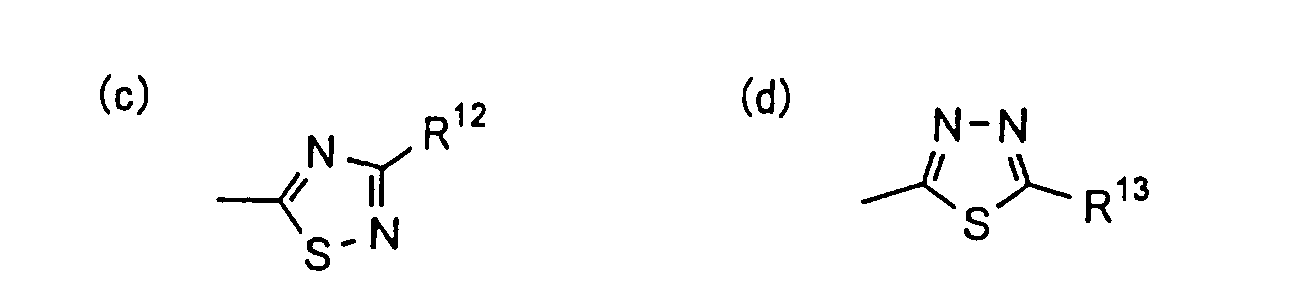
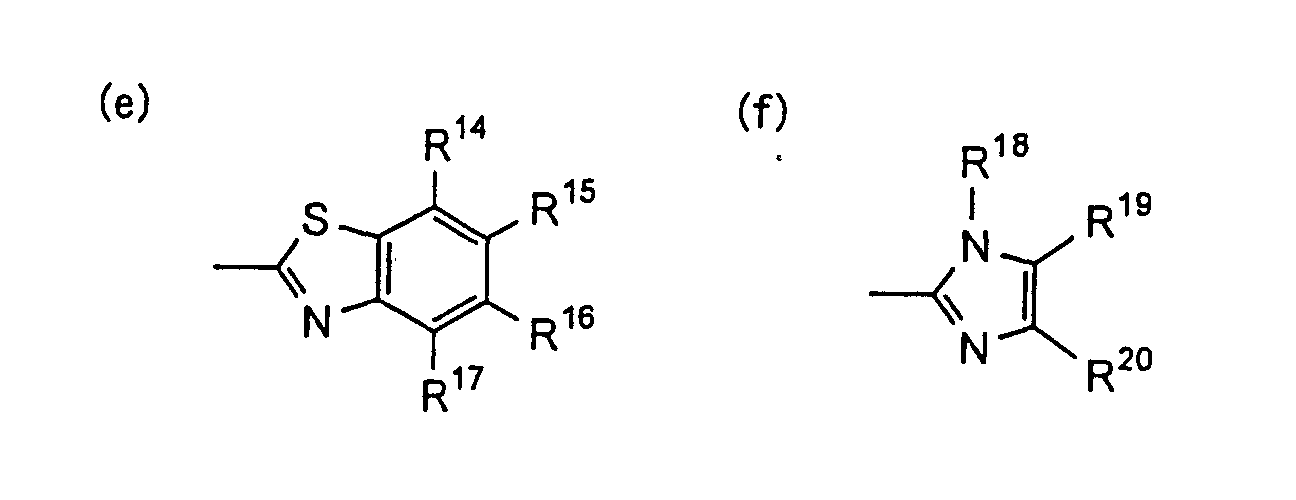
- In the above-described formulas (a) to (f), R7 to R20 represent the substituents as described in G, R1 and R2.
- Of the formulas (a) to (f), preferred are pyrazole and isothiazole rings represented by the formulas (a) and (b), with the pyrazole ring of the formula (a) being most preferred.
- B1 and B2 represent -CR1= and -CR2=, respectively, or one of them represents a nitrogen atom and the other one represents -CR1= or -CR2=, of which the former one is preferred.
- G, R1 and R2 each independently represents a hydrogen atom, a halogen atom, an aliphatic group, an aromatic group, a heterocyclic group, a cyano group, a carboxyl group, a carbamoyl group, an alkoxycarbonyl group, an aryloxycarbonyl group, a heterocyclic oxycarbonyl group, an acyl group, a hydroxy group, an alkoxy group, an aryloxy group, a heterocyclic oxy group, a silyloxy group, an acyloxy group, a carbamoyloxy group, an alkoxycarbonyloxy group, an aryloxycarbonyloxy group, an amino group substituted with an alkyl, aryl or heterocyclic group, an acylamino group, an ureido group, a sulfamoylamino group, an alkoxycarbonylamino group, an aryloxycarbonylamino group, an alkyl or arylsulfonyl group, a heterocyclic sulfonylamino group, a nitro group, an alkyl-, aryl- or heterocyclo-thio group, an alkyl- or aryl-sulfonyl group, a heterocyclic sulfonyl group, an alkyl- or aryl-sulfinyl group, a heterocyclic sulfinyl group, a sulfamoyl group or a sulfo group, which may have a substituent further.
- Preferred examples of the substituent represented by G include a hydrogen atom, halogen atoms, aliphatic groups, aromatic groups, a hydroxy group, alkoxy groups, aryloxy groups, acyloxy groups, heterocyclic oxy groups, amino groups substituted with an alkyl, aryl, or heterocyclic group, acylamino groups, an ureido group, a sulfamoylamino group, alkoxycarbonylamino groups, aryloxycarbonylamino groups, and alkyl-, aryl- or heterocyclic thio groups, of which a hydrogen atom, halogen atoms, alkyl groups, a hydroxy group, alkoxy groups, aryloxy groups, acyloxy groups, amino groups substituted with an alkyl, aryl or heterocyclic group, and acylamino groups are preferred, with a hydrogen atom, arylamino groups and amide group being most preferred. Each of these groups may have a substituent further.
- Preferred examples of the substituent represented by R1 or R2 include a hydrogen atom, alkyl groups, alkoxycarbonyl groups, a carboxyl group, a carbamoyl group, and a cyano group. Each of these groups may have a substituent further.
- R5 and R6 each independently represents a hydrogen atom, an aliphatic group, an aromatic group, a heterocyclic group, an acyl group, an alkoxycarbonyl group, an aryloxycarbonyl group, a carbamoyl group, an alkyl- or aryl-sulfonyl group or a sulfamoyl group, which may have a substituent further. Preferred examples of the substituent represented by R5 or R6 include a hydrogen atom, aliphatic groups, aromatic groups, heterocyclic groups, acyl groups, and alkyl- or aryl-sulfonyl groups. Of these, a hydrogen atom, aromatic groups, heterocyclic groups, acyl groups, and alkyl- or aryl-sulfonyl groups are more preferred, with a hydrogen atom, aryl groups and heterocyclic groups being most preferred. Each of these groups may have a substituent further. R5 and R6 however do not represent a hydrogen atom simultaneously.
- A pair R1 and R5, or a pair R5 and R6 may be coupled to form a 5- or 6-membered ring.
- When each of the substituents represented by A, R1, R2, R5, R6 and G has a substituent further, those described in G, R1 and R2 can be given as examples.
- When the dye of the invention is a water soluble dye, it has, as a substituent, an ionic hydrophilic group on any one position of A, R1, R2, R5, R6 and G. Examples of the ionic hydrophilic group as a substituent include a sulfo group, carboxyl group, and quaternary ammonium groups. As the ionic hydrophilic group, carboxyl and sulfo groups are preferred, with a sulfo group being especially preferred. The carboxyl and sulfo groups may be in the form of a salt. Examples of the counterion which forms its salt include alkali metal ions (ex. sodium ion and potassium ion) and organic cations (ex. tetramethylguanidium ion). When the dye does not belong to a water soluble dye, it is regarded as an oil soluble dye.
- The term "aliphatic group" as used herein means an alkyl group, a substituted alkyl group, an alkenyl group, a substituted alkenyl group, an alkynyl group, a substituted alkynyl group, an aralkyl group or a substituted aralkyl group. The aliphatic group may be branched or alternatively, may form a ring. The aliphatic group preferably has 1 to 20, more preferably 1 to 16 carbon atoms. The aryl portion of the aralkyl or substituted aralkyl group is preferably phenyl or naphthyl, with phenyl being especially preferred.
- Examples of the aliphatic group include methyl, ethyl, butyl, isopropyl, t-butyl, hydroxyethyl, methoxyethyl, cyanoethyl, trifluoromethyl, 3-sulfopropyl, 4-sulfobutyl, cyclohexyl, benzyl, 2-phenethyl, vinyl and allyl.
- The term "aromatic group" as used herein means an aryl group and a substituted aryl group. As the aryl group, a phenyl or naphthyl group is preferred, with a phenyl group being especially preferred. The aromatic group has preferably 6 to 20, more preferably 6 to 16 carbon atoms.
- Examples of the aromatic group include phenyl, p-tolyl, p-methoxyphenyl, o-chlorophenyl and m-(3-sulfopropylamino)phenyl.
- The term "heterocyclic group" means a substituted heterocyclic group or an unsubstituted heterocyclic group. The heterocycle may be condensed with an aliphatic ring, an aromatic ring or another heterocycle. As the heterocyclic group, a 5- or 6-membered heterocyclic group is preferred. Examples of the substituent include aliphatic groups, halogen atoms, alkyl- and aryl-sulfonyl groups, acyl groups, acylamino groups, sulfamoyl group, carbamoyl group and ionic hydrophilic groups.
- Examples of the heterocyclic group include 2-pyridyl, 2-thienyl, 2-thiazolyl, 2-benzothiazolyl, 2-benzoxazolyl and 2-furyl.
- The term "alkyl- or aryl-sulfonyl group" means a substituted alkylsulfonyl group, a substituted aryl sulfonyl group, an unsubstituted alkylsulfonyl group or an unsubstituted arylsulfonyl group. Examples of the alkyl-and aryl-sulfonyl groups include methanesulfonyl group and phenylsulfonyl group, respectively.
- The term "alkyl- or aryl-sulfinyl group" means a substituted alkylsulfinyl group, a substituted aryl sulfinyl group, an unsubstituted alkylsulfinyl group and an unsubstituted arylsulfinyl group. Examples of the alkyl- and aryl-sulfinyl groups include methanesulfinyl group and phenylsulfinyl group, respectively.
- The term "acyl group" means a substituted acyl group or an unsubstituted acyl group. The acyl group has preferably 1 to 12 carbon atoms. Examples of the substituent include ionic hydrophilic groups. Examples of the acyl group include acetyl and benzoyl.
- Examples of the halogen atom include fluorine, chlorine and bromine atoms.
- The term "amino group substituted with an alkyl, aryl or heterocyclic group" means an amino group substituted with any one of alkyl groups, aryl groups and heterocyclic groups. The alkyl groups, aryl groups and heterocyclic groups may have a substituent further. An unsubstituted amino group is not embraced in it. As the alkylamino group, that having 1 to 6 carbon atoms is preferred. Examples of the substituent include ionic hydrophilic groups. Examples of the alkylamino groups include methylamino and diethylamino.
- The term "arylamino group" means a substituted arylamino group or an unsubstituted arylamino group. As the arylamino group, that having 6 to 12 carbon atoms is preferred. Examples of the substituent include halogen atoms and ionic hydrophilic groups.
- Examples of the arylamino group include anilino and 2-chloroanilino.
- The term "alkoxy group" means a substituted alkoxy group or an unsubstituted alkoxy group. As the alkoxy group, that having 1 to 12 carbon atoms is preferred. Examples of the substituent include alkoxy groups, hydroxyl group, and ionic hydrophilic groups. Examples of the alkoxy group include methoxy, ethoxy, isopropoxy, methoxyethoxy, hydroxyethoxy and 3-carboxypropoxy.
- The term "aryloxy group" means a substituted aryloxy group or an unsubstituted aryloxy group. As the aryloxy group, that having 6 to 12 carbon atoms is preferred. Examples of the substituent include alkoxy groups and ionic hydrophilic groups. Examples of the aryloxy group include phenoxy, p-methoxyphenoxy and o-methoxyphenoxy.
- As the silyloxy group, that substituted with a C1-12 aliphatic or aromatic group is preferred. Examples of the substituted silyloxy group include trimethylsilyloxy and diphenylmethylsilyloxy.
- The term "heterocyclic oxy group" means a substituted heterocyclic oxy group and an unsubstituted heterocyclic oxy group. The heterocyclic oxy group has preferably 2 to 12 carbon atoms. Examples of the substituent include alkyl, alkoxy and ionic hydrophilic groups. Examples of the heterocyclic oxy group include 3-pyridyloxy and 3-thienyloxy.
- The term "alkoxycarbonyloxy group" means a substituted alkoxycarbonyloxy group or an unsubstituted alkoxycarbonyloxy group. The alkoxycarbonyloxy group has preferably 2 to 12 carbon atoms. Examples of the alkoxycarbonyloxy group include methoxycarbonyloxy and isopropoxycarbonyloxy.
- The term "aryloxycarbonyloxy group" means a substituted aryloxycarbonyloxy group or an unsubstituted aryloxycarbonyloxy group. The aryloxycarbonyloxy group has preferably 7 to 12 carbon atoms. Examples of the aryloxycarbonyloxy group include phenoxycarbonyloxy.
- The term "acylamino group" means a substituted acylamino group or an unsubstituted acylamino group. The acylamino group has preferably 2 to 12 carbon atoms. Examples of the substituent include ionic hydrophilic groups. Examples of the acylamino group include acetylamino, propionylamino, benzoylamino, N-phenylacetylamino and 3,5-disulfobenzoylamino.
- The term "ureido group" means a substituted ureido group or an unsubstituted ureido group. The ureido group has preferably 1 to 12 carbon atoms. Examples of the substituent include alkyl and aryl groups. Examples of the ureido group include 3-methylureido, 3,3-dimethylureido and 3-phenylureido.
- The term "sulfamoylamino group" means a substituted sulfamoylamino group or an unsubstituted sulfamoylamino group. Examples of the substituent include alkyl groups. Examples of the sulfamoylamino group include N,N-dipropylsulfamoylamino.
- The term "alkoxycarbonylamino group" means a substituted alkoxycarbonylamino group or an unsubstituted alkoxycarbonylamino group. The alkoxycarbonylamino group has preferably 2 to 12 carbon atoms. Examples of the substituent include ionic hydrophilic groups. Examples of the alkoxycarbonylamino group include ethoxycarbonylamino group.
- The term "alkyl- or aryl-sulfonylamino group" means a substituted alkylsulfonylamino group, a substituted arylsulfonylamino group, an unsubstituted alkylsulfonylamino group or an unsubstituted arylsulfonylamino group. The sulfonylamino group has preferably 1 to 12 carbon atoms. Examples of the substituent include ionic hydrophilic groups. Examples of the sulfonylamino group include methanesulfonylamino, N-phenylmethanesulfonylamino, benzenesulfonylamino and 3-carboxybenzenesulfonylamino.
- The term "carbamoyl group" means a substituted carbamoyl group or an unsubstituted carbamoyl group. Examples of the substituent include alkyl groups. Examples of the carbamoyl group include methylcarbamoyl and dimethylcarbamoyl.
- The term "sulfamoyl group" embraces a substituted sulfamoyl group or an unsubstituted sulfamoyl group. Examples of the substituent include alkyl groups. Examples of the sulfamoyl group include dimethylsulfamoyl and di-(2-hydroxyethyl)sulfamoyl.
- The term "alkoxycarbonyl group" means a substituted alkoxycarbonyl group or an unsubstituted alkoxycarbonyl group. The alkoxycarbonyl group has preferably 2 to 12 carbon atoms. Examples of the substituent include ionic hydrophilic groups. Examples of the alkoxycarbonyl group include methoxycarbonyl and ethoxycarbonyl.
- The term "acyloxy group" means a substituted acyloxy group or an unsubstituted acyloxy group. The acyloxy group has preferably 2 to 12 carbon atoms. Examples of the substituent include ionic hydrophilic groups. Examples of the acyloxy group include acetoxy and benzoyloxy.
- The term "carbamoyloxy group" means a substituted carbamoyloxy group or an unsubstituted carbamoyloxy group. Examples of the substituent include alkyl groups. Examples of the carbamoyloxy group include N-methylcarbamoyloxy group.
- The term "aryloxycarbonyl group" means a substituted aryloxycarbonyl group or an unsubstituted aryloxycarbonyl group. The aryloxycarbonyl group has preferably 7 to 12 carbon atoms. Examples of the substituent include ionic hydrophilic groups. Examples of the aryloxycarbonyl group include phenoxycarbonyl.
- The term "aryloxycarbonylamino group" means a substituted aryloxycarbonylamino group or an unsubstituted aryloxycarbonylamino group. The aryloxycarbonylamino group has preferably 7 to 12 carbon atoms. Examples of the substituent include ionic hydrophilic groups. Examples of the aryloxycarbonylamino group include phenoxycarbonylamino.
- The term "alkyl-, aryl- or heterocyclic-thio group" means a substituted alkyl-, aryl- or heterocyclic-thio group or an unsubstituted alkyl-, aryl- or heterocyclic-thio group. The alkyl-, aryl- or heterocyclic thio group has preferably 1 to 12 carbon atoms. Examples of the substituent include ionic hydrophilic groups. Examples of the alkyl-, aryl- or heterocyclic-thio group include methylthio, phenylthio and 2-pyridylthio groups.
- The term "heterocyclic oxycarbonyl group" means a substituted heterocyclic oxycarbonyl group or an unsubstituted heterocyclic oxycarbonyl group. The heterocyclic oxycarbonyl group has preferably 2 to 12 carbon atoms. Examples of the substituent include ionic hydrophilic groups. Examples of the heterocyclic oxycarbonyl group include 2-pyridyloxycarbonyl.
- The term "heterocyclic sulfonylamino group" means a substituted heterocyclic sulfonylamino group or an unsubstituted heterocyclic sulfonylamino group. The heterocyclic sulfonylamino group has preferably 1 to 12 carbon atoms. Examples of the substituent include ionic hydrophilic groups. Examples of the heterocyclic sulfonylamino group include 2-thiophenesulfonylamino and 3-pyridinesulfonylamino.
- The term "heterocyclic sulfonyl group" means a substituted heterocyclic sulfonyl group or an unsubstituted heterocyclic sulfonyl group. The heterocyclic sulfonyl group has preferably 1 to 12 carbon atoms. Examples of the substituent include ionic hydrophilic groups. Examples of the heterocyclic sulfonyl group include 2-thiophenesulfonyl and 3-pyridinesulfonyl.
- The term "heterocyclic sulfinyl group" means a substituted heterocyclic sulfinyl group or an unsubstituted heterocyclic sulfinyl group. The heterocyclic sulfinyl group has preferably 1 to 12 carbon atoms. Examples of the substituent include ionic hydrophilic groups. Examples of the heterocyclic sulfinyl group include 4-pyridinesulfinyl.
- In the invention, a structure represented by the following formula (A-2) is especially preferred.
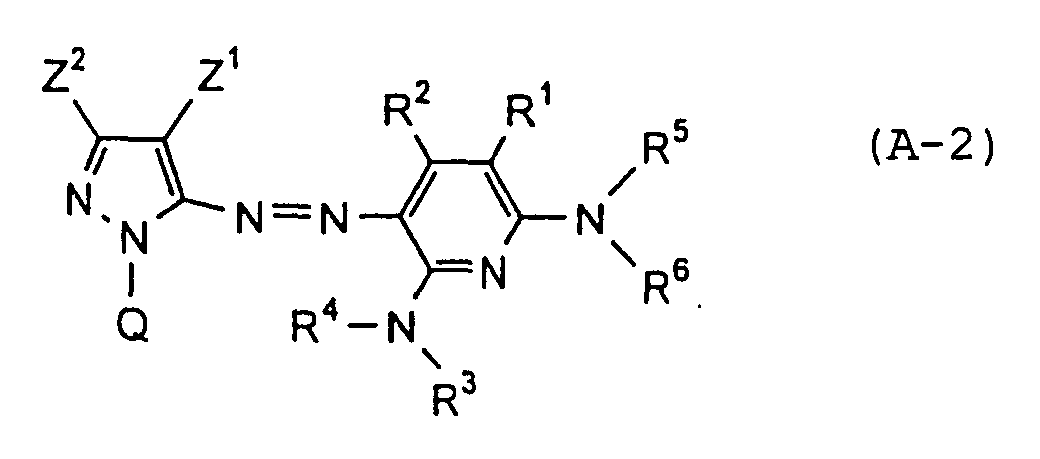
- In the formula (A-2), Z1 represents an electron attractive group having a Hammett substituent constant δp of 0.20 or greater. The electron attractive group represented by Z1 has preferably δp of 0.30 or greater, more preferably 0.45 or greater, especially 0.60 or greater. The constant δp is however desired not to exceed 1.0. Preferred specific examples of the substituent include electron attractive substituents which will be described later. Of these, preferred are C2-12 acyl groups, C2-12 alkyloxycarbonyl groups, nitro group, cyano group, C1-12 alkylsulfonyl groups, C6-18 arylsulfonyl groups, C1-12 carbamoyl groups, and C1-12 alkyl halide groups, of which cyano group, C1-12 alkylsulfonyl groups, C6-18 arylsulfonyl groups are especially preferred, with cyano group being most preferred.
- R1, R2, R5 and R6 in the formula (A-2) have the same meanings as described in the formula (A-1).
- R3 and R4 each independently represents a hydrogen atom, an aliphatic group, an aromatic group, a heterocyclic group, an acyl group, an alkoxycarbonyl group, an aryloxycarbonyl group, a carbamoyl group, an alkyl- or aryl-sulfonyl group or a sulfamoyl group. Of these, a hydrogen atom, an aromatic group, a heterocyclic group, an acyl group, an alkylsulfonyl group or an arylsulfonyl group is preferred, with a hydrogen atom, an aromatic group or a heterocyclic group being especially preferred.
- Z2 represents a hydrogen atom, an aliphatic group, an aromatic group or a heterocyclic group. Q represents a hydrogen atom, an aliphatic group, an aromatic group or a heterocyclic group. As Q, a group made of a nonmetal atomic group necessary for forming a 5- to 8-membered ring is preferred. The 5- to 8-membered ring may be substituted, be saturated or have an unsaturated bond. An aromatic group and a heterocyclic group are especially preferred. Preferred examples of the nonmetal atom include nitrogen atom, oxygen atom, sulfur atom and carbon atom. Specific examples of such a cyclic structure include benzene, cyclopentane, cyclohexane, cycloheptane, cyclooctane, cyclohexene, pyridine, pyrimidine, pyrazine, pyridazine, triazine, imidazole, benzimidazole, oxazole, benzoxazole, thiazole, benzothiazole, oxane, sulfolane and thiane rings.
- Each of the groups as described in the formula (A-2) may have a substituent further. When they have a substituent, substituents as described in the formula (A-1), groups exemplified in G, R1, or R2, and ionic hydrophilic groups can be mentioned by way of example.
- A description will next be made of a Hammett substituent constant σp value used herein. The Hammett rule is an empirical rule suggested by L. P. Hammett in 1935 in order to deal quantitatively with the influence of substituents on reactions or equilibria of benzene derivatives, and nowadays its validity is widely accepted. The substituent constants determined by the Hammett rule include σp values and σm values, many of which are described in general books and are described in detail, for example, in "Lange's Handbook of Chemistry," 12th edition, ed. by J. A. Dean, published in 1979 (McGraw-Hill), and in "Journal of Japanese Chemistry", Extra Number, No. 122, pages 96 to 103, 1979 (Nankodo Co., Ltd.). In the present invention, each substituent is stipulated by the Hammett substituent constant σp values. It is however needless to say that substituents are not limited by these values which are known and described in literature in these books but rather the present invention includes substituents whose Hammett substituent constant σp values are not known in the literature but when measured in accordance with the Hammett rule, fall within its range. The compounds represented by the formulas (A-1) and (A-2) of the invention are not always benzene derivatives, but σp values are used as a measure for indicating electron effects of the substituent irrespective of the position of the substituent. In the invention, σp values are used in this sense.
- Examples of electron attractive groups having an Hammett substituent constant σp value of 0.60 or greater include cyano group, nitro group, alkylsulfonyl groups (such as methanesulfonyl) and arylsulfonyl groups (such as benzenesulfonyl).
- Examples of electron attractive groups having an Hammett substituent constant σp value of 0.45 or greater include acyl groups (such as acetyl), alkoxycarbonyl groups (such as dodecyloxycarbonyl), aryloxycarbonyl groups (such as m-chlorophenoxycarbonyl), alkylsulfinyl groups (such as n-propylsulfinyl), arylsulfinyl groups (ex. phenylsulfinyl), sulfamoyl groups (such as N-ethylsulfamoyl and N,N-dimethylsulfamoyl), and alkyl halilde groups (such as trifluoromethyl).
- Examples of the electron attractive groups with a σp value of 0.30 or greater include, in addition to the above-described groups, acyloxy groups (such as acetoxy), carbamoyl groups (such as N-ethylcarbamoyl and N,N-dibutylcarbamoyl), halogenated alkoxy groups (such as trifluoromethyloxy), halogenated aryloxy groups (such as pentafluorophenyloxy), sulfonyloxy groups (ex. methylsulfonyloxy), halogenated alkylthio groups (such as difluoromethylthio), aryl groups substituted with at least two electron attractive groups having a σp value4 of 0.15 or greater (such as 2,4-dinitrophenyl and pentachlorophenyl) and heterocycles (such as 2-benzoxazolyl, 1-benzothiazolyl and 1-phenyl-2-benzimidazolyl). Specific examples of the electron attractive group having a σp value of 0.20 or greater include, in addition to the above-described ones, halogen atoms.
- The azo dyes of the formula (A-1) having, as B1 and B2, -CR1= and -CR2=, respectively, and, as each of R1 and R2, a hydrogen atom, a halogen atom, a cyano group, a carbamoyl group, a carboxyl group, an alkyl group, a hydroxy group or an alkoxy group, more preferably a hydrogen atom, a cyano group, a carbamoyl group or an alkoxy group are especially preferred.
- As G, preferred are a hydrogen atom, halogen atoms, alkyl groups, a hydroxyl group, an amino group and amide groups, of which a hydrogen atom, halogen atoms, an amino group and amide groups are more preferred, with a hydrogen atom, an amino group and amide groups being still more preferred.
- As A, preferred are pyrazole, imidazole, isothiazole, thiadiazole and benzothiazole rings, of which pyrazole and isothiazole rings are more preferred, with pyrazole ring being most preferred.
- As R5 and R6, preferred are a hydrogen atom, alkyl groups, aryl groups, heterocyclic groups, a sulfonyl group and acyl groups, of which a hydrogen atom, aryl groups, heterocyclic groups and a sulfonyl group are preferred, with a hydrogen atom, aryl groups and heterocyclic groups being most preferred. R5 and R6 however do not represent a hydrogen atom simultaneously.
- As the compound of the formula (A-1), those having, as at least one of the substituents, the above-described preferred group are preferred, of which those having, as more substituents, the above-described preferred groups are more preferred, with those having, as all the substituents, the above-described preferred groups being most preferred.
- Specific examples of the azo dye of the formula (A-1) will be described below, but azo dyes used in the invention are not limited thereto.
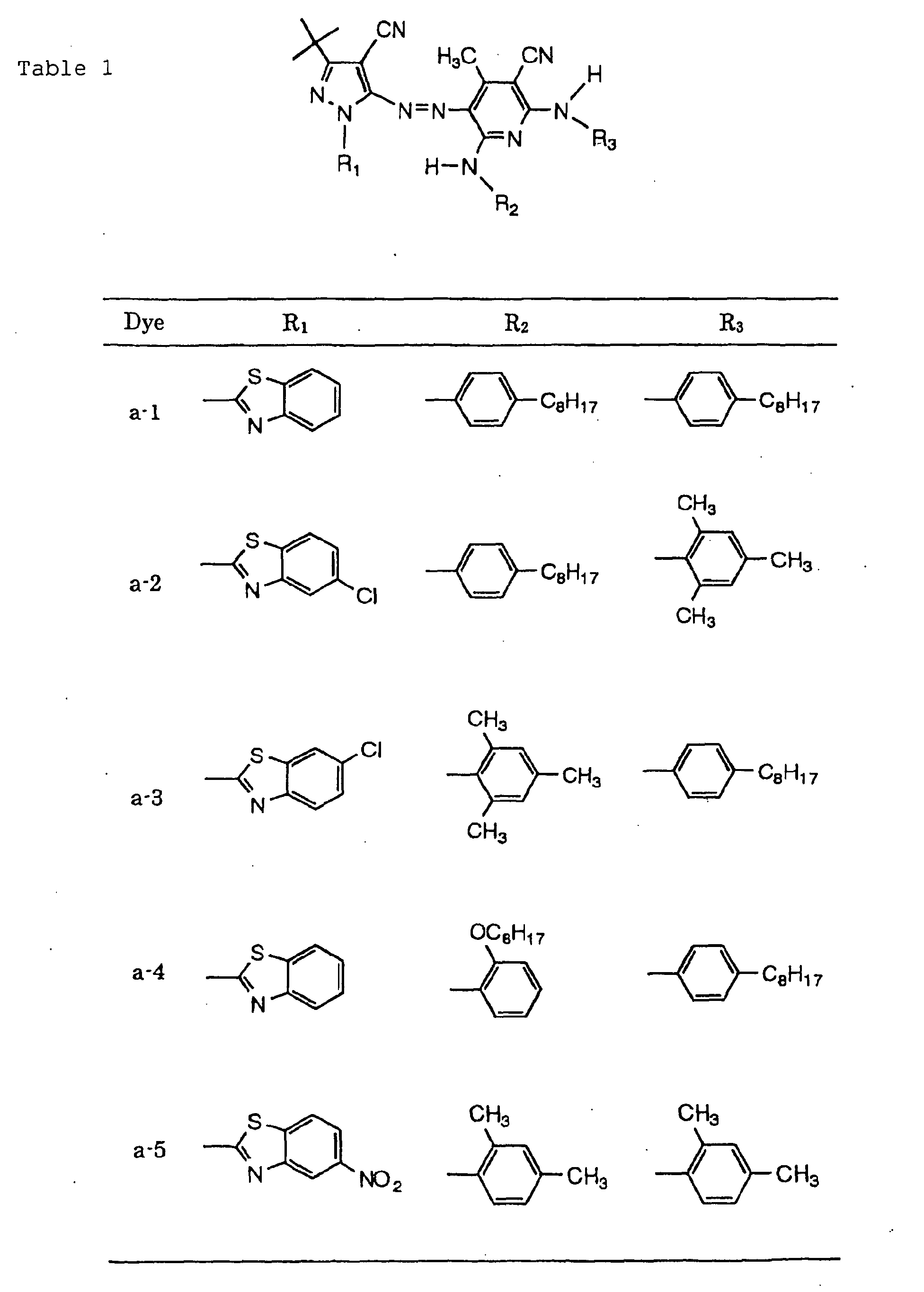
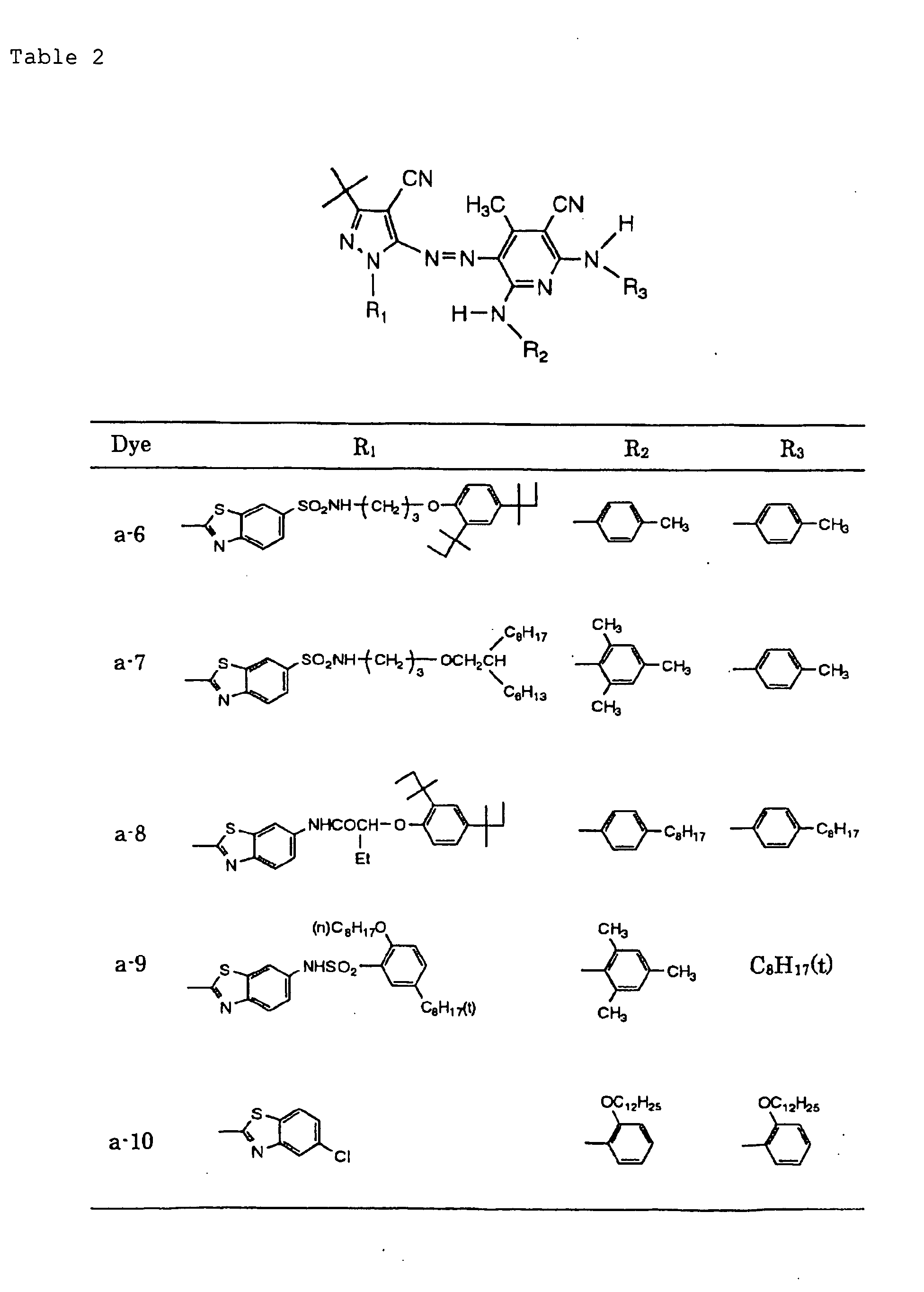

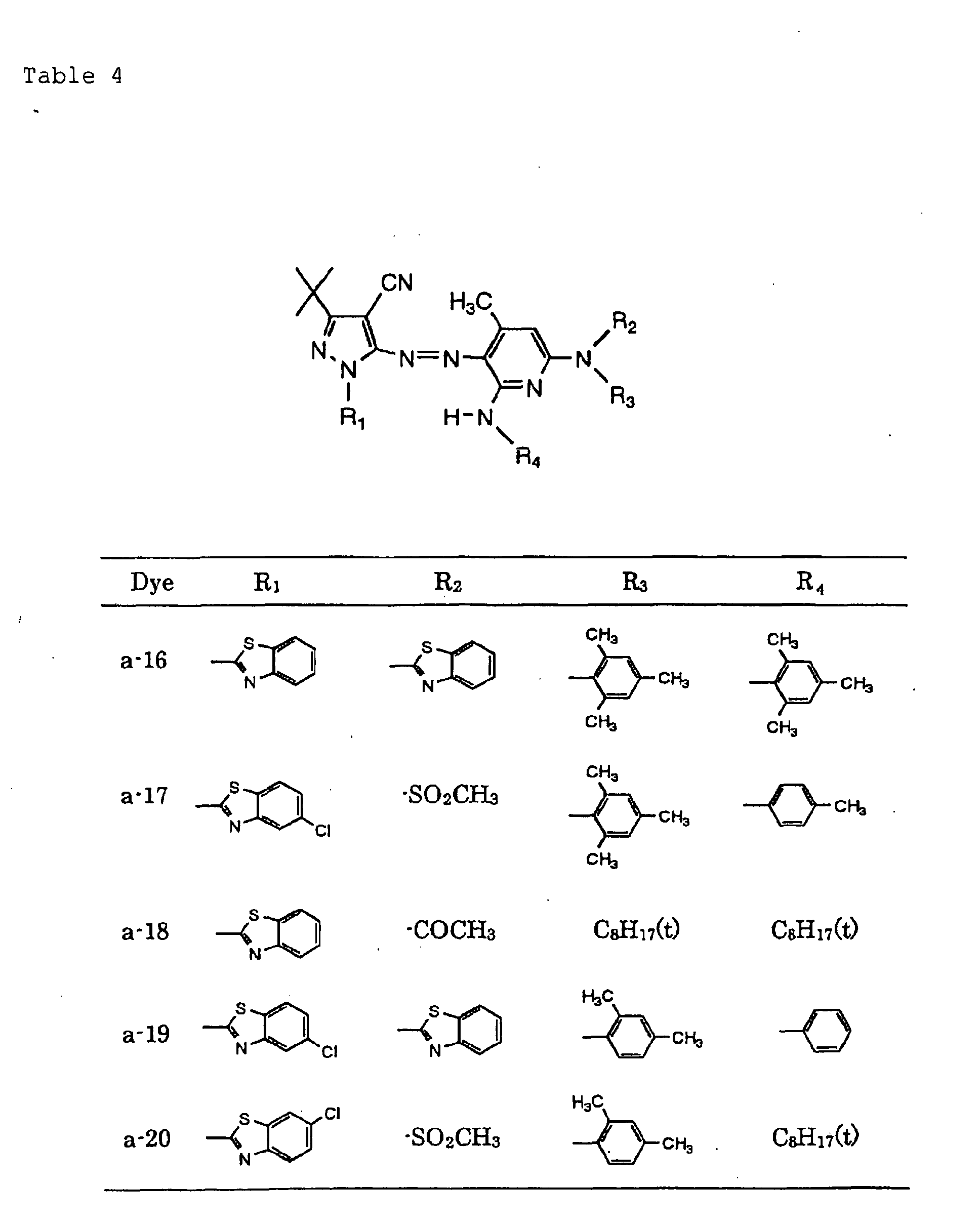

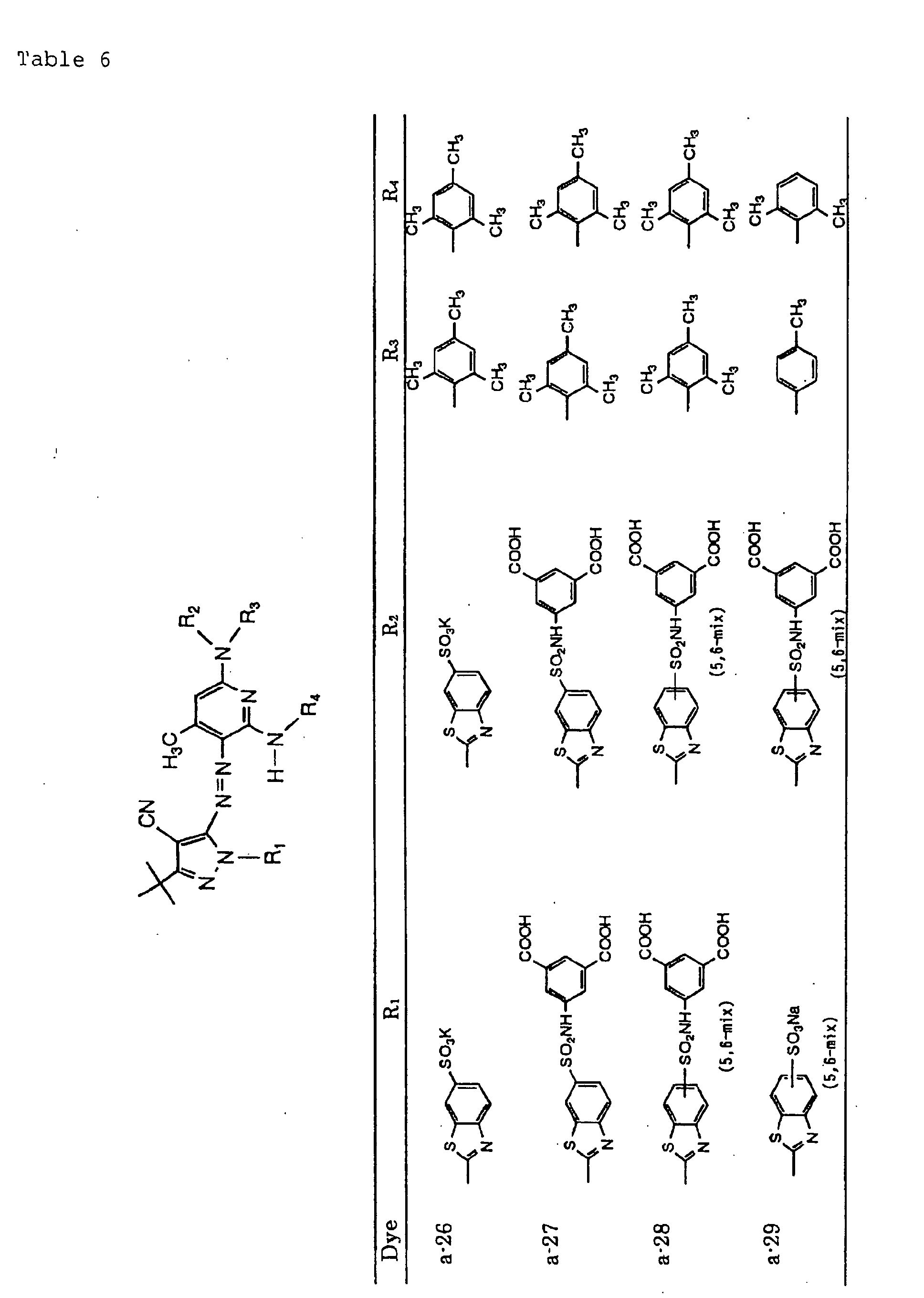


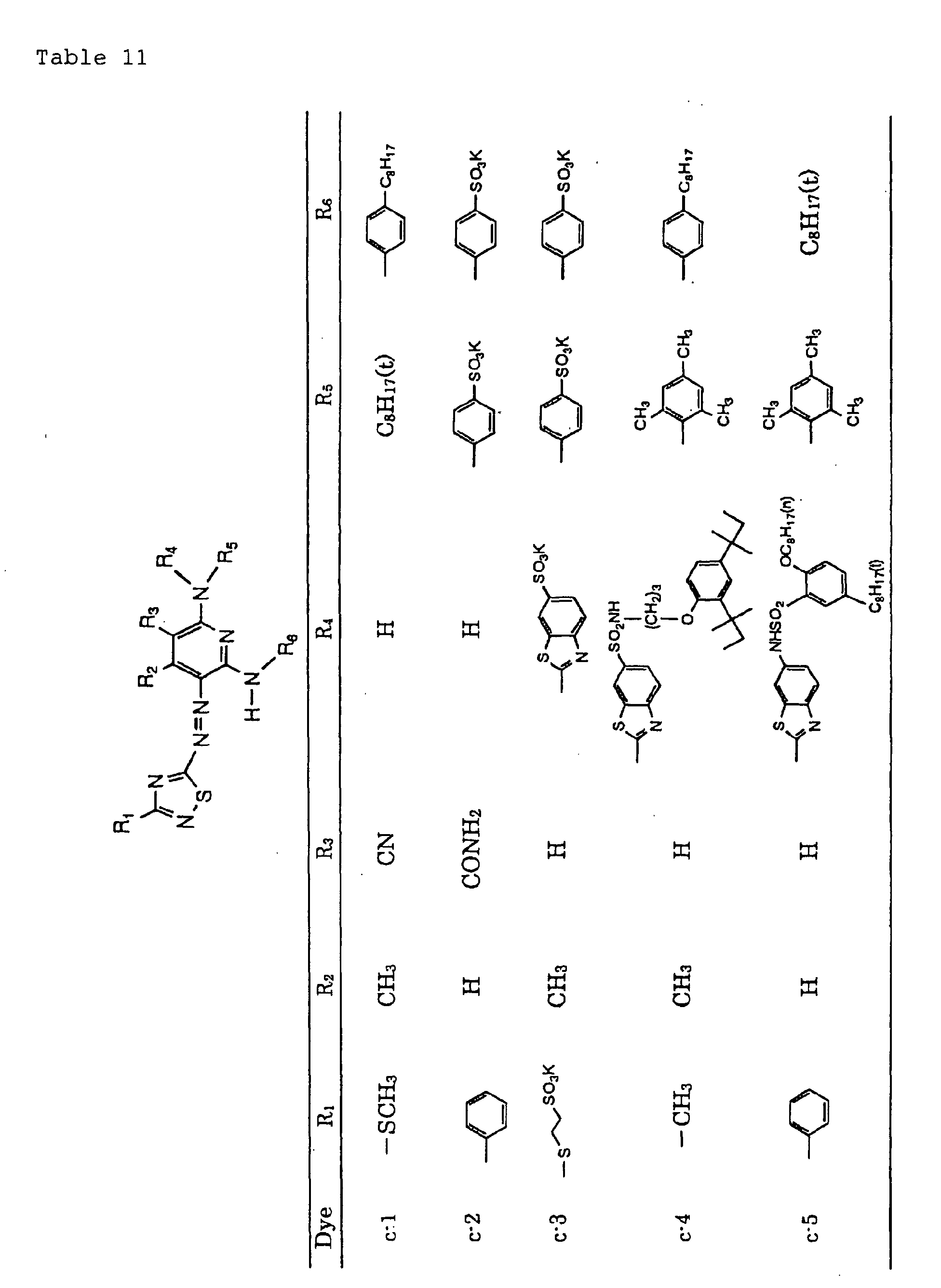
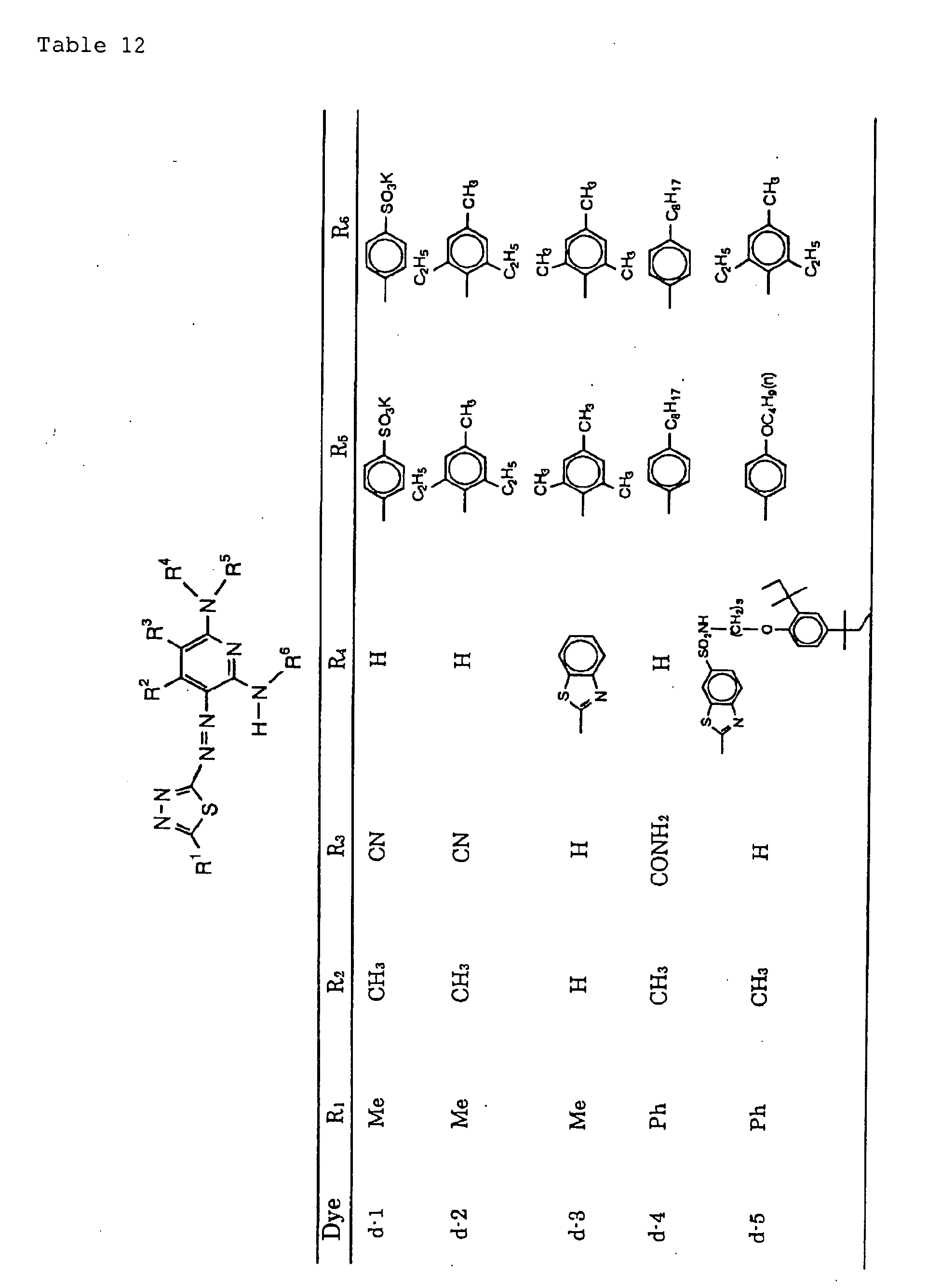
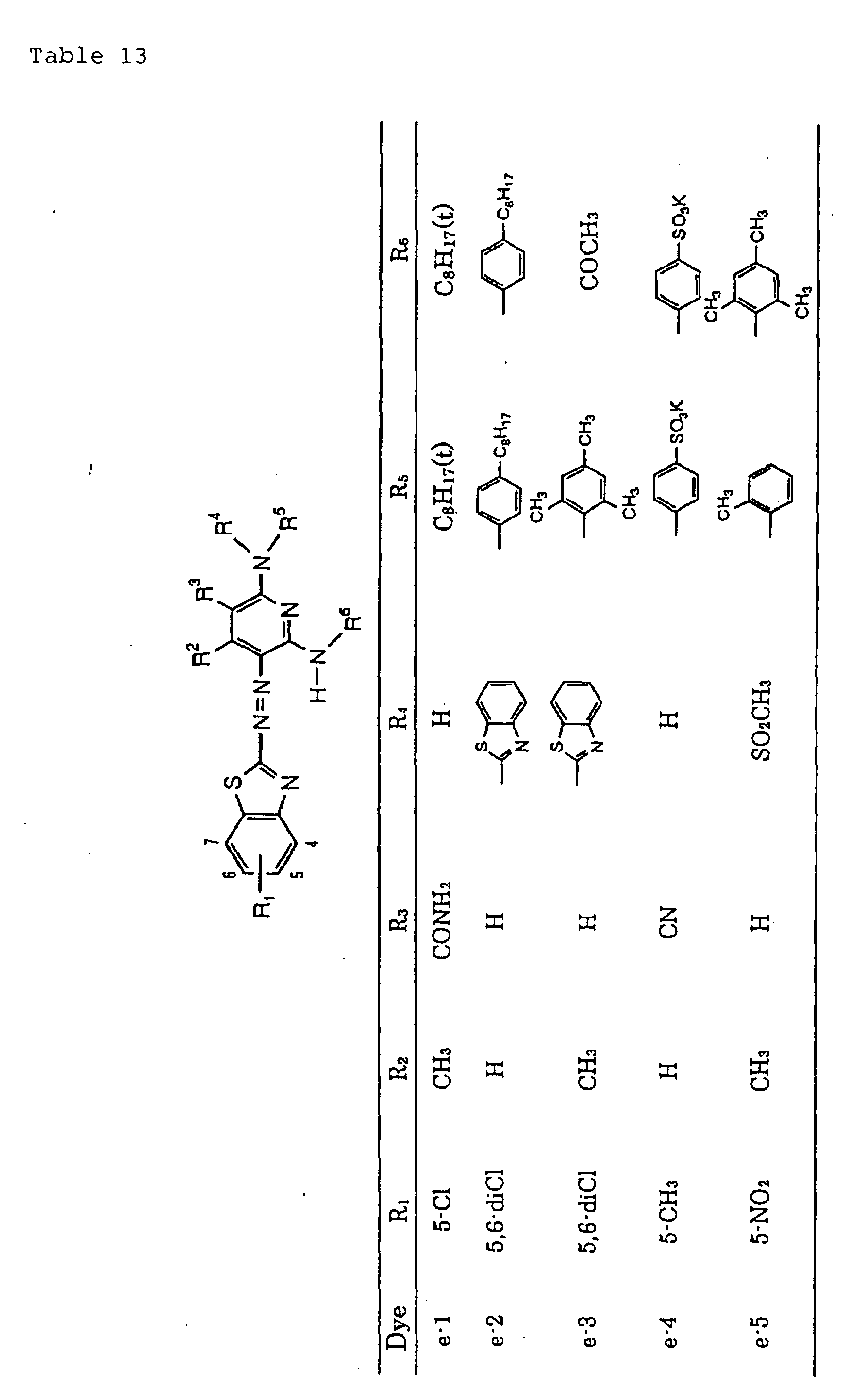
- The inkjet recording ink compositions of the invention each contains the azo dye preferably in an amount of 0.1 to 20% by mass, more preferably 0.2 to 15% by mass.
- The inkjet recording ink composition of the invention may contain another dye in combination with the azo dye in order to adjust the color tone for obtaining a full-color image. The dyes usable in combination will next be described.
- As yellow dyes, any desired one can be employed. Examples include aryl or heterylazo dyes having, as a coupling component, a phenol, naphthol, aniline, pyrazolone, pyridone, or open-chain type active methylene compound; azomethine dyes having an open-chain active methylene compound as a coupling component; methine dyes such as benzylidene and monomethineoxonol dyes; quinone dyes such as naphthoquinone and anthraquinone dyes; and other dyes such as quinophthalone, nitro·nitroso, acridine and acridinone dyes.
- As magenta dyes, any desired one is usable in the invention. Examples include aryl or heterylazo dyes having a phenol, naphthol or aniline as a coupling component; azomethine dyes having a pyrazolone or pyrazolotriazole as a coupling component; methine dyes such as arylidene, styryl, merocyanine, and oxonol dyes; carbonium dyes such as diphenylmethane, triphenylmethane and xanthene dyes; quinone dyes such as naphthoquinone, anthraquinone and anthrapyridone dyes; and condensed polycyclic dyes such as dioxazine dyes.
- As cyan dyes, any desired one is usable in the invention. Examples include indoaniline dyes, indophenol dyes and azomethine dyes having pyrrolotriazole as a coupling component; polymethine dyes such as cyanine, oxonol and merocyanine dyes; carbonium dyes such as diphenylmethane, triphenylmethane and xanthene dyes; phthalocyanine dyes; anthraquinone dyes; aryl or heterylazo dyes having a phenol, naphthol or aniline as a coupling component; and indigo·thioindigo dyes.
- Each of the above-exemplified dyes may assume each of yellow, magenta and cyan colors for the first time after dissociation of a portion of its chromophore. In this case, a counter cation may be either an inorganic cation such as alkali metal or ammonium or an organic cation such as pyridinium or quaternary ammonium salt. Alternatively, it may be a polymer cation having, in its partial structure, such a cation.
- Preferred is the use of pigments formed by the reaction between the below-described yellow, magenta and cyan couplers with the oxidized product of an aromatic primary amine developing agent.
- Yellow couplers: Couplers as described in U.S. Patent Nos. 3,933,501, 4,022,620, 4,326,024, 4,401,752 and 4,248,961, Japanese Patent Publication No. 10739/1983, British Patent Nos. 1,425,020 and 1,476,760, U.S. Patent Nos. 3,973,968, 4,314,023 and 4,511,649, and European Patent No. 249,473A, couplers represented by the formula (I) or (II) of European Patent No. 502,424A, couplers represented by the formula (1) or (2) of European Patent No. 513,496A (particularly, Y-28 on page 18), couplers represented by the formula (I) of claim 1 of European Patent No. 568,037A, couplers represented by the formula (I), lines 45 to 55, column 1 of U.S. Patent No. 5,066,576, couplers represented by the formula (I) in [0008] of Japanese Patent Laid-Open No. 274425/1992, couplers as described in Claim 1 on page 40 of European Patent No. 498,381A1 (particularly, D-35 on page 18), couplers represented by the formula (Y) on page 4 of European Patent No. 447,969A1 (particularly, Y1 (on page 17), Y-54 (page 41)) and couplers represented by the formulas (II) to (IV), lines 36 to 58, column 7 of U.S. Patent No. 4,476,219 [particularly, II-17 and 19 (column 17), and II-24 (column 19)].
- Magenta couplers: Couplers as described in U.S. Patent Nos. 4,310,619 and 4,351,897, European Patent No. 73,636, U.S. Patent Nos. 3,061,432 and 3,725,067, Research Disclosure Nos. 24220 (June, 1984) and 24230 (June, 1984), Japanese Patent Laid-Open Nos. 33552/1985, 43659/1985, 72238/1986, 35730/1988, 118034/1980 and 185951/1985, U.S. Patent Nos. 4,500,630, 4,540,654 and 4,556,630, World IPO WO88/04795, Japanese Patent Laid-Open No.39737/1991 [L-57 (right bottom on page 11), L-68 (right bottom on page 12) and L-77 (right bottom on page 13)], European Patent Nos. 456,257 [[A-4]-63 (page 134), [A-4]-73, -75 (page 139)], 486,965 {[M-4, -6] (page 26), M-7 (page 27)) and 571,959A ([M-45] (page 19)}, Japanese Patent Laid-Open No. 204106/1983 ((M-1) (page 6)), and No. 362631/1992 (M-22 of [0237]), and U.S. Patent Nos. 3,061,432 and 3,725,067.
- Cyan couplers: U.S. Patent Nos. 4,052,212, 4,146,396, 4,228,233 and 4,296,200, European Patent No. 73,636, Japanese Patent Laid-Open 204843/1992 [CX-1,3,4,5,11,12,13,15 (pages 14 to 16)], Japanese Patent Laid-Open No. 43345/1992 [C-7,10 (page 35), 34,35 (page 37), (I-1), (I-17) (pages 42 to 43)] and a coupler represented by the formula (Ia) or (Ib) of Claim 1 of Japanese Patent Laid-Open No. 67385/1994.
- In the next place, compounds represented by the formula (I) will be described.
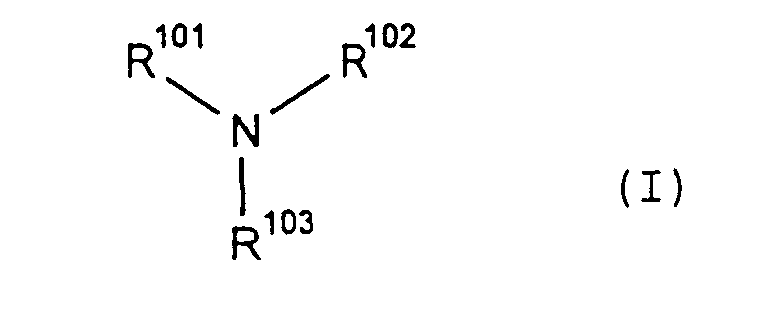
- In the formula (I), R101 and R102 each represents a hydrogen atom, an aliphatic group (such as methyl, ethyl, t-butyl, octyl or methoxyethoxy), an aromatic group (such as phenyl, p-chlorophenyl or naphthyl), a heterocyclic group (such as 2-pyridyl, 4-pyridyl, 1-piperidino or 1-morpholino), an acyl group (such as acetyl, pivaloyl, methacryloyl, or benzoyl), aliphatic oxycarbonyl group (such as methoxycarbonyl or hexadecyloxycarbonyl), an aromatic oxycarbonyl group (such as phenoxycarbonyl), an aliphatic sulfonyl group (such as methanesulfonyl or butanesulfonyl), an aromatic sulfonyl group (such as benzenesulfonyl or p-toluenesulfonyl), a substituted or unsubstituted carbamoyl group (such as carbamoyl, N-methylcarbamoyl or N-phenylcarbamoyl), or a substituted or unsubstituted thiocarbamoyl group (such as thiocarbamoyl, N-methylthiocarbamoyl or N-phenylthiocarbamoyl).
- R103 represents an aliphatic group (such as methyl, ethyl, t-butyl, octyl or methoxyethoxy), an aromatic group (such as phenyl, p-chlorophenyl or naphthyl), an aliphatic oxy group (such as methoxy or octyloxy), an aromatic oxy group (such as phenoxy or p-methoxyphenoxy), an aliphatic thio group (such as methylthio or octylthio), an aromatic thio (such as phenylthio or p-methoxyphenylthio), an acyloxy group (such as acetoxy, pivaloyloxy or p-chlorobenzoyl), an aliphatic oxycarbonyloxy group (such as methoxycarbonyloxy or octyloxycarbonyloxy), an aromatic oxycarbonyloxy group (such as phenoxycarbonyloxy), a substituted or unsubstituted amino group (such as an amino group substituted with an aliphatic group, an aromatic group, an acyl group, an aliphatic sulfonyl group or an aromatic sulfonyl group), a heterocyclic group (such as 2-pyridyl, 4-pyridyl, 1-piperidino or 1-morpholino) or hydroxy group.
- If possible, any of a pair R101 and R102, a pair R102 and R103, and a pair R103 and R101 may be coupled together to form a 5- to 7-membered ring (such as piperidine or pyrazolidine) with the proviso that the ring thus formed is not a 2,2,6,6-tetraalkylpiperidine skeleton.
- These substituents may be substituted further with, for example, a halogen atom, an alkyl group (such as cycloalkyl or bicycloalkyl), an alkenyl group (such as cycloalkenyl or bicycloalkenyl), an alkynyl group, an aryl group, a heterocyclic group, a cyano group, a hydroxyl group, a nitro group, a carboxyl group, an alkoxy group, an aryloxy group, a silyloxy group, a heterocyclic oxy group, an acyloxy group, a carbamoyloxy group, an alkoxycarbonyloxy group, an aryloxycarbonyloxy group, an amino group (including an anilino group), an acylamino group, an aminocarbonylamino group, an alkoxycarbonylamino group, an aryloxycarbonylamino group, a sulfamoylamino group, an alkyl- or aryl-sulfonylamino group, a mercapto group, an alkylthio group, an arylthio group, a heterocyclic thio group, a sulfamoyl group, a sulfo group, an alkyl- or aryl-sulfinyl group, an alkyl- or aryl-sulfonyl group, an acyl group, an aryloxycarbonyl group, an alkoxycarbonyl group, a carbamoyl group, an aryl or heterocyclic azo group, an imido group, a phosphino group, a phosphinyl group, a phosphinyloxy group, a phosphinylamino group or a silyl group.
- The compounds of the invention represented by the formula (I) embrace compounds of the formula (I) as described in Japanese Patent Publication No. 97332/1994, compounds of the formula (I) as described in Japanese Patent Publication No. 97334/1994, compounds of the formula (I) as described in Japanese Patent Laid-Open No. 148037/1990, compounds of the formula (I) as described in Japanese Patent Laid-Open No. 150841/1990, compounds of the formula (I) as described in Japanese Patent Laid-Open No. 181145/1990, compounds of the formula (I) as described in Japanese Patent Laid-Open No. 266836/1991, compounds of the formula (IV) as described in Japanese Patent Laid-Open No. 350854/1992, and compounds of the formula (I) as described in Japanese Patent Laid-Open No. 61166/1993.
- As the compounds of the formula (I), compounds of the formulas (1A) and (1B) are preferred in consideration of their effects.
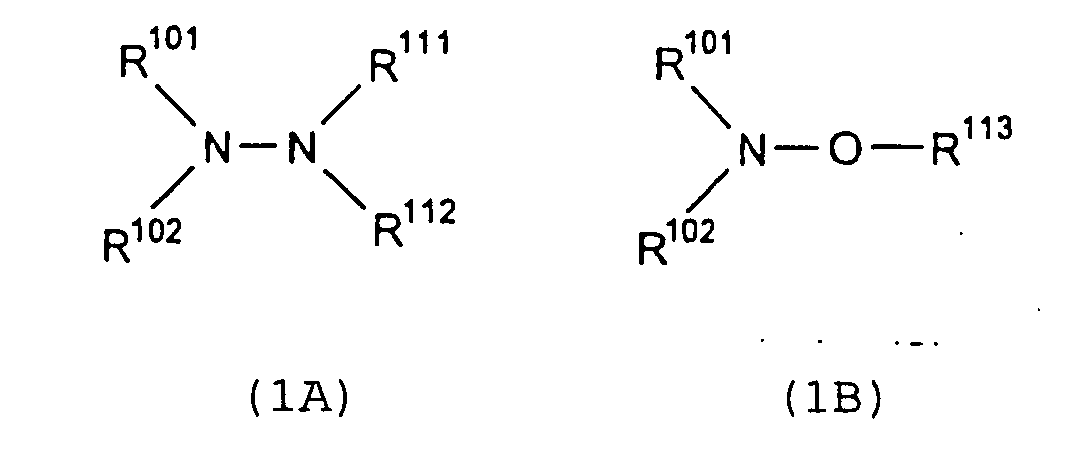
- In each of the formulas (1A) and (1B), R101 and R102 have the same meanings as defined above in the formula (I). R111 to R113 have the same meanings as described as R101.
- In the formula (IA), R101 and R102 each preferably represents a hydrogen atom, an aliphatic group, an aromatic group, of which an aliphatic group or an aromatic group is more preferred. R111 and R112 each preferably represents a hydrogen atom, an acyl group, an aliphatic oxycarbonyl group, an aromatic oxycarbonyl group, a sulfonyl group, a substituted or unsubstituted carbamoyl group, or a substituted or unsubstituted thiocarbamoyl group, with a hydrogen atom, an acyl group, a sulfonyl group, a substituted or unsubstituted carbamoyl group or a substituted or unsubstituted thiocarbamoyl group being more preferred.
- In the formula (IB), R101 represents preferably an aliphatic group, an aromatic group, a heterocyclic group, an acyl group, an aliphatic sulfonyl group or an aromatic sulfonyl group, with an aliphatic group, a heterocyclic group or an acyl group being more preferred. R102 represents preferably a hydrogen atom, an aliphatic group or an aromatic group, with a hydrogen atom or an aliphatic group being more preferred. R113 represents preferably a hydrogen atom, an aliphatic group, an aromatic group, a heterocyclic group or an acyl group, with a hydrogen atom or an aliphatic group being more preferred.
- Compounds of the formula (IA) can be synthesized by alkylation, acylation, sulfonylation or carbamoylation of a hydrazine derivative. Compounds of the formula (IB), on the other hand, can be synthesized by alkylation or acylation of a hydroxylamine derivative.
- Specific examples of the compounds represented by the formula (I) will be described next, but they are not limited thereto.
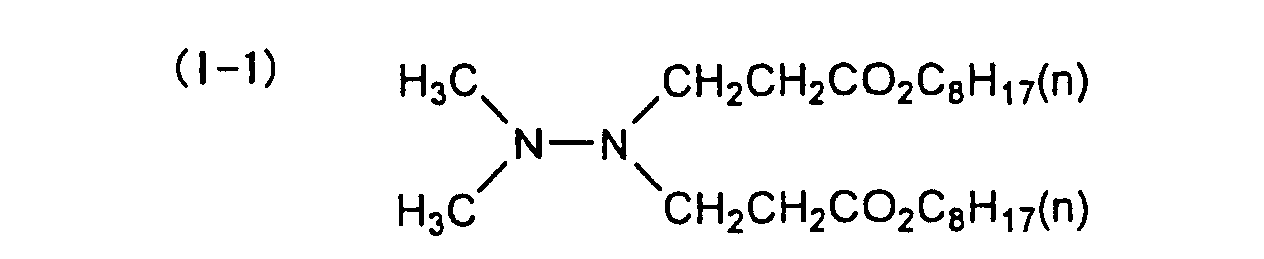
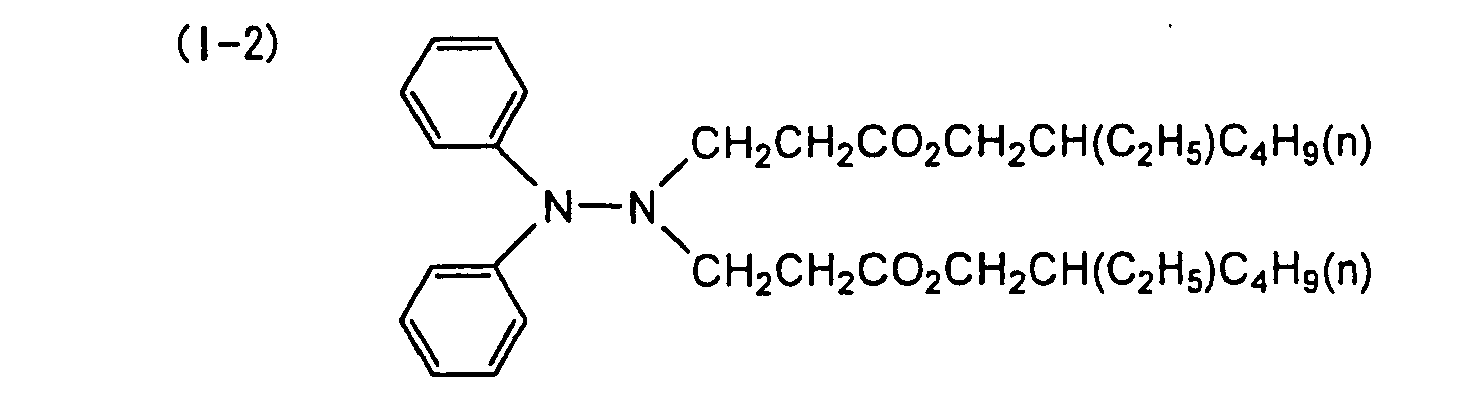

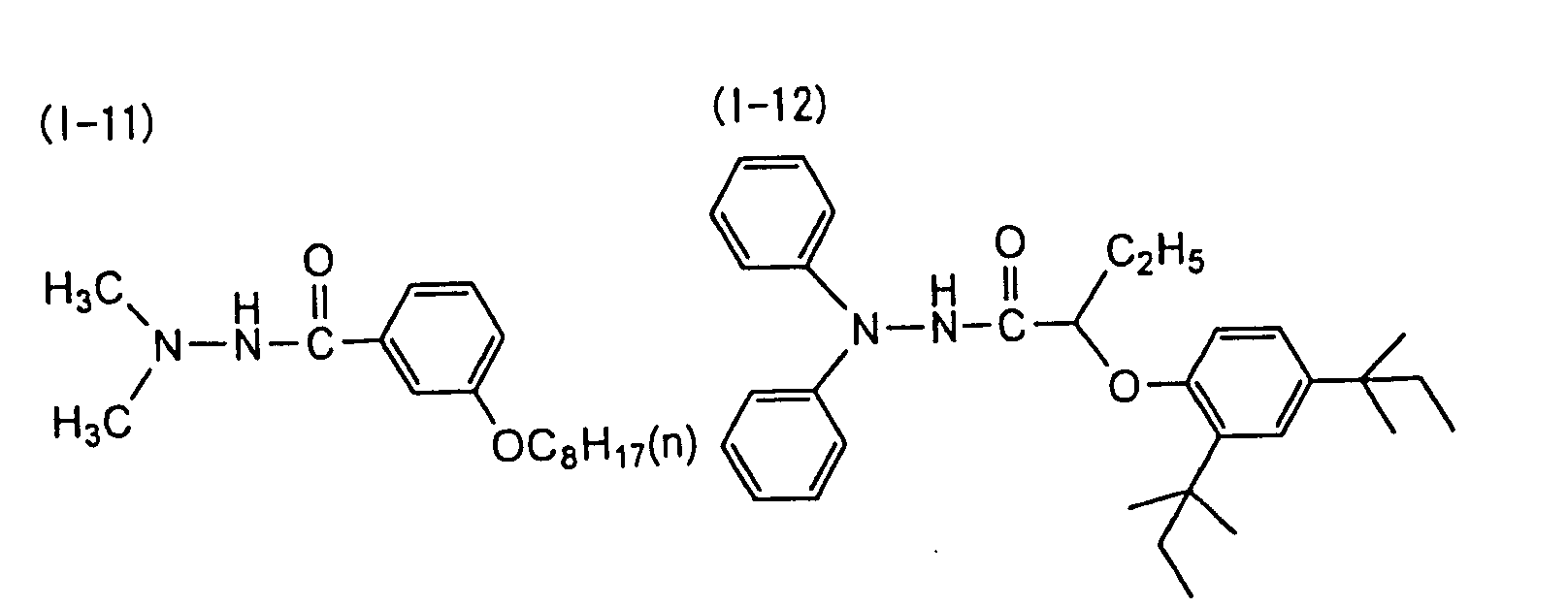


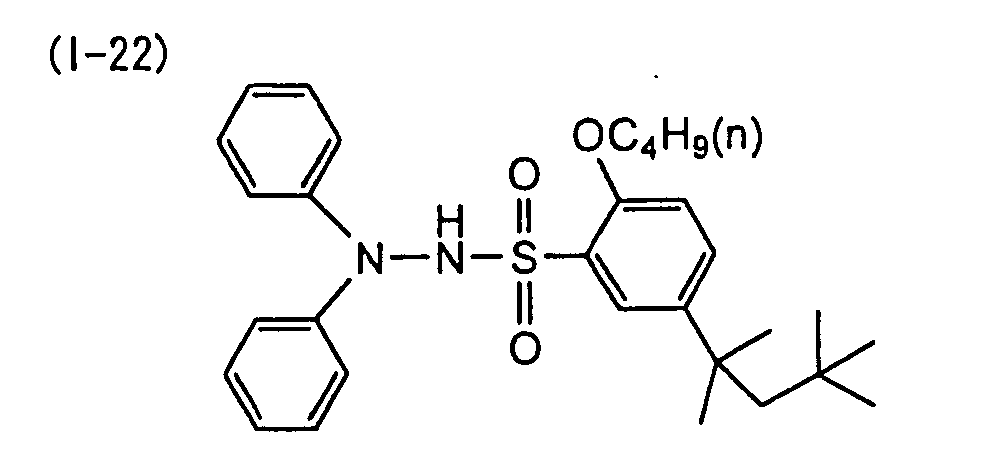

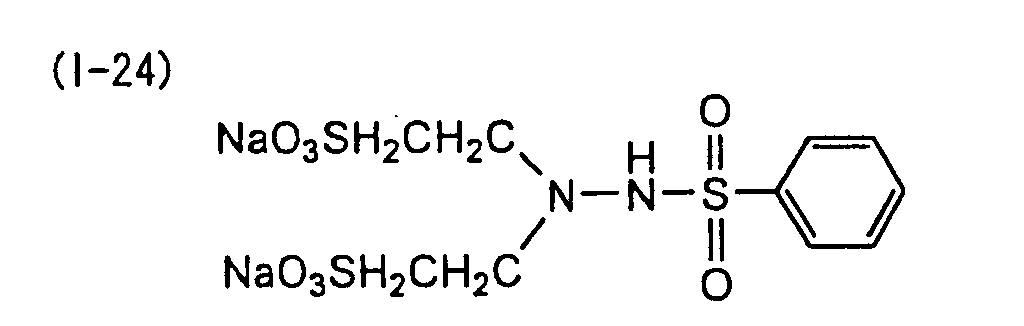

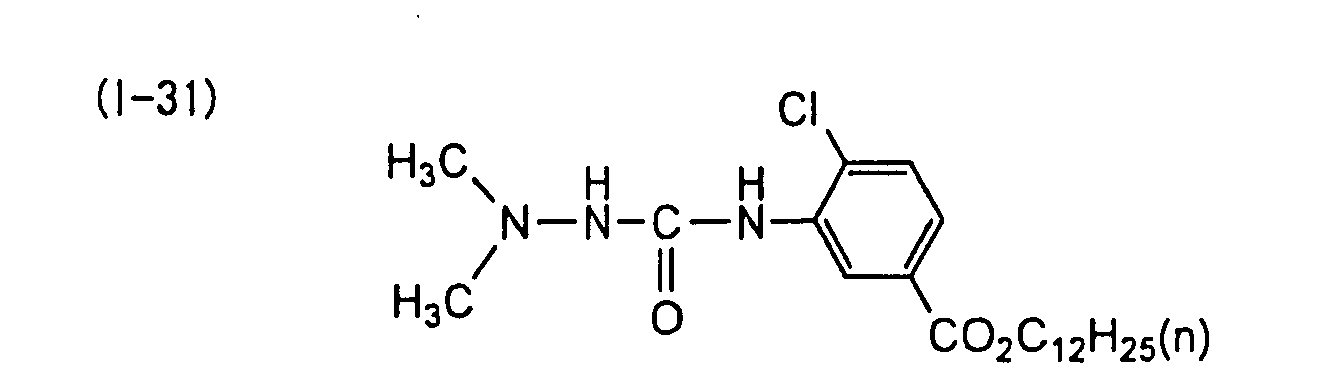
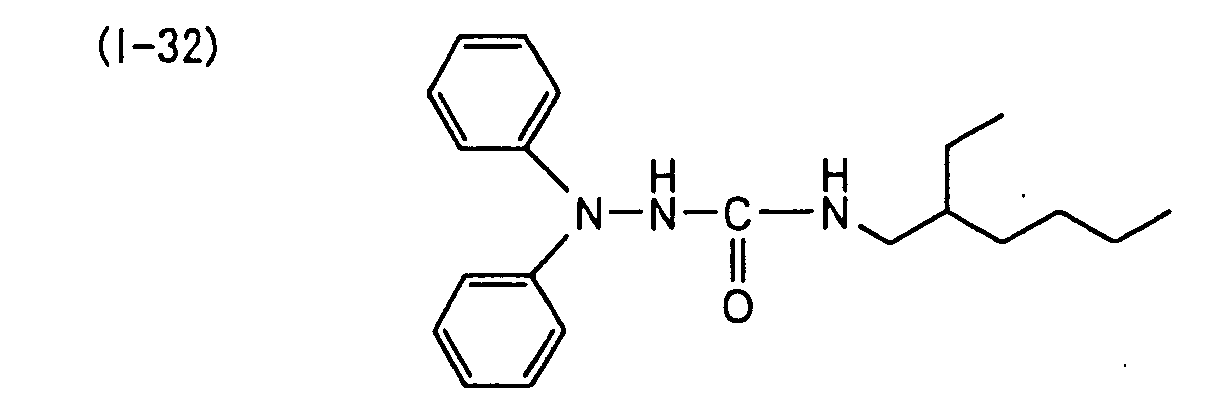
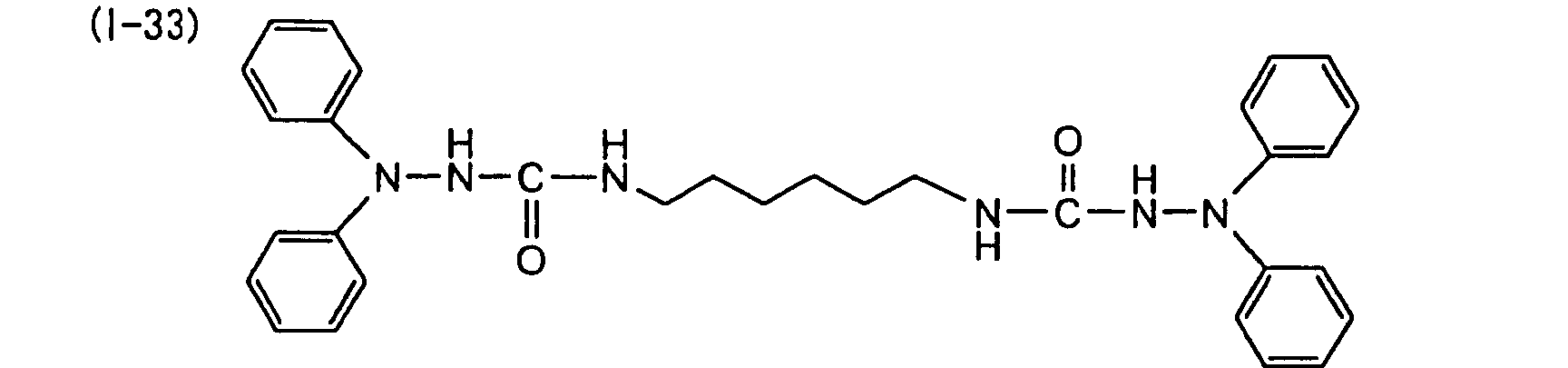

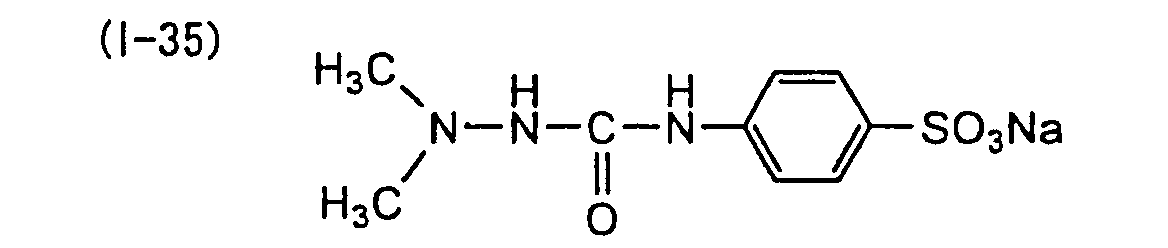

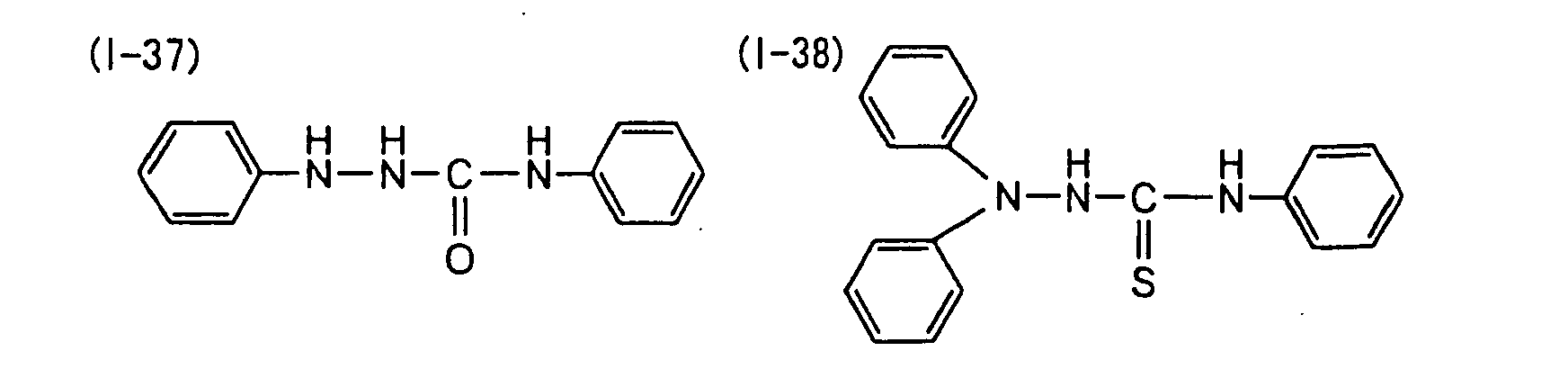

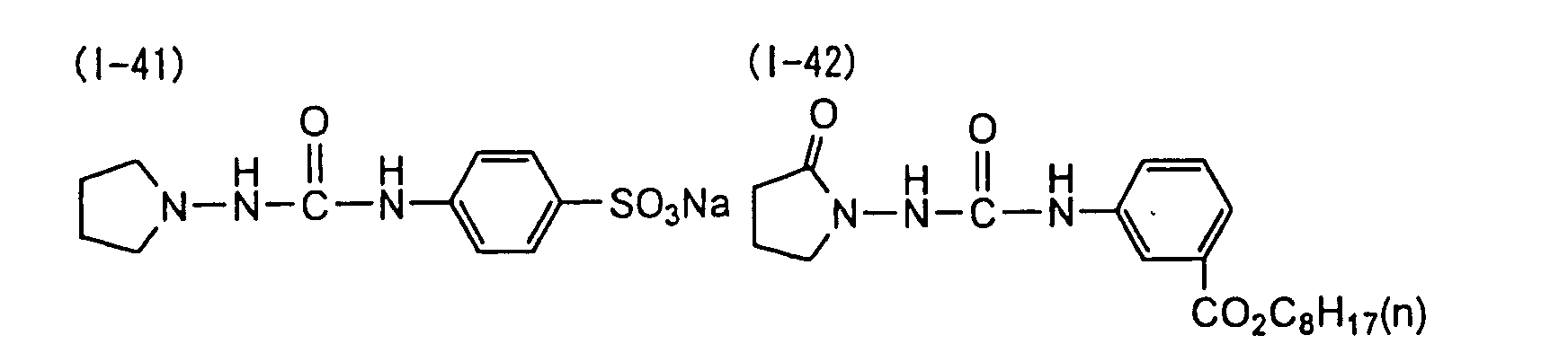

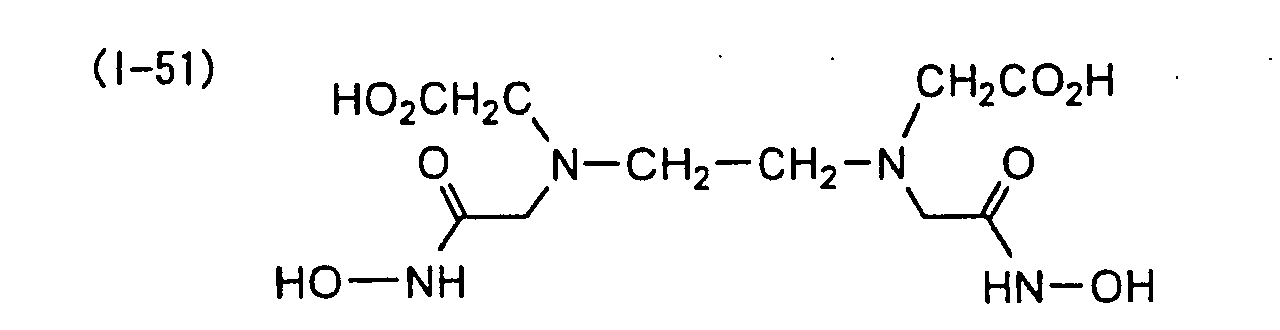


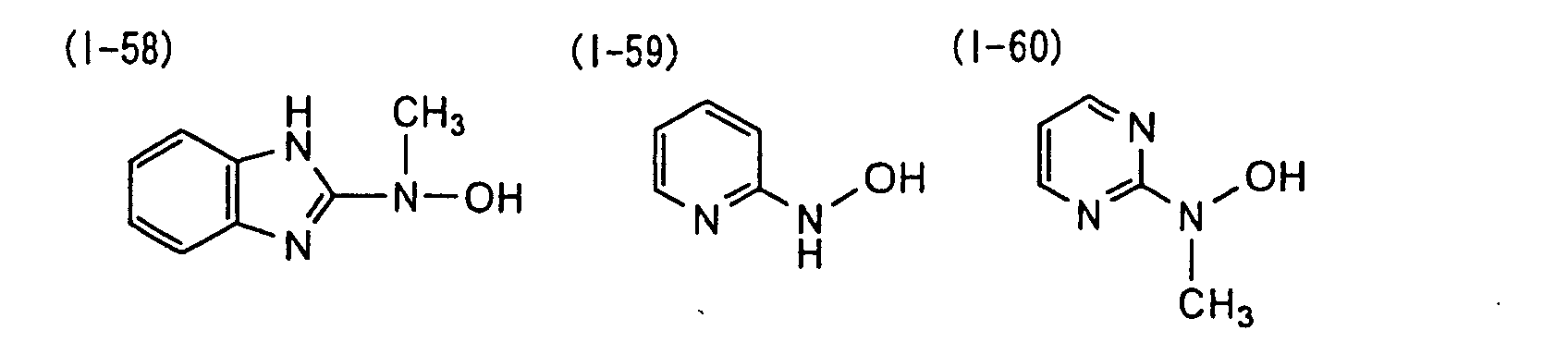
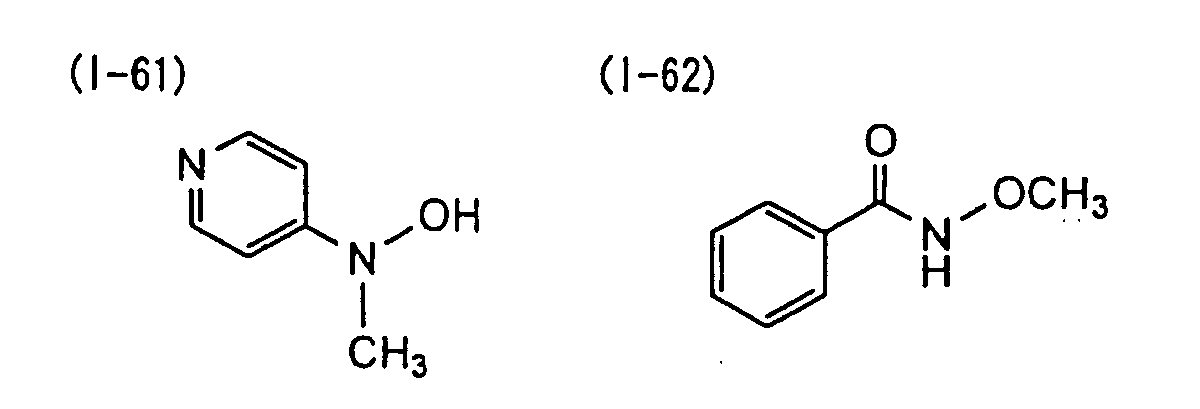
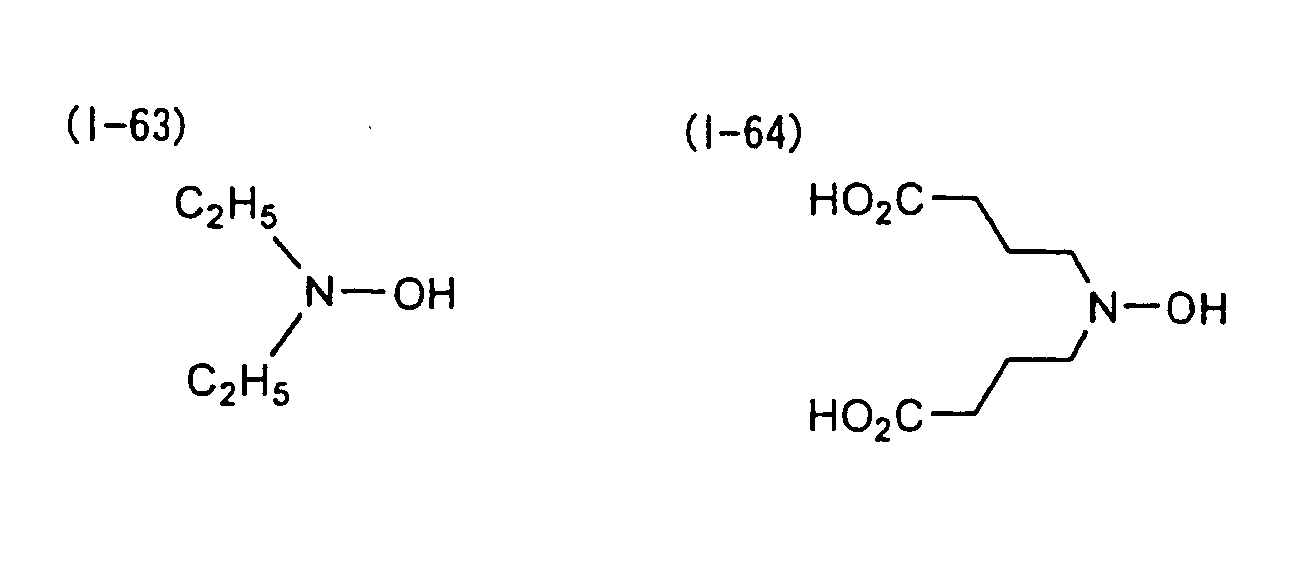
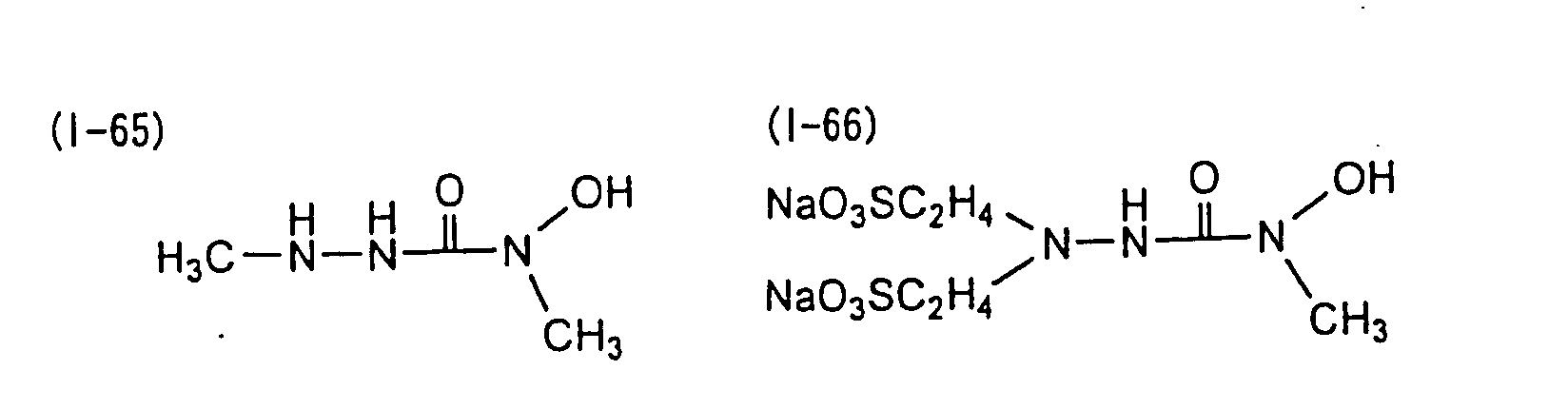


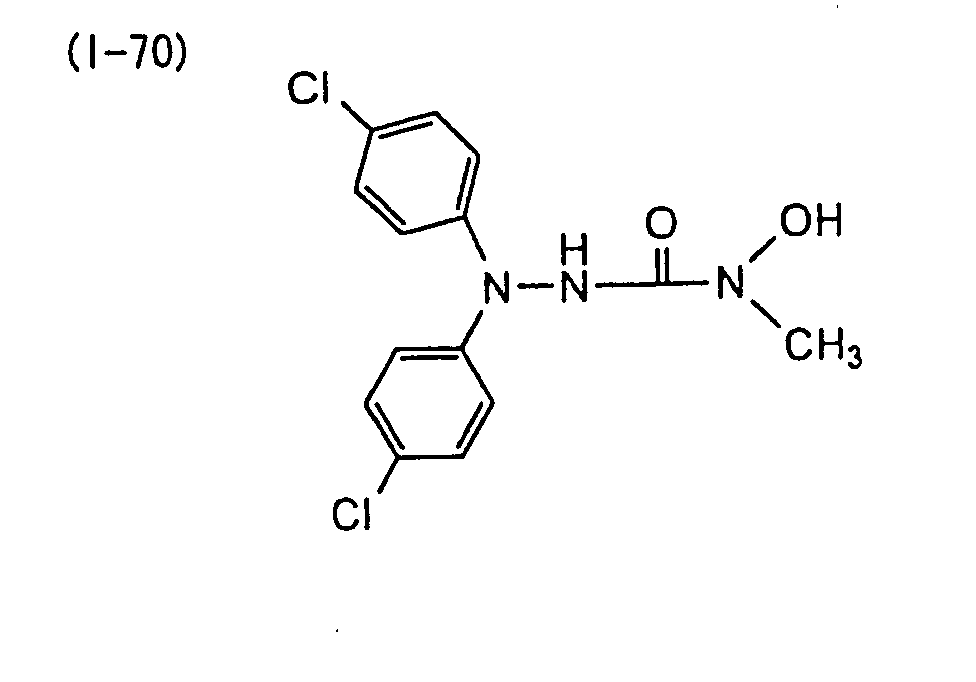
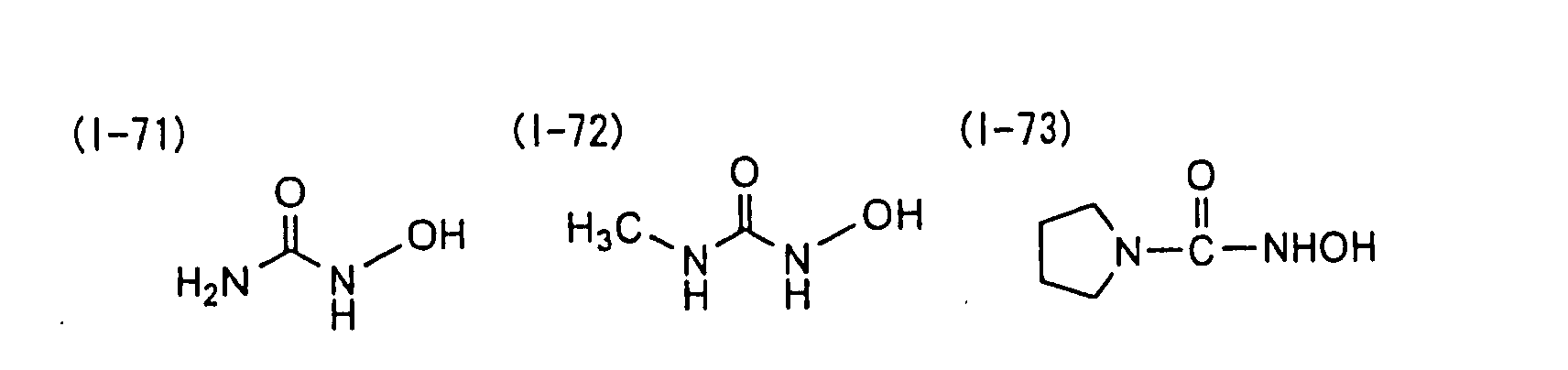


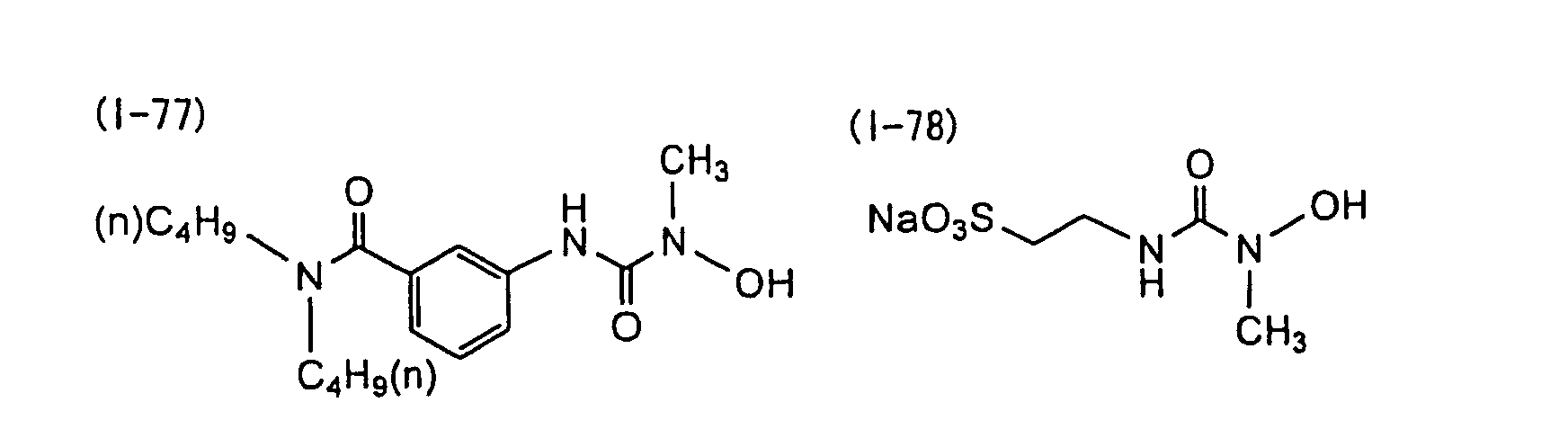
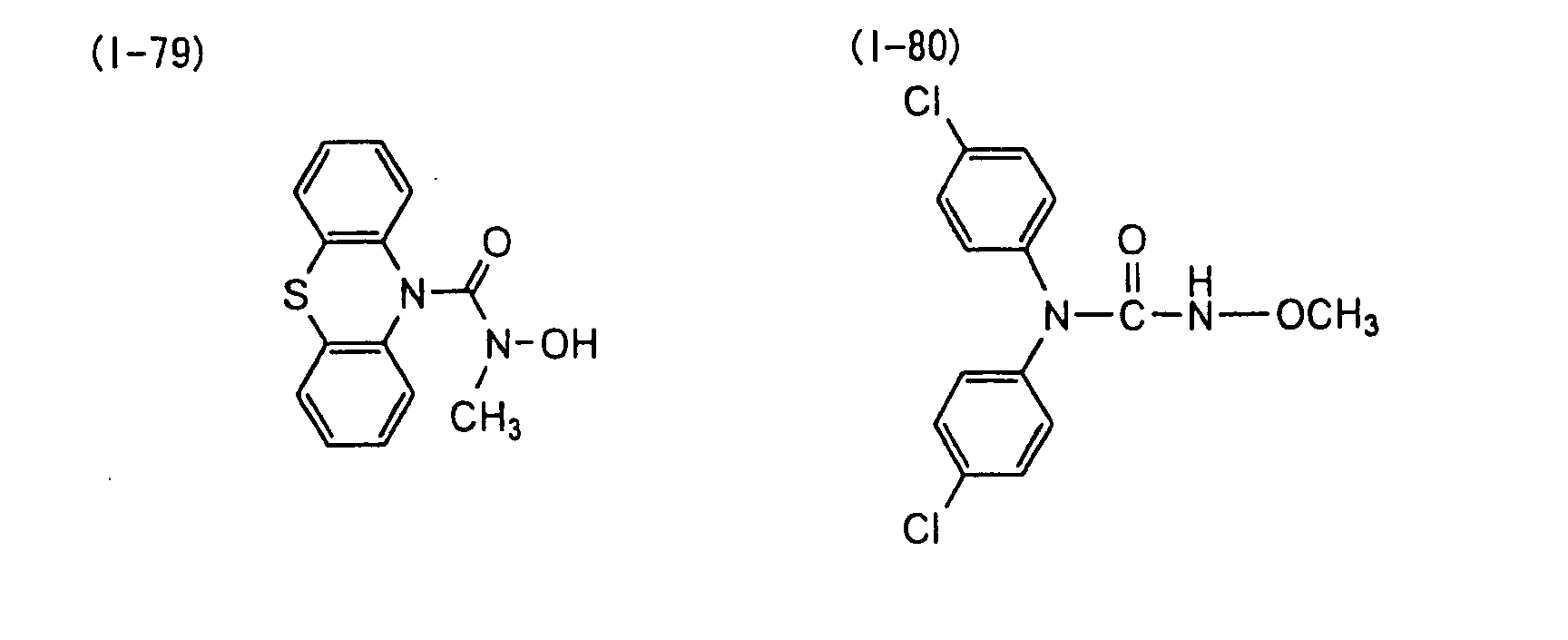


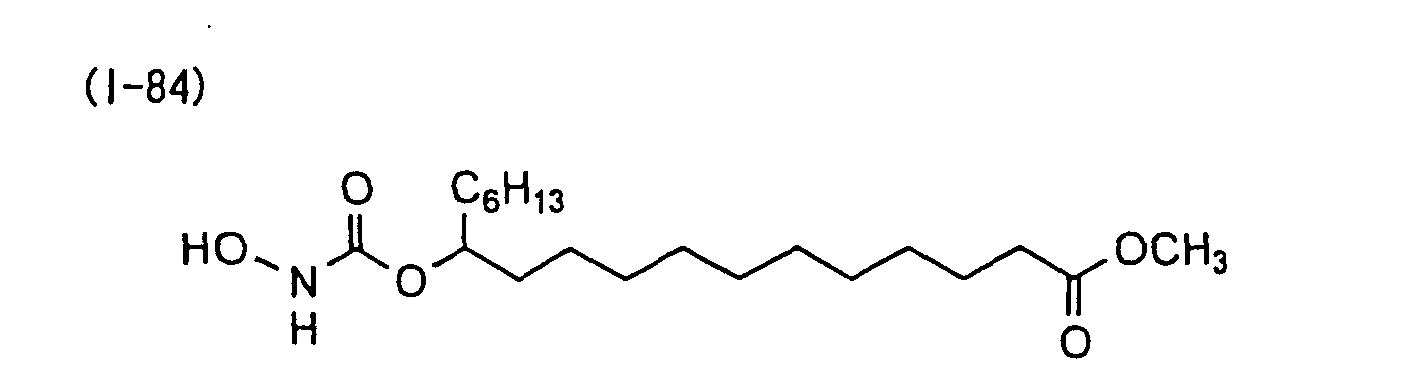
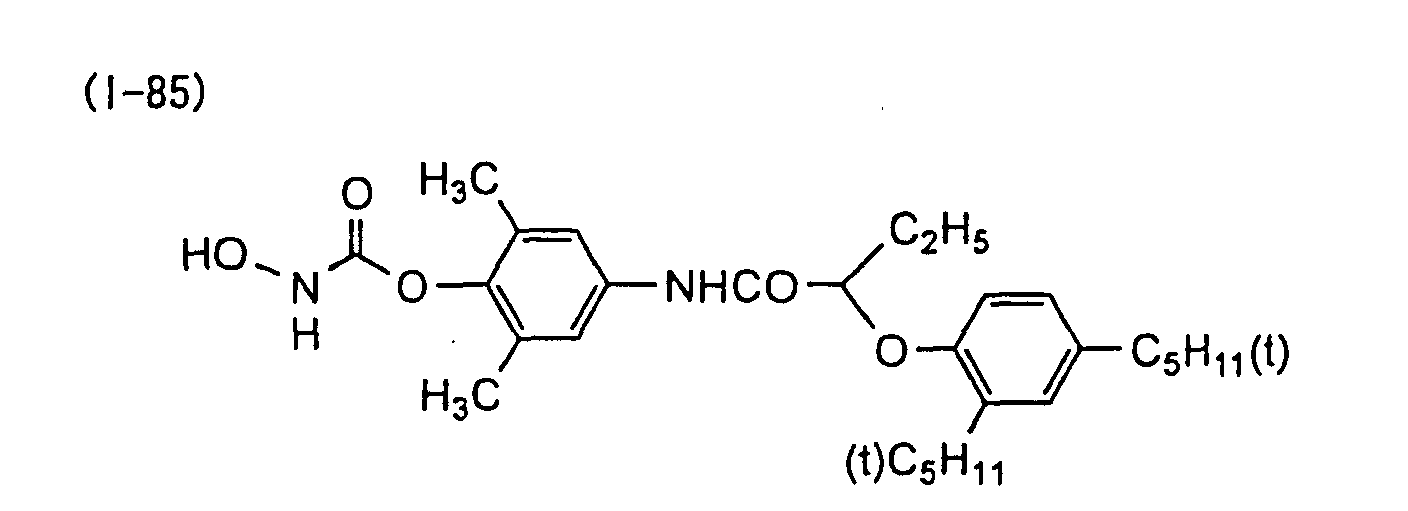
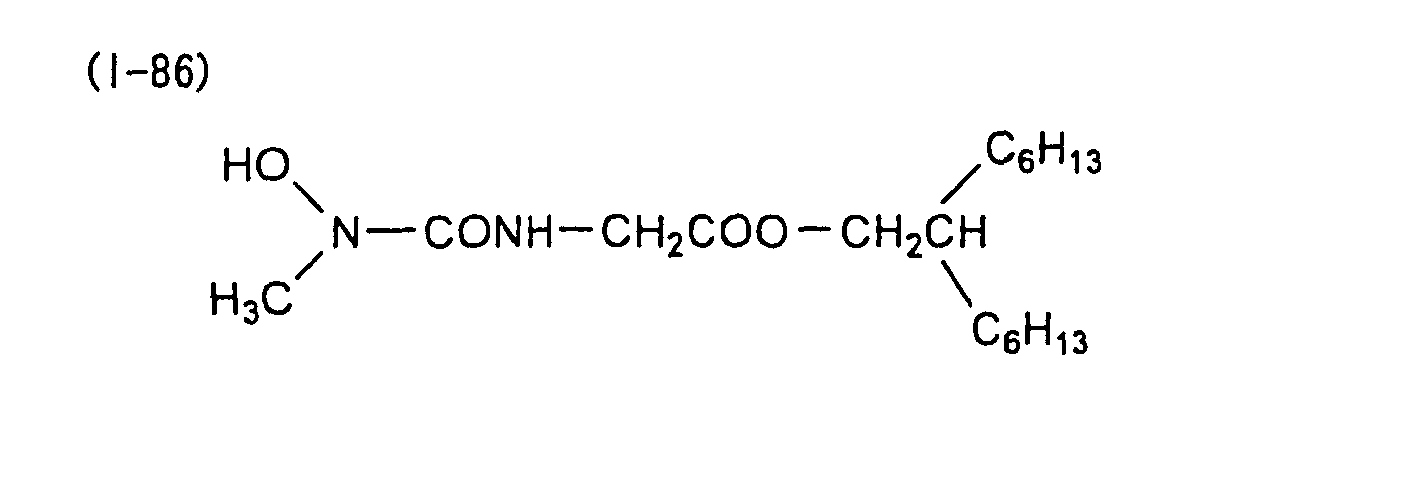
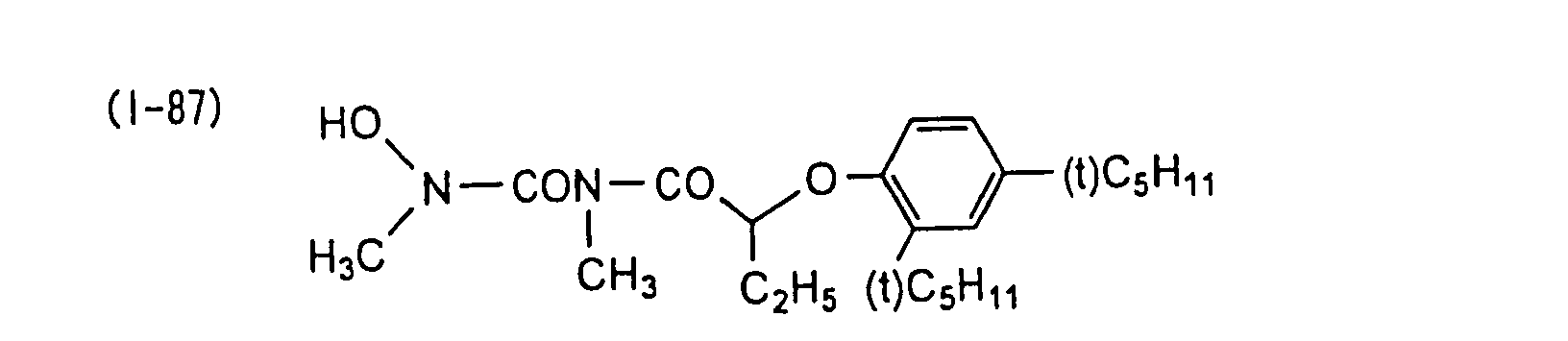
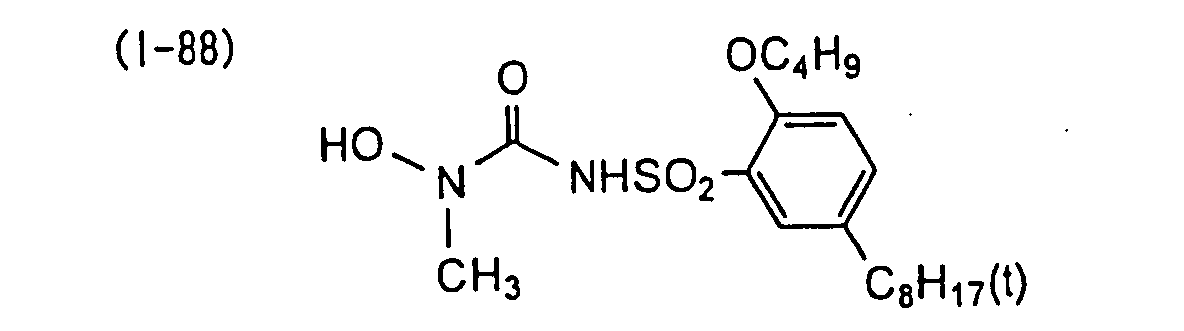


- The inkjet recording ink composition preferably contains 2 to 200 parts by mass of the invention compound of the formula (I) based on 100 parts by mass of the dye. If necessary, two or more compounds are usable as a mixture of any mixing ratio. Compounds as described below may be used in combination. These compounds are usable in any phase of the inkjet recording ink composition, but coexistence with the azo dye is desired.
- In the invention, various organic or metal complex type antifading agents can be used to improve the shelf life of images. Organic antifading agents include hydroquinones, alkoxyphenols, dialkoxyphenols, phenols, anilines, amines, indanes, coumarones, alkoxyanilines and heterocycles, while metal complex type antifading agents include nickel complexes and zinc complexes. More specifically, usable are compounds as cited in the patents described in Research Disclosure, No. 17643 (Sections I to J of VII), No. 15162, No. 18716 (left column on page 650), No. 36544 (page 527), No. 307105 (page 872), and No. 15162; and those embraced in the formula of the typical compounds and compound examples described on pages 127 to 137 of Japanese Patent Laid-Open No. 215272/1087.
- As well as these compounds, alkene compounds of the formula (I) in U.S. Patent No. 4713317, boron compounds of the formula (I) in Japanese Patent Laid-Open No. 174430/1992, epoxy compounds of the formula (II) in U.S. Patent No. 5183731 and the formula (S1) in Japanese Patent Laid-Open No. 53431/1996, disulfide compounds of the formula in EP 271322B1 and the formulas (I), (II), (III) and (IV) in Japanese Patent Laid-Open No. 19736/1992, sulfinic acid compounds of the formula (1) in U.S. Patent No. 4770987, reactive compounds of the formulas (I), (II), (III) and (IV) in U.S. Patent No. 5242785, and cyclic phosphorous compounds of the formula (1) in Japanese Patent Laid-Open No. 283279/1996.
- In the invention, metal complexes may be used. A number of metal complexes such as dithiolate nickel complexes and salicylaldoxime nickel complexes are known. Metal complexes such as those represented by the formula (I) in Japanese Patent Publication No. 13736/1986, the formula (I) in Japanese Patent Publication No. 13737/1986, the formula (I) in Japanese Patent Publication No. 13738/1986, the formula (I) in Japanese Patent Publication No. 13739/1986, the formula (I) in Japanese Patent Publication No. 13740/1986, the formula (I) in Japanese Patent Publication No. 13742/1986, the formula (I) in Japanese Patent Publication No. 13743/1986, the formula (I) in Japanese Patent Publication No. 13744/1986, the formula in Japanese Patent Publication No. 69212/1993, the formulas (I) and (II) in Japanese Patent Publication No. 88809/1993, the formula in Japanese Patent Laid-Open No. 199248/1988, the formulas (I) and (II) in Japanese Patent Publication No. 75568/1989, the formulas (I) and (II) in Japanese Patent Laid-Open No. 182749/1991, the formulas (II), (III), (IV) and (V) in U.S. Patent No. 4590153, and the formulas (II), (III) and (IV) in U.S. Patent No. 4912027.
- Metal complexes represented by the formula (IIIA) are usable in the invention in consideration of their effects.

- In the formula (IIIA), R91, R92, R93 and R94 each represents a substituent, R95 represents a hydrogen atom, an aliphatic group or an aromatic group, R96 represents a hydrogen atom, an aliphatic group, an aromatic group or a hydroxy group, and M stands for Cu, Co, Ni, Pd or Pt, or two R96s may be coupled together to form a 5- to 7-membered ring, or any adjacent pair of R91 and R92, R92 and R93, R93 and R94, R94 and R95 may be coupled together to form a 5- or 6-membered ring.
- Examples of the substituent R91, R92, R93 or R94 include aliphatic groups, aliphatic oxy groups, aliphatic sulfonyl groups, aromatic sulfonyl groups and acylamino groups. Examples of the aliphatic group as R95 or R96 include methyl, ethyl and undecyl groups and those of the aromatic group include phenyl group. As M, Ni is preferred.
- The compounds of the formula (1) may be used in combination with an antistaining agent as described in Japanese Patent Laid-Open No. 104448/1995 (column 39/line 50 to column 70/line 9), Japanese Patent Laid-Open No. 77775/1995 (column 61/line 50 to column 62/line 49), or Japanese Patent Laid-Open No. 301895/1995 (column 87/line 49 to column 88/line 48); a ultraviolet absorber as described in Japanese Patent Laid-Open No. 215272/1987 (page 125/upper right column/line 2 to page 127/lower left column/last line), Japanese Patent Laid-Open No. 33144/1990 (page 37/lower right column/line 14 to page 38/upper left column/line 11), or European Patent No. 0.355.600A2 (page 85/line 22 to line 31); or an antifading agent as described in Japanese Patent Laid-Open No. 104448/1995 (column 70/line 10 to column 71/line 2).
- The inkjet recording ink of the invention can be prepared by dissolving and/or dispersing, in an aqueous medium, the azo dye and a compound represented by the formula (I). The aqueous medium usable in the invention is obtained adding an additive such as humectant, stabilizer or antiseptic as needed to water or a mixture of water and a small amount of a water miscible organic solvent.
- Examples of the water miscible organic solvent usable in the invention include alcohols (such as methanol, ethanol, propanol, isopropanol, butanol, isobutanol, sec-butanol, t-butanol, pentanol, hexanol, cyclohexanol and benzyl alcohol), polyhydric alcohols (such as ethylene glycol, diethylene glycol, triethylene glycol, polyethylene glycol, propylene glycol, dipropylene glycol, polypropylene glycol, butylene glycol, hexanediol, pentanediol, glycerin, hexane triol and thiodiglycol), glycol derivatives (such as ethylene glycol monomethyl ether, ethylene glycol monoethyl ether, ethylene glycol monobutyl ether, diethylene glycol monomethyl ether, diethylene glycol monobutyl ether, propylene glycol monomethyl ether, propylene glycol monobutyl ether, dipropylene glycol monomethyl ether, triethylene glycol monomethyl ether, ethylene glycol diacetate, ethylene glycol monomethylether acetate, triethylene glycol monomethyl ether, triethylene glycol monoethyl ether and ethylene glycol monophenyl ether), amines (such as ethanolamine, diethanolamine, triethanolamine, N-methyldiethanolamine, N-ethyldiethanolamine, morpholine, N-ethylmorpholine, ethylenediamine, diethylenetriamine, triethylenetetramine, polyethyleneimine and tetramethylpropylenediamine) and the other polar solvents (ex. formamide, N,N-dimethylformamide, N,N-dimethylacetamide, dimethylsulfoxide, sulfolane, 2-pyrrolidone, N-methyl-2-pyrrolidone, N-vinyl-2-pyrrolidone, 2-oxazolidone, 1,3-dimethyl-2-imidazolidinone, acetonitrile and acetone). At least two of these water miscible organic solvents can be used in combination.
- When the azo dye is an oil soluble dye, it can be prepared by dissolving the oil soluble dye in a high-boiling-point organic solvent and then dispersing and emulsifying the resulting solution in an aqueous medium. When the compound of the formula (I) is used, it may be dispersed and emulsified together with the oil soluble dye and allowed to coexist with the dye in the same oil droplet. Alternatively, the dispersed emulsion obtained separately may be added or the compound may be dissolved or dispersed in an aqueous phase. Coexistence of it with the oil soluble dye in the same oil droplet is however preferred.
- The high-boiling-point organic solvent to be used in the invention has a boiling point of 150°C or greater, preferably 170°C or greater.
- Examples include phthalic acid esters (such as dibutyl phthalate, dioctyl phthalate, dicyclohexyl phthalate, di-2-ethylhexyl phthalate, decyl phthalate, bis(2,4-di-tert-amylphenyl) isophthalate, and bis(1,1-diethylpropyl) phthalate), phosphoric acid or phosphonic acid esters (such as diphenyl phosphate, triphenyl phosphate, tricresyl phosphate, 2-ethylhexyldiphenyl phosphate, dioctylbutyl phosphate, tricyclohexyl phosphate, tri-2-ethylhexyl phosphate, tridodecyl phosphate, and di-2-ethylhexylphenyl phosphate), benzoic acid esters (such as 2-ethylhexyl benzoate, 2,4-dichlorobenzoate, dodecyl benzoate, and 2-ethylhexyl-p-hydroxy benzoate), amides (such as N,N-diethyldodecanamide and N,N-diethyllaurylamide), alcohols or phenols (such as isostearyl alcohol and 2,4-di-tert-amylphenol), aliphatic esters (such as dibutoxyethyl succinate, di-2-ethylhexyl succinate, 2-hexyldecyl tetradecanoate, tributyl citrate, diethyl azelate, isostearyl lactate and trioctyl citrate), aniline derivatives (such as N,N-dibutyl-2-butoxy-5-tert-octylaniline), chlorinated paraffins (such as paraffins having a chlorine content of 10 to 80%), trimesic acid esters (such as tributyl trimesate), dodecyl benzene, diisopropyl naphthalene, phenols (such as 2,4-di-tert-amylphenol, 4-dodecyloxyphenol, 4-dodecyloxycarbonylphenol and 4-(4-dodecyloxyphenylsulfonylphenol), carboxylic acids (such as 2-(2,4-di-tert-amylphenoxybutyric acid and 2-ethoxyoctanedacanoic acid), and alkylphosphoric acids (such as di-2(ethylhexyl)phosphoric acid and diphenylphosphoric acid). These high-boiling-point organic solvents may be used in an amount of 0.01 to 20 times the mass, preferably 0.05 to 5 times the mass of the oil soluble dye.
- These high-boiling-point organic solvents may be used either singly or at least two of them may be used in combination [for example, tricresyl phosphate and dibutyl phthalate, trioctyl phosphate and di(2-ethylhexyl)sebacate, or dibutyl phthalate and poly(N-t-butyl acrylamide)].
- The other compounds serving as a high-boiling-point organic solvent and/or synthesizing processes thereof, each usable in the invention, are described in, for example, U.S. Patent No. 2,322,027, 2,533,514, 2,772,163, 2,835,579, 3,594,171, 3,676,137, 3,689,271, 3,700,454, 3,748,141, 3,764,336, 3,765,897, 3,912,515, 3,936,303, 4,004,928, 4,080,209, 4,127,413, 4,193,802, 4,207,393, 4,220,711, 4,239,851, 4,278,757, 4,353,979, 4,363,873, 4,430,421, 4,430,422, 4,430,422, 4,464,464, 4,483,918, 4,540,657, 4,684,606, 4,728,599, 4,745,049, 4,935,321, or 5,013,639; European Patent No. 2,76,319A, 286,253A, 289,820A, 309,158A, 309,159A, 309,160A, 509,311A, or 510,576A; East German Patent No. 147,009, 157,147, 159,573, or 225,240A; British Patent No. 2,091,124A; Japanese Patent Laid-Open Nos. 47335/1973, 26530/1975, 25133/1976, 26036/1976, 27921/1976, 27922/1976, 149028/1976, 46816/1977, 1520/1978, 1521/1978, 15127/1978, 146622/1978, 91325/1979, 106228/1979, 118246/1979, 59464/1980, 64333/1981, 81836/1981, 204041/1984, 84641/1986, 118345/1987, 247364/1987, 167357/1988, 214744/1988, 301941/1988, 9452/1989, 9454/1989, 68745/1989, 101543/1989, 102454/1989, 792/1990, 4239/1990, 43541/1990, 49237/1992, 30165/1992, 232946/1992 or 346338/1992.
- The above-described high-boiling-point organic solvents may be used in an amount of 0.01 to 3.0 times the mass, preferably 0.01 to 1.0 time the mass of the oil soluble dye.
- In the invention, the oil soluble dye or high-boiling-point organic solvent is dispersed and emulsified in an aqueous medium. Upon emulsification and dispersion, a low-boiling-point organic solvent are usable from the viewpoint of emulsifying properties. The low-boiling-point organic solvent is an organic solvent having a boiling point of 30°C or greater but not greater than 150°C under normal pressure. Preferred examples include, but not limited to, esters (ethyl acetate, butyl acetate, ethyl propionate, β-ethoxyethyl acetate and methyl cellosolve acetate), alcohols (such as isopropyl alcohol, n-butyl alcohol and secondary butyl alcohol), ketones (such as methyl isobutyl ketone, methyl ethyl ketone and cyclohexanone), amides (such as dimethylformamide and N-methylpyrrolidone) and ethers (such as tetrahydrofuran and dioxane).
- Emulsification and dispersion are conducted for the purpose of forming fine oil droplets of an oil phase by dispersing, in an aqueous phase composed mainly of water, an oil phase having a dye dissolved in a high-boiling-point organic solvent, in some cases, in a mixed solvent thereof with a low-boiling-point organic solvent. At this time, to either one of the aqueous phase or oil phase or both of them, an additive such as surfactant, humectant, dye stabilizer, emulsion stabilizer, antiseptic and/or antifungal agent, which will be described later, may be added as needed.
- Emulsification is usually conducted by adding an oil phase to an aqueous phase. Alternatively, so-called phase inversion emulsification wherein an aqueous phase is added dropwise to an oil phase can be preferably employed.
- Various surfactants can be employed upon dispersion and emulsification in the invention. Preferred examples include anionic surfactants such as fatty acid salts, alkyl sulfates, alkylbenzene sulfonates, alkylnaphthalene sulfonates, dialkyl sulfosuccinates, alkyl phosphates, naphthalenesulfonic acid-formalin condensate, and polyoxyethylene alkyl sulfates; and nonionic surfactants such as polyoxyethylene alkyl ethers, polyoxyethylene alkyl allyl ethers, polyoxyethylene fatty acid esters, sorbitan fatty acid esters, polyoxyethylene sorbitan fatty acid esters, polyoxyethylene alkyl amines, glycerin fatty acid esters, and oxyethylene oxypropylene block copolymers. As well as these surfactants, SURFYNOLS (trade name; product of Air Products & Chemicals) which are acetylene series polyoxyethylene oxide surfactants are preferred. Amine oxide type amphoteric surfactants such as N,N-dimethyl-N-alkylamine oxides are also preferred. Moreover, surfactants as described in Japanese Patent Laid-Open No. 157,636/1984 (pp. 37-38), and Research Disclosure No. 308119 (1989) are also usable.
- In order to stabilize the emulsion rightly after emulsification, a water soluble polymer can be added in combination with the surfactant. As the water soluble polymer, polyvinyl alcohol, polyvinyl pyrrolidone, polyethylene oxide, polyacrylic acid and polyacrylamide, and copolymers thereof are preferred. Natural water-soluble polymers such as polysaccharides, casein and gelatin are also preferred. In order to stabilize the dispersion of a dye, it is possible to use, in combination, polyvinyl, polyurethane, polyamide, polyurea or polycarbonate available by the polymerization of an acrylate ester, methacrylate ester, vinyl ester, acrylamide, methacrylamide, olefin, styrene, vinyl ether, or acrylonitrile, which polymer is substantially insoluble in an aqueous medium. These polymers preferably contain - SO2- or -COO-. When such a polymer substantially insoluble in an aqueous medium is used in combination, it is used preferably in an amount not greater than 20% by mass, more preferably not greater than 10% by mass, based on the high-boiling-point organic solvent.
- Upon preparation of an aqueous ink by dispersing and emulsifying an oil soluble dye or high-boiling-point organic solvent, control of its particle size is of particular importance. It is essential to minimize the average particle size in order to heighten color purity or density upon formation of an image by inkjet. The volume-average particle size is preferably 1 µm or less, more preferably 5 to 100 nm.
- The volume average particle size and particle distribution of the dispersed particles can be measured readily in a known manner, for example, the static light scattering method, dynamic light scattering method, centrifugal precipitation method or the method described on pages 417 to 418 of Jikken Kagaku Koza, 4th Edition. For example, a particle size can be measured easily by diluting an ink with distilled water to give the particle concentration in the ink of 0.1 to 1 %by mass and measuring the resulting diluted ink by a commercially available volume-average particle size measuring instrument (for example, Microtrac UPA (trade name; product of Nikkiso Co., Ltd.). The dynamic light scattering method using Laser Doppler effect permits measurement of small particle size so that it is especially preferred.
- The volume-average particle size is an average particle size based on the volume of the particles and it is found by multiplying the diameter of each particle by its volume and then dividing the sum of the products by the total volume of the particles. There is a description on page 119 of "Chemistry of High Molecular Latex" (written by Soichi Muroi, published by Kobunshi Kankokai).
- It has been revealed that the existence of coarse particles plays an important role in printing performance. Described specifically, coarse particles cause clogging of a head nozzle or, if not so, form a stain and prevent discharge or cause irregular discharge of the ink, thereby having a serious influence on the printing performance. To prevent such phenomena, it is important to control the number of the particles having a particle size of 5 µm or greater to 10 or less and the number of the particles having a particle size of 1 µm or greater to 100 or less, in 1 µl of the resulting ink.
- Such coarse particles can be removed by known centrifugal separation or precise filtration. Such separation may be conducted rightly after dispersion and emulsification, or after addition of various additives such as humectant and surfactant to the emulsified dispersion but rightly before filling a cartridge with the mixture.
- A mechanical emulsifier can be employed as effective means for decreasing the average particle size and removing coarse particles.
- As the emulsifier, usable are known ones such as simple-system stirrer, mill-system emulsifiers such as impeller agitator, inline agitator and colloid mill and ultrasonic system emulsifier, with use of a high pressure homogenizer being especially preferred.
- Specific mechanism of a high pressure homogenizer is described in U.S. Patent No. 4522354 or Japanese Patent Laid-Open No. 47264/1994. Examples of the commercially available one include Gaulin homogenizer (product of A.P.V GAULIN INC), microfluidizer (product of MICROFLUIDEX INC.) and Ultimaizer (product of Sugino Machine).
- A recently developed high pressure homogenizer as described in U.S Patent No. 5720551 having a mechanism for forming fine droplets in a ultrahigh pressure jet stream is particularly effective for dispersion and emulsification of the invention. "DeBEE 2000" (product of BEE INTERNATIONAL LTD.) is one of the emulsifiers adopting this ultrahigh pressure jet stream.
- The pressure upon emulsification by a high pressure emulsifier is at least 50 MPa, preferably at least 60 MPa, still more preferably at least 180 MPa.
- Use of at least two emulsifiers, for example, successive use of a stirring emulsifier and a high pressure homogenizer is particularly preferred. It is also preferred to disperse and emulsify by such emulsifiers, add to the resulting emulsion an additive such as humectant or surfactant and subject the resulting mixture to high pressure homogenizer again while filling a cartridge with the resulting ink.
- When both of a high boiling point organic solvent and a low boiling point organic solvent are incorporated, removal of the low boiling point solvent is preferred for stability, safety and sanitation of the emulsion. The low boiling point solvent can be removed in a known manner, for example, evaporation, vacuum evaporation or ultrafiltration, depending on the kind of the solvent. This removal of the low boiling point organic solvent is preferably conducted as soon as possible rightly after emulsification.
- When the inkjet recording ink composition obtained by the invention is used for inkjet recording, additives selected as needed from antidrying agent for preventing clogging at a jet orifice due to drying of an ink, penetration promoter to promote penetration of an ink into paper, ultraviolet absorber, antioxidant, viscosity regulator, surface tension regulator, dispersant, dispersion stabilizer, antifungal agent, rust preventive, pH regulator, antifoaming agent and chelating agent can be added.
- As the antidrying agent to be used in the invention, water soluble organic solvents having a vapor pressure lower than that of water are preferred. Specific examples include polyhydric alcohols typified by ethylene glycol, propylene glycol, diethylene glycol, polyethylene glycol, thiodiglycol, dithiodiglycol, 2-methyl-1,3-propanediol, 1,2,6-hexanetriol, acetylene glycol derivative, glycerin and trimethylolpropane; lower alkyl ethers of a polyvalent alcohol such as ethylene glycol monomethyl (or ethyl) ether, diethylene glycol monomethyl (or ethyl) ether and triethylene glycol monoethyl (or butyl) ether; heterocyclics such as 2-pyrrolidone, N-methyl-2-pyrrolidone, 1,3-dimethyl-2-imidazolidinone and N-ethylmorpholine; sulfur-containing compounds such as sulfolane, dimethylsulfoxide and 3-sulfolene; polyfunctional compounds such as diacetone alcohol and diethanolamine; and urea derivatives. Of these, polyhydric alcohols such as glycerin and diethylene glycol are more preferred. The above-exemplified antidrying agents may be used either singly or in combination. The antidrying agent is preferably added in an amount of 10 to 50% by mass of the ink.
- Examples of the penetration promoter usable in the invention include alcohols such as ethanol, isopropanol, butanol, di- or tri-ethylene glycol monobutyl ether, and 1,2-hexanediol and nonionic surfactants such as sodium lauryl sulfate and sodium oleate. Incorporation of it in an amount of 10 to 30% by mass in an ink brings about sufficient effects. It is preferably added in an amount within a range causing neither bleeding of print nor print-through.
- Examples of the ultraviolet absorber to be used in the invention for improving the shelf life of images include benzotriazole compounds as described in Japanese Patent Laid-Open No. 185677/1983, 190537/1986, 782/1990, 197075/1993 and 34057/1997, benzophenone compounds as described in Japanese Patent Laid-Open No. 2784/1971 and 194483/1993 and U.S. Patent No. 3214463, cinnamic acid compounds as described in Japanese Patent Publication No. 30492/1983 and 21141/1981 and Japanese Patent Laid-Open No. 88106/1998, triazine compounds as described in Japanese Patent Laid-Open No. 298503/1992, 53427/1996, 239368/1996 and 182621/1998 and International Patent Publication No. 501291/1996, and compounds so called fluorescent brightener such as those as described in Research Disclosure No. 24239, stilbene and benzoxazole compounds which emit fluorescence, absorbing ultraviolet rays.
- Examples of the antifungal agent usable in the invention include sodium dehydroacetate, sodium benzoate, sodium pyridinethion-1-oxide, ethyl p-hydroxybenzoate and 1,2-benzisothiazolin-3-one and salts thereof. It is preferably added in an amount of 0.02 to 5.00% by mass of the ink.
- Details of the antifungal agent are described in "Dictionary of Antibacterial and Antifungal Agents" (ed. by The Society for Antibacterial and Antifungal Agents, Japan).
- Examples of the rust inhibitor include acidic sulfite, sodium thiosulfate, ammonium thioglycolate, diisopropylammonium nitrite, pentaerythritol tetranitrate, dicyclohexylammonium nitrite and benzotriazole. It is preferably added in an amount of 0.02 to 5.00% by mass in the ink.
- The pH regulator to be used in the invention functions well for regulating pH of the ink and imparting it with dispersion stability. It is preferably added to adjust its pH to 4.5 to 10.0, more preferably to 6 to 10.0.
- As basic pH regulators, organic bases and inorganic alkalis are usable while as acidic ones, organic acids and inorganic acids are usable.
- The organic bases include triethanolamine, diethanolamine, N-methyldiethanolamine and dimethylethanolamine. The inorganic alkalis include hydroxides of an alkali metal (ex. sodium hydroxide, lithium hydroxide and potassium hydroxide), carbonates (ex. sodium carbonate and sodium bicarbonate) and ammonia.
- The organic acids include acetic acid, propionic acid, trifluoroacetic acid and alkylsulfonic acid. The inorganic acids include hydrochloric acid, sulfuric acid and phosphoric acid.
- As the surface tension regulator, noionic, cationic and anionic surfactants are usable in the invention. Examples of the anionic surfactants include fatty acid salts, alkyl sulfates, alkyl benzenesulfonates, alkyl naphthalene sulfonates, dialkyl sulfosuccinates, alkylphosphates, naphthalenesulfonate formalin condensate, and polyoxyethylene alkyl sulfate esters; those of the nonionic surfactants include polyoxyethylene alkyl ethers, polyoxyethylene alkyl allyl ethers, polyoxyethylene fatty acid esters, sorbitan fatty acid esters, polyoxyethylene sorbitan fatty acid esters, polyoxyethylene alkylamines, glycerin fatty acid esters, and oxyethylene oxypropylene block copolymers. SURFYNOLS (trade name; product of Air Products & Chemicals Inc.) which are acetylene type polyoxyethylene oxide surfactants are also preferably employed. Amine oxide type amphoteric surfactants such as N,N-dimethyl-N-alkylamine oxide are also preferred. Surfactants as described in Japanese Patent Laid-Open No. 157,636/1984 (pp. 37-38) and Research Disclosure No. 308119 (1989) are also usable.
- The ink of the invention containing or not containing such a regulator is preferred to have a surface tension of 20 to 60 mN/m, more preferably 25 to 45 mN/m.
- The ink usable in the invention has preferably a viscosity of 30 mPa·s or less. It is preferably adjusted to 20 mPa·s or less. A viscosity regulator is sometimes added to adjust its viscosity. Examples of the viscosity regulators include celluloses, water soluble polymers such as polyvinyl alcohol, and nonionic surfactants. More specific description about viscosity regulators can be found in Chapter 9 of "Viscosity Regulating Technique" (Information Technology Association, 1999) and pages 162 to 174 of "Chemicals for Inkjet Printers (Supplement, 98) -Researches on Development Trend and Prospect of Materials-" (CMC, 1997)).
- In the invention, it is also possible to add, as needed, the above-described cationic, anionic or nonionic surfactant as a dispersant or dispersion stabilizer, and a fluorine or silicon compound, or a chelating agent typified by EDTA as an antifoaming agent.
- Recording paper and recording film to be used in the image recording method of the invention will next be described. As recording paper and recording film, usable are those having, as a support, chemical pulp such as LBKP or NBKP, mechanical pulp such as GP, PGW, RMP, TMP, CTMP, CMP or CGP, or recycled pulp such as DIP, to which conventionally known additives such as pigment, binder, sizing agent, fixer, cationic agent and paper strength agent have been added as needed, and made using paper machine such as wire paper machine or cylinder paper machine. Alternatively, the support may be synthetic paper or plastic film sheet and it preferably has a thickness of 10 to 250 µm and a basis weight of 10 to 250 g/m2.
- The support may be used as a receiving material after disposing thereon an image receiving layer and back coat layer, or after disposing a size press or anchor coat layer by using starch or polyvinyl alcohol and then disposing thereon an image receiving layer and a back coat layer. The support may further be subjected to flattening treatment by a calendering machine such as machine calender, TG calender or soft calender.
- In the invention, paper or a plastic film having both sides thereof laminated with polyolefin (ex. polyethylene, polystyrene, polyethylene terephthalate or polybutene, or copolymer thereof) is preferably employed as the support. Addition of a white pigment (ex. titanium oxide or zinc oxide) or a tinting dye (ex. cobalt blue, ultramarine or neodium oxide) to polyolefin is preferred.
- In the image receiving layer disposed on the support, a porous material and an aqueous binder are incorporated. The image receiving layer preferably contains a pigment, preferably a white pigment. Examples of the white pigment include inorganic white pigments such as calcium carbonate, kaolin, talc, clay, diatomaceous earth, synthetic amorphous silica, aluminum silicate, magnesium silicate, calcium silicate, aluminum hydroxide, alumina, lithopone, zeolite, barium sulfate, calcium sulfate, titanium dioxide, zinc sulfide and zinc carbonate and organic pigments such as styrene pigments, acrylic pigments, urea resins and melamine resins. As the white pigment, porous white inorganic pigment, particularly, synthetic amorphous silica having a large pore area is preferred. As the synthetic amorphous silica, silicic anhydride available by dry process and hydrated silicic acid available by wet process are usable, of which hydrated silicic acid is desired. These pigments may be used in combination.
- Examples of the aqueous binder contained in the image receiving layer include water-soluble polymers such as polyvinyl alcohol, silanol-modified polyvinyl alcohol, starch, cationated starch, casein, gelatin, carboxymethyl cellulose, hydroxyethyl cellulose, polyvinylpyrrolidone, polyalkylene oxide and polyalkylene oxide derivatives and water-dispersible polymers such as styrene butadiene latex and acrylic emulsion. These aqueous binders may be used either singly or in combination. Of them, polyvinyl alcohol and silanol-modified polyvinyl alcohol are particularly preferred from the viewpoints of adhesion to the pigment and peel resistance of the ink receptive layer.
- The image receiving layer may contain, in addition to, the pigment and aqueous binder, a mordant, a water proofing agent, light resistance improver, surfactant, hardener and the like additives.
- The mordant to be added to the image receiving layer is preferably immobilized. A polymeric mordant is preferably employed for this purpose.
- Polymeric mordants are described in Japanese Patent Laid-Open Nos. 28325/1973, 74430/1979, 124726/1979, 22766/1980, 142339/1980, 23850/1985, 23851/1985, 23852/1985, 23853/1985, 57836/1985, 60643/1985, 118834/1985, 122940/1985, 122941/1985, 122942/1985, 235134/1985 and 161236/1989, and U.S. Patent Nos. 2484430, 2548564, 3148061, 3309690, 4115124, 4124386, 4193800, 4273853, 4282305 and 4450224. Image receiving materials containing the polymer mordant as described on pages 212 to 215 of Japanese Patent Laid-Open 161236/1989 are particularly preferred. Use of these polymer mordants makes it possible to form an image having excellent image quality and improved light resistance.
- A water proofing agent is effective for improving water resistance of an image and as this agent, cationic resins are particularly desired. These cationic resins include polyamide polyamine epichlorohydrin, polyethyleneimine, polyaminesulfone, dimethyldiallyl ammonium chloride polymer, cation polyacrylamide and colloidal silica. Of these cationic resins, polyamide polyamine epichlorohydrin is particularly preferred. The cationic resin is preferably added in an amount of 1 to 15% by mass, particularly 3 to 10% by mass based on the whole solid content of the ink receiving layer.
- Examples of the light resistance improver include zinc sulfate, zinc oxide, hindered amine antioxidants and benzotriazole ultraviolet absorbers such as benzophenone, of which zinc sulfate is particularly preferred.
- The surfactant functions as a coating aid, peeling improver, slip improver or antistatic agent. Description on it can be found in Japanese Patent Laid-Open No. 173463/1987 and 183457/1987.
- Instead of the surfactant, organofluoro compounds may be employed. They are preferably hydrophobic. Examples include fluorine surfactants, oily fluorine compounds (ex. fluorine oil) and solid fluorine compound resins (ex. ethylene tetrafluoride resins). Organofluoro compounds are described in Japanese Patent Publication No. 9053/1982 (8th to 17th columns), and Japanese Patent Laid-Open No. 20994/1986 and 135826/1987.
- As the hardener, materials as described on page 222 of Japanese Patent Laid-Open No. 161236/1989 are usable.
- As the other additives to the image receiving layer, pigment dispersants, thickeners, antifoaming agents, dyes, fluorescent brighteners, antiseptics, pH regulators, matting agents and hardeners can be used. The ink receiving layer may be a single layer or a double layer.
- The recording paper or recording film may have a back coat layer disposed thereon. To this layer, white pigments, aqueous binders and the other components can be added.
- Examples of the white pigment to be incorporated in the back coat layer include white inorganic pigments such as light calcium carbonate, heavy calcium carbonate, kaolin, talc, calcium sulfate, barium sulfate, titanium dioxide, zinc oxide, zinc sulfide, zinc carbonate, titan white (white satin), aluminum silicate, diatomaceous earth, calcium silicate, magnesium silicate, synthetic amorphous silica, colloidal silica, colloidal alumina, pseudo boehmite, aluminum hydroxide, alumina, litopone, zeolite, hydrated halloysite, magnesium carbonate and magnesium hydroxide, and organic pigments such as styrene plastic pigment, acrylic plastic pigment, polyethylene, microcapsules, urea resins and melamine resins.
- As the aqueous binder to be incorporated in the back coat layer, usable are water soluble polymers such as styrene/maleate salt copolymers, styrene/acrylate salt copolymers, polyvinyl alcohol, silanol-modified polyvinyl alcohol, starch, cationated starch, casein, gelatin, carboxymethyl cellulose, hydroxyethyl cellulose and polyvinylpyrrolidone, and water dispersible polymers such as styrene butadiene latex and acrylic emulsion. Examples of the other component to be incorporated in the back coat layer include antifoaming agent, foaming inhibitor, dye, fluorescent brightener, antiseptic and water proofing agent.
- To layers (including back layer) constituting the ink-jet recording paper or recording film, a fine particle dispersion of a polymer may be added. It is used in order to improve the physical properties of a film, for example, stabilizing size and preventing curling, adhesion and cracks. A description on the fine particle dispersion of a polymer can be found in Japanese Patent Laid-Open No. 245258/1987, 1316648/1987 and 110066/1987. Addition of a fine particle dispersion of a polymer having a low glass transition point (40°C or lower) to a mordant-containing layer enables to prevent occurrence of cracks or curing of the layer. Addition of a fine particle dispersion of a polymer having a high glass transition point also prevents occurrence of curling when added to the back layer.
- The ink composition of the invention can be used, without being limited by its recording method, in a known recording process, for example, a charge control process of ejecting ink by making use of electrostatic induction power, drop-on-demand process (pressure pulse process) making use of oscillation pressure of a piezoelectric element, acoustic ink-jet process of exposing ink to acoustic beams converted from electric signals and utilizing a radiation pressure for discharging ink, and thermal ink-jet (bubble jet) process of heating ink to form bubbles and making use of the pressure thus generated.
- Ink-jet recording methods include a method of jetting a number of photoinks, that is, small-volume inks having a low density, a method of improving image quality by using a plurality of inks having substantially the same hue but different concentrations and a method of using a colorless transparent ink.
- The present invention will hereinafter be described in detail by Examples. It should however be borne in mind that the present invention is not limited to or by them.
- To the below-described components, deionized water was added to give the whole amount of 1 liter. While heating at 30 to 40°C, the mixture was stirred for one hour. The reaction mixture was then adjusted to pH 9 with 10 mol/l of KOH, followed by filtration, under reduced pressure, through a microfilter having a average pore size of 0.25 µm, whereby a light magenta ink solution was prepared.
Magenta dye of the invention (1-27) 7.5 g/l Diethylene glycol 150 g/l Urea 37 g/l Glycerin 130 g/l Triethylene glycol monobutyl ether 130 g/l Invention Compound (I-4) (100 mol% relative to the dye) 2.0 g/l Surfynol 465 12.5 g/l Triethanolamine 6.9 g/l Benzotriazole 0.08 g/l PROXEL XL2 3.5 g/l - In a similar manner to the above-described method except that the kind of a dye or additive was changed, magenta ink, light cyan ink, cyan ink, yellow ink and black ink were prepared to form Ink Set 101 as shown in Table 14.
Light magenta Magenta Light cyan Cyan Yellow Black Dye (g/l) (a-27)
7.5(a-27)
30.0A-2
8.75A-2
35.0A-3
14.7A-5
20.0A-4
14.0A-6
20.0A-7
20.01 A-3
21.0Diethylene glycol (g/l) 50 112 130 200 160 20 Urea (g/l) 37 46 - - - - Glycerin (g/l) 130 130 150 180 150 120 Triethylene glycol monobutyl ether (g/l) 130 140 130 140 130 - Diethylene glycol monobutyl ether (g/l) - - - - - 230 2-Pyrrolidone (g/l) - - - - - 81 Compound of formula (I) (g/l) (1-4)
2.0(1-4)
8.0- - - - Surfynol 465 (g/l) 12.5 11.5 11.1 9.8 - - Surfynol STG (g/l) - - - - 9.0 8.5 Triethanolamine (g/l) 6.9 7.0 6.0 6.7 0.8 18.9 Benzotriazole (g/l) 0.08 0.07 0.08 0.08 0.06 0.06 Proxel XL2 (g/l) 3.5 2.5 1.8 2.0 2.5 1.8 Deionized water is added to give the total amount of 1 liter. 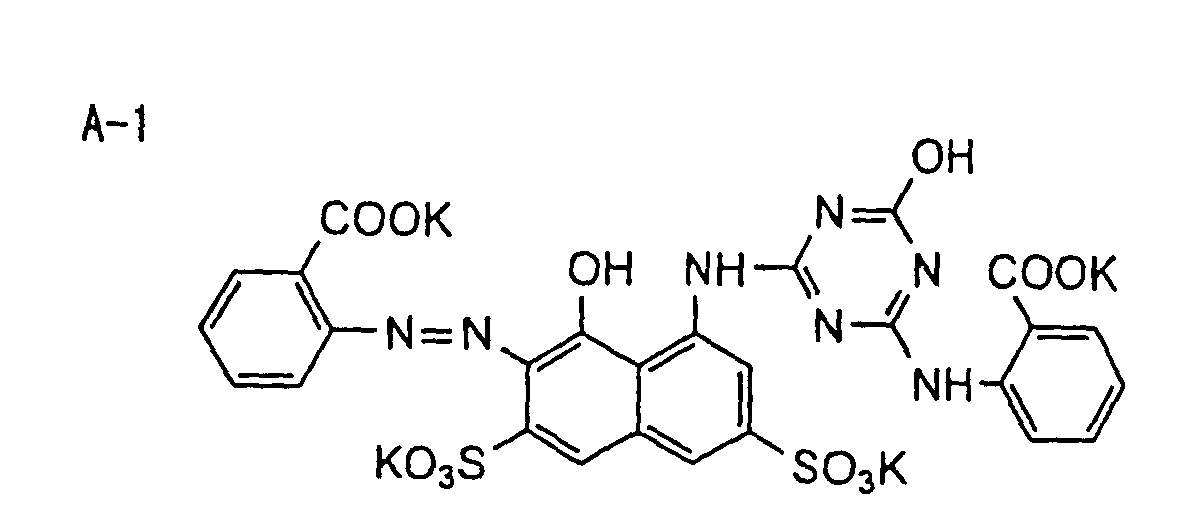

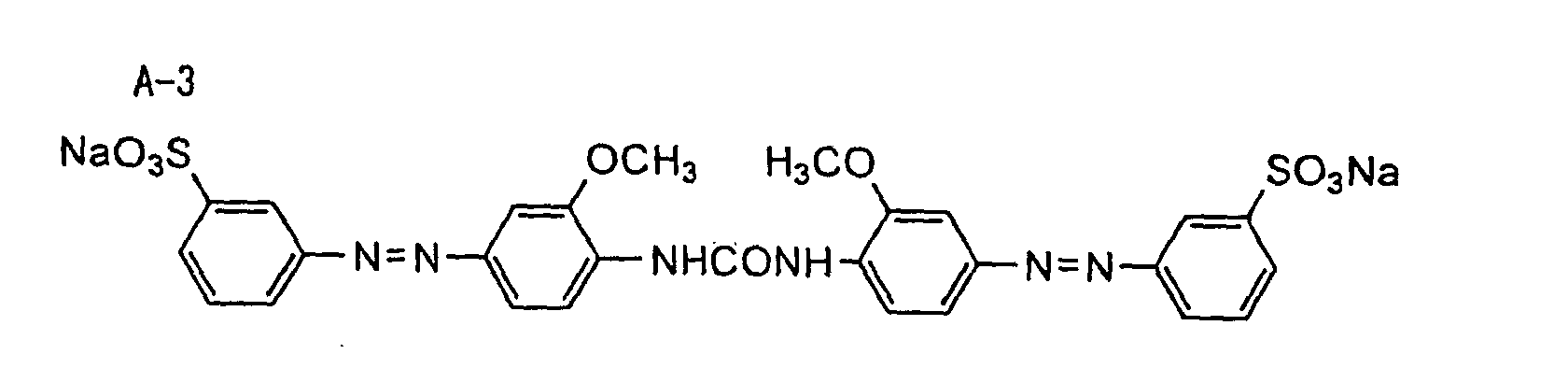

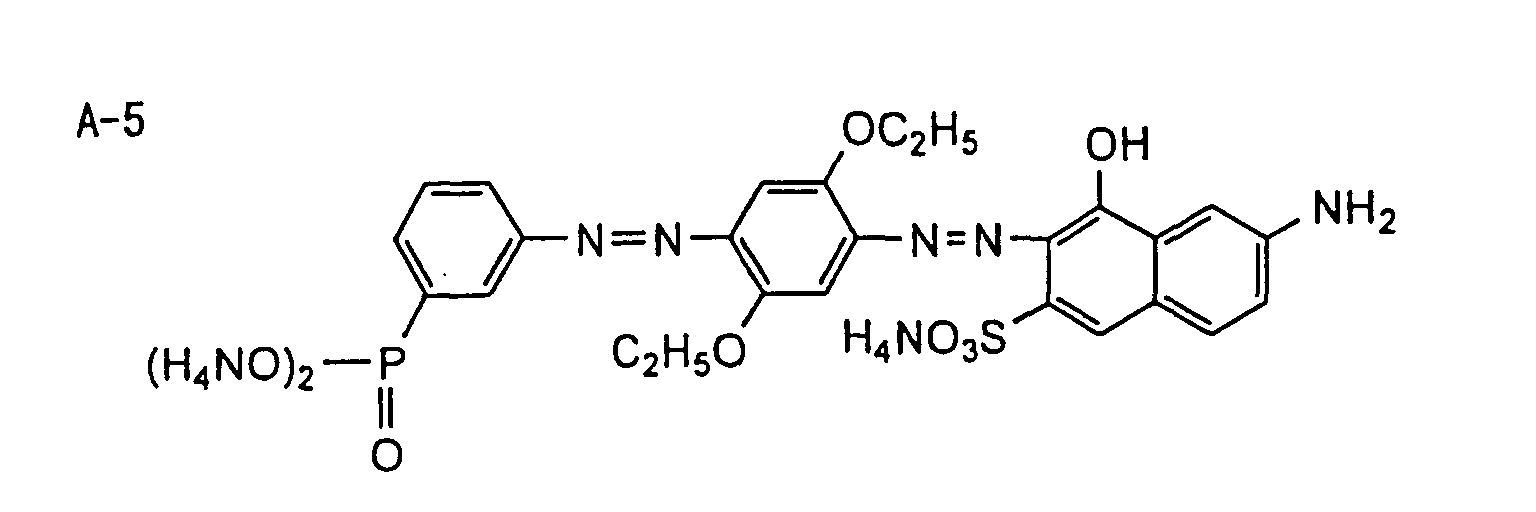


- Ink sets 102 to 167 were then prepared in a similar manner to that employed for Ink set 101 except that the kind or amount of the dye or the invention compound was changed as described in Tables 15 to 17. When the dye was changed, it was added in an equimolar amount to Ink set 101. When at least two of the dyes were used in combination, they were used each in an equimolar amount and the total amount of them was adjusted to be equimolar to Ink set 101. When the invention compound was used, the compound of the formula (I) was used at a molar ratio as shown in Tables 15 to 17 relative to the dye. When at least two of the invention compounds were used, the molar ratio was adjusted also in accordance with Tables 15 to 17. In addition, Ink sets 121, 128, 135, 142, 149, 156, 166, 167 were prepared as comparative products.
Ink set Light magenta Magenta Remarks 102 Dye
Compound of formula (I) (molar ratio relative to dye)a-27
I-13 (100 mol%)a-27
I-13 (100)Invention product 103 Dye
Compound of formula (I) (molar ratio relative to dye)a-27
I-24 (100 mol%)a-27
I-24 (100)Invention product 104 Dye
Compound of formula (I) (molar ratio relative to dye)a-27
I-34 (100 mol%)a-27
I-34 (100)Invention product 105 Dye
Compound of formula (I) (molar ratio relative to dye)a-27
I-35 (100 mol%)a-27
I-35 (100)Invention product 106 Dye
Compound of formula (I) (molar ratio relative to dye)a-27
I-41 (100 mol%)a-27
I-41 (100)Invention product 107 Dye
Compound of formula (I) (molar ratio relative to dye)a-27
I-43 (100 mol%)a-27
I-43 (100)Invention product 108 Dye
Compound of formula (I) (molar ratio relative to dye)a-27
I-51 (100 mol%)a-27
I-51 (100)Invention product 109 Dye
Compound of formula (I) (molar ratio relative to dye)a-27
I-52 (100 mol%)a-27
I-52 (100)Invention product 110 Dye
Compound of formula (I) (molar ratio relative to dye)a-27
I-57 (100 mol%)a-27
I-57 (100)Invention product 111 Dye
Compound of formula (I) (molar ratio relative to dye)a-27
I-58 (100 mol%)a-27
I-58 (100)Invention product 112 Dye
Compound of formula (I) (molar ratio relative to dye)a-27
I-59 (100 mol%)a-27
I-59 (100)Invention product 113 Dye
Compound of formula (I) (molar ratio relative to dye)a-27
I-61 (100 mol%)a-27
I-61 (100)Invention product 114 Dye
Compound of formula (I) (molar ratio relative to dye)a-27
I-63 (100 mol%)a-27
I-63 (100)Invention product 115 Dye
Compound of formula (I) (molar ratio relative to dye)a-27
I-71 (100 mol%)a-27
I-71 (100)Invention product 116 Dye
Compound of formula (I) (molar ratio relative to dye)a-27
I-73 (100 mol%)a-27
I-73 (100)Invention product 117 Dye
Compound of formula (I) (molar ratio relative to dye)a-27
I-78 (100 mol%)a-27
I-78 (100)Invention product 118 Dye
Compound of formula (I) (molar ratio relative to dye)a-27
I-65 (100 mol%)a-27
I-65 (100)Invention product 119 Dye
Compound of formula (I) (molar ratio relative to dye)a-27
I-66 (100 mol%)a-27
I-66 (100)Invention product 120 Dye
Compound of formula (I) (molar ratio relative to dye)a-27
I-67 (100 mol%)a-27
I-67 (100)Invention product 121 Dye
Compound of formula (I) (molar ratio relative to dye)a-27
-a-27
-Comparative example 122 Dye
Compound of formula (I) (molar ratio relative to dye)a-26
I-13 (100 mol%)a-26
I-13 (100)Invention product 123 Dye
Compound of formula (I) (molar ratio relative to dye)a-26
I-35 (100 mol%)a-26
I-35 (100)Invention product 124 Dye
Compound of formula (I) (molar ratio relative to dye)a-26
I-51 (100 mol%)a-26
I-51 (100)Invention product Ink set Light magenta Magenta Remarks 125 Dye
Compound of formula (I) (molar ratio relative to dye)a-26
I-58 (100 mol%)a-26
I-58(100)Invention product 126 Dye
Compound of formula (I) (molar ratio relative to dye)a-26
I-78 (100 mol%)a-26
I-78 (100)Invention product 127 Dye
Compound of formula (I) (molar ratio relative to dye)a-26
I-66 (100 mol%)a-26
I-66 (100)Invention product 128 Dye
Compound of formula (I) (molar ratio relative to dye)a-26
-a-26
-Comparative example 129 Dye
Compound of formula (I) (molar ratio relative to dye)b-5
I-13 (100 mol%)b-5
I-13 (100)Invention product 130 Dye
Compound of formula (I) (molar ratio relative to dye)b-5
I-35 (100 mol%)b-5
I-35 (100)Invention product 131 Dye
Compound of formula (I) (molar ratio relative to dye)b-5
I-51 (100 mol%)b-5
I-51 (100)Invention product 132 Dye
Compound of formula (I) (molar ratio relative to dye)b-5
I-58 (100 mol%)b-5
I-58 (100)Invention product 133 Dye
Compound of formula (I) (molar ratio relative to dye)b-5
I-78 (100 mol%)b-5
I-78 (100)Invention product 134 Dye
Compound of formula (I) (molar ratio relative to dye)b-5
I-66 (100 mol%)b-5
I-66 (100)Invention product 135 Dye
Compound of formula (I) (molar ratio relative to dye)b-5
-b-5
-Comparative example 136 Dye
Compound of formula (I) (molar ratio relative to dye)c-3
I-13 (100 mol%)c-3
I-13 (100)Invention product 137 Dye
Compound of formula (I) (molar ratio relative to dye)c-3
I-35 (100 mol%)c-3
I-35 (100)Invention product 138 Dye
Compound of formula (I) (molar ratio relative to dye)c-3
I-51 (100 mol%)c-3
I-51 (100)Invention product 139 Dye
Compound of formula (I) (molar ratio relative to dye)c-3
I-58 (100 mol%)c-3
I-58 (100)Invention product 140 Dye
Compound of formula (I) (molar ratio relative to dye)c-3
I-78 (100 mol%)c-3
I-78 (100)Invention product 141 Dye
Compound of formula (I) (molar ratio relative to dye)c-3
I-66 (100 mol%)c-3
I-66 (100)Invention product 142 Dye
Compound of formula (I) (molar ratio relative to dye)c-3
-c-3
-Comparative example 143 Dye
Compound of formula (I) (molar ratio relative to dye)d-1
I-13 (100 mol%)d-1
I-13 (100)Invention product 144 Dye
Compound of formula (I) (molar ratio relative to dye)d-1
I-35 (100 mol%)d-1
I-35 (100)Invention product 145 Dye
Compound of formula (I) (molar ratio relative to dye)d-1
I-51 (100 mol%)d-1
I-51 (100)Invention product 146 Dye
Compound of formula (I) (molar ratio relative to dye)d-1
I-58 (100 mol%)d-1
I-58 (100)Invention product 147 Dye
Compound of formula (I) (molar ratio relative to dye)d-1
I-78 (100 mol%)d-1
I-78 (100)Invention product Ink set Light magenta Magenta Remarks 148 Dye
Compound of formula (I) (molar ratio relative to dye)d-1
I-66 (100 mol%)d-1
I-66 (100)Invention product 149 Dye
Compound of formula (I) (molar ratio relative to dye)d-1
-d-1
-Comparative example 150 Dye
Compound of formula (I) (molar ratio relative to dye)e-4
I-13 (100 mol%)e-4
I-13(100)Invention product 151 Dye
Compound of formula (I) (molar ratio relative to dye)e-4
I-35 (100 mol%)e-4
I-35 (100)Invention product 152 Dye
Compound of formula (I) (molar ratio relative to dye)e-4
I-51 (100 mol%)e-4
I-51 (100)Invention product 153 Dye
Compound of formula (I) (molar ratio relative to dye)e-4
I-58 (100 mol%)e-4
I-58(100)Invention product 154 Dye
Compound of formula (I) (molar ratio relative to dye)e-4
I-78 (100 mol%)e-4
I-78 (100)Invention product 155 Dye
Compound of formula (I) (molar ratio relative to dye)e-4
I-66 (100 mol%)e-4
I-66 (100)Invention product 156 Dye
Compound of formula (I) (molar ratio relative to dye)e-4
-e-4
-Comparative example 157 Dye
Compound of formula (I) (molar ratio relative to dye)
Compound of formula (I) (molar ratio relative to dye)a-27
I-35 (50 mol%)
I-51 (50 mol%)a-27
I-35 (50)
I-51 (50)Invention product 158 Dye
Compound of formula (I) (molar ratio relative to dye)
Compound of formula (I) (molar ratio relative to dye)a-27
I-35 (50 mol%)
I-71 (50 mol%)a-27
I-35 (50)
I-71 (50)Invention product 159 Dye
Compound of formula (I) (molar ratio relative to dye)
Compound of formula (I) (molar ratio relative to dye)
Compound of formula (I) (molar ratio relative to dye)a-27
I-35 (33 mol%)
I-51 (33 mol%)
I-71 (33 mol%)a-27
I-35 (33)
I-51 (33)
I-71(33)Invention product 160 Dye
Compound of formula (I) (molar ratio relative to dye)a-27/b-5
I-35 (100 mol%)a-26
I-35 (100)Invention product 161 Dye
Compound of formula (I) (molar ratio relative to dye)a-27/b-5
I-51 (100 mol%)a-26
I-51 (100)Invention product 162 Dye
Compound of formula (I) (molar ratio relative to dye)a-27/b-5
I-78 (100 mol%)a-26
I-78 (100)Invention product 163 Dye
Compound of formula (I) (molar ratio relative to dye)a-27/b-5
I-66 (100 mol%)a-26
I-66 (100)Invention product 164 Dye
Compound of formula (I) (molar ratio relative to dye)
Compound of formula (I) (molar ratio relative to dye)a-27/b-5
I-35 (100 mol%)
I-51 (100 mol%)a-26
I-35 (100)
I-51 (100)Invention product 165 Dye
Compound of formula (I) (molar ratio relative to dye)
Compound of formula (I) (molar ratio relative to dye)a-27/b-5
I-35 (100 mol%)
I-71 (100 mol%)a-26
I-35 (100)
I-71 (100)Invention product 166 Dye
Compound of formula (I) (molar ratio relative to dye)a-27/b-5
-a-26
-Comparative example 167 Dye C
ompound of formula (I) (molar ratio relative to dye)A-17.0g/l
-A-128.0g/l Comparative example - These Ink sets 101 to 167 were filled in the cartridge of "Ink Jet Printer PM670C" (trade name; product of EPSON) and by this printer, images were printed on photo-quality inkjet glossy paper EX manufactured by Fuji Photo Film. Following evaluation was conducted.
- 1) Printing performance (1) was evaluated by setting the cartridge in the printer; printing images onto 20 sheets of A4-size paper after confirmation of ink discharge from all the nozzles; and then ranking the degree of disturbance of the printed images in accordance with the following criteria. A: Disturbance of the printed image did not occur at all during printing.B: Disturbance of the printed image occurred.C: Disturbance of the printed image continued from the start to the end of printing.
- 2) Printing performance (2) was evaluated by leaving the cartridge to stand for 2 days at 60°C; and ranking the degree of disturbance of the printed image in a similar manner to that employed for printing performance (1).
- 3) Dryness was evaluated visually by the stain which appeared when the just printed images were touched with fingers.
- 4) Bleeding of thin lines was evaluated as follows: (i) thin-line patterns of yellow, magenta, cyan and black were printed and they were visually evaluated. (ii) thin-line patterns of black was printed on the printed solid color of magenta ink and bleeding caused by contact of two colors was evaluated.
- 5) Water resistance was evaluated by the bleeding of images after immersed in deionized water for 10 seconds.
- 6) The shelf life of the image was evaluated by the
printed solid image sample of magenta.
- (1) After measurement of the image density Ci rightly after printing, the image was exposed to xenon light (85000 lx) for 10 days by using a weatherometer (product of ATLAS). The image density Cf was measured again. From a dye remaining ratio Cf/Ci *100, light fastness was evaluated.
- 2) The densities before and after the storage of the sample for 14 days under the conditions of 80°C at 15% RH were measured using X-rite 310 and a dye remaining ratio was calculated in a similar manner to that employed for evaluation of light fastness. Thus, the dark heat fastness was evaluated.
- 3) Ozone resistance: The densities before and after storage of the sample for 3 days under the ozone concentration of 1.0 ppm was measured by X-rite 310 and a dye remaining ratio was calculated. Based on it, ozone resistance was evaluated.
-
- The results are shown in Tables 18 and 19.
- In tables 18 and 19, "O" means "good" and "×" means "bad".
Ink set Printing performance (1) Printing performance (2) Dryness Bleeding(1) Bleeding (2) Water resistance Light fastness Dark heat fastness Ozone resistance Remarks 101 A A O
(goo d)O O O 83 98 97 Invention product 102 A A O O O O 88 97 96 Invention product 103 A A O O O O 90 97 98 Invention product 104 A A O O O O 89 96 98 Invention product 105 A A O O O O 91 98 96 Invention product 106 A A O O O O 88 97 97 Invention product 107 A A O O O O 89 98 96 Invention product 108 A A O O O O 89 97 98 Invention product 109 A A O O O O 89 97 97 Invention product 110 A A O O O O 91 96 98 Invention product 111 A A O O O O 88 98 98 Invention product 112 A A O O O O 89 97 97 Invention product 113 A A O O O O 89 98 97 Invention product 114 A A O O O O 88 98 96 Invention product 115 A A O O O O 87 97 98 Invention product 116 A A O O O O 89 96 97 Invention product 117 A A O O O O 88 96 98 Invention product 118 A A O O O O 87 97 98 Invention product 119 A A O O O O 89 97 97 Invention product 120 A A O O O O 88 98 96 Invention product 121 A A O O O O 81 97 96 Comparative example 122 A A O O O O 88 98 97 Invention product 123 A A O O O O 90 98 97 Invention product 124 A A O O O O 89 97 96 Invention product 125 A A O O O O 88 97 97 Invention product 126 A A O O O O 87 96 98 Invention product 127 A A O O O O 90 96 98 Invention product 128 A A O O O O 78 97 97 Comparative example 129 A A O O O O 87 96 98 Invention product 130 A A O O O O 88 96 97 Invention product 131 A A O O O O 88 97 97 Invention product 132 A A O O O O 89 98 97 Invention product 133 A A O O O O 87 98 98 Invention product 134 A A O O O O 88 97 98 Invention product 135 A A O O O O 76 98 97 Comparative example Ink set Printing performance
(1)Printing performance
(2)Dryness Bleeding
(1)Bleeding
(2)Water resistance Light fastness Dark heat fastness Ozone resistance Remarks 136 A A O O O O 86 97 97 Invention product 137 A A O O O O 86 97 97 Invention product 138 A A O O O O 87 96 98 Invention product 139 A A O O O O 86 98 97 Invention product 140 A A O O O O 85 97 96 Invention product 141 A A O O O O 86 96 98 Invention product 142 A A O O O O 74 98 97 Comparative example 143 A A O O O O 87 97 97 Invention product 144 A A O O O O 88 97 96 Invention product 145 A A O O O O 88 98 98 Invention product 146 A A O O O O 87 97 96 Invention product 147 A A O O O O 86 97 97 Invention product 148 A A O O O O 88 96 96 Invention product 149 A A O O O O 75 97 96 Comparative example 150 A A O O O O 84 98 97 Invention product 151 A A O O O O 86 98 98 Invention product 152 A A O O O O 85 96 98 Invention product 153 A A O O O O 87 97 97 Invention product 154 A A O O O O 86 96 98 Invention product 155 A A O O O O 85 98 97 Invention product 156 A A O O O O 74 97 97 Comparative example 157 A A O O O O 88 98 96 Invention product 158 A A O O O O 89 98 97 Invention product 159 A A O O O O 90 97 98 Invention product 160 A A O O O O 89 98 96 Invention product 161 A A O O O O 89 97 97 Invention product 162 A A O O O O 88 97 96 Invention product 163 A A O O O O 87 96 97 Invention product 164 A A O O O O 88 97 97 Invention product 165 A A O O O O 89 98 98 Invention product 166 A A O O O O 82 96 96 Comparative example 167 A A O ×
(bad)× × 72 97 44 Comparative example - The invention ink compositions containing the compound of the formula (I) are found to generate less streaks due to clogging of a nozzle and also free from bleeding of thin lines, and have excellent dryness and water resistance, even if their concentration is high at the time of printing. In particular, it is apparent that they are excellent in the shelf life of images with high light fastness.
- Ink compositions similar to those prepared in Example 1 were filled in the cartridge of "Ink Jet Printer BJ-F850" (trade name; product of Canon Inc.) and by this printer, images were printed on photo-quality inkjet glossy paper EX manufactured by Fuji Photo Film. The images were evaluated as in Example 1, leading to similar results to Example 1.
- At 70°C, 8 g of Dye (a-22) and 5 g of dioctyl sulfosuccinate were dissolved in 6 g of High boiling point organic solvent (s-1), 10 g of High boiling point organic solvent (s-2) and 50 ml of ethyl acetate. In the resulting solution was added 500 ml of deionized water while stirring by a magnetic stirrer, whereby an oil-in-water type coarse-particle dispersion was prepared.
- Then, this coarse-particle dispersion was caused to pass through "Microfluidizer" (manufactured by Microfluidics Inc.) five times at 60 MPa to convert the dispersion into fine droplets. The resulting emulsion was desolvated in a rotary evaporator until an ethyl acetate odor disappeared. After addition of 140 g of diethylene glycol, 64 g of glycerin, 7 g of "SURFYNOL 465" (product of Air Products & Chemicals) and an additive such as urea to the resulting fine emulsion of the oil soluble dye, 900 ml of deionized water was added. The mixture was adjusted to pH 9 with 10 mol/l of KOH, whereby a light magenta ink as shown in Table 20 was prepared. The volume-average particle size of the ink thus dispersed in the form of emulsion was found to be 51 nm as a result of measurement using "Microtrac UPA" (manufactured by Nikkiso Co., Ltd.).
- By changing the kind of the dye, magenta ink, light cyan ink, cyan ink, yellow ink and black ink for Ink set 201 as shown in Table 20 were prepared.
Light magenta Magenta Light cyan Cyan Yellow Black Dye (g/l) (e-22)
5.00(a-22)
20.0C-1
9.3C-1
37.2Y-1
27.2(a-22)
10.0
C-1
18.6
Y-1
13.6High-boiling-point organic solvent (g/l) S-1 3.63
S-2 6.3814.52
25.526.75
11.927.0
47.619.74
34.730.6
53.8Sodium dioctylsulfosuccinate (g/l) 6.25 25.0 11.6 46.4 34.0 52.7 Diethylene glycol (g/l) 110.0 110.0 110.0 110.0 110.0 110.0 Urea (g/l) 46.0 46.0 46.0 46.0 46.0 46.0 Glycerin (g/l) 50.0 50.0 50.0 50.0 50.0 50.0 Surfynol 465 (g/l) 5.5 5.5 5.5 5.5 5.5 5.5 Triethanolamine (g/l) 7.5 7.5 7.5 7.5 7.5 7.5 Benzotriazole (g/l) 0.075 0.075 0.075 0.075 0.075 0.075 Proxel XL2 (g/l) 2.5 2.5 2.5 2.5 2.5 2.5 Deionized water was added to give the total amount of 1 liter. Volume-average particle size 51 nm 53 nm 62 nm 65 nm 59 nm 70 nm 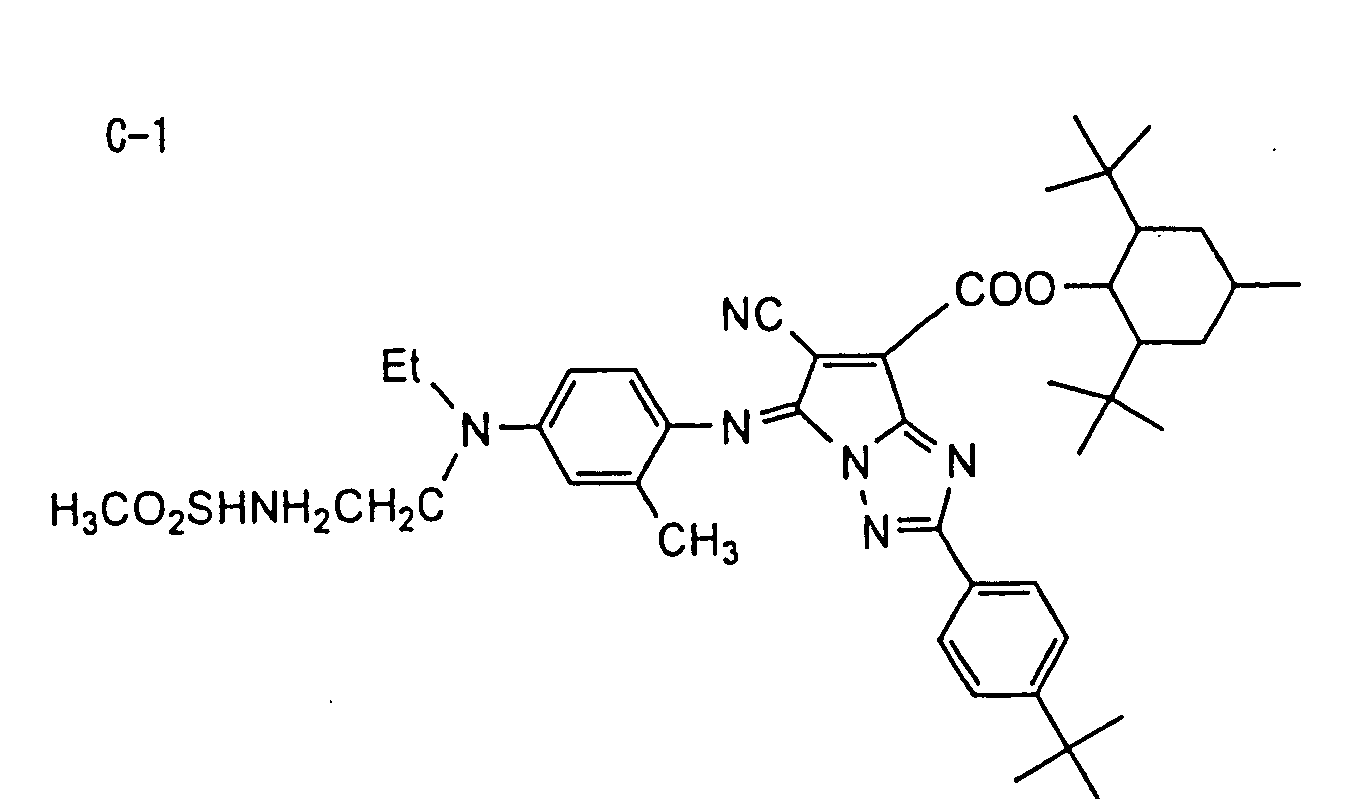

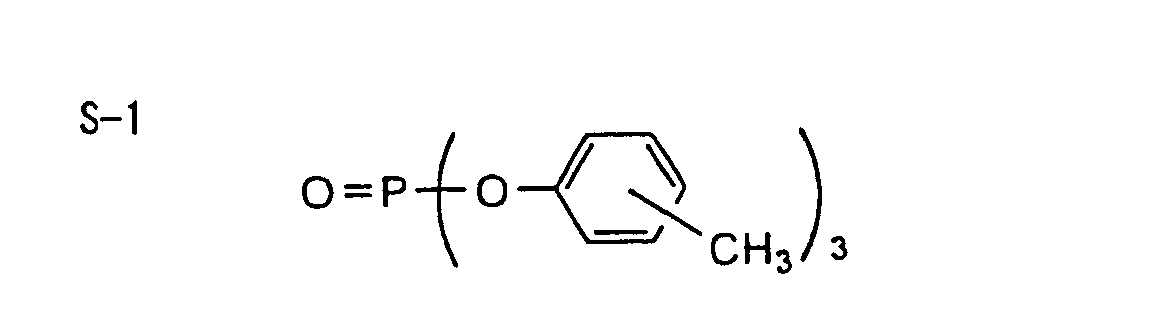

- In a similar manner to that employed for Ink set 201 except that the dye of Ink set 201 was changed to each of the dyes as shown in Tables 21 to 25 so that the molar amount would be equal to that of the Ink set 201 (when at least two dyes are used in combination for the ink of the same color, they were used in an equimolar amount); the compound of the formula (I) was added to give the amount as shown in Tables 21 to 25 in terms of the molar ratio relative to the dye; and the magenta dye ((a-22) of Ink set 201), among the dyes to be used for the black ink, was added so that the molar amount of the dye used for the magenta ink in the same ink set would be equal to the amount of the ink set 201, whereby Ink sets 201 to 277 were prepared.
- Ink sets 278 and 279 were prepared in a similar manner except that the pressure upon emulsification was changed to increase the volume-average particle size.
- As the comparative ink set using a water soluble dye, Ink set 167 as shown in Table 19 was used.
Ink set Light magenta Magenta Remarks 201 Dye
Compound of formula (I)
Volume-average particle sizea-22
-
51 rima-22
-
53Comparative example 202 Dye
Compound of formula (I)
Volume-average particle sizea-22
I-11 (100 mol%)
53 nma-2
2 I-11 (100 mol%)
50Invention product 203 Dye
Compound of formula (I)
Volume-average particle sizea-22
I-31 (100 mol%)
53 nma-22
I-31 (100 mol%)
50Invention product 204 Dye
Compound of formula (I)
Volume-average particle sizea-22
I-39 (100 mol%)
53 nma-22
I-39 (100 mol%)
50Invention product 205 Dye
Compound of formula (I)
Volume-average particle sizea-22 gI-42 (100 mol%)
53 nma-22
I-42 (100 mol%)
50Invention product 206 Dye
Compound of formula (I)
Volume-average particle sizea-22
I-44 (100 mol%)
53 nma-22
I-44 (100 mol%)
50Invention product 207 Dye
Compound of formula (I)
Volume-average particle sizea-22
I-53 (100 mol%)
53 nma-22
I-53 (100 mol%)
50Invention product 208 Dye
Compound of formula (I)
Volume-average particle sizea-22
I-69 (100 mol%)
53 nma-22
I-69 (100 mol%)
50Invention product 209 Dye
Compound of formula (I)
Volume-average particle sizea-22
I-77 (100 mol%)
53 nma-22
I-77 (100 mol%)
50Invention product 210 Dye
Compound of formula (I)
Volume-average particle sizea-23
-
51 nma-23
-
53Comparative example 211 Dye
Compound of formula (I)
Volume-average particle sizea-23
I-11 (100 mol%)
53 nma-23
I-11 (100 mol%)
50Invention product 212 Dye
Compound of formula (I)
Volume-average particle sizea-23
I-31 (100 mol%)
53 nma-23
I-31 (100 mol%)
50Invention product 213 Dye
Compound of formula (I)
Volume-average particle sizea-23
I-39 (100 mol%)
53 nma-23
I-39 (100 mol%)
50Invention product 214 Dye
Compound of formula (I)
Volume-average particle sizea-23
I-42 (100 mol%)
53 nma-23
I-42 (100 mol%)
50Invention product 215 Dye
Compound of formula (I)
Volume-average particle sizea-23
I-44 (100 mol%)
53 nma-23
I-44 (100 mol%)
50Invention product Ink set Light magenta Magenta Remarks 216 Dye
Compound of formula (I)
Volume-average particle sizea-23
I-53 (100 mol%)
53 nma-23
I-53 (100 mol%)
50Invention product 217 Dye
Compound of formula (I)
Volume-average particle sizea-23
I-69 (100 mol%)
53 nma-23
I-69 (100 mol%)
50Invention product 218 Dye
Compound of formula (I)
Volume-average particle sizea-23
I-77 (100 mol%)
53 nma-23
I-77 (100 mol%)
50Invention product 219 Dye
Compound of formula (I)
Volume-average particle sizeb-6
-
51 nmb-6
-
53Comparative example 220 Dye
Compound of formula (I)
Volume-average particle sizeb-6
I-11 (100 mol%)
53 nmb-6
I-11 (100 mol%)
50Invention product 221 Dye
Compound of formula (I)
Volume-average particle sizeb-6
I-31 (100 mol%)
53 nmb-6
I-31 (100 mol%)
50Invention product 222 Dye
Compound of formula (I)
Volume-average particle sizeb-6
I-39 (100 mol%)
53 nmb-6
I-39 (100 mol%)
50Invention product 223 Dye
Compound of formula (I)
Volume-average particle sizeb-6
I-42 (100 mol%)
53 nmb-6
I-42 (100 mol%)
50Invention product 224 Dye
Compound of formula (I)
Volume-average particle sizeb-6 gI-44 (100 mol%)
53 nmb-6
I-44 (100 mol%)
50Invention product 225 Dye
Compound of formula (I)
Volume-average particle sizeb-6
I-53 (100 mol%)
53 nmb-6
I-53 (100 mol%)
50Invention product 226 Dye
Compound of formula (I)
Volume-average particle sizeb-6
I-69 (100 mol%)
53 nmb-6
I-69 (100 mol%)
50Invention product 227 Dye
Compound of formula (I)
Volume-average particle sizeb-6
I-77 (100 mol%)
53 nmb-6
I-77 (100 mol%)
50Invention product 228 Dye
Compound of formula (I)
Volume-average particle sizec-4
-
51 nmc-4
-
53Comparative example 229 Dye
Compound of formula (I)
Volume-average particle sizec-4
I-11 (100 mol%)
53 nmc-4
I-11 (100 mol%)
50Invention product 230 Dye
Compound of formula (I)
Volume-average particle sizec-4
I-31 (100 mol%)
53 nmc-4
I-31 (100 mol%)
50Invention product 231 Dye
Compound of formula (I)
Volume-average particle sizec-4
I-39 (100 mol%)
53 nmc-4
I-39 (100 mol%)
50Invention product Ink set Light magenta Magenta Remarks 232 Dye
Compound of formula (I)
Volume-average particle sizec-4
I-42 (100 mol%)
53 nmc-4
I-42 (100 mol%)
50Invention product 233 Dye
Compound of formula (I)
Volume-average particle sizec-4
I-44 (100 mol%)
53 nmc-4
I-44 (100 mol%)
50Invention product 234 Dye
Compound of formula (I)
Volume-average particle sizec-4
I-53 (100 mol%)
53 nmc-4
I-53 (100 mol%)
50Invention product 235 Dye
Compound of formula (I)
Volume-average particle sizec-4
I-69 (100 mol%)
53 nmc-4
I-69 (100 mol%)
50Invention product 236 Dye
Compound of formula (I)
Volume-average particle sizec-4
I-77 (100 mol%)
53 nmc-4 I
-77 (100 mol%)
50Invention product 237 Dye
Compound of formula (I)
Volume-average particle sized-5
-
d-5 51 nmd-5
-
d-5 53Comparative example 238 Dye
Compound of formula (I)
Volume-average particle sized-5
I-11 (100 mol%)
53 nmd-5
I-11 (100 mol%)
50Invention product 239 Dye
Compound of formula (I)
Volume-average particle sized-5
I-31 (100 mol%)
53 nmd-5
I-31 (100 mol%)
50Invention product 240 Dye
Compound of formula (I)
Volume-average particle sized-5
I-39 (100 mol%)
53 nmd-5
I-39 (100 mol%)
50Invention product 241 Dye
Compound of formula (I)
Volume-average particle sized-5
I-42 (100 mol%)
53 nmd-5
I-42 (100 mol%)
50Invention product 242 Dye
Compound of formula (I)
Volume-average particle sized-5
I-44 (100 mol%)
53 nmd-5
I-44 (100 mol%)
50Invention product 243 Dye
Compound of formula (I)
Volume-average particle sized-5
I-53 (100 mol%)
53 nmd-5
I-53 (100 mol%)
50Invention product 244 Dye
Compound of formula (I)
Volume-average particle sized-5
I-69 (100 mol%)
53 nmd-5
I-69 (100 mol%)
50Invention product 245 Dye
Compound of formula (I)
Volume-average particle sized-5
I-77 (100 mol%)
53 nmd-5
I-77 (100 mol%)
50Invention product 246 Dye
Compound of formula (I)
Volume-average particle sizee-2
-
51 nme-2
-
53Comparative example 247 Dye
Compound of formula (I)
Volume-average particle sizee-2
I-11 (100 mol%)
53 nme-2
I-11 (100 mol%)
50Invention product Ink set Light magenta Magenta Remarks 248 Dye
Compound of formula (I)
Volume-average particle sizee-2
I-31 (100 mol%)
53 nme-2
I-31 (100 mol%)
50Invention product 249 Dye C
ompound of formula (I)
Volume-average particle sizee-2
I-39 (100 mol%)
53 nme-2
I-39 (100 mol%)
50Invention product 250 Dye
Compound of formula (I)
Volume-average particle sizee-2
I-42 (100 mol%)
53 nme-2
I-42 (100 mol%)
50Invention product 251 Dye
Compound of formula (I)
Volume-average particle sizee-2
I-44 (100 mol%)
53 nme-2
I-44 (100 mol%)
50Invention product 252 Dye
Compound of formula (I) gVolume-average particle sizee-2
I-53 (100 mol%)
53 nme-2
I-53 (100 mol%)
50Invention product 253 Dye
Compound of formula (I)
Volume-average particle sizee-2
I-69 (100 mol%)
53 nme-2
I-69 (100 mol%)
50Invention product 254 Dye
Compound of formula (I)
Volume-average particle sizee-2
I-77 (100 mol%)
53 nme-2
I-77 (100 mol%)
50Invention product 255 Dye
Compound of formula (I)
Volume-average particle sizea-22
I-11, I-31 (100 mol%)
53 nma-22
I-11, I-31 (100 mol%)
50Invention product 256 Dye
Compound of formula (I)
Volume-average particle sizea-22
I-11, I-44 (100 mol%)
53 nma-22
I-11, I-44 (100 mol%)
50Invention product 257 Dye
Compound of formula (I)
Volume-average particle sizea-22
I-31, I-44 (100 mol%)
53 nma-22
I-31,I-44 (100 mol%)
50Invention product 258 Dye
Compound of formula (I)
Volume-average particle sizea-22
I-53, I-77 (100 mol%)
53 nma-22
I-53, I-77 (100 mol%)
50Invention product 259 Dye
Compound of formula (I)
Volume-average particle sizea-22
I-53, I-69 (100 mol%)
53 nma-22
I-53, I-69 (100 mol%)
50Invention product 260 Dye
Compound of formula (I)
Volume-average particle sizea-22
I-77, I-69 (100 mol%)
53 nma-22
I-77, I-69 (100 mol%)
50Invention product 261 Dye
Compound of formula (I)
Volume-average particle sizea-22
I-31, I-53 (100 mol%)
53 nma-22
I-31, I-53 (100 mol%)
50Invention product 262 Dye
Compound of formula (I)
Volume-average particle sizea-22
I-31, I-77 (100 mol%)
53 nma-22
I-31, I-77 (100 mol%)
50Invention product 263 Dye
Compound of formula (I)
Volume-average particle sizea-22
I-44, I-53 (100 mol%)
53 nma-22
I-44, I-53 (100 mol%)
50Invention product Ink set Light magenta Magenta Remarks 264 Dye
Compound of formula (I)
Volume-average particle sizea-22
I-11(20 mol%)
53 nma-22
I-11(20 mol%)
50Invention product 265 Dye
Compound of formula (I)
Volume-average particle sizea-22
I-11 (50 mol%)
53 nma-22
I-11 (50 mol%)
50Invention product 266 Dye
Compound of formula (I)
Volume-average particle sizea-22
I-11 (200 mol%)
53 nma-22
I-11 (200 mol%)
50Invention product 267 Dye
Compound of formula (I)
Volume-average particle sizea-22
I-11 (500 mol%)
53 nma-22
I-11 (500 mol%)
50Invention product 268 Dye
Compound of formula (I)
Volume-average particle sizea-22, a-23
-
51 nma-22, a-23
-
53Comparative example 269 Dye
Compound of formula (I)
Volume-average particle sizea-22, b-6
-
51 nma-22, b-6
-
53Comparative example 270 Dye
Compound of formula (I)
Volume-average particle sizea-22, a-23
I-11 (100 mol%)
53 nma-22 a-23
I-11 (100 mol%)
50Invention product 271 Dye
Compound of formula (I)
Volume-average particle sizea-22, b-6
I-11 (100 mol%)
53 nma-22, b-6
I-11 (100 mol%)
50Invention product 272 Dye
Compound of formula (I)
Volume-average particle sizea-22, a-23
I-31 (100 mol%)
53 nma-22, a-23
I-31 (100 mol%)
50Invention product 273 Dye
Compound of formula (I)
Volume-average particle sizea-22, b-6
I-31 (100 mol%)
53 nma-22, b-6
I-31 (100 mol%)
50Invention product 274 Dye
Compound of formula (I)
Volume-average particle sizea-22, a-23
I-53 (100 mol%)
53 nma-22, a-23
I-53 (100 mol%)
50Invention product 275 Dye
Compound of formula (I)
Volume-average particle sizea-22, b-6
I-53 (100 mol%)
53 nma-22, b-6
I-53 (100 mol%)
50Invention product 276 Dye
Compound of formula (I)
Volume-average particle sizea-22, a-23
I-77 (100 mol%)
53 nma-22, a-23
I-77 (100 mol%)
50Invention product 277 Dye
Compound of formula (I)
Volume-average particle sizea-22, b-6 I-77 (100 mol%)
53 nma-22, b-6
I-77 (100 mol%)
50Invention product 278 Dye
Compound of formula (I)
Volume-average particle sizea-22, a-23
-
305 nma-22,a-23
-
331Comparative example 279 Dye
Compound of formula (I)
Volume-average particle sizea-22, b-6
I-77 (100 mol%)
305 nma-22, b-6
I-77 (100 mol%)
331Invention product - Each of these Ink sets 201 to 280 was filled in the cartridge of "Ink jet printer PM670C" (manufactured by EPSON) and by using this printer, images were printed on photo-quality inkjet glossy paper EX (product of Fuji Photo Film). They were evaluated as in Example 1.
- The results thus obtained are shown in Tables 26 and 27. In tables 26 and 27, "O" means "good" and "×" means "bad" .
Ink set Printing performance
(1)Printing performance
(2)Dryness Bleeding
(1)Bleeding
(2)Water resistance Light fastness Dark heat fastness Ozone resistance Remarks 201 A A O
(good)O O O 82 96 94 Comparative example 202 A A O O O O 88 95 94 Invention product 203 A A O O O O 90 96 94 Invention product 204 A A O O O O 89 94 96 Invention product 205 A A O O O O 91 94 95 Invention product 206 A A O O O O 88 94 94 Invention product 207 A A O O O O 89 94 94 Invention product 208 A A O O O O 91 96 94 Invention product 209 A A O O O O 89 95 96 Invention product 210 A A O O O O 81 95 95 Comparative example 211 A A O O O O 88 93 94 Invention product 212 A A O O O O 89 94 93 Invention product 213 A A O O O O 89 93 94 Invention product 214 A A O O O O 88 94 94 Invention product 215 A A O O O O 87 94 93 Invention product 216 A A O O O O 89 93 94 Invention product 217 A A O O O O 88 94 94 Invention product 218 A A O O O O 89 94 94 Invention product 219 A A O O O O 78 94 96 Comparative example 220 A A O O O O 87 96 95 Invention product 221 A A O O O O 86 95 96 Invention product 222 A A O O O O 85 96 94 Invention product 223 A A O O O O 87 94 93 Invention product 224 A A O O O O 86 93 95 Invention product 225 A A O O O O 88 95 93 Invention product 226 A A O O O 0 89 93 94 Invention product 227 A A O O O O 88 94 94 Invention product 228 A A O O O O 74 94 94 Comparative example 229 A A O O O O 85 94 93 Invention product 230 A A O O O O 86 93 96 Invention product 231 A A O O O O 86 96 95 Invention product 232 A A O O O O 84 95 96 Invention product 233 A A O O O O 85 95 94 Invention product 234 A A O O O O 86 93 93 Invention product 235 A A O O O O 86 94 95 Invention product 236 A A O O O O 87 94 93 Invention product 237 A A O O O O 74 94 94 Comparative example 238 A A O O O O 85 93 93 Invention product 239 A A O O O O 86 96 94 Invention product 240 A A O O O O 86 94 94 Invention product Ink set Printing performance
(1)Printing performance
(2)Dryness Bleeding
(1)Bleeding
(2)Water resistance Light fastness Dark heat fastness Ozone resistance Remarks 241 A A O O O O 87 96 94 Invention product 242 A A O O O O 86 95 93 Invention product 243 A A O O O O 87 95 95 Invention product 244 A A O O O O 86 93 93 Invention product 245 A A O O O O 86 94 93 Invention product 246 A A O O O O 73 94 93 Comparative example 247 A A O O O O 84 94 93 Invention product 248 A A O O O O 86 94 94 Invention product 249 A A O O O O 85 94 96 Invention product 250 A A O O O O 85 93 95 Invention product 251 A A O O O O 86 94 96 Invention product 252 A A O O O O 84 96 94 Invention product 253 A A O O O O 86 95 93 Invention product 254 A A O O O O 85 96 94 Invention product 255 A A O O O O 86 93 93 Invention product 256 A A O O O O 89 94 95 Invention product 257 A A O O O O 88 96 93 Invention product 258 A A O O O O 88 95 93 Invention product 259 A A O O O O 89 96 94 Invention product 260 A A O O O O 89 94 93 Invention product 261 A A O O O O 88 96 94 Invention product 262 A A O O O O 87 95 96 Invention product 263 A A O O O O 86 95 95 Invention product 264 A A O O O O 86 93 96 Invention product 265 A A O O O O 88 94 93 Invention product 266 A A O O O O 91 93 93 Invention product 267 A A O O O O 93 94 94 Invention product 268 A A O O O O 81 94 93 Comparative example 269 A A O O O O 80 94 94 Comparative example 270 A A O O O O 88 93 96 Invention product 271 A A O O O O 87 94 95 Invention product 272 A A O O O O 88 96 96 Invention product 273 A A O O O O 89 95 94 Invention product 274 A A O O O O 87 96 93 Invention product 275 A A O O O O 87 94 94 Invention product 276 A A O O O O 89 96 93 Invention product 277 A A O O O O 89 94 94 Invention product 278 A A O O O O 82 96 94 Comparative example 279 A A O O O O 89 95 94 Invention product 167 A A O ×
(bad)× × 71 96 42 Comparative example - It has been found that use of the ink composition of the present invention permits exhibition of excellent printing performance and also excellent weather resistance and light fastness. The ink composition of the invention does not cause bleeding upon outputting thin lines.
- Each of the inks similar to those prepared in Example 3 was filled in the cartridge of "Ink jet printer BJ-F850" (manufactured by Canon Inc.) and by using this printer, images were printed on photo-quality inkjet glossy paper EX (product of Fuji Photo Film). They were evaluated as in Example 3, leading to similar results to Example 3.
- The present invention makes it possible to provide, in aqueous ink advantageous from the viewpoints of handling ease, odor and safety, inkjet recording ink compositions featuring high discharge stability, good color development, excellent color hue, shelf life and particularly light fastness of recorded images, and excellent stability and water resistance. The present invention also makes it possible to overcome their drawbacks in quality such as bleeding of thin lines. The inkjet recording ink compositions according to the invention are capable of maintaining high discharge stability over time or even with the passage of time under severe conditions and is free from defects in color hue, shelf life, stability, water resistance and picture quality.
- The entire disclosure of each and every foreign patent application from which the benefit of foreign priority has been claimed in the present application is incorporated herein by reference, as if fully set forth.
Claims (7)
- An ink composition for inkjet recording comprising:wherein the azo dye is dissolved or dispersed in the aqueous medium:an azo dye having an aromatic nitrogen-containing 6-membered heterocycle as a coupling component;a compound represented by the following formula (I); andan aqueous mediumwherein R101 and R102 each independently represents a hydrogen atom, an aliphatic group, an aromatic group, a heterocyclic group, an acyl group, an aliphatic oxycarbonyl group, an aromatic oxycarbonyl group, an aliphatic sulfonyl group, an aromatic sulfonyl group, a substituted or unsubstituted carbamoyl group, or a substituted or unsubstituted thiocarbamoyl group;

R103 represents an aliphatic group, an aromatic group, a heterocyclic group, an aliphatic oxy group, an aromatic oxy group, an aliphatic thio group, an aromatic thio group, an acyloxy group, an aliphatic oxycarbonyloxy group, an aromatic oxycarbonyloxy group, a substituted or unsubstituted amino group or a hydroxy group; and
at least one of a pair R101 and R102, a pair R102 and R103, and a pair R103 and R101 may be coupled to form a 5-, 6- or 7-membered ring with the proviso that the ring formed is not a 2,2,6,6-tetraalkylpiperidine skeleton. - The ink composition for inkjet recording according to claim 1, wherein the azo dye is represented by the following formula (A-1):wherein A represents a 5-membered heterocyclic group,

B1 and B2 represent -CR1= and -CR2=, respectively, or either one of B1 and B2 represents a nitrogen atom and the other one represents -CR1= or -CR2=,
G, R1, and R2 each independently represents a hydrogen atom, a halogen atom, an aliphatic group, an aromatic group, a heterocyclic group, a cyano group, a carboxyl group, a carbamoyl group, an alkoxycarbonyl group, an aryloxycarbonyl group, a heterocyclic oxycarbonyl group, an acyl group, a hydroxy group, an alkoxy group, an aryloxy group, a heterocyclic oxy group, a silyloxy group, an acyloxy group, a carbamoyloxy group, an alkoxycarbonyloxy group, an aryloxycarbonyloxy group, an amino group substituted with an alkyl, aryl or heterocyclic group, an acylamino group, an ureido group, a sulfamoylamino group, an alkoxycarbonylamino group, an aryloxycarbonylamino group, an alkylsulfonylamino group, an arylsulfonylamino group, a heterocyclic sulfonylamino group, a nitro group, an alkylthio group, an aryl thio group, a heterocyclic thio group, an alkylsulfonyl group, an arylsulfonyl group, a heterocyclic sulfonyl group, an alkylsulfinyl group, an arylsulfinyl group, a heterocyclic sulfinyl group, a sulfamoyl group or a sulfo group, each of which may have a substituent further, and
R5 and R6 each independently represents a hydrogen atom, an aliphatic group, an aromatic group, a heterocyclic group, an acyl group, an alkoxycarbonyl group, an aryloxycarbonyl group, a carbamoyl group, an alkylsulfonyl group, an arylsulfonyl group or a sulfamoyl group, each of which may have a substituent further, or
a pair R1 and R5, or a pair R5 and R6 may be coupled to form a 5- or 6-membered ring. - The ink composition for inkjet recording according to claim 1, wherein the compound represented by the formula (I) is a compound represented by the following formula (IA) or (IB):
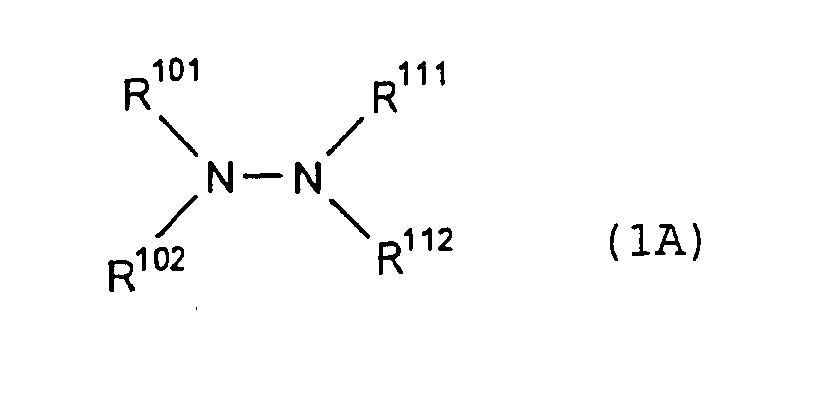

- The ink composition for inkjet recording according to claim 2, wherein A in the formula (A-1) represents one of the following formulae (a) to (f) :


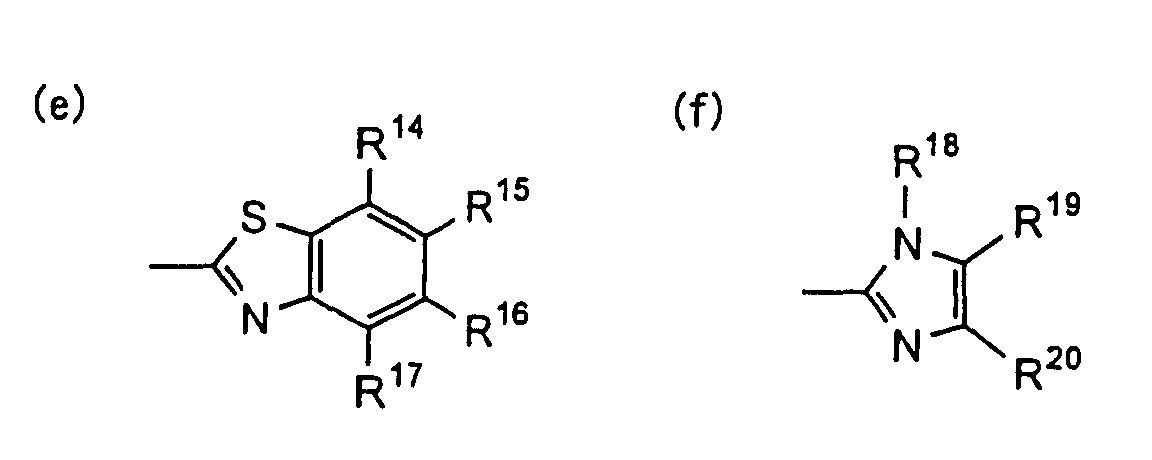
- The ink composition for inkjet recording according to claim 2, wherein the dye represented by the formula (A-1) is a water soluble dye, and the ink compositon is produced by at least one of the processes of:dissolving the dye in the aqueous medium; anddispersing the dye in the aqueous medium.
- The ink composition for inkjet recording according to claim 2, wherein the dye represented by the formula (A-1) is an oil soluble dye, and the ink compositon is produced by the processes of:dissolving the dye in a high-boiling-point organic solvent; anddispersing the organic solvent in the aqueous medium after the dissolving.
- An inkjet recording method comprising:preparing an image receiving material which comprises a support and image receiving layer comprising white inorganic pigment particles; andejecting the ink composition according to claim 1 to the image receiving material according to a recording signal.
Applications Claiming Priority (2)
| Application Number | Priority Date | Filing Date | Title |
|---|---|---|---|
| JP2001114186 | 2001-04-12 | ||
| JP2001114186A JP2002309137A (en) | 2001-04-12 | 2001-04-12 | Ink composition for ink jet recording |
Publications (2)
| Publication Number | Publication Date |
|---|---|
| EP1251154A1 true EP1251154A1 (en) | 2002-10-23 |
| EP1251154B1 EP1251154B1 (en) | 2006-01-18 |
Family
ID=18965295
Family Applications (1)
| Application Number | Title | Priority Date | Filing Date |
|---|---|---|---|
| EP20020008394 Expired - Lifetime EP1251154B1 (en) | 2001-04-12 | 2002-04-12 | Ink compositions for inkjet recording |
Country Status (5)
| Country | Link |
|---|---|
| US (1) | US6827771B2 (en) |
| EP (1) | EP1251154B1 (en) |
| JP (1) | JP2002309137A (en) |
| AT (1) | ATE316125T1 (en) |
| DE (1) | DE60208734T2 (en) |
Cited By (16)
| Publication number | Priority date | Publication date | Assignee | Title |
|---|---|---|---|---|
| EP1380623A1 (en) * | 2002-07-12 | 2004-01-14 | Fuji Photo Film Co., Ltd. | Ink for inkjet, ink set for inkjet recording and inkjet recording method |
| WO2004035699A1 (en) * | 2002-10-12 | 2004-04-29 | Avecia Limited | Ink comprising casein |
| WO2004056931A1 (en) * | 2002-12-20 | 2004-07-08 | Ciba Specialty Chemicals Holding Inc. | Ink-jet ink and recording material |
| EP1460114A1 (en) * | 2003-03-18 | 2004-09-22 | Agfa-Gevaert | New stabilizers for ink-jet inks and recording materials. |
| EP1464683A1 (en) * | 2003-04-01 | 2004-10-06 | Tetenal Photowerk GmbH & Co. KG | Ink-Jet Ink |
| EP1473337A4 (en) * | 2002-02-08 | 2005-04-27 | Fuji Photo Film Co Ltd | Ink for inkjet recording and method for inkjet recording |
| EP1475416A4 (en) * | 2002-02-13 | 2005-08-03 | Fuji Photo Film Co Ltd | Ink for ink-jet recording and ink-jet recording method |
| GB2413558A (en) * | 2002-10-12 | 2005-11-02 | Avecia Inkjet Ltd | Use of casein for improving ozone fastness of a colorant |
| EP1674538A1 (en) * | 2004-12-21 | 2006-06-28 | Agfa-Gevaert | Ink-jet set |
| EP1469048A4 (en) * | 2002-01-25 | 2006-08-02 | Fuji Photo Film Co Ltd | Ink for inkjet recording, ink set for inkjet recording and inkjet recording method |
| EP1726626A1 (en) * | 2005-05-27 | 2006-11-29 | Fuji Photo Film Co., Ltd. | Ink for ink-jet recording, ink set, and ink-jet recording method |
| EP1731579A1 (en) * | 2005-06-08 | 2006-12-13 | Adger Kogyo Co. Ltd. | Ink composition and writing instrument |
| US7201477B2 (en) | 2001-04-09 | 2007-04-10 | Fujifilm Corporation | Ink for ink jet recording, ink set for ink jet recording and ink jet recording method |
| US7404851B2 (en) * | 2006-02-02 | 2008-07-29 | Fujifilm Corporation | Ink composition and recording method using the same |
| US7438752B2 (en) * | 2006-02-02 | 2008-10-21 | Fujifilm Corporation | Ink composition and recording method |
| EP2455431A1 (en) * | 2003-10-23 | 2012-05-23 | Fujifilm Corporation | Ink and ink set for inkjet recording |
Families Citing this family (16)
| Publication number | Priority date | Publication date | Assignee | Title |
|---|---|---|---|---|
| US6824598B2 (en) * | 2000-06-20 | 2004-11-30 | Hewlett-Packard Development Company, L.P. | Inkjet ink sets with combinations of light dye load and dark dye load |
| JP4738655B2 (en) * | 2001-07-04 | 2011-08-03 | 富士フイルム株式会社 | Ink composition for inkjet recording |
| JP4070432B2 (en) * | 2001-07-25 | 2008-04-02 | 富士フイルム株式会社 | Ink composition and inkjet recording method |
| JP2004035772A (en) | 2002-07-04 | 2004-02-05 | Fuji Photo Film Co Ltd | Ink for ink jet recording and ink jet recording method |
| US7066989B2 (en) * | 2003-01-08 | 2006-06-27 | Fuji Photo Film Co., Ltd. | Inkjet ink, production method of inkjet ink, inkjet ink set and inkjet recording method |
| JP4630584B2 (en) * | 2003-06-18 | 2011-02-09 | 富士フイルム株式会社 | Ink and inkjet recording ink |
| JP2005206751A (en) * | 2004-01-26 | 2005-08-04 | Konica Minolta Holdings Inc | Ink-jet printing ink and ink-jet recording method |
| JP2006063330A (en) * | 2004-07-29 | 2006-03-09 | Canon Inc | Ink jet ink, ink jet recording method, ink cartridge, recording unit, and ink jet recording apparatus |
| US20060170745A1 (en) * | 2004-12-21 | 2006-08-03 | Agfa-Gevaert | Ink-jet ink set for producing images with large colour gamut and high stability |
| US8840231B2 (en) * | 2005-10-04 | 2014-09-23 | Hewlett-Packard Development Company, L.P. | Ink-jet printing methods compositions providing improved image durability |
| GB0719083D0 (en) * | 2007-09-29 | 2007-11-07 | Fujifilm Corp | Magenta dyes and inks for use in ink-jet printing |
| JP4816979B2 (en) | 2008-10-29 | 2011-11-16 | ブラザー工業株式会社 | Water-based ink for ink jet recording, ink jet recording method and color change inhibitor |
| WO2013138617A1 (en) | 2012-03-16 | 2013-09-19 | Axikin Pharmaceuticals, Inc. | 3,5-diaminopyrazole kinase inhibitors |
| NZ631142A (en) | 2013-09-18 | 2016-03-31 | Axikin Pharmaceuticals Inc | Pharmaceutically acceptable salts of 3,5-diaminopyrazole kinase inhibitors |
| WO2016053299A1 (en) | 2014-09-30 | 2016-04-07 | Hewlett-Packard Development Company, L.P. | Aqueous ink composition |
| TWI703133B (en) | 2014-12-23 | 2020-09-01 | 美商艾克斯基製藥公司 | 3,5-diaminopyrazole kinase inhibitors |
Citations (4)
| Publication number | Priority date | Publication date | Assignee | Title |
|---|---|---|---|---|
| US5462590A (en) * | 1993-01-25 | 1995-10-31 | Fuji Xerox Co., Ltd. | Ink-jet ink and method of printing using the same |
| EP0882600A2 (en) * | 1997-06-06 | 1998-12-09 | Agfa-Gevaert AG | Inkjet system |
| EP0909798A1 (en) * | 1997-03-25 | 1999-04-21 | Seiko Epson Corporation | Inks for ink-jet recording |
| EP0913434A1 (en) * | 1997-10-30 | 1999-05-06 | Xerox Corporation | Improved ink compositions for thermal ink jet printing |
Family Cites Families (11)
| Publication number | Priority date | Publication date | Assignee | Title |
|---|---|---|---|---|
| JP3106966B2 (en) * | 1996-07-17 | 2000-11-06 | 富士ゼロックス株式会社 | Ink jet recording ink and ink jet recording method |
| US6582502B2 (en) | 2000-01-25 | 2003-06-24 | Fuji Photo Film Co., Ltd. | Dye, ink for ink jet recording, and ink jet recording method |
| JP4105848B2 (en) | 2000-01-25 | 2008-06-25 | 富士フイルム株式会社 | Dye, inkjet recording ink, and inkjet recording method |
| US6676735B2 (en) * | 2000-06-21 | 2004-01-13 | Seiko Epson Corporation | Aqueous ink |
| JP2002167531A (en) * | 2000-11-29 | 2002-06-11 | Fuji Photo Film Co Ltd | Ink composition for ink-jet recording and image forming method |
| ATE405614T1 (en) | 2001-01-31 | 2008-09-15 | Fujifilm Corp | PHTHALOCYANINE COMPOUND, INK, INK JET PRINTING INK, INK JET PRINTING METHOD AND METHOD FOR IMPROVING THE OZONE GAS RESISTANCE OF COLORED IMAGE MATERIAL |
| JP3909813B2 (en) | 2001-01-31 | 2007-04-25 | 富士フイルム株式会社 | Phthalocyanine compound, inkjet recording ink containing the same, and inkjet recording method |
| US7018455B2 (en) * | 2001-03-30 | 2006-03-28 | Seiko Epson Corporation | Ink composition, recording medium, ink jet recording method, and printed matter |
| JP4095807B2 (en) | 2001-04-09 | 2008-06-04 | 富士フイルム株式会社 | Azo compound and method for producing the same |
| AU2002243036A1 (en) | 2001-04-09 | 2002-10-28 | Fuji Photo Film Co., Ltd. | Azo compounds and process of producing the same and novel intermediate compounds used in the process of producing azo compounds |
| JP3909809B2 (en) | 2001-04-16 | 2007-04-25 | 富士フイルム株式会社 | Coloring composition containing phthalocyanine compound, inkjet ink, inkjet recording method, and ozone gas fading resistance improving method |
-
2001
- 2001-04-12 JP JP2001114186A patent/JP2002309137A/en active Pending
-
2002
- 2002-04-11 US US10/119,897 patent/US6827771B2/en not_active Expired - Fee Related
- 2002-04-12 AT AT02008394T patent/ATE316125T1/en not_active IP Right Cessation
- 2002-04-12 DE DE2002608734 patent/DE60208734T2/en not_active Expired - Lifetime
- 2002-04-12 EP EP20020008394 patent/EP1251154B1/en not_active Expired - Lifetime
Patent Citations (4)
| Publication number | Priority date | Publication date | Assignee | Title |
|---|---|---|---|---|
| US5462590A (en) * | 1993-01-25 | 1995-10-31 | Fuji Xerox Co., Ltd. | Ink-jet ink and method of printing using the same |
| EP0909798A1 (en) * | 1997-03-25 | 1999-04-21 | Seiko Epson Corporation | Inks for ink-jet recording |
| EP0882600A2 (en) * | 1997-06-06 | 1998-12-09 | Agfa-Gevaert AG | Inkjet system |
| EP0913434A1 (en) * | 1997-10-30 | 1999-05-06 | Xerox Corporation | Improved ink compositions for thermal ink jet printing |
Cited By (23)
| Publication number | Priority date | Publication date | Assignee | Title |
|---|---|---|---|---|
| US7201477B2 (en) | 2001-04-09 | 2007-04-10 | Fujifilm Corporation | Ink for ink jet recording, ink set for ink jet recording and ink jet recording method |
| EP1469048A4 (en) * | 2002-01-25 | 2006-08-02 | Fuji Photo Film Co Ltd | Ink for inkjet recording, ink set for inkjet recording and inkjet recording method |
| EP1473337A4 (en) * | 2002-02-08 | 2005-04-27 | Fuji Photo Film Co Ltd | Ink for inkjet recording and method for inkjet recording |
| US7287848B2 (en) | 2002-02-08 | 2007-10-30 | Fujifilm Corporation | Ink for inkjet recording and method for inkjet recording |
| US7175268B2 (en) | 2002-02-13 | 2007-02-13 | Fuji Photo Film Co., Ltd. | Inkjet recording ink and inkjet recording method |
| EP1475416A4 (en) * | 2002-02-13 | 2005-08-03 | Fuji Photo Film Co Ltd | Ink for ink-jet recording and ink-jet recording method |
| US7052534B2 (en) | 2002-07-12 | 2006-05-30 | Fuji Photo Film Co., Ltd. | Ink for inkjet recording, ink set for inkjet recording and inkjet recording method |
| EP1380623A1 (en) * | 2002-07-12 | 2004-01-14 | Fuji Photo Film Co., Ltd. | Ink for inkjet, ink set for inkjet recording and inkjet recording method |
| WO2004035699A1 (en) * | 2002-10-12 | 2004-04-29 | Avecia Limited | Ink comprising casein |
| GB2408743A (en) * | 2002-10-12 | 2005-06-08 | Avecia Ltd | Ink comprising casein |
| GB2413558A (en) * | 2002-10-12 | 2005-11-02 | Avecia Inkjet Ltd | Use of casein for improving ozone fastness of a colorant |
| GB2408743B (en) * | 2002-10-12 | 2006-01-11 | Avecia Ltd | Process for improving ozone fastness |
| CN100358952C (en) * | 2002-12-20 | 2008-01-02 | 西巴特殊化学品控股有限公司 | Inkjet ink and recording material |
| WO2004056931A1 (en) * | 2002-12-20 | 2004-07-08 | Ciba Specialty Chemicals Holding Inc. | Ink-jet ink and recording material |
| EP1460114A1 (en) * | 2003-03-18 | 2004-09-22 | Agfa-Gevaert | New stabilizers for ink-jet inks and recording materials. |
| EP1464683A1 (en) * | 2003-04-01 | 2004-10-06 | Tetenal Photowerk GmbH & Co. KG | Ink-Jet Ink |
| EP2455431A1 (en) * | 2003-10-23 | 2012-05-23 | Fujifilm Corporation | Ink and ink set for inkjet recording |
| EP1674538A1 (en) * | 2004-12-21 | 2006-06-28 | Agfa-Gevaert | Ink-jet set |
| EP1726626A1 (en) * | 2005-05-27 | 2006-11-29 | Fuji Photo Film Co., Ltd. | Ink for ink-jet recording, ink set, and ink-jet recording method |
| US7527683B2 (en) | 2005-05-27 | 2009-05-05 | Fujifilm Corporation | Ink for ink-jet recording, ink set, and ink-jet recording method |
| EP1731579A1 (en) * | 2005-06-08 | 2006-12-13 | Adger Kogyo Co. Ltd. | Ink composition and writing instrument |
| US7404851B2 (en) * | 2006-02-02 | 2008-07-29 | Fujifilm Corporation | Ink composition and recording method using the same |
| US7438752B2 (en) * | 2006-02-02 | 2008-10-21 | Fujifilm Corporation | Ink composition and recording method |
Also Published As
| Publication number | Publication date |
|---|---|
| JP2002309137A (en) | 2002-10-23 |
| ATE316125T1 (en) | 2006-02-15 |
| US6827771B2 (en) | 2004-12-07 |
| DE60208734T2 (en) | 2006-07-13 |
| EP1251154B1 (en) | 2006-01-18 |
| US20030097959A1 (en) | 2003-05-29 |
| DE60208734D1 (en) | 2006-04-06 |
Similar Documents
| Publication | Publication Date | Title |
|---|---|---|
| EP1251154B1 (en) | Ink compositions for inkjet recording | |
| US6835240B2 (en) | Ink compositions for inkjet recording | |
| EP1403339B1 (en) | Black ink for inkjet recording | |
| WO2003066751A1 (en) | Ink composition and method of ink-jet recording | |
| JP2004123804A (en) | Black inkjet recording ink | |
| JP2002167531A (en) | Ink composition for ink-jet recording and image forming method | |
| US20030210310A1 (en) | Ink set for inkjet recording and inkjet recording method | |
| JP4210508B2 (en) | Black ink for inkjet recording | |
| JP2003292850A (en) | Inkjet recording ink and inkjet recording process | |
| JP2003176429A (en) | Ink composition and inkjet recording method | |
| JP2003231835A (en) | Ink composition for ink jet recording and ink jet recording method | |
| JP4538188B2 (en) | Ink for inkjet recording | |
| JP4538186B2 (en) | Black ink for inkjet recording | |
| JP2001279142A (en) | Ink composition for ink jet and ink jet recording method | |
| JP2003292849A (en) | Inkjet recording ink and inkjet recording process | |
| JP2004115701A (en) | Black ink for inkjet recording and inkjet recording method | |
| JP2003226026A (en) | Ink cartridge, ink cartridge set, and method of inkjet recording | |
| JP2004051890A (en) | Ink composition and method of inkjet-recording | |
| JP2003231847A (en) | Ink for ink-jet recording and ink-jet recording method | |
| JP4213942B2 (en) | Black ink for inkjet recording | |
| JP2003231843A (en) | Ink for ink-jet recording and ink-jet recording method | |
| JP2004123861A (en) | Method for producing black inkjet recording ink | |
| JP2003286426A (en) | Method for manufacturing ink for ink-jet recording | |
| JP2003286425A (en) | Method for manufacturing ink for ink-jet recording | |
| JP2001342385A (en) | Ink composition for ink jet and method for ink-jet recording |
Legal Events
| Date | Code | Title | Description |
|---|---|---|---|
| PUAI | Public reference made under article 153(3) epc to a published international application that has entered the european phase |
Free format text: ORIGINAL CODE: 0009012 |
|
| AK | Designated contracting states |
Kind code of ref document: A1 Designated state(s): AT BE CH CY DE DK ES FI FR GB GR IE IT LI LU MC NL PT SE TR |
|
| AX | Request for extension of the european patent |
Free format text: AL;LT;LV;MK;RO;SI |
|
| 17P | Request for examination filed |
Effective date: 20021220 |
|
| AKX | Designation fees paid |
Designated state(s): AT BE CH CY DE DK ES FI FR GB GR IE IT LI LU MC NL PT SE TR |
|
| 17Q | First examination report despatched |
Effective date: 20031021 |
|
| GRAP | Despatch of communication of intention to grant a patent |
Free format text: ORIGINAL CODE: EPIDOSNIGR1 |
|
| GRAS | Grant fee paid |
Free format text: ORIGINAL CODE: EPIDOSNIGR3 |
|
| GRAA | (expected) grant |
Free format text: ORIGINAL CODE: 0009210 |
|
| AK | Designated contracting states |
Kind code of ref document: B1 Designated state(s): AT BE CH CY DE DK ES FI FR GB GR IE IT LI LU MC NL PT SE TR |
|
| PG25 | Lapsed in a contracting state [announced via postgrant information from national office to epo] |
Ref country code: AT Free format text: LAPSE BECAUSE OF FAILURE TO SUBMIT A TRANSLATION OF THE DESCRIPTION OR TO PAY THE FEE WITHIN THE PRESCRIBED TIME-LIMIT Effective date: 20060118 Ref country code: FI Free format text: LAPSE BECAUSE OF FAILURE TO SUBMIT A TRANSLATION OF THE DESCRIPTION OR TO PAY THE FEE WITHIN THE PRESCRIBED TIME-LIMIT Effective date: 20060118 Ref country code: BE Free format text: LAPSE BECAUSE OF FAILURE TO SUBMIT A TRANSLATION OF THE DESCRIPTION OR TO PAY THE FEE WITHIN THE PRESCRIBED TIME-LIMIT Effective date: 20060118 Ref country code: IT Free format text: LAPSE BECAUSE OF FAILURE TO SUBMIT A TRANSLATION OF THE DESCRIPTION OR TO PAY THE FEE WITHIN THE PRESCRIBED TIME-LIMIT;WARNING: LAPSES OF ITALIAN PATENTS WITH EFFECTIVE DATE BEFORE 2007 MAY HAVE OCCURRED AT ANY TIME BEFORE 2007. THE CORRECT EFFECTIVE DATE MAY BE DIFFERENT FROM THE ONE RECORDED. Effective date: 20060118 Ref country code: CH Free format text: LAPSE BECAUSE OF FAILURE TO SUBMIT A TRANSLATION OF THE DESCRIPTION OR TO PAY THE FEE WITHIN THE PRESCRIBED TIME-LIMIT Effective date: 20060118 Ref country code: LI Free format text: LAPSE BECAUSE OF FAILURE TO SUBMIT A TRANSLATION OF THE DESCRIPTION OR TO PAY THE FEE WITHIN THE PRESCRIBED TIME-LIMIT Effective date: 20060118 |
|
| REG | Reference to a national code |
Ref country code: GB Ref legal event code: FG4D |
|
| REG | Reference to a national code |
Ref country code: CH Ref legal event code: EP |
|
| REG | Reference to a national code |
Ref country code: IE Ref legal event code: FG4D |
|
| REF | Corresponds to: |
Ref document number: 60208734 Country of ref document: DE Date of ref document: 20060406 Kind code of ref document: P |
|
| PG25 | Lapsed in a contracting state [announced via postgrant information from national office to epo] |
Ref country code: IE Free format text: LAPSE BECAUSE OF NON-PAYMENT OF DUE FEES Effective date: 20060412 |
|
| PG25 | Lapsed in a contracting state [announced via postgrant information from national office to epo] |
Ref country code: SE Free format text: LAPSE BECAUSE OF FAILURE TO SUBMIT A TRANSLATION OF THE DESCRIPTION OR TO PAY THE FEE WITHIN THE PRESCRIBED TIME-LIMIT Effective date: 20060418 Ref country code: DK Free format text: LAPSE BECAUSE OF FAILURE TO SUBMIT A TRANSLATION OF THE DESCRIPTION OR TO PAY THE FEE WITHIN THE PRESCRIBED TIME-LIMIT Effective date: 20060418 |
|
| PG25 | Lapsed in a contracting state [announced via postgrant information from national office to epo] |
Ref country code: ES Free format text: LAPSE BECAUSE OF FAILURE TO SUBMIT A TRANSLATION OF THE DESCRIPTION OR TO PAY THE FEE WITHIN THE PRESCRIBED TIME-LIMIT Effective date: 20060429 |
|
| PG25 | Lapsed in a contracting state [announced via postgrant information from national office to epo] |
Ref country code: MC Free format text: LAPSE BECAUSE OF NON-PAYMENT OF DUE FEES Effective date: 20060430 |
|
| PG25 | Lapsed in a contracting state [announced via postgrant information from national office to epo] |
Ref country code: PT Free format text: LAPSE BECAUSE OF FAILURE TO SUBMIT A TRANSLATION OF THE DESCRIPTION OR TO PAY THE FEE WITHIN THE PRESCRIBED TIME-LIMIT Effective date: 20060619 |
|
| REG | Reference to a national code |
Ref country code: CH Ref legal event code: PL |
|
| ET | Fr: translation filed | ||
| PLBE | No opposition filed within time limit |
Free format text: ORIGINAL CODE: 0009261 |
|
| STAA | Information on the status of an ep patent application or granted ep patent |
Free format text: STATUS: NO OPPOSITION FILED WITHIN TIME LIMIT |
|
| 26N | No opposition filed |
Effective date: 20061019 |
|
| REG | Reference to a national code |
Ref country code: GB Ref legal event code: 732E |
|
| REG | Reference to a national code |
Ref country code: FR Ref legal event code: TP Ref country code: FR Ref legal event code: CD |
|
| PG25 | Lapsed in a contracting state [announced via postgrant information from national office to epo] |
Ref country code: GR Free format text: LAPSE BECAUSE OF FAILURE TO SUBMIT A TRANSLATION OF THE DESCRIPTION OR TO PAY THE FEE WITHIN THE PRESCRIBED TIME-LIMIT Effective date: 20060419 |
|
| PG25 | Lapsed in a contracting state [announced via postgrant information from national office to epo] |
Ref country code: LU Free format text: LAPSE BECAUSE OF NON-PAYMENT OF DUE FEES Effective date: 20060412 Ref country code: TR Free format text: LAPSE BECAUSE OF FAILURE TO SUBMIT A TRANSLATION OF THE DESCRIPTION OR TO PAY THE FEE WITHIN THE PRESCRIBED TIME-LIMIT Effective date: 20060118 |
|
| PG25 | Lapsed in a contracting state [announced via postgrant information from national office to epo] |
Ref country code: CY Free format text: LAPSE BECAUSE OF FAILURE TO SUBMIT A TRANSLATION OF THE DESCRIPTION OR TO PAY THE FEE WITHIN THE PRESCRIBED TIME-LIMIT Effective date: 20060118 |
|
| PGFP | Annual fee paid to national office [announced via postgrant information from national office to epo] |
Ref country code: NL Payment date: 20120425 Year of fee payment: 11 Ref country code: DE Payment date: 20120425 Year of fee payment: 11 |
|
| PGFP | Annual fee paid to national office [announced via postgrant information from national office to epo] |
Ref country code: GB Payment date: 20120411 Year of fee payment: 11 Ref country code: FR Payment date: 20120504 Year of fee payment: 11 |
|
| REG | Reference to a national code |
Ref country code: NL Ref legal event code: V1 Effective date: 20131101 |
|
| GBPC | Gb: european patent ceased through non-payment of renewal fee |
Effective date: 20130412 |
|
| PG25 | Lapsed in a contracting state [announced via postgrant information from national office to epo] |
Ref country code: GB Free format text: LAPSE BECAUSE OF NON-PAYMENT OF DUE FEES Effective date: 20130412 Ref country code: DE Free format text: LAPSE BECAUSE OF NON-PAYMENT OF DUE FEES Effective date: 20131101 |
|
| REG | Reference to a national code |
Ref country code: FR Ref legal event code: ST Effective date: 20131231 |
|
| REG | Reference to a national code |
Ref country code: DE Ref legal event code: R119 Ref document number: 60208734 Country of ref document: DE Effective date: 20131101 |
|
| PG25 | Lapsed in a contracting state [announced via postgrant information from national office to epo] |
Ref country code: FR Free format text: LAPSE BECAUSE OF NON-PAYMENT OF DUE FEES Effective date: 20130430 Ref country code: NL Free format text: LAPSE BECAUSE OF NON-PAYMENT OF DUE FEES Effective date: 20131101 |