EP1249730A1 - Method for preparing kit part for bleach-fixing solutions and kit for bleaching solutions for use in silver halide color photographic materials and method for processing silver halide color photographic materials - Google Patents
Method for preparing kit part for bleach-fixing solutions and kit for bleaching solutions for use in silver halide color photographic materials and method for processing silver halide color photographic materials Download PDFInfo
- Publication number
- EP1249730A1 EP1249730A1 EP02007726A EP02007726A EP1249730A1 EP 1249730 A1 EP1249730 A1 EP 1249730A1 EP 02007726 A EP02007726 A EP 02007726A EP 02007726 A EP02007726 A EP 02007726A EP 1249730 A1 EP1249730 A1 EP 1249730A1
- Authority
- EP
- European Patent Office
- Prior art keywords
- solution
- iii
- bleach
- kit
- salt
- Prior art date
- Legal status (The legal status is an assumption and is not a legal conclusion. Google has not performed a legal analysis and makes no representation as to the accuracy of the status listed.)
- Granted
Links
- 229910052709 silver Inorganic materials 0.000 title claims abstract description 62
- 239000004332 silver Substances 0.000 title claims abstract description 62
- 238000004061 bleaching Methods 0.000 title claims abstract description 50
- 238000012545 processing Methods 0.000 title claims abstract description 42
- -1 silver halide Chemical class 0.000 title claims abstract description 40
- 239000000463 material Substances 0.000 title claims abstract description 35
- 238000000034 method Methods 0.000 title claims description 71
- 238000003756 stirring Methods 0.000 claims abstract description 48
- 239000002253 acid Substances 0.000 claims abstract description 46
- 125000004435 hydrogen atom Chemical class [H]* 0.000 claims abstract description 34
- 150000003839 salts Chemical class 0.000 claims abstract description 33
- VCJMYUPGQJHHFU-UHFFFAOYSA-N iron(3+);trinitrate Chemical compound [Fe+3].[O-][N+]([O-])=O.[O-][N+]([O-])=O.[O-][N+]([O-])=O VCJMYUPGQJHHFU-UHFFFAOYSA-N 0.000 claims abstract description 24
- 229910052757 nitrogen Inorganic materials 0.000 claims abstract description 24
- 229910052717 sulfur Inorganic materials 0.000 claims abstract description 22
- 238000002156 mixing Methods 0.000 claims abstract description 21
- VTLYFUHAOXGGBS-UHFFFAOYSA-N Fe3+ Chemical compound [Fe+3] VTLYFUHAOXGGBS-UHFFFAOYSA-N 0.000 claims abstract description 20
- RBTARNINKXHZNM-UHFFFAOYSA-K iron trichloride Chemical compound Cl[Fe](Cl)Cl RBTARNINKXHZNM-UHFFFAOYSA-K 0.000 claims abstract description 18
- QGZKDVFQNNGYKY-UHFFFAOYSA-O Ammonium Chemical compound [NH4+] QGZKDVFQNNGYKY-UHFFFAOYSA-O 0.000 claims abstract description 12
- 229910021578 Iron(III) chloride Inorganic materials 0.000 claims abstract description 11
- FEONEKOZSGPOFN-UHFFFAOYSA-K tribromoiron Chemical compound Br[Fe](Br)Br FEONEKOZSGPOFN-UHFFFAOYSA-K 0.000 claims abstract description 10
- DGAQECJNVWCQMB-PUAWFVPOSA-M Ilexoside XXIX Chemical compound C[C@@H]1CC[C@@]2(CC[C@@]3(C(=CC[C@H]4[C@]3(CC[C@@H]5[C@@]4(CC[C@@H](C5(C)C)OS(=O)(=O)[O-])C)C)[C@@H]2[C@]1(C)O)C)C(=O)O[C@H]6[C@@H]([C@H]([C@@H]([C@H](O6)CO)O)O)O.[Na+] DGAQECJNVWCQMB-PUAWFVPOSA-M 0.000 claims abstract description 8
- ZLMJMSJWJFRBEC-UHFFFAOYSA-N Potassium Chemical compound [K] ZLMJMSJWJFRBEC-UHFFFAOYSA-N 0.000 claims abstract description 8
- 239000011591 potassium Substances 0.000 claims abstract description 8
- 239000011734 sodium Substances 0.000 claims abstract description 8
- 229910052700 potassium Inorganic materials 0.000 claims abstract description 7
- 229910052708 sodium Inorganic materials 0.000 claims abstract description 7
- 229910052739 hydrogen Inorganic materials 0.000 claims abstract 5
- 239000001257 hydrogen Substances 0.000 claims abstract 5
- 150000001875 compounds Chemical class 0.000 claims description 34
- 125000004432 carbon atom Chemical group C* 0.000 claims description 22
- XEEYBQQBJWHFJM-UHFFFAOYSA-N iron Substances [Fe] XEEYBQQBJWHFJM-UHFFFAOYSA-N 0.000 claims description 17
- 229910052783 alkali metal Inorganic materials 0.000 claims description 16
- 150000001340 alkali metals Chemical class 0.000 claims description 16
- 125000002947 alkylene group Chemical group 0.000 claims description 14
- OKTJSMMVPCPJKN-UHFFFAOYSA-N Carbon Chemical compound [C] OKTJSMMVPCPJKN-UHFFFAOYSA-N 0.000 claims description 9
- 229910052799 carbon Inorganic materials 0.000 claims description 8
- 150000001768 cations Chemical class 0.000 claims description 8
- 229910021576 Iron(III) bromide Inorganic materials 0.000 claims description 7
- 125000000217 alkyl group Chemical group 0.000 claims description 6
- PMVSDNDAUGGCCE-TYYBGVCCSA-L Ferrous fumarate Chemical class [Fe+2].[O-]C(=O)\C=C\C([O-])=O PMVSDNDAUGGCCE-TYYBGVCCSA-L 0.000 claims description 5
- 125000005647 linker group Chemical group 0.000 claims description 4
- 125000004430 oxygen atom Chemical group O* 0.000 claims description 4
- UFHFLCQGNIYNRP-UHFFFAOYSA-N Hydrogen Chemical compound [H][H] UFHFLCQGNIYNRP-UHFFFAOYSA-N 0.000 claims 2
- 238000002360 preparation method Methods 0.000 abstract description 22
- RUTXIHLAWFEWGM-UHFFFAOYSA-H iron(3+) sulfate Chemical compound [Fe+3].[Fe+3].[O-]S([O-])(=O)=O.[O-]S([O-])(=O)=O.[O-]S([O-])(=O)=O RUTXIHLAWFEWGM-UHFFFAOYSA-H 0.000 abstract 1
- 229910000360 iron(III) sulfate Inorganic materials 0.000 abstract 1
- 150000003467 sulfuric acid derivatives Chemical class 0.000 abstract 1
- 239000000243 solution Substances 0.000 description 124
- 239000002244 precipitate Substances 0.000 description 68
- 239000012488 sample solution Substances 0.000 description 56
- 239000010410 layer Substances 0.000 description 53
- 239000000839 emulsion Substances 0.000 description 41
- BQCADISMDOOEFD-UHFFFAOYSA-N Silver Chemical compound [Ag] BQCADISMDOOEFD-UHFFFAOYSA-N 0.000 description 32
- QTBSBXVTEAMEQO-UHFFFAOYSA-N Acetic acid Chemical compound CC(O)=O QTBSBXVTEAMEQO-UHFFFAOYSA-N 0.000 description 30
- 108010010803 Gelatin Proteins 0.000 description 26
- 229920000159 gelatin Polymers 0.000 description 26
- 239000008273 gelatin Substances 0.000 description 26
- 235000019322 gelatine Nutrition 0.000 description 26
- 235000011852 gelatine desserts Nutrition 0.000 description 26
- 239000003381 stabilizer Substances 0.000 description 22
- ZUNKMNLKJXRCDM-UHFFFAOYSA-N silver bromoiodide Chemical compound [Ag].IBr ZUNKMNLKJXRCDM-UHFFFAOYSA-N 0.000 description 21
- 239000000975 dye Substances 0.000 description 19
- XLYOFNOQVPJJNP-UHFFFAOYSA-N water Substances O XLYOFNOQVPJJNP-UHFFFAOYSA-N 0.000 description 17
- 230000000694 effects Effects 0.000 description 16
- QAOWNCQODCNURD-UHFFFAOYSA-N Sulfuric acid Chemical compound OS(O)(=O)=O QAOWNCQODCNURD-UHFFFAOYSA-N 0.000 description 14
- 239000007844 bleaching agent Substances 0.000 description 11
- 239000003795 chemical substances by application Substances 0.000 description 11
- VHUUQVKOLVNVRT-UHFFFAOYSA-N Ammonium hydroxide Chemical compound [NH4+].[OH-] VHUUQVKOLVNVRT-UHFFFAOYSA-N 0.000 description 10
- 235000011114 ammonium hydroxide Nutrition 0.000 description 10
- IOLCXVTUBQKXJR-UHFFFAOYSA-M potassium bromide Chemical compound [K+].[Br-] IOLCXVTUBQKXJR-UHFFFAOYSA-M 0.000 description 10
- 229920005989 resin Polymers 0.000 description 10
- 239000011347 resin Substances 0.000 description 10
- KWYUFKZDYYNOTN-UHFFFAOYSA-M Potassium hydroxide Chemical compound [OH-].[K+] KWYUFKZDYYNOTN-UHFFFAOYSA-M 0.000 description 9
- 239000011248 coating agent Substances 0.000 description 9
- 238000000576 coating method Methods 0.000 description 9
- 238000006243 chemical reaction Methods 0.000 description 8
- 150000007524 organic acids Chemical class 0.000 description 8
- 238000001556 precipitation Methods 0.000 description 8
- 239000000523 sample Substances 0.000 description 8
- SJOOOZPMQAWAOP-UHFFFAOYSA-N [Ag].BrCl Chemical compound [Ag].BrCl SJOOOZPMQAWAOP-UHFFFAOYSA-N 0.000 description 7
- FAPWRFPIFSIZLT-UHFFFAOYSA-M Sodium chloride Chemical compound [Na+].[Cl-] FAPWRFPIFSIZLT-UHFFFAOYSA-M 0.000 description 6
- 239000002250 absorbent Substances 0.000 description 6
- 230000002745 absorbent Effects 0.000 description 6
- 238000007254 oxidation reaction Methods 0.000 description 6
- BWHMMNNQKKPAPP-UHFFFAOYSA-L potassium carbonate Chemical compound [K+].[K+].[O-]C([O-])=O BWHMMNNQKKPAPP-UHFFFAOYSA-L 0.000 description 6
- 230000000717 retained effect Effects 0.000 description 6
- 230000001235 sensitizing effect Effects 0.000 description 6
- 239000004743 Polypropylene Substances 0.000 description 5
- 239000007864 aqueous solution Substances 0.000 description 5
- 238000011156 evaluation Methods 0.000 description 5
- SZQUEWJRBJDHSM-UHFFFAOYSA-N iron(3+);trinitrate;nonahydrate Chemical compound O.O.O.O.O.O.O.O.O.[Fe+3].[O-][N+]([O-])=O.[O-][N+]([O-])=O.[O-][N+]([O-])=O SZQUEWJRBJDHSM-UHFFFAOYSA-N 0.000 description 5
- 229920001155 polypropylene Polymers 0.000 description 5
- 229960003975 potassium Drugs 0.000 description 5
- AKHNMLFCWUSKQB-UHFFFAOYSA-L sodium thiosulfate Chemical compound [Na+].[Na+].[O-]S([O-])(=O)=S AKHNMLFCWUSKQB-UHFFFAOYSA-L 0.000 description 5
- 235000019345 sodium thiosulphate Nutrition 0.000 description 5
- QGZKDVFQNNGYKY-UHFFFAOYSA-N Ammonia Chemical compound N QGZKDVFQNNGYKY-UHFFFAOYSA-N 0.000 description 4
- 102100033183 Epithelial membrane protein 1 Human genes 0.000 description 4
- 238000011161 development Methods 0.000 description 4
- 230000018109 developmental process Effects 0.000 description 4
- 108010008594 epithelial membrane protein-1 Proteins 0.000 description 4
- 229910052742 iron Inorganic materials 0.000 description 4
- 230000003287 optical effect Effects 0.000 description 4
- 235000005985 organic acids Nutrition 0.000 description 4
- 230000003647 oxidation Effects 0.000 description 4
- SQGYOTSLMSWVJD-UHFFFAOYSA-N silver(1+) nitrate Chemical compound [Ag+].[O-]N(=O)=O SQGYOTSLMSWVJD-UHFFFAOYSA-N 0.000 description 4
- GEHJYWRUCIMESM-UHFFFAOYSA-L sodium sulfite Chemical compound [Na+].[Na+].[O-]S([O-])=O GEHJYWRUCIMESM-UHFFFAOYSA-L 0.000 description 4
- 239000004094 surface-active agent Substances 0.000 description 4
- VEXZGXHMUGYJMC-UHFFFAOYSA-M Chloride anion Chemical compound [Cl-] VEXZGXHMUGYJMC-UHFFFAOYSA-M 0.000 description 3
- XEKOWRVHYACXOJ-UHFFFAOYSA-N Ethyl acetate Chemical compound CCOC(C)=O XEKOWRVHYACXOJ-UHFFFAOYSA-N 0.000 description 3
- 101000832225 Homo sapiens Stabilin-1 Proteins 0.000 description 3
- HEMHJVSKTPXQMS-UHFFFAOYSA-M Sodium hydroxide Chemical compound [OH-].[Na+] HEMHJVSKTPXQMS-UHFFFAOYSA-M 0.000 description 3
- 102100024471 Stabilin-1 Human genes 0.000 description 3
- 239000000654 additive Substances 0.000 description 3
- MTHSVFCYNBDYFN-UHFFFAOYSA-N diethylene glycol Chemical compound OCCOCCO MTHSVFCYNBDYFN-UHFFFAOYSA-N 0.000 description 3
- 230000001747 exhibiting effect Effects 0.000 description 3
- 238000010438 heat treatment Methods 0.000 description 3
- RAXXELZNTBOGNW-UHFFFAOYSA-N imidazole Natural products C1=CNC=N1 RAXXELZNTBOGNW-UHFFFAOYSA-N 0.000 description 3
- 239000011229 interlayer Substances 0.000 description 3
- 239000000203 mixture Substances 0.000 description 3
- 229920000036 polyvinylpyrrolidone Polymers 0.000 description 3
- 235000013855 polyvinylpyrrolidone Nutrition 0.000 description 3
- 229910000027 potassium carbonate Inorganic materials 0.000 description 3
- 235000011181 potassium carbonates Nutrition 0.000 description 3
- NLKNQRATVPKPDG-UHFFFAOYSA-M potassium iodide Chemical compound [K+].[I-] NLKNQRATVPKPDG-UHFFFAOYSA-M 0.000 description 3
- 239000011241 protective layer Substances 0.000 description 3
- 239000011780 sodium chloride Substances 0.000 description 3
- VKZRWSNIWNFCIQ-UHFFFAOYSA-N 2-[2-(1,2-dicarboxyethylamino)ethylamino]butanedioic acid Chemical compound OC(=O)CC(C(O)=O)NCCNC(C(O)=O)CC(O)=O VKZRWSNIWNFCIQ-UHFFFAOYSA-N 0.000 description 2
- IAVREABSGIHHMO-UHFFFAOYSA-N 3-hydroxybenzaldehyde Chemical compound OC1=CC=CC(C=O)=C1 IAVREABSGIHHMO-UHFFFAOYSA-N 0.000 description 2
- 101000767534 Arabidopsis thaliana Chorismate mutase 2 Proteins 0.000 description 2
- 239000003109 Disodium ethylene diamine tetraacetate Substances 0.000 description 2
- ZGTMUACCHSMWAC-UHFFFAOYSA-L EDTA disodium salt (anhydrous) Chemical compound [Na+].[Na+].OC(=O)CN(CC([O-])=O)CCN(CC(O)=O)CC([O-])=O ZGTMUACCHSMWAC-UHFFFAOYSA-L 0.000 description 2
- 102100033176 Epithelial membrane protein 2 Human genes 0.000 description 2
- 108050009423 Epithelial membrane protein 2 Proteins 0.000 description 2
- 102100030146 Epithelial membrane protein 3 Human genes 0.000 description 2
- 101710143764 Epithelial membrane protein 3 Proteins 0.000 description 2
- UQSXHKLRYXJYBZ-UHFFFAOYSA-N Iron oxide Chemical compound [Fe]=O UQSXHKLRYXJYBZ-UHFFFAOYSA-N 0.000 description 2
- CSNNHWWHGAXBCP-UHFFFAOYSA-L Magnesium sulfate Chemical compound [Mg+2].[O-][S+2]([O-])([O-])[O-] CSNNHWWHGAXBCP-UHFFFAOYSA-L 0.000 description 2
- QPCDCPDFJACHGM-UHFFFAOYSA-N N,N-bis{2-[bis(carboxymethyl)amino]ethyl}glycine Chemical compound OC(=O)CN(CC(O)=O)CCN(CC(=O)O)CCN(CC(O)=O)CC(O)=O QPCDCPDFJACHGM-UHFFFAOYSA-N 0.000 description 2
- 101000986989 Naja kaouthia Acidic phospholipase A2 CM-II Proteins 0.000 description 2
- GWEVSGVZZGPLCZ-UHFFFAOYSA-N Titan oxide Chemical compound O=[Ti]=O GWEVSGVZZGPLCZ-UHFFFAOYSA-N 0.000 description 2
- WNLRTRBMVRJNCN-UHFFFAOYSA-N adipic acid Chemical compound OC(=O)CCCCC(O)=O WNLRTRBMVRJNCN-UHFFFAOYSA-N 0.000 description 2
- 230000002411 adverse Effects 0.000 description 2
- 229910021529 ammonia Inorganic materials 0.000 description 2
- SWLVFNYSXGMGBS-UHFFFAOYSA-N ammonium bromide Chemical compound [NH4+].[Br-] SWLVFNYSXGMGBS-UHFFFAOYSA-N 0.000 description 2
- ROOXNKNUYICQNP-UHFFFAOYSA-N ammonium persulfate Chemical compound [NH4+].[NH4+].[O-]S(=O)(=O)OOS([O-])(=O)=O ROOXNKNUYICQNP-UHFFFAOYSA-N 0.000 description 2
- XYXNTHIYBIDHGM-UHFFFAOYSA-N ammonium thiosulfate Chemical compound [NH4+].[NH4+].[O-]S([O-])(=O)=S XYXNTHIYBIDHGM-UHFFFAOYSA-N 0.000 description 2
- 239000006172 buffering agent Substances 0.000 description 2
- 150000001721 carbon Chemical group 0.000 description 2
- 125000003178 carboxy group Chemical group [H]OC(*)=O 0.000 description 2
- 239000008367 deionised water Substances 0.000 description 2
- 229910021641 deionized water Inorganic materials 0.000 description 2
- 235000019301 disodium ethylene diamine tetraacetate Nutrition 0.000 description 2
- 239000006185 dispersion Substances 0.000 description 2
- 238000001035 drying Methods 0.000 description 2
- 230000007613 environmental effect Effects 0.000 description 2
- 239000011521 glass Substances 0.000 description 2
- 230000002140 halogenating effect Effects 0.000 description 2
- 239000012535 impurity Substances 0.000 description 2
- 229940057995 liquid paraffin Drugs 0.000 description 2
- 229960003330 pentetic acid Drugs 0.000 description 2
- 229920013716 polyethylene resin Polymers 0.000 description 2
- 239000001267 polyvinylpyrrolidone Substances 0.000 description 2
- FGIUAXJPYTZDNR-UHFFFAOYSA-N potassium nitrate Chemical compound [K+].[O-][N+]([O-])=O FGIUAXJPYTZDNR-UHFFFAOYSA-N 0.000 description 2
- XOJVVFBFDXDTEG-UHFFFAOYSA-N pristane Chemical compound CC(C)CCCC(C)CCCC(C)CCCC(C)C XOJVVFBFDXDTEG-UHFFFAOYSA-N 0.000 description 2
- 239000000047 product Substances 0.000 description 2
- 229910001961 silver nitrate Inorganic materials 0.000 description 2
- 159000000000 sodium salts Chemical class 0.000 description 2
- 235000010265 sodium sulphite Nutrition 0.000 description 2
- 239000002904 solvent Substances 0.000 description 2
- 230000000087 stabilizing effect Effects 0.000 description 2
- 230000000007 visual effect Effects 0.000 description 2
- GVEYRUKUJCHJSR-UHFFFAOYSA-N (4-azaniumyl-3-methylphenyl)-ethyl-(2-hydroxyethyl)azanium;sulfate Chemical compound OS(O)(=O)=O.OCCN(CC)C1=CC=C(N)C(C)=C1 GVEYRUKUJCHJSR-UHFFFAOYSA-N 0.000 description 1
- BKUSIKGSPSFQAC-RRKCRQDMSA-N 2'-deoxyinosine-5'-diphosphate Chemical compound O1[C@H](CO[P@@](O)(=O)OP(O)(O)=O)[C@@H](O)C[C@@H]1N1C(NC=NC2=O)=C2N=C1 BKUSIKGSPSFQAC-RRKCRQDMSA-N 0.000 description 1
- PAWQVTBBRAZDMG-UHFFFAOYSA-N 2-(3-bromo-2-fluorophenyl)acetic acid Chemical compound OC(=O)CC1=CC=CC(Br)=C1F PAWQVTBBRAZDMG-UHFFFAOYSA-N 0.000 description 1
- LDZYRENCLPUXAX-UHFFFAOYSA-N 2-methyl-1h-benzimidazole Chemical compound C1=CC=C2NC(C)=NC2=C1 LDZYRENCLPUXAX-UHFFFAOYSA-N 0.000 description 1
- ZNBNBTIDJSKEAM-UHFFFAOYSA-N 4-[7-hydroxy-2-[5-[5-[6-hydroxy-6-(hydroxymethyl)-3,5-dimethyloxan-2-yl]-3-methyloxolan-2-yl]-5-methyloxolan-2-yl]-2,8-dimethyl-1,10-dioxaspiro[4.5]decan-9-yl]-2-methyl-3-propanoyloxypentanoic acid Chemical compound C1C(O)C(C)C(C(C)C(OC(=O)CC)C(C)C(O)=O)OC11OC(C)(C2OC(C)(CC2)C2C(CC(O2)C2C(CC(C)C(O)(CO)O2)C)C)CC1 ZNBNBTIDJSKEAM-UHFFFAOYSA-N 0.000 description 1
- YGUMVDWOQQJBGA-VAWYXSNFSA-N 5-[(4-anilino-6-morpholin-4-yl-1,3,5-triazin-2-yl)amino]-2-[(e)-2-[4-[(4-anilino-6-morpholin-4-yl-1,3,5-triazin-2-yl)amino]-2-sulfophenyl]ethenyl]benzenesulfonic acid Chemical compound C=1C=C(\C=C\C=2C(=CC(NC=3N=C(N=C(NC=4C=CC=CC=4)N=3)N3CCOCC3)=CC=2)S(O)(=O)=O)C(S(=O)(=O)O)=CC=1NC(N=C(N=1)N2CCOCC2)=NC=1NC1=CC=CC=C1 YGUMVDWOQQJBGA-VAWYXSNFSA-N 0.000 description 1
- 229920002284 Cellulose triacetate Polymers 0.000 description 1
- 229920000858 Cyclodextrin Polymers 0.000 description 1
- PQUCIEFHOVEZAU-UHFFFAOYSA-N Diammonium sulfite Chemical compound [NH4+].[NH4+].[O-]S([O-])=O PQUCIEFHOVEZAU-UHFFFAOYSA-N 0.000 description 1
- DBVJJBKOTRCVKF-UHFFFAOYSA-N Etidronic acid Chemical compound OP(=O)(O)C(O)(C)P(O)(O)=O DBVJJBKOTRCVKF-UHFFFAOYSA-N 0.000 description 1
- 239000001116 FEMA 4028 Substances 0.000 description 1
- CWYNVVGOOAEACU-UHFFFAOYSA-N Fe2+ Chemical compound [Fe+2] CWYNVVGOOAEACU-UHFFFAOYSA-N 0.000 description 1
- HBBGRARXTFLTSG-UHFFFAOYSA-N Lithium ion Chemical compound [Li+] HBBGRARXTFLTSG-UHFFFAOYSA-N 0.000 description 1
- GRYLNZFGIOXLOG-UHFFFAOYSA-N Nitric acid Chemical compound O[N+]([O-])=O GRYLNZFGIOXLOG-UHFFFAOYSA-N 0.000 description 1
- 239000004698 Polyethylene Substances 0.000 description 1
- 229910006069 SO3H Inorganic materials 0.000 description 1
- SLINHMUFWFWBMU-UHFFFAOYSA-N Triisopropanolamine Chemical compound CC(O)CN(CC(C)O)CC(C)O SLINHMUFWFWBMU-UHFFFAOYSA-N 0.000 description 1
- NNLVGZFZQQXQNW-ADJNRHBOSA-N [(2r,3r,4s,5r,6s)-4,5-diacetyloxy-3-[(2s,3r,4s,5r,6r)-3,4,5-triacetyloxy-6-(acetyloxymethyl)oxan-2-yl]oxy-6-[(2r,3r,4s,5r,6s)-4,5,6-triacetyloxy-2-(acetyloxymethyl)oxan-3-yl]oxyoxan-2-yl]methyl acetate Chemical compound O([C@@H]1O[C@@H]([C@H]([C@H](OC(C)=O)[C@H]1OC(C)=O)O[C@H]1[C@@H]([C@@H](OC(C)=O)[C@H](OC(C)=O)[C@@H](COC(C)=O)O1)OC(C)=O)COC(=O)C)[C@@H]1[C@@H](COC(C)=O)O[C@@H](OC(C)=O)[C@H](OC(C)=O)[C@H]1OC(C)=O NNLVGZFZQQXQNW-ADJNRHBOSA-N 0.000 description 1
- 230000002378 acidificating effect Effects 0.000 description 1
- 230000000996 additive effect Effects 0.000 description 1
- 239000002671 adjuvant Substances 0.000 description 1
- 230000032683 aging Effects 0.000 description 1
- 150000008044 alkali metal hydroxides Chemical class 0.000 description 1
- XGGLLRJQCZROSE-UHFFFAOYSA-K ammonium iron(iii) sulfate Chemical compound [NH4+].[Fe+3].[O-]S([O-])(=O)=O.[O-]S([O-])(=O)=O XGGLLRJQCZROSE-UHFFFAOYSA-K 0.000 description 1
- 229910001870 ammonium persulfate Inorganic materials 0.000 description 1
- 150000003863 ammonium salts Chemical class 0.000 description 1
- 230000002421 anti-septic effect Effects 0.000 description 1
- DMSMPAJRVJJAGA-UHFFFAOYSA-N benzo[d]isothiazol-3-one Chemical compound C1=CC=C2C(=O)NSC2=C1 DMSMPAJRVJJAGA-UHFFFAOYSA-N 0.000 description 1
- WHGYBXFWUBPSRW-FOUAGVGXSA-N beta-cyclodextrin Chemical compound OC[C@H]([C@H]([C@@H]([C@H]1O)O)O[C@H]2O[C@@H]([C@@H](O[C@H]3O[C@H](CO)[C@H]([C@@H]([C@H]3O)O)O[C@H]3O[C@H](CO)[C@H]([C@@H]([C@H]3O)O)O[C@H]3O[C@H](CO)[C@H]([C@@H]([C@H]3O)O)O[C@H]3O[C@H](CO)[C@H]([C@@H]([C@H]3O)O)O3)[C@H](O)[C@H]2O)CO)O[C@@H]1O[C@H]1[C@H](O)[C@@H](O)[C@@H]3O[C@@H]1CO WHGYBXFWUBPSRW-FOUAGVGXSA-N 0.000 description 1
- 235000011175 beta-cyclodextrine Nutrition 0.000 description 1
- 229960004853 betadex Drugs 0.000 description 1
- 238000009835 boiling Methods 0.000 description 1
- 230000015556 catabolic process Effects 0.000 description 1
- 239000002738 chelating agent Substances 0.000 description 1
- 239000007795 chemical reaction product Substances 0.000 description 1
- 238000001816 cooling Methods 0.000 description 1
- 238000005260 corrosion Methods 0.000 description 1
- 230000007797 corrosion Effects 0.000 description 1
- 239000013078 crystal Substances 0.000 description 1
- 238000000354 decomposition reaction Methods 0.000 description 1
- 238000006731 degradation reaction Methods 0.000 description 1
- BBZQTKQSEQOSKT-UHFFFAOYSA-N ethoxy(sulfo)sulfamic acid Chemical compound CCON(S(O)(=O)=O)S(O)(=O)=O BBZQTKQSEQOSKT-UHFFFAOYSA-N 0.000 description 1
- 238000002474 experimental method Methods 0.000 description 1
- 239000011121 hardwood Substances 0.000 description 1
- 239000012456 homogeneous solution Substances 0.000 description 1
- 229910000378 hydroxylammonium sulfate Inorganic materials 0.000 description 1
- 239000003112 inhibitor Substances 0.000 description 1
- 238000007689 inspection Methods 0.000 description 1
- 235000014413 iron hydroxide Nutrition 0.000 description 1
- SURQXAFEQWPFPV-UHFFFAOYSA-L iron(2+) sulfate heptahydrate Chemical compound O.O.O.O.O.O.O.[Fe+2].[O-]S([O-])(=O)=O SURQXAFEQWPFPV-UHFFFAOYSA-L 0.000 description 1
- NCNCGGDMXMBVIA-UHFFFAOYSA-L iron(ii) hydroxide Chemical compound [OH-].[OH-].[Fe+2] NCNCGGDMXMBVIA-UHFFFAOYSA-L 0.000 description 1
- 229910001416 lithium ion Inorganic materials 0.000 description 1
- 229910003002 lithium salt Inorganic materials 0.000 description 1
- 159000000002 lithium salts Chemical class 0.000 description 1
- 229910052943 magnesium sulfate Inorganic materials 0.000 description 1
- 235000019341 magnesium sulphate Nutrition 0.000 description 1
- 230000002906 microbiologic effect Effects 0.000 description 1
- 239000012452 mother liquor Substances 0.000 description 1
- 229910017604 nitric acid Inorganic materials 0.000 description 1
- 239000007800 oxidant agent Substances 0.000 description 1
- 239000003002 pH adjusting agent Substances 0.000 description 1
- LQPLDXQVILYOOL-UHFFFAOYSA-I pentasodium;2-[bis[2-[bis(carboxylatomethyl)amino]ethyl]amino]acetate Chemical compound [Na+].[Na+].[Na+].[Na+].[Na+].[O-]C(=O)CN(CC([O-])=O)CCN(CC(=O)[O-])CCN(CC([O-])=O)CC([O-])=O LQPLDXQVILYOOL-UHFFFAOYSA-I 0.000 description 1
- 229920000573 polyethylene Polymers 0.000 description 1
- 239000004848 polyfunctional curative Substances 0.000 description 1
- XAEFZNCEHLXOMS-UHFFFAOYSA-M potassium benzoate Chemical compound [K+].[O-]C(=O)C1=CC=CC=C1 XAEFZNCEHLXOMS-UHFFFAOYSA-M 0.000 description 1
- 235000015497 potassium bicarbonate Nutrition 0.000 description 1
- 239000011736 potassium bicarbonate Substances 0.000 description 1
- 229910000028 potassium bicarbonate Inorganic materials 0.000 description 1
- TYJJADVDDVDEDZ-UHFFFAOYSA-M potassium hydrogencarbonate Chemical compound [K+].OC([O-])=O TYJJADVDDVDEDZ-UHFFFAOYSA-M 0.000 description 1
- 229940086066 potassium hydrogencarbonate Drugs 0.000 description 1
- 229910001414 potassium ion Inorganic materials 0.000 description 1
- 239000004323 potassium nitrate Substances 0.000 description 1
- 235000010333 potassium nitrate Nutrition 0.000 description 1
- 159000000001 potassium salts Chemical class 0.000 description 1
- BHZRJJOHZFYXTO-UHFFFAOYSA-L potassium sulfite Chemical compound [K+].[K+].[O-]S([O-])=O BHZRJJOHZFYXTO-UHFFFAOYSA-L 0.000 description 1
- 235000019252 potassium sulphite Nutrition 0.000 description 1
- ZNNZYHKDIALBAK-UHFFFAOYSA-M potassium thiocyanate Chemical compound [K+].[S-]C#N ZNNZYHKDIALBAK-UHFFFAOYSA-M 0.000 description 1
- 229940116357 potassium thiocyanate Drugs 0.000 description 1
- RZEWPBTZTSBBAK-UHFFFAOYSA-J potassium;iron(3+);disulfate Chemical compound [K+].[Fe+3].[O-]S([O-])(=O)=O.[O-]S([O-])(=O)=O RZEWPBTZTSBBAK-UHFFFAOYSA-J 0.000 description 1
- 239000000837 restrainer Substances 0.000 description 1
- 230000035945 sensitivity Effects 0.000 description 1
- 229910001415 sodium ion Inorganic materials 0.000 description 1
- KVCGISUBCHHTDD-UHFFFAOYSA-M sodium;4-methylbenzenesulfonate Chemical compound [Na+].CC1=CC=C(S([O-])(=O)=O)C=C1 KVCGISUBCHHTDD-UHFFFAOYSA-M 0.000 description 1
- JLUIYMONJKWFGN-UHFFFAOYSA-J sodium;iron(3+);disulfate Chemical compound [Na+].[Fe+3].[O-]S([O-])(=O)=O.[O-]S([O-])(=O)=O JLUIYMONJKWFGN-UHFFFAOYSA-J 0.000 description 1
- 239000011122 softwood Substances 0.000 description 1
- 239000000126 substance Substances 0.000 description 1
- DHCDFWKWKRSZHF-UHFFFAOYSA-N sulfurothioic S-acid Chemical compound OS(O)(=O)=S DHCDFWKWKRSZHF-UHFFFAOYSA-N 0.000 description 1
- AWDBHOZBRXWRKS-UHFFFAOYSA-N tetrapotassium;iron(6+);hexacyanide Chemical compound [K+].[K+].[K+].[K+].[Fe+6].N#[C-].N#[C-].N#[C-].N#[C-].N#[C-].N#[C-] AWDBHOZBRXWRKS-UHFFFAOYSA-N 0.000 description 1
- 229920005992 thermoplastic resin Polymers 0.000 description 1
- OGIDPMRJRNCKJF-UHFFFAOYSA-N titanium oxide Inorganic materials [Ti]=O OGIDPMRJRNCKJF-UHFFFAOYSA-N 0.000 description 1
- VMKIDAQIKNXCBG-UHFFFAOYSA-K triazanium iron(3+) trisulfate Chemical compound [NH4+].[NH4+].[NH4+].[Fe+3].[O-]S([O-])(=O)=O.[O-]S([O-])(=O)=O.[O-]S([O-])(=O)=O VMKIDAQIKNXCBG-UHFFFAOYSA-K 0.000 description 1
- ZFVJLNKVUKIPPI-UHFFFAOYSA-N triphenyl(selanylidene)-$l^{5}-phosphane Chemical compound C=1C=CC=CC=1P(C=1C=CC=CC=1)(=[Se])C1=CC=CC=C1 ZFVJLNKVUKIPPI-UHFFFAOYSA-N 0.000 description 1
- BYGOPQKDHGXNCD-UHFFFAOYSA-N tripotassium;iron(3+);hexacyanide Chemical compound [K+].[K+].[K+].[Fe+3].N#[C-].N#[C-].N#[C-].N#[C-].N#[C-].N#[C-] BYGOPQKDHGXNCD-UHFFFAOYSA-N 0.000 description 1
- MDCYSJQKIMVMJL-UHFFFAOYSA-H tripotassium;iron(3+);trisulfate Chemical compound [K+].[K+].[K+].[Fe+3].[O-]S([O-])(=O)=O.[O-]S([O-])(=O)=O.[O-]S([O-])(=O)=O MDCYSJQKIMVMJL-UHFFFAOYSA-H 0.000 description 1
- SYKWEVIHQVNHCY-UHFFFAOYSA-H trisodium iron(3+) trisulfate Chemical compound S(=O)(=O)([O-])[O-].S(=O)(=O)([O-])[O-].S(=O)(=O)([O-])[O-].[Fe+3].[Na+].[Na+].[Na+] SYKWEVIHQVNHCY-UHFFFAOYSA-H 0.000 description 1
- 239000004034 viscosity adjusting agent Substances 0.000 description 1
- RZLVQBNCHSJZPX-UHFFFAOYSA-L zinc sulfate heptahydrate Chemical compound O.O.O.O.O.O.O.[Zn+2].[O-]S([O-])(=O)=O RZLVQBNCHSJZPX-UHFFFAOYSA-L 0.000 description 1
Classifications
-
- G—PHYSICS
- G03—PHOTOGRAPHY; CINEMATOGRAPHY; ANALOGOUS TECHNIQUES USING WAVES OTHER THAN OPTICAL WAVES; ELECTROGRAPHY; HOLOGRAPHY
- G03C—PHOTOSENSITIVE MATERIALS FOR PHOTOGRAPHIC PURPOSES; PHOTOGRAPHIC PROCESSES, e.g. CINE, X-RAY, COLOUR, STEREO-PHOTOGRAPHIC PROCESSES; AUXILIARY PROCESSES IN PHOTOGRAPHY
- G03C7/00—Multicolour photographic processes or agents therefor; Regeneration of such processing agents; Photosensitive materials for multicolour processes
- G03C7/30—Colour processes using colour-coupling substances; Materials therefor; Preparing or processing such materials
- G03C7/42—Bleach-fixing or agents therefor ; Desilvering processes
-
- G—PHYSICS
- G03—PHOTOGRAPHY; CINEMATOGRAPHY; ANALOGOUS TECHNIQUES USING WAVES OTHER THAN OPTICAL WAVES; ELECTROGRAPHY; HOLOGRAPHY
- G03C—PHOTOSENSITIVE MATERIALS FOR PHOTOGRAPHIC PURPOSES; PHOTOGRAPHIC PROCESSES, e.g. CINE, X-RAY, COLOUR, STEREO-PHOTOGRAPHIC PROCESSES; AUXILIARY PROCESSES IN PHOTOGRAPHY
- G03C5/00—Photographic processes or agents therefor; Regeneration of such processing agents
- G03C5/26—Processes using silver-salt-containing photosensitive materials or agents therefor
- G03C5/264—Supplying of photographic processing chemicals; Preparation or packaging thereof
Definitions
- the present invention relates to a method for preparing a kit part used for a bleach-fixing solution and a kit used for a bleaching solution for silver halide color photographic light sensitive materials and a method for processing silver halide color photographic light sensitive materials by the use thereof.
- the method for obtaining color photographic images is commonly comprised of a process of forming dye images obtained through color development and a process of removing metallic silver formed together with the dye images from a silver halide color photographic material, a so-called desilvering process.
- the desilvering process is a step of processing a developed silver halide color photographic material with a bleaching solution containing halide ions and an oxidizing agent to cause formed metallic silver to be changed to silver halide, followed by processing with a fixing solution containing a silver halide solvent to remove the silver halide formed by bleaching as well as any remaining unexposed and undeveloped silver halide.
- a fixing solution containing a silver halide solvent to remove the silver halide formed by bleaching as well as any remaining unexposed and undeveloped silver halide.
- bleach-fixing solution There is also known a process of conducting bleaching and fixing in a single solution.
- JP-A refers to Japanese Patent Application published for public inspection
- JP-A alkylenediamine-N,N'-disuccinic acid iron (III) complex salts as a bleaching agent, as described in JP-A Nos. 4-313752 and 5-72695.
- alkylenediamine-N,N'-disuccinic acid was made to react with (A) ammonia or an alkali metal hydroxide and (B) iron hydroxide in an aqueous solution, followed by oxidation of the reaction product, as described in JP-A No.
- oxidation by using air or a peroxo-compound or heating reaction during the preparation process caused decomposition of alkylenediamine-N,N'-disuccinic acid to produce impurities, producing problems in that precipitates were formed or the silver-bleaching ability of a silver halide photographic material was adversely affected, so that new technical developments are still being sought.
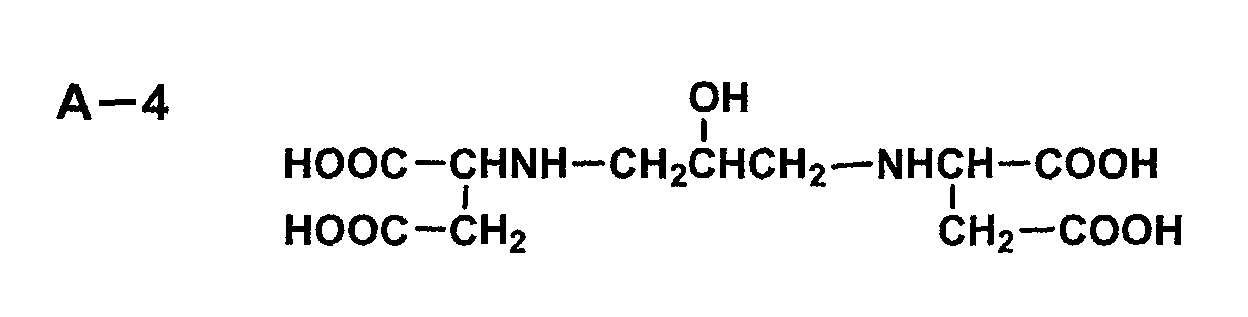
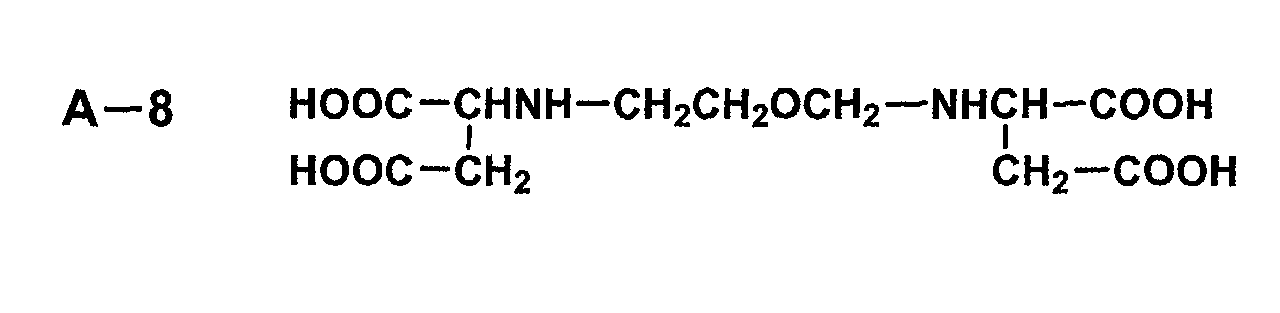
- any of the foregoing compounds is a [S,S]-isomer (optical isomer). Of these, compounds (A-1), (A-3) and (A-12) are preferred.
- the foregoing exemplified compounds are each represented by an acidic form but their salts (such as ammonium, potassium or sodium salts) are also usable in the invention.
- another aspect of the invention concerns the use of at least one iron(III) salt [hereinafter, also referred to as a ferric salt] selected from the group consisting of iron(III) nitrate (or ferric nitrate), iron(III) chloride (or ferric chloride), iron(III) bromide (or ferric bromide), and compounds represented by general formulas of 3M 1 ⁇ Fe(III) (SO 4 ) 3 and M 1 ⁇ Fe(III) (SO 4 ) 2 , in which M 1 represents an ammonium, potassium, sodium or hydrogen atom.
- iron(III) salt selected from the group consisting of iron(III) nitrate (or ferric nitrate), iron(III) chloride (or ferric chloride), iron(III) bromide (or ferric bromide
- M 1 represents an ammonium, potassium, sodium or hydrogen atom.
- iron(III) salt relating to the invention can be used a compound selected from the iron(III) salts described above and exemplary examples thereof include iron(III) nitrate, iron(III) chloride, iron(III) bromide, triammonium iron(III) trisulfate, tripotassium iron(III) trisulfate, trisodium iron(III) trisulfate, potassium iron(III) sulfate, sodium iron(III) sulfate, and ammonium iron(III) sulfate.
- the above-described [S,S]-alkylenediamine-N,N'-disuccinic acid or its salt is added into a mixing tank containing mother liquor (such as water) to form a solution, and at least one of the iron(III) salts described above is further added thereto subsequently.
- the solution prepared by adding a [S,S]-alkylenediamine-N,N'- disuccinic acid or its salt into the mixing tank is adjusted so as to exhibit a pH of 6 to 10. Adjusting the pH of the solution to the foregoing range results in further enhanced effects of the invention. Specifically, the pH is more preferably 7 to 8.5.
- the pH of a kit part of a bleach-fixing solution and the pH of a kit of a bleaching solution are each within the range of 3.5 to 6.0, thereby achieving further enhanced effects of the invention more suitably.
- the pH of 4.0 to 5.5 is more preferred.
- an organic acid represented by the following formula (1) is employed: wherein L 8 and L 9 are each an alkylene group; r2 and r3 are each 0 or 1; r4 is an integer of 1 to 5; q is an integer of 0 to 4, provided that r4 + q ⁇ 5; and M is an alkali metal or a hydrogen atom; formula (1) MOOC-(Z) k -(X) n wherein X represents -COOM 2 , -OH, -SO 3 M 3 or -PO 3 M 4 M 5 , in which M 2 through M 5 each represent an alkali metal or hydrogen atom; n is an integer of 1 to 3, provided that when n is 2 or more, plural Xs may be the same or different; Z represents a (n+1)-valent linking group having 1 to 10 carbon atoms and comprising carbon(s
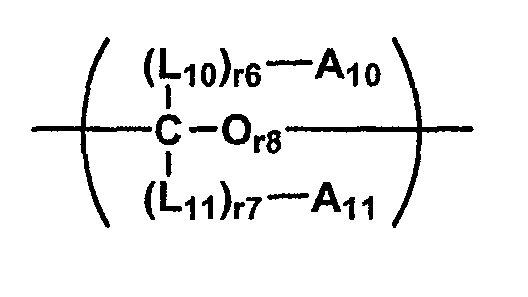
- an organic acid represented by the foregoing formula (1) is preferred: formula (1-B) X ⁇ (Y) r5 ⁇ COOM wherein Y is wherein L 10 and L 11 are each an alkylene group; r5 through r8 are each 0 or 1; A 10 and A 11 are each -H, -OH, -COOM 1 , -SO 3 M 2 , or -PO 3 M 3 M 4 , in which M and M 1 through M 4 are each an alkali metal or hydrogen atom.
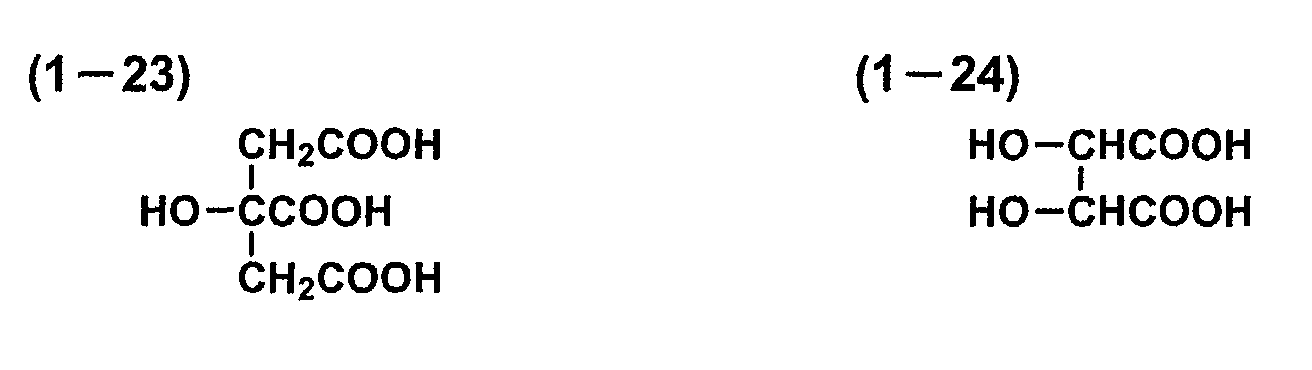
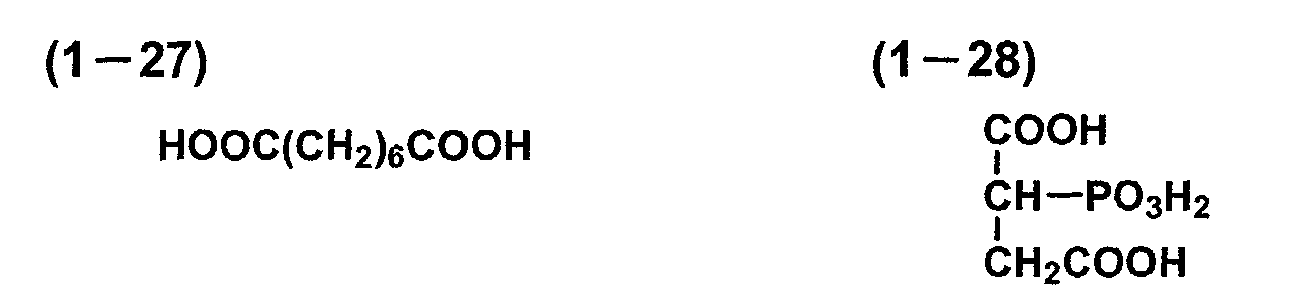
- organic acid represented by formula (1) is shown below, but are by no means limited to these.
- (1-1) HOOCCH 2 C(OH)(COOH)CH 2 COOH (1-2) HOOC(CHOH) 2 COOH (1-3) HOOCCH 2 COOH (1-4) HOOCCH(OH)CH 2 COOH (1-14) HOOC ⁇ (CH 2 ) 3 ⁇ COOH (1-15) HOOC ⁇ (CH 2 ) 4 ⁇ COOH (1-16) HOOCC ⁇ CCOOH (1-25) HOOC ⁇ CH 2 ⁇ SO 3 H (1-26) HOOC(CH 2 ) 5 COOH
- Preferred of the foregoing exemplified compounds are specifically compounds (1-5), (1-6), (1-10), (1-15), (1-21), (1-23) and (1-29).
- Examples of a salt of the acid described above include an ammonium salt, lithium salt, sodium salt and potassium salt; and sodium and potassium salts are preferable in terms of storage stability.
- the organic acids described above can be used alone or in combination thereof.
- an alkylenediamine-N-monosuccinic acid or its salt is employed, thereby the objective effects of the invention can be achieved more suitably.
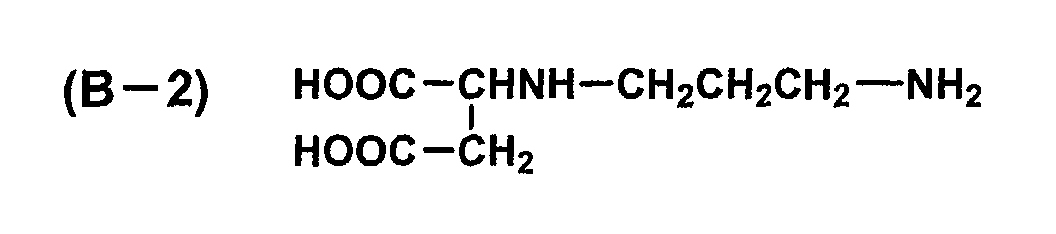
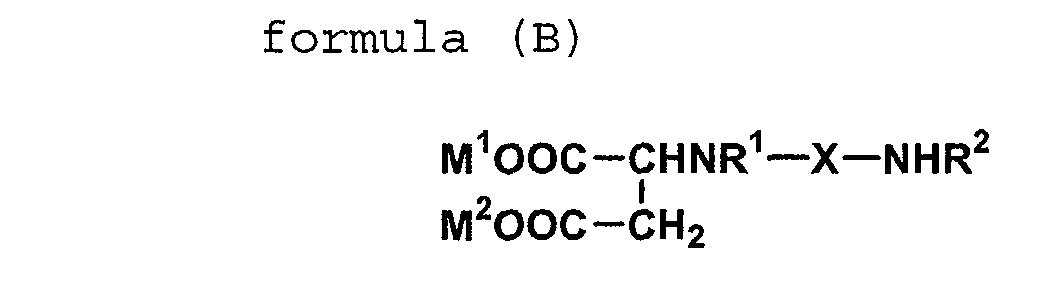
- the alkylenediamine-N-monosuccinic acid or its salt used in the invention is preferably a compound represented by the following formula (B): wherein M 1 and M 2 each represent a hydrogen atom, alkali metal atom or a cation such as ammonium; X represents an alkylene group having 2 to 6 carbon atoms, which may be substituted, or -(B 1 O) n -B 2 -, in which n is an integer of 1 to 6 and B 1 and B 2 , which may be the same or different, is an alkylene group having 1 to 5 carbon atoms; R 1 and R 2 are each a hydrogen atom or an alkyl group having 1 to 3 carbon atoms.
- the foregoing exemplified compounds may be a [S,S]-form (optical isomer). Although the foregoing exemplified compounds are represented in the form of a free acid, they may be in the form of a salt of ammonium or any cation (such as sodium, potassium or lithium ion). Preferable of the foregoing compounds is specifically compound (B-1).
- the alkylenediamine-N-monosuccinic acid or its salt used in the invention is contained preferably in an amount of 0.05 to 2.0 mol/l.
- the preparation method of a kit part of a bleach-fixing solution or a bleaching solution kit is characterized in that at least after adding the ferric salt, stirring within the mixing tank is carried out by means of propeller stirring or circulation stirring, wherein the propeller stirring is performed using a rotary blade having a turning radius not less than 1/4 of the radius of the mixing tank at a stirring rate of 50 to 120 r.p.m and the circulation stirring being performed at a circulating speed of 2.0 to 5.5 cycles/min, and whereby the intended effects of the invention can be suitably achieved.
- the rotary blade used in the propeller stirring preferably have a turning radius of 1/3.5 to 1/2 of the mixing tank radius and be rotated at a rate of 60 to 100 r.p.m., or the circulation stirring be performed at a circulating speed of 2.5 to 4.5 cycle/min, thereby, the intended effects of the invention can be suitably achieved.
- the turning radius is a length of from the rotation center to the top of the blade.
- the radius of the tank is defined as a radius of a circle inscribing the wall of the tank.
- the preparation method of a kit part of a bleach-fixing solution or a bleaching solution kit is characterized in that the molar ratio of a [S,S]-alkylenediamine-N,N'-disuccinic acid or its salt to an iron(III) salt is 1.00 to 1.10, whereby the intended effects of the invention can suitably be achieved.
- the [S,S]-alkylenediamine-N,N'-disuccinic acid (or its salt) and iron(III) salt are each contained preferably in an amount of 0.05 to 2.0 mol/l.
- the ammonium content is preferably 0 to 30 mol%, based on total cations contained therein, whereby the intended effects of the invention can be suitably achieved.
- the ammonium content is more preferably 0 to 10 mol% is, whereby odor is minimized and the intended effects of the invention can be more suitably achieved.
- the kit part of a bleach-fixing solution or the bleaching solution kit relating to the invention may contain, in addition to the compounds described above, adjuvants such a halogenating agent, a bleaching agent, a bleach-accelerating agent, an alkaline agent, an acid, an anticorrosion agent and buffering agent.
- adjuvants such as a halogenating agent, a bleaching agent, a bleach-accelerating agent, an alkaline agent, an acid, an anticorrosion agent and buffering agent.
- exemplary examples thereof include ammonium bromide, potassium bromide, imidazole, acetic acid, ammonium nitrate, potassium nitrate, nitric acid, sulfuric acid and ammonia water as well as conventional additives used in bleach-fixing solutions and bleaching solutions.
- a concentrated part containing a bleaching agent such as aminopolycarboxylic acid iron complex salt and a concentrated part containing a thiosulfate are used as plural kit parts in terms of storage stability and physical distribution.
- the kit part of a bleach-fixing solution relating to the invention is a kit part containing a bleaching agent, referring to a product form when really handed in to users.
- the kit of a bleaching solution (or bleaching solution kit) relating to the invention may be used as a single kit containing a bleaching agent, a halogenating agent and a buffering agent, or may be separated to plural kit parts, but in either of them, it is a kit containing a bleaching agent, referring to a product form at the time when really handed in to users.
- sample solution No. 1 was a homogeneous solution containing no precipitate.
- sample solution No. 2 was prepared similarly to sample solution No. 1, provided that in place of iron(III) nitrate nona-hydrate, 200 moles of triiron tetraoxide and 900 g of iron powder were added and reaction was performed at a temperature of 90 to 95° C. After cooling to 60° C and removing insoluble iron oxide, air was blown into the reaction solution at a rate of 7 lit./min for 3 hrs. using a ball filter to perform an oxidation reaction, thereafter, the pH was adjusted to 6.0 using ammonia water to obtain sample solution No. 2.
- sample solution No. 3 was prepared similarly to sample solution 1, provided that in place of iron(III) nitrate nona-hydrate, an equimolar amount of iron(II) sulfate hepta-hydrate was added and dissolved with heating and after being cooled to ordinary temperature, the pH was adjusted to 7.0 with 25% ammonia water. Subsequently, to the reaction solution was added ammonium persulfate in 1 hr. at room temperature with stirring at 50 r.p.m. and after performing an oxidation reaction, the pH was adjusted to 6.0 with sulfuric acid to obtain sample solution No. 3.
- sample solution No. 4 was prepared similarly to sample solution 1, provided that in place of iron(III) nitrate nonahydrate, an equimolar amount of triiron tetraoxide was used and reaction was continued for 3 hrs at 60° C and air was blown into the reaction solution at the same temperature to perform oxidation, thereafter, the reaction solution was filtered to obtain sample solution No. 4.
- color photographic paper was prepared in accordance with the following procedure.
- a 5 ⁇ m thick melt-extruded polyethylene layer was provided on the opposite side to the back resin layer to form a laminated surface resin layer.
- 95% by weight of polypropylene and 5% by weight of anatase type titanium oxide were kneaded and meltingly extruded at 300° C and then, 30 ⁇ m thick, biaxially stretched polypropylene resin sheet was prepared using a flat film method sequential biaxial-stretching apparatus. The thus prepared biaxially stretched polypropylene resin sheet was nipped onto the surface of the polyethylene resin layer described above to form laminated resin layers to obtain a paper support.
- the surface resin layer side of the thus obtained paper support was subjected to corona discharge (at an output current of 2 amp. and further thereon, a gelatin sublayer was coated at a gelatin coverage of 40 mg/m 2 .
- preparation of the 1st layer coating solution is exemplarily shown below.
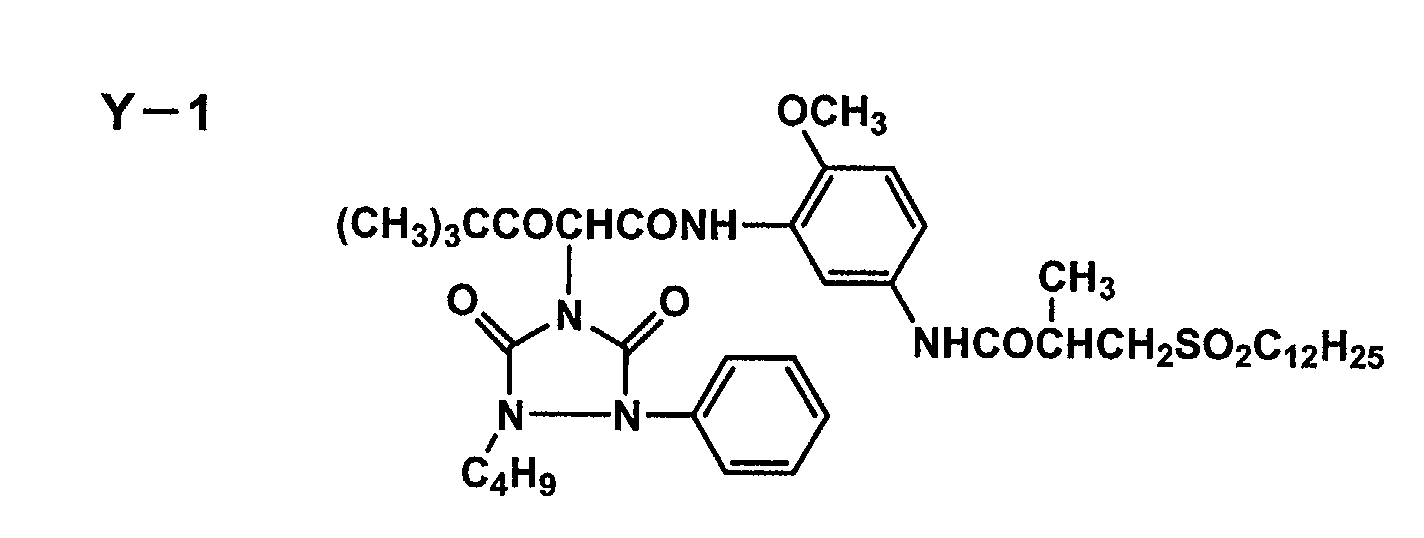
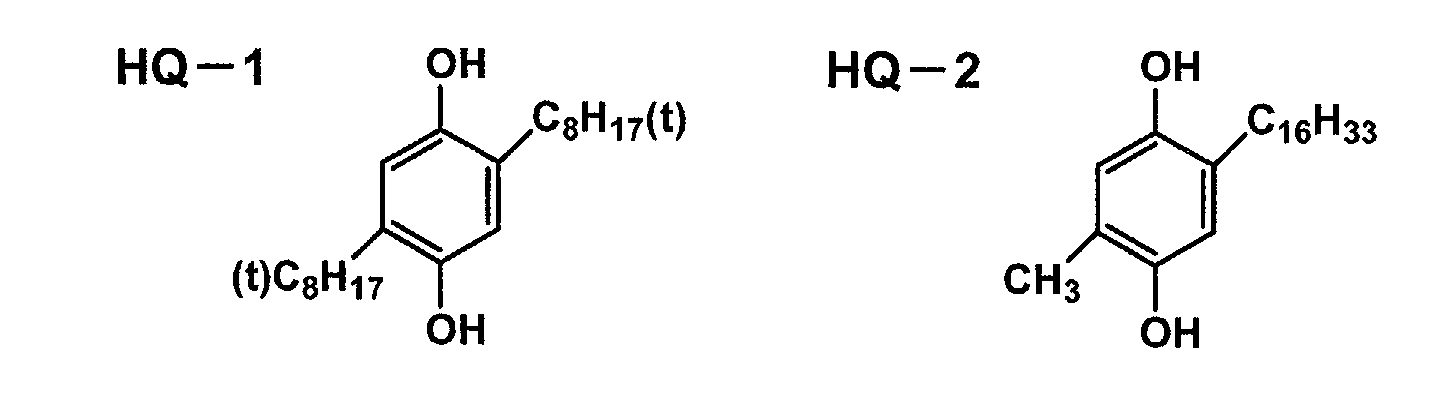
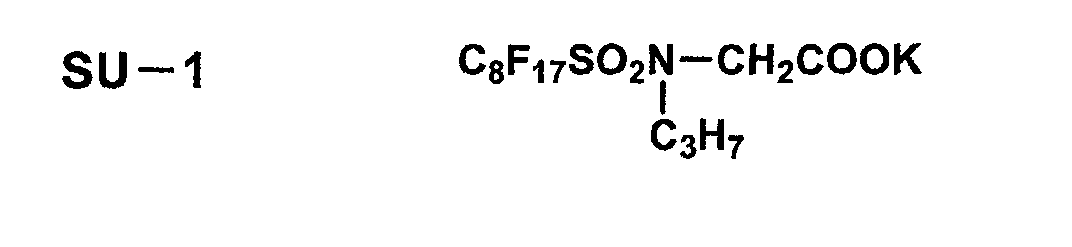
- Yellow coupler (Y-1) of 26.7 g, 100 g of dye image stabilizer (ST-1), 6.67 g of dye image stabilizer (ST-2) and 0.67 g of additive (HQ-1) were dissolved in 60 ml of ethyl acetate together with 6.67 g of high boiling solvent (DNP) and dispersed in 220 ml of an aqueous 10% gelatin solution containing 7 ml of 20% surfactant aqueous solution (SU-1 using an ultrasonic homogenizer to prepare a yellow coupler dispersion.
- the thus emulsified dispersion was mixed with a blue-sensitive silver halide emulsion (having a silver equivalent content of 10 g) to prepare the 1 st layer coating solution.
- Coating solutions for the 2nd to 7th layers were prepared similarly to the 1st layer coating solution described above.
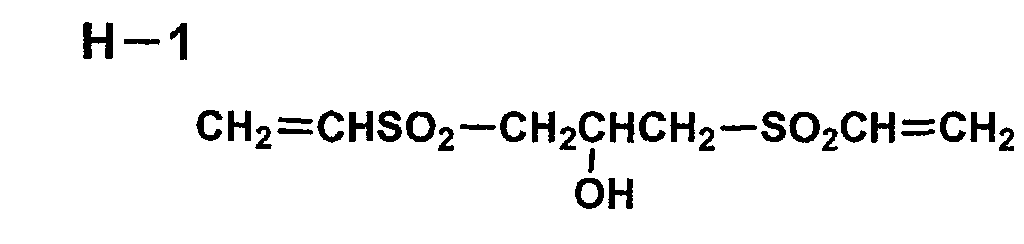
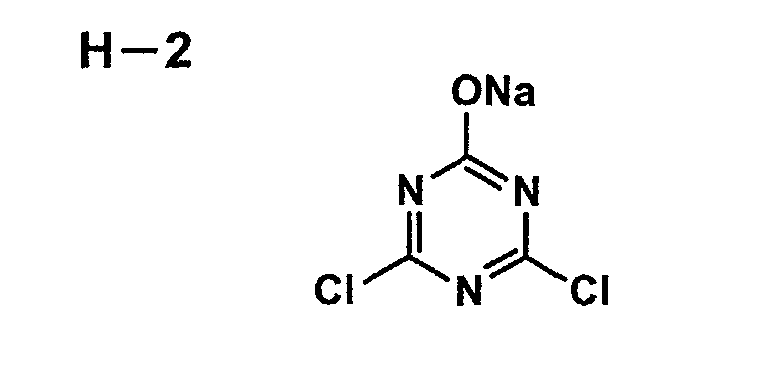
- Hardening agent, (H-1) was added to the 2nd and 4th layers, and (H-2) was added to the 7th layer.
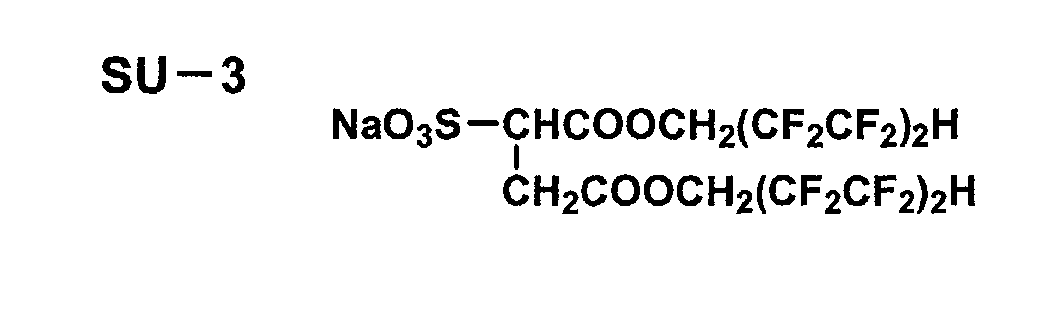
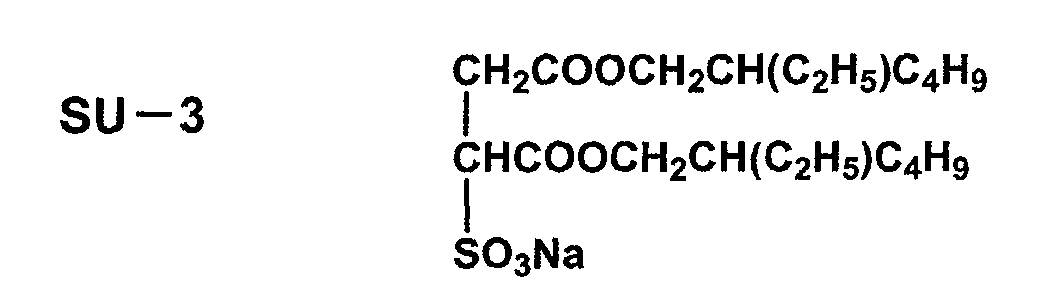
- surfactants (SU-2) and (SU-3) were used to adjust the surface tension.
- Additives used for preparing the foregoing sample are as follws.
- Solution A Sodium chloride 3.42 g Potassium bromide 0.03 g Water to make 200 ml Solution B Silver nitrate 10 g Water to make 200 ml Solution C Sodium chloride 102.7 g Potassium bromide 1.0 g Water to make 600 ml Solution D Silver nitrate 300 g Water to make 600 ml
- the resulting emulsion was desalted using a 5% aqueous solution of Demol N (produced by Kao-Atlas) and aqueous 20% magnesium sulfate solution, and re-dispersed in a gelatin aqueous solution to obtain a monodisperse cubic grain emulsion (EMP-1) having an average grain size of 0.85 ⁇ m, a coefficient of variation of grain size of 7% and a chloride content of 99.5 mol%.
- Demol N produced by Kao-Atlas
- MMP-1 monodisperse cubic grain emulsion having an average grain size of 0.85 ⁇ m, a coefficient of variation of grain size of 7% and a chloride content of 99.5 mol%.
- EMP-1 The emulsion, EMP-1 was chemically sensitized at 50° C for 90 min using the following compounds to obtain blue-sensitive silver bromochloride emulsion (Em A).
- Sodium thiosulfate 0.8 mg/mol AgX Chloroauric acid 0.5 mg/mol AgX Stabilizer STAB-1 6x10 -4 mol/mol AgX Sensitizing dye BS-1 4x10 -4 mol/mol AgX Sensitizing dye BS-2 1x10 -4 mol/mol AgX
- Monodisperse cubic grain emulsions having an average grain size of 0.43 ⁇ m, a variation coefficient of 8% and a chloride content of 99.5 mol% was prepared in the same manner as in preparation of EMP-1, except that an adding time of Solutions A and B, and that of Solution C and D were respectively varied.
- EMP-2 The emulsion, EMP-2 was chemical-sensitized at 55° C for 120 min. using the following compounds to obtain green-sensitive silver bromochloride emulsion (Em B).
- Monodisperse cubic grain emulsion, EMP-3 having an average grain size of 0.50 ⁇ m, a variation coefficient of 8% and a chloride content of 99.5 mol% were prepared in the same manner as in preparation of EMP-1, except that an adding time of Solutions A and B, and that of Solution C and D were respectively varied.
- Emulsion EMP-3 was chemically sensitized at 60° C for 90 using the following compounds to obtain red-sensitive silver halide emulsion (Em C).
- Sodium thiosulfate 1.8 mg/mol AgX Chloroauric acid 2.0 mg/mol AgX Stabilizer STAB-1 6x10 -4 mol/mol AgX Sensitizing dye RS-1 4x10 -4 mol/mol AgX
- the thus prepared photographic material sample was exposed through an optical wedge and subjected to each of processes 1-1 through 1-4 according to the following processing steps, using the following processing solutions, in which sample solution Nos. 1 through 4 were each used as a bleach-fixing solution.
- Bleach-fixing solution Water 300 g Bleach-fixer kit part (Sample Solution No. 1 to 4, shown in Table 1) 200 ml Ammonium thiosulfate 80 g Ammonium sulfite 12 g
- Water was added to make the total volume of 1 lit. anf the pH was adjusted to 6.5 using 25% ammonia water or acetic acid.
- the amount of developed silver remained in the maximum density area of each of the processed samples was measured by a fluorescent X-ray analyzer (produced by RIGAKU DENKI KOGYO Co., Ltd.) to determine the residual silver amount (mg/dm 2 ).
- each of the bleach-fixing solutions was sealed in a glass container and allowed to stand at 50° C for 3 days; thereafter, the bleach-fixing solutions each were visually observed with respect to occurrence of precipitation within the solution.
- Sample solution Nos. 2-1 through 2-8 of a bleach-fixing kit part were prepared similarly to Sample solution No. 1 of Example 1, except that after adding 250 lit. deionized water and 500 moles of exemplified compound (A-1) with stirring at a stirring speed of 50 r.p.m., the pH was adjusted to a value shown in Table 4, using 25% ammonia water and 90% acetic acid. Subsequently, exposure and processing were conducted similarly to Example 1, except that Sample solution Nos. 2-1 through 2-8 were each used as a bleach-fixing solution. Then, similarly to Example 1, the retained silver amount was more, after completion of the foregoing processing, each of bleach-fixing solutions was stirred at 40° C for 2 hrs. and the state of each of the solutions was visually observed.
- Sample solution Nos. 3-1 through 3-7 of a bleach-fixing kit part were prepared similarly to Sample solution No. 1 of Example 1, except that instead of adjusting the pH 5.0 after the addition of a ferrate, the pH was adjusted to a value , as shown in Table 5.
- the thus prepared sample solutions No. 3- through 3-7 were sealed in a thermoplastic resin vessel and aged at 50° C for 1 week. After being aged, the state of each of the solutions was visually observed. Then, exposure and processing were conducted similarly to Example 1, except that the thus aged bleach-fixing solutions were used as a bleach fixing solution (Processing Nos. 3-1 through 3-7).
- Example 2 the thus processed samples were measured with respect to the residual silver amount. Results of the visual observation of aged solutions and the residual silver amount were shown in Table 3. Processing No. Sample Solution pH Residual Silver (mg/m 2 ) State of Solution 3-1 3-1 3.0 0.4 Some precipitates 3-2 3-2 3.5 0.2 Very slight precipitates 3-3 3-3 4.0 0.0 No precipitate 3-4 3-4 5.0 0.0 No precipitate 3-5 3-5 5.5 0.0 No precipitate 3-6 3-6 6.0 0.2 Very slight precipitates 3-7 3-7 7.0 0.6 Some precipitates
- Sample solutions Nos. 4-1 through 4-6 of a bleach-fixing kit part were prepared similarly to sample solution No. 3-2 of Example 3, except that in place of acetic acid, organic acids shown in Table 4 were used as a pH-adjusting agent. Similarly to Example 3, sample solutions were measured with respect to the state of aged solutions and the retained silver amount. Results thereof are shown in Table 4. Processing No. Sample Solution Organic Acid Residual Silver (mg/m 2 ) State of Solution 4-1 4-1 Acetic acid 0.2 very slight precipitates 4-2 4-2 (1-5) 0.0 No precipitate 4-3 4-3 (1-6) 0.0 No precipitate 4-4 4-4 (1-15) 0.1 No precipitate 4-5 4-5 (1-21) 0.2 No precipitate 4-6 4-6 (1-29) 0.1 No precipitate
- Sample solutions Nos. 5-1 through 5-3 of a bleach-fixing kit part were prepared similarly to sample solution No. 3-2 of Example 3, except that a compound represented by formula (B), alkylenediaminemonosuccinic acid (hereinafter, also denoted simply as ADMS)as was added in an amount of 1/20 mol% of the compound (A-1). Similarly to Example 3, the state of aged sample solutions and retained silver amounts were evaluated. Results thereof are shown in Table 5. Processing No. Sample Solution ADMS Residual Silver (mg/m 2 ) State of Solution 5-1 5-1 - 0.2 Very slight precipitates 5-2 5-2 (B-1) 0.0 No precipitate 5-3 5-3 (B-2) 0.0 No precipitate
- Sample solutions No. 6-1 through 6-16 of a bleach-fixing kit part were prepared similarly to sample solution No. 1 of Example 1, except that the radius of a stirring blade provided in the mixing tank (which was expressed in terms of a ratio of the turning radius of the blade to the radius of the mixing tank) and the stirring rate after addition of a ferrate were each varied, as shown in Table 6.
- the radius of a stirring blade provided in the mixing tank which was expressed in terms of a ratio of the turning radius of the blade to the radius of the mixing tank
- the stirring rate after addition of a ferrate were each varied, as shown in Table 6.
- storage stability of sample solutions i.e., occurrence of precipitation in the aged solutions and the retained silver amount were evaluated and the results thereof are shown in Table 6. Processing No.
- Sample solutions Nos. 7-1 through 7-8 of a bleach-fixing kit part were prepared similarly to sample solution No. 1 of Example 1, except that as a stirring condition, a circulation system by using a circulation pump was employed in place of propeller stirring and the circulation rate was varied, as shown in Table 9. Similarly to Example 1, storage stability of sample solutions, i.e., occurrence of precipitation in the aged solutions and the residual silver were evaluated, and the results thereof are shown in Table 7. Processing No.
- Sample solutions Nos. 8-1 through 8-8 of a bleach-fixing kit part were prepared similarly to sample solution No. 1 of Example 1, except that the amount of compound (A-1), which was expressed in terms of a molar ratio of compound (A-1) to iron(III) nitrate, was varied as shown in Table 8. Similarly to Example 1, storage stability of sample solutions, i.e., occurrence of precipitation in the aged solutions and the residual silver were evaluated, and the results thereof are shown in Table 8. Processing No.
- a silver halide color photographic material (color negative film) was prepared in accordance with the following procedure.
- the foregoing emulsions a through i were each chemically sensitized by adding the foregoing sensitizing dyes to each of the emulsions and then by adding triphenylphosphine selenide, sodium thiosulfate, chloroauric acid and potassium thiocyanate according to the commonly known procedure until the relationship between sensitivity and fog reached an optimum point.
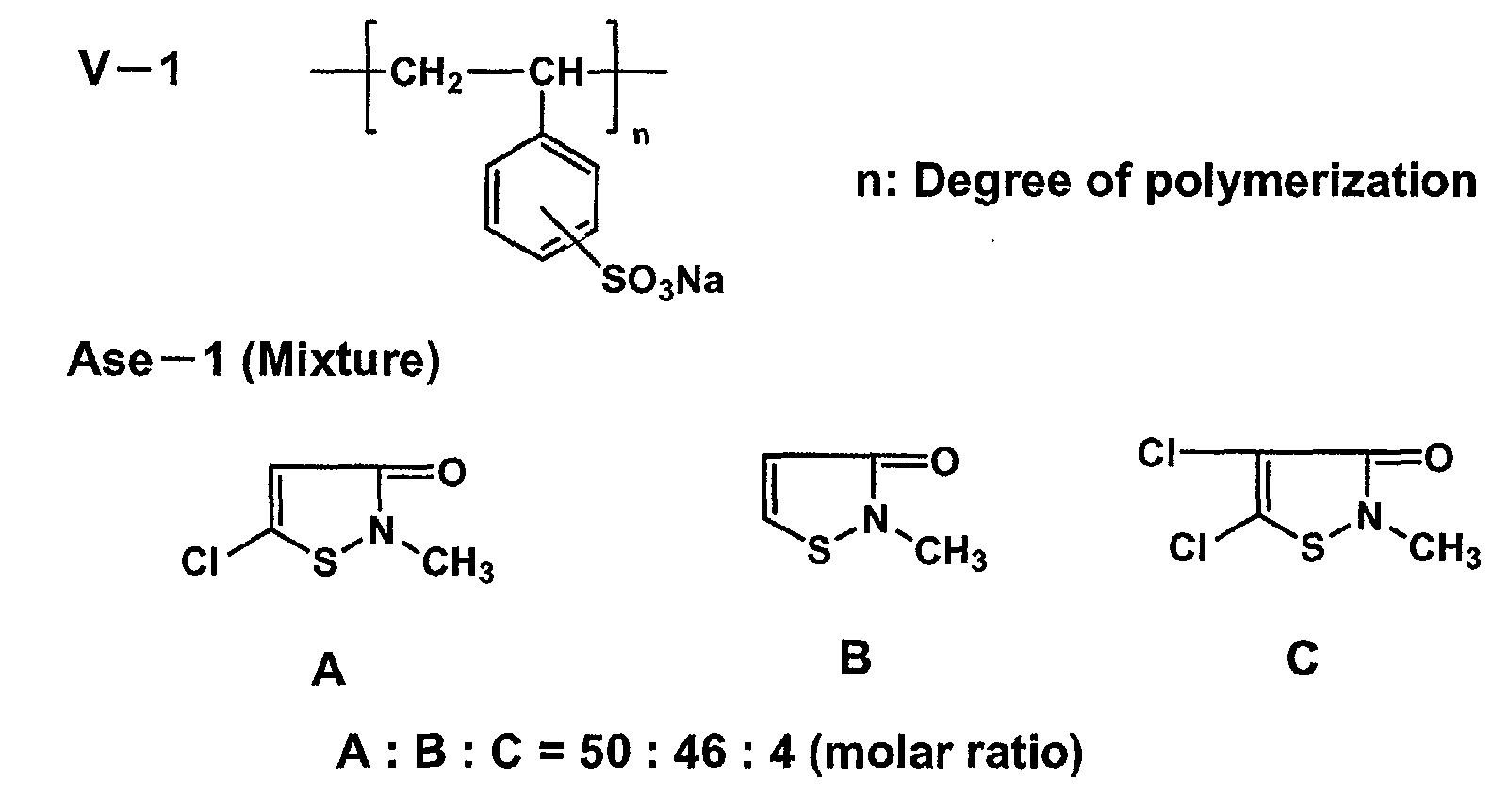
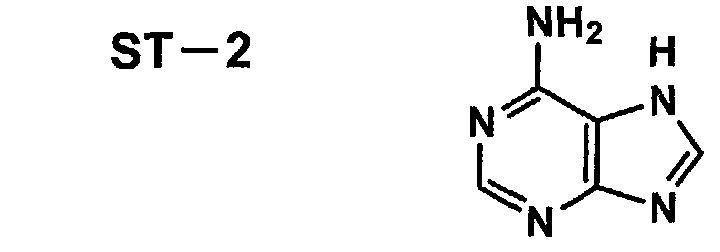
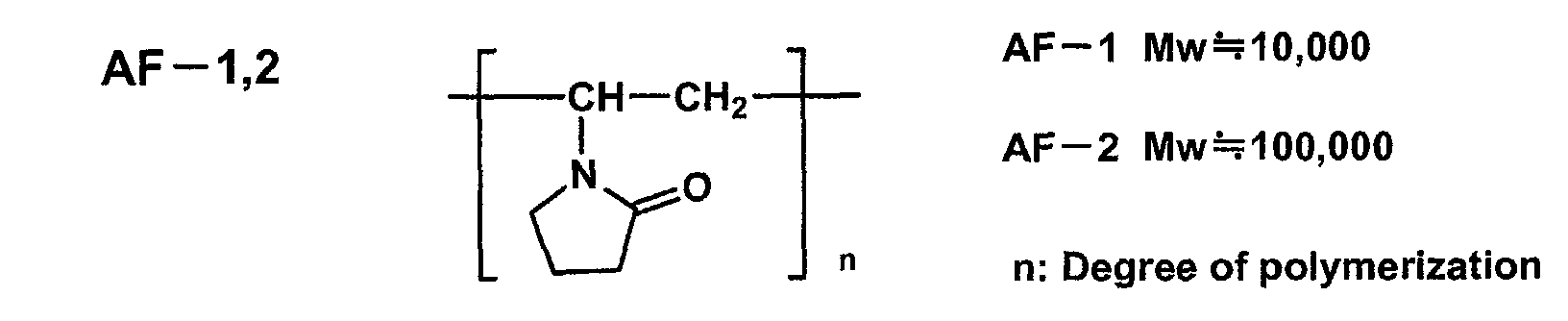
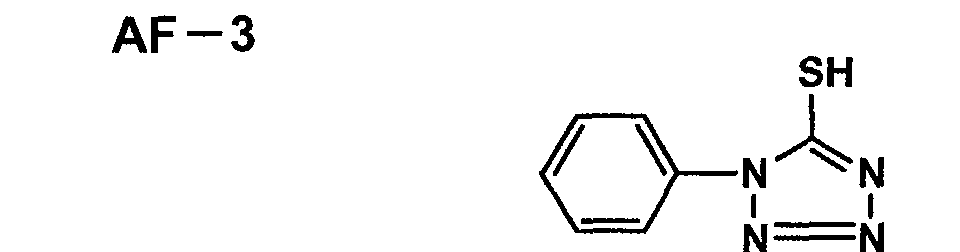
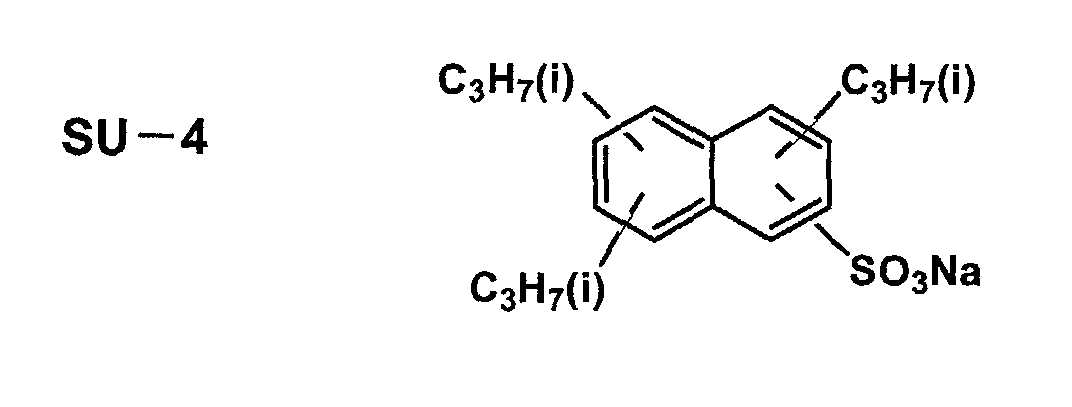
- coating aids SU-1, SU-2 and SU-3 In addition to the above composition were added coating aids SU-1, SU-2 and SU-3; a dispersing aid SU-4; viscosity-adjusting agent V-1; stabilizers ST-1 and ST-2; fog restrainer AF-1 and AF-2 comprising two kinds polyvinyl pyrrolidone of weight-averaged molecular weights of 10,000 and 1.100,000; inhibitors AF-3, AF-4 and AF-5; hardener H-1 and H-2; and antiseptic Ase-1.
- As liquid paraffin was used Merck Index 117139 (available from Merck Co.).
- Sample solutions B1 to B4 as a bleaching solution kit were prepare similarly to sample solution No. 1 of Example 1 except that 8- kg of ammonium bromide was added and the pH was adjusted to 3.5 using 90% acetic acid.
- Bleaching solution for 1 lit.
- Sample solution B1 to B4 (Table 16) 500 ml Water to make 1 lit.
- Fixing solution for 1 lit.
- Ammonium thiosulfate 100 g Sodium thiosulfate 10 g Sodium sulfite 12 g Disodium ethylenediaminetetraacetate 2 g Water was added to make 1 lit. and the pH was adjusted to 7.5 using ammonia water or 50% sulfuric acid.
- Stabilizing solution for 1 lit.
Landscapes
- Physics & Mathematics (AREA)
- General Physics & Mathematics (AREA)
- Silver Salt Photography Or Processing Solution Therefor (AREA)
Abstract
Description
wherein the kit part of a bleach-fixing solution or the kit of a bleaching solution contains a compound represented by the following formula (1) :
MOOC- (Z)k- (X)n
wherein after adding the iron(III) salt, stirring is performed in the mixing tank by propeller stirring or circulation stirring, wherein the propeller stirring is performed using a rotary blade having a turning radius of not less than 1/4 of the radius of the mixing tank at a stirring rate of 50 to 120 r.p.m, and the circulation stirring being performed at a circulation rate of 2.0 to 5.5 cycles/min;
wherein the molar ratio of the [S,S]-alkylenediamine-N,N'- disuccinic acid or its salt to the iron(III) salt is 1.00 to 1.10;












wherein L8 and L9 are each an alkylene group; r2 and r3 are each 0 or 1; r4 is an integer of 1 to 5; q is an integer of 0 to 4, provided that r4 + q ≤ 5; and M is an alkali metal or a hydrogen atom;
MOOC-(Z)k-(X)n
wherein X represents -COOM2, -OH, -SO3M3 or -PO3M4M5, in which M2 through M5 each represent an alkali metal or hydrogen atom; n is an integer of 1 to 3, provided that when n is 2 or more, plural Xs may be the same or different; Z represents a (n+1)-valent linking group having 1 to 10 carbon atoms and comprising carbon(s) and hydrogen atom(s), or carbon atom(s), hydrogen atom(s) and oxygen atom(s); and k is 0 or 1; M represents an alkali metal or a hydrogen atom.

X―(Y)r5―COOM
MOOC―(CH2)p6―X
MOOC―(CH2)p7―CH=CH―(CH2)p8―X
HOOCCH2C(OH)(COOH)CH2COOH
HOOC(CHOH)2COOH
HOOCCH2COOH
HOOCCH(OH)CH2COOH


HOOC―(CH2)3―COOH
HOOC―(CH2)4―COOH
HOOCC≡CCOOH


HOOC―CH2―SO3H
HOOC(CH2)5COOH




| Layer | Constitution | Amount (g/m2) |
| 7th Layer | Gelatin | 0.60 |
| (Protective layer) | ||
| 6th Layer | Gelatin | 0.30 |
| (UV absorbing layer) | UV absorbent (UV-1) | 0.10 |
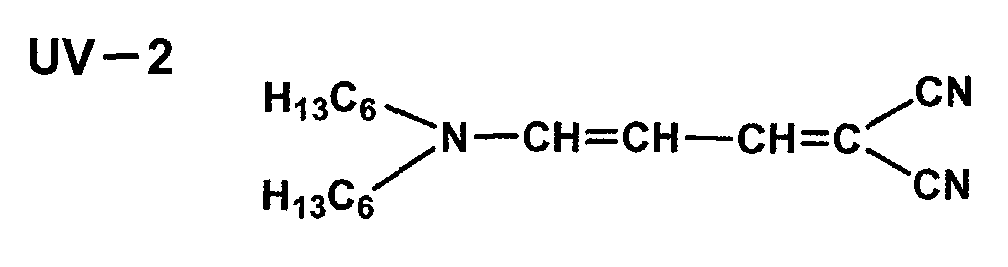
| UV absorbent (UV-2) | 0.04 | |
| UV absorbent (UV-3) | 0.18 | |
| Antistaining agent (HQ-1) | 0.01 | |
| DNP | 0.18 | |
| PVP | 0.03 | |
| Antiirradiation dye (AI-2) | 0.02 | |
| 5th Layer | Gelatin | 1.05 |
| (Red-sensitive layer) | Red-sensitive silver bromo-chloride emulsion (Em C) by equivalent converted to silver | 0.13 |
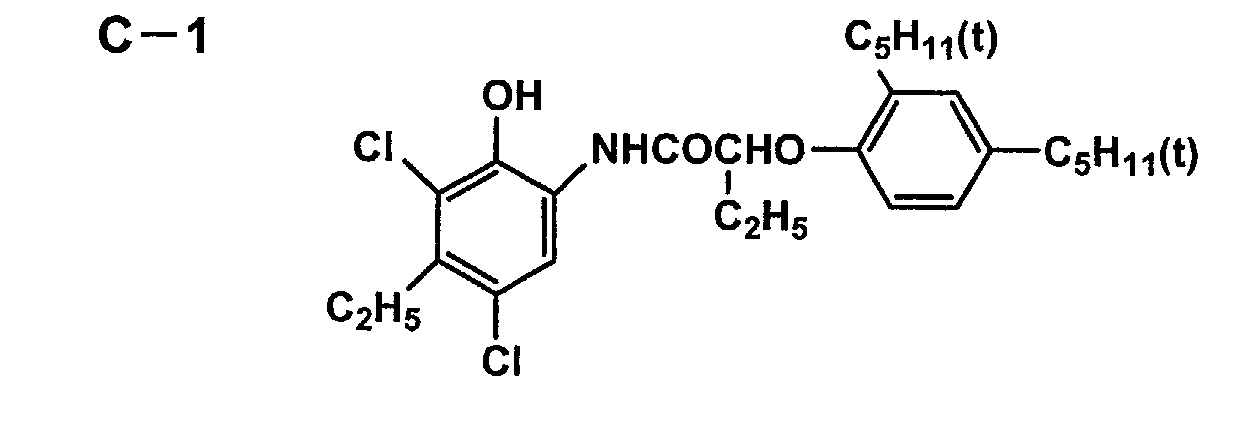
| Cyan coupler (C-1) | 0.20 | |
| Cyan coupler (C-2) | 0.22 | |
| Dye image stabilizer (ST-1) | 0.20 | |
| Antistaining agent (HQ-1) | 0.01 | |
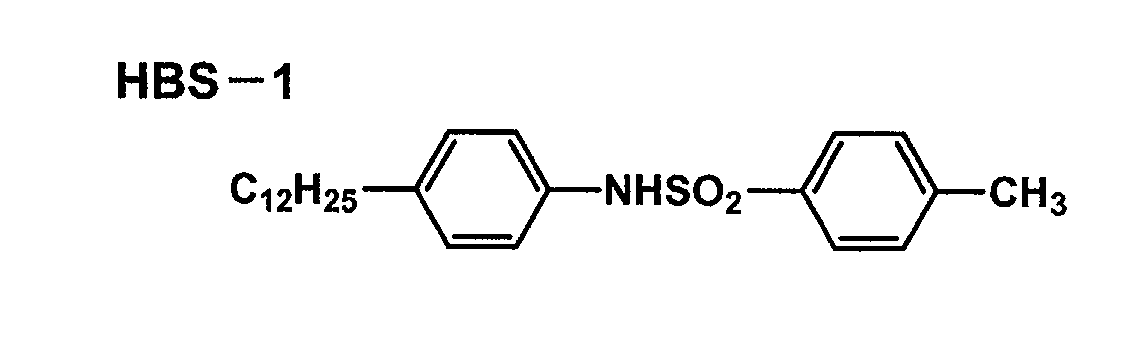
| HBS-1 | 0.20 | |
| DOP | 0.20 | |
| 4th Layer | Gelatin | 0.75 |
| (UV absorbing layer) | UV absorbent (UV-1) | 0.28 |
| UV absorbent (UV-2) | 0.08 | |
| UV absorbent (UV-3) | 0.38 | |
| Antistaining agent (HQ-1) | 0.03 | |
| DNP | 0.30 | |
| 3rd Layer | Gelatin | 1.25 |
| (Green-sensitive layer) | Green-sensitive silver bromo-chloride mulsion (Em B) by equivalent converted to silver | 0.12 |
| Magenta coupler (M-C) | 0.30 | |
| Dye image stabilizer (ST-3) | 0.15 | |
| Dye image stabilizer (ST-4) | 0.15 | |
| Dye image stabilizer (ST-5) | 0.15 | |
| DNP | 0.20 | |
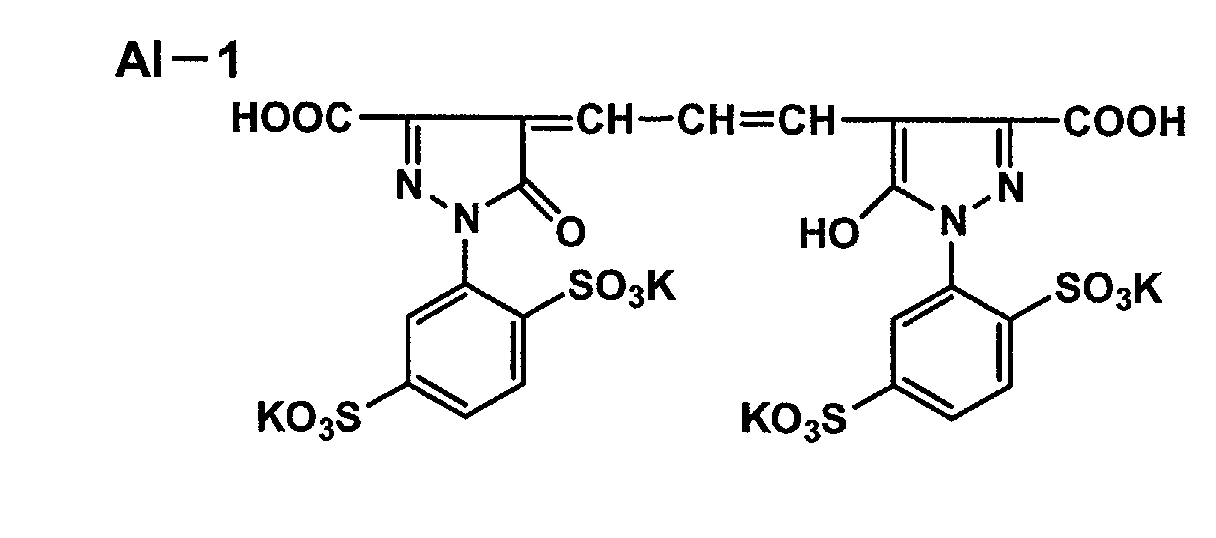
| Antiirradiatiob dye (AI-1) | 0.02 | |
| 2nd layer | Gelatin | 1.10 |
| (Interlayer) | Antistaining agent (HQ-2) | 0.12 |
| DIDP | 0.15 | |
| 1st layer | Gelatin | 1.15 |
| (Blue-sensitive layer) | Blue-sensitive silver bromo-chloride emulsion (Em A) by equivalent converted to silver | 0.18 |
| Yellow coupler (Y-1) | 0.75 | |
| Dye image stabilizer (ST-1) | 0.30 | |
| Dye image stabilizer (ST-2) | 0.20 | |
| Antistaining agent (HQ-1) | 0.02 | |
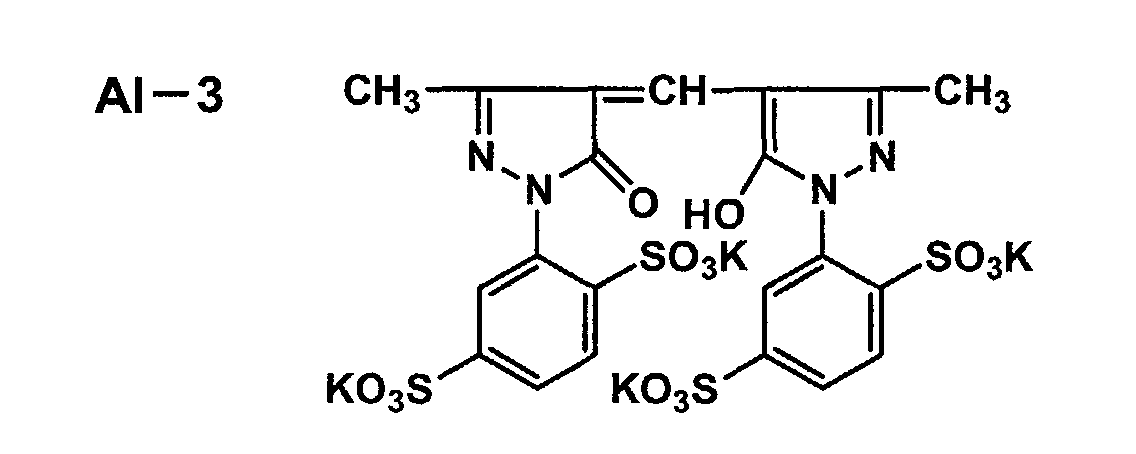
| Antiirradiation dye (AI-3) | 0.02 | |
| DNP | 0.18 |

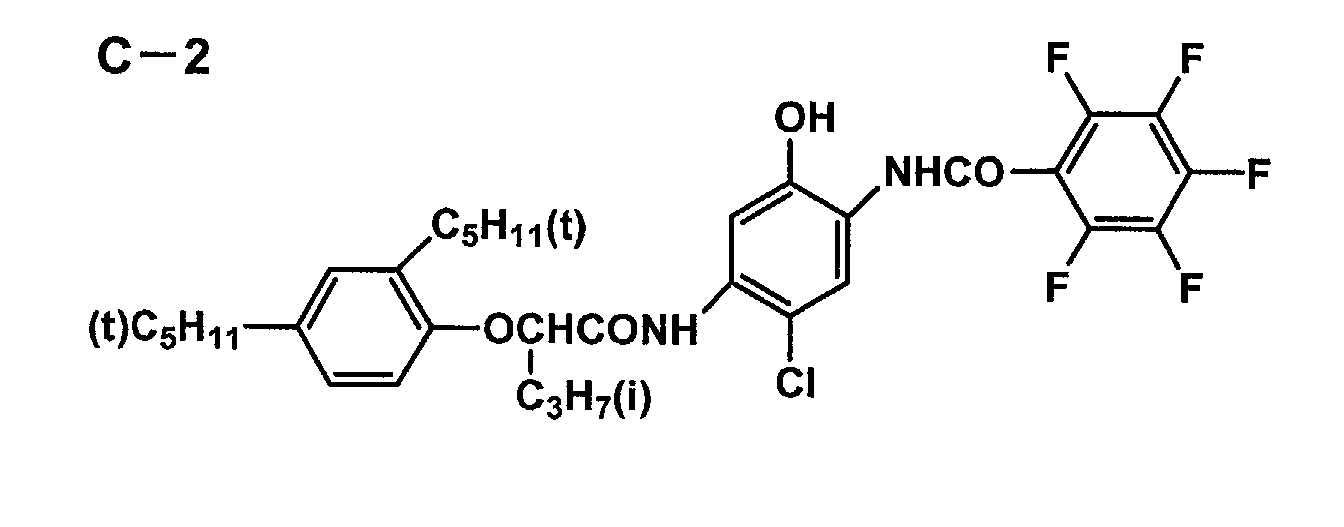

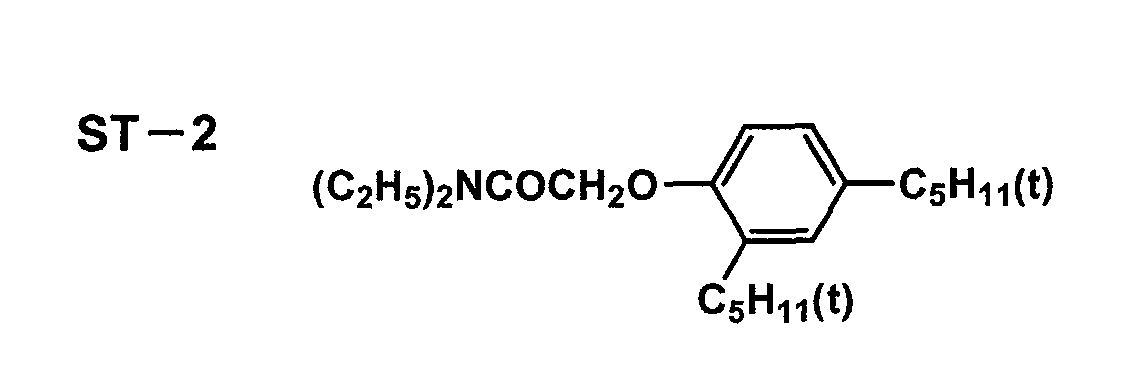

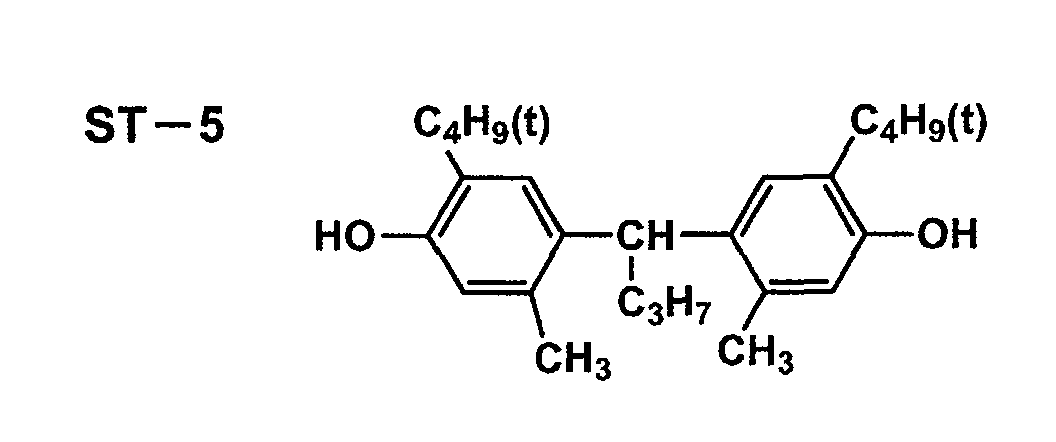

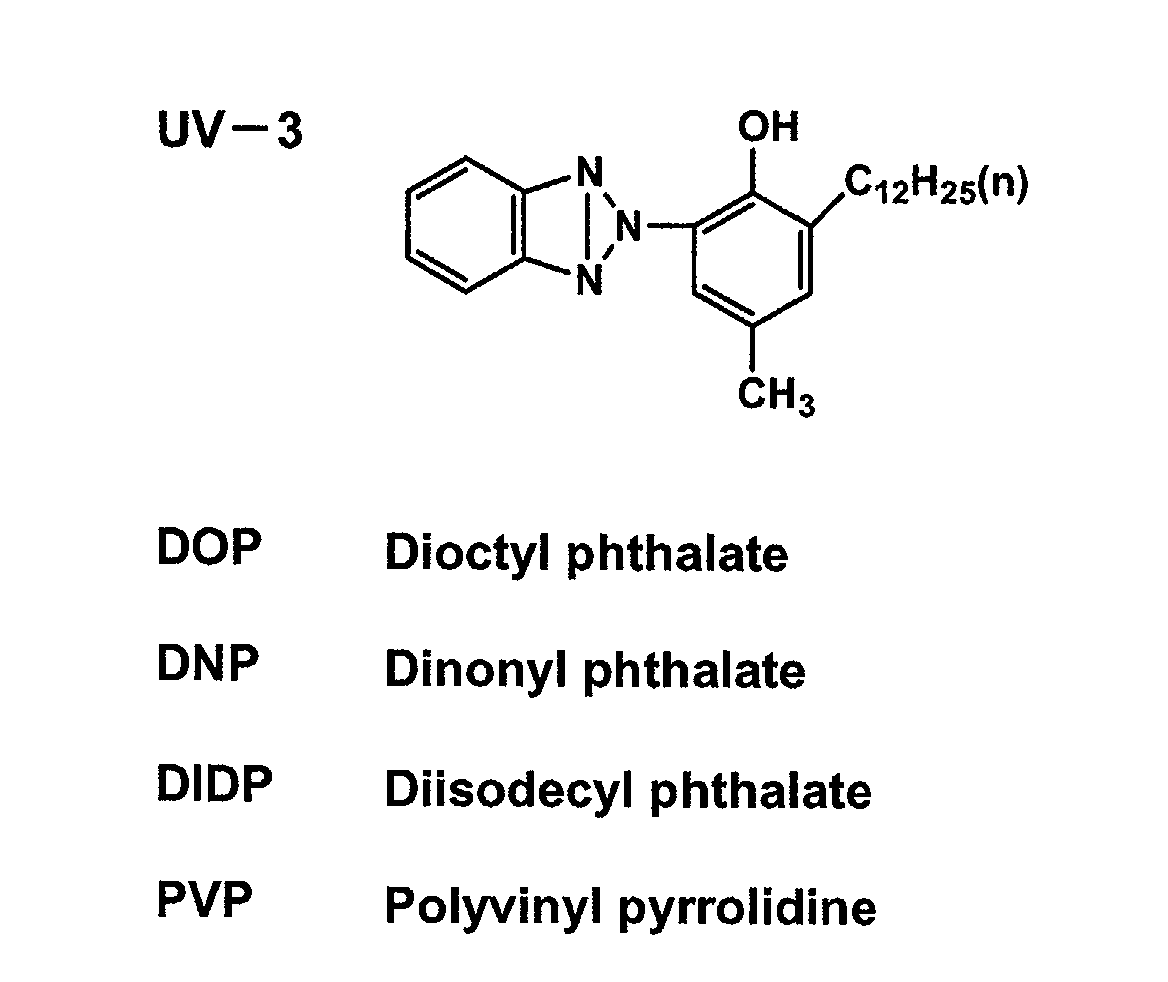



| Solution A | |
| Sodium chloride | 3.42 g |
| Potassium bromide | 0.03 g |
| Water to make | 200 ml |
| Solution B | |
| Silver nitrate | 10 g |
| Water to make | 200 ml |
| Solution C | |
| Sodium chloride | 102.7 g |
| Potassium bromide | 1.0 g |
| Water to make | 600 ml |
| Solution D | |
| Silver nitrate | 300 g |
| Water to make | 600 ml |
| Sodium thiosulfate | 0.8 mg/mol AgX |
| Chloroauric acid | 0.5 mg/mol AgX |
| Stabilizer STAB-1 | 6x10⁻⁴ mol/mol AgX |
| Sensitizing dye BS-1 | 4x10⁻⁴ mol/mol AgX |
| Sensitizing dye BS-2 | 1x10⁻⁴ mol/mol AgX |
| Sodium thiosulfate | 1.5 mg/mol AgX |
| Chloroauric acid | 1.0 mg /mol AgX |
| Stabilizer STAB-1 | 6x10⁻⁴ mol/mol AgX |
| Sensitizing dye GS-1 | 4x10⁻⁴ mol/mol AgX |
| Sodium thiosulfate | 1.8 mg/mol AgX |
| Chloroauric acid | 2.0 mg/mol AgX |
| Stabilizer STAB-1 | 6x10⁻⁴ mol/mol AgX |
| Sensitizing dye RS-1 | 4x10⁻⁴ mol/mol AgX |


| Processing Step | Temperature | Time |
| (1) Color developing | 40.0 + 0.3° C | 20 sec. |
| (2) Bleach-fixing | 38.0 + 0.3° C | 15 sec. |
| (3) Stabilizing | 30 to 36° C | 45 sec. (three-bath cascade) |
| (4) Drying | 60 to 80° C | 20 sec. |
| Preparation of processing solutions | |
| Color developing solution | |
| Water | 700 g |
| Diethylene glycol | 12 g |
| Triisopropanolamine | 8 g |
| N,N-disulfoethylhydroxylamine | 8 g |
| Sodium p-toluenesulfonate | 15 g |
| Potassium bromide | 10 mg |
| Sodium chloride | 3.0 g |
| Diethylenetriaminepentaacetic acid | 5 g |
| Potassium sulfite 3-Methyl-4-amino-N-ethyl-N-(β-methane- | 0.2 g |
| sulfonamidoethyl)-aniline sulfate | 8.0 g |
| Potassium carbonate | 26 g |
| Potassium hydrogen carbonate | 3.2 g |
| Bleach-fixing solution | |
| Water | 300 g |
| Bleach-fixer kit part (Sample Solution No. 1 to 4, shown in Table 1) | 200 ml |
| Ammonium thiosulfate | 80 g |
| Ammonium sulfite | 12 g |
| Water | 800 g |
| Benzisothiazoline-3-one | 0.2 g |
| Tinopal SFP (available from Ciba-Geigy Co.) | 1.0 g |
| Zinc sulfate heptahydrate | 0.1 g |
| 1-Hydroxyethylidene-1,1-diphosphonic acid | 2.0 g |
| Diethylenetriaminepentaacetic acid | 1.2 g |
| Processing No. | Sample Solution | Residual Silver (mg/m2) | Storage Stability | Remark |
| 1-1 | 1 | 0.0 | No precipitate | Inv. |
| 1-2 | 2 | 0.5 | Precipitates | Comp. |
| 1-3 | 3 | 0.7 | Precipitates | Comp. |
| 1-4 | 4 | 0.6 | Precipitates | Comp. |
| Processing No. | Sample Solution | pH | Residual Silver (mg/m2) | State of Solution |
| 2-1 | 2-1 | 5.0 | 0.7 | Some precipitates |
| 2-2 | 2-2 | 6.0 | 0.3 | No precipitate |
| 2-3 | 2-3 | 7.0 | 0.0 | No precipitate |
| 2-4 | 2-4 | 8.0 | 0.0 | No precipitate |
| 2-5 | 2-5 | 8.5 | 0.0 | No precipitate |
| 2-6 | 2-6 | 9.0 | 0.3 | No precipitate |
| 2-7 | 2-7 | 10.0 | 0.4 | No precipitate |
| 2-8 | 2-8 | 11.0 | 0.6 | Some precipitates |
| Processing No. | Sample Solution | pH | Residual Silver (mg/m2) | State of Solution |
| 3-1 | 3-1 | 3.0 | 0.4 | Some precipitates |
| 3-2 | 3-2 | 3.5 | 0.2 | Very slight precipitates |
| 3-3 | 3-3 | 4.0 | 0.0 | No precipitate |
| 3-4 | 3-4 | 5.0 | 0.0 | No precipitate |
| 3-5 | 3-5 | 5.5 | 0.0 | No precipitate |
| 3-6 | 3-6 | 6.0 | 0.2 | Very slight precipitates |
| 3-7 | 3-7 | 7.0 | 0.6 | Some precipitates |
| Processing No. | Sample Solution | Organic Acid | Residual Silver (mg/m2) | State of Solution |
| 4-1 | 4-1 | Acetic acid | 0.2 | very slight precipitates |
| 4-2 | 4-2 | (1-5) | 0.0 | No precipitate |
| 4-3 | 4-3 | (1-6) | 0.0 | No precipitate |
| 4-4 | 4-4 | (1-15) | 0.1 | No precipitate |
| 4-5 | 4-5 | (1-21) | 0.2 | No precipitate |
| 4-6 | 4-6 | (1-29) | 0.1 | No precipitate |
| Processing No. | Sample Solution | ADMS | Residual Silver (mg/m2) | State of Solution |
| 5-1 | 5-1 | - | 0.2 | Very slight precipitates |
| 5-2 | 5-2 | (B-1) | 0.0 | No precipitate |
| 5-3 | 5-3 | (B-2) | 0.0 | No precipitate |
| Processing No. | Sample Solution | Stirring Blade Radius | Stirring Rate (r.p.m.) | Residual Silver (mg/m2) | Storage Stability |
| 6-1 | 6-1 | 1/5 | 75 | 0.5 | Some precipitates |
| 6-2 | 6-2 | 1/4.5 | 75 | 0.3 | Very slight precipitates |
| 6-3 | 6-3 | 1/4 | 75 | 0.2 | No precipitate |
| 6-4 | 6-4 | 1/3.5 | 75 | 0.0 | No precipitate |
| 6-5 | 6-5 | 1/3 | 75 | 0.0 | No precipitate |
| 6-6 | 6-6 | 1/2.5 | 75 | 0.0 | No precipitate |
| 6-7 | 6-7 | 1/2 | 75 | 0.0 | No precipitate |
| 6-8 | 6-8 | 1/1.5 | 75 | 0.2 | Very slight precipitates |
| 6-9 | 6-9 | 1/3 | 40 | 0.5 | Some precipitates |
| 6-10 | 6-10 | 1/3 | 50 | 0.2 | Very slight precipitate |
| 6-11 | 6-11 | 1/3 | 60 | 0.0 | No precipitate |
| 6-12 | 6-12 | 1/3 | 80 | 0.0 | No precipitate |
| 6-13 | 6-13 | 1/3 | 100 | 0.0 | No precipitate |
| 6-14 | 6-14 | 1/3 | 120 | 0.0 | No precipitate |
| 6-15 | 6-15 | 1/3 | 130 | 0.2 | Very slight precipitates |
| 6-16 | 6-16 | 1/3 | 150 | 0.4 | Very slight precipitates |
| Processing No. | Sample Solution | Circulation Rate (cycle/min) | Residual Silver (mg/m2) | Storage Stability |
| 7-1 | 7-1 | 1.5 | 0.4 | Some Precipitates |
| 7-2 | 7-2 | 2.0 | 0.2 | Very slight precipitate |
| 7-3 | 7-3 | 2.5 | 0.0 | No precipitate |
| 7-4 | 7-4 | 3.0 | 0.0 | No precipitate |
| 7-5 | 7-5 | 4.0 | 0.0 | No precipitate |
| 7-6 | 7-6 | 4.5 | 0.0 | No precipitate |
| 7-7 | 7-7 | 5.5 | 0.2 | Very slight precipitate |
| 7-8 | 7-8 | 6.0 | 0.6 | Very slight precipitate |
| Processing No. | Sample Solution | Molar Ratio of (A-1) to Iron(III) Nitrate | Residual Silver (mg/m2) | Storage Stability |
| 8-1 | 8-1 | 0.90 | 0.4 | Slight precipitate |
| 8-2 | 8-2 | 0.95 | 0.2 | Slight precipitate |
| 8-3 | 8-3 | 1.00 | 0.0 | No precipitate |
| 8-4 | 8-4 | 1.03 | 0.0 | No precipitate |
| 8-5 | 8-5 | 1.05 | 0.0 | No precipitate |
| 8-6 | 8-6 | 1.07 | 0.2 | No precipitate |
| 8-7 | 8-7 | 1.10 | 0.3 | No precipitate |
| 8-8 | 8-8 | 1.15 | 0.6 | Very slight precipitate |
| 1st Layer: Anti-Halation Layer | |
| Black colloidal silver | 0.16 |
| UV-1 | 0.30 |
| CM-1 | 0.12 |
| CC-1 | 0.03 |
| OIL-1 | 0.24 |
| Gelatin | 1.33 |
| 2nd Layer: Interlayer | |
| Silver iodobromide emulsion j | 0.10 |
| AS-1 | 0.12 |
| OIL-1 | 0.15 |
| Gelatin | 0.67 |
| 3rd Layer: Low-speed Red-Sensitive Layer | |
| Silver iodobromide emulsion c | 0.053 |
| Silver iodobromide emulsion d | 0.11 |
| Silver iodobromide emulsion e | 0.11 |
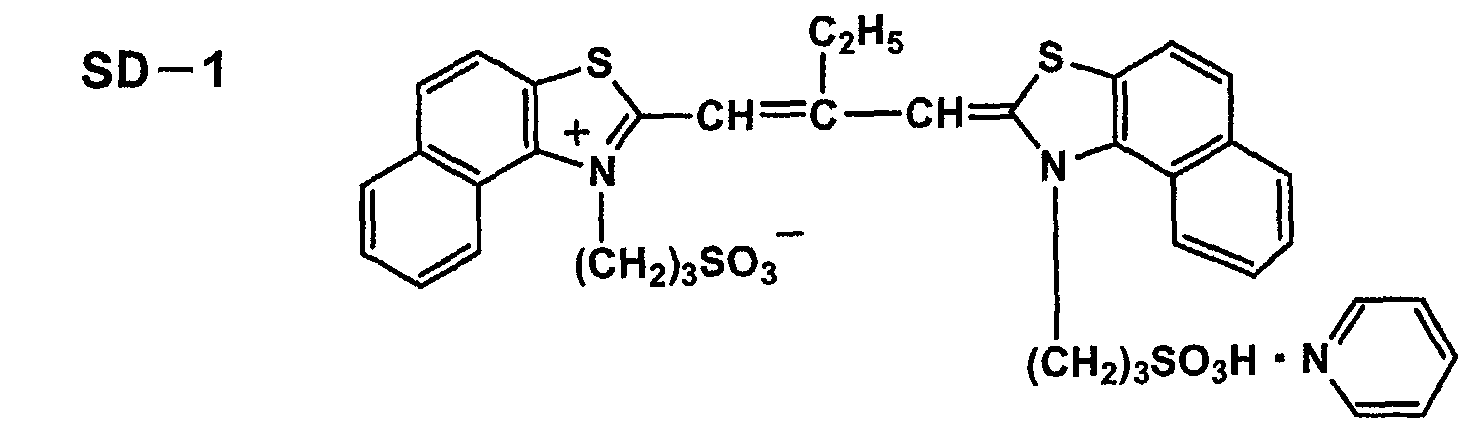
| SD-1 | 2.2 x 10⁻⁵ |
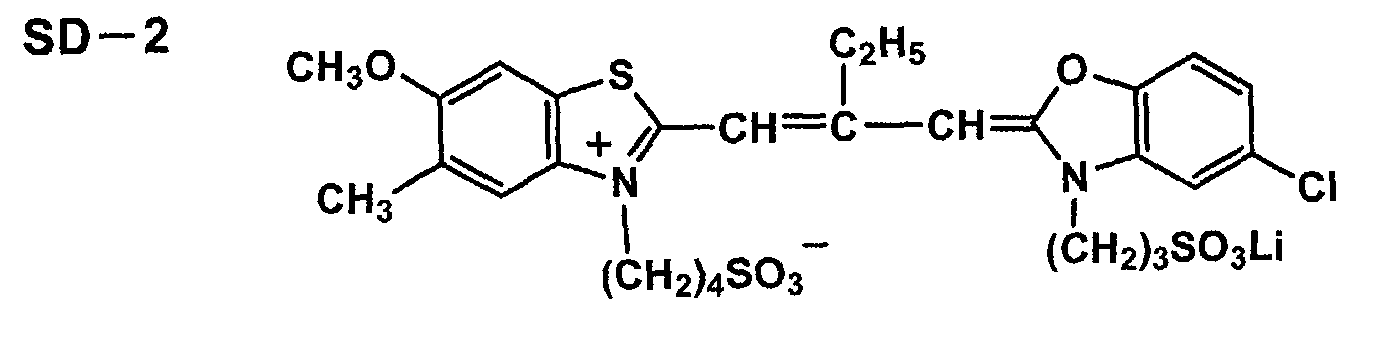
| SD-2 | 5.9 x 10⁻⁵ |
| SD-3 | 1.2 x 10⁻⁴ |
| SD-5 | 2.8 x 10⁻⁴ |
| C-1 | 0.19 |
| CC-1 | 0.003 |
| OIL-2 | 0.096 |
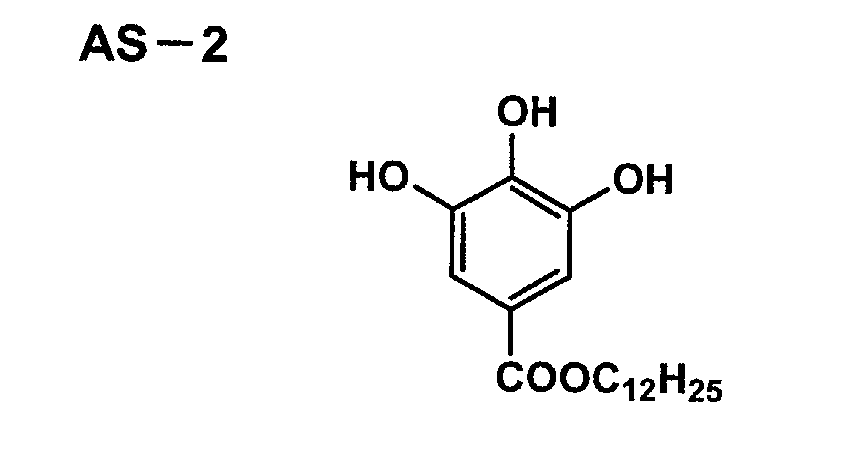
| AS-2 | 0.001 |
| Gelatin | 0.44 |
| 4th Layer: Medium-speed Red-sensitive Layer | |
| Silver iodobromide emulsion b | 0.28 |
| Silver iodobromide emulsion c | 0.34 |
| Silver iodobromide emulsion d | 0.50 |
| SD-1 | 1.8 x 10⁻⁵ |
| SD-3 | 2.6 x 10⁻⁴ |
| SD-5 | 2.8 x 10⁻⁴ |
| C-1 | 0.74 |
| CC-1 | 0.081 |
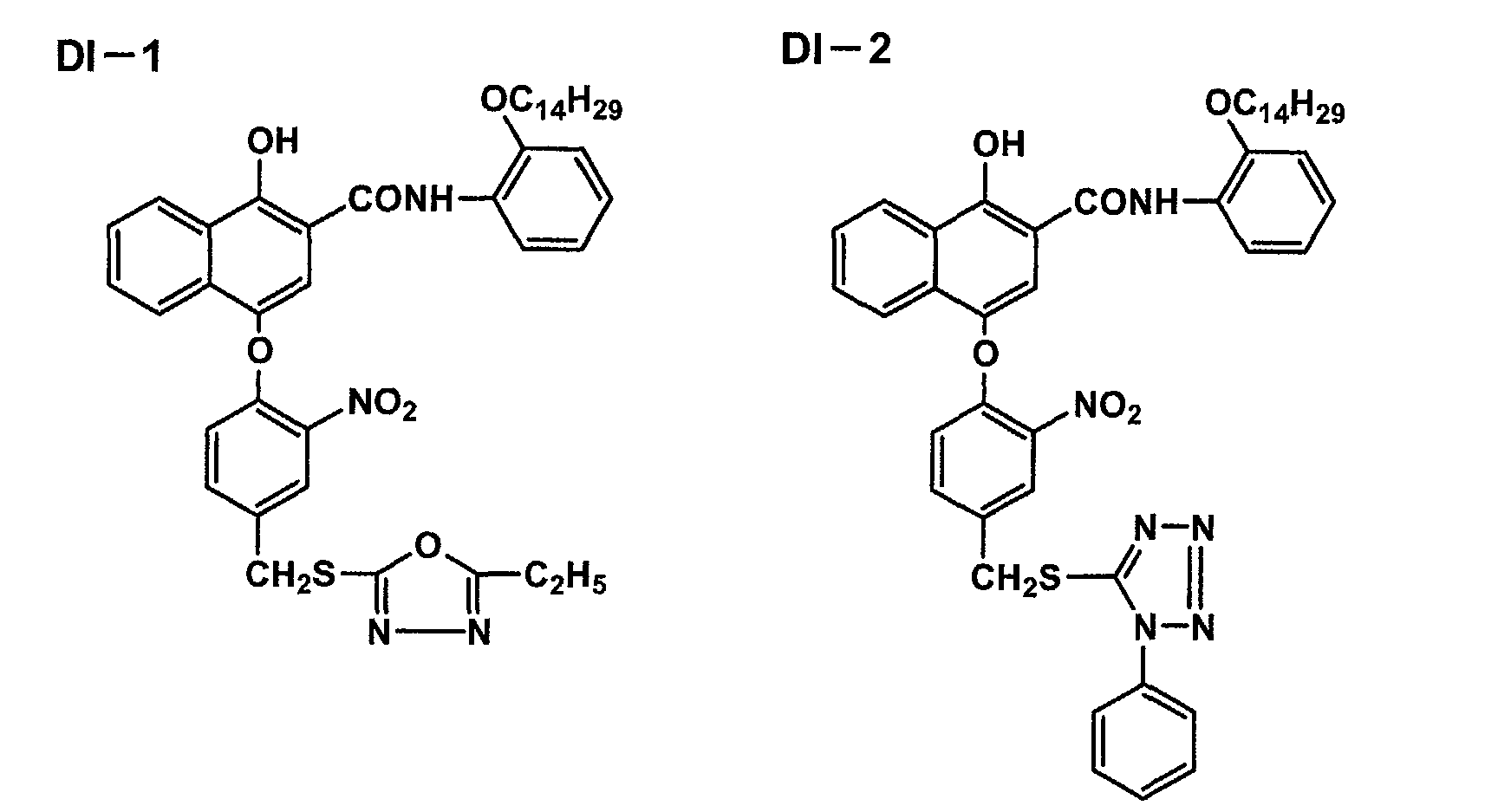
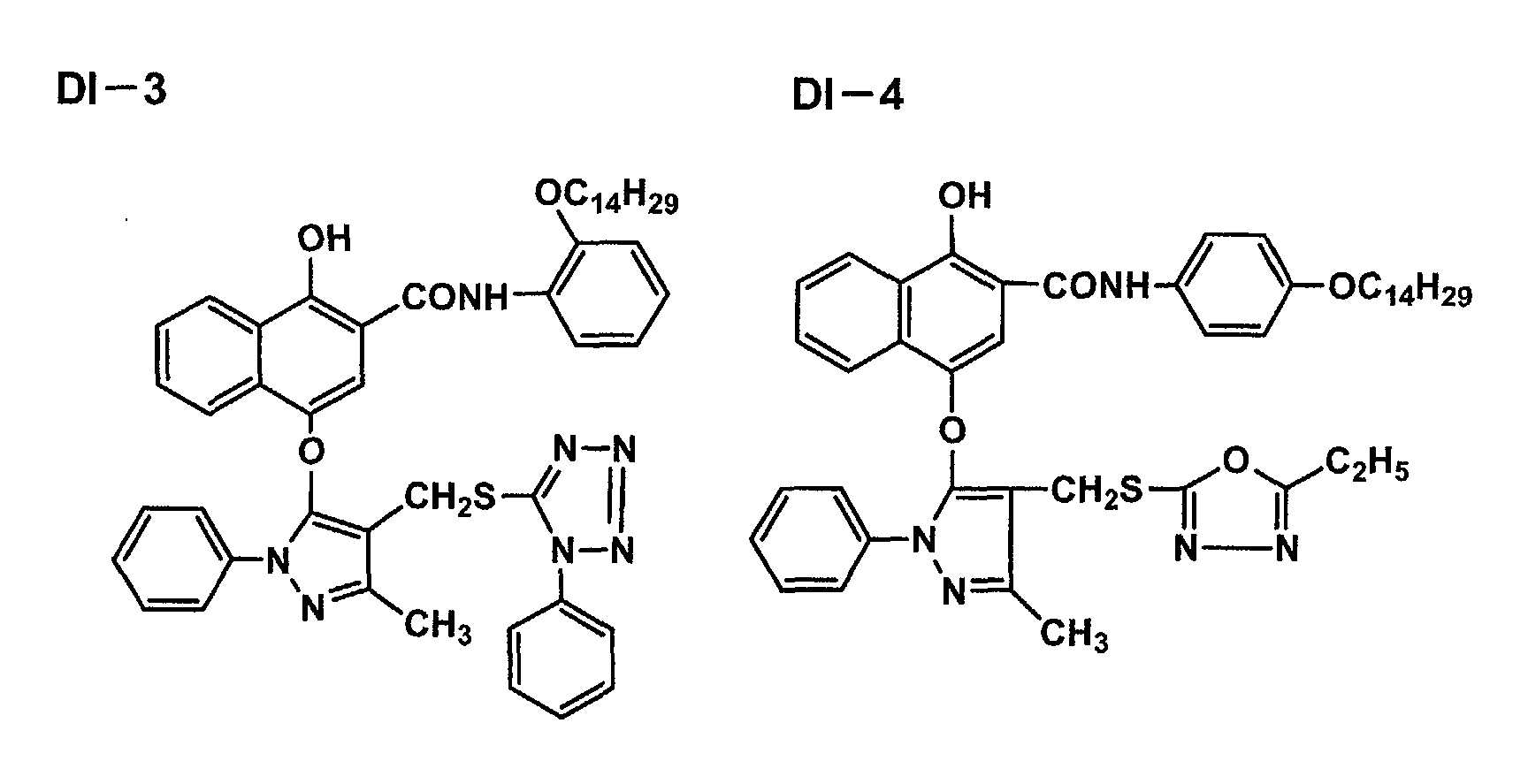
| DI-1 | 0.020 |
| DI-4 | 0.008 |
| OIL-2 | 0.42 |
| AS-2 | 0.003 |
| Gelatin | 1.95 |
| 5th Layer: High-speed Red-Sensitive Layer | |
| Silver iodobromide emulsion a | 1.45 |
| Silver iodobromide emulsion e | 0.076 |
| SD-1 | 2.3 x 10⁻⁵ |
| SD-2 | 1.1 x 10⁻⁴ |
| SD-3 | 2.3 x 10⁻⁵ |
| C-2 | 0.087 |
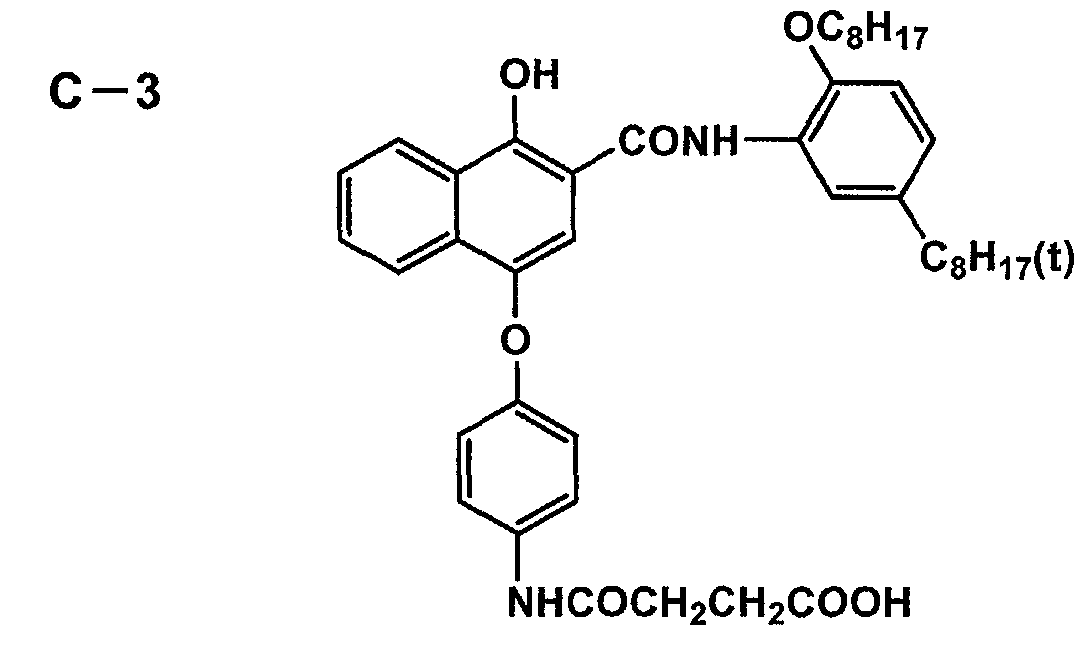
| C-3 | 0.12 |
| CC-1 | 0.036 |
| DI-1 | 0.021 |
| DI-3 | 0.005 |
| OIL-2 | 0.15 |
| AS-2 | 0.004 |
| Gelatin | 1.40 |
| 6th Layer: Interlayer | |
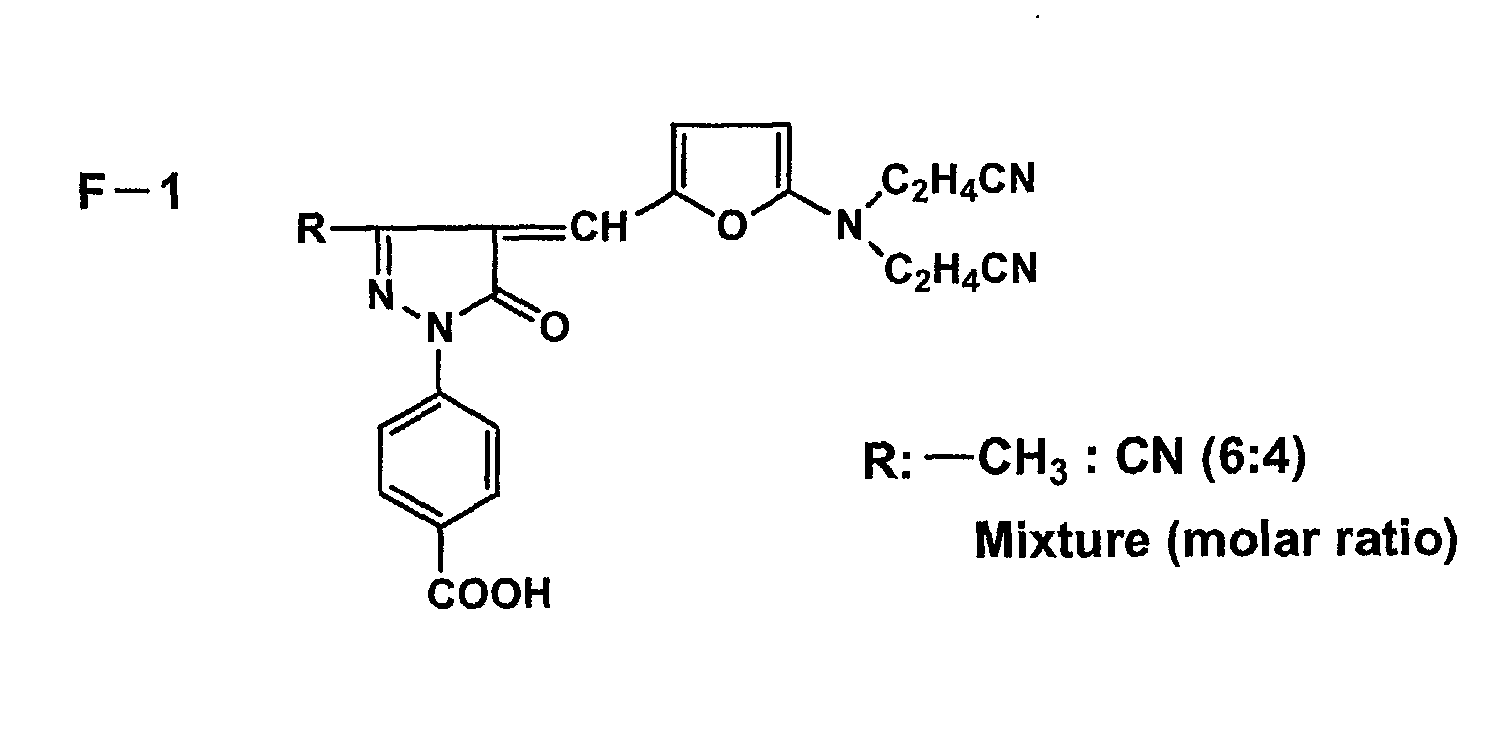
| F-1 | 0.03 |
| AS-1 | 0.18 |
| OIL-1 | 0.22 |
| Gelatin | 1.00 |
| 7th Layer: Low-speed Green-Sensitive Layer | |
| Silver iodobromide emulsion c | 0.22 |
| Silver iodobromide emulsion e | 0.22 |
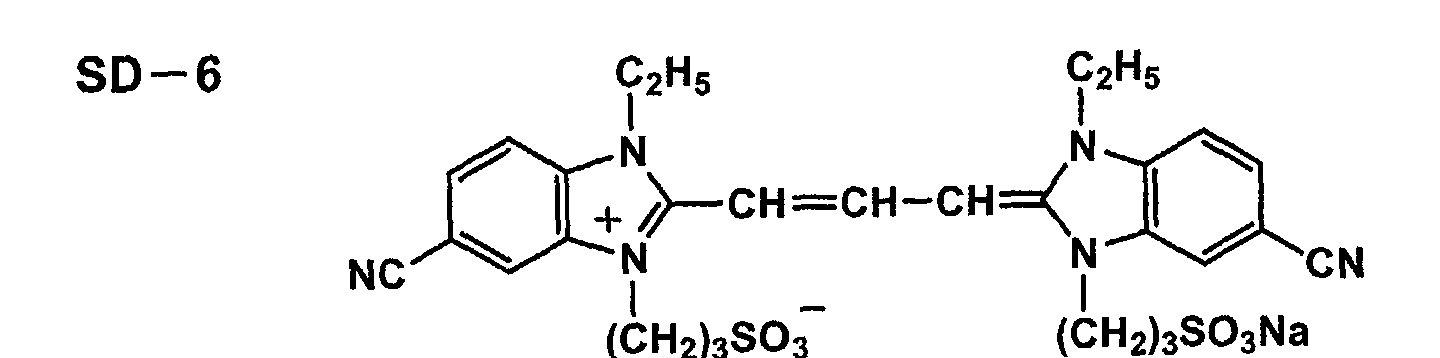
| SD-6 | 4.7 x 10⁻⁵ |
| SD-7 | 2.6 x 10⁻⁴ |
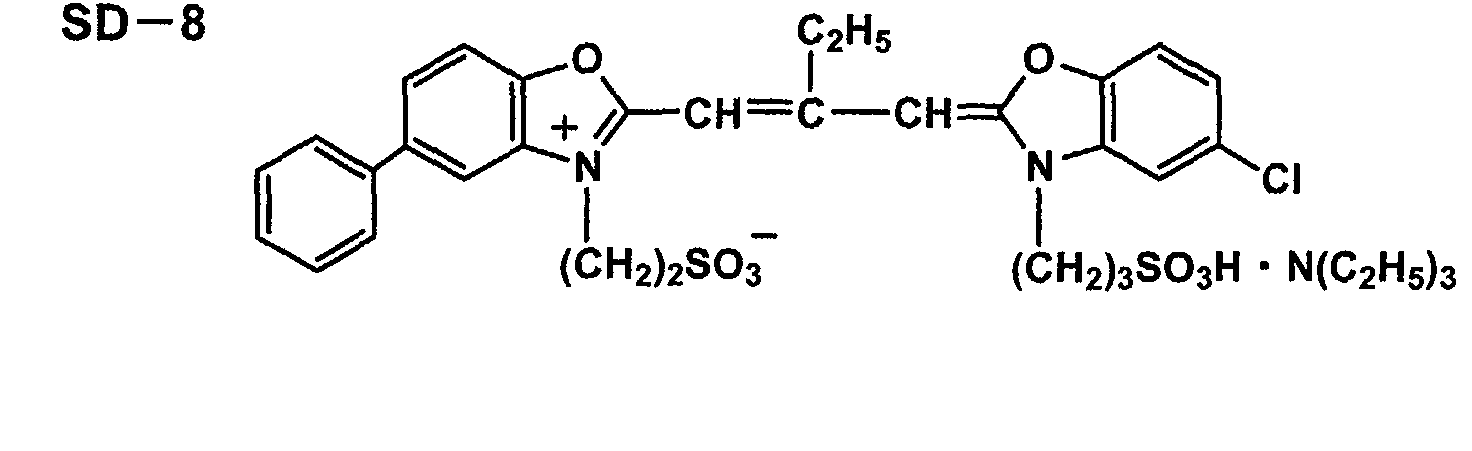
| SD-8 | 1.9 x 10⁻⁴ |
| SD-9 | 1.1 x 10⁻⁴ |
| SD-10 | 2.4 x 10⁻⁵ |
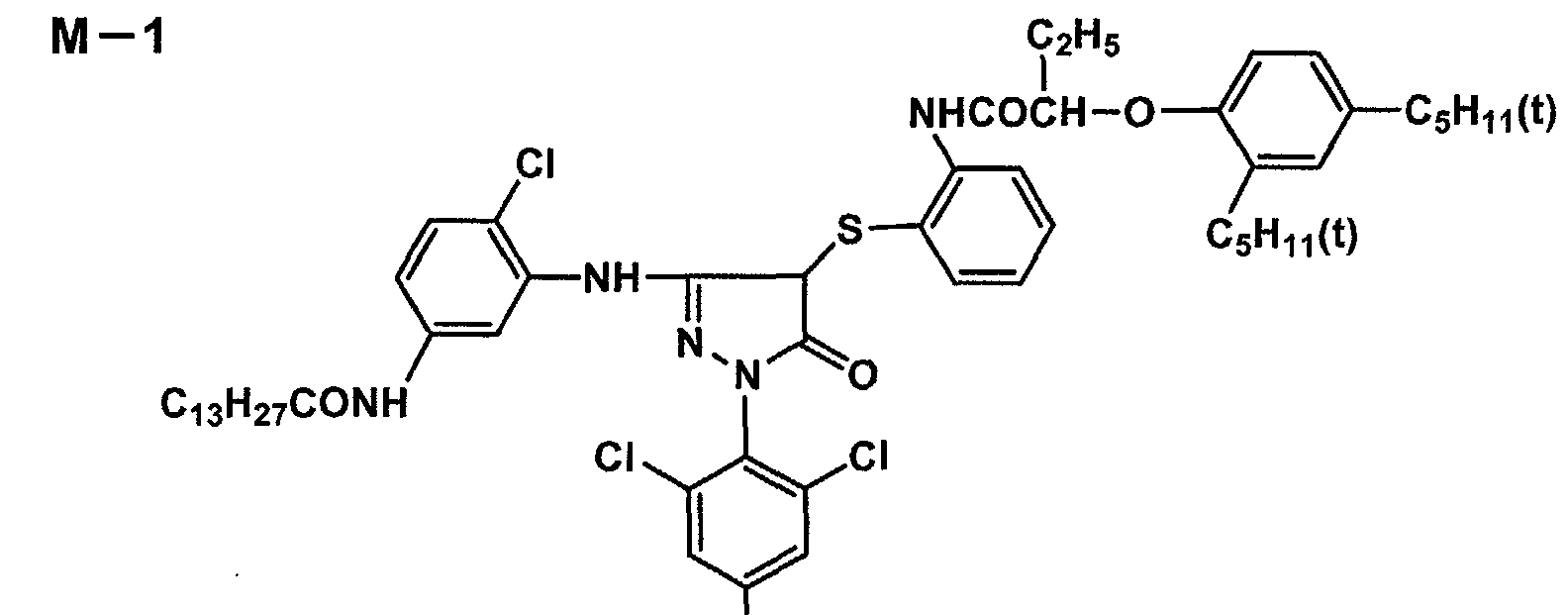
| M-1 | 0.35 |
| CM-1 | 0.044 |
| DI-2 | 0.010 |
| OIL-1 | 0.41 |
| AS-2 | 0.001 |
| AS-3 | 0.11 |
| Gelatin | 1.29 |
| 8th Layer: Medium-speed Green-Sensitive Layer | |
| Silver iodobromide emulsion b | 0.90 |
| Silver iodobromide emulsion e | 0.048 |
| SD-6 | 3.8 x 10⁻⁵ |
| SD-7 | 2.6 x 10⁻⁵ |
| SD-8 | 3.4 x 10⁻⁴ |
| SD-9 | 1.6 x 10⁻⁴ |
| SD-10 | 4.4 x 10⁻⁵ |
| M-1 | 0.15 |
| CM-1 | 0.062 |
| CM-2 | 0.030 |
| DI-2 | 0.032 |
| OIL-1 | 0.28 |
| AS-2 | 0.005 |
| AS-3 | 0.045 |
| Gelatin | 1.00 |
| 9th Layer: High-speed Green-Sensitive Layer | |
| Silver iodobromide emulsion a | 1.39 |
| Silver iodobromide emulsion e | 0.073 |
| SD-6 | 4.1 x 10⁻⁵ |
| SD-7 | 2.6 x 10⁻⁵ |
| SD-8 | 3.7 x 10⁻⁴ |
| SD-10 | 4.9 x 10⁻⁵ |
| M-1 | 0.071 |
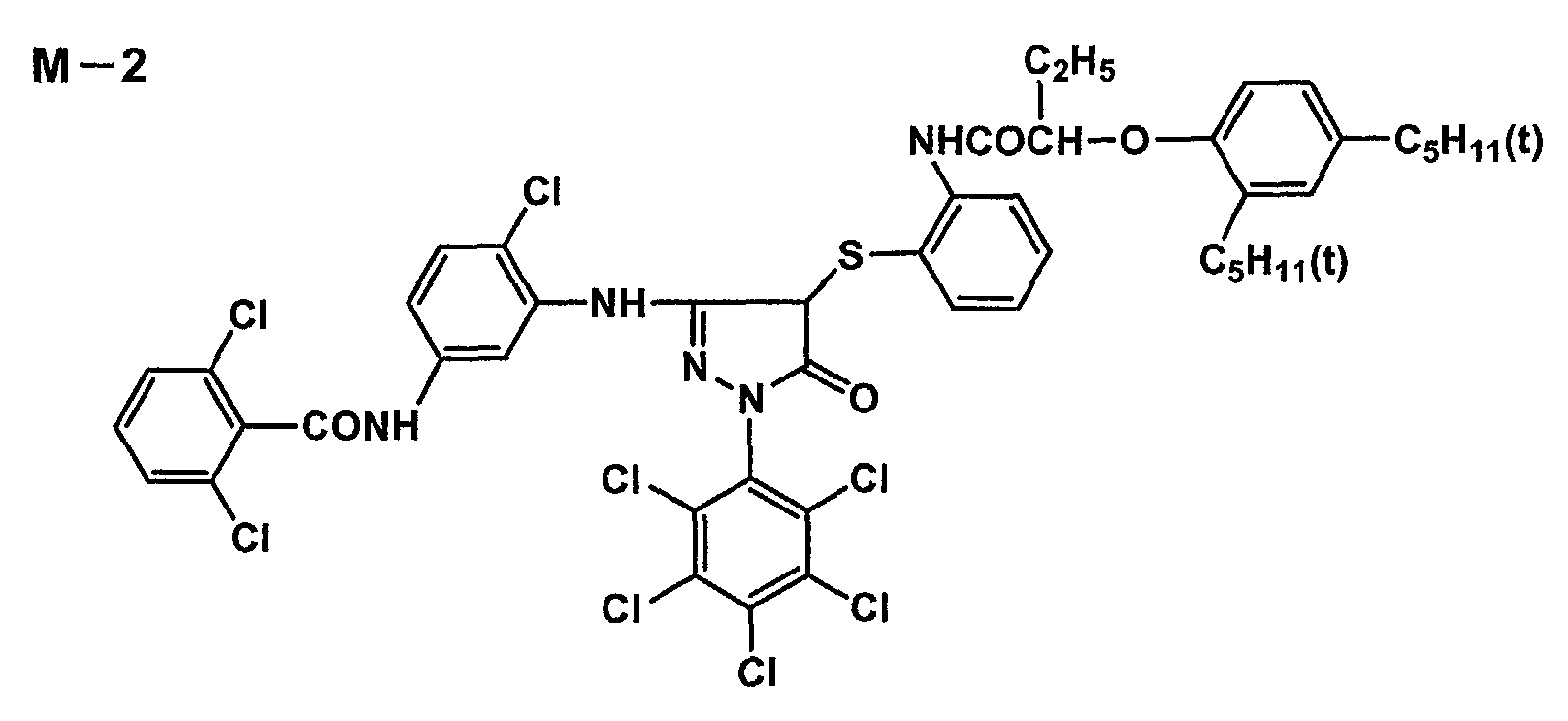
| M-2 | 0.073 |
| CM-2 | 0.013 |
| DI-2 | 0.004 |
| DI-3 | 0.003 |
| OIL-1 | 0.27 |
| AS-2 | 0.008 |
| AS-3 | 0.043 |
| Gelatin | 1.35 |
| 10th Layer: Yellow Filter Layer | |
| Yellow colloidal silver | 0.053 |
| AS-1 | 0.15 |
| OIL-1 | 0.18 |
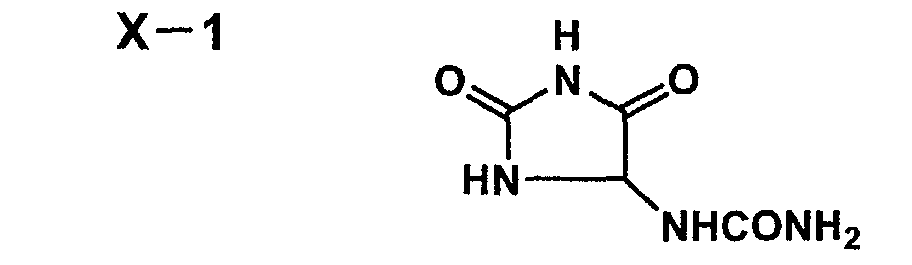
| X-1 | 0.06 |
| Gelatin | 0.83 |
| 11th Layer: Low-speed Blue-sensitive Layer | |
| Silver iodobromide emulsion g | 0.22 |
| Silver iodobromide emulsion h | 0.099 |
| Silver iodobromide emulsion i | 0.17 |
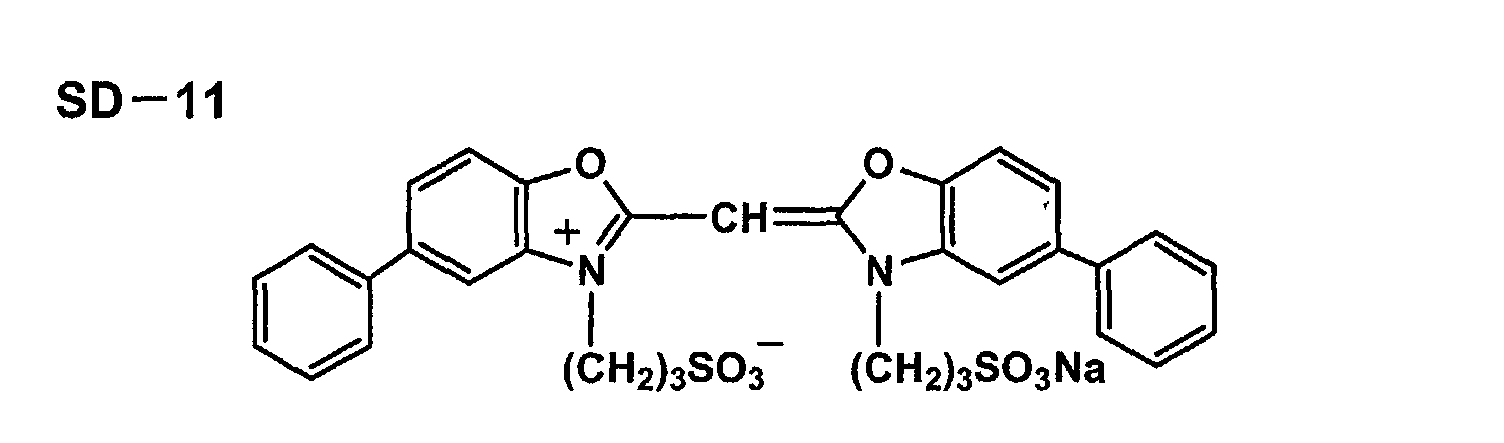
| SD-11 | 2.4 x 10⁻⁴ |
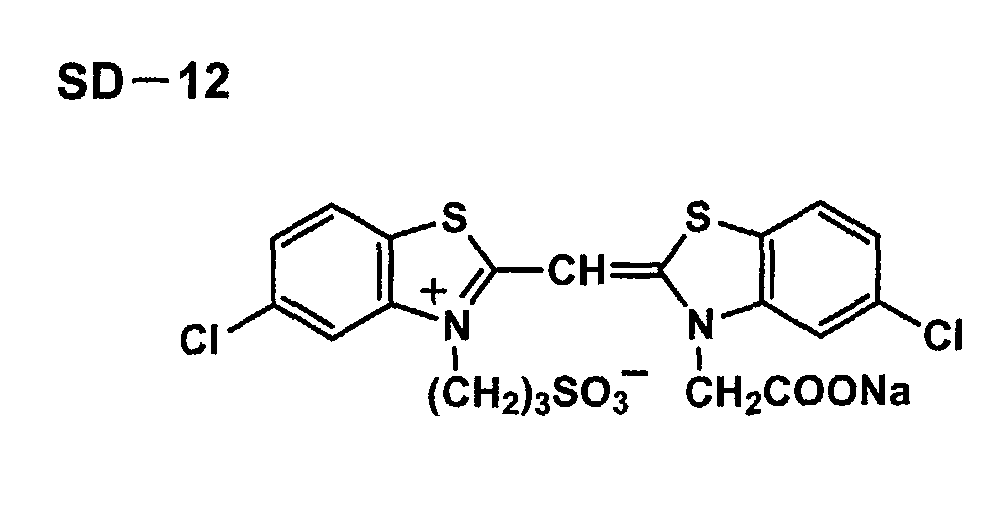
| SD-12 | 5.7 x 10⁻⁴ |
| SD-13 | 1.3 x 10⁻⁴ |
| Y-1 | 1.02 |
| OIL-1 | 0.42 |
| AS-2 | 0.003 |
| X-1 | 0.11 |
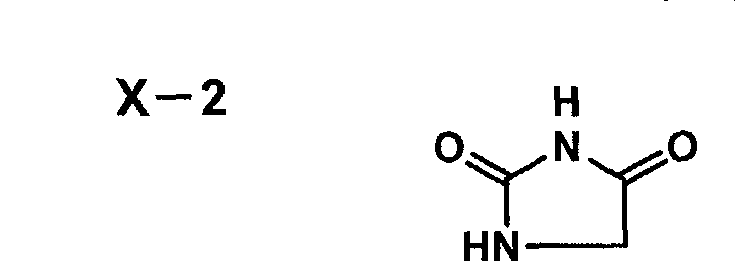
| X-2 | 0.18 |
| Gelatin | 1.95 |
| 12th Layer: High-sped Blue-sensitive Layer | |
| Silver iodobromide emulsion f | 1.52 |
| SD-11 | 8.3 x 10⁻⁵ |
| SD-12 | 2.3 x 10⁻⁴ |
| Y-1 | 0.22 |
| DI-5 | 0.11 |
| OIL-1 | 0.13 |
| AS-2 | 0.003 |
| X-1 | 0.15 |
| X-2 | 0.20 |
| Gelatin | 1.20 |
| 13th Layer: First Protective Layer | |
| Silver iodobromide emulsion j | 0.30 |
| UV-1 | 0.11 |
| UV-2 | 0.055 |
| Liquid paraffin | 0.28 |
| X-1 | 0.079 |
| Gelatin | 1.00 |
| 14th Layer: Second protective Layer | |
| PM-1 | 0.13 |
| PM-2 | 0.018 |
| WAX-1 | 0.021 |
| Gelatin | 0.55 |
| Emulsion | Av. grain size (µm) | Av. AgI content (mol%) | Diameter/thickness ratio |
| a | 0.85 | 4.2 | 7.0 |
| b | 0.70 | 4.2 | 6.0 |
| c | 0.50 | 4.2 | 5.0 |
| d | 0.38 | 8.0 | Octahedral, |
| twinned | |||
| e | 0.27 | 2.0 | Tetradehedral, |
| twinned | |||
| f | 1.00 | 8.0 | 4.5 |
| g | 0.74 | 3.5 | 6.2 |
| h | 0.44 | 4.2 | 6.1 |
| i | 0.30 | 1.9 | 5.5 |
| j | 0.03 | 2.0 | 1.0 |









H9C4OOC(CH2)8COOC4H9












| Step | Time | Temperature |
| Color developing | 3 min. 15 sec | 41° C |
| Bleaching | 30 sec. | 38° C |
| Fixing-1 | 45 sec. | 38° C |
| Fixing-2 | 45 sec. | 38° C |
| Stabilizing-1 | 20 sec. | 38° C |
| Stabilizing-2 | 20 sec. | 38° C |
| Stabilizing-3 | 20 sec. | 38° C |
| Drying | 90 sec. | 65° C |
| Color developing solution (for 1 lit.) | |
| Sodium sulfite | 5.0 g |
| Potassium carbonate | 45.0 g |
| Sodium diethylenetriaminepentaacetate | 4.0 g |
| Hydroxylamine sulfate | 3.0 g |
| Potassium bromide | 1.5 g |
| 2-Methylbenzimidazole | 0.1 g |
| Polyvinyl pyrrolidone K-17 | 2.0 g |
| Potassium iodide | 2.0 mg |
| 4-Amino-3-methyl-N-ethyl-(β-hydroxyethyl)-aniline sulfate | 10.2 g |
| Water was added to make 1 lit. and the pH was adjusted to 10.30 using potassium hydroxide or 50% sulfuric acid. |
| Bleaching solution (for 1 lit.) | |
| Sample solution B1 to B4 (Table 16) | 500 ml |
| Water to make | 1 lit. |
| Fixing solution (for 1 lit.) | |
| Ammonium thiosulfate | 100 g |
| Sodium thiosulfate | 10 g |
| Sodium sulfite | 12 g |
| Disodium ethylenediaminetetraacetate | 2 g |
| Water was added to make 1 lit. and the pH was adjusted to 7.5 using ammonia water or 50% sulfuric acid. |
| Stabilizing solution (for 1 lit.) | |
| m-Hydroxybenzaldehyde | 1.5 g |
| Disodium ethylenediaminetetraacetate | 0.6 g |
| β-cyclodextrin | 0.2 g |
| Potassium carbonate | 0.2 g |
| Water was added to make 1 lit. and the pH was adjusted to 8.0 using potassium hydroxide or 50% sulfuric acid. |
| Processing No. | Bleach Sample Solution | Retained Silver (mg/m2) | Storage Stability | Remark |
| 9-1 | B-1 | 0.3 | No precipitate | Inv. |
| 9-2 | B-2 | 0.9 | Precipitate | Comp. |
| 9-3 | B-3 | 1.1 | Precipitate | Comp. |
| 9-4 | B-4 | 1.2 | Precipitate | Comp. |
Claims (19)
- A method for preparing a kit part of a bleach-fixing solution for use in silver halide color photographic materials comprising the steps of:(a) adding a [S,S]-alkylenediamine-N,N'-disuccinic acid or its salt into a mixing tank to form a solution, and then(b) adding thereto at least one iron(III) salt selected from the group consisting of iron(III) nitrate, iron(III) chloride, iron(III) bromide, (M1)3Fe(III) (SO4)3 and M1Fe(III) (SO4)2, in which M1 represents a hydrogen, sodium or potassium or an ammonium, while stirring.
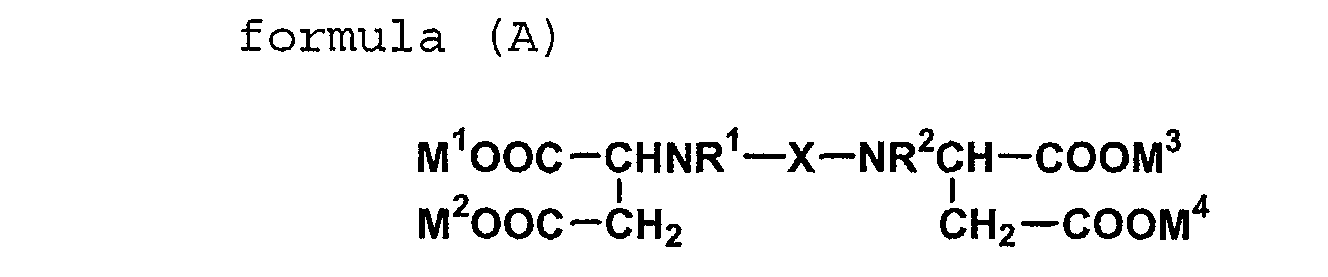
- The method of claim 1, wherein the [S,S]-alkylenediamine-N,N'-disuccinic acid is a compound represented by the following formula (A):wherein M1, M2, M3 and M4 each represent a hydrogen atom, an alkali metal or a cation; X represents an alkylene group having 2 to 6 carbon atoms or -(B1O)n-B2-, in which B1 and B2 each represent an alkylene group having 1 to 5 carbon atoms and n is an integer of 1 to 6; R1 and R2 each represent a hydrogen atom or an alkyl group having 1 to 3 carbon atoms.
- The method of claim 1 or 2, wherein the solution formed in the step (a) has a pH of 6.0 to 10.0.
- The method of claim 1, 2 or 3, wherein the kit part of a bleach-fixing solution exhibits a pH of 3.5 to 6.0.
- The method as claimed in any of claim 1 through 4,
wherein the kit part of a bleach-fixing solution contains a compound represented by the following formula (1) :
MOOC-(Z)k-(X)n - The method as claimed in any of claims 1 through 5,
wherein the kit part of a bleach-fixing solution contains an alkylenediamine-N-monosuccinic acid or its salt. - The method of claim 6, wherein the alkylenediamine-N-monosuccinic acid is represented by the following formula (B) :wherein M1 and M2 each represent a hydrogen atom, alkali metal atom or a cation; X represents an alkylene group having 2 to 6 carbon atoms or -(B1O)n-B2-, in which B1 and B2 is an alkylene group having 1 to 5 carbon atoms and n is an integer of 1 to 6; R1 and R2 each represent a hydrogen atom or an alkyl group having 1 to 3 carbon atoms.
- The method of claim 1, wherein in the step (b), stirring is performed by propeller stirring or circulation stirring, wherein the propeller stirring is performed using a rotary blade having a turning radius of not less than 1/4 of the radius of the mixing tank at a stirring rate of 50 to 120 r.p.m, and the circulation stirring being performed at a circulation rate of 2.0 to 5.5 cycles/min.
- The method of claim as claimed in any of claims 1 through 8, wherein the molar ratio of the [S,S]-alkylenediamine-N,N'-disuccinic acid or its salt to the iron(III) salt is 1.00 to 1.10.
- A method for preparing a kit of a bleaching solution for use in silver halide color photographic materials comprising the steps of:(a) adding a [S,S]-alkylenediamine-N,N'-disuccinic acid or its salt into a mixing tank to form a solution, and then(b) adding thereto at least one iron(III) salt selected from the group consisting of iron(III) nitrate, iron(III) chloride, iron(III) bromide, (M1)3Fe(III) (SO4)3 and M1Fe(III) (SO4)2, in which M1 represents a hydrogen, sodium or potassium or an ammonium, while stirring.
- The method of claim 10, wherein the [S,S]-alkylenediamine-N,N'-disuccinic acid is a compound represented by the following formula (A):wherein M1, M2, M3 and M4 each represent a hydrogen atom, an alkali metal or a cation; X represents an alkylene group having 2 to 6 carbon atoms or -(B1O)n-B2-, in which B1 and B2 each represent an alkylene group having 1 to 5 carbon atoms and n is an integer of 1 to 6; R1 and R2 each represent a hydrogen atom or an alkyl group having 1 to 3 carbon atoms.

- The method of claim 10 or 11, wherein the solution formed in the step (a) has a pH of 6.0 to 10.0.
- The method of claim 10, 11 or 12, wherein the kit of a bleaching solution exhibits a pH of 3.5 to 6.0.
- The method as claimed in any of claim 10 through 13, wherein the kit part of a bleaching solution contains a compound represented by the following formula (1) :
MOOC-(Z)k-(X)n - The method as claimed in any of claims 10 through 14, wherein the kit of a bleaching solution contains an alkylenediamine-N-monosuccinic acid or its salt.
- The method of claim 15, wherein the
alkylenediamine-N-monosuccinic acid is represented by the following formula (B):wherein M1 and M2 each represent a hydrogen atom, alkali metal atom or a cation; X represents an alkylene group having 2 to 6 carbon atoms or -(B1O)n-B2-, in which B1 and B2 is an alkylene group having 1 to 5 carbon atoms and n is an integer of 1 to 6; R1 and R2 each represent a hydrogen atom or an alkyl group having 1 to 3 carbon atoms.
- The method of claim 10, wherein in the step (b), stirring is performed by propeller stirring or circulation stirring, wherein the propeller stirring is performed using a rotary blade having a turning radius of not less than 1/4 of the radius of the mixing tank at a stirring rate of 50 to 120 r.p.m, and the circulation stirring being performed at a circulation rate of 2.0 to 5.5 cycles/min.
- The method as claimed in any of claims 10 through 17, wherein the molar ratio of the [S,S]-alkylenediamine-N,N'-disuccinic acid or its salt to the iron(III) salt is 1.00 to 1.10.
- A method for processing a silver halide color photographic material comprising the steps of:wherein the bleach-fixing solution and bleaching solution are prepared using a kit part prepared by the method as claimed in claim 1 and using a kit prepared by the method as claimed in claim 10, respectively.subjecting the photographic material to light-exposure,subjecting the exposed photographic material to color-developing, andsubjecting the developed photographic material to bleach-fixing or bleaching with a bleach-fixing solution or a bleaching solution, respectively,
Applications Claiming Priority (2)
| Application Number | Priority Date | Filing Date | Title |
|---|---|---|---|
| JP2001109800A JP2002303960A (en) | 2001-04-09 | 2001-04-09 | Method for producing kit part for bleach fixing solution and bleaching solution kit for silver halide color photographic sensitive material and processing method for silver halide color photographic sensitive material |
| JP2001109800 | 2001-04-09 |
Publications (2)
| Publication Number | Publication Date |
|---|---|
| EP1249730A1 true EP1249730A1 (en) | 2002-10-16 |
| EP1249730B1 EP1249730B1 (en) | 2004-10-13 |
Family
ID=18961691
Family Applications (1)
| Application Number | Title | Priority Date | Filing Date |
|---|---|---|---|
| EP02007726A Expired - Lifetime EP1249730B1 (en) | 2001-04-09 | 2002-04-05 | Method for preparing kit part for bleach-fixing solutions and kit for bleaching solutions for use in silver halide color photographic materials and method for processing silver halide color photographic materials |
Country Status (5)
| Country | Link |
|---|---|
| US (1) | US6682880B2 (en) |
| EP (1) | EP1249730B1 (en) |
| JP (1) | JP2002303960A (en) |
| CN (1) | CN1237392C (en) |
| DE (1) | DE60201549T2 (en) |
Families Citing this family (2)
| Publication number | Priority date | Publication date | Assignee | Title |
|---|---|---|---|---|
| US12566174B2 (en) | 2017-05-11 | 2026-03-03 | The Research Foundation For The State University Of New York | Method and kit for determining the presence of monosodium urate crystals in joint synovial fluid |
| US11174235B2 (en) * | 2018-06-14 | 2021-11-16 | Championx Usa Inc. | Carboxy alkyl-ester anti-agglomerants for the control of natural gas hydrates |
Citations (2)
| Publication number | Priority date | Publication date | Assignee | Title |
|---|---|---|---|---|
| US5521056A (en) * | 1995-01-10 | 1996-05-28 | Eastman Kodak Company | Photographic peracid bleaching composition and processing method using ternary iron carboxylate complexes as catalysts in peracid bleaching solutions |
| US5679817A (en) * | 1994-07-25 | 1997-10-21 | Nitto Chemical Industry Co., Ltd. | Alkylenediamine-N,N'-disuccinic acid iron (III) complex salts and process for production thereof |
Family Cites Families (2)
| Publication number | Priority date | Publication date | Assignee | Title |
|---|---|---|---|---|
| JP3086979B2 (en) * | 1992-02-17 | 2000-09-11 | コニカ株式会社 | Bleaching solution or bleach-fixing solution and processing method of silver halide color photographic light-sensitive material using these processing solutions |
| US5652085A (en) * | 1995-08-30 | 1997-07-29 | Eastman Kodak Company | Succinic acid derivative degradable chelants, uses and composition thereof |
-
2001
- 2001-04-09 JP JP2001109800A patent/JP2002303960A/en not_active Withdrawn
-
2002
- 2002-04-03 US US10/115,608 patent/US6682880B2/en not_active Expired - Fee Related
- 2002-04-05 DE DE60201549T patent/DE60201549T2/en not_active Expired - Fee Related
- 2002-04-05 CN CN02106157.2A patent/CN1237392C/en not_active Expired - Fee Related
- 2002-04-05 EP EP02007726A patent/EP1249730B1/en not_active Expired - Lifetime
Patent Citations (2)
| Publication number | Priority date | Publication date | Assignee | Title |
|---|---|---|---|---|
| US5679817A (en) * | 1994-07-25 | 1997-10-21 | Nitto Chemical Industry Co., Ltd. | Alkylenediamine-N,N'-disuccinic acid iron (III) complex salts and process for production thereof |
| US5521056A (en) * | 1995-01-10 | 1996-05-28 | Eastman Kodak Company | Photographic peracid bleaching composition and processing method using ternary iron carboxylate complexes as catalysts in peracid bleaching solutions |
Also Published As
| Publication number | Publication date |
|---|---|
| DE60201549D1 (en) | 2004-11-18 |
| US6682880B2 (en) | 2004-01-27 |
| DE60201549T2 (en) | 2005-10-20 |
| CN1380582A (en) | 2002-11-20 |
| CN1237392C (en) | 2006-01-18 |
| JP2002303960A (en) | 2002-10-18 |
| US20030087207A1 (en) | 2003-05-08 |
| EP1249730B1 (en) | 2004-10-13 |
Similar Documents
| Publication | Publication Date | Title |
|---|---|---|
| JP2896541B2 (en) | Processing solution for silver halide photographic materials | |
| EP0219113B1 (en) | Method of processing silver halide color photographic material | |
| JP2648913B2 (en) | Processing method of silver halide color photographic light-sensitive material | |
| DE2707989A1 (en) | COLOR DEVELOPER AND PROCESS FOR DEVELOPING EXPOSED SILVER HALOGENIDE CONTAINING COLOR MATERIAL | |
| JPH0193740A (en) | Processing method for silver halide color photosensitive material | |
| JPH0667370A (en) | Processing solution for silver halide photographic sensitive material | |
| JP3009432B2 (en) | Processing method of silver halide color photographic light-sensitive material | |
| DE69130091T2 (en) | Process for processing color photographic light-sensitive silver halide materials | |
| EP1249730B1 (en) | Method for preparing kit part for bleach-fixing solutions and kit for bleaching solutions for use in silver halide color photographic materials and method for processing silver halide color photographic materials | |
| JP2867048B2 (en) | Processing method of silver halide color photographic light-sensitive material | |
| JP2990311B2 (en) | Processing method of silver halide color photographic light-sensitive material | |
| JPS6374060A (en) | Method for processing silver halide photographic sensitive material | |
| US20050244762A1 (en) | Method for reducing sensitizing dye stain | |
| DE3784132T2 (en) | METHOD FOR TREATING COLOR PHOTOGRAPHIC SILVER HALOGENIDE MATERIAL AND PHOTOGRAPHIC COLOR DEVELOPING COMPOSITION. | |
| JP2867050B2 (en) | Processing method of silver halide color photographic light-sensitive material | |
| DE69226489T2 (en) | Process for producing color photographic silver halide images | |
| JP3172899B2 (en) | Processing solutions for silver halide photographic materials and processing solutions having bleaching ability | |
| EP0465076A1 (en) | A method for processing silver halide colour photographic light-sensitive materials | |
| JPH0376733B2 (en) | ||
| JPH01186942A (en) | Image forming method | |
| JPH04356044A (en) | Method for rapid formation of color photographic picture image excellent in processing stability | |
| JP2002090961A (en) | Processing agent composition for silver halide photographic sensitive material, color developing solution, bleaching solution, bleaching fixing solution, fixing solution and stabilizing solution | |
| DE3942243A1 (en) | COLOR DEVELOPMENT PROCESS | |
| JPS6374059A (en) | Method for processing silver halide photographic sensitive material | |
| JPH01200252A (en) | Processing method for silver halide color photographic sensitive material |
Legal Events
| Date | Code | Title | Description |
|---|---|---|---|
| PUAI | Public reference made under article 153(3) epc to a published international application that has entered the european phase |
Free format text: ORIGINAL CODE: 0009012 |
|
| AK | Designated contracting states |
Kind code of ref document: A1 Designated state(s): AT BE CH CY DE DK ES FI FR GB GR IE IT LI LU MC NL PT SE TR |
|
| AX | Request for extension of the european patent |
Free format text: AL;LT;LV;MK;RO;SI |
|
| 17P | Request for examination filed |
Effective date: 20030404 |
|
| AKX | Designation fees paid |
Designated state(s): BE DE GB |
|
| 17Q | First examination report despatched |
Effective date: 20030718 |
|
| GRAP | Despatch of communication of intention to grant a patent |
Free format text: ORIGINAL CODE: EPIDOSNIGR1 |
|
| GRAS | Grant fee paid |
Free format text: ORIGINAL CODE: EPIDOSNIGR3 |
|
| GRAA | (expected) grant |
Free format text: ORIGINAL CODE: 0009210 |
|
| AK | Designated contracting states |
Kind code of ref document: B1 Designated state(s): BE DE GB |
|
| PG25 | Lapsed in a contracting state [announced via postgrant information from national office to epo] |
Ref country code: BE Free format text: LAPSE BECAUSE OF FAILURE TO SUBMIT A TRANSLATION OF THE DESCRIPTION OR TO PAY THE FEE WITHIN THE PRESCRIBED TIME-LIMIT Effective date: 20041013 |
|
| REG | Reference to a national code |
Ref country code: GB Ref legal event code: FG4D |
|
| REG | Reference to a national code |
Ref country code: IE Ref legal event code: FG4D |
|
| REF | Corresponds to: |
Ref document number: 60201549 Country of ref document: DE Date of ref document: 20041118 Kind code of ref document: P |
|
| PLBE | No opposition filed within time limit |
Free format text: ORIGINAL CODE: 0009261 |
|
| STAA | Information on the status of an ep patent application or granted ep patent |
Free format text: STATUS: NO OPPOSITION FILED WITHIN TIME LIMIT |
|
| 26N | No opposition filed |
Effective date: 20050714 |
|
| PGFP | Annual fee paid to national office [announced via postgrant information from national office to epo] |
Ref country code: DE Payment date: 20090402 Year of fee payment: 8 |
|
| PGFP | Annual fee paid to national office [announced via postgrant information from national office to epo] |
Ref country code: GB Payment date: 20090401 Year of fee payment: 8 |
|
| GBPC | Gb: european patent ceased through non-payment of renewal fee |
Effective date: 20100405 |
|
| PG25 | Lapsed in a contracting state [announced via postgrant information from national office to epo] |
Ref country code: DE Free format text: LAPSE BECAUSE OF NON-PAYMENT OF DUE FEES Effective date: 20101103 |
|
| PG25 | Lapsed in a contracting state [announced via postgrant information from national office to epo] |
Ref country code: GB Free format text: LAPSE BECAUSE OF NON-PAYMENT OF DUE FEES Effective date: 20100405 |