EP1249694A2 - Verfahren zur Bestimmung des elasto-plastischen Verhaltens von aus anisotropem Material bestehenden Bauteilen sowie Anwendung des Verfahrens - Google Patents
Verfahren zur Bestimmung des elasto-plastischen Verhaltens von aus anisotropem Material bestehenden Bauteilen sowie Anwendung des Verfahrens Download PDFInfo
- Publication number
- EP1249694A2 EP1249694A2 EP02405231A EP02405231A EP1249694A2 EP 1249694 A2 EP1249694 A2 EP 1249694A2 EP 02405231 A EP02405231 A EP 02405231A EP 02405231 A EP02405231 A EP 02405231A EP 1249694 A2 EP1249694 A2 EP 1249694A2
- Authority
- EP
- European Patent Office
- Prior art keywords
- elastic
- anisotropic
- linear
- inelastic
- stress
- Prior art date
- Legal status (The legal status is an assumption and is not a legal conclusion. Google has not performed a legal analysis and makes no representation as to the accuracy of the status listed.)
- Granted
Links
Classifications
-
- G—PHYSICS
- G01—MEASURING; TESTING
- G01M—TESTING STATIC OR DYNAMIC BALANCE OF MACHINES OR STRUCTURES; TESTING OF STRUCTURES OR APPARATUS, NOT OTHERWISE PROVIDED FOR
- G01M5/00—Investigating the elasticity of structures, e.g. deflection of bridges or air-craft wings
- G01M5/0041—Investigating the elasticity of structures, e.g. deflection of bridges or air-craft wings by determining deflection or stress
-
- G—PHYSICS
- G01—MEASURING; TESTING
- G01M—TESTING STATIC OR DYNAMIC BALANCE OF MACHINES OR STRUCTURES; TESTING OF STRUCTURES OR APPARATUS, NOT OTHERWISE PROVIDED FOR
- G01M5/00—Investigating the elasticity of structures, e.g. deflection of bridges or air-craft wings
- G01M5/0016—Investigating the elasticity of structures, e.g. deflection of bridges or air-craft wings of aircraft wings or blades
Definitions
- the present invention relates to the field of analysis and prediction the behavior of mechanical components. It concerns a procedure for Determination of the elasto-plastic behavior of components according to the generic term of claim 1.
- the amplitude of the total reference strain ⁇ ⁇ , ep is used as a measure of the damage (damage law). If the required number of cycles N req is to be achieved in the component, the amplitude of the total reference strain ⁇ ⁇ , ep of the relationship must be at every location of the component (A) ⁇ ⁇ , ep ⁇ ⁇ M a ( T dam , N req ) suffice.
- ⁇ M / a is the permissible total strain amplitude, which is determined from isothermal LCF tests. It is to be determined for different temperatures and number of cycles. The temperature T dam on which the damage is based must be selected appropriately for a cycle with variable temperature.
- the object is achieved by the entirety of the features of claim 1.
- the equation according to the modified Neuber rule with an iterative process in particular a Newton iteration.
- the method for determining the service life of cyclical gas turbine components applied.
- ⁇ v, ep is the (anisotropic) reference stress.
- ⁇ pl ⁇ ⁇ ⁇ 2 ⁇ , ep ⁇ ⁇ ep with the 'direction vector' and the 'reference strain' (7)
- ⁇ ⁇ ⁇ e R , ⁇ 2 ⁇ , ep ⁇ 2 0 n -1
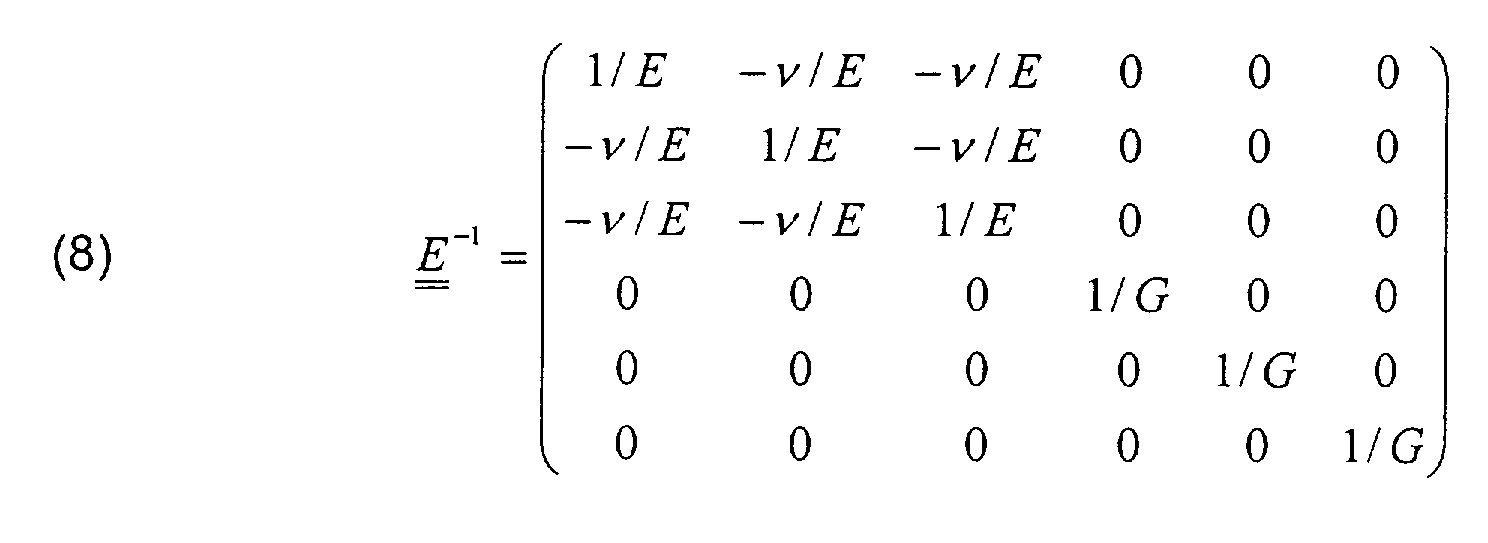
- the linear-elastic material equation is used for the single-crystal materials of interest here with cubic symmetry E, G and ⁇ are the three independent elastic material constants for cubically symmetrical (single crystal) materials.
- ⁇ ep and ⁇ ep are the strains and stresses estimated according to the anisotropic Neuber rule.
- ⁇ * and ⁇ * are the strains and stresses determined with the linear FE calculation.
- ⁇ * 2 ⁇ 2 ep + ⁇ 2 ep D ⁇ e e R ⁇ D ⁇ * 2 v ⁇ * 2 ⁇ ⁇ 2 ep ⁇ 2 0 , ⁇ * 2 ⁇ ⁇ * 2 n -1
- the inelastic correction term (21) ⁇ * 2 ⁇ ⁇ * 2 is also a scalar quantity, which can be determined from the elastic stresses together with the anisotropic parameters (Hill's constants F, G, ).
- the above equation (19) for ⁇ 2 / ep can be solved with an iterative process (Newton iteration) as in the case of the 'classic' Neuber rule. If ⁇ 2 / ep is determined, D can be used to calculate the elastoplastic stress vector immediately.
Landscapes
- Engineering & Computer Science (AREA)
- Aviation & Aerospace Engineering (AREA)
- Physics & Mathematics (AREA)
- General Physics & Mathematics (AREA)
- Investigating Strength Of Materials By Application Of Mechanical Stress (AREA)
- Control Of Turbines (AREA)
- Measuring Temperature Or Quantity Of Heat (AREA)
Abstract
Description
- ER die 'Referenz'-Steifigkeit. ER wird mitgeführt, um die formale Ähnlichkeit des Formelwerkes mit dem des bekannten isotropen Falles zu erhalten. ER wird zweckmäßigerweise in der Größenordnung der elastischen Konstanten des betrachteten Materials gewählt, z.B. ER = 100000 Nmm-2,
- Ω das plastische Potential des Materiales, aus dem durch Ableitung nach den Spannungen die plastischen Dehnungen berechnet werden,
- σ ep- = [σxx, σyy,...] der 'Vektor' der Spannungen, und
- σν,ep eine anisotrope Vergleichsspannung (s.u.).

Claims (4)
- Verfahren zur Bestimmung des elasto-plastischen Verhaltens von aus anisotropem Material bestehenden Bauteilen, insbesondere von Gasturbinenanlagen, bei hohen Temperaturen, bei welchem Verfahren zunächst das linear-elastische Verhalten bestimmt und auf der Grundlage der linear-elastischen Resultate durch Anwendung der Neuber-Regel das inelastische Verhalten mitberücksichtigt wird, dadurch gekennzeichnet, dass zur Berücksichtigung von anisotropen Eigenschaften der Bauteile, wie sie insbesondere durch Einsatz von einkristallinen Materialien auftreten, eine modifizierte anisotrope Neuber-Regel der Form
σ* = ermittelte lineare Spannung,
ε* = ermittelte lineare Dehnung,
σ ep = abgeschätzte inelastische Spannung,
σν,ep = Hill'sche elastisch-plastische Vergleichsspannung,
E -1 = inverse Steifigkeitsmatrix
ER = Referenz-Steifigkeit,
σ0 = Bezugsspannung, und
α, n = Konstanten. - Verfahren nach Anspruch 1, dadurch gekennzeichnet, dass für die Grössen σ* und σ ep die folgenden Beziehungen
- Verfahren nach Anspruch 2, dadurch gekennzeichnet, dass die Gleichung gemäss der modifizierten Neuber-Regel mit einem iterativen Verfahren, insbesondere einer Newton-Iteration, gelöst wird.
- Anwendung des Verfahrens nach einem der Ansprüche 1 bis 3 zur Bestimmung der Lebensdauer von unter zyklischer Belastung stehenden Gasturbinenkomponenten.
Applications Claiming Priority (2)
| Application Number | Priority Date | Filing Date | Title |
|---|---|---|---|
| DE10118542 | 2001-04-14 | ||
| DE10118542A DE10118542A1 (de) | 2001-04-14 | 2001-04-14 | Verfahren zur Bestimmung des elasto-plastischen Verhaltens von aus anisotropem Material bestehenden Bauteilen sowie Anwendung des Verfahrens |
Publications (3)
| Publication Number | Publication Date |
|---|---|
| EP1249694A2 true EP1249694A2 (de) | 2002-10-16 |
| EP1249694A3 EP1249694A3 (de) | 2004-04-14 |
| EP1249694B1 EP1249694B1 (de) | 2006-06-07 |
Family
ID=7681545
Family Applications (1)
| Application Number | Title | Priority Date | Filing Date |
|---|---|---|---|
| EP02405231A Expired - Lifetime EP1249694B1 (de) | 2001-04-14 | 2002-03-25 | Verfahren zur Bestimmung des elasto-plastischen Verhaltens von aus anisotropem Material bestehenden Bauteilen sowie Anwendung des Verfahrens |
Country Status (3)
| Country | Link |
|---|---|
| US (1) | US6715364B2 (de) |
| EP (1) | EP1249694B1 (de) |
| DE (2) | DE10118542A1 (de) |
Cited By (2)
| Publication number | Priority date | Publication date | Assignee | Title |
|---|---|---|---|---|
| WO2003076908A1 (de) * | 2002-03-08 | 2003-09-18 | Alstom Technology Ltd | Verfahren zur bestimmung des elasto-plastischen verhaltens von aus anisotropem material bestehenden bauteilen sowie anwendung des verfahrens |
| CN110412126A (zh) * | 2019-07-18 | 2019-11-05 | 中国科学院金属研究所 | 一种单晶高温合金弹性常数的测定方法 |
Families Citing this family (4)
| Publication number | Priority date | Publication date | Assignee | Title |
|---|---|---|---|---|
| US8604172B2 (en) * | 2009-04-17 | 2013-12-10 | Lpath, Inc. | Humanized antibody compositions and methods for binding lysophosphatidic acid |
| EP2490140A1 (de) | 2010-08-19 | 2012-08-22 | PART Engineering GmbH | Computerimplementierters Verfahren zur Bestimmung des elasto-plastischen, mechanischen Verhaltens von inhomogenen, anisotropen Werkstoffen |
| DE102013223238A1 (de) * | 2013-11-14 | 2015-05-21 | Siemens Aktiengesellschaft | Verfahren zum Abschätzen der Lebensdauer von Maschinenbauteilen |
| DE102015202385A1 (de) * | 2015-02-11 | 2016-08-11 | Siemens Aktiengesellschaft | Verfahren zum Abschätzen des Materialverhaltens eines Werkstoffes |
Family Cites Families (4)
| Publication number | Priority date | Publication date | Assignee | Title |
|---|---|---|---|---|
| DE2749836C3 (de) * | 1977-11-08 | 1980-07-03 | Dornier System Gmbh, 7990 Friedrichshafen | Zerstörungsfreie Prüfung der Ermüdung von Bauteilen |
| US5490195A (en) * | 1994-05-18 | 1996-02-06 | Fatigue Management Associates Llc | Method for measuring and extending the service life of fatigue-limited metal components |
| US5625664A (en) * | 1994-05-18 | 1997-04-29 | Fatigue Management Associates Llc | Methods for the design, quality control, and management of fatigue-limited metal components |
| US5625958A (en) * | 1995-09-06 | 1997-05-06 | United Technologies Corporation | Method and a gauge for measuring the service life remaining in a blade |
-
2001
- 2001-04-14 DE DE10118542A patent/DE10118542A1/de not_active Withdrawn
-
2002
- 2002-03-25 DE DE50207057T patent/DE50207057D1/de not_active Expired - Lifetime
- 2002-03-25 EP EP02405231A patent/EP1249694B1/de not_active Expired - Lifetime
- 2002-04-11 US US10/119,937 patent/US6715364B2/en not_active Expired - Fee Related
Non-Patent Citations (2)
| Title |
|---|
| K.S. LOND, Y.W. KWON, G.H. LINDSEY: "Investigation of inelastic stress concentrations around notches, Part II: experimental study" INTEGRITY OF STRUCTURES AND FLUID SYSTEMS, PIPING AND PIPE SUPPORTS, AND PUMPS AND VALVES, Bd. 356, 1997, Seiten 39-52, XP008027253 * |
| R.S. ALWAR, SURESH BABU: "Inelastic strain concentration in directionally solidified materials" TRANSACTIONS OF THE CANADIAN SOCIETY FOR MECHANICAL ENGINEERING, Bd. 19, Nr. 3, 1995, Seiten 331-346, XP008027252 * |
Cited By (4)
| Publication number | Priority date | Publication date | Assignee | Title |
|---|---|---|---|---|
| WO2003076908A1 (de) * | 2002-03-08 | 2003-09-18 | Alstom Technology Ltd | Verfahren zur bestimmung des elasto-plastischen verhaltens von aus anisotropem material bestehenden bauteilen sowie anwendung des verfahrens |
| US7050912B2 (en) | 2002-03-08 | 2006-05-23 | Alstom Technology Ltd. | Method of determining the elastoplastic behavior of components consisting of anisotropic material and use of the method |
| CN110412126A (zh) * | 2019-07-18 | 2019-11-05 | 中国科学院金属研究所 | 一种单晶高温合金弹性常数的测定方法 |
| CN110412126B (zh) * | 2019-07-18 | 2021-08-03 | 中国科学院金属研究所 | 一种单晶高温合金弹性常数的测定方法 |
Also Published As
| Publication number | Publication date |
|---|---|
| EP1249694A3 (de) | 2004-04-14 |
| DE10118542A1 (de) | 2002-10-17 |
| EP1249694B1 (de) | 2006-06-07 |
| DE50207057D1 (de) | 2006-07-20 |
| US6715364B2 (en) | 2004-04-06 |
| US20030000313A1 (en) | 2003-01-02 |
Similar Documents
| Publication | Publication Date | Title |
|---|---|---|
| Placidi et al. | Two-dimensional strain gradient damage modeling: a variational approach | |
| Mackenzie-Helnwein et al. | A multi-surface plasticity model for clear wood and its application to the finite element analysis of structural details | |
| EP1483563B1 (de) | Verfahren zur bestimmung des elasto-plastischen verhaltens von aus anisotropem material bestehenden bauteilen, sowie anwendung des verfahrens | |
| Andrieu-Renaud et al. | The PHI2 method: a way to compute time-variant reliability | |
| Lorentzen et al. | Lattice strain evolution during cyclic loading of stainless steel | |
| Cavalagli et al. | Strength domain of non-periodic masonry by homogenization in generalized plane state | |
| Dingli et al. | Predictions of the complex cyclic behavior of polycrystals using a self-consistent modeling | |
| EP1249694B1 (de) | Verfahren zur Bestimmung des elasto-plastischen Verhaltens von aus anisotropem Material bestehenden Bauteilen sowie Anwendung des Verfahrens | |
| Nguyen et al. | Time-dependent analysis of composite beams with continuous shear connection based on a space-exact stiffness matrix | |
| Rao et al. | Non-linear analysis of undrained cyclic strength of soft marine clay | |
| Allam et al. | Bending response of a fiber-reinforced viscoelastic arched bridge model | |
| Quilici et al. | FE simulation of macro-, meso-and micro-scales in polycrystalline plasticity | |
| Dick et al. | Fatigue modelling in fretting contact with a crystal plasticity model | |
| Aboudi et al. | Micromechanics of metal matrix composites using the generalized method of cells model (gmc) user's guide | |
| Zhou et al. | Experimental study of the rate-sensitivity of SiCp/Al composites and the establishment of a dynamic constitutive equation | |
| EP2490140A1 (de) | Computerimplementierters Verfahren zur Bestimmung des elasto-plastischen, mechanischen Verhaltens von inhomogenen, anisotropen Werkstoffen | |
| Martin et al. | Numerical multi-scale simulations of the mechanical behavior of β-metastable titanium alloys Ti5553 and Ti17 | |
| Chouman et al. | Elastic-viscoplastic notch correction methods | |
| Filograna et al. | A simple model of nonlinear viscoelasticity taking into account stress relaxation | |
| Bhattacharyya | A model reduction approach in space and time for fatigue damage simulation | |
| Ercolessi et al. | Efficient implementation of an advanced bounding surface constitutive model for steel | |
| Zhang et al. | Ratcheting behavior of Eurofer97 at 550 C | |
| Grammenoudis et al. | Isotropic hardening in micropolar plasticity | |
| Lee et al. | Fundamentals of cyclic plasticity theories | |
| Brockman | Explicit forms for the tangent modulus tensor in viscoplastic stress analysis |
Legal Events
| Date | Code | Title | Description |
|---|---|---|---|
| PUAI | Public reference made under article 153(3) epc to a published international application that has entered the european phase |
Free format text: ORIGINAL CODE: 0009012 |
|
| AK | Designated contracting states |
Kind code of ref document: A2 Designated state(s): AT BE CH CY DE DK ES FI FR GB GR IE IT LI LU MC NL PT SE TR |
|
| AX | Request for extension of the european patent |
Free format text: AL;LT;LV;MK;RO;SI |
|
| PUAL | Search report despatched |
Free format text: ORIGINAL CODE: 0009013 |
|
| RAP1 | Party data changed (applicant data changed or rights of an application transferred) |
Owner name: ALSTOM TECHNOLOGY LTD |
|
| AK | Designated contracting states |
Kind code of ref document: A3 Designated state(s): AT BE CH CY DE DK ES FI FR GB GR IE IT LI LU MC NL PT SE TR |
|
| AX | Request for extension of the european patent |
Extension state: AL LT LV MK RO SI |
|
| 17P | Request for examination filed |
Effective date: 20040930 |
|
| AKX | Designation fees paid |
Designated state(s): DE GB |
|
| GRAP | Despatch of communication of intention to grant a patent |
Free format text: ORIGINAL CODE: EPIDOSNIGR1 |
|
| GRAS | Grant fee paid |
Free format text: ORIGINAL CODE: EPIDOSNIGR3 |
|
| GRAA | (expected) grant |
Free format text: ORIGINAL CODE: 0009210 |
|
| AK | Designated contracting states |
Kind code of ref document: B1 Designated state(s): DE GB |
|
| REG | Reference to a national code |
Ref country code: GB Ref legal event code: FG4D Free format text: NOT ENGLISH |
|
| REF | Corresponds to: |
Ref document number: 50207057 Country of ref document: DE Date of ref document: 20060720 Kind code of ref document: P |
|
| GBT | Gb: translation of ep patent filed (gb section 77(6)(a)/1977) |
Effective date: 20060906 |
|
| PLBE | No opposition filed within time limit |
Free format text: ORIGINAL CODE: 0009261 |
|
| STAA | Information on the status of an ep patent application or granted ep patent |
Free format text: STATUS: NO OPPOSITION FILED WITHIN TIME LIMIT |
|
| 26N | No opposition filed |
Effective date: 20070308 |
|
| PGFP | Annual fee paid to national office [announced via postgrant information from national office to epo] |
Ref country code: DE Payment date: 20140331 Year of fee payment: 13 |
|
| PGFP | Annual fee paid to national office [announced via postgrant information from national office to epo] |
Ref country code: GB Payment date: 20140225 Year of fee payment: 13 |
|
| REG | Reference to a national code |
Ref country code: DE Ref legal event code: R119 Ref document number: 50207057 Country of ref document: DE |
|
| GBPC | Gb: european patent ceased through non-payment of renewal fee |
Effective date: 20150325 |
|
| PG25 | Lapsed in a contracting state [announced via postgrant information from national office to epo] |
Ref country code: GB Free format text: LAPSE BECAUSE OF NON-PAYMENT OF DUE FEES Effective date: 20150325 Ref country code: DE Free format text: LAPSE BECAUSE OF NON-PAYMENT OF DUE FEES Effective date: 20151001 |