EP1249448A1 - 3-Acetyl-n-substituted-3-aminomethyltetrahydroguran-2-one derivative and process therefor - Google Patents
3-Acetyl-n-substituted-3-aminomethyltetrahydroguran-2-one derivative and process therefor Download PDFInfo
- Publication number
- EP1249448A1 EP1249448A1 EP20020008031 EP02008031A EP1249448A1 EP 1249448 A1 EP1249448 A1 EP 1249448A1 EP 20020008031 EP20020008031 EP 20020008031 EP 02008031 A EP02008031 A EP 02008031A EP 1249448 A1 EP1249448 A1 EP 1249448A1
- Authority
- EP
- European Patent Office
- Prior art keywords
- aminomethyltetrahydrofuran
- substituted
- acetyl
- derivative
- derivative represented
- Prior art date
- Legal status (The legal status is an assumption and is not a legal conclusion. Google has not performed a legal analysis and makes no representation as to the accuracy of the status listed.)
- Granted
Links
- 238000000034 method Methods 0.000 title claims description 31
- -1 3-acetyl-N-substituted-3-aminomethyltetrahydrofuran-2-one Chemical class 0.000 claims abstract description 62
- 238000006243 chemical reaction Methods 0.000 claims abstract description 40
- WSFSSNUMVMOOMR-UHFFFAOYSA-N Formaldehyde Chemical compound O=C WSFSSNUMVMOOMR-UHFFFAOYSA-N 0.000 claims abstract description 35
- 125000001424 substituent group Chemical group 0.000 claims abstract description 29
- 125000005002 aryl methyl group Chemical group 0.000 claims abstract description 25
- 125000004435 hydrogen atom Chemical group [H]* 0.000 claims abstract description 20
- 125000001931 aliphatic group Chemical group 0.000 claims abstract description 11
- OMQHDIHZSDEIFH-UHFFFAOYSA-N 3-Acetyldihydro-2(3H)-furanone Chemical class CC(=O)C1CCOC1=O OMQHDIHZSDEIFH-UHFFFAOYSA-N 0.000 claims abstract description 8
- 229920000642 polymer Polymers 0.000 claims abstract description 6
- 125000002924 primary amino group Chemical group [H]N([H])* 0.000 claims abstract description 4
- 125000000467 secondary amino group Chemical class [H]N([*:1])[*:2] 0.000 claims abstract 2
- KACIABQWTKOKIS-UHFFFAOYSA-N 3-(aminomethyl)oxolan-2-one Chemical class NCC1CCOC1=O KACIABQWTKOKIS-UHFFFAOYSA-N 0.000 claims description 19
- UCDNBKIBKCIPDP-UHFFFAOYSA-N 3-acetyl-3-(aminomethyl)oxolan-2-one Chemical class CC(=O)C1(CN)CCOC1=O UCDNBKIBKCIPDP-UHFFFAOYSA-N 0.000 claims description 19
- 238000007327 hydrogenolysis reaction Methods 0.000 claims description 14
- 230000000850 deacetylating effect Effects 0.000 claims description 8
- 238000005902 aminomethylation reaction Methods 0.000 claims description 2
- 150000001875 compounds Chemical class 0.000 abstract description 6
- 238000004519 manufacturing process Methods 0.000 description 20
- RTZKZFJDLAIYFH-UHFFFAOYSA-N Diethyl ether Chemical compound CCOCC RTZKZFJDLAIYFH-UHFFFAOYSA-N 0.000 description 15
- OKTJSMMVPCPJKN-UHFFFAOYSA-N Carbon Chemical compound [C] OKTJSMMVPCPJKN-UHFFFAOYSA-N 0.000 description 14
- 239000002904 solvent Substances 0.000 description 14
- LFQSCWFLJHTTHZ-UHFFFAOYSA-N Ethanol Chemical compound CCO LFQSCWFLJHTTHZ-UHFFFAOYSA-N 0.000 description 12
- OKKJLVBELUTLKV-UHFFFAOYSA-N Methanol Chemical compound OC OKKJLVBELUTLKV-UHFFFAOYSA-N 0.000 description 12
- 239000000758 substrate Substances 0.000 description 11
- 125000003118 aryl group Chemical group 0.000 description 10
- 239000002585 base Substances 0.000 description 9
- 239000001257 hydrogen Substances 0.000 description 8
- 229910052739 hydrogen Inorganic materials 0.000 description 8
- XLYOFNOQVPJJNP-UHFFFAOYSA-N water Substances O XLYOFNOQVPJJNP-UHFFFAOYSA-N 0.000 description 7
- UFHFLCQGNIYNRP-UHFFFAOYSA-N Hydrogen Chemical compound [H][H] UFHFLCQGNIYNRP-UHFFFAOYSA-N 0.000 description 6
- HEMHJVSKTPXQMS-UHFFFAOYSA-M Sodium hydroxide Chemical compound [OH-].[Na+] HEMHJVSKTPXQMS-UHFFFAOYSA-M 0.000 description 6
- HEDRZPFGACZZDS-MICDWDOJSA-N Trichloro(2H)methane Chemical compound [2H]C(Cl)(Cl)Cl HEDRZPFGACZZDS-MICDWDOJSA-N 0.000 description 6
- 239000003054 catalyst Substances 0.000 description 6
- 239000007789 gas Substances 0.000 description 6
- 125000002496 methyl group Chemical group [H]C([H])([H])* 0.000 description 6
- 238000000926 separation method Methods 0.000 description 6
- 125000004432 carbon atom Chemical group C* 0.000 description 5
- 239000000203 mixture Substances 0.000 description 5
- 0 *C(C1CN(*)*)C(*)(*)OC1=O Chemical compound *C(C1CN(*)*)C(*)(*)OC1=O 0.000 description 4
- 238000005160 1H NMR spectroscopy Methods 0.000 description 4
- KFZMGEQAYNKOFK-UHFFFAOYSA-N Isopropanol Chemical compound CC(C)O KFZMGEQAYNKOFK-UHFFFAOYSA-N 0.000 description 4
- 125000000217 alkyl group Chemical group 0.000 description 4
- 239000007864 aqueous solution Substances 0.000 description 4
- 125000002837 carbocyclic group Chemical group 0.000 description 4
- 238000004440 column chromatography Methods 0.000 description 4
- 239000003444 phase transfer catalyst Substances 0.000 description 4
- BDERNNFJNOPAEC-UHFFFAOYSA-N propan-1-ol Chemical compound CCCO BDERNNFJNOPAEC-UHFFFAOYSA-N 0.000 description 4
- 239000000243 solution Substances 0.000 description 4
- HBSGYQWMHTXYSP-UHFFFAOYSA-N 3-acetyl-3-[(dibenzylamino)methyl]oxolan-2-one Chemical compound C=1C=CC=CC=1CN(CC=1C=CC=CC=1)CC1(C(=O)C)CCOC1=O HBSGYQWMHTXYSP-UHFFFAOYSA-N 0.000 description 3
- QTBSBXVTEAMEQO-UHFFFAOYSA-N Acetic acid Chemical compound CC(O)=O QTBSBXVTEAMEQO-UHFFFAOYSA-N 0.000 description 3
- WEVYAHXRMPXWCK-UHFFFAOYSA-N Acetonitrile Chemical compound CC#N WEVYAHXRMPXWCK-UHFFFAOYSA-N 0.000 description 3
- UHOVQNZJYSORNB-UHFFFAOYSA-N Benzene Chemical compound C1=CC=CC=C1 UHOVQNZJYSORNB-UHFFFAOYSA-N 0.000 description 3
- VTYYLEPIZMXCLO-UHFFFAOYSA-L Calcium carbonate Chemical compound [Ca+2].[O-]C([O-])=O VTYYLEPIZMXCLO-UHFFFAOYSA-L 0.000 description 3
- YMWUJEATGCHHMB-UHFFFAOYSA-N Dichloromethane Chemical compound ClCCl YMWUJEATGCHHMB-UHFFFAOYSA-N 0.000 description 3
- XEKOWRVHYACXOJ-UHFFFAOYSA-N Ethyl acetate Chemical compound CCOC(C)=O XEKOWRVHYACXOJ-UHFFFAOYSA-N 0.000 description 3
- ZMXDDKWLCZADIW-UHFFFAOYSA-N N,N-Dimethylformamide Chemical compound CN(C)C=O ZMXDDKWLCZADIW-UHFFFAOYSA-N 0.000 description 3
- KWYUFKZDYYNOTN-UHFFFAOYSA-M Potassium hydroxide Chemical compound [OH-].[K+] KWYUFKZDYYNOTN-UHFFFAOYSA-M 0.000 description 3
- 230000002411 adverse Effects 0.000 description 3
- 150000001298 alcohols Chemical class 0.000 description 3
- 125000006615 aromatic heterocyclic group Chemical group 0.000 description 3
- JFDZBHWFFUWGJE-UHFFFAOYSA-N benzonitrile Chemical compound N#CC1=CC=CC=C1 JFDZBHWFFUWGJE-UHFFFAOYSA-N 0.000 description 3
- SXPWTBGAZSPLHA-UHFFFAOYSA-M cetalkonium chloride Chemical compound [Cl-].CCCCCCCCCCCCCCCC[N+](C)(C)CC1=CC=CC=C1 SXPWTBGAZSPLHA-UHFFFAOYSA-M 0.000 description 3
- 229960000228 cetalkonium chloride Drugs 0.000 description 3
- 239000007795 chemical reaction product Substances 0.000 description 3
- 238000002425 crystallisation Methods 0.000 description 3
- 230000008025 crystallization Effects 0.000 description 3
- 238000004821 distillation Methods 0.000 description 3
- 125000001495 ethyl group Chemical group [H]C([H])([H])C([H])([H])* 0.000 description 3
- 238000000605 extraction Methods 0.000 description 3
- 238000001914 filtration Methods 0.000 description 3
- 125000001449 isopropyl group Chemical group [H]C([H])([H])C([H])(*)C([H])([H])[H] 0.000 description 3
- 239000007791 liquid phase Substances 0.000 description 3
- UKVIEHSSVKSQBA-UHFFFAOYSA-N methane;palladium Chemical compound C.[Pd] UKVIEHSSVKSQBA-UHFFFAOYSA-N 0.000 description 3
- VLKZOEOYAKHREP-UHFFFAOYSA-N n-Hexane Chemical compound CCCCCC VLKZOEOYAKHREP-UHFFFAOYSA-N 0.000 description 3
- 239000012071 phase Substances 0.000 description 3
- 238000002360 preparation method Methods 0.000 description 3
- 125000001436 propyl group Chemical group [H]C([*])([H])C([H])([H])C([H])([H])[H] 0.000 description 3
- 238000001953 recrystallisation Methods 0.000 description 3
- 238000001179 sorption measurement Methods 0.000 description 3
- 230000003595 spectral effect Effects 0.000 description 3
- NDBYEEOAFMZFLH-UHFFFAOYSA-N 3-(diethylaminomethyl)oxolan-2-one Chemical compound CCN(CC)CC1CCOC1=O NDBYEEOAFMZFLH-UHFFFAOYSA-N 0.000 description 2
- BLHYFUWBYUZTBM-UHFFFAOYSA-N 3-[(dibenzylamino)methyl]oxolan-2-one Chemical compound O=C1OCCC1CN(CC=1C=CC=CC=1)CC1=CC=CC=C1 BLHYFUWBYUZTBM-UHFFFAOYSA-N 0.000 description 2
- YICDZAQQGSPULN-UHFFFAOYSA-N 3-acetyl-3-[(benzylamino)methyl]oxolan-2-one Chemical compound C=1C=CC=CC=1CNCC1(C(=O)C)CCOC1=O YICDZAQQGSPULN-UHFFFAOYSA-N 0.000 description 2
- XKRFYHLGVUSROY-UHFFFAOYSA-N Argon Chemical compound [Ar] XKRFYHLGVUSROY-UHFFFAOYSA-N 0.000 description 2
- IJGRMHOSHXDMSA-UHFFFAOYSA-N Atomic nitrogen Chemical compound N#N IJGRMHOSHXDMSA-UHFFFAOYSA-N 0.000 description 2
- HEDRZPFGACZZDS-UHFFFAOYSA-N Chloroform Chemical compound ClC(Cl)Cl HEDRZPFGACZZDS-UHFFFAOYSA-N 0.000 description 2
- BZLVMXJERCGZMT-UHFFFAOYSA-N Methyl tert-butyl ether Chemical compound COC(C)(C)C BZLVMXJERCGZMT-UHFFFAOYSA-N 0.000 description 2
- LRHPLDYGYMQRHN-UHFFFAOYSA-N N-Butanol Chemical compound CCCCO LRHPLDYGYMQRHN-UHFFFAOYSA-N 0.000 description 2
- IMNFDUFMRHMDMM-UHFFFAOYSA-N N-Heptane Chemical compound CCCCCCC IMNFDUFMRHMDMM-UHFFFAOYSA-N 0.000 description 2
- KDLHZDBZIXYQEI-UHFFFAOYSA-N Palladium Chemical compound [Pd] KDLHZDBZIXYQEI-UHFFFAOYSA-N 0.000 description 2
- CDBYLPFSWZWCQE-UHFFFAOYSA-L Sodium Carbonate Chemical compound [Na+].[Na+].[O-]C([O-])=O CDBYLPFSWZWCQE-UHFFFAOYSA-L 0.000 description 2
- UIIMBOGNXHQVGW-UHFFFAOYSA-M Sodium bicarbonate Chemical compound [Na+].OC([O-])=O UIIMBOGNXHQVGW-UHFFFAOYSA-M 0.000 description 2
- DKGAVHZHDRPRBM-UHFFFAOYSA-N Tert-Butanol Chemical compound CC(C)(C)O DKGAVHZHDRPRBM-UHFFFAOYSA-N 0.000 description 2
- WYURNTSHIVDZCO-UHFFFAOYSA-N Tetrahydrofuran Chemical compound C1CCOC1 WYURNTSHIVDZCO-UHFFFAOYSA-N 0.000 description 2
- 230000004913 activation Effects 0.000 description 2
- 229910052784 alkaline earth metal Inorganic materials 0.000 description 2
- HTZCNXWZYVXIMZ-UHFFFAOYSA-M benzyl(triethyl)azanium;chloride Chemical compound [Cl-].CC[N+](CC)(CC)CC1=CC=CC=C1 HTZCNXWZYVXIMZ-UHFFFAOYSA-M 0.000 description 2
- WGQKYBSKWIADBV-UHFFFAOYSA-N benzylamine Chemical compound NCC1=CC=CC=C1 WGQKYBSKWIADBV-UHFFFAOYSA-N 0.000 description 2
- 125000000484 butyl group Chemical group [H]C([*])([H])C([H])([H])C([H])([H])C([H])([H])[H] 0.000 description 2
- 235000010216 calcium carbonate Nutrition 0.000 description 2
- 150000001721 carbon Chemical group 0.000 description 2
- 229910052799 carbon Inorganic materials 0.000 description 2
- 239000013078 crystal Substances 0.000 description 2
- 150000002431 hydrogen Chemical class 0.000 description 2
- 239000007788 liquid Substances 0.000 description 2
- 239000000463 material Substances 0.000 description 2
- WSFSSNUMVMOOMR-NJFSPNSNSA-N methanone Chemical compound O=[14CH2] WSFSSNUMVMOOMR-NJFSPNSNSA-N 0.000 description 2
- 125000001624 naphthyl group Chemical group 0.000 description 2
- 125000001997 phenyl group Chemical group [H]C1=C([H])C([H])=C(*)C([H])=C1[H] 0.000 description 2
- BWHMMNNQKKPAPP-UHFFFAOYSA-L potassium carbonate Chemical compound [K+].[K+].[O-]C([O-])=O BWHMMNNQKKPAPP-UHFFFAOYSA-L 0.000 description 2
- 125000004076 pyridyl group Chemical group 0.000 description 2
- 150000003335 secondary amines Chemical class 0.000 description 2
- 239000007858 starting material Substances 0.000 description 2
- NHGXDBSUJJNIRV-UHFFFAOYSA-M tetrabutylammonium chloride Chemical compound [Cl-].CCCC[N+](CCCC)(CCCC)CCCC NHGXDBSUJJNIRV-UHFFFAOYSA-M 0.000 description 2
- VDZOOKBUILJEDG-UHFFFAOYSA-M tetrabutylammonium hydroxide Chemical compound [OH-].CCCC[N+](CCCC)(CCCC)CCCC VDZOOKBUILJEDG-UHFFFAOYSA-M 0.000 description 2
- 125000004178 (C1-C4) alkyl group Chemical group 0.000 description 1
- WSLDOOZREJYCGB-UHFFFAOYSA-N 1,2-Dichloroethane Chemical compound ClCCCl WSLDOOZREJYCGB-UHFFFAOYSA-N 0.000 description 1
- 125000004973 1-butenyl group Chemical group C(=CCC)* 0.000 description 1
- 125000003903 2-propenyl group Chemical group [H]C([*])([H])C([H])=C([H])[H] 0.000 description 1
- 125000002774 3,4-dimethoxybenzyl group Chemical group [H]C1=C([H])C(=C([H])C(OC([H])([H])[H])=C1OC([H])([H])[H])C([H])([H])* 0.000 description 1
- 125000006281 4-bromobenzyl group Chemical group [H]C1=C([H])C(=C([H])C([H])=C1Br)C([H])([H])* 0.000 description 1
- 125000006283 4-chlorobenzyl group Chemical group [H]C1=C([H])C(=C([H])C([H])=C1Cl)C([H])([H])* 0.000 description 1
- ZAMOUSCENKQFHK-UHFFFAOYSA-N Chlorine atom Chemical group [Cl] ZAMOUSCENKQFHK-UHFFFAOYSA-N 0.000 description 1
- XDTMQSROBMDMFD-UHFFFAOYSA-N Cyclohexane Chemical compound C1CCCCC1 XDTMQSROBMDMFD-UHFFFAOYSA-N 0.000 description 1
- BWLUMTFWVZZZND-UHFFFAOYSA-N Dibenzylamine Chemical compound C=1C=CC=CC=1CNCC1=CC=CC=C1 BWLUMTFWVZZZND-UHFFFAOYSA-N 0.000 description 1
- SNRUBQQJIBEYMU-UHFFFAOYSA-N Dodecane Natural products CCCCCCCCCCCC SNRUBQQJIBEYMU-UHFFFAOYSA-N 0.000 description 1
- PXGOKWXKJXAPGV-UHFFFAOYSA-N Fluorine Chemical group FF PXGOKWXKJXAPGV-UHFFFAOYSA-N 0.000 description 1
- OAKJQQAXSVQMHS-UHFFFAOYSA-N Hydrazine Chemical compound NN OAKJQQAXSVQMHS-UHFFFAOYSA-N 0.000 description 1
- FXHOOIRPVKKKFG-UHFFFAOYSA-N N,N-Dimethylacetamide Chemical compound CN(C)C(C)=O FXHOOIRPVKKKFG-UHFFFAOYSA-N 0.000 description 1
- 229910017852 NH2NH2 Inorganic materials 0.000 description 1
- 229910021205 NaH2PO2 Inorganic materials 0.000 description 1
- 229930040373 Paraformaldehyde Natural products 0.000 description 1
- VYPSYNLAJGMNEJ-UHFFFAOYSA-N Silicium dioxide Chemical compound O=[Si]=O VYPSYNLAJGMNEJ-UHFFFAOYSA-N 0.000 description 1
- 125000004423 acyloxy group Chemical group 0.000 description 1
- 150000001338 aliphatic hydrocarbons Chemical class 0.000 description 1
- 229910052783 alkali metal Inorganic materials 0.000 description 1
- 229910000288 alkali metal carbonate Inorganic materials 0.000 description 1
- 150000008041 alkali metal carbonates Chemical class 0.000 description 1
- 150000008044 alkali metal hydroxides Chemical class 0.000 description 1
- 229910001860 alkaline earth metal hydroxide Inorganic materials 0.000 description 1
- 125000003342 alkenyl group Chemical group 0.000 description 1
- 125000003545 alkoxy group Chemical group 0.000 description 1
- 125000000304 alkynyl group Chemical group 0.000 description 1
- HSFWRNGVRCDJHI-UHFFFAOYSA-N alpha-acetylene Natural products C#C HSFWRNGVRCDJHI-UHFFFAOYSA-N 0.000 description 1
- 150000001408 amides Chemical class 0.000 description 1
- 125000003277 amino group Chemical group 0.000 description 1
- VZTDIZULWFCMLS-UHFFFAOYSA-N ammonium formate Chemical compound [NH4+].[O-]C=O VZTDIZULWFCMLS-UHFFFAOYSA-N 0.000 description 1
- 229910052786 argon Inorganic materials 0.000 description 1
- 150000004945 aromatic hydrocarbons Chemical class 0.000 description 1
- 125000002102 aryl alkyloxo group Chemical group 0.000 description 1
- 125000004104 aryloxy group Chemical group 0.000 description 1
- 125000001797 benzyl group Chemical group [H]C1=C([H])C([H])=C(C([H])=C1[H])C([H])([H])* 0.000 description 1
- UDYGXWPMSJPFDG-UHFFFAOYSA-M benzyl(tributyl)azanium;bromide Chemical compound [Br-].CCCC[N+](CCCC)(CCCC)CC1=CC=CC=C1 UDYGXWPMSJPFDG-UHFFFAOYSA-M 0.000 description 1
- VJGNLOIQCWLBJR-UHFFFAOYSA-M benzyl(tributyl)azanium;chloride Chemical compound [Cl-].CCCC[N+](CCCC)(CCCC)CC1=CC=CC=C1 VJGNLOIQCWLBJR-UHFFFAOYSA-M 0.000 description 1
- KXHPPCXNWTUNSB-UHFFFAOYSA-M benzyl(trimethyl)azanium;chloride Chemical compound [Cl-].C[N+](C)(C)CC1=CC=CC=C1 KXHPPCXNWTUNSB-UHFFFAOYSA-M 0.000 description 1
- GEHMWSIEKHOKJZ-UHFFFAOYSA-M benzyl(trioctyl)azanium;chloride Chemical compound [Cl-].CCCCCCCC[N+](CCCCCCCC)(CCCCCCCC)CC1=CC=CC=C1 GEHMWSIEKHOKJZ-UHFFFAOYSA-M 0.000 description 1
- 238000007664 blowing Methods 0.000 description 1
- GDTBXPJZTBHREO-UHFFFAOYSA-N bromine Chemical group BrBr GDTBXPJZTBHREO-UHFFFAOYSA-N 0.000 description 1
- 229910052794 bromium Chemical group 0.000 description 1
- NKWPZUCBCARRDP-UHFFFAOYSA-L calcium bicarbonate Chemical compound [Ca+2].OC([O-])=O.OC([O-])=O NKWPZUCBCARRDP-UHFFFAOYSA-L 0.000 description 1
- 229910000020 calcium bicarbonate Inorganic materials 0.000 description 1
- 229910000019 calcium carbonate Inorganic materials 0.000 description 1
- AXCZMVOFGPJBDE-UHFFFAOYSA-L calcium dihydroxide Chemical compound [OH-].[OH-].[Ca+2] AXCZMVOFGPJBDE-UHFFFAOYSA-L 0.000 description 1
- 239000000920 calcium hydroxide Substances 0.000 description 1
- 229910001861 calcium hydroxide Inorganic materials 0.000 description 1
- 125000003917 carbamoyl group Chemical group [H]N([H])C(*)=O 0.000 description 1
- 125000003178 carboxy group Chemical group [H]OC(*)=O 0.000 description 1
- 238000004517 catalytic hydrocracking Methods 0.000 description 1
- 239000000460 chlorine Chemical group 0.000 description 1
- 229910052801 chlorine Inorganic materials 0.000 description 1
- 238000007796 conventional method Methods 0.000 description 1
- 230000008878 coupling Effects 0.000 description 1
- 238000010168 coupling process Methods 0.000 description 1
- 238000005859 coupling reaction Methods 0.000 description 1
- 125000004093 cyano group Chemical group *C#N 0.000 description 1
- 150000004292 cyclic ethers Chemical class 0.000 description 1
- 125000002704 decyl group Chemical group [H]C([H])([H])C([H])([H])C([H])([H])C([H])([H])C([H])([H])C([H])([H])C([H])([H])C([H])([H])C([H])([H])C([H])([H])* 0.000 description 1
- HPNMFZURTQLUMO-UHFFFAOYSA-N diethylamine Chemical compound CCNCC HPNMFZURTQLUMO-UHFFFAOYSA-N 0.000 description 1
- 125000005982 diphenylmethyl group Chemical group [H]C1=C([H])C([H])=C(C([H])=C1[H])C([H])(*)C1=C([H])C([H])=C([H])C([H])=C1[H] 0.000 description 1
- 125000003438 dodecyl group Chemical group [H]C([H])([H])C([H])([H])C([H])([H])C([H])([H])C([H])([H])C([H])([H])C([H])([H])C([H])([H])C([H])([H])C([H])([H])C([H])([H])C([H])([H])* 0.000 description 1
- 150000002148 esters Chemical class 0.000 description 1
- 150000002170 ethers Chemical class 0.000 description 1
- OAYLNYINCPYISS-UHFFFAOYSA-N ethyl acetate;hexane Chemical compound CCCCCC.CCOC(C)=O OAYLNYINCPYISS-UHFFFAOYSA-N 0.000 description 1
- 125000002534 ethynyl group Chemical group [H]C#C* 0.000 description 1
- 229910052731 fluorine Inorganic materials 0.000 description 1
- 239000011737 fluorine Substances 0.000 description 1
- 150000008282 halocarbons Chemical class 0.000 description 1
- 125000005843 halogen group Chemical group 0.000 description 1
- 239000001307 helium Substances 0.000 description 1
- 229910052734 helium Inorganic materials 0.000 description 1
- SWQJXJOGLNCZEY-UHFFFAOYSA-N helium atom Chemical compound [He] SWQJXJOGLNCZEY-UHFFFAOYSA-N 0.000 description 1
- 125000004051 hexyl group Chemical group [H]C([H])([H])C([H])([H])C([H])([H])C([H])([H])C([H])([H])C([H])([H])* 0.000 description 1
- 229930195733 hydrocarbon Natural products 0.000 description 1
- CREVBWLEPKAZBH-UHFFFAOYSA-M hydron;tetraethylazanium;sulfate Chemical compound OS([O-])(=O)=O.CC[N+](CC)(CC)CC CREVBWLEPKAZBH-UHFFFAOYSA-M 0.000 description 1
- 125000002887 hydroxy group Chemical group [H]O* 0.000 description 1
- 239000011261 inert gas Substances 0.000 description 1
- 150000007529 inorganic bases Chemical class 0.000 description 1
- 150000002484 inorganic compounds Chemical class 0.000 description 1
- 229910010272 inorganic material Inorganic materials 0.000 description 1
- 229910052500 inorganic mineral Inorganic materials 0.000 description 1
- 238000011835 investigation Methods 0.000 description 1
- 125000000959 isobutyl group Chemical group [H]C([H])([H])C([H])(C([H])([H])[H])C([H])([H])* 0.000 description 1
- QWDJLDTYWNBUKE-UHFFFAOYSA-L magnesium bicarbonate Chemical compound [Mg+2].OC([O-])=O.OC([O-])=O QWDJLDTYWNBUKE-UHFFFAOYSA-L 0.000 description 1
- 239000002370 magnesium bicarbonate Substances 0.000 description 1
- 235000014824 magnesium bicarbonate Nutrition 0.000 description 1
- 229910000022 magnesium bicarbonate Inorganic materials 0.000 description 1
- ZLNQQNXFFQJAID-UHFFFAOYSA-L magnesium carbonate Chemical compound [Mg+2].[O-]C([O-])=O ZLNQQNXFFQJAID-UHFFFAOYSA-L 0.000 description 1
- 239000001095 magnesium carbonate Substances 0.000 description 1
- 229910000021 magnesium carbonate Inorganic materials 0.000 description 1
- VTHJTEIRLNZDEV-UHFFFAOYSA-L magnesium dihydroxide Chemical compound [OH-].[OH-].[Mg+2] VTHJTEIRLNZDEV-UHFFFAOYSA-L 0.000 description 1
- 239000000347 magnesium hydroxide Substances 0.000 description 1
- 229910001862 magnesium hydroxide Inorganic materials 0.000 description 1
- 125000000956 methoxy group Chemical group [H]C([H])([H])O* 0.000 description 1
- 239000011707 mineral Substances 0.000 description 1
- 235000010755 mineral Nutrition 0.000 description 1
- 150000002825 nitriles Chemical class 0.000 description 1
- 125000000449 nitro group Chemical group [O-][N+](*)=O 0.000 description 1
- 229910052757 nitrogen Inorganic materials 0.000 description 1
- 238000000655 nuclear magnetic resonance spectrum Methods 0.000 description 1
- TVMXDCGIABBOFY-UHFFFAOYSA-N octane Chemical compound CCCCCCCC TVMXDCGIABBOFY-UHFFFAOYSA-N 0.000 description 1
- 150000007524 organic acids Chemical class 0.000 description 1
- 235000005985 organic acids Nutrition 0.000 description 1
- 125000004043 oxo group Chemical group O=* 0.000 description 1
- 125000001820 oxy group Chemical group [*:1]O[*:2] 0.000 description 1
- 125000005740 oxycarbonyl group Chemical group [*:1]OC([*:2])=O 0.000 description 1
- 125000006505 p-cyanobenzyl group Chemical group [H]C1=C([H])C(=C([H])C([H])=C1C#N)C([H])([H])* 0.000 description 1
- 125000006503 p-nitrobenzyl group Chemical group [H]C1=C([H])C(=C([H])C([H])=C1[N+]([O-])=O)C([H])([H])* 0.000 description 1
- 229910052763 palladium Inorganic materials 0.000 description 1
- 229920002866 paraformaldehyde Polymers 0.000 description 1
- 125000001147 pentyl group Chemical group C(CCCC)* 0.000 description 1
- 239000012450 pharmaceutical intermediate Substances 0.000 description 1
- 239000002861 polymer material Substances 0.000 description 1
- 229920006324 polyoxymethylene Polymers 0.000 description 1
- 229910000028 potassium bicarbonate Inorganic materials 0.000 description 1
- 235000015497 potassium bicarbonate Nutrition 0.000 description 1
- 239000011736 potassium bicarbonate Substances 0.000 description 1
- 229910000027 potassium carbonate Inorganic materials 0.000 description 1
- 235000011181 potassium carbonates Nutrition 0.000 description 1
- TYJJADVDDVDEDZ-UHFFFAOYSA-M potassium hydrogencarbonate Chemical compound [K+].OC([O-])=O TYJJADVDDVDEDZ-UHFFFAOYSA-M 0.000 description 1
- 229940086066 potassium hydrogencarbonate Drugs 0.000 description 1
- FVSKHRXBFJPNKK-UHFFFAOYSA-N propionitrile Chemical compound CCC#N FVSKHRXBFJPNKK-UHFFFAOYSA-N 0.000 description 1
- 125000002568 propynyl group Chemical group [*]C#CC([H])([H])[H] 0.000 description 1
- 125000002914 sec-butyl group Chemical group [H]C([H])([H])C([H])([H])C([H])(*)C([H])([H])[H] 0.000 description 1
- 239000000741 silica gel Substances 0.000 description 1
- 229910002027 silica gel Inorganic materials 0.000 description 1
- 229910000030 sodium bicarbonate Inorganic materials 0.000 description 1
- 235000017557 sodium bicarbonate Nutrition 0.000 description 1
- 229910000029 sodium carbonate Inorganic materials 0.000 description 1
- 239000007787 solid Substances 0.000 description 1
- 238000003756 stirring Methods 0.000 description 1
- 239000000126 substance Substances 0.000 description 1
- 125000000999 tert-butyl group Chemical group [H]C([H])([H])C(*)(C([H])([H])[H])C([H])([H])[H] 0.000 description 1
- JRMUNVKIHCOMHV-UHFFFAOYSA-M tetrabutylammonium bromide Chemical compound [Br-].CCCC[N+](CCCC)(CCCC)CCCC JRMUNVKIHCOMHV-UHFFFAOYSA-M 0.000 description 1
- DPKBAXPHAYBPRL-UHFFFAOYSA-M tetrabutylazanium;iodide Chemical compound [I-].CCCC[N+](CCCC)(CCCC)CCCC DPKBAXPHAYBPRL-UHFFFAOYSA-M 0.000 description 1
- RKHXQBLJXBGEKF-UHFFFAOYSA-M tetrabutylphosphanium;bromide Chemical compound [Br-].CCCC[P+](CCCC)(CCCC)CCCC RKHXQBLJXBGEKF-UHFFFAOYSA-M 0.000 description 1
- IBWGNZVCJVLSHB-UHFFFAOYSA-M tetrabutylphosphanium;chloride Chemical compound [Cl-].CCCC[P+](CCCC)(CCCC)CCCC IBWGNZVCJVLSHB-UHFFFAOYSA-M 0.000 description 1
- HWCKGOZZJDHMNC-UHFFFAOYSA-M tetraethylammonium bromide Chemical compound [Br-].CC[N+](CC)(CC)CC HWCKGOZZJDHMNC-UHFFFAOYSA-M 0.000 description 1
- YMBCJWGVCUEGHA-UHFFFAOYSA-M tetraethylammonium chloride Chemical compound [Cl-].CC[N+](CC)(CC)CC YMBCJWGVCUEGHA-UHFFFAOYSA-M 0.000 description 1
- YLQBMQCUIZJEEH-UHFFFAOYSA-N tetrahydrofuran Natural products C=1C=COC=1 YLQBMQCUIZJEEH-UHFFFAOYSA-N 0.000 description 1
- CZDYPVPMEAXLPK-UHFFFAOYSA-N tetramethylsilane Chemical compound C[Si](C)(C)C CZDYPVPMEAXLPK-UHFFFAOYSA-N 0.000 description 1
- SNNIPOQLGBPXPS-UHFFFAOYSA-M tetraoctylazanium;chloride Chemical compound [Cl-].CCCCCCCC[N+](CCCCCCCC)(CCCCCCCC)CCCCCCCC SNNIPOQLGBPXPS-UHFFFAOYSA-M 0.000 description 1
- 125000002221 trityl group Chemical group [H]C1=C([H])C([H])=C([H])C([H])=C1C([*])(C1=C(C(=C(C(=C1[H])[H])[H])[H])[H])C1=C([H])C([H])=C([H])C([H])=C1[H] 0.000 description 1
- 239000005418 vegetable material Substances 0.000 description 1
- 125000000391 vinyl group Chemical group [H]C([*])=C([H])[H] 0.000 description 1
- 229920002554 vinyl polymer Polymers 0.000 description 1
Classifications
-
- C—CHEMISTRY; METALLURGY
- C07—ORGANIC CHEMISTRY
- C07D—HETEROCYCLIC COMPOUNDS
- C07D307/00—Heterocyclic compounds containing five-membered rings having one oxygen atom as the only ring hetero atom
- C07D307/02—Heterocyclic compounds containing five-membered rings having one oxygen atom as the only ring hetero atom not condensed with other rings
- C07D307/26—Heterocyclic compounds containing five-membered rings having one oxygen atom as the only ring hetero atom not condensed with other rings having one double bond between ring members or between a ring member and a non-ring member
- C07D307/30—Heterocyclic compounds containing five-membered rings having one oxygen atom as the only ring hetero atom not condensed with other rings having one double bond between ring members or between a ring member and a non-ring member with hetero atoms or with carbon atoms having three bonds to hetero atoms with at the most one bond to halogen, e.g. ester or nitrile radicals, directly attached to ring carbon atoms
- C07D307/32—Oxygen atoms
- C07D307/33—Oxygen atoms in position 2, the oxygen atom being in its keto or unsubstituted enol form
Definitions
- the present invention relates to an 3-acetyl-N-substituted-3-aminomethyltetrahydrofuran-2-one derivative and a production process therefor, as well as to production processes for a N-substituted-3-aminomethyltetrahydrofuran-2-one derivative, for an 3-acetyl-3-aminomethyltetrahydrofuran-2-one derivative and for an 3-aminomethyltetrahydrofuran-2-one derivative using the 3-acetyl-N-substituted-3-aminomethyltetrahydrofuran-2-one derivative as a starting material.
- Japanese Unexamined Patent Application Publication No. 7-60131 discloses a process in which 3-methylenetetrahydro-2-(3H)-furanone is allowed to react with diethylamine in the presence of an inorganic compound and thereby yields a N,N-diethyl-aminomethyltetrahydrofuran-2-one.
- the prepared N,N-diethyl-aminomethyltetrahydrofuran-2-one cannot yield 3-aminomethyltetrahydrofuran-2-one by a simple reaction, which 3-aminomethyltetrahydrofuran-2-one is practically used as a pharmaceutical intermediate.
- an object of the present invention is to provide a novel 3-acetyl-N-substituted-3-aminomethyltetrahydrofuran-2-one derivative that is useful for the preparation of an 3-aminomethyltetrahydrofuran-2-one derivative, as well as to provide a production process for the 3-acetyl-N-substituted-3-aminomethyltetrahydrofuran-2-one derivative.
- Another object of the present invention is to provide production processes for a N-substituted-3-aminomethyltetrahydrofuran-2-one derivative and for an 3-acetyl-3-aminomethyltetrahydrofuran-2-one derivative, which are useful for the preparation of such an 3-aminomethyltetrahydrofuran-2-one derivative.
- a further object of the present invention is to provide a process for efficiently producing an 3-aminomethyltetrahydrofuran-2-one derivative by a simple reaction.
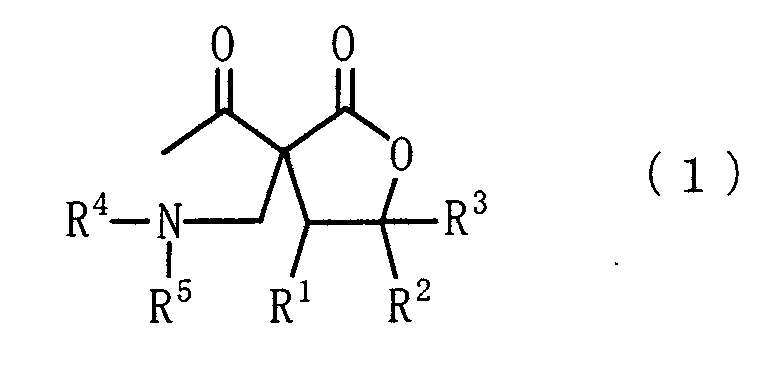
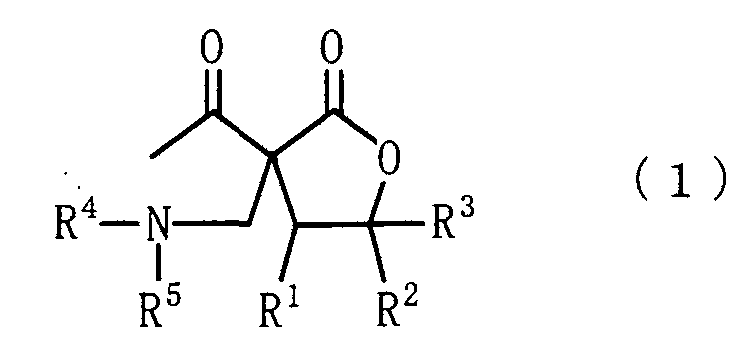
- the present invention provides, in an aspect, an 3-acetyl-N-substituted-3-aminomethyltetrahydrofuran-2-one derivative represented by following Formula (1): wherein R 1 , R 2 and R 3 are the same or different and are each a hydrogen atom or an aliphatic hydrocarbon group; and R 4 and R 5 are the same or different and are each a hydrogen atom or an arylmethyl group which may have a substituent, where at least one of R 4 and R 5 is an arylmethyl group which may have a substituent.
- Formula (1) wherein R 1 , R 2 and R 3 are the same or different and are each a hydrogen atom or an aliphatic hydrocarbon group; and R 4 and R 5 are the same or different and are each a hydrogen atom or an arylmethyl group which may have a substituent, where at least one of R 4 and R 5 is an arylmethyl group which may have a substituent.
- the present invention provides a process for producing the 3-acetyl-N-substituted-3-aminomethyltetrahydrofuran-2-one derivative represented by Formula (1).
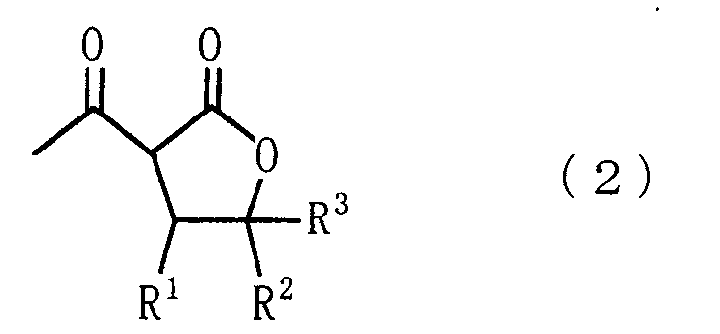
- the process includes the step of subjecting an 3-acetyltetrahydrofuran-2-one derivative represented by following Formula (2): wherein R 1 , R 2 and R 3 are the same or different and are each a hydrogen atom or an aliphatic hydrocarbon group, to aminomethylation by a reaction with formaldehyde or a polymer thereof and a primary or secondary amine represented by following Formula (3): wherein R 4 and R 5 are the same or different and are each a hydrogen atom or an arylmethyl group which may have a substituent, where at least one of R 4 and R 5 is an arylmethyl group which may have a substituent.
- the present invention provides, in a further aspect, a process for producing a N-substituted-3-aminomethyltetrahydrofuran-2-one derivative.
- the process includes the step of deacetylating the 3-acetyl-N-substituted-3-aminomethyltetrahydrofuran-2-one derivative represented by Formula (1) by a reaction with a base to thereby yield a N-substituted-3-aminomethyltetrahydrofuran-2-one derivative represented by following Formula (4): wherein R 1 , R 2 , R 3 , R 4 and R 5 have the same meanings as defined above.
- the present invention provides a process for producing an 3-aminomethyltetrahydrofuran-2-one derivative.
- the process includes the steps of deacetylating the 3-acetyl-N-substituted-3-aminomethyltetrahydrofuran-2-one derivative represented by Formula (1) by a reaction with a base to thereby yield a N-substituted-3-aminomethyltetrahydrofuran-2-one derivative represented by Formula (4), and subjecting this compound to hydrogenolysis to thereby yield an 3-aminomethyltetrahydrofuran-2-one derivative represented by following Formula (5): wherein R 1 , R 2 and R 3 have the same meanings as defined above.
- the present invention provides a process for producing an 3-acetyl-3-aminomethyltetrahydrofuran-2-one derivative.
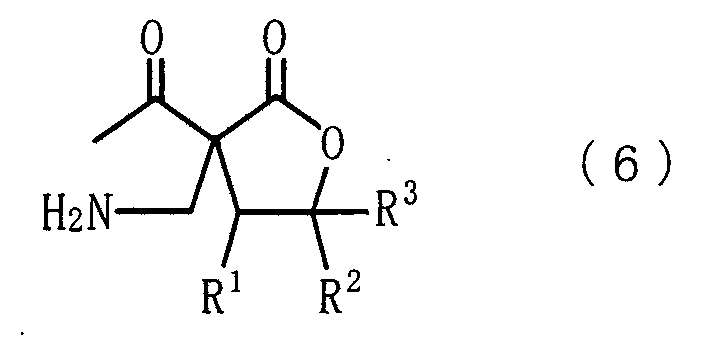
- the process includes the step of subjecting the 3-acetyl-N-substituted-3-aminomethyltetrahydrofuran-2-one derivative represented by Formula (1) to hydrogenolysis to thereby yield an 3-acetyl-3-aminomethyltetrahydrofuran-2-one derivative represented by following Formula (6): wherein R 1 , R 2 and R 3 have the same meanings as defined above.
- the present invention provides a process for producing the 3-aminomethyltetrahydrofuran-2-one derivative represented by Formula (5).
- the process includes the steps of subjecting the 3-acetyl-N-substituted-3-aminomethyltetrahydrofuran-2-one derivative represented by Formula (1) to hydrogenolysis to thereby yield the 3-acetyl-3-aminomethyltetrahydrofuran-2-one derivative represented by Formula (6), and deacetylating the resulting compound by a reaction with a base.
- the present invention can easily yield novel 3-acetyl-N-substituted-3-aminomethyltetrahydrofuran-2-one derivatives.
- the present invention can easily yield N-substituted-3-aminomethyltetrahydrofuran-2-one derivatives and 3-acetyl-3-aminomethyltetrahydrofuran-2-one derivatives, which are useful for the preparation of the 3-aminomethyltetrahydrofuran-2-one derivatives.
- the present invention can efficiently yield 3-aminomethyltetrahydrofuran-2-one derivatives by a simple reaction.
- the substituents R 1 , R 2 and R 3 are the same or different and are each a hydrogen atom or an aliphatic hydrocarbon group.
- Such aliphatic hydrocarbon groups include, but are not limited to, methyl, ethyl, propyl, isopropyl, butyl, isobutyl, s-butyl, t-butyl, pentyl, hexyl, decyl, dodecyl, and other alkyl groups each having from about 1 to about 10, and preferably from about 1 to about 4, carbon atoms; vinyl, allyl, 1-butenyl, and other alkenyl groups each having from about 2 to about 10, and preferably from about 2 to about 4, carbon atoms; ethynyl, propynyl, and other alkynyl groups each having from about 2 to about 10, and preferably from about 2 to about 4, carbon atoms.
- the substituents R 4 and R 5 are the same or different and are each a hydrogen atom or an arylmethyl group which may have a substituent, where at least one of R 4 and R 5 is an arylmethyl group which may have a substituent.
- the substituent may be substituted on a carbon atom of whichever of the aryl moiety and the methyl moiety of the arylmethyl group.
- Such aryl groups include aromatic carbocyclic groups and aromatic heterocyclic groups.
- aromatic carbocyclic groups include, but are not limited to, phenyl, naphthyl, and other aromatic carbocyclic groups each having from about 6 to about 20, and preferably from about 6 to about 10, carbon atoms.
- aromatic heterocyclic groups include, for example, pyridyl group.
- Substituents which may be substituted on the aryl moiety of the arylmethyl group include, but are not limited to, halogen atoms (e.g., fluorine, chlorine and bromine atoms), oxo group, hydroxyl group, substituted oxy groups (e.g., methoxy group and other alkoxy groups; aryloxy groups; aralkyloxy groups; and acyloxy groups), carboxyl group, substituted oxycarbonyl groups, substituted or unsubstituted carbamoyl groups, cyano group, nitro group, substituted or unsubstituted amino groups, and alkyl groups (e.g., methyl, ethyl, propyl, isopropyl, and other C 1 -C 4 alkyl groups).
- halogen atoms e.g., fluorine, chlorine and bromine atoms
- oxo group e.g., methoxy group and other alkoxy groups;
- Substituents which may be substituted on a carbon atom of the methyl moiety of the arylmethyl group include, but are not limited to, methyl, ethyl, propyl, isopropyl, butyl, and other alkyl groups (preferably, alkyl groups each having from 1 to 4 carbon atoms), the aforementioned aryl groups such as phenyl, naphthyl, pyridyl, and other aromatic carbocyclic groups or aromatic heterocyclic groups which may have a substituent.
- a substituent on the methyl moiety may be combined with the aryl moiety or with a substituent on the aryl moiety to form a ring.
- arylmethyl group examples include benzyl, p-chlorobenzyl, p-bromobenzyl, o-nitrobenzyl, p-nitrobenzyl, p-cyanobenzyl, 3,4-dimethoxybenzyl, ⁇ -phenylethyl, diphenylmethyl, bis(p-methoxyphenyl)methyl, triphenylmethyl, (p-methoxyphenyl)diphenylmethyl, diphenyl-4-pyridylmethyl, 2-pyridyl-N-oxide, and 5-dibenzosuberyl groups.
- the 3-acetyl-N-substituted-3-aminomethyltetrahydrofuran-2-one derivative representedby Formula (1) can be obtained by allowing an 3-acetyltetrahydrofuran-2-one derivative represented by Formula (2) to react with formaldehyde or a polymer thereof and a primary or secondary amine represented by Formula (3) and thereby introducing a N-substituted aminomethyl group into the 3-position of the 3-acetyltetrahydrofuran-2-one derivative represented by Formula (2).
- R 1 , R 2 , R 3 , R 4 and R 5 in Formula (2) and (3) include the same groups as mentioned above.
- formaldehyde pure formaldehyde may be used, but an aqueous solution of formaldehyde (formalin) having a concentration of from about 30% to 50% by weight, and preferably from about 35% to 45% by weight, is advantageously used.
- the formaldehyde may be formed in a reaction system.
- Polymers of formaldehyde include, for example, paraformaldehyde and other low molecular weight polyoxymethylenes.
- the amount of the formaldehyde or a polymer thereof is, as formaldehyde, from about 1 to about 3 moles and preferably from about 1.1 to about 2 moles relative to 1 mole of the substrate 3-acetyltetrahydrofuran-2-one derivative.
- a reaction is performed in the presence of, or in the absence of, a solvent.
- the solvent is not specifically limited, as long as it does not adversely affect the reaction.
- solvents include, but are not limited to, methanol, ethanol, propanol, t-butyl alcohol, and other alcohols; chloroform, dichloromethane, 1,2-dichloroethane, and other halogenated hydrocarbons; benzene and other aromatic hydrocarbons; hexane, heptane, octane, and other aliphatic hydrocarbons; cyclohexane and other alicyclic hydrocarbons; N,N-dimethylformamide, N,N-dimethylacetamide, and other amides; acetonitrile, propionitrile, benzonitrile, and other nitriles; diethyl ether, t-butyl methyl ether, tetrahydrofuran, and other chain or cyclic ethers
- a reaction temperature can appropriately be set depending on the type of the substrate and other factors and is, for example, from about 10°C to about 100°C, and preferably from about 20°C to about 50°C. The reaction smoothly proceeds at around room temperature.
- the reaction may be performed at ambient or atmospheric pressure or under a pressure (under a load) in a conventional system such as batch system, semi-batch system or continuous system.
- reaction products can be separated and purified by, for example, filtration, concentration, distillation, extraction, crystallization, recrystallization, adsorption, column chromatography, and other separation means or combinations of these separation means.
- the N-substituted-3-aminomethyltetrahydrofuran-2-one derivative represented by Formula (4) can be prepared by deacetylating the 3-acetyl-3-aminomethyltetrahydrofuran-2-one derivative represented by Formula (1) by a reaction with a base.
- Such bases for use in the reaction include, but are not limited to, sodium carbonate, potassium carbonate, and other alkali metal carbonates; sodium hydrogencarbonate, potassium hydrogencarbonate, and other alkali metal hydrogencarbonates; sodium hydroxide, potassium hydroxide, and other alkali metal hydroxides; magnesium carbonate, calcium carbonate, and other alkaline earth metal carbonates; magnesium hydrogencarbonate, calcium hydrogencarbonate, and other alkaline earth metal hydrogencarbonates; magnesium hydroxide, calcium hydroxide, and other alkaline earth metal hydroxides; and other inorganic bases. Each of these bases can be used alone or in combination.
- the amount of the base is from about 0.5 to about 4 moles, and preferably from about 1 to about 2 moles, relative to 1 mole of the substrate 3-acetyl-N-substituted-3-aminomethyltetrahydrofuran-2-one derivative.
- the reaction is generally performed in the presence of a solvent.
- solvents are not specifically limited as long as they do not adversely affect the reaction and include the solvents exemplified in the production of the 3-acetyl-N-substituted-3-aminomethyltetrahydrofuran-2-one derivative.
- Preferred solvents in this reaction are water; methanol, ethanol, propanol, isopropanol, butanol, and other alcohols; diethyl ether, t-butylmethyl ether, and other ethers.
- the amount of the solvent is, for example, from about 2 to about 30 parts by weight, and preferably from about 3 to about 20 parts by weight, relative to 1 part by weight of the 3-acetyl-N-substituted-3-aminomethyltetrahydrofuran-2-one derivative.
- phase transfer catalysts include, but are not limited to, tetraethylammonium chloride, tetraethylammonium bromide, tetrabutylammonium chloride, tetrabutylammonium bromide, tetrabutylammonium iodide, tetraethylammonium hydrogensulfate, tetrabutylammonium hydroxide, tetraoctylammonium chloride, trimethylbenzylammonium chloride, triethylbenzylammonium chloride, tributylbenzylammonium chloride, tributylbenzylammonium bromide, trioctylbenzylammonium chloride, cetyldimethylbenzylammonium chloride, tetrabutylphosphonium chloride, tetrabut
- phase transfer catalyst is, for example, from about 0.01 to about 0.3 mole, and preferably from about 0.05 to about 0.1 mole, relative to 1 mole of the substrate 3-acetyl-N-substituted-3-aminomethyltetrahydrofuran-2-one derivative.
- a reaction temperature can appropriately be set depending on the type of the substrate and other factors and is, for example, from about 0°C to about 50°C, and preferably from about 0°C to about 10°C.
- the reaction can be performed in a conventional system such as batch system, semi-batch system or continuous system.
- reaction products can be separated and purified by, for example, filtration, concentration, distillation, extraction, crystallization, recrystallization, adsorption, column chromatography, and other separation means or combinations of these separation means.
- the 3-acetyl-3-aminomethyltetrahydrofuran-2-one derivative represented by Formula (6) can be obtained by subjecting the 3-acetyl-N-substituted-3-aminomethyltetrahydrofuran-2-one derivative represented by Formula (1) to hydrogenolysis (hydrocracking).
- the hydrogenolysis is generally performed by bringing the 3-acetyl-N-substituted-3-aminomethyltetrahydrofuran-2-one derivative into contact with hydrogen in a solvent in the presence of a hydrogenolysis catalyst.
- a hydrogenolysis catalyst include any conventional hydrogenolysis catalysts, of which a palladium-carbon (activated carbon) catalyst is preferred.
- the activated carbon is not specifically limited and includes any activated carbon derived from vegetable materials, mineral materials, polymer materials and other materials by conventional techniques such as gas activation and chemical activation.
- the activated carbon has a specific surface area of, for example, from about 500 to about 4000 m 2 /g and preferably from about 700 to about 4000 m 2 /g.
- the amount of palladium on the activated carbon is, for example, from about 1% to about 30% by weight, and preferably from about 3% to about 20% by weight, relative to the weight of the activated carbon.
- the amount of the palladium-carbon catalyst is, for example, from about 0.1% to about 20% by weight, and preferably from about 1% to about 10% by weight, relative to the weight of the substrate 3-acetyl-N-substituted-3-aminomethyltetrahydrofuran-2-one derivative.
- Hydrogen for use in the hydrogenolysis is not specifically limited and includes pure hydrogen and hydrogen diluted with an inert gas such as nitrogen, argon or helium gas.
- a gas phase component can be dissolved in a liquid phase by any technique, as long as the gas phase component is sufficiently dissolved in the liquid phase.
- the gas phase component may be dissolved by gas-liquid contact alone or by blowing a gas containing hydrogen into the liquid phase.
- hydrogen HCOONH 4 , HCOONH (C 2 H 5 ) 3 , NaH 2 PO 2 , NH 2 NH 2 and other hydrogen sources can be used.
- the amount of hydrogen can appropriately be set depending on the type of the substrate and other factors and is generally molar excess to the substrate.
- Solvents for use in this reaction are not specifically limited as long as they do not adversely affect the reaction and can solve reaction components.
- Such solvents include, for example, methanol, ethanol, propanol, isopropanol, and other alcohols.
- the amount of the solvent is generally from about 3 times to about 50 times, and preferably from about 5 times to about 10 times relative to the amount of the substrate.
- a reaction temperature is not specifically limited and is preferably from about 10°C to about 30°C.
- the reaction may be performed at atmospheric pressure or under a pressure (under a load) .
- the pressure is generally from about 0.1 to about 10 MPa, and preferably from about 0.1 to about 1 MPa.
- the reaction can be performed in a conventional system such as batch system, semi-batch system or continuous system.
- reaction products can be separated and purified by, for example, filtration, concentration, distillation, extraction, crystallization, recrystallization, adsorption, column chromatography, and other separation means or combinations of these separation means.
- the 3-aminomethyltetrahydrofuran-2-one derivative represented by Formula (5) can be prepared by either (i) aprocess via the production of the N-substituted-3-aminomethyltetrahydrofuran-2-one derivative represented by Formula (4) or (ii) a process via the production of the 3-acetyl-3-aminomethyltetrahydrofuran-2-one derivative represented by Formula (6).
- the process (i) via the production of the N-substituted-3-aminomethyltetrahydrofuran-2-one derivative represented by Formula (4) includes the steps of (A) yielding the N-substituted-3-aminomethyltetrahydrofuran-2-one derivative represented by Formula (4) from the 3-acetyl-N-substituted-3-aminomethyltetrahydrofuran-2-one derivative represented by Formula (1), and (B) subjecting the resulting compound to hydrogenolysis.
- the production process for the N-substituted-3-aminomethyltetrahydrofuran-2-one derivative can be applied as the step (A) of the process (i) .
- the N-substituted-3-aminomethyltetrahydrofuran-2-one derivative as a substrate is subjected to hydrogenolysis in a similar manner as in the production process for the 3-acetyl-3-aminomethyltetrahydrofuran-2-one derivative.
- the process (ii) via the production of the 3-acetyl-3-aminomethyltetrahydrofuran-2-one derivative represented by Formula (6) includes the steps of (A) yielding the 3-acetyl-3-aminomethyltetrahydrofuran-2-one derivative represented by Formula (6) from the 3-acetyl-N-substituted-3-aminomethyltetrahydrofuran-2-one derivative represented by Formula (1), and (B) deacetylating the resulting compound by a reaction with a base.
- step (A) of the process (ii) the production process for the 3-acetyl-3-aminomethyltetrahydrofuran-2-one derivative can be applied.
- step (B) of the process (ii) the 3-acetyl-3-aminomethyltetrahydrofuran-2-one derivative as a substrate is deacetylated by a reaction with a base in a similar manner as in the production process for the N-substituted-3-aminomethyltetrahydrofuran-2-one derivative represented by Formula (4).
- NMR spectra were determined with tetramethylsilane as an internal standard at 270 MHz ( 1 H-NMR) using JNM-EX270 available from JEOL Ltd. Coupling constants (Hz) are indicated by J.
Landscapes
- Chemical & Material Sciences (AREA)
- Organic Chemistry (AREA)
- Low-Molecular Organic Synthesis Reactions Using Catalysts (AREA)
- Furan Compounds (AREA)
Abstract


Description
- The present invention relates to an 3-acetyl-N-substituted-3-aminomethyltetrahydrofuran-2-one derivative and a production process therefor, as well as to production processes for a N-substituted-3-aminomethyltetrahydrofuran-2-one derivative, for an 3-acetyl-3-aminomethyltetrahydrofuran-2-one derivative and for an 3-aminomethyltetrahydrofuran-2-one derivative using the 3-acetyl-N-substituted-3-aminomethyltetrahydrofuran-2-one derivative as a starting material.
- To produce an analogous compound to 3-aminomethyltetrahydrofuran-2-one, Japanese Unexamined Patent Application Publication No. 7-60131 discloses a process in which 3-methylenetetrahydro-2-(3H)-furanone is allowed to react with diethylamine in the presence of an inorganic compound and thereby yields a N,N-diethyl-aminomethyltetrahydrofuran-2-one. However, the prepared N,N-diethyl-aminomethyltetrahydrofuran-2-one cannot yield 3-aminomethyltetrahydrofuran-2-one by a simple reaction, which 3-aminomethyltetrahydrofuran-2-one is practically used as a pharmaceutical intermediate.
- Accordingly, an object of the present invention is to provide a novel 3-acetyl-N-substituted-3-aminomethyltetrahydrofuran-2-one derivative that is useful for the preparation of an 3-aminomethyltetrahydrofuran-2-one derivative, as well as to provide a production process for the 3-acetyl-N-substituted-3-aminomethyltetrahydrofuran-2-one derivative.
- Another object of the present invention is to provide production processes for a N-substituted-3-aminomethyltetrahydrofuran-2-one derivative and for an 3-acetyl-3-aminomethyltetrahydrofuran-2-one derivative, which are useful for the preparation of such an 3-aminomethyltetrahydrofuran-2-one derivative.
- A further object of the present invention is to provide a process for efficiently producing an 3-aminomethyltetrahydrofuran-2-one derivative by a simple reaction.
- After intensive investigations to achieve the above objects, the present inventors have found that such an 3-aminomethyltetrahydrofuran-2-one derivative can easily be obtained from a novel 3-acetyl-N-substituted-3-aminomethyltetrahydrofuran-2-one derivative. The present invention has been accomplished based on these findings.
- Specifically, the present invention provides, in an aspect, an 3-acetyl-N-substituted-3-aminomethyltetrahydrofuran-2-one derivative represented by following Formula (1):wherein R1, R2 and R3 are the same or different and are each a hydrogen atom or an aliphatic hydrocarbon group; and R4 and R5 are the same or different and are each a hydrogen atom or an arylmethyl group which may have a substituent, where at least one of R4 and R5 is an arylmethyl group which may have a substituent.

- In another aspect, the present invention provides a process for producing the 3-acetyl-N-substituted-3-aminomethyltetrahydrofuran-2-one derivative represented by Formula (1). The process includes the step of subjecting an 3-acetyltetrahydrofuran-2-one derivative represented by following Formula (2):wherein R1, R2 and R3 are the same or different and are each a hydrogen atom or an aliphatic hydrocarbon group, to aminomethylation by a reaction with formaldehyde or a polymer thereof and a primary or secondary amine represented by following Formula (3):
 wherein R4 and R5 are the same or different and are each a hydrogen atom or an arylmethyl group which may have a substituent, where at least one of R4 and R5 is an arylmethyl group which may have a substituent.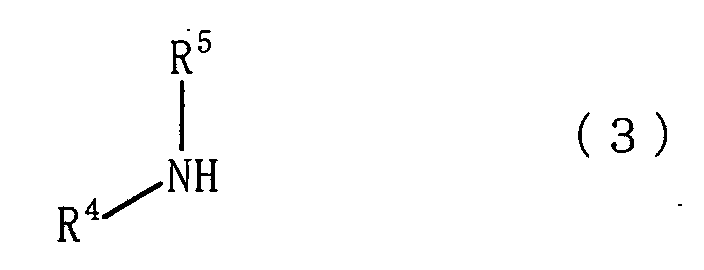
- The present invention provides, in a further aspect, a process for producing a N-substituted-3-aminomethyltetrahydrofuran-2-one derivative. The process includes the step of deacetylating the 3-acetyl-N-substituted-3-aminomethyltetrahydrofuran-2-one derivative represented by Formula (1) by a reaction with a base to thereby yield a N-substituted-3-aminomethyltetrahydrofuran-2-one derivative represented by following Formula (4):wherein R1, R2, R3, R4 and R5 have the same meanings as defined above.
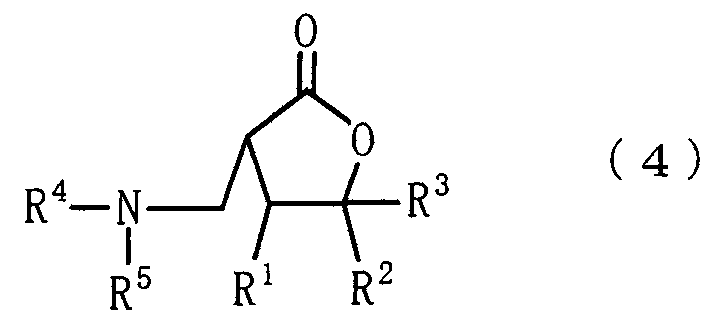
- In yet another aspect, the present invention provides a process for producing an 3-aminomethyltetrahydrofuran-2-one derivative. The process includes the steps of deacetylating the 3-acetyl-N-substituted-3-aminomethyltetrahydrofuran-2-one derivative represented by Formula (1) by a reaction with a base to thereby yield a N-substituted-3-aminomethyltetrahydrofuran-2-one derivative represented by Formula (4), and subjecting this compound to hydrogenolysis to thereby yield an 3-aminomethyltetrahydrofuran-2-one derivative represented by following Formula (5):wherein R1, R2 and R3 have the same meanings as defined above.
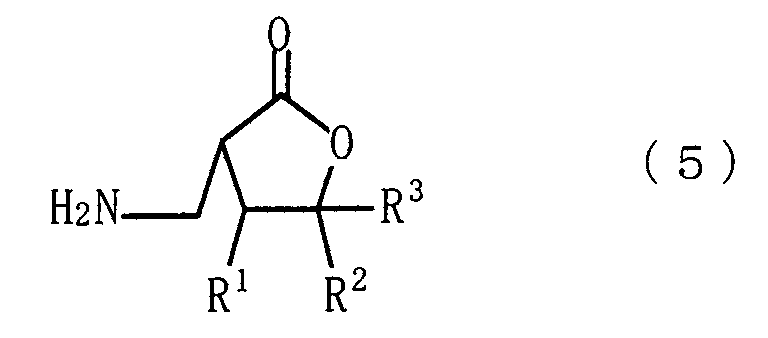
- In another aspect, the present invention provides a process for producing an 3-acetyl-3-aminomethyltetrahydrofuran-2-one derivative. The process includes the step of subjecting the 3-acetyl-N-substituted-3-aminomethyltetrahydrofuran-2-one derivative represented by Formula (1) to hydrogenolysis to thereby yield an 3-acetyl-3-aminomethyltetrahydrofuran-2-one derivative represented by following Formula (6):wherein R1, R2 and R3 have the same meanings as defined above.
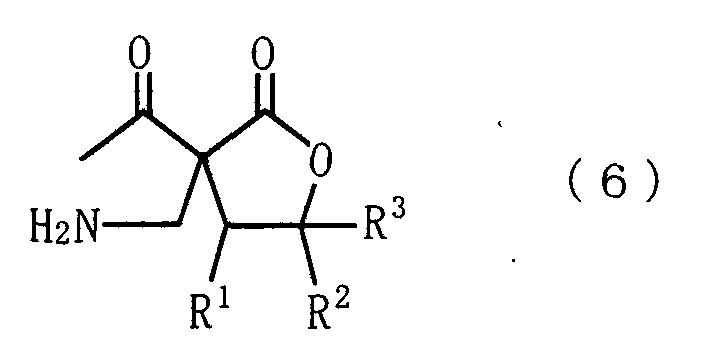
- Yet another aspect, the present invention provides a process for producing the 3-aminomethyltetrahydrofuran-2-one derivative represented by Formula (5). The process includes the steps of subjecting the 3-acetyl-N-substituted-3-aminomethyltetrahydrofuran-2-one derivative represented by Formula (1) to hydrogenolysis to thereby yield the 3-acetyl-3-aminomethyltetrahydrofuran-2-one derivative represented by Formula (6), and deacetylating the resulting compound by a reaction with a base.
- The present invention can easily yield novel 3-acetyl-N-substituted-3-aminomethyltetrahydrofuran-2-one derivatives.
- The present invention can easily yield N-substituted-3-aminomethyltetrahydrofuran-2-one derivatives and 3-acetyl-3-aminomethyltetrahydrofuran-2-one derivatives, which are useful for the preparation of the 3-aminomethyltetrahydrofuran-2-one derivatives.
- In addition and advantageously, the present invention can efficiently yield 3-aminomethyltetrahydrofuran-2-one derivatives by a simple reaction.
- In the 3-acetyl-N-substituted-3-aminomethyltetrahydrofuran-2-one derivatives represented by Formula (1), the substituents R1, R2 and R3 are the same or different and are each a hydrogen atom or an aliphatic hydrocarbon group.
- Such aliphatic hydrocarbon groups include, but are not limited to, methyl, ethyl, propyl, isopropyl, butyl, isobutyl, s-butyl, t-butyl, pentyl, hexyl, decyl, dodecyl, and other alkyl groups each having from about 1 to about 10, and preferably from about 1 to about 4, carbon atoms; vinyl, allyl, 1-butenyl, and other alkenyl groups each having from about 2 to about 10, and preferably from about 2 to about 4, carbon atoms; ethynyl, propynyl, and other alkynyl groups each having from about 2 to about 10, and preferably from about 2 to about 4, carbon atoms.
- In Formula (1), the substituents R4 and R5 are the same or different and are each a hydrogen atom or an arylmethyl group which may have a substituent, where at least one of R4 and R5 is an arylmethyl group which may have a substituent. The substituent may be substituted on a carbon atom of whichever of the aryl moiety and the methyl moiety of the arylmethyl group. Such aryl groups include aromatic carbocyclic groups and aromatic heterocyclic groups.
- Such aromatic carbocyclic groups include, but are not limited to, phenyl, naphthyl, and other aromatic carbocyclic groups each having from about 6 to about 20, and preferably from about 6 to about 10, carbon atoms. The aromatic heterocyclic groups include, for example, pyridyl group.
- Substituents which may be substituted on the aryl moiety of the arylmethyl group include, but are not limited to, halogen atoms (e.g., fluorine, chlorine and bromine atoms), oxo group, hydroxyl group, substituted oxy groups (e.g., methoxy group and other alkoxy groups; aryloxy groups; aralkyloxy groups; and acyloxy groups), carboxyl group, substituted oxycarbonyl groups, substituted or unsubstituted carbamoyl groups, cyano group, nitro group, substituted or unsubstituted amino groups, and alkyl groups (e.g., methyl, ethyl, propyl, isopropyl, and other C1-C4 alkyl groups).
- Substituents which may be substituted on a carbon atom of the methyl moiety of the arylmethyl group include, but are not limited to, methyl, ethyl, propyl, isopropyl, butyl, and other alkyl groups (preferably, alkyl groups each having from 1 to 4 carbon atoms), the aforementioned aryl groups such as phenyl, naphthyl, pyridyl, and other aromatic carbocyclic groups or aromatic heterocyclic groups which may have a substituent.
- In the arylmethyl group, a substituent on the methyl moiety may be combined with the aryl moiety or with a substituent on the aryl moiety to form a ring.
- Examples of the arylmethyl group are benzyl, p-chlorobenzyl, p-bromobenzyl, o-nitrobenzyl, p-nitrobenzyl, p-cyanobenzyl, 3,4-dimethoxybenzyl, α-phenylethyl, diphenylmethyl, bis(p-methoxyphenyl)methyl, triphenylmethyl, (p-methoxyphenyl)diphenylmethyl, diphenyl-4-pyridylmethyl, 2-pyridyl-N-oxide, and 5-dibenzosuberyl groups.
- The 3-acetyl-N-substituted-3-aminomethyltetrahydrofuran-2-one derivative representedby Formula (1) can be obtained by allowing an 3-acetyltetrahydrofuran-2-one derivative represented by Formula (2) to react with formaldehyde or a polymer thereof and a primary or secondary amine represented by Formula (3) and thereby introducing a N-substituted aminomethyl group into the 3-position of the 3-acetyltetrahydrofuran-2-one derivative represented by Formula (2).
- The substituents R1, R2, R3, R4 and R5 in Formula (2) and (3) include the same groups as mentioned above.
- As formaldehyde, pure formaldehyde may be used, but an aqueous solution of formaldehyde (formalin) having a concentration of from about 30% to 50% by weight, and preferably from about 35% to 45% by weight, is advantageously used. The formaldehyde may be formed in a reaction system. Polymers of formaldehyde include, for example, paraformaldehyde and other low molecular weight polyoxymethylenes. The amount of the formaldehyde or a polymer thereof is, as formaldehyde, from about 1 to about 3 moles and preferably from about 1.1 to about 2 moles relative to 1 mole of the substrate 3-acetyltetrahydrofuran-2-one derivative.
- A reaction is performed in the presence of, or in the absence of, a solvent. The solvent is not specifically limited, as long as it does not adversely affect the reaction. Such solvents include, but are not limited to, methanol, ethanol, propanol, t-butyl alcohol, and other alcohols; chloroform, dichloromethane, 1,2-dichloroethane, and other halogenated hydrocarbons; benzene and other aromatic hydrocarbons; hexane, heptane, octane, and other aliphatic hydrocarbons; cyclohexane and other alicyclic hydrocarbons; N,N-dimethylformamide, N,N-dimethylacetamide, and other amides; acetonitrile, propionitrile, benzonitrile, and other nitriles; diethyl ether, t-butyl methyl ether, tetrahydrofuran, and other chain or cyclic ethers; ethyl acetate and other esters; acetic acid and other organic acids; and water. Preferred solvents are water; and methanol, ethanol, propanol, andotheralcohols, of which water is typically preferred. Each of these solvents can be used alone or in combination.
- A reaction temperature can appropriately be set depending on the type of the substrate and other factors and is, for example, from about 10°C to about 100°C, and preferably from about 20°C to about 50°C. The reaction smoothly proceeds at around room temperature.
- The reaction may be performed at ambient or atmospheric pressure or under a pressure (under a load) in a conventional system such as batch system, semi-batch system or continuous system.
- After the completion of the reaction, reaction products can be separated and purified by, for example, filtration, concentration, distillation, extraction, crystallization, recrystallization, adsorption, column chromatography, and other separation means or combinations of these separation means.
- The N-substituted-3-aminomethyltetrahydrofuran-2-one derivative represented by Formula (4) can be prepared by deacetylating the 3-acetyl-3-aminomethyltetrahydrofuran-2-one derivative represented by Formula (1) by a reaction with a base.
- Such bases for use in the reaction include, but are not limited to, sodium carbonate, potassium carbonate, and other alkali metal carbonates; sodium hydrogencarbonate, potassium hydrogencarbonate, and other alkali metal hydrogencarbonates; sodium hydroxide, potassium hydroxide, and other alkali metal hydroxides; magnesium carbonate, calcium carbonate, and other alkaline earth metal carbonates; magnesium hydrogencarbonate, calcium hydrogencarbonate, and other alkaline earth metal hydrogencarbonates; magnesium hydroxide, calcium hydroxide, and other alkaline earth metal hydroxides; and other inorganic bases. Each of these bases can be used alone or in combination. The amount of the base is from about 0.5 to about 4 moles, and preferably from about 1 to about 2 moles, relative to 1 mole of the substrate 3-acetyl-N-substituted-3-aminomethyltetrahydrofuran-2-one derivative.
- The reaction is generally performed in the presence of a solvent. Such solvents are not specifically limited as long as they do not adversely affect the reaction and include the solvents exemplified in the production of the 3-acetyl-N-substituted-3-aminomethyltetrahydrofuran-2-one derivative. Preferred solvents in this reaction are water; methanol, ethanol, propanol, isopropanol, butanol, and other alcohols; diethyl ether, t-butylmethyl ether, and other ethers. The amount of the solvent is, for example, from about 2 to about 30 parts by weight, and preferably from about 3 to about 20 parts by weight, relative to 1 part by weight of the 3-acetyl-N-substituted-3-aminomethyltetrahydrofuran-2-one derivative.
- To perform the reaction in a shorter time, a phase transfer catalyst may be added to the reaction system. Such phase transfer catalysts include, but are not limited to, tetraethylammonium chloride, tetraethylammonium bromide, tetrabutylammonium chloride, tetrabutylammonium bromide, tetrabutylammonium iodide, tetraethylammonium hydrogensulfate, tetrabutylammonium hydroxide, tetraoctylammonium chloride, trimethylbenzylammonium chloride, triethylbenzylammonium chloride, tributylbenzylammonium chloride, tributylbenzylammonium bromide, trioctylbenzylammonium chloride, cetyldimethylbenzylammonium chloride, tetrabutylphosphonium chloride, tetrabutylphosphonium bromide, and other conventional phase transfer catalysts. Among them, cetyldimethylbenzylammonium chloride and triethylbenzylammonium chloride are preferred. The amount of the phase transfer catalyst is, for example, from about 0.01 to about 0.3 mole, and preferably from about 0.05 to about 0.1 mole, relative to 1 mole of the substrate 3-acetyl-N-substituted-3-aminomethyltetrahydrofuran-2-one derivative.
- A reaction temperature can appropriately be set depending on the type of the substrate and other factors and is, for example, from about 0°C to about 50°C, and preferably from about 0°C to about 10°C. The reaction can be performed in a conventional system such as batch system, semi-batch system or continuous system.
- After the completion of the reaction, reaction products can be separated and purified by, for example, filtration, concentration, distillation, extraction, crystallization, recrystallization, adsorption, column chromatography, and other separation means or combinations of these separation means.
- The 3-acetyl-3-aminomethyltetrahydrofuran-2-one derivative represented by Formula (6) can be obtained by subjecting the 3-acetyl-N-substituted-3-aminomethyltetrahydrofuran-2-one derivative represented by Formula (1) to hydrogenolysis (hydrocracking).
- The hydrogenolysis is generally performed by bringing the 3-acetyl-N-substituted-3-aminomethyltetrahydrofuran-2-one derivative into contact with hydrogen in a solvent in the presence of a hydrogenolysis catalyst. Such hydrogenolysis catalysts include any conventional hydrogenolysis catalysts, of which a palladium-carbon (activated carbon) catalyst is preferred.
- In the palladium-carbon (activated carbon) catalyst, the activated carbon is not specifically limited and includes any activated carbon derived from vegetable materials, mineral materials, polymer materials and other materials by conventional techniques such as gas activation and chemical activation. The activated carbon has a specific surface area of, for example, from about 500 to about 4000 m2/g and preferably from about 700 to about 4000 m2/g. The amount of palladium on the activated carbon is, for example, from about 1% to about 30% by weight, and preferably from about 3% to about 20% by weight, relative to the weight of the activated carbon.
- The amount of the palladium-carbon catalyst is, for example, from about 0.1% to about 20% by weight, and preferably from about 1% to about 10% by weight, relative to the weight of the substrate 3-acetyl-N-substituted-3-aminomethyltetrahydrofuran-2-one derivative.
- Hydrogen for use in the hydrogenolysis is not specifically limited and includes pure hydrogen and hydrogen diluted with an inert gas such as nitrogen, argon or helium gas. A gas phase component can be dissolved in a liquid phase by any technique, as long as the gas phase component is sufficiently dissolved in the liquid phase. For example, the gas phase component may be dissolved by gas-liquid contact alone or by blowing a gas containing hydrogen into the liquid phase. Instead of hydrogen, HCOONH4, HCOONH (C2H5)3, NaH2PO2, NH2NH2 and other hydrogen sources can be used.
- The amount of hydrogen can appropriately be set depending on the type of the substrate and other factors and is generally molar excess to the substrate.
- Solvents for use in this reaction are not specifically limited as long as they do not adversely affect the reaction and can solve reaction components. Such solvents include, for example, methanol, ethanol, propanol, isopropanol, and other alcohols. The amount of the solvent is generally from about 3 times to about 50 times, and preferably from about 5 times to about 10 times relative to the amount of the substrate.
- A reaction temperature is not specifically limited and is preferably from about 10°C to about 30°C.
- The reaction may be performed at atmospheric pressure or under a pressure (under a load) . When the reaction is performed under a pressure, the pressure is generally from about 0.1 to about 10 MPa, and preferably from about 0.1 to about 1 MPa. The reaction can be performed in a conventional system such as batch system, semi-batch system or continuous system.
- After the completion of the reaction, reaction products can be separated and purified by, for example, filtration, concentration, distillation, extraction, crystallization, recrystallization, adsorption, column chromatography, and other separation means or combinations of these separation means.
- Using the 3-acetyl-N-substituted-3-aminomethyltetrahydrofuran-2-one derivative represented by Formula (1) as a starting material, the 3-aminomethyltetrahydrofuran-2-one derivative represented by Formula (5) can be prepared by either (i) aprocess via the production of the N-substituted-3-aminomethyltetrahydrofuran-2-one derivative represented by Formula (4) or (ii) a process via the production of the 3-acetyl-3-aminomethyltetrahydrofuran-2-one derivative represented by Formula (6).
- The process (i) via the production of the N-substituted-3-aminomethyltetrahydrofuran-2-one derivative represented by Formula (4) includes the steps of (A) yielding the N-substituted-3-aminomethyltetrahydrofuran-2-one derivative represented by Formula (4) from the 3-acetyl-N-substituted-3-aminomethyltetrahydrofuran-2-one derivative represented by Formula (1), and (B) subjecting the resulting compound to hydrogenolysis.
- The production process for the N-substituted-3-aminomethyltetrahydrofuran-2-one derivative can be applied as the step (A) of the process (i) . In the step (B) of the process (i), the N-substituted-3-aminomethyltetrahydrofuran-2-one derivative as a substrate is subjected to hydrogenolysis in a similar manner as in the production process for the 3-acetyl-3-aminomethyltetrahydrofuran-2-one derivative.
- The process (ii) via the production of the 3-acetyl-3-aminomethyltetrahydrofuran-2-one derivative represented by Formula (6) includes the steps of (A) yielding the 3-acetyl-3-aminomethyltetrahydrofuran-2-one derivative represented by Formula (6) from the 3-acetyl-N-substituted-3-aminomethyltetrahydrofuran-2-one derivative represented by Formula (1), and (B) deacetylating the resulting compound by a reaction with a base.
- As the step (A) of the process (ii), the production process for the 3-acetyl-3-aminomethyltetrahydrofuran-2-one derivative can be applied. In the step (B) of the process (ii), the 3-acetyl-3-aminomethyltetrahydrofuran-2-one derivative as a substrate is deacetylated by a reaction with a base in a similar manner as in the production process for the N-substituted-3-aminomethyltetrahydrofuran-2-one derivative represented by Formula (4).
- The present invention will be illustrated in further detail with reference to several examples below, which are not intended to limit the scope of the invention.
- In the examples, NMR spectra were determined with tetramethylsilane as an internal standard at 270 MHz (1H-NMR) using JNM-EX270 available from JEOL Ltd. Coupling constants (Hz) are indicated by J.
- To a mixture of 10.2 g of dibenzylamine and 29.7 g of water, 8.9 g of 37% by weight formaldehyde aqueous solution was added dropwise at room temperature, followed by dropwise addition of 12.8 g of 3-acetyltetrahydrofuran-2-one at room temperature. After the completion of addition, the mixture was heated to 90°C and thereby yielded a solution. The solution was cooled to room temperature, was filtrated, the resulting solid matter was heated with diethyl ether and thereby yielded a solution. The solution was gradually cooled to 0°C, the resulting crystal was filtrated and thereby yielded 19.2 g of 3-acetyl-N,N-dibenzyl-3-aminomethyltetrahydrofuran-2-one as a white crystal.
- 1H-NMR (CDCl3) ppm: 2.07 (s, 3H, CH 3CO), 2.11-2.22 (m, 1H, OCH 2CH2), 2.80-2.85 (d, 1H, J=13.5, CCH 2N), 2.98-3.06 (m, 1H, OCH 2CH2), 3.25-3.30 (d, 2H, J=13.5, NCH 2Ph), 3.47-3.52 (d, 1H, J=13.5, CCH 2N), 3.69-3.74 (d, 2H, J=13.5, NCH 2Ph), 4.00-4.10 (m, 1H, OCH2CH 2), 4.17-4.25 (m, 1H, OCH2CH 2), 7.22-7.36 (m, 10H, Ph)
- To 59.4 g of water, 21.4 g of benzylamine was added, and the resulting mixture was stirred with 17.8 g of 37% by weight formaldehyde aqueous solution at room temperature for 1 hour. To the mixture, 25.6 g of 3-acetyltetrahydrofuran-2-one was added dropwise, followed by stirring at 60°C for 1 hour. After the completion of reaction, the resulting mixture was cooled to room temperature, followed by removal of water from the resulting oily matter, and thereby yielded 23.6 g of 3-acetyl-N-benzyl-3-aminomethyltetrahydrofuran-2-one as a yellow oily matter.
- 1H-NMR (CDCl3) ppm: 2.06-2.22 (m, 1H, CH 2CH2O), 2.27 (s, 3H, CH 3), 2.73-2.82 (m, 1H, CH 2CH2O), 3.01 (d, 1H, J=12.2, NHCH 2C), 3.13 (d, 1H, J=12.2, NHCH 2C), 3.77 (s, 2H, NHCH 2Ph), 4.11-4.30 (m, 2H, CH2CH 2O)
- To 6.8 g of 3-acetyl-N,N-dibenzyl-3-aminomethyltetrahydrofuran-2-one, 33.8 g of diethyl ether and 0.68 g of cetyldimethylbenzylammonium chloride were added, followed by dropwise addition of 8 g of 10% by weight NaOH aqueous solution at 0°C. The resulting diethyl ether layer was separated, was concentrated under reduced pressure, the residue was subjected to column chromatography on a silica gel, was eluted with hexane-ethyl acetate and thereby yielded 3.45 g of N,N-dibenzyl-3-aminomethyltetrahydrofuran-2-one as a light yellow liquid.
- 1H-NMR (CDCl3) ppm: 1.90-2.00 (m, 1H, OCH2CH 2), 2.30-2.37 (m, 1H, OCH2CH 2), 2.57-2.61 (m, 1H, CCH 2N), 2.68-2.80 (m, 1H, HCCH2N), 2.83-2.89 (dd, 1H, J=3.78, 12.2, CCH 2N), 3.39-3.44 (d, 2H, J=13.5, NCH 2Ph), 3.75-3.80 (d, 2H, J=13.5, NCH 2Ph), 4.09-4.16 (m, 2H, OCH 2CH2), 7.22-7.36 (m, 10H, Ph)
- Other embodiments and variations will be obvious to those skilled in the art, and this invention is not to be limited to the specific matters stated above.
Claims (6)
- An 3-acetyl-N-substituted-3-aminomethyltetrahydrofuran-2-one derivative represented by following Formula (1):wherein R1, R2 and R3 are the same or different and are each a hydrogen atom or an aliphatic hydrocarbon group; and R4 and R5 are the same or different and are each a hydrogen atom or an arylmethyl group which may have a substituent, where at least one of R4 and R5 is an arylmethyl group which may have a substituent.

- A process for producing an 3-acetyl-N-substituted-3-aminomethyltetrahydrofuran-2-one derivative, the process comprising the step of:wherein R1, R2 and R3 are the same or different and are each a hydrogen atom or an aliphatic hydrocarbon group, to aminomethylation by a reaction with formaldehyde or a polymer thereof and a primary or secondary amine represented by following Formula (3):subjecting an 3-acetyltetrahydrofuran-2-one derivative represented by following Formula (2):
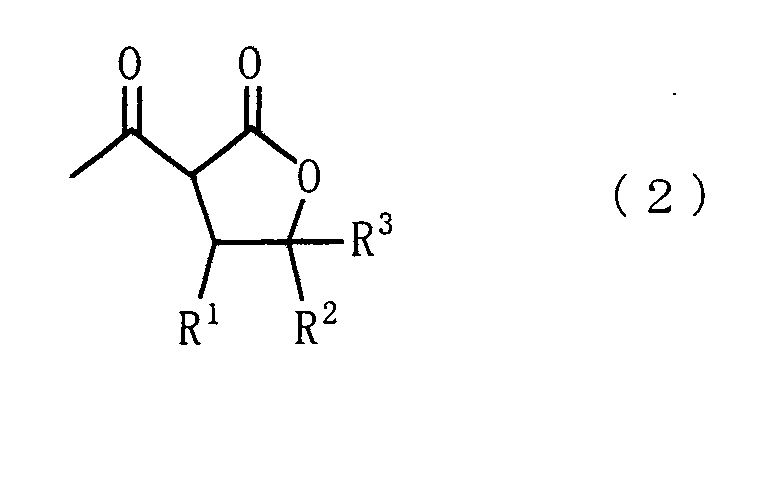 wherein R4 and R5 are the same or different and are each a hydrogen atom or an arylmethyl group which may have a substituent, where at least one of R4 and R5 is an arylmethyl group which may have a substituent, to thereby yield an 3-acetyl-N-substituted-3-aminomethyltetrahydrofuran-2-one derivative represented by following Formula (1):
 wherein R1, R2, R3, R4 and R5 have the same meanings as defined above.
- A process for producing a N-substituted-3-aminomethyltetrahydrofuran-2-one derivative, the process comprising the step of:wherein R1, R2 and R3 are the same or different and are each a hydrogen atom or an aliphatic hydrocarbon group; and R4 and R5 are the same or different and are each a hydrogen atom or an arylmethyl group which may have a substituent, where at least one of R4 and R5 is an arylmethyl group which may have a substituent, by a reaction with a base to thereby yield a N-substituted-3-aminomethyltetrahydrofuran-2-one derivative represented by following Formula (4):deacetylating an 3-acetyl-N-substituted-3-aminomethyltetrahydrofuran-2-one derivative represented by following Formula (1):
 wherein R1, R2, R3, R4 and R5 have the same meanings as defined above.
- A process for producing 3-aminomethyltetrahydrofuran-2-one derivative, the process comprising the steps of:deacetylating an 3-acetyl-N-substituted-3-aminomethyltetrahydrofuran-2-one derivative represented by following Formula (1):wherein R1, R2 and R3 are the same or different and are each a hydrogen atom or an aliphatic hydrocarbon group; and R4 and R5 are the same or different and are each a hydrogen atom or an arylmethyl group which may have a substituent, where at least one of R4 and R5 is an arylmethyl group which may have a substituent, by a reaction with a base to thereby yield a N-substituted-3-aminomethyltetrahydrofuran-2-one derivative represented by following Formula (4):
 wherein R1, R2, R3, R4 and R5 have the same meanings as defined above; and
 subjecting the N-substituted-3-aminomethyltetrahydrofuran-2-one derivative represented by Formula (4) to hydrogenolysis to thereby yield an 3-aminomethyltetrahydrofuran-2-one derivative represented by following Formula (5):wherein R1, R2 and R3 have the same meanings as defined above.
- A process for producing an 3-acetyl-3-aminomethyltetrahydrofuran-2-one derivative, the process comprising the step of:wherein R1, R2 and R3 are the same or different and are each a hydrogen atom or an aliphatic hydrocarbon group; and R4 and R5 are the same or different and are each a hydrogen atom or an arylmethyl group which may have a substituent, where at least one of R4 and R5 is an arylmethyl group which may have a substituent, to hydrogenolysis to thereby yield an 3-acetyl-3-aminomethyltetrahydrofuran-2-one derivative represented by following Formula (6):subjecting an 3-acetyl-N-substituted-3-aminomethyltetrahydrofuran-2-one derivative represented by following Formula (1):
 wherein R1, R2 and R3 have the same meanings as defined above.
- A process for producing an 3-aminomethyltetrahydrofuran-2-one derivative, the process comprising the steps of:subjecting an 3-acetyl-N-substituted-3-aminomethyltetrahydrofuran-2-one derivative represented by following Formula (1):wherein R1, R2 and R3 are the same or different and are each a hydrogen atom or an aliphatic hydrocarbon group; and R4 and R5 are the same or different and are each a hydrogen atom or an arylmethyl group which may have a substituent, where at least one of R4 and R5 is an arylmethyl group which may have a substituent, to hydrogenolysis to thereby yield an 3-acetyl-3-aminomethyltetrahydrofuran-2-one derivative represented by following Formula (6):
 wherein R1, R2 and R3 have the same meanings as defined above; and
 deacetylating the 3-acetyl-3-aminomethyltetrahydrofuran-2-one derivative represented by Formula (6) by a reaction with a base to thereby yield an 3-aminomethyltetrahydrofuran-2-one derivative represented by following Formula (5):wherein R1, R2 and R3 have the same meanings as defined above.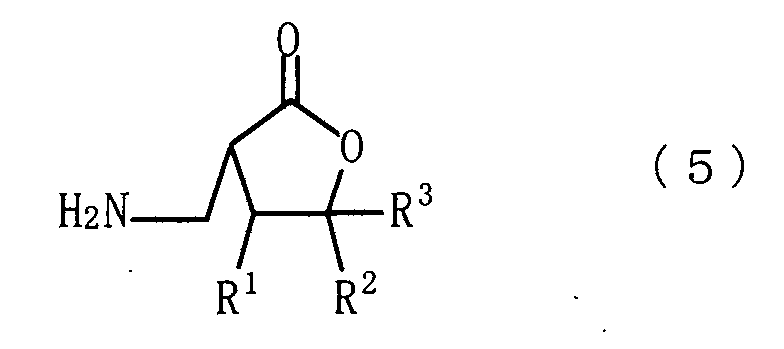
Applications Claiming Priority (2)
| Application Number | Priority Date | Filing Date | Title |
|---|---|---|---|
| JP2001110778A JP4659254B2 (en) | 2001-04-10 | 2001-04-10 | 3-acetyl-N-substituted-3-aminomethyltetrahydrofuran-2-one derivatives and process for producing the same |
| JP2001110778 | 2001-04-10 |
Publications (2)
| Publication Number | Publication Date |
|---|---|
| EP1249448A1 true EP1249448A1 (en) | 2002-10-16 |
| EP1249448B1 EP1249448B1 (en) | 2010-12-15 |
Family
ID=18962481
Family Applications (1)
| Application Number | Title | Priority Date | Filing Date |
|---|---|---|---|
| EP02008031A Expired - Lifetime EP1249448B1 (en) | 2001-04-10 | 2002-04-10 | 3-Acetyl-n-substituted-3-aminomethyltetrahydroguran-2-one derivative and process therefor |
Country Status (4)
| Country | Link |
|---|---|
| US (1) | US6498258B2 (en) |
| EP (1) | EP1249448B1 (en) |
| JP (1) | JP4659254B2 (en) |
| DE (1) | DE60238578D1 (en) |
Cited By (1)
| Publication number | Priority date | Publication date | Assignee | Title |
|---|---|---|---|---|
| CN108424406A (en) * | 2018-05-05 | 2018-08-21 | 湖北荆洪生物科技股份有限公司 | A kind of production technology of 3- aminomethyls tetrahydrofuran |
Families Citing this family (1)
| Publication number | Priority date | Publication date | Assignee | Title |
|---|---|---|---|---|
| JP4217887B2 (en) | 2003-07-22 | 2009-02-04 | 日本電気株式会社 | Receiver |
Citations (1)
| Publication number | Priority date | Publication date | Assignee | Title |
|---|---|---|---|---|
| JPH0760131A (en) * | 1993-08-31 | 1995-03-07 | Osaka Organic Chem Ind Ltd | Modified inorganic powder, method for producing the same, reaction-promoting catalyst and optical activity-imparting agent comprising the same |
-
2001
- 2001-04-10 JP JP2001110778A patent/JP4659254B2/en not_active Expired - Fee Related
-
2002
- 2002-04-05 US US10/115,949 patent/US6498258B2/en not_active Expired - Fee Related
- 2002-04-10 EP EP02008031A patent/EP1249448B1/en not_active Expired - Lifetime
- 2002-04-10 DE DE60238578T patent/DE60238578D1/en not_active Expired - Lifetime
Patent Citations (1)
| Publication number | Priority date | Publication date | Assignee | Title |
|---|---|---|---|---|
| JPH0760131A (en) * | 1993-08-31 | 1995-03-07 | Osaka Organic Chem Ind Ltd | Modified inorganic powder, method for producing the same, reaction-promoting catalyst and optical activity-imparting agent comprising the same |
Non-Patent Citations (1)
| Title |
|---|
| PATENT ABSTRACTS OF JAPAN vol. 1995, no. 06 31 July 1995 (1995-07-31) * |
Cited By (2)
| Publication number | Priority date | Publication date | Assignee | Title |
|---|---|---|---|---|
| CN108424406A (en) * | 2018-05-05 | 2018-08-21 | 湖北荆洪生物科技股份有限公司 | A kind of production technology of 3- aminomethyls tetrahydrofuran |
| CN108424406B (en) * | 2018-05-05 | 2021-10-26 | 湖北荆洪生物科技股份有限公司 | Production process of 3-aminomethyl tetrahydrofuran |
Also Published As
| Publication number | Publication date |
|---|---|
| JP4659254B2 (en) | 2011-03-30 |
| US6498258B2 (en) | 2002-12-24 |
| US20020151727A1 (en) | 2002-10-17 |
| DE60238578D1 (en) | 2011-01-27 |
| EP1249448B1 (en) | 2010-12-15 |
| JP2002308863A (en) | 2002-10-23 |
Similar Documents
| Publication | Publication Date | Title |
|---|---|---|
| US11780810B2 (en) | Intermediates for optically active piperidine derivatives and preparation methods thereof | |
| KR19980018089A (en) | Stereoselective Preparation of Transazetidinone | |
| US20090281176A1 (en) | Process for the synthesis of ramelteon and its intermediates | |
| Im et al. | Nucleophilic behaviour of DBU and DBN toward acetylated Baylis-Hillman adducts | |
| US6498258B2 (en) | 3-acetyl-N-substituted-3-aminomethyltetrahydrofuran-2-one derivative and production process therefor | |
| EP0928787A1 (en) | Process for the preparation of 3-amino-pyrrolidine derivatives | |
| KR100205767B1 (en) | Stereoselective preparation method of azetidinone | |
| CN114478422B (en) | Intermediate of pregabalin and preparation method thereof | |
| US20160016969A1 (en) | Isohexide monotriflates and process for synthesis thereof | |
| Asano et al. | Short-step and scalable synthesis of (±)-cytoxazone | |
| US6710210B2 (en) | N-substituted-aminomethyl cyclopropyl ketone derivatives or salts thereof and production process therefor | |
| JP4667589B2 (en) | Method for producing 2,4-dihydroxypyridine | |
| JP5071689B2 (en) | 3-alkoxycarbonyl-6,7-chloromethylenedioxycoumarin compound and method for producing the same. | |
| JP4483183B2 (en) | Process for producing 6,7-dihydroxycoumarin-3-carboxylic acid derivative and its intermediate | |
| CN108863830A (en) | A kind of chiral aryl allylic amines compound and its synthetic method | |
| JP4799756B2 (en) | N-substituted-1-amino-5-halo-2-pentanone derivatives or salts thereof and methods for producing them | |
| EP1893668B1 (en) | N-(2-hydroxyalkanoyl) -n,n'-dialkylureas and a process for their preparation | |
| KR100574343B1 (en) | Method for preparing stereoselective 4-hydroxy-2-piperidinone | |
| JP2003252840A (en) | Method for producing amino acid aminoalkyl ester inorganic acid salt | |
| CN114805161A (en) | Preparation method of 3-fluridinyl hydrochloride | |
| IE65561B1 (en) | Process for production of optically active 2-(tetrahydropyran-2-yloxy)-1-propanol | |
| EP1460061A1 (en) | Process for producing 1-alkoxycarbonyl nitrogenous saturated heterocyclic derivative | |
| JPH1045721A (en) | Production of 1-substituted-4,5-diphenyl-2-imidazolidinone and intermediate for the same | |
| EP0047516A1 (en) | Propylamine derivative and process of manufacturing the same | |
| JP2000281619A (en) | Production of 1-acyloxy-3-halogeno-2-propanol and epihalohydrin and 1-acyloxy-3-halogenopropane-2- sulfonate |
Legal Events
| Date | Code | Title | Description |
|---|---|---|---|
| PUAI | Public reference made under article 153(3) epc to a published international application that has entered the european phase |
Free format text: ORIGINAL CODE: 0009012 |
|
| AK | Designated contracting states |
Kind code of ref document: A1 Designated state(s): AT BE CH CY DE DK ES FI FR GB GR IE IT LI LU MC NL PT SE TR |
|
| AX | Request for extension of the european patent |
Free format text: AL;LT;LV;MK;RO;SI |
|
| 17P | Request for examination filed |
Effective date: 20030409 |
|
| AKX | Designation fees paid |
Designated state(s): CH DE FR GB LI |
|
| RAP1 | Party data changed (applicant data changed or rights of an application transferred) |
Owner name: DAICEL CHEMICAL INDUSTRIES, LTD. |
|
| 17Q | First examination report despatched |
Effective date: 20080115 |
|
| GRAP | Despatch of communication of intention to grant a patent |
Free format text: ORIGINAL CODE: EPIDOSNIGR1 |
|
| GRAS | Grant fee paid |
Free format text: ORIGINAL CODE: EPIDOSNIGR3 |
|
| GRAA | (expected) grant |
Free format text: ORIGINAL CODE: 0009210 |
|
| AK | Designated contracting states |
Kind code of ref document: B1 Designated state(s): CH DE FR GB LI |
|
| REG | Reference to a national code |
Ref country code: CH Ref legal event code: NV Representative=s name: BOVARD AG PATENTANWAELTE Ref country code: GB Ref legal event code: FG4D Ref country code: CH Ref legal event code: EP |
|
| REF | Corresponds to: |
Ref document number: 60238578 Country of ref document: DE Date of ref document: 20110127 Kind code of ref document: P |
|
| REG | Reference to a national code |
Ref country code: CH Ref legal event code: PFA Owner name: DAICEL CHEMICAL INDUSTRIES, LTD. Free format text: DAICEL CHEMICAL INDUSTRIES, LTD.#MAINICHI INTECIO 3-4-5, UMEDA#KITA-KU, OSAKA-SHI OSAKA 530-0001 (JP) -TRANSFER TO- DAICEL CHEMICAL INDUSTRIES, LTD.#MAINICHI INTECIO 3-4-5, UMEDA#KITA-KU, OSAKA-SHI OSAKA 530-0001 (JP) |
|
| PGFP | Annual fee paid to national office [announced via postgrant information from national office to epo] |
Ref country code: CH Payment date: 20110502 Year of fee payment: 10 Ref country code: FR Payment date: 20110503 Year of fee payment: 10 |
|
| PGFP | Annual fee paid to national office [announced via postgrant information from national office to epo] |
Ref country code: GB Payment date: 20110421 Year of fee payment: 10 |
|
| PGFP | Annual fee paid to national office [announced via postgrant information from national office to epo] |
Ref country code: DE Payment date: 20110527 Year of fee payment: 10 |
|
| PLBE | No opposition filed within time limit |
Free format text: ORIGINAL CODE: 0009261 |
|
| STAA | Information on the status of an ep patent application or granted ep patent |
Free format text: STATUS: NO OPPOSITION FILED WITHIN TIME LIMIT |
|
| 26N | No opposition filed |
Effective date: 20110916 |
|
| REG | Reference to a national code |
Ref country code: DE Ref legal event code: R097 Ref document number: 60238578 Country of ref document: DE Effective date: 20110916 |
|
| REG | Reference to a national code |
Ref country code: CH Ref legal event code: PL |
|
| GBPC | Gb: european patent ceased through non-payment of renewal fee |
Effective date: 20120410 |
|
| REG | Reference to a national code |
Ref country code: FR Ref legal event code: ST Effective date: 20121228 |
|
| PG25 | Lapsed in a contracting state [announced via postgrant information from national office to epo] |
Ref country code: CH Free format text: LAPSE BECAUSE OF NON-PAYMENT OF DUE FEES Effective date: 20120430 Ref country code: LI Free format text: LAPSE BECAUSE OF NON-PAYMENT OF DUE FEES Effective date: 20120430 Ref country code: GB Free format text: LAPSE BECAUSE OF NON-PAYMENT OF DUE FEES Effective date: 20120410 |
|
| REG | Reference to a national code |
Ref country code: DE Ref legal event code: R119 Ref document number: 60238578 Country of ref document: DE Effective date: 20121101 |
|
| PG25 | Lapsed in a contracting state [announced via postgrant information from national office to epo] |
Ref country code: FR Free format text: LAPSE BECAUSE OF NON-PAYMENT OF DUE FEES Effective date: 20120430 |
|
| PG25 | Lapsed in a contracting state [announced via postgrant information from national office to epo] |
Ref country code: DE Free format text: LAPSE BECAUSE OF NON-PAYMENT OF DUE FEES Effective date: 20121101 |