EP1249244A1 - Therapeutic compositions for the treatment of a disease modulated by the G-actin / F-actin equilibrium, especially a respiratory tract disease - Google Patents
Therapeutic compositions for the treatment of a disease modulated by the G-actin / F-actin equilibrium, especially a respiratory tract disease Download PDFInfo
- Publication number
- EP1249244A1 EP1249244A1 EP20010201360 EP01201360A EP1249244A1 EP 1249244 A1 EP1249244 A1 EP 1249244A1 EP 20010201360 EP20010201360 EP 20010201360 EP 01201360 A EP01201360 A EP 01201360A EP 1249244 A1 EP1249244 A1 EP 1249244A1
- Authority
- EP
- European Patent Office
- Prior art keywords
- actin
- disease
- magnesium
- treatment
- potassium
- Prior art date
- Legal status (The legal status is an assumption and is not a legal conclusion. Google has not performed a legal analysis and makes no representation as to the accuracy of the status listed.)
- Withdrawn
Links
- 108010085238 Actins Proteins 0.000 title claims abstract description 125
- 102000007469 Actins Human genes 0.000 title claims abstract description 125
- 201000010099 disease Diseases 0.000 title claims abstract description 23
- 208000037265 diseases, disorders, signs and symptoms Diseases 0.000 title claims abstract description 23
- 239000000203 mixture Substances 0.000 title description 11
- 230000001225 therapeutic effect Effects 0.000 title description 5
- 208000018569 Respiratory Tract disease Diseases 0.000 title 1
- 210000003097 mucus Anatomy 0.000 claims abstract description 42
- 150000001875 compounds Chemical class 0.000 claims abstract description 37
- ZLMJMSJWJFRBEC-UHFFFAOYSA-N Potassium Chemical compound [K] ZLMJMSJWJFRBEC-UHFFFAOYSA-N 0.000 claims abstract description 31
- 239000011591 potassium Substances 0.000 claims abstract description 31
- 239000011777 magnesium Substances 0.000 claims abstract description 30
- 229910052749 magnesium Inorganic materials 0.000 claims abstract description 30
- 229910052700 potassium Inorganic materials 0.000 claims abstract description 30
- FYYHWMGAXLPEAU-UHFFFAOYSA-N Magnesium Chemical compound [Mg] FYYHWMGAXLPEAU-UHFFFAOYSA-N 0.000 claims abstract description 29
- 201000003883 Cystic fibrosis Diseases 0.000 claims abstract description 11
- 101710163270 Nuclease Proteins 0.000 claims abstract description 6
- 208000019693 Lung disease Diseases 0.000 claims description 19
- TWRXJAOTZQYOKJ-UHFFFAOYSA-L Magnesium chloride Chemical compound [Mg+2].[Cl-].[Cl-] TWRXJAOTZQYOKJ-UHFFFAOYSA-L 0.000 claims description 18
- 230000000593 degrading effect Effects 0.000 claims description 18
- 230000015572 biosynthetic process Effects 0.000 claims description 17
- 102000004190 Enzymes Human genes 0.000 claims description 16
- 108090000790 Enzymes Proteins 0.000 claims description 16
- 239000008194 pharmaceutical composition Substances 0.000 claims description 14
- 239000003814 drug Substances 0.000 claims description 12
- 238000000338 in vitro Methods 0.000 claims description 11
- 229910001629 magnesium chloride Inorganic materials 0.000 claims description 9
- 159000000003 magnesium salts Chemical class 0.000 claims description 9
- 238000004519 manufacturing process Methods 0.000 claims description 7
- 230000002265 prevention Effects 0.000 claims description 6
- 230000001737 promoting effect Effects 0.000 claims description 6
- 230000009467 reduction Effects 0.000 claims description 6
- ZPWVASYFFYYZEW-UHFFFAOYSA-L dipotassium hydrogen phosphate Chemical compound [K+].[K+].OP([O-])([O-])=O ZPWVASYFFYYZEW-UHFFFAOYSA-L 0.000 claims description 5
- 229910000396 dipotassium phosphate Inorganic materials 0.000 claims description 5
- 230000028327 secretion Effects 0.000 claims description 5
- 230000002195 synergetic effect Effects 0.000 claims description 5
- NBIIXXVUZAFLBC-UHFFFAOYSA-L Phosphate ion(2-) Chemical compound OP([O-])([O-])=O NBIIXXVUZAFLBC-UHFFFAOYSA-L 0.000 claims description 4
- 206010025135 lupus erythematosus Diseases 0.000 claims description 4
- 238000002360 preparation method Methods 0.000 claims description 4
- 208000006110 Wiskott-Aldrich syndrome Diseases 0.000 claims description 3
- 210000002345 respiratory system Anatomy 0.000 claims description 3
- 230000006472 autoimmune response Effects 0.000 claims 1
- 230000007423 decrease Effects 0.000 abstract description 20
- 230000005764 inhibitory process Effects 0.000 abstract description 4
- 238000012790 confirmation Methods 0.000 abstract 1
- 102000030938 small GTPase Human genes 0.000 abstract 1
- 108060007624 small GTPase Proteins 0.000 abstract 1
- 108020004414 DNA Proteins 0.000 description 50
- 206010036790 Productive cough Diseases 0.000 description 28
- 210000003802 sputum Anatomy 0.000 description 28
- 208000024794 sputum Diseases 0.000 description 28
- 230000000694 effects Effects 0.000 description 21
- 108090000623 proteins and genes Proteins 0.000 description 19
- 238000000034 method Methods 0.000 description 16
- 235000018102 proteins Nutrition 0.000 description 16
- 102000004169 proteins and genes Human genes 0.000 description 16
- 108010067396 dornase alfa Proteins 0.000 description 15
- 229910001425 magnesium ion Inorganic materials 0.000 description 14
- JLVVSXFLKOJNIY-UHFFFAOYSA-N Magnesium ion Chemical compound [Mg+2] JLVVSXFLKOJNIY-UHFFFAOYSA-N 0.000 description 13
- 229940088598 enzyme Drugs 0.000 description 13
- 239000000243 solution Substances 0.000 description 12
- 210000004027 cell Anatomy 0.000 description 9
- KPKZJLCSROULON-QKGLWVMZSA-N Phalloidin Chemical compound N1C(=O)[C@@H]([C@@H](O)C)NC(=O)[C@H](C)NC(=O)[C@H](C[C@@](C)(O)CO)NC(=O)[C@H](C2)NC(=O)[C@H](C)NC(=O)[C@@H]3C[C@H](O)CN3C(=O)[C@@H]1CSC1=C2C2=CC=CC=C2N1 KPKZJLCSROULON-QKGLWVMZSA-N 0.000 description 8
- 239000004480 active ingredient Substances 0.000 description 8
- 150000002500 ions Chemical class 0.000 description 8
- 238000002560 therapeutic procedure Methods 0.000 description 8
- 241001465754 Metazoa Species 0.000 description 7
- HVYWMOMLDIMFJA-DPAQBDIFSA-N cholesterol Chemical compound C1C=C2C[C@@H](O)CC[C@]2(C)[C@@H]2[C@@H]1[C@@H]1CC[C@H]([C@H](C)CCCC(C)C)[C@@]1(C)CC2 HVYWMOMLDIMFJA-DPAQBDIFSA-N 0.000 description 6
- 230000003247 decreasing effect Effects 0.000 description 6
- 210000004072 lung Anatomy 0.000 description 6
- -1 magnesium Chemical class 0.000 description 6
- 239000000843 powder Substances 0.000 description 6
- 102000053602 DNA Human genes 0.000 description 5
- 230000015556 catabolic process Effects 0.000 description 5
- 150000001768 cations Chemical class 0.000 description 5
- 238000006731 degradation reaction Methods 0.000 description 5
- VHJLVAABSRFDPM-QWWZWVQMSA-N dithiothreitol Chemical compound SC[C@@H](O)[C@H](O)CS VHJLVAABSRFDPM-QWWZWVQMSA-N 0.000 description 5
- 239000003937 drug carrier Substances 0.000 description 5
- LFQSCWFLJHTTHZ-UHFFFAOYSA-N Ethanol Chemical compound CCO LFQSCWFLJHTTHZ-UHFFFAOYSA-N 0.000 description 4
- 108010063954 Mucins Proteins 0.000 description 4
- 102000015728 Mucins Human genes 0.000 description 4
- LRHPLDYGYMQRHN-UHFFFAOYSA-N N-Butanol Chemical compound CCCCO LRHPLDYGYMQRHN-UHFFFAOYSA-N 0.000 description 4
- 108010009711 Phalloidine Proteins 0.000 description 4
- ISWSIDIOOBJBQZ-UHFFFAOYSA-N Phenol Chemical compound OC1=CC=CC=C1 ISWSIDIOOBJBQZ-UHFFFAOYSA-N 0.000 description 4
- 150000001413 amino acids Chemical group 0.000 description 4
- 238000004458 analytical method Methods 0.000 description 4
- 210000002919 epithelial cell Anatomy 0.000 description 4
- 230000002779 inactivation Effects 0.000 description 4
- 230000004044 response Effects 0.000 description 4
- 239000000126 substance Substances 0.000 description 4
- UXVMQQNJUSDDNG-UHFFFAOYSA-L Calcium chloride Chemical compound [Cl-].[Cl-].[Ca+2] UXVMQQNJUSDDNG-UHFFFAOYSA-L 0.000 description 3
- 102000012605 Cystic Fibrosis Transmembrane Conductance Regulator Human genes 0.000 description 3
- 108010079245 Cystic Fibrosis Transmembrane Conductance Regulator Proteins 0.000 description 3
- PEDCQBHIVMGVHV-UHFFFAOYSA-N Glycerine Chemical compound OCC(O)CO PEDCQBHIVMGVHV-UHFFFAOYSA-N 0.000 description 3
- DGAQECJNVWCQMB-PUAWFVPOSA-M Ilexoside XXIX Chemical compound C[C@@H]1CC[C@@]2(CC[C@@]3(C(=CC[C@H]4[C@]3(CC[C@@H]5[C@@]4(CC[C@@H](C5(C)C)OS(=O)(=O)[O-])C)C)[C@@H]2[C@]1(C)O)C)C(=O)O[C@H]6[C@@H]([C@H]([C@@H]([C@H](O6)CO)O)O)O.[Na+] DGAQECJNVWCQMB-PUAWFVPOSA-M 0.000 description 3
- 108091005804 Peptidases Proteins 0.000 description 3
- DNIAPMSPPWPWGF-UHFFFAOYSA-N Propylene glycol Chemical compound CC(O)CO DNIAPMSPPWPWGF-UHFFFAOYSA-N 0.000 description 3
- 239000004365 Protease Substances 0.000 description 3
- 235000001014 amino acid Nutrition 0.000 description 3
- 229940024606 amino acid Drugs 0.000 description 3
- 230000008901 benefit Effects 0.000 description 3
- 239000001110 calcium chloride Substances 0.000 description 3
- 229910001628 calcium chloride Inorganic materials 0.000 description 3
- 239000000969 carrier Substances 0.000 description 3
- 235000012000 cholesterol Nutrition 0.000 description 3
- 230000001684 chronic effect Effects 0.000 description 3
- 238000003776 cleavage reaction Methods 0.000 description 3
- 238000002474 experimental method Methods 0.000 description 3
- 230000002401 inhibitory effect Effects 0.000 description 3
- 210000000265 leukocyte Anatomy 0.000 description 3
- 239000007788 liquid Substances 0.000 description 3
- 239000000178 monomer Substances 0.000 description 3
- 210000000440 neutrophil Anatomy 0.000 description 3
- 229920000642 polymer Polymers 0.000 description 3
- 229910001414 potassium ion Inorganic materials 0.000 description 3
- 159000000001 potassium salts Chemical class 0.000 description 3
- 230000007017 scission Effects 0.000 description 3
- 239000011734 sodium Substances 0.000 description 3
- 229910052708 sodium Inorganic materials 0.000 description 3
- 239000004094 surface-active agent Substances 0.000 description 3
- 201000000596 systemic lupus erythematosus Diseases 0.000 description 3
- 239000003826 tablet Substances 0.000 description 3
- UFTFJSFQGQCHQW-UHFFFAOYSA-N triformin Chemical compound O=COCC(OC=O)COC=O UFTFJSFQGQCHQW-UHFFFAOYSA-N 0.000 description 3
- XLYOFNOQVPJJNP-UHFFFAOYSA-N water Substances O XLYOFNOQVPJJNP-UHFFFAOYSA-N 0.000 description 3
- 241000894006 Bacteria Species 0.000 description 2
- VEXZGXHMUGYJMC-UHFFFAOYSA-M Chloride anion Chemical compound [Cl-] VEXZGXHMUGYJMC-UHFFFAOYSA-M 0.000 description 2
- HEDRZPFGACZZDS-UHFFFAOYSA-N Chloroform Chemical compound ClC(Cl)Cl HEDRZPFGACZZDS-UHFFFAOYSA-N 0.000 description 2
- KCXVZYZYPLLWCC-UHFFFAOYSA-N EDTA Chemical compound OC(=O)CN(CC(O)=O)CCN(CC(O)=O)CC(O)=O KCXVZYZYPLLWCC-UHFFFAOYSA-N 0.000 description 2
- 102000004878 Gelsolin Human genes 0.000 description 2
- 108090001064 Gelsolin Proteins 0.000 description 2
- NTYJJOPFIAHURM-UHFFFAOYSA-N Histamine Chemical compound NCCC1=CN=CN1 NTYJJOPFIAHURM-UHFFFAOYSA-N 0.000 description 2
- 208000032376 Lung infection Diseases 0.000 description 2
- 102000002151 Microfilament Proteins Human genes 0.000 description 2
- PXHVJJICTQNCMI-UHFFFAOYSA-N Nickel Chemical compound [Ni] PXHVJJICTQNCMI-UHFFFAOYSA-N 0.000 description 2
- 102100037486 Reverse transcriptase/ribonuclease H Human genes 0.000 description 2
- PXIPVTKHYLBLMZ-UHFFFAOYSA-N Sodium azide Chemical compound [Na+].[N-]=[N+]=[N-] PXIPVTKHYLBLMZ-UHFFFAOYSA-N 0.000 description 2
- FAPWRFPIFSIZLT-UHFFFAOYSA-M Sodium chloride Chemical compound [Na+].[Cl-] FAPWRFPIFSIZLT-UHFFFAOYSA-M 0.000 description 2
- 208000027418 Wounds and injury Diseases 0.000 description 2
- 230000009471 action Effects 0.000 description 2
- 230000001154 acute effect Effects 0.000 description 2
- 238000003556 assay Methods 0.000 description 2
- 208000006673 asthma Diseases 0.000 description 2
- 239000000872 buffer Substances 0.000 description 2
- 230000003139 buffering effect Effects 0.000 description 2
- 230000003197 catalytic effect Effects 0.000 description 2
- 230000008859 change Effects 0.000 description 2
- 238000012512 characterization method Methods 0.000 description 2
- OSASVXMJTNOKOY-UHFFFAOYSA-N chlorobutanol Chemical compound CC(C)(O)C(Cl)(Cl)Cl OSASVXMJTNOKOY-UHFFFAOYSA-N 0.000 description 2
- 230000018044 dehydration Effects 0.000 description 2
- 238000006297 dehydration reaction Methods 0.000 description 2
- 230000001934 delay Effects 0.000 description 2
- KXGVEGMKQFWNSR-LLQZFEROSA-N deoxycholic acid Chemical compound C([C@H]1CC2)[C@H](O)CC[C@]1(C)[C@@H]1[C@@H]2[C@@H]2CC[C@H]([C@@H](CCC(O)=O)C)[C@@]2(C)[C@@H](O)C1 KXGVEGMKQFWNSR-LLQZFEROSA-N 0.000 description 2
- 229960003964 deoxycholic acid Drugs 0.000 description 2
- KXGVEGMKQFWNSR-UHFFFAOYSA-N deoxycholic acid Natural products C1CC2CC(O)CCC2(C)C2C1C1CCC(C(CCC(O)=O)C)C1(C)C(O)C2 KXGVEGMKQFWNSR-UHFFFAOYSA-N 0.000 description 2
- 238000009792 diffusion process Methods 0.000 description 2
- 229940079593 drug Drugs 0.000 description 2
- 230000002255 enzymatic effect Effects 0.000 description 2
- 210000003722 extracellular fluid Anatomy 0.000 description 2
- 238000009472 formulation Methods 0.000 description 2
- 239000003205 fragrance Substances 0.000 description 2
- 238000011534 incubation Methods 0.000 description 2
- 239000004615 ingredient Substances 0.000 description 2
- 230000003834 intracellular effect Effects 0.000 description 2
- 238000001990 intravenous administration Methods 0.000 description 2
- 239000012528 membrane Substances 0.000 description 2
- 210000003632 microfilament Anatomy 0.000 description 2
- 210000000663 muscle cell Anatomy 0.000 description 2
- 230000035772 mutation Effects 0.000 description 2
- 239000002245 particle Substances 0.000 description 2
- 244000052769 pathogen Species 0.000 description 2
- 239000000546 pharmaceutical excipient Substances 0.000 description 2
- 239000013612 plasmid Substances 0.000 description 2
- 230000002685 pulmonary effect Effects 0.000 description 2
- 229940107568 pulmozyme Drugs 0.000 description 2
- 230000002829 reductive effect Effects 0.000 description 2
- 150000003839 salts Chemical class 0.000 description 2
- 210000003491 skin Anatomy 0.000 description 2
- 239000007787 solid Substances 0.000 description 2
- 239000002904 solvent Substances 0.000 description 2
- 230000003019 stabilising effect Effects 0.000 description 2
- 238000003860 storage Methods 0.000 description 2
- 230000009897 systematic effect Effects 0.000 description 2
- 238000012360 testing method Methods 0.000 description 2
- 210000001519 tissue Anatomy 0.000 description 2
- WRIDQFICGBMAFQ-UHFFFAOYSA-N (E)-8-Octadecenoic acid Natural products CCCCCCCCCC=CCCCCCCC(O)=O WRIDQFICGBMAFQ-UHFFFAOYSA-N 0.000 description 1
- OWEGMIWEEQEYGQ-UHFFFAOYSA-N 100676-05-9 Natural products OC1C(O)C(O)C(CO)OC1OCC1C(O)C(O)C(O)C(OC2C(OC(O)C(O)C2O)CO)O1 OWEGMIWEEQEYGQ-UHFFFAOYSA-N 0.000 description 1
- LQJBNNIYVWPHFW-UHFFFAOYSA-N 20:1omega9c fatty acid Natural products CCCCCCCCCCC=CCCCCCCCC(O)=O LQJBNNIYVWPHFW-UHFFFAOYSA-N 0.000 description 1
- QSBYPNXLFMSGKH-UHFFFAOYSA-N 9-Heptadecensaeure Natural products CCCCCCCC=CCCCCCCCC(O)=O QSBYPNXLFMSGKH-UHFFFAOYSA-N 0.000 description 1
- 206010001076 Acute sinusitis Diseases 0.000 description 1
- GUBGYTABKSRVRQ-XLOQQCSPSA-N Alpha-Lactose Chemical compound O[C@@H]1[C@@H](O)[C@@H](O)[C@@H](CO)O[C@H]1O[C@@H]1[C@@H](CO)O[C@H](O)[C@H](O)[C@H]1O GUBGYTABKSRVRQ-XLOQQCSPSA-N 0.000 description 1
- QGZKDVFQNNGYKY-UHFFFAOYSA-O Ammonium Chemical compound [NH4+] QGZKDVFQNNGYKY-UHFFFAOYSA-O 0.000 description 1
- DCXYFEDJOCDNAF-UHFFFAOYSA-N Asparagine Natural products OC(=O)C(N)CC(N)=O DCXYFEDJOCDNAF-UHFFFAOYSA-N 0.000 description 1
- 241000972773 Aulopiformes Species 0.000 description 1
- 208000034309 Bacterial disease carrier Diseases 0.000 description 1
- BVKZGUZCCUSVTD-UHFFFAOYSA-M Bicarbonate Chemical compound OC([O-])=O BVKZGUZCCUSVTD-UHFFFAOYSA-M 0.000 description 1
- 206010006458 Bronchitis chronic Diseases 0.000 description 1
- OYPRJOBELJOOCE-UHFFFAOYSA-N Calcium Chemical compound [Ca] OYPRJOBELJOOCE-UHFFFAOYSA-N 0.000 description 1
- 229920002134 Carboxymethyl cellulose Polymers 0.000 description 1
- 206010007559 Cardiac failure congestive Diseases 0.000 description 1
- 102000014914 Carrier Proteins Human genes 0.000 description 1
- 108010062745 Chloride Channels Proteins 0.000 description 1
- 102000011045 Chloride Channels Human genes 0.000 description 1
- ZAMOUSCENKQFHK-UHFFFAOYSA-N Chlorine atom Chemical compound [Cl] ZAMOUSCENKQFHK-UHFFFAOYSA-N 0.000 description 1
- 206010009137 Chronic sinusitis Diseases 0.000 description 1
- 241001529297 Coregonus peled Species 0.000 description 1
- 230000007064 DNA hydrolysis Effects 0.000 description 1
- 201000004624 Dermatitis Diseases 0.000 description 1
- 206010012741 Diarrhoea haemorrhagic Diseases 0.000 description 1
- 206010014561 Emphysema Diseases 0.000 description 1
- 108010042407 Endonucleases Proteins 0.000 description 1
- 102000004533 Endonucleases Human genes 0.000 description 1
- 108010088842 Fibrinolysin Proteins 0.000 description 1
- 206010019280 Heart failures Diseases 0.000 description 1
- 101000863721 Homo sapiens Deoxyribonuclease-1 Proteins 0.000 description 1
- VEXZGXHMUGYJMC-UHFFFAOYSA-N Hydrochloric acid Chemical compound Cl VEXZGXHMUGYJMC-UHFFFAOYSA-N 0.000 description 1
- QNAYBMKLOCPYGJ-REOHCLBHSA-N L-alanine Chemical compound C[C@H](N)C(O)=O QNAYBMKLOCPYGJ-REOHCLBHSA-N 0.000 description 1
- DCXYFEDJOCDNAF-REOHCLBHSA-N L-asparagine Chemical compound OC(=O)[C@@H](N)CC(N)=O DCXYFEDJOCDNAF-REOHCLBHSA-N 0.000 description 1
- CKLJMWTZIZZHCS-REOHCLBHSA-N L-aspartic acid Chemical compound OC(=O)[C@@H](N)CC(O)=O CKLJMWTZIZZHCS-REOHCLBHSA-N 0.000 description 1
- OUYCCCASQSFEME-QMMMGPOBSA-N L-tyrosine Chemical compound OC(=O)[C@@H](N)CC1=CC=C(O)C=C1 OUYCCCASQSFEME-QMMMGPOBSA-N 0.000 description 1
- GUBGYTABKSRVRQ-QKKXKWKRSA-N Lactose Natural products OC[C@H]1O[C@@H](O[C@H]2[C@H](O)[C@@H](O)C(O)O[C@@H]2CO)[C@H](O)[C@@H](O)[C@H]1O GUBGYTABKSRVRQ-QKKXKWKRSA-N 0.000 description 1
- WHXSMMKQMYFTQS-UHFFFAOYSA-N Lithium Chemical compound [Li] WHXSMMKQMYFTQS-UHFFFAOYSA-N 0.000 description 1
- GUBGYTABKSRVRQ-PICCSMPSSA-N Maltose Natural products O[C@@H]1[C@@H](O)[C@H](O)[C@@H](CO)O[C@@H]1O[C@@H]1[C@@H](CO)OC(O)[C@H](O)[C@H]1O GUBGYTABKSRVRQ-PICCSMPSSA-N 0.000 description 1
- 108010040897 Microfilament Proteins Proteins 0.000 description 1
- 108091093105 Nuclear DNA Proteins 0.000 description 1
- 102000011931 Nucleoproteins Human genes 0.000 description 1
- 108010061100 Nucleoproteins Proteins 0.000 description 1
- 239000005642 Oleic acid Substances 0.000 description 1
- ZQPPMHVWECSIRJ-UHFFFAOYSA-N Oleic acid Natural products CCCCCCCCC=CCCCCCCCC(O)=O ZQPPMHVWECSIRJ-UHFFFAOYSA-N 0.000 description 1
- 108091034117 Oligonucleotide Proteins 0.000 description 1
- 241000283973 Oryctolagus cuniculus Species 0.000 description 1
- 108010067372 Pancreatic elastase Proteins 0.000 description 1
- 102000016387 Pancreatic elastase Human genes 0.000 description 1
- 102000035195 Peptidases Human genes 0.000 description 1
- 239000002202 Polyethylene glycol Substances 0.000 description 1
- 239000004721 Polyphenylene oxide Substances 0.000 description 1
- 208000006399 Premature Obstetric Labor Diseases 0.000 description 1
- 102000007327 Protamines Human genes 0.000 description 1
- 108010007568 Protamines Proteins 0.000 description 1
- 102000001253 Protein Kinase Human genes 0.000 description 1
- 240000002878 Prunus cerasus Species 0.000 description 1
- 241000589516 Pseudomonas Species 0.000 description 1
- 108010008281 Recombinant Fusion Proteins Proteins 0.000 description 1
- 102000007056 Recombinant Fusion Proteins Human genes 0.000 description 1
- 108020004682 Single-Stranded DNA Proteins 0.000 description 1
- 239000004147 Sorbitan trioleate Substances 0.000 description 1
- PRXRUNOAOLTIEF-ADSICKODSA-N Sorbitan trioleate Chemical compound CCCCCCCC\C=C/CCCCCCCC(=O)OC[C@@H](OC(=O)CCCCCCC\C=C/CCCCCCCC)[C@H]1OC[C@H](O)[C@H]1OC(=O)CCCCCCC\C=C/CCCCCCCC PRXRUNOAOLTIEF-ADSICKODSA-N 0.000 description 1
- 241000269319 Squalius cephalus Species 0.000 description 1
- 208000002847 Surgical Wound Diseases 0.000 description 1
- 229920002807 Thiomer Polymers 0.000 description 1
- 208000018452 Torsade de pointes Diseases 0.000 description 1
- 208000002363 Torsades de Pointes Diseases 0.000 description 1
- 239000007983 Tris buffer Substances 0.000 description 1
- 240000003834 Triticum spelta Species 0.000 description 1
- 208000025865 Ulcer Diseases 0.000 description 1
- 208000001407 Vascular Headaches Diseases 0.000 description 1
- 102000001392 Wiskott Aldrich Syndrome protein Human genes 0.000 description 1
- 108010093528 Wiskott Aldrich Syndrome protein Proteins 0.000 description 1
- 206010052428 Wound Diseases 0.000 description 1
- 210000001766 X chromosome Anatomy 0.000 description 1
- 208000019291 X-linked disease Diseases 0.000 description 1
- TVXBFESIOXBWNM-UHFFFAOYSA-N Xylitol Natural products OCCC(O)C(O)C(O)CCO TVXBFESIOXBWNM-UHFFFAOYSA-N 0.000 description 1
- JLCPHMBAVCMARE-UHFFFAOYSA-N [3-[[3-[[3-[[3-[[3-[[3-[[3-[[3-[[3-[[3-[[3-[[5-(2-amino-6-oxo-1H-purin-9-yl)-3-[[3-[[3-[[3-[[3-[[3-[[5-(2-amino-6-oxo-1H-purin-9-yl)-3-[[5-(2-amino-6-oxo-1H-purin-9-yl)-3-hydroxyoxolan-2-yl]methoxy-hydroxyphosphoryl]oxyoxolan-2-yl]methoxy-hydroxyphosphoryl]oxy-5-(5-methyl-2,4-dioxopyrimidin-1-yl)oxolan-2-yl]methoxy-hydroxyphosphoryl]oxy-5-(6-aminopurin-9-yl)oxolan-2-yl]methoxy-hydroxyphosphoryl]oxy-5-(6-aminopurin-9-yl)oxolan-2-yl]methoxy-hydroxyphosphoryl]oxy-5-(6-aminopurin-9-yl)oxolan-2-yl]methoxy-hydroxyphosphoryl]oxy-5-(6-aminopurin-9-yl)oxolan-2-yl]methoxy-hydroxyphosphoryl]oxyoxolan-2-yl]methoxy-hydroxyphosphoryl]oxy-5-(5-methyl-2,4-dioxopyrimidin-1-yl)oxolan-2-yl]methoxy-hydroxyphosphoryl]oxy-5-(4-amino-2-oxopyrimidin-1-yl)oxolan-2-yl]methoxy-hydroxyphosphoryl]oxy-5-(5-methyl-2,4-dioxopyrimidin-1-yl)oxolan-2-yl]methoxy-hydroxyphosphoryl]oxy-5-(5-methyl-2,4-dioxopyrimidin-1-yl)oxolan-2-yl]methoxy-hydroxyphosphoryl]oxy-5-(6-aminopurin-9-yl)oxolan-2-yl]methoxy-hydroxyphosphoryl]oxy-5-(6-aminopurin-9-yl)oxolan-2-yl]methoxy-hydroxyphosphoryl]oxy-5-(4-amino-2-oxopyrimidin-1-yl)oxolan-2-yl]methoxy-hydroxyphosphoryl]oxy-5-(4-amino-2-oxopyrimidin-1-yl)oxolan-2-yl]methoxy-hydroxyphosphoryl]oxy-5-(4-amino-2-oxopyrimidin-1-yl)oxolan-2-yl]methoxy-hydroxyphosphoryl]oxy-5-(6-aminopurin-9-yl)oxolan-2-yl]methoxy-hydroxyphosphoryl]oxy-5-(4-amino-2-oxopyrimidin-1-yl)oxolan-2-yl]methyl [5-(6-aminopurin-9-yl)-2-(hydroxymethyl)oxolan-3-yl] hydrogen phosphate Polymers Cc1cn(C2CC(OP(O)(=O)OCC3OC(CC3OP(O)(=O)OCC3OC(CC3O)n3cnc4c3nc(N)[nH]c4=O)n3cnc4c3nc(N)[nH]c4=O)C(COP(O)(=O)OC3CC(OC3COP(O)(=O)OC3CC(OC3COP(O)(=O)OC3CC(OC3COP(O)(=O)OC3CC(OC3COP(O)(=O)OC3CC(OC3COP(O)(=O)OC3CC(OC3COP(O)(=O)OC3CC(OC3COP(O)(=O)OC3CC(OC3COP(O)(=O)OC3CC(OC3COP(O)(=O)OC3CC(OC3COP(O)(=O)OC3CC(OC3COP(O)(=O)OC3CC(OC3COP(O)(=O)OC3CC(OC3COP(O)(=O)OC3CC(OC3COP(O)(=O)OC3CC(OC3COP(O)(=O)OC3CC(OC3COP(O)(=O)OC3CC(OC3CO)n3cnc4c(N)ncnc34)n3ccc(N)nc3=O)n3cnc4c(N)ncnc34)n3ccc(N)nc3=O)n3ccc(N)nc3=O)n3ccc(N)nc3=O)n3cnc4c(N)ncnc34)n3cnc4c(N)ncnc34)n3cc(C)c(=O)[nH]c3=O)n3cc(C)c(=O)[nH]c3=O)n3ccc(N)nc3=O)n3cc(C)c(=O)[nH]c3=O)n3cnc4c3nc(N)[nH]c4=O)n3cnc4c(N)ncnc34)n3cnc4c(N)ncnc34)n3cnc4c(N)ncnc34)n3cnc4c(N)ncnc34)O2)c(=O)[nH]c1=O JLCPHMBAVCMARE-UHFFFAOYSA-N 0.000 description 1
- 238000010521 absorption reaction Methods 0.000 description 1
- 239000002253 acid Substances 0.000 description 1
- 150000007513 acids Chemical class 0.000 description 1
- 108091000387 actin binding proteins Proteins 0.000 description 1
- 206010000891 acute myocardial infarction Diseases 0.000 description 1
- 239000000654 additive Substances 0.000 description 1
- 239000000443 aerosol Substances 0.000 description 1
- 238000000246 agarose gel electrophoresis Methods 0.000 description 1
- 238000005054 agglomeration Methods 0.000 description 1
- 230000002776 aggregation Effects 0.000 description 1
- 235000004279 alanine Nutrition 0.000 description 1
- 125000002877 alkyl aryl group Chemical group 0.000 description 1
- 208000026935 allergic disease Diseases 0.000 description 1
- 210000004102 animal cell Anatomy 0.000 description 1
- 150000001450 anions Chemical class 0.000 description 1
- 229940069428 antacid Drugs 0.000 description 1
- 239000003159 antacid agent Substances 0.000 description 1
- 239000003242 anti bacterial agent Substances 0.000 description 1
- 230000000844 anti-bacterial effect Effects 0.000 description 1
- 239000002518 antifoaming agent Substances 0.000 description 1
- 229940121375 antifungal agent Drugs 0.000 description 1
- 239000003429 antifungal agent Substances 0.000 description 1
- 239000000427 antigen Substances 0.000 description 1
- 108091007433 antigens Proteins 0.000 description 1
- 102000036639 antigens Human genes 0.000 description 1
- 239000012062 aqueous buffer Substances 0.000 description 1
- 239000007864 aqueous solution Substances 0.000 description 1
- 235000009582 asparagine Nutrition 0.000 description 1
- 229960001230 asparagine Drugs 0.000 description 1
- 235000003704 aspartic acid Nutrition 0.000 description 1
- 208000010668 atopic eczema Diseases 0.000 description 1
- 230000001363 autoimmune Effects 0.000 description 1
- 230000009286 beneficial effect Effects 0.000 description 1
- OQFSQFPPLPISGP-UHFFFAOYSA-N beta-carboxyaspartic acid Natural products OC(=O)C(N)C(C(O)=O)C(O)=O OQFSQFPPLPISGP-UHFFFAOYSA-N 0.000 description 1
- GUBGYTABKSRVRQ-QUYVBRFLSA-N beta-maltose Chemical compound OC[C@H]1O[C@H](O[C@H]2[C@H](O)[C@@H](O)[C@H](O)O[C@@H]2CO)[C@H](O)[C@@H](O)[C@@H]1O GUBGYTABKSRVRQ-QUYVBRFLSA-N 0.000 description 1
- 108091008324 binding proteins Proteins 0.000 description 1
- 229920001222 biopolymer Polymers 0.000 description 1
- 210000004369 blood Anatomy 0.000 description 1
- 239000008280 blood Substances 0.000 description 1
- 210000000621 bronchi Anatomy 0.000 description 1
- 201000009267 bronchiectasis Diseases 0.000 description 1
- 206010006451 bronchitis Diseases 0.000 description 1
- 229910052793 cadmium Inorganic materials 0.000 description 1
- BDOSMKKIYDKNTQ-UHFFFAOYSA-N cadmium atom Chemical compound [Cd] BDOSMKKIYDKNTQ-UHFFFAOYSA-N 0.000 description 1
- 239000011575 calcium Substances 0.000 description 1
- 229910052791 calcium Inorganic materials 0.000 description 1
- 239000001768 carboxy methyl cellulose Substances 0.000 description 1
- 235000010948 carboxy methyl cellulose Nutrition 0.000 description 1
- 239000008112 carboxymethyl-cellulose Substances 0.000 description 1
- 239000003795 chemical substances by application Substances 0.000 description 1
- 239000000460 chlorine Substances 0.000 description 1
- 229910052801 chlorine Inorganic materials 0.000 description 1
- 229960004926 chlorobutanol Drugs 0.000 description 1
- 208000007451 chronic bronchitis Diseases 0.000 description 1
- 208000027157 chronic rhinosinusitis Diseases 0.000 description 1
- 238000000576 coating method Methods 0.000 description 1
- 239000000084 colloidal system Substances 0.000 description 1
- 239000012141 concentrate Substances 0.000 description 1
- 208000018631 connective tissue disease Diseases 0.000 description 1
- 238000013270 controlled release Methods 0.000 description 1
- 239000006071 cream Substances 0.000 description 1
- 239000013078 crystal Substances 0.000 description 1
- 230000009089 cytolysis Effects 0.000 description 1
- 230000006378 damage Effects 0.000 description 1
- 230000034994 death Effects 0.000 description 1
- 230000007547 defect Effects 0.000 description 1
- 230000002950 deficient Effects 0.000 description 1
- 238000012217 deletion Methods 0.000 description 1
- 230000037430 deletion Effects 0.000 description 1
- 238000011161 development Methods 0.000 description 1
- 230000029087 digestion Effects 0.000 description 1
- 238000010790 dilution Methods 0.000 description 1
- 239000012895 dilution Substances 0.000 description 1
- 239000002270 dispersing agent Substances 0.000 description 1
- 239000006185 dispersion Substances 0.000 description 1
- 239000002612 dispersion medium Substances 0.000 description 1
- 239000012153 distilled water Substances 0.000 description 1
- 238000009826 distribution Methods 0.000 description 1
- 238000012377 drug delivery Methods 0.000 description 1
- 208000002296 eclampsia Diseases 0.000 description 1
- 239000000839 emulsion Substances 0.000 description 1
- 230000007515 enzymatic degradation Effects 0.000 description 1
- BEFDCLMNVWHSGT-UHFFFAOYSA-N ethenylcyclopentane Chemical compound C=CC1CCCC1 BEFDCLMNVWHSGT-UHFFFAOYSA-N 0.000 description 1
- 230000005713 exacerbation Effects 0.000 description 1
- 210000001723 extracellular space Anatomy 0.000 description 1
- 238000000605 extraction Methods 0.000 description 1
- 229940001501 fibrinolysin Drugs 0.000 description 1
- 229940111111 fibrinolysin and desoxyribonuclease Drugs 0.000 description 1
- 230000004907 flux Effects 0.000 description 1
- 239000012634 fragment Substances 0.000 description 1
- 230000006870 function Effects 0.000 description 1
- ZDXPYRJPNDTMRX-UHFFFAOYSA-N glutamine Natural products OC(=O)C(N)CCC(N)=O ZDXPYRJPNDTMRX-UHFFFAOYSA-N 0.000 description 1
- 239000008187 granular material Substances 0.000 description 1
- 230000035876 healing Effects 0.000 description 1
- 238000010438 heat treatment Methods 0.000 description 1
- 229960001340 histamine Drugs 0.000 description 1
- 210000003630 histaminocyte Anatomy 0.000 description 1
- 239000000017 hydrogel Substances 0.000 description 1
- 229920003063 hydroxymethyl cellulose Polymers 0.000 description 1
- 229940031574 hydroxymethyl cellulose Drugs 0.000 description 1
- 230000008105 immune reaction Effects 0.000 description 1
- 230000001771 impaired effect Effects 0.000 description 1
- 230000006872 improvement Effects 0.000 description 1
- 238000001727 in vivo Methods 0.000 description 1
- 230000000415 inactivating effect Effects 0.000 description 1
- 208000015181 infectious disease Diseases 0.000 description 1
- 210000004969 inflammatory cell Anatomy 0.000 description 1
- 230000002757 inflammatory effect Effects 0.000 description 1
- 239000003112 inhibitor Substances 0.000 description 1
- 208000014674 injury Diseases 0.000 description 1
- 229910052500 inorganic mineral Inorganic materials 0.000 description 1
- 229910052816 inorganic phosphate Inorganic materials 0.000 description 1
- 238000003780 insertion Methods 0.000 description 1
- 230000037431 insertion Effects 0.000 description 1
- 230000003993 interaction Effects 0.000 description 1
- 230000002452 interceptive effect Effects 0.000 description 1
- 210000000936 intestine Anatomy 0.000 description 1
- 230000000622 irritating effect Effects 0.000 description 1
- QXJSBBXBKPUZAA-UHFFFAOYSA-N isooleic acid Natural products CCCCCCCC=CCCCCCCCCC(O)=O QXJSBBXBKPUZAA-UHFFFAOYSA-N 0.000 description 1
- 239000007951 isotonicity adjuster Substances 0.000 description 1
- 210000001503 joint Anatomy 0.000 description 1
- 210000003734 kidney Anatomy 0.000 description 1
- 239000008101 lactose Substances 0.000 description 1
- 229960001375 lactose Drugs 0.000 description 1
- 239000008141 laxative Substances 0.000 description 1
- 229940125722 laxative agent Drugs 0.000 description 1
- 230000000670 limiting effect Effects 0.000 description 1
- 239000002502 liposome Substances 0.000 description 1
- 229910052744 lithium Inorganic materials 0.000 description 1
- 230000004199 lung function Effects 0.000 description 1
- 235000010335 lysozyme Nutrition 0.000 description 1
- 229960002160 maltose Drugs 0.000 description 1
- 239000000463 material Substances 0.000 description 1
- 238000005259 measurement Methods 0.000 description 1
- HEBKCHPVOIAQTA-UHFFFAOYSA-N meso ribitol Natural products OCC(O)C(O)C(O)CO HEBKCHPVOIAQTA-UHFFFAOYSA-N 0.000 description 1
- 229920000609 methyl cellulose Polymers 0.000 description 1
- 239000001923 methylcellulose Substances 0.000 description 1
- 239000004530 micro-emulsion Substances 0.000 description 1
- 244000005700 microbiome Species 0.000 description 1
- 239000003094 microcapsule Substances 0.000 description 1
- 239000004005 microsphere Substances 0.000 description 1
- 230000005012 migration Effects 0.000 description 1
- 238000013508 migration Methods 0.000 description 1
- 239000011707 mineral Substances 0.000 description 1
- 230000004048 modification Effects 0.000 description 1
- 238000012986 modification Methods 0.000 description 1
- 238000010172 mouse model Methods 0.000 description 1
- 229940051875 mucins Drugs 0.000 description 1
- 230000000510 mucolytic effect Effects 0.000 description 1
- 229940066491 mucolytics Drugs 0.000 description 1
- 210000003205 muscle Anatomy 0.000 description 1
- 230000000869 mutational effect Effects 0.000 description 1
- 239000002088 nanocapsule Substances 0.000 description 1
- 239000002105 nanoparticle Substances 0.000 description 1
- 229910052759 nickel Inorganic materials 0.000 description 1
- 239000002674 ointment Substances 0.000 description 1
- ZQPPMHVWECSIRJ-KTKRTIGZSA-N oleic acid Chemical compound CCCCCCCC\C=C/CCCCCCCC(O)=O ZQPPMHVWECSIRJ-KTKRTIGZSA-N 0.000 description 1
- 229960002969 oleic acid Drugs 0.000 description 1
- 235000021313 oleic acid Nutrition 0.000 description 1
- 230000010355 oscillation Effects 0.000 description 1
- 230000003534 oscillatory effect Effects 0.000 description 1
- 230000001717 pathogenic effect Effects 0.000 description 1
- 239000008188 pellet Substances 0.000 description 1
- 230000035515 penetration Effects 0.000 description 1
- 229960003742 phenol Drugs 0.000 description 1
- 150000003904 phospholipids Chemical class 0.000 description 1
- 108010016297 plasmin drug combination deoxyribonuclease Proteins 0.000 description 1
- 229920001308 poly(aminoacid) Polymers 0.000 description 1
- 229920001200 poly(ethylene-vinyl acetate) Polymers 0.000 description 1
- 229920000747 poly(lactic acid) Polymers 0.000 description 1
- 229920003229 poly(methyl methacrylate) Polymers 0.000 description 1
- 229920000728 polyester Polymers 0.000 description 1
- 229920000570 polyether Polymers 0.000 description 1
- 229920001223 polyethylene glycol Polymers 0.000 description 1
- 208000030683 polygenic disease Diseases 0.000 description 1
- 239000004626 polylactic acid Substances 0.000 description 1
- 239000004926 polymethyl methacrylate Substances 0.000 description 1
- 239000001267 polyvinylpyrrolidone Substances 0.000 description 1
- 229920000036 polyvinylpyrrolidone Polymers 0.000 description 1
- 235000013855 polyvinylpyrrolidone Nutrition 0.000 description 1
- 230000008092 positive effect Effects 0.000 description 1
- XAEFZNCEHLXOMS-UHFFFAOYSA-M potassium benzoate Chemical compound [K+].[O-]C(=O)C1=CC=CC=C1 XAEFZNCEHLXOMS-UHFFFAOYSA-M 0.000 description 1
- 201000011461 pre-eclampsia Diseases 0.000 description 1
- 229950008679 protamine sulfate Drugs 0.000 description 1
- 239000011253 protective coating Substances 0.000 description 1
- 108060006633 protein kinase Proteins 0.000 description 1
- 201000001474 proteinuria Diseases 0.000 description 1
- 230000017854 proteolysis Effects 0.000 description 1
- 210000004879 pulmonary tissue Anatomy 0.000 description 1
- 238000000746 purification Methods 0.000 description 1
- 239000002719 pyrimidine nucleotide Substances 0.000 description 1
- 150000003230 pyrimidines Chemical class 0.000 description 1
- 230000008844 regulatory mechanism Effects 0.000 description 1
- 230000000241 respiratory effect Effects 0.000 description 1
- 235000019515 salmon Nutrition 0.000 description 1
- 210000002966 serum Anatomy 0.000 description 1
- 238000004904 shortening Methods 0.000 description 1
- 238000002741 site-directed mutagenesis Methods 0.000 description 1
- 239000000779 smoke Substances 0.000 description 1
- 239000011780 sodium chloride Substances 0.000 description 1
- 239000012064 sodium phosphate buffer Substances 0.000 description 1
- 235000010199 sorbic acid Nutrition 0.000 description 1
- 229940075582 sorbic acid Drugs 0.000 description 1
- 239000004334 sorbic acid Substances 0.000 description 1
- 235000019337 sorbitan trioleate Nutrition 0.000 description 1
- 229960000391 sorbitan trioleate Drugs 0.000 description 1
- 239000007921 spray Substances 0.000 description 1
- 238000007619 statistical method Methods 0.000 description 1
- 235000000346 sugar Nutrition 0.000 description 1
- 150000008163 sugars Chemical class 0.000 description 1
- 230000009469 supplementation Effects 0.000 description 1
- 230000001502 supplementing effect Effects 0.000 description 1
- 230000001629 suppression Effects 0.000 description 1
- 239000000725 suspension Substances 0.000 description 1
- 229940124597 therapeutic agent Drugs 0.000 description 1
- 206010043554 thrombocytopenia Diseases 0.000 description 1
- 230000000699 topical effect Effects 0.000 description 1
- 239000003053 toxin Substances 0.000 description 1
- 231100000765 toxin Toxicity 0.000 description 1
- 108700012359 toxins Proteins 0.000 description 1
- 230000032258 transport Effects 0.000 description 1
- OUYCCCASQSFEME-UHFFFAOYSA-N tyrosine Natural products OC(=O)C(N)CC1=CC=C(O)C=C1 OUYCCCASQSFEME-UHFFFAOYSA-N 0.000 description 1
- 231100000397 ulcer Toxicity 0.000 description 1
- 230000002861 ventricular Effects 0.000 description 1
- 239000000811 xylitol Substances 0.000 description 1
- HEBKCHPVOIAQTA-SCDXWVJYSA-N xylitol Chemical compound OC[C@H](O)[C@@H](O)[C@H](O)CO HEBKCHPVOIAQTA-SCDXWVJYSA-N 0.000 description 1
- 229960002675 xylitol Drugs 0.000 description 1
- 235000010447 xylitol Nutrition 0.000 description 1
Classifications
-
- A—HUMAN NECESSITIES
- A61—MEDICAL OR VETERINARY SCIENCE; HYGIENE
- A61K—PREPARATIONS FOR MEDICAL, DENTAL OR TOILETRY PURPOSES
- A61K33/00—Medicinal preparations containing inorganic active ingredients
- A61K33/06—Aluminium, calcium or magnesium; Compounds thereof, e.g. clay
-
- A—HUMAN NECESSITIES
- A61—MEDICAL OR VETERINARY SCIENCE; HYGIENE
- A61K—PREPARATIONS FOR MEDICAL, DENTAL OR TOILETRY PURPOSES
- A61K33/00—Medicinal preparations containing inorganic active ingredients
- A61K33/14—Alkali metal chlorides; Alkaline earth metal chlorides
-
- A—HUMAN NECESSITIES
- A61—MEDICAL OR VETERINARY SCIENCE; HYGIENE
- A61K—PREPARATIONS FOR MEDICAL, DENTAL OR TOILETRY PURPOSES
- A61K38/00—Medicinal preparations containing peptides
- A61K38/16—Peptides having more than 20 amino acids; Gastrins; Somatostatins; Melanotropins; Derivatives thereof
- A61K38/43—Enzymes; Proenzymes; Derivatives thereof
- A61K38/46—Hydrolases (3)
- A61K38/465—Hydrolases (3) acting on ester bonds (3.1), e.g. lipases, ribonucleases
-
- A—HUMAN NECESSITIES
- A61—MEDICAL OR VETERINARY SCIENCE; HYGIENE
- A61P—SPECIFIC THERAPEUTIC ACTIVITY OF CHEMICAL COMPOUNDS OR MEDICINAL PREPARATIONS
- A61P11/00—Drugs for disorders of the respiratory system
-
- C—CHEMISTRY; METALLURGY
- C12—BIOCHEMISTRY; BEER; SPIRITS; WINE; VINEGAR; MICROBIOLOGY; ENZYMOLOGY; MUTATION OR GENETIC ENGINEERING
- C12Y—ENZYMES
- C12Y301/00—Hydrolases acting on ester bonds (3.1)
- C12Y301/21—Endodeoxyribonucleases producing 5'-phosphomonoesters (3.1.21)
- C12Y301/21001—Deoxyribonuclease I (3.1.21.1)
Definitions
- the present invention describes a method to improve the performance of DNA degrading proteins (DNAse) in the treatment of pulmonary disease such as cystic fibrosis.
- DNAse DNA degrading proteins
- the negative affect of actin monomers on the activity of DNAse is countered by shifting the equilibrium of actin towards it polymeric, filamentous state. This shift is performed by ions such as magnesium or potassium and are administered in a combination with DNAse.
- Cystic fibrosis (hereinafter referred as CF) is characterized by the presence of highly viscous pulmonary secretions in the lung (Wine in J. Clin. Invest. (1999) 103:309-312).
- the origin of these secretions also described as mucus, which covers the epithelial cells of the bronchi and upper airways, has been associated with a mutation in the CFTR (i.e. Cystic Fibrosis Transmembrane conductance Regulator) gene (Collins in Science (1992) 256:774-779).
- CFTR codes for a protein, which functions as a chloride channel in the apical membrane of epithelial cells of the lung and intestine.
- DNA concentration in the mucus of CF patients typically ranges from 3-15 mg/ml (Shah et al. in Respir. Med. (1995) 89:499-502; Zahm et al. in Eur. Respir. J. (1995) 8:381-386 ; Vasconcellos et al.
- Some of the compounds in mucus are released from leukocytes that infiltrate pulmonary tissue in response to the presence of microorganisms, such as Pseudomonas, Pneumococcus and Staphyloccus bacteria, or other irritating factors such as pollen and smoke.
- microorganisms such as Pseudomonas, Pneumococcus and Staphyloccus bacteria, or other irritating factors such as pollen and smoke.
- mucolytic drugs able to decrease the mucus viscoelasticity are often used.
- the viscosity of mucus of CF patients is significantly reduced by the administration of DNA degrading proteins.
- the protein most frequently used is DNAse I, an endonuclease that hydrolyses the highly viscous double stranded and single stranded DNA preferentially at a site adjacent to pyrimidine nucleotides, resulting in shorter oligonucleotides with decreased viscosity.
- surfactants in the sputum are released when the DNA network is degraded.
- DNAsel has an optimal activity near pH 7.0.
- the presence of divalent cations, such as magnesium, in the catalytic centre of DNAse I is essential for its activity.
- Mg 2+ the cleavage at both strands occurs independently from each other.
- Mn 2+ manganese
- rhDNAse I The human homologue of human DNAse I has been purified, cloned and expressed as a recombinant protein and is approved as a medicine.
- Recombinant human DNAse I (hereinafter rhDNAse I) is commercially available under the trade name Pulmozyme and is also designated as "dornase alpha".
- rhDNAse I significantly improves lung function and decreases exacerbations in some CF patients (Shah et al. in Respir. Med. (2000) 89:499-502; Fuchs et al. in N. Engl. J. Med. (1994) 331:637), it does not mean that all patients show clinical improvements.
- U.S. Patent 5,830,436 provides an example of an alkylaryl polyether alcohol polymer surfactant used in the treatment of pulmonary diseases.
- DNAse I is subject to proteolytic degradation by proteases that are produced by leukocytes.
- the most predominant protease is elastase.
- U.S. Patent 6,124,257 describes the administration of protease inhibitory proteins in order to improve the integrity and activity of DNAse I.
- DNAse I decreases with time due to a chemical automodification of an aspartic acid into an isoaspartic acid.
- a purification method to remove the inactive modified DNAse I and an alternative storage method to prevent this modification are described in U.S. Patent 5,783,433.
- Actin is the most abundant protein in nucleated animal cells and constitutes approximately 10 to 20% of the protein of many nucleated cells and 30% of the protein of muscle cells. Actin molecules each bind an ATP or ADP molecule and self-assemble into long filaments during which the ATP is hydrolysed into ADP. Injury to animal tissues results in the release of actin into the extracellular space.
- non-muscle cell actin the double-helical, rod-like, filament form of actin which is assembled from G-actin monomers
- F-actin the double-helical, rod-like, filament form of actin which is assembled from G-actin monomers
- the ionic conditions of extracellular fluids favour actin polymerisation, so that virtually all the actin released from dying cells would be expected to polymerise into filaments if sufficiently concentrated (i.e. greater than a few micrograms per millilitre) as disclosed by Lind et al. in Am. Rev. Respir. Dis. (1988) 138:429-434).
- actin filaments can easily attain lengths of several microns.
- a wide variety of factors that influence the equilibrium between monomeric G-actin and polymeric F-actin is known.
- toxins e.g. phalloidin
- numerous proteins lysozymes, kinases, actin related proteins
- ions potassium, magnesium, cadmium, lithium, nickel, ammonium
- actin Due to the large amounts of actin present in cells, the release of actin from dying cells provides sufficient actin to have a significant effect on the microenvironment by increasing the viscosity of extracellular fluids, such as mucus.
- the lysis of neutrophils is the major source of actin in the mucus of CF patients.
- DNAse I The therapeutic effect of DNAse I on the treatment of diseases such as CF has been attributed to the degradation of the DNA released by the neutrophils resulting in a decreased viscosity.
- the activity of DNAse I is strongly influenced by the presence of actin. DNAse I binds to G actin after which it is inactivated (Ulmer et al. in Proc. Natl. Acad. Sci. USA (1996) 93:8225-8229). As a consequence of the binding of DNAse I to the actin monomer, DNAse I also acts as an actin depolymerising compound according to Vasconcellos et al. in Science (1994) 263, 969-971. It was suggested that the mucolytic effect of DNAse in pulmonary secretions was rather to actin disaggregating than to DNA hydrolysis. Mutational analysis of DNAse I disproved this hypothesis (Ulmer et al. cited supra).
- WAS Wiskott Aldrich Syndrome
- WASP Wiskott Aldrich Syndrome
- X-linked hereditary disease characterised by thrombocytopenia with small platelet size, eczema, and increased susceptibility to infections and bloody diarrhoea. Death usually occurs before the age of 10 years according to Derry et al. in Hum. Molec. Genet. (1995) 4:1127-1135 and Derry et al. in Cell (1994) 78:635-644.
- the WASP protein was shown to regulate the intracellular actin network. Defective WASP results in a lower level of F-actin (Fachetti et al. in J. Pathol. (1998) 185:99-107; Gallego et al. in Blood (1997) 90:3089-3097). Therefore there is a need in the art for promoting F actin formation by shifting the equilibrium between G actin and F actin for the prevention or treatment of such diseases induced by an excess of G actin.
- SLE Systemic Lupus Erythematosus
- dsDNA double stranded DNA
- SLE is a multifactorial and polygenic disease. It is a chronic, remitting, relapsing, inflammatory, and often febrile multisystemic disorder of connective tissue, acute or insidious at onset, is characterized principally by involvement of the skin, joints, kidneys, and serosal membranes. Of unknown aetiology, lupus erythematosus is thought to represent a failure of the regulatory mechanisms of the autoimmune system. (see Online Mendelian Inheritance in Man, OMIM (TM) Johns Hopkins University (Baltimore, MD) and National Center for Biotechnology Information, National Library of Medicine (Bethesda, MD)).
- rhDNase administration delays the development of dsDNA antibodies, reduces proteinuria and delays mortality.
- the pharmacokinetics and the activity of disease markers after administration of rhDNAse were determined by Davis et al . in Lupus (1999) 8:68-76 and Prince et al. in Clin. Exp. Immunol. (1998) 113:289-296. These studies show that rhDNAse is able to degrade DNA in DNA/antibody complexes and that inhibitors are present in the serum of patients.
- the administration of magnesium or potassium salts can diminish eventual inhibition by G-actin.
- magnesium and potassium salts can be applied in a combination with pomades containing rhDNAse (Fibrinolysin W/Dnase, Elase, Fibrinolysin and Desoxyribonuclease topical). These pomades are used as a medicine for the removal of dead skin and tissue healing of wounds such as burns, ulcers, surgical wounds, circumcision or episiotomy.
- pomades containing rhDNAse Fibrinolysin W/Dnase, Elase, Fibrinolysin and Desoxyribonuclease topical.
- magnesium has been reviewed by Swain et al. in South Med. J. (1999) 92:1040-1047. Magnesium has long been used as an ingredient in laxatives and antacids. Intravenous magnesium also is effective for the suppression of ventricular ectopy in the hospital setting and is a first-line agent for torsades de pointes. It is less clear whether it is useful in patients with congestive heart failure or acute myocardial infarction. Although effective for treatment of pre-eclampsia and eclampsia, its use in the termination of pre-term labor has recently been questioned. In asthma and chronic lung disease, intravenous magnesium may also be useful. Finally, magnesium may have a role in the prevention and treatment of vascular headaches.
- magnesium plays a role in the inhibition of histamine release from mast cells or in the relaxation of smooth lung muscle (Nannini et al. in Chest (1997) 111:858-861). In this respect, magnesium is not interfering with externally supplied therapeutic compounds.
- the present invention deals, in general terms and without being limited by theory, with influencing the actin polymerisation degree and modulating the inhibitory effect of G actin in the treatment of diseases induced by an excess of G-actin, for instance pulmonary diseases characterised by the presence of viscous mucus such as CF.
- diseases induced by an excess of G-actin for instance pulmonary diseases characterised by the presence of viscous mucus such as CF.
- a first object of the present invention therefore is the use of a compound able to promote F actin formation by shifting the equilibrium between G actin and F actin for the treatment of a disease of the respiratory tract.
- the use may be in the manufacture of a medicament.
- Vasconcellos et al. (cited supra) specifically teaches away from this finding.
- a second object of the present invention is the use of a potassium or magnesium salt for promoting F actin formation by shifting the equilibrium between G actin and F actin for the prevention or treatment of a disease induced by an excess of G actin.
- the use may be in the manufacture of a medicament.
- Another object of the present invention is a pharmaceutical composition for the treatment of a pulmonary disease characterised by the presence of viscous mucus, comprising:
- Yet another object of the present invention is a method of treatment of a pulmonary disease characterised by the presence of viscous mucus in an animal, comprising administering to the animal in need of such treatment a therapeutically effective amount of:
- Methods to improve the efficiency of the DNAse I treatment of patients suffering from pulmonary disease such as CF are usually intended to reduce the viscoelasticity of mucus by (i) increasing the performance of DNAse I, (ii) preventing the binding of DNAse I to G actin and (iii) using G actin binding proteins.
- This invention exploits the physicochemical behaviour of actin not by preventing the inactivation of DNAse I or by using compounds that bind G actin, but by promoting the formation of F actin.
- DNAse I variant refers to an amino acid sequence that is altered by one or more amino acids.
- the variant may have "conservative” changes (wherein a substituted amino acid has similar structural or chemical properties, e.g. replacement of asparagine with glutamine) or "non conservative” changes (e.g. replacement of alanine with tyrosine).
- Variants may also include amino acid deletions or insertions or both.
- salt means a pharmaceutically acceptable grade of a mineral or organic salt of potassium or magnesium, in which the monovalent or divalent cation is associated with a suitable anion, as is well known in the art.
- Another teaching of this invention is the use of a potassium or magnesium salt for promoting F actin formation by shifting the equilibrium between G actin and F actin for the prevention or treatment of a disease induced by an excess of G actin.
- a potassium or magnesium salt for promoting F actin formation by shifting the equilibrium between G actin and F actin for the prevention or treatment of a disease induced by an excess of G actin.
- An example of such disease in addition to the previously mentioned pulmonary disease, is the Wiskott Aldrich Syndrome.
- Another teaching of this invention is the use of a potassium or magnesium salt for the manufacture of a medicament for the treatment of a pulmonary disease characterised by the presence of viscous mucus such as cystic fibrosis.
- This invention also considers a pharmaceutical composition for the treatment of a pulmonary disease characterised by the presence of viscous mucus, comprising (a) a compound able to promote F actin formation by shifting the equilibrium between G actin and F actin, and (b) a DNA degrading enzyme in respective proportions such as to provide a synergistic effect in the reduction of mucus viscosity, as a combined preparation for simultaneous, separate or sequential use.
- a pharmaceutical composition for the treatment of a pulmonary disease characterised by the presence of viscous mucus comprising (a) a compound able to promote F actin formation by shifting the equilibrium between G actin and F actin, and (b) a DNA degrading enzyme in respective proportions such as to provide a synergistic effect in the reduction of mucus viscosity, as a combined preparation for simultaneous, separate or sequential use.
- a pharmaceutical composition for the treatment of a pulmonary disease characterised by the presence of viscous mucus comprising (a) a compound
- the pharmaceutical composition is intended for the treatment of cystic fibrosis.
- the amounts of active ingredients (a) and (b) in the composition are mucous viscosity reducing amounts.
- the pharmaceutical composition of the invention may further comprise at least a pharmaceutically acceptable carrier.
- pharmaceutically acceptable carrier means any material or substance with which the active ingredient is formulated in order to facilitate its application or dissemination to the locus to be treated, for instance by dissolving, dispersing or diffusing the said composition, and/or to facilitate its storage, transport or handling without impairing its effectiveness.
- the pharmaceutically acceptable carrier may be a solid or a liquid or a gas which has been compressed to form a liquid, i.e. the compositions of this invention can suitably be used as concentrates, emulsions, solutions, granulates, dusts, sprays, aerosols, suspensions, ointments, creams, tablets, pellets or powders. More preferably however, the pharmaceutically acceptable carrier should be selected in such a way that the pharmaceutical composition of the invention can be inhaled.
- Suitable pharmaceutical carriers for use in the pharmaceutical compositions of the invention are described for instance in Remington's Pharmaceutical Sciences 16 ed. (1980) and their formulation is well known to those skilled in the art. They include any and all solvents, dispersion media, coatings, antibacterial and antifungal agents (for example phenol, sorbic acid, chlorobutanol), isotonic agents (such as sugars or sodium chloride) and the like. Additional ingredients may be included in order to control the duration of action of the active ingredient in the composition.
- Controlled release compositions may thus be achieved by selecting appropriate polymer carriers such as for example polyesters, polyamino acids, polyvinyl pyrrolidone, ethylene-vinyl acetate copolymers, methylcellulose, carboxymethylcellulose, protamine sulfate muco adhesive polymers and the like.
- the rate of drug release and duration of action may also be controlled by incorporating the active ingredient into particles, e.g. microcapsules, of a polymeric substance such as hydrogels, polylactic acid, hydroxymethylcellulose, polymethyl methacrylate and the other above-described polymers.
- Such methods include colloid drug delivery systems like liposomes, microspheres, microemulsions, nanoparticles, nanocapsules and so on.
- the pharmaceutical composition comprising the active ingredient may be in a solid form such as a tablet and may require a protective coating.
- the pharmaceutical form suitable for injectionable use include sterile aqueous solutions or dispersions and sterile powders for the extemporaneous preparation thereof.
- Typical carriers therefore include biocompatible aqueous buffers, ethanol, glycerol, propylene glycol, polyethylene glycol and mixtures thereof.
- the present invention also contemplates a method of treatment of a pulmonary disease characterised by the presence of viscous mucus in an animal, comprising administering to the animal in need of such treatment a therapeutically effective amount of (a) a compound able to promote F actin formation by shifting the equilibrium between G actin and F actin, and (b) a DNA degrading enzyme in respective proportions such as to provide a synergistic effect in the reduction of mucus viscosity.
- the compound (a) and the DNA degrading enzyme (b) may be administered simultaneously, separately or sequentially.
- compound (a) is administered before the DNA degrading enzyme (b).
- this method of treatment which is preferably intended for the treatment of cystic fibrosis:
- the method is not restricted to the administration of rhDNAse I and potassium or magnesium cations solely. Such cations can be supplied in any therapy where it is the aim of improving performance of DNA degrading enzymes.
- the invention therefore relates to any therapy wherein a DNAse (rhDNAse or any other DNA degrading enzyme) is used.
- the pharmaceutically active ingredients can be administered directly to the airways of the animal to be treated as a dry inhalable powder.
- the powder particles have preferentially a diameter not above 10 ⁇ m and may further include an additional compound compatible for inhalation.
- This additional compound can dilute the active ingredient, assist in a homogeneous distribution or prevent agglomeration, caking, or crystal growth.
- the additional compound can be, but is not limited to, lactose, maltose, xylitol, sorbitan trioleate, oleic acid or the like.
- the pharmaceutical active ingredient can also be administered by the nebulisation of a solution.
- it is diluted in a compatible stabilising and buffering solution which may further contain carriers like droplet stabilising compounds, antifoaming agents, dispersing agents and/or other additives commonly used in this kind of formulation.
- magnesium or potassium salt is orally supplied to the patient in the form of tablets.
- an assay is developed to predict the success rate of DNAse I therapy in general and of the method of treatment of the invention (including the supplementation of magnesium or potassium salts) in particular.
- the Mg 2+ and/or K + content and the rheological parameters of the sputum of a patient are measured as described below.
- the sample is divided in fractions.
- a therapeutic amount of the said cation(s) is supplied to one fraction, after which the DNA of the samples is digested with rhDNAse I.
- DNA is extracted by phenol/chloroform extraction or by any commercially available kit able to extract DNA from crude samples. Degradation of DNA is then evaluated by means of agarose gel electrophoresis. As a control, samples with and without supplemented ions are incubated in the absence of DNAse I.
- EDTA ethylenediamine tetraacetic acid
- G actin of sputum can be measured by adding sputum to a dilution series of DNAse with equal amounts of plasmid DNA. The presence of non degraded plasmid DNA after digestion is a parameter for G actin inactivating the DNAse.
- Phalloidin binds specifically to F-actin. Fluorescent forms of phalloidin or coupled antibodies to phalloidin can be used as chromophores to demonstrate and quantify F-actin.
- DNA and mucin concentration were measured according to Sanders et al. in Am. J. Respir. Crit. Care Med. (2000) 162:1905-1911.
- the osmolarity was determined using an advanced cryomatic osmometer Model 3C2 (Advanced Instruments, Needhamhigh, Massachusetts).
- Sodium, potassium and chloride concentrations were determined using ion selective electrodes. Concentrations of calcium (Ehrhardt et al. in Wien. Klin. Wschr. (1992) 104:5-11), magnesium (Ehrhardt et al. in Wien. Klin. Wschr. (1992) 104:5-11), inorganic phosphate (Fiske et al. in J. Biol. Chem.
- the change of sputum viscoelasticity upon treatment with rhDNase I was determined with a controlled stress rotation rheometer (AR 1000 N, TA-Instruments, Brussels, Belgium) using a cone-plate geometry. The angle between the cone and the plate was 2 degrees and the sample volume required was approximately 0.9 ml. Dynamic oscillatory measurements were performed at a constant frequency of 1 Hz with a stress ranging from 0.01 to 0.1 Pa. In order to avoid disruption of the weak biopolymer network in the sputum due to the oscillation forces, the elastic modulus (G') and viscous modulus (G”) of the sputum samples were determined in the linear viscoelastic region.
- G' elastic modulus
- G viscous modulus
- the DNAse concentration in this experiment is in the range of the DNAse concentration measured in sputum of CF patients after administration of rhDNAse I (Pulmozyme®, Roche) (Sinicropi et al. in Am. J. Respir. Crit. Care Med. (1994) 149:A671). After 20 minutes incubation at 20 °C, G' and G" of the sputum fraction was determined again. As a control 86 ⁇ l buffer was added to another 1.0 ml sputum fraction. Table 2 below shows the percent decrease in G' and G" due to cleavage of the sputum DNA by rhDNAse I.
- RhDNAse I The net percentage decrease in viscoelasticity due to rhDNAse I was obtained by subtraction of the percent decrease caused by the excipient from the percent decrease caused by rhDNAse I and excipient. RhDNAse I was considered to be effective in decreasing sputum viscoelasticity in vitro when the percent decrease of both G' and G" was at least 10 %. Ten of the twelve sputa (i.e. 83 %) obtained from CF patients who showed a clinical response on rhDNAse I were degraded in vitro by rhDNAse I. Seven of the ten sputa (i.e.
- the viscosity of DNA and DNA/actin solutions was measured with a calibrated capillary viscosimeter (Schott Adjust, Hofheim, Germany) equipped with an automated apparatus (Lauda, Köningshofen, Germany).
- the capillary viscosimeter was placed in a water bath (20.00 °C ⁇ 0.05 °C) and the outflow times (t in s) were determined automatically.
- the effect of Mg 2+ and K + ions on the activity of DNAse was determined by changing the Mg 2+ and K + concentration in a standardized DNA digest.
- the DNAse activity is highest at high levels of Mg 2+ and K + . This is in accordance with the fact that DNAse has a better performance when the F actin configuration is favoured under conditions of high ionic strength.
Landscapes
- Health & Medical Sciences (AREA)
- Life Sciences & Earth Sciences (AREA)
- Chemical & Material Sciences (AREA)
- General Health & Medical Sciences (AREA)
- Veterinary Medicine (AREA)
- Medicinal Chemistry (AREA)
- Pharmacology & Pharmacy (AREA)
- Animal Behavior & Ethology (AREA)
- Public Health (AREA)
- Epidemiology (AREA)
- Bioinformatics & Cheminformatics (AREA)
- Organic Chemistry (AREA)
- Engineering & Computer Science (AREA)
- Inorganic Chemistry (AREA)
- Biochemistry (AREA)
- Immunology (AREA)
- General Engineering & Computer Science (AREA)
- Genetics & Genomics (AREA)
- Proteomics, Peptides & Aminoacids (AREA)
- Wood Science & Technology (AREA)
- Zoology (AREA)
- Gastroenterology & Hepatology (AREA)
- Pulmonology (AREA)
- Chemical Kinetics & Catalysis (AREA)
- General Chemical & Material Sciences (AREA)
- Nuclear Medicine, Radiotherapy & Molecular Imaging (AREA)
- Pharmaceuticals Containing Other Organic And Inorganic Compounds (AREA)
- Medicines That Contain Protein Lipid Enzymes And Other Medicines (AREA)
Abstract
The equilibrium between G actin and F actin is shifted towards the F actin
confirmation with compounds such as the ionic form of magnesium or
potassium. The higher amount of F actin decreases the inhibition of nucleases
such as DNAsel by monomeric G actin. The increased performance of the
nuclease results in better treatment of patients suffering from cystic fibrosis or
other diseases associated with viscous mucus.
Description
- The present invention describes a method to improve the performance of DNA degrading proteins (DNAse) in the treatment of pulmonary disease such as cystic fibrosis. The negative affect of actin monomers on the activity of DNAse is countered by shifting the equilibrium of actin towards it polymeric, filamentous state. This shift is performed by ions such as magnesium or potassium and are administered in a combination with DNAse.
- Cystic fibrosis (hereinafter referred as CF) is characterized by the presence of highly viscous pulmonary secretions in the lung (Wine in J. Clin. Invest. (1999) 103:309-312). The origin of these secretions, also described as mucus, which covers the epithelial cells of the bronchi and upper airways, has been associated with a mutation in the CFTR (i.e. Cystic Fibrosis Transmembrane conductance Regulator) gene (Collins in Science (1992) 256:774-779). CFTR codes for a protein, which functions as a chloride channel in the apical membrane of epithelial cells of the lung and intestine. In the lung this leads to a decreased chloride flux from the epithelial cells into the respiratory mucus layer. This, combined with an increased sodium and water absorption from the mucus into the cells (Knowles in N. Engl. J. Med. (1981) 305:1489-1495) results in an enhancement of the mucus viscoelasticity. Additionally, it is hypothesized that the gene defect in CF may also lead to altered mucins which bind bacteria more tightly (Scharfman et al.in Infect Immun. (1996) 64:5417-5420).
- Due to the impaired clearance of inhaled pathogens, chronic bacterial colonization of the lungs are very common in CF patients. These lung infections evoke a migration of leukocytes and neutrophils into the mucus. However, these inflammatory cells, together with the pathogens and epithelial cells also die and release nuclear DNA and actin in the mucus, which further enhances the viscoelasticity and the decreased clearance of the mucus. DNA concentration in the mucus of CF patients typically ranges from 3-15 mg/ml (Shah et al. in Respir. Med. (1995) 89:499-502; Zahm et al. in Eur. Respir. J. (1995) 8:381-386 ; Vasconcellos et al. in Science (1994) 263:969-971). The high viscosity of mucus also causes suffering and even morbidity in diseases like chronic bronchitis, bronchiectasis, emphysema, acute and chronic sinusitis.
- Some of the compounds in mucus (DNA and actin) are released from leukocytes that infiltrate pulmonary tissue in response to the presence of microorganisms, such as Pseudomonas, Pneumococcus and Staphyloccus bacteria, or other irritating factors such as pollen and smoke.
- In order to facilitate the removal of lung secretions, mucolytic drugs able to decrease the mucus viscoelasticity are often used. The viscosity of mucus of CF patients is significantly reduced by the administration of DNA degrading proteins. The protein most frequently used is DNAse I, an endonuclease that hydrolyses the highly viscous double stranded and single stranded DNA preferentially at a site adjacent to pyrimidine nucleotides, resulting in shorter oligonucleotides with decreased viscosity. In addition, surfactants in the sputum are released when the DNA network is degraded.
- DNAsel has an optimal activity near pH 7.0. The presence of divalent cations, such as magnesium, in the catalytic centre of DNAse I is essential for its activity. In the presence of Mg2+ the cleavage at both strands occurs independently from each other. In the presence of manganese (Mn2+) ions, cleavage occurs at approximately the same site, resulting in blunt or nearly blunt ended fragments.
- The human homologue of human DNAse I has been purified, cloned and expressed as a recombinant protein and is approved as a medicine. Recombinant human DNAse I (hereinafter rhDNAse I) is commercially available under the trade name Pulmozyme and is also designated as "dornase alpha". Although clinical trials have shown that rhDNAse I significantly improves lung function and decreases exacerbations in some CF patients (Shah et al. in Respir. Med. (2000) 89:499-502; Fuchs et al. in N. Engl. J. Med. (1994) 331:637), it does not mean that all patients show clinical improvements. Indeed, other studies claim that there is a wide variation in clinical response of CF patients to rhDNAse I (in particular Bollert in Eur. Respir. J. (1999) 13:107-113 ; Christopher in J. Clin. Pharm. Ther. (1999) 24:415-426; Cobos in Eur. J. Pediatr. (2000) 159:176-181) and that a significant number of patients (the so-called non-responders) show no benefit from rhDNAse I therapy.
- The reason for the failure in these non-responders is not clearly understood. Several variants or alternatives on the rhDNAse I treatment , some of them being relevant to the present invention, are described below.
- The high viscosity of the mucus impedes the diffusion and penetration of DNAse inwards the mucus. Some surfactants that also reduce the viscosity may provide additional benefits by increasing the diffusion and subsequent performance of administered DNAse. U.S. Patent 5,830,436 provides an example of an alkylaryl polyether alcohol polymer surfactant used in the treatment of pulmonary diseases.
- DNAse I is subject to proteolytic degradation by proteases that are produced by leukocytes. The most predominant protease is elastase. U.S. Patent 6,124,257 describes the administration of protease inhibitory proteins in order to improve the integrity and activity of DNAse I.
- The catalytic activity of DNAse can be impeded by a shift in pH due to acidic compounds present in the mucus of patients. U.S.Patent 5,863,563 describes the administration of alkaline buffer compounds as a powder or as a nebulised solution. As a consequence of this buffering, DNAse I is able to perform in an optimal pH environment.
- The activity of DNAse I decreases with time due to a chemical automodification of an aspartic acid into an isoaspartic acid. A purification method to remove the inactive modified DNAse I and an alternative storage method to prevent this modification are described in U.S. Patent 5,783,433.
- A major drawback in the DNAse I treatment of pulmonary diseases is its binding to monomeric actin and its subsequent inactivation. Actin is the most abundant protein in nucleated animal cells and constitutes approximately 10 to 20% of the protein of many nucleated cells and 30% of the protein of muscle cells. Actin molecules each bind an ATP or ADP molecule and self-assemble into long filaments during which the ATP is hydrolysed into ADP. Injury to animal tissues results in the release of actin into the extracellular space. Although approximately half of non-muscle cell actin is F-actin (the double-helical, rod-like, filament form of actin which is assembled from G-actin monomers), the ionic conditions of extracellular fluids favour actin polymerisation, so that virtually all the actin released from dying cells would be expected to polymerise into filaments if sufficiently concentrated (i.e. greater than a few micrograms per millilitre) as disclosed by Lind et al. in Am. Rev. Respir. Dis. (1988) 138:429-434). In purified solutions, in the absence of filament-shortening proteins, actin filaments can easily attain lengths of several microns. A wide variety of factors that influence the equilibrium between monomeric G-actin and polymeric F-actin is known. A non exhaustive list of these includes toxins (e.g. phalloidin), numerous proteins (lysozymes, kinases, actin related proteins) and a variety of ions (potassium, magnesium, cadmium, lithium, nickel, ammonium) as disclosed by Higgs et al. in J. Biol. Chem. (1999) 274:32531-4; Richard et al. in Int. Microbiol. (1999) 2:185-94; Sun et al. in Curr. Opin. Cell. Biol. (1995) 7:102-110; Carlier et al. in Adv. Exp. Med. Biol. (1994) 358:71-81; Estes et al. in Cell Motil. (1992) 13:272-284 ; Shu et al. in Biochem. J. (1992) 283:567-573; Pollard in Curr. Opin. Cell. Biol. (1990) 2:33-40 and Korn in Physiol. Rev. (1982) 62:672-737.
- Due to the large amounts of actin present in cells, the release of actin from dying cells provides sufficient actin to have a significant effect on the microenvironment by increasing the viscosity of extracellular fluids, such as mucus. The lysis of neutrophils is the major source of actin in the mucus of CF patients.
- The therapeutic effect of DNAse I on the treatment of diseases such as CF has been attributed to the degradation of the DNA released by the neutrophils resulting in a decreased viscosity. The activity of DNAse I is strongly influenced by the presence of actin. DNAse I binds to G actin after which it is inactivated (Ulmer et al. in Proc. Natl. Acad. Sci. USA (1996) 93:8225-8229). As a consequence of the binding of DNAse I to the actin monomer, DNAse I also acts as an actin depolymerising compound according to Vasconcellos et al. in Science (1994) 263, 969-971. It was suggested that the mucolytic effect of DNAse in pulmonary secretions was rather to actin disaggregating than to DNA hydrolysis. Mutational analysis of DNAse I disproved this hypothesis (Ulmer et al. cited supra).
- The inactivation of DNAse I due to the binding to G-actin is a major problem for the therapeutic use of DNAse I. Attempts to circumvent this problem have been made, especially by trying to decrease the DNAse actin interaction by using alternative forms of DNAse. Examples of such attempts are the use of site directed mutagenesis of DNAse I in order to decrease its binding affinity for actin (International patent publication WO 96/26279), the use of DNAse I having a lower pH optimum but which does not bind to actin (International patent publication WO98/16659) or the use of novel DNAse molecules having a lower affinity for actin (International patent publication WO97/28266).
- As an alternative, the formation of free G actin is prevented by some actin binding proteins. For instance, U.S. Patent 5,656,589 describes the administration of gelsolin to patients with pulmonary diseases. Gelsolin has three actin binding sites and can bind to monomeric and polymeric actin. It therefore has as such a viscosity decreasing effect by severing actin filaments and has a beneficial effect on the DNAse I treatment by binding the inhibitory G actin before the latter binds to DNAse I.
- Therefore there is a constant need in the art for improving the performance of DNAse I in the treatment of pulmonary diseases such as CF. Since most of the above-described solutions to this problem involve the administration of proteins which, as is well known to the skilled person, encounter stability problems and can provoke immune reactions, there is also a need for a more simple and less expensive solution to the above problem.
- Other diseases are also concerned by an excess of G-actin or a decrease in intracellular F-actin. An example of such diseases is the Wiskott Aldrich Syndrome (hereinafter WAS) where a mutation in the X chromosome in the gene for WAS protein (hereinafter WASP) results in an X-linked hereditary disease characterised by thrombocytopenia with small platelet size, eczema, and increased susceptibility to infections and bloody diarrhoea. Death usually occurs before the age of 10 years according to Derry et al. in Hum. Molec. Genet. (1995) 4:1127-1135 and Derry et al. in Cell (1994) 78:635-644. The WASP protein was shown to regulate the intracellular actin network. Defective WASP results in a lower level of F-actin (Fachetti et al. in J. Pathol. (1998) 185:99-107; Gallego et al. in Blood (1997) 90:3089-3097). Therefore there is a need in the art for promoting F actin formation by shifting the equilibrium between G actin and F actin for the prevention or treatment of such diseases induced by an excess of G actin.
- Systemic Lupus Erythematosus (SLE) is characterized by the production of pathogenic autoantibodies against nucleoprotein antigens and double stranded DNA (dsDNA). SLE is a multifactorial and polygenic disease. It is a chronic, remitting, relapsing, inflammatory, and often febrile multisystemic disorder of connective tissue, acute or insidious at onset, is characterized principally by involvement of the skin, joints, kidneys, and serosal membranes. Of unknown aetiology, lupus erythematosus is thought to represent a failure of the regulatory mechanisms of the autoimmune system. (see Online Mendelian Inheritance in Man, OMIM (TM) Johns Hopkins University (Baltimore, MD) and National Center for Biotechnology Information, National Library of Medicine (Bethesda, MD)).
- In a lupus prone mouse model it has been shown that rhDNase administration delays the development of dsDNA antibodies, reduces proteinuria and delays mortality. The pharmacokinetics and the activity of disease markers after administration of rhDNAse were determined by Davis et al. in Lupus (1999) 8:68-76 and Prince et al. in Clin. Exp. Immunol. (1998) 113:289-296. These studies show that rhDNAse is able to degrade DNA in DNA/antibody complexes and that inhibitors are present in the serum of patients. To improve the activity of rhDNAse in the treatment of LSE, the administration of magnesium or potassium salts can diminish eventual inhibition by G-actin.
- Furthermore, magnesium and potassium salts can be applied in a combination with pomades containing rhDNAse (Fibrinolysin W/Dnase, Elase, Fibrinolysin and Desoxyribonuclease topical). These pomades are used as a medicine for the removal of dead skin and tissue healing of wounds such as burns, ulcers, surgical wounds, circumcision or episiotomy.
- The use of magnesium as a therapeutic agent has been reviewed by Swain et al. in South Med. J. (1999) 92:1040-1047. Magnesium has long been used as an ingredient in laxatives and antacids. Intravenous magnesium also is effective for the suppression of ventricular ectopy in the hospital setting and is a first-line agent for torsades de pointes. It is less clear whether it is useful in patients with congestive heart failure or acute myocardial infarction. Although effective for treatment of pre-eclampsia and eclampsia, its use in the termination of pre-term labor has recently been questioned. In asthma and chronic lung disease, intravenous magnesium may also be useful. Finally, magnesium may have a role in the prevention and treatment of vascular headaches.
- In allergic diseases such as asthma, magnesium plays a role in the inhibition of histamine release from mast cells or in the relaxation of smooth lung muscle (Nannini et al. in Chest (1997) 111:858-861). In this respect, magnesium is not interfering with externally supplied therapeutic compounds.
- A systematic survey of compounds present in sputum which might interfere with DNAse I has not been performed until now. Analysis of the ionic content of mucus in CF patients is generally restricted to sodium and chlorine. No difference in other ion levels was seen between healthy persons and CF patients according to Noone et al. in Chest (1997) 112:1283-1290.
- Based on such a systematic survey performed by the inventors, the present invention deals, in general terms and without being limited by theory, with influencing the actin polymerisation degree and modulating the inhibitory effect of G actin in the treatment of diseases induced by an excess of G-actin, for instance pulmonary diseases characterised by the presence of viscous mucus such as CF. Surprisingly, it was found that by shifting the actin toward its F-actin conformation, the positive effect of the improved DNAse I performance overrules the increased viscosity that is caused by the higher content of F-actin.
- A first object of the present invention therefore is the use of a compound able to promote F actin formation by shifting the equilibrium between G actin and F actin for the treatment of a disease of the respiratory tract. The use may be in the manufacture of a medicament. Vasconcellos et al. (cited supra) specifically teaches away from this finding.
- A second object of the present invention is the use of a potassium or magnesium salt for promoting F actin formation by shifting the equilibrium between G actin and F actin for the prevention or treatment of a disease induced by an excess of G actin. The use may be in the manufacture of a medicament.
- Another object of the present invention is a pharmaceutical composition for the treatment of a pulmonary disease characterised by the presence of viscous mucus, comprising:
- (a) a compound able to promote F actin formation by shifting the equilibrium between G actin and F actin, and
- (b) a DNA degrading enzyme in respective proportions such as to provide a synergistic effect in the reduction of mucus viscosity, as a combined preparation for simultaneous, separate or sequential use.
-
- Yet another object of the present invention is a method of treatment of a pulmonary disease characterised by the presence of viscous mucus in an animal, comprising administering to the animal in need of such treatment a therapeutically effective amount of:
- (a) a compound able to promote F actin formation by shifting the equilibrium between G actin and F actin, and
- (b) a DNA degrading enzyme in respective proportions such as to provide a synergistic effect in the reduction of mucus viscosity. The compound (a) and the DNA degrading enzyme (b) can be administered simultaneously, separately or sequentially. For instance compound (a) can be administered before the DNA degrading enzyme (b). The compound (a) can be selected from potassium and magnesium salts. The DNA degrading enzyme can be a nuclease, for example DNAse I or a variant thereof. Compound (a) can be selected from potassium hydrogenophosphate K2HPO4 and magnesium chloride MgCl2. The above method may be used for the treatment of cystic fibrosis.
-
- The attached claims define further embodiments of the present invention.
- Methods to improve the efficiency of the DNAse I treatment of patients suffering from pulmonary disease such as CF are usually intended to reduce the viscoelasticity of mucus by (i) increasing the performance of DNAse I, (ii) preventing the binding of DNAse I to G actin and (iii) using G actin binding proteins. This invention exploits the physicochemical behaviour of actin not by preventing the inactivation of DNAse I or by using compounds that bind G actin, but by promoting the formation of F actin.
- It is known from the prior art that ions like magnesium and potassium have an influence on the polymerisation of actin. By supplementing these ions to the mucus of patients according to the present invention, the equilibrium of actin polymerisation is shifted towards the F actin conformation. On the one hand, as a consequence the inhibition of DNAse I activity by binding to monomeric G-actin is strongly reduced. On the other hand, the viscosity of the mucus is expected to increase due to the higher viscoelasticity of the larger proportion of F-actin as compared to non-supplemented mucus. In particular, a good correlation is shown between the concentration of potassium and magnesium ions present in the sputum of patients and the reduction in viscoelasticity after DNAse I treatment. This results in the more general teaching of using a compound able to promote F actin formation by shifting the equilibrium between G actin and F actin for the treatment of a disease of the respiratory tract. Preferably, the said compound:
- is a potassium or magnesium salt,
- is used in combination with DNAse I or a variant thereof.
- Preferably in the latter case, the promotion of F actin formation is effected before G actin binds to DNAse I or a variant thereof. Also preferably, the disease to be treated is a pulmonary disease characterised by the presence of viscous mucus, such as cystic fibrosis. As used herein, the term "DNAse I variant" refers to an amino acid sequence that is altered by one or more amino acids. The variant may have "conservative" changes (wherein a substituted amino acid has similar structural or chemical properties, e.g. replacement of asparagine with glutamine) or "non conservative" changes (e.g. replacement of alanine with tyrosine). Variants may also include amino acid deletions or insertions or both.
- As used herein, the term "salt " means a pharmaceutically acceptable grade of a mineral or organic salt of potassium or magnesium, in which the monovalent or divalent cation is associated with a suitable anion, as is well known in the art.
- Another teaching of this invention is the use of a potassium or magnesium salt for promoting F actin formation by shifting the equilibrium between G actin and F actin for the prevention or treatment of a disease induced by an excess of G actin. An example of such disease, in addition to the previously mentioned pulmonary disease, is the Wiskott Aldrich Syndrome.
- Another teaching of this invention is the use of a potassium or magnesium salt for the manufacture of a medicament for the treatment of a pulmonary disease characterised by the presence of viscous mucus such as cystic fibrosis.
- This invention also considers a pharmaceutical composition for the treatment of a pulmonary disease characterised by the presence of viscous mucus, comprising (a) a compound able to promote F actin formation by shifting the equilibrium between G actin and F actin, and (b) a DNA degrading enzyme in respective proportions such as to provide a synergistic effect in the reduction of mucus viscosity, as a combined preparation for simultaneous, separate or sequential use. In this pharmaceutical composition:
- compound (a) is preferably selected from potassium and magnesium salts more preferably, potassium hydrogenophosphate K2HPO4 and magnesium chloride MgCl2.
- alternatively, compound (a) can be a compound leading to an increased potassium or magnesium concentration in mucus such as deoxycholic acid or odorants (e.g. butanol)
- the DNA degrading enzyme preferably is a nuclease such as DNAse I or a variant thereof.
- Preferably the pharmaceutical composition is intended for the treatment of cystic fibrosis. As readily understood by the skilled person, the amounts of active ingredients (a) and (b) in the composition are mucous viscosity reducing amounts. As usual in the art, the pharmaceutical composition of the invention may further comprise at least a pharmaceutically acceptable carrier.
- The term "pharmaceutically acceptable carrier" as used herein means any material or substance with which the active ingredient is formulated in order to facilitate its application or dissemination to the locus to be treated, for instance by dissolving, dispersing or diffusing the said composition, and/or to facilitate its storage, transport or handling without impairing its effectiveness. The pharmaceutically acceptable carrier may be a solid or a liquid or a gas which has been compressed to form a liquid, i.e. the compositions of this invention can suitably be used as concentrates, emulsions, solutions, granulates, dusts, sprays, aerosols, suspensions, ointments, creams, tablets, pellets or powders. More preferably however, the pharmaceutically acceptable carrier should be selected in such a way that the pharmaceutical composition of the invention can be inhaled.
- Suitable pharmaceutical carriers for use in the pharmaceutical compositions of the invention are described for instance in Remington's Pharmaceutical Sciences 16 ed. (1980) and their formulation is well known to those skilled in the art. They include any and all solvents, dispersion media, coatings, antibacterial and antifungal agents (for example phenol, sorbic acid, chlorobutanol), isotonic agents (such as sugars or sodium chloride) and the like. Additional ingredients may be included in order to control the duration of action of the active ingredient in the composition. Controlled release compositions may thus be achieved by selecting appropriate polymer carriers such as for example polyesters, polyamino acids, polyvinyl pyrrolidone, ethylene-vinyl acetate copolymers, methylcellulose, carboxymethylcellulose, protamine sulfate muco adhesive polymers and the like. The rate of drug release and duration of action may also be controlled by incorporating the active ingredient into particles, e.g. microcapsules, of a polymeric substance such as hydrogels, polylactic acid, hydroxymethylcellulose, polymethyl methacrylate and the other above-described polymers. Such methods include colloid drug delivery systems like liposomes, microspheres, microemulsions, nanoparticles, nanocapsules and so on. Depending on the route of administration, the pharmaceutical composition comprising the active ingredient may be in a solid form such as a tablet and may require a protective coating. The pharmaceutical form suitable for injectionable use include sterile aqueous solutions or dispersions and sterile powders for the extemporaneous preparation thereof. Typical carriers therefore include biocompatible aqueous buffers, ethanol, glycerol, propylene glycol, polyethylene glycol and mixtures thereof.
- The present invention also contemplates a method of treatment of a pulmonary disease characterised by the presence of viscous mucus in an animal, comprising administering to the animal in need of such treatment a therapeutically effective amount of (a) a compound able to promote F actin formation by shifting the equilibrium between G actin and F actin, and (b) a DNA degrading enzyme in respective proportions such as to provide a synergistic effect in the reduction of mucus viscosity. In this method of treatment, the compound (a) and the DNA degrading enzyme (b) may be administered simultaneously, separately or sequentially. Preferably however, compound (a) is administered before the DNA degrading enzyme (b). In this method of treatment, which is preferably intended for the treatment of cystic fibrosis:
- compound (a) is preferably selected from potassium and magnesium salts, more preferably from potassium hydrogenophosphate K2HPO4 and magnesium chloride MgCl2.
- alternatively, compound (a) can be a compound leading to an increased potassium or magnesium concentration in mucus such as deoxycholic acid or odorants (e.g. butanol)
- the DNA degrading enzyme preferably is a nuclease, more preferably DNAse I or a variant thereof.
- The method is not restricted to the administration of rhDNAse I and potassium or magnesium cations solely. Such cations can be supplied in any therapy where it is the aim of improving performance of DNA degrading enzymes. The invention therefore relates to any therapy wherein a DNAse (rhDNAse or any other DNA degrading enzyme) is used.
- The pharmaceutically active ingredients can be administered directly to the airways of the animal to be treated as a dry inhalable powder. The powder particles have preferentially a diameter not above 10 µm and may further include an additional compound compatible for inhalation. This additional compound can dilute the active ingredient, assist in a homogeneous distribution or prevent agglomeration, caking, or crystal growth. The additional compound can be, but is not limited to, lactose, maltose, xylitol, sorbitan trioleate, oleic acid or the like.
- The pharmaceutical active ingredient can also be administered by the nebulisation of a solution. In this case, it is diluted in a compatible stabilising and buffering solution which may further contain carriers like droplet stabilising compounds, antifoaming agents, dispersing agents and/or other additives commonly used in this kind of formulation.
- A variety of devices for the administration of liquids or powders is described and well known to those skilled in the art.
- In some instances, it may assist in the efficiency of the therapy if the magnesium or potassium salt is orally supplied to the patient in the form of tablets.
- The success of DNAse I therapy is not guaranteed and the therapy is expensive. Based on the findings described herein, an assay is developed to predict the success rate of DNAse I therapy in general and of the method of treatment of the invention (including the supplementation of magnesium or potassium salts) in particular. In a typical procedure, the Mg2+ and/or K+ content and the rheological parameters of the sputum of a patient are measured as described below. The sample is divided in fractions. A therapeutic amount of the said cation(s) is supplied to one fraction, after which the DNA of the samples is digested with rhDNAse I. After incubation, the digest is stopped by the addition of ethylenediamine tetraacetic acid (EDTA) and heating the samples for 20 minutes at 65°C. DNA is extracted by phenol/chloroform extraction or by any commercially available kit able to extract DNA from crude samples. Degradation of DNA is then evaluated by means of agarose gel electrophoresis. As a control, samples with and without supplemented ions are incubated in the absence of DNAse I.
- G actin of sputum can be measured by adding sputum to a dilution series of DNAse with equal amounts of plasmid DNA. The presence of non degraded plasmid DNA after digestion is a parameter for G actin inactivating the DNAse.
- Phalloidin binds specifically to F-actin. Fluorescent forms of phalloidin or coupled antibodies to phalloidin can be used as chromophores to demonstrate and quantify F-actin.
- The following examples are provided for illustrative purpose only and without any limiting intention.
- Sputum was collected from CF patients in accordance with the rules of the Ethic Committee of the Universitary Hospital of Ghent, Belgium.
- DNA and mucin concentration were measured according to Sanders et al. in Am. J. Respir. Crit. Care Med. (2000) 162:1905-1911. The osmolarity was determined using an advanced cryomatic osmometer Model 3C2 (Advanced Instruments, Needhamhigh, Massachusetts). Sodium, potassium and chloride concentrations were determined using ion selective electrodes. Concentrations of calcium (Ehrhardt et al. in Wien. Klin. Wschr. (1992) 104:5-11), magnesium (Ehrhardt et al. in Wien. Klin. Wschr. (1992) 104:5-11), inorganic phosphate (Fiske et al. in J. Biol. Chem. (1925) 66:375-400), bicarbonate (Peled in Methods of enzymatic analysis, 3rd edition (1985) (7) 572-577), phospholipid (Michelson in Anal. Chem. (1977) 29:60-65), protein (Weichselbaum in Am. J. clin. Path. (1946) 16:40-4), cholesterol (Roeschlau et al.in J. Clin. Chem. Clin. Biochem. (1974) 12:226-227) and triglyceride (Wahlefeld et al. in Methods of enzymatic analysis, 2nd English edition, Verlag Chemie (1974) (4) 1831) were measured. For all these assays we incubated 150 µl of CF sputum with 150 µl of 6 mM DTT (dithiothreitol), 100 mM sodium phosphate buffer pH 7.0 at 24°C for 1 hour. DTT reduces the disulfide bridges in mucin, liquifies the sputum sample, and consequently facilitates sample manipulation. As a control was used 150 µl of distilled water with 150 µl of the buffered DTT solution. All these determinations (except the estimation of DNA, mucin and osmolarity) were performed using an automatic Hitachi 747 auto-analyser (Hitachi, Tokyo, Japan).
- The experimental results are expressed as mean ± standard deviation. As the number of data in each group was less than 30, the Mann-Whitney test was used to evaluate whether sputum from responders and non-responders showed a significant difference in the concentration of the analysed components. The Mann-Whitney test was also used to compare elasticity (G') and viscosity (G") of the sputum fractions before and after treatment with rhDNase I and to determine whether CF sputa which were degraded by rhDNase I in vitro showed significant differences in biochemical composition compared with CF sputa which were not degraded by rhDNase I in vitro. Significance was set at p = 0.05.
- The biochemical composition of the CF sputa of both responders and non-responders is shown in table 1 below, wherein * indicates that data are not available due to limited amounts of sample. Statistical analysis revealed that CF sputa which showed a decrease in viscoelasticity in vitro by rhDNase I had a significant higher osmolarity (p = 0.02), DNA (p = 0.03), protein (p = 0.01), cholesterol (p = 0.04), triglyceride (p= 0.01), K+ (p = 0.02) and total magnesium (p = 0.01) concentration. The higher DNA, protein, cholesterol and triglyceride concentrations of these sputa indicate that they were obtained from CF patients with more serious lung infections. As rhDNase I decreases viscoelasticity by cleaving DNA, it was expected that sputa with high DNA concentrations showed also a decrease in viscoelasticty by rhDNase I in vitro.
- Of the several parameters that were determined, only potassium and magnesium have a significantly higher concentration in the responder group (patients 1-13) compared to the non-responder group (patients 14-22) (p = 0.04 and 0.02 respectively). In the responder group also a higher, although not significant, DNA concentration was observed (p = 0.40). All non-responders had in their sputum a potassium concentration below 19.5 mM or a magnesium concentration below 1.4 mM. This correlation can be used as a parameter for predicting the response of CF patients on rhDNase I treatment.
- The significant higher potassium and magnesium concentrations measured in the CF sputa obtained from responders and in sputa which are mucolysed by rhDNase I in vitro can explain the failure of treatment in non responders. The interconversion from G actin to F actin is promoted by Mg2+ and K+ ions (Shu et al. in Biochem.J. (1992) 283:567-573). The differences in K+ and Mg2+ concentration in the two groups are relevant in terms of influencing the polymerisation state of actin. Maximal polymerisation is obtained with concentrations of 2 mM Mg2+ or 200 mM K+ (Shu et al. cited supra). The lower presence of Mg2+ and K+ in the non-responder group indeed promotes the G actin conformation that will result in a higher inactivation of DNAse I compared to the responder group. Besides the concentrations of these ions, the total actin content determines the concentration of G actin as well.

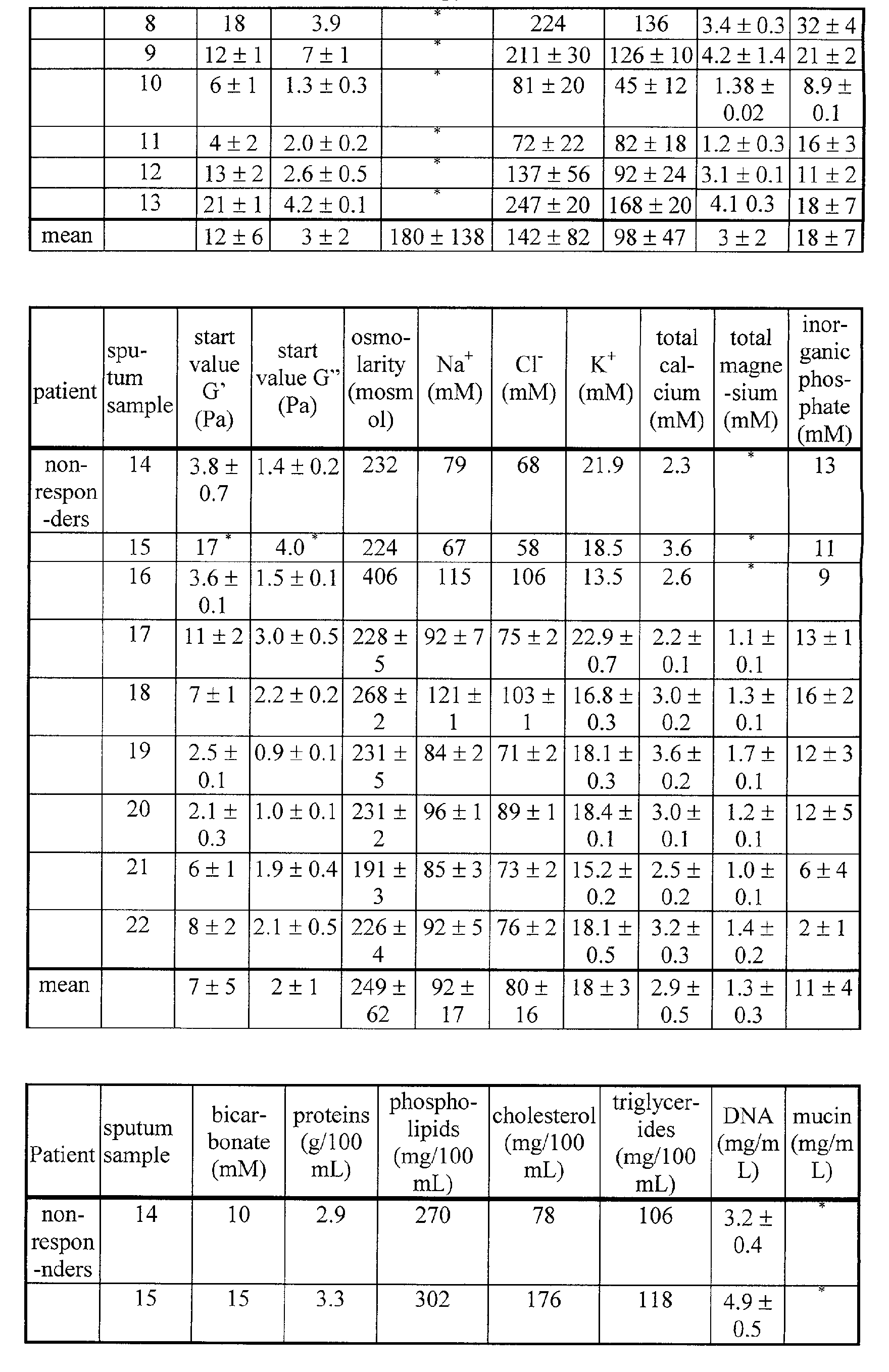

- The change of sputum viscoelasticity upon treatment with rhDNase I was determined with a controlled stress rotation rheometer (AR 1000 N, TA-Instruments, Brussels, Belgium) using a cone-plate geometry. The angle between the cone and the plate was 2 degrees and the sample volume required was approximately 0.9 ml. Dynamic oscillatory measurements were performed at a constant frequency of 1 Hz with a stress ranging from 0.01 to 0.1 Pa. In order to avoid disruption of the weak biopolymer network in the sputum due to the oscillation forces, the elastic modulus (G') and viscous modulus (G") of the sputum samples were determined in the linear viscoelastic region. All experiments were carried out at 20°C in order to decrease the enzymatic degradation and dehydration of the sputum during the experiments (Sanders et al. in J. Pharm. Sci.(2000) 89:835-849). Sample dehydration was also prevented by using a solvent trap.
- The effect of rhDNAse I on the viscoelasticity of CF-sputa obtained from both responders and non-responders was measured immediately after collection of the sputa. Table 2 below shows the values of G' and G" of the sputa before degradation.
- In order to evaluate the degradation of sputa by rhDNAse I, a 0.9 ml sputum fraction was taken from a sputum sample and the start value of its elasticity (G') and viscosity (G") was measured. Consequently, 86µl rhDNAse I (126 µg/ml in 0.877 % NaCI and 0.015 % CaCl2; (1 µg rhDNAse I = 1 Genentech U)) was mixed with the sputum. The DNAse concentration in this experiment is in the range of the DNAse concentration measured in sputum of CF patients after administration of rhDNAse I (Pulmozyme®, Roche) (Sinicropi et al. in Am. J. Respir. Crit. Care Med. (1994) 149:A671). After 20 minutes incubation at 20 °C, G' and G" of the sputum fraction was determined again. As a control 86 µl buffer was added to another 1.0 ml sputum fraction. Table 2 below shows the percent decrease in G' and G" due to cleavage of the sputum DNA by rhDNAse I. The net percentage decrease in viscoelasticity due to rhDNAse I was obtained by subtraction of the percent decrease caused by the excipient from the percent decrease caused by rhDNAse I and excipient. RhDNAse I was considered to be effective in decreasing sputum viscoelasticity in vitro when the percent decrease of both G' and G" was at least 10 %. Ten of the twelve sputa (i.e. 83 %) obtained from CF patients who showed a clinical response on rhDNAse I were degraded in vitro by rhDNAse I. Seven of the ten sputa (i.e. 70 %) obtained from CF patients who did not benefit from rhDNAse I therapy were also not degraded in vitro by rhDNAse I. Although a rather good correlation was observed between the effect of rhDNAse I in vitro and in vivo, using the effect of rhDNAse I on sputum viscoelasticity in vitro as a predictive parameter would result in a false prediction in about 25 % of the cases.
sputum sample start value G' (Pa) start value G" (Pa) percent decrease G'(%) percent decrease G" (%) responder 1 25 ± 7 6.5 ± 1.3 30 26 2 5.3 ± 0.8 2.1 ± 0.3 -2 0 3 14 ± 6 4.3 ± 1.5 61 56 4 3.0 ± 0.4 1.2 ± 0.1 80 33 5 16 ± 4 4.2 ± 0.9 41 38 6 3.4 ± 0.8 1.4 ± 0.2 9 7 7 14 ± 4 3.3 ± 0.8 21 12 8 6.6 ± 0.6 2.7 ± 0.3 35 30 9 4.0 ± 0.1 1.5 ± 0.1 33 13 10 2.8 ± 0.8 0.9 ± 0.1 7 11 11 10 ± 1 2.8 ± 0.5 28 14 12 2.1 ± 0.2 1.2 ± 0.2 33 17 13 3.7 ± 0.4 1.6 ± 0.1 24 13 Non-responder 14 3.8 ± 0.7 1.4 ± 0.2 32 21 15 17 * 4.0 * 29 23 16 3.6 ± 0.1 1.5 ± 0.1 3 13 17 11 ± 2 3.0 ± 0.5 0 -7 18 7 ± 1 2.2 ± 0.2 9 5 19 2.5 ± 0.1 0.9 ± 0.1 4 -11 20 2.1 ± 0.3 1.0 ± 0.1 5 10 21 6 ± 1 1.9 ± 0.4 8 -5 22 8 ± 2 2.1 ± 0.5 9 14 - The viscosity of DNA and DNA/actin solutions was measured with a calibrated capillary viscosimeter (Schott Geräte, Hofheim, Germany) equipped with an automated apparatus (Lauda, Köningshofen, Germany). The capillary viscosimeter was placed in a water bath (20.00 °C ± 0.05 °C) and the outflow times (t in s) were determined automatically. The viscosity (η) of the solutions is related to t by: η=kwhere k and B are known constants. The effect of Mg2+ and K+ ions on the activity of DNAse (measured as decrease in viscosity) was determined by changing the Mg2+ and K+ concentration in a standardized DNA digest. DNA (salmon sperm DNA from Sigma) was digested (10 µl/ml rhDNAse I, 2,3 mg/ml DNA, 70 mM NaCI, and 3 mM CaCl2, pH 7.0) in order to determine the change in viscosity of the DNA solution. Table 3 below shows that viscosity η rapidly drops to a value near 1 mm2/s. This indicates that the administered amounts of Mg2+ and K+ do not interfere with the requirement of DNAse I for divalent cations.


- In a set-up comparable to example 4, the effect of K+ and Mg2+ ions on DNA degradation (decrease in viscosity) is measured in the presence of rabbit skeletal actin prepared according to Spudich et al. in J. Biol. Chem. (1971) 246: 4866-4871) (6,4 µg/ml rhDNAsel ,1.5 mg DNA/ml and 1.1 mg actin/ml 70 mM NaCI, 3 mM CaCl2, 0.35 mM ATP, 3.2 mM TRIS/HCl, 0.13 mM DTT, and 0.006 % NaN3, pH 7,0). K+ and Mg2+ were supplied as K2HPO4 and MgCl2 respectively. The viscosity of the DNA/actin solutions at different time points after the addition of rhDNase I are shown in table 4 below.
- The DNAse activity is highest at high levels of Mg2+ and K+. This is in accordance with the fact that DNAse has a better performance when the F actin configuration is favoured under conditions of high ionic strength.
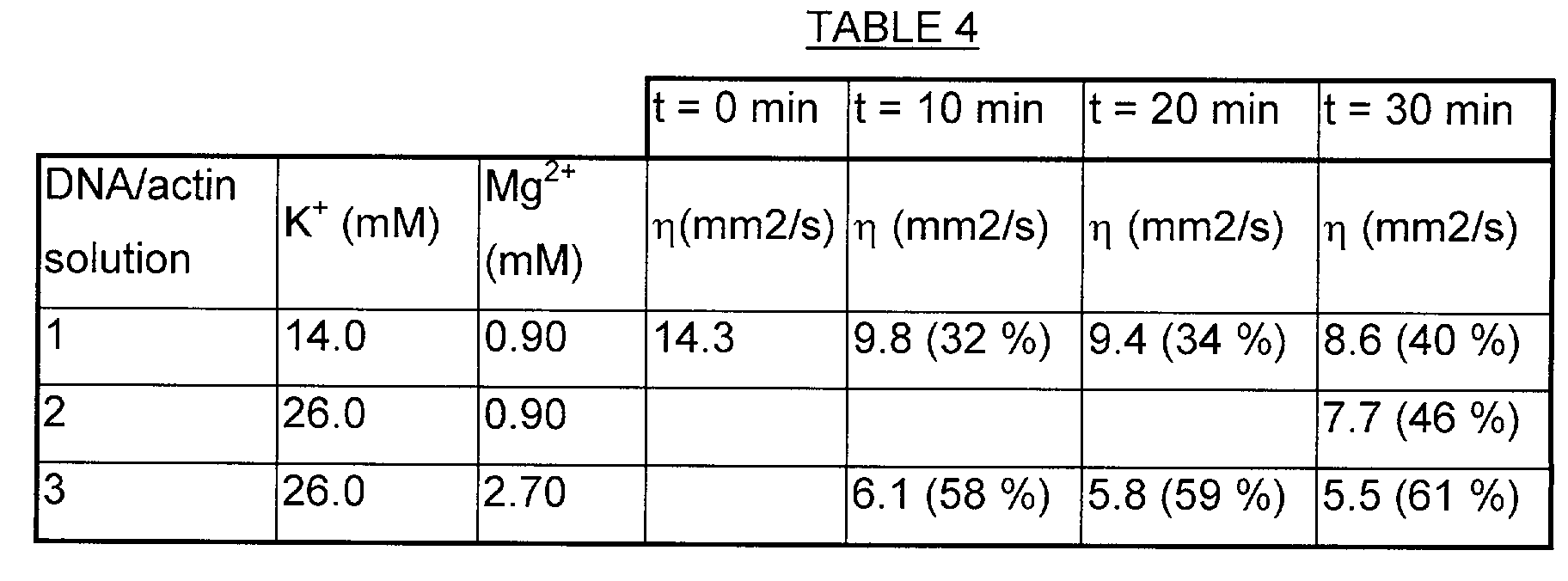
Claims (19)
- Use of a compound able to promote F actin formation by shifting the equilibrium between G actin and F actin in the manufacture of a medicament for the treatment of a disease of the respiratory tract.
- Use according to claim 1, wherein the said compound is an ionic form of potassium or magnesium.
- Use according to claim 1 or claim 2, in combination with DNAse I or a variant thereof.
- Use according to claim 3, wherein promotion of F actin formation is effected before G actin binds to DNAse I or a variant thereof.
- Use according to any of claims 1 to 4, wherein the disease is a pulmonary disease characterised by the presence of viscous mucus .
- Use according to any of claims 1 to 5, wherein the disease is cystic fibrosis.
- Use of an ionic form of potassium or magnesium or a compound leading to an increased concentration of ionic magnesium or potassium for promoting F actin formation by shifting the equilibrium between G actin and F actin in the manufacture of a medicament for the prevention or treatment of a disease induced by an excess of G actin or DNA.
- Use according to claim 7, wherein the disease is the Wiskott Aldrich Syndrome.
- Use of a an ionic form of potassium or magnesium or a compound leading to an increased concentration of ionic magnesium or potassium for promoting F actin formation by shifting the equilibrium between G actin and F actin in a medicament for the prevention or treatment of a disease induced by an autoimmune response against DNA.
- Use according to claim 9, wherein the disease is Lupus Erythrematous.
- Use of a potassium or magnesium salt in the manufacture of a medicament for the treatment of a pulmonary disease characterised by the presence of viscous mucus.
- Use according to claim 11, wherein the said pulmonary disease is cystic fibrosis.
- A pharmaceutical composition for the treatment of a pulmonary disease characterised by the presence of viscous mucus, comprising:in respective proportions such as to provide a synergistic effect in the reduction of mucus viscosity, as a combined preparation for simultaneous, separate or sequential use.(a) a compound able to promote F actin formation by shifting the equilibrium between G actin and F actin, and(b) a DNA degrading enzyme
- A pharmaceutical composition according to claim 13, wherein compound (a) is selected from potassium and magnesium salts.
- A pharmaceutical composition according to claim 13 or 14, wherein the DNA degrading enzyme is a nuclease.
- A pharmaceutical composition according to any of claims 13 to 15, wherein the DNA degrading enzyme is DNAse I or a variant thereof.
- A pharmaceutical composition according to any of claims 13 to 16, wherein compound (a) is selected from potassium hydrogenophosphate K2HPO4 and magnesium chloride MgCl2.
- A pharmaceutical composition according to any of claims 13 to 17, for the treatment of cystic fibrosis.
- An in vitro diagnostic tool to characterize mucus secretions from patients suffering from a disease associated with viscous mucus.
Priority Applications (5)
| Application Number | Priority Date | Filing Date | Title |
|---|---|---|---|
| EP20010201360 EP1249244A1 (en) | 2001-04-13 | 2001-04-13 | Therapeutic compositions for the treatment of a disease modulated by the G-actin / F-actin equilibrium, especially a respiratory tract disease |
| PCT/EP2002/004198 WO2002083167A2 (en) | 2001-04-13 | 2002-04-15 | Therapeutic compositions for the treatment of a respiratory tract disease |
| US10/474,897 US7432308B2 (en) | 2001-04-13 | 2002-04-15 | Therapeutic compositions for the treatment of a respiratory tract disease |
| AU2002338303A AU2002338303A1 (en) | 2001-04-13 | 2002-04-15 | Therapeutic compositions for the treatment of a respiratory tract disease |
| CA002443107A CA2443107A1 (en) | 2001-04-13 | 2002-04-15 | Therapeutic compositions for the treatment of a respiratory tract disease |
Applications Claiming Priority (1)
| Application Number | Priority Date | Filing Date | Title |
|---|---|---|---|
| EP20010201360 EP1249244A1 (en) | 2001-04-13 | 2001-04-13 | Therapeutic compositions for the treatment of a disease modulated by the G-actin / F-actin equilibrium, especially a respiratory tract disease |
Publications (1)
| Publication Number | Publication Date |
|---|---|
| EP1249244A1 true EP1249244A1 (en) | 2002-10-16 |
Family
ID=8180149
Family Applications (1)
| Application Number | Title | Priority Date | Filing Date |
|---|---|---|---|
| EP20010201360 Withdrawn EP1249244A1 (en) | 2001-04-13 | 2001-04-13 | Therapeutic compositions for the treatment of a disease modulated by the G-actin / F-actin equilibrium, especially a respiratory tract disease |
Country Status (5)
| Country | Link |
|---|---|
| US (1) | US7432308B2 (en) |
| EP (1) | EP1249244A1 (en) |
| AU (1) | AU2002338303A1 (en) |
| CA (1) | CA2443107A1 (en) |
| WO (1) | WO2002083167A2 (en) |
Families Citing this family (14)
| Publication number | Priority date | Publication date | Assignee | Title |
|---|---|---|---|---|
| WO2005046454A2 (en) * | 2003-11-12 | 2005-05-26 | Trustrees Of The University Of Pennsylvania | Methods of using gelsolin to treat or prevent bacterial sepsis |
| US9408891B2 (en) * | 2003-11-12 | 2016-08-09 | The Trustees Of The University Of Pennsylvania | Methods of using gelsolin to treat or prevent bacterial sepsis |
| KR101314461B1 (en) * | 2004-05-12 | 2013-10-07 | 더 브리검 앤드 우먼즈 하스피털, 인크. | Use of gelsolin to treat infections |
| EP1791566A4 (en) | 2004-08-06 | 2008-07-16 | Nat Jewish Med & Res Center | PRODUCT AND METHOD FOR PREVENTING THE DEVELOPMENT OF A BIOLOGICAL FILM |
| WO2007027578A2 (en) * | 2005-08-31 | 2007-03-08 | Regenerx Biopharmaceuticals, Inc. | Methods and compositions for decreasing cohesivity of pathological respiratory tract secretions |
| EP3279663B1 (en) | 2006-03-15 | 2021-07-28 | The Brigham and Women's Hospital, Inc. | Use of gelsolin to diagnose and treat inflammatory diseases |
| CA2680333C (en) * | 2006-03-15 | 2016-10-25 | The Brigham And Women's Hospital, Inc. | Use of gelsolin to treat multiple sclerosis and to diagnose neurologic diseases |
| US8753662B2 (en) | 2007-02-15 | 2014-06-17 | National Jewish Health | Methods and compositions for the disruption of biofilms |
| DK2250280T3 (en) | 2008-01-25 | 2015-03-09 | Gen Hospital Corp | THERAPEUTIC USES OF gelsolin in renal failure |
| US9603906B2 (en) | 2012-02-01 | 2017-03-28 | Protalix Ltd. | Inhalable liquid formulations of DNase I |
| EP3240896A1 (en) | 2015-01-04 | 2017-11-08 | Protalix Ltd. | Modified dnase and uses thereof |
| US11918549B2 (en) | 2017-08-25 | 2024-03-05 | AZ Solutions LLC | System and method for wound treatment and irrigation |
| CA3073325A1 (en) | 2017-08-25 | 2019-02-28 | AZ Solutions LLC | System and method for wound treatment and irrigation |
| WO2022235781A1 (en) * | 2021-05-04 | 2022-11-10 | AZ solutions, LLC | Treatment of lung and airway diseases and disorders |
Citations (6)
| Publication number | Priority date | Publication date | Assignee | Title |
|---|---|---|---|---|
| WO1994022465A1 (en) * | 1993-04-02 | 1994-10-13 | Brigham And Women's Hospital | Method for reducing the viscosity of pathological mucoid airway contents in the respiratoy tract |
| WO1996001627A1 (en) * | 1994-07-08 | 1996-01-25 | THE GOVERNMENT OF THE UNITED STATES OF AMERICA, represented by THE SECRETARY, DEPARTMENT OF HEALTH ANS HUMA SERVICES | Use of swinholide a for severing and depolymerizing actin |
| WO1996011016A1 (en) * | 1994-10-06 | 1996-04-18 | Alpha 1 Biomedicals, Inc. | TREATMENT OF OBSTRUCTIVE AIRWAY DISEASE BY ADMINISTERING THYMOSIN β4, OR COADMINISTRATION OF THYMOSIN β4 AND DNase I |
| WO1998037096A1 (en) * | 1997-02-20 | 1998-08-27 | University Of Maryland, Baltimore | Zonula occludens toxin receptors |
| WO2000003746A2 (en) * | 1998-07-14 | 2000-01-27 | The Brigham And Women's Hospital, Inc. | Upregulation of type iii endothelial cell nitric oxide synthase by agents that disrupt actin cytoskeletal organization |
| EP0998945A1 (en) * | 1998-09-30 | 2000-05-10 | Transgene S.A. | Use of magnesium (Mg2+) for the enhancement of gene delivery in gene therapy |
Family Cites Families (5)
| Publication number | Priority date | Publication date | Assignee | Title |
|---|---|---|---|---|
| DE3921954A1 (en) | 1989-07-04 | 1991-01-17 | Thomae Gmbh Dr K | LOW-VISCOSE, HIGHLY CONCENTRATED SURFACTANT SUSPENSION |
| HU207800B (en) | 1990-05-10 | 1993-06-28 | Andras Sikter | Process for producing composition for improving condition and for treating different illnesses |
| US5132118A (en) | 1990-05-11 | 1992-07-21 | Mills John A | Treatment of exercise-induced pulmonary hemorrhage in animals |
| IL106484A (en) | 1992-07-31 | 1998-08-16 | Lai John | Compositions for therapeutic and anaesthetic treatment and the use thereof |
| US5985339A (en) | 1996-11-22 | 1999-11-16 | Kamarei; A. Reza | Refrigeration-shelf-stable ready-to-drink complete nutritional compositions and products |
-
2001
- 2001-04-13 EP EP20010201360 patent/EP1249244A1/en not_active Withdrawn
-
2002
- 2002-04-15 CA CA002443107A patent/CA2443107A1/en not_active Abandoned
- 2002-04-15 US US10/474,897 patent/US7432308B2/en not_active Expired - Fee Related
- 2002-04-15 WO PCT/EP2002/004198 patent/WO2002083167A2/en not_active Ceased
- 2002-04-15 AU AU2002338303A patent/AU2002338303A1/en not_active Abandoned
Patent Citations (6)
| Publication number | Priority date | Publication date | Assignee | Title |
|---|---|---|---|---|
| WO1994022465A1 (en) * | 1993-04-02 | 1994-10-13 | Brigham And Women's Hospital | Method for reducing the viscosity of pathological mucoid airway contents in the respiratoy tract |
| WO1996001627A1 (en) * | 1994-07-08 | 1996-01-25 | THE GOVERNMENT OF THE UNITED STATES OF AMERICA, represented by THE SECRETARY, DEPARTMENT OF HEALTH ANS HUMA SERVICES | Use of swinholide a for severing and depolymerizing actin |
| WO1996011016A1 (en) * | 1994-10-06 | 1996-04-18 | Alpha 1 Biomedicals, Inc. | TREATMENT OF OBSTRUCTIVE AIRWAY DISEASE BY ADMINISTERING THYMOSIN β4, OR COADMINISTRATION OF THYMOSIN β4 AND DNase I |
| WO1998037096A1 (en) * | 1997-02-20 | 1998-08-27 | University Of Maryland, Baltimore | Zonula occludens toxin receptors |
| WO2000003746A2 (en) * | 1998-07-14 | 2000-01-27 | The Brigham And Women's Hospital, Inc. | Upregulation of type iii endothelial cell nitric oxide synthase by agents that disrupt actin cytoskeletal organization |
| EP0998945A1 (en) * | 1998-09-30 | 2000-05-10 | Transgene S.A. | Use of magnesium (Mg2+) for the enhancement of gene delivery in gene therapy |
Non-Patent Citations (1)
| Title |
|---|
| MARUYAMA, KOSCAK ET AL: "Effects of potassium chloride, magnesium chloride, an calcium chloride concentrations on the monomer-polymer equilibrium of actin in the presence and absence of cytochalasin D", J. BIOCHEM. (TOKYO) (1984), 96(3), 605-11, XP001041958 * |
Also Published As
| Publication number | Publication date |
|---|---|
| US7432308B2 (en) | 2008-10-07 |
| WO2002083167A3 (en) | 2003-01-30 |
| AU2002338303A1 (en) | 2002-10-28 |
| CA2443107A1 (en) | 2002-10-24 |
| WO2002083167A2 (en) | 2002-10-24 |
| US20040141961A1 (en) | 2004-07-22 |
Similar Documents
| Publication | Publication Date | Title |
|---|---|---|
| US7432308B2 (en) | Therapeutic compositions for the treatment of a respiratory tract disease | |
| CN1107521C (en) | Method for reducing the viscosity of pathological mucoid airway contents in the respiratoy tract | |
| Suri | The use of human deoxyribonuclease (rhDNase) in the management of cystic fibrosis | |
| AU2008203028B2 (en) | Pharmaceutically stable hemostatic compositions | |
| JP2020534865A (en) | Modified DNSE Enzymes and Use in Treatment | |
| US20190209662A1 (en) | Use of alkaline phosphatase for preserving renal function | |
| EP3624832B1 (en) | Methods and pharmaceutical compositions for the treatment of acute ischemic stroke | |
| US20210162029A1 (en) | Compositions and methods for treatment or prevention of skin diseases and disorders with lekti | |
| EP3019188B1 (en) | A peptide and the use thereof in the treatment of inflammatory disorders | |
| US20050159334A1 (en) | Method for treating rheumatoid arthritis by inhibiting peptidylarginine deiminase | |
| JPH0772139B2 (en) | Preparation for prevention and treatment of corneal lesion | |
| US20070060517A1 (en) | Methods for preventing and treating local tracheal, bronchial or alveolar bleeding or hemoptysis | |
| Kelly et al. | The lung responds to zymosan in a unique manner independent of toll-like receptors, complement, and dectin-1 | |
| Beckmann et al. | Myeloperoxidase has no effect on the low procoagulant activity of silica-free DNA | |
| US20200330565A1 (en) | Methods and compositions for pre-emptive treatment of graft versus host disease | |
| Sato et al. | Anti-BlyS antibody reduces the immune reaction against enzyme and enhances the efficacy of enzyme replacement therapy in Fabry disease model mice | |
| JP2002533473A (en) | Pharmaceutical formulations containing hyaluronan degrading enzymes of microbial origin | |
| WO2019222801A1 (en) | Promotion of epithelial repair via the administration of activators of pi3k/akt signalling | |
| Collins et al. | The enzymatic digestion of elastin at acidic pH | |
| Ozkan et al. | Ligneous Conjunctivitis with Plasminogen Deficiency Treated with Topical Allogeneic Serum Drops: A Case Report | |
| Ali | Neutrophil Extracellular Trap Formation in Cystic Fibrosis | |
| Gessert et al. | LXVIII The Action of Enzymes on Human Middle Ear Effusions | |
| Wagener | Recombinant Human Deoxyribonuclease I | |
| RU2695132C1 (en) | Pharmaceutical composition for improving rheological properties of sputum based on enzyme nuclease serratia marcescens | |
| Stern et al. | Therapeutic approaches to the lung problems in cystic fibrosis |
Legal Events
| Date | Code | Title | Description |
|---|---|---|---|
| PUAI | Public reference made under article 153(3) epc to a published international application that has entered the european phase |
Free format text: ORIGINAL CODE: 0009012 |
|
| AK | Designated contracting states |
Kind code of ref document: A1 Designated state(s): AT BE CH CY DE DK ES FI FR GB GR IE IT LI LU MC NL PT SE TR |
|
| AX | Request for extension of the european patent |
Free format text: AL;LT;LV;MK;RO;SI |
|
| AKX | Designation fees paid | ||
| REG | Reference to a national code |
Ref country code: DE Ref legal event code: 8566 |
|
| STAA | Information on the status of an ep patent application or granted ep patent |
Free format text: STATUS: THE APPLICATION IS DEEMED TO BE WITHDRAWN |
|
| 18D | Application deemed to be withdrawn |
Effective date: 20030417 |