EP1249173A1 - Oil or fat composition - Google Patents
Oil or fat composition Download PDFInfo
- Publication number
- EP1249173A1 EP1249173A1 EP20020008147 EP02008147A EP1249173A1 EP 1249173 A1 EP1249173 A1 EP 1249173A1 EP 20020008147 EP20020008147 EP 20020008147 EP 02008147 A EP02008147 A EP 02008147A EP 1249173 A1 EP1249173 A1 EP 1249173A1
- Authority
- EP
- European Patent Office
- Prior art keywords
- oil
- fat composition
- fat
- fried
- frying
- Prior art date
- Legal status (The legal status is an assumption and is not a legal conclusion. Google has not performed a legal analysis and makes no representation as to the accuracy of the status listed.)
- Granted
Links
- 239000000203 mixture Substances 0.000 title claims abstract description 82
- 150000001732 carboxylic acid derivatives Chemical class 0.000 claims abstract description 12
- 238000000034 method Methods 0.000 claims description 28
- CIWBSHSKHKDKBQ-JLAZNSOCSA-N Ascorbic acid Chemical compound OC[C@H](O)[C@H]1OC(=O)C(O)=C1O CIWBSHSKHKDKBQ-JLAZNSOCSA-N 0.000 claims description 25
- GVJHHUAWPYXKBD-UHFFFAOYSA-N (±)-α-Tocopherol Chemical compound OC1=C(C)C(C)=C2OC(CCCC(C)CCCC(C)CCCC(C)C)(C)CCC2=C1C GVJHHUAWPYXKBD-UHFFFAOYSA-N 0.000 claims description 22
- 235000013305 food Nutrition 0.000 claims description 19
- 239000003963 antioxidant agent Substances 0.000 claims description 18
- 238000010411 cooking Methods 0.000 claims description 18
- WIGCFUFOHFEKBI-UHFFFAOYSA-N gamma-tocopherol Natural products CC(C)CCCC(C)CCCC(C)CCCC1CCC2C(C)C(O)C(C)C(C)C2O1 WIGCFUFOHFEKBI-UHFFFAOYSA-N 0.000 claims description 12
- 229930003427 Vitamin E Natural products 0.000 claims description 11
- 235000020748 rosemary extract Nutrition 0.000 claims description 11
- 235000019165 vitamin E Nutrition 0.000 claims description 11
- 239000011709 vitamin E Substances 0.000 claims description 11
- 229940046009 vitamin E Drugs 0.000 claims description 11
- ZZZCUOFIHGPKAK-UHFFFAOYSA-N D-erythro-ascorbic acid Natural products OCC1OC(=O)C(O)=C1O ZZZCUOFIHGPKAK-UHFFFAOYSA-N 0.000 claims description 10
- 229930003268 Vitamin C Natural products 0.000 claims description 10
- 229940092258 rosemary extract Drugs 0.000 claims description 10
- 239000001233 rosmarinus officinalis l. extract Substances 0.000 claims description 10
- 235000019154 vitamin C Nutrition 0.000 claims description 10
- 239000011718 vitamin C Substances 0.000 claims description 10
- 229920001296 polysiloxane Polymers 0.000 claims description 9
- 150000003839 salts Chemical class 0.000 claims description 7
- 150000004347 all-trans-retinol derivatives Chemical class 0.000 claims description 3
- 235000012041 food component Nutrition 0.000 claims description 3
- 239000005417 food ingredient Substances 0.000 claims description 3
- 230000008569 process Effects 0.000 claims description 3
- 241000894007 species Species 0.000 claims description 3
- BVKZGUZCCUSVTD-UHFFFAOYSA-N carbonic acid Chemical class OC(O)=O BVKZGUZCCUSVTD-UHFFFAOYSA-N 0.000 claims description 2
- 150000001991 dicarboxylic acids Chemical class 0.000 claims 1
- 239000003921 oil Substances 0.000 description 153
- 235000019198 oils Nutrition 0.000 description 152
- 239000003925 fat Substances 0.000 description 59
- KRKNYBCHXYNGOX-UHFFFAOYSA-N citric acid Chemical compound OC(=O)CC(O)(C(O)=O)CC(O)=O KRKNYBCHXYNGOX-UHFFFAOYSA-N 0.000 description 56
- 239000000796 flavoring agent Substances 0.000 description 27
- 235000019634 flavors Nutrition 0.000 description 27
- 230000003647 oxidation Effects 0.000 description 19
- 238000007254 oxidation reaction Methods 0.000 description 19
- 235000015165 citric acid Nutrition 0.000 description 18
- 235000012149 noodles Nutrition 0.000 description 15
- XLYOFNOQVPJJNP-UHFFFAOYSA-N water Substances O XLYOFNOQVPJJNP-UHFFFAOYSA-N 0.000 description 15
- 244000061456 Solanum tuberosum Species 0.000 description 14
- 235000002595 Solanum tuberosum Nutrition 0.000 description 14
- 230000007062 hydrolysis Effects 0.000 description 13
- 238000006460 hydrolysis reaction Methods 0.000 description 13
- 239000000284 extract Substances 0.000 description 12
- 150000001735 carboxylic acids Chemical class 0.000 description 10
- 235000012489 doughnuts Nutrition 0.000 description 10
- 230000000694 effects Effects 0.000 description 10
- 235000012015 potatoes Nutrition 0.000 description 10
- 239000002253 acid Substances 0.000 description 9
- 239000000463 material Substances 0.000 description 9
- 235000013606 potato chips Nutrition 0.000 description 9
- 235000002639 sodium chloride Nutrition 0.000 description 9
- 150000003626 triacylglycerols Chemical class 0.000 description 9
- PEDCQBHIVMGVHV-UHFFFAOYSA-N Glycerine Chemical compound OCC(O)CO PEDCQBHIVMGVHV-UHFFFAOYSA-N 0.000 description 8
- 235000013330 chicken meat Nutrition 0.000 description 8
- 230000000052 comparative effect Effects 0.000 description 8
- 235000019640 taste Nutrition 0.000 description 8
- 241000287828 Gallus gallus Species 0.000 description 7
- 235000014113 dietary fatty acids Nutrition 0.000 description 7
- 239000000194 fatty acid Substances 0.000 description 7
- 229930195729 fatty acid Natural products 0.000 description 7
- 239000000779 smoke Substances 0.000 description 7
- 239000000243 solution Substances 0.000 description 7
- LFQSCWFLJHTTHZ-UHFFFAOYSA-N Ethanol Chemical compound CCO LFQSCWFLJHTTHZ-UHFFFAOYSA-N 0.000 description 6
- 210000000577 adipose tissue Anatomy 0.000 description 6
- -1 alkali metal salts Chemical class 0.000 description 6
- 238000002360 preparation method Methods 0.000 description 6
- LDVVTQMJQSCDMK-UHFFFAOYSA-N 1,3-dihydroxypropan-2-yl formate Chemical compound OCC(CO)OC=O LDVVTQMJQSCDMK-UHFFFAOYSA-N 0.000 description 5
- 241000209140 Triticum Species 0.000 description 5
- 235000021307 Triticum Nutrition 0.000 description 5
- 150000004665 fatty acids Chemical class 0.000 description 5
- 235000008446 instant noodles Nutrition 0.000 description 5
- 239000000543 intermediate Substances 0.000 description 5
- 238000004519 manufacturing process Methods 0.000 description 5
- 238000003860 storage Methods 0.000 description 5
- UFTFJSFQGQCHQW-UHFFFAOYSA-N triformin Chemical compound O=COCC(OC=O)COC=O UFTFJSFQGQCHQW-UHFFFAOYSA-N 0.000 description 5
- FEWJPZIEWOKRBE-JCYAYHJZSA-N Dextrotartaric acid Chemical compound OC(=O)[C@H](O)[C@@H](O)C(O)=O FEWJPZIEWOKRBE-JCYAYHJZSA-N 0.000 description 4
- VEXZGXHMUGYJMC-UHFFFAOYSA-N Hydrochloric acid Chemical class Cl VEXZGXHMUGYJMC-UHFFFAOYSA-N 0.000 description 4
- FEWJPZIEWOKRBE-UHFFFAOYSA-N Tartaric acid Natural products [H+].[H+].[O-]C(=O)C(O)C(O)C([O-])=O FEWJPZIEWOKRBE-UHFFFAOYSA-N 0.000 description 4
- 238000009825 accumulation Methods 0.000 description 4
- 125000002252 acyl group Chemical group 0.000 description 4
- 229960005070 ascorbic acid Drugs 0.000 description 4
- 235000019606 astringent taste Nutrition 0.000 description 4
- 230000015556 catabolic process Effects 0.000 description 4
- 238000006731 degradation reaction Methods 0.000 description 4
- 229940079593 drug Drugs 0.000 description 4
- 239000003814 drug Substances 0.000 description 4
- 235000013312 flour Nutrition 0.000 description 4
- 125000005456 glyceride group Chemical group 0.000 description 4
- 235000011187 glycerol Nutrition 0.000 description 4
- 238000010438 heat treatment Methods 0.000 description 4
- 235000014593 oils and fats Nutrition 0.000 description 4
- 239000011975 tartaric acid Substances 0.000 description 4
- 235000002906 tartaric acid Nutrition 0.000 description 4
- GVJHHUAWPYXKBD-IEOSBIPESA-N α-tocopherol Chemical compound OC1=C(C)C(C)=C2O[C@@](CCC[C@H](C)CCC[C@H](C)CCCC(C)C)(C)CCC2=C1C GVJHHUAWPYXKBD-IEOSBIPESA-N 0.000 description 4
- GZIFEOYASATJEH-VHFRWLAGSA-N δ-tocopherol Chemical compound OC1=CC(C)=C2O[C@@](CCC[C@H](C)CCC[C@H](C)CCCC(C)C)(C)CCC2=C1 GZIFEOYASATJEH-VHFRWLAGSA-N 0.000 description 4
- CSCPPACGZOOCGX-UHFFFAOYSA-N Acetone Chemical compound CC(C)=O CSCPPACGZOOCGX-UHFFFAOYSA-N 0.000 description 3
- XEKOWRVHYACXOJ-UHFFFAOYSA-N Ethyl acetate Chemical compound CCOC(C)=O XEKOWRVHYACXOJ-UHFFFAOYSA-N 0.000 description 3
- IAJILQKETJEXLJ-UHFFFAOYSA-N Galacturonsaeure Natural products O=CC(O)C(O)C(O)C(O)C(O)=O IAJILQKETJEXLJ-UHFFFAOYSA-N 0.000 description 3
- 244000068988 Glycine max Species 0.000 description 3
- 235000010469 Glycine max Nutrition 0.000 description 3
- KFZMGEQAYNKOFK-UHFFFAOYSA-N Isopropanol Chemical compound CC(C)O KFZMGEQAYNKOFK-UHFFFAOYSA-N 0.000 description 3
- 239000002310 Isopropyl citrate Substances 0.000 description 3
- XBLJCYOUYPSETL-UHFFFAOYSA-N Isopropyl citrate Chemical compound CC(C)O.CC(=O)CC(O)(C(O)=O)CC(O)=O XBLJCYOUYPSETL-UHFFFAOYSA-N 0.000 description 3
- 240000005856 Lyophyllum decastes Species 0.000 description 3
- 235000013194 Lyophyllum decastes Nutrition 0.000 description 3
- MUBZPKHOEPUJKR-UHFFFAOYSA-N Oxalic acid Chemical compound OC(=O)C(O)=O MUBZPKHOEPUJKR-UHFFFAOYSA-N 0.000 description 3
- HEMHJVSKTPXQMS-UHFFFAOYSA-M Sodium hydroxide Chemical compound [OH-].[Na+] HEMHJVSKTPXQMS-UHFFFAOYSA-M 0.000 description 3
- 230000003064 anti-oxidating effect Effects 0.000 description 3
- 235000006708 antioxidants Nutrition 0.000 description 3
- 239000007864 aqueous solution Substances 0.000 description 3
- 239000003795 chemical substances by application Substances 0.000 description 3
- 238000004040 coloring Methods 0.000 description 3
- 201000010099 disease Diseases 0.000 description 3
- 208000037265 diseases, disorders, signs and symptoms Diseases 0.000 description 3
- 239000008157 edible vegetable oil Substances 0.000 description 3
- 238000005886 esterification reaction Methods 0.000 description 3
- 235000013373 food additive Nutrition 0.000 description 3
- 239000002778 food additive Substances 0.000 description 3
- 230000006698 induction Effects 0.000 description 3
- 235000019300 isopropyl citrate Nutrition 0.000 description 3
- VLKZOEOYAKHREP-UHFFFAOYSA-N n-Hexane Chemical compound CCCCCC VLKZOEOYAKHREP-UHFFFAOYSA-N 0.000 description 3
- 239000011435 rock Substances 0.000 description 3
- 150000003722 vitamin derivatives Chemical class 0.000 description 3
- PFTAWBLQPZVEMU-DZGCQCFKSA-N (+)-catechin Chemical compound C1([C@H]2OC3=CC(O)=CC(O)=C3C[C@@H]2O)=CC=C(O)C(O)=C1 PFTAWBLQPZVEMU-DZGCQCFKSA-N 0.000 description 2
- PBTPTBMYJPCXRQ-MGMRMFRLSA-N (2r)-2-[(1s)-1,2-dihydroxyethyl]-3,4-dihydroxy-2h-furan-5-one;hexadecanoic acid Chemical compound OC[C@H](O)[C@H]1OC(=O)C(O)=C1O.CCCCCCCCCCCCCCCC(O)=O PBTPTBMYJPCXRQ-MGMRMFRLSA-N 0.000 description 2
- BJEPYKJPYRNKOW-REOHCLBHSA-N (S)-malic acid Chemical compound OC(=O)[C@@H](O)CC(O)=O BJEPYKJPYRNKOW-REOHCLBHSA-N 0.000 description 2
- LMDZBCPBFSXMTL-UHFFFAOYSA-N 1-ethyl-3-(3-dimethylaminopropyl)carbodiimide Chemical compound CCN=C=NCCCN(C)C LMDZBCPBFSXMTL-UHFFFAOYSA-N 0.000 description 2
- 240000002791 Brassica napus Species 0.000 description 2
- 235000004977 Brassica sinapistrum Nutrition 0.000 description 2
- NLZUEZXRPGMBCV-UHFFFAOYSA-N Butylhydroxytoluene Chemical compound CC1=CC(C(C)(C)C)=C(O)C(C(C)(C)C)=C1 NLZUEZXRPGMBCV-UHFFFAOYSA-N 0.000 description 2
- 235000005979 Citrus limon Nutrition 0.000 description 2
- 244000131522 Citrus pyriformis Species 0.000 description 2
- GZIFEOYASATJEH-UHFFFAOYSA-N D-delta tocopherol Natural products OC1=CC(C)=C2OC(CCCC(C)CCCC(C)CCCC(C)C)(C)CCC2=C1 GZIFEOYASATJEH-UHFFFAOYSA-N 0.000 description 2
- VZCYOOQTPOCHFL-OWOJBTEDSA-N Fumaric acid Chemical compound OC(=O)\C=C\C(O)=O VZCYOOQTPOCHFL-OWOJBTEDSA-N 0.000 description 2
- 239000002211 L-ascorbic acid Substances 0.000 description 2
- 235000000069 L-ascorbic acid Nutrition 0.000 description 2
- OFOBLEOULBTSOW-UHFFFAOYSA-N Malonic acid Chemical compound OC(=O)CC(O)=O OFOBLEOULBTSOW-UHFFFAOYSA-N 0.000 description 2
- 208000008589 Obesity Diseases 0.000 description 2
- 240000007594 Oryza sativa Species 0.000 description 2
- 235000007164 Oryza sativa Nutrition 0.000 description 2
- 235000019482 Palm oil Nutrition 0.000 description 2
- JUJWROOIHBZHMG-UHFFFAOYSA-N Pyridine Chemical compound C1=CC=NC=C1 JUJWROOIHBZHMG-UHFFFAOYSA-N 0.000 description 2
- CDBYLPFSWZWCQE-UHFFFAOYSA-L Sodium Carbonate Chemical compound [Na+].[Na+].[O-]C([O-])=O CDBYLPFSWZWCQE-UHFFFAOYSA-L 0.000 description 2
- 229920002125 Sokalan® Polymers 0.000 description 2
- BGNXCDMCOKJUMV-UHFFFAOYSA-N Tert-Butylhydroquinone Chemical compound CC(C)(C)C1=CC(O)=CC=C1O BGNXCDMCOKJUMV-UHFFFAOYSA-N 0.000 description 2
- 239000003513 alkali Substances 0.000 description 2
- BJEPYKJPYRNKOW-UHFFFAOYSA-N alpha-hydroxysuccinic acid Natural products OC(=O)C(O)CC(O)=O BJEPYKJPYRNKOW-UHFFFAOYSA-N 0.000 description 2
- 238000004458 analytical method Methods 0.000 description 2
- 235000010323 ascorbic acid Nutrition 0.000 description 2
- 239000011668 ascorbic acid Substances 0.000 description 2
- WGVKWNUPNGFDFJ-DQCZWYHMSA-N beta-Tocopherol Natural products OC1=CC(C)=C2O[C@@](CCC[C@H](C)CCC[C@H](C)CCCC(C)C)(C)CCC2=C1C WGVKWNUPNGFDFJ-DQCZWYHMSA-N 0.000 description 2
- CZBZUDVBLSSABA-UHFFFAOYSA-N butylated hydroxyanisole Chemical compound COC1=CC=C(O)C(C(C)(C)C)=C1.COC1=CC=C(O)C=C1C(C)(C)C CZBZUDVBLSSABA-UHFFFAOYSA-N 0.000 description 2
- 238000011088 calibration curve Methods 0.000 description 2
- ADRVNXBAWSRFAJ-UHFFFAOYSA-N catechin Natural products OC1Cc2cc(O)cc(O)c2OC1c3ccc(O)c(O)c3 ADRVNXBAWSRFAJ-UHFFFAOYSA-N 0.000 description 2
- 235000005487 catechin Nutrition 0.000 description 2
- 238000006243 chemical reaction Methods 0.000 description 2
- 229950001002 cianidanol Drugs 0.000 description 2
- 238000004737 colorimetric analysis Methods 0.000 description 2
- 235000010389 delta-tocopherol Nutrition 0.000 description 2
- 238000004332 deodorization Methods 0.000 description 2
- 230000006866 deterioration Effects 0.000 description 2
- 235000005911 diet Nutrition 0.000 description 2
- 230000037213 diet Effects 0.000 description 2
- 230000032050 esterification Effects 0.000 description 2
- 238000000605 extraction Methods 0.000 description 2
- 230000007774 longterm Effects 0.000 description 2
- 239000001630 malic acid Substances 0.000 description 2
- 235000011090 malic acid Nutrition 0.000 description 2
- 235000013372 meat Nutrition 0.000 description 2
- 230000007246 mechanism Effects 0.000 description 2
- 235000020824 obesity Nutrition 0.000 description 2
- 239000002540 palm oil Substances 0.000 description 2
- 239000000843 powder Substances 0.000 description 2
- 230000009467 reduction Effects 0.000 description 2
- 238000011160 research Methods 0.000 description 2
- 239000011369 resultant mixture Substances 0.000 description 2
- 235000009566 rice Nutrition 0.000 description 2
- 239000012488 sample solution Substances 0.000 description 2
- 239000002904 solvent Substances 0.000 description 2
- 239000003549 soybean oil Substances 0.000 description 2
- 235000012424 soybean oil Nutrition 0.000 description 2
- 239000004250 tert-Butylhydroquinone Substances 0.000 description 2
- 235000019281 tert-butylhydroquinone Nutrition 0.000 description 2
- 229930003799 tocopherol Natural products 0.000 description 2
- 235000010384 tocopherol Nutrition 0.000 description 2
- 239000011732 tocopherol Substances 0.000 description 2
- 229960001295 tocopherol Drugs 0.000 description 2
- VZCYOOQTPOCHFL-UHFFFAOYSA-N trans-butenedioic acid Natural products OC(=O)C=CC(O)=O VZCYOOQTPOCHFL-UHFFFAOYSA-N 0.000 description 2
- 238000011282 treatment Methods 0.000 description 2
- 239000002446 δ-tocopherol Substances 0.000 description 2
- CSTRPYAGFNTOEQ-MGMRMFRLSA-N (2r)-2-[(1s)-1,2-dihydroxyethyl]-3,4-dihydroxy-2h-furan-5-one;octadecanoic acid Chemical compound OC[C@H](O)[C@H]1OC(=O)C(O)=C1O.CCCCCCCCCCCCCCCCCC(O)=O CSTRPYAGFNTOEQ-MGMRMFRLSA-N 0.000 description 1
- 239000001124 (E)-prop-1-ene-1,2,3-tricarboxylic acid Substances 0.000 description 1
- KMZHZAAOEWVPSE-UHFFFAOYSA-N 2,3-dihydroxypropyl acetate Chemical compound CC(=O)OCC(O)CO KMZHZAAOEWVPSE-UHFFFAOYSA-N 0.000 description 1
- JAHNSTQSQJOJLO-UHFFFAOYSA-N 2-(3-fluorophenyl)-1h-imidazole Chemical compound FC1=CC=CC(C=2NC=CN=2)=C1 JAHNSTQSQJOJLO-UHFFFAOYSA-N 0.000 description 1
- 241000251468 Actinopterygii Species 0.000 description 1
- 241000143060 Americamysis bahia Species 0.000 description 1
- 235000002566 Capsicum Nutrition 0.000 description 1
- OKTJSMMVPCPJKN-UHFFFAOYSA-N Carbon Chemical compound [C] OKTJSMMVPCPJKN-UHFFFAOYSA-N 0.000 description 1
- 241000238366 Cephalopoda Species 0.000 description 1
- 241000951471 Citrus junos Species 0.000 description 1
- 241001137251 Corvidae Species 0.000 description 1
- AEMOLEFTQBMNLQ-VANFPWTGSA-N D-mannopyranuronic acid Chemical compound OC1O[C@H](C(O)=O)[C@@H](O)[C@H](O)[C@@H]1O AEMOLEFTQBMNLQ-VANFPWTGSA-N 0.000 description 1
- 108090000790 Enzymes Proteins 0.000 description 1
- 102000004190 Enzymes Human genes 0.000 description 1
- 108090000604 Hydrolases Proteins 0.000 description 1
- 102000004157 Hydrolases Human genes 0.000 description 1
- 206010020772 Hypertension Diseases 0.000 description 1
- 244000017020 Ipomoea batatas Species 0.000 description 1
- 235000002678 Ipomoea batatas Nutrition 0.000 description 1
- ONIBWKKTOPOVIA-BYPYZUCNSA-N L-Proline Chemical compound OC(=O)[C@@H]1CCCN1 ONIBWKKTOPOVIA-BYPYZUCNSA-N 0.000 description 1
- 239000011786 L-ascorbyl-6-palmitate Substances 0.000 description 1
- QAQJMLQRFWZOBN-LAUBAEHRSA-N L-ascorbyl-6-palmitate Chemical compound CCCCCCCCCCCCCCCC(=O)OC[C@H](O)[C@H]1OC(=O)C(O)=C1O QAQJMLQRFWZOBN-LAUBAEHRSA-N 0.000 description 1
- 229930182821 L-proline Natural products 0.000 description 1
- 108090001060 Lipase Proteins 0.000 description 1
- 239000004367 Lipase Substances 0.000 description 1
- 102000004882 Lipase Human genes 0.000 description 1
- 108010048733 Lipozyme Proteins 0.000 description 1
- 241001465754 Metazoa Species 0.000 description 1
- 241000237502 Ostreidae Species 0.000 description 1
- 239000006002 Pepper Substances 0.000 description 1
- 235000004347 Perilla Nutrition 0.000 description 1
- 244000124853 Perilla frutescens Species 0.000 description 1
- 244000046052 Phaseolus vulgaris Species 0.000 description 1
- 235000010627 Phaseolus vulgaris Nutrition 0.000 description 1
- 235000016761 Piper aduncum Nutrition 0.000 description 1
- 235000017804 Piper guineense Nutrition 0.000 description 1
- 244000203593 Piper nigrum Species 0.000 description 1
- 235000008184 Piper nigrum Nutrition 0.000 description 1
- 239000004743 Polypropylene Substances 0.000 description 1
- ZLMJMSJWJFRBEC-UHFFFAOYSA-N Potassium Chemical compound [K] ZLMJMSJWJFRBEC-UHFFFAOYSA-N 0.000 description 1
- 235000019484 Rapeseed oil Nutrition 0.000 description 1
- 244000178231 Rosmarinus officinalis Species 0.000 description 1
- FAPWRFPIFSIZLT-UHFFFAOYSA-M Sodium chloride Chemical compound [Na+].[Cl-] FAPWRFPIFSIZLT-UHFFFAOYSA-M 0.000 description 1
- 229920002472 Starch Polymers 0.000 description 1
- KDYFGRWQOYBRFD-UHFFFAOYSA-N Succinic acid Natural products OC(=O)CCC(O)=O KDYFGRWQOYBRFD-UHFFFAOYSA-N 0.000 description 1
- 235000019486 Sunflower oil Nutrition 0.000 description 1
- 240000008042 Zea mays Species 0.000 description 1
- 235000005824 Zea mays ssp. parviglumis Nutrition 0.000 description 1
- 235000002017 Zea mays subsp mays Nutrition 0.000 description 1
- 210000000683 abdominal cavity Anatomy 0.000 description 1
- 238000002835 absorbance Methods 0.000 description 1
- 229940091181 aconitic acid Drugs 0.000 description 1
- 230000009471 action Effects 0.000 description 1
- 239000000654 additive Substances 0.000 description 1
- 230000000996 additive effect Effects 0.000 description 1
- IAJILQKETJEXLJ-RSJOWCBRSA-N aldehydo-D-galacturonic acid Chemical compound O=C[C@H](O)[C@@H](O)[C@@H](O)[C@H](O)C(O)=O IAJILQKETJEXLJ-RSJOWCBRSA-N 0.000 description 1
- IAJILQKETJEXLJ-QTBDOELSSA-N aldehydo-D-glucuronic acid Chemical compound O=C[C@H](O)[C@@H](O)[C@H](O)[C@H](O)C(O)=O IAJILQKETJEXLJ-QTBDOELSSA-N 0.000 description 1
- 229910052783 alkali metal Inorganic materials 0.000 description 1
- 229910052784 alkaline earth metal Inorganic materials 0.000 description 1
- 229910052782 aluminium Inorganic materials 0.000 description 1
- XAGFODPZIPBFFR-UHFFFAOYSA-N aluminium Chemical compound [Al] XAGFODPZIPBFFR-UHFFFAOYSA-N 0.000 description 1
- 230000003078 antioxidant effect Effects 0.000 description 1
- 238000013459 approach Methods 0.000 description 1
- 235000010385 ascorbyl palmitate Nutrition 0.000 description 1
- OGBUMNBNEWYMNJ-UHFFFAOYSA-N batilol Chemical class CCCCCCCCCCCCCCCCCCOCC(O)CO OGBUMNBNEWYMNJ-UHFFFAOYSA-N 0.000 description 1
- 235000013527 bean curd Nutrition 0.000 description 1
- 235000015278 beef Nutrition 0.000 description 1
- 238000005842 biochemical reaction Methods 0.000 description 1
- 238000004061 bleaching Methods 0.000 description 1
- 238000009835 boiling Methods 0.000 description 1
- 235000008429 bread Nutrition 0.000 description 1
- KDYFGRWQOYBRFD-NUQCWPJISA-N butanedioic acid Chemical compound O[14C](=O)CC[14C](O)=O KDYFGRWQOYBRFD-NUQCWPJISA-N 0.000 description 1
- 159000000007 calcium salts Chemical class 0.000 description 1
- 229910052799 carbon Inorganic materials 0.000 description 1
- 125000004432 carbon atom Chemical group C* 0.000 description 1
- 239000003054 catalyst Substances 0.000 description 1
- 230000008859 change Effects 0.000 description 1
- 235000015228 chicken nuggets Nutrition 0.000 description 1
- GTZCVFVGUGFEME-IWQZZHSRSA-N cis-aconitic acid Chemical compound OC(=O)C\C(C(O)=O)=C\C(O)=O GTZCVFVGUGFEME-IWQZZHSRSA-N 0.000 description 1
- HNEGQIOMVPPMNR-IHWYPQMZSA-N citraconic acid Chemical compound OC(=O)C(/C)=C\C(O)=O HNEGQIOMVPPMNR-IHWYPQMZSA-N 0.000 description 1
- 229940018557 citraconic acid Drugs 0.000 description 1
- 150000001875 compounds Chemical class 0.000 description 1
- 239000012141 concentrate Substances 0.000 description 1
- 235000009508 confectionery Nutrition 0.000 description 1
- 239000000470 constituent Substances 0.000 description 1
- 238000007796 conventional method Methods 0.000 description 1
- 235000014510 cooky Nutrition 0.000 description 1
- 238000001816 cooling Methods 0.000 description 1
- 235000005822 corn Nutrition 0.000 description 1
- 239000002285 corn oil Substances 0.000 description 1
- 235000005687 corn oil Nutrition 0.000 description 1
- 230000002596 correlated effect Effects 0.000 description 1
- 238000000354 decomposition reaction Methods 0.000 description 1
- 230000001877 deodorizing effect Effects 0.000 description 1
- 230000002542 deteriorative effect Effects 0.000 description 1
- 206010012601 diabetes mellitus Diseases 0.000 description 1
- 239000004205 dimethyl polysiloxane Substances 0.000 description 1
- 235000013870 dimethyl polysiloxane Nutrition 0.000 description 1
- 235000021186 dishes Nutrition 0.000 description 1
- 238000009826 distribution Methods 0.000 description 1
- 238000001035 drying Methods 0.000 description 1
- 150000002148 esters Chemical class 0.000 description 1
- 230000003203 everyday effect Effects 0.000 description 1
- 201000005577 familial hyperlipidemia Diseases 0.000 description 1
- 235000013410 fast food Nutrition 0.000 description 1
- 230000002349 favourable effect Effects 0.000 description 1
- 235000021323 fish oil Nutrition 0.000 description 1
- 239000006260 foam Substances 0.000 description 1
- 239000011888 foil Substances 0.000 description 1
- 238000009472 formulation Methods 0.000 description 1
- 235000013611 frozen food Nutrition 0.000 description 1
- 235000011389 fruit/vegetable juice Nutrition 0.000 description 1
- 239000001530 fumaric acid Substances 0.000 description 1
- 229960002598 fumaric acid Drugs 0.000 description 1
- 235000011087 fumaric acid Nutrition 0.000 description 1
- 235000010382 gamma-tocopherol Nutrition 0.000 description 1
- 238000004817 gas chromatography Methods 0.000 description 1
- 229940097043 glucuronic acid Drugs 0.000 description 1
- 238000004128 high performance liquid chromatography Methods 0.000 description 1
- 230000006872 improvement Effects 0.000 description 1
- 238000010348 incorporation Methods 0.000 description 1
- 210000001596 intra-abdominal fat Anatomy 0.000 description 1
- 235000019421 lipase Nutrition 0.000 description 1
- FCCDDURTIIUXBY-UHFFFAOYSA-N lipoamide Chemical compound NC(=O)CCCCC1CCSS1 FCCDDURTIIUXBY-UHFFFAOYSA-N 0.000 description 1
- 239000007788 liquid Substances 0.000 description 1
- 210000004185 liver Anatomy 0.000 description 1
- 208000019423 liver disease Diseases 0.000 description 1
- VZCYOOQTPOCHFL-UPHRSURJSA-N maleic acid Chemical compound OC(=O)\C=C/C(O)=O VZCYOOQTPOCHFL-UPHRSURJSA-N 0.000 description 1
- 239000011976 maleic acid Substances 0.000 description 1
- 229940099690 malic acid Drugs 0.000 description 1
- LVHBHZANLOWSRM-UHFFFAOYSA-N methylenebutanedioic acid Natural products OC(=O)CC(=C)C(O)=O LVHBHZANLOWSRM-UHFFFAOYSA-N 0.000 description 1
- 238000000199 molecular distillation Methods 0.000 description 1
- 239000008601 oleoresin Substances 0.000 description 1
- 239000003960 organic solvent Substances 0.000 description 1
- 235000006408 oxalic acid Nutrition 0.000 description 1
- 235000020636 oyster Nutrition 0.000 description 1
- 235000015108 pies Nutrition 0.000 description 1
- 235000021018 plums Nutrition 0.000 description 1
- 229920000435 poly(dimethylsiloxane) Polymers 0.000 description 1
- 229920001155 polypropylene Polymers 0.000 description 1
- 229910052700 potassium Inorganic materials 0.000 description 1
- 239000011591 potassium Substances 0.000 description 1
- 238000004321 preservation Methods 0.000 description 1
- 230000002265 prevention Effects 0.000 description 1
- 229960002429 proline Drugs 0.000 description 1
- 238000011321 prophylaxis Methods 0.000 description 1
- 238000010298 pulverizing process Methods 0.000 description 1
- UMJSCPRVCHMLSP-UHFFFAOYSA-N pyridine Natural products COC1=CC=CN=C1 UMJSCPRVCHMLSP-UHFFFAOYSA-N 0.000 description 1
- 239000013557 residual solvent Substances 0.000 description 1
- 238000005096 rolling process Methods 0.000 description 1
- 238000000926 separation method Methods 0.000 description 1
- 238000004904 shortening Methods 0.000 description 1
- 235000011888 snacks Nutrition 0.000 description 1
- 239000000344 soap Substances 0.000 description 1
- 229910000029 sodium carbonate Inorganic materials 0.000 description 1
- 239000011780 sodium chloride Substances 0.000 description 1
- 159000000000 sodium salts Chemical class 0.000 description 1
- 239000007787 solid Substances 0.000 description 1
- 238000001179 sorption measurement Methods 0.000 description 1
- 239000003381 stabilizer Substances 0.000 description 1
- 235000019698 starch Nutrition 0.000 description 1
- 239000008107 starch Substances 0.000 description 1
- 239000007858 starting material Substances 0.000 description 1
- 238000003756 stirring Methods 0.000 description 1
- 239000002600 sunflower oil Substances 0.000 description 1
- 238000000194 supercritical-fluid extraction Methods 0.000 description 1
- 230000002195 synergetic effect Effects 0.000 description 1
- 239000003760 tallow Substances 0.000 description 1
- 229960001367 tartaric acid Drugs 0.000 description 1
- 238000010998 test method Methods 0.000 description 1
- 238000002560 therapeutic procedure Methods 0.000 description 1
- 235000008371 tortilla/corn chips Nutrition 0.000 description 1
- GTZCVFVGUGFEME-UHFFFAOYSA-N trans-aconitic acid Natural products OC(=O)CC(C(O)=O)=CC(O)=O GTZCVFVGUGFEME-UHFFFAOYSA-N 0.000 description 1
- 238000005809 transesterification reaction Methods 0.000 description 1
- 238000006227 trimethylsilylation reaction Methods 0.000 description 1
- 235000015112 vegetable and seed oil Nutrition 0.000 description 1
- 239000008158 vegetable oil Substances 0.000 description 1
- 229940088594 vitamin Drugs 0.000 description 1
- 229930003231 vitamin Natural products 0.000 description 1
- 235000013343 vitamin Nutrition 0.000 description 1
- 239000011782 vitamin Substances 0.000 description 1
- 150000003700 vitamin C derivatives Chemical class 0.000 description 1
- 238000005406 washing Methods 0.000 description 1
- 235000004835 α-tocopherol Nutrition 0.000 description 1
- 239000002076 α-tocopherol Substances 0.000 description 1
- 235000007680 β-tocopherol Nutrition 0.000 description 1
- 239000011590 β-tocopherol Substances 0.000 description 1
- 239000002478 γ-tocopherol Substances 0.000 description 1
- QUEDXNHFTDJVIY-UHFFFAOYSA-N γ-tocopherol Chemical compound OC1=C(C)C(C)=C2OC(CCCC(C)CCCC(C)CCCC(C)C)(C)CCC2=C1 QUEDXNHFTDJVIY-UHFFFAOYSA-N 0.000 description 1
- QUEDXNHFTDJVIY-DQCZWYHMSA-N γ-tocopherol Chemical compound OC1=C(C)C(C)=C2O[C@@](CCC[C@H](C)CCC[C@H](C)CCCC(C)C)(C)CCC2=C1 QUEDXNHFTDJVIY-DQCZWYHMSA-N 0.000 description 1
Classifications
-
- A—HUMAN NECESSITIES
- A23—FOODS OR FOODSTUFFS; TREATMENT THEREOF, NOT COVERED BY OTHER CLASSES
- A23D—EDIBLE OILS OR FATS, e.g. MARGARINES, SHORTENINGS OR COOKING OILS
- A23D9/00—Other edible oils or fats, e.g. shortenings or cooking oils
- A23D9/007—Other edible oils or fats, e.g. shortenings or cooking oils characterised by ingredients other than fatty acid triglycerides
-
- A—HUMAN NECESSITIES
- A21—BAKING; EDIBLE DOUGHS
- A21D—TREATMENT OF FLOUR OR DOUGH FOR BAKING, e.g. BY ADDITION OF MATERIALS; BAKING; BAKERY PRODUCTS
- A21D8/00—Methods for preparing or baking dough
- A21D8/06—Baking processes
-
- A—HUMAN NECESSITIES
- A23—FOODS OR FOODSTUFFS; TREATMENT THEREOF, NOT COVERED BY OTHER CLASSES
- A23D—EDIBLE OILS OR FATS, e.g. MARGARINES, SHORTENINGS OR COOKING OILS
- A23D9/00—Other edible oils or fats, e.g. shortenings or cooking oils
- A23D9/007—Other edible oils or fats, e.g. shortenings or cooking oils characterised by ingredients other than fatty acid triglycerides
- A23D9/013—Other fatty acid esters, e.g. phosphatides
-
- A—HUMAN NECESSITIES
- A23—FOODS OR FOODSTUFFS; TREATMENT THEREOF, NOT COVERED BY OTHER CLASSES
- A23L—FOODS, FOODSTUFFS OR NON-ALCOHOLIC BEVERAGES, NOT OTHERWISE PROVIDED FOR; PREPARATION OR TREATMENT THEREOF
- A23L19/00—Products from fruits or vegetables; Preparation or treatment thereof
- A23L19/10—Products from fruits or vegetables; Preparation or treatment thereof of tuberous or like starch containing root crops
- A23L19/12—Products from fruits or vegetables; Preparation or treatment thereof of tuberous or like starch containing root crops of potatoes
- A23L19/18—Roasted or fried products, e.g. snacks or chips
-
- A—HUMAN NECESSITIES
- A23—FOODS OR FOODSTUFFS; TREATMENT THEREOF, NOT COVERED BY OTHER CLASSES
- A23L—FOODS, FOODSTUFFS OR NON-ALCOHOLIC BEVERAGES, NOT OTHERWISE PROVIDED FOR; PREPARATION OR TREATMENT THEREOF
- A23L7/00—Cereal-derived products; Malt products; Preparation or treatment thereof
- A23L7/10—Cereal-derived products
- A23L7/109—Types of pasta, e.g. macaroni or noodles
- A23L7/111—Semi-moist pasta, i.e. containing about 20% of moist; Moist packaged or frozen pasta; Pasta fried or pre-fried in a non-aqueous frying medium, e.g. oil; Packaged pasta to be cooked directly in the package
Definitions
- the present invention relates to a diglyceride-containing oil or fat composition which is stable against thermal oxidation or hydrolysis and which has excellent flavor and appearance, to fried foods produced by use of the composition, and to a method of producing the fried foods.
- Exercise and diet are important means of reducing body fat, but in many cases difficulty is encountered in proper diet control.
- Pharmaceutical therapy is another approach for reducing body fat, but involves a concern in terms of safety.
- Diglycerides which are known to have an effect of reducing accumulation of body fat and preventing obesity, have recently become of interest, and diglyceride-containing edible oils have already been on the market (see Japanese Patent Application Laid-Open No.10-176181).
- diglycerides are vulnerable to hydrolysis and oxidation when stored or heated for a long time.
- Fatty acid generated during hydrolysis lowers the smoke point of oil, to thereby permit issuance of odor during cooking and to also hamper efficient cooking work.
- oxidation raises problems, such as deteriorative smell and coloring of the oil. Hitherto, no effective method has been known to improve stability of triglycerides against hydrolysis.
- oil or fat may be referred to simply as oil, and the term “frying” is used to encompass stir-frying, deep-frying, and any other similar methods of cooking by use of oil
- citric acid as a synergist for the anti-oxidation agent
- citric acid or a salt thereof employed in the latter method is sparingly soluble to triglycerides, and improvement is desired with respect to its effect (Japanese Patent Application Laid-Open No. 49-86557).
- isopropyl citrate was approved as a food additive for its function of improving solubility of citric acid or a salt thereof to triglycerides.
- isopropyl citrate is produced from isopropyl alcohol, the amount of isopropyl citrate which can be incorporated into an oil or fat is currently restricted to 100 ppm or less (Manual for Japanese Official Compendium of Food Additives, 1999).
- catechin significantly improves stability of oil or fat against oxidation, its effect of preventing hydrolysis of oil or fat is not necessarily satisfactory.
- the present inventors have performed research on the stability of oils or fats containing diglyceride, which has the effect of preventing accumulation of body fat, against hydrolysis and thermal degradation caused by long-term storage or heating, and have discovered a peculiar phenomenon that organic carboxylic acids, which are sparingly soluble to triglycerides and thus are unsatisfactory in their effect to stabilize triglycerides, are abundantly soluble to diglycerides. They have also discovered that organic carboxylic acids exhibit significant effect on the aforementioned stability; in particular, prevention of hydrolysis of diglyceride-containing oil or fat.
- the present inventors have found that when a certain amount of organic carboxylic acid is added to an oil or fat of high diglyceride content, there can be obtained an oil or fat composition for frying use which is stable against thermal oxidation or hydrolysis ⁇ which conventionally cannot be avoided after long-term storage or heating ⁇ and whose smoke point is resistant to lowering during the course of cooking, and that cooking by use of the oil composition provides fried foods of excellent flavor and appearance.
- an object of the present invention is to provide an oil or fat composition which, when stored for a long time or heated, is stable against thermal oxidation or hydrolysis and which has excellent flavor and appearance.
- Another object of the present invention is to provide a fried food produced by use of the composition.
- an oil or fat composition containing the following components (A) and (B):
- a fried food produced by use of the oil or fat composition.
- the oil or fat composition of the present invention contains diglyceride, which serves as component (A), in an amount of 15 wt% (hereinafter wt% will be referred to simply as %) or more, preferably 20% or more, more preferably 30% or more, even more preferably 50% or more, most preferably 80% or more.
- the diglyceride content is preferably 95% or less.
- Monoglyceride content is preferably 2% or less, more preferably 1.5% or less.
- the balance of the oil/fat composition is triglyceride. When the diglyceride content is higher than 50%, the oil/fat composition provides a food which prevents accumulation of body fat, and is thus particularly suitable for use as a deep-frying oil for tempura and other similar foods.
- the number of carbon atoms of the acyl groups that constitute the diglyceride molecule is preferably 8 to 24, more preferably 16 to 22.
- the unsaturated acyl groups preferably account for 55% or more, more preferably 70% or more, even more preferably 90% or more, of the entirety of the acyl groups.
- the diglyceride can be obtained through any suitable method such as a transesterification reaction between oil/fat and glycerin, or an esterification reaction between an oil/fat-derived fatty acid and glycerin.
- the reaction may be a chemical reaction employing an alkali catalyst, or a biochemical reaction employing oil/fat hydrolase such as lipase.
- Example sources of triglyceride which serves as a starting material in the production of diglyceride, include vegetable oils such as soybean oil, rapeseed oil, palm oil, sunflower oil, rice oil, and corn oil; animal fats and oils such as beef tallow and fish oil; hydrogenated oils thereof; fractionated oils; and random-transesterified oils.
- vegetable oils such as soybean oil, rapeseed oil, palm oil, sunflower oil, rice oil, and corn oil
- animal fats and oils such as beef tallow and fish oil
- hydrogenated oils thereof fractionated oils
- random-transesterified oils random-transesterified oils.
- oils or fats that are solid at room temperature but liquid at a cooking temperature of higher than 80°C (e.g., palm oil), and hydrogenated oils derived from a variety of oils and fats, because they provide a diglyceride-containing oil/fat composition which exhibits highly improved stability against oxidation, and the amount of the oil/fat composition remaining on the surfaces of fried foods obtained through use of the composition is reduced.
- palm oil e.g., palm oil
- hydrogenated oils derived from a variety of oils and fats because they provide a diglyceride-containing oil/fat composition which exhibits highly improved stability against oxidation, and the amount of the oil/fat composition remaining on the surfaces of fried foods obtained through use of the composition is reduced.
- organic carboxylic acids to be incorporated into the oil/fat composition of the present invention as component (B) encompass organic carboxylic acids, salts thereof, and derivatives thereof. From the viewpoint of stability, use of organic carboxylic acids or salts thereof is preferred. Examples of the organic carboxylic acids include C2-C8 (preferably C2-C6) hydroxycarboxylic acid and dicarboxylic acid.
- citric acid succinic acid, maleic acid, oxalic acid, aconitic acid, itaconic acid, citraconic acid, tartaric acid, fumaric acid, malic acid, ascorbic acid, galacturonic acid, glucuronic acid, and mannuronic acid are preferred, with citric acid, tartaric acid, and malic acid being particularly preferred.
- Citric acid is commercially available under the trade name "citric acid (crystalline) MG" (product of ADM) or under the trade name "purified crystalline citric acid M” (product of Fuso Chemical Co., Ltd.).
- Examples of salts of the organic carboxylic acids include alkali metal salts and alkaline earth metal salts of these, with sodium salts and calcium salts being particularly preferred.
- Derivatives of the organic carboxylic acids include organic acid monoglycerides, such as citric acid monoglyceride, tartaric acid monoglyceride, and a mixture of acetic acid monoglyceride and tartaric acid monoglyceride, with citric acid monoglyceride being particularly preferred.
- the amount of component (B) is 70 ppm or more on the basis of the weight of the diglyceride employed. From the viewpoint of the effect of preventing hydrolysis, the amount of component (B) is preferably 70 to 2,000 ppm, more preferably 100 to 1,500 ppm, even more preferably 120 to 1,000 ppm, especially 150-800 ppm, on the basis of the weight of the diglyceride.
- the organic carboxylic acids may be provided in the form of extract or so-called crude drug, so long as organic carboxylic acid is contained.
- extract or crude drug When such extract or crude drug is employed, the amount thereof is such that the organic carboxylic acid content of the extract or crude drug is 70 ppm or more on the basis of the weight of the diglyceride.
- the extract or the crude drug may be commercially obtained in the forms of powder, concentrate, etc., which are produced through subjecting lemons, yuzu oranges, or plums to extraction.
- the organic carboxylic acid content of the oil/fat composition of the present invention can be measured by means of HPLC, or colorimetry employing orthonitrophenylhydrazine (ONPH).
- OPH orthonitrophenylhydrazine
- citric acid content may be measured through colorimetry as described below.
- Citric acid content of oil/fat composition (Amount of citric acid read from a calibration curve) ⁇ 4
- the ONPH solution is a solution obtained by dissolving 53.6 mg of ONPH (i.e., a hydrochloric acid salt of orthonitrophenylhydrazine) in 10 mL of 0.2 mol/L hydrochloric acid
- the ETC solution is a solution obtained by dissolving 287.6 mg of ETC (i.e., a hydrochloric acid salt of 1-ethyl-3-(3-dimethylaminopropyl)carbodiimide) in 10 mL of a 6% (aqueous) solution of pyridine.
- the oil/fat composition of the present invention preferably contains an anti-oxidation agent.
- the anti-oxidation agent include natural antioxidants such as rosemary extract; vitamin C, vitamin E, L-proline, butylhydroxyanisole (BHA), butylhydroxytoluene (BHT), and tert-butylhydroquinone (TBHQ).
- a rosemary extract, vitamin C or a derivative of vitamin C, or vitamin E as the anti-oxidation agent is particularly preferred, because the effect obtainable from the use of anti-oxidation agent increases drastically.
- These may be used in combination or two or more species.
- preferred are rosemary extract - vitamin C, vitamin C - vitamin E, and rosemary extract - vitamin E.
- the combination of vitamin C, vitamin E, and rosemary extract is particularly preferred.
- the rosemary extract is obtained by drying leaves of rosemary, which belongs to the Perilla family, pulverizing the dried leaves, and subjecting the resultant pulverized material to extraction with water, hot water, hexane, ethanol, acetone, ethyl acetate, or a mixture of any of these solvents.
- the thus-produced extract not only can the thus-produced extract be used, but so can oleoresin products formulated by use of the extract, as well as formulations containing rosemanol, carsonol, or isorosemanol, which are constituents of the extract.
- these extracts are preferably subjected to deodorizing treatment through reduction in pressure, heating under reduced pressure, supercritical fluid extraction, or column adsorption.
- the amount of residual solvent in the derodorized extracts is preferably 20 ppm or less, more preferably 15 ppm or less.
- Examples of commercial products of rosemary extract include HERBER ROCKS TYPE O, HERBER ROCKS TYPE HT-O, HERBER ROCKS TYPE 25, DUOLITE NMH, and DUOLITE NM-1 (all these are products of Calsec), and LEOMEAL E and LEOMEAL IO (these two are products of Lion Co., Ltd.).
- the amount of any of these rosemary extracts to be incorporated into the composition is preferably 0.02 to 0.5%, more preferably 0.05 to 0.35%, even more preferably 0.1 to 0.3%, as reduced to the net weight of the extract; i.e., excluding water and organic solvents.
- vitamin C and derivatives thereof include L-ascorbic acid fatty acid esters, among which those esters that are soluble to diglyceride-containing oil/fat compositions are preferred, with higher fatty acid esters of L-ascorbic acid, such as those in which the carbon number in the acyl groups is 12 to 22, being more preferred, and L-ascorbic acid palmitate and L-ascorbic acid stearate being even more preferred, and L-ascorbic acid palmitate being most preferred.
- L-ascorbic acid fatty acid esters among which those esters that are soluble to diglyceride-containing oil/fat compositions are preferred, with higher fatty acid esters of L-ascorbic acid, such as those in which the carbon number in the acyl groups is 12 to 22, being more preferred, and L-ascorbic acid palmitate and L-ascorbic acid stearate being even more preferred, and L-ascorbic acid palmitate being most preferred.
- the amount of vitamin C or a derivative thereof is preferably 0.004% or more, more preferably 0.006 to 0.08%, and even more preferably 0.008 to 0.06%, as reduced to the amount of ascorbic acid.
- the vitamin E which may be incorporated into the composition of the present invention is any of ⁇ -, ⁇ -, ⁇ -, or ⁇ -tocopherol, or a mixture thereof. From the viewpoint of resistance to heat, ⁇ -tocopherol is preferred.
- Examples of commercially available vitamin E include E-MIX D and E-MIX 80 (products of Eisai), MDE-6000 (product of Yashiro), and E-oil 400 (product of Riken Vitamin).
- the vitamin E content of the composition is preferably 0.01% or more, more preferably 0.02 to 0.4%, most preferably 0.05 to 0.3%, in terms of tocopherol.
- the amount of the anti-oxidation agent to be incorporated in the oil/fat composition is preferably 0.004 to 0.98%, more preferably 0.01 to 0.8%, most preferably 0.04 to 0.6%. When two or more anti-oxidation agents are used in combination, preferably, the total amount falls within these ranges.
- Silicone exhibits a defoaming effect in the oil/fat composition of the present invention, and thus incorporation of silicone into the oil/fat composition of the present invention is preferred.
- the silicone is available in the form of a variety of formulated products containing, for example, dimethylpolysiloxane, which is known as a food additive.
- examples of the silicone include KS-66, KS-69, KF-96, and KM-72, all of which are produced by Shin-Etsu Chemical Co., Ltd., and THF 450 and TSA 737, which are produced by Toshiba Silicone.
- the silicone content of the oil/fat composition of the present invention is preferably at least 0.00003%, more preferably 0.00005 - 0.001%, even more preferably 0.0001 to 0.001%.
- the oil/fat composition of the present invention can be prepared by adding to a diglyceride-containing oil or fat one or more of the aforementioned organic carboxylic acids and, according to needs, one or more anti-oxidation agents such as rosemary extract, vitamin C or derivatives thereof, and vitamin E, and silicone, and the resultant mixture is appropriately heated with stirring.
- the rosemary extract, vitamin C derivatives, and vitamin E may be dissolved in advance in a solvent such as ethanol, before being added to the diglyceride-containing oil or fat.
- the thus-obtained oil/fat composition of the present invention is stable, is not oxidized or hydrolyzed after having undergone heating or storing for a long time, and is therefore useful as, for example, an edible oil. Moreover, when the oil/fat composition of the present invention is added to ordinary edible oil, stability of the oil against oxidation is improved, to thereby find utility as an anti-oxidation agent for such ordinary oil.
- the oil/fat composition of the present invention is suitable as an oil for use in frying or deep-frying a variety of food ingredients.
- the fried or deep-fried foods cooked through use of the composition have favorable appearance and flavor.
- the oil/fat composition of the present invention is suitable for preparing, but not limited to, snacks such as potato chips, fabricated potato, tortilla chips, and fried beans; deep-fried confectioneries prepared from rice, wheat, soybeans, corn, potato, or sweet potato, such as senbei; french fried potatoes; fried chicken; chicken nuggets; doughnuts; instant noodles; aburage (deep-fried tofu in sheet form); fried breads; fried cakes; fried pies; fried cookies; everyday dishes such as gyoza (fried Chinese dumplin), shumai (fried shaomai), harumaki (spring roll), croquette, cutlets, fried fish fillets, fried shrimps, fried squid fillets, fried oysters, fritters, and tempura; and frozen foods of these.
- the frying temperature is preferably at least 140°C, more preferably 150 to 200°C, more
- the oil/fat compositions shown in Table 1 were prepared by use of the following oils a , b , and c .
- Oil a Oil of high soybean-derived diglyceride content
- Soybean fatty acid (650 parts by weight) and glycerin (107 parts by weight) were subjected to esterification by use of Lipozyme IM (product of Novo Nordisk Bioindustry) at 0.07 hPa and 40°C for 5 hours.
- the enzyme was filtered off, and the residue was subjected to molecular distillation at 235°C, followed by bleaching and washing with water.
- composition of oil a Glyceride Triglyceride 13.0% Diglyceride 86.9% Monoglyceride 0.1% Citric acid 5 ppm
- the glyceride composition in the oil was determined by first subjecting the oil to trimethylsilylation employing a silylating agent (silylating agent TH, product of Kanto Kagaku), and applying the trimethylsilylated product to a gas chromatography column equipped with a flame ionization detector having a capillary column (model: DBTM-1, product of J & W).
- silylating agent TH silylating agent
- TH product of Kanto Kagaku
- Oil b Oil of high rapeseed-derived diglyceride content
- rapeseed fatty acid 650 parts by weight
- glycerin 107 parts by weight
- composition of oil b Glyceride Triglyceride 14.2% Diglyceride 85.7% Monoglyceride 0.1% Citric acid 5 ppm
- Oil c Refined soybean oil (product of Nisshin Seiyu)
- Glyceride Triglyceride 98% or more
- kansui i.e., a potassium carbonate- or sodium carbonate-based alkali agent which is essential for the production of Chinese-type noodles; 30 g, prepared by dissolving 4 g of kansui in 1 L of water), and the mixture was kneaded for 10 minutes. Subsequently, the dough was repeatedly subjected to sheeting and rolling, and then the resultant dough sheet was cut with blade No. 22, to thereby obtain noodles having a cross section of about 1.4 mm by 1.4 mm. Thereafter, in a conventional manner, the strands were steamed for 3 minutes, and allowed to stand to cool, to thereby prepare an intermediate noodle (i.e., steamed noodle).
- kansui i.e., a potassium carbonate- or sodium carbonate-based alkali agent which is essential for the production of Chinese-type noodles
- 30 g prepared by dissolving 4 g of kansui in 1 L of water
- volume of oil 1,500 g The volume reduced after every 40 repetitions of frying operation (which takes 1 hour) was replenished with fresh oil.
- Cooking conditions In a unit cooking operation for producing each noodle product, the intermediate noodle (i.e., steamed noodle; 30 g) was deep-fried in the above oil for 35 seconds to thereby yield an instant noodle.
- the intermediate noodle i.e., steamed noodle; 30 g
- the oil/fat compositions of the present invention (Invention oil Nos. 1 to 11) produced less smoke and issued less degradation-related odor than did Comparative oil Nos. 1 to 4.
- the products produced by use of the oils of the present invention had excellent flavor without unfavorable oil-derived smell, and also had good appearance.
- Example 3 Using each of Invention oil Nos. 3, 4, and 8 obtained from Example 1 and Comparative oil No. 1 also obtained from Example 1, deep-frying procedures for potato chips, as described below, were repeated 140 times continuously. Each oil employed was evaluated for acid value and stability against oxidation in accordance with the method described in Example 2. In addition, flavor of the potato chips from the 140th deep-frying lot and that of the potato chips preserved for one month in an aluminum foil laminate package were also evaluated in accordance with the method described in Example 2. The results are shown in Table 3.
- Material preparation Potatoes (Irish cobbler) were peeled, sliced to 1.5 mm thickness, and according to conventional methods, washed with water and then with hot water, to thereby remove starch and exudes from the surfaces. Moisture on the surfaces of the slices was wiped off, to thereby prepare material for deep-frying.
- Cooking conditions In a unit deep-frying operation, 500 g of potato slices were deep-fried in the aforementioned oil for 2.5 minutes, to thereby yield potato chips.
- Oil (23 kg) was placed in a gas fryer (model FG-400; product of Tsuji Kikai K.K.). The volume of oil reduced after every 10 repetitions of deep-frying of potato chips was replenished with fresh oil.
- Example 4 French fried potatoes
- Material preparation Whole potatoes (Irish cobbler) with skin were washed with water, each potato was cut along its major axis into 4 to 6 pieces (cau), and blanched in water for 15 minutes. Subsequently, moisture on the surfaces was carefully removed by wiping, to thereby prepare material for deep-frying.
- Oil (23 kg) was placed in a gas fryer (model FG-400; product of Tsuji Kikai K.K.). The volume of oil reduced after every 10 repetitions of deep-frying of french fried potatoes was replenished with fresh oil.
- Cooking conditions In a unit deep-frying operation, 500 g of potatoes were deep-fried in the aforementioned oil for 6 minutes, to thereby yield french fried potatoes.
- Material preparation Chicken dark meat is cut into pieces (slightly larger than bite size). A small amount of salt, pepper and lemon juice are applied thereto and worked sufficiently. Wheat flour is applied to the surfaces of the pieces, to thereby prepare material for deep-frying.
- Oil (10 kg) was placed in an electric fryer (model SEF-D9A; product of Sanyo Electric Co., Ltd.). The volume of oil reduced after every 10 repetitions of deep-frying of one lot of chicken meat pieces was replenished with fresh oil.
- Cooking conditions In a unit deep-frying operation, 200 g of meat pieces were deep-fried in the aforementioned oil for 7 minutes, to thereby yield deep-fried chicken.
- Oil composition Acid value (relative value) Induction time (hours) (hours) Fried chicken chicken After 100 repetitions of repetitions of frying Before frying After 100 repetitions of frying
- Flavor of cooked fried chicken Invention 3 1.02 6.6 6.4 B 4 1.00 7.2 6.9 B 8 1.01 23.5 22.3
- Oil (10 kg) was placed in an electric fryer (model SEF-D9A; product of Sanyo Electric Co., Ltd.). The volume of oil reduced after every 10 repetitions of deep-frying of one lot of doughnuts was replenished with fresh oil.
- the oil/fat composition of the present invention exhibits excellent stability against thermal oxidation and hydrolysis, provides good flavor, and has excellent appearance. Also, fried foods produced by use of the oil/fat composition of the present invention have excellent flavor and good stability for preservation.
Landscapes
- Chemical & Material Sciences (AREA)
- Engineering & Computer Science (AREA)
- Food Science & Technology (AREA)
- Life Sciences & Earth Sciences (AREA)
- Polymers & Plastics (AREA)
- Nutrition Science (AREA)
- Health & Medical Sciences (AREA)
- Oil, Petroleum & Natural Gas (AREA)
- Edible Oils And Fats (AREA)
- Fats And Perfumes (AREA)
- Bakery Products And Manufacturing Methods Therefor (AREA)
- General Preparation And Processing Of Foods (AREA)
- Noodles (AREA)
- Preparation Of Fruits And Vegetables (AREA)
Abstract
Description
- The present invention relates to a diglyceride-containing oil or fat composition which is stable against thermal oxidation or hydrolysis and which has excellent flavor and appearance, to fried foods produced by use of the composition, and to a method of producing the fried foods.
- Recently, research has progressed to unveil correlation between the distribution of fat in the body and a variety of life-style related diseases. Specifically, accumulation of visceral fat, such as fat in the abdominal cavity or liver fat, has been shown to be highly correlated with not only obesity but also diabetes, hyperlipemia, liver diseases, hypertension, and other conditions and diseases. Therefore, reduction of body fat is considered critical for the prophylaxis and treatment of these conditions or diseases.
- Exercise and diet are important means of reducing body fat, but in many cases difficulty is encountered in proper diet control. Pharmaceutical therapy is another approach for reducing body fat, but involves a concern in terms of safety.
- Diglycerides, which are known to have an effect of reducing accumulation of body fat and preventing obesity, have recently become of interest, and diglyceride-containing edible oils have already been on the market (see Japanese Patent Application Laid-Open No.10-176181). However, like triglycerides, diglycerides are vulnerable to hydrolysis and oxidation when stored or heated for a long time. Fatty acid generated during hydrolysis lowers the smoke point of oil, to thereby permit issuance of odor during cooking and to also hamper efficient cooking work. Also, oxidation raises problems, such as deteriorative smell and coloring of the oil. Hitherto, no effective method has been known to improve stability of triglycerides against hydrolysis. Meanwhile, techniques are known to prevent oxidation of triglycerides, including addition of a variety of anti-oxidation agents to frying oil or fat (hereinafter "oil or fat" may be referred to simply as oil, and the term "frying" is used to encompass stir-frying, deep-frying, and any other similar methods of cooking by use of oil) and addition of citric acid as a synergist for the anti-oxidation agent ("Theories and Practice of Fried Foods" published by Saiwai Shobo, 1976). In particular, citric acid or a salt thereof employed in the latter method is sparingly soluble to triglycerides, and improvement is desired with respect to its effect (Japanese Patent Application Laid-Open No. 49-86557).
- In 1983, isopropyl citrate was approved as a food additive for its function of improving solubility of citric acid or a salt thereof to triglycerides. However, since isopropyl citrate is produced from isopropyl alcohol, the amount of isopropyl citrate which can be incorporated into an oil or fat is currently restricted to 100 ppm or less (Manual for Japanese Official Compendium of Food Additives, 1999).
- In connection with oils and fats consumed under severe conditions by professionals engaged in culinary enterprises such as restaurants, fast food shops, and fried food manufacturing plants, there remains a strong need for improved stability of triglycerides and diglycerides against oxidation. In order to meet this need, in some cases, ascorbyl palmitate, tocopherol, or a similar compound capable of serving as an antioxidant is used in large amounts. However, addition of these antioxidants in large amounts increases acid value, which is associated with an increased amount of smoke and a change in oil color during cooking. Moreover, fried foods produced by use of an oil containing such an additive involve problems in terms of quality; e.g., degradation in flavor, color tone, and appearance, which is partly attributed to soap smell from fatty acid generated through decomposition of the oil.
- There is proposed a method for preventing oxidation by use of catechin (WO 00/77133). Although catechin significantly improves stability of oil or fat against oxidation, its effect of preventing hydrolysis of oil or fat is not necessarily satisfactory.
- It is also disclosed that a method for preventing dispropotionation from diglycerides to triglycerides and monoglycerides during deodorization process by use of citric acid (Japanese Patent Application Laid-Open No.4-261497). However, the document has no indication that citric acid prevents hydrolysis of diglycerides containing oil.
- In view of the foregoing, the present inventors have performed research on the stability of oils or fats containing diglyceride, which has the effect of preventing accumulation of body fat, against hydrolysis and thermal degradation caused by long-term storage or heating, and have discovered a peculiar phenomenon that organic carboxylic acids, which are sparingly soluble to triglycerides and thus are unsatisfactory in their effect to stabilize triglycerides, are abundantly soluble to diglycerides. They have also discovered that organic carboxylic acids exhibit significant effect on the aforementioned stability; in particular, prevention of hydrolysis of diglyceride-containing oil or fat. In short, the present inventors have found that when a certain amount of organic carboxylic acid is added to an oil or fat of high diglyceride content, there can be obtained an oil or fat composition for frying use which is stable against thermal oxidation or hydrolysis―which conventionally cannot be avoided after long-term storage or heating―and whose smoke point is resistant to lowering during the course of cooking, and that cooking by use of the oil composition provides fried foods of excellent flavor and appearance.
- Accordingly, an object of the present invention is to provide an oil or fat composition which, when stored for a long time or heated, is stable against thermal oxidation or hydrolysis and which has excellent flavor and appearance.
- Another object of the present invention is to provide a fried food produced by use of the composition.
- In one aspect of the present invention there is provided an oil or fat composition containing the following components (A) and (B):
- (A) diglyceride: 15 wt% or more,
and - (B) one or more species of organic carboxylic acid:
70 ppm or more on the basis of the diglyceride. -
- In another aspect of the present invention, there is provided a fried food produced by use of the oil or fat composition.
- In still another object of the present invention, there is provided a method for producing the fried food.
- The oil or fat composition of the present invention (hereinafter may be referred to as the oil/fat composition of the present invention) contains diglyceride, which serves as component (A), in an amount of 15 wt% (hereinafter wt% will be referred to simply as %) or more, preferably 20% or more, more preferably 30% or more, even more preferably 50% or more, most preferably 80% or more. However, from the viewpoint of diglyceride production, the diglyceride content is preferably 95% or less. Monoglyceride content is preferably 2% or less, more preferably 1.5% or less. The balance of the oil/fat composition is triglyceride. When the diglyceride content is higher than 50%, the oil/fat composition provides a food which prevents accumulation of body fat, and is thus particularly suitable for use as a deep-frying oil for tempura and other similar foods.
- The number of carbon atoms of the acyl groups that constitute the diglyceride molecule is preferably 8 to 24, more preferably 16 to 22. The unsaturated acyl groups preferably account for 55% or more, more preferably 70% or more, even more preferably 90% or more, of the entirety of the acyl groups. The diglyceride can be obtained through any suitable method such as a transesterification reaction between oil/fat and glycerin, or an esterification reaction between an oil/fat-derived fatty acid and glycerin. The reaction may be a chemical reaction employing an alkali catalyst, or a biochemical reaction employing oil/fat hydrolase such as lipase.
- Example sources of triglyceride, which serves as a starting material in the production of diglyceride, include vegetable oils such as soybean oil, rapeseed oil, palm oil, sunflower oil, rice oil, and corn oil; animal fats and oils such as beef tallow and fish oil; hydrogenated oils thereof; fractionated oils; and random-transesterified oils. Of these, preferred examples are oils or fats that are solid at room temperature but liquid at a cooking temperature of higher than 80°C (e.g., palm oil), and hydrogenated oils derived from a variety of oils and fats, because they provide a diglyceride-containing oil/fat composition which exhibits highly improved stability against oxidation, and the amount of the oil/fat composition remaining on the surfaces of fried foods obtained through use of the composition is reduced.
- The organic carboxylic acids to be incorporated into the oil/fat composition of the present invention as component (B) encompass organic carboxylic acids, salts thereof, and derivatives thereof. From the viewpoint of stability, use of organic carboxylic acids or salts thereof is preferred. Examples of the organic carboxylic acids include C2-C8 (preferably C2-C6) hydroxycarboxylic acid and dicarboxylic acid. Specifically, citric acid, succinic acid, maleic acid, oxalic acid, aconitic acid, itaconic acid, citraconic acid, tartaric acid, fumaric acid, malic acid, ascorbic acid, galacturonic acid, glucuronic acid, and mannuronic acid are preferred, with citric acid, tartaric acid, and malic acid being particularly preferred. Citric acid is commercially available under the trade name "citric acid (crystalline) MG" (product of ADM) or under the trade name "purified crystalline citric acid M" (product of Fuso Chemical Co., Ltd.). Examples of salts of the organic carboxylic acids include alkali metal salts and alkaline earth metal salts of these, with sodium salts and calcium salts being particularly preferred. Derivatives of the organic carboxylic acids include organic acid monoglycerides, such as citric acid monoglyceride, tartaric acid monoglyceride, and a mixture of acetic acid monoglyceride and tartaric acid monoglyceride, with citric acid monoglyceride being particularly preferred.
- The amount of component (B) is 70 ppm or more on the basis of the weight of the diglyceride employed. From the viewpoint of the effect of preventing hydrolysis, the amount of component (B) is preferably 70 to 2,000 ppm, more preferably 100 to 1,500 ppm, even more preferably 120 to 1,000 ppm, especially 150-800 ppm, on the basis of the weight of the diglyceride.
- The organic carboxylic acids may be provided in the form of extract or so-called crude drug, so long as organic carboxylic acid is contained. When such extract or crude drug is employed, the amount thereof is such that the organic carboxylic acid content of the extract or crude drug is 70 ppm or more on the basis of the weight of the diglyceride. The extract or the crude drug may be commercially obtained in the forms of powder, concentrate, etc., which are produced through subjecting lemons, yuzu oranges, or plums to extraction.
- The organic carboxylic acid content of the oil/fat composition of the present invention can be measured by means of HPLC, or colorimetry employing orthonitrophenylhydrazine (ONPH). For example, citric acid content may be measured through colorimetry as described below.
- An oil/fat composition (20 g) heated to 60°C is placed in a 100-mL separating funnel. Warm water (5 mL, 60°C) is added thereto, and the funnel is vigorously shaken for two minutes. Subsequently, the funnel is allowed to stand still for layer separation, and the lower layer is taken as a sample solution. The sample solution (2 mL), ONPH solution (1 mL), and ETC solution (1 mL) are placed in a 10-mL measuring flask. The flask is sealed tightly, and heated at 40°C for 30 minutes, after which 1.5 mol/L NaOH aqueous solution (1 mL) is added thereto, followed by heating at 60°C for 15 minutes, then cooling to room temperature. Absorbance at 540 nm is measured. By use of calibration curves obtained from aqueous solutions of citric acid of known concentration, the citric acid content is calculated from the following equation.
- Citric acid content of oil/fat composition = (Amount of citric acid read from a calibration curve) ÷ 4
- As used herein, the ONPH solution is a solution obtained by dissolving 53.6 mg of ONPH (i.e., a hydrochloric acid salt of orthonitrophenylhydrazine) in 10 mL of 0.2 mol/L hydrochloric acid, and the ETC solution is a solution obtained by dissolving 287.6 mg of ETC (i.e., a hydrochloric acid salt of 1-ethyl-3-(3-dimethylaminopropyl)carbodiimide) in 10 mL of a 6% (aqueous) solution of pyridine.
- The oil/fat composition of the present invention preferably contains an anti-oxidation agent. Examples of the anti-oxidation agent include natural antioxidants such as rosemary extract; vitamin C, vitamin E, L-proline, butylhydroxyanisole (BHA), butylhydroxytoluene (BHT), and tert-butylhydroquinone (TBHQ).
- The mechanism that provides the synergistic effect attained by the combined use of organic carboxylic acid and an anti-oxidation agent in a diglyceride-containing oil/fat composition is not completely clear. One hypothetical mechanism is that since the polarity of organic carboxylic acid is―as compared with the polarity of tocopherol―close to that of diglyceride, organic carboxylic acid is readily soluble to diglyceride and when dissolved therein can fully exert its action as a stabilizer.
- Use of a rosemary extract, vitamin C or a derivative of vitamin C, or vitamin E as the anti-oxidation agent is particularly preferred, because the effect obtainable from the use of anti-oxidation agent increases drastically. These may be used in combination or two or more species. Among a variety of combinations, preferred are rosemary extract - vitamin C, vitamin C - vitamin E, and rosemary extract - vitamin E. The combination of vitamin C, vitamin E, and rosemary extract is particularly preferred.
- The rosemary extract is obtained by drying leaves of rosemary, which belongs to the Perilla family, pulverizing the dried leaves, and subjecting the resultant pulverized material to extraction with water, hot water, hexane, ethanol, acetone, ethyl acetate, or a mixture of any of these solvents. In the present invention, not only can the thus-produced extract be used, but so can oleoresin products formulated by use of the extract, as well as formulations containing rosemanol, carsonol, or isorosemanol, which are constituents of the extract. From the viewpoint of excellent flavor, these extracts are preferably subjected to deodorizing treatment through reduction in pressure, heating under reduced pressure, supercritical fluid extraction, or column adsorption. Hereinafter, the thus-obtained deodorized extracts will be referred to simply as deodorized extracts. The amount of residual solvent in the derodorized extracts is preferably 20 ppm or less, more preferably 15 ppm or less. Examples of commercial products of rosemary extract include HERBER ROCKS TYPE O, HERBER ROCKS TYPE HT-O, HERBER ROCKS TYPE 25, DUOLITE NMH, and DUOLITE NM-1 (all these are products of Calsec), and LEOMEAL E and LEOMEAL IO (these two are products of Lion Co., Ltd.). In order to impart excellent anti-oxidation property to the oil/fat composition of the present invention, the amount of any of these rosemary extracts to be incorporated into the composition is preferably 0.02 to 0.5%, more preferably 0.05 to 0.35%, even more preferably 0.1 to 0.3%, as reduced to the net weight of the extract; i.e., excluding water and organic solvents.
- Examples of vitamin C and derivatives thereof include L-ascorbic acid fatty acid esters, among which those esters that are soluble to diglyceride-containing oil/fat compositions are preferred, with higher fatty acid esters of L-ascorbic acid, such as those in which the carbon number in the acyl groups is 12 to 22, being more preferred, and L-ascorbic acid palmitate and L-ascorbic acid stearate being even more preferred, and L-ascorbic acid palmitate being most preferred.
- From the viewpoint of imparting excellent anti-oxidation property to the oil/fat composition, the amount of vitamin C or a derivative thereof is preferably 0.004% or more, more preferably 0.006 to 0.08%, and even more preferably 0.008 to 0.06%, as reduced to the amount of ascorbic acid.
- The vitamin E which may be incorporated into the composition of the present invention is any of α-, β-, γ-, or δ-tocopherol, or a mixture thereof. From the viewpoint of resistance to heat, δ-tocopherol is preferred. Examples of commercially available vitamin E include E-MIX D and E-MIX 80 (products of Eisai), MDE-6000 (product of Yashiro), and E-oil 400 (product of Riken Vitamin).
- In order to impart excellent anti-oxidation properties to the oil/fat composition of the present invention, the vitamin E content of the composition is preferably 0.01% or more, more preferably 0.02 to 0.4%, most preferably 0.05 to 0.3%, in terms of tocopherol.
- The amount of the anti-oxidation agent to be incorporated in the oil/fat composition is preferably 0.004 to 0.98%, more preferably 0.01 to 0.8%, most preferably 0.04 to 0.6%. When two or more anti-oxidation agents are used in combination, preferably, the total amount falls within these ranges.
- Silicone exhibits a defoaming effect in the oil/fat composition of the present invention, and thus incorporation of silicone into the oil/fat composition of the present invention is preferred. The silicone is available in the form of a variety of formulated products containing, for example, dimethylpolysiloxane, which is known as a food additive. Examples of the silicone include KS-66, KS-69, KF-96, and KM-72, all of which are produced by Shin-Etsu Chemical Co., Ltd., and THF 450 and TSA 737, which are produced by Toshiba Silicone. By addition of silicone to the composition of the present invention, stability against oxidation is further improved, and degradation of flavor during use of the oil composition can be effectively prevented.
- The silicone content of the oil/fat composition of the present invention is preferably at least 0.00003%, more preferably 0.00005 - 0.001%, even more preferably 0.0001 to 0.001%.
- The oil/fat composition of the present invention can be prepared by adding to a diglyceride-containing oil or fat one or more of the aforementioned organic carboxylic acids and, according to needs, one or more anti-oxidation agents such as rosemary extract, vitamin C or derivatives thereof, and vitamin E, and silicone, and the resultant mixture is appropriately heated with stirring. The rosemary extract, vitamin C derivatives, and vitamin E may be dissolved in advance in a solvent such as ethanol, before being added to the diglyceride-containing oil or fat.
- The thus-obtained oil/fat composition of the present invention is stable, is not oxidized or hydrolyzed after having undergone heating or storing for a long time, and is therefore useful as, for example, an edible oil. Moreover, when the oil/fat composition of the present invention is added to ordinary edible oil, stability of the oil against oxidation is improved, to thereby find utility as an anti-oxidation agent for such ordinary oil.
- The oil/fat composition of the present invention is suitable as an oil for use in frying or deep-frying a variety of food ingredients. The fried or deep-fried foods cooked through use of the composition have favorable appearance and flavor.
- The oil/fat composition of the present invention is suitable for preparing, but not limited to, snacks such as potato chips, fabricated potato, tortilla chips, and fried beans; deep-fried confectioneries prepared from rice, wheat, soybeans, corn, potato, or sweet potato, such as senbei; french fried potatoes; fried chicken; chicken nuggets; doughnuts; instant noodles; aburage (deep-fried tofu in sheet form); fried breads; fried cakes; fried pies; fried cookies; everyday dishes such as gyoza (fried Chinese dumplin), shumai (fried shaomai), harumaki (spring roll), croquette, cutlets, fried fish fillets, fried shrimps, fried squid fillets, fried oysters, fritters, and tempura; and frozen foods of these. In view that hydrolysis of the oil/fat tends to occur at a frying temperature of lower than 140°C, the frying temperature is preferably at least 140°C, more preferably 150 to 200°C, more preferably 160 to 190°C.
- The oil/fat compositions shown in Table 1 were prepared by use of the following oils a, b, and c.
- Soybean fatty acid (650 parts by weight) and glycerin (107 parts by weight) were subjected to esterification by use of Lipozyme IM (product of Novo Nordisk Bioindustry) at 0.07 hPa and 40°C for 5 hours. The enzyme was filtered off, and the residue was subjected to molecular distillation at 235°C, followed by bleaching and washing with water. To the thus-obtained oil (150 g), 10% citric acid aqueous solution (7.5 g) was added, and the mixture was stirred for 20 minutes at 60°C. Subsequently, the mixture was dehydrated at 110°C under 0.27 kPa. Deodorization for 2 hours at 234°C afforded the oil a.
- Composition of oil a:
Glyceride Triglyceride 13.0% Diglyceride 86.9% Monoglyceride 0.1% Citric acid 5 ppm - The glyceride composition in the oil was determined by first subjecting the oil to trimethylsilylation employing a silylating agent (silylating agent TH, product of Kanto Kagaku), and applying the trimethylsilylated product to a gas chromatography column equipped with a flame ionization detector having a capillary column (model: DBTM-1, product of J & W).
- Similar to the procedure used for preparation of oil a, rapeseed fatty acid (650 parts by weight) and glycerin (107 parts by weight) were subjected to esterification and posttreatment, to thereby obtain oil b.
- Composition of oil b:
Glyceride Triglyceride 14.2% Diglyceride 85.7% Monoglyceride 0.1% Citric acid 5 ppm -
Glyceride Triglyceride 98% or more 

- Using each of the oil compositions obtained from Example 1, instant noodles were produced 400 times continuously. Oil properties, oil appearance, and amount of smoke issued during deep-frying were evaluated at the halfway point and after the 400th deep-frying procedure.
Subsequently, the fried noodles were packed in a polypropylene foam package and stored for one month, and then the noodles were evaluated for flavor. - Intermediate noodle: To 100 g of wheat flour was added kansui (i.e., a potassium carbonate- or sodium carbonate-based alkali agent which is essential for the production of Chinese-type noodles; 30 g, prepared by dissolving 4 g of kansui in 1 L of water), and the mixture was kneaded for 10 minutes. Subsequently, the dough was repeatedly subjected to sheeting and rolling, and then the resultant dough sheet was cut with blade No. 22, to thereby obtain noodles having a cross section of about 1.4 mm by 1.4 mm. Thereafter, in a conventional manner, the strands were steamed for 3 minutes, and allowed to stand to cool, to thereby prepare an intermediate noodle (i.e., steamed noodle).
- Volume of oil = 1,500 g The volume reduced after every 40 repetitions of frying operation (which takes 1 hour) was replenished with fresh oil.
- Oil temperature = 160°C
- Cooking conditions: In a unit cooking operation for producing each noodle product, the intermediate noodle (i.e., steamed noodle; 30 g) was deep-fried in the above oil for 35 seconds to thereby yield an instant noodle.
- Storage conditions: temperature = 20°C; relative humidity (RH) = 65 ± 5%; period = one month
- Reconstitution conditions in hot water: Boiling water (100 g) was poured into the cup container that contained any of the obtained instant noodles, and the cup container was allowed to stand for 3 minutes.
- A portion of each oil having undergone 200 deep-frying procedures and a portion of each oil having undergone 400 deep-frying procedures were sampled, and the acid value was measured in accordance with Standard Analytical Methods for Oils and Fats 2.3.1-1996 (by Oil Chemists' Society, Japan). The results are shown in Table 2.
- A portion of oil having undergone 400 deep-frying procedures was sampled, and the induction time was measured in accordance with CDM test method specified in Standard Analytical Methods for Oils and Fats 2.5.1.2-1996 (by Oil Chemists' Society, Japan). The results are shown in Table 2.
- Each oil was evaluated for flavor and appearance, and, after reconstitution with hot water, each noodle was evaluated for flavor, by 10 panelists and in accordance with the following criteria. The results in terms of average ratings are shown in Table 2.
-
- A: Completely free of any unfavorable taste such as acidity and astringency; remarkably excellent.
- B: Almost no unfavorable taste; excellent
- C: Slight presence of unfavorable taste such as acidity and astringency
- D: Clear presence of unfavorable taste, and disagreeable flavor.
-
-
- B: No undissolved matter or coloring at 80°C; good
- D: Presence of undissolved matter or coloring at 80°C; poor
-
-
- A: Completely free of any unfavorable taste such as acidity and astringency; remarkably excellent.
- B: Almost no unfavorable taste; excellent
- C: Slight presence of unfavorable taste such as acidity and astringency
- D: Clear presence of unfavorable taste, and
disagreeable flavor.
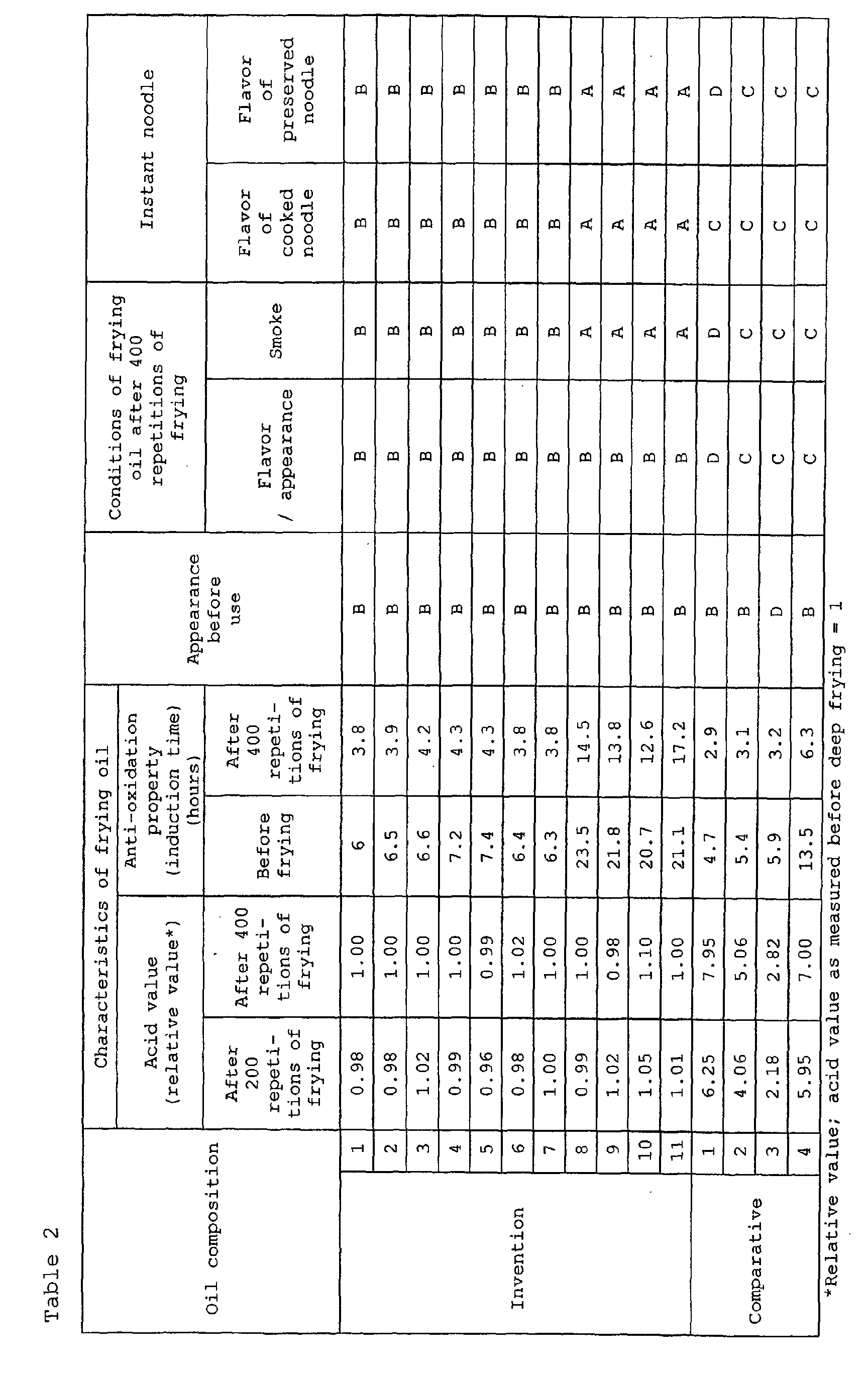
-
- After 200 frying procedures and 400 frying procedures, the oil/fat compositions of the present invention (Invention oil Nos. 1 to 11) produced less smoke and issued less degradation-related odor than did Comparative oil Nos. 1 to 4. Regarding the deep-fried noodles, as compared with Comparative Products, the products produced by use of the oils of the present invention had excellent flavor without unfavorable oil-derived smell, and also had good appearance. The oil/fat compositions identified as Invention oil Nos. 8 to 11, in which component (B) was used in combination with an anti-oxidation agent, exhibited particularly excellent stability against hydrolysis and oxidation.
- Using each of Invention oil Nos. 3, 4, and 8 obtained from Example 1 and Comparative oil No. 1 also obtained from Example 1, deep-frying procedures for potato chips, as described below, were repeated 140 times continuously. Each oil employed was evaluated for acid value and stability against oxidation in accordance with the method described in Example 2. In addition, flavor of the potato chips from the 140th deep-frying lot and that of the potato chips preserved for one month in an aluminum foil laminate package were also evaluated in accordance with the method described in Example 2. The results are shown in Table 3.
- Material preparation: Potatoes (Irish cobbler) were peeled, sliced to 1.5 mm thickness, and according to conventional methods, washed with water and then with hot water, to thereby remove starch and exudes from the surfaces. Moisture on the surfaces of the slices was wiped off, to thereby prepare material for deep-frying.
- Cooking conditions: In a unit deep-frying operation, 500 g of potato slices were deep-fried in the aforementioned oil for 2.5 minutes, to thereby yield potato chips.
- Apparatus and volume of oil: Oil (23 kg) was placed in a gas fryer (model FG-400; product of Tsuji Kikai K.K.). The volume of oil reduced after every 10 repetitions of deep-frying of potato chips was replenished with fresh oil.
- Oil temperature = 180°C
- Storage conditions: temperature = 20°C; relative humidity (RH) = 65 ± 5%; period = one month

- Using each of Invention oil composition Nos. 3, 4, 8, and 12 obtained from Example 1, and Comparative oil composition No. 1 also obtained from Example 1, deep-frying procedures for french fried potatoes, as described below, were repeated 100 times continuously. The flavor of the french fried potatoes from the 100th deep-frying lot, as well as acid value and stability of oil against oxidation, were examined in accordance with the methods described in Example 2. The results are shown in Table 4.
- Material preparation: Whole potatoes (Irish cobbler) with skin were washed with water, each potato was cut along its major axis into 4 to 6 pieces (château), and blanched in water for 15 minutes. Subsequently, moisture on the surfaces was carefully removed by wiping, to thereby prepare material for deep-frying.
- Apparatus and volume of oil: Oil (23 kg) was placed in a gas fryer (model FG-400; product of Tsuji Kikai K.K.). The volume of oil reduced after every 10 repetitions of deep-frying of french fried potatoes was replenished with fresh oil.
- Oil temperature = 180°C
- Cooking conditions: In a unit deep-frying operation, 500 g of potatoes were deep-fried in the aforementioned oil for 6 minutes, to thereby yield french fried potatoes.

- Using each of Invention oil composition Nos. 3, 4, and 8 obtained from Example 1, and Comparative oil composition No. 1 also obtained from Example 1, deep-frying procedures for cooking deep-fried chicken, as described below, were repeated 100 times continuously. The flavor of the deep-fried chicken from the 100th deep-frying lot, as well as acid value and stability of the oil against oxidation were examined in accordance with the methods described in Example 2. The results are shown in Table 5.
- Material preparation: Chicken dark meat is cut into pieces (slightly larger than bite size). A small amount of salt, pepper and lemon juice are applied thereto and worked sufficiently. Wheat flour is applied to the surfaces of the pieces, to thereby prepare material for deep-frying.
- Apparatus and volume of oil: Oil (10 kg) was placed in an electric fryer (model SEF-D9A; product of Sanyo Electric Co., Ltd.). The volume of oil reduced after every 10 repetitions of deep-frying of one lot of chicken meat pieces was replenished with fresh oil.
- Oil temperature = 170°C
- Cooking conditions: In a unit deep-frying operation, 200 g of meat pieces were deep-fried in the aforementioned oil for 7 minutes, to thereby yield deep-fried chicken.
Oil composition Acid value (relative value) Induction time (hours) (hours) Fried chicken chicken After 100 repetitions of repetitions of frying Before frying After 100 repetitions of frying Flavor of cooked fried chicken Invention 3 1.02 6.6 6.4 B 4 1.00 7.2 6.9 B 8 1.01 23.5 22.3 A Comparison 1 3.35 4.7 4.3 C - Using each of Invention oil composition Nos. 3, 4, and 8 obtained from Example 1, and Comparative oil composition No. 1 also obtained from Example 1, deep-frying procedures for cooking doughnuts, as described below, were repeated 100 times continuously. The flavor of the doughnuts from the 100th deep-frying lot, as well as acid value and stability of the oil against oxidation were examined in accordance with the methods described in Example 2. The results are shown in Table 6.
- Material preparation: Sugar (30 parts by weight; hereinafter "part by weight" is referred to simply as "part"), shortening (New Econa (produced by Kao Corporation; 8 parts), and common salt (1 part) were added to one another, and mixed well in a vertical-type mixer equipped with a heater. Subsequently, while egg (20 parts) and water (35 parts) were gradually added thereto, the mixture was stirred until a creamy material was obtained. Weak wheat flour (80 parts), strong wheat flour (20 parts), and baking powder (3 parts) were added thereto, and the resultant mixture was stirred for 90 seconds. The thus-obtained dough is allowed to stand for 20 minutes at room temperature, then rolled into sheet of about 1 cm thickness. The sheet was punched by use of a doughnut ring cutter having a diameter of 75 mm, to thereby prepare intermediates.
- Apparatus and volume of oil: Oil (10 kg) was placed in an electric fryer (model SEF-D9A; product of Sanyo Electric Co., Ltd.). The volume of oil reduced after every 10 repetitions of deep-frying of one lot of doughnuts was replenished with fresh oil.
- Oil temperature = 180°C
- Cooking conditions: In a unit deep-frying operation, 5 pieces of dough were deep-fried in the aforementioned oil for 7 minutes while occasionally turning upside down, to thereby yield doughnuts.
Oil composition Acid value (relative value) Induction time (hours) Doughnut After 100 repetitions of frying Before frying After 100 repetitions of frying Flavor of produced doughnuts Invention 3 1.00 6.6 6.6 B 4 0.98 7.2 6.9 B 8 1.01 23.5 21.5 A Comparison 1 3.45 4.7 4.2 C - In Examples 3 to 6, all the cooked foods produced by use of the oil/fat compositions of the present invention (Invention oil Nos. 3, 4, 8, and 12) were found to have excellent flavor. After one month storage, the potato chips produced by use of the oil/fat compositions of the present invention underwent substantially no deterioration in flavor. In contrast, the potato chips produced by use of the oil/fat composition for comparison (Comparative oil No. 1) underwent significant deterioration in flavor.
- When the oil/fat compositions of the present invention were employed for producing french fried potatoes, deep-fried chicken, and doughnuts, smoke generation was not significant even after increased repetitions of frying operation. Also, there was almost no disagreeable smell from the deep-fried foods. In contrast, when Comparative oil No. 1 was employed, considerable amounts of smoke was generated, and the flavor of the fried foods was deteriorated significantly.
- The effects of Invention oil No. 8, in which component (B) and an anti-oxidation agent were used in combination, were particularly excellent.
- As described above, the oil/fat composition of the present invention exhibits excellent stability against thermal oxidation and hydrolysis, provides good flavor, and has excellent appearance. Also, fried foods produced by use of the oil/fat composition of the present invention have excellent flavor and good stability for preservation.
Claims (9)
- An oil or fat composition containing the following components (A) and (B):(A) diglyceride: 15 wt% or more,
and(B) one or more species of organic carboxylic acid:
70 ppm or more on the basis of the diglyceride. - The oil or fat composition according to claim 1, wherein the composition has a diglyceride content of 20 to 95% by weight.
- The oil or fat composition according to claims 1 or 2, wherein the organic carboxylic acid is contained in an amount of 70 to 2,000 ppm.
- The oil or fat composition according to any one of claims 1 to 3, wherein the organic carboxylic acid is selected from among C2-C8 hydroxycarboxylic acids and dicarboxylic acids, salts thereof, and derivatives thereof.
- The oil or fat composition according to any one of claims 1 to 4, further containing an anti-oxidation agent.
- The oil or fat composition according to claim 5, wherein the anti-oxidation agent is rosemary extract, vitamin C or a derivative thereof, or vitamin E.
- The oil or fat composition according to any one of claims 1 to 6, further containing silicone.
- A method of producing fried foods comprising subjecting food ingredients to a cooking process by use of the oil or fat composition as described in any one of claims 1 to 7.
- A fried food produced through subjecting food ingredients to a cooking process by use of the oil or fat composition as described in any one of claims 1 to 7.
Applications Claiming Priority (4)
| Application Number | Priority Date | Filing Date | Title |
|---|---|---|---|
| JP2001115001 | 2001-04-13 | ||
| JP2001115001 | 2001-04-13 | ||
| JP2002041613 | 2002-02-19 | ||
| JP2002041613A JP4181781B2 (en) | 2001-04-13 | 2002-02-19 | Oil composition |
Publications (2)
| Publication Number | Publication Date |
|---|---|
| EP1249173A1 true EP1249173A1 (en) | 2002-10-16 |
| EP1249173B1 EP1249173B1 (en) | 2012-05-02 |
Family
ID=26613549
Family Applications (1)
| Application Number | Title | Priority Date | Filing Date |
|---|---|---|---|
| EP02008147A Expired - Lifetime EP1249173B1 (en) | 2001-04-13 | 2002-04-12 | Oil or fat composition |
Country Status (5)
| Country | Link |
|---|---|
| US (1) | US7060316B2 (en) |
| EP (1) | EP1249173B1 (en) |
| JP (1) | JP4181781B2 (en) |
| AU (1) | AU784581B2 (en) |
| TW (1) | TWI233336B (en) |
Cited By (2)
| Publication number | Priority date | Publication date | Assignee | Title |
|---|---|---|---|---|
| KR100951756B1 (en) * | 2001-09-13 | 2010-04-08 | 가오 가부시키가이샤 | Oil composition |
| CN111374187A (en) * | 2018-12-28 | 2020-07-07 | 丰益(上海)生物技术研发中心有限公司 | Palm oil and grease composition containing same |
Families Citing this family (35)
| Publication number | Priority date | Publication date | Assignee | Title |
|---|---|---|---|---|
| US20020119237A1 (en) * | 2000-12-22 | 2002-08-29 | Hevey Maurice O. | Medium and method for delivery of edible materials subject to degradation by oxidation and hydrolysis |
| US20040234668A1 (en) * | 2002-12-06 | 2004-11-25 | Fuji Oil Co., Ltd. | Oil and fat for producing confectionery, process for producing the same, and product using the same |
| JP4008376B2 (en) * | 2003-04-02 | 2007-11-14 | サンヨー食品株式会社 | Production method of instant noodles |
| JP4381037B2 (en) | 2003-06-04 | 2009-12-09 | 花王株式会社 | Oil composition |
| JP4025769B2 (en) * | 2003-09-30 | 2007-12-26 | 花王株式会社 | Flavor degradation control method |
| JP5273631B2 (en) | 2004-02-27 | 2013-08-28 | 塩水港精糖株式会社 | Fat solution and / or solid solution of saccharide-fat soluble material, method for producing the same |
| JP5710865B2 (en) * | 2005-07-18 | 2015-04-30 | ディーエスエム アイピー アセッツ ビー.ブイ. | How to recycle old cooking oil |
| KR100913850B1 (en) * | 2006-12-29 | 2009-08-26 | 우석대학교 산학협력단 | Method for the production of edible oil having rich and deep buttery flavor with very low content of trans fatty acid and edible oil prepared by the same |
| US9284515B2 (en) | 2007-08-09 | 2016-03-15 | Elevance Renewable Sciences, Inc. | Thermal methods for treating a metathesis feedstock |
| CN105238435A (en) | 2007-08-09 | 2016-01-13 | 埃莱文斯可更新科学公司 | Thermal methods for treating a metathesis feedstock |
| BRPI0814994A2 (en) | 2007-08-09 | 2015-02-03 | Elevance Renewable Sciences | CHEMICAL METHODS FOR TREATMENT OF A METATESE RAW MATERIAL |
| MY156576A (en) * | 2008-11-26 | 2016-03-15 | Elevance Renewable Sciences | Methods of producing jet fuel from natural oil feedstocks through metathesis reactions |
| US8889932B2 (en) * | 2008-11-26 | 2014-11-18 | Elevance Renewable Sciences, Inc. | Methods of producing jet fuel from natural oil feedstocks through oxygen-cleaved reactions |
| JP4560590B1 (en) * | 2009-03-27 | 2010-10-13 | 日清オイリオグループ株式会社 | Cooking oil and fat for cooking and method for producing the same |
| PL2488474T3 (en) | 2009-10-12 | 2017-07-31 | Elevance Renewable Sciences, Inc. | Methods of refining and producing fuel from natural oil feedstocks |
| US9382502B2 (en) | 2009-10-12 | 2016-07-05 | Elevance Renewable Sciences, Inc. | Methods of refining and producing isomerized fatty acid esters and fatty acids from natural oil feedstocks |
| US9000246B2 (en) | 2009-10-12 | 2015-04-07 | Elevance Renewable Sciences, Inc. | Methods of refining and producing dibasic esters and acids from natural oil feedstocks |
| US9222056B2 (en) | 2009-10-12 | 2015-12-29 | Elevance Renewable Sciences, Inc. | Methods of refining natural oils, and methods of producing fuel compositions |
| US9175231B2 (en) | 2009-10-12 | 2015-11-03 | Elevance Renewable Sciences, Inc. | Methods of refining natural oils and methods of producing fuel compositions |
| US9365487B2 (en) | 2009-10-12 | 2016-06-14 | Elevance Renewable Sciences, Inc. | Methods of refining and producing dibasic esters and acids from natural oil feedstocks |
| US9051519B2 (en) | 2009-10-12 | 2015-06-09 | Elevance Renewable Sciences, Inc. | Diene-selective hydrogenation of metathesis derived olefins and unsaturated esters |
| US8735640B2 (en) | 2009-10-12 | 2014-05-27 | Elevance Renewable Sciences, Inc. | Methods of refining and producing fuel and specialty chemicals from natural oil feedstocks |
| US9169447B2 (en) | 2009-10-12 | 2015-10-27 | Elevance Renewable Sciences, Inc. | Methods of refining natural oils, and methods of producing fuel compositions |
| JP2012139175A (en) * | 2010-12-29 | 2012-07-26 | Riken Vitamin Co Ltd | Fat-and-oil composition for frying |
| US9139493B2 (en) | 2011-12-22 | 2015-09-22 | Elevance Renewable Sciences, Inc. | Methods for suppressing isomerization of olefin metathesis products |
| US9133416B2 (en) | 2011-12-22 | 2015-09-15 | Elevance Renewable Sciences, Inc. | Methods for suppressing isomerization of olefin metathesis products |
| US9169174B2 (en) | 2011-12-22 | 2015-10-27 | Elevance Renewable Sciences, Inc. | Methods for suppressing isomerization of olefin metathesis products |
| US9388098B2 (en) | 2012-10-09 | 2016-07-12 | Elevance Renewable Sciences, Inc. | Methods of making high-weight esters, acids, and derivatives thereof |
| CN103773605A (en) * | 2014-02-25 | 2014-05-07 | 广东省粮食科学研究所 | Composite antioxidant for storing edible vegetable oil and application thereof |
| JP6497890B2 (en) * | 2014-10-31 | 2019-04-10 | 日清オイリオグループ株式会社 | Oil and fat composition for heating and cooking and method for producing the oil and fat composition for heating and cooking |
| JP6763219B2 (en) * | 2016-07-08 | 2020-09-30 | 日本精工株式会社 | Cooking oil purification agent, cooking oil purification filter, and method for suppressing deterioration of cooking oil |
| JP6804253B2 (en) * | 2016-09-29 | 2020-12-23 | 日清オイリオグループ株式会社 | A fat composition for cooking, a method for producing the same, and a method for suppressing deterioration of the fat for cooking due to heating. |
| EP3681301A1 (en) * | 2017-09-15 | 2020-07-22 | Olitalia S.r.l. | Composition of edible oil, particularly for use in frying and cooking of foods |
| IT201700103759A1 (en) * | 2017-09-15 | 2019-03-15 | Olitalia S R L | COMPOSITION OF FOOD OIL, PARTICULARLY FOR USE IN FRYING AND COOKING FOOD |
| WO2025070108A1 (en) * | 2023-09-25 | 2025-04-03 | 株式会社J-オイルミルズ | Acid value increase inhibitor and method for suppressing increase in acid value |
Citations (7)
| Publication number | Priority date | Publication date | Assignee | Title |
|---|---|---|---|---|
| GB813538A (en) * | 1954-08-10 | 1959-05-21 | Eastman Kodak Co | Improvements in and relating to the stabilization of oxidizable compositions |
| JPH04261497A (en) * | 1991-02-15 | 1992-09-17 | Kao Corp | Purification of oil and fat rich in diglyceride |
| JPH05316971A (en) * | 1992-05-14 | 1993-12-03 | Kanegafuchi Chem Ind Co Ltd | O / W emulsion composition for cooked rice |
| JPH10127230A (en) * | 1996-10-30 | 1998-05-19 | Kao Corp | Fried confectionery |
| JP2000116324A (en) * | 1998-10-13 | 2000-04-25 | Kao Corp | Oil composition |
| WO2000077133A1 (en) * | 1999-06-16 | 2000-12-21 | Kao Corporation | Fat compositions |
| WO2001015550A1 (en) * | 1999-08-27 | 2001-03-08 | Kao Corporation | Process for producing fried instant noodles |
Family Cites Families (19)
| Publication number | Priority date | Publication date | Assignee | Title |
|---|---|---|---|---|
| US3805686A (en) | 1972-12-15 | 1974-04-23 | C West | Air pollution control system for food processing apparatus |
| GB8418154D0 (en) | 1984-07-17 | 1984-08-22 | Unilever Plc | Edible fat composition |
| JPH0738771B2 (en) | 1989-01-17 | 1995-05-01 | 花王株式会社 | Liquid edible oil composition |
| US5077069A (en) * | 1991-01-07 | 1991-12-31 | Kabi Pharmacia Ab | Composition of natural antioxidants for the stabilization of polyunsaturated oils |
| US5230916A (en) * | 1991-01-07 | 1993-07-27 | Kabi Pharmacia Ab | Ascorbic acid complex having antioxidant function and improved solubility in lipid materials |
| JP3244354B2 (en) | 1993-06-30 | 2002-01-07 | 花王株式会社 | Oil composition for preparing fried foods |
| AU1664595A (en) * | 1994-02-18 | 1995-09-04 | Loders Croklaan B.V. | Fat blends, based on diglycerides |
| AU1705595A (en) | 1994-02-18 | 1995-09-04 | Loders Croklaan B.V. | Fat blends containing diglycerides |
| DE69510404T2 (en) | 1994-03-31 | 2000-01-20 | Loders Croklaan B.V., Wormerveer | Oils with a low saturated fatty acid content |
| US5525516B1 (en) | 1994-09-30 | 1999-11-09 | Eastman Chem Co | Method for tagging petroleum products |
| US6004611A (en) | 1996-10-18 | 1999-12-21 | Kao Corporation | General-purpose oils composition |
| JP3619002B2 (en) | 1998-03-03 | 2005-02-09 | 花王株式会社 | Deep-fried food and shortening |
| BR9904796B1 (en) | 1998-03-24 | 2012-02-22 | phytosterol-containing oil or fat composition, oil or fat composition, food product, beverage product, and cooking table oil. | |
| US6139897A (en) | 1998-03-24 | 2000-10-31 | Kao Corporation | Oil or fat composition containing phytosterol |
| US6025348A (en) | 1998-04-30 | 2000-02-15 | Kao Corporation | Oil and fat composition containing phytosterol |
| JP3720194B2 (en) | 1998-07-09 | 2005-11-24 | 花王株式会社 | Method for producing partial glycerides |
| US6365211B1 (en) * | 1999-06-18 | 2002-04-02 | The Procter & Gamble Co. | Cooking aid with reduced foaming |
| JP3853552B2 (en) | 1999-12-17 | 2006-12-06 | 花王株式会社 | Method for producing diglyceride |
| US6638551B1 (en) * | 2002-03-05 | 2003-10-28 | Selecto Scientific, Inc. | Methods and compositions for purifying edible oil |
-
2002
- 2002-02-19 JP JP2002041613A patent/JP4181781B2/en not_active Expired - Fee Related
- 2002-04-12 TW TW091107463A patent/TWI233336B/en not_active IP Right Cessation
- 2002-04-12 AU AU34314/02A patent/AU784581B2/en not_active Ceased
- 2002-04-12 EP EP02008147A patent/EP1249173B1/en not_active Expired - Lifetime
- 2002-04-12 US US10/120,514 patent/US7060316B2/en not_active Expired - Lifetime
Patent Citations (8)
| Publication number | Priority date | Publication date | Assignee | Title |
|---|---|---|---|---|
| GB813538A (en) * | 1954-08-10 | 1959-05-21 | Eastman Kodak Co | Improvements in and relating to the stabilization of oxidizable compositions |
| JPH04261497A (en) * | 1991-02-15 | 1992-09-17 | Kao Corp | Purification of oil and fat rich in diglyceride |
| JPH05316971A (en) * | 1992-05-14 | 1993-12-03 | Kanegafuchi Chem Ind Co Ltd | O / W emulsion composition for cooked rice |
| JPH10127230A (en) * | 1996-10-30 | 1998-05-19 | Kao Corp | Fried confectionery |
| JP2000116324A (en) * | 1998-10-13 | 2000-04-25 | Kao Corp | Oil composition |
| WO2000077133A1 (en) * | 1999-06-16 | 2000-12-21 | Kao Corporation | Fat compositions |
| EP1186648A1 (en) * | 1999-06-16 | 2002-03-13 | Kao Corporation | Fat compositions |
| WO2001015550A1 (en) * | 1999-08-27 | 2001-03-08 | Kao Corporation | Process for producing fried instant noodles |
Non-Patent Citations (4)
| Title |
|---|
| PATENT ABSTRACTS OF JAPAN vol. 017, no. 046 (C - 1021) 28 January 1993 (1993-01-28) * |
| PATENT ABSTRACTS OF JAPAN vol. 018, no. 131 (C - 1175) 3 March 1994 (1994-03-03) * |
| PATENT ABSTRACTS OF JAPAN vol. 1998, no. 10 31 August 1998 (1998-08-31) * |
| PATENT ABSTRACTS OF JAPAN vol. 2000, no. 07 29 September 2000 (2000-09-29) * |
Cited By (2)
| Publication number | Priority date | Publication date | Assignee | Title |
|---|---|---|---|---|
| KR100951756B1 (en) * | 2001-09-13 | 2010-04-08 | 가오 가부시키가이샤 | Oil composition |
| CN111374187A (en) * | 2018-12-28 | 2020-07-07 | 丰益(上海)生物技术研发中心有限公司 | Palm oil and grease composition containing same |
Also Published As
| Publication number | Publication date |
|---|---|
| EP1249173B1 (en) | 2012-05-02 |
| TWI233336B (en) | 2005-06-01 |
| AU3431402A (en) | 2002-10-17 |
| AU784581B2 (en) | 2006-05-04 |
| US20030026886A1 (en) | 2003-02-06 |
| US7060316B2 (en) | 2006-06-13 |
| JP4181781B2 (en) | 2008-11-19 |
| JP2002371294A (en) | 2002-12-26 |
Similar Documents
| Publication | Publication Date | Title |
|---|---|---|
| US7060316B2 (en) | Oil or fat composition | |
| EP1424907B1 (en) | Oil composition | |
| EP1483973B1 (en) | Fat or oil composition | |
| JP4212276B2 (en) | Oil composition | |
| JP5636398B2 (en) | Oil composition | |
| AU2002328058A1 (en) | Oil composition | |
| JPWO2000077133A1 (en) | oil composition | |
| EP1297752B1 (en) | Production method for fried foods | |
| JP5100974B2 (en) | Oil composition | |
| KR100965830B1 (en) | Oil and fat composition | |
| US20240172768A1 (en) | Edible oil and fat composition, method for inhibiting unpleasant taste, agent for inhibiting unpleasant taste, and method for producing deep-fried food |
Legal Events
| Date | Code | Title | Description |
|---|---|---|---|
| PUAI | Public reference made under article 153(3) epc to a published international application that has entered the european phase |
Free format text: ORIGINAL CODE: 0009012 |
|
| AK | Designated contracting states |
Kind code of ref document: A1 Designated state(s): AT BE CH CY DE DK ES FI FR GB GR IE IT LI LU MC NL PT SE TR |
|
| AX | Request for extension of the european patent |
Free format text: AL;LT;LV;MK;RO;SI |
|
| 17P | Request for examination filed |
Effective date: 20030319 |
|
| AKX | Designation fees paid |
Designated state(s): DE FR GB |
|
| GRAP | Despatch of communication of intention to grant a patent |
Free format text: ORIGINAL CODE: EPIDOSNIGR1 |
|
| GRAS | Grant fee paid |
Free format text: ORIGINAL CODE: EPIDOSNIGR3 |
|
| GRAA | (expected) grant |
Free format text: ORIGINAL CODE: 0009210 |
|
| AK | Designated contracting states |
Kind code of ref document: B1 Designated state(s): DE FR GB |
|
| REG | Reference to a national code |
Ref country code: GB Ref legal event code: FG4D |
|
| REG | Reference to a national code |
Ref country code: DE Ref legal event code: R096 Ref document number: 60242780 Country of ref document: DE Effective date: 20120621 |
|
| PLBE | No opposition filed within time limit |
Free format text: ORIGINAL CODE: 0009261 |
|
| STAA | Information on the status of an ep patent application or granted ep patent |
Free format text: STATUS: NO OPPOSITION FILED WITHIN TIME LIMIT |
|
| 26N | No opposition filed |
Effective date: 20130205 |
|
| REG | Reference to a national code |
Ref country code: DE Ref legal event code: R097 Ref document number: 60242780 Country of ref document: DE Effective date: 20130205 |
|
| REG | Reference to a national code |
Ref country code: FR Ref legal event code: PLFP Year of fee payment: 15 |
|
| REG | Reference to a national code |
Ref country code: FR Ref legal event code: PLFP Year of fee payment: 16 |
|
| PGFP | Annual fee paid to national office [announced via postgrant information from national office to epo] |
Ref country code: FR Payment date: 20170313 Year of fee payment: 16 |
|
| PGFP | Annual fee paid to national office [announced via postgrant information from national office to epo] |
Ref country code: GB Payment date: 20170412 Year of fee payment: 16 Ref country code: DE Payment date: 20170404 Year of fee payment: 16 |
|
| REG | Reference to a national code |
Ref country code: DE Ref legal event code: R119 Ref document number: 60242780 Country of ref document: DE |
|
| GBPC | Gb: european patent ceased through non-payment of renewal fee |
Effective date: 20180412 |
|
| PG25 | Lapsed in a contracting state [announced via postgrant information from national office to epo] |
Ref country code: DE Free format text: LAPSE BECAUSE OF NON-PAYMENT OF DUE FEES Effective date: 20181101 |
|
| PG25 | Lapsed in a contracting state [announced via postgrant information from national office to epo] |
Ref country code: GB Free format text: LAPSE BECAUSE OF NON-PAYMENT OF DUE FEES Effective date: 20180412 |
|
| PG25 | Lapsed in a contracting state [announced via postgrant information from national office to epo] |
Ref country code: FR Free format text: LAPSE BECAUSE OF NON-PAYMENT OF DUE FEES Effective date: 20180430 |