EP1247533A2 - Combination treatment of multiple sclerosis (MS), other demyelinating conditions and peripheral neuropathy, especially painful neuropathies and diabetic neuropathy - Google Patents
Combination treatment of multiple sclerosis (MS), other demyelinating conditions and peripheral neuropathy, especially painful neuropathies and diabetic neuropathy Download PDFInfo
- Publication number
- EP1247533A2 EP1247533A2 EP02251844A EP02251844A EP1247533A2 EP 1247533 A2 EP1247533 A2 EP 1247533A2 EP 02251844 A EP02251844 A EP 02251844A EP 02251844 A EP02251844 A EP 02251844A EP 1247533 A2 EP1247533 A2 EP 1247533A2
- Authority
- EP
- European Patent Office
- Prior art keywords
- alkyl
- pharmaceutically acceptable
- independently
- acceptable salt
- ring
- Prior art date
- Legal status (The legal status is an assumption and is not a legal conclusion. Google has not performed a legal analysis and makes no representation as to the accuracy of the status listed.)
- Withdrawn
Links
Classifications
-
- A—HUMAN NECESSITIES
- A61—MEDICAL OR VETERINARY SCIENCE; HYGIENE
- A61K—PREPARATIONS FOR MEDICAL, DENTAL OR TOILETRY PURPOSES
- A61K45/00—Medicinal preparations containing active ingredients not provided for in groups A61K31/00 - A61K41/00
- A61K45/06—Mixtures of active ingredients without chemical characterisation, e.g. antiphlogistics and cardiaca
-
- A—HUMAN NECESSITIES
- A61—MEDICAL OR VETERINARY SCIENCE; HYGIENE
- A61K—PREPARATIONS FOR MEDICAL, DENTAL OR TOILETRY PURPOSES
- A61K31/00—Medicinal preparations containing organic active ingredients
- A61K31/185—Acids; Anhydrides, halides or salts thereof, e.g. sulfur acids, imidic, hydrazonic or hydroximic acids
- A61K31/19—Carboxylic acids, e.g. valproic acid
- A61K31/195—Carboxylic acids, e.g. valproic acid having an amino group
- A61K31/197—Carboxylic acids, e.g. valproic acid having an amino group the amino and the carboxyl groups being attached to the same acyclic carbon chain, e.g. gamma-aminobutyric acid [GABA], beta-alanine, epsilon-aminocaproic acid or pantothenic acid
- A61K31/198—Alpha-amino acids, e.g. alanine or edetic acid [EDTA]
-
- A—HUMAN NECESSITIES
- A61—MEDICAL OR VETERINARY SCIENCE; HYGIENE
- A61K—PREPARATIONS FOR MEDICAL, DENTAL OR TOILETRY PURPOSES
- A61K31/00—Medicinal preparations containing organic active ingredients
- A61K31/33—Heterocyclic compounds
- A61K31/38—Heterocyclic compounds having sulfur as a ring hetero atom
- A61K31/381—Heterocyclic compounds having sulfur as a ring hetero atom having five-membered rings
-
- A—HUMAN NECESSITIES
- A61—MEDICAL OR VETERINARY SCIENCE; HYGIENE
- A61K—PREPARATIONS FOR MEDICAL, DENTAL OR TOILETRY PURPOSES
- A61K31/00—Medicinal preparations containing organic active ingredients
- A61K31/33—Heterocyclic compounds
- A61K31/395—Heterocyclic compounds having nitrogen as a ring hetero atom, e.g. guanethidine or rifamycins
- A61K31/40—Heterocyclic compounds having nitrogen as a ring hetero atom, e.g. guanethidine or rifamycins having five-membered rings with one nitrogen as the only ring hetero atom, e.g. sulpiride, succinimide, tolmetin, buflomedil
- A61K31/4015—Heterocyclic compounds having nitrogen as a ring hetero atom, e.g. guanethidine or rifamycins having five-membered rings with one nitrogen as the only ring hetero atom, e.g. sulpiride, succinimide, tolmetin, buflomedil having oxo groups directly attached to the heterocyclic ring, e.g. piracetam, ethosuximide
-
- A—HUMAN NECESSITIES
- A61—MEDICAL OR VETERINARY SCIENCE; HYGIENE
- A61K—PREPARATIONS FOR MEDICAL, DENTAL OR TOILETRY PURPOSES
- A61K31/00—Medicinal preparations containing organic active ingredients
- A61K31/33—Heterocyclic compounds
- A61K31/395—Heterocyclic compounds having nitrogen as a ring hetero atom, e.g. guanethidine or rifamycins
- A61K31/40—Heterocyclic compounds having nitrogen as a ring hetero atom, e.g. guanethidine or rifamycins having five-membered rings with one nitrogen as the only ring hetero atom, e.g. sulpiride, succinimide, tolmetin, buflomedil
- A61K31/403—Heterocyclic compounds having nitrogen as a ring hetero atom, e.g. guanethidine or rifamycins having five-membered rings with one nitrogen as the only ring hetero atom, e.g. sulpiride, succinimide, tolmetin, buflomedil condensed with carbocyclic rings, e.g. carbazole
- A61K31/404—Indoles, e.g. pindolol
- A61K31/405—Indole-alkanecarboxylic acids; Derivatives thereof, e.g. tryptophan, indomethacin
-
- A—HUMAN NECESSITIES
- A61—MEDICAL OR VETERINARY SCIENCE; HYGIENE
- A61K—PREPARATIONS FOR MEDICAL, DENTAL OR TOILETRY PURPOSES
- A61K31/00—Medicinal preparations containing organic active ingredients
- A61K31/33—Heterocyclic compounds
- A61K31/395—Heterocyclic compounds having nitrogen as a ring hetero atom, e.g. guanethidine or rifamycins
- A61K31/41—Heterocyclic compounds having nitrogen as a ring hetero atom, e.g. guanethidine or rifamycins having five-membered rings with two or more ring hetero atoms, at least one of which being nitrogen, e.g. tetrazole
-
- A—HUMAN NECESSITIES
- A61—MEDICAL OR VETERINARY SCIENCE; HYGIENE
- A61K—PREPARATIONS FOR MEDICAL, DENTAL OR TOILETRY PURPOSES
- A61K31/00—Medicinal preparations containing organic active ingredients
- A61K31/33—Heterocyclic compounds
- A61K31/395—Heterocyclic compounds having nitrogen as a ring hetero atom, e.g. guanethidine or rifamycins
- A61K31/41—Heterocyclic compounds having nitrogen as a ring hetero atom, e.g. guanethidine or rifamycins having five-membered rings with two or more ring hetero atoms, at least one of which being nitrogen, e.g. tetrazole
- A61K31/4164—1,3-Diazoles
- A61K31/4166—1,3-Diazoles having oxo groups directly attached to the heterocyclic ring, e.g. phenytoin
-
- A—HUMAN NECESSITIES
- A61—MEDICAL OR VETERINARY SCIENCE; HYGIENE
- A61K—PREPARATIONS FOR MEDICAL, DENTAL OR TOILETRY PURPOSES
- A61K31/00—Medicinal preparations containing organic active ingredients
- A61K31/33—Heterocyclic compounds
- A61K31/395—Heterocyclic compounds having nitrogen as a ring hetero atom, e.g. guanethidine or rifamycins
- A61K31/41—Heterocyclic compounds having nitrogen as a ring hetero atom, e.g. guanethidine or rifamycins having five-membered rings with two or more ring hetero atoms, at least one of which being nitrogen, e.g. tetrazole
- A61K31/425—Thiazoles
- A61K31/426—1,3-Thiazoles
-
- A—HUMAN NECESSITIES
- A61—MEDICAL OR VETERINARY SCIENCE; HYGIENE
- A61K—PREPARATIONS FOR MEDICAL, DENTAL OR TOILETRY PURPOSES
- A61K31/00—Medicinal preparations containing organic active ingredients
- A61K31/33—Heterocyclic compounds
- A61K31/395—Heterocyclic compounds having nitrogen as a ring hetero atom, e.g. guanethidine or rifamycins
- A61K31/435—Heterocyclic compounds having nitrogen as a ring hetero atom, e.g. guanethidine or rifamycins having six-membered rings with one nitrogen as the only ring hetero atom
- A61K31/44—Non condensed pyridines; Hydrogenated derivatives thereof
-
- A—HUMAN NECESSITIES
- A61—MEDICAL OR VETERINARY SCIENCE; HYGIENE
- A61K—PREPARATIONS FOR MEDICAL, DENTAL OR TOILETRY PURPOSES
- A61K31/00—Medicinal preparations containing organic active ingredients
- A61K31/33—Heterocyclic compounds
- A61K31/395—Heterocyclic compounds having nitrogen as a ring hetero atom, e.g. guanethidine or rifamycins
- A61K31/495—Heterocyclic compounds having nitrogen as a ring hetero atom, e.g. guanethidine or rifamycins having six-membered rings with two or more nitrogen atoms as the only ring heteroatoms, e.g. piperazine or tetrazines
- A61K31/505—Pyrimidines; Hydrogenated pyrimidines, e.g. trimethoprim
- A61K31/513—Pyrimidines; Hydrogenated pyrimidines, e.g. trimethoprim having oxo groups directly attached to the heterocyclic ring, e.g. cytosine
-
- A—HUMAN NECESSITIES
- A61—MEDICAL OR VETERINARY SCIENCE; HYGIENE
- A61P—SPECIFIC THERAPEUTIC ACTIVITY OF CHEMICAL COMPOUNDS OR MEDICINAL PREPARATIONS
- A61P25/00—Drugs for disorders of the nervous system
-
- A—HUMAN NECESSITIES
- A61—MEDICAL OR VETERINARY SCIENCE; HYGIENE
- A61P—SPECIFIC THERAPEUTIC ACTIVITY OF CHEMICAL COMPOUNDS OR MEDICINAL PREPARATIONS
- A61P25/00—Drugs for disorders of the nervous system
- A61P25/02—Drugs for disorders of the nervous system for peripheral neuropathies
-
- A—HUMAN NECESSITIES
- A61—MEDICAL OR VETERINARY SCIENCE; HYGIENE
- A61P—SPECIFIC THERAPEUTIC ACTIVITY OF CHEMICAL COMPOUNDS OR MEDICINAL PREPARATIONS
- A61P25/00—Drugs for disorders of the nervous system
- A61P25/28—Drugs for disorders of the nervous system for treating neurodegenerative disorders of the central nervous system, e.g. nootropic agents, cognition enhancers, drugs for treating Alzheimer's disease or other forms of dementia
-
- A—HUMAN NECESSITIES
- A61—MEDICAL OR VETERINARY SCIENCE; HYGIENE
- A61P—SPECIFIC THERAPEUTIC ACTIVITY OF CHEMICAL COMPOUNDS OR MEDICINAL PREPARATIONS
- A61P43/00—Drugs for specific purposes, not provided for in groups A61P1/00-A61P41/00
-
- A—HUMAN NECESSITIES
- A61—MEDICAL OR VETERINARY SCIENCE; HYGIENE
- A61P—SPECIFIC THERAPEUTIC ACTIVITY OF CHEMICAL COMPOUNDS OR MEDICINAL PREPARATIONS
- A61P9/00—Drugs for disorders of the cardiovascular system
- A61P9/10—Drugs for disorders of the cardiovascular system for treating ischaemic or atherosclerotic diseases, e.g. antianginal drugs, coronary vasodilators, drugs for myocardial infarction, retinopathy, cerebrovascula insufficiency, renal arteriosclerosis
Definitions
- This invention relates to a method of treating Multiple Sclerosis (MS) and other demyelinating conditions and peripheral neuropathy in a mammal by administering to the mammal a Serotonin Reuptake Inhibitor (SRIs) in combination with a neurotransmitter-inducing or precursor agent. It also relates to pharmaceutical compositions containing a pharmaceutically acceptable carrier, a Serotonin Reuptake Inhibitor (SRI) and a neurotransmitter-inducing or precursor agent.
- MS Multiple Sclerosis
- SRIs Serotonin Reuptake Inhibitor
- a drug for temporal lobe epilepsy is sometimes effective in trigeminal neuralgia though not usually in other types of pain in this class.
- Diabetic neuropathy may be mild, for example taking the form of "burning" or tingling in the feet or numbness and/or loss of vibration sense in the extremities, especially the feet. Moderate to severe symptoms of neuropathy include pain and spasm in the extremities (painful neuropathy with spasm). Diabetic amyotrophy is indicated by pain over the thigh and loss of quadriceps power, sometimes also loss of power in the lower leg resulting in foot drop. Autonomic neuropathy principally affects the nerves supplying the heart and viscera. Mononeuritis is usually caused by a single peripheral nerve palsy.
- peripheral neuropathies include the following:
- the present invention relates to a pharmaceutical composition for the treatment of Multiple Sclerosis (MS), other demyelinating conditions, and peripheral neuropathy
- a pharmaceutical composition for the treatment of Multiple Sclerosis (MS), other demyelinating conditions, and peripheral neuropathy comprising: (a) a compound that exhibits activity as a Serotonin Reuptake Inhibitor (SRI), or a pharmaceutically acceptable salt thereof; (b) a neurotransmitter inducing or precursor agent or pharmaceutically acceptable salt thereof; and (c) a pharmaceutically acceptable carrier; wherein the active agents "a” and "b” above are present in amounts that render the composition effective in treating, respectively, Multiple Sclerosis, other demyelinating conditions especially encephalomyelitis and peripheral neuropathy especially painful neuropathies and diabetic neuropathy.
- SRI Serotonin Reuptake Inhibitor
- This invention also relates to a method of treating Multiple Sclerosis, other demyelinating conditions and peripheral neuropathy in a mammal comprising administering to said mammal, respectively, an anti-Multiple Sclerosis, anti-demyelinating or anti-peripheral neuropathy effective amount of a pharmaceutical composition
- a pharmaceutical composition comprising: (a) a Serotonin Reuptake Inhibitor (SRI) compound that exhibits activity as, respectively, an anxiolytic or an antidepressant, or a pharmaceutically acceptable salt thereof; (b) a neurotransmitter-inducing or precursor agent or pharmaceutically acceptable salt thereof; and (c) a pharmaceutically acceptable carrier; wherein the active agents "a” and "b” above are present in amounts that render the composition effective in treating, respectively, Multiple Sclerosis, other demyelinating conditions, especially encephalomyelitis and peripheral neuropathy, especially painful neuropathies and diabetic neuropathy with improvement in the efficacy achieved by either component individually.
- SRI Serotonin Reup
- This invention also relates to a method of treating Multiple Sclerosis, other demyelinating conditions and peripheral neuropathy in a mammal comprising administering to said mammal: (a) a Serotonin Reuptake Inhibitor (SRI) compound that exhibits activity as, respectively, an anxiolytic agent or an antidepressant, or a pharmaceutically acceptable salt thereof; and (b) a neurotransmitter-inducing or precursor agent or pharmaceutically acceptable salt thereof; wherein the active agents "a” and "b” above are present in amounts that render the combination of the two agents effective in treating, respectively, Multiple Sclerosis, other demyelinating conditions and peripheral neuropathy with improvement in the efficacy achieved by either component individually in the treatment of Multiple Sclerosis, other demyelinating conditions, especially encephalomyelitis and peripheral neuropathy especially painful neuropathies and diabetic neuropathy.
- SRI Serotonin Reuptake Inhibitor
- both the neurotransmitter inducing or precursor agent and the (SRI) antidepressant or anti-anxiety agent will be administered to a patient within a reasonable period of time.
- the compounds may be in the same pharmaceutically acceptable carrier and therefore administered simultaneously. They may be in separate pharmaceutical carriers such as conventional oral dosage forms that are taken simultaneously.
- the term combination also refers to the case where the compounds are provided in separate dosage forms and are administered sequentially.
- the (SRI) antidepressant or anxiolytic agent may be administered as a tablet and then, within a reasonable period of time, the neurotransmitter-inducing or precursor agent may be administered either as an oral dosage form such as a tablet or a fast-dissolving oral dosage form.
- a fast dissolving oral formulation is meant, an oral delivery form which when placed on the tongue of a patient, dissolves within about seconds
- compositions of the present invention that contain a neurotransmitter-inducing or precursor agent and (SRI) antidepressant are useful for the treatment of Multiple Sclerosis, other demyelinating conditions especially encephalomyelitis and peripheral neuropathy especially diabetic neuropathy and painful neuropathy.
- compositions of the present invention are especially useful for the treatment of Multiple Sclerosis, other demyelinating conditions and peripheral neuropathy by compensating for the effects of the nerve damage caused by these conditions.
- a combination of a neurotransmitter-inducing or precursor agent and an (SRI) antidepressant or anxiolytic agent in accordance with the present invention, it is possible to treat Multiple Sclerosis, other demyelinating conditions and peripheral neuropathy in patients for whom conventional therapy might not be wholly successful.
- treatment refers to reversing, alleviating, inhibiting the progress of, or preventing the disorder or condition to which such term applies, or one or more symptoms of such condition or disorder.
- treatment refers to the act of treating, as “treating” is defined immediately above.
- Serotonin Reuptake Inhibitors SRI
- SRI Serotonin Reuptake Inhibitors
- Pharmaceutically acceptable acid addition salts of the compounds of formula I can also be used in the methods and pharmaceutical composition of this invention.
- Examples of pharmaceutically acceptable acid addition salts of the compounds of formula I are the salts of hydrochloric acid, p-toluenesulfonic acid, fumaric acid, citric acid, succinic acid, salicylic acid, oxalic acid, hydrobromic acid, phosphoric acid, methanesulfonic acid, tartaric acid, maleic acid, di-p-toluoyl tartaric acid, acetic acid, sulfuric acid, hydroiodic acid and mandelic acid.
- halo includes fluoro, chloro, bromo and iodo.
- alkyl may be straight, branched or cyclic, and may include straight and cyclic moieties as well as branched and cyclic moieties.
- the compounds of formula I may have optical centers and therefore may occur in different enantiomeric configurations. All enantiomers, diastereomers, and other stereoisomers of such compounds of formula I, as well as racemic and other mixtures thereof are included in the pharmaceutical compositions and methods of this invention.
- Preferred embodiments of formula I include the following compounds of the formula I and their pharmaceutically acceptable salts:
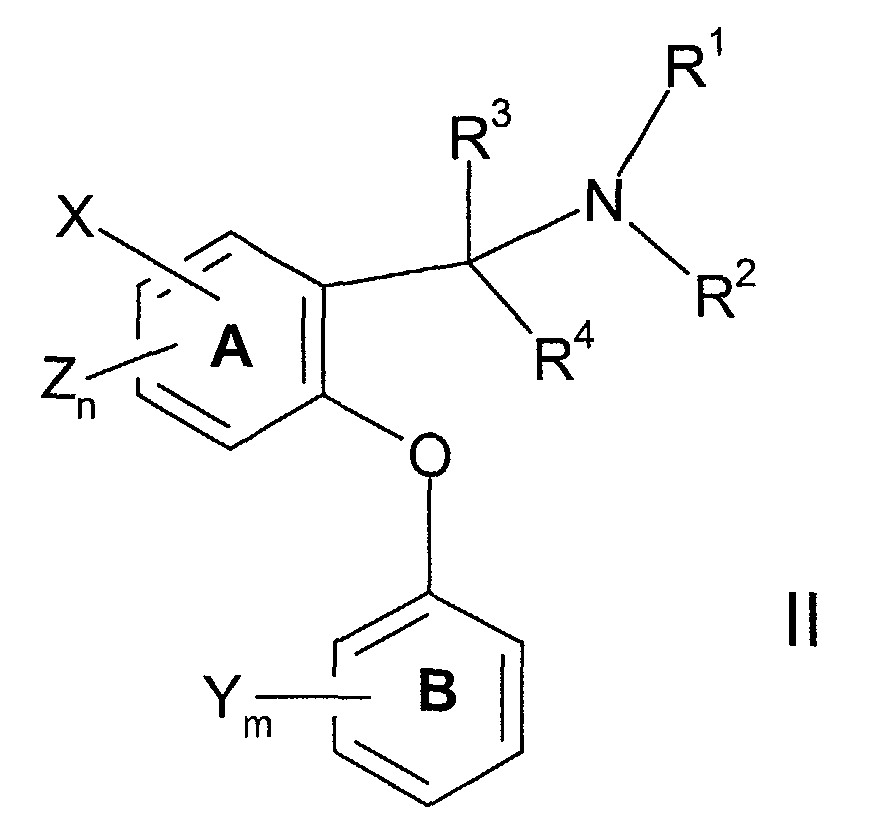
- ring B is phenyl, not replaced with a naphthyl group. In another embodiment, phenyl ring B in the compounds of formula II is replaced with a naphthyl group.
- each Y is hydrogen or halo. In a more preferred embodiment, m is 1 or 2, and each Y is chlorine.
- compounds of formula II, or pharmaceutically acceptable salts, thereof are described above, but wherein X is selected from furan, thiophene, pyrrole, and 1,2,3-triazole, and wherein X may be further substituted.
- each Z is selected from hydrogen and halo.
- Z is hydrogen.
- R 3 and R 4 are independently selected from hydrogen and unsubstituted (C 1 -C 4 ) alkyl.
- R 3 and R 4 are hydrogen.
- R 1 and R 2 are independently selected from hydrogen and unsubstituted (C 1 -C 4 )alkyl.
- R 1 and R 2 are hydrogen and the other of R 1 and R 2 is (C 1 -C 4 )alkyl. More preferably, one of R 1 and R 2 is hydrogen and the other of R 1 and R 2 is methyl.
- the methods and pharmaceutical compositions of this invention also relates to the pharmaceutically acceptable acid addition salts of the compounds of formula II.
- pharmaceutically acceptable acid addition salts of the compounds of formula II are the salts of hydrochloric acid, p-toluenesulfonic acid, fumaric acid, citric acid, succinic acid, salicylic acid, oxalic acid, hydrobromic acid, phosphoric acid, methanesulfonic acid, tartaric acid, maleic acid, di-p-toluoyl tartaric acid, acetic acid, sulfuric acid, hydroiodic acid and mandelic acid.
- halo includes fluoro, chloro, bromo and iodo.
- alkyl may be straight, branched or cyclic, and may include straight and cyclic moieties as well as branched and cyclic moieties.
- the compounds of formula II may have optical centers and therefore may occur in different enantiomeric configurations.
- the invention includes all enantiomers, diastereomers, and other stereoisomers of such compounds of formula II, as well as racemic and other mixtures thereof.
- Formula II compounds also include isotopically-labeled compounds, which are identical to those recited in formula II, but for the fact that one or more atoms are replaced by an atom having an atomic mass or mass number different from the atomic mass or mass number usually found in nature.
- isotopes that can be incorporated into compounds of the invention include isotopes of hydrogen, carbon, nitrogen, oxygen, phosphorous, fluorine, iodine, and chlorine, such as 3 H, 11 C, 14 C, 18 F, 123 I and 125 I.
- Compounds of the present invention and pharmaceutically acceptable salts of said compounds that contain the aforementioned isotopes and/or other isotopes of other atoms are within the scope of this invention.
- Isotopically-labeled compounds of the present invention for example those into which radioactive isotopes such as 3 H and 14 C are incorporated, are useful in drug and/or substrate tissue distribution assays. Tritiated, i.e., 3 H, and carbon-14, i.e., 14 C, isotopes are particularly preferred for their ease of preparation and detectability. Further, substitution with heavier isotopes such as deuterium, i.e., 2 H, can afford certain therapeutic advantages resulting from greater metabolic stability, for example increased in vivo half-life or reduced dosage requirements and, hence, may be preferred in some circumstances.
- Preferred embodiments of the compounds of formula II include the following compounds of the formula II and their pharmaceutically acceptable salts:
- Suitable classes of a neurotransmitter-inducing or precursor agent include, but not limited to the following compounds:
- a neurotransmitter-inducing or precursor agent is a component which enhances or triggers production of a neurotransmitter.
- Compounds may be provided as a metabolite of a precursor.
- L-phenylalanine may be provided as a metabolite of aspartame.
- L-DOPA can also be used as a metabolite of aspartame.
- the principal active ingredient is mixed with a pharmaceutical carrier, e.g. , conventional tableting ingredients such as corn starch, lactose, sucrose, sorbitol, talc, stearic acid, magnesium stearate, dicalcium phosphate or gums, and other pharmaceutical diluents, e.g. , water, to form a solid preformulation composition containing a homogeneous mixture of a compound of the present invention, or a non-toxic pharmaceutically acceptable salt thereof.
- a pharmaceutical carrier e.g. , conventional tableting ingredients such as corn starch, lactose, sucrose, sorbitol, talc, stearic acid, magnesium stearate, dicalcium phosphate or gums, and other pharmaceutical diluents, e.g. , water, to form a solid preformulation composition containing a homogeneous mixture of a compound of the present invention, or a non-toxic pharmaceutically acceptable salt thereof.
- preformulation compositions when referring to these preformulation compositions as homogeneous, it is meant that the active ingredient is dispersed evenly throughout the composition so that the composition may be readily subdivided into equally effective unit dosage forms such as tablets, pills and capsules.
- This solid preformulation composition is then subdivided into unit dosage forms of the type described above containing, typically, from 0.05 to about 500 mg of each of the therapeutic agents contained in the composition.
- the tablets or pills of the composition can be coated or otherwise compounded to provide a dosage form affording the advantage of prolonged action.
- the tablet or pill can comprise an inner dosage and an outer dosage component, the latter being in the form of an envelope over the former.
- the two components can be separated by an enteric layer which serves to resist disintegration in the stomach and permits the inner component to pass intact into the duodenum or to be delayed in release.
- enteric layers or coatings such materials including a number of polymeric acids and mixtures of polymeric acids with such materials as shellac acetyl alcohol and cellulose acetate.
- liquid forms in which the novel compositions of the present invention may be incorporated for administration orally or by injection include aqueous solutions, suitably flavored syrups, aqueous or oil suspensions, and flavored emulsions with edible oils such as cottonseed oil, sesame oil, coconut oil, peanut oil or soybean oil, as well as elixirs and similar pharmaceutical vehicles.
- Suitable dispersing or suspending agents for aqueous suspensions include synthetic and natural gums such as tragacanth, acacia, alginate, dextran, sodium carboxymethyl cellulose, methylcellulose, polyvinyl-pyrrolidone or gelatin.
- compositions for administration of therapeutic agent or other therapeutic agent by injection include those comprising the therapeutic agent in association with a surface-active agent (or wetting agent or surfactant) or in the form of an emulsion (as a water-in-oil or oil-in-water emulsion).
- Suitable surface-active agents include, in particular, non-ionic agents, such as polyoxyethylenesorbitans (e.g. , TweenTM 20, 40, 60, 80 or 85) and other sorbitans (e.g. , SpanTM 20, 40, 60, 80 or 85).
- Compositions with a surface-active agent will conveniently comprise between 0.05 and 5% surface-active agent, and preferably between 0.1 and 2.5%. It will be appreciated that other ingredients may be added, for example mannitol or other pharmaceutically acceptable vehicles, if necessary.
- Suitable emulsions may be prepared using commercially available fat emulsions, such as IntralipidTM, Liposyn TM, InfonutrolTM, Lipofundin TM and LipiphysanTM.
- the therapeutic agent may be either dissolved in a pre-mixed emulsion composition or alternatively it may be dissolved in an oil (e.g. , soybean oil, safflower oil, cottonseed oil, sesame oil, com oil or almond oil) and an emulsion formed upon mixing with a phospholipid (e.g. , eggs phospholipids, soybean phospholipids or soybean lecithin) and water.
- an oil e.g. , soybean oil, safflower oil, cottonseed oil, sesame oil, com oil or almond oil
- a phospholipid e.g. , eggs phospholipids, soybean phospholipids or soybean lecithin
- compositions for inhalation or insufflation include solutions and suspensions in pharmaceutically acceptable, aqueous or organic solvents or mixtures thereof, and powders.
- the liquid or solid compositions may contain suitable pharmaceutically acceptable excipients as set out above.
- the compositions are administered by the oral or nasal respiratory route for local or systemic effect.
- Compositions in preferably sterile pharmaceutically acceptable solvents may be nebulised by use of inert gases. Nebulised solutions may be breathed directly from the nebulising device or the nebulising devise may be attached to a face mask, tent or intermittent positive pressure breathing machine.
- Solution, suspension, or powder compositions may be administered, preferably orally or nasally, from devices which deliver the formulation in an appropriate manner.
- compositions of the present invention may also be presented for administration in the form of transdermal patches using conventional technology.
- the compositions may also be administered via the buccal cavity using, for example, absorption wafers.
- the present invention further provides a process for the preparation of a pharmaceutical composition comprising a neurotransmitter-inducing or precursor agent and an (SRI) antidepressant or anxiolytic agent, or pharmaceutically acceptable salts of the same, which process comprises bringing a neurotransmitter-inducing or precursor agent and the (SRI) antidepressant or anxiolytic agent (or the pharmaceutically acceptable salts of one or both of these therapeutic agents) into association with a pharmaceutically acceptable carrier or excipient.
- the amount of the neurotransmitter-inducing or precursor agent and the (SRI) antidepressant or anxiolytic agent required for use in the treatment of MS, other demyelinating conditions and peripheral neuropathy will vary not only with the particular compounds or compositions selected but also with the route of administration, the nature of the condition being treated, and the age and condition of the patient, and will ultimately be at the discretion of the patient's physician or pharmacist.
- the in vitro activity of the (SRI) compounds used in this invention at the individual monoamine reuptake sites can be determined using rat synaptosomes or HEK-293 cells transfected with the human serotonin, dopamine or norepinephrine transporter, according to the following procedure adapted from those described by S. Snyder et al., (Molecular Pharmacology , 1971, 7, 66-80), D.T. Wong et al., ( Biochemical Pharmacology , 1973, 22, 311-322), H. F. Bradford ( Journal of Neurochemistry , 1969, 16, 675-684) and D. J. K. Balfour ( European Journal of Pharmacology , 1973, 23, 19-26).
- Synaptosomes Male Sprague Dawley rats are decapitated and the brains rapidly removed. The cortex, hippocampi and corpus striata are dissected out and placed in ice cold sucrose buffer, 1 gram in 20 ml of buffer (the buffer is prepared using 320 mM sucrose containing 1mg/ml glucose, 0.1mM ethylenediamine tetraacetic acid (EDTA) adjusted to pH 7.4 with tris(hydroxymethyl)-aminomethane (TRIS) base). The tissues are homogenized in a glass homogenizing tube with a TeflonTM pestle at 350 rpm using a Potters homogenizer. The homogenate is centrifuged at 1000 x g for 10 min. at 4°C. The resulting supernatant is recentrifuged at 17,000 x g for 20 min. at 4°C. The final pellet is resuspended in an appropriate volume of sucrose buffer that yielded less than 10% uptake.
- the buffer is
- test compound is administered subcutaneously (sc) at a given dose, it is co-administered with 5 mg/kg of parachloroamphetamine (PCA).
- PCA parachloroamphetamine
- the rats are fasted the night before the experiment and then treated with the test compound at a given dose 30 minutes prior to the administration of the PCA (5 mg/kg, sc). After three hours, the animals are sacrificed and the tissues removed as above.
- a neurotransmitter inducing or precursing agent is a component which enhances or triggers production of a neurotransmitter.
- a preferred neurotransmitter-inducing or precursing agent for use in the present invention is L-phenylalanine (LPA).
- LPA L-phenylalanine
- L-tryptophan may also find use in the present invention.
- mammal includes animals of economic importance such as bovine, ovine, and porcine animals, especially those that produce meat, as well as domestic animals (e.g. cats and dogs), sports animals (e.g. horses), zoo animals, and humans, the latter being preferred.
Landscapes
- Health & Medical Sciences (AREA)
- General Health & Medical Sciences (AREA)
- Chemical & Material Sciences (AREA)
- Veterinary Medicine (AREA)
- Medicinal Chemistry (AREA)
- Public Health (AREA)
- Pharmacology & Pharmacy (AREA)
- Life Sciences & Earth Sciences (AREA)
- Animal Behavior & Ethology (AREA)
- Epidemiology (AREA)
- Bioinformatics & Cheminformatics (AREA)
- Engineering & Computer Science (AREA)
- Nuclear Medicine, Radiotherapy & Molecular Imaging (AREA)
- Chemical Kinetics & Catalysis (AREA)
- General Chemical & Material Sciences (AREA)
- Organic Chemistry (AREA)
- Neurosurgery (AREA)
- Biomedical Technology (AREA)
- Neurology (AREA)
- Cardiology (AREA)
- Heart & Thoracic Surgery (AREA)
- Vascular Medicine (AREA)
- Urology & Nephrology (AREA)
- Hospice & Palliative Care (AREA)
- Psychiatry (AREA)
- Pharmaceuticals Containing Other Organic And Inorganic Compounds (AREA)
- Acyclic And Carbocyclic Compounds In Medicinal Compositions (AREA)
- Medicines That Contain Protein Lipid Enzymes And Other Medicines (AREA)
Abstract
Description
- HIV associated neuropathy;
- B12 - deficiency associated neuropathy;
- cranial nerve palsies;
- drug-induced neuropathy;
- industrial neuropathy;
- lymphomatous neuropathy;
- myelomatous neuropathy;
- multi-focal motor neuropathy;
- chronic idiopathic sensory neuropathy;
- carcinomatous neuropathy;
- acute pain autonomic neuropathy;
- alcoholic neuropathy;
- compressive neuropathy; and
- mono- and poly- neuropathies.

Claims (20)
- A combination treatment comprising: (a) a compound that exhibits activity, respectively, as an (SRI) anxiolytic agent or an antidepressant, or a pharmaceutically acceptable salt thereof; and (b) a neurotransmitter-inducing or precursor agent or pharmaceutically acceptable salt thereof.
- A combination according to claim 2 suitable for the simultaneous, sequential or separate treatment of Multiple Sclerosis and other demyelinating conditions in a mammal and wherein the active agents "a" and "b" are present in amounts that render the composition effective in treating, respectively, Multiple Sclerosis and other demyelinating conditions.
- A combination according to any one of claims 1-2, wherein the (SRI) anxiolytic agent or antidepressant is selected from compounds of the formula I:wherein
 or a pharmaceutically acceptable salt thereof.phenyl ring A and phenyl ring B can each, independently, be replaced by a naphthyl group, and wherein when phenyl ring A is replaced by a naphthyl group, the ethereal oxygen of structure I and the carbon to which R3, R4 and NR1R2 are attached, are attached to adjacent ring carbon atoms of the naphthyl group and neither of said adjacent ring carbon atoms is also adjacent to a fused ring carbon atom of said naphthyl group;n and m are, selected, independently, from one, two and three;R1 and R2 are selected, independently, from hydrogen (C1-C4)alkyl, (C2-C4)alkenyl, and (C2-C4)alkynyl, or R1 and R2, together with the nitrogen to which they are attached, form a four to eight membered saturated ring containing one or two heteroatoms, including the nitrogen to which R1 and R2 are attached, wherein the second heteroatom, when present, is selected from oxygen, nitrogen and sulfur, and wherein said ring may optionally be substituted at available binding sites with from one to three substituents selected, independently, from hydroxy and (C1-C6)alkyl;R3 and R4 are selected, independently, from hydrogen and (C1-C4) alkyl optionally substituted with from one to three fluorine atoms, or R3 and R4, together with the carbon to which they are attached, form a four to eight membered saturated carbocyclic ring, and wherein said ring may optionally be substituted at available binding sites with from one to three substituents selected, independently, from hydroxy and (C1-C6)alkyl;or R2 and R3, together with the nitrogen to which R2 is attached and the carbon to which R3 is attached, form a four to eight membered saturated ring containing one or two heteroatoms, including the nitrogen to which R2 is attached, wherein the second heteroatom, when present, is selected from oxygen, nitrogen and sulfur, and wherein said ring may optionally be substituted at available binding sites with from one to three substituents selected, independently, from hydroxy and (C1-C6)alkyl;each X and each Y is selected, independently, from hydrogen, halo (i.e., chloro, fluoro, bromo or iodo), (C1-C4)alkyl optionally substituted with from one to three fluorine atoms, (C1-C4)alkoxy optionally substituted with from one to three fluorine atoms, cyano, nitro, amino, (C1-C4)alkylamino, di-[(C1-C4)alkyl]amino, NR5(C=O)(C1-C4)alkyl wherein R5 is hydrogen or (C1-C6)alkyl, and SOp(C1-C6)alkyl wherein p is zero, one or two; andwith the proviso that: (a) no more than one of NR1R2, CR3R4 and R2NCR3 can form a ring; and (b) at least one X must be other than hydrogen when (i) R3 and R4 are both hydrogen, (ii) R1 and R2 are selected, independently, from hydrogen and (C1-C4)alkyl, and (iii) ring B is mono- or disubstituted with, respectively, one or two halo groups;
 - A combination according to any one of claims 1-2, wherein the (SRI) anxiolytic agent or antidepressant is selected from compounds of the formula II:wherein
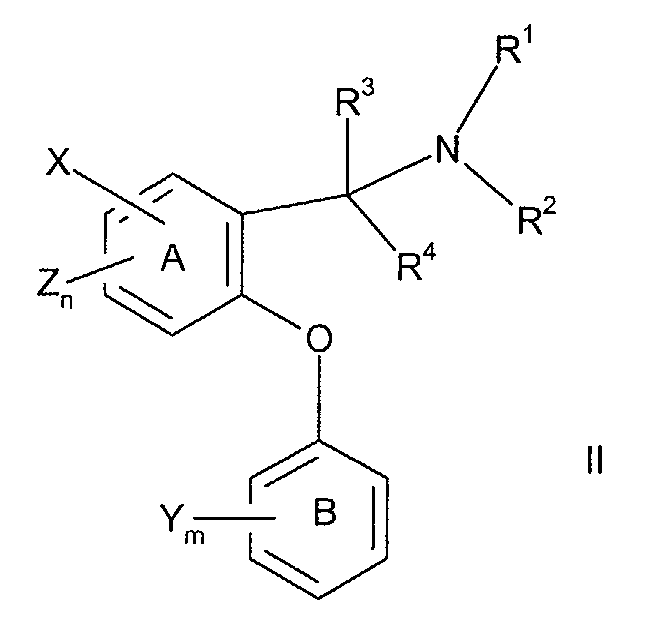 or a pharmaceutically acceptable salt thereof.phenyl ring A and phenyl ring B can each, independently, be replaced by a naphthyl group, and wherein when phenyl ring A is replaced by a naphthyl group, the ethereal oxygen of formula II and the carbon to which R3, R4 and NR1R2 are attached, are attached to adjacent ring carbon atoms of the naphthyl group and neither of said adjacent ring carbon atoms is also adjacent to a fused ring carbon atom of said naphthyl group;n and m are, selected, independently, from one, two and three;R1 and R2 are selected, independently, from hydrogen, (C1-C4)alkyl, (C2-C4)alkenyl, and (C2-C4)alkynyl, or R1 and R2, together with the nitrogen to which they are attached, form a four to eight membered saturated ring containing one or two heteroatoms, including the nitrogen to which R1 and R2 are attached, wherein the second heteroatom, when present, is selected from oxygen, nitrogen and sulfur, and wherein said ring may optionally be substituted at available binding sites with from one to three substituents selected, independently, from hydroxy and (C1-C6)alkyl;R3 and R4 are selected, independently, from hydrogen and (C1-C4) alkyl optionally substituted with from one to three fluorine atoms, or R3 and R4, together with the carbon to which they are attached, form a four to eight membered saturated carbocyclic ring, and wherein said ring may optionally be substituted at available binding sites with from one to three substituents selected, independently, from hydroxy and (C1-C6)alkyl;or R2 and R3, together with the nitrogen to which R2 is attached and the carbon to which R3 is attached, form a four to eight membered saturated ring containing one or two heteroatoms, including the nitrogen to which R2 is attached, wherein the second heteroatom, when present, is selected from oxygen, nitrogen and sulfur, and wherein said ring may optionally be substituted at available binding sites with from one to three substituents selected, independently, from hydroxy and (C1-C6)alkyl;each X is selected, independently, from phenyl, heteroaryl and heterocycle, and wherein each X may be further substituted by hydrogen, halo, (C1-C4)alkyl optionally substituted with from one to three fluorine atoms, (C1-C4)alkoxy optionally substituted with from one to three fluorine atoms, cyano, nitro, amino, hydroxy, carbonyl, (C1-C4)alkylamino, di-[(C1-C4)alkyl]amino, NR5(C=O)(C1-C4)alkyl, SO2NR5R6 and SOp(C1-C6)alkyl, wherein R5 and R6 are selected, independently, from hydrogen and (C1-C6)alkyl, and p is zero, one or two;each Y is selected, independently, from hydrogen, halo, (C1-C4)alkyl optionally substituted with from one to three fluorine atoms, (C1-C4)alkoxy optionally substituted with from one to three fluorine atoms, cyano, nitro, amino, (C1-C4)alkylamino, di-[(C1-C4)alkyl]amino, NR5(C=O)(C1-C4)alkyl, SO2NR5R6 and SOp(C1-C6)alkyl, wherein R5 and R6 are selected, independently, from hydrogen and (C1-C6)alkyl, and p is zero, one or two; andeach Z is selected independently from hydrogen, halo, (C1-C4)alkyl optionally substituted with from one to three fluorine atoms, (C1-C4)alkoxy;
 - A combination according to any one of claims 1-4 wherein the neurotransmitter-inducing or precursor agent or a pharmaceutically acceptable salt thereof is selected from:L-phenylalanine;L-tyrosine;L-tryptophan;L-DOPA; and tyramine.
- A pharmaceutical composition comprising: (a) a compound that exhibits activity, respectively, as an (SRI) anxiolytic agent or an antidepressant, or a pharmaceutically acceptable salt thereof; (b) a neurotransmitter-inducing or precursor agent or pharmaceutically acceptable salt thereof; and (c) a pharmaceutically acceptable carrier.
- A pharmaceutical composition according to claim 6 suitable for the treatment of Multiple Sclerosis and other demyelinating conditions in a mammal and wherein the active agents "a" and "b" are present in amounts that render the composition effective in treating, respectively, Multiple Sclerosis and other demyelinating conditions.
- A pharmaceutical composition according to claim 7 where the demyelinating conditions are encephalomyelitis and peripheral neuropathy, especially painful neuropathy and diabetic neuropathy.
- A pharmaceutical composition according to any one of claims 6-8, wherein the (SRI) anxiolytic agent or antidepressant is selected from compounds of the formula I, or a pharmaceutically acceptable salt thereof, as defined in claim 3.
- A pharmaceutical composition according to any one of claims 6-8, wherein the (SRI) anxiolytic agent or antidepressant is selected from compounds of the formula II or a pharmaceutically acceptable salt thereof, as defined in claim 4.
- A pharmaceutical composition according to any one of claims 6-10 wherein the neuro-transmitter-inducing or precursor agent or a pharmaceutically acceptable salt thereof is selected from:L-phenylalanine;L-tyrosine;L-tryptophan;L-DOPA; andTyramine.
- A pharmaceutical composition according to any one of claims 6-11 wherein the amount of the (SRI) anxiolytic agent or antidepressant, or pharmaceutically acceptable salt thereof, in said composition is from about 0.05 mg to about 500 mg and the amount of the neurotransmitter-inducing or precursor agent or pharmaceutically acceptable salt thereof is from about 0.05 mg to about 500 mg.
- Use of (a) a compound that exhibits activity, respectively, as an (SRI) anxiolytic agent or an antidepressant, or a pharmaceutically acceptable salt thereof; in the manufacture of a medicament combined with (b) a neurotransmitter-inducing or precursor agent or pharmaceutically acceptable salt thereof for the treatment of Multiple Sclerosis and other demyelinating disorders.
- Use according to claim 13 wherein the active agents "a" and "b" above are present in amounts that render the combination of the two agents effective in treating Multiple Sclerosis and other demyelinating diseases.
- Use according to claim 13 or 14 demyelinating diseases. are encephalomyelitis and peripheral neuropathy, especially diabetic neuropathy and painful neuropathy.
- Use according to any one of claims 13- 15, wherein the (SRI) anxiolytic agent or antidepressant is selected from compounds of the formula I, or a pharmaceutically acceptable salt thereof, as defined in claim 3.
- The use according to any one of claims 13- 15, wherein the (SRI) anxiolytic agent or antidepressant is selected from compounds of the formula II, or a pharmaceutically acceptable salt thereof, as defined in 4.
- The use according to any one of claims 13-17, wherein the (SRI) antianxiety agent or the (SRI) antidepressant, or pharmaceutically acceptable salt thereof, and the neurotransmitter-inducing or precursor agent or pharmaceutically acceptable salt thereof, are administered as part of the same dosage form.
- The use according to any one of claims 13-18, wherein the neurotransmitter-inducing or precursor agent, or pharmaceutically acceptable salt thereof, is administered in an amount from about 100 mg per day to about 5 grams per day, and the (SRI) anxiolytic agent or antidepressant, or pharmaceutically acceptable salt thereof, is administered in an amount from about 0.05 mg day to about 1500 mg per day.
- The use according to any one of claims 13-19, wherein the neurotransmitter-inducing or precursor agent or pharmaceutically acceptable salt thereof is selected from:L-phenylalanine;L-tyrosine;L-tryptophan;tyramine; andL-DOPA.
Applications Claiming Priority (2)
| Application Number | Priority Date | Filing Date | Title |
|---|---|---|---|
| US28198801P | 2001-04-05 | 2001-04-05 | |
| US281988P | 2001-04-05 |
Publications (2)
| Publication Number | Publication Date |
|---|---|
| EP1247533A2 true EP1247533A2 (en) | 2002-10-09 |
| EP1247533A3 EP1247533A3 (en) | 2003-12-17 |
Family
ID=23079611
Family Applications (1)
| Application Number | Title | Priority Date | Filing Date |
|---|---|---|---|
| EP02251844A Withdrawn EP1247533A3 (en) | 2001-04-05 | 2002-03-14 | Combination treatment of multiple sclerosis (MS), other demyelinating conditions and peripheral neuropathy, especially painful neuropathies and diabetic neuropathy |
Country Status (6)
| Country | Link |
|---|---|
| US (1) | US20020147206A1 (en) |
| EP (1) | EP1247533A3 (en) |
| JP (1) | JP2002356445A (en) |
| BR (1) | BR0201094A (en) |
| CA (1) | CA2380381A1 (en) |
| MX (1) | MXPA02003452A (en) |
Cited By (1)
| Publication number | Priority date | Publication date | Assignee | Title |
|---|---|---|---|---|
| WO2007074456A3 (en) * | 2005-12-29 | 2008-05-29 | Yeda Res & Dev | Inhibition of cxcr4 and/or cell motility by phenylalanine, cysteine or peptides containing said aminoacids |
Families Citing this family (8)
| Publication number | Priority date | Publication date | Assignee | Title |
|---|---|---|---|---|
| US6575147B2 (en) * | 1999-02-25 | 2003-06-10 | Go-Tec | Internal combustion system adapted for use of a dual fuel composition including acetylene |
| US6403657B1 (en) * | 1999-10-04 | 2002-06-11 | Martin C. Hinz | Comprehensive pharmacologic therapy for treatment of obesity |
| US6759437B2 (en) * | 1999-10-04 | 2004-07-06 | Martin C. Hinz | Comprehensive pharmacologic therapy for treatment of obesity including cysteine |
| US20070293571A1 (en) * | 2006-06-08 | 2007-12-20 | Hinz Martin C | Adminstration of dopa precursors with sources of dopa to effectuate optimal catecholamine neurotransmitter outcomes |
| CA2479218A1 (en) * | 2002-03-21 | 2003-10-02 | Martin C. Hinz | Serotonin and catecholamine system segment optimization technology |
| US20090311795A1 (en) * | 2002-03-21 | 2009-12-17 | Hinz Martin C | Bilateral control of functions traditionally regulated by only serotonin or only dopamine |
| CA2516653A1 (en) * | 2003-02-21 | 2004-09-10 | Martin C. Hinz | Serotonin and catecholamine system segment optimization technology |
| JP4638685B2 (en) * | 2003-06-10 | 2011-02-23 | ハイデルベルガー ドルツクマシーネン アクチエンゲゼルシヤフト | Method of metering dampening water during printing on an offset press |
Family Cites Families (3)
| Publication number | Priority date | Publication date | Assignee | Title |
|---|---|---|---|---|
| US5189064A (en) * | 1985-07-22 | 1993-02-23 | Matrix Technologies, Inc. | Treatment of cocaine addiction |
| NZ293642A (en) * | 1994-10-05 | 1998-10-28 | Cari Loder | Prevention or treatment of nerve damage caused by multiple sclerosis and other demyelinating conditions with a tri- or tetracyclic antidepressant or a monoamine oxidase inhibitor and a neurotransmitter-inducer |
| YU56301A (en) * | 1999-02-23 | 2004-05-12 | Pfizer Products Inc. | Monoamine reuptake inhibitors for treatment of cns disorders |
-
2001
- 2001-12-19 US US10/024,968 patent/US20020147206A1/en not_active Abandoned
-
2002
- 2002-03-14 EP EP02251844A patent/EP1247533A3/en not_active Withdrawn
- 2002-04-03 JP JP2002100682A patent/JP2002356445A/en not_active Withdrawn
- 2002-04-03 CA CA002380381A patent/CA2380381A1/en not_active Abandoned
- 2002-04-04 MX MXPA02003452A patent/MXPA02003452A/en unknown
- 2002-04-05 BR BR0201094-1A patent/BR0201094A/en not_active IP Right Cessation
Cited By (1)
| Publication number | Priority date | Publication date | Assignee | Title |
|---|---|---|---|---|
| WO2007074456A3 (en) * | 2005-12-29 | 2008-05-29 | Yeda Res & Dev | Inhibition of cxcr4 and/or cell motility by phenylalanine, cysteine or peptides containing said aminoacids |
Also Published As
| Publication number | Publication date |
|---|---|
| JP2002356445A (en) | 2002-12-13 |
| CA2380381A1 (en) | 2002-10-05 |
| US20020147206A1 (en) | 2002-10-10 |
| MXPA02003452A (en) | 2002-11-05 |
| BR0201094A (en) | 2003-05-27 |
| EP1247533A3 (en) | 2003-12-17 |
Similar Documents
| Publication | Publication Date | Title |
|---|---|---|
| US6436938B1 (en) | Combination treatment for depression | |
| US20020123490A1 (en) | Combination treatment for anxiety, depression, obsessive compulsive disorder and psychosis | |
| AU2001271910B2 (en) | Use of dopamine D2/D3 receptor agonists to treat fibromyalgia | |
| JP2009137970A (en) | Pharmaceutical composition comprising mirtazapine and one or more selective serotonin reuptake inhibitor | |
| US20020165217A1 (en) | Combination treatment for anxiety and depression | |
| US20020107244A1 (en) | Combination treatment for depression | |
| US20020183306A1 (en) | Combination treatment for sleep disorders including sleep apnea | |
| US20020147206A1 (en) | Combination treatment of multiple sclerosis (MS), other demyelinating conditions and peripheral neuropathy, especially painful neuropathies and diabetic neuropathy | |
| JPS63243028A (en) | Antidepressant for alleviating basic depression | |
| AU619420B2 (en) | Treatment of depression | |
| JP2015510893A (en) | Iloperidone metabolites for use in the treatment of mental disorders | |
| CN110290788A (en) | Use of carbamate compounds for preventing, alleviating or treating bipolar disorder | |
| KR20210141933A (en) | How to treat borderline personality disorder | |
| ES2379165T3 (en) | Use of a PPAR-alpha agonist to treat weight gain associated with a treatment with a PPAR-Gamma agonist | |
| JP4677705B2 (en) | Headache prevention and / or treatment | |
| US20040242667A1 (en) | Method of using cyclooxegenase-2 inhibitors in the treatment and prevention of dementia | |
| HK40015213A (en) | Use of carbamate compounds for prevention, alleviation or treatment of bipolar disorder | |
| BR112019021140A2 (en) | composition, method to reduce blood glucose levels, weight gain or fat deposit levels, or treatment, adipocyte beige induction method or preventing pancreatic beta cell degeneration, and lyn kinase activator and agonist of trpm8 for use in reducing blood glucose levels, weight gain or fat deposit levels, or treatment. | |
| JPS63107925A (en) | Preventive and treating agent for arteriosclerosis |
Legal Events
| Date | Code | Title | Description |
|---|---|---|---|
| PUAI | Public reference made under article 153(3) epc to a published international application that has entered the european phase |
Free format text: ORIGINAL CODE: 0009012 |
|
| 17P | Request for examination filed |
Effective date: 20020330 |
|
| AK | Designated contracting states |
Kind code of ref document: A2 Designated state(s): AT BE CH CY DE DK ES FI FR GB GR IE IT LI LU MC NL PT SE TR |
|
| AX | Request for extension of the european patent |
Free format text: AL;LT;LV;MK;RO;SI |
|
| PUAL | Search report despatched |
Free format text: ORIGINAL CODE: 0009013 |
|
| AK | Designated contracting states |
Kind code of ref document: A3 Designated state(s): AT BE CH CY DE DK ES FI FR GB GR IE IT LI LU MC NL PT SE TR |
|
| AX | Request for extension of the european patent |
Extension state: AL LT LV MK RO SI |
|
| AKX | Designation fees paid |
Designated state(s): AT BE CH CY DE DK ES FI FR GB GR IE IT LI LU MC NL PT SE TR |
|
| 17Q | First examination report despatched |
Effective date: 20050602 |
|
| STAA | Information on the status of an ep patent application or granted ep patent |
Free format text: STATUS: THE APPLICATION IS DEEMED TO BE WITHDRAWN |
|
| 18D | Application deemed to be withdrawn |
Effective date: 20051005 |