FIELD OF THE INVENTION
-
The present invention relates to a light-sensitive silver
halide photographic emulsion, a material comprising said emulsion
and a screen-film combination of a radiographic intensifying
phosphor screen and said material.
BACKGROUND OF THE INVENTION
-
Cubic silver halide grains are grains which have since quite a
long time been known as applicable in quite a lot of silver halide
light-sensitive photographic materials, but since the early eighties
many attempts have been made in order to replace them by silver halide
tabular grains and to make those tabular grains suitable for use in
silver halide photographic materials for quite a lot of diverse
applications.
-
However as a global result fairly heterogeneous emulsion
crystal distributions were obtained in an attempt to prepare
homogenous tabular crystals populations: a common variability or
variation coefficient (defined as ratio between average standard
deviation on equivalent circular diameter and the said average
equivalent circular diameter) of 0.30 to 0.60 has frequently been
calculated, partly due to the presence of quite a large number of
non-tabular grains having a sphere equivalent diameter of less than
0.3 µm. Moreover differences in thickness growth have been observed,
said differences leading to unevenness as a consequence of observed
differences in image tone.
-
Heterodispersity of grain morphology further leads to, e.g.,
uncontrolled chemical and spectral sensitization, lower contrast and
lower covering power, thereby losing typical advantages of the said
grains as referred to hereinbefore.
-
Until now efforts in order to get more monodisperse tabular
silver halide crystal distributions in emulsion preparation have
been directed towards silver halide crystals rich in silver bromide
as has e.g. been described in US-A's 4,797,354; 5,147,771;
5,147,772; 5,147,773; 5,171,659; 5,248,587; 5,204,235; 5,210,013;
5,215,879; 5,250,403; 5,252,442, 5,252,453; 5,254,453; 5,318,888;
5,439,787; 5,472,837; 5,482,826 and 5,484,697 and in Research
Disclosure No. 391, p. 713-723 (1996).
-
Many attempts have been made in order to improve the degree of
homogeneity of the size and shape of the crystals but the majority of
them is related with tabular grains rich in silver bromide. So
radiographic materials comprising emulsions having monodisperse
tabular silver brom(oiod)ide crystals have e.g. been described in
US-A's 5,252,442 and 5,508,158. The same preparation methods as for
the forementioned tabular grains rich in silver bromide can however
not be applied as such in preparing tabular grains rich in silver
chloride, especially due to the recommended presence of crystal habit
modifiers or stabilizers, usually adenine or more generally
aminoazaindenes, as this leads to the disadvantages set forth
hereinbefore. Stabilization of the crystal habit of anisotropically
grown crystals having flat parallel twins however remains an ever
lasting demand.
-
Combinations of intensifying screens provided with luminescent
phosphors in contact with light-sensitive silver halide photographic
materials are conventionally used for medical diagnosis. By X-ray
radiation the luminescent phosphors in the screen panel or panels
are converting X-rays into visible radiation, thereby exposing the
film material in contact with the said panel (for single-side coated
materials as e.g. in mammography) or panels (for duplitized
materials as e.g. in chest imaging).
-
In mammography e.g. the compressed breast is irradiated with
soft X-rays emitted from an X-ray generating device and the
modulated X-rays are detected with a radiographic X-ray conversion
screen, also called intensifying screen, fluorescent screen or
phosphor screen. The X-ray conversion screen comprises a
luminescent phosphor which converts the absorbed X-rays into visible
light and the emitted visible light exposes a silver halide film
that is brought into contact with said X-ray conversion screen.
After film processing, comprising the steps of developing, fixing,
rinsing and drying, a mammogram is obtained which can be read on a
light box. No other field of medical radiology demands such a high
level of image quality as mammography and the ability of the
mammogram to portray relevant diagnostic information is highly
determined by the image quality of the screen-film system. Image
quality is manifested by a number of features in the image including
sharpness, noise, contrast, silver image colour and skin line
perceptibility. Conventional mammography films can roughly be
classified in low and high contrast types according to the value of
their average gradation as defined above. The low contrast type can
be characterized by a relatively low average gradation ranging from
2.0 to 2.5 whereas the average gradation of the high contrast type
may range higher than 3.0. Often, high contrast films are preferred
because of the higher ability to detect tiny cancers deep in the
glandular tissue of the breast. If the contrast is too high,
however, it may preclude visualization of both thin (i.e. the skin
line) and thick tissues (i.e. the inside of the breast) in the same
image due to lack of exposure latitude. Therefore, some
radiologists prefer low contrast mammography films. When the
contrast is low, skin line perceptibility is excellent, but then the
chance of missing possibly malignant breast lesions is high. Thus a
balance has to be found between contrast and exposure latitude and
an example of this approach has been described in US-A 5,290,655.
-
Maintaining the image quality constant is becoming another
requirement of facilities performing mammography. Accordingly,
quality control tests are executed on a regular basis in order to
monitor the consistency of the performance of the X-ray equipment,
the image receptors and the film processor. In order to minimize
the influence of varying film processing time, temperature,
chemistry and replenishment, a preferred mammography film requires a
stable speed and contrast with regard to these processing
parameters. As in addition, there is a general trend in the field
of radiology to shorten the film processing time and likewise in the
field of mammography, being driven by intensified screening
programs, the interest has focused on rapid access of mammograms.
As a consequence, mammography films are preferred which comprise
silver halide crystals that can be processed rapidly and
consistently in a dry-to-dry processing cycle of 90 seconds or less
and therefore, most mammography films today comprise good
developable cubic silver halide crystals. As described in
EP-A 0 712 036 such cubic crystals show a stable speed and contrast
upon varying processing parameters, but said cubic grain emulsions
however are characterized by a very high contrast, resulting in a
poor skin line perceptibility.
-
Especially in rapid processing applications it is very
difficult to obtain the desired low fog, high speed and high
covering power simultaneously. Replacing cubic grain emulsions by
tabular grain emulsions is in favour of getting a high covering
power at moderate coating amounts of silver halide as has been
demonstrated e.g. in US-A 4,414,304. Disadvantages of tabular
grains however are the lower contrast than the contrast obtainable
with cubic grains, the brown colour hue of developed crystals and
the residual colouration of the processed image, especially in short
processing cycles, due to strong adsorption of huge amounts of
spectral sensitizing dye(s) at the large specific surface area,
characteristic for the said tabular grains.
-
Making use of a mixture of cubic and tabular grains or of a
multilayer arrangement of cubic and/or tabular grains in order to
provide a good image tone as in EP-A 0 874 275 and in EP-A 0 770 909
respectively is more complex and less interesting from the point of
view of reproducibility of the production process. Another method
provided in order to get a suitable image tone has been described in
EP-A 0 844 520, wherein the light-sensitive silver halide emulsion
layer comprises blue coloured polymeric matting particles.
-
The above cited references on tabular grains are mainly
concerned with high sensitive silver bromide or silver bromoiodide
emulsions. As already set forth above tabular grain emulsions
having a high aspect ratio are known to provide several advantages
over more conventional spherical grains as e.g. a high covering
power, a high (spectral) sensitivity and a lower coating weight,
which saves costs in manufacturing. Said lower coating weight is
especially preferred if rapid processing applications, preferably
accompanied by low replenishing amounts of developer and fixer, are
required, which nowadays is an ever more returning demand. In order
to prevent residual colour or dye stain after said rapid processing
in low replenishing conditions, it is even most favourable not to
make use of antihalation dyes as those dyes are normally coated in
the layer, most close to the support, so that it takes some time to
leave the film. In mammography however literature is scarce with
respect to the use of antihalation dyes and dye stain mostly results
from the presence after processing of residual amounts from the
normally used high amounts of spectral sensitizing dyes, required in
high amounts in the presence of tabular grain emulsions
characterized by their large surface to volume ratio. Said
spectrally sensitizing dyes are well known in the art of
photography, especially for green and red sensitization of flat
tabular grains, whereas for blue and/or ultraviolet sensitization
the number of examples is rather limited. Further it is known in
mammography to use combinations of green-emitting phosphor screens
with film materials containing green sensitized tabular grain
emulsions. After processing of exposed tabular emulsion grains
residual amounts of dyes may thus be present. Those huge amounts
are particularly added in favour of high speed and high image
quality (especially sharpness)in diagnostic imaging applications,
where it is further of utmost importance to reduce irradiation of
the patient to minimum levels.
-
Although not restricted to single-side coated materials, the
present invention is especially useful in mammographic applications,
wherein, for reasons of good image definition light-sensitive layers
are present on only one side of the film support. Image formation
therein proceeds with a system consisting of only one intensifying
screen, wherein a high speed, a high contrast (preferably a high
"toe contrast") and low residual dye stain are desired. Specific
measures taken therefore have e.g. been described in US-A 5,290,655;
in EP-A's 0 264 788 and 0 577 027 and in Research Disclosure No.
33487 (1992), p. 161 but it is clear that any measure in order to
decrease residual dye stain level, just as for duplitized or double
side coated radiographic materials, without further losses with
respect to sensitometry and image quality is highly desired.
The said losses may become particularly prohibitive the thinner the
flat tabular grains are: an enhanced specific surface resulting
therefrom requires higher amounts of spectrally and chemically
sensitizing compounds or agents which may cause adverse effects as
there are desensitization and a decreasing decoloration ability.
-
Moreover sensitivity to darkroom illumination, causing fog and
having an influence on sensitometric and image quality
characteristics, may form a problem with respect to diagnosis.
OBJECTS OF THE INVENTION
-
It is an object of the present invention to provide a silver
halide photographic material for mammography, said material having a
low fog (partly due to low darkroom sensitivity), high speed,
desired contrast (gradation) and high image quality (especially
sharpness).
-
It is a further object of the present invention to provide a
mammographic material having little coloration (residual dye stain),
even after rapid processing (short processing times).
SUMMARY OF THE INVENTION
-
The above mentioned objects are realized by providing a
chemically and spectrally-sensitized silver halide photographic
emulsion composed of essentially (100) cubic silver brom(oiod)ide
grains or crystals with an average edge length of from 0.2 µm up to
1.5 µm (preferably having a high degree of monodispersity), wherein
said grains have been spectrally sensitized in the wavelength range
from 540 nm to 555 nm by the step of adding at least three (a main,
a second and a third trimethine) spectrally sensitizing dyes:
- a main spectrally sensitizing dye present in an amount of at
least 85 mole %,
- a second spectrally sensitizing dye present in an amount of
less than 10 mole %, and
- a third spectrally sensitizing dye present in an amount of at
most 5 mole %, preferably in an amount of not more than 3 mole % and
most preferably said second spectrally sensitizing dye is added in
an amount of not more than 1 mole % of all spectrally sensitizing
dyes added,
said amount being expressed in mole % based on total molar
amounts of all spectrally sensitizing dyes added;
characterized in that
- at least said main spectrally sensitizing dye is a methine dye
comprising first and second nuclei joined by a substituted or
unsubstituted trimethine linkage, wherein both nuclei are
benzoxazole nuclei, said nuclei being each substituted by one
halogen atom or by a methyl group in the 5- and 5'- or 6- and 6'-position
respectively; the N-atom of which has a substituted or
unsubstituted alkyl chain having from 1 to 4 carbon atoms and a
water-soluble group;
- at least said third spectrally sensitizing dye is a methine
dye comprising first and second nuclei joined by a substituted or
unsubstituted trimethine linkage, wherein both nuclei are
benzimidazole nuclei, said nuclei substituted by one or more halogen
atom(s) in the 5-, 5'-,6- and/or 6'-position, or by a methyl group;
the N-atoms of which having a substituted or unsubstituted alkyl
chain having from 1 to 4 carbon atoms and a water-soluble group on
at least on one N-atom; and in that
the said second spectrally sensitizing dye is a asymmetrical
trimethine dye comprising first and second nuclei, independently
represented by a benzoxazole or a benzimidazole nucleus, at least
one of them being substituted by a hydrophobic substituent, having a
higher Van der Waals volume than any other hydrophobic substituent
of both other spectrally sensitizing dyes (or expressed otherwise: a
structure more sterically hindered than the structure of the other
spectral sensitizers),
or, in the alternative, that
the said second spectrally sensitizing dye is an asymmetrical
trimethine dye comprising a benzoxazole nucleus and a benzimidazole
nucleus, and wherein, apart from the presence on at least one N-atom
of a water-soluble group, other substitutions provide an asymmetric
structure.
-
A light-sensitive silver halide photographic film material
(particularly suitable for use in mammography) has further been
disclosed, said material comprising a support and on one side
thereof, at least one light-sensitive emulsion layer having been
coated in at least one light-sensitive emulsion layer with the
chemically and spectrally sensitized emulsion as disclosed.
-
Moreover a radiographic screen/film combination has been
described, said screen-film combination comprising a light-sensitive
silver halide photographic film material as disclosed, in contact
with one supported or self-supporting X-ray intensifying screen,
characterized in that said supported or self-supporting X-ray
intensifying screen essentially consists of luminescent phosphor
particles emitting green light in the wavelength range as set forth.
-
Specific features for preferred embodiments of the invention
have further been set out in the dependent claims.
-
Further advantages and embodiments of the present invention
will become apparent from the following description.
DETAILED DESCRIPTION OF THE INVENTION
-
As has been disclosed in the statement of the present invention
in a radiographic screen/film combination for recording medical
diagnostic images of soft tissue, and more in particular for
mammographic applications, the film material is thus characterized
by the presence, at one side of a transparent support, of at least
one light-sensitive silver halide emulsion layer, wherein the silver
halide emulsion essentially has cubic silver halide emulsion grains
or crystals, spectrally sensitized in order to optimally detect the
light emitted from the X-ray conversion screen, by the method as
disclosed herein. The said grains have been spectrally sensitized
in the wavelength range from 540 nm to 555 nm by the step of adding
at least three (a main, a second and a third trimethine) dyes:
- at least said main spectrally sensitizing dye is a methine dye
comprising first and second nuclei joined by a substituted or
unsubstituted trimethine linkage, wherein both nuclei are
benzoxazole nuclei, said nuclei being each substituted by one
halogen atom or by a methyl group in the 5- and 5'- or 6- and 6'-position
respectively; the N-atom of which has a substituted or
unsubstituted alkyl chain having from 1 to 4 carbon atoms and a
water-soluble group;
- at least said third spectrally sensitizing dye is a methine dye
comprising first and second nuclei joined by a substituted or
unsubstituted trimethine linkage, wherein both nuclei are
benzimidazole nuclei, said nuclei substituted by one or more halogen
atom(s) in the 5-, 5'-,6- and/or 6'-position, or by a methyl group;
the N-atoms of which having a substituted or unsubstituted alkyl
chain having from 1 to 4 carbon atoms and a water-soluble group on
at least on one N-atom; and in that
the said second spectrally sensitizing dye is a symmetrical or
asymmetrical trimethine dye comprising first and second nuclei,
independently represented by a benzoxazole or a benzimidazole
nucleus, at least one of them being substituted by a hydrophobic
substituent, having a higher Van der Waals volume than any other
hydrophobic substituent of both other spectrally sensitizing dyes.
-
In the alternative, according to the present invention said
second spectrally sensitizing dye is an asymmetrical trimethine dye
comprising a benzoxazole nucleus and a benzimidazole nucleus, and
wherein, apart from the presence on at least one N-atom of a water-soluble
group, other substitutions provide an asymmetric structure.
-
In another preferred embodiment according to the present
invention the said second spectrally sensitizing dye is an
asymmetric trimethine dye comprising a benzoxazole nucleus and a
benzimidazole nucleus, wherein, apart from the presence on at least
one N-atom of a water-soluble group, other substitutions provide an
asymmetric structure.
-
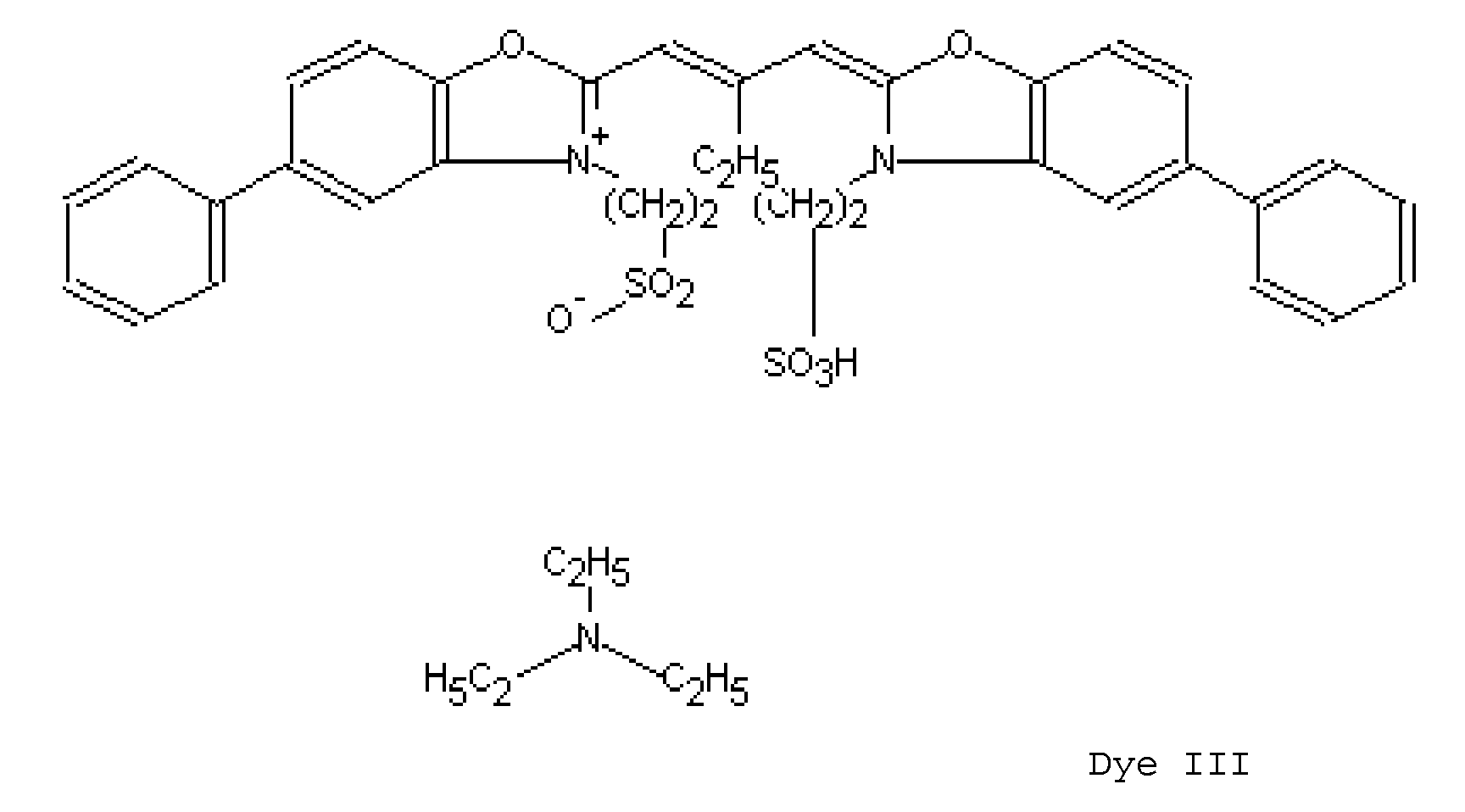
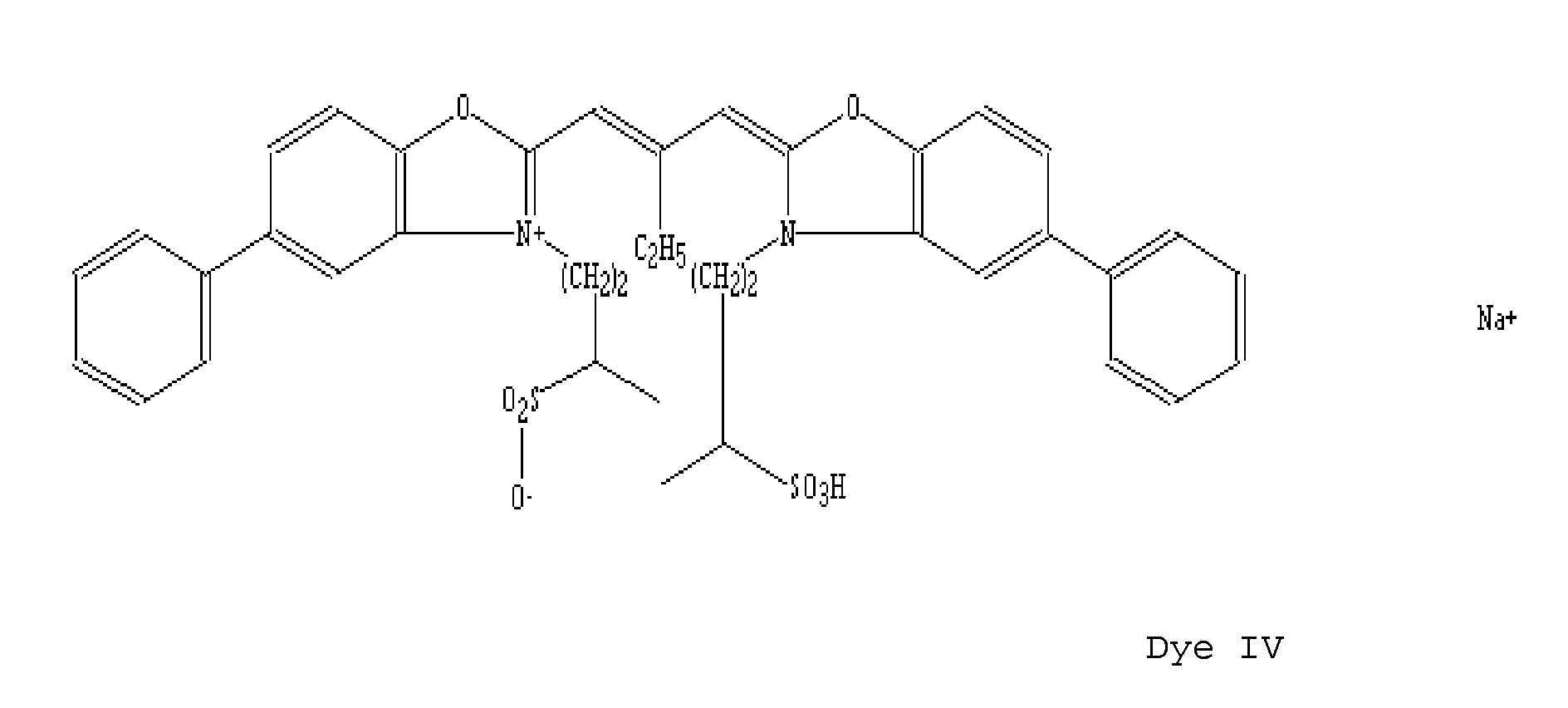
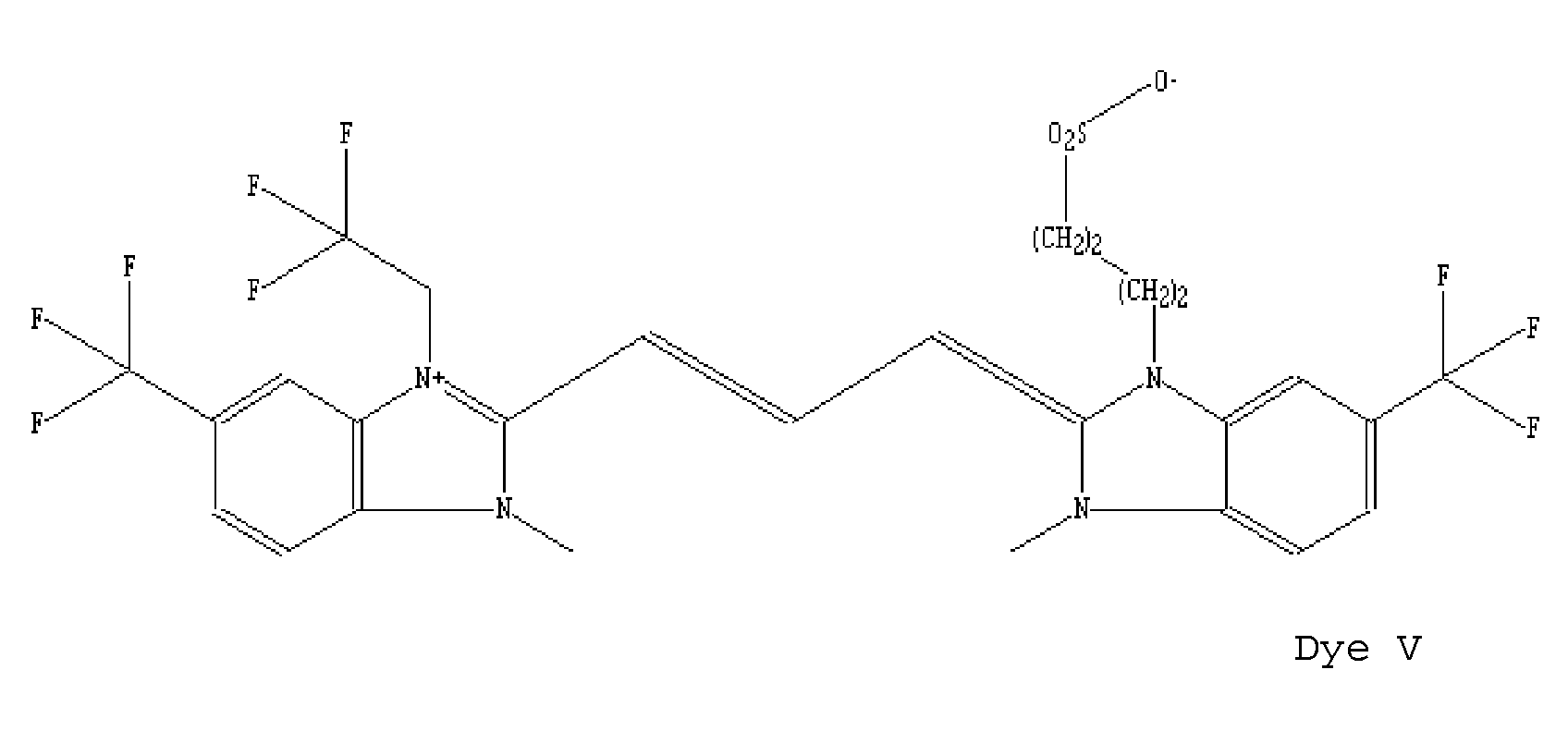
In a further preferred embodiment according to the present
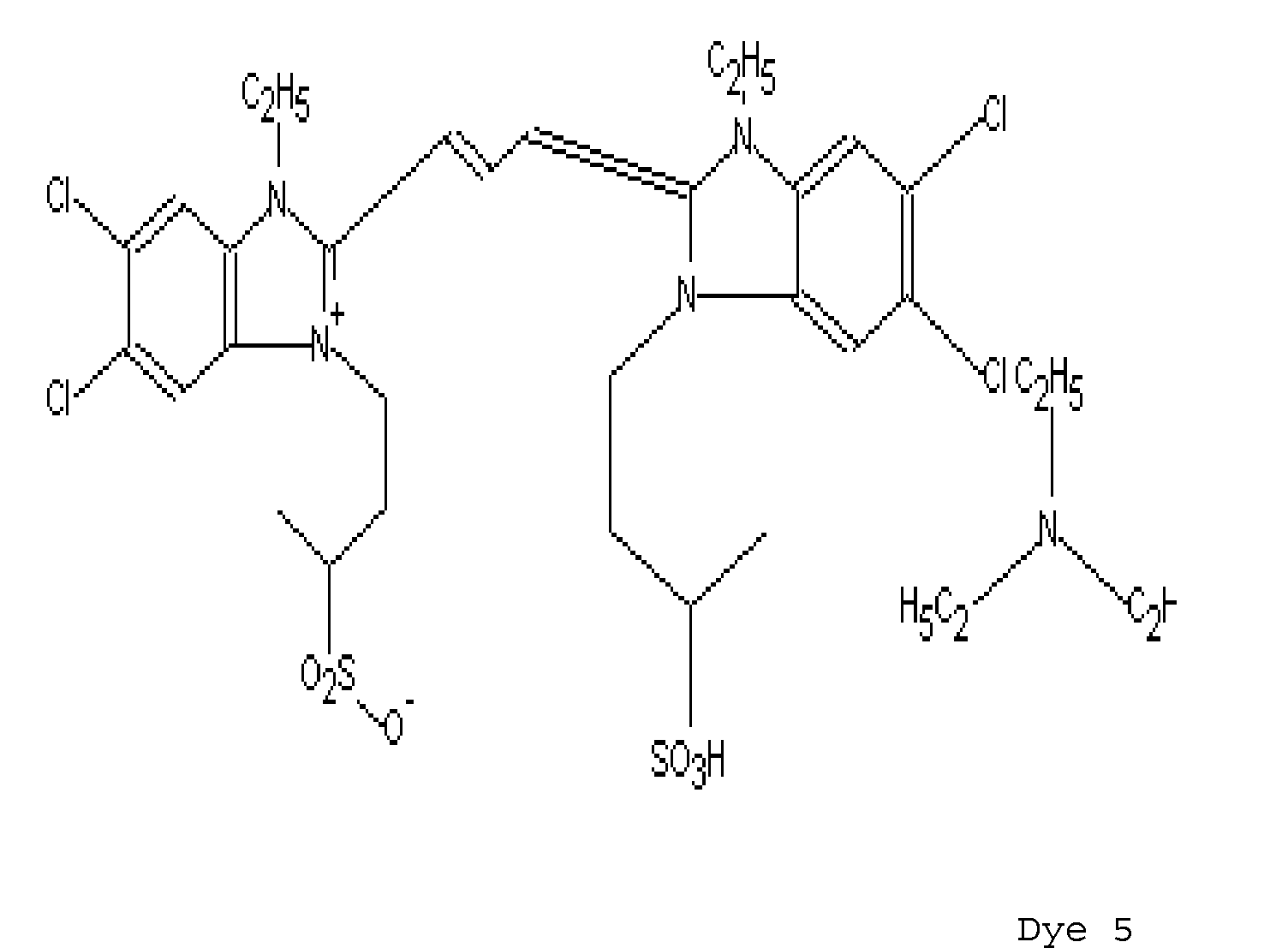
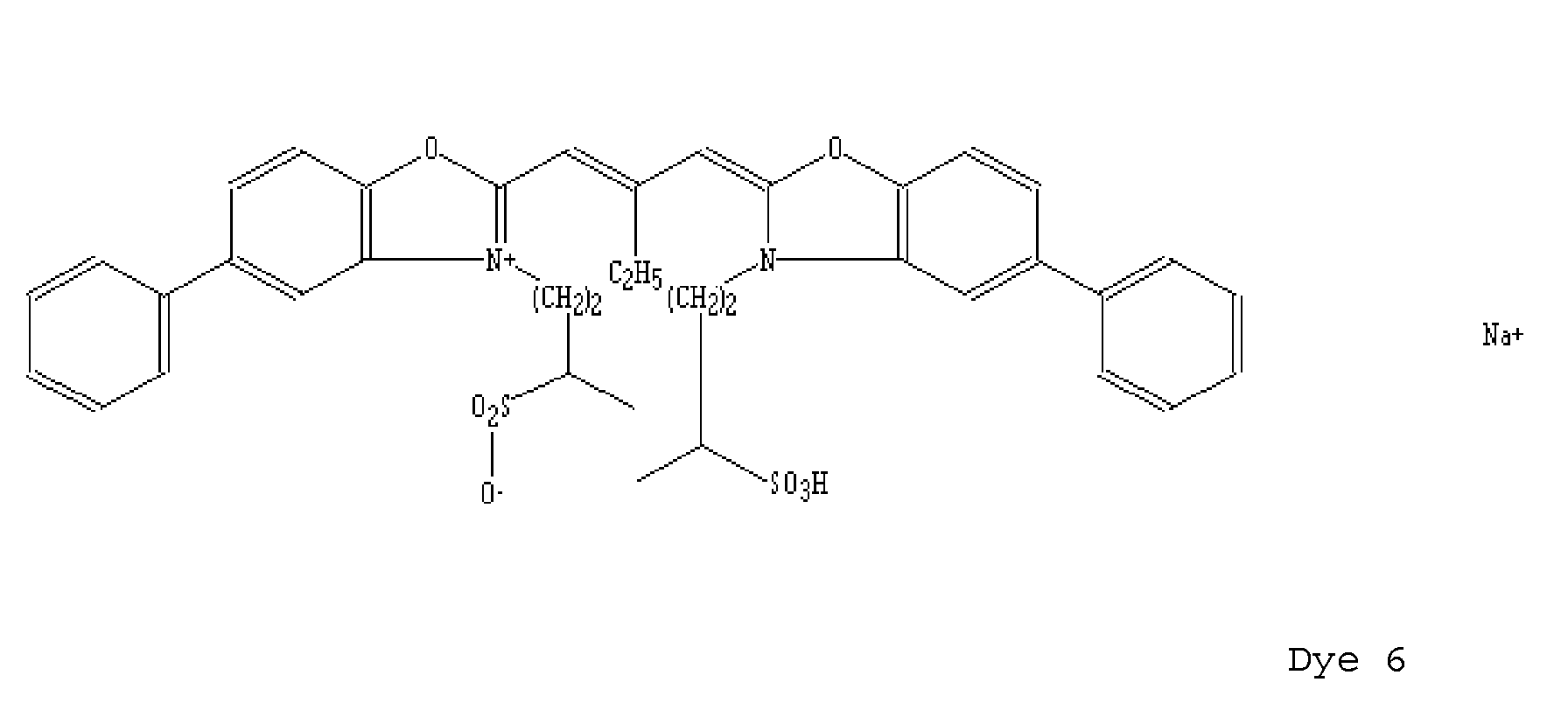
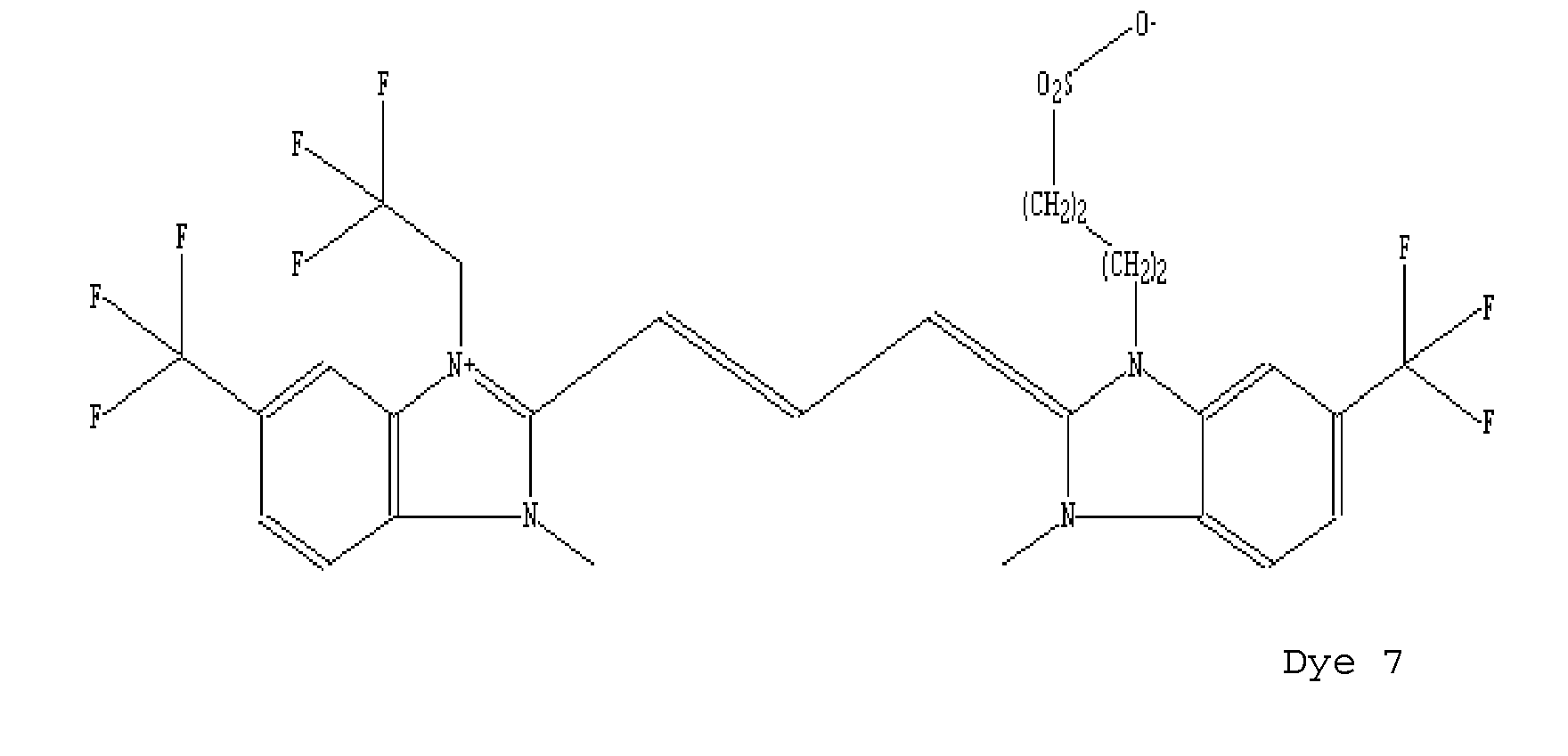
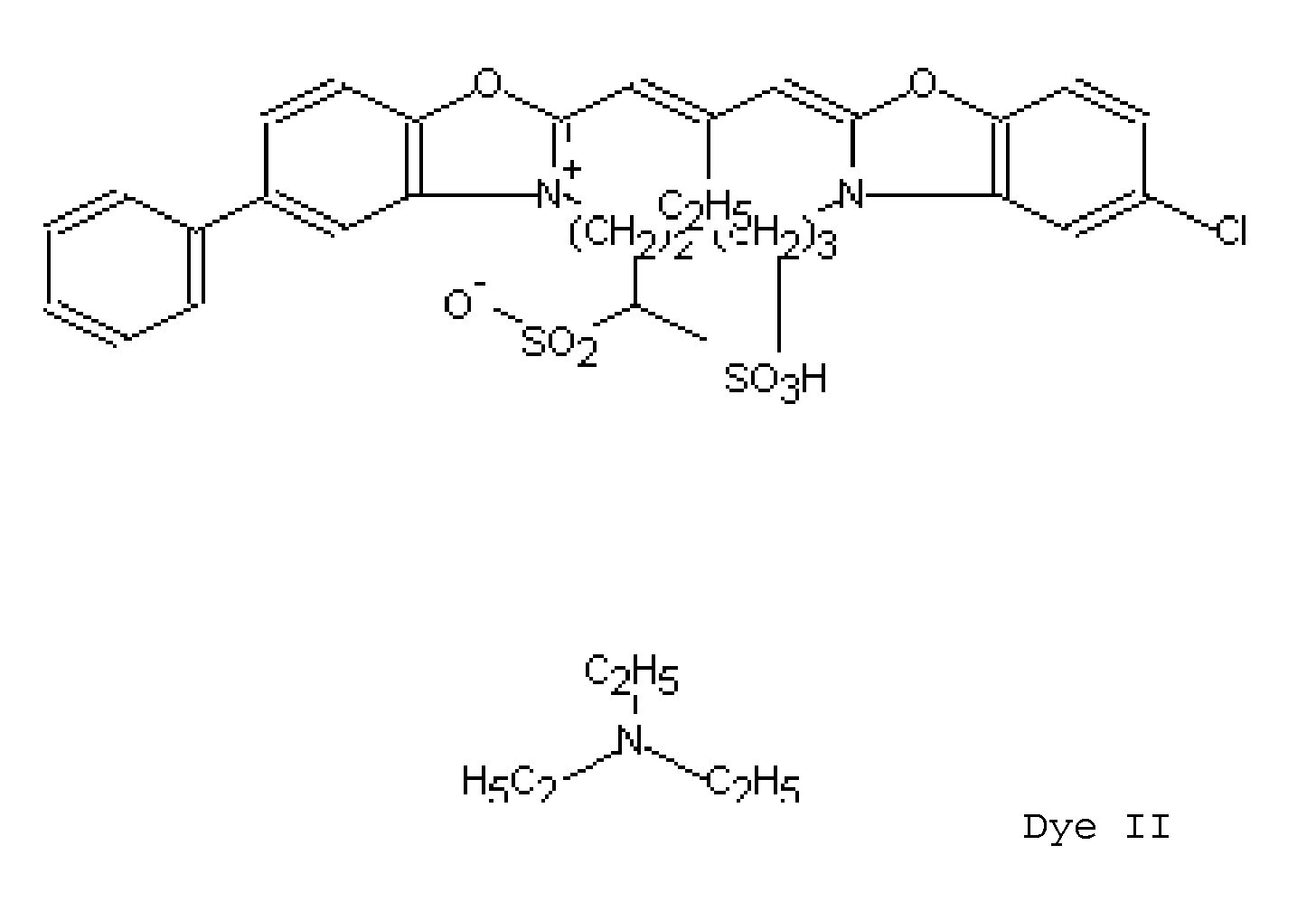
invention said second spectrally sensitizing dye is a dye selected
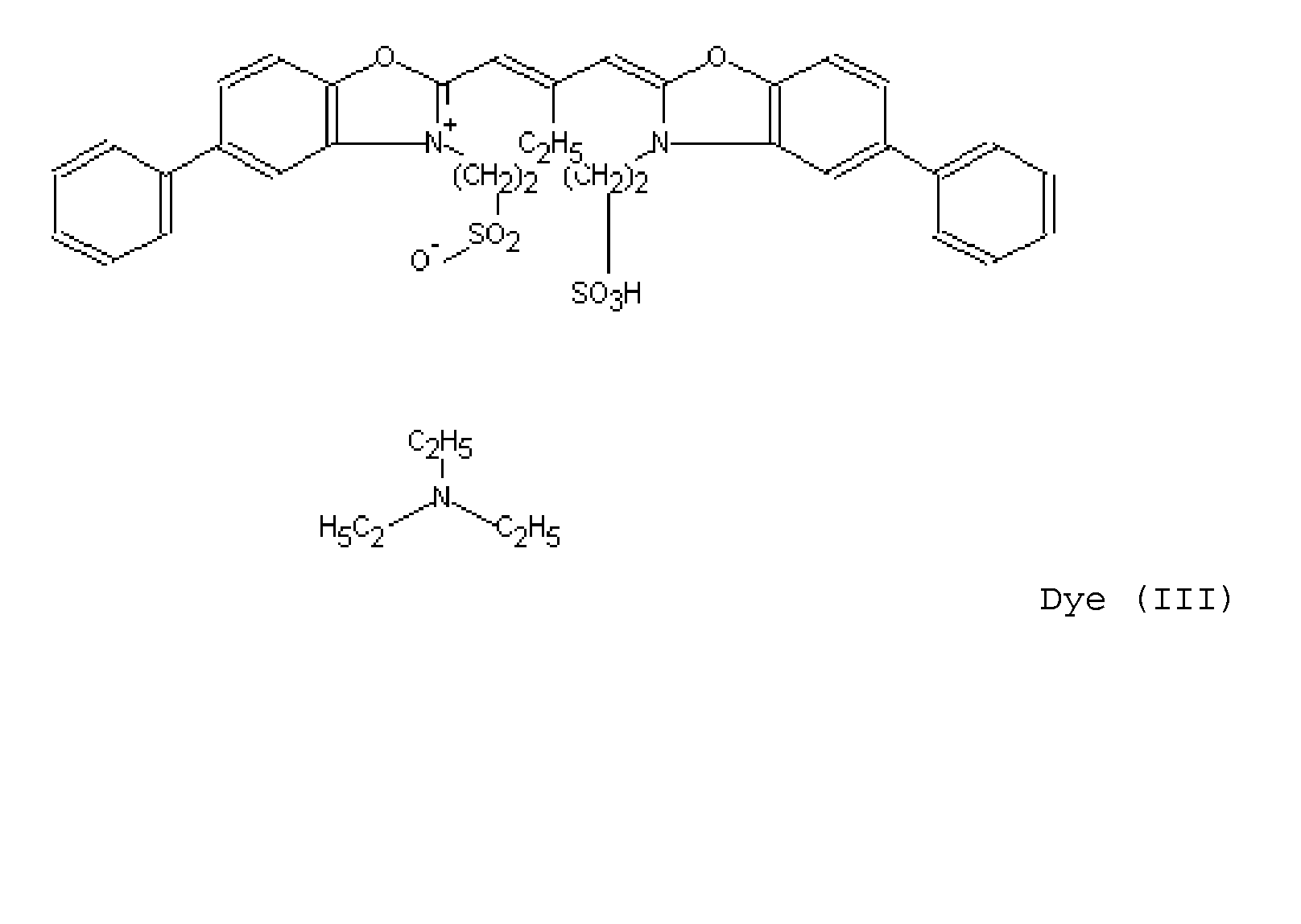
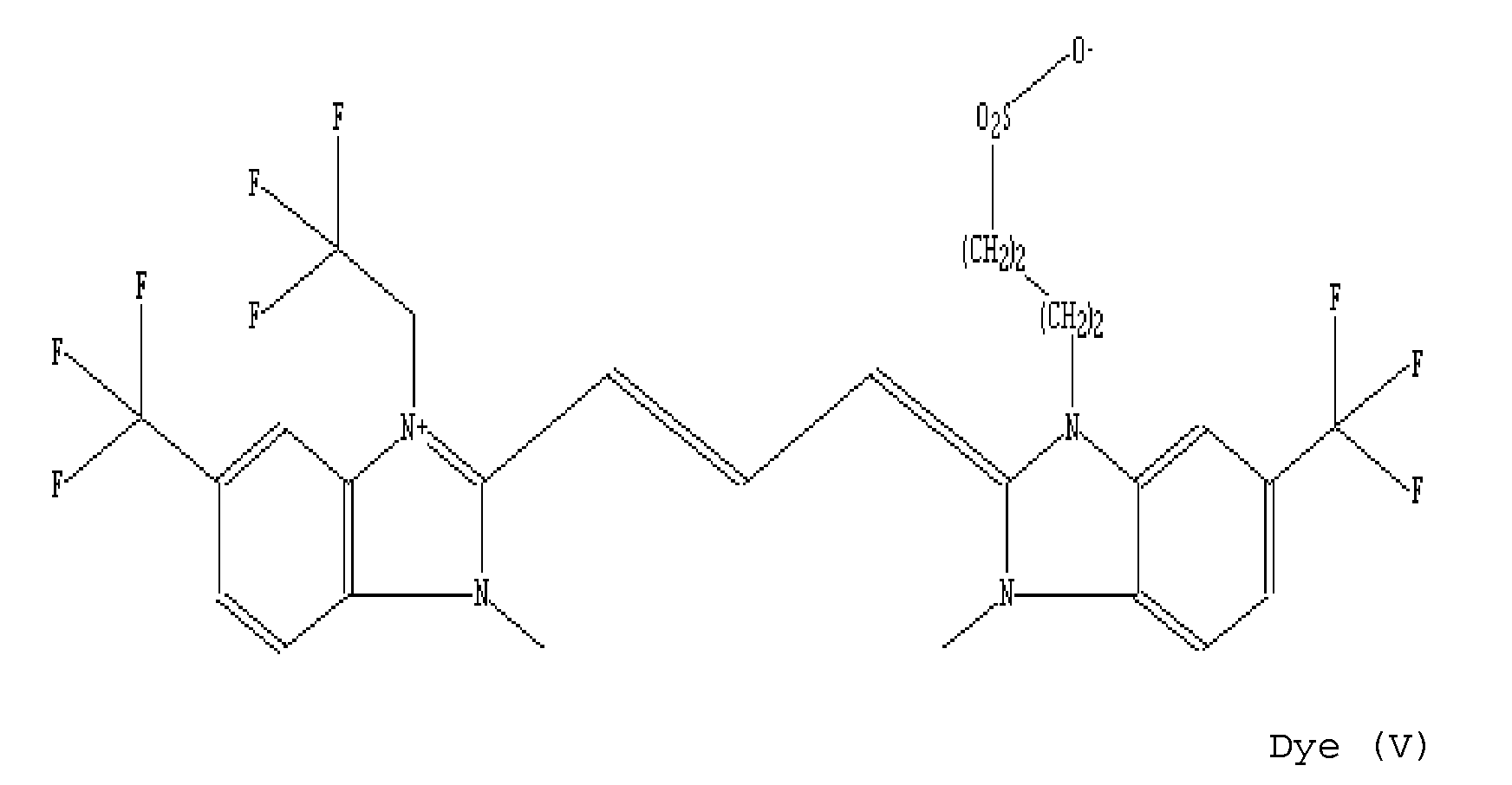
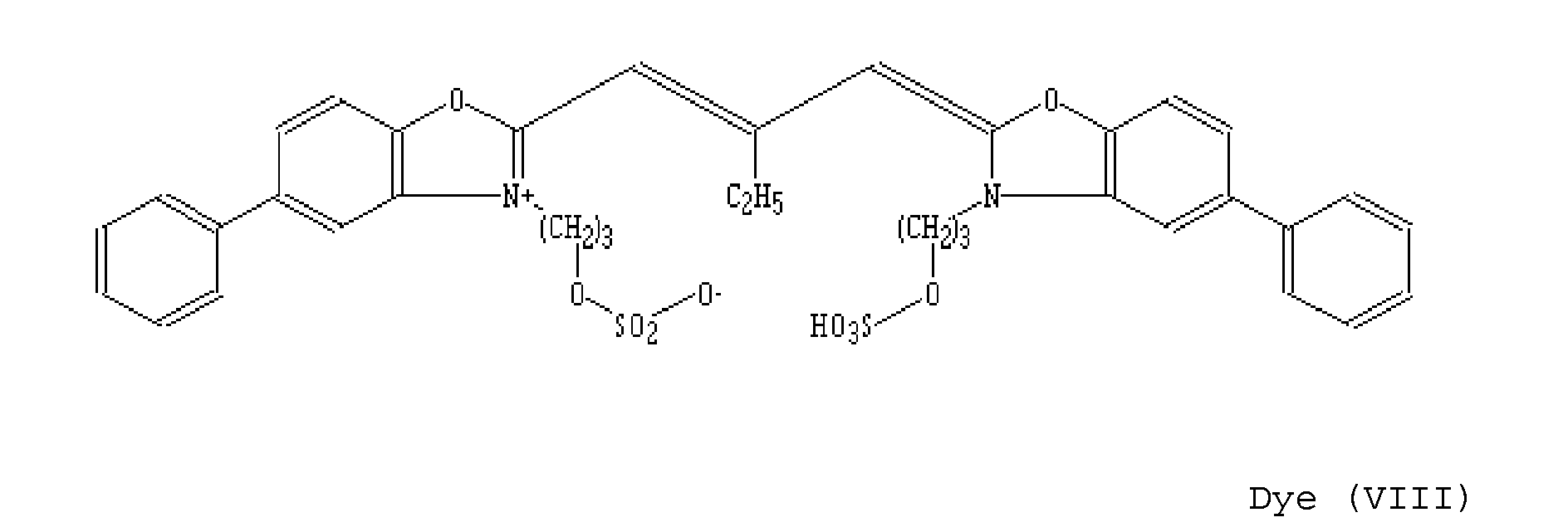
from the group consisting of the dyes I-VIII, having the formulae
-
It is an essential feature, according to the present invention
that the said third spectrally sensitizing dye is present in an
amount of not more than 5 mole % of all spectral sensitizers, more
preferably in an amount of not more than 3 mole % of all spectrally
sensitizing dyes and most preferably in an amount of not more than 1
mole % of all spectrally sensitizing dyes or, in other words, in
clearly lower amounts than both other spectrally sensitizing
trimethine dyes, whereas the second dye should be present in an
amount of less than 10 mole %, more preferably less than 5 mole %
and still more preferably in an amount of about 3 mole %.
-
In another embodiment according to the present invention said
"hydrophobic substituent" (present as substituent on the nuclei of
the second spectral sensitizer) is selected from the group
consisting of substituted or unsubstituted phenyl and -(CH2)x-CF3,
wherein x is 0 or an integer having a value of from 1 to 4. It is
required to add the spectral sensitizers used in the present
invention in a consecutive order as they have been numbered, in
order to attain all advantages as mentioned.
-
Emulsion grains or crystals of the emulsion according to the
present invention essentially have (100) cubic silver halide grains
or crystals, more preferably having a silver brom(oiod)ide
composition with an average edge length of from 0.2 µm up to 1.5 µm.
The term "essentially cubic" is indicative for the presence, in an
amount of at least 90 %, more preferably at least 95 % and even more
preferably at least 99 % by number of crystals having a {100}
crystal habit and thus (100) crystal faces, wherein edges may be
sharp or rounded-off (e.g. due to preparation methods wherein silver
solubilizing growth accelerators are used such as ammonia or
methionine, a thioether compound, thiazolidine-2-thione, tetra-substituted
thiourea, potassium or ammonium rhodanide and an amine
compound may be present during grain precipitation in order to
adjust the average grain size) and wherein it is even not excluded
that cubo-octaeders are present, provided that (111) crystal faces
therein represent not more than 10 %, more preferably not more than
5 % and even more preferably not more than 1 % of the total
projective area of all crystal faces present, and wherein (100)
faces are clearly representing the majority of the crystal faces
present in the emulsions. The class of so-called cubic grains
embraces (a) perfectly cubic crystals, or (b) cubic crystals with
rounded corners, or (c) cubic crystals with small (111) faces at the
corners (also known as tetradecahedrical grains), the total area of
these (111) faces however being small compared to the total area of
the (100) faces. Presence of cubo-octahedral shapes which are not
excluded depends on the pAg values applied during the precipitation.
So preferred methods for the precipitation of cubic grains are the
pAg-balanced double- or triple-jet methods as described in
EP-A's 0 712 036 and 0 610 609, since these methods provide
monodispersed emulsions characterized by a narrow grain size
distribution defined in that at least 95 % by weight or number of
the grains have a diameter within about 40 %, preferably within
about 30 % of the average grain size and more preferably within
about 10% to 20%.
-
The emulsion of the present invention accordingly has cubic
grains having a high degree of monodispersity in that a variation
coefficient on said average edge length is less than 0.20. More
preferably said variation coefficient of the emulsion grains
according to this invention has a low value of between 0.10 and
0.20, said variation coefficient being defined as the ratio between
the standard deviation of the grain size and the average grain size.
This is particularly desired as a high contrast is envisaged for the
mammographic image after processing of the material according to the
present invention. The silver halide grains are obtained by
conventional precipitation techniques which are well known in the
art and consist of the addition of aqueous solutions of silver and
halide salts, e.g. silver nitrate and sodium, potassium or ammonium
halide to a solution comprising a protective colloid. In order to
get controlled growth use is often made of variable flow rates in
order to provide (and controll) crystal growth to be performed at a
higher rate and to perform precipitation in more concentrated
reaction vessels which may even lead to variability coefficients
over the grain distributions in the range between 0.10 and 0.20,
thus corresponding with the desired homogeneity as in the present
invention. If it is recommended, in favour of fine-tuning desired
gradations at differing densities or sensitivity points of the
sensitometric curve, e.g. in order to have a broader emulsion grain
distribution, then a less homogeneous distribution will be strived
after. Apart for growing the cubes in a reaction vessel at slightly
higher pAg values, it is also possible and, in favour of addition of
other ingredients - such as chemical and spectral sensitizers - to
more uniform crystals, even recommended to prepare the most suitable
cubic grain emulsion from more than one chemically and spectrally
sensitized emulsion having a very narrow grain distribution. This
is recommended more particularly for the light-sensitive emulsion
layer in the back layer unit, which, in favour of skin line
perceptibility, should contribute to the total density of the
processed material, wherein the back layer unit should exhibit an
optical density of at least 1.00 in the wavelength region of the
exposing radiation.
-
The grain size of the cubic grain emulsions can be determined
using conventional techniques, e.g. as described by Trivelli and
Smith, The Photographic Journal, vol. 69, 1939, p.330-338, Loveland
"ASTM symposium on light microscopy" 1953, p.94-122 and Mees and
James "The Theory of the photographic process" (1977), Chapter II.
-
Precipitation of silver halide crystals suitable for use in
emulsion layers according to the present invention is performed in
the presence of a protective, hydrophilic colloid, which should be
chosedn with care: e.g. conventional lime-treated or acid treated
gelatin can be used, but also oxidized gelatin (generally known as
gelatin having less than 30 p.p.m. of methionine) or a synthetic
peptizer. The preparation of such modified gelatin types has been
described in e.g. "The Science and Technology of Gelatin", edited by
A.G. Ward and A. Courts, Academic Press 1977, page 295 and next
pages. The gelatin may also be an enzyme-treated gelatin as
described in Bull. Soc. Sci. Phot. Japan, No. 16, page 30 (1966).
Before and during formation of the silver halide grains it is common
practice to establish a gelatin concentration of from about 0.05 %
to 5.0 % by weight in the dispersion medium. Cubic silver halide
grains may also be precipitated in absence of gelatin, e.g. by
making use of colloidal silica as a protective colloid in the
presence of an onium compound, as described in EP-A's 0 677 773 and
0 649 051; or in the alternative by making use of cationic oxidized
starch as has been disclosed e.g. in EP-A 0 758 759.
-
At the end of the precipitation the emulsion is made free from
excess of soluble inorganic salts by a conventional washing
technique e.g. flocculation by ammonium sulphate or polystyrene
sulphonate, followed by one or more washing and redispersion steps.
Conventional washing techniques can be found in Research Disclosure,
Item 38957, Section III. Emulsion washing. Another well-known
washing technique is ultrafiltration as described e.g. in EP-A 0 794
455. Finally, in order to prepare the emulsion for further
sensitization actions extra gelatin or another binder material can
be added to the emulsion in order to obtain a gelatin to silver
ratio wherein the emulsion remains colloidally stable during said
further actions. So in order to enhance speed of the cubic silver
halide emulsion grains chemical sensitization is applied thereto
according to the procedures described in e.g. "Chimie et Physique
Photographique" by P. Glafkides, in "Photographic Emulsion
Chemistry" by G.F. Duffin, in "Making and Coating Photographic
Emulsion" by V.L. Zelikman et al, and in "Die Grundlagen der
Photographischen Prozesse mit Silberhalogeniden" edited by H.Frieser
and published by Akademische Verlagsgesellschaft (1968). As
described in the above mentioned literature, chemical sensitization
can be carried out by effecting the ripening in the presence of
small amounts of compounds containing sulphur,selenium or tellurium
e.g. thiosulphate, thiocyanate, thiourea, selenosulphate,
selenocyanate, selenoureas, tellurosulphate, tellurocyanate,
sulphites, mercapto compounds, and rhodamines. In a preferred
embodiment, these compounds or combinations thereof are applied in
combination with a noble metal salt, preferably a gold complex salt,
but also salts of platinum, palladium and iridium as described in
US-A 2,448,060 and GB-A 618,061 may be used. Description of
chemical sensitization techniques can be found in Research
Disclosure, Item 38957, Chapter IV. Additions of sulphur and/or
selenium and/or tellurium and gold may be carried out consecutively
or simultaneously. In the latter case the addition of
goldthiosulphate, goldselenosulphate or goldtellurosulphate
compounds may be recommended. So it has e.g. been set out in EP-A 0
712 036 that especially silver bromide and silver bromoiodide
emulsions with cubic crystal habit are showing favourable
development characteristics with respect to high image quality,
without the risk of high fog densities, if the said emulsions are
chemically sensitized with high amounts of gold sensitizer. The
amount of gold, used in the chemical ripening of emulsions according
to the present invention, is preferably in the range of 25 to 45
p.p.m. vs. the amount of metallic silver. Optionally, small amounts
of dopants in form of complexing agents of Rh, Ru, Os, Pt or Ir, can
be added if not yet performed in the course of grain precipitation
in order to get grain occlusions other than silver and halide as
disclosed in Research Disclosure, Item 38957, Section I; or in more
general terms of transition metal hexacoordination complexes as
dopants for increasing imaging speed by providing or as so-called
SET's (shallow electron trapping agents as described in Research
Disclosure, Vol. 367, Nov. 1994, Item 36736. Also reductors may be
added as chemical sensitizers as e.g. tin compounds as described in
GB-A 789,823, amines, hydrazine derivatives, formamidine-sulphinic
acids, and silane compounds. The chemical sensitization can also
proceed in the presence of phenidone and/or its derivatives, a
dihydroxybenzene as hydroquinone, resorcinol, catechol and/or a
derivative(s) thereof, one or more stabilizer(s) or antifoggant(s),
one or more spectral sensitizer(s) or combinations of said
ingredients. Pretreatment with small amounts of oxidizing agents
before adding the already mentioned chemical sensitizers may be
useful in order to optimize the attainable fog to sensitivity
relationship.
-
In a preferred embodiment, these compounds or combinations
thereof are applied in combination with a noble metal salt,
preferably a gold complex salt, but also salts of platinum,
palladium and iridium as described in US-A 2,448,060 and 5,759,760
and in GB-A 618,061 may be used. Amounts of gold, used in the
chemical ripening of emulsions in order to get the most preferred
contrast in the toe portion of the sensitometric curve have been
disclosed e.g. in EP-A's 0 610 609 and 0 712 036. Additions of
sulphur and/or selenium and/or tellurium and gold may be carried out
consecutively or simultaneously. In the latter case the addition of
goldthiosulphate, goldselenosulphate or goldtellurosulphate
compounds may be recommended. Optionally, small amounts of compounds
(complexing agents) of Rh, Ru, Os or Ir can be added. Also reductors
may be added as chemical sensitizers as e.g. tin compounds as
described in GB-A 789,823, amines, hydrazine derivatives,
formamidine-sulphinic acids, and silane compounds. The chemical
sensitization can also proceed in the presence of phenidone and/or
its derivatives, a dihydroxybenzene as hydroquinone, resorcinol,
catechol and/or a derivative(s) thereof, one or more stabilizer(s)
or antifoggant(s), and one or more spectral sensitizer(s) applied as
claimed, or combinations of said ingredients.
-
According to the present invention a light-sensitive silver
halide photographic film material is provided, said material
comprising a support and on one side thereof, at least one light-sensitive
emulsion layer having been coated in at least one light-sensitive
emulsion layer with the chemically and spectrally
sensitized emulsion as disclosed hereinbefore and as claimed.
-
According to the present invention the material is coated with
a (green) spectrally-sensitized light(radiation)-sensitive emulsion
layer, or, in the alternative, more than one emulsion layer having
cubic emulsion grains coated in only one layer unit, being the front
layer unit of the mammographic material, which is mounted in a
screen/film system, in intimate contact with the (light-emitting
intensifying) screen, wherein the radiation-sensitive silver
brom(oiod)ide grains are containing more than 50 mole % of silver
bromide and less than 4 mole % of silver iodide, based on total
molar silver amounts. In a more preferred embodiment the said
radiation-sensitive silver halide grains are silver bromoiodide
grains, containing at most 1 mole % of silver iodide, based on
silver and even pure silver bromide emulsions are not excluded.
Silver iodide present in lower amounts than silver bromide can be
distributed in a homogeneously (continuously) or heterogeneously
(for so-called "core-shell emulsions" having a core wherein iodide
concentrations are lower or higher than in the shell or shells
adjacent thereto). In another embodiment pure silver bromide cubes
may still be "doped" with silver iodide by application of the so-called
"conversion"-technique, wherein silver iodide is formed by
conversion at the grain surface after addition of organic or
inorganic compounds relasing iodide ions, such as potassium iodide
or the iodide releasing compounds described in EP-A's 0 563 701,
0 563 708 and 0 651 284. In still another embodiment silver iodide
is added in form of ultrafine silver iodide grains of about 0.050 µm
or even smaller (also called "micrate emulsions") after stopping
precipitation in the precipitation method or after having ended
precipitation, so that silver iodide is located at dedicated sites
in the cubic grains.
-
The silver halide grains present in a mammography film are
spectrally sensitized in order to optimally detect the light emitted
from the X-ray conversion screen, by the method disclosed
hereinbefore in the statement of the present invention in order to
get a preferred mammography film, further characterized by a
spectral sensitivity ranging from 5 to 130 µJ/m2 measured at the
emission maximum of the X-ray conversion screen, said spectral
sensitivity being defined herein as the amount of exposure to light
of a given wavelength required to obtain an optical density Dmin +
1.0 after processing.
-
So according to a preferred embodiment the front layer unit
wherein the chemically and spectrally sensitized cubic grain
emulsions are coated, have a silver halide amount, expressed as
equivalent amount of silver nitrate, of less than 9.0 g/m2 and more
preferably in the range from 6.5 to 8.5 g/m2. The radiation-sensitive
cubic silver halide emulsion grains therein have an
average grain size in the range of from 0.45 µm up to 0.80 µm.
Coating amounts of hardenable hydrophilic colloid, composing the
front layer unit are, in a preferred embodiment, limited to less
than 6.0 g/m2, and coating amounts of non-hardenable hydrophilic
colloid are limited to less than 60 weight % thereof; in order to
provide the desired sensitometric and drying properties within the
short running time (within 120 seconds, and more preferably less
than 90 seconds) of the processing cycle, wherein subsequent
processing steps are a developing step, a fixing step, a rinsing
step and a drying step, with, inbetween those steps, one or more
rinsing steps. In those rapid processing applications it may be
advantageous to divide the total amount of silver, normally coated
in the front layer unit, between the said front layer unit and the
backing layer unit. In order to provide a speed difference of from
0.30 up to 1.00 log (Exposure) between the front layer unit and the
back layer unit, as described therein, the said back layer unit is
coated with radiation-sensitive cubic silver halide grains
accounting for less than 1/3 (but not less than 1/5) of the total
radiation-sensitive silver halide present in the film, wherein said
cubic grains having an average grain size of from 0.25 µm up to less
than 0.55 µm. The hydrophilic backing layer unit coated on the back
major face of the support further contains hardenable hydrophilic
colloid limited to less than 3.0 g/m2, (more preferably in the range
from 2.0 to 2.5 g/m2) and non-hardenabe hydrophilic colloid limited
to less than 10 weight% thereof. A total amount of silver halide
coated in the material (sum of coating amounts at both sides for
both - front and back - layer units), expressed as silver nitrate
again, should be in the range from 6.0 up to 9.0 g/m2. In favour of
attaining that speed difference the image-forming portion in the
material according to the present invention is, as a consequence of
its composition, as disclosed hereinbefore, further comprised of a
hydrophilic front layer unit coated on the front major face of the
support capable of absorbing up to at least 60 %, and more
preferably even more than 70 %, of the exposing radiation.
It is clear that in such a layer arrangement as set forth
hereinbefore with light-sensitive emulsion layers at both sides of
the transparent support, which is typically a blue coloured
polyethylene terephtalate (PET) film having a thickness of 175 µm,
the said arrangment is not coated symmetrically: according to the
present invention the radiographic material is coated with a
hydrophilic front layer unit coated on the front major face of the
support (to be contacted with the sole intensifying screen when
exposed to "soft" X-rays, generated from a device with a tube
voltage of 20 kV to 40 kV, as is typical for mammographic
applications) wherein the front layer unit is capable of reaching a
maximum density of more than 3.00, and even more preferably more
than 3.5, after processing and wherein sensitivity (speed), measured
at a density of 1.00 above fog, is higher for the front layer unit
than for the back layer unit in an amount of from 0.30 up to 1.00
log (Exposure) and in a more preferred embodiment the back layer
unit has a speed ranging from 0.4 log E to 0.6 log E slower than the
front layer unit. So the cubic grains in the back layer unit,
exhibiting a speed that ranges from 0.3 log E to 1.0 log E slower
than in the front layer unit, provide facilitating visualization of
anatomical features in the region of the skin-line. Said "E" stands
for "Exposure" and speed (sensitivity) is measured at a density of
1.0 above fog for the front as well as for the back layer unit.
In that case, hardenable hydrophilic colloid in the whole back layer
unit should be limited to less than 3.0 g/m2, and should, more
preferably, be situated in the range from 2.0 to 2.5 g/m2, whereas
in the whole front layer unit it should be limited to less than 4.0
g/m2, more preferably be situated in the range from 3.5 to 3.9 g/m2.
In the back layer unit the non-hardenabe hydrophilic colloid, the
presence of which is preferably limited to the light-sensitive
emulsion layer thereof, should further be limited to less than
10 wt %, but more than 5 wt %, versus the total amount of hardenable
hydrophilic colloid present in the whole back layer unit.
Opposite thereto, in case of such a layer arrangement, in the front
layer unit the non-hardenabe hydrophilic colloid should be present
in the light-sensitive emulsion layer thereof in an amount of more
than 50 wt % and even up to 60 wt %, versus the amount of hardenable
hydrophilic colloid present in the light-sensitive layer, which
means that in the whole front layer unit the said non-hardenable
hydrophilic colloid should be present in an amount of about 30 wt%
(preferably in the range from 25 up to 35 wt%). With respect to the
terminology "whole back layer unit" it is understood that, besides
the subbed support a "density providing layer" should be present,
situated farther from the said support, and adjacent to the emulsion
layer, and that "density providing layer" should further be covered
by an outermost protective antistress layer as a topcoat layer.
Otherwise the terminology "whole front layer unit" is indicative
for, besides the subbed support, for a light-sensitive emulsion
layer adjacent to the said subbed support, wherein said emulsion
layer is further covered by an outermost protective antistress layer
as a topcoat layer, and wherein this protective layer should be
hardened to an extent in order to avoid scratches due to contact
made with the intensifying screen during exposure.
-
With respect to the subbing layers coated directly on the thus
provide subbed support, it is clear that these layers are coated
(preferably during stretching the polyester in order to get the
support of the desired thickness) in order to improve the adhesion
of the adjacent radiation-sensitive emulsion layer of the front
layer unit and the non-radiation sensitive dye containing layer of
the back layer unit to the support (in a common layer arrangement of
a "classic" mammographic film material) or, in the alternative, the
"slower" adjacent radiation-sensitive emulsion layer of the back
layer unit as mentioned hereinbefore. In a "classic" mammographic
film material an undercoat layer between the emulsion and subbing
layer(s) and a protective layer on top of the emulsion layer(s) is
present. Additional non light-sensitive intermediate layers are
optional. Of crucial importance however, within the spirit of the
present invention, is the particular combination of spectrally
sensitizing dyes as applied to the cubic grains in order to provide
light-sensitive layers in the mammographic material according to the
present invention that can, after having been exposed in a
film/screen system according to the present invention, be processed
in a rapid processing cycle without leaving dye stain, leading to
misinterpretated diagnosis.
-
The layer arrangements of the whole front and back layer units
described hereinbefore should further be constructed in such a way
that after processing (inclusive for the drying step) no curl of the
processed film material occurs, as examination of the image would
become more problematic. A solution therefore has been described in
EP-Application No. 00201286.2 filed April 10, 2000.
-
In that invention a single-side coated light-sensitive silver
halide photographic film material has been described, comprising, on
one side of a subbed support, one or more light-sensitive silver
halide emulsion layer(s) overcoated with an outermost protective
layer; said emulsion layer(s) having silver halide grains dispersed
in binder, wherein said silver halide is coated in a total amount,
expressed as an equivalent amount of silver nitrate of more than 5 g
per m2, a latex polymer present in an amount of less than 30 % by
weight versus said binder, and, at the other side of said support, a
backing layer, covered with a protective outermost layer,
characterized in that at least said backing layer is provided in at
least one layer thereof, besides a cross-linked or cross-linkable
first binder, with an organic component as a second binder, wherein
said organic component is free from cross-linking upon reaction with
a hardener and wherein said organic component is a polymer selected
from the group consisting of dextran having a molecular weight of
not more than 20000 and polyacrylamide having a molecular weight not
more than 20000. Said organic component free from cross-linking
upon reaction with a hardener is present therein in an amount of
more than 50 % by weight of a total binder amount calculated as sum
of said first and second binder.
-
In the present invention use is thus made again of a first
cross-linkable binder, called hardenable hydrophilic colloid in the
present invention and present in amounts in the front layer unit and
in the back layer unit as disclosed hereinbefore, besides a second
binder, called herein "non-hardenable hydrophilic colloid", being a
polymer selected from the group consisting of dextran having an
average molecular weight from 1000 up to 100000, polyacrylamide
having an average molecular weight from 1000 up to 100000,
polyvinyl-pyrrolidone, polyvinyl alcohol and gelatin of the type
which is free from cross-linking upon reaction with a hardener, more
preferably a polymer selected from the group consisting of dextran
having a molecular weight of not more than 20000 and polyacrylamide
having a molecular weight not more than 20000. Amounts at both
sides of the support will differ from those disclosed in the cited
EP-Application in case wherein light-sensitive layers are present at
both sides of the support as an equilibrium in order to prevent the
processed material from curling has to be sought, moreover as
presence of coating amounts of silver at both sides causes further
complications: apart from differing amounts of coated silver halide,
differing total amounts of hydrophilic polymer at both sides of the
support are present in that the topcoat layer of the front layer
unit is coated from an amount of gelatin of about 1.0 up to 1.2
g/m2, corresponding with a coating amount twice as high as coated in
the topcoat layer of the back layer unit, and wherein, even when the
"density providing layer" in the back layer unit contains about 0.5
g/m2 of gelatin amounts of gelatin in the back layer unit are not
exceeding 60 wt% of the total amount of gelatin coated in the whole
front layer unit.
-
Therefore amounts of hardener should be added to the respective
layer units at both sides in order to get a perfect balance for the
material when leaving the processor as a dried film material bearing
the image to be examined. As a consequence amounts of water
absorption before processing should be different at the front layer
unit side versus at the back layer unit side due to the required
differences in hardening degrees, but should become about equal
after processing: as dextran is a non-hardenable polymer binder,
present in higher amounts in the emulsion layer(s) of the front
layer unit - more than 0.5 g/m2, more preferably more than 1.0 g/m2
and even more preferably more than 1.5 g/m2) in an amount of about
10 times the amount in the layers of the back layer unit, the
highest amounts will leave the photographic material from the front
layer unit during processing, and more particularly during the
rinsing step, the better for dextran having a lower molecular weight
(M.W. of 10000 even being more preferred than a M.W. of 20000;
differentiation in M.W. in front and back layer unit moreover
leaving further degrees of freedom in optimizing the layer built-up
of the material of the present invention). After the drying step a
processed material free from ennoying curl properties is thus
attained thanks to a suitable balance of hydrophilic colloid gelatin
binder in front and back layer unit.
-
As a hardenable hydrophilic colloid binder of the layers,
gelatin is used as a preferred polymer binder material, which can be
forehardened with appropriate hardening agents such as those of the
epoxide type, those of the ethylenimine type, those of the
vinylsulfone type, e.g. 1,3-vinylsulphonyl-2-propanol or di-(vinylsulphonyl)-methane,
vinylsulphonyl-ether compounds, vinylsul-phonyl
compounds having soluble groups, chromium salts like e.g.
chromium acetate and chromium alum, aldehydes as e.g. formaldehyde,
glyoxal, and glutaraldehyde, N-methylol compounds as e.g. methylol-urea
and methyloldimethylhydantoin, dioxan derivatives e.g. 2,3-dihydroxy-dioxan,
active vinyl compounds e.g. 1,3,5-triacryloyl-hexahydro-s-triazine,
active halogen compounds e.g. 2,4-dichloro-6-hydroxy-s-triazine,
and mucohalogenic acids e.g. mucochloric acid
and mucophenoxychloric acid. These hardeners can be used alone or in
combination. The binder can also be hardened with fast-reacting
hardeners such as carbamoylpyridinium salts as disclosed in US-A
4,063,952 and with onium compounds as disclosed in EP-A 0 408 143.
-
Topcoat layers present as outermost layers at both sides of the
material according to the present invention have a protective
function and are coated from hydrophilic colloid in an amount of
from about 1.1 g/m2 and 0.5 g/m2 in the front and in the back layer
unit respectively. In one embodiment a density providing layer is
present in the back layer unit of the single-side coated material.
In case wherein a light-sensitive layer is present in the backing
layer, this density providing layer is situated farther from the
support than the emulsion layer(s), it represents a layer containing
a dye in an amount in order to provide a density of about 0.40
before, and less than 0.10 after processing, due to decolorization
of said dye in an alkaline developer. In a further embodiment the
dye exhibits a half peak absorption bandwidth over the spectral
region of peak emission by the intensifying screen. Accordingly
preferred dyes suitable for use in the density providing layer have
been described in EP-A's 0 489 973, 0 586 748, 0 587 229, 0 587 230,
0 656 401, 0 786 497 and 0 781 816, as well in the US-A's
corresponding therewith. Particularly preferred is the dye
according to the formula(IX) hereinafter, the preparation method of
which has been described in US-A 5,344,749.

-
Methods in which dye dispersions can be prepared have been
described in EP-A's 0 549 486, 0 602 428, 0 724 191, 0 756 201, 0
762 193 and 0 762 194. Examples of typical so-called ultrafine (less
than 1 µm) "solid particle dispersions" and the method of preparing
them can be found in EP-A's 0 299 435, 0 323 729, 0 351 593, 0 387
923, 0 524 498, and in US-A 4,988,611; without however being limited
thereto. Said dyes can also be added in the form of a solid silica
particle dispersion as disclosed in EP-A 0 569 074. Still another
technique to obtain ultra fine dye dispersions consists in
acidifying a slightly alkaline coating composition "in situ" just
before coating it onto the supporting layer. Further useful
information about dyes having decolorizing characteristics in
alkaline processing solutions can be found in Research Disclosure,
Item 38957, Chapter VIII. Presence of such dye(s) in adapted amounts
is not only recommended to adjust the sensitivity of the different
emulsion layers and eventually the required contrast, but also in
order to reduce scattering of exposure radiation and thus to enhance
sharpness.
-
Apart from the said dye or dyes providing a density of about
0.40 in the back layer unit, the radiographic material according to
the present invention has a spectral sensitivity maximum by the
adsorption of spectral sensitizers disclosed hereinbefore, absorbing
light from the phosphors prompt emitting light in the wavelength
range from 540 to 555 nm after having been irradiated with X-rays,
said maximum corresponding with an exposure amount from 5 to 80
microJoules per m2 required in order to obtain an optical density of
Dmin+1.0 after processing.
-
Other dyes, which per se do not have any spectral sensitization
activity, or certain other compounds, which do not substantially
absorb visible radiation, can have a supersensitization effect when
they are incorporated together with spectral sensitizing agents into
the emulsion. Suitable supersensitizers are e.g. heterocyclic
mercapto compounds containing at least one electronegative
substituent as described e.g. in US-A 3,457,078, nitrogen-containing
heterocyclic ring-substituted aminostilbene compounds as described
e.g. in US-A's 2,933,390 and 3,635,721, aromatic organic acid/for-maldehyde
condensation products as described e.g. in US-A 3,743,510
as well as cadmium salts, although nowadays to be avoided, due to
ecological considerations, and azaindene compounds.
-
The silver halide emulsions suitable for use in hydrophilic
layers of the film material according to the present invention may
also comprise compounds preventing the formation of a high minimum
density or stabilizing the photographic properties during the
production or storage of photographic materials or during the
photographic treatment thereof. Many known compounds may be added
as fog-inhibiting agent or stabilizer to the silver halide emulsion.
Suitable examples are i.a. the heterocyclic nitrogen-containing
compounds such as benzothiazolium salts, nitroimidazoles,
nitrobenzimidazoles, chlorobenzimidazoles, bromobenzimidazoles,
mercaptothiazoles, mercaptobenzothiazoles, mercaptobenzimidazoles,
mercaptothiadiazoles, aminotriazoles, benzotriazoles (preferably
5-methyl-benzotriazole), nitrobenzotriazoles, mercaptotetrazoles, in
particular 1-phenyl-5-mercapto-tetrazole, mercaptopyrimidines,
mercaptotriazines, benzothiazoline-2-thione, oxazoline-thione,
triazaindenes, tetrazaindenes and pentazaindenes, especially those
described by Birr in Z. Wiss. Phot. 47 (1952), pages 2-58,
triazolopyrimidines such as those described in GB-A 1,203,757, GB-A
1,209,146, JP-B 77/031738 and GB-A 1,500,278, and 7-hydroxy-s-tria-zolo-[1,5-a]-pyrimidines
as described in US-A 4,727,017, and other
compounds such as benzenethiosulphonic acid, benzenethiosulphinic
acid and benzenethiosulphonic acid amide. Other compounds which can
be used as fog-inhibiting compounds are those described in Research
Disclosure No. 17643 (1978), Chapter VI; in Research Disclosure,
Item 38957, Chapter VII and in Item 18431, Chapter II. These fog-inhibiting
agents or stabilizers may be added to the silver halide
emulsion prior to, during, or after the ripening thereof and
mixtures of two or more of these compounds can be used.
-
The photographic material according to the present invention
may further comprise various kinds of surface-active agents in the
light-sensitive emulsion layer(s) or in at least one other
hydrophilic colloid layer. Suitable surface-active agents include
non-ionic agents such as saponins, alkylene oxides, e.g.,
polyethylene glycol, polyethylene glycol/polypropylene glycol
condensation products, polyethylene glycol alkyl ethers or
polyethylene glycol alkylaryl ethers, polyethylene glycol esters,
polyethylene glycol sorbitan esters, polyalkylene glycol alkylamines
or alkylamides, siliconepolyethylene oxide adducts, glycidol
derivatives, fatty acid esters of polyhydric alcohols and alkyl
esters of saccharides, anionic agents comprising an acid group such
as a carboxyl, sulpho, phospho, sulphuric or phosphoric ester group;
ampholytic agents such as aminoacids, aminoalkyl sulphonic acids,
aminoalkyl sulphates or phosphates, alkyl betaines, and amine-N-oxides;
and cationic agents such as alkylamine salts, aliphatic,
aromatic, or heterocyclic quaternary ammonium salts, aliphatic or
heterocyclic ring-containing phosphonium or sulphonium salts. Such
surface-active agents can be used for various purposes, e.g. as
coating aids, as compounds preventing electric charges, as compounds
improving film transport in automatic film handling equipment, as
compounds facilitating dispersive emulsification, as compounds
preventing or reducing adhesion, and as compounds improving
photographic properties such as higher contrast, sensitisation and
development acceleration.
-
Especially when rapid processing conditions are important,
development acceleration may be useful, which can be accomplished
with the aid of various compounds, preferably polyoxyalkylene
derivatives having a molecular weight of at least 400 such as those
described in e.g. US-A's 3,038,805; 4,038,075 and 4,292,400.
Especially preferred developing accelerators are recurrent thioether
groups containing polyoxyethylenes as described in DE 2,360,878,
EP-A's 0,634,688 and 0,674,215, which are incorporated herein by
reference. The same or different or a mixture of different
developing accelerators may be added to at least one of the
hydrophilic layers at the emulsion side. It may be advantageous to
partially substitute the hydrophilic colloid binder, preferably
gelatin, of the light-sensitive silver halide emulsion layer or of
an hydrophilic colloid layer in water-permeable relationship
therewith by suitable amounts of dextran or dextran derivatives to
improve the covering power of the silver image formed and to provide
a higher resistance to abrasion in wet condition.
-
The photographic material of the present invention may further
comprise various other additives such as compounds improving the
dimensional stability of the photographic material, UV-absorbers,
spacing agents, lubricants, plasticizers, antistatic agents, etc. as
those described in Research Disclosure, Item 38957, Chapter IX,
particularly referring to coating physical property modifying
addenda, as coating aids (A), plasticizers and lubricants (B),
antistatic agents (C), and matting agents (D). Suitable additives
for improving the dimensional stability are i.a. dispersions of a
water-soluble or hardly soluble synthetic polymer e.g. polymers of
alkyl (meth)acrylates, alkoxy(meth)acrylates, glycidyl
(meth)acrylates, (meth)acrylamides, vinyl esters, acrylo-nitriles,
olefins and styrenes, or copolymers of the above with acrylic acids,
methacrylic acids, α-β-unsaturated dicarboxylic acids, hydroxyalkyl
(meth)acrylates, sulphoalkyl (meth)acrylates, and styrene sulphonic
acids.
-
Suitable UV-absorbers are e.g. aryl-substituted benzotriazole
compounds as described in US-A 3,533,794, 4-thiazolidone compounds
as described in US-A's 3,314,794 and 3,352,681, benzophenone
compounds as described in JP-A 2784/71, cinnamic ester compounds as
described in US-A's 3,705,805 and 3,707,375, butadiene compounds as
described in US-A 4,045,229, and benzoxazole compounds as described
in US-P 3,700,455.
-
In general, the average particle size of spacing agents is
comprised between 0.2 and 10 µm. Spacing agents can be soluble or
insoluble in alkali. Alkali-insoluble spacing agents usually remain
permanently in the photographic material, whereas alkali-soluble
spacing agents usually are removed in an alkaline processing bath.
Suitable spacing agents can be made i.a. of polymethyl methacrylate,
of copolymers of acrylic acid and methyl methacrylate, and of
hydroxypropylmethyl cellulose hexahydrophthalate. Other suitable
spacing agents have been described in US-A 4,614,708.
-
Compounds which can be used as a plasticizer for the
hydrophilic colloid layers are acetamide or polyols such as
trimethylolpropane, pentanediol, butanediol, ethylene glycol and
glycerine. Further, a polymer latex is preferably incorporated
into the hydrophilic colloid layer for the purpose of improving the
anti-pressure properties, e.g. a homopolymer of acrylic acid alkyl
ester or a copolymer thereof with acrylic acid, a copolymer of
styrene and butadiene, and a homopolymer or copolymer consisting of
monomers having an active methylene group.
-
The photographic material may comprise an antistatic layer to
avoid static discharges during coating, processing and other
handling of the material. Such antistatic layer may be an outermost
coating like the protective layer or an afterlayer or a stratum of
one or more antistatic agents or a coating applied directly to the
film support or other support and overcoated with a barrier or
gelatin layer. Antistatic compounds suitable for use in such layers
are e.g. vanadium pentoxide soles, tin oxide soles or conductive
polymers such as polyethylene oxides or a polymer latex;,
polythiopene (and more particularly PEDT) and the like.
-
Non-neutral silver image colours obtained after processing, due
to the colour of the silver thus formed, can be corrected by
increasing the optical density in the red region of the visible
spectrum by adding suitable dyes to the support or any coated layer.
This non-image wise colour correction method has been disclosed
in references as e.g. JP-A's 03-100645, 01-029838, 01-312536, 03-103846,
03-094249, 03-255435, 61-285445; issued EP-A 0 271 309 and
US-A 4,861,702. This method however may result in an excessive base
+ fog density of the photographic material and therefore, an
alternative way consists in an image-wise colour correction by using
colour-forming developers, which are blue coloured in their oxidized
form. Examples thereof have been summarized in JP-A's 03-153234,
03-154043 and 03-154046. In JP-A's 03-156447 and 03-157645 the
adsorption of a blue coloured dye as a function of exposure has
further been disclosed.
-
According to the present invention a radiographic screen/film
combination is further claimed, comprising the light-sensitive
silver halide photographic film material as disclosed hereinbefore,
in contact with one supported or self-supporting X-ray intensifying
screen, characterized in that said supported or self-supporting
X-ray intensifying screen essentially consists of luminescent
phosphor particles emitting green light in the wavelength range from
540 nm up to 555 nm.
-
After image-wise exposure by light emitted by the intensifying
screen and processing the image thus obtained, an average contrast
or gradient in the range from 2.5 up to 3.5, measured over a density
above fog in the range of from 0.25 to 2.50, is thus attained,
wherein said image-forming portion is comprised of layer units
permeable for aqueous processing solutions, said layer units being
a hydrophilic front layer unit coated on the front major face of the
support wherein the front layer unit is capable of reaching a
maximum density of more than 3.00 and a hydrophilic back layer unit
coated on the back major face of the support, wherein sensitivity
(speed), measured at a density of 1.00 above fog, is higher for the
front layer unit than for the back layer unit in an amount of from
0.30 up to 1.00 log (Exposure), thanks to the presence in both, the
front layer unit and the back layer unit, of the presence of one or
more light-sensitive silver halide emulsion layer(s) coated with
emulsion crystals, essentially having a cubic crystal habit.
-
Processing of the exposed material after exposure of the
screen/film material of the present invention as claimed preferably
includes the steps of developing, fixing and drying, and is
performed within 120 seconds or less and more preferably within 90
seconds or less. An important advantage of the dual- or double-side
coated radiographic elements for soft tissue imaging is that they
are much better suited for rapid processing applications than
radiographic elements containing a single emulsion layer unit. This
suitability for rapid processing is particularly due to the fact
that high amounts of silver are not restricted to presence in only
one radiation-sensitive emulsion layer and to the fact that,
opposite to duplitized films as for chest imaging in radiology, low
cross-over can only be attained the presence of two antihalation
layers, interposed between the support and each emulsion layer unit.
This allows the amount of hydrophilic colloid coated on each side of
the support to be decreased further if compared with amount spresent
in the said duplitized films. Rapid processing in mammographic
applications, more preferably related with hardener-free processing
solutions although not limited thereto, has been described in EP-A's
0 610 609, 0 712 036 and 0 874 275 and is perfectly suitable for use
in the present application.
-
A radiological method for obtaining a diagnostic image for
mammography is moreover provided by application of the present
invention, said method comprising the steps of mounting a film-screen
system by bringing a photographic material as disclosed
herein into contact with a radiographic X-ray conversion screen; and
processing said photographic material in a total dry-to-dry
processing time of from 38 seconds up to less than 120 seconds,
and, more preferably, in a dry-to-dry processing time of from 45 up
to 90 seconds. Enhancement of the hardening degree of the coated
material provides the possibility to use hardener free processing
solutions. This opens the way to one-part package chemistry and
concentration regeneration, reducing the volume of chemicals and the
amount of packaging material, which is highly requested from the
point of view of ecology. Further lowering the coated amount of
silver halide crystals is in favour of archivability due to a higher
fixation capacity, whereas an enhanced hardening degree is in favour
of a lower water absorption and a higher drying capacity in the
processing, avoiding sticking phenomena. Lower amounts of coated
silver halide crystals that are causing less scattering from the
incident light radiating from the intensifying screen during
exposure and the high gradations observed after processing are two
important factors in favour of the high definition of the obtained
images, enhancing its diagnostic value.
-
Sensitometric curves of processed film materials are known to
show the plot of optical density (D) as a function of relative
logarithmic exposure (logE). Important characteristics of
mammographic film materials in particular, besides the preferably
low fog and high speed (defined as the log E(xposure) at which the
optical density is equal to minimum density Dmin + 1.0) and contrast
are the skin line point (SL) being defined herein as the point of
the sensitometric curve where log E equals the "Speed Point"+ 0.8.
-
A practical mammogram is normally obtained by subjecting a
film-screen system to X-ray exposure. In diagnostic image formation
any commercially available X-ray generating device may be used,
providing an exposure to soft X-rays with a tube voltage of 20 to 40
kV. A preferred luminescent phosphor coated in the X-ray conversion
screen is Gd2O2S:Tb, which emits green light in the wavelength range
from 540 tot 555 nm. Said phosphor and its use in intensifying
screens have been described extensively in patent literature, e.g.
in US-A's 3,872,309; 4,130,429; 4,912,333; 4,925,594; 4,994,355;
5,021,327; 5,107,125 and 5,259,016 and in GB-A 1,489,398.
-
The thickness of the phosphor layer depends on the amount of
coated phosphor required in order to obtain the desired screen
speed. A preferred intensifying screen used in combination with the
film material according to this invention is characterized by a
phosphor coating weight of at least 45 mg/cm2 and a phosphor to
binder ratio of at least 97:3 as described in EP-A 0 712 036. In the
screen/film image-forming system disclosed in this invention the
features of the intensifying screen emitting green light are at
least as important as the features offered by the silver halide
photographic material used in this system. Image quality, i.a.,
granularity and sharpness are measured at the processed silver
halide photographic film that is used in combination with the said
intensifying screen. More in detail it is well-known that sharper
images are obtained with phosphor particles of smaller mean particle
size, but light emission efficiency declines with decreasing
particle size. Thus, the optimum mean particle size for a given
application is a compromise between imaging speed and image
sharpness desired.
-
The synergistic effect obtained between image speed and image
sharpness are a function of, i.a., the coated amount of phosphor,
optionally presence of a coloured dye in the said coated phosphor
layer and the reflectance of the support on which the phosphor layer
was coated. A preferred phosphor coated in the intensifying screen
for use in the film/screen system according to the present invention
is Gd2O2S:Tb. Said phosphor and the use in intensifying screens has
been described e.g. in US-P's 3,872,309; 4, 130,429; 4,912,333;
4,925,594; 4,994,355; 5,021,327; 5,107,125 and 5,259;016 and in GB
1,489,398. As is well-known the thickness of the phosphor layer may
differ depending on the amount of phoshor used. Usually said
thickness is within the range of from 50 to 1000 µm, preferably from
50 to 500 µm and more preferably from 150 to 250 µm. The coated
amouns of phosphor(s) vary depending on the desired screen speed as
has been described in EP-A 0 592 724. More details about intensifying
screens and coating methods thereof, in order to provide an
optimized handling and excellent speed and image definition have
been described in EP-A's 0 510 753 and 0 510 754 and in PCT-Applications
WO 94/530 and WO 94/531.
-
While the present invention will hereinafter be illustrated by
working examples representing preferred embodiments thereof, it will
be understood that it is not intended to limit the invention to
those embodiments.
EXAMPLES
Example 1
Preparation of AgBr(I) Cubic Grain Emulsion:
Precipitation:
-
To 1 l of a solution, containing 15 g of methionine and 50 g of
gelatine, adjusted to a pH of 5.8, were added, at 60° C, by double
jet addition, a 2.94 M solution of AgNO3 at a constant flow rate of
5.7 ml/min during 5 minutes and a solution of a mixture of 2.91 M of
KBr and 0.03 M of KI at a flow rate controlled in order to maintain
pAg constant corresponding with a value of 89 mV vs. Ag/AgCl(sat.)
reference electrode. Then the flow rate of the AgNO3 solution was
increased linearly up to 21 ml/min during 72 minutes and 46 seconds.
The cubic grains thus prepared were composed of 99 mole % AgBr and
1 mole % AgI, based on silver, with an average grain size of 0.70
µm.
Chemical ripening conditions:
-
pH 6.0, optimized quantities of sodium thiosulphate, chloro
auric acid, ammonium thiocyanate, sodium toluene thiosulphonate and
sodium sulphite.
Coating of the materials
Preparation of the film material.
-
Before coating each emulsion was stabilized with 1-p-carboxy-phenyl-5-mercaptotetrazole
and after addition of the normal coating
additives the solutions were coated simultaneously together with a
protective layer containing 1.3 g gelatin per m2 on one side of a
polyethylene terephthalate film support having a thickness of 175
µm. The resulting photographic material contained on the said one
side an amount of silver halide corresponding with an amount of 7
grams of silver, expressed as silver nitrate, per m2. At the
opposite side a conventional anti-curl and anti-halation layer was
applied.
-
Samples of these coatings were exposed with green light of 540
nm during 0.1 seconds using a continuous wedge and were processed.
The processing was run in developer G138i® (trademark product
from Agfa-Gevaert N.V., Mortsel, Belgium), followed by fixing in
fixer G334®, and rinsing at the indicated temperature of 35°C for a
total processing time of 45 seconds.
-
In Table 2 the sensitometric results obtained have been given.
The density as a function of the light dose was measured and
therefrom were determined the following parameters:
- fog level F (with an accuracy of 0.001 density), multiplied by
a factor of 1000;
- the relative speed S at a density of 1 above fog (an increase
of the said speed with a factor of 2 gives a speed value that is
0.30 lower as the relation is logarithmic and as less light is
needed to get the desired density), multiplied by a factor of 100;
- the darkroom light sensitivity (DRLS): determined as density
(multiplied by 1000) after processing a material having been
illuminated during 180 seconds at a distance of 810 mm from darkroom
light with a darkroom density difference between exposed and
unexposed part of the film, the exposed part being exposed to
darkroom light during 3 minutes with a darkroom filter GBX2,
so that the light intensity at the film was 36 + 0.5 lux at the site
of the strips to be exposed.
- Stain Level:
- 1(= absence of stain or acceptable level)
- 2 (= stain level acceptable)
- 3 (= stain level not acceptable)
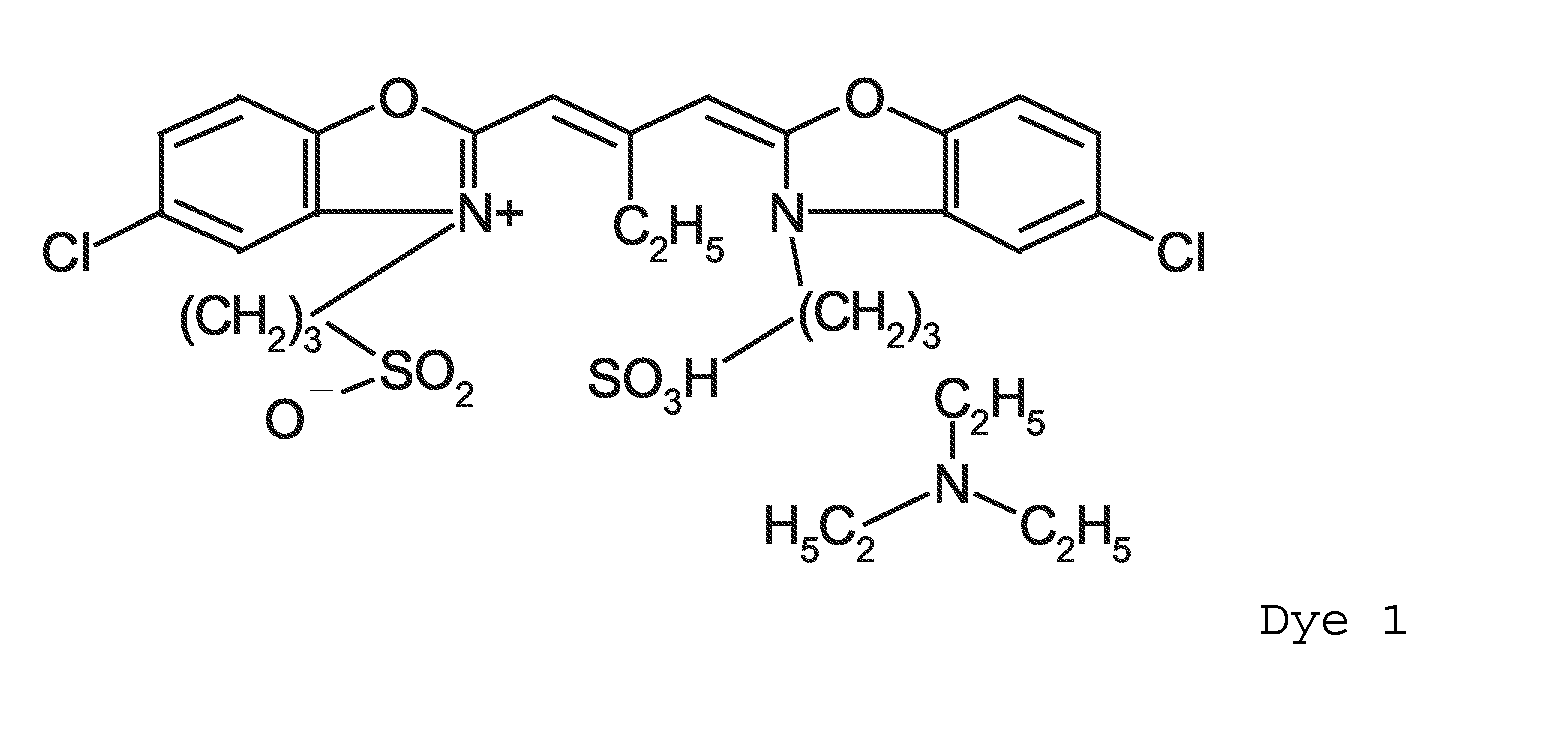
| Matl No. | 2nd Dye (No.) | Amount vs. Dye 1 (%) | 3rd Dye (No.) | Amount vs. Dye 1 (%) |
| 1 | - | - | - | - |
| 2 | 2 | 3 | - | - |
| 3 | 3 | 3 | - | - |
| 4 | 4 | 3 | - | - |
| 5 | 2 | 10 | - | - |
| 6 | 3 | 10 | - | - |
| 7 | 4 | 10 | - | - |
| 8 | 2 | 3 | 5 | 1 |
| 9 | 3 | 3 | 5 | 1 |
| 10 | 4 | 3 | 5 | 1 |
| 11 | 2 | 10 | 5 | 1 |
| 12 | 3 | 10 | 5 | 1 |
| 13 | 4 | 10 | 5 | 1 |
-
As can be concluded from the superior results obtained for
Coating Materials Nos. 8-10 as has been shown in Table 2 hereinafter
(lowest fog, highest speed, lowest darkroom sensitivity and better
dye stain level if compared with Coating Materials Nos. 11-13), the
combination of dyes as set forth in the statement of the invention,
whether or not being symmetrical or asymmetrical for the second dye,
provided that the conditions as set forth in the statement of the
present invention are fulfilled, indeed provides a solution in order
to reach the objects of the present invention.
| Matl. No. | F (x 1000) | S (x 100) | DRLS (x 1000) | Stain Level |
| 1 (comp) | 182 | 158 | 27 | 1 |
| 2 (comp) | 185 | 157 | 29 | 1 |
| 3 (comp) | 184 | 157 | 38 | 1 |
| 4 (comp) | 187 | 158 | - | 1 |
| 5 (comp) | 188 | 156 | 28 | 3 |
| 6 (comp) | 199 | 155 | 40 | 3 |
| 7 (comp) | 183 | 154 | 25 | 3 |
| 8 (inv) | 183 | 155 | 38 | 1 |
| 9 (inv) | 187 | 153 | 47 | 1 |
| 10 (inv) | 183 | 154 | 28 | 1 |
| 11 (comp) | 184 | 154 | 39 | 2 |
| 12 (comp) | 203 | 152 | 55 | 2 |
| 13 (comp) | 186 | 152 | 30 | 2 |
Example 2
-
In the same way as in Example 1 the Materials Nos. 14-26 were
coated. The combination of spectral sensitizing dyes therein has
been summarized in the Table 3, whereas the same results obtained
with respect to fog, speed, darkroom sensitivity and stain level
have been summarized in Table 4.
-
Same conclusions can be drawn from the results obtained in the
Table 4 hereinafter as from those in Table 2 from Example 1.
-
In the present Example however it has moreover been demonstrated
that the ratio amount of the dyes is decisive in order to
fully reach the objects of the present invention with respect to
speed-darkroom-sensitivity and dye stain level (see inventive
samples Nos. 15-17-19-21-23-25 versus comparative samples Nos. 16-18-20-22-24-26).
-
As has been clearly shown in this Example, the dyes according
to the formulae representing the "second spectrally sensitizing dye"
may again be symmetric or asymmetric, provided that the conditions
as claimed have been fulfilled.
| Matl No. | 2nd dye (No.) | Amount vs. Dye 1 (%) | 3rd dye (No.) | Amount vs. Dye 1 (%) |
| 14 | - | - | - | - |
| 15 | 6 | 3 | 5 | 1 |
| 16 | 6 | 10 | 5 | 1 |
| 17 | 6 | 3 | 5 | 1 |
| 18 | 6 | 10 | 5 | 1 |
| 19 | 7 | 3 | 5 | 1 |
| 20 | 7 | 10 | 5 | 1 |
| 21 | 8 | 3 | 5 | 1 |
| 22 | 8 | 10 | 5 | 1 |
| 23 | 9 | 3 | 5 | 1 |
| 24 | 9 | 10 | 5 | 1 |
| 25 | 10 | 3 | 5 | 1 |
| 26 | 4 | 3 | 5 | 1 |
| Matl. No. | F (x 1000) | S (x 100) | DRLS (x 1000) | Stain Level |
| 14 (comp) | 202 | 155 | 0 | 1 |
| 15 (inv) | 204 | 151 | 16 | 1 |
| 16 (comp) | 208 | 147 | 19 | 2 |
| 17 (inv) | 203 | 152 | 13 | 1 |
| 18 (comp) | 207 | 148 | 17 | 2 |
| 19 (inv) | 203 | 153 | 11 | 1 |
| 20 (comp) | 202 | 152 | 18 | 2 |
| 21 (inv) | 208 | 153 | 11 | 1 |
| 22 (comp) | 203 | 153 | 15 | 2 |
| 23 (inv) | 201 | 152 | 10 | 1 |
| 24 (comp) | 201 | 155 | 17 | 2 |
| 25 (inv) | 210 | 149 | 11 | 1 |
| 26 (comp) | 207 | 152 | 10 | 2 |
-
Having described in detail preferred embodiments of the current
invention, it will now be apparent to those skilled in the art that
numerous modifications can be made therein without departing from
the scope of the invention as defined in the appending claims.