EP1245641A1 - Sliding material - Google Patents
Sliding material Download PDFInfo
- Publication number
- EP1245641A1 EP1245641A1 EP00987719A EP00987719A EP1245641A1 EP 1245641 A1 EP1245641 A1 EP 1245641A1 EP 00987719 A EP00987719 A EP 00987719A EP 00987719 A EP00987719 A EP 00987719A EP 1245641 A1 EP1245641 A1 EP 1245641A1
- Authority
- EP
- European Patent Office
- Prior art keywords
- carbon powder
- powder
- tribological
- polybenzimidazole resin
- composition
- Prior art date
- Legal status (The legal status is an assumption and is not a legal conclusion. Google has not performed a legal analysis and makes no representation as to the accuracy of the status listed.)
- Withdrawn
Links
Classifications
-
- C—CHEMISTRY; METALLURGY
- C08—ORGANIC MACROMOLECULAR COMPOUNDS; THEIR PREPARATION OR CHEMICAL WORKING-UP; COMPOSITIONS BASED THEREON
- C08G—MACROMOLECULAR COMPOUNDS OBTAINED OTHERWISE THAN BY REACTIONS ONLY INVOLVING UNSATURATED CARBON-TO-CARBON BONDS
- C08G73/00—Macromolecular compounds obtained by reactions forming a linkage containing nitrogen with or without oxygen or carbon in the main chain of the macromolecule, not provided for in groups C08G12/00 - C08G71/00
- C08G73/06—Polycondensates having nitrogen-containing heterocyclic rings in the main chain of the macromolecule
- C08G73/22—Polybenzoxazoles
-
- C—CHEMISTRY; METALLURGY
- C08—ORGANIC MACROMOLECULAR COMPOUNDS; THEIR PREPARATION OR CHEMICAL WORKING-UP; COMPOSITIONS BASED THEREON
- C08L—COMPOSITIONS OF MACROMOLECULAR COMPOUNDS
- C08L79/00—Compositions of macromolecular compounds obtained by reactions forming in the main chain of the macromolecule a linkage containing nitrogen with or without oxygen or carbon only, not provided for in groups C08L61/00 - C08L77/00
- C08L79/04—Polycondensates having nitrogen-containing heterocyclic rings in the main chain; Polyhydrazides; Polyamide acids or similar polyimide precursors
-
- C—CHEMISTRY; METALLURGY
- C08—ORGANIC MACROMOLECULAR COMPOUNDS; THEIR PREPARATION OR CHEMICAL WORKING-UP; COMPOSITIONS BASED THEREON
- C08G—MACROMOLECULAR COMPOUNDS OBTAINED OTHERWISE THAN BY REACTIONS ONLY INVOLVING UNSATURATED CARBON-TO-CARBON BONDS
- C08G73/00—Macromolecular compounds obtained by reactions forming a linkage containing nitrogen with or without oxygen or carbon in the main chain of the macromolecule, not provided for in groups C08G12/00 - C08G71/00
- C08G73/06—Polycondensates having nitrogen-containing heterocyclic rings in the main chain of the macromolecule
- C08G73/18—Polybenzimidazoles
-
- C—CHEMISTRY; METALLURGY
- C08—ORGANIC MACROMOLECULAR COMPOUNDS; THEIR PREPARATION OR CHEMICAL WORKING-UP; COMPOSITIONS BASED THEREON
- C08K—Use of inorganic or non-macromolecular organic substances as compounding ingredients
- C08K3/00—Use of inorganic substances as compounding ingredients
- C08K3/02—Elements
- C08K3/04—Carbon
Definitions
- the present invention relates to a tribological material. More particularly, the present invention relates to a composition comprising a carbon powder and a polybenzimidazole resin.
- This composition according to the present invention is used in members that should have tribological properties, for example, washers, bearings, piston rings, and other members of which the temperature may be brought to high temperatures.
- metals or metals with a lubricating agent coated thereon have been used in tribological materials that can withstand high temperatures, which are above the service temperature range in which lubricating oils can be used, specifically a temperature of 300°C or above.
- Metals however, suffer from problems including large weight and damage to counter materials.
- Resin materials which have been studied as such tribological materials, include, for example, ultrahigh molecular polyethylene, polycarbonate resin, polyphenylene sulfide resin, phenolic resin, fluororesin, aromatic polyamide and the like.
- lubricating agents for example, molybdenum compounds
- a resinous composition characterized by comprising a carbon powder and a polybenzimidazole resin powder.
- a method for producing a tribological material characterized by comprising the steps of: blending a carbon powder and a polybenzimidazole resin powder together to form a composition; and molding the composition with heating under pressure into a tribological material.
- a tribological material which possesses excellent tribological properties under high temperature conditions and has a low coefficient of friction.
- composition according to the present invention comprises polybenzimidazole.
- polybenzimidazole refers to a polymer comprising substituted or unsubstituted benzimidazole as monomer units.
- the substituent may be any one so far as the substituent does not sacrifice the effect of the present invention.
- Preferred polybenzimidazoles are represented by the following general formula (I): wherein
- R 1 to R 5 and R 1' to R 5' each independently are preferably hydrogen, an alkyl group having 1 to 10 carbon atoms, an aryl group having 6 to 10 carbon atoms, a halogen, a hydroxyl group, or an alkoxyl group having 1 to 10 carbon atoms.
- L 1 and L 2 each independently are preferably a single bond or a divalent linking group comprised of a chalcogen atom, an aromatic compound, an aliphatic compound, an alicyclic compound, or a heterocyclic compound.
- L 1 or L 2 is a linking group comprised of an aliphatic compound, an alkylene having 1 to 8 carbon atoms is preferred; when L 1 or L 2 is a linking group comprised of an aromatic compound, phenylene or naphthylene is preferred; when L 1 or L 2 is a linking group comprised of a heterocyclic compound, pyridinylene, pyrazinylene, furanylene, quinolinylene, thiophenylene, pyranylene, indenylene, or furylenylene is preferred; and when L 1 or L 2 is a linking group comprised of chalcogen, -O-, -S-, or -SO 2 - is preferred.
- preferred polybenzimidazoles include:
- poly-2,2'-(m-phenylene)-5,5'-dibenzimidazoles represented by the following formula (II) are more preferably used in the composition of the present invention: wherein n is a number indicating the degree of polymerization.
- Any polybenzimidazole may be selected from these compounds so far as the effect of the present invention is not sacrificed. Further, if necessary, two or more benzimidazoles may be used in combination.
- polybenzimidazoles have a wide range of intrinsic viscosity according to the structure and the molecular weight. Preferably, the intrinsic viscosity is not less than 0.2. Further, the thermal properties also depend upon the structure. Since heat resistance is required, the polybenzimidazole should have a higher heat distortion temperature than temperatures to which the tribological material may be exposed. In general, the heat distortion temperature is preferably 180°C or above, more preferably 300°C or above.
- the above poly-2,2'-(m-phenylene)-5,5'-dibenzimidazoles generally have a heat distortion temperature of about 435°C and are particularly preferred compounds.
- these polybenzimidazoles are generally blended in a powder form.
- the particle diameter of the resin powder is not particularly limited. However, the particle diameter is preferably not more than 1 mm as measured by a laser scattering particle size distribution method.
- the composition of the present invention comprises a carbon powder. Carbons are classified into diamond, graphite, and amorphous carbon. In the present invention, the carbon powder is preferably a graphite powder. Graphites are classified into naturally occurring type and artificial type. Further, shapes are classified into flakes, particles, masses, soil, shapeless and the like. In the present invention, any graphite may be selected from the above graphites.
- the carbon powder has a particle diameter of not more than 1 mm, more preferably not more than 500 ⁇ m, as measured by the laser light scattering particle size distribution method.
- the particle diameter of the carbon powder is preferably smaller than that of the polybenzimidazole resin powder.
- the particle diameter of the carbon powder is larger than that of the polybenzimidazole resin powder, at the time of molding of the composition, uneven thermal conduction and, in its turn, uneven melting of the resin occur, sometimes leading to the formation of voids in the interior of the molded product of the composition.
- the particle diameter of the carbon powder is excessively large, the carbon powder is likely to be separated from the resin in the surface portion. This sometimes deteriorates the abrasion properties, and, thus, the molded product is worn away in an early stage.
- the resin composition of the present invention comprises the above-described polybenzimidazole resin powder and carbon powder.
- the content of the carbon powder is preferably 1 to 70% by weight, more preferably 5 to 50% by weight, based on the total weight of the resin composition.
- the content of the polybenzimidazole resin is preferably 30 to 99% by weight, more preferably 50 to 95% by weight.
- the resin composition according to the present invention may contain other additional components so far as the effect of the present invention is not sacrificed.
- Additional components usable herein include (i) resins, for example, high-molecular polyethylene, polyphenylene sulfide and the like and (ii) polymeric compounds which are carbonized as a result of heat decomposition, for example, polycarbonate and the like.
- the polybenzimidazole resin composition is molded into a tribological material. Molding may be carried out by any of method, and examples thereof include sintering molding, ultrasonic powder molding, cold pressure molding, melt molding, injection molding and the like. Preferably, molding is carried out by pressing under high temperature conditions. These conditions depend, for example, upon the type of the polybenzimidazole resin used. Molding is carried out at a temperature of preferably 350 to 600°C, more preferably 400 to 500°C, and a pressure of preferably 140 to 1,400 kg/cm 2 , more preferably 500 to 1,000 kg/cm 2 .
- the molded product of the polybenzimidazole resin composition thus obtained has an excellent coefficient of friction and can be used as a tribological material possessing excellent tribological properties at a high temperature of 300°C or above.
- the above composition according to the present invention can be used in members that should have tribological properties, for example, washers, bearings, piston rings, and other members of which the temperature may be brought to high temperatures.
- a poly-2,2'-(m-phenylene)-5,5'-dibenzimidazole powder resin was allowed to stand in a forced air convection oven at 150°C for 12 hr to dry the resin for removing volatile components contained in the resin, followed by furnace cooling. Thereafter, 30% by weight, based on the total weight, of a carbon powder (particle diameter about 50 ⁇ m; manufactured by Chuetu Graphite Works Co., Ltd.) was added to and intimately mixed with the resin powder. This mixed powder was loaded into a mold which has been preheated to 200°C and was then compressed by means of a 650-ton hydraulic press at 470°C and 600 kg/cm 2 to prepare a molded sinter.
- a carbon powder particle diameter about 50 ⁇ m; manufactured by Chuetu Graphite Works Co., Ltd.
- the sinter thus obtained was cut into a size of 5 x 30 x 30 and was subjected to a thrust wear test according to the method specified in JIS K 7218 A. Testing conditions were as follows.
- a sinter was prepared in the same manner as in Example 1, except that a carbon powder manufactured by The Kansai Coke and Chemicals Co., LTD. (particle diameter about 5 ⁇ m) was used instead of the carbon powder in Example 1.
- the sinter thus obtained was subjected to a thrust wear test in the same manner as in Example 1. This sinter had a coefficient of dynamic friction of 0.21.
- a sinter was prepared in the same manner as in Example 1, except that a carbon powder manufactured by Hitachi Powdered Metals Co., Ltd. (particle diameter about 2 ⁇ m) was used instead of the carbon powder in Example 1.
- the sinter thus obtained was subjected to a thrust wear test in the same manner as in Example 1. This sinter had a coefficient of dynamic friction of 0.15.
- a sinter was prepared in the same manner as in Example 1, except that the carbon powder was not incorporated.
- the sinter thus obtained was subjected to a thrust wear test in the same manner as in Example 1. This sinter had a coefficient of dynamic friction of 0.31.
Landscapes
- Chemical & Material Sciences (AREA)
- Health & Medical Sciences (AREA)
- Chemical Kinetics & Catalysis (AREA)
- Medicinal Chemistry (AREA)
- Polymers & Plastics (AREA)
- Organic Chemistry (AREA)
- Compositions Of Macromolecular Compounds (AREA)
- Lubricants (AREA)
- Macromolecular Compounds Obtained By Forming Nitrogen-Containing Linkages In General (AREA)
Abstract
The present invention relates to a resinous
composition comprising a carbon powder and a
polybenzimidazole resin powder, and a tribological
material using the resinous composition. This
tribological material can be produced by blending a
carbon powder and a polybenzimidazole resin powder
together to prepare a composition and molding the
composition with heating under pressure. The present
invention provides a tribological material which
possesses excellent tribological properties under high
temperature conditions and has a low coefficient of
friction.
Description
The present invention relates to a tribological
material. More particularly, the present invention
relates to a composition comprising a carbon powder and
a polybenzimidazole resin. This composition according to
the present invention is used in members that should
have tribological properties, for example, washers,
bearings, piston rings, and other members of which the
temperature may be brought to high temperatures.
In general, metals or metals with a lubricating
agent coated thereon have been used in tribological
materials that can withstand high temperatures, which
are above the service temperature range in which
lubricating oils can be used, specifically a temperature
of 300°C or above. Metals, however, suffer from problems
including large weight and damage to counter materials.
For this reason, the application of resins, which
have smaller weight than metals and are relatively
flexible, to tribological materials has been studied.
Resin materials, which have been studied as such
tribological materials, include, for example, ultrahigh
molecular polyethylene, polycarbonate resin,
polyphenylene sulfide resin, phenolic resin, fluororesin,
aromatic polyamide and the like. The incorporation of
lubricating agents, for example, molybdenum compounds,
into these resins has also been studied.
These conventional resins, however, involve a
problem of strength, heat resistance, or abrasion
resistance. Further, regarding the heat resistance, the
temperature of only the sliding face of the resin
material is partially brought to high temperatures. This
often causes troubles such as deformation.
It is an object of the present invention to provide
a tribological material which can solve the problems of
the conventional tribological materials and has an
excellent coefficient of friction and possesses
excellent tribological properties under high temperature
conditions of 300°C or above.
According to the present invention, there is
provided a resinous composition characterized by
comprising a carbon powder and a polybenzimidazole resin
powder.
Further, according to the present invention, there
is provided a method for producing a tribological
material, characterized by comprising the steps of:
blending a carbon powder and a polybenzimidazole resin
powder together to form a composition; and molding the
composition with heating under pressure into a
tribological material.
Furthermore, according to the present invention,
there is provided a tribological material which
possesses excellent tribological properties under high
temperature conditions and has a low coefficient of
friction.
The composition according to the present invention
comprises polybenzimidazole. Here polybenzimidazole
refers to a polymer comprising substituted or
unsubstituted benzimidazole as monomer units. When the
benzimidazole has a substituent, the substituent may be
any one so far as the substituent does not sacrifice the
effect of the present invention.
Preferred polybenzimidazoles are represented by the
following general formula (I):
 wherein
Here R1 to R5 and R1' to R5' each independently are
preferably hydrogen, an alkyl group having 1 to 10
carbon atoms, an aryl group having 6 to 10 carbon atoms,
a halogen, a hydroxyl group, or an alkoxyl group having
1 to 10 carbon atoms.
L1 and L2 each independently are preferably a
single bond or a divalent linking group comprised of a
chalcogen atom, an aromatic compound, an aliphatic
compound, an alicyclic compound, or a heterocyclic
compound.
When L1 or L2 is a linking group comprised of an
aliphatic compound, an alkylene having 1 to 8 carbon
atoms is preferred; when L1 or L2 is a linking group
comprised of an aromatic compound, phenylene or
naphthylene is preferred; when L1 or L2 is a linking
group comprised of a heterocyclic compound, pyridinylene,
pyrazinylene, furanylene, quinolinylene, thiophenylene,
pyranylene, indenylene, or furylenylene is preferred;
and when L1 or L2 is a linking group comprised of
chalcogen, -O-, -S-, or -SO2- is preferred.
Specific examples of preferred polybenzimidazoles
include:
Among them, poly-2,2'-(m-phenylene)-5,5'-dibenzimidazoles
represented by the following formula
(II) are more preferably used in the composition of the
present invention:
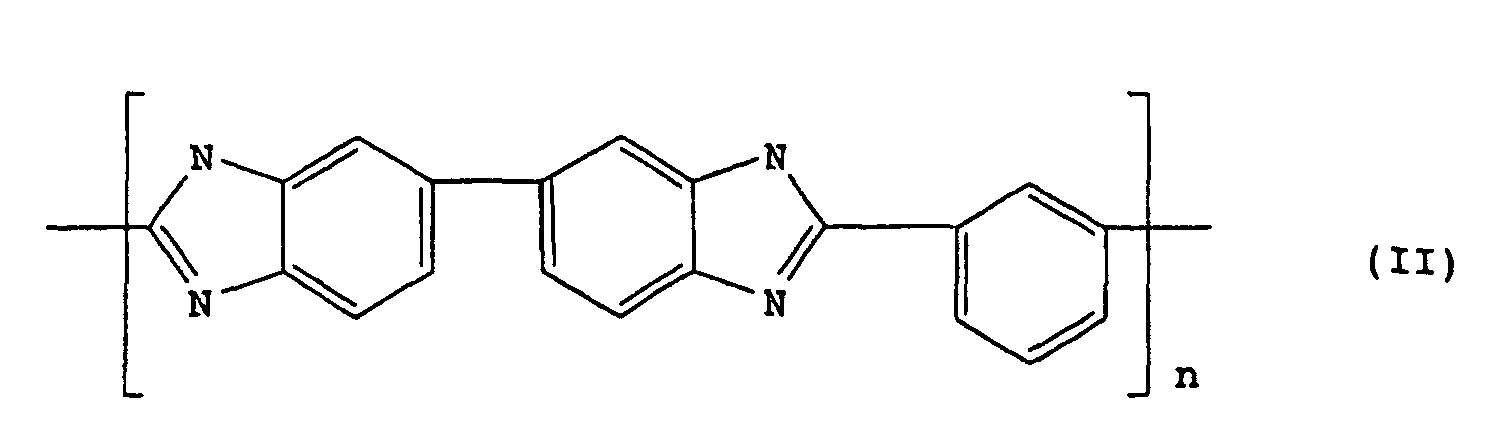 wherein n is a number indicating the degree of
polymerization.
wherein n is a number indicating the degree of
polymerization.
Any polybenzimidazole may be selected from these
compounds so far as the effect of the present invention
is not sacrificed. Further, if necessary, two or more
benzimidazoles may be used in combination.
These polybenzimidazoles have a wide range of
intrinsic viscosity according to the structure and the
molecular weight. Preferably, the intrinsic viscosity is
not less than 0.2. Further, the thermal properties also
depend upon the structure. Since heat resistance is
required, the polybenzimidazole should have a higher
heat distortion temperature than temperatures to which
the tribological material may be exposed. In general,
the heat distortion temperature is preferably 180°C or
above, more preferably 300°C or above. The above poly-2,2'-(m-phenylene)-5,5'-dibenzimidazoles
generally have
a heat distortion temperature of about 435°C and are
particularly preferred compounds.
In the composition according to the present
invention, these polybenzimidazoles are generally
blended in a powder form. In this case, the particle
diameter of the resin powder is not particularly limited.
However, the particle diameter is preferably not more
than 1 mm as measured by a laser scattering particle
size distribution method.
The composition of the present invention comprises
a carbon powder. Carbons are classified into diamond,
graphite, and amorphous carbon. In the present invention,
the carbon powder is preferably a graphite powder.
Graphites are classified into naturally occurring type
and artificial type. Further, shapes are classified into
flakes, particles, masses, soil, shapeless and the like.
In the present invention, any graphite may be selected
from the above graphites.
In the composition according to the present
invention, preferably, the carbon powder has a particle
diameter of not more than 1 mm, more preferably not more
than 500 µm, as measured by the laser light scattering
particle size distribution method. The particle diameter
of the carbon powder is preferably smaller than that of
the polybenzimidazole resin powder. When the particle
diameter of the carbon powder is larger than that of the
polybenzimidazole resin powder, at the time of molding
of the composition, uneven thermal conduction and, in
its turn, uneven melting of the resin occur, sometimes
leading to the formation of voids in the interior of the
molded product of the composition. On the other hand,
when the particle diameter of the carbon powder is
excessively large, the carbon powder is likely to be
separated from the resin in the surface portion. This
sometimes deteriorates the abrasion properties, and,
thus, the molded product is worn away in an early stage.
The resin composition of the present invention
comprises the above-described polybenzimidazole resin
powder and carbon powder.
The content of the carbon powder is preferably 1 to
70% by weight, more preferably 5 to 50% by weight, based
on the total weight of the resin composition. The
content of the polybenzimidazole resin is preferably 30
to 99% by weight, more preferably 50 to 95% by weight.
The resin composition according to the present
invention may contain other additional components so far
as the effect of the present invention is not sacrificed.
Additional components usable herein include (i) resins,
for example, high-molecular polyethylene, polyphenylene
sulfide and the like and (ii) polymeric compounds which
are carbonized as a result of heat decomposition, for
example, polycarbonate and the like.
The polybenzimidazole resin composition is molded
into a tribological material. Molding may be carried out
by any of method, and examples thereof include sintering
molding, ultrasonic powder molding, cold pressure
molding, melt molding, injection molding and the like.
Preferably, molding is carried out by pressing under
high temperature conditions. These conditions depend,
for example, upon the type of the polybenzimidazole
resin used. Molding is carried out at a temperature of
preferably 350 to 600°C, more preferably 400 to 500°C,
and a pressure of preferably 140 to 1,400 kg/cm2, more
preferably 500 to 1,000 kg/cm2.
The molded product of the polybenzimidazole resin
composition thus obtained has an excellent coefficient
of friction and can be used as a tribological material
possessing excellent tribological properties at a high
temperature of 300°C or above. Specifically, the above
composition according to the present invention can be
used in members that should have tribological properties,
for example, washers, bearings, piston rings, and other
members of which the temperature may be brought to high
temperatures.
The following examples further illustrate the
present invention, but are not intended to limit it.
A poly-2,2'-(m-phenylene)-5,5'-dibenzimidazole
powder resin was allowed to stand in a forced air
convection oven at 150°C for 12 hr to dry the resin for
removing volatile components contained in the resin,
followed by furnace cooling. Thereafter, 30% by weight,
based on the total weight, of a carbon powder (particle
diameter about 50 µm; manufactured by Chuetu Graphite
Works Co., Ltd.) was added to and intimately mixed with
the resin powder. This mixed powder was loaded into a
mold which has been preheated to 200°C and was then
compressed by means of a 650-ton hydraulic press at 470°C
and 600 kg/cm2 to prepare a molded sinter.
The sinter thus obtained was cut into a size of 5 x
30 x 30 and was subjected to a thrust wear test
according to the method specified in JIS K 7218 A.
Testing conditions were as follows.
As a result, it was found that the sinter had a
coefficient of dynamic friction of 0.15.
A sinter was prepared in the same manner as in
Example 1, except that a carbon powder manufactured by
The Kansai Coke and Chemicals Co., LTD. (particle
diameter about 5 µm) was used instead of the carbon
powder in Example 1. The sinter thus obtained was
subjected to a thrust wear test in the same manner as in
Example 1. This sinter had a coefficient of dynamic
friction of 0.21.
A sinter was prepared in the same manner as in
Example 1, except that a carbon powder manufactured by
Hitachi Powdered Metals Co., Ltd. (particle diameter
about 2 µm) was used instead of the carbon powder in
Example 1. The sinter thus obtained was subjected to a
thrust wear test in the same manner as in Example 1.
This sinter had a coefficient of dynamic friction of
0.15.
A sinter was prepared in the same manner as in
Example 1, except that the carbon powder was not
incorporated. The sinter thus obtained was subjected to
a thrust wear test in the same manner as in Example 1.
This sinter had a coefficient of dynamic friction of
0.31.
Claims (8)
- A resinous composition comprising a carbon powder and a polybenzimidazole resin powder.
- A resinous composition according to claim 1, wherein the carbon powder consists of a graphite.
- A resinous composition according to claim 1, wherein the content of the carbon powder is from 1 to 70% by weight based on the total amount of the resinous composition.
- A resinous composition according to claim 1, wherein the polybenzimidazole resin is represented by the following general formula (I):wherein
 R1 to R5 and R1' to R5' each independently are a substituent;L1 is a divalent linking group;L2 is a divalent linking group which bonds any one of R1 to R5 to any one of R1' to R5'; andp and q each are a number which indicates the degree of polymerization.
 - A resinous composition according to claim 4, wherein the polybenzimidazole resin is poly-2,2'-(m-phenylene)-5,5'-dibenzimidazole.
- A method for producing a tribological material, comprising the steps of:blending a carbon powder and a polybenzimidazole resin powder together to form a composition; andmolding the composition with heating under pressure into a tribological material.
- A method for producing a tribological material according to claim 6, wherein the molding is carried out under conditions of temperature 350 to 600°C and pressure 140 to 1,400 kg/cm2.
- A molded tribological material comprising a carbon powder and a polybenzimidazole resin powder.
Applications Claiming Priority (3)
| Application Number | Priority Date | Filing Date | Title |
|---|---|---|---|
| JP36836699 | 1999-12-24 | ||
| JP36836699A JP2001181501A (en) | 1999-12-24 | 1999-12-24 | Sliding material |
| PCT/JP2000/009155 WO2001048088A1 (en) | 1999-12-24 | 2000-12-22 | Sliding material |
Publications (2)
| Publication Number | Publication Date |
|---|---|
| EP1245641A1 true EP1245641A1 (en) | 2002-10-02 |
| EP1245641A4 EP1245641A4 (en) | 2003-05-14 |
Family
ID=18491633
Family Applications (1)
| Application Number | Title | Priority Date | Filing Date |
|---|---|---|---|
| EP00987719A Withdrawn EP1245641A4 (en) | 1999-12-24 | 2000-12-22 | Sliding material |
Country Status (6)
| Country | Link |
|---|---|
| US (1) | US20030015817A1 (en) |
| EP (1) | EP1245641A4 (en) |
| JP (1) | JP2001181501A (en) |
| KR (1) | KR20020063255A (en) |
| CN (1) | CN1413233A (en) |
| WO (1) | WO2001048088A1 (en) |
Cited By (1)
| Publication number | Priority date | Publication date | Assignee | Title |
|---|---|---|---|---|
| GB2398527A (en) * | 2003-02-20 | 2004-08-25 | Daido Metal Co | Sliding member |
Families Citing this family (1)
| Publication number | Priority date | Publication date | Assignee | Title |
|---|---|---|---|---|
| CN109852055A (en) * | 2019-01-29 | 2019-06-07 | 江苏常源新材料科技有限公司 | A kind of preparation method of polybenzimidazoles plate |
Family Cites Families (12)
| Publication number | Priority date | Publication date | Assignee | Title |
|---|---|---|---|---|
| US3721625A (en) * | 1968-06-11 | 1973-03-20 | Us Air Force | Solid lubricant compositions employing polybenzimidazole resins and lubricating pigments |
| US4912176A (en) * | 1987-09-03 | 1990-03-27 | Hoechst Celanese Corporation | Sintered polybenzimidazole/polyaryleneketone articles and method of manufacture |
| US5002981A (en) * | 1988-12-07 | 1991-03-26 | Ucar Carbon Technology Corporation | High strength carbonaceous cement |
| JPH04348133A (en) * | 1991-05-27 | 1992-12-03 | Kawasaki Steel Corp | Production of friction material |
| DE69328681T2 (en) * | 1992-05-15 | 2000-09-28 | Hoechst Celanese Corp., Summit | SELF-LUBRICATING COMPOSITION CONTAINING POLYBENZIMIDAZOLE |
| US5384352A (en) * | 1993-07-28 | 1995-01-24 | Hoechst Celanese Corp. | Self lubricating polybenzimidazole shaped articles |
| JPH0763266A (en) * | 1993-08-25 | 1995-03-07 | Nippon Piston Ring Co Ltd | piston ring |
| JP3358752B2 (en) * | 1993-12-28 | 2002-12-24 | 株式会社安川電機 | Solid lubricated rolling bearing |
| JPH08251951A (en) * | 1995-03-06 | 1996-09-27 | Canon Inc | Vibration motor |
| JPH09208329A (en) * | 1996-02-07 | 1997-08-12 | Toray Ind Inc | Jar for degreasing and firing ceramics |
| JP3681858B2 (en) * | 1997-05-21 | 2005-08-10 | 株式会社松尾工業所 | Lathe materials and lathe products |
| JP3681848B2 (en) * | 1996-12-27 | 2005-08-10 | 株式会社松尾工業所 | Round bars and lathe products |
-
1999
- 1999-12-24 JP JP36836699A patent/JP2001181501A/en active Pending
-
2000
- 2000-12-22 EP EP00987719A patent/EP1245641A4/en not_active Withdrawn
- 2000-12-22 US US10/168,223 patent/US20030015817A1/en not_active Abandoned
- 2000-12-22 KR KR1020027008078A patent/KR20020063255A/en not_active Withdrawn
- 2000-12-22 WO PCT/JP2000/009155 patent/WO2001048088A1/en not_active Ceased
- 2000-12-22 CN CN00817519A patent/CN1413233A/en active Pending
Cited By (3)
| Publication number | Priority date | Publication date | Assignee | Title |
|---|---|---|---|---|
| GB2398527A (en) * | 2003-02-20 | 2004-08-25 | Daido Metal Co | Sliding member |
| GB2398527B (en) * | 2003-02-20 | 2005-05-11 | Daido Metal Co | Sliding member |
| US6983681B2 (en) | 2003-02-20 | 2006-01-10 | Daido Metal Company Ltd. | Sliding member |
Also Published As
| Publication number | Publication date |
|---|---|
| JP2001181501A (en) | 2001-07-03 |
| US20030015817A1 (en) | 2003-01-23 |
| WO2001048088A1 (en) | 2001-07-05 |
| KR20020063255A (en) | 2002-08-01 |
| EP1245641A4 (en) | 2003-05-14 |
| CN1413233A (en) | 2003-04-23 |
Similar Documents
| Publication | Publication Date | Title |
|---|---|---|
| EP2142600B1 (en) | Thermoplastic polymer mixtures, and applications thereof | |
| CN100463940C (en) | Bridge bearing slip material and its preparation method | |
| US20150126663A1 (en) | Tribological aromatic polyimide compositions | |
| EP0392856A2 (en) | Sintered polybenzimidazole/polyaryleneketone articles and method of manufacture | |
| Zhang et al. | A new family of low wear, low coefficient of friction polymer blend based on polytetrafluoroethylene and an aromatic thermosetting polyester | |
| US8440295B2 (en) | Mechanical seal device, sliding element, and method of production thereof | |
| US9796942B2 (en) | Bearing material | |
| US20030015817A1 (en) | Sliding Material | |
| JPH03292366A (en) | Wear-resistant resin composition | |
| JP2921525B2 (en) | Sliding material | |
| JPH03500328A (en) | bearing | |
| JPH07304925A (en) | Melt-moldable resin composition filled with calcined polytetrafluoroethylene | |
| JPH1112459A (en) | Polyamide resin composition and molded article using the same | |
| JP2007269936A (en) | Dry lubricating coating composition | |
| JP2724843B2 (en) | Resin composition for sliding members | |
| JP5517307B2 (en) | Sliding member and manufacturing method thereof | |
| JP2995024B2 (en) | Manufacturing method of synthetic resin sliding bearings | |
| JP3289425B2 (en) | Swing resistant bearing | |
| JP2804294B2 (en) | Lubricating resin composition for plain bearings | |
| JP3126352B2 (en) | Plain bearing | |
| JP3009210B2 (en) | Lubricating composition | |
| JPH0770585A (en) | Sliding material | |
| Tewari et al. | The effect of lubricant additives on friction and wear studies of polyphenylene sulphide | |
| JPH1180481A (en) | Polytetrafluoroethylene resin composition and sliding member comprising the same | |
| JPH09176667A (en) | Sliding material composition |
Legal Events
| Date | Code | Title | Description |
|---|---|---|---|
| PUAI | Public reference made under article 153(3) epc to a published international application that has entered the european phase |
Free format text: ORIGINAL CODE: 0009012 |
|
| 17P | Request for examination filed |
Effective date: 20020724 |
|
| AK | Designated contracting states |
Kind code of ref document: A1 Designated state(s): AT BE CH CY DE DK ES FI FR GB GR IE IT LI LU MC NL PT SE TR |
|
| A4 | Supplementary search report drawn up and despatched |
Effective date: 20030401 |
|
| 17Q | First examination report despatched |
Effective date: 20030829 |
|
| STAA | Information on the status of an ep patent application or granted ep patent |
Free format text: STATUS: THE APPLICATION IS DEEMED TO BE WITHDRAWN |
|
| 18D | Application deemed to be withdrawn |
Effective date: 20040109 |