Background of the Invention and Related Art Statement
The present invention relates to a production method of
a composite material composed of a dispersing agent and a
matrix and to a composite material produced by the production
method.
A composite material is a composition aggregate in which
plural raw materials are macroscopically mixed to provide
characteristics, which a raw material alone could not realize,
by complementarily utilizing mechanical properties that each
raw material possesses. Basically, the method of producing
a composite material is a technical method by which a material
is combined with other material, and there are various
combinations depending on matrixes and dispersing agents,
intended purposes, or cost and the like.
Among them, metal matrix composites and intermetallic
matrix composites are composite materials that are made by
using a metal like Al, Ti, Ni, Nb and others, or an
intermetallic compound like TiAl, Ti3Al, Al3Ti, NiAl, Ni3Al,
Ni2Al3, Al3Ni, Nb3Al, Nb2Al, Al3Nb and others as a matrix and
using an inorganic material like ceramics and others as a
dispersing agent. Accordingly, metal matrix composites and
intermetallic matrix composites are materials intended for
use in the aerospace field and the automobile industry by
making the best use of their properties of light weight and
high strength, and especially metal matrix composites, in
recent years, are contemplated to utilize in many fields,
including electronics represented by electronic devices, by
making the best use of the properties of low thermal expansion
and high thermal conduction.
Production methods of intermetallic compound-based
composite material include a method in which intermetallic
compound powder is produced by mechanical alloying (MA) and
the like in advance, and then the powder is hot-pressed (HP)
or hot isostatic-pressed (HIP) with fibers and/or particles
as dispersing agent under the conditions of high temperature
and high pressure. And, production methods of metal-based
composite material include solid state fabrication
techniques like a method in which materials are hot-pressed
(HP) or hot isostatic-pressed (HIP) under the conditions of
high temperature and high pressure, and liquid phase methods
like a pressurized impregnation method in which a molten metal
is impregnated and a squeeze casting method in which high
pressure is needed.
Summary of the Invention
As problems in the conventional production methods for
producing metal matrix composites and intermetallic matrix
composites, in order to produce fine composite materials, not
only do fine matrixes need to be formed by loading high
temperature and high pressure in production methods of
hot-pressing, hot isostatic-pressing and the like but the
performance and scale of production equipment are restricted,
consequently there are such problems that it is extremely
difficult to produce large-sized or complex-shaped composite
materials, in addition, it is impossible to perform a near
net shaping in consideration of the shape of an end product,
and mechanical processing treatment is needed in a later
process.
Further, as a pretreatment process in the production of
an intermetallic compound-based composite material, a
process is needed to synthesize intermetallic compound powder
by mechanical alloying and the like in advance, accordingly
there is such a problem that the production process has
multiple stages and is complicated. As a result, as described
above, the conventional method of producing metal matrix
composites and intermetallic matrix composites is an
extremely high cost production method because not only does
the method need a multistage process but it is carried out
under high temperature and high pressure.
In order to solve these problems, Japanese Patent
Publication No. 2609376 and Japanese Patent Application
Laid-Open No. 9-227969 disclose production methods of
composite materials in which methods using a preform composed
of a metal oxide and others that can be reduced with Al and
the like, the preform is made to react with liquid Al and the
like in the surface layer to synthesize aluminide
intermetallic compounds and oxides (especially Al2O3) in-situ
synthesis.
However, according to the production methods disclosed
in Japanese Patent Publication No. 2609376 and Japanese
Patent Application Laid-Open No. 9-227969, because the kinds
of dispersing agents to be dispersed in obtained composite
materials are limited, intended material designs are limited
to some specific combinations and it becomes difficult to
change the properties of composite materials. Further, the
methods have such a problem that if the ratio of materials
to be used is not strictly controlled, metal oxides and others
or Al and others may remain. Moreover, since a large quantity
of reaction heat is generated in a moment, there may be some
cases where reaction control is difficult.
On the other hand, among composite materials, porous
composite materials having a lot of pores (hereinafter
described as "porous composite materials") exhibits various
kinds of effect due to as well as being light compared to
composite materials having fine microstructures (hereinafter
described as "fine composite materials"). In addition, in
the case that pores are introduced into the matrix, generally,
mechanical properties such as strength, Yong's modulus and
the like decrease though the material becomes lighter as its
porosity increases.
Further, up to now some trials have been performed to
make obtained porous composite materials light by making
hollow particles compound with a metal of Al or the like, and
there has been mainly employed as a production process a
pressurized impregnation method in which operations under
pressure are required when a metal of Al or the like is
impregnated into gaps among hollow particles. According to
the pressurized impregnation method, however, there are such
problems that crushing, breaking or the like are easily caused
in hollow particles when a metal of Al or the like is
impregnated. That is, hollow particles are broken due to
static pressure of a molten metal in the case that a higher
pressure is applied to the molten metal to impregnate it into
the gaps, and the molten metal occupies the inner portions
of the broken hollow particles. This results in failure to
lightening the product. On the other hand, however, the gaps
among the hollow particles will not be fulfilled sufficiently
with the molten metal, in the case that a pressure for
impregnating the molten metal into the gaps is reduced so as
not to break the hollow particles. This results in the
formation of internal defects, such as cavities. Consequently,
there are some cases that expected properties,
e.g., light weight are not given to obtained composite
materials or that the improvements in the specific strength,
specific elasticity, and the like were not achieved.
The present invention has been done in view of these
problems associated with conventional arts and aims at
providing a production method and composite materials
produced by the production method, which production method
reduces and simplifies the production processes and at the
same time, produces a metal-based composite material, an
intermetallic compound-based composite material, and a
composite material in a state in which a metal and an
intermetallic compound are mixed is used as a matrix, which
composite materials are also applicable to large-sized and
complex-shaped end products.
That is, according to the present invention, there is
provided a production method of a composite material composed
of a dispersing agent and a matrix, which comprises: forming
a metal-coated layer on the surface of said dispersing agent
to prepare a metal-coated dispersing agent, filling said
metal-coated dispersing agent in a jig prepared in a fixed
shape, and then causing the reaction of said metal-coated
layer with molten Al by impregnating said filled metal-coated
dispersing agent with said molten Al to form said matrix.
In the present invention, it is preferable that a
metal-coated layer that is composed of Ni and has the
thickness of below 1% with respect to the average particle
size of the dispersing agent is formed using below 4 mass %
of Ni with respect to the total amount of molten Al and Ni,
and whole the matrix is made of Al. And it is also preferable
that a metal-coated layer that is composed of Ni and has the
thickness of 1% or more to below 8% with respect to the average
particle size of the dispersing agent is formed using 4 mass %
or more to below 42 mass % of Ni with respect to the total
amount of molten Al and Ni, and whole the matrix is made of
a mixture of Al and an aluminide intermetallic compound.
Similarly, it is also preferable that a metal-coated layer
that is composed of Ni and has the thickness of 8% or more
to 24% or less with respect to the average particle size of
the dispersing agent is formed using 42 mass % or more to 87.8
mass % or less of Ni with respect to the total amount of molten
Al and Ni, and whole the matrix is made of an aluminide
intermetallic compound.
On the other hand, in the present invention, it is
preferable that a metal-coated layer that is composed of Ti
and has the thickness of below 1% with respect to the average
particle size of the dispersing agent is formed using below
2 mass % of Ti with respect to the total amount of molten Al
and Ti, and whole the matrix is made of Al. And it is also
preferable that a metal-coated layer that is composed of Ti
and has the thickness of 1% or more to below 12% with respect
to the average particle size of the dispersing agent is formed
using 2 mass % or more to below 36.5 mass % of Ti with respect
to the total amount of molten Al and Ti, and whole the matrix
is made of a mixture of Al and an aluminide intermetallic
compound. Similarly, it is also preferable that a metal-coated
layer that is composed of Ti and has the thickness of
12% or more to 25% or less with respect to the average particle
size of the dispersing agent is formed using 36.5 mass % or
more to 86 mass % or less of Ti with respect to the total amount
of molten Al and Ti, and whole the matrix is made of an
aluminide intermetallic compound.
Further, in the present invention, it is preferable that
a metal-coated layer that is composed of Nb and has the
thickness of below 1% with respect to the average particle
size of the dispersing agent is formed using below 4 mass %
of Nb with respect to the total amount of molten Al and Nb,
and whole the matrix is made of Al. And it is also preferable
that a metal-coated layer that is composed of Nb and has the
thickness of 1% or more to below 12% with respect to the average
particle size of the dispersing agent is formed using 4 mass %
or more to below 53 mass % of Nb with respect to the total
amount of molten Al and Nb, and whole the matrix is made of
a mixture of Al and an aluminide intermetallic compound.
Similarly, it is also preferable that a metal-coated layer
that is composed of Nb and has the thickness of 12% or more
to 25% or less with respect to the average particle size of
the dispersing agent is formed using 53 mass % or more to 92.4
mass % or less of Nb with respect to the total amount of molten
Al and Nb, and whole the matrix is made of an aluminide
intermetallic compound.
In the present invention, it is preferable to form the
metal-coated film by any method of electroless plating, CVD
(chemical vapor deposition), ion plating as PVD (physical
vapor deposition), sputtering, or vacuum evaporation.
On the other hand, according to the present invention,
there is provided a production method of a composite material
that is composed of a dispersing agent and a matrix, which
comprises: forming a metal oxide-coated layer on a surface
of said dispersing agent to prepare a metal oxide-coated
dispersing agent, filling said metal oxide-coated dispersing
agent in a jig prepared in a fixed shape, and then causing
the reaction of said metal oxide-coated layer with molten Al
by impregnating said filled metal oxide-coated dispersing
agent with said molten Al to form said matrix.
In the present invention, it is preferable to use as a
dispersing agent any one of inorganic materials of fibers,
particles, whiskers, hollow particles, porous bodies with
open pores, or porous bodies with closed pores, and further
it is preferable to use hollow particles of 0.1 to 30 µm in
shell thickness. Moreover, it is preferable to use any
inorganic material of Al2O3, AlN, SiC, or Si3N4.
In the present invention, it is preferable to make the
volume percentage of a dispersing agent in a composite
material to be 20 to 80%. On the other hand, after a
metal-coated dispersing agent has been prepared, prior to
filling the metal-coated dispersing agent into a jig, it is
preferable to mix metal powder with the metal-coated
dispersing agent. And it is preferable to use metal powder
having particle size at the rate of 0.05 to 80% with respect
to the average particle size of the dispersing agent.
On the other hand, according to the present invention,
there is provided a composite material comprising a
dispersing agent and a matrix, wherein a metal-coated
dispersing agent is prepared by forming a metal-coated layer
on the surface of said dispersing agent, said metal-coated
dispersing agent is filled in a jig prepared in a fixed shape,
and the reaction of said metal-coated layer with molten Al
is caused by impregnating said filled metal-coated dispersing
agent with said molten Al to form said matrix.
In the present invention, it is preferable that the
metal-coated layer is Ni, the amount of Ni used is below 4
mass % with respect to the total amount of molten Al and Ni,
the thickness of the metal-coated layer is below 1% with
respect to the average particle size of the dispersing agent,
and whole the matrix is Al. And it is also preferable that
the amount of Ni used is 4 mass % or more to below 42 mass %
with respect to the total amount of molten Al and Ni, the
thickness of the metal-coated layer is 1% or more to below
8% with respect to the average particle size of the dispersing
agent, and whole the matrix is a mixture of Al and an aluminide
intermetallic compound. Similarly, it is also preferable
that the amount of Ni used is 42 mass % or more to 87.8 mass %
or less with respect to the total amount of molten Al and Ni,
the thickness of the metal-coated layer is 8% or more to 26%
or less with respect to the average particle size of the
dispersing agent, and whole the matrix is an aluminide
intermetallic compound.
On the other hand, in the present invention, it is
preferable that the metal-coated layer is Ti, the amount of
Ti used is below 2 mass % with respect to the total amount
of molten Al and Ti, the thickness of the metal-coated layer
is below 1% with respect to the average particle size of the
dispersing agent, and whole the matrix is Al. And it is also
preferable that the amount of Ti used is 2 mass % or more to
below 36.5 mass % with respect to the total amount of molten
Al and Ti, the thickness of the metal-coated layer is 1% or
more to below 12 % with respect to the average particle size
of the dispersing agent, and whole the matrix is a mixture
of Al and an aluminide intermetallic compound. Similarly,
it is also preferable that the amount of Ti used is 36.5 mass %
or more to 86 mass % or less with respect to the total amount
of molten Al and Ti, the thickness of the metal-coated layer
is to 12% or more to 25% or less with respect to the average
particle size of the dispersing agent, and whole the matrix
is an aluminide intermetallic compound.
Further, in the present invention, it is preferable that
the metal-coated layer is Nb, the amount of Nb used is below
4 mass % with respect to the total amount of molten Al and
Nb, the thickness of the metal-coated layer is below 1% with
respect to the average particle size of the dispersing agent,
and whole the matrix is Al. And it is also preferable that
the amount of Nb used is 4 mass % or more to below 53 mass %
with respect to the total amount of molten Al and Nb, the
thickness of the metal-coated layer is 1% or more to below
12% with respect to the average particle size of the
dispersing agent, and whole the matrix is a mixture of Al and
an aluminide intermetallic compound. Similarly, it is also
preferable that the amount of Nb used is 53 mass % or more
to 92.4 mass % or less with respect to the total amount of
molten Al and Nb, the thickness of the metal-coated layer is
12% or more to 25% or less with respect to the average particle
size of the dispersing agent, and whole the matrix is an
aluminide intermetallic compound.
On the other hand, according to the present invention,
there is provided a composite material comprising a
dispersing agent and a matrix, wherein a metal oxide-coated
dispersing agent is prepared by forming a metal oxide-coated
layer on the surface of said dispersing agent, said metal
oxide-coated dispersing agent is filled in a jig prepared in
a fixed shape, and the reaction of said metal oxide-coated
layer with molten Al is caused by impregnating said filled
metal oxide-coated dispersing agent with said molten Al to
form said matrix.
In the present invention, it is preferable that a
dispersing agent is any one of inorganic materials of fibers,
particles, whiskers, hollow particles, porous bodies with
open pores, or porous bodies with closed pores, and further
it is preferable that the shell thickness of hollow particles
is 0.1 to 30 µm. Moreover, it is preferable that the above
described inorganic material is any of Al2O3, AlN, SiC, or
Si3N4.
In the present invention, it is preferable that the
volume percentage of a dispersing agent in a composite
material is 20 to 80%. On the other hand, after a metal-coated
dispersing agent has been prepared, prior to filling
the metal-coated dispersing agent into a jig, it is preferable
that metal powder is mixed with the above described
metal-coated dispersing agent. And it is preferable that the
average particle size of the above described metal powder is
at the rate of 0.05 to 80% with respect to the average particle
size of the dispersing agent.
Brief Description of the Drawings
Fig. 1 is a scanning electron microphotograph showing
the microstructure of Al2O3 particles (ground particles) of
dispersing agents.
Fig. 2 is a scanning electron microphotograph showing
the microstructure of Al2O3 particles (ground particles) of
dispersing agents forming a metal-coated layer (thickness is
below 1 µm and the amount used is below 4 mass %).
Fig. 3 is a scanning electron microphotograph showing
the microstructure of Al2O3 particles (ground particles) of
dispersing agents forming a metal-coated layer (thickness is
below 1 µm and the amount used is below 4 mass %).
Fig. 4 is a scanning electron microphotograph showing
the microstructure of a composite material produced in
Example 1, in which material the volume percentage of
particles is 40 vol. % and the metal : the intermetallic
compound (volume ratio) = 10 : 0.
Fig. 5 is a scanning electron microphotograph showing
the microstructure of a composite material produced in
Example 1, in which material the volume percentage of
particles is 40 vol. % and the metal : the intermetallic
compound (volume ratio) = 5 : 5.
Fig. 6 is a scanning electron microphotograph showing
the microstructure of a composite material produced in
Example 1, in which material the volume percentage of
particles is 40 vol. % and the metal : the intermetallic
compound (volume ratio) = 2 : 8.
Fig. 7 is a scanning electron microphotograph showing
the microstructure of a composite material produced in
Example 1, in which material the volume percentage of
particles is 40 vol. % and the metal : the intermetallic
compound (volume ratio) = 0 : 10.
Fig. 8 is a scanning electron microphotograph showing
the microstructure of a composite material produced in
Example 7, with magnification of 200.
Fig. 9 is a scanning electron microphotograph showing
the microstructure of a composite material produced in
Example 8, with magnification of 200, respectively.
Detailed Description of Preferred Embodiment
In the following, the present invention will be
described in detail with regard to embodiments, but the
present invention should not be limited to these embodiments.
The first aspect of the present invention is the
production method of a composite material that is composed
of a dispersing agent and a matrix and relates to a production
method that is characterized in that a metal-coated layer is
formed on the surface of a dispersing agent in advance, the
obtained metal-coated dispersing agent is filled in a jig
prepared in a fixed shape, then the reaction of the
metal-coated layer with molten Al is caused by impregnating
the filled metal-coated dispersing agent with molten Al to
form a matrix in-situ synthesis. That is, because the
formation of a matrix is progressed by reactions like a
self-combustion reaction and others, it is possible to
produce a composite material by non-pressurized infiltration
without relying on such conditions imposed in case of
producing a composite material by HP (hot press) or HIP (hot
isostatic-press) as conventional production methods. In the
following, the details will be further described.
In the present invention, the inner part of the reaction
system is held at high temperature in a moment by the reaction
of molten Al with the metal-coated layer. For this reason,
molten Al is penetrated into gaps in a dispersing agent
without being pressurized while causing the reaction, as a
result, a fine composite material can be produced without
loading high pressure. Therefore, it will be possible to
produce a composite material having large-sized and/or
complicated shape, which production was difficult because of
the performance of the production equipment.
For example, a metal-coated layer is formed on the
surface of a dispersing agent using any of Ni, Ti or Nb to
prepare the metal-coated dispersing agent, and after that,
when the metal-coated dispersing agent is impregnated with
molten Al, the molten Al reacts with the metal-coated layer,
resulting in the improvement of the wettability of molten Al
to the dispersing agent. Representative examples of the
reactions in this case will be shown in the following formulas
(expression 1 to expression 3).
[Expression 1]
3 Al + Ni → Al3Ni : ΔH298 = -150 kJ / mol
wherein ΔH denotes reaction heat of formation (when ΔH<0,
exothermic reaction)
[Expression 2]
3 Al + Ti → Al3Ti : ΔH298 = -146 kJ / mol
wherein ΔH denotes reaction heat of formation (when ΔH<0,
exothermic reaction)
[Expression 3]
3 Al + Nb → Al3Nb : ΔH298 = -160 kJ / mol
wherein ΔH denotes reaction heat of formation (when ΔH<0,
exothermic reaction)
As shown in the above expressions, reactions at this time
are exothermic reactions accompanying the heat of formation
of compounds, and in the production method of the present
invention, the formation of a composite material is promoted
by utilizing this reaction heat. Consequently, because the
conditions of high temperature and high pressure, which were
necessary to produce a finer composite material in HP (hot
press) and the like, become unnecessary, it becomes possible
to produce a composite material having large-sized and/or
complicated shape, which production was difficult because of
the performance of production equipment.
Furthermore, when the thickness of a metal-coated layer
that covers a dispersing agent and the amount of a metal to
be used are strictly prescribed, it is possible to control
the composition of a matrix to be formed around the dispersing
agent. That is, it is possible to use Al as the main component
of the matrix, to make the matrix of a mixture of Al and an
intermetallic compound, or to make whole the matrix of an
aluminide intermetallic compound, and a proper matrix may be
selected in response to the purpose of using a producible
composite material and others accordingly.
Further, being different from the production methods
disclosed in Japanese Patent Publication No. 2609376 and
Japanese Patent Application Laid-Open No. 9-227969, only a
matrix can be synthesized in situ. Accordingly, any kind of
a dispersing agent can be freely selected, and it is possible
to optionally select a composite material having desired
properties and to produce a composite material having desired
physical properties.
Moreover, because it is easy to control reaction heat
by optionally selecting and setting the kind of a dispersing
agent and the amount used, the production method of the
present invention can be applied to the industrial production
process of a composite material.
In the present invention, it is preferable that a
metal-coated layer that is composed of Ni and has the
thickness of below 1% with respect to the average particle
size of the dispersing agent is formed using below 4 mass %
of Ni with respect to the total amount of molten Al and Ni,
and whole the matrix to be formed by reaction is made of Al.
Further, the amount of Ni used is more preferably below 3.5
mass % and is especially preferably below 3 mass % with respect
to the total amount of molten Al and Ni. And, the thickness
of the metal-coated layer is more preferably below 0.8% and
is especially preferably below 0.7% with respect to the
average particle size of the dispersing agent.
When a metal-coated layer that is composed of Ni and has
the thickness of 1% or more with respect to the average
particle size of the dispersing agent is formed using Ni in
an amount of 4 mass % or more with respect to the total amount
of molten Al and Ni, the residual content of an intermetallic
compound formed from Ni and Al is approximately 1.0% or more
in volume percentage in the matrix, which is not preferable
because it becomes difficult to make the whole matrix of
uniform Al. Furthermore, in order to utilize reaction heat,
which is a feature of the present invention, it will be
sufficient to use Ni in an amount of 1 mass % or more with
respect to the total amount of molten Al and Ni, and to have
the thickness of the metal-coated layer to be 0.28% or more
with respect to the average particle size of the dispersing
agent.
Moreover, the phrase "make whole the matrix of Al" used
in the present invention means that whole the matrix is
positively made of Al by controlling the thickness and amount
of the metal-coated layer in the surface of a dispersing agent.
However, in this case, some amount of an intermetallic
compound phase that is inevitably formed is mixed in Al
constituting the matrix, but if the rate of the phase
accounting for the matrix is approximately 3% or less in
volume percentage, it is determined that whole the matrix is
made of Al.
It is preferable that a metal-coated layer that is
composed of Ni and has the thickness of 1% or more to below
8% with respect to the average particle size of the dispersing
agent is formed using 4 mass % or more to below 42 mass % of
Ni with respect to the total amount of molten Al and Ni, and
whole the matrix to be formed by reaction is made of a mixture
of Al and an aluminide intermetallic compound. Further, the
amount of Ni used is more preferably 6 to 40 mass % and is
especially preferably 8 to 38 mass % with respect to the total
amount of molten Al and Ni. And, the thickness of the
metal-coated layer is more preferably 2 to 7% and is
especially preferably 3 to 6% with respect to the average
particle size of the dispersing agent.
When a metal-coated layer that is composed of Ni and has
the thickness of below 1% with respect to the average particle
size of the dispersing agent is formed using Ni in an amount
of below 4 mass % with respect to the total amount of molten
Al and Ni, which is not preferable because it becomes
difficult to make whole the matrix of a mixture of Al and an
aluminide intermetallic compound. On the other hand, when
a metal-coated layer that is composed of Ni and has the
thickness of 8% or more with respect to the average particle
size of the dispersing agent is formed using Ni in an amount
of 42 mass % or more with respect to the total amount of molten
Al and Ni, which is also not preferable because it becomes
difficult to make whole the matrix of a mixture of Al and an
aluminide intermetallic compound.
Moreover, the phrase "make whole the matrix of a mixture
of Al and an aluminide intermetallic compound" used in the
present invention means that whole the matrix is positively
made to be a mixed state of Al and an aluminide intermetallic
compound by controlling the thickness and amount of the
metal-coated layer in the surface of a dispersing agent.
It is preferable that a metal-coated layer that is
composed of Ni and has the thickness of 8% or more to 26% or
less with respect to the average particle size of the
dispersing agent is formed using 42 mass % or more to 87.8
mass % or less of Ni with respect to the total amount of molten
Al and Ni, and whole the matrix to be formed by reaction is
made of an aluminide intermetallic compound. Further, the
amount of Ni used is more preferably 45 to 85 mass % and is
especially preferably 48 to 83 mass % with respect to the total
amount of molten Al and Ni. And, the thickness of the
metal-coated layer is more preferably 10 to 24% and is
especially preferably 12 to 22% with respect to the average
particle size of the dispersing agent.
When a metal-coated layer that is composed of Ni and has
the thickness of below 8% with respect to the average particle
size of the dispersing agent is formed using Ni in an amount
of below 42 mass % with respect to the total amount of molten
Al and Ni, which is not preferable because it becomes
difficult to make whole the matrix of an aluminide
intermetallic compound. On the other hand, when a metal-coated
layer that is composed of Ni and has the thickness of
over 26% with respect to the average particle size of the
dispersing agent is formed using Ni in an amount of over 87.8
mass % with respect to the total amount of molten Al and Ni,
which is not preferable because it becomes difficult to make
whole the matrix of an aluminide intermetallic compound and
metal that should be the metal-coated layer remains in the
matrix in a large quantity, particularly over 5 % in terms
of the volume percentage.
Here, the composite material can be applied without
difficulty to take aim at improving the brittle behavior as
one of features of intermetallic compounds by making some
metal-coated layers remain, if the amount of metals remaining
in the matrix is 5 % or less in terms of the volume percentage.
Moreover, the phrase "make whole the matrix of an
aluminide intermetallic compound" used in the present
invention means that whole the matrix is positively made of
an aluminide intermetallic compound by controlling the
thickness and amount of the metal-coated layer in the surface
of a dispersing agent. However, in this case, it is also
supposed that some metals that should be the metal-coated
layer, which metals inevitably remain, are mixed in the
aluminide intermetallic compound constituting the matrix,
but if the rate of the metals accounting for the matrix is
approximately 3% or less in volume percentage, it is
determined that whole the matrix is made of an aluminide
intermetallic compound.
In the present invention, it is preferable that a
metal-coated layer that is composed of Ti and has the
thickness of below 1% with respect to the average particle
size of the dispersing agent is formed using below 2 mass %
of Ti with respect to the total amount of molten Al and Ti,
and whole the matrix to be formed by reaction is made of Al.
Further, the amount of Ti used is more preferably below 1.5
mass % and is especially preferably below 1 mass % with respect
to the total amount of molten Al and Ti. And, the thickness
of the metal-coated layer is more preferably below 0.9% and
is especially preferably below 0.8% with respect to the
average particle size of the dispersing agent.
When a metal-coated layer that is composed of Ti and has
the thickness of 1% or more with respect to the average
particle size of the dispersing agent is formed using Ti in
an amount of 2 mass % or more with respect to the total amount
of molten Al and Ti, the residual content of an intermetallic
compound formed from Ti and Al is approximately 3% or more
in volume percentage in the matrix, which is not preferable
because it becomes difficult to make whole the matrix of
uniform Al. Furthermore, in order to utilize reaction heat,
which is a feature of the present invention, it will be
sufficient to use Ti in an amount of 0.5 mass % or more with
respect to the total amount of molten Al and Ti, and to have
the thickness of the metal-coated layer to be 0.27% or more
with respect to the average particle size of the dispersing
agent.
It is preferable that a metal-coated layer that is
composed of Ti and has the thickness of 1% or more to below
12% with respect to the average particle size of the
dispersing agent is formed using 2 mass % or more to below
36.5 mass % of Ti with respect to the total amount of molten
Al and Ti, and whole the matrix to be formed by reaction is
made of a mixture of Al and an aluminide intermetallic
compound. Further, the amount of Ti used is more preferably
4 to 34 mass % and is especially preferably 6 to 32 mass %
with respect to the total amount of molten Al and Ti. And,
the thickness of the metal-coated layer is more preferably
2 to 10% and is especially preferably 3 to 8% with respect
to the average particle size of the dispersing agent.
When a metal-coated layer that is composed of Ti and has
the thickness of below 1% with respect to the average particle
size of the dispersing agent is formed using Ti in an amount
of below 2 mass % with respect to the total amount of molten
Al and Ti, which is not preferable because it becomes
difficult to make whole the matrix of a mixture of Al and an
aluminide intermetallic compound. On the other hand, when
a metal-coated layer that is composed of Ti and has the
thickness of 12% or more with respect to the average particle
size of the dispersing agent is formed using Ti in an amount
of 36.5 mass % or more with respect to the total amount of
molten Al and Ti, which is also not preferable because it
becomes difficult to make the whole matrix of a mixture of
Al and an aluminide intermetallic compound.
It is preferable that a metal-coated layer that is
composed of Ti and has the thickness of 12% or more to 25%
or less with respect to the average particle size of the
dispersing agent is formed using 36.5 mass % or more to 86
mass % or less of Ti with respect to the total amount of molten
Al and Ti, and whole the matrix to be formed by reaction is
made of an aluminide intermetallic compound. Further, the
amount of Ti used is more preferably 38 to 84 mass % and is
especially preferably 40 to 82 mass % with respect to the total
amount of molten Al and Ti. And, the thickness of the
metal-coated layer is more preferably 14 to 23% and is
especially preferably 16 to 20% with respect to the average
particle size of the dispersing agent.
When a metal-coated layer that is composed of Ti and has
the thickness of below 12% with respect to the average
particle size of the dispersing agent is formed using Ti in
an amount of below 36.5 mass % with respect to the total amount
of molten Al and Ti, which is not preferable because it becomes
difficult to make whole the matrix of an aluminide
intermetallic compound. On the other hand, when a metal-coated
layer that is composed of Ti and has the thickness of
over 25% with respect to the average particle size of the
dispersing agent is formed using Ti in an amount of over 86
mass % with respect to the total amount of molten Al and Ti,
which is not preferable because it becomes difficult to make
whole the matrix of an aluminide intermetallic compound and
metal that should be the metal-coated layer remains in the
matrix in a large quantity, particularly over 5 % in terms
of the volume percentage.
Here, the composite material can be applied without
difficulty to take aim at improving the brittle behavior as
one of features of intermetallic compounds by making some
metal-coated layers remain, if the amount of metals remaining
in the matrix is 5 % or less in terms of the volume percentage.
In the present invention, it is preferable that a
metal-coated layer that is composed of Nb and has the
thickness of below 1% with respect to the average particle
size of the dispersing agent is formed using below 4 mass %
of Nb with respect to the total amount of molten Al and Nb,
and whole the matrix to be formed by reaction is made of Al.
Further, the amount of Nb used is more preferably below 3.5
mass % and is especially preferably below 3 mass % with respect
to the total amount of molten Al and Nb. And, the thickness
of the metal-coated layer is more preferably below 0.8% and
is especially preferably below 0.7% with respect to the
average particle size of the dispersing agent.
When a metal-coated layer that is composed of Nb and has
the thickness of 1% or more with respect to the average
particle size of the dispersing agent is formed using Nb in
an amount of 4 mass % or more with respect to the total amount
of molten Al and Nb, the residual content of an intermetallic
compound formed from Nb and Al is approximately 3% or more
in volume percentage in the matrix, which is not preferable
because it becomes difficult to make whole the matrix of
uniform Al. Furthermore, in order to utilize reaction heat,
which is a feature of the present invention, it will be
sufficient to use Nb in an amount of 0.9 mass % or more with
respect to the total amount of molten Al and Nb, and to have
the thickness of the metal-coated layer to be 0.26% or more
with respect to the average particle size of the dispersing
agent.
It is preferable that a metal-coated layer that is
composed of Nb and has the thickness of 1% or more to below
12% with respect to the average particle size of the
dispersing agent is formed using 4 mass % or more to below
53 mass % of Nb with respect to the total amount of molten
Al and Nb, and whole the matrix to be formed by reaction is
made of a mixture of Al and an aluminide intermetallic
compound. Further, the amount of Nb used is more preferably
6 to 50 mass % and is especially preferably 8 to 48 mass %
with respect to the total amount of molten Al and Nb. And,
the thickness of the metal-coated layer is more preferably
2 to 11% and is especially preferably 3 to 10% with respect
to the average particle size of the dispersing agent.
When a metal-coated layer that is composed of Nb and has
the thickness of below 1% with respect to the average particle
size of the dispersing agent is formed using Nb in an amount
of below 4 mass % with respect to the total amount of molten
Al and Nb, which is not preferable because it becomes
difficult to make whole the matrix of a mixture of Al and an
aluminide intermetallic compound. On the other hand, when
a metal-coated layer that is composed of Nb and has the
thickness of 12% or more with respect to the average particle
size of the dispersing agent is formed using Nb in an amount
of 53 mass % or more with respect to the total amount of molten
Al and Nb, which is also not preferable because it becomes
difficult to make the whole matrix of a mixture of Al and an
aluminide intermetallic compound.
It is preferable that a metal-coated layer that is
composed of Nb and has the thickness of 12% or more to 25%
or less with respect to the average particle size of the
dispersing agent is formed using 53 mass % or more to 92.4
mass % or less of Nb with respect to the total amount of molten
Al and Nb, and whole the matrix to be formed by reaction is
made of an aluminide intermetallic compound. Further, the
amount of Nb used is more preferably 55 to 90 mass % and is
especially preferably 58 to 87 mass % with respect to the total
amount of molten Al and Nb. And, the thickness of the
metal-coated layer is more preferably 14 to 23% and is
especially preferably 15 to 20% with respect to the average
particle size of the dispersing agent.
When a metal-coated layer that is composed of Nb and has
the thickness of below 12% with respect to the average
particle size of the dispersing agent is formed using Nb in
an amount of below 53 mass % with respect to the total amount
of molten Al and Nb, which is not preferable because it becomes
difficult to make whole the matrix of an aluminide
intermetallic compound. On the other hand, when a metal-coated
layer that is composed of Nb and has the thickness of
over 25% with respect to the average particle size of the
dispersing agent was formed using Nb in an amount of over 92.4
mass % with respect to the total amount of molten Al and Nb,
which is not preferable because it becomes difficult to make
whole the matrix of an aluminide intermetallic compound and
metal that should be the metal-coated layer remains in the
matrix in a large quantity, particularly over 5 % in terms
of the volume percentage.
Here, the composite material can be applied without
difficulty aiming at improving the brittle behavior as one
of features of intermetallic compounds by making some metal
layers remain, if the amount of metals remaining in the matrix
is 5 % or less in terms of the volume percentage.
Here, when the physical properties of a composite
material produced are watched carefully, to take one example,
if the kind of a dispersing agent and the volume percentage
of particles are the same, the more the content of Al in the
matrix is, the higher the thermal conductivity, thermal
expansion coefficients and fracture toughness values are.
Further, when the kind of the dispersing agent is changed,
the thermal conductivity will be higher in the order of Si3N4,
AlN, SiC, and the thermal expansion coefficient will be higher
in the order of Si3N4, SiC, and AlN. Consequently, according
to the production method of the present invention, it is
possible to easily produce a composite material having
desired physical properties by suitably selecting the kinds
and amounts of a dispersing agent, a metal and the like.
In the next place, the details of the present invention
will be described by citing one example of the production
method. First, a dispersing agent having a fixed shape is
prepared, a metal-coated layer is formed on the surface of
the above described dispersing agent by the fixed means. At
this time, in the present invention, it is preferable to form
the metal-coated film by any method of electroless plating,
CVD (chemical vapor deposition) , ion plating as PVD (physical
vapor deposition), sputtering, or vacuum evaporation. By
using these methods, the metal-coated layer can be set to a
suitable thickness and it is also possible to properly control
the kind of the matrix from that containing Al as a main
component to that containing an aluminide intermetallic
compound.
Moreover, according to the present invention, it
provides a production method of a composite material that is
composed of a dispersing agent and a matrix, and is
characterized in that a metal oxide-coated layer is formed
on the surface of the dispersing agent to prepare a metal
oxide-coated dispersing agent, after the above described
metal oxide-coated dispersing agent is filled in a jig
prepared in a fixed shape, a reaction is caused between the
metal oxide-coated layer and molten Al by impregnating the
filled metal oxide-coated dispersing agent with the molten
Al to form a matrix. That is, a composite material in which
the matrix is synthesized in situ can also be produced by
forming metal oxide-coated layer instead of the above-described
metal-coated layer. Further, a metal oxide-coated
layer used here may be a compound that has reactivity with
Al to be impregnated, that is, a compound that can be reduced
by Al.
Furthermore, in the present invention, it is preferable
to use as a dispersing agent any one of inorganic materials
of fibers, powder, whiskers, hollow particles, porous bodies
with open pores , or porous bodies with closed pores. By using
these inorganic materials, it is possible to produce a
composite material having strength and features suitable for
the applications of end products.
Still more, in the present invention, when hollow
particles are used as dispersing agents, a composite material
to be obtained can be made to have low density and be light,
and can be provided with properties of excellent thermal
insulation, impact absorption and others. Further, by
properly adjusting the shell thickness of hollow particles,
it is possible to improve the specific strength and specific
elastic modulus of a composite material to be obtained and
to reduce its thermal expansion coefficient. That is, a
porous composite material produced with the introduction of
pores usually tends to have low strength and Young's modulus.
However, in the present invention, a porous composite
material can be provided by using hollow particles having
proper shell thickness as dispersing agents, in which porous
composite material decrease in values of physical properties
is restrained including strength and Young' modulus while
maintaining the lightness , and specific strength and specific
elastic modulus are improved.
Further, in the present invention, because molten Al is
penetrated into metal-coated dispersing agent filled in a jig
without being pressurized, problems of crushing, breaking and
others are hardly caused in hollow particles, consequently,
properties (light weight, high thermal insulation, high
impact absorption and others) are provided that are expected
in obtained porous composite material. Further, since it is
possible to make a near net shape in consideration of the shape
of an end product, the production processes can be reduced
and the reduction in the production cost is achieved at the
same time.
Further, as the above described hollow particles in the
present invention, it is preferable to use hollow particles
of 0.1 to 30 µm in shell thickness and it is more preferable
to use hollow particles of 0.5 to 10 µm in shell thickness.
It is not preferable to use hollow particles of below 0.1 µm
in shell thickness because the strength and Young's modulus
of a composite material to be obtained become low, and it is
also not preferable to use hollow particles of over 30 µm in
shell thickness because lightening is sometimes impeded.
Moreover, as hollow particles to be used in the present
invention, shirasu balloon, pearlite, glass balloon, fly ash,
zirconia balloon, alumina balloon, carbon balloon and others
can be listed.
And, in the present invention, it is preferable to use
any of Al
2O
3, AlN, SiC, or Si
3N
4 as an inorganic material. A
composite material will exhibit various properties by the
combination of a matrix and a dispersing agent as its
constituents. The representative properties of composite
materials produced with the use of dispersing agents composed
of various inorganic materials are shown in Table 1. It is
possible to properly produce a composite material meeting the
requirements of an application by selecting a dispersing
agent from various inorganic materials like this.
| Dispersing agents | Features of an intermetallic compound-based composite material produced using the following dispersing agents |
| Al2O3 | Oxidation resistance, High strength, Abrasion resistance, Low thermal expansion |
| AIN | Thermal conduction property, High strength, Abrasion resistance, Low thermal expansion |
| SiC | Thermal conduction property, Electric conductivity, High strength, Abrasion resistance, Low thermal expansion |
| Si3N4 | High strength, Abrasion resistance, Low thermal expansion |
Next, the above described metal-coated dispersing agent
is filled in a fixed jig and Al (commercially available pure
Al) is placed on the dispersing agent. Al to be used in this
time is not limited to pure Al, Al of about 90% or more in
purity can be used without any trouble and various kinds of
Al alloys may be used. After that, the filled metal-coated
dispersing agent is heated to about 700°C that is some tens
of degrees above the melting temperature of Al (about 660°C)
in a vacuum to make molten Al impregnate into gaps in the
metal-coated dispersing agent. In this case, infiltration
in capillary that is caused by the reaction of the metal-coated
layer with molten Al will be induced and an intended
matrix of the composite material is synthesized in a moment
as a result. Because the synthesis itself of the matrix is
completed in a very short time, particularly it takes only
about several minutes.
Further, after the reaction is completed, in order to
make the obtained matrix of the composite material homogenous
and stable, the composite material may be kept at a state of
being isothermal or heated if necessary. Though the
temperature and time for keeping the composite material at
this time will be somewhat influenced by material systems,
the temperature is preferably from a temperature equal to the
temperature at which the reaction was caused to a temperature
of about 400 to 500°C higher than that one, and the keeping
time may be from about 30 minutes to several hours when
occasion demands.
When whole the matrix in a composite material to be
produced is made of an aluminide intermetallic compound, a
metal that forms the above described molten Al to be
impregnated and the metal-coated layer may be formulated so
as to be an aluminide intermetallic compound composed of the
composition based on Table 2. Concerning an aluminide
intermetallic compound to be intended, for example, about Ti
- Al system, since representatively three phases of Al
3Ti,
TiAl, and Ti
3Al from Al-rich side exist and these single phase
materials or two phase materials can be obtained, it is
possible to select an intermetallic compound that is to be
a matrix according to the material properties to be needed.
Making Al react with various kinds of metal powder according
to the rate shown in Table 2 allows a matrix to be converted
from Al of low melting point to an aluminide intermetallic
compound of higher melting point.
| Material series | Intermetallic compounds | Melting points (°C) | Al compositions (mass %) |
| Al-Ni | Al3Ni | 854 | 58 |
| Ni2Al3 | 1133 | 40-44.7 |
| NiAl | 1638 | 23.5-36 |
| Ni3Al | 1385 | 12.2-15 |
| Al-Ti | Al3Ti | 1350 | 62.5-63.5 |
| TiAl | 1480 | 34-56.2 |
| Ti3Al | 1180 | 14-23 |
| Al-Nb | Al3Nb | 1680 | 45-47 |
| Nb2Al | 1940 | 12-17 |
| Nb3Al | 2060 | 7.6-8.8 |
That is, not only does the process for preparing an
aluminide intermetallic compound in advance become
unnecessary, but it is possible to produce a composite
material that does not cause the phenomena of decreasing
strength in the melting point area of Al and others.
Furthermore, concerning the replacement of Al with an
aluminide intermetallic compound as the reaction proceeds,
there will be no problem so long as the degradation of the
property aspect, including lowering in strength due to
microscopic residual Al, does not occur. Particularly, the
use of a composite material will be allowed if no peak of
residual Al is confirmed in X-ray diffraction analysis or in
thermal analysis, including DTA (differential thermal
analysis) that will be described later.
In the present invention, it is preferable to use a
dispersing agent in a volume percentage accounting for 20 to
80% of a composite material as an end product, more preferably
25 to 75% and most preferably 30 to 70%. When the volume
percentage is below 20%, the composite material cannot reveal
enough strength, and when over 80%, there will be caused a
problem in the impregnation of molten Al, and it becomes
difficult to synthesize an aluminide intermetallic compound
as a result. Consequently, the present invention is a
production method that can be suitably adopted in view of the
content ratio of a dispersing agent constituting a general
composite material.
On the other hand, in the present invention, after a
metal-coated dispersing agent has been prepared, prior to
filling the above described metal-coated dispersing agent
into a jig, it is preferable to mix metal powder with the above
described metal-coated dispersing agent. Through this
operation, a composite material can be easily produced in
which the matrix is an aluminide intermetallic compound, and
the volume percentage of dispersing agents is higher.
Still more, the average particle size of metal powder
used at this time is preferably 0.05 to 80%, more preferably
10 to 70%, and especially preferably 20 to 60% with respect
to the average particle size of dispersing agents. When the
average particle size of metal powder is below 0.05% with
respect to the average particle size of dispersing agents,
it is difficult to obtain metal powder itself and the handling
of such metal powder becomes inconvenient because the risk
of dust explosion is accompanied, and when over 80%, the
reaction activity cannot be raised sufficiently, and an
intermetallic compound-based composite material to be formed
cannot be made minute.
Moreover, "a dispersing agent of 10 to 150 µm in average
particle size" described in the present invention means
"particles of 10 to 150 µm in average particle size" when the
dispersing agents are particle-like, and when the dispersing
agents are not particle-like but fibers, whiskers or the like,
it means "in the case where the ratio of the fiber length /the
fiber diameter is below 150, fibers, whiskers or the like
of 0.1 to 30 µm in fiber diameter", or "in the case where the
ratio of the fiber length / the fiber diameter is 150 or more,
fibers, whiskers or the like of 0.5 to 500 µm in fiber
diameter."
On the other hand, the second aspect of the present
invention relates to a composite material that is composed
of a dispersing agent and a matrix, and is characterized in
that a metal-coated dispersing agent is prepared by forming
a metal-coated layer on the surface of the dispersing agent,
the above described metal-coated dispersing agent is filled
in a jig prepared in a fixed shape, and the reaction of the
metal-coated layer with molten Al is caused by impregnating
the filled metal-coated dispersing agent with the molten Al
to form the matrix, and the composite material can be produced
by the production method of a composite material in the
present invention, which method has been described above.
Further, a composite material is provided which material
is characterized in that when a metal oxide-coated layer is
formed instead of the above described metal-coated layer, the
reaction of the layer with molten Al is also caused to form
the matrix.
[Examples]
In the following, the present invention will be
described by giving examples, but it goes without saying that
the present invention should not be limited to these examples
at all.
Example 1
Al2O3 particles (ground particles) having the average
particle size of 47 µm as dispersing agents and Ni that would
become a metal-coated layer were prepared, and a metal-coated
layer was formed on the surface of the dispersing agents by
electroless plating treatment so that the volume percentage
of the particles was 30 to 80 vol. % and the amount of the
metal-coated layer was from over 4 to below 42 mass % to produce
metal-coated dispersing agents (metal-coated particles).
Then, the above described metal-coated particles were
filled in a fixed jig, onto which Al (commercially available
pure Al (Al050, purity is >99.5%) was loaded. After having
been held in a vacuum of 0.00133 Pa, the Al loaded particles
were heated to 700°C under the same pressure and kept at the
temperature for 3 minutes to 1 hour to make Al impregnate,
and then cooled slowly to produce a composite material shown
in Table 3. In Table 3 and Tables thereafter, the symbol "O"
means that the product was produced, the symbol"x" means that
no product was produced, and the symbol "-" means that no data
was available.
Further, Fig. 1 is a scanning electron microphotograph
showing the microstructure of Al2O3 particles (ground
particles) as dispersing agents. And Fig. 2 is a scanning
electron microphotograph showing Al2O3 particles (ground
particles) as dispersing agents that formed the metal-coated
layer (thickness is below 1 µm, the amount used : 4 mass %),
Fig. 3 is a scanning electron microphotograph showing the
microstructure of Al2O3 particles (ground particles) as
dispersing agents that formed the metal-coated layer
(thickness is below 1 µm, the amount used : 4 mass %). And
Fig. 4 to Fig. 7 are scanning electron microphotographs
showing the microstructure of a composite material of 40
vol. % in volume percentage of the particles that was produced
in Example 1, and among the photographs Fig. 4 indicates the
case of the metal : the intermetallic compound (volume ratio)
= 10 : 0, Fig. 5 the case of the metal : the intermetallic
compound (volume ratio) = 5 : 5, Fig. 6 the case of the metal :
the intermetallic compound (volume ratio) = 2 : 8, and Fig.
7 the case of the metal : the intermetallic compound (volume
ratio) = 0 : 10.
Here, the expression of "the metal : the intermetallic
compound (volume ratio)" used in the description in the
following tables denotes a value calculated from strength of
X-ray obtained by subjecting a series of samples prepared by
changing the matrix composition to the XRD analysis on the
basis of a working curve prepared by the use of a mixed powder
containing a metal and an intermetallic compound with volume
ratio thereof being previously adjusted to be a predetermined
one by the XRD analysis. However, in the present invention,
a metallic phase or an intermetallic compound phase, which
are inevitably present, sometimes remains because a matrix
composition can be freely changed. Therefore, the figure "0"
means the one that a peak can hardly be observed by XRD, and
to be concrete, it means 1.0 % or less in terms of the volume
percentage.
| Volume percentages of particles (vol. %) | Metal : Intermetallic compound (volume ratio) |
| | 10:0 | 8:2 | 5:5 | 2:8 | 0:10 | Hybrid type |
| | | | | | | 0:10 |
| 30 | - | - | - | - | O | O |
| 40 | - | - | O | O | O | O |
| 50 | O | O | O | O | O | O |
| 60 | O | O | O | O | × | O |
| 70 | O | O | × | × | × | O |
As clearly seen in Table 3 and Figs. 4 to 7, it was
confirmed that through changing the amount of Ni coated to
Al2O3 particles, not only can a composite material be produced
in which the matrix has a desired composition, but a composite
material can also be produced in which the measured value of
bending strength at high temperature is high, that is, a
composite material in which whole the matrix is an
intermetallic compound (the metal : the intermetallic
compound (volume ratio) = 0 : 10).
Example 2
Al2O3 particles (ground particles) having the average
particle size of 47 µm as dispersing agents and Ni that would
become a metal-coated layer were prepared, and a metal-coated
layer was formed on the surface of the dispersing agents by
electroless plating treatment so that the volume percentage
of the particles was 30 to 80 vol. % and the amount of the
metal-coated layer was from over 4 to below 42 mass %. Next,
a mixture of metal-coated particles and metal powder was
produced by mixing Ni powder of 10 µm in average particle size
in the metal-coated layer, and then Al was impregnated in the
mixture according to the same operation in Example 1 to
produce a composite material. The result is shown as "Hybrid
type" in Table 3 similarly to Example 1.
As shown in Table 3, it could be confirmed that a
composite material having a volume percentage of the
particles of 60 and 70 vol. % (the metal: the intermetallic
compound (volume ratio) = 0 : 10), which could not be produced
in Example 1, could also be produced.
Example 3
SiC having the average particle size of 54 µm, AlN of
50 µm and Si
3N
4 particles (ground particles) of 47 µm as
dispersing agents and Ni that would become a metal-coated
layer were prepared, and a metal-coated layer was formed on
the surface of the dispersing agents by electroless plating
treatment so that the volume percentage of the particles was
50 vol. % and the amount of the metal-coated layer was from
over 4 to below 42 mass % to produce metal-coated particles.
Next, Al was impregnated in the metal-coated particles
according to the same operation in Example 1 to produce a
composite material. The result is shown in Table 4.
| Dispersing agents (Volume percentage of particles : 50 vol. %) | Metal : Intermetallic compound (volume ratio) |
| | 10:0 | 2:8 | 0:10 |
| SiC | O | O | O |
| AlN | O | O | O |
| Si3N4 | O | O | O |
As shown in Table 4, it could be confirmed that even in
the case where various kinds of inorganic materials were used
as a dispersing agent, any composite material in which the
matrix composition was arbitrarily changed could be produced.
Example 4
Al
2O
3 having the average particle size of 47 µm, SiC of
54 µm, AlN of 50 µm and Si
3N
4 particles (ground particles)
of 47 µm as dispersing agents and Ti and Nb that would become
a metal-coated layer were prepared, and a metal-coated layer
was formed on the surface of the dispersing agents by
sputtering so that the volume percentage of the particles was
50 vol. % and the amount of the metal-coated layer was from
over 2 to below 36.5 mass % for Ti and from over 4 to below
53 mass % for Nb to produce metal-coated particles. Next,
Al was impregnated in the metal-coated particles according
to the same operation in Example 1 to produce a composite
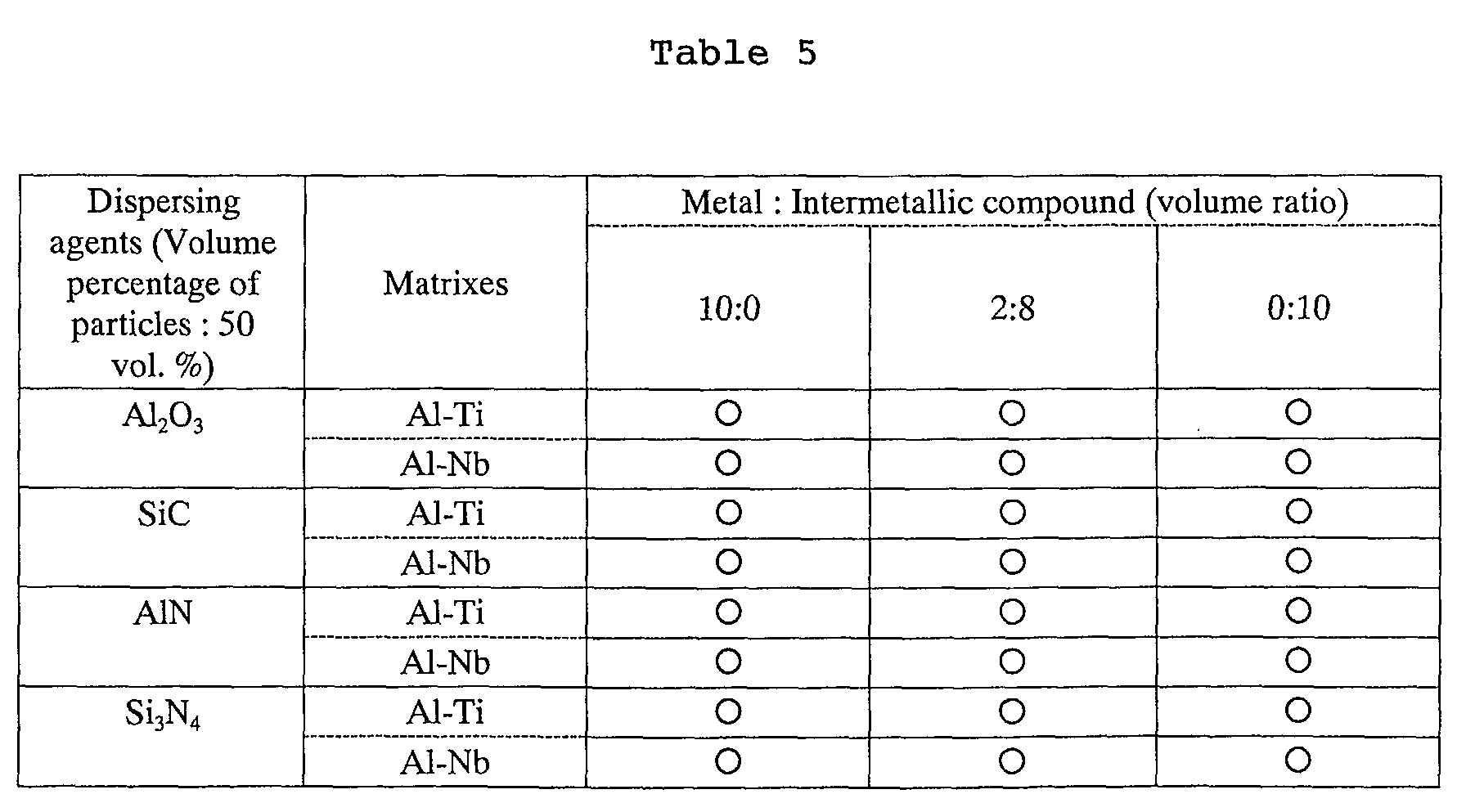
material. The result is shown in Table 5.
As shown in Table 5, it could be confirmed that even in
the case where Ti and Nb metals other than Ni were used in
regard to metals to form a metal-coated layer, any composite
material in which the matrix composition was arbitrarily
changed could be produced.
Example 5
Al2O3 particles (ground particles) having the average
particle size of 47 µm as dispersing agents and Ni that would
become a metal-coated layer were prepared, and a metal-coated
layer was formed on the surface of the dispersing agents by
electroless plating treatment so that the volume percentage
of the particles was 40 to 70 vol. % and the amount of the
metal-coated layer was from over 4 to below 86 mass % to produce
metal-coated particles. Next, Al was impregnated in the
metal-coated particles according to the same operation in
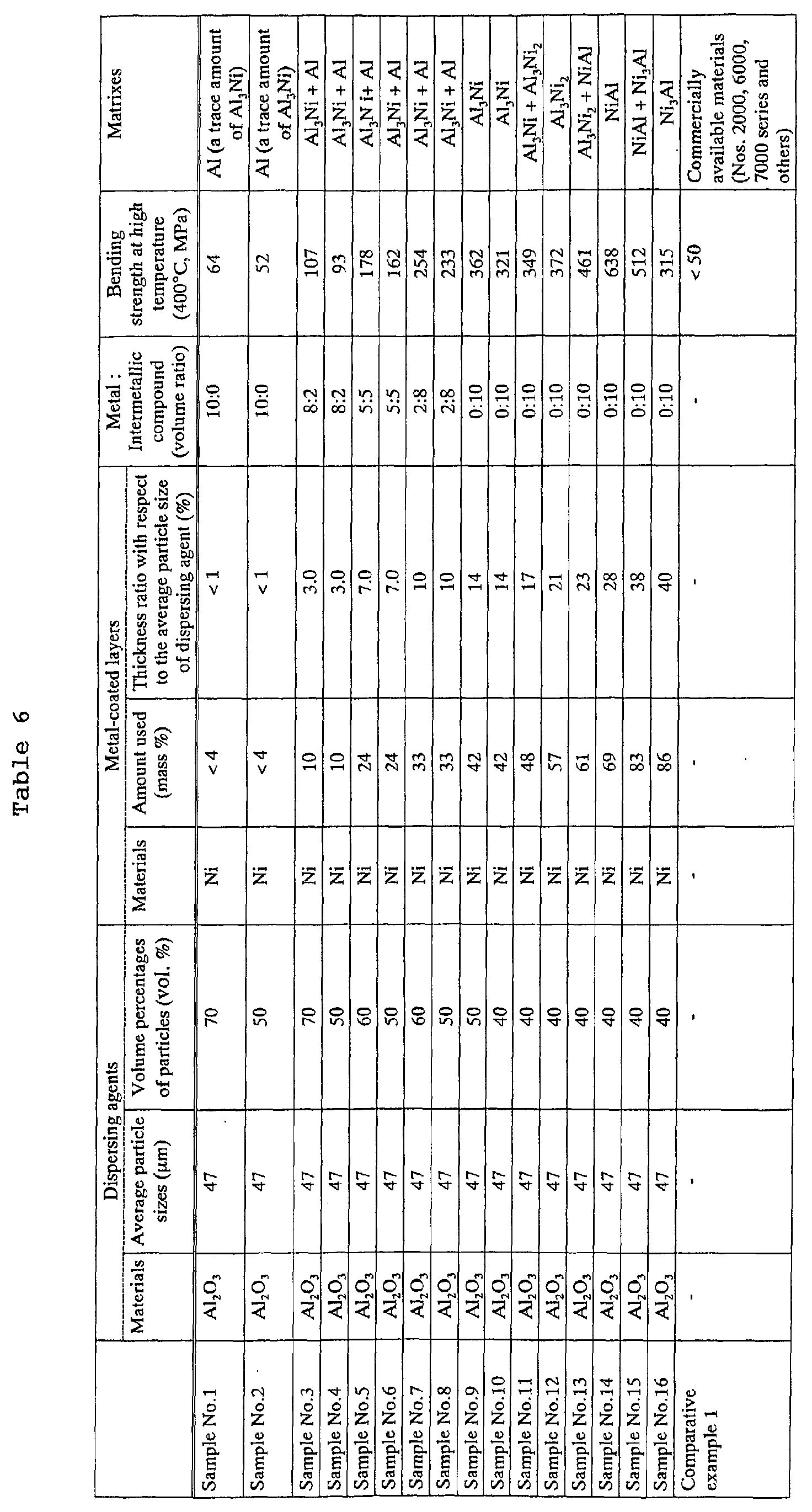
Example 1 to produce a composite material (Sample Nos. 1 to
16). The result is shown in Table 6.
Further, concerning obtained composite materials
(Sample Nos. 1 to 16), and Al alloys of No. 2000, 6000, and
7000 series that are commercially available (Comparative
example 1), test pieces having a fixed shape were cut off and
subjected to the measurement of strength in four-point
bending test (JIS R1601) at 400°C. The results are shown in
Table 6. Here, the reason for selecting 400°C as the test
temperature is because Al or Al alloys used in impregnation
are easily deformed and strength is difficult to be revealed
at the temperature zone, and because it becomes possible to
quantitatively judge the substitution state of the matrix
constituting the obtained composite material.
Furthermore, when a test piece was cut off from each
composite material and subjected to thermal analysis with an
differential thermal balance analyzer TG-DTA (made by RIGAKU,
TG8120 type) under an inert gas atmosphere, peaks of
endothermic reactions due to the dissolution reactions of Al
existing in the matrixes were confirmed in Sample Nos. 1 to
8, while no endothermic reaction due to the dissolution
reaction of Al was measured and only peaks from aluminide
intermetallic compounds as product phases after synthesis
were measured in Sample Nos. 9 to 16. That is, it was
confirmed that concerning Sample Nos. 1 to 8, the composite
materials were metal matrix composites in which Al existed
in the matrixes, and concerning Sample Nos. 9 to 16, the
composite materials were intermetallic matrix composites in
which a whole Al in the matrixes was completely replaced with
aluminide intermetallic compounds by reaction.
As shown in Table 6, it could be confirmed that the
composition of the matrix formed could be arbitrarily changed
from an Al-rich compound to an aluminide intermetallic
compound by controlling the amount of the metal-coated layer.
Further, it could also be confirmed that any of the composite
material produced had sufficient bending strength at high
temperature.
(The measurements and tests of various kinds of physical
property values on composite materials produced)
1. Measurements of physical property values (Composite
materials of Al2O3 / Al-Ni series).
According to the method in Example 1, composite
materials in which the volume percentage of the particles was
40 to 70 vol. % and the metal : the intermetallic compound
(volume ratio) = 10 : 0, 2 : 8, 0 : 10 were produced using
Al2O3 particles (ground particles) having the average particle
size of 47 µm as dispersing agents and Ni as a metal-coated
layer. Then, thermal conductivity, thermal expansion
coefficients and fracture toughness values were measured on
each composite material. The results are shown in Tables 7,
8 and 9. Further, the measurement methods of the above
described each physical property value are as shown in the
following. And, "-" used in the description in each table
means that no production was conducted, and "x" means that
no composite material could be produced (the production was
impossible).
[The measurement of thermal conductivity]:
After samples having a fixed shape were cut off from
obtained composite materials, thermal conductivity was
measured on the samples with a thermal constant measuring
device (made by Shinku Riko Co., Ltd., TC-7000) according to
Laser Flash Process. The measurement was conducted at room
temperature.
[The measurement of thermal expansion coefficients]:
After samples having a fixed shape were cut off from
obtained composite materials, thermal expansion coefficients
of the samples were measured at room temperature to 800°C in
the atmosphere of Ar gas with a thermal expansion meter (made
by Mac Science Co., Ltd., TD-5000S).
[The measurement of fracture toughness values]:
After samples having a fixed shape were cut off from
obtained composite materials, strength in four-point bending
test was measured on the samples and fracture toughness values
were calculated according to Chevron notch method.
| Volume of particles percentages (vol. %) | Metal : Intermetallic compound (volume ratio) |
| | 10:0 | 2:8 | 0:10 |
| | Thermal conductivity (W/mK) |
| 40 | - | - | 33 |
| 50 | 73 | 41 | 31 |
| 60 | - | 43 | × |
| 70 | 49 | × | × |
| Volume percentages of particles (vol. %) | Metal : Intermetallic compound (volume ratio) |
| | 10:0 | 2:8 | 0:10 |
| | Thermal expansion coefficients (ppm/K) |
| 40 | - | - | 11.7 |
| 50 | 15.8 | 12.5 | 10.4 |
| 60 | - | 11.2 | × |
| 70 | 13.4 | × | × |
| Volume percentages of particles (vol. %) | Metal : Intermetallic compound (volume ratio) |
| | 10:0 | 2:8 | 0:10 |
| | Fracture toughness values (Ma·m1/2) |
| 40 | - | - | 9.4 |
| 50 | 19.3 | 15.4 | 8.2 |
| 60 | - | 13.7 | × |
| 70 | 16.1 | × | × |
As shown in Tables 7 to 9, it could be confirmed that
in composite materials produced by conducting the present
invention, their composite material properties could be made
variable by changing the ratio of the metal : the
intermetallic compound (volume ratio) or the volume
percentage of particles in the matrix.
2. Measurements of physical property values (Composite
materials of SiC, AlN, Si3N4 / Al-Ni).
According to the method in Example 3, composite
materials in which the volume percentage of the particles was
50 vol. % and the metal : the intermetallic compound (volume
ratio) = 10 : 0, 2 : 8, 0 : 10 were produced using SiC having
the average particle size of 54 µm, AlN of 50 µm and Si
3N
4
particles (ground particles) of 47 µm as dispersing agents
and Ni as a metal-coated layer. Then, high-temperature
strength, thermal conductivity, and thermal expansion
coefficients were measured on each composite material. The
results are shown in Table 10. Further, the measurement
methods of the above described each physical property value
are as described above. And, "-" used in the description in
the table means that no production was conducted.
As shown in Table 10, it was confirmed that in composite
materials produced by conducting the present invention, their
optional composite material properties could be obtained by
not only changing the ratio of the metal : the intermetallic
compound in the matrix (volume ratio) but selecting the kind
of dispersing agents.
3. Oxidation resistance tests and abrasion resistance
tests (Composite materials of Al2O3 / Al-Ni series).
According to the method in Example 1, composite
materials in which the volume percentage of the particles was
50 vol. % and the metal : the intermetallic compound (volume
ratio) = 10 : 0, 2 : 8, 0 : 10 were produced using Al2O3 particles
(ground particles) having the average particle size of 47 µm
as dispersing agents and Ni as a metal-coated layer. Then,
oxidation resistance tests, abrasion resistance tests were
conducted on each composite material. The results are shown
in Tables 11 and 12. Further, the measurement methods of the
above described each physical property value are as shown in
the following. And, concerning the abrasion resistance test,
the same test as that for the composite materials was
conducted on commercially available Al alloy (AC8A), which
is excellent in abrasion resistance due to the presence of
an eutectic Si phase among Al alloys, as Comparative example
2.
[Oxidation resistance tests]:
Obtained composite materials were held at 900°C for 100
hours in the air, and the weight changes of the samples before
and after the test were measured.
[Abrasion resistance tests]:
Samples having a fixed shape were cut off from obtained
composite materials and the abrasion resistance tests were
conducted on the samples with an abrasion testing machine
(made by Shinko Engineering Co., Ltd.) at room temperature.
As shown in Tables 11 and 12, in composite materials
produced by practicing the present invention, because the
matrix is changed from Al having low melting point to an
aluminide intermetallic compound by making the ratio of the
metal : the intermetallic compound in the matrix (volume
ratio) to be 0 : 10 in the oxidation resistance test, the
composite materials did not cause partial dissolving and had
a little change in weight. And it was confirmed that the
abrasion loss of the composite material was lower than that
of commercially available Al alloys in the abrasion
resistance test and further the abrasion resistance was more
improved by the intermetallic compound in the matrix.
Examples 6 to 8
A total of 3 kinds of dispersing agents of Al2O3 particles
(ground particles) having the average particle size of 47
µm as solid particles, and of hollow particles composed of
shirasu balloon (manufactured by Ube Material Industries)
having the average shell thickness of about 1 µm or less and
fly ash balloon (manufactured by Taiheiyo Cement) having the
average shell thickness of about 5 - 10 µm or less, and Ni
that would become a metal-coated layer were prepared, and
a metal-coated layer was formed on the surface of the
dispersing agents by electroless plating treatment so that
the volume percentage of the particles was 50 vol. % and the
amount of the metal-coated layer was 4 mass % to produce
metal-coated particles. Next, the metal-coated particles
were impregnated with Al according to the same operation in
Example 1 to produce a composite material (Examples 6 to 8).
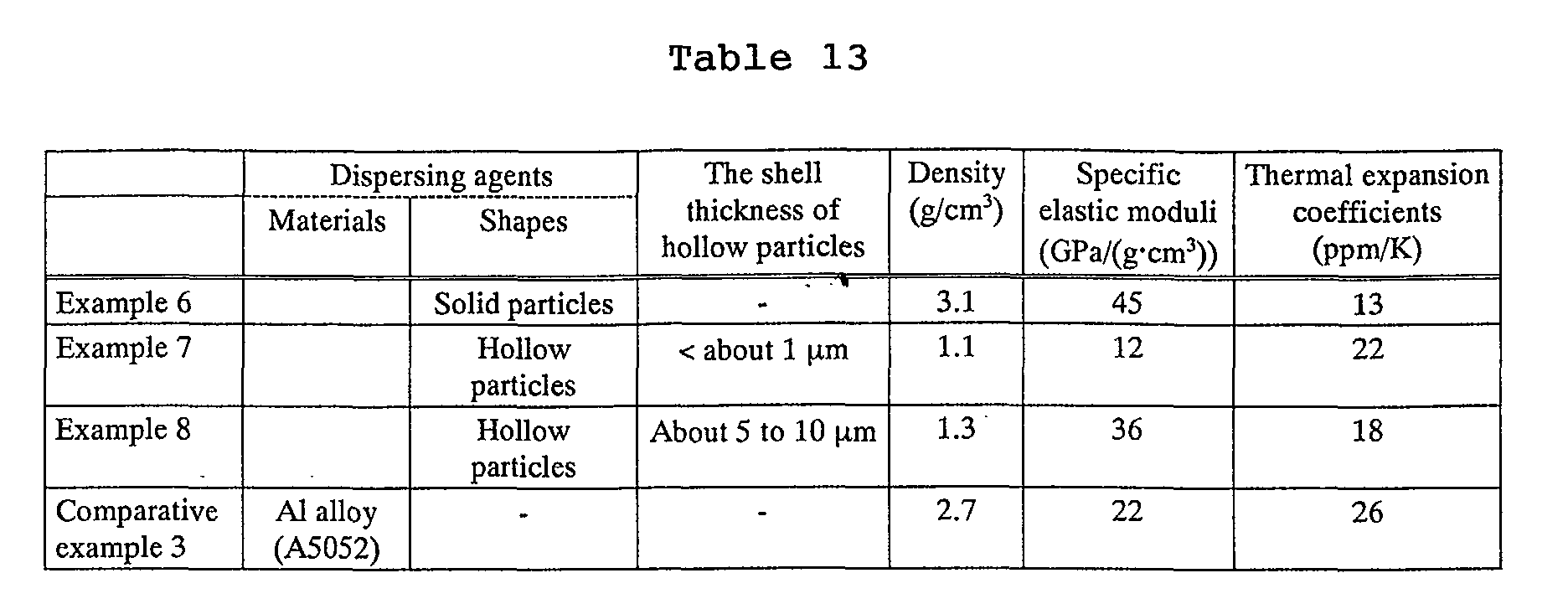
A sample having a fixed shape was cut off from each of
obtained composite materials (Sample Nos. 1 to 16) and
commercially available Al alloy (A5052, Comparative example
1), and the measurements of density, specific elastic modulus
and thermal expansion coefficients were conducted on the
samples. Further, the measurement of density was conducted
according to the Archimedes method, and the measurement of
a specific elastic modulus was conducted by the method shown
in the following. Furthermore, Figs. 8, and 9 are scanning
electron microphotographs showing the microstructure of
composite materials in Examples 7 and 8, with magnification
of 200, respectively.
[Calculation of specific elastic modulus]:
Young's modulus was measured by the aforementioned
four-point bending test, and the obtained value was divided
by the density of the sample employed to calculate a specific
elastic modulus.
As shown in Table 13, it could be confirmed that the
density of the porous composite materials concerned with the
present invention and produced using hollow particles as
dispersing agents (Examples 7 and 8) was about half as high
as that of the composite material produced using Al alloy
(Comparative example 3). Further, it became clear that the
specific elastic modulus of the porous composite material
produced using hollow particles of about 5 to 10 µm in the
average shell thickness (Example 8) was significantly
increased, compared to that of the porous composite material
produced using hollow particles of below about 1 µm in the
average shell thickness (Example 7). Furthermore, the value
of the thermal expansion coefficient thereof was found to
be lowered to the level equal to that of the case wherein
the solid particles were used (Example 6).
Examples 9 and 10
A dispersing agent of hollow particles composed of fly
ash balloon (manufactured by Taiheiyo Cement) having the
average particle size of about 100 µm and the average shell
thickness of about 5 - 10 µm or less, used in Example 8 where
the specific elastic modulus was remarkably increased, and
Ni that would become a metal-coated layer were prepared. Then,
two kinds of metal-coated particles were produced by forming
a metal-coated layer on the surface of the dispersing agent
by electroless plating treatment in the amounts of 24 mass %
and 42 mass %, respectively, with adjusting the volume
percentage of the particles to 50 vol. % therein. Next, thus
obtained metal-coated particles were impregnated with Al
according to the same operation in Example 1 to produce a
composite material (Examples 9, 10).
As a result, it was found that porous composite material
having a matrix showing from a multi-phase of Al+Al3Ni
(Example 9) to a single phase of Al3Ni (Example 10) can be
synthesized, even in the case of using hollow particles.
As described above, according to the production method
of the present invention, because metal-coated layers are
formed on the surface of various kinds of dispersing agents,
the reaction of the metal-coated layer with molten Al is
caused. For this reason, composite materials can be produced
at low temperature and under non-pressurized condition
compared to the conventional production method. Further, it
is possible that the matrix in a composite material is
properly set to be any of Al, a mixture of Al and an aluminide
intermetallic compound, or an aluminide intermetallic
compound by synthesizing an aluminide intermetallic compound
in situ or controlling the thickness and the amount used of
a metal-coated layer. Moreover, since it is possible to make
a near net shape in consideration of the shape of an end
product, the production processes can be reduced and the
reduction in the production cost is achieved at the same time.
On the other hand, the composite material of the present
invention that is produced according to the above described
production method is a composite material having the desired
physical properties.