EP1244328A2 - Lieferung von Mehrfachsendungdiensten über ein WDM Netzwerk - Google Patents
Lieferung von Mehrfachsendungdiensten über ein WDM Netzwerk Download PDFInfo
- Publication number
- EP1244328A2 EP1244328A2 EP02002895A EP02002895A EP1244328A2 EP 1244328 A2 EP1244328 A2 EP 1244328A2 EP 02002895 A EP02002895 A EP 02002895A EP 02002895 A EP02002895 A EP 02002895A EP 1244328 A2 EP1244328 A2 EP 1244328A2
- Authority
- EP
- European Patent Office
- Prior art keywords
- wavelength
- optical network
- modulator
- multicast data
- multicast
- Prior art date
- Legal status (The legal status is an assumption and is not a legal conclusion. Google has not performed a legal analysis and makes no representation as to the accuracy of the status listed.)
- Granted
Links
Images



Classifications
-
- H—ELECTRICITY
- H04—ELECTRIC COMMUNICATION TECHNIQUE
- H04Q—SELECTING
- H04Q11/00—Selecting arrangements for multiplex systems
- H04Q11/0001—Selecting arrangements for multiplex systems using optical switching
- H04Q11/0005—Switch and router aspects
-
- H—ELECTRICITY
- H04—ELECTRIC COMMUNICATION TECHNIQUE
- H04Q—SELECTING
- H04Q11/00—Selecting arrangements for multiplex systems
- H04Q11/0001—Selecting arrangements for multiplex systems using optical switching
- H04Q11/0062—Network aspects
-
- H—ELECTRICITY
- H04—ELECTRIC COMMUNICATION TECHNIQUE
- H04Q—SELECTING
- H04Q11/00—Selecting arrangements for multiplex systems
- H04Q11/0001—Selecting arrangements for multiplex systems using optical switching
- H04Q11/0005—Switch and router aspects
- H04Q2011/0007—Construction
- H04Q2011/0016—Construction using wavelength multiplexing or demultiplexing
-
- H—ELECTRICITY
- H04—ELECTRIC COMMUNICATION TECHNIQUE
- H04Q—SELECTING
- H04Q11/00—Selecting arrangements for multiplex systems
- H04Q11/0001—Selecting arrangements for multiplex systems using optical switching
- H04Q11/0005—Switch and router aspects
- H04Q2011/0037—Operation
- H04Q2011/0047—Broadcast; Multicast
Definitions
- the invention relates to a wavelength division multiplexed (WDM) network. More particularly, the present invention relates to a method and a system for delivering multicasting data services on different wavelengths using a configurable four-port wavelength selective crossbar switch (4WCS).
- WDM wavelength division multiplexed
- Multicasting is achieved by duplicating multicast packets multiple times for each receiver in a traditional data communication network, but this approach has the disadvantage of creating a bottleneck at the multicast server.
- proposals for generating a virtual tree network architecture and broadcast data on the virtual tree Nevertheless, these proposals incur signaling difficulties and Quality of Service issues, such as local bandwidth bottlenecks and latency issues.
- wavelength division multiplexed WDM
- A.A.M. Saleh et al. "Architectural Principles of Optical Regional and Metropolitan Access Networks," J. Lightwave Technology, Vol. 17, No. 12, p2431-2448, Dec. 1999.
- the present invention provides a technique for selectively and dynamically changing a wavelength configurable crossbar switch for modulating selected wavelengths of a wavelength division multiplexed (WDM) signal with content data.
- the present invention also provides a technique for providing node-to-node communication on a remotely modulated ring carrier. Additionally, the present invention provides a technique for selectively multicasting on different wavelengths of a WDM signal.
- a wavelength division multiplexed (WDM) signal having a plurality of wavelengths is received from a hub node of the optical network, such as a unidirectional ring network or a bi-directional ring network. That is, the WDM signal includes a plurality of wavelengths for multicast data and at least one wavelength for non-multicast data.
- a four-port wavelength crossbar switch (4WCS) selectably switches each wavelength for multicast data from the optical network to a modulator loop.
- the modulator loop includes a multicast modulator that modulates the plurality of wavelengths that are for multicast data with the multicast data.
- wavelengths are selectively separated from the WDM signal for reconfiguring delivery of multicast data by remote control, without manual changes being made to a device selectively separating the wavelengths from the WDM signal.
- the present invention relates to a method and an apparatus for multicasting data services on different wavelengths using a configurable four-port wavelength crossbar switch (4WCS).
- a wavelength-specific optical carrier can reside on a network provider's location while multicast data modulation resides at a separate content-provider location.
- a service provider can imprint the multicast data onto the selected wavelengths for delivery to users downstream, the provider of the network infrastructure can maintain network integrity, such as, wavelength accuracy, crosstalk power levels, etc.
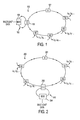
- FIG. 1 is a functional block diagram of a unidirectional MAN 100 providing multicasting of data services on different wavelengths using a configurable four-port wavelength crossbar switch (4WCS) according to a first embodiment of the present invention.
- MAN 100 includes a hub node 101, a modulator loop 102, and a plurality of user nodes N 1 -N 4 .
- Hub node 101 sends out signals having standard wavelengths.
- Modulator loop 102 is connected to MAN 100 by a four-port wavelength selective crossbar switch (4WCS) 103.
- Four-port crossbar switch 103 can operate based on, for example, diffraction gratings combined with spatial light modulator arrays, tunable fiber gratings with circulators and wavelength slicers, or arrayed waveguide gratings (AWG) combined with optical switches.
- diffraction gratings combined with spatial light modulator arrays
- tunable fiber gratings with circulators and wavelength slicers or arrayed waveguide gratings (AWG) combined with optical switches.
- AWG arrayed waveguide gratings
- Optical sources are preferably located at hub node 101, and are under the control of the network provider.
- a content provider encodes multicast data using an optical modulator MOD 104 that is part of modulator loop 102. While Figure 1 shows hub node 101 and modulator loop 102 as separate nodes, the functions of hub node 101 and modulator loop 102 can alternatively be combined into a single node.
- Each user node N 1 to N 4 respectively receives a multicast wavelength ⁇ 1 to ⁇ 4 , in addition to other assigned wavelengths, in this example, wavelengths ⁇ 5 to ⁇ 8 , respectively.
- Switch 103 sets all multicast wavelengths used by the multicast data provider at modulator loop 102 to the "cross" state, while all other wavelengths are set to the "bar” state.
- a multicast wavelength is set to the cross state in switch 103, the wavelength passes through MOD 104 and receives the multicast data before being routed back onto MAN 100.
- the barred wavelength passes directly through switch 103 without any modulation.
- Optical modulator MOD 104 such as an external Mach-Zehnder modulator, simultaneously modulates all multicast wavelengths of the service subscribers in a well-known manner, thereby sharing modulation costs.
- different content provider can share the wavelength-specific optical carriers generated by the hub node, thereby providing a significant cost advantage.
- Subscribers may be added or removed simply by switching the state of switch 103 in a dynamic manner from a remote location without making manual changes to switch 103.
- An optical amplifier may be inserted in modulator loop 102 for compensating for insertion losses.
- a switched semiconductor amplifier may combine both modulation and amplification for the most economical solution.
- Increasing the number of wavelengths in the ring and adding routing devices in modulator loop 102 can accommodate diverse service packages from a content provider.
- services can be provisioned flexibly, from a single service that spans several wavelengths, to services that are segregated by wavelength, to multiple services broadcast on a single wavelength and shared over several nodes.
- Additional content providers at other nodes, including content provided from the hub node 101 can be accommodated on wavelengths not routed to the content provider operating modulator loop 102.
- FIG. 2 is a functional block diagram of a bi-directional metropolitan area network (MAN) 200 providing multicasting of data services on different wavelengths using a configurable four-port wavelength selective crossbar switch (4WCS) according to a second embodiment of the present invention.
- the 4WCS must operate bidirectionally.
- a modulator loop 202 that includes a modulator 204 is provided in the "middle" of the MAN 200, that is, modulator loop 202 is physically located in MAN 200 so that at least one subscriber node N is located in either direction around MAN 200.
- Modulator loop 202 is connected to MAN 200 by a four-port wavelength crossbar switch (4WCS) 203. Accordingly, the clockwise wavelengths that are generated by hub node 201 are modulated by modulator loop 202 and the multicast signal is sent to local nodes (nodes N1 and N2) in the clockwise direction from modulator loop 202.
- 4WCS wavelength crossbar switch
- Local nodes in the counter-clockwise direction from modulator loop 202 receive the counter-clockwise wavelengths generated by hub node 201 and that have been modulated by modulator loop 202.
- the clockwise and counter-clockwise traffic may be on two different fibers, or may be on the same fiber, but have different wavelengths. When the counter-clockwise and clockwise wavelengths are all on the same fiber, wavelengths may even share a single modulator for the same multicast signal, provided that the modulator itself can operate bidirectionally.
- FIG. 3 shows a functional block diagram of an experimental WDM ring network 300 that was used for studying the architecture and technology of metropolitan and regional optical access networks, and for demonstrating the present invention. Details regarding experimental WDM ring network 300 are provided in C.F. Lam et al., "Demonstration of programmable optical multicasting in a regional/metro area network", IEEE Photonics Technology Letters, vol. 13, pp. 1236-1238 (2001).
- WDM ring network 300 included a network operator hub node 301, an independent content node 302 that was remotely located from node 301, and four subscriber nodes 303-306. All of the wavelengths used in network 300 are on the standard 100 GHz ITU grid.
- Network 300 also had a total circumference of 75 km formed from AllwaveTM fiber, which is available from Lucent Technologies, Inc.
- the various nodes forming experimental ring network 300 were physically separated from 5 km to 20 km apart, as indicated in Figure 3. All of the traffic used for the study consisted of a 2 31 -1 pseudo-random bit sequence (PRBS) at 2.488 Gb/s.
- PRBS pseudo-random bit sequence
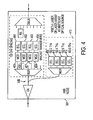
- FIG. 4 is a functional block diagram showing details of hub node 301 as used in experimental ring network 300.
- Hub node 301 included four external cavity lasers (ECL) 401-404 having 193.0-193.3 THz frequencies and respectively had external modulation 405-408 for sending unicast (point-to-point) downstream traffic to each individual subscriber node 303-306.
- ECL external cavity laser
- a multi-wavelength laser simulated by an array of four ECL lasers 409-412, respectively having frequencies 192.2, 192.4, 192.6 and 193.6 THz, was used as a multicast wavelength source 413 for carrying multicast traffic to individual subscribers.
- a remotely-located content node 302 generated the multicast data.
- Content node 302 was connected to ring network 300 using a Corning Pure PathTM wavelength selective cross-connect (WSS) 307.
- WSS 307 was a liquid crystal based 2 ⁇ 2 four-port device, such as described by A.R. Ranalli et al., "Liquid Crystal-Based Wavelength Selectable Cross-Connect,” ECOC 1999, Nice, France.
- WSS 307 operated on 80 ITU wavelengths having 50 GHz spacing, and had a measured insertion loss of about 4 dB for all the wavelengths in both the bar and cross states.
- Switch 307 could be selectively set into either a cross state or a bar state for each of the input wavelengths using a digital controller (not shown). The crosstalk between the cross and bar states was less than -40 dB.
- WSS 307 at content node 302 was set to the bar state for all the unicast wavelengths so that the unicast signals would bypass (i.e., not be affected by) content node 302.
- a multicast wavelength could be set into either the bar or cross state at WSS 307.
- the multicast wavelength bypassed content node 302 without being modulated.
- the multicast wavelength would pass through a LiNbO 3 external modulator 308, which modulated the input optical signal using the multicast data.
- a content node can selectively send the same multicast data to any appropriate subscriber node.
- Modulator 308 was wavelength independent and was shared by all the multicast wavelengths in the cross state. Modulator 308 imposed the multicast data onto all wavelengths passing through modulator 308 from the "drop" port of WSS 307, shown in Figure 3. The multicast wavelengths were inserted back into ring network 300 from the "add" port of WSS 307.
- the modulator that was used in content node 302 was polarization dependent.
- the launch polarizations of the multicast sources were adjusted to match that of the modulator.
- a polarization independent LiNbO 3 modulator could have been used.
- electro-absorptive modulators could be used for multicast content modulation. See, for example, Data Sheets of Electro-Absorption Modulator, Japan Aviation Electronics Industry, Ltd.
- FIG. 5 shows a functional block diagram of a subscriber node 303-306 that was used in experimental ring network 300.
- Each subscriber node 303-306 included two separate passive wavelength add/drops 501 and 502.
- each subscriber node 303-306 dropped a downstream unicast wavelength from hub node 301 and added the same wavelength as upstream traffic to hub node 301 using a passive wavelength add/drop multiplexer (WADM) 501.
- WADM passive wavelength add/drop multiplexer
- Both fiber Bragg gratings at subscriber nodes 303 and 304, and thin film filters at subscriber nodes 305 and 306 were used as unicast traffic add/drops.
- a unicast receiver 502 received the dropped wavelength.
- the upstream traffic was produced by a directly modulated DFB laser 503 at each individual node.
- each subscriber node also dropped an additional multicast wavelength using a thin film add/drop filter 504 that was received by a multicast receiver 505, as shown in Figure 5.
- add/drops 501 and 502 could be combined by using a wavelength cyclic add/drops, such as disclosed by M.D. Feuer et al., "Upgradeable Metro Networks Using Frequency-Cyclic Optical Add/Drop," Optical Fiber Communication Conference 2001, paper WBB5, March 17-21, Anaheim, CA.
- Each wavelength cyclic add/drop is capable of adding/dropping combs of periodic wavelength components.
- free spectral ranges FSRs
- FSRs free spectral ranges
- FIG. 6 shows a spectrum of the wavelengths that were used for experimental ring network 300.
- the multicast wavelengths were selected according to the particular wavelength add/drop multiplexers (WADMs) that were available at the time.
- WADMs wavelength add/drop multiplexers
- multi-wavelength lasers such as a DFB or a DBR array as disclosed by, for example, M.G. Young et al., "A 16x1 wavelength division mulitplexer with integrated distributed Bragg reflector lasers and absorption modulators," IEEE Phot. Tech. Lett., 5(8): 908-910 (1993)
- a multi-frequency laser as disclosed by, for example, M. Zirngibl, et al., "Characterization of a multiwavelength waveguide grating router laser," IEEE Phot. Tech. Lett., 6:1082-1084 (1994)
- having a comb of output frequencies could have been used as sources.
- each unicast wavelength has an output power of - 1 dBm, while each multicast wavelength has an output power of 9 dBm because the multicast wavelengths suffered more loss at the content node, as shown in Figure 6.
- optical line amplifiers could be used for enhancing the power budget.
- EDFAs Erbium-doped fiber amplifiers
- EDWAs Erbium-doped waveguide amplifiers
- SOAs solid state optical amplifiers
- the multi-wavelength output source and WSS could have been used for this type of application.
- the multi-wavelength source, the modulator and drive electronics could all be shared among subscribers.
- the content provider could be a CATV primary headend and the subscribers could be secondary headends, such as disclosed by Oleh Sniezko et al., "HFC Architecture in the Making," CED, vol.25, no.7, July 1999.
- the content could be digital TV signals using QAM modulation schemes.
- DirectTVTM employs QPSK modulation and strong forward error correction (FEC).
- Such signal requires only a 6 dB signal-to-noise ratio (SNR) and is sufficiently robust to be distributed on a digital optical link.
- SNR signal-to-noise ratio
- the required SNR for QPSK and 16-QAM modulation is 16 dB and 24 dB respectively.
- These values are close to the requirements for on-off keyed digital signals (15 dB), and can be easily achieved in a metro-scale WDM network.
- Distribution of broadcast digital TV signals on passive WDM optical networks has been demonstrated before, such as disclosed by K.C. Reichmann et al., "Simultaneous Delivery of 1280 Video Channels over a WDM Passive Optical Network," Proceedings of 26th European Conference on Optical Communication, Vol. 3, pp. 79-80, Sept. 3-7, 2000, Kunststoff, Germany.
- the unicast lasers were conveniently separated from the multicast laser.
- the output of the unicast lasers could also be used by content node 302 by simply turning off the unicast modulators at hub node 301.
- the laser sources can be shared between hub node 301 and content node 302.
- the content node would be freed from ensuring the correct output wavelengths and the optical source integrity. Consequently, the service provider would provide and monitor all wavelength sources from a central location.
- the multi-wavelength sources could be shared among several service providers.
- FIG. 9 shows an exemplary configuration of a bi-directional ring network 900 according to the present invention.
- the clockwise traffic uses different wavelengths than the counter-clockwise traffic.
- a content node 902 can be located anywhere in the ring.
- Multicast wavelengths are transmitted in both directions from a hub node 901, passing through content node 902 and reaching all of the subscriber nodes 903-905.
- the WADMs on ring fiber 906 would be bi-directional add/drops, such as thin film filters.
- the remote modulator and the 2 ⁇ 2 WSS both not shown are both bi-directional and reversible.
- a protection fiber 907 is also shown.
- a loop back mechanism restores the traffic in ring fiber 906. This restoration scheme works because of the optical transparency and bi-directionality of the node add/drop devices.
- Another alternative configuration for a ring network according to the present invention would be to cascade more than one content node.
- wavelengths could be shared back and forth between the content nodes.
Landscapes
- Engineering & Computer Science (AREA)
- Computer Networks & Wireless Communication (AREA)
- Optical Communication System (AREA)
- Small-Scale Networks (AREA)
Applications Claiming Priority (4)
| Application Number | Priority Date | Filing Date | Title |
|---|---|---|---|
| US26888 | 1993-03-05 | ||
| US27649501P | 2001-03-19 | 2001-03-19 | |
| US276495P | 2001-03-19 | ||
| US10/026,888 US7027733B2 (en) | 2001-03-19 | 2001-12-27 | Delivering multicast services on a wavelength division multiplexed network using a configurable four-port wavelength selective crossbar switch |
Publications (3)
| Publication Number | Publication Date |
|---|---|
| EP1244328A2 true EP1244328A2 (de) | 2002-09-25 |
| EP1244328A3 EP1244328A3 (de) | 2003-10-08 |
| EP1244328B1 EP1244328B1 (de) | 2007-04-04 |
Family
ID=26701777
Family Applications (1)
| Application Number | Title | Priority Date | Filing Date |
|---|---|---|---|
| EP20020002895 Expired - Lifetime EP1244328B1 (de) | 2001-03-19 | 2002-02-08 | Lieferung von Mehrfachsenung-Diensten über ein WDM Netzwerk |
Country Status (3)
| Country | Link |
|---|---|
| EP (1) | EP1244328B1 (de) |
| CA (1) | CA2369403C (de) |
| DE (1) | DE60219231T2 (de) |
Cited By (1)
| Publication number | Priority date | Publication date | Assignee | Title |
|---|---|---|---|---|
| CN111314014A (zh) * | 2020-02-27 | 2020-06-19 | 武汉兴思为光电科技有限公司 | 一种mwdm光通信网及光通信系统 |
Family Cites Families (2)
| Publication number | Priority date | Publication date | Assignee | Title |
|---|---|---|---|---|
| US6097533A (en) * | 1997-10-21 | 2000-08-01 | Antec Corporation | Optical amplifier for CATV system with forward and reverse paths |
| CA2300235A1 (en) * | 1999-03-22 | 2000-09-22 | Kazem A. Sohraby | Wavelength division multiplexed system for optical access rings |
-
2002
- 2002-01-25 CA CA 2369403 patent/CA2369403C/en not_active Expired - Fee Related
- 2002-02-08 DE DE2002619231 patent/DE60219231T2/de not_active Expired - Lifetime
- 2002-02-08 EP EP20020002895 patent/EP1244328B1/de not_active Expired - Lifetime
Cited By (1)
| Publication number | Priority date | Publication date | Assignee | Title |
|---|---|---|---|---|
| CN111314014A (zh) * | 2020-02-27 | 2020-06-19 | 武汉兴思为光电科技有限公司 | 一种mwdm光通信网及光通信系统 |
Also Published As
| Publication number | Publication date |
|---|---|
| EP1244328A3 (de) | 2003-10-08 |
| DE60219231T2 (de) | 2007-08-09 |
| CA2369403A1 (en) | 2002-09-19 |
| CA2369403C (en) | 2008-04-29 |
| DE60219231D1 (de) | 2007-05-16 |
| EP1244328B1 (de) | 2007-04-04 |
Similar Documents
| Publication | Publication Date | Title |
|---|---|---|
| US7366417B2 (en) | Delivering multicast services on a wavelength division multiplexed network using a configurable four-port wavelength selective crossbar switch | |
| US7620323B2 (en) | Method and apparatus for interconnecting a plurality of optical transducers with a wavelength division multiplexed optical switch | |
| CN1094025C (zh) | 具有光波长交换功能的模块化光交叉连接结构 | |
| CA2267141C (en) | Dynamically reconfigurable optical add-drop multiplexers for wdm optical communication systems | |
| AU2003200193B2 (en) | WDM optical network with passive pass-through at each node | |
| US6449073B1 (en) | Optical communication system | |
| US20090041457A1 (en) | Modular WSS-based communications system with colorless add/drop interfaces | |
| Wagner et al. | WDM applications in broadband telecommunication networks | |
| KR20110053973A (ko) | Wdm pon rf/비디오 브로드캐스트 오버레이 | |
| KR101367486B1 (ko) | 파장 분할 다중 액세스 네트워크를 운용하는 장치 및 방법 | |
| US20150244494A1 (en) | Passive Optical Network and Optical Line Terminal | |
| US6829438B2 (en) | Add/drop multiplexing in WDM optical networks | |
| US6429955B1 (en) | Optical network | |
| EP1137308A2 (de) | Programmierbare optische Schaltvorrichtung | |
| Hood et al. | Optical distribution systems for television studio applications | |
| CA2369403C (en) | Delivering multicast services on a wavelength division multiplexed network using a configurable four-port wavelength selective crossbar switch | |
| Iannone et al. | Broadcast digital video delivered over WDM passive optical networks | |
| Leisching et al. | All-optical-networking at 0.8 Tb/s using reconfigurable optical add/drop multiplexers | |
| Lam et al. | Demonstration of programmable optical multicasting in a regional/metro area network | |
| Kaman et al. | A cyclic MUX-DMUX photonic cross-connect architecture for transparent waveband optical networks | |
| Takesue et al. | Novel node configuration for DWDM photonic access ring using CMLS | |
| Gamelin et al. | 8-channel reconfigurable WDM networking demonstration with wavelength translation and electronic multicasting at 2.5 Gbit/s | |
| Prat et al. | Demonstration and field trial of a scalable resilient hybrid ngPON | |
| Ramaswami | Fiber-optic networks: future trends | |
| Lam et al. | Programmable optical multicasting in a regional/metro area network using a wavelength selective optical cross-connect |
Legal Events
| Date | Code | Title | Description |
|---|---|---|---|
| PUAI | Public reference made under article 153(3) epc to a published international application that has entered the european phase |
Free format text: ORIGINAL CODE: 0009012 |
|
| AK | Designated contracting states |
Kind code of ref document: A2 Designated state(s): AT BE CH CY DE DK ES FI FR GB GR IE IT LI LU MC NL PT SE TR |
|
| AX | Request for extension of the european patent |
Free format text: AL;LT;LV;MK;RO;SI |
|
| PUAL | Search report despatched |
Free format text: ORIGINAL CODE: 0009013 |
|
| AK | Designated contracting states |
Kind code of ref document: A3 Designated state(s): AT BE CH CY DE DK ES FI FR GB GR IE IT LI LU MC NL PT SE TR |
|
| AX | Request for extension of the european patent |
Extension state: AL LT LV MK RO SI |
|
| 17P | Request for examination filed |
Effective date: 20031213 |
|
| 17Q | First examination report despatched |
Effective date: 20040408 |
|
| AKX | Designation fees paid |
Designated state(s): DE FR GB |
|
| GRAP | Despatch of communication of intention to grant a patent |
Free format text: ORIGINAL CODE: EPIDOSNIGR1 |
|
| GRAS | Grant fee paid |
Free format text: ORIGINAL CODE: EPIDOSNIGR3 |
|
| GRAA | (expected) grant |
Free format text: ORIGINAL CODE: 0009210 |
|
| AK | Designated contracting states |
Kind code of ref document: B1 Designated state(s): DE FR GB |
|
| REG | Reference to a national code |
Ref country code: GB Ref legal event code: FG4D |
|
| REF | Corresponds to: |
Ref document number: 60219231 Country of ref document: DE Date of ref document: 20070516 Kind code of ref document: P |
|
| ET | Fr: translation filed | ||
| PLBE | No opposition filed within time limit |
Free format text: ORIGINAL CODE: 0009261 |
|
| STAA | Information on the status of an ep patent application or granted ep patent |
Free format text: STATUS: NO OPPOSITION FILED WITHIN TIME LIMIT |
|
| 26N | No opposition filed |
Effective date: 20080107 |
|
| PGFP | Annual fee paid to national office [announced via postgrant information from national office to epo] |
Ref country code: DE Payment date: 20130228 Year of fee payment: 12 |
|
| PGFP | Annual fee paid to national office [announced via postgrant information from national office to epo] |
Ref country code: FR Payment date: 20140128 Year of fee payment: 13 |
|
| PGFP | Annual fee paid to national office [announced via postgrant information from national office to epo] |
Ref country code: GB Payment date: 20140128 Year of fee payment: 13 |
|
| REG | Reference to a national code |
Ref country code: DE Ref legal event code: R119 Ref document number: 60219231 Country of ref document: DE |
|
| REG | Reference to a national code |
Ref country code: DE Ref legal event code: R119 Ref document number: 60219231 Country of ref document: DE Effective date: 20140902 |
|
| PG25 | Lapsed in a contracting state [announced via postgrant information from national office to epo] |
Ref country code: DE Free format text: LAPSE BECAUSE OF NON-PAYMENT OF DUE FEES Effective date: 20140902 |
|
| GBPC | Gb: european patent ceased through non-payment of renewal fee |
Effective date: 20150208 |
|
| REG | Reference to a national code |
Ref country code: FR Ref legal event code: ST Effective date: 20151030 |
|
| PG25 | Lapsed in a contracting state [announced via postgrant information from national office to epo] |
Ref country code: GB Free format text: LAPSE BECAUSE OF NON-PAYMENT OF DUE FEES Effective date: 20150208 |
|
| PG25 | Lapsed in a contracting state [announced via postgrant information from national office to epo] |
Ref country code: FR Free format text: LAPSE BECAUSE OF NON-PAYMENT OF DUE FEES Effective date: 20150302 |