EP1244305A2 - Data recording method - Google Patents
Data recording method Download PDFInfo
- Publication number
- EP1244305A2 EP1244305A2 EP02006096A EP02006096A EP1244305A2 EP 1244305 A2 EP1244305 A2 EP 1244305A2 EP 02006096 A EP02006096 A EP 02006096A EP 02006096 A EP02006096 A EP 02006096A EP 1244305 A2 EP1244305 A2 EP 1244305A2
- Authority
- EP
- European Patent Office
- Prior art keywords
- data
- frame data
- order
- recording
- play
- Prior art date
- Legal status (The legal status is an assumption and is not a legal conclusion. Google has not performed a legal analysis and makes no representation as to the accuracy of the status listed.)
- Withdrawn
Links
Images


Classifications
-
- H—ELECTRICITY
- H04—ELECTRIC COMMUNICATION TECHNIQUE
- H04N—PICTORIAL COMMUNICATION, e.g. TELEVISION
- H04N5/00—Details of television systems
- H04N5/76—Television signal recording
- H04N5/78—Television signal recording using magnetic recording
- H04N5/782—Television signal recording using magnetic recording on tape
- H04N5/783—Adaptations for reproducing at a rate different from the recording rate
-
- H—ELECTRICITY
- H04—ELECTRIC COMMUNICATION TECHNIQUE
- H04N—PICTORIAL COMMUNICATION, e.g. TELEVISION
- H04N5/00—Details of television systems
- H04N5/76—Television signal recording
- H04N5/91—Television signal processing therefor
- H04N5/92—Transformation of the television signal for recording, e.g. modulation, frequency changing; Inverse transformation for playback
- H04N5/926—Transformation of the television signal for recording, e.g. modulation, frequency changing; Inverse transformation for playback by pulse code modulation
- H04N5/9261—Transformation of the television signal for recording, e.g. modulation, frequency changing; Inverse transformation for playback by pulse code modulation involving data reduction
Definitions
- the present invention relates to data recording methods and apparatus for recording frame data according to motion JPEG or the like onto a recording medium, data reproducing methods and apparatus for reproducing the frame data from the recording medium, and recording media recording thereon frame data according to motion JPEG or the like.
- JPEG Joint Photographic Coding Experts Group
- ITU-TS International Telecommunication Union-Telecommunication Standardization Sector; formerly the CCITT
- ISO International Organization for Standardization
- MPEG Motion Picture Image Coding Experts Group
- motion JPEG motion JPEG
- Motion JPEG is a standard in which the technique of JPEG is applied to dynamic images.
- data of each frame of a dynamic image is provided according to JPEG.
- a data reproducing apparatus rapidly expands the data of the frames in series to realize a dynamic image display.
- a recording medium records thereon data of static images of frames that constitute a dynamic image, for example, as illustrated in FIG. 1, the frame data indicated by "0 ⁇ 00", “0 ⁇ 01”, “0 ⁇ 02", “0 ⁇ 03”, “0 ⁇ 04", ..., being recorded in this order.
- the data reproducing apparatus reproduces the static images in order as streaming data from the recording medium to realize a dynamic image display.
- FIG. 1 illustrates a case of a normal-speed play.
- each frame is constituted by entire data of a static image, differently from MPEG in which only information on difference between frames is used. Therefore, editing at an arbitrary part, a reverse play, a multiple-speed play, etc., can be realized in simple manners.
- a special reproduction method e.g., the below-described first or second reproduction method, is required for realizing a double-speed play, a quadruple-speed play, or the like, (hereinafter referred to as a high-speed play).
- a double-speed play of an optical disk will be described below by way of example.
- the data reproducing apparatus i.e., an optical disk player
- the data reproducing apparatus can not realize any high play speed more than its data read performance.
- Any optical disk player has a limit of its data read performance (data read speed).
- the play speed is restricted by the limit of the data read performance of the optical disk player even if the player has its CPU capable of realizing a higher-speed play.
- the data skipping operation and the data read operation must frequently be switched over from one to the other.
- Such frequent switchover operations require excessive time and may cause a bottleneck on the high-speed play.
- the frequent switchover operations may cause an excessive load on the reading head unit (an optical pickup) of the optical disk player.
- An object of the present invention is to provide data recording methods and apparatus, data reproducing methods and apparatus, and recording media, all of which are capable of realizing such a high-speed play as were more than the data read performance of the data reproducing apparatus, and realizing a high-speed play with eliminating wasteful operations and relieving the load on the reading head unit of the data reproducing apparatus.
- the data recording method according to the present invention is defined in independent claim 1
- the data recording apparatus according to the present invention is defined in independent claim 3
- the data reproducing method according to the present invention is defined in independent claim 5
- the data reproducing apparatus according to the present invention is defined in independent claim 7
- n-bit codes are assigned respectively to 2 n frame data in the order of a normal-speed play, the bit order of each of the n-bit codes is reversed, a recording order of the frame data is defined based on the reversed n-bit codes, and then the frame data are recorded in the defined recording order onto a recording medium.
- frame data when frame data are reproduced from the recording medium, frame data corresponding in number to the reciprocal of the multiple in a desired play speed are read out in order from the recording medium, the read-out frame data are stored in a buffer memory or the like, and then the stored frame data are read out from the buffer memory or the like in a predetermined order in accordance with the desired play speed.
- the recording order of the frame data on the recording medium is devised so that all the frame data need not be read out in a high-speed play of the recording medium and only the necessary frame data can be reproduced even without frequent skip operations upon reproduction.
- a data reproducing apparatus can realize such a high-speed play as were more than its data read performance, wasteful operations in a high-speed play can be eliminated, and the load on the reading head unit of the data reproducing apparatus can be relieved.
- the data reproducing apparatus reads out only 1/4 (two frame data in this example) from the head of the eight frame data recorded on the optical disk, and stores them in a buffer memory or the like. That is, the data reproducing apparatus reads out two frame data of "0 ⁇ 00" and "0 ⁇ 04" from the optical disk, as shown in (B) of FIG. 4, and stores them in the buffer memory or the like. The data reproducing apparatus then reads out the frame data from the buffer memory or the like in the order of "0 ⁇ 00" and "0 ⁇ 04". The data reproducing apparatus thus obtains the frame data necessary for the quadruple-speed play.
- the data reproducing apparatus reads out only 1/2 (four frame data in this example) from the head of the eight frame data recorded on the optical disk, and stores them in the buffer memory or the like. That is, the data reproducing apparatus reads out four frame data of "0 ⁇ 00", “0 ⁇ 04", “0 ⁇ 02", and "0 ⁇ 06" from the optical disk, as shown in (B) of FIG. 4, and stores them in the buffer memory or the like. The data reproducing apparatus then reads out the frame data from the buffer memory or the like in the order of "0 ⁇ 00", "0 ⁇ 02", “0 ⁇ 04", and "0 ⁇ 06". The data reproducing apparatus thus obtains the frame data necessary for the double-speed play.
- the data reproducing apparatus reads out all the eight frame data of "0 ⁇ 00” to "0 ⁇ 07” in the recording order on the optical disk, as shown in (B) of FIG. 4, and stores them in the buffer memory or the like.
- the data reproducing apparatus then reads out the frame data from the buffer memory or the like in the order of "0 ⁇ 00", “0 ⁇ 01", “0 ⁇ 02", “0 ⁇ 03", “0 ⁇ 04", "0 ⁇ 05", “0 ⁇ 06", and "0 ⁇ 07".
- the data reproducing apparatus reads out only the frame data of "0 ⁇ 00" at the head of the eight frame data shown in (B) of FIG. 4, and stores it in the buffer memory or the like.
- the data reproducing apparatus then reads out the frame data of "0 ⁇ 00" from the buffer memory or the like.
- a unit of frames for rearrangement is constituted by eight (2 3 ) frames.
- FIG. 5 illustrates another embodiment in which a unit of frames for rearrangement is constituted by 32 (2 5 ) frames.
- the data reproducing apparatus can realize from a normal-speed play to a 2 5 (32)-fold-speed play. More specifically, in the case of a 16-fold-speed play, the data reproducing apparatus reads out 1/16 (i.e., two frame data) from the head of the 32 frame data recorded on the optical disk. That is, the data reproducing apparatus reads out frame data of "0 ⁇ 00" and "0 ⁇ 16" in this order from the optical disk, and stores them in the buffer memory or the like. The data reproducing apparatus then reads out the frame data from the buffer memory or the like in the order of "0 ⁇ 00" and "0 ⁇ 16". The data reproducing apparatus thus obtains the frame data necessary for the 16-fold-speed play.
- 1/16 i.e., two frame data
- the data reproducing apparatus reads out 1/8 (i.e., four frame data) from the head of the 32 frame data recorded on the optical disk. That is, the data reproducing apparatus reads out frame data of "0 ⁇ 00", “0 ⁇ 16", “0 ⁇ 08”, and "0 ⁇ 24” in this order from the optical disk, and stores them in the buffer memory or the like. The data reproducing apparatus then reads out the frame data from the buffer memory or the like in the order of "0 ⁇ 00", “0 ⁇ 08", "0 ⁇ 16", and "0 ⁇ 24". The data reproducing apparatus thus obtains the frame data necessary for the eight-fold-speed play.
- 1/8 i.e., four frame data
- the data reproducing apparatus can realize a quadruple-speed play, a double-speed play, a normal-speed play, and a 32-fold-speed play in similar manners.
- the data recording apparatus reverses the bit order of each of n-bit codes that have been assigned respectively to 2 n frame data.
- the data recording apparatus then records the frame data corresponding to the respective reversed n-bit codes onto an optical disk in the order of the reversed n-bit codes.
- the data reproducing apparatus realizes a high-speed play as follows. That is, the data reproducing apparatus reads out, from the optical disk, frame data corresponding in number to the reciprocal of the multiple in speed of the high-speed play, in the recording order, and stores the read-out frame data in a buffer memory or the like. The data reproducing apparatus then reads out the frame data from the buffer memory or the like in an order predetermined in accordance with the play speed.
- the optical disk records thereon the frame data in the order of the reversed n-bit codes.
- the data reproducing apparatus may read out only frame data corresponding in number to the reciprocal of the multiple in speed of the high-speed play. Therefore, the data read performance (data read speed) of the data reproducing apparatus may suffice if it can read out only frame data corresponding in number to the reciprocal of the multiple in speed of the high-speed play. This means that such a high-speed play as were more than the actual data read performance of the data reproducing apparatus can be realized.
- the frame data necessary for any high-speed play are recorded in succession on the optical disk. Therefore, the data reproducing apparatus can realize any high-speed play with a less number of skip operations than the prior art. This can reduce the wastefulness in operation and so relieve the load on the reading head unit of the data reproducing apparatus.
- the data reproducing apparatus may read out the number of frame data more than the reciprocal of the multiple in speed of a high-speed play. Besides, even when the data reproducing apparatus cannot afford to realize a high-speed play because of its data read performance, by reading out the number of frame data in accordance with its data read performance from the optical disk, the data reproducing apparatus can realize the high-speed play with images of some quality though skipping the necessary frames to some extent is unavoidable.
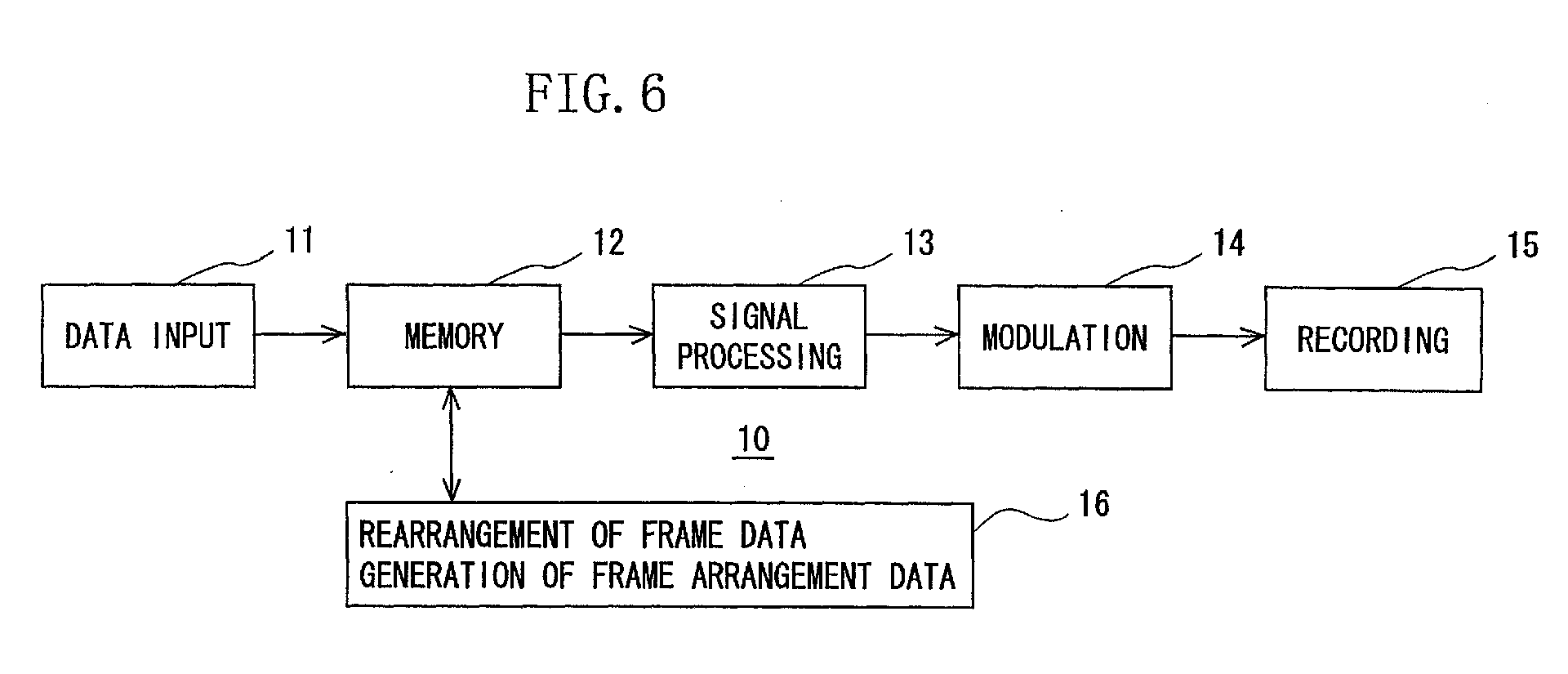
- FIG. 6 illustrates functional components of a data recording apparatus 10 for rearranging frame data and recording the rearranged frame data onto an optical disk, as described above.
- a data input unit 11 takes in frame data in the order of a normal-speed play, the order being shown in FIG. 1.
- Frame data to be input through the data input unit 11 are according to, e.g., motion JPEG.
- the frame data according to motion JPEG may be taken at need out of frame data provided in advance within a database.
- a control unit 16 stores, in a memory 12, the frame data input through the data input unit 11 in the order of a normal-speed play.
- the memory 12 must have its capacity sufficient for storing data of a unit of frames for rearrangement. More specifically, in the case that a unit of frames for rearrangement is constituted by eight frames as in the embodiment of FIGS. 3 and 4, the memory 12 must have its capacity sufficient for storing eight frame data. Also, in the case that a unit of frames for rearrangement is constituted by 32 frames as in the embodiment of FIG. 5, the memory 12 must have its capacity sufficient for storing 32 frame data.
- the control unit 16 controls addresses in the memory 12 so that frame data may be read out from the memory 12 in an order after rearrangement. More specifically, in the case that a unit of frames for rearrangement is constituted by eight frames, the control unit 16 controls the memory 12 so that frame data may be read out from the memory 12 in the order after the rearrangement illustrated in FIGS. 3 and 4. Also, in the case that a unit of frames for rearrangement is constituted by 32 frames, the control unit 16 controls the memory 12 so that frame data may be read out from the memory 12 in the order after the rearrangement illustrated in FIG. 5.
- the frame data read out from the memory 12 are sent to a signal processing unit 13.
- the signal processing unit 13 generates an error correction code for each frame data and adds it to the frame data.
- the signal processing unit 13 thereby encodes the frame data and then sends the encoded frame data to a modulation unit 14.
- the modulation unit 14 generates a signal (hereinafter referred to as frame signal) in which a predetermined carrier signal has been modulated based on the encoded frame data.
- the modulation unit 14 then sends the frame signal to a recording unit 15.
- the recording unit 15 is provided with an optical recording head.
- the recording unit 15 drives the optical recording head based on the frame signal to record frame data onto an optical disk.
- the optical disk may be a master disk to be used for making one or more duplicate optical disks.
- control unit 16 generates frame arrangement data.
- the frame arrangement data is data necessary for reading out frame data from an optical disk in accordance with a play speed.
- the control unit 16 sends the frame arrangement data to the signal processing unit 13 through the memory 12.
- the control unit 16 may send the frame arrangement data directly to the signal processing unit 13 not through the memory 12.
- the signal processing unit 13 generates an error correction code for the frame arrangement data and adds it to the frame arrangement data.
- the signal processing unit 13 thereby encodes the frame arrangement data and then sends it to the modulation unit 14.
- the modulation unit 14 generates a signal (hereinafter simply referred to as arrangement signal) in which a predetermined carrier signal has been modulated based on the encoded frame arrangement data.
- the modulation unit 14 then sends the arrangement signal to the recording unit 15.
- the recording unit 15 drives the optical recording head based on the arrangement signal to record the frame arrangement data in a predetermined recording area of the optical disk on which the frame data are recorded or to be recorded as described above.
- the frame arrangement data may be recorded in a TOC (Table Of Contents) recording area of the optical disk as TOC data.
- the data recording apparatus 10 records frame data onto an optical disk.
- FIG. 7 illustrates functional components of a data reproducing apparatus 20 for reproducing frame data from an optical disk on which the frame data have been recorded in the above-described manner.
- a reading unit 21 is provided with an optical'head for reading out an signal from an optical disk.
- the reading unit 21 sends the read-out signal to a demodulation unit 22.
- the demodulation unit 22 demodulates the signal read out from the optical disk, to obtain a rectangular-wave signal.
- the rectangular-wave signal output from the demodulation 22 is sent to a signal processing unit 23.
- the signal processing unit 23 converts the received rectangular-wave signal into binary data.
- the signal processing unit 23 performs error correction using the error correction code added to the binary data, and thereby decodes the data.
- the data reproducing apparatus reads out frame arrangement data from a predetermined recording area of the optical disk. More specifically, a control unit 26 controls the reading unit 21 to read out an signal from the predetermined recording area of the optical disk.
- the read-out signal is sent to the signal processing unit 23 through the demodulation unit 22.
- the signal processing unit 23 converts the output rectangular-wave signal from the demodulation unit 22 into binary data and then performs error correction.
- the signal processing unit 23 thereby decodes the frame arrangement data and then sends it to the control unit 26.
- the control unit 26 can know the recording position of each frame data (i.e., the address of each frame data) on the optical disk, and the recording order of the frame data on the optical disk. For example, based on the frame arrangement data, the control unit 26 can know that the frame data have been rearranged as illustrated in FIG. 3 or shown in (B) of FIG. 4 or 5.
- control unit 26 controls the operation of the reading unit 21 to read out frame data from the optical disk in accordance with the input play speed. More specifically, the control unit 26 controls the reading unit 21 to read out frame data corresponding in number to the reciprocal of the multiple in the input play speed, from the optical disk.
- the signal read out from the optical disk by the reading unit 21 is sent to the signal processing unit 23 through the demodulation unit 22.
- the signal processing unit 23 converts the output rectangular-wave signal from the demodulation unit 22 into binary data and then performs error correction.
- the signal processing unit 23 thereby decodes the frame data read out from the optical disk, and then sends them to a buffer 24.
- the buffer 24 has its capacity sufficient for storing frame data corresponding in number to the reciprocal of the multiple in any play speed that the user may input.
- the control unit 26 then controls the buffer 24 so that the frame data may be read out from the buffer 24 in a predetermined order in accordance with the input play speed, as shown in (B) of FIG. 4 or 5.
- the frame data read out from the buffer 24 are sent to a data output unit 25.
- the data output unit 25 converts the frame data into a signal that meets the signal standard (a television standard such as NTSC) of an externally connected monitor device.
- the data output unit 25 then outputs the signal to the monitor device.
- the data reproducing apparatus with the above-described functional components can realize the high-speed play, requested by the user, of the optical disk on which the rearranged frame data are recorded.
- recording media used in the present invention are not limited to optical disks. Magnetic disks such as hard disks, magnetic tapes, etc., can also be used.
- frame data to be recorded on a recording medium are not limited to those according to motion JPEG.
- the present invention is applicable to data according to any standard if the standard defines each frame data complete in itself.
- a transmitter may transmit frame data, which have been rearranged as described above, in accordance with a play speed requested by a receiver.
- the receiver can realize a high-speed play even without receiving all frame data.
Landscapes
- Engineering & Computer Science (AREA)
- Multimedia (AREA)
- Signal Processing (AREA)
- Signal Processing For Digital Recording And Reproducing (AREA)
- Television Signal Processing For Recording (AREA)
Abstract
Description
Claims (10)
- A Data recording method comprising the steps of:assigning n-bit codes respectively to 2n frame data (where n is a positive integer) in the order of a normal-speed play;reversing the bit order of each of the n-bit codes;defining a recording order of the frame data based on the reversed n-bit codes; andrecording the frame data in the defined recording order onto a recording medium.
- The method according to claim 1, wherein the 2n frame data are motion JPEG data.
- A data recording apparatus comprising:a frame rearranging unit, that rearranges 2n frame data (where n is a positive integer) based on n-bit codes obtained by reversing the bit order of each of n-bit codes assigned respectively to the frame data in the order of a normal-speed play; anda recording unit, that records the rearranged frame data in a rearranged order onto a recording medium.
- The apparatus according to claim 3, wherein the 2n frame data are motion JPEG data.
- A data reproducing method comprising the steps of:reading out frame data corresponding in number to the reciprocal of the multiple in an aimed play speed, in the recording order from a recording medium on which 2n frame data (where n is a positive integer) having been rearranged based on n-bit codes obtained by reversing the bit order of each of n-bit codes assigned respectively to the frame data in the order of a normal-speed play, are recorded in the order after the rearrangement;storing the read-out frame data in a buffer; andreading out the stored frame data.
- The method according to claim 5, wherein the 2n frame data are motion JPEG data.
- A data reproducing apparatus comprising:a reading-out unit, that reads out frame data corresponding in number to the reciprocal of the multiple in an aimed play speed, in the recording order from a recording medium on which 2n frame data (where n is a positive integer) having been rearranged based on n-bit codes obtained by reversing the bit order of each of n-bit codes assigned respectively to the frame data in the order of a normal-speed play, are recorded in the order after the rearrangement;a memory unit, that stores the read-out frame data; anda memory reading-out unit, that reads out the stored frame data from the memory unit.
- The apparatus according to claim 7, wherein the 2n frame data are motion JPEG data.
- A recording medium on which 2n frame data (where n is a positive integer) having been rearranged based on n-bit codes obtained by reversing the bit order of each of n-bit codes assigned respectively to the frame data in the order of a normal-speed play are recorded in the order after the rearrangement.
- The medium according to claim 9, wherein the 2n frame data are motion JPEG data.
Applications Claiming Priority (4)
| Application Number | Priority Date | Filing Date | Title |
|---|---|---|---|
| JP2001077704 | 2001-03-19 | ||
| JP2001077704 | 2001-03-19 | ||
| JP2002008482 | 2002-01-17 | ||
| JP2002008482A JP3615519B2 (en) | 2001-03-19 | 2002-01-17 | Data recording and reproducing method and apparatus, data reproducing method and apparatus |
Publications (2)
| Publication Number | Publication Date |
|---|---|
| EP1244305A2 true EP1244305A2 (en) | 2002-09-25 |
| EP1244305A3 EP1244305A3 (en) | 2006-06-07 |
Family
ID=26611505
Family Applications (1)
| Application Number | Title | Priority Date | Filing Date |
|---|---|---|---|
| EP02006096A Withdrawn EP1244305A3 (en) | 2001-03-19 | 2002-03-18 | Data recording method |
Country Status (3)
| Country | Link |
|---|---|
| US (1) | US6614367B2 (en) |
| EP (1) | EP1244305A3 (en) |
| JP (1) | JP3615519B2 (en) |
Families Citing this family (3)
| Publication number | Priority date | Publication date | Assignee | Title |
|---|---|---|---|---|
| US7487171B2 (en) * | 2005-12-30 | 2009-02-03 | International Business Machines Corporation | System and method for managing a hierarchy of databases |
| JP2009088941A (en) * | 2007-09-28 | 2009-04-23 | Sony Corp | Image display device, image display method, receiving device, receiving method, and portable terminal |
| CN102346728B (en) * | 2010-07-29 | 2016-02-10 | 中兴通讯股份有限公司 | A kind of method and apparatus adopting vector processor to realize FFT/DFT inverted order |
Family Cites Families (12)
| Publication number | Priority date | Publication date | Assignee | Title |
|---|---|---|---|---|
| US4222072A (en) * | 1978-12-28 | 1980-09-09 | Discovision Associates | Video player/recorder with non-linear mark length modulation |
| US5354135A (en) * | 1984-08-03 | 1994-10-11 | Canon Kabushiki Kaisha | Recorder and dot pattern control circuit |
| JP2509570B2 (en) * | 1986-06-30 | 1996-06-19 | 株式会社東芝 | Image data recording device |
| JPH07118050B2 (en) * | 1987-03-13 | 1995-12-18 | 株式会社日立製作所 | Digital signal recording / reproducing device |
| US5315446A (en) * | 1989-06-13 | 1994-05-24 | Aiwa Co., Ltd. | Recording and reproducing method and apparatus for a digital audio signal and a reversed bit order digital video |
| JP2727839B2 (en) * | 1991-12-27 | 1998-03-18 | 日本ビクター株式会社 | Magnetic recording and / or reproducing apparatus and magnetic recording method |
| JPH05225704A (en) * | 1992-02-13 | 1993-09-03 | Olympus Optical Co Ltd | Information recording method |
| US5699442A (en) * | 1992-04-10 | 1997-12-16 | Andrew Welch | System for detecting the location of a reflective object within a video field |
| JPH09116866A (en) * | 1995-10-20 | 1997-05-02 | Sony Corp | Encoding method, encoding / decoding method, and recording / reproducing apparatus |
| US6038536A (en) * | 1997-01-31 | 2000-03-14 | Texas Instruments Incorporated | Data compression using bit change statistics |
| US6351758B1 (en) * | 1998-02-13 | 2002-02-26 | Texas Instruments Incorporated | Bit and digit reversal methods |
| JP2002170333A (en) * | 2000-11-28 | 2002-06-14 | Pioneer Electronic Corp | Method and device for recording information, and method and device for reproducing information |
-
2002
- 2002-01-17 JP JP2002008482A patent/JP3615519B2/en not_active Expired - Fee Related
- 2002-03-13 US US10/097,124 patent/US6614367B2/en not_active Expired - Lifetime
- 2002-03-18 EP EP02006096A patent/EP1244305A3/en not_active Withdrawn
Also Published As
| Publication number | Publication date |
|---|---|
| JP3615519B2 (en) | 2005-02-02 |
| US20020130793A1 (en) | 2002-09-19 |
| EP1244305A3 (en) | 2006-06-07 |
| US6614367B2 (en) | 2003-09-02 |
| JP2002354422A (en) | 2002-12-06 |
Similar Documents
| Publication | Publication Date | Title |
|---|---|---|
| KR100219748B1 (en) | Optical disk recording and reproducing device and method | |
| JP3254924B2 (en) | Data reproducing method and data reproducing apparatus | |
| EP0627853B1 (en) | Picture reproduction apparatus and picture decoding apparatus | |
| US5040061A (en) | Method and apparatus for transmitting a compressed picture signal by using different encoding techniques for portions of each frame | |
| US5802240A (en) | Video editing apparatus | |
| JPH1013791A (en) | Video signal decoding method and video signal decoding device | |
| JPH08214265A (en) | Method and apparatus for reproducing coded data | |
| JP3253530B2 (en) | Video recording device | |
| EP1244305A2 (en) | Data recording method | |
| JP3375431B2 (en) | Optical disk, recording method, reproducing method and reproducing apparatus for optical disk | |
| JPWO1995002300A1 (en) | Image signal decoding method and image signal decoding device | |
| US20040233806A1 (en) | Recording device and method, recording medium and program | |
| JPH10334596A (en) | Disk unit | |
| US5864647A (en) | Recording and reproducing apparatus using basic data | |
| JPH11252507A (en) | Video signal reproducing apparatus and method, and video signal recording / reproducing apparatus and method | |
| JPH0879688A (en) | Data reproducing method and data reproducing apparatus | |
| JPH06339113A (en) | Moving picture recording and reproducing device | |
| JP2558973B2 (en) | Optical disk drive | |
| JPH0472976A (en) | Recording and reproducing system for dct compression moving picture data | |
| JP2697290B2 (en) | Video signal recording device and playback device, recording method and processing device | |
| JPH08130715A (en) | Image playback device | |
| JPH03129979A (en) | Video signal recording disk | |
| JP2000032395A (en) | Decryption method | |
| JPH089327A (en) | Optical disc and reproducing method thereof | |
| US6684023B2 (en) | Multiple channel image compressing and recording apparatus and method therefor |
Legal Events
| Date | Code | Title | Description |
|---|---|---|---|
| PUAI | Public reference made under article 153(3) epc to a published international application that has entered the european phase |
Free format text: ORIGINAL CODE: 0009012 |
|
| AK | Designated contracting states |
Kind code of ref document: A2 Designated state(s): AT BE CH CY DE DK ES FI FR GB GR IE IT LI LU MC NL PT SE TR |
|
| AX | Request for extension of the european patent |
Free format text: AL;LT;LV;MK;RO;SI |
|
| PUAL | Search report despatched |
Free format text: ORIGINAL CODE: 0009013 |
|
| AK | Designated contracting states |
Kind code of ref document: A3 Designated state(s): AT BE CH CY DE DK ES FI FR GB GR IE IT LI LU MC NL PT SE TR |
|
| AX | Request for extension of the european patent |
Extension state: AL LT LV MK RO SI |
|
| AKX | Designation fees paid | ||
| STAA | Information on the status of an ep patent application or granted ep patent |
Free format text: STATUS: THE APPLICATION IS DEEMED TO BE WITHDRAWN |
|
| 18D | Application deemed to be withdrawn |
Effective date: 20061208 |
|
| REG | Reference to a national code |
Ref country code: DE Ref legal event code: 8566 |