EP1243664A1 - Bar or wire product for use in cold forging and method for producing the same - Google Patents
Bar or wire product for use in cold forging and method for producing the same Download PDFInfo
- Publication number
- EP1243664A1 EP1243664A1 EP00985851A EP00985851A EP1243664A1 EP 1243664 A1 EP1243664 A1 EP 1243664A1 EP 00985851 A EP00985851 A EP 00985851A EP 00985851 A EP00985851 A EP 00985851A EP 1243664 A1 EP1243664 A1 EP 1243664A1
- Authority
- EP
- European Patent Office
- Prior art keywords
- less
- wire rod
- steel bar
- cold forging
- radius
- Prior art date
- Legal status (The legal status is an assumption and is not a legal conclusion. Google has not performed a legal analysis and makes no representation as to the accuracy of the status listed.)
- Granted
Links
Images

Classifications
-
- C—CHEMISTRY; METALLURGY
- C21—METALLURGY OF IRON
- C21D—MODIFYING THE PHYSICAL STRUCTURE OF FERROUS METALS; GENERAL DEVICES FOR HEAT TREATMENT OF FERROUS OR NON-FERROUS METALS OR ALLOYS; MAKING METAL MALLEABLE, e.g. BY DECARBURISATION OR TEMPERING
- C21D9/00—Heat treatment, e.g. annealing, hardening, quenching or tempering, adapted for particular articles; Furnaces therefor
- C21D9/52—Heat treatment, e.g. annealing, hardening, quenching or tempering, adapted for particular articles; Furnaces therefor for wires; for strips ; for rods of unlimited length
- C21D9/525—Heat treatment, e.g. annealing, hardening, quenching or tempering, adapted for particular articles; Furnaces therefor for wires; for strips ; for rods of unlimited length for wire, for rods
-
- C—CHEMISTRY; METALLURGY
- C21—METALLURGY OF IRON
- C21D—MODIFYING THE PHYSICAL STRUCTURE OF FERROUS METALS; GENERAL DEVICES FOR HEAT TREATMENT OF FERROUS OR NON-FERROUS METALS OR ALLOYS; MAKING METAL MALLEABLE, e.g. BY DECARBURISATION OR TEMPERING
- C21D1/00—General methods or devices for heat treatment, e.g. annealing, hardening, quenching or tempering
- C21D1/26—Methods of annealing
- C21D1/32—Soft annealing, e.g. spheroidising
-
- C—CHEMISTRY; METALLURGY
- C22—METALLURGY; FERROUS OR NON-FERROUS ALLOYS; TREATMENT OF ALLOYS OR NON-FERROUS METALS
- C22C—ALLOYS
- C22C38/00—Ferrous alloys, e.g. steel alloys
- C22C38/002—Ferrous alloys, e.g. steel alloys containing In, Mg, or other elements not provided for in one single group C22C38/001 - C22C38/60
-
- C—CHEMISTRY; METALLURGY
- C22—METALLURGY; FERROUS OR NON-FERROUS ALLOYS; TREATMENT OF ALLOYS OR NON-FERROUS METALS
- C22C—ALLOYS
- C22C38/00—Ferrous alloys, e.g. steel alloys
- C22C38/04—Ferrous alloys, e.g. steel alloys containing manganese
-
- C—CHEMISTRY; METALLURGY
- C22—METALLURGY; FERROUS OR NON-FERROUS ALLOYS; TREATMENT OF ALLOYS OR NON-FERROUS METALS
- C22C—ALLOYS
- C22C38/00—Ferrous alloys, e.g. steel alloys
- C22C38/06—Ferrous alloys, e.g. steel alloys containing aluminium
-
- C—CHEMISTRY; METALLURGY
- C22—METALLURGY; FERROUS OR NON-FERROUS ALLOYS; TREATMENT OF ALLOYS OR NON-FERROUS METALS
- C22C—ALLOYS
- C22C38/00—Ferrous alloys, e.g. steel alloys
- C22C38/18—Ferrous alloys, e.g. steel alloys containing chromium
- C22C38/22—Ferrous alloys, e.g. steel alloys containing chromium with molybdenum or tungsten
-
- C—CHEMISTRY; METALLURGY
- C21—METALLURGY OF IRON
- C21D—MODIFYING THE PHYSICAL STRUCTURE OF FERROUS METALS; GENERAL DEVICES FOR HEAT TREATMENT OF FERROUS OR NON-FERROUS METALS OR ALLOYS; MAKING METAL MALLEABLE, e.g. BY DECARBURISATION OR TEMPERING
- C21D2211/00—Microstructure comprising significant phases
- C21D2211/002—Bainite
-
- C—CHEMISTRY; METALLURGY
- C21—METALLURGY OF IRON
- C21D—MODIFYING THE PHYSICAL STRUCTURE OF FERROUS METALS; GENERAL DEVICES FOR HEAT TREATMENT OF FERROUS OR NON-FERROUS METALS OR ALLOYS; MAKING METAL MALLEABLE, e.g. BY DECARBURISATION OR TEMPERING
- C21D2211/00—Microstructure comprising significant phases
- C21D2211/008—Martensite
-
- C—CHEMISTRY; METALLURGY
- C21—METALLURGY OF IRON
- C21D—MODIFYING THE PHYSICAL STRUCTURE OF FERROUS METALS; GENERAL DEVICES FOR HEAT TREATMENT OF FERROUS OR NON-FERROUS METALS OR ALLOYS; MAKING METAL MALLEABLE, e.g. BY DECARBURISATION OR TEMPERING
- C21D2211/00—Microstructure comprising significant phases
- C21D2211/009—Pearlite
-
- C—CHEMISTRY; METALLURGY
- C21—METALLURGY OF IRON
- C21D—MODIFYING THE PHYSICAL STRUCTURE OF FERROUS METALS; GENERAL DEVICES FOR HEAT TREATMENT OF FERROUS OR NON-FERROUS METALS OR ALLOYS; MAKING METAL MALLEABLE, e.g. BY DECARBURISATION OR TEMPERING
- C21D8/00—Modifying the physical properties of ferrous metals or ferrous alloys by deformation combined with, or followed by, heat treatment
- C21D8/06—Modifying the physical properties of ferrous metals or ferrous alloys by deformation combined with, or followed by, heat treatment during manufacturing of rods or wires
Definitions
- the present invention relates to a steel bar or wire rod, for cold forging, used for manufacturing machine structural components such as the components of cars, construction machines and the like, and to a method of producing the same and, more specifically, to a steel bar or wire rod, for cold forging, excellent in ductility and thus being suitable for heavy cold forging work, and a method of producing the same.
- Carbon steels for machine structural use and low alloy steels for machine structural use have been used conventionally as the structural steels for the manufacture of machine structural components such as the components of cars, construction machines and the like.
- the machine structural components for cars such as bolts, rods, engine components and driving system components have so far been manufactured from these steel materials mainly through a hot forging and machining process.
- the recent trend is that the above hot forging and machining process is replaced with a cold forging process in view of advantages such as the improvement of productivity.
- a cold forging process cold forging work is usually applied to a hot rolled steel material after it is subjected to spheroidizing annealing (SA) and cold workability is secured.
- SA spheroidizing annealing
- a problem here is that the cold forging causes work hardening of the steel material and its ductility is lowered, resulting in the occurrence of cracks and a shorter service life of metal dies.
- SA spheroidizing annealing
- Japanese Unexamined Patent Publication No. S57-63638 proposes a method for obtaining a steel wire rod excellent in cold forging properties by cooling a hot-rolled steel material to 600°C, at a cooling rate of 4°C/sec. or higher, to form a quenched structure and then applying spheroidizing annealing to the steel material covered with scale in an inert gas atmosphere.
- Japanese Unexamined Patent Publication No. S57-63638 proposes a method for obtaining a steel wire rod excellent in cold forging properties by cooling a hot-rolled steel material to 600°C, at a cooling rate of 4°C/sec. or higher, to form a quenched structure and then applying spheroidizing annealing to the steel material covered with scale in an inert gas atmosphere.
- S60-152627 discloses a method in which finish rolling conditions are specifically defined and a steel material is rapidly cooled after the rolling to obtain a structure where fine pearlite, bainite or martensite is mixed in finely dispersed pro-eutectoid ferrite.
- Japanese Unexamined Patent Publication No. S61-264158 proposes a method for lowering the steel hardness after spheroidizing annealing by improving the chemical composition of a steel, namely by obtaining a low carbon steel wherein the content of P is reduced to 0.005% or less and the expressions Mn/S ⁇ 1.7 and Al/N ⁇ 4.0 are satisfied.
- Japanese Unexamined Patent Publication No. S60-114517 proposes a method in which controlled rolling is applied for the purpose of eliminating a softening annealing process before cold working.
- the object of the present invention is to provide a steel bar or wire rod for cold forging excellent in ductility after spheroidizing annealing, capable of preventing, in the manufacture of machine structural components from a hot-rolled steel bar or wire rod through spheroidizing annealing and cold forging, the conventional problem of cracking of a steel material during cold forging work, and a method of producing the same.
- the gist of the present invention which has been established on the basis of the above finding, is as follows:
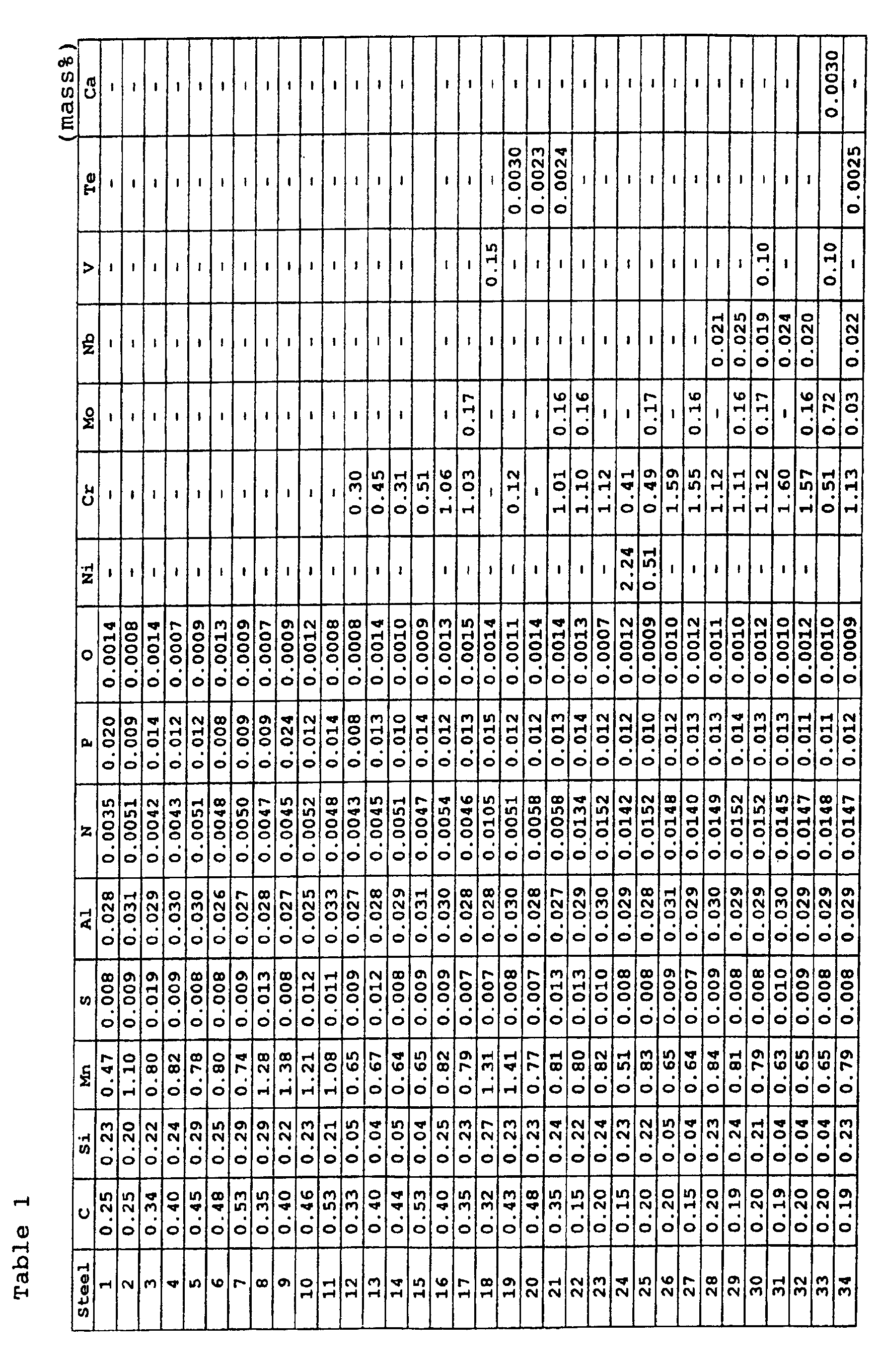
- C is an element indispensable for the enhancement of the steel strength required of machine structural components. With a C content less than 0.1%, the strength of a final product is insufficient but, with a C content in excess of 0.6%, the ductility of a final product is deteriorated. The C content is, therefore, limited to 0.1 to 0.6%.
- Si is added as a deoxidizing agent and also for the purpose of increasing the strength of a final product through solid solution hardening.
- a content of Si below 0.01% is insufficient for obtaining the above effects.
- the content of Si is defined to be 0.01 to 0.5%. It is, however, preferable to set the upper limit of the Si content at 0.35% or lower or, more preferably, at 0.2% or lower.
- Mn is an element effective for increasing the strength of a final product through the enhancement of hardenability. With a Mn content less than 0.2%, a sufficient effect is not obtained and, with its addition in excess of 1.7%, not only the effect becomes saturated but also ductility is deteriorated. The Mn content is, therefore, limited to 0.2 to 1.7%.
- S is a component inevitably included in steel and exists there in the form of MnS. Its content is defined in the present invention to be 0.001 to 0.15% because S is effective for enhancing machinability and fining a crystal structure. However, as S is detrimental to cold forming work, it is preferable to limit its content to 0.015% or lower or, more preferably, to 0.01% or lower, when machinability is not required.
- Al is effective as a deoxidizing agent. It is also effective for fining crystal grains by fixing solute N in steel as AlN. With an excessive content of Al, however, an excessive amount of Al 2 O 3 is formed, resulting in an increase of internal defects and the deterioration of cold workability.
- the content of Al is therefore limited within the range from 0.015 to 0.05% in the present invention.
- N reacts with Al or Nb to form AlN or NbN (NbCN), fines crystal grains and enhances steel ductility and, for this reason, its content is set at 0.003 to 0.025%.
- P is a component inevitably included in steel and causes grain boundary segregation and center segregation, deteriorating ductility. It is, therefore, desirable to limit the content of P to 0.035% or less or, preferably, 0.02% or less.
- O is a component inevitably included in steel too, and deteriorates cold workability by reacting with Al to form Al 2 O 3 . It is therefore desirable to control its content to 0.003% or lower or, preferably, 0.002% or lower.
- a steel may contain one or more of Ni, Cr and Mo.
- Ni, Cr and Mo are added for increasing the strength of a final product through the enhancement of hardenability and similar effects.
- An addition of each of these elements in a great quantity causes bainite and martensite to form down to the center portion of an as hot-rolled steel bar or wire rod, raising steel hardness, and is not desirable from the economical viewpoint, either.
- the contents of these elements therefore, are limited to 3.5% or less for Ni, 2% or less for Cr, and 1% or less for Mo.
- Nb and/or V may be added to a steel.
- Nb When the content of Nb is below 0.005% or that of V is below 0.03%, however, a tangible effect is not obtained.
- their contents exceed 0.1 and 0.3%, respectively, the effect is saturated and, rather, the ductility is deteriorated.
- their contents are defined to be 0.005 to 0.1% for Nb and 0.03 to 0.3% for V.
- a steel may contain one or more of the following elements: 0.02% or less of Te, 0.02% or less of Ca, 0.01% or less of Zr, 0.035% or less of Mg, 0.15% or less of rare earth elements, and 0.1% or less of Y. These elements form respective oxides, and the oxides not only act as nuclei for the formation of MnS but also reform MnS into (Mn, Ca)S, (Mn, Mg)S, etc.
- the contents of these elements are defined to be 0.02% or less for Te, 0.02% or less for Ca, 0.01% or less for Zr, 0.035% or less for Mg, 0.1% or less for Y, and 0.15% or less for rare earth elements.
- the rare earth elements described in the present invention mean elements having atomic numbers of 57 to 71.
- the Zr content in steel is determined by the inductively coupled plasma emission spectrometry (ICP), in a manner similar to the determination of the content of Nb in steel, after a sample is treated in the same manner as specified in Attachment 3 of JIS G 1237-1997.
- the amount of each sample used in the measurement of Example of the present invention was 2 g per steel grade and a calibration curve for the ICP was set so as to be suited for measuring a very small quantity of Zr. That is to say, solutions having different Zr concentrations were prepared by diluting a standard solution of Zr so that the Zr concentrations varied from 1 to 200 ppm, and the calibration curve was determined by measuring the amounts of Zr in the diluted solutions.
- the common procedures related to the ICP are based on JIS K 0116-1995 (General Rules for Emission Spectrometry) and JIS Z 8002-1991 (General Rules for Tolerances of Tests and Analyses).
- the present inventors studied methods of enhancing the ductility of a steel bar or wire rod for cold forging and made it clear that the key to enhancing the ductility of a spheroidizing-annealed steel material was to make the spheroidizing-annealed structure homogeneous and fine, and that, for this end, it was effective to control the percentage of ferrite in the structure after hot rolling to a specified figure or less and to make the balance a mixed structure consisting of one or more of fine martensite, bainite and pearlite. It follows that the ductility of a steel bar or wire rod increases when it is rapidly cooled after finish hot rolling and then spheroidizing-annealed.
- the present inventors discovered: that, for solving the above problem, it was effective to temper the martensite formed in the surface layer of a steel bar or wire rod by rapidly cooling the surface layer after finish hot rolling and subsequently making it recuperate by the sensible heat thereof and, by doing so, to soften the surface layer prior to spheroidizing annealing, and further to make the internal portion composed of a soft structure by making use of the low cooling rate; and that, as a result of the above, a steel bar or wire rod for cold forging excellent in ductility after spheroidizing annealing and having a low cold deformation resistance could be obtained.
- Fig. 1 is a graph showing the relation between the position (mm, 0 at the center) in a section of a steel bar 36 mm in diameter for cold forging according to the present invention and the hardness (HV) at the position.
- the average hardness at the surface is HV 280 to 330 and that at the center is roughly HV 200, and the hardness decreases gradually towards the center.
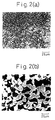
- the structure at the surface consists mainly of tempered martensite and that at the center mainly of ferrite and pearlite.
- the present inventors further proceeded with tests and examinations into the structure of the surface layer and the relation between the hardness of the surface layer and that of the center portion not causing cracking at cold forging work.
- the present inventors discovered: that, even if the surface layer was composed of a tempered martensite structure (a structure in which ferrite exists in a phase consisting substantially of one or more of martensite, bainite and pearlite), the cold forging cracks could not be prevented from occurring unless the area percentage of ferrite was 10% or less in the portion of a steel bar or wire rod from the surface to the depth of 0.15 of its diameter, or, preferably 5% or less in the case of heavy cold forging work; that, in order to secure the ductility during cold forging and prevent cracks from occurring and deformation resistance from increasing, it was necessary to form a fine and homogeneous structure having a higher percentage of tempered martensite in the surface layer at the stage after the steel bar or wire rod was hot-rolled; and that, for this end, it was necessary to create difference in hardness between the surface layer and the center portion at the stage after the steel bar or wire rod was hot-rolled and the necessary condition for achieving the above was to make the average hardness
- the austenite crystal grain size number under JIS G 0551 not less than 8 in the portion of the steel bar or wire rod from the surface to the depth of 0.15 of its radius.
- the ferrite crystal grain size number under JIS G 3545 not less than 8 in the portion of the steel bar or wire rod from the surface to the depth of 0.15 of its radius, and it is preferable to make the number not less than 9 when better properties are required, or not less than 10 when still higher properties are required.
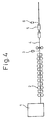
- Fig. 4 is a schematic illustration showing the example of a rolling line employed in the present invention.
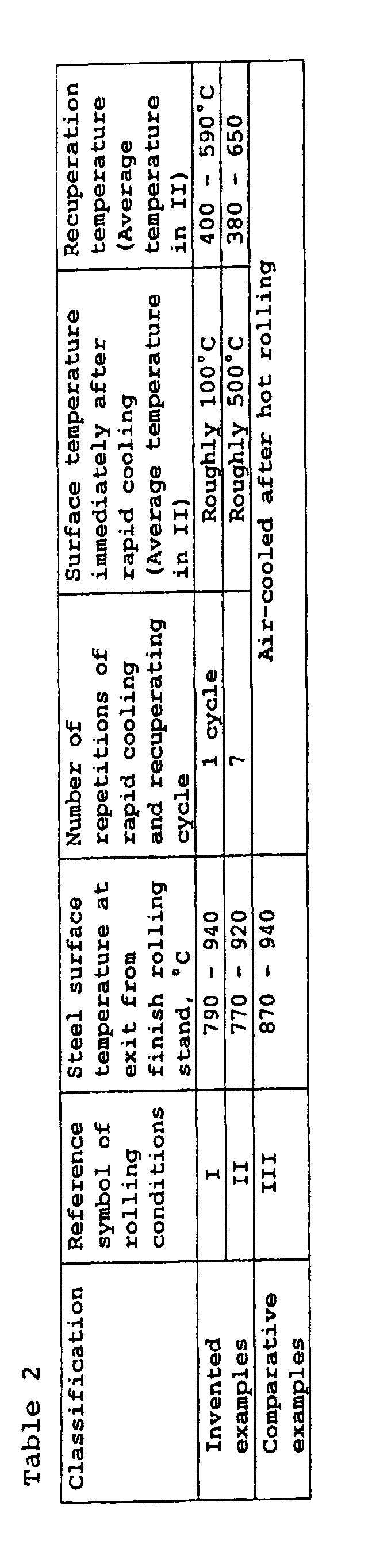
- a steel having a chemical composition according to any one of claims 1 to 5 is heated in a reheating furnace 1 and finish-rolled through a hot rolling mill 2 so that the surface temperature of the steel bar or wire rod is controlled to 700 to 1,000°C at the exit from the final finish rolling stand.
- the temperature at the exit from the final finish rolling stand is measured with a pyrometer 3.
- the finish-rolled steel bar or wire rod 4 is rapidly cooled by applying water to the surface in the cooling troughs 5 (preferably, at an average cooling rate of 30°C/sec.
- the surface layer of the steel bar or wire rod is recuperated by the sensible heat of its center portion to a surface temperature of 200 to 700°C (measured with a pyrometer 6) so that the structure of the surface layer consists mainly of tempered martensite.
- the above rapid cooling and recuperating process is conducted at least once or more. This remarkably enhances the ductility of a steel.
- the reason why the surface temperature of the steel bar or wire rod is controlled to 700 to 1,000°C is that crystal grains can be made fine through low temperature rolling and, by so doing, the structure after the rapid cooling can be made fine: when the surface temperature is 1,000°C or lower, the austenite grain size number in the surface layer becomes 8; when it is 950°C or lower, the number becomes 9; and when it is 860°C or lower, the number becomes 10.
- the surface temperature is below 700°C, however, it becomes difficult to reduce the quantity of ferrite in the structure of the surface layer, and, for his reason, the surface temperature must be 700°C or above.
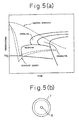
- Fig. 5 is a diagram showing CCT curves for explaining the structures of the surface layer and the center portion of a steel bar or wire rod.
- the structure of the surface layer 7, which is cooled at a high cooling rate mainly consists of tempered martensite, while that of the center portion 8, which is cooled at a lower cooling rate than the surface layer, consists of ferrite and pearlite.
- a steel bar or wire rod is rapidly cooled to a surface temperature of 600°C or below and then it is recuperated by the sensible heat to a surface temperature of 200 to 700°C is to make the surface layer consist of a structure mainly composed of tempered martensite and having a reduced hardness.
- the steels listed in Table 1 were rolled into steel bars and wire rods under the rolling conditions listed in Table 2.
- the diameter of the rolled products ranged from 36 to 55 mm.
- the steel bars and wire rods underwent spheroidizing annealing and then a hardening treatment through quenching and tempering.
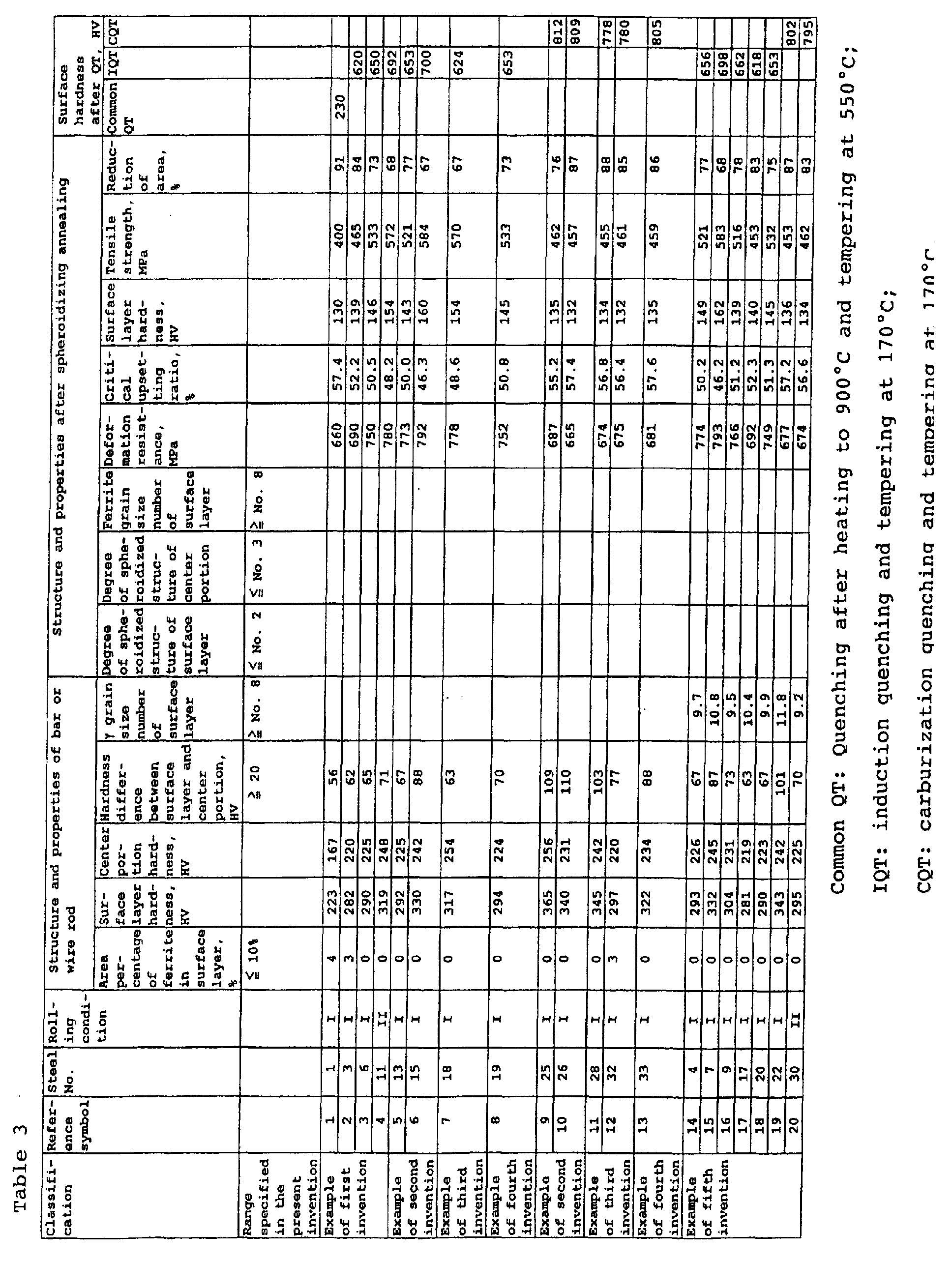
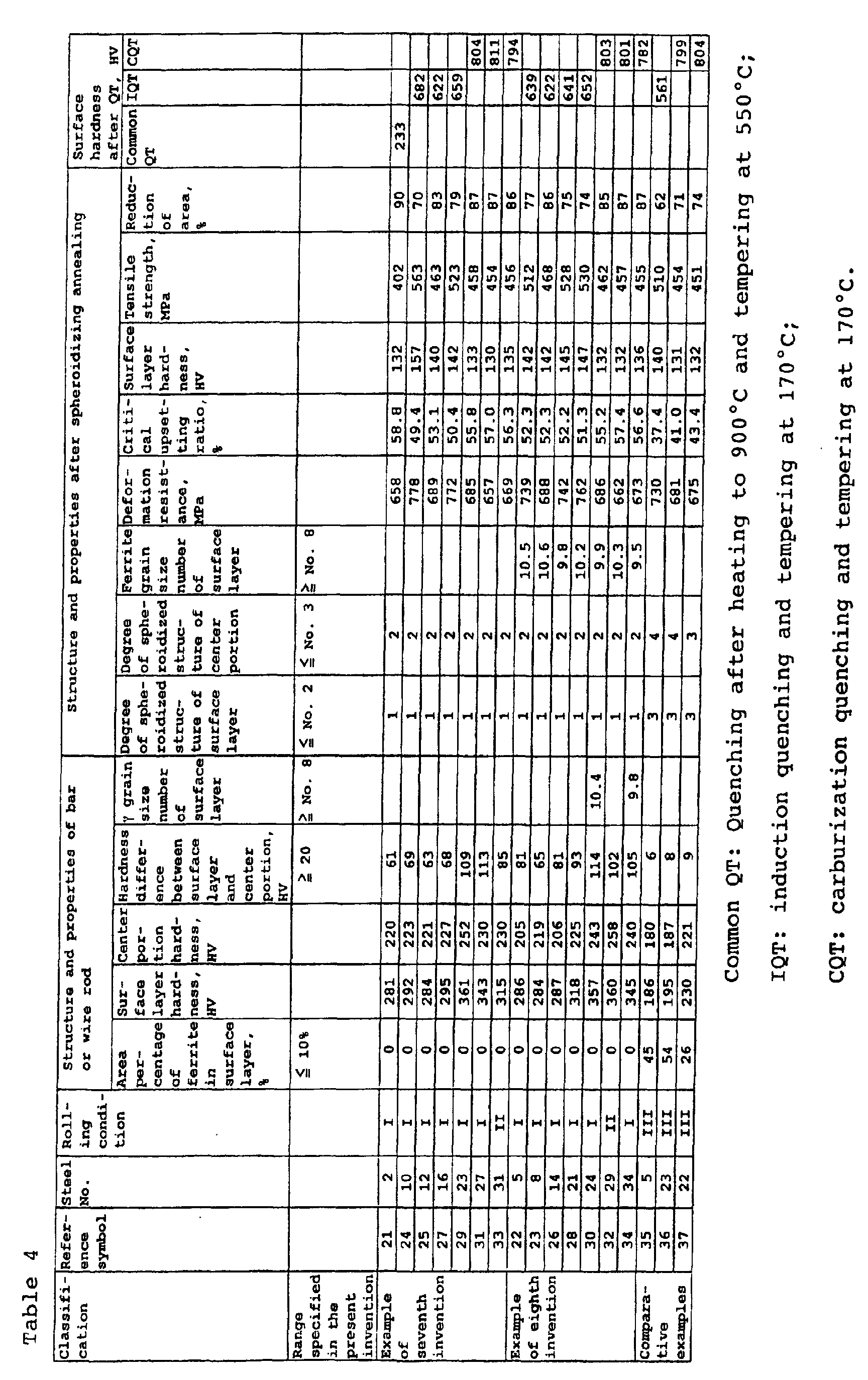
- the structures and properties of the steel bars and wire rods were investigated at the stages right after rolling, after spheroidizing-annealing and after quenched and tempered, respectively. The results are shown in Tables 3 and 4. "The portion of a steel bar or wire rod from the surface to the depth of 0.15 of the radius" referred to in the claims of the present invention is expressed in Tables 3 and 4 simply as "surface layer” (e.g., surface layer hardness).
- the portion of a steel bar or wire rod from the depth of 0.5 of the radius to the center is expressed in the tables simply as "center portion” (e.g., center portion hardness).
- the deformation resistance of each of the steel bars and wire rods was measured by subjecting the columnar test piece having the same diameter as the rolled product and a height 1.5 times the diameter to the upsetting test.
- a critical upsetting ratio was measured by subjecting each of the columnar test pieces of the aforementioned dimension, each having a notch 0.8 mm in depth and 0.15 mm in notch apex radius at the surface, to the upsetting test.
- the test pieces for tensile test were cut out from the positions corresponding to the surface layers of the rolled products, and the tensile strength and reduction of area, which is an indicator of ductility, of the surface layers were measured through tensile test.
- the rolled products of each steel underwent any one of the common quenching and tempering (common QT), induction quenching and tempering (IQT) and carburizing quenching and tempering (CQT).
- the induction quenching was conducted at a frequency of 30 kHz.
- the carburizing quenching was conducted under the condition of a carbon potential of 0.8% and 950°C x 8 h.
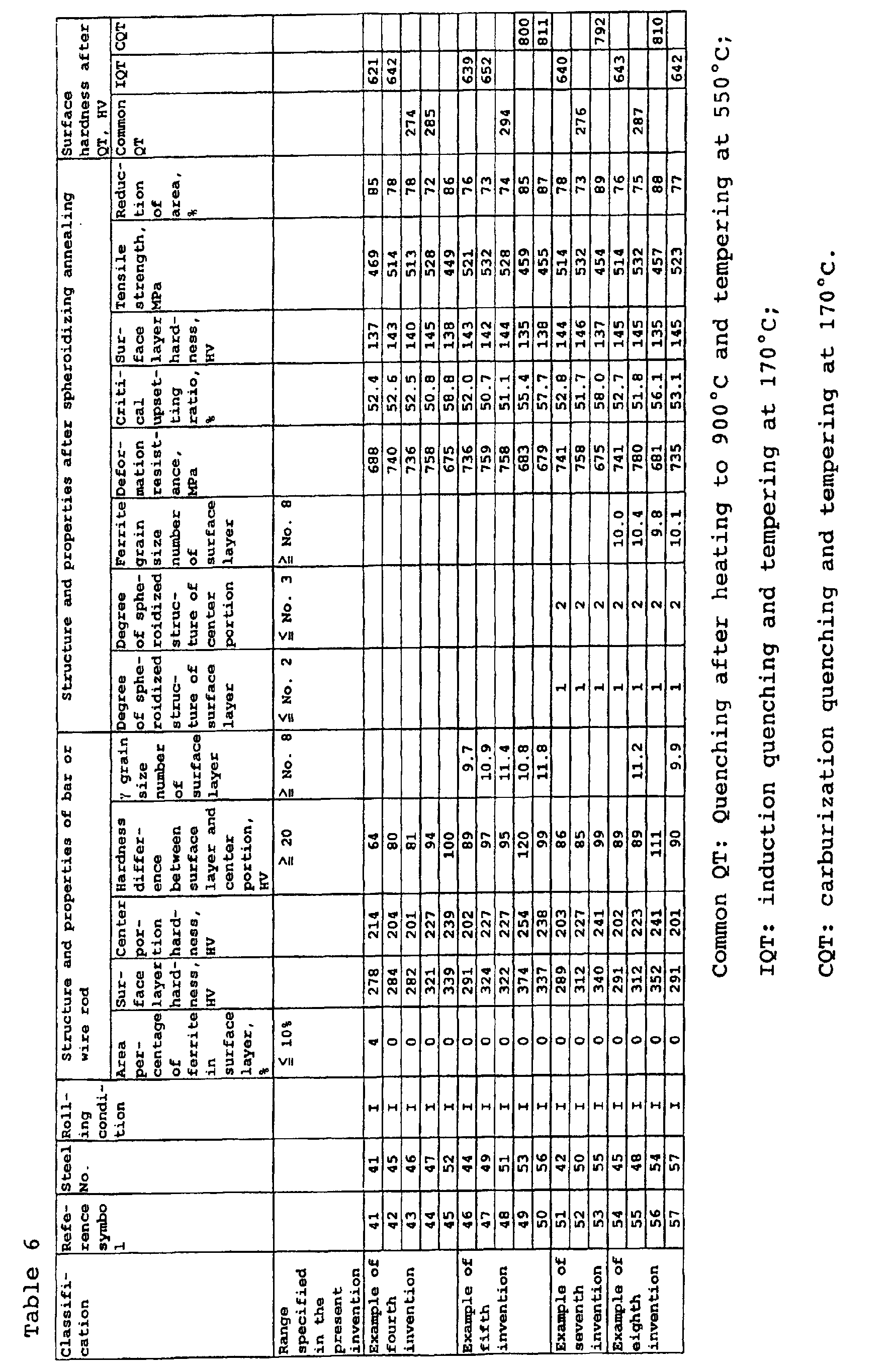
- the samples according to the present invention are remarkably better in the critical upsetting ratio and the reduction of area, which are indicators of steel ductility, than the comparative samples having the same carbon contents, and their deformation resistance and the hardness after the quenching and tempering are satisfactory.
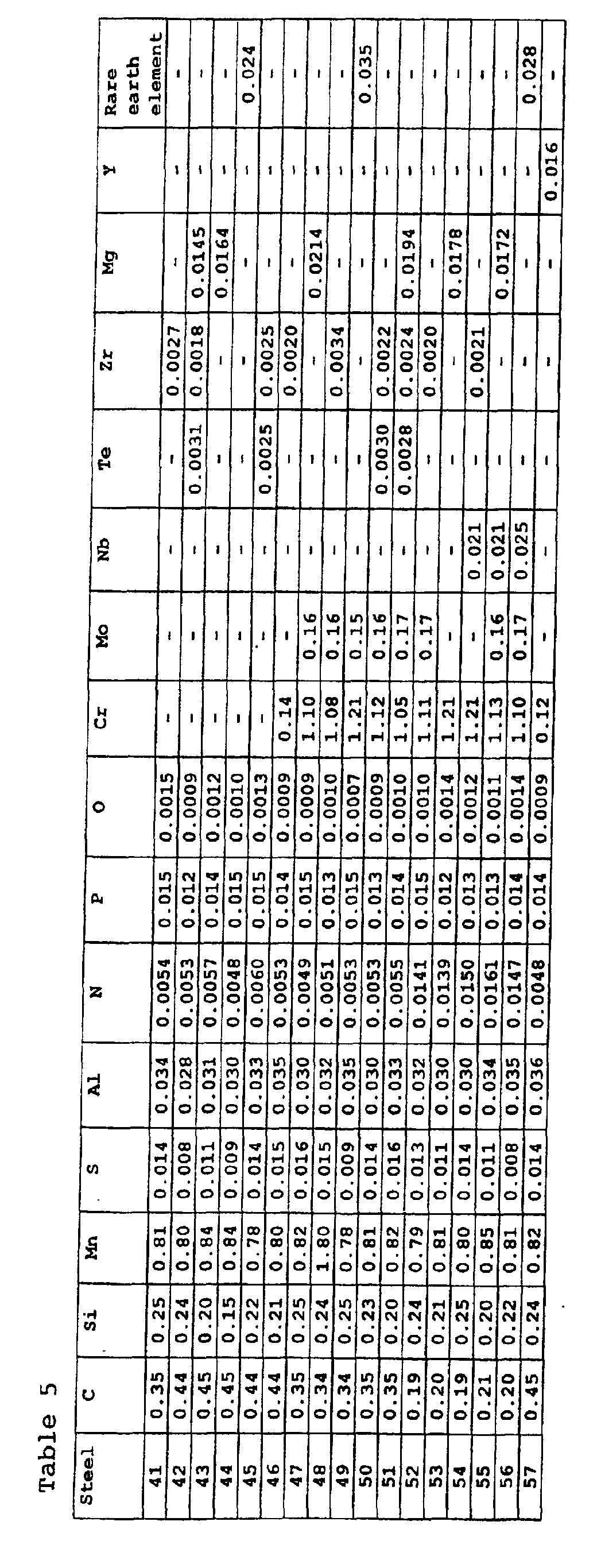
- Table 5 shows the steels listed in Table 5
- Table 6 shows the investigation results of their structures and material properties. Comparing the samples of Table 6 with the comparative samples of Table 4, the samples according to the present invention are remarkably better in the critical upsetting ratio and the reduction of area, which are indicators of steel ductility, than the comparative samples having the same carbon contents, and their deformation resistance and the hardness after the quenching and tempering are satisfactory.
- a steel bar or wire rod for cold forging according to the present invention is a steel bar or wire rod for cold forging excellent in ductility after spheroidizing annealing, capable of preventing the steel material from cracking during cold forging, which cracking has conventionally constituted a problem in the cold forging after spheroidizing annealing.
- the present invention makes it possible to manufacture forged machine components requiring heavy working by cold forging thanks to the above, it brings about remarkable advantages in significantly enhancing productivity and saving energy.
Landscapes
- Chemical & Material Sciences (AREA)
- Engineering & Computer Science (AREA)
- Materials Engineering (AREA)
- Mechanical Engineering (AREA)
- Metallurgy (AREA)
- Organic Chemistry (AREA)
- Physics & Mathematics (AREA)
- Thermal Sciences (AREA)
- Crystallography & Structural Chemistry (AREA)
- Heat Treatment Of Steel (AREA)
Abstract
Description
Claims (8)
- A steel bar or wire rod for cold forging excellent in ductility after spheroidizing annealing, characterized by: consisting of a steel containing, in mass,and having the contents of P and O controlled to 0.035% or less and 0.003% or less, respectively, with the balance consisting of Fe and unavoidable impurities; the area percentage of ferrite in the metallographic structure of the portion from the surface to the depth of 0.15 of the radius of said steel bar or wire rod being 10 % or less, with the rest of the structure consisting substantially of one or more of martensite, bainite and pearlite; and the average hardness of the portion from the depth of 0.5 of the radius to the center being lower than that of the surface layer (the portion from the surface to the depth of 0.15 of the radius) by HV 20 or more.0.1 to 0.6% of C,0.01 to 0.5% of Si,0.2 to 1.7% of Mn,0.001 to 0.15% of S,0.015 to 0.05% of Al and0.003 to 0.025% of N,
- A steel bar or wire rod for cold forging excellent in ductility after spheroidizing annealing according to claim 1, characterized by further containing, in mass, one or more of:3.5% or less of Ni,2% or less of Cr and1% or less of Mo.
- A steel bar or wire rod for cold forging excellent in ductility after spheroidizing annealing according to claim 1 or 2, characterized by further containing, in mass, one or more of:0.005 to 0.1% of Nb and0.03 to 0.3% of V.
- A steel bar or wire rod for cold forging excellent in ductility after spheroidizing annealing according to any one of claims 1 to 3, characterized by further containing, in mass, one or more of:0.02% or less of Te,0.02% or less of Ca,0.01% or less of Zr,0.035% or less of Mg,0.1% or less of Y and0.15% or less of rare earth elements.
- A steel bar or wire rod for cold forging excellent in ductility after spheroidizing annealing according to any one of claims 1 to 4, characterized in that the austenite grain size number according to Japanese Industrial Standard (JIS) in the portion from the surface to the depth of 0.15 of the radius is 8 or higher.
- A method of producing a steel bar or wire rod for cold forging excellent in ductility after spheroidizing annealing, characterized by: finish-rolling a steel material having a chemical composition specified in any one of claims 1 to 5 while controlling the surface temperature to 700 to 1,000°C at the exit from the final finish rolling stand, during hot rolling, and, after that, subjecting the rolled material to at least a process cycle of "rapidly cooling the hot rolled material to a surface temperature of 600°C or below and subsequently making it recuperate by the sensible heat thereof so that the surface temperature becomes 200 to 700°C" or repeating the process cycle twice or more; and, by doing so, making the area percentage of ferrite in the structure of the portion of the steel bar or wire rod from the surface to the depth of 0.15 of the radius of the steel bar or wire rod or less, and the rest of the structure being consisted substantially of one or more of martensite, bainite and pearlite, and also, forming the structure in which the average hardness of the portion from the depth of 0.5 of the radius to the center is lower than that of the surface layer (the portion from the surface to the depth of 0.15 of the radius) by HV 20 or more.
- A steel bar or wire rod for cold forging excellent in ductility characterized by: being a steel bar or wire rod according to any one of claims 1 to 5 having undergone spheroidizing annealing; the degree of spheroidized structure according to JIS G 3539 in the portion from the surface to the depth of 0.15 of the radius being No. 2 or below; and the degree of spheroidized structure in the portion from the depth of 0.5 of the radius to the center being No. 3 or below.
- A steel bar or wire rod for cold forging excellent in ductility according to claim 7, characterized in that the ferrite grain size number under JIS in the portion from the surface to the depth of 0.15 of the radius is 8 or higher.
Applications Claiming Priority (5)
| Application Number | Priority Date | Filing Date | Title |
|---|---|---|---|
| JP36655299 | 1999-12-24 | ||
| JP36655299 | 1999-12-24 | ||
| JP2000261688 | 2000-08-30 | ||
| JP2000261688A JP4435953B2 (en) | 1999-12-24 | 2000-08-30 | Bar wire for cold forging and its manufacturing method |
| PCT/JP2000/009165 WO2001048257A1 (en) | 1999-12-24 | 2000-12-22 | Bar or wire product for use in cold forging and method for producing the same |
Publications (3)
| Publication Number | Publication Date |
|---|---|
| EP1243664A1 true EP1243664A1 (en) | 2002-09-25 |
| EP1243664A4 EP1243664A4 (en) | 2004-11-17 |
| EP1243664B1 EP1243664B1 (en) | 2005-12-07 |
Family
ID=26581808
Family Applications (1)
| Application Number | Title | Priority Date | Filing Date |
|---|---|---|---|
| EP00985851A Expired - Lifetime EP1243664B1 (en) | 1999-12-24 | 2000-12-22 | Bar or wire product for use in cold forging and method for producing the same |
Country Status (5)
| Country | Link |
|---|---|
| US (1) | US6866724B2 (en) |
| EP (1) | EP1243664B1 (en) |
| JP (1) | JP4435953B2 (en) |
| DE (1) | DE60024672T2 (en) |
| WO (1) | WO2001048257A1 (en) |
Cited By (4)
| Publication number | Priority date | Publication date | Assignee | Title |
|---|---|---|---|---|
| WO2004067789A1 (en) * | 2003-01-27 | 2004-08-12 | Nippon Steel Corporation | High strength high toughness high carbon steel wire rod and process for producing the same |
| EP1669468A4 (en) * | 2003-09-29 | 2007-03-07 | Jfe Steel Corp | Steel product for induction hardening, induction-hardened member using the same, and methods for producing them |
| EP3072986A4 (en) * | 2013-11-19 | 2017-06-14 | Nippon Steel & Sumitomo Metal Corporation | Rod steel |
| US20180044757A1 (en) * | 2015-03-31 | 2018-02-15 | Nippon Steel & Sumitomo Metal Corporation | Age-hardening steel and method of manufacturing parts using age-hardening steel |
Families Citing this family (23)
| Publication number | Priority date | Publication date | Assignee | Title |
|---|---|---|---|---|
| JP3740042B2 (en) * | 2000-09-06 | 2006-01-25 | 株式会社神戸製鋼所 | Method for controlling the morphology of sulfide inclusions |
| AU2003222211A1 (en) * | 2002-02-12 | 2003-09-04 | The Timken Company | Low carbon microalloyed steel |
| DE10359679B3 (en) * | 2003-12-18 | 2005-02-24 | Ejot Gmbh & Co. Kg | Fixing screw formed by cold rolling consists of a material made from steel having a ferritic structure and further components having a higher carbon content compared with the carbon in the ferrite |
| KR100536660B1 (en) * | 2003-12-18 | 2005-12-14 | 삼화강봉주식회사 | Steel wire with superior impact absorption energy at law temperature and the method of making the same |
| JP2007023310A (en) * | 2005-07-12 | 2007-02-01 | Kobe Steel Ltd | Steel for machine structural use |
| US20070068607A1 (en) * | 2005-09-29 | 2007-03-29 | Huff Philip A | Method for heat treating thick-walled forgings |
| JP5064240B2 (en) * | 2006-07-28 | 2012-10-31 | 新日本製鐵株式会社 | Surface fine-grained steel parts and manufacturing method thereof |
| JP5215720B2 (en) * | 2008-04-28 | 2013-06-19 | 株式会社神戸製鋼所 | Steel wire rod |
| JP5233846B2 (en) * | 2009-06-02 | 2013-07-10 | 新日鐵住金株式会社 | Steel materials used for nitriding and induction hardening |
| JP5443331B2 (en) * | 2009-12-24 | 2014-03-19 | 株式会社神戸製鋼所 | Forged steel and assembled crankshaft |
| JP4977879B2 (en) * | 2010-02-26 | 2012-07-18 | Jfeスチール株式会社 | Super high strength cold-rolled steel sheet with excellent bendability |
| JP5676146B2 (en) * | 2010-05-25 | 2015-02-25 | 株式会社リケン | Pressure ring and manufacturing method thereof |
| JP5736936B2 (en) * | 2011-04-27 | 2015-06-17 | 新日鐵住金株式会社 | Hot rolled steel bar or wire, and method for producing cold forging steel wire |
| CN102212747A (en) * | 2011-06-03 | 2011-10-12 | 首钢总公司 | Low-cost steel for automobile beam and manufacturing method thereof |
| DE102011051682B4 (en) * | 2011-07-08 | 2013-02-21 | Max Aicher | Method and apparatus for treating a steel product and steel product |
| KR20140135264A (en) * | 2012-04-05 | 2014-11-25 | 신닛테츠스미킨 카부시키카이샤 | Steel wire rod or steel bar having excellent cold forgeability |
| WO2014030327A1 (en) | 2012-08-20 | 2014-02-27 | 新日鐵住金株式会社 | Round steel material for cold forging |
| KR101449511B1 (en) * | 2014-07-29 | 2014-10-13 | 한국기계연구원 | Work hardenable yield ratio control steel and method for manufacturing the same |
| JP6319136B2 (en) * | 2015-02-26 | 2018-05-09 | Jfeスチール株式会社 | Steel material having an inclined structure and method for producing the same |
| KR101758491B1 (en) * | 2015-12-17 | 2017-07-17 | 주식회사 포스코 | Non-quenched and tempered wire rod having excellent strength and cold workability and method for manufacturing same |
| JP6443324B2 (en) * | 2015-12-25 | 2018-12-26 | Jfeスチール株式会社 | Steel material and manufacturing method thereof |
| KR101787287B1 (en) * | 2016-10-21 | 2017-10-19 | 현대제철 주식회사 | High strength steel deformed bar and method of manufacturing the same |
| KR102448754B1 (en) * | 2020-12-14 | 2022-09-30 | 주식회사 포스코 | High-strength wire rod with excellent heat treatment property and resistance of hydrogen delayed fracture, heat treatment parts using the same, and methods for manufacturing thereof |
Family Cites Families (7)
| Publication number | Priority date | Publication date | Assignee | Title |
|---|---|---|---|---|
| US3711338A (en) * | 1970-10-16 | 1973-01-16 | Morgan Construction Co | Method for cooling and spheroidizing steel rod |
| FR2488278A1 (en) * | 1980-08-05 | 1982-02-12 | Siderurgie Fse Inst Rech | Spheroidisation annealing steel to improve cold formability - preceded by quenching from rolling temp. to reduce annealing time |
| JPS62139817A (en) | 1985-12-16 | 1987-06-23 | Kawasaki Steel Corp | Production of steel wire enabling quick spheroidization treatment |
| US5213634A (en) | 1991-04-08 | 1993-05-25 | Deardo Anthony J | Multiphase microalloyed steel and method thereof |
| JPH07268546A (en) * | 1994-03-30 | 1995-10-17 | Sumitomo Metal Ind Ltd | High carbon steel wire having double-layered structure and method for producing the same |
| JPH09287056A (en) | 1996-04-23 | 1997-11-04 | Toa Steel Co Ltd | Wire rod and steel bar having excellent cold forgeability, and methods for producing the same |
| JP4435954B2 (en) * | 1999-12-24 | 2010-03-24 | 新日本製鐵株式会社 | Bar wire for cold forging and its manufacturing method |
-
2000
- 2000-08-30 JP JP2000261688A patent/JP4435953B2/en not_active Expired - Fee Related
- 2000-12-22 WO PCT/JP2000/009165 patent/WO2001048257A1/en not_active Ceased
- 2000-12-22 DE DE60024672T patent/DE60024672T2/en not_active Expired - Lifetime
- 2000-12-22 EP EP00985851A patent/EP1243664B1/en not_active Expired - Lifetime
- 2000-12-22 US US10/168,650 patent/US6866724B2/en not_active Expired - Lifetime
Cited By (6)
| Publication number | Priority date | Publication date | Assignee | Title |
|---|---|---|---|---|
| WO2004067789A1 (en) * | 2003-01-27 | 2004-08-12 | Nippon Steel Corporation | High strength high toughness high carbon steel wire rod and process for producing the same |
| US7462250B2 (en) | 2003-01-27 | 2008-12-09 | Nippon Steel Corporation | High strength, high toughness, high carbon steel wire rod and method of production of same |
| EP1669468A4 (en) * | 2003-09-29 | 2007-03-07 | Jfe Steel Corp | Steel product for induction hardening, induction-hardened member using the same, and methods for producing them |
| EP3072986A4 (en) * | 2013-11-19 | 2017-06-14 | Nippon Steel & Sumitomo Metal Corporation | Rod steel |
| US10131965B2 (en) | 2013-11-19 | 2018-11-20 | Nippon Steel & Sumitomo Metal Corporation | Steel bar |
| US20180044757A1 (en) * | 2015-03-31 | 2018-02-15 | Nippon Steel & Sumitomo Metal Corporation | Age-hardening steel and method of manufacturing parts using age-hardening steel |
Also Published As
| Publication number | Publication date |
|---|---|
| DE60024672T2 (en) | 2006-07-20 |
| EP1243664B1 (en) | 2005-12-07 |
| EP1243664A4 (en) | 2004-11-17 |
| JP4435953B2 (en) | 2010-03-24 |
| US6866724B2 (en) | 2005-03-15 |
| JP2001240940A (en) | 2001-09-04 |
| WO2001048257A1 (en) | 2001-07-05 |
| US20030075250A1 (en) | 2003-04-24 |
| DE60024672D1 (en) | 2006-01-12 |
Similar Documents
| Publication | Publication Date | Title |
|---|---|---|
| EP1243664B1 (en) | Bar or wire product for use in cold forging and method for producing the same | |
| US6602359B1 (en) | Bar or wire product for use in cold forging and method for producing the same | |
| US6547890B2 (en) | Steel wire rod for cold forging and method for producing the same | |
| US6551419B2 (en) | Hot-rolled steel wire and rod for machine structural use and a method for producing the same | |
| KR101965520B1 (en) | Rolled steel bar or rolled wire material for cold-forged component | |
| EP2784169B1 (en) | Rolled steel bar for hot forging | |
| CN108315637B (en) | High carbon hot-rolled steel sheet and method for producing same | |
| JPWO2020145325A1 (en) | Steel material | |
| JP4057930B2 (en) | Machine structural steel excellent in cold workability and method for producing the same | |
| JP3536684B2 (en) | Steel wire with excellent wire drawing workability | |
| CN114502761B (en) | Rails and manufacturing methods | |
| EP3020841B1 (en) | Coil spring, and method for manufacturing same | |
| JP2024001480A (en) | Steel | |
| JPH05171262A (en) | Manufacture of wire rod or bar steel for case hardened product | |
| CN120898013A (en) | Guide rail and its manufacturing method | |
| JP2024543182A (en) | Ultra-high strength cold-rolled steel sheet with excellent elongation ratio and its manufacturing method | |
| WO2024003593A1 (en) | Forged part of steel and a method of manufacturing thereof | |
| JPH10152754A (en) | Case hardening steel and method for producing case hardened steel | |
| KR101115716B1 (en) | High strength steel having excellent delayed fracture resistance and low yield ratio and method for producing the same | |
| EP4663799A1 (en) | Rail and method for manufacturing same | |
| KR101115718B1 (en) | High strength steel having excellent delayed fracture resistance and elongation and method for producing the same | |
| EP3901294A1 (en) | Steel sheet | |
| KR100605723B1 (en) | High strength steel product with excellent delayed fracture resistance and manufacturing method | |
| WO2025125864A1 (en) | Forged part of steel and a method of manufacturing thereof | |
| WO2025210377A1 (en) | Steel for coil springs of automobiles and a method of manufacturing of a coil thereof |
Legal Events
| Date | Code | Title | Description |
|---|---|---|---|
| PUAI | Public reference made under article 153(3) epc to a published international application that has entered the european phase |
Free format text: ORIGINAL CODE: 0009012 |
|
| 17P | Request for examination filed |
Effective date: 20020712 |
|
| AK | Designated contracting states |
Kind code of ref document: A1 Designated state(s): AT BE CH CY DE DK ES FI FR GB GR IE IT LI LU MC NL PT SE TR |
|
| RBV | Designated contracting states (corrected) |
Designated state(s): DE GB |
|
| A4 | Supplementary search report drawn up and despatched |
Effective date: 20040930 |
|
| GRAP | Despatch of communication of intention to grant a patent |
Free format text: ORIGINAL CODE: EPIDOSNIGR1 |
|
| GRAS | Grant fee paid |
Free format text: ORIGINAL CODE: EPIDOSNIGR3 |
|
| GRAA | (expected) grant |
Free format text: ORIGINAL CODE: 0009210 |
|
| AK | Designated contracting states |
Kind code of ref document: B1 Designated state(s): DE GB |
|
| REG | Reference to a national code |
Ref country code: GB Ref legal event code: FG4D |
|
| REF | Corresponds to: |
Ref document number: 60024672 Country of ref document: DE Date of ref document: 20060112 Kind code of ref document: P |
|
| PLBE | No opposition filed within time limit |
Free format text: ORIGINAL CODE: 0009261 |
|
| STAA | Information on the status of an ep patent application or granted ep patent |
Free format text: STATUS: NO OPPOSITION FILED WITHIN TIME LIMIT |
|
| 26N | No opposition filed |
Effective date: 20060908 |
|
| REG | Reference to a national code |
Ref country code: DE Ref legal event code: R082 Ref document number: 60024672 Country of ref document: DE Representative=s name: VOSSIUS & PARTNER, DE Effective date: 20130227 Ref country code: DE Ref legal event code: R081 Ref document number: 60024672 Country of ref document: DE Owner name: NIPPON STEEL & SUMITOMO METAL CORPORATION, JP Free format text: FORMER OWNER: NIPPON STEEL CORP., TOKIO/TOKYO, JP Effective date: 20130227 Ref country code: DE Ref legal event code: R082 Ref document number: 60024672 Country of ref document: DE Representative=s name: VOSSIUS & PARTNER PATENTANWAELTE RECHTSANWAELT, DE Effective date: 20130227 |
|
| PGFP | Annual fee paid to national office [announced via postgrant information from national office to epo] |
Ref country code: DE Payment date: 20181211 Year of fee payment: 19 |
|
| PGFP | Annual fee paid to national office [announced via postgrant information from national office to epo] |
Ref country code: GB Payment date: 20181219 Year of fee payment: 19 |
|
| REG | Reference to a national code |
Ref country code: DE Ref legal event code: R082 Ref document number: 60024672 Country of ref document: DE Representative=s name: VOSSIUS & PARTNER PATENTANWAELTE RECHTSANWAELT, DE Ref country code: DE Ref legal event code: R081 Ref document number: 60024672 Country of ref document: DE Owner name: NIPPON STEEL CORPORATION, JP Free format text: FORMER OWNER: NIPPON STEEL & SUMITOMO METAL CORPORATION, TOKYO, JP |
|
| REG | Reference to a national code |
Ref country code: DE Ref legal event code: R119 Ref document number: 60024672 Country of ref document: DE |
|
| GBPC | Gb: european patent ceased through non-payment of renewal fee |
Effective date: 20191222 |
|
| PG25 | Lapsed in a contracting state [announced via postgrant information from national office to epo] |
Ref country code: GB Free format text: LAPSE BECAUSE OF NON-PAYMENT OF DUE FEES Effective date: 20191222 Ref country code: DE Free format text: LAPSE BECAUSE OF NON-PAYMENT OF DUE FEES Effective date: 20200701 |