EP1243591A2 - Synthesis of non-C2-symmetric bisphosphine ligands as catalysts for asymmetric hydrogenation - Google Patents
Synthesis of non-C2-symmetric bisphosphine ligands as catalysts for asymmetric hydrogenation Download PDFInfo
- Publication number
- EP1243591A2 EP1243591A2 EP02005577A EP02005577A EP1243591A2 EP 1243591 A2 EP1243591 A2 EP 1243591A2 EP 02005577 A EP02005577 A EP 02005577A EP 02005577 A EP02005577 A EP 02005577A EP 1243591 A2 EP1243591 A2 EP 1243591A2
- Authority
- EP
- European Patent Office
- Prior art keywords
- chiral
- phosphorous
- butyl
- phosphorous atom
- achiral
- Prior art date
- Legal status (The legal status is an assumption and is not a legal conclusion. Google has not performed a legal analysis and makes no representation as to the accuracy of the status listed.)
- Withdrawn
Links
- 0 CC(C=C1)=C(C2CCCC2)C=C*1I Chemical compound CC(C=C1)=C(C2CCCC2)C=C*1I 0.000 description 2
- HFWASDNNFQPAEQ-UHFFFAOYSA-N COc(cccc1)c1P(c1ccccc1)[IH+] Chemical compound COc(cccc1)c1P(c1ccccc1)[IH+] HFWASDNNFQPAEQ-UHFFFAOYSA-N 0.000 description 1
Classifications
-
- B—PERFORMING OPERATIONS; TRANSPORTING
- B01—PHYSICAL OR CHEMICAL PROCESSES OR APPARATUS IN GENERAL
- B01J—CHEMICAL OR PHYSICAL PROCESSES, e.g. CATALYSIS OR COLLOID CHEMISTRY; THEIR RELEVANT APPARATUS
- B01J31/00—Catalysts comprising hydrides, coordination complexes or organic compounds
- B01J31/16—Catalysts comprising hydrides, coordination complexes or organic compounds containing coordination complexes
- B01J31/22—Organic complexes
- B01J31/2282—Unsaturated compounds used as ligands
- B01J31/2295—Cyclic compounds, e.g. cyclopentadienyls
-
- B—PERFORMING OPERATIONS; TRANSPORTING
- B01—PHYSICAL OR CHEMICAL PROCESSES OR APPARATUS IN GENERAL
- B01J—CHEMICAL OR PHYSICAL PROCESSES, e.g. CATALYSIS OR COLLOID CHEMISTRY; THEIR RELEVANT APPARATUS
- B01J31/00—Catalysts comprising hydrides, coordination complexes or organic compounds
- B01J31/16—Catalysts comprising hydrides, coordination complexes or organic compounds containing coordination complexes
- B01J31/24—Phosphines, i.e. phosphorus bonded to only carbon atoms, or to both carbon and hydrogen atoms, including e.g. sp2-hybridised phosphorus compounds such as phosphabenzene, phosphole or anionic phospholide ligands
-
- B—PERFORMING OPERATIONS; TRANSPORTING
- B01—PHYSICAL OR CHEMICAL PROCESSES OR APPARATUS IN GENERAL
- B01J—CHEMICAL OR PHYSICAL PROCESSES, e.g. CATALYSIS OR COLLOID CHEMISTRY; THEIR RELEVANT APPARATUS
- B01J31/00—Catalysts comprising hydrides, coordination complexes or organic compounds
- B01J31/16—Catalysts comprising hydrides, coordination complexes or organic compounds containing coordination complexes
- B01J31/24—Phosphines, i.e. phosphorus bonded to only carbon atoms, or to both carbon and hydrogen atoms, including e.g. sp2-hybridised phosphorus compounds such as phosphabenzene, phosphole or anionic phospholide ligands
- B01J31/2404—Cyclic ligands, including e.g. non-condensed polycyclic ligands, the phosphine-P atom being a ring member or a substituent on the ring
- B01J31/2409—Cyclic ligands, including e.g. non-condensed polycyclic ligands, the phosphine-P atom being a ring member or a substituent on the ring with more than one complexing phosphine-P atom
-
- B—PERFORMING OPERATIONS; TRANSPORTING
- B01—PHYSICAL OR CHEMICAL PROCESSES OR APPARATUS IN GENERAL
- B01J—CHEMICAL OR PHYSICAL PROCESSES, e.g. CATALYSIS OR COLLOID CHEMISTRY; THEIR RELEVANT APPARATUS
- B01J31/00—Catalysts comprising hydrides, coordination complexes or organic compounds
- B01J31/16—Catalysts comprising hydrides, coordination complexes or organic compounds containing coordination complexes
- B01J31/24—Phosphines, i.e. phosphorus bonded to only carbon atoms, or to both carbon and hydrogen atoms, including e.g. sp2-hybridised phosphorus compounds such as phosphabenzene, phosphole or anionic phospholide ligands
- B01J31/2404—Cyclic ligands, including e.g. non-condensed polycyclic ligands, the phosphine-P atom being a ring member or a substituent on the ring
- B01J31/2409—Cyclic ligands, including e.g. non-condensed polycyclic ligands, the phosphine-P atom being a ring member or a substituent on the ring with more than one complexing phosphine-P atom
- B01J31/2414—Cyclic ligands, including e.g. non-condensed polycyclic ligands, the phosphine-P atom being a ring member or a substituent on the ring with more than one complexing phosphine-P atom comprising aliphatic or saturated rings
-
- B—PERFORMING OPERATIONS; TRANSPORTING
- B01—PHYSICAL OR CHEMICAL PROCESSES OR APPARATUS IN GENERAL
- B01J—CHEMICAL OR PHYSICAL PROCESSES, e.g. CATALYSIS OR COLLOID CHEMISTRY; THEIR RELEVANT APPARATUS
- B01J31/00—Catalysts comprising hydrides, coordination complexes or organic compounds
- B01J31/16—Catalysts comprising hydrides, coordination complexes or organic compounds containing coordination complexes
- B01J31/24—Phosphines, i.e. phosphorus bonded to only carbon atoms, or to both carbon and hydrogen atoms, including e.g. sp2-hybridised phosphorus compounds such as phosphabenzene, phosphole or anionic phospholide ligands
- B01J31/2404—Cyclic ligands, including e.g. non-condensed polycyclic ligands, the phosphine-P atom being a ring member or a substituent on the ring
- B01J31/2419—Cyclic ligands, including e.g. non-condensed polycyclic ligands, the phosphine-P atom being a ring member or a substituent on the ring comprising P as ring member
- B01J31/2428—Cyclic ligands, including e.g. non-condensed polycyclic ligands, the phosphine-P atom being a ring member or a substituent on the ring comprising P as ring member with more than one complexing phosphine-P atom
- B01J31/2433—Cyclic ligands, including e.g. non-condensed polycyclic ligands, the phosphine-P atom being a ring member or a substituent on the ring comprising P as ring member with more than one complexing phosphine-P atom comprising aliphatic or saturated rings
-
- B—PERFORMING OPERATIONS; TRANSPORTING
- B01—PHYSICAL OR CHEMICAL PROCESSES OR APPARATUS IN GENERAL
- B01J—CHEMICAL OR PHYSICAL PROCESSES, e.g. CATALYSIS OR COLLOID CHEMISTRY; THEIR RELEVANT APPARATUS
- B01J31/00—Catalysts comprising hydrides, coordination complexes or organic compounds
- B01J31/16—Catalysts comprising hydrides, coordination complexes or organic compounds containing coordination complexes
- B01J31/24—Phosphines, i.e. phosphorus bonded to only carbon atoms, or to both carbon and hydrogen atoms, including e.g. sp2-hybridised phosphorus compounds such as phosphabenzene, phosphole or anionic phospholide ligands
- B01J31/2404—Cyclic ligands, including e.g. non-condensed polycyclic ligands, the phosphine-P atom being a ring member or a substituent on the ring
- B01J31/2442—Cyclic ligands, including e.g. non-condensed polycyclic ligands, the phosphine-P atom being a ring member or a substituent on the ring comprising condensed ring systems
- B01J31/2447—Cyclic ligands, including e.g. non-condensed polycyclic ligands, the phosphine-P atom being a ring member or a substituent on the ring comprising condensed ring systems and phosphine-P atoms as substituents on a ring of the condensed system or on a further attached ring
- B01J31/2452—Cyclic ligands, including e.g. non-condensed polycyclic ligands, the phosphine-P atom being a ring member or a substituent on the ring comprising condensed ring systems and phosphine-P atoms as substituents on a ring of the condensed system or on a further attached ring with more than one complexing phosphine-P atom
-
- B—PERFORMING OPERATIONS; TRANSPORTING
- B01—PHYSICAL OR CHEMICAL PROCESSES OR APPARATUS IN GENERAL
- B01J—CHEMICAL OR PHYSICAL PROCESSES, e.g. CATALYSIS OR COLLOID CHEMISTRY; THEIR RELEVANT APPARATUS
- B01J31/00—Catalysts comprising hydrides, coordination complexes or organic compounds
- B01J31/16—Catalysts comprising hydrides, coordination complexes or organic compounds containing coordination complexes
- B01J31/24—Phosphines, i.e. phosphorus bonded to only carbon atoms, or to both carbon and hydrogen atoms, including e.g. sp2-hybridised phosphorus compounds such as phosphabenzene, phosphole or anionic phospholide ligands
- B01J31/2404—Cyclic ligands, including e.g. non-condensed polycyclic ligands, the phosphine-P atom being a ring member or a substituent on the ring
- B01J31/2442—Cyclic ligands, including e.g. non-condensed polycyclic ligands, the phosphine-P atom being a ring member or a substituent on the ring comprising condensed ring systems
- B01J31/2447—Cyclic ligands, including e.g. non-condensed polycyclic ligands, the phosphine-P atom being a ring member or a substituent on the ring comprising condensed ring systems and phosphine-P atoms as substituents on a ring of the condensed system or on a further attached ring
- B01J31/2452—Cyclic ligands, including e.g. non-condensed polycyclic ligands, the phosphine-P atom being a ring member or a substituent on the ring comprising condensed ring systems and phosphine-P atoms as substituents on a ring of the condensed system or on a further attached ring with more than one complexing phosphine-P atom
- B01J31/2457—Cyclic ligands, including e.g. non-condensed polycyclic ligands, the phosphine-P atom being a ring member or a substituent on the ring comprising condensed ring systems and phosphine-P atoms as substituents on a ring of the condensed system or on a further attached ring with more than one complexing phosphine-P atom comprising aliphatic or saturated rings, e.g. Xantphos
-
- B—PERFORMING OPERATIONS; TRANSPORTING
- B01—PHYSICAL OR CHEMICAL PROCESSES OR APPARATUS IN GENERAL
- B01J—CHEMICAL OR PHYSICAL PROCESSES, e.g. CATALYSIS OR COLLOID CHEMISTRY; THEIR RELEVANT APPARATUS
- B01J31/00—Catalysts comprising hydrides, coordination complexes or organic compounds
- B01J31/16—Catalysts comprising hydrides, coordination complexes or organic compounds containing coordination complexes
- B01J31/24—Phosphines, i.e. phosphorus bonded to only carbon atoms, or to both carbon and hydrogen atoms, including e.g. sp2-hybridised phosphorus compounds such as phosphabenzene, phosphole or anionic phospholide ligands
- B01J31/2404—Cyclic ligands, including e.g. non-condensed polycyclic ligands, the phosphine-P atom being a ring member or a substituent on the ring
- B01J31/2442—Cyclic ligands, including e.g. non-condensed polycyclic ligands, the phosphine-P atom being a ring member or a substituent on the ring comprising condensed ring systems
- B01J31/2461—Cyclic ligands, including e.g. non-condensed polycyclic ligands, the phosphine-P atom being a ring member or a substituent on the ring comprising condensed ring systems and phosphine-P atoms as ring members in the condensed ring system or in a further ring
- B01J31/2471—Cyclic ligands, including e.g. non-condensed polycyclic ligands, the phosphine-P atom being a ring member or a substituent on the ring comprising condensed ring systems and phosphine-P atoms as ring members in the condensed ring system or in a further ring with more than one complexing phosphine-P atom
- B01J31/2476—Cyclic ligands, including e.g. non-condensed polycyclic ligands, the phosphine-P atom being a ring member or a substituent on the ring comprising condensed ring systems and phosphine-P atoms as ring members in the condensed ring system or in a further ring with more than one complexing phosphine-P atom comprising aliphatic or saturated rings
-
- B—PERFORMING OPERATIONS; TRANSPORTING
- B01—PHYSICAL OR CHEMICAL PROCESSES OR APPARATUS IN GENERAL
- B01J—CHEMICAL OR PHYSICAL PROCESSES, e.g. CATALYSIS OR COLLOID CHEMISTRY; THEIR RELEVANT APPARATUS
- B01J31/00—Catalysts comprising hydrides, coordination complexes or organic compounds
- B01J31/16—Catalysts comprising hydrides, coordination complexes or organic compounds containing coordination complexes
- B01J31/24—Phosphines, i.e. phosphorus bonded to only carbon atoms, or to both carbon and hydrogen atoms, including e.g. sp2-hybridised phosphorus compounds such as phosphabenzene, phosphole or anionic phospholide ligands
- B01J31/2404—Cyclic ligands, including e.g. non-condensed polycyclic ligands, the phosphine-P atom being a ring member or a substituent on the ring
- B01J31/2442—Cyclic ligands, including e.g. non-condensed polycyclic ligands, the phosphine-P atom being a ring member or a substituent on the ring comprising condensed ring systems
- B01J31/2461—Cyclic ligands, including e.g. non-condensed polycyclic ligands, the phosphine-P atom being a ring member or a substituent on the ring comprising condensed ring systems and phosphine-P atoms as ring members in the condensed ring system or in a further ring
- B01J31/248—Bridged ring systems, e.g. 9-phosphabicyclononane
-
- C—CHEMISTRY; METALLURGY
- C07—ORGANIC CHEMISTRY
- C07B—GENERAL METHODS OF ORGANIC CHEMISTRY; APPARATUS THEREFOR
- C07B53/00—Asymmetric syntheses
-
- C—CHEMISTRY; METALLURGY
- C07—ORGANIC CHEMISTRY
- C07F—ACYCLIC, CARBOCYCLIC OR HETEROCYCLIC COMPOUNDS CONTAINING ELEMENTS OTHER THAN CARBON, HYDROGEN, HALOGEN, OXYGEN, NITROGEN, SULFUR, SELENIUM OR TELLURIUM
- C07F15/00—Compounds containing elements of Groups 8, 9, 10 or 18 of the Periodic Table
- C07F15/0006—Compounds containing elements of Groups 8, 9, 10 or 18 of the Periodic Table compounds of the platinum group
- C07F15/0073—Rhodium compounds
-
- C—CHEMISTRY; METALLURGY
- C07—ORGANIC CHEMISTRY
- C07F—ACYCLIC, CARBOCYCLIC OR HETEROCYCLIC COMPOUNDS CONTAINING ELEMENTS OTHER THAN CARBON, HYDROGEN, HALOGEN, OXYGEN, NITROGEN, SULFUR, SELENIUM OR TELLURIUM
- C07F9/00—Compounds containing elements of Groups 5 or 15 of the Periodic Table
- C07F9/02—Phosphorus compounds
- C07F9/28—Phosphorus compounds with one or more P—C bonds
- C07F9/50—Organo-phosphines
- C07F9/5027—Polyphosphines
-
- C—CHEMISTRY; METALLURGY
- C07—ORGANIC CHEMISTRY
- C07F—ACYCLIC, CARBOCYCLIC OR HETEROCYCLIC COMPOUNDS CONTAINING ELEMENTS OTHER THAN CARBON, HYDROGEN, HALOGEN, OXYGEN, NITROGEN, SULFUR, SELENIUM OR TELLURIUM
- C07F9/00—Compounds containing elements of Groups 5 or 15 of the Periodic Table
- C07F9/02—Phosphorus compounds
- C07F9/28—Phosphorus compounds with one or more P—C bonds
- C07F9/50—Organo-phosphines
- C07F9/5045—Complexes or chelates of phosphines with metallic compounds or metals
-
- C—CHEMISTRY; METALLURGY
- C07—ORGANIC CHEMISTRY
- C07F—ACYCLIC, CARBOCYCLIC OR HETEROCYCLIC COMPOUNDS CONTAINING ELEMENTS OTHER THAN CARBON, HYDROGEN, HALOGEN, OXYGEN, NITROGEN, SULFUR, SELENIUM OR TELLURIUM
- C07F9/00—Compounds containing elements of Groups 5 or 15 of the Periodic Table
- C07F9/02—Phosphorus compounds
- C07F9/547—Heterocyclic compounds, e.g. containing phosphorus as a ring hetero atom
- C07F9/6527—Heterocyclic compounds, e.g. containing phosphorus as a ring hetero atom having nitrogen and oxygen atoms as the only ring hetero atoms
- C07F9/653—Five-membered rings
-
- C—CHEMISTRY; METALLURGY
- C07—ORGANIC CHEMISTRY
- C07F—ACYCLIC, CARBOCYCLIC OR HETEROCYCLIC COMPOUNDS CONTAINING ELEMENTS OTHER THAN CARBON, HYDROGEN, HALOGEN, OXYGEN, NITROGEN, SULFUR, SELENIUM OR TELLURIUM
- C07F9/00—Compounds containing elements of Groups 5 or 15 of the Periodic Table
- C07F9/02—Phosphorus compounds
- C07F9/547—Heterocyclic compounds, e.g. containing phosphorus as a ring hetero atom
- C07F9/6564—Heterocyclic compounds, e.g. containing phosphorus as a ring hetero atom having phosphorus atoms, with or without nitrogen, oxygen, sulfur, selenium or tellurium atoms, as ring hetero atoms
- C07F9/6568—Heterocyclic compounds, e.g. containing phosphorus as a ring hetero atom having phosphorus atoms, with or without nitrogen, oxygen, sulfur, selenium or tellurium atoms, as ring hetero atoms having phosphorus atoms as the only ring hetero atoms
- C07F9/65683—Heterocyclic compounds, e.g. containing phosphorus as a ring hetero atom having phosphorus atoms, with or without nitrogen, oxygen, sulfur, selenium or tellurium atoms, as ring hetero atoms having phosphorus atoms as the only ring hetero atoms the ring phosphorus atom being part of a phosphine
-
- B—PERFORMING OPERATIONS; TRANSPORTING
- B01—PHYSICAL OR CHEMICAL PROCESSES OR APPARATUS IN GENERAL
- B01J—CHEMICAL OR PHYSICAL PROCESSES, e.g. CATALYSIS OR COLLOID CHEMISTRY; THEIR RELEVANT APPARATUS
- B01J2231/00—Catalytic reactions performed with catalysts classified in B01J31/00
- B01J2231/60—Reduction reactions, e.g. hydrogenation
- B01J2231/64—Reductions in general of organic substrates, e.g. hydride reductions or hydrogenations
- B01J2231/641—Hydrogenation of organic substrates, i.e. H2 or H-transfer hydrogenations, e.g. Fischer-Tropsch processes
-
- B—PERFORMING OPERATIONS; TRANSPORTING
- B01—PHYSICAL OR CHEMICAL PROCESSES OR APPARATUS IN GENERAL
- B01J—CHEMICAL OR PHYSICAL PROCESSES, e.g. CATALYSIS OR COLLOID CHEMISTRY; THEIR RELEVANT APPARATUS
- B01J2231/00—Catalytic reactions performed with catalysts classified in B01J31/00
- B01J2231/60—Reduction reactions, e.g. hydrogenation
- B01J2231/64—Reductions in general of organic substrates, e.g. hydride reductions or hydrogenations
- B01J2231/641—Hydrogenation of organic substrates, i.e. H2 or H-transfer hydrogenations, e.g. Fischer-Tropsch processes
- B01J2231/645—Hydrogenation of organic substrates, i.e. H2 or H-transfer hydrogenations, e.g. Fischer-Tropsch processes of C=C or C-C triple bonds
-
- B—PERFORMING OPERATIONS; TRANSPORTING
- B01—PHYSICAL OR CHEMICAL PROCESSES OR APPARATUS IN GENERAL
- B01J—CHEMICAL OR PHYSICAL PROCESSES, e.g. CATALYSIS OR COLLOID CHEMISTRY; THEIR RELEVANT APPARATUS
- B01J2531/00—Additional information regarding catalytic systems classified in B01J31/00
- B01J2531/02—Compositional aspects of complexes used, e.g. polynuclearity
- B01J2531/0261—Complexes comprising ligands with non-tetrahedral chirality
- B01J2531/0266—Axially chiral or atropisomeric ligands, e.g. bulky biaryls such as donor-substituted binaphthalenes, e.g. "BINAP" or "BINOL"
-
- B—PERFORMING OPERATIONS; TRANSPORTING
- B01—PHYSICAL OR CHEMICAL PROCESSES OR APPARATUS IN GENERAL
- B01J—CHEMICAL OR PHYSICAL PROCESSES, e.g. CATALYSIS OR COLLOID CHEMISTRY; THEIR RELEVANT APPARATUS
- B01J2531/00—Additional information regarding catalytic systems classified in B01J31/00
- B01J2531/80—Complexes comprising metals of Group VIII as the central metal
- B01J2531/82—Metals of the platinum group
- B01J2531/822—Rhodium
Definitions
- This invention relates to non-C 2 -symmetric bisphosphine (BisP) ligands and a method for their preparation.
- this invention relates to forming metal/bisphosphine complexes that catalyze asymmetric transformation reactions to generate high enantiomeric excesses of formed compounds.
- the invention also relates to a method for preparing BisP.
- a growing trend in the pharmaceutical industry is to market chiral drugs in enantiomerically pure form to provide desired positive effects in humans.
- Production of enantiomerically pure compounds is important for several reasons. First, one enantiomer often provides a desired biological function through interactions with natural binding sites, but another enantiomer typically does not have the same function or effect. Further, it is possible that one enantiomer has harmful side effects, while another enantiomer provides a desired positive biological activity.
- Asymmetric catalysis is often the most efficient method for the synthesis of enantiomerically enriched compounds because a small amount of a chiral catalyst can be used to produce a large quantity of a chiral target molecule.
- asymmetric catalysis As the key step in the production of enantiomerically pure compounds with a tremendous effort focused on developing new asymmetric catalysts for these reactions (Morrison J. D., ed. Asymmetric Synthesis, New York: Academic Press, 1985:5; Bosnich B., ed. Asymmetric Catalysis, Dordrecht, Netherlands: Martinus Nijhoff Publishers, 1986; Brunner H.
- Chiral phosphine ligands have played a significant role in the development of novel transition metal catalyzed asymmetric reactions to produce enantiomeric excess of compounds with desired activities.
- the first successful attempts at asymmetric hydrogenation of enamide substrates were accomplished in the late 1970s using chiral bisphosphines as transition metal ligands (Vineyard B. D., Knowles W. S., Sabacky M. J., Bachman G. L., Weinêtf D. J. J. Am. Chem. Soc. 1977;99(18):5946-52; Knowles W. S., Sabacky M. J., Vineyard B. D., Weinêtf D. J. J. Am. Chem. Soc. 1975;97(9):2567-8).
- BPE, Duphos, and BisP ligands are some of the most efficient and broadly useful ligands developed for asymmetric hydrogenation to date (Burk M. J. Chemtracts 1998;11(11):787-802 (CODEN: CHEMFW ISSN:1431-9268. CAN 130:38423; AN 1998:698087 CAPLUS); Burk M. J., Bienewald F., Harris M., Zanotti-Gerosa A. Angew Chem., Int. Ed. 1998;37(13/14):1931-1933; Burk, M. J., Casy G., Johnson N. B. J . Org. Chem. 1998;63(18):6084-6085; Burk M.
- a Rhodium/Duphos complex can be used to selectively form (S)-(+)-3-(aminomethyl)-5-methylhexanoic acid, known as pregabalin, which is used as an anti-seizure drug.
- S-enantiomer which is produced in an enantiomeric excess, is preferred because it shows better anticonvulsant activity than the R-enantiomer (Yuen et al., Bioorganic & Medicinal Chemistry Letters 1994;4:823).
- BPE, Duphos, and BisP have shown high enantioselectivities in numerous asymmetric reactions. Improved reaction of BPE, Duphos, and BisP is attributed to, among other factors, rigidity in their C 2 -symmetric structure. If the spatial area of a metal/phosphine ligand structure, such as BisP, is divided into four quadrants, as shown in Scheme 1, alternating hindered and unhindered quadrants are formed. This structural feature creates areas of hindrance in the BisP/metal complexes and produces desired stereochemical results in asymmetric hydrogenation reactions. However, there are a variety of reactions in which only modest enantioselectivity has been achieved with these ligands.
- multiple chiral centers in these ligands increases the difficulty in synthesis of these compounds. Further, the multiple chiral centers could increase the cost associated with forming the ligands.
- a proton from one of the methyl groups of t-butyldimethyl phosphine is selectively deprotonated with a chiral base, such as s-BuLi and (-)-sparteine, and then the resulting anion couples with itself in the presence of copper(II) chloride to provide the bisphosphine borane protected ligand, in about 40% yield and >99% enantiomeric excess after recrystallization.
- the rhodium complex of BisP is known to give high enantiomeric excess in hydrogenation reactions for a variety of substrates. For instance, the rhodium-BisP catalyst hydrogenates ⁇ -N-acetylmethylacrylate to produce 98% enantiomeric excess (Imamoto T. et al., supra., 1998).
- a drawback to the synthesis of the BisP ligand in Scheme 2 is that only one antipode of sparteine is available in nature, and therefore, only one enantiomer of the ligand (the S,S isomer) can be synthesized via this route.
- Ligand and metal/ligand complexes are needed that can further improve the production of enantiomerically active forms of compounds.
- Non-C 2 bisphosphine ligands when complexed with a metal, serve as catalysts in asymmetric hydrogenation reactions to form enantiomerically enriched compounds.
- One non-C 2 -symmetric bisphosphine is represented by the general Formula I: wherein:
- Another non-C 2 -symmetric bisphosphine compound of present invention has the general Formula II: wherein:
- Another aspect of the invention is directed to the method for forming P-chiral bisphosphine ligands.
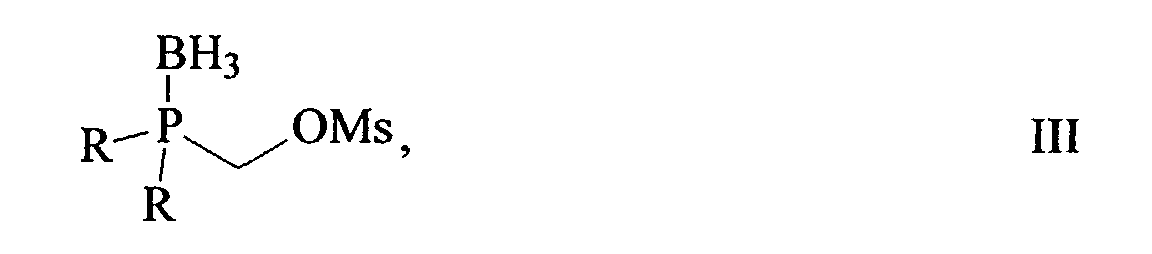
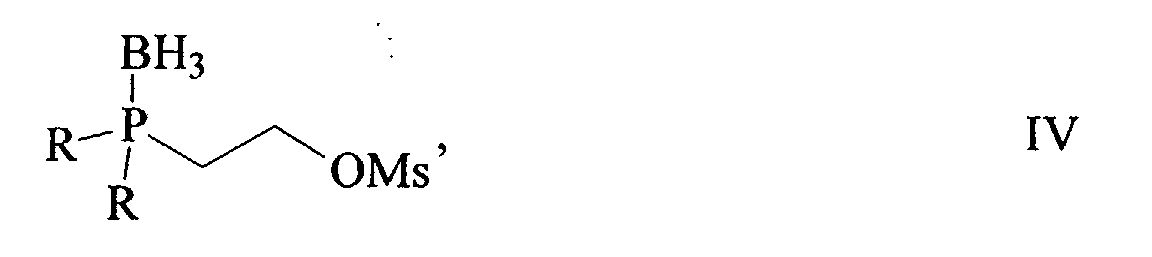
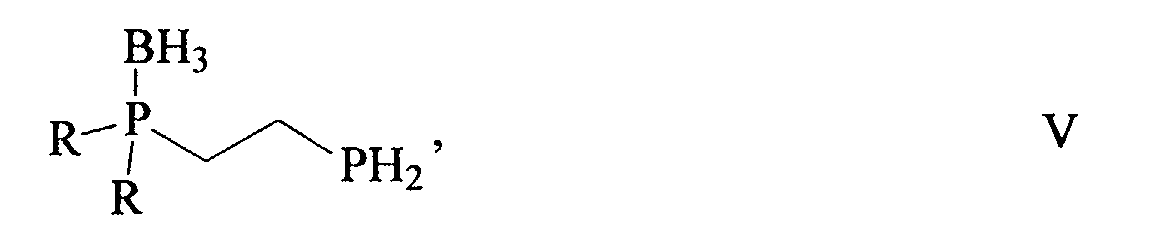
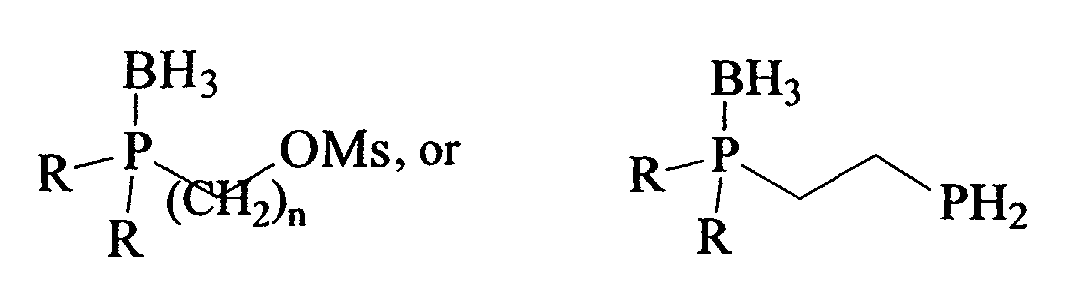
- Compounds used as synthons during the synthesis of non-C 2 -symmetric bisphosphine ligands include compounds with the Formulas III, IV, V, and VI: wherein R is t-butyl, isopropyl, adamantyl, (1,1-dimethylpropane), (1,1-diethylbutane) c-C 5 H 9 , or c-C 6 H 11 ; and Ms is mesylate.
- Another aspect of the invention is directed to methods for forming non-C 2 -bisphosphine ligands.
- the methods include preparing compounds of the general structural Formulas I and II, as shown in Schemes 4-12.
- Another compound of the present invention has the general Formula VIII: wherein:
- Yet another aspect of the invention is directed to forming enantiomeric excesses of compounds catalyzed with the metal/non-C 2 -symmetric bisphosphine complexes in asymmetric reactions.
- the present invention is applicable to the synthesis of non-C 2 -symmetric bisphosphine ligands for use in metal/non-C 2 -symmetric bisphosphine complexes for asymmetric catalysis.
- the present invention is directed to reacting the metal/non-C 2 -symmetric bisphosphine complexes to produce enantiomeric excesses of compound in asymmetric hydrogenation syntheses. While the present invention is not so limited, an appreciation of various aspects of the invention will be gained through a discussion of the examples provided below.
- the "corresponding enantiomer” means that if a compound includes a stereochemical configuration designated as R, the corresponding enantiomer is the S configuration. If a compound has an S configuration, the corresponding enantiomer is the R configuration. If a compound has a stereochemical configuration of 1R,2S, the "corresponding enantiomer” is the 1S,2R compound. Similarly, if a compound has an 1S,2R configuration, the "corresponding enantiomer” is the 1R,2S compound. If a P-chiral compound has an 1S,2S configuration, the "corresponding enantiomer” is the 1R,2R compound. If a compound has an 1R,2R configuration, the "corresponding enantiomer” is the 1S,2S compound.
- a high level of enantioselectivity means a hydrogenation that yields a product of greater than or equal to about 80%, preferably, greater than or equal to about 90% enantiomeric excess (abbreviated e.e.).
- Enantiomeric excess is defined as the ratio (%R-%S)/(%R+%S) ⁇ 100, where %R is the percentage of R enantiomer and %S is the percentage of S enantiomer in a sample of optically active compound.
- %R is the percentage of R enantiomer
- %S is the percentage of S enantiomer in a sample of optically active compound.
- a compound with a high degree of enantiomeric purity or a “compound of high enantiomeric purity” is meant a compound that exhibits enantiomeric excess to the extent of greater than or equal to about 90%, preferably, greater than or equal to about 95% enantiomeric excess (abbreviated e.e.).
- the present invention provides novel non-C 2 -symmetric bisphosphine substituted compounds of the general Formula I: wherein:
- Another non-C 2 -symmetric bisphosphine compound of present invention has the general Formula II: wherein:
- alkyl includes a straight or branched saturated aliphatic hydrocarbon chain, such as, for example, methyl, ethyl, propyl, isopropyl (1-methylethyl), butyl, tert -butyl (1,1-dimethylethyl), and the like.
- aryl group includes an aromatic hydrocarbon group, including fused aromatic rings, such as, for example phenyl and naphthyl. Such groups may be unsubstituted or substituted on the aromatic ring by, for example, an alkoxy group of 1 to 4 carbon atoms, an amino group, a hydroxy group, or an acetyloxy group.
- aralkyl group includes an aromatic hydrocarbon group, including fused aromatic rings, such as for example, phenyl and naphthyl, bonded to an alkyl group with the alkyl bonded to the phospholane ring.
- the aromatic hydrocarbon group may be unsubstituted or substituted (ring substituted aralkyl) by, for example, an alkoxy group of 1 to 4 carbon atoms, an amino group, a hydroxy group, or an acetyloxy group.
- LAH lithium aluminum hydride
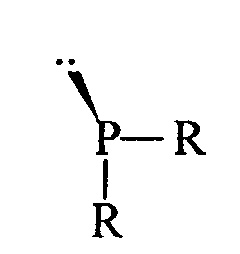
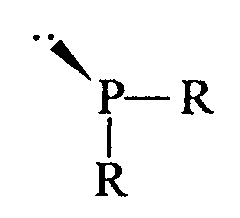
- Achiral phosphorous groups include, but are not limited to, the following: wherein R is t-butyl, isopropyl, adamantyl, (1,1-dimethylpropane), (1,1-diethylbutane), c-C 5 H 9 , or c-C 6 H 11 .
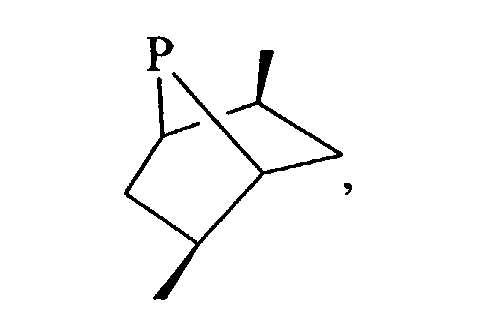
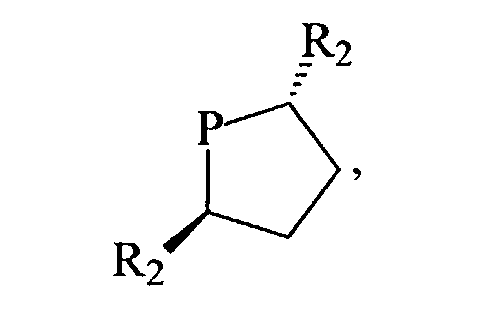
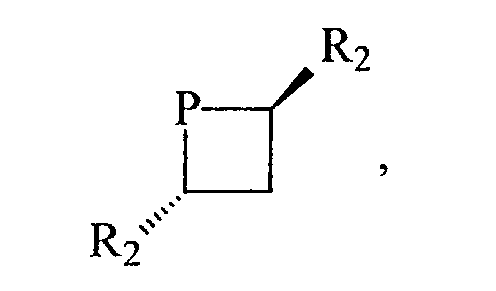
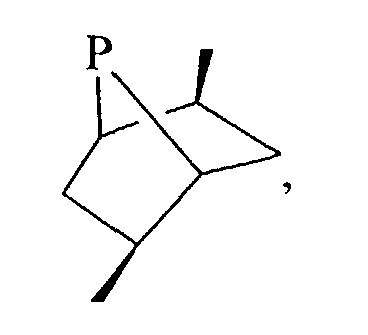
- Chiral phosphorous groups include, but are not limited to, the following and their corresponding enantiomers: wherein:
- a preferred R group for the achiral phosphorous groups of compounds of the general Formula I is t-butyl.
- examples of other preferred non-C 2 -symmetric bisphosphine ligands of the general Formula I include, but are not limited to, those compounds in which R is isopropyl, adamantyl, (1,1-dimethylpropane), (1,1-diethylbutane), c-C 5 H 9 , or c-C 6 H 11 and their corresponding enantiomers.
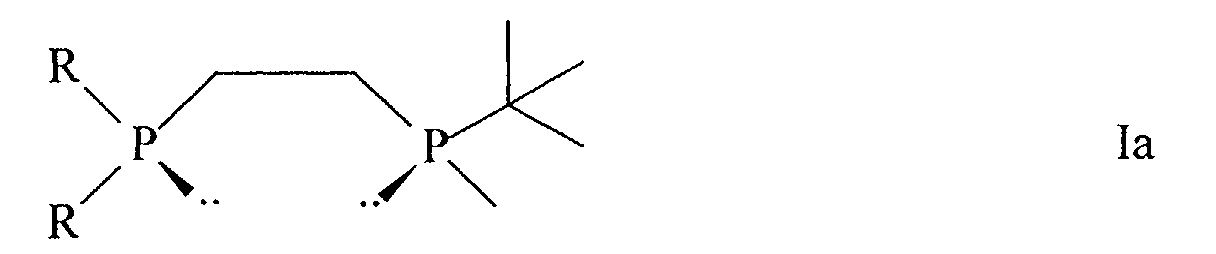
- the non-C 2 -symmetric bisphosphine substituted compound, 1-(di-tert-butyl-phosphanyl borane)-((R)-2-tert-butyl-methyl-phosphanyl borane) ethane is represented by the Formula Ia: wherein R is t-butyl.
- R is isopropyl, adamantyl, (1,1-dimethylpropane), (1,1-diethylbutane), c-C 5 H 9 , or c-C 6 H 11 .
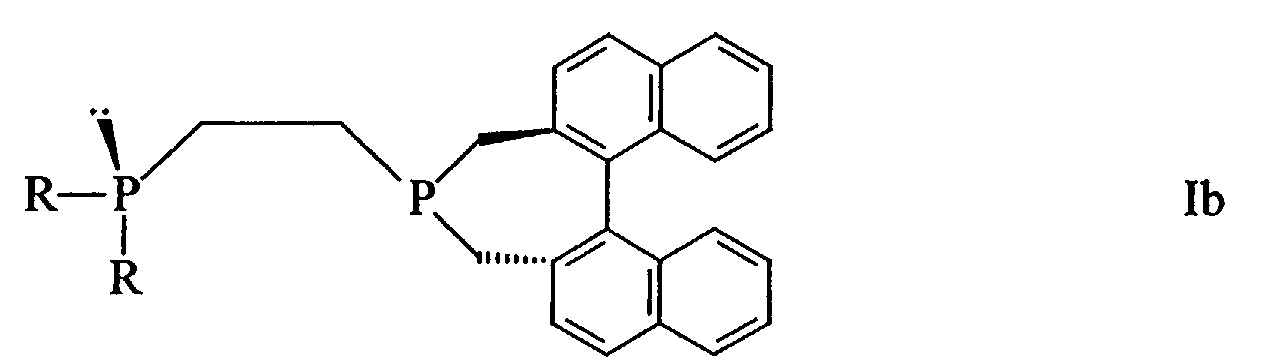
- the non-C 2 -symmetric bisphosphine substituted compound, 1-((S)-2,2'-phosphanyl-1,1-binaphthyl)-2-((R)-2-tert-butyl-methyl-phosphanyl) ethane is represented by the Formula Ib: wherein R is t-butyl.
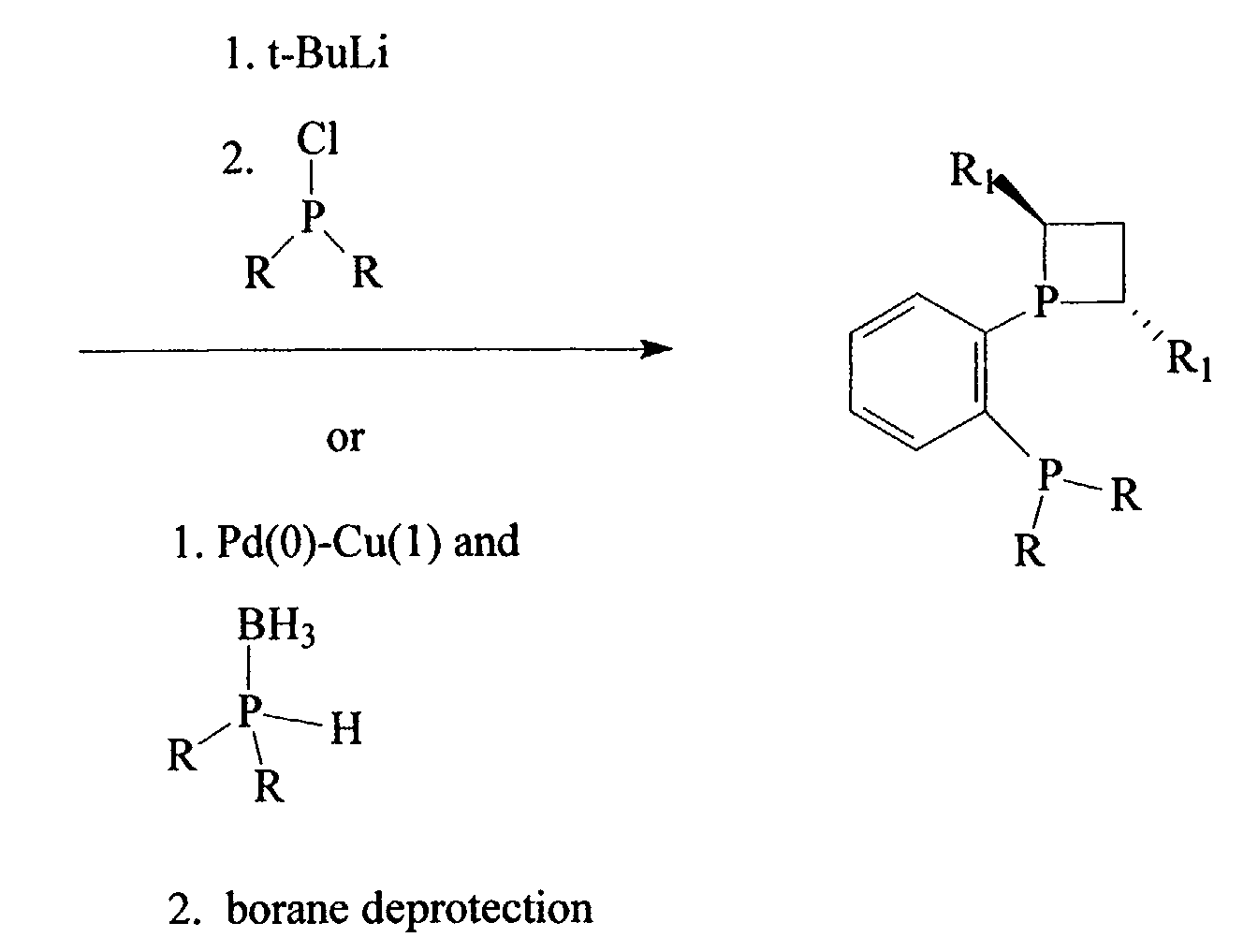
- the non-C 2 -symmetric bisphosphine substituted compound, 1-((R)-2-tert-butyl-methyl-phosphanyl)-2-((R,R)-2,5-dialkylphosphanyl) ethane is represented by the Formula Ic: wherein R is t-butyl, and R 2 is alkyl.
- the non-C 2 -symmetric bisphosphine substituted compound, 1-((R)-2-tert-butyl-methyl-phosphanyl)-2-((R,R)-2,5-dialkylphosphanyl) benzene is represented by the Formula IIa: wherein R is t-butyl, and R 2 is alkyl.
- the bisphosphine compounds of Formula I and II of the present invention are useful as transition metal ligands in asymmetric catalysis.
- the use of these ligands to form transition metal catalysts results in a high level of enantioselective and stereochemical control in the catalyzed hydrogenation of unsaturated substrates.
- Compounds I and II include one to three chiral centers instead of the four chiral centers that are found in molecules such as Duphos.
- Ligands displaying the structural motif of Ia do not necessarily have to contain bulky groups on phosphorous that are the same. In other words, as long as there are three sterically hindered quadrants in the metal-ligand complex, the desired effect in asymmetric transformations will be achieved.
- non-C 2 -symmetric compounds such as those with the general Formula I.
- This invention further comprises the use or synthesis of synthons with the Formulas III, IV, V, and VI: wherein R is t-butyl, isopropyl, adamantyl, (1,1-dimethylpropane), (1,1-diethylbutane), c-C 5 H 9 , or c-C 6 H 11 ; and Ms is mesylate.
- the above bisphospholane compounds of Formulas I, II, and their corresponding enantiomers can be complexed with any of the transition metals as well as the lanthanides and actinides. Such complexes are formed by methods known in the art.
- Another compound of the present invention includes the metal/P-chiral phospholane complex with the general structural Formula VIII and its corresponding enantiomer: wherein:
- Preferred transition metal complexes of the present invention are those including the above described preferred compounds complexed with rhodium.
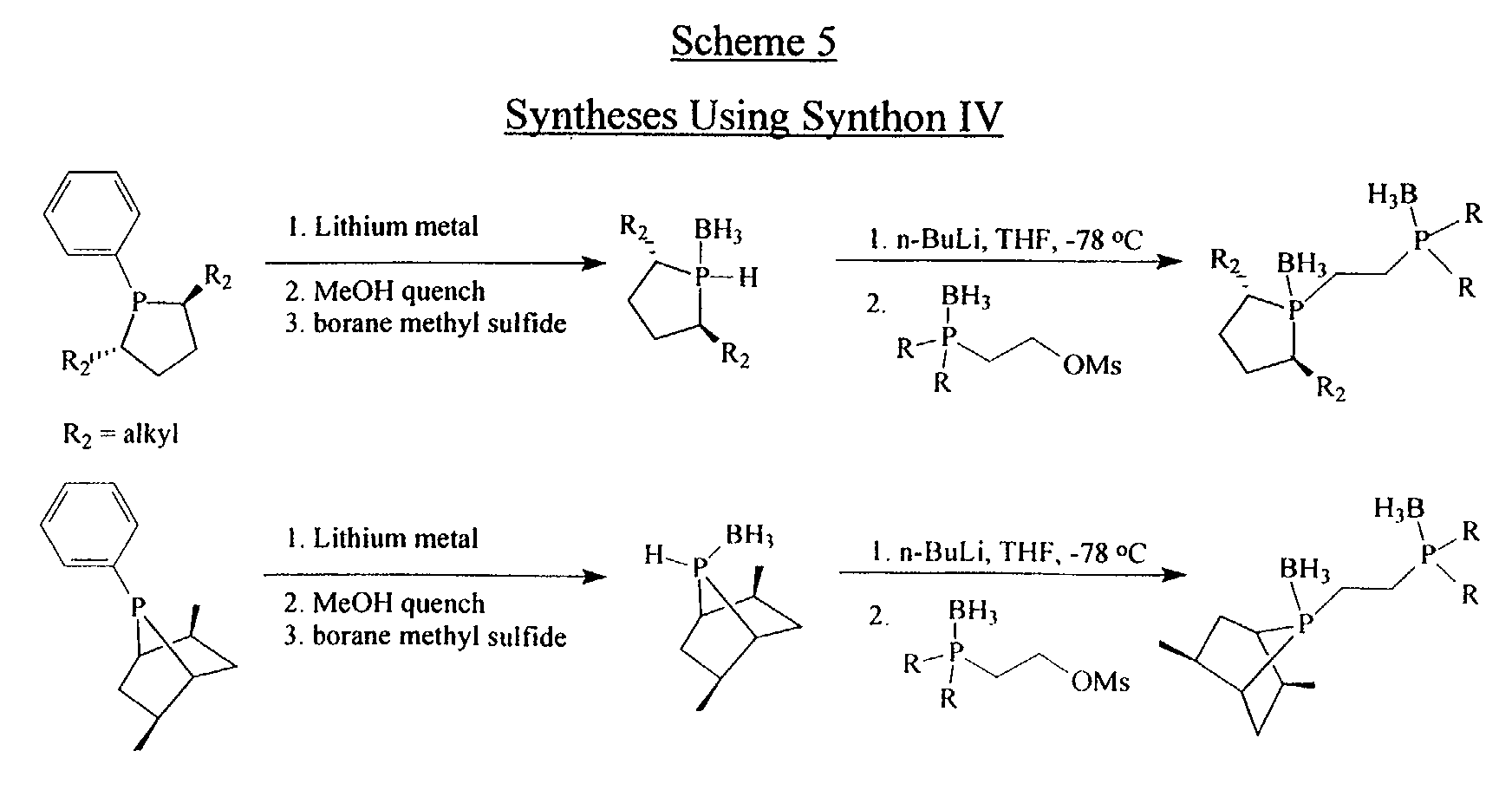
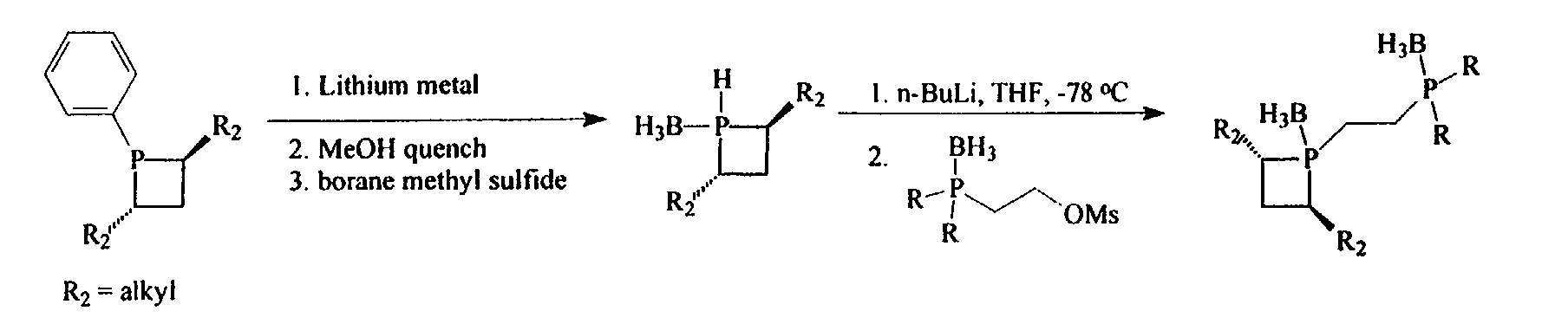
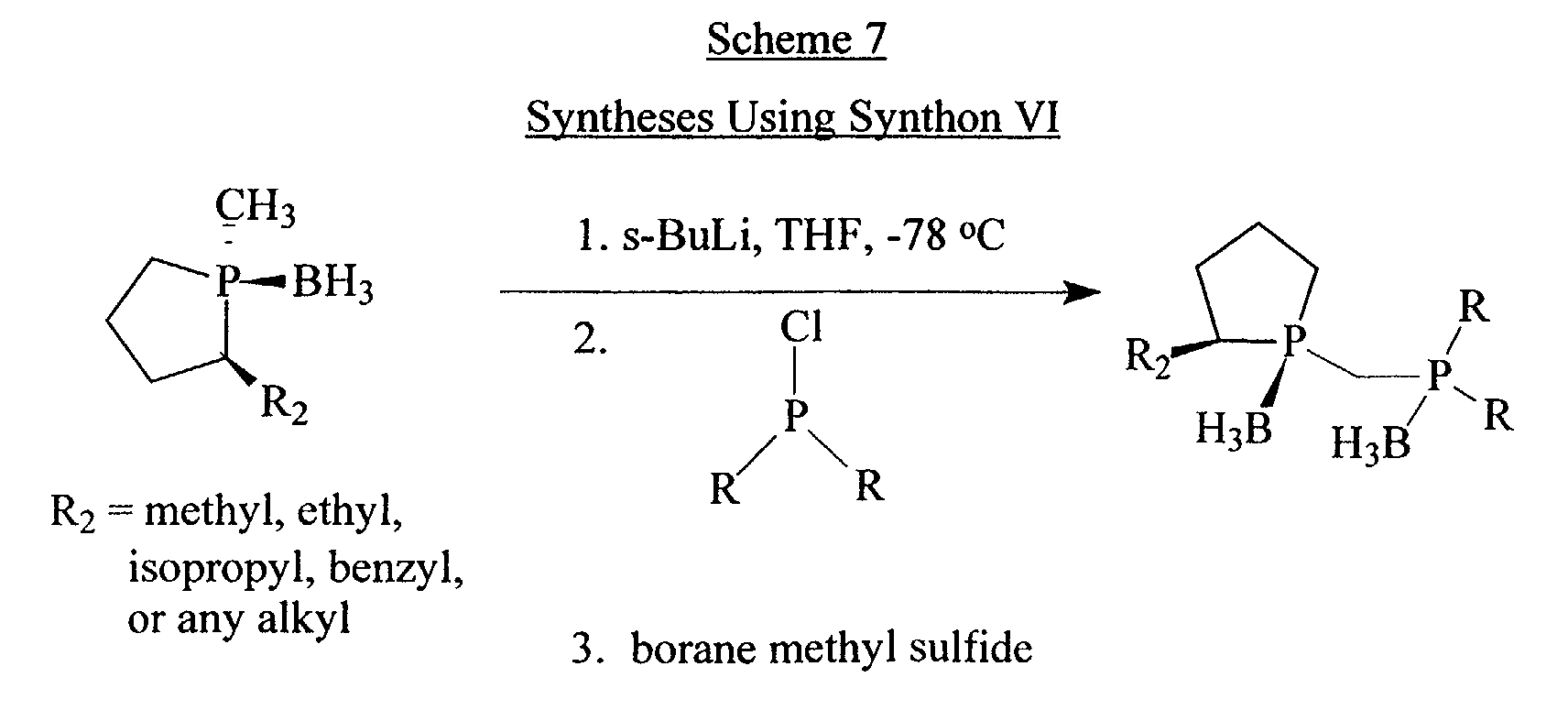
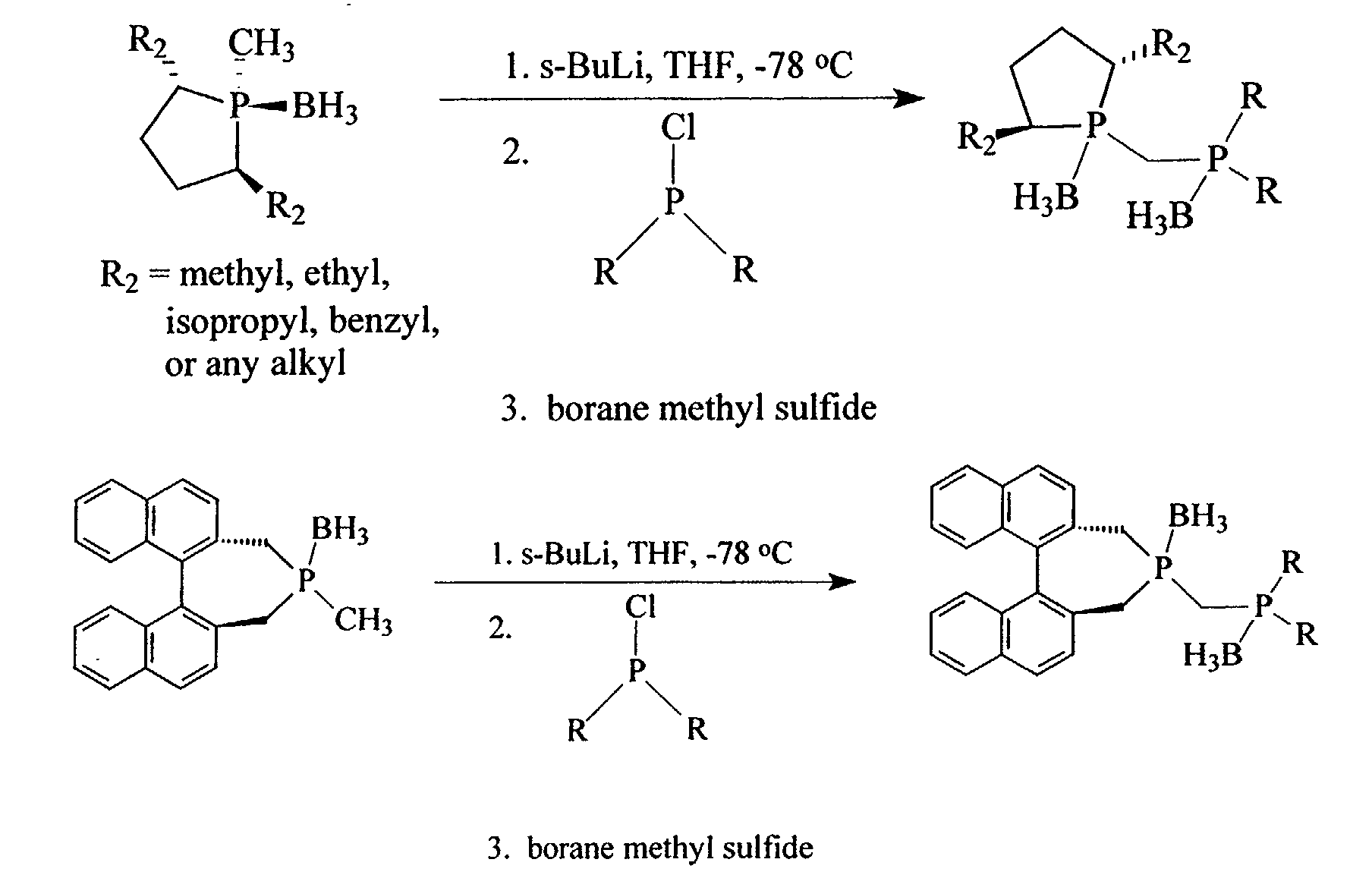
- the synthesis the non-C 2 borane-protected ligands can be formed through synthons that are formed as shown in Scheme 3.
- R is t-butyl, isopropyl, adamantyl, (1,1)-dimethylpropane, (1,1-diethylbutane), c-C 5 H 9 , or c-C 6 H 11 ; and Ms is mesylate.
- An additional synthon is a compound with the formula: wherein R is t-butyl, isopropyl, adamantyl, (1,1)-dimethylpropane, (1,1-diethylbutane), c-C 5 H 9 , or c-C 6 H 11 .
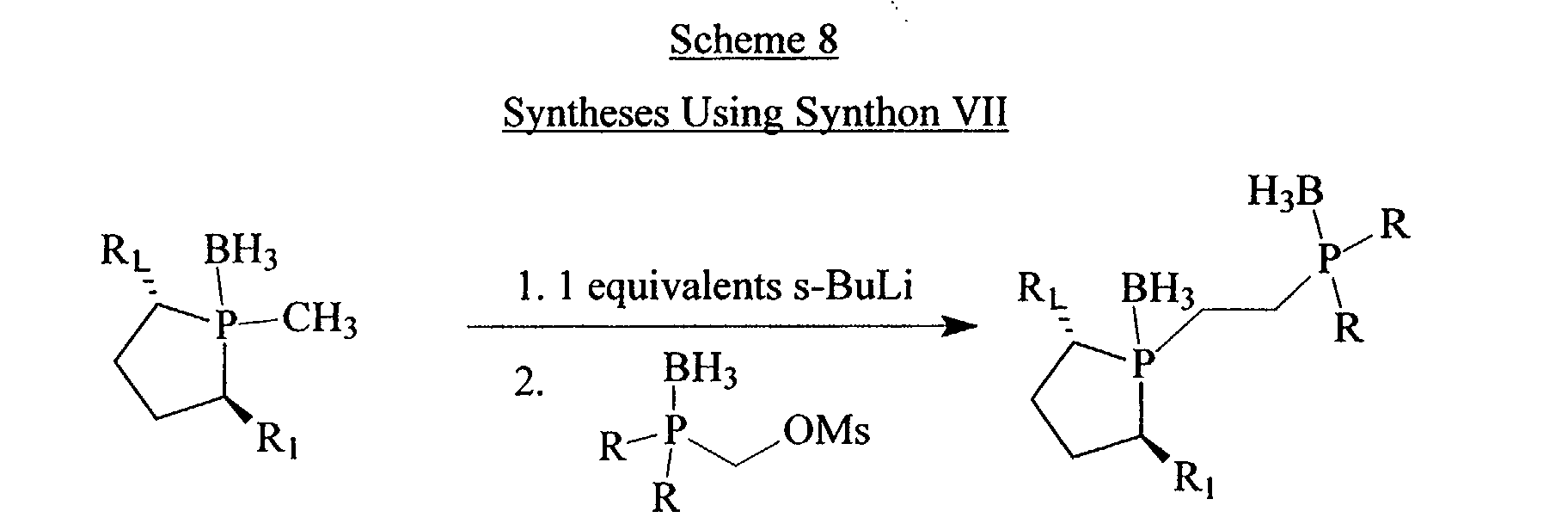
- the above synthons can be used in a variety of reactions to form non-C 2 -symmetric ligands as shown in Schemes 4-8. wherein R is t-butyl, isopropyl, adamantyl, (1,1)-dimethylpropane, (1,1-diethylbutane), c-C 5 H 9 , or c-C 6 H 11 ; and Ms is mesylate.
- R is t-butyl, isopropyl, adamantyl, (1,1)-dimethylpropane, (1,1-diethylbutane), c-C 5 H 9 , or c-C 6 H 11 ; and Ms is mesylate.
- R is t-butyl, isopropyl, adamantyl, (1,1)-dimethylpropane, (1,1-diethylbutane), c-C 5 H 9 , or c-C 6 H 11 ; and Ms is mesylate.
- R is t-butyl, isopropyl, adamantyl, (1,1)-dimethylpropane, (1,1-diethylbutane), c-C 5 H 9 , or c-C 6 H 11 .
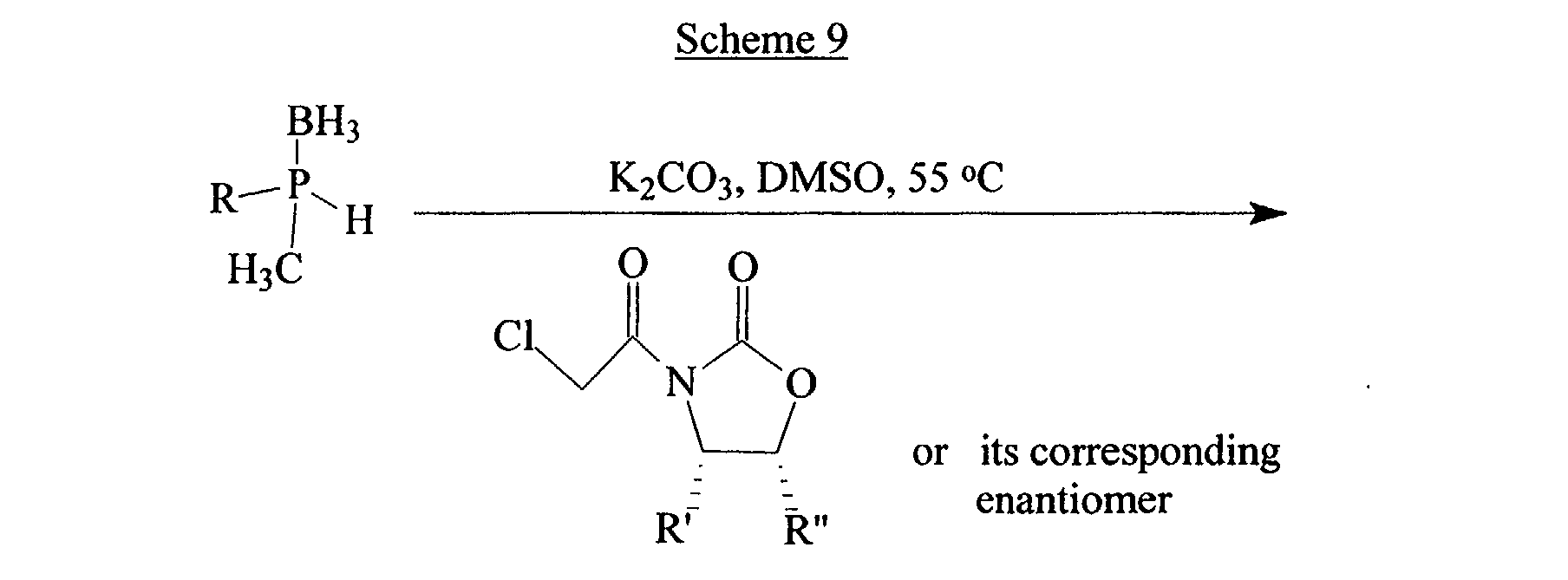
- Scheme 9 shows a method of synthesis to compound Ia.
- R is t-butyl, isopropyl, adamantyl, (1,1)-dimethylpropane, (1,1-diethylbutane), c-C 5 H 9 , or c-C 6 H 11
- Ms is mesylate.
- R' is methyl, benzyl, aryl, isopropyl
- R" is H, methyl, benzyl, aryl, isopropyl
- One method includes reacting (+/-)- tert-butyl-methyl-phosphane borane as a starting material.
- This primary phosphine is made via a one-pot procedure starting from dichloromethylphosphine, reacting with dimethylsulfide-borane, t-butyl magnesium chloride, and then LAH.
- (+/-)-tert-butyl-methyl-phosphane borane is reacted with a chiral auxiliary that includes K 2 CO 3 , DMSO, and N-chloroacetyl-(S)-(-)-4-benzyl-2-oxazolidinone at 55°C to form a mixture of diastereomers (S)-4-benzyl-3-[2-((R)-tert-butyl-methyl-phosphanyl)-ethanoyl]-oxazolidin-2-one and (S)-4-benzyl-3-[2-((S)-tert-butyl-methyl-phosphanyl)-ethanoyl]-oxazolidin-2-one in quantitative yield.
- These diastereomers can be separated either by column chromatography or via recrystallization.
- Each diastereomer can then be reduced with NaBH 4 to remove the chiral auxiliary and form either enantiomer of the alcohol, 2-(tert-butyl-methyl-phosphanyl)-ethanol, as shown in Scheme 9.
- the alcohol is then reacted with mesylate chloride and pyridine to form the compound IX.
- the corresponding enantiomer of compound IX can also be formed by choosing the opposite diastereomer.
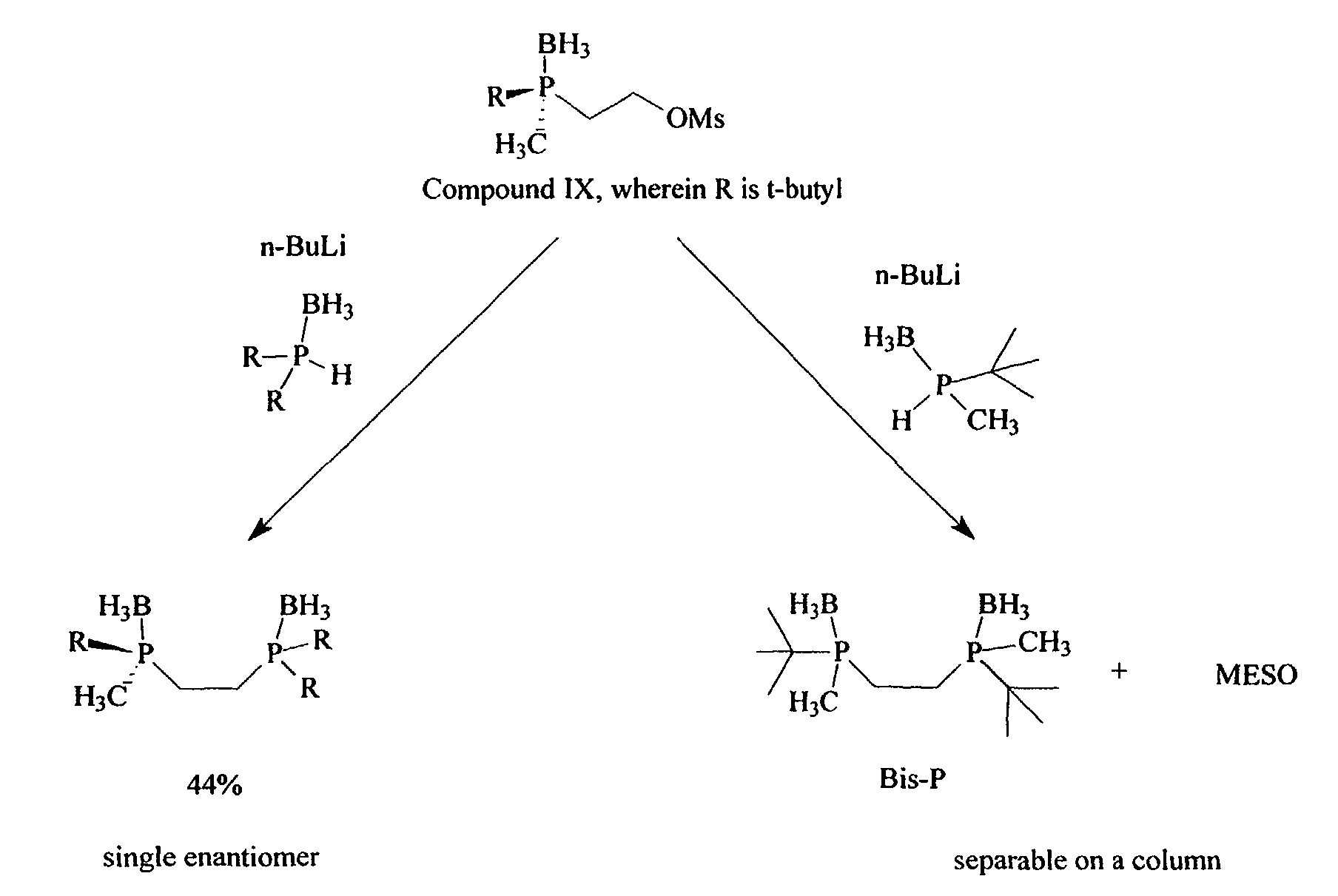
- Compound IX can then be reacted with a mixture of n-butyl lithium and compound VII.
- compound IX can then be reacted with a mixture of n-butyl lithium and t-butylmethylphosphine borane to form Bis-P and a meso product.
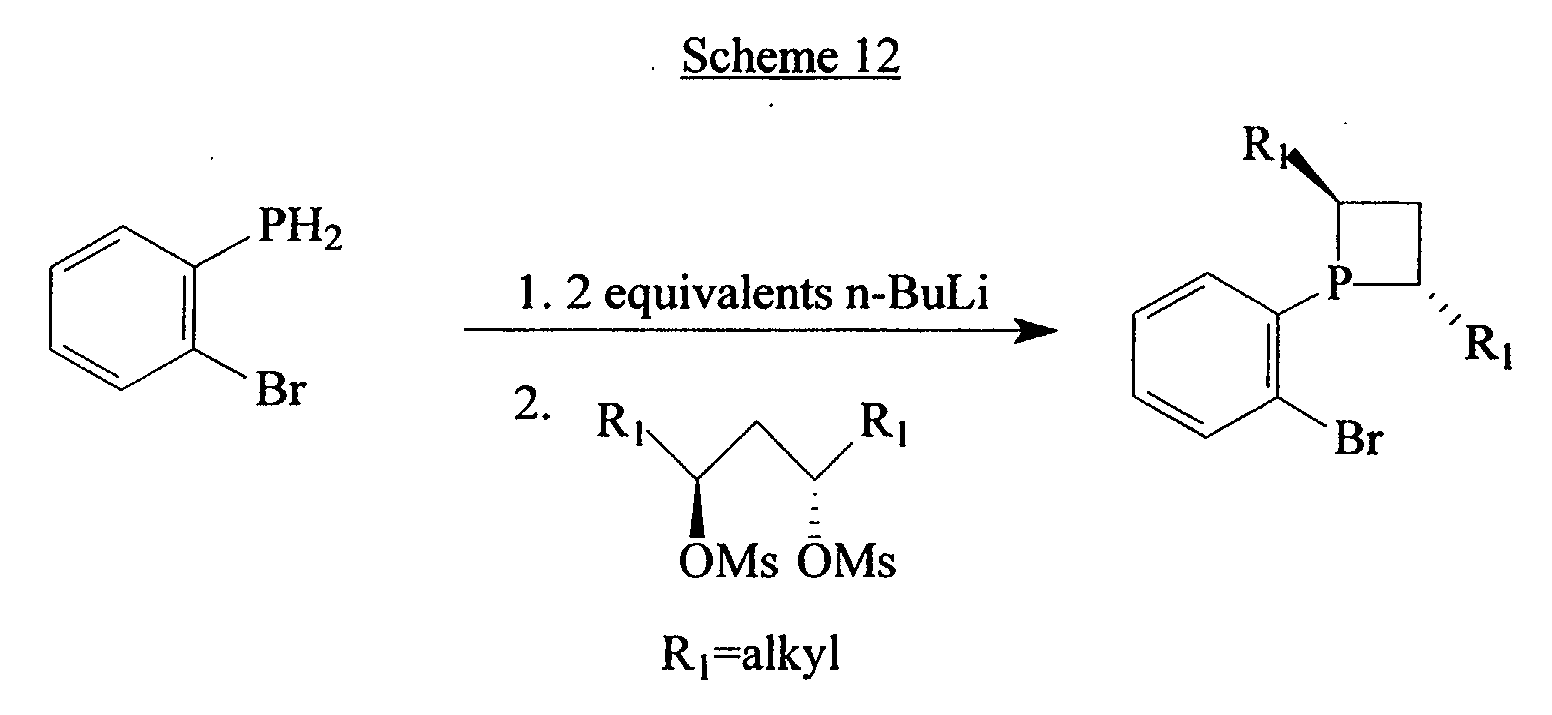
- the compound with the general Formula IIa can be synthesized via the route shown in Scheme 10, wherein R is t-butyl, isopropyl, adamantyl, (1,1)-dimethylpropane, (1,1-diethylbutane), c-C 5 H 9 , or c-C 6 H 11 ; and Ms is mesylate.
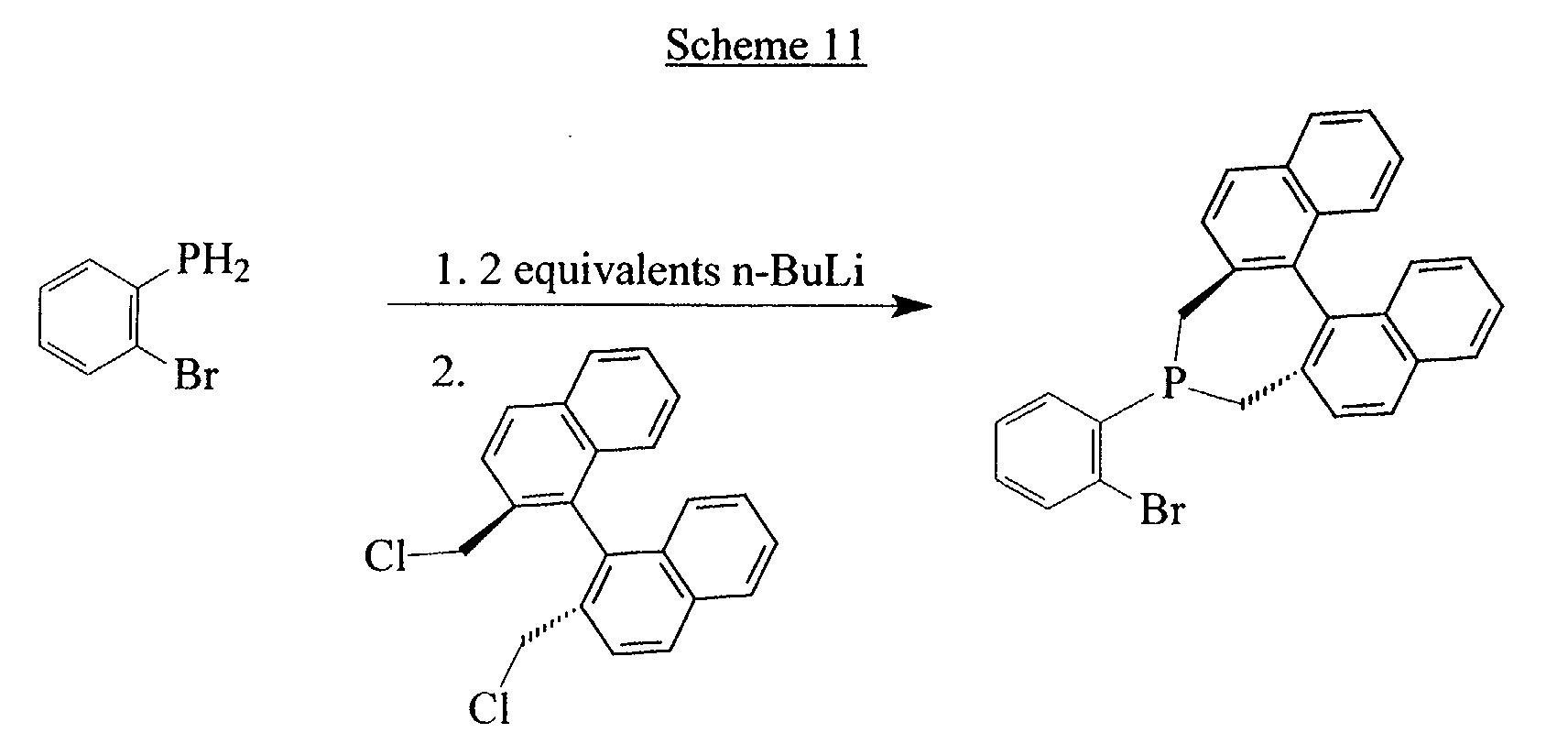
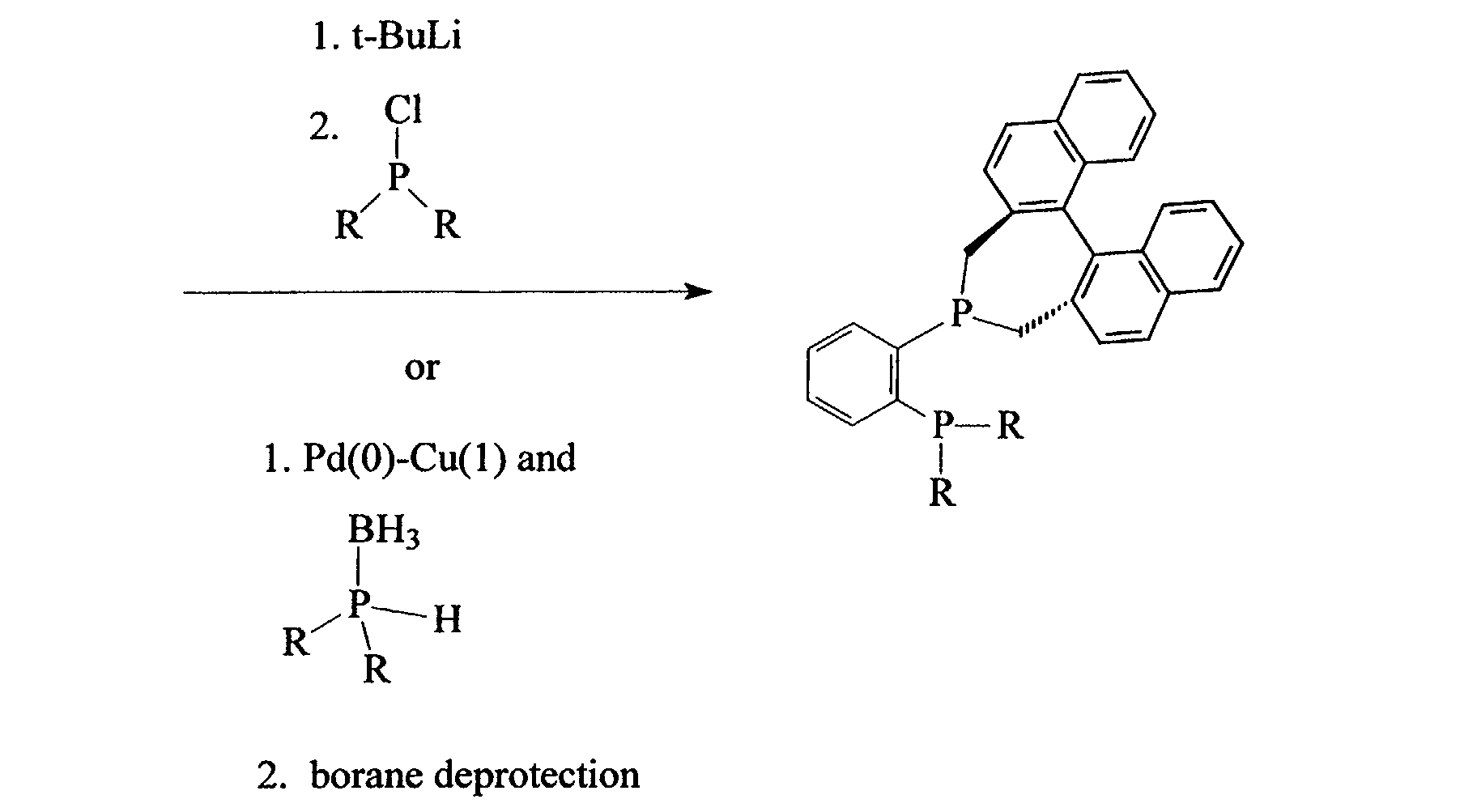
- the compound with the general Formula Ib can be synthesized via the route shown in Scheme 11, wherein R is t-butyl, isopropyl, adamantyl, (1,1)-dimethylpropane, (1,1-diethylbutane), c-C 5 H 9 , or c-C 6 H 11 .
- R is t-butyl, isopropyl, adamantyl, (1,1)-dimethylpropane, (1,1-diethylbutane), c-C 5 H 9 , or c-C 6 H 11 ; and Ms is mesylate.
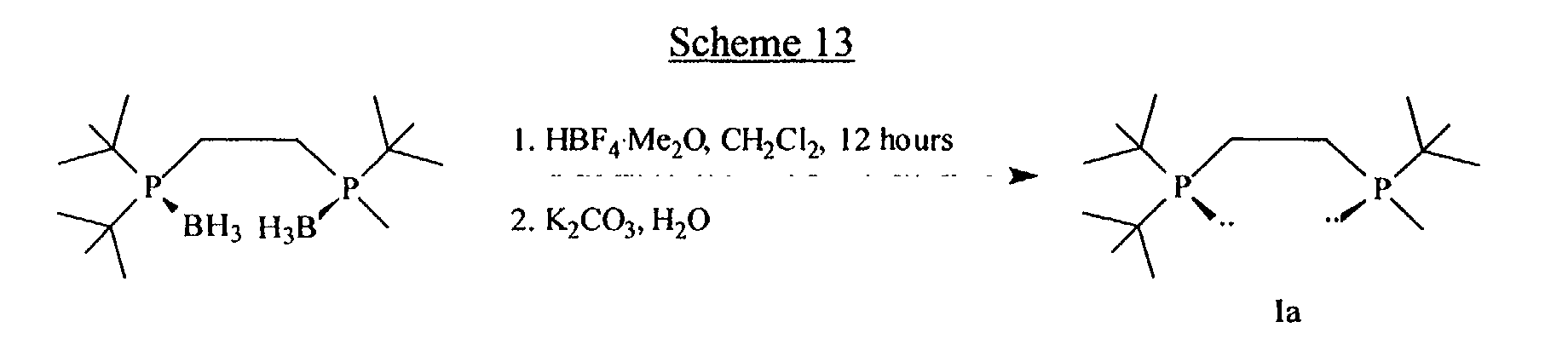
- Conditions can be used for borane removal or deprotection from the phosphorous atom of borane protected ligands, such as compounds shown in Scheme 9, that do not lead to racemization at the non-C 2 -symmetric center to form compounds I, Ia, Ib, Ic, and IIa.
- the borane group can be removed by treating the phosphine borane ligand with HBF 4 ⁇ Me 2 O followed by hydrolysis with K 2 CO 3 .
- the borane groups can be removed from an intermediate ligand to form a compound with the formula Ia.
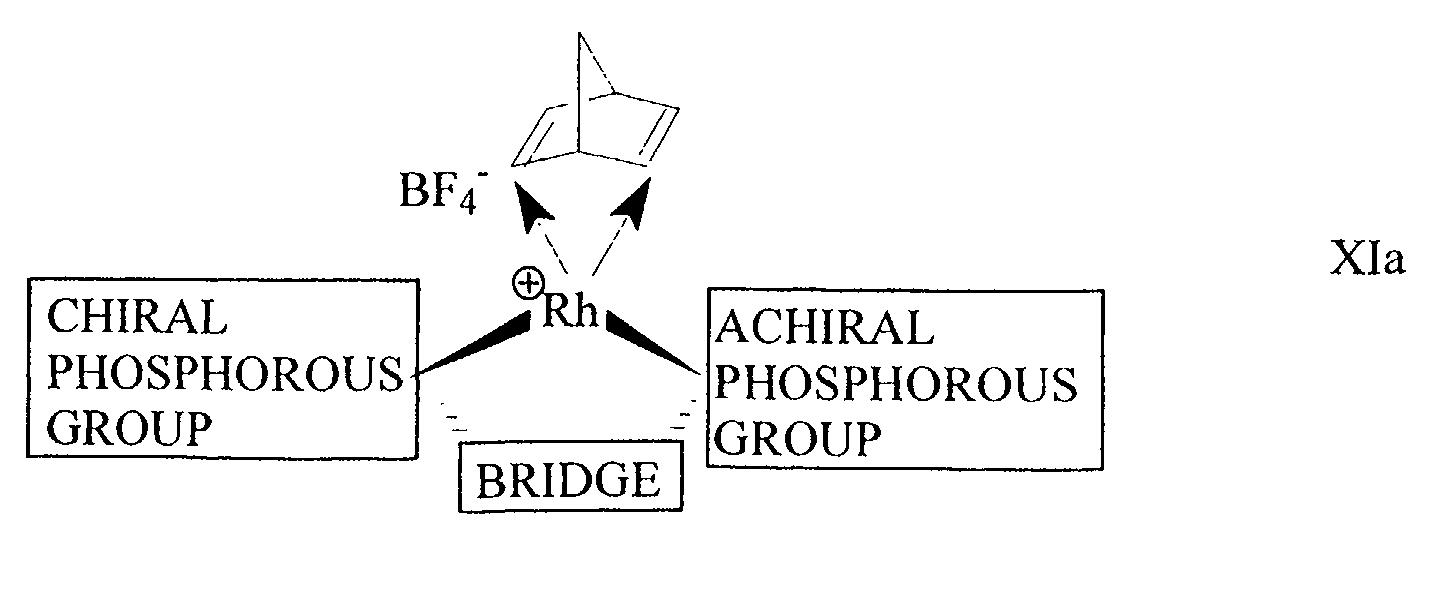
- ligands of the general formulas I can be bound immediately to rhodium by reacting the ligand with [Rh(norbornadiene)BF 4 ] 2 to yield a catalyst with the Formula XIa: wherein:
- any suitable transition metal, actinide, or lanthanide and corresponding anion can be used to form the metal/non-C 2 bisphosphine complex shown as compound XI.
- the corresponding anion can alternatively be PF 6 -, SbF 6 -, Otf - , or ClO 4 - .
- Scheme 9 Also shown in Scheme 9 is a synthesis method for the formation of BisP. Either enantiomer of compound IX can then easily be converted to either enantiomer of BisP, or the ligand Ia, as shown in Scheme 9.
- the difference in the synthesis of BisP and the ligand Ia is the use of either di-t-butylphosphine borane in the synthesis of ligand Ia or t-butylmethylphosphine borane in the synthesis of BisP, as the nucleophile that displaces the mesylate in the last step of the synthesis.
- nucleophilic displacement creates yet another chiral center resulting in a reaction mixture that contains a 50:50 mixture of the chiral ligand and the meso ligand.
- the meso compound is easily separated from the chiral compound by column chromatography.
- no further chiral centers are formed in the reaction so all of the material in the reaction mixture after addition is a single enantiomer chiral compound, Ia.
- Metal/non-C 2 -symmetric ligands of the general Formula XI can be used to catalyze hydrogenation and other asymmetric reactions.
- compounds of the general Formula XI can also be used as catalysts in transformations including, but not limited to, hydroformylation, ⁇ -allyl palladium coupling, hydrosilation, hydrocyanation, olefin metathesis, hydroacylation, and isomerization of allylamines.
- the metal/non-C 2 -symmetric phospholanes can catalyze various substrates.
- a complex represented by the Formula XIa, wherein the chiral group is and the achiral group is wherein R is t-butyl, isopropyl, adamantyl, (1,1-dimethylpropane), (1,1-diethylbutane), c-C 5 H 9 , or c-C 6 H 11 can be used to catalyze substrates, such as enamides, enol esters, and succinates, with the general structural formula wherein X is N, O, or C; R 1 is an alkyl, a carboxylic acid derivative, a carboxylic ester, or a nitrile; R 2 is an alkyl, an acetyl derivative, or a carboxylic acid; and R 3 is an alkyl or hydrogen, and R 4 is an alkyl identical to
- Metal/non-C 2 -symmetric compounds typically bond to a substrate to be catalyzed through the center, M, which is bound to a phosphorous atom of the chiral and achiral phosphorous groups, of a compound with the structural Formula XIb, its corresponding enantiomer, or solvates thereof wherein:
- a solvate of the Formula XIb includes compounds having one or more solvent molecules bonded to the M center.
- the solvent molecules include, but are not limited to, MeOH, THF, ethanol, isopropanol, acetonitrile, methylene chloride, benzene, toluene, water, ethyl acetate, dioxane, carbon tetrachloride, DMSO, DMF, DMF/water mixtures, supercritical carbon dioxide, alcohol/water mixtures or any other suitable solvent.
- THF was distilled from sodium prior to use or THF (anhydrous, 99.9%) was used as needed from Aldrich Sure-Seal bottles supplied by Aldrich Chemical Company.
- Dichloromethane anhydrous, 99.8%
- diethyl ether anhydrous, 99.8%
- Methyl sulfoxide DMSO, A.C.S.
- the acquisition window was typically 8000 Hz from +18 to -2 ppm (Reference TMS @ 0 ppm), and processing was with 0.2 Hz line broadening.
- Typical acquisition time is 80 seconds.
- Regular 13 C NMR spectra were acquired using 45-degree tip angle pulses, 2.0 second recycle delay, and 2048 scans at a resolution of 1 Hz/point.
- Spectral width was typically 25 KHz from +235 to -15 ppm (Reference TMS @ 0 ppm).
- Proton decoupling was applied continuously, and 2 Hz line broadening was applied during processing.
- Typical acquisition time is 102 minutes.
- 31 P NMR spectra were acquired using 45-degree tip angle pulses, 1.0 second recycle delay, and 64 scans at a resolution of 2 Hz/point.
- Spectral width was typically 48 KHz from +200 to -100 ppm (Reference 85% Phosphoric Acid @ 0 ppm). Proton decoupling was applied continuously, and 2 Hz line broadening was applied during processing. Typical acquisition time is 1.5 minutes.
- HPLC High Performance Liquid Chromatography
- PCl 3 (3.94 g, 2.5 mL, 0.029 mole) was dissolved in 75 mL anhydrous THF in a 250-mL round bottom flask under N 2 and then cooled to 0°C with an ice bath.
- the tert-butylmagnesium chloride (29 mL, 0.058 mole, 2.0 M in diethyl ether) was added dropwise via syringe, and then the reaction was stirred 1.5 hours at 0°C.
- Lithium aluminum hydride (1.1 g, 0.029 mole) was then delivered to the reaction as a dry powder in portions over 20 minutes.
- borane methylsulfide (2.9 mL, 0.029 mole 10.0 M solution) was delivered via syringe. After stirring overnight, the reaction was cooled to 0°C and then quenched cautiously with 150 mL 1N HCl. The reaction mixture was poured into a separatory funnel, and the organic layer was separated. The aqueous layer was extracted with 2 ⁇ 100 mL Et 2 O and then the combined organics were dried over MgSO 4 . The volatiles were then removed on a rotary evaporator at reduced pressure. The crude product was passed through a plug of silica gel using 3% ethyl acetate/hexane to yield the title compound with sufficient purity for subsequent chemistry.
- Dichloromethylphosphine (25 g, 0.214 mole) was poured out of an ampule into a 3-neck 1000-mL flask equipped with an addition funnel while blowing N 2 through the flask. Nitrogen degassed anhydrous Et 2 O (350 mL) was immediately poured into the flask and then the flask was sealed with a septum. The solution was cooled to 0°C and then borane methylsulfide (21.4 mL, 0.214 moles, 10.0 M solution) was delivered to the solution via syringe.
- tert-butylmagnesium chloride (107 mL, 0.214 mole, 2.0 M in ethyl ether) was delivered via the addition funnel over a period of one hour while maintaining the reaction solution at 0°C. During the addition, a white precipitate formed which persisted during stirring for 45 minutes after the addition. Lithium aluminum hydride was then delivered to the reaction as a dry powder in portions over 20 minutes while maintaining the reaction temperature at 0°C. After the addition the reaction was warmed to room temperature and then stirred overnight. It was then cooled to 0°C and quenched cautiously with 400 mL 1N HCl. The organic layer was separated, and then the aqueous layer was extracted with 100 mL Et 2 O.
- N-Chloroacetyl-(S)-(-)-4-benzyl-2-oxazolidinone (6.39 g, 0.0254 mole) was placed in a 250-mL round bottom flask. (+/-)-tert-butyl-methyl-phosphane borane was added to the flask along with 75 mL DMSO. Potassium carbonate (17.5 g, 0.127 mole) was added in one portion and the reaction was placed under N 2 . The reaction was heated to 55°C in an oil bath and stirred for one hour. The resulting solution was red and K 2 CO 3 was not completely dissolved in solution.
- the reaction was cooled to room temperature and then was poured into 500 mL 1N HCl which had been chilled to 0°C. Ethyl acetate (300 mL) was added and the biphasic solution was shaken briskly in a separatory funnel. The organic layer was separated and then the aqueous layer was extracted with 100 mL ethyl acetate. The combined organic layers were then washed successively with distilled water and then brine. The organic layer was dried over MgSO 4 and the solvent was removed in vacuo.
- the crude white oily product was triturated with 2 ⁇ 75 mL warm hexane to remove excess phosphine and then the resulting white solid was dissolved in 30 mL hot ethyl acetate and allowed to cool to room temperature. Upon cooling, crystals formed. The crystals were collected on filter paper and then washed with 30 mL hexane. Crystals then formed in the filtrate. The diastereomeric ratio of the crystals on the filter paper was 92 ((S,R) isomer):8 ((S,S) isomer) and they weighed 1.17 g.
- the organic layer was separated after shaking and then the aqueous layer was extracted with 2 ⁇ 50 mL ethyl acetate. The organic layers were combined and dried over MgSO 4 and then the volatiles were removed invacuo. The crude product was passed through a plug of silica gel using 25% ethyl acetate/hexane and after removing the volatiles in vacuo, 1.651 g/97.1% of the title compound was isolated.
- the (S) isomer can be synthesized via the same procedure starting from (S)-4-benzyl-3-[2-((S)-tert-butyl-methyl-phosphanyl)-ethanoyl]-oxazolidin-2-one.
- the (S) isomer can be synthesized via the same procedure starting from (S)-2-(tert-butyl-methyl-phosphanyl)-ethanol.
- Methanesulfonic acid 2-((R)-tert-butyl-methyl-phosphanyl borane)-ethyl ester (536 mg, 2.232 mmole) was dissolved in 7 mL anhydrous THF in a 50-mL round bottom flask under N 2 . The solution was cooled to -78°C with a dry ice/acetone bath with stirring. In a separate 25-mL round bottom flask was dissolved (+/-)-tert-butyl-methyl-phosphane borane. This solution was placed under N 2 and then cooled to -78°C.
- n-BuLi (1.07 mL, 2.678 mmole, 2.5 M in hexane) was added dropwise via syringe to the (+/-)-tert-butyl-methyl-phosphane borane solution.
- the reaction was stirred for 20 minutes at -78°C and then the solution was taken up in a syringe and delivered to the mesylate solution over 30 seconds.
- the reaction was stirred 20 minutes at -78°C and then warmed to room temperature and stirred overnight.
- the (S,S) isomer can be synthesized via the same procedure starting from Methanesulfonic acid 2-((S)-tert-butyl-methyl-phosphanyl borane)-ethyl ester.
- Enantiomeric purity was determined by chiral HPLC using a Chiracel OD-H column (10 mm, 4.6 ⁇ 250 mm), mobile phase Hexanes:IPA:TFA 95:5:0.1, flow rate of 0.5 mL/min, and RI detection at 1/16 range.
- the (S,S) isomer was observed at 17.9 minutes and the (R,R) isomer was observed at 12.0 minutes.
- Spectral data was identical to that described in Imamoto T., et al., supra., 1998.
- Methanesulfonic acid 2-((R)-tert-butyl-methyl-phosphanyl borane)-ethyl ester (660 mg, 2.75 mmole) was dissolved in 7 mL anhydrous THF in a 50-mL round bottom flask under N 2 . The solution was cooled to -78°C with a dry ice/acetone bath. In a separate 25-mL round bottom flask was dissolved di-tert-butyl-phosphane borane (528 mg, 3.30 mmole). This solution was placed under N 2 and then cooled to -78°C.
- n-BuLi (1.32 mL, 3.30 mmole, 2.5 M in hexane) was added dropwise via syringe to the di-tert-butyl-phosphane borane solution.
- the reaction was stirred for 20 minutes at -78°C and then the solution was taken up in a syringe and delivered to the mesylate solution over 30 seconds.
- the reaction was stirred 20 minutes at -78°C and then warmed to room temperature and stirred overnight.
- the (S) isomer can be synthesized via the same procedure starting from Methanesulfonic acid 2-((S)-tert-butyl-methyl-phosphanyl borane)-ethyl ester.
Landscapes
- Chemical & Material Sciences (AREA)
- Organic Chemistry (AREA)
- Inorganic Chemistry (AREA)
- Chemical Kinetics & Catalysis (AREA)
- Materials Engineering (AREA)
- Engineering & Computer Science (AREA)
- Life Sciences & Earth Sciences (AREA)
- Molecular Biology (AREA)
- General Health & Medical Sciences (AREA)
- Biochemistry (AREA)
- Health & Medical Sciences (AREA)
- Organic Low-Molecular-Weight Compounds And Preparation Thereof (AREA)
- Low-Molecular Organic Synthesis Reactions Using Catalysts (AREA)
- Catalysts (AREA)
Abstract
Description













wherein the chiral group is



Claims (13)
- A non-C2 bisphosphine ligand of the structural formula:wherein the achiral phosphorous group includes at least one achiral phosphorous atom having at least two bonds to atoms other than the bridge;

the chiral phosphorous group comprises at least one phosphorous atom, wherein the at least one phosphorous atom is chiral or the at least one phosphorous atom is bonded to a chiral substituent; and
the Bridge is a -(CH2)n- where n is an integer from 1 to 12; a 1,2-divalent phenyl; or a 1,2-divalent substituted phenyl. - The ligand according to Claim 1, wherein the achiral phosphorous group iswherein R is t-butyl, isopropyl, adamantyl, (1,1-dimethylpropane), (1,1-diethylbutane), c-C5H9, or c-C6H11.
- The ligand according to Claim 1, wherein the chiral phosphorous group is


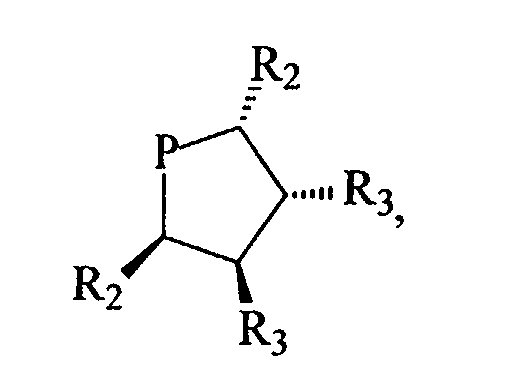
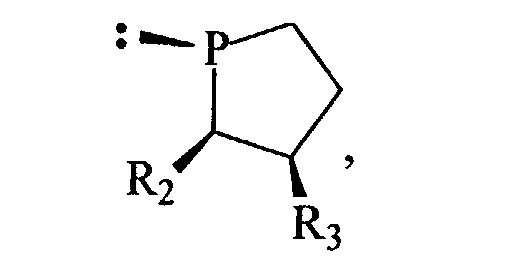 or
or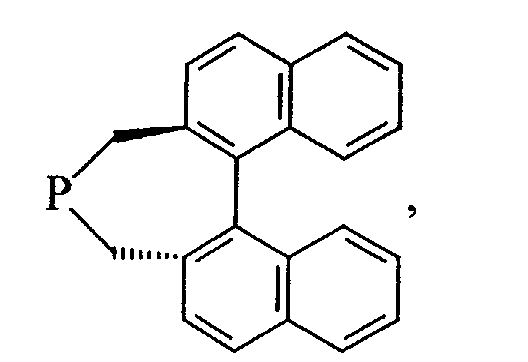 wherein R is t-butyl, isopropyl, adamantyl, (1,1-dimethylpropane), (1,1-diethylbutane) c-C5H9, or c-C6H11;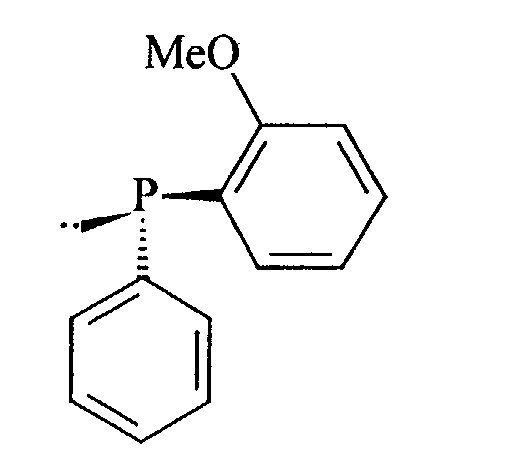
R2 is methyl, ethyl, isopropyl, cyclohexyl, benzyl, a ring substituted benzyl, an aryl, or a ring substituted aryl; and
R3 is OBn, OH, sulphonate, or hydrogen; or
its corresponding enantiomer. - The ligand according to Claim 1 which is 1-(di-tert-butyl-phosphanyl borane)-((R)-2-tert-butyl-methyl-phosphanyl borane) ethane.
- The ligand according to Claim 1 which is 1-((S)-2,2'-phosphanyl-1,1-binaphthyl)-2-((R)-2-tert-butyl-methyl-phosphanyl) ethane.
- The ligand according to Claim 1 which is 1-((R)-2-tert-butyl-methyl-phosphanyl)-2-((R,R)-2,5-dialkylphosphanyl) ethane.
- A compound of the structural formulaswherein n is 1 or 2, and R is t-butyl, isopropyl, adamantyl, (1,1-dimethylpropane), (1,1-diethylbutane), c-C5H9, or c-C6H11; and Ms is mesylate.
- A non-C2 bisphosphine ligand according to Claim 1 and of the structural formula:wherein:
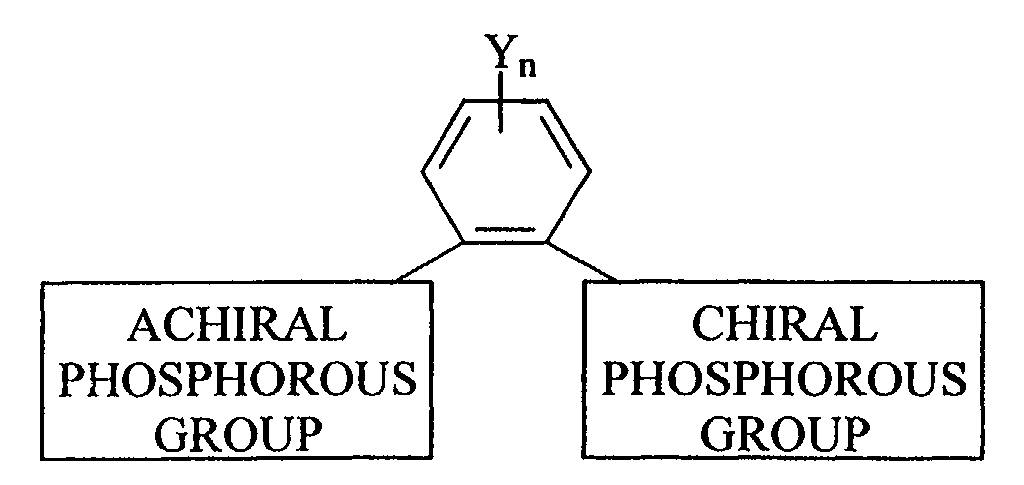 the achiral phosphorous group includes at least one achiral phosphorous atom having one bond to each of two identical atoms other than the bridge;the chiral phosphorous group comprises at least one phosphorous atom, wherein the least one phosphorous atome is chiral or the at least one phosphorous atom is bonded to a chiral substituent; andeach Y is independently halogen, alkyl, alkoxy, aryl, aryloxy, nitro, amino, vinyl, substituted vinyl, alkynyl, or sulfonic acid and n is an integer from 0 to 4 equal to the number of unsubstituted aromatic ring carbons.
 - The ligand according to Claim 8 which is 1-((R)-2-tert-butyl-methyl-phosphanyl)-2-((R,R)-2,5-dialkylphosphanyl) benzene.
- A catalyst of the structural formula:wherein:
 the achiral phosphorous group includes at least one achiral phosphorous atom having at least two bonds to atoms other than the bridge;the chiral phosphorous group comprises at least one phosphorous atom, wherein the at least one phosphorous atom is chiral or the at least one phosphorous atom is bonded to a chiral substituent;a Bridge is a -(CH2)n- where n is an integer from 1 to 12; a 1,2-divalent phenyl; or a 1,2-divalent substituted phenyl;M is a transition metal, an actinide, or a lanthanide; andZ is BF4, PF6, SbF6, OTf, or ClO4; orits corresponding enantiomer.
 - The catalyst of Claim 10, wherein M is rhodium.
- A method for an asymmetric transformation comprising the step of reacting a substrate with general structural formulawherein X is N, O, or C; R1 is an alkyl, a carboxylic acid derivative, a carboxylic ester, or a nitrile; R2 is an alkyl, an acetyl derivative, or a carboxylic acid; R3 is an alkyl or hydrogen; and R4 is the R3 alkyl or hydrogen;

with a compound of the structural formula, the corresponding enantiomer, or a solvate thereofwherein: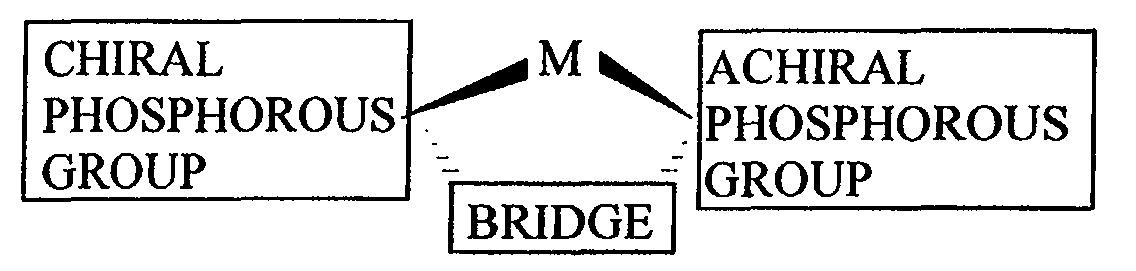 the achiral phosphorous group includes at least one achiral phosphorous atom having at least two bonds to atoms other than the bridge;the chiral phosphorous group comprises at least one phosphorous atom, wherein the at least one phosphorous atom is chiral or the at least one phosphorous atom is bonded to a chiral substituent; anda Bridge is a -(CH2)n- where n is an integer from 1 to 12; a 1,2-divalent phenyl; or a 1,2-divalent substituted phenyl.M is a transition metal, an actinide, or a lanthanide;or its corresponding enantiomer, or a solvate thereof.
 - The method of Claim 12, wherein M is rhodium; the asymmetric transformation is a hydrogenation reaction; the substrate is 3-cyano-5-methylhex-3-enoic acid, and the product of the asymmetric transformation has a high degree of enantiomeric excess.
Applications Claiming Priority (2)
| Application Number | Priority Date | Filing Date | Title |
|---|---|---|---|
| US27712501P | 2001-03-19 | 2001-03-19 | |
| US277125P | 2001-03-19 |
Publications (2)
| Publication Number | Publication Date |
|---|---|
| EP1243591A2 true EP1243591A2 (en) | 2002-09-25 |
| EP1243591A3 EP1243591A3 (en) | 2003-07-02 |
Family
ID=23059501
Family Applications (1)
| Application Number | Title | Priority Date | Filing Date |
|---|---|---|---|
| EP02005577A Withdrawn EP1243591A3 (en) | 2001-03-19 | 2002-03-12 | Synthesis of non-C2-symmetric bisphosphine ligands as catalysts for asymmetric hydrogenation |
Country Status (6)
| Country | Link |
|---|---|
| US (4) | US6689915B2 (en) |
| EP (1) | EP1243591A3 (en) |
| JP (1) | JP3888677B2 (en) |
| BR (1) | BR0200846A (en) |
| CA (1) | CA2377069C (en) |
| MX (1) | MXPA02001147A (en) |
Cited By (4)
| Publication number | Priority date | Publication date | Assignee | Title |
|---|---|---|---|---|
| EP1318156A1 (en) * | 2001-12-10 | 2003-06-11 | Takasago International Corporation | Novel asymmetric phosphine ligand |
| US6855849B2 (en) | 2001-03-19 | 2005-02-15 | Warner-Lambert Company | Non-C2-symmetric bisphosphine ligands as catalysts for asymmetric hydrogenation |
| EP1864990A1 (en) * | 2006-06-01 | 2007-12-12 | Universität Wien | Preparation of secondary phosphines |
| CN108409784A (en) * | 2017-02-09 | 2018-08-17 | 上海交通大学 | A kind of preparation method of phosphorus chirality important intermediate |
Families Citing this family (16)
| Publication number | Priority date | Publication date | Assignee | Title |
|---|---|---|---|---|
| EP0934061B3 (en) | 1996-07-24 | 2015-01-21 | Warner-Lambert Company LLC | Isobutylgaba and its derivatives for the treatment of pain |
| US20040072680A1 (en) * | 2002-04-26 | 2004-04-15 | The Penn State Research Foundation | Chiral phosphorus cyclic compounds for transition metal-catalyzed asymmetric reactions |
| US7265242B2 (en) * | 2004-02-26 | 2007-09-04 | Shell Oil Company | Process for the carbonylation of ethylenically or acetylenically unsaturated compounds |
| JP2007524700A (en) * | 2004-02-26 | 2007-08-30 | シエル・インターナシヨナル・リサーチ・マートスハツペイ・ベー・ヴエー | Process for the carbonylation of ethylenically or acetylenically unsaturated compounds |
| PT1727620E (en) * | 2004-03-12 | 2007-11-05 | Warner Lambert Co | C1-symmetric bisphosphine ligands and their use in the asymmetric synthesis of pregabalin |
| JP5243800B2 (en) * | 2004-12-23 | 2013-07-24 | スーパーコンダクター・テクノロジーズ・インコーポレイテッド | RF property optimization (RE) Ba2Cu3O7-δ superconducting thin film article |
| US7803952B2 (en) | 2005-04-08 | 2010-09-28 | Dsm Ip Assets B.V. | Manufacture of lactones |
| JP5145212B2 (en) | 2005-04-15 | 2013-02-13 | ディーエスエム アイピー アセッツ ビー.ブイ. | Production of thiolactone |
| JP5223045B2 (en) * | 2006-02-08 | 2013-06-26 | 独立行政法人科学技術振興機構 | Method for producing diphosphine compound, diphosphine compound produced by this production method and intermediate product |
| CN101432290A (en) | 2006-02-08 | 2009-05-13 | 独立行政法人科学技术振兴机构 | Bis(phosphine)boronium salts, process for preparation of bis(phosphine)boronium salts, and bis(phosphine)boronium salts prepared by the process |
| US7547577B2 (en) * | 2006-11-14 | 2009-06-16 | Endicott Interconnect Technologies, Inc. | Method of making circuitized substrate with solder paste connections |
| JP2008189633A (en) * | 2007-02-08 | 2008-08-21 | Nippon Chem Ind Co Ltd | Method for producing optically active dialkylphosphinomethane derivative |
| SG157299A1 (en) | 2008-05-09 | 2009-12-29 | Agency Science Tech & Res | Diagnosis and treatment of kawasaki disease |
| GB0812297D0 (en) * | 2008-07-04 | 2008-08-13 | Lucite Int Uk Ltd | Novel carbonylation ligand sand thier use of in the carbonylation of ethylenically unsaturated compounds |
| JP5378837B2 (en) * | 2009-03-11 | 2013-12-25 | 日本化学工業株式会社 | Process for producing optically active bisphosphinomethane |
| WO2014164801A1 (en) * | 2013-03-11 | 2014-10-09 | Rutgers, The State University Of New Jersey | Metallorganocatalysis for asymmetric transformations |
Family Cites Families (17)
| Publication number | Priority date | Publication date | Assignee | Title |
|---|---|---|---|---|
| US4606636A (en) * | 1983-10-25 | 1986-08-19 | Universite De Saint-Etienne | Optical apparatus for identifying the individual multiparametric properties of particles or bodies in a continuous flow |
| US5439578A (en) * | 1993-06-03 | 1995-08-08 | The Governors Of The University Of Alberta | Multiple capillary biochemical analyzer |
| US5646241A (en) * | 1995-05-12 | 1997-07-08 | Quantum Materials, Inc. | Bleed resistant cyanate ester-containing compositions |
| JP4028625B2 (en) | 1997-09-11 | 2007-12-26 | 小川香料株式会社 | Phosphine compounds and rhodium complexes using them as ligands |
| US6103083A (en) * | 1998-02-20 | 2000-08-15 | Tetragen | Capillary electrophoresis apparatus and method |
| GB9805348D0 (en) * | 1998-03-16 | 1998-05-06 | Ici Plc | Compound |
| DE19824121A1 (en) | 1998-05-29 | 1999-12-02 | Basf Ag | Production of optically active phospholanes, their metal complexes and use in asymmetric synthesis |
| JP2002523419A (en) | 1998-08-21 | 2002-07-30 | ザ・ペン・ステイト・リサーチ・ファウンデイション | Asymmetric catalysis based on chiral phosphorane |
| JP3713970B2 (en) * | 1998-09-09 | 2005-11-09 | 株式会社日立製作所 | Equipment for separating and collecting specific gene fragments |
| JP2972887B1 (en) | 1998-10-29 | 1999-11-08 | 千葉大学長 | Asymmetric synthesis using optically active bisphosphinomethanes and their rhodium or copper complexes |
| GB9823716D0 (en) | 1998-10-29 | 1998-12-23 | Isis Innovation | Diphosphines |
| JP4290265B2 (en) | 1999-03-02 | 2009-07-01 | 第一ファインケミカル株式会社 | Novel asymmetric ligand |
| JP4201916B2 (en) | 1999-05-10 | 2008-12-24 | 日本化学工業株式会社 | Optically active 1,2-bis (dialkylphosphino) benzene derivative, process for producing the same, and rhodium metal complex having the compound as a ligand |
| US6194593B1 (en) * | 2000-01-28 | 2001-02-27 | Nippon Chemical Industrial Co., Ltd. | 1, 2-bis(dialkylphosphino) benzene derivates having optical activites, process for producing same, and rhodium metal complexes containing same as ligands |
| US20020080349A1 (en) * | 2000-12-22 | 2002-06-27 | Armstrong Thomas M. | Sample chamber for use in analytical instrumentation |
| DK1354192T3 (en) * | 2001-01-26 | 2011-12-12 | Qiagen Sciences Llc | Multichannel cassette for bioseparation |
| MXPA02001147A (en) | 2001-03-19 | 2004-04-21 | Warner Lambert Co | Synthesis of non-c2-symmetric bisphosphine ligands as catalysts for asymmetric hydrogenation. |
-
2002
- 2002-01-31 MX MXPA02001147A patent/MXPA02001147A/en active IP Right Grant
- 2002-02-27 US US10/083,923 patent/US6689915B2/en not_active Expired - Fee Related
- 2002-03-12 EP EP02005577A patent/EP1243591A3/en not_active Withdrawn
- 2002-03-15 CA CA002377069A patent/CA2377069C/en not_active Expired - Fee Related
- 2002-03-18 BR BR0200846-7A patent/BR0200846A/en not_active IP Right Cessation
- 2002-03-18 JP JP2002074577A patent/JP3888677B2/en not_active Expired - Fee Related
- 2002-09-18 US US10/245,941 patent/US6855849B2/en not_active Expired - Fee Related
-
2003
- 2003-12-19 US US10/741,117 patent/US20040138487A1/en not_active Abandoned
-
2005
- 2005-01-20 US US11/039,611 patent/US7414156B2/en not_active Expired - Fee Related
Cited By (6)
| Publication number | Priority date | Publication date | Assignee | Title |
|---|---|---|---|---|
| US6855849B2 (en) | 2001-03-19 | 2005-02-15 | Warner-Lambert Company | Non-C2-symmetric bisphosphine ligands as catalysts for asymmetric hydrogenation |
| US7414156B2 (en) | 2001-03-19 | 2008-08-19 | Warner Lambert Co. | Non-C2-symmetric bisphosphine ligands as catalysts for asymmetric hydrogenation |
| EP1318156A1 (en) * | 2001-12-10 | 2003-06-11 | Takasago International Corporation | Novel asymmetric phosphine ligand |
| EP1864990A1 (en) * | 2006-06-01 | 2007-12-12 | Universität Wien | Preparation of secondary phosphines |
| CN108409784A (en) * | 2017-02-09 | 2018-08-17 | 上海交通大学 | A kind of preparation method of phosphorus chirality important intermediate |
| CN108409784B (en) * | 2017-02-09 | 2020-07-14 | 上海交通大学 | A kind of preparation method of phosphochiral important intermediate |
Also Published As
| Publication number | Publication date |
|---|---|
| EP1243591A3 (en) | 2003-07-02 |
| US20030073868A1 (en) | 2003-04-17 |
| MXPA02001147A (en) | 2004-04-21 |
| US20020143214A1 (en) | 2002-10-03 |
| US6689915B2 (en) | 2004-02-10 |
| US7414156B2 (en) | 2008-08-19 |
| JP3888677B2 (en) | 2007-03-07 |
| US6855849B2 (en) | 2005-02-15 |
| CA2377069A1 (en) | 2002-09-19 |
| US20050124830A1 (en) | 2005-06-09 |
| CA2377069C (en) | 2007-08-07 |
| BR0200846A (en) | 2003-03-25 |
| JP2002338586A (en) | 2002-11-27 |
| US20040138487A1 (en) | 2004-07-15 |
Similar Documents
| Publication | Publication Date | Title |
|---|---|---|
| US6689915B2 (en) | Synthesis of non-C2-symmetric bisphosphine ligands as catalysts for asymmetric hydrogenation | |
| Burk et al. | Preparation and use of C2-symmetric bis (phospholanes): production of. alpha.-amino acid derivatives via highly enantioselective hydrogenation reactions | |
| US5767276A (en) | Asymmetric synthesis catalyzed by transition metal complexes with new chiral ligands | |
| Ewalds et al. | Application of P‐stereogenic aminophosphine phosphinite ligands in asymmetric hydroformylation | |
| Darcel et al. | Direct use of chiral or achiral organophosphorus boranes as pro-ligands for transition metal catalyzed reactions | |
| EP1341799B1 (en) | P-chirale bisphospholane ligands, their transition metal complexes | |
| US6399787B1 (en) | Catalytic asymmetric hydrogenation, hydroformylation, and hydrovinylation via transition metal catalysts with phosphines and phosphites | |
| C. Córdoba et al. | Palladium Complexes of Methylene-Bridged P-Stereogenic, Unsymmetrical Diphosphines | |
| Jaillet et al. | P (III)-Chirogenic phosphinite building blocks by stereospecific N→ O phosphinyl migration | |
| CA2340943A1 (en) | Asymmetric catalysis based on chiral phospholanes | |
| CA2380566C (en) | Novel chiral phosphorus ligands and the use thereof in the production of optically active products | |
| US6207868B1 (en) | Asymmetric synthesis catalyzed by transition metal complexes with chiral ligands | |
| JP2004091488A (en) | Method for producing phosphite and transition metal complex | |
| EP0997470A1 (en) | Optically active bisphosphinomethanes and their rhodium and copper complexes for catalytic asymmetric syntheses | |
| EP1030854B1 (en) | Catalysts for asymmetric synthesis containing rigid chiral ligands | |
| EP1318156B1 (en) | Novel asymmetric phosphine ligand | |
| Cheow | Asymmetric ligand transformation reactions promoted by cyclometallated complexes | |
| Zou | Synthesis of New Phosphorus Ligands for Asymmetric Catalysis | |
| CZ20001742A3 (en) | Catalysts for asymmetric syntheses containing solid chiral ligands |
Legal Events
| Date | Code | Title | Description |
|---|---|---|---|
| PUAI | Public reference made under article 153(3) epc to a published international application that has entered the european phase |
Free format text: ORIGINAL CODE: 0009012 |
|
| AK | Designated contracting states |
Kind code of ref document: A2 Designated state(s): AT BE CH CY DE DK ES FI FR GB GR IE IT LI LU MC NL PT SE TR |
|
| AX | Request for extension of the european patent |
Free format text: AL;LT;LV;MK;RO;SI |
|
| PUAL | Search report despatched |
Free format text: ORIGINAL CODE: 0009013 |
|
| AK | Designated contracting states |
Designated state(s): AT BE CH CY DE DK ES FI FR GB GR IE IT LI LU MC NL PT SE TR |
|
| AX | Request for extension of the european patent |
Extension state: AL LT LV MK RO SI |
|
| 17P | Request for examination filed |
Effective date: 20040102 |
|
| AKX | Designation fees paid |
Designated state(s): AT BE CH CY DE DK ES FI FR GB GR IE IT LI LU MC NL PT SE TR |
|
| RAP1 | Party data changed (applicant data changed or rights of an application transferred) |
Owner name: WARNER-LAMBERT COMPANY LLC |
|
| 17Q | First examination report despatched |
Effective date: 20060210 |
|
| RAP1 | Party data changed (applicant data changed or rights of an application transferred) |
Owner name: WARNER-LAMBERT COMPANY LLC |
|
| APBN | Date of receipt of notice of appeal recorded |
Free format text: ORIGINAL CODE: EPIDOSNNOA2E |
|
| APBR | Date of receipt of statement of grounds of appeal recorded |
Free format text: ORIGINAL CODE: EPIDOSNNOA3E |
|
| APAF | Appeal reference modified |
Free format text: ORIGINAL CODE: EPIDOSCREFNE |
|
| APBT | Appeal procedure closed |
Free format text: ORIGINAL CODE: EPIDOSNNOA9E |
|
| STAA | Information on the status of an ep patent application or granted ep patent |
Free format text: STATUS: THE APPLICATION IS DEEMED TO BE WITHDRAWN |
|
| 18D | Application deemed to be withdrawn |
Effective date: 20091001 |