EP1243245A1 - Infusion container and method of storing freeze-dried medicine - Google Patents
Infusion container and method of storing freeze-dried medicine Download PDFInfo
- Publication number
- EP1243245A1 EP1243245A1 EP00962838A EP00962838A EP1243245A1 EP 1243245 A1 EP1243245 A1 EP 1243245A1 EP 00962838 A EP00962838 A EP 00962838A EP 00962838 A EP00962838 A EP 00962838A EP 1243245 A1 EP1243245 A1 EP 1243245A1
- Authority
- EP
- European Patent Office
- Prior art keywords
- medicine
- container
- storing chamber
- freeze
- dissolving liquid
- Prior art date
- Legal status (The legal status is an assumption and is not a legal conclusion. Google has not performed a legal analysis and makes no representation as to the accuracy of the status listed.)
- Withdrawn
Links
Images

Classifications
-
- A—HUMAN NECESSITIES
- A61—MEDICAL OR VETERINARY SCIENCE; HYGIENE
- A61J—CONTAINERS SPECIALLY ADAPTED FOR MEDICAL OR PHARMACEUTICAL PURPOSES; DEVICES OR METHODS SPECIALLY ADAPTED FOR BRINGING PHARMACEUTICAL PRODUCTS INTO PARTICULAR PHYSICAL OR ADMINISTERING FORMS; DEVICES FOR ADMINISTERING FOOD OR MEDICINES ORALLY; BABY COMFORTERS; DEVICES FOR RECEIVING SPITTLE
- A61J1/00—Containers specially adapted for medical or pharmaceutical purposes
- A61J1/14—Details; Accessories therefor
- A61J1/20—Arrangements for transferring or mixing fluids, e.g. from vial to syringe
- A61J1/2093—Containers having several compartments for products to be mixed
-
- A—HUMAN NECESSITIES
- A61—MEDICAL OR VETERINARY SCIENCE; HYGIENE
- A61J—CONTAINERS SPECIALLY ADAPTED FOR MEDICAL OR PHARMACEUTICAL PURPOSES; DEVICES OR METHODS SPECIALLY ADAPTED FOR BRINGING PHARMACEUTICAL PRODUCTS INTO PARTICULAR PHYSICAL OR ADMINISTERING FORMS; DEVICES FOR ADMINISTERING FOOD OR MEDICINES ORALLY; BABY COMFORTERS; DEVICES FOR RECEIVING SPITTLE
- A61J1/00—Containers specially adapted for medical or pharmaceutical purposes
- A61J1/14—Details; Accessories therefor
- A61J1/20—Arrangements for transferring or mixing fluids, e.g. from vial to syringe
- A61J1/2003—Accessories used in combination with means for transfer or mixing of fluids, e.g. for activating fluid flow, separating fluids, filtering fluid or venting
- A61J1/202—Separating means
- A61J1/2031—Separating means having openings brought into alignment
Definitions
- the present invention relates to an infusion container and a method for storing a freeze-dried medicine therein. More particularly, it relates to an infusion container for preserving a freeze-dried medicine and its dissolving liquid in a separate state, and for mixing the freeze-dried medicine and the dissolving liquid in the container in a sterile manner just before the use to supply the mixture as a solution for infusion, and a method for storing a freeze-dried medicine in the infusion container.
- a large amount of a medicine is freeze-dried in advance and divided into predetermined amounts (amounts equivalent to one-container units) and the predetermined amount of medicine is charged into a medicine storing chamber of the infusion container, or alternatively, as described in, for example, Japanese Patent Nos. 2551881 and 2767016, a medicine is freeze-dried in advance using specific small containers and the freeze-dried medicine of a predetermined amount is taken out from the small container and charged into the medicine storing chamber of the infusion container.
- the present invention provides an infusion container comprising a medicine storing chamber for storing a medicine and a dissolving liquid storing chamber for storing a dissolving liquid, the dissolving liquid storing chamber being connected with the medicine storing chamber, characterized in that the medicine storing chamber holds a small container having an open mouth and storing a freeze-dried medicine, and is so constructed as to be partitioned from the dissolving liquid storing chamber when the infusion container is out of use and preserved and to be capable of being communicated with the dissolving liquid storing chamber when in use.
- a medicine freeze-dried in advance in the small container can be stored in the medicine storing chamber along with the small container, so that there is no need for taking the medicine out from the small container, thereby making a medicine storing process very simple and thus eliminating a loss produced by a remaining medicine.
- the small container needs to be a container (having, for example, an area in the mouth of 2-3 cm 2 and a height of 1.0-1.5 cm) in which a medicine is capable of being stored in a state where it is dissolved (in a state before it is freeze-dried) on the order of 0.5-4.0 ml and an open mouth is provided for allowing freeze-drying of the medicine and passage of the dissolving liquid and which is capable of being held in the medicine storing chamber of the infusion container. Further, it is preferable that the small container can be positioned in the medicine storing chamber of the infusion container.
- An example of a means for positioning the small container in the medicine storing chamber is a fitting portion provided in the medicine storing chamber for fitting a part of the small container.
- a specific example of the fitting portion is a protruding piece.
- Specific example(s) of the protruding piece is/are protrusion(s) and/or a ridge formed on a container body of the medicine storing chamber to fit, respectively, longitudinal groove(s) formed in side walls and/or a trench formed in a bottom wall of the small container.
- the small container which has the open mouth as mentioned above, may have, on the open mouth, a lid with an opening formed for passage of the dissolving liquid.
- the small container is made of synthetic resin such as polyethylene, polypropylene, polyvinyl chloride or cyclic polyolefin, or metal such as aluminum or stainless steel, and preferably of polyethylene, polypropylene or cyclic polyolefin.
- Antibiotics are, for example, cephem antibiotics such as cefazolin sodium, ceftizoxime sodium, cefotiam hydrochloride, cefmenoxime hydrochloride, cephacetrile sodium, cefamandole sodium, cefaloridine, cefotaxime sodium, cefotetan sodium, cefoperazone so dium, cefsulodin sodium, ceftezole sodium, cefpiramide sodium, cefmetazole sodium, cefuroxime sodium and cefocules sulfate, and penicillin antibiotics such as ampicillin sodium, carbenicillin disodium, sulbenicillin disodium, and ticarcillin sodium and, further, vancomycin hydrochloride.
- Antitumor agents are, for example, mitomycin C, fluorouracil, tegafur, and cytarabine.
- Antiulcer agents are, for example, famotidine, ranitidine hydrochloride, and cimetidine.
- the dissolving liquid stored in the dissolving liquid storing chamber of the infusion container according to the present invention may be a physiological saline solution, a glucose solution, or an amino acid solution containing cysteine, tryptophan or the like.
- the dissolving liquid is not specifically limited thereto.
- a capping member according to the present invention specifically comprises, for example, a pierceable plug body and a lid portion optionally attached to the plug body.
- a chamber for storing a medicine alternation preventive agent may be formed on the capping member sealing the mouth portion of the medicine storing chamber (as a specific embodiment, on the above-mentioned lid portion) preferably, so as to store a desiccant and/or a deoxidant inside as a medicine alternation preventive agent.
- the desiccant serves to stabilize medicines which deteriorate by humidity and may contain silica gel, zeolite or the like as components.
- the deoxidant serves to prevent alternation of medicines which are easily oxidized and may contain active iron oxide, amorphous copper or the like.
- the desiccant and the deoxidant may be suitably used depending on the kind or the like of the medicine to be stored in the medicine storing chamber.
- the desiccant and the deoxidant may be used alone or in combination.
- the dissolving liquid storing chamber according to the present invention is a flexible container molded into a bag-like shape by fusing comparatively flexible synthetic resin sheet such as polyethylene, polypropylene, or polyvinyl chloride, or blow-molded out of such synthetic resin.
- the medicine storing chamber mentioned above may also be such a flexible container as above, so that both containers can be molded integrally (the double-bag system).
- the present invention provides a small container for freeze-drying a medicine which has a small container-like shape and which has, in side walls and/or in a bottom wall thereof, respectively, a longitudinal groove and/or a trench for insuring a fit in a medicine storing chamber of an infusion container and for positioning the container itself in the medicine storing chamber.
- the present invention provides a method for storing a freeze-dried medicine in an infusion container which comprises the medicine storing chamber for storing a medicine and a dissolving liquid storing chamber for storing a dissolving liquid, the dissolving liquid storing chamber being connected with the medicine storing chamber and being so partitioned from the medicine storing chamber that an inside of the dissolving liquid storing chamber is capable of being communicated with an inside of the medicine storing chamber when in use, the method comprising the steps of, for storing the medicine in the medicine storing chamber of the infusion container, filling a small container having an open mouth with a solution prepared by dissolving the medicine, freeze-drying the solution by an ordinary method, and storing the freeze-dried medicine in the medicine storing chamber along with the small container without taking the freeze-dried medicine out from the small container.
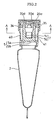
- Fig. 1 is a longitudinal sectional view of an embodiment of an infusion container according to the present invention
- Fig. 2 is a longitudinal sectional view of the embodiment in which the infusion container is viewed from an angle different by 90° from that in Fig. 1
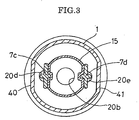
- Fig. 3 is a sectional view taken along line A-A of Fig. 2
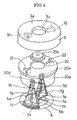
- Fig. 4 is a partially exploded perspective view mainly illustrating an open state of communication holes
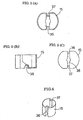
- Figs. 5(A), (B) and (C) are plan view, partially longitudinal sectional view, and bottom view, respectively, of a small container for freeze-drying a medicine
- Fig. 6 is perspective view of the small container for freeze-drying a medicine illustrated in Figs. 5(A), (B) and (C).
- An infusion container 10 illustrated in Figs. 1 and 2 mainly comprises a medicine storing chamber 1 in which a freeze-dried medicine (not illustrated) is stored and a dissolving liquid storing chamber 2 in which a dissolving liquid (not illustrated) is stored.
- the medicine storing chamber 1 is a container with a wide mouth.
- the medicine storing chamber 1 comprises a container body 8 with a bottom thereof connected with the dissolving liquid storing chamber 2; a small container 15 for freeze-drying a medicine, the small container being held in the container body; a freeze-dried medicine freeze-dried in advance and stored intact in the small container; and a capping member 3.
- the container body 8 has, at an upper end thereof, a mouth portion 1a to which the capping member 3 can be mounted, and has a communication hole 5 mentioned later at a bottom portion 6.
- the container body 8 is integrally formed as a whole of polypropylene and made more rigid than the dissolving liquid storing chamber 2.
- the dissolving liquid storing chamber 2 is blow-molded out of transparent polypropylene into a liquid-impermeable, flat bag-like shape (to a thickness of 0.2-0.5 mm) and has sufficient flexibility and resiliency.
- a flanged mouth 2b which is connected with a port 1b formed at a lower end portion of the medicine storing chamber 1.
- a suspension hole portion 23 is formed at a lower peripheral portion 2a of the dissolving liquid storing chamber 2.
- the medicine storing chamber 1 and the dissolving liquid storing chamber 2 are connected by, thermal welding the port 1b of the medicine storing chamber 1 and the flanged mouth portion 2b of the dissolving liquid storing chamber 2.
- the medicine storing chamber 1 and the dissolving liquid storing chamber 2 may be integrally molded.
- the communication hole 5 (communication holes 5a and 5b) for allowing communication between the medicine storing chamber 1 and the dissolving liquid storing chamber 2 and further there are formed a pair of protrusions 7c and 7d as a protruding piece 7 which protrudes into the medicine storing chamber 1, covers and seals the communication hole 5.
- the protrusions 7c and 7d are in the shape of towers arranged side by side, and have ribs 7f and 7g in the shape of fins for providing strength against a twist.
- the protruding piece 7 has fan-like cut portions (or openings) 7a and 7b at a bottom portion 7e common to the protrusions 7c and 7d.
- the fan-like communication holes 5a and 5b at the bottom portion 6 of the medicine storing chamber 1 are formed to oppose to each other relative to the center of the bottom portion 6 and each have a central angle of about 90° .
- the fan-like cut portions 7a and 7b are formed in correspondence to the above communication holes 5a and 5b.
- reference numeral 7h represents a ridge which serves as a part of the protruding piece 7 formed on the bottom portion 7e.
- Tip portions of the protrusions 7c and 7d are inserted into (engaged with) engaging holes 20d and 20e formed in a rubber plug 20, mentioned later, of the capping member 3.
- Y-shaped claws 31 and 32 formed on a ceiling of the capping member 3 are allowed to fit the Y-shaped cavities 21 and 22 formed in an upper surface of the rubber plug 20 so that the rotation of the capping member 3 can be conveyed to the rubber plug 20.
- the communication holes 5a and 5b are closed by the bottom portion 7e in a liquid-impermeable manner as shown in Fig. 1, while the bottom portion 7e rotates via the engaging holes 20d and 20e and the protrusions 7c and 7d in accordance with the rotation of the capping member 3, whereby the communication holes 5a and 5b are adjusted to the cut portions 7a and 7b for allowing communication between the medicine storing chamber 1 and the dissolving liquid storing chamber 2, as shown in Fig. 4.
- Ultra high molecular weight polyethylene is laminated to lower side surfaces of the rubber plug 20 (especially, of a rubber body 20a mentioned later) so as to facilitate the rotation for dissolution of the freeze-dried medicine in the dissolving liquid (so as to reduce frictional resistance to the mouth portion 1a). Also, an O-ring packing 33 is interposed among the rubber plug 20, the mouth portion 1a of the medicine storing chamber 1 and the capping member3 for improving liquid-impermeability.
- the protruding piece 7 is made of a mixture of polypropylene in 10-30 % and polyethylene in 90-70 %, and the medicine storing chamber 1 is made of polypropylene in 100 %. These are bonded with resin (provisionally fixed) so as to secure the tightness of the communication holes 5a and 5b until the medicine is mixed with the dissolving liquid.
- Two projections 11 and 12 are formed equiangularly on the outer periphery of an opening of the container body 8 of the medicine storing chamber 1, while in an internal surface of the capping member 3 are formed depressions 34 and 35 for restricting the movement of the capping member 3 relative to the projections 11 and 12 in the range of 90° .
- a pair of steps 40 and 41 are spaced at 180° intervals on an outer periphery of the container body 8 for making it easier to hold the container body 8 during the rotation of the capping member 3 as mentioned later (see Fig. 2).
- the rubber plug (plug body) 20 of the capping member 3 is inserted into the mouth portion 1a of the medicine storing chamber 1 for keeping the medicine storing chamber 1 airtight.
- the rubber plug 20 has a double structure of a rubber body 20a of a chlorinated butyl rubber selected for improving stability toward the medicine (in a solid form), the rubber body 20a occupying most area of the rubber plug 20, and a small rubber plug portion 20b positioned substantially at the center of the upper surface of the rubber body 20a and corresponding in shape to a cut hole 3b serving as an opening 4 for a medicine solution delivery portion 4 of the lid portion 3a of the capping member 3 for prevention of liquid leakage after insertion of puncture needle.
- the small rubber plug 20b is made of isoprene rubber with good restoration properties and partially exposed via the cut hole 3b, the cut hole 3b is protected by an upper lid portion 9 so that the upper surface of the rubber plug 20 may not be contaminated.
- the upper lid portion 9 is attached to the capping member 3 by welding.
- the upper lid portion 9 is opened by pulling a puller piece 9a and thereby breaking the weld, so that the small rubber plug 20b appears via the cut hole 3b.
- the upper lid portion 9 has a flat upper surface that allows the infusion container 10 filled with a freeze-dried medicine and a dissolving liquid to stand by itself.
- a lower recess 20c for facilitating the insertion of the puncture needle and engaging holes 20d and 20e for engaging with the tip portions of the protrusions 7c and 7d.
- the engaging holes 20d and 20e have a diameter of 2-6 mm.
- the small container 15 for freeze-drying a medicine is a substantially cylindrical container with an open mouth.
- the small container 15 has longitudinal grooves 36 and 37 in side walls, and a trench (transverse groove) 38 in a bottom wall in a continuous manner.
- the small container 15 is molded out of polypropylene to a mean material thickness of 0.5-1.0 mm.
- the small container 15 stores the freeze-dried medicine intact in a state where it was freeze-dried therein, and is positioned in the medicines-storing container 1, especially as illustrated in Figs. 1-4.
- the small container 15 is allowed to enter via the mouth portion 1a and positioned by engaging the longitudinal grooves 36 and 37 and the trench 38 of the small container 15 with, respectively, the protrusions 7c and 7d and the ridge 7h serving as the protruding piece 7.
- the freeze-dried medicine was obtained by filling the small container with a solution prepared by dissolving the medicine and freeze-drying the solution in a separate freeze-dryer by an ordinary method.
- the rubber plug 20 rotates in accordance therewith and further the protrusions 7c and 7d rotate via the engaging holes 20d and 20e of the rubber plug 20 to break the resin-bonding (provisional fixing) made to the bottom portion 6 of the medicine storing chamber 1, whereby the large communication hole 5 (communication holes 5a and 5b) is easily formed between the medicine storing chamber 1 and the dissolving liquid storing chamber 2 (see especially Fig. 4).
- the dissolving liquid is allowed to flow into the medicine storing chamber 1 via the communication hole 5 by reversing the infusion container 10 or pressing the dissolving liquid storing chamber 2.
- the dissolving liquid enters the small container 15 for freeze-drying a medicine from the mouth thereof and the freeze-dried medicine in the small container 15 is quickly dissolved therein (normally, a freeze-dried medicine is easily and instantly dissolved in a dissolving liquid).
- a medicine solution obtained by mixing the freeze-dried medicine with the dissolving liquid is taken out as an infusion fluid at one end of a drip infusion device (not illustrated, the same with the below) by removing the upper lid portion 9 with the puller piece 9a to open the cut hole 3b serving as the medicine solution delivery portion 4, inserting into the exposed small rubber plug portion 20b of the rubber plug 20 the puncture needle integrally connected to the drip infusion device at the other end to pierce the rubber plug 20a, and hanging the suspension hole portion 23 of the dissolving liquid storing chamber 3 on a stand.
- the communication between the medicine storing chamber 1 and the dissolving liquid storing chamber 2 is achieved with extreme ease by the rotation of the capping member 3.
- the sterility inside the infusion container 10 is secured because the container is, due to the flat shape of dissolving liquid storing chamber 2 itself and its resiliency, capable of discharging the dissolving liquid by finally taking the shape of a plate even without allowing the outside air to enter (even without using an air needle) during the drip infusion, so that the medicine solution is not in contact with the air until the drip infusion is finished.
- the infusion container 10 exclusive of the rubber plug are made of plastics consisting only of polyethylene and polypropylene described in (Japanese Pharmacopoeia Tests on Plastics for Containers for Solutions for Infusion), it is unnecessary to classify the components depending on whether they are made glass or metal in discarding the infusion container 10 containers as needed with conventional infusion containers (infusion kits) when the drip infusion is finished.
- the protruding piece seals the communication holes formed at the bottom of the medicine storing chamber and the protruding piece engaged with the rubber plug is released from the bottom of the medicine storing chamber by the rotation of the capping member via the rubber plug to open the communication holes, whereby the medicine storing chamber and the dissolving liquid storing chamber are brought into communication, making it possible to provide a solution for infusion easily and in a sterile manner.
- a medicine freeze-dried in advance in the small container for freeze-drying a medicine is capable of being held in the medicine storing chamber along with the small container, so that there is no need for taking the medicine out from the small container, thereby making a medicine storing process very simple and thus eliminating a loss produced by a medicine remaining in the small container.
Landscapes
- Health & Medical Sciences (AREA)
- Pharmacology & Pharmacy (AREA)
- Life Sciences & Earth Sciences (AREA)
- Animal Behavior & Ethology (AREA)
- General Health & Medical Sciences (AREA)
- Public Health (AREA)
- Veterinary Medicine (AREA)
- Medical Preparation Storing Or Oral Administration Devices (AREA)
Abstract
The present invention provides an infusion container capable
of conveniently storing a freeze-dried medicine in a medicine
storing chamber thereof with no loss produced by a remaining
freeze-dried medicine.
Description
The present invention relates to an infusion container
and a method for storing a freeze-dried medicine therein.
More particularly, it relates to an infusion container for
preserving a freeze-dried medicine and its dissolving liquid in a
separate state, and for mixing the freeze-dried medicine and
the dissolving liquid in the container in a sterile manner just
before the use to supply the mixture as a solution for infusion,
and a method for storing a freeze-dried medicine in the
infusion container.
For storing a freeze-dried medicine in an infusion
container of this kind, a large amount of a medicine is
freeze-dried in advance and divided into predetermined
amounts (amounts equivalent to one-container units) and the
predetermined amount of medicine is charged into a medicine
storing chamber of the infusion container, or alternatively, as
described in, for example, Japanese Patent Nos. 2551881 and
2767016, a medicine is freeze-dried in advance using specific
small containers and the freeze-dried medicine of a
predetermined amount is taken out from the small container
and charged into the medicine storing chamber of the infusion
container.
However, it takes a lot of trouble to perform a series of
steps of crushing the freeze-dried medicine, measuring out the
crushed freeze-dried medicine by a predetermined amount, and
filling the infusion container with it. In the case where the
small containers are used, it takes trouble especially to take
the freeze-dried medicine out from the small container and
there may possibly be a loss produced by an expensive
freeze-dried medicine remaining in the small container.
Thus, it is a main purpose of the present invention to
provide an infusion container in which a freeze-dried medicine
can conveniently be stored in a medicine storing chamber
thereof.
It is another main purpose of the present invention to
provide an infusion container in which a medicine freeze-dried
in a small container for freeze-drying a medicine is capable of
being stored in a medicine storing chamber with no loss
produced by a remaining medicine.
The present invention provides an infusion container
comprising a medicine storing chamber for storing a medicine
and a dissolving liquid storing chamber for storing a dissolving
liquid, the dissolving liquid storing chamber being connected
with the medicine storing chamber, characterized in that the
medicine storing chamber holds a small container having an
open mouth and storing a freeze-dried medicine, and is so
constructed as to be partitioned from the dissolving liquid
storing chamber when the infusion container is out of use and
preserved and to be capable of being communicated with the
dissolving liquid storing chamber when in use.
Namely, in the present invention, since a small
container for storing a freeze-dried medicine having an open
mouth is held in a medicine storing chamber, a medicine
freeze-dried in advance in the small container can be stored in
the medicine storing chamber along with the small container,
so that there is no need for taking the medicine out from the
small container, thereby making a medicine storing process
very simple and thus eliminating a loss produced by a
remaining medicine.
Here, the small container needs to be a container
(having, for example, an area in the mouth of 2-3 cm2 and a
height of 1.0-1.5 cm) in which a medicine is capable of being
stored in a state where it is dissolved (in a state before it is
freeze-dried) on the order of 0.5-4.0 ml and an open mouth is
provided for allowing freeze-drying of the medicine and passage
of the dissolving liquid and which is capable of being held in
the medicine storing chamber of the infusion container.
Further, it is preferable that the small container can be
positioned in the medicine storing chamber of the infusion
container. An example of a means for positioning the small
container in the medicine storing chamber is a fitting portion
provided in the medicine storing chamber for fitting a part of
the small container. A specific example of the fitting portion
is a protruding piece. Specific example(s) of the protruding
piece is/are protrusion(s) and/or a ridge formed on a container
body of the medicine storing chamber to fit, respectively,
longitudinal groove(s) formed in side walls and/or a trench
formed in a bottom wall of the small container.
Also, the small container, which has the open mouth
as mentioned above, may have, on the open mouth, a lid with
an opening formed for passage of the dissolving liquid.
Further, the small container is made of synthetic resin
such as polyethylene, polypropylene, polyvinyl chloride or
cyclic polyolefin, or metal such as aluminum or stainless steel,
and preferably of polyethylene, polypropylene or cyclic
polyolefin.
Specific examples of the active ingredients in a
freeze-dried medicine stored in the medicine storing chamber
of the infusion container according to the present invention
along with the small container are as follows.
Antibiotics are, for example, cephem antibiotics such
as cefazolin sodium, ceftizoxime sodium, cefotiam
hydrochloride, cefmenoxime hydrochloride, cephacetrile
sodium, cefamandole sodium, cefaloridine, cefotaxime sodium,
cefotetan sodium, cefoperazone so dium, cefsulodin sodium,
ceftezole sodium, cefpiramide sodium, cefmetazole sodium,
cefuroxime sodium and cefocules sulfate, and penicillin
antibiotics such as ampicillin sodium, carbenicillin disodium,
sulbenicillin disodium, and ticarcillin sodium and, further,
vancomycin hydrochloride. Antitumor agents are, for example,
mitomycin C, fluorouracil, tegafur, and cytarabine. Antiulcer
agents are, for example, famotidine, ranitidine hydrochloride,
and cimetidine.
The dissolving liquid stored in the dissolving liquid
storing chamber of the infusion container according to the
present invention may be a physiological saline solution, a
glucose solution, or an amino acid solution containing cysteine,
tryptophan or the like. However, the dissolving liquid is not
specifically limited thereto.
A capping member according to the present invention
specifically comprises, for example, a pierceable plug body and
a lid portion optionally attached to the plug body.
According to a preferable embodiment of the present
invention, a chamber for storing a medicine alternation
preventive agent may be formed on the capping member sealing
the mouth portion of the medicine storing chamber (as a
specific embodiment, on the above-mentioned lid portion)
preferably, so as to store a desiccant and/or a deoxidant inside
as a medicine alternation preventive agent. The desiccant
serves to stabilize medicines which deteriorate by humidity
and may contain silica gel, zeolite or the like as components.
The deoxidant serves to prevent alternation of medicines which
are easily oxidized and may contain active iron oxide,
amorphous copper or the like. The desiccant and the
deoxidant may be suitably used depending on the kind or the
like of the medicine to be stored in the medicine storing
chamber. The desiccant and the deoxidant may be used alone
or in combination.
Preferably, the dissolving liquid storing chamber
according to the present invention is a flexible container
molded into a bag-like shape by fusing comparatively flexible
synthetic resin sheet such as polyethylene, polypropylene, or
polyvinyl chloride, or blow-molded out of such synthetic resin.
In an embodiment, the medicine storing chamber mentioned
above may also be such a flexible container as above, so that
both containers can be molded integrally (the double-bag
system).
In one aspect, the present invention provides a small
container for freeze-drying a medicine which has a small
container-like shape and which has, in side walls and/or in a
bottom wall thereof, respectively, a longitudinal groove and/or
a trench for insuring a fit in a medicine storing chamber of an
infusion container and for positioning the container itself in
the medicine storing chamber.
In another aspect, the present invention provides a
method for storing a freeze-dried medicine in an infusion
container which comprises the medicine storing chamber for
storing a medicine and a dissolving liquid storing chamber for
storing a dissolving liquid, the dissolving liquid storing
chamber being connected with the medicine storing chamber
and being so partitioned from the medicine storing chamber
that an inside of the dissolving liquid storing chamber is
capable of being communicated with an inside of the medicine
storing chamber when in use, the method comprising the steps
of, for storing the medicine in the medicine storing chamber of
the infusion container, filling a small container having an open
mouth with a solution prepared by dissolving the medicine,
freeze-drying the solution by an ordinary method, and storing
the freeze-dried medicine in the medicine storing chamber
along with the small container without taking the freeze-dried
medicine out from the small container.
Hereafter, the present invention will be detailed on the
basis of an embodiment illustrated in the drawings. This is
not to restrict the present invention.
Fig. 1 is a longitudinal sectional view of an
embodiment of an infusion container according to the present
invention; Fig. 2 is a longitudinal sectional view of the
embodiment in which the infusion container is viewed from an
angle different by 90° from that in Fig. 1; Fig. 3 is a sectional
view taken along line A-A of Fig. 2; Fig. 4 is a partially
exploded perspective view mainly illustrating an open state of
communication holes; Figs. 5(A), (B) and (C) are plan view,
partially longitudinal sectional view, and bottom view,
respectively, of a small container for freeze-drying a medicine;
Fig. 6 is perspective view of the small container for
freeze-drying a medicine illustrated in Figs. 5(A), (B) and (C).
An infusion container 10 illustrated in Figs. 1 and 2
mainly comprises a medicine storing chamber 1 in which a
freeze-dried medicine (not illustrated) is stored and a
dissolving liquid storing chamber 2 in which a dissolving liquid
(not illustrated) is stored.
The medicine storing chamber 1 is a container with a
wide mouth. The medicine storing chamber 1 comprises a
container body 8 with a bottom thereof connected with the
dissolving liquid storing chamber 2; a small container 15 for
freeze-drying a medicine, the small container being held in the
container body; a freeze-dried medicine freeze-dried in advance
and stored intact in the small container; and a capping
member 3. The container body 8 has, at an upper end thereof,
a mouth portion 1a to which the capping member 3 can be
mounted, and has a communication hole 5 mentioned later at
a bottom portion 6. The container body 8 is integrally formed
as a whole of polypropylene and made more rigid than the
dissolving liquid storing chamber 2.
The dissolving liquid storing chamber 2 is blow-molded
out of transparent polypropylene into a liquid-impermeable,
flat bag-like shape (to a thickness of 0.2-0.5 mm) and has
sufficient flexibility and resiliency. At an upper portion of the
dissolving liquid storing chamber 2 is formed a flanged mouth
2b which is connected with a port 1b formed at a lower end
portion of the medicine storing chamber 1. At a lower
peripheral portion 2a of the dissolving liquid storing chamber 2
there is formed a suspension hole portion 23 as a suspension
support portion. The medicine storing chamber 1 and the
dissolving liquid storing chamber 2 are connected by, thermal
welding the port 1b of the medicine storing chamber 1 and the
flanged mouth portion 2b of the dissolving liquid storing
chamber 2. Alternatively, the medicine storing chamber 1 and
the dissolving liquid storing chamber 2 may be integrally
molded.
At the bottom portion 6 of the medicine storing
chamber 1 connected to the dissolving liquid storing chamber
2 in a liquid-impermeable manner, there is formed the
communication hole 5 ( communication holes 5a and 5b) for
allowing communication between the medicine storing chamber
1 and the dissolving liquid storing chamber 2 and further there
are formed a pair of protrusions 7c and 7d as a protruding
piece 7 which protrudes into the medicine storing chamber 1,
covers and seals the communication hole 5. The protrusions
7c and 7d are in the shape of towers arranged side by side,
and have ribs 7f and 7g in the shape of fins for providing
strength against a twist. The protruding piece 7 has fan-like
cut portions (or openings) 7a and 7b at a bottom portion 7e
common to the protrusions 7c and 7d. Here, the fan- like
communication holes 5a and 5b at the bottom portion 6 of the
medicine storing chamber 1 are formed to oppose to each other
relative to the center of the bottom portion 6 and each have a
central angle of about 90° . The fan- like cut portions 7a and
7b are formed in correspondence to the above communication
holes 5a and 5b. The cut portions 7a and 7b at the bottom
portion 7e are adjusted to the pair of fan- like communication
holes 5a and 5b formed at the bottom portion 6 of the medicine
storing chamber 1 by the rotation of the protrusions 7c and 7d,
whereby the medicine storing chamber 1 and the dissolving
liquid storing chamber 2 are brought into communication.
Here, reference numeral 7h represents a ridge which serves as
a part of the protruding piece 7 formed on the bottom portion
7e.
Tip portions of the protrusions 7c and 7d are inserted
into (engaged with) engaging holes 20d and 20e formed in a
rubber plug 20, mentioned later, of the capping member 3.
Y- shaped claws 31 and 32 formed on a ceiling of the capping
member 3 are allowed to fit the Y- shaped cavities 21 and 22
formed in an upper surface of the rubber plug 20 so that the
rotation of the capping member 3 can be conveyed to the
rubber plug 20.
Accordingly, before the use, the communication holes
5a and 5b are closed by the bottom portion 7e in a
liquid-impermeable manner as shown in Fig. 1, while the
bottom portion 7e rotates via the engaging holes 20d and 20e
and the protrusions 7c and 7d in accordance with the rotation
of the capping member 3, whereby the communication holes 5a
and 5b are adjusted to the cut portions 7a and 7b for allowing
communication between the medicine storing chamber 1 and
the dissolving liquid storing chamber 2, as shown in Fig. 4.
Ultra high molecular weight polyethylene is laminated
to lower side surfaces of the rubber plug 20 (especially, of a
rubber body 20a mentioned later) so as to facilitate the
rotation for dissolution of the freeze-dried medicine in the
dissolving liquid (so as to reduce frictional resistance to the
mouth portion 1a). Also, an O-ring packing 33 is interposed
among the rubber plug 20, the mouth portion 1a of the
medicine storing chamber 1 and the capping member3 for
improving liquid-impermeability.
In the meanwhile, the protruding piece 7 is made of a
mixture of polypropylene in 10-30 % and polyethylene in
90-70 %, and the medicine storing chamber 1 is made of
polypropylene in 100 %. These are bonded with resin
(provisionally fixed) so as to secure the tightness of the
communication holes 5a and 5b until the medicine is mixed
with the dissolving liquid.
Two projections 11 and 12 are formed equiangularly on
the outer periphery of an opening of the container body 8 of
the medicine storing chamber 1, while in an internal surface of
the capping member 3 are formed depressions 34 and 35 for
restricting the movement of the capping member 3 relative to
the projections 11 and 12 in the range of 90° .
Also, a pair of steps 40 and 41 are spaced at 180°
intervals on an outer periphery of the container body 8 for
making it easier to hold the container body 8 during the
rotation of the capping member 3 as mentioned later (see Fig.
2).
The rubber plug (plug body) 20 of the capping member
3 is inserted into the mouth portion 1a of the medicine storing
chamber 1 for keeping the medicine storing chamber 1 airtight.
The rubber plug 20 has a double structure of a rubber body
20a of a chlorinated butyl rubber selected for improving
stability toward the medicine (in a solid form), the rubber body
20a occupying most area of the rubber plug 20, and a small
rubber plug portion 20b positioned substantially at the center
of the upper surface of the rubber body 20a and corresponding
in shape to a cut hole 3b serving as an opening 4 for a
medicine solution delivery portion 4 of the lid portion 3a of the
capping member 3 for prevention of liquid leakage after
insertion of puncture needle. Though the small rubber plug
20b is made of isoprene rubber with good restoration
properties and partially exposed via the cut hole 3b, the cut
hole 3b is protected by an upper lid portion 9 so that the upper
surface of the rubber plug 20 may not be contaminated. The
upper lid portion 9 is attached to the capping member 3 by
welding. The upper lid portion 9 is opened by pulling a puller
piece 9a and thereby breaking the weld, so that the small
rubber plug 20b appears via the cut hole 3b. The upper lid
portion 9 has a flat upper surface that allows the infusion
container 10 filled with a freeze-dried medicine and a
dissolving liquid to stand by itself.
In a lower surface of the rubber plug 20a, there is
formed a lower recess 20c for facilitating the insertion of the
puncture needle and engaging holes 20d and 20e for engaging
with the tip portions of the protrusions 7c and 7d. The
engaging holes 20d and 20e have a diameter of 2-6 mm.
In Figs. 1-6, especially in Figs. 5(A), (B) and (C) and Fig.
6, the small container 15 for freeze-drying a medicine is a
substantially cylindrical container with an open mouth. The
small container 15 has longitudinal grooves 36 and 37 in side
walls, and a trench (transverse groove) 38 in a bottom wall in a
continuous manner. The small container 15 is molded out of
polypropylene to a mean material thickness of 0.5-1.0 mm.
The small container 15 stores the freeze-dried
medicine intact in a state where it was freeze-dried therein,
and is positioned in the medicines-storing container 1,
especially as illustrated in Figs. 1-4.
Namely, before the rubber plug 20 of the capping
member 3 is mounted in the mouth portion 1a, the small
container 15 is allowed to enter via the mouth portion 1a and
positioned by engaging the longitudinal grooves 36 and 37 and
the trench 38 of the small container 15 with, respectively, the
protrusions 7c and 7d and the ridge 7h serving as the
protruding piece 7. The freeze-dried medicine was obtained
by filling the small container with a solution prepared by
dissolving the medicine and freeze-drying the solution in a
separate freeze-dryer by an ordinary method.
By such a construction of the infusion container 10,
when the capping member 3 is rotated, the rubber plug 20
rotates in accordance therewith and further the protrusions 7c
and 7d rotate via the engaging holes 20d and 20e of the rubber
plug 20 to break the resin-bonding (provisional fixing) made to
the bottom portion 6 of the medicine storing chamber 1,
whereby the large communication hole 5 ( communication holes
5a and 5b) is easily formed between the medicine storing
chamber 1 and the dissolving liquid storing chamber 2 (see
especially Fig. 4).
Further, the dissolving liquid is allowed to flow into
the medicine storing chamber 1 via the communication hole 5
by reversing the infusion container 10 or pressing the
dissolving liquid storing chamber 2. Thus, the dissolving
liquid enters the small container 15 for freeze-drying a
medicine from the mouth thereof and the freeze-dried medicine
in the small container 15 is quickly dissolved therein (normally,
a freeze-dried medicine is easily and instantly dissolved in a
dissolving liquid).
Subsequently, a medicine solution obtained by mixing
the freeze-dried medicine with the dissolving liquid is taken
out as an infusion fluid at one end of a drip infusion device
(not illustrated, the same with the below) by removing the
upper lid portion 9 with the puller piece 9a to open the cut
hole 3b serving as the medicine solution delivery portion 4,
inserting into the exposed small rubber plug portion 20b of the
rubber plug 20 the puncture needle integrally connected to the
drip infusion device at the other end to pierce the rubber plug
20a, and hanging the suspension hole portion 23 of the
dissolving liquid storing chamber 3 on a stand. Thus, in the
above embodiment, the communication between the medicine
storing chamber 1 and the dissolving liquid storing chamber 2
is achieved with extreme ease by the rotation of the capping
member 3.
Also, the sterility inside the infusion container 10 is
secured because the container is, due to the flat shape of
dissolving liquid storing chamber 2 itself and its resiliency,
capable of discharging the dissolving liquid by finally taking
the shape of a plate even without allowing the outside air to
enter (even without using an air needle) during the drip
infusion, so that the medicine solution is not in contact with
the air until the drip infusion is finished. Further, since all
the components of the infusion container 10 exclusive of the
rubber plug are made of plastics consisting only of
polyethylene and polypropylene described in (Japanese
Pharmacopoeia Tests on Plastics for Containers for Solutions
for Infusion), it is unnecessary to classify the components
depending on whether they are made glass or metal in
discarding the infusion container 10 containers as needed with
conventional infusion containers (infusion kits) when the drip
infusion is finished.
As mentioned above, according to this infusion
container, the protruding piece seals the communication holes
formed at the bottom of the medicine storing chamber and the
protruding piece engaged with the rubber plug is released from
the bottom of the medicine storing chamber by the rotation of
the capping member via the rubber plug to open the
communication holes, whereby the medicine storing chamber
and the dissolving liquid storing chamber are brought into
communication, making it possible to provide a solution for
infusion easily and in a sterile manner.
According to the present invention, a medicine
freeze-dried in advance in the small container for freeze-drying
a medicine is capable of being held in the medicine storing
chamber along with the small container, so that there is no
need for taking the medicine out from the small container,
thereby making a medicine storing process very simple and
thus eliminating a loss produced by a medicine remaining in
the small container.
Claims (10)
- An infusion container comprising a medicine storing chamber for storing a medicine and a dissolving liquid storing chamber for storing a dissolving liquid, the dissolving liquid storing chamber being connected with the medicine storing chamber,
characterized in that the medicine storing chamber holds a small container having an open mouth and storing a freeze-dried medicine, and is so constructed as to be partitioned from the dissolving liquid storing chamber when the infusion container is out of use and preserved and to be capable of being communicated with the dissolving liquid storing chamber when in use. - An infusion container of claim 1, wherein the medicine storing chamber comprises a container body with a bottom thereof connected with the dissolving liquid storing chamber and a capping member for sealing a mouth portion of the container body, and the small container is held in the container body.
- An infusion container of claim 2, wherein the container body has in an inside thereof a fitting portion for fitting a part of the small container and thereby for positioning the small container.
- An infusion container of claim 3, wherein the small container has a longitudinal groove in side walls thereof and/or a trench in a bottom wall thereof, and the fitting portion of the container body is a protruding piece which fits the longitudinal groove and/or the trench and thereby positions the small container, the protruding piece being formed on the bottom of the container body.
- An infusion container of claim 4, wherein the longitudinal groove comprises two or more grooves formed equidistantly and circumferentially in the side walls of the small container.
- An infusion container of claim 4, wherein the container body has at the bottom a hole for allowing communication with the dissolving liquid storing chamber, the protruding piece is movable on the bottom of the container body and a bottom portion of the protruding piece openably seals the communication hole, the capping member has an engaging portion engaged with a tip portion of the protruding piece and is capable of opening the communication hole by the rotation of the capping member via the engaging portion and the protruding piece.
- An infusion container of claim 1, wherein the small container is made of synthetic resin or metal.
- A small container for freeze-drying a medicine, which has a small container-like shape and which has, in side walls and/or in a bottom wall thereof, respectively, a longitudinal groove and/or a trench for insuring a fit in a medicine storing chamber of an infusion container and for positioning the container itself in the medicine storing chamber.
- A small container of claim 8, wherein the longitudinal groove comprises two or more grooves formed equidistantly and circumferentially in the side walls of the small container.
- A method for storing a freeze-dried medicine in an infusion container which comprises a medicine storing chamber for storing a medicine and a dissolving liquid storing chamber for storing a dissolving liquid, the dissolving liquid storing chamber being connected with the medicine storing chamber and being so partitioned from the medicine storing chamber that an inside of the dissolving liquid storing chamber is capable of being communicated with an inside of the medicine storing chamber when in use,
the method comprising the steps of, for storing the medicine in the medicine storing chamber of the infusion container,
filling a small container having an open mouth with a solution prepared by dissolving the medicine,
freeze-drying the solution by an ordinary method, and
storing the freeze-dried medicine in the medicine storing chamber along with the small container without taking the freeze-dried medicine out from the small container.
Applications Claiming Priority (3)
| Application Number | Priority Date | Filing Date | Title |
|---|---|---|---|
| JP27938899 | 1999-09-30 | ||
| JP27938899 | 1999-09-30 | ||
| PCT/JP2000/006590 WO2001022913A1 (en) | 1999-09-30 | 2000-09-25 | Infusion container and method of storing freeze-dried medicine |
Publications (2)
| Publication Number | Publication Date |
|---|---|
| EP1243245A1 true EP1243245A1 (en) | 2002-09-25 |
| EP1243245A4 EP1243245A4 (en) | 2006-10-18 |
Family
ID=17610445
Family Applications (1)
| Application Number | Title | Priority Date | Filing Date |
|---|---|---|---|
| EP00962838A Withdrawn EP1243245A4 (en) | 1999-09-30 | 2000-09-25 | INFUSION CONTAINER AND METHOD FOR STORING A LYOPHILIZED MEDICAMENT |
Country Status (2)
| Country | Link |
|---|---|
| EP (1) | EP1243245A4 (en) |
| WO (1) | WO2001022913A1 (en) |
Cited By (1)
| Publication number | Priority date | Publication date | Assignee | Title |
|---|---|---|---|---|
| GB2485254A (en) * | 2011-08-22 | 2012-05-09 | Eulysis Uk Ltd | A container having a recess in a closure for a dried active agent |
Family Cites Families (7)
| Publication number | Priority date | Publication date | Assignee | Title |
|---|---|---|---|---|
| US3441179A (en) * | 1967-05-29 | 1969-04-29 | Ways & Means Inc | Mixing container |
| JP2551881B2 (en) * | 1991-06-26 | 1996-11-06 | 株式会社大塚製薬工場 | Freeze-drying container and method for producing freeze-dried drug in filled container |
| JP2767016B2 (en) * | 1992-07-14 | 1998-06-18 | 株式会社大塚製薬工場 | Freeze-drying container |
| EP0809994B1 (en) * | 1995-02-13 | 2003-05-21 | Fujisawa Pharmaceutical Co., Ltd. | Transfusion container |
| JPH1080465A (en) * | 1996-07-19 | 1998-03-31 | Material Eng Tech Lab Inc | Medical container |
| JPH10165480A (en) * | 1996-12-13 | 1998-06-23 | Material Eng Tech Lab Inc | Lyophilized container and method for producing the same |
| FR2767514B1 (en) * | 1997-08-22 | 1999-11-05 | Dominique Mounier | MIXER BOTTLE COMBINING TWO INSULATED COMPONENTS BEFORE THEY ARE COLLECTED AND INJECTED WITH A SYRINGE |
-
2000
- 2000-09-25 WO PCT/JP2000/006590 patent/WO2001022913A1/en not_active Ceased
- 2000-09-25 EP EP00962838A patent/EP1243245A4/en not_active Withdrawn
Cited By (2)
| Publication number | Priority date | Publication date | Assignee | Title |
|---|---|---|---|---|
| GB2485254A (en) * | 2011-08-22 | 2012-05-09 | Eulysis Uk Ltd | A container having a recess in a closure for a dried active agent |
| GB2485254B (en) * | 2011-08-22 | 2013-01-23 | Eulysis Uk Ltd | A container having a recessed closure for drying and storing one or more active agents |
Also Published As
| Publication number | Publication date |
|---|---|
| WO2001022913A1 (en) | 2001-04-05 |
| EP1243245A4 (en) | 2006-10-18 |
Similar Documents
| Publication | Publication Date | Title |
|---|---|---|
| US4731053A (en) | Container device for separately storing and mixing two ingredients | |
| EP0750569B1 (en) | Container for pharmaceutical substances | |
| US5261902A (en) | Fluid container assembly | |
| US7115117B2 (en) | Infusion vessel | |
| JP3491727B2 (en) | Drug container with communication means | |
| KR102632686B1 (en) | injection system | |
| EP0809994B1 (en) | Transfusion container | |
| JP4617552B2 (en) | Infusion container and lyophilized drug storage method | |
| JP4175255B2 (en) | Small container for substance alteration inhibitor and infusion container containing the same | |
| US6019752A (en) | Fluid vessel | |
| JP4095851B2 (en) | Infusion container and drug container | |
| JP3238170B2 (en) | Infusion container | |
| WO2001022913A1 (en) | Infusion container and method of storing freeze-dried medicine | |
| JP2003062039A (en) | Drug container | |
| JP2004041379A (en) | Infusion container and medicine container | |
| JP2004041377A (en) | Infusion container and medicine container | |
| JPH07184979A (en) | Vessel for infusion | |
| JPH11253526A (en) | Sealing member, substance deterioration preventing structure and infusion container using the same | |
| JP2005006945A (en) | Infusion container | |
| JP2749899B2 (en) | Medicine container | |
| JPH04352962A (en) | Liquid infusing device | |
| JPH04327850A (en) | Liquid transfusing device | |
| JP2555143Y2 (en) | Infusion device | |
| JP2000288068A (en) | Liquid container | |
| JP2004041380A (en) | Infusion container |
Legal Events
| Date | Code | Title | Description |
|---|---|---|---|
| PUAI | Public reference made under article 153(3) epc to a published international application that has entered the european phase |
Free format text: ORIGINAL CODE: 0009012 |
|
| 17P | Request for examination filed |
Effective date: 20020327 |
|
| AK | Designated contracting states |
Kind code of ref document: A1 Designated state(s): AT BE CH CY DE DK ES FI FR GB GR IE IT LI LU MC NL PT SE |
|
| RAP1 | Party data changed (applicant data changed or rights of an application transferred) |
Owner name: ASTELLAS PHARMA INC. |
|
| A4 | Supplementary search report drawn up and despatched |
Effective date: 20060915 |
|
| STAA | Information on the status of an ep patent application or granted ep patent |
Free format text: STATUS: THE APPLICATION IS DEEMED TO BE WITHDRAWN |
|
| 18D | Application deemed to be withdrawn |
Effective date: 20061214 |