EP1242589B1 - Methods for producing enantiomerically pure alpha-substituted carboxylic acids - Google Patents
Methods for producing enantiomerically pure alpha-substituted carboxylic acids Download PDFInfo
- Publication number
- EP1242589B1 EP1242589B1 EP00989578.0A EP00989578A EP1242589B1 EP 1242589 B1 EP1242589 B1 EP 1242589B1 EP 00989578 A EP00989578 A EP 00989578A EP 1242589 B1 EP1242589 B1 EP 1242589B1
- Authority
- EP
- European Patent Office
- Prior art keywords
- polypeptide
- sequence
- nitrilase
- nucleic acid
- sequences
- Prior art date
- Legal status (The legal status is an assumption and is not a legal conclusion. Google has not performed a legal analysis and makes no representation as to the accuracy of the status listed.)
- Expired - Lifetime
Links
- 238000000034 method Methods 0.000 title claims description 182
- 150000001735 carboxylic acids Chemical class 0.000 title description 9
- 108090000765 processed proteins & peptides Proteins 0.000 claims description 232
- 102000004196 processed proteins & peptides Human genes 0.000 claims description 226
- 229920001184 polypeptide Polymers 0.000 claims description 221
- 150000007523 nucleic acids Chemical class 0.000 claims description 170
- 102000039446 nucleic acids Human genes 0.000 claims description 110
- 108020004707 nucleic acids Proteins 0.000 claims description 110
- 108020004414 DNA Proteins 0.000 claims description 101
- 108091028043 Nucleic acid sequence Proteins 0.000 claims description 75
- 108010033272 Nitrilase Proteins 0.000 claims description 64
- 238000009396 hybridization Methods 0.000 claims description 61
- 108090000623 proteins and genes Proteins 0.000 claims description 59
- 210000004027 cell Anatomy 0.000 claims description 57
- 230000000694 effects Effects 0.000 claims description 56
- 235000001014 amino acid Nutrition 0.000 claims description 47
- 239000013598 vector Substances 0.000 claims description 47
- 125000003729 nucleotide group Chemical group 0.000 claims description 46
- 239000002773 nucleotide Substances 0.000 claims description 45
- 150000001413 amino acids Chemical group 0.000 claims description 44
- 102000004190 Enzymes Human genes 0.000 claims description 37
- 108090000790 Enzymes Proteins 0.000 claims description 37
- 238000006243 chemical reaction Methods 0.000 claims description 36
- QGZKDVFQNNGYKY-UHFFFAOYSA-N Ammonia Chemical compound N QGZKDVFQNNGYKY-UHFFFAOYSA-N 0.000 claims description 35
- ZHNUHDYFZUAESO-UHFFFAOYSA-N Formamide Chemical compound NC=O ZHNUHDYFZUAESO-UHFFFAOYSA-N 0.000 claims description 35
- 102000040430 polynucleotide Human genes 0.000 claims description 29
- 108091033319 polynucleotide Proteins 0.000 claims description 29
- 239000002157 polynucleotide Substances 0.000 claims description 29
- 238000002703 mutagenesis Methods 0.000 claims description 24
- 231100000350 mutagenesis Toxicity 0.000 claims description 24
- 150000001875 compounds Chemical class 0.000 claims description 23
- 125000005219 aminonitrile group Chemical group 0.000 claims description 22
- 230000000295 complement effect Effects 0.000 claims description 22
- 239000000203 mixture Substances 0.000 claims description 21
- XFXPMWWXUTWYJX-UHFFFAOYSA-N Cyanide Chemical compound N#[C-] XFXPMWWXUTWYJX-UHFFFAOYSA-N 0.000 claims description 20
- 150000001732 carboxylic acid derivatives Chemical class 0.000 claims description 18
- 239000013612 plasmid Substances 0.000 claims description 18
- 229910021529 ammonia Inorganic materials 0.000 claims description 16
- 125000000217 alkyl group Chemical group 0.000 claims description 15
- 235000008206 alpha-amino acids Nutrition 0.000 claims description 15
- 150000002576 ketones Chemical class 0.000 claims description 14
- 150000001299 aldehydes Chemical class 0.000 claims description 13
- 125000003118 aryl group Chemical group 0.000 claims description 13
- 239000000543 intermediate Substances 0.000 claims description 13
- 150000003863 ammonium salts Chemical class 0.000 claims description 12
- 230000027455 binding Effects 0.000 claims description 12
- 239000013604 expression vector Substances 0.000 claims description 12
- 125000000623 heterocyclic group Chemical group 0.000 claims description 9
- 238000004519 manufacturing process Methods 0.000 claims description 9
- 238000002741 site-directed mutagenesis Methods 0.000 claims description 9
- 125000001424 substituent group Chemical group 0.000 claims description 9
- 150000001370 alpha-amino acid derivatives Chemical class 0.000 claims description 8
- 150000001412 amines Chemical class 0.000 claims description 8
- 210000003527 eukaryotic cell Anatomy 0.000 claims description 8
- 240000004808 Saccharomyces cerevisiae Species 0.000 claims description 7
- 125000000753 cycloalkyl group Chemical group 0.000 claims description 7
- 229940061720 alpha hydroxy acid Drugs 0.000 claims description 6
- 150000001280 alpha hydroxy acids Chemical class 0.000 claims description 6
- 125000001072 heteroaryl group Chemical group 0.000 claims description 6
- 230000007062 hydrolysis Effects 0.000 claims description 6
- 238000006460 hydrolysis reaction Methods 0.000 claims description 6
- 230000003301 hydrolyzing effect Effects 0.000 claims description 6
- ROHFNLRQFUQHCH-YFKPBYRVSA-N L-leucine Chemical compound CC(C)C[C@H](N)C(O)=O ROHFNLRQFUQHCH-YFKPBYRVSA-N 0.000 claims description 5
- 210000004436 artificial bacterial chromosome Anatomy 0.000 claims description 5
- 238000007845 assembly PCR Methods 0.000 claims description 5
- 238000012219 cassette mutagenesis Methods 0.000 claims description 5
- 238000003776 cleavage reaction Methods 0.000 claims description 5
- 238000001727 in vivo Methods 0.000 claims description 5
- 210000004962 mammalian cell Anatomy 0.000 claims description 5
- 230000007017 scission Effects 0.000 claims description 5
- 230000001568 sexual effect Effects 0.000 claims description 5
- 241000972773 Aulopiformes Species 0.000 claims description 4
- 241000238631 Hexapoda Species 0.000 claims description 4
- 125000003342 alkenyl group Chemical group 0.000 claims description 4
- 125000004104 aryloxy group Chemical group 0.000 claims description 4
- 125000004122 cyclic group Chemical group 0.000 claims description 4
- 230000002538 fungal effect Effects 0.000 claims description 4
- 229910052751 metal Inorganic materials 0.000 claims description 4
- 239000002184 metal Substances 0.000 claims description 4
- 210000001236 prokaryotic cell Anatomy 0.000 claims description 4
- 235000019515 salmon Nutrition 0.000 claims description 4
- 230000001131 transforming effect Effects 0.000 claims description 4
- 108700026244 Open Reading Frames Proteins 0.000 claims description 3
- 108020005202 Viral DNA Proteins 0.000 claims description 3
- 125000003545 alkoxy group Chemical group 0.000 claims description 3
- 125000000304 alkynyl group Chemical group 0.000 claims description 3
- 229910052736 halogen Inorganic materials 0.000 claims description 3
- 150000002367 halogens Chemical class 0.000 claims description 3
- 125000002887 hydroxy group Chemical group [H]O* 0.000 claims description 3
- PXQLVRUNWNTZOS-UHFFFAOYSA-N sulfanyl Chemical class [SH] PXQLVRUNWNTZOS-UHFFFAOYSA-N 0.000 claims description 3
- 241000701447 unidentified baculovirus Species 0.000 claims description 3
- YTRNSQPXEDGWMR-CQSZACIVSA-N (2s)-2-cyclohexyl-2-hydroxy-2-phenylacetic acid Chemical compound C1([C@@](O)(C(=O)O)C=2C=CC=CC=2)CCCCC1 YTRNSQPXEDGWMR-CQSZACIVSA-N 0.000 claims description 2
- RWOLDZZTBNYTMS-UHFFFAOYSA-N 2-(2-chlorophenyl)-2-hydroxyacetic acid Chemical compound OC(=O)C(O)C1=CC=CC=C1Cl RWOLDZZTBNYTMS-UHFFFAOYSA-N 0.000 claims description 2
- QNAYBMKLOCPYGJ-UWTATZPHSA-N D-alanine Chemical compound C[C@@H](N)C(O)=O QNAYBMKLOCPYGJ-UWTATZPHSA-N 0.000 claims description 2
- QNAYBMKLOCPYGJ-UHFFFAOYSA-N D-alpha-Ala Natural products CC([NH3+])C([O-])=O QNAYBMKLOCPYGJ-UHFFFAOYSA-N 0.000 claims description 2
- ZGUNAGUHMKGQNY-SSDOTTSWSA-N D-alpha-phenylglycine Chemical compound OC(=O)[C@H](N)C1=CC=CC=C1 ZGUNAGUHMKGQNY-SSDOTTSWSA-N 0.000 claims description 2
- COLNVLDHVKWLRT-MRVPVSSYSA-N D-phenylalanine Chemical compound OC(=O)[C@H](N)CC1=CC=CC=C1 COLNVLDHVKWLRT-MRVPVSSYSA-N 0.000 claims description 2
- 229930182832 D-phenylalanine Natural products 0.000 claims description 2
- IWYDHOAUDWTVEP-UHFFFAOYSA-N R-2-phenyl-2-hydroxyacetic acid Natural products OC(=O)C(O)C1=CC=CC=C1 IWYDHOAUDWTVEP-UHFFFAOYSA-N 0.000 claims description 2
- 208000037065 Subacute sclerosing leukoencephalitis Diseases 0.000 claims description 2
- 206010042297 Subacute sclerosing panencephalitis Diseases 0.000 claims description 2
- 210000004507 artificial chromosome Anatomy 0.000 claims description 2
- 210000001106 artificial yeast chromosome Anatomy 0.000 claims description 2
- 239000013599 cloning vector Substances 0.000 claims description 2
- 150000002500 ions Chemical class 0.000 claims description 2
- 230000000717 retained effect Effects 0.000 claims description 2
- 210000005253 yeast cell Anatomy 0.000 claims description 2
- 238000003752 polymerase chain reaction Methods 0.000 claims 3
- 150000004820 halides Chemical group 0.000 claims 2
- QBYIENPQHBMVBV-HFEGYEGKSA-N (2R)-2-hydroxy-2-phenylacetic acid Chemical compound O[C@@H](C(O)=O)c1ccccc1.O[C@@H](C(O)=O)c1ccccc1 QBYIENPQHBMVBV-HFEGYEGKSA-N 0.000 claims 1
- 239000003513 alkali Substances 0.000 claims 1
- KXZJHVJKXJLBKO-UHFFFAOYSA-N chembl1408157 Chemical group N=1C2=CC=CC=C2C(C(=O)O)=CC=1C1=CC=C(O)C=C1 KXZJHVJKXJLBKO-UHFFFAOYSA-N 0.000 claims 1
- 229960002510 mandelic acid Drugs 0.000 claims 1
- 239000000523 sample Substances 0.000 description 75
- 239000012634 fragment Substances 0.000 description 69
- 229940024606 amino acid Drugs 0.000 description 41
- 230000008569 process Effects 0.000 description 38
- 102000004169 proteins and genes Human genes 0.000 description 37
- 235000018102 proteins Nutrition 0.000 description 36
- 229940088598 enzyme Drugs 0.000 description 34
- 238000004422 calculation algorithm Methods 0.000 description 29
- 238000004590 computer program Methods 0.000 description 22
- 238000012900 molecular simulation Methods 0.000 description 18
- 125000003275 alpha amino acid group Chemical group 0.000 description 17
- 108091026890 Coding region Proteins 0.000 description 15
- 230000015572 biosynthetic process Effects 0.000 description 15
- 239000000243 solution Substances 0.000 description 15
- 239000000047 product Substances 0.000 description 14
- 108091034117 Oligonucleotide Proteins 0.000 description 13
- 230000003321 amplification Effects 0.000 description 13
- -1 cyanide compound Chemical class 0.000 description 13
- 238000003199 nucleic acid amplification method Methods 0.000 description 13
- 239000007790 solid phase Substances 0.000 description 13
- 238000006467 substitution reaction Methods 0.000 description 13
- 102000053602 DNA Human genes 0.000 description 12
- 239000002585 base Substances 0.000 description 12
- 238000013500 data storage Methods 0.000 description 12
- 238000003786 synthesis reaction Methods 0.000 description 12
- 239000000758 substrate Substances 0.000 description 10
- 108091032973 (ribonucleotides)n+m Proteins 0.000 description 9
- 241000588724 Escherichia coli Species 0.000 description 9
- 238000010790 dilution Methods 0.000 description 9
- 239000012895 dilution Substances 0.000 description 9
- 238000012216 screening Methods 0.000 description 9
- 125000000539 amino acid group Chemical group 0.000 description 8
- 230000001580 bacterial effect Effects 0.000 description 8
- 230000004071 biological effect Effects 0.000 description 8
- 230000035772 mutation Effects 0.000 description 8
- 238000007792 addition Methods 0.000 description 7
- 150000001371 alpha-amino acids Chemical class 0.000 description 7
- 239000000872 buffer Substances 0.000 description 7
- 125000004432 carbon atom Chemical group C* 0.000 description 7
- 238000012217 deletion Methods 0.000 description 7
- 230000037430 deletion Effects 0.000 description 7
- 239000003623 enhancer Substances 0.000 description 7
- 230000002068 genetic effect Effects 0.000 description 7
- 239000011159 matrix material Substances 0.000 description 7
- 230000004048 modification Effects 0.000 description 7
- 239000000126 substance Substances 0.000 description 7
- 238000013518 transcription Methods 0.000 description 7
- 230000035897 transcription Effects 0.000 description 7
- TWRXJAOTZQYOKJ-UHFFFAOYSA-L Magnesium chloride Chemical compound [Mg+2].[Cl-].[Cl-] TWRXJAOTZQYOKJ-UHFFFAOYSA-L 0.000 description 6
- OKKJLVBELUTLKV-UHFFFAOYSA-N Methanol Chemical compound OC OKKJLVBELUTLKV-UHFFFAOYSA-N 0.000 description 6
- FAPWRFPIFSIZLT-UHFFFAOYSA-M Sodium chloride Chemical compound [Na+].[Cl-] FAPWRFPIFSIZLT-UHFFFAOYSA-M 0.000 description 6
- JLCPHMBAVCMARE-UHFFFAOYSA-N [3-[[3-[[3-[[3-[[3-[[3-[[3-[[3-[[3-[[3-[[3-[[5-(2-amino-6-oxo-1H-purin-9-yl)-3-[[3-[[3-[[3-[[3-[[3-[[5-(2-amino-6-oxo-1H-purin-9-yl)-3-[[5-(2-amino-6-oxo-1H-purin-9-yl)-3-hydroxyoxolan-2-yl]methoxy-hydroxyphosphoryl]oxyoxolan-2-yl]methoxy-hydroxyphosphoryl]oxy-5-(5-methyl-2,4-dioxopyrimidin-1-yl)oxolan-2-yl]methoxy-hydroxyphosphoryl]oxy-5-(6-aminopurin-9-yl)oxolan-2-yl]methoxy-hydroxyphosphoryl]oxy-5-(6-aminopurin-9-yl)oxolan-2-yl]methoxy-hydroxyphosphoryl]oxy-5-(6-aminopurin-9-yl)oxolan-2-yl]methoxy-hydroxyphosphoryl]oxy-5-(6-aminopurin-9-yl)oxolan-2-yl]methoxy-hydroxyphosphoryl]oxyoxolan-2-yl]methoxy-hydroxyphosphoryl]oxy-5-(5-methyl-2,4-dioxopyrimidin-1-yl)oxolan-2-yl]methoxy-hydroxyphosphoryl]oxy-5-(4-amino-2-oxopyrimidin-1-yl)oxolan-2-yl]methoxy-hydroxyphosphoryl]oxy-5-(5-methyl-2,4-dioxopyrimidin-1-yl)oxolan-2-yl]methoxy-hydroxyphosphoryl]oxy-5-(5-methyl-2,4-dioxopyrimidin-1-yl)oxolan-2-yl]methoxy-hydroxyphosphoryl]oxy-5-(6-aminopurin-9-yl)oxolan-2-yl]methoxy-hydroxyphosphoryl]oxy-5-(6-aminopurin-9-yl)oxolan-2-yl]methoxy-hydroxyphosphoryl]oxy-5-(4-amino-2-oxopyrimidin-1-yl)oxolan-2-yl]methoxy-hydroxyphosphoryl]oxy-5-(4-amino-2-oxopyrimidin-1-yl)oxolan-2-yl]methoxy-hydroxyphosphoryl]oxy-5-(4-amino-2-oxopyrimidin-1-yl)oxolan-2-yl]methoxy-hydroxyphosphoryl]oxy-5-(6-aminopurin-9-yl)oxolan-2-yl]methoxy-hydroxyphosphoryl]oxy-5-(4-amino-2-oxopyrimidin-1-yl)oxolan-2-yl]methyl [5-(6-aminopurin-9-yl)-2-(hydroxymethyl)oxolan-3-yl] hydrogen phosphate Polymers Cc1cn(C2CC(OP(O)(=O)OCC3OC(CC3OP(O)(=O)OCC3OC(CC3O)n3cnc4c3nc(N)[nH]c4=O)n3cnc4c3nc(N)[nH]c4=O)C(COP(O)(=O)OC3CC(OC3COP(O)(=O)OC3CC(OC3COP(O)(=O)OC3CC(OC3COP(O)(=O)OC3CC(OC3COP(O)(=O)OC3CC(OC3COP(O)(=O)OC3CC(OC3COP(O)(=O)OC3CC(OC3COP(O)(=O)OC3CC(OC3COP(O)(=O)OC3CC(OC3COP(O)(=O)OC3CC(OC3COP(O)(=O)OC3CC(OC3COP(O)(=O)OC3CC(OC3COP(O)(=O)OC3CC(OC3COP(O)(=O)OC3CC(OC3COP(O)(=O)OC3CC(OC3COP(O)(=O)OC3CC(OC3COP(O)(=O)OC3CC(OC3CO)n3cnc4c(N)ncnc34)n3ccc(N)nc3=O)n3cnc4c(N)ncnc34)n3ccc(N)nc3=O)n3ccc(N)nc3=O)n3ccc(N)nc3=O)n3cnc4c(N)ncnc34)n3cnc4c(N)ncnc34)n3cc(C)c(=O)[nH]c3=O)n3cc(C)c(=O)[nH]c3=O)n3ccc(N)nc3=O)n3cc(C)c(=O)[nH]c3=O)n3cnc4c3nc(N)[nH]c4=O)n3cnc4c(N)ncnc34)n3cnc4c(N)ncnc34)n3cnc4c(N)ncnc34)n3cnc4c(N)ncnc34)O2)c(=O)[nH]c1=O JLCPHMBAVCMARE-UHFFFAOYSA-N 0.000 description 6
- 238000003556 assay Methods 0.000 description 6
- 230000007613 environmental effect Effects 0.000 description 6
- 230000002255 enzymatic effect Effects 0.000 description 6
- 238000001943 fluorescence-activated cell sorting Methods 0.000 description 6
- 238000005755 formation reaction Methods 0.000 description 6
- 239000003446 ligand Substances 0.000 description 6
- 230000005291 magnetic effect Effects 0.000 description 6
- 244000005700 microbiome Species 0.000 description 6
- 238000012986 modification Methods 0.000 description 6
- 238000012545 processing Methods 0.000 description 6
- 238000000746 purification Methods 0.000 description 6
- 238000011160 research Methods 0.000 description 6
- 230000028327 secretion Effects 0.000 description 6
- 108010004901 Haloalkane dehalogenase Proteins 0.000 description 5
- 108010076504 Protein Sorting Signals Proteins 0.000 description 5
- 108020004682 Single-Stranded DNA Proteins 0.000 description 5
- 239000012472 biological sample Substances 0.000 description 5
- 238000004113 cell culture Methods 0.000 description 5
- 230000001186 cumulative effect Effects 0.000 description 5
- 238000002844 melting Methods 0.000 description 5
- 230000008018 melting Effects 0.000 description 5
- 230000000813 microbial effect Effects 0.000 description 5
- 230000002829 reductive effect Effects 0.000 description 5
- 230000010076 replication Effects 0.000 description 5
- 230000009870 specific binding Effects 0.000 description 5
- 238000012360 testing method Methods 0.000 description 5
- 238000001890 transfection Methods 0.000 description 5
- 238000013519 translation Methods 0.000 description 5
- 230000014616 translation Effects 0.000 description 5
- 241000701161 unidentified adenovirus Species 0.000 description 5
- 108091092195 Intron Proteins 0.000 description 4
- 108020005187 Oligonucleotide Probes Proteins 0.000 description 4
- 238000007059 Strecker synthesis reaction Methods 0.000 description 4
- 108010006785 Taq Polymerase Proteins 0.000 description 4
- 239000002253 acid Substances 0.000 description 4
- 238000004458 analytical method Methods 0.000 description 4
- 230000003247 decreasing effect Effects 0.000 description 4
- 230000029087 digestion Effects 0.000 description 4
- 229940079593 drug Drugs 0.000 description 4
- 239000003814 drug Substances 0.000 description 4
- 125000002485 formyl group Chemical group [H]C(*)=O 0.000 description 4
- 238000001502 gel electrophoresis Methods 0.000 description 4
- 238000000338 in vitro Methods 0.000 description 4
- 230000001404 mediated effect Effects 0.000 description 4
- 108020004999 messenger RNA Proteins 0.000 description 4
- 238000010369 molecular cloning Methods 0.000 description 4
- 239000002751 oligonucleotide probe Substances 0.000 description 4
- 238000010647 peptide synthesis reaction Methods 0.000 description 4
- 230000008488 polyadenylation Effects 0.000 description 4
- NNFCIKHAZHQZJG-UHFFFAOYSA-N potassium cyanide Chemical compound [K+].N#[C-] NNFCIKHAZHQZJG-UHFFFAOYSA-N 0.000 description 4
- 238000002360 preparation method Methods 0.000 description 4
- 108091008146 restriction endonucleases Proteins 0.000 description 4
- 230000000707 stereoselective effect Effects 0.000 description 4
- QKNYBSVHEMOAJP-UHFFFAOYSA-N 2-amino-2-(hydroxymethyl)propane-1,3-diol;hydron;chloride Chemical compound Cl.OCC(N)(CO)CO QKNYBSVHEMOAJP-UHFFFAOYSA-N 0.000 description 3
- QTBSBXVTEAMEQO-UHFFFAOYSA-N Acetic acid Chemical compound CC(O)=O QTBSBXVTEAMEQO-UHFFFAOYSA-N 0.000 description 3
- 108020004705 Codon Proteins 0.000 description 3
- 108020004635 Complementary DNA Proteins 0.000 description 3
- 241001465754 Metazoa Species 0.000 description 3
- LRHPLDYGYMQRHN-UHFFFAOYSA-N N-Butanol Chemical compound CCCCO LRHPLDYGYMQRHN-UHFFFAOYSA-N 0.000 description 3
- 102000007056 Recombinant Fusion Proteins Human genes 0.000 description 3
- 108010008281 Recombinant Fusion Proteins Proteins 0.000 description 3
- 241000187747 Streptomyces Species 0.000 description 3
- 241000700605 Viruses Species 0.000 description 3
- 230000002378 acidificating effect Effects 0.000 description 3
- 229910052783 alkali metal Inorganic materials 0.000 description 3
- 125000003368 amide group Chemical group 0.000 description 3
- 239000003795 chemical substances by application Substances 0.000 description 3
- 238000004587 chromatography analysis Methods 0.000 description 3
- 238000010367 cloning Methods 0.000 description 3
- 239000013601 cosmid vector Substances 0.000 description 3
- 239000000284 extract Substances 0.000 description 3
- 230000004927 fusion Effects 0.000 description 3
- 238000004128 high performance liquid chromatography Methods 0.000 description 3
- 229910001629 magnesium chloride Inorganic materials 0.000 description 3
- 239000000463 material Substances 0.000 description 3
- 150000002825 nitriles Chemical class 0.000 description 3
- 238000007899 nucleic acid hybridization Methods 0.000 description 3
- 239000002245 particle Substances 0.000 description 3
- 239000002243 precursor Substances 0.000 description 3
- 125000002924 primary amino group Chemical group [H]N([H])* 0.000 description 3
- 230000002285 radioactive effect Effects 0.000 description 3
- 239000011541 reaction mixture Substances 0.000 description 3
- 150000003839 salts Chemical class 0.000 description 3
- 238000002864 sequence alignment Methods 0.000 description 3
- 238000012163 sequencing technique Methods 0.000 description 3
- 239000011780 sodium chloride Substances 0.000 description 3
- 239000007787 solid Substances 0.000 description 3
- 238000010189 synthetic method Methods 0.000 description 3
- 238000012546 transfer Methods 0.000 description 3
- 230000009466 transformation Effects 0.000 description 3
- 238000011179 visual inspection Methods 0.000 description 3
- YBJHBAHKTGYVGT-ZKWXMUAHSA-N (+)-Biotin Chemical compound N1C(=O)N[C@@H]2[C@H](CCCCC(=O)O)SC[C@@H]21 YBJHBAHKTGYVGT-ZKWXMUAHSA-N 0.000 description 2
- IWYDHOAUDWTVEP-SSDOTTSWSA-N (R)-mandelic acid Chemical class OC(=O)[C@H](O)C1=CC=CC=C1 IWYDHOAUDWTVEP-SSDOTTSWSA-N 0.000 description 2
- KDCGOANMDULRCW-UHFFFAOYSA-N 7H-purine Chemical compound N1=CNC2=NC=NC2=C1 KDCGOANMDULRCW-UHFFFAOYSA-N 0.000 description 2
- NLXLAEXVIDQMFP-UHFFFAOYSA-N Ammonia chloride Chemical compound [NH4+].[Cl-] NLXLAEXVIDQMFP-UHFFFAOYSA-N 0.000 description 2
- 241000282693 Cercopithecidae Species 0.000 description 2
- 108010017826 DNA Polymerase I Proteins 0.000 description 2
- 102000004594 DNA Polymerase I Human genes 0.000 description 2
- 108020003215 DNA Probes Proteins 0.000 description 2
- 239000003298 DNA probe Substances 0.000 description 2
- 229920002307 Dextran Polymers 0.000 description 2
- 241000255581 Drosophila <fruit fly, genus> Species 0.000 description 2
- ZGTMUACCHSMWAC-UHFFFAOYSA-L EDTA disodium salt (anhydrous) Chemical compound [Na+].[Na+].OC(=O)CN(CC([O-])=O)CCN(CC(O)=O)CC([O-])=O ZGTMUACCHSMWAC-UHFFFAOYSA-L 0.000 description 2
- 241000196324 Embryophyta Species 0.000 description 2
- 108700024394 Exon Proteins 0.000 description 2
- WHUUTDBJXJRKMK-UHFFFAOYSA-N Glutamic acid Natural products OC(=O)C(N)CCC(O)=O WHUUTDBJXJRKMK-UHFFFAOYSA-N 0.000 description 2
- 241000203747 Gordonia terrae Species 0.000 description 2
- 108090000604 Hydrolases Proteins 0.000 description 2
- 102000004157 Hydrolases Human genes 0.000 description 2
- DCXYFEDJOCDNAF-REOHCLBHSA-N L-asparagine Chemical compound OC(=O)[C@@H](N)CC(N)=O DCXYFEDJOCDNAF-REOHCLBHSA-N 0.000 description 2
- CKLJMWTZIZZHCS-REOHCLBHSA-N L-aspartic acid Chemical compound OC(=O)[C@@H](N)CC(O)=O CKLJMWTZIZZHCS-REOHCLBHSA-N 0.000 description 2
- ZDXPYRJPNDTMRX-VKHMYHEASA-N L-glutamine Chemical compound OC(=O)[C@@H](N)CCC(N)=O ZDXPYRJPNDTMRX-VKHMYHEASA-N 0.000 description 2
- AGPKZVBTJJNPAG-WHFBIAKZSA-N L-isoleucine Chemical compound CC[C@H](C)[C@H](N)C(O)=O AGPKZVBTJJNPAG-WHFBIAKZSA-N 0.000 description 2
- 102000004856 Lectins Human genes 0.000 description 2
- 108090001090 Lectins Proteins 0.000 description 2
- ROHFNLRQFUQHCH-UHFFFAOYSA-N Leucine Natural products CC(C)CC(N)C(O)=O ROHFNLRQFUQHCH-UHFFFAOYSA-N 0.000 description 2
- KDXKERNSBIXSRK-UHFFFAOYSA-N Lysine Natural products NCCCCC(N)C(O)=O KDXKERNSBIXSRK-UHFFFAOYSA-N 0.000 description 2
- 229910021380 Manganese Chloride Inorganic materials 0.000 description 2
- GLFNIEUTAYBVOC-UHFFFAOYSA-L Manganese chloride Chemical compound Cl[Mn]Cl GLFNIEUTAYBVOC-UHFFFAOYSA-L 0.000 description 2
- 101000969137 Mus musculus Metallothionein-1 Proteins 0.000 description 2
- 229930193140 Neomycin Natural products 0.000 description 2
- 229910019142 PO4 Inorganic materials 0.000 description 2
- 108091093037 Peptide nucleic acid Proteins 0.000 description 2
- 108091000080 Phosphotransferase Proteins 0.000 description 2
- 241000589516 Pseudomonas Species 0.000 description 2
- 108020004511 Recombinant DNA Proteins 0.000 description 2
- 108020005091 Replication Origin Proteins 0.000 description 2
- 241000293869 Salmonella enterica subsp. enterica serovar Typhimurium Species 0.000 description 2
- 241000256248 Spodoptera Species 0.000 description 2
- 239000004098 Tetracycline Substances 0.000 description 2
- 108010022394 Threonine synthase Proteins 0.000 description 2
- 102000006601 Thymidine Kinase Human genes 0.000 description 2
- 108020004440 Thymidine kinase Proteins 0.000 description 2
- 206010046865 Vaccinia virus infection Diseases 0.000 description 2
- KZSNJWFQEVHDMF-UHFFFAOYSA-N Valine Natural products CC(C)C(N)C(O)=O KZSNJWFQEVHDMF-UHFFFAOYSA-N 0.000 description 2
- 230000003213 activating effect Effects 0.000 description 2
- AVKUERGKIZMTKX-NJBDSQKTSA-N ampicillin Chemical compound C1([C@@H](N)C(=O)N[C@H]2[C@H]3SC([C@@H](N3C2=O)C(O)=O)(C)C)=CC=CC=C1 AVKUERGKIZMTKX-NJBDSQKTSA-N 0.000 description 2
- 229960000723 ampicillin Drugs 0.000 description 2
- 210000004102 animal cell Anatomy 0.000 description 2
- 230000000692 anti-sense effect Effects 0.000 description 2
- 238000000376 autoradiography Methods 0.000 description 2
- 238000002869 basic local alignment search tool Methods 0.000 description 2
- 239000011324 bead Substances 0.000 description 2
- HUMNYLRZRPPJDN-UHFFFAOYSA-N benzaldehyde Chemical compound O=CC1=CC=CC=C1 HUMNYLRZRPPJDN-UHFFFAOYSA-N 0.000 description 2
- 238000005842 biochemical reaction Methods 0.000 description 2
- 230000000903 blocking effect Effects 0.000 description 2
- 239000001506 calcium phosphate Substances 0.000 description 2
- 229910000389 calcium phosphate Inorganic materials 0.000 description 2
- 235000011010 calcium phosphates Nutrition 0.000 description 2
- 239000011203 carbon fibre reinforced carbon Substances 0.000 description 2
- 125000003178 carboxy group Chemical group [H]OC(*)=O 0.000 description 2
- 239000003054 catalyst Substances 0.000 description 2
- 238000007385 chemical modification Methods 0.000 description 2
- 239000007795 chemical reaction product Substances 0.000 description 2
- 239000003153 chemical reaction reagent Substances 0.000 description 2
- 230000002759 chromosomal effect Effects 0.000 description 2
- 238000012411 cloning technique Methods 0.000 description 2
- 238000010276 construction Methods 0.000 description 2
- 238000007796 conventional method Methods 0.000 description 2
- 238000012937 correction Methods 0.000 description 2
- 230000007423 decrease Effects 0.000 description 2
- 238000013461 design Methods 0.000 description 2
- 238000011161 development Methods 0.000 description 2
- 102000004419 dihydrofolate reductase Human genes 0.000 description 2
- 238000006073 displacement reaction Methods 0.000 description 2
- 238000004520 electroporation Methods 0.000 description 2
- 108010052305 exodeoxyribonuclease III Proteins 0.000 description 2
- 210000002950 fibroblast Anatomy 0.000 description 2
- 230000006870 function Effects 0.000 description 2
- 239000000499 gel Substances 0.000 description 2
- 230000013595 glycosylation Effects 0.000 description 2
- 238000006206 glycosylation reaction Methods 0.000 description 2
- 210000004408 hybridoma Anatomy 0.000 description 2
- 125000001183 hydrocarbyl group Chemical group 0.000 description 2
- 238000011534 incubation Methods 0.000 description 2
- 230000006698 induction Effects 0.000 description 2
- 238000002955 isolation Methods 0.000 description 2
- 210000003734 kidney Anatomy 0.000 description 2
- 238000002372 labelling Methods 0.000 description 2
- 101150066555 lacZ gene Proteins 0.000 description 2
- 239000002523 lectin Substances 0.000 description 2
- 238000007834 ligase chain reaction Methods 0.000 description 2
- 150000002632 lipids Chemical class 0.000 description 2
- JORQDGTZGKHEEO-UHFFFAOYSA-N lithium cyanide Chemical compound [Li+].N#[C-] JORQDGTZGKHEEO-UHFFFAOYSA-N 0.000 description 2
- 239000011565 manganese chloride Substances 0.000 description 2
- 235000002867 manganese chloride Nutrition 0.000 description 2
- 239000003550 marker Substances 0.000 description 2
- 201000001441 melanoma Diseases 0.000 description 2
- 239000012528 membrane Substances 0.000 description 2
- 229930182817 methionine Natural products 0.000 description 2
- 239000003471 mutagenic agent Substances 0.000 description 2
- 229960004927 neomycin Drugs 0.000 description 2
- 235000015097 nutrients Nutrition 0.000 description 2
- NBIIXXVUZAFLBC-UHFFFAOYSA-K phosphate Chemical compound [O-]P([O-])([O-])=O NBIIXXVUZAFLBC-UHFFFAOYSA-K 0.000 description 2
- 239000010452 phosphate Substances 0.000 description 2
- 102000020233 phosphotransferase Human genes 0.000 description 2
- 230000001323 posttranslational effect Effects 0.000 description 2
- 230000001902 propagating effect Effects 0.000 description 2
- 230000002797 proteolythic effect Effects 0.000 description 2
- 208000009305 pseudorabies Diseases 0.000 description 2
- 239000011535 reaction buffer Substances 0.000 description 2
- 230000006798 recombination Effects 0.000 description 2
- 238000005215 recombination Methods 0.000 description 2
- 230000002441 reversible effect Effects 0.000 description 2
- 238000010187 selection method Methods 0.000 description 2
- 238000000926 separation method Methods 0.000 description 2
- MNWBNISUBARLIT-UHFFFAOYSA-N sodium cyanide Chemical compound [Na+].N#[C-] MNWBNISUBARLIT-UHFFFAOYSA-N 0.000 description 2
- 125000003107 substituted aryl group Chemical group 0.000 description 2
- 125000005346 substituted cycloalkyl group Chemical group 0.000 description 2
- 125000000472 sulfonyl group Chemical group *S(*)(=O)=O 0.000 description 2
- 229960002180 tetracycline Drugs 0.000 description 2
- 229930101283 tetracycline Natural products 0.000 description 2
- 235000019364 tetracycline Nutrition 0.000 description 2
- 150000003522 tetracyclines Chemical class 0.000 description 2
- 230000002103 transcriptional effect Effects 0.000 description 2
- 230000014621 translational initiation Effects 0.000 description 2
- QORWJWZARLRLPR-UHFFFAOYSA-H tricalcium bis(phosphate) Chemical compound [Ca+2].[Ca+2].[Ca+2].[O-]P([O-])([O-])=O.[O-]P([O-])([O-])=O QORWJWZARLRLPR-UHFFFAOYSA-H 0.000 description 2
- 241001430294 unidentified retrovirus Species 0.000 description 2
- 208000007089 vaccinia Diseases 0.000 description 2
- 230000003612 virological effect Effects 0.000 description 2
- XLYOFNOQVPJJNP-UHFFFAOYSA-N water Substances O XLYOFNOQVPJJNP-UHFFFAOYSA-N 0.000 description 2
- VOXXWSYKYCBWHO-QMMMGPOBSA-N (S)-3-phenyllactic acid Chemical compound OC(=O)[C@@H](O)CC1=CC=CC=C1 VOXXWSYKYCBWHO-QMMMGPOBSA-N 0.000 description 1
- 125000003088 (fluoren-9-ylmethoxy)carbonyl group Chemical group 0.000 description 1
- GZCWLCBFPRFLKL-UHFFFAOYSA-N 1-prop-2-ynoxypropan-2-ol Chemical compound CC(O)COCC#C GZCWLCBFPRFLKL-UHFFFAOYSA-N 0.000 description 1
- ABEXEQSGABRUHS-UHFFFAOYSA-N 16-methylheptadecyl 16-methylheptadecanoate Chemical compound CC(C)CCCCCCCCCCCCCCCOC(=O)CCCCCCCCCCCCCCC(C)C ABEXEQSGABRUHS-UHFFFAOYSA-N 0.000 description 1
- SGUARWQDISKGTC-UHFFFAOYSA-N 2-hydroxyimino-2-nitroacetonitrile Chemical compound ON=C(C#N)[N+]([O-])=O SGUARWQDISKGTC-UHFFFAOYSA-N 0.000 description 1
- OSJPPGNTCRNQQC-UWTATZPHSA-N 3-phospho-D-glyceric acid Chemical compound OC(=O)[C@H](O)COP(O)(O)=O OSJPPGNTCRNQQC-UWTATZPHSA-N 0.000 description 1
- IRLPACMLTUPBCL-KQYNXXCUSA-N 5'-adenylyl sulfate Chemical compound C1=NC=2C(N)=NC=NC=2N1[C@@H]1O[C@H](COP(O)(=O)OS(O)(=O)=O)[C@@H](O)[C@H]1O IRLPACMLTUPBCL-KQYNXXCUSA-N 0.000 description 1
- DEQPBRIACBATHE-FXQIFTODSA-N 5-[(3as,4s,6ar)-2-oxo-1,3,3a,4,6,6a-hexahydrothieno[3,4-d]imidazol-4-yl]-2-iminopentanoic acid Chemical compound N1C(=O)N[C@@H]2[C@H](CCCC(=N)C(=O)O)SC[C@@H]21 DEQPBRIACBATHE-FXQIFTODSA-N 0.000 description 1
- ODHCTXKNWHHXJC-VKHMYHEASA-N 5-oxo-L-proline Chemical compound OC(=O)[C@@H]1CCC(=O)N1 ODHCTXKNWHHXJC-VKHMYHEASA-N 0.000 description 1
- 230000005730 ADP ribosylation Effects 0.000 description 1
- 102000013563 Acid Phosphatase Human genes 0.000 description 1
- 108010051457 Acid Phosphatase Proteins 0.000 description 1
- 108010006591 Apoenzymes Proteins 0.000 description 1
- 101100238293 Arabidopsis thaliana MOR1 gene Proteins 0.000 description 1
- 239000004475 Arginine Substances 0.000 description 1
- DCXYFEDJOCDNAF-UHFFFAOYSA-N Asparagine Natural products OC(=O)C(N)CC(N)=O DCXYFEDJOCDNAF-UHFFFAOYSA-N 0.000 description 1
- 241000228212 Aspergillus Species 0.000 description 1
- 108090001008 Avidin Proteins 0.000 description 1
- 241000193830 Bacillus <bacterium> Species 0.000 description 1
- 244000063299 Bacillus subtilis Species 0.000 description 1
- 235000014469 Bacillus subtilis Nutrition 0.000 description 1
- 241000894006 Bacteria Species 0.000 description 1
- CPELXLSAUQHCOX-UHFFFAOYSA-M Bromide Chemical group [Br-] CPELXLSAUQHCOX-UHFFFAOYSA-M 0.000 description 1
- KXDHJXZQYSOELW-UHFFFAOYSA-M Carbamate Chemical compound NC([O-])=O KXDHJXZQYSOELW-UHFFFAOYSA-M 0.000 description 1
- 108010059892 Cellulase Proteins 0.000 description 1
- VEXZGXHMUGYJMC-UHFFFAOYSA-M Chloride anion Chemical group [Cl-] VEXZGXHMUGYJMC-UHFFFAOYSA-M 0.000 description 1
- 108091062157 Cis-regulatory element Proteins 0.000 description 1
- 108091033380 Coding strand Proteins 0.000 description 1
- 241000589518 Comamonas testosteroni Species 0.000 description 1
- 241000701022 Cytomegalovirus Species 0.000 description 1
- 230000004544 DNA amplification Effects 0.000 description 1
- 230000033616 DNA repair Effects 0.000 description 1
- 108010014303 DNA-directed DNA polymerase Proteins 0.000 description 1
- 102000016928 DNA-directed DNA polymerase Human genes 0.000 description 1
- 102000004163 DNA-directed RNA polymerases Human genes 0.000 description 1
- 108090000626 DNA-directed RNA polymerases Proteins 0.000 description 1
- 238000012286 ELISA Assay Methods 0.000 description 1
- 241000131747 Exiguobacterium acetylicum Species 0.000 description 1
- 108091029865 Exogenous DNA Proteins 0.000 description 1
- 241000700662 Fowlpox virus Species 0.000 description 1
- 108010010803 Gelatin Proteins 0.000 description 1
- 108700039691 Genetic Promoter Regions Proteins 0.000 description 1
- VOXXWSYKYCBWHO-UHFFFAOYSA-N HO-Phe-OH Natural products OC(=O)C(O)CC1=CC=CC=C1 VOXXWSYKYCBWHO-UHFFFAOYSA-N 0.000 description 1
- 241000606768 Haemophilus influenzae Species 0.000 description 1
- 108091027305 Heteroduplex Proteins 0.000 description 1
- 108700005087 Homeobox Genes Proteins 0.000 description 1
- 241000764238 Isis Species 0.000 description 1
- 125000000998 L-alanino group Chemical group [H]N([*])[C@](C([H])([H])[H])([H])C(=O)O[H] 0.000 description 1
- ZGUNAGUHMKGQNY-ZETCQYMHSA-N L-alpha-phenylglycine zwitterion Chemical compound OC(=O)[C@@H](N)C1=CC=CC=C1 ZGUNAGUHMKGQNY-ZETCQYMHSA-N 0.000 description 1
- FFEARJCKVFRZRR-BYPYZUCNSA-N L-methionine Chemical compound CSCC[C@H](N)C(O)=O FFEARJCKVFRZRR-BYPYZUCNSA-N 0.000 description 1
- KZSNJWFQEVHDMF-BYPYZUCNSA-N L-valine Chemical compound CC(C)[C@H](N)C(O)=O KZSNJWFQEVHDMF-BYPYZUCNSA-N 0.000 description 1
- 239000004472 Lysine Substances 0.000 description 1
- 241001599018 Melanogaster Species 0.000 description 1
- 241000203407 Methanocaldococcus jannaschii Species 0.000 description 1
- 241000203815 Microbacterium testaceum Species 0.000 description 1
- 241000699666 Mus <mouse, genus> Species 0.000 description 1
- 241000699660 Mus musculus Species 0.000 description 1
- 241000204051 Mycoplasma genitalium Species 0.000 description 1
- 238000000636 Northern blotting Methods 0.000 description 1
- 108010038807 Oligopeptides Proteins 0.000 description 1
- 102000015636 Oligopeptides Human genes 0.000 description 1
- 241000283973 Oryctolagus cuniculus Species 0.000 description 1
- 241000276498 Pollachius virens Species 0.000 description 1
- 239000002202 Polyethylene glycol Substances 0.000 description 1
- CZPWVGJYEJSRLH-UHFFFAOYSA-N Pyrimidine Chemical compound C1=CN=CN=C1 CZPWVGJYEJSRLH-UHFFFAOYSA-N 0.000 description 1
- 230000006819 RNA synthesis Effects 0.000 description 1
- 241000316848 Rhodococcus <scale insect> Species 0.000 description 1
- AUNGANRZJHBGPY-SCRDCRAPSA-N Riboflavin Chemical compound OC[C@@H](O)[C@@H](O)[C@@H](O)CN1C=2C=C(C)C(C)=CC=2N=C2C1=NC(=O)NC2=O AUNGANRZJHBGPY-SCRDCRAPSA-N 0.000 description 1
- 241000231739 Rutilus rutilus Species 0.000 description 1
- 238000012300 Sequence Analysis Methods 0.000 description 1
- 238000002105 Southern blotting Methods 0.000 description 1
- 241000191940 Staphylococcus Species 0.000 description 1
- 108091081024 Start codon Proteins 0.000 description 1
- 108010090804 Streptavidin Proteins 0.000 description 1
- 101150006914 TRP1 gene Proteins 0.000 description 1
- 108020004566 Transfer RNA Proteins 0.000 description 1
- 102000004357 Transferases Human genes 0.000 description 1
- 108090000992 Transferases Proteins 0.000 description 1
- 229920004890 Triton X-100 Polymers 0.000 description 1
- 239000013504 Triton X-100 Substances 0.000 description 1
- 208000036142 Viral infection Diseases 0.000 description 1
- 238000009825 accumulation Methods 0.000 description 1
- 230000021736 acetylation Effects 0.000 description 1
- 238000006640 acetylation reaction Methods 0.000 description 1
- 150000007513 acids Chemical class 0.000 description 1
- 125000002252 acyl group Chemical group 0.000 description 1
- 230000010933 acylation Effects 0.000 description 1
- 238000005917 acylation reaction Methods 0.000 description 1
- 238000001042 affinity chromatography Methods 0.000 description 1
- 150000001340 alkali metals Chemical class 0.000 description 1
- 150000001350 alkyl halides Chemical class 0.000 description 1
- 125000004419 alkynylene group Chemical group 0.000 description 1
- 230000009435 amidation Effects 0.000 description 1
- 238000007112 amidation reaction Methods 0.000 description 1
- BFNBIHQBYMNNAN-UHFFFAOYSA-N ammonium sulfate Chemical compound N.N.OS(O)(=O)=O BFNBIHQBYMNNAN-UHFFFAOYSA-N 0.000 description 1
- 229910052921 ammonium sulfate Inorganic materials 0.000 description 1
- 238000012870 ammonium sulfate precipitation Methods 0.000 description 1
- 235000011130 ammonium sulphate Nutrition 0.000 description 1
- 238000004873 anchoring Methods 0.000 description 1
- 238000005571 anion exchange chromatography Methods 0.000 description 1
- 150000001450 anions Chemical class 0.000 description 1
- 239000000427 antigen Substances 0.000 description 1
- 102000036639 antigens Human genes 0.000 description 1
- 108091007433 antigens Proteins 0.000 description 1
- ODKSFYDXXFIFQN-UHFFFAOYSA-N arginine Natural products OC(=O)C(N)CCCNC(N)=N ODKSFYDXXFIFQN-UHFFFAOYSA-N 0.000 description 1
- 125000000637 arginyl group Chemical class N[C@@H](CCCNC(N)=N)C(=O)* 0.000 description 1
- 230000010516 arginylation Effects 0.000 description 1
- 235000009582 asparagine Nutrition 0.000 description 1
- 229960001230 asparagine Drugs 0.000 description 1
- 235000003704 aspartic acid Nutrition 0.000 description 1
- 210000003719 b-lymphocyte Anatomy 0.000 description 1
- 210000003578 bacterial chromosome Anatomy 0.000 description 1
- 230000008901 benefit Effects 0.000 description 1
- OQFSQFPPLPISGP-UHFFFAOYSA-N beta-carboxyaspartic acid Natural products OC(=O)C(N)C(C(O)=O)C(O)=O OQFSQFPPLPISGP-UHFFFAOYSA-N 0.000 description 1
- 230000008827 biological function Effects 0.000 description 1
- 230000033228 biological regulation Effects 0.000 description 1
- 229960002685 biotin Drugs 0.000 description 1
- 235000020958 biotin Nutrition 0.000 description 1
- 239000011616 biotin Substances 0.000 description 1
- 238000006664 bond formation reaction Methods 0.000 description 1
- 239000007853 buffer solution Substances 0.000 description 1
- 102000043372 carbon-nitrogen hydrolase Human genes 0.000 description 1
- 108700020484 carbon-nitrogen hydrolase Proteins 0.000 description 1
- 230000003197 catalytic effect Effects 0.000 description 1
- 238000005277 cation exchange chromatography Methods 0.000 description 1
- 239000013592 cell lysate Substances 0.000 description 1
- 229940106157 cellulase Drugs 0.000 description 1
- 238000005119 centrifugation Methods 0.000 description 1
- 229960005091 chloramphenicol Drugs 0.000 description 1
- 210000000349 chromosome Anatomy 0.000 description 1
- 238000010835 comparative analysis Methods 0.000 description 1
- 239000002299 complementary DNA Substances 0.000 description 1
- 230000021615 conjugation Effects 0.000 description 1
- 238000004132 cross linking Methods 0.000 description 1
- 239000000287 crude extract Substances 0.000 description 1
- 238000007883 cyanide addition reaction Methods 0.000 description 1
- 230000001351 cycling effect Effects 0.000 description 1
- 235000018417 cysteine Nutrition 0.000 description 1
- XUJNEKJLAYXESH-UHFFFAOYSA-N cysteine Natural products SCC(N)C(O)=O XUJNEKJLAYXESH-UHFFFAOYSA-N 0.000 description 1
- SUYVUBYJARFZHO-RRKCRQDMSA-N dATP Chemical compound C1=NC=2C(N)=NC=NC=2N1[C@H]1C[C@H](O)[C@@H](COP(O)(=O)OP(O)(=O)OP(O)(O)=O)O1 SUYVUBYJARFZHO-RRKCRQDMSA-N 0.000 description 1
- SUYVUBYJARFZHO-UHFFFAOYSA-N dATP Natural products C1=NC=2C(N)=NC=NC=2N1C1CC(O)C(COP(O)(=O)OP(O)(=O)OP(O)(O)=O)O1 SUYVUBYJARFZHO-UHFFFAOYSA-N 0.000 description 1
- RGWHQCVHVJXOKC-SHYZEUOFSA-J dCTP(4-) Chemical compound O=C1N=C(N)C=CN1[C@@H]1O[C@H](COP([O-])(=O)OP([O-])(=O)OP([O-])([O-])=O)[C@@H](O)C1 RGWHQCVHVJXOKC-SHYZEUOFSA-J 0.000 description 1
- HAAZLUGHYHWQIW-KVQBGUIXSA-N dGTP Chemical compound C1=NC=2C(=O)NC(N)=NC=2N1[C@H]1C[C@H](O)[C@@H](COP(O)(=O)OP(O)(=O)OP(O)(O)=O)O1 HAAZLUGHYHWQIW-KVQBGUIXSA-N 0.000 description 1
- NHVNXKFIZYSCEB-XLPZGREQSA-N dTTP Chemical compound O=C1NC(=O)C(C)=CN1[C@@H]1O[C@H](COP(O)(=O)OP(O)(=O)OP(O)(O)=O)[C@@H](O)C1 NHVNXKFIZYSCEB-XLPZGREQSA-N 0.000 description 1
- 230000017858 demethylation Effects 0.000 description 1
- 238000010520 demethylation reaction Methods 0.000 description 1
- 238000001514 detection method Methods 0.000 description 1
- 238000010586 diagram Methods 0.000 description 1
- 229940079919 digestives enzyme preparation Drugs 0.000 description 1
- 238000009510 drug design Methods 0.000 description 1
- 238000007876 drug discovery Methods 0.000 description 1
- 238000005538 encapsulation Methods 0.000 description 1
- 230000009088 enzymatic function Effects 0.000 description 1
- 238000006911 enzymatic reaction Methods 0.000 description 1
- 238000012869 ethanol precipitation Methods 0.000 description 1
- ZMMJGEGLRURXTF-UHFFFAOYSA-N ethidium bromide Chemical compound [Br-].C12=CC(N)=CC=C2C2=CC=C(N)C=C2[N+](CC)=C1C1=CC=CC=C1 ZMMJGEGLRURXTF-UHFFFAOYSA-N 0.000 description 1
- 229960005542 ethidium bromide Drugs 0.000 description 1
- 125000001495 ethyl group Chemical group [H]C([H])([H])C([H])([H])* 0.000 description 1
- 238000000605 extraction Methods 0.000 description 1
- 230000008713 feedback mechanism Effects 0.000 description 1
- 230000035558 fertility Effects 0.000 description 1
- 239000012847 fine chemical Substances 0.000 description 1
- 239000007850 fluorescent dye Substances 0.000 description 1
- 150000004673 fluoride salts Chemical group 0.000 description 1
- 230000022244 formylation Effects 0.000 description 1
- 238000006170 formylation reaction Methods 0.000 description 1
- 238000013467 fragmentation Methods 0.000 description 1
- 238000006062 fragmentation reaction Methods 0.000 description 1
- 230000005714 functional activity Effects 0.000 description 1
- 230000006251 gamma-carboxylation Effects 0.000 description 1
- 239000008273 gelatin Substances 0.000 description 1
- 229920000159 gelatin Polymers 0.000 description 1
- 235000019322 gelatine Nutrition 0.000 description 1
- 235000011852 gelatine desserts Nutrition 0.000 description 1
- 101150056310 gem1 gene Proteins 0.000 description 1
- 238000010353 genetic engineering Methods 0.000 description 1
- 238000012268 genome sequencing Methods 0.000 description 1
- 239000011521 glass Substances 0.000 description 1
- 235000013922 glutamic acid Nutrition 0.000 description 1
- 239000004220 glutamic acid Substances 0.000 description 1
- ZDXPYRJPNDTMRX-UHFFFAOYSA-N glutamine Natural products OC(=O)C(N)CCC(N)=O ZDXPYRJPNDTMRX-UHFFFAOYSA-N 0.000 description 1
- 230000002414 glycolytic effect Effects 0.000 description 1
- 230000012010 growth Effects 0.000 description 1
- 150000003278 haem Chemical group 0.000 description 1
- 125000005842 heteroatom Chemical group 0.000 description 1
- 238000002744 homologous recombination Methods 0.000 description 1
- 230000006801 homologous recombination Effects 0.000 description 1
- 229920001519 homopolymer Polymers 0.000 description 1
- 229940088597 hormone Drugs 0.000 description 1
- 239000005556 hormone Substances 0.000 description 1
- XMBWDFGMSWQBCA-UHFFFAOYSA-N hydrogen iodide Chemical group I XMBWDFGMSWQBCA-UHFFFAOYSA-N 0.000 description 1
- 230000002209 hydrophobic effect Effects 0.000 description 1
- 238000004191 hydrophobic interaction chromatography Methods 0.000 description 1
- 150000001261 hydroxy acids Chemical class 0.000 description 1
- 238000012872 hydroxylapatite chromatography Methods 0.000 description 1
- 230000033444 hydroxylation Effects 0.000 description 1
- 238000005805 hydroxylation reaction Methods 0.000 description 1
- 238000005417 image-selected in vivo spectroscopy Methods 0.000 description 1
- 230000001976 improved effect Effects 0.000 description 1
- 239000003112 inhibitor Substances 0.000 description 1
- 230000000977 initiatory effect Effects 0.000 description 1
- 238000002347 injection Methods 0.000 description 1
- 239000007924 injection Substances 0.000 description 1
- 238000011081 inoculation Methods 0.000 description 1
- 238000003780 insertion Methods 0.000 description 1
- 230000037431 insertion Effects 0.000 description 1
- 238000012739 integrated shape imaging system Methods 0.000 description 1
- 239000000138 intercalating agent Substances 0.000 description 1
- 230000026045 iodination Effects 0.000 description 1
- 238000006192 iodination reaction Methods 0.000 description 1
- 125000000959 isobutyl group Chemical group [H]C([H])([H])C([H])(C([H])([H])[H])C([H])([H])* 0.000 description 1
- 125000001449 isopropyl group Chemical group [H]C([H])([H])C([H])(*)C([H])([H])[H] 0.000 description 1
- 101150109249 lacI gene Proteins 0.000 description 1
- 230000000670 limiting effect Effects 0.000 description 1
- 238000001638 lipofection Methods 0.000 description 1
- 238000002865 local sequence alignment Methods 0.000 description 1
- 230000002934 lysing effect Effects 0.000 description 1
- 125000002496 methyl group Chemical group [H]C([H])([H])* 0.000 description 1
- 230000011987 methylation Effects 0.000 description 1
- 238000007069 methylation reaction Methods 0.000 description 1
- 235000019799 monosodium phosphate Nutrition 0.000 description 1
- 238000002887 multiple sequence alignment Methods 0.000 description 1
- 125000004108 n-butyl group Chemical group [H]C([H])([H])C([H])([H])C([H])([H])C([H])([H])* 0.000 description 1
- 125000001280 n-hexyl group Chemical group C(CCCCC)* 0.000 description 1
- 125000004123 n-propyl group Chemical group [H]C([H])([H])C([H])([H])C([H])([H])* 0.000 description 1
- 238000011275 oncology therapy Methods 0.000 description 1
- 230000003287 optical effect Effects 0.000 description 1
- 230000008520 organization Effects 0.000 description 1
- 230000003647 oxidation Effects 0.000 description 1
- 238000007254 oxidation reaction Methods 0.000 description 1
- 125000005254 oxyacyl group Chemical group 0.000 description 1
- 229910052760 oxygen Inorganic materials 0.000 description 1
- HFHZKZSRXITVMK-UHFFFAOYSA-N oxyphenbutazone Chemical compound O=C1C(CCCC)C(=O)N(C=2C=CC=CC=2)N1C1=CC=C(O)C=C1 HFHZKZSRXITVMK-UHFFFAOYSA-N 0.000 description 1
- 229940115458 pantolactone Drugs 0.000 description 1
- QNGNSVIICDLXHT-UHFFFAOYSA-N para-ethylbenzaldehyde Natural products CCC1=CC=C(C=O)C=C1 QNGNSVIICDLXHT-UHFFFAOYSA-N 0.000 description 1
- 230000005298 paramagnetic effect Effects 0.000 description 1
- 230000036961 partial effect Effects 0.000 description 1
- 230000037361 pathway Effects 0.000 description 1
- 239000012071 phase Substances 0.000 description 1
- 125000001997 phenyl group Chemical group [H]C1=C([H])C([H])=C(*)C([H])=C1[H] 0.000 description 1
- 229940080469 phosphocellulose Drugs 0.000 description 1
- 230000026731 phosphorylation Effects 0.000 description 1
- 238000006366 phosphorylation reaction Methods 0.000 description 1
- 229920001223 polyethylene glycol Polymers 0.000 description 1
- 229920005597 polymer membrane Polymers 0.000 description 1
- 102000054765 polymorphisms of proteins Human genes 0.000 description 1
- 230000013823 prenylation Effects 0.000 description 1
- 239000013615 primer Substances 0.000 description 1
- 239000002987 primer (paints) Substances 0.000 description 1
- 230000037452 priming Effects 0.000 description 1
- 230000001737 promoting effect Effects 0.000 description 1
- 230000009145 protein modification Effects 0.000 description 1
- 230000030788 protein refolding Effects 0.000 description 1
- 229940043131 pyroglutamate Drugs 0.000 description 1
- 230000006340 racemization Effects 0.000 description 1
- 238000003127 radioimmunoassay Methods 0.000 description 1
- 238000002708 random mutagenesis Methods 0.000 description 1
- 102000005962 receptors Human genes 0.000 description 1
- 230000001105 regulatory effect Effects 0.000 description 1
- 238000009877 rendering Methods 0.000 description 1
- 210000001995 reticulocyte Anatomy 0.000 description 1
- 238000007363 ring formation reaction Methods 0.000 description 1
- 238000007423 screening assay Methods 0.000 description 1
- 230000003248 secreting effect Effects 0.000 description 1
- 230000035945 sensitivity Effects 0.000 description 1
- 230000035939 shock Effects 0.000 description 1
- 239000011734 sodium Substances 0.000 description 1
- AJPJDKMHJJGVTQ-UHFFFAOYSA-M sodium dihydrogen phosphate Chemical compound [Na+].OP(O)([O-])=O AJPJDKMHJJGVTQ-UHFFFAOYSA-M 0.000 description 1
- 229910000162 sodium phosphate Inorganic materials 0.000 description 1
- 239000012064 sodium phosphate buffer Substances 0.000 description 1
- 239000002689 soil Substances 0.000 description 1
- 238000000527 sonication Methods 0.000 description 1
- 241000894007 species Species 0.000 description 1
- 230000006641 stabilisation Effects 0.000 description 1
- 238000011105 stabilization Methods 0.000 description 1
- 238000010186 staining Methods 0.000 description 1
- 238000010972 statistical evaluation Methods 0.000 description 1
- 238000007619 statistical method Methods 0.000 description 1
- 238000003756 stirring Methods 0.000 description 1
- 238000003860 storage Methods 0.000 description 1
- 125000005017 substituted alkenyl group Chemical group 0.000 description 1
- 125000000547 substituted alkyl group Chemical group 0.000 description 1
- 125000004426 substituted alkynyl group Chemical group 0.000 description 1
- 230000019635 sulfation Effects 0.000 description 1
- 238000005670 sulfation reaction Methods 0.000 description 1
- 229940124530 sulfonamide Drugs 0.000 description 1
- 150000003456 sulfonamides Chemical class 0.000 description 1
- 229910052717 sulfur Inorganic materials 0.000 description 1
- 230000002194 synthesizing effect Effects 0.000 description 1
- 125000000999 tert-butyl group Chemical group [H]C([H])([H])C(*)(C([H])([H])[H])C([H])([H])[H] 0.000 description 1
- RWQNBRDOKXIBIV-UHFFFAOYSA-N thymine Chemical class CC1=CNC(=O)NC1=O RWQNBRDOKXIBIV-UHFFFAOYSA-N 0.000 description 1
- 238000010361 transduction Methods 0.000 description 1
- 230000026683 transduction Effects 0.000 description 1
- 238000011426 transformation method Methods 0.000 description 1
- 238000011830 transgenic mouse model Methods 0.000 description 1
- 230000001052 transient effect Effects 0.000 description 1
- 125000002023 trifluoromethyl group Chemical group FC(F)(F)* 0.000 description 1
- 230000034512 ubiquitination Effects 0.000 description 1
- 238000010798 ubiquitination Methods 0.000 description 1
- 239000004474 valine Substances 0.000 description 1
- 230000009385 viral infection Effects 0.000 description 1
- 238000005406 washing Methods 0.000 description 1
- 238000001262 western blot Methods 0.000 description 1
Classifications
-
- C—CHEMISTRY; METALLURGY
- C12—BIOCHEMISTRY; BEER; SPIRITS; WINE; VINEGAR; MICROBIOLOGY; ENZYMOLOGY; MUTATION OR GENETIC ENGINEERING
- C12N—MICROORGANISMS OR ENZYMES; COMPOSITIONS THEREOF; PROPAGATING, PRESERVING, OR MAINTAINING MICROORGANISMS; MUTATION OR GENETIC ENGINEERING; CULTURE MEDIA
- C12N9/00—Enzymes; Proenzymes; Compositions thereof; Processes for preparing, activating, inhibiting, separating or purifying enzymes
- C12N9/14—Hydrolases (3)
- C12N9/78—Hydrolases (3) acting on carbon to nitrogen bonds other than peptide bonds (3.5)
-
- C—CHEMISTRY; METALLURGY
- C12—BIOCHEMISTRY; BEER; SPIRITS; WINE; VINEGAR; MICROBIOLOGY; ENZYMOLOGY; MUTATION OR GENETIC ENGINEERING
- C12N—MICROORGANISMS OR ENZYMES; COMPOSITIONS THEREOF; PROPAGATING, PRESERVING, OR MAINTAINING MICROORGANISMS; MUTATION OR GENETIC ENGINEERING; CULTURE MEDIA
- C12N15/00—Mutation or genetic engineering; DNA or RNA concerning genetic engineering, vectors, e.g. plasmids, or their isolation, preparation or purification; Use of hosts therefor
-
- C—CHEMISTRY; METALLURGY
- C12—BIOCHEMISTRY; BEER; SPIRITS; WINE; VINEGAR; MICROBIOLOGY; ENZYMOLOGY; MUTATION OR GENETIC ENGINEERING
- C12P—FERMENTATION OR ENZYME-USING PROCESSES TO SYNTHESISE A DESIRED CHEMICAL COMPOUND OR COMPOSITION OR TO SEPARATE OPTICAL ISOMERS FROM A RACEMIC MIXTURE
- C12P13/00—Preparation of nitrogen-containing organic compounds
- C12P13/002—Nitriles (-CN)
-
- C—CHEMISTRY; METALLURGY
- C12—BIOCHEMISTRY; BEER; SPIRITS; WINE; VINEGAR; MICROBIOLOGY; ENZYMOLOGY; MUTATION OR GENETIC ENGINEERING
- C12P—FERMENTATION OR ENZYME-USING PROCESSES TO SYNTHESISE A DESIRED CHEMICAL COMPOUND OR COMPOSITION OR TO SEPARATE OPTICAL ISOMERS FROM A RACEMIC MIXTURE
- C12P13/00—Preparation of nitrogen-containing organic compounds
- C12P13/04—Alpha- or beta- amino acids
-
- C—CHEMISTRY; METALLURGY
- C12—BIOCHEMISTRY; BEER; SPIRITS; WINE; VINEGAR; MICROBIOLOGY; ENZYMOLOGY; MUTATION OR GENETIC ENGINEERING
- C12P—FERMENTATION OR ENZYME-USING PROCESSES TO SYNTHESISE A DESIRED CHEMICAL COMPOUND OR COMPOSITION OR TO SEPARATE OPTICAL ISOMERS FROM A RACEMIC MIXTURE
- C12P41/00—Processes using enzymes or microorganisms to separate optical isomers from a racemic mixture
- C12P41/006—Processes using enzymes or microorganisms to separate optical isomers from a racemic mixture by reactions involving C-N bonds, e.g. nitriles, amides, hydantoins, carbamates, lactames, transamination reactions, or keto group formation from racemic mixtures
-
- C—CHEMISTRY; METALLURGY
- C12—BIOCHEMISTRY; BEER; SPIRITS; WINE; VINEGAR; MICROBIOLOGY; ENZYMOLOGY; MUTATION OR GENETIC ENGINEERING
- C12P—FERMENTATION OR ENZYME-USING PROCESSES TO SYNTHESISE A DESIRED CHEMICAL COMPOUND OR COMPOSITION OR TO SEPARATE OPTICAL ISOMERS FROM A RACEMIC MIXTURE
- C12P7/00—Preparation of oxygen-containing organic compounds
- C12P7/40—Preparation of oxygen-containing organic compounds containing a carboxyl group including Peroxycarboxylic acids
- C12P7/42—Hydroxy-carboxylic acids
-
- C—CHEMISTRY; METALLURGY
- C12—BIOCHEMISTRY; BEER; SPIRITS; WINE; VINEGAR; MICROBIOLOGY; ENZYMOLOGY; MUTATION OR GENETIC ENGINEERING
- C12Y—ENZYMES
- C12Y305/00—Hydrolases acting on carbon-nitrogen bonds, other than peptide bonds (3.5)
- C12Y305/05—Hydrolases acting on carbon-nitrogen bonds, other than peptide bonds (3.5) in nitriles (3.5.5)
- C12Y305/05001—Nitrilase (3.5.5.1)
-
- Y—GENERAL TAGGING OF NEW TECHNOLOGICAL DEVELOPMENTS; GENERAL TAGGING OF CROSS-SECTIONAL TECHNOLOGIES SPANNING OVER SEVERAL SECTIONS OF THE IPC; TECHNICAL SUBJECTS COVERED BY FORMER USPC CROSS-REFERENCE ART COLLECTIONS [XRACs] AND DIGESTS
- Y02—TECHNOLOGIES OR APPLICATIONS FOR MITIGATION OR ADAPTATION AGAINST CLIMATE CHANGE
- Y02P—CLIMATE CHANGE MITIGATION TECHNOLOGIES IN THE PRODUCTION OR PROCESSING OF GOODS
- Y02P20/00—Technologies relating to chemical industry
- Y02P20/50—Improvements relating to the production of bulk chemicals
- Y02P20/52—Improvements relating to the production of bulk chemicals using catalysts, e.g. selective catalysts
Definitions
- the present invention relates generally to methods for producing enantiomerically pure ⁇ -substituted carboxylic acids.
- the invention relates more particularly to methods for producing enantiomerically pure ⁇ -amino acids in a single reaction vessel comprising the use of a stereoselective nitrilase in the presence of a cyanide compound, an ammonia or amine compound, and an aldehyde or a ketone.
- chiral molecules are the ⁇ -substituted carboxylic acids. These molecules have long been recognized as important chiral precursors to a wide variety of complex biologically active molecules. In particular, a great deal of research effort has been dedicated to the development of methods for the synthesis of enantiomerically pure ⁇ -amino acids. Recently, there has been an increasing demand for enantiomerically pure ⁇ -amino acids for a variety of uses, including, for example, chiral medicines.
- a common synthetic route to ⁇ -amino acids is the Strecker synthesis, shown below: Reversible addition of cyanide and ammonia to the aldehyde or ketone produces an amino nitrile intermediate, which, upon hydrolysis, yields the desired ⁇ -amino acid. Although this synthesis has been used to produce racemic amino acids on an industrial scale, there has been only moderate success in developing chiral versions of the Strecker synthesis.
- WO 86/07386 discloses a method of preparing optically active amino acids or amino acid amides by converting an amino nitrile using an enantioselective nitrilase.
- EP 0610048 microbial cells harvested from Gordona terrae are used to produce optically active ⁇ -hydrocarboxylic acid having a phenyl group.
- Aureobacterium testaceum provides a source of cells used in the production of R(-)-mandelic acid derivatives in EP 0449648 .
- EP 0610049 discloses the use of microbial cells from Rhodococcus sp or Brevibacterium acetylicum in the synthesis of L-3-phenyllactic acid.
- EP 0780471 discloses a cloned nitrilase gene from Gordona terrae MA-1.
- Gene 161 (1995) 15 20 discloses the identification and purification of a nitrilase from Comamonas testosteroni sp and its alignment with known nitrilases.
- the invention provides nitrilase polypeptides and nucleic acid sequences encoding such nitrilase polypeptides.
- the invention provides a substantially purified isolated or recombinant polypeptide having an amino acid sequence as set forth in SEQ ID NO:4 and sequences having at least 90% identity thereto and having nitrilase activity.
- the invention provides an isolated or recombinant nucleic acid sequence encoding an amino acid sequence as set forth in SEQ ID NO:4 and sequences having at least 90% identity thereto and having nitrilase activity. As set out in claim 2, the sequence may have at least 90% identity with SEQ ID NO:3.
- nitrilase which stereoselectively hydrolyzes the amino nitrile or cyanohydrin intermediate, under conditions sufficient to produce the carboxylic acid.
- the nitrilase comprises a polypeptide of the invention or is encoded by a nucleic acid sequence of the invention.
- the invention provides a method for producing an enantiomerically pure ⁇ -substituted carboxylic acid.
- the method includes contacting an aldehyde or ketone with a cyanide containing compound and an ammonia-containing compound or an ammonium salt or an amine, and stereoselectively hydrolyzing the resulting amino nitrile or cyanohydrin intermediate with the said nitrilase or a polypeptide having nitrilase activity, wherein the nitrilase is sufficiently active to perform the hydrolysis in the presence of the reaction components, under conditions and for a time sufficient to produce the carboxylic acid.
- a cyanide-containing compound preferably a metal or gaseous cyanide compound, and an ammonia-containing compound or an ammonium salt or an amine
- stereoselectively hydrolyzing the resulting amino nitrile or cyanohydrin intermediate with a nitrilase of the invention wherein the nitrilase is sufficiently active to perform the hydrolysis in the presence of cyanide and ammonia.
- invention methods provide the additional advantage of producing the desired enantiomerically pure ⁇ -substituted carboxylic acids in a single reaction vessel.
- the nitrilase is SEQ ID NO:4, or a polypeptide of the first aspect of the invention.
- alkyl refers to a monovalent straight or branched chain or cyclic radical of from one to twenty-four carbon atoms, including methyl, ethyl, n-propyl, isopropyl, n-butyl, isobutyl, tert-butyl, n-hexyl, and the like.
- lower alkyl refers to a monovalent straight or branched chain or cyclic radical of from one to about six carbon atoms.
- substituted alkyl comprises alkyl groups further bearing one or more substituents selected from hydroxy, alkoxy (of a lower alkyl group), mercapto (of a lower alkyl group), cycloalkyl, substituted cycloalkyl, heterocyclic, substituted heterocyclic, aryl, substituted aryl, heteroaryl, substituted heteroaryl, aryloxy, substituted aryloxy, halogen, trifluoromethyl, cyano, nitro, nitrone, amino, amido, -C(O)H, acyl, oxyacyl, carboxyl, carbamate, sulfonyl, sulfonamide, sulfuryl, and the like.
- alkenyl refers to straight or branched chain hydrocarbyl groups having one or more carbon-carbon double bonds, and having in the range of about 2 up to 24 carbon atoms
- substituted alkenyl refers to alkenyl groups further bearing one or more substituents as set forth above.
- cycloalkyl refers to cyclic ring-containing groups containing in the range of about 3 up to 8 carbon atoms
- substituted cycloalkyl refers to cycloalkyl groups further bearing one or more substituents as set forth above.
- heterocyclic refers to cyclic (i.e., ring-containing) groups containing one or more heteroatoms (e.g., N, O, S, or the like) as part of the ring structure, and having in the range of 3 up to 14 carbon atoms and "substituted heterocyclic” refers to heterocyclic groups further bearing one or more substituents as set forth above.
- heteroatoms e.g., N, O, S, or the like
- alkynyl refers to straight or branched chain hydrocarbyl groups having at least one carbon-carbon triple bond, and having in the range of about 2 up to 12 carbon atoms
- substituted alkynyl refers to alkynylene groups further bearing one or more substituents as set forth above.
- aryl refers to aromatic groups having in the range of 6 up to 14 carbon atoms and "substituted aryl” refers to aryl groups further bearing one or more substituents as set forth above.
- the enantiomerically pure ⁇ -substituted carboxylic acid produced by the methods of the present invention is an ⁇ -amino acid or ⁇ -hydroxy acid.
- the enantiomerically pure ⁇ -amino acid is D-phenylalanine, D-phenylglycine, L-methylphenylglycine, L-tert-leucine, D-alanine, or D-hydroxynorleucine, R-pantolactone, 2-chloromandelic acid, (S)-and (R)-mandelic acid and the enantiomerically pure ⁇ -hydroxy acid is (S)-cyclohexylmandelic acid.
- Aldehydes and ketones contemplated for use in the practice of the present invention have the following structure: wherein R 1 and R 2 are as defined above. In preferred embodiments, at least one of R 1 and R 2 is an aryl group.
- Metal cyanides contemplated for use in the practice of the present invention include the alkali metal cyanides LiCN, NaCN, KCN, RbCN, and CsCn.
- Preferred alkali metal cyanides include LiCN, NaCN, and KCN.
- a most preferred alkali metal cyanide is KCN.
- gaseous cyanides are useful in the method of the invention.
- Ammonia or an ammonium salt or an amine may be used in accordance with the present invention.
- Ammonium salts contemplated for use in the practice of the present invention have the formula NH 2 (R) 2 + X - , wherein each R is independently -H or lower alkyl, and X is fluoride, chloride, bromide, or iodide or any counter ion.
- R is lower alkyl
- the methods of the present invention also provide N -substituted or N , N- disubstituted enantiomerically pure ⁇ -amino acids.
- the ammonium salt is NH 4 + Cl - .
- Nitrilases contemplated for use in the practice of the present invention include those which are sufficiently robust to stereoselectively hydrolyze the transient amino nitrile or cyanohydrin under Strecker conditions, i.e., in the presence of cyanide and ammonia.
- Such nitrilases include, for example, those set forth in SEQ ID No: 4.
- nucleic acid refers to an oligonucleotide, nucleotide, polynucleotide, or to a fragment of any of these, to DNA or RNA of genomic or synthetic origin which may be single-stranded or double-stranded and may represent a sense or antisense strand, peptide nucleic acid (PNA), or to any DNA-like or RNA-like material, natural or synthetic in origin.
- a "nucleic acid sequence” of the invention includes, for example, a sequence encoding a polypeptide as set forth in SEQ ID No: 4, and variants thereof.
- a "nucleic acid sequence” of the invention includes, for example, a sequence as set forth in SEQ ID No: 3, sequences complemetary thereto, and variants thereof.
- a "coding sequence” or a “nucleotide sequence encoding” a particular polypeptide or protein is a nucleic acid sequence which is transcribed and translated into a polypeptide or protein when placed under the control of appropriate regulatory sequences.
- gene means the segment of DNA involved in producing a polypeptide chain; it includes regions preceding and following the coding region (leader and trailer) as well as, where applicable, intervening sequences (introns) between individual coding segments (exons).
- amino acid or amino acid sequence refer to an oligopeptide, peptide, polypeptide, or protein sequence, or to a fragment, portion, or subunit of any of these, and to naturally occurring or synthetic molecules.
- an "amino acid sequence” or “polypeptide sequence” of the invention includes, for example, a sequence as set forth in SEQ ID No: 4, and variants thereof.
- an "amino acid sequence” of the invention includes, for example, a sequence encoded by a polynucleotide having a sequence as set forth in SEQ ID No: 3, sequences complemetary thereto and variants thereof.
- polypeptide refers to amino acids joined to each other by peptide bonds or modified peptide bonds, i.e., peptide isosteres, and may contain modified amino acids other than the 20 gene-encoded amino acids.
- the polypeptides may be modified by either natural processes, such as post-translational processing, or by chemical modification techniques which are well known in the art. Modifications can occur anywhere in the polypeptide, including the peptide backbone, the amino acid side-chains and the amino or carboxyl termini. It will be appreciated that the same type of modification may be present in the same or varying degrees at several sites in a given polypeptide. Also a given polypeptide may have many types of modifications.
- Modifications include acetylation, acylation, ADP-ribosylation, amidation, covalent attachment of flavin, covalent attachment of a heme moiety, covalent attachment of a nucleotide or nucleotide derivative, covalent attachment of a lipid or lipid derivative, covalent attachment of a phosphytidylinositol, cross-linking cyclization, disulfide bond formation, demethylation, formation of covalent cross-links, formation of cysteine, formation of pyroglutamate, formylation, gamma-carboxylation, glycosylation, GPI anchor formation, hydroxylation, iodination, methylation, myristolyation, oxidation, pergylation, proteolytic processing, phosphorylation, prenylation, racemization, selenoylation, sulfation, and transfer-RNA mediated addition of amino acids to protein such as arginylation.
- isolated means that the material is removed from its original environment (e.g., the natural environment if it is naturally occurring).
- a naturally-occurring polynucleotide or polypeptide present in a living animal is not isolated, but the same polynucleotide or polypeptide, separated from some or all of the coexisting materials in the natural system, is isolated.
- Such polynucleotides could be part of a vector and/or such polynucleotides or polypeptides could be part of a composition, and still be isolated in that such vector or composition is not part of its natural environment.
- the term "purified” does not require absolute purity; rather, it is intended as a relative definition. Individual nucleic acids obtained from a library have been conventionally purified to electrophoretic homogeneity. The sequences obtained from these clones could not be obtained directly either from the library or from total human DNA.
- the purified nucleic acids of the invention have been purified from the remainder of the genomic DNA in the organism by at least 10 4 -10 6 fold. However, the term “purified” also includes nucleic acids which have been purified from the remainder of the genomic DNA or from other sequences in a library or other environment by at least one order of magnitude, typically two or three orders, and more typically four or five orders of magnitude.
- the term “recombinant” means that the nucleic acid is adjacent to "backbone” nucleic acid to which it is not adjacent in its natural environment. Additionally, to be “enriched” the nucleic acids will represent 5% or more of the number of nucleic acid inserts in a population of nucleic acid backbone molecules.
- Backbone molecules according to the invention include nucleic acids such as expression vectors, self-replicating nucleic acids, viruses, integrating nucleic acids, and other vectors or nucleic acids used to maintain or manipulate a nucleic acid insert of interest.
- the enriched nucleic acids represent 15% or more of the number of nucleic acid inserts in the population of recombinant backbone molecules.
- the enriched nucleic acids represent 50% or more of the number of nucleic acid inserts in the population of recombinant backbone molecules. In a one embodiment, the enriched nucleic acids represent 90% or more of the number of nucleic acid inserts in the population of recombinant backbone molecules.
- “Recombinant” polypeptides or proteins refer to polypeptides or proteins produced by recombinant DNA techniques; i.e., produced from cells transformed by an exogenous DNA construct encoding the desired polypeptide or protein.
- synthetic polypeptides or protein are those prepared by chemical synthesis. Solid-phase chemical peptide synthesis methods can also be used to synthesize the polypeptide or fragments of the invention.
- assembly of a polypeptide or fragment can be carried out on a solid support using an Applied Biosystems, Inc. Model 431A automated peptide synthesizer.
- Applied Biosystems, Inc. Model 431A automated peptide synthesizer Such equipment provides ready access to the peptides of the invention, either by direct synthesis or by synthesis of a series of fragments that can be coupled using other known techniques.
- a promoter sequence is "operably linked to" a coding sequence when RNA polymerase which initiates transcription at the promoter will transcribe the coding sequence into mRNA.
- Plasmids are designated by a lower case p preceded and/or followed by capital letters and/or numbers.
- the starting plasmids herein are either commercially available, publicly available on an unrestricted basis, or can be constructed from available plasmids in accord with published procedures.
- equivalent plasmids to those described herein are known in the art and will be apparent to the ordinarily skilled artisan.
- “Digestion” of DNA refers to catalytic cleavage of the DNA with a restriction enzyme that acts only at certain sequences in the DNA.
- the various restriction enzymes used herein are commercially available and their reaction conditions, cofactors and other requirements were used as would be known to the ordinarily skilled artisan.
- For analytical purposes typically 1 g of plasmid or DNA fragment is used with about 2 units of enzyme in about 20 1 of buffer solution.
- For the purpose of isolating DNA fragments for plasmid construction typically 5 to 50 g of DNA are digested with 20 to 250 units of enzyme in a larger volume. Appropriate buffers and substrate amounts for particular restriction enzymes are specified by the manufacturer. Incubation times of about 1 hour at 37 ⁇ C are ordinarily used, but may vary in accordance with the supplier's instructions. After digestion the gel electrophoresis may be performed to isolate the desired fragment.
- Oligonucleotide refers to either a single stranded polydeoxynucleotide or two complementary polydeoxynucleotide strands which may be chemically synthesized. Such synthetic oligonucleotides have no 5' phosphate and thus will not ligate to another oligonucleotide without adding a phosphate with an ATP in the presence of a kinase. A synthetic oligonucleotide will ligate to a fragment that has not been dephosphorylated.
- substantially identical in the context of two nucleic acid sequences or polypeptides, refers to two or more sequences that have at least 90-95% nucleotide or amino acid residue identity, when compared and aligned for maximum correspondence, as measured using one of the known sequence comparison algorithms or by visual inspection.
- substantial identity exists over a region of at least about 100 residues, and most commonly the sequences are substantially identical over at least about 150-200 residues.
- the sequences are substantially identical over the entire length of the coding regions.
- substantially identical amino acid sequence is a sequence that differs from a reference sequence by one or more conservative or non-conservative amino acid substitutions, deletions, or insertions, particularly when such a substitution occurs at a site that is not the active site of the molecule, and provided that the polypeptide essentially retains its functional properties.
- a conservative amino acid substitution for example, substitutes one amino acid for another of the same class (e.g., substitution of one hydrophobic amino acid, such as isoleucin, valine, leucine, or methionine, for another, or substitution of one polar amino acid for another, such as substitution of arginine for lysine, glutamic acid for aspartic acid or glutamine for asparagine).
- One or more amino acids can be deleted, for example, from a haloalkane dehalogenase polypeptide, resulting in modification of the structure of the polypeptide, without significantly altering its biological activity.
- amino- or carboxyl-terminal amino acids that are not required for haloalkane dehalogenase biological activity can be removed.
- Modified polypeptide sequences of the invention can be assayed for haloalkane dehalogenase biological activity by any number of methods, including contacting the modified polypeptide sequence with an haloalkane dehalogenase substrate and determining whether the modified polypeptide decreases the amount of specific substrate in the assay or increases the bioproducts of the enzymatic reaction of a functional haloalkane dehalogenase polypeptide with the substrate.
- Fragments are a portion of a naturally occurring or recombinant protein which can exist in at least two different conformations. Fragments can have the same or substantially the same amino acid sequence as the naturally occurring protein. “Substantially the same” means that an amino acid sequence is largely, but not entirely, the same, but retains at least one functional activity of the sequence to which it is related. In general two amino acid sequences are “substantially the same” or “substantially homologous” if they are at least about 70, but more typically about 85% or more identical. Fragments which have different three dimensional structures as the naturally occurring protein are also included. An example of this, is a "pro-form" molecule, such as a low activity proprotein that can be modified by cleavage to produce a mature enzyme with significantly higher activity.
- Hybridization refers to the process by which a nucleic acid strand joins with a complementary strand through base pairing. Hybridization reactions can be sensitive and selective so that a particular sequence of interest can be identified even in samples in which it is present at low concentrations.
- Suitably stringent conditions can be defined by, for example, the concentrations of salt or formamide in the prehybridization and hybridization solutions, or by the hybridization temperature, and are well known in the art. In particular, stringency can be increased by reducing the concentration of salt, increasing the concentration of formamide, or raising the hybridization temperature.
- hybridization under high stringency conditions could occur in about 50% formamide at about 37°C to 42°C.
- Hybridization could occur under reduced stringency conditions in about 35% to 25% formamide at about 30°C to 35°C.
- hybridization could occur under high stringency conditions at 42°C in 50% formamide, 5X SSPE, 0.3% SDS, and 200 n/ml sheared and denatured salmon sperm DNA.
- Hybridization could occur under reduced stringency conditions as described above, but in 35% formamide at a reduced temperature of 35°C.
- the temperature range corresponding to a particular level of stringency can be further narrowed by calculating the purine to pyrimidine ratio of the nucleic acid of interest and adjusting the temperature accordingly. Variations on the above ranges and conditions are well known in the art.
- variant refers to polynucleotides or polypeptides of the invention modified at one or more base pairs, codons, introns, exons, or amino acid residues (respectively) yet still retain the biological activity of the nitrilase of the invention.
- Variants can be produced by any number of means including methods such as, for example, error-prone PCR, shuffling, oligonucleotide-directed mutagenesis, assembly PCR, sexual PCR mutagenesis, in vivo mutagenesis, cassette mutagenesis, recursive ensemble mutagenesis, exponential ensemble mutagenesis, site-specific mutagenesis, ligation reassembly, GSSM and any combination thereof.
- Polynucleotides as hereinabove described can be introduced into a suitable host cell.
- a suitable host cell is any cell which is capable of promoting recombination and/or reductive reassortment.
- the selected polynucleotides are preferably already in a vector which includes appropriate control sequences.
- the host cell can be a higher eukaryotic cell, such as a mammalian cell, or a lower eukaryotic cell, such as a yeast cell, or preferably, the host cell can be a prokaryotic cell, such as a bacterial cell.
- Introduction of the construct into the host cell can be effected by calcium phosphate transfection, DEAE-Dextran mediated transfection, or electroporation (Davis et al., 1986).
- bacterial cells such as E. coli, Streptomyces, Salmonella typhimurium
- fungal cells such as yeast
- insect cells such as Drosophila S2 and Spodoptera Sf9
- animal cells such as CHO, COS or Bowes melanoma
- adenoviruses and plant cells.
- mammalian expression systems include the COS-7 lines of monkey kidney fibroblasts, described in "SV40-transformed simian cells support the replication of early SV40 mutants" (Gluzman, 1981), and other cell lines capable of expressing a compatible vector, for example, the C127, 3T3, CHO, HeLa and BHK cell lines.
- Mammalian expression vectors will comprise an origin of replication, a suitable promoter and enhancer, and also any necessary ribosome binding sites, polyadenylation site, splice donor and acceptor sites, transcriptional termination sequences, and 5' flanking nontranscribed sequences. DNA sequences derived from the SV40 splice, and polyadenylation sites may be used to provide the required nontranscribed genetic elements.
- Host cells containing the polynucleotides of interest can be cultured in conventional nutrient media modified as appropriate for activating promoters, selecting transformants or amplifying genes.
- the culture conditions such as temperature, pH and the like, are those previously used with the host cell selected for expression, and will be apparent to the ordinarily skilled artisan.
- the clones which are identified as having the specified enzyme activity may then be sequenced to identify the polynucleotide sequence encoding an enzyme having the enhanced activity.
- expression vectors which may be used there may be mentioned viral particles, baculovirus, phage, plasmids, phagemids, cosmids, fosmids, bacterial artificial chromosomes, viral DNA (e.g., vaccinia, adenovirus, foul pox virus, pseudorabies and derivatives of SV40), P1-based artificial chromosomes, yeast plasmids, yeast artificial chromosomes, and any other vectors specific for specific hosts of interest (such as bacillus, aspergillus and yeast).
- the DNA may be included in any one of a variety of expression vectors for expressing a polypeptide.
- Such vectors include chromosomal, nonchromosomal and synthetic DNA sequences.
- suitable vectors are known to those of skill in the art, and are commercially available.
- the following vectors are provided by way of example; Bacterial: pQE vectors (Qiagen), pBluescript plasmids, pNH vectors, (lambda-ZAP vectors (Stratagene); ptrc99a, pKK223-3, pDR540, pRIT2T (Pharmacia); Eukaryotic: pXT1, pSG5 (Stratagene), pSVK3, pBPV, pMSG, pSVLSV40 (Pharmacia).
- any other plasmid or other vector may be used so long as they are replicable and viable in the host.
- Low copy number or high copy number vectors may be employed with the present invention.
- a preferred type of vector for use in the present invention contains an f-factor origin replication.
- the f-factor (or fertility factor) in E. coli is a plasmid which effects high frequency transfer of itself during conjugation and less frequent transfer of the bacterial chromosome itself.
- a particularly preferred embodiment is to use cloning vectors, referred to as "fosmids" or bacterial artificial chromosome (BAC) vectors. These are derived from E. coli f-factor which is able to stably integrate large segments of genomic DNA. When integrated with DNA from a mixed uncultured environmental sample, this makes it possible to achieve large genomic fragments in the form of a stable "environmental DNA library.”
- Cosmid vectors were originally designed to clone and propagate large segments of genomic DNA. Cloning into cosmid vectors is described in detail in "Molecular Cloning: A laboratory Manual” (Sambrook et al., 1989).
- the DNA sequence in the expression vector is operatively linked to an appropriate expression control sequence(s) (promoter) to direct RNA synthesis.
- promoter particularly named bacterial promoters include lad, lacZ, T3, T7, gpt, lambda PR, PL and trp.
- Eukaryotic promoters include CMV immediate early, HSV thymidine kinase, early and late SV40, LTRs from retrovirus, and mouse metallothionein-I. Selection of the appropriate vector and promoter is well within the level of ordinary skill in the art.
- the expression vector also contains a ribosome binding site for translation initiation and a transcription terminator.
- the vector may also include appropriate sequences for amplifying expression.
- Promoter regions can be selected from any desired gene using CAT (chloramphenicol transferase) vectors or other vectors with selectable markers.
- the expression vectors preferably contain one or more selectable marker genes to provide a phenotypic trait for selection of transformed host cells such as dihydrofolate reductase or neomycin resistance for eukaryotic cell culture, or tetracycline or ampicillin resistance in E. coli.
- One aspect of the invention is an isolated nucleic acid comprising SEQ ID No:3, sequences substantially identical thereto, sequences complementary thereto.
- the isolated, nucleic acids may comprise DNA, including cDNA, genomic DNA, and synthetic DNA.
- the DNA may be double-stranded or single-stranded, and if single stranded may be the coding strand or non-coding (anti-sense) strand.
- the isolated nucleic acids may comprise RNA.
- the isolated nucleic acid sequences of the invention may be used to prepare the polypeptide of SEQ ID No:4, and sequences substantially identical thereto, or fragments comprising at least 5, 10, 15, 20, 25, 30, 35, 40, 50, 75, 100, or 150 consecutive amino acids of one of the polypeptides of SEQ ID No:4, and sequences substantially identical thereto.
- another aspect of the invention is an isolated nucleic acid sequence which encodes one of the polypeptides of SEQ ID No:4, sequences substantially identical thereto.
- the coding sequences of these nucleic acids may be identical to the coding sequence of SEQ ID No:3, or a fragment thereof or may be different coding sequences which encode the polypeptide of SEQ ID No:4, sequences substantially identical thereto as a result of the redundancy or degeneracy of the genetic code.
- the genetic code is well known to those of skill in the art and can be obtained, for example, on page 214 of B. Lewin, Genes VI, Oxford University Press, 1997 , the disclosure of which is incorporated herein by reference.
- the isolated nucleic acid sequence which encodes the polypeptide of SEQ ID No:4, and sequences substantially identical thereto may include, but is not limited to: only a coding sequence of SEQ ID No:3, and sequences substantially identical thereto, and additional coding sequences, such as leader sequences or proprotein sequences and non-coding sequences, such as introns or non-coding sequences 5' and/or 3' of the coding sequence.
- additional coding sequences such as leader sequences or proprotein sequences and non-coding sequences, such as introns or non-coding sequences 5' and/or 3' of the coding sequence.
- polynucleotide encoding a polypeptide encompasses a polynucleotide which includes only coding sequence for the polypeptide as well as a polynucleotide which includes additional coding and/or non-coding sequence.
- nucleic acid sequences of the invention may be mutagenized using conventional techniques, such as site directed mutagenesis, or other techniques familiar to those skilled in the art, to introduce silent changes into the polynucleotides of SEQ ID NO:3, and sequences substantially identical thereto.
- silent changes include, for example, changes which do not alter the amino acid sequence encoded by the polynucleotide. Such changes may be desirable in order to increase the level of the polypeptide produced by host cells containing a vector encoding the polypeptide by introducing codons or codon pairs which occur frequently in the host organism.
- the invention also relates to polynucleotides which have nucleotide changes which result in amino acid substitutions, additions, deletions, fusions and truncations in the polypeptide of the invention (SEQ ID No: 4).
- nucleotide changes may be introduced using techniques such as site directed mutagenesis, random chemical mutagenesis, exonuclease III deletion, and other recombinant DNA techniques.
- nucleotide changes may be naturally occurring allelic variants which are isolated by identifying nucleic acid sequences which specifically hybridize to probes comprising at least 10, 15, 20, 25, 30, 35, 40, 50, 75, 100, 150, 200, 300, 400, or 500 consecutive bases of the sequence of SEQ ID No: 3, and sequences substantially identical thereto (or the sequences complementary thereto) under conditions of high, moderate, or low stringency as provided herein.
- the isolated nucleic acid of SEQ ID No: 3, sequences substantially identical thereto, complementary sequences, or a fragment comprising at least 10, 15, 20, 25, 30, 35, 40, 50, 75, 100, 150, 200, 300, 400, or 500 consecutive bases of one of the foregoing sequences may also be used as probes to determine whether a biological sample, such as a soil sample, contains an organism having a nucleic acid sequence of the invention or an organism from which the nucleic acid was obtained. In such procedures, a biological sample potentially harboring the organism from which the nucleic acid was isolated is obtained and nucleic acids are obtained from the sample. The nucleic acids are contacted with the probe under conditions which permit the probe to specifically hybridize to any complementary sequences which are present therein.
- conditions which permit the probe to specifically hybridize to complementary sequences may be determined by placing the probe in contact with complementary sequences from samples known to contain the complementary sequence as well as control sequences which do not contain the complementary sequence.
- Hybridization conditions such as the salt concentration of the hybridization buffer, the formamide concentration of the hybridization buffer, or the hybridization temperature, may be varied to identify conditions which allow the probe to hybridize specifically to complementary nucleic acids.
- Hybridization may be detected by labeling the probe with a detectable agent such as a radioactive isotope, a fluorescent dye or an enzyme capable of catalyzing the formation of a detectable product.
- a detectable agent such as a radioactive isotope, a fluorescent dye or an enzyme capable of catalyzing the formation of a detectable product.
- more than one probe may be used in an amplification reaction to determine whether the sample contains an organism containing a nucleic acid sequence of the invention (e.g., an organism from which the nucleic acid was isolated).
- the probes comprise oligonucleotides.
- the amplification reaction may comprise a PCR reaction. PCR protocols are described in Ausubel and Sambrook, supra.
- the amplification may comprise a ligase chain reaction, 3SR, or strand displacement reaction.
- the amplification product may be detected by performing gel electrophoresis on the reaction products and staining the gel with an intercalator such as ethidium bromide.
- an intercalator such as ethidium bromide.
- one or more of the probes may be labeled with a radioactive isotope and the presence of a radioactive amplification product may be detected by autoradiography after gel electrophoresis.
- Probes derived from sequences near the ends of a sequence as set forth in SEQ ID No: 3, and sequences substantially identical thereto, may also be used in chromosome walking procedures to identify clones containing genomic sequences located adjacent to the nucleic acid sequences as set forth above. Such methods allow the isolation of genes which encode additional proteins from the host organism.
- nucleic acid sequence as set forth in SEQ ID No: 3, sequences substantially identical thereto, sequences complementary thereto, or a fragment comprising at least 10, 15, 20, 25, 30, 35, 40, 50, 75, 100, 150, 200, 300,400, or 500 consecutive bases of one of the foregoing sequences may be used as probes to identify and isolate related nucleic acids.
- the related nucleic acids may be cDNAs or genomic DNAs from organisms other than the one from which the nucleic acid was isolated.
- the other organisms may be related organisms.
- a nucleic acid sample is contacted with the probe under conditions which permit the probe to specifically hybridize to related sequences. Hybridization of the probe to nucleic acids from the related organism is then detected using any of the methods described above.
- nucleic acid hybridization reactions the conditions used to achieve a particular level of stringency will vary, depending on the nature of the nucleic acids being hybridized. For example, the length, degree of complementarity, nucleotide sequence composition (e.g., GC v. AT content), and nucleic acid type (e.g., RNA v. DNA) of the hybridizing regions of the nucleic acids can be considered in selecting hybridization conditions. An additional consideration is whether one of the nucleic acids is immobilized, for example, on a filter.
- Hybridization may be carried out under conditions of low stringency, moderate stringency or high stringency.
- nucleic acid hybridization a polymer membrane containing immobilized denatured nucleic acids is first prehybridized for 30 minutes at 45 ⁇ C in a solution consisting of 0.9 M NaCl, 50 mM NaH2PO4, pH 7.0, 5.0 mM Na2EDTA, 0.5% SDS, 10X Denhardt's, and 0.5 mg/ml polyriboadenylic acid. Approximately 2 X 10⁷ cpm (specific activity 4-9 X 10⁸ cpm/ug) of 32P end-labeled oligonucleotide probe are then added to the solution.
- the membrane is washed for 30 minutes at room temperature in 1X SET (150 mM NaCl, 20 mM Tris hydrochloride, pH 7.8,1 mM Na2EDTA) containing 0.5% SDS, followed by a 30 minute wash in fresh 1X SET at Tm-10 C for the oligonucleotide probe.
- 1X SET 150 mM NaCl, 20 mM Tris hydrochloride, pH 7.8,1 mM Na2EDTA
- the membrane is then exposed to auto-radiographic film for detection of hybridization signals.
- nucleic acids having different levels of homology to the probe can be identified and isolated.
- Stringency may be varied by conducting the hybridization at varying temperatures below the melting temperatures of the probes.
- the melting temperature, Tm is the temperature (under defined ionic strenght and pH) at which 50% of the target sequence hybridizes to a perfectly complementary probe.
- Very stringent conditions are selected to be equal to or about 5 C lower than the Tm for a particular probe.
- Prehybridization may be carried out in 6X SSC, 5X Denhardt's reagent, 0.5% SDS, 100 g denatured fragmented salmon sperm DNA or 6X SSC, 5X Denhardt's reagent, 0.5% SDS, 100 g denatured fragmented salmon sperm DNA, 50% formamide.
- 6X SSC 6X SSC
- 5X Denhardt's reagent 0.5% SDS
- 100 g denatured fragmented salmon sperm DNA 50% formamide.
- the formulas for SSC and Denhardt's solutions are listed in Sambrook et al., supra.
- Hybridization is conducted by adding the detectable probe to the prehybridization solutions listed above. Where the probe comprises double stranded DNA, it is denatured before addition to the hybridization solution. The filter is contacted with the hybridization solution for a sufficient period of time to allow the probe to hybridize to cDNAs or genomic DNAs containing sequences complementary thereto or homologous thereto. For probes over 200 nucleotides in length, the hybridization may be carried out at 15-25 C below the Tm. For shorter probes, such as oligonucleotide probes, the hybridization may be conducted at 5-10 C below the Tm. Typically, for hybridizations in 6X SSC, the hybridization is conducted at approximately 68 C. Usually, for hybridizations in 50% formamide containing solutions, the hybridization is conducted at approximately 42 C.
- the filter is washed to remove any non-specifically bound detectable probe.
- the stringency used to wash the filters can also be varied depending on the nature of the nucleic acids being hybridized, the length of the nucleic acids being hybridized, the degree of complementarity, the nucleotide sequence composition (e.g., GC v. AT content), and the nucleic acid type (e.g., RNA v. DNA).
- Examples of progressively higher stringency condition washes are as follows: 2X SSC, 0.1% SDS at room temperature for 15 minutes (low stringency); 0.1X SSC, 0.5% SDS at room temperature for 30 minutes to 1 hour (moderate stringency); 0.1X SSC, 0.5% SDS for 15 to 30 minutes at between the hybridization temperature and 68°C (high stringency); and 0.15M NaCl for 15 minutes at 72°C (very high stringency).
- a final low stringency wash can be conducted in 0.1X SSC at room temperature.
- the examples above are merely illustrative of one set of conditions that can be used to wash filters.
- One of skill in the art would know that there are numerous recipes for different stringency washes. Some other examples are given below.
- Nucleic acids which have hybridized to the probe are identified by autoradiography or other conventional techniques.
- the above procedure may be modified to identify nucleic acids having decreasing levels of homology to the probe sequence.
- less stringent conditions may be used.
- the hybridization temperature may be decreased in increments of 5°C from 68°C to 42°C in a hybridization buffer having a Na+ concentration of approximately 1M.
- the filter may be washed with 2X SSC, 0.5% SDS at the temperature of hybridization. These conditions are considered to be “moderate” conditions above 50°C and "low” conditions below 50°C.
- a specific example of “moderate” hybridization conditions is when the above hybridization is conducted at 55°C.
- a specific example of "low stringency" hybridization conditions is when the above hybridization is conducted at 45°C.
- the hybridization may be carried out in buffers, such as 6X SSC, containing formamide at a temperature of 42°C.
- concentration of formamide in the hybridization buffer may be reduced in 5% increments from 50% to 0% to identify clones having decreasing levels of homology to the probe.
- the filter may be washed with 6X SSC, 0.5% SDS at 50°C. These conditions are considered to be “moderate” conditions above 25% formamide and "low” conditions below 25% formamide.
- 6X SSC 0.5% SDS at 50°C.
- the preceding methods may be used to isolate nucleic acids having a sequence with at least about 97%, at least 95% or at least 90% homology to a nucleic acid sequence as set forth in SEQ ID No: 3, sequences substantially identical thereto, or fragments comprising at least about 10, 15, 20, 25, 30, 35, 40, 50, 75, 100, 150, 200, 300, 400, or 500 consecutive bases thereof, and the sequences complementary to any of the foregoing sequences.
- Homology may be measured using an alignment algorithm.
- the homologous polynucleotides may have a coding sequence which is a naturally occurring allelic variant of one of the coding sequences described herein. Such allelic variants may have a substitution, deletion or addition of one or more nucleotides when compared to the nucleic acid sequence as set forth in SEQ ID No: 3, or sequences complementary thereto.
- nucleic acids which encode polypeptides having at least about 99%, at least 95% or at least 90% homology to a polypeptide having a sequence as set forth in SEQ ID NO: 4, sequences substantially identical thereto, or fragments comprising at least 5, 10, 15, 20, 25, 30, 35, 40, 50, 75, 100, or 150 consecutive amino acids thereof as determined using a sequence alignment algorithm (e.g., such as the FASTA version 3.0t78 algorithm with the default parameters).
- polypeptides comprising a sequence as set forth in SEQ ID No: 4, and sequences substantially identical thereto.
- polypeptides may be obtained by inserting a nucleic acid encoding the polypeptide into a vector such that the coding sequence is operably linked to a sequence capable of driving the expression of the encoded polypeptide in a suitable host cell.
- the expression vector may comprise a promoter, a ribosome binding site for translation initiation and a transcription terminator.
- the vector may also include appropriate sequences for amplifying expression.
- Promoters suitable for expressing the polypeptide or fragment thereof in bacteria include the E. coli lac or trp promoters, the lacI promoter, the lacZ promoter, the T3 promoter, the T7 promoter, the gpt promoter, the lambda PR promoter, the lambda PL promoter, promoters from operons encoding glycolytic enzymes such as 3-phosphoglycerate kinase (PGK), and the acid phosphatase promoter.
- Fungal promoters include the factor promoter.
- Eukaryotic promoters include the CMV immediate early promoter, the HSV thymidine kinase promoter, heat shock promoters, the early and late SV40 promoter, LTRs from retroviruses, and the mouse metallothionein-I promoter. Other promoters known to control expression of genes in prokaryotic or eukaryotic cells or their viruses may also be used.
- Mammalian expression vectors may also comprise an origin of replication, any necessary ribosome binding sites, a polyadenylation site, splice donor and acceptor sites, transcriptional termination sequences, and 5' flanking nontranscribed sequences.
- DNA sequences derived from the SV40 splice and polyadenylation sites may be used to provide the required nontranscribed genetic elements.
- Enhancers are cis-acting elements of DNA, usually from about 10 to about 300 bp in length that act on a promoter to increase its transcription. Examples include the SV40 enhancer on the late side of the replication origin bp 100 to 270, the cytomegalovirus early promoter enhancer, the polyoma enhancer on the late side of the replication origin, and the adenovirus enhancers.
- the expression vectors typically contain one or more selectable marker genes to permit selection of host cells containing the vector.
- selectable markers include genes encoding dihydrofolate reductase or genes conferring neomycin resistance for eukaryotic cell culture, genes conferring tetracycline or ampicillin resistance in E. coli, and the S. cerevisiae TRP1 gene.
- the “biopanning” procedure refers to a process for identifying clones having a specified biological activity by screening for sequence homology in a library of clones prepared by (i) selectively isolating target DNA, from DNA derived from at least one microorganism, by use of at least one probe DNA comprising at least a portion of a DNA sequence encoding an biological having the specified biological activity; and (ii) optionally transforming a host with isolated target DNA to produce a library of clones which are screened for the specified biological activity.
- the probe DNA used for selectively isolating the target DNA of interest from the DNA derived from at least one microorganism can be a full-length coding region sequence or a partial coding region sequence of DNA for an enzyme of known activity.
- the original DNA library can be preferably probed using mixtures of probes comprising at least a portion of the DNA sequence encoding an enzyme having the specified enzyme activity.
- These probes or probe libraries are preferably single-stranded and the microbial DNA which is probed has preferably been converted into single-stranded form.
- the probes that are particularly suitable are those derived from DNA encoding enzymes having an activity similar or identical to the specified enzyme activity which is to be screened.
- the probe DNA should be at least about 10 bases and preferably at least 15 bases. In one embodiment, the entire coding region may be employed as a probe. Conditions for the hybridization in which target DNA is selectively isolated by the use of at least one DNA probe will be designed to provide a hybridization stringency of at least about 50% sequence identity, more particularly a stringency providing for a sequence identity of at least about 70%.
- nucleic acid hybridization reactions the conditions used to achieve a particular level of stringency will vary, depending on the nature of the nucleic acids being hybridized. For example, the length, degree of complementarity, nucleotide sequence composition (e.g., GC v. AT content), and nucleic acid type (e.g., RNA v. DNA) of the hybridizing regions of the nucleic acids can be considered in selecting hybridization conditions. An additional consideration is whether one of the nucleic acids is immobilized, for example, on a filter.
- An example of progressively higher stringency conditions is as follows: 2 x SSC/0.1% SDS at about room temperature (hybridization conditions); 0.2 x SSC/0.1% SDS at about room temperature (low stringency conditions); 0.2 x SSC/0.1% SDS at about 42°C (moderate stringency conditions); and 0.1 x SSC at about 68°C (high stringency conditions). Washing can be carried out using only one of these conditions, e.g., high stringency conditions, or each of the conditions can be used, e.g., for 10-15 minutes each, in the order listed above, repeating any or all of the steps listed. However, as mentioned above, optimal conditions will vary, depending on the particular hybridization reaction involved, and can be determined empirically.
- Hybridization techniques for probing a microbial DNA library to isolate target DNA of potential interest are well known in the art and any of those which are described in the literature are suitable for use herein, particularly those which use a solid phase-bound, directly or indirectly bound, probe DNA for ease in separation from the remainder of the DNA derived from the microorganisms.
- the probe DNA is "labeled" with one partner of a specific binding pair (i.e. a ligand) and the other partner of the pair is bound to a solid matrix to provide ease of separation of target from its source.
- the ligand and specific binding partner can be selected from, in either orientation, the following: (1) an antigen or hapten and an antibody or specific binding fragment thereof; (2) biotin or iminobiotin and avidin or streptavidin; (3) a sugar and a lectin specific therefor; (4) an enzyme and an inhibitor therefor; (5) an apoenzyme and cofactor; (6) complementary homopolymeric oligonucleotides; and (7) a hormone and a receptor therefor.
- the solid phase is preferably selected from: (1) a glass or polymeric surface; (2) a packed column of polymeric beads; and (3) magnetic or paramagnetic particles.
- the target DNA is separated from the probe DNA after isolation. It is then amplified before being used to transform hosts.
- the double stranded DNA selected to include as at least a portion thereof a predetermined DNA sequence can be rendered single stranded, subjected to amplification and reannealed to provide amplified numbers of selected double stranded DNA. Numerous amplification methodologies are now well known in the art.
- the selected DNA is then used for preparing a library for screening by transforming a suitable organism.
- Hosts particularly those specifically identified herein as preferred, are transformed by artificial introduction of the vectors containing the target DNA by inoculation under conditions conducive for such transformation.
- the resultant libraries of transformed clones are then screened for clones which display activity for the enzyme of interest.
- the screening for enzyme activity may be effected on individual expression clones or may be initially effected on a mixture of expression clones to ascertain whether or not the mixture has one or more specified enzyme activities. If the mixture has a specified enzyme activity, then the individual clones may be rescreened utilizing a FACS machine for such enzyme activity or for a more specific activity. Alternatively, encapsulation techniques such as gel microdroplets, may be employed to localize multiple clones in one location to be screened on a FACS machine for positive expressing clones within the group of clones which can then be broken out into individual clones to be screened again on a FACS machine to identify positive individual clones.
- small insert library means a gene library containing clones with random small size nucleic acid inserts of up to approximately 5000 base pairs.
- large insert library means a gene library containing clones with random large size nucleic acid inserts of approximately 5000 up to several hundred thousand base pairs or greater.
- the invention provides a process for enzyme activity screening of clones containing selected DNA derived from a microorganism which process includes: screening a library for specified enzyme activity, said library including a plurality of clones, said clones having been prepared by recovering from genomic DNA of a microorganism selected DNA, which DNA is selected by hybridization to at least one DNA sequence which is all or a portion of a DNA sequence encoding an enzyme having the specified activity; and transforming a host with the selected DNA to produce clones which are screened for the specified enzyme activity.
- a DNA library derived from a microorganism is subjected to a selection procedure to select therefrom DNA which hybridizes to one or more probe DNA sequences which is all or a portion of a DNA sequence encoding an enzyme having the specified enzyme activity by:
- the process includes a preselection to recover DNA including signal or secretion sequences.
- DNA including signal or secretion sequences.
- the process includes a preselection to recover DNA including signal or secretion sequences.
- a particularly embodiment of this aspect further comprises, after (a) but before (b) above, the steps of:
- the DNA which has been selected and isolated to include a signal sequence is then subjected to the selection procedure hereinabove described to select and isolate therefrom DNA which binds to one or more probe DNA sequences derived from DNA encoding an enzyme(s) having the specified enzyme activity.
- In vivo biopanning may be performed utilizing a FACS-based machine.
- Complex gene libraries are constructed with vectors which contain elements which stabilize transcribed RNA. For example, the inclusion of sequences which result in secondary structures such as hairpins which are designed to flank the transcribed regions of the RNA would serve to enhance their stability, thus increasing their half life within the cell.
- the probe molecules used in the biopanning process consist of oligonucleotides labeled with reporter molecules that only fluoresce upon binding of the probe to a target molecule. These probes are introduced into the recombinant cells from the library using one of several transformation methods. The probe molecules bind to the transcribed target mRNA resulting in DNA/RNA heteroduplex molecules. Binding of the probe to a target will yield a fluorescent signal which is detected and sorted by the FACS machine during the screening process.
- the nucleic acid encoding the polypeptide of SEQ ID No: 4, sequences substantially identical thereto, or fragments comprising at least about 5, 10, 15, 20, 25, 30, 35, 40, 50, 75, 100, or 150 consecutive amino acids thereof is assembled in appropriate phase with a leader sequence capable of directing secretion of the translated polypeptide or fragment thereof.
- the nucleic acid can encode a fusion polypeptide in which the polypeptide of SEQ ID No: 4, sequences substantially identical thereto, or fragments comprising at least 5, 10, 15,20, 25, 30, 35, 40, 50, 75, 100, or 150 consecutive amino acids thereof is fused to heterologous peptides or polypeptides, such as N-terminal identification peptides which impart desired characteristics, such as increased stability or simplified purification.
- a fusion polypeptide in which the polypeptide of SEQ ID No: 4, sequences substantially identical thereto, or fragments comprising at least 5, 10, 15,20, 25, 30, 35, 40, 50, 75, 100, or 150 consecutive amino acids thereof is fused to heterologous peptides or polypeptides, such as N-terminal identification peptides which impart desired characteristics, such as increased stability or simplified purification.
- the appropriate DNA sequence may be inserted into the vector by a variety of procedures.
- the DNA sequence is ligated to the desired position in the vector following digestion of the insert and the vector with appropriate restriction endonucleases.
- blunt ends in both the insert and the vector may be ligated.
- a variety of cloning techniques are disclosed in Ausubel et al. Current Protocols in Molecular Biology, John Wiley 503 Sons, Inc. 1997 and Sambrook et al., Molecular Cloning: A Laboratory Manual 2d Ed., Cold Spring Harbor Laboratory Press, 1989 . Such procedures and others are deemed to be within the scope of those skilled in the art.
- the vector may be, for example, in the form of a plasmid, a viral particle, or a phage.
- Other vectors include chromosomal, nonchromosomal and synthetic DNA sequences, derivatives of SV40; bacterial plasmids, phage DNA, baculovirus, yeast plasmids, vectors derived from combinations of plasmids and phage DNA, viral DNA such as vaccinia, adenovirus, fowl pox virus, and pseudorabies.
- a variety of cloning and expression vectors for use with prokaryotic and eukaryotic hosts are described by Sambrook, et al., Molecular Cloning: A Laboratory Manual, Second Edition, Cold Spring Harbor, N.Y., (1989 ).
- Particular bacterial vectors which may be used include the commercially available plasmids comprising genetic elements of the well known cloning vector pBR322 (ATCC 37017), pKK223-3 (Pharmacia Fine Chemicals, Uppsala, Sweden), GEM1 (Promega Biotec, Madison, WI, USA) pQE70, pQE60, pQE-9 (Qiagen), pD10, psiX174 pBluescript II KS, pNH8A, pNH16a, pNH18A, pNH46A (Stratagene), ptrc99a, pKK223-3, pKK233-3, pDR540, pRIT5 (Pharmacia), pKK232-8 and pCM7.
- Particular eukaryotic vectors include pSV2CAT, pOG44, pXT1, pSG (Stratagene) pSVK3, pBPV, pMSG, and pSVL (Pharmacia).
- any other vector may be used as long as it is replicable and viable in the host cell.
- the host cell may be any of the host cells familiar to those skilled in the art, including prokaryotic cells, eukaryotic cells, mammalian cells, insect cells, or plant cells.
- prokaryotic cells such as E. coli, Streptomyces, Bacillus subtilis, Salmonella typhimurium and various species within the genera Pseudomonas, Streptomyces, and Staphylococcus
- fungal cells such as yeast
- insect cells such as Drosophila S2 and Spodoptera Sf9
- animal cells such as CHO, COS or Bowes melanoma
- adenoviruses The selection of an appropriate host is within the abilities of those skilled in the art.
- the vector may be introduced into the host cells using any of a variety of techniques, including transformation, transfection, transduction, viral infection, gene guns, or Ti-mediated gene transfer. Particular methods include calcium phosphate transfection, DEAE-Dextran mediated transfection, lipofection, or electroporation ( Davis, L., Dibner, M., Battey, I., Basic Methods in Molecular Biology, (1986 )).
- the engineered host cells can be cultured in conventional nutrient media modified as appropriate for activating promoters, selecting transformants or amplifying the genes of the invention.
- the selected promoter may be induced by appropriate means (e.g., temperature shift or chemical induction) and the cells may be cultured for an additional period to allow them to produce the desired polypeptide or fragment thereof.
- Cells are typically harvested by centrifugation, disrupted by physical or chemical means, and the resulting crude extract is retained for further purification.
- Microbial cells employed for expression of proteins can be disrupted by any convenient method, including freeze-thaw cycling, sonication, mechanical disruption, or use of cell lysing agents. Such methods are well known to those skilled in the art.
- the expressed polypeptide or fragment thereof can be recovered and purified from recombinant cell cultures by methods including ammonium sulfate or ethanol precipitation, acid extraction, anion or cation exchange chromatography, phosphocellulose chromatography, hydrophobic interaction chromatography, affinity chromatography, hydroxylapatite chromatography and lectin chromatography. Protein refolding steps can be used, as necessary, in completing configuration of the polypeptide. If desired, high performance liquid chromatography (HPLC) can be employed for final purification steps.
- HPLC high performance liquid chromatography
- mammalian cell culture systems can also be employed to express recombinant protein.
- mammalian expression systems include the COS-7 lines of monkey kidney fibroblasts (described by Gluzman, Cell, 23:175, 1981 ), and other cell lines capable of expressing proteins from a compatible vector, such as the C127, 3T3, CHO, HeLa and BHK cell lines.
- the constructs in host cells can be used in a conventional manner to produce the gene product encoded by the recombinant sequence.
- the polypeptides produced by host cells containing the vector may be glycosylated or may be non-glycosylated.
- Polypeptides of the invention may or may not also include an initial methionine amino acid residue.
- polypeptide of SEQ ID No 4, sequences substantially identical thereto, or fragments comprising at least 5, 10, 15, 20, 25, 30, 35, 40, 50, 75, 100, or 150 consecutive amino acids thereof can be synthetically produced by conventional peptide synthesizers.
- fragments or portions of the polypeptides may be employed for producing the corresponding full-length polypeptide by peptide synthesis; therefore, the fragments may be employed as intermediates for producing the full-length polypeptides.
- Cell-free translation systems can also be employed to produce the polypeptide of SEQ ID No 4, sequences substantially identical thereto, or fragments comprising at least 5, 10, 15, 20, 25, 30, 35, 40, 50, 75, 100, or 150 consecutive amino acids thereof using mRNAs transcribed from a DNA construct comprising a promoter operably linked to a nucleic acid encoding the polypeptide or fragment thereof.
- the DNA construct may be linearized prior to conducting an in vitro transcription reaction.
- the transcribed mRNA is then incubated with an appropriate cell-free translation extract, such as a rabbit reticulocyte extract, to produce the desired polypeptide or fragment thereof.
- the invention also relates to variants of the polypeptide of SEQ ID No 4, sequences substantially identical thereto.
- variant includes derivatives or analogs of these polypeptides.
- the variants may differ in amino acid sequence from the polypeptide of SEQ ID NO: 4, and sequences substantially identical thereto, by one or more substitutions, additions, deletions, fusions and truncations, which may be present in any combination.
- variants may be naturally occurring or created in vitro.
- variants may be created using genetic engineering techniques such as site directed mutagenesis, random chemical mutagenesis, Exonuclease III deletion procedures, and standard cloning techniques.
- variants, fragments, analogs, or derivatives may be created using chemical synthesis or modification procedures.
- variants are also familiar to those skilled in the art. These include procedures in which nucleic acid sequences obtained from natural isolates are modified to generate nucleic acids which encode polypeptides having characteristics which enhance their value in industrial or laboratory applications. In such procedures, a large number of variant sequences having one or more nucleotide differences with respect to the sequence obtained from the natural isolate are generated and characterized. Typically, these nucleotide differences result in amino acid changes with respect to the polypeptides encoded by the nucleic acids from the natural isolates.
- variants may be created using error prone PCR.
- error prone PCR PCR is performed under conditions where the copying fidelity of the DNA polymerase is low, such that a high rate of point mutations is obtained along the entire length of the PCR product.
- Error prone PCR is described in Leung, D.W., et al., Technique, 1:11-15, 1989 ) and Caldwell, R. C. & Joyce G.F., PCR Methods Applic., 2:28-33, 1992 .
- nucleic acids to be mutagenized are mixed with PCR primers, reaction buffer, MgCl2, MnCl2, Taq polymerase and an appropriate concentration of dNTPs for achieving a high rate of point mutation along the entire length of the PCR product.
- the reaction may be performed using 20 fmoles of nucleic acid to be mutagenized, 30pmole of each PCR primer, a reaction buffer comprising 50mM KCl, 10mM Tris HCl (pH 8.3) and 0.01% gelatin, 7mM MgCl2, 0.5mM MnCl2, 5 units of Taq polymerase, 0.2mM dGTP, 0.2mM dATP, 1mM dCTP, and 1mM dTTP.
- PCR may be performed for 30 cycles of 94°C for 1 min, 45° C for 1 min, and 72°C for 1 min. However, it will be appreciated that these parameters may be varied as appropriate.
- the mutagenized nucleic acids are cloned into an appropriate vector and the activities of the polypeptides encoded by the mutagenized nucleic acids is evaluated.
- Variants may also be created using oligonucleotide directed mutagenesis to generate site-specific mutations in any cloned DNA of interest.
- Oligonucleotide mutagenesis is described in Reidhaar-Olson, J.F. & Sauer, R.T., et al., Science, 241:53-57, 1988 . Briefly, in such procedures a plurality of double stranded oligonucleotides bearing one or more mutations to be introduced into the cloned DNA are synthesized and inserted into the cloned DNA to be mutagenized. Clones containing the mutagenized DNA are recovered and the activities of the polypeptides they encode are assessed.
- Assembly PCR involves the assembly of a PCR product from a mixture of small DNA fragments. A large number of different PCR reactions occur in parallel in the same vial, with the products of one reaction priming the products of another reaction. Assembly PCR is described in pending U.S. Patent Application Serial No. 08/677,112 filed July 9, 1996 , entitled, Method of "DNA Shuffling with Polynucleotides Produced by Blocking or interrupting a Synthesis or Amplification Process".
- Still another method of generating variants is sexual PCR mutagenesis.
- sexual PCR mutagenesis forced homologous recombination occurs between DNA molecules of different but highly related DNA sequence in vitro, as a result of random fragmentation of the DNA molecule based on sequence homology, followed by fixation of the crossover by primer extension in a PCR reaction.
- Sexual PCR mutagenesis is described in Stemmer, W.P., PNAS, USA, 91:10747-10751, 1994 . Briefly, in such procedures a plurality of nucleic acids to be recombined are digested with DNAse to generate fragments having an average size of 50-200 nucleotides.
- Fragments of the desired average size are purified and resuspended in a PCR mixture.
- PCR is conducted under conditions which facilitate recombination between the nucleic acid fragments.
- PCR may be performed by resuspending the purified fragments at a concentration of 10-30ng/ul in a solution of 0.2mM of each dNTP, 2.2mM MgCl2, 50mM KCL, 10mM Tris HCl, pH 9.0, and 0.1% Triton X-100.
- PCR 2.5 units of Taq polymerase per 100 ⁇ l of reaction mixture is added and PCR is performed using the following regime: 94 °C for 60 seconds, 94 °C for 30 seconds, 50-55° C for 30 seconds, 72 °C for 30 seconds (30-45 times) and 72° C for 5 minutes.
- oligonucleotides may be included in the PCR reactions.
- the Klenow fragment of DNA polymerase I may be used in a first set of PCR reactions and Taq polymerase may be used in a subsequent set of PCR reactions. Recombinant sequences are isolated and the activities of the polypeptides they encode are assessed.
- Variants may also be created by in vivo mutagenesis.
- random mutations in a sequence of interest are generated by propagating the sequence of interest in a bacterial strain, such as an E. coli strain, which carries mutations in one or more of the DNA repair pathways.
- a bacterial strain such as an E. coli strain
- Such "mutator" strains have a higher random mutation rate than that of a wild-type parent. Propagating the DNA in one of these strains will eventually generate random mutations within the DNA.
- Mutator strains suitable for use for in vivo mutagenesis are described in PCT Publication No. WO 91/16427, published October 31, 1991 , entitled "Methods for Phenotype Creation from Multiple Gene Populations”.
- cassette mutagenesis a small region of a double stranded DNA molecule is replaced with a synthetic oligonucleotide "cassette" that differs from the native sequence.
- the oligonucleotide often contains completely and/or partially randomized native sequence.
- Recursive ensemble mutagenesis may also be used to generate variants.
- Recursive ensemble mutagenesis is an algorithm for protein engineering (protein mutagenesis) developed to produce diverse populations of phenotypically related mutants whose members differ in amino acid sequence. This method uses a feedback mechanism to control successive rounds of combinatorial cassette mutagenesis. Recursive ensemble mutagenesis is described in Arkin, A.P. and Youvan, D.C., PNAS, USA, 89:7811-7815, 1992 .
- variants are created using exponential ensemble mutagenesis.
- Exponential ensemble mutagenesis is a process for generating combinatorial libraries with a high percentage of unique and functional mutants, wherein small groups of residues are randomized in parallel to identify, at each altered position, amino acids which lead to functional proteins.
- Exponential ensemble mutagenesis is described in Delegrave, S. and Youvan, D.C., Biotechnology Research, 11:1548-1552, 1993 . Random and site-directed mutagenesis are described in Arnold, F.H., Current Opinion in Biotechnology, 4:450-455, 1993 .
- the variants are created using shuffling procedures wherein portions of a plurality of nucleic acids which encode distinct polypeptides are fused together to create chimeric nucleic acid sequences which encode chimeric polypeptides as described in pending U.S. Patent Application Serial No. 08/677,112 filed July 9, 1996 , entitled, "Method of DNA Shuffling with Polynucleotides Produced by Blocking or interrupting a Synthesis or Amplification Process", and pending U.S. Patent Application Serial No. 08/651,568 filed May 22, 1996 , entitled, “Combinatorial Enzyme Development”.
- variants of the polypeptide of SEQ ID No: 4 may be variants in which one or more of the amino acid residues of the polypeptide of SEQ ID No: 4 are substituted with a conserved or non-conserved amino acid residue (preferably a conserved amino acid residue) and such substituted amino acid residue may or may not be one encoded by the genetic code.
- Conservative substitutions are those that substitute a given amino acid in a polypeptide by another amino acid of like characteristics. Typically seen as conservative substitutions are the following replacements: replacements of an aliphatic amino acid such as Ala, Val, Leu and Ile with another aliphatic amino acid; replacement of a Ser with a Thr or vice versa; replacement of an acidic residue such as Asp and Glu with another acidic residue; replacement of a residue bearing an amide group, such as Asn and Gln, with another residue bearing an amide group; exchange of a basic residue such as Lys and Arg with another basic residue; and replacement of an aromatic residue such as Phe, Tyr with another aromatic residue.
- conservative substitutions are the following replacements: replacements of an aliphatic amino acid such as Ala, Val, Leu and Ile with another aliphatic amino acid; replacement of a Ser with a Thr or vice versa; replacement of an acidic residue such as Asp and Glu with another acidic residue; replacement of a residue bearing an amide group
- variants are those in which one or more of the amino acid residues of the polypeptide of SEQ ID No: 4 includes a substituent group.
- polypeptide is associated with another compound, such as a compound to increase the half-life of the polypeptide (for example, polyethylene glycol).
- a compound to increase the half-life of the polypeptide for example, polyethylene glycol
- Additional variants are those in which additional amino acids are fused to the polypeptide, such as a leader sequence, a secretory sequence, a proprotein sequence or a sequence which facilitates purification, enrichment, or stabilization of the polypeptide.
- the fragments, derivatives and analogs retain the same biological function or activity as the polypeptide of SEQ ID No: 4, and sequences substantially identical thereto.
- the fragment, derivative, or analog includes a proprotein, such that the fragment, derivative, or analog can be activated by cleavage of the proprotein portion to produce an active polypeptide.
- polypeptides which have at least 90%, at least about 95%, or more than about 95% homology to the polypeptide of SEQ ID No: 4.
- Homology may be determined using any of the programs described above which aligns the polypeptides or fragments being compared and determines the extent of amino acid identity or similarity between them. It will be appreciated that amino acid "homology" includes conservative amino acid substitutions such as those described above.
- polypeptides or fragments having homology to the polypeptide of SEQ ID No: 4 may be obtained by isolating the nucleic acids encoding them using the techniques described above.
- homologous polypeptides or fragments may be obtained through biochemical enrichment or purification procedures.
- sequence of potentially homologous polypeptides or fragments may be determined by proteolytic digestion, gel electrophoresis and/or microsequencing.
- sequence of the prospective homologous polypeptide or fragment can be compared to the polypeptide of SEQ ID No: 4 using any of the programs described herein.
- An assay may identify fragments or variants of SEQ ID No: 4, or sequences substantially identical thereto, which retain the enzymatic function of the polypeptide of SEQ ID No: 4, and sequences substantially identical thereto.
- the fragments or variants of the polypeptides may be used to catalyze biochemical reactions, which indicate that said fragment or variant retains the enzymatic activity of the polypeptide in SEQ ID No: 4.
- the assay for determining if fragments of variants retain the enzymatic activity of the polypeptide of SEQ ID No: 4, and sequences substantially identical thereto includes the steps of; contacting the polypeptide fragment or variant with a substrate molecule under conditions which allow the polypeptide fragment or variant to function, and detecting either a decrease in the level of substrate or an increase in the level of the specific reaction product of the reaction between the polypeptide and substrate.
- the polypeptide of SEQ ID No: 4, sequences substantially identical thereto or fragments comprising at least 5, 10, 15, 20, 25, 30, 35, 40, 50, 75, 100, or 150 consecutive amino acids thereof may be used in a variety of applications.
- the polypeptides or fragments thereof may be used to catalyze biochemical reactions.
- a process for utilizing a polypeptide of SEQ ID No: 4, and sequences substantially identical thereto or polynucleotides encoding such polypeptides for hydrolyzing haloalkanes In such procedures, a substance containing a haloalkane compound is contacted with the polypeptide of SEQ ID No: 4, and sequences substantially identical thereto under conditions which facilitate the hydrolysis of the compound.
- polypeptide of SEQ ID No: 4 sequences substantially identical thereto or fragments comprising at least 5, 10, 15, 20, 25, 30, 35, 40, 50, 75, 100, or 150 consecutive amino acids thereof, may also be used to generate antibodies which bind specifically to the enzyme polypeptides or fragments.
- the resulting antibodies may be used in immunoaffinity chromatography procedures to isolate or purify the polypeptide or to determine whether the polypeptide is present in a biological sample.
- a protein preparation such as an extract, or a biological sample is contacted with an antibody capable of specifically binding to the polypeptide of SEQ ID No: 4, sequences substantially identical thereto, or fragments of the foregoing sequences.
- the antibody In immunoaffinity procedures, the antibody is attached to a solid support, such as a bead or other column matrix.
- the protein preparation is placed in contact with the antibody under conditions in which the antibody specifically binds to the polypeptide of SEQ ID No: 4, sequences substantially identical thereto, or fragment thereof. After a wash to remove non-specifically bound proteins, the specifically bound polypeptides are eluted.
- the ability of proteins in a biological sample to bind to the antibody may be determined using any of a variety of procedures familiar to those skilled in the art. For example, binding may be determined by labeling the antibody with a detectable label such as a fluorescent agent, an enzymatic label, or a radioisotope. Alternatively, binding of the antibody to the sample may be detected using a secondary antibody having such a detectable label thereon. Particular assays include ELISA assays, sandwich assays, radioimmunoassays, and Western Blots.
- Polyclonal antibodies generated against the polypeptide of SEQ ID No: 4, and sequences substantially identical thereto, or fragments comprising at least 5, 10, 15, 20, 25, 30, 35, 40, 50, 75, 100, or 150 consecutive amino acids thereof can be obtained by direct injection of the polypeptides into an animal or by administering the polypeptides to an animal, for example, a nonhuman. The antibody so obtained will then bind the polypeptide itself. In this manner, even a sequence encoding only a fragment of the polypeptide can be used to generate antibodies which may bind to the whole native polypeptide. Such antibodies can then be used to isolate the polypeptide from cells expressing that polypeptide.
- any technique which provides antibodies produced by continuous cell line cultures can be used. Examples include the hybridoma technique ( Kohler and Milstein, Nature, 256:495-497, 1975 ) the trioma technique, the human B-cell hybridoma technique ( Kozbor et al., Immunology Today 4:72, 1983 ), and the EBV-hybridoma technique ( Cole, et al., 1985, in Monoclonal Antibodies and Cancer Therapy, Alan R. Liss, Inc., pp. 77-96 ).
- Antibodies generated against a polypeptide of SEQ ID No: 4, sequences substantially identical thereto, or fragments comprising at least 5, 10, 15, 20, 25, 30, 35, 40, 50, 75, 100, or 150 consecutive amino acids thereof may be used in screening for similar polypeptides from other organisms and samples.
- polypeptides from the organism are contacted with the antibody and those polypeptides which specifically bind the antibody are detected. Any of the procedures described above may be used to detect antibody binding.
- One such screening assay is described in " Methods for Measuring Cellulase Activities", Methods in Enzymology, Vol 160, pp. 87-116 .
- nucleic acid sequence as set forth in SEQ ID No: 3 encompasses a nucleic acid sequence as set forth in SEQ ID No: 3, a sequence substantially identical to one of the foregoing sequences, fragments of any one or more of the foregoing sequences, nucleotide sequences homologous to SEQ ID No: 3 or homologous to fragments of SEQ ID No: 3, and sequences complementary to all of the preceding sequences.
- the fragments include portions of SEQ ID No: 3 comprising at least 10, 15, 20, 25, 30, 35, 40, 50, 75, 100, 150, 200, 300, 400, or 500 consecutive nucleotides of SEQ ID No: 3, and sequences substantially identical thereto.
- Homologous sequences and fragments of SEQ ID No: 3, and sequences substantially identical thereto refer to a sequence having at least 99%, 98%, 97%, 96%, 95% or 90% homology to these sequences. Homology may be determined using any of the computer programs and parameters described herein, including FASTA version 3.0t7 with the default parameters. Homologous sequences also include RNA sequences in which uridines replace the thymines in the nucleic acid sequences as set forth in SEQ ID No: 3. The homologous sequences may be obtained using any of the procedures described herein or may result from the correction of a sequencing error.
- nucleic acid sequences of the invention can be represented in the traditional single character format (See the inside back cover of Stryer, Lubert. Biochemistry, 3rd edition. W. H Freeman & Co., New York .) or in any other format which records the identity of the nucleotides in a sequence.
- a polypeptide sequence as set forth in SEQ ID No: 4" encompasses a polypeptide sequence as set forth in SEQ ID No. : 4, sequences substantially identical thereto, which are encoded by a sequence as set forth in SEQ ID No: 3, polypeptide sequences homologous to the polypeptides of SEQ ID No: 4, and sequences substantially identical thereto, or fragments of any of the preceding sequences.
- homologous polypeptide sequences refer to a polypeptide sequence having at least 99%, 98%, 97%, 96%, 95% or 90%, homology to one of the polypeptide sequences of the invention.
- Homology may be determined using any of the computer programs and parameters described herein, including FASTA version 3.0t78 with the default parameters or with any modified parameters.
- the homologous sequences may be obtained using any of the procedures described herein or may result from the correction of a sequencing error.
- the polypeptide fragments comprise at least 5, 10, 15, 20, 25, 30, 35, 40, 50, 75, 100, or 150 consecutive amino acids of the polypeptides of SEQ ID No: 4, and sequences substantially identical thereto. It will be appreciated that the polypeptides of the invention can be represented in the traditional single character format or three letter format (See the inside back cover of Starrier, Lubert. Biochemistry, 3rd edition. W. H Freeman & Co., New York .) or in any other format which relates the identity of the polypeptides in a sequence.
- nucleic acid sequence and a polypeptide sequence of the invention can be stored, recorded, and manipulated on any medium which can be read and accessed by a computer.
- the words "recorded” and “stored” refer to a process for storing information on a computer medium.
- a skilled artisan can readily adopt any of the presently known methods for recording information on a computer readable medium to generate manufactures comprising one or more of the nucleic acid sequences as set forth in SEQ ID No: 3, and sequences substantially identical thereto, one or more of the polypeptide sequences as set forth in SEQ ID No: 4, and sequences substantially identical thereto.
- Disclosed is also a computer readable medium having recorded thereon at least 2, 5, 10, 15, or 20 nucleic acid sequences as set forth in SEQ ID No: 3, and sequences substantially identical thereto.
- a computer readable medium may have recorded thereon one or more of the nucleic acid sequences as set forth in SEQ ID No: 3, and sequences substantially identical thereto. It may have recorded thereon one or more of the polypeptide sequences as set forth in SEQ ID No: 4, and sequences substantially identical thereto. It may have recorded thereon at least 2, 5, 10, 15, or 20 of the sequences as set forth above.
- Computer readable media include magnetically readable media, optically readable media, electronically readable media and magnetic/optical media.
- the computer readable media may be a hard disk, a floppy disk, a magnetic tape, CD-ROM, Digital Versatile Disk (DVD), Random Access Memory (RAM), or Read Only Memory (ROM) as well as other types of other media known to those skilled in the art.
- Systems e.g., internet based systems, particularly computer systems, may store and manipulate the sequence information described herein.
- One example of a computer system 100 is illustrated in block diagram form.
- a computer system refers to the hardware components, software components, and data storage components used to analyze a nucleotide sequence of a nucleic acid sequence as set forth in SEQ ID No: 3, and sequences substantially identical thereto, or a polypeptide sequence as set forth in SEQ ID No: 4.
- the computer system 100 typically includes a processor for processing, accessing and manipulating the sequence data.
- the processor 105 can be any well-known type of central processing unit, such as, for example, the Pentium III from Intel Corporation, or similar processor from Sun, Motorola, Compaq, AMD or International Business Machines.
- the computer system 100 is a general purpose system that comprises the processor 105 and one or more internal data storage components 110 for storing data, and one or more data retrieving devices for retrieving the data stored on the data storage components.
- the computer system 100 may include a processor 105 connected to a bus which is connected to a main memory 115 (preferably implemented as RAM) and one or more internal data storage devices 110, such as a hard drive and/or other computer readable media having data recorded thereon.
- the computer system 100 may further include one or more data retrieving device 118 for reading the data stored on the internal data storage devices 110.
- the data retrieving device 118 may represent, for example, a floppy disk drive, a compact disk drive, a magnetic tape drive, or a modem capable of connection to a remote data storage system (e.g., via the internet) etc.
- the internal data storage device 110 is a removable computer readable medium such as a floppy disk, a compact disk, a magnetic tape, etc. containing control logic and/or data recorded thereon.
- the computer system 100 may advantageously include or be programmed by appropriate software for reading the control logic and/or the data from the data storage component once inserted in the data retrieving device.
- the computer system 100 includes a display 120 which is used to display output to a computer user.
- the computer system 100 can be linked to other computer systems 125a-c in a network or wide area network to provide centralized access to the computer system 100.
- Software for accessing and processing the nucleotide sequences of a nucleic acid sequence as set forth in SEQ ID No: 3, and sequences substantially identical thereto, or a polypeptide sequence as set forth in SEQ ID No: 4, and sequences substantially identical thereto, may reside in main memory 115 during execution.
- the computer system 100 may further comprise a sequence comparison algorithm for comparing a nucleic acid sequence as set forth in SEQ ID No: 3, and sequences substantially identical thereto, or a polypeptide sequence as set forth in SEQ ID No: 4, and sequences substantially identical thereto, stored on a computer readable medium to a reference nucleotide or polypeptide sequence(s) stored on a computer readable medium.
- a "sequence comparison algorithm” refers to one or more programs which are implemented (locally or remotely) on the computer system 100 to compare a nucleotide sequence with other nucleotide sequences and/or compounds stored within a data storage means.
- sequence comparison algorithm may compare the nucleotide sequences of a nucleic acid sequence as set forth in SEQ ID No: 3, and sequences substantially identical thereto, or a polypeptide sequence as set forth in SEQ ID No: 4, and sequences substantially identical thereto, stored on a computer readable medium to reference sequences stored on a computer readable medium to identify homologies or structural motifs.
- sequence analysis software e.g., Sequence Analysis Software Package of the Genetics Computer Group, University of Wisconsin Biotechnology Center, 1710 University Avenue, Madison, WI 53705.
- sequence analysis software e.g., Sequence Analysis Software Package of the Genetics Computer Group, University of Wisconsin Biotechnology Center, 1710 University Avenue, Madison, WI 53705.
- sequence analysis software e.g., Sequence Analysis Software Package of the Genetics Computer Group, University of Wisconsin Biotechnology Center, 1710 University Avenue, Madison, WI 53705
- identity in the context of two or more nucleic acids or polypeptide sequences, refer to two or more sequences or subsequences that are the same or have a specified percentage of amino acid residues or nucleotides that are the same when compared and aligned for maximum correspondence over a comparison window or designated region as measured using any number of sequence comparison algorithms or by manual alignment and visual inspection.
- sequence comparison typically one sequence acts as a reference sequence, to which test sequences are compared.
- test and reference sequences are entered into a computer, subsequence coordinates are designated, if necessary, and sequence algorithm program parameters are designated. Default program parameters can be used, or alternative parameters can be designated.
- sequence comparison algorithm then calculates the percent sequence identities for the test sequences relative to the reference sequence, based on the program parameters.
- a “comparison window”, as used herein, includes reference to a segment of any one of the number of contiguous positions selected from the group consisting of from 20 to 600, usually about 50 to about 200, more usually about 100 to about 150 in which a sequence may be compared to a reference sequence of the same number of contiguous positions after the two sequences are optimally aligned.
- Methods of alignment of sequence for comparison are well-known in the art. Optimal alignment of sequences for comparison can be conducted, e.g., by the local homology algorithm of Smith & Waterman, Adv. Appl. Math. 2:482, 1981 , by the homology alignment algorithm of Needleman & Wunsch, J. Mol.
- Such alignment programs can also be used to screen genome databases to identify polynucleotide sequences having substantially identical sequences.
- a number of genome databases are available, for example, a substantial portion of the human genome is available as part of the Human Genome Sequencing Project (J. Roach, http://weber.u.Washington.edu/ ⁇ roach/human_ genome_progress 2.html) (Gibbs, 1995). At least twenty-one other genomes have already been sequenced, including, for example, M. genitalium (Fraser et al., 1995), M. jannaschii (Bult et al., 1996), H. influenzae (Fleischmann et al., 1995), E.
- HSPs high scoring sequence pairs
- the word hits are extended in both directions along each sequence for as far as the cumulative alignment score can be increased. Cumulative scores are calculated using, for nucleotide sequences, the parameters M (reward score for a pair of matching residues; always >0). For amino acid sequences, a scoring matrix is used to calculate the cumulative score. Extension of the word hits in each direction are halted when: the cumulative alignment score falls off by the quantity X from its maximum achieved value; the cumulative score goes to zero or below, due to the accumulation of one or more negative-scoring residue alignments; or the end of either sequence is reached.
- the BLAST algorithm parameters W, T, and X determine the sensitivity and speed of the alignment.
- W wordlength
- E expectation
- the BLAST algorithm also performs a statistical analysis of the similarity between two sequences (see, e.g., Karlin & Altschul, Proc.
- BLAST Basic Local Alignment Search Tool
- the parameters used with the above algorithms may be adapted depending on the sequence length and degree of homology studied. In some embodiments, the parameters may be the default parameters used by the algorithms in the absence of instructions from the user.
- the database of sequences can be a private database stored within the computer system 100, or a public database such as GENBANK that is available through the Internet.
- the process 200 begins at a start state 201 and then moves to a state 202 wherein the new sequence to be compared is stored to a memory in a computer system 100.
- the memory could be any type of memory, including RAM or an internal storage device.
- the process 200 then moves to a state 204 wherein a database of sequences is opened for analysis and comparison.
- the process 200 then moves to a state 206 wherein the first sequence stored in the database is read into a memory on the computer.
- a comparison is then performed at a state 210 to determine if the first sequence is the same as the second sequence. It is important to note that this step is not limited to performing an exact comparison between the new sequence and the first sequence in the database.
- the process 200 moves to a state 214 wherein the name of the sequence from the database is displayed to the user. This state notifies the user that the sequence with the displayed name fulfills the homology constraints that were entered.
- the process 200 moves to a decision state 218 wherein a determination is made whether more sequences exist in the database. If no more sequences exist in the database, then the process 200 terminates at an end state 220. However, if more sequences do exist in the database, then the process 200 moves to a state 224 wherein a pointer is moved to the next sequence in the database so that it can be compared to the new sequence.
- the new sequence is aligned and compared with every sequence in the database. It should be noted that if a determination had been made at the decision state 212 that the sequences were not homologous, then the process 200 would move immediately to the decision state 218 in order to determine if any other sequences were available in the database for comparison.
- a computer system may comprise a processor, a data storage device having stored thereon a nucleic acid sequence as set forth in SEQ ID No: 3, and sequences substantially identical thereto, or a polypeptide sequence as set forth in SEQ ID No: 4, and sequences substantially identical thereto, a data storage device having retrievably stored thereon reference nucleotide sequences or polypeptide sequences to be compared to a nucleic acid sequence or a polypeptide sequence of the invention, and a sequence comparer for conducting the comparison.
- the sequence comparer may indicate a homology level between the sequences compared or identify structural motifs in the above described nucleic acid code of SEQ ID No: 3, and sequences substantially identical thereto, or a polypeptide sequence as set forth in SEQ ID No: 4, and sequences substantially identical thereto, or it may identify structural motifs in sequences which are compared to these nucleic acid codes and polypeptide codes.
- the data storage device may have stored thereon the sequences of at least 2, 5, 10, 15, 20, 25, 30 or 40 or more of the nucleic acid sequence as set forth in SEQ ID No: 3, and sequences substantially identical thereto, or the polypeptide sequence as set forth in SEQ ID No: 4, and sequences substantially identical thereto.
- a method may determine the level of homology between a nucleic acid sequence as set forth in SEQ ID No: 3, and sequences substantially identical thereto, or a polypeptide sequence as set forth in SEQ ID No: 4, and sequences substantially identical thereto, and a reference nucleotide sequence.
- the method includes reading the nucleic acid code or the polypeptide code and the reference nucleotide or polypeptide sequence through the use of a computer program which determines homology levels and determining homology between the nucleic acid code or polypeptide code and the reference nucleotide or polypeptide sequence with the computer program.
- the computer program may be any of a number of computer programs for determining homology levels, including those specifically enumerated herein, (e.g., BLAST2N with the default parameters or with any modified parameters).
- the method may be implemented using the computer systems described above. The method may also be performed by reading at least 2, 5, 10, 15, 20, 25, 30 or 40 or more of the above described nucleic acid sequence as set forth in SEQ ID No: 3 or the polypeptide sequences as set forth in SEQ ID No: 4 through use of the computer program and determining homology between the nucleic acid codes or polypeptide codes and reference nucleotide sequences or polypeptide sequences.
- the process 250 begins at a start state 252 and then moves to a state 254 wherein a first sequence to be compared is stored to a memory.
- the second sequence to be compared is then stored to a memory at a state 256.
- the process 250 then moves to a state 260 wherein the first character in the first sequence is read and then to a state 262 wherein the first character of the second sequence is read.
- the sequence is a nucleotide sequence, then the character would normally be either A, T, C, G or U.
- the sequence is a protein sequence, then it is preferably in the single letter amino acid code so that the first and sequence sequences can be easily compared.
- a determination is then made at a decision state 264 whether the two characters are the same.
- the process 250 moves to a state 268 wherein the next characters in the first and second sequences are read. A determination is then made whether the next characters are the same. If they are, then the process 250 continues this loop until two characters are not the same. If a determination is made that the next two characters are not the same, the process 250 moves to a decision state 274 to determine whether there are any more characters either sequence to read. If there are not any more characters to read, then the process 250 moves to a state 276 wherein the level of homology between the first and second sequences is displayed to the user. The level of homology is determined by calculating the proportion of characters between the sequences that were the same out of the total number of sequences in the first sequence.
- the homology level would be 100%.
- the computer program may be a computer program which compares the nucleotide sequences of a nucleic acid sequence as set forth in the invention, to one or more reference nucleotide sequences in order to determine whether the nucleic acid code of SEQ ID No: 3, and sequences substantially identical thereto, differs from a reference nucleic acid sequence at one or more positions.
- such a program records the length and identity of inserted, deleted or substituted nucleotides with respect to the sequence of either the reference polynucleotide or a nucleic acid sequence as set forth in SEQ ID No: 3, and sequences substantially identical thereto.
- the computer program may be a program which determines whether a nucleic acid sequence as set forth in SEQ ID No: 3, and sequences substantially identical thereto, contains a single nucleotide polymorphism (SNP) with respect to a reference nucleotide sequence.
- SNP single nucleotide polymorphism
- a method may determine whether a nucleic acid sequence as set forth in SEQ ID No: 3, and sequences substantially identical thereto, differs at one or more nucleotides from a reference nucleotide sequence, comprising the steps of reading the nucleic acid code and the reference nucleotide sequence through use of a computer program which identifies differences between nucleic acid sequences and identifying differences between the nucleic acid code and the reference nucleotide sequence with the computer program.
- the computer program may be a program which identifies single nucleotide polymorphisms.
- the method may be implemented by the computer systems described above and the method illustrated in Figure 3.
- the method may also be performed by reading at least 2, 5, 10, 15, 20, 25, 30, or 40 or more of the nucleic acid sequence as set forth in SEQ ID No: 3, and sequences substantially identical thereto, and the reference nucleotide sequences through the use of the computer program and identifying differences between the nucleic acid codes and the reference nucleotide sequences with the computer program.
- the computer based system may further comprise an identifier for identifying features within a nucleic acid sequence as set forth in SEQ ID No: 3 or a polypeptide sequence as set forth in SEQ ID No: 4, and sequences substantially identical thereto.
- An "identifier" refers to one or more programs which identifies certain features within a nucleic acid sequence or a polypeptide sequence of the invention.
- the identifier may comprise a program which identifies an open reading frame in a nucleic acid sequence as set forth in SEQ ID No: 3, and sequences substantially identical thereto.
- the process 300 begins at a start state 302 and then moves to a state 304 wherein a first sequence that is to be checked for features is stored to a memory 115 in the computer system 100.
- the process 300 then moves to a state 306 wherein a database of sequence features is opened.
- a database would include a list of each feature's attributes along with the name of the feature. For example, a feature name could be "Initiation Codon" and the attribute would be "ATG". Another example would be the feature name "TAATAA Box" and the feature attribute would be "TAATAA”.
- the features may be structural polypeptide motifs such as alpha helices, beta sheets, or functional polypeptide motifs such as enzymatic active sites, helix-turn-helix motifs or other motifs known to those skilled in the art.
- the process 300 then moves to a decision state 320 wherein a determination is made whether move features exist in the database. If no more features do exist, then the process 300 terminates at an end state 324. However, if more features do exist in the database, then the process 300 reads the next sequence feature at a state 326 and loops back to the state 310 wherein the attribute of the next feature is compared against the first sequence. It should be noted, that if the feature attribute is not found in the first sequence at the decision state 316, the process 300 moves directly to the decision state 320 in order to determine if any more features exist in the database.
- a method may identify a feature within a nucleic acid sequence as set forth in SEQ ID No: 3, and sequences substantially identical thereto, or a polypeptide sequence as set forth in SEQ ID No: 4, and sequences substantially identical thereto, comprising reading a nucleic acid sequence or a polypeptide sequence through the use of a computer program which identifies features therein and identifying features within the nucleic acid sequence or polypeptide sequence with the computer program.
- the computer program may comprise a computer program which identifies open reading frames.
- the method may be performed by reading a single sequence or at least 2, 5, 10, 15, 20, 25, 30, or 40 of the nucleic acid sequence as set forth in SEQ ID No: 3, and sequences substantially identical thereto, or the polypeptide sequence as set forth in SEQ ID No: 4, and sequences substantially identical thereto, through the use of the computer program and identifying features within the nucleic acid codes or polypeptide codes with the computer program.
- a nucleic acid sequence or a polypeptide sequence of the invention may be stored and manipulated in a variety of data processor programs in a variety of formats.
- nucleic acid sequence as set forth in SEQ ID No: 3, and sequences substantially identical thereto, or a polypeptide sequence as set forth in SEQ ID No: 4, and sequences substantially identical thereto may be stored as text in a word processing file, such as MicrosoftWORD or WORDPERFECT or as an ASCII file in a variety of database programs familiar to those of skill in the art, such as DB2, SYBASE, or ORACLE.
- word processing file such as MicrosoftWORD or WORDPERFECT
- ASCII file such as DB2, SYBASE, or ORACLE.
- sequence comparison algorithms may be used as sequence comparison algorithms, identifiers, or sources of reference nucleotide sequences or polypeptide sequences to be compared to a nucleic acid sequence as set forth in SEQ ID No: 3, and sequences substantially identical thereto, or a polypeptide sequence as set forth in SEQ ID No: 4, and sequences substantially identical thereto.
- sequence comparison algorithms may be used as sequence comparison algorithms, identifiers, or sources of reference nucleotide sequences or polypeptide sequences to be compared to a nucleic acid sequence as set forth in SEQ ID No: 3, and sequences substantially identical thereto, or a polypeptide sequence as set forth in SEQ ID No: 4, and sequences substantially identical thereto.
- sequence comparison algorithms may be used as sequence comparison algorithms, identifiers, or sources of reference nucleotide sequences or polypeptide sequences to be compared to a nucleic acid sequence as set forth in SEQ ID No: 3, and sequences substantially identical thereto, or a polypeptide sequence as set forth in
- the programs and databases which may be used include, but are not limited to: MacPattern (EMBL), DiscoveryBase (Molecular Applications Group), GeneMine (Molecular Applications Group), Look (Molecular Applications Group), MacLook (Molecular Applications Group), BLAST and BLAST2 (NCBI), BLASTN and BLASTX ( Altschul et al, J. Mol. Biol. 215: 403, 1990 ), FASTA ( Pearson and Lipman, Proc. Natl. Acad. Sci. USA, 85: 2444, 1988 ), FASTDB ( Brutlag et al. Comp. App. Biosci.
- Motifs which may be detected using the above programs include sequences encoding leucine zippers, helix-turn-helix motifs, glycosylation sites, ubiquitination sites, alpha helices, and beta sheets, signal sequences encoding signal peptides which direct the secretion of the encoded proteins, sequences implicated in transcription regulation such as homeoboxes, acidic stretches, enzymatic active sites, substrate binding sites, and enzymatic cleavage sites.
- DNA can be mutagenized, or "evolved”, utilizing any one or more of these techniques, and rescreened to identify more desirable clones.
- the invention will now be illustrated by the following working examples, which are in no way a limitation of the present invention.
- Phenylglycinonitrile was prepared using the Strecker reaction conditions as follows:
- Nitrilase BD 1921 showed approximately 10% conversion to product in the 5 times dilution of substrate nitrilase BD 1911 converted ⁇ 5% of the substrate. Higher conversions were obtained for the lower dilutions of Strecker reaction mixture (up to 35% conversion in the 50 times dilution).
Landscapes
- Chemical & Material Sciences (AREA)
- Organic Chemistry (AREA)
- Life Sciences & Earth Sciences (AREA)
- Engineering & Computer Science (AREA)
- Wood Science & Technology (AREA)
- Zoology (AREA)
- Health & Medical Sciences (AREA)
- Genetics & Genomics (AREA)
- Bioinformatics & Cheminformatics (AREA)
- General Engineering & Computer Science (AREA)
- Biochemistry (AREA)
- General Health & Medical Sciences (AREA)
- Biotechnology (AREA)
- Microbiology (AREA)
- Chemical Kinetics & Catalysis (AREA)
- General Chemical & Material Sciences (AREA)
- Biomedical Technology (AREA)
- Molecular Biology (AREA)
- Medicinal Chemistry (AREA)
- Analytical Chemistry (AREA)
- Physics & Mathematics (AREA)
- Biophysics (AREA)
- Plant Pathology (AREA)
- Enzymes And Modification Thereof (AREA)
- Preparation Of Compounds By Using Micro-Organisms (AREA)
- Micro-Organisms Or Cultivation Processes Thereof (AREA)
- Organic Low-Molecular-Weight Compounds And Preparation Thereof (AREA)
Description
- The present invention relates generally to methods for producing enantiomerically pure α-substituted carboxylic acids. The invention relates more particularly to methods for producing enantiomerically pure α-amino acids in a single reaction vessel comprising the use of a stereoselective nitrilase in the presence of a cyanide compound, an ammonia or amine compound, and an aldehyde or a ketone.
- The continuing importance of asymmetric organic synthesis in drug design and discovery has fueled the search for new synthetic methods and chiral precursors. This research effort has resulted in the identification of many new synthetic methods and chiral precursors which have been utilized in developing complex molecules of biological interest.
- One important class of chiral molecules are the α-substituted carboxylic acids. These molecules have long been recognized as important chiral precursors to a wide variety of complex biologically active molecules. In particular, a great deal of research effort has been dedicated to the development of methods for the synthesis of enantiomerically pure α-amino acids. Recently, there has been an increasing demand for enantiomerically pure α-amino acids for a variety of uses, including, for example, chiral medicines.
- A common synthetic route to α-amino acids is the Strecker synthesis, shown below:

-
WO 86/07386 - In
EP 0610048 microbial cells harvested from Gordona terrae are used to produce optically active α-hydrocarboxylic acid having a phenyl group. - Aureobacterium testaceum provides a source of cells used in the production of R(-)-mandelic acid derivatives in
EP 0449648 . -
EP 0610049 discloses the use of microbial cells from Rhodococcus sp or Brevibacterium acetylicum in the synthesis of L-3-phenyllactic acid. -
EP 0780471 discloses a cloned nitrilase gene from Gordona terrae MA-1. - The study of nitrilases, looking for sequence similarities is disclosed, for example, in Protein Science (1994), 3: 1334-1348 "New family of carbon-nitrogen hydrolases".
- Gene 161 (1995) 15 20 discloses the identification and purification of a nitrilase from Comamonas testosteroni sp and its alignment with known nitrilases.
- Accordingly, there is a need in the art for efficient, inexpensive, high-yield synthetic methods for producing enantiomerically pure α-substituted carboxylic acids, such as, for example, α-amino acids and α-hydroxy acids.
- The invention provides nitrilase polypeptides and nucleic acid sequences encoding such nitrilase polypeptides. In one aspect, the invention provides a substantially purified isolated or recombinant polypeptide having an amino acid sequence as set forth in SEQ ID NO:4 and sequences having at least 90% identity thereto and having nitrilase activity.
- In another aspect, the invention provides an isolated or recombinant nucleic acid sequence encoding an amino acid sequence as set forth in SEQ ID NO:4 and sequences having at least 90% identity thereto and having nitrilase activity. As set out in claim 2, the sequence may have at least 90% identity with SEQ ID NO:3.
- In accordance with the present invention there are further provided methods for producing enantiomerically pure α-substituted carboxylic acids, such as, for example, α-amino acids and α-hydroxy acids. The methods include combining an aldehyde or ketone with a cyanide and an ammonia-containing compound or an ammonium salt, in the presence of a nitrilase which stereoselectively hydrolyzes the amino nitrile or cyanohydrin intermediate, under conditions sufficient to produce the carboxylic acid. The nitrilase comprises a polypeptide of the invention or is encoded by a nucleic acid sequence of the invention.
- The invention provides a method for producing an enantiomerically pure α-substituted carboxylic acid. The method includes contacting an aldehyde or ketone with a cyanide containing compound and an ammonia-containing compound or an ammonium salt or an amine, and stereoselectively hydrolyzing the resulting amino nitrile or cyanohydrin intermediate with the said nitrilase or a polypeptide having nitrilase activity, wherein the nitrilase is sufficiently active to perform the hydrolysis in the presence of the reaction components, under conditions and for a time sufficient to produce the carboxylic acid.
- Aspects of the invention are set out in the accompanying claims.
- In accordance with the present invention, there are provided methods for producing enantiomerically pure α-substituted carboxylic acids. The methods of the invention include contacting an aldehyde or ketone with a cyanide-containing compound, preferably a metal or gaseous cyanide compound, and an ammonia-containing compound or an ammonium salt or an amine, and stereoselectively hydrolyzing the resulting amino nitrile or cyanohydrin intermediate with a nitrilase of the invention, wherein the nitrilase is sufficiently active to perform the hydrolysis in the presence of cyanide and ammonia. This stereoselective synthesis is outlined in Scheme 1.
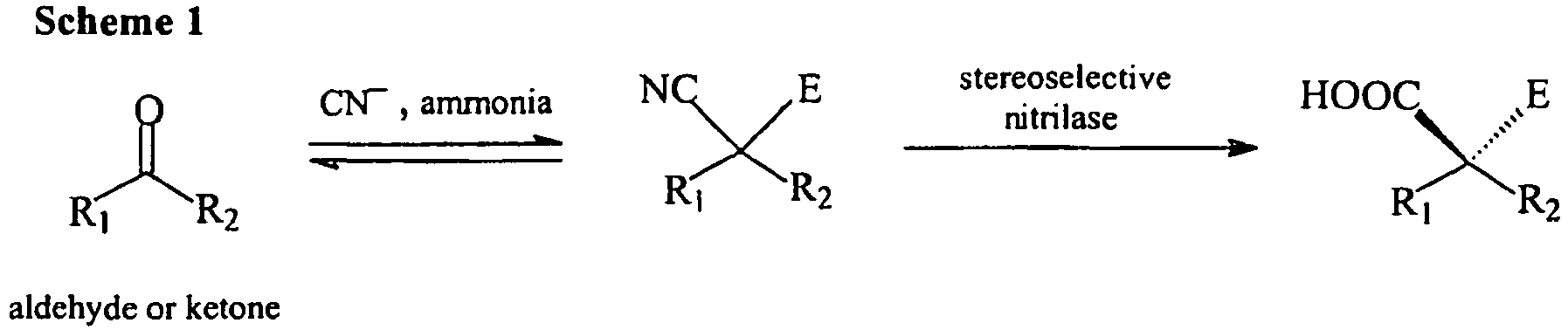
- Since the formation of the amino nitrile or cyanohydrin is a reversible process, the use of a stereoselective nitrilase provides chiral induction, thereby producing the desired amino acid or hydroxy acid enantiomer in 100% theoretical yield. Indeed, even aryl aldehydes and ketones (wherein the equilibrium disfavors amino nitrile or cyanohydrin formation) are effectively converted to chiral α-carboxylic acids. Moreover, since the stereoselective nitrilases contemplated for use in the practice of the present invention are able to perform the hydrolysis in the presence of cyanide and ammonia, invention methods provide the additional advantage of producing the desired enantiomerically pure α-substituted carboxylic acids in a single reaction vessel. The nitrilase is SEQ ID NO:4, or a polypeptide of the first aspect of the invention.
- The enantiomerically pure α-substituted carboxylic acids produced by the methods of the present invention have the following structure:

- R1 and R2 are each independently -H, substituted or unsubstituted alkyl, alkenyl, alkynyl, aryl, heteroaryl, cycloalkyl, heterocyclic, wherein said substituents are lower alkyl, hydroxy, alkoxy, mercapto, cycloalkyl, heterocyclic, aryl, heteroaryl, aryloxy, or halogen or optionally R1 and R2 are linked to cooperate to form a functional cyclic moiety, and
- E is -N(Rx)2 or -OH, wherein each Rx is -H or lower alkyl.
- As used herein, the term "alkyl" refers to a monovalent straight or branched chain or cyclic radical of from one to twenty-four carbon atoms, including methyl, ethyl, n-propyl, isopropyl, n-butyl, isobutyl, tert-butyl, n-hexyl, and the like. The term "lower alkyl" refers to a monovalent straight or branched chain or cyclic radical of from one to about six carbon atoms.
- As used herein, "substituted alkyl" comprises alkyl groups further bearing one or more substituents selected from hydroxy, alkoxy (of a lower alkyl group), mercapto (of a lower alkyl group), cycloalkyl, substituted cycloalkyl, heterocyclic, substituted heterocyclic, aryl, substituted aryl, heteroaryl, substituted heteroaryl, aryloxy, substituted aryloxy, halogen, trifluoromethyl, cyano, nitro, nitrone, amino, amido, -C(O)H, acyl, oxyacyl, carboxyl, carbamate, sulfonyl, sulfonamide, sulfuryl, and the like.
- As used herein, "alkenyl" refers to straight or branched chain hydrocarbyl groups having one or more carbon-carbon double bonds, and having in the range of about 2 up to 24 carbon atoms, and "substituted alkenyl" refers to alkenyl groups further bearing one or more substituents as set forth above.
- As used herein, "cycloalkyl" refers to cyclic ring-containing groups containing in the range of about 3 up to 8 carbon atoms, and "substituted cycloalkyl" refers to cycloalkyl groups further bearing one or more substituents as set forth above.
- As used herein, "heterocyclic" refers to cyclic (i.e., ring-containing) groups containing one or more heteroatoms (e.g., N, O, S, or the like) as part of the ring structure, and having in the range of 3 up to 14 carbon atoms and "substituted heterocyclic" refers to heterocyclic groups further bearing one or more substituents as set forth above.
- As used herein, "alkynyl" refers to straight or branched chain hydrocarbyl groups having at least one carbon-carbon triple bond, and having in the range of about 2 up to 12 carbon atoms, and "substituted alkynyl" refers to alkynylene groups further bearing one or more substituents as set forth above.
- As used herein, "aryl" refers to aromatic groups having in the range of 6 up to 14 carbon atoms and "substituted aryl" refers to aryl groups further bearing one or more substituents as set forth above.
- In preferred embodiments, the enantiomerically pure α-substituted carboxylic acid produced by the methods of the present invention is an α-amino acid or α-hydroxy acid. In particularly preferred embodiments the enantiomerically pure α-amino acid is D-phenylalanine, D-phenylglycine, L-methylphenylglycine, L-tert-leucine, D-alanine, or D-hydroxynorleucine, R-pantolactone, 2-chloromandelic acid, (S)-and (R)-mandelic acid and the enantiomerically pure α-hydroxy acid is (S)-cyclohexylmandelic acid.
- Aldehydes and ketones contemplated for use in the practice of the present invention have the following structure:
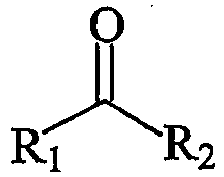
- Metal cyanides contemplated for use in the practice of the present invention include the alkali metal cyanides LiCN, NaCN, KCN, RbCN, and CsCn. Preferred alkali metal cyanides include LiCN, NaCN, and KCN. A most preferred alkali metal cyanide is KCN. In addition, gaseous cyanides are useful in the method of the invention.
- Ammonia or an ammonium salt or an amine may be used in accordance with the present invention. Ammonium salts contemplated for use in the practice of the present invention have the formula NH2(R)2 +X-, wherein each R is independently -H or lower alkyl, and X is fluoride, chloride, bromide, or iodide or any counter ion. Thus, when R is lower alkyl, the methods of the present invention also provide N-substituted or N,N-disubstituted enantiomerically pure α-amino acids. In a preferred embodiment, the ammonium salt is NH4 +Cl-.
- Nitrilases contemplated for use in the practice of the present invention include those which are sufficiently robust to stereoselectively hydrolyze the transient amino nitrile or cyanohydrin under Strecker conditions, i.e., in the presence of cyanide and ammonia. Such nitrilases include, for example, those set forth in SEQ ID No: 4.
- The phrases "nucleic acid" or "nucleic acid sequence" as used herein refer to an oligonucleotide, nucleotide, polynucleotide, or to a fragment of any of these, to DNA or RNA of genomic or synthetic origin which may be single-stranded or double-stranded and may represent a sense or antisense strand, peptide nucleic acid (PNA), or to any DNA-like or RNA-like material, natural or synthetic in origin. In one embodiment, a "nucleic acid sequence" of the invention includes, for example, a sequence encoding a polypeptide as set forth in SEQ ID No: 4, and variants thereof. In another embodiment, a "nucleic acid sequence" of the invention includes, for example, a sequence as set forth in SEQ ID No: 3, sequences complemetary thereto, and variants thereof.
- A "coding sequence" or a "nucleotide sequence encoding" a particular polypeptide or protein, is a nucleic acid sequence which is transcribed and translated into a polypeptide or protein when placed under the control of appropriate regulatory sequences.
- The term "gene" means the segment of DNA involved in producing a polypeptide chain; it includes regions preceding and following the coding region (leader and trailer) as well as, where applicable, intervening sequences (introns) between individual coding segments (exons).
- "Amino acid" or "amino acid sequence" as used herein refer to an oligopeptide, peptide, polypeptide, or protein sequence, or to a fragment, portion, or subunit of any of these, and to naturally occurring or synthetic molecules. In one embodiment, an "amino acid sequence" or "polypeptide sequence" of the invention includes, for example, a sequence as set forth in SEQ ID No: 4, and variants thereof. In another embodiment, an "amino acid sequence" of the invention includes, for example, a sequence encoded by a polynucleotide having a sequence as set forth in SEQ ID No: 3, sequences complemetary thereto and variants thereof.
- The term "polypeptide" as used herein, refers to amino acids joined to each other by peptide bonds or modified peptide bonds, i.e., peptide isosteres, and may contain modified amino acids other than the 20 gene-encoded amino acids. The polypeptides may be modified by either natural processes, such as post-translational processing, or by chemical modification techniques which are well known in the art. Modifications can occur anywhere in the polypeptide, including the peptide backbone, the amino acid side-chains and the amino or carboxyl termini. It will be appreciated that the same type of modification may be present in the same or varying degrees at several sites in a given polypeptide. Also a given polypeptide may have many types of modifications. Modifications include acetylation, acylation, ADP-ribosylation, amidation, covalent attachment of flavin, covalent attachment of a heme moiety, covalent attachment of a nucleotide or nucleotide derivative, covalent attachment of a lipid or lipid derivative, covalent attachment of a phosphytidylinositol, cross-linking cyclization, disulfide bond formation, demethylation, formation of covalent cross-links, formation of cysteine, formation of pyroglutamate, formylation, gamma-carboxylation, glycosylation, GPI anchor formation, hydroxylation, iodination, methylation, myristolyation, oxidation, pergylation, proteolytic processing, phosphorylation, prenylation, racemization, selenoylation, sulfation, and transfer-RNA mediated addition of amino acids to protein such as arginylation. (See Proteins - Structure and Molecular Properties 2nd Ed., T.E. Creighton, W.H. Freeman and Company, New York (1993); Posttranslational Covalent Modification of Proteins, B.C. Johnson, Ed., Academic Press, New York, pp. 1-12 (1983)).
- As used herein, the term "isolated" means that the material is removed from its original environment (e.g., the natural environment if it is naturally occurring). For example, a naturally-occurring polynucleotide or polypeptide present in a living animal is not isolated, but the same polynucleotide or polypeptide, separated from some or all of the coexisting materials in the natural system, is isolated. Such polynucleotides could be part of a vector and/or such polynucleotides or polypeptides could be part of a composition, and still be isolated in that such vector or composition is not part of its natural environment.
- As used herein, the term "purified" does not require absolute purity; rather, it is intended as a relative definition. Individual nucleic acids obtained from a library have been conventionally purified to electrophoretic homogeneity. The sequences obtained from these clones could not be obtained directly either from the library or from total human DNA. The purified nucleic acids of the invention have been purified from the remainder of the genomic DNA in the organism by at least 104-106 fold. However, the term "purified" also includes nucleic acids which have been purified from the remainder of the genomic DNA or from other sequences in a library or other environment by at least one order of magnitude, typically two or three orders, and more typically four or five orders of magnitude.
- As used herein, the term "recombinant" means that the nucleic acid is adjacent to "backbone" nucleic acid to which it is not adjacent in its natural environment. Additionally, to be "enriched" the nucleic acids will represent 5% or more of the number of nucleic acid inserts in a population of nucleic acid backbone molecules. Backbone molecules according to the invention include nucleic acids such as expression vectors, self-replicating nucleic acids, viruses, integrating nucleic acids, and other vectors or nucleic acids used to maintain or manipulate a nucleic acid insert of interest. Typically, the enriched nucleic acids represent 15% or more of the number of nucleic acid inserts in the population of recombinant backbone molecules. More typically, the enriched nucleic acids represent 50% or more of the number of nucleic acid inserts in the population of recombinant backbone molecules. In a one embodiment, the enriched nucleic acids represent 90% or more of the number of nucleic acid inserts in the population of recombinant backbone molecules.
"Recombinant" polypeptides or proteins refer to polypeptides or proteins produced by recombinant DNA techniques; i.e., produced from cells transformed by an exogenous DNA construct encoding the desired polypeptide or protein. "Synthetic" polypeptides or protein are those prepared by chemical synthesis. Solid-phase chemical peptide synthesis methods can also be used to synthesize the polypeptide or fragments of the invention. Such method have been known in the art since the early 1960's (Merrifield, R. B., J. Am. Chem. Soc., 85:2149-2154,1963) (See also Stewart, J. M. and Young, J. D., Solid Phase Peptide Synthesis, 2 ed., Pierce Chemical Co., Rockford, Ill., pp. 11-12)) and have recently been employed in commercially available laboratory peptide design and synthesis kits (Cambridge Research Biochemicals). Such commercially available laboratory kits have generally utilized the teachings of H. M. Geysen et al, Proc. Natl. Acad. Sci., USA, 81:3998 (1984) and provide for synthesizing peptides upon the tips of a multitude of "rods" or "pins" all of which are connected to a single plate. When such a system is utilized, a plate of rods or pins is inverted and inserted into a second plate of corresponding wells or reservoirs, which contain solutions for attaching or anchoring an appropriate amino acid to the pin's or rod's tips. By repeating such a process step, i.e., inverting and inserting the rod's and pin's tips into appropriate solutions, amino acids are built into desired peptides. In addition, a number of available FMOC peptide synthesis systems are available. For example, assembly of a polypeptide or fragment can be carried out on a solid support using an Applied Biosystems, Inc. Model 431A automated peptide synthesizer. Such equipment provides ready access to the peptides of the invention, either by direct synthesis or by synthesis of a series of fragments that can be coupled using other known techniques. - A promoter sequence is "operably linked to" a coding sequence when RNA polymerase which initiates transcription at the promoter will transcribe the coding sequence into mRNA.
- "Plasmids" are designated by a lower case p preceded and/or followed by capital letters and/or numbers. The starting plasmids herein are either commercially available, publicly available on an unrestricted basis, or can be constructed from available plasmids in accord with published procedures. In addition, equivalent plasmids to those described herein are known in the art and will be apparent to the ordinarily skilled artisan.
- "Digestion" of DNA refers to catalytic cleavage of the DNA with a restriction enzyme that acts only at certain sequences in the DNA. The various restriction enzymes used herein are commercially available and their reaction conditions, cofactors and other requirements were used as would be known to the ordinarily skilled artisan. For analytical purposes, typically 1 g of plasmid or DNA fragment is used with about 2 units of enzyme in about 20 1 of buffer solution. For the purpose of isolating DNA fragments for plasmid construction, typically 5 to 50 g of DNA are digested with 20 to 250 units of enzyme in a larger volume. Appropriate buffers and substrate amounts for particular restriction enzymes are specified by the manufacturer. Incubation times of about 1 hour at 37□C are ordinarily used, but may vary in accordance with the supplier's instructions. After digestion the gel electrophoresis may be performed to isolate the desired fragment.
- "Oligonucleotide" refers to either a single stranded polydeoxynucleotide or two complementary polydeoxynucleotide strands which may be chemically synthesized. Such synthetic oligonucleotides have no 5' phosphate and thus will not ligate to another oligonucleotide without adding a phosphate with an ATP in the presence of a kinase. A synthetic oligonucleotide will ligate to a fragment that has not been dephosphorylated.
- The phrase "substantially identical" in the context of two nucleic acid sequences or polypeptides, refers to two or more sequences that have at least 90-95% nucleotide or amino acid residue identity, when compared and aligned for maximum correspondence, as measured using one of the known sequence comparison algorithms or by visual inspection. Typically, the substantial identity exists over a region of at least about 100 residues, and most commonly the sequences are substantially identical over at least about 150-200 residues. In some embodiments, the sequences are substantially identical over the entire length of the coding regions.
- Additionally a "substantially identical" amino acid sequence is a sequence that differs from a reference sequence by one or more conservative or non-conservative amino acid substitutions, deletions, or insertions, particularly when such a substitution occurs at a site that is not the active site of the molecule, and provided that the polypeptide essentially retains its functional properties. A conservative amino acid substitution, for example, substitutes one amino acid for another of the same class (e.g., substitution of one hydrophobic amino acid, such as isoleucin, valine, leucine, or methionine, for another, or substitution of one polar amino acid for another, such as substitution of arginine for lysine, glutamic acid for aspartic acid or glutamine for asparagine). One or more amino acids can be deleted, for example, from a haloalkane dehalogenase polypeptide, resulting in modification of the structure of the polypeptide, without significantly altering its biological activity. For example, amino- or carboxyl-terminal amino acids that are not required for haloalkane dehalogenase biological activity can be removed. Modified polypeptide sequences of the invention can be assayed for haloalkane dehalogenase biological activity by any number of methods, including contacting the modified polypeptide sequence with an haloalkane dehalogenase substrate and determining whether the modified polypeptide decreases the amount of specific substrate in the assay or increases the bioproducts of the enzymatic reaction of a functional haloalkane dehalogenase polypeptide with the substrate.
- "Fragments" as used herein are a portion of a naturally occurring or recombinant protein which can exist in at least two different conformations. Fragments can have the same or substantially the same amino acid sequence as the naturally occurring protein. "Substantially the same" means that an amino acid sequence is largely, but not entirely, the same, but retains at least one functional activity of the sequence to which it is related. In general two amino acid sequences are "substantially the same" or "substantially homologous" if they are at least about 70, but more typically about 85% or more identical. Fragments which have different three dimensional structures as the naturally occurring protein are also included. An example of this, is a "pro-form" molecule, such as a low activity proprotein that can be modified by cleavage to produce a mature enzyme with significantly higher activity.
- "Hybridization" refers to the process by which a nucleic acid strand joins with a complementary strand through base pairing. Hybridization reactions can be sensitive and selective so that a particular sequence of interest can be identified even in samples in which it is present at low concentrations. Suitably stringent conditions can be defined by, for example, the concentrations of salt or formamide in the prehybridization and hybridization solutions, or by the hybridization temperature, and are well known in the art. In particular, stringency can be increased by reducing the concentration of salt, increasing the concentration of formamide, or raising the hybridization temperature.
- For example, hybridization under high stringency conditions could occur in about 50% formamide at about 37°C to 42°C. Hybridization could occur under reduced stringency conditions in about 35% to 25% formamide at about 30°C to 35°C. In particular, hybridization could occur under high stringency conditions at 42°C in 50% formamide, 5X SSPE, 0.3% SDS, and 200 n/ml sheared and denatured salmon sperm DNA. Hybridization could occur under reduced stringency conditions as described above, but in 35% formamide at a reduced temperature of 35°C. The temperature range corresponding to a particular level of stringency can be further narrowed by calculating the purine to pyrimidine ratio of the nucleic acid of interest and adjusting the temperature accordingly. Variations on the above ranges and conditions are well known in the art.
- The term "variant" refers to polynucleotides or polypeptides of the invention modified at one or more base pairs, codons, introns, exons, or amino acid residues (respectively) yet still retain the biological activity of the nitrilase of the invention. Variants can be produced by any number of means including methods such as, for example, error-prone PCR, shuffling, oligonucleotide-directed mutagenesis, assembly PCR, sexual PCR mutagenesis, in vivo mutagenesis, cassette mutagenesis, recursive ensemble mutagenesis, exponential ensemble mutagenesis, site-specific mutagenesis, ligation reassembly, GSSM and any combination thereof.
- Polynucleotides as hereinabove described can be introduced into a suitable host cell. A suitable host cell is any cell which is capable of promoting recombination and/or reductive reassortment. The selected polynucleotides are preferably already in a vector which includes appropriate control sequences. The host cell can be a higher eukaryotic cell, such as a mammalian cell, or a lower eukaryotic cell, such as a yeast cell, or preferably, the host cell can be a prokaryotic cell, such as a bacterial cell. Introduction of the construct into the host cell can be effected by calcium phosphate transfection, DEAE-Dextran mediated transfection, or electroporation (Davis et al., 1986).
- As representative examples of appropriate hosts, there may be mentioned: bacterial cells, such as E. coli, Streptomyces, Salmonella typhimurium; fungal cells, such as yeast; insect cells such as Drosophila S2 and Spodoptera Sf9; animal cells such as CHO, COS or Bowes melanoma; adenoviruses; and plant cells. The selection of an appropriate host is deemed to be within the scope of those skilled in the art from the teachings herein.
- With particular references to various mammalian cell culture systems that can be employed to express recombinant protein, examples of mammalian expression systems include the COS-7 lines of monkey kidney fibroblasts, described in "SV40-transformed simian cells support the replication of early SV40 mutants" (Gluzman, 1981), and other cell lines capable of expressing a compatible vector, for example, the C127, 3T3, CHO, HeLa and BHK cell lines. Mammalian expression vectors will comprise an origin of replication, a suitable promoter and enhancer, and also any necessary ribosome binding sites, polyadenylation site, splice donor and acceptor sites, transcriptional termination sequences, and 5' flanking nontranscribed sequences. DNA sequences derived from the SV40 splice, and polyadenylation sites may be used to provide the required nontranscribed genetic elements.
- Host cells containing the polynucleotides of interest can be cultured in conventional nutrient media modified as appropriate for activating promoters, selecting transformants or amplifying genes. The culture conditions, such as temperature, pH and the like, are those previously used with the host cell selected for expression, and will be apparent to the ordinarily skilled artisan. The clones which are identified as having the specified enzyme activity may then be sequenced to identify the polynucleotide sequence encoding an enzyme having the enhanced activity.
- As representative examples of expression vectors which may be used there may be mentioned viral particles, baculovirus, phage, plasmids, phagemids, cosmids, fosmids, bacterial artificial chromosomes, viral DNA (e.g., vaccinia, adenovirus, foul pox virus, pseudorabies and derivatives of SV40), P1-based artificial chromosomes, yeast plasmids, yeast artificial chromosomes, and any other vectors specific for specific hosts of interest (such as bacillus, aspergillus and yeast). Thus, for example, the DNA may be included in any one of a variety of expression vectors for expressing a polypeptide. Such vectors include chromosomal, nonchromosomal and synthetic DNA sequences. Large numbers of suitable vectors are known to those of skill in the art, and are commercially available. The following vectors are provided by way of example; Bacterial: pQE vectors (Qiagen), pBluescript plasmids, pNH vectors, (lambda-ZAP vectors (Stratagene); ptrc99a, pKK223-3, pDR540, pRIT2T (Pharmacia); Eukaryotic: pXT1, pSG5 (Stratagene), pSVK3, pBPV, pMSG, pSVLSV40 (Pharmacia). However, any other plasmid or other vector may be used so long as they are replicable and viable in the host. Low copy number or high copy number vectors may be employed with the present invention.
- A preferred type of vector for use in the present invention contains an f-factor origin replication. The f-factor (or fertility factor) in E. coli is a plasmid which effects high frequency transfer of itself during conjugation and less frequent transfer of the bacterial chromosome itself. A particularly preferred embodiment is to use cloning vectors, referred to as "fosmids" or bacterial artificial chromosome (BAC) vectors. These are derived from E. coli f-factor which is able to stably integrate large segments of genomic DNA. When integrated with DNA from a mixed uncultured environmental sample, this makes it possible to achieve large genomic fragments in the form of a stable "environmental DNA library."
- Another type of vector for use in the present invention is a cosmid vector. Cosmid vectors were originally designed to clone and propagate large segments of genomic DNA. Cloning into cosmid vectors is described in detail in "Molecular Cloning: A laboratory Manual" (Sambrook et al., 1989).
- The DNA sequence in the expression vector is operatively linked to an appropriate expression control sequence(s) (promoter) to direct RNA synthesis. Particular named bacterial promoters include lad, lacZ, T3, T7, gpt, lambda PR, PL and trp. Eukaryotic promoters include CMV immediate early, HSV thymidine kinase, early and late SV40, LTRs from retrovirus, and mouse metallothionein-I. Selection of the appropriate vector and promoter is well within the level of ordinary skill in the art. The expression vector also contains a ribosome binding site for translation initiation and a transcription terminator. The vector may also include appropriate sequences for amplifying expression. Promoter regions can be selected from any desired gene using CAT (chloramphenicol transferase) vectors or other vectors with selectable markers. In addition, the expression vectors preferably contain one or more selectable marker genes to provide a phenotypic trait for selection of transformed host cells such as dihydrofolate reductase or neomycin resistance for eukaryotic cell culture, or tetracycline or ampicillin resistance in E. coli.
- One aspect of the invention is an isolated nucleic acid comprising SEQ ID No:3, sequences substantially identical thereto, sequences complementary thereto. The isolated, nucleic acids may comprise DNA, including cDNA, genomic DNA, and synthetic DNA. The DNA may be double-stranded or single-stranded, and if single stranded may be the coding strand or non-coding (anti-sense) strand. Alternatively, the isolated nucleic acids may comprise RNA.
- As discussed in more detail below, the isolated nucleic acid sequences of the invention may be used to prepare the polypeptide of SEQ ID No:4, and sequences substantially identical thereto, or fragments comprising at least 5, 10, 15, 20, 25, 30, 35, 40, 50, 75, 100, or 150 consecutive amino acids of one of the polypeptides of SEQ ID No:4, and sequences substantially identical thereto.
- Accordingly, another aspect of the invention is an isolated nucleic acid sequence which encodes one of the polypeptides of SEQ ID No:4, sequences substantially identical thereto. The coding sequences of these nucleic acids may be identical to the coding sequence of SEQ ID No:3, or a fragment thereof or may be different coding sequences which encode the polypeptide of SEQ ID No:4, sequences substantially identical thereto as a result of the redundancy or degeneracy of the genetic code. The genetic code is well known to those of skill in the art and can be obtained, for example, on page 214 of B. Lewin, Genes VI, Oxford University Press, 1997, the disclosure of which is incorporated herein by reference.
- The isolated nucleic acid sequence which encodes the polypeptide of SEQ ID No:4, and sequences substantially identical thereto, may include, but is not limited to: only a coding sequence of SEQ ID No:3, and sequences substantially identical thereto, and additional coding sequences, such as leader sequences or proprotein sequences and non-coding sequences, such as introns or non-coding sequences 5' and/or 3' of the coding sequence. Thus, as used herein, the term "polynucleotide encoding a polypeptide" encompasses a polynucleotide which includes only coding sequence for the polypeptide as well as a polynucleotide which includes additional coding and/or non-coding sequence.
- Alternatively, the nucleic acid sequences of the invention may be mutagenized using conventional techniques, such as site directed mutagenesis, or other techniques familiar to those skilled in the art, to introduce silent changes into the polynucleotides of SEQ ID NO:3, and sequences substantially identical thereto. As used herein, "silent changes" include, for example, changes which do not alter the amino acid sequence encoded by the polynucleotide. Such changes may be desirable in order to increase the level of the polypeptide produced by host cells containing a vector encoding the polypeptide by introducing codons or codon pairs which occur frequently in the host organism.
- The invention also relates to polynucleotides which have nucleotide changes which result in amino acid substitutions, additions, deletions, fusions and truncations in the polypeptide of the invention (SEQ ID No: 4). Such nucleotide changes may be introduced using techniques such as site directed mutagenesis, random chemical mutagenesis, exonuclease III deletion, and other recombinant DNA techniques. Alternatively, such nucleotide changes may be naturally occurring allelic variants which are isolated by identifying nucleic acid sequences which specifically hybridize to probes comprising at least 10, 15, 20, 25, 30, 35, 40, 50, 75, 100, 150, 200, 300, 400, or 500 consecutive bases of the sequence of SEQ ID No: 3, and sequences substantially identical thereto (or the sequences complementary thereto) under conditions of high, moderate, or low stringency as provided herein.
- The isolated nucleic acid of SEQ ID No: 3, sequences substantially identical thereto, complementary sequences, or a fragment comprising at least 10, 15, 20, 25, 30, 35, 40, 50, 75, 100, 150, 200, 300, 400, or 500 consecutive bases of one of the foregoing sequences may also be used as probes to determine whether a biological sample, such as a soil sample, contains an organism having a nucleic acid sequence of the invention or an organism from which the nucleic acid was obtained. In such procedures, a biological sample potentially harboring the organism from which the nucleic acid was isolated is obtained and nucleic acids are obtained from the sample. The nucleic acids are contacted with the probe under conditions which permit the probe to specifically hybridize to any complementary sequences which are present therein.
- Where necessary, conditions which permit the probe to specifically hybridize to complementary sequences may be determined by placing the probe in contact with complementary sequences from samples known to contain the complementary sequence as well as control sequences which do not contain the complementary sequence. Hybridization conditions, such as the salt concentration of the hybridization buffer, the formamide concentration of the hybridization buffer, or the hybridization temperature, may be varied to identify conditions which allow the probe to hybridize specifically to complementary nucleic acids.
- If the sample contains the organism from which the nucleic acid was isolated, specific hybridization of the probe is then detected. Hybridization may be detected by labeling the probe with a detectable agent such as a radioactive isotope, a fluorescent dye or an enzyme capable of catalyzing the formation of a detectable product.
- Many methods for using the labeled probes to detect the presence of complementary nucleic acids in a sample are familiar to those skilled in the art. These include Southern Blots, Northern Blots, colony hybridization procedures, and dot blots. Protocols for each of these procedures are provided in Ausubel et al. Current Protocols in Molecular Biology, John Wiley 503 Sons, Inc. 1997 and Sambrook et al., Molecular Cloning: A Laboratory Manual 2d Ed., Cold Spring Harbor Laboratory Press, 1989.
- Alternatively, more than one probe (at least one of which is capable of specifically hybridizing to any complementary sequences which are present in the nucleic acid sample), may be used in an amplification reaction to determine whether the sample contains an organism containing a nucleic acid sequence of the invention (e.g., an organism from which the nucleic acid was isolated). Typically, the probes comprise oligonucleotides. In one embodiment, the amplification reaction may comprise a PCR reaction. PCR protocols are described in Ausubel and Sambrook, supra. Alternatively, the amplification may comprise a ligase chain reaction, 3SR, or strand displacement reaction. (See Barany, F., "The Ligase Chain Reaction in a PCR World", PCR Methods and Applications 1:5-16, 1991; E. Fahy et al., "Self-sustained Sequence Replication (3SR): An Isothermal Transcription-based Amplification System Alternative to PCR", PCR Methods and Applications 1:25-33, 1991; and Walker G.T. et al., "Strand Displacement Amplification-an Isothermal in vitro DNA Amplification Technique", Nucleic Acid Research 20:1691-1696, 1992. In such procedures, the nucleic acids in the sample are contacted with the probes, the amplification reaction is performed, and any resulting amplification product is detected. The amplification product may be detected by performing gel electrophoresis on the reaction products and staining the gel with an intercalator such as ethidium bromide. Alternatively, one or more of the probes may be labeled with a radioactive isotope and the presence of a radioactive amplification product may be detected by autoradiography after gel electrophoresis.
- Probes derived from sequences near the ends of a sequence as set forth in SEQ ID No: 3, and sequences substantially identical thereto, may also be used in chromosome walking procedures to identify clones containing genomic sequences located adjacent to the nucleic acid sequences as set forth above. Such methods allow the isolation of genes which encode additional proteins from the host organism.
- An isolated nucleic acid sequence as set forth in SEQ ID No: 3, sequences substantially identical thereto, sequences complementary thereto, or a fragment comprising at least 10, 15, 20, 25, 30, 35, 40, 50, 75, 100, 150, 200, 300,400, or 500 consecutive bases of one of the foregoing sequences may be used as probes to identify and isolate related nucleic acids. In some embodiments, the related nucleic acids may be cDNAs or genomic DNAs from organisms other than the one from which the nucleic acid was isolated. For example, the other organisms may be related organisms. In such procedures, a nucleic acid sample is contacted with the probe under conditions which permit the probe to specifically hybridize to related sequences. Hybridization of the probe to nucleic acids from the related organism is then detected using any of the methods described above.
- In nucleic acid hybridization reactions, the conditions used to achieve a particular level of stringency will vary, depending on the nature of the nucleic acids being hybridized. For example, the length, degree of complementarity, nucleotide sequence composition (e.g., GC v. AT content), and nucleic acid type (e.g., RNA v. DNA) of the hybridizing regions of the nucleic acids can be considered in selecting hybridization conditions. An additional consideration is whether one of the nucleic acids is immobilized, for example, on a filter.
- Hybridization may be carried out under conditions of low stringency, moderate stringency or high stringency. As an example of nucleic acid hybridization, a polymer membrane containing immobilized denatured nucleic acids is first prehybridized for 30 minutes at 45□C in a solution consisting of 0.9 M NaCl, 50 mM NaH2PO4, pH 7.0, 5.0 mM Na2EDTA, 0.5% SDS, 10X Denhardt's, and 0.5 mg/ml polyriboadenylic acid. Approximately 2 X 10⁷ cpm (specific activity 4-9 X 10⁸ cpm/ug) of 32P end-labeled oligonucleotide probe are then added to the solution. After 12-16 hours of incubation, the membrane is washed for 30 minutes at room temperature in 1X SET (150 mM NaCl, 20 mM Tris hydrochloride, pH 7.8,1 mM Na2EDTA) containing 0.5% SDS, followed by a 30 minute wash in fresh 1X SET at Tm-10 C for the oligonucleotide probe. The membrane is then exposed to auto-radiographic film for detection of hybridization signals.
- By varying the stringency of the hybridization conditions used to identify nucleic acids, such as cDNAs or genomic DNAs, which hybridize to the detectable probe, nucleic acids having different levels of homology to the probe can be identified and isolated. Stringency may be varied by conducting the hybridization at varying temperatures below the melting temperatures of the probes. The melting temperature, Tm, is the temperature (under defined ionic strenght and pH) at which 50% of the target sequence hybridizes to a perfectly complementary probe. Very stringent conditions are selected to be equal to or about 5 C lower than the Tm for a particular probe. The melting temperature of the probe may be calculated using the following formulas:

- If the hybridization is carried out in a solution containing formamide, the melting temperature may be calculated using the equation: Tm=81.5+16.6(log [Na+])+0.41 (fraction G+C)-(0.63% formamide)-(600/N) where N is the length of the probe.
- Prehybridization may be carried out in 6X SSC, 5X Denhardt's reagent, 0.5% SDS, 100 g denatured fragmented salmon sperm DNA or 6X SSC, 5X Denhardt's reagent, 0.5% SDS, 100 g denatured fragmented salmon sperm DNA, 50% formamide. The formulas for SSC and Denhardt's solutions are listed in Sambrook et al., supra.
- Hybridization is conducted by adding the detectable probe to the prehybridization solutions listed above. Where the probe comprises double stranded DNA, it is denatured before addition to the hybridization solution. The filter is contacted with the hybridization solution for a sufficient period of time to allow the probe to hybridize to cDNAs or genomic DNAs containing sequences complementary thereto or homologous thereto. For probes over 200 nucleotides in length, the hybridization may be carried out at 15-25 C below the Tm. For shorter probes, such as oligonucleotide probes, the hybridization may be conducted at 5-10 C below the Tm. Typically, for hybridizations in 6X SSC, the hybridization is conducted at approximately 68 C. Usually, for hybridizations in 50% formamide containing solutions, the hybridization is conducted at approximately 42 C.
- All of the foregoing hybridizations would be considered to be under conditions of high stringency.
- Following hybridization, the filter is washed to remove any non-specifically bound detectable probe. The stringency used to wash the filters can also be varied depending on the nature of the nucleic acids being hybridized, the length of the nucleic acids being hybridized, the degree of complementarity, the nucleotide sequence composition (e.g., GC v. AT content), and the nucleic acid type (e.g., RNA v. DNA). Examples of progressively higher stringency condition washes are as follows: 2X SSC, 0.1% SDS at room temperature for 15 minutes (low stringency); 0.1X SSC, 0.5% SDS at room temperature for 30 minutes to 1 hour (moderate stringency); 0.1X SSC, 0.5% SDS for 15 to 30 minutes at between the hybridization temperature and 68°C (high stringency); and 0.15M NaCl for 15 minutes at 72°C (very high stringency). A final low stringency wash can be conducted in 0.1X SSC at room temperature. The examples above are merely illustrative of one set of conditions that can be used to wash filters. One of skill in the art would know that there are numerous recipes for different stringency washes. Some other examples are given below.
- Nucleic acids which have hybridized to the probe are identified by autoradiography or other conventional techniques.
- The above procedure may be modified to identify nucleic acids having decreasing levels of homology to the probe sequence. For example, to obtain nucleic acids of decreasing homology to the detectable probe, less stringent conditions may be used. For example, the hybridization temperature may be decreased in increments of 5°C from 68°C to 42°C in a hybridization buffer having a Na+ concentration of approximately 1M. Following hybridization, the filter may be washed with 2X SSC, 0.5% SDS at the temperature of hybridization. These conditions are considered to be "moderate" conditions above 50°C and "low" conditions below 50°C. A specific example of "moderate" hybridization conditions is when the above hybridization is conducted at 55°C. A specific example of "low stringency" hybridization conditions is when the above hybridization is conducted at 45°C.
- Alternatively, the hybridization may be carried out in buffers, such as 6X SSC, containing formamide at a temperature of 42°C. In this case, the concentration of formamide in the hybridization buffer may be reduced in 5% increments from 50% to 0% to identify clones having decreasing levels of homology to the probe. Following hybridization, the filter may be washed with 6X SSC, 0.5% SDS at 50°C. These conditions are considered to be "moderate" conditions above 25% formamide and "low" conditions below 25% formamide. A specific example of "moderate" hybridization conditions is when the above hybridization is conducted at 30% formamide. A specific example of "low stringency" hybridization conditions is when the above hybridization is conducted at 10% formamide.
- For example, the preceding methods may be used to isolate nucleic acids having a sequence with at least about 97%, at least 95% or at least 90% homology to a nucleic acid sequence as set forth in SEQ ID No: 3, sequences substantially identical thereto, or fragments comprising at least about 10, 15, 20, 25, 30, 35, 40, 50, 75, 100, 150, 200, 300, 400, or 500 consecutive bases thereof, and the sequences complementary to any of the foregoing sequences. Homology may be measured using an alignment algorithm. For example, the homologous polynucleotides may have a coding sequence which is a naturally occurring allelic variant of one of the coding sequences described herein. Such allelic variants may have a substitution, deletion or addition of one or more nucleotides when compared to the nucleic acid sequence as set forth in SEQ ID No: 3, or sequences complementary thereto.
- Additionally, the above procedures may be used to isolate nucleic acids which encode polypeptides having at least about 99%, at least 95% or at least 90% homology to a polypeptide having a sequence as set forth in SEQ ID NO: 4, sequences substantially identical thereto, or fragments comprising at least 5, 10, 15, 20, 25, 30, 35, 40, 50, 75, 100, or 150 consecutive amino acids thereof as determined using a sequence alignment algorithm (e.g., such as the FASTA version 3.0t78 algorithm with the default parameters).
- Another aspect of the invention is an isolated or purified polypeptide comprising a sequence as set forth in SEQ ID No: 4, and sequences substantially identical thereto. As discussed above, such polypeptides may be obtained by inserting a nucleic acid encoding the polypeptide into a vector such that the coding sequence is operably linked to a sequence capable of driving the expression of the encoded polypeptide in a suitable host cell. For example, the expression vector may comprise a promoter, a ribosome binding site for translation initiation and a transcription terminator. The vector may also include appropriate sequences for amplifying expression.
- Promoters suitable for expressing the polypeptide or fragment thereof in bacteria include the E. coli lac or trp promoters, the lacI promoter, the lacZ promoter, the T3 promoter, the T7 promoter, the gpt promoter, the lambda PR promoter, the lambda PL promoter, promoters from operons encoding glycolytic enzymes such as 3-phosphoglycerate kinase (PGK), and the acid phosphatase promoter. Fungal promoters include the factor promoter. Eukaryotic promoters include the CMV immediate early promoter, the HSV thymidine kinase promoter, heat shock promoters, the early and late SV40 promoter, LTRs from retroviruses, and the mouse metallothionein-I promoter. Other promoters known to control expression of genes in prokaryotic or eukaryotic cells or their viruses may also be used.
- Mammalian expression vectors may also comprise an origin of replication, any necessary ribosome binding sites, a polyadenylation site, splice donor and acceptor sites, transcriptional termination sequences, and 5' flanking nontranscribed sequences. In some embodiments, DNA sequences derived from the SV40 splice and polyadenylation sites may be used to provide the required nontranscribed genetic elements.
- Vectors for expressing the polypeptide or fragment thereof in eukaryotic cells may also contain enhancers to increase expression levels. Enhancers are cis-acting elements of DNA, usually from about 10 to about 300 bp in length that act on a promoter to increase its transcription. Examples include the SV40 enhancer on the late side of the replication origin bp 100 to 270, the cytomegalovirus early promoter enhancer, the polyoma enhancer on the late side of the replication origin, and the adenovirus enhancers.
- In addition, the expression vectors typically contain one or more selectable marker genes to permit selection of host cells containing the vector. Such selectable markers include genes encoding dihydrofolate reductase or genes conferring neomycin resistance for eukaryotic cell culture, genes conferring tetracycline or ampicillin resistance in E. coli, and the S. cerevisiae TRP1 gene.
- After the expression libraries have been generated one can include the additional step of "biopanning" such libraries prior to screening by cell sorting. The "biopanning" procedure refers to a process for identifying clones having a specified biological activity by screening for sequence homology in a library of clones prepared by (i) selectively isolating target DNA, from DNA derived from at least one microorganism, by use of at least one probe DNA comprising at least a portion of a DNA sequence encoding an biological having the specified biological activity; and (ii) optionally transforming a host with isolated target DNA to produce a library of clones which are screened for the specified biological activity.
- The probe DNA used for selectively isolating the target DNA of interest from the DNA derived from at least one microorganism can be a full-length coding region sequence or a partial coding region sequence of DNA for an enzyme of known activity. The original DNA library can be preferably probed using mixtures of probes comprising at least a portion of the DNA sequence encoding an enzyme having the specified enzyme activity. These probes or probe libraries are preferably single-stranded and the microbial DNA which is probed has preferably been converted into single-stranded form. The probes that are particularly suitable are those derived from DNA encoding enzymes having an activity similar or identical to the specified enzyme activity which is to be screened.
- The probe DNA should be at least about 10 bases and preferably at least 15 bases. In one embodiment, the entire coding region may be employed as a probe. Conditions for the hybridization in which target DNA is selectively isolated by the use of at least one DNA probe will be designed to provide a hybridization stringency of at least about 50% sequence identity, more particularly a stringency providing for a sequence identity of at least about 70%.
- In nucleic acid hybridization reactions, the conditions used to achieve a particular level of stringency will vary, depending on the nature of the nucleic acids being hybridized. For example, the length, degree of complementarity, nucleotide sequence composition (e.g., GC v. AT content), and nucleic acid type (e.g., RNA v. DNA) of the hybridizing regions of the nucleic acids can be considered in selecting hybridization conditions. An additional consideration is whether one of the nucleic acids is immobilized, for example, on a filter.
- An example of progressively higher stringency conditions is as follows: 2 x SSC/0.1% SDS at about room temperature (hybridization conditions); 0.2 x SSC/0.1% SDS at about room temperature (low stringency conditions); 0.2 x SSC/0.1% SDS at about 42°C (moderate stringency conditions); and 0.1 x SSC at about 68°C (high stringency conditions). Washing can be carried out using only one of these conditions, e.g., high stringency conditions, or each of the conditions can be used, e.g., for 10-15 minutes each, in the order listed above, repeating any or all of the steps listed. However, as mentioned above, optimal conditions will vary, depending on the particular hybridization reaction involved, and can be determined empirically.
- Hybridization techniques for probing a microbial DNA library to isolate target DNA of potential interest are well known in the art and any of those which are described in the literature are suitable for use herein, particularly those which use a solid phase-bound, directly or indirectly bound, probe DNA for ease in separation from the remainder of the DNA derived from the microorganisms.
- Preferably the probe DNA is "labeled" with one partner of a specific binding pair (i.e. a ligand) and the other partner of the pair is bound to a solid matrix to provide ease of separation of target from its source. The ligand and specific binding partner can be selected from, in either orientation, the following: (1) an antigen or hapten and an antibody or specific binding fragment thereof; (2) biotin or iminobiotin and avidin or streptavidin; (3) a sugar and a lectin specific therefor; (4) an enzyme and an inhibitor therefor; (5) an apoenzyme and cofactor; (6) complementary homopolymeric oligonucleotides; and (7) a hormone and a receptor therefor. The solid phase is preferably selected from: (1) a glass or polymeric surface; (2) a packed column of polymeric beads; and (3) magnetic or paramagnetic particles.
- Further, it is optional but desirable to perform an amplification of the target DNA that has been isolated. In this embodiment the target DNA is separated from the probe DNA after isolation. It is then amplified before being used to transform hosts. The double stranded DNA selected to include as at least a portion thereof a predetermined DNA sequence can be rendered single stranded, subjected to amplification and reannealed to provide amplified numbers of selected double stranded DNA. Numerous amplification methodologies are now well known in the art.
- The selected DNA is then used for preparing a library for screening by transforming a suitable organism. Hosts, particularly those specifically identified herein as preferred, are transformed by artificial introduction of the vectors containing the target DNA by inoculation under conditions conducive for such transformation.
- The resultant libraries of transformed clones are then screened for clones which display activity for the enzyme of interest.
- Having prepared a multiplicity of clones from DNA selectively isolated from an organism, such clones are screened for a specific enzyme activity and to identify the clones having the specified enzyme characteristics.
- The screening for enzyme activity may be effected on individual expression clones or may be initially effected on a mixture of expression clones to ascertain whether or not the mixture has one or more specified enzyme activities. If the mixture has a specified enzyme activity, then the individual clones may be rescreened utilizing a FACS machine for such enzyme activity or for a more specific activity. Alternatively, encapsulation techniques such as gel microdroplets, may be employed to localize multiple clones in one location to be screened on a FACS machine for positive expressing clones within the group of clones which can then be broken out into individual clones to be screened again on a FACS machine to identify positive individual clones. Thus, for example, if a clone mixture has hydrolase activity, then the individual clones may be recovered and screened utilizing a FACS machine to determine which of such clones has hydrolase activity. As used herein, "small insert library" means a gene library containing clones with random small size nucleic acid inserts of up to approximately 5000 base pairs. As used herein, "large insert library" means a gene library containing clones with random large size nucleic acid inserts of approximately 5000 up to several hundred thousand base pairs or greater.
- As described with respect to one of the above aspects, the invention provides a process for enzyme activity screening of clones containing selected DNA derived from a microorganism which process includes: screening a library for specified enzyme activity, said library including a plurality of clones, said clones having been prepared by recovering from genomic DNA of a microorganism selected DNA, which DNA is selected by hybridization to at least one DNA sequence which is all or a portion of a DNA sequence encoding an enzyme having the specified activity; and transforming a host with the selected DNA to produce clones which are screened for the specified enzyme activity.
- In one embodiment, a DNA library derived from a microorganism is subjected to a selection procedure to select therefrom DNA which hybridizes to one or more probe DNA sequences which is all or a portion of a DNA sequence encoding an enzyme having the specified enzyme activity by:
- (a) rendering the double-stranded genomic DNA population into a single-stranded DNA population;
- (b) contacting the single-stranded DNA population of (a) with the DNA probe bound to a ligand under conditions permissive of hybridization so as to produce a double-stranded complex of probe and members of the genomic DNA population which hybridize thereto;
- (c) contacting the double-stranded complex of (b) with a solid phase specific binding partner for said ligand so as to produce a solid phase complex;
- (d) separating the solid phase complex from the single-stranded DNA population of (b);
- (e) releasing from the probe the members of the genomic population which had bound to the solid phase bound probe;
- (f) forming double-stranded DNA from the members of the genomic population of (e);
- (g) introducing the double-stranded DNA of (f) into a suitable host to form a library containing a plurality of clones containing the selected DNA; and
- (h) screening the library for the specified enzyme activity.
- In another aspect, the process includes a preselection to recover DNA including signal or secretion sequences. In this manner it is possible to select from the genomic DNA population by hybridization as hereinabove described only DNA which includes a signal or secretion sequence. The following paragraphs describe the protocol for this procedure, the nature and function of secretion signal sequences in general and a specific exemplary application of such sequences to an assay or selection process.
- A particularly embodiment of this aspect further comprises, after (a) but before (b) above, the steps of:
- (ai) contacting the single-stranded DNA population of (a) with a ligand-bound oligonucleotide probe that is complementary to a secretion signal sequence unique to a given class of proteins under conditions permissive of hybridization to form a double-stranded complex;
- (aii) contacting the double-stranded complex of (ai) with a solid phase specific binding partner for said ligand so as to produce a solid phase complex;
- (aiii) separating the solid phase complex from the single-stranded DNA population of (a);
- (aiv) releasing the members of the genomic population which had bound to said solid phase bound probe; and
- (av) separating the solid phase bound probe from the members of the genomic population which had bound thereto.
- The DNA which has been selected and isolated to include a signal sequence is then subjected to the selection procedure hereinabove described to select and isolate therefrom DNA which binds to one or more probe DNA sequences derived from DNA encoding an enzyme(s) having the specified enzyme activity.
- This procedure is described and exemplified in
U.S. Serial No. 08/692,002, filed August 2, 1996 . - In vivo biopanning may be performed utilizing a FACS-based machine. Complex gene libraries are constructed with vectors which contain elements which stabilize transcribed RNA. For example, the inclusion of sequences which result in secondary structures such as hairpins which are designed to flank the transcribed regions of the RNA would serve to enhance their stability, thus increasing their half life within the cell. The probe molecules used in the biopanning process consist of oligonucleotides labeled with reporter molecules that only fluoresce upon binding of the probe to a target molecule. These probes are introduced into the recombinant cells from the library using one of several transformation methods. The probe molecules bind to the transcribed target mRNA resulting in DNA/RNA heteroduplex molecules. Binding of the probe to a target will yield a fluorescent signal which is detected and sorted by the FACS machine during the screening process.
- In some embodiments, the nucleic acid encoding the polypeptide of SEQ ID No: 4, sequences substantially identical thereto, or fragments comprising at least about 5, 10, 15, 20, 25, 30, 35, 40, 50, 75, 100, or 150 consecutive amino acids thereof is assembled in appropriate phase with a leader sequence capable of directing secretion of the translated polypeptide or fragment thereof. Optionally, the nucleic acid can encode a fusion polypeptide in which the polypeptide of SEQ ID No: 4, sequences substantially identical thereto, or fragments comprising at least 5, 10, 15,20, 25, 30, 35, 40, 50, 75, 100, or 150 consecutive amino acids thereof is fused to heterologous peptides or polypeptides, such as N-terminal identification peptides which impart desired characteristics, such as increased stability or simplified purification.
- The appropriate DNA sequence may be inserted into the vector by a variety of procedures. In general, the DNA sequence is ligated to the desired position in the vector following digestion of the insert and the vector with appropriate restriction endonucleases. Alternatively, blunt ends in both the insert and the vector may be ligated. A variety of cloning techniques are disclosed in Ausubel et al. Current Protocols in Molecular Biology, John Wiley 503 Sons, Inc. 1997 and Sambrook et al., Molecular Cloning: A Laboratory Manual 2d Ed., Cold Spring Harbor Laboratory Press, 1989. Such procedures and others are deemed to be within the scope of those skilled in the art.
- The vector may be, for example, in the form of a plasmid, a viral particle, or a phage. Other vectors include chromosomal, nonchromosomal and synthetic DNA sequences, derivatives of SV40; bacterial plasmids, phage DNA, baculovirus, yeast plasmids, vectors derived from combinations of plasmids and phage DNA, viral DNA such as vaccinia, adenovirus, fowl pox virus, and pseudorabies. A variety of cloning and expression vectors for use with prokaryotic and eukaryotic hosts are described by Sambrook, et al., Molecular Cloning: A Laboratory Manual, Second Edition, Cold Spring Harbor, N.Y., (1989).
- Particular bacterial vectors which may be used include the commercially available plasmids comprising genetic elements of the well known cloning vector pBR322 (ATCC 37017), pKK223-3 (Pharmacia Fine Chemicals, Uppsala, Sweden), GEM1 (Promega Biotec, Madison, WI, USA) pQE70, pQE60, pQE-9 (Qiagen), pD10, psiX174 pBluescript II KS, pNH8A, pNH16a, pNH18A, pNH46A (Stratagene), ptrc99a, pKK223-3, pKK233-3, pDR540, pRIT5 (Pharmacia), pKK232-8 and pCM7. Particular eukaryotic vectors include pSV2CAT, pOG44, pXT1, pSG (Stratagene) pSVK3, pBPV, pMSG, and pSVL (Pharmacia). However, any other vector may be used as long as it is replicable and viable in the host cell.
- The host cell may be any of the host cells familiar to those skilled in the art, including prokaryotic cells, eukaryotic cells, mammalian cells, insect cells, or plant cells. As representative examples of appropriate hosts, there may be mentioned: bacterial cells, such as E. coli, Streptomyces, Bacillus subtilis, Salmonella typhimurium and various species within the genera Pseudomonas, Streptomyces, and Staphylococcus, fungal cells, such as yeast, insect cells such as Drosophila S2 and Spodoptera Sf9, animal cells such as CHO, COS or Bowes melanoma, and adenoviruses. The selection of an appropriate host is within the abilities of those skilled in the art.
- The vector may be introduced into the host cells using any of a variety of techniques, including transformation, transfection, transduction, viral infection, gene guns, or Ti-mediated gene transfer. Particular methods include calcium phosphate transfection, DEAE-Dextran mediated transfection, lipofection, or electroporation (Davis, L., Dibner, M., Battey, I., Basic Methods in Molecular Biology, (1986)).
- Where appropriate, the engineered host cells can be cultured in conventional nutrient media modified as appropriate for activating promoters, selecting transformants or amplifying the genes of the invention. Following transformation of a suitable host strain and growth of the host strain to an appropriate cell density, the selected promoter may be induced by appropriate means (e.g., temperature shift or chemical induction) and the cells may be cultured for an additional period to allow them to produce the desired polypeptide or fragment thereof.
- Cells are typically harvested by centrifugation, disrupted by physical or chemical means, and the resulting crude extract is retained for further purification. Microbial cells employed for expression of proteins can be disrupted by any convenient method, including freeze-thaw cycling, sonication, mechanical disruption, or use of cell lysing agents. Such methods are well known to those skilled in the art. The expressed polypeptide or fragment thereof can be recovered and purified from recombinant cell cultures by methods including ammonium sulfate or ethanol precipitation, acid extraction, anion or cation exchange chromatography, phosphocellulose chromatography, hydrophobic interaction chromatography, affinity chromatography, hydroxylapatite chromatography and lectin chromatography. Protein refolding steps can be used, as necessary, in completing configuration of the polypeptide. If desired, high performance liquid chromatography (HPLC) can be employed for final purification steps.
- Various mammalian cell culture systems can also be employed to express recombinant protein. Examples of mammalian expression systems include the COS-7 lines of monkey kidney fibroblasts (described by Gluzman, Cell, 23:175, 1981), and other cell lines capable of expressing proteins from a compatible vector, such as the C127, 3T3, CHO, HeLa and BHK cell lines.
- The constructs in host cells can be used in a conventional manner to produce the gene product encoded by the recombinant sequence. Depending upon the host employed in a recombinant production procedure, the polypeptides produced by host cells containing the vector may be glycosylated or may be non-glycosylated. Polypeptides of the invention may or may not also include an initial methionine amino acid residue.
- Alternatively, the polypeptide of SEQ ID No 4, sequences substantially identical thereto, or fragments comprising at least 5, 10, 15, 20, 25, 30, 35, 40, 50, 75, 100, or 150 consecutive amino acids thereof can be synthetically produced by conventional peptide synthesizers. In other embodiments, fragments or portions of the polypeptides may be employed for producing the corresponding full-length polypeptide by peptide synthesis; therefore, the fragments may be employed as intermediates for producing the full-length polypeptides.
- Cell-free translation systems can also be employed to produce the polypeptide of SEQ ID No 4, sequences substantially identical thereto, or fragments comprising at least 5, 10, 15, 20, 25, 30, 35, 40, 50, 75, 100, or 150 consecutive amino acids thereof using mRNAs transcribed from a DNA construct comprising a promoter operably linked to a nucleic acid encoding the polypeptide or fragment thereof. In some embodiments, the DNA construct may be linearized prior to conducting an in vitro transcription reaction. The transcribed mRNA is then incubated with an appropriate cell-free translation extract, such as a rabbit reticulocyte extract, to produce the desired polypeptide or fragment thereof.
- The invention also relates to variants of the polypeptide of SEQ ID No 4, sequences substantially identical thereto. The term "variant" includes derivatives or analogs of these polypeptides. In particular, the variants may differ in amino acid sequence from the polypeptide of SEQ ID NO: 4, and sequences substantially identical thereto, by one or more substitutions, additions, deletions, fusions and truncations, which may be present in any combination.
- The variants may be naturally occurring or created in vitro. In particular, such variants may be created using genetic engineering techniques such as site directed mutagenesis, random chemical mutagenesis, Exonuclease III deletion procedures, and standard cloning techniques. Alternatively, such variants, fragments, analogs, or derivatives may be created using chemical synthesis or modification procedures.
- Other methods of making variants are also familiar to those skilled in the art. These include procedures in which nucleic acid sequences obtained from natural isolates are modified to generate nucleic acids which encode polypeptides having characteristics which enhance their value in industrial or laboratory applications. In such procedures, a large number of variant sequences having one or more nucleotide differences with respect to the sequence obtained from the natural isolate are generated and characterized. Typically, these nucleotide differences result in amino acid changes with respect to the polypeptides encoded by the nucleic acids from the natural isolates.
- For example, variants may be created using error prone PCR. In error prone PCR, PCR is performed under conditions where the copying fidelity of the DNA polymerase is low, such that a high rate of point mutations is obtained along the entire length of the PCR product. Error prone PCR is described in Leung, D.W., et al., Technique, 1:11-15, 1989) and Caldwell, R. C. & Joyce G.F., PCR Methods Applic., 2:28-33, 1992. Briefly, in such procedures, nucleic acids to be mutagenized are mixed with PCR primers, reaction buffer, MgCl2, MnCl2, Taq polymerase and an appropriate concentration of dNTPs for achieving a high rate of point mutation along the entire length of the PCR product. For example, the reaction may be performed using 20 fmoles of nucleic acid to be mutagenized, 30pmole of each PCR primer, a reaction buffer comprising 50mM KCl, 10mM Tris HCl (pH 8.3) and 0.01% gelatin, 7mM MgCl2, 0.5mM MnCl2, 5 units of Taq polymerase, 0.2mM dGTP, 0.2mM dATP, 1mM dCTP, and 1mM dTTP. PCR may be performed for 30 cycles of 94°C for 1 min, 45° C for 1 min, and 72°C for 1 min. However, it will be appreciated that these parameters may be varied as appropriate. The mutagenized nucleic acids are cloned into an appropriate vector and the activities of the polypeptides encoded by the mutagenized nucleic acids is evaluated.
- Variants may also be created using oligonucleotide directed mutagenesis to generate site-specific mutations in any cloned DNA of interest. Oligonucleotide mutagenesis is described in Reidhaar-Olson, J.F. & Sauer, R.T., et al., Science, 241:53-57, 1988. Briefly, in such procedures a plurality of double stranded oligonucleotides bearing one or more mutations to be introduced into the cloned DNA are synthesized and inserted into the cloned DNA to be mutagenized. Clones containing the mutagenized DNA are recovered and the activities of the polypeptides they encode are assessed.
- Another method for generating variants is assembly PCR. Assembly PCR involves the assembly of a PCR product from a mixture of small DNA fragments. A large number of different PCR reactions occur in parallel in the same vial, with the products of one reaction priming the products of another reaction. Assembly PCR is described in pending
U.S. Patent Application Serial No. 08/677,112 filed July 9, 1996 - Still another method of generating variants is sexual PCR mutagenesis. In sexual PCR mutagenesis, forced homologous recombination occurs between DNA molecules of different but highly related DNA sequence in vitro, as a result of random fragmentation of the DNA molecule based on sequence homology, followed by fixation of the crossover by primer extension in a PCR reaction. Sexual PCR mutagenesis is described in Stemmer, W.P., PNAS, USA, 91:10747-10751, 1994. Briefly, in such procedures a plurality of nucleic acids to be recombined are digested with DNAse to generate fragments having an average size of 50-200 nucleotides. Fragments of the desired average size are purified and resuspended in a PCR mixture. PCR is conducted under conditions which facilitate recombination between the nucleic acid fragments. For example, PCR may be performed by resuspending the purified fragments at a concentration of 10-30ng/ul in a solution of 0.2mM of each dNTP, 2.2mM MgCl2, 50mM KCL, 10mM Tris HCl, pH 9.0, and 0.1% Triton X-100. 2.5 units of Taq polymerase per 100□l of reaction mixture is added and PCR is performed using the following regime: 94 °C for 60 seconds, 94 °C for 30 seconds, 50-55° C for 30 seconds, 72 °C for 30 seconds (30-45 times) and 72° C for 5 minutes. However, it will be appreciated that these parameters may be varied as appropriate. In some embodiments, oligonucleotides may be included in the PCR reactions. In other embodiments, the Klenow fragment of DNA polymerase I may be used in a first set of PCR reactions and Taq polymerase may be used in a subsequent set of PCR reactions. Recombinant sequences are isolated and the activities of the polypeptides they encode are assessed.
- Variants may also be created by in vivo mutagenesis. In some embodiments, random mutations in a sequence of interest are generated by propagating the sequence of interest in a bacterial strain, such as an E. coli strain, which carries mutations in one or more of the DNA repair pathways. Such "mutator" strains have a higher random mutation rate than that of a wild-type parent. Propagating the DNA in one of these strains will eventually generate random mutations within the DNA. Mutator strains suitable for use for in vivo mutagenesis are described in
PCT Publication No. WO 91/16427, published October 31, 1991 - Variants may also be generated using cassette mutagenesis. In cassette mutagenesis a small region of a double stranded DNA molecule is replaced with a synthetic oligonucleotide "cassette" that differs from the native sequence. The oligonucleotide often contains completely and/or partially randomized native sequence.
- Recursive ensemble mutagenesis may also be used to generate variants. Recursive ensemble mutagenesis is an algorithm for protein engineering (protein mutagenesis) developed to produce diverse populations of phenotypically related mutants whose members differ in amino acid sequence. This method uses a feedback mechanism to control successive rounds of combinatorial cassette mutagenesis. Recursive ensemble mutagenesis is described in Arkin, A.P. and Youvan, D.C., PNAS, USA, 89:7811-7815, 1992.
- In some embodiments, variants are created using exponential ensemble mutagenesis. Exponential ensemble mutagenesis is a process for generating combinatorial libraries with a high percentage of unique and functional mutants, wherein small groups of residues are randomized in parallel to identify, at each altered position, amino acids which lead to functional proteins. Exponential ensemble mutagenesis is described in Delegrave, S. and Youvan, D.C., Biotechnology Research, 11:1548-1552, 1993. Random and site-directed mutagenesis are described in Arnold, F.H., Current Opinion in Biotechnology, 4:450-455, 1993.
In some embodiments, the variants are created using shuffling procedures wherein portions of a plurality of nucleic acids which encode distinct polypeptides are fused together to create chimeric nucleic acid sequences which encode chimeric polypeptides as described in pendingU.S. Patent Application Serial No. 08/677,112 filed July 9, 1996 U.S. Patent Application Serial No. 08/651,568 filed May 22, 1996 - The variants of the polypeptide of SEQ ID No: 4 may be variants in which one or more of the amino acid residues of the polypeptide of SEQ ID No: 4 are substituted with a conserved or non-conserved amino acid residue (preferably a conserved amino acid residue) and such substituted amino acid residue may or may not be one encoded by the genetic code.
- Conservative substitutions are those that substitute a given amino acid in a polypeptide by another amino acid of like characteristics. Typically seen as conservative substitutions are the following replacements: replacements of an aliphatic amino acid such as Ala, Val, Leu and Ile with another aliphatic amino acid; replacement of a Ser with a Thr or vice versa; replacement of an acidic residue such as Asp and Glu with another acidic residue; replacement of a residue bearing an amide group, such as Asn and Gln, with another residue bearing an amide group; exchange of a basic residue such as Lys and Arg with another basic residue; and replacement of an aromatic residue such as Phe, Tyr with another aromatic residue.
- Other variants are those in which one or more of the amino acid residues of the polypeptide of SEQ ID No: 4 includes a substituent group.
- Still other variants are those in which the polypeptide is associated with another compound, such as a compound to increase the half-life of the polypeptide (for example, polyethylene glycol).
- Additional variants are those in which additional amino acids are fused to the polypeptide, such as a leader sequence, a secretory sequence, a proprotein sequence or a sequence which facilitates purification, enrichment, or stabilization of the polypeptide.
- In some embodiments, the fragments, derivatives and analogs retain the same biological function or activity as the polypeptide of SEQ ID No: 4, and sequences substantially identical thereto. In other embodiments, the fragment, derivative, or analog includes a proprotein, such that the fragment, derivative, or analog can be activated by cleavage of the proprotein portion to produce an active polypeptide.
- Another aspect of the invention is polypeptides which have at least 90%, at least about 95%, or more than about 95% homology to the polypeptide of SEQ ID No: 4. Homology may be determined using any of the programs described above which aligns the polypeptides or fragments being compared and determines the extent of amino acid identity or similarity between them. It will be appreciated that amino acid "homology" includes conservative amino acid substitutions such as those described above.
- The polypeptides or fragments having homology to the polypeptide of SEQ ID No: 4 may be obtained by isolating the nucleic acids encoding them using the techniques described above.
- Alternatively, the homologous polypeptides or fragments may be obtained through biochemical enrichment or purification procedures. The sequence of potentially homologous polypeptides or fragments may be determined by proteolytic digestion, gel electrophoresis and/or microsequencing. The sequence of the prospective homologous polypeptide or fragment can be compared to the polypeptide of SEQ ID No: 4 using any of the programs described herein.
- An assay may identify fragments or variants of SEQ ID No: 4, or sequences substantially identical thereto, which retain the enzymatic function of the polypeptide of SEQ ID No: 4, and sequences substantially identical thereto. For example the fragments or variants of the polypeptides, may be used to catalyze biochemical reactions, which indicate that said fragment or variant retains the enzymatic activity of the polypeptide in SEQ ID No: 4.
- The assay for determining if fragments of variants retain the enzymatic activity of the polypeptide of SEQ ID No: 4, and sequences substantially identical thereto includes the steps of; contacting the polypeptide fragment or variant with a substrate molecule under conditions which allow the polypeptide fragment or variant to function, and detecting either a decrease in the level of substrate or an increase in the level of the specific reaction product of the reaction between the polypeptide and substrate.
The polypeptide of SEQ ID No: 4, sequences substantially identical thereto or fragments comprising at least 5, 10, 15, 20, 25, 30, 35, 40, 50, 75, 100, or 150 consecutive amino acids thereof may be used in a variety of applications. For example, the polypeptides or fragments thereof may be used to catalyze biochemical reactions. In accordance with one aspect of the invention, there is provided a process for utilizing a polypeptide of SEQ ID No: 4, and sequences substantially identical thereto or polynucleotides encoding such polypeptides for hydrolyzing haloalkanes. In such procedures, a substance containing a haloalkane compound is contacted with the polypeptide of SEQ ID No: 4, and sequences substantially identical thereto under conditions which facilitate the hydrolysis of the compound. - The polypeptide of SEQ ID No: 4, sequences substantially identical thereto or fragments comprising at least 5, 10, 15, 20, 25, 30, 35, 40, 50, 75, 100, or 150 consecutive amino acids thereof, may also be used to generate antibodies which bind specifically to the enzyme polypeptides or fragments. The resulting antibodies may be used in immunoaffinity chromatography procedures to isolate or purify the polypeptide or to determine whether the polypeptide is present in a biological sample. In such procedures, a protein preparation, such as an extract, or a biological sample is contacted with an antibody capable of specifically binding to the polypeptide of SEQ ID No: 4, sequences substantially identical thereto, or fragments of the foregoing sequences.
In immunoaffinity procedures, the antibody is attached to a solid support, such as a bead or other column matrix. The protein preparation is placed in contact with the antibody under conditions in which the antibody specifically binds to the polypeptide of SEQ ID No: 4, sequences substantially identical thereto, or fragment thereof. After a wash to remove non-specifically bound proteins, the specifically bound polypeptides are eluted.
The ability of proteins in a biological sample to bind to the antibody may be determined using any of a variety of procedures familiar to those skilled in the art. For example, binding may be determined by labeling the antibody with a detectable label such as a fluorescent agent, an enzymatic label, or a radioisotope. Alternatively, binding of the antibody to the sample may be detected using a secondary antibody having such a detectable label thereon. Particular assays include ELISA assays, sandwich assays, radioimmunoassays, and Western Blots. - Polyclonal antibodies generated against the polypeptide of SEQ ID No: 4, and sequences substantially identical thereto, or fragments comprising at least 5, 10, 15, 20, 25, 30, 35, 40, 50, 75, 100, or 150 consecutive amino acids thereof can be obtained by direct injection of the polypeptides into an animal or by administering the polypeptides to an animal, for example, a nonhuman. The antibody so obtained will then bind the polypeptide itself. In this manner, even a sequence encoding only a fragment of the polypeptide can be used to generate antibodies which may bind to the whole native polypeptide. Such antibodies can then be used to isolate the polypeptide from cells expressing that polypeptide.
- For preparation of monoclonal antibodies, any technique which provides antibodies produced by continuous cell line cultures can be used. Examples include the hybridoma technique (Kohler and Milstein, Nature, 256:495-497, 1975) the trioma technique, the human B-cell hybridoma technique (Kozbor et al., Immunology Today 4:72, 1983), and the EBV-hybridoma technique (Cole, et al., 1985, in Monoclonal Antibodies and Cancer Therapy, Alan R. Liss, Inc., pp. 77-96).
- Techniques described for the production of single chain antibodies (
U.S. Patent No. 4,946,778 ) can be adapted to produce single chain antibodies to the polypeptide of SEQ ID No: 4, or fragments thereof. Alternatively, transgenic mice may be used to express humanized antibodies to these polypeptides or fragments. - Antibodies generated against a polypeptide of SEQ ID No: 4, sequences substantially identical thereto, or fragments comprising at least 5, 10, 15, 20, 25, 30, 35, 40, 50, 75, 100, or 150 consecutive amino acids thereof may be used in screening for similar polypeptides from other organisms and samples. In such techniques, polypeptides from the organism are contacted with the antibody and those polypeptides which specifically bind the antibody are detected. Any of the procedures described above may be used to detect antibody binding. One such screening assay is described in "Methods for Measuring Cellulase Activities", Methods in Enzymology, Vol 160, pp. 87-116.
- As used herein the term "nucleic acid sequence as set forth in SEQ ID No: 3" encompasses a nucleic acid sequence as set forth in SEQ ID No: 3, a sequence substantially identical to one of the foregoing sequences, fragments of any one or more of the foregoing sequences, nucleotide sequences homologous to SEQ ID No: 3 or homologous to fragments of SEQ ID No: 3, and sequences complementary to all of the preceding sequences. The fragments include portions of SEQ ID No: 3 comprising at least 10, 15, 20, 25, 30, 35, 40, 50, 75, 100, 150, 200, 300, 400, or 500 consecutive nucleotides of SEQ ID No: 3, and sequences substantially identical thereto. Homologous sequences and fragments of SEQ ID No: 3, and sequences substantially identical thereto, refer to a sequence having at least 99%, 98%, 97%, 96%, 95% or 90% homology to these sequences. Homology may be determined using any of the computer programs and parameters described herein, including FASTA version 3.0t7 with the default parameters. Homologous sequences also include RNA sequences in which uridines replace the thymines in the nucleic acid sequences as set forth in SEQ ID No: 3. The homologous sequences may be obtained using any of the procedures described herein or may result from the correction of a sequencing error. It will be appreciated that the nucleic acid sequences of the invention can be represented in the traditional single character format (See the inside back cover of Stryer, Lubert. Biochemistry, 3rd edition. W. H Freeman & Co., New York.) or in any other format which records the identity of the nucleotides in a sequence.
- As used herein the term "a polypeptide sequence as set forth in SEQ ID No: 4" encompasses a polypeptide sequence as set forth in SEQ ID No. : 4, sequences substantially identical thereto, which are encoded by a sequence as set forth in SEQ ID No: 3, polypeptide sequences homologous to the polypeptides of SEQ ID No: 4, and sequences substantially identical thereto, or fragments of any of the preceding sequences. Homologous polypeptide sequences refer to a polypeptide sequence having at least 99%, 98%, 97%, 96%, 95% or 90%, homology to one of the polypeptide sequences of the invention. Homology may be determined using any of the computer programs and parameters described herein, including FASTA version 3.0t78 with the default parameters or with any modified parameters. The homologous sequences may be obtained using any of the procedures described herein or may result from the correction of a sequencing error. The polypeptide fragments comprise at least 5, 10, 15, 20, 25, 30, 35, 40, 50, 75, 100, or 150 consecutive amino acids of the polypeptides of SEQ ID No: 4, and sequences substantially identical thereto. It will be appreciated that the polypeptides of the invention can be represented in the traditional single character format or three letter format (See the inside back cover of Starrier, Lubert. Biochemistry, 3rd edition. W. H Freeman & Co., New York.) or in any other format which relates the identity of the polypeptides in a sequence.
- It will be appreciated by those skilled in the art that a nucleic acid sequence and a polypeptide sequence of the invention can be stored, recorded, and manipulated on any medium which can be read and accessed by a computer. As used herein, the words "recorded" and "stored" refer to a process for storing information on a computer medium. A skilled artisan can readily adopt any of the presently known methods for recording information on a computer readable medium to generate manufactures comprising one or more of the nucleic acid sequences as set forth in SEQ ID No: 3, and sequences substantially identical thereto, one or more of the polypeptide sequences as set forth in SEQ ID No: 4, and sequences substantially identical thereto. Disclosed is also a computer readable medium having recorded thereon at least 2, 5, 10, 15, or 20 nucleic acid sequences as set forth in SEQ ID No: 3, and sequences substantially identical thereto.
- A computer readable medium may have recorded thereon one or more of the nucleic acid sequences as set forth in SEQ ID No: 3, and sequences substantially identical thereto. It may have recorded thereon one or more of the polypeptide sequences as set forth in SEQ ID No: 4, and sequences substantially identical thereto.
It may have recorded thereon at least 2, 5, 10, 15, or 20 of the sequences as set forth above. - Computer readable media include magnetically readable media, optically readable media, electronically readable media and magnetic/optical media. For example, the computer readable media may be a hard disk, a floppy disk, a magnetic tape, CD-ROM, Digital Versatile Disk (DVD), Random Access Memory (RAM), or Read Only Memory (ROM) as well as other types of other media known to those skilled in the art.
Systems (e.g., internet based systems), particularly computer systems, may store and manipulate the sequence information described herein. One example of a computer system 100 is illustrated in block diagram form. As used herein, "a computer system" refers to the hardware components, software components, and data storage components used to analyze a nucleotide sequence of a nucleic acid sequence as set forth in SEQ ID No: 3, and sequences substantially identical thereto, or a polypeptide sequence as set forth in SEQ ID No: 4. The computer system 100 typically includes a processor for processing, accessing and manipulating the sequence data. The processor 105 can be any well-known type of central processing unit, such as, for example, the Pentium III from Intel Corporation, or similar processor from Sun, Motorola, Compaq, AMD or International Business Machines.
Typically the computer system 100 is a general purpose system that comprises the processor 105 and one or more internal data storage components 110 for storing data, and one or more data retrieving devices for retrieving the data stored on the data storage components. A skilled artisan can readily appreciate that any one of the currently available computer systems are suitable.
The computer system 100 may include a processor 105 connected to a bus which is connected to a main memory 115 (preferably implemented as RAM) and one or more internal data storage devices 110, such as a hard drive and/or other computer readable media having data recorded thereon. The computer system 100 may further include one or more data retrieving device 118 for reading the data stored on the internal data storage devices 110.
The data retrieving device 118 may represent, for example, a floppy disk drive, a compact disk drive, a magnetic tape drive, or a modem capable of connection to a remote data storage system (e.g., via the internet) etc. In some embodiments, the internal data storage device 110 is a removable computer readable medium such as a floppy disk, a compact disk, a magnetic tape, etc. containing control logic and/or data recorded thereon. The computer system 100 may advantageously include or be programmed by appropriate software for reading the control logic and/or the data from the data storage component once inserted in the data retrieving device.
The computer system 100 includes a display 120 which is used to display output to a computer user. It should also be noted that the computer system 100 can be linked to other computer systems 125a-c in a network or wide area network to provide centralized access to the computer system 100.
Software for accessing and processing the nucleotide sequences of a nucleic acid sequence as set forth in SEQ ID No: 3, and sequences substantially identical thereto, or a polypeptide sequence as set forth in SEQ ID No: 4, and sequences substantially identical thereto, (such as search tools, compare tools, and modeling tools etc.) may reside in main memory 115 during execution.
The computer system 100 may further comprise a sequence comparison algorithm for comparing a nucleic acid sequence as set forth in SEQ ID No: 3, and sequences substantially identical thereto, or a polypeptide sequence as set forth in SEQ ID No: 4, and sequences substantially identical thereto, stored on a computer readable medium to a reference nucleotide or polypeptide sequence(s) stored on a computer readable medium. A "sequence comparison algorithm" refers to one or more programs which are implemented (locally or remotely) on the computer system 100 to compare a nucleotide sequence with other nucleotide sequences and/or compounds stored within a data storage means. For example, the sequence comparison algorithm may compare the nucleotide sequences of a nucleic acid sequence as set forth in SEQ ID No: 3, and sequences substantially identical thereto, or a polypeptide sequence as set forth in SEQ ID No: 4, and sequences substantially identical thereto, stored on a computer readable medium to reference sequences stored on a computer readable medium to identify homologies or structural motifs. Various sequence comparison programs identified elsewhere in this patent specification are particularly contemplated. Protein and/or nucleic acid sequence homologies may be evaluated using any of the variety of sequence comparison algorithms and programs known in the art. Such algorithms and programs include, but are by no means limited to, TBLASTN, BLASTP, FASTA, TFASTA, and CLUSTALW (Pearson and Lipman, Proc. Natl. Acad. Sci. USA 85(8):2444-2448, 1988; Altschul et al., J. Mol. Biol. 215(3):403-410, 1990; Thompson et al., Nucleic Acids Res. 22(2):4673-4680, 1994; Higgins et al., Methods Enzymol. 266:383-402, 1996; Altschul et al., J. Mol. Biol. 215(3):403-410, 1990; Altschul et al., Nature Genetics 3:266-272, 1993).
Homology or identity is often measured using sequence analysis software (e.g., Sequence Analysis Software Package of the Genetics Computer Group, University of Wisconsin Biotechnology Center, 1710 University Avenue, Madison, WI 53705). Such software matches similar sequences by assigning degrees of homology to various deletions, substitutions and other modifications. The terms "homology" and "identity" in the context of two or more nucleic acids or polypeptide sequences, refer to two or more sequences or subsequences that are the same or have a specified percentage of amino acid residues or nucleotides that are the same when compared and aligned for maximum correspondence over a comparison window or designated region as measured using any number of sequence comparison algorithms or by manual alignment and visual inspection. For sequence comparison, typically one sequence acts as a reference sequence, to which test sequences are compared. When using a sequence comparison algorithm, test and reference sequences are entered into a computer, subsequence coordinates are designated, if necessary, and sequence algorithm program parameters are designated. Default program parameters can be used, or alternative parameters can be designated. The sequence comparison algorithm then calculates the percent sequence identities for the test sequences relative to the reference sequence, based on the program parameters. A "comparison window", as used herein, includes reference to a segment of any one of the number of contiguous positions selected from the group consisting of from 20 to 600, usually about 50 to about 200, more usually about 100 to about 150 in which a sequence may be compared to a reference sequence of the same number of contiguous positions after the two sequences are optimally aligned. Methods of alignment of sequence for comparison are well-known in the art. Optimal alignment of sequences for comparison can be conducted, e.g., by the local homology algorithm of Smith & Waterman, Adv. Appl. Math. 2:482, 1981, by the homology alignment algorithm of Needleman & Wunsch, J. Mol. Biol 48:443, 1970, by the search for similarity method of person & Lipman, Proc. Nat'l. Acad. Sci. USA 85:2444, 1988, by computerized implementations of these algorithms (GAP, BESTFIT, FASTA, and TFASTA in the Wisconsin Genetics Software Package, Genetics Computer Group, 575 Science Dr., Madison, WI), or by manual alignment and visual inspection. Other algorithms for determining homology or identity include, for example, in addition to a BLAST program (Basic Local Alignment Search Tool at the National Center for Biological Information), ALIGN, AMAS (Analysis of Multiply Aligned Sequences), AMPS (Protein Multiple Sequence Alignment), ASSET (Aligned Segment Statistical Evaluation Tool), BANDS, BESTSCOR, BIOSCAN (Biological Sequence Comparative Analysis Node), BLIMPS (BLocks IMProved Searcher), FASTA, Intervals & Points, BMB, CLUSTAL V, CLUSTAL W, CONSENSUS, LCONSENSUS, WCONSENSUS, Smith-Waterman algorithm, DARWIN, Las Vegas algorithm, FNAT (Forced Nucleotide Alignment Tool), Framealign, Framesearch, DYNAMIC, FILTER, FSAP (Fristensky Sequence Analysis Package), GAP (Global Alignment Program), GENAL, GIBBS, GenQuest, ISSC (Sensitive Sequence Comparison), LALIGN (Local Sequence Alignment), LCP (Local Content Program), MACAW (Multiple Alignment Construction & Analysis Workbench), MAP (Multiple Alignment Program), MBLKP, MBLKN, PIMA (Pattern-Induced Multi-sequence Alignment), SAGA (Sequence Alignment by Genetic Algorithm) and WHAT-IF. Such alignment programs can also be used to screen genome databases to identify polynucleotide sequences having substantially identical sequences. A number of genome databases are available, for example, a substantial portion of the human genome is available as part of the Human Genome Sequencing Project (J. Roach, http://weber.u.Washington.edu/~roach/human_ genome_progress 2.html) (Gibbs, 1995). At least twenty-one other genomes have already been sequenced, including, for example, M. genitalium (Fraser et al., 1995), M. jannaschii (Bult et al., 1996), H. influenzae (Fleischmann et al., 1995), E. coli (Blattner et al., 1997), and yeast (S. cerevisiae) (Mewes et al., 1997), and D. melanogaster (Adams et al., 2000). Significant progress has also been made in sequencing the genomes of model organism, such as mouse, C. elegans, and Arabadopsis sp. Several databases containing genomic information annotated with some functional information are maintained by different organization, and are accessible via the internet, for example, http://wwwtigr.org/tdb; http://www.genetics.wisc.edu; http://genome-www.stanford.edu/~ball; http://hiv-web.lanl.gov; http://www.ncbi.nlm.nih.gov; http://www.ebi.ac.uk; http://Pasteur.fr/other/biology; and http:// www.genome.wi.mit.edu. One example of a useful algorithm is BLAST and BLAST 2.0 algorithms, which are described in Altschul et al., Nuc. Acids Res. 25:3389-3402, 1977, and Altschul et al., J. Mol. Biol. 215:403-410, 1990, respectively. Software for performing BLAST analyses is publicly available through the National Center for Biotechnology Information (http://www.ncbi.nlm.nih.gov/). This algorithm involves first identifying high scoring sequence pairs (HSPs) by identifying short words of length W in the query sequence, which either match or satisfy some positive-valued threshold score T when aligned with a word of the same length in a database sequence. T is referred to as the neighborhood word score threshold (Altschul et al., supra). These initial neighborhood word hits act as seeds for initiating searches to find longer HSPs containing them. The word hits are extended in both directions along each sequence for as far as the cumulative alignment score can be increased. Cumulative scores are calculated using, for nucleotide sequences, the parameters M (reward score for a pair of matching residues; always >0). For amino acid sequences, a scoring matrix is used to calculate the cumulative score. Extension of the word hits in each direction are halted when: the cumulative alignment score falls off by the quantity X from its maximum achieved value; the cumulative score goes to zero or below, due to the accumulation of one or more negative-scoring residue alignments; or the end of either sequence is reached. The BLAST algorithm parameters W, T, and X determine the sensitivity and speed of the alignment. The BLASTN program (for nucleotide sequences) uses as defaults a wordlength (W) of 11, an expectation (E) of 10, M=5, N=-4 and a comparison of both strands. For amino acid sequences, the BLASTP program uses as defaults a wordlength of 3, and expectations (E) of 10, and the BLOSUM62 scoring matrix (see Henikoff & Henikoff, Proc. Natl. Acad. Sci. USA 89:10915, 1989) alignments (B) of 50, expectation (E) of 10, M=5, N= -4, and a comparison of both strands. The BLAST algorithm also performs a statistical analysis of the similarity between two sequences (see, e.g., Karlin & Altschul, Proc. Natl. Acad. Sci. USA 90:5873, 1993). One measure of similarity provided by BLAST algorithm is the smallest sum probability (P(N)), which provides an indication of the probability by which a match between two nucleotide or amino acid sequences would occur by chance. For example, a nucleic acid is considered similar to a references sequence if the smallest sum probability in a comparison of the test nucleic acid to the reference nucleic acid is less than about 0.2, more preferably less than about 0.01, and most preferably less than about 0.001.
In one embodiment, protein and nucleic acid sequence homologies are evaluated using the Basic Local Alignment Search Tool ("BLAST") In particular, five specific BLAST programs are used to perform the following task: - (1) BLASTP and BLAST3 compare an amino acid query sequence against a protein sequence database;
- (2) BLASTN compares a nucleotide query sequence against a nucleotide sequence database;
- (3) BLASTX compares the six-frame conceptual translation products of a query nucleotide sequence (both strands) against a protein sequence database;
- (4) TBLASTN compares a query protein sequence against a nucleotide sequence database translated in all six reading frames (both strands); and
- (5) TBLASTX compares the six-frame translations of a nucleotide query sequence against the six-frame translations of a nucleotide sequence database.
- The parameters used with the above algorithms may be adapted depending on the sequence length and degree of homology studied. In some embodiments, the parameters may be the default parameters used by the algorithms in the absence of instructions from the user.
- The database of sequences can be a private database stored within the computer system 100, or a public database such as GENBANK that is available through the Internet.
- The process 200 begins at a start state 201 and then moves to a state 202 wherein the new sequence to be compared is stored to a memory in a computer system 100. As discussed above, the memory could be any type of memory, including RAM or an internal storage device.
The process 200 then moves to a state 204 wherein a database of sequences is opened for analysis and comparison. The process 200 then moves to a state 206 wherein the first sequence stored in the database is read into a memory on the computer. A comparison is then performed at a state 210 to determine if the first sequence is the same as the second sequence. It is important to note that this step is not limited to performing an exact comparison between the new sequence and the first sequence in the database. Well-known methods are known to those of skill in the art for comparing two nucleotide or protein sequences, even if they are not identical. For example, gaps can be introduced into one sequence in order to raise the homology level between the two tested sequences. The parameters that control whether gaps or other features are introduced into a sequence during comparison are normally entered by the user of the computer system.
Once a comparison of the two sequences has been performed at the state 210, a determination is made at a decision state 210 whether the two sequences are the same. Of course, the term "same" is not limited to sequences that are absolutely identical. Sequences that are within the homology parameters entered by the user will be marked as "same" in the process 200.
If a determination is made that the two sequences are the same, the process 200 moves to a state 214 wherein the name of the sequence from the database is displayed to the user. This state notifies the user that the sequence with the displayed name fulfills the homology constraints that were entered. Once the name of the stored sequence is displayed to the user, the process 200 moves to a decision state 218 wherein a determination is made whether more sequences exist in the database. If no more sequences exist in the database, then the process 200 terminates at an end state 220. However, if more sequences do exist in the database, then the process 200 moves to a state 224 wherein a pointer is moved to the next sequence in the database so that it can be compared to the new sequence. In this manner, the new sequence is aligned and compared with every sequence in the database.
It should be noted that if a determination had been made at the decision state 212 that the sequences were not homologous, then the process 200 would move immediately to the decision state 218 in order to determine if any other sequences were available in the database for comparison.
A computer system may comprise a processor, a data storage device having stored thereon a nucleic acid sequence as set forth in SEQ ID No: 3, and sequences substantially identical thereto, or a polypeptide sequence as set forth in SEQ ID No: 4, and sequences substantially identical thereto, a data storage device having retrievably stored thereon reference nucleotide sequences or polypeptide sequences to be compared to a nucleic acid sequence or a polypeptide sequence of the invention, and a sequence comparer for conducting the comparison. The sequence comparer may indicate a homology level between the sequences compared or identify structural motifs in the above described nucleic acid code of SEQ ID No: 3, and sequences substantially identical thereto, or a polypeptide sequence as set forth in SEQ ID No: 4, and sequences substantially identical thereto, or it may identify structural motifs in sequences which are compared to these nucleic acid codes and polypeptide codes. In some embodiments, the data storage device may have stored thereon the sequences of at least 2, 5, 10, 15, 20, 25, 30 or 40 or more of the nucleic acid sequence as set forth in SEQ ID No: 3, and sequences substantially identical thereto, or the polypeptide sequence as set forth in SEQ ID No: 4, and sequences substantially identical thereto.
A method may determine the level of homology between a nucleic acid sequence as set forth in SEQ ID No: 3, and sequences substantially identical thereto, or a polypeptide sequence as set forth in SEQ ID No: 4, and sequences substantially identical thereto, and a reference nucleotide sequence. The method includes reading the nucleic acid code or the polypeptide code and the reference nucleotide or polypeptide sequence through the use of a computer program which determines homology levels and determining homology between the nucleic acid code or polypeptide code and the reference nucleotide or polypeptide sequence with the computer program. The computer program may be any of a number of computer programs for determining homology levels, including those specifically enumerated herein, (e.g., BLAST2N with the default parameters or with any modified parameters). The method may be implemented using the computer systems described above. The method may also be performed by reading at least 2, 5, 10, 15, 20, 25, 30 or 40 or more of the above described nucleic acid sequence as set forth in SEQ ID No: 3 or the polypeptide sequences as set forth in SEQ ID No: 4 through use of the computer program and determining homology between the nucleic acid codes or polypeptide codes and reference nucleotide sequences or polypeptide sequences.
The process 250 begins at a start state 252 and then moves to a state 254 wherein a first sequence to be compared is stored to a memory. The second sequence to be compared is then stored to a memory at a state 256. The process 250 then moves to a state 260 wherein the first character in the first sequence is read and then to a state 262 wherein the first character of the second sequence is read. It should be understood that if the sequence is a nucleotide sequence, then the character would normally be either A, T, C, G or U. If the sequence is a protein sequence, then it is preferably in the single letter amino acid code so that the first and sequence sequences can be easily compared.
A determination is then made at a decision state 264 whether the two characters are the same. If they are the same, then the process 250 moves to a state 268 wherein the next characters in the first and second sequences are read. A determination is then made whether the next characters are the same. If they are, then the process 250 continues this loop until two characters are not the same. If a determination is made that the next two characters are not the same, the process 250 moves to a decision state 274 to determine whether there are any more characters either sequence to read.
If there are not any more characters to read, then the process 250 moves to a state 276 wherein the level of homology between the first and second sequences is displayed to the user. The level of homology is determined by calculating the proportion of characters between the sequences that were the same out of the total number of sequences in the first sequence. Thus, if every character in a first 100 nucleotide sequence aligned with a every character in a second sequence, the homology level would be 100%.
Alternatively, the computer program may be a computer program which compares the nucleotide sequences of a nucleic acid sequence as set forth in the invention, to one or more reference nucleotide sequences in order to determine whether the nucleic acid code of SEQ ID No: 3, and sequences substantially identical thereto, differs from a reference nucleic acid sequence at one or more positions. Optionally such a program records the length and identity of inserted, deleted or substituted nucleotides with respect to the sequence of either the reference polynucleotide or a nucleic acid sequence as set forth in SEQ ID No: 3, and sequences substantially identical thereto. In one embodiment, the computer program may be a program which determines whether a nucleic acid sequence as set forth in SEQ ID No: 3, and sequences substantially identical thereto, contains a single nucleotide polymorphism (SNP) with respect to a reference nucleotide sequence.
A method may determine whether a nucleic acid sequence as set forth in SEQ ID No: 3, and sequences substantially identical thereto, differs at one or more nucleotides from a reference nucleotide sequence, comprising the steps of reading the nucleic acid code and the reference nucleotide sequence through use of a computer program which identifies differences between nucleic acid sequences and identifying differences between the nucleic acid code and the reference nucleotide sequence with the computer program. The computer program may be a program which identifies single nucleotide polymorphisms. The method may be implemented by the computer systems described above and the method illustrated in Figure 3. The method may also be performed by reading at least 2, 5, 10, 15, 20, 25, 30, or 40 or more of the nucleic acid sequence as set forth in SEQ ID No: 3, and sequences substantially identical thereto, and the reference nucleotide sequences through the use of the computer program and identifying differences between the nucleic acid codes and the reference nucleotide sequences with the computer program.
The computer based system may further comprise an identifier for identifying features within a nucleic acid sequence as set forth in SEQ ID No: 3 or a polypeptide sequence as set forth in SEQ ID No: 4, and sequences substantially identical thereto.
An "identifier" refers to one or more programs which identifies certain features within a nucleic acid sequence or a polypeptide sequence of the invention. In one embodiment, the identifier may comprise a program which identifies an open reading frame in a nucleic acid sequence as set forth in SEQ ID No: 3, and sequences substantially identical thereto.
The process 300 begins at a start state 302 and then moves to a state 304 wherein a first sequence that is to be checked for features is stored to a memory 115 in the computer system 100. The process 300 then moves to a state 306 wherein a database of sequence features is opened. Such a database would include a list of each feature's attributes along with the name of the feature. For example, a feature name could be "Initiation Codon" and the attribute would be "ATG". Another example would be the feature name "TAATAA Box" and the feature attribute would be "TAATAA". An example of such a database is produced by the University of Wisconsin Genetics Computer Group (www.gcg.com). Alternatively, the features may be structural polypeptide motifs such as alpha helices, beta sheets, or functional polypeptide motifs such as enzymatic active sites, helix-turn-helix motifs or other motifs known to those skilled in the art.
Once the database of features is opened at the state 306, the process 300 moves to a state 308 wherein the first feature is read from the database. A comparison of the attribute of the first feature with the first sequence is then made at a state 310. A determination is then made at a decision state 316 whether the attribute of the feature was found in the first sequence. If the attribute was found, then the process 300 moves to a state 318 wherein the name of the found feature is displayed to the user. - The process 300 then moves to a decision state 320 wherein a determination is made whether move features exist in the database. If no more features do exist, then the process 300 terminates at an end state 324. However, if more features do exist in the database, then the process 300 reads the next sequence feature at a state 326 and loops back to the state 310 wherein the attribute of the next feature is compared against the first sequence.
It should be noted, that if the feature attribute is not found in the first sequence at the decision state 316, the process 300 moves directly to the decision state 320 in order to determine if any more features exist in the database.
A method may identify a feature within a nucleic acid sequence as set forth in SEQ ID No: 3, and sequences substantially identical thereto, or a polypeptide sequence as set forth in SEQ ID No: 4, and sequences substantially identical thereto, comprising reading a nucleic acid sequence or a polypeptide sequence through the use of a computer program which identifies features therein and identifying features within the nucleic acid sequence or polypeptide sequence with the computer program. The computer program may comprise a computer program which identifies open reading frames. The method may be performed by reading a single sequence or at least 2, 5, 10, 15, 20, 25, 30, or 40 of the nucleic acid sequence as set forth in SEQ ID No: 3, and sequences substantially identical thereto, or the polypeptide sequence as set forth in SEQ ID No: 4, and sequences substantially identical thereto, through the use of the computer program and identifying features within the nucleic acid codes or polypeptide codes with the computer program.
In addition, a nucleic acid sequence or a polypeptide sequence of the invention may be stored and manipulated in a variety of data processor programs in a variety of formats. For example, a nucleic acid sequence as set forth in SEQ ID No: 3, and sequences substantially identical thereto, or a polypeptide sequence as set forth in SEQ ID No: 4, and sequences substantially identical thereto, may be stored as text in a word processing file, such as MicrosoftWORD or WORDPERFECT or as an ASCII file in a variety of database programs familiar to those of skill in the art, such as DB2, SYBASE, or ORACLE. In addition, many computer programs and databases may be used as sequence comparison algorithms, identifiers, or sources of reference nucleotide sequences or polypeptide sequences to be compared to a nucleic acid sequence as set forth in SEQ ID No: 3, and sequences substantially identical thereto, or a polypeptide sequence as set forth in SEQ ID No: 4, and sequences substantially identical thereto. The following list is intended not to limit the invention but to provide guidance to programs and databases which are useful with the nucleic acid sequences or the polypeptide sequences of the invention.
The programs and databases which may be used include, but are not limited to: MacPattern (EMBL), DiscoveryBase (Molecular Applications Group), GeneMine (Molecular Applications Group), Look (Molecular Applications Group), MacLook (Molecular Applications Group), BLAST and BLAST2 (NCBI), BLASTN and BLASTX (Altschul et al, J. Mol. Biol. 215: 403, 1990), FASTA (Pearson and Lipman, Proc. Natl. Acad. Sci. USA, 85: 2444, 1988), FASTDB (Brutlag et al. Comp. App. Biosci. 6:237-245, 1990), Catalyst (Molecular Simulations Inc.), Catalyst/SHAPE (Molecular Simulations Inc.), Cerius2.DBAccess (Molecular Simulations Inc.), HypoGen (Molecular Simulations Inc.), Insight II, (Molecular Simulations Inc.), Discover (Molecular Simulations Inc.), CHARMm (Molecular Simulations Inc.), Felix (Molecular Simulations Inc.), DelPhi, (Molecular Simulations Inc.), QuanteMM, (Molecular Simulations Inc.), Homology (Molecular Simulations Inc.), Modeler (Molecular Simulations Inc.), ISIS (Molecular Simulations Inc.), Quanta/Protein Design (Molecular Simulations Inc.), WebLab (Molecular Simulations Inc.), WebLab Diversity Explorer (Molecular Simulations Inc.), Gene Explorer (Molecular Simulations Inc.), SeqFold (Molecular Simulations Inc.), the MDL Available Chemicals Directory database, the MDL Drug Data Report data base, the Comprehensive Medicinal Chemistry database, Derwents's World Drug Index database, the BioByteMasterFile database, the Genbank database, and the Genseqn database. Many other programs and data bases would be apparent to one of skill in the art given the present disclosure.
Motifs which may be detected using the above programs include sequences encoding leucine zippers, helix-turn-helix motifs, glycosylation sites, ubiquitination sites, alpha helices, and beta sheets, signal sequences encoding signal peptides which direct the secretion of the encoded proteins, sequences implicated in transcription regulation such as homeoboxes, acidic stretches, enzymatic active sites, substrate binding sites, and enzymatic cleavage sites. - Each of these techniques is described in detail in the references mentioned. DNA can be mutagenized, or "evolved", utilizing any one or more of these techniques, and rescreened to identify more desirable clones. The invention will now be illustrated by the following working examples, which are in no way a limitation of the present invention.
- The invention will now be described in greater detail by reference to the following non-limiting examples.
- Phenylglycinonitrile was prepared using the Strecker reaction conditions as follows:
- 1 g 98% KCN in 4 ml H2O in round bottomed flask
- 1.18 g NH4Cl
- Mix at room temp until NH4Cl has dissolved
- Add 2.12 g benzaldehyde in 4 ml methanol
- Stir for 2 h using a magnetic stirrer
- Various dilutions of the reaction mixture were made in 0.1 M sodium phosphate buffer (pH 7), ranging from no dilution to a fifty times dilution. Enzyme solutions were prepared by addition of buffer to lyophilized cell lysate preparations. These cell Iysates contained nitrilase which had been overexpressed in a Pseudomonas host. Two enzyme preparations, example BD 1911 and example BD 1921, with final protein concentrations of 10.72 and 15.56 mg/ml of solution, were used. The enzyme solutions (20 µl) were added individually to each of the phenylglycinonitrile-containing dilutions (final volume 300 µl). The samples were incubated at room temperature. After 18 hours, the reactions were sampled and run on TLC (4:1:5 1-butanol: acetic acid: water). Phenylglycine was detected in the 10, 25 and 50 times dilutions, with a faint peak appearing in the 5 times dilution, for both enzymes. After 5 days, the reactions were sampled again and analyzed by HPLC. Nitrilase BD 1921 showed approximately 10% conversion to product in the 5 times dilution of substrate nitrilase BD 1911 converted < 5% of the substrate. Higher conversions were obtained for the lower dilutions of Strecker reaction mixture (up to 35% conversion in the 50 times dilution).
-
- <110> Diversa Corporation
- <120> METHODS FOR PRODUCING ENANTIOMERICALLY PURE ALPHA-SUBSTITUTED CARBOXYLIC ACIDS
- <130> DIVER1440WO
- <140> Not yet known
<141> 2000-12-28 - <150>
60/254,414
<151> 2000-12-07 - <150>
60/173,609
<151> 1999-12-29 - <160> 4
- <170> PatentIn Ver. 2.1
- <210> 1 .
<211> 1041
<212> DNA
<213> Unknown Organism - <220>
<223> Description of Unknown Organism: Obtained from an environmental sample - <220>
<221> CDS
<222> (1) .. (1041) - <400> 1


- <210> 2
<211> 346
<212> PRT
<213> Unknown Organism - <223> Description of Unknown Organism: Obtained from an environmental sample
- <400> 2


- <210> 3
<211> 1014
<212> DNA
<213> Unknown Organism - <220>
<223> Description of Unknown Organism: Obtained from an environmental sample - <220>
<221> CDS
<222> (1) .. (1014) - <400> 3


- <210> 4
<211> 337
<212> PRT
<213> Unknown Organism - <223> Description of Unknown Organism: obtained from an environmental sample
- <400> 4


Claims (34)
- A substantially purified, isolated or recombinant polypeptide having an amino acid sequence(a) comprising a sequence as set forth in SEQ ID NO:4, or(b) comprising sequences having at least 90%, sequence identity to SEQ ID NO:4, wherein the polypeptide has nitrilase activity.
- An isolated or recombinant nucleic acid comprising(a) a polynucleotide sequence encoding a polypeptide having (i) an amino acid sequence as set forth in SEQ ID NO:4, or (ii) amino acid sequences having at least 90% sequence identity to SEQ ID NO:4, wherein the polypeptide has nitrilase activity;(b) a polynucleotide sequence that hybridizes to the nucleic acid sequence as set forth in SEQ ID NO:3, wherein the polynucleotide encoding a polypeptide having nitrilase activity, and the hybridization conditions comprise high stringency conditions comprising 42°C in 50% formamide, 5X SSPE, 0.3% SDS, and 200 n/ml sheared and denatured salmon sperm DNA;(c) a polynucleotide sequence having at least 90% sequence identity to SEQ ID NO:3 over the coding region, wherein the polynucleotide encodes a polypeptide having nitrilase activity; or,(d) a polynucleotide sequence complementary to (a), (b) or (c).
- A vector comprising a nucleic acid as set forth in claim 2, wherein optionally the vector is an expression vector or a cloning vector, and optionally the vector comprises a cosmid, a fosmid, a bacterial artificial chromosome (BAC), a baculovirus, a phage, a plasmid, a phagemid, a viral DNA, a P1-based artificial chromosomes, a yeast plasmid or a yeast artificial chromosome.
- A host cell comprising a polypeptide as set forth in claim 1, a nucleic acid as set forth in claim 2 or a vector as set forth in claim 3, wherein optionally the cell is a prokaryotic cell, a eukaryotic cell, a mammalian cell, a plant cell, a fungal cell, a yeast cell or an insect cell.
- An isolated or recombinant antibody capable of specifically binding to a polypeptide as set forth in claim 1, or a polypeptide encoded by a nucleic acid as set forth in claim 2.
- A method for hydrolyzing amino nitriles or cyanohydrin intermediates to produce an α-substituted carboxylic acid, said method comprising
contacting an aldehyde or ketone with a cyanide containing compound and an ammonia-containing compound or an ammonium salt or an amine, and
hydrolyzing the resulting amino nitrile or cyanohydrin intermediate with a nitrilase or a polypeptide having nitrilase activity, wherein the nitrilase is sufficiently active to perform the hydrolysis in the presence of the reaction components, under conditions and for a time sufficient to produce the carboxylic acid,
wherein the nitrilase or a polypeptide having nitrilase activity(a) comprises a polypeptide according to claim 1; or(b) is encoded by a nucleic acid according to claim 2. - A method for producing an alpha-substituted carboxylic acid, the method comprising(a) providing an aldehyde or a ketone;(b) providing a cyanide-containing compound;(c) providing an ammonia-containing compound or a compound comprising an ammonium salt or an amine;(d) providing a composition comprising a nitrilase or a polypeptide having nitrilase activity which comprises a polypeptide according to claim 1 or is encoded by a nucleic acid according to claim 2;(e) contacting the aldehyde or ketone of step (a) with a cyanide-containing compound of step (b) and an ammonia-containing compound or a compound comprising an ammonium salt or an amine of step (c) such that an amino nitrile or a cyanohydrin intermediate is produced; and(f) contacting the amino nitrile or cyanohydrin intermediate of step (e) with the composition of step (d) such that the nitrilase or polypeptide having nitrilase activity hydrolyzes the amino nitrile or cyanohydrin intermediate to produce an alpha-substituted carboxylic acid.
- A method for producing an alpha-substituted carboxylic acid, the method comprising(a) providing a composition comprising an amino nitrile or a cyanohydrin;(b) providing a composition comprising a nitrilase or a polypeptide having nitrilase activity, which comprises a polypeptide according to claim 1 or is encoded by a nucleic acid according to claim 2; and(c) contacting the amino nitrile or cyanohydrin of step (a) with the composition of step (b) such that the nitrilase or polypeptide having nitrilase activity hydrolyzes the amino nitrile or cyanohydrin intermediate to produce an alpha-substituted carboxylic acid.
- A method for producing an alpha-amino acid, the method comprising(a) providing an aldehyde or a ketone;(b) providing a cyanide-containing compound and ammonia;(c) providing a composition comprising a nitrilase or a polypeptide having nitrilase activity, which comprises a polypeptide according to claim 1 or is encoded by a nucleic acid according to claim 2;(d) contacting the aldehyde or ketone of step (a) with the cyanide-containing compound and ammonia of step (b) such that an amino nitrile is produced; and(e) contacting the amino nitrile of step (d) with the nitrilase or the polypeptide having nitrilase activity of step (c) such that the nitrilase or the polypeptide having nitrilase activity hydrolyzes the amino nitrile to produce an alpha-substituted amino acid.
- A method for producing an alpha-substituted carboxylic acid, said method comprising
contacting an aldehyde or ketone with a cyanide-containing compound and an ammonia-containing compound, an ammonium salt or an amine, and
hydrolyzing the resulting amino nitrile or cyanohydrin intermediate with a nitrilase or a polypeptide having nitrilase activity, wherein the nitrilase hydrolyzes the reaction components to produce an alpha-substituted carboxylic acid and
wherein the nitrilase or polypeptide having nitrilase activity comprises a polypeptide according to claim 1 or is encoded by a nucleic acid according to claim 2. - A method for producing an alpha-substituted carboxylic acid, the method comprising
providing a composition comprising a nitrilase or a polypeptide having nitrilase activity, which comprises a polypeptide according to claim 1 or is encoded by a nucleic acid according to claim 2; and
contacting reaction components with the composition such that the nitrilase or polypeptide having nitrilase activity hydrolyzes the reaction components to produce an alpha-substituted carboxylic acid,
wherein the reaction components are an aldehyde or ketone, a cyanide-containing compound, and an ammonia-containing compound, ammonia salt, or amine. - The method according to any one of claims 6 to 11, wherein said α-substituted carboxylic acid has the following structure:
 R1 and R2 are each independently -H, substituted or unsubstituted alkyl, alkenyl, alkynyl, aryl, heteroaryl, cycloalkyl, heterocyclic, wherein said substituents are lower alkyl, hydroxy, alkoxy, mercapto, cycloalkyl, heterocyclic, aryl, heteroaryl, aryloxy, or halogen or optionally R1 and R2 are linked to cooperate to form a functional cyclic moiety and E is -N(Rx)2 or -OH, wherein each Rx is -H or lower alkyl.
 - The method according to claim 12, wherein said α-substituted carboxylic acid is an α-amino acid.
- The method according to claim 12 or 13, wherein at least one of R1 and R2 is substituted or unsubstituted aryl.
- The method according to claim 13 or 14, wherein said α-amino acid is D-phenylalanine, D-phenylglycine, or L-methylphenylglycine.
- The method according to claim 13, wherein said α-amino acid bears a substituted or unsubstituted alkyl side chain.
- The method according to claim 16, wherein said α-amino acid is L-tert-leucine, D-alanine, or D-hydroxynorleucine.
- The method according to claim 12, wherein said α-substituted carboxylic acid is an α-hydroxy acid.
- The method according to claim 18, wherein at least one of R1 and R2 is substituted or unsubstituted aryl.
- The method according to claim 18, wherein said α-hydroxy acid is (S)-cyclohexylmandelic acid, mandelic acid or 2-chloro mandelic acid.
- The method according to any one of claims 6 to 11, wherein the cyanide is a metal cyanide or a gaseous cyanide.
- The method according to claim 21, wherein the cyanide is an alkali cyanide.
- The method according to claim 21, wherein the metal cyanide is sodium cyanide.
- The method according to any one of claims 6 to 11, wherein the ammonium salt has the formula NH2(R)2 +X, wherein each R is independently -H or lower alkyl, and X is a counter ion.
- The method according to claim 24, wherein X is a halide.
- The method according to claim 25, wherein the halide is Cl-.
- The method according to claim 26, wherein the ammonium salt is NH4 +Cl-.
- The method of any one of claims 6 to 27, wherein the method produces an enantiomerically pure α-substituted carboxylic acid or an enantiomerically pure α-substituted amino acid.
- The method of any one of claims 6 to 11, wherein the reaction takes place in a single reaction vessel.
- A method of generating a variant of a nucleic acid encoding a polypeptide with an enzyme activity comprising the steps of:(a) providing a template nucleic acid comprising a sequence as set forth in claim 2; and(b) modifying, deleting or adding one or more nucleotides in the template sequence, or a combination thereof, to generate a variant of the template nucleic acid encoding a polypeptide with retained enzyme activity or a polypeptide including a proprotein, cleavage of which produces a polypeptide with enzyme activity,wherein optionally the method further comprises expressing the variant nucleic acid to generate a variant polypeptide;
and optionally the variants can be produced by a method comprising error-prone polymerase chain reaction (PCR), shuffling, oligonucleotide-directed mutagenesis, assembly PCR, sexual PCR mutagenesis, in vivo mutagenesis, cassette mutagenesis, recursive ensemble mutagenesis, exponential ensemble mutagenesis, site-specific mutagenesis, ligation reassembly, gene site saturation mutagenesis (GSSM), synthetic ligation reassembly (SLR) and any combination thereof. - A method of producing a recombinant polypeptide comprising the steps of: (a) providing a nucleic acid operably linked to a promoter, wherein the nucleic acid comprises a sequence as set forth in claim 2; and (b) expressing the nucleic acid of step (a) under conditions that allow expression of the polypeptide, thereby producing a recombinant polypeptide;
wherein optionally the method further comprises transforming a host cell with the nucleic acid of step (a) followed by expressing the nucleic acid of step (a), thereby producing a recombinant polypeptide in a transformed cell. - The method of claim 6, 7, 8 or claim 10, wherein the nitrilase or polypeptide having nitrilase activity stereoselectively hydrolyzes the resulting amino nitrile or cyanohydrin intermediate.
- The method of claim 9, wherein the nitrilase or the polypeptide having nitrilase activity stereoselectively hydrolyzes the amino nitrile.
- The method of claim 11, wherein the nitrilase or polypeptide having nitrilase activity stereoselectively hydrolyzes the reaction components.
Priority Applications (1)
| Application Number | Priority Date | Filing Date | Title |
|---|---|---|---|
| EP20100177452 EP2258840A1 (en) | 1999-12-29 | 2000-12-29 | Methods for producing enantiomerically pure alpha-substituted carboxylic acids |
Applications Claiming Priority (5)
| Application Number | Priority Date | Filing Date | Title |
|---|---|---|---|
| US17360999P | 1999-12-29 | 1999-12-29 | |
| US173609P | 1999-12-29 | ||
| US25441400P | 2000-12-07 | 2000-12-07 | |
| US254414P | 2000-12-07 | ||
| PCT/US2000/035555 WO2001048175A2 (en) | 1999-12-29 | 2000-12-29 | METHODS FOR PRODUCING ENANTIOMERICALLY PURE α-SUBSTITUTED CARBOXYLIC ACIDS |
Related Child Applications (1)
| Application Number | Title | Priority Date | Filing Date |
|---|---|---|---|
| EP10177452.9 Division-Into | 2010-09-17 |
Publications (2)
| Publication Number | Publication Date |
|---|---|
| EP1242589A2 EP1242589A2 (en) | 2002-09-25 |
| EP1242589B1 true EP1242589B1 (en) | 2013-11-13 |
Family
ID=26869344
Family Applications (2)
| Application Number | Title | Priority Date | Filing Date |
|---|---|---|---|
| EP00989578.0A Expired - Lifetime EP1242589B1 (en) | 1999-12-29 | 2000-12-29 | Methods for producing enantiomerically pure alpha-substituted carboxylic acids |
| EP20100177452 Withdrawn EP2258840A1 (en) | 1999-12-29 | 2000-12-29 | Methods for producing enantiomerically pure alpha-substituted carboxylic acids |
Family Applications After (1)
| Application Number | Title | Priority Date | Filing Date |
|---|---|---|---|
| EP20100177452 Withdrawn EP2258840A1 (en) | 1999-12-29 | 2000-12-29 | Methods for producing enantiomerically pure alpha-substituted carboxylic acids |
Country Status (9)
| Country | Link |
|---|---|
| US (9) | US7300775B2 (en) |
| EP (2) | EP1242589B1 (en) |
| JP (1) | JP4261799B2 (en) |
| AU (1) | AU785076B2 (en) |
| CA (2) | CA2365224A1 (en) |
| HK (1) | HK1050216B (en) |
| IL (1) | IL145054A0 (en) |
| MX (1) | MX291457B (en) |
| WO (1) | WO2001048175A2 (en) |
Families Citing this family (17)
| Publication number | Priority date | Publication date | Assignee | Title |
|---|---|---|---|---|
| US7608445B1 (en) | 1999-12-29 | 2009-10-27 | Verenium Corporation | Nitrilases, nucleic acids encoding them and methods for making and using them |
| US7300775B2 (en) | 1999-12-29 | 2007-11-27 | Verenium Corporation | Methods for producing α-substituted carboxylic acids using nitrilases and strecker reagents |
| US7521216B2 (en) | 1999-12-29 | 2009-04-21 | Verenium Corporation | Nitrilases and methods for making and using them |
| US20040002147A1 (en) * | 1999-12-29 | 2004-01-01 | Desantis Grace | Nitrilases |
| EP1578910A4 (en) * | 2001-06-21 | 2008-06-04 | Verenium Corp | Nitrilases |
| US7932064B2 (en) | 2002-06-13 | 2011-04-26 | Verenium Corporation | Processes for making (R)-ethyl 4-cyano-3-hydroxybutyric acid |
| ATE435278T1 (en) | 2003-02-27 | 2009-07-15 | Basf Se | MODIFIED NITRILASES AND THEIR USE IN PROCESS FOR PRODUCING CARBOXYLIC ACIDS |
| KR100925900B1 (en) | 2005-04-28 | 2009-11-09 | 화이자 리미티드 | Amino Acid Derivatives |
| WO2008106662A2 (en) * | 2007-03-01 | 2008-09-04 | Verenium Corporation | Nitrilases, nucleic acids encoding them and methods for making and using them |
| US8247436B2 (en) | 2010-03-19 | 2012-08-21 | Novartis Ag | Pyridine and pyrazine derivative for the treatment of CF |
| KR101223665B1 (en) * | 2011-01-26 | 2013-01-17 | 재단법인 경북해양바이오산업연구원 | Method for preparing a carboxylic acid using nitrilase RMN2 |
| KR101719035B1 (en) * | 2014-09-19 | 2017-03-23 | 포항공과대학교 산학협력단 | Preparation of d-lactic acid using new enzymes |
| AU2016342027B2 (en) * | 2015-10-23 | 2021-05-13 | Navitor Pharmaceuticals, Inc. | Modulators of Sestrin-GATOR2 interaction and uses thereof |
| CN109688817B (en) | 2016-10-03 | 2022-02-22 | Illumina公司 | Fluorescence detection and analysis method of amine and hydrazine |
| WO2018156094A1 (en) | 2017-02-24 | 2018-08-30 | Murat Can | Emission reducer fuel saving apparatus |
| CA3116477A1 (en) | 2018-10-18 | 2020-04-23 | Basf Se | Method for the production of acrylic acid or salts thereof |
| US20240002787A1 (en) * | 2022-06-30 | 2024-01-04 | Battelle Savannah River Alliance, Llc | Porous glass-based microbial storage and delivery system |
Family Cites Families (65)
| Publication number | Priority date | Publication date | Assignee | Title |
|---|---|---|---|---|
| JPS6019496A (en) | 1983-07-12 | 1985-01-31 | Nitto Chem Ind Co Ltd | Microbial production of amide |
| CN85107055A (en) | 1984-10-01 | 1986-06-10 | 诺沃工业联合股票公司 | Emzymatic process |
| JPS61162195A (en) | 1985-01-11 | 1986-07-22 | Nitto Chem Ind Co Ltd | Production of amide with bacterium |
| US4611067A (en) | 1985-01-31 | 1986-09-09 | Merck & Co., Inc. | Process for the preparation of HMG-CoA reductase inhibitors and intermediate compounds employed therein |
| DK261685A (en) | 1985-06-11 | 1986-12-12 | Novo Industri As | PROCEDURE FOR MANUFACTURING OPTIC ACTIVE ORGANIC COMPOUNDS |
| US5206158A (en) | 1986-07-02 | 1993-04-27 | Gist-Brocades N.V. | Process for the preparation of difluorobenzamide |
| US4946778A (en) | 1987-09-21 | 1990-08-07 | Genex Corporation | Single polypeptide chain binding molecules |
| US5124482A (en) | 1988-02-22 | 1992-06-23 | Warner-Lambert Company | Process for trans-6-(2-substituted-pyrrol-1-yl)alkyl)pyran-2-one inhibitors of cholesterol synthesis |
| US5245047A (en) | 1988-02-22 | 1993-09-14 | Warner-Lambert Company | Process for trans-6-[2-(substituted-pyrrol-1-yl)alkyl]pyran-2-one inhibitors of cholesterol synthesis |
| US5216174A (en) | 1988-02-22 | 1993-06-01 | Warner-Lambert Co. | Process for trans-6-[12-(substituted-pyrrol-1-yl)alkyl]pyran-2-one inhibitors of cholesterol synthesis |
| US5149837A (en) | 1988-02-22 | 1992-09-22 | Warner-Lambert Company | Process for trans-6-[2-(substituted-pyrrol-1-yl)alkyl]pyran-2-one inhibitors of cholesterol synthesis |
| US5097045A (en) | 1989-02-01 | 1992-03-17 | Warner-Lambert Company | Process for trans-6-[2-(substituted-pyrrol-1-yl)alkyl]pyran-2-one inhibitors of cholesterol synthesis |
| US5003080A (en) | 1988-02-22 | 1991-03-26 | Warner-Lambert Company | Process for trans-6-(2-(substituted-pyrrol-1-yl)alkyl)pryan-2-one inhibitors of cholesterol synthesis |
| DE68926922T2 (en) | 1988-03-08 | 1996-12-19 | Japan Energy Corp., Tokio/Tokyo | Process for the production of L-alpha amino acids |
| US5587303A (en) | 1988-03-08 | 1996-12-24 | Nippon Mining Company, Ltd. | Production process of L-amino acids with bacteria |
| JPH0479894A (en) | 1990-07-19 | 1992-03-13 | Nikko Kyodo Co Ltd | Production of d-alanine |
| JP2670838B2 (en) | 1988-03-08 | 1997-10-29 | 株式会社ジャパンエナジー | Method for producing L-α-amino acids |
| HU218465B (en) | 1989-08-09 | 2000-09-28 | Dekalb Genetics Corporation | Methods and Compositions for Stably Transforming, Producing Monocotyledonous Plants and Their Cells |
| DK589389D0 (en) | 1989-11-23 | 1989-11-23 | Novo Nordisk As | IMMOBILIZED ENZYME PREPARATION |
| WO1991008316A1 (en) | 1989-11-27 | 1991-06-13 | Geobiotics, Inc. | Processes to recover and reconcentrate gold from its ores |
| BR9007196A (en) * | 1989-12-22 | 1991-12-10 | Gen Electric | COMPOSITION |
| JP2696424B2 (en) | 1990-08-16 | 1998-01-14 | 日東化学工業株式会社 | Method for producing R (-)-mandelic acid |
| DE69131217T2 (en) | 1990-03-30 | 1999-09-23 | Mitsubishi Rayon Co., Ltd. | Process for the production of R (-) mandelic acid and its derivatives |
| AU7791991A (en) | 1990-04-24 | 1991-11-11 | Stratagene | Methods for phenotype creation from multiple gene populations |
| US5103024A (en) | 1990-10-17 | 1992-04-07 | Warner-Lambert Company | Process for the synthesis of (4r-cis)-1,1-dimethylethyl 6-cyanomethyl-2,2-dimethyl-1,3-dioxane-4-acetate |
| US5248793A (en) | 1990-10-17 | 1993-09-28 | Warner-Lambert Company | Process for the synthesis of (4R-cis)-1,1-dimethylethyl 6-iodomethyl or 6-(phenyl-substituted)sulfonyloxymethyl-2,2-dimethyl-1,3-dioxane-4-acetate |
| EP0502476B1 (en) | 1991-03-04 | 2001-07-18 | Mitsubishi Rayon Co., Ltd. | Hybrid plasmid vectors containing genes encoding nitrile degrading enzymes and methods of producing amides and acids |
| US5837840A (en) | 1993-09-20 | 1998-11-17 | Board Of Trustees Of Leland Stanford Jr. University | NF-AT polypeptides and polynucleotides |
| US5629190A (en) | 1992-08-10 | 1997-05-13 | Rhone-Poulenc Chimie | Polypeptides possessing a nitrilase activity and method of converting nitriles to carboxylates by means of said polypeptides |
| FR2694571B1 (en) | 1992-08-10 | 1994-11-04 | Rhone Poulenc Chimie | Polypeptides having nitrilase activity, DNA sequence coding for said polypeptides, expression cassettes and host microorganisms allowing their production. |
| JP3218133B2 (en) | 1993-02-03 | 2001-10-15 | 三菱レイヨン株式会社 | Method for producing optically active α-hydroxycarboxylic acid having phenyl group |
| JP2720140B2 (en) | 1993-02-03 | 1998-02-25 | 日東化学工業株式会社 | Method for producing optically active α-hydroxycarboxylic acid having phenyl group |
| US5298627A (en) | 1993-03-03 | 1994-03-29 | Warner-Lambert Company | Process for trans-6-[2-(substituted-pyrrol-1-yl)alkyl]pyran-2-one inhibitors of cholesterol synthesis |
| GB9307924D0 (en) | 1993-04-16 | 1993-06-02 | Zeneca Ltd | Chrial synthesis |
| JP3119468B2 (en) | 1994-11-09 | 2000-12-18 | 三菱レイヨン株式会社 | Method for producing optically active α-hydroxy acid or α-hydroxyamide |
| NL1000360C2 (en) | 1995-05-15 | 1996-11-18 | Akzo Nobel Nv | Process for the preparation of pyridine-2,6-diamines |
| US5811515A (en) | 1995-06-12 | 1998-09-22 | California Institute Of Technology | Synthesis of conformationally restricted amino acids, peptides, and peptidomimetics by catalytic ring closing metathesis |
| JPH0937788A (en) | 1995-07-31 | 1997-02-10 | Nitto Chem Ind Co Ltd | Novel nitrilase gene |
| US5756306A (en) | 1995-11-10 | 1998-05-26 | Nitto Chemical Industry Co., Ltd. | Process for producing a-hydroxy acid or a-hydroxyamide by microorganism |
| GB9525372D0 (en) | 1995-12-12 | 1996-02-14 | Allied Colloids Ltd | Enzymes, their preparation and their use in the production of ammonium acrylate |
| US5932212A (en) | 1996-05-24 | 1999-08-03 | Altus Biologics, Inc. | Crosslinked protein crystal formulations and their use as catalysts in organic solvents |
| WO1998013119A1 (en) | 1996-09-24 | 1998-04-02 | Altus Biologics Inc. | Crosslinked protein crystals as universal separation media |
| EP0856579A1 (en) | 1997-01-31 | 1998-08-05 | BIOGNOSTIK GESELLSCHAFT FÜR BIOMOLEKULARE DIAGNOSTIK mbH | An antisense oligonucleotide preparation method |
| US20010038444A1 (en) | 1998-03-02 | 2001-11-08 | Eastman Kodak Company | Detection of pitch variations in lenticular material |
| EP1054860B1 (en) | 1997-12-19 | 2007-04-25 | Pfizer Ireland Pharmaceuticals | Process for the synthesis of 1,3-diols |
| EP2311436A1 (en) | 1998-04-27 | 2011-04-20 | Altus Pharmaceuticals Inc. | Stabilized protein crystals, formulations containing them and methods of making them |
| US6492578B1 (en) | 1998-07-10 | 2002-12-10 | Calgene Llc | Expression of herbicide tolerance genes in plant plastids |
| WO2000003685A2 (en) | 1998-07-20 | 2000-01-27 | Thomas Jefferson University | Nitrilase homologs |
| DE19913858A1 (en) | 1999-03-26 | 2000-09-28 | Studiengesellschaft Kohle Mbh | High-throughput screening method to determine the enantioselectivity of asymmetric reactions |
| EP1194578B1 (en) | 1999-07-10 | 2008-05-28 | Calgene LLC | Enhanced expression of proteins using gfp |
| WO2001014561A1 (en) | 1999-07-12 | 2001-03-01 | The Texas A & M University System | Nor gene compositions and methods for use thereof |
| AUPQ262599A0 (en) | 1999-09-02 | 1999-09-23 | University Of Queensland, The | Gene expression |
| EP1214434A2 (en) | 1999-09-24 | 2002-06-19 | Calgene LLC | Enhancer elements for increased translation in plant plastids |
| CA2385045A1 (en) | 1999-10-07 | 2001-04-12 | Maxygen, Inc. | Ifn-alpha homologues |
| AU1090701A (en) | 1999-10-15 | 2001-04-30 | Calgene Llc | Methods and vectors for site-specific recombination in plant cell plastids |
| US7521216B2 (en) * | 1999-12-29 | 2009-04-21 | Verenium Corporation | Nitrilases and methods for making and using them |
| US20040002147A1 (en) | 1999-12-29 | 2004-01-01 | Desantis Grace | Nitrilases |
| US20040014195A1 (en) | 1999-12-29 | 2004-01-22 | Diversa Corporation | Nitrilases, nucleic acids encoding them and methods for making and using them |
| US7300775B2 (en) | 1999-12-29 | 2007-11-27 | Verenium Corporation | Methods for producing α-substituted carboxylic acids using nitrilases and strecker reagents |
| WO2002021125A2 (en) | 2000-09-05 | 2002-03-14 | The Althexis Company, Inc. | Drug discover employing calorimetric target triage |
| US20020137153A1 (en) | 2000-10-04 | 2002-09-26 | Ramer Sandra W. | Enantioselective production of amino carboxylic acids |
| AU2002250180A1 (en) | 2001-02-23 | 2002-09-12 | Maxygen, Inc. | Screening for enzyme stereoselectivity utilizing mass spectrometry |
| EP1578910A4 (en) | 2001-06-21 | 2008-06-04 | Verenium Corp | Nitrilases |
| CA2451159A1 (en) | 2001-07-06 | 2003-01-16 | Teva Pharmaceutical Industries Ltd. | Process for the preparation of 7-amino syn 3,5-dihydroxy heptanoic acid derivatives via 6-cyano syn 3,5-dihydroxy hexanoic acid derivatives |
| WO2004096988A2 (en) | 2003-04-25 | 2004-11-11 | Dow Global Technologies Inc | Discovery of biocatalysts and biocatalytic activities using nuclear magnetic resonance |
-
2000
- 2000-12-28 US US09/751,299 patent/US7300775B2/en not_active Expired - Fee Related
- 2000-12-29 AU AU26070/01A patent/AU785076B2/en not_active Ceased
- 2000-12-29 MX MXPA01008736 patent/MX291457B/en active IP Right Grant
- 2000-12-29 WO PCT/US2000/035555 patent/WO2001048175A2/en not_active Ceased
- 2000-12-29 JP JP2001548688A patent/JP4261799B2/en not_active Expired - Fee Related
- 2000-12-29 CA CA002365224A patent/CA2365224A1/en not_active Abandoned
- 2000-12-29 HK HK03101995.0A patent/HK1050216B/en not_active IP Right Cessation
- 2000-12-29 CA CA2718302A patent/CA2718302C/en not_active Expired - Fee Related
- 2000-12-29 IL IL14505400A patent/IL145054A0/en unknown
- 2000-12-29 EP EP00989578.0A patent/EP1242589B1/en not_active Expired - Lifetime
- 2000-12-29 EP EP20100177452 patent/EP2258840A1/en not_active Withdrawn
-
2007
- 2007-10-08 US US11/868,909 patent/US8034595B2/en not_active Expired - Fee Related
-
2009
- 2009-09-09 US US12/556,528 patent/US7811804B2/en not_active Expired - Fee Related
-
2010
- 2010-05-04 US US12/773,317 patent/US8088613B2/en not_active Expired - Fee Related
-
2011
- 2011-09-20 US US13/236,862 patent/US8318471B2/en not_active Expired - Fee Related
- 2011-09-21 US US13/238,227 patent/US8501451B2/en not_active Expired - Fee Related
-
2012
- 2012-11-12 US US13/674,216 patent/US8778651B2/en not_active Expired - Fee Related
-
2014
- 2014-06-06 US US14/297,989 patent/US9315792B2/en not_active Expired - Fee Related
-
2016
- 2016-03-08 US US15/064,269 patent/US9828594B2/en not_active Expired - Fee Related
Non-Patent Citations (1)
| Title |
|---|
| DESANTIS GRACE ET AL: "An enzyme library approach to biocatalysis: Development of nitrilases for enantioselective production of carboxylic acid derivatives", JOURNAL OF THE AMERICAN CHEMICAL SOCIETY, vol. 124, no. 31, 7 August 2002 (2002-08-07), pages 9024 - 9025, XP055054086, ISSN: 0002-7863, DOI: doi:10.1021/ja0259842 * |
Also Published As
Similar Documents
| Publication | Publication Date | Title |
|---|---|---|
| US8034595B2 (en) | Nitrilases and methods for making and using them | |
| CA2430192C (en) | Enzymes having dehalogenase activity and methods of use thereof | |
| US20080227132A1 (en) | Hydrolase Enzymes and Their Use in Kinetic Resolution | |
| CA2486062A1 (en) | Nitrilases, nucleic acids encoding them and methods for making and using them | |
| CA2419975A1 (en) | Enzymes having high temperature polymerase activity and methods of use thereof | |
| US20020132295A1 (en) | Enzymes having transaminase and aminotransferase activity and methods of use thereof | |
| US7288400B2 (en) | Nucleic acids encoding esterases and methods of making and using them | |
| US20020137185A1 (en) | Enzymes having amidase activity and methods of use thereof | |
| US20020102680A1 (en) | Catalases | |
| US6949369B2 (en) | α-galactosidases and methods for making and using them | |
| US20020164751A1 (en) | Enzymes having thermostable phosphatase activity and methods of use thereof | |
| AU2006235875B2 (en) | Enzymes having dehalogenase activity and methods of use thereof | |
| US20020120118A1 (en) | Enzymes having endoglucanase activity and methods of use thereof |
Legal Events
| Date | Code | Title | Description |
|---|---|---|---|
| PUAI | Public reference made under article 153(3) epc to a published international application that has entered the european phase |
Free format text: ORIGINAL CODE: 0009012 |
|
| 17P | Request for examination filed |
Effective date: 20011001 |
|
| AK | Designated contracting states |
Kind code of ref document: A2 Designated state(s): AT BE CH CY DE DK ES FI FR GB GR IE IT LI LU MC NL PT SE TR |
|
| AX | Request for extension of the european patent |
Free format text: AL;LT;LV;MK;RO;SI |
|
| RIN1 | Information on inventor provided before grant (corrected) |
Inventor name: WEINER, DAVID, PAUL Inventor name: MADDEN, MARK Inventor name: CHAPLIN, JENNIFER, ANN Inventor name: DR. DAN ROBERTSON |
|
| 17Q | First examination report despatched |
Effective date: 20050420 |
|
| RAP1 | Party data changed (applicant data changed or rights of an application transferred) |
Owner name: VERENIUM CORPORATION |
|
| RAP1 | Party data changed (applicant data changed or rights of an application transferred) |
Owner name: VERENIUM CORPORATION |
|
| GRAP | Despatch of communication of intention to grant a patent |
Free format text: ORIGINAL CODE: EPIDOSNIGR1 |
|
| INTG | Intention to grant announced |
Effective date: 20130517 |
|
| INTG | Intention to grant announced |
Effective date: 20130523 |
|
| GRAS | Grant fee paid |
Free format text: ORIGINAL CODE: EPIDOSNIGR3 |
|
| GRAA | (expected) grant |
Free format text: ORIGINAL CODE: 0009210 |
|
| AK | Designated contracting states |
Kind code of ref document: B1 Designated state(s): AT BE CH CY DE DK ES FI FR GB GR IE IT LI LU MC NL PT SE TR |
|
| REG | Reference to a national code |
Ref country code: GB Ref legal event code: FG4D |
|
| REG | Reference to a national code |
Ref country code: CH Ref legal event code: EP |
|
| REG | Reference to a national code |
Ref country code: AT Ref legal event code: REF Ref document number: 640594 Country of ref document: AT Kind code of ref document: T Effective date: 20131215 |
|
| REG | Reference to a national code |
Ref country code: IE Ref legal event code: FG4D |
|
| REG | Reference to a national code |
Ref country code: CH Ref legal event code: NV Representative=s name: ING. MARCO ZARDI C/O M. ZARDI AND CO. S.A., CH |
|
| REG | Reference to a national code |
Ref country code: NL Ref legal event code: T3 |
|
| REG | Reference to a national code |
Ref country code: DE Ref legal event code: R096 Ref document number: 60048335 Country of ref document: DE Effective date: 20140109 |
|
| REG | Reference to a national code |
Ref country code: HK Ref legal event code: GR Ref document number: 1050216 Country of ref document: HK |
|
| REG | Reference to a national code |
Ref country code: AT Ref legal event code: MK05 Ref document number: 640594 Country of ref document: AT Kind code of ref document: T Effective date: 20131113 |
|
| PG25 | Lapsed in a contracting state [announced via postgrant information from national office to epo] |
Ref country code: SE Free format text: LAPSE BECAUSE OF FAILURE TO SUBMIT A TRANSLATION OF THE DESCRIPTION OR TO PAY THE FEE WITHIN THE PRESCRIBED TIME-LIMIT Effective date: 20131113 Ref country code: FI Free format text: LAPSE BECAUSE OF FAILURE TO SUBMIT A TRANSLATION OF THE DESCRIPTION OR TO PAY THE FEE WITHIN THE PRESCRIBED TIME-LIMIT Effective date: 20131113 |
|
| PG25 | Lapsed in a contracting state [announced via postgrant information from national office to epo] |
Ref country code: CY Free format text: LAPSE BECAUSE OF FAILURE TO SUBMIT A TRANSLATION OF THE DESCRIPTION OR TO PAY THE FEE WITHIN THE PRESCRIBED TIME-LIMIT Effective date: 20131113 Ref country code: BE Free format text: LAPSE BECAUSE OF FAILURE TO SUBMIT A TRANSLATION OF THE DESCRIPTION OR TO PAY THE FEE WITHIN THE PRESCRIBED TIME-LIMIT Effective date: 20131113 Ref country code: ES Free format text: LAPSE BECAUSE OF FAILURE TO SUBMIT A TRANSLATION OF THE DESCRIPTION OR TO PAY THE FEE WITHIN THE PRESCRIBED TIME-LIMIT Effective date: 20131113 Ref country code: AT Free format text: LAPSE BECAUSE OF FAILURE TO SUBMIT A TRANSLATION OF THE DESCRIPTION OR TO PAY THE FEE WITHIN THE PRESCRIBED TIME-LIMIT Effective date: 20131113 |
|
| PG25 | Lapsed in a contracting state [announced via postgrant information from national office to epo] |
Ref country code: PT Free format text: LAPSE BECAUSE OF FAILURE TO SUBMIT A TRANSLATION OF THE DESCRIPTION OR TO PAY THE FEE WITHIN THE PRESCRIBED TIME-LIMIT Effective date: 20140313 |
|
| REG | Reference to a national code |
Ref country code: DE Ref legal event code: R097 Ref document number: 60048335 Country of ref document: DE |
|
| PG25 | Lapsed in a contracting state [announced via postgrant information from national office to epo] |
Ref country code: MC Free format text: LAPSE BECAUSE OF FAILURE TO SUBMIT A TRANSLATION OF THE DESCRIPTION OR TO PAY THE FEE WITHIN THE PRESCRIBED TIME-LIMIT Effective date: 20131113 |
|
| PLBE | No opposition filed within time limit |
Free format text: ORIGINAL CODE: 0009261 |
|
| STAA | Information on the status of an ep patent application or granted ep patent |
Free format text: STATUS: NO OPPOSITION FILED WITHIN TIME LIMIT |
|
| REG | Reference to a national code |
Ref country code: IE Ref legal event code: MM4A |
|
| PG25 | Lapsed in a contracting state [announced via postgrant information from national office to epo] |
Ref country code: DK Free format text: LAPSE BECAUSE OF FAILURE TO SUBMIT A TRANSLATION OF THE DESCRIPTION OR TO PAY THE FEE WITHIN THE PRESCRIBED TIME-LIMIT Effective date: 20131113 |
|
| 26N | No opposition filed |
Effective date: 20140814 |
|
| PG25 | Lapsed in a contracting state [announced via postgrant information from national office to epo] |
Ref country code: IE Free format text: LAPSE BECAUSE OF NON-PAYMENT OF DUE FEES Effective date: 20131229 |
|
| REG | Reference to a national code |
Ref country code: DE Ref legal event code: R097 Ref document number: 60048335 Country of ref document: DE Effective date: 20140814 |
|
| PGFP | Annual fee paid to national office [announced via postgrant information from national office to epo] |
Ref country code: NL Payment date: 20141226 Year of fee payment: 15 |
|
| PG25 | Lapsed in a contracting state [announced via postgrant information from national office to epo] |
Ref country code: TR Free format text: LAPSE BECAUSE OF FAILURE TO SUBMIT A TRANSLATION OF THE DESCRIPTION OR TO PAY THE FEE WITHIN THE PRESCRIBED TIME-LIMIT Effective date: 20131113 |
|
| PG25 | Lapsed in a contracting state [announced via postgrant information from national office to epo] |
Ref country code: LU Free format text: LAPSE BECAUSE OF NON-PAYMENT OF DUE FEES Effective date: 20131229 |
|
| PG25 | Lapsed in a contracting state [announced via postgrant information from national office to epo] |
Ref country code: IT Free format text: LAPSE BECAUSE OF FAILURE TO SUBMIT A TRANSLATION OF THE DESCRIPTION OR TO PAY THE FEE WITHIN THE PRESCRIBED TIME-LIMIT Effective date: 20131113 Ref country code: GR Free format text: LAPSE BECAUSE OF NON-PAYMENT OF DUE FEES Effective date: 20131113 |
|
| REG | Reference to a national code |
Ref country code: FR Ref legal event code: PLFP Year of fee payment: 16 |
|
| PGFP | Annual fee paid to national office [announced via postgrant information from national office to epo] |
Ref country code: CH Payment date: 20151228 Year of fee payment: 16 Ref country code: GB Payment date: 20151229 Year of fee payment: 16 |
|
| PGFP | Annual fee paid to national office [announced via postgrant information from national office to epo] |
Ref country code: FR Payment date: 20160126 Year of fee payment: 16 |
|
| PG25 | Lapsed in a contracting state [announced via postgrant information from national office to epo] |
Ref country code: GR Free format text: LAPSE BECAUSE OF FAILURE TO SUBMIT A TRANSLATION OF THE DESCRIPTION OR TO PAY THE FEE WITHIN THE PRESCRIBED TIME-LIMIT Effective date: 20140214 |
|
| REG | Reference to a national code |
Ref country code: NL Ref legal event code: MM Effective date: 20160101 |
|
| PG25 | Lapsed in a contracting state [announced via postgrant information from national office to epo] |
Ref country code: NL Free format text: LAPSE BECAUSE OF NON-PAYMENT OF DUE FEES Effective date: 20160101 |
|
| REG | Reference to a national code |
Ref country code: CH Ref legal event code: PL |
|
| GBPC | Gb: european patent ceased through non-payment of renewal fee |
Effective date: 20161229 |
|
| REG | Reference to a national code |
Ref country code: FR Ref legal event code: ST Effective date: 20170831 |
|
| PG25 | Lapsed in a contracting state [announced via postgrant information from national office to epo] |
Ref country code: FR Free format text: LAPSE BECAUSE OF NON-PAYMENT OF DUE FEES Effective date: 20170102 Ref country code: LI Free format text: LAPSE BECAUSE OF NON-PAYMENT OF DUE FEES Effective date: 20161231 Ref country code: CH Free format text: LAPSE BECAUSE OF NON-PAYMENT OF DUE FEES Effective date: 20161231 |
|
| PG25 | Lapsed in a contracting state [announced via postgrant information from national office to epo] |
Ref country code: GB Free format text: LAPSE BECAUSE OF NON-PAYMENT OF DUE FEES Effective date: 20161229 |
|
| PGFP | Annual fee paid to national office [announced via postgrant information from national office to epo] |
Ref country code: DE Payment date: 20180228 Year of fee payment: 18 |
|
| REG | Reference to a national code |
Ref country code: DE Ref legal event code: R119 Ref document number: 60048335 Country of ref document: DE |
|
| PG25 | Lapsed in a contracting state [announced via postgrant information from national office to epo] |
Ref country code: DE Free format text: LAPSE BECAUSE OF NON-PAYMENT OF DUE FEES Effective date: 20190702 |