EP1242426B1 - Gamma-hydroxy-2-(fluoroalkylaminocarbonyl)-1-piperazinepentanamides as hiv protease inhibitors - Google Patents
Gamma-hydroxy-2-(fluoroalkylaminocarbonyl)-1-piperazinepentanamides as hiv protease inhibitors Download PDFInfo
- Publication number
- EP1242426B1 EP1242426B1 EP00980679A EP00980679A EP1242426B1 EP 1242426 B1 EP1242426 B1 EP 1242426B1 EP 00980679 A EP00980679 A EP 00980679A EP 00980679 A EP00980679 A EP 00980679A EP 1242426 B1 EP1242426 B1 EP 1242426B1
- Authority
- EP
- European Patent Office
- Prior art keywords
- hydroxy
- dihydro
- piperazinepentanamide
- carbonyl
- amino
- Prior art date
- Legal status (The legal status is an assumption and is not a legal conclusion. Google has not performed a legal analysis and makes no representation as to the accuracy of the status listed.)
- Expired - Lifetime
Links
- 0 CC1(*)C=CC(OCC(C2*)O)=C2C=C1 Chemical compound CC1(*)C=CC(OCC(C2*)O)=C2C=C1 0.000 description 24
- LVILGAOSPDLNRM-UHFFFAOYSA-N Cc1ccncn1 Chemical compound Cc1ccncn1 LVILGAOSPDLNRM-UHFFFAOYSA-N 0.000 description 3
- QENRQCQTAAWTGJ-UHFFFAOYSA-N Cc(cc1)n[n]1I Chemical compound Cc(cc1)n[n]1I QENRQCQTAAWTGJ-UHFFFAOYSA-N 0.000 description 2
- DXSGUNYGMFYRNT-VNACDTBVSA-N C#CCN1C[C@@H](C(NCC(F)(F)F)=O)N(C[C@H](C[C@@H](Cc2cccnc2)C(N[C@H]2c3ccccc3OC[C@H]2O)=O)O)CC1 Chemical compound C#CCN1C[C@@H](C(NCC(F)(F)F)=O)N(C[C@H](C[C@@H](Cc2cccnc2)C(N[C@H]2c3ccccc3OC[C@H]2O)=O)O)CC1 DXSGUNYGMFYRNT-VNACDTBVSA-N 0.000 description 1
- NOCWZJICTYLYBN-GHRIWEEISA-N C/C(/c1cncc(C)c1)=N\OS(c1ccc(C)cc1)(=O)=O Chemical compound C/C(/c1cncc(C)c1)=N\OS(c1ccc(C)cc1)(=O)=O NOCWZJICTYLYBN-GHRIWEEISA-N 0.000 description 1
- COHYWINDCUAWPI-BJMVGYQFSA-N C/C(/c1cncc(Cl)c1)=N\O Chemical compound C/C(/c1cncc(Cl)c1)=N\O COHYWINDCUAWPI-BJMVGYQFSA-N 0.000 description 1
- FCACHSUJEMZCMK-UHFFFAOYSA-N C1OC(c2ccc[o]2)OC1 Chemical compound C1OC(c2ccc[o]2)OC1 FCACHSUJEMZCMK-UHFFFAOYSA-N 0.000 description 1
- VXPSZNAYRKOYHT-HNNXBMFYSA-N C=CCOC(N(CCN(Cc1cc(cncc2Cl)c2[o]1)C1)[C@@H]1C(NCC(F)(F)F)=O)=O Chemical compound C=CCOC(N(CCN(Cc1cc(cncc2Cl)c2[o]1)C1)[C@@H]1C(NCC(F)(F)F)=O)=O VXPSZNAYRKOYHT-HNNXBMFYSA-N 0.000 description 1
- KVQBNBBAEUCMPM-PKHIMPSTSA-N CC(C(c1cc(OC)cnc1)=O)NC(C(C)(C)N(CC1)C[C@@H](C(NCC(F)(F)F)=O)N1C(OCC=C)=O)=O Chemical compound CC(C(c1cc(OC)cnc1)=O)NC(C(C)(C)N(CC1)C[C@@H](C(NCC(F)(F)F)=O)N1C(OCC=C)=O)=O KVQBNBBAEUCMPM-PKHIMPSTSA-N 0.000 description 1
- YVNVRMXPNLNQBY-UHFFFAOYSA-N CC(C)(C#C)N(CC1)CC(C(NCC(F)(F)F)=O)N1C(OCC=C)=O Chemical compound CC(C)(C#C)N(CC1)CC(C(NCC(F)(F)F)=O)N1C(OCC=C)=O YVNVRMXPNLNQBY-UHFFFAOYSA-N 0.000 description 1
- RQZYWLOYRMMFFI-UHFFFAOYSA-N CC(C)(C#C)N(CC1)CC(C(NCC(F)(F)F)=O)N1C(OCc1ccccc1)=O Chemical compound CC(C)(C#C)N(CC1)CC(C(NCC(F)(F)F)=O)N1C(OCc1ccccc1)=O RQZYWLOYRMMFFI-UHFFFAOYSA-N 0.000 description 1
- LCAVDCAZDREMBT-KRWDZBQOSA-N CC(C)(C(NCC(c(cccc1)c1F)=O)=O)N(CC1)C[C@@H](C(NCC(F)(F)F)=O)N1C(OCC=C)=O Chemical compound CC(C)(C(NCC(c(cccc1)c1F)=O)=O)N(CC1)C[C@@H](C(NCC(F)(F)F)=O)N1C(OCC=C)=O LCAVDCAZDREMBT-KRWDZBQOSA-N 0.000 description 1
- BTHDJIYDXDDFPC-VOTSOKGWSA-N CC(C)(C)OC(/C=C/c1ccc[s]1)=O Chemical compound CC(C)(C)OC(/C=C/c1ccc[s]1)=O BTHDJIYDXDDFPC-VOTSOKGWSA-N 0.000 description 1
- AIFUHGWVGOCWIU-UHFFFAOYSA-N CC(C)(C)OC(CCc1ncccc1)=O Chemical compound CC(C)(C)OC(CCc1ncccc1)=O AIFUHGWVGOCWIU-UHFFFAOYSA-N 0.000 description 1
- JFLIJPZORRVOLQ-KRWDZBQOSA-N CC(C)(C)OC(N(CCN(C1)C(C)(C)c(cc2)n[n]2-c2cccnc2)[C@@H]1C(NCC(F)(F)F)=O)=O Chemical compound CC(C)(C)OC(N(CCN(C1)C(C)(C)c(cc2)n[n]2-c2cccnc2)[C@@H]1C(NCC(F)(F)F)=O)=O JFLIJPZORRVOLQ-KRWDZBQOSA-N 0.000 description 1
- DUNKWCZRDWSAMY-UHFFFAOYSA-N CC(C)(C)OC(N(CCN(C1)C(C)(C)c2cc3cnccc3[o]2)C1(CO)C=O)=O Chemical compound CC(C)(C)OC(N(CCN(C1)C(C)(C)c2cc3cnccc3[o]2)C1(CO)C=O)=O DUNKWCZRDWSAMY-UHFFFAOYSA-N 0.000 description 1
- BKYBFDYKYQPBIO-UHFFFAOYSA-N CC(C)(C)OC(Nc1cc(F)cnc1)=O Chemical compound CC(C)(C)OC(Nc1cc(F)cnc1)=O BKYBFDYKYQPBIO-UHFFFAOYSA-N 0.000 description 1
- FUSHCJZMKFNATD-UHFFFAOYSA-N CC(C)(C)OC(Nc1cc(OC)cnc1)=O Chemical compound CC(C)(C)OC(Nc1cc(OC)cnc1)=O FUSHCJZMKFNATD-UHFFFAOYSA-N 0.000 description 1
- XKPCSONGAVGKPD-VTKXWOQHSA-N CC(C)(c(cc1)n[n]1-c1cc(Cl)cnc1)N1C[C@@H](C(NCC(F)(F)F)=O)N(C[C@H](C[C@@H](CCc2ccccc2)C(N2C(C)(C)O[C@H]3[C@@H]2c2ccccc2OC3)=O)O)CC1 Chemical compound CC(C)(c(cc1)n[n]1-c1cc(Cl)cnc1)N1C[C@@H](C(NCC(F)(F)F)=O)N(C[C@H](C[C@@H](CCc2ccccc2)C(N2C(C)(C)O[C@H]3[C@@H]2c2ccccc2OC3)=O)O)CC1 XKPCSONGAVGKPD-VTKXWOQHSA-N 0.000 description 1
- GDVWHLMIDKPHQU-GMCXVJADSA-N CC(C)(c(cc1)n[n]1-c1cc(F)cnc1)N1C[C@@H](C(NCC(F)(F)F)=O)N(C[C@H](C[C@@H](Cc2ccccc2)C(N2C(C)(C)O[C@H]3[C@@H]2c(cccc2)c2OC3)=O)O)CC1 Chemical compound CC(C)(c(cc1)n[n]1-c1cc(F)cnc1)N1C[C@@H](C(NCC(F)(F)F)=O)N(C[C@H](C[C@@H](Cc2ccccc2)C(N2C(C)(C)O[C@H]3[C@@H]2c(cccc2)c2OC3)=O)O)CC1 GDVWHLMIDKPHQU-GMCXVJADSA-N 0.000 description 1
- MKTBPKRLENABFZ-VHHSALANSA-N CC(C)(c(cc1)n[n]1-c1cc(OC)cnc1)N1C[C@@H](C(NCC(F)(F)F)=O)N(C[C@H](C[C@@H](CCc2ccccc2)C(N2C(C)(C)O[C@H]3[C@@H]2c2ccccc2OC3)=O)O)CC1 Chemical compound CC(C)(c(cc1)n[n]1-c1cc(OC)cnc1)N1C[C@@H](C(NCC(F)(F)F)=O)N(C[C@H](C[C@@H](CCc2ccccc2)C(N2C(C)(C)O[C@H]3[C@@H]2c2ccccc2OC3)=O)O)CC1 MKTBPKRLENABFZ-VHHSALANSA-N 0.000 description 1
- OFRVXLSKDIWOCB-VJTSUQJLSA-N CC(C)(c(cc1)n[n]1-c1ccccc1)N1C[C@@H](C(NCC(F)(F)F)=O)N(C[C@H](C[C@H]2Cc3cccnc3)OC2=O)CC1 Chemical compound CC(C)(c(cc1)n[n]1-c1ccccc1)N1C[C@@H](C(NCC(F)(F)F)=O)N(C[C@H](C[C@H]2Cc3cccnc3)OC2=O)CC1 OFRVXLSKDIWOCB-VJTSUQJLSA-N 0.000 description 1
- SUICADYHNIBTNG-ZNZIZOMTSA-N CC(C)(c1c(C)cc(-c2ccncc2)[o]1)N1C[C@@H](C(NCC(F)(F)F)=O)N(C[C@H](C[C@H]2Cc3ccccc3)OC2=O)CC1 Chemical compound CC(C)(c1c(C)cc(-c2ccncc2)[o]1)N1C[C@@H](C(NCC(F)(F)F)=O)N(C[C@H](C[C@H]2Cc3ccccc3)OC2=O)CC1 SUICADYHNIBTNG-ZNZIZOMTSA-N 0.000 description 1
- GBTDALJNPKHEPC-HNNXBMFYSA-N CC(C)(c1c(C)cc(-c2ccncc2)[o]1)N1C[C@@H](C(NCC(F)(F)F)=O)NCC1 Chemical compound CC(C)(c1c(C)cc(-c2ccncc2)[o]1)N1C[C@@H](C(NCC(F)(F)F)=O)NCC1 GBTDALJNPKHEPC-HNNXBMFYSA-N 0.000 description 1
- LUQPYDOKJGJWLF-PSCZUITBSA-N CC(C)(c1c[n](-c2ccccc2)nn1)N1C[C@@H](C(NCC(F)(F)F)=O)N(C[C@H](C[C@@H](Cc2ccccc2)C(N[C@H]2c3ccccc3OC[C@H]2O)=O)O)CC1 Chemical compound CC(C)(c1c[n](-c2ccccc2)nn1)N1C[C@@H](C(NCC(F)(F)F)=O)N(C[C@H](C[C@@H](Cc2ccccc2)C(N[C@H]2c3ccccc3OC[C@H]2O)=O)O)CC1 LUQPYDOKJGJWLF-PSCZUITBSA-N 0.000 description 1
- RGKZZTWJTHFXEH-INIZCTEOSA-N CC(C)(c1c[s]c(-c2cc(Cl)cnc2)n1)N(CC1)C[C@@H](C(NCC(F)(F)F)=O)N1C(OCC=C)=O Chemical compound CC(C)(c1c[s]c(-c2cc(Cl)cnc2)n1)N(CC1)C[C@@H](C(NCC(F)(F)F)=O)N1C(OCC=C)=O RGKZZTWJTHFXEH-INIZCTEOSA-N 0.000 description 1
- JZHJCXMBQZDDMD-MBXOKDIYSA-N CC(C)(c1c[s]c(-c2cc(Cl)cnc2)n1)N(CCN1C[C@H](C[C@@H](Cc2ccccc2)C(N2C(C)(C)O[C@H]3[C@@H]2c2ccccc2OC3)=O)O)C[C@H]1[IH](NCC(F)(F)F)=O Chemical compound CC(C)(c1c[s]c(-c2cc(Cl)cnc2)n1)N(CCN1C[C@H](C[C@@H](Cc2ccccc2)C(N2C(C)(C)O[C@H]3[C@@H]2c2ccccc2OC3)=O)O)C[C@H]1[IH](NCC(F)(F)F)=O JZHJCXMBQZDDMD-MBXOKDIYSA-N 0.000 description 1
- RHNYMAXUAQRPCW-DBHJDYOCSA-N CC(C)(c1c[s]c(-c2cccnc2)n1)N1C[C@@H](C(NCC(F)(F)F)=O)N(C[C@H](C[C@@H](Cc2ccccc2)C(N2C(C)(C)O[C@H]3[C@@H]2c2ccccc2OC3)=O)O)CC1 Chemical compound CC(C)(c1c[s]c(-c2cccnc2)n1)N1C[C@@H](C(NCC(F)(F)F)=O)N(C[C@H](C[C@@H](Cc2ccccc2)C(N2C(C)(C)O[C@H]3[C@@H]2c2ccccc2OC3)=O)O)CC1 RHNYMAXUAQRPCW-DBHJDYOCSA-N 0.000 description 1
- ROABETCVVSWXSB-BEILRLPOSA-N CC(C)(c1c[s]c(-c2cccnc2)n1)N1C[C@@H](C(NCC(F)(F)F)=O)N(C[C@H](C[C@@H](Cc2ccccc2)C(N[C@H]2c(cccc3)c3OC[C@H]2O)=O)O)CC1 Chemical compound CC(C)(c1c[s]c(-c2cccnc2)n1)N1C[C@@H](C(NCC(F)(F)F)=O)N(C[C@H](C[C@@H](Cc2ccccc2)C(N[C@H]2c(cccc3)c3OC[C@H]2O)=O)O)CC1 ROABETCVVSWXSB-BEILRLPOSA-N 0.000 description 1
- SCUMFKPRZWUVOQ-LKDOZTFVSA-N CC(C)(c1cc(-c2ccccc2)n[o]1)N1C[C@@H](C(NCC(F)(F)F)=O)N(CC(C[C@@H](Cc2ccccc2)C(N[C@H]2c(cccc3)c3OC[C@H]2O)=O)O)CC1 Chemical compound CC(C)(c1cc(-c2ccccc2)n[o]1)N1C[C@@H](C(NCC(F)(F)F)=O)N(CC(C[C@@H](Cc2ccccc2)C(N[C@H]2c(cccc3)c3OC[C@H]2O)=O)O)CC1 SCUMFKPRZWUVOQ-LKDOZTFVSA-N 0.000 description 1
- NHMHUHNLBJECND-WZXFIOQESA-N CC(C)(c1cc(-c2ccccc2)n[o]1)N1C[C@@H](C(NCC(F)(F)F)=O)N(C[C@H](C[C@@H](Cc2cnccc2)C(N[C@H]2c(cccc3)c3OC[C@H]2O)=O)O)CC1 Chemical compound CC(C)(c1cc(-c2ccccc2)n[o]1)N1C[C@@H](C(NCC(F)(F)F)=O)N(C[C@H](C[C@@H](Cc2cnccc2)C(N[C@H]2c(cccc3)c3OC[C@H]2O)=O)O)CC1 NHMHUHNLBJECND-WZXFIOQESA-N 0.000 description 1
- WGGDGIKATYFOSL-HQJQLWGTSA-N CC(C)(c1cc(cncc2)c2[o]1)N1C[C@@H](C(NCC(F)(F)F)=O)N(C[C@H](CC(Cc2ccccc2)C(N2C(C)(C)O[C@H]3[C@@H]2c2ccccc2OC3)=O)O)CC1 Chemical compound CC(C)(c1cc(cncc2)c2[o]1)N1C[C@@H](C(NCC(F)(F)F)=O)N(C[C@H](CC(Cc2ccccc2)C(N2C(C)(C)O[C@H]3[C@@H]2c2ccccc2OC3)=O)O)CC1 WGGDGIKATYFOSL-HQJQLWGTSA-N 0.000 description 1
- PRYHLHBPQXFBHC-HNNXBMFYSA-N CC(C)(c1ccc(-c2ccnc(C)c2)[o]1)N1C[C@@H](C(NCC(F)(F)F)=O)NCC1 Chemical compound CC(C)(c1ccc(-c2ccnc(C)c2)[o]1)N1C[C@@H](C(NCC(F)(F)F)=O)NCC1 PRYHLHBPQXFBHC-HNNXBMFYSA-N 0.000 description 1
- XIBZIYNEOFRTQD-UHFFFAOYSA-N CC(C)(c1csc(-c2cccnc2)n1)N1CC(C(NCC(F)(F)F)=O)NCC1 Chemical compound CC(C)(c1csc(-c2cccnc2)n1)N1CC(C(NCC(F)(F)F)=O)NCC1 XIBZIYNEOFRTQD-UHFFFAOYSA-N 0.000 description 1
- SIPPMNDJIJIBHK-VPHKFGTKSA-N CC(C)(c1ncc(-c(cc2)ccc2F)[o]1)N(CCN1C[C@H](C[C@H]2Cc3cc4cncnc4[o]3)OC2=O)C[C@H]1[IH]C(NCC(F)(F)F)=O Chemical compound CC(C)(c1ncc(-c(cc2)ccc2F)[o]1)N(CCN1C[C@H](C[C@H]2Cc3cc4cncnc4[o]3)OC2=O)C[C@H]1[IH]C(NCC(F)(F)F)=O SIPPMNDJIJIBHK-VPHKFGTKSA-N 0.000 description 1
- CBAXKZFOYOEMEN-VIHJOENHSA-N CC(C)(c1ncc(-c(cc2)ccc2F)[o]1)N1C[C@@H](C(NCC(F)(F)F)=O)N(C[C@H](C[C@@H](Cc2cc3cnccc3[o]2)C(N[C@H]2c(cccc3)c3OC[C@H]2O)=O)O)CC1 Chemical compound CC(C)(c1ncc(-c(cc2)ccc2F)[o]1)N1C[C@@H](C(NCC(F)(F)F)=O)N(C[C@H](C[C@@H](Cc2cc3cnccc3[o]2)C(N[C@H]2c(cccc3)c3OC[C@H]2O)=O)O)CC1 CBAXKZFOYOEMEN-VIHJOENHSA-N 0.000 description 1
- RVLFDWXMDDMFMR-DRBSXUCXSA-N CC(C)(c1ncc(-c(cc2)ncc2Cl)[o]1)N1C[C@@H](C(NCC(F)(F)F)=O)N(C[C@H](C[C@@H](Cc2ccccc2)C(N[C@H]2c(cccc3)c3OC[C@H]2O)=O)O)CC1 Chemical compound CC(C)(c1ncc(-c(cc2)ncc2Cl)[o]1)N1C[C@@H](C(NCC(F)(F)F)=O)N(C[C@H](C[C@@H](Cc2ccccc2)C(N[C@H]2c(cccc3)c3OC[C@H]2O)=O)O)CC1 RVLFDWXMDDMFMR-DRBSXUCXSA-N 0.000 description 1
- FPKZMFMGTXIYLD-ZDUSSCGKSA-N CC(C)(c1ncc(-c2cc(Br)cnc2)[o]1)N1C[C@@H](C(NCC(F)(F)F)=O)NCC1 Chemical compound CC(C)(c1ncc(-c2cc(Br)cnc2)[o]1)N1C[C@@H](C(NCC(F)(F)F)=O)NCC1 FPKZMFMGTXIYLD-ZDUSSCGKSA-N 0.000 description 1
- ACXIIFXUPJRDIE-CYBMUJFWSA-N CC(C)(c1ncc(-c2cc(OC(F)F)cnc2)[o]1)N1C[C@@H](CC(NCC(F)(F)F)=O)NCC1 Chemical compound CC(C)(c1ncc(-c2cc(OC(F)F)cnc2)[o]1)N1C[C@@H](CC(NCC(F)(F)F)=O)NCC1 ACXIIFXUPJRDIE-CYBMUJFWSA-N 0.000 description 1
- NFRAOPDIKTWACK-AEFFLSMTSA-N CC1(C)O[C@H](COc2c3cccc2)[C@H]3N1C(CCc1cncnc1)=O Chemical compound CC1(C)O[C@H](COc2c3cccc2)[C@H]3N1C(CCc1cncnc1)=O NFRAOPDIKTWACK-AEFFLSMTSA-N 0.000 description 1
- VVHWZGSEBVALHF-WMQCIHAUSA-N CC1(C)O[C@H](COc2ccccc22)[C@H]2N1C([C@@H](CC=C)Cc1ccncc1)=O Chemical compound CC1(C)O[C@H](COc2ccccc22)[C@H]2N1C([C@@H](CC=C)Cc1ccncc1)=O VVHWZGSEBVALHF-WMQCIHAUSA-N 0.000 description 1
- BYJFTKLVHKEEOX-UHFFFAOYSA-N CCC(C)(C)C(F)(F)F Chemical compound CCC(C)(C)C(F)(F)F BYJFTKLVHKEEOX-UHFFFAOYSA-N 0.000 description 1
- RUJVEPVXBAAGRL-UHFFFAOYSA-N CCOC(CN)(c(cc1)ncc1Cl)OCC Chemical compound CCOC(CN)(c(cc1)ncc1Cl)OCC RUJVEPVXBAAGRL-UHFFFAOYSA-N 0.000 description 1
- IJGOJDFZOICYST-HNNXBMFYSA-N CCOc1cc(-c2cnc(C(C)(C)N3C[C@@H](C(NCC(F)(F)F)=O)NCC3)[o]2)cnc1 Chemical compound CCOc1cc(-c2cnc(C(C)(C)N3C[C@@H](C(NCC(F)(F)F)=O)NCC3)[o]2)cnc1 IJGOJDFZOICYST-HNNXBMFYSA-N 0.000 description 1
- FYUMRYNAZSTXJV-UHFFFAOYSA-N CCOc1cc(Br)cnc1 Chemical compound CCOc1cc(Br)cnc1 FYUMRYNAZSTXJV-UHFFFAOYSA-N 0.000 description 1
- WWRPBCUUCSDQQN-ZDBMLMNMSA-N CCc1cncc(-c2cnc(C(C)(C)N3C[C@@H](C(NCC(F)(F)F)=O)N(C[C@H](C[C@@H](Cc4ccccc4)C(N4C(C)(C)O[C@H]5[C@@H]4c(cccc4)c4OC5)=O)O)CC3)[o]2)c1 Chemical compound CCc1cncc(-c2cnc(C(C)(C)N3C[C@@H](C(NCC(F)(F)F)=O)N(C[C@H](C[C@@H](Cc4ccccc4)C(N4C(C)(C)O[C@H]5[C@@H]4c(cccc4)c4OC5)=O)O)CC3)[o]2)c1 WWRPBCUUCSDQQN-ZDBMLMNMSA-N 0.000 description 1
- ORIMPJHDGVFITH-UHFFFAOYSA-N CN(C)c1cncc(Br)c1 Chemical compound CN(C)c1cncc(Br)c1 ORIMPJHDGVFITH-UHFFFAOYSA-N 0.000 description 1
- JIRJAOSTLIQOCY-UHFFFAOYSA-N COC(c1cncc(OC)c1)=O Chemical compound COC(c1cncc(OC)c1)=O JIRJAOSTLIQOCY-UHFFFAOYSA-N 0.000 description 1
- RVONTEAAWURBIH-RVMYUDEUSA-N C[C@](C[C@@H](CN(CCN(Cc1cc([s]cc2)c2[s]1)C1)[C@@H]1C(NCC(F)(F)F)=O)O)(Cc1cccnc1)C(N[C@H]1c2ccccc2OC[C@H]1O)=O Chemical compound C[C@](C[C@@H](CN(CCN(Cc1cc([s]cc2)c2[s]1)C1)[C@@H]1C(NCC(F)(F)F)=O)O)(Cc1cccnc1)C(N[C@H]1c2ccccc2OC[C@H]1O)=O RVONTEAAWURBIH-RVMYUDEUSA-N 0.000 description 1
- YCMWQOJUUDCWDO-UHFFFAOYSA-N Cc(cccc1)c1OCOCC[Si+](C)(C)C Chemical compound Cc(cccc1)c1OCOCC[Si+](C)(C)C YCMWQOJUUDCWDO-UHFFFAOYSA-N 0.000 description 1
- JXHULLYCUSEDSJ-UHFFFAOYSA-N Cc1cncc(NC2C=NOC(O)=C2)c1 Chemical compound Cc1cncc(NC2C=NOC(O)=C2)c1 JXHULLYCUSEDSJ-UHFFFAOYSA-N 0.000 description 1
- HGESOVOCIGPWGB-UHFFFAOYSA-N Cc1cnn[n]1I Chemical compound Cc1cnn[n]1I HGESOVOCIGPWGB-UHFFFAOYSA-N 0.000 description 1
- KFRKVTLVOGRUSV-UHFFFAOYSA-N Cc1nccc(-c2ccc(C3OCCO3)[o]2)c1 Chemical compound Cc1nccc(-c2ccc(C3OCCO3)[o]2)c1 KFRKVTLVOGRUSV-UHFFFAOYSA-N 0.000 description 1
- KYBSADVUMWZIJX-LHDJCVGKSA-N N/C(/[C@@H](C[C@@H](CN(CCN(Cc1ccc(-c2cnncc2)[o]1)C1)C1[S@](NCC(F)(F)F)=O)O)Cc1ccccc1)=[O]\c1cccc(OC2)c1C[C@@H]2O Chemical compound N/C(/[C@@H](C[C@@H](CN(CCN(Cc1ccc(-c2cnncc2)[o]1)C1)C1[S@](NCC(F)(F)F)=O)O)Cc1ccccc1)=[O]\c1cccc(OC2)c1C[C@@H]2O KYBSADVUMWZIJX-LHDJCVGKSA-N 0.000 description 1
- XIFRPSFRLOAZKR-UHFFFAOYSA-N NC(c1cncc(Cl)c1)=S Chemical compound NC(c1cncc(Cl)c1)=S XIFRPSFRLOAZKR-UHFFFAOYSA-N 0.000 description 1
- BNKKNZGTKXAFPT-ZDUSSCGKSA-N O=C([C@H]1NCCN(Cc2ccc(-c3cncnc3)[o]2)C1)NCC(F)(F)F Chemical compound O=C([C@H]1NCCN(Cc2ccc(-c3cncnc3)[o]2)C1)NCC(F)(F)F BNKKNZGTKXAFPT-ZDUSSCGKSA-N 0.000 description 1
- DKNFDTZUBFHDFQ-UHFFFAOYSA-N O=Cc(cc1)c[n]1-c1cccc(Cl)c1 Chemical compound O=Cc(cc1)c[n]1-c1cccc(Cl)c1 DKNFDTZUBFHDFQ-UHFFFAOYSA-N 0.000 description 1
- GUKVIPXWLJIRHL-UHFFFAOYSA-N O=Cc1cc(cncc2I)c2[o]1 Chemical compound O=Cc1cc(cncc2I)c2[o]1 GUKVIPXWLJIRHL-UHFFFAOYSA-N 0.000 description 1
- DTVJWWIQBOQYAO-UHFFFAOYSA-N O=Cc1cncc(-c2ncc[s]2)c1 Chemical compound O=Cc1cncc(-c2ncc[s]2)c1 DTVJWWIQBOQYAO-UHFFFAOYSA-N 0.000 description 1
- WDVDHJLKXYCOFS-UHFFFAOYSA-N OCc1cc(Br)cnc1 Chemical compound OCc1cc(Br)cnc1 WDVDHJLKXYCOFS-UHFFFAOYSA-N 0.000 description 1
- YPUIUHNYDZXAPQ-PEACLVBGSA-N O[C@@H](C[C@@H](CCc1ccccc1)C(NC(CS(C1)(=O)=O)c2c1cccc2)=O)CN(CCN(Cc1ccc(-c2cncnc2)[o]1)C1)[C@@H]1C(NCC(F)(F)F)=O Chemical compound O[C@@H](C[C@@H](CCc1ccccc1)C(NC(CS(C1)(=O)=O)c2c1cccc2)=O)CN(CCN(Cc1ccc(-c2cncnc2)[o]1)C1)[C@@H]1C(NCC(F)(F)F)=O YPUIUHNYDZXAPQ-PEACLVBGSA-N 0.000 description 1
- KOYPQMWPIMPZLX-ADBULOGGSA-N O[C@@H](C[C@@H](Cc1c[s]cc1)C(N[C@H]1c(cccc2)c2OC[C@H]1O)=O)CN(CCN(Cc1ccc(-c2ccccn2)[o]1)C1)[C@@H]1C(NCC(F)(F)F)=O Chemical compound O[C@@H](C[C@@H](Cc1c[s]cc1)C(N[C@H]1c(cccc2)c2OC[C@H]1O)=O)CN(CCN(Cc1ccc(-c2ccccn2)[o]1)C1)[C@@H]1C(NCC(F)(F)F)=O KOYPQMWPIMPZLX-ADBULOGGSA-N 0.000 description 1
- ORTZDKPVJHVJKU-JJCSDTKMSA-N O[C@@H](C[C@@H](Cc1ccccc1)C(N[C@H]1c(cccc2)c2OC[C@H]1O)=O)CN(CCN(Cc1ccc(-c2nccnc2)[o]1)C1)[C@@H]1C(NCC(F)(F)F)=O Chemical compound O[C@@H](C[C@@H](Cc1ccccc1)C(N[C@H]1c(cccc2)c2OC[C@H]1O)=O)CN(CCN(Cc1ccc(-c2nccnc2)[o]1)C1)[C@@H]1C(NCC(F)(F)F)=O ORTZDKPVJHVJKU-JJCSDTKMSA-N 0.000 description 1
- XSFNMJMMFIUDNF-NMFJTZELSA-N O[C@@H](C[C@@H](Cc1ccccc1)C(N[C@H]1c(cccc2)c2OC[C@H]1O)=O)CN(CCN(Cc1cncc(-c2ncc[s]2)c1)C1)[C@@H]1C(NCC(F)(F)F)=O Chemical compound O[C@@H](C[C@@H](Cc1ccccc1)C(N[C@H]1c(cccc2)c2OC[C@H]1O)=O)CN(CCN(Cc1cncc(-c2ncc[s]2)c1)C1)[C@@H]1C(NCC(F)(F)F)=O XSFNMJMMFIUDNF-NMFJTZELSA-N 0.000 description 1
- RRCQFFCBIOPZTK-ZUHKWECKSA-N O[C@@H](C[C@@H](Cc1ccccc1)C(N[C@H]1c2ccccc2OC[C@H]1O)=O)CN(CCN(Cc1cc(-c2c[s]cc2)cnc1)C1)[C@@H]1C(NCC(F)(F)F)=O Chemical compound O[C@@H](C[C@@H](Cc1ccccc1)C(N[C@H]1c2ccccc2OC[C@H]1O)=O)CN(CCN(Cc1cc(-c2c[s]cc2)cnc1)C1)[C@@H]1C(NCC(F)(F)F)=O RRCQFFCBIOPZTK-ZUHKWECKSA-N 0.000 description 1
- LOSYRMKVBLOSRV-NMFJTZELSA-N O[C@@H](C[C@@H](Cc1ccccc1)C(N[C@H]1c2ccccc2OC[C@H]1O)=O)CN(CCN(Cc1cc(-c2ncc[o]2)cnc1)C1)[C@@H]1C(NCC(F)(F)F)=O Chemical compound O[C@@H](C[C@@H](Cc1ccccc1)C(N[C@H]1c2ccccc2OC[C@H]1O)=O)CN(CCN(Cc1cc(-c2ncc[o]2)cnc1)C1)[C@@H]1C(NCC(F)(F)F)=O LOSYRMKVBLOSRV-NMFJTZELSA-N 0.000 description 1
- CIUZLVDACRNDIB-IWZSICTPSA-N O[C@@H](C[C@@H](Cc1ccccc1)C(N[C@H]1c2ccccc2OC[C@H]1O)=O)CN(CCN(Cc1ccc(-c2cc(Cl)cnc2)[o]1)C1)[C@@H]1C(NCC(F)(F)F)=O Chemical compound O[C@@H](C[C@@H](Cc1ccccc1)C(N[C@H]1c2ccccc2OC[C@H]1O)=O)CN(CCN(Cc1ccc(-c2cc(Cl)cnc2)[o]1)C1)[C@@H]1C(NCC(F)(F)F)=O CIUZLVDACRNDIB-IWZSICTPSA-N 0.000 description 1
- QZXRJEAMSHYNIE-WUNCZRCYSA-N O[C@@H](C[C@@H](Cc1ccccc1)C(N[C@H]1c2ccccc2OC[C@H]1O)=O)CN(CCN(Cc1cccnc1)C1)[C@@H]1C(NCC(F)(F)F)=O Chemical compound O[C@@H](C[C@@H](Cc1ccccc1)C(N[C@H]1c2ccccc2OC[C@H]1O)=O)CN(CCN(Cc1cccnc1)C1)[C@@H]1C(NCC(F)(F)F)=O QZXRJEAMSHYNIE-WUNCZRCYSA-N 0.000 description 1
- GBCDOYQRVNSPPY-VDVJXTNFSA-N O[C@@H](C[C@@H](Cc1ccccc1)C(N[C@H]1c2ccccc2OC[C@H]1O)=O)CN(CCN(Cc1ncc(-c2ccccn2)[o]1)C1)[C@@H]1C(NCC(F)(F)F)=O Chemical compound O[C@@H](C[C@@H](Cc1ccccc1)C(N[C@H]1c2ccccc2OC[C@H]1O)=O)CN(CCN(Cc1ncc(-c2ccccn2)[o]1)C1)[C@@H]1C(NCC(F)(F)F)=O GBCDOYQRVNSPPY-VDVJXTNFSA-N 0.000 description 1
Classifications
-
- C—CHEMISTRY; METALLURGY
- C07—ORGANIC CHEMISTRY
- C07D—HETEROCYCLIC COMPOUNDS
- C07D401/00—Heterocyclic compounds containing two or more hetero rings, having nitrogen atoms as the only ring hetero atoms, at least one ring being a six-membered ring with only one nitrogen atom
- C07D401/02—Heterocyclic compounds containing two or more hetero rings, having nitrogen atoms as the only ring hetero atoms, at least one ring being a six-membered ring with only one nitrogen atom containing two hetero rings
- C07D401/06—Heterocyclic compounds containing two or more hetero rings, having nitrogen atoms as the only ring hetero atoms, at least one ring being a six-membered ring with only one nitrogen atom containing two hetero rings linked by a carbon chain containing only aliphatic carbon atoms
-
- A—HUMAN NECESSITIES
- A61—MEDICAL OR VETERINARY SCIENCE; HYGIENE
- A61K—PREPARATIONS FOR MEDICAL, DENTAL OR TOILETRY PURPOSES
- A61K31/00—Medicinal preparations containing organic active ingredients
-
- A—HUMAN NECESSITIES
- A61—MEDICAL OR VETERINARY SCIENCE; HYGIENE
- A61K—PREPARATIONS FOR MEDICAL, DENTAL OR TOILETRY PURPOSES
- A61K45/00—Medicinal preparations containing active ingredients not provided for in groups A61K31/00 - A61K41/00
- A61K45/06—Mixtures of active ingredients without chemical characterisation, e.g. antiphlogistics and cardiaca
-
- A—HUMAN NECESSITIES
- A61—MEDICAL OR VETERINARY SCIENCE; HYGIENE
- A61P—SPECIFIC THERAPEUTIC ACTIVITY OF CHEMICAL COMPOUNDS OR MEDICINAL PREPARATIONS
- A61P31/00—Antiinfectives, i.e. antibiotics, antiseptics, chemotherapeutics
-
- A—HUMAN NECESSITIES
- A61—MEDICAL OR VETERINARY SCIENCE; HYGIENE
- A61P—SPECIFIC THERAPEUTIC ACTIVITY OF CHEMICAL COMPOUNDS OR MEDICINAL PREPARATIONS
- A61P31/00—Antiinfectives, i.e. antibiotics, antiseptics, chemotherapeutics
- A61P31/12—Antivirals
- A61P31/14—Antivirals for RNA viruses
- A61P31/18—Antivirals for RNA viruses for HIV
-
- A—HUMAN NECESSITIES
- A61—MEDICAL OR VETERINARY SCIENCE; HYGIENE
- A61P—SPECIFIC THERAPEUTIC ACTIVITY OF CHEMICAL COMPOUNDS OR MEDICINAL PREPARATIONS
- A61P37/00—Drugs for immunological or allergic disorders
- A61P37/02—Immunomodulators
-
- A—HUMAN NECESSITIES
- A61—MEDICAL OR VETERINARY SCIENCE; HYGIENE
- A61P—SPECIFIC THERAPEUTIC ACTIVITY OF CHEMICAL COMPOUNDS OR MEDICINAL PREPARATIONS
- A61P43/00—Drugs for specific purposes, not provided for in groups A61P1/00-A61P41/00
-
- C—CHEMISTRY; METALLURGY
- C07—ORGANIC CHEMISTRY
- C07D—HETEROCYCLIC COMPOUNDS
- C07D405/00—Heterocyclic compounds containing both one or more hetero rings having oxygen atoms as the only ring hetero atoms, and one or more rings having nitrogen as the only ring hetero atom
- C07D405/02—Heterocyclic compounds containing both one or more hetero rings having oxygen atoms as the only ring hetero atoms, and one or more rings having nitrogen as the only ring hetero atom containing two hetero rings
- C07D405/06—Heterocyclic compounds containing both one or more hetero rings having oxygen atoms as the only ring hetero atoms, and one or more rings having nitrogen as the only ring hetero atom containing two hetero rings linked by a carbon chain containing only aliphatic carbon atoms
-
- C—CHEMISTRY; METALLURGY
- C07—ORGANIC CHEMISTRY
- C07D—HETEROCYCLIC COMPOUNDS
- C07D405/00—Heterocyclic compounds containing both one or more hetero rings having oxygen atoms as the only ring hetero atoms, and one or more rings having nitrogen as the only ring hetero atom
- C07D405/14—Heterocyclic compounds containing both one or more hetero rings having oxygen atoms as the only ring hetero atoms, and one or more rings having nitrogen as the only ring hetero atom containing three or more hetero rings
-
- C—CHEMISTRY; METALLURGY
- C07—ORGANIC CHEMISTRY
- C07D—HETEROCYCLIC COMPOUNDS
- C07D409/00—Heterocyclic compounds containing two or more hetero rings, at least one ring having sulfur atoms as the only ring hetero atoms
- C07D409/14—Heterocyclic compounds containing two or more hetero rings, at least one ring having sulfur atoms as the only ring hetero atoms containing three or more hetero rings
-
- C—CHEMISTRY; METALLURGY
- C07—ORGANIC CHEMISTRY
- C07D—HETEROCYCLIC COMPOUNDS
- C07D413/00—Heterocyclic compounds containing two or more hetero rings, at least one ring having nitrogen and oxygen atoms as the only ring hetero atoms
- C07D413/14—Heterocyclic compounds containing two or more hetero rings, at least one ring having nitrogen and oxygen atoms as the only ring hetero atoms containing three or more hetero rings
-
- C—CHEMISTRY; METALLURGY
- C07—ORGANIC CHEMISTRY
- C07D—HETEROCYCLIC COMPOUNDS
- C07D417/00—Heterocyclic compounds containing two or more hetero rings, at least one ring having nitrogen and sulfur atoms as the only ring hetero atoms, not provided for by group C07D415/00
- C07D417/14—Heterocyclic compounds containing two or more hetero rings, at least one ring having nitrogen and sulfur atoms as the only ring hetero atoms, not provided for by group C07D415/00 containing three or more hetero rings
-
- C—CHEMISTRY; METALLURGY
- C07—ORGANIC CHEMISTRY
- C07D—HETEROCYCLIC COMPOUNDS
- C07D491/00—Heterocyclic compounds containing in the condensed ring system both one or more rings having oxygen atoms as the only ring hetero atoms and one or more rings having nitrogen atoms as the only ring hetero atoms, not provided for by groups C07D451/00 - C07D459/00, C07D463/00, C07D477/00 or C07D489/00
- C07D491/02—Heterocyclic compounds containing in the condensed ring system both one or more rings having oxygen atoms as the only ring hetero atoms and one or more rings having nitrogen atoms as the only ring hetero atoms, not provided for by groups C07D451/00 - C07D459/00, C07D463/00, C07D477/00 or C07D489/00 in which the condensed system contains two hetero rings
- C07D491/04—Ortho-condensed systems
-
- C—CHEMISTRY; METALLURGY
- C07—ORGANIC CHEMISTRY
- C07D—HETEROCYCLIC COMPOUNDS
- C07D495/00—Heterocyclic compounds containing in the condensed system at least one hetero ring having sulfur atoms as the only ring hetero atoms
- C07D495/02—Heterocyclic compounds containing in the condensed system at least one hetero ring having sulfur atoms as the only ring hetero atoms in which the condensed system contains two hetero rings
- C07D495/04—Ortho-condensed systems
Definitions
- the present invention is directed to ⁇ -hydroxy-2-(fluoroalkylaminocarbonyl)-1-piperazinepentanamide compounds, their pharmaceutically acceptable salts, their synthesis, and their use as inhibitors of HIV protease.
- the compounds of the present invention are useful for preventing or treating infection by HIV and for treating AIDS.
- a retrovirus designated human immunodeficiency virus is the etiological agent of the complex disease that includes progressive destruction of the immune system (acquired immune deficiency syndrome; AIDS) and degeneration of the central and peripheral nervous system.
- This virus was previously known as LAV, HTLV-III, or ARV.
- a common feature of retrovirus replication is the extensive post-translational processing of precursor polyproteins by a virally encoded protease to generate mature viral proteins required for virus assembly and function. Inhibition of this processing prevents the production of normally infectious virus. For example, Kohl et al., Proc. Nat'l Acad. Sci.
- Nucleotide sequencing of HIV shows the presence of a pol gene in one open reading frame [ Ratner et al., Nature 1985, 313: 277 ]. Amino acid sequence homology provides evidence that the pol sequence encodes reverse transcriptase, an endonuclease and an HIV protease [ Toh et al., EMBO J. 1985, 4: 1267 ; Power et al., Science 1986, 231: 1567 ; Pearl et al., Nature 1987, 329: 351 ].
- HIV protease inhibitors are presently in clinical use for the treatment of AIDS and HIV infection, including indinavir (see US 5413999 ), nelfinavir ( US 5484926 ), saquinavir ( US 5196438 ), and ritonavir ( US 5484801 ).
- Each of these protease inhibitors is a peptidomimetic, competitive inhibitor of the viral protease which prevents cleavage of the HIV gag-pol polyprotein precursor.
- Indinavir for example, has been found to be highly effective in reducing HIV viral loads and increasing CD4 cell counts in HIV-infected patients, when used in combination with nucleoside reverse transcriptase inhibitors. See, for example, Hammer et al., New England J. Med. 1997, 337: 725-733 and Gulick et al., New England J. Med. 1997, 337: 734-739 .
- a substantial and persistent problem in the treatment of AIDS has been the ability of the HIV virus to develop resistance to the therapeutic agents employed to treat the disease.
- Resistance to HIV-1 protease inhibitors has been associated with 25 or more amino acid substitutions in both the protease and the cleavage sites. Many of these viral variants are resistant to all of the HIV protease inhibitors currently in clinical use. See Condra et al., Drug Resistance Updates 1998, 1: 1-7 ; Condra et al., Nature 1995, 374: 569-571 ; Condra et al., J. Virol. 1996, 70: 8270-8276 ; Patrick et al., Antiviral Ther. 1996, Suppl. 1: 17-18 ; and Tisdale et al., Antimicrob. Agents Chemother. 1995, 39: 1704-1710 .
- WO-A-9426717 discloses pentaneamide derivatives as HIV protease inhibitors.
- US-B-5455351 discloses piperazine derivatives as HIV protease inhibitors.
- WO-A-9933795 discloses prodrugs of HIV aspartyl protease inhibitors.
- WO-A-9854178 discloses the sulfate salt of a particular HIV protease inhibitor having improved oral absorption and biovailability.
- the present invention is directed to novel protease inhibitors which are much more potent against HIV viral mutants than the known protease inhibitors.
- the present invention provides a novel group of ⁇ -hydroxy-2-(fluoroalkylaminocarbonyl)-1-piperazinepentanamide compounds which are potent inhibitors of HIV protease including mutant forms thereof that are resistant to known protease inhibitors. These compounds are useful in the inhibition of HIV protease, the prevention of infection by HIV, the treatment of infection by HIV and in the treatment of AIDS and/or ARC, when employed as compounds or pharmaceutically acceptable salts or hydrates (when appropriate) thereof, optionally as pharmaceutical composition ingredients, and optionally in combination with other antivirals, anti-infectives, immunomodulators, antibiotics or vaccines. More particularly, the present invention includes a compound of Formula (I): wherein
- the present invention also includes pharmaceutical compositions containing a compound of the present invention and methods of preparing such pharmaceutical compositions.
- the present invention further includes methods of treating AIDS, methods of preventing infection by HIV, and methods of treating infection by HIV.
- the present invention also includes methods for making compounds of the present invention and methods for making intermediates useful in the preparation of compounds of the present invention.
- the present invention includes the compounds of Formula (I) above. These compounds and their pharmaceutically acceptable salts are HIV protease inhibitors.
- a first embodiment of the present invention is a compound of Formula (I), wherein
- a second embodiment of the present invention is a compound of Formula (I), wherein
- a third embodiment of the present invention is a compound of Formula(I), wherein
- a first class of the present invention is a compound of Formula (I), wherein
- a second class of the present invention is a compound of Formula (I), wherein
- a fourth embodiment of the present invention is a compound of Formula (I), wherein
- a third class of the present invention is a compound of Formula (I), wherein
- R5 is
- a fifth embodiment of the present invention is a compound of Formula (I), wherein,
- R6 is
- a sixth embodiment of the present invention is a compound of Formula (I), wherein
- a seventh embodiment of the present invention is a compound of Formula (I), wherein
- a fourth class of the present invention is a compound of Formula (I), wherein
- R 1 is C 1 -C 6 alkyl, C 1 -C 6 cycloalkyl, phenyl, substituted phenyl, heteroaryl, or substituted heteroaryl, wherein heteroaryl is pyridyl, methylenedioxyphenyl, furanyl, benzofuranyl, benzothiofuranyl, benzoxazolyl, benzothiazolyl, azabenzothiazolyl, azabenzoxazolyl, azabenzofuranyl, azabenzothiofuranyl, oxazolyl, thiazolyl, isoxazolyl, triazolyl, thiadiazolyl, oxadiazolyl, indazolyl, pyrrolyl, pyrazolyl, thiophenyl, or thienothiophenyl; and wherein
- a fifth class of the present invention is a compound of Formula (I), wherein
- heterocycle in (i)(i) and in (ii)(l) are each independently and wherein substituted heterocycle in (i)(j) is heterocycle as defined above with one or more substituents independently selected from halogen, cyano, C 1 -C 4 alkyl, fluorinated C 1 -C 4 alkyl, C 1 -C 4 alkoxy, fluorinated C 1 -C 4 alkoxy, and S-(C 1 -C 4 alkyl); and substituted heterocycle in (ii)(m) is heterocycle as defined above with one or more substituents independently selected from halogen, hydroxy, cyano, C 1 -C 4 alkyl, fluorinated C 1 -C 4 alkyl, C 1 -C 4 alkoxy, fluorinated C 1 -C 4 alkoxy, S-(C 1 -C 4 alkyl), NR a R b , thiazolyl, oxazolyl, imi
- heterocycle in (i)(g) and in (ii)(j) are each independently and wherein substituted heterocycle in (i)(h) is heterocycle as defined above with one or more substituents independently selected from halogen, cyano, C 1 -C 4 alkyl, fluorinated C 1 -C 4 alkyl, and C 1 -C 4 alkoxy; and substituted heterocycle in (ii)(k) is heterocycle as defined above with one or more substituents independently selected from halogen, cyano, C 1 -C 4 alkyl, fluorinated C 1 -C 4 alkyl, and C 1 -C 4 alkoxy; or is
- An eighth embodiment of the present invention is a compound of Formula (I), wherein
- a ninth embodiment of the present invention is a compound of Formula (I), wherein
- a sixth class of the present invention is a compound of Formula (I), wherein
- a seventh class of the present invention is a compound of Formula (I), wherein
- An eighth class of the present invention is a compound of Formula (I), wherein
- a ninth class of the present invention is a compound of Formula (I), wherein
- R 2 and R 3 are each independently hydrogen or methyl
- a tenth class of the present invention is a compound of Formula (I), wherein
- R 2 and R 3 are each independently hydrogen or methyl
- An eleventh class of the present invention is a compound of Formula (I), wherein
- R2 and R3 are each independently hydrogen or methyl
- Exemplifying the invention are compounds selected from the group consisting of
- a preferred aspect of the present invention is a compound selected from the group consisting of
- Additional embodiments of the invention include the pharmaceutical compositions and methods set forth in (a)-(r) above, wherein the compound employed therein is a compound of one of the embodiments, classes, or sub-classes of compounds described above.
- the present invention also includes a process for preparing compounds of Formula (II): which comprises reacting a piperazine of Formula (III): with an aldehyde of formula R 1 -CHO in the presence of a reducing agent; wherein R 1 , R 4 , R 5 and R 6 are independently as defined above in Formula (I) or as defined in any embodiments, classes or aspects thereof.
- Suitable reducing agents include sodium cyanoborohydride, sodium triacetoxyborohydride, hydrogen plus a hydrogenation catalyst (e.g., a trasition metal catalyst -- such as Ni, Pt or Pd -- or a compound thereof - such as a halide, hydroxide, or oxide--), zinc with HCl, sodium borohydride, iron pentacarbonyl with alcoholic KOH, and selenophenol (PhSeH).
- the reducing agent is sodium cyanoborohydride or sodium triacetoxyborohydride.
- a solvent which can be any inorganic or organic substance which can dissolve, disperse, and/or suspend the reactants and is chemically inert under the reaction conditions employed.
- Suitable solvents include C 2 -C 4 nitriles (e.g., acetonitrile and propionitrile), N,N-di-C 1 -C 6 alkyl tertiary amides of C 1 -C 6 alkylcarboxylic acids (e.g., DMF and N,N-dimethylacetamide), C 5 -C 6 cyclic tertiary amides (e.g., N-methylpyrrolidone), aliphatic C 2 -C 6 ethers and di-ethers (e.g., ethyl ether, MTBE and dimethoxyethane), C 4 -C 6 cyclic ethers and di-ethers (e.g., THF and dioxane), and combinations of two or more
- the solvent is an N,N-di-C 1 -C 4 alkyl tertiary amide of a C 1 -C 4 alkylcarboxylic acid.
- the solvent is DMF, N,N-dimethylacetamide, or N-methylpyrrolidone.
- the reaction temperature is suitably in a range of from about -20 to about 100 °C, and is typically in a range of from about -10 to about 80°C. In one embodiment, the temperature is in a range of from about 0 to about 50°C (e.g., from about 0 to about 30°C).
- the relative amounts of reactants and reagents are typically selected so as to maximize the conversion of Compound III and the yield of Compound II. Accordingly, at least about one equivalent of aldehyde is typically employed per equivalent of Compound III. In one embodiment, the aldehyde is employed in an amount in the range of from about 1 to about 5 equivalents (e.g., from about 1 to about 1.5 equivalents) per equivalent of Compound II.
- the reducing agent is typically also employed in an amount of at least about one equivalent per equivalent of Compound III. In one embodiment, an equal number of equivalents of reducing agent and aldehyde are employed in the reaction.
- One embodiment of this process is a process for preparing compounds of Formula (II-A): which comprises reacting a piperazine of Formula (III-A): with an aldehyde of formula R 1 -CHO in the presence of a reducing agent; wherein R 1 , R 4 , R 5 and R 6 are independently as defined above in Formula (I) or as defined in any embodiments, classes or aspects thereof.
- C 1 -C 6 alkyl refers to a linear or branched chain alkyl group having from 1 to 6 carbon atoms, and is selected from the hexyl alkyl and pentyl alkyl isomers, n-, iso-, sec- and t-butyl, n- and isopropyl, ethyl and methyl.
- C 1 -C 4 alkyl refers to a linear or branched chain alkyl group having from 1 to 4 carbon atoms, and is selected from n-, iso-, sec- and t-butyl, n- and isopropyl, ethyl and methyl.
- C 2 -C 6 alkenyl refers to a linear or branched chain alkenyl group having from 2 to 6 carbon atoms, and is selected from the hexyl alkenyl and pentyl alkenyl isomers, 1-, 2- and 3-butenyl, 1- and 2-isobutenyl, 1- and 2-propenyl, and ethenyl.
- C 2 -C 4 alkenyl has an analogous definition.
- C 2 -C 6 alkynyl refers to a linear or branched chain alkynyl group having from 2 to 6 carbon atoms, and is selected from the hexyl alkynyl and pentyl alkynyl isomers, 1-, 2- and 3-butynyl, 1- and 2-propynyl, and ethynyl.
- C 2 -C 4 alkynyl has an analogous definition.
- C 1 -C 6 alkoxy means an -O-alkyl group wherein alkyl is C 1 to C 6 alkyl as defined above.
- C 1 -C 4 alkoxy has an analogous meaning; i.e., it is an alkoxy group selected from methoxy, ethoxy, n-propoxy, isopropoxy, n-butoxy, isobutoxy, tert-butoxy, and sec-butoxy.
- C 1 -C 3 alkoxy is selected from methoxy, ethoxy, n-propoxy, and isopropoxy.
- C 3 -C 6 cycloalkyl refers to a cyclic ring selected from cyclopropyl, cyclobutyl, cyclopentyl, and cyclohexyl.
- C 3 -C 5 cycloalkyl has an analogous meaning.
- C 3 -C 6 azacycloalkyl refers to a saturated monocyclic group consisting of one nitrogen and from 3 to 6 carbon atoms, selected from azetidinyl (i.e., azacyclobutyl), pyrrolidinyl (azacyclopentyl), piperidinyl (azacyclohexyl), and hexahydroazepinyl (azacycloheptyl).
- azetidinyl i.e., azacyclobutyl
- pyrrolidinyl azacyclopentyl
- piperidinyl azacyclohexyl
- hexahydroazepinyl azacycloheptyl
- halogen refers to fluorine, chlorine, bromine and iodine (alternatively, fluoro, chloro, bromo, and iodo).
- fluorinated C 1 -C 6 alkyl (which may alternatively be referred to as “C 1 -C 6 fluoroalkyl”) means a C 1 -C 6 alkyl group as defined above with one or more fluorine substituents.
- fluorinated C 1 -C 4 alkyl has an analogous meaning.
- fluoroalkyls include the series (CH 2 ) 0-3 CF 3 (i.e., trifluoromethyl, 2,2,2-trifluoroethyl, 3,3,3-trifluoro-n-propyl, etc.), 1-fluoroethyl, 2-fluoroethyl, 2,2-difluoroethyl, 3,3,3-trifluoroisopropyl, 1,1,1,3,3,3-hexafluoroisopropyl, and perfluorohexyl.
- fluorinated C 1 -C 6 alkoxy (which may alternatively be referred to as “C 1 -C 6 fluoroalkoxy”) means a C 1 -C 6 alkoxy group as defined above wherein the alkyl moiety has one or more fluorine substituents.
- fluorinated C 1 -C 4 alkoxy and “fluorinated C 1 -C 3 alkoxy” have analogous meanings.
- Representative examples include the series O(CH 2 ) 0-3 CF 3 (i.e., trifluoromethoxy, 2,2,2-trifluoroethoxy, 3,3,3-trifluoro-n-propoxy, etc.), 1,1,1,3,3,3-hexafluoroisopropoxy, and so forth.
- carrier refers to a saturated or unsaturated monocyclic ring consisting of from 5 to 7 carbon atoms or a saturated or unsaturated bicyclic ring consisting of from 7 to 10 carbon atoms. It is understood that either or both rings of the bicyclic may be saturated or unsaturated.
- Exemplary carbocyclics include, but are not limited to, cyclopentyl, cyclohexyl, cylcoheptyl, cyclopentenyl, cyclohexenyl, cycloheptenyl, phenyl, naphthyl, tetrahydronaphthyl (tetralin), indenyl, and indanyl.
- aryl refers to aromatic mono- and poly-carbocyclic ring systems, wherein the carbocyclic rings in the polyring systems may be fused or attached to each other via a single ring carbon.
- Suitable aryl groups include, but are not limited to, phenyl, naphthyl, and biphenylenyl.
- substituted aryl refers to an aryl group as defined above having one or more substituents independently selected from cyano, halo, hydroxy, C 1 -C 6 alkyl, C 2 -C 6 alkenyl, C 2 -C 6 alkynyl, C 1 -C 6 alkoxy, fluorinated C 1 -C 6 alkyl, fluorinated C 1 -C 6 alkoxy, heterocycle, substituted heterocycle, and the like.
- heterocyclic refers to (i) a 4- to 8-membered, saturated or unsaturated monocyclic ring consisting of carbon atoms and one or more heteroatoms selected from N, O and S or (ii) a 7- to 10-membered bicyclic ring system, either ring of which is saturated or unsaturated, consisting of carbon atoms and one or more heteroatoms selected from N, O and S; and wherein the nitrogen and sulfur heteroatoms in (i) or (ii) are optionally oxidized, and the nitrogen heteroatom is optionally quaternized.
- heterocyclic ring may be attached at any heteroatom or carbon atom, provided that attachment results in the creation of a stable structure.
- Representative examples of heterocyclic groups include azetidinyl, piperidinyl, piperazinyl, azepinyl, pyrrolyl, indazolyl, pyrrolidinyl, pyrazolyl, pyrazolidinyl, imidazolyl, imidazolidinyl, imidazolinyl, pyridyl, pyrazinyl, pyrimidinyl, pyridazinyl, oxazolyl, oxazolidinyl, triazolyl, isoxazolyl, isoxazolidinyl, morpholinyl, thiazolyl, thiadiazolyl, thiazolidinyl, isothiazolyl, quinoxazolinyl, isothiazolidinyl, methylenedioxyphenyl, quinolin
- substituted heterocyclic refers to a heterocyclic group as defined above having one or more substituents independently selected from cyano, halo, hydroxy, amino, C 1 -C 4 alkylamino, di-(C 1 -C 4 alkyl)amino, C 3 -C 6 azacycloalkyl, C 1 -C 6 alkyl, C 2 -C 6 alkenyl, C 2 -C 6 alkynyl, C 1 -C 4 alkoxy, fluorinated C 1 -C 6 alkyl, fluorinated C 1 -C 6 alkoxy, aryl (e.g., phenyl), and the like.
- substituents independently selected from cyano, halo, hydroxy, amino, C 1 -C 4 alkylamino, di-(C 1 -C 4 alkyl)amino, C 3 -C 6 azacycloalkyl, C 1 -C 6 alkyl, C 2 -C 6 alken
- heteroaryl refers to a.heterocyclic group as defined above, wherein the monocyclic ring (i) is an aromatic ring and in the bicyclic ring system (ii) at least one ring is an aromatic ring.
- heteroaryl refers to (i) a 5- or 6-membered aromatic ring consisting of carbon atoms and from 1 to 3 heteroatoms selected from N, S, and O or (ii) an 8- to 10-membered bicyclic ring system consisting of carbon atoms and from 1 to 3 heteroatoms selected from N, S, and O, wherein at least one of the rings in the bicyclic system is an aromatic ring.
- substituted heteroaryl refers to a heteroaryl group as defined above having one or more substituents independently selected from cyano, halo, hydroxy, amino, C 1 -C 4 alkylamino, (di-(C 1 -C 4 alkyl)amino, C 3 -C 6 azacycloalkyl, C 1 -C 6 alkyl, C 2 -C 6 alkenyl, C 2 -C 6 alkynyl, C 1 -C 6 alkoxy, fluorinated C 1 -C 6 alkyl, fluorinated C 1 -C 6 alkoxy, aryl (e.g., phenyl), substituted aryl, heterocycle, and substituted heterocycle.
- substituents independently selected from cyano, halo, hydroxy, amino, C 1 -C 4 alkylamino, (di-(C 1 -C 4 alkyl)amino, C 3 -C 6 azacycloalkyl, C 1
- substituted includes mono- and poly-substitution by a named substituent to the extent such single and multiple substitution is chemically allowed and results in a chemically stable compound.
- any variable or term occurs more than one time in any constituent or formulas set forth herein (e.g., Formula (I)
- its definition on each occurrence is independent of its definition at every other occurrence.
- R 2 and R 3 in Formula (I) are both designated as "C 1 -C 4 alkyl”
- R 2 and R 3 can represent the same or different alkyl groups embraced by the term.
- R 1 and R 4 can be the same or different heteroaryl groups.
- the present invention includes pharmaceutical compositions useful for inhibiting HIV protease, comprising an effective amount of a compound of this invention, and a pharmaceutically acceptable carrier.
- Pharmaceutical compositions useful for preventing or treating infection by HIV, or for treating AIDS or ARC are also encompassed by the present invention, as well as a method of inhibiting HIV protease, and a method of preventing or treating infection by HIV, or of treating AIDS or ARC.
- An aspect of the present invention is a pharmaceutical composition comprising a therapeutically effective amount of a compound of the present invention in combination with a therapeutically effective amount of an agent useful for treating HIV infection and/or AIDS (alternatively referred to as an HIV/AIDS treatment agent) selected from:
- the present invention also includes the use of a compound of the present invention as described above as a medicament for (a) inhibiting HIV protease, (b) preventing or treating infection by HIV, or (c) treating AIDS or ARC.
- the present invention further includes the use of a compound of the present invention as described above in the preparation of a medicament for (a) inhibiting HIV protease, (b) preventing or treating infection by HIV, or (c) treating AIDS or ARC.
- the present invention also includes the use of any of the HIV protease inhibiting compounds of the present invention as described above in combination with one or more HIV/AIDS treatment agents selected from an HIV/AIDS antiviral agent, an anti-infective agent, and an immunomodulator for use as a medicament for (a) inhibiting HIV protease, (b) preventing or treating infection by HIV, or (c) treating AIDS or ARC, said medicament comprising an effective amount of the HIV protease inhibitor compound and an effective amount of the one or more treatment agents.
- HIV/AIDS treatment agents selected from an HIV/AIDS antiviral agent, an anti-infective agent, and an immunomodulator for use as a medicament for (a) inhibiting HIV protease, (b) preventing or treating infection by HIV, or (c) treating AIDS or ARC, said medicament comprising an effective amount of the HIV protease inhibitor compound and an effective amount of the one or more treatment agents.
- the present invention further includes the use of any of the HIV protease inhibiting compounds of the present invention as described above in combination with one or more HIV/AIDS treatment agents selected from an HIV/AIDS antiviral agent, an anti-infective agent, and an immunomodulator for the manufacture of a medicament for (a) inhibiting HIV protease, (b) preventing or treating infection by HIV, or (c) treating AIDS or ARC, said medicament comprising an effective amount of the HIV protease inhibitor compound and an effective amount of the one or more treatment agents.
- HIV/AIDS treatment agents selected from an HIV/AIDS antiviral agent, an anti-infective agent, and an immunomodulator for the manufacture of a medicament for (a) inhibiting HIV protease, (b) preventing or treating infection by HIV, or (c) treating AIDS or ARC, said medicament comprising an effective amount of the HIV protease inhibitor compound and an effective amount of the one or more treatment agents.
- the compounds of the present invention may have asymmetric centers and may occur, except when specifically noted, as mixtures of stereoisomers or as individual diastereomers, or enantiomers, with all isomeric forms being included in the present invention.
- a therapeutically effective amount of the compounds of the present invention are useful in the inhibition of HIV protease, the prevention or treatment of infection by human immunodeficiency virus (HIV) and the treatment of consequent pathological conditions such as AIDS.
- Treating AIDS or preventing or treating infection by HIV is defined as including, but not limited to, treating a wide range of states of HIV infection: AIDS, ARC (AIDS related complex), both symptomatic and asymptomatic, and actual or potential exposure to HIV.
- the compounds of this invention are useful in treating infection by HIV after suspected past exposure to HIV by e.g., blood transfusion, exchange of body fluids, bites, accidental needle stick, or exposure to patient blood during surgery.
- the compounds of the invention can also be used in "salvage" therapy; i.e., the compounds can be used to treat HIV infection, AIDS, or ARC in HIV-positive subjects whose viral load achieved undetectable levels via conventional therapies employing known protease inhibitors, and then rebounded due to the emergence of HIV mutants resistant to the known inhibitors.
- the compounds of this invention are useful in the preparation and execution of screening assays for antiviral compounds.
- the compounds of this invention are useful for isolating enzyme mutants, which are excellent screening tools for more powerful antiviral compounds.
- the compounds of this invention are useful in establishing or determining the binding site of other antivirals to HIV protease, e.g., by competitive inhibition.
- the compounds of this invention are commercial products to be sold for these purposes.
- the present invention also provides for the use of a compound of structural formula (I) to make a pharmaceutical composition useful for inhibiting HIV protease and in the treatment of AIDS or ARC.
- the compounds of the present invention may be administered in the form of pharmaceutically acceptable salts.
- pharmaceutically acceptable salt refers to all acceptable salts of the compounds of Formula (I) (in the form of water- or oil-soluble or dispersible products) and includes the conventional non-toxic salts or the quaternary ammonium salts which are formed, e.g., from inorganic or organic acids or bases.
- acid addition salts include acetate, lactobionate, benzenesulfonate, laurate, benzoate, malate, bicarbonate, maleate, bisulfate, mandelate, bitartrate, mesylate, borate, methylbromide, bromide, methylnitrate, calcium edetate, methylsulfate, camsylate, mucate, carbonate, napsylate, chloride, nitrate, clavulanate, N-methylglucamine, citrate, ammonium salt, dihydrochloride, oleate, edetate, oxalate, edisylate, pamoate (embonate), estolate, palmitate, esylate, pantothenate, fumarate, phosphate/diphosphate, gluceptate, polygalacturonate, gluconate, salicylate, glutamate, stearate, glycollylarsanilate, sulfate,
- Base salts include ammonium salts, alkali metal salts such as sodium and potassium salts, alkaline earth metal salts such as calcium and magnesium salts, salts with organic bases such as ethylenediamine, N-methyl-glutamine, N,N'-dibenzylethylene-diamine, chloroprocaine, diethanolamine, procaine, choline, N-benzylphenethyl-amine, diethylamine, piperazine, tris(hydroxymethyl)aminomethane, tetramethylammonium hydroxide, and dicyclohexylamine, and salts with amino acids such as arginine, lysine, ornithine, and so forth.
- organic bases such as ethylenediamine, N-methyl-glutamine, N,N'-dibenzylethylene-diamine, chloroprocaine, diethanolamine, procaine, choline, N-benzylphenethyl-amine, diethylamine, piperaz
- the basic nitrogen-containing groups may be quaternized with such agents as lower alkyl halides, such as methyl, ethyl, propyl, and butyl chlorides, bromides, and iodides; dialkyl sulfates such as dimethyl, diethyl, dipropyl, dibutyl, and diamyl sulfates; long chain halides such as decyl, lauryl, myristyl and stearyl chlorides, bromides, and iodides; and aralkyl halides such as benzyl and phenethyl bromides and others.
- the salt can be used as a dosage form for modifying the solubility or hydrolysis characteristics of the compound or can be used in sustained release or pro-drug formulations.
- esters can be employed, e.g. acetate, maleate, pivaloyloxymethyl, and the like, and those esters known in the art for modifying solubility or hydrolysis characteristics for use as sustained release or prodrug formulations.
- the compounds of the present invention may be administered orally, parenterally (including subcutaneous injections, intravenous, intramuscular, intrasternal injection or infusion techniques), by inhalation spray, or rectally, in dosage unit formulations containing conventional non-toxic pharmaceutically-acceptable carriers, adjuvants and vehicles.
- administration and variants thereof (e.g., “administering” a compound) in reference to a compound of the invention each mean providing the compound or a prodrug of the compound to the individual in need of treatment.
- a compound of the invention or prodrug thereof is provided in combination with one or more other active agents (e.g., AIDS antivirals)
- administration and its variants are each understood to include concurrent and sequential provision of the compound or prodrug thereof and other agents.
- a method of treating and a pharmaceutical composition for treating HIV infection and AIDS involves administering to a subject in need of such treatment a pharmaceutical composition comprising a pharmaceutical carrier and a therapeutically effective amount of a compound of the present invention.
- composition is intended to encompass a product comprising the specified ingredients in the specified amounts, as well as any product which results, directly or indirectly, from combination of the specified ingredients in the specified amounts.
- pharmaceutically acceptable means that the carrier, diluent or excipient must be compatible with the other ingredients of the formulation and not deleterious to the recipient thereof.
- subject refers to an animal, preferably a mammal, most preferably a human, who has been the object of treatment, observation or experiment.
- terapéuticaally effective amount means that amount of active compound or pharmaceutical agent that elicits the biological or medicinal response in a tissue, system, animal or human that is being sought by a researcher, veterinarian, medical doctor or other clinician, which includes alleviation of the symptoms of the disease being treated.
- compositions may be in the form of orally-administrable suspensions or tablets, nasal sprays, sterile injectible preparations, for example, as sterile injectible aqueous or oleagenous suspensions or suppositories.
- these compositions When administered orally as a suspension, these compositions are prepared according to techniques well-known in the art of pharmaceutical formulation and may contain microcrystalline cellulose for imparting bulk, alginic acid or sodium alginate as a suspending agent, methylcellulose as a viscosity enhancer, and sweeteners/flavoring agents known in the art.
- these compositions may contain microcrystalline cellulose, dicalcium phosphate, starch, magnesium stearate and lactose and/or other excipients, binders, extenders, disintegrants, diluents and lubricants known in the art.
- compositions When administered by nasal aerosol or inhalation, these compositions are prepared according to techniques well-known in the art of pharmaceutical formulation and may be prepared as solutions in saline, employing benzyl alcohol or other suitable preservatives, absorption promoters to enhance bioavailability, fluorocarbons, and/or other solubilizing or dispersing agents known in the art.
- the injectible solutions or suspensions may be formulated according to known art, using suitable non-toxic, parenterally-acceptable diluents or solvents, such as mannitol, 1,3-butanediol, water, Ringer's solution or isotonic sodium chloride solution, or suitable dispersing or wetting and suspending agents, such as sterile, bland, fixed oils, including synthetic mono- or diglycerides, and fatty acids, including oleic acid.
- suitable non-toxic, parenterally-acceptable diluents or solvents such as mannitol, 1,3-butanediol, water, Ringer's solution or isotonic sodium chloride solution, or suitable dispersing or wetting and suspending agents, such as sterile, bland, fixed oils, including synthetic mono- or diglycerides, and fatty acids, including oleic acid.
- compositions When rectally administered in the form of suppositories, these compositions may be prepared by mixing the drug with a suitable non-irritating excipient, such as cocoa butter, synthetic glyceride esters of polyethylene glycols, which are solid at ordinary temperatures, but liquefy and/or dissolve in the rectal cavity to release the drug.
- a suitable non-irritating excipient such as cocoa butter, synthetic glyceride esters of polyethylene glycols, which are solid at ordinary temperatures, but liquefy and/or dissolve in the rectal cavity to release the drug.
- the compounds of this invention can be administered orally to humans in a dosage range of 0.01 to 1000 mg/kg body weight in divided doses.
- One preferred dosage range is 0.1 to 200 mg/kg body weight orally in divided doses.
- Another preferred dosage range is 0.5 to 100 mg/kg body weight orally in divided doses.
- the compositions are preferably provided in the form of tablets containing I to 1000 milligrams of the active ingredient, particularly 1, 5, 10, 15. 20, 25.50,75, 100, 150, 200, 250, 300, 400, 500, 600, 750, 800, 900, and 1000 milligrams of the active ingredient for the symptomatic adjustment of the dosage to the patient to be treated.
- the present invention is also directed to combinations of the HIV protease inhibitor compounds with one or more agents useful in the treatment of HIV infection and/or AIDS.
- the compounds of this invention may be effectively administered, whether at periods of pre-exposure and/or post-exposure, in combination with effective amounts of the HIV/AIDS antivirals, imunomodulators, antiinfectives, or vaccines, such as those in Table 1 as follows:
- ANTIVIRALS Drug Name Manufacturer Indication Amprenavir Glaxo Wellcome HIV infection, AIDS, 141 W94 ARC GW 141 (protease inhibitor) Abacavir Glaxo Welcome HIV infection, AIDS, GW 1592 ARC 1592U89 (reverse transcriptase inhibitor) Acemannan Carrington Labs ARC (Irving, TX) Acyclovir Burroughs Wellcome HIV infection, AIDS, ARC, in combination with AZT AD-439 Tanox Biosystems HIV infection, AIDS, ARC AD-519 Tanox Biosystems HIV infection, AIDS, ARC Adefovir dipivoxil Gilead Sciences HIV infection AL-721 Ethigen ARC, PGL, HIV positive, (Los Angeles, CA) AIDS Alpha Interferon Glaxo Wellcome Kaposi's sarcoma, HIV, in combination w/Retrovir Ansamycin Adria Laboratories ARC LM 427 (Dublin, OH) Erbamont (Stamford,
- AIDS, ARC, HIV Ind. Ltd. (Osaka, Japan) positive asymptomatic ddC Hoffman-La Roche HIV infection, AIDS, ARC Dideoxycytidine ddI Bristol-Myers Squibb HIV infection, AIDS, ARC; Dideoxyinosine combination with AZT/d4T DMP-450 AVID HIV infection, AIDS, (Camden, NJ) ARC (protease inhibitor) EL10 Elan Corp, PLC HIV infection (Gainesville, GA) Efavirenz DuPont (SUSTIVA®), HIV infection, AIDS, (DMP 266) Merck (STOCRIN®) ARC (-) 6-Chloro-4(S)-cyclopropylethynyl- (non-nucleoside RT inhibitor) 4(S)-trifluoro-methyl- 1,4-dihydro-2H-3,1- benzoxazin-2-one, Famciclovir Smith Kline herpes zoster, herpes
- HIV infection HIV infection, AIDS, ARC Recombinant Human Triton Biosciences AIDS, Kaposi's sarcoma, Interferon Beta (Almeda, CA) ARC Interferon alfa-n3 Interferon Sciences ARC, AIDS Indinavir Merck HIV infection, AIDS, ARC, asymptomatic HIV positive, also in combination with AZT/ddI/ddC Compound A Merck HIV infection, AIDS, ARC, asymptomatic HIV positive ISIS 2922 ISIS Pharmaceuticals CMV retinitis KNI-272 Nat'l Cancer Institute HIV-assoc.
- Lamivudine 3TC Glaxo Wellcome HIV infection, AIDS, ARC (reverse transcriptase inhibitor); also with AZT Lobucavir Bristol-Myers Squibb CMV infection Nelfinavir Agouron HIV infection, AIDS, Pharmaceuticals ARC (protease inhibitor) Nevirapine Boeheringer HIV infection, AIDS, Ingleheim ARC (protease inhibitor) Novapren Novaferon Labs, Inc. HIV inhibitor (Akron, OH) Peptide T Peninsula Labs AIDS Octapeptide (Belmont, CA) Sequence Trisodium Astra Pharm.
- AIDS ARC (Irving, TX) CL246,738 American Cyanamid Lederle Labs AIDS, Kaposi's sarcoma EL10 Elan Corp, PLC HIV infection (Gainesville, GA) FP-21399 Fuki ImmunoPharm blocks HIV fusion with CD4+ cells Gamma Interferon Genentech ARC, in combination w/TNF (tumor necrosis factor) Granulocyte Genetics Institute AIDS Macrophage Colony Sandoz Stimulating Factor Granulocyte Hoeschst-Roussel AIDS Macrophage Colony Immunex Stimulating Factor Granulocyte Schering-Plough AIDS, combination w/AZT Macrophage Colony Stimulating Factor HIV Core Particle Rorer seropositive HIV Immunostimulant IL-2 Cetus AIDS, in combination Interleukin-2 w/AZT IL-2 Hoffman-La Roche AIDS, ARC, HIV, in Interleukin-2 Immunex combination w/AZT IL
- Kaposi's sarcoma Muramyl-Tripeptide Granulocyte Amgen AIDS, in combination Colony Stimulating w/AZT Factor Remune Immune Response Corp.
- immunotherapeutic rCD4 Genentech AIDS ARC Recombinant Soluble Human CD4 rCD4-IgG AIDS, ARC hybrids Recombinant Biogen AIDS, ARC Soluble Human CD4 Interferon Hoffman-La Roche Kaposi's sarcoma, AIDS, Alfa 2a ARC, in combination w/AZT SK&F106528 Smith Kline HIV infection Soluble T4 Thymopentin Immunobiology HIV infection Research Institute Tumor Necrosis Genentech ARC, in combination Factor; TNF w/gamma Interferon etanercept Immunex Corp rheumatoid arthritis (Enbrel®) infliximab Centocor (Remicade®) rheumatoid arthritis and Crohn's disease ANT
- One suitable combination is a compound of the present invention and a nucleoside inhibitor of HIV reverse transcriptase such as AZT, 3TC, ddC, or ddI.
- Another suitable combination is a compound of the present invention and a non-nucleoside inhibitor of HIV reverse transcriptase, such as efavirenz, and optionally a nucleoside inhibitor of HIV reverse transcriptase, such as AZT, 3TC, ddC or ddl.
- Still another suitable combination is any one of the combinations in the preceding paragraph, further comprising an additional HIV protease inhibitor such as indinavir, Compound A, nelfinavir, ritonavir, saquinavir, amprenavir, or abacavir.
- An aspect of this combination is the combination wherein the additional inhibitor of HIV protease is the sulfate salt of indinavir.
- Another aspect of this combination is the combination in which the additional protease inhibitor is selected from nelfinavir and ritonavir.
- Still another aspect of this combination is the combination in which the additional inhibitor of HIV protease is saquinavir, which is typically administered in a dosage of 600 or 1200 mg tid.
- Suitable combinations include a compound of the present invention with the following (1) efavirenz, optionally with AZT and/or 3TC and/or ddl and/or ddC, and optionally with indinavir; (2) any of AZT and/or ddI and/or ddC and/or 3TC, and optionally with indinavir; (3) d4T and 3TC and/or AZT; (4) AZT and 3TC; and (5) AZT and d4T.
- Another aspect of the present invention is co-administration of a compound of the present invention with an inhibitor of cytochrome P450 monooxygenase in an amount effective to improve the pharmacokinetics of the compound.
- Compounds of the invention can be metabolized, at least in part, by cytochrome P450 (CYP3A4).
- Co-administration of compounds of the invention with a cytcochrome P450 inhibitor can improve the pharmacokinetic profile of the compound in subjects (e.g., humans); i.e., co-administration can increase C max (the maximum plasma concentration of the compound), AUC (area under the curve of plasma concentration of the compound versus time), and/or the half-life of the compound.
- Suitable P450 inhibitors include, but are not limited to, indinavir and ritonavir. It is to be understood that the primary role of indinavir and ritonavir in this circumstance is as a pharmacokinetic modulator and not as a protease inhibitor; i.e., an amount of indinavir or ritonavir which is effective for improving the pharmacokinetics of the compound can provide a secondary or even negligible contribution to the antiviral effect. Improvements in the pharmacokinetic profile have been observed for compounds of the present invention, when co-dosed with P450-inhibiting amounts of either ritonavir or indinavir.
- a compound of the present invention can also be administered in combination with an HIV integrase inhibitor such as a compound described in WO 99/62520 , WO 99/62513 , or WO 99/62897 .
- a compound of the present invention can also be administered in combination with a CCR5 receptor antagonist, such as a compound described in WO00/59502 or WO 00/59503 .
- the compound of the present invention and other active agents may be administered together or separately.
- the administration of one agent may be prior to, concurrent with, or subsequent to the administration of other agent(s).
- Efavirenz is (-)-6-chloro-4-cyclopropylethynyl-4-trifluoromethyl-1,4-dihydro-2H-3,1-benzoxazin-2-one, also known as DMP-266 or SUSTIVA® (DuPont) or STOCRIN® (Merck).
- DMP-266 or SUSTIVA® (DuPont) or STOCRIN® (Merck).
- STOCRIN® Merck
- Efavirenz and its utility as an HIV reverse transcriptase inhibitor is described in US 5519021 and in the corresponding PCT published application, WO 95/20389 .
- Efavirenz can be synthesized by the protocol of US 5633405 .
- AZT is 3'-azido-3'-deoxythymidine, is also known as zidovudine, and is available from Burroughs-Wellcome under the tradename RETROVIR®.
- Stavudine is 2',3'-didehydro-3'-deoxythymidine, is also known as 2',3'-dihydro-3'-deoxythymidine and d4T, and is available from Bristol-Myers Squibb under the tradename ZERIT®.
- 3TC is (2R-cis)-4-amino-1-[2-(hydroxymethyl)-1,3-oxathiolan-5-yl]-2(1H)-pyrimidinone, is also known as (-)-1-[(2R,5S)-2-(hydroxymethyl)-1,3-oxathiolan-5-yl]cytosine and lamivudine, and is available from Glaxo Wellcome under the tradename EPIVIR®.
- ddC is 2',3'-dideoxycytidine, is also known as zalcitabine, and is available from Hoffman LaRoche under the tradename HIVID®.
- ddI is 2',3'-dideoxyinosine, is also known as didanosine, and is available from Bristol-Myers-Squibb under the tradename VIDEX®.
- VIDEX® The preparation of ddC, ddI and AZT are also described in EPO 0,484,071 .
- Indinavir is N-(2(R)-hydroxy-1(S)-indanyl)-2(R)-phenylmethyl-4-(S)-hydroxy-5-(1-(4-(3-pyridyl-methyl)-2(S)-N'-(t-butylcarboxamido)-piperazinyl))-pentaneamide, and can be prepared as described in US 5413999 .
- Indinavir is generally administered as the sulfate salt at a dosage of 800 mg three times a day.
- Indinavir sulfate is available from Merck under the tradename CRIXIVAN®.
- Compound A is N-(2(R)-hydroxy-1(S)-indanyl)-2(R)-phenylmethyl-4(S)-hydroxy-5-(1-(4-(2-benzo[b]furanylmethyl)-2(S)-N'-(t-butylcarboxamido)-piperazinyl))pentaneamide, preferably administered as the sulfate salt.
- Compound A can be prepared as described in US 5646148 .
- Ritonavir is [5S-(5R*,8R*,10R*, 11R*)]-10-hydroxy-2-methyl-5-(1-methylethyl)-1-[2-(1-methylethyl)-4-thiazolyl]-3,6-dioxo-8,11-bis(phenylmethyl)-2, 4, 7, 12-tetraazatridecan-13-oic acid 5-thiazolylmethyl ester, also known as 5-thiazolylmethyl [(aS)-a-[(1S,3S)-1-hydroxy-3-[(2S)-2-[3-[(2-isopropyl-4-thiazolyl)methyl]-3-methylureido]-3-methylbutyramido]-4-phenylbutyl]phenethyl]carbamate. It is available from Abbott under the tradename NORVIR®. Ritonavir can be prepared as described in US 5484801 .
- Nelfinavir is [3S-[2(2S*,3S*),3a,4ab,8ab]]-N-(1,1-dimethylethyl)decahydro-2-[2-hydroxy-3-[(3-hydroxy-2-methylbenzoyl)amino]-4-(phenylthio)butyl]-3-isoquinolinecarboxamide, also known as (3S,4aS,8aS)-N-tert-Butyl-2-[(2R,3R)-3-(3,2-crestoamido)-2-hydroxy-4-(phenylthio)butyl]decahydro-3-isoquinolinecarboxamide.
- VIRACEPT® the monomethanesulfonate salt of nelfinavir (nelfinavir mesylate) is commerically available from Agouron.
- Nelfinavir can be prepared as described in US 5484926 .
- Saquinavir is N-tert-butyl-decahydro-2-[2(R)-hydroxy-4-phenyl-3(S)-[[N-(2-quinolylcarbonyl)-L-asparaginyl]amino]butyl]-(4aS,8aS)-isoquinoline-3(S)-carboxamide.
- Saquinavir can be prepared in accordance with procedures disclosed in US 5196438 .
- INVIRASE® saquinavir mesylate
- Roche Laboratories is available from Roche Laboratories.
- Amprenavir is 4-amino-N-((2 syn,3S)-2-hydroxy-4-phenyl-3-((S)-tetrahydrofuran-3-yloxycarbonylamino)-butyl)-N-isobutyl-benzenesulfonamide, also known as Compound 168 and 141 W94.
- Amprenavir is an aspartyl protease inhibitor that can be prepared by following the procedures described in US 5585397 .
- Amprenavir is available under the tradename AGENERASE® from Glaxo Wellcome. Amprenavir can be prepared as described in US 5783701 .
- Abacavir is (1S,4R)- cis -4-[2-amino-6-(cyclopropylamino)-9H-purin-9-yl]-2-cyclopentene-1-methanol, also known as 1592U89.
- Abacavir can be prepared by following the protocol of EP 0434450 .
- the compounds of the present invention can be readily prepared according to the following reaction schemes and examples, or modifications thereof, using readily available starting materials, reagents and conventional synthesis procedures. In these reactions, it is also possible to make use of variants which are themselves known to those of ordinary skill in this art, but are not mentioned in greater detail. Furthermore, other methods for preparing compounds of the invention will be readily apparent to the person of ordinary skill in the art in light of the following reaction schemes and examples. Unless otherwise indicated, all variables are as defined above.
- a compound of Formula (I) can be prepared in accordance with Scheme 1, wherein Compound I is readily prepared via literature procedures described in Dorsey et al., J. Med. Chem. 1994, 37: 3443-3451 , and also in US 5413999 .
- Treatment of the hydroxyl compound 1 with triflic anhydride and lutidine in an inert solvent such as dichloromethane provides triflate 2 .
- Displacement of the triflate with piperazine 3 occurs on heating in an inert solvent such as isopropanol to give lactone 4 .
- Amide coupling of compound 5 with NH 2 R 5 to obtain 6 is typically performed by the carbodiimide method with reagents such as 1-ethyl-3-(3-dimethylaminopropyl) carbodiimide (EDC) and HOBT in an inert solvent such as dichloromethane.
- reagents such as 1-ethyl-3-(3-dimethylaminopropyl) carbodiimide (EDC) and HOBT in an inert solvent such as dichloromethane.
- EDC 1-ethyl-3-(3-dimethylaminopropyl) carbodiimide
- HOBT inert solvent
- Other methods of forming the amide or peptide bond include, but are not limited to, the synthetic routes via an acid chloride, azide, mixed anhydride or activated ester.
- the silyl protecting group is removed with fluoride to arrive at compound 7 .
- the BOC protecting group on the amine is then removed with a strong acid such as trifluoroacetic acid or hydrochloric acid in an alcoholic solvent such as methanol to give the penultimate intermediate 8 .
- Penultimate 8 is then reacted with the desired aldehyde 9 and a reducing agent such as sodium cyanoborohydride or sodium triacetoxyborohydride in an inert solvent such as dichloromethane to give compound 10 .
- Piperazine intermediates are readily prepared from the known piperazine carboxylic acid 21 , which can be prepared as described in Hel. Chem. Acta. 1960, 43: 888-896 . Selective monoprotection of the piperazine is carried out using BOC anhydride as described in Tetrahedron Letters 1989, 30: 5193-5196 . The remaining unprotected amine can then be protected with any number of chloroformates including allyl chloroformate or benzyl chloroformate to give 23. Amide couplings of 23 with NH 2 R 6 to give 24 are performed using standard amide coupling reactions as described above.
- aldehyde intermediates are, in many cases, commercially available (e.g., Aldrich Chemical).
- Other aldehydes of interest can be prepared by literature methods including classical methods familiar to those skilled in the art. Stille and Suzuki coupling of commercially and readily available aryl and heteroaryl halides, aryl trialkylstannanes, and arylboronic acids also provides the desired aldehydes as exemplified for bromofuran in Scheme 5 below.
- Aldehyde 27 can be reacted with trialkylarylstannane 26 in the presence of a palladium catalyst by the method of Gronowitz et al. , J. Heterocyclic Chem. 1995, 35: 771 , to give 28 .
- trialkylstannane 30 can be coupled with arylhalides such as 29 to give 31 which can be deprotected under mild conditions with dilute hydrochloric acid to give aldehyde 28 .
- arylhalides such as 29
- Other aldehydes are available via metal halogen exchange followed by anion quenching with DMF as described by Vogel et al., J. Chem. Soc. Perkin Trans 1, 1974, 37 .
- Metalation of a biaryl or heterobiaryl compound such as 32 with a strong base such as n-butyllithium at low temperature in an inert solvent such as THF followed by anion trapping with DMF also provides aldehydes such as 28 .
- R 2 and R 3 are alkyl or cycloalkyl and X is a leaving group such as bromine, chlorine, mesylate, triflate, or phosphonate.
- Heterocycles of interest can be prepared from the acetylenic piperazine 37 using chemistry known to those skilled in the art.
- intermediates such as 39 can be formed by the reaction of iodo or bromo phenols such as 38 with 37 according to the procedures of Castro et al., J. Org. Chem. 1966, 31: 4071-4078 , Larock et al., J. Org. Chem.
- Triazole intermediates 41 are readily available from the reaction of 37 and aryl or heteroaryl azides as shown for phenylazide 40 in an inert high boiling solvent such as dichlorobenzene according to the method of Sakamoto et. al. as described in Heterocycles 1993, 35: 1273 .
- Sydnones, such as 42 are available by procedures detailed in J. Heterocycl. Chem. 1992, 29: 1013-1015 . They can be reacted with 37 to give pyrazoles such as 43 according to the procedure of Gotthardt et al. as described in Chem. Ber. 1968, 101: 536 .
- Isoxazole intermediates such as 45 can be formed by treatment of the piperazine 37 with nitrones like 44 in a high boiling solvent such as nitrobenzene as described in Liebigs Ann. Chem. 1992, 947-952 . Each of these piperazine intermediates can be converted to compounds of the instant invention via chemistry depicted in Schemes 1-3 above.
- Oxazolyl piperazine intermediates such as 50 are available via the route shown in Scheme 8 below.
- Alkylation of piperazine 25 with bromo acid 46 in the presence of silver triflate in an inert solvent such as THF, according to methods detailed in J. Org. Chem. 1995, 60: 4013-4016 provides 47 .
- Amide coupling of amine 48 to acid 47 to provide 49 can be carried out by any of the methods described above including the EDC /HOBT method.
- Amines such as 48 are prepared via chemistry described in Org. Synth. 1986, 64: 19-26 and Tetrahedron Letters 1999, 40: 6739-6743 .
- Oxazole formation is accomplished by the action of a strong acid such as sulfuric acid on 49 in an inert solvent at elevated temperature, or as described in J. Med. Chem. 1996, 39: 2753-2763 , to give intermediate 50 .
- a strong acid such as sulfuric acid
- intermediates can be transformed into compounds of the instant invention via synthetic routes shown in Schemes 1,2, and 3.
- the present invention also includes a process for preparing a nitrogen-protected piperazine carboxamide of Formula (I*): wherein the process comprises:
- the piperazine carboxamides of Formula I* are useful as intermediates in the preparation of compounds of the invention as described above.
- the group R 6A in Compounds I*, II*, and III* is hydrogen, C 1 -C 6 alkyl or fluorinated C 1 -C 6 alkyl.
- R 6A is hydrogen, C 1 -C 4 alkyl or fluorinated C 1 -C 4 alkyl.
- R 6A is C 1 -C 4 alkyl (e.g., methyl, ethyl, isopropyl, t-butyl, and so forth).
- R6 A is t-butyl.
- R 6A is fluorinated C 1 -C 6 alkyl. In an aspect of the preceding embodiment, R 6A is In another aspect of the preceding embodiment R 6A is
- the other two of R s , R t and R u is hydrogen.
- each of R s , R t and R u is hydrogen.
- P in Compound I* is a nitrogen-protecting group.
- Suitable protective groups and methods for protecting nitrogen via these groups include those described in Protective Groups in Organic Chemistry, J.F.W. McOmie, editor, Plenum Press, 1973 ; Theodora W. Greene, Protective Groups in Organic Synthesis, John Wiley & Sons, 1985 ; and W. Greene and P.G.M. Wuts, Protective Groups in Organic Synthesis, John Wiley & Sons, 1991 .
- P is: (a) (C 1 -C 4 alkyl)-oxycarbonyl, (b) (C 3 -C 8 cycloalkyl)-oxycarbonyl, (c) benzyloxycarbonyl in which the benzyl is optionally substituted with 1 or 2 substituents independently selected from C 1 -C 4 alkyl, -O-C 1 -C 4 alkyl, and halo, (d) benzyl optionally substituted with 1 or 2 substituents independently selected from C 1 -C 4 alkyl, -O-C 1 -C 4 alkyl, and halo, (e) trihaloacetyl, or (f) tri-(C 1 -C 4 alkyl)silyl.
- Exemplary protecting groups include t-butyloxycarbonyl, benzyloxycarbonyl, benzyl, 4-methoxybenzyl, 2,4-dimethoxybenzyl, trifluoroacetyl, trimethylsilyl, or triethylsilyl.
- P is t-butyloxycarbonyl.
- Step A of the process of the invention the pyrazine carboxamide of Formula II* in a mixture with a solvent is hydrogenated, optionally in the presence of a hydrogenation catalyst, to form the corresponding piperazine carboxamide.
- Suitable solvents include organic compounds, or mixtures thereof, which are chemically inert under the reaction conditions employed in Step A and which can also dissolve, suspend, and/or disperse Compound II* during the hydrogenation.
- Suitable solvents can be selected from the group consisting of C 3 -C 12 linear and branched alkanes, C 1 -C 6 linear and branched halogenated alkanes, C 5 -C 7 cycloalkanes, C 6 -C 10 aromatic hydrocarbons, dialkyl ethers wherein each alkyl is independently a C 1 -C 6 alkyl, C 4 -C 8 dialkoxyalkanes, C 4 -C 6 cyclic ethers and diethers, C 6 -C 8 aromatic ethers, and C 1 -C 6 alkyl alcohols.
- Exemplary solvents include carbon tetrachloride, chloroform, methylene chloride, 1,2-dichloroethane (DCE), 1,1,2-trichloroethane (TCE), 1,1,2,2-tetrachloroethane, cyclohexane, toluene, o - and m - and p -xylene, ethylbenzene, ethyl ether, MTBE, THF, dioxane, 1,2-dimethoxyethane (DME), anisole, phenetole, methanol, ethanol, n - and iso -propanol, and tert-butyl alcohol.
- DCE 1,2-dichloroethane
- TCE 1,1,2-trichloroethane
- THF 1,1,2,2-tetrachloroethane
- cyclohexane toluene
- the solvent is selected from the group consisting of C 2 -C 6 linear and branched halogenated alkanes, dialkyl ethers wherein each alkyl is independently a C 1 -C 4 alkyl, C 4 -C 6 cyclic ethers and diethers, and C 1 -C 4 alkyl alcohols.
- the solvent is a C 1 -C 4 alkyl alcohol.
- the solvent is methanol or ethanol.
- the solvent can also be a mixture comprising water and one or more organic co-solvents.
- Suitable co-solvents include the organic solvents set forth in the preceding two paragraphs.
- the co-solvent is a C 1 -C 6 monohydric alcohol.
- the co-solvent is methanol or ethanol.
- the water can comprise from about 5 to about 95 volume percent based on the total volume of solvent.
- the hydrogenation of pyrazine carboxamide II* can be conducted over a wide range of temperatures, although the temperature is typically in the range of from about -25 to about 200°C (e.g., from about -20 to about 100°C). In one embodiment, the temperature is in the range of from about 0 to about 80°C. In another embodiment, the temperature is from about 15 to about 60°C.
- the pressure is not a critical aspect of the process of the invention, although atmospheric and superatmospheric pressures tend to be expedient.
- the pressure is at least about 15 psia (103 kPa).
- the pressure is in the range of from about 10 psia (68.9 kPa) to about 10,000 psia (68,950 kPa) (e.g., from about 50 psia (345 kPa) to about 1,000 psia (6,895 kPa)).
- the hydrogenation is conducted at a temperature in the range of from about 10 to about 100 °C and at a pressure of from about 2 psig (115 kPa) to about 1000 psig (6996 kPa). In another embodiment, the hydrogenation is conducted at a temperature in the range of from about 15 to about 60°C and at a pressure in the range of from about 5 psig (135.8 kPa) to about 40 psig (377.1 kPa).
- any catalyst which is capable of expediting the hydrogenation of the pyrazine ring in Compound II* may be employed in the process of the invention.
- the catalyst comprises one or more transition metals, or compounds thereof, and especially comprises one or more of the Group VIII metals (or compounds thereof) as set forth in the Periodic Table of the Elements (see, e.g., the 78th edition of the Handbook of Chemistry and Physics, CRC Press (1997 )).
- the metals can be employed in elemental form or as compounds (e.g., as oxides, hydroxides, or halides).
- Suitable hydrogenation catalysts include palladium, rhenium, rhodium, platinum, or nickel.
- the catalyst can be supported or unsupported.
- Suitable catalyst supports include carbon, silica, alumina, silicon carbide, aluminum fluoride, and calcium fluoride. Palladium is particularly suitable for use in the process of the invention. Exemplary palladium catalysts include Pd black (i.e., fine metallic palladium particles), Pd/C (i.e., palladium on a carbon support), and Pd(OH) 2 /C.
- the hydrogen source is typically hydrogen gas, optionally in admixture with a carrier gas that is inert to the process of the invention (e.g., nitrogen or a noble gas such as helium or argon).
- a carrier gas e.g., nitrogen or a noble gas such as helium or argon.
- the hydrogenation can be carried out in batches or continuously in various types of reactors such as a fixed bed reactor or an agitated slurry reactor in which the slurry of gas, solvent, pyrazine carboxamide II*, and catalyst is continuously agitated by mechanical or gas means.
- a suitable reaction vessel for relatively small scale, batch-wise hydrogenations is an autoclave equipped with a stirrer or rocker to agitate the reaction mixture.
- the order of addition of pyrazine carboxamide II, solvent, and hydrogenation catalyst to the reaction vessel (also referred to herein as the reaction "pot") is not critical.
- the reaction components can, for example, be added concurrently, either together or separately, or they can be added sequentially in any order.
- Compound II pre-mixed with the solvent is charged to the reaction vessel followed by addition of the catalyst.
- the hydrogenation can then be conducted by charging hydrogen gas, optionally in admixture with one or more inert gases, to the vessel containing the mixture comprising pyrazine carboxamide II*, solvent, and catalyst, and then agitating the mixture under reaction conditions.
- Any amount of catalyst and hydrogen can be employed which results in the formation of at least some of Compound III*.
- the maximum conversion of Compound II* and maximum yield of Compound W* is normally desired, and relative proportions of reactants and reagents suitable for this purpose are typically employed.
- the uptake of hydrogen is not a critical process parameter, although at least a stoichiometric amount of hydrogen gas is typically employed.
- the amount of catalyst employed in Step A is suitably at least about 0.01 mole percent transition metal (e.g., Pd), and is typically in the range of from about 0.01 to about 5 (e.g., from about 0.1 to about 5) mole percent transition metal, based on the total moles of transition metal and Compound II*. In one embodiment, the amount of catalyst is in the range of from about 1 to about 5 (e.g., from about 2 to about 3) mole percent transition metal. In another embodiment, the catalyst comprises palladium (e.g., Pd/C or Pd(OH) 2 /C), and the amount of palladium catalyst is in the range of from about 1 to about 5 mole percent.
- transition metal e.g., Pd
- the yield of piperazine carboxamide III* in Step A can be at least about 80% (e.g., from about 85% to about 99%), and are often at least about 85% (e.g., from about 90% to about 99 %)
- Step B of the process of the invention involves the resolution of the S-carboxamide isomer from the racemic piperazine carboxamide III* resulting from hydrogenation step A, via the formation and separation of diastereomeric salts.
- Suitable chiral acids for use in Step (b1) include optically active forms of tartaric acid, mandelic acid, camphoric acid, 10-camphorsulfonic acid, pyroglutamic acid, O,O-diacetyltartaric acid, O,O-dibenzoyltartaric acid, O,O-di-4-toluyltartaric acid, and N-acetyl derivatives of amino acids such as N-acetylleucine.
- a preferred chiral acid is (S)-camphorsulfonic acid or (R)-camphorsulfonic acid.
- the chiral acid is especially (S)-camphorsulfonic acid, and the crystallized (S)-camphorsulfonate salt resulting from crystallizing step (b2) is a mono- or bis-salt of the S-isomer.
- the amount of chiral acid employed in Step B is typically in the range of from about 0.5 to about 3 equivalents per equivalent of racemic piperazine carboxamide III*.
- the solvent can be any chemically inert organic or inorganic substance, or combinations thereof, which can dissolve Compound III* and the chiral acid.
- Suitable solvents include water, C 1 -C 6 monohydric alcohols (e.g., methanol, ethanol, n -propanol, n-butanol, n -pentanol, isopropanol, and sec -butyl alcohol), C 2 -C 8 polyhydric alcohols (e.g., ethylene glycol, propylene glycol, and glycerol), C 2 -C 4 nitriles (e.g., acetonitrile and propionitrile), N,N-di-C 1 -C 6 alkyl tertiary amides of C 1 -C 6 alkylcarboxylic acids (e.g., DMF), aliphatic C 2 -C 6 ethers and di-ethers (e.g., ethyl ether
- the solvent is selected from the group consisting of C 1 -C 6 monohydric alcohols, aliphatic C 2 -C 6 ethers and di-ethers and C 4 -C 6 cyclic ethers and di-ethers.
- the solvent is an alcohol such as methanol or ethanol.
- the solvent is the combination of a C 1 -C 6 monohydric alcohol and a C 1 -C 4 nitrile.
- the solvent is a mixture of ethanol and acetonitrile.
- the solvent is a mixture comprising water and at least one organic co-solvent.
- water comprises at least about 2 volume percent of the solvent (e.g., from about 2 to about 95 volume percent) based on the total volume of solvent.
- the aqueous solvent comprises from about 2 to about 70 volume percent (e.g., from about 5 to about 50 volume percent) water, with the balance of the solvent being organic co-solvent.
- Suitable co-solvents include the organic solvents set forth in the preceding paragraph.
- the co-solvent is a C 1 -C 6 monohydric alcohol optionally in combination with a C 1 -C 4 nitrile.
- the solvent is water, ethanol, and acetonitrile.
- the crystallization of the S - or R -isomer as set forth in Step (b2) above can be accomplished using conventional techniques, such as by cooling the solution or by concentrating the solution via vacuum or evaporative removal of solvent, and optionally seeding the solution with the appropriate crystal salt. If the resulting crystals are predominantly the desired S-isomer, the crystals can then be separated by filtration and followed optionally by the washing and drying of the filter cake. If the precipiated crystals are predominantly the R-isomer, a salt which contains predominantly the S-isomer can be obtained from the mother liquor, such as by evaporative or vacuum removal of the solvent.
- the yield of the S -carboxamide isomer in Step B can be in a range of from about 20% to about 40%, and is often from about 30% to about 40 %, based upon the racemic piperazine carboxamide. (The yield based upon the desired S- enantiomer is twice these values; i.e., from about 40% to about 80%, and often from about 60% to about 80%.)
- Step C of the process of the invention involves breaking the crystallized salt by treating the S-isomer-containing salt with base and sequentially or concurrently treating the S-isomer with a nitrogen-protecting agent to obtain piperazine carboxamide I*.
- Suitable bases for breaking the recovered S-isomer include bases selected from the group consisting of alkali metal hydroxides, alkali metal carbonates, alkali metal oxides, C 1 -C 6 alkoxides of alkali metals, alkaline earth metal hydroxides, alkaline earth metal oxides, tetra (C 1 -C 4 alkyl)ammonium hydroxides, and tri-(C 1 -C 4 alkyl)amines.
- Exemplary bases include hydroxides, carbonates, and oxides of lithium, sodium and potassium; methoxides, ethoxides, and n- and iso-propoxides of lithium, sodium, and potassium; tetramethyl- and tetraethylammonium hydroxide; triethylamine; and diisopropylethylamine.
- the base is selected from the group consisting of alkali metal hydroxides.
- the base is NaOH or KOH.
- the base can also be an alkanolamine (e.g., ethanolamine), a hydroxylamine (e.g., hydroxylamine per se, N-methylhydroxylamine, N,N-dimethylhydroxylamine, or N-ethylhydroxylamine), or a diamine (e.g., ethylenediamine, tetramethylenediamine, or hexamethylenediamine).
- alkanolamine e.g., ethanolamine
- a hydroxylamine e.g., hydroxylamine per se, N-methylhydroxylamine, N,N-dimethylhydroxylamine, or N-ethylhydroxylamine
- a diamine e.g., ethylenediamine, tetramethylenediamine, or hexamethylenediamine
- a typical procedure can employ an aqueous base (e.g., aqueous NaOH), wherein the crystallized salt is slurried in an organic solvent and the slurry is mixed with aqueous base resulting in a solution or a biphasic mixture, followed by addition of and reaction with the nitrogen-protecting agent (e.g., Boc 2 O).
- aqueous base e.g., aqueous NaOH
- the crystallized salt is slurried in an organic solvent and the slurry is mixed with aqueous base resulting in a solution or a biphasic mixture, followed by addition of and reaction with the nitrogen-protecting agent (e.g., Boc 2 O).
- the formation of the slurry and the biphasic mixture/solution is suitably conducted at temperatures in the range of from about 0 to about 100°C, and is typically conducted at a temperature of from about 10 to about 60°C. In one embodiment, the temperature is in the range of from about 15 to about 35°C
- the organic solvent can suitably be selected from C 1 -C 12 linear and branched alkanes, C 1 -C 12 linear and branched halogenated alkanes, C 5 -C 10 cycloalkanes, C 6 -C 14 aromatic hydrocarbons, dialkyl ethers wherein each alkyl is independently a C 1 -C 10 alkyl, C 4 -C 8 dialkoxyalkanes, C 4 -C 8 cyclic ethers and diethers, C 6 -C 8 aromatic ethers, C 2 -C 10 dialkyl ketones wherein each alkyl is independently C 1 -C 8 alkyl, C 1 -C 6 alkyl esters of C 1 -C 6 alkylcarboxylic acids, primary C 1 -C 10 alkyl alcohols, secondary C 3 -C 10 alkyl alcohols, tertiary C 4 -C 10 alkyl alcohols, primary amides of C 1 -C 6 alkylcarboxy
- Exemplary solvents include carbon tetrachloride, chloroform, methylene chloride, 1,2-dichloroethane (DCE), 1,1,2-trichloroethane (TCE), 1,1,2,2-tetrachloroethane, cyclohexane, toluene, o- and m- and p-xylene, ethylbenzene, ethyl ether, MTBE, THF, dioxane, 1,2-dimethoxyethane (DME), anisole, phenetole, acetone, methyl ethyl ketone (MEK), methyl acetate, ethyl acetate, IPAc, ethanol, n- and iso -propanol, tert-butyl alcohol, dimethylformamide (DMF), acetonitrile, propionitrile, benzonitrile, and p-tolunitrile.
- DCE 1,2-dichloroe
- Another typical procedure can employ a non-aqueous base, wherein the crystallized salt is suspended in organic solvent, optionally including a small amount of water (e.g., from about 0 to about 10 volume percent) as co-solvent, the suspension mixed with an organic base, and the mixture stirred until homogeneous, followed by addition of and reaction with the nitrogen-protecting agent.
- organic solvent optionally including a small amount of water (e.g., from about 0 to about 10 volume percent) as co-solvent
- the formation of the suspension and the homogeneous mixture is suitably conducted at temperatures in the range of from about 0 to about 100°C, and is typically conducted at a temperature of from about 10 to about 60°C (e.g., from about 15 to about 35°C).
- Suitable organic solvents include those set forth in the preceding paragraph.
- the solvent is a mixture of C 2 -C 4 aliphatic nitrile and a C 1 -C 4 alkyl ester of a C 1 -C 4 alkylcarboxylic acid (e.g., a mixture of acetonitrile and isopropyl acetate).
- the base is typically employed in an amount of at least about 2 equivalents per equivalent of crystallized salt.
- Treating with base to break the salt in Step C also includes eluting a solution of the crystalline salt through a suitable ion exchange column, such that the chiral acid and the piperazine amide elute separately.
- the crystalline salt solution can be prepared by dissolving the salt crystals obtained in Step B in a suitable solvent (e.g., the solvents set forth above in the description of Step B).
- a suitable solvent e.g., the solvents set forth above in the description of Step B.
- the mother liquor i.e., Step (b4)
- the mother liquor can be passed directly through the column and thereby avoiding isolation of the salt crystal.
- the eluted piperazine carboxamide can then be reacted with a suitable nitrogen protecting agent to afford Compound I*.
- the amount of agent typically employed is that which can maximize the conversion of the S-isomer of III* to I*. Accordingly, the amount of nitrogen-protecting agent is suitably at least about 1 equivalent per equivalent of III*. In one embodiment, the amount of nitrogen-protecting agent is in the range of from about 1 to about 1.5 equivalents per equivalent of III*.
- Another aspect of the invention is a process for racemizing an optically pure or enriched piperazine carboxamide selected from: which comprises treating the piperazine carboxamide with a strong base in a solvent at a temperature in the range of from about 0 to about 250°C; wherein P' is either hydrogen or a nitrogen-protecting group P as defined above; and R 6A , R s , R t and R u are each as defined above.
- Suitable strong bases include of alkali metal hydroxides and C 1 -C 6 alkoxides of alkali metals.
- Exemplary strong bases include the methoxides, ethoxides, n - and iso -propoxides, and tert -butoxides of lithium, sodium, and potassium.
- Suitable solvents include the organic solvents set forth above as useful in Step C.
- the reaction temperature is more typically in the range of from about 40 to about 120°C.
- the starting piperazine carboxamide is the R-isomer:
- the mother liquor from Step (b3) or the salt crystals from Step (b4) can be a source of the R-isomer, wherein the diastereomeric salt containing the isomer can be broken by treating with base in the same manner as that described above in Step C for the S-isomer, to afford the R-isomer.
- the piperazine carboxamide can be subjected to the resolution process as described in Step B above to obtain additional quantities of the desired S-isomer.
- An embodiment of the invention is a process which comprises Steps A, B and C as set forth above, and which further comprises:
- Acid salts of the amine, R 6A NH 2 , suitable for use in Step Z include salts of inorganic acids (e.g., HCl, sulfuric acid, nitric acid, etc.) and of organic acids (e.g., acetic acid, trifluoroacetic acid, alkyl and aryl sulfonic acids, etc.)
- inorganic acids e.g., HCl, sulfuric acid, nitric acid, etc.
- organic acids e.g., acetic acid, trifluoroacetic acid, alkyl and aryl sulfonic acids, etc.
- the amount of Compound IV* typically employed in Step Z is at least about one equivalent per equivalent of the amine.
- the amount of Compound IV* is in the range of from about 0.5 to about 5 equivalents per equivalent of amine.
- the amount of Compound IV* is in the range of from about 0.9 to about 2 (e.g., from about 1 to about 1.5) equivalents per equivalent of amine.
- the coupling agent in Step Z can be any organic compound which facilitates the amidation of the carboxylic acid group in IV* by R 6A NH 2 .
- Suitable coupling agents include carbodiimides (e.g., such as dicyclohexylcarbodiimide, diisopropylcarbodiimide, EDC, and the like), N,N'-carbonyldiimidazole, POCl 3 , TiCl 4 , SO 2 ClF, and chlorosulfonyl isocyanate.
- the coupling agent is EDC.
- the coupling agent is EDC in combination with HOBT.
- the amount of coupling agent typically employed in Step Z is at least about one equivalent per equivalent of IV*. In one embodiment, the amount of coupling agent is in the range of from about 1 to about 5 equivalents per equivalent of IV*. In another embodiment, the amount of coupling agent is in the range of from about 1 to about 2 equivalents per equivalent of IV*.
- the amidation of Compound IV* can be conducted over a wide range of temperatures, although the temperature is typically in the range of from about -20 to about 150°C (e.g., from about -15 to about 120°C). In one embodiment, the temperature is in the range of from about -5 to about 65°C. In another embodiment, the temperature is from about 0 to about 50°C. In still another embodiment, the temperature is from about 10 to about 35°C.
- the pyrazine carboxylic acid IV* is dissolved, dispersed or suspended in an organic solvent, followed by the sequential addition of the amine and the coupling agent.
- the mixture is maintained at reaction temperature for a period sufficient to achieve maximum conversion, after which the amidated product is recovered from the reaction mixture by conventional separation and isolation procedures.
- Organic solvents suitable for use in Step Z include the C 1 -C 12 linear and branched alkanes, C 1 -C 12 linear and branched halogenated alkanes, C 5 -C 10 cycloalkanes, C 6 -C 14 aromatic hydrocarbons, dialkyl ethers wherein each alkyl is independently a C 1 -C 10 alkyl, C 4 -C 8 dialkoxyalkanes, C 4 -C 8 cyclic ethers and diethers, C 6 -C 8 aromatic ethers, C 2 -C 10 dialkyl ketones wherein each alkyl is independently C 1 -C 8 alkyl, C 1 -C 6 alkyl esters of C 1 -C 6 alkylcarboxylic acids, primary C 1 -C 10 alkyl alcohols, secondary C 3 -C 10 alkyl alcohols, tertiary C 4 -C 10 alkyl alcohols, primary amides of C 1 -C 6 alkylcar
- Steps Z, A, B and C can be followed by monitoring the disappearance of a reactant (e.g., Compound II* or H 2 in Step A) and/or the appearance of the product (e.g., III* in step A) using such analytical techniques as TLC, HPLC, NMR or GC.
- a reactant e.g., Compound II* or H 2 in Step A
- the appearance of the product e.g., III* in step A
- Yields of at least about 70% (e.g., from about 70% to about 90%) for pyrazine carboxamide II* can be obtained in Step Z, and yields of from about 85% to about 95% can often be achieved.
- Another embodiment of the process of the invention is a process for preparing a nitrogen-protected piperazine carboxamide of formula A1 : wherein P is a nitrogen-protecting group and the process comprises:
- Step (b2) can optionally be assisted by seeding the solution with the (S)-camphorsulfonate salt of the (S)-isomer.
- the resolution of the S-carboxamide isomer is conducted in a solvent consisting of acetonitrile, ethanol, and water with from about 1.2 to about 2.0 equivalents (e.g., from about 1.5 to about 1.9 equivalents) of ( S )-CSA per equivalent of racemic A3 .
- the resolution of the S -carboxamide isomer is conducted in a solvent consisting of acetonitrile, ethanol, and water with from about 1.2 to about 2.0 equivalents (e.g., from about 1.6 to about 1.8 equivalents; or about 1.7 equivalents) of (S)-CSA per equivalent of racemic A3 , wherein water constitutes from about 2 to about 7 weight percent (e.g., from about 4 to about 5 weight percent) of the solvent and the volume ratio of acetonitrile to ethanol is in the range of from about 9:1 to about 6:4.
- the enantiomeric excess of the resulting salt can be upgraded by (i) forming a slurry of the salt in a solvent system comprising acetonitrile, ethanol and water (c.g., from about 50 to about 95 volume percent acetonitrile, from about 49 to about 4 volume percent ethanol, and from about 1 to about 5 volume percent water; another example: from about 1:1 to about 15:1 (v/v) acetonitrile:95% ethanol), (ii) aging the slurry by heating it for a period of time (e.g., at a temperature of from about 50 to about 90°C for at least about one hour), and then (iii) cooling the slurry (e.g., to a temperature in the range of from about 0 to about 30°C).
- the resulting crystals have an increased ee and can be recovered by conventional means (e.g., filtration, washing with the slurry solvent, and drying).
- Another embodiment of the process is a process which comprises Steps A, B and C as set forth in the preceding embodiment, and which further comprises:
- Step Z The general reaction conditions and procedures, choice of solvents, choice and/or amounts of reactants and reagents described earlier for Step Z apply to Step Z of this embodiment as well.
- Another embodiment of the present invention is a compound of Formula (V*): wherein P is a nitrogen-protecting group.
- P is Boc.
- Step B To a solution of the intermediate prepared in Step B (4.30 g, 11.6 mmol) in pyridine (150 mL) was added the intermediate prepared in Step C (4.03 g, 11.6 mmol). To this solution was added Cu 2 O (2.50 g, 17.4 mmol). The resulting mixture was heated to reflux for 2 hours, then cooled to ambient temperature. The reaction was quenched by the addition of 200 mL of saturated aqueous NaHCO 3 , and extracted with ethyl acetate (500 mL x2). The organic layers were washed with 10% aqueous NH 4 OH (300 mL x3) and brine (300 mL), dried (MgSO 4 ), and concentrated in vacuo.
- Step R ( ⁇ R , ⁇ S ,2 S )- N -((3 S ,4 S )-3,4-dihydro-3-hydroxy-2 H -1-benzopyran-4-yl)-4-(1-furo[3,2- c ]pyfidin-2-yl-1-methylethyl)- ⁇ -hydroxy- ⁇ -(phenylmethyl)-2-[[(2,2,2-trifluoroethyl)amino]carbonyl]-1-piperazinepentanamide piperazinepentanamide
- Step D ( ⁇ R , ⁇ S ,2 S )- N -((3 S ,4 S )-3,4-dihydro-3-hydroxy-2 H -1-benzopyran-4-yl)-2-[[(2-fluoroethyl)amino]carbonyl]-4-(1-furo[3,2- c ]pyridin-2-yl-1-methylethyl)- ⁇ -hydroxy- ⁇ -(phenylmethyl)-1-piperazinepentanamide
- Step D ( ⁇ R , ⁇ S ,2 S )- N -((3 S ,4 S )-3,4-dihydro-3-hydroxy-2 H -1-benzofuran-4-yl)-2-[[[2-fluoro-1,1-bis(fluoromethyl)ethyl]amino]carbonyl]-4-(1-furo[3,2- c ]pyridin-2-yl-1-methylethyl)- ⁇ -hydroxy- ⁇ -(phenylmethyl)-1-piperazinepentanamide
- Step D ( ⁇ R , ⁇ S ,2 S )-2-[[[1,1-bis(fluoromethyl)ethyl]amino]carbonyl]- N- ((3 S ,4 S )-3,4-dihydro-3-hydroxy-2 H -1-benzopyran-4-yl)-4-(1-furo[3,2-c]pyridin-2-yl-1-methylethyl)- ⁇ -hydroxy- ⁇ -(phenylmethyl)-1-pierpazinepentanamide
- Step D ( ⁇ R , ⁇ S ,2 S )- N -((3 S ,4 S )-3,4-dihydro-3-hydroxy-2 H -1-benzopyran-4-yl)-4-(1-furo[3,2- c ]pyridin-2-yl-1-methylethyl)- ⁇ -hydroxy- ⁇ -(phenylmethyl)-2-[[(3,3,3-trifluoropropyl)amino]carbonyl]-1-piperazinepentanamide
- Step D ( ⁇ R , ⁇ S ,2 S )- N -((3 S ,4 S )-3,4-dihydro-3-hydroxy-2 H -1-benzopyran-4-yl)-4-(1-furo[3,2-c]pyridin-2-yl-1-methylethyl)- ⁇ -hydroxy-2-[[(2,2,3,3,3-pentafluoropropyl)amino]carbonyl]- ⁇ -(phenylmethyl)-1-piperazinepentanamide
- Step D ( ⁇ R , ⁇ S ,2 S )- N -((3 S ,4 S )-3,4-dihydro-3-hydroxy-2 H -1-benzopyran-4-yl)-2-[[(2-fluoro-1,1-dimethylethyl)amino]carbonyl]-4-(1-furo[3,2-c]pyridin-2-yl-1-methylethyl)- ⁇ -hydroxy- ⁇ -(phenylmethyl)-1-piperazinepentanamide
- Step B ( ⁇ R , ⁇ S ,2 S )- N -((1S,2 R )-1,2-dihydro-2-hydroxy-1 H -inden-1-yl)-4-(1-furo[3,2- c ]pyridin-2-yl-1-methylethyl)- ⁇ -hydroxy- ⁇ -(phenylmethyl)-2-[[(2,2,2-trifluoroethyl)amino]carbonyl]-1-piperazinepentanamide
- Step B ( ⁇ R , ⁇ S ,2 S )- N -((1 S ,2 R )-1,2-dihydro-2-hydroxy-1 H -inden-1-yl)-2-[[(2-fluoroethyl)amino]carbonyl]-4-[1-furo[3,2-c]pyridin-2-yl-1-methylethyl)- ⁇ -hydroxy- ⁇ -(phenylmethyl)-1-piperazinepentanamide
- Step B ( ⁇ R , ⁇ S ,2 S )- N -((1 S ,2 R )-1,2-dihydro-2-hydroxy-1 H -inden-1-yl)-4-(1-furo[3,2- c ]pyridin-2-yl-1-methylethyl)- ⁇ -hydroxy- ⁇ -(phenylmethyl)-2-[[(3,3,3-trifluoropropyl)amino]carbonyl]-1-piperazinepentanamide
- Step B ( ⁇ R , ⁇ S ,2 S )- N -((1 S ,2 R )-1,2-dihydro-2-hydroxy-1 H -inden-1-yl)-4-(1-furo[3,2- c ]pyridin-2-yl-1-methylethyl)- ⁇ -hydroxy-2-[[(2,2,3,3,3-pentafluoropropyl)amino]carbonyl]- ⁇ -(phenylmethyl)-1-piperazinenentanamide
- Step E ( ⁇ R , ⁇ S ,2 S )-4-(2-benzofuranylmethyl)- N -((3 S ,4 S )-3,4-dihydro-3-hydroxy-2 H -1-benzopyran-4-yl)- ⁇ -hydroxy- ⁇ -(phenylmethyl)-2-[[(2,2,2-trifluoroethyl)amino]carbonyl]-1-piperazinepentanamide
- Step C ( ⁇ R , ⁇ S ,2 S )- N -((3 S ,4 S )-3,4-dihydro-3-hydroxy-2 H -1-benzopyran-4-yl)- ⁇ -hydroxy- ⁇ -(phenylmethyl)-4-[[5-(3-pyridinyl)-1-furanyl]methyl]-2-[[(2,2,2-trifluoroethyl)amino]carbonyl]-1-piperazinepentanamide
- Step A The intermediate prepared in Step A was dissolved in DMF (320 mL) and di-isopropylethylamine (11.9 mL, 68.0 mmol) was added, followed by 4-bromopyridine hydrochloride (11.8 g, 57.0 mmol). To this solution was then added tetrakis(triphenylphosphine)palladium(0) (2.0 g, 1.7 mmol), and the mixture was heated to 100 °C for 1 hour. The reaction was cooled to ambient temperature, and diluted with 1.5 L of diethyl ether. The organic layer was washed with 5% aqueous NaHCO 3 (300 mL x3), brine (300 mL), dried (MgSO 4 ) and concentrated in vacuo.
- Step D ( ⁇ R , ⁇ S ,2 S )- N -((3 S ,4 S )-3,4-dihydro-3-hydroxy-2 H -1-benzopyran-4-yl)- ⁇ -hydroxy- ⁇ -(phenylmethyl)-4-[[5-(3-pyridinyl)-1-furanyl]methyl]-2-[[(2,2,2-trifluoroethyl)amino]carbonyl]-1-piperazinepentanamide
- Step E The title compound was obtained following the procedure described in Example 12. Step E, starting with the intermediate prepared in Step C (307 mg, 1.77 mmol), and using the intermediate prepared in Example 12, Step D (500 mg, 0.886 mmol). The material was obtained in > 95% purity from the reaction mixture, as a white solid.
- Step A To a solution of the trimethylstannylfuran intermediate prepared in Example 15, Step A (5.00 g, 16.5 mmol) in DMF (100 mL) was added 5-bromopyrimidine (2.62 g, 16.5 mmol), followed by tetrakis(triphenylphosphine)-palladium(0) (0.572 g, 0.49 mmol). The resulting mixture was heated to 100 °C for 1 hour, then cooled to ambient temperature and diluted with 1.2 L of diethyl ether.
- Step C ( ⁇ R , ⁇ S ,2 S )- N -((3 S ,4 S )-3,4-dihydro-3-hydroxy-2 H -1-benzopyran-4-yl)- ⁇ -hydroxy- ⁇ -(phenylmethyl)-4-[[5-(5-pyrimidinyl)-1-furanyl]methyl]-2-[[(2,2,2-trifluoroethyl)amino]carbonyl]-1-piperazinepentanamide
- Step B ( ⁇ R , ⁇ S ,2 S )- N -((3 S ,4 S )-3,4-dihydro-3-hydroxy-2 H -1-benzopyran-4-yl)- ⁇ -hydroxy-4-[(3-methyl-7-methoxy-4-benzofuranyl)methyl]- ⁇ -(3-pyridinylmethyl)-2-[[(2,2,2-trifluoroethyl)amino]carbonyl]-1-piperazinepentanamide
- Step B ( ⁇ R , ⁇ S ,2 S )- N -((3 S ,4 S )-3,4-dihydro-3-hydroxy-2 H -1-benzopyran-4-yl)- ⁇ -hydroxy-4-[(7-methoxy-2-benzofuranyl)methyl]- ⁇ -(phenylmethyl)-2-[[(2,2,2-trifluoroethyl)amino]carbonyl]-1-piperazinepentanamide
- Step B ( ⁇ R , ⁇ S ,2 S )- N -((3 S ,4 S )-3,4-dihydro-3-hydroxy-2 H -1-benzopyran-4-yl)- ⁇ -hydroxy- ⁇ -(phenylmethyl)-4-[(1-phenyl-1 H -pyrrol-3-yl)methyl]-2-[[2,2,2-trifluoroethyl)amino]carbonyl]-1-piperazinepentanamide
- Step C ( ⁇ R , ⁇ S ,2 S )- N -((3 S ,4 S )-3,4-dihydro-3-hydroxy-2 H -1-benzopyran-4-yl)- ⁇ -hydroxy-4-[(1-phenyl-1 H -imidazol-4-yl)methyl]- ⁇ -(phenylmethyl)-2-[[(2,2,2-trifluoroethyl)amino]carbonyl]-1-piperazinepentanamide
- Step C ( ⁇ R , ⁇ S ,2 S )-4-(2-benzofuranylmethyl)- N -((1 S ,2 R )-1,2-dihydro-2-hydroxy-1 H -inden-1-yl)- ⁇ -hydroxy- ⁇ -(phenylmethyl)-2-[[(2,2,2-trifluoroethyl)amino]carbonyl]-1-piperazinepentanamide
- Step C To a solution of the intermediate from Step C (6.90 g, 21.8 mmol) in DMF (15 mL) was added the intermediate from Example 12, Step B (5.83 g, 18.7 mmol), and di- iso -propylethylamine (3.92 mL, 22.5 mmol). The mixture was heated to 100 °C for 16 hours, then cooled to ambient temperature and diluted with ethyl acetate (1 L) and washed with 0.5 N aqueous NaHCO 3 (300 mL x3), and brine (300 mL), dried (MgSO 4 ) and concentrated in vacuo. Purification by flash chromatography afforded the title compound as a white solid.
- Step H ( ⁇ R , ⁇ S ,2 S )- N -((3 S ,4 S )-3,4-dihydro-3-hydroxy-2 H -1-benzopyran-4-yl)- ⁇ -hydroxy-4-[(5-phenyl-2-furanyl)methyl]- ⁇ -(3-pyridinylmethyl)-2-[[(2,2,2-trifluoroethyl)amino]carbonyl]-1-piperazinepentanamide
- This methyl ester was dissolved in THF (15 mL) and cooled to 0 °C. To this solution was added lithium aluminum hydride (10.6 mL of a 1.0 M solution in THF, 10.6 mmol). After 20 min the reaction was quenched by the addition of 20% aqueous NaOH (20 mL). The mixture was diluted with ethyl acetate (100 mL) and washed with brine (100 mL). The organic layer was dried (MgSO 4 ) and concentrated in vacuo. The resulting alcohol was dissolved in dichloromethane (25 mL), and celite (100 mg) was added to the reaction, followed by pyridinium chlorochromate (1.57 g, 7.28 mmol).
- Step B ( ⁇ R , ⁇ S ,2 S )- N -((3 S ,4 S )-3,4-dihydro-3-hydroxy-2 H -1-benzopyran-4-yl)- ⁇ -hydroxy- ⁇ -(3-pyridinylmethyl)-4-(thieno[2,3- b ]thien-2-ylmethyl)-2-[[(2,2,2-trifluoroethyl)amino]carbonyl]-1-piperazinepentanamide
- Step B ( ⁇ R , ⁇ S ,2 S )- N -((3 S ,4 S )-3,4-dihydro-3-hydroxy-2 H -1-benzopyran-4-yl)- ⁇ -hydroxy- ⁇ -(3-pyridinylmethyl)-4-(thieno[3,2-b]thien-2-ylmethyl)-2-[[(2,2,2-trifluoroethyl)amino]carbonyl]-1-piperazinepentanamide
- Step C ( ⁇ R , ⁇ S ,2 S )- N -((3 S ,4 S )-3,4-dihydro-3-hydroxy-2 H -1-benzopyran-4-yl)- ⁇ -hydroxy- ⁇ -(3-pyridinylmethyl)-4-[[5-(2-thienyl)-2-furanyl]methyl]-2-[[(2,2,2-trifluoroethyl)amino]carbonyl]-1-piperazinepentanamide
- Step A To a solution of the intermediate prepared in Example 29, Step A (1.00 g, 4.50 mmol) in THF (25 mL) at -78 °C was added sec -butyllithium (4.15 mL of a 1.3 M solution in cyclohexane, 5.40 mmol). After 30 min the reaction was warmed to -50 °C for 1 hour, then re-cooled to -78 °C. Iodomethane (0.309 mL, 4.95 mmol) was added, and the reaction was warmed to 0 °C and stirred for 1 hour.
- Step C ( ⁇ R , ⁇ S ,2 S )- N -((3 S ,4 S )-3,4-dihydro-3-hydroxy-2 H -1-benzopyran-4-yl)- ⁇ -hydroxy-4-[[5-(5-methyl-2-thienyl)-2-furanyl]methyl]- ⁇ -(3-pyridinylmethyl)-2-[[(2,2,2-trifluoroethyl)amino]carbonyl]-1-piperazinepentanamide
- Step F ( ⁇ R , ⁇ S ,2 S )- N -((3 S ,4 S )-3,4-dihydro-3-hydroxy-2 H -1-benzopyran-4-yl)- ⁇ -hydroxy-4-[(5-phenyl-2-furanyl)methyl]- ⁇ -(4-pyridinylmethyl)-2-[[2,2,2-trifluoroethyl)amino]carbonyl]-1-piperazinepentanamide
- Step A To a solution of the piperazine intermediate prepared in Example 12, Step A (18.2 g, 46.1 mmol) in dichloromethane (200 mL) was added trifluoroacetic acid (100 mL). After 1 hour the reaction was concentrated to a minimum mass under high vacuum, affording a colorless oil. To this material was slowly added trimethylsilyl cyanide (50 mL) via cannula under a vented atmosphere of nitrogen (Caution-HCN evolution). To this solution was then added the ketone intermediate prepared in Step B (6.63 g, 35.4 mmol). The resulting mixture was heated to 60 °C for 3 hours, then cooled to ambient temperature.
- the mixture was diluted with diethyl ether (300 mL) was washed with 1% aqueous HCl (100 mL x3). The combine aqueous layers were brought to pH 8 with saturated aqueous NaHCO 3 , and extracted with ethyl acetate (300 mL). This organic layer was washed with brine, dried (MgSO 4 ) and concentrated in vacuo. The resulting oil was dissolved in 1,2-dimethoxyethane (200 mL) and cooled to -20 °C. To this solution was added methylmagnesium chloride (50 mL of a 3.0 M solution in THF, 150 mmol), and the suspension was stirred at 20°C for 20 hours.
- methylmagnesium chloride 50 mL of a 3.0 M solution in THF, 150 mmol
- Step H ( ⁇ R , ⁇ S ,2 S )- N -((3 S ,4 S )-3,4-dihydro-3-hydroxy-2 H -1-benzopyran-4-yl)- ⁇ -hydroxy-4-[1-methyl-1-[5-(4-pyridinyl)-2-furanyl]ethyl]- ⁇ -(phenylmethyl)-2-[[(2,2,2-trifluoroethyl)amino]carbonyl]-1-piperazinepentanamide
- Step C To a solution of the intermediate prepared in Example 35, Step C (740 mg, 1.56 mmol) in THF (5 mL) was added thiosalicilic acid (360 mg, 2.33 mmol). In a separate flask was prepared a solution of dipalladium(0)tris(dibenzylidineacetone) (72.5 mg, 0.079 mmol) and 1,4-bis(diphenylphosphino)butane (67.4 mg, 0.158 mmol) in THF (5 mL). The palladium(0) solution was added to the reaction mixture via cannula. After 2 hours, the reaction was quenched by the addition of 1% aqueous HCl (100 mL).
- Step C ( ⁇ R , ⁇ S ,2 S )- N -((3 S ,4 S )-3,4-dihydro-3-hydroxy-2 H -1-benzopyran-4-yl)- ⁇ -hydroxy- ⁇ -(phenylmethyl)-4-[1-[5-(4-pyridinyl)-1-furanyl]ethyl]-2-[[(2,2,2-trifluoroethyl)amino]carbonyl]-1-piperazinepentanamide
- Diastereomer A from Step B (32 mg, 41 ⁇ mol) was dissolved in 10 mL of a saturated solution of HCl (g) in methanol at 0 °C. The reaction was warmed to ambient temperature over 18 hours, then quenched with saturated aqueous NaHCO 3 (15 mL). The mixture was extracted with dichloromethane, and the organic layer was dried (Na 2 SO 4 ) and concentrated in vacuo. Purification by chromatotron (50% acetone in hexane) afforded the title compound as a white solid.
- Step D ( ⁇ R , ⁇ S ,2 S )- N -((3 S ,4 S )-3,4-dihydro-3-hydroxy-2 H -1-benzopyran-4-yl)- ⁇ -hydroxy- ⁇ -(phenylmethyl)-4-[1-[5-(4-pyridinyl)-1-furanyl]ethyl]-2-[[(2,2,2-trifluoroethyl)amino]carbonyl]-1-piperazinepentanamide
- Step A To a solution of the piperazine intermediate prepared in Example 12, Step A (15.3 g, 38.7 mmol) in dichloromethane (50 mL) was added trifluoroacetic acid (25 mL). After 70 min the reaction was concentrated in vacuo to a colorless oil. This material was dissolved in THF (200 mL) and cooled to 0 °C. To this solution was added CuCl (380 mg, 3.87 mmol), followed by 3-Chloro-3-methyl-1-butyne (5.22 mL, 46.5 mmol), copper powder (250 mg, 3.87 mmol), and triethylamine (12 mL, 85.2 mmol). After warming to ambient temperature and stirring 16 hours, the reaction was filtered through celite.
- Step G ( ⁇ R , ⁇ S ,2 S )- N -((3 S ,4 S )-3,4-dihydro-3-hydroxy-2 H -1-benzopyran-4-yl)- ⁇ -hydroxy-4-[1-methyl-1-(1-phenyl-1 H -pyrazol-3-yl)ethyl]- ⁇ -(3-pyridinylmethyl)-2-[[(2,2,2-trifluoroethyl)amino]carbonyl]-1-piperazinepentanamide
- Step F To a solution of the intermediate prepared in Step F (1.70 g, 1.97 mmol) in THF (50 mL) was added tetrabutylammonium fluoride (19.7 mL of a 1.0 M solution in THF, 19.7 mmol). After 9 hours at ambient temperature the reaction was diluted with dichloromethane (300 mL) and washed with saturated aqueous NaHCO 3 (200 mL). The organic layer was dried (Na 2 SO 4 ) and concentrated in vacuo. Purification by flash chromatography (10% methanol in dichloromethane) afforded the title compound as a white solid.
- This material (6.24 g, 40.2 mmol) was added to a solution containing the intermediate from Example 37, Step B (6,68 g, 16.25 mmol) and triethylamine (6.73 mL, 48.3 mmol) in THF (80 mL) over 3 hours. After 5 hours at ambient temperature the reaction was diluted with diethyl ether (300 mL) and washed with saturated aqueous NaHCO 3 (200 mL), brine (200 mL), dried (MgSO 4 ), and concentrated in vacuo. Purification by flash chromatography (35% ethyl acetate in hexane) afforded the title compound.
- Step D ( ⁇ R , ⁇ S ,2 S )- N -((3 S ,4 S )-3,4-dihydro-3-hydroxy-2 H -1-benzopyran-4-yl)- ⁇ -hydroxy-4-[1-methyl-1-(3-phenyl-5-isoxazolyl)ethyl]- ⁇ -(3-pyndinylmethyl)-2-[[(2,2,2-trifluoroethyl)amino]carbonyl]-1-piperazinepentanamide
- Step D To a solution of the intermediate prepared in Example 12, Step D (1.01 g, 1.78 mmol) in THF (20 mL) at 0 °C was added triethylamine (0.546 mL, 3.92 mmol), followed by CuCl (17.6 mg, 1.78 mmol), 3-chloro-3-methylbutene (0.200 mL, 1.78 mmol), and copper powder (11.3 mg, 1.78 mmol). The mixture was warmed to ambient temperature and stirred 18 hours, then quenched by the addition of saturated aqueous NaHCO 3 (100 mL) and extracted with dichloromethane (100 mL x2).
- Step B ( ⁇ R , ⁇ S ,2 S )- N -((3 S ,4 S )-3,4-dihydro-3-hydroxy-2 H -1-benzopyran-4-yl)- ⁇ -hydroxy-4-[1-methyl-1-(3-phenyl-5-isoxazolyl)ethyl]]- ⁇ -(phenylmethyl)-2-[[(2,2,2-trifluoroethyl)amino]carbonyl]-1-piperazinepentanamide
- Step F To a solution of the intermediate obtained in Example 23, Step F (57.7 mg, 0.102 mmol) in DMF (2 mL) at 0 °C was added di-iso-propylethyamine (44.5 ⁇ L, 0.255 mmol), followed by propargyl bromide (12.5 ul of an 80% solution in toluene, 0.112 mmol). The reaction was warmed to ambient temperature and stirred for 18 hours. The reaction was then quenched by the addition of 0.5 N aqueous NaHCO 3 (30 mL) and extracted with ethyl acetate (50 mL).
- Step E ( ⁇ R , ⁇ S ,2 S )-4-[(7-chlorobenzofuran-2-yl)methyl]- N -((3 S ,4 S )-3,4-dihydro-3-hydroxy-2 H -1-benzopyran-4-yl)- ⁇ -hydroxy- ⁇ -(3-pyridinylmethyl)-2-[[(2,2,2-trifluoroethyl)amino]carbonyl]-1-piperazinepentanamide
- Step A To a solution of the intermediate prepared in Step A (37.4 mg, 0.0620 mmol) in pyridine (1 mL) was added the intermediate prepared in Step D (18.3 mg, 0.0744 mmol), followed by Cu 2 O (13.3 mg, 0.093 mmol). The mixture was heated to reflux for 1.5 hours, then cooled to ambient temperature and diluted with dichloromethane (30 mL). The organic layer was washed with saturated aqueous NaHCO 3 (30 mL), dried (Na 2 SO 4 ), and concentrated in vacuo. Purification by flash chromatography (10% methanol in ethyl acetate) afforded the title compound as a white solid.
- Step C ( ⁇ R , ⁇ S ,2 S )- N -((3 S ,4 S )-3,4-dihydro-3-hydroxy-2 H -1-benzopyran-4-yl)-4-(1-furo[3,2- c ]pyridin-2-yl-1-methylethyl)- ⁇ -hydroxy- ⁇ -(phenylmethyl)-2-[[(2,2-difluoroethyl)amino]carbonyl]-1-piperazinepentanamide
- Step C ( ⁇ R , ⁇ S ,2 S )-N-((3 S ,4 S )-3,4-dihydro-3-hydroxy-2 H -1-benzopyran-4-yl)- ⁇ -hydroxy- ⁇ -(phenylmethyl)-4-[[5-(2-thiazolyl)-3-pyridinyl]methyl]-2-[[(2,2,2-trifluoroethyl)aminolcarbonyl]-1-piperazinepentanamide
- Step D ( ⁇ R , ⁇ S ,2 S )- N -((3 S ,4 S )-3,4-dihydro-3-hydroxy-2 H -1-benzopyran-4-yl)- ⁇ -hydroxy-4-[[5-(2-oxazolyl)-3-pyridinyl]methyl]- ⁇ -(phenylmethyl)-2-[[(2,2,2-trifluoroethyl)amino]carbonyl]-1-piperazinepentanamide
- Step E From the aldehyde as obtained in Step C above (20.0 mg; 0.09 mmol), penultimate intermediate as obtained in Example 12, Step D (50.0 mg; .012 mmol) and NaBH(OAc) 3 (24.0 mg; 0.12 mmol) in anhydrous DMF (0.9 mL) following the general reductive amination procedure as described for Example 53, Step E was obtained the desired compound after Biotage flash chromatography (5% MeOH/DCM).
- Step C ( ⁇ R , ⁇ S ,2 S )- N -((3 S ,4 S )-3,4-dihydro-3-hydroxy-2 H -1-benzopyran-4-yl)- ⁇ -hydroxy- ⁇ -(phenylmethyl)-4-[[5-(4-thiazolyl)-3-pyridinyl]methyl]-2-[[(2,2,2-trifluoroethyl)amino]carbonyl]-1-piperazinepentanamide
- Step C ( ⁇ R , ⁇ S ,2 S )- N -((3 S ,4 S )-3,4-dihydro-3-hydroxy-2 H -1-benzopyran-4-yl)- ⁇ -hydroxy- ⁇ -(phenylmethyl)-4-[[5-(2-thiazolyl)-2-furanyl]methyl]-2-[[(2,2,2-trifluoroethyl)amino]carbonyl]-1-piperazinepentanamide
- Step F ( ⁇ R , ⁇ S ,2 S )-4-[[5-(5-chloro-3-pyridinyl)-2-furanyl]methyl]- N -((3 S ,4 S )-3,4-dihydro-3-hydroxy-2 H -1-benzopyran-4-yl)- ⁇ -hydroxy- ⁇ -(phenylmethyl)-2-[[(2,2,2-trifluoroethyl)amino]carbonyl]-1-piperazinepentanamide
- Step A ( ⁇ R , ⁇ S ,2 S )- N -((3 S ,4 S )-3,4-dihydro-3-hydroxy-2 H -1-benzopyran-4-yl)- ⁇ -hydroxy-4-[(5-phenyl-2-furanyl)methyl]- ⁇ -(phenylmethyl)-2-[[(2,2,2-trifluoroethyl)amino]carbony]-1-piperazinepentanamide
- Step B ( ⁇ R, ⁇ S ,2 S )-4-[(4-chloro-5-phenyl-2-furanyl)methyl]- N -((3 S ,4 S )-3,4-dihydro-3-hydroxy-2 H -1-benzopyran-4-yl)- ⁇ -hydroxy- ⁇ -(phenylmethyl)-2-[[(2,2,2-trifluoroethyl)amino]carbonyl]-1-perazinepentanamide
- Step A To a stirred solution of the acetal obtained in Step A (388.0 mg; 1.79 mmol) in THF (20 mL) was added 1N HCl (7.2 mL; 7.2 mmol). After approximately 1.25 hours, dilute NH 4 OH was added until the pH of the reaction was basic. The mixture was then poured into EtOAc and washed with water and brine. Drying (Na 2 SO 4 ), filtration and removal of the solvent in vacuo provided the desired aldehyde.
- Step C ( ⁇ R , ⁇ S ,2 S )- N -((3 S ,4 S )-3,4-dihydro-3-hydroxy-2 H -1-benzopyran-4-yl)- ⁇ -hydroxy- ⁇ -(phenylmethyl)-4-[[5-(2-pyridinyl)-2-furanyl]methyl]-2-[[(2,2,2-trifluoroethyl)amino]carbonyl]-1-piperazinepentanamide
- Step E From the aldehyde as obtained in Step C above (727.0 mg; 4.2 mmol), penultimate intermediate as obtained in Example 12, Step D (1.58 g; 2.79 mmol) and NaBH(OAc) 3 (890.0 mg; 4.2 mmol) in anhydrous DMF (20 mL) following the general reductive amination procedure as described for Example 53, Step E was obtained the desired compound after Biotage flash chromatography (5% MeOH/DCM) followed by recrystallization from hot EtOAc/hex.
- This intermediate was prepared in the same manner as Example 46 Step C, employing NaH suspension (340 mg; 8.47 mmol), 5-chloro-2-pyridinol (1.0 g; 7.7 mmol), and CF 3 SO 2 Cl (0.902 mL; 8.47 mmol).
- the crude product was purified by Biotage flash chromatography (40M; 7% EtOAc/hexane) to provide desired compound as a pale yellow oil.
- This intermediate was prepared in the same manner as Example 46 Step D, employing triflate obtained from Step A above (814 mg; 3.11 mmol), Pd(PPh 3 ) 4 (108 mg; 0.093 mmol), AgO (385 mg; 3.11 mmol), and intermediate obtained from Example 46 Step B (1.13g; 3.73 mmol). Biotage column chromatography (40S, 15% EtOAc/hexane) provided the bi-heteroaryl.
- the aldehyde was also prepared as follows:
- THF 125 mL; KF ⁇ 200ppm
- TMEDA 24.40 mL; 1.1 eq.; KF ⁇ 125ppm
- 2-furaldehyde diethyl acetal 24.80 mL
- the solution was cooled to -40 °C over 15 min., and then n-BuLi (101 mL; 1.1 eq.) was added over 1 hour with the temperature maintained at less than -20 °C.
- the mixture was stirred 15 min at -25 °C, and then assayed via LC.
- the assay showed 96% deprotonation.
- the mixture was then stirred for 30 min at -25 °C and warmed to 25 °C over 60 min.
- Solid Pd(dppf)Cl 2 (0.60g; 0.5 mol%) was then added, followed by solid 2,5-dichloropyridine (23.91g; 1.1 eq.), each in one portion.
- the mixture was then heated to 55 °C and aged for 3 h (95% conversion by NMR assay; ⁇ 85% assay yield by LC), after which the mixture was allowed to cool to room temperature and stirred overnight.
- reaction mixture was then cooled to 0 °C and quenched with 5 °C 5M AcOH (294 mL; 5 eq.) over 10 min with the temp. maintained less than 25 °C throughout.
- the mixture was agitated for 15 min at 23 °C and then allowed to settle for 2 h.
- the aqueous layer was removed and the organic layer was cooled to 0 °C, followed by addition thereto of 5 °C 10% NaOH (250 mL; 5 mL/g) over 10 min with the temperature maintained ⁇ 25 °C throughout.
- the mixture was agitated for 15 min at 23 °C, allowed to settle for 2 h, the aqueous layer removed, followed by addition of sat'd brine (62.5 mL; 2.5 mL/g) over 2 min with the temp. maintained less than 25 °C.
- the mixture was agitated for 15 min at 23 °C, allowed to settle for 2 h, and the aqueous layer removed.
- the organic soln. was concentrated down to 5 mL/g (125 mL) under vacuum with the soln.'s temperature maintained between 25-35 °C.
- the concentrated solution was then diluted to 10 mL/g (250 mL) with heptane. This was repeated twice more to solvent switch completely to heptane (THF ⁇ 1%).
- Darco G-60 (12.5 g) was added to the solution, and the mixture was heated to 50 °C for 2h, cooled to 23 °C over 1 h and aged at 23 °C for 15h.
- the mixture was then filtered through solka floc (25 g) and the filtercake was washed with heptane (250 mL).
- the heptane solution of the acetal was then added to a 500 mL round bottomed flask equipped with a thermocouple, an overhead stirrer, an N 2 inlet and a distillation setup, concentrated down to 340 mL, and then diluted up with THF (25 mL).
- THF 25 mL
- the batch was then seeded with aldehyde 0.25g and aged at room temperature for 15 min upon which some of the aldehyde began to crystallize out.
- the slurry was constant volume batch concentrated at ⁇ 350 mL with 200 mL of heptane being flushed through to remove the THF and the EtOH which formed upon deprotection. (The temperature of the slurry was maintained ⁇ 35°C). The slurry was diluted to 375 mL with heptane and cooled to 23 °C. The deprotection was complete at this time, with only about 1% acetal remaining. The solid aldehyde was filtered and displacement washed with 250 mL of r.t. heptane and dried overnight under a stream of nitrogen. The aldehyde was then dried for 2 days at 40 °C and 200 torr.
- Step D ( ⁇ R , ⁇ S ,2 S )-4-[[5-(5-chloro-2-pyridinyl)-2-furanyl]methyl]- N -((3 S ,4 S )-3,4-dihydro-3-hydroxy-2 H -1-benzopyran-4-yl)- ⁇ -hydroxy- ⁇ -(phenylmethyl)-2-[[(2,2,2-trifluoroethyl)amino]carbonyl]-1-piperazinepentananamide
- Step D ( ⁇ R , ⁇ S ,2 S )- N -((3 S ,4 S )-3,4-dihydro-3-hydroxy-2 H -1-benzopyran-4-yl)- ⁇ -hydroxy-4-[[5-(2-methyl-4-pyridinyl)-2-furanyl]methyl]- ⁇ -(phenylmethyl)-2-[[(2,2,2-trifluoroethyl)amino]carbonyl]-1-piperazinepentanamide
Landscapes
- Chemical & Material Sciences (AREA)
- Organic Chemistry (AREA)
- Health & Medical Sciences (AREA)
- Life Sciences & Earth Sciences (AREA)
- Public Health (AREA)
- Veterinary Medicine (AREA)
- Medicinal Chemistry (AREA)
- Pharmacology & Pharmacy (AREA)
- Animal Behavior & Ethology (AREA)
- General Health & Medical Sciences (AREA)
- General Chemical & Material Sciences (AREA)
- Nuclear Medicine, Radiotherapy & Molecular Imaging (AREA)
- Epidemiology (AREA)
- Chemical Kinetics & Catalysis (AREA)
- Oncology (AREA)
- Communicable Diseases (AREA)
- Engineering & Computer Science (AREA)
- Virology (AREA)
- Bioinformatics & Cheminformatics (AREA)
- Immunology (AREA)
- Pharmaceuticals Containing Other Organic And Inorganic Compounds (AREA)
- AIDS & HIV (AREA)
- Tropical Medicine & Parasitology (AREA)
- Molecular Biology (AREA)
- Plural Heterocyclic Compounds (AREA)
- Hydrogenated Pyridines (AREA)
- Organic Low-Molecular-Weight Compounds And Preparation Thereof (AREA)
- Low-Molecular Organic Synthesis Reactions Using Catalysts (AREA)
- Nitrogen Condensed Heterocyclic Rings (AREA)
- Heterocyclic Carbon Compounds Containing A Hetero Ring Having Oxygen Or Sulfur (AREA)
- Medicines That Contain Protein Lipid Enzymes And Other Medicines (AREA)
Abstract
Description
- The present invention is directed to γ-hydroxy-2-(fluoroalkylaminocarbonyl)-1-piperazinepentanamide compounds, their pharmaceutically acceptable salts, their synthesis, and their use as inhibitors of HIV protease. The compounds of the present invention are useful for preventing or treating infection by HIV and for treating AIDS.
- References are made throughout this application to various publications in order to more fully describe the state of the art to which this invention pertains. The disclosures of these references are hereby incorporated by reference in their entireties for all purposes.
- A retrovirus designated human immunodeficiency virus (HIV) is the etiological agent of the complex disease that includes progressive destruction of the immune system (acquired immune deficiency syndrome; AIDS) and degeneration of the central and peripheral nervous system. This virus was previously known as LAV, HTLV-III, or ARV. A common feature of retrovirus replication is the extensive post-translational processing of precursor polyproteins by a virally encoded protease to generate mature viral proteins required for virus assembly and function. Inhibition of this processing prevents the production of normally infectious virus. For example, Kohl et al., Proc. Nat'l Acad. Sci. 1988, 85: 4686, demonstrated that genetic inactivation of the HIV encoded protease resulted in the production of immature, non-infectious virus particles. These results indicated that inhibition of the HIV protease represents a viable method for the treatment of AIDS and the prevention or treatment of infection by HIV.
- Nucleotide sequencing of HIV shows the presence of a pol gene in one open reading frame [Ratner et al., Nature 1985, 313: 277]. Amino acid sequence homology provides evidence that the pol sequence encodes reverse transcriptase, an endonuclease and an HIV protease [Toh et al., EMBO J. 1985, 4: 1267; Power et al., Science 1986, 231: 1567; Pearl et al., Nature 1987, 329: 351].
- Several HIV protease inhibitors are presently in clinical use for the treatment of AIDS and HIV infection, including indinavir (see
US 5413999 ), nelfinavir (US 5484926 ), saquinavir (US 5196438 ), and ritonavir (US 5484801 ). Each of these protease inhibitors is a peptidomimetic, competitive inhibitor of the viral protease which prevents cleavage of the HIV gag-pol polyprotein precursor. Indinavir, for example, has been found to be highly effective in reducing HIV viral loads and increasing CD4 cell counts in HIV-infected patients, when used in combination with nucleoside reverse transcriptase inhibitors. See, for example, Hammer et al., New England J. Med. 1997, 337: 725-733 and Gulick et al., New England J. Med. 1997, 337: 734-739. - A substantial and persistent problem in the treatment of AIDS has been the ability of the HIV virus to develop resistance to the therapeutic agents employed to treat the disease. Resistance to HIV-1 protease inhibitors has been associated with 25 or more amino acid substitutions in both the protease and the cleavage sites. Many of these viral variants are resistant to all of the HIV protease inhibitors currently in clinical use. See Condra et al., Drug Resistance Updates 1998, 1: 1-7; Condra et al., Nature 1995, 374: 569-571; Condra et al., J. Virol. 1996, 70: 8270-8276; Patrick et al., Antiviral Ther. 1996, Suppl. 1: 17-18; and Tisdale et al., Antimicrob. Agents Chemother. 1995, 39: 1704-1710.
- Attempts to address the resistance issue with "salvage therapy" consisting of high doses of multiple protease inhibitors have only been moderately successful due to the high level of cross resistance and toxicities associated with these protease inhibitors. Accordingly, there remains a need for new protease inhibitors having improved effectiveness against the viral variants.
-
WO-A-9426717 US-B-5455351 (Abbott Laboratories) discloses piperazine derivatives as HIV protease inhibitors.WO-A-9933795 WO-A-9854178 - The present invention is directed to novel protease inhibitors which are much more potent against HIV viral mutants than the known protease inhibitors.
- The present invention provides a novel group of γ-hydroxy-2-(fluoroalkylaminocarbonyl)-1-piperazinepentanamide compounds which are potent inhibitors of HIV protease including mutant forms thereof that are resistant to known protease inhibitors. These compounds are useful in the inhibition of HIV protease, the prevention of infection by HIV, the treatment of infection by HIV and in the treatment of AIDS and/or ARC, when employed as compounds or pharmaceutically acceptable salts or hydrates (when appropriate) thereof, optionally as pharmaceutical composition ingredients, and optionally in combination with other antivirals, anti-infectives, immunomodulators, antibiotics or vaccines. More particularly, the present invention includes a compound of Formula (I):

- R1 is C1-C6 alkyl, C2-C6 alkenyl, C2-C6 alkynyl, C3-C6 cycloalkyl, aryl, substituted aryl, heteroaryl, or substituted heteroaryl; wherein
- (i) each of the substituents on substituted aryl is independently
- (a) halogen,
- (b) cyano,
- (c) hydroxy,
- (d) C1-C6 alkyl,
- (e) C2-C6 alkenyl,
- (f) C2-C6 alkynyl,
- (g) fluorinated C1-C6 alkyl,
- (h) C1-C6 alkoxy,
- (i) fluorinated C1-C6 alkoxy,
- (j) S-(C1-C6 alkyl),
- (k) heterocycle, or
- (l) heterocycle substituted with one or more substituents independently selected from halogen, cyano, hydroxy, C1-C6 alkyl, C2-C6 alkenyl, C2-C6 alkynyl, fluorinated C1-C6 alkyl, C1-C6 alkoxy, fluorinated C1-C6 alkoxy, S-(C1-C6 alkyl), and NRaRb;
- (ii) each of the substituents on substituted heteroaryl is independently
- (a) halogen,
- (b) cyano,
- (c) hydroxy,
- (d) NRaRb,
- (e) C1-C6 alkyl,
- (f) C2-C6 alkenyl,
- (g) C2-C6 alkynyl,
- (h) fluorinated C1-C6 alkyl,
- (i) C1-C6 alkoxy,
- (j) fluorinated C1-C6 alkoxy,
- (k) S-(C1-C6 alkyl),
- (l) phenyl,
- (m) phenyl substituted with one or more substituents independently selected from halogen, cyano, hydroxy, C1-C6 alkyl, C2-C6 alkenyl, C2-C6 alkynyl, fluorinated C1-C6 alkyl, C1-C6 alkoxy, fluorinated C1-C6 alkoxy, and S-(C1-C6 alkyl),
- (l) heterocycle, or
- (m) heterocycle substituted with one or more substituents independently selected from halogen, cyano, hydroxy, C1-C6 alkyl, C2-C6 alkenyl, C2-C6 alkynyl, fluorinated C1-C6 alkyl, C1-C6 alkoxy, fluorinated C1-C6 alkoxy, S-(C1-C6 alkyl), NRaRb, and a 5- or 6-membered heteroaromatic ring consisting of carbon atoms and from 1 to 3 heteroatoms selected from N, O and S;
- (i) each of the substituents on substituted aryl is independently
- R2 and R3 are each independently hydrogen or C1-C4 alkyl; or R2 and R3 together with the carbon to which they are attached form C3-C6 cycloalkyl;
- R4 is C1-C6 alkyl, C3-C6 cycloalkyl, aryl, substituted aryl, heteroaryl, or substituted heteroaryl; wherein each of the substituents on substituted aryl is independently halogen, hydroxy, C1-C6 alkyl, C2-C6 alkenyl, C2-C6 alkynyl, fluorinated C1-C6 alkyl, C1-C6 alkoxy, or heteroaryl; and each of the substituents on substituted heteroaryl is independently halogen, hydroxy, C1-C6 alkyl, C2-C6 alkenyl, C2-C6 alkynyl, fluorinated C1-C6 alkyl, C1-C6 alkoxy, or aryl;
- R5 is carbocyclic, substituted carbocyclic, heterocyclic or substituted heterocyclic, wherein each of the substituents on substituted carbocyclic or substituted heterocyclic is independently halogen, hydroxy, C1-C6 alkyl, C2-C6 alkenyl, C2-C6 alkynyl, fluorinated C1-C6 alkyl, or C1-C6 alkoxy;
- R6 is fluorinated C1-C6 alkyl; and
- Ra and Rb are each independently hydrogen or C1-C4 alkyl; or Ra and Rb together with the nitrogen to which they are attached form C3-C6 azacycloalkyl;
- The present invention also includes pharmaceutical compositions containing a compound of the present invention and methods of preparing such pharmaceutical compositions. The present invention further includes methods of treating AIDS, methods of preventing infection by HIV, and methods of treating infection by HIV. The present invention also includes methods for making compounds of the present invention and methods for making intermediates useful in the preparation of compounds of the present invention.
- These and other embodiments, aspects and features of the present invention are either further described in or will be apparent from the ensuing description, examples, and appended claims.
- The present invention includes the compounds of Formula (I) above. These compounds and their pharmaceutically acceptable salts are HIV protease inhibitors.
- A first embodiment of the present invention is a compound of Formula (I), wherein
- R1 is C1-C6 alkyl, C2-C6 alkenyl, C2-C6 alkynyl, C3-C6 cycloalkyl, aryl, substituted aryl, heteroaryl, or substituted heteroaryl; wherein
- (i) each of the substituents on substituted aryl is independently
- (a) halogen,
- (b) cyano,
- (c) hydroxy,
- (d) C1-C6 alkyl,
- (e) C2-C6 alkenyl,
- (f) C2-C6 alkynyl,
- (g) fluorinated C1-C6 alkyl,
- (h) C1-C6 alkoxy,
- (i) heterocycle, or
- (j) heterocycle substituted with one or more substituents independently selected from halogen, cyano, hydroxy, C1-C6 alkyl, C2-C6 alkenyl, C2-C6 alkynyl, fluorinated C1-C6 alkyl, C1-C6 alkoxy, and NRaRb;
- (ii) each of the substituents on substituted heteroaryl is independently
- (a) halogen,
- (b) cyano,
- (c) hydroxy,
- (d) NRaRb,
- (e) C1-C6 alkyl,
- (f) C2-C6 alkenyl,
- (g) C2-C6 alkynyl,
- (h) fluorinated C1-C6 alkyl,
- (i) C1-C6 alkoxy,
- (j) phenyl,
- (k) phenyl substituted with one or more substituents independently selected from halogen, cyano, hydroxy, C1-C6 alkyl, C2-C6 alkenyl, C2-C6 alkynyl, fluorinated C1-C6 alkyl, and C1-C6 alkoxy,
- (l) heterocycle, or
- (m) heterocycle substituted with one or more substituents independently selected from halogen, cyano, hydroxy, C1-C6 alkyl, C2-C6 alkenyl, C2-C6 alkynyl, fluorinated C1-C6 alkyl, C1-C6 alkoxy, and NRaRb;
- (i) each of the substituents on substituted aryl is independently
- and all other variables are as originally defined above;
- A second embodiment of the present invention is a compound of Formula (I), wherein
- R4 is C1-C6 alkyl, C3-C6 cycloalkyl, phenyl, substituted phenyl, heteroaryl, or substituted heteroaryl, wherein heteroaryl is selected from pyridyl, pyrazinyl, pyrimidinyl, thiophenyl, thiazolyl, pyridofuranyl, pyrimidofuranyl, pyridothienyl, pyridazothienyl, pyridooxazolyl, pyridazooxazolyl, pyrimidooxazolyl, pyridothiazolyl, and pyridazothiazolyl; and wherein each of the substituents on substituted phenyl or substituted heteroaryl is independently halogen, hydroxy, C1-C6 alkyl, fluorinated C1-C6 alkyl, or C1-C6 alkoxy;
- and all other variables are as originally defined above;
- A third embodiment of the present invention is a compound of Formula(I), wherein
- R4 is C1-C6 alkyl, C3-C6 cycloalkyl, phenyl, substituted phenyl, heteroaryl, or substituted heteroaryl, wherein heteroaryl is selected from pyridyl, pyrazinyl, pyrimidinyl, and thiophenyl; and wherein each of the substituents on substituted phenyl or substituted heteroaryl is independently halogen, hydroxy, C1-C6 alkyl, fluorinated C1-C6 alkyl, or C1-C6 alkoxy;
- and all other variables are as defined in the first embodiment;
- A first class of the present invention is a compound of Formula (I),
wherein - R4 is


- each Z is independently hydrogen, halogen, cyano, C1-C6 alkyl, or C1- C6 alkoxy; and
- q is an integer from 0 to 2;
- and all other variables are as defined in the second embodiment;
- A second class of the present invention is a compound of Formula (I), wherein
- R4 is


- each Z is independently hydrogen, halogen, cyano, C1-C6 alkyl, or C1- C6 alkoxy;
- q is an integer from 0 to 2;
- and all other variables are as defined in the third embodiment;
- A fourth embodiment of the present invention is a compound of Formula (I), wherein
- R5 is carbocyclic, substituted carbocyclic, heterocyclic or substituted heterocyclic, wherein carbocyclic is cyclopentyl, indanyl, or tetralin, and heterocyclic is chroman, thiochroman, or dioxoisothiochroman; wherein each of the substituents on substituted carbocyclic or substituted heterocyclic is independently halogen, hydroxy, C1-C6 alkyl, fluorinated C1-C6 alkyl, or C1-C6 alkoxy;
- and all other variables are as originally defined or as defined in any one of the preceding embodiments or classes;
- A third class of the present invention is a compound of Formula (I), wherein
- R5 is

- A is CRcRd, O, or S;
- each Y is independently hydrogen, halogen, C1-C6 alkyl, fluorinated C1-C6 alkyl, or C1-C6 alkoxy;
- Rc and Rd are each independently hydrogen or C1-C4 alkyl, or Rc and Rd together with the carbon to which they are attached from C3-C6 cycloalkyl;
- Re is hydrogen, C1-C4 alkyl, fluorinated C1-C4 alkyl, or phenyl;
- p is an integer from 0 to 2;
- and all other variables are as defined in the fourth embodiment;
- In a preferred aspect of the third class of the present invention, R5 is

- A fifth embodiment of the present invention is a compound of Formula (I), wherein,
- R6 is


- and all other variables are as originally defined or as defined in any of the preceding embodiments or classes;
- In a preferred aspect of the fifth embodiment, R6 is

- A sixth embodiment of the present invention is a compound of Formula (I), wherein
- R1 is C1-C6 alkyl, C3-C6 cycloalkyl, aryl, substituted aryl, heteroaryl, or substituted heteroaryl, wherein heteroaryl is (i) a 5- or 6-membered aromatic ring consisting of carbon atoms and from 1 to 3 heteroatoms selected from N, S, and O or (ii) an 8- to 10-membered bicyclic ring system consisting of carbon atoms and from 1 to 3 heteroatoms selected from N, S, and O, wherein at least one of the rings in the bicyclic system is an aromatic ring; wherein
- (i) each of the substituents on substituted aryl is independently
- (a) halogen,
- (b) cyano,
- (c) hydroxy,
- (d) C1-C6 alkyl,
- (e) C2-C6 alkenyl,
- (f) C2-C6 alkynyl,
- (g) fluorinated C1-C6 alkyl,
- (h) C1-C6alkoxy,
- (i) fluorinated C1-C6 alkoxy,
- (j) S-(C1-C6 alkyl),
- (k) heterocycle, or
- (l) heterocycle substituted with one or more substituents independently selected from halogen, cyano, hydroxy, C1-C6 alkyl, C2-C6 alkenyl, C2-C6 alkynyl, fluorinated C1-C6 alkyl, C1-C6 alkoxy, fluorinated C1-C6 alkoxy, S-(C1-C6 alkyl), and NRaRb;
- (ii) each of the substituents on substituted heteroaryl is independently
- (a) halogen,
- (b) cyano,
- (c) hydroxy,
- (d) NRaRb,
- (e) C1-C6 alkyl,
- (f) C2-C6 alkenyl,
- (g) C2-C6 alkynyl,
- (h) fluorinated C1-C6 alkyl,
- (i) C1-C6 alkoxy,
- (j) fluorinated C1-C6 alkoxy,
- (k) S-(C1-C6 alkyl),
- (l) phenyl,
- (m) phenyl substituted with one or more substituents independently selected from halogen, cyano, hydroxy, C1-C6 alkyl, C2-C6 alkenyl, C2-C6 alkynyl, fluorinated C1-C6 alkyl, C1-C6 alkoxy, fluorinated C1-C6 alkoxy, and S-(C1-C6 alkyl),
- (1) heterocycle, or
- (m) heterocycle substituted with one or more substituents independently selected from halogen, cyano, hydroxy, C1-C6 alkyl, C2-C6 alkenyl, C2-C6 alkynyl, fluorinated C1-C6 alkyl, C1-C6 alkoxy, fluorinated C1-C6 alkoxy, S-(C1-C6 alkyl), NRaRb, and a 5- or 6-membered heteroaromatic ring consisting of carbon atoms and from 1 to 3 heteroatoms selected from N, O and S;
- (i) each of the substituents on substituted aryl is independently
- and all other variables are as originally defined or as defined in any of the preceding embodiments or classes;
- A seventh embodiment of the present invention is a compound of Formula (I), wherein
- R1 is C1-C6 alkyl, C3-C6 cycloalkyl, aryl, substituted aryl, heteroaryl, or substituted heteroaryl, wherein heteroaryl is (i) a 5- or 6-membered aromatic ring consisting of carbon atoms and from 1 to 3 heteroatoms selected from N, S, and O or (ii) an 8- to 10-membered bicyclic ring system consisting of carbon atoms and from 1 to 3 heteroatoms selected from N, S, and O, wherein at least one of the rings in the bicyclic system is an aromatic ring; wherein
- (i) each of the substituents on substituted aryl is independently
- (a) halogen,
- (b) cyano,
- (c) hydroxy,
- (d) C1-C6 alkyl,
- (e) C2-C6 alkenyl,
- (f) C2-C6 alkynyl,
- (g) fluorinated C1-C6 alkyl,
- (h) C1-C6 alkoxy,
- (i) heterocycle, or
- (j) heterocycle substituted with one or more substituents independently selected from halogen, cyano, hydroxy, C1-C6 alkyl, C2-C6 alkenyl, C2-C6 alkynyl, fluorinated C1-C6 alkyl, C1-C6 alkoxy, and NRaRb;
- (ii) each of the substituents on substituted heteroaryl is independently
- (a) halogen,
- (b) cyano,
- (c) hydroxy,
- (d) NRaRb,
- (e) C1-C6 alkyl,
- (f) C2-C6 alkenyl,
- (g) C2-C6 alkynyl,
- (h) fluorinated C1-C6 alkyl,
- (i) C1-C6 alkoxy,
- (j) phenyl,
- (k) phenyl substituted with one or more substituents independently selected from halogen, cyano, hydroxy, C1-C6 alkyl, C2-C6 alkenyl, C2-C6 alkynyl, fluorinated C1-C6 alkyl, and C1-C6 alkoxy
- (l) heterocycle, or
- (m) heterocycle substituted with one or more substituents independently selected from halogen, cyano, hydroxy, C1-C6 alkyl, C2-C6 alkenyl, C2-C6 alkynyl, fluorinated C1-C6 alkyl, C1-C6 alkoxy, and NRaRb;
- (i) each of the substituents on substituted aryl is independently
- and all other variables are as originally defined or as defined in any of the preceding embodiments or classes;
- A fourth class of the present invention is a compound of Formula (I), wherein
- R1 is C1-C6 alkyl, C1-C6 cycloalkyl, phenyl, substituted phenyl, heteroaryl, or substituted heteroaryl, wherein heteroaryl is pyridyl, methylenedioxyphenyl, furanyl, benzofuranyl, benzothiofuranyl, benzoxazolyl, benzothiazolyl, azabenzothiazolyl, azabenzoxazolyl, azabenzofuranyl, azabenzothiofuranyl, oxazolyl, thiazolyl, isoxazolyl, triazolyl, thiadiazolyl, oxadiazolyl, indazolyl, pyrrolyl, pyrazolyl, thiophenyl, or thienothiophenyl; and wherein
- (i) each of the substituents on substituted phenyl is independently
- (a) halogen,
- (b) cyano,
- (c) hydroxy,
- (d) C1-C4 alkyl,
- (e) fluorinated C1-C4 alkyl,
- (f) C1-C4 alkoxy,
- (g) fluorinated C1-C4 alkoxy,
- (h) S-(C1-C4 alkyl),
- (i) heterocycle which is a 5- or 6-membered unsaturated monocyclic ring consisting of carbon atoms and from 1 to 3 heteroatoms selected from N, O and S, or
- (j) substituted heterocycle which is a 5- or 6-membered unsaturated monocyclic ring as defined in (i) substituted with one or more substituents independently selected from halogen, cyano, hydroxy, C1-C4 alkyl, fluorinated C1-C4 alkyl, C1-C4 alkoxy, fluorinated C1-C4 alkoxy, S-(C1-C4 alkyl) and NRaRb; and
- (ii) each of the substituents on substituted heteroaryl is independently
- (a) halogen,
- (b) cyano,
- (c) hydroxy,
- (d) NRaRb, if and only if the heteroaryl is pyridyl,
- (e) C1-C4 alkyl,
- (f) fluorinated C1-C4 alkyl,
- (g) C1-C4 alkoxy,
- (h) fluorinated C1-C4 alkoxy,
- (i) S-(C1-C4 alkyl),
- (j) phenyl,
- (k) phenyl substituted with one or more substituents independently selected from halogen, cyano, hydroxy, C1-C4 alkyl, fluorinated C1-C4 alkyl, C1-C4 alkoxy, fluorinated C1-C4 alkoxy, and S-(C1-C4 alkyl),
- (l) heterocycle which is a 5- or 6-membered unsaturated monocyclic ring consisting of carbon atoms and from 1 to 3 heteroatoms selected from N, O and S;
- (m) substituted heterocycle which is a 5- or 6-membered unsaturated monocyclic ring as defined in (1) substituted with one or more substituents independently selected from halogen, cyano, hydroxy, C1-C4 alkyl, fluorinated C1-C4 alkyl, C1-C4 alkoxy, fluorinated C1-C4 alkoxy, S-(C1-C4 alkyl), NRaRb, thiazolyl, oxazolyl, imidazolyl, pyrazolyl, triazolyl, pyrolyl, furanyl, thienyl, isoxazolyl, and isothiazolyl;
- A fifth class of the present invention is a compound of Formula (I), wherein
- R1 is C1-C6 alkyl, C1-C6 cycloalkyl, phenyl, substituted phenyl, heteroaryl, or substituted heteroaryl, wherein heteroaryl is pyridyl, methylenedioxyphenyl, furanyl, benzofuranyl, benzothiofuranyl, benzoxazolyl, benzothiazolyl, azabenzothiazolyl, azabenzoxazolyl, azabenzofuranyl, azabenzothiofuranyl, oxazolyl, thiazolyl, isoxazolyl, triazolyl, thiadiazolyl, oxadiazolyl, indazolyl, pyrrolyl, pyrazolyl, thiophenyl, or thienothiophenyl; and wherein
- (i) each of the substituents on substituted phenyl is independently
- (a) halogen,
- (b) cyano,
- (c) hydroxy,
- (d) C1-C4 alkyl,
- (e) fluorinated C1-C4 alkyl,
- (f) C1-C4 alkoxy,
- (g) heterocycle which is a 5- or 6-membered unsaturated monocyclic ring consisting of carbon atoms and from 1 to 3 heteroatoms selected from N, O and S, or
- (h) substituted heterocycle which is a 5- or 6-membered unsaturated monocyclic ring as defined in (g) substituted with one or more substituents independently selected from halogen, cyano, hydroxy, C1-C4 alkyl, fluorinated C1-C4 alkyl, C1-C4 alkoxy and NRaRb; and
- (ii) each of the substituents on substituted heteroaryl is independently
- (a) halogen,
- (b) cyano,
- (c) hydroxy,
- (d) NRaRb, if and only if the heteroaryl is pyridyl,
- (e) C1-C4 alkyl,
- (f) fluorinated C1-C4 alkyl,
- (g) C1-C4 alkoxy,
- (h) phenyl,
- (i) phenyl substituted with one or more substituents independently selected from halogen, cyano, hydroxy, C1-C4 alkyl, fluorinated C1-C4 alkyl , and C1-C4 alkoxy,
- (j) heterocycle which is a 5- or 6-membered unsaturated monocyclic ring consisting of carbon atoms and from 1 to 3 heteroatoms selected from N, O and S;
- (k) substituted heterocycle which is a 5- or 6-membered unsaturated monocyclic ring as defined in (j) substituted with one or more substituents independently selected from halogen, cyano, hydroxy, C1-C4 alkyl, fluorinated C1-C4 alkyl, C1-C4 alkoxy and NRaRb.
- (i) each of the substituents on substituted phenyl is independently
- and all other variables are as defined in the seventh embodiment;
- In a preferred aspect of the fourth class, heterocycle in (i)(i) and in (ii)(l) are each independently


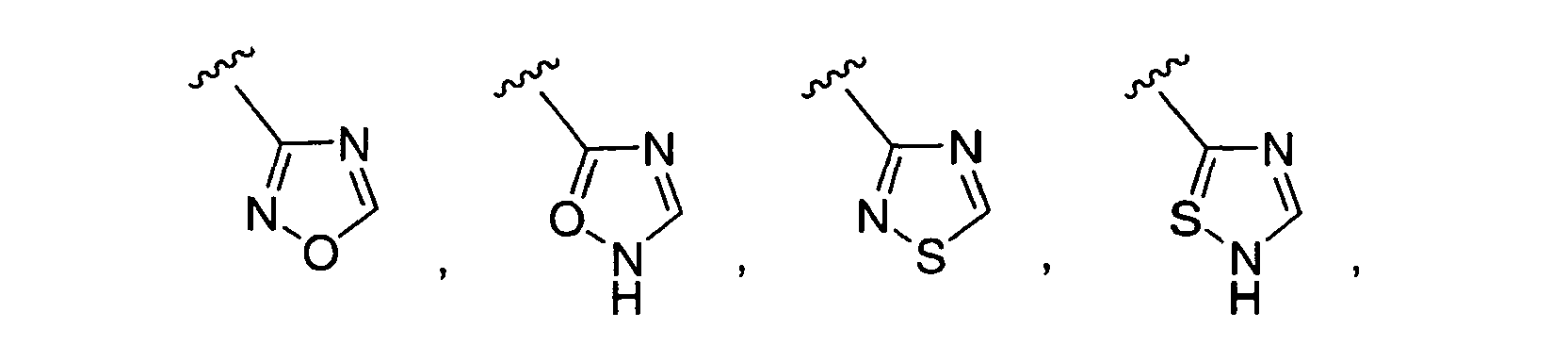

substituted heterocycle in (i)(j) is heterocycle as defined above with one or more substituents independently selected from halogen, cyano, C1-C4 alkyl, fluorinated C1-C4 alkyl, C1-C4 alkoxy, fluorinated C1-C4 alkoxy, and S-(C1-C4 alkyl); and
substituted heterocycle in (ii)(m) is heterocycle as defined above with one or more substituents independently selected from halogen, hydroxy, cyano, C1-C4 alkyl, fluorinated C1-C4 alkyl, C1-C4 alkoxy, fluorinated C1-C4 alkoxy, S-(C1-C4 alkyl), NRaRb, thiazolyl, oxazolyl, imidazolyl, pyrazolyl, triazolyl, pyrrolyl, isoxazolyl, and isothiazolyl; or is
- In a preferred aspect of the fifth class, heterocycle in (i)(g) and in (ii)(j) are each independently


substituted heterocycle in (i)(h) is heterocycle as defined above with one or more substituents independently selected from halogen, cyano, C1-C4 alkyl, fluorinated C1-C4 alkyl, and C1-C4 alkoxy; and
substituted heterocycle in (ii)(k) is heterocycle as defined above with one or more substituents independently selected from halogen, cyano, C1-C4 alkyl, fluorinated C1-C4 alkyl, and C1-C4 alkoxy; or is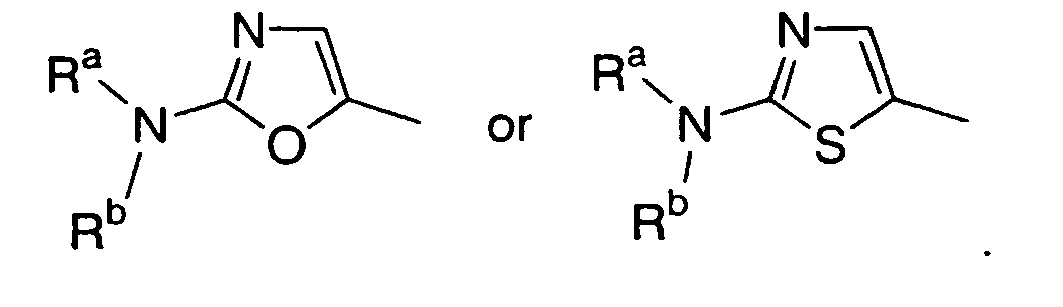
- An eighth embodiment of the present invention is a compound of Formula (I), wherein
- R1 is


- each D is independently hydrogen, halogen, cyano, hydroxy, NRaRb, C1-C4 alkyl, C1-C4 alkoxy, fluorinated C1-C4 alkoxy, S-(C1-C4 alkyl), phenyl, substituted phenyl, heterocycle, or substituted heterocycle; wherein substituted phenyl is phenyl with one or more subsituents independently selected from halogen, hydroxy, C1-C4 alkyl, and C1-C4 alkoxy; and wherein substituted heterocycle is heterocycle with one or more substituents independently selected from halogen, hydroxy, C1-C4 alkyl, C1-C4 alkoxy, fluorinated C1-C4 alkoxy, and S-(C1-C4 alkyl);
- each E is independently hydrogen, halogen, cyano, hydroxy, C1-C4 alkyl, C1-C4 alkoxy, heterocycle, or substituted heterocycle;
- G and G' are each independently selected from hydrogen, halogen, cyano, hydroxy, C1-C4 alkyl, fluorinated C1-C4 alkyl, and C1-C4 alkoxy;
- J is

- each L is independently hydrogen, halogen, cyano, hydroxy, C1-C4 alkyl, fluorinated C1-C4 alkyl, or C1-C4 alkoxy;
- X is O or S;
- heterocycle in each of D, E and J is independently


- s, s', and t are each independently integers from 0 to 2;
- and all other variables are as originally defined or as defined in any of the preceding embodiments or classes;
- A ninth embodiment of the present invention is a compound of Formula (I), wherein
- R1 is
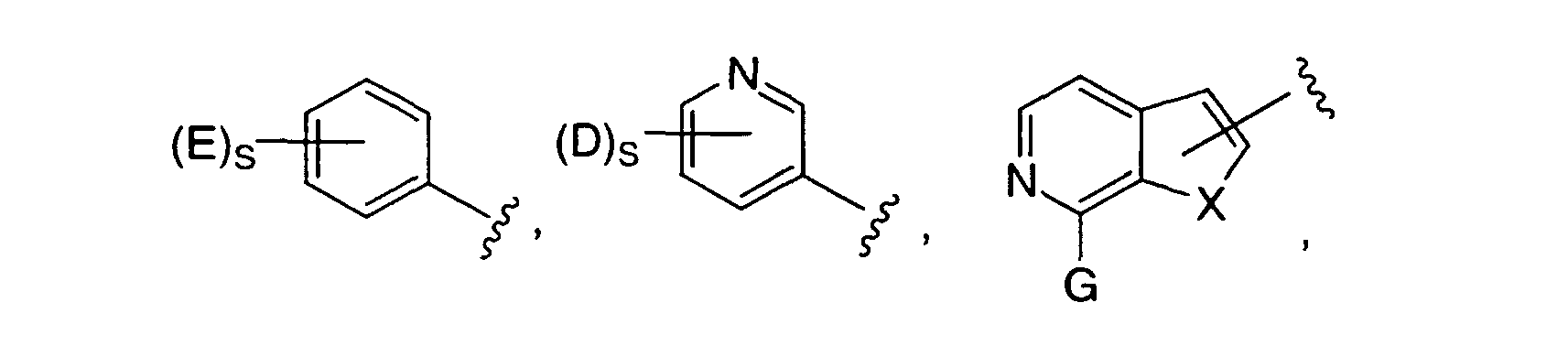
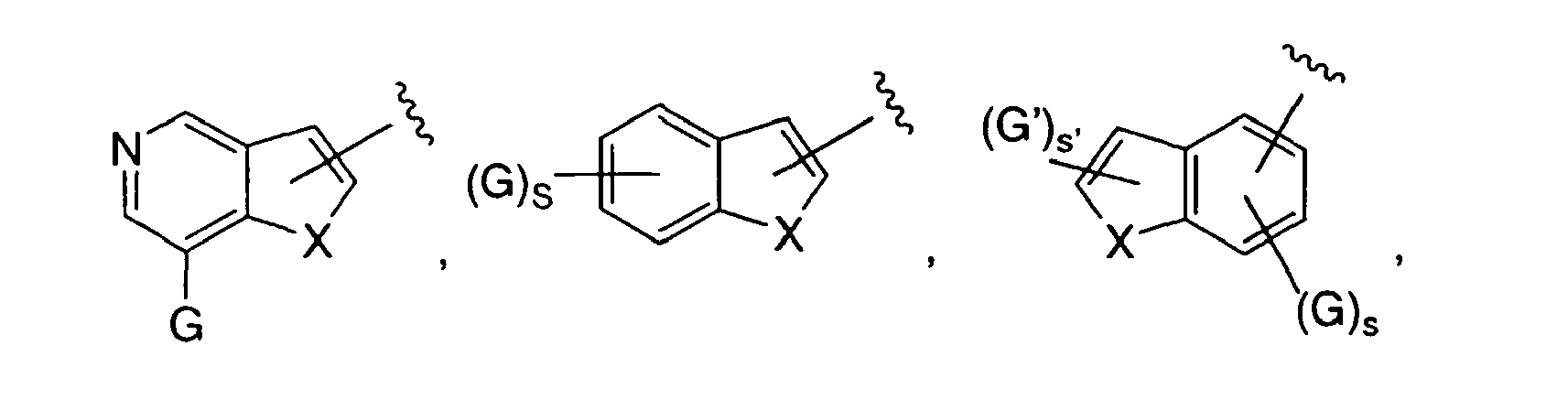


- each D is independently hydrogen, halogen, cyano, hydroxy, NRaRb, C1-C4 alkyl, C1-C4 alkoxy, phenyl, substituted phenyl, heterocycle, or substituted heterocycle; wherein substituted phenyl is phenyl with one or more subsituents independently selected from halogen, hydroxy, C1-C4 alkyl, and C1-C4 alkoxy; and wherein substituted heterocycle is heterocycle with one or more substituents independently selected from halogen, hydroxy, C1-C4 alkyl, and C1-C4 alkoxy;
- each E is independently hydrogen, halogen, cyano, hydroxy, C1-C4 alkyl, C1-C4 alkoxy, heterocycle, or substituted heterocycle;
- G and G' are each independently selected from hydrogen, halogen, cyano, hydroxy, C1-C4 alkyl, fluorinated C1-C4 alkyl, and C1-C4 alkoxy;
- J is

- each L is independently hydrogen, halogen, cyano, hydroxy, C1-C4 alkyl, fluorinated C1-C4 alkyl, or C1-C4 alkoxy;
- X is O or S;
- heterocycle in each of D, E and J is independently


- substituted heterocycle in each of E and J is independently heterocycle as defined above with one or more substituents independently selected from halogen, cyano, fluorinated C1-C4 alkyl and C1-C4 alkoxy; or is

- s, s', and t are each independently integers from 0 to 2;
- and all other variables are as originally defined or as defined in any of the preceding embodiments or classes;
- A sixth class of the present invention is a compound of Formula (I), wherein
- R6 is




- and all other variables are as defined in the eighth or the ninth embodiments.
- A seventh class of the present invention is a compound of Formula (I), wherein
- R4 is


- each Z is independently hydrogen, halogen, cyano, C1-C6 alkyl, or C1-C6 alkoxy;
- q is an integer from 0 to 2;
- and all other variables are as defined in the sixth class;
- An eighth class of the present invention is a compound of Formula (I), wherein
- R4 is


- each Z is independently hydrogen, halogen, cyano, C1-C6 alkyl, or C1- C6 alkoxy;
- q is an integer from 0 to 2;
- and all other variables are as defined in the sixth class;
- A ninth class of the present invention is a compound of Formula (I), wherein
- R1 is


- R2 and R3 are each independently hydrogen or C1-C4 alkyl; or R2 and R3 together with the carbon to which they are attached form C3-C6 cycloalkyl;
- R4 is


- R5 is

- R6 is

- J is

- heterocycle is



- each L is independently hydrogen, halogen, cyano, hydroxy, C1-C4 alkyl, fluorinated C1-C4 alkyl, or C1-C4 alkoxy;
- X is O or S;
- each Y is independently hydrogen, halogen, C1-C6 alkyl, fluorinated C1-C6 alkyl, or C1-C4 alkoxy;
- p is an integer from 0 to 2; and
- t is an integer from 0 to 2;
- In a preferred aspect of the ninth class, R2 and R3 are each independently hydrogen or methyl;
- each L is independently hydrogen, chlorine, or fluorine;
- each Y is independently hydrogen, chlorine, or fluorine; and
- each of the substituents on substituted heterocycle is independently chlorine, fluorine, methoxy, ethoxy, -OCF3, -OCHF2, methyl, ethyl, n-propyl, -S-CH3, -N(CH3)2, and thiazolyl.
- A tenth class of the present invention is a compound of Formula (I), wherein
- R1 is

- R2 and R3 are each independently hydrogen or C1-C4 alkyl; or R2 and R3 together with the carbon to which they are attached form C3-C6 cycloalkyl;
- R4 is


- R5 is

- R6 is

- J is

- heterocycle is



- each L is independently hydrogen, halogen, cyano, hydroxy, C1-C4 alkyl, fluorinated C1-C4 alkyl, or C1-C4 alkoxy;
- X is O or S;
- each Y is independently hydrogen, halogen, C1-C6 alkyl, fluorinated C1-C6 alkyl, or C1-C4 alkoxy;
- p is an integer from 0 to 2; and
- t is an integer from 0 to 2;
- In a preferred aspect of the tenth class, R2 and R3 are each independently hydrogen or methyl;
- each L is independently hydrogen, chlorine, or fluorine;
- each Y is independently hydrogen, chlorine, or fluorine; and
- each of the substituents on substituted heterocycle is independently chlorine, fluorine, or methoxy.
- An eleventh class of the present invention is a compound of Formula (I), wherein
- R1 is

- R2 and R3 are each independently hydrogen or C1-C4 alkyl; or R2 and R3 together with the carbon to which they are attached form C3-C6 cycloalkyl;
- R4 is

- R5 is

- R6 is
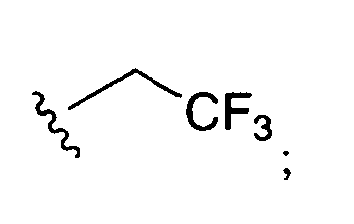
- J is

- heterocycle is

- each L is independently hydrogen, halogen, cyano, hydroxy, C1-C4 alkyl, fluorinated C1-C4 alkyl, or C1-C4 alkoxy;
- X is O or S;
- each Y is independently hydrogen, halogen, C1-C6 alkyl, fluorinated C1-C6 alkyl, or C1-C4 alkoxy; and
- p is an integer from 0 to 2;
- t is an integer from 0 to 2;
- In a preferred aspect of the eleventh class, R2 and R3 are each independently hydrogen or methyl;
- each L is independently hydrogen, chlorine, or fluorine;
- each Y is independently hydrogen, chlorine, or fluorine; and
- each of the substituents on substituted heterocycle is independently chlorine, fluorine, methoxy, ethoxy, -OCF3, -OCHF2, methyl, ethyl, n-propyl, -S-CH3, -N(CH3)2, and thiazolyl.
- Exemplifying the invention are compounds selected from the group consisting of
- (αR,γS,2S)-N-((3S,4S)-3,4-dihydro-3-hydroxy-2H-1-benzopyran-4-yl)-4-(1-furo[3,2-c]pyridin-2-yl-1-methylethyl)-γ-hydroxy-α-(phenylmethyl)-2-[[(2,2,2-trifluoroethyl)amino]carbonyl]-1-piperazinepentanamide;
- (αR,γS,2S)-N-((3S,4S)-3,4-dihydro-3-hydroxy-2H-1-benzopyran-4-yl)-2-[[(2-fluoroethyl)amino]carbonyl]-4-(1-furo[3,2-c]pyridin-2-yl-1-methylethyl)-γ-hydroxy-α-(phenylmethyl)-1-piperazinepentanamide;
- (αR,γS,2S)-N-((3S,4S)-3,4-dihydro-3-hydroxy-2H-1-benzofuran-4-yl)-2-[[[2-fluoro-1,1-bis(fluoromethyl)ethyl]amino]carbonyl]-4-(1-furo[3,2-c]pyridin-2-yl-1-methylethyl)-γ-hydroxy-α-(phenylmethyl)-1-piperazinepentanamide;
- (αR,γS,2S)-2-[[[1,1-bis(fluoromethyl)ethyl]amino]carbonyl]-N-((3S,4S)-3,4-dihydro-3-hydroxy-2H-1-benzopyran-4-yl)-4-(1-furo[3,2-c]pyridin-2-yl-1-methylethyl)-γ-hydroxy-α-(phenylmethyl)-1-piperazinepentanamide;
- (αR,γS,2S)-N-((3S,4S)-3,4-dihydro-3-hydroxy-2H-1-benzopyran-4-yl)-4-(1-furo[3,2-c]pyridin-2-yl-1-methylethyl)-γ-hydroxy-α-(phenylmethyl)-2-[[(3,3,3-trifluoropropyl)amino]carbonyl]-1-piperazinepentanamide;
- (αR,γS,2S)-N-((3S,4S)-3,4-dihydro-3-hydroxy-2H-1-benzopyran-4-yl)-4-(1-furo[3,2-c]pyridin-2-yl-1-methylethyl)-γ-hydroxy-2-[[(2,2,3,3,3-pentafluoropropyl)-mino]carbonyl]-α-(phenylmethyl)-1-piperazinepentanamide;
- (αR,γS,2S)-N-((3S,4S)-3,4-dihydro-3-hydroxy-2H-1-benzopyran-4-yl)-2-[[(2-fluoro-1,1-dimethylethyl)amino]carbonyl]-4-(1-furo[3,2-c]pyridin-2-yl-1-methylethyl)-γ-hydroxy-α-(phenylmethyl)-1-piperazinepentanamide;
- (αR,γS,2S)-N-((1S,2R)-1,2-dihydro-2-hydroxy-1H-inden-1-yl)-4-(1-furo[3,2-c]pyridin-2-yl-1-methylethyl)-γ-hydroxy-α-(phenylmethyl)-2-[[(2,2,2-trifluoroethyl)amino]carbonyl]-1-piperazinepentanamide;
- (αR,γS,2S)-N-((1S,2R)-1,2-dihydro-2-hydroxy-1H-inden-1-yl)-2-[[(2-fluoroethyl)amino]carbonyl]-4-[1-furo[3,2-c]pyridin-2-yl-1-methylethyl)-γ-hydroxy-α-(phenylmethyl)-1-piperazinepentanamide;
- (αR,γS,2S)-N-((1S,2R)-1,2-dihydro-2-hydroxy-1H-inden-1-yl)-4-(1-furo[3,2-c]pyridin-2-yl-1-methylethyl)-γ-hydroxy-α-(phenylmethyl)-2-[[(3,3,3-trifluoropropyl)amino]carbonyl]-1-piperazinepentanamide;
- (αR,γS,2S)-N-((1S,2R)-1,2-dihydro-2-hydroxy-1H-inden-1-yl)-4-(1-furo[3,2-c]pyridin-2-yl-1-methylethyl)-γ-hydroxy-2-[[(2,2,3,3,3-pentafluoropropyl)amino]-carbonyl]-α-(phenylmethyl)-1-piperazinepentanamide;
- (αR,γS,2S)-4-(2-benzofuranylmethyl)-N-((3S,4S)-3,4-dihydro-3-hydroxy-2H-1-benzopyran-4-yl)-γ-hydroxy-α-(phenylmethyl)-2-[[(2,2,2-trifluoroethyl)amino]-carbonyl]-1-piperazinepentanamide;
- (αR,γS,2S)-N-((3S,4S)-3,4-dihydro-3-hydroxy-2H-1-benzopyran-4-yl)-γ-hydroxy-α-(phenylmethyl)-4-[[5-(3-pyridinyl)-1-furanyl]methyl]-2-[[(2,2,2-trifluoroethyl)-amino]carbonyl]-1-piperazinepentanamide;
- (αR,γS,2S)-N-((3S,4S)-3,4-dihydro-3-hydroxy-2H-1-benzopyran-4-yl)-γ-hydroxy-α-(phenylmethyl)-4-(3-pyridinylmethyl)-2-[[(2,2,2-trifluoroethyl)amino]carbonyl]-1-piperazinepentanamide;
- (αR,γS,2S)-N-((3S,4S)-3,4-dihydro-3-hydroxy-2H-1-benzopyran-4-yl)-γ-hydroxy-α-(phenylmethyl)-4-[[5-(3-pyridinyl)-1-furanyl]methyl]-2-[[(2,2,2-trifluoroethyl)-amino]carbonyl]-1-piperazinepentanamide;
- (αR,γS,2S)-N-((3S,4S)-3,4-dihydro-3-hydroxy-2H-1-benzopyran-4-yl)-γ-hydroxy-α-(phenylmethyl)-4-[[5-(5-pyrimidinyl)-1-furanyl]methyl]-2-[[(2,2,2-trifluoroethyl)-amino]carbonyl]-1-piperazinepentanamide;
- (αR,γS,2S)-N-((3S,4S)-3,4-dihydro-3-hydroxy-2H-1-benzopyran-4-yl)-γ-hydroxy-4-[(3-methyl-7-methoxy-4-benzofuranyl)methyl]-α-(3-pyridinylmethyl)-2-[[(2,2,2-trifluoroethyl)amino]carbonyl]-1-piperazinepentanamide;
- (αR,γS,2S)-N-((3S,4S)-3,4-dihydro-3-hydroxy-2H-1-benzopyran-4-yl)-γ-hydroxy-4-[(7-methoxy-2-benzofuranyl)methyl]-α-(phenylmethyl)-2-[[(2,2,2-trifluoroethyl)-amino]carbonyt]-1-piperazinepentanamide;
- (αR,γS,2S)-N-((3S,4S)-3,4-dihydro-3-hydroxy-2H-1-benzopyran-4-yl)-γ-hydroxy-α-(phenylmethyl)-4-[(1-phenyl-1H-pyrrol-3-yl)methyl]-2-[[(2,2,2-trifluoroethyl)-amino]carbonyl]-1-piperazinepentanamide;
- (αR,γS,2S)-N-((3S,4S)-3,4-dihydro-3-hydroxy-2H-1-benzopyran-4-yl)-γ-hydroxy-4-[(1-phenyl-1H-imidazol-4-yl)methyl]-α-(phenylmethyl)-2-[[(2,2,2-trifluoroethyl)-amino]carbonyl]-1-piperazinepentanamide;
- (αR,γS,2S)-4-(2-benzofuranylmethyl)-N-((1S,2R)-1,2-dihydro-2-hydroxy-1H-inden-1-yl)-γ-hydroxy-α-(phenylmethyl)-2-[[(2,2,2-trifluoroethyl)amino]carbonyl]-1-piperazinepentanamide;
- (αR,γS,2S)-N-((1S,2R)-1,2-dihydro-2-hydroxy-1H-inden-1-yl)-γ-hydroxy-α-(phenylmethyl)-4-(3-pyridinylmethyl)-2-[[(2,2,2-trifluoroethyl)amino]carbonyl]-1-piperazinepentanamide;
- (αR,γS,2S)-N-((3S,4S)-3,4-dihydro-3-hydroxy-2H-1-benzopyran-4-yl)-γ-hydroxy-4-[(5-phenyl-2-furanyl)methyl]-α-(3-pyridinylmethyl)-2-[[(2,2,2-trifluoroethyl)-amino]carbonyl]-1-piperazinepentanamide;
- (αR,γS,2S)-4-(2-benzopyranylmethyl)-N-((3S,4S)-3,4-dihydro-3-hydroxy-2H-1-benzopyran-4-yl)-γ-hydroxy-α-(3-pyridinylmethyl)-2-[[(2,2,2-trifluoroethyl)-amino]carbonyl]-1-piperazinepentanamide;
- (αR,γS,2S)-N-((3S,4S)-3,4-dihydro-3-hydroxy-2H-1-benzopyran-4-yl)-γ-hydroxy-α-(3-pyridinylmethyl)-4-(thieno[2,3-b]thien-2-ylmethyl)-2-([(2,2,2-trifluoroethyl)amino]carbonyl]-1-piperazinepentanamide;
- (αR,γS,2S)-4-[(2,6-difluorophenyl)methyl]-N-((3S,4S)-3,4-dihydro-3-hydroxy-2H-1-benzopyran-4-yl)-γ-hydroxy-α-(3-pyridinylmethyl)-2-[[(2,2,2-trifluoroethyl)-amino]carbonyl]-1-piperazinepentanamide;
- (αR,γS,2S)-N-((3S,4S)-3,4-dihydro-3-hydroxy-2H-1-benzopyran-4-yl)-γ-hydroxy-α-(3-pyridinylmethyl)-4-(thieno[3,2-b]thien-2-ylmethyl)-2-[[(2,2,2-trifluoroethyl)-amino]carbonyl]-1-piperazinepentanamide;
- (αR,γS,2S)-N-((3S,4S)-3,4-dihydro-3-hydroxy-2H-1-benzopyran-4-yl)-γ-hydroxy-4-[(7-methoxy-2-benzofuranyl)methyl]-α-(3-pyridinylmethyl)-2-[[(2,2,2-trifluoroethyl)amino]carbonyl]-1-piperazinepentanamide;
- (αR,γS,2S)-N-((3S,4S)-3,4-dihydro-3-hydroxy-2H-1-benzopyran-4-yl)-γ-hydroxy-α-(3-pyridinylmethyl)-4-[[5-(2-thienyl)-2-furanyl]methyl]-2-[[(2,2,2-trifluoroethyl)-amino]carbonyl]-1-piperazinepentanamide;
- (αR,γS,2S)-N-((3S,4S)-3,4-dihydro-3-hydroxy-2H-1-benzopyran-4-yl)-γ-hydroxy-4-[(1-phenyl-1H-pyrrol-3-yl)methyl]-α-(3-pyridinylmethyl)-2-[[(2,2,2-trifluoroethyl)-amino]carbonyl]-1-piperazinepentanamide;
- (αR,γS,2S)-N-((3S,4S)-3,4-dihydro-3-hydroxy-2H-1-benzopyran-4-yl)-γ-hydroxy-4-(1-phenyl-1H-imidazol-4-yl)methyl]-α-(3-pyridinylmethyl)-2-[[(2,2,2-trifluoroethyl)-amino]carbonyl]-1-piperazinepentanamide;
- (αR,γS,2S)-N-((3S,4S)-3,4-dihydro-3-hydroxy-2H-1-benzopyran-4-yl)-γ-hydroxy-4-[[5-(5-methyl-2-thienyl)-2-furanyl]methyl]-α-(3-pyridinylmethyl)-2-[[(2,2,2-trifluoroethyl)amino]carbonyl]-1-piperazinepentanamide;
- (αR,γS,2S)-N-((3S,4S)-3,4-dihydro-3-hydroxy-2H-1-benzopyran-4-yl)-γ-hydroxy-4-[(5-phenyl-2-furanyl)methyl]-α-(4-pyridinylmethyl)-2-[[(2,2,2-trifluoroethyl)amino]-carbonyl]-1-piperazinepentanamide;
- (αR,γS, 2S)-4-(2-benzofuranylmethyl)-N-((3S,4S)-3,4-dihydro-3-hydroxy-2H-1-benzopyran-4-yl)-γ-hydroxy-α-(4-pyridinylmethyl)-2-[[(2,2,2-trifluoroethyl)-amino]carbonyl]-1-piperazinepentanamide;
- (αR,γS,2S)-N-((3S,4S)-3,4-dihydro-3-hydroxy-2H-1-benzopyran-4-yl)-γ-hydroxy-4-[1-methyl-1-[5-(4-pyridinyl)-2-furanyl]ethyl]-α-(phenylmethyl)-2-[[(2,2,2-trifluoroethyl)amino]carbonyl]-1-piperazinepentanamide;
- (αR,γS,2S)-N-((3S,4S)-3,4-dihydro-3-hydroxy-2H-1-benzopyran-4-yl)-γ-hydroxy-α-(phenylmethyl)-4-[1-[5-(4-pyridinyl)-1-furanyl]ethyl]-2-[[(2,2,2-trifluoroethyl)-amino]carbonyl]-1-piperazinepentanamide;
- (αR,γS,2S)-N-((3S,4S)-3,4-dihydro-3-hydroxy-2H-1-benzopyran-4-yl)-γ-hydroxy-α-(phenylmethyl)-4-[1-[5-(4-pyridinyl)-1-furanyl]ethyl]-2-[[(2,2,2-trifluoroethyl)-amino]carbonyl]-1-piperazinepentanamide;
- (αR,γS,2S)-N-((3S,4S)-3,4-dihydro-3-hydroxy-2H-1-benzopyran-4-yl)-γ-hydroxy-4-[1-methyl-1-(1-phenyl-1H-pyrazol-3-yl)ethyl]-α-(3-pyridinylmethyl)-2-[[(2,2,2-trifluoroethyl)amino]carbonyl]-1-piperazinepentanamide;
- (αR,γS,2S)-N-((3S,4S)-3,4-dihydro-3-hydroxy-2H-1-benzopyran-4-yl)-γ-hydroxy-4-[1-methyl-1-(3-phenyl-5-isoxazolyl)ethyl]-α-(3-pyridinylmethyl)-2-[[(2,2,2-trifluoroethyl)amino]carbonyl]-1-piperazinepentanamide;
- (αR,γS,2S)-N-((3S,4S)-3,4-dihydro-3-hydroxy-2H-1-benzopyran-4-yl)-γ-hydroxy-4-[1-methyl-1-(3-phenyl-5-isoxazolyl)ethyl]]-α-(phenylmethyl)-2-[[(2,2,2-trifluoroethyl)amino]carbonyl]-1-piperazinepentanamide;
- (αR,γS,2S)-4-[(7-chlorobenzofuran-2-yl)methyl]-N-((3S,4S)-3,4-dihydro-3-hydroxy-2H-1-benzopyran-4-yl)-γ-hydroxy-α-(3-pyridinylmethyl)-2-[[(2,2,2-trifluoroethyl)-amino]carbonyl]-1-piperazinepentanamide;
- (αR,γS,2S)-N-((3S,4S)-3,4-dihydro-3-hydroxy-2H-1-benzopyran-4-yl)-4-(1-furo[3,2-c]pyridin-2-yl-1-methylethyl)-γ-hydroxy-α-(phenylmethyl)-2-[[(2,2-difluoroethyl)amino]carbonyl]-1-piperazinepentanamide;
- (αR,γS,2S)-N-((3S,4S)-3,4-dihydro-3-hydroxy-2H-1-benzopyran-4-yl)-γ-hydroxy-α-(phenylmethyl)-4-[[5-(2-thiazolyl)-3-pyridinyl]methyl]-2-[[(2,2,2-trifluoroethyl)-amino]carbonyl]-1-piperazinepentanamide;
- (αR,γS,2S)-N-((3S,4S)-3,4-dihydro-3-hydroxy-2H-1-benzopyran-4-yl)-γ-hydroxy-4-[[5-(2-oxazolyl)-3-pyridinyl]methyl]-α-(phenylmethyl)-2-[[(2,2,2-trifluoroethyl)-amino]carbonyl]-1-piperazinepentanamide;
- (αR,γS,2S)-N-((3S,4S)-3,4-dihydro-3-hydroxy-2H-1-benzopyran-4-yl)-γ-hydroxy-α-(phenylmethyl)-4-[[5-(4-thiazolyl)-3-pyridinyl]methyl]-2-[[(2,2,2-trifluoroethyl)-amino]carbonyl]-1-piperazinepentanamide;
- (αR,γS,2S)-N-((3S,4S)-3,4-dihydro-3-hydroxy-2H-1-benzopyran-4-yl)-γ-hydroxy-α-(phenylmethyl)-4-[[5-(2-thiazolyl)-2-furanyl]methyl]-2-[[(2,2,2-trifluoroethyl)-amino]carbonyl]-1-piperazinepentanamide;
- (αR,γS,2S)-4-[[5-(5-chloro-3-pyridinyl)-2-furanyl]methyl]-N-((3S,4S)-3,4-dihydro-3-hydroxy-2H-1-benzopyran-4-yl)-γ-hydroxy-α-(phenylmethyl)-2-[[(2,2,2-trifluoroethyl)amino]carbonyl]-1-piperazinepentanamide;
- (αR,γS,2S)-N-((3S,4S)-3,4-dihydro-3-hydroxy-2H-1-benzopyran-4-yl)-γ-hydroxy-4-[(5-phenyl-2-furanyl)methyl]-α-(phenylmethyl)-2-[[(2,2,2-trifluoroethyl)amino]-carbonyl]-I-piperazinepentanamide;
- (αR,γS,2S)-4-[(4-chloro-5-phenyl-2-furanyl)methyl]-N-((3S,4S)-3,4-dihydro-3-hydroxy-2H-1-benzopyran-4-yl)-γ-hydroxy-α-(phenylmethyl)-2-[[(2,2,2-trifluoroethyl)amino]carbonyl]-1-piperazinepentanamide;
- (αR,γS,2S)-N-((3S,4S)-3,4-dihydro-3-hydroxy-2H-1-benzopyran-4-yl)-γ-hydroxy-α-(phenylmethyl)-4-[[5-(2-pyridinyl)-2-furanyl]methyl]-2-[[(2,2,2-trifluoroethyl)-amino]carbonyl]-1-piperazinepentanamide;
- (αR,γS,2S)-4-[[5-(5-chloro-2-pyridinyl)-2-furanyl]methyl]-N-((3S,4S)-3,4-dihydro-3-hydroxy-2H-1-benzopyran-4-yl)-γ-hydroxy-α-(phenylmethyl)-2-[[(2,2,2-trifluoroethyl)amino]carbonyl]- 1-piperazinepentanamide;
- (αR,γS,2S)-N-((3S,4S)-3,4-dihydro-3-hydroxy-2H-1-benzopyran-4-yl)-γ-hydroxy-4-[[5-(2-methyl-4-pyridinyl)-2-furanyl]methyl]-α-(phenylmethyl)-2-[[(2,2,2-trifluoroethyl)amino]carbonyl]-1-piperazinepentanamide;
- (αR,γS,2S)-N-((3S,4S)-3,4-dihydro-3-hydroxy-2H-1-benzopyran-4-yl)-4-[[5-(2-ethyl-4-pyridinyl)-2-furanyl]methyl]-γ-hydroxy-α-(phenylmethyl)-2-[[(2,2,2-trifluoroethyl)-amino]carbonyl]-1-piperazinepentanamide;
- (αR,γS,2S)-N-((3S,4S)-3,4-dihydro-3-hydroxy-2H-1-benzopyran-4-yl)-γ-hydroxy-4-[[5-(5-oxazolyl)-2-furanyl]methyl]-α-(phenylmethyl)-2-[[(2,2,2-trifluoroethyl)-amino]carbonyl]-1-piperazinepentanamide;
- (αR,γS,2S)-N-((3S,4S)-3,4-dihydro-3-hydroxy-2H-1-benzopyran-4-yl)-γ-hydroxy-α-(phenylmethyl)-4-[[1-(4-pyridinyl)-1H-pyrrol-3-yl]methyl]-2-[[(2,2,2-trifluoroethyl)-amino]carbonyl]-1-piperazinepentanamide;
- (αR,γS,2S)-N-((3S,4S)-3,4-dihydro-3-hydroxy-2H-1-benzopyran-4-yl)-γ-hydroxy-α-(phenylmethyl)-4-[[1-(3-pyridinyl)-1H-pyrrol-3-yl]methyl]-2-[[(2,2,2-trifluoroethyl)-amino]carbonyl]-1-piperazinepentanamide;
- (αR,γS,2S)-N-((3S,4S)-3,4-dihydro-3-hydroxy-2H-1-benzopyran-4-yl)-γ-hydroxy-α-(phenylmethyl)-4-[[5-(4-pyridazinyl)-2-furanyl]methyl]-2-[[(2,2,2-trifluoroethyl)-amino]carbonyl]-1-piperazinepentanamide;
- (αR,γS,2S)-N-((3S,4S)-3,4-dihydro-3-hydroxy-2H-1-benzopyran-4-yl)-γ-hydroxy-4-[1-methyl-1-[3-methyl-5-(4-pyridinyl)-2-furanyl]ethyl]-α-(phenylmethyl)-2-[[(2,2,2-trifluoroethyl)amino]carbonyl]-1-piperazinepentanamide;
- (αR,γS,2S)-N-((3S,4S)-3,4-dihydro-3-hydroxy-2H-1-benzopyran-4-yl)-γ-hydroxy-α-(phenylmethyl)-4-[[5-(2-pyrazinyl)-2-furanyl]methyl]-2-[[(2,2,2-trifluoroethyl)-amino]carbonyl]-1-piperazinepentanamide;
- (αR,γS,2S)-N-((3S,4S)-3,4-dihydro-3-hydroxy-2H-1-benzopyran-4-yl)-γ-hydroxy-4-[[5-(1-methyl-1H-pyrazol-4-yl)-3-pyridinyl]methyl]-α-(phenylmethyl)-2-[[(2,2,2-trifluoroethyl)amino]carbonyl]-1-piperazinepentanamide;
- (αR,γS,2S)-N-((3S,4S)-3,4-dihydro-3-hydroxy-2H-1-benzopyran-4-yl)-γ-hydroxy-α-(phenylmethyl)-4-[[5-(2-thienyl)-3-pyridinyl]methyl]-2-[[(2,2,2-trifluoroethyl)amino]-carbonyl]-1-piperazinepentanamide;
- (αR,γS,2S)-N-((3S,4S)-3,4-dihydro-3-hydroxy-2H-1-benzopyran-4-yl)-γ-hydroxy-α-(phenylmethyl)-4-[[5-(3-thienyl)-3-pyridinyl]methyl]-2-[[(2,2,2-trifluoroethyl)-amino]carbonyl]-1-piperazinepentanamide;
- (αR,γS,2S)-N-((3S,4S)-3,4-dihydro-3-hydroxy-2H-1-benzopyran-4-yl)-γ-hydroxy-α-(phenylmethyl)-4-[[5-(4-pyrimidinyl)-2-furanyl]methyl]-2-[[(2,2,2-trifluoroethyl)amino]carbonyl]-1-piperazinepentanamide;
- (αR,γS,2S)-4-[(7-chlorofuro[3,2-c]pyridin-2-yl)methyl]-N-((3S,4S)-3,4-dihydro-3-hydroxy-2H-1-benzopyran-4-yl)-γ-hydroxy-α-(phenylmethyl)-2-[[(2,2,2-trifluoroethyl)amino]carbonyl]-1-piperazinepentanamide;
- (αR,γS,2S)-N-((3S,4S)-3,4-dihydro-3-hydroxy-2H-1-benzopyran-4-yl)-γ-hydroxy-α-(phenylmethyl)-4-[[5-(3-pyridinyl)-2-oxazolyl]methyl]-2-[[(2,2,2-trifluoroethyl)amino]carbonyl]-1-piperazinepentanamide;
- (αR,γS,2S)-N-((3S,4S)-3,4-dihydro-3-hydroxy-2H-1-benzopyran-4-yl)-yl-hydroxy-α-(phenylmethyl)-4-[[5-(2-pyridinyl)-2-oxazolyl]methyl]-2-[[(2,2,2-trifluoroethyl)-amino]carbonyl]-1-piperazinepentanamide;
- (αR,γS,2S)-N-((3S,4S)-3,4-dihydro-3-hydroxy-2H-1-benzopyran-4-yl)-γ-hydroxy-α-(phenylmethyl)-4-[1-methyl-1-[5-(2-pyridinyl)-2-oxazolyl]ethyl]-2-[[(2,2,2-trifluoroethyl)amino]carbonyl]-1-piperazinepentanamide;
- (αR,γS,2S)-N-((3S,4S)-3,4-dihydro-3-hydroxy-2H-1-benzopyran-4-yl)-γ-hydroxy-4-[1-methyl-1-[5-(3-pyridinyl)-2-oxazolyl]ethyl]-α-(phenylmethyl)-2-[[(2,2,2-trifluoroethyl)amino]carbonyl]-1-piperazinepentanamide;
- (αR,γS,2S)-N-((3S,4S)-3,4-dihydro-3-hydroxy-2H-1-benzopyran-4-yl)-γ-hydroxy-4-[(5-phenyl-2-furanyl)methyl]-α-(5-pyrimidinylmethyl)-2-[[(2,2,2-trifluoroethyl)-amino]carbonyl]-1-piperazinepentanamide;
- (αR,γS,2S)-N-((3S,4S)-3,4-dihydro-3-hydroxy-2H-1-benzopyran-4-yl)-γ-hydroxy-4-[(5-phenyl-2-furanyl)methyl]-α-(2-pyrazinylmethyl)-2-[[(2,2,2-trifluoroethyl)amino]carbonyl]-1-piperazinepentanamide;
- (αS,γS,2S)-N-((3S,4S)-3,4-dihydro-3-hydroxy-2H-1-benzopyran-4-yl)-γ-hydroxy-4-[[5-(2-pyridinyl)-2-furanyl]methyl]-α-(2-thienylmethyl)-2-[[(2,2,2-trifluoroethyl)-amino]carbonyl]-1-piperazinepentanamide;
- (αS,γS,2S)-N-((3S,4S)-3,4-dihydro-3-hydroxy-2H-1-benzopyran-4-yl)-γ-hydroxy-4-[[5-(5-pyrimidinyl)-2-furanyl]methyl]-α-(5-thienylmethyl)-2-[[(2,2,2-trifluoroethyl)amino]carbonyl]-1-piperazinepentanamide;
- (αS,γS,2S)-N-((3S,4S)-3,4-dihydro-3-hydroxy-2H-1-benzopyran-4-yl)-γ-hydroxy-4-[[5-(2-pyridinyl)-2-furanyl]methyl]-α-(3-thienylmethyl)-2-[[(2,2,2-trifluoroethyl)-amino]carbonyl]-1-piperazinepentanamide;
- (αR,γS,2S)-N-((3S,4S)-3,4-dihydro-3-hydroxy-2H-1-benzopyran-4-yl)-γ-hydroxy-4-[(5-phenyl-2-furanyl)methyl]-α-(2-pyridinylmethyl)-2-[[(2,2,2-trifluoroethyl)amino]-carbonyl]-1-piperazinepentanamide;
- (αR,γS,2S)-N-((1S,2R)-1,2-dihydro-2-hydroxy-1H-inden-1-yl)-γ-hydroxy-α-(phenylmethyl)-4-[[5-(2-pyridinyl)-2-furanyl]methyl]-2-[[(2,2,2-trifluoroethyl)-amino]carbonyl]-1-piperazinepentanamide;
- (αR,γS,2S)-4-[[5-(5-chloro-2-pyridinyl)-2-furanyl]methyl]-N-((1S,2R)-1,2-dihydro-2-hydroxy-1H-inden-1-yl)-γ-hydroxy-α-(phenylmethyl)-2-[[(2,2,2-trifluoroethyl)-amino]carbonyl]-1-piperazinepentanamide;
- (αR,γS,2S)-N-((3S,4S)-3,4-dihydro-3-hydroxy-2H-1-benzopyran-4-yl)-γ-hydroxy-4-[1-methyl-1-[5-(5-chloro-3-pyridinyl)-2-oxazolyl]ethyl]-α-(phenylmethyl)-2-[[(2,2,2 trifluoroethyl)amino]carbonyl]-1-piperazinepentanamide;
- (αR,γS,2S)-N-((3S,4S)-3,4-dihydro-3-hydroxy-2H-1-benzopyran-4-yl)-γ-hydroxy-α-(phenylmethyl)-4-[1-methyl-1-[5-(5-chloro-2-pyridinyl)-2-oxazolyl]ethyl]-2-[[(2,2,2-trifluoroethyl)amino]carbonyl]-1-piperazinepentanamide;
- (αR,γS,2S)-N-((3S,4S)-3,4-dihydro-3-hydroxy-2H-1-benzopyran-4-yl)-γ-hydroxy-4-[(3-chloro-1-phenyl-1H-pyrrol-3-yl)methyl]-α-(3-pyridinylmethyl)-2-[[(2,2,2-trifluoroethyl)amino]carbonyl]-1-piperazinepentanamide;
- (αR,γS,2S)-N-((3S,4S)-3,4-dihydro-3-hydroxy-2H-1-benzopyran-4-yl)-γ-hydroxy-4-[(4-chloro-1-phenyl-1H-pyrrol-3-yl)methyl]-α-(3-pyridinylmethyl)-2-[[(2,2,2-trifluoroethyl)amino]carbonyl]-1-piperazinepentanamide;
- (αR,γS,2S)-N-((3S,4S)-3,4-dihydro-3-hydroxy-2H-1-benzopyran-4-yl)-γ-hydroxy-4-[1-methyl-1-(1-phenyl-1H-triazoyl-4-yl)ethyl]-α-(3-phenylmethyl)-2-[[(2,2,2-trifluoroethyl)amino]carbonyl]-1-piperazinepentanamide;
- (αR,γS,2S)-N-((3S,4S)-3,4-dihydro-3-hydroxy-2H-1-benzopyran-4-yl)-γ-hydroxy-4-[1-methyl-1-(1-phenyl-1H-triazoyl-4-yl)ethyl]-α-(3-pyridinylmethyl)-2-[[(2,2,2-trifluoroethyl)amino]carbonyl]-1-piperazinepentanamide;
- (αR,γS,2S)-N-(4S-3,4-dihydro-1H-2,2-dioxobenzothiopyranyl)-γ-hydroxy-α-(phenylmethyl)-4-[[5-(5-pyrimidinyl)-1-furanyl]methyl]-2-[[(2,2,2-trifluoroethyl)amino]carbonyl]-1-piperazinepentanamide;
- (αR,γS,2S)-N-(4S-3,4-dihydro-1H-2,2-dioxobenzothiopyranyl)-γ-hydroxy-α-(phenylmethyl)-4-[[5-(2-pyridinyl)-2-furanyl]methyl]-2-[[(2,2,2-trifluoroethyl)-amino]carbonyl]-1-piperazinepentanamide;
- (αR,γS,2S)-N-((3S,4S)-3,4-dihydro-3-hydroxy-2H-1-benzopyran-4-yl)-γ-hydroxy-4-[1-methyl-1-[5-(2-methyl-4-pyridinyl)-2-furanyl]ethyl]-α-(phenylmethyl)-2-[[(2,2,2-trifluoroethyl)amino]carbonyl]-1-piperazinepentanamide;
- Also exemplifying the invention are compounds selected from the group consisting of
- (αR,γS,2S)-N-[(3S,4S)-3,4-dihydro-3-hydroxy-2H-1-benzopyran-4-yl]-γ-hydroxy-4-[1-[5-(5-methoxy-3-pyridinyl)-2-oxazolyl]-1-methylethyl]-α-(phenylmethyl)-2-[[(2,2,2-trifluoroethyl)amino]carbonyl]-1-piperazinepentanamide;
- (αR,γS,2S)-N-[(3S,4S)-3,4-dihydro-3-hydroxy-2H-1-benzopyran-4-yl]-4-[1-[5-(5-methyl-3-pyridinyl)-2-oxazolyl]-1-methylethyl]-γ-hydroxy-α-(phenylmethyl)-2-[[(2,2,2-trifluoroethyl)amino]carbonyl]-1-piperazinepentanamide;
- (αR,γS,2S)-N-[(3S,4S)-3,4-dihydro-3-hydroxy-2H-1-benzopyran-4-yl]-4-[1-[5-(5-hydroxy-3-pyridinyl)-2-oxazolyl]-1-methylethyl]-γ-hydroxy-α-(phenylmethyl)-2-[[(2,2,2-trifluoroethyl)amino]carbonyl]-1-piperazinepentanamide;
- (αR,γS,2S)-4-[1-[5-[5-(difluoromethoxy)-3-pyridinyl]-2-oxazolyl]-1-methylethyl]-N-[(3S,4S)-3,4-dihydro-3-hydroxy-2H-1-benzopyran-4-yl]-γ-hydroxy-α-(phenylmethyl)-2-[[(2,2,2-trifluoroethyl)amino]carbonyl] -1-piperazinepentanamide;
- (αR,γS,2S)-4-[1-[5-[5-(difluoromethyl)-3-pyridinyl]-2-oxazolyl]-1-methylethyl]-N-[(3S,4S)-3,4-dihydro-3-hydroxy-2H-1-benzopyran-4-yl]-γ-hydroxy-α-(phenylmethyl)-2-[[(2,2,2-trifluoroethyl)amino]carbonyl]-1-piperazinepentanamide;
- (αR,γS,2S)-N-[(3S,4S)-3,4-dihydro-3-hydroxy-2H-1-benzopyran-4-yl]-4-[1-[5-(2-fluorophenyl)-2-oxazolyl]-1-methylethyl]-γ-hydroxy-α-(phenylmethyl)-2-[[(2,2,2-trifluoroethyl)amino]carbonyl]-1-piperazine-pentanamide;
- (αR,γS,2S)-N-[(3S,4S)-3,4-dihydro-3-hydroxy-2H-1-benzopyran-4-yl]-4-[1-[5-(3-fluorophenyl)-2-oxazolyl]-1-methylethyl]-γ-hydroxy-α-(phenylmethyl)-2-[[(2,2,2-trifluoroethyl)amino]carbonyl]-1-piperazinepentanamide;
- (αR,γS,2S)-N-[(3S,4S)-3,4-dihydro-3-hydroxy-2H-1-benzopyran-4-yl]-4-[1-[5-(4-fluorophenyl)-2-oxazolyl]-1-methylethyl]-γ-hydroxy-α-(phenylmethyl)-2-[[(2,2,2-trifluoroethyl)amino]carbonyl]-1-piperazinepentanamide;
- (αR,γS,2S)-N-[(3S,4S)-3,4-dihydro-3-hydroxy-2H-1-benzopyran-4-yl]-γ-hydroxy-4-[1-[5-(5-ethoxy-3-pyridinyl)-2-oxazolyl]-1-methylethyl]-α-(phenylmethyl)-2-[[(2,2,2-trifluoroethyl)amino]carbonyl]-1-piperazinepentanamide;
- (αR,γS,2S)-N-[(3S,4S)-3,4-dihydro-3-hydroxy-2H-1-benzopyran-4-yl]-γ-hydroxy-4-[1-[5-(5-fluoro-3-pyridinyl)-2-oxazolyl]-1-methylethyl]-α-(phenylmethyl)-2-[[(2,2,2-trifluoroethyl)amino]carbonyl]-1-piperazinepentanamide;
- (αR,γS,2S)-N-[(3S,4S)-3,4-dihydro-3-hydroxy-2H-1-benzopyran-4-yl]-γ-hydroxy-4-[1-[5-(5-ethyl-3-pyridinyl)-2-oxazolyl]-1-methylethyl]-α-(phenylmethyl)-2-[[(2,2,2-trifluoroethyl)amino]carbonyl]-1-piperazinepentanamide;
- (αR,γS,2S)-N-[(3S,4S)-3,4-dihydro-3-hydroxy-2H-1-benzopyran-4-yl]-γ-hydroxy-4-[1-methyl-1-[5-(5-propyl-3-pyridinyl)-2-oxazolyl]ethyl]-α-(phenylmethyl)-2-[[(2,2,2-trifluoroethyl)amino]carbonyl]-1-piperazinepentanamide;
- (αR,γS,2S)-N-[(3S,4S)-3,4-dihydro-3-hydroxy-2H-1-benzopyran-4-yl]-γ-hydroxy-4-[1-methyl-l-[4-methyl-5-(3-pyridinyl)-2-oxazolyl]ethyl]-α-(phenylmethyl)-2-[[(2,2,2-trifluoroethyl)amino]carbonyl]-1-piperazinepentanamide;
- (αR,γS,2S)-N-[(3S,4S)-3,4-dihydro-3-hydroxy-2H-1-benzopyran-4-yl]-γ-hydroxy-4-[1-[5-(5-methoxy-3-pyridinyl)-4-methyl-2-oxazolyl]-1-methylethyl]-α-(phenylmethyl)-2-[[(2,2,2-trifluoroethyl)amino]carbonyl]-1-piperazinepentanamide;
- (αR,γS,2S)-N-[(3S,4S)-3,4-dihydro-3-hydroxy-2H-1-benzopyran-4-yl]-γ-hydroxy-4-[1-methyl-1-[5-[5-(methylthio)-3-pyridinyl]-2-oxazolyl]ethyl]-α-(phenylmethyl)-2-[[(2,2,2-trifluoroethyl)amino]carbonyl]-1-piperazinepentanamide;
- (αR,γS,2S)-N-[(3S,4S)-3,4-dihydro-3-hydroxy-2H-1-benzopyran-4-yl]-γ-hydroxy-4-[1-[5-(5-dimethylamino-3-pyridinyl)-2-oxazolyl]-1-methylethyl]-α-(phenylmethyl)-2-[[(2,2,2-trifluoroethyl)amino]carbonyl]-1-piperazinepentanamide;
- (αR,γS,2S)-4-[1-[3-(5-methoxy-3-pyridinyl)-5-isoxazoly]-1-methylethyl]-N-[(3S,4S)-3,4-dihydro-3-hydroxy-2H-1-benzopyran-4-yl]-γ-hydroxy-α-(phenylmethyl)-2-[[(2,2,2-trifluoroethyl)amino]carbonyl]-1-piperazinepentanamide;
- (αR,γS,2S)-4-[1-[2-(5-methoxy-3-pyridinyl)-4-thiazolyl]-1-methylethyl]-N-[(3S,4S)-3,4-dihydro-3-hydroxy-2H-1-benzopyran-4-yl]-γ-hydroxy-α-(phenylmethyl)-2-[[(2,2,2-trifluoroethyl)amino]carbonyl]-1-piperazinepentanamide;
- (αR,γS,2S)-4-[1-[2-(5-chloro-3-pyridinyl)-4-thiazolyl]-1-methylethyl]-N-[(3S,4S)-3,4-dihydro-3-hydroxy-2H-1-benzopyran-4-yl]-γ-hydroxy-α-(phenylmethyl)-2-[[(2,2,2-trifluoroethyl)amino]carbonyl]-1-piperazinepentanamide;
- (αR,γS,2S)-4-[1-[2-(3-pyridinyl)-4-thiazolyl]-1-methylethyl]-N-[(3S,4S)-3,4-dihydro-3-hydroxy-2H-1-benzopyran-4-yl]-γ-hydroxy-α-(phenylmethyl)-2-[[(2,2,2-trifluoroethyl)amino]carbonyl]-1-piperazinepentanamide;
- (αR,γS,2S)-N-[(3S,4S)-3,4-dihydro-3-hydroxy-2H-1-benzopyran-4-yl]-γ-hydroxy-4-[1-[1-(5-methoxy-3-pyridinyl)-1H-pyrazol-3-yl]-1-methylethyl]-α-(phenylmethyl)-2-[[(2,2,2-trifluoroethyl)amino]carbonyl]-1-piperazinepentanamide;
- (αR,γS,2S)-N-[(3S,4S)-3,4-dihydro-3-hydroxy-2H-1-benzopyran-4-yl]-γ-hydroxy-4-[1-[1-(5-chloro-3-pyridinyl)-1H-pyrazol-3-yl]-1-methylethyl]-α-(phenylmethyl)-2-[[(2,2,2-trifluoroethyl)amino]carbonyl]-1-piperazinepentanamide;
- (αR,γS,2S)-N-[(3S,4S)-3,4-dihydro-3-hydroxy-2H-1-benzopyran-4-yl]-γ-hydroxy-4-[1-[1-(5-fluoro-3-pyridinyl)-1H-pyrazol-3-yl]-1-methylethyl]-α-(phenylmethyl)-2-[[(2,2,2-trifluoroethyl)amino]carbonyl]-1-piperazinepentanamide;
- (αR,γS,2S)-N-[(3S,4S)-3,4-dihydro-3-hydroxy-2H-1-benzopyran-4-yl]-γ-hydroxy-4-[1-[1-(3-pyridinyl)-1H-pyrazol-3-yl]-1-methylethyl]-α-(phenylmethyl)-2-[[(2,2,2-trifluoroethyl)amino]carbonyl]-1-piperazinepentanamide;
- (αS,γS,2S)-4-[1-[5-phenyl-2-oxazolyl]-1-methylethyl]-N-[(3S,4S)-3,4-dihydro-3-hydroxy-2H-1-benzopyran-4-yl]-α-(furo[2,3-c]pyridin-2-ylmethyl)-γ-hydroxy-2-[[(2,2,2-trifluoroethyl)amino]carbonyl]-1-piperazinepentanamide;
- (αS,γS,2S)-4-[1-[5-(4-chlorophenyl)-2-oxazolyl]-1-methylethyl]-N-[(3S,4S)-3,4-dihydro-3-hydroxy-2H-1-benzopyran-4-yl]-α-(furo[2,3-c]pyridin-2-ylmethyl)-γ-hydroxy-2-[[(2,2,2-trifluoroethyl)amino]carbonyl]-1-piperazinepentanamide;
- (αS,γS,2S)-4-[1-[5-(4-fluorophenyl)-2-oxazolyl]-1-methylethyl]-N-[(3S,4S)-3,4-dihydro-3-hydroxy-2H-1-benzopyran-4-yl]-α-(furo[2,3-c]pyridin-2-ylmethyl)-γ-hydroxy-2-[[(2,2,2-trifluoroethyl)amino]carbonyl]-1-piperazinepentanamide;
- (αS,γS,2S)-4-[1-[5-(4-chlorophenyl)-2-oxazolyl]-1-methylethyl]-N-[(3S,4S)-3,4-dihydro-3-hydroxy-2H-1-benzopyran-4-yl]-α-(furo[2,3-c]pyridin-3-ylmethyl)-γ-hydroxy-2-[[(2,2,2-trifluoroethyl)amino]carbonyl]-1-piperazinepentanamide;
- (αS,γS,2S)-4-[1-[5-(4-fluorophenyl)-2-oxazolyl]-1-methylethyl]-N-[(3S,4S)-3,4-dihydro-3-hydroxy-2H-1-benzopyran-4-yl]-α-(furo[2,3-c]pyridin-3-ylmethyl)-γ-hydroxy-2-[[(2,2,2-trifluoroethyl)amino]carbonyl]-1-piperazinepentanamide;
- (αS,γS,2S)-N-[(3S,4S)-3,4-dihydro-3-hydroxy-2H-1-benzopyran-4-yl]-4-[1-[5-(4-fluorophenyl)-2-oxazolyl]-1-methylethyl]-α-(furo[2,3-d]pyrimidin-6-ylmethyl)-γ-hydroxy-2-[[(2,2,2-trifluoroethyl)amino]carbonyl]-1-piperazinepentanamide;
- A preferred aspect of the present invention is a compound selected from the group consisting of
- (αR,γS,2S)-N-((3S,4S)-3,4-dihydro-3-hydroxy-2H-1-benzopyran4-yl)-4-(1-furo[3,2-c]pyridin-2-yl-1-methylethyl)-γ-hydroxy-α-(phenylmethyl)-2-[[(2,2,2-trifluoroethyl)amino]carbonyl]-1-piperazinepentanamide;
- (αR,γS,2S)-N-((3S,4S)-3,4-dihydro-3-hydroxy-2H-1-benzopyran-4-yl)-γ-hydroxy-4-[(5-phenyl-2-furanyl)methyl]-α-(4-pyridinylmethyl)-2-[[(2,2,2-trifluoroethyl)amino]-carbonyl]-1-piperazinepentanamide;
- (αR,γS,2S)-N-((3S,4S)-3,4-dihydro-3-hydroxy-2H-1-benzopyran-4-yl)-γ-hydroxy-4-[1-methyl-1-(1-phenyl-1H-pyrazol-3-yl)ethyl]-α-(3-pyridinylmethyl)-2-[[(2,2,2-trifluoroethyl)amino]carbonyl]-1-piperazinepentanamide;
- (αR,γS,2S)-N-((3S,4S)-3,4-dihydro-3-hydroxy-2H-1-benzopyran-4-yl)-γ-hydroxy-α-(phenylmethyl)-4-[[5-(2-pyridinyl)-2-furanyl]methyl]-2-[[(2,2,2-trifluoroethyl)-amino]carbonyl]-1-piperazinepentanamide;
- (αR,γS,2S)-4-[[5-(5-chloro-2-pyridinyl)-2-furanyl]methyl]-N-((3S,4S)-3,4-dihydro-3-hydroxy-2H-1-benzopyran-4-yl)-γ-hydroxy-α-(phenylmethyl)-2-[[(2,2,2-trifluoroethyl)amino]carbonyl]-1-piperazinepentanamide;
- (αR,γS,2S)-N-((3S,4S)-3,4-dihydro-3-hydroxy-2H-1-benzopyran-4-yl)-γ-hydroxy-4-[1-methyl-1-[5-(3-pyridinyl)-2-oxazolyl]ethyl]-α-(phenylmethyl)-2-[[(2,2,2-trifluoroethyl)amino]carbonyl]-1-piperazinepentanamide;
- (αR,γS,2S)-N-[(3S,4S)-3,4-dihydro-3-hydroxy-2H-1-benzopyran-4-yl]-γ-hydroxy-4-[1-[5-(5-methoxy-3-pyridinyl)-2-oxazolyl]-1-methylethyl]-α-(phenylmethyl)-2-[[(2,2,2-trifluoroethyl)amino]carbonyl]-1-piperazinepentanamide;
- (αR,γS,2S)-N-[(3S,4S)-3,4-dihydro-3-hydroxy-2H-1-benzopyran-4-yl]-γ-hydroxy-4-[1-[5-(5-fluoro-3-pyridinyl)-2-oxazolyl]-1-methylethyl]-α-(phenylmethyl)-2-[[(2,2,2-trifluoroethyl)amino]carbonyl]-1-piperazinepentanamide;
- (αR,γS,2S)-N-[(3S,4S)-3,4-dihydro-3-hydroxy-2H-1-benzopyran-4-yl]-γ-hydroxy-4-[1-[1-(5-fluoro-3-pyridinyl)-1H-pyrazol-3-yl]-1-methylethyl]-α-(phenylmethyl)-2-[[(2,2,2-trifluoroethyl)amino]carbonyl]-1-piperazinepentanamide;
- (αS,γS,2S)-4-[1-[5-(4-chlorophenyl)-2-oxazolyl]-1-methylethyl]-N-[(3S,4S)-3,4-dihydro-3-hydroxy-2H-1-benzopyran-4-yl]-α-(furo[2,3-c]pyridin-2-ylmethyl)-γ-hydroxy-2-[[(2,2,2-trifluoroethyl)amino]carbonyl]-1-piperazinepentanamide;
- (αS,γS,2S)-4-[1-[5-(4-fluorophenyl)-2-oxazolyl]-1-methylethyl]-N-[(3S,4S)-3,4-dihydro-3-hydroxy-2H-1-benzopxan-4-yl]-α-(furo[2,3-c]pyridin-2-ylmethyl)-γ-hydroxy-2-[[(2,2,2-trifluoroethyl)amino]carbonyl]-1-piperazinepentanamide;
- (αS,γS,2S)-4-[1-[5-(4-chlorophenyl)-2-oxazolyl]-1-methylethyl]-N-[(3S,4S)-3,4-dihydro-3-hydroxy-2H-1-benzopyran-4-yl]-α-(furo[2,3-c]pyridin-3-ylmethyl)-γ-hydroxy-2-[[(2,2,2-trifluoroethyl)amino]carbonyl]-1-piperazinepentanamide;
- (αS,γS,2S)-4-[1-[5-(4-fluorophenyl)-2-oxazolyl]-1-methylethyl]-N-[(3S,4S)-3,4-dihydro-3-hydroxy-2H-1-benzopyran-4-yl]-α-(furo[2,3-c]pyridin-3-ylmethyl)-γ-hydroxy-2-[[(2,2,2-trifluoroethyl)amino]carbonyl]-1-piperazinepentanamide;
- (αS,γS,2S-N-[(3S,4S)-3,4-dihydro-3-hydroxy-2H-1-benzopyran-4-yl]-4-[1-[5-(4-fluorophenyl)-2-oxazolyl]-1-methylethyl]-α-(furo[2,3-d]pyrimidin-6-ylmethyl)-γ-hydroxy-2-[[(2,2,2-trifluoroethyl)amino]carbonyl]-1-piperazinepentanamide;
- Other embodiments of the present invention include the following:
- (a) A pharmaceutical composition comprising a therapeutically effective amount of a compound of Formula (I) and a pharmaceutically acceptable carrier.
- (b) A pharmaceutical composition made by combining a therapeutically effective amount of a compound of Formula (I) and a pharmaceutically acceptable carrier.
- (c) The pharmaceutical composition of (a), wherein the composition further comprises a therapeutically effective amount of at least one AIDS treatment agent selected from the group consisting of AIDS antiviral agents, immunomodulators, and anti-infective agents.
- (d) The pharmaceutical composition of (a), wherein the composition further comprises a therapeutically effective amount of at least one antiviral agent selected from the group consisting of non-nucleoside HIV reverse transcriptase inhibitors and nucleoside HIV reverse transcriptase inhibitors.
- (e) The pharmaceutical composition of (d), further comprising a therapeutically effective amount of an additional HIV protease inhibitor.
- (g) The pharmaceutical composition of (a), wherein the composition further comprises a therapeutically effective amount of at least one antiviral agent which is a CCR5 receptor antagonist.
- (h) The pharmaceutical composition of (a), wherein the composition further comprises a therapeutically effective amount of at least one antiviral agent which is an HIV integrase inhibitor.
- (i) The pharmaceutical composition of (a), further comprising a cytochrome P450 monooxygenase inhibitor (e.g., indinavir or ritonavir or a pharmaceutically acceptable salt thereof) in an amount effective to improve the pharmacokinetics of the compound.
- (j) A method of inhibiting HIV protease in a subject in need thereof which comprises administering to the subject a therapeutically effective amount of a compound of Formula (I).
- (k) A method of preventing or treating infection by HIV in a subject in need thereof which comprises administering to the subject a therapeutically effective amount of a compound of Formula (I).
- (l) A method of treating AIDS in a subject in need thereof which comprises administering to the subject a therapeutically effective amount of a compound of Formula (I).
- (m) The method of (j) or (k) or (1), wherein the compound of Formula (I) is administered in combination with a therapeutically effective amount of at least one AIDS treatment agent selected from the group consisting of AIDS antiviral agents, immunomodulators, and anti-infective agents.
- (n) The method of (j) or (k) or (l), wherein the compound of Formula (I) is administered in combination with a therapeutically effective amount of at least one antiviral agent selected from the group consisting of non-nucleoside HIV reverse transcriptase inhibitors and nucleoside HIV reverse transcriptase inhibitors.
- (o) The method of (j) or (k) or (l), wherein the compound is administered in combination with a cytochrome P450 monooxygenase inhibitor in an amount effective to improve the pharmacokinetics of the compound.
- (p) A method of inhibiting HIV protease in a subject in need thereof which comprises administering to the subject a therapeutically effective amount of any one of the compositions set forth in (a) to (i).
- (q) A method of preventing or treating infection by HIV in a subject in need thereof which comprises administering to the subject a therapeutically effective amount of any one of the compositions set forth in (a) to (i).
- (r) A method of treating AIDS in a subject in need thereof which comprises administering to the subject a therapeutically effective amount of any one of the compositions set forth in (a) to (i).
- Additional embodiments of the invention include the pharmaceutical compositions and methods set forth in (a)-(r) above, wherein the compound employed therein is a compound of one of the embodiments, classes, or sub-classes of compounds described above.
- The present invention also includes a process for preparing compounds of Formula (II):


- The reaction is typically conducted in a solvent, which can be any inorganic or organic substance which can dissolve, disperse, and/or suspend the reactants and is chemically inert under the reaction conditions employed. Suitable solvents include C2-C4 nitriles (e.g., acetonitrile and propionitrile), N,N-di-C1-C6 alkyl tertiary amides of C1-C6 alkylcarboxylic acids (e.g., DMF and N,N-dimethylacetamide), C5-C6 cyclic tertiary amides (e.g., N-methylpyrrolidone), aliphatic C2-C6 ethers and di-ethers (e.g., ethyl ether, MTBE and dimethoxyethane), C4-C6 cyclic ethers and di-ethers (e.g., THF and dioxane), and combinations of two or more of the foregoing. In one embodiment, the solvent is an N,N-di-C1-C4 alkyl tertiary amide of a C1-C4 alkylcarboxylic acid. In another embodiment, the solvent is DMF, N,N-dimethylacetamide, or N-methylpyrrolidone.
- The reaction temperature is suitably in a range of from about -20 to about 100 °C, and is typically in a range of from about -10 to about 80°C. In one embodiment, the temperature is in a range of from about 0 to about 50°C (e.g., from about 0 to about 30°C).
- The relative amounts of reactants and reagents are typically selected so as to maximize the conversion of Compound III and the yield of Compound II. Accordingly, at least about one equivalent of aldehyde is typically employed per equivalent of Compound III. In one embodiment, the aldehyde is employed in an amount in the range of from about 1 to about 5 equivalents (e.g., from about 1 to about 1.5 equivalents) per equivalent of Compound II. The reducing agent is typically also employed in an amount of at least about one equivalent per equivalent of Compound III. In one embodiment, an equal number of equivalents of reducing agent and aldehyde are employed in the reaction.
- In a typical procedure, Compound III and the aldehyde are dissolved in the solvent at a relatively low temperature (e.g., below about 5°C), followed by addition of the reducing agent, after which the reaction mixture is warmed to reaction temperature (e.g., from about 20 to about 25°C) and maintained at that temperature until the reaction is complete, as determined by a standard method of monitoring the progress of the reaction (e.g., HPLC). Compound II can then be recovered from the reaction mixture using conventional procedures such as filtration and washing of the precipitate. Yields of at least about 70% can be achieved by the process.
- One embodiment of this process is a process for preparing compounds of Formula (II-A):


- Another embodiment of this process is a process as set forth in the preceding paragraph, wherein:
- R1 is

- wherein X is O or S, and J is

- t is an integer from zero to 2;
- each L is independently hydrogen, halogen, cyano, hydroxy, C1-C4 alkyl, fluorinated C1-C4 alkyl, or C1-C4 alkoxy;
- heterocycle is


substituted heterocycle is heterocycle as defined above having one or more substituents independently selected from halogen, C1-C4 alkoxy, C1-C4 alkyl, fluorinated C1-C4 alkoxy, fluorinated C1-C4 alkyl, -S-CH3, -N(CH3)2, thiazolyl, and oxazolyl;
- wherein X is O or S, and J is
- R4 is

- R5 is

- R6 is

- As used herein, the term "C1-C6 alkyl" refers to a linear or branched chain alkyl group having from 1 to 6 carbon atoms, and is selected from the hexyl alkyl and pentyl alkyl isomers, n-, iso-, sec- and t-butyl, n- and isopropyl, ethyl and methyl. "C1-C4 alkyl" refers to a linear or branched chain alkyl group having from 1 to 4 carbon atoms, and is selected from n-, iso-, sec- and t-butyl, n- and isopropyl, ethyl and methyl.
- The term "C2-C6 alkenyl" refers to a linear or branched chain alkenyl group having from 2 to 6 carbon atoms, and is selected from the hexyl alkenyl and pentyl alkenyl isomers, 1-, 2- and 3-butenyl, 1- and 2-isobutenyl, 1- and 2-propenyl, and ethenyl. "C2-C4 alkenyl" has an analogous definition.
- The term "C2-C6 alkynyl" refers to a linear or branched chain alkynyl group having from 2 to 6 carbon atoms, and is selected from the hexyl alkynyl and pentyl alkynyl isomers, 1-, 2- and 3-butynyl, 1- and 2-propynyl, and ethynyl. "C2-C4 alkynyl" has an analogous definition.
- The term "C1-C6 alkoxy" means an -O-alkyl group wherein alkyl is C1 to C6 alkyl as defined above. "C1-C4 alkoxy" has an analogous meaning; i.e., it is an alkoxy group selected from methoxy, ethoxy, n-propoxy, isopropoxy, n-butoxy, isobutoxy, tert-butoxy, and sec-butoxy. Similarly, "C1-C3 alkoxy" is selected from methoxy, ethoxy, n-propoxy, and isopropoxy.
- The term "C3-C6 cycloalkyl" refers to a cyclic ring selected from cyclopropyl, cyclobutyl, cyclopentyl, and cyclohexyl. "C3-C5 cycloalkyl" has an analogous meaning.
- The term "C3-C6 azacycloalkyl" refers to a saturated monocyclic group consisting of one nitrogen and from 3 to 6 carbon atoms, selected from azetidinyl (i.e., azacyclobutyl), pyrrolidinyl (azacyclopentyl), piperidinyl (azacyclohexyl), and hexahydroazepinyl (azacycloheptyl). "C3-C5 azacycloalkyl" has an analogous meaning.
- The term "halogen" (which may alternatively be referred to as "halo") refers to fluorine, chlorine, bromine and iodine (alternatively, fluoro, chloro, bromo, and iodo).
- The term "fluorinated C1-C6 alkyl" (which may alternatively be referred to as "C1-C6 fluoroalkyl") means a C1-C6 alkyl group as defined above with one or more fluorine substituents. The term "fluorinated C1-C4 alkyl" has an analogous meaning. Representative examples of suitable fluoroalkyls include the series (CH2)0-3CF3 (i.e., trifluoromethyl, 2,2,2-trifluoroethyl, 3,3,3-trifluoro-n-propyl, etc.), 1-fluoroethyl, 2-fluoroethyl, 2,2-difluoroethyl, 3,3,3-trifluoroisopropyl, 1,1,1,3,3,3-hexafluoroisopropyl, and perfluorohexyl.
- The term "fluorinated C1-C6 alkoxy" (which may alternatively be referred to as "C1-C6 fluoroalkoxy") means a C1-C6 alkoxy group as defined above wherein the alkyl moiety has one or more fluorine substituents. The terms "fluorinated C1-C4 alkoxy" and "fluorinated C1-C3 alkoxy" have analogous meanings. Representative examples include the series O(CH2)0-3CF3 (i.e., trifluoromethoxy, 2,2,2-trifluoroethoxy, 3,3,3-trifluoro-n-propoxy, etc.), 1,1,1,3,3,3-hexafluoroisopropoxy, and so forth.
- The term "carbocyclic" (which may alternatively be referred to as "carbocycle") refers to a saturated or unsaturated monocyclic ring consisting of from 5 to 7 carbon atoms or a saturated or unsaturated bicyclic ring consisting of from 7 to 10 carbon atoms. It is understood that either or both rings of the bicyclic may be saturated or unsaturated. Exemplary carbocyclics include, but are not limited to, cyclopentyl, cyclohexyl, cylcoheptyl, cyclopentenyl, cyclohexenyl, cycloheptenyl, phenyl, naphthyl, tetrahydronaphthyl (tetralin), indenyl, and indanyl.
- The term "aryl" refers to aromatic mono- and poly-carbocyclic ring systems, wherein the carbocyclic rings in the polyring systems may be fused or attached to each other via a single ring carbon. Suitable aryl groups include, but are not limited to, phenyl, naphthyl, and biphenylenyl.
- The term "substituted aryl" refers to an aryl group as defined above having one or more substituents independently selected from cyano, halo, hydroxy, C1-C6 alkyl, C2-C6 alkenyl, C2-C6 alkynyl, C1-C6 alkoxy, fluorinated C1-C6 alkyl, fluorinated C1-C6 alkoxy, heterocycle, substituted heterocycle, and the like.
- The term "heterocyclic" (which may alternatively be referred to as "heterocycle") refers to (i) a 4- to 8-membered, saturated or unsaturated monocyclic ring consisting of carbon atoms and one or more heteroatoms selected from N, O and S or (ii) a 7- to 10-membered bicyclic ring system, either ring of which is saturated or unsaturated, consisting of carbon atoms and one or more heteroatoms selected from N, O and S; and wherein the nitrogen and sulfur heteroatoms in (i) or (ii) are optionally oxidized, and the nitrogen heteroatom is optionally quaternized. The heterocyclic ring may be attached at any heteroatom or carbon atom, provided that attachment results in the creation of a stable structure. Representative examples of heterocyclic groups include azetidinyl, piperidinyl, piperazinyl, azepinyl, pyrrolyl, indazolyl, pyrrolidinyl, pyrazolyl, pyrazolidinyl, imidazolyl, imidazolidinyl, imidazolinyl, pyridyl, pyrazinyl, pyrimidinyl, pyridazinyl, oxazolyl, oxazolidinyl, triazolyl, isoxazolyl, isoxazolidinyl, morpholinyl, thiazolyl, thiadiazolyl, thiazolidinyl, isothiazolyl, quinoxazolinyl, isothiazolidinyl, methylenedioxyphenyl, quinolinyl, isoquinolinyl, benzimidazolyl, thiadazolyl, benzopyranyl, benzothiazolyl, benzoazolyl, furyl, tetrahydrofuryl, benzofuranyl, benzothiofuranyl, azabenzofuranyl, benzothiazolyl, azabenzothiazolyl, azabenzoxazolyl, tetrahydropuranyl, thiophenyl (alternatively referred to herein as "thienyl"), thienothiophenyl, benzothiophenyl, and oxadiazolyl.
- The term "substituted heterocyclic" (alternatively "substituted heterocycle") refers to a heterocyclic group as defined above having one or more substituents independently selected from cyano, halo, hydroxy, amino, C1-C4 alkylamino, di-(C1-C4 alkyl)amino, C3-C6 azacycloalkyl, C1-C6 alkyl, C2-C6 alkenyl, C2-C6 alkynyl, C1-C4 alkoxy, fluorinated C1-C6 alkyl, fluorinated C1-C6 alkoxy, aryl (e.g., phenyl), and the like.
- The term "heteroaryl" refers to a.heterocyclic group as defined above, wherein the monocyclic ring (i) is an aromatic ring and in the bicyclic ring system (ii) at least one ring is an aromatic ring. In one aspect, heteroaryl refers to (i) a 5- or 6-membered aromatic ring consisting of carbon atoms and from 1 to 3 heteroatoms selected from N, S, and O or (ii) an 8- to 10-membered bicyclic ring system consisting of carbon atoms and from 1 to 3 heteroatoms selected from N, S, and O, wherein at least one of the rings in the bicyclic system is an aromatic ring.
- The term "substituted heteroaryl" refers to a heteroaryl group as defined above having one or more substituents independently selected from cyano, halo, hydroxy, amino, C1-C4 alkylamino, (di-(C1-C4 alkyl)amino, C3-C6 azacycloalkyl, C1-C6 alkyl, C2-C6 alkenyl, C2-C6 alkynyl, C1-C6 alkoxy, fluorinated C1-C6 alkyl, fluorinated C1-C6 alkoxy, aryl (e.g., phenyl), substituted aryl, heterocycle, and substituted heterocycle.
- The term "substituted" includes mono- and poly-substitution by a named substituent to the extent such single and multiple substitution is chemically allowed and results in a chemically stable compound.
- The symbol "" in front of an open bond in the structural formula of a group marks the point of attachment of the group to the rest of the molecule.

- When any variable or term occurs more than one time in any constituent or formulas set forth herein (e.g., Formula (I)), its definition on each occurrence is independent of its definition at every other occurrence. Thus, for example, if R2 and R3 in Formula (I) are both designated as "C1-C4 alkyl", R2 and R3 can represent the same or different alkyl groups embraced by the term. As another example, in an embodiment of Formula (I) in which R1 and R4 are both heteroaryl, R1 and R4 can be the same or different heteroaryl groups.
- Combinations of substituents and/or variables are permitted only to the extent such combinations result in stable compounds.
- The present invention includes pharmaceutical compositions useful for inhibiting HIV protease, comprising an effective amount of a compound of this invention, and a pharmaceutically acceptable carrier. Pharmaceutical compositions useful for preventing or treating infection by HIV, or for treating AIDS or ARC, are also encompassed by the present invention, as well as a method of inhibiting HIV protease, and a method of preventing or treating infection by HIV, or of treating AIDS or ARC. An aspect of the present invention is a pharmaceutical composition comprising a therapeutically effective amount of a compound of the present invention in combination with a therapeutically effective amount of an agent useful for treating HIV infection and/or AIDS (alternatively referred to as an HIV/AIDS treatment agent) selected from:
- (1) an HIV/AIDS antiviral agent,
- (2) an anti-infective agent, and
- (3) an immunomodulator.
- The present invention also includes the use of a compound of the present invention as described above as a medicament for (a) inhibiting HIV protease, (b) preventing or treating infection by HIV, or (c) treating AIDS or ARC. The present invention further includes the use of a compound of the present invention as described above in the preparation of a medicament for (a) inhibiting HIV protease, (b) preventing or treating infection by HIV, or (c) treating AIDS or ARC.
- The present invention also includes the use of any of the HIV protease inhibiting compounds of the present invention as described above in combination with one or more HIV/AIDS treatment agents selected from an HIV/AIDS antiviral agent, an anti-infective agent, and an immunomodulator for use as a medicament for (a) inhibiting HIV protease, (b) preventing or treating infection by HIV, or (c) treating AIDS or ARC, said medicament comprising an effective amount of the HIV protease inhibitor compound and an effective amount of the one or more treatment agents.
- The present invention further includes the use of any of the HIV protease inhibiting compounds of the present invention as described above in combination with one or more HIV/AIDS treatment agents selected from an HIV/AIDS antiviral agent, an anti-infective agent, and an immunomodulator for the manufacture of a medicament for (a) inhibiting HIV protease, (b) preventing or treating infection by HIV, or (c) treating AIDS or ARC, said medicament comprising an effective amount of the HIV protease inhibitor compound and an effective amount of the one or more treatment agents.
- The compounds of the present invention may have asymmetric centers and may occur, except when specifically noted, as mixtures of stereoisomers or as individual diastereomers, or enantiomers, with all isomeric forms being included in the present invention.
- A therapeutically effective amount of the compounds of the present invention are useful in the inhibition of HIV protease, the prevention or treatment of infection by human immunodeficiency virus (HIV) and the treatment of consequent pathological conditions such as AIDS. Treating AIDS or preventing or treating infection by HIV is defined as including, but not limited to, treating a wide range of states of HIV infection: AIDS, ARC (AIDS related complex), both symptomatic and asymptomatic, and actual or potential exposure to HIV. For example, the compounds of this invention are useful in treating infection by HIV after suspected past exposure to HIV by e.g., blood transfusion, exchange of body fluids, bites, accidental needle stick, or exposure to patient blood during surgery. The compounds of the invention can also be used in "salvage" therapy; i.e., the compounds can be used to treat HIV infection, AIDS, or ARC in HIV-positive subjects whose viral load achieved undetectable levels via conventional therapies employing known protease inhibitors, and then rebounded due to the emergence of HIV mutants resistant to the known inhibitors.
- The compounds of this invention are useful in the preparation and execution of screening assays for antiviral compounds. For example, the compounds of this invention are useful for isolating enzyme mutants, which are excellent screening tools for more powerful antiviral compounds. Furthermore, the compounds of this invention are useful in establishing or determining the binding site of other antivirals to HIV protease, e.g., by competitive inhibition. Thus the compounds of this invention are commercial products to be sold for these purposes.
- The present invention also provides for the use of a compound of structural formula (I) to make a pharmaceutical composition useful for inhibiting HIV protease and in the treatment of AIDS or ARC.
- The compounds of the present invention may be administered in the form of pharmaceutically acceptable salts. The term "pharmaceutically acceptable salt" refers to all acceptable salts of the compounds of Formula (I) (in the form of water- or oil-soluble or dispersible products) and includes the conventional non-toxic salts or the quaternary ammonium salts which are formed, e.g., from inorganic or organic acids or bases. Examples of acid addition salts include acetate, lactobionate, benzenesulfonate, laurate, benzoate, malate, bicarbonate, maleate, bisulfate, mandelate, bitartrate, mesylate, borate, methylbromide, bromide, methylnitrate, calcium edetate, methylsulfate, camsylate, mucate, carbonate, napsylate, chloride, nitrate, clavulanate, N-methylglucamine, citrate, ammonium salt, dihydrochloride, oleate, edetate, oxalate, edisylate, pamoate (embonate), estolate, palmitate, esylate, pantothenate, fumarate, phosphate/diphosphate, gluceptate, polygalacturonate, gluconate, salicylate, glutamate, stearate, glycollylarsanilate, sulfate, hexylresorcinate, subacetate, hydrabamine, succinate, hydrobromide, tannate, hydrochloride, tartrate, hydroxynaphthoate, teoclate, iodide, tosylate, isothionate, triethiodide, lactate, panoate, valerate, and the like. Base salts include ammonium salts, alkali metal salts such as sodium and potassium salts, alkaline earth metal salts such as calcium and magnesium salts, salts with organic bases such as ethylenediamine, N-methyl-glutamine, N,N'-dibenzylethylene-diamine, chloroprocaine, diethanolamine, procaine, choline, N-benzylphenethyl-amine, diethylamine, piperazine, tris(hydroxymethyl)aminomethane, tetramethylammonium hydroxide, and dicyclohexylamine, and salts with amino acids such as arginine, lysine, ornithine, and so forth. Also, the basic nitrogen-containing groups may be quaternized with such agents as lower alkyl halides, such as methyl, ethyl, propyl, and butyl chlorides, bromides, and iodides; dialkyl sulfates such as dimethyl, diethyl, dipropyl, dibutyl, and diamyl sulfates; long chain halides such as decyl, lauryl, myristyl and stearyl chlorides, bromides, and iodides; and aralkyl halides such as benzyl and phenethyl bromides and others. The salt can be used as a dosage form for modifying the solubility or hydrolysis characteristics of the compound or can be used in sustained release or pro-drug formulations.
- Also, pharmaceutically acceptable esters can be employed, e.g. acetate, maleate, pivaloyloxymethyl, and the like, and those esters known in the art for modifying solubility or hydrolysis characteristics for use as sustained release or prodrug formulations.
- For these purposes, the compounds of the present invention may be administered orally, parenterally (including subcutaneous injections, intravenous, intramuscular, intrasternal injection or infusion techniques), by inhalation spray, or rectally, in dosage unit formulations containing conventional non-toxic pharmaceutically-acceptable carriers, adjuvants and vehicles.
- The term "administration" and variants thereof (e.g., "administering" a compound) in reference to a compound of the invention each mean providing the compound or a prodrug of the compound to the individual in need of treatment. When a compound of the invention or prodrug thereof is provided in combination with one or more other active agents (e.g., AIDS antivirals), "administration" and its variants are each understood to include concurrent and sequential provision of the compound or prodrug thereof and other agents.
- Thus, in accordance with the present invention there is further provided a method of treating and a pharmaceutical composition for treating HIV infection and AIDS. The treatment involves administering to a subject in need of such treatment a pharmaceutical composition comprising a pharmaceutical carrier and a therapeutically effective amount of a compound of the present invention.
- As used herein, the term "composition" is intended to encompass a product comprising the specified ingredients in the specified amounts, as well as any product which results, directly or indirectly, from combination of the specified ingredients in the specified amounts.
- The expression "pharmaceutically acceptable" means that the carrier, diluent or excipient must be compatible with the other ingredients of the formulation and not deleterious to the recipient thereof.
- The term "subject," (alternatively referred to herein as "patient") as used herein refers to an animal, preferably a mammal, most preferably a human, who has been the object of treatment, observation or experiment.
- The term "therapeutically effective amount" as used herein means that amount of active compound or pharmaceutical agent that elicits the biological or medicinal response in a tissue, system, animal or human that is being sought by a researcher, veterinarian, medical doctor or other clinician, which includes alleviation of the symptoms of the disease being treated.
- These pharmaceutical compositions may be in the form of orally-administrable suspensions or tablets, nasal sprays, sterile injectible preparations, for example, as sterile injectible aqueous or oleagenous suspensions or suppositories.
- When administered orally as a suspension, these compositions are prepared according to techniques well-known in the art of pharmaceutical formulation and may contain microcrystalline cellulose for imparting bulk, alginic acid or sodium alginate as a suspending agent, methylcellulose as a viscosity enhancer, and sweeteners/flavoring agents known in the art. As immediate release tablets, these compositions may contain microcrystalline cellulose, dicalcium phosphate, starch, magnesium stearate and lactose and/or other excipients, binders, extenders, disintegrants, diluents and lubricants known in the art.
- When administered by nasal aerosol or inhalation, these compositions are prepared according to techniques well-known in the art of pharmaceutical formulation and may be prepared as solutions in saline, employing benzyl alcohol or other suitable preservatives, absorption promoters to enhance bioavailability, fluorocarbons, and/or other solubilizing or dispersing agents known in the art.
- The injectible solutions or suspensions may be formulated according to known art, using suitable non-toxic, parenterally-acceptable diluents or solvents, such as mannitol, 1,3-butanediol, water, Ringer's solution or isotonic sodium chloride solution, or suitable dispersing or wetting and suspending agents, such as sterile, bland, fixed oils, including synthetic mono- or diglycerides, and fatty acids, including oleic acid.
- When rectally administered in the form of suppositories, these compositions may be prepared by mixing the drug with a suitable non-irritating excipient, such as cocoa butter, synthetic glyceride esters of polyethylene glycols, which are solid at ordinary temperatures, but liquefy and/or dissolve in the rectal cavity to release the drug.
- The compounds of this invention can be administered orally to humans in a dosage range of 0.01 to 1000 mg/kg body weight in divided doses. One preferred dosage range is 0.1 to 200 mg/kg body weight orally in divided doses. Another preferred dosage range is 0.5 to 100 mg/kg body weight orally in divided doses. For oral administration, the compositions are preferably provided in the form of tablets containing I to 1000 milligrams of the active ingredient, particularly 1, 5, 10, 15. 20, 25.50,75, 100, 150, 200, 250, 300, 400, 500, 600, 750, 800, 900, and 1000 milligrams of the active ingredient for the symptomatic adjustment of the dosage to the patient to be treated. It will be understood, however, that the specific dose level and frequency of dosage for any particular patient may be varied and will depend upon a variety of factors including the activity of the specific compound employed, the metabolic stability and length of action of that compound, the age, body weight, general health, sex, diet, mode and time of administration, rate of excretion, drug combination, the severity of the particular condition, and the host undergoing therapy.
- The present invention is also directed to combinations of the HIV protease inhibitor compounds with one or more agents useful in the treatment of HIV infection and/or AIDS. For example, the compounds of this invention may be effectively administered, whether at periods of pre-exposure and/or post-exposure, in combination with effective amounts of the HIV/AIDS antivirals, imunomodulators, antiinfectives, or vaccines, such as those in Table 1 as follows:
-
ANTIVIRALS Drug Name Manufacturer Indication Amprenavir Glaxo Wellcome HIV infection, AIDS, 141 W94 ARC GW 141 (protease inhibitor) Abacavir Glaxo Welcome HIV infection, AIDS, GW 1592 ARC 1592U89 (reverse transcriptase inhibitor) Acemannan Carrington Labs ARC (Irving, TX) Acyclovir Burroughs Wellcome HIV infection, AIDS, ARC, in combination with AZT AD-439 Tanox Biosystems HIV infection, AIDS, ARC AD-519 Tanox Biosystems HIV infection, AIDS, ARC Adefovir dipivoxil Gilead Sciences HIV infection AL-721 Ethigen ARC, PGL, HIV positive, (Los Angeles, CA) AIDS Alpha Interferon Glaxo Wellcome Kaposi's sarcoma, HIV, in combination w/Retrovir Ansamycin Adria Laboratories ARC LM 427 (Dublin, OH) Erbamont (Stamford, CT) Antibody which Advanced Biotherapy AIDS, ARC neutralizes pH Concepts labile alpha aberrant (Rockville, MD) Interferon AR177 Aronex Pharm HIV infection, AIDS, ARC beta-fluoro-ddA Nat'l Cancer Institute AIDS-associated diseases BMS-232623 Bristol-Myers Squibb/ HIV infection, AIDS, (CGP-73547) Novartis ARC (protease inhibitor) BMS-234475 Bristol-Myers Squibb/ HIV infection, AIDS, (CGP-61755) Novartis ARC (protease inhibitor) CI-1012 Warner-Lambert HIV-1 infection Cidofovir Gilead Science CMV retinitis, herpes, papillomavirus Curdlan sulfate AJI Pharma USA HIV infection Cytomegalovirus immune globin MedImmune CMV retinitis Cytovene Syntex sight threatening CMV Ganciclovir peripheral CMV retinitis Delaviridine Pharmacia-Upjohn HIV infection, AIDS, ARC (protease inhibitor) Dextran Sulfate Ueno Fine Chem. AIDS, ARC, HIV Ind. Ltd. (Osaka, Japan) positive asymptomatic ddC Hoffman-La Roche HIV infection, AIDS, ARC Dideoxycytidine ddI Bristol-Myers Squibb HIV infection, AIDS, ARC; Dideoxyinosine combination with AZT/d4T DMP-450 AVID HIV infection, AIDS, (Camden, NJ) ARC (protease inhibitor) EL10 Elan Corp, PLC HIV infection (Gainesville, GA) Efavirenz DuPont (SUSTIVA®), HIV infection, AIDS, (DMP 266) Merck (STOCRIN®) ARC (-) 6-Chloro-4(S)-cyclopropylethynyl- (non-nucleoside RT inhibitor) 4(S)-trifluoro-methyl- 1,4-dihydro-2H-3,1- benzoxazin-2-one, Famciclovir Smith Kline herpes zoster, herpes simplex FTC Emory University HIV infection, AIDS, ARC (reverse transcriptase inhibitor) GS 840 Gilead HIV infection, AIDS, ARC (reverse transcriptase inhibitor) HBY097 Hoechst Marion Roussel HIV infection, AIDS, ARC (non-nucleoside reverse transcriptase inhibitor) Hypericin VIMRx Pharm. HIV infection, AIDS, ARC Recombinant Human Triton Biosciences AIDS, Kaposi's sarcoma, Interferon Beta (Almeda, CA) ARC Interferon alfa-n3 Interferon Sciences ARC, AIDS Indinavir Merck HIV infection, AIDS, ARC, asymptomatic HIV positive, also in combination with AZT/ddI/ddC Compound A Merck HIV infection, AIDS, ARC, asymptomatic HIV positive ISIS 2922 ISIS Pharmaceuticals CMV retinitis KNI-272 Nat'l Cancer Institute HIV-assoc. diseases Lamivudine, 3TC Glaxo Wellcome HIV infection, AIDS, ARC (reverse transcriptase inhibitor); also with AZT Lobucavir Bristol-Myers Squibb CMV infection Nelfinavir Agouron HIV infection, AIDS, Pharmaceuticals ARC (protease inhibitor) Nevirapine Boeheringer HIV infection, AIDS, Ingleheim ARC (protease inhibitor) Novapren Novaferon Labs, Inc. HIV inhibitor (Akron, OH) Peptide T Peninsula Labs AIDS Octapeptide (Belmont, CA) Sequence Trisodium Astra Pharm. CMV retinitis, HIV infection, Phosphonoformate Products, Inc other CMV infections PNU-140690 Pharmacia Upjohn HIV infection, AIDS, ARC (protease inhibitor) Probucol Vyrex HIV infection, AIDS RBC-CD4 Sheffield Med. Tech HIV infection, AIDS, (Houston TX) ARC Ritonavir Abbott HIV infection, AIDS, (ABT-538) ARC (protease inhibitor) Saquinavir Hoffmann-LaRoche HIV infection, AIDS, ARC (protease inhibitor) Stavudine; d4T Bristol-Myers Squibb HIV infection, AIDS, ARC Didehydrodeoxy-thymidine Valaciclovir Glaxo Wellcome genital HSV & CMV infections Virazole Viratek/ICN asymptomatic HIV Ribavirin (Costa Mesa, CA) positive, LAS, ARC VX-478 Vertex HIV infection, AIDS, ARC Zalcitabine Hoffmann-La Roche HIV infection, AIDS, ARC, with AZT Zidovudine; AZT Glaxo Wellcome HIV infection, AIDS, ARC, Kaposi's sarcoma in combination with other therapies (reverse transcriptase inhibitor) ABT-378; Lopinavir Abbott HIV infection, AIDS, ARC (protease inhibitor) ABT-378/r; Combination of lopinavir and ritonavir; Kaletra Abbott HIV infection, AIDS, ARC (protease inhibitor) JE2147/AG1776 Agouron HIV infection, AIDS, ARC (protease inhibitor) T-20 Trimeris HIV infection, AIDS, ARC (fusion inhibitor) T-1249 Trimeris HIV infection, AIDS, ARC (fusion inhibitor) BMS 232632 Bristol-Myers-Squibb HIV infection, AIDS, ARC (protease inhibitor) PRO 542 Progenics HIV infection, AIDS, ARC (attachment inhibitor) PRO 140 Progenics HIV infection, AIDS, ARC (CCR5 co-receptor inhibitor) TAK-779 Takeda HIV infection, AIDS, ARC (injectable CCR5 receptor antagonist) DPC 681 & DPC 684 DuPont HIV infection, AIDS, ARC (protease inhibitors) DPC 961 & DPC 083 DuPont HIV infection AIDS, ARC (nonnucleoside reverse transcriptase inhibitors) IMMUNO-MODULATORS Drug Name Manufacturer Indication AS-101 Wyeth-Ayerst AIDS Bropirimine Pharmacia Upjohn advanced AIDS Acemannan Carrington Labs, Inc. AIDS, ARC (Irving, TX) CL246,738 American Cyanamid Lederle Labs AIDS, Kaposi's sarcoma EL10 Elan Corp, PLC HIV infection (Gainesville, GA) FP-21399 Fuki ImmunoPharm blocks HIV fusion with CD4+ cells Gamma Interferon Genentech ARC, in combination w/TNF (tumor necrosis factor) Granulocyte Genetics Institute AIDS Macrophage Colony Sandoz Stimulating Factor Granulocyte Hoeschst-Roussel AIDS Macrophage Colony Immunex Stimulating Factor Granulocyte Schering-Plough AIDS, combination w/AZT Macrophage Colony Stimulating Factor HIV Core Particle Rorer seropositive HIV Immunostimulant IL-2 Cetus AIDS, in combination Interleukin-2 w/AZT IL-2 Hoffman-La Roche AIDS, ARC, HIV, in Interleukin-2 Immunex combination w/AZT IL-2 Chiron AIDS, increase in CD4 cell Interleukin-2 counts (aldeslukin) Immune Globulin Cutter Biological pediatric AIDS, in Intravenous (Berkeley, CA) combination w/AZT (human) IMREG-1 Imreg AIDS, Kaposi's (New Orleans, LA) sarcoma, ARC, PGL IMREG-2 Imreg AIDS, Kaposi's sarcoma, (New Orleans, LA) ARC, PGL Imuthiol Diethyl Merieux Institute AIDS, ARC Dithio Carbamate Alpha-2 Schering Plough Kaposi's sarcoma w/AZT, Interferon AIDS Methionine- TNI Pharmaceutical AIDS, ARC Enkephalin (Chicago, IL) MTP-PE Ciba-Geigy Corp. Kaposi's sarcoma Muramyl-Tripeptide Granulocyte Amgen AIDS, in combination Colony Stimulating w/AZT Factor Remune Immune Response Corp. immunotherapeutic rCD4 Genentech AIDS, ARC Recombinant Soluble Human CD4 rCD4-IgG AIDS, ARC hybrids Recombinant Biogen AIDS, ARC Soluble Human CD4 Interferon Hoffman-La Roche Kaposi's sarcoma, AIDS, Alfa 2a ARC, in combination w/AZT SK&F106528 Smith Kline HIV infection Soluble T4 Thymopentin Immunobiology HIV infection Research Institute Tumor Necrosis Genentech ARC, in combination Factor; TNF w/gamma Interferon etanercept Immunex Corp rheumatoid arthritis (Enbrel®) infliximab Centocor (Remicade®) rheumatoid arthritis and Crohn's disease ANTI-INFECTIVES Drug Name Manufacturer Indication Clindamycin with Pharmacia Upjohn PCP Primaquine Fluconazole Pfizer cryptococcal meningitis, candidiasis Pastille Squibb Corp. prevention of oral candidiasis Nystatin Pastille Ornidyl Merrell Dow PCP Eflornithine Pentamidine LyphoMed PCP treatment Isethionate (1M & IV) (Rosemont, IL) Trimethoprim antibacterial Trimethoprim/sulfa antibacterial Piritrexim Burroughs Wellcome PCP treatment Pentamidine Fisons Corporation PCP prophylaxis isethionate for inhalation Spiramycin Rhone-Poulenc cryptosporidia diarrhea Intraconazole- Janssen Pharm. histoplasmosis; cryptococcal R51211 meningitis Trimetrexate Warner-Lambert PCP OTHER Drug Name Manufacturer Indication Daunorubicin NeXstar, Sequus Karposi's sarcoma Recombinant Human Ortho Pharm. Corp. severe anemia assoc. with Erythropoietin AZT therapy Recombinant Human Serono AIDS-related wasting, Growth Hormone cachexia Leukotriene B4 Receptor HIV infection Antagonist Megestrol Acetate Bristol-Myers Squibb treatment of anorexia assoc. w/AIDS Soluble CD4 Protein and Derivatives - HIV infection Testosterone Alza, Smith Kline AIDS-related wasting Total Enteral Norwich Eaton diarrhea and malabsorption, Nutrition Pharmaceuticals related to AIDS - It will be understood that the scope of combinations of the compounds of this invention with HIV/AIDS antivirals, immunomodulators, anti-infectives or vaccines is not limited to the list in Table 1 above, but includes in principle any combination with any pharmaceutical composition useful for the treatment of HIV infection and/or AIDS.
- One suitable combination is a compound of the present invention and a nucleoside inhibitor of HIV reverse transcriptase such as AZT, 3TC, ddC, or ddI. Another suitable combination is a compound of the present invention and a non-nucleoside inhibitor of HIV reverse transcriptase, such as efavirenz, and optionally a nucleoside inhibitor of HIV reverse transcriptase, such as AZT, 3TC, ddC or ddl.
- Still another suitable combination is any one of the combinations in the preceding paragraph, further comprising an additional HIV protease inhibitor such as indinavir, Compound A, nelfinavir, ritonavir, saquinavir, amprenavir, or abacavir. An aspect of this combination is the combination wherein the additional inhibitor of HIV protease is the sulfate salt of indinavir. Another aspect of this combination is the combination in which the additional protease inhibitor is selected from nelfinavir and ritonavir. Still another aspect of this combination is the combination in which the additional inhibitor of HIV protease is saquinavir, which is typically administered in a dosage of 600 or 1200 mg tid.
- Other suitable combinations include a compound of the present invention with the following (1) efavirenz, optionally with AZT and/or 3TC and/or ddl and/or ddC, and optionally with indinavir; (2) any of AZT and/or ddI and/or ddC and/or 3TC, and optionally with indinavir; (3) d4T and 3TC and/or AZT; (4) AZT and 3TC; and (5) AZT and d4T.
- Another aspect of the present invention is co-administration of a compound of the present invention with an inhibitor of cytochrome P450 monooxygenase in an amount effective to improve the pharmacokinetics of the compound. Compounds of the invention can be metabolized, at least in part, by cytochrome P450 (CYP3A4). Co-administration of compounds of the invention with a cytcochrome P450 inhibitor can improve the pharmacokinetic profile of the compound in subjects (e.g., humans); i.e., co-administration can increase Cmax (the maximum plasma concentration of the compound), AUC (area under the curve of plasma concentration of the compound versus time), and/or the half-life of the compound. Suitable P450 inhibitors include, but are not limited to, indinavir and ritonavir. It is to be understood that the primary role of indinavir and ritonavir in this circumstance is as a pharmacokinetic modulator and not as a protease inhibitor; i.e., an amount of indinavir or ritonavir which is effective for improving the pharmacokinetics of the compound can provide a secondary or even negligible contribution to the antiviral effect. Improvements in the pharmacokinetic profile have been observed for compounds of the present invention, when co-dosed with P450-inhibiting amounts of either ritonavir or indinavir.
- A compound of the present invention can also be administered in combination with an HIV integrase inhibitor such as a compound described in
WO 99/62520 WO 99/62513 WO 99/62897 WO00/59502 WO 00/59503 - In the above-described combinations, the compound of the present invention and other active agents may be administered together or separately. In addition, the administration of one agent may be prior to, concurrent with, or subsequent to the administration of other agent(s). These combinations may have unexpected or synergistic effects on limiting the spread and degree of infection of HIV.
- Efavirenz is (-)-6-chloro-4-cyclopropylethynyl-4-trifluoromethyl-1,4-dihydro-2H-3,1-benzoxazin-2-one, also known as DMP-266 or SUSTIVA® (DuPont) or STOCRIN® (Merck). Efavirenz and its utility as an HIV reverse transcriptase inhibitor is described in
US 5519021 and in the correspondingPCT published application, WO 95/20389 US 5633405 . Additionally, the asymmetric synthesis of an enantiomeric benzoxazinone by a highly enantioselective acetylide addition and cyclization sequence is described in Thompson et al., Tetrahedron Letters 1995, 36: 8937-40, as well as in thePCT publication, WO 96/37457 - AZT is 3'-azido-3'-deoxythymidine, is also known as zidovudine, and is available from Burroughs-Wellcome under the tradename RETROVIR®. Stavudine is 2',3'-didehydro-3'-deoxythymidine, is also known as 2',3'-dihydro-3'-deoxythymidine and d4T, and is available from Bristol-Myers Squibb under the tradename ZERIT®. 3TC is (2R-cis)-4-amino-1-[2-(hydroxymethyl)-1,3-oxathiolan-5-yl]-2(1H)-pyrimidinone, is also known as (-)-1-[(2R,5S)-2-(hydroxymethyl)-1,3-oxathiolan-5-yl]cytosine and lamivudine, and is available from Glaxo Wellcome under the tradename EPIVIR®. ddC is 2',3'-dideoxycytidine, is also known as zalcitabine, and is available from Hoffman LaRoche under the tradename HIVID®. ddI is 2',3'-dideoxyinosine, is also known as didanosine, and is available from Bristol-Myers-Squibb under the tradename VIDEX®. The preparation of ddC, ddI and AZT are also described in
EPO 0,484,071 . - Indinavir is N-(2(R)-hydroxy-1(S)-indanyl)-2(R)-phenylmethyl-4-(S)-hydroxy-5-(1-(4-(3-pyridyl-methyl)-2(S)-N'-(t-butylcarboxamido)-piperazinyl))-pentaneamide, and can be prepared as described in
US 5413999 . Indinavir is generally administered as the sulfate salt at a dosage of 800 mg three times a day. Indinavir sulfate is available from Merck under the tradename CRIXIVAN®. - Compound A is N-(2(R)-hydroxy-1(S)-indanyl)-2(R)-phenylmethyl-4(S)-hydroxy-5-(1-(4-(2-benzo[b]furanylmethyl)-2(S)-N'-(t-butylcarboxamido)-piperazinyl))pentaneamide, preferably administered as the sulfate salt. Compound A can be prepared as described in
US 5646148 . - Ritonavir is [5S-(5R*,8R*,10R*, 11R*)]-10-hydroxy-2-methyl-5-(1-methylethyl)-1-[2-(1-methylethyl)-4-thiazolyl]-3,6-dioxo-8,11-bis(phenylmethyl)-2, 4, 7, 12-tetraazatridecan-13-oic acid 5-thiazolylmethyl ester, also known as 5-thiazolylmethyl [(aS)-a-[(1S,3S)-1-hydroxy-3-[(2S)-2-[3-[(2-isopropyl-4-thiazolyl)methyl]-3-methylureido]-3-methylbutyramido]-4-phenylbutyl]phenethyl]carbamate. It is available from Abbott under the tradename NORVIR®. Ritonavir can be prepared as described in
US 5484801 . - Nelfinavir is [3S-[2(2S*,3S*),3a,4ab,8ab]]-N-(1,1-dimethylethyl)decahydro-2-[2-hydroxy-3-[(3-hydroxy-2-methylbenzoyl)amino]-4-(phenylthio)butyl]-3-isoquinolinecarboxamide, also known as (3S,4aS,8aS)-N-tert-Butyl-2-[(2R,3R)-3-(3,2-crestoamido)-2-hydroxy-4-(phenylthio)butyl]decahydro-3-isoquinolinecarboxamide. VIRACEPT®, the monomethanesulfonate salt of nelfinavir (nelfinavir mesylate) is commerically available from Agouron. Nelfinavir can be prepared as described in
US 5484926 . - Saquinavir is N-tert-butyl-decahydro-2-[2(R)-hydroxy-4-phenyl-3(S)-[[N-(2-quinolylcarbonyl)-L-asparaginyl]amino]butyl]-(4aS,8aS)-isoquinoline-3(S)-carboxamide. Saquinavir can be prepared in accordance with procedures disclosed in
US 5196438 .. INVIRASE® (saquinavir mesylate) is available from Roche Laboratories. - Amprenavir is 4-amino-N-((2 syn,3S)-2-hydroxy-4-phenyl-3-((S)-tetrahydrofuran-3-yloxycarbonylamino)-butyl)-N-isobutyl-benzenesulfonamide, also known as Compound 168 and 141 W94. Amprenavir is an aspartyl protease inhibitor that can be prepared by following the procedures described in
US 5585397 . Amprenavir is available under the tradename AGENERASE® from Glaxo Wellcome. Amprenavir can be prepared as described inUS 5783701 . - Abacavir is (1S,4R)-cis-4-[2-amino-6-(cyclopropylamino)-9H-purin-9-yl]-2-cyclopentene-1-methanol, also known as 1592U89. Abacavir can be prepared by following the protocol of
EP 0434450 . - Abbreviations used in the instant specification, particularly the Schemes and Examples, are as follows:
- Alloc = allyloxycarbonyl
- AcOH = acetic acid
- BOC or Boc = t-butyloxycarbonyl
- BOC-ON = 2-(tert-butoxycarbonylamino)-2-phenyl acetonitrile
- Bu = butyl
- CBZ = carbobenzoxy (alternatively, benzyloxycarbonyl)
- CSA = camphorsulfonic acid
- DCE = dichloroethane
- DCM = dichloromethane
- DMF = dimethylformamide
- DMSO = dimethylsulfoxide
- DIEA = diisopropylethylamine
- EDC = 1-ethyl-3-(3-dimethylaminopropyl) carbodiimide
- ES = electron spray (ionization)
- Et = ethyl
- Et2O = diethyl ether
- EtOAc = ethyl acetate
- EtOH = ethanol
- HBTU = 1-hydroxybenzotriazole
- HOAT = 1-hydroxy-7-azabensotriazole
- HOBT = 1-hydroxy benzotriazole hydrate
- HPLC = high performance liquid chromatography
- IPA = isopropyl alcohol
- KF = Karl Fisher titration for water
- LC = liquid chromatography
- Me = methyl
- MeOH = methanol
- MS = mass spectrometry
- NMP = N-methyl pyrrolidinone
- NMR = nuclear magnetic resonance
- Pd(dppf)Cl2 = 1,1'-bis(diphenylphosphino)ferrocene palladium dichloride
- Ph = phenyl
- TBAF = tetrabutylammonium fluoride
- TBSCI = t-butyldimethylsilyl chloride
- TBSOTf = t-butyldimethylsilyl triflate
- TEA = triethylamine
- TFA = trifluoroacetic acid
- TFEA = trifluoroethylamine
- Tf2O = triflic anhydride
- THF = tetrahydrofuran
- TLC = thin layer chromatgraphy
- TMEDA = N,N,N',N'-tetramethylethylenediamine
- TMSCN = trimethylsilyl cyanide
- TsOH = p-toluenesulfonic acid
- The compounds of the present invention can be readily prepared according to the following reaction schemes and examples, or modifications thereof, using readily available starting materials, reagents and conventional synthesis procedures. In these reactions, it is also possible to make use of variants which are themselves known to those of ordinary skill in this art, but are not mentioned in greater detail. Furthermore, other methods for preparing compounds of the invention will be readily apparent to the person of ordinary skill in the art in light of the following reaction schemes and examples. Unless otherwise indicated, all variables are as defined above.
- The preparation of the compounds of the present invention can be carried out in sequential or convergent synthetic routes, as shown in Schemes 1-8 below. A compound of Formula (I) can be prepared in accordance with Scheme 1, wherein Compound I is readily prepared via literature procedures described in Dorsey et al., J. Med. Chem. 1994, 37: 3443-3451, and also in
US 5413999 . Treatment of the hydroxyl compound 1 with triflic anhydride and lutidine in an inert solvent such as dichloromethane provides triflate 2 . Displacement of the triflate with piperazine 3 occurs on heating in an inert solvent such as isopropanol to give lactone 4 . Hydrolysis of lactone 4 with an aqueous lithium hydroxide provides the hydroxy acid which is conveniently protected with a standard silyl protecting group such as t-butyldimethylsilyl by reaction with either t-butyldimethylsilyl chloride in the presence of imidazole in an inert solvent or the reaction with the silyl triflate and diisopropyl ethylamine in an inert solvent such as dichloromethane. Mild aqueous hydrolysis of the silyl ester provides the protected hydroxy-acid 5 . Amide coupling of compound 5 with NH2R5 to obtain 6 is typically performed by the carbodiimide method with reagents such as 1-ethyl-3-(3-dimethylaminopropyl) carbodiimide (EDC) and HOBT in an inert solvent such as dichloromethane. Other methods of forming the amide or peptide bond include, but are not limited to, the synthetic routes via an acid chloride, azide, mixed anhydride or activated ester. The silyl protecting group is removed with fluoride to arrive at compound 7 . The BOC protecting group on the amine is then removed with a strong acid such as trifluoroacetic acid or hydrochloric acid in an alcoholic solvent such as methanol to give the penultimate intermediate 8. Penultimate 8 is then reacted with the desired aldehyde 9 and a reducing agent such as sodium cyanoborohydride or sodium triacetoxyborohydride in an inert solvent such as dichloromethane to give compound 10.
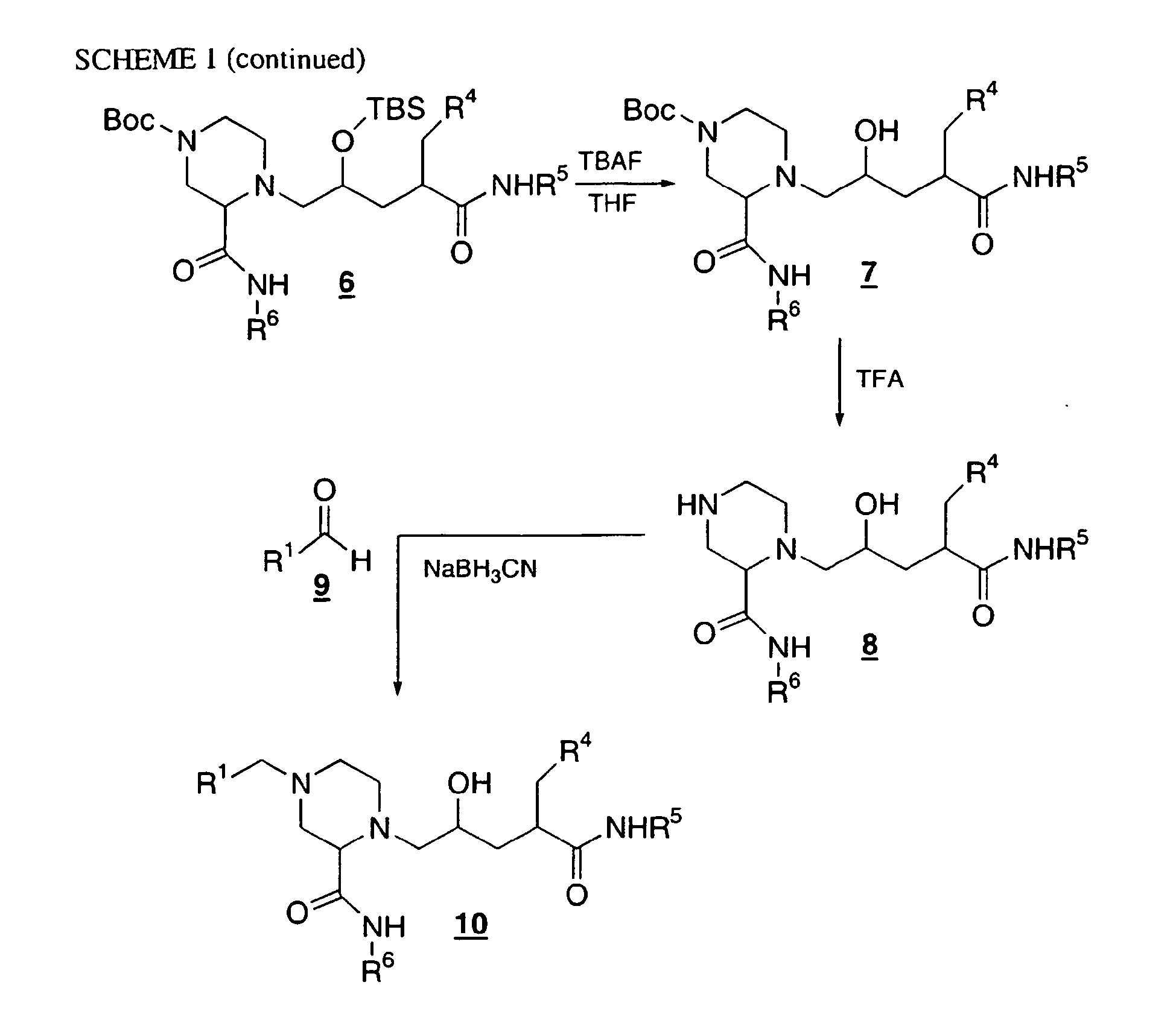
- A more convergent route to compounds of the present invention is presented in Scheme 2, below. The orthogonally protected piperazine 11 can be selectively deprotected. The BOC protecting group can be removed by treatment with strong acids such as trifluoroacetic acid in dichloromethane or HCl in methanol. The resulting amine 12 can then be reacted with an aldehyde in the presence of a reducing agent such as sodium cyanoborohydride or sodium triacetoxyborohydride to give piperazine 13 . Removal of the Alloc protecting group is readily accomplished with a palladium catalyst in the presence of a nucleophilic trapping agent such as 1,3-dimethylbarbituric acid or as in J. Org. Chem. 1993, 58, 6109-6113. Displacement of the triflate of 2 with piperazine 14, as in Scheme 1 gives lactone 15 which is then converted into compounds of the present invention following the route depicted in Scheme 1.

- An alternative route to the instant compounds is presented in Scheme 3, as exemplified for NH2R5 = aminoindanol. Compound 16 can be easily prepared according to the procedures described in the literature including, but not limited to, those described in Tetrahedron Letters 1995, 36: 2195-2198 and
US 5646148 . As shown in Part A of Scheme 3, the epoxide opening can be carried out by heating piperazine 3 and the epoxide in an inert solvent. Acidic removal of the protecting groups can be accomplished by treatment with hydrochloric acid in an alcoholic solvent such as methanol, ethanol or isopropanol. The resulting intermediate 18 is then reductively aminated as in Scheme 1 to provide the compounds of the present invention. Alternatively, as shown in Part B of Scheme 3, the epoxide opening can be preformed with fully elaborated piperazine 14 to give 20 . Once again the protecting group is removed with strong acid to give 19.

- Intermediates of formula NH2R5 can be readily prepared via the literature procedures including, but not limited to, those found in Tetrahedron Letters 1991, 32: 711-714, Tetrahedron Letters 1995, 36: 3993-3996 and Synthesis 1998, 938-961. A procedure for preparing cis-aminochromanols by the stereoselective hydroge bromide-promoted hydrogenation of an α-hydroxyoxime is described in Davies et al., Tetrahedron Letters 2000, 41: 8021-8025.
- Piperazine intermediates are readily prepared from the known piperazine carboxylic acid 21, which can be prepared as described in Hel. Chem. Acta. 1960, 43: 888-896. Selective monoprotection of the piperazine is carried out using BOC anhydride as described in Tetrahedron Letters 1989, 30: 5193-5196. The remaining unprotected amine can then be protected with any number of chloroformates including allyl chloroformate or benzyl chloroformate to give 23. Amide couplings of 23 with NH2R6 to give 24 are performed using standard amide coupling reactions as described above. Many NH2R6 amines are commercially available and others can be prepared via literature methods including, but not limited to, those described in Tetrahedron Letters 1999, 40, 3831-3834. Acidic removal of the BOC protecting group as before gives 25. The Alloc group can be removed as before. The CBZ group is readily removed by hydrogenolysis with a palladium catalyst under a hydrogen atmosphere in an alcoholic solvent such as methanol or ethanol. Removal of the protecting groups can also be accomplished by a number of methods known in the art, such as those described in Greene, Protective Groups in Organic Synthesis, John Wiley and Sons, New York, 1991. These deprotected intermediates are then carried onto compounds of the instant invention via the synthetic routes shown in Schemes 1, 2 and 3.

- The desired aldehyde intermediates are, in many cases, commercially available (e.g., Aldrich Chemical). Other aldehydes of interest can be prepared by literature methods including classical methods familiar to those skilled in the art. Stille and Suzuki coupling of commercially and readily available aryl and heteroaryl halides, aryl trialkylstannanes, and arylboronic acids also provides the desired aldehydes as exemplified for bromofuran in Scheme 5 below. Aldehyde 27 can be reacted with trialkylarylstannane 26 in the presence of a palladium catalyst by the method of Gronowitz et al. , J. Heterocyclic Chem. 1995, 35: 771, to give 28. Alternatively, trialkylstannane 30 can be coupled with arylhalides such as 29 to give 31 which can be deprotected under mild conditions with dilute hydrochloric acid to give aldehyde 28 . Other aldehydes are available via metal halogen exchange followed by anion quenching with DMF as described by Vogel et al., J. Chem. Soc. Perkin Trans 1, 1974, 37. Metalation of a biaryl or heterobiaryl compound such as 32 with a strong base such as n-butyllithium at low temperature in an inert solvent such as THF followed by anion trapping with DMF also provides aldehydes such as 28.

- When R2 and R3 are alkyl, the necessary intermediates can be formed as shown in Scheme 6 below. Piperazine 12 can be treated with TMSCN and a ketone in acetic acid to give intermediate 34 according to the method described in J. Org. Chem. 1990, 55, 4207-4209. The Alloc protecting group is removed as described in Scheme 4 and the resulting intermediate, 35 , is then treated with an excess of a Grignard to give the gem-dialkyl compound 14A. This intermediate is then converted to the compounds of the present invention via chemistry described in Schemes 2 and 3 above.

- An additional route to intermediates such as 14A , where R2 and R3 are alkyl or cycloalkyl, is depicted in Scheme 7, below. Alkylation of piperazine 25, where P' is an appropriate protecting group such as those described above, with alkylating agent 36 , is conveniently carried out in the presence of copper oxide, copper, and a tertiary amine base according to methods described in J. Org. Chem 1996, 61: 6517-6522, J. Am. Chem. Soc. 1960, 4908, and J. Org. Chem. 1994, 59: 2282-2284, where R2 and R3 are alkyl or cycloalkyl and X is a leaving group such as bromine, chlorine, mesylate, triflate, or phosphonate. Heterocycles of interest can be prepared from the acetylenic piperazine 37 using chemistry known to those skilled in the art. For example, intermediates such as 39 can be formed by the reaction of iodo or bromo phenols such as 38 with 37 according to the procedures of Castro et al., J. Org. Chem. 1966, 31: 4071-4078, Larock et al., J. Org. Chem. 1995, 60: 3270, or Arcadi et al., Synthesis 1986, 749. Triazole intermediates 41 are readily available from the reaction of 37 and aryl or heteroaryl azides as shown for phenylazide 40 in an inert high boiling solvent such as dichlorobenzene according to the method of Sakamoto et. al. as described in Heterocycles 1993, 35: 1273. Sydnones, such as 42, are available by procedures detailed in J. Heterocycl. Chem. 1992, 29: 1013-1015. They can be reacted with 37 to give pyrazoles such as 43 according to the procedure of Gotthardt et al. as described in Chem. Ber. 1968, 101: 536. Isoxazole intermediates such as 45 can be formed by treatment of the piperazine 37 with nitrones like 44 in a high boiling solvent such as nitrobenzene as described in Liebigs Ann. Chem. 1992, 947-952. Each of these piperazine intermediates can be converted to compounds of the instant invention via chemistry depicted in Schemes 1-3 above.


- Oxazolyl piperazine intermediates such as 50 are available via the route shown in Scheme 8 below. Alkylation of piperazine 25 with bromo acid 46 in the presence of silver triflate in an inert solvent such as THF, according to methods detailed in J. Org. Chem. 1995, 60: 4013-4016, provides 47 . Amide coupling of amine 48 to acid 47 to provide 49 can be carried out by any of the methods described above including the EDC /HOBT method. Amines such as 48 are prepared via chemistry described in Org. Synth. 1986, 64: 19-26 and Tetrahedron Letters 1999, 40: 6739-6743. Oxazole formation is accomplished by the action of a strong acid such as sulfuric acid on 49 in an inert solvent at elevated temperature, or as described in J. Med. Chem. 1996, 39: 2753-2763, to give intermediate 50. Again, intermediates such as these can be transformed into compounds of the instant invention via synthetic routes shown in Schemes 1,2, and 3.
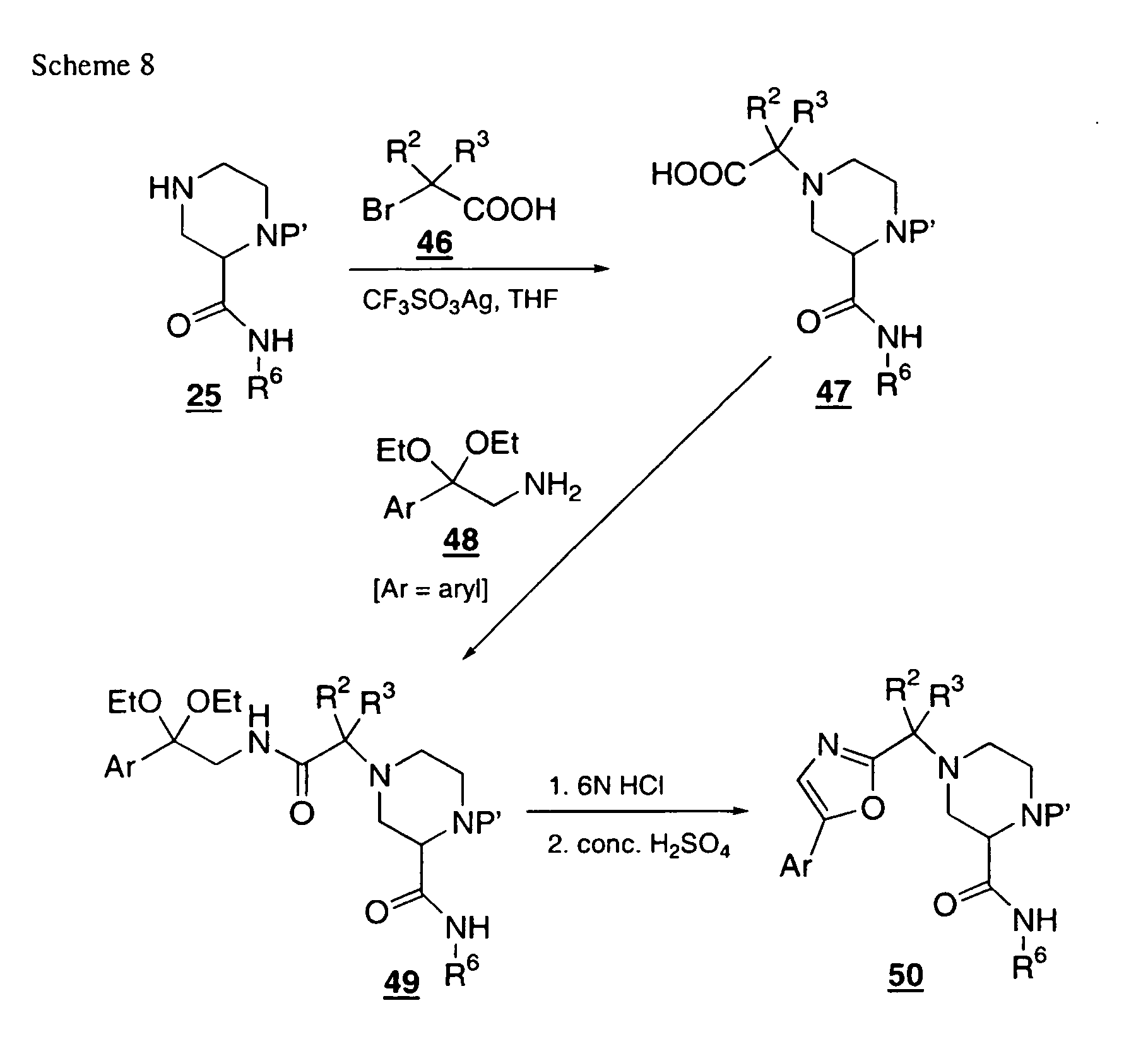
- The present invention also includes a process for preparing a nitrogen-protected piperazine carboxamide of Formula (I*):

- (A) hydrogenating a pyrazine carboxamide of Formula (II*):


- (B) resolving the S-carboxamide isomer of Compound III* by:
- (b1) forming a solution comprising Compound III*, a chiral acid, and solvent;
- (b2) crystallizing from the solution a salt which contains predominantly either the S- or R- isomer;
- (b3) if the precipitated salt crystals consist predominantly of the desired isomer, separating the salt crystals from the mother liquor; and
- (b4) if the mother liquor consists predominantly of the desired isomer, separating the salt crystals from the mother liquor and recovering the isomer from the mother liquor; and
- (C) breaking the separated crystalline salt of the S-carboxamide isomer by treating the salt with base, and treating the free S-isomer with a nitrogen-protecting agent to obtain piperazine amide (I*);
- P is a nitrogen-protecting group;
- R6A is hydrogen, C1-C6 alkyl or fluorinated C1-C6 alkyl; and
- each of Rs, Rt and Ru is independently hydrogen, C1-C4 alkyl, -C(=O)Rw, -COORw, or -C(=O)NRwRz, where Rw and Rz are each independently hydrogen or C1-C4 alkyl.
- The piperazine carboxamides of Formula I* are useful as intermediates in the preparation of compounds of the invention as described above. In this process, the group R6A in Compounds I*, II*, and III* is hydrogen, C1-C6 alkyl or fluorinated C1-C6 alkyl. In one embodiment, R6A is hydrogen, C1-C4 alkyl or fluorinated C1-C4 alkyl. In another embodiment, R6A is C1-C4 alkyl (e.g., methyl, ethyl, isopropyl, t-butyl, and so forth). In an aspect of the preceding embodiment, R6A is t-butyl.
- In still another embodiment, R6A is fluorinated C1-C6 alkyl. In an aspect of the preceding embodiment, R6A is





- In the process, each of Rs, Rt and Ru is independently hydrogen, C1-C4 alkyl, -C(=O)Rw, -COORw, or -C(=O)NRwRz, where Rw and Rz are each independently hydrogen or C1-C4 alkyl. In one embodiment, one of Rs, Rt and Ru is hydrogen, C1-C4 alkyl, -C(=O)Rw, -COORw, or -C(=O)NRwRz, and the other two of Rs, Rt and Ru is hydrogen. In another embodiment, each of Rs, Rt and Ru is hydrogen.
- P in Compound I* is a nitrogen-protecting group. Suitable protective groups and methods for protecting nitrogen via these groups include those described in Protective Groups in Organic Chemistry, J.F.W. McOmie, editor, Plenum Press, 1973; Theodora W. Greene, Protective Groups in Organic Synthesis, John Wiley & Sons, 1985; and W. Greene and P.G.M. Wuts, Protective Groups in Organic Synthesis, John Wiley & Sons, 1991.
- In one embodiment, P is: (a) (C1-C4 alkyl)-oxycarbonyl, (b) (C3-C8 cycloalkyl)-oxycarbonyl, (c) benzyloxycarbonyl in which the benzyl is optionally substituted with 1 or 2 substituents independently selected from C1-C4 alkyl, -O-C1-C4 alkyl, and halo, (d) benzyl optionally substituted with 1 or 2 substituents independently selected from C1-C4 alkyl, -O-C1-C4 alkyl, and halo, (e) trihaloacetyl, or (f) tri-(C1-C4 alkyl)silyl. Exemplary protecting groups include t-butyloxycarbonyl, benzyloxycarbonyl, benzyl, 4-methoxybenzyl, 2,4-dimethoxybenzyl, trifluoroacetyl, trimethylsilyl, or triethylsilyl. In an aspect of the process of the invention, P is t-butyloxycarbonyl.
- In Step A of the process of the invention, the pyrazine carboxamide of Formula II* in a mixture with a solvent is hydrogenated, optionally in the presence of a hydrogenation catalyst, to form the corresponding piperazine carboxamide.
- Suitable solvents include organic compounds, or mixtures thereof, which are chemically inert under the reaction conditions employed in Step A and which can also dissolve, suspend, and/or disperse Compound II* during the hydrogenation. Suitable solvents can be selected from the group consisting of C3-C12 linear and branched alkanes, C1-C6 linear and branched halogenated alkanes, C5-C7 cycloalkanes, C6-C10 aromatic hydrocarbons, dialkyl ethers wherein each alkyl is independently a C1-C6 alkyl, C4-C8 dialkoxyalkanes, C4-C6 cyclic ethers and diethers, C6-C8 aromatic ethers, and C1-C6 alkyl alcohols. Exemplary solvents include carbon tetrachloride, chloroform, methylene chloride, 1,2-dichloroethane (DCE), 1,1,2-trichloroethane (TCE), 1,1,2,2-tetrachloroethane, cyclohexane, toluene, o- and m- and p-xylene, ethylbenzene, ethyl ether, MTBE, THF, dioxane, 1,2-dimethoxyethane (DME), anisole, phenetole, methanol, ethanol, n- and iso-propanol, and tert-butyl alcohol.
- In one embodiment, the solvent is selected from the group consisting of C2-C6 linear and branched halogenated alkanes, dialkyl ethers wherein each alkyl is independently a C1-C4 alkyl, C4-C6 cyclic ethers and diethers, and C1-C4 alkyl alcohols. In an aspect of the preceding embodiment, the solvent is a C1-C4 alkyl alcohol. In another aspect of the preceding embodiment, the solvent is methanol or ethanol.
- The solvent can also be a mixture comprising water and one or more organic co-solvents. Suitable co-solvents include the organic solvents set forth in the preceding two paragraphs. In one embodiment, the co-solvent is a C1-C6 monohydric alcohol. In an aspect of this embodiment, the co-solvent is methanol or ethanol. The water can comprise from about 5 to about 95 volume percent based on the total volume of solvent.
- The hydrogenation of pyrazine carboxamide II* can be conducted over a wide range of temperatures, although the temperature is typically in the range of from about -25 to about 200°C (e.g., from about -20 to about 100°C). In one embodiment, the temperature is in the range of from about 0 to about 80°C. In another embodiment, the temperature is from about 15 to about 60°C.
- The pressure is not a critical aspect of the process of the invention, although atmospheric and superatmospheric pressures tend to be expedient. In one embodiment, the pressure is at least about 15 psia (103 kPa). In another embodiment, the pressure is in the range of from about 10 psia (68.9 kPa) to about 10,000 psia (68,950 kPa) (e.g., from about 50 psia (345 kPa) to about 1,000 psia (6,895 kPa)).
- In one embodiment, the hydrogenation is conducted at a temperature in the range of from about 10 to about 100 °C and at a pressure of from about 2 psig (115 kPa) to about 1000 psig (6996 kPa). In another embodiment, the hydrogenation is conducted at a temperature in the range of from about 15 to about 60°C and at a pressure in the range of from about 5 psig (135.8 kPa) to about 40 psig (377.1 kPa).
- Any catalyst which is capable of expediting the hydrogenation of the pyrazine ring in Compound II* may be employed in the process of the invention. Typically, the catalyst comprises one or more transition metals, or compounds thereof, and especially comprises one or more of the Group VIII metals (or compounds thereof) as set forth in the Periodic Table of the Elements (see, e.g., the 78th edition of the Handbook of Chemistry and Physics, CRC Press (1997)). The metals can be employed in elemental form or as compounds (e.g., as oxides, hydroxides, or halides). Suitable hydrogenation catalysts include palladium, rhenium, rhodium, platinum, or nickel. The catalyst can be supported or unsupported. Suitable catalyst supports include carbon, silica, alumina, silicon carbide, aluminum fluoride, and calcium fluoride. Palladium is particularly suitable for use in the process of the invention. Exemplary palladium catalysts include Pd black (i.e., fine metallic palladium particles), Pd/C (i.e., palladium on a carbon support), and Pd(OH)2/C.
- The hydrogen source is typically hydrogen gas, optionally in admixture with a carrier gas that is inert to the process of the invention (e.g., nitrogen or a noble gas such as helium or argon).
- The hydrogenation can be carried out in batches or continuously in various types of reactors such as a fixed bed reactor or an agitated slurry reactor in which the slurry of gas, solvent, pyrazine carboxamide II*, and catalyst is continuously agitated by mechanical or gas means. A suitable reaction vessel for relatively small scale, batch-wise hydrogenations is an autoclave equipped with a stirrer or rocker to agitate the reaction mixture. In a batch process, the order of addition of pyrazine carboxamide II, solvent, and hydrogenation catalyst to the reaction vessel (also referred to herein as the reaction "pot") is not critical. The reaction components can, for example, be added concurrently, either together or separately, or they can be added sequentially in any order. In one embodiment, Compound II pre-mixed with the solvent is charged to the reaction vessel followed by addition of the catalyst. The hydrogenation can then be conducted by charging hydrogen gas, optionally in admixture with one or more inert gases, to the vessel containing the mixture comprising pyrazine carboxamide II*, solvent, and catalyst, and then agitating the mixture under reaction conditions.
- Any amount of catalyst and hydrogen can be employed which results in the formation of at least some of Compound III*. Of course, the maximum conversion of Compound II* and maximum yield of Compound W* is normally desired, and relative proportions of reactants and reagents suitable for this purpose are typically employed.
- The uptake of hydrogen is not a critical process parameter, although at least a stoichiometric amount of hydrogen gas is typically employed.
- The amount of catalyst employed in Step A is suitably at least about 0.01 mole percent transition metal (e.g., Pd), and is typically in the range of from about 0.01 to about 5 (e.g., from about 0.1 to about 5) mole percent transition metal, based on the total moles of transition metal and Compound II*. In one embodiment, the amount of catalyst is in the range of from about 1 to about 5 (e.g., from about 2 to about 3) mole percent transition metal. In another embodiment, the catalyst comprises palladium (e.g., Pd/C or Pd(OH)2/C), and the amount of palladium catalyst is in the range of from about 1 to about 5 mole percent.
- The yield of piperazine carboxamide III* in Step A can be at least about 80% (e.g., from about 85% to about 99%), and are often at least about 85% (e.g., from about 90% to about 99 %)
- Step B of the process of the invention involves the resolution of the S-carboxamide isomer from the racemic piperazine carboxamide III* resulting from hydrogenation step A, via the formation and separation of diastereomeric salts. Suitable chiral acids for use in Step (b1) include optically active forms of tartaric acid, mandelic acid, camphoric acid, 10-camphorsulfonic acid, pyroglutamic acid, O,O-diacetyltartaric acid, O,O-dibenzoyltartaric acid, O,O-di-4-toluyltartaric acid, and N-acetyl derivatives of amino acids such as N-acetylleucine. A preferred chiral acid is (S)-camphorsulfonic acid or (R)-camphorsulfonic acid. The chiral acid is especially (S)-camphorsulfonic acid, and the crystallized (S)-camphorsulfonate salt resulting from crystallizing step (b2) is a mono- or bis-salt of the S-isomer. The amount of chiral acid employed in Step B is typically in the range of from about 0.5 to about 3 equivalents per equivalent of racemic piperazine carboxamide III*.
- The solvent can be any chemically inert organic or inorganic substance, or combinations thereof, which can dissolve Compound III* and the chiral acid. Suitable solvents include water, C1-C6 monohydric alcohols (e.g., methanol, ethanol, n-propanol, n-butanol, n-pentanol, isopropanol, and sec-butyl alcohol), C2-C8 polyhydric alcohols (e.g., ethylene glycol, propylene glycol, and glycerol), C2-C4 nitriles (e.g., acetonitrile and propionitrile), N,N-di-C1-C6 alkyl tertiary amides of C1-C6 alkylcarboxylic acids (e.g., DMF), aliphatic C2-C6 ethers and di-ethers (e.g., ethyl ether, MTBE and dimethoxyethane), C4-C6 cyclic ethers and di-ethers (e.g., THF and dioxane), and combinations of two or more of the foregoing. In one embodiment, the solvent is selected from the group consisting of C1-C6 monohydric alcohols, aliphatic C2-C6 ethers and di-ethers and C4-C6 cyclic ethers and di-ethers. In an aspect of the preceding embodiment, the solvent is an alcohol such as methanol or ethanol. In another embodiment, the solvent is the combination of a C1-C6 monohydric alcohol and a C1-C4 nitrile. In an aspect of the preceding embodiment, the solvent is a mixture of ethanol and acetonitrile.
- In another embodiment, the solvent is a mixture comprising water and at least one organic co-solvent. In an aspect of this embodiment, water comprises at least about 2 volume percent of the solvent (e.g., from about 2 to about 95 volume percent) based on the total volume of solvent. In another aspect of this embodiment, the aqueous solvent comprises from about 2 to about 70 volume percent (e.g., from about 5 to about 50 volume percent) water, with the balance of the solvent being organic co-solvent. Suitable co-solvents include the organic solvents set forth in the preceding paragraph. In one embodiment, the co-solvent is a C1-C6 monohydric alcohol optionally in combination with a C1-C4 nitrile. In an aspect of this embodiment, the solvent is water, ethanol, and acetonitrile.
- The crystallization of the S- or R-isomer as set forth in Step (b2) above can be accomplished using conventional techniques, such as by cooling the solution or by concentrating the solution via vacuum or evaporative removal of solvent, and optionally seeding the solution with the appropriate crystal salt. If the resulting crystals are predominantly the desired S-isomer, the crystals can then be separated by filtration and followed optionally by the washing and drying of the filter cake. If the precipiated crystals are predominantly the R-isomer, a salt which contains predominantly the S-isomer can be obtained from the mother liquor, such as by evaporative or vacuum removal of the solvent.
- The yield of the S-carboxamide isomer in Step B can be in a range of from about 20% to about 40%, and is often from about 30% to about 40 %, based upon the racemic piperazine carboxamide. (The yield based upon the desired S-enantiomer is twice these values; i.e., from about 40% to about 80%, and often from about 60% to about 80%.)
- Step C of the process of the invention involves breaking the crystallized salt by treating the S-isomer-containing salt with base and sequentially or concurrently treating the S-isomer with a nitrogen-protecting agent to obtain piperazine carboxamide I*. Suitable bases for breaking the recovered S-isomer include bases selected from the group consisting of alkali metal hydroxides, alkali metal carbonates, alkali metal oxides, C1-C6 alkoxides of alkali metals, alkaline earth metal hydroxides, alkaline earth metal oxides, tetra (C1-C4 alkyl)ammonium hydroxides, and tri-(C1-C4 alkyl)amines. Exemplary bases include hydroxides, carbonates, and oxides of lithium, sodium and potassium; methoxides, ethoxides, and n- and iso-propoxides of lithium, sodium, and potassium; tetramethyl- and tetraethylammonium hydroxide; triethylamine; and diisopropylethylamine. In one embodiment, the base is selected from the group consisting of alkali metal hydroxides. In an aspect of the preceding embodiment, the base is NaOH or KOH.
- The base can also be an alkanolamine (e.g., ethanolamine), a hydroxylamine (e.g., hydroxylamine per se, N-methylhydroxylamine, N,N-dimethylhydroxylamine, or N-ethylhydroxylamine), or a diamine (e.g., ethylenediamine, tetramethylenediamine, or hexamethylenediamine).
- A typical procedure can employ an aqueous base (e.g., aqueous NaOH), wherein the crystallized salt is slurried in an organic solvent and the slurry is mixed with aqueous base resulting in a solution or a biphasic mixture, followed by addition of and reaction with the nitrogen-protecting agent (e.g., Boc2O). The formation of the slurry and the biphasic mixture/solution is suitably conducted at temperatures in the range of from about 0 to about 100°C, and is typically conducted at a temperature of from about 10 to about 60°C. In one embodiment, the temperature is in the range of from about 15 to about 35°C. The organic solvent can suitably be selected from C1-C12 linear and branched alkanes, C1-C12 linear and branched halogenated alkanes, C5-C10 cycloalkanes, C6-C14 aromatic hydrocarbons, dialkyl ethers wherein each alkyl is independently a C1-C10 alkyl, C4-C8 dialkoxyalkanes, C4-C8 cyclic ethers and diethers, C6-C8 aromatic ethers, C2-C10 dialkyl ketones wherein each alkyl is independently C1-C8 alkyl, C1-C6 alkyl esters of C1-C6 alkylcarboxylic acids, primary C1-C10 alkyl alcohols, secondary C3-C10 alkyl alcohols, tertiary C4-C10 alkyl alcohols, primary amides of C1-C6 alkylcarboxylic acids, N-C1-C6 alkyl secondary amides or N,N-di-C1-C6 alkyl tertiary amides of C1-C6 alkylcarboxylic acids, C2-C6 aliphatic nitriles, C7-C10 aromatic nitriles, and mixtures thereof. Exemplary solvents include carbon tetrachloride, chloroform, methylene chloride, 1,2-dichloroethane (DCE), 1,1,2-trichloroethane (TCE), 1,1,2,2-tetrachloroethane, cyclohexane, toluene, o- and m- and p-xylene, ethylbenzene, ethyl ether, MTBE, THF, dioxane, 1,2-dimethoxyethane (DME), anisole, phenetole, acetone, methyl ethyl ketone (MEK), methyl acetate, ethyl acetate, IPAc, ethanol, n-and iso-propanol, tert-butyl alcohol, dimethylformamide (DMF), acetonitrile, propionitrile, benzonitrile, and p-tolunitrile.
- Another typical procedure can employ a non-aqueous base, wherein the crystallized salt is suspended in organic solvent, optionally including a small amount of water (e.g., from about 0 to about 10 volume percent) as co-solvent, the suspension mixed with an organic base, and the mixture stirred until homogeneous, followed by addition of and reaction with the nitrogen-protecting agent. The formation of the suspension and the homogeneous mixture is suitably conducted at temperatures in the range of from about 0 to about 100°C, and is typically conducted at a temperature of from about 10 to about 60°C (e.g., from about 15 to about 35°C). Suitable organic solvents include those set forth in the preceding paragraph. In one embodiment, the solvent is a mixture of C2-C4 aliphatic nitrile and a C1-C4 alkyl ester of a C1-C4 alkylcarboxylic acid (e.g., a mixture of acetonitrile and isopropyl acetate).
- It is normally desired to completely break the crystallized salt so as to obtain the free base (S)-piperazine carboxamide. Accordingly, the base is typically employed in an amount of at least about 2 equivalents per equivalent of crystallized salt.
- Treating with base to break the salt in Step C also includes eluting a solution of the crystalline salt through a suitable ion exchange column, such that the chiral acid and the piperazine amide elute separately. The crystalline salt solution can be prepared by dissolving the salt crystals obtained in Step B in a suitable solvent (e.g., the solvents set forth above in the description of Step B). In the case where the desired salt crystals are present in the Step B mother liquor (i.e., Step (b4)), the mother liquor can be passed directly through the column and thereby avoiding isolation of the salt crystal. The eluted piperazine carboxamide can then be reacted with a suitable nitrogen protecting agent to afford Compound I*.
- While any amount of nitrogen-protecting agent can be employed which results in the formation of at least some of Compound I*, the amount of agent typically employed is that which can maximize the conversion of the S-isomer of III* to I*. Accordingly, the amount of nitrogen-protecting agent is suitably at least about 1 equivalent per equivalent of III*. In one embodiment, the amount of nitrogen-protecting agent is in the range of from about 1 to about 1.5 equivalents per equivalent of III*.
- Yields of at least about 85% (e.g., from about 90% to about 99%) for Compound I* can be obtained in Step C.
- Another aspect of the invention is a process for racemizing an optically pure or enriched piperazine carboxamide selected from:

- In an embodiment of the racemization process, the starting piperazine carboxamide is the R-isomer:

- An embodiment of the invention is a process which comprises Steps A, B and C as set forth above, and which further comprises:
- (Z) reacting a pyrazine carboxylic acid of Formula (IV*):

- Acid salts of the amine, R6ANH2, suitable for use in Step Z include salts of inorganic acids (e.g., HCl, sulfuric acid, nitric acid, etc.) and of organic acids (e.g., acetic acid, trifluoroacetic acid, alkyl and aryl sulfonic acids, etc.)
- While any amount of the Compound IV* can be employed which results in the formation of at least some of Compound ll*, the maximum conversion of Compound IV* and maximum yield of Compound II* is normally desired. Accordingly, the amount of Compound IV* typically employed in Step Z is at least about one equivalent per equivalent of the amine. In one embodiment, the amount of Compound IV* is in the range of from about 0.5 to about 5 equivalents per equivalent of amine. In another embodiment, the amount of Compound IV* is in the range of from about 0.9 to about 2 (e.g., from about 1 to about 1.5) equivalents per equivalent of amine.
- The coupling agent in Step Z can be any organic compound which facilitates the amidation of the carboxylic acid group in IV* by R6ANH2. Suitable coupling agents include carbodiimides (e.g., such as dicyclohexylcarbodiimide, diisopropylcarbodiimide, EDC, and the like), N,N'-carbonyldiimidazole, POCl3, TiCl4, SO2ClF, and chlorosulfonyl isocyanate. In one embodiment, the coupling agent is EDC. In an aspect of the preceding embodiment, the coupling agent is EDC in combination with HOBT.
- While any amount of coupling agent can be employed which results in the formation of at least some of Compound II*, the maximum conversion of Compound IV* and maximum yield of Compound II* is normally desired. Accordingly, the amount of coupling agent typically employed in Step Z is at least about one equivalent per equivalent of IV*. In one embodiment, the amount of coupling agent is in the range of from about 1 to about 5 equivalents per equivalent of IV*. In another embodiment, the amount of coupling agent is in the range of from about 1 to about 2 equivalents per equivalent of IV*.
- The amidation of Compound IV* can be conducted over a wide range of temperatures, although the temperature is typically in the range of from about -20 to about 150°C (e.g., from about -15 to about 120°C). In one embodiment, the temperature is in the range of from about -5 to about 65°C. In another embodiment, the temperature is from about 0 to about 50°C. In still another embodiment, the temperature is from about 10 to about 35°C.
- In a typical procedure, the pyrazine carboxylic acid IV* is dissolved, dispersed or suspended in an organic solvent, followed by the sequential addition of the amine and the coupling agent. The mixture is maintained at reaction temperature for a period sufficient to achieve maximum conversion, after which the amidated product is recovered from the reaction mixture by conventional separation and isolation procedures.
- Organic solvents suitable for use in Step Z include the C1-C12 linear and branched alkanes, C1-C12 linear and branched halogenated alkanes, C5-C10 cycloalkanes, C6-C14 aromatic hydrocarbons, dialkyl ethers wherein each alkyl is independently a C1-C10 alkyl, C4-C8 dialkoxyalkanes, C4-C8 cyclic ethers and diethers, C6-C8 aromatic ethers, C2-C10 dialkyl ketones wherein each alkyl is independently C1-C8 alkyl, C1-C6 alkyl esters of C1-C6 alkylcarboxylic acids, primary C1-C10 alkyl alcohols, secondary C3-C10 alkyl alcohols, tertiary C4-C10 alkyl alcohols, primary amides of C1-C6 alkylcarboxylic acids, N-C1-C6 alkyl secondary amides or N,N-di-C1-C6 alkyl tertiary amides of C1-C6 alkylcarboxylic acids, C2-C6 aliphatic nitriles, C7-C10 aromatic nitriles, and mixtures thereof.
- If desired, the progress of the reaction in any one or all of Steps Z, A, B and C can be followed by monitoring the disappearance of a reactant (e.g., Compound II* or H2 in Step A) and/or the appearance of the product (e.g., III* in step A) using such analytical techniques as TLC, HPLC, NMR or GC.
- Yields of at least about 70% (e.g., from about 70% to about 90%) for pyrazine carboxamide II* can be obtained in Step Z, and yields of from about 85% to about 95% can often be achieved.
- Another embodiment of the process of the invention is a process for preparing a nitrogen-protected piperazine carboxamide of formula A1:

- (A) hydrogenating a pyrazine carboxamide of formula A2:


- (B) resolving the S-carboxamide isomer of Compound A3 by:
- (b1) forming a solution comprising Compound A3, (S)-camphorsulfonic acid, and solvent; and
- (b2) crystallizing from the solution a salt which contains predominantly the S-isomer; and
- (C) breaking the separated crystal salt of the S-carboxamide isomer by treating the salt with base, and treating the resulting free base S-isomer with a nitrogen-protecting agent to obtain piperazine carboxamide A1.
- The general reaction conditions and procedures, choice of solvents, choice and/or amounts of reactants and reagents described earlier for Steps A, B and C apply to Steps A, B and C of this embodiment as well. The crystallization in Step (b2) can optionally be assisted by seeding the solution with the (S)-camphorsulfonate salt of the (S)-isomer.
- In an aspect of this embodiment, the resolution of the S-carboxamide isomer is conducted in a solvent consisting of acetonitrile, ethanol, and water with from about 1.2 to about 2.0 equivalents (e.g., from about 1.5 to about 1.9 equivalents) of (S)-CSA per equivalent of racemic A3. In a preferred aspect of this embodiment, the resolution of the S-carboxamide isomer is conducted in a solvent consisting of acetonitrile, ethanol, and water with from about 1.2 to about 2.0 equivalents (e.g., from about 1.6 to about 1.8 equivalents; or about 1.7 equivalents) of (S)-CSA per equivalent of racemic A3 , wherein water constitutes from about 2 to about 7 weight percent (e.g., from about 4 to about 5 weight percent) of the solvent and the volume ratio of acetonitrile to ethanol is in the range of from about 9:1 to about 6:4.
- The enantiomeric excess of the resulting salt can be upgraded by (i) forming a slurry of the salt in a solvent system comprising acetonitrile, ethanol and water (c.g., from about 50 to about 95 volume percent acetonitrile, from about 49 to about 4 volume percent ethanol, and from about 1 to about 5 volume percent water; another example: from about 1:1 to about 15:1 (v/v) acetonitrile:95% ethanol), (ii) aging the slurry by heating it for a period of time (e.g., at a temperature of from about 50 to about 90°C for at least about one hour), and then (iii) cooling the slurry (e.g., to a temperature in the range of from about 0 to about 30°C). The resulting crystals have an increased ee and can be recovered by conventional means (e.g., filtration, washing with the slurry solvent, and drying).
- Another embodiment of the process is a process which comprises Steps A, B and C as set forth in the preceding embodiment, and which further comprises:
- (Z) reacting a pyrazine carboxylic acid of Formula A4:

- The general reaction conditions and procedures, choice of solvents, choice and/or amounts of reactants and reagents described earlier for Step Z apply to Step Z of this embodiment as well.
- Another embodiment of the present invention is a compound of Formula (V*):

- The following examples serve only to illustrate the invention and its practice. The examples are not to be construed as limitations on the scope or spirit of the invention.
-
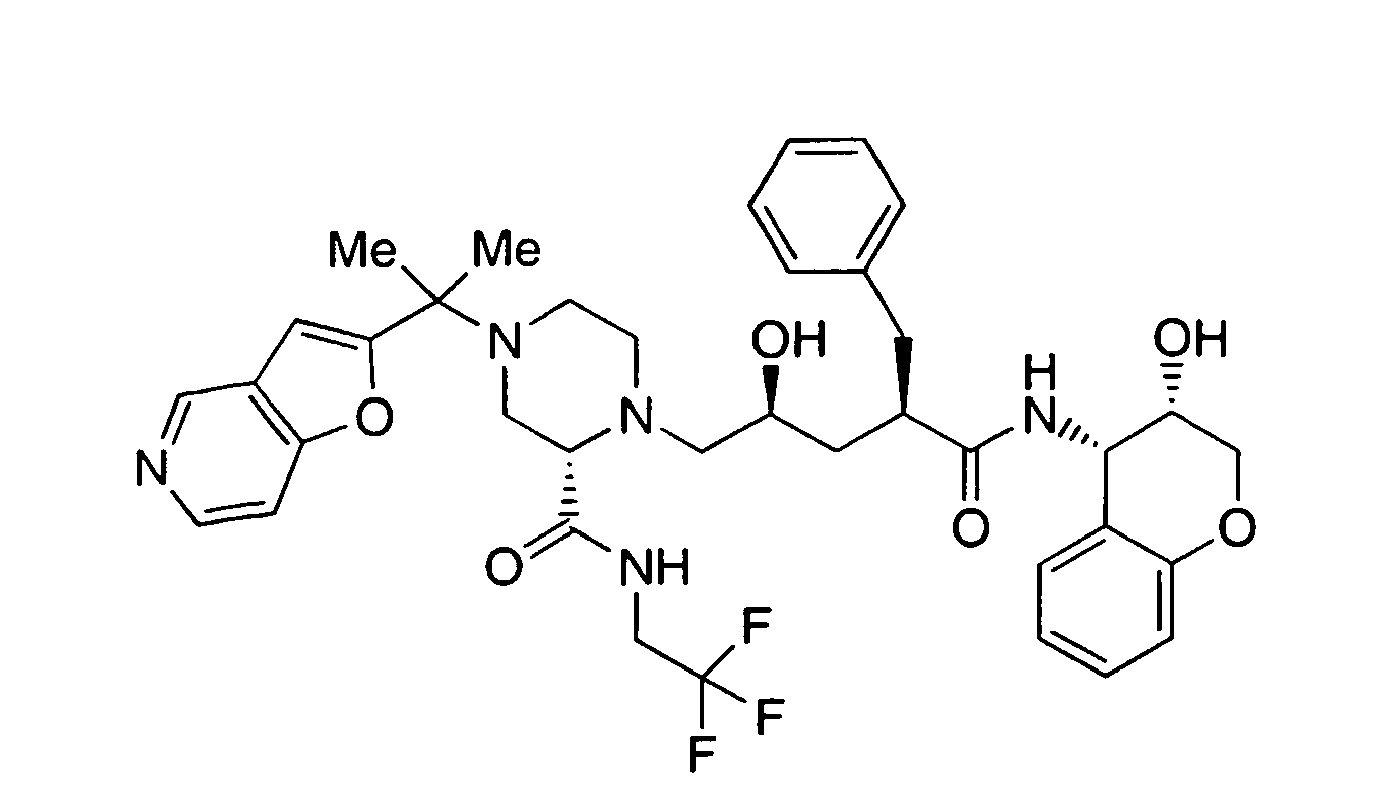
-

- To a solution of 1,4-piperazine-2-(S)-carboxylic acid [bis(+)-CSA salt] (54.9 g, 92.2 mmol) in 1 L THF was added 1N aqueous NaOH until the resulting solution was pH 9 (250 mL). The solution was cooled to 0 °C, and BOC-ON (22.7 g, 92.2 mmol, as a solution in 200 mL THF) was added via an addition funnel. The resulting solution was warmed to ambient temperature over 5 hours, then cooled again to 0 °C. Allyl chloroformate (9.78 mL, 92.2 mmol) was added via syringe, followed by an additional 100 mL of 1N aqueous NaOH. The solution was warmed to ambient temperature overnight, then concentrated to minimum volume by rotary evaporator. The resulting mixture was acidified to pH 1 with 1N aqueous HCl, and extracted with ethyl acetate (400 mL x 2). The organic layers were washed with brine (200 mL) dried (MgSO4) and concentrated in vacuo, affording 44.9 g of a yellow oil. This material was dissolved in 400 mL DMF, followed by the addition of CsHCO3 (14.8 g, 76.1 mmol) and Cs2CO3 (14.3 g, 44.2 mmol). To this mixture was added benzyl bromide (14.2 mL, 120 mmol). After 20 hours at ambient temperature, an additional aliquot of benzyl bromide (5.50 mL, 46.2 mmol) was added. After an additional 4 hours at ambient temperature, the reaction was quenched by the addition of 200 mL of saturated aqueous NaHCO3. The mixture was extracted with ethyl acetate (400 mL x 2). The organic layers were washed with H2O (300 mL x 2) and brine (300 mL), dried (MgSO4), and concentrated in vacuo to afford 55.2 g of a yellow oil. Purification by flash chromatography (5% ethyl acetate in dichloromethane) afforded the title compound as a clear oil. 1H NMR (CDCl3, 300 MHz) 7.35 (s, 5H), 5.90 (m, 1H), 5.20 (m, 4H), 4.70 (m, 5H), 3.95 (m, 1H), 3.30 (m, 1H), 3.10 (dt, 1H), 2.85 (m, 1H), 1.45 (s, 9H).
-

- To the intermediate prepared in Step A (28.0 g, 69.9 mmol) in 400 mL of dichloromethane was added 200 mL trifluoroacetic acid at ambient temperature. After 5 hours, the solution was poured slowly onto 1 L of saturated aqueous NaHCO3. To this mixture was added 2.5 N aqueous NaOH until the aqueous layer was pH 7. The organic layer was extracted, dried (Na2SO4), and concentrated in vacuo affording a clear oil. To 5.75 g (19.6 mmol) of this intermediate in 50 mL of THF was added 194 mg (2.00 mmol) CuCl. The mixture was cooled to 0 °C, and 3-chloro-3-methyl-1-butyne (2.20 mL, 19.6 mmol) was added via syringe, followed by Cu powder (124 mg, 2.00 mmol) and triethylamine (6.00 mL, 43.0 mmol). The resulting mixture was warmed to ambient temperature overnight. The reaction mixture was then filtered through celite, and the solution diluted with ethyl acetate (300 mL), and washed with saturated aqueous NaHCO3 (300 mL) and brine (300 mL). The organic layer was dried (MgSO4) and concentrated in vacuo affording a yellow oil. Purification by flash chromatography (20% ethyl acetate in hexane) afforded the title compound as a clear oil. 1H NMR (CDCl3, 400 MHz) 7.39 (s, 5H), 5.92 (m, 1H), 5.20 (m, 4H), 4.80 (d, 1H), 4.62 (dd, 2H), 3.93 (dd, 1H), 3.58 (t, 1H), 3.28 (dt, 1H), 2.98 (dd, 1H), 2.40 (d, 1H), 2.22 (m, 1H), 1.76 (s, 1H), 1.36 (s, 3H), 1.32 (s, 3H).
-

- To a solution of 4-hydroxypyridine (10.0 g, 105 mmol) in 200 mL of methanol was added N-iodosuccinimide (47.1 g, 210 mmol). The solution was heated to reflux for 3 hours, and the resulting precipitate was filtered hot. The filtrate was dried in vacuo, affording the title compound as a white solid. 1H NMR (DMSO-D6, 300 MHz) 8.25 (s, 2H), 2.50 (s, 1H).
-

- To a solution of the intermediate prepared in Step B (4.30 g, 11.6 mmol) in pyridine (150 mL) was added the intermediate prepared in Step C (4.03 g, 11.6 mmol). To this solution was added Cu2O (2.50 g, 17.4 mmol). The resulting mixture was heated to reflux for 2 hours, then cooled to ambient temperature. The reaction was quenched by the addition of 200 mL of saturated aqueous NaHCO3, and extracted with ethyl acetate (500 mL x2). The organic layers were washed with 10% aqueous NH4OH (300 mL x3) and brine (300 mL), dried (MgSO4), and concentrated in vacuo. Purification by flash chromatography (45% ethyl acetate in hexane) afforded the title compound as a yellow gum. 1H NMR (CDCl3, 400 MHz) 8.68 (s, 1H), 8.66 (s, 1H), 7.30 (s, 5H), 6.59 (s, 1H), 5.84 (m, 1H), 5.27 (m, 4H), 4.76 (d, 1H), 4.60 (m, 2H), 3.90 (dd, 1H), 3.63 (dd, 1H), 3.27 (dt, 1H), 2.99 (dd, 1H), 2.34 (dt, 1H), 2.23 (dq, 1H), 1.93 (s, 6H).
-

- To a solution of tris(dibenzylidineacetone)dipalladium(0) (371 mg, 0.405 mmol) in 50 mL of THF was added 1,4-bis(diphenylphosphino)butane (466 mg, 0.810 mmol). After stirring 20 min at ambient temperature, this solution was added via cannula to a solution of the intermediate from Step D (4.77 g, 8.10 mmol) and thiosalicilic acid (1.87 g, 12.1 mmol) in 50 mL THF. After 1 hour at ambient temperature the reaction was diluted with 1 L diethyl ether and extracted with 1% aqueous HCl (250 mL x3). The combined aqueous layers were neutralized with excess saturated aqueous NaHCO3, and the resulting suspension was extracted with ethyl acetate (500 mL x2). These organic layers were washed with brine (200 mL), dried (MgSO4), and concentrated in vacuo affording 4.26 g of a yellow solid. This material was dissolved in 800 mL dichloromethane. To this solution was added triethyl amine (1.47 mL, 10.5 mmol), di-tert-butyldicarbonate (2.03 g, 9.29 mmol) and 4-dimethylaminopyridine (ca. 20 mg). After 1 hour at ambient temperature the reaction was quenched by the addition of 500 mL of saturated aqueous NaHCO3. The mixture was extracted with dichloromethane (200 mL x3), the organic layers were dried (Na2SO4) and concentrated in vacuo, affording 5.109 g of a yellow solid. Purification by flash chromatography (20% ethyl acetate in dichloromethane) afforded the title compound as a white solid. 1H NMR (CDCl3, 400 MHz) 8.69 (m, 2H), 7.35 (s, 5H), 6.60 (s, 1H), 5.17 (m, 2H), 4.60 (d, 1H), 3.80 (dd, 1H), 3.62 (dd, 1H), 3.20 (dt, 1H), 3.01 (dd, 1H), 2.32 (dt, 1H), 2.14 (m, 1H), 1.45 (s, 9H), 1.44 (s, 3H), 1.37 (s, 3H).
-

- To a solution of the intermediate from Step E (3.41 g, 5.63 mmol) in methanol (100 mL) was added triethylamine (1.96 mL, 14.1 mmol) and 10% Pd(0) on carbon (200 mg). The reaction vessel was charged with 1 atmosphere of H2 and stirred at ambient temperature. An additional 200 mg of 10% Pd(0) on carbon was added after 24, 48, 56 and 64 hours at ambient temperature. The reaction was then filtered through celite and concentrated in vacuo affording the title compound as a white solid. 1H NMR (CDCl3, 400 MHz) 9.65 (s, 2H), 8.79 (s, 1H), 8.40 (d, 1H), 7.35 (d, 1H), 6.59 (s, 1H), 4.43 (d, 1H), 3.75 (m, 2H), 3.30 (m, 1H) 3.08 (q, 12 H), 2.85 (m, 1H), 2.20 (m, 1H), 2.03 (m, 1H), 1.55 (t, 18 H), 1.40 (s, 15H).
-
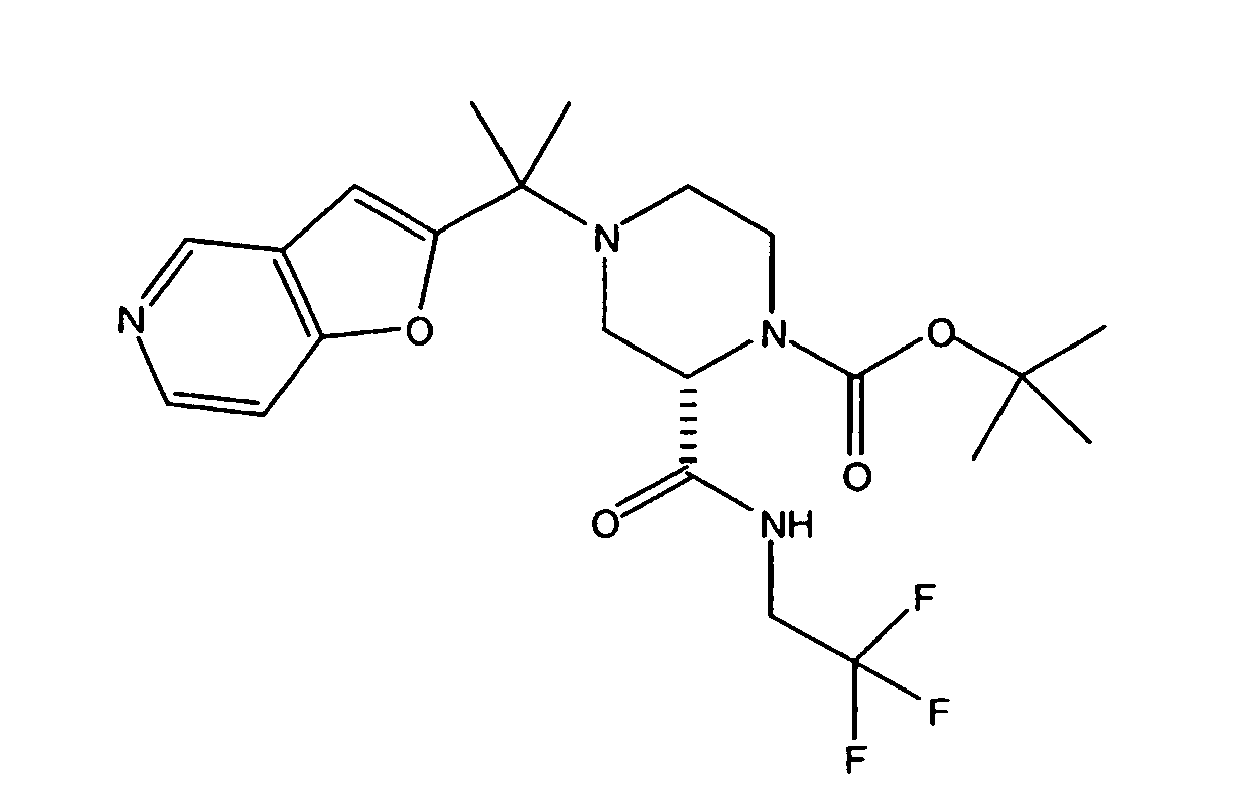
- To a solution of the intermediate from Step F (200 mg, 0.278 mmol) in dichloromethane (3 mL) was added triethylamine (116 µL, 0.834 mmol), trifluoroethylamine (33.2 µL, 0.420 mmol), HOAT (41.6 mg, 0.306 mmol) and EDC (58.6 mg, 0.306 mmol). After 12 hours at ambient temperature the solution was concentrated by rotary evaporator and purified by flash chromatography (30% dichloromethane in ethyl acetate) to afford the title compound as a clear oil. 1H NMR (CDCl3, 400 MHz) 8.86 (s, 1H), 8.46 (d, 1H), 7.46 (s, 1H), 7.37 (d, 1H), 6.61 (s, 1H), 4.67 (s, 1H), 3.98 (m, 3H), 3.51 (d, 1H), 3.02 (m, 1H), 2.91 (d, 1H), 2.30 (dd, 1H), 2.20 (t, 1H), 1.50 (s, 6H), 1.38 (s, 9H). HPLC-MS (ES) 471.4 (M+1).
-

- To a solution of the intermediate from Step G (135 mg, 0.278 mmol) in dichloromethane (5 mL) was added trifluoroacetic acid (2.5 mL). After 3 hours at ambient temperature, the reaction was quenched by the addition of saturated aqueous NaHCO3 (20 mL). The mixture was extracted with dichloromethane (20 mL x 2) and concentrated in vacuo, affording the title compound as a colorless oil. This was used without further purification.
-

- To a solution of 4-chromanone (10 g, 67.49 mmol) in 400 mL dichloromethane at 0 °C was added bromine (4.45 mL, 86.39 mmol) dropwise slowly. The reaction was monitored by TLC. After half an hour the reaction mixture was diluted with methylene chloride (100 mL) and was washed with water (300 mL). The organic layer was dried over anhydrous sodium sulfate and concentrated. The resulting product was dissolved in HOAc (100 mL) and sodium sulfite (8 g) was added. The reaction mixture was stirred at room temperature and reaction progress was monitored by TLC. After 48 hours the reaction mixture was poured into water and the product was extracted with methylene chloride. The organic layer was dried over anhydrous sodium sulfate and concentrated in vacuo to give the titled compound as a white solid. 1H NMR (CDCl3, 400 MHz): 7.93 (d, J = 8.8 Hz, 1H), 7.54 (t, 1H), 7.08 (t, 1H), 7.02 (d, J = 8.0 Hz, 1H), 4.63 (m, 4H)
-

- To a solution of 3-bromo-4-chromanone (2 g, 8.81 mmol) in methanol (20 mL) was added sodium borohydride (0.4 g, 10.57 mmol). The reaction was stirred at room temperature and monitored by TLC. After 2 hours the solvent was removed in vacuo and then diluted with ethyl acetate (50 mL). The resulting solution was washed with brine, dried over anhydrous sodium sulfate, filtered and concentrated in vacuo to give the titled compound as a white solid. 1H NMR (CDCl3, 300 MHz): 7.32 (d, J = 7.2 Hz, 1H), 7.23 (t, 1H), 6.96 (t, 1H), 6.84 (d, J = 9.0 Hz, 1H), 4.82 (m, 1H), 4.54 (m, 1H), 4.38 (m, 2H).
-

- To a solution of 3-bromo-4-chromanol (2 g, 8.72 mmol) in acetonitrile (20 mL) was added concentrated sulfuric acid (1 mL, 17.47 mmol). The reaction mixture was stirred at 45 °C - 50 °C for 18 hours. The solvent was removed in vacuo. Then water (10 mL) was added. The reaction mixture was heated to reflux. After 5 hours the reaction mixture was cooled to room temperature. The pH of the reaction mixture was adjusted to 12-13 by dropwise addition of aqueous 50% sodium hydroxide. The product was extracted with tetrahydrofuran three times. The organic layer were combined and dried over anhydrous sodium sulfate, filtered and concentrated in vacuo to give the title compound as a white solid. 1H NMR (CDCl3, 300 MHz): 7.29 (d, J = 7.8 Hz, 1H), 7.16 (t, 1H), 6.93, (t, 1H), 6.83 (d, J = 8.4 Hz, 1H), 4.12 (m, 1H), 3.99 (m, 2H), 3.84 (m, 1H).
-

- To a suspension of the racemic 4-amino-3-chromanol in ethanol (35 mL per gram of 4-amino-3-chromanol) was added 1.0 equivalent of (S)-(+) mandelic acid. The suspension was heated to 70 °C until forming a homogeneous solution. The solution was cooled to room temperature and white crystal was formed. After filtering the white crystal was dissolved in 3 N aqueous sodium hydroxide solution and the resolved product was extracted with ethyl acetate three times. The combined organic layer was dried over anhydrous sodium sulfate, filtered and concentrated in vacuo to give the titled compound as a white solid. The purity of the compound was verified by chiral HPLC with Crownpak CR+ column eluted with pH 1.0 perchloric acid solution. 1H NMR (CDCl3, 300 MHz): 7.29 (d, J = 7.8 Hz, 1H), 7.16 (t, 1H), 6.93, (t, 1H), 6.83 (d, J = 8.4 Hz, 1H), 4.12 (m, 1H), 3.99 (m, 2H), 3.84 (m, 1H).
-

- To a solution of the intermediate from Step L (5.97 g, 36.2 mmol) in THF (200 mL) was added hydrocinnamic acid (5.43 g, 36.2 mmol). The suspension was cooled to 0 °C, and HOBT (5.23 g, 39.8 mmol) was added, followed by EDC (7.63 g, 39.8 mmol), and triethylamine (15.1 mL, 108 mmol). The mixture was warmed to ambient temperature and stirred 72 hours. The reaction mixture was poured onto 500 mL of 1.5 N aqueous HCl, and diluted with 200 mL of ethyl acetate. The organic layer was washed with an additional 200 mL of 1.5 N aqueous HCl, saturated aqueous NaHCO3 (200 mL), and brine (200 mL), dried (MgSO4), and concentrated in vacuo affording 16.0 g of a white solid. This material was dissolved in 400 mL of a 1:1 mixture of THF and 2,2-dimethoxypropane. To this solution was added 100 mg of p-toluenesulfonic acid, and the reaction was heated to reflux for 6 hours. The reaction was then cooled to ambient temperature and quenched by the addition of saturated aqueous NaHCO3 (400 mL). The resulting mixture was extracted with ethyl acetate (400 mL x2). The organic layers were washed with brine (200 mL), dried (MgSO4), and concentrated in vacuo, affording 12.3 g of a yellow oil. Purification by flash chromatography (30% ethyl acetate in hexane) afforded the title compound as a white solid. 1H NMR (CDCl3, 300 MHz) 7.25 (m, 7H), 6.82 (m, 2H), 4.70 (d, 1H), 4.33 (m, 1H), 4.08 (d, 1H), 3.92 (s, 1H), 3.11 (m, 2H), 2.92 (m, 1H), 2.68 (m, 1H), 1.61 (s, 3H), 1.23 (s, 3H).
-

- To a solution of the intermediate from Step N (6.36 g, 18.9 mmol) in THF (180 mL) was added allyl bromide (1.80 mL, 18.9 mmol). The solution was cooled to 22 °C, and lithium hexamethyldisilylazide (20.8 mL of a 1.0 N solution in THF, 20.8 mmol) was added. After 10 min the reaction was quenched by the addition of saturated aqueous NH4Cl (100 mL), and extracted with ethyl acetate (200 mL x2). The organic layers were washed with saturated aqueous NaHCO3 (200 mL), brine (200 mL), dried (MgSO4), and concentrated in vacuo. The resulting oil was purified by flash chromatography (25% ethyl acetate in hexane) affording the title compound as a white gum. 1H NMR (CDCl3, 300 MHz) indicated a 5:1 mixture of rotamers: 7.30 (m, 5H), 7.05 (m, 1H), 6.80 (m, 1H), 6.4 (m, 1H), 5.85 (m, 1H), 5.15 (m, 1H), 4.98 (m, 1H), 4.40 (m, 1H), 4.25 (m, 2H), 3.38 (dd, 1H), 3.19 (m, 1H), 2.80 (m, 1H), 2.42 (m, 1H), 1.70 (s, 3H), 1.23 (s, 3H).
-

- To a solution of the intermediate from Step N (6.10 g, 16.2 mmol) in 200 mL of ethyl acetate was added 200 mL of 0.5 aqueous NaHCO3. The mixture was cooled to 0 °C, and N-iodosuccinimide was added in a single portion. The reaction was warmed to ambient temperature and stirred 24 hr. The reaction was then diluted with ethyl acetate (500 mL). The organic layer was washed with 1N Na2S2O3 (300 mL x2), and brine (300 mL), dried (MgSO4), and concentrated in vacuo, affording a yellow oil. Purification by flash chromatography (30% ethyl acetate in hexane) afforded the title compound as a white solid. 1H NMR (CDCl3, 300 MHz) indicated a 5:2 mixture of rotamers: 7.30 (m, 5H), 7.05 (m, 1H), 6.82 (m, 1H), 6.60 (m, 1H), 5.92 (d, 0.3H), 5.58 (d, 0.7H), 4.45 (m, 2H), 4.20 (m, 2H), 3.63 (m, 1H), 3.44 (m, 2H), 3.20 (m, 2H), 2.82 (m, 2H), 2.40 (d, 1H), 2.00 (m, 1H), 1.72 (s, 3H), 1.49 (d, 2H), 1.29 (s, 3H).
-

- To a solution of the intermediate from Step O (7.71 g, 14.8 mmol) in ethyl acetate (300 mL) was added sodium methoxide (5.07 mL of a 25% solution in methanol, 22.2 mmol). After 10 minutes the reaction was quenched by the addition of saturated aqueous NaHCO3 (300 mL). The organic layer was washed with brine (300 mL), dried (MgSO4), and concentrated in vacuo affording the title compound as a white gum. This was used without further purification. 1H NMR (CDCl3, 300 MHz) indicated a 5:2 mixture of rotamers: 7.30 (m, 5H), 7.10 (m, 1H), 6.82 (m, 1H), 6.50 (m, 1H), 5.89 (d, 0.3H), 5.40 (d, 0.7H), 4.40 (m, 2H), 4.15 (m, 2H), 3.40 (m, 2H), 3.00 (m, 1H), 2.85 (m, 2H), 2.50 (dd, 0.7H), 2.40 (dd, 0.3H), 2.20 (m, 1H), 1.72 (s, 3H), 1.49 (d, 1H), 1.29 (s, 3H).
-

- To a solution of the intermediate from Step P (1.34 g, 3.41 mmol) in 2-propanol (30 mL) was added the intermediate from Step H (1.15 g, 3.10 mmol). The solution was heated to reflux for 7 hr, then cooled to ambient temperature and concentrated in vacuo, affording 2.82 g of a black oil. Purification by flash chromatography (5% methanol in ethyl acetate) afforded the title compound as a yellow solid. 1H NMR (CDCl3, 400 MHz) indicated a 4:1 mixture of rotamers: 9.40 (m, 1H), 8.90 (s, 1H), 8.55 (d, 1H), 7.30 (m, 6H), 7.10 (m, 1H), 6.81 (d, 1H), 6.68 (m, 4H), 5.90 (d, 0.3H), 5.69 (d, 0.7H), 4.43 (dd, 2H), 4.30 (m, 2H), 3.73 (m, 2H), 3.50 (m, 2H), 3.40 (m, 2H), 3.10 (m, 2H), 2.83 (m, 2H), 2.60 (m, 4H), 1.70 (s, 3H), 1.55 (s, 6H), 1.25 (s, 3H).
- The intermediate from Step 0 (558 mg, 0.731 mmol) was dissolved in methanol saturated with gaseous HCl (40 mL). After stirring 12 hours at ambient temperature the reaction was quenched by the addition of saturated aqueous NaHCO3 (200 mL). The resulting mixture was extracted with dichloromethane (50 mL x4). The organic layers were dried (Na2SO4) and concentrated in vacuo affording 518 mg of a yellow solid. Purification by flash chromatography afforded the title compound as a white solid. 1H NMR (CDCl3, 400 MHz) 9.42 (t, J = 4.8 Hz, 1H), 8.90 (s, 1H), 8.52 (d, J = 6.0 Hz, 1H), 7.37 (d, J = 5.6 Hz, 1H), 7.30 (m, 5H), 7.11 (t, J = 8.4 Hz, 1H), 7.06 (d, J = 7.6 Hz, 1H), 6.78 (m, 2H), 6.67 (s, 1H), 5.91 (d, J = 8.4 Hz, 1H), 5.15 (dd, J = 4.0 Hz, 1H), 4.27 (m, 1H), 4.06 (d, J = 10.4 Hz, 1H), 4.00 (dd, J = 4.8 Hz, J = 11.6 Hz, 1H), 3.76 (m, 3H), 3.46 (s, 1H), 3.37 (s, 1H), 3.11 (d, J = 11.6 Hz, 1H), 2.85 (m, 4H), 2.70 (m, 4H), 2.44 (m, 2H), 2.10 (d, J = 5.2 Hz, 1H), 1.90 (t, J = 11.2 Hz, 1H), 1.57 (s, 8H); HPLC-MS (ES) 724.6 (M+1).
-

-

- The title compound was obtained following the procedure described in Example 1, Step G, starting with the intermediate prepared as in Example 1, Step F (394 mg, 0.548 mmol) and 2-fluoroethylamine hydrochloride (70.9 mg, 0.712 mmol). Purification by flash chromatography (ethyl acetate) afforded the title compound as a clear oil. 1H NMR (CDCl3, 400 MHz) 8.85 (s, 1H), 8.45 (d, 1H), 7.40 (d, 1H), 6.80 (s, 1H), 4.65 (m, 2H), 4.50 (m, 1H), 4.00 (s, 1H), 3.60 (m, 4H), 3.07 (m, 1H), 2.92 (d, 1H), 2.25 (dd, 1H), 2.20 (m, 1H), 1.55 (s, 6H), 1.43 (s, 9H); HPLC-MS (ES) 435.1 (M+1).
-

- To a solution of the intermediate from Step A (220 mg, 0.507 mmol) in dichloromethane (5 mL) was added trifluoroacetic acid (2.5 mL). After 2 hours at ambient temperature the reaction was quenched by the addition of saturated aqueous NaHCO3 (20 mL). The mixture was extracted with dichloromethane (20 mL x2) and concentrated in vacuo, affording the free piperazine as a white solid. This was used without further purification.
-

- To a solution of the intermediate prepared in Step B (91.2 mg, 0.273 mmol) in 2-propanol was added the intermediate from Example 1, Step P (107 mg, 0.273 mg) as described in Example 1, Step Q. Purification by flash chromatography (2.5% methanol, 5% triethylamine in ethyl acetate) afforded the title compound. HPLC-MS (ES) 728.2 (M+1).
- The title compound was obtained following the procedure described in Example 1, Step R, starting with the intermediate prepared in Example 2, Step C (52.2 mg, 71.8 µmol). Purification by preparative TLC (10% methanol in ethyl acetate) afforded the title compound as a white solid. 1H NMR (CDCl3, 400 MHz) 9.04 (s, 1H), 8.89 (s, 1H), 8.50 (d, J = 6.0 Hz, 1H), 7.42 (d, J = 6.0 Hz, 1H), 7.27 (m, 5H), 7.10 (m, 2H), 6.78 (d, J = 8.0 Hz, 1H), 6.66 (s, 1H), 6.01 (d, J = 8.0 Hz, 1H), 5.15 (dd, J = 11.6 Hz, J = 7.2 Hz, 1H), 4.66 (m, 1H), 4.55 (m, 1H), 4.06 (d, J = 10.8 Hz, 1H), 3.99 (dd, J = 5.6 Hz, J = 12.0 Hz, 1H), 3.77 (m, 2H), 3.55 (m, 1H), 3.34 (s, 1H), 3.06 (d, J = 11.2 Hz, 1H), 2.90 (m, 4H), 2.70 (m, 2H), 2.47 (d, J = 11.2 Hz, 2H), 1.90 (t, J = 6.8 Hz, 1H), 1.72 (s, 3H), 1.57 (s, 3H); HPLC-MS (ES) 688.2 (M+1).
-

-

- The title compound was obtained following the procedure described in Example 1, Step G, starting with the intermediate prepared in example 1, Step F (388 mg, 0.540 mmol) and 2-fluoro-1,1-bis-(fluoromethyl)-ethylamine hydrochloride (prepared as described in Ok, D.; Fisher, M. H.; Wyvratt, M. J.; Meinke, P. T.; Tetrahedron Lett 1999, 40, 3831-3834). (115 mg, 0.702 mmol). Purification by flash chromatography (ethyl acetate) afforded the title compound as a clear oil. 1H NMR (CDCl3, 400 MHz) 8.88 (s, 1H), 8.50 (d, 1H), 7.40 (d, 1H), 6.60 (s, 1H), 4.85 (m, 6H), 4.60 (m, 1H), 4.00 (m, 1H), 3.45 (m, 1H), 3.10 (m, 1H), 2.90 (m, 1H), 2.37 (dd, 1H), 2.20 (m, 1H), 1.53 (s, 3H), 1.50 (s, 3H), 1.40 (s, 9H).
-

- The title compound was obtained following the procedure described in Example 2, Step B, starting with the intermediate prepared in Example 3, Step A (209 mg, 0.419 mmol), affording the title compound as a clear oil. This was used without further purification.
-

- The title compound was obtained following the procedure described in Example 1, Step Q, starting with the intermediate prepared in Example 3, Step B (158 mg, 0.397 mmol) and the intermediate prepared in Example 1, Step P (156 mg, 0.397 mmol). Purification by flash chromatography (5% methanol in ethyl acetate) afforded the title compound. 1H NMR (CDCl3, 400 MHz) indicated a 4:1 mixture of rotamers: 9.20 (s, 1H), 8.90 (s, 1H), 8.53 (d, 1H), 7.43 (d, 1H), 7.39 (s, 1H), 7.30 (m, 5H), 7.22 (t, 1H), 7.13 (t, 1H), 6.82 (d, 1H), 6.68 (m, 3H), 5.90 (d, 0.2H), 5.70 (d, 0.8H), 4.93 (s, 3H), 4.80 (s, 3H), 4.42 (dd, 2H), 4.29 (d, 1H), 4.18 (d, 1H), 3.70 (t, 1H), 3.45 (m, 3H), 3.20 (m, 1H), 2.83 (m, 2H), 2.62 (m, 2H), 2.40 (m, 2H), 1.78 (t, 1H), 1.70 (s, 3H), 1.59 (s, 3H), 1.55 (s, 3H), 1.24 (s, 3H); HPLC-MS (ES) 792.2 (M+1).
- The title compound was obtained following the procedure described in Example 1, Step R, starting with the intermediate prepared in Example 3, Step C (31.6 mg, 40.0 µmol). Purification by preparative TLC (5% methanol in ethyl acetate) afforded the title compound as a white solid. 1H NMR (CDCl3, 400 MHz) 9.17 (s, 1H), 8.90 (s, 1H), 8.52 (d, J = 6.0 Hz, 1H), 7.43 (d, J = 5.6 Hz, 1H), 7.22 (m, 5H), 7.10 (t, J = 8.0 Hz, 1H), 7.04 (d, J = 7.6 Hz, 1H), 6.79 (d, J = 8.4 Hz, 1H), 6.75 (d, J = 8.0 Hz, 1H), 6.67 (s, 1H), 5.95 (m, 1H), 5.15 (dd, J = 4.0 Hz, J = 7.6 Hz, 1H), 4.95 (s, 3H), 4.83 (s, 3H), 4.01 (m, 2H), 3.76 (m, 1H), 3.26 (s, 1H), 3.18 (d, J = 11.2 Hz, 1H), 2.94 (m, 4H), 2.63 (m, 2H), 2.42 (m, 2H), 1.90 (t, J = 11.2 Hz, 1H), 1.59 (s, 3H), 1.57 (s, 3H); HPLC-MS (ES) 752.2 (M+1).
-

-

- The title compound was obtained following the procedure described in Example 1, Step G, starting with the intermediate prepared in Example 1, Step F (394 mg, 0.548 mmol) and 2-fluoro-1-(fluoromethyl)-1-methyl-ethylamine hydrochloride (prepared as described in Ok, D.; Fisher, M. H.; Wyvratt, M. J.; Meinke, P. T.; Tetrahedron Lett 1999, 40, 3831-3834 ) (117 mg, 0.713 mmol). Purification by flash chromatography (ethyl acetate) afforded the title compound as a white solid. 1H NMR (CDCl3, 400 MHz) 8.86 (s, 1H), 8.45 (d, 1H), 7.40 (d, 1H), 6.60 (s, 1H), 4.60 (m, 5H), 4.00 (s, 1H), 3.45 (s, 1H), 3.10 (t, 1H), 2.90 (s, 1H), 2.30 (dd, 1H), 2.18 (t, 1H), 1.81 (s, 1H), 1.55 (s, 3H), 1.50 (s, 3H), 1.48 (s, 3H), 1.40 (s, 9H).
-

- The title compound was obtained following the procedure described in Example 2, Step B, starting with the intermediate prepared in Example 4, Step A (190 mg, 0.396 mmol), affording the title compound as a colorless oil. This was used without further purification.
-

- The title compound was obtained following the procedure described in Example 1, Step Q, starting with the intermediate prepared in Example 4, Step B (146 mg, 0,383 mmol), and the intermediate prepared in Example 1, Step P (151 mg, 0.383 mmol). Purification by flash chromatography (5% methanol in ethyl acetate) afforded the title compound as a clear oil. 1H NMR (CDCl3, 400 MHz) indicated a 5:1 mixture of rotamers: 8.94 (s, 1H), 8.89 (s, 1H), 8.53 (d, 1H), 7.42 (d, 1H), 7.30 (m, 5H), 7.20 (t, 1H), 7.14 (t, 1H), 6.80 (d, 1H), 6.65 (m, 3H), 5.90 (d, 0.2H), 5.70 (d, 0.711), 4.75 (m, 3H), 4.64 (m, 3H), 4.43 (dd, 1H), 4.30 (s, 1H), 4.20 (d, 1H), 3.70 (s, 1H), 3.45 (m, 4H), 3.20 (m, 2H), 2.80 (m, 2H), 2.60 (m, 2H), 2.40 (d, 1H), 1.68 (s, 3H), 1.58 (s, 3H), 1.55 (s, 3H), 1.53 (s, 3H), 1.24 (s, 3H); HPLC-MS (ES) 774.2 (M+1).
- The title compound was obtained following the procedure described in Example 1, Step R, starting with the intermediate prepared in Example 4, Step C (82.4 mg, 107 µmol). Purification by preparative TLC (5% methanol in ethyl acetate) afforded the title compound as a white solid. 1H NMR (CDCl3, 400 MHz) 8.91 (s, 2H), 8.52 (d, J = 5.6 Hz, 1H), 7.42 (d, J = 5.6 Hz, 1H), 7.24 (m, 5H), 7.11 (t, J = 7.2 Hz, 1H), 7.06 (d, J = 7.6 Hz, 1H), 6.77 (m, 1H), 6.67 (s, 1H), 5.93 (d, J = 8.4 Hz, 1H), 5.14 (dd, J = 7.2 Hz, 1H), 4.75 (quint, J = 9.2 Hz, 2H), 4.63 (quint, J = 10.8 Hz, 2H), 4.06 (d, J = 11.6 Hz, 1H), 3.97 (dd, J = 11.6 Hz, 1H), 3.81 (s, 1H), 3.75 (m, 1H), 3.24 (s, 1H), 3.12 (d, J = 12.4 Hz, 1H), 2.89 (m, 6H), 2.67 (m, 2H), 2.42 (m, 1H), 1.90 (t, J = 11.2 Hz, 1H), 1.59 (s, 3H), 1.57 (s, 3H); HPLC-MS (ES) 734.2 (M+1).
-

-

- The title compound was obtained following the procedure described in Example 1, Step G, starting with the intermediate prepared in Example 1, Step F (400 mg, 0.556 mmol), and 3,3,3-trifluoropropylamine hydrochloride (109 mg, 0.729 mmol). Purification by flash chromatography (25% hexane in ethyl acetate) afforded the title compound as a colorless oil. 1H NMR (CDCl3, 400 MHz) 8.85 (s, 1H), 8.46 (d. 1H), 7.37 (d, 1H), 6.60 (s, 1H), 4.59 (s, 1H), 3.99 (s, 1H), 3.59 (m, 3H), 2.90 (m, 2H, 2.41 (m, 2H), 2.22 (dd, 1H), 2.17 (m, 1H), 1.53 (s, 3H), 1.51 (s, 3H), 1.44 (s, 9H); HPLC-MS (ES) 485.2 (M+1).
-

- The title compound was obtained following the procedure described in Example 2, Step B, starting with the intermediate prepared in Example 5, Step A (266 mg, 0.550 mmol), affording the title compound as a colorless oil. This was used without further purification.
-

- The title compound was obtained following the procedure described in Example 1, Step Q, starting with the intermediate prepared in Example 5, Step B (102 mg, 0.266 mmol) and the intermediate prepared in Example 1, Step P (106 mg, 0.271 mmol). Purification by flash chromatography afforded the title compound. HPLC-MS (ES) 778.3 (M+1).
- The title compound was obtained following the procedure described in Example 1, Step R, starting with the intermediate prepared in Example 5, Step C. Purification by flash chromatography (5% methanol in ethyl acetate) afforded the title compound as a white solid. 1H NMR (CDCl3, 500 MHz) 8.99 (s, 1H), 8.88 (s, 1H), 8.50 (d, J = 5.5 Hz, 1H), 7.37 (d, J = 5.7 Hz, 1H), 7.28 (m, 2H), 7.21 (m, 2H), 7.08 (t, J = 8.0 Hz, 2H), 6.78 (d, J = 8.2 Hz, 2H), 6.65 (s, 1H), 6.15 (d, J = 8.0 Hz, 1H), 5.16 (dd, J = 3.9 Hz, J = 7.8 Hz, 1H), 3.99 (m, 2H), 3.78 (m, 3H), 3.40 (m, 1H), 3.27 (t, J = 2.9 Hz, 1H), 2.95 (t, J = 10.3 Hz, 2H), 2.82 (m, 3H), 2.66 (m, 3H), 2.46 (m, 3H), 1.87 (t, J= 11.0 Hz, 1H), 1.56 (s, 3H), 1.53 (s, 3H); HPLC-MS (ES) 738.3 (M+1).
-

-

- The title compound was obtained following the procedure described in Example 1, Step G, starting with the intermediate prepared in Example 1, Step F (400 mg, 0.556 mmol), and 2,2,3,3,3-pentafluoropropylamine (109 mg, 0.731 mmol). Purification by flash chromatography (25% hexane in ethyl acetate) afforded the title compound as a colorless oil. HPLC-MS (ES) 521.2 (M+1).
-

- The title compound was obtained following the procedure described in Example 2, Step B, starting with the intermediate prepared in Example 6, Step A (275 mg, 0.533 mmol), affording the title compound as a colorless oil. This was used without further purification. HPLC-MS (ES) 421.1 (M+1).
-
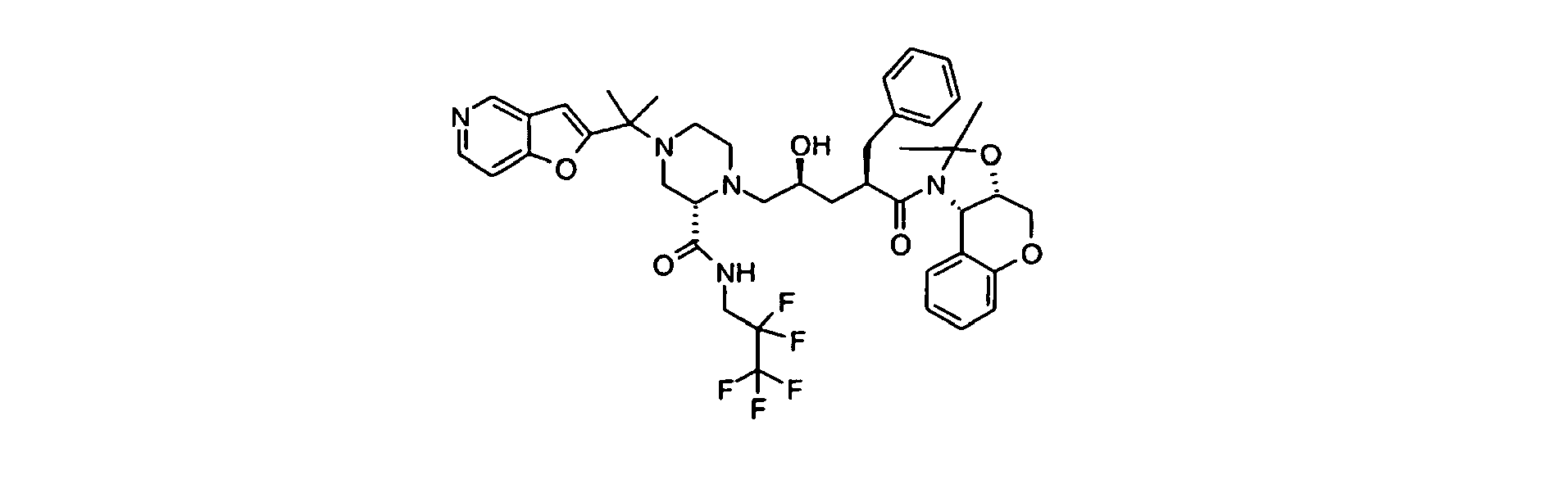
- The title compound was obtained following the procedure described in Example 1, Step Q, starting with the intermediate prepared in Example 6, Step B (94.6 mg, 0.225 mmol) and the intermediate prepared in Example 1, Step P (91.0 mg, 0.231 mmol). Purification by flash chromatography (3% methanol in ethyl acetate) afforded the title compound. HPLC-MS (ES) 814.3 (M+1).
- The title compound was obtained following the procedure described in Example 1, Step R, starting with the intermediate prepared in Example 6, Step C (37.9 mg, 46.6 µmol). Purification by flash chromatography (5% methanol in ethyl acetate) afforded 19.4 mg (54%) of the title compound as a white solid. 1H NMR (CDCl3, 500 MHz) 9.28 (s, 1H), 8.94 (s, 1H), 8.53 (s, 1H), 7.41 (d, J = 5.3 Hz, 1H), 7.28 (m, 2H), 7.23 (m, 2H), 7.10 (t, J = 7.3 Hz, 1H), 7.06 (d, J = 7.8 Hz, 1H), 6.78 (d, J = 7.5 Hz, 2H), 6.71 (s, 1H), 6.10 (d, J = 8.2 Hz, 1H), 5.15 (t, J = 3.7 Hz, 1H), 4.38 (m, 1H), 4.04 (m, 2H), 3.80 (m, 3H), 3.42 (s, 1H), 3.07 (d, J = 11.2 Hz, 1H), 2.79 (m, 13H), 2.46 (t, J = 13.5 Hz, 2H), 1.91 (t, J = 11.6 Hz, 1H), 1.58 (s, 3H), 1.57 (s, 3H); HPLC-MS (ES) 774.3 (M+1).
-

-

- The title compound was obtained following the procedure described in Example 1, Step G, starting with the intermediate prepared in Example 1, Step F (400 mg, 0.556 mmol) and 1,1-dimethyl-2-fluoroethylamine hydrochloride (prepared as described in Ok, D.; Fisher, M. H.; Wyvratt, M. J.; Meinke, P. T.; Tetrahedron Lett 1999, 40, 3831-3834) (93.3 mg, 0.731 mmol). Purification by flash chromatography (25% hexane in ethyl acetate) afforded the title compound as a colorless oil. HPLC-MS (ES) 463.3 (M+1).
-

- The title compound was obtained following the procedure described in Example 2, Step B, starting with the intermediate prepared in Example 7, Step A (245 mg, 0.530 mmol), affording the title compound as a clear oil. This was used without further purification. HPLC-MS (ES) 363.2 (M+1).
-

- The title compound was obtained following the procedure described in Example 1, Step Q, starting with the intermediate prepared in Example 7, Step B (15.0 mg, 0.041 mmol) and the intermediate prepared in Example 1, Step P (24.3 mg, 0.062 mmol). Purification by preparative TLC (4% methanol in ethyl acetate) afforded the title compound as a white solid. HPLC-MS (ES) 756.4 (M+1).
- The title compound was obtained following the procedure described in Example 1. Step R, starting with the intermediate prepared in Example 7, Step C (17.0 mg, 0.022 mmol). Purification by preparative TLC (chromatotron, 5-10% methanol in ethyl acetate) afforded the title compound as a white solid. 1H NMR (CDCl3, 500 MHz) 8.89 (s, 1H), 8.63 (s, 1H), 8.49 (d, J = 5.7 Hz), 7.39 (d, J = 5.7 Hz, 1H). 7.29 (m, 2H), 7.23 m (m, 2H), 7.07 (m, 2H), 6.78 (m, 2H), 6.66 (s, 1H), 6.07 (d, J = 8.0 Hz, 1H), 5.18 (m, 1H), 4.64 (d, 1H), 4.54 (d, J = 3.4 Hz, 1H), 4.45 (d, 1H), 4.04 (d, 1H), 3.99 (dd, J = 5.0 Hz, 1H), 3.82 (m, 1H), 3.75 (t, 1H), 3.21 (s, 1H), 3.08 (d, 1H), 2.95 (m, 2H), 2.80 m, 2H), 2.66 (m, 2H), 2.46 (m, 2H), 1.88 (t, 1H), 1.58 (s, 3H), 1.56 (s, 3H), 1.48 (s, 3H), 1.47 (s, 3H), 1.40 (t, 1H); HPLC-MS (ES) 716.3 (M+1).
-

-

- The title compound was obtained following the procedure described in Example 1, Step Q, starting with the intermediate prepared in Example 1, Step H (99.1 mg, 0.268 mmol) and the corresponding aminoindanyl epoxide (prepared as described in Maligres, P.E.; Weissman, S. A.; Upadhyaya, V.; Cianciosi, S. J.; Reamer, R.A.; Purick, R. M.; Sager, J.; Rossen, K.; Eng, K. K.; Askin, D.; Volante, R P.; Reider, P. J.; Tetrahedron, 1996, 52, 3327-3338) (50.0 mg, 0.132 mmol). Purification by flash chromatography (5% methanol in ethyl acetate) afforded the title compound as a clear oil. 1H NMR (CDCl3, 400 MHz) 9.37 (t, 1H), 8.86 (s, 1H), 8.52 (d, 1H), 7.40 (d, 1H), 7.32 (m, 5H), 7.20 (m, 2H), 6.95 (t, 1H), 6.63 (s, 1H), 6.40 (d, 1H), 5.93 (d, 1H), 4.78 (s, 1H), 4.25 (m, 1H), 3.75 (m, 2H), 3.40 (m, 3H), 3.04 (s, 3H), 2.80 (m, 2H), 2.64 (m, 3H), 2.45 (m, 1H), 2.38 (m, 1H), 1.80 (m, 1H), 1.62 (s, 3H). 1.58 (s, 6H), 1.37 (s, 3H).
- The title compound was obtained following the procedure described in Example 1, Step R, starting with the intermediate prepared in Example 8, Step A (50.5 mg, 67.6 µmol). Purification by flash chromatography (5% methanol in ethyl acetate) afforded the title compound as a white solid. 1H NMR (CDCl3, 400 MHz) 9.34 (t, J = 6.4 Hz, 1H), 8.87 (s, 1H), 8.48 (d, J = 6.0 Hz, 1H), 7.36 (d, J = 5.6 Hz, 1H), 7.30 (m, 2H), 7.23 (m, 2H), 7.16 (d, J = 3.2 Hz, 1H), 7.07 (d, J = 5.2 Hz, 1H), 6.65 (s, 1H), 6.13 (d, J = 8.8 Hz, 1H), 5.27 (dd, J = 4.4 Hz, J = 8.4 Hz, 1H), 4.27 (m, 2H), 3.75 (m, 3H), 3.34 (s, 1H), 3.03 (m, 2H), 2.99 (m, 2H), 2.88 (m, 2H), 2.80 (m, 3H), 2.60 (m, 2H), 1.93 (t, J = 11.2 Hz, 1H), 1.54 (s, 7H); HPLC-MS (ES) 708.4 (M+1).
-

-

- The title compound was obtained following the procedure described in Example 1, Step Q, starting with the intermediate prepared in Example 2, Step B (69.8 mg, 0.209 mmol) and the epoxide intermediate employed in Example 8, Step A (78.8 mg, 0.209 mmol). Purification by flash chromatography (2.5% methanol, 5% triethylamine in ethyl acetate) afforded the title compound as a colorless oil. 1H NMR (CDCl3, 400 MHz) 9.0 (s, 1H), 8.86 (s, 1H), 8.50 (d, 1H), 7.42 (s, 1H), 7.30 (m, 5H), 7.20 (m, 2H), 6.95 (t, 1H), 6.62 (s, 1H), 6.40 (d, 1H), 5.93 (d, 1H), 4.78 (s, 1H), 4.68 (m, 1H), 4.50 (m, 1H), 3.80 (m, 2H), 3.60 (s, 1H), 3.43 (m, 2H), 3.30 (s, 1H), 3.05 (s, 2H), 2.80 (m, 1H), 2.62 (m, 3H), 2.40 (m, 2H), 1.76 (m, 1H), 1.64 (s, 3H), 1.57 (s, 7H), 1.32 (s, 3H); HPLC-MS (ES) 712.3 (M+1).
- The title compound was obtained following the procedure described in Example 1, Step R, starting with the intermediate prepared in Example 9, Step A (54.1 mg, 76.1 µmol). Purification by preparative TLC (10% methanol in ethyl acetate) afforded the title compound as a white solid. 1H NMR (CDCl3, 400 MHz) 9.00 (s, 1H), 8.89 (s, 1H), 8.50 (d, J = 5.6 Hz, 1H), 7.42 (d, J = 5.6 Hz, 1H), 7.30 (m, 5H), 7.18 (s, 1H), 7.09 (s, 1H), 6.66 (s, 1H), 5.95 (d, J = 8.4 Hz, 1H) 5.28 (dd, J = 4.8 Hz, J = 8.8 Hz, 1H), 4.66 (m, 1H), 4.54 (m, 1H), 4.28 (t, 1H), 3.80 (m, 2H), 3.71 (m, 1H), 3.61 (m, 1H), 3.56 (m, 1H), 3.36 (s, 1H, 3.04 (m, 2H), 2.84 (m, 4H), 2.71 (m, 2H), 2.48 (d, J = 10.0 Hz, 1H) 1.94 (t, J = 11.2 Hz, 1H), 1.57 (s, 8H); HPLC-MS (ES) 672.3 (M+1).
-

-
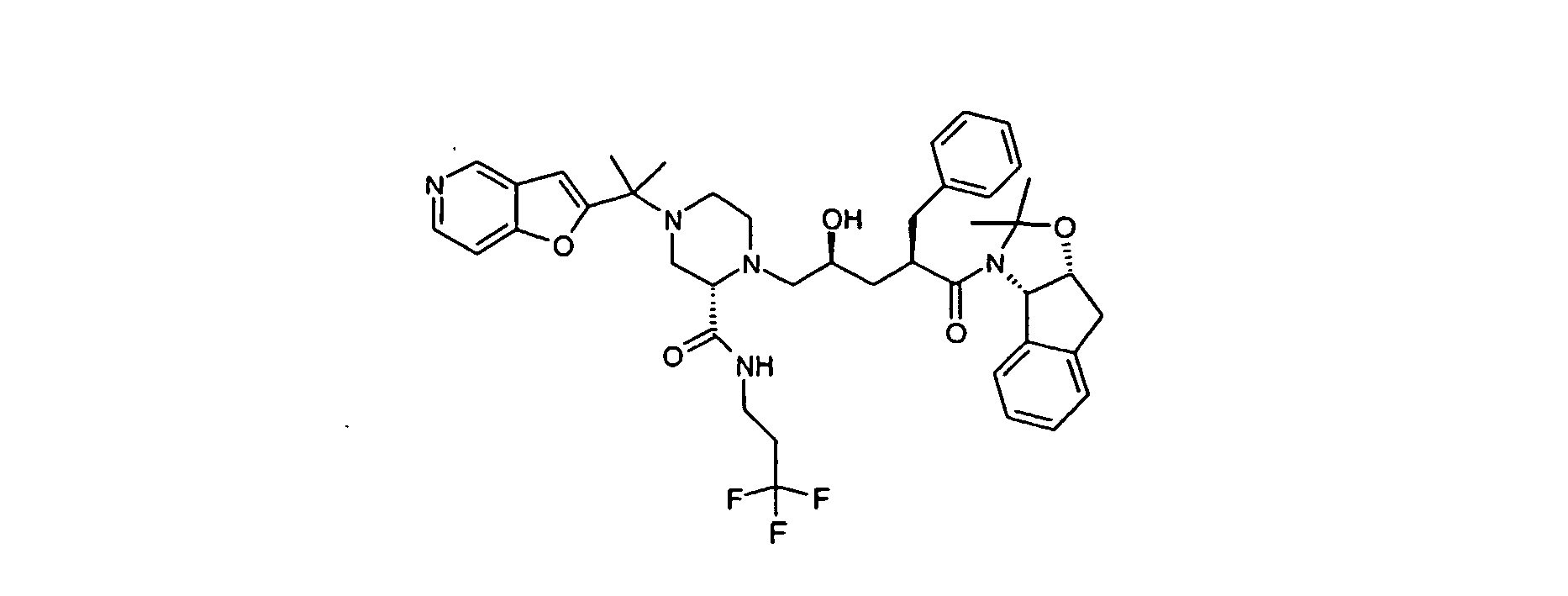
- The title compound was obtained following the procedure described in Example 1, Step Q, starting with the intermediate prepared in Example 5, Step B (93.8 mg, 0.244 mmol) and the epoxide employed in Example 8, Step A (92.2 mg, 0.244 mmol). Purification by flash chromatography afforded the title compound. HPLC-MS (ES) 762.3 (M+1).
- The title compound was obtained following the procedure described in Example 1, Step R, starting with the intermediate prepared in Example 10, Step A. Purification by flash chromatography (5% methanol in ethyl acetate) afforded the title compound as a white solid. 1H NMR (CDCl3, 500 MHz) 8.95 (s, 1H), 8.88 (s, 1H), 8.49 (d, J = 5.7 Hz, 1H), 7.37 (d, J = 5.7 Hz, 1H), 7.30 (m, 4H), 7.17 (d, J = 2.3 Hz, 1H), 7.09 (d, J = 2.6 Hz, 1H), 6.64 (s, 1H), 6.10 (d, J = 8.5 Hz, 1H), 5.27 (dd, J = 4.8 Hz, J = 8.5 Hz, 1H), 4.28 (t, J = 4.8 Hz, 1H), 3.76 (m, 2H), 3.41 (m, 1H), 3.28 (t, J = 2.9 Hz, 1H), 3.04 (dd, J = 5.3 Hz, J = 16.7 Hz, 1H), 2.89 (m, 3H), 2.79 (m, 3H), 2.67 (m, 3H), 2.46 (m, 3H), 1.93 (t, 2H), 1.55 (s, 3H), 1.53 (s, 3H); HPLC-MS (ES) 722.2 (M+1).
-

-

- The title compound was obtained following the procedure described in Example 1, Step Q, starting with the intermediate prepared in Example 6, Step B (104 mg, 0.248 mmol) and the epoxide intermediate used in Example 8, Step A (94.0 mg, 0.249 mmol). Purification by flash chromatography (3% methanol in ethyl acetate) afforded the title compound as a white solid. HPLC-MS (ES) 798.4 (M+1).
- The title compound was obtained following the procedure described in Example 1, Step R, starting with the intermediate prepared in Example 11, Step A (42.8 mg, 0.0537 mmol). Purification by flash chromatography (3% methanol in ethyl acetate) afforded the title compound as a white solid. 1H NMR (CDCl3, 500 MHz) 9.30 (s, 1H), 8.90 (s, 1H), 8.51 (d, J = 4,5 Hz, 1H), 7.37 (d, J = 5.0 Hz, 1H), 7.27 (m, 2H), 7.23 (m, 3H), 7.23 (s, 2H), 7.17 (s, 2H), 6.67 (s, 1H), 6.08 (d, J = 8.2 Hz, 1H), 5.27 (m, 1H), 4.35 (m, 1H), 4.27 (s, 1H), 3.79 (m, 2H), 3.39 (s, 1H), 3.05 (m, 2H), 2.91 (m, 2H), 2.71 (m, 3H), 2.69 (m, 3H), 2.49 (m, 2H), 1.933 (t, 1H). HPLC-MS (ES) 758.4 (M+1).
-

-

- To a solution of 1,4-piperazine-2-(S)-carboxylic acid [bis(+)-CSA salt (30.0 g, 50.0 mmol) in 600 mL THF was added 1N aqueous NaOH until the resulting solution was pH 9 (150 mL). The solution was cooled to 0 °C, and BOC-ON (12.3 g, 50.0) was added. The resulting solution was warmed to ambient temperature over 5 hours, then cooled again to 0 °C. Allyl chloroformate (5.31 mL, 50.0 mmol) was added via syringe, followed by an additional 60 mL of 1N aqueous NaOH. The solution was warmed to ambient temperature overnight, then concentrated to minimum volume by rotary evaporator. The resulting mixture was acidified to pH 1 with 1N aqueous HCl, and extracted with ethyl acetate (400 mL x 2). The organic layers were washed with brine (200 mL) dried (MgSO4) and concentrated in vacuo, affording 23.7 g of a yellow oil. This material was dissolved in 750 mL of dichloromethane, followed by the addition of triethylamine (35.0 mL, 250 mmol), trifluoroethylamine (9.95 mL, 125 mmol), HOAT (10.2 g, 75.0 mmol), and EDC (14.4 g, 75.0 mmol). After 22 hours at ambient temperature the reaction mixture was quenched by the addition of saturated aqueous NaHCO3 (500 mL). The organic layer was washed with an additional 500 mL of saturated aqueous NaHCO3, then 1N aqueous NaHSO4 (500 mL), and additional saturated aqueous NaHCO3 (500 mL). The organic layer was dried (Na2SO4) and concentrated in vacuo. Purification by flash chromatography (40% ethyl acetate in hexane) afforded the title compound as a white solid. 1H NMR (CDCl3, 400 MHz) 5.95 (m, 1H), 5.35 (d, 1H), 5.28 (d, 1H), 4.75 (s, 1H), 4.68 (d, 1H), 4.53 (d, 1H), 3.90 (m, 3H), 3.20 (dd, 1H), 3.00 (m, 1H), 1.45 (s, 9H).
-

- To a solution of tris (dibenzylidineacetone)dipalladium(0) (1.42 g, 1.55 mmol) in 150 mL of THF was added 1,4-bis(diphenylphosphino)butane (1.78 g, 3.10 mmol). After stirring 20 min at ambient temperature, this solution was added via cannula to a solution of the intermediate prepared in Step A (12.3 g, 31.0 mmol) and thiosalicilic acid (7.18 g, 46.6 mmol) in 150 mL of THF. After 1 hour at ambient temperature the reaction was diluted with 1 L of diethyl ether and extracted with 1% aqueous HCl (250 mL x3). The combined aqueous layers were neutralized with excess saturated NaHCO3, and the resulting suspension was extracted with ethyl acetate (500 mL x2). These organic layers were washed with brine (200 mL), dried (MgSO4), and concentrated in vacuo, affording the title compound as a clear oil. 1H NMR (CDCl3, 400 MHz) 7.28 (s, 1H), 4.00 (dd, 1H), 3.97 (m, 2H), 4.70 (s, 1H), 3.40 (dd. 1H). 3.20 (dd, 1H), 3.05 (s, 1H), 2.93 (d, 1H), 2.81 (t, 1H), 1.80 (s, 1H), 1.43 (s, 9H).
-

- The title compound was obtained following the procedure described in Example 1, Step Q, starting with the intermediate prepared in Example 12, Step B (1.82 g, 5.86 mmol) and the intermediate prepared in example 1, Step P (2.53 g, 6.45 mmol). Purification by flash chromatography (65% ethyl acetate in hexane) afforded the title compound as a colorless oil. 1H NMR (CDCl3, 400 MHz) 7.25 (m, 5H), 7.20 (t, 1H), 7.18 (t, 1H), 7.15 (t, 1H), 7.03 (t, 1H), 6.83 (m, 1H), 6.60 (m, 2H), 5.89 (d, 1H), 5.50 (s, 1H), 4.45 (dd, 1H), 3.97 (dd, 1H), 4.23 (d, 1H), 4.00 (m, 1H), 3.82 (m, 2H), 3.68 (m, 1H), 3.45 (m, 3H), 3.32 (m, 3H), 2.87 (m, 1H), 2.67 (d, 1H), 2.50 (m, 2H), 1.82 (t, 1H), 1.76 (s, 3H), 1.74 (s, 3H), 1.42 (s, 9H), 1.24 (s, 6H); HPLC-MS (ES) 705.3 (M+1).
-

- To a solution of the intermediate prepared in Step C (2.43 g, 3.45 mmol) in 2-propanol (20 mL) at 0 °C was added concentrated aqueous HCl (20 mL). After 16 hours at ambient temperature the reaction was brought to pH 8 with 2N aqueous NaOH. The mixture was then extracted with ethyl acetate (200 mL x2). The organic layers were washed with brine (200 mL), dried (MgSO4), and concentrated in vacuo affording the title compound as a white solid. 1H NMR (CDCl3, 400 MHz) 9.05 (t, 1H), 7.28 (m, 5H), 7.13 (t, 1H), 7.10 (d, 1H), 6.80 (m, 2H), 6.20 (d, 1H), 5.20 (dd, 1H), 4.08 (m, 4H), 3.80 (m, 2H), 3.28 (s, 1H), 3.14 (m, 1H0, 2.98 (m, 4H), 2.65 (m, 2H), 2.48 (dd, 1H), 1.91 (t, 1H), 1.58 (t, 1H); HPLC-MS (ES) 565.2 (M+1).
- To a solution of the intermediate prepared in Step D (86 mg, 0.15 mmol) in 3% acetic acid / DMF (1.5 mL) was added benzofuran-2-carboxaldehyde (26 µL, 0.18 mmol). After 10 min at ambient temperature, sodium triacetoxy borohydride (49 mg, 0.23 mmol) was added. After 4 hours at ambient temperature the reaction was diluted with ethyl acetate (30 mL) and washed with 5% aqueous NaHCO3 (30 mL x 4). The organic layer was washed with brine, dried (MgSO4), and concentrated in vacuo. Purification by flash chromatography afforded the title compound as a white solid. 1H NMR (CD3OD 400 MHz) 7.53 (dd, J = 0.8 Hz, J = 7.6 Hz, 1H), 7.42 (d, J = 8.0 Hz, 1H), 7.16 (m, 10H), 6.81 (dt, J = 1.2 Hz, J = 7.6 Hz, 1H), 6.72 (dd, J = 1.2 Hz, J = 8.4 Hz, 1H), 6.71 (s, 1H), 5.15 (d. J = 4.4 Hz, 1H), 4.06 (m, 2H), 3.97 (m, 1H), 3.74 (m, 6H), 3.11 (dd, J = 3.2 Hz, J = 7.6 Hz, 1H), 3.00 (m, 4H), 2.75 (m, 4H), 2.62 (dd, J = 8.0 Hz, J = 11.6 Hz, 1H), 2.53 (t, J = 8.4 Hz, 1H), 2.42 (m, 3H), 2.05 (t, J = 11.2 Hz, 1H), 1.40 (dt, J = 3.6 Hz, J = 10.0 Hz, 1H); HPLC-MS (ES) 695.2 (M+1).
-

-

- To a solution of 5-bromo-2-furaldehyde (20.0 g, 114 mmol) in 100 mL of benzene was added ethylene glycol (15.9 mL, 285 mmol) and p-toluenesulfonic acid monohydrate (282 mg, 1.48 mmol). The mixture was heated to reflux with azeotropic removal of water for 18 hours, then cooled to ambient temperature and concentrated in vacuo. The residue was dissolved in diethyl ether (1.5 L) and washed with saturated aqueous NaHCO3 (150 mL), and brine (150 mL). The organic layer was dried (MgSO4) and concentrated in vacuo affording an orange oil. This material was dissolved in THF (300 mL) and cooled to -78 °C. To this solution was added sec-butyllithium (100 mL of a 1.3M solution in cyclohexane, 130 mmol) via cannula. After 1 hour at -78 °C, a solution of trimethyltin chloride (12.6 g, 63 mmol, as a solution in 50 mL of THF) was added via cannula. After an additional 30 min at 78 °C, the mixture was warmed to ambient temperature. After 2 hours the reaction was quenched by the addition of 100 mL of acetone, followed by 400 mL of water. The mixture was diluted with diethyl ether (500 mL). The organic layer was washed with saturated aqueous NaHCO3 (150 mL x2), and brine, dried (MgSO4), and concentrated in vacuo, affording an orange oil. This material was dissolved in DMF (320 mL), and 3-bromopyridine (5.5 mL, 57 mmol) was added, followed by tetrakis(triphenylphosphine)palladium(0) (2.0 g, 1.73 mmol). The solution was heated to 100 °C for 1 hour, then cooled to ambient temperature. The solution was poured onto diethyl ether (1 L) and washed with 5% aqueous NaHCO3 (150 mL x3), and brine (150 mL). The organic layer was dried (MgSO4) and concentrated in vacuo. Purification by flash chromatography (50% ethyl acetate in hexane) afforded the title compound as an orange oil. 1H NMR (CDCl3, 400 MHz) 8.87 (s, 1H), 8.44 (d, 1H), 7.89 (d, 1H), 7.24 (m, 1H), 6.65 (d, 1H), 6.49 (d, 1H), 5.94 (s, 1H), 4.11 (m, 2H), 3.98 (m, 2H).
-

- To a solution of the intermediate prepared in Step A (1.00 g, 4.60 mmol) in THF (100 mL) at 0 °C was added 1 N aqueous HCl (16.1 mL, 16.1 mmol). After warming to ambient temperature over 2 hours, the reaction was quenched by the addition of 1N NH4OH until the reaction was pH 8. The reaction was diluted with 200 mL of ethyl acetate and washed with saturated aqueous NaHCO3 (150 mL) brine (150 mL), dried (MgSO4), and concentrated in vacuo, affording the title compound as a white solid. 1H NMR (CDCl3, 400 MHz) 9.72 (s, 1H), 9.07 (s, 1H), 8.64 (d, 1H), 8.13 (d, 1H), 7.43 (m, 1H), 7.37 (d, 1H), 6.97 (d, 1H).
- The title compound was obtained following the procedure described in Example 12, Step E, starting with the intermediate prepared in Step B (307 mg, 1.77 mmol), and using the intermediate prepared in Example 12, Step D (500 mg, 0.886 mmol). Purification by recrystallization (dichloromethane / ethyl acetate) afforded the title compound as a white solid. 1H NMR (CDCl3, 500 MHz) 9.04 (s, 1H), 8.90 (d, J = 1.8 Hz, 1H), 8.52 (d, J = 3.4 Hz, 1H), 7.90 (d, J = 8.1 Hz, 1H), 7.29 (m, 7H), 7.12 (m, 1H), 7.09 (d, J = 7.6 Hz, 1H), 6.81 (t, J = 7.8 Hz, 2H), 6.72 (d, J = 3.4 Hz, 1H), 6.37 (d, J = 3.2 Hz, 1H), 6.02 (d, J = 8.0 Hz, 1H), 5.19 (m, 1H), 4.14 (q, J = 7.1 Hz, 2H), 4.06 (m, 2H), 3.82m, 2H), 3.72 (d, J = 13.9 Hz, 1H), 3.62 (d, J = 14.2 Hz, 1H), 3.51 (s, 1H), 3.36 (s, 1H), 2.98 (m, 3H), 2.94 (m, 1H), 2.82 (m, 1H), 2.74 (m, 2H), 2.61 (d, J = 3.2 Hz, 1H), 2.48 (m, 2H), 2.21 (d, J = 5.8 Hz, 1H), 1.91 (t, 1H), 1.69 (s, 1H), 1.57 (t, 1H); HPLC-MS (ES) 722.2 (M+1).
-

- The title compound was obtained following the procedure described in Example 12, Step E, starting with 3-pyridine carboxaldehyde (32 µL, 0.30 mmol) and the intermediate prepared in Example 12, Step D (86 mg, 0.15 mmol). Purification by flash chromatography (10% methanol in dichloromethane) afforded the title compound as a white solid. 1H NMR (CD3OD, 400 MHz) 8.47 (d, J = 1.6 Hz, 1H), 8.43 (dd, J = 1.6 Hz, J = 4.8 Hz, 1H), 7.80 (d, J = 6.0 Hz, 1H), 7.40 (dd, J = 4.8 Hz, J = 7.6 Hz, 1H), 7.22 (m, 5H), 7.11 (m, 2 H), 6.80 (dt, J = 1.2 Hz, J = 7.6 Hz, 1 H), 6.73 (d, J = 8.4 Hz, 1H), 5.16 (d, J = 4.0 Hz, 1H), 4.08 (s, 2H), 3.94 (m, 1H), 3.80 (m, 4H), 3.57 (s, 3H), 3.11 (dd, J = 3.2 Hz, J = 7.2 Hz, 1 H), 2.98 (m, 3H), 2.76 (dd, J = 6.4 Hz, J = 13.2 Hz, 1 H), 2.67 (dd, J = 2.4 Hz, J = 10.8 Hz, 1H), 2.51 (m, 6H)2.05 (t, J = 11.6 Hz, 1H), 1.41 (dt, J = 3.6 Hz, J = 10.0 Hz, 1H); HPLC-MS (ES) 656.3 (M+1).
-

-

- To a solution of 5-bromo-2-furaldehyde (20.0 g, 114 mmol) in 100 mL of benzene was added ethylene glycol (15.9 mL, 285 mmol) and p-toluenesulfonic acid monohydrate (282 mg, 1.48 mmol). The mixture was heated to reflux with azeotropic removal of water for 18 hours, then cooled to ambient temperature and concentrated in vacuo. The residue was dissolved in diethyl ether (1.5 L) and washed with saturated aqueous NaHCO3 (150 mL), and brine (150 mL). The organic layer was dried (MgSO4) and concentrated in vacuo affording an orange oil. This material was dissolved in THF (300 mL) and cooled to -78 °C. To this solution was added sec-butyllithium (100 mL of a 1.3M solution in cyclohexane, 130 mmol) via cannula. After 1 hour at -78 °C, a solution of trimethyltin chloride (12.6 g, 63 mmol, as a solution in 50 mL of THF) was added via cannula. After an additional 30 min at -78 °C, the mixture was warmed to ambient temperature. After 2 hours the reaction was quenched by the addition of 100 mL of acetone, followed by 400 mL of water. The mixture was diluted with diethyl ether (500 mL). The organic layer was washed with saturated aqueous NaHCO3 (150 mL x2), and brine, dried (MgSO4), and concentrated in vacuo, affording the 5-trimethylstannylfuran-2-dioxolane as an orange oil.
-

- The intermediate prepared in Step A was dissolved in DMF (320 mL) and di-isopropylethylamine (11.9 mL, 68.0 mmol) was added, followed by 4-bromopyridine hydrochloride (11.8 g, 57.0 mmol). To this solution was then added tetrakis(triphenylphosphine)palladium(0) (2.0 g, 1.7 mmol), and the mixture was heated to 100 °C for 1 hour. The reaction was cooled to ambient temperature, and diluted with 1.5 L of diethyl ether. The organic layer was washed with 5% aqueous NaHCO3 (300 mL x3), brine (300 mL), dried (MgSO4) and concentrated in vacuo. Purification by flash chromatography (50% ethyl acetate in hexane) afforded the title compound as an orange solid. 1H NMR (CDCl3, 400 MHz) 8.60 (d, 2H), 7.50 (d, 2H), 6.83 (d, 1H), 6.58 (d, 1H), 6.00 (s, 1H), 4.18 (m, 2H), 4.08 (m, 2H).
-

- To a solution of the intermediate prepared in Step B (2.00 g, 9.20 mmol) in THF (200 mL) at 0 °C was added 1 N aqueous HCl (32.2 mL, 32.2 mmol). After warming to ambient temperature over 2 hours, the reaction was quenched by the addition of 1N NH4OH until the reaction was pH 8. The reaction was diluted with 200 mL of ethyl acetate and washed with saturated aqueous NaHCO3 (150 mL), brine (150 mL), dried (MgSO4), and concentrated in vacuo, affording the title compound as an orange solid. 1H NMR (CDCl3, 400 MHz) 9.87 (s, 1H), 8.62 (d, 2H), 7.61 (d, 2H), 7.32 (d, 1H), 7.01 (d, 1H).
- The title compound was obtained following the procedure described in Example 12. Step E, starting with the intermediate prepared in Step C (307 mg, 1.77 mmol), and using the intermediate prepared in Example 12, Step D (500 mg, 0.886 mmol). The material was obtained in > 95% purity from the reaction mixture, as a white solid. 1H NMR (DMSO-D6, 500 MHz) 8.55 (d, J = 1.4 Hz, 1H), 8.41 (t, J = 6.2 Hz, 1H), 7.79 (d, J = 9.0 Hz, 1H), 7.58 (d, J = 1.3 Hz, 1H), 7.20 (m, 3H), 7.06 (d, J = 8.5 Hz, 1 H), 6.76 (t, J = 7.7 Hz, 1H), 6.69 (d, J = 5.8 Hz, 1H), 6.49 (d, J = 3.5 Hz, 1H), 5.09 (m, 2H), 4.58 (d, J = 4.3 Hz, 1H), 4.12 (d, J = 11.2 Hz, 1H), 4.05 (dd, J = 4.1 Hz, J = 11.5 Hz, 1H), 3.89 (m, 1H), 3.77 (m, 1H), 3.71 (d, J = 2.5 Hz, 1H), 3.60 (s, 2H), 2.92 (m, 4H), 2.40 (t, J = 9.4 Hz, 1H), 2.26 (m, 4H), 1.95 (t, J = 11.6 Hz, 1H), 1.15 (t, J = 8.4 Hz); HPLC-MS (ES) 722.2 (M+1).
-

-

- To a solution of the trimethylstannylfuran intermediate prepared in Example 15, Step A (5.00 g, 16.5 mmol) in DMF (100 mL) was added 5-bromopyrimidine (2.62 g, 16.5 mmol), followed by tetrakis(triphenylphosphine)-palladium(0) (0.572 g, 0.49 mmol). The resulting mixture was heated to 100 °C for 1 hour, then cooled to ambient temperature and diluted with 1.2 L of diethyl ether. The organic layer was washed with saturated aqueous NaHCO3 (500 mL x2), water (500 mL x2), and brine (500 mL), dried (MgSO4), and concentrated in vacuo. Purification by recrystallization from diethyl ether / hexane afforded the furanylpyrimidine as an orange solid. 1H NMR (CDCl3, 400 MHz) 9.11 (s, 1H), 9.01 (s, 2H), 6.80 (d, 1H), 6.59 (d, 1H), 6.00 (s, 1H), 4.18 (m, 2H), 4.07 (m, 2H).
-

- To a solution of the intermediate prepared in Step A (837 mg, 3.83 mmol) in THF (100 mL) and cooled to 0 °C. To this solution was added 1 N aqueous HCl (10 mL, 10 mmol). After 1 hour at 0 °C the reaction was quenched by the addition of concentrated NH4OH (50 mL). The mixture was diluted with ethyl acetate (200 mL), and the organic layer was washed with saturated aqueous NaHCO3 (200 mL) and brine (200 mL), dried (MgSO4), and concentrated in vacuo, affording the aldehyde as an orange solid. 1H NMR (CDCl3, 400 MHz) 9.76 (s, 1H), 9.24 (s, 1H), 9.17 (s, 2H), 7.39 (d, 1H), 7.05 (d, 1H).
- The title compound was obtained following the procedure described in Example 12, Step E, starting with the aldehyde intermediate prepared in Step B (166 mg, 0.953 mmol), and using the intermediate prepared in Example 12, Step D (312 mg, 0.554 mmol). Purification by flash chromatography (3% methanol in ethyl acetate) afforded of the title compound as a white solid. 1H NMR (CDCl3, 400 MHz) 9.11 (s, 1H), 8.97 (s, 1H), 8.89 (s, 1H), 7.28 (m, 5H), 7.12 (m, 2H), 6.80 (m, 3H), 6.42 (s, 1H), 6.08 (d, J = 8.0 Hz, 1H), 5.18 (dd, J = 4.1 Hz, 1H), 4.08 (m, 4H), 3.80 (s, 1H), 3.67 (m, 4H), 3.38 (s, 1H), 2.88 (m, 11H), 2.47 (d, J = 10.4 Hz, 1H), 2.24 (s, 1H), 1.92 (t, J= 11.2 Hz, 1H), 1,56 (t, J = 10.8 Hz, 1H); HPLC-MS, (ES) 723.5 (M+1).
-

-

- To a solution of 5-iodovanilin (3.00 g, 10.8 mmol) in DMF (10 mL) was added K2CO3 (3.72 g, 27.0 mmol), followed by allyl bromide (0.934 mL, 16.2 mmol). The reaction was heated to 50 °C for 1.5 hours, then cooled to ambient temperature and diluted with 300 mL of ethyl acetate. The organic layer was washed with 1 N aqueous NaHS04 (300 mL), 0.5 N NaHC03 (300 mL x3), and brine (300 mL). The organic layer was then dried (MgSO4) and concentrated in vacuo, affording 3.38 g of the allyl ether as a yellow solid. This material was dissolved in DMF (20 mL), and to this solution was added Na2CO3 (853 mg, 8.05 mmol), sodium formate (1.37 g, 20.1 mmol), tetrabutylammonium chloride (2.46 g, 8.86 mmol), and palladium(II) acetate (90.4 mg, 0.403 mmol). The reaction was heated to 80 °C for 1 hour, then cooled to ambient temperature and diluted with 300 mL of ethyl acetate. The organic layer was washed with 1 N NaHSO4 (300 mL), 0.5 N NaHCO3 (300 mL x3), and brine (300 mL), dried (MgSO4), and concentrated in vacuo, affording a brown oil. Purification by flash chromatography (25% ethyl acetate in hexane) afforded the aldehyde as a white solid. 1H NMR (CDCl3, 400 MHz) 10.0 (s, 1H), 7.65 (s, 1H), 7.50 (s, 1H), 7.35 (s, 1H), 4.05 (s, 3H), 2.28 (s, 3H).
- The title compound was obtained following the procedure described in Example 12, Step E, starting with the aldehyde prepared in Step A (22.3 mg, 0.118 mmol) and the intermediate prepared in Example 12, Step D (33.2 mg, 0.0589 mmol). Purification by flash chromatography (95% ethyl acetate in hexane) afforded the title compound as a white solid. 1H NMR (CDCl3, 400 MHz) 9.19 (s, 1H), 7.44 (d, J = 4.4 Hz, 1H), 7.27 (m, 5H), 7.14 (t, J = 7.6 Hz, 1H), 7.09 (d, J = 8.0 Hz, 1H), 7.01 (s, 1H), 6.82 (t, J = 8.4 Hz, 1H), 6.69 (s, 1H), 5.94 (d, J = 7.6 Hz, 1H), 4.20 (dd, J = 4.4 Hz, J = 8.8 Hz, 1H), 4.18 (m, 1H), 4.03 (m, 5H), 3.81 (m, 2H), 3.61 (m, 4H), 3.36 (s, 1H), 3.05 (d, J = 12.0 Hz, 1H), 2.93 (m, 2H), 2.79 (m, 3H), 2.56 (d, J = 9.2 Hz, 1H), 2.47 (d, J = 10.8 Hz, 1H), 2.35 (t, J = 8.0 Hz, 1H), 2.24 (s, 3H), 2.11 (d, J = 6.4 Hz, 1H), 1.92 (t, J = 11.2 Hz, 1H), 1.61 (m, 1H), 1.27 (s, 2H); HPLC-MS (ES) 739.4 (M+1).
-

-

- To a solution of 7-methoxy-2-benzofurancarboxylic acid (1.04 g, 5.42 mmol) in benzene (120 mL) was added methanol (40 mL), followed by trimethylsilyldiazomethane (2.72 mL of a 2.0 M solution in hexane, 5.42 mmol). After 30 min the reaction was diluted with dichloromethane (300 mL) and washed with saturated aqueous NaHCO3 (300 mL). The organic layer was dried (Na2SO4) and concentrated in vacuo, affording 1. 11 g of the carboxylic acid methyl ester as a white solid. This material was dissolved in THF (100 mL), and the resulting solution was cooled to 0 °C. To this solution was added LiAlH4 (13.5 mL of a 1.0 M solution in THF, 13.5 mmol). After 30 min the reaction was quenched by the slow addition of saturated aqueous NH4Cl (100 mL). The mixture was diluted with ethyl acetate (300 mL), and the organic layer was washed with 1 N NaHSO4 (300 mL), saturated aqueous NaHCO3 (300 mL) and brine (300 mL), dried (MgSO4) and concentrated in vacuo, affording 977 mg of the alcohol as a colorless oil. This material was dissolved in DMSO (20 mL), and to this solution was added triethylamine (4.52 mL, 32.5 mmol), followed by sulfur trioxide pyridine complex (2.58 g, 16.2 mmol). After 10 min the reaction was diluted with dichloromethane (200 mL) and washed with 1 N aqueous NaHSO4 (200 mL), followed by 0.5 N aqueous NaHCO3 (200 mL). The organic layer was dried (Na2SO4) and concentrated in vacuo, yielding the aldehyde as a yellow oil. 1H NMR (CDCl3, 400 MHz) 9.92 (s, 1H), 7.57 (s, 1H), 7.35 (d, 1H), 7.26 (t, 1H), 6.98 (d, 1H), 4.02 (s, 3H).
- The title compound was obtained following the procedure described in Example 12, Step E, starting with the aldehyde prepared in Step A (25.6 mg, 0.145 mmol) and the intermediate prepared in Example 12, Step D (41.0 mg, 0.0727 mmol). Purification by flash chromatography (95% ethyl acetate in hexane) afforded the title compound as a white solid. 1H NMR (CDCl3, 400 MHz) 9.33 (s, 1H), 7.22 (m, 10H). 6.83 (m, 2H), 6.37 (s, 1H), 6.05 (d, J = 8.0 Hz, 1H), 5.18 (dd, J = 4.0 Hz, 1H), 4.27 (m, 1H), 4.07 (d, J= 11.2 Hz, 1H), 4.01 (d, J = 7.6 Hz, 1H), 4.00 (s, 3H), 3.87 (d, J = 14.0 Hz, 1H), 3.78 (s, 1H), 3.75 (m, 1H, 1H), 3.63 (d, J = 14.4 Hz, 1H), 3.34 (s, 1H), 3.00 (m, 2H), 2.92 (m, 2H), 2.75 (m, 3H), 2.56 (m, 2H), 2.23 (s, 1H), 1.91 (t, J = 11.2 Hz, 1H), 1.57 (t, J = 10.4 Hz, 1H). 1.27 (s, 1H); HPLC-MS (ES) 725.4 (M+1).
-

-

- To a solution of aniline (1.68 mL, 18.4 mmol) in acetic acid (25 mL) was added 2,5-dimethoxy-3-tetrahydrofurancarboxaldehyde (2.95 g, 18.4 mmol). The resulting solution was heated to 90 °C for 30 min, then cooled to ambient temperature. The reaction was added slowly to saturated aqueous NaHCO3 (500 mL), and the mixture was extracted with dichloromethane (200 mL). The organic layer was dried (Na2SO4) and concentrated in vacuo. Purification by flash chromatography (25% ethyl acetate in hexane) afforded the aldehyde as a yellow oil. 1H NMR (CDCl3, 400 MHz) 9.89 (s, 1H), 7.69 (s, 1H), 7.40 (m, 5H), 7.12 (d, 1H), 6.80 (d, 1H).
- The title compound was obtained following the procedure described in Example 12, Step E, starting with the aldehyde prepared in Step A (19.7 mg, 0.115 mmol) and the intermediate prepared in Example 12, Step D (43.3 mg, 0.0767 mmol). Purification by flash chromatography (ethyl acetate) afforded the title compound as a white solid. 1H NMR (CDCl3, 400 MHz) 9.38 (s, 1H), 7.45 (t, J = 6.4 Hz, 1H), 7.38 (d, J = 8.4 Hz, 1H), 7.28 (m, 4H), 7.14 (t, J = 7.2 Hz, 1H), 7.01 (s, 1H), 6.99 (s, 1H), 6.84 (d, J = 7.6 Hz, 1H), 6.81 (d, J = 8.0 Hz, 1H), 6.23 (t, J = 2.0 Hz, 1H), 5.97 (d, J = 8.0 Hz, 1H) 5.18 (dd, J = 4.0 Hz, 1H), 4.17 (m, 1H), 4.07 (d, J = 10.4 Hz, 1H), 4.01 (dd, J = 5.2 Hz, J = 11.6 Hz, 1H), 3.83 (s, 1H), 3.72 (m, 2H), 3.55 (d, J = 13.2 Hz, 1H), 3.44 (d, J = 13.2 Hz, 1H), 3.55 (s, 1H), 3.01 (d, J = 11.6 Hz, 1H), 3.01 (d, J = 15.2 Hz, 1H), 2.97 (t, J = 10.4 Hz, 1H), 2.89 (m, 1H), 2.81 (dd, J = 4.4 Hz, J = 12.0 Hz, 1H), 2.69 (m, 2H), 2.46 (d, J = 10.8 Hz, 1H), 2.31 (t, J = 10.4 Hz, 1H), 2.16 (s, 1H). 1.91 (t, J= 10.8 Hz, 1H), 1.58 (m, 2H); HPLC-MS (ES) 720.5 (M+1).
-

-

- To a solution of aniline (3.16 mL, 34.7 mmol) in ethanol (66 mL) was added acetic acid (3.5 mL), followed by triethylorthoformate (5.77 mL, 34.7 mmol). The mixture was heated to reflux for 30 min, the cooled to ambient temperature. Methyl nitroacetatc (6.38 mL, 69.4 mmol) was added, and the reaction was again heated to reflux for 3.5 hours. The mixture was then cooled to 0 °C, and the precipitate that formed was collected by filtration and dried in vacuo, affording 5.16 g of the nitro enamine as a white solid. This material was dissolved in triethylorthoformate (60 mL). To the solution was added 10% Pd / C (1.70 g), and the reaction was placed under 2.5 atm of H2 at 70 °C for 2 hours. The reaction was filtered through celite and concentrated in vacuo. The residue was dissolved in THF (300 mL) and cooled to 0 °C, followed by addition of 1 N aqueous HCl until the solution was pH 1. After 30 min at 0 °C the solution was adjusted to pH 8 with saturated aqueous NaHCO3 and extracted with ethyl acetate (300 mL). The organic layer was washed with brine (300 mL), dried (MgSO4), and concentrated in vacuo. Purification by flash chromatography (65% ethyl acetate in hexane) afforded the title compound as a yellow solid. 1H NMR (CDCl3, 400 MHz) 7.95 (s, 1H), 7.90 (s, 1H), 7.50 (m, 2H), 7.40 (m, 3H), 3.92 (s, 3H).
-

- To a solution of the methyl ester prepared in Step A (200 mg, 0.990 mmol) in THF (4 mL) at 0 °C was added LiAlH4 (1.98 mL of a 1.0 M solution in THF, 1.98 mmol). After 30 min the reaction was quenched by the addition of 20% aqueous NaOH (2 mL). The mixture was diluted with ethyl acetate (100 mL) and the organic layer was washed with brine (100 mL), dried (MgSO4) and concentrated in vacuo, affording 166 mg of the alcohol as a colorless oil. This material was dissolved in 1:1 pentane:dichloromethane (10 mL). To this solution was added 1.10 g of celite, followed by MnO2 (1.10 g, 12.7 mmol). After 2 hours the mixture was filtered through celite and concentrated in vacuo, affording the aldehyde, which was used without further purification. 1H NMR (CDCl3, 300 MHz) 9.97 (s, 1H), 7.96 (s, 1H), 7.90 (s, 1H), 7.45 (m, 5H).
- The title compound was obtained following the procedure described in Example 12, Step E, starting with the aldehyde prepared in Step B (18 mg, 0.11 mmol) and the intermediate prepared in Example 12, Step D (50 mg, 0.089 mmol). Purification by flash chromatography (7% methanol in ethyl acetate) afforded the title compound as a white solid. 1H NMR (CD3OD, 400 MHz) 8.10 (s, 1H), 7.81 (d, J = 9.2 Hz, 1H) 7.53 (m, 6H), 7.40 (m, 1H), 7.23 (m, 5H), 7.18 (m, 1H), 7.10 (m, 2H), 6.82 (t, J = 7.2 Hz, 1H), 6.72 (d, J = 8.0 Hz, 1H), 5.16 (d, J = 4.0 Hz, 1H), 4.08 (m, 2H), 3.98 (m, 1H), 3.76 (m, 4H), 3.62 (s, 2H), 3.15 (m, 1H), 3.03 (m, 3H), 2.75 (m, 6H), 2.59 (t, J = 8.8 Hz, 1H), 2.41 (m, 2H), 2.05 (t, J = 11.6 Hz, 1H), 1.41 (m, 2H); HPLC-MS (ES) 721.6 (M+1).
-

-

- The title compound was obtained following the procedure described in Example 1, Step Q, starting with the intermediate prepared in Example 12, Step B (187 mg, 0.603 mmol) and the epoxide intermediate employed in Example 8, step A (250 mg, 0.663 mmol). Purification by flash chromatography (65% ethyl acetate in hexane) afforded the title compound as a colorless oil. 1H NMR (CDCl3, 400 MHz) 7.25 (m, 8H), 6.92 (t, 1H), 6.40 (d, 1H), 5.63 (s, 1H), 4.83 (s, 1H), 3.90 (m, 3H), 3.78 (d, 1H), 3.51 (m, 4H), 3.30 (m, 1H, 3.19 (, 1H), 3.09 (s, 2H), 2.90 (d, 1H), 2.82 (dd, 1H), 2.66 (m, 1H), 2.52 (m, 2H), 1.88 (dd, 1H), 1.65 (s, 3H), 1.60 (t, 1H), 1.48 (s, 9H), 1.39 (s, 3H); HPLC-MS (ES) 689.2 (M+1).
-

- To a solution of the intermediate prepared in Step A (288 mg, 0.419 mmol) in 2-propanol (10 mL) at 0 °C was added concentrated aqueous HCl (10 mL). After 16 hours at ambient temperature the reaction was brought to pH 8 with 2N aqueous NaOH. The mixture was then extracted with ethyl acetate (200 mL x2). The organic layers were washed with brine (200 mL), dried (MgSO4), and concentrated in vacuo affording the title compound as a white solid. 1H NMR (CDCl3, 400 MHz) 9.00 (t, 1H), 7.22 (m, 9H), 6.17 (d, 1H), 5.28 (dd, 1H), 4.28 (t, 1H), 4.10 (m, 1H), 3.81 (m, 2H), 3.24 (m, 1H), 3.11 (m, 1H), 3.10 (dd, 1H), 3.00 (m, 2H), 2.90 (dd, 1H), 2.85 (m, 3H), 2.75 (m, 1H), 2.67 (m, 1H), 2.50 (dd, 1H), 1.98 (t, 1H), 1.58 (t, 1H); HPLC-MS (ES) 549.2 (M+1).
- The title compound was obtained following the procedure described in Example 12, Step E, starting with benzofuran-2-carboxaldehyde (22 mg, 0.15 mmol) and the intermediate prepared in Example 21, Step B (70 mg, 0.13 mmol). Purification by flash chromatography (1% methanol in ethyl acetate) afforded the title compound as a white solid 1H NMR (CD3OD, 400 MHz) 7.52 (d, J = 6.8 Hz, 1H), 7.42 (d, J = 8 Hz, 1H), 7.18 (m, 5H), 6.70 (s, 1H), 5.19 (d, J = 5.2 Hz, 1H), 4.31 (dt, J = 2.4 Hz, J = 5.2 Hz, 1H), 3.96 (m, 1H), 3.73 (m, 4 H), 3.10 (m, 2H), 3.03 (d, 5.2 Hz, 1H), 2.96 (m, 3H), 2.75 (m, 7H), 2.61 (dd, J = 8.0 Hz, J = 11.2 Hz, 1H), 2.54 (dd, J = 2.8 Hz, J = 8.4 Hz, 1H), 2.39 (m, 4H), 2.02 (dt, J = 2.0 Hz, J = 13.6 Hz, 1H), 1.40 (dt, J = 2.8 Hz, J = 10.0 Hz, 1H); HPLC-MS (ES) 679.2 (M+1).
-

- The title compound was obtained following the procedure described in Example 12, Step E, starting with pyridine-3 carboxaldehyde (28 mg, 0.26 mmol) and the intermediate prepared in Example 21, Step B (70 mg, 0.13 mmol). Purification by flash chromatography (10% methanol in ethyl acetate) afforded the title compound as a white solid 1H NMR (CD3OD, 400 MHz) 8.47 (d. J = 1.6 Hz, 1H), 8.43 (dd, J = 1.6 Hz, J = 4.8 Hz, 1H), 7.81 (dt, J = 1.6 Hz, J = 8.0 Hz, 1H), 7.40 (dd, J = 5.2 Hz, J = 8.0 Hz, 1H), 7.19 (m, 9H), 5.20 (d, J = 4.8 Hz, 1H), 4.32 (t, J = 5.2 Hz, 1H), 3.83 (m, 3H), 3.56 (s, 2H), 3.04 (m, 4H), 2.85 (d, J = 16.4 Hz, 1H), 2.77 (m, 1H), 2.66 (d, J = 8.0 Hz, 1H), 2.47 (m, 7H), 2.02 (m, 1H), 1.34 (m, 1H); HPLC-MS (ES) 640.3 (M+1).
-

-

- To a solution of 2(R)-hydroxy-1(S)-aminoindane (98.7 g, 660 mmol) in DMF (400 mL) was added dichloromethane (2.2 L), followed by 3-pyridine propionic acid (100 g, 660 mmol), HOBT (134 g, 990 mmol), and EDC (189 g, 990 mmol). After 2 hours the thick slurry was filtered and the filtrate was dried in vacuo. This material was dissolved in dichloromethane (1.5 L), and cooled to 0°C. To the solution was added 2-methoxypropene (259 mL, 2.69 mol), followed by camphorsulfonic acid (150 g, 697 mmol). The mixture was warmed to ambient temperature over 1 hour, then brought to pH 10 with 1 N aqueous NaOH. The organic layer was dried (Na2SO4) and concentrated in vacuo. The resulting yellow solid was tritrated with hexane to afford a beige solid. 1H NMR (CDCl3, 400 MHz) 8.55 (s, 1H), 8.47 (d, 1H)m 7.60 (d, 1H), 7.20 (m, 5H), 5.14 (d, 1H), 4.70 (m, 1H), 3.12 (m, 2H), 3.05 (s, 2H), 2.93 (m, 2H), 1.60 (s, 3HO, 1.34 (s, 3H).
-

- The title compound was obtained following the procedure described in Example 1, Step N, using the intermediate from Step A (30.0 g, 93.1 mmol). Tritration of the crude material with hexane afforded the title compound as a beige solid. 1H NMR (CDCl3, 400 MHz) 8.60 (s, 1H), 8.50 (d, 1H), 7.61 (dt, 1H), 7.20 (m, 4H), 6.82 (t, 1H), 6.12 (d, 1H), 5.85 (m, 1H), 5.20 (d, 1H), 5.08 (d, 1H), 5.06 (s, 1H), 4.74 (s, 1H), 3.38 (dd, 1H), 3.10 (m, 1H), 3.00 (s, 2H), 2.78 (dd, 1H), 2.45 (m, 1H), 2.35 (m, 1H), 1.60 (s, 3H), 1.27 (s, 3H).
-

- To a solution of the intermediate from Step B (29.8 g, 82.2 mmol) in THF (250 mL) was added water (250 mL). The mixture was cooled to 0 oC, and I2 (83.5 g, 329 mmol) was added, followed by methanesulfonic acid (10.7 mL, 164 mmol). The mixture was warmed to ambient temperature and stirred for 16 hours. The reaction was then diluted with ethyl acetate (1 L) and washed with 1 N NaHSO4 (300 mL x3). The aqueous layer was brought to pH 8 with saturated aqueous NaHCO3, and extracted with dichloromethane (500 mL x2). These organic layers were dried (Na2SO4) and concentrated in vacuo. Purification by flash chromatography (ethyl acetate) afforded the title compound as a beige solid. 1H NMR (CDCl3, 400 MHz) 8.51 (d, 1H), 8.46 (s, 1H), 7.55 (d, 1H), 7.21 (s, 1H), 4.20 (m, 1H), 3.35 (dd, 1H), 3.20 (m, 2H), 3.18 (dd, 1H), 3.08 (m, 1H), 2.82 (dd, 1H), 2.20 (m, 2H); HPLC-MS (ES) 318.0 (M+1).
-

- To a solution of the intermediate from Step C (6.90 g, 21.8 mmol) in DMF (15 mL) was added the intermediate from Example 12, Step B (5.83 g, 18.7 mmol), and di-iso-propylethylamine (3.92 mL, 22.5 mmol). The mixture was heated to 100 °C for 16 hours, then cooled to ambient temperature and diluted with ethyl acetate (1 L) and washed with 0.5 N aqueous NaHCO3 (300 mL x3), and brine (300 mL), dried (MgSO4) and concentrated in vacuo. Purification by flash chromatography afforded the title compound as a white solid. 1H NMR (CDCl3, 400 MHz) 8.55 (d, 1H), 8.48 (s, 1H), 7.58 (dd, 1H), 7.26 (d, 1H), 7.00 (t, 1H), 4.46 (m, 1H), 4.05 (m, 1H0, 3.90 (m, 1H, 3.72 (m, 2H), 3.10 (m, 3H), 2.90 (m, 2H), 2.85 (dd, 1H), 2.60 (m, 2H), 2.40 (t, 1H), 2.05 (m, 1H), 1.95 (m, 1H), 1.42 (s, 9H).
-

- To a solution of the intermediate from Step D (3.35 g, 6.70 mmol) in 1,2-dimethoxyethane (30 mL) at 0 °C was added 1 N aqueous LiOH (7.36 mL, 7.36 mmol). After 30 min the reaction was concentrated in vacuo, and the carboxylic acid (lithium salt) product was dried to a white powder by repeated azeotropic drying with benzene in vacuo. This material was dissolved in DMF (50 mL), and to this solution was added tert-butyldimethylsilyl chloride (10.1 g, 67.0 mmol), and imidazole (9.12 g, 134 mmol). After 2 hours at ambient temperature the reaction was quenched with 0.05 N aqueous pH 7 phosphate buffer (100 mL) and extracted with ethyl acetate (300 mL). The organic layer was washed with brine (300 mL), dried (MgSO4) and concentrated in vacuo. The resulting silyl ester was dissolved in THF (20 mL) and water (10 mL) was added. The mixture was concentrated in vacuo, with the residual water removed by repeated azeotropic drying with benzene in vacuo. The resulting free acid was dissolved in DMF (100 mL), and to this solution was added the chiral aminochromanol intermediate from Example 1, Step L (1.11 g, 6.70 mmol), followed by HOBT (2.26 g, 16.7 mmol), di-iso-propylethamine (4.61 mL, 26.8 mmol), and HBTU (3.81 g, 10.0 mmol). After 16 hours at ambient temperature the reaction was diluted with ethyl acetate (300 mL) and washed with 0.5 N NaHO3 (300 mL x3), and brine (300 mL). The organic layer was dried (MgSO4) and concentrated in vacuo. Purification by flash chromatography afforded the title compound as a white solid. 1H NMR (CDCl3, 400 MHz) 8.48 (s, 1H), 8.46 (d, 1H), 7.95 (d, 1H), 7.55 (d, 1H), 7.22 (dd, 1H), 7.16 (t, 1H), 7.14 (d, 1H), 6.84 (t, 1H), 6.79 (d, 1H), 5.20 (dd, 1H), 4.08 (s, 1H), 4.00 (dd, 1H), 3.80 (m, 4H), 3.64 (d, 1H), 3.62 (m, 1H), 3.00 (m, 4H), 2.80 (m, 2H), 2.42 (m, 2H), 2.23 (m, 2H), 1.42 (s, 9H), 0.89 (s, 9H), 0.02 (s, 3H), 0.02 (s, 3H).
-

- To a solution of the intermediate from Step E (5.32 g, 6.83 mmol) in 2-propanol (20 mL) at 0 °C was added concentrated aqueous HCl (20 mL). After 1 hour the reaction was added to saturated aqueous NaHCO3 (400 mL) and extracted with dichloromethane until there was no product remaining in the aqueous layer by HPLC analysis (200 mL x20). The combined organic layers were concentrated in vacuo, affording the title compound as a white solid. 1H NMR (CDCl3, 400 MHz) 8.41 (s, 1H), 8.39 (d, 1H), 7.76 (d, 1H), 7.34 (m, 1H), 7.10 (m 2H), 6.83 (t, 1H), 6.77 (d, 1H), 5.20 (d, 1H), 4.80 (s, 2H), 4.08 (m, 3H), 3.75 (m, 3H), 3.28 (t, 2H), 3.00 (m, 4H), 2.85 (m, 3H), 2.50 (dd, 1 H), 2.40 (dd, 1H), 2.10 (m, 1H), 1.40 (m, 1H).
-

- To a solution of 4-bromofuran carboxaldehyde (2.00 g, 11.4 mmol) in deoxygenated DMF (50 mL) was added tetrakis(triphenylphosphine)palladium(0) (660 mg, 0.570 mmol), followed by phenylboronic acid (1.39 g, 11.4 mmol), and 2 N aqueous Na2CO3 (11.4 mL of a 2.0 M solution, 22.9 mmol). The mixture was heated to 100 °C for 16 hours, the cooled to ambient temperature and diluted with ethyl acetate (500 mL). The mixture was washed with 0.5 N NaHCO3 (300 mL x3) and brine (300 mL). The organic layer was dried (MgSO4), and concentrated in vacuo. Purification by flash chromatography (35% ethyl acetate in hexane) afforded the title compound as a yellow oil. 1H NMR (CDCl3, 300 MHz) 9.62 (s, 1H), 7.82 (d, 2H), 7.40 (m, 3H), 7.31 (d, 1H), 6.80 (d, 1H).
- The title compound was obtained following the procedure described in Example 12, Step E, starting with the intermediate prepared in Step F (368 mg, 0.652 mmol) and the aldehyde prepared in Step G (168 mg, 0.978 mmol). Purification by flash chromatography (10% methanol in ethyl acetate) afforded 348 mg (74%) of the title compound as a white solid. 1H NMR (CDCl3, 400 MHz) 9.16 (s, 1H), 8.42 (d, J = 3.6 Hz, 1H) 8.39 (d, 1H), 7.64 (d, J = 7.6 Hz, 1H), 7.55 (d, J = 8.0 Hz, 1H), 7.40 (t, J = 7.2 Hz, 1H), 7.30 (d, J = 7.6 Hz, 1H), 7.22 (dd, J = 4.4 Hz, J = 7.2 Hz, 1H), 7.11 (d, J = 6.0 Hz, 1H), 6.82 (d, J = 6.4 Hz, 1H), 6.61 (d, J = 2.8 Hz, 1H), 6.50 (d, J = 8.4 Hz, 1H), 6.33 (d, J = 3.2 Hz, 1H), 5.22 (dd, J = 4.0 Hz, J = 8.0 Hz, 1H), 4.12 (m, 2H), 4.01 (dd, J = 5.2 Hz, J = 11.2 Hz, 1H), 3.84 (m, 1H), 3.78 (t, J = 9.6 Hz, 1H), 3.72 (d, J = 14.0 Hz, 1H), 3.56 (d, J = 14.0 Hz, 1H), 3.49 (m, 1H), 3.34 (s, 1H), 3.00 (m, 2H), 2.88 (m, 1H)2.71 (m, 2H), 2.54 (dd, J = 2.8 Hz, J = 11.6 Hz, 1H), 2.45 (d, J = 10.0 Hz, 1H), 1.87 (t, J = 11.2 Hz, 1H), 1.51 (t, J = 10.8 Hz, 1H); HPLC-MS (ES) 722.4 (M+1).
-

- The title compound was obtained following the procedure described in Example 12, Step E, starting with the intermediate prepared in Example 23, Step F (357 mg, 0.632 mmol) and benzofuran-2-carboxaldehyde (185 mg, 1.26 mmol). Purification by flash chromatography (10% methanol in ethyl acetate) afforded the title compound as a white solid. 1H NMR (CDCl3, 400 MHz) 9.19 (s, 1H), 8.45 (s, 2H), 7.56 (d, J = 8.0 Hz, 2H), 7.44 (d, J = 8.0 Hz, 1H), 7.29 (m, 6H), 7.12 (m, 2H), 6.82 (d, J = 7.2 Hz, 2H), 6.65 (s, 1H), 6.33 (s, 1H), 5.22 (dd, J = 4.4 Hz, 1H), 4.21 (m, 1H), 4.11 (d, J = 10.8 Hz, 1H), 4.02 (dd, J = 5.2 Hz, J = 11.6 Hz, 1H), 3.88 (s, 1H), 3.78 (m, 2H), 3.68 (m, 2H), 3.35 (t, J = 2.4 Hz, 1H), 2.99 (m, 3H), 2.87 (m, 1H), 2.76 (m, 3H), 2.61 (dd, J = 3.2 Hz, J = 11.6 Hz, 1H), 2.48 (m, 2H), 1.89 (t, J = 11.2 Hz, 1H), 1.55 (t, J = 10.4 Hz, 1H); HPLC-MS (ES) 696.3 (M+1).
-

-

- To a solution of 2-thieno-[2,3-b]thiophenecarboxylic acid (prepared as described in Gronowitz, S.; Persson, B. Acta Chem. Scand., 1967, 21, 812-813) (0.981 g, 5.32 mmol) in benzene (38 mL) was added methanol (13 mL), followed by trimethylsilyldiazomethane (3.99 mL of a 1.5 M solution in hexane, 7.99 mmol). After 20 min at ambient temperature the reaction was quenched by the addition of acetic acid (5 mL), and the solution was concentrated in vacuo. This methyl ester was dissolved in THF (15 mL) and cooled to 0 °C. To this solution was added lithium aluminum hydride (10.6 mL of a 1.0 M solution in THF, 10.6 mmol). After 20 min the reaction was quenched by the addition of 20% aqueous NaOH (20 mL). The mixture was diluted with ethyl acetate (100 mL) and washed with brine (100 mL). The organic layer was dried (MgSO4) and concentrated in vacuo. The resulting alcohol was dissolved in dichloromethane (25 mL), and celite (100 mg) was added to the reaction, followed by pyridinium chlorochromate (1.57 g, 7.28 mmol). After 90 min the reaction was diluted with diethyl ether (200 mL) and filtered through celite. The liquid was concentrated in vacuo. Purification by flash chromatography (11% ethyl acetate in hexane) afforded the aldehyde. 1H NMR (CDCl3, 400 MHz) 9.94 (s, 1H), 7.93 (s, 1H), 7.44 (d, 1H), 7.33 (d, 1H).
- The title compound was obtained following the procedure described in Example 12, Step E, starting with the intermediate prepared in Example 23, Step F (357 mg, 0.632 mmol) and the aldehyde prepared in Step A (220 mg, 1.32 mmol). Purification by flash chromatography (7.5% methanol in ethyl acetate) afforded the title compound as a white solid. 1H NMR (CD3OD, 400 MHz) 8.40 (d, J = 2 Hz, 1H), 8.35 (dd, J = 1.6 Hz, J = 4.8 Hz, 1H), 7.74 (dt, J = 1.6 Hz, J = 8.0 Hz, 1H), 7.39 (d, J = 5.2 Hz, 1H), 7.33 (dd, J = 4.8 Hz, J = 3.2 Hz, 1H), 7.16 (d, J = 5.2 Hz, 1H), 7.12 (m, 3H), 6.80 (dt, J = 0.8 Hz, J = 6.8 Hz, 1H), 6.73 (d, J = 8 Hz, 1H), 5.81 (d, J = 4 Hz, 1H), 4.03 (m, 3H), 3.78 (m, 3H), 3.04 (m, 4H), 2.79 (m, 2H), 2.67 (m, 1H), 2.56 (dd, J = 7.6 Hz, J = 3.2 Hz, 1H), 2.45 (m, 4H), 2.08 (dt, J = 2.4 Hz, J = 10.4 Hz, 1H); HPLC-MS (ES) 718.4 (M+1).
-

- The title compound was obtained following the procedure described in Example 12, Step E, starting with the intermediate prepared in Example 23, Step F (50 mg, 0.089 mmol) and 2,6-difluorobenzaldehyde (25 mg, 0.178 mmol). Purification by flash chromatography (10% methanol in ethyl acetate) afforded the title compound as a white solid. 1H NMR (CD3OD, 400 MHz) 8.40 (s, 1H), 8.36 (dd, J = 3.6 Hz, J = 1.2 Hz, 1H), 7.74 (d, J = 8.0 Hz, 1H), 7.35 (m, 2H), 7.10 (m, 2H), 7.01 (q, J = 7.6 Hz, 2H), 6.82 (t, J = 7.6 Hz, 1H), 6.74 (d, J = 8.4 Hz, 1H), 5.18 (d, J = 4.0 Hz, 1H), 4.03 (m, 3H), 3.77 (m, 2H), 3.70 (m, 3H), 3.0 (m, 4H), 2.9 (m, 2H), 2.78 (m, 2H), 2.60 (m, 2H), 2.53 (m, 1H), 2.38 (m, 4H), 2.06 (m, 1H), 1.40 (m, 1H); HPLC-MS (ES) 692.2 (M+1).
-

-

- To a solution of thieno[3,2-B]thiophene (100 mg, 0.700 mmol) in DMF (5 mL) at 0 °C was added POCl3 (110 mg, 0.700 mmol). The mixture was slowly heated to 100 °C over I hour and stirred at that temperature for 3 hours. The mixture was then cooled to ambient temperature and poured onto cold water (100 mL). The pH was adjusted to 6 with solid sodium acetate, and the mixture was extracted with diethyl ether (100 mL). The organic layer was washed with saturated aqueous NaHCO3 (100 mL) and brine (100 mL), dried (MgSO4) and concentrated in vacuo. Purification by flash chromatography (10% ethyl acetate in hexane) afforded the title compound as a yellow solid. 1H NMR (CDCl3, 400 MHz) 9.98 (s, 1H), 7.97 (s, 1H), 7.70 (d, 1H), 7.35 (d, 1H).
- The title compound was obtained following the procedure described in Example 12, Step E, starting with the intermediate prepared in Example 23, Step F (50 mg, 0.089 mmol) and the aldehyde prepared in Step A (22.6 mg, 0.13 mmol). Purification by flash chromatography (13% methanol in ethyl acetate) afforded the title compound as a white solid. 1H NMR (CD3OD, 400 MHz) 8.40 (s, 1H), 8.36 (d, J = 3.6 Hz, 1H), 7.75 (d, J = 7.6 Hz, 1H), 7.44 (d, J = 5.2 Hz, 1H), 7.33 (dd, J = 4.8 Hz, J = 8.0 Hz, 1H), 7.24 (d, J = 5.2 Hz, 1H), 7.20 (s, 1H), 7.13 (d, J = 7.6 Hz, 1H), 7.09 (t, J = 7.6 Hz, 1H), 6.82 (t, J = 7.2 Hz, 1H), 6.73 (d, J = 8.0 Hz, 1H), 5.18 (d, J = 4.0 Hz, 1H), 4.02 (m, 3H), 3.83 (m, 4H), 3.16 (dd, J = 3.2 Hz, J = 7.2 Hz, 1H) 3.03 (m, 4H), 2.83 (m, 3H), 2.70 (m, 1H), 2.62 (t, J = 8.4 Hz, 1H), 2.42 (m, 5H), 2.08 (t, J = 11.6 Hz, 1H), 1.43 (m, 1H); HPLC-MS (ES) 718.1 (M+1).
-

- The title compound was obtained following the procedure described in Example 12, Step E, starting with the intermediate prepared in Example 23, Step F (53.1 mg, 0.094 mmol) and the aldehyde prepared in Example 18, Step A (33.1 mg, 0.188 mmol). Purification by flash chromatography (10% methanol in ethyl acetate) afforded the title compound as a white solid. 1H NMR (CD3OD, 400 MHz) 8.34 (s, 1H), 8.28 (d, J = 4.8 Hz, 1H), 7.67 (d, J = 8.0 Hz, 1H), 7.26 (dd, J = 4.8 Hz, J = 8.0 Hz, 1H), 7.05 (m, 3H), 6.77 (m, 2H), 6.67 (d, J = 8.0 Hz, 1H), 6.63 (s, 1H), 5.11 (d, J = 4.0 Hz, 1H), 3.98 (m, 3H), 3.89 (s, 3H), 3.67 (m, 3H), 3.06 (dd, J = 3.2 Hz, J = 7.2 Hz, 1H), 2.91 (m, 1H), 2.74 (m, 2H), 2.65 (m, 1H), 2.54 (m, 1H), 2.43 (m, 1H), 2.35 (d, J = 6.8 Hz, 1H), 2.00 (t, J = 11.6 Hz, 1H), 1.36 (t, 1H); HPLC-MS (ES) 726.3 (M+1).
-

-

- To a solution of 5-bromo-2-furaldehyde (20 g, 0.11 mol) in benzene (100 mL) was added ethylene glycol (16 mL, 0.28 mol) and p-toluenesulfonic acid (290 mg, 1.5 mmol). The reaction was heated to reflux for 16 hours with azeotropic removal of water, then cooled to ambient temperature and diluted with diethyl ether (1.5 L). The solution was washed with saturated aqueous NaHCO3 (150 mL) and brine (200 mL), dried (MgSO4), and concentrated in vacuo, affording 23 g of a colorless oil. A portion of this material (3.0 g, 14 mmol) was dissolved in DMF (8 mL). To this solution was added 2-(tributylstannyl)thiophene (5.2 mL, 16 mmol) and tetrakis(triphenylphosphine)-palladium(0) (560 mg, 0.48 mmol). The mixture was heated to 100 °C for 3 hours, then cooled to ambient temperature. The reaction was diluted with ethyl acetate (300 mL) and washed with 0.5 N aqueous NaHCO3 (125 mL x3) and brine (125 mL), dried (MgSO4) and concentrated in vacuo. Purification by flash chromatography (10% ethyl acetate in hexane) afforded the title compound. 1H NMR (CDCl3, 400 MHz) 7.30 (m, 2H), 7.25 (d, 1H), 7.05 (t, 1H), 6.50 (d, 1H), 6.46 (d, 1H), 5.99 (s, 1H), 4.18 (m, 2H), 4.05 (m, 2H).
-

- To a solution of the intermediate prepared in Step A (1,28 g, 5.75 mmol) in THF (35 mL) was added 1 N aqueous HCl (25 mL, 25 mmol). After 16 hours at ambient temperature the reaction was poured onto saturated aqueous NaHCO3 (500 mL) and extracted with ethyl acetate (1L). The organic layer was dried (MgSO4) and concentrated in vacuo, affording the title compound as an orange oil. 1H NMR (CDCl3, 400 MHz) 9.63 (s, 1H), 7.53 (d, 1H), 7.41 (d, 1H), 7.31 (d, 1H), 7.28 (d, 1H), 7.14 (t, 1H), 6.69 (d, 1H).
- The title compound was obtained following the procedure described in Example 12, Step E, starting with the intermediate prepared in Example 23, Step F (43.3 mg, 0.0766 mmol) and the aldehyde prepared in Step B (29.4 mg, 0.165 mmol). Purification by flash chromatography (7% methanol in dichloromethane) afforded the title compound as a white solid. 1H NMR (CDCl3, 500 MHz) 9.14 (s, 1H) 8.39 (d, J = 4.1 Hz, 1H), 8.37 (s, 1H), 7.56 (d, J = 7.8 Hz, 1H), 7.28 (m, 3H), 7.10 (m, 3H), 6.80 (t, J = 8.0 Hz, 2H), 6.60 (d, J = 8.3 Hz, 1H), 6.46 (d, J = 3.4 Hz, 1H), 6.30 (d, J = 2.2 Hz, 1H), 5.22 (dd, J = 4.1 Hz, J = 8.0 Hz, 1H), 4.10 Hz, (m, 3H), 3.82 (m, 2H), 3.69 (d, J = 14.0 Hz, 2H), 3.55 (m, 3H), 3.34 (s, 1H), 2.97 (m, 4H), 2.70 (m, 3H), 2.53 (dd, J = 3.0 Hz, J = 11.7 Hz, 1H), 2.43 (m, 2H), 1.86 (t, 1H), 1.50 (t, 1H); HPLC-MS (ES) 728.3 (M+1).
-

- The title compound was obtained following the procedure described in Example 12, Step E, starting with the intermediate prepared in Example 23, Step F (52.7 mg, 0.0934 mmol) and the aldehyde prepared in Example 19, Step A (47.9 mg, 0.280 mmol). Purification by flash chromatography (10% methanol in ethyl acetate) afforded the title compound as a white solid. 1H NMR (CDCl3, 400 MHz) 9.38 (s, 1H), 8.44 (s, 2H), 7.56 (d, J = 7.6 Hz, 1H), 7.45 (t, J = 8.4 Hz, 1H), 7.37 (d, J = 7.6 Hz, 1H), 7.24 (d, J = 12.8 Hz, 1H), 7.12 (m, 3H), 6.99 (s, 1H), 6.83 (t, J = 9.6 Hz, 1H), 6.42 (s, 1H), 6.22 (s, 1H), 5.22 (dd, J= 7.6 Hz, 1H), 4.15 (m, 1H), 4.11 (d, J = 10.4 Hz, 1H), 4.00 (dd, J = 11.6 Hz, 1H), 3.88 (s, 1H), 3.78 (t, J = 10.0 Hz, 1H), 3.69 (m, 1H), 3.55 (d, J = 13.2 Hz, 1H), 3.44 (d, J = 13.2 Hz, 1H), 3.34 (s, 1H), 3.09 (d, J = 12.0 Hz, 1H), 3.00 (d, J = 10.0 Hz, 1H), 2.46 (d, J = 10.8 Hz, 1H), 2.31 (t, J = 7.6 Hz, 1H), 1.88 (t, J = 11.2 Hz, 1H), 1.55 (t, J = 10.4 Hz, 1H); HPLC-MS (ES) 721.4 (M+1).
-

- The title compound was obtained following the procedure described in Example 12, Step E, starting with the intermediate prepared in Example 23, Step F (90 mg, 0.160 mmol) and the aldehyde prepared in Example 20, Step B (14 mg, 0.081 mmol). Purification by flash chromatography (15% methanol in ethyl acetate) afforded the title compound as a white solid. 1H NMR (CD3OD, 400 MHz) 8.41 (s, 1 H), 8.36 (dd, J = 1.2 Hz, J = 4.8 Hz, 1H) 8.09 (d, J = 1.2 Hz, 1H), 7.74 (d, J = 7.6 Hz, 1H), 7.54 (m, 5H), 7.36 (m, 2H), 7.12 (m, 2H), 6.83 (dt, J = 1.2 Hz, J = 7.6 Hz, 1H), 6.73 (d, J = 7.2 Hz, 1H), 5.18 (d, J = 4.0 Hz, 1H), 4.00 (m, 3H), 3.77 (m, 3H), 3.59 (s, 2H), 3.12 (dd, J = 3.2 Hz, J = 7.6 Hz, 1H), 3.01 (m, 3H), 2.79 (m, 2H), 2.70 (m, 1H), 2.62 (m, 1H), 2.54 (m, 1H), 2.42 (m, 3H), 2.09 (t, J = 11.2 Hz, 1H), 1.41 (m, 2H), 1.28 (s. 1H); HPLC-MS (ES) 722.4 (M+1).
-

-

- To a solution of the intermediate prepared in Example 29, Step A (1.00 g, 4.50 mmol) in THF (25 mL) at -78 °C was added sec-butyllithium (4.15 mL of a 1.3 M solution in cyclohexane, 5.40 mmol). After 30 min the reaction was warmed to -50 °C for 1 hour, then re-cooled to -78 °C. Iodomethane (0.309 mL, 4.95 mmol) was added, and the reaction was warmed to 0 °C and stirred for 1 hour. The reaction was quenched by the slow addition of saturated aqueous NH4Cl (20 mL) and diluted with ethyl acetate (200 mL). The organic layer was washed with saturated aqueous NaHCO3 (100 mL), brine (100 mL), dried (MgSO4), and concentrated in vacuo. Purification by flash chromatography (10% ethyl acetate in hexane) afforded the title compound. 1H NMR (CDCl3, 400 MHz) 7.08 (d, 1H), 6.69 (d, 1H), 6.48 (d, 1H), 6.36 (d, 1H), 5.98 (s, 1H), 2.53 (s, 3H).
-

- To a solution of the intermediate prepared in Step A (912 mg, 3.86 mmol) in THF (20 mL) at 0 °C was added 1 N aqueous HCl (10 mL, 10 mmol). After 1 hour the reaction was quenched by the slow addition of saturated aqueous NaHCO3 (50 mL), and diluted with ethyl acetate (200 mL). The organic layer was washed with brine (200 mL), dried (MgSO4), and concentrated in vacuo, affording the title compound, which was used without further purification. 1H NMR (CDCl3, 400 MHz) 9.60 (s, 1H), 7.37 (d, 1H), 7.28 (d, 1H), 6.79 (d, 1H), 6.59 (d. 1H), 2.57 (s, 3H).
- The title compound was obtained following the procedure described in Example 12, Step E, starting with the intermediate prepared in Example 23, Step F (404 mg, 0.716 mmol) and the aldehyde prepared in Step B (291 mg, 1.51 mmol). Purification by flash chromatography (5% methanol in ethyl acetate) afforded the title compound as a white solid. 1H NMR (CDCl3, 500 MHz) 9.18 (s, 1H), 8.35 (d, J = 4.6 Hz, 1H), 8.30 (s, 1H), 7.53 (d, J = 7.5 Hz, 1H) 7.20 (t, J = 5.0 Hz, 1H), 7.10 (m, 2H), 7.02 (d, J = 3.4 Hz, 1H), 6.77 (m, 4H), 6.35 (d, J = 3.2 Hz, 1H), 6.26 (d, J = 3.0 Hz, 1H), 5.21 (m, 1H), 4.08 (m, 4H), 3.79 (m, 2H), 3.68 (d, J = 14.0 Hz, 2H), 3.52 (m, 3H), 3.32 (s, 1H), 2.93 (m, 4H), 2.67 (m, 4H), 2.50 (s, 3H), 2.44 (m, 4H), 1.85 (t, 1H), 1.47 (t, 1H); HPLC-MS (ES) 742.3 (M+1).
-

-

- To a solution of 3-(4-pyridyl)-acrylic acid (25.0 g, 168 mmol) in 1:1 ethanol:THF (250 mL) was added 10% Pd(0)/C (2.50 g). The reaction vessel was placed under 110 psi of H2 until 1.0 equivalent of H2 had been consumed as indicated by a pressure drop in the reaction vessel. The mixture was then diluted with 1 L of hot methanol and filtered through celite, rinsing with hot methanol. The liquid obtained was concentrated in vacuo, affording 11.0 g (43% of 3-(4-pyridyl)-propionic acid. This material was dissolved in DMF (300 mL), and to this solution was added the aminochromanol intermediate from Example 1, Step L (12.0 g, 72.5 mmol), HOBT (11.7 g, 87.0 mmol), di-iso-propylethylamine (27.8 mL, 159 mmol) and HBTU (27.5 g, 72.5 mmol). After 2 hours at ambient temperature, the reaction was quenched with 0.5 N aqueous NaHCO3 (500 mL) and diluted with ethyl acetate (1L). The organic layer was washed with 0.5 N NaHCO3 (300 mL x3), brine (300 mL), dried (MgSO4), and concentrated in vacuo, affording 13.2 g (61%) of the amide as a white solid. A portion of this material (2.27 g, 7.61 mmol) was dissolved in dichloromethane (100 mL), and 2-methoxypropene (3.64 mL, 38 mmol) was added, followed by camphorsulfonic acid (1.20 g, 5.17 mmol). After 3 hours at ambient temperature the reaction was quenched by the addition of 1.4 mL of triethylamine, and concentrated in vacuo. Purification by flash chromatography (3% methanol in ethyl acetate) afforded the title compound as a clear oil. 1H NMR (CDCl3, 400 MHz) 8.55 (d, 2H), 7.58 (s, 1H), 7.26 (m, 3H), 7.00 (d, 1H), 6.84 (t, 1H), 5.81 (s, 1H), 4.88 (s, 1H), 4.40 (d, 2H), 4.18 (m, 3H), 3.02 (m, 3H), 2.70 (m, 1H), 1.62 (s, 3H), 1.30 (s, 1H).
-

- The title compound was obtained following the procedure described in Example 1, Step N, using the intermediate prepared in Step A (3.89 g, 11.5 mmol). Purification by flash chromatography (80% ethyl acetate in hexane) afforded the title compound as a colorless oil. 1H NMR revealed a 3:1 mixture of rotamers. 1H NMR of the major rotamer: (CDCl3, 400 MHz) 8.60 (d, 1H), 7.26 (d, 1H), 7.20 (d, 1H), 7.10 (t, 1H), 6.80 (d, 1H), 6.50 (t, 1H), 6.23 (d, 1H), 5.85 (m, 1H), 5.20 (d, 2H), 4.99 (d, 1H), 4.40 (dd, 1H), 4.20 (dd, 1H), 3.40 (dd, 1H), 3.20 (m, 1H), 2.80 (m, 1H), 2.42 (m, 2H), 1.70 (s, 3H), 1.44 (s, 3H).
-

- The title compound was obtained following the two step procedure described in Example 1, Steps O and P, using the intermediate prepared in Step B (3.32 g, 8.78 mmol). Purification by flash chromatography (2% methanol in ethyl acetate) afforded the title compound as a colorless oil. 1H NMR revealed a 3:1 mixture of rotamers. 1H NMR of the major rotamer (CDCl3, 400 MHz) 8.60 (d, 2H), 7.26 (d, 2H), 7.17 (d, 1H), 7.13 (t, 1H), 6.63 (d, 1H), 6.58 (t, 1H), 6.38 (d, 1H), 5.39 (d, 1H), 4.43 (dd, 1H), 4.40 (d, 1H), 4.25 (d, 1H), 3.40 (m, 2H), 3.00 (m, 1H), 2.80 (m, 2H), 2.57 (t, 1H), 1.78 (s, 3H), 1.30 (s, 3H)
-

- The title compound was obtained following the procedure described in Example 1, Step Q, using the intermediate prepared in Step C (1.89 g, 4.80 mmol) and the piperazine intermediate prepared in Example 12, Step B (1.50 g, 4.80 mmol). Purification by flash chromatography (4% methanol in ethyl acetate) provided the title compound as a yellow gum. 1H NMR (CDCl3, 400 MHz) 8.60 (d, 2H), 7.35 (s, 1H, 7.22 (d, 2H), 7.10 (m, 2H), 6.81 (d, 1H), 6.63 (t, 1H), 6.50 (d, 1H), 5.60 (s, 1H), 4.40 (m, 2H), 4.20 (d, 1H), 3.95 (dd, 1H), 3.90 (t, 1H), 3.70 (m, 2H), 3.40 (m, 2H), 3.20 (, 2H), 3.08 (m, 1H), 2.93 (m, 1H), 2.80 (m, 1H), 2.42 (m, 1H), 1.80 (s, 3H), 1.45 (s, 9H), 1.28 (s, 3H).
-

- The title compound was obtained as a white solid following the procedure described in Example 12, Step D, using the intermediate prepared in Step D (2.13 g, 3.02 mmol). 1H NMR (CD3OD, 400 MHz) 8.40 (d, 2H), 7.38 (m, 3H), 7.16 (m, 2H), 6.86 (t, 1H), 6.77 (d, 1H), 5.20 (d, 1H), 4.10 (m, 2H), 4.00 (m, 1H), 3.80 (m, 3H), 3.18 (m, 1H), 2.90 (m, 4H), 2.45 (dd, 1H), 2.35 (dd, 1H), 2.26 (m, 1H), 1.07 (m, 1H), 1.40 (m, 1H), 1.08 (d, 1H).
- The title compound was obtained following the procedure described in Example 12, Step E, starting with the intermediate prepared in Example 33, Step E (104 mg, 0.184 mmol) and the aldehyde prepared in Example 23, Step G (74 mg, 0.431 mmol). Purification by tritration of the crude material with diethyl ether afforded the title compound as a white solid. 1H NMR (CD3OD, 400 MHz) 8.39 (dd, J = 1.6 Hz, J = 4.7 Hz, 2H), 7.66 (d, J = 8.4 Hz, 2H), 7.36 (t, J = 7.4 Hz, 1H), 7.32 (d, J = 6.1 Hz, 2H), 7.24 (t, J = 7.4 Hz, 1H), 7.10 (m, 2H), 6.83 (dt, J = 1.1 Hz, J = 7.7 Hz, 1H), 6.74 (d, J = 8.2 Hz, 1H), 6.70 (d, J = 3.3 Hz, 1H), 6.39 (d, J = 3.3 Hz, 1H), 5.18 (d, J = 4.1 Hz, 1H), 4.07 (m, 3H), 3.80 (m, 3H), 3.67 (s, 2H), 3.09 (dd, J = 3.2 Hz, J = 8.0 Hz, 2H), 3.00 (m, 2H), 2.81 (m, 3H), 2.57 (m, 2H), 2.42 (m, 3H), 2.08 (t, 1H), 1.39 (t, 1H); HPLC-MS (ES) 722.5 (M+1).
-

- The title compound was obtained following the procedure described in Example 12, Step E, starting with the intermediate prepared in Example 33, Step E (50 mg, 0.088 mmol) and benzofuran-2-carboxaldehyde (30 mg, 0.20 mmol). Purification by flash chromatography (4% methanol in ethyl acetate) afforded the title compound as a white solid. 1H NMR (CDCl3, 400 MHz) 9.22 (s, 1H), 8.49 (d, J = 5.3 Hz, 2H), 7.56 (d, J = 7.4 Hz, 1H), 7.43 (d, J = 8.0 Hz, 1H), 7.32 (dt, J = 1.3 Hz, J = 8.0 Hz, 1H), 7.27 (d, J = 0.6 Hz, 2H), 7.17 (m, 3H), 6.82 (d, J = 8.2 Hz, 2H), 6.65 (s, 1H), 6.39 (d, 1H), 5.20 (dd, 1H), 4.09 (m, 2H), 4.01 (m, 1H), 3.82 (m, 1H), 3.79 (m, 2H), 3.66 (m, 3H), 3.35 (s, 1H), 3.03 (m, 4H), 2.70 (m, 5H), 2.46 (d, J = 10.6 Hz, 2H). 1.87 (t, 1H), 1.58 (t, 1H); HPLC-MS (ES) 696.4 (M+1).
-

-

- To a solution of 2-(tributylstannyl)-furan (52.1 mL, 165 mmol) in DMF (1.6 L) was added di-iso-propylethylamine (43.0 mL, 248 mmol), and 4-bromopyridine hydrochloride (35.4 g, 182 mmol), followed by tetrakis(triphenylphosphine)-palladium(0) (5.74 g, 49.7 mmol). The solution was heated to 100 °C for 4 hours, then cooled to ambient temperature and diluted with 2 L of diethyl ether. The organic layer was washed with 50% saturated aqueous KF (1 L x2), followed by saturated aqueous NaHCO3 (1 L), and brine (1 L). The organic layer was dried (MgSO4) and concentrated in vacuo. Purification by flash chromatography (35% ethyl acetate in hexane) afforded the title compound as a white solid. 1H NMR (CDCl3, 400 MHz) 8.61 (d, 2H), 7.58 (d, 1H), 7.54 (d, 2H), 6.86 (d, 1H), 6.50 (t, 1H).
-

- To a solution of the intermediate prepared in Step A (11.3 g, 78.3 mmol) in THF (300 mL) at -78 °C was added sec-butyllithium (66.3 mL of a 1.3 M solution in cyclohexane, 86.1 mmol). After 1 hour at -78 °C, N-methoxy-N-methylacetamide (9.69 g, 94.0 mmol) was added. After 5 hours at -78 °C the reaction was quenched by the addition of saturated aqueous NH4Cl (500 mL), warmed to ambient temperature, and diluted with ethyl acetate (500 mL). The organic layer was washed with saturated aqueous NaHCO3 (500 mL), brine (500 mL), dried (MgSO4) and concentrated in vacuo. Purification by flash chromatography (80% ethyl acetate in hexane) afforded the title compound as a yellow solid. 1H NMR (CDCl3, 400 MHz) 8.70 (d, 2H), 7.63 (d, 2H), 7.30 (d, 1H), 6.99 (d, 1H), 2.56 (s, 3H)
-

- To a solution of the piperazine intermediate prepared in Example 12, Step A (18.2 g, 46.1 mmol) in dichloromethane (200 mL) was added trifluoroacetic acid (100 mL). After 1 hour the reaction was concentrated to a minimum mass under high vacuum, affording a colorless oil. To this material was slowly added trimethylsilyl cyanide (50 mL) via cannula under a vented atmosphere of nitrogen (Caution-HCN evolution). To this solution was then added the ketone intermediate prepared in Step B (6.63 g, 35.4 mmol). The resulting mixture was heated to 60 °C for 3 hours, then cooled to ambient temperature. The reaction was added slowly to a well stirred mixture of ice and 50% aqueous NH4OH via cannula. This solution was extracted with ethyl acetate (500 mL x2), and the organic layers were washed with brine (500 mL), dried (MgSO4), and concentrated in vacuo. Purification by flash chromatography (80% ethyl acetate in hexane) afforded the title compound (1:1 mixture of diastereomers) as a yellow solid.
-

- To a solution of the intermediate prepared in Step C (8.62 g, 17.6 mmol) in THF (90 mL) was added thiosalicilic acid (4.06 g, 23.3 mmol). In a separate flask was prepared a solution of dipalladium(0)tris(dibenzylidineacetone) (804 mg, 0.877 mmol) and 1,4-bis(diphenylphosphino)butane (1.01 g, 1.76 mmol) in THF (90 mL). The palladium(0) solution was added to the reaction mixture via cannula. After 2 hours, the reaction was quenched by the addition of 1% aqueous HCl (100 mL). The mixture was diluted with diethyl ether (300 mL) was washed with 1% aqueous HCl (100 mL x3). The combine aqueous layers were brought to pH 8 with saturated aqueous NaHCO3, and extracted with ethyl acetate (300 mL). This organic layer was washed with brine, dried (MgSO4) and concentrated in vacuo. The resulting oil was dissolved in 1,2-dimethoxyethane (200 mL) and cooled to -20 °C. To this solution was added methylmagnesium chloride (50 mL of a 3.0 M solution in THF, 150 mmol), and the suspension was stirred at 20°C for 20 hours. The reaction was quenched by the slow addition of saturated aqueous NH4Cl (100 mL) and warmed to ambient temperature. The mixture was diluted with ethyl acetate (400 mL). The organic layer was washed with saturated aqueous NaHCO3 (200 mL) and brine (200 mL), dried (MgSO4), and concentrated in vacuo. Purification by flash chromatography (5% methanol in acetone) afforded the title compound as a beige solid. 1H NMR (CDCl3, 400 MHz) 8.60 (d, 2H), 7.95 (t, 1H), 7.63 (d, 2H), 6.80 (d, 1H), 6.23 (d, 1H), 3.90 (m, 2H), 3.43 (dd, 1H), 2.95 (m, 1H), 3.82 (m, 2H), 2.60 (m, 2H), 2.46 (m, 1H), 1.49 (s, 3H), 1.47 (s, 3H).
-

- To a solution of dihydro-5(S)-(hydroxymethyl)-3(R)-(phenylmethyl)-3(2H)-furanone (prepared as described in Dorsey et al., J. Med. Chem.1994, 37, 3443-3451) (4.04 g, 19.6 mmol) in dichloromethane (50 mL) at 0 °C was added 2,6-lutidine (3.42 mL, 29.4 mmol) followed by trifluoromethanesulfonic acid anhydride (4.28 mL, 25.5 mmol). After 1 hour the reaction was quenched by the addition of water (20 mL) and diluted with dichloromethane. The organic layer was washed with saturated aqueous NaHCO3 (100 mL), dried (Na2SO4) and concentrated in vacuo. Purification by flash chromatography (5% methanol in acetone) afforded the title compound as a white solid. 1H NMR (CDCl3, 400 MHz) 7.32 (m, 3H), 7.20 (d, 2H), 4.60 (dd, 1H), 4.50 (m, 2H), 3.20 (dd, 1H), 3.08 (m, 1H), 2.89 (dd, 1H), 2.20 (m, 2H).
-

- To a solution of the piperazine intermediate prepared in Step D (4.55 g, 11.5 mmol) in 2-propanol (11.5 mL) at 0 °C was added di-iso-propylethylamine (4.00 mL, 23.0 mmol), followed by the lactone intermediate prepared in Step E (4.27 g, 12.6 mmol). After 1 hour at 0 °C the reaction was quenched by the addition of saturated aqueous NaHCO3 (100 mL) and diluted with ethyl acetate (200 mL). The organic layer was washed with brine (100 mL), dried (MgSO4), and concentrated in vacuo. Purification by flash chromatography (ethyl acetate) afforded the title compound as a beige solid. 1H NMR (CDCl3, 400 MHz) 8.60 (d, 2H), 8.54 (s, 1h), 7.43 (d, 2H), 7.27 (m, 3H), 7.18 (d, 2H), 6.80 (d, 1H), 6.28 (d, 1H), 4.40 (m, 1H), 4.20 (m, 1H), 3.60 (m, 1H), 3.20 (m, 2H), 2.95 (m, 1H), 2.80 (m, 3H), 2.50 (m, 2H), 2.00 (m, 2H), 1.50 (s, 3H), 1.47 (s, 3H).
-

- The title compound was obtained following the procedure described in Example 23, Step E, using the lactone intermediate prepared in Step F (3.16 g, 5.41 mmol), and the aminochromanol intermediate prepared in Example 1, Step L (1.16 g, 7.03 mmol). Purification by flash chromatography (75% ethyl acetate in hexane) afforded the title compound as a white solid. 1H NMR (CDCl3, 400 MHz) 8.60 (d, 2H), 8.42 (s, 1H), 7.46 (d, 2H), 7.30 (m, 3H), 7.20 (d, 2H), 7.15 (m, 1H), 6.85 (t, 1H), 6.80 (d, 1H), 6.28 (d, 1H), 5.62 (d, 1H), 5.19 (dd, 1H), 4.05 (m, 2H), 3.90 (m, 2H), 3.70 (m, 2H), 3.20 (t, 1H), 2.80 (m, 4H), 2.60 (m, 3H), 2.34 (m, 2H), 1.50 (s, 3H), 1.48 (s, 3H), 0.82 (s, 9H), 0.07 (s, 3H), 0.00 (s, 3H).
- To a solution of the intermediate prepared in Step G (4.12 g, 4.78 mmol) in THF (50 mL) was added tetrabutylammonium fluoride (47.8 mL of a 1.0 M solution in THF, 47.8 mmol). After 9 hours at ambient temperature the reaction was diluted with dichloromethane (300 mL) and washed with saturated aqueous NaHCO3 (200 mL). The organic layer was dried (Na2SO4) and concentrated in vacuo. Purification by flash chromatography afforded the title compound as a white solid. 1H NMR (CDCl3, 400 MHz) 9.29 (t, J = 6.4 Hz, 1H), 8.62 (dd, J = 1.6 Hz, J = 4.8 Hz, 1H), 7.47 (dd, J = 1.6 Hz, J = 4.4 Hz, 1H), 7.29 (m, 5H), 7.10 (t, J = 8.8 Hz, 1H), 7.06 (d, J = 7.6 Hz, 1H), 6.34 (d, J = 3.2 Hz, 1H), 5.95 (d, J = 8.0 Hz, 1H), 5.16 (dd, J = 4.4 Hz, 1H), 4.13 (m, 1H), 4.07 (d, J = 12.4 Hz, 1H), 4.00 (dd, J = 5.2 Hz, J = 12.0 Hz, 1H), 3.81 (m, 1H), 3.75 (t, J = 10.0 Hz, 1H), 3.65 (m, 1H), 3.35 (s, 1H), 3.10 (d, J = 11.6 Hz, 1H), 2.86 (m, 4H), 2.64 (m, 2H), 2.39 (m, 2H), 1.89 (t, J = 10.8 Hz, 1H), 1.65 (t, 1H), 1.56 (s, 3H), 1.53 (s, 3H); HPLC-MS (ES) 750.4 (M+1).
-
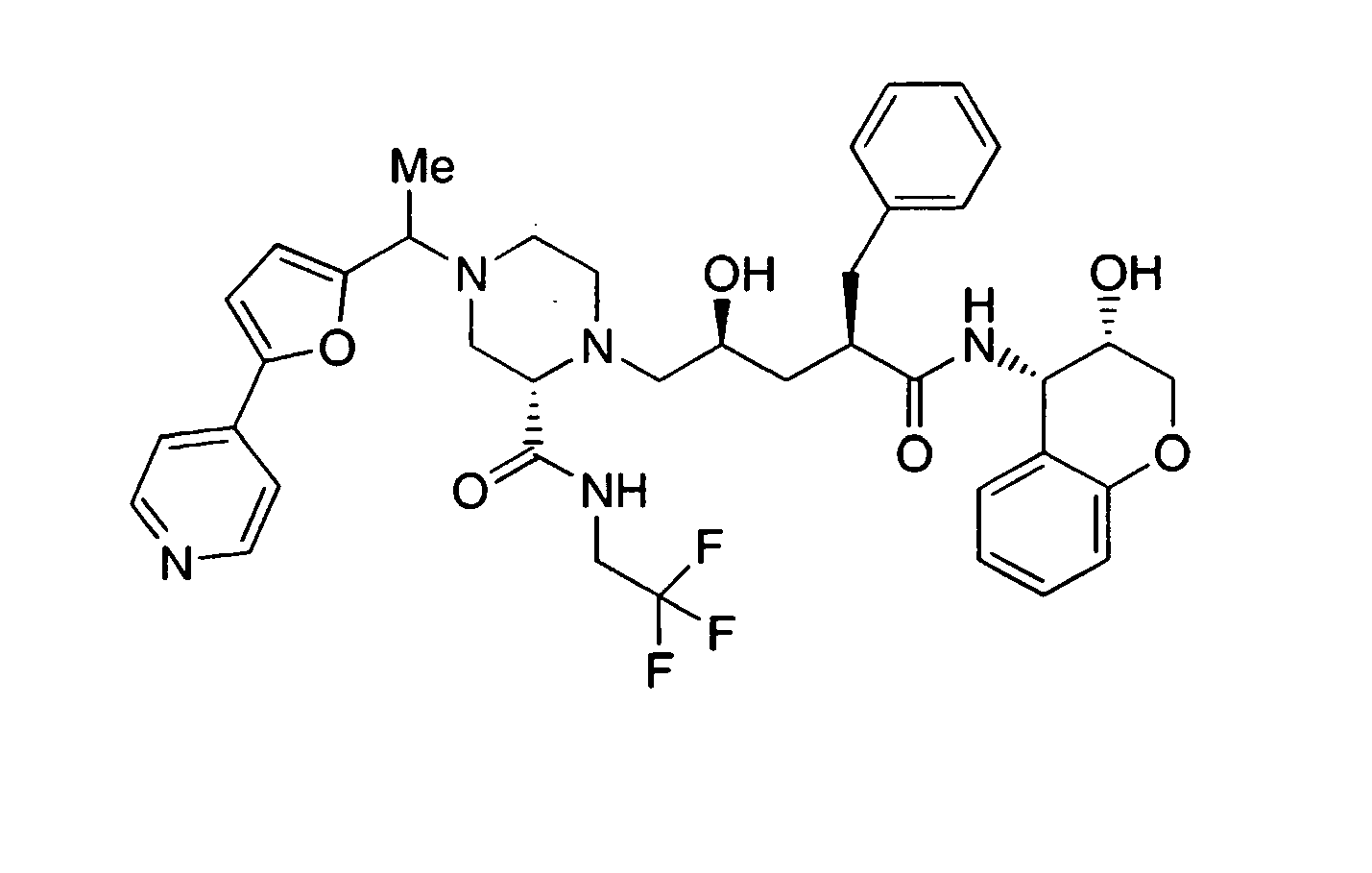
-

- To a solution of the intermediate prepared in Example 35, Step C (740 mg, 1.56 mmol) in THF (5 mL) was added thiosalicilic acid (360 mg, 2.33 mmol). In a separate flask was prepared a solution of dipalladium(0)tris(dibenzylidineacetone) (72.5 mg, 0.079 mmol) and 1,4-bis(diphenylphosphino)butane (67.4 mg, 0.158 mmol) in THF (5 mL). The palladium(0) solution was added to the reaction mixture via cannula. After 2 hours, the reaction was quenched by the addition of 1% aqueous HCl (100 mL). The mixture was diluted with diethyl ether (300 mL) was washed with 1% aqueous HCl (50 mL x3). The combine aqueous layers were brought to pH 8 with saturated aqueous NaHCO3, and extracted with ethyl acetate (100 mL). This organic layer was washed with brine, dried (MgSO4) and concentrated in vacuo. Purification by flash chromatography (7% methanol in ethyl acetate) afforded the free piperazine as a white solid. To a solution of this intermediate (313 mg, 0.770 mmol) in ethanol (5 mL) was added NaBH4 (582 mg, 15.4 mmol). The mixture was heated to 83 °C and stirred for 2.5 hours, then cooled to ambient temperature and diluted with dichloromethane (50 mL). The organic layer was washed with saturated aqueous NaHCO3 (50 mL), dried (NaHCO3) and concentrated in vacuo. Purification by flash chromatography (10% methanol in dichloromethane) afforded the title compound as a 1:1 mixture of diastereomers. 1H NMR (CDCl3, 400 MHz) 8.60 (d, 2H), 7.73 (m, 1H), 7.48 (d, 2H), 6.83 (d, 1H), 6.30 (m, 1H), 3.90 (m, 4H), 3.49 (m, 1H) 3.00 (m, 2H), 2.90 (m, 1H), 2.80 (dd, 2H), 2.64 (m, 1H), 2.55 (m, 1H), 2.49 (m, 1H), 2.39 (m, 1H), 1.48 (d, 3H); HPLC-MS (ES) 383.3 (M+1) in two peaks, 1:1 ratio.
-

- The title compound was obtained following the procedure described in Example 1, Step Q, starting with the intermediate prepared in Example 36, Step A (163 mg, 0.425 mmol) and the epoxide intermediate prepared in Example 1, Step P (235 mg, 0.597 mmol). Purification by flash chromatography (100 : 10 : 0.5 dichloromethane : methanol : NH4OH) afforded 220 mg (67%) of a 1:1 mixture of diastereomers. HPLC-MS (ES) 776.6 (M+1) as 2 peaks, 1:1 ratio. This material was further purified by chromatotron, (0-3% methanol in ethyl acetate) affording material enriched in the faster eluting diastereomer (Diastereomer A) and then material enriched in the slower eluting diastereomer (Diastereomer B).
- The material enriched in Diastereomer A from Step B (32 mg, 41 µmol) was dissolved in 10 mL of a saturated solution of HCl (g) in methanol at 0 °C. The reaction was warmed to ambient temperature over 18 hours, then quenched with saturated aqueous NaHCO3 (15 mL). The mixture was extracted with dichloromethane, and the organic layer was dried (Na2SO4) and concentrated in vacuo. Purification by chromatotron (50% acetone in hexane) afforded the title compound as a white solid. (Diastereomer A, >95% diastereomerically pure) 1H NMR (CDCl3, 500 MHz) 9.09 (s, 1H), 8.61 (d, J = 4.5 Hz, 2H), 7.49 (d, J = 6.0 Hz, 2H), 7.28 (m, 3H), 7.23 (m, 2H), 7.08 (m, 2H), 6.87 (d, J = 3.4 Hz, 1H), 6.78 (m, 2H), 6.35 (d, J = 3.6 Hz, 1H), 6.03 (d, J = 8.0 Hz, 1H), 5.18 (m, 1H), 4.05 (m, 3H), 3.91 (d, J = 6.9 Hz, 1H), 3,80 (m, 3H), 3.35 (s, 1H), 3.02 (d, 1H), 2.89 (m, 4H), 2.73 (m, 5H), 2.55 (m, 2H), 2.45 (dd, J = 3.0 Hz, J = 13.0 Hz, 1H), 1.89 (t, 1H), 1.55 (t, 1H), 1.51 (d, J = 6.9 Hz, 3H); HPLC-MS (ES) 736.6 (M+1). Chiral HPLC (Chiralpak AD column, 20% 2-propanol in hexane) indicated > 95% diastereomerically pure (tr = 14.80 min)
- The title compound was obtained using the procedure described in Step C using the material enriched in Diastereomer B from Step B (23 mg, 30 µmol). Purification by chromatotron (150 : 10 : 1 dichloromethane : methanol : NH4OH) afforded 10 mg (46%) of a mixture of diastereomers with no appreciable diastereomeric enrichment over the starting material. A saturated solution of this material in 2-propanol was prepared, and 1 mL of this solution was injected on a chiral preparative HPLC (Chiralpak AD, 20% 2-propanol in hexane). The fractions enriched in diastereomer B were collected and concentrated in vacuo, affording of a white solid. Chiral HPLC (Chiralpak AD, 20% 2-propanol in hexane) indicated an 82 : 18 mixture of Diastereomer B (tr = 16.16 min) and Diastereomer A (tr = 14.80 min). 1H NMR of major diastereomer (CDCl3, 500 MHz) 9.12 (s, 1H), 8.63 (d, J = 5.5 Hz, 2H), 7.50 (d, J = 4.6 Hz, 2H), 7.31 (m, 4H), 7.09 (d, J = 7.6 Hz, 1H), 7.06 (d, J = 7.5 Hz, 1H), 6.87 (d, J = 3.4 Hz, 1H), 6.79 (t, J = 7.8 Hz, 2H), 6.36 (d, J = 3.4 Hz, 1H), 6.00 (d, J = 8.0 Hz, 1H), 5.16 (dd, J = 3.9 Hz, J = 7.7 Hz, 1H), 4.06 (d, J = 11.5 Hz, 1H), 3.96 (m, 4H), 3.80 (s, 2H), 3.34 (s, 1H), 2.96 (m, 4H), 2.78 (m, 4H), 2.68 (m, 4H), 2.45 (d, J = 13.0 Hz, 2H), 2.19 (s, 1H), 1.90 (t, 1H), 1.55 (t, 1H), 1.49 (d, J = 6.2 Hz, 3H); HPLC-MS (ES) 736.5 (M+1).
-

-

- To a solution of the piperazine intermediate prepared in Example 12, Step A (15.3 g, 38.7 mmol) in dichloromethane (50 mL) was added trifluoroacetic acid (25 mL). After 70 min the reaction was concentrated in vacuo to a colorless oil. This material was dissolved in THF (200 mL) and cooled to 0 °C. To this solution was added CuCl (380 mg, 3.87 mmol), followed by 3-Chloro-3-methyl-1-butyne (5.22 mL, 46.5 mmol), copper powder (250 mg, 3.87 mmol), and triethylamine (12 mL, 85.2 mmol). After warming to ambient temperature and stirring 16 hours, the reaction was filtered through celite. The liquor was diluted with ethyl acetate (500 mL) washed with saturated aqueous NaHCO3 (500 mL), and brine (500 mL), dried (MgSO4) and concentrated in vacuo. Purification by flash chromatography (10% methanol in dichloromethane) afforded the title compound as a colorless oil. 1H NMR (CDCl3, 400 MHz) 7.50 (s, 1H), 5.91 (m, 1H), 5.33 (d, 1H), 5.20 (d, 1H), 4.80 (s, 1H, 4.60 (m, 2H), 3.93 (m, 3H), 3.52 (d, 1H), 3.14 (s, 1H), 2.96 (s, 1H), 2.43 (d, 1H), 2.28 (m, 2H), 1.42 (s, 3H), 1.38 (s, 3H); HPLC-MS (ES) 362.3 (M+1).
-

- To a solution of the intermediate prepared in Step A (10.9g, 30.1 mmol) in THF (150 mL) was added thiosalicilic acid (6.97 g, 45.2 mmol). In a separate flask was prepared a solution of dipalladium(0)tris(dibenzylidineacetone) (1.38 g, 1.51 mmol) and 1,4-bis(diphenylphosphino)butane (1.73 g, 3.01 mmol) in THF (150 mL). The palladium(0) solution was added to the reaction mixture via cannula. After 2 hours the reaction was quenched by the addition of 1% aqueous HCl (300 mL). The mixture was diluted with diethyl ether (600 mL) was washed with 1% aqueous HCl (100 mL x3). The combine aqueous layers were brought to pH 8 with saturated aqueous NaHCO3, and extracted with ethyl acetate (500 mL). This organic layer was washed with brine, dried (MgSO4) and concentrated in vacuo, affording a colorless oil. This material was dissolved in dichloromethane (250 mL) and cooled to 0 °C. To this solution was added triethylamine (4.49 mL, 32.2 mmol) and benzoylchloride (4.60 mL, 32.2 mmol). The solution was warmed to ambient temperature and stirred for 18 hours, then quenched by the addition of saturated aqueous NaHCO3 (200 mL). The organic layer was extracted and dried (Na2SO4) and concentrated in vacuo. Purification by flash chromatography (5% methanol in ethyl acetate) afforded the title compound as a colorless oil. 1H NMR (CDCl3, 400 MHz) 7.27 (m, 5H), 5.18 (dd, 2H), 4.80 (s, 1H), 3.90 (m, 2H), 3.55 (d, 1H), 3.17 (s, 1H), 2.92 (s, 1H), 2.40 (dd, 1H), 2.24 (m, 2H), 1.41 (s, 3H), 1.39 (s, 3H); HPLC-MS (ES) 412.3 (M+1).
-

- To a suspension of N-phenylglycine (10.0 g, 66.2 mmol) in acetic acid (70 mL) was added water (70 mL). The suspension was cooled to 0 °C, and NaNO2 (5.02 g, 72.8 mmol) was added slowly. After 90 min the reaction was extracted with benzene (200 mL x2). The organic layers were dried (MgSO4) and to the resulting solution was added acetic anhydride (18.7 mL, 198 mmol). The reaction was heated to reflux for 18 hours, then cooled to ambient temperature and washed with saturated aqueous NaHCO3 (300 mL), and brine. The organic layer was dried (MgSO4) and concentrated in vacuo. Purification by flash chromatography (65% ethyl acetate in hexane) afforded of the title compound as a yellow solid. 1H NMR (CDCl3, 400 MHz) 7.74 (d, 2H), 7.68 (m, 3H), 6.70 (s, 1H).
-

- To a solution of the intermediate from Step B (6.95 g, 16.9 mmol) in m-dichlorobenzene (13 mL) was added the intermediate from Step C (2.74 g, 16.9 mmol). The resulting suspension was heated to 180 °C for 22 hours. The solvent was removed in vacuo. Purification by flash chromatography (30% ethyl acetate in hexane) afforded the title compound. 1H NMR (CDCl3, 400 MHz) 8.17 (s, 1H), 7.78 (d, 2H), 7.52 (t, 2H), 7.30 (m, 5H), 6.40 (d, 1H), 5.17 (m, 2H), 4.70 (d, 1h), 3.94 (m, 4H), 3.60 (m, 1H), 3.37 (m, 3H), 3.00 (m, 2H), 2.44 (dt, 1H), 2.22 (m, 1H), 1.51 (s, 6H).
-

- To a solution of the intermediate from Step D (5.66 g, 10.7 mmol) in methanol (50 mL) was added triethylamine (2.24 mL, 16.1 mmol), and 10% Pd(0) on carbon (1.13 g). The reaction mixture was placed under 1 atm of H2 gas for 3 hours, then the reaction was filtered through celite. The solution was concentrated in vacuo, and the resulting oil was dissolved in DMF (8 mL). To this solution was added di-iso-propylethylamine (2.05 mL, 11.8 mL), followed by the intermediate from Example 23 Step C (3.39 g, 10.7 mmol). The solution was heated to 90 °C for 17 hours, then cooled to ambient temperature, diluted with ethyl acetate (300 mL) and washed with 0.5 N aqueous NaHCO3 (200 mL x3). The organic layer was then washed with brine (200 mL), dried (MgSO4) and concentrated in vacuo. Purification by flash chromatography (7% methanol in ethyl acetate) afforded the title compound. 1H NMR (CD3OD, 400 MHz) 8.48 (s, 1H), 8.43 (d, 1H), 8.16 (d, 1H), 8.04 (s, 1H), 7.78 (m, 2H), 7.52 (t, 2H), 7.41 (t, 1H), 7.36 (t, 1H), 6.50 (d, 1H), 4.67 (m, 1H), 4.00 (m, 1H), 3.76 (m, 1H), 3.27 (m, 1H), 3.18 (m, 2H), 3.04 (m, 2H), 2.80 (m, 1H), 2.58 (m, 4H), 2.17 (m, 2H), 1.53 (s, 6H); HPLC-MS (ES) 585.4 (M+1).
-

- The title compound was obtained following the procedure described in Example 23, Step E, using the lactone intermediate prepared in Step E (1.94 g, 3.32 mmol), and the aminochromanol intermediate prepared in Example 1, Step L (0.80 g, 3.92 mmol). Purification by flash chromatography (15% ethyl acetate in hexane) afforded the title compound as a white solid. HPLC-MS (ES) 864.5 (M+1).
- To a solution of the intermediate prepared in Step F (1.70 g, 1.97 mmol) in THF (50 mL) was added tetrabutylammonium fluoride (19.7 mL of a 1.0 M solution in THF, 19.7 mmol). After 9 hours at ambient temperature the reaction was diluted with dichloromethane (300 mL) and washed with saturated aqueous NaHCO3 (200 mL). The organic layer was dried (Na2SO4) and concentrated in vacuo. Purification by flash chromatography (10% methanol in dichloromethane) afforded the title compound as a white solid. 1H NMR (CD3OD, 400 MHz) 8.38 (d, J = 2.0 Hz, 1H), 8.34 (dd, J = 1.6 Hz, J = 5.2 Hz, 1H), 8.10 (d, J = 2.4 Hz, 1H) 7.72 (dd. J = 1.2 Hz, J = 7.6 Hz, 3H), 7.44 (t, J = 8.0 Hz, 2H), 7.29 (m, 2H), 7.09 (m, 2H), 6.80 (dt, J = 1.2 Hz, J = 7.6 Hz, 1H), 6.72 (dd, J = 0.8 Hz, J = 8.4 Hz, 1H), 6.44 (d, J = 2.4 Hz, 1H), 5.16 (d, J = 4.0 Hz, 1H), 4.01 (m, 3H), 3.73 (m, 3H), 3.00 (m, 4H), 2.70 (m, 5H), 2.55 (t, J = 8.0 Hz, 1H), 2.39 (m, 3H), 2.06 (t, J = 11.6 Hz, 1H), 1.51 (s, 3H), 1.50 (s, 3H), 1.39 (dt, J = 2.8 Hz, J = 9.2 Hz, 1H); HPLC-MS (ES) 750.4 (M+1).
-

-

- To a solution of bezaldehyde oxime (6.06 g, 50.0 mmol) in DMF (42 mL) at 0 °C was added N-chlorosuccinimide (6.68 g, 50.0 mmol) over 1 hour. The reaction was warmed to ambient temperature over 1 hour, then quenched by the addition of water (200 mL). The mixture was extracted with diethyl ether (200 mL x2), and the organic layers were washed with saturated aqueous NaHC03 (100 mL), brine (100 mL), and concentrated in vacuo, affording 6.4 g (82%) of the hydroxamic acid chloride as a white solid. This material (6.24 g, 40.2 mmol) was added to a solution containing the intermediate from Example 37, Step B (6,68 g, 16.25 mmol) and triethylamine (6.73 mL, 48.3 mmol) in THF (80 mL) over 3 hours. After 5 hours at ambient temperature the reaction was diluted with diethyl ether (300 mL) and washed with saturated aqueous NaHCO3 (200 mL), brine (200 mL), dried (MgSO4), and concentrated in vacuo. Purification by flash chromatography (35% ethyl acetate in hexane) afforded the title compound. 1H NMR (CDCl3, 400 MHz) 7.79 (d, 1H), 7.42 (m, 3H), 7.32 (m, 5H), 6.37 (s, 1H), 5.16 (s, 2H), 4.76 (m, 1H), 4.00 (m, 1H), 3.95 (m, 1H), 3.50 (m, 1H), 3.10 (m, 1H), 2.92 (m, 1H), 2.32 (dd, 1H), 2.20 (m, 1H), 1.51 (s, 3H), 1.49 (s, 3H); HPLC-MS (ES) 531.4 (M+1).
-

- The title compound was obtained using the procedure described in Example 37, Step E, using the intermediate prepared in Step A (6.82 g, 12.9 mmol), and the lactone intermediate prepared in Example 23, Step C (710 mg, 2.46 mmol). Purification by flash chromatography (5% methanol in ethyl acetate) afforded the title compound as a colorless oil. HPLC-MS (ES) 586.4 (M+1).
-

- The title compound was obtained following the procedure described in Example 23, Step E, using the lactone intermediate prepared in Step B (560 mg, 0.96 mmol), and the aminochromanol intermediate prepared in Example 1, Step L (0.170 g, 1.13 mmol). Purification by flash chromatography (ethyl acetate) afforded the title compound as a white solid. HPLC-MS (ES) 865.5 (M+1).
- The title compound was prepared as described in Example 37, Step G, using the intermediate prepared in Step C (310 mg, 0.36 mmol). Purification by flash chromatography (6% methanol in dichloromethane) afforded the title compound as a white solid. 1H NMR (CD3OD, 400 MHz) 8.38 (d, J = 1.6 Hz, 1H), 8.34 (dd, J = 1.6 Hz, J = 4.8 Hz, 1H), 7.82 (m, 2H), 7.72 (d, J = 8.0 Hz, 1H), 7.47 (m, 3H), 7.32 (dd, J = 4.8 Hz, J = 7.6 Hz, 1H), 7.10 (m, 2H), 6.82 (t, J = 6.4 Hz, 1H), 6.75 (m, 3H), 5.16 (d, J = 3.6 Hz, 1H), 4.03 (m, 3H), 3.76 (m, 3H), 3.01 (m, 4H), 2.80 (m, 3H), 2.64 (dd, J = 6.8 Hz, J = 10.4 Hz, 1H), 2.51 (t, J = 8.4 Hz, 1H), 2.41 (m, 3H), 2.05 (t, J = 11.2 Hz, 1H), 1.55 (s, 6H), 1.39 (m, 2H); HPLC-MS (ES) 751.5 (M+1).
-

-

- To a solution of the intermediate prepared in Example 12, Step D (1.01 g, 1.78 mmol) in THF (20 mL) at 0 °C was added triethylamine (0.546 mL, 3.92 mmol), followed by CuCl (17.6 mg, 1.78 mmol), 3-chloro-3-methylbutene (0.200 mL, 1.78 mmol), and copper powder (11.3 mg, 1.78 mmol). The mixture was warmed to ambient temperature and stirred 18 hours, then quenched by the addition of saturated aqueous NaHCO3 (100 mL) and extracted with dichloromethane (100 mL x2). The organic layers were dried (Na2SO4) and concentrated in vacuo, yielding the title compound as a yellow solid. 1H NMR (CDCl3, 400 MHz) 9.14 (m, 1H), 7.25 (m, 5H), 7.18 (t, 1H), 7.12 (d, 1H), 6.83 (t, 1H), 6.81 (d, 1H), 6.05 (d, 1H), 5.20 (dd, 1H), 4.06 (m, 3H), 3.90 (m, 1H), 3.60 (d, 1H), 3.40 (s, 1H), 3.21 (d, 1H), 2.94 (m, 2H), 2.80 (m, 2H), 2.65 (m, 3H), 2.47 (m, 3H), 2.23 (s, 1H), 1.93 (t, 1H), 1.60 (t, 1H), 1.40 (s, 6H).
- To a solution of the intermediate prepared in Step A (500 mg, 0.794 mmol) in THF (1 mL) was added triethylamine (1.10 mL, 7.94 mmol). The solution was heated to 50 °C, and a solution of the hydroxamic acid chloride prepared in Example 38, Step A (1.00 g, 6.43 mmol) in 2.2 mL THF was added via syringe pump over 5 hours. After 36 hours at 50 °C the reaction was cooled to ambient temperature and diluted with ethyl acetate (100 mL). The organic layer was washed with 0.5 N NaHCO3 (100 mL), brine (100 mL), dried (MgSO4) and concentrated in vacuo. Purification by flash chromatography (4% methanol in dichloromethane) afforded the title compound as a white solid. 1H NMR (CDCl3, 500 MHz) 9.16 (s, 1H), 7.80 (d, J = 3.4 Hz, 1H), 7.47 (s, 2H), 7.28 (d, J = 7.1 Hz, 2H), 7.22 (s, 2H), 7.08 (t, J = 7.3 Hz, 2H), 6.79 (t, J = 7.6 Hz, 2H), 6.43 (s, 1H0, 6.15 (d, J = 8.0 Hz, 1H), 5.15 (m, 1H), 4.20 (m, 1H), 4.03 (m, 2H), 3.79 (m, 3H), 3.56 (s, 1H), 3.50 (q, J = 6.8 Hz, 1H), 3.33 (s, 1H), 2.92 (m, 4H), 2.80 (d, 11.6 Hz, 1H), 2.71 (m, 4H), 2.45 (s, 2H), 2.32 (s, 1H), 1.90 (t, J = 12.1 Hz, 2H), 1.57 (s, 3H), 1.55 (s, 3H), 1.22 (t, J = 6.7 Hz, 1H); HPLC-MS (ES) 750.5 (M+1).
-

-

- To a solution of the intermediate obtained in Example 23, Step F (57.7 mg, 0.102 mmol) in DMF (2 mL) at 0 °C was added di-iso-propylethyamine (44.5 µL, 0.255 mmol), followed by propargyl bromide (12.5 ul of an 80% solution in toluene, 0.112 mmol). The reaction was warmed to ambient temperature and stirred for 18 hours. The reaction was then quenched by the addition of 0.5 N aqueous NaHCO3 (30 mL) and extracted with ethyl acetate (50 mL). The organic layer was washed with brine (20 mL), dried (MgSO4) and concentrated in vacuo, affording the title compound as a beige solid. 1H NMR (CDCl3, 400 Mhz) 8.76 (t, 1H), 8.40 (d, 1H), 8.37 (s, 1H), 7.56 (d, 1H), 7.20 (m, 1H), 7.13 (dd, 1H), 6.80 (m, 2H), 6.60 (d, 1H), 5.20 (dd, 1H), 4.10 (m, 3H), 3.80 (m, 3H), 3.37 (m, 3H), 3.04 (m, 1H), 2.91 (m, 1H), 2.80 (m, 1H), 2.72 (m, 2H), 2.54 (m, 1H), 2.47 (dd, 1H), 1.87 (d, 1H), 154 (t, 1H);
-

- To a solution of 2-chlorophenol (0.500 mL, 4.83 mmol) in THF (10 mL) at 0 °C was added sodium hexamethyldisilylazide (5.30 mL of a 1.0 M solution in THF. 5.30 mmol). After 30 min at 0 °C, 2-(trimethylsilyloxy)ethoxymethyl chloride (0.940 mL, 5.30 mmol) was added, and the solution was warmed to ambient temperature and stirred an additional 2 hours. The reaction was diluted with diethyl ether (100 mL) and washed with saturated aqueous NaHCO3 (100 mL), and brine (100 mL), dried (MgSO4), and concentrated in vacuo. Purification by flash chromatography (1% ethyl acetate in hexane) afforded the title compound. 1H NMR (CDCl3, 300 MHz) 7.36 (d, 1H), 7.21 (d, 2H), 6.96 (m, 1H), 5.30 (s, 2H), 3.80 (dd, 2H), 0.97 (dd, 1H), 0.00 (s, 9H).
-

- To a solution of the intermediate prepared in Step B (304 mg, 1.17 mmol) in THF (6 mL) at -78 °C was added t-butyllithium (0.760 mL of a 1.7 M solution in hexanes, 1.29 mmol). The solution was warmed to 0 °C for 45 min, then recooled to -78 °C. A solution of I2 (327 mg, 1.29 mmol) in THF (3 mL) was added dropwise, and the reaction was slowly warmed to ambient temperature for 30 min. The reaction was quenched by the addition of saturated aqueous NaHCO3 (30 mL) and diluted with diethyl ether (100 mL). The organic layer was washed with 1 N aqueous Na2S2O3 (50 mL) and brine (50 mL), dried (MgSO4), and concentrated in vacuo. Purification by flash chromatography (1% ethyl acetate in hexane) afforded the title compound. 1H NMR (CDCl3, 300 MHz) 7.68 (d, 1H), 7.35 (d, 1H), 6.77 (t, 1H), 5.19 (s, 2H), 4.02 (dd, 2H), 1.04 (dd, 1H), 0.02 (s, 9H).
-

- To a solution of the intermediate prepared in Step C (2.60 g, 6.76 mmol) in THF (20 mL) was added tetrabutylammonium fluoride (13.5 mL of a 1.0 M solution in THF, 13.5 mmol). The reaction was heated to reflux for 2 hours, then cooled to ambient temperature and poured onto ethyl acetate (100 mL). The resulting suspension was filtered through celite. The liquid was then washed with water (100 mL x2) and brine, dried (MgSO4), and concentrated in vacuo. Purification by flash chromatography (2% ethyl acetate in hexane) afforded the title compound. 1H NMR (CDCl3, 300 MHz) 7.62 (dd, 1H), 7.32 (dd, 1H), 6.63 (d, 1H), 5.93 (s, 1H).
- To a solution of the intermediate prepared in Step A (37.4 mg, 0.0620 mmol) in pyridine (1 mL) was added the intermediate prepared in Step D (18.3 mg, 0.0744 mmol), followed by Cu2O (13.3 mg, 0.093 mmol). The mixture was heated to reflux for 1.5 hours, then cooled to ambient temperature and diluted with dichloromethane (30 mL). The organic layer was washed with saturated aqueous NaHCO3 (30 mL), dried (Na2SO4), and concentrated in vacuo. Purification by flash chromatography (10% methanol in ethyl acetate) afforded the title compound as a white solid. 1H NMR (CDCl3, 400 MHz) 9.16 (s, 1H), 8.46 (s, 1H), 7.57 (d, 1H), 7.46 (d, J = 7.6 Hz, 1H), 7.20 (m, 6H), 6.81 (d, J = 6.8 Hz, 1H), 6.70 (s, 1H), 6.42 (d, J = 8.0 Hz, 1H), 5.23 (d, 1H), 4.24 (m, 1H), 4.12 (d, J = 10.8 Hz, 1H), 4.02 (m, 1H), 3.84 (m, 4H), 3.36 (s, 1H), 3.02 (m, 2H), 2.89 (m, 1H), 2.74 (m, 2H), 2.60 (d, J = 11.2 Hz, 1H), 2.47 (d, J = 12.0 Hz, 1H), 1.89 (t, J = 12.4 Hz, 1H) 1.54 (t, 1H); HPLC-MS (ES) 730.4 (M+1).
-
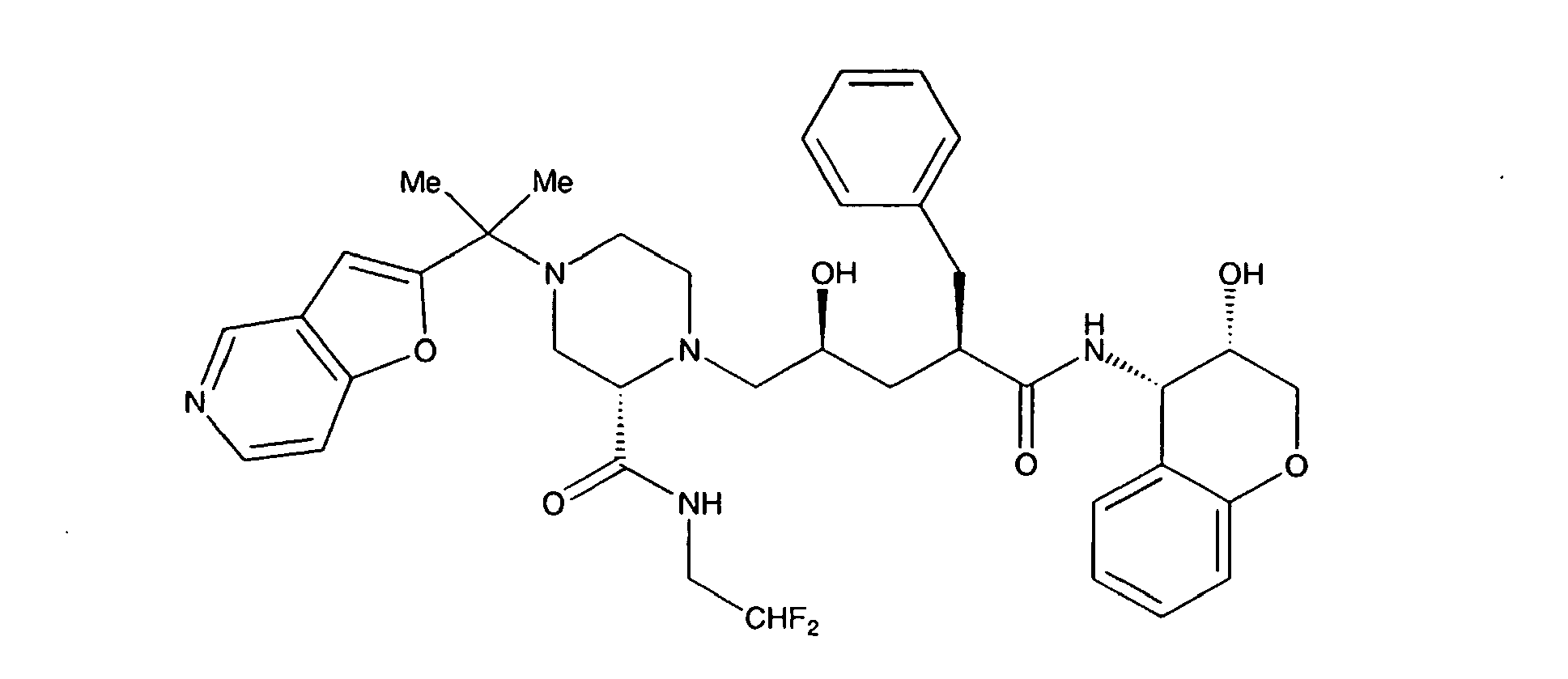
-

- The title compound was obtained following the procedure described in Example 1, Step G, starting with the intermediate prepared in Example 1, Step F (200 mg, 0.278 mmol) and 2,2-difluoroethyllamine (33.8 mg, 4.20 mmol). Purification by flash chromatography (70% ethyl acetate in dichloromethane) afforded the title compound as a colorless oil. 1H NMR (CDCl3, 400 MHz) 8.68 (s, 1H), 8.47 (d, 1H), 7.49 (d, 1H), 6.62 (s, 1H), 6.06 (t, 1H), 5.92 (t, 1H), 5.79 (t, 1H), 4.64 (s, 1H), 4.01 (s, 1H), 3.71 (m, 2H), 3.52 (d, 1H), 3.03 (m, 1H), 2.92 (d, 1H), 2.29 (dd, 1H), 2.20 (t, 1H), 1.93 (s, 1H), 1.54 (s, 3H), 1.45 (s, 3H).
- The title compound was obtained following the procedure described in Example 2, Step B, starting with the intermediate prepared in Step A (127 mg, 0.278 mmol), affording the title compound as a colorless oil. This was used without further purification.
- The title compound was obtained following the procedure described in Example 1, Steps Q, starting with the intermediate prepared in Step B (75.0 mg, 0.213 mmol) and the intermediate prepared in Example 1, Step P (50.0 mg, 0.133 mmol). Purification by flash chromatography (5% methanol in ethyl acetate) afforded 58.8 mg (62%) of the alcohol intermediate. This material was treated with acid as described in Example 1, Step R. Purification by preparative TLC (5% methanol in ethyl acetate) afforded the title compound as a white solid. 1H NMR (CDCl3, 400 MHz) 9.16 (t, J = 5.2 Hz, 1H), 8.88 (s, 1H), 8.50 (d, J = 5.6 Hz, 1H), 7.40 (d, J = 6.0 Hz, 1H), 7.29 (m, 2H), 7.23 (m, 3H), 7.10 (t, J = 7.2 Hz, 1H), 7.06 (d, J = 7.6 Hz, 1H), 6.79 (m, 2H), 6.65 (s, 1H), 6.10 (t, 1H), 6.06 (d, J = 8.0 Hz, 1H), 5.96 (t, J = 3.6 Hz, 1H), 5.82 (t, 1H), 5.15 (dd, J = 4.0 Hz, J = 8.0 Hz, 1H), 4.06 (d, J = 10.4 Hz, 1H), 4.00 (dd, J = 5.2 Hz, J = 11.6 Hz, 1H), 3.93 (m, 1H), 3.80 (m, 1H), 3.75 (m, 1H), 3.56 (m, 2H), 3.33 (s, 1H), 3.06 (d, J = 11.6 Hz, 1H), 2.85 (m, 4H), 2.68 (m, 3H), 2.43 (dt, J = 4.4 Hz, J = 10.8 Hz, 2H), 1.90 (t, J = 10.8 Hz, 1H), 1.58 (m, 1H), 1.56 (s, 6H); HPLC-MS (ES) 706.3 (M+1).
-

-

- To stirred anhydrous diethyl ether (20 mL) cooled to -78 °C under N2 was added nBuLi (2.1 mL, 5.46 mmol). Thiazole (425.0 mg; 4.99 mmol) in diethyl ether (12 mL) was then added dropwise. After 1 hour at -78 °C was added Me3SnCl (1.1 g, 5.5 mmol) in diethyl ether (7.5 mL) over a 10 minute period. The reaction was stirred at -78 °C for one hour before being allowed to reach ambient temperature. Filtration through celite followed by evaporation of the solvent in vacuo provided the desired stannane contaminated with approximately 15% of starting thiazole. 1H NMR (400 MHz, CDCl3) δ 0.5 (s, 9H), 7.58 (d, J=3.6 Hz, 1H), 8.18 (d, J=3.6 Hz, 1H).
-

- A mixture of bromide obtained from Example 59 Step D (200 mg; 1.08 mmol), AgO (250 mg; 1.08 mmol), and Pd(PPh3)4 (62 mg; 0.054 mmol) in dry DMF (4.3 mL) was stirred at 100 °C for 5 minutes after which time a solution of stannane obtained from Step A above (295 mg; 1.19 mmol) in dry DMF (2.0 mL) was added dropwise. After 18 hours, the mixture was filtered through celite; poured into EtOAc (100 mL); washed with H2O, saturated NaHCO3 solution, and brine; dried (Na2SO4), filtered, and concentrated in vacuo. Purification by flash column chromatography (25% EtOAc/hexane) provided the desired aldehyde as a pale yellow solid. 1H NMR (400 MHz, CDCl3): δ 7.51 (d, J=3.3 Hz, 1H), 8.00 (d, J=3.3 Hz, 1H), 8.69 (apparent t, J=2.2 Hz, 1H), 9.13 (d, J=2.0 Hz, 1H), 9.45 (d, J=2.2 Hz, 1H), 10.22 (s, 1H).
- From a solution of the aldehyde obtained from Step B above (19 mg; 0.10 mmol), penultimate intermediate from Example 12 Step D (50 mg; 0.070 mmol), and NaHB(OAc)3 (21 mg; 0.10 mmol) in anhydrous DMF (1.0 mL), using the procedure from Example 46 Step F, the titled compound was obtained as a white solid after purification by flash column chromatography (5% MeOH/CH2Cl2). 1H-NMR (400 MHz, CD3OD): δ 1.43 (m, 1H), 2.06 (m, 1H), 2.38-2.54 (complex m, 4H), 2.59-2.68 (complex m, 2H), 2.70-2.79 (complex m, 2H), 2.93-2.99 (m, 1H), 3.01-3.09 (complex m, 2H), 3.15 (dd, J=3.3, 7.1 Hz, 1H), 3.66 (s, 2H), 3.74-3.95 (complex m, 4H), 4.04-4.11 (complex m, 2H), 5.16 (d, J=4.1 Hz, 1H), 6.73 (dd, J=0.9, 8.2 Hz, 1H), 6.81 (apparent td, J=1.0, 7.5 Hz, 1H), 7.06-7.28 (complex m, 7H), 7.72 (d, J=3.3 Hz, 1H), 7.95 (d, J=3.2 Hz, 1H), 8.33 (apparent t, J=2.1 Hz, 1H), 8.56 (d, J=1.9 Hz, 1H), 9.03 (d, J=2.2 Hz, 1H); electrospray ionization mass spectrum: m/e 739.5 (MH+ calcd for C37H41F3N5O6S, 739.3).
-

-

- To a stirred solution of the aldehyde obtained from Example 59, Step D (225.0 mg; 1.20 mmol) in benzene (12 mL) was added aminoacetaldehyde dimethyl acetal (0. 171 mL; 1.57 mmol). The reaction vessel was equipped with a Dean-Stark apparatus and heated to reflux for 1.5 hours. The reaction mixture was poured in EtOAc and washed with water and brine. Drying (MgSO4), filtration and removal of the solvent in vacuo provided the desired acetal. 1H NMR (400 MHz, CDCl3) δ 3.44 (s, 611). 3.8 2 (d, J=7.2 Hz, 2H), 4.69 (dd, J1=J2=7.2 Hz, 1H), 8.38 (s, 1H), 8.43 (m, 1H), 8.72 (d, J=3.2 Hz, 1H), 8.75 (d, J=2.4 Hz, 1H).
-

- To the acetal obtained in Step A (361.0 mg; 1.32 mmol) was added with cooling to 0 °C concentrated H2SO4 (7 mL). Next, P2O5 (487.0 mg; 1.72 mmol) was added as a solid and the whole was heated to 100 °C for 30 minutes. The reaction mixture was allowed to reach ambient temperature and stirred overnight. The next day, the contents of the reaction were poured onto ice and concentrated NH4OH was added with cooling to 0 °C until the reaction mixture was approximately pH=8. The aqueous layer was extracted several times with CHCl3. The organic layer was then washed with brine. Drying (MgSO4), filtration and removal of the solvent in vacuo provided quantitative yield of the desired oxazole. 1H NMR (400 MHz, CDCl3) δ 7.32 (s,1H), 7.81 (d, J=0.8 Hz, 1H), 8.49 (apparent t, J=2.0, 1H), 8.76 (d, J=2.2 Hz, 1H), 9.21 (d, J=2.0 Hz, 1H).
-

- A nitrogen filled flask was charged with the oxazole obtained in Step B (98.0 mg; 0.44 mmol), NaOOCH (45.0 mg, 0.66 mmol) and Cl2Pd(PPh3)2 (15.0 mg, 0.22 mmol). The atmosphere was replace with CO. DMF (4mL) was then added. Carbon monoxide was then bubbled through the reaction mixture while the reaction was heated to 100 °C for approximately 2 hours. The reaction mixture was poured in EtOAc and washed with water and brine. After drying (MgSO4), filtration and removal of the solvent in vacuo, purification employing Biotage flash chromatography (75% EtOAc/hex) provided the desired aldehyde. 1H NMR (400 MHz, CDCl3) δ 7.25 (d, J=3.7 Hz, 1H), 7.29 (m, 1H), 7.35 (d, J=3.6 Hz, 1H), 7.80 (m, 1H), 7.93 (m, 1H), 8.65 (m, 1H), 9.72 (s, 1H).
- From the aldehyde as obtained in Step C above (20.0 mg; 0.09 mmol), penultimate intermediate as obtained in Example 12, Step D (50.0 mg; .012 mmol) and NaBH(OAc)3 (24.0 mg; 0.12 mmol) in anhydrous DMF (0.9 mL) following the general reductive amination procedure as described for Example 53, Step E was obtained the desired compound after Biotage flash chromatography (5% MeOH/DCM). 1H NMR (400 MHz, CD3OD) δ 1.41 (m, 1H), 2.06 (m, 1H), 2.36-2.54 (complex m, 5H), 2.56-2.67 (m, 2H), 2.68-2.80 (complex m, 2H), 2.91-3.09 (complex m, 4H), 3.14 (dd, J=3.3, 7.2 Hz, 1H), 3.66 (s, 2H), 3.73-3.98 (complex m, 6H), 4.01-4.12 (complex m, 2H), 5.15 (d, J=3.9 Hz, 1H), 6.72 (dd, J=1.0, 8.2 Hz, 1H), 6.81 (apparent td, J=1.1, 7.5 Hz, 1H), 7.05-7.14 (complex m, 2H), 7.18-7.30 (complex m, 5H), 7.37(d, J=0.7 Hz, 1H), 8.06 (d, J=0.7 Hz, 1H), 8.39 (m, 1H), 8.60 (d, J=1.9 Hz, 1H), 9.09 (d, J=2.0 Hz, 1H); electrospray ionization mass spectrum: m/e 723.4 (MH+ calcd for C37H42F3N6O6, 723.3).
-

-

- A stirred solution of the intermediate obtained from Example 59 Step D (483 mg; 2.60 mmol), (Me3Sn)2 (0.550 mL; 2.86 mmol), and PPh3 (20 mg; 0.078 mmol) in dry toluene (10 mL) was degassed with nitrogen for 10 minutes after which Pd(PPh3)4 (150 mg; 0.13 mmol) was added and the solution heated to reflux. After 45 minutes, the reaction was poured into EtOAc (120 mL), washed successively with saturated NaHCO3 solution and brine, dried (Na2SO4), filtered, and concentrated. Purification by Biotage column chromatography (40S; 15% EtOAc/hexane) provided the desired compound. 1H NMR (400 MHz, CDCl3): δ 0.41 (s, 9H), 8.27 (apparent t, J=1.9 Hz, 1H), 8.86 (d, J=1.5 Hz, 1H), 8.99 (d, J=2.1 Hz, 1H), 10.11 (s, 1H).
-

- From a stirred solution of 4-bromothiazole (180 mg; 1.09 mmol), stannane intermediate from Step A above (147 mg; 0.545 mmol), and Pd(PPh3)4 (31 mg; 0.027 mmol) in DMF (5 mL), using the procedure from Example 49 Step A the desired compound was obtained after purification by Biotage column chromatography (35% EtOAc/hexane). 1H-NMR (400 MHz, CDCl3): δ 7.79 (d, J=1.9 Hz, 1H), 8.70 (apparent t, J=1.6 Hz, 1H), 8.98 (d, J=2.0 Hz, 1H), 9.07 (d, J=2.0 Hz, 1H), 9.44 (d, J=2.2 Hz, 1H), 10.22 (s, 1H).
- From a solution of the aldehyde obtained from Step B above (25 mg; 0.13 mmol), penultimate intermediate from Example 12 Step D (50 mg; 0.089 mmol), and NaHB(OAc)3 (28 mg; 0.13 mmol) in anhydrous DMF (1.0 mL), using the procedure from Example 46 Step F, the titled compound was obtained as a white solid after purification by flash column chromatography (5% MeOH/CH2Cl2). 1H-NMR (400 MHz, CD3OD): δ 1.42 (m, 1H), 2.06 (m, 1H), 2.38-2.53 (complex m, 4H), 2.60-2.79 (complex m, 4H), 2.93-2.99 (m, 1H), 3.01-3.08 (complex m, 2H), 3.10 (dd, J=3.3, 7.0 Hz, 1H), 3.65 (s, 2H), 3.73-3.95 (complex m, 4H), 4.04-4.08 (complex m, 2H), 5.16 (d, J=3.9 Hz, 1H), 6.73 (d, J=8.2 Hz, 1H), 6.81 (apparent t, J=7.4 Hz, 1H), 7.06-7.28 (complex m, 7H), 8.12 (d, J=1.9 Hz, 1H), 8.36 (apparent t, J=2.1 Hz, 1H), 8.46 (d, J=1.9 Hz, 1H), 9.04 (d, J=2.2 Hz, 1H), 9.11 (d, J=1.9 Hz, 1H); electrospray ionization mass spectrum: m/e 739.5 (MH+ calcd for C37H41F3N5O6S, 739.3).
-

-

- From a stirred solution of 2-bromothiazole (0.191 mL; 2.12 mmol), stannane intermediate from Example 46 Step B (321 mg; 1.06 mmol), and Pd(PPh3)4 (37 mg; 0.032 mmol) in DMF (10 mL), using the procedure from Example 46, Step B, the desired compound was obtained after purification by flash column chromatography (25% EtOAc/hexane). 1H-NMR (300 MHz, CDCl3): δ 4.02-4.19 (complex m, 4H), 6.01 (s, 1H), 6.57 (d, J=3.6 Hz, 1H), 6.97 (d, J=3.5 Hz, 1H), 7.31 (d, J=3.2 Hz, 1H), 7.83 (d, J=3.2 Hz, 1H).
-

- From a stirred solution of intermediate from Step A above (133 mg; 0.60 mmol) and HCl solution (2.4 mL; 2.4 mmol) in THF (6.5 mL), following the procedure described in Example 46 Step E, the desired aldehyde was obtained after workup and was used without further purification. 1H-NMR (300 MHz, CDCl3): δ 7.16 (d, J=3.9 Hz, 1H), 7.35 (d, J=3.7 Hz, 1H), 7.48 (d, J=3.2 Hz, 1H), 7.93 (d, J=3.1 Hz, 1H), 9.72 (s, 1H).
- From a solution of the aldehyde obtained from Step D above (247 mg; 1.27 mmol), penultimate intermediate from Example 12 Step D (481 mg; 0.85 mmol), and NaHB(OAc)3 (269 mg; 1.27 mmol) in anhydrous DMF (6 mL), using the procedure from Example 46 Step F was obtained after purification by Biotage column chromatography (40M; 5% MeOH/CH2Cl2) the titled compound as a white solid. 1H-NMR (400 MHz, CD3OD): δ 1.40 (m, 1H), 2.05 (m, 1H), 2.34-2.56 (complex m, 4H), 2.61 (m, 1H), 2.69-2.81 (complex m, 3H), 2.92-3.06 (complex m, 3H), 3.11 (dd, J=3.3, 7.7 Hz, 1H), 3.69 (s, 2H), 3.72-3.80 (complex m, 3H), 3.94-4.00 (complex m, 1H), 4.07-4.11 (complex m, 2H), 5.16 (d, J=4.1 Hz, 1H), 6.51 (d, J=3.3 Hz, 1H), 6.73 (d, J=8.2 Hz, 1H), 6.82 (apparent td, J=1.0, 7.5 Hz, 1H), 7.01 (d, J=3.5 Hz), 7.07-7.27 (complex m, 7H), 7.57 (d, J=3.3 Hz, 1H), 7.82 (d, J=3.3 Hz, 1H); electrospray ionization mass spectrum: m/e 728.4 (MH+ calcd for C36H40F3N5O6S, 728.3).
-

-

- To a stirred solution of 5-bromo-2-furaldehyde (7.66 g; 43.8 mmol) in benzene (44 mL) was added ethylene glycol (6.02 mL; 109.5 mmol) and p-TsOH•H2O (108 mg; 0.57 mmol). The reaction vessel was equipped with a Dean-Stark apparatus and heated to reflux for 75 minutes. The reaction mixture was poured in Et2O (750 mL) and washed with saturated NaHCO3 solution, water and brine. The organic layer was dried (MgSO4), filtered, and concentrated in vacuo. The crude product was purified by flash column chromatography (gradient elution 4% to 5% EtOAc/hexane) to provide the desired compound as a pale yellow oil. 1H-NMR (300 MHz, CDCl3): δ 3.98-4.15 (complex m, 4H), 5.87 (s, 1H), 6.28 (d, J=3.2Hz, 1H), 6.41 (d, J=3.6Hz, 1H).
-

- To a stirred solution of the intermediate from Step A (1.19 g; 5.43 mmol) in dry THF (29 mL) cooled to -78 °C was added dropwise t-BuLi (6.7 mL; 11.4 mmol). After 30 minutes a solution of trimethyltin chloride (1.19 g; 5.97 mmol) in dry THF (3 mL) was added dropwise. The reaction was allowed to warm to ambient temperature over 40 minutes. The volatiles were removed in vacuo and the residue was poured in Et2O (200 mL), washed with saturated NaHCO3, water, and brine, dried (Na2SO4), filtered, and concentrated in vacuo to provide the stannane which was used without further purification. 1H-NMR (300 MHz, CDCl3): δ 0.32 (s, 9H). 4.00-4.14 (complex m, 4H), 5.98 (s, 1H), 6.45 (d, J=3.0Hz, 1H), 6.52 (d, J=3.2Hz, 1H).
-

- A suspension (60% wt) of NaH in mineral oil (1.36 g; 34.0 mmol) was charged to a flask under nitrogen atmosphere and washed two times with dry THF. It was then suspended in dry THF (100 mL) and cooled to 0 °C. A solution of 5-chloro-3-pyridinol (4.0 g; 30.9 mmol) in dry THF (100 mL) was added dropwise and the ice bath was removed. After 30 minutes, the reaction mixture was recooled to 0 °C, neat CF3SO2Cl was dripped in and again allowed to reach ambient temperature. Volatiles were removed in vacuo and the residue was poured into EtOAc/Et2O (900 mL). The organic layer was washed with water and brine, dried (MgSO4), filtered, and concentrated to provide the desired compound which was used without further purification. 1H-NMR (300 MHz, CDCl3): δ 7.68 (apparent t, J=2.2 Hz, 1H), 8.51 (d, J=2.4 Hz, 1H), 8.64 (d, J=2.0 Hz, 1H).
-

- To a stirred solution of intermediate prepared in Step C (500 mg; 1.91 mmol) in dry DMF (19 mL) under nitrogen was added Pd(PPh3)4 (66 mg; 0.057 mmol) followed by AgO (237 mg; 1.91 mmol). After the mixture was stirred at 100 °C for 5 minutes, a solution of the stannane prepared in Step B in dry DMF (2 mL) was added. After an additional 10 minutes the mixture was cooled to room temperature, filtered through celite, and diluted with EtOAc (400 mL). After washing successively with saturated NaHCO3 solution, water and brine, drying (Na2SO4), filtration, and removal of solvents in vacuo, the residue was purified by flash column chromatography (25% EtOAc/hexane) to provide the desired product. 1H-NMR (400 MHz, CDCl3): δ 4.00-4.19 (complex m, 4H), 5.98 (s, 1H), 6.54 (d, J=4.0 Hz, 1H), 6.73 (d, J=4.0 Hz, 1H), 7.93 (apparent t, J=2.0 Hz, 1H), 8.42 (m, 1H), 8.76 (m, 1H).
-

- To a solution of intermediate prepared in Step D (430 mg; 1.71 mmol) dissolved in THF (20 mL) was added 1N HCl (6.84 mL; 6.84 mmol). After 75 minutes the solution was brought to basic pH by the addition of dilute NH4OH. THF was removed in vacuo and the residue was poured into EtOAc/Et2O (200 mL). After washing successively with saturated NaHCO3 solution, water and brine, drying (Na2SO4), filtration, and removal of solvents in vacuo, the residue was purified by flash column chromatography (30% EtOAc/hexane) to provide the desired product. 1H-NMR (300 MHz, CDCl3): δ 6.97 (d, J=3.7Hz, 1H), 7.35 (d, J=3.7Hz, 1H), 8.11 (apparent t, J=2.1Hz, 1H), 8.57 (s, 1H), 8.91 (s, 1H), 9.71 (s, 1H).
- To a solution of aldehyde obtained from Step E (277 mg; 1.34 mmol) above and penultimate obtained from Example 12 Step D (500 mg; 0.89 mmol) in anhydrous DMF (9 mL) was added NaHB(OAc)3 (283 mg; 1.34 mmol). After 18 hours the solution was poured into EtOAc, washed with saturated NaHCO3 solution, water and brine, dried (Na2SO4), filtered, and solvent removed in vacuo. Purification by Biotage column chromatography (40M, 5% MeOH/CH2Cl2) provided the titled compound as a white solid. 1H-NMR (400 MHz, CD3OD): δ 1.40 (m, 1H), 2.06 (m, 1H), 2.37 (m, 1H), 2.42-2.53 (complex m, 3H), 2.57-2.62 (m, 1H), 2.70-2.82 (complex m, 3H), 2.92-3.05 (complex m, 3H), 3.12 (dd, J=3.4, 8.0 Hz, 1H), 3.69 (s, 2H), 3.74-3.80 (complex m, 3H), 3.91-4.00 (complex m, 1H), 4.04-4.11 (complex m, 2H), 5.16 (d, J=4.1 Hz, 1H), 6.48 (d, J=3.5 Hz, 1H), 6.73 (dd, J=0.9, 8.2 Hz, 1H), 6.82 (apparent td, J=1.1, 7.5 Hz, 1H), 7.00 (d, J=3.3 Hz, 1H), 7.07-7.27 (complex m, 7H), 8.13 (apparent t, J=2.1 Hz, 1H), 8.41 (d, J=2.2 Hz, 1H) 8.80 (d, J=1.8 Hz, 1H); electrospray ionization mass spectrum: m/e 756.4 (MH+ calcd for C38H41ClF3N5O6, 756.3).
-

- To a solution of aldehyde obtained from Example 23 Step G (271 mg; 1.58 mmol) and penultimate intermediate obtained from Example 12 Step D (594 mg; 1.05 mmol) in anhydrous DMF (10 mL) was added NaHB(OAc)3 (334 mg; 1.58 mmol). After 18 hours the solution was poured into EtOAc, washed with saturated NaHC03 solution, water and brine, dried (Na2SO4), filtered, and solvent removed in vacuo. Purification by Biotage column chromatography (40M; 4% MeOH/CH2Cl2) provided the titled compound as a white solid. 1H-NMR (400 MHz, CD3OD): δ 1.40 (m, 1H), 2.05 (m, 1H), 2.34-2.47 (complex m, 3H), 2.50-2.61 (complex m, 2H), 2.72-2.77 (complex m, 2H), 2.83 (m, 1H), 2.92-3.05 (complex m, 3H), 3.11 (dd, J=3.3, 8.0 Hz, 1H), 3.66 (s, 2H), 3.69-3.80 (complex m, 3H), 3.91-4.04 (complex m, 1H), 4.07-4.11 (complex m, 2H), 5.15 (d, J=3.9 Hz, 1H), 6.39 (d, J=3.3 Hz, 1H), 6.70 (d, J=3.1 Hz, 1H), 6.73 (apparent dd, J=1.0, 8.2 Hz, 1H), 6.82 (apparent td, J=1.1, 7.6 Hz, 1H), 7.06-7.27 (complex m, 8H), 7.37 (apparent t, J=7.7 Hz, 2H), 7.66 (apparent d, J=7.2 Hz, 2H); electrospray ionization mass spectrum: m/e 721.5 (MH+ calcd for C39H43F3N4O6, 721.3).
-

-

- To a stirred solution of 3-chloro-2-phenyl-furan (200 mg; 1.12 mmol), (prepared as described in D. Obrecht, Helv. Chim. Acta 1989, 72, 447) in dry THF (10 mL) cooled to -78 °C was added dropwise n-BuLi (0.470 mL; 1.23 mmol). After 35 minutes, dry DMF (0.130 mL; 1.68 mmol) was added slowly. Fifteen minutes later the solution was allowed to stir at ambient temperature 2 hours. The reaction was quenched with saturated NaHCO3 and poured in EtOAc/Et2O (80 mL). After washing with water and brine, drying (MgSO4), filtration, and removal of solvents in vacuo, the residue was purified by Biotage column chromatography (12M; 7% EtOAc/hexane) to provide the desired product. 1H-NMR (300 MHz, CDCl3): δ 7.28 (s, 1H), 7.43-7.51 (complex m, 3H), 8.06 (apparent d, J=7.8 Hz, 2H), 9.64 (s, 1H).
- From a solution of the aldehyde obtained from Step A above (41 mg; 0.200 mmol), penultimate intermediate from Example 12 Step D (75 mg; 0.133 mmol), and NaHB(OAc)3 (43 mg; 0.200 mmol) in anhydrous DMF (1.2 mL) using the procedure from Example 46 Step F was obtained after purification by Biotage column chromatography (12M; 5% MeOH/CH2Cl2) the titled compound as a white solid. 1H-NMR (400 MHz, CDC3OD): δ 1.39 (m, 1H), 2.06 (m, 1H), 2.33-2.46 (complex m, 3H), 2.49-2.55 (m, 1H), 2.57-2.62 (m, 1H), 2.72-2.86 (complex m, 3H), 2.91-3.05 (complex m, 3H), 3.11 (dd, J=3.3, 8.0 Hz, 1H), 3.66 (s, 2H), 3.71-3.79 (complex m, 3H), 3.91-4.04 (complex m, 1H), 4.07-4.11 (complex m, 2H), 5.16 (d, J=4.1 Hz, 1H), 6.49 (s, 1H), 6.73 (apparent d, J=8.2 Hz, 1H), 6.82 (apparent td, J=1.1, 7.5 Hz, 1H), 7.07-7.27 (complex m, 7H), 7.33 (m, 1H), 7.43 (apparent t, J=7.6 Hz, 2H), 7.89 (apparent d, J=7.3 Hz, 2H); electrospray ionization mass spectrum: m/e 755.4 (MH+ calcd for C39H42ClF3N4O6, 755.3).
-

-

- To a stirred solution of the stannane obtained from Example 46, Step B (630.0 mg; 2.08 mmol) in anhydrous DMF (20 mL) under N2 was added 2-bromopyridine (0.397 mL; 4.16 mmol) and Pd(PPh3)4 (72 mg; 0.0624 mmol). The reaction vessel was heated to 100 °C for 40 minutes. The reaction mixture was poured in EtOAc and washed with water and brine. After drying (Na2SO4), filtration and removal of the solvent in vacuo, purification employing flash chromatography (30% EtOAc/hex) provided the desired acetal. 1H NMR (300 MHz, CDCl3) δ 4.03-4.10 (complex m, 2H), 4.12-4.19 (complex m, 2H), 6.03 (s, 1H), 6.57 (d, J=3.4 Hz, 1H), 7.03 (d, J=3.4 Hz, 1H), 7.16 (m, 1H), 7.68-7.74 (complex m, 2H), 8.58 (m, 1H).
-

- To a stirred solution of the acetal obtained in Step A (388.0 mg; 1.79 mmol) in THF (20 mL) was added 1N HCl (7.2 mL; 7.2 mmol). After approximately 1.25 hours, dilute NH4OH was added until the pH of the reaction was basic. The mixture was then poured into EtOAc and washed with water and brine. Drying (Na2SO4), filtration and removal of the solvent in vacuo provided the desired aldehyde. 1H NMR (300 MHz, CDCl3) δ 7.25 (d, J=3.7 Hz, 1H), 7.29 (m, 1H), 7.35 (d, J=3.6 Hz, 1H), 7.80 (m, 1H), 7.93 (m, 1H), 8.65 (m, 1H), 9.72 (s, 1H).
- From the aldehyde as obtained in Step C above (727.0 mg; 4.2 mmol), penultimate intermediate as obtained in Example 12, Step D (1.58 g; 2.79 mmol) and NaBH(OAc)3 (890.0 mg; 4.2 mmol) in anhydrous DMF (20 mL) following the general reductive amination procedure as described for Example 53, Step E was obtained the desired compound after Biotage flash chromatography (5% MeOH/DCM) followed by recrystallization from hot EtOAc/hex. 1H NMR (400 MHz, CD3OD) δ 1.41 (m, 1H), 2.05 (m, 1H), 2.33-2.49 (complex m, 4H), 2.50-2.57 (m, 1H), 2.58-2.65 (m, 1H), 2.69-2.85 (complex m, 4H), 2.91-3.08 (complex m, 4H), 3.12 (dd, J=3.3, 8.0 Hz, 1H), 3.70 (s, 2H), 3.73-3.81 (complex m, 4H), 3.91-4.01 (complex m, 2H), 4.02-4.12 (complex m, 2H), 5.15 (d, J=4.1 Hz, 1H), 6.48 (d, J=3.3 Hz, 1H), 6.72 (d, J=8.0 Hz, 1H), 6.82 (apparent td, J=1.0, 7.5 Hz, 1H), 7.05-7.40 (complex m, 9H), 7.77 (m, 1H), 7.84 (apparent td, J=1.6,7.5 Hz, 1H), 8.49 (apparent d, J=4.8 Hz, 1H); electrospray ionization mass spectrum: m/e 722.5 (MH+ calcd for C38H43F3N5O6, 722.3).
-

-

- This intermediate was prepared in the same manner as Example 46 Step C, employing NaH suspension (340 mg; 8.47 mmol), 5-chloro-2-pyridinol (1.0 g; 7.7 mmol), and CF3SO2Cl (0.902 mL; 8.47 mmol). The crude product was purified by Biotage flash chromatography (40M; 7% EtOAc/hexane) to provide desired compound as a pale yellow oil. 1H-NMR (300 MHz, CDCl3): δ 7.16 (d, J=8.0Hz, 1H), 7.86 (dd, J=8.6, 2.7Hz, 1H), 8.35 (d, J=2.2Hz, 1H).
-

- This intermediate was prepared in the same manner as Example 46 Step D, employing triflate obtained from Step A above (814 mg; 3.11 mmol), Pd(PPh3)4 (108 mg; 0.093 mmol), AgO (385 mg; 3.11 mmol), and intermediate obtained from Example 46 Step B (1.13g; 3.73 mmol). Biotage column chromatography (40S, 15% EtOAc/hexane) provided the bi-heteroaryl. 1H-NMR (300 MHz, CDCl3): δ 4.04-4.16 (complex m, 4H), 6.00 (s, 1H), 6.57 (d, J=3.4Hz, 1H), 7.01 (d, J=3.4Hz, 1H), 7.66 (s, 1H), 8.51 (s, 1H).
-

- This aldehyde was prepared in the same manner as Example 46 Step E, employing the acetal obtained from Step B above (685 mg; 2.72 mmol). The desired aldehyde was obtained as a pale yellow solid and was used after workup without further purification. 1H-NMR (400 MHz, CDCl3): δ 7.26 (d, J=3.7Hz, 1H), 7.37 (d, J=3.7Hz, 1H), 7.78 (dd, J=8.4, 2.3 Hz, 1H), 7.90 (d, J=8.4Hz, 1H), 8.61 (d, J=2.5Hz, 1H), 9.73 (s, 1H).
- The aldehyde was also prepared as follows:

- THF (125 mL; KF <200ppm), TMEDA (24.40 mL; 1.1 eq.; KF<125ppm) and 2-furaldehyde diethyl acetal (24.80 mL) were added at room temperature to a 1L round bottomed flask equipped with a thermocouple, an overhead stirrer, N2 inlet and an addition funnel. The solution was cooled to -40 °C over 15 min., and then n-BuLi (101 mL; 1.1 eq.) was added over 1 hour with the temperature maintained at less than -20 °C. The mixture was stirred 15 min at -25 °C, and then assayed via LC. The assay showed 96% deprotonation. The reaction mixture was then cooled to -35 °C, and a slurry of 1.5M ZnCl2/THF (68.5 mL; 0.7 eq.; KF = 680ppm - dried by soxhlet distillation through molecular sieves for 3 days) was added over 1 h while maintaining the temperature at less than <-20 °C throughout the addition. The mixture was then stirred for 30 min at -25 °C and warmed to 25 °C over 60 min. Solid Pd(dppf)Cl2 (0.60g; 0.5 mol%) was then added, followed by solid 2,5-dichloropyridine (23.91g; 1.1 eq.), each in one portion. The mixture was then heated to 55 °C and aged for 3 h (95% conversion by NMR assay; ~85% assay yield by LC), after which the mixture was allowed to cool to room temperature and stirred overnight.
- The reaction mixture was then cooled to 0 °C and quenched with 5 °C 5M AcOH (294 mL; 5 eq.) over 10 min with the temp. maintained less than 25 °C throughout. The mixture was agitated for 15 min at 23 °C and then allowed to settle for 2 h. The aqueous layer was removed and the organic layer was cooled to 0 °C, followed by addition thereto of 5 °C 10% NaOH (250 mL; 5 mL/g) over 10 min with the temperature maintained <25 °C throughout. The mixture was agitated for 15 min at 23 °C, allowed to settle for 2 h, the aqueous layer removed, followed by addition of sat'd brine (62.5 mL; 2.5 mL/g) over 2 min with the temp. maintained less than 25 °C.
- The mixture was agitated for 15 min at 23 °C, allowed to settle for 2 h, and the aqueous layer removed.
- The organic soln. was concentrated down to 5 mL/g (125 mL) under vacuum with the soln.'s temperature maintained between 25-35 °C. The concentrated solution was then diluted to 10 mL/g (250 mL) with heptane. This was repeated twice more to solvent switch completely to heptane (THF <1%). Darco G-60 (12.5 g) was added to the solution, and the mixture was heated to 50 °C for 2h, cooled to 23 °C over 1 h and aged at 23 °C for 15h. The mixture was then filtered through solka floc (25 g) and the filtercake was washed with heptane (250 mL).
- The heptane solution of the acetal was then added to a 500 mL round bottomed flask equipped with a thermocouple, an overhead stirrer, an N2 inlet and a distillation setup, concentrated down to 340 mL, and then diluted up with THF (25 mL). One quarter of an acid charge consisting of HCl (5M; 3 mL = 10 mol% based on starting acetal) diluted in 12.5 mL of THF was added to the acetal soln. over 1 min and aged for 5 min at room temperature. The batch was then seeded with aldehyde 0.25g and aged at room temperature for 15 min upon which some of the aldehyde began to crystallize out. The remaining acid charge was then added over 5 min and the slurry was aged at room temperature for 2h. After such time, the deprotection was only 90% complete as determined by LC assay, so an additional 0.3 mL of acid was added to the slurry. The slurry was aged for an additional 30 min with little change in the percentage of deprotected aldehyde.
- The slurry was constant volume batch concentrated at ~350 mL with 200 mL of heptane being flushed through to remove the THF and the EtOH which formed upon deprotection. (The temperature of the slurry was maintained <35°C). The slurry was diluted to 375 mL with heptane and cooled to 23 °C. The deprotection was complete at this time, with only about 1% acetal remaining. The solid aldehyde was filtered and displacement washed with 250 mL of r.t. heptane and dried overnight under a stream of nitrogen. The aldehyde was then dried for 2 days at 40 °C and 200 torr.
- From a solution of the aldehyde obtained from Step C above (42 mg; 0.200 mmol), penultimate intermediate from Example 12 Step D (75 mg; 0.133 mmol), and NaHB(OAc)3 (43 mg; 0.200 mmol) in anhydrous DMF (1.2 mL) using the procedure from Example 46 Step F, the titled compound was obtained after purification by Biotage column chromatography (12M; 4% MeOH/CH2Cl2) as a white solid. 1H-NMR (400 MHz, CD3OD): δ 1.39 (m, 1H), 2.06 (m, 1H), 2.33-2.46 (complex m, 3H), 2.49-2.55 (m, 1H), 2.57-2.62 (m, 1H), 2.72-2.82 (complex m, 3H), 2.91-3.06 (complex m, 3H), 3.10 (dd, J=3.3, 8.0 Hz, 1H), 3.69 (s, 2H), 3.71-3.80 (complex m, 3H), 3.94-4.02 (complex m, 1H), 4.04-4.08 (complex m, 2H), 5.15 (d, J=4.1 Hz, 1H), 6.48 (d, J=3.3 Hz, 1H), 6.73 (dd, J=1.2, 8.2 Hz, 1H), 6.82 (apparent td, J=1.2, 7.5 Hz, 1H), 7.06 (d, J=3.3 Hz, 1H), 7.07-7.28 (complex m, 7H), 7.74 (dd, J=0.8, 8.6 Hz, 1H), 7.86 (dd, J=2.5, 8.6 Hz, 1H), 8.49 (m, 1H); electrospray ionization mass spectrum: m/e 756.4 (MH+ calcd for C38H41ClF3N5O6, 756.3).
- Crystals of the title compound were obtained from n-propanol. m.p. = 204-206°C.
-

-

- To a stirred suspension of 4-bromopyridine hydrochloride (20.7g; 106.4 mmol) in dry THF (500 mL) cooled to -78 °C was added over 25 minutes MeMgBr (152 mL; 212.8 mmol). After 15 minutes, phenyl chloroformate (13.4 mL; 106.4 mmol) was added dropwise. After 20 minutes the reaction was allowed to warm to ambient temperature. The reaction was quenched with saturated NH4Cl solution and poured into Et2O (600 mL); washed with H2O, 2N HCl, H2O, and brine; dried (Na2SO4), filtered and concentrated. The residue was dissolved in dry toluene (450 mL) and a solution of o-chloranil (26.2 g; 106.4 mmol) in AcOH (220 mL) was added. After stirring 25 hours, the reaction was cooled to 0 °C and made basic with NaOH solution. The mixture was filtered through celite, the organic layer washed with H2O and three times with 2N HCl. The acid extracts were combined, washed with Et2O, and made basic with NaOH solution, then extracted three times with CH2Cl2. Drying (Na2SO4), filtration, and removal of volatiles in vacuo provided the desired compound as a yellow oil which was used without further purification. 1H NMR (300 MHz, CDCl3): δ 2.52 (s, 3H), 7.27 (m, 1H), 7.34 (d, J=1.4 Hz, 1H), 8.30 (d, J=5.3 Hz, 1H).
-

- From a stirred solution of the intermediate from Step A above (800 mg; 4.65 mmol), stannane intermediate from Example 46 Step B (986 mg; 3.26 mmol), and Pd(PPh3)4 (161 mg; 0.140 mmol) in anhydrous DMF (23 mL), using the procedure from Example 49 Step A the desired compound was obtained after purification by flash column chromatography (50% EtOAc/hexane). 1H-NMR (400 MHz, CDCl3): δ 2.58 (s, 3H), 4.04-4.22 (complex m, 4H), 6.01 (s, 1H), 6.56 (d, J=3.0 Hz, 1H), 6.83 (d, J=3.2 Hz, 1H), 7.34 (m, 1H), 7.42 (s, 1H), 8.49 (d, J=5.0 Hz, 1H).
-

- From a stirred solution of intermediate from Step B above (370 mg; 1.60 mmol) and HCl solution (6.4 mL; 6.4 mmol) in THF (16 mL), following the procedure described in Example 46 Step E, the desired aldehyde was obtained after workup and was used without further purification. 1H-NMR (300 MHz, CDCl3): δ 2.61 (s, 3H), 7.00 (d, J=3.7 Hz, 1H), 7.33 (d, J=3.6 Hz, 1H), 7.45 (dd, J=5.4, 1.3 Hz, 1H), 7.55 (s, 1H), 8.57 (d, J=4.2 Hz, 1H), 9.71 (s, 1H).
- From a solution of the aldehyde obtained from Step C above (297 mg; 1.59 mmol), penultimate intermediate from Example 12 Step D (628 mg; 1.11 mmol), and NaHB(OAc)3 (337 mg; 1.59 mmol) in anhydrous DMF (12 mL), using the procedure from Example 46 Step F the titled compound was obtained after flash column chromatography (5% MeOH/CH2Cl2). 1H-NMR (400 MHz, CD3OD): δ 1.40 (m, 1H), 2.06 (m, 1H), 2.33-2.56 (complex m, 4H), 2.53 (s, 3H), 2.60 (m, 1H), 2.69-2.83 (complex m, 3H), 2.94 (m, 1H), 3.00-3.08 (complex m, 2H), 3.11 (dd, J=3.3, 8.0 Hz, 1H), 3.69 (s, 2H), 3.73-3.81 (complex m, 3H), 3.91-4.04 (complex m, 1H), 4.04-4.11 (complex m, 2H), 5.15 (d, J=4.1 Hz, 1H), 6.48 (d, J=3.4 Hz, 1H), 6.73 (d, J=8.2 Hz, 1H), 6.82 (apparent t, J=7.4 Hz, 1H), 7.06 (d, J=3.5 Hz, 1H), 7.11 (apparent t, J=8.5 Hz, 2H), 7.15-7.27 (complex m, 5H), 7.47 (dd, J=1.4, 5.5 Hz, 1H), 7.55 (s, 1H), 8.35 (d, J=5.5 Hz, 1H); electrospray ionization mass spectrum: m/e 736.5 (MH+ calcd for C39H44F3N5O6, 736.3).
-

-
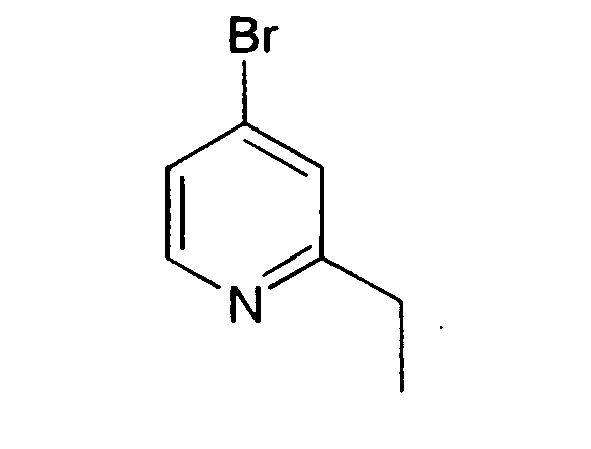
- From 4-bromopyridine hydrochloride (5.0 g; 25.7 mmol) and EtMgBr (51.4 mL; 51.4 mmol) and using the procedure from Example 51 Step A, the desired intermediate was obtained and used without further purification. 1H NMR (300 MHz, CDCl3): δ 1.29 (t, J=7.6 Hz, 3H), 2.80 (q, J=7.6 Hz, 2H), 7.28 (dd, J=5.3, 1.8 Hz, 1H), 7.34 (d, J=1.9 Hz, 1H), 8.33 (d, J=5.3 Hz, 1H).
-

- From a stirred solution of the intermediate from Step A above (1.10 g; 5.94 mmol), stannane intermediate from Example 46 Step B (1.50 g; 4.95 mmol), and Pd(PPh3)4 (172 mg; 0.149 mmol) in anhydrous DMF (30 mL), using the procedure from Example 49 Step A, the desired compound was obtained after purification by Biotage column chromatography (40% EtOAc/hexane). 1H-NMR (300 MHz, CDCl3): δ 1.33 (t, J=7.6 Hz, 3H), 2.84 (q, J=7.6 Hz, 2H), 4.03-4.19 (complex m, 4H), 6.00 (s, 1H), 6.56 (d, J=3.5 Hz, 1H), 6.81 (d, J=3.4 Hz, 1H), 7.32 (dd, J=5.3, 1.6 Hz, 1H), 7.40 (s, 1H), 8.51 (d, J=5.2 Hz, 1H).
-

- From a stirred solution of intermediate from Step B above (1.09 g; 4.44 mmol) and HCl solution (17.8 mL; 17.8 mmol) in THF (40 mL), following the procedure described in Example 46 Step E, the desired compound was obtained after workup and was used without further purification. 1H-NMR (300 MHz, CDCl3): δ 1.35 (t, J=7.6 Hz, 3H), 2.89 (q, J=7.6 Hz, 2H), 7.02 (d, J=3.7 Hz, 1H), 7.34 (d, J=3.8 Hz, 1H), 7.46 (dd, J=5.2, 1.6 Hz, 1H), 7.55 (s, 1H), 8.60 (d, J=5.2 Hz, 1H), 9.72 (s, 1H).
- From a solution of the aldehyde obtained from Step C above (29 mg; 0.146 mmol), penultimate intermediate from Example 12 Step D (55 mg; 0.097 mmol), and NaHB(OAc)3 (31 mg; 0.146 mmol) in anhydrous DMF (1.0 mL), using the procedure from Example 46 Step F, the titled compound was obtained after workup as a white solid and was used without further purification. 1H-NMR (400 MHz, CD3OD): δ 1.31 (t, J=7.6 Hz, 3H), 1.40 (m, 1H), 2.06 (m, 1H), 2.37 (m, 1H), 2.42-2.54 (complex m, 3H), 2.60 (m, 1H), 2.60 (m, 1H), 2.70-2.84 (complex m, 5H), 2.94 (m, 1H). 3.01-3.07 (complex m, 2H), 3.11 (dd, J=3.2, 8.1 Hz, 1H), 3.69 (s, 2H), 3.73-3.81 (complex m, 3H), 3.91-4.04 (complex m, 1H), 4.04-4.11 (complex m, 2H), 5.15 (d, J=3.9 Hz, 1H), 6.49 (d, J=3.3 Hz, 1H), 6.73 (d, J=8.2 Hz, 1H), 6.82 (apparent t, J=7.1 Hz, 1H), 7.06-7.27 (complex m, 8H), 7.48 (dd, J=1.6, 5.5 Hz, 1H), 7.56 (s, 1H), 8.38 (d, J=5.3 Hz, 1H); electrospray ionization mass spectrum: m/e 750.5 (MH+ calcd for C40H46F3N5O6, 750.3).
-

-

- To a stirred solution of 2-furaldehyde (25.0 g; 260 mmol) in benzene (260 mL) was added ethylene glycol (37.0 mL; 650 mmol) and p-toluenesulfonic acid monohydrate (645mg; 3.9 mmol). The reaction vessel was equipped with a Dean-Stark apparatus and heated to reflux for 5 hours. The reaction mixture was poured in diethyl ether (1.7 L) and washed with saturated NaHCO3 solution, water and brine. After drying (MgSO4), filtration and removal of the solvent in vacuo, purification employing flash chromatography (5% EtOAc/hexane) provided the desired acetal. 1H NMR (400 MHz, CDCl3) δ 3.99-4.08 (complex m, 2H), 4.11-4.18(complex m, 2H), 5.93 (s, 1H), 6.37 (dd, J=1.8, 3.4 Hz, 1H), 6.46 (d, J=3.3 Hz, 1H), 7.44 (dd, J1=J2=0.9 Hz, 1H).
-

- To a stirred solution of the acetal obtained in Step A (932 mg; 6.74 mmol) in anhydrous THF (20 mL) cooled to -78 °C was added tBuLi (4.36 mL; 7.4 mmol) dropwise. After one hour at -78 °C, DMF (0.782 mL; 10.11 mmol) was added. The cooling bath was removed and the reaction vessel was allowed to reach ambient temperature at which time the contents of the reaction were poured into Et2O. The combined organic layers were washed sequentially with dilute NH4Cl solution, water and brine. After drying (MgSO4), filtration and removal of the solvent in vacuo, purification employing flash chromatography (15% EtOAc/hex) provided the desired aldehyde. 1H NMR (300 MHz, CDCl3) δ 4.00-4.17 (complex m, 4H), 5.99 (s, 1H), 6.61 (d, J=3.5 Hz, 1H), 7.19 (d, J=3.4 Hz, 1H), 9.64 (s, 1H).
-

- To a stirred solution of the aldehyde obtained in Step B (382 mg; 2.27 mmol) in anhydrous THF (20 mL) cooled to 0 °C was added sequentially 1 H-benzotriazol-1-ylmethyl isocyanide (359 mg; 2.27 mmol), EtOH (0.266 mL; 4.54 mmol) and potassium tert-butoxide (4.54 mL; 4.54 mmol). After approximately 30 minutes at 0 °C, the cooling bath was removed and the reaction vessel was allowed to reach ambient temperature at which time the contents of the reaction were poured into EtOAc. The combined organic layers were washed with water and brine. After drying (MgSO4), filtration and removal of the solvent in vacuo, purification employing flash chromatography (30% EtOAc/hexane) provided the desired oxazole. 1H NMR (400 MHz, CDCl3) δ 4.01-4.10 (m, 2H), 4.12-4.20 (m, 2H), 5.98 (s, 1H), 6.54 (d, J=3.6 Hz, 1H). 6.62 (d, J=3.6 Hz, 1H), 7.31 (s, 1H), 7.85 (s, 1H).
-

- To a stirred solution of the oxazole obtained in Step C (225 mg; 1.08 mmol) in THF (6 mL) was added 1N HCl (4.32 mL; 4.32 mmol). After approximately 4 hours the contents of the reaction were poured into EtOAc. The combined organic layers were washed with dilute NH4OH, water and brine. After drying (MgSO4), filtration and removal of the solvent in vacuo, purification employing flash chromatography (30% EtOAc/hex) provided the desired aldehyde. 1H NMR (400 MHz, CDCl3) δ 6.8 (d, J=3.7 Hz, 1H), 7.34 (d, J=3.8 Hz, 1H), 7.59 (s, 1H), 7.98 (s, 1H). 9.70 (s, 1H).
- To a stirred solution of the penultimate intermediate obtained from Example 12 Step D (17 mg; 0.030 mmol) in anhydrous DMF (0.5 mL) under N2 was added the aldehyde obtained in Step D above (7.3 mg; 0.045 mmol) followed by NaBH(OAc)3 (9.5 mg; 0.045 mmol). The reaction was stirred overnight. The following morning, the reaction solution was poured into EtOAc and washed with water and brine. After drying (MgSO4), filtration and removal of the solvent in vacuo, purification employing flash chromatography (5% MeOH/DCM) provided the desired product after lyophilization from MeCN/H2O (1:1). 1H NMR (400 MHz, CD3OD) δ 1.40 (m, 1H), 2.06 (m, 1H), 2.34-2.52 (complex m, 4H), 2.54-2.61 (m, 1H), 2.68-2.79 (complex m, 4H), 2.92-3.06 (complex m, 4H), 3.10 (dd, J=3.4, 7.7 Hz, 1H), 3.65 (s, 2H), 3.73-3.79 (complex m, 4H), 3.94-4.01 (complex m, 2H), 4.05-4.12 (complex m, 2H), 5.15 (d, J=3.9 Hz, 1H), 6.45 (d, J=3.5 Hz, 1H), 6.71 (d, J=3.5 Hz, 1H), 6.73 (d, J=8.2 Hz, 1H), 6.82 (apparent td, J=1.2, 7.6 Hz, 1H), 7.08-7.15 (m, 2H), 7.18-7.22 (complex m, 6H), 8.20 (s, 1H); electrospray ionization mass spectrum: m/e 712.4 (MH+ calcd for C36H41F3N5O7, 712.3).
-

-

- A solution of 4-aminopyridine (0.094 g, 1.0 mmol) and 2,5-dimethoxytetrahydrofurane (0.20 g, 1.25 mmol) in acetic acid (1 mL) was heated at 90°C for 2 hours. The pH of the solution was adjusted to 10 with 1N NaOH. The aqueous layer was then extracted with dichloromethane (3 x 10 mL). The combined dichloromethane layers were washed with brine and dried over sodium sulfate. Removal of the solvent afforded the title compound as a light brown oil. The compound was pure enough for the next step. 1H NMR (300 MHz, CDCl3): 9.88 (s, 1H), 8.70 (d, J= 3 Hz, 2H), 7.80 (s, 1H), 7.36 (d, J= 3 Hz, 2H), 7.22 (s, 1H), 6.85 (s, 1H).
- A mixture of the aldehyde from Step A (18.9 mg, 0.11 mmol), penultimate from Example 12 Step D (40 mg, 0.073 mmol), and sodium triacetoxyborohydride (23 mg, 0.11 mmol) in anhydrous dichloroethane (2 mL) was stirred at room temperature overnight. After 18 hours, the solvent was removed via vacuum. Preparative TLC purification (EtOAc/hexane) gave the titled compound as a white solid. 1H NMR (400 MHz, CDCl3) 1:1 rotamers: 9.20 (br s, 1H), 8.63 (dd, J = 4.8, 1.6 Hz, 2H), 7.08-7.35 (m, 12H), 6.82 (m, 2H), 6.30 (s, 1H), 6.94 (d, J = 8.4 Hz, 1H), 5.18 (m, 1H), 4.00-4.20 (m, 4H), 3.77 (m, 2H), 3.49 (AB q, J = 36, 13.2 Hz, 2H), 3.37 (s, 1H), 2.41-3.05 (m, 11H), 2.37 (m, 1H), 1.92 (m, 1H), 1.59 (m, 1H). LC-MS (M+ +1)(EI) 721.
-

-

- A solution of 3-aminopyridine (0.094 g, 1.1 mmol) and 2,5-dimethoxytetrahydrofuran (0.20 g, 1.25 mmol) in acetic acid (1 mL) was heated at 80°C for 1 hour. The pH of the solution was adjusted to 10. The mixture was then extracted with dichloromethane (3 x 15 mL). The combined dichloromethane layers were washed with brine, and dried over sodium sulfate. The titled compound was obtained as a yellow solid. 1H NMR (CDCl3, 400 MHz): 9.90 (s, 1H), 8.80 (d, J = 2.8 Hz, 1H), 8.64 (dd, J = 4.8, 1.6 Hz, 1H), 7.77 (m, 1H), 7.70 (d, J = 1.6 Hz, 1H), 7.47 (m, 1H), 7.11 (d, J= 2.4 Hz, 1H), 6.87 (dd, J = 3.2, 2 Hz, 1H).
- A mixture of the aldehyde from Step A (18.9 mg, 0.11 mmol), penultimate fro Example 12 Step D (40 mg, 0.073 mmol), and sodium triacetoxyborohydride (23 mg, 0.11 mmol) in anhydrous dichloroethane (2 mL) was stirred at room temperature overnight. After 18 hours, the solvent was removed via vacuum. The preparative TLC purification (EtOAc/Hexane) gave the titled compound as a white solid. 1H NMR (CDCl3, 400 MHz): 9.30 (br s, 1H), 8.75 (s, 1H), 8.53 (d, J= 4 Hz, 1H), 7.68 (m, 1H), 7.40 (dd, J = 8.4, 5.2 Hz, 1H), 7.23 (m, 4H), 7.16 (m, 3H), 7.00(s, 1H), 6.82 (m, 2H), 6.30 (s, 1H), 6.02 (br s, 1H), 5.19 (m, 1H), 3.99- 4.20 (m, 3H), 3.68-3.81 (m, 2H), 3.42-3.60 (m, 2H), 3.38 (s, 1H), 2.61-3.10 (m, 8H), 2.50 (m, 2H), 2.37 (m, 1H), 1.90 (m, 1H), 1.60 (m, 1H). LC-MS (M+ +1)(EI) 721.
-

-

- A mixture of 5-bromo-2-(1,3-dioxalane)furan (0.50 g, 2.4 mmol), (trimethylsilyl)acetylene (0.31 mL, 2.28 mmol), piperidine (1 mL, 10 mmol), and catalytic amount of tetrakis(triphenylphosphine)palladium, Cul and triphenylphosphine was heated to reflux for 30 min. Water (10 mL) was added. The mixture was extracted with ethyl acetate (3 x 20 mL). The combined ethyl acetate layers were washed with brine and dried over sodium sulfate. Flash chromatography using EtOAc/hexane 1:9 as the elute gave the titled compound as a colorless oil. 1H NMR (CDCl3, 400 MHz): 6.90 (d, J = 3.2 Hz, 1H), 6.67 (d, J = 3.2 Hz, 1H), 5.91 (s, 1H), 4.00-4.20 (m, 4H), 0.22 (s, 9H).
-

- A solution of the titled compound from Step A (0.11 g, 0.47 mmol), 1,2,4,5-tetrazine in acetonitrile (5 mL) was refluxed for 2 days. No starting material was observed by TLC (EtOAc/hexane 2:8). The solvent was removed. The residue was stirred with 1M tetrabutylammonium fluoride (0.5 mL) in THF/water at room temperature for 2 days. Water (1 mL) was added and the mixture was extracted with ethyl acetate (3 x 15 mL). The combined ethyl acetate layers were washed with brine, and dried over sodium sulfate. Preparative TLC plate using 1:1 EtOAc/hexane as the elute afforded the pyridazine as a white solid (0.058 g, 58%). The pyridazine was then stirred with a mixture of 1N HCl (1 mL) and THF (5 mL) at room temperature for 4 hours. The mixture was basified with saturated sodium bicarbonate solution and extracted with dichloromethane (2 x 15 mL). The combined dichloromethane layers were dried over sodium sulfate. The titled compound was obtained as a yellow solid upon removal of the solvent. 1H NMR (CDCl3, 400 MHz): 9.80 (s, 1H), 9.57 (m, 1H), 9.31 (dd, J = 5.6, 1.2 Hz, 1H), 7.84 (dd, J = 5.6, 2 Hz, 1H), 7.41 (d, J = 4 Hz, 1H), 7.21 (d, J = 4 Hz, 1H).
- A mixture of the aldehyde from Step B (22 mg, 0.12 mmol), penultimate prepared as in Example 12 Step D (65 mg, 0.12 mmol), and sodium triacetoxyborohydride (38 mg, 0.18 mmol) in anhydrous dichloroethane (2 mL) was stirred at room temperature overnight. After 18 hours, the solvent was removed via vacuum. Preparative TLC purification (EtOAc/MeOH 9:1) gave the titled compound as a yellow solid. 1H NMR (CDCl3, 400 MHz): 9.41 (s, 1H), 9.16 (d, J =5.2 Hz, 1H), 8.79 (br s, 1H), 7.59 (dd, J = 5.6, 2 Hz, 1H), 7.08-7.36 (m, 7H), 7.02 (d, J = 3.6 Hz, 1H), 6.80 (m, 2H), 6.46 (d, J = 3.2 Hz, 1H), 6.06 (d, J = 8.4 Hz, 1H), 5.17 (dd, J = 8, 4 Hz, 1H), 4.01-4.16 (m, 3H), 3.63-3.81 (m, 5H), 3.40 (s, 1H), 2.62-3.12 (m, 9H), 2.48 (m, 2H), 1.97 (m, 1H), 1.59 (m, 1H). LC-MS (M++1)(EI) 723.
-

-

- To a solution of commercially available methyl 3-methylfuroate (20.0 g, 140 mmol) in 100 mL of MeOH, NaOH (11.43 g, 280 mmol) in 20 mL of water was added. The yellowish solution was stirred at room temperature for 3 hours. TLC (1:9 EtOAc/hexane) showed no starting material. MeOH was removed and the pH of the aqueous solution was adjusted to 4 with 1N HCl. The slurry was extracted with ethyl acetate (5 x 100 mL). The combined ethyl acetate layers were washed brine, and dried over sodium sulfate. 3-methyl furoic acid was obtained as a white solid (13.2 g, 73 %) after evaporation of the solvent. To a mixture of 3-methyl furoic acid (8.60 g, 68 mmol), N,O-dimethylhydroxylamine hydrochloride (8.0 g, 82 mmol), EDC (15.7 g, 82 mmol), and HOBT (11.07 g, 82 mmol) in dichloromethane (200 mL), triethylamine (14.4 mL, 100 mmol) was added. The solution was stirred at room temperature for 4 hours, and washed with 1N NaOH (50 mL), 1N HCl (50 mL), brine, and dried over sodium sulfate. The title compound was obtained as a colorless liquid upon removal of the solvent. 1H NMR (CDCl3, 400 MHz): 7.40 (s, 1H), 6.38 (s, 1H), 3.81 (s, 3H), 3.36 (s, 3H), 2.38 (s, 3H).
-

- To a solution of the titled compound from Step A (6.0 g, 35.9 mmol) in dichloroethane (50 mL), a solution of bromine (2.22 mL, 43.1 mmol) in dichloroethane (5 mL) was added dropwise in about 30 min. The progress of the bromination was monitored by HPLC. The reaction was stirred at room temperature for 2 hours, until no starting material was seen by HPLC. The solution was diluted with dichloromethane (100 mL). The solution was then washed with saturated solution of sodium bicarbonate (50 mL), brine, and dried over sodium sulfate. The 5-brominated furan was obtained as a yellow oil (5.17 g, 58%) after chromatography (2:8 EtOAc/hexane). A mixture of the 5-bromofuran above (5.17 g, 20.8 mmol), hexamethylditin (7.5 g, 22.9 mmol), tetrakis (triphenylphosphine)palladium (1.2 g, 1 mmol), and triphenylphosphine (0.16 g, 0.62 mmol) in toluene (20 mL) was heated to reflux overnight. Water (100 mL) was added. The mixture was extracted with EtOAc (3 x 100 mL). The combined ethyl acetate layers were washed with brine, and dried over sodium sulfate. Flash chromatography using 1:9 EtOAc/hexane as the elute gave the titled compound as a colorless oil. 1H NMR (CDCl3, 300 MHz): 6.50 (s, 1H), 3.80 (s, 3H), 3.50 (s, 3H), 2.34 (s, 3H), 0.38 (s, 9H).
-

- A mixture of the titled compound from Step B (1.40 g, 4.25 mmol), 4-bromopyridine hydrochloride (1.65 g, 8.5 mmol), diisopropylethylamine (DIEA) (1.63 mL, 9.36 mmol), and tetrakis(triphenylphosphine)palladium (0.15 g, 0.13 mmol) in DMF (10 mL) was heated to 100 °C overnight. Water (100 mL) was added and the mixture was extracted with ethyl acetate (3 x 100 mL). The combined ethyl acetate layers were washed with brine and dried over sodium sulfate. Flash chromatography using 1:1 EtOAc/hexane as the elute afforded the titled compound as a yellow solid. 1H NMR (CDCl3, 400 MHz): 8.66(d, J = 6.4 Hz, 2H), 7.59 (d, J = 6 Hz, 2H), 6.89 (s, 1H), 3.95 (s, 3H), 3.49 (s, 3H), 2.40 (s, 3H).
-

- To a solution of the titled compound from Step C (0.77 g, 3.13 mmol) in THF (10 mL) at 0 °C, 1.4 M solution of methyl magnesium bromide (11.2 mL, 15.65 mmol) in a mixture of toluene and THF was added slowly. The reaction was stirred at 0 °C for 2 hours. TLC (3:7 EtOAc/hexane) showed no starting material. Water (5 mL) was added. The mixture was extracted with ethyl acetate (3 x 15 mL). The combined ethyl acetate layers were washed with brine and dried over sodium sulfate. Flash chromatography using 3:7 EtOAc/hexane as the elute gave the titled compound as a colorless oil. 1H NMR (CDCl3, 400 MHz): 8.70 (d, J = 6.4 Hz, 2H), 7.63 (d, J = 6 Hz, 2H), 6.89 (s, 1H), 2.60 (s, 3H), 2.43 (s, 3H).
-

- To a solution of Boc protected piperzine prepared as in Example 12 Step A (0.98 g, 2.48 mmol) in dichloromethane (10 mL), trifluoroacetic acid (5 mL) was added. The solution was stirred at room temperature for 3 hours. TLC (1:1 EtOAc/hexane) showed no starting material. The solvents were removed and dried under high vacuum for 2 hours. The residue was mixed with the titled compound from Step D (0.47 g, 2.34 mmol) and trimethylsilyl cyanide (3.11 mL, 23.4 mmol) and the mixture was heated at 60 C overnight. LC-MS indicated that there was no starting ketone left. The mixture was poured into an icy ammonium hydroxide solution (10 mL). The aqueous solution was extracted with ethyl acetate (3 x 50 mL). The combined ethyl acetate layers were washed with brine and dried over sodium sulfate. Flash chromatography using 1:1 EtOAc/hexane as the elute gave the titled compound as a light yellow oil. 1H NMR (CDCl3, 400 MHz): a 4:6 mixture of diastereomers 8.61 (d, J = 6.4 Hz, 2H), 7.62 (m, 0.8H), 7.60 (m, 1.2H), 6.89 (s, 0.4H), 6/82 (s, 0.6H), 6.50 (br s, 1H), 5.95 (m, 1H), 5.32 (m, 2H), 4.95 (m, 0.6H), 4.80 (m, 0.4H), 4.70 (m, 2H), 4.20 (m, 2H), 3.85 (m, 0.6H), 3.70 (m, 1H), 3.40 (m, 0.4H), 3.10 (m, 1H), 2.82 (m, 1H), 2.40 (m, 2H), 2.22 (s, 1.2H), 2.17 (s, 1.8H), 1.96 (s, 3H).
-

- 1,3-Dimethylbarbituric acid (1.45 g, 9.30 mmol) was added to a solution of the titled compound from Step E (0.94 g, 1.86 mmol) in THF at room temperature. The brown solution was stirred at room temperature for 20 min. Tetrakis(triphenylphosphine)palladium (0.21 g, 0.186 mmol) was added and the solution was stirred at room temperature for another 20 min. The color of the solution turned to redish. TLC (EtOAc) showed no starting material. 1N HCl (20 mL) was added. The mixture was extracted with ethyl acetate (2 x 30 mL). The aqueous was adjusted to pH = 10 and extracted with chloroform (3 x 50 mL). The combined chloroform layers were dried over sodium sulfate. Flash chromatography (5:95 MeOH/ CH2Cl2) afforded the titled compound as a yellow oil. 1H NMR: (CDCl3, 400MHz): a 4:6 mixture of diastereomers 8.70 (m, 1.2H), 8.61 (m, 0.8H), 7.64 (br s, 1H), 7.60 (m, 1.2H), 7.48 (m, 0.8H), 6.88 (s, 0.6H), 6.77 (s, 0.4H), 3.96 (m, 2H), 3.58 (m, 1 H), 3.20 (m, 1H), 2.96 (m, 3H), 2.60 (s, 3H), 2.46 (s, 3H), 2.20 (m, 2H).
-

- To a solution of the titled compound from Step F (0.716 g, 1.7 mmol) in DME (10 mL) at 0 °C, methylmagnesium bromide (12 mL, 17 mmol, 1.4 M) was added. The mixture was stirred at 0 °C for 2 hours and room temperature for 30 min. TLC showed no starting material (5:95 MeOH/ CH2Cl2). Water (10 mL) was added and the aqueous was extracted with ethyl acetate (3 x 20 mL). The combined ethyl acetate layers were washed with brine and dried over sodium sulfate. Flash chromatography using 5:95 MeOH /CH2Cl2 as the elute gave the titled compound as a gummy material. 1H NMR (CDCl3, 400 MHz): 8.60 (d, J= 6 Hz, 2H), 7.45 (d, J= 6 Hz, 2H), 6.70 (s, 1H), 3.92 (m, 2H), 3.50 (m, 1H), 2.83 (m, 4H), 2.48 (m, 2H), 2.18 (s, 3H), 1.60 (s, 6H).
-

- To a solution of the dihydro-5(S)-(hydroxymethyl)-3(R)-(phenylmethyl)-3(2H)-furanone (2.06 g, 10 mmol) in dichloromethane (50 mL) at 0 °C, triflic anhydride and 2,6-lutidine were added. The solution was stirred at 0 °C for 1 hour. Water (10 mL) was added. The mixture was extracted with dichloromethane (2 x 50 mL). The combined dichloromethane layers were washed with brine (20 mL), and dried over sodium sulfate. The triflate was obtained as a white waxy material after flash chromatography using 2:8 EtOAc/hexane as the elute. A mixture of the triflate (0.33 g, 1.02 mmol), the titled compound from Step G (0.421 g, 1.02 mmol), and N,N-diisopropylethyl amine (0.21 mL, 1.23 mmol) in 2-propanol (10 mL) was stirred at room temperature overnight. After 20 hours, the solvent was removed. The residue was dissolved in dichloromethane (20 mL). The solution was washed with water, brine, and dried over sodium sulfate. The titled compound was obtained as a gummy material after flash chromatography using 7:3 EtOAc/hexane as the elute. 1H NMR (CDCl3, 400 MHz): 8.60 (d, J = 6Hz, 2H), 8.05 (br s, 1H), 7.46 (d, J = 6 Hz, 2H), 7.25 (m, 5H), 6.76 (s, 1H), 4.41 (m, 1H), 4.08 (m, 1H), 3.78 (m, 2H), 2.56-3.35 (m, 9H), 2.20 (s, 3H), 2.05 (m, 1H), 1.97 (m, 1H), 1.60 (s, 6H), 1.10 (m, 2H).
-

- A mixture of the titled compound from Step H (0.452 g, 0.76 mmol) in dioxane (10 mL) and 1 mL of aqueous LiOH (38 mg, 0.90 mmol) was stirred at room temperature overnight. The solvent was removed azeotropically with toluene (3 x 10 mL). The residue was dissolved in 3:1 mixture of EtOAc/ CH2Cl2 (10 mL). TBSOTf (0.38 mL, 1.66 mmol) and N,N-diisopropylethyl amine (0.31 mL, 1.81 mmol) were added. The mixture was stirred at room temperature and the reaction was monitored by LC/MS. More TBSOTf (up to 6 eq) and N,N-diisopropylethyl amine (up to 8 eq) were added. After 20 hours, water (10 mL) was added and the mixture was extracted with EtOAc (3 x 60 mL). The combined ethyl acetate layers were washed with brine, and dried over sodium sulfate. Evaporation of the solvent gave a colorless oil that was then mixed with 1:1 mixture of water and THF (5 mL). The solution was stirred at room temperature for 2 hours and LC/MS showed that there was no silyl ester left. The solvents were removed and dried under high vacuum. The residue was mixed with O-benzotriazol-1-yl-N,N,N',N'-tetramethyluronium hexafluorophosphate (0.80g, 2.1 mmol), N,N-diisopropylethyl amine (0.66 mL, 3.78 mmol), aminochromanol (0.15 g, 0.90 mmol), and catalytic amount of 1-hydroxy-7-azabenzo-trazole in DMF (5 mL) at room temperature overnight. After 22 hours, water (10 mL) was added. The mixture was extracted with ethyl acetate (3 x 50 mL). The combined ethyl acetate layers were washed with brine, and dried over sodium sulfate. The titled compound was obtained as a white solid after flash chromatography using 1:1 EtOAc/hexane as the elute. 1H NMR (CDCl3, 400 MHz): 8.58 (d, J= 6 Hz, 2H), 8.18 (br s, 1H), 7.40 (d, J = 6 Hz, 2H), 6.79-7.36 (m, 9H), 6.65 (s, 1H), 5.72 (br s, 1H), 5.17 (m, 1H), 4.00 (m, 4H), 3.82 (m, 1H), 3.70 (m, 2H), 3.18 (m, 1H), 2.81 (m, 7H), 2.30-3.10 (m, 6H), 2.08 (s, 3H), 1.50 (s, 6H), 0.82 (s, 9H), 0.02 (s, 3H), 0.01 (s, 3H).
- To a solution of the titled compound from Step I (34 mg, 0.039 mmol) in THF (1 mL), 1 M solution of tetrabutylammonium fluoride (0.046 mL, 0.046 mmol) was added. The solution was stirred at room temperature for 1 hour. TLC (EtOAc/hexane =1:1) showed no reaction. Another 5 equivalents of tetrabutylammonium fluoride were added. The solution was stirred at 60°C for 1h and room temperature overnight. No starting material was seen by TLC. The solvent was removed. The titled compound was obtained as a white solid after preparative TLC using ethyl acetate as the elute. 1H NMR (CDCl3, 400 MHz): 9.10 (br s, 1H), 8.60 (d, J = 6Hz, 2H), 7.43 (d, J = 6Hz, 2H), 7.28 (m, 5H), 7.10 (m, 2H), 6.80 (m, 2H), 6.71 (s, 1H), 5.99 (d, J = 8Hz, 1H), 5.18 (m, 1H), 4.00 (m, 3H), 3.80 (m, 2H), 3.60 (m, 1H), 3.38 (m, 1H), 2.40-3.10 (m, 11H), 2.20 (s, 3H), 1.90 (m, 1H), 1.60 (s, 3H), 1.58 (s, 3H), 1.40 (m, 1H). LC-MS (M++1)(EI) 764.
-

-

- To a solution of the stannane from Example 46 Step B (2 g, 6.6 mmol) and chloropyrazine (756 mg, 6.6 mmol) in DMF (20 mL) was added dichlorobis(triphenylphosphine)palladium(II) (140 mg, 0.2 mmol). The reaction mixture was stirred at 100 °C for 20 hours to see the stannane was consumed (by TLC). It was cooled to room temperature and diluted with ethyl acetate (200 mL). The diluted solution was then washed with water (2 X 100 mL) and brine (100 mL). The organic layer was dried over anhydrous sodium sulfate and concentrated in vacuum to get a brown oil. The crude product was purified by flash column chromatography on silica gel with ethyl acetate as eluant to give the titled compound as a slightly yellow oil which solidified after standing. 1H NMR (CDCl3, 300 MHz): δ 8.99 (s, 1H), 8.53 (d, J=2.4 Hz, 1H), 8.43 (d, J=2.4 Hz, 1H), 7.26 (s, 1 H), 6.04 (s, 1H), 4.04-4.21 (m, 4 H).
-

- The intermediate from the previous step (1.1 g, 5.04 mmol) was dissolved in THF (25 mL). The solution was cooled to 0 °C and HCl (1 M, 25 mL) was added. The reaction solution was stirred at 0 °C for 10 minutes and slowly warmed to room temperature at which it was stirred for 10 hours. (The reaction was monitored by TLC). It was concentrated to about 30 mL. To the remaining mixture was added ethyl acetate (100 mL). Then 1 N NaOH was used to basicify the solution to pH=12. The organic layer was collected , dried over anhydrous sodium sulfate and concentrated in vacuum to give the titled compound as a pale solid.. 1H NMR (CDCl3, 300 MHz): δ 9.77 (s, 1H), 9.18 (s, 1 H), 8.62 (d, J= 2.4 Hz, 1 H), 8.59 (d, J=2.4, 1H), 7.38 (d, J=3.9 Hz, 1 H), 7.33(d,J=3.9 Hz, 1H).
- To a solution of the aldehyde from the previous step (21 mg, 0,11 mmol) and the penultimate (50 mg, 0.09 mmol) in DCE (5 mL) was added sodium triacetoxyborohydride (28 mg, 0.13 mmol). The reaction mixture was stirred at room temperature for 12 hours and purified on preparative TLC (2000microns, CH2Cl2 / acetone / 2N NH3 in methanol = 47.5 / 47.5 / 5 as eluant) to give the titled compound as a white solid. 1H NMR (CD3OD, 400 MHz): δ 8.96 (s, 1 H), 8.55 (d, J = 2.1 Hz, 1b H), 8.43 ( d, J = 2.1 Hz, 1 H), 7.81 (d, J = 6.6 Hz, 1 H), 7.07-7.27 (m, 7 H), 6.82 (dt, J = 7.6, 1.2 Hz, 1 H), 6.72 (dd, J = 1.2, 8.0 Hz, 1 H), 6.53 ( d, J = 2.1 Hz, 1 H), 5.16 (m, 1 H), 4.08- 4.11 (m, 2 H), 3.94-4.00(m 1 H), 3.73-3.81 (m, 4 H), 3.13 (broad s, 1 H), 3.01-3.05 ( m, 2 H), 2.92-2.97 (m, 2 H), 2.81 ( broad d, J = 11.2. 1 H), 2.73-2.77 (m, 2 H), 2.65 (t, J = 11.2 Hz, 1 H), 2.52 (t, J = 10 Hz, 1 H), 2.36-2.36 (m, 4 H), 2.02-2.14 (m, 1 H), 1.37-1.44 (m, 1 H). LC-MS (M++1) (EI) 723.4.
-

-

- To a solution of 1-methyl pyrazole ( 10 g, 122 mmol) in chloroform (100 mL) was added a solution of bromine (78 g, 160 mmol in 50 mL chloroform) dropwise at room temperature. The reaction solution was refluxed for 8 hours. Then it was diluted with chloroform (200 mL) and 1 N NaOH was added until a clear solution was obtained. The organic layer was dried over anhydrous sodium sulfate and concentrated to give a slightly yellow oil. The crude product was purified by flash column chromatography on silica gel with hexanes / ethyl acetate = 100 /1.5 as eluant to get 4-bromo-1-methylpyrazole as a colorless oil. 1H NMR (CDCl3, 300 MHz): δ 7.44 (s, 1H), 7.38 (s, 1H), 3.89 (s, 3 H).
-

- To a solution of 4-bromo-1-methylpyrazole (15 g, 38.5mmol) in ether (150 mL) n-Butyllithium (2.5M in hexanes, 17 mL, 42.4 mmol) was added at -78 °C. After the reaction solution was stirred at -78 °C for 30 minutes, tributyltin chloride (11.5 mL, 42.4 mmol) was added. It was stirred at -60°C for 1 hour and warmed to room temperature, at which it was stirred for 1 more hour. Then, it was diluted with ethyl acetate (300 mL) and washed with water (200 mL ) and brine. The organic layer was dried over anhydrous sodium sulfate and concentrated. The crude product was purified by flash column chromatography on silica gel with hexanes / ethyl acetate = 10 / 1 as eluant to get 1-methyl-4-tributylstannylpyrazole as a white wax. 1H NMR (CDCl3, 300 MHz): δ 7.42 (s, 1H), 7.23 (s, 1H), 3.93 (s, 3 H). 1.28-1.55 ( m, 18 H), 0.91 (t, J = 15 Hz, 9 H).
-

- To a solution of borane-tetrahydrofuran complex (1 M in THF, 800 mL) in THF (250 mL) was added 5-bromonicotinic acid (40 g, 198 mmol) at small portions to keep the temperature of the reaction solution below 40 °C. After the addition, the reaction solution was stirred at room temperature for 24 hours. It was quenched with sodium hydroxide solution (1 N, 1L). The quenched mixture was heated to reflux for 12 hours. It was separated. The aqueous layer was extracted with ethyl acetate for 4 times (500 mL each time). The combined organic layer was dried over anhydrous sodium sulfate and concentrated to get the titled compound as a colorless oil. It was used in the next step without further purification. 1H NMR (CDCl3, 300 MHz): δ 8.59 (d, J=2.2 Hz, 1 H), 8.49 (d, J=1.4 Hz, 1 H), 7.90 (s, 1 H), 4.74 (s, 2 H).
-

- To a solution of the alcohol from the previous step (22.5 g, 120 mmol) in THF (1000 mL) was added manganese (IV) oxide (210 g, 2.4 mol). The reaction mixture was stirred at room temperature for 2 days. It was filtered and the solid was washed with ethyl acetate 3 times (200 mL each time). The combined filtrate and washes were concentrated and purified by flash column chromatography on silica gel with 1/1 ethyl acetate/hexanes as eluant to give the title compound as a white solid. 1H NMR (CDCl3, 300 MHz): δ 10.08 (s, 1 H), 8.99 (s, 1 H), 8.95 (d, J=0.6 Hz, 1 H), 8.30 (d, J=0.6 Hz, 1 H).
-

- To a solution of 1-methyl-4-tfibutylstannylpyrazole from Step B (519 mg, 1.4 mmol) and 3-bromo-5-pyridinecarboxaldehyde (200 mg, 1.08 mmol) in xylene (10 mL) was added tetrakis(triphenylphosphine)palladium(0) (37.5 mg, 0.03 mmol). After refluxing for 4 hours, the reaction mixture was cooled to room temperature. It was diluted with toluene (100 mL). Then, potassium fluoride (5 g) in water (10 mL) was added. The mixture was stirred at room temperature for 2 hours. It was filtered. The filtrate was washed with water (20 mL) and brine. The organic layer was dried over anhydrous sodium sulfate and concentrated. The crude product was purified on preparative TLC (2000 microns, CH2Cl2 / acetone / 2 N ammonia in methanol = 10 / 10 / 1) to give the titled compound as a pale solid. 1H NMR (CDCl3, 300 MHz): δ 10.15 (s, 1 H), 8.97 (s, 1 H), 8.90 (s, 1 H), 8.20 (s, 1 H), 7.96 (s, 1 H), 7.76 (s, 1 H), 3.99 (s, 3 H).
- To a solution of the aldehyde from the previous step (21 mg, 0,11 mmol) and the penultimate from Example 12 Step D (50 mg, 0.09 mmol) in DCE (5 mL) was added sodium triacetoxyborohydride (28 mg, 0.13 mmol). The reaction mixture was stirred at room temperature for 12 hours and purified on preparative TLC (2000 microns, CH2Cl2 / acetone / 2N NH3 in methanol = 47.5 / 47.5 / 5 as eluant) to give the titled compound as a white solid. 1H NMR (CD3OD, 400 MHz): δ 8.65 (d, J = 2 Hz, 1 H), 8.30 (s, 1 H), 8.10 (s, 1 H), 7.98 (d, J = 2 Hz, 1 H), 7.92 (d, J = 0.4 Hz, 1 H). 7.18-7.28 (m, 5 H), 7.07-7.11 (m, 2 H), 6.80 (dt, J = 7.6, 1.2 Hz, 1 H), 6.73 (d, J = 8.0 Hz, 1 H), 5.16 (d, J = 4 Hz, 1 H), 4.07-4.10 (m, 2 H), 3.94 (s, 3 H), 3.85-3.91(m 1H), 3.74-3.76 (m, 2 H), 3.60 (s, 2 H), 2.93-3.15 (m, 5 H), 2.74-2.79 (m, 2 H), 2.60-2.67 (m, 3 H), 2.40-2.55 (m, 4 H), 2.02-2.14 (m, 1 H), 1.37-1.44 (m, 1 H). LC-MS (M++1) (EI) 736.5.
-

-

- To a solution of 2-tributylstannylfurane (241 mg, 0.65 mmol) and 3-bromo-5-pyridinecarboxaldehyde from Example 59 Step D (100 mL, 0.54 mmol) in xylene (5 mL) was added tetrakis(triphenylphosphine)palladium(0) (19 mg, 0.02 mmol). After refluxing for 4 hours, the reaction mixture was cooled to room temperature. It was diluted with toluene (50 mL) and then potassium fluoride (2 g) in water (10 mL) was added. The mixture was stirred at room temperature for 2 hours. It was filtered. The filtrate was washed with water (20 mL) and brine. The organic layer was dried over anhydrous sodium sulfate and concentrated. The crude product was purified on preparative TLC (2000 microns, hexanes / ether = 1 / 1) to give the titled compound as a pale solid. 1H NMR (CDCl3, 300 MHz): δ 10.17 (s, 1 H), 9.10 (d, J = 2.1 Hz, 1 H), 8.96 (d, J = 1.5 Hz, 1 H), 8.32 (t, J = 2.1 Hz, 1 H), 7.43-7,48 (m, 1 H), 7.16-7.19 (m, 1H).
- To a solution of the aldehyde from the previous step (21 mg, 0.11 mmol) and the penultimate prepared as in Example 12 Step D (50 mg, 0.09 mmol) in DCE (5 mL) was added sodium triacetoxyborohydride (28 mg, 0.13 mmol). The reaction mixture was stirred at room temperature for 12 hours and purified on preparative TLC (2000microns, CH2Cl2 / acetone / 2N NH3 in methanol = 47.5 / 47.5/5 as eluant) to give the titled compound as a white solid. 1H NMR (CD3OD, 400 MHz): δ 8.72 (d, J = 2 Hz, 1 H), 8.38 (s, 1H), 8.05 (s, 1 H), 7.50-7.55 (m, 2 H), 7.06-7.27 (m, 8 H), 6.8 (t, J = 7.2, 1 H), 6.72 (d, J = 8.0 Hz, 1 H), 5.16 (d, J = 4 Hz, 1 H), 4.07-4.10 (m, 2 H), 3.74-3.91(m 3 H), 3.62 (s, 2 H), 2.93-3.15 (m, 5 H), 2.61-2.79 (m, 5 H), 2.38-2.54 (m, 5 H), 2.02-2.14 (m, 1 H), 1.37-1.44 (m, 1 H). LC-MS (M++1) (EI) 738.5.
-

-

- A solution of 3-Bromo-5-pyridinecarboxaldehyde from Example 59 Step D (200 mg, 1.08 mmol) and tetrakis(triphenylphosphine)palladium(0) (70 mg, 0.06 mmol) in DME (5 mL) was stirred at room temperature for 5 minutes. Thiophene-3-boronic acid (141 mg, 1.08 mmol) was added and the stirring was continued for 10 more minutes. Then, sodium carbonate solution (2 M, 5 mL) was added and the reaction mixture was heated to refluxed for 12 hours. After it was cooled to room temperature, the reaction mixture was distributed between ethyl acetate (50 mL) and water (50 mL). The organic layer was dried over anhydrous sodium sulfate, concentrated, and purified on preparative TLC (2000 microns, hexanes / ethyl acetate = 1/1) to get 5-(3-furanyl)-3-pyridinecarboxaldehyde as a pale solid. 1H NMR (CDCl3, 300 MHz): δ 10.18 (s, 1 H), 9.11 (d, J = 2.1Hz, 1 H), 8.98 (d, J = 1.8 Hz, 1 H), 8.33 (t, J = 2.1 Hz, 1 H), 7.44 (dd, J = 1.2, 1.5 Hz, 1 H), 7.44-7.52 (m, 2 H).
- To a solution of the aldehyde from the previous step (21 mg, 0,11 mmol) and the penultimate prepared as in Example 12 Step D (50 mg, 0.09 mmol) in DCE (5 mL) was added sodium triacetoxyborohydride (28 mg, 0.13 mmol). The reaction mixture was stirred at room temperature for 12 hours and purified on preparative TLC (2000microns, CH2Cl2 / acetone / 2N NH3 in methanol = 47.5 / 47.5 / 5 as eluant) to give the titled compound as a white solid. 1H NMR (CD3OD, 400 MHz): δ 8.76 (s, 1 H), 8.38 (s, 1 H), 8.09 (s, 1 H), 7.82 (dd, J = 1.2, 1.6 Hz, 1 H), 7.52-7.57 (m, 2 H), 7.18-7.28 (m, 5 H), 7.06-7.13 (m, 2 H), 6.81 (t, J=7.2, 1 H), 6.73 (d, J=8.0 Hz, 1 H), 5.16 (d, J=4 Hz, 1 H), 4.07-4.08 (m, 2 H), 3.74-3.91(m 3 H), 3.63 (s, 2 H), 2.93-3.15 (m, 5 H), 2.62-2.78 (m, 5 H), 2.38-2.54 (m, 5 H), 2.02-2.14 (m, 1 H), 1.37-1.44 (m, 1 H). LC-MS (M++1) (EI) 738.5.
-

-

- To a solution of the chloropyridyl intermediate (100 mg, 0.4 mmol) in methanol (5 mL) was added triethylamine (70 µl, 0.5 mmol) and palladium on carbon (10 mg). Hydrogen in balloon was applied and the reaction was monitored by HPLC. After stirring under the hydrogen atmosphere for 12 hours the reaction mixture was filtered. The filtrate was concentrated to get a pale solid. The solid obtained was stirred in a mixture of THF (10 mL) and HCl (1 N, 10 mL) for 10 hours. Ethyl acetate (100 mL) was added and it was washed with NaOH solution (1 N, 15 mL) and brine. The organic layer was concentrated and purified on preparative TLC (2000 microns, hexanes / ethyl acetate = 1 / 1) to get the title compound as a pale solid. 1H NMR (CDCl3, 300 MHz): δ 9.77 (s, 1 H), 9.29 (d, J=1.2 Hz, 1 H), 8.85 (d, J=5.1 Hz, 1 H), 7.84 (dd, J=3.9, 1.2 Hz, 1 H), 7.46 (d, J=3.6 Hz, 1 H), 7.38 (d, J=3.9 Hz, 1 H),
- To a solution of the aldehyde from the previous step (21 mg, 0,11 mmol) and the penultimate prepared as in Example 12 Step D (50 mg, 0.09 mmol) in DCE (5 mL) was added sodium triacetoxyborohydride (28 mg, 0.13 mmol). The reaction mixture was stirred at room temperature for 10 hours and purified on preparative TLC (2000 microns, CH2Cl2 / acetone / 2N NH3 in methanol = 47.5 / 47.5/5 as eluant) to get the titled compound as a white solid. 1H NMR (CD3OD, 400 MHz): δ 9.04 (s, 1 H), 8.72 (d, J=5.2 Hz, 1 H), 7.75 (dd, J=1.2, 4.0 Hz, 1 H), 7.36 (d, J=3.6 Hz, 1 H), 7.20-7.27 (m, 4 H), 7.07-7.19 (m, 3 H), 6.82 (t, J = 7.2, 1 H), 6.73 (d, J = 8.0 Hz, 1 H), 6.57 (d, J=3.6 Hz, 1 H), 5.15 (d, J = 4 Hz, 1 H), 4.07-4.08 (m, 2 H), 3.74-3.91(m 3 H), 3.63 (s, 2 H), 2.93-3.15 (m, 5 H), 2.62-2.78 (m, 5 H), 2.38-2.54 (m, 5 H), 2.02-2.14 (m, 1 H), 1.37-1.44 (m, 1 H). LC-MS (M++1) (EI) 723.5.
-
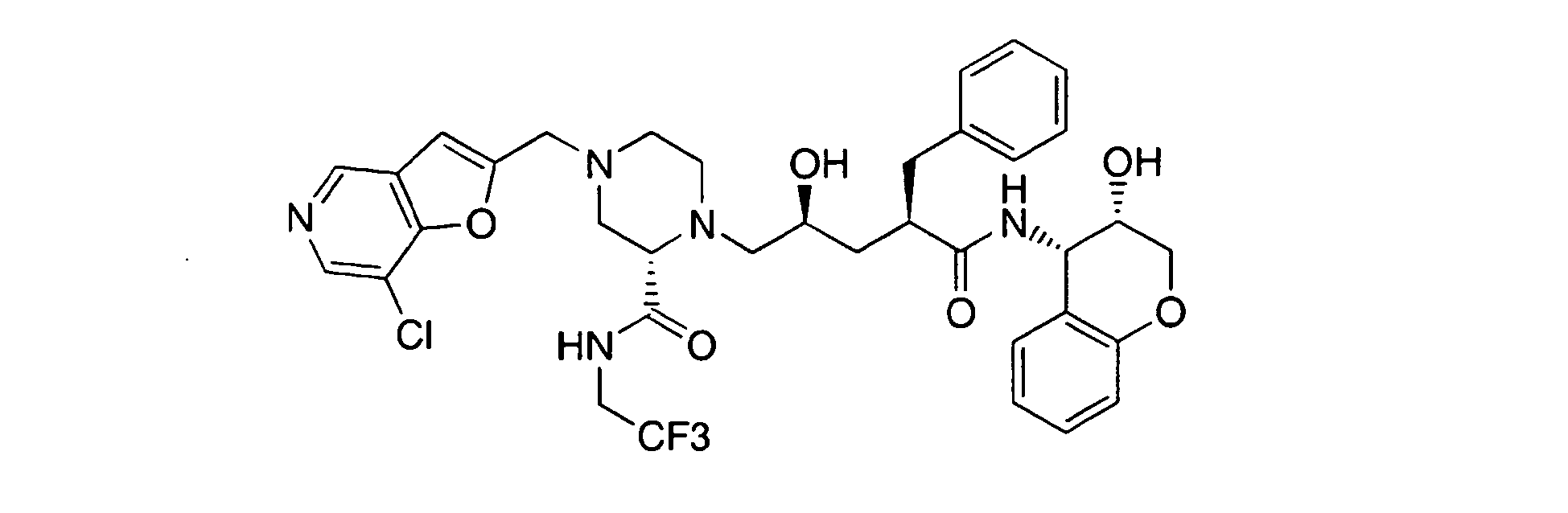
-

- To a suspension of 4-hydroxypyridine (40 g, 421 mmol) in methanol (1 1) was added N-iodosuccinimide (189 g, 841 mmol). The reaction mixture was heated to reflux for 10 hours. After it was cooled to room temperature, it was filtered. The solid was washed with methanol (2 X 500 mL) and dried under high vacuum overnight to give the title compound as a pale powder. 1H NMR (DMSO, 300 MHz): δ 8.25 (s).
-

- To a solution of 4-hydroxy-3,5-diiodopyridine (40 g, 115 mmol) in pyrrolidine (200 mL) was added tetrakis(triphenylphosphine)palladium(0) (3.4 g, 2.8 mmol) and copper(I) iodide (2.2 g, 11.5 mmol). It was stirred at room temperature for 20 minutes. Propargyl alcohol (3.3 g, 58 mmol) was introduced very slowly. After he reaction mixture was stirred at room temperature for 10 hours, the solvent was removed. The residue was dissolved in THF (200 mL) and the solution obtained was refluxed for 2 hours. The solvent was evaporated and the residue was distributed between ethyl acetate (500 mL) and saturated sodium bicarbonate (200 mL). The organic layer was dried over anhydrous sodium sulfate, concentrated and purified by flash column chromatography on silica gel with ethyl acetate as eluant to give the title compound as a white solid. 1H NMR (CD3OD, 300 MHz): δ 8.75 (s, 1 H), 8.63 (s, 1 H), 6.99 (s, 1H), 4.74 (s, 2 H).
-

- To a solution of the alcohol from the previous step (5.62 g, 20.4 mmol) in DMF (100 mL) was added manganese(IV) oxide (40 g, 409 mmol). The reaction mixture was stirred at room temperature for 2 days. Then, it was filtered. The solid was washed with boiling methanol for six times (100 mL each time). The combined filtrate and washes was concentrated to get the title compound as a white solid. 1H NMR (DMSO, 400 MHz): δ 9.91 (s, 1 H), 9.11 (s, 1 H), 8.90 (s, 1 H), 8.18 (s, 1 H).
-

- To a solution of the aldehyde from the previous step (3.14 g, 11.5 mmol) and the piperazine intermediate from Example 12 Step A (3.4 g following removal of the BOC with trifluroacetic acid, 11.5 mmol) in DCE (20 mL) was added sodium triacetoxyborohydride (3.66 g, 17.3 mmol). The reaction mixture was stirred at room temperature for 12 hours. After most of the solvent was evaporated, the residue was distributed between ethyl acetate (200 mL) and saturated sodium bicarbonate (100 mL). The organic layer was dried over anhydrous sodium sulfate, concentrated and purified by flash column chromatography on silica gel with hexanes / ethyl acetate = 1 / 1 as eluant to give the title compound as a white solid. 1H NMR (CDCl3, 400 MHz): δ 8.77 (s, 1 H), 8.76 (s, 1 H), 6.88 (s, 1 H), 5.91-5.98 (m, 1 H), 5.25-5.36 (m, 2 H), 4.83-4.87 (m, 1 H), 4.66 (s, 1 H), 4.00 (broad s, 1 H), 3.84 (dd, J=15.2, 37.6 Hz, 2 H), 3.55 (d. J=10,8 Hz, 1 H), 3.20 (broad s, 1 H), 2.93 (d, J=10.8 Hz, 1 H), 2.32-2.41 (m, 2 H), 1.66 (broad s, 2 H).
-

- A solution of the intermediate from the previous step (2 g, 3.62 mmol) and copper(I) chloride (1.8 g, 18.1 mmol) in DMF (15 mL) was stirred at 110 °C for 6 hours. HPLC showed that the starting material was gone. It was distributed between ethyl acetate (500 mL) and concentrated ammonium hydroxide (300 mL). The organic layer was dried over anhydrous sodium sulfate, concentrated and purified by flash column chromatography on silica gel with hexanes / ethyl acetate = 1 / 2 as eluant to get the title compound as a white solid. 1H NMR (CDCl3, 400 MHz): δ 8.76 (s, 1H), 8.39 (s, 1 H), 6.94 (s, 1H), 5.90-5.97 (m, 1 H), 5.24-5.35 (m,2 H), 4.83-4.87 (m, 1 H). 4.66 (s, I H), 3.84 (dd, J=15.2, 37.6 Hz, 2 H), 3.60 (broad s, 1 H), 3.55 (d. J=10,8 Hz, I H), 2.99 (broad s, 1 H), 2.93 (d, J=10.8 Hz, 1 H), 2.32-2.41 (m, 2 H), 1.66 (broad s, 2 H).
-

- A suspension of tris(dibenzylideneacetone)dipalladium(0) (183 mg, 0.2 mmol) and 1,4-bis(diphenylphosphino)butane (85.3 mg, 0,2 mmol) in THF (20 mL) was stirred at room temperature for 20 minutes. Then, it was transferred to a solution of the intermediate from the previous step (910 mg, 1.97 mmol) and thiosalicylic acid (380 mg, 2.46 mmol) in THF (5 mL). After stirring at room temperature for 10 hours the reaction mixture was distributed between ethyl acetate (200 mL) and sodium hydroxide solution (1N, 100 mL). The organic layer was dried over anhydrous sodium sulfate, concentrated and purified by flash column chromatography on silica gel with ethyl acetate / 2 N ammonia in methanol = 95/ 5 as eluant to give the title compound as a slightly yellow gum. 1H NMR (CDCl3, 400 MHz): δ 8.76 (s, 1 H), 8.46 (s, 1 H), 7.76 (broad s, 1 H), 6.79 (s, 1 H), 3.84-4.02 (m, 2 H), 3.80 (d, J=3.2 Hz, 2 H), 3.56 (dd, J= 3.6, 6.8 Hz, 1 H), 2.86-3.06(m, 3 H), 2.49-2.73 (m, 3 H),
- A solution of the piperazine intermediate from the previous step (378 mg, 1 mmol) and the epoxide from Example 1, Step P (394 mg, 1 mmol) in methanol (10 mL) was heated to reflux for 24 hours. After the solvent was evaporated, the residue was purified by flash column chromatography on silica gel with ethyl acetate / 2 N ammonia in methanol = 98/ 2 as eluant to get a white solid (485 mg). The solid obtained was dissolved in methanol (10 mL) and HCl (1 N in ether, 3 mL) was added. The solution obtained was stirred at room temperature for 8 hours. After the solvent was removed the residue was purified by flash column chromatography on silica gel with ethyl acetate / 2 N ammonia in methanol = 98/ 2 as eluant to give the title compound as a white solid. 1H NMR (CDCl3, 300 MHz): δ 8.92-8.97 (m, 1 H), 8.77 (s, 1 H), 8.48 (s, 1 H), 7.20-7.32 (m, 5 H), 7.05-7.15 (m, 2 H), 6.77-6.82 (m, 2 H), 5.93 (d, J=8.4 Hz, 1 H), 5.14-5.18 (m, 1 H), 4.07-4.24 (m, 1 H), 3.96-4.04 (m, 2 H), 3.67-3.87 (m, 5 H), 3.45-3.46 (m, 1 H), 3.37 (broad s, 1 H), 2.62-3.04 (m, 8 H), 2.44-2.53 (m, 2 H),), 2.02-2.14 (m, 1 H), 1.37-1.44 (m, 1H). LC-MS (M++1) (EI) 730.5.
-

-

- A solution of 5-(pyrid-3-yl)oxazole (4.0 g, 27.4 mmol) in THF (100 mL) was cooled to -78 °C and butyllithium (2.5 M in hexanes, 13.1 mL, 32.8 mmol) was added. After it was stirred at -78 °C for 30 minutes, N-formylmorpholine (0.63 mL, 82.1 mmol) was added. The reaction solution was slowly warmed to room temperature at which it was stirred for 10 hours. Then, ethyl acetate (200 mL) was added and the diluted solution was washed with saturated sodium bicarbonate solution (200 mL). The organic layer was dried over anhydrous sodium sulfate, concentrated and purified by flash column chromatography on silica gel with 1/1 hexanes / ethyl acetate as eluant to give the title compound as a slightly yellow solid. 1H NMR (CDCl3, 300 MHz): δ 9.80 (s, 1 H), 9.04 (s, 1 H), 8.68 (d, J=1.5 Hz, 1 H), 8.07-8.10 (m, 1 H), 7.20 (d, J=1.5 Hz, 1 H), 7.41-7.45 (m, 1 H).
- To a solution of the aldehyde from the previous step (16 mg, 0.09 mmol) and the penultimate from Example 12 Step D (50 mg, 0.09 mmol) in DCE (3 mL) was added sodium triacetoxyborohydride (28 mg, 0.13 mmol). The reaction mixture was stirred at room temperature for 24 hours and purified on preparative TLC (2000 microns, CH2Cl2 / acetone / 2N NH3 in methanol = 47.5 /47.5/5 as eluant) to give the titled compound as a white solid. 1H NMR (CD3OD, 400 MHz): δ 8.91 (d, J=1.6 Hz, 1 H), 8,52 (d, J=4.8 Hz, 1 H), 8.14 (d, J=8.0 Hz, 1 H), 7.64 (s, 1 H), 7.51-7.54 (m, 1H), 7.07-7.26 (m, 7 H), 6.82 (t, J=7.2, 1 H), 6.73 (d, J=8.0 Hz, 1H), 5.16 (d, J=4 Hz, 1 H), 4.07-4.08 (m, 2 H), 3.80-3.96 (m, 1 H), 3.73-3.78 (m, 5 H), 3.13-3.16 (m, 1 H), 2.83-3.06 (m, 3 H), 2.57-2.78 (m, 4 H), 2.40-2.49 (m, 4 H), 2.02-2.14 (m, 1 H), 1.37-1.44 (m, 1 H). LC-MS (M++1) (EI) 723.7.
-

-

- A solution of 5-(pyrid-2-yl)oxazole (4.0 g, 27.4 mmol) in THF (100 mL) was cooled to -78 °C and butyllithium (2.5 M in hexanes, 13.1 mL, 32.8 mmol) was added. After it was stirred at -78 °C for 30 minutes, N-formylmorpholine (0.63 mL, 82.1 mmol) was added. The reaction solution was slowly warmed to room temperature and then it was stirred for 10 hours. Ethyl acetate (200 mL) was added and the diluted solution was washed with saturated sodium bicarbonate solution (200 mL). The organic layer was dried over anhydrous sodium sulfate, concentrated and purified by flash column chromatography on silica gel with 1/1 hexanes / ethyl acetate as eluant to give the title compound as a slightly yellow solid. 1H NMR (CDCl3, 300 MHz): δ 8.69 (s, 1 H), 9.04 (s, 1 H), 7.98-8.00 (m, 1 H), 7.82-7.89 (m, 2 H), 7.36-7.25 (m, 1 H).
- To a solution of the aldehyde from the previous step (16 mg, 0.09 mmol) and the penultimate from Example 12 Step D (50 mg, 0.09 mmol) in DCE (3 mL) was added sodium triacetoxyborohydride (28 mg, 0.13 mmol). The reaction mixture was stirred at room temperature for 24 hours and purified on preparative TLC (2000 microns, CH2Cl2 / acetone / 2N NH3 in methanol = 47.5 / 47.5 / 5 as eluant) to give the titled compound as a white solid. 1H NMR (CD3OD, 400 MHz): δ 8.58 (d, J=1.6 Hz, 1H), 7.90 (t, J=1.6 Hz, 1H), 7.80 (t, J=1.6 Hz, 1H), 7.68-7.69 (m, 1H), 7.36-7.39 (m, 1 H), 7.09-7.25 (m,7 H), 6.83 (t, J=7.2, 1H), 6.73 (d, J=8.0 Hz, 1 H), 5.16 (d, J=4 Hz, 1 H), 4.07-4.08 (m, 2 H), 3.80-3.96 (m, 1 H), 3.73-3.78 (m, 5 H), 3.13-3.16 (m, 1 H), 2.83-3.06 (m, 3 H), 2.57-2.78 (m, 4 H), 2.40-2.49 (m, 4 H), 2.02-2.14 (m, 1 H), 1.37-1.44 (m, 1 H). LC-MS (M++1) (EI) 723.7.
-

-

- A solution of hydroxyamine hydrochloride (25 g, 360 mmol) in water (50 mL) was added to aqueous sodium hydroxide (20%, 70 mL). To this stirred solution was added 2-acetylpyridine (36.3 g, 300 mmol). The reaction mixture was cooled to 0 °C at which it was stirred for 3 hours to form a white precipitate. It was filtered. And the solid was washed with ice-cooled water (300 mL). The solid obtained was dissolved in 600 mL of boiling water. The hot water solution was slowly cooled to room temperature to form a white needle. It was filtered. The crystalline solid was washed with ice-cooled water (300 mL) and dried under high vacuum overnight to give the titled compound. 1H NMR (DMSO, 400 MHz): δ 8.56 (d, J=0.8 Hz, 1 H), 7.80 (d, J=1.6 Hz, 1 H), 7.75 (dd, J=1.6, 6.0 Hz, 1 H), 7.32 (dd, J=6.0, 2.4 Hz, 1 H), 2.19 (s, 3 H).
-

- A solution of the oxime form the previous step (31 g, 228 mmol) and p-toluenesulfonyl chloride (54.3 g, 285 mmol) in pyridine (100 mL) was stirred at room temperature for 24 hours to form a brown precipitate. 500 mL of ice-cooled water was added while stirring. The initially formed brown precipitate dissolved followed by the formation of a white precipitate. This precipitate was collected by filtration and washed with ice-cooled water (3 X 200 mL). It was dried under high vacuum to constant weight to give the titled compound. 1H NMR (CDCl3, 400 MHz): δ 8.61 (ddd, J=1.0, 1.8,4.9 Hz, 1 H), 7.48 (d, J=8.4 Hz, 1 H), 7.82 (dt, J=0.9, 8.1 Hz, 1 H), 7.70 (dt, J=1.8, 7.7 Hz, 1 H), 7.32-7.39 (m, 3 H), 2.46 (s, 6 H).
-

- To a solution of the tosylate from the previous step (60 g, 205.2 mmol) in ethanol (1 L) was added potassium ethoxide (17.8 g, 211.4 mmol) at 0 °C. It was slowly warmed to room temperature at which it was stirred for 1 hour. It was then diluted with 1 I of anhydrous ethanol and HCl gas was bubbled in for 1 hour to see some precipitate. It was concentrated. The residue was distributed between methylene chloride (500 mL) and saturated sodium carbonate (about 500 mL to get pH=10). The organic layer was concentrated and vacuum distilled to get the titled compound as a colorless oil. 1H NMR (CDCl3, 400 MHz): δ 8.67-8.70 (m, 1 H), 7.71-7.80 (m, 2H), 7.20- 7.24 (m, 1 H), 3.35-3.49 (m, 4 H), 3.21 (s, 2 H), 1.21- 1.28 (m, 6 H).
-

- To a solution of the piperazine intermediate from Example 12, Step A (1 g, 3.39 mmol following removal of the BOC group with trifluoroacetic acid) and silver trifluoromethane sulfonate (725 mg, 2.82 mmol) in THF (5 mL) was added triethylamine. While stirring, a solution of 2-bromo-2-methylpropionic acid (472 mg, 2.82 mmol) in 5 mL of THF was introduced slowly (within 1.5 hours) through a syringe pump. The reaction mixture was stirred at room temperature for 2 hours after the additions. Then, it was filtered. The filtrate was concentrated and purified by flash column chromatography on silica gel with 10/1 ethyl acetate / methanol as eluant to give the title compound as a white solid. 1H NMR (CDCl3, 400 MHz): δ 9.02 (broad s, 1 H), 6.98 (broad s, 1 H), 5.90-6.00 (m, 1 H), 5.24-5.28 (m, 2 H), 5.65 (broad s, 1 H), 4.16 (broad s, 1 H), 2.90-2.93 (m, 1 H), 2.55-2.57 (m, 1 H), 2.40-2.41 (m, 1 H), 1.59-1.61 (m,1H).
-
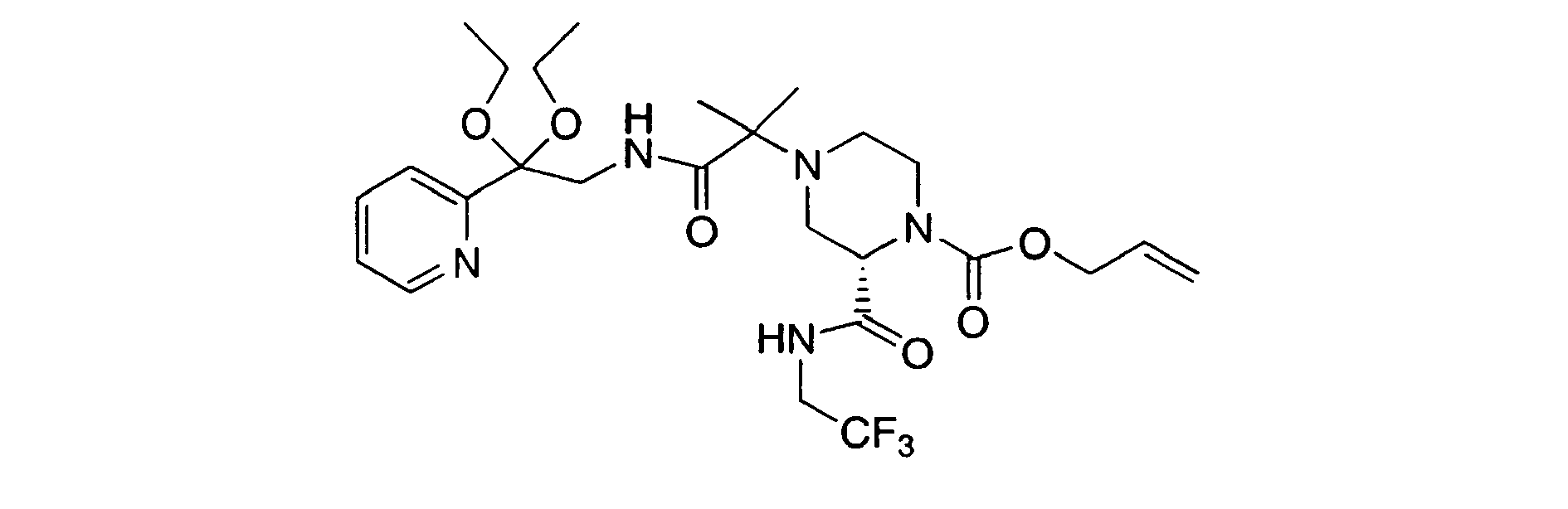
- To a solution of the carboxylic acid from the previous step (2 g, 5.24 mmol) and the aminoacetal from Step C (1.33 g, 6.3 mmol) in DMF (20 mL) was added O-benzoltriazol-1-N,N,N',N'-tetramethyluronium hexafluorophosphate (4.77 g,12.6 mmol), 1-hydroxybenzotriazol hydrate (1.7 g, 12.6 mmol) and diisopropylethylamine (4.56 mL, 26.2 mmol). After stirring at room temperature for 10 hours, the reaction solution was distributed between ethyl acetate (300 mL) and water (300 mL). The organic layer was washed with water (200 mL) and brine. It was dried over anhydrous sodium sulfate, concentrated and purified by flash column chromatography on silica gel with 1/2 hexanes / ethyl acetate as eluant to get the title compound as a white solid. 1H NMR (CDCl3, 400 MHz): δ 8.66 (d, J=4.8 Hz, 1 H), 7.70 (d, J=3.6 Hz, 2 H), 7.27 (m, 1 H), 6.63 (t, J=6.1 Hz, 1 H), 5.89- 5.99 (m, 1 H), 5.26-5.35 (m, 2 H), 4.65 (d, J=4.8 Hz, 3 H), 4.19 (dd, J=8.0, 13.6 Hz, 1 H), 3.92 (broad s, 2 H), 3.57-3.68 (m, 3 H), 3.27-3.40 (m, 3 H), 2.82 (s, 2 H), 2.79 (broad s, 1 H), 2.49 (d, J=5.6 Hz, 1 H), 2.29 (dd, J=4.0, 8.0 Hz, 1 H), 2.14 (dt, J=3.2, 11.6 Hz, 1 H), 1.20-1.25 (2t, J=7.2 Hz, 6 H), 1.11 (s, 3H), 1.03 (s, 3 H).
-

- The acetal from the previous step (1.6 g, 2.79 mmol) was dissolved in THF (10 mL) and HCl (6 N, 10 mL) was added. The reaction solution was stirred at 70 °C for 12 hours until (by TLC) the acetal was consumed. It was diluted with 200 mL of ethyl acetate and 1 N sodium hydroxide solution was added until pH=10. The organic layer was dried over anhydrous sodium sulfate, concentrated and purified by flash column chromatography on silica gel with 10/1 ethyl acetate/methanol as eluant to give the title compound as a white solid. 1H NMR (CDCl3, 400 MHz): δ 8.70-8.1 (m, 1 H), 8.00 (dt, J=0.4, 6.8 Hz, 1 H), 7.86 (dt, J=1.6, 6.0 Hz, 1H), 7.51 (ddd, J=1.2, 4.8, 7.6 Hz, 1 H), 6.66 (broad s, 1 H), 5.89- 5.99 (m, 1 H), 5.27-5.34 (m, 2 H), 5.11 (dd, J=6.8, 19.6 Hz, 1 H), 4.80-4.86 (m, 2 H), 4.68 (d, J=4.2 Hz, 2 H), 4.00-4.09 (m, H), 3.72 (d, J=12 Hz, 1 H), 3.45-3.50 (m, 1 H), 3.27 (t, J=10.4 Hz, 1 H), 2.91 (d, J=10.4 Hz, 1 H), 2.45 (dd, J=4.0, 12.0 Hz, 1 H), 2.35 (dt, J=2.8, 12 Hz, 1 H), 1.30 (s, 3 H), 1.27 (s, 3 H).
-

- The ketoamide from the previous step (930 mg, 1.86 mmol) was dissolved in 6 mL of fuming sulfuric acid. It was stirred at 55- 60° C for 15 minutes. After cooled to room temperature it was carefully poured into ice-water (20 mL). While the aqueous solution was stirred, potassium hydroxide (solid) was added slowly until pH=12. It was extracted with ethyl acetate for 3 times (100 mL each time). The combined extractant was dried over anhydrous sodium sulfate, concentrated and purified by flash column chromatography on silica gel with 100/12 ethyl acetate/methanol as eluant to give the title compound as a colorless glass. 1H NMR (CDCl3, 400 MHz): δ 8.64 (t, J=4.8 Hz, 1 H), 8.19 (broad s, 1 H), 7.74-7.80 (m, 1 H), 7.59-7.65 (m, 2 H), 7.23-7.28 (m, 1 H), 3.92-4.03 (m, 2 H), 3.51 (dd, J=3.6, 5.6 Hz, 1 H), 2.84-2.99 (m, 2 H), 2.76-2.82 (m, 1 H), 2.56- 2.64 (m, 3 H), 1.62 (s, 3 H), 1.61 (s, 3 H). LC-MS (M++1) (EI) 398.3, 399.3
- A solution of the intermediate from the previous step (470 mg, 1.18 mmol) and the epoxide from Example 1, Step P (535.2 mg, 1.36 mmol) in ethanol (10 mL) was refluxed for 2 days. After the solvent was evaporated the residue was purified by flash column chromatography on silica gel with 10/1 ethyl acetate/methanol as eluant to get a white solid (580 mg) (LC-MS (M++1) (EI) 791.5). The solid obtained was dissolved in methanol (10 mL) and cooled to 0 oC. HCl (1 N in ether, 10 mL) was added and the reaction solution was warmed to room temperature at which it was stirred for 10 hours. The solvent was evaporated. The residue was distributed between ethyl acetate (50 mL) and 1 N potassium hydroxide (10 mL). The organic layer was dried over anhydrous sodium sulfate, concentrated and purified by flash column chromatography on silica gel with 10/1 ethyl acetate/methanol as eluant to give the title compound as a white solid. 1H NMR (CD3OD, 400 MHz): δ 8.58 (dt, J=1.2, 4.8 Hz, 1 H), 7.91 (dt, J=1.6, 7.6 Hz, 1 H), 7.78 (d, J=8.0Hz, 1 H), 7.67 (s, 1 H), 7.36-7.39 (m, 1 H), 7.05-7.22 (m, 7 H), 6.80 (t, J=7.2 Hz, 1 H), 6.72 (d, J=8.0 Hz, 1 H), 5.14 (d,J=4.1 Hz, 1 H), 4.06 (s, 2 H), 3.91-4.01 (m,1 H), 3.70-3.87 (m, 3 H), 3.28-3.31 (m, 2 H), 3.08 (dd, J=3.3, 7.2 Hz, 1 H), 2.95-3.02 (m, 2 H), 2.87-2.94 (m, 2 H), 2.62-2.79 (m, 3 H), 2.49 (t, J=8.4 Hz, 1H), 2.31-2.44 (m, 3 H), 1.98-2.05 (m, 1 H), 1.61 (s, 3 H), 1.60 (s, 3 H), 1.33-1.40 (m, 1 H). LC-MS (M++1) (EI) 751.5
-

-

- A solution of hydroxyamine hydrochloride (25 g, 360 mmol) in water (50 mL) was added to aqueous sodium hydroxide (20%, 70 mL). To this stirred solution was added 2-acetylpyridine (36.3 g, 300 mmol). The reaction mixture was cooled to 0 °C at which it was stirred for 3 hours to form a white precipitate. It was filtered. And the solid was washed with ice-cooled water (300 mL). The solid obtained was dissolved in 600 mL of boiling water. The hot water solution was slowly cooled to room temperature to form white needles. It was filtered. The crystalline solid was washed with ice-cooled water (300 mL) and dried under high vacuum over night to give the titled compound. 1H NMR (DMSO, 400 MHz): δ 8.82 (d, J=1.8 Hz, 1 H), 8.54 (dd, J=1.6, 4.9 Hz, 1 H), 7.99(dt, J=4.0, 8.0 Hz, 1 H), 7.40 (dd, J=4.7, 8.0, Hz 1H), 2.16 (s, 3 H).
-

- A solution of the oxime form the previous step (16.5 g, 121 mmol) and p-toluenesulfonyl chloride (29 g, 152 mmol) in pyridine (70 mL) was stirred at room temperature for 24 hours to form a brown precipitate. 300 mL of ice-cooled water added while stirring. The initially formed brown precipitate dissolved followed by the formation of a white precipitate. This precipitate was collected by filtration and washed with ice-cooled water for 3 times (100 mL each time). It was dried under high vacuum to constant weight to give the titled compound. 1H NMR (CDCl3, 400 MHz): δ 8.81 (d, J=1.7 Hz, 1 H), 8.67 (dd, J=2.0, 4.9 Hz, 1 H), 7.94 (dt, J=2.0, 8.3 Hz, 2 H), 7.90 (dt, J=1.6, 8.0 Hz, 1 H), 7.38 (d, J=8.0 Hz, 2 H), 7.32-7.36 (m, 1 H), 2.46 (s, 3 H), 2.39 (s, 3 H).
-

- To a solution of 2-acetylpyridine tosylate from the previous step (30 g, 102.6 mmol) in ethanol (500 mL) was added potassium ethoxide (9.1 g, 105.7 mmol) at 0 °C. It was slowly warmed to room temperature at which it was stirred for 1 hour. It was then diluted with 500 mL of anhydrous ethanol and HCl gas was bubbled in for 1 hour to see some precipitate. It was concentrated. The residue was distributed between methylene chloride (500 mL) and saturated sodium carbonate (about 500 mL to get pH=10). The organic layer was concentrated and vacuum distilled to get the titled compound as a colorless oil. 1H NMR (CDCl3, 400 MHz): δ 8.76-8.77 (m, 1 H), 8.58 (dd, J=1.8, 4.9 Hz, 1 H), 7.84 (dt, 1.8, 8.0 Hz, 1H), 7.32 (ddd, J= 0.8, 4.8, 8.0 Hz, 1 H), 3.37-3.53 (m, 4 H), 3.03 (s, 2 H), 1.25 (t, J=7.0 Hz, 6 H).
-

- To a solution of the carboxylic acid from the Example 66, Step D (2 g, 5.24 mmol) and the aminoacetal from the previous step (1.33 g, 6.3 mmol) in DMF (20 mL) was added O-benzoltriazol-1-N,N,N',N'-tetramethyluronium hexafluorophosphate (4.77 g,12.6 mmol), 1-hydroxybenzotriazol hydrate (1.7 g, 12.6 mmol) and diisipropylethylamine (4.56 mL, 26.2 mmol). After stirring at room temperature for 10 hours, the reaction solution was distributed between ethyl acetate (300 mL) and water (300 mL). The organic layer was washed with water (200 mL) and brine. It was dried over anhydrous sodium sulfate, concentrated and purified by flash column chromatography on silica gel with 1/2 hexanes / ethyl acetate as eluant to give the title compound as a white solid. 1H NMR (CDCl3, 400 MHz): δ 8.66 (d, J=4.8 Hz, 1 H), 7.70 (d, J=3.6 Hz, 2 H), 7.27 (m, 1 H), 6.63 (t, J=6.1 Hz, 1 H), 5.89-5.99 (m, 1H), 5.26-5.35 (m, 2 H), 4.65 (d, J=4.8 Hz, 3 H), 4.19 (dd, J=8.0, 13.6 Hz, 1 H), 3.92 (broad s, 2 H), 3.57-3.68 (m, 3 H), 3.27-3.40 (m, 3 H), 2.82 (s, 2 H), 2.79 (broad s, 1H), 2.49 (d, J=5.6 Hz, 1 H), 2.29 (dd, J=4.0, 8.0 Hz, 1 H), 2.14 (dt, J=3.2, 11.6 Hz, 1H), 1.20-1.25 (2t, J=7.2 Hz, 6 H), 1.11 (s, 3H), 1.03 (s, 3 H).
-

- The acetal from the previous step (1.7 g, 2.96 mmol) was dissolved in THF (10 mL) and HCl (6 N, 10 mL) was added. The reaction solution was stirred at 70 °C for 12 hours, until the acetal was consumed. It was diluted with 200 mL of ethyl acetate and 1 N sodium hydroxide solution was added until pH=10. The organic layer was dried over anhydrous sodium sulfate, concentrated and purified by flash column chromatography on silica gel with 10/1 ethyl acetate/methanol as eluant to give the title compound as a white solid. 1H NMR (CDCl3, 400 MHz): δ 9.19 (s, 1 H), 8.82 (d, J=3.7 Hz, 1 H), 8.33 (broad s, 1 H), 8.23 (dt, J=2.0, 8.0 Hz, 1 H), 7.46 (dd, J=4.9, 7.8 Hz, 1 H), 6.76 (broad s, 1 H), 5.88- 6.01 (m, 1 H), 5.27-5.36 (m, 2 H), 4.74-4.94 (m, 2 H), 4.68 (d, J=5.4 Hz, 2 H), 4.53 (dd, J= 3.0, 15.6, 1 H), 4.00-4.26 (m, 2 H), 3.68-3.71 (m, 1 H), 3.64 (d, J=9.7 Hz, 1 H), 3.25 (t, J=9.3 Hz, 1 H), 2.87 (d, J=11.0 Hz, 1 H), 2.43 (dd, J=3.5, 11.5 Hz, 1H), 2.33 (dt, J=3.3, 11.7 Hz, 1H), 1.81 (broad s, 1 H), 1.68-1.71 (m, 1 H), 1.27 (s, 6 H).
-

- The ketoamide from the previous step (1.01 g mg, 2.02 mmol) was dissolved in 8 mL of fuming sulfuric acid. It was stirred at 55- 60 ° C for 20 minutes. After cooled to room temperature it was carefully poured into ice-water (20 mL). While the aqueous solution was stirred, potassium hydroxide (solid) was added slowly until pH=12. It was extracted with ethyl acetate for 3 times (100 mL each time). The combined extractant was dried over anhydrous sodium sulfate, concentrated and purified by flash column chromatography on silica gel with 100/12 ethyl acetate/methanol as eluant to give the title compound as a colorless glass. 1H NMR (CDCl3, 400 MHz): δ 8.91 (d, J=1.8 Hz, 1 H), 8.59 (dd, J=1.5,4.9 Hz, 1 H), 8.08 (broad s, 1 H), 7.91 (dt, J=2.0, 8.0 Hz, 1 H), 7.38 (ddd, J=0.8, 4.9, 8.0 Hz, 1 H), 7.35 (s, 1H), 3.91-4.00 (m, 2 H), 3.51 (dd, J=3.8, 5.6 Hz, 1 H), 2.84-2.99 (m, 3 H), 2.76-2.82 (m, 1 H), 2.52- 2.64 (m, 2 H), 1.61 (s, 3 H), 1.60 (s, 3 H). LC-MS (M++1) (EI) 398.3.
- A solution of the intermediate from the previous step (608 mg, 1.53 mmol) and the epoxide from Example 1, Step P(6.93 mg, 1.76 mmol) in ethanol (15 mL) was refluxed for 12 hours. After the solvent was evaporated the residue was purified by flash column chromatography on silica gel with 10/1 ethyl acetate/methanol as eluant to get a white solid (620 mg) (LC-MS (M++1) (EI) 791.5). The solid obtained was dissolved in methanol (8 mL) and cooled to 0 °C. HCl (1 N in ether, 10 mL) was added and the reaction solution was warmed to room temperature at which it was stirred for 10 hours. The solvent was evaporated. The residue was distributed between ethyl acetate (50 mL) and 1 N potassium hydroxide (10 mL). The organic layer was dried over anhydrous sodium sulfate, concentrated and purified by flash column chromatography on silica gel with 10/1 ethyl acetate/methanol as eluant to give the title compound as a white solid. 1H NMR (CD3OD, 400 MHz): δ 8.89 (d, J=1.8 Hz, 1H), 8.51 (d, J=3.5 Hz, 1 H), 8.13 (dt, J=1.9, 8.0 Hz, 1 H), 7.81 (d, J=8.8 Hz, 1 H), 7.63 (s, 1 H), 7.51 (dd, J=4.9, 8.0 Hz, 1 H), 7.10-7.26 (m, 5 H), 7.05-7.09 (m, 2 H), 6.80 (t, J=7.2 Hz, 1 H), 6.72 (d, J=8.0 Hz, 1 H), 5.14 (d,J=3.9 Hz, 1 H), 4.06 (s, 2 H), 3.91-4.01 (m, 1 H), 3.70-3.87 (m, 3 H), 3.28-3.31 (m, 1 H), 3.10-3.21 (m, 2 H), 2.89-3.04 (m, 4 H), 2.80 (broad s, 1 H), 2.63-2.75 (m, 3 H), 2.41-2.52 (m, 4 H), 1.98-2.05 (m, 1 H), 1.61 (s, 3 H), 1.60 (s, 3 H), 1.33-1.40 (m, 1 H). LC-MS (M++1) (EI) 751.5
-

-

- To a solution of 5-bromopyrimidine (2.4 g, 15.1 mmol) in t-butyl acrylate (30 mL) was added palladium acetate (169.4 mg, 0.755 mmol) and triethylamine (3 mL, 21.59 mmol). The flask was sealed and heated at 80 oC. After 24 hours, another portion of palladium acetate (169.4 mg, 0.755 mmol) was added and the reaction mixture was heated at 80 °C for 24 hours. The solvent was removed in vacuo and the crude reaction mixture was purified by flash column chromatography on silica gel with 3:7 ethyl acetate/hexane as the eluant to give the titled compound. 1H NMR (CDCl3, 300 MHz): 9.18 (s, 1H), 8.86 (s, 2H), 7.52 (d, J = 17.5 Hz, 1H), 6.50 (d, J = 17.5 Hz, 1H), 1.55 (s, 9H).
-

- To the intermediate prepared in Step A (100 mg, 0.485 mmol) and triethylamine (0.135 mL, 0.97 mmol) in ethanol (5 mL) was added 10 % palladium on carbon (18 mg). The reaction mixture was stirred under a hydrogen balloon and the progress of the reaction was monitored by TLC. After half an hour the reaction mixture was filtered through celite and the filtrate was concentrated in vacuo. The crude product was purified by flash column chromatography on silica gel with 3:7 ethyl acetate/hexane as the eluant to give the titled compound. 1H NMR (CDCl3, 300 MHz): 9.08 (s, 1H), 8.62 (s, 2H), 2.90 (t, 2H), 2.59 (t, 2H), 1.42 (s, 9H).
-

- To the intermediate prepared in Step B (289 mg, 1.39 mmol) was added trifluoroacetic acid (10 mL) and stirred at room temperature for an hour. The solvent was removed in vacuo. The resulting product in methylene chloride (10 mL) was added aminochromanol (415 mg, 2.08 mmol,) prepared as in Example 1 Step L, EDC (531 mg, 2.78 mmol), HOBt (375 mg, 2.78 mmol) and N,N-diisopropylethylamine (1.2 mL, 6.95 mmol). The reaction mixture was stirred at room temperature overnight. A white precipitate of the titled compound was formed. The precipitated product was collected by filtration. The filtrate which also contained product was washed with water, dried over anhydrous sodium sulfate, filtered and concentrated in vacuo. 1H NMR (CDCl3, 300 MHz): 9.02 (s, 1H), 8.75 (s, 2H), 7.10 (m, 1H), 6.84 (m, 2H), 6.76 (m, 1H), 5.22 (m, 1H), 4.12 (m, 2H), 4.20 (m, 1H), 3.06 (t, 2H), 2.72 (t, 2H).
-

- To the intermediate prepared in Step C (306 mg, 1.02 mmol) in methylene chloride (10 mL) was added 2-methoxypropene (0.491 mL, 5.11 mmol) and camphorsulfonic acid (522 mg, 2.25 mmol). The reaction mixture was stirred at room temperature and the progress of the reaction was monitored by TLC. After 3 hours the crude reaction mixture was poured into 1 N aqueous sodium hydroxide solution and the product was extracted with ethyl acetate three times. The organic layers were combined, washed with brine, dried over anhydrous sodium sulfate, filtered and concentrated in vacuo. The crude product was purified by flash column chromatography on silica gel with ethyl acetate as the eluant to give the titled compound as a white solid. 1H NMR (CDCl3, 300 MHz): 9.10 (s, 1H), 8.68 (s, 2H), 7.12 (m, 1H), 6.98 (m, 1H), 6.86 (t, 2H), 4.92 (m, 1H), 4.39 (m, 1H), 4.28 (m, 1H), 4.18 (m, 1H), 3.10 (m, 2H), 3.00 (m, 2H), 1.60 (s, 3H), 1.25 (s, 3H).
-

- To a solution of intermediate prepared in Step D (122 mg, 0.3592 mmol) in anhydrous tetrahydrofuran (5 mL) at -25 °C was added allylbromide (0.034 mL, 0.395 mmol) followed by 1.0 M lithium bis(trimethylsilyl)amide in THF (0.395 mL, 0.395 mmol). The reaction mixture was stirred at -25 °C and progress of reaction was monitored by TLC. After 2 hours the reaction was quenched with water and warmed up to room temperature. The crude reaction mixture was extracted with ethyl acetate three times. The organic layers were combined, dried over anhydrous sodium sulfate, filtered and concentrated in vacuo. The crude product was purified by flash column chromatography on silica gel with 1:1 ethyl acetate/hexane as the eluant to give the titled compound as a white solid. 1H NMR (CDCl3, 300 MHz, mixture of rotamers R1 and R2 7:3 ratio): 9.16 (s, 0.7H, R1), 9.07 (s, 0.3H, R2), 8.74 (s, 1.4H, R1), 8.63 (s, 0.6H, R2), 7.66 (m, 0.3H), 7.18-7.04 (m, 1H), 6.90-6.78 (m, 1.4H), 6.55 (t, 0.7H), 6.22 (d, 0.7H), 5.94-5.68 (m, 1.3H), 5.22-4.94 (m, 2.7H), 4.42-4.02 (m, 3H), 3.37-3.12 (m, 2H), 2.84-2.77 (m, 1H), 2.50-2.26 (m, 2H), 1.35-1.07 (m, 6H).
-

- To the intermediate prepared in Step E (142 mg, 0.375 mmol) in ethyl acetate (6 mL) at 0 °C was added 0.5 M aqueous sodium bicarbonate solution (6 mL) and N-iodosuccinimide (177 mg, 0.788 mmol). The reaction mixture was allowed to warm to room temperature. After 14 hours the mixture was poured into aqueous sodium sulfite solution and extracted with ethyl acetate three times. The organic layers were combined, dried over anhydrous sodium sulfate, filtered and concentrated in vacuo. The resulting product was dissolved in ethyl acetate (5 mL) and sodium methoxide in methanol (25 wt. %, 0.136 mL, 0.596 mmol) was added. The reaction mixture was stirred at room temperature and progress of reaction was monitored by TLC. After an hour the mixture was poured into saturated sodium bicarbonate solution and the product was extracted with ethyl acetate three times. The combined organic layers were dried over anhydrous sodium sulfate, filtered and concentrated in vacuo. The crude titled product was purified by flash column chromatography on silica gel with ethyl acetate as the eluant. 1H NMR (CDCl3, 300 MHz, mixture of rotamers R1 and R2 4:1 ratio): 9.17 (s, 0.8H, R1), 9.11 (s, 0.2H, R2), 8.72 (s, 1.6H, R1), 8.63 (s, 0.4H, R2), 7.69 (d, J = 8.24 Hz, 0.2H, R2), 7.14-7.08 (m, 1H), 6.87-6.80 (m, 1.2H), 6.62-6.56 (m, 0.8H, R1), 6.36 (d, J = 7.84, 0.8H, R1), 5.85 (d, J = 5.55 Hz, 0.2H, R2), 5.34 (d, J = 4.67 Hz, 0.8H, R1), 4.44-4.04 (m, 3H), 3.40-3.36 (m, 1.6H), 3.15-2.68 (m, 4H), 2.55-2.20 (m, 2.4H), 1.50-1.22 (m, 6H).
-

- The intermediate prepared as in Example 12, Step A (500 mg, 1.32 mmol) was treated with 30 % TFA/methylene chloride (20 mL). The reaction mixture was stirred at room temperature for an hour. Then solvents were removed in vacuo. The reaction mixture was diluted with chloroform. 1 N NaOH was added to adjust the pH to 14 followed by extraction with chloroform three times. The organic layers were combined, washed with brine, dried over anhydrous sodium sulfate, filtered and concentrated in vacuo. The resulting product (469 mg, 1.59 mmol) in dichloroethane (20 mL) was added the intermediate prepared in Example 23, Step G (273 mg, 1.59 mmol) followed by sodium triacetoxyborohydride (505 mg, 2.38 mmol). The reaction mixture was stirred at room temperature overnight. Then solvent was removed in vacuo. The crude product was purified by flash column chromatography on silica gel with 3:7 ethyl acetate/hexane as the eluant. The resulting intermediate (408 mg, 0.904 mmol) in methylene chloride (10 mL) was added 1,3-dimethylbarbituric acid (169 mg, 1.08 mmol). After stirring at room temperature for 5 min, Pd(PPh3)4 (52 mg, 0.045 mmol) was added. The reaction mixture was stirred at room temperature and progress of reaction was monitored by TLC. After an hour the mixture was poured into 1N NaOH and the product extracted with methylene chloride three times. The organic layers were combined, dried over anhydrous sodium sulfate, filtered and concentrated in vacuo. The crude reaction mixture was purified by flash column chromatography on silica gel with 8 % methanol/ethyl acetate as the eluant to give the titled compound. 1H NMR (CDCl3, 300 MHz): 7.77 (bs, 1H), 7.66-7.62 (m, 2H), 7.39-7.34 (m, 2H), 7.26-7.22 (m, 1H), 6.58 (d, J = 3.24 Hz, 1H), 6.29 (d, J = 3.02 Hz, 1H), 3.98-3.71 (m, 4H), 3.64 (d, J = 9.68 Hz, 2H), 3.58-3.50 (m, 1H), 2.99-2.83 (m, 3H), 2.62-2.46 (m, 3H).
-

- The intermediate prepared in Step G (98 mg, 0.266 mmol) and the intermediate prepared in Step F (105 mg, 0.266 mmol) in methanol (4 mL) was heated to reflux overnight. The solvent was removed in vacuo. The crude reaction mixture was purified by flash column chromatography on silica gel with 1:24 methanol/ethyl acetate as the eluant to give the titled compound as a white solid. 1H NMR (CDCl3, 300 MHz, mixture of rotamers R1 and R2 4:1 ratio): 9.21 (bs, NH, 1H), 9.14 (s, 0.8H, R1), 9.09 (s, 0.2H, R2), 8.70 (s, 1.6H, R1), 8.61 (s, 0.4H, R2), 7.61 (d, J = 7.36 Hz, 2H), 7.40-7.38 (m, 2H), 7.35-7.25 (m, 1H), 7.12-7.07 (m, 1H), 6.82-6.80 (m, 1.2H), 6.66-6.58 (m, 2H), 6.52-6.49 (m, 0.8H, R1), 6.31-6.28 (m, 1H), 5.88 (d, 0.2H, R2), 5.68 (d, J = 4.61 Hz, 0.8H, R1), 4.44-4.07 (m, 5H), 3.78-2.40 (m, 21H), 1.81-1.71 (m, 1.6H, R1), 1.68 (s, 2.4H, R1), 1.60-1.55 (m, 0.4H, R2), 1.47 (s, 0.6H, R2), 1.34 (s, 0.6H, R2), 1.24 (s, 2.4H, R1).
- To a solution of the intermediate obtained in Step H (92 mg, 0.123 mmol) in methanol (5 mL) was added 1 M HCl in ethyl ether (2.5 mL, 2.46 mmol). The reaction mixture was stirred at room temperature. After overnight the mixture was neutralized by 2 M ammonia in methanol. The solvent was removed in vacuo and the reaction mixture was diluted with chloroform and washed with 1 N NaOH. The aqueous layer was extracted with chloroform three times. The organic layers were combined, dried over anhydrous sodium sulfate, filtered and concentrated in vacuo. The crude product was purified by flash column chromatography with 4% 2M ammonia in methanol/ethyl acetate as the eluant. 1H NMR (CDCl3, 300 MHz): 9.15 (bs. NH, 1H), 8.99 (s, 1H), 8.47 (s, 2H), 7.64-7.61 (m, 2H), 7.40-7.35 (m, 2H), 7.29-7.27 (m, 1 H), 7.12-7.25 (m, 2H), 6.82-6.73 (m, 2H), 6.60 (d, J = 3.27 Hz, 1H), 6.31 1 (d, J = 3.30 Hz, 1H), 5.20-5.18 (m, 1H), 4.15-4.00 (m, 3H), 3.77-3.69 (m, 3H), 3.57-3.31 (m, 4H), 3.01-2.04 (m, 10H), 1.84-1.76 (m, 1H), 1.48-1.40 (m, 1H). LC-MS (M++1) (EI) 723.
-

-

- To a solution of chloropyrazine (0.78 mL, 8.73 mmol), t-butyl acrylate (6.4 mL, 43.6 mmol) and triethylamine (6.1 mL, 43.6 mmol) in anhydrous DMF (20 mL) was added palladium acetate (98 mg, 0.436 mmol) and 2-(di-t-butylphosphino)biphenyl (260 mg, 0.873 mmol). The flask was sealed and heated at 120 °C. After 14 hours the reaction mixture was poured into water and the product was extracted with ethyl acetate. The organic layer was dried over sodium sulfate, filtered and concentrated in vacuo. The crude reaction mixture was purified by flash column chromatography on silica gel with 3:17 ethyl acetate/hexane as the eluant to give the titled compound. 1H NMR (CDCl3, 300 MHz): 8.68 (s, 1H), 8.60 (m, 1H), 8.52 (m, 1H), 7.60 (d, J = 15 Hz, 1H), 6.92 (d, J = 15 Hz, 1H), 1.56 (s, 9H).
-

- To the intermediate prepared in Step A (518 mg, 2.51 mmol) and triethylamine (0.71 mL, 5.10 mmol) in ethanol (20 mL) was added 10 % palladium on carbon (95 mg). The reaction mixture was stirred under a hydrogen balloon and progress of reaction was monitored by HPLC. After 2 hours the reaction mixture was filtered through celite and the filtrate was concentrated in vacuo to give the titled compound. 1H NMR (CDCl3, 400 MHz): 8.52 (s, 1H), 8.50 (m, 1H), 8.23 (m, 1H), 3.13 (t, 2H), 2.75 (t, 2H), 1.42 (s, 9H).
-

- To the intermediate prepared in Step B (430 mg, 2.07 mmol) was added trifluoroacetic acid (20 mL) and stirred at room temperature for an hour. The solvent was removed in vacuo to give the titled compound. 1H NMR (CDCl3, 400 MHz): 8.74 (m, 1H), 8.68 (s, 1H), 8.54 (m, 1H), 3.28 (t, 2H), 2.98 (t, 2H), 1.40 (s, 9H).
-

- To the intermediate obtained in Step C (312 mg, 2.05 mmol) in methylene chloride (10 mL) was added aminochromanol (409 mg, 2.05 mmol) prepared as in Example 1 Step L, EDC (392 mg, 2.05 mmol), HOBt (277 mg, 2.05 mmol) and N,N-diisopropylethylamine (1.19 mL, 6.83 mmol). The reaction mixture was stirred at room temperature overnight. Then solvent was removed in vacuo. The reaction mixture was diluted with ethyl acetate and washed with brine. The aqueous layer was extracted with ethyl acetate three times. The organic layers were combined, dried over anhydrous sodium sulfate, filtered and concentrated in vacuo. The resulting product in methylene chloride (30 mL) was added 2-methoxypropene (0.8 mL, 8.33 mmol) and camphorsulfonic acid (350 mg, 1.51 mmol). The reaction mixture was stirred at room temperature and progress of reaction was monitored by TLC. After an hour the crude reaction mixture was poured into 1 N NaOH and the product was extracted with ethyl acetate three times. The organic layers were combined, washed with brine, dried over anhydrous sodium sulfate, filtered and concentrated in vacuo. The crude product was purified by flash column chromatography on silica gel with ethyl acetate as the eluant to give the titled compound. 1H NMR (CDCl3, 300 MHz, mixture of rotamers R1 and R2 3:2 ratio): 8.59-8.39 (m, 3H), 7.40 (m, 0.4H, R2), 7.30 (m, 0.6H, R1), 7.20-7.10(m, 1H), 6.94-6.78 (m, 2H), 5.79 (m, 0.4H, R2), 5.18 (m, 0.6H, R1), 4.48-4.05 (m, 3H), 3.36-3.20 (m, 4H), 1.72 (s, 1.2H, R2), 1.56 (s, 1.8H, R1), 1.39 (s, 1.2H, R2), 1.28 (s, 1.8H, R1).
-

- To a solution of intermediate prepared in Step D (622 mg, 1.83 mmol) in anhydrous tetrahydrofuran (20 mL) at -25 °C was added allylbromide (0.174 mL, 2.02 mmol) followed by 1.0 M lithium bis(trimethylsilyl)amide in THF (2.02 mL, 2.02 mmol). The reaction mixture was stirred at -25 °C and progress of reaction was monitored by TLC. After 2 hours the reaction was quenched with water and warmed up to room temperature. The crude reaction mixture was extracted with ethyl acetate three times. The organic layers were combined, dried over anhydrous sodium sulfate, filtered and concentrated in vacuo. The crude product was purified by flash column chromatography on silica gel with 1:1 ethyl acetate/hexane as the eluant to give the titled compound as a white solid. 1H NMR (CDCl3, 300 MHz, mixture of rotamers R1 and R2 7:3 ratio): 8.60-8.42 (m, 3H), 7.16-7.10 (m, 1H), 6.98-6.68 (m, 3H), 5.95-5.62 (m, 1.3H), 5.20-4.99 (m, 2.7H), 4.48-4.06 (m, 3H), 3.75-3.64(m, 0.7H), 3.50-3.18 (m, 1.3H), 3.08-3.00 (m, 1H), 2.52-2.20 (m, 2H), 1.65-1.20 (m, 6H).
-

- To the intermediate prepared in Step E (53 mg, 0.14 mmol) in ethyl acetate (2 mL) at 0 °C was added 0.5 M aqueous sodium bicarbonate solution (2 mL) and N-iodosuccinimide (95 mg, 0.421 mmol). The reaction mixture was allowed to gradually warm to room temperature and progress of reaction was monitored by HPLC. After 2.5 hours the reaction mixture was poured into aqueous sodium sulfite solution and the product was extracted with ethyl acetate three times. The organic layers were combined, dried over anhydrous sodium sulfate and concentrated in vacuo. The resulting product was dissolved in ethyl acetate (2.5 mL) and sodium methoxide in methanol (25 wt. %, 0.073 mL, 0.32 mmol) was added. The reaction mixture was stirred at room temperature and progress of reaction was monitored by TLC. After an hour the mixture was poured into saturated sodium bicarbonate solution and the product was extracted with ethyl acetate three times. The combined organic layers were dried over anhydrous sodium sulfate, filered and concentrated in vacuo. The crude product was purified by flash column chromatography on silica gel with ethyl acetate as the eluant to give the titled compound. 1H NMR (CDCl3, 300 MHz, mixture of rotamers R1 and R2 2:1 ratio): 8.58-8.43 (m, 3H), 7.26 (m, 0.3H, R2), 7.16-7.11 (m, 0.7H, R1), 7.00-6.73 (m, 3H), 5.85 (d, J = 5.50 Hz, 0.3H, R2), 5.40 (d, J = 4.67 Hz, 0.7H, R1), 4.50-4.04 (m, 3H), 3.82-2.18 (m, 8H), 1.74 (s, 2H, R2), 1.60 (s, 1H, R2), 1.52 (s, 1H, R2), 1.30 (s, 2H, R1).
-

- The intermediate prepared in Step F (90 mg, 0.244 mmol) and the intermediate prepared as in Example 68 Step G (150 mg, 0.38 mmol) in methanol (4 mL) were heated to reflux overnight. The solvent was removed in vacuo. The crude reaction mixture was purified by flash column chromatography on silica gel with 2 % methanol/ethyl acetate as the eluant to give the titled compound as a white solid. 1H NMR (CDCl3, 300 MHz, mixture of rotamers R1 and R2 3:1 ratio): 9.15 (bs, NH, 0.75H, R1), 9.08 (bs, NH, 0.25H, R2), 8.54 (s, 1.5H, R1) 8.52 (s, 0.5H, R2), 8.46 (s, 0.75H, R1), 8.41 (s, 0.25H, R2), 7.60 (m, 2H), 7.38 (m, 2H), 7.27 (m, 1H), 7.16-7.10 (m, 2H), 6.85-6.75 (m, 2H), 6.58 (m, 1H), 6.30 (m, 1H), 5.90 (d, 0.25H), 5.75 (d, 0.75H), 4.48-4.05 (m, 3H), 3.90-2.85 (m, 11H), 2.68-2.30 (m, 6H), 1.80-1.22 (m, 8H).
- To a solution of the intermediate obtained in Step G (20 mg, 0.026 mmol) in methanol (1 mL) was added 1 M HCl in ethyl ether (0.52 mL, 0.52 mmol). The reaction mixture was stirred at room temperature and progress of reaction was monitored by HPLC. After 7 hours the mixture was neutralized by 2 M ammonia in methanol. The solvent was removed in vacuo. The mixture was diluted with chloroform and washed with 1 N NaOH. The aqueous layer was extracted with chloroform three times. The organic layers were combined, dried over anhydrous sodium sulfate, filtered and concentrated in vacuo. The crude product was purified by flash column chromatography with 6 % methanol/chloroform as the eluant to give the title compound as a white solid. 1H NMR (CDCl3, 300 MHz): 9.15 (bs, NH, 1H), 8.46 (s, 1H), 8.40 (m, 2H), 7.63 (m, 2H), 7.41-7.35 (m, 2H), 7.30-7.25 (m, 1H), 7.16-7.10 (m, 2H), 6.85-6.80 (m, 2H), 6.61 (m, 1H), 6.31 (m, 1H), 5.24 (m, 1H), 4.20-2.36 (m, 20H), 1.86 (m, 1H), 1.52 (m, 1H). LC-MS (M++1) (EI) 723.
-

-

- To a solution of 2-bromothiophene (0.59 mL, 6.13 mmol), t-butyl acrylate (2.69 mL, 18.4 mmol) and triethylamine (4.27 mL, 30.7 mmol) in anhydrous acetonitrile (15 mL) was added palladium acetate (137.7 mg, 0.613 mmol) and tritolylphosphine (373.3 mg, 1.23 mmol). The flask was sealed and heated at 100°C. After 14 hours the reaction mixture was poured into brine and extracted with ethyl acetate three times. The organic layers were combined, dried over sodium sulfate, filtered and concentrated in vacuo. The crude product was purified by flash column chromatography on silica gel with 5 % ethyl acetate/hexane as the eluant to give the titled compound. 1H NMR (CDCl3, 300 MHz): 7.58 (d, J = 16.3 Hz 1H), 7.45 (m, 1H), 7.36-7.27 (m, 2H), 6.20 (d, J = 16 Hz, 1H), 1.56 (s, 9H).
-

- To the intermediate prepared in Step A (11.9 g, 56.1mmol) in ethanol (400 mL) was added 10 % palladium on carbon (2.5 g). The reaction mixture was stirred under a hydrogen balloon and progress of reaction was monitored by NMR after mini-workup. After 14 hours 40 % conversion of starting material was observed.
- The reaction mixture was filtered through celite and concentrated in vacuo. The resulting material was retreated with Pd/C (2.5 g) in ethanol under a hydrogen balloon. After 5 hours, another portion of Pd/C (1 g) was added. The reaction mixture was stirred overnight and filtered through celite. The filtrate was concentrated in vacuo to give the titled compound. 1H NMR (CDCl3, 300 MHz): 7.12 (m, 1H), 6.90 (m, 1H). 6.80 (m, 1H), 3.10 (t, 2H), 2.78 (t, 2H), 1.40 (s, 9H).
-

- To the intermediate prepared in Step B (6 g, 38.3 mmol) was added trifluoroacetic acid (100 mL) and stirred at room temperature for 30 min. The solvent was then removed in vacuo. The resulting product in methylene chloride (100 mL) was added aminochromanol (6.77 g, 33.9 mmol) prepared as in Example 1 Step L, EDC (7.02 g, 36.7 mmol), HOBt (4.97 mg, 36.7 mmol) and N,N-diisopropylethylamine (19.7 mL, 113.0 mmol). After 14 hours the reaction mixture was poured into water and extracted with methylene chloride three times. The organic layers were combined, dried over anhydrous sodium sulfate, filtered and concentrated in vacuo. The crude product was purified with flash column chromatography on silica gel with 75 % ethyl acetate/hexane as the eluant to give the titled compound. 1H NMR (CDCl3, 300 MHz): 7.17 (m, 2H), 6.98-6.80 (m, 5H), 5.97 (bs, NH, 1H), 5.28 (m, 1H), 4.18-4.08 (m, 3H), 3.27 (m, 2H), 2.65 (m, 2H).
-

- To the intermediate obtained in Step C (8.6 g, 28.4 mmol) in methylene chloride (400 mL) was added 2-methoxypropene (13.6 mL, 141.8 mmol) and camphorsulfonic acid (658 mg, 2.84 mmol). The reaction mixture was stirred at room temperature and progress of reaction was monitored by TLC. After half an hour the crude reaction mixture was poured into 1 N aqueous sodium hydroxide solution and the product was extracted with methylene chloride three times. The organic layers were combined, washed with brine, dried over anhydrous sodium sulfate, filtered and concentrated in vacuo. The crude product was purified by flash column chromatography on silica gel with 30 % ethyl acetate/hexane as the eluant to give the titled compound. 1H NMR (CDCl3, 300 MHz): 7.17-7.06 (m, 3H), 6.95-6.85 (m, 4H), 4.96 (m, 1H), 4.44-4.40 (m, 2H), 4.19 (m, 1H), 3.55 (m, 2H), 3.00 (m, 2H), 1.66 (s, 3H), 1.61 (s, 3H).
-

- To a solution of intermediate prepared in Step D (4.09 g, 11.9 mmol) in anhydrous tetrahydrofuran (100 mL) at -25 °C was added allylbromide (1.24 mL, 14.3 mmol) followed by 1.0 M lithium bis(trimethylsilyl)amide in THF (14.3 mL, 14.3 mmol). The reaction mixture was stirred at -25 °C and progress of reaction was monitored by TLC. After 30 min the reaction was quenched with water and warmed up to room temperature. The crude reaction mixture was extracted with ethyl acetate three times. The organic layers were combined, dried over anhydrous sodium sulfate, filtered and concentrated in vacuo. The crude product was purified by flash column chromatography on silica gel with 1:4 ethyl acetate/hexane as the eluant to give the titled compound as a white solid. 1H NMR (CDCl3, 300 MHz, mixture of rotamers R1 and R2 3:1 ratio): 7.70 (m, 0.25H, R2), 7.22-6.78 (m, 5.25H), 6.59 (t, 0.75H, R1), 6.38 (d, 0.75H, R1), 5.92-5.65 (m, 1.25H), 5.24-4.98 (m, 2.75H), 4.48-4.08 (m, 3H), 3.56-3.58 (m, 0.75H), 3.38-3.18 (m, 1H), 3.10-3.00 (m, 1H), 2.83 (m, 0.25H), 2.48-2.30 (m, 2H), 1.72 (s, 2.25H, R1), 1.38 (s, 0.75H, R2), 1.35 (s, 0.75H, R2), 1.30 (s, 2.25H, R1).
-

- To the intermediate prepared in Step E (3.72 g, 9.72 mmol) in ethyl acetate (150 mL) at 0 °C was added 0.5 M aqueous sodium bicarbonate solution (150 mL) and N-iodosuccinimide (4.59 mg, 20.4 mmol). The reaction mixture was allowed to gradually warm to room temperature and progress of reaction was monitored by HPLC. After 6 hours the reaction mixture was poured into aqueous sodium sulfite solution and extracted with ethyl acetate three times. The organic layers were combined, dried over anhydrous sodium sulfate, filtered and concentrated in vacuo. The resulting product was dissolved in ethyl acetate (130 mL) and sodium methoxide in methanol (25 wt. %, 3.3 mL) was added. The reaction mixture was stirred at room temperature and progress of reaction was monitored by TLC. After an hour the mixture was poured into saturated sodium bicarbonate solution and extracted with ethyl acetate three times. The combined organic layers were dried over anhydrous sodium sulfate, filtered and concentrated in vacuo. The crude product was purified by column chromatography on silica gel with 50 % ethyl acetate/hexane as the eluant to give the titled compound. 1H NMR (CDCl3, 400 MHz, mixture of rotamers R1 and R2 3:1 ratio): 7.78 (m, 0.25H, R2), 7.21-6.81 (m, 5.25H), 6.65 (t, 0.75H, R1), 6.50 (d, 0.75H, R1), 5.90 (d, J = 5.50 Hz, 0.25H, R2), 5.39 (d, J = 4.5 Hz, 0.75H, R1), 4.47-4.09 (m, 3H), 3.622-3.56 (m, 0.75H, R1), 3.25-3.30 (m, 1H), 3.15-2.86 (m, 3H), 2.76-2.17 (m, 3H), 1.76-1.32 (m, 6H).
-

- The intermediate prepared as in Example 68 Step H (4 g, 10.6 mmol) was treated with 30 % TFA/methylene chloride (200 mL). The reaction mixture was stirred at room temperature for an hour. Then solvent was removed in vacuo. The reaction mixture was diluted with chloroform. Then 1 N NaOH was added to adjust the pH to 14 followed by extraction with chloroform three times. The organic layers were combined, washed with brine, dried over anhydrous sodium sulfate, filtered and concentrated in vacuo. To the resulting product (2.69 g, 9.12 mmol) in dichloroethane (50 mL) was added the intermediate prepared in Example 49, Step B (1.58 g, 9.12 mmol) followed by sodium triacetoxyborohydride (2.90 g, 13.7 mmol). The reaction mixture was stirred at room temperature overnight. Then solvent was removed in vacuo. The crude product was purified by column chromatography on silica gel with ethyl acetate as the eluant. The resulting intermediate (3.04 g, 6.71 mmol) in methylene chloride (100 mL) was added 1,3-dimethylbarbituric acid (1.26 g, 8.06 mmol). After stirring at room temperature for 5 min, Pd(PPh3)4 (388 mg, 0.336 mmol) was added. The reaction mixture was stirred at room temperature and progress of reaction was monitored by TLC. After an hour the mixture was poured into 1 N NaOH extracted with methylene chloride three times. The organic layers were combined, dried over anhydrous sodium sulfate, filtered and concentrated in vacuo. The crude reaction mixture was purified by flash column chromatography on silica gel with 10 % methanol/ethyl acetate as the eluant to give the titled compound. 1H NMR (CDCl3, 300 MHz): 8.58 (m, 1H), 7.69 (m, 2H), 7.16 (m, 1H), 6.98 (d, J = 3.33 Hz, 1H), 6.36 (d, J = 3.36 Hz, 1H), 4.05-3.64 (m, 5H), 3.52 (bs, NH, 1H), 3.04-2.87 (m, 3H), 2.66-2.44 (m, 3H).
- The intermediate prepared in Step F (867 mg, 2.17 mmol) and the intermediate prepared in Step G (800 mg, 2.17 mmol) in methanol (15 mL) was heated to reflux overnight. Then solvent was removed in vacuo. The crude reaction mixture was purified by flash column chromatography on silica gel with ethyl acetate as the eluant. The resulting product (1.33 g, 1.77 mmol) in methanol (70 mL) was added 1N HCl in ethyl ether (26 mL, 26 mmol). The reaction mixture was stirred at room temperature and progress of reaction was monitored by HPLC. After 10 hours the mixture was neutralized by ammonium hydroxide in methanol. Then solvent was removed in vacuo. The mixture was diluted with chloroform and washed with 1 N NaOH. The aqueous layer was extracted with methylene chloride three times. The organic layers were combined, dried over anhydrous sodium sulfate, filtered and concentrated in vacuo. The crude product was purified by flash column chromatography with 4 % methanol/ethyl acetate as the eluant to give the titled compound as a white solid. 1H NMR (CDCl3, 300 MHz): 9.15 (bs, NH, 1H), 8.60 (m, 1H), 7.75-7.60 (m, 2H), 7.20-7.08 (m, 4H), 6.99-6.79 (m, 4H), 6.40 (m, 1H), 6.23 (m, 1H), 5.22 (m, 1H), 4.18-3.77 (m, 8H), 3.39-3.18 (m, 2H), 3.05-2.42 (m, 10H), 1.91-1.52 (m, 2H). LC-MS (M++1) (EI) 728.
-

-

- The intermediate prepared as in Example 68 Step (3 g, 7.95 mmol) was treated with 30 % TFA/methylene chloride (150 mL). The reaction mixture was stirred at room temperature for an hour. Then solvents were removed in vacuo. The reaction mixture was diluted with chloroform. 1 N NaOH was added to adjust the pH to 14 followed by extraction with chloroform three times. The organic layers were combined, washed with brine, dried over anhydrous sodium sulfate, filtered and concentrated in vacuo. To the resulting product (1.95 g, 6.61 mmol) in dichloroethane (25 mL) was added the intermediate prepared as in Example 16 Step B (1.15 g, 6.61 mmol) followed by triethylamine (1.84 mL, 13.2 mmol) and sodium triacetoxyborohydride (2.10 g, 9.91 mmol). The reaction mixture was stirred at room temperature overnight. Then solvent was removed in vacuo. The crude product was purified by column chromatography on silica gel with 5 % methanol/ethyl acetate as the eluant. The resulting intermediate (328 mg, 6.71 mmol) in methylene chloride (80 mL) was added 1,3-dimethylbarbituric acid (136 g, 0.87 mmol). After stirring at room temperature for 5 min, Pd(PPh3)4 (42 mg, 0.036 mmol) was added. The reaction mixture was stirred at room temperature and progress of reaction was monitored by TLC. After an hour the mixture was poured into 1N NaOH and extracted with methylene chloride three times. The organic layers were combined, dried over anhydrous sodium sulfate, filtered and concentrated in vacuo. The crude reaction mixture was purified by flash column chromatography on silica gel with 10 % methanol/ethyl acetate with 0.1 % ammonium hydroxide as the eluant to give the titled compound. 1H NMR (CDCl3, 300 MHz): 9.08 (s, 1H), 8.98 (s, 2H), 7.62 (bs, NH, 1H), 6.79 (d, 1H), 6.38 (d, 1H), 4.00-3.80 (m, 2H), 3.67 (s, 2H), 3.52 (m, 1H), 3.02-2.84 (m, 3H), 2.68-2.38 (m, 3H).
- The intermediate prepared in Step A (187 mg, 0.51 mmol) and the intermediate prepared as in Example 70 Step G (202 mg, 0.51 mmol) in methanol (3.5 mL) were heated to reflux overnight. Then solvent was removed in vacuo. The crude reaction mixture was purified by flash column chromatography on silica gel with 3 % methanol/ethyl acetate as the eluant. The resulting product (156 g, 0.20 mmol) in methanol (8 mL) at 0°C was added 1 M HCl in ethyl ether (3.0 mL, 3.0 mmol). The reaction mixture was allowed to warm up to room temperature and progress of reaction was monitored by HPLC. After 14 hours the mixture was neutralized by ammonium hydroxide in methanol. Then solvent was removed in vacuo. The mixture was diluted with chloroform and washed with 1 N NaOH. The aqueous layer was extracted with chloroform three times. The organic layers were combined, dried over anhydrous sodium sulfate, filtered and concentrated in vacuo. The crude product was purified by flash column chromatography with 8 % methanol/chloroform as the eluant to give the titled compound as a white solid. 1H NMR (CDCl3, 300 MHz): 9.10 (s, 1H), 8.96 (s, 2H), 8.92 (bs, NH, 1H), 7.16-7.08 (m, 3H), 6.94-6.78 (m, 4H), 6.40 (d, J = 3.36 Hz, 1H), 6.22 (d, J = 8.02 Hz, 1H), 5.22 (m, 1H), 4.15-3.92 (m, 4H), 3.35-3.17 (m, 2H), 3.05-2.42 (m, 10H), 1.92-1.52 (m, 2H). LC-MS (M++1) (EI) 729.
-

-

- To a solution of 3-bromothiophene (0.58 mL, 6.13 mmol), t-butyl acrylate (2.70 mL, 18.4 mmol) and triethylamine (4.27 mL, 30.7 mmol) in anhydrous acetonitrile (15 mL) was added palladium acetate (137.7 mg, 0.613 mmol) and tritolylphosphine (373.3 mg, 1.23 mmol). The flask was sealed and heated at 100 oC. After l4 hours the reaction mixture was poured into brine and extracted with ethyl acetate three times. The organic layers were combined, dried over sodium sulfate, filtered and concentrated in vacuo. The crude reaction mixture was purified by flash column chromatography on silica gel with 5% ethyl acetate/hexane as the eluant to give the titled compound. 1H NMR (CDCl3, 300 MHz): 7.57 (d, J = 15 Hz, 1H), 7.46 (m, 1H), 7.34-7.27 (m, 2H), 6.20 (d, J= 16.3 Hz, 1H), 1.54 (s, 9H).
-

- This intermediate was prepared by the same method described in Example 70. 1H NMR (CDCl3, 300 MHz, mixture of rotamers R1 and R2 3:1 ratio): 7.72 (m, 0.25H, R2), 7.32-6.78 (m, 5.25H), 6.62 (t, 0.75H, R1), 6.36 (d, 0.75H, R1), 5.94-5.65 (m, 1.25H), 5.20-4.99 (m, 2.75H), 4.45-4.06 (m, 3H), 3.38-3.12 (m, 2H), 2.90-2.72 (m, 1H), 2.45-2.25 (m, 2H), 1.72 (s, 2.25H, R1), 1.36 (s, 0.75H, R2), 1.27 (s, 2.25H, R1), 1.5 (s, 0.75H, R2).
-

- To the intermediate prepared in Step B (2.35 g, 6.12 mmol) in ethyl acetate (94 mL) at 0 °C was added 0.5 M aqueous sodium bicarbonate solution (94 mL) and N-iodosuccinimide (2.89 mg, 12.8 mmol). The reaction mixture was allowed to gradually warm to room temperature and progress of reaction was monitored by HPLC. After 6 hours the reaction mixture was poured into aqueous sodium sulfite solution and extracted with ethyl acetate three times. The organic layers were combined, dried over anhydrous sodium sulfate, filtered and concentrated in vacuo. The resulting product was dissolved in ethyl acetate (90 mL) and sodium methoxide in methanol (25 wt. %, 2 mL) was added. The reaction mixture was stirred at room temperature and progress of reaction was monitored by TLC. After an hour the mixture was poured into saturated sodium bicarbonate solution and extracted with ethyl acetate three times. The combined organic layers were dried over anhydrous sodium sulfate, filtered and concentrated in vacuo. The crude titled product was purified by column chromatography on silica gel with 50 % ethyl acetate/hexane as the eluant to give the titled compound. 1H NMR (CDCl3, 400 MHz, mixture of rotamers R1 and R2 3:1 ratio): 7.78 (m, 0.25H, R2), 7.34-6.80 (m, 5.25H), 6.67 (t, 0.75H, R1), 6.46 (d, 0.75H, R1), 5.88 (d, 0.25H, R2), 5.38 (d, 0.75H, R1), 4.48-4.09 (m, 3H), 3.46-3.34 (m, 2H), 3.19-2.46 (m, 5H), 2.30-2.18 (m, 1H), 2.76-2.17 (m, 3H), 1.77 (s, 2.25 H, R1), 1.46 (s, 0.75 H, R2), 1.39 (s, 0.75 H, R2), 1.32 (s, 2.25H, R1).
- The intermediate prepared in Step C (548 mg, 1.37 mmol) and the intermediate prepared as in Example 70 Step G (506 mg, 1.37 mmol) in methanol (8 mL) was heated to reflux overnight. Then solvent was removed in vacuo. The crude reaction mixture was purified by flash column chromatography on silica gel with ethyl acetate as the eluant. The resulting product (950 g, 1.26 mmol) in methanol (50 mL) was added 1 M HCl in ethyl ether (18.5 mL, 18.5 mmol). The reaction mixture was stirred at room temperature and progress of reaction was monitored by HPLC. After 9 hours the mixture was neutralized by ammonium hydroxide in methanol. Then solvent was removed in vacuo. The mixture was diluted with chloroform and washed with 1 N NaOH. The aqueous layer was extracted with methylene chloride three times. The organic layers were combined, dried over anhydrous sodium sulfate, filtered and concentrated in vacuo. The crude product was purified by flash column chromatography with 8 % methanol/chloroform as the eluant to give the titled compound as a white solid. 1H NMR (CDCl3, 400 MHz): 9.17 (bs, NH, 1H), 8.61 (m, 1H), 7.74 (m, 1H), 7.64 (d, J = 7.8 Hz, 1H), 7.21-6.81 (m, 6H), 6.83 (m, 2H), 6.40 (d, J = 3.3 Hz, 1H), 6.18 (d, J = 8.8 Hz, 1H), 5.21 (m, 1H), 4.20-3.58 (m, 9H), 3.35 (m, 1H), 3.07-2.41 (m, 10H), 1.86 (m, 1H), 1.56 (m, 1H). LC-MS (M++1) (EI) 728.
-

-

- To a solution of 2-bromopyridine (0.60 mL, 6.33 mmol), t-butyl acrylate (4.6 mL, 31.6 mmol) and triethylamine (4.4 mL, 31.6 mmol) in anhydrous DMF (20 mL) was added palladium acetate (71 mg, 0.316 mmol) and 2-(di-t-butylphosphino)biphenyl (189 mg, 0.633 mmol). The flask was sealed and heated at 120 °C. After 14 hours the reaction mixture was poured into water and extracted with ethyl acetate. The organic layer was dried over sodium sulfate, filtered and concentrated in vacuo. The crude reaction mixture was purified by flash column chromatography on silica gel with 15 % ethyl acetate/hexane as the eluant to give the titled compound. 1H NMR (CDCl3, 300 MHz): 8.62 (d, J = 4.76 Hz, 1H), 7.67 (m, 1H), 7.58 (d, J = 15.81, 1H), 7.41 (d, J = 7.82 Hz, 1H), 7.22 (m, 1H), 6.81 (d, J = 15.72 Hz, 1H), 1.52 (s, 9H).
-

- To the intermediate prepared in Step A (5.52 g, 26.6 mmol) and triethylamine (7 mL) in ethanol (250 mL) was added 10 % palladium on carbon (1 g). The reaction mixture was stirred under a hydrogen balloon and progress of reaction was monitored by HPLC. After 4 hours the reaction mixture was filtered through celite and the filtrate was concentrated in vacuo to give the titled compound. 1H NMR (CDCl3, 300 MHz): 8.72 (d, 1H), 7.60 (m, 1H), 7.18 (d, 1H), 7.10 (m, 1H), 3.08 (t, 2H), 2.70 (t, 2H), 1.42 (s, 9H).
-

- To the intermediate prepared in Step B (4.0 g, 26.6 mmol) was added trifluoroacetic acid (200 mL) and stirred at room temperature for an hour. Then solvent was removed in vacuo. The resulting product in methylene chloride (100 mL) was added aminochromanol (6.4 g, 26.7 mmol) prepared as in Example 1 Step L, EDC (6.63 g, 34.7 mmol), HOBt (4.68 g, 34.7 mmol) and N,N-diisopropylethylamine (18 mL, 106.7 mmol). The reaction mixture was stirred at room temperature overnight. A white precipitate of the titled compound was formed. The precipitated product was collected by filtration. The filtrate which also contained product was washed with water, dried over anhydrous sodium sulfate, filtered and concentrated in vacuo. 1H NMR (CDCl3, 300 MHz): 8.20 (d, 1H), 7.64 (t, 1H), 7.25-7.06 (m, 3H), 6.90-6.80 (m, 3H), 5.26 (m, 1H), 4.20-4.16 (m, 3H), 3.19 (m, 2H), 2.78 (t, 2H).
-

- To the intermediate prepared in Step C (6.9 g, 23.1 mmol) in methylene chloride (400 mL) was added 2-methoxypropene (11.1 mL, 115.6 mmol) and camphorsulfonic acid (10.8 g, 46.3 mmol). The reaction mixture was stirred at room temperature and progress of reaction was monitored by TLC. After half an hour the crude reaction mixture was poured into 1 N NaOH and extracted with ethyl acetate three times. The organic layers were combined, washed with brine, dried over anhydrous sodium sulfate, filtered and concentrated in vacuo. The crude product was purified by flash column chromatography on silica gel with ethyl acetate as the eluant to give the titled compound as a white solid. 1H NMR (CDCl3, 300 MHz, mixture of rotamers R1 and R2 2:1 ratio): 8.52 (m, 0.67H, R1), 8.25 (m, 0.37H, R2), 7.60 (m, 1H), 7.48 (m, 0.37H, R2), 7.06 (m, 2H), 6.95-6.80 (m, 2H), 5.80 (m, 0.37H), 5.20 (m, 0.67H), 4.25-4.15 (m, 3H), 4.18 (m, 1H), 3.30-2.88 (m, 4H), 1.70 (s, 1H, R2), 1.52 (s, 2H, R1), 1.38 (m, 1H, R1), 1.26 (s, 2H, R2).
-

- To a solution of intermediate prepared in Step D (3.74 g, 11.1 mmol) in anhydrous tetrahydrofuran (100 mL) at -25 oC was added allylbromide (1.15 mL, 13.3 mmol) followed by 1.0 M lithium bis(trimethylsilyl)amide in THF (13.3 mL, 13.3 mmol). The reaction mixture was stirred at -25 °C and progress of reaction was monitored by TLC. After half an hour the reaction was quenched with water and warmed up to room temperature. The crude reaction mixture was extracted with ethyl acetate three times. The organic layers were combined, dried over anhydrous sodium sulfate and concentrated in vacuo. The crude product was purified by flash column chromatography on silica gel with 1:1 ethyl acetate/hexane as the eluant to give the titled compound as a white solid. 1H NMR (CDCl3, 400 MHz, mixture of rotamers R1 and R2 2 : 1 ratio): 8.65 (d, 0.67H, R1), 8.53 (d, 0.37H), 7.73-7.59 (m, 1.37H), 7.25 -7.08 (m, 3H), 6.92-6.60 (m, 2.67H), 5.97-5.70 (m, 1.37H), 5.23-5.00 (m, 2.67H), 4.48-4.07 (m, 4H), 3.68(m, 0.67H), 3.50-3.20 (m, 1.3H), 3.02 (m, 1H), 2.52-2.23 (m, 2H), 1.70 (s, 2H, R1), 1.24 (s, 1H, R2), 1.22 (s, 1H, R2), 1.20 (s, 2H).
-

- To the intermediate prepared in Step E (3.4 g, 9.0 mmol) in tetrahydrofuran (50 mL) and water (50 mL) at 0 °C was added iodine (9.1 g, 35.9 mmol) and methanesulfonic acid (1.16 mL, 17.9 mmol). The reaction mixture was allowed to gradually warm to room temperature. After 14 hours the reaction mixture was poured into aqueous sodium sulfite solution and extracted with methylene chloride three times. The organic layers were combined, dried over anhydrous sodium sulfate, filtered and concentrated in vacuo. The crude titled product was purified by flash column chromatography on silica gel with 60 % ethyl acetate/hexane as the eluant. 1H NMR (CDCl3, 400 MHz): 8.54 (m, 1H), 7.63 (m, 1H), 7.21-7.16 (m, 2H), 4.52 (m, 1H), 3.38-3.26 (m, 4H), 3.09-3.03 (m, 1H), 2.35-2.19 (m, 2H).
-

- To the intermediate prepared in Step F (686 mg, 2.16 mmol) and the intermediate prepared as in Example 68 Step G (1.2 g, 3.25 mmol) in DMF (8 mL) was added N,N-diisopropylethylamine (0.57 mL, 3.25 mmol). The reaction mixture was heated to 75 °C for 36 hours. The reaction mixture was poured into water and extracted with ethyl acetate three times. The organic layers were combined, washed with water and brine, dried over anyhydrous sodium sulfate, filtered and concentrated in vacuo. The crude reaction mixture was purified by flash column chromatography on silica gel with 2 % methanol/ethyl acetate as the eluant to give the titled compound. 1H NMR (CDCl3, 300 MHz): 8.51 (m, 1H), 7.64-7.58 (m, 3H), 7.40-7.34 (m, 211), 7.27 (m, 1H), 7.18-7.14 (m, 2H), 6.57 (d, J = 3.20 Hz, 1H), 6.28 (d, J = 3.12 Hz, 1H), 4.49 (m, 1H), 3.68-3.21 (m, 7H), 3.00-2.51 (m, 9H), 2.12-2.04 (m, 2H).
-

- To a solution of the intermediate obtained in Step G (530 mg, 1.00 mmol) in DME (20 mL) was added 1 M LiOH aqueous solution (1.20 mL, 1.20 mmol). The reaction mixture was stirred at room temperature. After 14 hours solvent was removed by vacuo. The resulting intermediate in ethyl acetate (20 mL) was added N,N-diisopropylethylamine (0.868 mL, 4.99 mmol) followed by TBSOTf (0.802 mL, 3.50 mmol). The reaction mixture was stirred at room temperature and progress of reaction was monitored by TLC. After an hour the crude reaction mixture was concentrated with silica gel (2 g) in vacuo and passed through flash column chromatography with ethyl acetate as the eluant. Then the resulting product in 1:1 THF/H2O solution was stirred at room temperature. After 14 hours the reaction mixture was extracted with ethyl acetate. The organic layer was dried over anhydrous sodium sulfate, filtered and concentrated in vacuo. To the resulting intermediate in DMF (8 mL) was added aminochromanol prepared as in Example 1 Step L (165 mg, 1.08 mmol), EDC (281 mg, 1.47 mmol) and HOBt (199 mg, 1.47 mmol). The reaction mixture was stirred at room temperature. After 14 hours the mixture was poured into water and extracted with ethyl acetate. The organic layer was dried over anhydrous sodium sulfate, filtered and concentrated in vacuo. The crude product was purified by flash column chromatography with ethyl acetate as the eluant to give the titled compound. 1H NMR (CDCl3, 400 MHz): 8.41 (m, 1H), 7.66-7.61 (m, 3H), 7.39 (m, 2H), 7.29-7.14 (m, 4H), 6.95-6.87 (m, 2H), 6.59 (m, 2H), 6.29 (d, 1H), 5.23 (m, 1H), 4.25-2.57 (m, 19H), 2.34-2.24 (m, 2H), 1.36 (m, 1H). LC-MS (M++1) (EI) 838.
- To the intermediate prepared in Step H (100 mg, 0.12 mmol) in THF (8 mL) was added HF/pyridine (0.36 mL). The reaction mixture was stirred at room temperature. After 14 hours the mixture was poured into 1N NaOH solution and extracted with ethyl acetate three times. The organic layers were combined, dried over anhydrous sodium sulfate, filtered and concentrated in vacuo. The crude product was purified by flash column chromatography with 5 % methanol/ethyl acetate. 1H NMR (CDCl3, 400 MHz, mixture of diastereomers D1 and D2 3:2 ratio): 9.21 (bs, NH, 0.4H, D2), 9.15 (bs, NH, 0.6H, D1), 8.53 (d, 0.4H, D2), 8.45 (d, 0.6H, D1), 7.65 (m, 3H), 7.40 (m, 2H), 7.30-7.12 (m, 4H), 6.88-6.78 (m, 2H), 6.60 (m, 2H), 6.34 (m, 1H), 5.25 (m, 0.6H, D1), 5.08 (m, 0.4H, D2), 4.30-4.10 (m, 4H), 3.84-2.40 (m, 17H), 1.90 (m, 1H), 1.50 (m, 1H). LC-MS (M++1) (EI) 722.
-

-

- To a stirred solution of the piperazine prepared as in Example 12 Step B (11.3g; 33.4 mmol) in IPA (54 mL) was added the triflate (6.95g; 22.3 mmol) prepared as in Example 35, Step E followed by DIEA (5.8 mL; 33.4 mmol). The reaction was aged approximately 4.5 hours, then the solvent was removed in vacuo. The remainder was poured in EtOAc and washed with water and brine. After drying (Na2SO4), filtration and removal of the solvent in vacuo, purification employing flash chromatography (50% EtOAc/hex) provided of the desired lactone. 1H NMR(400 MHz, CDCl3) δ 1.45 (s, 9H), 1.85-1.95 (m, 1H), 2.05-2.15 (m, 1H), 2.35-2.45 (m, 1H), 2.52-2.68 (complex m, 2H), 2.79-2.95 (complex m, 2H), 3.03-3.21 (complex m, 5H), 3.65-3.82 (complex m, 2H), 3.91-3.98 (m, 1H), 4.03-4.17 (m, 1H), 4.84-4.90 (m, 1H), 6.95 (broad s, 1H), 7.18-7.37 (complex m, 5H).
-

- To a solution of the lactone from above (9.98g; 20.0 mmol) in anhydrous DME (110 mL) cooled to 0 °C was added dropwise an aqueous solution of LiOH (23.0 mL; 22.0 mmol). The reaction was stirred 3 hours following the removal of the ice bath. The solvents were removed in vacuo at no greater than 35 °C and the residue azeotroped from benzene and MeCN until a foam was obtained. This solid was dissolved in dry DMF (55 mL). Imidazole was added (27.2g; 400 mmol), and the resulting solution cooled to 0 °C. TBMSCI (30.1g; 200 mmol) was then added to the reaction, the ice bath removed, and the mixture allowed to stir at ambient temperature. After 21 hours the mixture was poured into EtOAc (700 mL) and Et2O (300 mL). After washing with dilute NaHCO3, H2O, and brine, drying (Na2SO4), filtration, removal of solvent in vacuo provided a mixture of mono- and bis-protected intermediate. This ester/acid mixture was dissolved in THF (200 mL) / H2O (75 mL) and stirred 1.5 hours. Solvents were removed in vacuo and the residue azeotroped from toluene and MeCN. The residue was then taken up in DCM, dried (MgSO4), filtered, and volatiles removed in vacuo to provide the acid, which was used without further purification. To a stirred solution of approximately 1.36 mmol of the acid intermediate in anhydrous NMP (25 mL) at 0 °C was added DIEA (0.711 mL; 4.08 mmol). The following solids were then added sequentially, waiting until complete dissolution of solid occurred before adding the next: HOBt (414 mg; 3.06 mmol); cis-aminoindanol (243 mg; 1.63 mmol); and HBTU (774 mg; 2.04 mmol). The solution was allowed to stir at ambient temperature 2.75 hours. The reaction was poured into EtOAc; washed with dilute NaHCO3 solution, H2O and brine; dried (MgSO4), filtered, and concentrated in vacuo. Purification by Biotage column chromatography (40M; 40% EtOAc/hexane) provided the desired compound contaminated with -10% of the undesired diastereomer, which was used without further purification.
- The coupled intermediate was dissolved in anhydrous THF (4.6 mL), and TBAF (1.05 mL; 1.05 mmol) was added. The solution was heated to 50 °C. After 16 hours, the reaction was poured into EtOAc/Et2O and washed with dilute NaHCO3, H2O and brine. Drying (MgSO4), filtration, and removal of solvent in vacuo was followed by Biotage column chromatography (40S; 85% EtOAc/hexane) and then by flash column chromatography (5% MeOH/DCM) to provide white solid.
- To a stirred solution of this Boc-protected intermediate in anhydrous DCM (2.8 mL) cooled to 0 °C was added TFA (1.2 mL). The ice batch was removed and the solution stirred 1.75 hours. Volatiles were removed in vacuo and the residue azeotroped from DCM. This residue was dissolved in EtOAc and washed with 20% NH4OH, 50% brine, brine, dried (MgSO4), filtered, and solvents removed in vacuo to provide the desired amine as an off-white solid which was used without further purification.
- From the aldehyde as obtained in Example 49, Step B (46.0 mg; 0.27 mmol), penultimate intermediate as obtained above (100.0 mg; 0.18 mmol) and NaBH(OAc)3 (57.0 mg; 0.27 mmol) in anhydrous DMF (1.5 mL) following the general reductive amination procedure as described for Example 53, Step E was obtained the desired compound. 1H NMR(400 MHz, CD3OD) δ 1..39 (m, 1H), 2.03 (m, 1H), 2.32-2.45 (complex m, 3H), 2.51 (m, 1H), 2.60 (m, 1H), 2.70-2.87 (complex m, 4H), 2.95-3.11 (complex m, 5H), 3.69 (s, 2H), 3.71-3.80 (complex m, 2H), 3.90-3.99 (complex m, 1H), 4.32 (m, 1H), 5.19 (d, J=5.1 Hz, 1H), 6.48 (d, J=3.3 Hz, 1H), 7.06 (d, J=3.3 Hz, 1H), 7.11-7.28 (complex m, 9H), 7.77 (m, 1H), 7.84 (apparent td, J=1.6, 7.5 Hz, 1H), 8.49 (apparent d, J=4.8 Hz, 1H); electrospray ionization mass spectrum: mle 706.5 (MH+ calcd for C38H43F3N5O6, 706.3).
-

- From a solution of the aldehyde obtained from Example 50, Step C (59 mg; 0.285 mmol), penultimate intermediate from Example 74 Step A (103 mg; 0.19 mmol), and NaHB(OAc)3 (60 mg; 0.285 mmol) in anhydrous DMF (1.2 mL) using the procedure from Example 46, Step F, the titled compound was obtained as a white solid after purification by flash column chromatography (3% to 3.5% MeOH/CH2Cl2 gradient elution). 1H-NMR (400 MHz, CD3OD): δ 1.39 (m, 1H), 2.03 (m, 1H), 2.32-2.45 (complex m, 3H), 2.51 (m, 1H), 2.60 (m, 1H), 2.70-2.87 (complex m, 4H), 2.95-3.11 (complex m, 5H), 3.69 (s, 2H), 3.71-3.80 (complex m, 2H), 3.90-3.99 (complex m, 1H). 4.32 (m, 1H), 5.19 (d, J=5.1 Hz, 1H), 6.48 (d, J=3.3 Hz, 1H), 7.06 (d, J=3.3 Hz, 1H). 7.11-7.28 (complex m, 9H), 7.74 (dd, J=0.6, 8.6 Hz, 1H), 7.85 (dd, J=2.4, 8.6 Hz, 1H), 8.49 (m, 1H); electrospray ionization mass spectrum: m/e 741.0 (MH+ calcd for C38H41ClF3N5O5, 740.3).
-

-

- To a solution of 2,5-dichloropyridine (125 g, 845mmol) and 2-methyl-3-butyn-2-ol (107 mL, 1.1mol) in diethylamine (350 mmol, 3.4 mol) in a 3-neck 1 liter round bottom flask was added copper iodide (125 mg, 0.63 mmol) and dichlorobis(triphenylphosphine)palladium(II) (1.75 g, 2.5 mmol). The reaction mixture was refluxed for 24 hours. After it was cooled to room temperature, it was filtered. The solid was washed with diethylamine twice (100 mL each time) and discarded. The filtrate and washes were combined and concentrated to give a dark brown residue which solidified after standing. This crude product was dissolved in toluene (11) and washed with water for 3 times (500 mL each time). Then water (500 mL), tetrabutylammonium bromide (1.2 g) and sodium cyanide (12 g) was added. The mixture was stirred at room temperature for 24 hours. It was separated. The organic layer was dried over anhydrous sodium sulfate and concentrated to get the title compound as a brown oil, which was used in the next step without further purification. 1H NMR (CDCL3, 400 Hz): δ 8.54 (d, J= 2.6 Hz, 1H), 7.64 (dd, J=2.6, 8.6 Hz, 1 H), 7.37 (d, J=8.6 Hz, 1 H), 1.65 (s, 6 H). LC-MS (M++1) (EI) 196.1
-

- The acetylene form the previous step (150 g, 767 mmol) was dissolved in 2.5 mL of water in a 3-neck 4 liter round bottom flask with a mechanical stirrer. It was heated to 75 °C, and a hot water bath was used to keep the reaction solution at 70 - 80°C. Potasium permanganate (400 g, 2.53 mol) was added in small portions to keep the reaction mixture below 80 °C. The addition lasted 1.5 hours and HPLC showed that the acetylene was consumed after the addition. It was filtered. The solid was washed with boiling water twice (100 mL each time) and discarded. The combined aqueous layer and washes was concentrated at 80 °C to about 1 liter. It was filtered again to remove any remaining manganese dioxide. The filtrate was cooled to room temperature and concentrated HCl was added until pH=3. It was stirred at room temperature for 1 hour to form a yellow precipitate. It was cooled to 0 °C and filtered. The solid was washed with cooled water for several times and dried under high vacuum overnight to give the title compound as a pale powder. 1H NMR (CD3OD, 400 Hz): δ 8.66 (d, J= 2.4 Hz, 1 H), 8.13 (d, J= 8.4 Hz, 1 H), 8.03 (dd, J=2.4, 8.4 Hz, 1 H). LC-MS (M++1) (EI) 158.1
-

- To a solution of the carboxylic acid from the previous step (60g, 382 mmol) and 4-methylmorpholine (84 mL, 764 mmol) in methylene chloride (11), at -20 °C, was added isobutylchloroformate (52 mL, 401 mmol). It was stirred at - 20~ -10 °C for 1 hour. Then, N,O-dimethylhydroxylamine hydrochloride (41 g, 420 mmol) was added. The reaction solution was slowly warmed to room temperature, at which it was stirred for 6 hours. It was poured into 1 liter of water. The organic layer was washed with water (500 mL) and brine (500 mL), dried over anhydrous sodium sulfate, concentrated, and purified by flash column chromatography on silica gel with hexanes / ethyl acetate = 2 / 1 as eluant to give the title compound as a slightly yellow oil. 1H NMR (CDCl3, 400 Hz): δ 8.59 (s, 1H), 7.78 (dd, J=2.4, 8.4 Hz, 1H), 7.66 (broad s, 1 H), 3.77 (s, 3 H). 3.42 (s, 3H).
-

- To a solution of the amide from the previous step (33.1 g, 165 mmol) in anhydrous THF (300 mL), at 0 °C, was added methylmagnesium bromide (1.4M solution, 355 mL, 497 mmol). The reaction solution was stirred at 0 OC for 3 hours and poured into 800 mL of ice-water. Ethyl acetate was used to extract it (3 times, 500 mL each time). The combined organic layers was dried over anhydrous sodium sulfate, concentrated, and purified by flash column chromatography on silica gel with hexanes / ethyl acetate = 3 / 1 as eluant to give the title compound as a white solid. 1H NMR (CDCl3, 400 Hz): δ 8.63 (d, J=2.1 Hz, 1H), 8.01 (d, J=8.2 Hz, 1H), 7.81 (dd,J=2.3, 8.4 Hz, 1 H), 2.72 (s, 3 H). LC-MS (M++1) (EI) 156.1
-

- To a suspension of the acetylpyridine obtained as from the previous step (30 g, 193 mmol) and hydroxyamine hydrochloride (16.1g, 231 mmol) in ethyl alcohol (200 mL) was added sodium hydroxide powder (10 g, 250 mmol). The reaction mixture was refluxed for 8 hours to see that the starting material was consumed by LCMS. The solvent was vacuum removed. The residue was washed with cooled water for several times to give the title compound as a white solid. 1H NMR (DMSO, 400 Hz): δ 8.61 -8.62 (m, 1 H), 7.84-7.91 (m, 2 H), 2.17 (s, 3 H).
-

- A solution of the oxime form the previous step (20 g, 117.2 mmol) and p-toluenesulfonyl chloride (28 g, 146.5 mmol) in pyridine (70 mL) was stirred at room temperature for 24 hours to form a brown precipitate. 500 mL of ice-cooled water added while stirring. The initially formed brown precipitate dissolved followed by the formation of a white precipitate. This precipitate was collected by filtration and washed with ice-cooled water for 4 times (200 mL each time). It was dried under high vacuum to constant weight to give the titled compound as a pale solid. 1H NMR (CDCl3, 400 Hz): δ 8.55 (dd, J=0.8, 2.5 Hz, 1 H), 7.93 (d, J=8.4 Hz, 2 H), 7.79 (dd, J= 0.6, 8.0 Hz, 1 H), 7.67 (dd, J=2.4, 8.4 Hz, 1 H), 7.37 (d, J=8.0, 2 H), 2.46 (s, 3 H), 2.43 (s, 3 H). LC-MS (M++1) (EI) 325.0, 152.7.
-

- To a solution of potassium ethoxide (10.43 g, 121.1 mmol) in 30 mL anhydrous ethanol, at 0 OC, was added a solution of the tosylamide from the previous step (38.16 g, 117.6 mmol) in ethanol (500 mL) dropwise through a dropping funnel. It was slowly warmed to room temperature at which it was stirred for 2 hours to form a white precipitate. It was diluted with 1liter of anhydrous ether and filtered. The solid was washed with anhydrous ether (100 mL). To the combined filtrate and washes HCl gas was bubbled in for 1 hour to get a cloudy solution. It was concentrated. The residue was distributed between methylene chloride (500 mL) and saturated sodium carbonate (about 500 mL to get pH=12). The organic layer was concentrated to give the crude product as dark red gum, which was used in the next step without further purification. LC-MS (M++1) (EI) 199.1.
-

- To a solution of the carboxylic acid from the Example 66 Step D (1.5 g, 3.93 mmol) in DMF (10 mL) was added O-benzoltriazol-1-N,N,N',N'-tetramethyluronium hexafluorophosphate (3.6 g, 9.44 mmol), 1-hydroxybenzottiazol hydrate (1.3 g, 9.44 mmol) and diisipropylethylamine (3.4 mL, 19.7 mmol). It was stirred at room temperature for 30 minutes, and the aminoacetal from the previous step (1.2 g, 4.72 mmol) was added. After stirring at room temperature for 10 hours, the reaction solution was distributed between ethyl acetate (400 mL) and water (400 mL). The organic layer was washed with brine. It was dried over anhydrous sodium sulfate, concentrated and purified by flash column chromatography on silica gel with 1/2 hexanes / ethyl acetate as eluant to give the title compound as a white solid. 1H NMR (CDCl3, 400 Hz): δ 8.61 (t, J=1.6 Hz, 1 H), 7.66-7.71 (m, 2 H), 6.57 (broad s, 1 H), 5.89- 5.99 (m, 1 H), 5.24-5.35 (m, 2 H), 4.65 (d, J=4.8 Hz, 3 H), 4.11-4.18 (m, 2 H), 3.80-3.98 (m, 3 H), 3.54-3.68 (m, 3 H), 3.24-3.40 (m, 3 H), 2.82 (t, J=11.5 Hz, 1 H), 2.52 (d, J=10.2 Hz, 1 H), 2.27 (dd, J=4.0, 11.7 Hz, 1 H), 2.16 (dt, J=4.0, 11.8 Hz, 1 H), 1.17-1.29 (m,4 H), 1.10 (s, 3H), 1.03 (s, 3 H).
-

- The acetal from the previous step (2.1 g, 3.45 mmol) was dissolved in THF (10 mL) and HCl (6 N, 10 mL) was added. The reaction solution was stirred at 50 °C for 8 hours to see the acetal was consumed by TLC. It was diluted with 200 mL of ethyl acetate and 1 N sodium hydroxide solution was added until pH=12. The organic layer was dried over anhydrous sodium sulfate, concentrated and purified by flash column chromatography on silica gel with 2/1 ethyl acetate/hexanes as eluant to give the title compound as a colorless glass. 1H NMR (CDCl3, 400 Hz): δ 8.65 (d, J=2.2 Hz, 1 H), 8.16 (broad s, 1 H), 7.97 (d, J=8.4 Hz, 1 H), 7.83 (dd, J=2.1, 8.4 Hz, 1 H), 6.76 (broad s, 1 H), 5.88- 6.01 (m, 1 H), 5.28-5.37 (m, 2 H), 5.05 (dd, J=6.9, 20 Hz, 1H), 4.82 (s, 2 H), 4.6 (d, J=5.3 Hz, 2 H), 4.00-4.26 (m, 3 H), 3.64-3.74 (m, 2 H), 3.25 (t, J=9.3 Hz, 1 H), 2.87 (d, J=11.0 Hz, 1 H), 2.43 (dd, J=3.5, 11.5 Hz, 1 H), 2.33 (dt, J=3.3, 11.7 Hz, 1 H), 1.81 (broad s, 1 H), 1.68-1.71 (m, 1 H), 1.29 (s, 3 H), 1.28 (s, 3 H).
- Step J

- The ketoamide from the previous step (1.01 g, 1.89 mmol) was dissolved in 7 mL of fuming sulfuric acid. It was stirred at 55 ° C for 15 minutes. After cooled to room temperature it was carefully poured into ice-water (250 mL). While the aqueous solution was stirred, potassium hydroxide (solid) was added slowly until pH=12. It was extracted with ethyl acetate for 3 times (200 mL each time). The combined extractant was dried over anhydrous sodium sulfate, and concentrated to give the title compound a pale solid. 1H NMR (CDCl3, 400 Hz): δ 8.58 (d, J=2.3 Hz, 1 H), 8.21 (broad s, 1 H), 7.75 (dd, J=2.4, 8,4 Hz, 1 H), 7.57-7.61 (m, 2 H), 3.92-4.20 (m, 2 H), 3.56 (broad s, 1 H), 2.84-2.99 (m, 3 H), 2.76-2.82 (m, 1 H), 2.52- 2.64 (m, 2 H), 1.61 (s, 3 H), 1.60 (s, 3 H). LC-MS (M++1) (EI) 432.3.
- A solution of the intermediate from the previous step (631 mg, 1.60 mmol) and the epoxide from Example 1, Step P (693 mg, 1.60 mmol) in ethanol (15 mL) was refluxed for 48 hours. After the solvent was evaporated the residue was purified by flash column chromatography on silica gel with 10/7 ethyl acetate/methanol as eluant to get a white solid (862 mg) (LC-MS (M++1) (EI) 825.6). The solid obtained was dissolved in methanol (20 mL) and cooled to 0 °C. HCl (1 N in ether, 3.2 mL) was added and the reaction solution was warmed to room temperature at which it was stirred for 6 hours. The solvent was evaporated. The residue was distributed between ethyl acetate (200 mL) and 1 N potassium hydroxide (15 mL). The organic layer was dried over anhydrous sodium sulfate, concentrated and purified by flash column chromatography on silica gel with 10/7 ethyl acetate/methanol as eluant to give the title compound as a white solid. 1H NMR (CD3OD, 400 Hz): δ 8.58 (t, J=1.8 Hz, 1 H), 7.92 (dt, J=2.4, 8.6 Hz, 1 H), 7.75 (dd, J=1.5, 8.6 Hz, 1 H), 7.67 (d, J=1.9 Hz, 1 H), 7.12-7.26 (m, 6 H), 7.05-7.09 (m, 2 H), 6.80 (t, J=7.2 Hz, 1 H), 6.72 (d, J=8.0 Hz, 1 H), 5.13 (d, J=4.1 Hz, 1 H), 4.04-4.07 (m, 2 H), 3.91-4.01 (m,1 H), 3.77-3.83 (m, 1 H), 3.70-3.76 (m, 2 H), 3.07-3.09 (m, 1 H), 2.96-3.05 (m, 2 H), 2.84-2.94 (m, 2 H), 2.69-2.78 (m, 2 H), 2.62-2.66 (m, 1 H), 2.31-2.53 (m, 4 H), 1.98-2.05 (m, 1 H), 1.60 (s, 3 H), 1.59 (s, 3 H), 1.33-1.40 (m, 1 H). LC-MS (M++1) (EI) 785.5
-

-

- To a solution of 5-bromonicotinic acid (50 g, 247.5 mmol) and 4-methyl morpholine (54.5 mL, 495 mmol) in methylene chloride (500 mL), at -50 °C, isobutylchloroformate (32.1 mL, 247.5 mmol) was added. After it was stirred at -20 to -10 °C for 1 hour, N,O-dimethylhydroxylamine hydrochloride (25.4 g, 260 mmol) was added. The reaction solution was slowly warmed to room temperature, at which it was stirred for 6 hours. It was poured into 1 liter of water. The organic layer was washed with water (500 mL) and brine (500 mL), dried over anhydrous sodium sulfate, concentrated, and purified by flash column chromatography on silica gel with hexanes / ethyl acetate = 1 / 1 as eluant to give the title compound as a colorless oil. 1H NMR (CDCl3, 400 Hz): δ 8.89 (s, 1H), 8.77 (s, 1H), 8.19 (t, J=2.0 Hz, 1 H), 3.59 (s, 3 H). 3.41 (s, 3H).
-

- To a solution of the Weinreb intermediate from the previous step (67 g, 275 mmol) in anhydrous THF (500 mL), at 0 °C, was added methylmagnesium bromide (1.4M solution, 590 mL, 824 mmol). The reaction solution was stirred at 0 °C for 3 hours and poured into 800 mL of ice-water. Ethyl acetate was used to extract it (3 times, 600 mL each time). The combined organic layers was dried over anhydrous sodium sulfate, concentrated, and purified by flash column chromatography on silica gel with hexanes / ethyl acetate = 3 / 1 as eluant to give the title compound as a white fluffy solid. 1H NMR (CDCl3, 400 Hz): δ 9.08 (s, 1H), 8.87 (s, 1H), 8.38 (t, J=2.0 Hz, 1 H), 2.66 (s, 3 H).
-

- A suspension of the bromopyridine from the previous step (40 g, 200 mmol) and copper(I) chloride (100 g, 1 mol) in DMF (500 mL) was stirred at 110 °C for 12 hours to see the starting material was consumed by LCMS. It was concentrated to about 200 mL, and distributed between ethyl acetate (1.5 1) and concentrated ammonium hydroxide (21). The aqueous layer was washed with ethyl acetate for 3 times (500 mL each time). The combined organic layers were dried over anhydrous sodium sulfate, concentrated, and purified by flash column chromatography on silica gel with hexanes / ethyl acetate = 3 / 1 as eluant to give the title compound as a white solid. 1H NMR (CDCl3, 400 MHz): δ 9.05 (s, 1H), 8.77 (s, 1H), 8.22 (t, J=2.0 Hz, 1 H), 2.66 (s, 3 H). LC-MS (M++1) (EI) 156.1.
-

- To a suspension of the acetylpyridine obtained as from the previous step (24 g, 154.3 mmol) and hydroxyamine hydrochloride (16.1g, 231 mmol) in ethyl alcohol (200 mL) was added sodium hydroxide powder (9.3 g, 231 mmol). The reaction mixture was refluxed for 2 hours to see that the starting material was consumed by LCMS. It was filtered. The solid was washed with ethanol (100 mL) and discarded. The combined filtrate and washed was concentrated. The residue was washed with cooled water for several times to give the title compound as a white solid. 1H NMR (DMSO, 400 MHz): δ 8.78 (d, J=1.8 Hz,1 H), 8.60 (d, J=2.3 Hz, 1 H), 8.07 (t, J=2.1 Hz, 1 H), 2.17 (s, 3 H). LC-MS (M++1) (EI) 171.1.
-

- A solution of the oxime form the previous step (25.67 g, 150.5 mmol) and p-toluenesulfonyl chloride (36 g, 188.1 mmol) in pyridine (100 mL) was stirred at room temperature for 48 hours to form a brown precipitate. Ice-cooled water (11) was added while stirring. The initially formed brown precipitate dissolved followed by the formation of a white precipitate. It was stirred at 0 OC for 2 hours. The precipitate was collected by filtration and washed with ice-cooled water for 4 times (200 mL each time). It was dried under high vacuum to constant weight to get the titled compound as a pale solid. 1H NMR (CDCl3, 400 MHz): δ 8.68 (d, J=1.9 Hz, 1 H), 8.63 (d, J=2.3 Hz, 1 H), 7.93 (d, J= 8.4 Hz, 2 H), 7.89 (t, J=1.9 Hz, 1 H), 7.39 (d, J=8.0, 2 H), 2.47 (s, 3 H), 2.38 (s, 3 H). LC-MS (M++1) (EI) 432.3.
-

- To a solution of potassium ethoxide (12.1 g, 140 mmol) in 80 mL anhydrous ethanol a solution of the tosylamide from the previous step (43.21 g, 133 mmol) in ethanol (1L) was added at 0 °C, dropwise through a dropping funnel. It was slowly warmed to room temperature at which it was stirred for 12 hours to form a white precipitate. It was diluted with 1liter of anhydrous ether and filtered. The solid was washed with anhydrous ether (100 mL). To the combined filtrate and washes HCl gas was bubbled in for 1 hour to get a cloudy solution. It was concentrated and the residue was distributed between methylene chloride (500 mL) and saturated sodium carbonate (about 500 mL to get pH=12). The organic layer was dried over anhydrous sodium sulfate, concentrated, and purified by flash column chromatography on silica gel with ethyl acetate/methanol = 5 / 1 as eluant to give the title compound as a slightly yellow oil. 1H NMR (CDCl3, 400 MHz): δ 8.62 (d, J=1.7 Hz, 1H), 8.54 (d, J=2.6 Hz, 1H), 7.86 (t, J=2.0 Hz, 1 H), 3.36-3.54 (m, 4H), 3.04 (s, 2 H), 1.26 (t, J=7.0 Hz, 6 H). LC-MS (M++1) (EI) 198.8.
-

- To a solution of the carboxylic acid from Example 66 Step D (1.8 g, 4.72 mmol) in DMF (10 mL) was added O-benzoltriazol-1-N,N,N',N'-tetramethyluronium hexafluorophosphate (5.16 g, 13.6 mmol), 1-hydroxybenzotriazol hydrate (1.84 g, 13.6 mmol) and diisopropylethylamine (4.11 mL, 23.6 mmol). It was stirred at room temperature for 30 minutes, and the aminoacetal from the previous step (1.4 g, 5.66 mmol) was added. After stirring at room temperature for 10 hours, the reaction solution was distributed between ethyl acetate (400 mL) and water (400 mL). The organic layer was washed with brine. It was dried over anhydrous sodium sulfate, concentrated and purified by flash column chromatography on silica gel with 1/2 hexanes / ethyl acetate as eluant to give the title compound as a white solid. 1H NMR (CD3OD, 400 MHz): δ 8.56 (d, J=1.6 Hz, 1 H), 8.48 (d, J=2.3 Hz, 1 H), 7.90 (t, J=2.0 Hz, 1 H), 7.45 (Broad s, 1 H), 5.94 (Broad s, 1 H), 5.16-5.37 (m, 2 H), 4.66 (s, 1 H), 4.60 (d, J=4.5 Hz, 2 H), 4.01-4.11 (m, 1 H), 3.92 (d, J=12.7 Hz, 1 H), 3.76-3.86 (m, 1 H), 3.40-3.67 (m, 3 H), 3.28-3.32 (m, 1 H), 3.18-3.26 (m, 1 H), 2.36-2.42 (m, 2 H), 2.13-2.20 (m 1 H), 1.27 (t, J=7.1 Hz, 2 H), 1.22 (T, J=7.2 Hz, 2 H), 0.98 (s, 3H), 0.93 (s, 3 H). LC-MS (M++1) (EI) 562.3.
-

- The acetal from the previous step (1.4 g, 2.35 mmol) was dissolved in THF (10 mL) and HCl (6 N, 10 mL) was added. The reaction solution was stirred at 50 °C for 3 hours to see the acetal was consumed. It was diluted with 200 mL of ethyl acetate and 1 N sodium hydroxide solution was added until pH=12. The organic layer was dried over anhydrous sodium sulfate, concentrated and purified by flash column chromatography on silica gel with 2/1 ethyl acetate/hexanes as eluant to give the title compound as a white solid. 1H NMR (CDCl3, 400 MHz): δ 9.05 (d, J=2.7 Hz, 1 H), 8.78 (d, J=2.3 Hz, 1 H), 8.41 (broad s, 1 H), 8.21 (t, J=2.1 Hz, 1 H), 6.76 (broad s, 1H), 6.60 (broad s, 1 H), 5.88- 6.01 (m, 1 H), 5.28-5.37 (m, 3 H), 4.76-4.88 (m, 2 H), 4.68 (d, J=5.2 Hz, 2 H), 4.53 (d, J=18.2 Hz, 1 H), 4.05-3.27 (m, 3 H), 3.57-3.90 (m, 3 H), 3.25 (t, J=9.3 Hz, 1 H), 2.87 (d, J=11.0 Hz, 1 H), 2.43 (dd, J=3.5, 11.7 Hz, 1 H), 2.33 (dt, J=3.1, 11.7 Hz, 1 H), 1.28 (s, 3 H), 1.26 (s, 3 H).
-

- The ketoamide from the previous step (905 mg, 1.7 mmol) was dissolved in 7 mL of fuming sulfuric acid. It was stirred at 55 °C for 15 minutes. After cooled to room temperature it was carefully poured into ice-water (250 mL). While the aqueous solution was stirred, potassium hydroxide (solid) was added slowly until pH=12. It was extracted with ethyl acetate for 3 times (200 mL each time). The combined extractant was dried over anhydrous sodium sulfate, and concentrated to get the title compound as a pale sticky solid. 1H NMR (CDCl3, 400 MHz): δ 8.77 (d, J=1.7 Hz, 1 H), 8.54 (d, J=2.4 Hz, 1 H), 8.03 (broad s, 1 H), 7.90 (t, J=2.0 Hz, 1 H), 7.39 (s, 2 H), 3.91-4.01 (m, 2 H), 3.51-3.53 (m, 1 H), 2.86-2.99 (m, 3 H), 2.75-2.82 (m, 1 H), 2.52- 2.64 (m, 2 H), 1.61 (s, 3 H), 1.60 (s, 3 H). LC-MS (M++1) (EI) 432.3.
- A solution of the intermediate from the previous step (560 mg, 1.42 mmol) and the epoxide from Example 1 Step P (651 mg, 1.42 mmol) in 2-propanol (15 mL) was refluxed for 36 hours. After the solvent was evaporated the residue was purified by flash column chromatography on silica gel with 10/1 ethyl acetate/methanol as eluant to get a white solid (810 mg) (LC-MS (M++1) (EI) 825.6). The solid obtained was dissolved in methanol (20 mL) and cooled to 0 °C. HCl (1 N in ether, 3.5 mL) was added and the reaction solution was warmed to room temperature at which it was stirred for 18 hours. The solvent was evaporated. The residue was distributed between ethyl acetate (200 mL) and 1 N potassium hydroxide (100 mL). The organic layer was dried over anhydrous sodium sulfate, concentrated and purified by flash column chromatography on silica gel with 10/2 ethyl acetate/methanol as eluant to give the title compound as a white solid. 1H NMR (CD3OD, 400 MHz): δ 8.84 (t, J=1.9 Hz, 1 H), 8.52 (s, 1H), 8.18-8.19(m, 1 H), 7.69 (d, J=2.0 Hz, 1 H), 7.12-7.25 (m, 5 H), 7.05-7.10 (m, 2 H), 6.80 (t, J=7.2 Hz, 1 H), 6.71 (d, J=7.8 Hz, 1 H), 5.48 (s, 1H), 5.13 (d, J=3.9 Hz, 1 H), 3.90-3.97 (m, 1 H), 3.78-3.87 (m, 1 H), 3.70-3.76 (m, 2 H), 3.08 (dd, J=3.0, 7.1 Hz, 1 H), 2.98-3.04 (m, 2 H), 2.84-2.99 (m, 2 H), 2.70-2.75 (m, 2 H), 2.65 (dd, J=5.0, 11.1 Hz, 1 H), 2.31-2.53 (m, 4 H), 2.0 (t, J=11.9 Hz 1 H), 1.59 (s, 6 H), 1.33-1.40 (m, 1 H). LC-MS (M++1) (EI) 785.5
-

-

- To a solution of 2,5-dimethoxy-3-tetrahydrofurancarboxaldehyde (230 µL, 1.62 mmol) in acetic acid (2 mL) was added 3-chloroaniline (222 mg, 2.75 mmol). The resulting solution was heated to 90 °C for 1 h, then cooled to ambient temperature and concentrated in vacuo. The residue was purified by flash chromatography (7% hexane in dichloromethane) affording the aldehyde as a clear oil. 1H NMR (CDCl3, 400 MHz) 9.87 (s, 1H), 7.67 (d, 1H), 7.45 (m, 2H), 7.38 (m, 2H), 7.10 (d, 1H), 6.82 (d, 1H). HPLC-MS (ES) 206.1 (M+1).
- The title compound was obtained following the procedure described in Example 12, Step E, starting with the intermediate prepared in Example 23, Step F (45 mg, 80 µmol) and the aldehyde prepared in Step A (33 mg, 161 µmol). Purification by flash chromatography (5% methanol in dichloromethane) afforded the title compound as a white solid. 1H NMR (CDCl3, 400 MHz) 9.26 (s, 1H), 8.36 (s, 1H), 8.32 (s, 1H), 7.55 (d, J = 8.0 Hz, 1H), 7.37 (m, 2H), 7.26 (m, 3H), 7.13 (m, 2H), 7.06 (m, 1H), 6.98 (m, 1H), 6.80 (m, 3H), 6.23 (dd, J = 1.7 Hz, J = 2.7 Hz, 1H), 5.20 (dd, J = 3.9 Hz, J = 8.2 Hz, 1H), 4.12 (m, 4H), 3.77 (m, 3H), 3.53 (d, J = 13 Hz, 2H), 3.51 (m, 7H), 2.96 (m, 4H), 2.70 (m, 4H), 2.45 (dt, J = 2.9 Hz, J = 10.4 Hz, 2H), 2.33 (m, 1H), 2.04 (s, 1H), 1.88 (t, 1H), 1.48 (t, 1H). HPLC-MS (ES) 756 (M+1).
-

-

- To a solution of 2,5-dimethoxy-3-tetrahydrofurancarboxaldehyde (230 µL, 1.62 mmol) in acetic acid (2 mL) was added 4-chloroaniline (218 mg, 2.75 mmol). The resulting solution was heated to 90 °C for 1 h, then cooled to ambient temperature and concentrated in vacuo. The residue was purified by flash chromatography (7% hexane in dichloromethane) affording the aldehyde as a clear oil. 1H NMR (CDCl3, 400 MHz) 9.88 (s, 1H), 7.65 (d, 1H), 7.49 (d, 2H), 7.39 (d, 2H), 7.06 (d, 1H), 6.83 (d, 1H); HPLC-MS (ES) 206.1 (M+1).
- The title compound was obtained following the procedure described in Example 12, Step E, starting with the intermediate prepared in Example 23, Step F (45 mg, 80 µmol) and the aldehyde prepared in Step A (33 mg, 161 µmol). Purification by flash chromatography (5% methanol in dichloromethane) afforded the title compound as a white solid. 1H NMR (CDCl3, 400 MHz) 9.26 (s, 1H), 8.35 (d, J = 7.8 Hz, 2H), 7.56 (d, J = 7.8 Hz, 1H), 7.41 (d, J = 9.0 Hz, 2H), 7.30 (d, J = 9.0 Hz, 2H), 7.29 (m, 1H), 7.22 (t, J = 4.8 Hz, 1H), 7.11 (d, J = 7.6 Hz, 2H), 7.03 (s, 1H), 6.95 (s, 1H), 6.79 (m, 3H), 6.22 (dd, J = 1.7 Hz, J = 2.9 Hz, 1H), 5.22 (dd, J = 5.3 Hz, J = 8.2 Hz, 1H), 4.10 (m, 3H), 3.81 (m, 2H), 3.72 (m, 1H), 3.54 (d, J = 13.1 Hz, 1H), 3.40 (m, 7H), 2.94 (m, 4H), 2.68 (m, 4H), 2.46 (dt, J = 3.2 Hz, J = 12.9 Hz, 2H), 2.34 (m, 1H), 2.04 (s, 1H), 1.89 (t, J = 11.2 Hz, 1H), 1.49 (m, 1H); HPLC-MS (ES) 755.2 (M+1).
-

- To a solution of the intermediate from Example 39, Step A (126 mg, 0.200 mmol) in 1 mL of toluene was added phenyl azide (24 mg, 0.20 mmol). The resulting mixture was heated to 110 °C for 14 h, then cooled to ambient temperature. Purification of the mixture by flash chromatography (7% methanol in ethyl acetate) afforded the title compound as a white solid. 1H NMR (CD3OD, 400 MHz) 8.43 (s, 1H), 7.85 (d, J = 8.0 Hz, 2H), 7.57 (t, J = 7.2 Hz, 2H), 7.47 (t, J = 7.6 Hz, 1H), 7.21 (m, 3H), 7.15 (m, 1H), 7.09 (m, 1H), 6.80 (dt, J = 1.2 Hz, J = 7.6 Hz, 1H), 6.72 (dd, J = 0.8 Hz, J = 8.0 Hz, 1H), 5.14 (d, J = 4.0 Hz, 1H), 4.08 (m, 3H), 3.74 (m, 3H), 3.30 (m, 1H), 3.09 (dd, J = 3.6 Hz, J = 6.8 Hz, 1H), 3.02 (m, 2H), 2.81 (d, J = 9.2 Hz, 1H), 2.73 (dd, J = 6.8 Hz, J = 13.2 Hz, 2H), 2.62 (dd, J = 7.2 Hz, J = 11.6 Hz, 1H, 2.50 (m, 2H), 2.40 (d, J = 6.4 Hz, 2H), 2.03 (t, J = 11.6 Hz, 1H), 1.39 (m, 1H), 1.23 (t, J = 6.8 Hz, 1H); HPLC-MS (ES) 750.4 (M+1).
-

-

- The title compound was made following the procedure described in Example 39, Step A, using the intermediate prepared in Example 23, Step F (265 mg, 0.469 mmol) and 3-methyl-3-chlorobutyne (52.7 µL, 0.469 mmol). Purification by flash chromatography (2% methanol in ethyl acetate) afforded the alkylated compound as a white solid. HPLC-MS (ES) 632.6 (M+1).
- The title compound was prepared by the procedure described in Example 79, Step A, using the intermediate prepared in Step A (126 mg, 0.200 mmol), and phenyl azide (24 mg, 0.20 mmol). Purification by flash chromatography (5% methanol in dichloromethane) afforded the title compound as a white solid. 1H NMR (CD3OD, 400 MHz) 8.52 (s, 1H), 8.39 (s, 1H), 8.37 (d, J = 4.0 Hz, 1H), 7.95 (d, J = 8.8 Hz, 1H), 7.85 (d, J = 8.0 Hz, 2H), 7.73 (d, J = 7.6 Hz, 1H), 7.51 (t, J* = 12.8 Hz, 2H), 7.47 (t, J = 7.2 Hz, 1H), 7.34 (dd, J = 7.6 Hz, J = 4.8 Hz, 1H), 7.09 (m, 2H), 6.82 (t, J = 7.6 Hz, 1H), 6.72 (d, J = 8.0 Hz, 1H), 5.17 (m, 1H), 4.02 (m, 4H), 3.75 (m, 3H), 3.10 (m, 1H), 2.98 (m, 3H), 2.69 (dd, 2H), 2.62 (m, 2H), 2.50 (d, J = 5.6 Hz, 2H), 2.03 (t, J = 11.6 Hz, 1H), 1.40 (m, 2H); HPLC-MS (ES) 751.4 (M+1).
-

-

- To a solution of the piperazine, prepared as in Example 12 Step A, (338 mg, 0.86 mmol) in dichloromethane (10 mL) was added 10 mL 30% trifluroacetic acid in dichloromethane (10 mL). The reaction mixture was stirred at ambient temperature for 2 hours. The reaction mixture was washed with 1N KOH (20 mL x 2), dried over anhydrous sodium sulfate, filtered and concentrated in vacuo to give the title compound as a colorless oil. 1H NMR (CDCl3, 400 MHz): 6.9 (bs, 1H), 5.95 (m, 1H), 5.3 (dd, J=11.7, 17.2 Hz, 2 H), 4.68 (d, J=4.9 Hz, 2H), 4.61 (bs, 2 H), 4.0 (m, 2H), 3.79 (m, 1H), 3.56 (d, J=13.1 Hz, 1H), 2.8 (m, 4H).
-

- To a solution of the intermediate obtained from Step A (268 mg, 0.91 1 mmol) in 1,2-dichloroethane (2 mL) was added the aldehyde obtained from Example 16 Step B (158 mg, 0.91 mmol) and sodium triacetoxy borohydride (289 mg, 1.36 mmol). The reaction was stirred at room temperature for 6 hours. The reaction mixture was poured into saturated sodium hydrogen carbonate and extracted with ethyl acetate (4 x 10 mL). The organic layers were combined, dried over anhydrous sodium sulfate, filtered and concentrated in vacuo to give the title compound. 1H NMR (CDCl3, 400 MHz): 9.1 (s, 1H), 8.9 (s, 2H), 6.8 (d, J=3.3 Hz, 1H), 6.4 (d, J=3.3 Hz, 1H), 5.9 (m, 1H), 5.35 (dd, J=7.2 Hz, 1H), 5.3 (dd, J=7.6 Hz, 1H), 4.9 (bs, 1H), 4.8 (m, 1H), 4.66 (t, J=5.4, 5.5 Hz, 2H), 4.2 (bm, 1H), 3.9 (bm, 2 H), 3.48 (d, J=11.1 Hz, 1H), 3.2 (bs, 1H), 2.9 (bd, 1H), 2.3 (m, 3H).
-

- To a solution of the intermediate obtained from Step B (400 mg, 0.88 mmol) in THF was added 1,3-dimethyl barbituric acid (156 mg, 1.0 mmol) and tetrakis triphenyl phosphine palladium (0) (30.5 mg, 0.026 mmol). The resulting mixture was stirred at room temperature for 2 hours. The reaction mixture was diluted with ethyl acetate and extracted with 1 N HCl (4 x 10 mL). The pH of the aqueous layer was adjusted to 10 with solid sodium carbonate. The aqueous layer was extracted with ethyl acetate (6 x 10 mL). The organic layers were combined and dried over anhydrous sodium sulfate, filtered and concentrated in vacuo to give the title compound.
-

- To a solution of the intermediate obtained from Step C (325 mg, 0.88 mmol) in 2-propanol was added the intermediate triflate obtained from Example 35 Step E (297 mg, 0.88 mmol) and diisopropylethylamine (0.153 mL, 0.88 mmol). The reaction was stirred at room temperature for 48 hours. The reaction mixture was concentrated in vacuo and purified by flash chromatography using ethyl acetate to give the title compound as a solid. 1H NMR (CDCl3 400 MHz): 9.1 (s, 1H), 8.9 (s, 2H), 8.1 (bs, 1H), 7.34 (m, 3H), 7.2 (m, 2H), 6.8 (d, J=3.6 Hz, 1H), 6.4 (d, J=3.4 Hz, 1H), 4.4 (m, 1H), 3.6 (m, 3H), 3.25 (t, J=3.7, 5.2 Hz, 1H), 3.19 (dd, J=4.5, 4.3 Hz, 1H), 2.95 (m, 2H), 2.75 (m, 3H), 2.6 (m, 6 H), 1.95 (m, 2H). LC-MS (M++1) (EI) 558.4
-

- To a solution of the intermediate obtained from Step D (236 mg, 0.42 mmol) in 1,4-dioxane (4 mL) was added 1N LiOH solution (0.465 mL, 0.465 mmol). The reaction was stirred at room temperature for 1 hour. The reaction mixture was then concentrated in vacuo and azeotropically dried with benzene (3x). The yellow solid obtained was dissolved in THF (5 mL) and di-isopropyl ethyl amine (0.228 mL, 1.31 mmol) was added. The reaction mixture was cooled to 0 °C and tert-butyldimethyl silyl-trifluromethane sulfonate (0.204 mL, 0.883 mmol) was added. The reaction mixture was slowly warmed to room temperature. After 3 hours the reaction mixture was poured into saturated sodium bicarbonate solution. The resulting mixture was extracted with dichloromethane (3 x 10 mL). The organic layers were dried over anhydrous sodium sulfate, filtered and concentrated in vacuo. The residue was dissolved in THF (5 mL) and water (5 mL) and stirred vigorously at room temperature for 14 hours. The layers were separated The organic layer was dried over anhydrous sodium sulfate, filtered and concentrated in vacuo to give the title compound. This material was used without further purification in the next step. LC/MS (M++1) (EI) 690.4.
-

- To a solution of the intermediate obtained from Step E (0.423 mmol) in dichloromethane (1 mL) was added 4 (R,S)-amino-3,4-dihydro-1H-benzothiopyran (84 mg, 0.423 mmol), 1-hydroxy-7-azabenzotriazole (86 mg, 0.634 mmol) diisopropylethylamine (0.148 mL, 0.846 mmol) and benzotriazole-1-yl-oxy-tris-pyrrolidino-phosphonium hexafluorophosphate (220 mg, 0.423 mmol). The reaction mixture was stirred at room temperature for 3 hours. The reaction mixture was poured into 10 % citric acid solution. The resulting biphasic mixture was extracted with dichloromethane (3x 10 mL). The organic layers were combined and washed with saturated sodium bicarbonate solution, dried over anhydrous sodium sulfate filtered and concentrated in vacuo. The crude material was purified by flash chromatography with 50% ethyl acetate-hexanes to give the title compound as a 1:1 mixture of diastereomers. LC/MS (M++1) 869.6.
- To a solution of the intermediate obtained from Step F (110 mg, 0.126 mmol) in THF (4 mL) was added tetrabutylammonium fluoride (2mL, 1.0M solution in THF). The reaction was stirred at room temperature for 30 minutes. The reaction mixture was concentrated in vacuo and purified by flash chromatography with 80% ethyl acetate-hexanes. The title compound was obtained as a 1:1 mixture of diatereomers. The diastereomers were separated by HPLC on a ChiralCel OD column with 25% ethanol-hexanes.
Diastereomer A : HPLC retention time 23.53 min. 1H NMR(400 MHz, CDCl3): 9.11 (s, 1H), 8.98 (s, 2H), 8.86 (bs, 1H), 7.17-7.3 (m, 8H), 7.06 (d, J=7.8 Hz, 1H), 6.81 (d, J=3.5 Hz, 1H), 6.74 (d, J=7.4 Hz, 1H), 6.63 (bs, 1H), 6.42 (d, J=2.7 Hz, 1H), 5.63 (m, 1H), 4.34 (d, J=16.4 Hz, 1H), 4.23 (d, J=16.6 Hz, 1H), 4.0 (m, 1H), 3.7 (m, 3H), 3.45 (d, J=4.5 Hz, 2H), 2.98 (m, 4H), 2.85 (m, 2H), 2.7 (m, 4H), 2.5 (m, 2H), 1.86 (dt, J=2.3, 13.6 Hz, 1H), 1.5 (dt, J=3.4, 13.9 Hz).
Diastereomer B: HPLC retention time 33.5 min. 1H NMR (400 MHz, CDCl3): 9.13 (s, 1H), 8.98 (s, 2H), 8.83 (bt, J=7.2 Hz, 1H), 7.41 (dd, J=1.3, 8.8 Hz, 1H), 7.19-7.32 (m, 8H), 7.06 (d, J=4.3 Hz, 1H), 6.84 (d, J=9 Hz, 1H), 6.82 (d, J=3.3 Hz, 1H), 6.41 (d, J=3.6 Hz, 1H), 5.8 (m, 1H), 4.32 (d, J=16.8 HZ, 1H), 4.18 (dd, J=3, 16.6 Hz, 1H), 4.03 (m, 1H), 3.7 (m, 3H), 3.56 (t, J=10.4 Hz, 1H), 3.3 (m, 2H), 2.8-3.0 (m, 5H), 2.5-2.7 (m, 5H), 2.4 (m, 2H), 1.85 (dt, J=1.5, 11.1 Hz, 1H), 1.54 (dt, J=3.3, 10.6 Hz, 1H). -

-

- To a solution of the intermediate obtained from Example 12, Step A (310 mg, 1.05 mmol) in 1,2-dichloroethane (2 mL) was added the aldehyde obtained from Example 49 Step B (182 mg, 1.05 mmol) and sodium triacetoxy borohydride (334 mg, 1.51 mmol). The reaction was stirred at room temperature for 6 hours. The reaction mixture was poured into saturated sodium hydrogen carbonate and extracted with ethyl acetate (4 x 10 mL). The organic layers were combined, dried over anhydrous sodium sulfate, filtered and concentrated in vacuo. The crude material was purified by flash chromatography with 40% ethyl acetate-hexanes to give the title compound. 1H NMR (CDCl3, 400 MHz): 8.61 (d, J=4.9 Hz, 1H), 7.7 (m, 2H), 7.2 (m, 1H), 7.0 (d, J=3.3 Hz, 1H), 6.4 (d, J=3.3 Hz, 1H), 5.9 (m, 1H), 5.3 (m, 2H), 4.9 (bs, 1H), 4.6 (bm, 2H), 4.1 (m, 1H), 3.95 (m, 2H), 3.8 (d, J=14.1 Hz, 1H), 3.65 (d, J=14.1 Hz, 1H), 3.4 (bs, 1H), 3.2 (bs, 1H), 2.95 (bs, 1H), 2.4 (m, 3H).
-

- To a solution of the intermediate obtained from Step A (350 mg, 0.77 mmol) in THF(5mL) was added 1,3-dimethyl barbituric acid (144 mg, 0.92 mmol) and tetrakistriphenylphosphine palladium (0) (44 mg, 0.038 mmol). The resulting mixture was stirred at room temperature for 2 hours. The reaction mixture was diluted with ethyl acetate and extracted with 1N HCl (4 x 10 mL). The pH of the aqueous layer was adjusted to 10 with solid sodium carbonate. The aqueous layer was extracted with ethyl acetate (6 x 10 mL). The organic layers were combined and dried over anhydrous sodium sulfate, filtered and concentrated in vacuo to give the title compound LC/MS (M++1) 369.2.
-

- To a solution of the intermediate obtained from Step B (260 mg, 0.7 mmol) in 2- propanol was added the intermediate triflate obtained from Example 35, Step E (237 mg, 0.7 mmol) and di-isopropyl ethyl amine (0.131 mL, 0.75 mmol). The reaction was stirred at room temperature for 16 hours. The reaction mixture was concentrated in vacuo and purified by flash chromatography with ethyl acetate to give the title compound as a light yellow solid. 1H NMR (CDCl3, 400MHz): 8.6 (d, J=4.9 Hz, 1H), 8.4 (bs, 1H), 7.74 (dt, J=1.7, 7.8 Hz, 1H), 7.65 (d, J=8.0 Hz, 1H), 7.3 (m, 3H), 7.2 (m, 3H), 6.99 (d, J=3.3 Hz, 1H), 6.38 (d, J=3.4 Hz, 1H), 4.45 (m, 1H), 4.1 (m, 1H), 3.73 (d, J=5 Hz, 1H), 3.65 (m, 1H), 3.63 (d, J=4.0 Hz, 1H), 3.25 (t, J=3.9 Hz, 1H), 3.18(dd, J=4.5, 13.9 Hz, 1H), 2.9 (m, 2H), 2.68-2.85 (m, 6H), 2.6 (d, J=8.3 Hz, 1H), 2.55 (dd, J=3.1, 14.5 Hz, 1H), 2.05 (m, 2H).
-

- To a solution of the intermediate obtained from step C (270 mg, 0.48 mmol) in 1,4-dioxane (4 mL) was added 1N LiOH solution (0.53 mL, 0.53 mmol). The reaction was stirred vigorously at room temperature for 16 hours. The reaction mixture was concentrated in vacuo and azeotropically dried with benzene (3x). The off-white solid obtained was dissolved in anhydrous THF (3 mL) and di-isopropyl ethyl amine (0.34 mL, 1.94 mmol) was added. The reaction mixture was cooled to 0 °C and tert-butyldimethylsilyltrifluromethane sulfonate (0.34 mL, 1.5 mmol) was added. The reaction mixture was slowly warmed to room temperature. After 3 hours the reaction mixture was poured into saturated sodium hydrogen bicarbonate solution. The resulting mixture was extracted with dichloromethane (3 x 10 mL). The organic layers were dried over anhydrous sodium sulfate and concentrated in vacuo. The residue was dissolved in THF (5 mL) and water (5 mL) and stirred vigorously at room temperature for 14 hours. The layers were separated. The organic layer was dried over anhydrous sodium sulfate, filtered and concentrated in vacuo to give the title compound. This material was used without further purification in the next step.
-

- To a solution of the intermediate obtained from step D (0.485 mmol) in dichloromethane (2 mL) was added 4(R,S)-amino-3,4-dihydro-1H-benzothiopyran (95 mg, 0.485 mmol), diisopropylethylamine (0.17 mL, 0.91 mmol) and benzotriazole-1-yl-oxy-tris-pyrrolidino-phosphonium hexafluorophosphate (252 mg, 0.485 mmol). The reaction mixture was stirred at room temperature for 2 hours. The reaction mixture was poured into 10 % citric acid solution. The resulting biphasic mixture was extracted with dichloromethane (3 x 10 mL). The organic layers were combined and washed with saturated sodium bicarbonate solution, dried over anhydrous sodium sulfate filtered and concentrated in vacuo. The crude material was purified by flash chromatography with 50 % ethyl acetate-hexanes to give the title compound as a 1:1 mixture of diastereomers. LC/MS (M++1) 868.4.
- To a solution of the intermediate obtained from step E (252 mg, 0.29 mmol) in THF (2 mL) was added tetrabutylammonium fluoride (0.32 mL, 1.0 M solution in THF). The reaction was stirred at room temperature for 16 hours. The reaction mixture was concentrated in vacuo and purified by flash chromatography with 80% ethyl acetate-hexanes. The title compound was obtained as a 1:1 mixture of diastereomers. The diastereomers were separated by HPLC on a ChiralCel OD column with 25% ethanol-hexanes. Diastereomer A : HPLC retention time 35.2 min.1H NMR (400 MHz, CDCl3): 9.14
(bt, 6.1 Hz, 1H), 8.61 (dd, J=1.0, 4.9 Hz, 1H), 7.72 (dt, J=1.8, 7.8 Hz, 1H), 7.65 (d, J=8 Hz, 1H), 7.16-7.27 (m, 8H), 7.05 (d, J=7.4 Hz, 1H), 6.99 (d, J=3.1 Hz, 1H), 6.72 (d. J=5.4 Hz, 1H), 6.6 (d, J=8.4 Hz, 1H), 6.39 (d, J=3.3 Hz, 1H), 5.65 (m, 1H), 4.32 (d, J=6.4 Hz, 1H), 4.19 (d, J=6.6 Hz, 1H), 4.1 (m, 1H), 3.73 (d, J=14.1 Hz, 1H), 3.6 (m, 2H), 3.58 (d, J=15.1 Hz, 1H), 3.43 (d, J=4.7 Hz, 2H), 3.35 (bt, J=2.7 Hz, 1H), 3.0 (m, 3H), 2.62-2.85 (m, 5H), 2.59 (dd, J=3.3, 11.7 Hz, 1H), 2.49 (dt, J=3.3, 11.1 Hz, 1H), 2.41 (dd, J=2.5, 13 Hz, 1H), 1.86 (dt, J=2.7, 13.9 Hz, 1H), 1.5 (dt, J=3.5, 10.3 Hz, 1H).
Diastereomer B; HPLC retention time 57.2 min. 1H NMR (400 MHz, CDCl3): 9.08 (bt, 5.4 Hz, 1H), 8.61 (d, J=4.1 Hz, 1H), 7.75 (dt, J=1.8, 8.1 Hz, 1H), 7.65 (d, J=8.0 Hz, 1H), 7.41 (d, J=3.6 Hz, 1H), 7.1-7.35 (m, 7H), 7.05 (d, J=9 Hz, 1H), 6.99 (d, J=3.3 Hz, 1H), 6.87 (d, J=9.6 Hz, 1H), 6.39 (d, J=3.4 Hz, 1H), 5.8 (m, 1H), 4.3 (d, J=16.6 Hz, 1H), 4.15 (m, 2H), 3.5-3.7 (m, 5H), 3.25 (m, 3H), 2.8 (m, 5H), 2.6 (m, 5H), 2.4 (m, 2H), 1.85 (dt, J=2.1, 10.7 Hz, 1H), 1.52 (dt, J=3.1, 10.5 Hz). -

-

- To a stirred solution of 2-acetylfuran (36.6 g; 332.4 mmol) in benzene (225 mL) was added ethylene glycol (46 mL; 831 mmol) and p-TsOH•H2O (947 mg; 4.99 mmol). The reaction vessel was equipped with a Dean-Stark apparatus and heated to reflux. The next morning, the reaction mixture was poured into Et2O (1.7 L) and washed with saturated NaHCO3 solution, water and brine. The organic layer was dried (Na2SO4 filtered, and concentrated in vacuo. The crude product was purified by vacuum distillation to provide the desired ketal. 1H NMR (300 MHz, CDCl3): δ 1.73 (s, 3H), 3.97-4.08 (complex m, 4H), 6.32 (m, 1H), 7.38 (m, 2H).
-

- To a stirred solution of the intermediate from Step A (8.73 g; 56.6 mmol) in dry THF (250 mL) cooled to -78 °C was added dropwise tBuLi (41.5 mL; 62.3 mmol). After 15 minutes the solution was warmed to -20 °C and stirred 2 hours, at which time the reaction was cooled to -78 °C. A solution of Me3SnCl (13.0 g; 65.1 mmol) in dry THF (15 mL) was added dropwise. The reaction was allowed to warm to ambient temperature after 15 minutes. The reaction was quenched with saturated NaHCO3; the volatiles were removed in vacuo and the residue was poured in Et2O (1 L); washed with water, and brine; dried (Na2SO4), filtered, and concentrated in vacuo to provide the stannane in quantitative yield, which was used without further purification. 1H-NMR (300 MHz, CDCl3): δ 0.32 (s, 9H), 1.74 (s, 3H), 6.31 (d, J=3.6 Hz, 1H), 6.48 (d, J=4.2 Hz, 1H).
-

- From a stirred solution of the intermediate from Step B above (500 mg; 1.58 mmol), bromopyridine intermediate from Example 51, Step A (326 mg; 1.90 mmol), and Pd(PPh3)4 (55 mg; 0.047 mmol) in dry DMF (8 mL), using the procedure from Example 49 Step A the deisred compound was obtained after purification by Biotage column chromatography (40S; 50% EtOAc/hexane). 1H-NMR (300 MHz, CDCl3): δ 1.80 (s, 3H), 2.58 (s, 3H), 4.04-4.11 (complex m, 4H), 6.44 (d, J=3.4 Hz, 1H), 6.77 (d, J=3.4 Hz, 1H), 7.31 (dd, J=5.2, 1.1 Hz, 1H), 7.39 (s, 1H), 8.47 (d, J=5.2 Hz, 1H).
-

- From a stirred solution of intermediate from Step C above (170 mg; 0.69 mmol) and HCl solution (2.76 mL; 2.76 mmol) in THF (3.5 mL), following the procedure described in Example 46 Step E, the desired aldehyde was obtained after workup and was used without further purification. 1H-NMR (300 MHz, CDCl3): δ 2.54 (s, 3H), 2.61 (s, 3H), 6.95 (d, J=3.7 Hz, 1H), 7.26 (d, J=3.6 Hz, 1H), 7.42 (d, J=5.2 Hz, 1H), 7.51 (s, 1H), 8.55 (d, J=5.2 Hz, 1H).
-

- To a stirred solution of intermediate from Step D above (7.1 g; 35.4 mmol) and piperazine intermediate from Example 12 Step A (8.37 g; 28.3 mmol) in AcOH (45 mL) was added TMSCN (19.0 mL; 141.5 mmol). After a slight exotherm, the flask was equipped with a reflux condenser and the reaction was stirred at 60 °C approximately 84 hours. The reaction was poured onto icy NH4OH and extracted 3x EtOAc. The organic extracts were combined, washed with brine, dried (Na2SO4), filtered and volatiles removed in vacuo. Flash column chromatography (gradient elution 4% to 5% MeOH/CH2Cl2) provided a 2:1 mixture of desired product and starting ketone. Electrospray ionization mass spectrum: mle 506.6 (MH+ calcd for C24H26F3N5O4, 506.2).
-

- To a solution of the intermediate from Step E above (-20 mmol piperazine) and 1,3-dimethylbarbituric acid (15.6 g; 100 mmol) in dry THF (250 mL) was added Pd(PPh3)4 (2.31 g; 2.0 mmol). After 40 minutes the mixture was filtered through celite and the volatiles removed in vacuo. The residue was poured into EtOAc (1.6 L) and washed with 1N HCl (4x125 mL). The acid extracts were combined and brought to basic pH with KOH solution. The aqueous layer was extracted with CHCl3 (4x300 mL) and the organic layer was dried (Na2S04), filtered, and concentrated in vacuo. Purification by Biotage column chromatography (40M; 97:2:1 EtOAc:MeOH:TEA; in 2 batches) provided 7.65 g of the desired product as a yellow solid. To a vigorously stirred solution of this intermediate (7.22 g; 17.1 mmol) in dry DME (115 mL) at 0 °C was added MeMgBr (122 mL; 171 mmol) over 45 minutes. The reaction mixture was allowed to stir at ambient temperature for 100 minutes. The reaction was quenched at 0 °C with saturated NH4Cl solution and the aqueous layer washed with EtOAc three times. The organics were combined, washed with brine, dried (Na2SO4), filtered, and concentrated in vacuo. Purification by Biotage column chromatography (40M; 93:5:2 EtOAc:MeOH:TEA; in 2 batches) provided the desired product. Electrospray ionization mass spectrum: mle 411.4 (MH+ calcd for C20H25F3N4O2, 411.2).
-

- To a stirred solution of intermediate from Step G above (3.40 g; 8.28 mmol) and DIEA (1.52 mL; 8.69 mmol) in dry IPA (60 mL) was added lactone intermediate from Example 35 Step E (2.80 g; 8.28 mmol). After 2 hours, the volatiles were removed in vacuo and the residue poured into EtOAc (500 mL). After washing with saturated NaHCO3 solution, 50% brine, and brine, drying (Na2SO4), filtration, and removal of volatiles in vacuo, purification by Biotage column chromatography (40M; 3% MeOH/CH2Cl2) provided the desired intermediate, which was carried on to Step I.
-

- To a stirred solution of intermediate from Step H above (3.9 g; 6.51 mmol) in dry DME (35 mL) at 0 °C was added dropwise aqueous LiOH solution (7.05 mL; 7.16 mmol). After 15 minutes the brown solution was allowed to stir at ambient temperature for 1.5 hours, at which time additional LiOH (0.5 mL; 0.51 mmol) was added. After 30 minutes, the solvents were removed in vacuo at no greater than 35 °C and the residue azeotroped from benzene and MeCN until a foam was obtained. This solid was dissolved in dry EtOAc (65 mL) and dry CH2Cl2 (16 mL) and cooled to 0 °C. DIEA (5.1 mL; 29.3 mmol) was added, followed by TBSOTf (5.25 mL; 22.8 mmol) dropwise. The ice bath was removed after 10 minutes, the yellow solution was stirred 20 minutes longer and poured into EtOAc. After washing with H2O, saturated NaHCO3, and brine, drying (Na2SO4), filtration, and removal of solvent in vacuo, purification by flash column chromatography (5% MeOH/CH2Cl2) yielded a mixture of mono- and bis-protected intermediate. This ester/acid mixture was dissolved in THF (145 mL) / H2O (70 mL) and stirred overnight. Solvents were removed in vacuo and the residue azeotroped from benzene and MeCN. The residue was dissolved in Et2O; filtered through silica, washing with EtOAc and MeOH; and the volatiles removed to provide the desired compound, which was carried on to the next step, assuming quantitative yield.
-

- To a stirred solution of intermediate from Step I (~6.5 mmol) in dry NMP (105 mL) cooled to 0 °C was added DIEA (3.40 mL; 19.5 mmol). The following solids were then added sequentially, waiting until complete dissolution of solid occurred before added the next: HOBt (1.98 g; 14.6 mmol); intermediate from Example 12 Step P (1.18 g; 7.15 mmol); and HBTU (3.70 g; 9.75 mmol). The solution was allowed to stir at ambient temperature 45 minutes. The reaction was poured into EtOAc (2 L); washed with dilute NaHCO3 solution, H2O and brine; dried (Na2SO4), filtered, and concentrated in vacuo. Purification by Biotage column chromatography (40M; 60% EtOAc/hexane) provided the desired compound as a pale yellow solid. Electrospray ionization mass spectrum: mle 878.5 (MH+ calcd for C47H62F3N5O6Si, 878.4).
- To a stirred solution of intermediate from Step J above (4.0 g; 4.56 mmol) in dry THF (33 mL) was added TBAF (6.0 mL; 6.0 mmol). After 6 hours at 45-50 °C, an additional 5.7 mL (5.7 mmol) TBAF was added to the reaction. Four hours later, the volatiles were removed in vacuo; the residue was poured into EtOAc (450 mL); washed with saturated NaHCO3 solution, alternately with H2O and brine, and finally with brine; dried (Na2SO4), filtered, and concentrated in vacuo. Purification by flash column chromatography (gradient elution 1% to 2% to 3% to 4% MeOH/CH2Cl2) provided the titled compound as a white solid. 1H NMR (400 MHz, CDCl3): δ 1.36 (m, 1H), 1.52 (s, 6H), 2.02 (m, 1H), 2.32-2.44 (complex m, 3H), 2.49 (m, 1H), 2.53 (s, 3H), 2.62 (m, 1H), 2.69-2.77 (complex m, 2H), 2.84-3.04 (complex m, 4H), 3.08 (dd, J=3.3, 7.4 Hz, 1H), 3.71-3.84 (complex m, 3H), 3.90-4.00 (complex m, 1H), 4.01-4.10 (complex m, 2H), 5.13 (d, J=4.1 Hz, 1H), 6.43 (d, J=3.5 Hz, 1H), 6.72 (dd, J=1.0, 8.2 Hz, 1H), 6.82 (apparent td, J=1.2, 7.5 Hz, 1H), 7.04 (d, J=3.6 Hz, 1H), 7.08 (apparent t, J=7.5 Hz, 2H), 7.13-7.25 (complex m, 5H), 7.45 (dd, J=1.4, 5.3 Hz, 1H), 7.52 (s, 1H), 8.35 (d, J=5.2 Hz, 1H); electrospray ionization mass spectrum: m/e 764.5 (MH+ calcd for C41H48F3N5O6, 764.4).
-

-

- To a suspension of 3,5-dibromopyridine (300 g, 1.27 mol) in DMF (0.5 L) sodium methoxide (25% in methanol, 1.45 L, 6.33 mol) was added. It was refluxed for 6 hours (internal temperature: 91 °C). After it was cooled to room temperature, water (1 L) was added. Methanol was removed under vacuum. The residue was extracted with ethyl acetate (3 x 1.5 L). The combined organic layer was dried over anhydrous sodium sulfate, concentrated, and purified by flash column chromatography on silica gel with hexanes / ether = 1 / 1 as eluant to get the title compound as a white crystal. 1H NMR (CDCl3, 500 Hz): δ 8.30 (s, 1 H), 8.25 (d, J=2.3 Hz, 1 H), 7.37-7.38 (m, 1 H), 3.87 (s, 3 H).
-
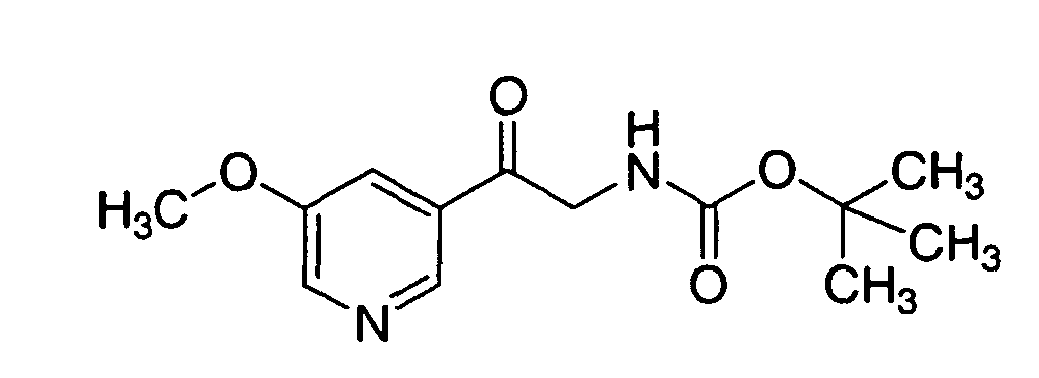
- To a solution of the bromopyridine (244 g, 1.30 mol) from the previous step in anhydrous THF (1.5 L) was added isopropyl magnesium chloride (2.0 M in THF, 0.68 L, 1.36 mol) at 0 °C. It was warmed to room temperature and stirred for one hour. Then it was cooled to 0 °C and N-(tert-butoxycarbonyl)glycine N'-methoxy-N'-methylamide (141.5 g, 0.65 mol) was added. It was warmed to room temperature and stirred for 10 hours. It was diluted with ethyl acetate (2 L) and washed with water (1.5 L). The organic layer was dried over anhydrous sodium sulfate, concentrated, and purified by flash column chromatography on silica gel with hexanes / ethyl acetate = 1 / 1 as eluant to get the title compound as a pale solid. 1H NMR (CDCl3, 500 Hz): δ 8.77 (s, 1 H), 8.53 (d, J=2.8 Hz, 1 H), 7.70-7.71 (m, 1 H), 5.49 (broad s, 1 H), 4.48 (d, J=4.1 Hz, 2 H), 3.93 (s, 3 H), 1.49 (s, 9 H).
-

- The protected aminoketone from the previous step (110 g, 486 mmol) was treated with a solution of 20% TFA in methylene chloride (300 mL) at room temperature for 8 hours. It was concentrated to get a brown gum, which was treated with hydrogen chloride in ether (1 M, 700 mL) and filtered. The filtrate was discarded. To the solid collected the above mentioned treatment with hydrogen chloride was applied for two more times. It was then dried on high vacuum to constant weight to get a pale fine powder. 1H NMR (D2O, 500 Hz): δ 8.96 (s, 1 H), 8.73 (d, J=2.5 Hz, 1 H), 8.52~8.53 (m, 1 H), 4.77 (s, 2 H), 4.07 (s, 3 H).
-

- A solution of the carboxylic acid triethylamine salt form Example 66, step D (64.5 g, 169 mmol), PyBop (176 g, 338 m mol), HOAt (46 g, 338 m mol), and N,N-diisopropyl ethylamine (177 mL, 1.01 mol) in DMF (500 mL) was stirred at room temperature for 20 minutes. Then, the hydrochloride from the previous step (40 g, 169 mmol) was added. After stirring at room temperature over night, it was concentrated to a brown slur. Ethyl acetate (1.5 L) was added, and it was washed with water (3x 1 L), 1 N potasium hydroxide solution and brine. It was dried over anhydrous sodium sulfate, concentrated, and purified by flash column chromatography on silica gel with hexanes / ethyl acetate = 1 / 1 as eluant to get the title compound as a pale solid. 1H NMR (CDCl3, 500 Hz): δ 8.80 (s, 1 H), 8.52-8.53 (m, 1H), 8.37 (broad s, 0.6 H), 7.90 (Broad s, 0.4 H), 7.70-7.71 (m, 1 H), 6.70 (broad s, 1 H), 5.94 (broad s, 1 H), 5.27-5.41 (m, 2 H), 4.87 (broad s, 1 H), 4.82 (s, 1 H), 4.67 (d, J=4.5 Hz, 2 H), 4.57 (d, J=18.3 Hz, 1 H), 4.05-4.14 (m, 2 H), 3.92 (s, 3H), 3.66 (d, J=11.2 Hz, 1H), 3.20-3.30 (m, 1H), 2.90 (d, J=10.8 Hz, 1H), 2.45 (d, J=9.3 Hz, 1 H), 2.35-2.37 (m, 1H), 1.28 (s, 6 H).
-

- The ketoamide from the previous step (40 g, 75.5 mmol) was treated with fuming sulfuric acid (20 % free SO3, 80 mL) at 60 °C for 10 minutes. It was poured into excess ice. Solid potassium hydroxide was added while stirring till pH = 12. It was extracted with ethyl acetate (7 x 0.7 L). The combined organic layer was dried over anhydrous sodium sulfate, concentrated, and purified by flash column chromatography on silica gel with ethyl acetate / methanol =10/1 as eluant to get the title compound as a white solid. 1H NMR (CDCl3, 500 Hz): δ 8.63 (broad s, 1 H), 8.50 (s, 1 H), 8.28 (s, 1 H), 7.36-7.37 (m, 1 H), 7.34 (s, 1 H), 3,91-4.00 (m, 2 H), 3.94 (s, 3 H), 3.78-3.79 (m, 1 H), 3.02-3.11 (m, 4 H), 2.88-2.91 (m, 1 H), 2.65-2.73 (m, 2 H), 1.60 (s, 3 H), 1.59 (s, 3 H).
-

- A solution of the oxazole from the previous step (24.5 g, 57.3 mmol) and the epoxide from Example 1, Step P (22.6 g, 57.3 mmol) in isopropanol (200 mL) was refluxed for 10 hours. After the solvent was removed, the residue was purified by flash column chromatography on silica gel with ethyl acetate / methanol =50/1 as eluant to get the title compound as a white solid. 1H NMR (CD3OD, 500 Hz): δ 8.48 (s, 1 H), 8.23 (d, J=2.3 Hz, 1H), 7.64-7.65 (m, 1H), 7.63 (s,1H), 7.20-7.32 (m, 5 H), 7.01 (t, J=7.5 Hz, 1 H), 6.68 (d, J=8.3 Hz, 1 H), 6.45 (t, J=6.5 Hz, 1 H), 6.35 (d, J=7.7 Hz, 1 H), 5.67 (d, J=3.9 Hz, 1 H), 4.45 (d, J=2.3 Hz, 1 H), 4.32-4.35 (m, 1 H), 4.18 (d, J=3.0 Hz, 1 H), 3.93-4.00 (m, 1 H), 3.95, (s, 3 H), 3.77-3.85 (m,2 H), 3.43-3.48 (m, 1H), 3.27 (t, J=5.1 Hz, 1 H), 3.03 (d, J=4.4 Hz, 1H), 2.73-2.83 (m, 2 H), 2.55 (t, J=8.3 Hz, 1 H), 2.34-2.43 (m, 3 H), 1.93-1.98 (m, 1H), 1.66 (s, 3 H), 1.52 (s, 6 H), 1.14(s, 3 H). LC-MS (M++1) (EI) 821.5.
- To a solution of the penultimate (33.6 g, 41 mmol) from the previous step in methanol (300 mL) was added hydrogen chloride in ether (1 N, 205 mL, 205 mmol) at 0 °C. It was warmed to room temperature and stirred for 10 hours. The reaction was monitored by LC-MS. After the reaction was done, excess of ammonia in methanol was added. The solvents were removed under vacuum. The residue was purified by flash column chromatography on silica gel with ethyl acetate / methanol =50/1 as eluant to get the title compound as a white solid. 1H NMR (CD3OD, 500 Hz): δ 8.49 (s, 1 H), 8.22 (d, J=1.6Hz, 1 H), 7.66-7.67 (m, 1 H), 7.20-7.25 (m, 4 H), 7.14-7.17 (m, 1 H), 7.06-7.10 (m, 2 H), 6.80 (t, J=7.6 Hz, 1 H), 6.71 (d, J=8.0 Hz, 1 H), 5.13 (d, J=3.8 Hz, 1 H), 4.04-4.06 (m, 2 H), 3.92-3.98 (m, 1 H), 3.94 (s, 3 H), 3.78-3.82 (m, 1 H), 3.72-3.77 (m, 2 H), 3.06-3.10 (m, 1 H), 2.96-3.03 (m, 2 H), 2.88-2.94 (m, 1H), 2.85 (d, J=11.2 Hz, 1 H), 2.70-2.77 (m, 2 H), 2.63-2.67 (m, 1 H), 2.44-2.50 (m, 1 H), 2.34-2.44 (m, 4 H), 2.00-2.04 (m, 1 H), 1.60 (s, 3 H), 1.59 (s, 3 H), 1.35-1.38 (m, 1 H). LC-MS (M++1) (EI) 781.5.
-

-

- Methyl 5-methylnicotinate (28 g, 185.2 mmol) was dissolved in a mixture of THF (300mL), methanol (100 mL) and water (100 mL). Lithium hydroxide (13.3 g, 555.7 mmol) was added. It was stirred at room temperature for 2 hours. The excess lithium hydroxide was filtered off. The filtrate was concentrated to get a white solid, which was used in the next step without further purification. 1H NMR (CD3OD, 500 Hz): δ 8.87 (s, 1 H), 8.47 (s, 2 H), 8.17-8.18 (m, 2 H), 2.38 (s, 3H).
-

- To a suspension of the nicotinic acid from the previous step (185.2 mmol) in methylene chloride (300 mL) was added 4-methyl morpholine (51 mL, 463 mmol). After stirring at room temperature for 10 minutes, it was cooled to -20 °C. Then, isobutyl chloroformate (288 mL, 222.3 mmol) was dropped in. It was stirred at -20 °C - -10 °C for one hour. N,O-dimethylhydroxylamine hydrochloride (21.7 g, 185.2 mmol) was added. The reaction solution was warmed to room temperature and stirred for 6 hours. It was washed with water (3 x 500 mL) and brine, dried over anhydrous sodium sulfate, concentrated, and purified by flash column chromatography on silica gel with hexanes / ethyl acetate =1/1 as eluant to get the title compound as a pale sticky solid. 1H NMR (CDCl3, 500 Hz): δ 8.76 (d, J=1.4 Hz 1 H), 8.52 (d, J=1.4 Hz, 1 H), 7.82-7.83 (m, 1 H), 3.57 (s, 3 H), 3.40 (s, 3 H), 2.40 (s, 3 H).
-

- To a solution of the amide from the previous step (14.2 g, 79 mmol) in THF (100 mL) was added methyl magnesium bromide (1.4 M, 280 mL, 395 mmol) at 0 °C. After stirring at 0 °C for 4 hours, the reaction solution was poured into ice. Sodium chloride was added to saturation. The aqueous layer was extracted with ethyl acetate (2 x 200 mL). The combined organic layer was dried over anhydrous sodium sulfate, concentrated, and purified by flash column chromatography on silica gel with hexanes / ethyl acetate =1/1 as eluant to get the title compound as a yellow oil, which was used in the next step directly. LC-MS (M++1) (EI) 136.3.
-

- To a solution of the methylketone from the previous step (11.7 g, 86.8 mmol) and hydroxylamine hydrochloride (7.3 g, 104.2 mmol) in ethanol (100 mL) was added sodium hydroxide (5.2 g, 130.2 mmol). After refluxing for 2 hours, it was concentrated. The residue was washed with cooled water and dried on high vacuum over night to get the title compound as a white solid. 1H NMR (DMSO, 500 Hz): δ 8.62 (s, 1 H), 8.38 (s, 1 H), 7.80 (s, 1 H), 2.30 (s, 3 H), 2.15 (s, 3 H).
-

- A solution of the oxime from the previous step (6.01 g, 40 mmol) and p-toluenesulfonyl chloride (9.6 g, 50 mmol) in anhydrous pyridine (25 mL) was stirred at room temperature for 24 hours to get some precipitate. Cooled water (1L) was added to see the dissolving of the original precipitate and the formation of a new precipitate. It was stirred for one hour and filtered. The solid collected was dried under high vacuum to constant weight to get the title compound as a white solid. 1H NMR (CDCl3, 500 Hz): δ 8.63 (s, 1 H), 8.41 (s, 1 H), 7.95 (d, J=8.0 Hz, 2 H), 7.80-7.81 (m, 1 H), 7.38 (d, J=8.0 Hz, 2 H), 2.47 (s, 3 H), 2.36 (s, 3 H), 2.21 (s, 3 H).
-

- To a solution of the tosylamide from the previous step (4.82 g, 15.8 mmol) in ethanol (40 mL) was added potassium ethoxide (1.41 g, 16.3 mmol) at 0 °C. It was slowly warmed to room temperature at which it was stirred for 2 hour. It was then diluted with anhydrous ether (500 mL) and filtered. To the filtrate HCl gas was bubbled in for 30 minutes to get a cloudy mixture. It was concentrated. The residue was distributed between methylene chloride (500 mL) and 1 N potassium hydroxide solution (pH=10). The organic layer was concentrated to get the titled compound as a brown sticky solid. 1H NMR (CDCl3, 500 MHz): δ 8.55 (d, J=1.8 Hz, 1 H), 8.40 (d, J=1.4 Hz, 1 H), 7.64 (d, J=0.8 Hz, 1H), 3.38-3.53 (m, 4 H), 3.02 (s, 2 H), 1.24 (t, J=7.0 Hz, 6 H).
-

- A solution of the carboxylic acid from the Example 66, Step D (1.5 g, 3.09 mmol), O-benzoltriazol-1-N,N,N',N'-tetramethyluronium hexafluorophosphate (2.8 g, 7.42 mmol), 1-hydroxybenzotriazol hydrate (1.0 g, 7.42 mmol) and diisipropylethylamine (2.7 mL, 15.45 mmol) in DMF (10 mL) was stirred at room temperature for half hour. The aminoacetal from the previous step (833 mg , 3.71 mmol) was added. After stirring at room temperature for 24 hours, the reaction solution was distributed between ethyl acetate (200 mL) and water (200 mL). The organic layer was washed with water (200 mL) and brine. It was dried over anhydrous sodium sulfate, concentrated and purified by flash column chromatography on silica gel with ethyl acetate as eluant to give the title compound as a white solid. 1H NMR (CDCl3, 400 MHz): δ 8.69 (d, J=4.0, 1H), 8.33 (s, 1 H), 7.84 (s, 1 H), 6.63 (t, J=6.1 Hz, 1 H), 5.89- 5.99 (m, 1 H), 5.26-5.35 (m, 2 H), 4.65 (d, J=4.8 Hz, 3 H), 4.19 (dd, J=8.0, 13.6 Hz, 1 H), 3.92 (broad s, 2 H), 3.57-3.68 (m, 3 H), 3.27-3.40 (m, 3 H), 2.82 (s, 2 H), 2.79 (broad s, 1 H), 2.49 (d, J=5.6 Hz, 1 H), 2.29 (dd, J=4.0, 8.0 Hz, 1 H), 2.14 (dt, J=3.2, 11.6 Hz, 1 H), 1.18-1.25 (2t, J=7.2 Hz, 6 H), 1.04 (s, 3H), 0.95 (s, 3 H).
-

- To a solution of the ketal from the previous step (2.1 g, 3.40 mmol) in THF (10 mL) was added hydrochloric acid (6 N, 10 mL). After stirring at 50 °C for 8 hours, the reaction solution was diluted with ethyl acetate (200 mL) and washed with 1 N potassium hydroxide solution. The organic layer was dried over anhydrous sodium sulfate, concentrated and purified by flash column chromatography on silica gel with ethyl acetate as eluant to give the title compound as a white solid. LC-MS (M++1) (EI) 588.4.
-

- The ketoamide from the previous step (1.0 g, 1.95 mmol) was treated with fuming sulfuric acid (20 % free SO3, 4 mL) at 60 °C for 10 minutes. It was poured into excess ice. Solid potassium hydroxide was added while stirring till pH = 12. It was extracted with ethyl acetate (5 x 300 mL). The combined organic layer was dried over anhydrous sodium sulfate, concentrated, and purified by flash column chromatography on silica gel with ethyl acetate / methanol =10/1 as eluant to get the title compound as a white solid. 1H NMR (CDCl3, 500 Hz): δ 8.71 (d, J=2.0 Hz, 1 H), 8.42 (d, J=1.8 Hz, 1 H), 8.10-8.12 (m, 1 H), 7.71 (broad s, 1 H), 7.33 (s, 1 H), 3,91-4.00 (m, 2 H), 2.51-3.54 (m, 1 H), 2.82-2.99 (m, 3 H), 2.78-2.81 (m, 1H), 2.53-2.63 (m, 2 H), 2.42 (s, 3 H), 1.61 (s, 3H), 1.60 (s, 3 H).
-

- A solution of the oxazole from the previous step (320 mg, 0.78 mmol) and the epoxide from Example 1, Step P (306 mg, 0.78 mmol) in ethanol (10 mL) was refluxed for 2 days. After the solvent was removed, the residue was purified by flash column chromatography on silica gel with ethyl acetate / methanol =20/1 as eluant to get the title compound as a white solid. LC-MS (M++1) (EI) 805.4
- To a solution of the penultimate from the previous step (220 mg, 0.27 mmol) in methanol (10 mL) was added hydrogen chloride in ether (1 N, 1.4 mL, 1.4 mmol) at 0 °C. It was warmed to room temperature and stirred for 12 hours. The reaction was monitored by LC-MS. After the reaction was done, excess ammonia in methanol was added. The solvents were removed under vacuum. The residue was purified on preparative TLC (2000 microns, ethyl acetate / methanol =10/1 as eluant) to get the title compound as a white solid. 1H NMR (CD3OD, 500 Hz): δ 8.70 (d, J=1.8 Hz, 1 H), 8.36 (d, J=1.3 Hz, 1 H), 7.97 (broad s, 1 H), 7.60 (s, 1 H), 7.15-7.25 (m, 5 H), 7.05-7.10 (m, 2 H), 6.80 (t, J=7.6 Hz, 1H), 6.72 (d, J=8.0 Hz, 1 H), 5.13 (d, J=4.3 Hz, 1 H), 4.02-4.09 (m, 2 H), 3.92 -3.98 (m, 1 H), 3.78-3.82 (m, 1 H), 3.72-3.77 (m, 2 H), 3.06-3.10 (m, 1 H), 2.96-3.03 (m, 2 H), 2.88-2.94 (m, 1H), 2.85 (d, J=11.2 Hz, 1 H), 2.70-2.77 (m, 2 H), 2.63-2.67 (m, 1 H), 2.44-2.50 (m, 1 H), 2.34-2.44 (m, 4 H), 2.42 (s, 3 H), 2.00-2.04 (m, 1 H), 1.60 (s, 3 H), 1.59 (s, 3 H), 1.35-1.38 (m, 1 H). LC-MS (M++1) (EI) 765.4.
-

-
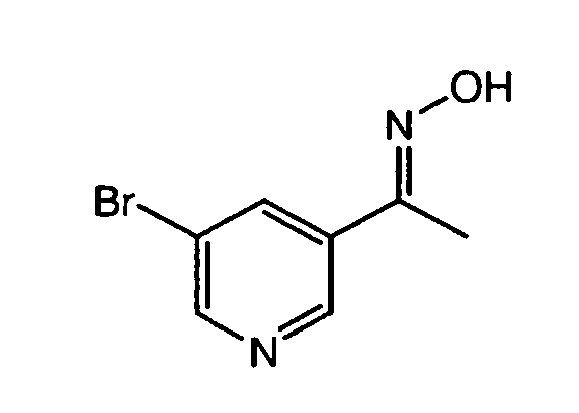
- To a solution of the methylketone from Example 77, Step B (35 g, 175 mmol) and hydroxylamine hydrochloride (18.3 g, 263 mmol) in ethanol (200 mL) was added sodium hydroxide (10.5 g, 263 mmol). After refluxing for one hour, it was concentrated. The residue was washed with cooled water. The solid collected was dried under high vacuum over night to get the title compound as a white solid. 1H NMR (DMSO 500 Hz): δ 8.78 (d, J=1.9Hz, 1 H), 8.60 (d, J=2.3 Hz, 1 H), 8.26 (t, J=2.1 Hz, 1 H), 2.23 (s, 3 H). LC-MS (M++1) (EI) 215.0, 217.0.
-

- A solution of the oxime from the previous step (46.9 g, 218 mmol) and p-toluenesulfonyl chloride (52 g, 272.6 mmol) in anhydrous pyridine (100 mL) was stirred at room temperature for 10 hours to get some precipitate. Cooled water (1 L) was added to see the dissolving of the original precipitate and the formation of a new precipitate. It was stirred for one hour and filtered. The solid collected was dried under high vacuum to constant weight to get the title compound as a pale solid. 1H NMR (CDCl3, 500 Hz): δ 8.74 (d, J=2.3 Hz, 1 H), 8.73 (d, J=1.8 Hz, 1 H), 8.04-8.05 (m, 1 H), 7.94 (d, J=7.8 Hz, 2 H), 7.38-7.41 (m, 2 H), 2.48 (s, 3 H), 2.38 (s, 3 H).
-

- To a solution of the tosylamide from the previous step (64.8 g, 175.5 mmol) in ethanol (200 mL) was added potassium ethoxide (15.6 g, 181 mmol) at 0 °C. It was slowly warmed to room temperature at which it was stirred for 10 hour. It was then diluted with anhydrous ether (1 L) and filtered. To the filtrate HCl gas was bubbled in for 30 minutes to get some precipitate. It was filtered. The solid collected was distributed between ethyl acetate (1 L) and 1 N potassium hydroxide solution (pH=10). The organic layer was concentrated to get the titled compound as a colorless oil. 1H NMR (CDCl3, 500 MHz): δ 8.66 (d, J=1.8 Hz, 1 H), 8.65 (d, J=2.3 Hz, 1 H), 8.01 (d, J=2.1 Hz, 1H), 3.37-3.53 (m, 4 H), 3.03 (s, 2 H), 1.26 (t, J=7.0 Hz, 6 H). LC-MS (M++1) (EI) 243.0.
-

- A solution of the carboxylic acid from the Example 66, Step D (6.72 g, 23.2 mmol), O-benzoltriazol-1-N,N,N',N'-tetramethyluronium hexafluorophosphate (17.6 g, 46.45 mmol), 1-hydroxybenzotriazol hydrate (6.28 g, 46.45 mmol) and diisipropylethylamine (16.9 mL, 96.8 mmol) in DMF (100 mL) was stirred at room temperature for half hour. The aminoacetal from the previous step (7.38 g , 19.4 mmol) was added. After stirring at room temperature for 3 hours, the reaction solution was distributed between ethyl acetate (1 L) and water (1 L). The organic layer was washed with water (1 L) and brine. It was dried over anhydrous sodium sulfate, concentrated and purified by flash column chromatography on silica gel with ethyl acetate as eluant to give the title compound as a white solid. 1H NMR (CDCl3, 400 MHz): 8.69 (s, 1 H), 8.60 (s, 1 H), 8.05 (s, 1 H), 7.70 (Broad s, 1 H), 5.92-5.98 (m, 1 H), 5.28-5.36 (m, 2 H), 4.67 (broad s, 2 H), 4.60 (d, J=4.5 Hz, 2 H), 4.01-4.11 (m, 1 H), 3.92 (d, J=12.7 Hz, 1 H), 3.76-3.86 (m, 1 H), 3.40-3.67 (m, 3 H), 3.28-3.32 (m, 1 H), 3.18-3.26 (m, 1 H), 2.36-2.42 (m, 2 H), 2.13-2.20 (m 1 H), 1.27 (t, J=7.1 Hz, 2 H), 1.22 (T, J=7.2 Hz, 2 H), 0.98 (s, 3H), 0.93 (s, 3 H). LC-MS (M++1) (EI) 652.3.
-

- To a solution of the ketal from the previous step (5.1 g, 8.82 mmol) in THF (20 mL) was added hydrochloric acid (6 N, 20 mL). After stirring at 50 °C for 10 hours, the reaction solution was diluted with ethyl acetate (400 mL) and washed with 1 N potassium hydroxide solution. The organic layer was dried over anhydrous sodium sulfate, concentrated and purified by flash column chromatography on silica gel with ethyl acetate as eluant to give the title compound as a white solid. LC-MS (M++1) (EI) 579.0, 580.0.
-

- The ketoamide from the previous step (3.5 g, 6.05 mmol) was treated with fuming sulfuric acid (20 % free SO3, 10 mL) at 60 °C for 10 minutes. It was poured into excess ice. Solid potassium hydroxide was added while stirring till pH = 12. It was extracted with ethyl acetate (5 x 200 mL). The combined organic layer was dried over anhydrous sodium sulfate and concentrated to get the title compound as a white solid. 1H NMR (CDCl3, 500 Hz): δ 8.79 (d, J=1.6 Hz, 1 H), 8.62 (d, J=1.8 Hz, 1 H), 8.06 (broad s, 1 H), 8.03-8.04 (m, 1 H), 7.38 (s, 1 H), 3.91-3.98 (m, 2 H), 2.49-3.52 (m, 1 H), 2.93-2.98 (m, 1 H), 2.87-2.91 (m, 2 H), 2.75-2.79 (m, 1 H), 2.56-2.58 (m, 2 H), 1.59 (s, 3 H), 1.58 (s, 3 H). LC-MS (M++1) (EI) 477.1, 478.1.
-

- To a solution the oxazole form the previous step (500 mg, 1.05 mmol) and 18-crown-6 (1.4 g, 5.25 mmol) in DMSO (80 mL) was added potassium superoxide (522 mg, 7.35 mmol). After stirring at room temperature for 16 hours, it was distributed between ethyl acetate (400 mL) and water (200 mL). The organic layer was dried over anhydrous sodium sulfate and concentrated to give the title compound as a white solid. LC-MS (M++1) (EI) 579.0, 580.0.
- A solution of the oxazole from the previous step (242 mg, 0.58 mmol) and the epoxide from Example 1, Step P (230 mg, 0.58 mmol) in ethanol (10 mL) was refluxed for 16 hours. After the solvent was removed, the residue was purified by flash column chromatography on silica gel with ethyl acetate / methanol =30/1 as eluant to get a white solid (LC-MS (M++1) (EI) 807.4. The solid obtained was dissolved in methanol (10 mL) and cooled to 0 °C. Hydrogen chloride in ether (1 N, 0.74 mL, 0.74 mmol) was added and the reaction solution was warmed to room temperature at which it was stirred for 10 hours. The solvent was removed under vacuum. The residue was distributed between ethyl acetate (100 mL) and potassium hydroxide solution (1 N, 100 mL). The organic layer was dried over anhydrous sodium sulfate, concentrated and purified on preparative TLC (2000 microns, ethyl acetate / methanol 10 / 1 as eluant) to give the title compound as a white solid. 1H NMR (CD3OD, 500 Hz): δ 8.59 (s, 1 H), 8.37 (s, 1 H), 8.07 (s, 1 H), 7.96 (s, 1 H), 7.94 (s, 1 H), 7.16-7.28 (m, 5 H), 7.05-7.15 (m, 2 H), 6.82 (t, J=7.8 Hz, 1 H), 6.72 (d, J=7.8 Hz, 1 H), 5.13 (d, J=4.3 Hz, 1 H), 4.02-4.09 (m, 2 H), 3.92-3.98 (m, 1 H), 3.78-3.82 (m, 1H), 3.72-3.77 (m, 2 H), 3.06-3.10 (m, 1 H), 2.96-3.03 (m, 2 H), 2.88-2.94 (m, 1H), 2.85 (d, J=11.2 Hz, 1 H), 2.70-2.77 (m, 2 H), 2.63-2.67 (m, 1 H), 2.44-2.50 (m, 1 H), 2.34-2.44 (m, 4 H), 2.42 (s, 3 H), 2.00-2.04 (m, 1 H), 1.60 (s, 3 H), 1.59 (s, 3 H), 1.35-1.38 (m, 1 H). LC-MS (M++1) (EI) 767.5.
-

-

- To a solution of furfurylamine (180 g, 1.85 mol) in water (500 mL) and hydrobromic acid (48 %, 143 mL) at -20°C was added bromine dropwise in 6 hours. After the addition, it was stirred at -20 - -10 °C for 12 hour. Nitrogen was blew through the reaction mixture for one hour followed by the addition of saturated potassium hydroxide solution till pH=1. It was heated to reflux for 15 minutes and cooled to 80°C. Additional saturated potassiuim hydroxide solution was applied to bring the pH value to about 5.5. It was filtered. The black solid collected was dried under high vacuum and washed with boiling methanol. The methanol washes was concentrated to get the title compound as a brown solid. 1H NMR (CD3OD, 500 Hz): δ 8.10 (d, J=1.8 Hz, 1 H), 8.07 (d, J=2.5 Hz, 1 H), 7.42-7.43 (m, 1 H). LC-MS (M++1)(EI) 173.0, 175.0.
-

- A 3-neck round bottom flask equipped with a stirring bar, a thermometer, a dry ice condenser and a gas inlet was charged with the hydroxylpyridine from the previous step (50 g, 289 mmol), sodium hydroxide (70 g, 1.73 mol), water (250 mL) and 1,4-dioxane (250 mL). Vacuum was applied for 2 minutes. It was heated to 60 °C and vacuum was applied again for 2 minutes. Then, difluorochloromethame was bubbled in for 12 hours. The reaction was monitored by LC-MS. When the start material was converted by about 80%, water (1 L) was added. It was extracted with ethyl acetate (3 x 1L). The organic layer was dried over anhydrous sodium sulfate, concentrated and purified by flash column chromatography on silica gel with hexanes / ether = 5 / 1 as eluant to give the title compound as a colorless oil. 1H NMR (CD3OD, 500 Hz): δ 8.58 (d, J=2.1 Hz, 1 H), 8.44 (s,1 H), 7.69 (d, J=4.6 Hz, 1 H), 6.58 (t, J=72.1 Hz, 1H). LC-MS (M++1) (EI) 224.0, 226.0.
-

- To a solution of bromopyridine from the previous step (4.5 g, 20.2 mmol) in anhydrous THF (30 mL) was added isopropyl magnesium chloride (2.0 M in THF, 26.2 mL, 13.1 mmol) at room temperature. After it was stirred for one hour N-(tert-butoxycarbonyl)glycine N'-methoxy-N'-methylamide (2.2 g, 10.1 mmol) was added. It was stirred at room temperature for 4 hours. Then, it was diluted with ethyl acetate (300 mL) and washed with water (200 mL). The organic layer was dried over anhydrous sodium sulfate, concentrated, and purified by flash column chromatography on silica gel with ethyl acetate as eluant to get the title compound as a white solid. 1H NMR (CDCl3, 500 Hz): δ 9.05 (d, J=1.6 Hz, 1 H), 8.33 (d, J=2.8 Hz, 1 H), 8.04-8.05 (m, 1 H), 6.65 (t, J=71.9 Hz, 1 H), 4.70 (d, J=4.8 Hz, 2 H), 1.38 (s, 9 H). LC-MS (M++1) (EI) 303.1.
-

- The protected aminoketone from the previous step (2.2 g, 7.28 mmol) was treated with a solution of 20% TFA in methylene chloride (20 mL) at room temperature for 6 hours. It was concentrated to get a brown gum, which was dissolved in DMF (20 mL). The carboxylic acid form Example 66, Step D (2.8 g, 7.28 mmol), PyBop (7.6 g, 14.6 mmol) and HOAt (2.0 g, 14.6 m mol) was added. After it was stirred at room temperature for 20 minutes, N,N-diisopropyl ethylamine (7.6 mL, 43.7 mmol) was added. After stirring at room temperature for 10 hours, it was diluted with methylene chloride (300 mL) and washed with water (150 mL), 1 N potasium hydroxide solution (100 mL) and brine. The organic layer was dried over anhydrous sodium sulfate, concentrated, and purified by flash column chromatography on silica gel with ethyl acetate as eluant to get the title compound as a yellow solid. 1H NMR (CDCl3, 500 Hz): δ 9.06 (d, J=1.8 Hz, 1 H), 8.71 (d, J=2.3 Hz, 1 H), 8.44 (broad s, 1 H), 8.02-8.03 (m, 1 H), 6.70 (broad s, 1 H), 6.64 (t, J=72.1 Hz, 1 H), 5.94 (broad s, 1 H), 5.27-5.41 (m, 2 H), 4.87 (broad s, 1 H), 4.82 (s, 1 H), 4.67 (d, J=4.5 Hz, 2 H), 4.57 (d, J=18.3 Hz, 1 H), 4.05-4.14 (m, 2 H), 3.66 (d, J=11.2 Hz, 1 H), 3.20-3.30 (m, 1 H), 2.90 (d, J=10.8 Hz, 1 H), 2.45 (d, J=9.3 Hz, 1 H), 2.35-2.37 (m, 1 H), 1.30 (s,3H), 1.28 (s, 3 H). LC-MS (M++1) (EI) 566.2.
-

- The ketoamide from the previous step (2.1 g, 3.7 mmol) was treated with fuming sulfuric acid (20 % free SO3, 10 mL) at 60 °C for 10 minutes. It was poured into excess ice. Solid potassium hydroxide was added while stirring till pH = 12. It was extracted with ethyl acetate (5 x 100 mL). The combined organic layer was dried over anhydrous sodium sulfate and concentrated to get the title compound as a white solid. 1H NMR (CDCl3, 500 Hz): δ 8.79 (d, J=1.8 Hz, 1 H), 8.47 (d, J=2.5 Hz, 1 H), 8.02-8.03 (m, 1 H), 7.69-7.70 (m, 1 H), 6.65 (t, J=72.3 Hz, 1 H), 3.94-3.99 (m, 2 H), 3.51-3.53 (m, 1 H), 2.96-2.98 (m, 1 H), 2.89-2.93 (m, 2 H), 2.78-2.81 (m, 1 H), 2.57-2.61 (m, 2 H), 1.62 (s, 3 H), 1.61 (s, 3 H). LC-MS (M++1) (EI) 464.2.
- A solution of the oxazole from the previous step (1.08 g, 2.33 mmol) and the epoxide from Example 1, Step P (916 mg, 2.33 mmol) in ethanol (20 mL) was refluxed for 28 hours. After the solvent was removed, the residue was purified by flash column chromatography on silica gel with ethyl acetate / methanol =30/1 as eluant to get a white solid. (LC-MS (M++1) (EI) 857.4. The solid obtained was dissolved in methanol (10 mL) and cooled to 0 °C. Hydrogen chloride in ether (1 N, 6.8 mL, 6.8 mmol) was added and the reaction solution was warmed to room temperature at which it was stirred for 12 hours. The solvent was removed under vacuum. The residue was distributed between ethyl acetate (100 mL) and potassium hydroxide solution (1 N, 100 mL). The organic layer was dried over anhydrous sodium sulfate, concentrated and purified on preparative HPLC to give the title compound as a white solid. 1H NMR (CD3OD, 500 Hz): δ 8.79 (d, J=1.6 Hz, 1 H), 8.41 (d, J=2.6 Hz, 1 H), 7.91-7.92 (m, 1 H), 7.69 (s, 1 H), 7.14-7.25 (m, 5 H), 7.03-7.10 (m, 2 H), 6.80 (t, J=7.5 Hz, 1 H), 6.71 (d, J=8.0 Hz, 1 H), 5.13 (d, J=4.0 Hz, 1 H), 4.02-4.09 (m, 2 H), 3.91-3.98 (m, 1 H), 3.78-3.84 (m, 1 H), 3.71-3.76 (m, 2 H), 3.07-3.11 (m, 1 H), 2.95-3.04 (m, 2 H), 2.88-2.94 (m, 1H), 2.85 (d, J=11.2 Hz, 1 H), 2.70-2.78 (m, 2 H), 2.63-2.68 (m, 1 H), 2.45-2.49 (m, 1 H), 2.34-2.44 (m, 4 H), 1.98-2.04 (m, 1 H), 1.60 (s, 3 H), 1.59 (s, 3 H), 1.35-1.38 (m, 1 H). LC-MS (M++1) (EI) 817.4.
-

-

- To a solution of the bromopyridine from Example 59, Step D (1 g, 5.38 mmol) in methylene chloride (10 mL) was added [bis(2-methoxyethyl)amino]sulfur trifluoride (1.5 mL, 8.06 mmol). After stirring at room temperature for two hours, it was washed with potassium hydroxide solution (1N, 50 mL). The organic layer was dried over anhydrous sodium sulfate, concentrated and purified by flash column chromatography on silica gel with hexanes / ether = 2 / 1 as eluant to give the title compound as a white crystal. 1H NMR (CDCl3, 500 Hz): δ 8.84 (s, 1 H), 8.71 (s, 1 H), 8.03 (s, 1 H), 7.73 (dt, J=2.1, 53.0 Hz, 1 H). LC-MS (M++1) (EI) 208.0, 210.0
-

- To a solution of bromopyridine from the previous step (1.58 g, 7.63 mmol) in anhydrous THF (20 mL) was added isopropyl magnesium chloride (2.0 M in THF, 4.96 mL, 9.92 mmol) at room temperature. After it was stirred for one hour N-(tert-butoxycarbonyl)glycine N'-methoxy-N'-methylamide (833 mg, 3.82 mmol) was added. It was stirred at room temperature for 10 hours. Then, it was diluted with ethyl acetate (300 mL) and washed with water (200 mL). The organic layer was dried over anhydrous sodium sulfate, concentrated, and purified by flash column chromatography on silica gel with ethyl acetate as eluant to get the title compound as a yellow solid. LC-MS (M++1) (El) 287.2.
-
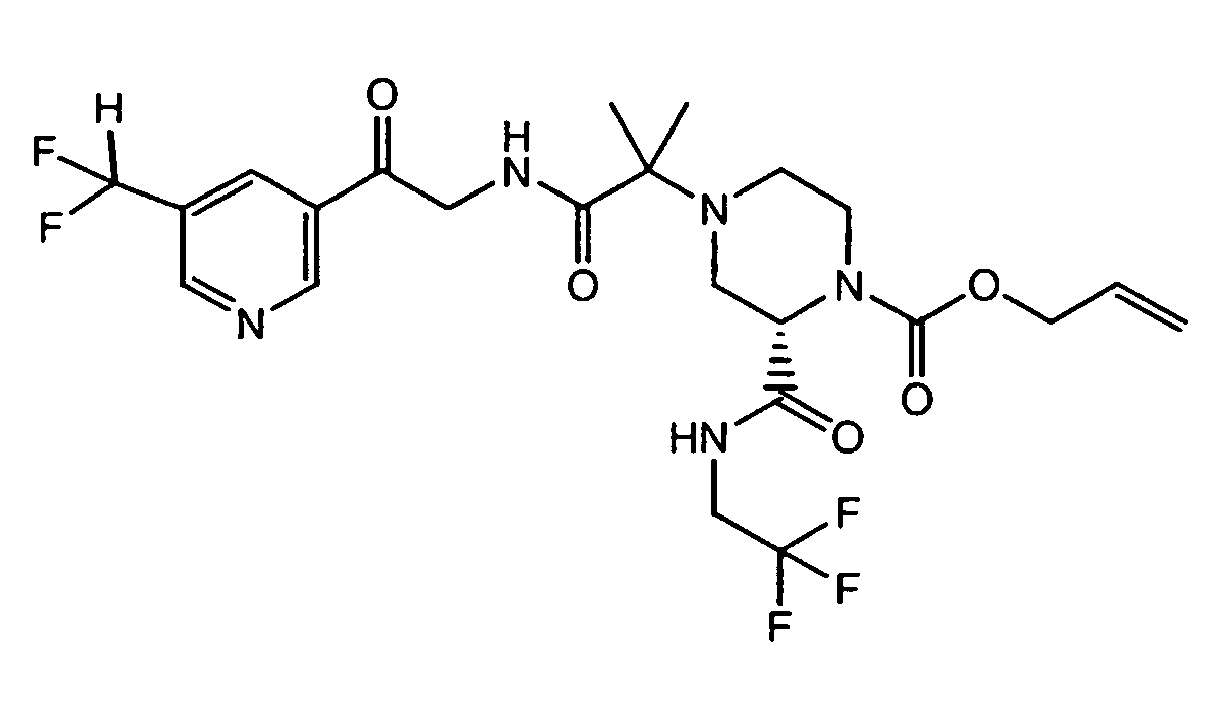
- The protected aminoketone from the previous step (1.0 g, 3.49 mmol) was treated with a solution of 20% TFA in methylene chloride (10 mL) at room temperature for 6 hours. After the solvent was removed, the residue was dissolved in DMF (10 mL). The carboxylic acid form Example 66, Step D (1.33 g, 3.49 mmol), PyBop (3.63 g, 6.98 mmol) and HOAt (0.95 g, 6.98 mmol) was added. After it was stirred at room temperature for 20 minutes, N,N-diisopropyl ethylamine (3.65 mL, 21 mmol) was added. It was stirred at room temperature for 10 hours and then, diluted with methylene chloride (200 mL) and washed with water (100 mL), 1 N potasium hydroxide solution (100 mL) and brine. The organic layer was dried over anhydrous sodium sulfate, concentrated, and purified by flash column chromatography on silica gel with ethyl acetate as eluant to get the title compound as a yellow solid. LC-MS (M++1) (EI) 550.5.
-

- The ketoamide from the previous step (1.1 g, 2.0 mmol) was treated with fuming sulfuric acid (20 % free SO3, 3 mL) at 60 °C for 10 minutes. It was poured into excess ice. Solid potassium hydroxide was added while stirring till pH = 12. It was extracted with ethyl acetate (5 x 100 mL). The combined organic layer was dried over anhydrous sodium sulfate and concentrated to get the title compound as a white solid. 1H NMR (CDCl3, 500 Hz): δ 9.02 (s, 1 H), 8.73 (s, 1 H), 8.05-8.06 (m, 1 H), 8.03-6.04 (m, 1 H), 7.45 (s, 1 H), 6.80 (t, J=56.0 Hz, 1 H), 3.94-3.99 (m, 2 H), 3.51-3.53 (m, 1 H), 2.96-2.98 (m, 1 H), 2.89-2.93 (m, 2 H), 2.78-2.81 (m, 1 H), 2.57-2.61 (m, 2 H), 1.62 (s, 3 H), 1.61 (s, 3 H). LC-MS (M++1) (EI) 447.2.
- A solution of the oxazole from the previous step (330 mg, 0.74 mmol) and the epoxide from Example 1, Step P (290 mg, 0.74 mmol) in ethanol (20 mL) was refluxed for 20 hours. After the solvent was removed, the residue was purified by flash column chromatography on silica gel with ethyl acetate / methanol = 30/1 as eluant to get a white solid. (LC-MS (M++1) (EI) 841.4. The solid obtained was dissolved in methanol (10 mL) and cooled to 0 °C. Hydrogen chloride in ether (1 N, 2.0 mL, 2.0 mmol) was added and the reaction solution was warmed to room temperature at which it was stirred for 12 hours. The solvent was removed under vacuum. The residue was distributed between ethyl acetate (100 mL) and potassium hydroxide solution (1 N, 100 mL). The organic layer was dried over anhydrous sodium sulfate, concentrated and purified on preparative HPLC to give the title compound as a white solid. 1H NMR (CD3OD, 500 Hz): δ 9.07 (s, 1 H), 8.72 (s, 1 H), 8.29 (s, 1H), 7.74 (s, 1 H), 7.14-7.25 (m, 5 H), 7.03-7.10 (m, 2 H), 6.80 (t, J=7.5 Hz, 1 H), 6.71 (d, J=8.0 Hz, 1 H), 5.13 (d, J=4.0 Hz, 1 H), 4.02-4.09 (m, 2 H), 3.91-3.98 (m, 1 H), 3.78-3.84 (m, 1 H), 3.71-3.76 (m, 2 H), 3.07-3.11 (m, 1 H), 2.95-3.04 (m, 2 H), 2.88-2.94 (m, 1H), 2.85 (d, J=11.2 Hz, 1 H), 2.70-2.78 (m, 2 H), 2.63-2.68 (m, 1 H), 2.45-2.49 (m, 1 H), 2.34-2.44 (m, 4 H), 1.98-2.04 (m, 1 H), 1.60 (s, 3 H), 1.59 (s, 3 H), 1.35-1.38 (m, 1 H). LC-MS (M++1) (EI) 801.4
-

-

- To a solution of 2'-fluoroacetophenone (40 g, 290 mmol) and hydroxylamine hydrochloride (30.2 g, 434 mmol) in ethanol (200 mL) was added sodium hydroxide (17.4 g, 434 mmol). After refluxing for 12 hour, it was concentrated. The residue was washed with cooled water and dried on high vacuum over night to get the title compound as a white solid. 1H NMR (CD3OD, 400 Hz): δ 7.44 (dt, J=1.6, 7.5 Hz, 1 H), 7.36-7.40 (m, 1 H), 7.16 (t, J=7.5 Hz, 1 H), 7.12 (dd, J=8.5, 11.2 Hz, 1 H), 2.21 (d, J=2.3 Hz, 3 H). LC-MS (M++1) (EI) 154.1
-

- A solution of the oxime from the previous step (42.0 g, 273.4 mmol) and p-toluenesulfonyl chloride (65.2 g, 341.7 mmol) in anhydrous pyridine (100 mL) was stirred at room temperature for one hours to get some precipitate. Cooled water (1 L) was added to see the dissolving of the original precipitate and the formation of a new precipitate. It was stirred for one hour and then filtered, the resulting solid was washed with cooled water and dried under high vacuum to constant weight to get the title compound as a pale solid. 1H NMR (CDCl3, 400 Hz): δ 7.93 (d, J=7.8 Hz, 2 H), 7.34-7.45 (m, 4 H), 7.15 (dt, J=1.0, 7.6 Hz, 1 H), 7.07-7.12 (m, 1 H), 2.46 (s, 3 H), 2.38 (d, J=1.8 Hz, 3 H).
-

- To a solution of the tosylamide from the previous step (63.9 g, 207.9 mmol) in ethanol (100 mL) was added potassium ethoxide (18.8 g, 218.3 mmol) in ethanol (800 mL) at 0 °C. It was slowly warmed to room temperature at which it was stirred for one hour to see a precipitate. It was then diluted with anhydrous ether (1 L) and filtered. To the filtrate hydrogen chloride gas was bubbled in for 30 minutes to get some white precipitate. It was concentrated. The residue was distributed between ethyl acetate (1 L) and 1 N potassium hydroxide solution (pH=10). The organic layer was concentrated and vacuum distilled to get the titled compound as a colorless oil. 1H NMR (CDCl3, 400 MHz): δ 7.73 (dt, J=1.8,7.8 Hz, 1 H), 7.30-7.35 (m, 1 H), 7.16 (dt, J=1.4, 7.8 Hz, 1H), 7.02-7.08 (m, 1 H), 3.37-3.54 (m, 4 H), 3.15 (s, 2 H), 1.25 (t, J=7.0 Hz, 6 H). LC-MS (M++1) (EI) 182.2, 228.2.
-

- A solution of the carboxylic acid from the Example 66, Step D (1.5 g, 3.09 mmol), O-benzoltriazol-1-N,N,N',N'-tetramethyluronium hexafluorophosphate (2.8 g, 7.42 mmol), 1-hydroxybenzotriazol hydrate (1.0 g, 7.42 mmol) and diisipropylethylamine (2.7 mL, 15.5 mmol) in DMF (10 mL) was stirred at room temperature for half hour. The aminoacetal from the previous step (844 mg , 3.71 mmol) was added. After stirring at room temperature for 10 hours, the reaction solution was distributed between ethyl acetate (500 mL) and water (500 mL). The organic layer was washed with water (500 mL) and brine. It was dried over anhydrous sodium sulfate, concentrated and purified by flash column chromatography on silica gel with hexanes / ethyl acetate = 3 / 1 as eluant to give the title compound as a white solid. 1H NMR (CD3OD 400 MHz): 7.66 (dt, J=1.6, 7.8 Hz, 1 H), 7.31-7.37 (m, 1 H), 7.21 (broad s, 1 H), 7.10-7.14 (m, 1 H), 7.01-7.07 (m, 1 H), 5.28-5.36 (m, 2 H), 4.67 (broad s, 2 H), 4.60 (d, J=4.5 Hz, 2 H), 4.01-4.11 (m, 1 H), 3.92 (d, J=12.7 Hz, 1 H), 3.76-3.86 (m, 1 H), 3.40-3.67 (m, 3 H), 3.28-3.32 (m, 1 H), 3.18-3.26 (m, 1 H), 2.36-2.42 (m, 2 H), 2.13-2.20 (m 1 H), 1.27 (t, J=7.2 Hz, 2 H), 1.18 (T, J=7.2 Hz, 2 H), 0.99 (s, 3H), 0.88 (s, 3 H). LC-MS (M++1) (EI) 591.2, 544.2.
-

- To a solution of the ketal from the previous step (1.4 g, 2.37 mmol) in THF (10 mL) was added hydrochloric acid (6 N, 20 mL). After stirring at 50 °C for 10 hours, the reaction solution was diluted with ethyl acetate (200 mL) and washed with 1 N potassium hydroxide solution. The organic layer was dried over anhydrous sodium sulfate, concentrated and purified by flash column chromatography on silica gel with hexanes / ethyl acetate =1 / 2 as eluant to give the title compound as a white solid. 1H NMR (CDCl3, 400 MHz): 8.42 (broad s, 1 H), 7.93 (dt, J=1.8, 7.6 Hz, 1 H), 7.55-7.61 (m, 1 H), 7.22-7.30 (m, 1 H), 7.15-7.22 (m, 1 H), 6.65 (broad s, 1 H), 5.95 (broad s, 1 H), 5.28-5.36 (m, 2 H), 4.67 (broad s, 2 H), 4.60 (d, J=4.5 Hz, 2 H), 4.01-4.11 (m, 1H), 3.92 (d, J=12.7 Hz, 1 H), 3.76-3.86 (m, 1 H), 3.40-3.67 (m, 3 H), 3.28-3.32 (m, 1 H), 2.87 (d, J=11.2 Hz, 1 H), 2.44 (dd, J=3.7, 11.8 Hz, 1 H), 2.33 (dt, J=3.3, 11.8 Hz 1H), 1.29 (s, 3H), 1.26 (s, 3 H). LC-MS (M++1) (EI) 517.5.
-

- Sulfuric acid (double distilled, 8 mL) was treated with phosphorus pentoxide (651 mg, 2.3 mmol) and added to the ketoamide from the previous step (790 mg, 1.53 mmol). After stirring at 100 °C for 10 minutes the reaction solution was poured into excess ice. Solid potassium hydroxide was added while stirring till pH = 12. It was extracted with ethyl acetate (5 x 200 mL). The combined organic layer was dried over anhydrous sodium sulfate, concentrated and purified by flash column chromatography on silica gel with ethyl acetate / methanol =10 / 1 as eluant to get the title compound as a white solid. 1H NMR (CDCl3, 400 Hz): δ 8.19 (broad s, 1 H), 7.73 (dt, J=1.8, 7.6 Hz, 1 H), 7.40 (d, J=3.9 Hz, 1 H), 7.30-7.36 (m, 1 H), 7.15-7.27 (m, 2 H), 3.91-3.98 (m, 2 H), 2.49-3.52 (m, 1 H), 2.93-2.98 (m, 1 H), 2.87-2.91 (m, 2 H), 2.75-2.79 (m, 1 H), 2.56-2.58 (m, 2 H), 1.61 (s, 3 H), 1.60 (s, 3 H). LC-MS (M++ 1) (EI) 415.2.
- A solution of the oxazole from the previous step (330 mg, 0.80 mmol) and the epoxide from Example 1, Step P (344 mg, 0.80 mmol) in ethanol (15 mL) was refluxed for 14 hours. After the solvent was removed, the residue was purified by flash column chromatography on silica gel with hexanes / ethyl acetate = 1/2 as eluant to get a pale solid. (LC-MS (M++1) (EI) 808.4. The solid obtained was dissolved in methanol (10 mL) and cooled to 0 °C. Hydrogen chloride in ether (1 N, 1.90 mL, 1.90 mmol) was added and the reaction solution was warmed to room temperature at which it was stirred for 12 hours. The solvent was removed under vacuum. The residue was purified on preparative HPLC to give the title compound as a white solid. 1H NMR (CD3OD, 500 Hz): δ 7.79 (dt, J=1.6 7.5 Hz, 1 H), 7.36-7.43 (m, 2 H), 7.19-7.32 (m, 6 H), 7.13-7.17 (m, 1H), 7.05-7.11 (m, 2 H), 6.80 (t, J=7.5 Hz, 1 H), 6.71 (d, J=8.0 Hz, 1 H), 5.13 (d, J=4.0 Hz, 1 H), 4.02-4.09 (m, 2 H), 3.91-3.98 (m, 1 H), 3.78-3:84 (m, 1 H), 3.71-3.76 (m, 2 H), 3.07-3.11 (m, 1 H), 2.95-3.04 (m, 2 H), 2.88-2.94 (m, 1H), 2.85 (d, J=11.2 Hz, 1 H), 2.70-2.78 (m, 2 H), 2.63-2.68 (m, 1 H), 2.45-2.49 (m, 1 H), 2.34-2.44 (m, 4 H), 1.98-2.04 (m, 1 H), 1.60 (s, 3 H), 1.59 (s, 3 H), 1.35-1.38 (m, 1 H). LC-MS (M++1) (EI) 768.4
-

-
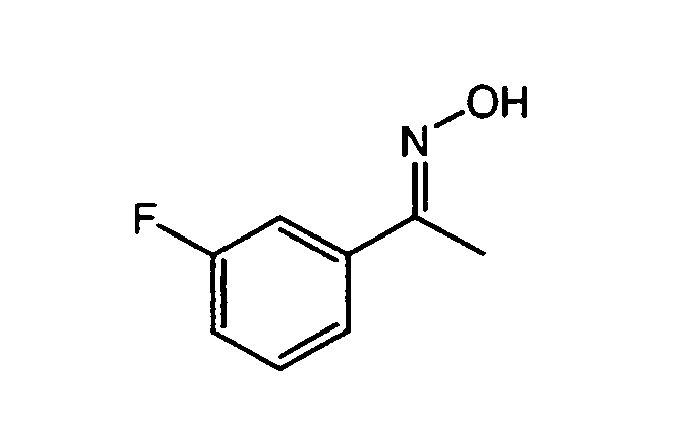
- To a solution of 3'-fluoroacetophenone (35 g, 253.4 mmol) and hydroxylamine hydrochloride (26.4 g, 380 mmol) in ethanol (200 mL) was added sodium hydroxide (15.2 g, 380 mmol). After refluxing for 12 hour, it was concentrated. The residue was washed with cooled water and dried on high vacuum over night to get the title compound as a white solid. 1H NMR (DMSO, 400 Hz): δ 7.44-4.49 (m, 1 H), 7.37-7.44 (m, 2 H), 7.14-7.20 (m, 1 H), 2.12 (s, 3 H). LC-MS (M++1) (EI) 154.1
-

- A solution of the oxime from the previous step (38.7 g, 252.6 mmol) and p-toluenesulfonyl chloride (60.2 g, 316 mmol) in anhydrous pyridine (100 mL) was stirred at room temperature for one hours to get some precipitate. Cooled water (1 L) was added to see the dissolving of the original precipitate and the formation of a new precipitate. It was stirred for one hour and then, filtered, washed with cooled water and dried under high vacuum to constant weight to get the title compound as a pale solid. 1H NMR (CDCl3, 400 Hz): δ 7.94 (d, J=8.4 Hz, 2 H), 7.35-7.40 (m, 4 H), 7.29-7.33 (m, 1 H), 7.13-7.17 (m, 1 H), 2.47 (s, 3 H), 2.35 (d, J=1.8 Hz, 3 H).
-

- To a solution of the tosylamide from the previous step (66.0 g, 214.8 mmol) in ethanol (100 mL) was added potassium ethoxide (19.4 g, 225.5 mmol) in ethanol (800 mL) at 0 °C. It was slowly warmed to room temperature at which it was stirred for one hour to see a precipitate. It was then diluted with anhydrous ether (1 L) and filtered. To the filtrate hydrogen chloride gas was bubbled in for 30 minutes to get some white precipitate. It was concentrated. The residue was distributed between ethyl acetate (1 L) and 1 N potassium hydroxide solution (pH=10). The organic layer was concentrated and vacuum distilled to get the titled compound as a colorless oil. 1H NMR (CDCl3, 500 MHz): 7.25-7.38 (m,3 H), 6.98-7.04 (m, 1 H), 3.36-3.53 (m, 4 H), 3.00 (s, 2 H), 1.24 (t, J=7.0 Hz, 6 H). LC-MS (M++1) (EI) 182.2, 228.2.
-

- A solution of the carboxylic acid from the Example 66, Step D (1.5 g, 3.09 mmol), O-benzoltriazol-1-N,N,N',N'-tetramethyluronium hexafluorophosphate (2.8 g, 7.42 mmol), 1-hydroxybenzotriazol hydrate (1.0 g, 7.42 mmol) and diisipropylethylamine (2.7 mL, 15.5 mmol) in DMF (10 mL) was stirred at room temperature for half hour. The aminoacetal from the previous step (844 mg , 3.71 mmol) was added. After stirring at room temperature for 10 hours, the reaction solution was distributed between ethyl acetate (500 mL) and water (500 mL). The organic layer was washed with water (500 mL) and brine. It was dried over anhydrous sodium sulfate, concentrated and purified by flash column chromatography on silica gel with hexanes / ethyl acetate = 3 / 1 as eluant to give the title compound as a white solid. 1H NMR (CD3OD, 400 MHz): 7.29-7.38 (m, 2 H), 7.23-7.26 (m, 1H), 7.19 (broad s, 1H), 6.99-7.05 (m, 1 H), 5.97 (broad s, 1 H), 5.28-5.36 (m, 2 H), 4.67 (broad s, 2 H), 4.60 (d, J=4.5 Hz, 2 H), 4.01-4.11 (m, 1 H), 3.92 (d, J=12.7 Hz, 1 H), 3.76-3.86 (m, 1 H), 3.40-3.67 (m, 3 H), 3.28-3.32 (m, 1 H), 3.18-3.26 (m, 1 H), 2.36-2.42 (m, 2 H), 2.13-2.20 (m 1 H), 1.27 (t, J=7.2 Hz, 2 H), 1.18 (T, J=7.2 Hz, 2 H), 0.99 (s, 3 H), 0.92 (s, 3 H). LC-MS (M++1) (EI) 591.2, 544.2.
-

- To a solution of the ketal from the previous step (1.5 g, 2.54 mmol) in THF (10 mL) was added hydrochloric acid (6 N, 20 mL). After stirring at 50 °C for 10 hours, the reaction solution was diluted with ethyl acetate (200 mL) and washed with 1 N potassium hydroxide solution. The organic layer was dried over anhydrous sodium sulfate, concentrated and purified by flash column chromatography on silica gel with hexanes / ethyl acetate =1 / 2 as eluant to give the title compound as a white solid. 1H NMR (CDCl3, 400 MHz): 8.24 (broad s, 1 H), 7.73-7.75 (m, 1 H), 7.63-7.67 (m, 1 H), 7.45-7.51 (m, 1H), 7.28-7.33 (m, 1 H), 6.63 (broad s, 1 H), 5.95 (broad s, 1 H), 5.28-5.37 (m, 2 H), 4.90 (dd, J=7.1, 22.7 Hz, 1 H), 4.82 (broad s, 1 H), 4.69 (d, J=4.9 Hz, 2 H), 4.51 (dd, J=4.0, 8.6 Hz, 1 H), 4.05-4.20 (m, 2 H), 4.01-4.09 (m, 1 H), 3.65 (d, J=11.7 Hz, 1 H), 3.28-3.32 (m, 1 H), 2.86 (d, J=11.3 Hz, 1 H), 2.43 (dd, J=3.9, 11.8 Hz, 1 H), 2.34 (dt, J=3.2, 11.8 Hz 1 H), 1.29 (s, 3H), 1.27 (s, 3 H). LC-MS (M++1) (EI) 517.5.
-

- Sulfuric acid (double distilled, 8 mL) was treated with phosphorus pentoxide (730 mg, 2.57 mmol) and added to the ketoamide from the previous step (884 mg, 1.71 mmol). After stirring at 60 °C for 10 minutes the reaction solution was poured into excess ice. Solid potassium hydroxide was added while stirring till pH = 12. It was extracted with ethyl acetate (5 x 200 mL). The combined organic layer was dried over anhydrous sodium sulfate, concentrated and purified by flash column chromatography on silica gel with ethyl acetate / methanol =10 / 1 as eluant to get the title compound as a white solid. 1H NMR (CDCl3, 400 Hz): LC-MS (M++1) (EI) 415.2.
- A solution of the oxazole from the previous step (501 mg, 1.21 mmol) and the epoxide from Example 1, Step P (522 mg, 1.21 mmol) in ethanol (15 mL) was refluxed for 14 hours. After the solvent was removed, the residue was purified by flash column chromatography on silica gel with hexanes / ethyl acetate = 1/2 as eluant to get a pale solid. (LC-MS (M++1) (EI) 808.4. The solid obtained was dissolved in methanol (10 mL) and cooled to 0 °C. Hydrogen chloride in ether (1 N, 5.5 mL, 5.5 mmol) was added and the reaction solution was warmed to room temperature at which it was stirred for 12 hours. The solvent was removed under vacuum. The residue was purified on preparative HPLC to give the title compound as a white solid. 1H NMR (CD3OD, 500 Hz): δ 7.49-7.53 (m, 2 H), 7.38-7.48 (m, 2 H), 7.19-7.30 (m, 5 H), 7.13-7.17 (m, 1H), 7.05-7.11 (m, 2 H), 6.80 (t, J=7.5 Hz, 1 H), 6.72 (d, J=8.0 Hz, 1 H), 5.13 (d, J=4.0 Hz, 1 H), 4.02-4.09 (m, 2 H), 3.91-3.98 (m, 1 H), 3.78-3.84 (m, 1 H), 3.71-3.76 (m, 2 H), 3.07-3.11 (m, 1 H), 2.95-3.04 (m, 2 H), 2.88-2.94 (m, 1H), 2.85 (d, J=11.2 Hz, 1 H), 2.70-2.78 (m, 2 H), 2.63-2.68 (m, 1 H), 2.45-2.49 (m, 1 H), 2.34-2.44 (m, 4 H), 1.98-2.04 (m, 1 H), 1.60 (s, 3 H), 1.59 (s, 3 H), 1.33-1.39 (m, 1 H). LC-MS (M++1) (EI) 768.4
-

-

- To a solution of 4'-fluoroacetophenone (40 g, 289.6 mmol) and hydroxylamine hydrochloride (24.2 g, 348 mmol) in ethanol (200 mL) was added sodium hydroxide (17.4 g, 434 mmol). After refluxing for 12 hour, it was concentrated. The residue was washed with cooled water and dried on high vacuum over night to get the title compound as a white solid. 1H NMR (DMSO, 400 Hz): δ 7.67(dd, J=5.7, 8.8 Hz, 2 H), 7.19 (t, J=8.8 Hz, 2 H). LC-MS (M++1) (EI) 154.1
-
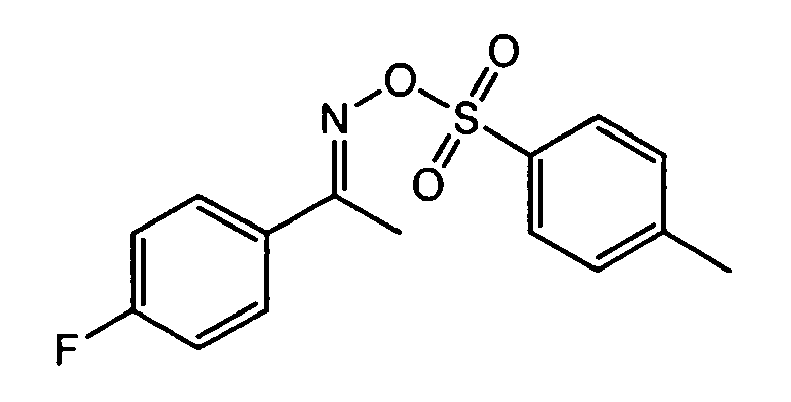
- A solution of the oxime from the previous step (42.7 g, 279 mmol) and p-toluenesulfonyl chloride (66.6 g, 349 mmol) in anhydrous pyridine (100 mL) was stirred at room temperature for one hours to get some precipitate. Cooled water (1L) was added to see the dissolving of the original precipitate and the formation of a new precipitate. It was stirred for one hour and then filtered, and the resulting solid was washed with cooled water and dried under high vacuum to constant weight to get the title compound as a pale solid. 1H NMR (CDCl3, 400 Hz): δ 7.94 (d, J=8.0 Hz, 2 H), 7.58-7.62 (m, 2 H), 7.37 (d, J=8.0 Hz, 2 H), 7.05-7.11 (m, 2 H), 2.47 (s, 3 H), 2.35 (d, J=1.8 Hz, 3 H).
-

- To a solution of the tosylamide from the previous step (71.5 g, 232.7 mmol) in ethanol (100 mL) was added potassium ethoxide (21.1 g, 244.3 mmol) in ethanol (800 mL) at 0 °C. It was slowly warmed to room temperature at which it was stirred for one hour to see a precipitate. It was then diluted with anhydrous ether (1 L) and filtered. To the filtrate hydrogen chloride gas was bubbled in for 30 minutes to get some white precipitate. It was concentrated. The residue was distributed between ethyl acetate (1 L) and 1 N potassium hydroxide solution (pH=10). The organic layer was concentrated and vacuum distilled to get the titled compound as a colorless oil. 1H NMR (CDCl3, 500 MHz): 7.48-7.53 (m, 2 H), 7.02-7.08 (m, 2 H), 3.35-3.52 (m, 4 H), 2.98 (s, 2 H), 1.23 (t, J=7.0 Hz, 6 H). LC-MS (M++1) (EI) 182.2, 228.2.
-

- A solution of the carboxylic acid from the Example 66, Step D (1.5 g, 3.09 mmol), O-benzoltriazol-1-N,N,N',N'-tetramethyluronium hexafluorophosphate (2.8 g, 7.42 mmol), 1-hydroxybenzotriazol hydrate (1.0 g, 7.42 mmol) and diisipropylethylamine (2.7 mL, 15.5 mmol) in DMF (10 mL) was stirred at room temperature for half hour. The aminoacetal from the previous step (843 mg , 3.71 mmol) was added. After stirring at room temperature for 10 hours, the reaction solution was distributed between ethyl acetate (500 mL) and water (500 mL). The organic layer was washed with water (500 mL) and brine. It was dried over anhydrous sodium sulfate, concentrated and purified by flash column chromatography on silica gel with hexanes / ethyl acetate = 3 / 1 as eluant to give the title compound as a white solid. 1H NMR (CDCl3, 400 MHz): 7.50-7.55 (m, 2 H), 7.16 (broad s, 1 H), 7.02-7.08 (m, 2 H), 5.97 (broad s, 1 H), 5.28-5.36 (m, 2 H), 4.67 (broad s, 2 H), 4.60 (d, J=4.5 Hz, 2 H), 4.01-4.11 (m, 1 H), 3.92 (d, J=12.7 Hz, 1 H), 3.76-3.86 (m, 1 H), 3.40-3.67 (m, 3 H), 3.28-3.32 (m, 1 H), 3.18-3.26 (m, 1 H), 2.36-2.42 (m, 2 H), 2.13-2.20 (m 1 H), 1.27 (t, J=7.2 Hz, 2 H), 1.18 (T, J=7.2 Hz, 2 H), 1.01 (s, 3 H), 0.95 (s, 3 H). LC-MS (M++1) (EI) 591.2, 544.2.
-

- To a solution of the ketal from the previous step (1.5 g, 2.54 mmol) in THF (10 mL) was added hydrochloric acid (6 N, 20 mL). After stirring at 50 °C for 10 hours, the reaction solution was diluted with ethyl acetate (200 mL) and washed with 1 N potassium hydroxide solution. The organic layer was dried over anhydrous sodium sulfate, concentrated and purified by flash column chromatography on silica gel with hexanes / ethyl acetate =1/2 as eluant to give the title compound as a white solid. 1H NMR (CDCl3, 400 MHz): 8.21 (broad s, 1 H), 8.00-8.03 (m, 2 H), 7.18 (t, J=8.6 Hz, 2 H), 6.63 (broad s, 1 H), 5.95 (broad s, 1 H), 5.28-5.37 (m, 2 H), 4.90 (dd, J=7.1, 22.7 Hz, 1 H), 4.82 (broad s, 1 H), 4.69 (d, J=4.9 Hz, 2 H), 4.51 (dd, J=4.0, 8.6 Hz, 1 H), 4.05-4.20 (m, 2 H), 4.01-4.09 (m, 1 H), 3.65 (d, J=11.7 Hz, 1 H), 3.28-3.32 (m, 1 H), 2.86 (d, J=11.3 Hz, 1 H), 2.42 (dd, J=3.9, 11.8 Hz, 1 H), 2.34 (dt, J=3.2, 11.8 Hz 1 H), 1.29 (s, 3H), 1.27 (s, 3 H). LC-MS (M++1) (EI) 517.5.
-

- Sulfuric acid (double distilled, 8 mL) was treated with phosphorus pentoxide (573 mg, 2.57 mmol) and added to the ketoamide from the previous step (695 mg, 1.35 mmol). After stirring at 60 °C for 10 minutes the reaction solution was poured into excess ice. Solid potassium hydroxide was added while stirring till pH = 12. It was extracted with ethyl acetate (5 x 200 mL). The combined organic layer was dried over anhydrous sodium sulfate, concentrated and purified by flash column chromatography on silica gel with ethyl acetate / methanol =10 / 1 as eluant to get the title compound as a white solid. 1H NMR (CDCl3, 400 Hz): LC-MS (M++1) (EI) 415.2.
- A solution of the oxazole from the previous step (331 mg, 0.80 mmol) and the epoxide from Example 1, Step P (344 mg, 0.80 mmol) in ethanol (15 mL) was refluxed for 14 hours. After the solvent was removed, the residue was purified by flash column chromatography on silica gel with hexanes / ethyl acetate = 1/2 as eluant to get a pale solid. (LC-MS (M++1) (EI) 808.4. The solid obtained was dissolved in methanol (10 mL) and cooled to 0 °C. Hydrogen chloride in ether (1N, 3.5 mL, 3.5 mmol) was added and the reaction solution was warmed to room temperature at which it was stirred for 12 hours. The solvent was removed under vacuum. The residue was purified on preparative HPLC to give the title compound as a white solid. 1H NMR (CD3OD, 500 Hz): δ 7.70-7.74 (m, 2 H), 7.39 (s, 1 H), 7.13-7.25 (m, 8 H), 7.05-7.11 (m, 2 H), 6.80 (t, J=7.5 Hz, 1 H), 6.72 (d, J=8.0 Hz, 1 H), 5.13 (d, J=4.0 Hz, 1 H), 4.02-4.09 (m, 2 H), 3.91-3.98 (m, 1 H), 3.78-3.84 (m, 1 H), 3.71-3.76 (m, 2 H), 3.07-3.11 (m, 1 H), 2.95-3.04 (m, 2 H), 2.88-2.94 (m, 1H), 2.85 (d, J=11.2 Hz, 1 H), 2.70-2.78 (m, 2 H), 2.63-2.68 (m, 1 H), 2.45-2.49 (m, 1 H), 2.34-2.44 (m, 4 H), 1.98-2.04 (m, 1 H), 1.61 (s, 3 H), 1.60 (s, 3 H), 1.33-1.39 (m, 1 H). LC-MS (M++1) (EI) 768.4
-

-

- To a stirred solution of 3,5-dibromo pyridine (9.0g, 38 mmol) in DMF (100 mL) cooled to 0 °C was added a solution of sodium ethoxide in ethanol (21% by wt, 63.31 mL, 190 mmol). The reaction was refluxed at 90 °C for 16 hours. The reaction mixture was cooled to room temperature and quenched by adding water (100 mL). The pH was adjusted to 9 by the addition of concentrated hydrochloric acid. The resulting solution was concentrated in vacuo. The residue was dissolved in water (300 mL) and extracted four times with ethyl acetate. The combined organic layers were dried over anhydrous sodium sulfate filtered and concentrated in vacuo. The crude material was purified by flash chromatography with 1:1 ethyl acetate hexanes to give the desired compound (3.0 g). LC-MS (M++1)(EI) 202.2.
-

- To a stirred solution of the intermediate form step A (3.41g, 16.87 mmol) in dry THF (5 mL) was added drop wise isopropyl magnesium chloride (11 mL, 21.94 mmol). The reaction mixture was stirred at room temperature for 30 minutes after which time N(tert-Butoxycarbonyl)glycine N'-methoxy-N'-methyl amide (1.84g, 8.43 mmol) was added as a solid. The reaction was quenched after 3 hours with saturated ammonium chloride. The resulting solution was extracted with ethyl acetate, washed with brine, dried over anhydrous sodium sulfate, filtered and concentrated in vacuo. The residue was purified by flash chromatography with 1:1 ethyl acetate hexanes to give the desired compound (1.88g) as a white solid. 1H NMR (CDCl3, 500 MHz): 8.77 (s, 1H), 8.54 (s, 1H), 7.71 (s, 1H), 5.48 (bs, 1H), 4.69 (d, J=4.1 Hz, 2H), 4.18 (q, 2H), 1.51 (s, 9H), 1.48 (t, 3H). LC-MS (M++1)(EI) 281.1.
-

- To the intermediate from Step B (257 mg, 0.91 mmol) was added 30% trifluoroacetic acid dichloromethane (10 mL). After 30 minutes the reaction mixture was concentrated in vacuo and the residue azeotropically dried with chloroform (3X). To a stirred solution of the residue in dichloromethane was added the acid from example 66, step D (419 mg, 1.1 mmol), 1-hydroxy-7-azabenzotriazole(150 mg, 1.1 mmol) and Benzotriazole-1-yl-oxy-tris-pyrrolidino-phosphonium hexafluorophosphate (572 mg, 1.1 mmol). N,N-Diisopropyl ethyl amine (951 µL, 5.46 mmol) was added dropwise and the resulting reaction mixture stirred at room temperature for 16 hours. The reaction mixture was diluted with ethyl acetate (10 mL), washed with saturated sodium bicarbonate solution, brine, dried over anhydrous sodium sulfate, filtered and concentrated in vacuo. The residue was purified by flash chromatography with 4:1 ethyl acetate-hexanes to give the desired compound (300 mg) as a white solid. LC-MS (M++1)(EI) 544.2.
-

- To the intermediate from step C(300 mg, 0.55 mmol) was added fuming sulfuric acid (1 mL). The resulting slurry was heated to 50°C for 30 minutes. The reaction mixture was cooled to -10 °C and ice-water (5 mL) was added very slowly. The resulting solution was basified with the addition of solid potassium hydroxide until the pH=10. A white solid precipitated out which was filtered and discarded. The filtrate was extracted with ethyl acetate (3X) dried over anhydrous sodium sulfate filtered and concentrated in vacuo. The residue was purified by flash chromatography using 100% ethyl acetate and then 5% 2.0M ammonia/ methanol-ethyl acetate to give the desired compound (62 mg) as a white solid. LC-MS (M++1)(EI) 442.2.
-

- A stirred solution of the intermediate from step D (62 mg, 0.14 mmol) and the intermediate from example 1, step P(55.26 mg, 0.14 mmol) in ethanol (1 mL) was heated to 70 °C for 16 hours. The reaction mixture was concentrated in vacuo and purified by flash chromatography using 5% methanol-ethyl acetate to give the desired product (70 mg) as a yellow solid. 1H NMR (CDCl3,500 MHz): 9.26 (bs, 1H), 8.5 (d, J=1.7 Hz, 1H), 8.3 (d, J=2.8 Hz, 1H), 7.3-7.4 (m, 6H), 7.22 (t, J=6.9, 7.1 Hz, 1H), 7.13 (t, J=6.6, 7.1 Hz, 1H), 6.84 (d, J=8.3 Hz, 1H), 6.7 (m, 2H), 5.72 (d, J=4.3 Hz, 1H), 4.46 (dd, J=2.5, 12.8 Hz, 1H), 4.42 (m, 1H), 4.32 (bs, 1H), 4.2 (m, 4H), 3.8 (m, 1H), 3.7 (m, 1H), 3.4-3.5 (m, 3H), 3.15-3.2 (m, 2H), 2.96 (d, J=10.7 Hz, 1H), 2.9 (m, 2H), 2.3-2.7 (m, 5H), 1.71 (s, 3H), 1.62 (s, 6H), 1.5 (t, 3H), 1.28(s, 3H). LC-MS (M++1)(EI) 835.5.
- To a stirred solution of the intermediate from step E (70 mg, 0.084 mmol) in methanol (3 mL) was added a solution of 1.0 M HCl in ether (1 ml, 1 mmol) and the resulting mixture stirred at room temperature for 3 hours. At the end of this time the reaction mixture was concentrated in vacuo. The residue was dissolved in ethyl acetate (10 mL) and washed with 1N sodium hydroxide solution, dried over anhydrous sodium sulfate filtered and concentrated in vacuo. The residue was purified by flash chromatography with 4% methanol ethyl acetate to give the (42 mg) title compound. 1H NMR (CDCl3, 500 MHz): 9.25 (bs, 1H), 8.5 (d, J=1.8 Hz, 1H), 8.29(d, J=2.7 Hz, 1H), 7.23-7.4 (m, 7H), 7.13 (t, J=7.1, 8.2 Hz, 1H), 7.09 (d, J=7.8 Hz, 1H), 6.9 (m, 2H), 6.05 (d, J=8.0 Hz, 1H), 5.18 (m, 1H), 4.2 (m, 3H), 4.1 (m, 3H), 3.8 (m, 3H), 3.4(bs, 1H), 3.1 (d, J=11.9 Hz, 1H), 2.9 (m, 3H), 2.65-2.8 (m, 4H), 2.49 (bd, J=11.7 Hz, 2 H), 2.15 (bs, 1H), 1.95 (t, J=11.2 Hz, 1H), 1.63 (s, 6H), 1.51 (t, 3H). LC-MS (M++1)(EI) 795.3.
-

-

- To a stirred solution of 2,6-dichloro-5-fluoro-nicotinic acid (10 g, 47.62 mmol) and N methoxy N-methyl amine (5.57 g, 57.14 mmol) in dichloromethane was added 4-dimethyl amino pyridine (58 mg, 0.47 mmol) N,N-diisopropylethyl amine (16.58 mL, 95.23 mmol) and EDC (9.12 g, 46.62 mmol). The resulting mixture was stirred at room temperature for 16 hours. The reaction mixture was diluted with dichloromethane and washed with 1N HCl and saturated sodium bicarbonate. The organic layer was dried over anhydrous sodium sulfate filtered and concentrated in vacuo. The residue was purified by flash chromatography with 50% ethyl acetate hexanes to give the desired compound (10.58g)as a colorless oil. 1H NMR (CDCl3,500 MHz): 7.54 (d, J=6.9 Hz, 1H), 3.56 (s, 3H), 3.42 (s, 3H). LC-MS (M++1)(EI) 253.2.
-

- To a stirred solution of the intermediate from step A (10.58 g, 41.81 mmol) in ethanol (150 mL) was added ammonium formate (13.18 g, 209 mmol), formic acid (5 mL) and 10% palladium on carbon (1.0 g). The resulting mixture was heated to 65 °C for 16 hours. The reaction mixture was cooled to room temperature and filtered through a pad of celite. The residue was washed with ethanol (50 mL) and discarded. The filtrate was concentrated in vacuo. The residue was dissolved in ethyl acetate and washed with saturated sodium bicarbonate solution and brine and dried over anhydrous sodium sulfate. The solution was filtered and concentrated in vacuo. The residue was purified by flash chromatography using 40% ethyl acetate hexanes to give the (6.5 g) desired compound. 1H NMR (CDCl3,500 MHz): 8.79 (s, 1H), 8.55 (d, J=3.0 Hz, 1H), 7.78 (dd, J=4.4, 8.6 Hz, 1H), 3.57 (s, 3H), 3.4 (s, 3H). LC-MS (M++1)(EI) 185.3.
-

- To a stirred solution of the intermediate from step B (4.3 g, 22.8 mmol) in anhydrous THF cooled to -20 °C was added methyl magnesium bromide (48.85 mL, 68.4 mmol, 1.4 M in THF). The reaction was warmed to room temperature and stirred for 2 hours. The reaction mixture was quenched with saturated ammonium chloride solution. The resulting biphasic mixture was extracted with ethyl acetate (3X). The combined organic layers was washed with brine, dried over anhydrous sodium sulfate, filtered and concentrated in vacuo. The residue was purified by flash chromatography with 30% ethyl acetate hexanes to give the desired compound (2.7 g) as colorless oil. 1H NMR (CDCl3,500 MHz): 9.01 (s, 1H), 8.68(d, J=2.7 Hz, 1H), 7.96 (d, J=2.7 Hz, 1H), 2.68 (s, 3H). LC-MS (M++1)(EI) 140.1.
-

- To a stirred solution of the intermediate from step C (5.25 g, 37.73 mmol) in ethanol (50 mL) was added hydroxylamine hydrochloride (2.97 g, 42.79 mmol) and sodium hydroxide (1.71 g, 42.79 mmol). The reaction was refluxed for two hours during which time a white precipitate crashed out. The reaction mixture was cooled to room temperature and filtered. The solid was washed with ethanol (3 x100 mL) and discarded. The filtrate was concentrated in vacuo. The residue was dissolved in ethyl acetate and washed with water. The organic layer was dried over anhydrous sodium sulfate, filtered and concentrated in vacuo to give the desired compound (5.7 g) as a white solid. 1H NMR (CDCl3,500 MHz):9.0 (bs, 1H), 8.78 (s, 1H), 8.5 (s, 1H), 7.75 (d, J=11.4 Hz, 1H), 2.32 (s, 3H). LC-MS (M++1)(EI) 155.2.
-

- To a solution of the intermediate from step D (5.7 g, 36.97 mmol) in pyridine (20 mL) was added para-toluene sulfonyl chloride (8.81 g, 46.22 mmol) and the resulting mixture was stirred at room temperature for 48 hours. At the end of this time the reaction mixture was diluted with ethyl acetate (300 mL). The organic layer was washed with ice water (3x250 mL), brine, dried over anhydrous sodium sulfate, filtered and concentrated in vacuo. The residue was azeotroped with toluene (5X) to give the desired compound (11.0 g) as a light brown oil. LC-MS (M++1)(EI) 309.2.
-

- To a stirred solution of the intermediate from step E (11.0g, 35.67 mmol) in dry ethanol (100 mL) cooled to 0 °C was added dropwise via an addition funnel a solution of potassium ethoxide (3.22 g, 37.45 mmol) in ethanol (200 mL). The reaction mixture was warmed to room temperature and stirred for 18 hours. The reaction mixture was concentrated to half its volume and anhydrous ether(100 mL) was added. A slow stream of hydrogen chloride gas was bubbled for 3 hours. The reaction mixture was concentrated in vacuo and the residue dissolved in ethyl acetate and washed with 1N potassium hydroxide, dried over anhydrous sodium sulfate filtered and concentrated in vacuo. The residue was purified by flash chromatography using 5% 2.0M ammonia/methanol-ethyl acetate to give the desired product (5.0 g) as a brown oil. 1H NMR (CDCl3,500 MHz): 8.55 (s, 1H), 8.43 (s, 1H), 7.5(m, 1H), 3.49 (m, 2H). 3.35 (m, 2H), 3.22 (s, 2H), 1.25 (m, 6H). LC-MS (M++1)(EI) 229.2.
-

- To a stirred solution of the intermediate obtained from step F (2.0 g, 8.76 mmol) in 1:1 DMF/DCM (10 mL) was added the intermediate obtained from example 66 step D (5.06 g, 10.51 mmol), 1-hydroxy-7-azabenzotriazole (1.8 g, 13.14 mmol), N,N-diisopropylethyl amine (2.28 mL, 13.14 mmol) and Benzotriazole-1-yl-oxy-tris-pyrrolidino-phosphonium hexafluorophosphate (5.46 g, 10.51 mmol). The resulting mixture was stirred at room temperature for 16 hours. The reaction mixture was concentrated in vacuo. The residue was dissolved in ethyl acetate (100 mL) and washed with saturated sodium bicarbonate (2X), brine (1X) dried over anhydrous sodium sulfate filtered and concentrated in vacuo. The residue was purified by flash chromatography using 70% ethyl acetate hexanes to give the desired product (4.84 g) as a white solid. 1H NMR (CDCl3,500 MHz): 8.58 (s, 1H), 8.37 (s, 1H), 7.58 (d, J=7.8 Hz, 1H), 5.94 (m, 1H), 5.34 (d, J=17.2 Hz, 1H), 5.28 (d, J=10.5 Hz, 1H), 4.65 (bs, 3H), 4.1 (bs, 1H), 4.0 (bs, 2H), 3.6 (m, 3H), 3.4 (m, 3H), 3.29 (d, J=19.2 Hz, 2H), 2.8 (bs, 1H), 2.6 (bd, J=10.3 Hz, 1H), 2.3 (bs, 1H), 2.1 (bs, 1H), 1.2 (m, 6H), 1.06 (s, 3H), 1.01 (s, 3H).). LC-MS (M++23)(EI) 614.3.
-

- To a stirred solution of the intermediate obtained form step G (4.84 g, 8.18 mmol) in THF (20 mL) was added 6N HCl (20 mL) and the resulting mixture heated to 60 °C for three hours. The reaction mixture was cooled to room temperature and diluted with ethyl acetate (100 mL). A solution of 6N NaOH was added until the pH=12. The resulting biphasic mixture was extracted with ethyl acetate (3X), the organic layer dried over anhydrous sodium sulfate filtered and concentrated in vacuo. The residue was purified by flash chromatography with 70% ethyl acetate hexanes to give the desired product (4.0 g) as a white solid. 1H NMR (CDCl3,500 MHz): 8.98 (s, 1H), 8.66 (bs, 1H), 8.34 (bs, 1H), 7.92 (d, J=8.3 Hz, 1H), 6.91 (bs, 1H), 5.91 (bs, 1H), 5.32 (d, J=16.7 Hz, 1H), 5.26 (d, J=10.3 Hz, 1H), 4.85 (m, 2H), 4.62 (bs, 2H), 4.54 (d, J=16.3 Hz, 1H), 4.2 (m, 2H), 3.8 (m, 1H), 3.6 (bs, 1H), 3.2 (bs, 1H), 2.86 (d, J=10.3 Hz, 1H), 2.4 (bs, 1H), 2.25 (t, 1H), 1.24 (s, 6H).). LC-MS (M++1)(EI) 518.3.
-

- To the intermediate from step H (2.5 g, 4.83 mmol) was added fuming sulfuric acid (4 mL). The resulting slurry was heated to 50 °C for 15 minutes. The reaction mixture was cooled to -10 °C and ice-water (5 mL) was added very slowly. The pH of the solution was adjusted to 10 by the addition of solid potassium hydroxide. A white precipitate crashed out that was filtered and discarded. The filtrate was extracted with ethyl acetate (4X). The organic layer was washed with brine (1X), dried over anhydrous sodium sulfate filtered and concentrated in vacuo. The residue was purified by flash chromatography using 100% ethyl acetate and then 5% 2.0M ammonia/ methanol-ethyl acetate to give the desired compound (1.1 g) as a white solid. 1H NMR (CDCl3, 500 MHz): 8.72 (s, 1H), 8.44 (d, J=2.7 Hz, 1H), 8.07 (bs, 1H), 7.63 (dt, J=2.0, 2.3, 8.9 Hz, 1H), 7.39 (s, 1H), 4.9 (m, 2H), 3.54 (dd, J=3.2, 5.9 Hz, 1H), 2.9-3.0 (m, 3H), 2.8 (dd, J=5.9, 11.4 Hz, 1H), 2.6 (m, 2H), 1.6 (s, 6H).). LC-MS (M++1)(EI) 416.3.
-

- A stirred solution of the intermediate from step I (1.1 g, 2.65 mmol) and the intermediate form example 1, step P(1.04 g, 2.65 mmol) in ethanol (35 mL) was heated to 70 °C for 16 hours. The reaction mixture was concentrated in vacuo and purified by flash chromatography using 100 % ethyl acetate and then 5% 2.0M ammonia in methanol-ethyl acetate to give the desired product (1.1g) as a white solid. 1H NMR (CDCl3,500 MHz): 9.19 (bs, 1H), 8.72 (s, 1H), 8.47 (d, J=2.7 Hz, 1H), 7.61 (d, J=9.0 Hz, 1H), 7.42 (s, 1H), 7.27-7.34 (m, 5H), 7.21 (t, J=7.3, 9.0 Hz, 1H), 7.12 (t, J=7.1, 8.0 Hz, 1H), 6.83 (dd, J=3.2, 8.1 Hz, 1H), 6.65 (m, 2H), 5.69 (d, J=4.1 Hz, 1H), 4.4 (d, J=12.8 Hz, 1H), 4.3 (m, 1H), 4.21 (d, J=12.8 Hz, 1H), 4.1 (m, 2H), 3.8 (m, 1H), 3.7 (bt, J=9.4 Hz, 1H), 3.5 (m, 2H), 3.4 (m, 2H), 3.15 (m, 2H), 2.95 (d, J=10.5 Hz, 1H), 2.85 (m, 1H), 2.4-2.7 (m, 4H), 1.7 (s, 3H), 1.61 (s, 6H), 1.27 (s, 3H). LC-MS (M++1)(EI) 809.3.
- To a solution of the intermediate from step J(1.1 g, 1.35 mmol) in methanol (20 mL) was added a solution of 1.0 M HCl in ether (17.5 ml, 17.5 mmol) and the resulting mixture stirred at room temperature for 4.5 hours. At the end of this time the reaction mixture was concentrated in vacuo. The residue was dissolved in ethyl acetate (100 mL) washed with 1N sodium hydroxide solution, dried over anhydrous sodium sulfate, filtered and concentrated in vacuo. The residue was purified by flash chromatography with 100% ethyl acetate and then 5% 2.0M ammonia/methanol ethyl acetate to give the title compound (880 mg) as a white solid. 1H NMR (CDCl3,500 MHz): 9.19 (bs, 1H), 8.73 (s, 1H), 8.47 (d, J=2.3 Hz, 1H), 7.62 (d, J=8.7 Hz, 1H), 7.43 (s, 1H), 7.23-7.33 (m, 5H), 7.12 (t, J=8.0 Hz, 1H), 7.06 (d, J=7.3 Hz, 1 H), 6.8 (d, J=7.5 Hz, 1H), 6.03 (d, J=8.0 Hz, 1H), 5.17 (m, 1H), 4.0-4.4 (m, 3H), 3.7-3.9 (m, 3H), 3.5 (bs, 1H), 3.45 (bs, 1H), 3.13 (d, J = 11.2 Hz, 1H), 2.9 (m, 3H), 2.7-2.8 (m, 4H), 2.48 (bd, J=11.9 Hz, 2H), 2.19 (d, J=4.5 Hz, 1H), 1.94 (t, J=11.4 Hz, 1H), 1.63 (s, 6H). LC-MS (M++1)(EI) 769.4.
-

-

- To a solution of 3,5-dibromopyridine (15 g, 63.31 mmol) in dry THF (100 mL) cooled to 0 oC was added drop wise isopropyl magnesium chloride (41 mL, 82.31 mmol). The reaction mixture was stirred at room temperature for 45 minutes after which time N(tert-Butoxycarbonyl)glycine N'-methoxy-N'-methyl amide (6.9g, 31.65 mmol) was added as a solid. The reaction was quenched after 3 hours with saturated ammonium chloride. The resulting solution was extracted with ethyl acetate, washed with brine, dried over anhydrous sodium sulfate, filtered and concentrated in vacuo. The residue was purified by flash chromatography with 15% ethyl acetate hexanes to give the desired compound (7.0 g) as a white solid. LC-MS (M++1)(EI) 315.3.
-
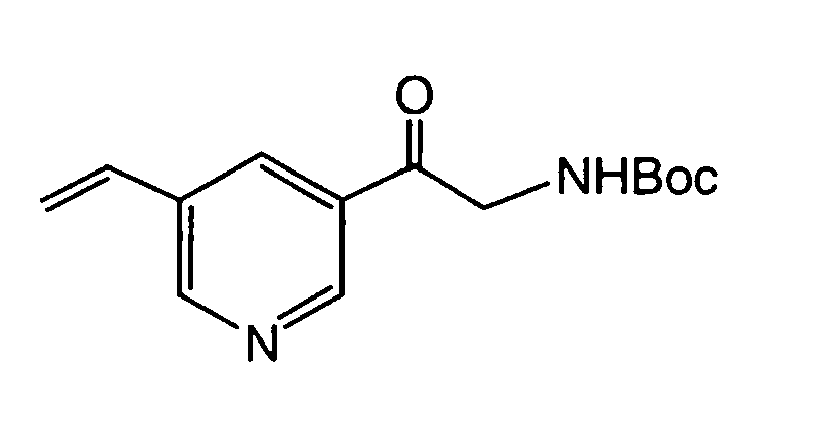
- To a solution of the intermediate from step A (5.1 g, 16.18 mmol) in toluene (120 mL) was added tri-n-butyl-vinyl stannane (5.7 mL, 19.41 mmol) and Pd(PPh3)4 (935 mg, 0.81 mmol). The resulting mixture was heated to reflux under a N2 atmosphere. The reaction mixture was cooled to room temperature, a saturated solution of potassium fluoride (120 mL) was added and the resulting biphasic mixture stirred vigorously for 45 minutes. The precipitate was filtered and discarded. The filtrate was extracted with diethyl ether (3X), the organic layer washed with brine, dried over anhydrous sodium sulfate filtered and concentrated in vacuo. The residue was purified by flash chromatography with 35 % ethyl acetate hexanes to give the desired compound (3.16 g) as a white solid. 1H NMR (CDCl3,500 MHz): 9.05 (s, 1H), 8.84 (s, 1H), 8.26 (s, 1H), 6.81 (dd, J=11, 17.6 Hz, 1H), 5.98 (d, J=17.6 Hz, 1H), 5.55 (d, J=11 Hz, 1H), 4.71 (d, J=3.9 Hz, 2H), 1.5(s, 9H).). LC-MS (M++1)(EI) 263.2.
-

- To a solution of the intermediate from step B (2.0 g, 3.81 mmol) in methanol (5 mL) was added 10% Pd/C (350 mg). The resulting solution was stirred at room temperature under hydrogen (1 atmosphere). After 3 hours the reaction was filtered through celite and the filtrate concentrated in vacuo to give the desired (2.0 g) compound. 1H NMR (CDCl3,500 MHz): 9.0 (s, 1H), 8.65 (s, 1H), 8.1 (s, 1H), 4.65 (d, 2H), 2.7 (q, 2H), 1.5 (s, 9H), 1.3 (t, 3H).
-

- To the intermediate from Step C (1.0 g, 3.78 mmol) was added 30% trifluoroacetic acid dichloromethane (10 mL). After 30 minutes the reaction mixture was concentrated in vacuo and the residue azeotropically dried with toluene (3X) and then chloroform (3X). To a solution of the residue in 1:1DMF/DCM (8 mL) was added the intermediate from example 66, step D(911 mg, 1.89 mmol), 1-hydroxy-7-azabenzotriazole (386 mg, 2.84 mmol) and Benzotriazole-1-yl-oxy-tris-pyrrolidino-phosphonium hexafluorophosphate (985mg, 1.89 mmol). N,N-Diisopropyl ethyl amine (1.97 mL, 11.34 mmol) was added dropwise and the resulting reaction mixture stirred at room temperature for 16 hours. The reaction mixture was diluted with ethyl acetate (20 mL), washed with saturated sodium bicarbonate solution, brine, dried over anhydrous sodium sulfate, filtered and concentrated in vacuo. The residue was purified by flash chromatography with 4:1 ethyl acetate-hexanes to give the desired compound (650 mg) as an oil. LC-MS (M++1)(EI) 528.2.
-

- To the intermediate from Step D (300 mg, 0.56mmol) was added fuming sulfuric acid (1 mL). The resulting slurry was heated to 50 °C for 15 minutes. The reaction mixture was cooled to -10 °C and ice-water (5 mL) was added very slowly. The pH of the resulting solution was adjusted to 10 with addition of solid potassium hydroxide. A white precipitate crashed out that was filtered and discarded. The filtrate was extracted with ethyl acetate (3X). The organic layer was washed with brine (1X), dried over anhydrous sodium sulfate filtered and concentrated in vacuo. The residue was purified by flash chromatography using 5% 2.0M ammonia/methanol-ethyl acetate to give the desired compound (100 mg) as a white solid. 1H NMR (CDCl3, 500 MHz): 8.74 (d, J=2.1 Hz, 1H), 8.45 (d, J=1.8 Hz, 1H), 8.2 (m, 1H), 7.72 (d, J=2.1 Hz, 1H), 7.34 (s, 1H), 3.97 (m, 2H), 3.53 (m, 1H), 2.9 (m, 4H), 2.75 (q, 2H), 2.6 (m, 2H), 1.62 (s, 3H), 1.61 (s, 3H), 1.3 (t, 3H). LC-MS (M++1)(EI) 426.2.
-

- A solution of the intermediate from Step E (100 mg, 0.24 mmol) and the intermediate from Example 1, Step P (93 mg, 0.24 mmol) in ethanol (5 mL) was heated to 70 °C for 16 hours. The reaction mixture was concentrated in vacuo and purified by flash chromatography using 80% ethyl acetate hexanes to give the desired product (100 mg) as a solid. LC-MS (M++1)(EI) 819.3.
- To a solution of the intermediate from Step F (100 mg, 0.122 mmol) in methanol (5 mL) was added a solution of 1.0 M HCl in ether (3.22 ml, 3.22 mmol) and the resulting mixture stirred at room temperature for 4 hours. At the end of this time the reaction mixture was concentrated in vacuo. The residue was dissolved in ethyl acetate (10 mL) and washed with 1N sodium hydroxide solution, dried over anhydrous sodium sulfate filtered and concentrated in vacuo. The residue was purified by flash chromatography with 5% methanol ethyl acetate to give the (55 mg) title compound as a white solid. 1H NMR (CDCl3,500 MHz): 9.3 (bs, 1H), 8.72 (d, J=2.1 Hz, 1H), 8.46 (d, J=1.9 Hz, 1H), 7.71 (s, 1H), 7.36 (s, 1H), 7.2-7.4 (m, 5H), 7.12 (d, J=7.8 Hz, 1H), 7.06 (d, J=7.8 Hz, 1H), 6.84 (t, J=7.1 Hz, 1H), 6.77 (d, J=8.0 Hz, 1H), 6.03 (bs, 1H), 5.17 (m, 1H), 4.0-4.2 (m, 4H), 3.8 (m, 3H), 3.15 (bs, 1H), 2.9 (m, 5H), 2.8 (m, 3H), 2.6(q, 2H), 2.55 (bs, 2H), 1.9 (m, 1H), 1.63(s, 6H), 1.57 (m, 1H), 1.33 (t, 3H). LC-MS (M++1)(EI) 779.4.
-

-

- To a solution of 3,5-dibromopyridine (2.0 g, 8.44 mmol) in THF (4 ml) was added isopropylmagnesium chloride (2M in THF, 5.49 ml, 10.98 mmol). The reaction mixture was stirred at room temperature for 1 h. Cupper cyanide (151 mg, 1.69 mmol) and lithium chloride (143 mg, 3.37 mmol) were added as solid. The reaction was cooled in a water bath and allyl bromide (0.804 ml, 9.29 mmol) was added. After 3 hours stirring at room temperature, the reaction mixture was diluted with methylene chloride, washed with aqueous NH4Cl solution and brine, dried over anhydrous sodium sulfate, filtered and concentrated in vacuo. The crude reaction mixture was purified by flash column chromatography on silica gel with 1:4 ethyl acetate/hexane as the eluant to give the titled compound. 1H NMR (CDCl3, 500 MHz): 8.54 (s, 1H), 8.38 (s, 1H), 7.68 (s, 1H), 5.93 (m, 1H), 5.16 (m, 2H), 3.40 (m, 2H).
-

- The intermediate prepared in Step A (1.4 g, 7.07 mmol) in THF (3.3 ml) was added isopropylmagnesium chloride (2M in THF, 4.59 ml, 9.19 mmol). The reaction mixture was stirred at room temperature for 1 h. N-(tert-Butoxycarbonyl)glycine-N'-methoxy-N'-methylamide (0.77 g, 3.53 mmol) was added in THF (4 ml). After stirring at room temperature for 3 hours, the reaction mixture was poured into aqueous NH4Cl solution and the product was extracted with methylene chloride. The organic layer was washed with brine, dried over anhydrous sodium sulfate, filtered and concentrated in vacuo. The crude product was purified by flash column chromatography on silica gel with 1:4 ethyl acetate/hexane as the eluant to give the titled compound. 1H NMR (CDCl3, 500 MHz): 9.02 (s, 1H), 8.66 (s, 1H), 8.05 (s, 1H), 5.93 (m, 1H), 5.16 (m, 2H), 4.66 (m, 2H), 3.47 (d, J = 6.4 Hz, 2H), 2.90 (t, 2H), 1.48 (s, 9H).
-

- The intermediate prepared in Step B (1.3 g, 4.71 mmol) in MeoH (20 ml) was added 10 % palladium on carbon (250 mg). The reaction mixture was stirred under a hydrogen balloon. After half an hour the reaction mixture was filtered through celite and the filtrate was concentrated in vacuo. The crude product was purified by flash column chromatography on silica gel with 3:7 ethyl acetate/hexane as the eluant to give the titled compound. 1H NMR (CDCl3, 500 MHz): 8.94 (s, 1H), 8.60 (s, 1H), 8.20 (s, 1H), 4.55 (m, 2H), 2.72 (t, 2H), 1.70 (m, 2H), 1.45 (s, 9H), 0.98 (t, 3H).
-

- The intermediate prepared in Step C (100 mg, 0.36 mmol) was treated in TFA in methylene chloride (30%, 10 ml) at room temperature for 30 min. Then the reaction mixture was concentrated in vacuo and azeotroped with chloroform three times. The resulting mixture was dissolved in DMF (3 ml) and the intermediate prepared as in Example 66 Step D (114 mg, 0.30 mmol), PyBop (374 mg, 0.72 mmol), HOAt (98 mg, 0.72 mmol), and DIEA (376 µl, 2.16 mmol) were added. The reaction mixture was stirred at room temperature overnight. The crude reaction mixture was poured into water and the product was extracted with ethyl acetate three times. The organic layers were combined, washed with water and brine, dried over anhydrous sodium sulfate, filtered and concentrated in vacuo. The crude product was purified by flash column chromatography on silica gel with ethyl acetate as the eluant to give the titled compound. 1H NMR (CDCl3, 500 MHz, mixture of rotamers R1 and R2 2:1 ratio): 9.12 (s, 0.33H, R2), 9.00 (s, 0.67H, R1), 8.64 (s, 0.67H, R1), 8.57 (s, 0.33H, R2), 8.22 (s, 0.33H, R2), 8.03 (s, 0.67H, R1), 5.94 (m, 1H), 5.35-5.26 (m, 1.33H), 4.91-4.52 (m, 3.67H), 4.20-3.20 (m, 6H), 2.88-2.83 (m, 1H), 2.75-2.72 (t, 0.66H, R2), 2.69-2.66 (t, 1.34H, R1), 2.47-2.31 (m, 2H), 1.97-1.94 (m, 1H), 1.78-1.74 (q, 0.66H, R2), 1.7-1.67 (q, 1.34H, R1), 1.27-1.24 (m, 6H), 1.04-1.01 (t, 0.99H, R2), 0.98-0.96 (t, 2.01H, R1).
-

- To intermediate prepared in Step D (300 mg, 0.554 mmol) was added fuming sulfuric acid (7 ml). The reaction mixture was stirred at 60 °C for 20 min, and then was slowly poured into ice water with stirring. The mixture was basified with potassium hydroxide to pH 12. The product was extracted with methylene chloride three times. The organic layers were combined, washed with brine, dried over anhydrous sodium sulfate, filtered and concentrated in vacuo. The crude product was purified by flash column chromatography on silica gel with 3:22 ammonia in MeOH (2M)/ethyl acetate as the eluant to give the titled compound. 1H NMR (CDCl3, 500 MHz): 8.73 (s, 1H), 8.42 (s, 1H), 7.69 (s, 1H), 7.34 (s, 1H), 3.99-3.92 (m, 2H), 3.52-3.49 (m, 1H), 2.98-2.77 (m, 4H), 2.68-2.65 (t, 2H), 2.60-2.56 (m, 2H), 1.74-1.68 (m, 2H), 1.61 (s, 3H), 1.60 (s, 3H), 1.02-0.99(t, 3H).
-
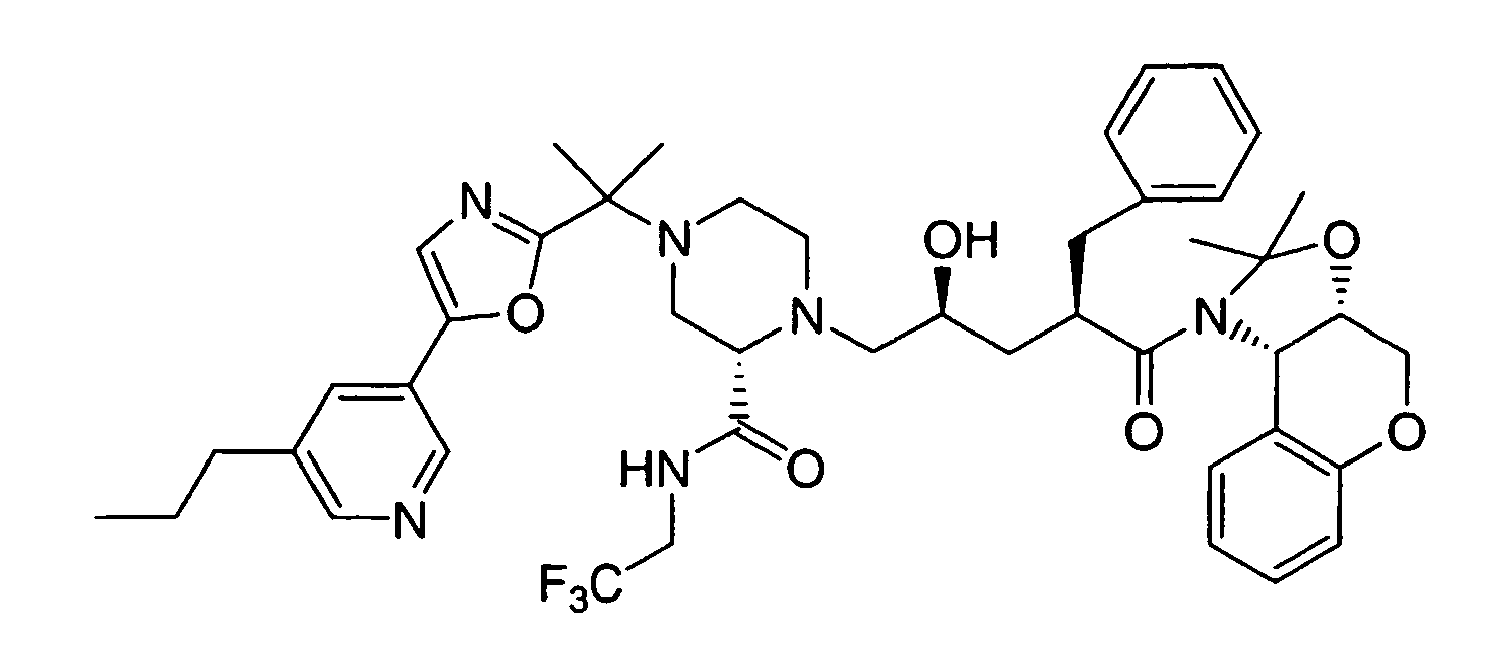
- The intermediate prepared in Step E (94 mg, 0.213 mmol) and the epoxide intermediate prepared as in Example 1 Step P (84 mg, 0.213 mmol) in methanol (2 ml) was heated to reflux overnight. The solvent was removed in vacuo. The crude reaction mixture was purified by flash column chromatography on silica gel with ethyl acetate as the eluant to give the titled compound as a white solid. 1H NMR (CDCl3, 500 MHz): 9.28 (bs, NH, 1H), 8.73 (s, 1H), 8.45 (s, 1H), 7.69 (s, 1H), 7.37-7.10 (m, 7H), 6.84-6.82 (m, 1H), 6.71-6.67 (m, 2H), 5.71 (d, J = 4.60 Hz, 1H), 4.46-4.10 (m, 3H), 3.80-3.70 (m, 2H), 3.54-2.42 (m, 17H), 1.81-1.45 (m, 14H), 1.03-1.00 (t, 3H).
- To a solution of the intermediate obtained in Step F (65 mg, 0.078 mmol) in methanol (3.4 ml) was added 1 M HCl in ethyl ether (1.3 ml, 1.3 mmol). The reaction mixture was stirred at room temperature. After 5 hours the mixture was neutralized by 2 M ammonia in methanol. The solvent was removed in vacuo and the reaction mixture was diluted with methylene chloride and washed with 1 N NaOH. The aqueous layer was extracted with methylene chloride three times. The organic layers were combined, dried over anhydrous sodium sulfate, filtered and concentrated in vacuo. The crude product was purified by flash column chromatography with 3 % 2M ammonia in methanol/ethyl acetate as the eluant. 1H NMR (CDCl3, 500 MHz): 9.24 (bs, NH, 1H), 8.71 (s, 1H), 8.43 (s, 2H), 7.69 (s, 1H), 7.36 (s, 1H), 7.32-7.22 (m, 4H), 7.16-7.07 (m, 2H), 6.15 (d, J = 8.0 Hz, 1H), 5.18-5.16 (m, 1H), 4.12-3.99 (m, 2H), 3.82-3.74 (m, 3H), 3.36-2.44 (m, 14H), 1.93-1.88 (m, 2H), 1.74-1.69 (m, 2H), 1.63-1.55 (m, 7H), 1.02-0.99 (t, 3H). LC-MS (M++1) (EI) 793.2.
-

-

- 3-Bromopyridine (0.83 ml, 8.61 mmol) in THF (4 ml) was added isopropylmagnesium chloride (2M in THF, 5.6 ml, 11.19 mmol). The reaction mixture was stirred at room temperature for 1 h. N-(tert-Butoxycarbonyl)alanine-N'-methoxy-N'-methylamide (1 g, 4.30 mmol) was added in THF (4 ml). After stirring at room temperature for 3 hours, the reaction mixture was poured into aqueous NH4Cl solution and the product was extracted with methylene chloride. The organic layer was washed with brine, dried over anhydrous sodium sulfate, filtered and concentrated in vacuo. The crude product was purified by flash column chromatography on silica gel with 3:7 ethyl acetate/hexane as the eluant to give the titled compound. 1H NMR (CDCl3, 500 MHz): 9.18 (d, J = 1.6 Hz, 1H), 8.80-8.78 (m, 1H), 8.26-8.24 (m, 1H), 7.44-7.42 (m, 1H), 5.60 (bs, NH, 1H), 5.25-5.22 (m, 1H), 1.43-1.40 (m, 12H).
-

- The intermediate prepared in Step A (237 mg, 0.95 mmol) was treated in TFA in methylene chloride (30%, 20 ml) at room temperature for 30 min. Then the reaction mixture was concentrated in vacuo and azeotroped with chloroform three times. To the resulting mixture dissolved in DMF (6 ml) was added the intermediate prepared in Example 66 Step D (300 mg, 0.79 mmol), PyBop (986 mg, 1.90 mmol), HOAt (258 mg, 1.90 mmol), and DIEA (990 µl, 5.69 mmol). The reaction mixture was stirred at room temperature overnight. The crude reaction mixture was poured into water and the product was extracted with ethyl acetate three times. The organic layers were combined, washed with water and brine, dried over anhydrous sodium sulfate, filtered and concentrated in vacuo. The crude product was purified by flash column chromatography on silica gel with 4:1 ethyl acetate/hexane as the eluant to give the titled compound. 1H NMR (CDCl3, 500 MHz): 9.18 (d, J= 1.6 Hz, 1H), 8.78 (d, J = 3.9 Hz, 1H), 8.29-8.27 (m, 1H), 7.45-7.43 (m, 1H), 5.98-5.93 (m, 1H), 5.36-5.28 (m, 3H), 4.74-4.68 (m, 3H), 4.17-4.12 (m, 2H), 3.80-3.40 (m, 2H), 3.18-3.06 (m, 1H), 2.84-2.80 (m, 1H), 2.41-2.28 (m, 2H), 1.51 (d, J = 7.1 Hz, 3H), 1.26 (s, 3H), 1.16 (s, 3H).
-

- To intermediate prepared in Step B (260 mg, 0.506 mmol) was added fuming sulfuric acid (5 ml). The reaction mixture was stirred at 60 °C for 20 min, and then was slowly poured into ice water with stirring. The mixture was basified with potassium hydroxide to pH 12. The product was extracted with methylene chloride three times. The organic layers were combined, washed with brine, dried over anhydrous sodium sulfate, filtered and concentrated in vacuo to give the titled compound. 1H NMR (CDCl3, 500 MHz): 8.87 (d, J= 2.0 Hz, 1H), 8.58-8.56 (m, 1H), 8.15 (bs, NH, 1H), 7.89-7.87 (m, 1H), 7.52-7.38 (m, 1H), 4.05-3.84 (m, 2H), 3.56-3.54 (m, 1H), 3.02-2.89 (m, 4H), 2.80-2.76 (m, 1H), 2.65-2.55 (m, 2H), 2.44 (s, 3H), 1.59 (s, 3H), 1.58 (s, 3H).
-

- The intermediate prepared in Step C (172 mg, 0.419 mmol) and the epoxide intermediate from Example 1 Step P (165 mg, 0.419 mmol) in methanol (3.5 ml) was heated to reflux overnight. The solvent was removed in vacuo. The crude reaction mixture was purified by flash column chromatography on silica gel with ethyl acetate as the eluant to give the titled compound. 1H NMR (CDCl3, 500 MHz): 9.33 (bs, NH, 1H), 8.87 (d, J = 2.1 Hz, 1H), 8.61-8.59 (m, 1H), 7.87-7.85 (m, 1H), 7.43-7.40 (m, 1H), 7.35-7.10 (m, 6H), 6.84-6.65 (m, 3H), 5.71 (d, J = 4.60 Hz, 1H), 4.46-4.10 (m, 3H), 3.73-2.46 (m, 16H), 2.45 (s, 3H), 1.78-1.57 (m, 10H), 1.28 (s, 3H).
- To a solution of the intermediate obtained in Step D (176 mg, 0.219 mmol) in methanol (10 ml) was added 1 M HCl in ethyl ether (5 ml, 5 mmol). The reaction mixture was stirred at room temperature. After 6 hours the mixture was neutralized by 2 M ammonia in methanol. The solvent was removed in vacuo and the reaction mixture was diluted with methylene chloride and washed with 1 N NaOH. The aqueous layer was extracted with methylene chloride three times. The organic layers were combined, washed with brine, dried over anhydrous sodium sulfate, filtered and concentrated in vacuo. The crude product was purified by flash column chromatography with 1.5 % 2M ammonia in methanol/ethyl acetate as the eluant. 1H NMR (CDCl3, 500 MHz): 9.29 (bs, NH, 1H), 8.86 (d, J = 2.3 Hz, 1H), 8.59-8.58 (m, 1H), 7.88-7.86 (m, 1H), 7.42-7.40 (m, 1H), 7.32-7.22 (m, 4H), 7.12-7.07 (m, 2H), 6.81-6.78 (m, 2H), 6.16 (d, J = 8.2 Hz, 1H), 5.18-5.16 (m, 1H), 4.16-3.99 (m, 3H), 3.82-3.36 (m, 5H), 3.10-2.65 (m, 9H), 2.47-2.44 (m, 4H), 1.93-1.88 (m, 2H), 1.61-1.56 (m, 7H). LC-MS (M++1) (EI) 765.2.
-

-

- A solution of 3,5-dibromopyridine (10 g, 42.2 mmol) in DMF (110 ml) was cooled in an ice bath. Sodium methoxide (25% by wt. in MeOH, 48.2 ml, 211.1 mmol) was added. The reaction mixture was heated to 100 °C overnight. The reaction was quenched with water (100 ml). Concentrated HCl was added to pH 9. The mixture was concentrated to dryness in vacuo, then water (250 ml) was added. The product was extracted with ethyl acetate three times. The organic layers were combined, washed with brine, dried over sodium sulfate, filtered and concentrated in vacuo. The crude product was purified by flash column chromatography on silica gel with 30 % ethyl acetate/hexane as the eluant to give the titled compound. 1H NMR (CDCl3, 500 MHz): 8.29 (s, 1H), 8.25 (s, 1H), 7.37 (s, 1H), 3.86 (s, 3H).
-

- The intermediate prepared in Step A (2.07 g, 11.0 mmol) in THF (4 ml) was added isopropylmagnesium chloride (2M in THF, 6.6 ml, 13.2 mmol). The reaction mixture was stirred at room temperature for 1 h. N-(tert-Butoxycarbonyl)alanine-N'-methoxy-N'-methylamide (1.28 g, 5.50 mmol) was added in THF (15 ml). After stirring at room temperature for 3 hours, the reaction mixture was poured into aqueous NH4Cl solution and the product was extracted with methylene chloride three times. The organic layer was combined, washed with brine, dried over anhydrous sodium sulfate, filtered and concentrated in vacuo. The crude product was purified by flash column chromatography on silica gel with 3:7 ethyl acetate/hexane as the eluant to give the titled compound. 1H NMR (CDCl3, 500 MHz): 8.81 (s, 1H), 8.53 (s, 1H), 7.74 (s, 1H), 5.49 (bs, NH, 1H), 5.27-5.24 (m, 1H), 3.98 (s, 3H), 1.47 (s, 9H), 1.45 (d, J = 7.3 Hz, 3H).
-
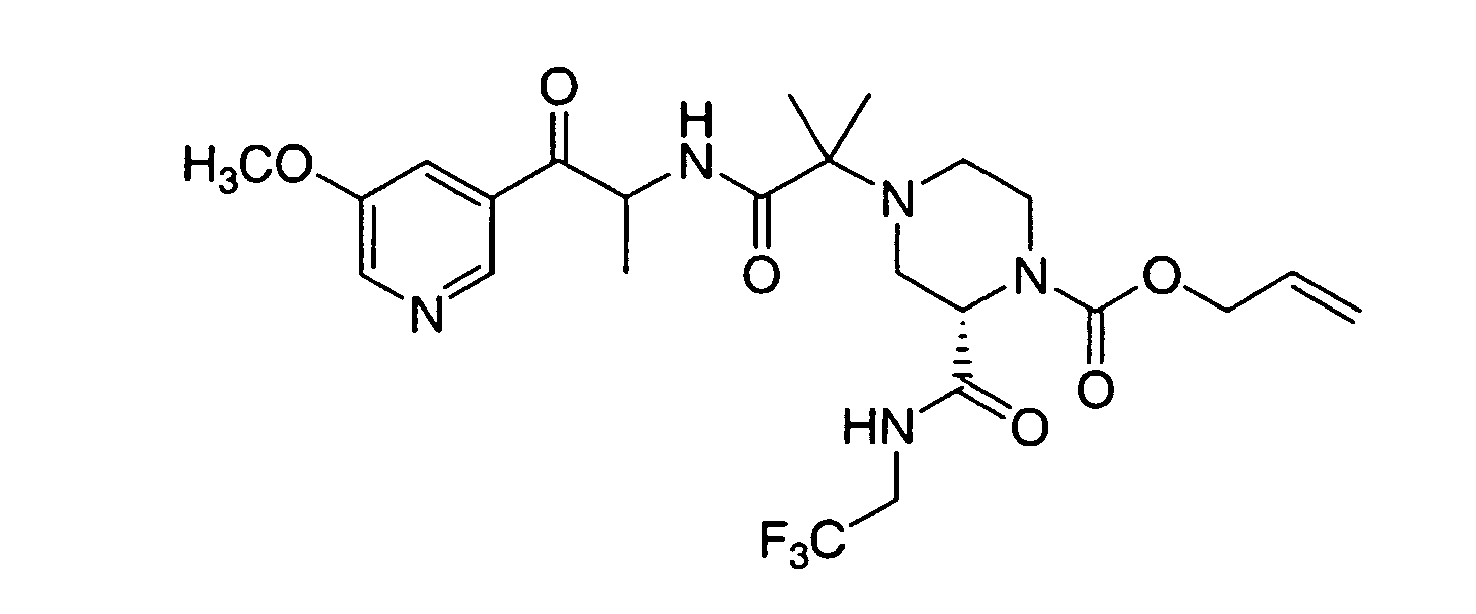
- The intermediate prepared in Step B (1.45 g, 5.17 mmol) was treated in TFA in methylene chloride (30%, 100 ml) at room temperature for 30 min. Then the reaction mixture was concentrated in vacuo and azeotroped with chloroform three times. The resulting mixture was dissolved in DMF (10 ml) and to this mixture was added the intermediate prepared in Example 66 Step P (1.97 g, 5.17 mmol), PyBop (5.4 g, 10.3 mmol), HOAt (1.4 g, 10.3 mmol), and DIEA (5.4 ml, 31.0 mmol). The reaction mixture was stirred at room temperature overnight. The crude reaction mixture was poured into water and the product was extracted with ethyl acetate three times. The organic layers were combined, washed with water and brine, dried over anhydrous sodium sulfate, filtered and concentrated in vacuo. The crude product was purified by flash column chromatography on silica gel with ethyl acetate as the eluant to give the titled compound. 1H NMR (CDCl3, 500 MHz): 8.80 (s, 1H), 8.49 (s, 1H), 7.70 (s, 1H), 5.98-5.93 (m, 1H), 5.36-5.27 (m, 3H), 4.75-4.68 (m, 3H), 4.18-4.11 (m, 2H), 3.92 (s, 3H), 3.80-3.40 (m, 2H), 3.18-3.06 (m, 1H), 2.85-2.83 (m, 1H), 2.42-2.28 (m, 2H), 1.52 (d, J = 7.1 Hz, 3H), 1.27 (s, 3H), 1.17 (s, 3H).
-

- To intermediate prepared in Step C (1.3 g, 2.39 mmol) was added fuming sulfuric acid (10 ml). The reaction mixture was stirred at 60 °C for 20 min, and then was slowly poured into ice water with stirring. The mixture was basified with potassium hydroxide to pH 12. The product was extracted with methylene chloride three times. The organic layers were combined, washed with brine, dried over anhydrous sodium sulfate, filtered and concentrated in vacuo. The crude product was purified by flash column chromatography on silica gel with 4 % 2M ammonia in MeOH/methylene chloride as the eluant to give the titled compound. 1H NMR (CDCl3, 500 MHz): 8.49 (s, 1H), 8.28 (s, 1H), 8.08 (bs, NH, 1H), 7.37 (s, 1H), 4.06-3.98 (m, 1H), 3.95 (s, 3H), 3.90-3.82 (m, 1H), 3.00-2.87 (m, 3H), 2.78-2.54 (m, 3H), 2.45 (s, 3H), 1.59 (s, 3H), 1.58 (s, 3H).
-

- The intermediate prepared in Step D (576 mg, 1.30 mmol) and the epoxide prepared in Example 1 Step P (513 mg, 1.30 mmol) in methanol (10 ml) was heated to reflux overnight. The solvent was removed in vacuo. The crude reaction mixture was purified by flash column chromatography on silica gel with ethyl acetate as the eluant to give the titled compound. 1H NMR (CDCl3, 500 MHz): 9.32 (bs, NH, 1H), 8.48 (s, 1H), 8.30 (s, 1H), 7.35-7.10 (m, 7H), 6.84-6.67 (m, 3H), 5.72 (d, J = 4.60 Hz, 1H), 4.47-4.13 (m, 3H), 3.95 (s, 3H), 3.72-2.41 (m, 19H), 1.77-1.55 (m, 10H), 1.28 (s, 3H).
- To a solution of the intermediate obtained in Step E (361 mg, 0.432 mmol) in methanol (23 ml) was added 1 M HCl in ethyl ether (11 ml, 11 mmol). The reaction mixture was stirred at room temperature. After 6 hours the mixture was neutralized by 2 M ammonia in methanol. The solvent was removed in vacuo and the reaction mixture was diluted with methylene chloride and washed with 1 N NaOH. The aqueous layer was extracted with methylene chloride three times. The organic layers were combined, washed with brine, dried over anhydrous sodium sulfate, filtered and concentrated in vacuo. The crude product was purified by flash column chromatography with 3 % 2M ammonia in methanol/ethyl acetate as the eluant to give the titled the compound. 1H NMR (CDCl3, 500 MHz): 9.31 (bs, NH, 1H), 8.48 (s, 1H), 8.30 (s, 1H), 7.35-7.23 (m, 5H), 7.14-7.08 (m, 2H), 6.82-6.79 (m, 2H), 6.08 (d, J = 8.0 Hz, 1H), 5.19-5.16 (m, 1H), 4.17-3.99 (m, 3H), 3.95 (s, 3H), 3.82-3.37 (m, 5H), 3.10-2.66 (m, 9H), 2.48-2.45 (m, 4H), 1.91-1.77 (m, 2H), 1.61-1.57 (m, 7H). LC-MS (M++1) (EI) 795.4.
-

-

- To a solution of 3,5-dibromopyridine (5 g, 21.1 mmol) in THF (10 ml) was added isopropylmagnesium chloride (2M in THF, 13.7 ml, 27.4 mmol). The reaction was stirred at room temperature for 1 h. Methyl disulfide (2.09 ml, 23.2 mmol) was added. After stirring at room temperature overnight, the reaction mixture was poured into aqueous NH4Cl solution and the product was extracted with methylene chloride three times. The organic layer was combined, washed with brine, dried over anhydrous sodium sulfate, filtered and concentrated in vacuo. The crude product was purified by flash column chromatography on silica gel with 1:4 ethyl acetate/hexane as the eluant. The resulting product (1.25 g, 6.16 mmol) in THF (4 ml) was added isopropylmagnesium chloride (2M in THF, 4.0 ml, 8.0 mmol). The reaction mixture was stirred at room temperature for 1 h. N-(tert-Butoxycarbonyl)glycine-N'-methoxy-N'-methylamide (715 mg, 3.08 mmol) was added in THF. After stirring at room temperature overnight, the reaction mixture was poured into aqueous NH4Cl solution and the product was extracted with methylene chloride three times. The organic layer was combined, washed with brine, dried over anhydrous sodium sulfate, filtered and concentrated in vacuo. The crude product was purified by flash column chromatography on silica gel with 3:7 ethyl acetate/hexane as the eluant to give the titled compound. 1H NMR (CDCl3, 500 MHz): 8.91 (s, 1H), 8.70 (s, 1H), 8.07 (s, 1H), 5.48 (bs, NH, 1H), 4.68 (d, J = 4.6 Hz, 2H), 2.59 (s, 3H), 1.51 (s, 9H).
-

- The intermediate prepared in Step A (305 mg, 1.08 mmol) was treated in TFA in Methylene chloride (30%) at room temperature for 30 min. Then the reaction mixture was concentrated in vacuo and azeotroped with chloroform three times. The resulting mixture was dissolved in DMF (4 ml) and to this mixture was added intermediate prepared in Example 66 Step D (412 mg, 1.08 mmol), PyBop (1.12 g, 2.16 mmol), HOAt (294 mg, 2.16 mmol), DIEA (1.13 ml, 6.48 mmol). The reaction mixture was stirred at room temperature overnight. The crude reaction mixture was poured into water and the product was extracted with ethyl acetate three times. The organic layers were combined, washed with water and brine, dried over anhydrous sodium sulfate, filtered and concentrated in vacuo. The crude product was purified by flash column chromatography on silica gel with ethyl acetate as the eluant to give the titled compound. 1H NMR (CDCl3, 500 MHz): 8.90 (s, 1H), 8.67 (s, 1H), 8.05 (s. 1H), 6.84 (bs, NH, 1H), 5.98-5.88 (m, 1H), 5.36-5.27 (m, 2H), 4.82-4.50 (m, 5H). 4.16-3.20 (m, 5H), 2.89-2.83 (m, 1H), 2.56 (s, 3H), 2.45-2.33 (m, 2H), 1.27 (m, 6H).
-

- To intermediate prepared in Step B (270 mg, 0.495 mmol) was added fuming sulfuric acid (5 ml). The reaction mixture was stirred at 60 °C for 20 min, and then was slowly poured into ice water with stirring. The mixture was basified with potassium hydroxide to pH 12. The product was extracted with methylene chloride three times. The organic layers were combined, dried over anhydrous sodium sulfate, filtered and concentrated in vacuo. The crude product was purified by flash column chromatography on silica gel with 5 % 2M ammonia in MeOH/ethyl acetate as the eluant to give the titled compound. 1H NMR (CDCl3, 500 MHz): 8.65 (s, 1H), 8.45 (s, 1H), 8.09 (bs, NH, 1H), 7.75 (s, 1H), 7.36 (s, 1H), 3.98-3.48 (m, 4H), 2.98-2.72 (m, 4H), 2.59-2.57 (m, 4H), 1.61 (s, 3H), 1.60 (s, 3H).
-

- The intermediate prepared in Step C (98 mg, 0.22 mmol) and the epoxide prepared in Example 1 Step P (87 mg, 0.22 mmol) in methanol (2 ml) was heated to reflux overnight. The solvent was removed in vacuo. The crude reaction mixture was purified by flash column chromatography on silica gel with ethyl acetate as the eluant to give the titled compound. 1H NMR (CDCl3, 500 MHz): 9.25 (bs, NH, 1H), 8.65 (s, 1H), 8.48 (s, 1H), 7.74 (s, 1H), 7.39 (s, 1H), 7.36-7.10 (m, 6H), 6.84-6.67 (m, 3H), 5.71 (d, J= 4.60 Hz, 1H), 4.47-4.11 (m, 3H), 3.82-3.68 (m, 2H), 3.54-2.81 (m, 7H), 2.69-2.42 (m, 9H), 1.80-1.50 (m, 9H), 1.31-1.26 (m, 6H).
- To a solution of the intermediate obtained in Step D (85 mg, 0.102 mmol) in methanol (5 ml) was added 1 M HCl in ethyl ether (2.5 ml, 2.5 mmol). The reaction mixture was stirred at room temperature. After 6 hours the mixture was neutralized by 2 M ammonia in methanol. The solvent was removed in vacuo and the reaction mixture was diluted with methylene chloride and washed with 1 N NaOH. The aqueous layer was extracted with methylene chloride three times. The organic layers were combined, washed with brine, dried over anhydrous sodium sulfate, filtered and concentrated in vacuo. The crude product was purified by flash column chromatography with 4 % 2M ammonia in methanol/ethyl acetate as the eluant to give the titled compound. 1H NMR (CDCl3, 500 MHz): 9.21 (bs, NH, 1H), 8.64 (s, 1H), 8.46 (s, 1H), 7.74 (s, 1H), 7.39 (s, 1H), 7.32-7.22 (m, 4H), 7.12-7.07 (m, 2H), 6.80-6.77 (m, 2H), 6.17 (d, J = 8.2 Hz, 1H), 5.18-5.16 (m, 1H), 4.16-3.98 (m, 3H), 3.82-3.74 (m, 2H), 3.39-3.36 (m, 1H), 3.10-2.64 (m, 10H), 2.58 (s, 3H), 2.48-2.43 (m, 2H), 1.94-1.88 (m, 2H), 1.63-1.53 (m, 7H). LC-MS (M++1) (EI) 797.3.
-

-

- To a solution of tert-butanol (35.9 mL, 380 mmol) in THF (200 mL) was added sodium amide (59.3 g of a 50% solution in toluene, 760 mmol). The mixture was heated to 50 °C for 2 h. Dimethyamine was added (190 mL of a 2.0 M solution in THF, 380 mmol) and the solution was heated for an additional 2 h at 50 °C. A solution of 3,5-dibromopyridine (45.0 g, 190 mmol in 150 mL THF) was added, and the reaction was heated for an additional 2 h at 50 °C. The reaction was then cooled to ambient temperature and added slowly to saturated aqueous NaHCO3 (1 L). The mixture was extracted with EtOAc (2 x 700 mL), and the organic layers were washed with saturated aqueous NaHCO3 (1 L), brine (500 mL), dried (MgSO4), and concentrated in vacuo, affording a 1:1 mixture of 3-bromo-5-dimethylaminopyridine and 3-bromo-4-dimethylaminopyridine. Purification by flash chromatography (5% EtOAc in DCM) afforded the 3-bromo-5-dimethylaminopyridine as a yellow solid. 1H NMR (CDCl3, 500 MHz) 8.05 (d, J = 2.5 Hz, 1H), 8.02 (d, J = 2.0 Hz, 1H), 7.09 (s, 1H), 3.00 (s, 6H).
-
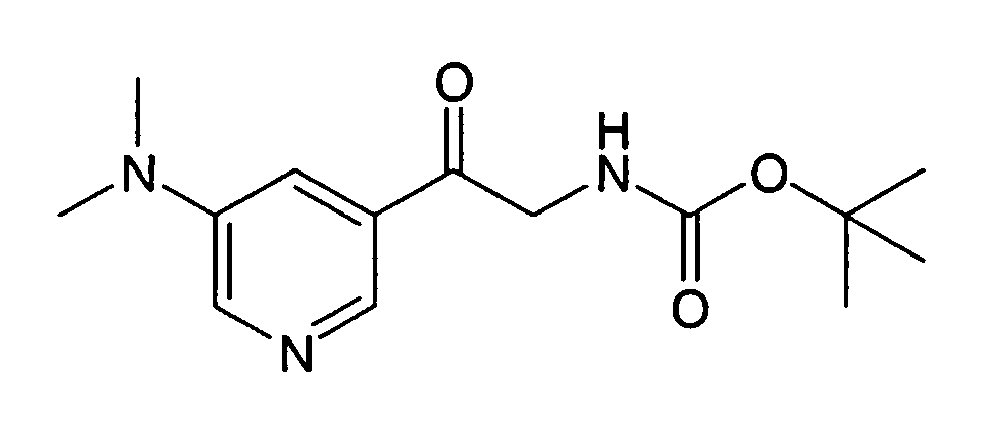
- To a solution of the intermediate prepared in Step A (9.35 g, 46.5 mmol) in THF (250 mL) was added iso-propylmagnesium chloride (37.5 mL of a 1.3 M solution in THF, 48.8 mmol). After 1 h at ambient temperature, the reaction was cooled to 0 °C, and a solution of N-tert-butylcarboxyglycine-N,O-dimethylhydroxamide (5.07 g, 46.5 mmol) in 50 mL of THF was added, and the solution was warmed to ambient temperature. After 27 h the reaction was cooled to 0 °C and quenched by the addition of saturated aqueous NaHCO3 (500 mL). The organic layer was washed with brine (500 mL), dried (MgSO4), and concentrated in vacuo. Purification by flash chromatography (5% MeOH, 45% EtOAc, 50% hexanes) afforded a 1:1 mixture of the pyridylketone and 3-dimethylaminopyridine as a brown oil. This mixture was carried on into the next series of reactions.
-

- To a solution of the intermediate mixture prepared in Step B (5.65 g) in DCM (100 mL) was added TFA (50 mL). After 1 h at ambient temperature the reaction was concentrated in vacuo. The residue was dissolved in 100 mL DMF. To this solution was added the intermediate from Example 66, Step D (8.68 g, 18 mmol), followed by Pybop (9.36g, 18 mmol), then DIEA (31.3 mL, 180 mmol). The reaction was stirred at ambient temperature for 3 h, then quenched by the addition of saturated aqueous NaHCO3 (200 mL). The mixture was diluted with EtOAc (500 mL) and the organic layer was washed with 0.5 M aqueous NaHCO3 (3 x 300 mL), brine (300 mL), dried (MgSO4), and concentrated in vacuo. Purification by flash chromatography (5% MeOH, 75% EtOAc, 20% hexanes) afforded the piperazine amide derivative as a yellow solid. 1H NMR (CDCl3, 500 MHz) 8.56 (s, 1H), 8.38 (s, 1H), 7.42 (s, 1H), 5.93 (m, 1H), 5.35 (d, 1H), 5.28 (d, 1H), 4.83 m 2H), 4.68 (s, 1H), 4.5 (d, 1H), 4.17 (m, 2H), 3.90 (s, 1H), 3.80 (s, 1H), 3.67 (d, 1H), 3.28 (t, 1H), 3.04 (s, 6H), 2.5 (m, 2H), 2.46 (dd, 1H), 2.38 (dt, 1H), 1.26 (s, 6H). HPLC-MS (ES) 543.2 (M+1).
-

- To the intermediate prepared in Step C (5.72 g, 10.55 mmol) was added fuming sulfuric acid (20% oleum, 15 mL). The mixture was heated to 50 °C for 15 minutes, then an additional 10 mL of fuming sulfuric acid was added, and the temperature increased to 70 °C. After 30 minutes the reaction was cooled to ambient temperature, and quenched by slow addition of the reaction mixture to saturated aqueous NaHCO3 (1 L). The aqueous layer was saturated with solid NaCl, and extracted with EtOAc (2 x 200 mL). The organic layer was dried (MgSO4) and concentrated in vacuo, affording the pyridyiloxazole as a yellow solid. HPLC-MS (ES) 441.2 (M+1).
-

- To a solution of the intermediate prepared in Step D (3.77 g, 8.57 mmol) in IPA (20 mL) was added the intermediate from Example 1, Step P (4.04 g, 10.28 mmol). The reaction was heated to reflux for 9 h, then cooled to ambient temperature, and concentrated in vacuo. Purification by flash chromatography (3% MeOH in EtOAc) afforded the coupled product as a yellow solid. HPLC-MS (ES) 834.5 (M+1).
- To a solution of the intermediate prepared in Step E (1.62 g, 1.94 mmol) in MeOH (100 mL) was added HCl (50 mL of a 1M solution in Et2O, 50 mmol). After 6 h at ambient temperature, the reaction was quenched by adding it to saturated aqueous NaHCO3 (500 mL). The organic layer was extracted with DCM (2 x 200 mL). The combined organic layers were dried (Na2SO4) and concentrated in vacuo. The product was purified by flash chromatography (5% MeOH in EtOAc) affording the title compound as a white solid. 1H NMR (CDCl3, 500 MHz) 9.31 (s, 1 H), 8.26 (d, J = 2.0 Hz, 1H), 8.15 (d, J = 3.0 Hz, 1H), 7.29 (m, 5H), 7.10 (m, 3H), 6.81 (m, 2H), 5.96 (d, J = 5 Hz, 1H), 5.18 (dd, J = 4.5 Hz, J = .0 Hz, 1H), 4.09 (m, 2H), 3.83 (m, 1H), 3.76 (m, 1H), 3.39 (s, 1H), 3.12 (m, 1H), 3.12 (d, J= 12 Hz, 1H), 3.07 (s, 6H), 2.98 (m, 2H), 2.89 (m, 1H), 2.82 (dd, J = 5.0 Hz, J = 12.5 Hz, 1H), 2.76 (m, 1H), 2.69 (t, J = 13.0 Hz, 2H), 2.48 (dd, J = 2.5 Hz, J = 13.0 Hz, 2H), 1.89 (t, J = 1.5 Hz, 1H) 1.84 (m, 1H), 1.65 (s, 3H), 1.64 (s, 3H), 1.29 (m, 1H). HPLC-MS (ES) 794.2 (M+1).
-

-

- To a solution of bromonicotinic acid (5.00 g, 24.75 mmol) in DMF (50 mL) was added sodium methoxide (28 mL of a 25% solution in MeOH, 124 mmol), followed by a catalytic amount of CuI (50 mg). The reaction was heated to 100 °C for 72 h, then cooled to 0 °C. To the solution was added HCl (29 mL of a 4.0 M solution in dioxane, 116 mmol), followed by triethylamine (17.2 mL, 123 mmol), then Pybop (15.45 g, 29.7 mmol). After 1 h at ambient temperature the reaction was quenched with 0.5 M NaHCO3 (200 mL) and diluted with EtOAc (300 mL). The organic layer was washed with 0.5 M NaHCO3 (3 x 200 mL), brine (200 mL), dried (MgSO4, and concentrated in vacuo. Purification by flash chromatography (10% MeOH in EtOAc) afforded the methyl ester as a colorless oil. 1H NMR (CD3OD, 500 MHz) 8.75 (s, 1H), 8.43 (s, 1H), 7.89 (s, 1H), 4.83 (s, 3H), 3.93 (s, 3H). HPLC-MS (ES) 168.1 (M+1).
-

- To a solution of the intermediate prepared in Step A (2.56 g, 15.3 mmol) in THF (150 mL) at 0 °C was added lithiumaluminum hydride (46 mL of a 10 M solution in THF). After 30 minutes, the reaction was quenched by the addition of EtOAc (10 mL), followed by the slow addition of saturated aqueous NaHCO3 (500 mL). The mixture was extracted with EtOAc (2 x 500 mL). The combined organic layers were washed with brine, dried (MgSO4), and concentrated in vacuo. The resulting alcohol was dissolved in chloroform (100 mL). To this solution was added celite (5 g), followed by Mn02 (13.0 g, 150 mmol). The mixture was heated to reflux for 30 minutes, then cooled to ambient temperature and filtered thru celite. The liquid was concentrated in vacuo, affording the aldehyde as a yellow oil. This material was dissolved in absolute ethanol (100 mL). To this solution was added pyridine (3.72 mL, 46.0 mmol), followed by hydroxylamine hydrochloride (3.99 g, 57.5 mmol). The reaction was heated to reflux for 1 h, then cooled to ambient temperature and concentrated in vacuo. The residue was dissolved in EtOAc (100 mL) and washed with water (100 mL). The organic layer was dried (MgSO4) and concentrated in vacuo, affording the oxime as a white solid. This material was dissolved in DMF (10 mL) and heated to 50 °C. To the mixture was added N-chlorosuccinimide (1.01 g, 7.56 mmol). After 30 minutes at 50 °C the reaction was cooled to ambient temperature and dissolved in EtOAc (200 mL). The solution was washed with water (200 mL), brine, dried (MgSO4), and concentrated in vacuo, affording the chlorooxime as a yellow solid. 1H NMR (CD3OD, 500 MHz) 8.60 (s, 1H), 8.35 (s, 1H), 7.78 (s, 1H), 3.97 (s, 3H). HPLC-MS (ES) 187.1 (M+1).
-

- To a solution of the intermediate prepared in Example 37, Step A (44.9 g, 124 mmol) in THF (600 mL) was added thiosalicilic acid (28.8 g, 186 mmol). In a separate flask was prepared a solution of dipalladium(0)tris(dibenzylidineacetone) (5.70 g, 6.22 mmol) and 1,4-bis(diphenylphosphino)butane (7.16 g, 12.45 mmol) in THF (600 mL). The palladium(0) solution was added to the reaction mixture via cannula. After 2 h at ambient temperature the reaction mixture was quenched by the addition of 1% aqueous HCl (500 mL) and diluted with ether (2 L). The organic layer was washed with 1% aqueous HCl (3 x 500 mL). The combined aqueous layers were brought to pH 8 with saturated aqueous NaHCO3, then extracted with EtOAc (2 x 600 mL). The combined organic layers were dried (MgSO4) and concentrated in vacuo, affording 27.9 g of a colorless oil. To 8.38 g of this oil (30.2 mmol) in DCM (300 mL) was added triethylamine (6.32 mL, 45.4 mmol), followed by di-tert-butyldicarbonate (7.92 g, 36.3 mmol). After 1 h at ambient temperature, the reaction was quenched by the addition of saturated aqueous NaHCO3 (200 mL). The organic layer was dried (Na2SO4) and concentrated in vacuo. Purification by flash chromatography afforded the Boc-protected piperazine as a colorless oil. 1H NMR (CDCl3, 500 MHz) 7.20 (s, 1H), 4.76 (s, 1H), 4.00 (m, 2H), 3.58 (d, 1H), 3.06 (m, 2H), 2.40 (dd, 1H), 2.30 (m, 1H), 1.50 (s, 9H), 1.47 (s, 3H), 1.44 (s, 3H).
-

- To a solution of the intermediate prepared in Step C (0.380 g, 1.01 mmol) in THF (1.5 mL) was added DIEA (0.875 mL, 5.04 mmol), and the mixture was heated to 55 °C. To this solution was added dropwise over 1 h a solution of the intermediate prepared in Step B (0.375 g, 2.01 mmol) in THF (2.5 mL). After completion of the reagent addition, the reaction was stirred at 55 °C for 16 h, then cooled to ambient temperature and quenched by the addition of saturated aqueous NaHCO3 (20 mL). The mixture was diluted with EtOAc (50 mL), and the organic layer was washed with brine (30 mL), and concentrated in vacuo. Purification by flash chromatography afforded the isoxazole as a yellow solid. 1H NMR (CDCl3, 500 MHz) 8.60 (s, 1H), 8.41 (s, 1H), 7.69 (s, 1H), 7.00 (s, 1H), 6.49 (s, 1H), 4.71 (s, 1H), 4.09 (m, 2H), 3.60 (d, 1H), 3.04 (s, 1H), 2.95 (d, 1H), 2.31 (dd, 1H), 2.23 (dt, 1H), 1.72 (s, 1H), 1.69 (s, 3H), 1.61 (s, 3H), 1.49 (s, 9H).
-

- To a solution of the intermediate prepared in Step D (88.3 mg, 0.167 mmol) in DCM (5 mL) was added TFA (2.5 mL). After 2 h at ambient temperature, the reaction was quenched by the addition of saturated aqueous NaHCO3 (10 mL). The organic layer was dried (Na2SO4 and concentrated in vacuo, affording the deprotected piperazine as a colorless oil. HPLC-MS (ES) 428.2 (M+1).
-

- To a solution of the intermediate prepared in Step E (68.0 mg, 0.159 mmol) in IPA (1 mL) was added the epoxide intermediate from Example 1, Step P (93.9 mg, 0.239 mmol). The reaction was heated to reflux for 13 h, then concentrated in vacuo. Purification by flash chromatography afforded the coupled product as a white solid. HPLC-MS (ES) 821.5 (M+1).
- To a solution of the intermediate prepared in Step F (55.6 g, 0.0678 mmol) in MeOH (5 mL) was added HCl (1.5 mL of a 1 M solution in Et2O, 1.5 mmol). After 8 h at ambient temperature, the reaction was quenched by the addition of saturated aqueous NaHCO3 (10 mL), and DCM (30 mL). The organic layer was dried (Na2SO4) and concentrated in vacuo. Purification by flash chromatorgaphy afforded the title compound as a white solid. 1H NMR (CDCl3, 500 MHz) 9.12 (s, 1H), 8.58 (d, J = 1.0 Hz, 1H), 8.43 (d,J = 3.0 Hz, 1H), 7.70 (t, J = 2.0 Hz, 1H), 7.30 (m, 4H), 7.13 (t, J = 7.5 Hz, 1H), 7.10 (d, J = 10.5 Hz, 1H), 6.82 (m, 2H), 6.49 (s, 1H), 6.01 (d, J = 8.0 Hz, 1H), 5.18 (dd, J = 4.0 Hz, J = 8.0 Hz, 1H), 4.23 (m, 1H), 4.06 (d, J = 11 Hz, 1H), 4.01 (dd, J = 5.0 Hz, J = 12.0 Hz, 1H), 3.96 (s, 3H), 3.85 (m, 3H), 3.50 (m, 1H), 3.38 (s, 1H), 3.01 (d, J = 12.0 Hz, 1H), 2.90 (m, 3H), 2.82 (dd, J = 4.5 Hz, J = 12.0 Hz, 1H), 2.72 (m, 3H), 2.49 (dt, J = 4.0 Hz, J = 15.5 Hz, 2H), 2.20 (s, 1H), 1.93 (t, J = 11.0 Hz, 1H), 1.70 (s, 1H), 1.60 (s, 3H), 1.58 (s, 3H). HPLC-MS (ES) 781.4 (M+1).
-

-
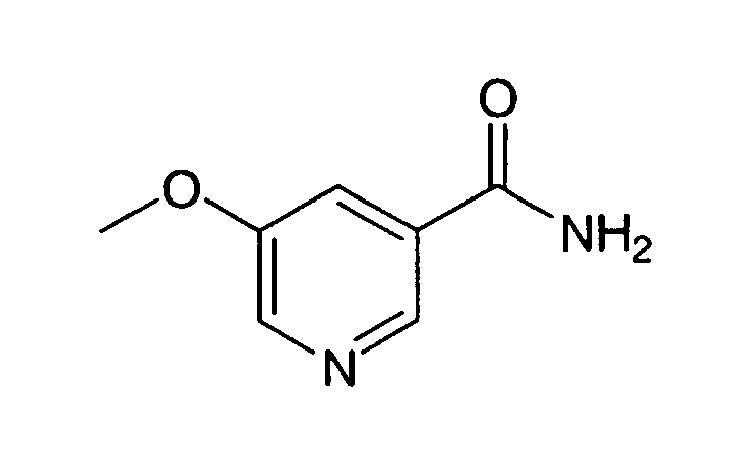
- To a solution of 5-bromonicotinic acid (10.0 g, 49.5 mmol) in DMF (80 mL) was added 25% sodium methoxide in MeOH (53.5 mL, 247 mmol) and a catalytic amount of CuI (200 mg). The solution was heated to 100 °C for 19 h, then cooled to ambient temperature. The reaction was concentrated in vacuo, and the residue was suspended in DCM (100 mL). To this mixture was added N-hydroxysuccinimide (6.27 g, 54.4 mmol), followed by EDC (10.44 g, 54.4 mmol). After 4 h at ambient temperature, 30% NH4OH (8.67 mL, 74.25 mmol) was added. After an additional 1h at ambient temperature, the reaction was concentrated in vacuo. The residue was dissolved in EtOAc (200 mL) and washed with saturated aqueous NaHCO3 (200 mL). The organic layer was dried (MgSO4) and concentrated in vacuo. Purification by flash chromatography afforded the pyridyl amide as a white solid. 1H NMR (CD3OD, 500 MHz) 8.63 (s, 1H), 8.38 (s, 1H), 7.80 (s, 1H), 4.82 (s, 3H); HPLC-MS (ES) 153.2 (M+1).
-

- To a suspension of the intermediate prepared in Step A (250 mg, 1.64 mmol) in toluene (15 mL) was added Lawesson's reagent (2.66 g, 6.57 mmol). The mixture was heated to reflux for 3 h, then cooled to ambient temperature and filtered thru celite. The liquid phase was concentrated in vacuo, and purified by flash chromatography (70% EtOAc in hexanes) affording the thioamide as a yellow solid. 1H NMR (CDCl3, 500 MHz) 8.58 (s, 1H), 8.37 (s, 1H), 7.80 (s, 1H), 7.64 (s, 1H), 7.32 (s, 1), 3.91 (s, 3H). HPLC-MS (ES) 169.1 (M+1).
-

- To a solution of the intermediate prepared in Example 37, Step A (44.9 g, 124 mmol) in THF (600 mL) was added thiosalicilic acid (28.8 g, 186 mmol). In a separate flask was prepared a solution of dipalladium(0)tris(dibenzylidineacetone) (5.70 g, 6.22 mmol) and 1,4-bis(diphenylphosphino)butane (7.16 g, 12.45 mmol) in THF (600 mL). The palladium(0) solution was added to the reaction mixture via cannula. After 2 h at ambient temperature the reaction mixture was quenched by the addition of 1% aqueous HCl (500 mL) and diluted with ether (2 L). The organic layer was washed with 1% aqueous HCl (3 x 500 mL). The combined aqueous layers were brought to pH 8 with saturated aqueous NaHCO3, then extracted with EtOAc (2 x 600 mL). The combined organic layers were dried (MgSO4) and concentrated in vacuo, affording 27.9 g of a colorless oil. To this oil (19.2 g) in 1M aqueous H2SO4 (300 mL) was added HgO (18.2 g, 83.3 mmol), and the mixture was stirred at ambient temperature. After 1 h, the reaction was quenched by the addition of saturated aqueous NaHCO3 until the solution was pH 8. The solution was further diluted with CH3CN (500 mL), followed by the addition of ethanethiol, which immediately precipitated the mercury salts. The suspension was filtered, and the liquid was extracted with EtOAc (2 x 1.5 L). The organic layers were washed with saturated aqueous NaHCO3 (500 mL), brine (500 mL), dried (MgSO4), and concentrated in vacuo, affording the methyl ketone as a brown oil. 1H NMR (CDCl3, 500 MHz) 7.83 (s, 1H), 4.07 (m, 1H), 3.90 (m, 1H), 3.60 (s, 1H), 2.92 (m, 2H), 2.79 (m, 1H), 2.73 (m, 1H), 2.38 (m, 2H), 2.23 (s, 3H), 1.84 (s, 1H), 1.13 (s, 3H). 1.12 (s, 3H); HPLC-MS (ES) 296.1 (M+1).
-

- To a solution of the intermediate from Step C (20.5 g, 69.4 mmol) in DCM (500 mL) at -78 °C was added triethylamine (33.8 mL, 243 mmol), followed by trimethylsilyl trifluoromethanesulfonate (33.5 mL, 173 mmol). The reaction was warmed slowly to ambient temperature. After stirring 12 h, solid NaHCO3 was added (15.0 g, 180 mmol), followed by N-bromosuccinimide (27.2 g, 152 mmol). After an additional 1 h at ambient temperature, allyl chloroformate was added (9.57 mL, 90.2 mmol), followed by triethylamine (10 mL, 90.2 mmol). The reaction was stirred for an additional 1 h at ambient temperature, then quenched by the addition of saturated aqueous NaHCO3 (300 mL). The organic layer was dried (Na2SO4), and concentrated in vacuo, yielding a black oil. Purification by flash chromatography (5% EtOAc in DCM) afforded the pure bromoketone as a beige solid. 1H NMR (CDCl3, 500 MHz) 6.64 (s, 1H), 5.96 (m, 1H), 5.78 (m, 1H), 5.32 (m, 2H), 4.83 (s, 1H), 4.64 (d, 2H), 4.22 (m, 3H), 3.90 (d, 1H), 3.60 (d, 2H), 3.12 (s, 1H), 2.60 (s, 1H, 2.38 (d, 1H), 2.34 (t, 1H), 1.26 (s, 3H), 1.19 (s, 3H); HPLC-MS (ES) 458.1, 460.1 (1:1 ratio, M-1, M+1).
-

- To a solution of the intermediate in Step D (15 mg, 0.330 mmol) in DMF (1 mL) was added the intermediate from Step B (61.0 mg, 0.360 mmol). The solution was heated to 60 °C for 16 h, then cooled to ambient temperature. The reaction was diluted with EtOAc (30 mL) and washed with saturated aqueous NaHCO3 (5 mL) and brine (5 mL), dried (MgSO4), and concentrated in vacuo. The residue was purified by preparative TLC, affording the pure pyridyl thiazoline as a yellow oil. 1H NMR (CDCl3, 500 MHz) 8.73 (d, 1H), 8.37 (d, 1H), 7.69 (m, 1H, 7.14 (d, 1H), 5.78 (m, 1H), 5.18 (d, 1H), 5.11 d, 1H), 4.09 (m, 1H), 3.92 (s, 3H), 3.70 (m, 1H), 3.59 (m, 1H), 3.42 (s, 1H), 3.20 (s, 1H), 3.09 (m, 1H), 2.97 (m, 1H), 2.82 (m, 1H), 2.60 (m, 2H), 1.50 (s, 3H), 1.49 (s, 3H). HPLC-MS (ES) 528.2 (M+1).
-

- To a solution of the intermediate from Step E (72.0 mg, 0.136 mmol) in THF (0.5 mL) was added thiosalicilic acid (31.0 mg, 0.200 mmol) under N2. In a separate flask was prepared a solution of dipalladium(0)tris(dibenzylidineacetone) (125 mg, 0.136 mmol) and 1,4-bis(diphenylphosphino)butane (156 mg, 0.272 mmol) in THF (0.5 mL). The palladium(0) solution was added to the reaction mixture via cannula. After 2 h at ambient temperature the reaction mixture was quenched by the addition of 1% aqueous HCl (0.5 mL) and diluted with ether (20 mL). The organic layer was washed with 1% aqueous HCl (3 x 5 mL). The combined aqueous layers were brought to pH 8 with saturated aqueous NaHCO3, then extracted with EtOAc (2 x 20 mL). The combined organic layers were dried (MgSO4) and concentrated in vacuo, affording the deprotected piperazine as a colorless oil. HPLC-MS (ES) 444.2 (M+1).
-

- To a solution of the intermediate prepared in Step F (36 mg, 0.081 mmol) in IPA (1 mL) was added the epoxide intermediate from Example 1, Step P (45 mg, 0.12 mmol). The reaction was heated to reflux for 18 h, then concentrated in vacuo. Purification by preparative TLC (EtOAc) afforded the coupled product as a white solid. HPLC-MS (ES) 837.5 (M+1).
- To a solution of the intermediate from Step G (27 mg, 0.032 mmol) in MeOH (3 mL) was added 1M HCl in Et2O (0.7 mL). After stirring 16 h at ambient temperature, the reaction was quenched by the addition of saturated aqueous NaHCO3 (10 mL). The solution was extracted with EtOAc (30 mL). The organic layer was dried (MgSO4) and concentrated in vacuo. Purification of the residue by preparative TLC (1% MeOH in EtOAc) afforded the title compound as a white solid. 1H NMR (CD3OD, 500 MHz) 8.68 (s, 1H), 8.30 (d, J = 2.5 Hz, 1H), 7.88 (s, 1H), 7.48 (s, 1H), 7.19 (m, 5H), 7.08 (m, 2H), 6.78 (t, J = 7.0 Hz, 1H), 6.71 (d, J = 8.0 Hz, 1H), 5.13 (d, J = 3.5 Hz, 1H), 4.82 (s, 3H), 4.06 (m, 2H), 3.75 (m, 2H), 3.30 (s, 1H), 3.12 (s, 1H), 3.01 (m, 1H), 2.91 (m, 2H), 2.72 (m, 2H), 2.59 (s, 1H), 2.47 (s, 1H), 2.38 (m, 2H), 2.01 (t, J = 13.5 Hz, 1H), 1.56 (s, 6H), 1.39 (m, 2H). HPLC-MS (ES) 797.2 (M+1).
-

-

- To a stirred suspension of 5-bromonicotinic acid (15.01 g, 74.3 mmol) in DCM (1 L) was added N-hydroxysuccinamide (8.55 g, 74.3 mmol), followed by a suspension of EDC (14.23 g, 74.2 mmol) in 30 mL DCM. Upon dissolution of the suspension (30 min) the reaction mixture was concentrated in vacuo to a dry solid. This material was dissolved in EtOAc (1 L) and washed with 0.5 N NaHCO3 (2 x 700 mL) and brine (100 mL). The organic layer was dried (MgSO4) and concentrated in vacuo, affording the succinate ester as a white solid. This material was dissolved in dioxane (600 mL), and treated with 30% aqueous NH4OH (13 mL, 111 mmol), forming a precipitate. The solid was filtered, and washed with dioxane (4 x 100 mL). The combined liquid phases were concentrated in vacuo, affording the amide as a white solid. 1H NMR (CD3OD, 500 MHz) 8.98 (d, J = 9.4 Hz, 1H), 8.82 (d, J = 9.1 Hz, 1 H), 8.46 (d, J = 9.3 Hz, 1H), 4.86 (s, 2H).
-

- To a solution of the intermediate prepared in Step A (3.50 g, 17.4 mmol) in DMF (40 mL) was added CuCl (8.64 g, 87.2 mmol). The suspension was heated to 100 °C under N2 for 72 h, then cooled to ambient temperature and concentrated to minimum volume in vacuo. To the remaining mixture was added 10% aqueous NH4OH (200 mL), and this solution was extracted with EtOAc (2 x 200 mL). The organic layers were washed with water (100 mL), and brine (100 mL), dried (MgSO4), and concentrated in vacuo, affording 814 mg (30%) of the chlorinated amide as a yellow solid. To this amide (300 mg, 1.92 mmol) in toluene (20 mL) was added Lawesson's reagent (3.10 g, 7.68 mmol). The mixture was heated to reflux for 4 h, then cooled to ambient temperature and filtered thru celite. The liquid phase was concentrated in vacuo, and purified by flash chromatography (40% EtOAc in hexanes) affording the thioamide as a yellow solid. 1H NMR (CD3OD, 500 MHz) 8.92 (s, 1H), 8.45 (s, 1H), 8.30 (s, 1H), 3.87 (s, 2H).
-

- To a solution of the intermediate from Example 102, Step D (156 mg, 0.342 mmol) in DMF (1 mL) was added the intermediate from Step B (65.9 mg, 0.382 mmol). The solution was heated to 60 °C for 16 h, then cooled to ambient temperature. The reaction was diluted with EtOAc (30 mL) and washed with saturated aqueous NaHCO3 (5 mL) and brine (5 mL), dried (MgSO4), and concentrated in vacuo. The residue was purified by preparative reverse phase HPLC, affording the pure pyridyl thiazoline as a yellow oil. 1H NMR (CDCl3, 500 MHz) 9.00 (d, J 1.6 Hz, 1H), 8.63 (d, J = 2.3 Hz, 1H), 8.25 (t, J = 2.0 Hz, 1H), 5.93 (m, 1H), 5.32 (d, J = 17.4 Hz, 1H), 5.23 (d, J = 10.6 Hz, 1H), 4.80 (s, 1H), 4.64 (m, 2H), 4.12 (m, 1H), 3.94 (m, 2H), 3.48 (d, J = .5 Hz, 1H), 3.19 (s, 1H), 3.02 (d, J = 10.7 Hz, 1H), 2.48 (s, 1H), 2.38 (s, 1H), 1.60 (s, 3H), 1.58 (s, 3H); HPLC-MS (ES) 532.2 (M+1).
-

- To a solution of the intermediate from Step C (75.0 mg, 0.140 mmol) in THF (0.5 mL) was added thiosalicilic acid (33.9 mg, 0.220 mmol) under N2. In a separate flask was prepared a solution of dipalladium(0)tris(dibenzylidineacetone) (8.1 mg, 0.009 mmol) and 1,4-bis(diphenylphosphino)butane (6.8 mg, 0.0016 mmol) in THF (0.5 mL). The palladium(0) solution was added to the reaction mixture via cannula. After 2 h at ambient temperature the reaction mixture was quenched by the addition of 1 % aqueous HCI (0.5 mL) and diluted with ether (20 mL). The organic layer was washed with 1% aqueous HCl (3 x 5 mL). The combined aqueous layers were brought to pH 8 with saturated aqueous NaHC03, then extracted with EtOAc (2 x 20 mL). The combined organic layers were dried (MgS04) and concentrated in vacuo, affording the deprotected piperazine as a colorless oil. HPLC-MS (ES) 448.2 (M+1).
-

- To a solution of the intermediate prepared in Step D (40 mg, 0.089 mmol) in 1PA (1 mL) was added the epoxide intermediate from Example 1, Step P (49 mg, 0.12 mmol). The reaction was heated to reflux for 9 h, then concentrated in vacuo. Purification by preparative reversed phase HPLC afforded the coupled product as a white solid. HPLC-MS (ES) 841.4 (M+1).
- To a solution of the intermediate from Step E (30 mg, 0.036 mmol) in MeOH (3 mL) was added 1M HCl in Et2O (0.5 mL). After stirring 16 h at ambient temperature, the reaction was quenched by the addition of saturated aqueous NaHCO3 (10 mL). The solution was extracted with EtOAc (30 mL). The organic layer was dried (MgSO4) and concentrated in vacuo. Purification of the residue by chromatotron TLC (3% MeOH in EtOAc) afforded the title compound as a white solid. 1H NMR (CDCl3, 500 MHz) 9.60 (s, 1H), 9.00 (s, 1H), 8.66 (s, 1H), 8.25 (s, 1H), 7.26 (m, 5H), 7.10 (m, 4H), 6.80 (s, 2H), 6.12 (m, 1H), 5.17 (s, 2H), 4.06 (m, 3H), 3.82 (m, 2H), 3.61 (m, 2H), 3.36 (m, 1H), 3.07 (d, J= 10.5 Hz, 1H), 2.92 (m, 4H), 2.69 (m, 2H), 2.67 (m, 3H), 2.44 (m, 3H), 1.90 (m, 3H), 1.58 (s, 6H), 1.28 (m, 1H); HPLC-MS (ES) 801.3 (M+1).
-

-

- To a solution of the intermediate from Example 102, Step D (200 mg, 0.436 mmol) in DMF (1 mL) was added pyridyl-3-thioamide (85.4 mg, 0.619 mmol). The solution was heated to 60 °C for 16 h, then cooled to ambient temperature. The reaction was diluted with EtOAc (30 mL) and washed with saturated aqueous NaHCO3 (5 mL) and brine (5 mL), dried (MgSO4), and concentrated in vacuo. The residue was purified by preparative reverse phase HPLC, affording the pure pyidyl thiazoline as a yellow oil. 1H NMR (CDCl3, 500 MHz) 9.17 (s, 1H), 8.70 (s, 1H), 8.23 (d, J = .1 Hz, 1H), 7.42 (t, J = 2.8 Hz, 1H), 7.22 (s, 1H), 5.92 (m, 1H), 5.33 (d, J = 17.2 Hz, 1H), 5.22 (dd, J = 0.9 Hz, J = 9.6 Hz, 1H), 4.77 (s, 1H), 4.63 (t, J = 7.3 Hz, 2H), 4.13 (s, 1H), 3.95 (m, 1H), 3.84 (m, 1H), 3.43 (m, 1H), 3.15 (s, 1H), 3.01 (d, J = 11.0 Hz, 1H), 2.47 (d, J = 11.0 Hz, 1H), 2.35 (m, 1H), 1.58 (s, 3H), 1.56 (s, 3H); 1.28 (m, 1H); HPLC-MS (ES) 498.3 (M+1).
-

- To a solution of the intermediate from Step A (89.0 mg, 0.179 mmol) in THF (0.5 mL) was added thiosalicilic acid (4.9 mg, 0.291 mmol) under N2. In a separate flask was prepared a solution of dipalladium(0)tris(dibenzylidineacetone) (26.1 mg, 0.029 mmol) and 1,4-bis(diphenylphosphino)butane (21.8 mg, 0.051 mmol) in THF (0.5 mL). The palladium(0) solution was added to the reaction mixture via cannula. After 2 h at ambient temperature the reaction mixture was quenched by the addition of 1% aqueous HCl (0.5 mL) and diluted with ether (20 mL). The organic layer was washed with 1% aqueous HCl (3 x 5 mL). The combined aqueous layers were brought to pH 8 with saturated aqueous NaHCO3, then extracted with EtOAc (2 x 20 mL). The combined organic layers were dried (MgSO4) and concentrated in vacuo, affording the deprotected piperazine as a colorless oil. HPLC-MS (ES) 414.3 (M+1).
-
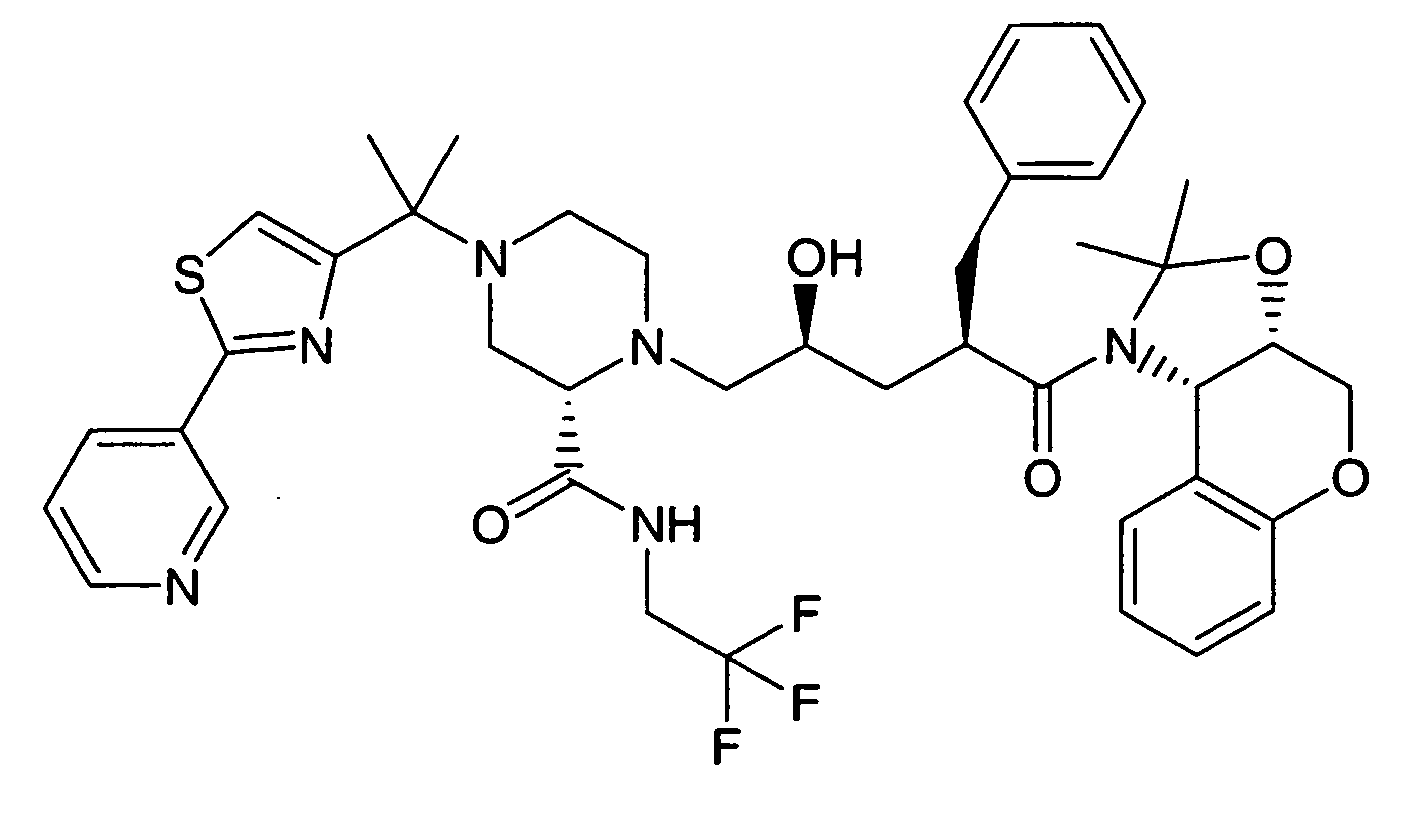
- To a solution of the intermediate prepared in Step B (35.5 mg, 0.086 mmol) in IPA (1 mL) was added the epoxide intermediate from Example 1, Step P (67.1 mg, 0.171 mmol). The reaction was heated to reflux for 6 h, then concentrated in vacuo. Purification by preparative reversed phase HPLC afforded the coupled product as a white solid. HPLC-MS (ES) 807.4 (M+1).
- To a solution of the intermediate from Step C (21.3 mg, 0.026 mmol) in MeOH (3 mL) was added 1M HCl in Et2O (0.5 mL). After stirring 16 h at ambient temperature, the reaction was quenched by the addition of saturated aqueous NaHCO3 (10 mL). The solution was extracted with EtOAc (30 mL). The organic layer was dried (MgSO4) and concentrated in vacuo. Purification of the residue by chromatotron TLC (2% MeOH in EtOAc) afforded the title compound as a white solid. 1H NMR (CDCl3, 500 MHz) 9.68 (s, 1H), 9.14 (d, J = 1.8 Hz, 1H), 8.70 (dd, J = 1.1 Hz, J = 1.3 Hz, 1H), 8.23 (d, J = 8.0 Hz, 1H), 7.42 (dd, J = 4.8 Hz, J = 4.8 Hz, 1H), 7.27 (m, 4H), 7.12 (m, 2H), 6.80 (m, 2H), 6.14 (s, 1H), 5.17 (dd, J = 3.9 Hz, J = 7.8 Hz, 1H), 4.06 (m, 3H), 3.83 (m, 2H), 3.55 (s, 1H), 3.35 (s, 1H), 3.05 (d, J = 11.4 Hz, 1H), 2.94 (m, 3H), 2.80 (dd, J = 4.6 Hz, J = 12.1 Hz, 2H), 2.67 (m, 2H), 2.43 (d, J = 12.8 Hz, 1H), 1.89 (m, 2H), 1.57 (s, 6H), 1.24 (s, 1H); HPLC-MS (ES) 767.4 (M+1).
-

-

- To a solution of 5-bromonicotinic acid (10.0 g, 49.5 mmol) in DMF (80 mL) was added 25% sodium methoxide in MeOH (53.5 mL, 247 mmol) and a catalytic amount of CuI (200 mg). The solution was heated to 100 °C for 19 h, then cooled to ambient temperature. The reaction was concentrated in vacuo, and the residue was suspended in tert-butanol (100 mL). To the mixture was added triethylamine (7.59 mL, 54.4 mmol), followed by diphenylphosphoryl azide (11.7 mL, 54.4 mmol). The resulting mixture was heated to reflux for 2 h, then cooled to ambient temperature and quenched with saturated aqueous NaHCO3 (200 mL). The mixture was diluted with EtOAc (300 mL) and washed with 10% aqueous NH4OH (200 mL) and brine (200 mL). The organic layer was dried (MgSO4) and concentrated in vacuo. Purification by flash chromatography (50% EtOAc in hexanes) afforded the Boc-amine. 1H NMR (CDCl3, 500 MHz) 7.98 (s, 1H), 7.96 (s, 1H), 7.70 (s, 1H), 6.79 (s, 1H), 3.83 (s, 3H), 1.49 (s, H).
-

- To a solution of the intermediate prepared in Step A (1.70 g, 7.59 mmol) in DCM (16 mL) was added TFA (8 mL). After 1.5 h at ambient temperature the reaction was concentrated in vacuo, and dissolved in DMF (20 mL). This solution was added to a refluxing solution of ethyl glyoxylate (6.2 mL of a 50% solution in toluene). The resulting mixture was cooled to ambient temperature and stirred for 30 minutes. To this solution was added sodium triacetoxyborohydride (6.43 g, 30.4 mmol) and the resulting mixture was stirred for 1 h. The mixture was then diluted with EtOAc (300 mL) and quenched with saturated aqueous NaHCO3 (200 mL). The organic layer was washed with 0.5 M aqueous NaHCO3, brine, dried (MgSO4) and concentrated in vacuo. Purification by flash chromatography afforded the pyridylglycine as a colorless oil. 1H NMR (CDCl3, 500 MHz) 7.72 (s, 1H), 7.68 (s, 1H), 6.40 (s, 1H), 4.45 (s, 1H), 4.23 (q, 2H), 3.86 (s, 2H), 3.79 (s, 3H), 1.28 t, 3H). HPLC-MS (ES) 211.2 (M+1).
-

- The intermediate prepared in Step B (408 mg, 1.94 mmol) was dissolved in HCI (35% aqueous), and the resulting mixture was heated to 80 °C for 1.5 h. The solution was then cooled to ambient temperature and concentrated in vacuo. The residue was dissolved in water (5 mL) at 0 °C, and to this solution was added NaNO2 (197 mg, 2.13 mmol). After 2.5 h at 0 °C the mixture was concentrated in vacuo, then dissolved in acetic anhydride (20 mL). The resulting mixture was heated to reflux for 45 minutes, then cooled to ambient temperature and concentrated in vacuo. Purification by flash chromatography (35% EtOAc in hexanes) afforded the sydnone as a yellow solid. 1H NMR (CDCl3, 500 MHz) 8.59 (s, 1H), 7.54 (s, 1H), 6.78 (s, 1H), 3.94 (s, 3H). HPLC-MS (ES) 194.1 (M+1).
-

- To a solution of the intermediate prepared in Step C (120 mg, 0.620 mmol) in 1,3-dichlorobenzene (2 mL) was added the intermediate prepared in Example 101, Step C (818 mg, 2.25 mmol). The mixture was heated to 135 °C for 36 h, then cooled to ambient temperature and concentrated in vacuo. Purification by flash chromatography (50% EtOAc in hexanes) afforded the pyrazole. This material was dissolved in DCM (0.5 ml) and to this solution was added TFA (0.25 mL). After I h at ambient temperature the reaction was quenched by the addition of saturated aqueous NaHCO3 (5 mL) and diluted with DCM (30 mL). The organic layer was dried (Na2SO4) and concentrated in vacuo, affording the deprotected piperazine as a colorless oil. 1H NMR (CDCl3, 500 MHz) 8.49 (s, 1H), 8.20 (s, 1H), 8.07 (s, 1H), 7.83 (s, 1H), 7.55 (s, 1H), 6.40 (s, 1H), 3.90 (m, 1H), 3.89 (s, 3H), 3.80 (m, 1H), 3.42 (m, 1H), .95 (m, 1H), 2.80 (m, 2H), 2.68 (m, 1H), 2.50 (m, 2H), 1.83 (s, 1H), 1.43 (s, 3H), 1.42 (s, 3H). HPLC-MS (ES) 427.2 (M+1).
-

- To a solution of the intermediate prepared in Step D (98 mg, 0.23 mmol) in IPA (2 mL) was added the epoxide intermediate prepared in Example 1, Step P (180 mg, 0.46 mmol). The solution was heated to reflux for 16 h, then cooled to ambient temperature and concentrated in vacuo. Purification by flash chromatography (EtOAc) afforded the coupled product as a white solid. HPLC-MS (ES) 820.5 (M+1).
- To a solution of the intermediate prepared in Step F (82.4 mg, 0.100 mmol) in MeOH (3 mL) was added HCl (1.5 mL of a 1.0 M solution in Et2O, 1.5 mmol). After 6 h at ambient temperature the reaction was quenched by the addition of saturated aqueous NaHCO3 (20 mL). The mixture was extracted with DCM (50 mL), and the organic layer was dried (Na2SO4) and concentrated in vacuo. Purification by preparative TLC (1% MeOH in EtOAc) afforded the title compound as a white solid. 1H NMR (CD3OD, 500 MHz) 8.59 (d, J = 2.0 Hz, 1H), 8.27 (d, J = 2.5 Hz, 1H), 8.15 (d, J = 2.5 Hz, 1H), 7.77 (t, J = 2.5 Hz, 1H), 7.20 (m, 5H) 7.10 (d, J = 7.5 Hz, 1H), 7.06 (d, J = 7.5 Hz, 1H), 6.80 (t, J = 8.0 Hz, 1H), 6.71 (d, J = 5.5 Hz, 1H), .51 (d, J = 2.5 Hz, 1H), 5.14 (d, J = 4.0 Hz, 1H), 4.06 (m, 2H), 3.94 (s, 3H), 3.77 (m, 2H), 3.07 (dd, J = 4.0 Hz, 1H), 3.01 (m, 1H), 2.95 (m, 3H), 2.81 (d, J = 9.0 Hz, 1H) 2.74 (d, J = 6.5 Hz, 1H), 2.71 (d, J = 6.5 Hz, 1H), 2.68 (m, 2H), 2.53 (m, 1H), 2.43 (m, 1H), 2.37 (d, J = 4.0 Hz, 2H), 2.03 (m, 1H), 1.50 (s, 6H), 1.39 (m, 1H). HPLC-MS (ES) 780.5 (M+1).
-

-

- To a solution of 5-bomonicotinic acid (10 g, 99 mmol) in a 3:1 mixture of benzene/MeOH (200 mL) was added trimethylsilyldiazomethane (74.2 mL of a 2.0 M solution in hexanes, 148 mmol). After 1 h at ambient temperature the reaction was quenched by the addition of acetic acid (5 mL). The reaction was diluted with EtOAc (300 mL) and washed with saturated aqueous NaHCO3 (300 mL), and brine (300 mL). The organic layer was dried (MgSO4) and concentrated in vacuo. The residue was then dissolved in DMF (100 mL), and to this solution was added CuCl (16.9 g, 171 mmol). The mixture was then heated to 100 °C for 24 h. The mixture was cooled to ambient temperature and diluted with EtOAc (1.5L). The organic layer was washed with 10% aqueous NH4OH (2 x 80 mL), and brine, dried (MgSO4) and concentrated in vacuo. The material was then dissolved in THF (200 mL) and treated with LiOH (33.4 mL of a 2.0 M solution, 76.8 mmol). After 1 h the reaction was concentrated in vacuo, and the residue was dissolved in THF (50 mL) and brought to pH 7 with HCl (1.0 M in Et2O). This mixture was again concentrated in vacuo, then dissolved in tert-butanol (135 mL). To the mixture was added triethylamine (9.46 mL, 67.9 mmol), followed by diphenylphosphoryl azide (14.6 mL, 67.9 mmol). The resulting mixture was heated to reflux for 2 h, then cooled to ambient temperature and quenched with saturated aqueous NaHCO3 (200 mL). The mixture was diluted with EtOAc (300 mL) and washed with 10% aqueous NH4OH (200 mL) and brine (200 mL). The organic layer was dried (MgSO4) and concentrated in vacuo. Purification by flash chromatography (25% EtOAc in hexanes) afforded the Boc-amine. 1H NMR (CDCl3, 500 MHz) 8.28 (s, 1H), 8.22 (s, 1H), 8.16 (s, 1H), 7.30 (s, 1H), 1.51 (s, 9H).
-
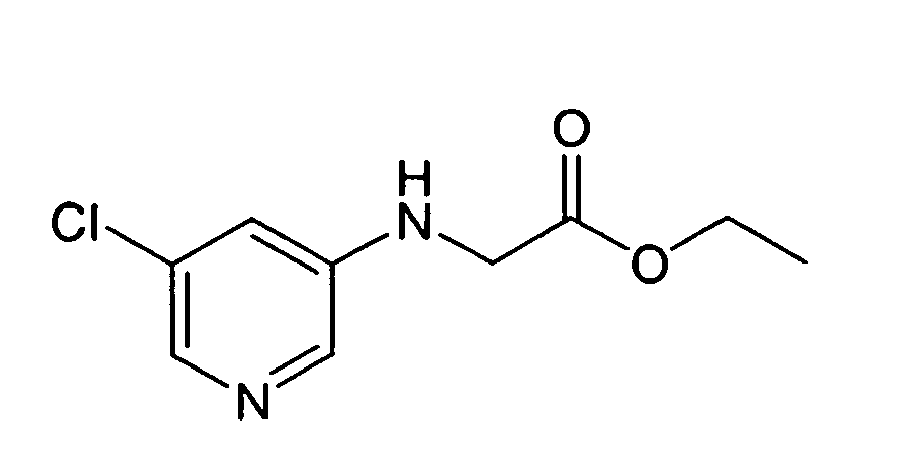
- To a solution of the intermediate prepared in Step A (1.70 g, 7.59 mmol) in DCM (16 mL) was added TFA (8 mL). After 1.5 h at ambient temperature the reaction was concentrated in vacuo, and dissolved in DMF (20 mL). This solution was added to a refluxing solution of ethyl glyoxylate (6.2 mL of a 50% solution in toluene). The resulting mixture was cooled to ambient temperature and stirred for 30 minutes. To this solution was added sodium triacetoxyborohydride (6.30 g, 29.7 mmol) and the resulting mixture was stirred for 1 h. The mixture was then diluted with EtOAc (300 mL) and quenched with saturated aqueous NaHCO3 (200 mL). The organic layer was washed with 0.5 M aqueous NaHCO3, brine, dried (MgSO4) and concentrated in vacuo. Purification by flash chromatography afforded the pyridylglycine as a colorless oil. 1H NMR (CDCl3, 500 MHz) 7.93 (s, 1H), 7.89 (s, 1H), 6.80 (s, 1H), 4.50 (s, 1H), 4.24 (q, 2H), 3.83 (d, 2H), 1.26 (t, 3H). HPLC-MS (ES) 215.1 (M+1).
-

- The intermediate prepared in Step B (397 mg, 1.85 mmol) was dissolved in HCl (35% aqueous), and the resulting mixture was heated to 80 °C for 1.5 h. The solution was then cooled to ambient temperature and concentrated in vacuo. The residue was dissolved in water (5 mL) at 0 °C, and to this solution was added NaNO2 (140 mg, 2.04 mmol). After 2.5 h at 0 °C the mixture was concentrated in vacuo, then dissolved in acetic anhydride (20 mL). The resulting mixture was heated to reflux for 45 minutes, then cooled to ambient temperature and concentrated in vacuo. Purification by flash chromatography (50% EtOAc in hexanes) afforded the sydnone as a yellow solid. 1H NMR (CDCl3, 500 MHz) 8.92 (s, 1H), 8.90 (s, 1H), 8.13 (s, 1H), 6.80 (s, 1H). HPLC-MS (ES) 198.1 (M+1).
-

- To a solution of the intermediate prepared in Step C (200 mg, 1.00 mmol) in 1,3-dichlorobenzene (2 mL) was added the intermediate prepared in Example 101, Step C (940 mg, 2.51 mmol). The mixture was heated to 135 °C for 24 h, then cooled to ambient temperature and concentrated in vacuo. Purification by flash chromatography (35% EtOAc in hexanes) afforded the pyrazole. 1H NMR (CDCl3, 500 MHz) 8.79 (s, 1H), 8.41 (s, 1H), 8.04 (s, 1H), 7.84 s, 1H), 6.40 (s, 1H), 4.60 (s, 1H), 3.90 (m, 3H), 3.41 (d, 1H), 2.97 (s, 1H), 2.80 (s, 1H), 2.32 (dd, 1H), 2.18 (t, 1H), 1.43 (s, 15H). HPLC-MS (ES) 531.2 (M+1).
-

- The intermediate from Step D was dissolved in DCM (1 ml) and to this solution was added TFA (0.5 mL). After 1 h at ambient temperature the reaction was quenched by the addition of saturated aqueous NaHCO3 (5 mL) and diluted with DCM (30 mL). The organic layer was dried (Na2SO4) and concentrated in vacuo, affording the deprotected piperazine as a colorless oil. To a solution of this intermediate (180 mg, 0.41 mmol) in IPA (4 mL) was added the epoxide intermediate prepared in Example 1, Step P (320 mg, 0.82 mmol). The solution was heated to reflux for 16 h, then cooled to ambient temperature and concentrated in vacuo. Purification by flash chromatography (EtOAc) afforded the coupled product as a white solid. HPLC-MS (ES) 824.4 (M+1).
- To a solution of the intermediate prepared in Step E (191 mg, 0.230 mmol) in MeOH (3 mL) was added HCl (1.5 mL of a 1.0 M solution in Et2O, 1.5 mmol). After 6 h at ambient temperature the reaction was quenched by the addition of saturated aqueous NaHCO3 (20 mL). The mixture was extracted with DCM (50 mL), and the organic layer was dried (Na2SO4) and concentrated in vacuo. Purification by preparative TLC (EtOAc) afforded the title compound as a white solid. 1H NMR (CD3OD, 500 MHz) 8.95 (d, J = 2.5 Hz, 1H), 8.44 (d, J = 2.5 Hz, 1H), 8.30 (d, J = 2.5 Hz, 1H), 8.29 (s, 1H), 7.17 (m, 7H), 6.80 (t, J = 7.5 Hz, 1H) 6.71 (d, J = 8.0 Hz, 1H), 6.54 (d, J = 2.0 Hz, 1H), 5.14 (d, J = 4.5 Hz, 1H), 4.07 (m, 2H), 3.97 (m, 1H), 3.74 (m, 3H), 2.98 (m, 4H), 3.10 (s, 1H) 2.96 (m, 3H), 2.83 (d, 1H), 2.39 (d, J = 6.5 Hz, 3H), 2.03 (t, J = 12 Hz, 1H), 1.51 (s, 6H), 1.38 (m, 1H). HPLC-MS (ES) 784.4 (M+1).
-

-

- To a solution of 2,6-dichloro-5-fluoro-3-pyridinecarboxylic acid (30.0 g, 143 mmol) in tert-butanol (200 mL) was added triethylamine (21.9 mL, 157 mmol), followed by diphenylphosphoryl azide (33.9 mL, 157 mmol). The resulting mixture was heated to reflux for 2 h, then cooled to ambient temperature and quenched with saturated aqueous NaHCO3 (200 mL). The mixture was diluted with EtOAc (300 mL) and washed with saturated NaHC03 (200 mL) and brine (200 mL). The organic layer was dried (MgSO4) and concentrated in vacuo. Purification by flash chromatography (3% EtOAc in hexanes) afforded the Boc-amine. This material was dissolved in ethanol (150 mL), and to this solution was added ammonium formate (11.2 g, 177.9 mmol) and formic acid (5 mL), followed by 10% palladium on carbon (1 g). The reaction was heated to reflux for 16 h, then cooled to ambient temperature and filtered thru celite. The liquid was concentrated in vacuo, and the residue dissolved in EtOAc (1 L). The organic layer was washed with saturated aqueous NaHCO3 (500 mL), brine (500 mL), dried (MgSO4), and concentrated in vacuo, affording the fluropyridine as a white solid. 1H NMR (CDCl3, 500 MHz) 8.20 (s, 1H), 8.16 (s, 1H), 7.93 (s, 1H), 7.50 (s, 1H), 1.52 (s, 9H).
-

- To a solution of the intermediate prepared in Step A (5.07 g, 23.9 mmol) in DCM (50 mL) was added TFA (25 mL). After 1.5 h at ambient temperature the reaction was concentrated in vacuo, and dissolved in DMF (28 mL). This solution was added to a refluxing solution of ethyl glyoxylate (19.5 mL of a 50% solution in toluene). The resulting mixture was cooled to ambient temperature and stirred for 30 minutes. To this solution was added sodium triacetoxyborohydride (20.2 g, 95.6 mmol) and the resulting mixture was stirred for 1 h. The mixture was then diluted with EtOAc (300 mL) and quenched with saturated aqueous NaHCO3 (200 mL). The organic layer was washed with 0.5 M aqueous NaHCO3, brine, dried (MgSO4) and concentrated in vacuo. Purification by flash chromatography (35% EtOAc in hexanes) afforded the pyridylglycine as a colorless oil. 1H NMR (CDCl3, 500 MHz) 7.82 (s, 1H), 7.81 (s, 1H), 6.55 (d, 1H), 4.60 (s, 1H), 4.23 (q, 2H), 3.84 (d, 2H), 1.29 (t, 3H). HPLC-MS (ES) 199.2 (M+1).
-

- The intermediate prepared in Step B (1.71 g, 8.62 mmol) was dissolved in HCl (8.6 mL of a 35% aqueous solution), and the resulting mixture was heated to 80 °C for 1.5 h. The solution was then cooled to ambient temperature and concentrated in vacuo. The residue was dissolved in water (5 mL) at 0 °C, and to this solution was added NaNO2 (650 mg, 9.48 mmol). After 2.5 h at 0 °C the mixture was concentrated in vacuo, then dissolved in acetic anhydride (30 mL). The resulting mixture was heated to reflux for 45 minutes, then cooled to ambient temperature and concentrated in vacuo. Purification by flash chromatography (50% EtOAc in hexanes) afforded the sydnone as a yellow solid. 1H NMR (CDCl3, 500 MHz) 8.89 (s, 1H), 8.79 (s, 1H), 7.88 (d, 1H), 6.80 (s, H). HPLC-MS (ES) 182.1 (M+1).
-

- To a solution of the intermediate prepared in Step C (180 mg, 1.00 mmol) in 1,3-dichlorobenzene (2 mL) was added the intermediate prepared in Example 101, Step C (940 mg, 2.51 mmol). The mixture was heated to 135 °C for 24 h, then cooled to ambient temperature and concentrated in vacuo. Purification by flash chromatography (35% EtOAc in hexanes) afforded the pyrazole. 1H NMR (CDCl3, 500 MHz) 8.78 (s, 1H), 8.37 (s, 1H), 7.90 (s, 1H), 7.79 (d, 1H), 7.40 (s, 1H), 6.40 (s, 1H) 4.63 (s, 1H), 3.95 (m, 3H), 3.40 (d, 1H), 3.00 (s, 1H), 2.79 (s, 1H), 2.32 (dd, 1H), 2.17 (t, 1H), 1.44 (s, 6H).
-

- The intermediate from Step D (0.268 g, 0.52 mmol) was dissolved in DCM (1 ml) and to this solution was added TFA (0.5 mL). After 1 h at ambient temperature the reaction was quenched by the addition of saturated aqueous NaHCO3 (5 mL) and diluted with DCM (30 mL). The organic layer was dried (Na2SO4) and concentrated in vacuo, affording the deprotected piperazine as a colorless oil. To a solution of this intermediate (195 mg, 0.47 mmol) in IPA (4 mL) was added the epoxide intermediate prepared in Example 1, Step P (370 mg, 0.94 mmol). The solution was heated to reflux for 16 h, then cooled to ambient temperature and concentrated in vacuo. Purification by flash chromatography (EtOAc) afforded the coupled product as a white solid.
- To a solution of the intermediate prepared in Step E (258 mg, 0.320 mmol) in MeOH (5 mL) was added HCl (5.0 mL of a 1.0 M solution in Et2O, 5.0 mmol). After 6 h at ambient temperature the reaction was quenched by the addition of saturated aqueous NaHCO3 (20 mL). The mixture was extracted with DCM (50 mL), and the organic layer was dried (Na2SO4) and concentrated in vacuo. Purification by flash chromatography (EtOAc) afforded the title compound as a white solid. 1H NMR (CD3OD, 500 MHz) 8.90 d, J = 1.5 Hz, 1H), 8.37 (d, J = 2.5 Hz, 1H), 8.30 (d, J = 2.5 Hz, 1H), 8.07 (dy, J = 2.5 Hz, J = 9.5 Hz, 1H), 7.20 (m, 5H), 7.09 (m, 2H), 6.80 (t, J= 7.5 Hz, 1H), 6.72 (d, J = 8.0 Hz, 1H), 6.54 (d, J = 3.0 Hz, 1H), 5.14 (d, J = 4.0 Hz, 1H), 4.05 (m, 2H), 3.95 (m, 1H), 3.77 (m, 3H), 3.20 (m, 1H), 2.95 (m, 4H), 2.82 (m, 1H), 2.72 (m, 3H), 2.51 (t, J = 8.5 Hz, 1H), 2.15 (t, J = 8.5 Hz, 1H), 2.38 (d, J = 6.5 Hz, 2H), 2.03 (dt, J = 4.0 Hz, J = 11.5 Hz, 1H), 1.50 (s, 6H), 1.38 (m, 1H). HPLC-MS (ES) 768.4 (M+1).
-

-

- A solution of 3-aminopyridine (940 mg, 10.0 mmol) in DMF (28 mL). was added to a refluxing solution of ethyl glyoxylate (8.17 mL of a 50% solution in toluene, 40.0 mmol). The resulting mixture was cooled to ambient temperature and stirred for 30 minutes. To this solution was added sodium triacetoxyborohydride (8.48 g, 40.0 mmol) and the resulting mixture was stirred for 1 h. The mixture was then diluted with EtOAc (300 mL) and quenched with saturated aqueous NaHCO3 (200 mL). The organic layer was washed with 0.5 M aqueous NaHCO3, brine, dried (MgSO4) and concentrated in vacuo. Purification by flash chromatography (35% EtOAc in hexanes) afforded the pyridylglycine as a colorless oil. 1H NMR (CDCl3, 500 MHz) 7.99 (s, 1H), 7.97 (d, 1H), 7.06 (dd, 1H), 6.80 (d, 1H), 4.53 (s, 1H), 4.20 (q, 2H), 3.81 (s, 3H), 1.23 (t, 3H). HPLC-MS (ES) 181.2 (M+1).
-

- The intermediate prepared in Step A (0.390 g, 2.16 mmol) was dissolved in HCl (3 mL of a 35% aqueous solution), and the resulting mixture was heated to 80 °C for 1.5 h. The solution was then cooled to ambient temperature and concentrated in vacuo. The residue was dissolved in water (5 mL) at 0 °C, and to this solution was added NaNO2 (160 mg, 2.38 mmol). After 2.5 h at 0 °C the mixture was concentrated in vacuo, then dissolved in acetic anhydride (8 mL). The resulting mixture was heated to reflux for 45 minutes, then cooled to ambient temperature and concentrated in vacuo. Purification by flash chromatography (EtOAc) afforded the sydnone as a yellow solid. 1H NMR (CDCl3, 500 MHz) 9.02 (s, 1H), 8.87 (d, 1H), 8.08 (d, 1H), 7.60 (dd, 1H). 6.80 (s, 1H). HPLC-MS (ES) 166.1 (M+1).
-

- To a solution of the intermediate prepared in Step B (126 mg, 0.76 mmol) in 1,3-dichlorobenzene (2 mL) was added the intermediate prepared in Example 101, Step C (720 mg, 1.90 mmol). The mixture was heated to 135 °C for 24 h, then cooled to ambient temperature and concentrated in vacuo. Purification by flash chromatography (35% EtOAc in hexanes) afforded the pyrazole. 1H NMR (CDCl3, 500 MHz) 8.94 (d, 1H), 8.49 (d, 1H), 7.96 (d, 1H), 7.84 (s, 1H), 7.60 (s, 1H), 7.37 (dd, 1H), 6.40 (s, 1H), 4.63 (s, 1H), 3.87 (s, 2H), 3.40 (d, 1H), 2.98 (s, 1H), 2.80 (s, 1H), 2.34 (dd, 1H), 2.16 (t, 1H), 1.49 (s, 12H), 1.47 (s, 3H). HPLC-MS (ES) 497.2 (M+1).
-

- The intermediate from Step C (0.172 g, 0.35 mmol) was dissolved in DCM (1 ml) and to this solution was added TFA (0.5 mL). After 1 h at ambient temperature the reaction was quenched by the addition of saturated aqueous NaHCO3 (5 mL) and diluted with DCM (30 mL). The organic layer was dried (Na2SO4) and concentrated in vacuo, affording the deprotected piperazine as a colorless oil. This intermediate was dissolved in IPA (4 mL) and to this solution was added the epoxide intermediate prepared in Example 1, Step P (340 mg, 0.86 mmol). The solution was heated to reflux for 16 h, then cooled to ambient temperature and concentrated in vacuo. Purification by flash chromatography (EtOAc) afforded the coupled product as a white solid.
- To a solution of the intermediate prepared in Step D (128 mg, 0.160 mmol) in MeOH (5 mL) was added HCl (5.0 mL of a 1.0 M solution in Et2O, 5.0 mmol). After 6 h at ambient temperature the reaction was quenched by the addition of saturated aqueous NaHCO3 (20 mL). The mixture was extracted with DCM (50 mL), and the organic layer was dried (Na2SO4) and concentrated in vacuo. Purification by flash chromatography (1% MeOH in EtOAc) afforded the title compound as a white solid. 1H NMR (CD3OD, 500 MHz) 9.00 (d, J = 2.5 Hz, 1H) 8.44 (dd, J = 1.5 Hz, J = 5.0 Hz, 1H), 8.25 (d, J = 2.5 Hz, 1H), 8.20 (ddd, J = 1.5 Hz, J = 2.5 Hz, J = 4.0 Hz, 1H), 7.51 (dd, J = 5.0 Hz, J = 8.5 Hz, 1H), 7.23 (m, 5H), 7.08 (m, 2H), 6.80 (dt, J = 1.0 Hz, J = 7.0 Hz, 1H), 6.71 (d, J = 8.0 Hz, 1H), 6.52 (d, J = 3.0 Hz, 1H), 5.14 (d, J = 4.5 Hz, 1H), 4.08 (m, 2H), 3.97 (m, 1H), 3.77 (m, 3H), 3.30 (d, J = 6.5 Hz, 1H), 3.08 (dd, 1H), 3.02 (m, 1H), 2.94 (m, 2H), 2.82 (d, J= 11.0 Hz, 1H), 2.73 (dd, J = 6.5 Hz, J = 13 Hz, 1H) 2.69 (m, 2H), 2.53 (t, J = 8.0 Hz, 1H), 2.42 (t, J = 8.5 Hz, 1H), 2.38 (d, J = 6.5 Hz, 2H), 2.03 (t, J = 13.5 Hz, 1H), 1.51 (s, 6H), 1.38 (m, 1H). HPLC-MS (ES) 750.4 (M+1).
-

-

- To a stirred solution of carboxylic acid from Example 66 Step D (332mg; 0.87mmol) in dry NMP (12mL) under nitrogen was added DIEA (0.606mL; 3.48mmol). After cooling the solution to 0 °C, the following solids were added, allowing one to dissolve before adding the next: HOBt (265mg; 1.96mmol), ω-aminoacetophenone hydrochloride (179mg; 1.04mmol), and HBTU (495mg; 1.31 mmol). The reaction was allowed to reach ambient temperature, and the next morning the mixture was poured into EtOAc and washed with saturated NaHCO3, water, brine, 3x dilute NaHCO3, and brine. After drying (MgSO4), filtration, and removal of solvent in vacuo, the residue was purified by flash column chromatography (50% EtOAc/hexane). Residual NMP which remained was removed by dissolution in EtOAc followed by washing with water (2x), brine, drying (MgSO4), filtration, and solvent removal in vacuo as before to provide the desired product; electrospray ionization mass spectrum: m/e 499.3 (MH+ calcd for C23H30F3N4O5, 499.2).
-

- To the amide obtained in Step A (225mg; 0.45mmol) was added H2SO4 (5mL). Partial dissolution occurred. The reaction vessel was purged with nitrogen, P2O5 (192mg; 0.68mmol) was added, and the mixture was stirred at 65 °C for 20 minutes. After cooling to 0 °C, ice chips were added and the reaction adjusted to pH 9 with the addition of 50% NH4OH, then conc. NH4OH. Extraction with CHCl3 (3x) was followed by drying (Na2SO4), filtration, removal of solvent in vacuo and purification by flash column chromatography (93:5:2 EtOAc: MeOH: TEA) to provide the desired product.
-

- To a stirred solution of DIPA (1.28mL; 9.74mmol) in dry THF (26mL) at 0 °C was added dropwise n-BuLi (3.54mL; 8.85mmol). After 15 minutes, the solution was cooled to -78 °C and a solution of (S)-(+)-dihydro-5-(t-butyldimethylsilylhydroxymethyl)-2(3H)-furanone (2.04g; 8.85mmol) in dry THF (8mL) was added dropwise. After an additional 30 minutes, propargyl bromide (1.56mL; 10.6mmol) was added dropwise. After 45 minutes the reaction was quenched with 10% citric acid, poured into Et2O, and washed with H2O (2x) and brine, dried (MgSO4), filtered, and solvents removed in vacuo. Purification by Biotage column chromatography (40M; 8% EtOAc/hexane) provided the desired compound.
-

- To a stirred solution of the intermediate from Step C above (903mg; 3.46mmol) in dry THF (21mL) was added HF-pyridine complex (1.2mL). The next morning, the reaction mixture was cooled to 0 °C and adjusted to pH 10 with NH4OH/H2O (2:1). Much solvent was removed in vacuo and the residue was poured into EtOAc and washed with saturated NaHCO3, 2x H2O and brine. Drying (MgSO4), filtration, removal of solvent in vacuo, and purification by Biotage column chromatography (40M; 50% EtOAc/hexane) provided the desired product.
-

- To a stirred solution of intermediate from Step D above (720mg; 4.67mmol) in dry CH2Cl2 (19mL) at 0 °C was added 2,6-lutidine (816uL; 7.0mmol) followed dropwise by trifluoromethanesulfonic anhydride (1.02mL; 6.07mmol). After 1.75 hours, the reaction mixture was poured into 20mL ice/brine and stirred 30 minutes. This mixture was poured into CH2Cl2 and washed with 2x H2O and 2x brine. After drying (MgSO4), filtration, and removal of solvent in vacuo, the residue was purified by Biotage column chromatography (40M; 20% EtOAc/hexane) to provide the desired intermediate. 1H NMR (500 MHz, CDCl3): δ 2.08 (m, 1H), 2.38-2.44 (complex m, 1H), 2.52-2.59 (complex m, 1H), 2.67 (m, 2H), 2.94-2.98 (complex m, 1H), 4.57 (1/2ABX, J=4.1, 11.2 Hz, 1H), 4.71 (1/2ABX, J=3.0, 11.2 Hz, 1H), 4.89 (m, 1H).
-

- To a stirred solution of piperazine (100mg; 0.25mmol) from Step B above and triflate (72mg; 0.25mmol) from Step E above in dry iPrOH (1.25mL) was added DIEA (52uL; 0.30mmol). The next morning, the reaction mixture was poured into EtOAc and washed with saturated NaHCO3, water, brine, water, and brine. Drying (MgSO4), filtration, and removal of solvent in vacuo was followed by flash column chromatography (70% EtOAc/hexane) to provide the desired intermediate.
-
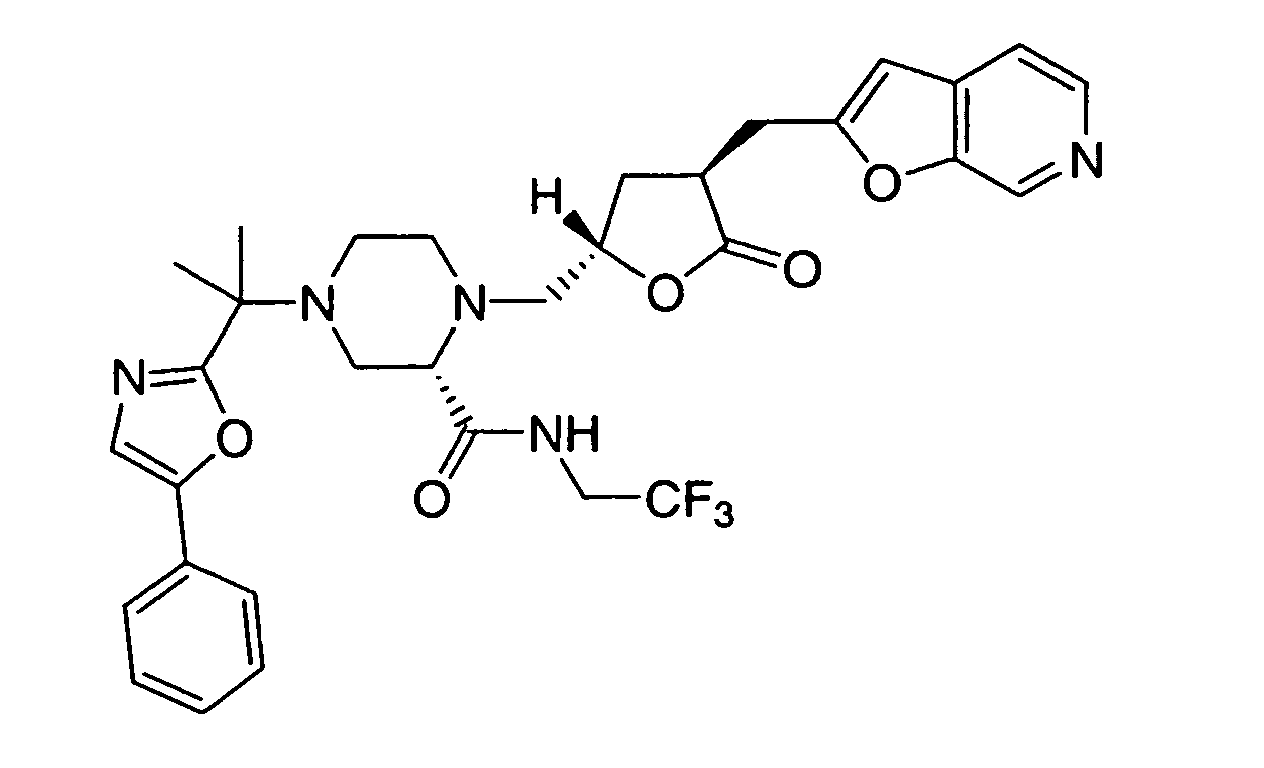
- To a solution of acetylene (95mg; 0.18mmol) from Step F above and 4-iodo-3-hydroxypyridine (52mg; 0.23mmol) in dry pyridine (1.3mL) was added Cu2O (33mg; 0.23mmol). After 35 minutes at 120 °C, the mixture was cooled to ambient temperature and filtered through celite, washing with EtOAc. The organics were washed with aqueous Na2SO4, 2x water, brine, dried (Na2SO4), filtered, and the solvents removed in vacuo. Purification by flash column chromatography (gradient elution 3% to 5% MeOH/CH2Cl2) provided the desired intermediate; electrospray ionization mass spectrum: m/e 626.3 (MH+ calcd for C32H35F3N5O5, 626.3).
-

- To a solution of the lactone (95mg; 0.15mmol) obtained from Step G above in dry dimethoxyethane (2mL) cooled to 0 °C under nitrogen was added aqueous LiOH (172uL; 0.167mmol). The flask was allowed to warm to ambient temperature and stirred for 3.5hr. The reaction was azeotroped from MeCN, MeCN/benzene, and benzene, taking care to keep the water bath below 35 °C. This salt was further dried under vacuum, then dissolved in dry DMF (3mL) and imidazole (204mg; 3.0mmol) was added. This solution was cooled to 0 °C and TBSCI was added (226mg; 1.5mmol). The flask was allowed to warm to ambient temperature and stirred overnight. The next morning the reaction was quenched with pH 7 phosphate buffer and extracted 3x EtOAc. After drying (Na2SO4), filtration, and removal of solvent in vacuo, the residue was dissolved in 3mL THF/water (2:1). After 1hr the mixture was azeotroped from MeCN, benzene, and MeCN to provide the carboxylic acid, which was used without further purification; electrospray ionization mass spectrum: mle 758.4 (MH+ calcd for C38H51F3N5O6Si, 758.4).
-

- To a stirred solution of acid (~0.15mmol) from Step H in dry NMP (2mL) at 0 °C was added DIEA (78uL; 0.45mmol) followed by the following solids, allowing one to dissolve before adding the next: HOBt (46mg; 0.34mmol), amino chromanol obtained from Example 1 Step L (30mg; 0.18mmol), and HBTU (85mg; 0.22mmol). The reaction was allowed to reach ambient temperature and the next morning the mixture was poured into EtOAc and washed with saturated NaHCO3, water, brine, 3x dilute NaHCO3, and brine. After drying (Na2SO4), filtration, and removal of the solvent in vacuo, the residue was purified by flash chromatography (95% EtOAc/hexane) to provide the desired product; electrospray ionization mass spectrum: m/e 905.3 (MH+ calcd for C47H60F3N6O7Si, 905.4).
- To a solution of the intermediate (63mg; 0.07mmol) from Step I in dry THF (2mL) was added TBAF (175uL; 0.175mmol). The solution was stirred at 55 °C for 2 hours. The reaction mixture was poured into EtOAc and washed with saturated NaHCO3, water, and brine. Drying (Na2SO4), filtration, and removal of the solvent in vacuo followed by purification by MPLC (Lobar column; linear gradient 10% to 90% MeCN/H2O) provided the titled compound after lyophilization from MeCN/water (1:1). 1H NMR (500 MHz, CD3OD): δ 1.45 (m, 1H), 1.58 (s, 3H), 1.59 (s, 3H), 2.09 (m, 1H), 2.35-2.43 (complex m, 3H), 2.48 (m, 1H), 2.63 (m, 1H), 2.77 (m, 1H), 2.87 (d, J=10.3 Hz, 1H), 2.98-3.01 (complex m, 2H), 3.08 (dd, J=3.2, 7.3 Hz, 1H), 3.20-3.26 (complex m, 2H), 3.75-3.80 (complex m, 2H), 3.88 (m, 1H), 3.91-3.98 (complex m, 1H), 4.02-4.09 (complex m, 2H), 5.22 (d, J=4.1 Hz, 1H), 6.72 (s, 1H), 6.74 (d, J=8.2 Hz, 1H), 6.80 (apparent t, J=7.5 Hz, 1H), 7.08 (apparent t, J=7.7 Hz, 1H), 7.14, (d, J=7.8 Hz, 1H), 7.35 (m, 1H), 7.42 (m, 3H), 7.57 (d, J=5.2 Hz, 1H), 7.68 (d, J=7.4 Hz, 2H), 8.25 (d, J=5.5 Hz, 1H), 8.68 (s, 1H) ; electrospray ionization mass spectrum: m/e 791.4 (MH+ calcd for C41H46F3N6O7, 791.3).
-

-

- To a stirring solution of hexamethylenetetramine (12.0g; 85.7mmol) in CH2Cl2 (400mL) was added portionwise α-bromo-p-chloroacetophenone (20.0g; 85.7mmol). After 30 minutes the precipitate was filtered and then suspended in EtOH (680mL). Conc. HCl was added (45mL) and the suspension stirred at 90 °C 1.5hrs. Dissolution occurred followed by solution turning pale yellow and a new precipitate formed. This solid was filtered, washed with EtOH, and dried under vacuum to provide the desired compound. 1H NMR (500 MHz, CD3OD): δ 4.60 (s, 2H), 7.61 (d, J=8.7 Hz, 2H), 8.04 (d, J=8.4 Hz, 2H).
-
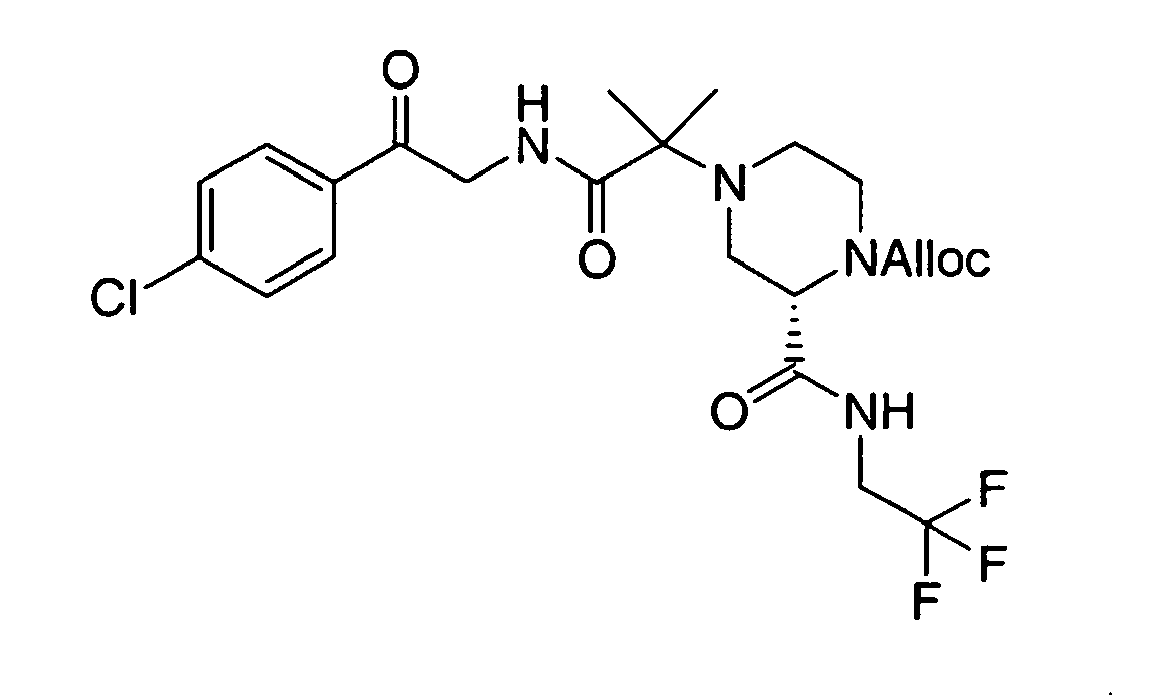
- This intermediate was prepared in the same manner as that of Example 109 Step A, employing carboxylic acid from Example 66 Step D (4.96g; 13mmol) in dry NMP (75mL), DIEA (9.06mL; 52mmol), HOBt (3.95g; 29.3mmol), intermediate from Step A above (3.22g; 15.6mmol), and HBTU (7.4g; 19.5mmol). The residue resulting after workup was purified by Biotage column chromatography (40M; 45% EtOAc/hexane) to provide the desired product. 1H NMR (500 MHz, CDCl3): δ 1.28 (s, 3H), 1.30 (s, 3H), 2.35 (apparent td, J=3.0, 11.6 Hz, 1H), 2.45 (apparent dd, J=3.8, 11.8 Hz, 1H), 2.86 (d, J=10.6 Hz, 1H), 3.22-3.33 (broad, 1H), 3.67 (d, J=11.7 Hz, 1H), 3.74-4.30 (broad, 3H), 4.51 (d, J=18.6 Hz, 1H), 4.70 (d, J=4.5 Hz, 2H), 4.83 (s, 1H), 4.89 (1/2ABX, J=6.8, 18.7 Hz, 1H), 5.30 (d, J=10.3 Hz, 1H), 5.36 (d, J=17.1 Hz, 1H), 5.92-6.02 (br s, 1H), 6.60-6.72 (br s, 1H), 7.49 (d, J=8.5 Hz, 2H), 7.93 (d, J=8.5 Hz, 2H), 8.20-8.30 (br s, 1H); electrospray ionization mass spectrum: m/e 533.3 (MH+ calcd for C23H29ClF3N4O5, 533.2).
-

- This intermediate was prepared according to the procedure described in Example 109 Step B, employing the compound from Step B above (139mg; 0.26mmol), P2O5 (110mg; 0.39mmol), and 2.75mL H2SO4. Flash column chromatography (93:5:2 EtOAc: MeOH: TEA) provided the desired compound. 1H NMR (500 MHz, CDCl3): δ 1.60 (s, 3H), 1.61 (s, 3H), 1.75-1.88 (broad s, 1H), 2.56-2.60 (complex m, 2H), 2.77-2.81 (m, 1H), 2.86-2.98 (complex m, 3H), 3.50-3.52 (m, 1H), 3.93-4.00 (m, 2H), 7.26 (s, 1H), 7.42 (d, J=8.5 Hz, 2H), 7.58 (d, J=8.4 Hz, 2H), 8.10-8.18 (broad s, 1H) ; electrospray ionization mass spectrum: m/e 431.3 (MH+ calcd for C19H23ClF3N4O2, 431.1).
-

- This intermediate was prepared according to the procedure described in Example 109 Step F, employing the compound from Step C above (85mg; 0.2mmol), intermediate from Example 109 Step E (58mg; 0.2mmol), and DIEA (42uL; 0.24mmol) in dry iPrOH (1.0mL) for 4 hours. Flash column chromatography (70% EtOAc/hexane) provided the desired product. 1H NMR (500 MHz, CDCl3): δ 1.60 (s, 3H), 1.61 (s, 3H), 2.04 (m, 1H), 2.18-2.24 (complex m, 1H), 2.23-2.36 (complex m, 1H), 2.53-2.66 (complex m, 4H), 2.73 (d, J=8.4 Hz, 2H), 2.82 (s, 2H), 2.87-2.97 (complex m, 3H), 3.29 (m, 1H), 3.66-3.72 (complex m, 1H), 4.15-4.22 (complex m, 1H), 4.69-4.73 (complex m, 1H), 7.27 (s, 1H), 7.44 (d, J=8.5 Hz, 2H), 7.56 (d, J=8.7 Hz, 2H), 8.56-8.63 (br s, 1H) ; electrospray ionization mass spectrum: mle 567.3 (MH+ calcd for C27H31CIF3N4O4, 567.2).
-

- This intermediate was prepared according to the procedure described in Example 109 Step G, employing the compound from Step D above (85mg; 0.15 mmol), 4-iodo-3-hydroxypyridine (50mg; 0.23mmol), and Cu2O (32mg; 0.23mmol) in dry pyridine (1.0mL) for 30 minutes. Following workup, flash column chromatography (gradient elution 3% to 5% MeOH/DCM) provided the desired product. 1H NMR (500 MHz, CDCl3): δ 1.59 (s, 3H), 1.60 (s, 3H), 2.17-2.21 (complex m, 2H), 2.57-2.61 (complex m, 2H), 2.70-2.86 (complex m, 4H), 2.89-2.97 (complex m, 2H), 3.03 (m, 1H), 3.15-3.20 (complex m, 1H), 3.27 (m, 1H), 3.37 (1/2ABX, J=4.3, 15.3 Hz, 1H), 3.63-3.69 (complex m, 1H), 4.14-4.20 (complex m, 1H), 4.59 (m, 1H), 6.56 (s, 1H), 7.26 (s, 1H), 7.43 (d, J=8.5 Hz, 2H), 7.48 (d, J=5.2 Hz, 1H), 7.55 (d, J=8.4 Hz, 2H), 8.42 (d, J=5.1 Hz, 1H), 8.65 (br s, 1H), 8.81 (s, 1H); electrospray ionization mass spectrum: m/e 660.3 (MH+ calcd for C32H34ClF3N5O5, 660.2).
-

- This compound was prepared according to the procedure described in Example 109 Step H, employing the compound from Step E above (53mg; 0.08mmol) and aqueous LiOH (86uL; 0.086mmol) in dry dimethoxyethane (1.5mL). Following removal of solvents as before, the lithium salt was treated (as in Example 109 Step H) with imidazole (109mg; 1.6mmol) and TBSCl (120mg; 0.8mmol) in dry DMF. Upon workup, the product was used without further purification.
-
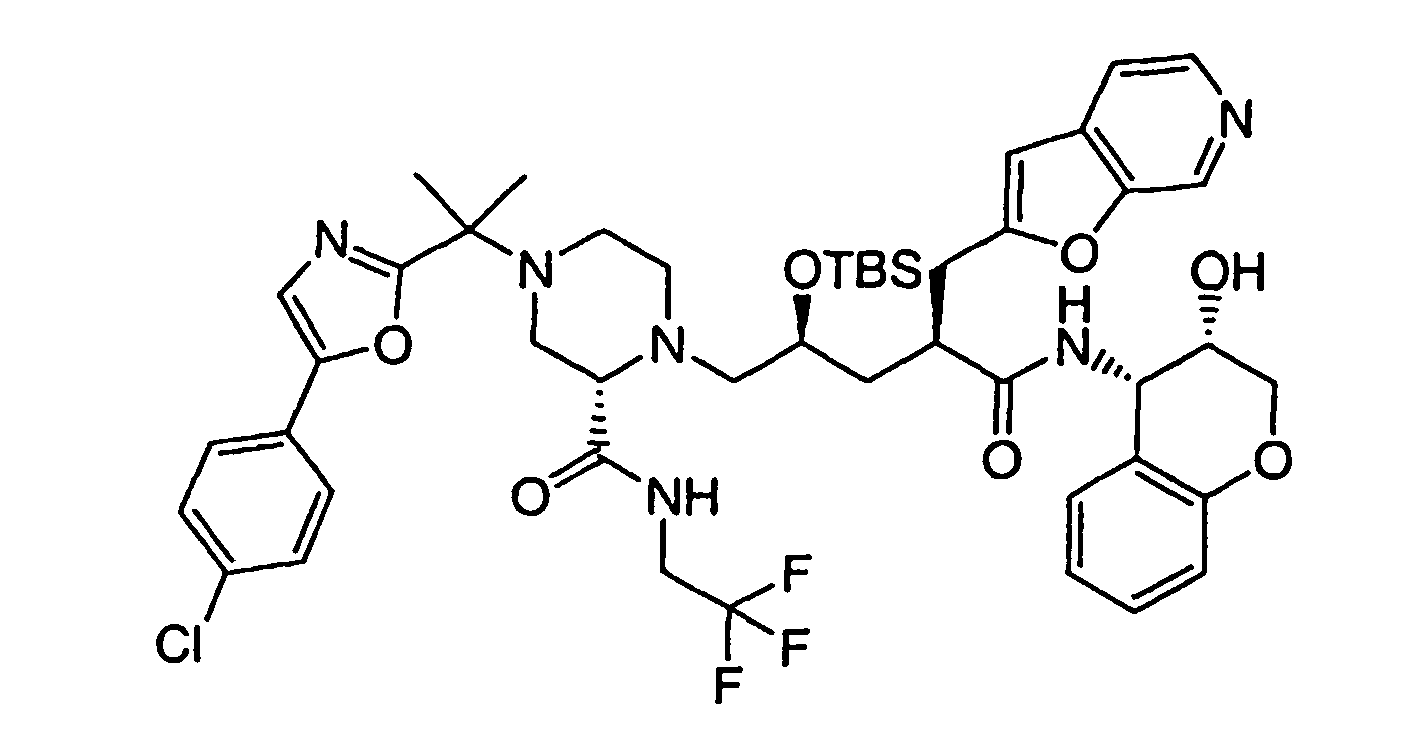
- This compound was prepared according to the procedure described in Example 109 Step I, employing the compound from Step F above (~0.08mmol) in dry NMP (1.2mL), DIEA (42uL; 0.24mmol), HOBt (24mg; 0.18mmol), amino chromanol obtained from Example 1 Step L (16mg; 0.096mmol), and HBTU (45mg; 0.12mmol). Following workup, flash column chromatography (1% MeOH/EA) provided the desired product.
- The titled compound was prepared according to the procedure described in Example 109 Step J, employing the intermediate from Step G above (28mg; 0.03mmol) and TBAF (75uL; 0.075mmol) in dry THF (1.0mL). Following workup, flash column chromatography (5% MeOH/CH2Cl2) provided the desired product after lyophilization. 1H NMR (500 MHz, CD3OD): δ 1.44 (m, 1H), 1.57 (s, 3H), 1.58 (s, 3H), 2.09 (m, 1H), 2.35-2.48 (complex m, 4H), 2.61 (m, 1H), 2.75 (m, 1H), 2.87 (d, J=9.6 Hz, 1H), 2.98-3.02 (complex m, 2H), 3.08 (m, 1H), 3.20-3.27 (complex m, 2H), 3.74-3.81 (complex m, 2H), 3.88 (m, 1H), 3.91-3.98 (complex m, 1H), 4.02-4.09 (complex m, 2H), 5.22 (d, J=4.1 Hz, 1H), 6.72 (s, 1H), 6.74 (d, J=8.0 Hz, 1H), 6.80 (apparent t, J=7.6 Hz, 1H), 7.09 (apparent t, J=7.7 Hz, 1H), 7.14, (d, J=7.3 Hz, 1H), 7.44 (m, 3H), 7.57 (d, J=5.2 Hz, 1H), 7.68 (d, J=8.4 Hz, 2H), 8.25 (d, J=5.5 Hz, 1H), 8.68 (s, 1H); electrospray ionization mass spectrum: m/e 825.4 (MH+ calcd for C41 H45ClF3N6O7, 825.3).
-
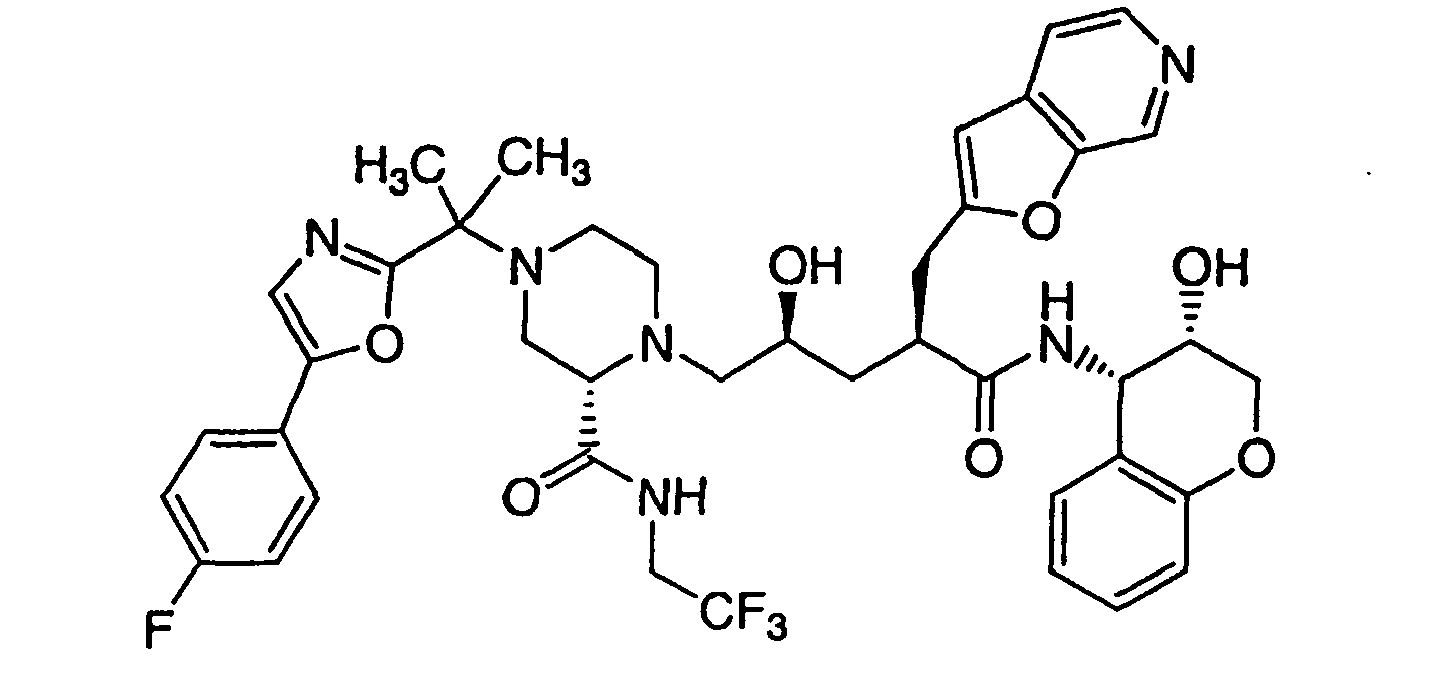
-

- This aminoketone was prepared in the same manner as Example 110 Step A employing hexamethylenetetramine (12.9g; 92.1mmol) in CH2Cl2 (500mL) and α-bromo-p-fluoroacetophenone (20.0g; 92.1mmol). After filtration, the solid was suspended in EtOH (680mL) and conc. HCl was added (45mL). The new solid was filtered, washed with EtOH, and dried under vacuum as before to provide the desired compound. 1H NMR (500 MHz, CD3OD): δ 4.61 (s, 2H), 7.33 (apparent t, J=8.8 Hz, 2H), 8.14 (m, 2H).
-

- This intermediate was prepared in the same manner as that of Example 109 Step A, employing carboxylic acid from Example 66 Step D (12.85g; 26.6mmol) in dry NMP (100mL), DIEA (18.5mL; 106.4mmol), HOBt (8.09g; 59.9mmol), intermediate from Step A above (6.3g; 33.25mmol), and HBTU (15.1g; 39.9mmol). The residue resulting after workup was purified by flash column chromatography (gradient elution 45% to 50% to 55% EtOAc/hexane) to provide the desired product. 1H NMR (500 MHz, CDCl3): δ 1.26 (s, 3H), 1.29 (s, 3H), 2.34 (apparent td, J=3.2, 11.7 Hz, 1H), 2.44 (dd, J=3.9, 11.7 Hz, 1H), 2.85 (d, J=10.9 Hz, 1H), 3.22-3.32 (broad, 1H), 3.66 (d, J=11.9 Hz, 1H), 3.75-4.27 (broad, 3H), 4.50 (apparent dd, J=3.7, 18.8 Hz, 1H), 4.68 (d, J=5.0 Hz, 2H), 4.82 (s, 1H), 4.88 (1/2ABX, J=6.8, 18.7 Hz, 1H), 5.28 (d, J=10.5 Hz, 1H), 5.34 (d, J=16.9 Hz, 1H), 5.90-6.00 (br s, 1H), 6.62-6.72 (br s, 1H), 7.17 (apparent t, J=8.6 Hz, 2H), 8.00 (m, 2H), 8.15-8.25 (br s, 1H); electrospray ionization mass spectrum: m/e 517.3 (MH+ calcd for C23H29F4N4O5, 517.2).
-

- This intermediate was prepared according to the procedure described in Example 109 Step B, employing the compound from Step B above (7.86g; 15.2mmol), P2O5 (6.47g; 22.8mmol), and 85mL H2SO4. Flash column chromatography (93:5:2 EtOAc: MeOH: TEA) provided the desired compound. 1H NMR (500 MHz, CDCl3): δ 1.58 (s, 3H), 1.60 (s, 3H), 1.80-1.88 (br s, 1H), 2.55-2.61 (complex m, 2H), 2.76-2.79 (m, 1H), 2.86-2.95 (complex m, 3H), 3.49 (m, 1H), 3.94 (m, 2H), 7.13 (apparent t, J=8.6 Hz, 2H), 7.19 (s, 1H), 7.60 (m, 2H), 8.12-8.18 (br s, 1H) ; electrospray ionization mass spectrum: m/e 415.3 (MH+ calcd for C19H23F4N4O2, 415.2).
-

- This intermediate was prepared according to the procedure described in Example 109 Step F, employing the compound from Step C above (139mg; 0.34mmol), intermediate from Example 109 Step E (96mg; 0.34mmol), and DIEA (71uL; 0.41mmol) in dry iPrOH (1.7mL) overnight. Flash column chromatography (70% EtOAc/hexane) provided the desired product. 1H NMR (500 MHz, CDCl3): δ 1.58 (s, 3H), 1.59 (s, 3H), 2.02 (m, 1H), 2.17-2.22 (complex m, 1H), 2.28-2.34 (complex m, 1H), 2.51-2.64 (complex m, 4H), 2.69-2.73 (m, 2H), 2.81 (m, 2H), 2.85-2.95 (complex m, 3H), 3.279 (m, 1H), 3.63-3.69 (complex m, 1H), 4.15-4.20 (complex m, 1H), 4.67-4.72 (m, 1H), 7.15 (apparent t, J=8.7 Hz, 2H), 7.20 (s, 1H), 7.60 (m, 2H), 8.58-8.65 (br s, 1H).
-

- This intermediate was prepared according to the procedure described in Example 109 Step G, employing the compound from Step D above (150mg; 0.27mmol), 4-iodo-3-hydroxypyridine (90mg; 0.41mmol), and Cu2O (59mg; 0.41mmol) in dry pyridine (2.0mL) for 30 minutes. Following workup, flash column chromatography (3% MeOH/CH2Cl2) provided the desired product. 1H NMR (500 MHz, CDCl3): δ 1.58 (s, 3H), 1.59 (s, 3H), 2.14-2.22 (complex m, 2H), 2.55-2.60 (complex m, 2H), 2.68-2.96 (complex m, 6H), 3.02 (m, 1H), 3.145-3.20 (complex m, 1H), 3.26 (m, 1H), 3.367 (1/2ABX, J=4.5, 15.3 Hz, 1H), 3.60-3.66 (complex m, 1H), 4.12-4.19 (complex m, 1H), 4.59 (m, 1H), 6.54 (s, 1H), 7.14 (apparent t, J=8.6 Hz, 2H). 7.20 (s, 1H), 7.48 (br s, 1H), 7.58 (m, 2H), 8.38-8.46 (broad s, 1H), 8.63-8.72 (br s, 1H). 8.76-8.90 (br s, 1H) ; electrospray ionization mass spectrum: m/e 644.2 (MH+ calcd for C32H34F4N5O5, 644.2).
-

- This compound was prepared according to the procedure described in Example 109 Step H, employing the compound from Step E above (68mg; 0.106mmol) and aqueous LiOH (114uL; 0.11mmol) in dry dimethoxyethane (2mL). Following removal of solvents as before, the lithium salt was treated (as in Example 109 Step H) with imidazole (144mg; 2.12mmol) and TBSCI (160mg; 1.06mmol) in dry DMF(2mL). Upon workup and subsequent hydrolysis in THF/H2O (1.5mL; 2:1), the product was used without further purification; electrospray ionization mass spectrum: m/e 776.2 (MH+ calcd for C38H50F4N5O6Si, 776.3).
-

- This compound was prepared according to the procedure described in Example 109 Step I, employing the compound from Step F above (~0.106mmol) in dry NMP (1.5mL), DIEA (55uL; 0.32mmol), HOBt (32mg; 0.24mmol), amino chromanol obtained from Example 1 Step L (21mg; 0.13mmol), and HBTU (60mg; 0.16mmol). Following workup, flash column chromatography (100% EA) provided the desired product. 1H NMR (500 MHz, CDCl3): δ -0.01 (s, 3H), 0.04 (s, 3H), 0.84 (s, 9H), 1.50 (m, 1H), 1.56 (s, 3H), 1.58 (s, 3H), 1.60-1.68 (br s, 1H), 2.27-2.33 (complex m, 2H), 2.57-2.66 (complex m, 4H), 2.75-2.90 (complex m, 4H), 3.00 (m, 1H), 3.04-3.12 (complex m, 1H), 3.18-3.23 (complex m, 2H), 3.66 (m, 1H), 3.86-3.90 (br s, 1H), 3.96 (m, 2H), 4.06-4.14 (complex m, 2H), 5.26 (m, 1H), 6.29 (d, J=8.4 Hz, 1H), 6.53 (s, 1H), 6.82 (d, J=8.0 Hz, 1H), 6.89 (apparent t, J=7.4 Hz, 1H), 7.12-7.20 (complex, 4H), 7.44 (d, J=5.1 Hz, 1H), 7.59 (m, 2H), 8.37 (d, J=5.3 Hz, 1H), 8.43-8.50 (br s, 1H), 8.75 (s, 1H); electrospray ionization mass spectrum: m/e 923.5 (MH+ calcd for C47H59F4N6O7Si, 923.4).
- The titled compound was prepared according to the procedure described in Example 109 Step J, employing the intermediate from Step G above (59mg; 0.064mmol) and TBAF (160uL; 0.16mmol) in dry THF (2.0mL). Following workup, purification by MPLC (Lobar column; linear gradient 10% to 90% MeCN/H2O) provided the titled compound after lyophilization. 1H NMR (500 MHz, CD3OD): δ 1.45 (m, 1H), 1.57 (s, 3H), 1.58 (s, 3H), 2.09 (m, 1H), 2.35-2.43 (complex m, 3H), 2.47 (m, 1H), 2.62 (m, 1H), 2.76 (m, 1H), 2.87 (d, J=9.8 Hz, 1H), 2.98-3.02 (complex m, 2H), 3.08 (dd, J=3.2, 7.3 Hz, 1H), 3.20-3.27 (complex m, 2H), 3.76-3.81 (complex m, 2H), 3.88 (m, 1H), 3.93-4.02 (complex m, 1H), 4.03-4.09 (complex m, 2H), 5.22 (d, J=4.2 Hz, 1H), 6.72 (s, 1H), 6.74 (d, J=8.3 Hz, 1H), 6.80 (apparent t, J=7.9 Hz, 1H), 7.09 (apparent t, J=8.5 Hz, 1H), 7.14, (d, J=7.8 Hz, 1H), 7.18 (apparent t, J=8.8 Hz, 2H), 7.39 (s, 1H), 7.57 (d, J=5.2 Hz, 1H), 7.71 (m, 2H), 8.25 (d, J=5.2 Hz, 1H), 8.68 (s, 1H) ; electrospray ionization mass spectrum: m/e 809.3 (MH+ calcd for C41H45F4N6O7, 809.3).
-

-

- This intermediate was prepared according to the procedure of Example 109 Step G, employing the acetylene from Example 110 Step D (490mg; 0.86mmol), 3,5-diiodo-4-hydroxypyridine (330mg; 0.95mmol) in dry pyridine (5.75mL) and Cu2O (160mg; 1.12mmol). After workup, purification by flash column chromatography (gradient elution 75% EtOAc/hexane to 100% EA to 5% MeOH/EtOAc) provided the desired compound. 1H NMR (500 MHz, CDCl3): δ 1.58 (s, 3H), 1.60 (s, 3H), 2.19-2.28 (complex m, 2H), 2.57-2.62 (complex m, 2H), 2.70-2.79 (complex m, 3H), 2.84-3.04 (complex m, 4H), 3.18-3.21 (complex m, 1H), 3.28 (m, 1H), 3.39 (1/2ABX, J=4.4, 15.4 Hz, 1H), 3.65-3.72 (complex m, 1H), 4.10-4.20 (complex m, 1H), 4.64 (m, 1H), 6.68 (s, 1H), 7.25 (s, 1H), 7.41 (d, J=8.5 Hz, 2H), 7.54 (d, J=8.5 Hz, 2H), 8.71 (m, 3H) ; electrospray ionization mass spectrum: m/e 786.0 (MH+ calcd for C32H33ClF3IN5O5, 786.1).
-

- A stirred solution of the iodide obtained in Step A above (183mg; 0.23mmol) in dry toluene (1.5mL) was degassed approximately 10 minutes, after which hexamethylditin (49ul; 0.26mmol) was added followed by PPh3 (2mg; 0.007mmol) and Pd(PPh3)4 (13mg; 0.011mmol). After 1.25 hours at reflux, the reaction mixture was filtered through Celite, washing with EtOAc. The organics were washed with saturated NaHCO3, water, and brine. Drying (Na2SO4), filtration, removal of solvent in vacuo and purification by flash column chromatography (4% MeOH/CH2Cl2) provided the desired compound, which was used without further purification.
-

- To a stirring solution of stannane from Step B above (104mg; 0.13mmol) in dry MeOH (2mL) was added an anhydrous ethereal solution of HCl (38uL; 0.38mmol). After 45 minutes the reaction mixture was diluted with EtOAc and washed with saturated NaHCO3, water and brine. Drying (Na2SO4), filtration, removal of solvent in vacuo and purification by flash column chromatography (4% MeOH/CH2Cl2) provided the desired compound. 1H NMR (500 MHz, CDCl3): δ 1.58 (s, 3H), 1.59 (s, 3H), 2.15-2.19 (complex m, 2H), 2.55-2.61 (complex m, 2H), 2.68-2.84 (complex m, 4H), 2.88-3.02 (complex m, 3H), 3.14 (m, 1H), 3.26 (m, 1H), 3.34 (1/2ABX, J=4.5, 15.3 Hz, 1H), 3.62-3.68 (complex m, 1H), 4.13-4.19 (complex m, 1H), 4.58 (m, 1H), 6.58 (s, 1H), 7.25 (s, 1H), 7.38 (d, J=5.0 Hz, 1H), 7.42 (d, J=8.5 Hz, 2H), 7.54 (d, J=8.5 Hz, 2H), 8.45 (br s, 1H), 8.63 (br s, 1H), 8.86 (br s, 1H); electrospray ionization mass spectrum: m/e 660.2 (MH+ calcd for C32H34ClF3N5O5, 660.2).
-

- This compound was prepared according to the procedure described in Example 109 Step H, employing the compound from Step C above (58mg; 0.088mmol) and aqueous LiOH (100uL; 0.097mmol) in dry dimethoxyethane (1.5mL). Following removal of solvents as before, the lithium salt was treated (as in Example 109 Step H) with imidazole (120mg; 1.76mmol) and TBSCl (133mg; 0.88mmol) in dry DMF(1.5mL). Upon workup, the product was purified by flash column chromatography (gradient elution 5% to 10% MeOH/CH2Cl2); electrospray ionization mass spectrum: mle 792.1 (MH+ calcd for C38H50ClF3N5O6Si, 792.3).
-

- This compound was prepared according to the procedure described in Example 109 Step I, employing the compound from Step D above (~0.088mmol) in dry NMP (1.3mL), DIEA (46uL; 0.26mmol), HOBt (27mg; 0.20mmol), amino chromanol obtained from Example 1 Step L (18mg; 0.11mmol), and HBTU (50mg; 0.13mmol). Following workup, flash column chromatography (1.5% MeOH/EA) provided the desired product. Residual NMP which remained was removed by dissolution in EtOAc followed by washing with water (2x), brine, drying (MgSO4), filtration, and solvent removal in vacuo as before to provide the desired product which was used without further purification; electrospray ionization mass spectrum: m/e 939.4 (MH+ calcd for C47H59ClF3N6O7Si, 939.4).
- This compound was prepared according to the procedure described in Example 109 Step J, employing the intermediate from Step E above (47mg; 0.05mmol) and TBAF (125uL; 0.125mmol) in dry THF (1.0mL). Following workup, purification by MPLC (Lobar column; linear gradient 10% to 90% MeCN/H2O) provided the titled compound after lyophilization. 1H NMR (500 MHz, CD3OD): δ 1.44 (m, 1H), 1.57 (s, 3H), 1.58 (s, 3H), 2.08 (m, 1H), 2.35-2.49 (complex m, 4H), 2.62 (m, 1H), 2.75 (m, 1H), 2.87 (d, J=9.9 Hz, 1H), 2.95-3.02 (complex m, 2H), 3.08 (dd, J=3.0, 7.3 Hz, 1H), 3.17-3.25 (complex m, 2H), 3.74-3.81 (complex m, 2H), 3.88 (m, 1H), 3.93-4.09 (complex m, 3H), 5.22 (d, J=4.1 Hz, 1H), 6.74 (m, 2H), 6.80 (apparent t, J=7.5 Hz, 1H), 7.09 (apparent t, J=7.7 Hz, 1H), 7.14, (d, J=7.8 Hz, 1H), 7.45 (m, 3H), 7.50 (d, J=5.7 Hz, 1H), 7.68 (d, J=8.5 Hz, 2H), 8.32 (d, J=5.7 Hz, 1H), 8.74 (s, 1H) ; electrospray ionization mass spectrum: m/e 825.1 (MH+ calcd for C41H45ClF3N6O7, 825.3).
-

-
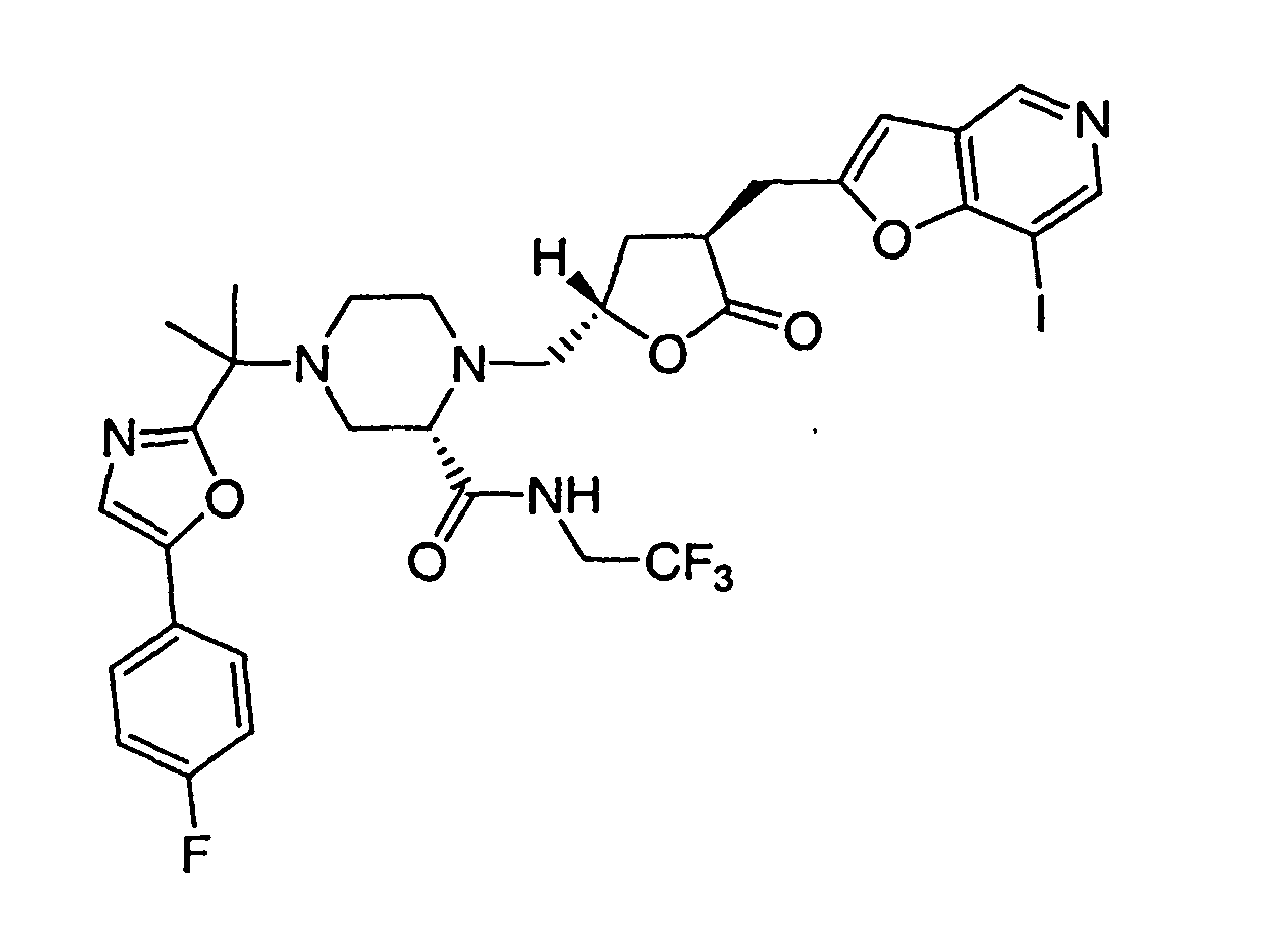
- This intermediate was prepared according to the procedure of Example 109 Step G, employing the acetylene from Example 110 Step D (225mg; 0.41mmol), 3,5-diiodo-4-hydroxypyridine (156mg; 0.45mmol) in dry pyridine (2.75mL) and Cu2O (76mg; 0.53mmol). After workup, purification by flash column chromatography (gradient elution 75% EtOAc/hexane to 100% EA to 5% MeOH/EtOAc) provided the desired compound. 1H NMR (500 MHz, CDCl3): δ 1.58 (s, 3H), 1.60 (s, 3H), 2.19-2.28 (complex m, 2H), 2.56-2.62 (complex m, 2H), 2.72-2.79 (complex m, 3H), 2.84-2.92 (complex m, 2H), 2.95-3.04 (complex m, 2H), 3.18-3.21 (complex m, 1H), 3.28 (m, 1H), 3.39 (1/2ABX, J=4.5, 15.4 Hz, 1H), 3.62-3.68 (complex m, 1H), 4.12-4.19 (complex m, 1H), 4.64 (m, 1H), 6.68 (s, 1H), 7.14 (apparent t, J=8.6 Hz, 2H), 7.20 (s, 1H), 7.59 (m, 2H), 8.72 (m, 3H) ; electrospray ionization mass spectrum: m/e 770.1 (MH+ calcd for C32H33F4IN5O5, 770.1).
-

- The stannane was prepared according to the procedure set forth in Example 112 Step B, employing the iodide obtained in Step A above (270mg; 0.35mmol) in dry toluene (2.3mL), hexamethylditin (75ul; 0.39mmol), PPh3 (3mg; 0.011mmol), and Pd(PPh3)4 (20mg; 0.018mmo1) for 2.5 hours. After workup, purification by flash column chromatography (4% MeOH/CH2Cl2) provided the desired compound. 1H NMR (500 MHz, CDCl3): δ 0.44 (s, 9H), 1.57 (s, 3H), 1.59 (s, 3H), 2.12-2.20 (complex m, 2H), 2.53-2.59 (complex m, 2H), 2.67-2.84 (complex m, 4H), 2.87-2.94 (complex m, 2H), 3.01 (1/2ABX, J=8.9, 15.1 Hz, 1H), 3.08-3.14 (complex m, 1H), 3.25 (m, 1H), 3.33 (1/2ABX, J=4.3, 15.3 Hz, 1H), 3.60-3.66 (complex m, 1H), 4.10-4.19 (complex m, 1H), 4.55 (m, 1H), 6.54 (s, 1H), 7.14 (apparent t, J=8.6 Hz, 2H), 7.20 (s, 1H), 7.59 (m, 2H), 8.41 (s, 1H) 8.65 (br s, 1H), 8.80 (s, 1H).
-

- This intermediate was prepared according to the procedure described in Example 112 Step C, employing stannane from Step B above (200mg; 0.25mmol) and ethereal HCl (750uL; 0.75mmol) in dry MeOH (4mL). Following workup, purification by flash column chromatography (gradient elution 4% to 5% MeOH/CH2Cl2) provided the desired compound. 1H NMR (500 MHz, CDCl3): δ 1.58 (s, 3H), 1.59 (s, 3H), 2.15-2.19 (complex m, 2H), 2.55-2.60 (complex m, 2H), 2.68-2.85 (complex m, 4H), 2.87-3.02 (complex m, 3H), 3.12-3.17 (complex m, 1H), 3.26 (m, 1H), 3.34 (1/2ABX, J=4.6, 15.4 Hz, 1H), 3.58-3.68 (complex m, 1H), 4.12-4.19 (complex m, 1H), 4.57 (m, 1H), 6.57 (s, 1H), 7.15 (apparent t, J=8.7 Hz, 2H), 7.20 (s, 1H), 7.38 (d, J=5.7 Hz, 1H), 7.59 (m, 2H), 8.48 (d, J=5.3 Hz, 1H), 8.66 (br s, 1H), 8.86 (s, 1H) ; electrospray ionization mass spectrum: mle 644.2 (MH+ calcd for C32H34F4N5O5, 644.2).
-

- This compound was prepared according to the procedure described in Example 109 Step H, employing the compound from Step C above (130mg; 0.20mmol) and aqueous LiOH (220uL; 0.21mmol) in dry dimethoxyethane (2mL). Following removal of solvents as before, the lithium salt was treated (as in Example 109 Step H) with imidazole (272mg; 4.0mmol) and TBSCI (301mg; 2.0mmol) in dry DMF (2mL). Upon workup and hydrolysis in THF/H2O (6mL; 2:1), the product was purified by flash column chromatography (gradient elution 7% to 9% MeOH/CH2Cl2); m/e 776.3 (MH+ calcd for C38H50F4N5O6Si, 776.3).
-

- This compound was prepared according to the procedure described in Example 109 Step I, employing the compound from Step D above (~0.20mmol) in dry NMP (1.0mL), DIEA (104uL; 0.60mmol), HOBt (61mg; 0.45mmol), amino chromanol obtained from Example 1 Step L (40mg; 0.24mmol), and HBTU (114mg; 0.30mmol). Following workup, flash column chromatography (gradient elution 1% to 2% MeOH/EA) provided the desired product.
- The titled compound was prepared according to the procedure described in Example 109 Step J, employing the intermediate from Step E above (170mg; 0.18mmol) and TBAF (405uL; 0.405mmol) in dry THF (3.0mL). Following workup, purification by flash column chromatography (gradient elution 5% to 6% MeOH/CH2Cl2) provided the titled compound after lyophilization. 1H NMR (500 MHz, CD3OD): δ 1.45 (m, 1H), 1.57 (s, 3H), 1.58 (s, 3H), 2.09 (m, 1H), 2.35-2.49 (complex m, 4H), 2.62 (m, 1H), 2.76 (m, 1H), 2.87 (d, J=11.2 Hz, 1H), 2.95-3.01 (complex m, 2H), 3.08 (m, 1H), 3.17-3.24 (complex m, 2H), 3.74-3.81 (complex m, 2H), 3.89 (m, 1H), 3.93-4.00 (complex m, 1H), 4.02-4.10 (complex m, 2H), 5.22 (d, J=4.2 Hz, 1H), 6.74 (m, 2H), 6.80 (apparent t, J=7.6 Hz, 1H), 7.09 (apparent t, J=7.7 Hz, 1H), 7.17, (m, 3H), 7.39 (s, 1H), 7.50 (d, J=5.7 Hz, 1H), 7.71 (m, 2H), 8.32 (d, J=5.9 Hz, 1H), 8.74 (s, 1H); electrospray ionization mass spectrum: m/e 809.2 (MH+ calcd for C41H45F4N6O7, 809.3).
-

-

- To a stirred solution of the acetylene from Example 111 Step D (411mg; 0.75mmol) and 5-iodo-pyrimidin-4-ol (199mg; 0.89mmol) in anhydrous DMF (7mL) under nitrogen was added Cl2Pd(PPh3)2 (5 mol %; 26 mg), Cul (10 mol %; 14 mg) and TEA (0.260mL; 1.5 mmol). The reaction was heated to 50 °-60 °C for 3 hours. After cooling, EtOAc and water were added followed by filtration through celite. The organic layer was washed with water, NaHCO3 solution and brine. Drying (MgSO4), filtration, concentration of the solvent in vacuo and purification by flash column chromatography (5% MeOH/DCM) provided the desired product. 1H NMR (500 MHz, CDCl3): δ 1.58 (s, 3H), 1.60 (s, 3H), 2.19-2.28 (complex m, 2H), 2.56-2.62 (complex m, 2H), 2.71-2.78 (complex m, 3H), 2.84-3.04 (complex m, 4H), 3.16-3.23 (complex m, 1H), 3.28 (m, 1H), 3.39 (1/2ABX, J=4.6, 15.3 Hz, 1H), 3.62-3.71 (complex m, 1H), 4.11-4.21 (complex m, 1H), 4.65 (m, 1H), 6.61 (s, 1H), 7.15 (apparent t, J=8.6 Hz, 2H), 7.21 (s, 1H), 7.60 (m, 2H), 8.57 (broad s, 1H); 8.95 (s, 1 H); 8.96 (s, 1H); electrospray ionization mass spectrum: mle 645.2 (MH+ calcd for C31H33F4N6O5, 645.2).
-
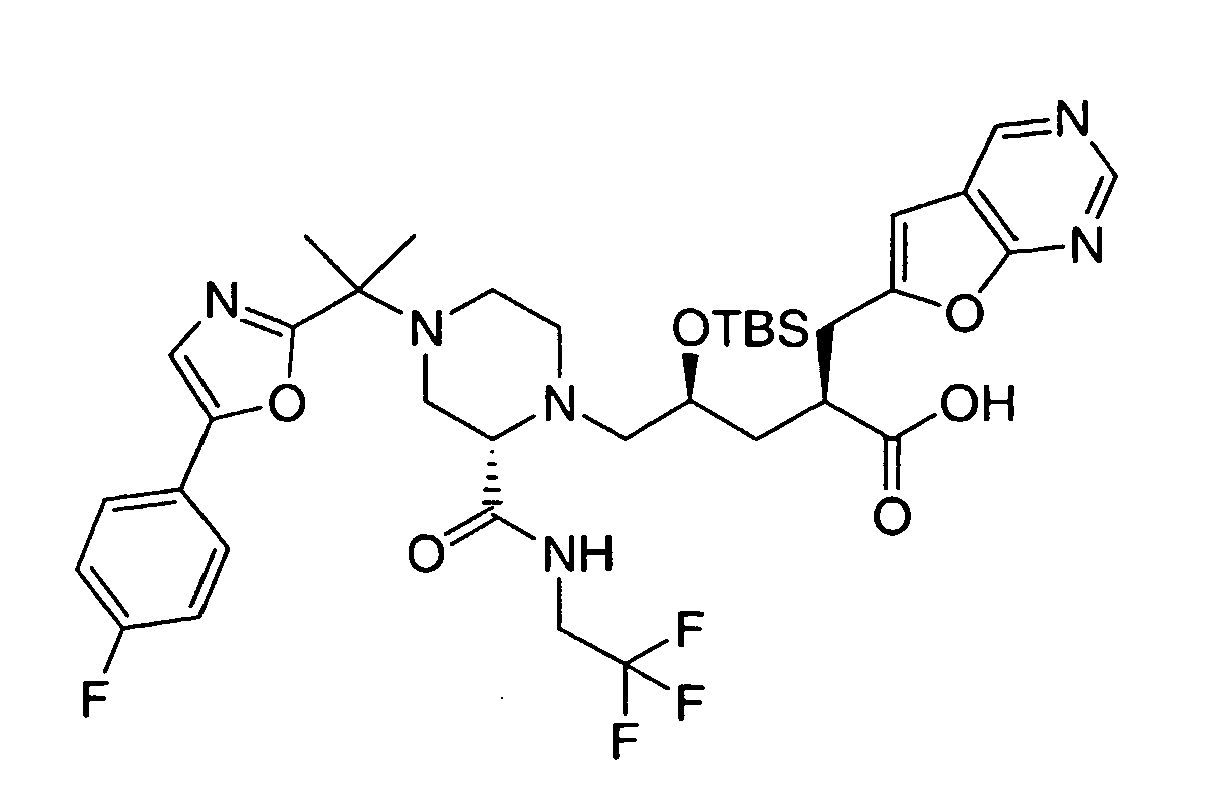
- This compound was prepared according to the procedure described in Example 109 Step H, employing the compound from Step A above (226mg; 0.35mmol) and aqueous LiOH (397uL; 0.385mmol) in dimethoxyethane (4mL). Following removal of solvents as before, the lithium salt was treated (as in Example 109 Step H) with imidazole (476mg; 7.0mmol) and TBSCl (527mg; 3.5mmol) in dry DMF (4mL). Upon workup and hydrolysis in THF/H2O (2:1), the product was purified by flash column chromatography (gradient elution 5% to 10% MeOH/CH2Cl2) to provide the desired carboxylic acid: electrospray ionization mass spectrum: m/e 777.4 (MH+ calcd for C37H49F4N6O6Si, 777.3).
-

- This compound was prepared according to the procedure described in Example 109 Step I, employing the compound from Step B above (0.23mmol) in dry NMP (3.0mL), DIEA (118uL; 0.70mmol), HOBt (71mg; 0.52mmol), amino chromanol obtained from Example 1 Step L (54mg; 0.32mmol), and HBTU (133mg; 0.35mmol). Following workup, flash column chromatography (5% MeOH/DCM) provided the desired product. electrospray ionization mass spectrum: m/e 924.5 (MH+ calcd for C37H49F4N6O6Si, 924.4).
- The titled compound was prepared according to the procedure described in Example 109 Step J, employing the intermediate from Step C above (170mg; 0.18mmol) and TBAF (405uL; 0.405mmol) in dry THF (3.0mL). Following workup, purification by flash column chromatography (5% MeOH/CH2Cl2) provided the titled compound after lyophilization. 1H NMR (500 MHz, CD3OD): δ 1.45 (m, 1H), 1.58 (s, 3H), 1.59 (s, 3H), 2.10 (m, 1H), 2.35-2.44 (complex m, 3H), 2.47 (m, 1H), 2.62 (m, 1H), 2.78 (m, 1H), 2.87 (d, J=9.8 Hz, 1H), 2.95-3.02 (complex m, 2H), 3.07 (dd, J= 3.2, 7.3 Hz, 1H), 3.18-3.29 (complex m, 2H), 3.75-3.82 (complex m, 2H), 3.92 (m, 1H), 3.93-4.09 (complex m, 3H), 5.22 (d, J=4.4 Hz, 1H), 6.74 (d, J=8.3 Hz, 2H), 6.78 (s, 1H), 6.81 (apparent t, J=7.6 Hz, 1H), 7.09 (apparent t, J=7.7 Hz, 1H), 7.14-7.20, (complex m, 3H), 7.32 (s, 1H), 7.39 (s, 1H), 7.72 (m, 2H), 8.80 (s, 1H), 8.92 (s, 1H) ; electrospray ionization mass spectrum: mle 810.3 (MH+ calcd for C40H44F4N7O7, 810.3).
- Synthetic oligonucleotide cassettes of 444 base pairs were designed according to the wild-type sequence of pET-3b-HIVPR. Point mutations were incorporated into the DNA with a bias toward optimal codon usage in E. Coli to yield amino acid mutations listed in Table 2 below. The oligonucleotides were annealed and ligated into pUC-18 or pUC-19 by Midland Certified Reagent Company. The primary sequence was verified before subcloning into a pET-3b expression vector via Nde I and Bpul102 I sites and reconfirmed by automated double-stranded DNA sequencing. Clones carrying the mutant DNA were transformed and expressed as previously described in Schock et al., J. Biol. Chem. 1996, 271: 31957-31963 and Chen et al., J. Biol. Chem. 1995, 270: 21433-21436. The cells were lysed in 50 mM Tris-HCl pH 8.0, 1 mM EDTA, 0.1% NP40, 10 mM MgCl2 , and 100µg / mL DNase I using a microfluidizer processor (Microfluidics International Corp., Newton, MA). The mutant protease was extracted, refolded, and purified over affinity columns as previously described in Schock et al., J. Biol. Chem. 1991, 271: 31957-31963. Protein concentrations were determined by amino acid analysis and purity was confirmed by SDS gel electrophoresis.
- Inhibition studies of the reaction of the protease (which was expressed in Eschericia coli) with a peptide substrate [Val-Ser-Gln-Asn-(betanapthyl)Ala-Pro-Ile-Val, 0.5 mg/mL at the time the reaction is initiated] were in 50 mM Na acetate, pH 5.5, 0.1% bovine serum albumin, 3.75% DMSO at 30°C for 1 hour. Various concentrations of inhibitor in 2 mL DMSO were added to 50 µL of the peptide solution in buffer. The reaction is initiated by the addition of 28 µL of 14.3 picomolar (wild type, K-60, Q-60) and 28.6 pM (V-18) protease in a solution of 50mM Na acetate pH 5.5 and 0.1 % bovine serum albumin. The reaction was quenched with 120 µL of 10% phosphoric acid. Products of the reaction were separated by HPLC (VYDAC wide pore 5 cm C-18 reverse phase, acetonitrile gradient, 0.1% phosphoric acid). The extent of inhibition of the reaction was determined from the peak heights of the products. HPLC of the products, independently synthesized, proved quantitation standards and confirmation of the product composition. The compounds of the invention prepared in Examples 1-114 exhibited IC50 values ranging from about 0.05 to about 1 nM against the wild-type enzyme. The indinavir IC50 value against the wild type enzyme is 0.6 nM (average). The compounds of the invention prepared in Examples 1-114 exhibited IC50 values in the range of about 0.02 to about 5 nM against the mutant enzymes Q-60, K-60, and V-18. These IC50 values range from about 4-fold to greater than about 100-fold more potent than the values of of 20 to 50 nM obtained for indinavir against these same mutant enzymes.
- Mutant viruses were constructed using gapped-duplex oligonucleotide mutagenesis of a subclone of plasmid pWT-6 as described in Colonno et al., Proc. Nat'l Acad. Sci. 1988, 85: 5449-5453. Infectious mutant proviral clones were constructed by subcloning the 833-b.p. Apal-Sse83871 fragment containing the mutagenized protease gene into the corresponding sites of plasmid pNL4-3 (see J. Virol. 1986, 59: 284-291). After transfection of the mutant proviral clone into HeLa cells and growth of viral stocks in cocultivated H9 human T-lymphoid cells, the complete sequence of the viral protease gene from the mutant viral population was verified as described in Nature 1995, 374: 569-571. The amino acid changes from wild type sequence for three of these viral constructs are shown in Table 2.
Table 2 - Wild-type and Mutant HIV-1 Protease Sequences Wild-type L10 K20 L24 M36 S37 R41 M46 I54 R57 Q58 I62 L63 I64 A71 G73 V77 V82 I84 L90 I93 Q-60 I K I V V P V I A M L K-60 I I V E P V I F M L V-18 I I D I K P V S V M L See Condra et al., J. Virol. 1996, 70: 8270-8276 and Olsen et al., J. Biol. Chem. 1999, 274: 23699-23701 for further details. - Inhibition of the spread of HIV in cell culture was measured according to Nunberg et al., J. Virol. 1991, 65: 4887. In this assay, MT-4 T-lymphoid cells were infected with HIV-1 (wild-type, unless otherwise indicated) by using a predetermined inoculum, and cultures were incubated for 24 h. At this time, ≤1% of the cells were positive by indirect immunofluorescence. Cells were then extensively washed and distributed into 96-well culture dishes. Serial twofold dilutions of inhibitor were added to the wells, and cultures were continued for 3 additional days. At 4 days postinfection, 100% of the cells in control cultures were infected. HIV-1 p24 accumulation was directly correlated with virus spread. The cell culture inhibitory concentration was defined as the inhibitor concentration in nanomoles/liter which reduced the spread of infection by at least 95%, or CIC95. The compounds of the invention prepared in Examples 1-114 exhibited CIC95 values in the range of from less than about 8 to about 50 nM against the wild-type viral construct. The CIC95 of indinavir against the wild-type viral construct is from 50 to 100 nM. The compounds of the invention prepared in Examples 1-114 exhibited CIC95 values in the range of about 8 to about 125 nM against the viral constructs Q60, K-60, and V-18. These CIC95 values range from about 4-fold to more than about 100-fold more potent than the values of greater than 1000 nM obtained for indinavir against these same viral constructs.
- MT cells are infected at Day 0 at a concentration of 250,000 per ml with a 1: 1000 dilution of HIV-1 strain IIIb stock (final 125 pg p24/ml; sufficient to yield <1% infected cells on day 1 and 25-100% on day 4). Cells are infected and grown in the following medium: RPMI 1640 (Whittaker BioProducts), 10% inactivated fetal bovine serum, 4 mM glutamine (Gibco Labs) and 1:100 Penicillin-Streptomycin (Gibco Labs).
- The mixture is incubated overnight at 37°C in 5% CO2 atmosphere.
- A matrix of nanomolar range concentrations of the pairwise combinations is prepared. At Day 1, aliquots of 125 ml of inhibitors are added to equal volumes of HIV-infected MT-4 cells (50,000 per well) in a 96-well microtiter cell culture plate. Incubation is continued for 3 days at 37°C in 5% CO2 atmosphere.
- Using a multichannel pipettor, the settled cells are resuspended and 125 ml harvested into a separate microtiter plate. The supernatant is assayed for HIV p24 antigen.
- The concentration of HIV p24 antigen is measured by an enzyme immunoassay, described as follows. Aliquots of p24 antigen to be measured are added to microwells coated with a monoclonal antibody specific for HIV core antigen. The microwells are washed at this point, and at other appropriate steps that follow. Biotinylated HIV-specific antibody is then added, followed by conjugated streptavidin-horseradish peroxidase. A color reaction occurs from the added hydrogen peroxide and tetramethylbenzidine substrate. Color intensity is proportional to the concentration of HIV p24 antigen.
- When there is synergy, pairwise combinations of inhibitors are found to exhibit markedly enhanced inhibition of virus spread, in comparison to each inhibitor alone, or in comparison to merely additive inhibition of each inhibitor.
- The data is processed as follows: fractional inhibitory concentration ratios (FIC) are calculated according to Elion, et al., J. Biol. Chem. 1954, 208: 477. The minimum sum of FICs, which is the maximum synergy, is determined for various pairwise combinations. The smaller the number, the greater the synergy.
-

- Pyrazine 2-carboxylic acid (1204 g) was suspended in DMF (4.8 L, 4 mUg acid). 2,2,2-trifluoroethylamine•HCl (TFEA•HCl) (1200 g), 1-hydroxybenzotriazole (HOBT) (60 g) and triethylamine (TEA) (1410 mL) were then added sequentially (exotherm upon addition of TEA, flask cooled with ice bath and temperature kept below 35 °C). The reaction was cooled to 15 °C and 1-(3-dimethylaminopropyl)-3-ethylcarbodiimide•HCl (EDC•HCl) (1940 g) was added portionwise over 15-30 min. The reaction temperature was kept below 35 °C. When the reaction appeared complete (approx. two hours, <5% pyrazine 2-carboxylic acid by LC assay), the reaction mixture (yellow/white slurry) was diluted with 10% K2CO3 in water (24 L, 20 mL/g acid) and the reaction slurry was kept below 35°C. The slurry was cooled to 10 °C, aged for two hours and filtered (mother liquor assay=3-4mg/mL). The wet cake was washed with deionized water (12 L, 10 mL/g acid) and dried under vacuum (22" Hg) at 40 °C with a nitrogen purge. Theoretical yield of 1816 g . Actual yield 1533 g (84%).
1H NMR: (CD3CN, 400 MHz): δ 9.29(d, J=1.5 Hz, 1H), 8.82 (d, J= 2.5 Hz, 1H), 8.63 (dd, J= 2.6,1.4 Hz, 1H), 8.40 (bs, 1H), 4.14 (dq, J=9.4, 6.8 Hz, 2H).
HPLC Assay conditions: Waters Xterra RP8 column, elution with acetonitrile and 5 mM K phosphate adjusted to pH= 8, detection at 220 nm. -

- Pyrazine amide (60.2 g 0.268 mol, not corrected for water content) was suspended in absolute ethanol (550 mL) in a 1.0 L autoclave hydrogenation vessel and cooled to 15 °C. Wet 20% Pd(OH)2/C 11.0 g (20wt%, 50wt%wet) was added and reaction was purged with N2 three times. H2 (5 psig) was introduced with stirring and the temperature maintained at 15 °C for 60 minutes. The temperature was then increased to 60 °C and the hydrogen pressure increased to 40 psig and the reaction mixture stirred for 18 additional hours. The reaction was considered complete when conversion is >99% by LC assay. The reaction mixture was filtered through Solka-Floc and the catalyst solids were washed with ethanol 2 X 110 mL. Assay of the combined filtrate and washes gave 53.5 g of racemic piperazine amide (Yield = 86%) 1H NMR (CD3CN, 400 MHz): δ7.58 (bs, 1H), 3.90 (dq, J=9.5,6.7 Hz, 2H), 3.24(dd, J=7.9, 5.5 Hz, 1H), 2.96 (dd, J= 12.1, 3.6 Hz, 1H), 2.84-2.78 (m, 1H), 2.77-2.67 (m, 3H), 2.66-2.56 (m, 1H), 1.90 (s, 2 H).
HPLC Assay conditions: YMC Basic column, elution with acetonitrile and 0.1% aqueous H3PO4, detection at 210 nm. -

- The pip amide ethanol filtrate (116.37 g containing 10.3 g of racemic pip amide by LC assay) was concentrated in vacuo to a final volume of 40.2 mL (3.9 mL per gram of pip amide) and the slurry is diluted with 82.4 mL (8 mL per gram pip amide) of acetonitrile (ACN) and stirred until homogenous. Separately (S)-camphorsulfonic acid ((S)-CSA) (19.26 g, MW= 232.30, 1.7 eq) was dissolved in 185 mL of ACN (18 mL per gram of pip amide). The water content of the two solutions was then determined by Karl Fisher titration. The CSA solution was added to the pip amide solution giving a small exotherm to approx. 31-32 °C. Water (11.02 mL, 1.118 mL per gram of pip amide minus the total water content of the two solutions) was then added, such that the acetonitrile:ethanol:water ratio was 26:2.9:1.1 (v/v/v). Solids began to form after 15-30 min. The solution/slurry was heated to 72 °C to completely dissolve all solids. The yellow solution was recooled to 62 °C and seeded with a slurry of 10.3 mg of pip amide salt in 1 mL of acetonitrile. After a two hour age at 62 °C the slurry was allowed to cool to room temperature overnight (crystallization was complete when loss to mother liquors was < 21 mg pip amide/mL by LC assay. The slurry was filtered then washed with 2 x 30 mL of ACN:EtOH:H2O [(26:2.9:1.1), (v:v:v)] solution. The wet cake (~13 g, white solid) was dried at 40 °C in a vacuum oven (24 in Hg, nitrogen sweep) to give 11.16 g of product (yield = 33%). Assay method (Pip Amide) as above. Chiral assay gives an enantiomeric excess (ee) of 98.0%.
1H NMR (CD3OD, 400 MHz): d4.84(bs, 5H), 4.64 (dd, J=12.0, 3.6 Hz, 1H), 4.13-3.94 (m, 3H), 3.77 (m, 2H), 3.66 (m, 1H), 3.54-3.43 (m, 2H), 3.28(d, J= 14.7 Hz, 2H), 2.82 (d, 14.7 Hz, 2H), 2.55 (m, 2H), 2.36 (m, 2H), 2.12-1.998 (m, 4H), 1.92 (d, J=18.4 Hz, 2H), 1.72 (m, 2H), 1.45 (m, 2H), 1.09 (s, 6H), 0.87 (s, 6H).
Enantiomeric excess determined by chiral HPLC of the mono BOC piperazine amide.
HPLC assay conditions: Chiral AGP column, elution with acetonitrile and 10 mM Kphospate, pH=6.5, detection at 210 nm. -

- To a 12 L flask was charged (S)-pip amide salt (412.87 g) having an ee of less than 98%, 7.43 L of ACN and 825 mL of 190 proof EtOH. The slurry was heated to 75 °C, aged for 1 hr at 75 °C (during heating the slurry thickened considerably), then allowed to cool to 25 °C overnight. The slurry was filtered and washed with EtOH (190 proof):ACN (10:90) (2 x 800 mL, 2 mL/g). The white solid was dried in a vacuum oven at 24 in Hg, 40 °C with a nitrogen sweep to give 400 g of product with an ee of 99%. Assays (normal and chiral) were performed as described above in the prior steps.
-

- Bis (S)-CSA piperazine amide salt (20 g) was suspended in a mixture of 113 mL of isopropyl acetate (IPAc) and 57 mL of acetonitrile. Triethylamine (8.26 mL, 2 eq) was added and the mixture stirred until homogenous. A solution of di t-butyl dicarbonate (TBDC) (6.46 g, 1.0 eq) in a mixture of 20 mL isopropyl acetate and 10 mL of acetonitrile (ACN) was then added over 10 minutes. After aging for two hours the solution was assayed as necessary by LC (Pip Amide Assay, see above) until the reaction was complete (i.e., less than 5% starting material). When the reaction was complete, 100 mL of water and 135 mL of isopropyl acetate were added, the resulting layers were separated and the organic layer was concentrated to 28 mL. The residue was then diluted with 28 mL of isopropyl alcohol and reconcentrated to 28 mL. This was repeated two additional times. The yield of BOC pip amide was 87% with a mono:bis BOC ratio of 95:5, as determined by HPLC.
1H NMR (CDCl3, 400MHz): δ=7.39 (app t, J=6.3Hz, 1H), 3.96 (dd, J=3.5, 13.4Hz, 1 H), 3.88 (m, 2H), 3.67 (d, J=11.5Hz, 1H), 3.39 (dd, J=3.8, 8.6Hz, 1H), 3.13 (dd, J=8.6, 13.3Hz, 1H), 3.02 (br, 1H), 2.91 (m, 1H), 2.77 (m, 1H), 1.43 (s, 9H).
13C NMR (CDCl3,) δ= 171.43, 154.41, 123.89 (q, J=78.5Hz), 80.16, 57.65, 43.63, 45.6 (br), 44.0 (br), 40.20 (q, J=34.7Hz), 28.19.
HPLC Assay conditions: YMC Basic column, elution with acetonitrile and 0.1% aqueous H3PO4, detection at 210 nm. - While the foregoing specification teaches the principles of the present invention, with examples provided for the purpose of illustration, the practice of the invention encompasses all of the usual variations, adaptations and/or modifications that come within the scope of the following claims.
or a pharmaceutically acceptable salt thereof.
Claims (39)
- A compound of formula:
 R1 is C1-C6 alkyl, C2-C6 alkenyl, C2-C6 alkynyl, C3-C6 cycloalkyl, aryl, substituted aryl, heteroaryl, or substituted heteroaryl; wherein(i) each of the substituents on substituted aryl is independently(a) halogen,(b) cyano,(c) hydroxy,(d) C1-C6 alkyl,(e) C2-C6 alkenyl,(f) C2-C6 alkynyl,(g) fluorinated C1-C6 alkyl,(h) C1-C6 alkoxy,(i) fluorinated C1-C6 alkoxy,(j) S-(C1-C6 alkyl),(k) heterocycle, or(l) heterocycle substituted with one or more substituents independently selected from halogen, cyano, hydroxy, C1-C6 alkyl, C2-C6 alkenyl, C2-C6 alkynyl, fluorinated C1-C6 alkyl, C1-C6 alkoxy, fluorinated C1-C6 alkoxy, S-(C1-C6 alkyl), and NRaRb;(ii) each of the substituents on substituted heteroaryl is independently(a) halogen,(b) cyano,(c) hydroxy,(d) NRaRb,(e) C1-C6 alkyl,(f) C2-C6 alkenyl,(g) C2-C6 alkynyl,(h) fluorinated C1-C6 alkyl,(i) C1-C6 alkoxy,(j) fluorinated C1-C6 alkoxy,(k) S-(C1-C6 alkyl),(l) phenyl,(m) phenyl substituted with one or more substituents independently selected from halogen, cyano, hydroxy, C1-C6 alkyl, C2-C6 alkenyl, C2-C6 alkynyl, fluorinated C1-C6 alkyl, C1-C6 alkoxy, fluorinated C1-C6 alkoxy, and S-(C1-C6 alkyl),(l) heterocycle, or(m) heterocycle substituted with one or more substituents independently selected from halogen, cyano, hydroxy, C1-C6 alkyl, C2-C6 alkenyl, C2-C6 alkynyl, fluorinated C1-C6 alkyl, C1-C6 alkoxy, fluorinated C1-C6 alkoxy, S-(C1-C6 alkyl), NRaRb, and a 5- or 6-membered heteroaromatic ring consisting of carbon atoms and from 1 to 3 heteroatoms selected from N, O and S;R2 and R3 are each independently hydrogen or C1-C4 alkyl; or R2 and R3 together with the carbon to which they are attached form C3-C6 cycloalkyl;R4 is C1-C6 alkyl, C3-C6 cycloalkyl, aryl, substituted aryl, heteroaryl, or substituted heteroaryl; wherein each of the substituents on substituted aryl is independently halogen, hydroxy, cyano, C1-C6 alkyl, C2-C6 alkenyl, C2-C6 alkynyl, fluorinated C1-C6 alkyl, C1-C6 alkoxy, or heteroaryl; and each of the substituents on substituted heteroaryl is independently halogen, hydroxy, cyano, C1-C6 alkyl, C2-C6 alkenyl, C2-C6 alkynyl, fluorinated C1-C6 alkyl, C1-C6 alkoxy, or aryl;R5 is carbocyclic, substituted carbocyclic, heterocyclic or substituted heterocyclic, wherein each of the substituents on substituted carbocyclic or substituted heterocyclic is independently halogen, hydroxy, C1-C6 alkyl, C2-C6 alkenyl, C2-C6 alkynyl, fluorinated C1-C6 alkyl, or C1-C6 alkoxy;R6 is fluorinated C1-C6 alkyl; andRa and Rb are each independently hydrogen or C1-C4 alkyl; or Ra and Rb together with the nitrogen to which they are attached form C3-C6 azacycloalkyl;or a pharmaceutically acceptable salt thereof.
 - A compound according to claim 1, whereinR1 is C1-C6 alkyl, C2-C6 alkenyl, C2-C6 alkynyl, C3-C6 cycloalkyl, aryl, substituted aryl, heteroaryl, or substituted heteroaryl; whereinor a pharmaceutically acceptable salt thereof.(i) each of the substituents on substituted aryl is independently(a) halogen,(b) cyano,(c) hydroxy,(d) C1-C6 alkyl,(e) C2-C6 alkenyl,(f) C2-C6 alkynyl,(g) fluorinated C1-C6 alkyl,(h) C1-C6 alkoxy,(i) heterocycle, or(j) heterocycle substituted with one or more substituents independently selected from halogen, cyano, hydroxy, C1-C6 alkyl, C2-C6 alkenyl, C2-C6 alkynyl, fluorinated C1-C6 alkyl, C1-C6 alkoxy, and NRaRb;(ii) each of the substituents on substituted heteroaryl is independently(a) halogen,(b) cyano,(c) hydroxy,(d) NRaRb,(e) C1-C6 alkyl,(f) C2-C6 alkenyl,(g) C2-C6 alkynyl,(h) fluorinated C1-C6 alkyl,(i) C1-C6 alkoxy,(j) phenyl,(k) phenyl substituted with one or more substituents independently selected from halogen, cyano, hydroxy, C1-C6 alkyl, C2-C6 alkenyl, C2-C6 alkynyl, fluorinated C1-C6 alkyl, and C1-C6 alkoxy,(l) heterocycle, or(m) heterocycle substituted with one or more substituents independently selected from halogen, cyano, hydroxy, C1-C6 alkyl, C2-C6 alkenyl, C2-C6 alkynyl, fluorinated C1-C6 alkyl, C1-C6 alkoxy, and NRaRb;
- The compound according to claim 1, whereinR4 is C1-C6 alkyl, C3-C6 cycloalkyl, phenyl, substituted phenyl, heteroaryl, or substituted heteroaryl, wherein heteroaryl is selected from pyridyl, pyrazinyl, pyrimidinyl, thiophenyl, thiazolyl, pyridofuranyl, pyrimidofuranyl, pyridothienyl, pyridazothienyl, pyridooxazolyl, pyridazooxazolyl, pyrimidooxazolyl, pyridothiazolyl, and pyridazothiazolyl; and wherein each of the substituents on substituted phenyl or substituted heteroaryl is independently halogen, cyano, hydroxy, C1-C6 alkyl, fluorinated C1-C6 alkyl, or C1-C6 alkoxy;or a pharmaceutically acceptable salt thereof.
- The compound according to claim 3, whereinR4 is


 each Z is independently hydrogen, halogen, cyano, C1-C6 alkyl, or C1-C6 alkoxy; andq is an integer from 0 to 2;or a pharmaceutically acceptable salt thereof.
 - The compound according to claim 1, whereinR5 is carbocyclic, substituted carbocyclic, heterocyclic or substituted heterocyclic, wherein carbocyclic is cyclopentyl, indanyl, or tetralin, and heterocyclic is chroman, thiochroman, or dioxoisothiochroman; wherein each of the substituents on substituted carbocyclic or substituted heterocyclic is independently halogen, hydroxy, C1-C6 alkyl, fluorinated C1-C6 alkyl, or C1-C6 alkoxy;or a pharmaceutically acceptable salt thereof.
- The compound according to claim 5, whereinR5 isor a pharmaceutically acceptable salt thereof.
 A is CRcRd O, or S;each Y is independently hydrogen, halogen, C1-C6 alkyl, fluorinated C1-C6 alkyl, or C1-C6 alkoxy;Rc and Rd are each independently hydrogen or C1-C4 alkyl, or Rc and Rd together with the carbon to which they are attached from C3-C6 cycloalkyl;Re is hydrogen, C1-C4 alkyl, fluorinated C1-C4 alkyl, or phenyl; andp is an integer from 0 to 2;
 - The compound according to claim 6, whereinR5 isor a pharmaceutically acceptable salt thereof.

- The compound according to claim 1, whereinR6 isor a pharmaceutically acceptable salt thereof.




- The compound according to claim 8, whereinR6 isor a pharmaceutically acceptable salt thereof.

- The compound according to claim 1, whereinR1 is C1-C6 alkyl, C3-C6 cycloalkyl, aryl, substituted aryl, heteroaryl, or substituted heteroaryl, wherein heteroaryl is (i) a 5- or 6-membered aromatic ring consisting of carbon atoms and from 1 to 3 heteroatoms selected from N, S, and O or (ii) an 8- to 10-membered bicyclic ring system consisting of carbon atoms and from 1 to 3 heteroatoms selected from N, S, and O, wherein at least one of the rings in the bicyclic system is an aromatic ring; wherein(i) each of the substituents on substituted aryl is independently(a) halogen,(b) cyano,(c) hydroxy,(d) C1-C6 alkyl,(e) C2-C6 alkenyl,(f) C2-C6 alkynyl,(g) fluorinated C1-C6 alkyl,(h) C1-C6 alkoxy,(i) fluorinated C1-C6 alkoxy,(j) S-(C1-C6 alkyl),(k) heterocycle, or(l) heterocycle substituted with one or more substituents independently selected from halogen, cyano, hydroxy, C1-C6 alkyl, C2-C6 alkenyl, C2-C6 alkynyl, fluorinated C1-C6 alkyl, C1-C6 alkoxy, fluorinated C1-C6 alkoxy, S-(C1-C6 alkyl), and NRaRb ;(ii) each of the substituents on substituted heteroaryl is independentlyor a pharmaceutically acceptable salt thereof.(a) halogen,(b) cyano,(c) hydroxy,(d) NRaRb,(e) C1-C6 alkyl,(f) C2-C6 alkenyl,(g) C2-C6 alkynyl,(h) fluorinated C1-C6 alkyl,(i) C1-C6 alkoxy,(j) fluorinated C1-C6 alkoxy,(k) S-(C1-C6 alkyl),(l) phenyl,(m) phenyl substituted with one or more substituents independently selected from halogen, cyano, hydroxy, C1-C6 alkyl, C2-C6 alkenyl, C2-C6 alkynyl, fluorinated C1-C6 alkyl, C1-C6 alkoxy, fluorinated C1-C6 alkoxy, and S-(C1-C6 alkyl),(l) heterocycle, or(m) heterocycle substituted with one or more substituents independently selected from halogen, cyano, hydroxy, C1-C6 alkyl, C2-C6 alkenyl, C2-C6 alkynyl, fluorinated C1-C6 alkyl, C1-C6 alkoxy, fluorinated C1-C6 alkoxy, S-(C1-C6 alkyl), NRaRb, and a 5- or 6-membered heteroaromatic ring consisting of carbon atoms and from 1 to 3 heteroatoms selected from N, O and S;
- The compound according to claim 10, whereinR1 is C1-C6 alkyl, C1-C6 cycloalkyl, phenyl, substituted phenyl, heteroaryl, or substituted heteroaryl, wherein heteroaryl is pyridyl, methylenedioxyphenyl, furanyl, benzofuranyl, benzothiofuranyl, benzoxazolyl, benzothiazolyl, azabenzothiazolyl, azabenzoxazolyl, azabenzofuranyl, azabenzothiofuranyl, oxazolyl, thiazolyl, isoxazolyl, triazolyl, thiadiazolyl, oxadiazolyl, indazolyl, pyrrolyl, pyrazolyl, thiophenyl, or thienothiophenyl; and whereinor a pharmaceutically acceptable salt thereof.(i) each of the substituents on substituted phenyl is independently(a) halogen,(b) cyano,(c) hydroxy,(d) C1-C4 alkyl,(e) fluorinated C1-C4 alkyl,(f) C1-C4 alkoxy,(g) fluorinated C1-C4 alkoxy,(h) S-(C1-C4 alkyl),(i) heterocycle which is a 5- or 6-membered unsaturated monocyclic ring consisting of carbon atoms and from 1 to 3 heteroatoms selected from N, O and S, or(j) substituted heterocycle which is a 5- or 6-membered unsaturated monocyclic ring as defined in (i) substituted with one or more substituents independently selected from halogen, cyano, hydroxy, C1-C4 alkyl, fluorinated C1-C4 alkyl, C1-C4 alkoxy, fluorinated C1-C4 alkoxy, S-(C1-C4 alkyl) and NRaRb; and(ii) each of the substituents on substituted heteroaryl is independently(a) halogen,(b) cyano,(c) hydroxy,(d) NRaRb, if and only if the heteroaryl is pyridyl,(e) C1-C4 alkyl,(f) fluorinated C1-C4 alkyl,(g) C1-C4 alkoxy,(h) fluorinated C1-C4 alkoxy,(i) S-(C1-C4 alkyl),(j) phenyl,(k) phenyl substituted with one or more substituents independently selected from halogen, cyano, hydroxy, C1-C4 alkyl, fluorinated C1-C4 alkyl, C1-C4 alkoxy, fluorinated C1-C4 alkoxy, and S-(C1-C4 alkyl),(l) heterocycle which is a 5- or 6-membered unsaturated monocyclic ring consisting of carbon atoms and from 1 to 3 heteroatoms selected from N, O and S;(m) substituted heterocycle which is a 5- or 6-membered unsaturated monocyclic ring as defined in (1) substituted with one or more substituents independently selected from halogen, cyano, hydroxy, C1-C4 alkyl, fluorinated C1-C4 alkyl, C1-C4 alkoxy, fluorinated C1-C4 alkoxy, S-(C1-C4 alkyl), NRaRb, thiazolyl, oxazolyl, imidazolyl, pyrazolyl, triazolyl, pyrrolyl, furanyl, thienyl, isoxazolyl, and isothiazolyl;
- The compound according to claim 11, wherein heterocycle in (i)(i) and in (ii)(1) are each independently


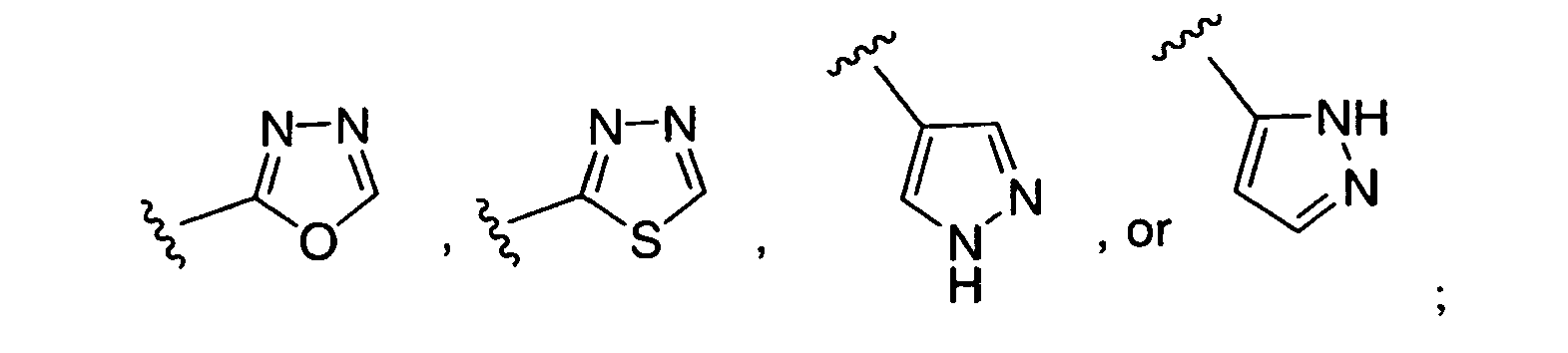
substituted heterocycle in (i)(j) is heterocycle as defined above with one or more substituents independently selected from halogen, cyano, C1-C4 alkyl, fluorinated C1-C4 alkyl, C1-C4 alkoxy, fluorinated C1-C4 alkoxy, and S-(C1-C4 alkyl); and
substituted heterocycle in (ii)(m) is heterocycle as defined above with one or more substituents independently selected from halogen, hydroxy, cyano, C1-C4 alkyl, fluorinated C1-C4 alkyl, C1-C4 alkoxy, fluorinated C1-C4 alkoxy, S-(C1-C4 alkyl), NRaRb, thiazolyl, oxazolyl, imidazolyl, pyrazolyl, triazolyl, pyrrolyl, isoxazolyl, and isothiazolyl; or is
- The compound according to claim 1, whereinR1 is


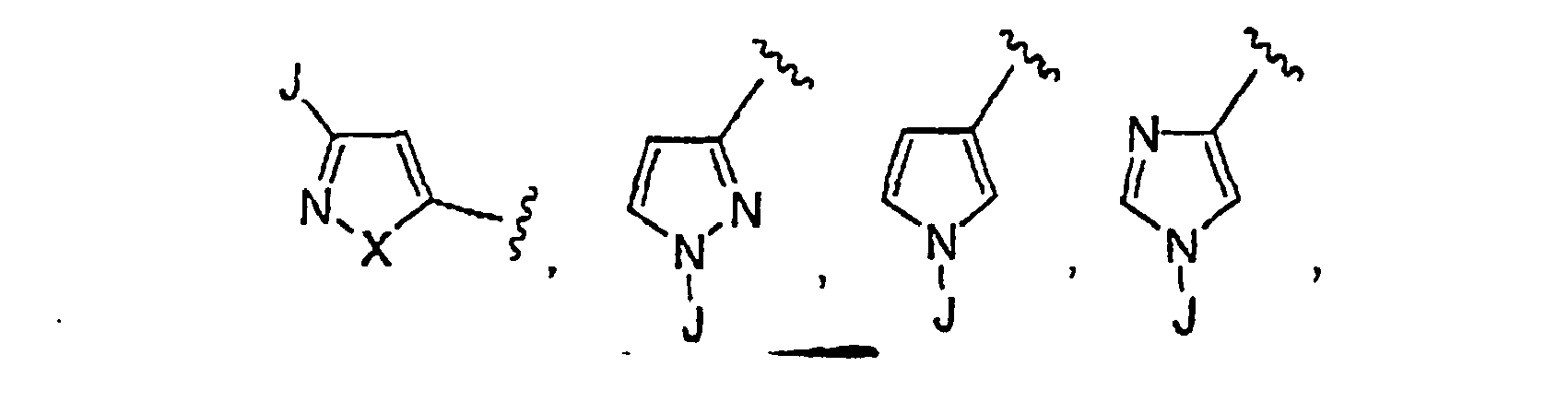

 each D is independently hydrogen, halogen, cyano, hydroxy, NRaRb, C1-C4 alkyl, C1-C4 alkoxy, fluorinated C1-C4 alkoxy, S-(C1-C4 alkyl), phenyl, substituted phenyl, heterocycle, or substituted heterocycle; wherein substituted phenyl is phenyl with one or more subsituents independently selected from halogen, hydroxy, C1-C4 alkyl, and C1-C4 alkoxy; and wherein substituted heterocycle is heterocycle with one or more substituents independently selected from halogen, hydroxy, C1-C4 alkyl, C1-C4 alkoxy, fluorinated C1-C4 alkoxy, and S-(C1-C4 alkyl);each E is independently hydrogen, halogen, cyano, hydroxy, C1-C4 alkyl, C1-C4 alkoxy, heterocycle, or substituted heterocycle;G and G' are each independently selected from hydrogen, halogen, cyano, hydroxy, C1-C4 alkyl, fluorinated C1-C4 alkyl, and C1-C4 alkoxy;J is
 each L is independently hydrogen, halogen, cyano, hydroxy, C1-C4 alkyl, fluorinated C1-C4 alkyl, or C1-C4 alkoxy;X is O or S;heterocycle in each of D, E and J is independently


 s, s', and t are each independently integers from 0 to 2;or a pharmaceutically acceptable salt thereof.
 - The compound according to claim 13, whereinR6 isor a pharmaceutically acceptable salt thereof.


- The compound according to claim 14, whereinR4 is


 each Z is independently hydrogen, halogen, cyano, C1-C6 alkyl, or C1-C6 alkoxy; andq is an integer from 0 to 2;or a pharmaceutically acceptable salt thereof.
 - The compound according to claim 15, whereinR1 is

 R4 is
R4 is
 R5 is
R5 is R6 is
R6 is J is
J is heterocycle is

 X is O or S;each Y is independently hydrogen, halogen, C1-C6 alkyl, fluorinated C1-C6 alkyl, or C1-C4 alkoxy; andp is an integer from 0 to 2;or a pharmaceutically acceptable salt thereof.
 - The compound according to claim 16, whereinR2 and R3 are each independently hydrogen or methyl;each L is independently hydrogen, chlorine, or fluorine;each Y is independently hydrogen, chlorine, or fluorine; andeach of the substituents on substituted heterocycle is independently chlorine, fluorine, methoxy, ethoxy, -OCF3, -OCHF2, methyl, ethyl, n-propyl, -S-CH3, -N(CH3)2, and thiazolyl;or a pharmaceutically acceptable salt thereof.
- The compound according to claim 16, whereinR1 is
 R4 is
R4 is R5 is
R5 is R6 is
R6 is J is
J is heterocycle is
 XisOorS;each Y is independently hydrogen, halogen, C1-C6 alkyl, fluorinated C1-C6 alkyl, or C1-C4 alkoxy; andp is an integer from 0 to 2;or a pharmaceutically acceptable salt thereof.
 - The compound according to claim 18, whereinR2 and R3 are each independently hydrogen or methyl;each L is independently hydrogen, chlorine, or fluorine;each Y is independently hydrogen, chlorine, or fluorine; andeach of the substituents on substituted heterocycle is independently chlorine, fluorine, methoxy, ethoxy, -OCF3, -OCHF2, methyl, ethyl, n-propyl, -S-CH3, -N(CH3)2, and thiazolyl;or a pharmaceutically acceptable salt thereof.
- The compound according to claim 1, wherein the compound is selected from the group consisting of(αR,γS,2S)-N-((3S,4S)-3,4-dihydro-3-hydroxy-2H-1-benzopyran-4-yl)-4-(1-furo[3,2-c]pyridin-2-yl-1-methylethyl)-γ-hydroxy-α-(phenylmethyl)-2-[[(2,2,2-trifluoroethyl)amino]carbonyl]-1-piperazinepentanamide;(αR,γS,2S)-N-((3S,4S)-3,4-dihydro-3-hydroxy-2H-1-benzopyran-4-yl)-2-[[(2-fluoroethyl)amino]carbonyl]-4-(1-furo[3,2-c]pyridin-2-yl-1-methylethyl)-γ-hydroxy-α-(phenylmethyl)-1-piperazinepentanamide;(αR,γS,2S)-N-((3S,4S)-3,4-dihydro-3-hydroxy-2H-1-benzofuran-4-yl)-2-[[[2-fluoro-1,1-bis(fluoromethyl)ethyl]amino]carbonyl]-4-(1-furo[3,2-c]pyridin-2-yl-1-methylethyl)-γ-hydroxy-α-(phenylmethyl)-1-piperazinepentanamide;(αR,γS,2S)-2-[[[1,1-bis(fluoromethyl)ethyl]amino]carbonyl]-N-((3S,4S)-3,4-dihydro-3-hydroxy-2H-1-benzopyran-4-yl)-4-(1-furo[3,2-c]pyridin-2-yl-1-methylethyl)-γ-hydroxy-α-(phenylmethyl)-1-piperazinepentanamide;(αR,γS,2S)-N-((3S,4S)-3,4-dihydro-3-hydroxy-2H-1-benzopyran-4-yl)-4-(1-furo[3,2-c]pyridin-2-yl-1-methylethyl)-γ-hydroxy-α-(phenylmethyl)-2-[[(3,3,3-trifluoropropyl)amino]carbonyl]-1-piperazinepentanamide;(αR,γS,2S)-N-((3S,4S)-3,4-dihydro-3-hydroxy-2H-1-benzopyran-4-yl)-4-(1-furo[3,2-c]pyridin-2-yl-1-methylethyl)-γ-hydroxy-2-[[(2,2,3,3,3-pentafluoropropyl)-mino]carbonyl]-α-(phenylmethyl)-1-piperazinepentanamide;(αR,γS,2S)-N-((3S,4S)-3,4-dihydro-3-hydroxy-2H-1-benzopyran-4-yl)-2-[[(2-fluoro-1,1-dimethylethyl)amino]carbonyl]-4-(1-furo[3,2-c]pyridin-2-yl-1-methylethyl)-γ-hydroxy-α-(phenylmethyl)-1-piperazinepentanamide;(αR,γS,2S)-N-((1S,2R)-1,2-dihydro-2-hydroxy-1H-inden-1-yl)-4-(1-furo[3,2-c]pyridin-2-yl-1-methylethyl)-γ-hydroxy-α-(phenylmethyl)-2-[[(2,2,2-trifluoroethyl)amino]carbonyl]-1-piperazinepentanamide;(αR,γS,2S)-N-((1S,2R)-1,2-dihydro-2-hydroxy-1H-inden-1-yl)-2-[[(2-fluoroethyl)amino]carbonyl]-4-[1-furo[3,2-c]pyridin-2-yl-1-methylethyl)-γ-hydroxy-α-(phenylmethyl)-1-piperazinepentanamide;(αR,γS,2S)-N-((1S,2R)-1,2-dihydro-2-hydroxy-1H-inden-1-yl)-4-(1-furo[3,2-c]pyridin-2-yl-1-methylethyl)-y-hydroxy-α-(phenylmethyl)-2-[[(3,3,3-trifluoropropyl)amino]carbonyl]-1-piperazinepentanamide;(αR,γS,2S)-N-((1S,2R)-1,2-dihydro-2-hydroxy-1H-inden-1-yl)-4-(1-furo[3,2-c]pyridin-2-yl-1-methylethyl)-γ-hydroxy-2-[[(2,2,3,3,3-pentafluoropropyl)amino]-carbonyl]-α-(phenylmethyl)-1-piperazinepentanamide;(αR,γS,2S)-4-(2-benzofuranylmethyl)-N-((3S,4S)-3,4-dihydro-3-hydroxy-2H-1-benzopyran-4-yl)-γ-hydroxy-α-(phenylmethyl)-2-[[(2,2,2-trifluoroethyl)amino]-carbonyl]-1-piperazinepentanamide;(αR,γS,2S)-N-((3S,4S)-3,4-dihydro-3-hydroxy-2H-1-benzopyran-4-yl)-γ-hydroxy-α-(phenylmethyl)-4-[[5-(3-pyridinyl)-1-furanyl]methyl]-2-[[(2,2,2-trifluoroethyl)-amino]carbonyl]-1-piperazinepentanamide;(αR,γS,2S)-N-((3S,4S)-3,4-dihydro-3-hydroxy-2H-1-benzopyran-4-yl)-γ-hydroxy-α-(phenylmethyl)-4-(3-pyridinylmethyl)-2-[[(2,2,2-trifluoroethyl)amino]carbonyl]-1-piperazinepentanamide;(αR,γS,2S)-N-((3S,4S)-3,4-dihydro-3-hydroxy-2H-1-benzopyran-4-yl)-γ-hydroxy-α-(phenylmethyl)-4-[[5-(3-pyridinyl)-1-furanyl]methyl]-2-[[(2,2,2-trifluoroethyl)-amino]carbonyl]-1-piperazinepentanamide;(αR,γS,2S)-N-((3S,4S)-3,4-dihydro-3-hydroxy-2H-1-benzopyran-4-yl)-γ-hydroxy-α-(phenylmethyl)-4-[[5-(5-pyrimidinyl)-1-furanyl]methyl]-2-[[(2,2,2-trifluoroethyl)-amino]carbonyl]-1-piperazinepentanamide;(αR,γS,2S)-N-((3S,4S)-3,4-dihydro-3-hydroxy-2H-1-benzopyran-4-yl)-γ-hydroxy-4-[(3-methyl-7-methoxy-4-benzofuranyl)methyl]-α-(3-pyridinylmethyl)-2-[[(2,2,2-trifluoroethyl)amino]carbonyl]-1-piperazinepentanamide;(αR,γS,2S)-N-((3S,4S)-3,4-dihydro-3-hydroxy-2H-1-benzopyran-4-yl)-γ-hydroxy-4-[(7-methoxy-2-benzofuranyl)methyl]-α-(phenylmethyl)-2-[[(2,2,2-trifluoroethyl)-amino]carbonyl]-1-piperazinepentanamide;(αR,γS,2S)-N-((3S,4S)-3,4-dihydro-3-hydroxy-2H-1-benzopyran-4-yl)-γ-hydroxy-α-(phenylmethyl)-4-[(1-phenyl-1H-pyrrol-3-yl)methyl]-2-[[(2,2,2-trifluoroethyl)-amino]carbonyl]-1-piperazinepentanamide;(αR,γS,2S)-N-((3S,4S)-3,4-dihydro-3-hydroxy-2H-1-benzopyran-4-yl)-γ-hydroxy-4-[(1-phenyl-1H-imidazol-4-yl)methyl]-α-(phenylmethyl)-2-[[(2,2,2-trifluoroethyl)-amino]carbonyl]-1-piperazinepentanamide;(αR,γS,2S)-4-(2-benzofuranylmethyl)-N-((1S,2R)-1,2-dihydro-2-hydroxy-1H-inden-1-yl)-γ-hydroxy-α-(phenylmethyl)-2-[[(2,2,2-trifluoroethyl)amino]carbonyl]-1-piperazinepentanamide;(αR,γS,2S)-N-((1S,2R)-1,2-dihydro-2-hydroxy-1H-inden-1-yl)-γ-hydroxy-α-(phenylmethyl)-4-(3-pyridinylmethyl)-2-[[(2,2,2-trifluoroethyl)amino]carbonyl]-1-piperazinepentanamide;(αR,γS,2S)-N-((3S,4S)-3,4-dihydro-3-hydroxy-2H-1-benzopyran-4-yl)-γ-hydroxy-4-[(5-phenyl-2-furanyl)methyl]-α-(3-pyridinylmethyl)-2-[[(2,2,2-trifluoroethyl)-amino]carbonyl]-1-piperazinepentanamide;(αR,γS,2S)-4-(2-benzopyranylmethyl)-N-((3S,4S)-3,4-dihydro-3-hydroxy-2H-1-benzopyran-4-yl)-γ-hydroxy-α-(3-pyridinylmethyl)-2-[[(2,2,2-trifluoroethyl)-amino]carbonyl]-1-piperazinepentanamide;(αR,γS,2S)-N-((3S,4S)-3,4-dihydro-3-hydroxy-2H-1-benzopyran-4-yl)-γ-hydroxy-α-(3-pyridinylmethyl)-4-(thieno[2,3-b]thien-2-ylmethyl)-2-[[(2,2,2-trifluoroethyl)amino]carbonyl]-1-piperazinepentanamide;(αR,γS,2S)-4-[(2,6-difluorophenyl)methyl]-N-((3S,4S)-3,4-dihydro-3-hydroxy-2H-1-benzopyran-4-yl)-γ-hydroxy-α-(3-pyridinylmethyl)-2-[[(2,2,2-trifluoroethyl)-amino]carbonyl]-1-piperazinepentanamide;(αR,γS,2S)-N-((3S,4S)-3,4-dihydro-3-hydroxy-2H-1-benzopyran-4-yl)-γ-hydroxy-α-(3-pyridinylmethyl)-4-(thieno[3,2-b]thien-2-ylmethyl)-2-[[(2,2,2-trifluoroethyl)-aminolcarbonyl]-1-piperazinepentanamide;(αR,γS,2S)-N-((3S,4S)-3,4-dihydro-3-hydroxy-2H-1-benzopyran-4-yl)-γ-hydroxy-4-[(7-methoxy-2-benzofuranyl)methyl]-α-(3-pyridinylmethyl)-2-[[(2,2,2-trifluoroethyl)amino]carbonyl]-1-piperazinepentanamide;(αR,γS,2S)-N-((3S,4S)-3,4-dihydro-3-hydroxy-2H-1-benzopyran-4-yl)-γ-hydroxy-α-(3-pyridinylmethyl)-4-[[5-(2-thienyl)-2-furanyl]methyl]-2-[[(2,2,2-trifluoroethyl)-amino]carbonyl]-1-piperazinepentanamide;(αR,γS,2S)-N-((3S,4S)-3,4-dihydro-3-hydroxy-2H-1-benzopyran-4-yl)-γ-hydroxy-4-[(1-phenyl-1H-pyrrol-3-yl)methyl]-α-(3-pyridinylmethyl)-2-[[(2,2,2-trifluoroethyl)-amino]carbonyl]-1-piperazinepentanamide;(αR,γS,2S)-N-((3S,4S)-3,4-dihydro-3-hydroxy-2H-1-benzopyran-4-yl)-γ-hydroxy-4-(1-phenyl-1H-imidazol-4-yl)methyl]-α-(3-pyridinylmethyl)-2-[[(2,2,2-trifluoroethyl)-amino]carbonyl]-1-piperazinepentanamide;(αR,γS,2S)-N-((3S,4S)-3,4-dihydro-3-hydroxy-2H-1-benzopyran-4-yl)-γ-hydroxy-4-[[5-(5-methyl-2-thienyl)-2-furanyl]methyl]-α-(3-pyridinylmethyl)-2-[[(2,2,2-trifluoroethyl)amino]carbonyl]-1-piperazinepentanamide;(αR,γS,2S)-N-((3S,4S)-3,4-dihydro-3-hydroxy-2H-1-benzopyran-4-yl)-γ-hydroxy-4-[(5-phenyl-2-furanyl)methyl]-α-(4-pyridinylmethyl)-2-[[(2,2,2-trifluoroethyl)amino]-carbonyl]-1-piperazinepentanamide;(αR,γS,2S)-4-(2-benzofuranylmethyl)-N-((3S,4S)-3,4-dihydro-3-hydroxy-2H-1-benzopyran-4-yl)-γ-hydroxy-α-(4-pyridinylmethyl)-2-[[(2,2,2-trifluoroethyl)-amino]carbonyl]-1-piperazinepentanamide;(αR,γS,2S)-N-((3S,4S)-3,4-dihydro-3-hydroxy-2H-1-benzopyran-4-yl)-γ-hydroxy-4-[1-methyl-1-[5-(4-pyridinyl)-2-furanyl]ethyl]-α-(phenylmethyl)-2-[[(2,2,2-trifluoroethyl)amino]carbonyl]-1-piperazinepentanamide;(αR,γS,2S)-N-((3S,4S)-3,4-dihydro-3-hydroxy-2H-1-benzopyran-4-yl)-γ-hydroxy-α-(phenylmethyl)-4-[1-[5-(4-pyridinyl)-1-furanyl]ethyl]-2-[[(2,2,2-trifluoroethyl)-amino]carbonyl]-1-piperazinepentanamide;(αR,γS,2S)-N-((3S,4S)-3,4-dihydro-3-hydroxy-2H-1-benzopyran-4-yl)-γ-hydroxy-α-(phenylmethyl)-4-[1-[5-(4-pyridinyl)-1-furanyl]ethyl]-2-[[(2,2,2-trifluoroethyl)-amino]carbonyl]-1-piperazinepentanamide;(αR,γS,2S)-N-((3S,4S)-3,4-dihydro-3-hydroxy-2H-1-benzopyran-4-yl)-γ-hydroxy-4-[1-methyl-1-(1-phenyl-1H-pyrazol-3-yl)ethyl]-α-(3-pyridinylmethyl)-2-[[(2,2,2-trifluoroethyl)amino]carbonyl]-1-piperazinepentanamide;(αR,γS,2S)-N-((3S,4S)-3,4-dihydro-3-hydroxy-2H-1-benzopyran-4-yl)-γ-hydroxy-4-[1-methyl-1-(3-phenyl-5-isoxazolyl)ethyl]-α-(3-pyridinylmethyl)-2-[[(2,2,2-trifluoroethyl)amino]carbonyl]-1-piperazinepentanamide;(αR,γS,2S)-N-((3S,4S)-3,4-dihydro-3-hydroxy-2H-1-benzopyran-4-yl)-γ-hydroxy-4-[1-methyl-1-(3-phenyl-5-isoxazolyl)ethyl]]-α-(phenylmethyl)-2-[[(2,2,2-trifluoroethyl)amino]carbonyl]-1-piperazinepentanamide;(αR,γS,2S)-4-[(7-chlorobenzofuran-2-yl)methyl]-N-((3S,4S)-3,4-dihydro-3-hydroxy-2H-1-benzopyran-4-yl)-γ-hydroxy-α-(3-pyridinylmethyl)-2-[[(2,2,2-trifluoroethyl)-amino]carbonyl]-1-piperazinepentanamide;(αR,γS,2S)-N-((3S,4S)-3,4-dihydro-3-hydroxy-2H-1-benzopyran-4-yl)-4-(1-furo[3,2-c]pyridin-2-yl-1-methylethyl)-γ-hydroxy-α-(phenylmethyl)-2-[[(2,2-difluoroethyl)amino]carbonyl]-1-piperazinepentanamide;(αR,γS,2S)-N-((3S,4S)-3,4-dihydro-3-hydroxy-2H-1-benzopyran-4-yl)-γ-hydroxy-α-(phenylmethyl)-4-[[5-(2-thiazolyl)-3-pyridinyl]methyl]-2-[[(2,2,2-trifluoroethyl)-amino]carbonyl]-1-piperazinepentanamide;(αR,γS,2S)-N-((3S,4S)-3,4-dihydro-3-hydroxy-2H-1-benzopyran-4-yl)-γ-hydroxy-4-[[5-(2-oxazolyl)-3-pyridinyl]methyl]-α-(phenylmethyl)-2-[[(2,2,2-trifluoroethyl)-amino]carbonyl]-1-piperazinepentanamide;(αR,γS,2S)-N-((3S,4S)-3,4-dihydro-3-hydroxy-2H-1-benzopyran-4-yl)-γ-hydroxy-α-(phenylmethyl)-4-[[5-(4-thiazolyl)-3-pyridinyl]methyl]-2-[[(2,2,2-trifluoroethyl)-amino]carbonyl]-1-piperazinepentanamide;(αR,γS,2S)-N-((3S,4S)-3,4-dihydro-3-hydroxy-2H-1-benzopyran-4-yl)-γ-hydroxy-α-(phenylmethyl)-4-[[5-(2-thiazolyl)-2-furanyl]methyl]-2-[[(2,2,2-trifluoroethyl)-amino]carbonyl]-1-piperazinepentanamide;(αR,γS,2S)-4-[[5-(5-chloro-3-pyridinyl)-2-furanyl]methyl]-N-((3S,4S)-3,4-dihydro-3-hydroxy-2H-1-benzopyran-4-yl)-γ-hydroxy-α-(phenylmethyl)-2-[[(2,2,2-trifluoroethyl)amino]carbonyl]-1-piperazinepentanamide;(αR,γS,2S)-N-((3S,4S)-3,4-dihydro-3-hydroxy-2H-1-benzopyran-4-yl)-γ-hydroxy-4-[(5-phenyl-2-furanyl)methyl]-α-(phenylmethyl)-2-[[(2,2,2-trifluoroethyl)amino]-carbonyl]- 1-piperazinepentanamide;(αR,γS,2S)-4-[(4-chloro-5-phenyl-2-furanyl)methyl]-N-((3S,4S)-3,4-dihydro-3-hydroxy-2H-1-benzopyran-4-yl)-γ-hydroxy-α-(phenylmethyl)-2-[[(2,2,2-trifluoroethyl)amino]carbonyl]-1-piperazinepentanamide;(αR,γS,2S)-N-((3S,4S)-3,4-dihydro-3-hydroxy-2H-1-benzopyran-4-yl)-γ-hydroxy-α-(phenylmethyl)-4-[[5-(2-pyridinyl)-2-furanyl]methyl]-2-[[(2,2,2-trifluoroethyl)-amino]carbonyl]-1-piperazinepentanamide;(αR,γS,2S)-4-[[5-(5-chloro-2-pyridinyl)-2-furanyl]methyl]-N-((3S,4S)-3,4-dihydro-3-hydroxy-2H-1-benzopyran-4-yl)-γ-hydroxy-α-(phenylmethyl)-2-[[(2,2,2-trifluoroethyl)amino]carbonyl]-1-piperazinepentanamide;(αR,γS,2S)-N-((3S,4S)-3,4-dihydro-3-hydroxy-2H-1-benzopyran-4-yl)-γ-hydroxy-4-[[5-(2-methyl-4-pyridinyl)-2-furanyl]methyl]-α-(phenylmethyl)-2-[[(2,2,2-trifluoroethyl)amino]carbonyl]-1-piperazinepentanamide;(αR,γS,2S)-N-((3S,4S)-3,4-dihydro-3-hydroxy-2H-1-benzopyran-4-yl)-4-[[5-(2-ethyl-4-pyridinyl)-2-furanyl]methyl]-γ-hydroxy-α-(phenylmethyl)-2-[[(2,2,2-trifluoroethyl)-amino]carbonyl]-1-piperazinepentanamide;(αR,γS,2S)-N-((3S,4S)-3,4-dihydro-3-hydroxy-2H-1-benzopyran-4-yl)-γ-hydroxy-4-[[5-(5-oxazolyl)-2-furanyl]methyl]-α-(phenylmethyl)-2-[[(2,2,2-trifluoroethyl)-amino]carbonyl]-1-piperazinepentanamide;(αR,γS,2S)-N-((3S,4S)-3,4-dihydro-3-hydroxy-2H-1-benzopyran-4-yl)-γ-hydroxy-α-(phenylmethyl)-4-[[1-(4-pyridinyl)-1H-pyrrol-3-yl]methyl]-2-[[(2,2,2-trifluoroethyl)-amino]carbonyl]-1-piperazinepentanamide;(αR,γS,2S)-N-((3S,4S)-3,4-dihydro-3-hydroxy-2H-1-benzopyran-4-yl)-γ-hydroxy-α-(phenylmethyl)-4-[[1-(3-pyridinyl)-1H-pyrrol-3-yl]methyl]-2-[[(2,2,2-trifluoroethyl)-amino]carbonyl]-1-piperazinepentanamide;(αR,γS,2S)-N-((3S,4S)-3,4-dihydro-3-hydroxy-2H-1-benzopyran-4-yl)-γ-hydroxy-α-(phenylmethyl)-4-[[5-(4-pyridazinyl)-2-furanyl]methyl]-2-[[(2,2,2-trifluoroethyl)-amino]carbonyl]-1-piperazinepentanamide;(αR,γS,2S)-N-((3S,4S)-3,4-dihydro-3-hydroxy-2H-1-benzopyran-4-yl)-γ-hydroxy-4-[1-methyl-1-[3-methyl-5-(4-pyridinyl)-2-furanyl]ethyl]-α-(phenylmethyl)-2-[[(2,2,2-trifluoroethyl)amino]carbonyl]-1-piperazinepentanamide;(αR,γS,2S)-N-((3S,4S)-3,4-dihydro-3-hydroxy-2H-1-benzopyran-4-yl)-γ-hydroxy-α-(phenylmethyl)-4-[[5-(2-pyrazinyl)-2-furanyl]methyl]-2-[[(2,2,2-trifluoroethyl)-amino]carbonyl]-1-piperazinepentanamide;(αR,γS,2S)-N-((3S,4S)-3,4-dihydro-3-hydroxy-2H-1-benzopyran-4-yl)-γ-hydroxy-4-[[5-(1-methyl-1H-pyrazol-4-yl)-3-pyridinyl]methyl]-α-(phenylmethyl)-2-[[(2,2,2-trifluoroethyl)amino]carbonyl]-1-piperazinepentanamide;(αR,γS,2S)-N-((3S,4S)-3,4-dihydro-3-hydroxy-2H-1-benzopyran-4-yl)-γ-hydroxy-α-(phenylmethyl)-4-[[5-(2-thienyl)-3-pyridinyl]methyl]-2-[[(2,2,2-trifluoroethyl)amino]-carbonyl]-1-piperazinepentanamide;(αR,γS,2S)-N-((3S,4S)-3,4-dihydro-3-hydroxy-2H-1-benzopyran-4-yl)-γ-hydroxy-α-(phenylmethyl)-4-[[5-(3-thienyl)-3-pyridinyl]methyl]-2-[[(2,2,2-trifluoroethyl)-amino]carbonyl]-1-piperazinepentanamide;(αR,γS,2S)-N-((3S,4S)-3,4-dihydro-3-hydroxy-2H-1-benzopyran-4-yl)-γ-hydroxy-α-(phenylmethyl)-4-[[5-(4-pyrimidinyl)-2-furanyl]methyl]-2-[[(2,2,2-trifluoroethyl)amino]carbonyl]-1-piperazinepentanamide;(αR,γS,2S)-4-[(7-chlorofuro[3,2-c]pyridin-2-yl)methyl]-N-((3S,4S)-3,4-dihydro-3-hydroxy-2H-1-benzopyran-4-yl)-γ-hydroxy-α-(phenylmethyl)-2-[[(2,2,2-trifluoroethyl)amino]carbonyl]-1-piperazinepentanamide;(αR,γS,2S)-N-((3S,4S)-3,4-dihydro-3-hydroxy-2H-1-benzopyran-4-yl)-γ-hydroxy-α-(phenylmethyl)-4-[[5-(3-pyridinyl)-2-oxazolyl]methyl]-2-[[(2,2,2-trifluoroethyl)amino]carbonyl]-1-piperazinepentanamide;(αR,γS,2S)-N-((3S,4S)-3,4-dihydro-3-hydroxy-2H-1-benzopyran-4-yl)-γ-hydroxy-α-(phenylmethyl)-4-[[5-(2-pyridinyl)-2-oxazolyl]methyl]-2-[[(2,2,2-trifluoroethyl)-amino]carbonyl]-1-piperazinepentanamide;(αR,γS,2S)-N-((3S,4S)-3,4-dihydro-3-hydroxy-2H-1-benzopyran-4-yl)-γ-hydroxy-α-(phenylmethyl)-4-[1-methyl-1-[5-(2-pyridinyl)-2-oxazolyl]ethyl]-2-[[(2,2,2-trifluoroethyl)amino]carbonyl]-1-piperazinepentanamide;(αR,γS,2S)-N-((3S,4S)-3,4-dihydro-3-hydroxy-2H-1-benzopyran-4-yl)-γ-hydroxy-4-[1-methyl-1-[5-(3-pyridinyl)-2-oxazolyl]ethyl]-α-(phenylmethyl)-2-[[(2,2,2-trifluoroethyl)amino]carbonyl]-1-piperazinepentanamide;(αR,γS,2S)-N-((3S,4S)-3,4-dihydro-3-hydrox-2H-1-benzopyran-4-yl)-γ-hydroxy-4-[(5-phenyl-2-furanyl)methyl]-α-(5-pyrimidinylmethyl)-2-[[(2,2,2-trifluoroethyl)-amino]carbonyl]-1-piperazinepentanamide;(αR,γS,2S)-N-((3S,4S)-3,4-dihydro-3-hydroxy-2H-1-benzopyran-4-yl)-γ-hydroxy-4-[(5-phenyl-2-furanyl)methyl]-α-(2-pyrazinylmethyl)-2-[[(2,2,2-trifluoroethyl)amino]carbonyl]-1-piperazinepentanamide;(αS,γS,2S)-N-((3S,4S)-3,4-dihydro-3-hydroxy-2H-1-benzopyran-4-yl)-γ-hydroxy-4-[[5-(2-pyridinyl)-2-furanyl]methyl]-α-(2-thienylmethyl)-2-[[(2,2,2-trifluoroethyl)-amino]carbonyl]-1-piperazinepentanamide;(αS,γS,2S)-N-((3S,4S)-3,4-dihydro-3-hydroxy-2H-1-benzopyran-4-yl)-γ-hydroxy-4-[[5-(5-pyrimidinyl)-2-furanyl]methyl]-α-(5-thienylmethyl)-2-[[(2,2,2-trifluoroethyl)amino]carbonyl]-1-piperazinepentanamide;(αS,γS,2S)-N-((3S,4S)-3,4-dihydro-3-hydroxy-2H-1-benzopyran-4-yl)-γ-hydroxy-4-[[5-(2-pyridinyl)-2-furanyl]methyl]-α-(3-thienylmethyl)-2-[[(2,2,2-trifluoroethyl)-amino]carbonyl]-1-piperazinepentanamide;(αR,γS,2S)-N-((3S,4S)-3,4-dihydro-3-hydroxy-2H-1-benzopyran-4-yl)-γ-hydroxy-4-[(5-phenyl-2-furanyl)methyl]-α-(2-pyridinylmethyl)-2-[[(2,2,2-trifluoroethyl)amino]-carbonyl]-1-piperazinepentanamide;(αR,γS,2S)-N-((1S,2R)-1,2-dihydro-2-hydroxy-1H-inden-1-yl)-γ-hydroxy-α-(phenylmethyl)-4-[[5-(2-pyridinyl)-2-furanyl]methyl]-2-[[(2,2,2-trifluoroethyl)-amino]carbonyl]-1-piperazinepentanamide;(αR,γS,2S)-4-[[5-(5-chloro-2-pyridinyl)-2-furanyl]methyl]-N-((1S,2R)-1,2-dihydro-2-hydroxy-1H-inden-1-yl)-γ-hydroxy-α-(phenylmethyl)-2-[[(2,2,2-trifluoroethyl)-amino]carbonyl]-1-piperazinepentanamide;(αR,γS,2S)-N-((3S,4S)-3,4-dihydro-3-hydroxy-2H-1-benzopyran-4-yl)-γ-hydroxy-4-[1-methyl-1-[5-(5-chloro-3-pyridinyl)-2-oxazolyl]ethyl]-α-(phenylmethyl)-2-[[(2,2,2 trifluoroethyl)amino]carbonyl]-1-piperazinepentanamide;(αR,γS,2S)-N-((3S,4S)-3,4-dihydro-3-hydroxy-2H-1-benzopyran-4-yl)-γ-hydroxy-α-(phenylmethyl)-4-[1-methyl-1-[5-(5-chloro-2-pyridinyl)-2-oxazolyl]ethyl]-2-[[(2,2,2-trifluoroethyl)amino]carbonyl]-1-piperazinepentanamide;(αR,γS,2S)-N-((3S,4S)-3,4-dihydro-3-hydroxy-2H-1-benzopyran-4-yl)-γ-hydroxy-4-[(3-chloro-1-phenyl-1H-pyrrol-3-yl)methyl]-α-(3-pyridinylmethyl)-2-[[(2,2,2-trifluoroethyl)amino]carbonyl]-1-piperazinepentanamide;(αR,γS,2S)-N-((3S,4S)-3,4-dihydro-3-hydroxy-2H-1-benzopyran-4-yl)-γ-hydroxy-4-[(4-chloro-1-phenyl-1H-pyrrol-3-yl)methyl]-α-(3-pyridinylmethyl)-2-[[(2,2,2-trifluoroethyl)amino]carbonyl]-1-piperazinepentanamide;(αR,γS,2S)-N-((3S,4S)-3,4-dihydro-3-hydroxy-2H-1-benzopyran-4-yl)-γ-hydroxy-4-[1-methyl-1-(1-phenyl-1H-triazoyl-4-yl)ethyl]-α-(3-phenylmethyl)-2-[[(2,2,2-trifluoroethyl)amino]carbonyl]-1-piperazinepentanamide;(αR,γS,2S)-N-((3S,4S)-3,4-dihydro-3-hydroxy-2H-1-benzopyran-4-yl)-γ-hydroxy-4-[1-methyl-1-(-phenyl-1H-triazoyl-4-yl)ethyl]-α-(3-pyridinylmethyl)-2-[[(2,2,2-trifluoroethyl)amino]carbonyl]-1-piperazinepentanamide;(αR,γS,2S)-N-(4S-3,4-dihydro-1H-2,2-dioxobenzothiopyranyl)-γ-hydroxy-α-(phenylmethyl)-4-[[5-(5-pyrimidinyl)-1-furanyl]methyl]-2-[[(2,2,2-trifluoroethyl)amino]carbonyl]-1-piperazinepentanamide;(αR,γS,2S)-N-(4S-3,4-dihydro-1H-2,2-dioxobenzothiopyranyl)-γ-hydroxy-α-(phenylmethyl)-4-[[5-(2-pyridinyl)-2-furanyl]methyl]-2-[[(2,2,2-trifluoroethyl)-amino]carbonyl]-1-piperazinepentanamide;(αR,γS,2S)-N-((3S,4S)-3,4-dihydro-3-hydroxy-2H-1-benzopyran-4-yl)-γ-hydroxy-4-[1-methyl-1-[5-(2-methyl-4-pyridinyl)-2-furanyl]ethyl]-α-(phenylmethyl)-2-[[(2,2,2-trifluoroethyl)amino]carbonyl]-1-piperazinepentanamide;and pharmaceutically acceptable salts thereof.
- The compound according to claim 1, wherein the compound is selected from the group consisting of(αR,γS,2S)-N-[(3S,4S)-3,4-dihydro-3-hydroxy-2H-1-benzopyran-4-yl]-γ-hydroxy-4-[1-[5-(5-methoxy-3-pyridinyl)-2-oxazolyl]-1-methylethyl]-α-(phenylmethyl)-2-[[(2,2,2-trifluoroethyl)amino]carbonyl]-1-piperazinepentanamide;(αR,γS,2S)-N-[(3S,4S)-3,4-dihydro-3-hydroxy-2H-1-benzopyran-4-yl]-4-[1-[5-(5-methyl-3-pyridinyl)-2-oxazolyl]-1-methylethyl]-γ-hydroxy-α-(phenylmethyl)-2-[[(2,2,2-trifluoroethyl)amino]carbonyl]-1-piperazinepentanamide;(αR,γS,2S)-N-[(3S,4S)-3,4-dihydro-3-hydroxy-2H-1-benzopyran-4-yl]-4-[1-[5-(5-hydroxy-3-pyridinyl)-2-oxazolyl]-1-methylethyl]-γ-hydroxy-α-(phenylmethyl)-2-[[(2,2,2-trifluoroethyl)amino]carbonyl]-1-piperazinepentanamide;(αR,γS,2S)-4-[1-[5-[5-(difluoromethoxy)-3-pyridinyl]-2-oxazolyl]-1-methylethyl]-N-[(3S,4S)-3,4-dihydro-3-hydroxy-2H-1-benzopyran-4-yl]-γ-hydroxy-α-(phenylmethyl)-2-[[(2,2,2-trifluoroethyl)amino]carbonyl] -1-piperazinepentanamide;(αR,γS,2S)-4-[1-[5-[5-(difluoromethyl)-3-pyridinyl]-2-oxazolyl]-1-methylethyl]-N-[(3S,4S)-3,4-dihydro-3-hydroxy-2H-1-benzopyran4-yl]-γ-hydroxy-α-(phenylmethyl)-2-[[(2,2,2-trifluoroethyl)amino]carbonyl]-1-piperazinepentanamide;(αR,γS,2S)-N-[(3S,4S)-3,4-dihydro-3-hydroxy-2H-1-benzopyran-4-yl]-4-[1-[5-(2-fluorophenyl)-2-oxazolyl]-1-methylethyl]-γ-hydroxy-α-(phenylmethyl)-2-[[(2,2,2-trifluoroethyl)amino]carbonyl]-1-piperazine-pentanamide;(αR,γS,2S)-N-[(3S,4S)-3,4-dihydro-3-hydroxy-2H-1-benzopyran-4-yl]-4-[1-[5-(3-fluorophenyl)-2-oxazolyl]-1-methylethyl]-γ-hydroxy-α-(phenylmethyl)-2-[[(2,2,2-trifluoroethyl)amino]carbonyl]-1-piperazinepentanamide;(αR,γS,2S)-N-[(3S,4S)-3,4-dihydro-3-hydroxy-2H-1-benzopyran-4-yl]-4-[1-[5-(4-fluorophenyl)-2-oxazolyl]-1-methylethyl]-γ-hydroxy-α-(phenylmethyl)-2-[[(2,2,2-trifluoroethyl)amino]carbonyl]-1-piperazinepentanamide;(αR,γS,2S)-N-[(3S,4S)-3,4-dihydro-3-hydroxy-2H-1-benzopyran-4-yl]-γ-hydroxy-4-[1-[5-(5-ethoxy-3-pyridinyl)-2-oxazolyl]-1-methylethyl]-α-(phenylmethyl)-2-[[(2,2,2-trifluoroethyl)amino]carbonyl]-1-piperazinepentanamide;(αR,γS,2S)-N-[(3S,4S)-3,4-dihydro-3-hydroxy-2H-1-benzopyran-4-yl]-γ-hydroxy-4-[1-[5-(5-fluoro-3-pyridinyl)-2-oxazolyl]-1-methylethyl]-α-(phenylmethyl)-2-[[(2,2,2-trifluoroethyl)amino]carbonyl]-1-piperazinepentanamide;(αR,γS,2S)-N-[(3S,4S)-3,4-dihydro-3-hydroxy-2H-1-benzopyran-4-yl]-γ-hydroxy-4-[1-[5-(5-ethyl -3-pyridinyl)-2-oxazolyl]-1-methylethyl]-α-(phenylmethyl)-2-[[(2,2,2-trifluoroethyl)amino]carbonyl]-1-piperazinepentanamide;(αR,γS,2S)-N-[(3S,4S)-3,4-dihydro-3-hydroxy-2H-1-benzopyran-4-yl]-γ-hydroxy-4-[1-methyl-1-[5-(5-propyl-3-pyridinyl)-2-oxazolyl]ethyl]-α-(phenylmethyl)-2-[[(2,2,2-trifluoroethyl)amino]carbonyl]-1-piperazinepentanamide;(αR,γS,2S)-N-[(3S,4S)-3,4-dihydro-3-hydroxy-2H-1-benzopyran-4-yl]-γ-hydroxy-4-[1-methyl-1-[4-methyl-5-(3-pyridinyl)-2-oxazolyl]ethyl]-α-(phenylmethyl)-2-[[(2,2,2-trifluoroethyl)amino]carbonyl]-1-piperazinepentanamide;(αR,γS,2S)-N-[(3S,4S)-3,4-dihydro-3-hydroxy-2H-1-benzopyran-4-yl]-γ-hydroxy-4-[1-[5-(5-methoxy-3-pyridinyl)-4-methyl-2-oxazolyl]-1-methylethyl]-a-(phenylmethyl)-2-[[(2,2,2-trifluoroethyl)amino]carbonyl]-1-piperazinepentanamide;(αR,γS,2S)-N-[(3S,4S)-3,4-dihydro-3-hydroxy-2H-1-benzopyran-4-yl]-γ-hydroxy-4-[1-methyl-1-[5-[5-(methylthio)-3-pyridinyl]-2-oxazolyl]ethyl]-α-(phenylmethyl)-2-[[(2,2,2-trifluoroethyl)amino]carbonyl]-1-piperazinepentanamide;(αR,γS,2S)-N-[(3S,4S)-3,4-dihydro-3-hydroxy-2H-1-benzopyran-4-yl]-γ-hydroxy-4-[1-[5-(5-dimethylamino-3-pyridinyl)-2-oxazolyl]-1-methylethyl]-α-(phenylmethyl)-2-[[(2,2,2-trifluoroethyl)amino]carbonyl]-1-piperazinepentanamide;(αR,γS,2S)-4-[1-[3-(5-methoxy-3-pyridinyl)-5-isoxazoly)-1-methylethyl]-N-[(3S,4S)-3,4-dihydro-3-hydroxy-2H-1-benzopyran-4-yl]-γ-hydroxy-α-(phenylmethyl)-2-[[(2,2,2-trifluoroethyl)amino]carbonyl]-1-piperazinepentanamide;(αR,γS,2S)-4-[1-[2-(5-methoxy-3-pyridinyl)-4-thiazolyl]-1-methylethyl]-N-[(3S,4S)-3,4-dihydro-3-hydroxy-2H-1-benzopyran-4-yl]-γ-hydroxy-α-(phenylmethyl)-2-[[(2,2,2-trifluoroethyl)amino]carbonyl]-1-piperazinepentanamide;(αR,γS,2S)-4-[1-[2-(5-chloro-3-pyridinyl)-4-thiazolyl]-1-methylethyl]-N-[(3S,4S)-3,4-dihydro-3-hydroxy-2H-1-benzopyran-4-yl]-γ-hydroxy-α-(phenylmethyl)-2-[[(2,2,2-trifluoroethyl)amino]carbonyl]-1-piperazinepentanamide;(αR,γS,2S)-4-[1-[2-(3-pyridinyl)-4-thiazolyl]-1-methylethyl]-N-[(3S,4S)-3,4-dihydro-3-hydroxy-2H-1-benzopyran-4-yl]-γ-hydroxy-α-(phenylmethyl)-2-[[(2,2,2-trifluoroethyl)amino]carbonyl]-1-piperazinepentanamide;(αR,γS,2S)-N-[(3S,4S)-3,4-dihydro-3-hydroxy-2H-1-benzopyran-4-yl]-γ-hydroxy-4-[1-[1-(5-methoxy-3-pyridinyl)-1H-pyrazol-3-yl]-1-methylethyl]-α-(phenylmethyl)-2-[[(2,2,2-trifluoroethyl)amino]carbonyl]-1-piperazinepentanamide;(αR,γS,2S)-N-[(3S,4S)-3,4-dihydro-3-hydroxy-2H-1-benzopyran-4-yl]-γ-hydroxy-4-[1-[1-(5-chloro-3-pyridinyl)-1H-pyrazol-3-yl]-1-methylethyl]-α-(phenylmethyl)-2-[[(2,2,2-trifluoroethyl)amino]carbonyl]-1-piperazinepentanamide;(αR,γS,2S)-N-[(3S,4S)-3,4-dihydro-3-hydroxy-2H-1-benzopyran-4-yl]-γ-hydroxy-4-[1-[1-(5-fluoro-3-pyridinyl)-1H-pyrazol-3-yl]-1-methylethyl]-α-(phenylmethyl)-2-[[(2,2,2-trifluoroethyl)amino]carbonyl]-1-piperazinepentanamide;(αR,γS,2S)-N-[(3S,4S)-3,4-dihydro-3-hydroxy-2H-1-benzopyran-4-yl]-γ-hydroxy-4-[1-[1-(3-pyridinyl)-1H-pyrazol-3-yl]-1-methylethyl]-α-(phenylmethyl)-2-[[(2,2,2-trifluoroethyl)amino]carbonyl]-1-piperazinepentanamide;(αS,γS,2S)-4-[1-[5-phenyl-2-oxazolyl]-1-methylethyl]-N-[(3S,4S)-3,4-dihydro-3-hydroxy-2H-1-benzopyran-4-yl]-α-(furo[2,3-c]pyridin-2-ylmethyl)-γ-hydroxy-2-[[(2,2,2-trifluoroethyl)amino]carbonyl]-1-piperazinepentanamide;(αS,γS,2S)-4-[1-[5-(4-chlorophenyl)-2-oxazolyl]-1-methylethyl]-N-[(3S,4S)-3,4-dihydro-3-hydroxy-2H-1-benzopyran-4-yl]-α-(furo[2,3-c]pyridin-2-ylmethyl)-γ-hydroxy-2-[[(2,2,2-trifluoroethyl)amino]carbonyl]-1-piperazinepentanamide;(αS,γS,2S)-4-[1-[5-(4-fluorophenyl)-2-oxazolyl]-1-methylethyl]-N-[(3S,4S)-3,4-dihydro-3-hydroxy-2H-1-benzopyran-4-yl]-α-(furo[2,3-c]pyridin-2-ylmethyl)-γ-hydroxy-2-[[(2,2,2-trifluoroethyl)amino]carbonyl]-1-piperazinepentanamide;(αS,γS,2S)-4-[1-[5-(4-chlorophenyl)-2-oxazolyl]-1-methylethyl]-N-[(3S,4S)-3,4-dihydro-3-hydroxy-2H-1-benzopyran-4-yl]-α-(furo[2,3-c]pyridin-3-ylmethyl)-γ-hydroxy-2-[[(2,2,2-trifluoroethyl)amino]carbonyl]-1-piperazinepentanamide;(αS,γS,2S)4-[1-[5-(4-fluorophenyl)-2-oxazolyl]-1-methylethyl]-N-[(3S,4S)-3,4-dihydro-3-hydroxy-2H-1-benzopyran-4-yl]-α-(furo[2,3-c]pyridin-3-ylmethyl)-γ-hydroxy-2-[[(2,2,2-trifluoroethyl)amino]carbonyl]-1-piperazinepentanamide;(αS,γS,2S)-N-[(3S,4S)-3,4-dihydro-3-hydroxy-2H-1-benzopyran-4-yl]-4-[1-[5-(4-fluorophenyl)-2-oxazolyl]-1-methylethyl]-α-(furo[2,3-d]pyrimidin-6-ylmethyl)-γ-hydroxy-2-[[(2,2,2-trifluoroethyl)amino]carbonyl]-1-piperazinepentanamide;and pharmaceutically acceptable salts thereof.
- The compound according to claim 1, wherein the compound is selected from the group consisting of(αR,γS,2S)-N-((3S,4S)-3,4-dihydro-3-hydroxy-2H-1-benzopyran-4-yl)-4-(1-furo[3,2-c]pyridin-2-yl-1-methylethyl)-γ-hydroxy-α-(phenylmethyl)-2-[[(2,2,2-trifluoroethyl)amino]carbonyl]-1-piperazinepentanamide;(αR,γS,2S)-N-((3S,4S)-3,4-dihydro-3-hydroxy-2H-1-benzopyran-4-yl)-γ-hydroxy-4-[(5-phenyl-2-furanyl)methyl]-α-(4-pyridinylmethyl)-2-[[(2,2,2-trifluoroethyl)amino]-carbonyl]-1-piperazinepentanamide;(αR,γS,2S)-N-((3S,4S)-3,4-dihydro-3-hydroxy-2H-1-benzopyran-4-yl)-γ-hydroxy-4-[1-methyl-1-(1-phenyl-1H-pyrazol-3-yl)ethyl]-α-(3-pyridinylmethyl)-2-[[(2,2,2-trifluoroethyl)amino]carbonyl]-1-piperazinepentanamide;(αR,γS,2S)-N-((3S,4S)-3,4-dihydro-3-hydroxy-2H-1-benzopyran-4-yl)-γ-hydroxy-α-(phenylmethyl)-4-[[5-(2-pyridinyl)-2-furanyl]methyl]-2-[[(2,2,2-trifluoroethyl)-amino]carbonyl]-1-piperazinepentanamide;(αR,γS,2S)-4-[[5-(5-chloro-2-pyridinyl)-2-furanyl]methyl]-N-((3S,4S)-3,4-dihydro-3-hydroxy-2H-1-benzopyran-4-yl)-γ-hydroxy-α-(phenylmethyl)-2-[[(2,2,2-trifluoroethyl)amino]carbonyl]- 1-piperazinepentanamide;(αR,γS,2S)-N-((3S,4S)-3,4-dihydro-3-hydroxy-2H-1-benzopyran-4-yl)-γ-hydroxy-4-[1-methyl-1-[5-(3-pyridinyl)-2-oxazolyl]ethyl]-α-(phenylmethyl)-2-[[(2,2,2-trifluoroethyl)amino]carbonyl]-1-piperazinepentanamide;(αR,γS,2S)-N-[(3S,4S)-3,4-dihydro-3-hydroxy-2H-1-benzopyran-4-yl]-γ-hydroxy-4-[1-[5-(5-methoxy-3-pyridinyl)-2-oxazolyl]-1-methylethyl]-α-(phenylmethyl)-2-[[(2,2,2-trifluoroethyl)amino]carbonyl]-1-piperazinepentanamide;(αR,γS,2S)-N-[(3S,4S)-3,4-dihydro-3-hydroxy-2H-1-benzopyran-4-yl]-γ-hydroxy-4-[1-[5-(5-fluoro-3-pyridinyl)-2-oxazolyl]-1-methylethyl]-α-(phenylmethyl)-2-[[(2,2,2-trifluoroethyl)amino]carbonyl]-1-piperazinepentanamide;(αR,γS,2S)-N-[(3S,4S)-3,4-dihydro-3-hydroxy-2H-1-benzopyran-4-yl]-γ-hydroxy-4-[1-[1-(5-fluoro-3-pyridinyl)-1H-pyrazol-3-yl]-1-methylethyl]-α-(phenylmethyl)-2-[[(2,2,2-trifluoroethyl)amino]carbonyl]-1-piperazinepentanamide;(αS,γS,2S)-4-[1-[5-(4-chlorophenyl)-2-oxazolyl]-1-methylethyl]-N-[(3S,4S)-3,4-dihydro-3-hydroxy-2H-1-benzopyran-4-yl]-α-(furo[2,3-c]pyridin-2-ylmethyl)-γ-hydroxy-2-[[(2,2,2-trifluoroethyl)amino]carbonyl]-1-piperazinepentanamide;(αS,γS,2S)-4-[1-[5-(4-fluorophenyl)-2-oxazolyl]-1-methylethyl]-N-[(3S,4S)-3,4-dihydro-3-hydroxy-2H-1-benzopyran-4-yl]-α-(furo[2,3-c]pyridin-2-ylmethyl)-γ-hydroxy-2-[[(2,2,2-trifluoroethyl)amino]carbonyl]-1-piperazinepentanamide;(αS,γS,2S)-4-[1-[5-(4-chlorophenyl)-2-oxazolyl]-1-methylethyl]-N-[(3S,4S)-3,4-dihydro-3-hydroxy-2H-1-benzopyran-4-yl]-α-(furo[2,3-c]pyridin-3-ylmethyl)-γ-hydroxy-2-[[(2,2,2-trifluoroethyl)amino]carbonyl]-1-piperazinepentanamide;(αS,γS,2S)-4-[1-[5-(4-fluorophenyl)-2-oxazolyl]-1-methylethyl]-N-[(3S,4S)-3,4-dihydro-3-hydroxy-2H-1-benzopyran-4-yl]-α-(furo[2,3-c]pyridin-3-ylmethyl)-γ-hydroxy-2-[[(2,2,2-trifluoroethyl)amino]carbonyl]-1-piperazinepentanamide;(αS,γS,2S)-N-[(3S,4S)-3,4-dihydro-3-hydroxy-2H-1-benzopyran-4-yl]-4-[1-[5-(4-fluorophenyl)-2-oxazolyl]-1-methylethyl]-α-(furo[2,3-d]pyrimidin-6-ylmethyl)-γ-hydroxy-2-[[(2,2,2-trifluoroethyl)amino]carbonyl]-1-piperazinepentanamide;and pharmaceutically acceptable salts thereof.
- A pharmaceutical composition comprising a therapeutically effective amount of a compound according to anyone of claims 1 to 22 or a pharmaceutically acceptable salt thereof and a pharmaceutically acceptable carrier.
- The pharmaceutical composition according to claim 23, wherein the composition further comprises a therapeutically effective amount of at least one HIV/AIDS treatment agent selected from the group consisting of HIV/AIDS antiviral agents, immunomodulators, and anti-infective agents.
- The pharmaceutical composition according to claim 23, wherein the composition further comprises a therapeutically effective amount of at least one antiviral agent selected from the group consisting of non-nucleoside HIV reverse transcriptase inhibitors and nucleoside HIV reverse transcriptase inhibitors.
- The pharmaceutical composition according to claim 25, further comprising a therapeutically effective amount of an additional HIV protease inhibitor.
- The pharmaceutical composition according to claim 23, further comprising a cytochrome P450 monooxygenase inhibitor in an amount effective to improve the pharmacokinetics of the compound.
- The pharmaceutical composition according to claim 27, wherein the cytochrome P450 inhibitor is selected from indinavir, ritonavir, and pharmaceutically acceptable salts thereof.
- A compound of any one of claims 1 to 22 or a pharmaceutically acceptable salt thereof for use in a method of treatment of the human body by therapy.
- Use of a compound of any one of claims 1 to 22 or a pharmaceutically acceptable salt thereof for the manufacture of medicament for inhibiting HIV protease, or preventing or treating injection by HIV or of treating AIDS.
- A process for preparing a nitrogen-protected piperazine carboxamide of Formula (I*):
 (A) hydrogenating a pyrazine carboxamideof Formula (II*):
 (B) resolving the S- carboxamide isomer of Compound III* by:(b1) forming a solution comprising Compound III*, a chiral acid, and solvent;(b2) crystallizing from the solution a salt which contains predominantly either the S- or R- isomer;(b3) if the precipitated salt crystals consist predominantly of the desired isomer, separating the salt crystals from the mother liquor; and(b4) if the mother liquor consists predominantly of the desired isomer, separating the salt crystals from the mother liquor and recovering the isomer from the mother liquor; and(C) breaking the separated crystalline salt of the S-carboxamide isomer by treating the salt with base, and treating the free S-isomer with a nitrogen-protecting agent to obtain piperazine amide (I*);whereinP is a nitrogen-protecting group;R6A is hydrogen, C1-C6 alkyl or fluorinated C1-C6 alkyl; andeach of Rs, Rt and Ru is independently hydrogen, C1-C4 alkyl, -C(=O)Rw, -COORw, or -C(=O)NRwRz, where Rw and Rz are each independently hydrogen or C1-C4 alkyl.
 - The process according to claim 31, wherein in Step (b1) the chiral acid is (S)-camphorsulfonic acid and the solvent consists of acetonitrile, ethanol and water.
- The process according to claim 31 or 32, wherein P is:(a) (C1-C4 alkyl)-oxycarbonyl,(b) (C3-C8 cycloalkyl)-oxycarbonyl,(c) benzyloxycarbonyl in which the benzyl is optionally substituted with 1 or 2 substituents independently selected from C1-C4 alkyl, -O-C1-C4 alkyl, and halo,(d) benzyl optionally substituted with 1 or 2 substituents independently selected from C1-C4 alkyl, -O-C1-C4 alkyl, and halo,(e) trihaloacetyl, or(f) tri-(C1-C4 alkyl)silyl.
- The process according to claim 31, 32 or 33, which further comprises(Z) reacting a pyrazine carboxylic acid of Formula (IV*):

- The process according to claim 34, wherein the coupling agent is dicyclohexylcarbodiimide, diisopropylcarbodiimide, EDC, N,N'-carbonyldiimidazole, POCl3, TiCl4, SO2ClF, or chlorosulfonyl isocyanate.
- The process according to claim 31, which is a process for preparing a nitrogen-protected piperazine carboxamide of formula A1:
 (A) hydrogenating a pyrazine carboxamide of formula A2:
 (B) resolving the S-carboxamide isomer of Compound A3 by:(b1) forming a solution comprising Compound A3, (S)-camphorsulfonic acid, and solvent; and(b2) crystallizing from the solution a salt which contains predominantly the S-isomer; and(C) breaking the separated crystal salt of the S-carboxamide isomer by treating the salt with base, and treating the resulting free base S-isomer with a nitrogen-protecting agent to obtain piperazine carboxamide A1.
 - The process according to claim 36, wherein in Step (b1) the (S)-camphorsulfonic acid is employed in an amount in the range of from about 1.2 to about 2.0 equivalents per equivalent of A3, and the solvent consists of acetonitrile, ethanol and water in which the water constitutes from about 2 to about 7 weight percent of the solvent and the volume ratio of acetonitrile to water is in the range of from about 9:1 to about 6:4.
- The process according to claim 36 or 37, which further comprises:(Z) reacting a pyrazine carboxylic acid of Formula A4:

- A compound of formula (V*):

Applications Claiming Priority (5)
| Application Number | Priority Date | Filing Date | Title |
|---|---|---|---|
| US16747899P | 1999-11-24 | 1999-11-24 | |
| US167478P | 1999-11-24 | ||
| US17705300P | 2000-01-20 | 2000-01-20 | |
| US177053P | 2000-01-20 | ||
| PCT/US2000/032089 WO2001038332A1 (en) | 1999-11-24 | 2000-11-21 | Gamma-hydroxy-2-(fluoroalkylaminocarbonyl)-1-piperazinepentanamides as hiv protease inhibitors |
Publications (2)
| Publication Number | Publication Date |
|---|---|
| EP1242426A1 EP1242426A1 (en) | 2002-09-25 |
| EP1242426B1 true EP1242426B1 (en) | 2007-10-31 |
Family
ID=26863215
Family Applications (1)
| Application Number | Title | Priority Date | Filing Date |
|---|---|---|---|
| EP00980679A Expired - Lifetime EP1242426B1 (en) | 1999-11-24 | 2000-11-21 | Gamma-hydroxy-2-(fluoroalkylaminocarbonyl)-1-piperazinepentanamides as hiv protease inhibitors |
Country Status (11)
| Country | Link |
|---|---|
| US (1) | US6642237B1 (en) |
| EP (1) | EP1242426B1 (en) |
| JP (1) | JP2003514910A (en) |
| AT (1) | ATE377011T1 (en) |
| AU (1) | AU777824B2 (en) |
| CA (1) | CA2391643C (en) |
| CO (1) | CO5261497A1 (en) |
| DE (1) | DE60036961T2 (en) |
| ES (1) | ES2295068T3 (en) |
| PE (1) | PE20011025A1 (en) |
| WO (1) | WO2001038332A1 (en) |
Families Citing this family (42)
| Publication number | Priority date | Publication date | Assignee | Title |
|---|---|---|---|---|
| GB9815567D0 (en) * | 1998-07-18 | 1998-09-16 | Glaxo Group Ltd | Antiviral compound |
| WO2001055326A2 (en) * | 2000-01-31 | 2001-08-02 | Human Genome Sciences, Inc. | Nucleic acids, proteins, and antibodies |
| US7049146B2 (en) | 2000-11-14 | 2006-05-23 | Facet Analytical Services And Technology, Llc | Calibration standards, methods, and kits for water determination |
| US7122376B2 (en) * | 2001-11-01 | 2006-10-17 | Facet Analytical Services And Technology, Llc | Calibration standards, methods, and kits for water determination |
| US6649761B2 (en) | 2001-05-30 | 2003-11-18 | Merck & Co., Inc. | Process for preparing piperazinepentaneamide HIV protease inhibitors |
| WO2002096359A2 (en) * | 2001-05-30 | 2002-12-05 | Merck & Co., Inc. | Piperazine pentanamide hiv protease inhibitors |
| US6835860B2 (en) | 2002-02-01 | 2004-12-28 | Merck & Co., Inc. | Iodohydroxylation of olefins |
| US20040067216A1 (en) * | 2002-02-22 | 2004-04-08 | Karki Shyam B. | Hiv protease inhibitors supported on cation exchange resins for oral administration |
| GB0218876D0 (en) * | 2002-08-13 | 2002-09-25 | Merck Sharp & Dohme | Therapeutic agents |
| AU2003270727A1 (en) * | 2002-09-17 | 2004-04-08 | Luna Innovations, Inc. | Remote temperature sensing of small volume and related apparatus thereof |
| US7199240B2 (en) | 2002-12-11 | 2007-04-03 | Merck & Co., Inc. | Reductive alkylation of saturated cyclic amines |
| JP4896518B2 (en) * | 2002-12-13 | 2012-03-14 | ワイエム・バイオサイエンシズ・オーストラリア・ピーティーワイ・リミテッド | Nicotinamide kinase inhibitor |
| TW574132B (en) * | 2003-04-14 | 2004-02-01 | Univ Nat Cheng Kung | Integrated microfluidic electro-spray chip system and the analysis method thereof |
| US7161015B1 (en) * | 2005-09-08 | 2007-01-09 | The United States Of America As Represented By The Secretary Of The Navy | Method of making 2-furylalkylketones |
| JP2006316049A (en) * | 2006-04-11 | 2006-11-24 | Tanabe Seiyaku Co Ltd | 2,2-dialkoxyethylamine compound and method for producing the same |
| JP2012528160A (en) | 2009-05-27 | 2012-11-12 | メルク・シャープ・エンド・ドーム・コーポレイション | HIV protease inhibitor |
| ES2898348T3 (en) | 2009-10-26 | 2022-03-07 | Merck Sharp & Dohme | Solid pharmaceutical compositions containing an integrase inhibitor |
| CA2794952C (en) | 2010-04-01 | 2018-05-15 | Critical Outcome Technologies Inc. | Compounds and method for treatment of hiv |
| WO2012052412A1 (en) | 2010-10-22 | 2012-04-26 | Bayer Cropscience Ag | Novel heterocyclic compounds as pesticides |
| WO2012055031A1 (en) | 2010-10-28 | 2012-05-03 | Merck Canada Inc. | Hiv protease inhibitors |
| GB201100181D0 (en) | 2011-01-06 | 2011-02-23 | Eisai Ltd | Fused aminodihydrothiazine derivatives |
| GB201101139D0 (en) | 2011-01-21 | 2011-03-09 | Eisai Ltd | Fused aminodihydrothiazine derivatives |
| GB201101140D0 (en) | 2011-01-21 | 2011-03-09 | Eisai Ltd | Fused aminodihydrothiazine derivatives |
| US9226505B2 (en) | 2011-09-23 | 2016-01-05 | Bayer Intellectual Property Gmbh | 4-substituted 1-phenylpyrazole-3-carboxylic acid derivatives as agents against abiotic plant stress |
| EP2771332B1 (en) | 2011-10-26 | 2016-06-29 | Merck Canada Inc. | Thiophen and thiazol sulfonamid derivatives as HIV protease inhibitors for the treatment of AIDS |
| BR112015005347A2 (en) | 2012-09-11 | 2017-08-08 | Merck Sharp & Dohme Corp E Merck Canada Inc | compound, pharmaceutical composition, and method for treatment or prophylaxis of HIV infection or for treatment, prophylaxis, or delay in the onset of AIDS |
| WO2015013835A1 (en) | 2013-07-31 | 2015-02-05 | Merck Sharp & Dohme Corp. | Piperazine derivatives as hiv protease inhibitors |
| EP3052132B1 (en) | 2013-09-30 | 2020-07-29 | Beth Israel Deaconess Medical Center, Inc. | Antibody therapies for human immunodeficiency virus (hiv) |
| WO2015095265A1 (en) | 2013-12-19 | 2015-06-25 | Merck Sharp & Dohme Corp. | Hiv protease inhibitors |
| WO2015095276A1 (en) | 2013-12-19 | 2015-06-25 | Merck Sharp & Dohme Corp. | Hiv protease inhibitors |
| WO2015134366A1 (en) | 2014-03-06 | 2015-09-11 | Merck Sharp & Dohme Corp. | Hiv protease inhibitors |
| US10138255B2 (en) | 2014-03-10 | 2018-11-27 | Merck Sharp & Dohme Corp. | Piperazine derivatives as HIV protease inhibitors |
| EP2944955A1 (en) * | 2014-05-13 | 2015-11-18 | Max-Planck-Gesellschaft zur Förderung der Wissenschaften e.V. | Benchmark for LC-MS systems |
| MX387903B (en) * | 2014-07-08 | 2025-03-19 | Corteva Agriscience Llc | PROCESS FOR THE PREPARATION OF 3-HYDROXYPICOLINIC ACIDS. |
| CN104311479B (en) * | 2014-09-15 | 2016-06-15 | 西华大学 | The synthesis of the iodo-4-pyridone of 3,5-bis- |
| US9938265B2 (en) * | 2015-11-30 | 2018-04-10 | Astrazeneca Ab | 1,3,4-thiadiazole compounds and their use in treating cancer |
| TW201822637A (en) | 2016-11-07 | 2018-07-01 | 德商拜耳廠股份有限公司 | Substituted sulfonamides for controlling animal pests |
| WO2019175464A1 (en) | 2018-03-14 | 2019-09-19 | Orion Corporation | Compounds useful as inhibitors of sodium-calcium exchanger (ncx) |
| AR114422A1 (en) | 2018-03-30 | 2020-09-02 | Syngenta Participations Ag | HERBICIDE COMPOUNDS |
| CN113329629A (en) | 2018-11-12 | 2021-08-31 | 先正达农作物保护股份公司 | Herbicidal compounds |
| CN112824417A (en) * | 2019-11-21 | 2021-05-21 | 上海天慈国际药业有限公司 | Preparation method of Laolatinib |
| US12083099B2 (en) | 2020-10-28 | 2024-09-10 | Accencio LLC | Methods of treating symptoms of coronavirus infection with viral protease inhibitors |
Family Cites Families (10)
| Publication number | Priority date | Publication date | Assignee | Title |
|---|---|---|---|---|
| GB8927913D0 (en) | 1989-12-11 | 1990-02-14 | Hoffmann La Roche | Amino acid derivatives |
| US5413999A (en) | 1991-11-08 | 1995-05-09 | Merck & Co., Inc. | HIV protease inhibitors useful for the treatment of AIDS |
| CA2081970C (en) | 1991-11-08 | 1997-07-08 | Joseph P. Vacca | Hiv protease inhibitors useful for the treatment of aids |
| US5484926A (en) | 1993-10-07 | 1996-01-16 | Agouron Pharmaceuticals, Inc. | HIV protease inhibitors |
| IL110255A (en) | 1993-07-16 | 1998-12-06 | Merck & Co Inc | Formation and resolution of 2-tert-butylcarboxamido-piperazine |
| US5455351A (en) * | 1993-12-13 | 1995-10-03 | Abbott Laboratories | Retroviral protease inhibiting piperazine compounds |
| HUT74681A (en) | 1993-12-15 | 1997-01-28 | Merck & Co Inc | N-(2-hydroxy-1-indenyl)-2-phenylmethyl-4-hydroxy-5-(2-carboxamido-piperazinyl)-pentaneamide derivatives of hiv protease inhibitor activity and phrmaceutical compositions contining them |
| IL111991A (en) | 1994-01-28 | 2000-07-26 | Abbott Lab | Liquid pharmaceutical composition of HIV protease inhibitors in organic solvent |
| TW438799B (en) * | 1997-05-29 | 2001-06-07 | Merck & Co Inc | HIV protease inhibitor |
| WO1999033795A1 (en) * | 1997-12-24 | 1999-07-08 | Vertex Pharmaceuticals Incorporated | Prodrugs of aspartyl protease inhibitors |
-
2000
- 2000-11-21 WO PCT/US2000/032089 patent/WO2001038332A1/en not_active Ceased
- 2000-11-21 JP JP2001540095A patent/JP2003514910A/en not_active Withdrawn
- 2000-11-21 DE DE60036961T patent/DE60036961T2/en not_active Expired - Lifetime
- 2000-11-21 AU AU17909/01A patent/AU777824B2/en not_active Ceased
- 2000-11-21 CA CA002391643A patent/CA2391643C/en not_active Expired - Fee Related
- 2000-11-21 EP EP00980679A patent/EP1242426B1/en not_active Expired - Lifetime
- 2000-11-21 US US09/718,223 patent/US6642237B1/en not_active Expired - Fee Related
- 2000-11-21 ES ES00980679T patent/ES2295068T3/en not_active Expired - Lifetime
- 2000-11-21 AT AT00980679T patent/ATE377011T1/en not_active IP Right Cessation
- 2000-11-23 CO CO00089726A patent/CO5261497A1/en not_active Application Discontinuation
- 2000-11-24 PE PE2000001259A patent/PE20011025A1/en not_active Application Discontinuation
Also Published As
| Publication number | Publication date |
|---|---|
| DE60036961D1 (en) | 2007-12-13 |
| DE60036961T2 (en) | 2008-08-28 |
| CA2391643A1 (en) | 2001-05-31 |
| CA2391643C (en) | 2010-01-12 |
| ES2295068T3 (en) | 2008-04-16 |
| JP2003514910A (en) | 2003-04-22 |
| ATE377011T1 (en) | 2007-11-15 |
| EP1242426A1 (en) | 2002-09-25 |
| AU1790901A (en) | 2001-06-04 |
| PE20011025A1 (en) | 2001-10-12 |
| CO5261497A1 (en) | 2003-03-31 |
| AU777824B2 (en) | 2004-11-04 |
| US6642237B1 (en) | 2003-11-04 |
| WO2001038332A1 (en) | 2001-05-31 |
Similar Documents
| Publication | Publication Date | Title |
|---|---|---|
| US6642237B1 (en) | Gamma-hydroxy-2-(fluoroalkylaminocarbonyl)-1-piperazinepentanamides and uses thereof | |
| US12275716B2 (en) | Modulators of estrogen receptor proteolysis and associated methods of use | |
| EP3072886B1 (en) | Pyridin-2-amides useful as cb2 agonists | |
| JP6775516B2 (en) | Innovative 3-indole substituted derivatives, pharmaceutical compositions, and usage | |
| KR101564634B1 (en) | Condensed aminodihydrothiazine derivative | |
| EP3601216B1 (en) | Substituted dihydroindene-4-carboxamides and analogs thereof, and methods using same for the treatment of hepatitis b virus infection | |
| KR101877187B1 (en) | Substituted dihydroisoquinolinone compounds | |
| EP3510025B1 (en) | Heteroaryl inhibitors of pad4 | |
| CN114072207A (en) | Bicyclic compounds | |
| KR20170032334A (en) | Heteroaryl compounds useful as inhibitors of sumo activating enzyme | |
| CN108137507A (en) | Proteolysis conditioning agent and relevant application method based on MDM2 | |
| JP2008501691A (en) | Pharmaceutical compounds and pharmaceutical compositions comprising the chemical compounds for treating inflammatory diseases | |
| TW201542542A (en) | Novel pde4 inhibitor | |
| CN104395302A (en) | 1-[m-Carboxamido(hetero)aryl-methyl]-heterocyclyl-carboxamide derivatives | |
| US20210009523A1 (en) | Compounds and Compositions for the Treatment of Cancer | |
| TWI355265B (en) | Hiv protease inhibiting compounds | |
| TWI258469B (en) | Aryl-substituted alicyclic compounds and pharmaceutical composition containing the same | |
| WO2002067683A1 (en) | Hiv protease inhibitors supported on cation exchange resins for oral administration | |
| CN112368276A (en) | Amino-pyrimidinone derivatives, process for their preparation and pharmaceutical compositions containing them | |
| US20040067216A1 (en) | Hiv protease inhibitors supported on cation exchange resins for oral administration | |
| WO2002096359A2 (en) | Piperazine pentanamide hiv protease inhibitors | |
| TWI295286B (en) | (2s)-2-[(2-oxo-4-propylpyrrolidinyl)butanamides and their uses | |
| US6589962B1 (en) | Alpha-hydroxy-gamma-[[(carbocyclic-or heterocyclic-substituted)amino]carbonyl]alkanamide derivatives and uses thereof | |
| HK40046935A (en) | Amino-pyrimidonyl derivatives, a process for their preparation and pharmaceutical compositions containing them | |
| HK1068615A (en) | Imidazo(1,2-a)pyridine derivative |
Legal Events
| Date | Code | Title | Description |
|---|---|---|---|
| PUAI | Public reference made under article 153(3) epc to a published international application that has entered the european phase |
Free format text: ORIGINAL CODE: 0009012 |
|
| 17P | Request for examination filed |
Effective date: 20020624 |
|
| AK | Designated contracting states |
Kind code of ref document: A1 Designated state(s): AT BE CH CY DE DK ES FI FR GB GR IE IT LI LU MC NL PT SE TR |
|
| AX | Request for extension of the european patent |
Free format text: AL PAYMENT 20020624;LT PAYMENT 20020624;LV PAYMENT 20020624;MK PAYMENT 20020624;RO PAYMENT 20020624;SI PAYMENT 20020624 |
|
| 17Q | First examination report despatched |
Effective date: 20061114 |
|
| GRAP | Despatch of communication of intention to grant a patent |
Free format text: ORIGINAL CODE: EPIDOSNIGR1 |
|
| RIC1 | Information provided on ipc code assigned before grant |
Ipc: C07D 409/14 20060101ALI20070423BHEP Ipc: C07D 405/06 20060101ALI20070423BHEP Ipc: C07D 405/12 20060101ALI20070423BHEP Ipc: C07D 417/14 20060101ALI20070423BHEP Ipc: C07D 413/14 20060101ALI20070423BHEP Ipc: A61K 31/495 20060101ALI20070423BHEP Ipc: C07D 495/04 20060101ALI20070423BHEP Ipc: C07D 401/06 20060101ALI20070423BHEP Ipc: A61P 31/18 20060101ALI20070423BHEP Ipc: C07D 405/14 20060101ALI20070423BHEP Ipc: C07D 491/048 20060101AFI20070423BHEP |
|
| GRAS | Grant fee paid |
Free format text: ORIGINAL CODE: EPIDOSNIGR3 |
|
| GRAA | (expected) grant |
Free format text: ORIGINAL CODE: 0009210 |
|
| AK | Designated contracting states |
Kind code of ref document: B1 Designated state(s): AT BE CH CY DE DK ES FI FR GB GR IE IT LI LU MC NL PT SE TR |
|
| AX | Request for extension of the european patent |
Extension state: AL LT LV MK RO SI |
|
| REG | Reference to a national code |
Ref country code: GB Ref legal event code: FG4D |
|
| REG | Reference to a national code |
Ref country code: IE Ref legal event code: FG4D |
|
| REG | Reference to a national code |
Ref country code: CH Ref legal event code: EP |
|
| REF | Corresponds to: |
Ref document number: 60036961 Country of ref document: DE Date of ref document: 20071213 Kind code of ref document: P |
|
| REG | Reference to a national code |
Ref country code: CH Ref legal event code: NV Representative=s name: RITSCHER & PARTNER AG |
|
| NLV1 | Nl: lapsed or annulled due to failure to fulfill the requirements of art. 29p and 29m of the patents act | ||
| REG | Reference to a national code |
Ref country code: CH Ref legal event code: PCAR Free format text: RITSCHER & PARTNER AG;RESIRAIN 1;8125 ZOLLIKERBERG (CH) |
|
| REG | Reference to a national code |
Ref country code: ES Ref legal event code: FG2A Ref document number: 2295068 Country of ref document: ES Kind code of ref document: T3 |
|
| PG25 | Lapsed in a contracting state [announced via postgrant information from national office to epo] |
Ref country code: SE Free format text: LAPSE BECAUSE OF FAILURE TO SUBMIT A TRANSLATION OF THE DESCRIPTION OR TO PAY THE FEE WITHIN THE PRESCRIBED TIME-LIMIT Effective date: 20080131 Ref country code: NL Free format text: LAPSE BECAUSE OF FAILURE TO SUBMIT A TRANSLATION OF THE DESCRIPTION OR TO PAY THE FEE WITHIN THE PRESCRIBED TIME-LIMIT Effective date: 20071031 |
|
| PG25 | Lapsed in a contracting state [announced via postgrant information from national office to epo] |
Ref country code: PT Free format text: LAPSE BECAUSE OF FAILURE TO SUBMIT A TRANSLATION OF THE DESCRIPTION OR TO PAY THE FEE WITHIN THE PRESCRIBED TIME-LIMIT Effective date: 20080331 |
|
| PG25 | Lapsed in a contracting state [announced via postgrant information from national office to epo] |
Ref country code: MC Free format text: LAPSE BECAUSE OF NON-PAYMENT OF DUE FEES Effective date: 20071130 Ref country code: AT Free format text: LAPSE BECAUSE OF FAILURE TO SUBMIT A TRANSLATION OF THE DESCRIPTION OR TO PAY THE FEE WITHIN THE PRESCRIBED TIME-LIMIT Effective date: 20071031 |
|
| ET | Fr: translation filed | ||
| PG25 | Lapsed in a contracting state [announced via postgrant information from national office to epo] |
Ref country code: DK Free format text: LAPSE BECAUSE OF FAILURE TO SUBMIT A TRANSLATION OF THE DESCRIPTION OR TO PAY THE FEE WITHIN THE PRESCRIBED TIME-LIMIT Effective date: 20071031 |
|
| PG25 | Lapsed in a contracting state [announced via postgrant information from national office to epo] |
Ref country code: BE Free format text: LAPSE BECAUSE OF FAILURE TO SUBMIT A TRANSLATION OF THE DESCRIPTION OR TO PAY THE FEE WITHIN THE PRESCRIBED TIME-LIMIT Effective date: 20071031 |
|
| PLBE | No opposition filed within time limit |
Free format text: ORIGINAL CODE: 0009261 |
|
| STAA | Information on the status of an ep patent application or granted ep patent |
Free format text: STATUS: NO OPPOSITION FILED WITHIN TIME LIMIT |
|
| 26N | No opposition filed |
Effective date: 20080801 |
|
| PG25 | Lapsed in a contracting state [announced via postgrant information from national office to epo] |
Ref country code: IE Free format text: LAPSE BECAUSE OF NON-PAYMENT OF DUE FEES Effective date: 20071121 |
|
| PG25 | Lapsed in a contracting state [announced via postgrant information from national office to epo] |
Ref country code: GR Free format text: LAPSE BECAUSE OF FAILURE TO SUBMIT A TRANSLATION OF THE DESCRIPTION OR TO PAY THE FEE WITHIN THE PRESCRIBED TIME-LIMIT Effective date: 20080201 |
|
| PG25 | Lapsed in a contracting state [announced via postgrant information from national office to epo] |
Ref country code: FI Free format text: LAPSE BECAUSE OF FAILURE TO SUBMIT A TRANSLATION OF THE DESCRIPTION OR TO PAY THE FEE WITHIN THE PRESCRIBED TIME-LIMIT Effective date: 20071031 |
|
| PG25 | Lapsed in a contracting state [announced via postgrant information from national office to epo] |
Ref country code: CY Free format text: LAPSE BECAUSE OF FAILURE TO SUBMIT A TRANSLATION OF THE DESCRIPTION OR TO PAY THE FEE WITHIN THE PRESCRIBED TIME-LIMIT Effective date: 20071031 |
|
| PG25 | Lapsed in a contracting state [announced via postgrant information from national office to epo] |
Ref country code: LU Free format text: LAPSE BECAUSE OF NON-PAYMENT OF DUE FEES Effective date: 20071121 |
|
| PG25 | Lapsed in a contracting state [announced via postgrant information from national office to epo] |
Ref country code: TR Free format text: LAPSE BECAUSE OF FAILURE TO SUBMIT A TRANSLATION OF THE DESCRIPTION OR TO PAY THE FEE WITHIN THE PRESCRIBED TIME-LIMIT Effective date: 20071031 |
|
| REG | Reference to a national code |
Ref country code: FR Ref legal event code: CD |
|
| REG | Reference to a national code |
Ref country code: CH Ref legal event code: PFA Owner name: MERCK SHARP & DOHME CORP. Free format text: MERCK & CO., INC.#126 EAST LINCOLN AVENUE#RAHWAY, NEW JERSEY 07065-0907 (US) -TRANSFER TO- MERCK SHARP & DOHME CORP.#126 EAST LINCOLN AVENUE#RAHWAY, NJ 07065 (US) Ref country code: CH Ref legal event code: NV Representative=s name: SERVOPATENT GMBH |
|
| PGFP | Annual fee paid to national office [announced via postgrant information from national office to epo] |
Ref country code: FR Payment date: 20101109 Year of fee payment: 11 |
|
| PGFP | Annual fee paid to national office [announced via postgrant information from national office to epo] |
Ref country code: DE Payment date: 20101130 Year of fee payment: 11 Ref country code: CH Payment date: 20101026 Year of fee payment: 11 |
|
| PGFP | Annual fee paid to national office [announced via postgrant information from national office to epo] |
Ref country code: IT Payment date: 20101119 Year of fee payment: 11 Ref country code: GB Payment date: 20101022 Year of fee payment: 11 |
|
| PGFP | Annual fee paid to national office [announced via postgrant information from national office to epo] |
Ref country code: ES Payment date: 20101115 Year of fee payment: 11 |
|
| REG | Reference to a national code |
Ref country code: CH Ref legal event code: PL |
|
| GBPC | Gb: european patent ceased through non-payment of renewal fee |
Effective date: 20111121 |
|
| PG25 | Lapsed in a contracting state [announced via postgrant information from national office to epo] |
Ref country code: LI Free format text: LAPSE BECAUSE OF NON-PAYMENT OF DUE FEES Effective date: 20111130 Ref country code: CH Free format text: LAPSE BECAUSE OF NON-PAYMENT OF DUE FEES Effective date: 20111130 |
|
| REG | Reference to a national code |
Ref country code: FR Ref legal event code: ST Effective date: 20120731 |
|
| PG25 | Lapsed in a contracting state [announced via postgrant information from national office to epo] |
Ref country code: IT Free format text: LAPSE BECAUSE OF NON-PAYMENT OF DUE FEES Effective date: 20111121 |
|
| REG | Reference to a national code |
Ref country code: DE Ref legal event code: R119 Ref document number: 60036961 Country of ref document: DE Effective date: 20120601 |
|
| PG25 | Lapsed in a contracting state [announced via postgrant information from national office to epo] |
Ref country code: GB Free format text: LAPSE BECAUSE OF NON-PAYMENT OF DUE FEES Effective date: 20111121 |
|
| PG25 | Lapsed in a contracting state [announced via postgrant information from national office to epo] |
Ref country code: FR Free format text: LAPSE BECAUSE OF NON-PAYMENT OF DUE FEES Effective date: 20111130 |
|
| REG | Reference to a national code |
Ref country code: ES Ref legal event code: FD2A Effective date: 20130603 |
|
| PG25 | Lapsed in a contracting state [announced via postgrant information from national office to epo] |
Ref country code: DE Free format text: LAPSE BECAUSE OF NON-PAYMENT OF DUE FEES Effective date: 20120601 |
|
| PG25 | Lapsed in a contracting state [announced via postgrant information from national office to epo] |
Ref country code: ES Free format text: LAPSE BECAUSE OF NON-PAYMENT OF DUE FEES Effective date: 20111122 |