EP1242082B1 - Methods and compositions for the prevention and treatment of atherosclerosis, restenosis and related disorders - Google Patents
Methods and compositions for the prevention and treatment of atherosclerosis, restenosis and related disorders Download PDFInfo
- Publication number
- EP1242082B1 EP1242082B1 EP00984269A EP00984269A EP1242082B1 EP 1242082 B1 EP1242082 B1 EP 1242082B1 EP 00984269 A EP00984269 A EP 00984269A EP 00984269 A EP00984269 A EP 00984269A EP 1242082 B1 EP1242082 B1 EP 1242082B1
- Authority
- EP
- European Patent Office
- Prior art keywords
- tnf
- inhibitor
- compounds
- aminoisoindoline
- atherosclerosis
- Prior art date
- Legal status (The legal status is an assumption and is not a legal conclusion. Google has not performed a legal analysis and makes no representation as to the accuracy of the status listed.)
- Expired - Lifetime
Links
- 239000000203 mixture Substances 0.000 title claims abstract description 49
- 208000037803 restenosis Diseases 0.000 title claims abstract description 40
- 201000001320 Atherosclerosis Diseases 0.000 title claims abstract description 31
- 238000011282 treatment Methods 0.000 title claims abstract description 25
- 238000000034 method Methods 0.000 title claims abstract description 13
- 230000002265 prevention Effects 0.000 title abstract description 15
- 208000037265 diseases, disorders, signs and symptoms Diseases 0.000 title description 8
- 150000001875 compounds Chemical class 0.000 claims abstract description 96
- -1 thalidomide Chemical class 0.000 claims abstract description 64
- 238000000576 coating method Methods 0.000 claims abstract description 19
- 239000011248 coating agent Substances 0.000 claims abstract description 14
- 108060008682 Tumor Necrosis Factor Proteins 0.000 claims abstract description 10
- 230000002401 inhibitory effect Effects 0.000 claims abstract description 10
- 238000002399 angioplasty Methods 0.000 claims description 25
- 239000003814 drug Substances 0.000 claims description 23
- 229940046728 tumor necrosis factor alpha inhibitor Drugs 0.000 claims description 16
- 239000002452 tumor necrosis factor alpha inhibitor Substances 0.000 claims description 15
- 230000002792 vascular Effects 0.000 claims description 15
- QLNJFJADRCOGBJ-UHFFFAOYSA-N propionamide Chemical compound CCC(N)=O QLNJFJADRCOGBJ-UHFFFAOYSA-N 0.000 claims description 12
- 229940080818 propionamide Drugs 0.000 claims description 12
- 239000000725 suspension Substances 0.000 claims description 12
- 241000124008 Mammalia Species 0.000 claims description 11
- 238000002513 implantation Methods 0.000 claims description 10
- GOTYRUGSSMKFNF-UHFFFAOYSA-N lenalidomide Chemical compound C1C=2C(N)=CC=CC=2C(=O)N1C1CCC(=O)NC1=O GOTYRUGSSMKFNF-UHFFFAOYSA-N 0.000 claims description 10
- 102000000852 Tumor Necrosis Factor-alpha Human genes 0.000 claims description 9
- 238000011477 surgical intervention Methods 0.000 claims description 9
- UVSMNLNDYGZFPF-UHFFFAOYSA-N pomalidomide Chemical compound O=C1C=2C(N)=CC=CC=2C(=O)N1C1CCC(=O)NC1=O UVSMNLNDYGZFPF-UHFFFAOYSA-N 0.000 claims description 8
- MZOFCQQQCNRIBI-VMXHOPILSA-N (3s)-4-[[(2s)-1-[[(2s)-1-[[(1s)-1-carboxy-2-hydroxyethyl]amino]-4-methyl-1-oxopentan-2-yl]amino]-5-(diaminomethylideneamino)-1-oxopentan-2-yl]amino]-3-[[2-[[(2s)-2,6-diaminohexanoyl]amino]acetyl]amino]-4-oxobutanoic acid Chemical compound OC[C@@H](C(O)=O)NC(=O)[C@H](CC(C)C)NC(=O)[C@H](CCCN=C(N)N)NC(=O)[C@H](CC(O)=O)NC(=O)CNC(=O)[C@@H](N)CCCCN MZOFCQQQCNRIBI-VMXHOPILSA-N 0.000 claims description 7
- 150000002632 lipids Chemical class 0.000 claims description 7
- LYCAIKOWRPUZTN-UHFFFAOYSA-N Ethylene glycol Chemical compound OCCO LYCAIKOWRPUZTN-UHFFFAOYSA-N 0.000 claims description 6
- 238000004519 manufacturing process Methods 0.000 claims description 6
- 229920001296 polysiloxane Polymers 0.000 claims description 6
- 238000005507 spraying Methods 0.000 claims description 6
- 238000001356 surgical procedure Methods 0.000 claims description 6
- 230000002829 reductive effect Effects 0.000 claims description 5
- 206010020772 Hypertension Diseases 0.000 claims description 4
- 238000005266 casting Methods 0.000 claims description 4
- 210000004351 coronary vessel Anatomy 0.000 claims description 4
- 239000000463 material Substances 0.000 claims description 4
- 230000002093 peripheral effect Effects 0.000 claims description 4
- 229920003229 poly(methyl methacrylate) Polymers 0.000 claims description 4
- 239000004926 polymethyl methacrylate Substances 0.000 claims description 4
- 208000033892 Hyperhomocysteinemia Diseases 0.000 claims description 3
- 208000008589 Obesity Diseases 0.000 claims description 3
- 230000002159 abnormal effect Effects 0.000 claims description 3
- 235000019504 cigarettes Nutrition 0.000 claims description 3
- 238000007887 coronary angioplasty Methods 0.000 claims description 3
- 206010012601 diabetes mellitus Diseases 0.000 claims description 3
- 239000003937 drug carrier Substances 0.000 claims description 3
- 210000001105 femoral artery Anatomy 0.000 claims description 3
- 230000003225 hyperhomocysteinemia Effects 0.000 claims description 3
- 210000003090 iliac artery Anatomy 0.000 claims description 3
- 235000020824 obesity Nutrition 0.000 claims description 3
- 238000013146 percutaneous coronary intervention Methods 0.000 claims description 3
- 229920000515 polycarbonate Polymers 0.000 claims description 3
- 239000004417 polycarbonate Substances 0.000 claims description 3
- 239000005020 polyethylene terephthalate Substances 0.000 claims description 3
- 229920002635 polyurethane Polymers 0.000 claims description 3
- 239000004814 polyurethane Substances 0.000 claims description 3
- 210000002966 serum Anatomy 0.000 claims description 3
- 230000000391 smoking effect Effects 0.000 claims description 3
- 206010061041 Chlamydial infection Diseases 0.000 claims description 2
- 208000035086 Chlamydophila Infections Diseases 0.000 claims description 2
- 239000004743 Polypropylene Substances 0.000 claims description 2
- 210000000709 aorta Anatomy 0.000 claims description 2
- 230000037396 body weight Effects 0.000 claims description 2
- 210000001715 carotid artery Anatomy 0.000 claims description 2
- 238000007598 dipping method Methods 0.000 claims description 2
- 210000003975 mesenteric artery Anatomy 0.000 claims description 2
- 229920001308 poly(aminoacid) Polymers 0.000 claims description 2
- 239000005014 poly(hydroxyalkanoate) Substances 0.000 claims description 2
- 229920002627 poly(phosphazenes) Polymers 0.000 claims description 2
- 229920001281 polyalkylene Polymers 0.000 claims description 2
- 229920002721 polycyanoacrylate Polymers 0.000 claims description 2
- 229920000728 polyester Polymers 0.000 claims description 2
- 229920000139 polyethylene terephthalate Polymers 0.000 claims description 2
- 229920000903 polyhydroxyalkanoate Polymers 0.000 claims description 2
- 229920002338 polyhydroxyethylmethacrylate Polymers 0.000 claims description 2
- 229920001155 polypropylene Polymers 0.000 claims description 2
- 229920001343 polytetrafluoroethylene Polymers 0.000 claims description 2
- 210000003137 popliteal artery Anatomy 0.000 claims description 2
- 210000002254 renal artery Anatomy 0.000 claims description 2
- MUBZPKHOEPUJKR-UHFFFAOYSA-N Oxalic acid Chemical compound OC(=O)C(O)=O MUBZPKHOEPUJKR-UHFFFAOYSA-N 0.000 claims 1
- 239000004952 Polyamide Substances 0.000 claims 1
- 239000004698 Polyethylene Substances 0.000 claims 1
- 239000004793 Polystyrene Substances 0.000 claims 1
- KPUWHANPEXNPJT-UHFFFAOYSA-N disiloxane Chemical class [SiH3]O[SiH3] KPUWHANPEXNPJT-UHFFFAOYSA-N 0.000 claims 1
- 229920000058 polyacrylate Polymers 0.000 claims 1
- 229920002647 polyamide Polymers 0.000 claims 1
- 229920000573 polyethylene Polymers 0.000 claims 1
- 229920002223 polystyrene Polymers 0.000 claims 1
- 229920002554 vinyl polymer Polymers 0.000 claims 1
- UEJJHQNACJXSKW-UHFFFAOYSA-N 2-(2,6-dioxopiperidin-3-yl)-1H-isoindole-1,3(2H)-dione Chemical compound O=C1C2=CC=CC=C2C(=O)N1C1CCC(=O)NC1=O UEJJHQNACJXSKW-UHFFFAOYSA-N 0.000 abstract description 38
- 229960003433 thalidomide Drugs 0.000 abstract description 37
- 239000002207 metabolite Substances 0.000 abstract description 9
- 230000007062 hydrolysis Effects 0.000 abstract description 7
- 238000006460 hydrolysis reaction Methods 0.000 abstract description 7
- 239000002243 precursor Substances 0.000 abstract description 7
- 102000003390 tumor necrosis factor Human genes 0.000 abstract 1
- 125000004432 carbon atom Chemical group C* 0.000 description 29
- 238000009472 formulation Methods 0.000 description 25
- 239000001257 hydrogen Substances 0.000 description 24
- 229910052739 hydrogen Inorganic materials 0.000 description 24
- 125000004435 hydrogen atom Chemical group [H]* 0.000 description 19
- 125000000217 alkyl group Chemical group 0.000 description 17
- 210000000329 smooth muscle myocyte Anatomy 0.000 description 17
- 239000004480 active ingredient Substances 0.000 description 14
- 239000000243 solution Substances 0.000 description 14
- 229940079593 drug Drugs 0.000 description 12
- 125000001997 phenyl group Chemical group [H]C1=C([H])C([H])=C(*)C([H])=C1[H] 0.000 description 12
- WYURNTSHIVDZCO-UHFFFAOYSA-N Tetrahydrofuran Chemical compound C1CCOC1 WYURNTSHIVDZCO-UHFFFAOYSA-N 0.000 description 10
- 238000013270 controlled release Methods 0.000 description 10
- 210000002540 macrophage Anatomy 0.000 description 10
- 125000002496 methyl group Chemical group [H]C([H])([H])* 0.000 description 10
- 239000003826 tablet Substances 0.000 description 10
- 210000001367 artery Anatomy 0.000 description 9
- 230000003902 lesion Effects 0.000 description 9
- 239000007788 liquid Substances 0.000 description 9
- 102000007651 Macrophage Colony-Stimulating Factor Human genes 0.000 description 8
- 108010046938 Macrophage Colony-Stimulating Factor Proteins 0.000 description 8
- 239000004615 ingredient Substances 0.000 description 8
- XLYOFNOQVPJJNP-UHFFFAOYSA-N water Substances O XLYOFNOQVPJJNP-UHFFFAOYSA-N 0.000 description 8
- 208000037260 Atherosclerotic Plaque Diseases 0.000 description 7
- 208000031481 Pathologic Constriction Diseases 0.000 description 7
- 125000001797 benzyl group Chemical group [H]C1=C([H])C([H])=C(C([H])=C1[H])C([H])([H])* 0.000 description 7
- 125000004093 cyano group Chemical group *C#N 0.000 description 7
- 230000000694 effects Effects 0.000 description 7
- 125000005843 halogen group Chemical group 0.000 description 7
- 125000000449 nitro group Chemical group [O-][N+](*)=O 0.000 description 7
- 239000000047 product Substances 0.000 description 7
- 150000003839 salts Chemical class 0.000 description 7
- 230000036262 stenosis Effects 0.000 description 7
- 208000037804 stenosis Diseases 0.000 description 7
- 238000002560 therapeutic procedure Methods 0.000 description 7
- 239000002253 acid Substances 0.000 description 6
- 230000001154 acute effect Effects 0.000 description 6
- 125000003545 alkoxy group Chemical group 0.000 description 6
- 239000002585 base Substances 0.000 description 6
- XBDQKXXYIPTUBI-UHFFFAOYSA-N dimethylselenoniopropionate Natural products CCC(O)=O XBDQKXXYIPTUBI-UHFFFAOYSA-N 0.000 description 6
- 239000002552 dosage form Substances 0.000 description 6
- HQKMJHAJHXVSDF-UHFFFAOYSA-L magnesium stearate Chemical compound [Mg+2].CCCCCCCCCCCCCCCCCC([O-])=O.CCCCCCCCCCCCCCCCCC([O-])=O HQKMJHAJHXVSDF-UHFFFAOYSA-L 0.000 description 6
- 210000001616 monocyte Anatomy 0.000 description 6
- 239000000546 pharmaceutical excipient Substances 0.000 description 6
- 239000000843 powder Substances 0.000 description 6
- 230000001225 therapeutic effect Effects 0.000 description 6
- UFHFLCQGNIYNRP-UHFFFAOYSA-N Hydrogen Chemical compound [H][H] UFHFLCQGNIYNRP-UHFFFAOYSA-N 0.000 description 5
- 208000007536 Thrombosis Diseases 0.000 description 5
- 208000027418 Wounds and injury Diseases 0.000 description 5
- 125000003917 carbamoyl group Chemical group [H]N([H])C(*)=O 0.000 description 5
- 230000004087 circulation Effects 0.000 description 5
- 230000006378 damage Effects 0.000 description 5
- 201000010099 disease Diseases 0.000 description 5
- 230000002526 effect on cardiovascular system Effects 0.000 description 5
- 208000014674 injury Diseases 0.000 description 5
- 229920000642 polymer Polymers 0.000 description 5
- 239000007787 solid Substances 0.000 description 5
- 125000001424 substituent group Chemical group 0.000 description 5
- YLQBMQCUIZJEEH-UHFFFAOYSA-N tetrahydrofuran Natural products C=1C=COC=1 YLQBMQCUIZJEEH-UHFFFAOYSA-N 0.000 description 5
- 210000001519 tissue Anatomy 0.000 description 5
- 230000000699 topical effect Effects 0.000 description 5
- 125000002023 trifluoromethyl group Chemical group FC(F)(F)* 0.000 description 5
- 102000004127 Cytokines Human genes 0.000 description 4
- 108090000695 Cytokines Proteins 0.000 description 4
- 229920002472 Starch Polymers 0.000 description 4
- 150000007513 acids Chemical class 0.000 description 4
- 239000002775 capsule Substances 0.000 description 4
- 210000000748 cardiovascular system Anatomy 0.000 description 4
- 210000004027 cell Anatomy 0.000 description 4
- 230000034994 death Effects 0.000 description 4
- 231100000517 death Toxicity 0.000 description 4
- 210000002889 endothelial cell Anatomy 0.000 description 4
- 230000003511 endothelial effect Effects 0.000 description 4
- 125000001495 ethyl group Chemical group [H]C([H])([H])C([H])([H])* 0.000 description 4
- 230000014509 gene expression Effects 0.000 description 4
- 239000008187 granular material Substances 0.000 description 4
- 239000003102 growth factor Substances 0.000 description 4
- 210000002216 heart Anatomy 0.000 description 4
- 239000007924 injection Substances 0.000 description 4
- 238000002347 injection Methods 0.000 description 4
- 238000007918 intramuscular administration Methods 0.000 description 4
- 238000001990 intravenous administration Methods 0.000 description 4
- 108090000623 proteins and genes Proteins 0.000 description 4
- 210000005227 renal system Anatomy 0.000 description 4
- 230000003390 teratogenic effect Effects 0.000 description 4
- YYQGUWHFXVXQOO-GFCCVEGCSA-N 2-chloro-4-[[3-[(2R)-2-hydroxybutyl]-1-methyl-2-oxobenzimidazol-5-yl]amino]pyridine-3-carbonitrile Chemical compound ClC1=C(C#N)C(=CC=N1)NC1=CC2=C(N(C(N2C[C@@H](CC)O)=O)C)C=C1 YYQGUWHFXVXQOO-GFCCVEGCSA-N 0.000 description 3
- 208000030507 AIDS Diseases 0.000 description 3
- QTBSBXVTEAMEQO-UHFFFAOYSA-N Acetic acid Chemical compound CC(O)=O QTBSBXVTEAMEQO-UHFFFAOYSA-N 0.000 description 3
- GUBGYTABKSRVRQ-XLOQQCSPSA-N Alpha-Lactose Chemical compound O[C@@H]1[C@@H](O)[C@@H](O)[C@@H](CO)O[C@H]1O[C@@H]1[C@@H](CO)O[C@H](O)[C@H](O)[C@H]1O GUBGYTABKSRVRQ-XLOQQCSPSA-N 0.000 description 3
- 102000000589 Interleukin-1 Human genes 0.000 description 3
- 108010002352 Interleukin-1 Proteins 0.000 description 3
- GUBGYTABKSRVRQ-QKKXKWKRSA-N Lactose Natural products OC[C@H]1O[C@@H](O[C@H]2[C@H](O)[C@@H](O)C(O)O[C@@H]2CO)[C@H](O)[C@@H](O)[C@H]1O GUBGYTABKSRVRQ-QKKXKWKRSA-N 0.000 description 3
- CZMRCDWAGMRECN-UGDNZRGBSA-N Sucrose Chemical compound O[C@H]1[C@H](O)[C@@H](CO)O[C@@]1(CO)O[C@@H]1[C@H](O)[C@@H](O)[C@H](O)[C@@H](CO)O1 CZMRCDWAGMRECN-UGDNZRGBSA-N 0.000 description 3
- 229930006000 Sucrose Natural products 0.000 description 3
- 230000003143 atherosclerotic effect Effects 0.000 description 3
- 229920002988 biodegradable polymer Polymers 0.000 description 3
- 239000004621 biodegradable polymer Substances 0.000 description 3
- 230000015572 biosynthetic process Effects 0.000 description 3
- 210000004369 blood Anatomy 0.000 description 3
- 239000008280 blood Substances 0.000 description 3
- 239000000969 carrier Substances 0.000 description 3
- 239000003795 chemical substances by application Substances 0.000 description 3
- KRKNYBCHXYNGOX-UHFFFAOYSA-N citric acid Chemical compound OC(=O)CC(O)(C(O)=O)CC(O)=O KRKNYBCHXYNGOX-UHFFFAOYSA-N 0.000 description 3
- 210000002808 connective tissue Anatomy 0.000 description 3
- 150000003950 cyclic amides Chemical class 0.000 description 3
- 239000003085 diluting agent Substances 0.000 description 3
- VBQUDDWATQWCPP-UHFFFAOYSA-N ethylsulfonylbenzene Chemical class CCS(=O)(=O)C1=CC=CC=C1 VBQUDDWATQWCPP-UHFFFAOYSA-N 0.000 description 3
- 230000002496 gastric effect Effects 0.000 description 3
- 239000000499 gel Substances 0.000 description 3
- 206010020718 hyperplasia Diseases 0.000 description 3
- 230000002757 inflammatory effect Effects 0.000 description 3
- 230000000302 ischemic effect Effects 0.000 description 3
- 239000008101 lactose Substances 0.000 description 3
- 235000019359 magnesium stearate Nutrition 0.000 description 3
- 238000000465 moulding Methods 0.000 description 3
- 210000000496 pancreas Anatomy 0.000 description 3
- 239000006072 paste Substances 0.000 description 3
- FYPMFJGVHOHGLL-UHFFFAOYSA-N probucol Chemical compound C=1C(C(C)(C)C)=C(O)C(C(C)(C)C)=CC=1SC(C)(C)SC1=CC(C(C)(C)C)=C(O)C(C(C)(C)C)=C1 FYPMFJGVHOHGLL-UHFFFAOYSA-N 0.000 description 3
- 229960003912 probucol Drugs 0.000 description 3
- 235000019260 propionic acid Nutrition 0.000 description 3
- IUVKMZGDUIUOCP-BTNSXGMBSA-N quinbolone Chemical compound O([C@H]1CC[C@H]2[C@H]3[C@@H]([C@]4(C=CC(=O)C=C4CC3)C)CC[C@@]21C)C1=CCCC1 IUVKMZGDUIUOCP-BTNSXGMBSA-N 0.000 description 3
- 230000009467 reduction Effects 0.000 description 3
- 239000007921 spray Substances 0.000 description 3
- 239000008107 starch Substances 0.000 description 3
- 235000019698 starch Nutrition 0.000 description 3
- 210000002784 stomach Anatomy 0.000 description 3
- 238000007920 subcutaneous administration Methods 0.000 description 3
- 239000000126 substance Substances 0.000 description 3
- 239000005720 sucrose Substances 0.000 description 3
- 239000000829 suppository Substances 0.000 description 3
- 230000009885 systemic effect Effects 0.000 description 3
- 239000000454 talc Substances 0.000 description 3
- 229910052623 talc Inorganic materials 0.000 description 3
- 208000019553 vascular disease Diseases 0.000 description 3
- GVJHHUAWPYXKBD-UHFFFAOYSA-N (±)-α-Tocopherol Chemical compound OC1=C(C)C(C)=C2OC(CCCC(C)CCCC(C)CCCC(C)C)(C)CCC2=C1C GVJHHUAWPYXKBD-UHFFFAOYSA-N 0.000 description 2
- 125000002030 1,2-phenylene group Chemical group [H]C1=C([H])C([*:1])=C([*:2])C([H])=C1[H] 0.000 description 2
- XTNHNNYYNNRZIV-UHFFFAOYSA-N 3-(3,4-dimethoxyphenyl)-n-hydroxy-3-(3-oxo-1h-isoindol-2-yl)propanamide Chemical compound C1=C(OC)C(OC)=CC=C1C(CC(=O)NO)N1C(=O)C2=CC=CC=C2C1 XTNHNNYYNNRZIV-UHFFFAOYSA-N 0.000 description 2
- HRYCWEZIWMFEDD-UHFFFAOYSA-N 3-(3-ethoxy-4-methoxyphenyl)-3-(4-nitro-1,3-dioxoisoindol-2-yl)-n-phenylmethoxypropanamide Chemical compound C1=C(OC)C(OCC)=CC(C(CC(=O)NOCC=2C=CC=CC=2)N2C(C3=C(C=CC=C3C2=O)[N+]([O-])=O)=O)=C1 HRYCWEZIWMFEDD-UHFFFAOYSA-N 0.000 description 2
- WLUIQUZGNPAKRL-UHFFFAOYSA-N 3-(6-amino-3-oxo-1h-isoindol-2-yl)piperidine-2,6-dione Chemical compound C1C2=CC(N)=CC=C2C(=O)N1C1CCC(=O)NC1=O WLUIQUZGNPAKRL-UHFFFAOYSA-N 0.000 description 2
- HBAQYPYDRFILMT-UHFFFAOYSA-N 8-[3-(1-cyclopropylpyrazol-4-yl)-1H-pyrazolo[4,3-d]pyrimidin-5-yl]-3-methyl-3,8-diazabicyclo[3.2.1]octan-2-one Chemical class C1(CC1)N1N=CC(=C1)C1=NNC2=C1N=C(N=C2)N1C2C(N(CC1CC2)C)=O HBAQYPYDRFILMT-UHFFFAOYSA-N 0.000 description 2
- 206010002383 Angina Pectoris Diseases 0.000 description 2
- 208000031104 Arterial Occlusive disease Diseases 0.000 description 2
- 206010003210 Arteriosclerosis Diseases 0.000 description 2
- CIWBSHSKHKDKBQ-JLAZNSOCSA-N Ascorbic acid Chemical compound OC[C@H](O)[C@H]1OC(=O)C(O)=C1O CIWBSHSKHKDKBQ-JLAZNSOCSA-N 0.000 description 2
- 101710155857 C-C motif chemokine 2 Proteins 0.000 description 2
- 102000000018 Chemokine CCL2 Human genes 0.000 description 2
- 108010037362 Extracellular Matrix Proteins Proteins 0.000 description 2
- 102000010834 Extracellular Matrix Proteins Human genes 0.000 description 2
- PEDCQBHIVMGVHV-UHFFFAOYSA-N Glycerine Chemical compound OCC(O)CO PEDCQBHIVMGVHV-UHFFFAOYSA-N 0.000 description 2
- 101000979342 Homo sapiens Nuclear factor NF-kappa-B p105 subunit Proteins 0.000 description 2
- VEXZGXHMUGYJMC-UHFFFAOYSA-N Hydrochloric acid Chemical compound Cl VEXZGXHMUGYJMC-UHFFFAOYSA-N 0.000 description 2
- 206010061216 Infarction Diseases 0.000 description 2
- 208000022559 Inflammatory bowel disease Diseases 0.000 description 2
- 108090001005 Interleukin-6 Proteins 0.000 description 2
- 235000010643 Leucaena leucocephala Nutrition 0.000 description 2
- 240000007472 Leucaena leucocephala Species 0.000 description 2
- 206010028980 Neoplasm Diseases 0.000 description 2
- 102100023050 Nuclear factor NF-kappa-B p105 subunit Human genes 0.000 description 2
- NBIIXXVUZAFLBC-UHFFFAOYSA-N Phosphoric acid Chemical compound OP(O)(O)=O NBIIXXVUZAFLBC-UHFFFAOYSA-N 0.000 description 2
- 102000016611 Proteoglycans Human genes 0.000 description 2
- 108010067787 Proteoglycans Proteins 0.000 description 2
- 208000032023 Signs and Symptoms Diseases 0.000 description 2
- QAOWNCQODCNURD-UHFFFAOYSA-N Sulfuric acid Chemical compound OS(O)(=O)=O QAOWNCQODCNURD-UHFFFAOYSA-N 0.000 description 2
- 206010052779 Transplant rejections Diseases 0.000 description 2
- 206010070517 Type 2 lepra reaction Diseases 0.000 description 2
- 230000003213 activating effect Effects 0.000 description 2
- 239000012190 activator Substances 0.000 description 2
- 125000004442 acylamino group Chemical group 0.000 description 2
- 230000002776 aggregation Effects 0.000 description 2
- 238000004220 aggregation Methods 0.000 description 2
- 125000003282 alkyl amino group Chemical group 0.000 description 2
- 125000003368 amide group Chemical group 0.000 description 2
- 230000003110 anti-inflammatory effect Effects 0.000 description 2
- 239000003963 antioxidant agent Substances 0.000 description 2
- 230000003078 antioxidant effect Effects 0.000 description 2
- 235000006708 antioxidants Nutrition 0.000 description 2
- 206010003119 arrhythmia Diseases 0.000 description 2
- 230000006793 arrhythmia Effects 0.000 description 2
- 208000021328 arterial occlusion Diseases 0.000 description 2
- 230000008901 benefit Effects 0.000 description 2
- 125000000051 benzyloxy group Chemical group [H]C1=C([H])C([H])=C(C([H])=C1[H])C([H])([H])O* 0.000 description 2
- 230000036770 blood supply Effects 0.000 description 2
- 210000004204 blood vessel Anatomy 0.000 description 2
- 244000309466 calf Species 0.000 description 2
- 201000011510 cancer Diseases 0.000 description 2
- 230000004663 cell proliferation Effects 0.000 description 2
- 239000001913 cellulose Substances 0.000 description 2
- 235000010980 cellulose Nutrition 0.000 description 2
- 229920002678 cellulose Polymers 0.000 description 2
- HVYWMOMLDIMFJA-DPAQBDIFSA-N cholesterol Chemical compound C1C=C2C[C@@H](O)CC[C@]2(C)[C@@H]2[C@@H]1[C@@H]1CC[C@H]([C@H](C)CCCC(C)C)[C@@]1(C)CC2 HVYWMOMLDIMFJA-DPAQBDIFSA-N 0.000 description 2
- 230000001684 chronic effect Effects 0.000 description 2
- 229940110456 cocoa butter Drugs 0.000 description 2
- 235000019868 cocoa butter Nutrition 0.000 description 2
- 239000000470 constituent Substances 0.000 description 2
- 239000006071 cream Substances 0.000 description 2
- 125000000000 cycloalkoxy group Chemical group 0.000 description 2
- 125000004663 dialkyl amino group Chemical group 0.000 description 2
- 208000035475 disorder Diseases 0.000 description 2
- 239000000839 emulsion Substances 0.000 description 2
- 150000002118 epoxides Chemical class 0.000 description 2
- 210000002744 extracellular matrix Anatomy 0.000 description 2
- 239000000796 flavoring agent Substances 0.000 description 2
- 210000000497 foam cell Anatomy 0.000 description 2
- 235000013355 food flavoring agent Nutrition 0.000 description 2
- 210000000245 forearm Anatomy 0.000 description 2
- MNWFXJYAOYHMED-UHFFFAOYSA-N heptanoic acid Chemical compound CCCCCCC(O)=O MNWFXJYAOYHMED-UHFFFAOYSA-N 0.000 description 2
- 238000001727 in vivo Methods 0.000 description 2
- 230000007574 infarction Effects 0.000 description 2
- 208000015181 infectious disease Diseases 0.000 description 2
- 239000003112 inhibitor Substances 0.000 description 2
- 230000005764 inhibitory process Effects 0.000 description 2
- 238000003780 insertion Methods 0.000 description 2
- 230000037431 insertion Effects 0.000 description 2
- 230000003834 intracellular effect Effects 0.000 description 2
- 210000003734 kidney Anatomy 0.000 description 2
- JVTAAEKCZFNVCJ-UHFFFAOYSA-N lactic acid Chemical compound CC(O)C(O)=O JVTAAEKCZFNVCJ-UHFFFAOYSA-N 0.000 description 2
- 239000000314 lubricant Substances 0.000 description 2
- 239000011159 matrix material Substances 0.000 description 2
- 230000007246 mechanism Effects 0.000 description 2
- 229910052751 metal Inorganic materials 0.000 description 2
- 239000002184 metal Substances 0.000 description 2
- 125000000956 methoxy group Chemical group [H]C([H])([H])O* 0.000 description 2
- 230000005012 migration Effects 0.000 description 2
- 238000013508 migration Methods 0.000 description 2
- 208000010125 myocardial infarction Diseases 0.000 description 2
- 210000004165 myocardium Anatomy 0.000 description 2
- 231100000252 nontoxic Toxicity 0.000 description 2
- 230000003000 nontoxic effect Effects 0.000 description 2
- 210000000056 organ Anatomy 0.000 description 2
- 238000007911 parenteral administration Methods 0.000 description 2
- 239000008194 pharmaceutical composition Substances 0.000 description 2
- XNGIFLGASWRNHJ-UHFFFAOYSA-N phthalic acid Chemical compound OC(=O)C1=CC=CC=C1C(O)=O XNGIFLGASWRNHJ-UHFFFAOYSA-N 0.000 description 2
- 229920001184 polypeptide Polymers 0.000 description 2
- 239000011148 porous material Substances 0.000 description 2
- 238000002360 preparation method Methods 0.000 description 2
- 239000003755 preservative agent Substances 0.000 description 2
- 102000004196 processed proteins & peptides Human genes 0.000 description 2
- 108090000765 processed proteins & peptides Proteins 0.000 description 2
- 230000035755 proliferation Effects 0.000 description 2
- 102000004169 proteins and genes Human genes 0.000 description 2
- 210000000664 rectum Anatomy 0.000 description 2
- 230000004044 response Effects 0.000 description 2
- 206010039073 rheumatoid arthritis Diseases 0.000 description 2
- YGSDEFSMJLZEOE-UHFFFAOYSA-N salicylic acid Chemical compound OC(=O)C1=CC=CC=C1O YGSDEFSMJLZEOE-UHFFFAOYSA-N 0.000 description 2
- 230000001624 sedative effect Effects 0.000 description 2
- 230000003393 splenic effect Effects 0.000 description 2
- 239000000375 suspending agent Substances 0.000 description 2
- 208000011580 syndromic disease Diseases 0.000 description 2
- 238000003786 synthesis reaction Methods 0.000 description 2
- 239000006188 syrup Substances 0.000 description 2
- 235000020357 syrup Nutrition 0.000 description 2
- 238000011200 topical administration Methods 0.000 description 2
- 210000000689 upper leg Anatomy 0.000 description 2
- 239000001124 (E)-prop-1-ene-1,2,3-tricarboxylic acid Substances 0.000 description 1
- BJEPYKJPYRNKOW-REOHCLBHSA-N (S)-malic acid Chemical compound OC(=O)[C@@H](O)CC(O)=O BJEPYKJPYRNKOW-REOHCLBHSA-N 0.000 description 1
- OORQQTPUPDFSRX-UHFFFAOYSA-N 1-(3-cyclopentyloxy-4-methoxyphenyl)-2-methylsulfonylethanamine Chemical compound COC1=CC=C(C(N)CS(C)(=O)=O)C=C1OC1CCCC1 OORQQTPUPDFSRX-UHFFFAOYSA-N 0.000 description 1
- 150000003923 2,5-pyrrolediones Chemical class 0.000 description 1
- UMISJYALWPECMM-UHFFFAOYSA-N 2-(3-ethoxy-4-methoxyphenyl)-n,n-dimethyl-2-(3-oxo-1h-isoindol-2-yl)ethanesulfonamide Chemical compound C1=C(OC)C(OCC)=CC(C(CS(=O)(=O)N(C)C)N2C(C3=CC=CC=C3C2)=O)=C1 UMISJYALWPECMM-UHFFFAOYSA-N 0.000 description 1
- SCJORWDJJJWLJD-UHFFFAOYSA-N 2-(3-fluoro-2,6-dioxopiperidin-3-yl)isoindole-1,3-dione Chemical class O=C1C2=CC=CC=C2C(=O)N1C1(F)CCC(=O)NC1=O SCJORWDJJJWLJD-UHFFFAOYSA-N 0.000 description 1
- LHMYYQCQGPBDIH-UHFFFAOYSA-N 2-(3-oxo-1h-isoindol-2-yl)-3-phenylpropanamide Chemical compound C1C2=CC=CC=C2C(=O)N1C(C(=O)N)CC1=CC=CC=C1 LHMYYQCQGPBDIH-UHFFFAOYSA-N 0.000 description 1
- FZEBPJBRDFXKIH-UHFFFAOYSA-N 2-(3-oxo-1h-isoindol-2-yl)-3-phenylpropanoic acid Chemical compound C1C2=CC=CC=C2C(=O)N1C(C(=O)O)CC1=CC=CC=C1 FZEBPJBRDFXKIH-UHFFFAOYSA-N 0.000 description 1
- JDYDVMXPJPHYAD-UHFFFAOYSA-N 2-[1-(3-cyclopentyloxy-4-methoxyphenyl)-2-methylsulfonylethyl]-4-(dimethylamino)isoindole-1,3-dione Chemical compound COC1=CC=C(C(CS(C)(=O)=O)N2C(C3=C(N(C)C)C=CC=C3C2=O)=O)C=C1OC1CCCC1 JDYDVMXPJPHYAD-UHFFFAOYSA-N 0.000 description 1
- JJVMWANXAMHGPS-UHFFFAOYSA-N 2-[1-(3-cyclopentyloxy-4-methoxyphenyl)-2-methylsulfonylethyl]isoindole-1,3-dione Chemical compound COC1=CC=C(C(CS(C)(=O)=O)N2C(C3=CC=CC=C3C2=O)=O)C=C1OC1CCCC1 JJVMWANXAMHGPS-UHFFFAOYSA-N 0.000 description 1
- RIKZBWUWLKCUNY-UHFFFAOYSA-N 2-[1-(3-ethoxy-4-methoxyphenyl)-2-methylsulfonylethyl]-3h-isoindol-1-one Chemical compound C1=C(OC)C(OCC)=CC(C(CS(C)(=O)=O)N2C(C3=CC=CC=C3C2)=O)=C1 RIKZBWUWLKCUNY-UHFFFAOYSA-N 0.000 description 1
- MQKGPVSCBKQSDG-UHFFFAOYSA-N 2-[1-(3-ethoxy-4-methoxyphenyl)-2-methylsulfonylethyl]-4-nitroisoindole-1,3-dione Chemical compound C1=C(OC)C(OCC)=CC(C(CS(C)(=O)=O)N2C(C3=C(C=CC=C3C2=O)[N+]([O-])=O)=O)=C1 MQKGPVSCBKQSDG-UHFFFAOYSA-N 0.000 description 1
- ZNADRQHKLJMLOG-UHFFFAOYSA-N 2-[1-(3-ethoxy-4-methoxyphenyl)-2-methylsulfonylethyl]-5-methylisoindole-1,3-dione Chemical compound C1=C(OC)C(OCC)=CC(C(CS(C)(=O)=O)N2C(C3=CC(C)=CC=C3C2=O)=O)=C1 ZNADRQHKLJMLOG-UHFFFAOYSA-N 0.000 description 1
- UGSRNQAWGQMBCT-UHFFFAOYSA-N 2-[1-(3-ethoxy-4-methoxyphenyl)-2-methylsulfonylethyl]-5-nitroisoindole-1,3-dione Chemical compound C1=C(OC)C(OCC)=CC(C(CS(C)(=O)=O)N2C(C3=CC(=CC=C3C2=O)[N+]([O-])=O)=O)=C1 UGSRNQAWGQMBCT-UHFFFAOYSA-N 0.000 description 1
- LOEYNUYXGGOZMW-UHFFFAOYSA-N 2-[1-(3-ethoxy-4-methoxyphenyl)-2-methylsulfonylethyl]benzo[e]isoindole-1,3-dione Chemical compound C1=C(OC)C(OCC)=CC(C(CS(C)(=O)=O)N2C(C3=C4C=CC=CC4=CC=C3C2=O)=O)=C1 LOEYNUYXGGOZMW-UHFFFAOYSA-N 0.000 description 1
- LKEVYMKDZMOTIM-UHFFFAOYSA-N 2-[1-(3-ethoxy-4-methoxyphenyl)-2-methylsulfonylethyl]isoindole-1,3-dione Chemical compound C1=C(OC)C(OCC)=CC(C(CS(C)(=O)=O)N2C(C3=CC=CC=C3C2=O)=O)=C1 LKEVYMKDZMOTIM-UHFFFAOYSA-N 0.000 description 1
- AUVALWUPUHHNQV-UHFFFAOYSA-N 2-hydroxy-3-propylbenzoic acid Chemical class CCCC1=CC=CC(C(O)=O)=C1O AUVALWUPUHHNQV-UHFFFAOYSA-N 0.000 description 1
- UFZWIEHRDSAKPV-UHFFFAOYSA-N 3-(1,3-dioxoisoindol-2-yl)-3-(3-ethoxy-4-methoxyphenyl)-n-hydroxypropanamide Chemical compound C1=C(OC)C(OCC)=CC(C(CC(=O)NO)N2C(C3=CC=CC=C3C2=O)=O)=C1 UFZWIEHRDSAKPV-UHFFFAOYSA-N 0.000 description 1
- GSCRRCMZMKJZFP-UHFFFAOYSA-N 3-(1,3-dioxoisoindol-2-yl)-3-(3-ethoxy-4-methoxyphenyl)-n-phenylmethoxypropanamide Chemical compound C1=C(OC)C(OCC)=CC(C(CC(=O)NOCC=2C=CC=CC=2)N2C(C3=CC=CC=C3C2=O)=O)=C1 GSCRRCMZMKJZFP-UHFFFAOYSA-N 0.000 description 1
- OUDWSJIHPUWLQE-UHFFFAOYSA-N 3-(3,4-diethoxyphenyl)-3-(3-oxo-1h-isoindol-2-yl)propanoic acid Chemical compound C1=C(OCC)C(OCC)=CC=C1C(CC(O)=O)N1C(=O)C2=CC=CC=C2C1 OUDWSJIHPUWLQE-UHFFFAOYSA-N 0.000 description 1
- OQYFIVKWHLAOKT-UHFFFAOYSA-N 3-(3,4-dimethoxyphenyl)-3-(1,3-dioxoisoindol-2-yl)-n-hydroxypropanamide Chemical compound C1=C(OC)C(OC)=CC=C1C(CC(=O)NO)N1C(=O)C2=CC=CC=C2C1=O OQYFIVKWHLAOKT-UHFFFAOYSA-N 0.000 description 1
- HHRBRFMDLUNNSX-UHFFFAOYSA-N 3-(3-butoxy-4-methoxyphenyl)-3-(3-oxo-1h-isoindol-2-yl)propanamide Chemical compound C1=C(OC)C(OCCCC)=CC(C(CC(N)=O)N2C(C3=CC=CC=C3C2)=O)=C1 HHRBRFMDLUNNSX-UHFFFAOYSA-N 0.000 description 1
- HHVLVKOMFOFNPK-UHFFFAOYSA-N 3-(3-cyclopentyloxy-4-methoxyphenyl)-3-(1,3-dioxoisoindol-2-yl)-n-hydroxypropanamide Chemical compound COC1=CC=C(C(CC(=O)NO)N2C(C3=CC=CC=C3C2=O)=O)C=C1OC1CCCC1 HHVLVKOMFOFNPK-UHFFFAOYSA-N 0.000 description 1
- XHDUFCCOLBQWDW-UHFFFAOYSA-N 3-(3-cyclopentyloxy-4-methoxyphenyl)-n-hydroxy-3-(3-oxo-1h-isoindol-2-yl)propanamide Chemical compound COC1=CC=C(C(CC(=O)NO)N2C(C3=CC=CC=C3C2)=O)C=C1OC1CCCC1 XHDUFCCOLBQWDW-UHFFFAOYSA-N 0.000 description 1
- FYNUUEVQBYCTHI-UHFFFAOYSA-N 3-(3-ethoxy-4-methoxyphenyl)-3-(3-oxo-1h-isoindol-2-yl)-n-phenylmethoxypropanamide Chemical compound C1=C(OC)C(OCC)=CC(C(CC(=O)NOCC=2C=CC=CC=2)N2C(C3=CC=CC=C3C2)=O)=C1 FYNUUEVQBYCTHI-UHFFFAOYSA-N 0.000 description 1
- QYOSHOBNEQEKHZ-UHFFFAOYSA-N 3-(3-ethoxy-4-methoxyphenyl)-3-(3-oxo-1h-isoindol-2-yl)propanoic acid Chemical compound C1=C(OC)C(OCC)=CC(C(CC(O)=O)N2C(C3=CC=CC=C3C2)=O)=C1 QYOSHOBNEQEKHZ-UHFFFAOYSA-N 0.000 description 1
- GGNUZNOYDSSADP-UHFFFAOYSA-N 3-(3-ethoxy-4-methoxyphenyl)-n-hydroxy-3-(3-oxo-1h-isoindol-2-yl)propanamide Chemical compound C1=C(OC)C(OCC)=CC(C(CC(=O)NO)N2C(C3=CC=CC=C3C2)=O)=C1 GGNUZNOYDSSADP-UHFFFAOYSA-N 0.000 description 1
- UWQLHYJEPXAAIF-UHFFFAOYSA-N 3-(3-ethoxy-4-methoxyphenyl)-n-hydroxy-3-(4-nitro-1,3-dioxoisoindol-2-yl)propanamide Chemical compound C1=C(OC)C(OCC)=CC(C(CC(=O)NO)N2C(C3=C(C=CC=C3C2=O)[N+]([O-])=O)=O)=C1 UWQLHYJEPXAAIF-UHFFFAOYSA-N 0.000 description 1
- YSFZDWMJUFEYIP-UHFFFAOYSA-N 3-(3-ethoxy-4-methoxyphenyl)-n-hydroxy-3-(5-methyl-1,3-dioxoisoindol-2-yl)propanamide Chemical compound C1=C(OC)C(OCC)=CC(C(CC(=O)NO)N2C(C3=CC(C)=CC=C3C2=O)=O)=C1 YSFZDWMJUFEYIP-UHFFFAOYSA-N 0.000 description 1
- JBOBZXFXFVDGNO-UHFFFAOYSA-N 3-(3-ethoxy-4-methoxyphenyl)-n-methoxy-3-(3-oxo-1h-isoindol-2-yl)propanamide Chemical compound C1=C(OC)C(OCC)=CC(C(CC(=O)NOC)N2C(C3=CC=CC=C3C2)=O)=C1 JBOBZXFXFVDGNO-UHFFFAOYSA-N 0.000 description 1
- CMBFWNFHRMUSLM-UHFFFAOYSA-N 3-(3-oxo-1h-isoindol-2-yl)-3-phenylpropanamide Chemical compound C1C2=CC=CC=C2C(=O)N1C(CC(=O)N)C1=CC=CC=C1 CMBFWNFHRMUSLM-UHFFFAOYSA-N 0.000 description 1
- MQSVZMUVVKVXTQ-UHFFFAOYSA-N 3-(3-oxo-1h-isoindol-2-yl)-3-phenylpropanoic acid Chemical compound C1C2=CC=CC=C2C(=O)N1C(CC(=O)O)C1=CC=CC=C1 MQSVZMUVVKVXTQ-UHFFFAOYSA-N 0.000 description 1
- XAWOJFZKIJHZEW-UHFFFAOYSA-N 3-(4,7-difluoro-1,3-dioxoisoindol-2-yl)-3-(3-ethoxy-4-methoxyphenyl)-n-hydroxypropanamide Chemical compound C1=C(OC)C(OCC)=CC(C(CC(=O)NO)N2C(C3=C(C(=CC=C3F)F)C2=O)=O)=C1 XAWOJFZKIJHZEW-UHFFFAOYSA-N 0.000 description 1
- LVGHSBVWSORFEX-UHFFFAOYSA-N 3-(4-amino-1,3-dioxoisoindol-2-yl)-3-(3-ethoxy-4-methoxyphenyl)-n-hydroxypropanamide Chemical compound C1=C(OC)C(OCC)=CC(C(CC(=O)NO)N2C(C3=C(N)C=CC=C3C2=O)=O)=C1 LVGHSBVWSORFEX-UHFFFAOYSA-N 0.000 description 1
- XTEVFIVUZLSJHJ-UHFFFAOYSA-N 3-(4-methoxy-3-propoxyphenyl)-3-(3-oxo-1h-isoindol-2-yl)propanamide Chemical compound C1=C(OC)C(OCCC)=CC(C(CC(N)=O)N2C(C3=CC=CC=C3C2)=O)=C1 XTEVFIVUZLSJHJ-UHFFFAOYSA-N 0.000 description 1
- AIZIZEHVOQPQPO-UHFFFAOYSA-N 3-(4-methoxy-3-propoxyphenyl)-3-(3-oxo-1h-isoindol-2-yl)propanoic acid Chemical compound C1=C(OC)C(OCCC)=CC(C(CC(O)=O)N2C(C3=CC=CC=C3C2)=O)=C1 AIZIZEHVOQPQPO-UHFFFAOYSA-N 0.000 description 1
- ASXKYGLTYKLCLZ-UHFFFAOYSA-N 3-(5-amino-1,3-dioxoisoindol-2-yl)-3-(3-ethoxy-4-methoxyphenyl)-n-hydroxypropanamide Chemical compound C1=C(OC)C(OCC)=CC(C(CC(=O)NO)N2C(C3=CC(N)=CC=C3C2=O)=O)=C1 ASXKYGLTYKLCLZ-UHFFFAOYSA-N 0.000 description 1
- LAGNQECGHYBSCQ-UHFFFAOYSA-N 3-(5-amino-3-oxo-1h-isoindol-2-yl)piperidine-2,6-dione Chemical compound O=C1C2=CC(N)=CC=C2CN1C1CCC(=O)NC1=O LAGNQECGHYBSCQ-UHFFFAOYSA-N 0.000 description 1
- BMYNFMYTOJXKLE-UHFFFAOYSA-N 3-azaniumyl-2-hydroxypropanoate Chemical compound NCC(O)C(O)=O BMYNFMYTOJXKLE-UHFFFAOYSA-N 0.000 description 1
- QNHYEPANFMRYAK-UHFFFAOYSA-N 3-fluoro-3-(3-oxo-1h-isoindol-2-yl)piperidine-2,6-dione Chemical class C1C2=CC=CC=C2C(=O)N1C1(F)CCC(=O)NC1=O QNHYEPANFMRYAK-UHFFFAOYSA-N 0.000 description 1
- BHJUWEUNUCJYER-UHFFFAOYSA-N 4-amino-2-[1-(3-ethoxy-4-methoxyphenyl)-2-methylsulfonylethyl]isoindole-1,3-dione Chemical compound C1=C(OC)C(OCC)=CC(C(CS(C)(=O)=O)N2C(C3=C(N)C=CC=C3C2=O)=O)=C1 BHJUWEUNUCJYER-UHFFFAOYSA-N 0.000 description 1
- DNYACGNXBKMXLK-UHFFFAOYSA-N 5-(dimethylamino)-2-[1-(3-ethoxy-4-methoxyphenyl)-2-methylsulfonylethyl]isoindole-1,3-dione Chemical compound C1=C(OC)C(OCC)=CC(C(CS(C)(=O)=O)N2C(C3=CC(=CC=C3C2=O)N(C)C)=O)=C1 DNYACGNXBKMXLK-UHFFFAOYSA-N 0.000 description 1
- IICWMVJMJVXCLY-UHFFFAOYSA-N 5-amino-2-(2,6-dioxopiperidin-3-yl)isoindole-1,3-dione Chemical compound O=C1C2=CC(N)=CC=C2C(=O)N1C1CCC(=O)NC1=O IICWMVJMJVXCLY-UHFFFAOYSA-N 0.000 description 1
- GOZMBJCYMQQACI-UHFFFAOYSA-N 6,7-dimethyl-3-[[methyl-[2-[methyl-[[1-[3-(trifluoromethyl)phenyl]indol-3-yl]methyl]amino]ethyl]amino]methyl]chromen-4-one;dihydrochloride Chemical compound Cl.Cl.C=1OC2=CC(C)=C(C)C=C2C(=O)C=1CN(C)CCN(C)CC(C1=CC=CC=C11)=CN1C1=CC=CC(C(F)(F)F)=C1 GOZMBJCYMQQACI-UHFFFAOYSA-N 0.000 description 1
- FHVDTGUDJYJELY-UHFFFAOYSA-N 6-{[2-carboxy-4,5-dihydroxy-6-(phosphanyloxy)oxan-3-yl]oxy}-4,5-dihydroxy-3-phosphanyloxane-2-carboxylic acid Chemical compound O1C(C(O)=O)C(P)C(O)C(O)C1OC1C(C(O)=O)OC(OP)C(O)C1O FHVDTGUDJYJELY-UHFFFAOYSA-N 0.000 description 1
- 244000215068 Acacia senegal Species 0.000 description 1
- 235000006491 Acacia senegal Nutrition 0.000 description 1
- 206010002091 Anaesthesia Diseases 0.000 description 1
- 206010002329 Aneurysm Diseases 0.000 description 1
- 206010002388 Angina unstable Diseases 0.000 description 1
- 241000416162 Astragalus gummifer Species 0.000 description 1
- 206010006895 Cachexia Diseases 0.000 description 1
- OYPRJOBELJOOCE-UHFFFAOYSA-N Calcium Chemical compound [Ca] OYPRJOBELJOOCE-UHFFFAOYSA-N 0.000 description 1
- 208000024172 Cardiovascular disease Diseases 0.000 description 1
- 101150015280 Cel gene Proteins 0.000 description 1
- 229920002101 Chitin Polymers 0.000 description 1
- 241001647372 Chlamydia pneumoniae Species 0.000 description 1
- 206010009900 Colitis ulcerative Diseases 0.000 description 1
- 102000008186 Collagen Human genes 0.000 description 1
- 108010035532 Collagen Proteins 0.000 description 1
- 229920000742 Cotton Polymers 0.000 description 1
- 208000011231 Crohn disease Diseases 0.000 description 1
- 239000004971 Cross linker Substances 0.000 description 1
- FBPFZTCFMRRESA-FSIIMWSLSA-N D-Glucitol Natural products OC[C@H](O)[C@H](O)[C@@H](O)[C@H](O)CO FBPFZTCFMRRESA-FSIIMWSLSA-N 0.000 description 1
- FBPFZTCFMRRESA-KVTDHHQDSA-N D-Mannitol Chemical compound OC[C@@H](O)[C@@H](O)[C@H](O)[C@H](O)CO FBPFZTCFMRRESA-KVTDHHQDSA-N 0.000 description 1
- ZZZCUOFIHGPKAK-UHFFFAOYSA-N D-erythro-ascorbic acid Natural products OCC1OC(=O)C(O)=C1O ZZZCUOFIHGPKAK-UHFFFAOYSA-N 0.000 description 1
- FBPFZTCFMRRESA-JGWLITMVSA-N D-glucitol Chemical compound OC[C@H](O)[C@@H](O)[C@H](O)[C@H](O)CO FBPFZTCFMRRESA-JGWLITMVSA-N 0.000 description 1
- 229920004934 Dacron® Polymers 0.000 description 1
- 229920002307 Dextran Polymers 0.000 description 1
- FEWJPZIEWOKRBE-JCYAYHJZSA-N Dextrotartaric acid Chemical compound OC(=O)[C@H](O)[C@@H](O)C(O)=O FEWJPZIEWOKRBE-JCYAYHJZSA-N 0.000 description 1
- 208000005189 Embolism Diseases 0.000 description 1
- 108090000790 Enzymes Proteins 0.000 description 1
- 102000004190 Enzymes Human genes 0.000 description 1
- PIICEJLVQHRZGT-UHFFFAOYSA-N Ethylenediamine Chemical compound NCCN PIICEJLVQHRZGT-UHFFFAOYSA-N 0.000 description 1
- 108010010803 Gelatin Proteins 0.000 description 1
- WQZGKKKJIJFFOK-GASJEMHNSA-N Glucose Natural products OC[C@H]1OC(O)[C@H](O)[C@@H](O)[C@@H]1O WQZGKKKJIJFFOK-GASJEMHNSA-N 0.000 description 1
- 229920002683 Glycosaminoglycan Polymers 0.000 description 1
- 208000009329 Graft vs Host Disease Diseases 0.000 description 1
- 229920000084 Gum arabic Polymers 0.000 description 1
- 206010019280 Heart failures Diseases 0.000 description 1
- 208000032843 Hemorrhage Diseases 0.000 description 1
- 241000282412 Homo Species 0.000 description 1
- DGAQECJNVWCQMB-PUAWFVPOSA-M Ilexoside XXIX Chemical compound C[C@@H]1CC[C@@]2(CC[C@@]3(C(=CC[C@H]4[C@]3(CC[C@@H]5[C@@]4(CC[C@@H](C5(C)C)OS(=O)(=O)[O-])C)C)[C@@H]2[C@]1(C)O)C)C(=O)O[C@H]6[C@@H]([C@H]([C@@H]([C@H](O6)CO)O)O)O.[Na+] DGAQECJNVWCQMB-PUAWFVPOSA-M 0.000 description 1
- 206010022562 Intermittent claudication Diseases 0.000 description 1
- 208000032382 Ischaemic stroke Diseases 0.000 description 1
- 238000008214 LDL Cholesterol Methods 0.000 description 1
- 206010024227 Lepromatous leprosy Diseases 0.000 description 1
- KDXKERNSBIXSRK-UHFFFAOYSA-N Lysine Natural products NCCCCC(N)C(O)=O KDXKERNSBIXSRK-UHFFFAOYSA-N 0.000 description 1
- 239000004472 Lysine Substances 0.000 description 1
- FYYHWMGAXLPEAU-UHFFFAOYSA-N Magnesium Chemical compound [Mg] FYYHWMGAXLPEAU-UHFFFAOYSA-N 0.000 description 1
- 229930195725 Mannitol Natural products 0.000 description 1
- 241001465754 Metazoa Species 0.000 description 1
- AFVFQIVMOAPDHO-UHFFFAOYSA-N Methanesulfonic acid Chemical compound CS(O)(=O)=O AFVFQIVMOAPDHO-UHFFFAOYSA-N 0.000 description 1
- 229920000168 Microcrystalline cellulose Polymers 0.000 description 1
- 102000014962 Monocyte Chemoattractant Proteins Human genes 0.000 description 1
- 108010064136 Monocyte Chemoattractant Proteins Proteins 0.000 description 1
- 208000009233 Morning Sickness Diseases 0.000 description 1
- MBBZMMPHUWSWHV-BDVNFPICSA-N N-methylglucamine Chemical compound CNC[C@H](O)[C@@H](O)[C@H](O)[C@H](O)CO MBBZMMPHUWSWHV-BDVNFPICSA-N 0.000 description 1
- 108010057466 NF-kappa B Proteins 0.000 description 1
- 102000003945 NF-kappa B Human genes 0.000 description 1
- 206010029113 Neovascularisation Diseases 0.000 description 1
- 206010029350 Neurotoxicity Diseases 0.000 description 1
- 229920002732 Polyanhydride Polymers 0.000 description 1
- 239000002202 Polyethylene glycol Substances 0.000 description 1
- 229920000954 Polyglycolide Polymers 0.000 description 1
- 229920001710 Polyorthoester Polymers 0.000 description 1
- OFOBLEOULBTSOW-UHFFFAOYSA-N Propanedioic acid Natural products OC(=O)CC(O)=O OFOBLEOULBTSOW-UHFFFAOYSA-N 0.000 description 1
- XBDQKXXYIPTUBI-UHFFFAOYSA-M Propionate Chemical compound CCC([O-])=O XBDQKXXYIPTUBI-UHFFFAOYSA-M 0.000 description 1
- 102000001708 Protein Isoforms Human genes 0.000 description 1
- 108010029485 Protein Isoforms Proteins 0.000 description 1
- 208000001647 Renal Insufficiency Diseases 0.000 description 1
- 206010038563 Reocclusion Diseases 0.000 description 1
- FAPWRFPIFSIZLT-UHFFFAOYSA-M Sodium chloride Chemical compound [Na+].[Cl-] FAPWRFPIFSIZLT-UHFFFAOYSA-M 0.000 description 1
- KDYFGRWQOYBRFD-UHFFFAOYSA-N Succinic acid Natural products OC(=O)CCC(O)=O KDYFGRWQOYBRFD-UHFFFAOYSA-N 0.000 description 1
- 229940126530 T cell activator Drugs 0.000 description 1
- 210000001744 T-lymphocyte Anatomy 0.000 description 1
- FEWJPZIEWOKRBE-UHFFFAOYSA-N Tartaric acid Natural products [H+].[H+].[O-]C(=O)C(O)C(O)C([O-])=O FEWJPZIEWOKRBE-UHFFFAOYSA-N 0.000 description 1
- 206010043275 Teratogenicity Diseases 0.000 description 1
- 102000002262 Thromboplastin Human genes 0.000 description 1
- 108010000499 Thromboplastin Proteins 0.000 description 1
- 206010044221 Toxic encephalopathy Diseases 0.000 description 1
- 229920001615 Tragacanth Polymers 0.000 description 1
- 208000025865 Ulcer Diseases 0.000 description 1
- 201000006704 Ulcerative Colitis Diseases 0.000 description 1
- 208000007814 Unstable Angina Diseases 0.000 description 1
- 229930003268 Vitamin C Natural products 0.000 description 1
- 229930003427 Vitamin E Natural products 0.000 description 1
- 208000034850 Vomiting in pregnancy Diseases 0.000 description 1
- 238000010521 absorption reaction Methods 0.000 description 1
- 235000010489 acacia gum Nutrition 0.000 description 1
- 230000035508 accumulation Effects 0.000 description 1
- 238000009825 accumulation Methods 0.000 description 1
- 235000011054 acetic acid Nutrition 0.000 description 1
- 230000002378 acidificating effect Effects 0.000 description 1
- 229940091181 aconitic acid Drugs 0.000 description 1
- 230000009471 action Effects 0.000 description 1
- 239000011149 active material Substances 0.000 description 1
- 239000008186 active pharmaceutical agent Substances 0.000 description 1
- 150000001298 alcohols Chemical class 0.000 description 1
- 229940072056 alginate Drugs 0.000 description 1
- 235000010443 alginic acid Nutrition 0.000 description 1
- 229920000615 alginic acid Polymers 0.000 description 1
- 229910052783 alkali metal Inorganic materials 0.000 description 1
- 150000001340 alkali metals Chemical class 0.000 description 1
- 229910052784 alkaline earth metal Inorganic materials 0.000 description 1
- 125000004414 alkyl thio group Chemical group 0.000 description 1
- OENHQHLEOONYIE-UKMVMLAPSA-N all-trans beta-carotene Natural products CC=1CCCC(C)(C)C=1/C=C/C(/C)=C/C=C/C(/C)=C/C=C/C=C(C)C=CC=C(C)C=CC1=C(C)CCCC1(C)C OENHQHLEOONYIE-UKMVMLAPSA-N 0.000 description 1
- BJEPYKJPYRNKOW-UHFFFAOYSA-N alpha-hydroxysuccinic acid Natural products OC(=O)C(O)CC(O)=O BJEPYKJPYRNKOW-UHFFFAOYSA-N 0.000 description 1
- 229910000147 aluminium phosphate Inorganic materials 0.000 description 1
- 239000003708 ampul Substances 0.000 description 1
- 230000037005 anaesthesia Effects 0.000 description 1
- 230000033115 angiogenesis Effects 0.000 description 1
- 238000002583 angiography Methods 0.000 description 1
- 239000003242 anti bacterial agent Substances 0.000 description 1
- 230000001772 anti-angiogenic effect Effects 0.000 description 1
- 230000000702 anti-platelet effect Effects 0.000 description 1
- 230000001028 anti-proliverative effect Effects 0.000 description 1
- 229940088710 antibiotic agent Drugs 0.000 description 1
- 239000004019 antithrombin Substances 0.000 description 1
- 239000003443 antiviral agent Substances 0.000 description 1
- 208000002399 aphthous stomatitis Diseases 0.000 description 1
- 210000001815 ascending colon Anatomy 0.000 description 1
- 230000001174 ascending effect Effects 0.000 description 1
- 230000000923 atherogenic effect Effects 0.000 description 1
- 230000003305 autocrine Effects 0.000 description 1
- 210000001099 axilla Anatomy 0.000 description 1
- 210000003719 b-lymphocyte Anatomy 0.000 description 1
- 229940125717 barbiturate Drugs 0.000 description 1
- 230000009286 beneficial effect Effects 0.000 description 1
- 125000005605 benzo group Chemical group 0.000 description 1
- WQZGKKKJIJFFOK-VFUOTHLCSA-N beta-D-glucose Chemical compound OC[C@H]1O[C@@H](O)[C@H](O)[C@@H](O)[C@@H]1O WQZGKKKJIJFFOK-VFUOTHLCSA-N 0.000 description 1
- 235000013734 beta-carotene Nutrition 0.000 description 1
- TUPZEYHYWIEDIH-WAIFQNFQSA-N beta-carotene Natural products CC(=C/C=C/C=C(C)/C=C/C=C(C)/C=C/C1=C(C)CCCC1(C)C)C=CC=C(/C)C=CC2=CCCCC2(C)C TUPZEYHYWIEDIH-WAIFQNFQSA-N 0.000 description 1
- 239000011648 beta-carotene Substances 0.000 description 1
- 229960002747 betacarotene Drugs 0.000 description 1
- 239000011230 binding agent Substances 0.000 description 1
- 229920000249 biocompatible polymer Polymers 0.000 description 1
- 230000004071 biological effect Effects 0.000 description 1
- 230000007321 biological mechanism Effects 0.000 description 1
- 230000017531 blood circulation Effects 0.000 description 1
- 230000023555 blood coagulation Effects 0.000 description 1
- 230000036765 blood level Effects 0.000 description 1
- 238000009835 boiling Methods 0.000 description 1
- 238000010322 bone marrow transplantation Methods 0.000 description 1
- 210000004556 brain Anatomy 0.000 description 1
- 239000000872 buffer Substances 0.000 description 1
- KDYFGRWQOYBRFD-NUQCWPJISA-N butanedioic acid Chemical compound O[14C](=O)CC[14C](O)=O KDYFGRWQOYBRFD-NUQCWPJISA-N 0.000 description 1
- 210000001217 buttock Anatomy 0.000 description 1
- 229910052791 calcium Inorganic materials 0.000 description 1
- 239000011575 calcium Substances 0.000 description 1
- 239000000378 calcium silicate Substances 0.000 description 1
- 229910052918 calcium silicate Inorganic materials 0.000 description 1
- 235000012241 calcium silicate Nutrition 0.000 description 1
- OYACROKNLOSFPA-UHFFFAOYSA-N calcium;dioxido(oxo)silane Chemical compound [Ca+2].[O-][Si]([O-])=O OYACROKNLOSFPA-UHFFFAOYSA-N 0.000 description 1
- 239000007894 caplet Substances 0.000 description 1
- 229910052799 carbon Inorganic materials 0.000 description 1
- 125000003178 carboxy group Chemical group [H]OC(*)=O 0.000 description 1
- 150000001768 cations Chemical class 0.000 description 1
- 230000005779 cell damage Effects 0.000 description 1
- 208000037887 cell injury Diseases 0.000 description 1
- 230000001413 cellular effect Effects 0.000 description 1
- 238000006243 chemical reaction Methods 0.000 description 1
- 239000002975 chemoattractant Substances 0.000 description 1
- 230000035605 chemotaxis Effects 0.000 description 1
- VDANGULDQQJODZ-UHFFFAOYSA-N chloroprocaine Chemical compound CCN(CC)CCOC(=O)C1=CC=C(N)C=C1Cl VDANGULDQQJODZ-UHFFFAOYSA-N 0.000 description 1
- 229960002023 chloroprocaine Drugs 0.000 description 1
- OEYIOHPDSNJKLS-UHFFFAOYSA-N choline Chemical compound C[N+](C)(C)CCO OEYIOHPDSNJKLS-UHFFFAOYSA-N 0.000 description 1
- 229960001231 choline Drugs 0.000 description 1
- GTZCVFVGUGFEME-IWQZZHSRSA-N cis-aconitic acid Chemical compound OC(=O)C\C(C(O)=O)=C\C(O)=O GTZCVFVGUGFEME-IWQZZHSRSA-N 0.000 description 1
- 235000015165 citric acid Nutrition 0.000 description 1
- 230000035602 clotting Effects 0.000 description 1
- 229920001436 collagen Polymers 0.000 description 1
- 239000007891 compressed tablet Substances 0.000 description 1
- 238000007906 compression Methods 0.000 description 1
- 230000006835 compression Effects 0.000 description 1
- 239000012050 conventional carrier Substances 0.000 description 1
- 229920001577 copolymer Polymers 0.000 description 1
- 208000029078 coronary artery disease Diseases 0.000 description 1
- 238000004132 cross linking Methods 0.000 description 1
- 125000002933 cyclohexyloxy group Chemical group C1(CCCCC1)O* 0.000 description 1
- 239000000824 cytostatic agent Substances 0.000 description 1
- 230000001085 cytostatic effect Effects 0.000 description 1
- 239000003405 delayed action preparation Substances 0.000 description 1
- 230000003111 delayed effect Effects 0.000 description 1
- 230000001419 dependent effect Effects 0.000 description 1
- 210000001731 descending colon Anatomy 0.000 description 1
- 238000013461 design Methods 0.000 description 1
- 238000011161 development Methods 0.000 description 1
- 239000008121 dextrose Substances 0.000 description 1
- ZBCBWPMODOFKDW-UHFFFAOYSA-N diethanolamine Chemical compound OCCNCCO ZBCBWPMODOFKDW-UHFFFAOYSA-N 0.000 description 1
- 229940043237 diethanolamine Drugs 0.000 description 1
- 230000004069 differentiation Effects 0.000 description 1
- 239000002270 dispersing agent Substances 0.000 description 1
- 238000009826 distribution Methods 0.000 description 1
- 239000008298 dragée Substances 0.000 description 1
- 238000012377 drug delivery Methods 0.000 description 1
- 238000007876 drug discovery Methods 0.000 description 1
- 229940088679 drug related substance Drugs 0.000 description 1
- 238000002651 drug therapy Methods 0.000 description 1
- 210000001198 duodenum Anatomy 0.000 description 1
- 230000003073 embolic effect Effects 0.000 description 1
- 239000003995 emulsifying agent Substances 0.000 description 1
- 230000001804 emulsifying effect Effects 0.000 description 1
- 210000003038 endothelium Anatomy 0.000 description 1
- 238000005516 engineering process Methods 0.000 description 1
- 210000003238 esophagus Anatomy 0.000 description 1
- BEFDCLMNVWHSGT-UHFFFAOYSA-N ethenylcyclopentane Chemical compound C=CC1CCCC1 BEFDCLMNVWHSGT-UHFFFAOYSA-N 0.000 description 1
- 125000001301 ethoxy group Chemical group [H]C([H])([H])C([H])([H])O* 0.000 description 1
- 229940012017 ethylenediamine Drugs 0.000 description 1
- 210000003414 extremity Anatomy 0.000 description 1
- 238000001125 extrusion Methods 0.000 description 1
- 239000004744 fabric Substances 0.000 description 1
- 239000000835 fiber Substances 0.000 description 1
- 125000001153 fluoro group Chemical group F* 0.000 description 1
- 239000006260 foam Substances 0.000 description 1
- 235000003599 food sweetener Nutrition 0.000 description 1
- 210000002683 foot Anatomy 0.000 description 1
- 210000000232 gallbladder Anatomy 0.000 description 1
- WIGCFUFOHFEKBI-UHFFFAOYSA-N gamma-tocopherol Natural products CC(C)CCCC(C)CCCC(C)CCCC1CCC2C(C)C(O)C(C)C(C)C2O1 WIGCFUFOHFEKBI-UHFFFAOYSA-N 0.000 description 1
- 229920000159 gelatin Polymers 0.000 description 1
- 239000008273 gelatin Substances 0.000 description 1
- 239000007903 gelatin capsule Substances 0.000 description 1
- 235000019322 gelatine Nutrition 0.000 description 1
- 235000011852 gelatine desserts Nutrition 0.000 description 1
- 239000007897 gelcap Substances 0.000 description 1
- 210000004392 genitalia Anatomy 0.000 description 1
- 235000011187 glycerol Nutrition 0.000 description 1
- 208000024908 graft versus host disease Diseases 0.000 description 1
- 210000002767 hepatic artery Anatomy 0.000 description 1
- 230000002440 hepatic effect Effects 0.000 description 1
- 238000004128 high performance liquid chromatography Methods 0.000 description 1
- 125000002887 hydroxy group Chemical group [H]O* 0.000 description 1
- 230000002390 hyperplastic effect Effects 0.000 description 1
- 230000001631 hypertensive effect Effects 0.000 description 1
- 150000003949 imides Chemical class 0.000 description 1
- 230000002519 immonomodulatory effect Effects 0.000 description 1
- 239000007943 implant Substances 0.000 description 1
- 239000000411 inducer Substances 0.000 description 1
- 239000003701 inert diluent Substances 0.000 description 1
- 230000008595 infiltration Effects 0.000 description 1
- 238000001764 infiltration Methods 0.000 description 1
- 210000004969 inflammatory cell Anatomy 0.000 description 1
- 230000000266 injurious effect Effects 0.000 description 1
- 201000004332 intermediate coronary syndrome Diseases 0.000 description 1
- 208000021156 intermittent vascular claudication Diseases 0.000 description 1
- 238000001361 intraarterial administration Methods 0.000 description 1
- 238000007913 intrathecal administration Methods 0.000 description 1
- GWVMLCQWXVFZCN-UHFFFAOYSA-N isoindoline Chemical class C1=CC=C2CNCC2=C1 GWVMLCQWXVFZCN-UHFFFAOYSA-N 0.000 description 1
- 201000006370 kidney failure Diseases 0.000 description 1
- 210000003127 knee Anatomy 0.000 description 1
- 239000004310 lactic acid Substances 0.000 description 1
- 235000014655 lactic acid Nutrition 0.000 description 1
- 210000000265 leukocyte Anatomy 0.000 description 1
- 230000006372 lipid accumulation Effects 0.000 description 1
- 239000002502 liposome Substances 0.000 description 1
- 239000011344 liquid material Substances 0.000 description 1
- 210000004185 liver Anatomy 0.000 description 1
- 239000007937 lozenge Substances 0.000 description 1
- 210000004072 lung Anatomy 0.000 description 1
- 206010025135 lupus erythematosus Diseases 0.000 description 1
- 229910052749 magnesium Inorganic materials 0.000 description 1
- 239000011777 magnesium Substances 0.000 description 1
- VZCYOOQTPOCHFL-UPHRSURJSA-N maleic acid Chemical compound OC(=O)\C=C/C(O)=O VZCYOOQTPOCHFL-UPHRSURJSA-N 0.000 description 1
- 239000011976 maleic acid Substances 0.000 description 1
- 239000001630 malic acid Substances 0.000 description 1
- 235000011090 malic acid Nutrition 0.000 description 1
- 239000000594 mannitol Substances 0.000 description 1
- 235000010355 mannitol Nutrition 0.000 description 1
- 239000012528 membrane Substances 0.000 description 1
- BPBRDDCTMUGRTO-UHFFFAOYSA-N methyl 3-(3-butoxy-4-methoxyphenyl)-3-(3-oxo-1h-isoindol-2-yl)propanoate Chemical compound C1=C(OC)C(OCCCC)=CC(C(CC(=O)OC)N2C(C3=CC=CC=C3C2)=O)=C1 BPBRDDCTMUGRTO-UHFFFAOYSA-N 0.000 description 1
- MBRFGSOSVRLYHU-UHFFFAOYSA-N methyl 3-(3-ethoxy-4-methoxyphenyl)-3-(3-oxo-1h-isoindol-2-yl)propanoate Chemical compound C1=C(OC)C(OCC)=CC(C(CC(=O)OC)N2C(C3=CC=CC=C3C2)=O)=C1 MBRFGSOSVRLYHU-UHFFFAOYSA-N 0.000 description 1
- OWDLKUNGWLGJFD-UHFFFAOYSA-N methyl 3-(4-methoxy-3-propoxyphenyl)-3-(3-oxo-1h-isoindol-2-yl)propanoate Chemical compound C1=C(OC)C(OCCC)=CC(C(CC(=O)OC)N2C(C3=CC=CC=C3C2)=O)=C1 OWDLKUNGWLGJFD-UHFFFAOYSA-N 0.000 description 1
- 229920000609 methyl cellulose Polymers 0.000 description 1
- 239000001923 methylcellulose Substances 0.000 description 1
- 235000010981 methylcellulose Nutrition 0.000 description 1
- 235000019813 microcrystalline cellulose Nutrition 0.000 description 1
- 229940016286 microcrystalline cellulose Drugs 0.000 description 1
- 239000008108 microcrystalline cellulose Substances 0.000 description 1
- 239000011859 microparticle Substances 0.000 description 1
- 239000004005 microsphere Substances 0.000 description 1
- 239000002480 mineral oil Substances 0.000 description 1
- 235000010446 mineral oil Nutrition 0.000 description 1
- 150000007522 mineralic acids Chemical class 0.000 description 1
- 239000007932 molded tablet Substances 0.000 description 1
- 239000002324 mouth wash Substances 0.000 description 1
- 210000003205 muscle Anatomy 0.000 description 1
- 230000002107 myocardial effect Effects 0.000 description 1
- ACTNHJDHMQSOGL-UHFFFAOYSA-N n',n'-dibenzylethane-1,2-diamine Chemical compound C=1C=CC=CC=1CN(CCN)CC1=CC=CC=C1 ACTNHJDHMQSOGL-UHFFFAOYSA-N 0.000 description 1
- MBKPNNHJNFQTAP-UHFFFAOYSA-N n-[2-[1-(3-ethoxy-4-methoxyphenyl)-2-methylsulfonylethyl]-1,3-dioxoisoindol-5-yl]acetamide Chemical compound C1=C(OC)C(OCC)=CC(C(CS(C)(=O)=O)N2C(C3=CC(NC(C)=O)=CC=C3C2=O)=O)=C1 MBKPNNHJNFQTAP-UHFFFAOYSA-N 0.000 description 1
- YENYTUWIKANDNM-UHFFFAOYSA-N n-[3-amino-3-(3,4-dimethoxyphenyl)propanoyl]benzamide Chemical compound C1=C(OC)C(OC)=CC=C1C(N)CC(=O)NC(=O)C1=CC=CC=C1 YENYTUWIKANDNM-UHFFFAOYSA-N 0.000 description 1
- 125000001624 naphthyl group Chemical group 0.000 description 1
- 239000007923 nasal drop Substances 0.000 description 1
- 229940100662 nasal drops Drugs 0.000 description 1
- 229940097496 nasal spray Drugs 0.000 description 1
- 239000007922 nasal spray Substances 0.000 description 1
- 230000002981 neuropathic effect Effects 0.000 description 1
- 230000007135 neurotoxicity Effects 0.000 description 1
- 231100000228 neurotoxicity Toxicity 0.000 description 1
- 239000002547 new drug Substances 0.000 description 1
- 229910052757 nitrogen Inorganic materials 0.000 description 1
- 125000004433 nitrogen atom Chemical group N* 0.000 description 1
- 108020004707 nucleic acids Proteins 0.000 description 1
- 102000039446 nucleic acids Human genes 0.000 description 1
- 150000007523 nucleic acids Chemical class 0.000 description 1
- 229920001778 nylon Polymers 0.000 description 1
- 230000000414 obstructive effect Effects 0.000 description 1
- 239000002674 ointment Substances 0.000 description 1
- 239000006186 oral dosage form Substances 0.000 description 1
- 150000007524 organic acids Chemical class 0.000 description 1
- 150000007530 organic bases Chemical class 0.000 description 1
- 230000003204 osmotic effect Effects 0.000 description 1
- 230000002611 ovarian Effects 0.000 description 1
- 210000001672 ovary Anatomy 0.000 description 1
- 150000003891 oxalate salts Chemical class 0.000 description 1
- 230000001590 oxidative effect Effects 0.000 description 1
- FJKROLUGYXJWQN-UHFFFAOYSA-N papa-hydroxy-benzoic acid Natural products OC(=O)C1=CC=C(O)C=C1 FJKROLUGYXJWQN-UHFFFAOYSA-N 0.000 description 1
- 230000003076 paracrine Effects 0.000 description 1
- 239000002245 particle Substances 0.000 description 1
- 235000010603 pastilles Nutrition 0.000 description 1
- 230000008506 pathogenesis Effects 0.000 description 1
- 230000035515 penetration Effects 0.000 description 1
- 229940124531 pharmaceutical excipient Drugs 0.000 description 1
- 239000000825 pharmaceutical preparation Substances 0.000 description 1
- 229940127557 pharmaceutical product Drugs 0.000 description 1
- 125000000843 phenylene group Chemical group C1(=C(C=CC=C1)*)* 0.000 description 1
- 230000004962 physiological condition Effects 0.000 description 1
- 239000006187 pill Substances 0.000 description 1
- 229920000435 poly(dimethylsiloxane) Polymers 0.000 description 1
- 229920000747 poly(lactic acid) Polymers 0.000 description 1
- 239000002745 poly(ortho ester) Substances 0.000 description 1
- 229920002463 poly(p-dioxanone) polymer Polymers 0.000 description 1
- 229920001610 polycaprolactone Polymers 0.000 description 1
- 239000000622 polydioxanone Substances 0.000 description 1
- 229920001223 polyethylene glycol Polymers 0.000 description 1
- 229940093429 polyethylene glycol 6000 Drugs 0.000 description 1
- 239000004633 polyglycolic acid Substances 0.000 description 1
- 239000004626 polylactic acid Substances 0.000 description 1
- 229920006254 polymer film Polymers 0.000 description 1
- 229920000915 polyvinyl chloride Polymers 0.000 description 1
- 239000004800 polyvinyl chloride Substances 0.000 description 1
- 159000000001 potassium salts Chemical class 0.000 description 1
- 230000002335 preservative effect Effects 0.000 description 1
- 125000002924 primary amino group Chemical group [H]N([H])* 0.000 description 1
- 229960004919 procaine Drugs 0.000 description 1
- MFDFERRIHVXMIY-UHFFFAOYSA-N procaine Chemical compound CCN(CC)CCOC(=O)C1=CC=C(N)C=C1 MFDFERRIHVXMIY-UHFFFAOYSA-N 0.000 description 1
- 239000000651 prodrug Substances 0.000 description 1
- 229940002612 prodrug Drugs 0.000 description 1
- 230000000069 prophylactic effect Effects 0.000 description 1
- 125000001436 propyl group Chemical group [H]C([*])([H])C([H])([H])C([H])([H])[H] 0.000 description 1
- 230000002685 pulmonary effect Effects 0.000 description 1
- 230000002285 radioactive effect Effects 0.000 description 1
- 229910052702 rhenium Inorganic materials 0.000 description 1
- WUAPFZMCVAUBPE-UHFFFAOYSA-N rhenium atom Chemical compound [Re] WUAPFZMCVAUBPE-UHFFFAOYSA-N 0.000 description 1
- 230000033764 rhythmic process Effects 0.000 description 1
- 229960001860 salicylate Drugs 0.000 description 1
- YGSDEFSMJLZEOE-UHFFFAOYSA-M salicylate Chemical compound OC1=CC=CC=C1C([O-])=O YGSDEFSMJLZEOE-UHFFFAOYSA-M 0.000 description 1
- 229960004889 salicylic acid Drugs 0.000 description 1
- 239000000932 sedative agent Substances 0.000 description 1
- 239000012056 semi-solid material Substances 0.000 description 1
- 238000007493 shaping process Methods 0.000 description 1
- 210000000813 small intestine Anatomy 0.000 description 1
- 230000027849 smooth muscle hyperplasia Effects 0.000 description 1
- 229910052708 sodium Inorganic materials 0.000 description 1
- 239000011734 sodium Substances 0.000 description 1
- 239000011343 solid material Substances 0.000 description 1
- 239000004334 sorbic acid Substances 0.000 description 1
- 235000010199 sorbic acid Nutrition 0.000 description 1
- 229940075582 sorbic acid Drugs 0.000 description 1
- 239000000600 sorbitol Substances 0.000 description 1
- 235000010356 sorbitol Nutrition 0.000 description 1
- 210000000952 spleen Anatomy 0.000 description 1
- 210000002563 splenic artery Anatomy 0.000 description 1
- 230000002269 spontaneous effect Effects 0.000 description 1
- 238000011272 standard treatment Methods 0.000 description 1
- 239000012058 sterile packaged powder Substances 0.000 description 1
- 125000003011 styrenyl group Chemical class [H]\C(*)=C(/[H])C1=C([H])C([H])=C([H])C([H])=C1[H] 0.000 description 1
- KZNICNPSHKQLFF-UHFFFAOYSA-N succinimide Chemical class O=C1CCC(=O)N1 KZNICNPSHKQLFF-UHFFFAOYSA-N 0.000 description 1
- 229940124530 sulfonamide Drugs 0.000 description 1
- 150000003456 sulfonamides Chemical class 0.000 description 1
- 230000001629 suppression Effects 0.000 description 1
- 239000004094 surface-active agent Substances 0.000 description 1
- 230000002459 sustained effect Effects 0.000 description 1
- 238000013268 sustained release Methods 0.000 description 1
- 239000012730 sustained-release form Substances 0.000 description 1
- 239000003765 sweetening agent Substances 0.000 description 1
- 238000007910 systemic administration Methods 0.000 description 1
- 201000000596 systemic lupus erythematosus Diseases 0.000 description 1
- 235000012222 talc Nutrition 0.000 description 1
- 239000011975 tartaric acid Substances 0.000 description 1
- 235000002906 tartaric acid Nutrition 0.000 description 1
- 231100000378 teratogenic Toxicity 0.000 description 1
- 231100000211 teratogenicity Toxicity 0.000 description 1
- 230000002381 testicular Effects 0.000 description 1
- 238000012360 testing method Methods 0.000 description 1
- 210000001550 testis Anatomy 0.000 description 1
- 238000011287 therapeutic dose Methods 0.000 description 1
- 230000008719 thickening Effects 0.000 description 1
- 239000002562 thickening agent Substances 0.000 description 1
- 231100000419 toxicity Toxicity 0.000 description 1
- 230000001988 toxicity Effects 0.000 description 1
- 235000010487 tragacanth Nutrition 0.000 description 1
- 239000000196 tragacanth Substances 0.000 description 1
- 229940116362 tragacanth Drugs 0.000 description 1
- GTZCVFVGUGFEME-UHFFFAOYSA-N trans-aconitic acid Natural products OC(=O)CC(C(O)=O)=CC(O)=O GTZCVFVGUGFEME-UHFFFAOYSA-N 0.000 description 1
- VZCYOOQTPOCHFL-UHFFFAOYSA-N trans-butenedioic acid Natural products OC(=O)C=CC(O)=O VZCYOOQTPOCHFL-UHFFFAOYSA-N 0.000 description 1
- 238000013518 transcription Methods 0.000 description 1
- 230000035897 transcription Effects 0.000 description 1
- 108091006106 transcriptional activators Proteins 0.000 description 1
- 210000003384 transverse colon Anatomy 0.000 description 1
- 239000002451 tumor necrosis factor inhibitor Substances 0.000 description 1
- 230000006433 tumor necrosis factor production Effects 0.000 description 1
- 230000036269 ulceration Effects 0.000 description 1
- 210000003932 urinary bladder Anatomy 0.000 description 1
- 210000004291 uterus Anatomy 0.000 description 1
- 210000001215 vagina Anatomy 0.000 description 1
- 210000003556 vascular endothelial cell Anatomy 0.000 description 1
- 239000003981 vehicle Substances 0.000 description 1
- 229930003231 vitamin Natural products 0.000 description 1
- 239000011782 vitamin Substances 0.000 description 1
- 235000013343 vitamin Nutrition 0.000 description 1
- 229940088594 vitamin Drugs 0.000 description 1
- 235000019154 vitamin C Nutrition 0.000 description 1
- 239000011718 vitamin C Substances 0.000 description 1
- 235000019165 vitamin E Nutrition 0.000 description 1
- 229940046009 vitamin E Drugs 0.000 description 1
- 239000011709 vitamin E Substances 0.000 description 1
- 239000007762 w/o emulsion Substances 0.000 description 1
- 239000008215 water for injection Substances 0.000 description 1
- 239000000080 wetting agent Substances 0.000 description 1
- 229940100445 wheat starch Drugs 0.000 description 1
- 230000029663 wound healing Effects 0.000 description 1
- OENHQHLEOONYIE-JLTXGRSLSA-N β-Carotene Chemical compound CC=1CCCC(C)(C)C=1\C=C\C(\C)=C\C=C\C(\C)=C\C=C\C=C(/C)\C=C\C=C(/C)\C=C\C1=C(C)CCCC1(C)C OENHQHLEOONYIE-JLTXGRSLSA-N 0.000 description 1
Classifications
-
- A—HUMAN NECESSITIES
- A61—MEDICAL OR VETERINARY SCIENCE; HYGIENE
- A61K—PREPARATIONS FOR MEDICAL, DENTAL OR TOILETRY PURPOSES
- A61K31/00—Medicinal preparations containing organic active ingredients
- A61K31/33—Heterocyclic compounds
- A61K31/395—Heterocyclic compounds having nitrogen as a ring hetero atom, e.g. guanethidine or rifamycins
- A61K31/435—Heterocyclic compounds having nitrogen as a ring hetero atom, e.g. guanethidine or rifamycins having six-membered rings with one nitrogen as the only ring hetero atom
- A61K31/44—Non condensed pyridines; Hydrogenated derivatives thereof
- A61K31/445—Non condensed piperidines, e.g. piperocaine
-
- A—HUMAN NECESSITIES
- A61—MEDICAL OR VETERINARY SCIENCE; HYGIENE
- A61K—PREPARATIONS FOR MEDICAL, DENTAL OR TOILETRY PURPOSES
- A61K31/00—Medicinal preparations containing organic active ingredients
- A61K31/16—Amides, e.g. hydroxamic acids
-
- A—HUMAN NECESSITIES
- A61—MEDICAL OR VETERINARY SCIENCE; HYGIENE
- A61K—PREPARATIONS FOR MEDICAL, DENTAL OR TOILETRY PURPOSES
- A61K31/00—Medicinal preparations containing organic active ingredients
- A61K31/16—Amides, e.g. hydroxamic acids
- A61K31/165—Amides, e.g. hydroxamic acids having aromatic rings, e.g. colchicine, atenolol, progabide
-
- A—HUMAN NECESSITIES
- A61—MEDICAL OR VETERINARY SCIENCE; HYGIENE
- A61K—PREPARATIONS FOR MEDICAL, DENTAL OR TOILETRY PURPOSES
- A61K31/00—Medicinal preparations containing organic active ingredients
- A61K31/185—Acids; Anhydrides, halides or salts thereof, e.g. sulfur acids, imidic, hydrazonic or hydroximic acids
- A61K31/19—Carboxylic acids, e.g. valproic acid
- A61K31/195—Carboxylic acids, e.g. valproic acid having an amino group
-
- A—HUMAN NECESSITIES
- A61—MEDICAL OR VETERINARY SCIENCE; HYGIENE
- A61K—PREPARATIONS FOR MEDICAL, DENTAL OR TOILETRY PURPOSES
- A61K31/00—Medicinal preparations containing organic active ingredients
- A61K31/33—Heterocyclic compounds
- A61K31/395—Heterocyclic compounds having nitrogen as a ring hetero atom, e.g. guanethidine or rifamycins
- A61K31/40—Heterocyclic compounds having nitrogen as a ring hetero atom, e.g. guanethidine or rifamycins having five-membered rings with one nitrogen as the only ring hetero atom, e.g. sulpiride, succinimide, tolmetin, buflomedil
- A61K31/403—Heterocyclic compounds having nitrogen as a ring hetero atom, e.g. guanethidine or rifamycins having five-membered rings with one nitrogen as the only ring hetero atom, e.g. sulpiride, succinimide, tolmetin, buflomedil condensed with carbocyclic rings, e.g. carbazole
-
- A—HUMAN NECESSITIES
- A61—MEDICAL OR VETERINARY SCIENCE; HYGIENE
- A61K—PREPARATIONS FOR MEDICAL, DENTAL OR TOILETRY PURPOSES
- A61K31/00—Medicinal preparations containing organic active ingredients
- A61K31/33—Heterocyclic compounds
- A61K31/395—Heterocyclic compounds having nitrogen as a ring hetero atom, e.g. guanethidine or rifamycins
- A61K31/40—Heterocyclic compounds having nitrogen as a ring hetero atom, e.g. guanethidine or rifamycins having five-membered rings with one nitrogen as the only ring hetero atom, e.g. sulpiride, succinimide, tolmetin, buflomedil
- A61K31/403—Heterocyclic compounds having nitrogen as a ring hetero atom, e.g. guanethidine or rifamycins having five-membered rings with one nitrogen as the only ring hetero atom, e.g. sulpiride, succinimide, tolmetin, buflomedil condensed with carbocyclic rings, e.g. carbazole
- A61K31/4035—Isoindoles, e.g. phthalimide
-
- A—HUMAN NECESSITIES
- A61—MEDICAL OR VETERINARY SCIENCE; HYGIENE
- A61K—PREPARATIONS FOR MEDICAL, DENTAL OR TOILETRY PURPOSES
- A61K31/00—Medicinal preparations containing organic active ingredients
- A61K31/33—Heterocyclic compounds
- A61K31/395—Heterocyclic compounds having nitrogen as a ring hetero atom, e.g. guanethidine or rifamycins
- A61K31/435—Heterocyclic compounds having nitrogen as a ring hetero atom, e.g. guanethidine or rifamycins having six-membered rings with one nitrogen as the only ring hetero atom
- A61K31/44—Non condensed pyridines; Hydrogenated derivatives thereof
-
- A—HUMAN NECESSITIES
- A61—MEDICAL OR VETERINARY SCIENCE; HYGIENE
- A61K—PREPARATIONS FOR MEDICAL, DENTAL OR TOILETRY PURPOSES
- A61K31/00—Medicinal preparations containing organic active ingredients
- A61K31/33—Heterocyclic compounds
- A61K31/395—Heterocyclic compounds having nitrogen as a ring hetero atom, e.g. guanethidine or rifamycins
- A61K31/435—Heterocyclic compounds having nitrogen as a ring hetero atom, e.g. guanethidine or rifamycins having six-membered rings with one nitrogen as the only ring hetero atom
- A61K31/44—Non condensed pyridines; Hydrogenated derivatives thereof
- A61K31/445—Non condensed piperidines, e.g. piperocaine
- A61K31/4523—Non condensed piperidines, e.g. piperocaine containing further heterocyclic ring systems
- A61K31/454—Non condensed piperidines, e.g. piperocaine containing further heterocyclic ring systems containing a five-membered ring with nitrogen as a ring hetero atom, e.g. pimozide, domperidone
-
- A—HUMAN NECESSITIES
- A61—MEDICAL OR VETERINARY SCIENCE; HYGIENE
- A61K—PREPARATIONS FOR MEDICAL, DENTAL OR TOILETRY PURPOSES
- A61K9/00—Medicinal preparations characterised by special physical form
- A61K9/20—Pills, tablets, discs, rods
- A61K9/2004—Excipients; Inactive ingredients
- A61K9/2013—Organic compounds, e.g. phospholipids, fats
- A61K9/2018—Sugars, or sugar alcohols, e.g. lactose, mannitol; Derivatives thereof, e.g. polysorbates
-
- A—HUMAN NECESSITIES
- A61—MEDICAL OR VETERINARY SCIENCE; HYGIENE
- A61K—PREPARATIONS FOR MEDICAL, DENTAL OR TOILETRY PURPOSES
- A61K9/00—Medicinal preparations characterised by special physical form
- A61K9/20—Pills, tablets, discs, rods
- A61K9/2004—Excipients; Inactive ingredients
- A61K9/2022—Organic macromolecular compounds
- A61K9/2031—Organic macromolecular compounds obtained otherwise than by reactions only involving carbon-to-carbon unsaturated bonds, e.g. polyethylene glycol, polyethylene oxide, poloxamers
-
- A—HUMAN NECESSITIES
- A61—MEDICAL OR VETERINARY SCIENCE; HYGIENE
- A61K—PREPARATIONS FOR MEDICAL, DENTAL OR TOILETRY PURPOSES
- A61K9/00—Medicinal preparations characterised by special physical form
- A61K9/20—Pills, tablets, discs, rods
- A61K9/2004—Excipients; Inactive ingredients
- A61K9/2022—Organic macromolecular compounds
- A61K9/205—Polysaccharides, e.g. alginate, gums; Cyclodextrin
- A61K9/2059—Starch, including chemically or physically modified derivatives; Amylose; Amylopectin; Dextrin
-
- A—HUMAN NECESSITIES
- A61—MEDICAL OR VETERINARY SCIENCE; HYGIENE
- A61P—SPECIFIC THERAPEUTIC ACTIVITY OF CHEMICAL COMPOUNDS OR MEDICINAL PREPARATIONS
- A61P3/00—Drugs for disorders of the metabolism
- A61P3/04—Anorexiants; Antiobesity agents
-
- A—HUMAN NECESSITIES
- A61—MEDICAL OR VETERINARY SCIENCE; HYGIENE
- A61P—SPECIFIC THERAPEUTIC ACTIVITY OF CHEMICAL COMPOUNDS OR MEDICINAL PREPARATIONS
- A61P3/00—Drugs for disorders of the metabolism
- A61P3/06—Antihyperlipidemics
-
- A—HUMAN NECESSITIES
- A61—MEDICAL OR VETERINARY SCIENCE; HYGIENE
- A61P—SPECIFIC THERAPEUTIC ACTIVITY OF CHEMICAL COMPOUNDS OR MEDICINAL PREPARATIONS
- A61P3/00—Drugs for disorders of the metabolism
- A61P3/08—Drugs for disorders of the metabolism for glucose homeostasis
- A61P3/10—Drugs for disorders of the metabolism for glucose homeostasis for hyperglycaemia, e.g. antidiabetics
-
- A—HUMAN NECESSITIES
- A61—MEDICAL OR VETERINARY SCIENCE; HYGIENE
- A61P—SPECIFIC THERAPEUTIC ACTIVITY OF CHEMICAL COMPOUNDS OR MEDICINAL PREPARATIONS
- A61P31/00—Antiinfectives, i.e. antibiotics, antiseptics, chemotherapeutics
- A61P31/10—Antimycotics
-
- A—HUMAN NECESSITIES
- A61—MEDICAL OR VETERINARY SCIENCE; HYGIENE
- A61P—SPECIFIC THERAPEUTIC ACTIVITY OF CHEMICAL COMPOUNDS OR MEDICINAL PREPARATIONS
- A61P43/00—Drugs for specific purposes, not provided for in groups A61P1/00-A61P41/00
-
- A—HUMAN NECESSITIES
- A61—MEDICAL OR VETERINARY SCIENCE; HYGIENE
- A61P—SPECIFIC THERAPEUTIC ACTIVITY OF CHEMICAL COMPOUNDS OR MEDICINAL PREPARATIONS
- A61P9/00—Drugs for disorders of the cardiovascular system
- A61P9/08—Vasodilators for multiple indications
-
- A—HUMAN NECESSITIES
- A61—MEDICAL OR VETERINARY SCIENCE; HYGIENE
- A61P—SPECIFIC THERAPEUTIC ACTIVITY OF CHEMICAL COMPOUNDS OR MEDICINAL PREPARATIONS
- A61P9/00—Drugs for disorders of the cardiovascular system
- A61P9/10—Drugs for disorders of the cardiovascular system for treating ischaemic or atherosclerotic diseases, e.g. antianginal drugs, coronary vasodilators, drugs for myocardial infarction, retinopathy, cerebrovascula insufficiency, renal arteriosclerosis
-
- A—HUMAN NECESSITIES
- A61—MEDICAL OR VETERINARY SCIENCE; HYGIENE
- A61P—SPECIFIC THERAPEUTIC ACTIVITY OF CHEMICAL COMPOUNDS OR MEDICINAL PREPARATIONS
- A61P9/00—Drugs for disorders of the cardiovascular system
- A61P9/12—Antihypertensives
-
- A—HUMAN NECESSITIES
- A61—MEDICAL OR VETERINARY SCIENCE; HYGIENE
- A61K—PREPARATIONS FOR MEDICAL, DENTAL OR TOILETRY PURPOSES
- A61K9/00—Medicinal preparations characterised by special physical form
- A61K9/0012—Galenical forms characterised by the site of application
- A61K9/0019—Injectable compositions; Intramuscular, intravenous, arterial, subcutaneous administration; Compositions to be administered through the skin in an invasive manner
- A61K9/0024—Solid, semi-solid or solidifying implants, which are implanted or injected in body tissue
Definitions
- the invention is directed to uses and compositions for the prevention and treatment of all forms of atherosclerosis, including atherosclerosis found in the cardiovascular and renal systems. More particularly, the present invention relates to the prevention and or reduction of stenosis and restenosis by administration of compounds such as thalidomide, its analogs, hydrolysis products, metabolites, derivatives and precursors of thalidomide. Compounds which may be used in the uses and compositions of the invention typically are capable of inhibiting tumor necrosis factor ⁇ (TNF- ⁇ ).
- TNF- ⁇ tumor necrosis factor ⁇
- the present invention is directed to the coating of prosthetic devices with these compounds for use or implantation into a subject, preferably a human. Preferred prosthetic devices include, for example, stents coated with the compounds for the prevention and/or treatment of restenosis.
- vascular disease may affect the brain, heart, kidneys, other vital organs as well as the extremities.
- Atherosclerosis is characterized by patchy subintimal thickening (atheromas) of the medium-sized arteries such as the coronary arteries, mesenteric arteries, renal arteries and carotid arteries and the large arteries such as the aorta.
- Atherosclerotic lesions involves proliferation of cellular constituents of the wall of blood vessels in response to chemical stimuli from platelets and monocytes derived from the blood. This proliferation of cells in the vessel wall can lead to narrowing of the lumen of the vessel.
- atherosclerotic plaques the focal lesions of atherosclerosis, can be sites of thrombus or clot formation, hemorrhage, or ulceration leading to interruption of the blood supply of the organ supplied by the affected blood vessel e.g .. thrombus formation over an atherosclerotic plaque in a coronary artery can occlude the vessel, depriving a portion of the heart of its blood supply and thus causing ischemic death or infarction of heart muscle.
- Atherosclerotic plaque consists of accumulated intracellular and extracellular lipids, smooth muscle cells, connective tissue, and glycosaminoglycans.
- the earliest detectable lesion of atherosclerosis is the fatty streak (consisting of lipid-laden foam cells, which are macrophages that have migrated as monocytes from the circulation into the subendothelial layer of the intima), which later evolves into the fibrous plaque (consisting of intimal smooth muscle cells surrounded by connective tissue and intracellular and extracellular lipids).
- the death rate from coronary artery disease is significant, for example, the death rates among white men aged 25 to 34 is about 1/10,000; at age 55 to 64, it is nearly 1/100. This age relationship may be due to the time required for lesions to develop or to the duration of exposure to risk factors.
- Atherosclerotic vessels are characterized by having reduced systolic expansion and abnormally rapid wave propagation.
- Arteriosclerotic arteries of hypertensive persons also have reduced elasticity, which is further reduced when atherosclerosis develops.
- LDL lipid hypothesis postulates that an elevation in plasma LDL levels results in penetration of LDL into the arterial wall, leading to lipid accumulation in smooth muscle cells and in macrophages (foam cells). LDL also augments smooth muscle cell hyperplasia and migration into the subintinal and intimal region in response to growth factors. LDL is modified or oxidized in this environment and is rendered more atherogenic.
- the chronic endothelial injury hypothesis postulates that endothelial injury by various mechanisms produces loss of endothelium, adhesion of platelets to subendothelium, aggregation of platelets to subendothelium, aggregation of platelets, chemotaxis of monocytes and T-cell lymphocytes, and release of the platelet-derived and monocyte-derived growth factors that induce migration of smooth muscle cells from the media into the intima, where they replicate, synthesize connective tissue and proteoglycans and form a fibrous plaque.
- Other cells e.g ., macrophages, endothelial cells, arterial smooth muscle cells
- growth factors that can contribute to smooth muscle hyperplasia and extracellular matrix production.
- Atherosclerotic plaque generally grow slowly and over time may produce a severe stenosis (a narrowing of the diameter of the artery) or may progress to total arterial occlusion. With time, the plaque becomes calcified. Some plaques are stable, but others, especially those rich in lipids and inflammatory cells ( e.g .,macrophages) and covered by a thin fibrous cap, may undergo spontaneous fissure or rupture, exposing the plaque contents to flowing blood. These plaques are deemed to be unstable or vulnerable and are more closely associated to the onset of an acute ischemic event. The ruptured plaque stimulates thrombosis; the thrombi may embolize, rapidly occlude the lumen to precipitate a heart attack or an acute ischemic syndrome, or gradually become incorporated into the plaque, contributing to its stepwise growth.
- Atherosclerosis is characteristically silent until critical stenosis, thrombosis, aneurysm, or embolus supervenes. Initially, symptoms and signs reflect an inability of blood flow to the affected tissue to increase with demand (e.g. , angina or exertion, intermittent claudication). Symptoms and signs commonly develop gradually as the atheroma slowly encroaches on the vessel lumen. However, when a major artery is acutely occluded, the results can be serious, such as, for example, infarction of heart muscle as described above.
- vascular intervention including angioplasty, stenting, atherectomy and grafting is often complicated by endothelial and smooth muscle cell proliferation resulting in restenosis or re-clogging of the artery. This may be due to endothelial cell injury caused by the treatment itself. Treatment of restenosis often involve a second angioplasty or bypass surgery. The drawbacks of such treatment are obvious including the risk of repeat restenosis.
- angioplasty involves insertion of a balloon-tipped catheter into an artery at the site of a partially obstructive atherosclerotic lesion. Inflation of the balloon is intended to rupture the intima and media and dilate the obstruction. About 20 to 30% of obstructions reocclude in just a few days or weeks. Eltchaninoff et al., Balloon Angioplasty For In-Stent Restenosis, 1998, J. Am Coll. Cardiol., 32(4): 980-984 . Use of stents reduces the reocclusion rate, however a significant percentage continue to result in restenosis. The rate of stenosis after angioplasty is dependent upon a number of factors including the length of the plaque. Stenosis rates vary from 10% to 35% depending the risk factors present. Further, repeat angiography one year later reveals an apparently normal lumen in only about 30% of vessels undergoing the procedure.
- the acute local thrombosis, blood coagulation and/or mechanical injury appear to activate cyto gene expression by macrophages and/or smooth muscle cells within the plaque.
- This acute cytokine expression evokes secondary, self-sustaining and continuing autocrine and paracrine growth factor and cytokine expression by lesional cells including leukocytes.
- both vascular endothelial and smooth muscle cells can express genes encoding both isoforms of the multipotent cytokine IL-1.
- Smooth muscle cells can also express the gene encoding TNF- ⁇ .
- Activated endothelial cells and smooth muscle cells both elaborate the B and T cell activator IL-6.
- IL-6 accounts for almost 4% of the newly synthesized proteins secreted by smooth muscle cells stimulated by IL-1.
- Human vascular wall cells also produce the monocyte chemoattractant and activator monocyte chemoattractant protein-1 (MCP-1)/JE (also known as macrophage chemoattractant and activating factor) and the monocyte differentiation and activating factor M-CSF (a macrophage colony stimulating factor).
- MCP-1 monocyte chemoattractant and activator monocyte chemoattractant protein-1
- M-CSF a macrophage colony stimulating factor
- Intracoronary irradiation during angioplasty and stent implantation to reduce the instances of restenosis have likewise been studied. Limitations include, for example, handling stents filled with radioactive liquid (Re 188-radioactive rhenium). Further, studies shown, that this strategy may need to be tailored to stent design for proper distribution for the absorption and scattering of beta emitters. Amols et al., (1998) Circulation, 98:2024-2029 .
- the present invention includes compositions for the treatment or prevention of atherosclerosis, including diseases of the cardiovascular and renal systems, and in particular, the treatment or prevention of restenosis after vascular intervention such as angioplasty.
- the present disclosure relates to the administration of compounds including thalidomide, its analogs, its hydrolysis products, its metabolites, its derivatives or precursors of thalidomide to treat or prevent atherosclerosis or the causes thereof, including stenosis.
- Compounds used typically exhibit TNF- ⁇ inhibitory activity.
- Administration includes oral, ophthalmic, (including intravitreal or intracameral), topical, mucosal (including buccal, rectal, vaginal, nasal and sublingual), transdermal or parenteral (including subcutaneous, intramuscular, intravenous, bolus injection, intradermal, intratracheal, and epidural) administration.
- a first aspect of the present invention is a TNF- ⁇ inhibitor selected from the group consisting of 1-oxo-2-(2,6-dioxopiperidin-3-yl)-4-aminoisoindoline, 1,3-dioxo-2-(2,6-dioxopiperidin-3-yl)-4-aminoisoindoline and 3-(3,4-dimethoxyphenyl)-3-(1-oxisoindolin-2-yl) propionamide, for use as a medicament for treating or preventing atherosclerosis, or inhibiting or preventing restenosis in a mammal.
- a second aspect of the present invention is a use of a TNF inhibitor selected from the group consisting of 1-oxo-2-(2,6-dioxopiperidin-3-yl)-4-aminoisoindoline, 1,3-dioxo-2-(2,6-dioxopiperidin-3-yl)-4-aminoisoindoline and 3-(3,4-dimethoxyphenyl)-3-(1-oxisoindolin-2-yl) propionamide for the manufacture of a medicament for treating or preventing atherosclerosis or inhibiting or preventing restenosis in a mammal.
- a TNF inhibitor selected from the group consisting of 1-oxo-2-(2,6-dioxopiperidin-3-yl)-4-aminoisoindoline, 1,3-dioxo-2-(2,6-dioxopiperidin-3-yl)-4-aminoisoindoline and 3-(3,4-dimethoxyphenyl
- the present disclosure also relates to a prosthetic device suitable for use or implantation into a subject, preferably a human.
- the device is coated with a composition containing the described compounds.
- the device can be a stent.
- the formulated materials comprise thalidomide, its analogs and other TNF- ⁇ inhibitors. These compounds are bio-compatible.
- a third aspect of the present invention is a prosthetic device suitable for implantation or use in a mammal wherein said device is coated on at least one surface with a therapeutically effective amount of a composition comprising a compound selected from the group consisting of 1-oxo-2-(2,6-dioxopiperidin-3-yl)-4-aminoisoindoline, 1,3-dioxo-2-(2,G-dioxopiperidin-3-yl)-4-aminoisoindoline and 3-(3,4-dimethoxyphenyl)-3-(1-oxisoindolin-2-yl) propionamide, so that restenosis is prevented or reduced.
- a composition comprising a compound selected from the group consisting of 1-oxo-2-(2,6-dioxopiperidin-3-yl)-4-aminoisoindoline, 1,3-dioxo-2-(2,G-dioxopiperidin-3-yl)-4-aminoiso
- This disclosure also relates to a prophylactic or therapeutic administration of a described compound in conjunction with a use of a stent coated with a described compound during surgery or implantation.
- a fourth aspect of the present invention is a method for production of a prosthetic device coated with a composition comprising a compound which inhibits the TNF- ⁇ selected from the group consisting of 1-oxo-2-(2,6-dioxopiperidin-3-yl)-4-aminoisoindoline, 1,3-dioxo-2-(2,6-dioxopiperidin-3-yl)-4-aminoisoindoline and 3-(3,4-dimethoxyphenyl)-3-(1-oxisoindolin-2-yl) propionamide comprising dipping, spraying, casting, layering or impregnating the device with a suspension comprising one of said compounds.
- a compound which inhibits the TNF- ⁇ selected from the group consisting of 1-oxo-2-(2,6-dioxopiperidin-3-yl)-4-aminoisoindoline, 1,3-dioxo-2-(2,6-dioxopiperidin-3-
- the present invention includes compositions for the treatment or prevention of atherosclerosis, including diseases of the cardiovascular and renal systems, and in particular, the treatment or prevention of restenosis after vascular intervention such as angioplasty.
- This includes the administration of thalidomide or analogs, hydrolysis products, metabolites and precursors or thalidomide.
- thalidomide N-phthaloyl- ⁇ -aminoglutarimide, commonly known as thalidomide was discovered. Thalidomide was thought to be free from the dangerous side effects associated with barbiturates and was marketed in the late 1950's as a sedative. The notoriety of thalidomide is based upon its significant teratogenic effects discovered upon its administration to pregnant women for morning sickness outside the United States (thalidomide was not approved in the United States due to possible peripheral neuropathic side effects not associated with its teratogenic effects). In spite of thalidomide's tragic start as a therapeutic, thalidomide has been extensively studied and found to possess a number of therapeutic properties.
- Thalidomide's anti-inflammatory effects were first noted as early as 1965. Skeskin J.Clin.Pharmacol. Ther.6:303(1965 ). More specifically, thalidomide was found to be extremely effective for the treatment of erythema nodosum leprosum (ENL), an acute inflammatory manifestation of lepromatous leprosy. More recently, thalidomide was found to exert immunomodulatory and anti-inflammatory effects in a variety of disease states, including graft-versus-host disease following bone marrow transplantation, rheumatoid arthritis, inflammatory bowel disease (IBD), cachexia in AIDS, and opportunic infections in AIDS.
- ENL erythema nodosum leprosum
- IBD inflammatory bowel disease
- the drug was found to have a wide variety of biological activities exclusive of its sedative effect including neurotoxicity, teratogenicity, suppression of TNF- ⁇ production by monocytes/macrophages and the accompanying inflammatory toxicities associated with high levels of TNF- ⁇ , and inhibition of angiongenesis and neovascularization.
- beneficial effects have been overted in a variety of dermatological conditions, ulcerative colitis, Crohn's disease, Beh ⁇ ets's syndrome, systemic lupus erythematosis, rheumatoid arthritis, aphthous ulcers, and lupus.
- Recently published results demonstrated the anti-angiogenic properties of thalidomide in in vivo models. D'Amato et al., Thalidomide Is An Inhibitor Of Angiogenesis, 1994, PNAS, USA 91:4082-4085 . Further preclinical and clinical trials in treatment of cancer and in AIDS related conditions are ongoing.
- the present invention adds to the field of uses for thalidomide and its derivatives for therapies directed to atherosclerosis, restenosis and related disorders.
- the preferred compounds of this disclosure are thalidomide, as well as analogs, hydrolysis products, metabolites, derivatives and precursors of thalidomide.
- the preferred compounds of the invention are 1-oxo-2-(2,6-dioxopiperidin-3-yl)-4-aminoisoindoline, 1,3-dioxo-2-(2,6-dioxopiperidin-3-yl)-4-aminoisoindoline and 3-(3,4-dimethoxyphenyl)-3-(1-oxisoindolin-2-yl) propionamide.
- Some of these compounds may be teratogenic (and thus must be used with the proper safeguards). However, it is to be understood that it is not necessary for a compound to have teratogenic activity to be considered part of the present invention.
- Compounds may also typically exhibit TNF- ⁇ inhibitory activity.
- the compounds include cyano and carboxy derivatives of substituted styrenes including those found in United States Patent. 5,929,117 ; the cyclic imides (particularly those described in Muller, Thalidomide: From tragedy to new drug discovery, Chemtech 27(1):21-25(1997 ) found in United States Patent No. 5,605,914 ; the cycloalkyl amides and cycloalkyl nitrites of United States Patent Nos.
- thalidomide as well as its analogs, its hydrolysis products, its metabolites and its precursors of thalidomide such as those described in D'Amato, United States Patent Nos. 5,593,990 , 5,629,327 , and 5,874,448 .
- the described compounds are thalidomide, as well as its analogs, its hydrolysis products, its metabolites and its precursors of thalidomide such as those described in D'Amato, United States Patent Nos. 5,593,990 , 5,629,327 , and 5,874,448 including but not limited to compounds having the following structures: It should be understood that the epoxide can be attached at the 6,1 site on the benzene ring, the 1,2 site, the 2,3 site 3,4 or the 4,5 site.
- Particularly preferred compounds include:
- cyclic amides include compounds of the formula: in which:
- Specific preferred compounds of this class include but are not limited to:
- Particularly preferred compounds include but are not limited to:
- NF ⁇ B nuclear factor ⁇ B
- NF ⁇ B nuclear factor ⁇ B
- a further preferred group of such compounds are those in which each of R 1 , R 2 , R 3 , and R 4 independently of the others, is hydrogen, halo, methyl, ethyl, methoxy, ethoxy, nitro, cyano, hydroxy, or -NR 8 R 9 in which each of R 8 and R 9 taken independently of the other is hydrogen or methyl or one of R 8 and R 9 is hydrogen and the other is -COCH 3 .
- a further preferred group of such compounds are those in which one of R 1 , R 2 , R 3 , and R 4 is -NH, and the remaining of R 1 , R 2 , R 3 , and R 4 are hydrogen.
- a further preferred group of such compounds are those in which one of R 1 , R 2 , R 3 and R 4 is -NHCOCH 3 and the remaining of R 1 , R 2 , R 3 , and R 4 are hydrogen.
- a further preferred group of such compounds are those in which one of R 1 , R 2 , R 3 and R 4 is -N(CH 3 ) 2 and the remaining of R 1 , R 2 , R 3 , and R 4 are hydrogen.
- a further preferred group of such compounds are those in which one of R 1 , R 2 , R 3 , and R 4 is methyl and the remaining of R 1 , R 2 , R 3 , and R 4 are hydrogen.
- a further preferred group of such compounds are those in which one of R 1 , R 2 , R 3 , and R 4 is fluoro and the remaining of R 1 , R 2 , R 3 , and R 4 are hydrogen.
- a further preferred group of such compounds are those in which each of R 5 and R 6 , independently of the other, is hydrogen, methyl, ethyl, propyl, methoxy, ethoxy, propoxy, cyclopentoxy, or cyclohexoxy.
- a further preferred group of such compounds are those in which R 5 is methoxy and R 6 is monocycloalkoxy, polycycloalkoxy, and benzocycloalkoxy.
- a further preferred group of such compounds are those in which R 5 is methoxy and R 6 is ethoxy.
- a further preferred group of such compounds are those in which R 7 is hydroxy, methyl, ethyl, phenyl, benzyl, or NR 8' R 9' in which each of R 8' and R 9' taken independently of the other is hydrogen or methyl.
- a further preferred group of such compounds are those in which R 7 is methyl, ethyl, phenyl, benzyl or NR 8' R 9' in which each of R 8' and R 9' taken independently of the other is hydrogen or methyl.
- a further preferred group of such compounds are those in which R 7 is methyl.
- a further preferred group of such compounds are those in which R 7 is NR 8' R 9' in which each of R 8' and R 9' taken independently of the other is hydrogen or methyl.
- Specific preferred compounds of this class include but are not limited to:
- the present invention also pertains to the physiologically acceptable non-toxic acid addition salts of the compounds thereof.
- Such salts include those derived from organic and inorganic acids or bases know in the art: such acids include for example, hydrochloric acid, hydrobromic acid, phosphoric acid, sulfuric acid, methanesulphonic acid, acetic acid, tartaric acid, lactic acid, succinic acid, citric acid, malic acid, maleic acid, sorbic acid, aconitic acid, salicylic acid, phthalic acid, embolic acid, enanthic acid, and the like.
- bases that can be used to prepare pharmaceutically acceptable base addition salts of such acidic compounds of the invention are those that form non-toxic base addition salts, i.e., salts containing pharmacologically acceptable cations such as, but not limited to, alkali metal or alkaline earth metal salts and the calcium, magnesium, sodium or potassium salts in particular.
- Suitable organic bases include, but are not limited to, N,N-dibenzylethylenediamine, chloroprocaine, choline, diethanolamine, ethylenediamine, meglumaine (N-methylglucamine), lysine, and procaine.
- thalidomide is commercially available (Thalomid TM , Celgene, Inc., Warren, New Jersey).
- Thalomid TM Celgene, Inc., Warren, New Jersey
- Other above compounds can be made by methods known in the art, including those disclosed in the patents cited above.
- the compounds described above can be provided as pharmaceutically acceptable formulations using formulation methods known to those of ordinary skill in the art.
- Administration as used in the invention includes those suitable for oral, ophthalmic, (including intravitreal or intracameral), topical, mucosal (including buccal, rectal, vaginal, nasal and sublingual), transdermal or parenteral (including subcutaneous, intramuscular, intravenous, bolus injection, intradermal, intratracheal, and epidural) administration.
- the combinations may be incorporated into biodegradable polymers allowing for sustained release of the compound, the polymers being implanted in the vicinity of where drug delivery is desired. Biodegradable polymers and their use are described, for example, in detail in Brem et al., J. Neurosurg. 74:441-446 (1991 ).
- the formulations include those suitable for oral, rectal, ophthalmic, (including intravitreal or intracameral) nasal, topical (including buccal and sublingual), vaginal or parenteral (including subcutaneous, intramuscular, intravenous, intradermal, intratracheal, and epidural) administration.
- the formulations may conveniently be presented in unit dosage form and may be prepared by conventional pharmaceutical techniques. Such techniques include the step of bringing into association the active ingredient and the pharmaceutical carrier(s) or excipient(s). In general, the formulations are prepared by uniformly and intimately bringing into associate the active ingredient with liquid carriers or finely divided solid carriers or both, and then, if necessary, shaping the product.
- Formulations of the present invention suitable for oral administration may be presented as discrete units such as capsules, cachets or tablets each containing a predetermined amount of the active ingredient; as a powder or granules; as a solution or a suspension in an aqueous liquid or a non-aqueous liquid; or as an oil-in-water liquid emulsion or a water-in-oil emulsion and as a bolus, etc.
- a tablet may be made by compression or molding, optionally with one or more accessory ingredients.
- Compressed tablets may be prepared by compressing, in a suitable machine, the active ingredient in a flee-flowing form such as a powder or granules, optionally mixed with a binder, lubricant, inert diluent, preservative, surface active or dispersing agent.
- Molded tablets may be made by molding, in a suitable machine, a mixture of the powdered compound moistened with an inert liquid diluent.
- the tablets may be optionally coated or scored and may be formulated so as to provide a slow or controlled release of the active ingredient therein.
- Formulations suitable for topical administration in the mouth include lozenges comprising the ingredients in a flavored basis, usually sucrose and acacia or tragacanth; pastilles comprising the active ingredient in an inert basis such as gelatin and glycerin, or sucrose and acacia; and mouthwashes comprising the ingredient to be administered in a suitable liquid carrier.
- Formulations suitable for topical administration to the skin may be presented as ointments, creams, gels and pastes comprising the ingredient to be administered in a pharmaceutical acceptable carrier.
- a preferred topical delivery system is a transdermal patch containing the ingredient to be administered.
- Formulations for rectal administration may be presented as a suppository with a suitable base comprising, for example, cocoa butter or a salicylate.
- Formulations suitable for nasal administration include a coarse powder having a particle size, for example, in the range of 20 to 500 microns which is administered in the manner in which snuff is administered, i.e. , by rapid inhalation through the nasal passage from a container of the powder held close up to the nose.
- Suitable formulations, wherein the carrier is a liquid, for administration, as for example, a nasal spray or as nasal drops, include aqueous or oily solutions of the active ingredient.
- Formulations suitable for vaginal administration may be presented as pessaries, tamports, creams, gels, pastes, foams or spray formulations containing in addition to the active ingredient such carriers as are known in the art to be appropriate.
- Formulations suitable for parenteral administration include aqueous and non-aqueous sterile injection solutions which may contain anti-oxidants, buffers, bacteriostats and solutes which render the formulation isotonic with the blood of the intended recipient; and aqueous and non-aqueous sterile suspensions which may include suspending agents and thickening agents.
- the formulations may be presented in unit-dose or multi-dose containers, for example, sealed ampules and vials, and may be stored in a freeze-dried (lyophilized) conditions requiring only the addition of the sterile liquid carrier, for example, water for injections, immediately prior to use.
- Extemporaneous injection solutions and suspensions may be prepared from sterile powders, granules and tablets of the kind previously described.
- Preferred unit dosage formulations are those containing a daily dose or unit, daily sub-dose, as herein above recited, or an appropriate fraction thereof, of the administered ingredient.
- formulations of the present invention may include other agents conventional in the art having regard to the type of formulation in question, for example, those suitable for oral administration may include flavoring agents.
- Oral dosage forms include tablets, capsules, dragees, and similar shaped, compressed pharmaceutical forms containing from about 1 ng to 300 mg of drug per unit dosage.
- Isotonic saline solutions can be used for parenteral administration which includes intramuscular, intrathecal, intravenous and intra-arterial routes of administration. Rectal administration can be effected through the use of suppositories formulated from conventional carriers such as cocoa butter.
- compositions thus comprise one or more compounds described above and are associated with at least one pharmaceutically acceptable carrier, diluent or excipient.
- the active ingredients are usually mixed with or diluted by an excipient or enclosed within such a carrier which can be in the form of a capsule or sachet.
- the excipient serves as a diluent, it may be a solid, semisolid, or liquid material which acts as a vehicle, carrier, or medium for the active ingredient.
- the compositions can be in the form of tablets, pills, powders, elixirs, suspensions, emulsions, solutions, syrups, soft and hard gelatin capsules, suppositories, sterile injectable solutions and sterile packaged powders.
- excipients include but are not limited to lactose, dextrose, sucrose, sorbitol, mannitol, starch, gum acacia, calcium silicate, microcrystalline cellulose, polyvinlypyrrolidinone, cellulose, water, syrup, and methyl cellulose
- the formulations can additionally include lubricating agents such as talc, magnesium stearate and mineral oil, wetting agents, emulsifying and suspending agents, preserving agents such as methyl- and propylhydroxybenzoates, sweetening agents or flavoring agents.
- compositions preferably are formulated in unit dosage form, meaning physically discrete units suitable as a unitary dosage, or a predetermined fraction of a unitary dose to be administered in a single or multiple dosage regimen to human subjects and other mammals, each unit containing a predetermined quantity of active material calculated to produce the desired therapeutic effect in association with a suitable pharmaceutical excipient.
- the compositions can be formulated so as to provide an immediate, sustained or delayed release of active ingredient after administration to the patient by employing procedures well known in the art.
- the compounds can also be administered by controlled release means or delivery devices that are well known to those of ordinary skill in the art, such as those described in U.S. Patent No. 3,845,770 ; 3,916,899 ; 3,536,809 ; 3,598,123 ; 4,008,719 ; 5,674,533 ; 5,059,595 ; 5,591,767 ; 5,120,548 ; 5,073,543 ; 5,639,476 ; 5,354,556 ; and 5,733,566 .
- dosage forms can be used to provide slow or controlled-release of one or more active ingredients using, for example, hydropropylmethyl cellulose, other polymer matrices, gels, permeable membranes, osmotic systems, multilayer coatings, microparticles, liposomes, or microspheres or a combination thereof to provide the desired release profile in varying proportions.
- Suitable controlled-release formulations known to those of ordinary skill in the art, including those described herein, can be readily selected fro use with the pharmaceutical compositions of the invention.
- the invention thus encompasses single unit dosage forms suitable for oral administration such as, but not limited to, tablets, capsules, gelcaps, and caplets that are adapted for controlled-release.
- controlled-release pharmaceutical products have a common goal of improving drug therapy over that achieved by their non-controlled counterparts.
- the use of an optimally designed controlled-release preparation in medical treatment is characterized by a minimum of drug substance being employed to cure or control the condition in a minimum amount of time.
- Advantages of controlled-release formulations include extended activity of the drug.
- controlled-release formulations can be used to affect the time of onset of action or other characteristics, such as blood levels of the drug, and thus can affect the occurrence of side effects.
- Controlled-release formulations are designed to initially release an amount of drug that promptly produces the desired therapeutic effect, and gradually and continually release of other amounts of drug to maintain this level of therapeutic effect over an extended period of time. In order to maintain this constant level of drug in the body, the drug must be released from the dosage form at a rate that will replace the amount of drug being metabolized and excreted from the body.
- Controlled-release of an active ingredient can be stimulated by various inducers, including, but not limited to, pH, temperature, enzymes, water, or other physiological conditions or compounds.
- Those at high risk having for example, a number of the risk factors described above in the background section, may be appropriate candidates for the therapies of the invention.
- the compounds may be used to inhibit or treat all forms of conditions involving atherosclerosis.
- the invention includes a therapy to reduce or prevent the degree of restenosis after vascular intervention such as angioplasty, stenting, atherectomy and grafting. All forms of vascular intervention are contemplated by the invention including diseases of the cardiovascular and renal system.
- the following chart provides a listing of the major systemic arteries that may be in need of treatment, all of which are contemplated by the invention: TABLE I Major Systemic Arteries Artery Body Areas Supplied Axillary Shoulder and axilla Brachial Upper arm Brachiocephalic Head, neck, and arm Celiac Divides into left gastric, splenic, and hepatic arteries Common carotid Neck Common iliac Divides into external and internal iliac arteries Coronary Heart Deep femoral Thigh Digital Fingers Dorsalis pedis Foot External carotid Neck and external head regions External iliac Femoral artery Femoral Thigh Gastric Stomach Hepatic Liver, gallbladder, pancreas, and duodenum Inferior mesenteric Descending colon, rectum, and pelvic wall Internal carotid Neck and internal head regions Internal iliac Rectum, urinary bladder, external genitalia, buttocks muscles, uterus and vagina Left gastric Es
- the optimal dosage to be administered will be readily determined by those skilled in the art and will vary on the condition being treated, the particular TNF- ⁇ inhibitor and mode of administration. Other factors include the weight and condition of the human or animal. It is to be understood that the present invention has application for both human and veterinary use. For oral administration to humans, a dosage of between approximately 0.01 to 300 mg/kg/day.
- the compound or composition such as a thalidomide composition is administered orally to a patient at risk for complications caused by atherosclerosis.
- those at risk include those having one or more of the following conditions: abnormal serum lipid levels, hypertension, cigarette smoking, diabetes mellitus, obesity, physical inactivity, hyperhomocysteinemia and chlamydia pneumoniae infection.
- the compound is thus administered prophylactically to prevent serious complications or to avoid the need for surgical intervention.
- Macrophage appear to infiltrate restenotic lesions of coronary arteries. For example, in one study macrophage areas, but neither smooth muscle cell nor tissue factor areas, were significantly larger in primary lesions that develop restenosis when compared to primary lesions that did not develop into restenosis after coronary atherectomy. Moreno et al., Macrophage Infiltration Predicts Restenosis After Coronary Intervention in Patients with Unstable Angina, 1996, Circulation 94(12):3098-3102 .
- M-CSF macrophage colony stimulating factor
- the invention encompasses the use of the compounds of the invention in patients having abnormally high levels of circulating macrophage colony stimulating factor (M-CSF) prior to vascular intervention.
- M-CSF macrophage colony stimulating factor
- vascular intervention includes for example, renal angioplasty, percutaneous coronary intervention (PCI), percutaneous transluminal coronary angioplasty (PTCA); carotid percutaneous transluminal angioplasty (PTA); coronary by-pass grafting, angioplasty with stent implantation, peripheral percutaneous transluminal intervention of the iliac, femoral or popliteal arteries, surgical intervention using impregnated artificial grafts and the like.
- PCI percutaneous coronary intervention
- PTCA percutaneous transluminal coronary angioplasty
- PTA carotid percutaneous transluminal angioplasty
- coronary by-pass grafting angioplasty with stent implantation, peripheral percutaneous transluminal intervention of the iliac, femoral or popliteal arteries, surgical intervention using impregnated artificial grafts and the like.
- the magnitude of a therapeutic dose of the compound will vary with the severity of the condition being treated, the route of administration and the particular compound being administered. Additionally, the dose, and dose frequency will also vary according to the age, body weight and general condition of the individual patient. In general, the administration will begin just prior to (-12 hours) or during the angioplasty and will typically continue for 4 to 12 weeks.
- the daily dose range of the compound administered orally is between 0.01 to 300 mg/kg/day.
- a dosage regime following angioplasty may be desired and may be necessary in the case of emergency vascular intervention.
- the dosage would be similar to the pre-angioplasty dosage and would typically be completed by about four to twelve weeks after the angioplasty.
- the invention encompasses the treatment or prevention of restenosis in patients after surgical intervention by the administration of thalidomide or an analogue, metabolite or prodrug thereof.
- stent or other devices used in surgical procedures such as angioplasty are coated with thalidomide or another compound of the invention prior to use in the patient.
- This coating is designed to prevent restenosis and to otherwise benefit the patient.
- Systemic administration of thalidomide or another compound of the invention after surgical intervention is also contemplated.
- multilayer coatings or releaseable coatings are also encompassed. Releaseable coatings can directly deposit the active compound e.g ., thalidomide to the area at risk for restenosis. Alternatively, topical/internal applications can be used.
- the compounds of the invention may be coated or scaled on a prosthetic device which is suitable, e.g ., for implantation or other use in a subject, preferably a human.
- a prosthetic device which is suitable, e.g ., for implantation or other use in a subject, preferably a human.
- examples of such devices include, but are not limited to, all types of angioplasty devices including a stent or stent/graft, or a commercial synthetic vascular graft or a biologic vascular graft.
- Any stent, stent/graft or tissue engineered vascular graft ("tubes”) known in the art can be coated or sealed with the compounds of the present invention.
- the tubes can be metallic, or made from a biocompatible polymer, as well as a biodegradable polymer, such as, e.g ., dacron polyester, poly(ethylene terephthalate), polycarbonate, polymethylmethacrylate, polypropylene, polyalkylene oxalates, polyvinylchloride, polyurethanes, polysiloxanes, nylons, poly(dimethyl siloxane), polycyanoacrylates, polyphosphazenes, poly(amino acids), ethylene glycol I dimethacrylate, poly(methyl methacrylate), poly(2-hydroxyethyl methacrylate), poly(HEMA), polyhydroxyalkanoates, polytetrafluorethylene, polycarbonate, poly(glycolide-lactide) copolymer, polylactic acid, poly( ⁇ -caprolactone), poly( ⁇ -hydroxybutyrate), polydioxanone, poly( ⁇ -ethyl glutamate), polyiminocarbonates, poly
- the tubes can also be fabric-coated metal structures.
- the tubes can also be made from combinations of metal and polymer.
- the tubes can be configured into any desired shape or conformation, such as, for example, linear, tapered, bifurcated, etc., and may be prepared using fiber technology, such as, e.g., crimped, woven, knitted, velour, double velour, with or without coils.
- the tubes can also be prepared by chemical extrusion, casting or molding using, for example, porous materials having linear or random pores that are circular or geometric in shape.
- the compounds can be applied to the device by spraying at least one surface of the device with the compounds in suspension, and allowing the applied surface to dry.
- the device can be dipped into such a suspension, or by casting a suspension of the compounds over the device, or by layering a device the a suspension of the compounds over the device, or by impregnating a device with a suspension of the compounds.
- the compounds may be applied to the inside surface of a tube.
- the compounds By applying the compounds on the inside of the tube, the compounds promote proper reendothelialization of the lumen wall, promote wound healing and prevent or inhibit one or more cardiovascular disease states, such as stenosis, restenosis or intimal and neointimal hyperplasias.
- the particular amount of the preparation to be applied to the device can be easily determined empirically by comparing devices with different amounts of the compound coated thereon and determining the efficacy of each by, for example, measuring. Also, one skilled in the relevant art and who is familiar with standard treatments would also be in a position to easily evaluate the efficacy of a device. Moreover, more than one coat of the compounds, either untreated or crosslinked, can be applied to a device. It is highly desirable to inspect the device once coated to insure that there are no gaps or breaks present in the coating.
- a stent coated with the compounds the present invention is provided.
- the compounds in or on the stent may be complexed with a drug, such as an antibiotic agent or an antiviral agent, or mixtures thereof, in order to insure against graft rejection.
- a drug such as an antibiotic agent or an antiviral agent, or mixtures thereof.
- Additional drugs which may be added to the coating include antiplatelets, antithrombins, cytostatic and antiproliferative agents for example.
- Compounds such as thalidomide may not need protection against graft rejection since thalidomide may have this effect itself.
- the methods used for implanting the coated devices are analogous to those used for the implantation of such devices without the coating, and, of course, depend on the nature of the condition to be modified or corrected.
- the surgery can be performed under either local or systemic anesthesia and, generally, involves an incision, spacing to accommodate the implant, insertion, and suture.
- Tablets each containing 50 mg of 1-oxo-2-(2,6-dioxo-piperidin-3y1)-4-amino-isoindoline can be prepared in the following manner: Constituents (for 1000 tablets) 1-oxo-2-(2,6-dioxo-piperidin-3yl)-4-amino-isoindoline 50.0g lactose 50.7g wheat starch 7.5g polyethylene glycol 6000 5.0g talc 5.0g magnesium stearate 1.8g demineralized water q.s.
- the solid ingredients are first forced through a sieve of 0.6 mm mesh width.
- the active ingredient, lactose, talc, magnesium stearate and half of the starch then are mixed.
- the other half of the starch is suspended in 40 mL of water and this suspension is added to a boiling solution of the polyethylene glycol in 100 mL of water.
- the resulting paste is added to the pulverulent substances and the mixture is granulated, if necessary with the addition of water.
- the granulate is dried overnight at 35°C, forced through a sieve of 1.2 mm mesh width and compressed to form tablets of approximately 6 mm diameter which are concave on both sides.
- a 5% (w/w) solution of silicone solid in tetrahydrofuran (THF) (HPLC grade. Aldrich or EM Science) is prepared by adding the required THF and a crosslinker agent into the silicone mixture.
- a separate 0.5% (w/w) solution of 1-oxo-2-(2,6-dioxo-piperidin-3y1)-4amino-isoindoline in THF is prepared by adding THF into a beaker containing 1-oxo-2-(2,6-dioxo-piperidin-3y1)-4amino-isoindoline.
- the ratio of W drug /W silicone solid is 0.1.
- the coating of the stent in an expanded state is accomplished by spraying one cycle of silicone solution, waiting for a short period of time (about 30 seconds), and spraying one cycle of solution, waiting for a short period of time (about 30 seconds), and then repeating the spraying sequence.
- the very last spray cycle is silicone solution.
- the coated stent is then moved to a convection oven and cured at 150°C for 45 minutes.
Landscapes
- Health & Medical Sciences (AREA)
- Life Sciences & Earth Sciences (AREA)
- Chemical & Material Sciences (AREA)
- Veterinary Medicine (AREA)
- Public Health (AREA)
- Medicinal Chemistry (AREA)
- General Health & Medical Sciences (AREA)
- Animal Behavior & Ethology (AREA)
- Pharmacology & Pharmacy (AREA)
- Epidemiology (AREA)
- Chemical Kinetics & Catalysis (AREA)
- Organic Chemistry (AREA)
- Nuclear Medicine, Radiotherapy & Molecular Imaging (AREA)
- General Chemical & Material Sciences (AREA)
- Bioinformatics & Cheminformatics (AREA)
- Engineering & Computer Science (AREA)
- Diabetes (AREA)
- Hematology (AREA)
- Cardiology (AREA)
- Obesity (AREA)
- Heart & Thoracic Surgery (AREA)
- Emergency Medicine (AREA)
- Biophysics (AREA)
- Urology & Nephrology (AREA)
- Communicable Diseases (AREA)
- Oncology (AREA)
- Child & Adolescent Psychology (AREA)
- Endocrinology (AREA)
- Vascular Medicine (AREA)
- Molecular Biology (AREA)
- Pharmaceuticals Containing Other Organic And Inorganic Compounds (AREA)
- Indole Compounds (AREA)
- Medicines That Contain Protein Lipid Enzymes And Other Medicines (AREA)
- Acyclic And Carbocyclic Compounds In Medicinal Compositions (AREA)
- Plural Heterocyclic Compounds (AREA)
- Nitrogen Condensed Heterocyclic Rings (AREA)
- Materials For Medical Uses (AREA)
Abstract
Description
- The invention is directed to uses and compositions for the prevention and treatment of all forms of atherosclerosis, including atherosclerosis found in the cardiovascular and renal systems. More particularly, the present invention relates to the prevention and or reduction of stenosis and restenosis by administration of compounds such as thalidomide, its analogs, hydrolysis products, metabolites, derivatives and precursors of thalidomide. Compounds which may be used in the uses and compositions of the invention typically are capable of inhibiting tumor necrosis factor α (TNF-α). In another embodiment, the present invention is directed to the coating of prosthetic devices with these compounds for use or implantation into a subject, preferably a human. Preferred prosthetic devices include, for example, stents coated with the compounds for the prevention and/or treatment of restenosis.
- In 1994, there were almost 1 million deaths due to vascular disease in the United States (twice as many as from cancer and 10 times as many as from accidents). Vascular disease may affect the brain, heart, kidneys, other vital organs as well as the extremities.
- The most common and serious vascular disease is atherosclerosis. Atherosclerosis is characterized by patchy subintimal thickening (atheromas) of the medium-sized arteries such as the coronary arteries, mesenteric arteries, renal arteries and carotid arteries and the large arteries such as the aorta.
- Development of atherosclerotic lesions involves proliferation of cellular constituents of the wall of blood vessels in response to chemical stimuli from platelets and monocytes derived from the blood. This proliferation of cells in the vessel wall can lead to narrowing of the lumen of the vessel. In addition, atherosclerotic plaques, the focal lesions of atherosclerosis, can be sites of thrombus or clot formation, hemorrhage, or ulceration leading to interruption of the blood supply of the organ supplied by the affected blood vessel e.g.. thrombus formation over an atherosclerotic plaque in a coronary artery can occlude the vessel, depriving a portion of the heart of its blood supply and thus causing ischemic death or infarction of heart muscle. Atherosclerotic plaque consists of accumulated intracellular and extracellular lipids, smooth muscle cells, connective tissue, and glycosaminoglycans. The earliest detectable lesion of atherosclerosis is the fatty streak (consisting of lipid-laden foam cells, which are macrophages that have migrated as monocytes from the circulation into the subendothelial layer of the intima), which later evolves into the fibrous plaque (consisting of intimal smooth muscle cells surrounded by connective tissue and intracellular and extracellular lipids).
- The death rate from coronary artery disease ("CAD") is significant, for example, the death rates among white men aged 25 to 34 is about 1/10,000; at age 55 to 64, it is nearly 1/100. This age relationship may be due to the time required for lesions to develop or to the duration of exposure to risk factors.
- Atherosclerotic vessels are characterized by having reduced systolic expansion and abnormally rapid wave propagation. Arteriosclerotic arteries of hypertensive persons also have reduced elasticity, which is further reduced when atherosclerosis develops.
- Two main hypotheses have been proposed to explain the pathogenesis of atherosclerosis: the lipid hypothesis and the chronic endothelial injury hypothesis.
- The lipid hypothesis postulates that an elevation in plasma LDL levels results in penetration of LDL into the arterial wall, leading to lipid accumulation in smooth muscle cells and in macrophages (foam cells). LDL also augments smooth muscle cell hyperplasia and migration into the subintinal and intimal region in response to growth factors. LDL is modified or oxidized in this environment and is rendered more atherogenic.
- The chronic endothelial injury hypothesis postulates that endothelial injury by various mechanisms produces loss of endothelium, adhesion of platelets to subendothelium, aggregation of platelets to subendothelium, aggregation of platelets, chemotaxis of monocytes and T-cell lymphocytes, and release of the platelet-derived and monocyte-derived growth factors that induce migration of smooth muscle cells from the media into the intima, where they replicate, synthesize connective tissue and proteoglycans and form a fibrous plaque. Other cells (e.g., macrophages, endothelial cells, arterial smooth muscle cells) also produce growth factors that can contribute to smooth muscle hyperplasia and extracellular matrix production.
- Atherosclerotic plaque generally grow slowly and over time may produce a severe stenosis (a narrowing of the diameter of the artery) or may progress to total arterial occlusion. With time, the plaque becomes calcified. Some plaques are stable, but others, especially those rich in lipids and inflammatory cells (e.g.,macrophages) and covered by a thin fibrous cap, may undergo spontaneous fissure or rupture, exposing the plaque contents to flowing blood. These plaques are deemed to be unstable or vulnerable and are more closely associated to the onset of an acute ischemic event. The ruptured plaque stimulates thrombosis; the thrombi may embolize, rapidly occlude the lumen to precipitate a heart attack or an acute ischemic syndrome, or gradually become incorporated into the plaque, contributing to its stepwise growth.
- Atherosclerosis is characteristically silent until critical stenosis, thrombosis, aneurysm, or embolus supervenes. Initially, symptoms and signs reflect an inability of blood flow to the affected tissue to increase with demand (e.g., angina or exertion, intermittent claudication). Symptoms and signs commonly develop gradually as the atheroma slowly encroaches on the vessel lumen. However, when a major artery is acutely occluded, the results can be serious, such as, for example, infarction of heart muscle as described above.
- Traditional therapy for prevention or inhibition of cardiovascular and cerebrovascular complications of atherosclerosis are reversing, to the extent possible, the risk factors associated with atherosclerosis such as cigarette smoking, obesity, abnormal serum levels (LDL cholesterol levels), hypertension, diabetes mellitus, hyperhomocysteinemia and possibly C. pneumoniae, infection. Hence treatment to date, is generally directed to the complications of atherosclerosis including angina pectoris, myocardial infarction, arrhythmias, heart failure, kidney failure, ischemic stroke, and peripheral arterial occlusion.
- Further, vascular intervention, including angioplasty, stenting, atherectomy and grafting is often complicated by endothelial and smooth muscle cell proliferation resulting in restenosis or re-clogging of the artery. This may be due to endothelial cell injury caused by the treatment itself. Treatment of restenosis often involve a second angioplasty or bypass surgery. The drawbacks of such treatment are obvious including the risk of repeat restenosis.
- For example, angioplasty involves insertion of a balloon-tipped catheter into an artery at the site of a partially obstructive atherosclerotic lesion. Inflation of the balloon is intended to rupture the intima and media and dilate the obstruction. About 20 to 30% of obstructions reocclude in just a few days or weeks. Eltchaninoff et al., Balloon Angioplasty For In-Stent Restenosis, 1998, J. Am Coll. Cardiol., 32(4): 980-984. Use of stents reduces the reocclusion rate, however a significant percentage continue to result in restenosis. The rate of stenosis after angioplasty is dependent upon a number of factors including the length of the plaque. Stenosis rates vary from 10% to 35% depending the risk factors present. Further, repeat angiography one year later reveals an apparently normal lumen in only about 30% of vessels undergoing the procedure.
- In terms of the biological mechanism and characteristics leading to restenosis, accumulation of extracellular matrix containing collagen and proteoglycans in association with smooth muscle cells characterizes both the atheroma and the arterial hyperplastic lesion that lead to restenosis after balloon injury or clinical angioplasty. Some of the delay in luminal narrowing with respect to smooth muscle cell proliferation may result from the continuing elaboration of matrix materials by neointimal smooth muscle cells. Various mediators may alter matrix synthesis by smooth muscle cells in vivo. A "cascade mechanism" has been proposed for restenosis. In this model, an injurious stimulus induces expression of growth-stimulatory cytokines such as interleukin 1 and tumor necrosis factor. Libby et al., Cascade Model of Restenosis 1992, Circulation 86(6): III-47-III52.
- More specifically, the acute local thrombosis, blood coagulation and/or mechanical injury appear to activate cyto gene expression by macrophages and/or smooth muscle cells within the plaque. This acute cytokine expression evokes secondary, self-sustaining and continuing autocrine and paracrine growth factor and cytokine expression by lesional cells including leukocytes. For example, both vascular endothelial and smooth muscle cells can express genes encoding both isoforms of the multipotent cytokine IL-1. Smooth muscle cells can also express the gene encoding TNF-α. Activated endothelial cells and smooth muscle cells both elaborate the B and T cell activator IL-6. IL-6 accounts for almost 4% of the newly synthesized proteins secreted by smooth muscle cells stimulated by IL-1. Human vascular wall cells also produce the monocyte chemoattractant and activator monocyte chemoattractant protein-1 (MCP-1)/JE (also known as macrophage chemoattractant and activating factor) and the monocyte differentiation and activating factor M-CSF (a macrophage colony stimulating factor).
- Various therapies have been attempted to treat or prevent restenosis. For example, it has been reported that, since oxidizing metabolites may induce chain reactions that may lead to restenosis, multivitamins having antioxidant properties (30,000 IU of beta carotene. 500 mg of vitamin C and 700 IU of vitamin E) and/or probucol (500 mg) were studied. They were administered twice daily for four weeks prior and six months after angioplasty. Tardif et al., N. Engl. J. Med.: 337(6): 365-72 (1997). The antioxidant vitamins alone had no effect. Probucol did reduce the rate of restenosis after angioplasty by almost 50%. However, probucol has removed from the U.S. market for reducing HDL cholesterol levels, and causing heart rhythm disturbances which might lead to dangerous arrhythmias.
- Intracoronary irradiation during angioplasty and stent implantation to reduce the instances of restenosis have likewise been studied. Limitations include, for example, handling stents filled with radioactive liquid (Re 188-radioactive rhenium). Further, studies shown, that this strategy may need to be tailored to stent design for proper distribution for the absorption and scattering of beta emitters. Amols et al., (1998) Circulation, 98:2024-2029.
- Clearly, there remains a great need for therapies directed to the prevention and treatment of atherosclerosis, restenosis and related disorders.
- The present invention includes compositions for the treatment or prevention of atherosclerosis, including diseases of the cardiovascular and renal systems, and in particular, the treatment or prevention of restenosis after vascular intervention such as angioplasty.
- The present disclosure relates to the administration of compounds including thalidomide, its analogs, its hydrolysis products, its metabolites, its derivatives or precursors of thalidomide to treat or prevent atherosclerosis or the causes thereof, including stenosis. Compounds used typically exhibit TNF-α inhibitory activity. Administration includes oral, ophthalmic, (including intravitreal or intracameral), topical, mucosal (including buccal, rectal, vaginal, nasal and sublingual), transdermal or parenteral (including subcutaneous, intramuscular, intravenous, bolus injection, intradermal, intratracheal, and epidural) administration.
- A first aspect of the present invention is a TNF-α inhibitor selected from the group consisting of 1-oxo-2-(2,6-dioxopiperidin-3-yl)-4-aminoisoindoline, 1,3-dioxo-2-(2,6-dioxopiperidin-3-yl)-4-aminoisoindoline and 3-(3,4-dimethoxyphenyl)-3-(1-oxisoindolin-2-yl) propionamide, for use as a medicament for treating or preventing atherosclerosis, or inhibiting or preventing restenosis in a mammal.
- A second aspect of the present invention is a use of a TNF inhibitor selected from the group consisting of 1-oxo-2-(2,6-dioxopiperidin-3-yl)-4-aminoisoindoline, 1,3-dioxo-2-(2,6-dioxopiperidin-3-yl)-4-aminoisoindoline and 3-(3,4-dimethoxyphenyl)-3-(1-oxisoindolin-2-yl) propionamide for the manufacture of a medicament for treating or preventing atherosclerosis or inhibiting or preventing restenosis in a mammal.
- The present disclosure also relates to a prosthetic device suitable for use or implantation into a subject, preferably a human. The device is coated with a composition containing the described compounds. The device can be a stent. The formulated materials comprise thalidomide, its analogs and other TNF- α inhibitors. These compounds are bio-compatible.
- A third aspect of the present invention is a prosthetic device suitable for implantation or use in a mammal wherein said device is coated on at least one surface with a therapeutically effective amount of a composition comprising a compound selected from the group consisting of 1-oxo-2-(2,6-dioxopiperidin-3-yl)-4-aminoisoindoline, 1,3-dioxo-2-(2,G-dioxopiperidin-3-yl)-4-aminoisoindoline and 3-(3,4-dimethoxyphenyl)-3-(1-oxisoindolin-2-yl) propionamide, so that restenosis is prevented or reduced.
- This disclosure also relates to a prophylactic or therapeutic administration of a described compound in conjunction with a use of a stent coated with a described compound during surgery or implantation.
- A fourth aspect of the present invention is a method for production of a prosthetic device coated with a composition comprising a compound which inhibits the TNF- α selected from the group consisting of 1-oxo-2-(2,6-dioxopiperidin-3-yl)-4-aminoisoindoline, 1,3-dioxo-2-(2,6-dioxopiperidin-3-yl)-4-aminoisoindoline and 3-(3,4-dimethoxyphenyl)-3-(1-oxisoindolin-2-yl) propionamide comprising dipping, spraying, casting, layering or impregnating the device with a suspension comprising one of said compounds.
- The present invention includes compositions for the treatment or prevention of atherosclerosis, including diseases of the cardiovascular and renal systems, and in particular, the treatment or prevention of restenosis after vascular intervention such as angioplasty. This includes the administration of thalidomide or analogs, hydrolysis products, metabolites and precursors or thalidomide.
- In 1953, N-phthaloyl-α-aminoglutarimide, commonly known as thalidomide was discovered. Thalidomide was thought to be free from the dangerous side effects associated with barbiturates and was marketed in the late 1950's as a sedative. The notoriety of thalidomide is based upon its significant teratogenic effects discovered upon its administration to pregnant women for morning sickness outside the United States (thalidomide was not approved in the United States due to possible peripheral neuropathic side effects not associated with its teratogenic effects). In spite of thalidomide's tragic start as a therapeutic, thalidomide has been extensively studied and found to possess a number of therapeutic properties.
- Thalidomide's anti-inflammatory effects were first noted as early as 1965. Skeskin J.Clin.Pharmacol. Ther.6:303(1965). More specifically, thalidomide was found to be extremely effective for the treatment of erythema nodosum leprosum (ENL), an acute inflammatory manifestation of lepromatous leprosy. More recently, thalidomide was found to exert immunomodulatory and anti-inflammatory effects in a variety of disease states, including graft-versus-host disease following bone marrow transplantation, rheumatoid arthritis, inflammatory bowel disease (IBD), cachexia in AIDS, and opportunic infections in AIDS. In studies to define the physiological targets of thalidomide, the drug was found to have a wide variety of biological activities exclusive of its sedative effect including neurotoxicity, teratogenicity, suppression of TNF-α production by monocytes/macrophages and the accompanying inflammatory toxicities associated with high levels of TNF-α, and inhibition of angiongenesis and neovascularization.
- Additionally, beneficial effects have been overted in a variety of dermatological conditions, ulcerative colitis, Crohn's disease, Behζets's syndrome, systemic lupus erythematosis, rheumatoid arthritis, aphthous ulcers, and lupus. Recently published results demonstrated the anti-angiogenic properties of thalidomide in in vivo models. D'Amato et al., Thalidomide Is An Inhibitor Of Angiogenesis, 1994, PNAS, USA 91:4082-4085. Further preclinical and clinical trials in treatment of cancer and in AIDS related conditions are ongoing.
- The present invention adds to the field of uses for thalidomide and its derivatives for therapies directed to atherosclerosis, restenosis and related disorders.
- The preferred compounds of this disclosure are thalidomide, as well as analogs, hydrolysis products, metabolites, derivatives and precursors of thalidomide. The preferred compounds of the invention are 1-oxo-2-(2,6-dioxopiperidin-3-yl)-4-aminoisoindoline, 1,3-dioxo-2-(2,6-dioxopiperidin-3-yl)-4-aminoisoindoline and 3-(3,4-dimethoxyphenyl)-3-(1-oxisoindolin-2-yl) propionamide. Some of these compounds may be teratogenic (and thus must be used with the proper safeguards). However, it is to be understood that it is not necessary for a compound to have teratogenic activity to be considered part of the present invention.
- Compounds may also typically exhibit TNF-α inhibitory activity. The compounds include cyano and carboxy derivatives of substituted styrenes including those found in United States Patent.
5,929,117 ; the cyclic imides (particularly those described in Muller, Thalidomide: From tragedy to new drug discovery, Chemtech 27(1):21-25(1997) found in United States Patent No.5,605,914 ; the cycloalkyl amides and cycloalkyl nitrites of United States Patent Nos.5,728,844 and5,728,845 , respectively; the aryl amides (for example, an embodiment being N-benzoyl-3-amino-3-(3',4'-dimethoxyphenyl)propanamide) of United States Patent Nos.5,801,195 and5,736,570 ; the 1-oxo-2-(2,6-dioxo-3-fluoropiperidin-3yl) isoindolines and 1,3-dioxo-2-(2,6-dioxo-3-fluoropiperidine-3-yl) isoindolines of United States Patent No.5,874,448 ; the tetra substituted 2-(2,6-dioxopiperdin-3-yl)-1-oxoisoindolines of United States Patent No.5,798,368 ; the imide/amide ethers and alcohols (for example 3-phthalimido-3-(3',4'-dimethoxypheryl)propan-1-oi) of United States Patent No.5,703,098 and the succinimides and maleimides (for example methyl 3-(3',4',5'6'-petrahydrophthalimdo)-3-(3",4"-dimethoxyphenyl)propionate) as found in United States Patent No.5,658,940 ; 1-Oxo and 1,3 dioxo-2-(2,6-dioxopiperidin-3 yl) isoindolines as described in Reexamined United States Patent No.B.5,635,517 Certificate issued June 29, 1999; a class of non-polypeptide cyclic amides disclosed in United States Patent Nos.5,698,579 and5,877,200 ; imido and amido substituted alkanohydroxamic acids found inWO 99/06041 09/183,049 5,593,990 ,5,629,327 , and5,874,448 . - The described compounds are thalidomide, as well as its analogs, its hydrolysis products, its metabolites and its precursors of thalidomide such as those described in D'Amato, United States Patent Nos.
5,593,990 ,5,629,327 , and5,874,448 including but not limited to compounds having the following structures:


- The above epoxides can be hydrolized to the following compounds which are also useful:
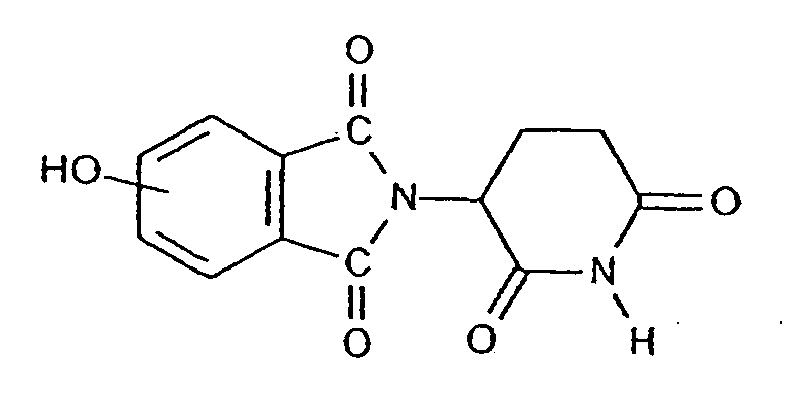


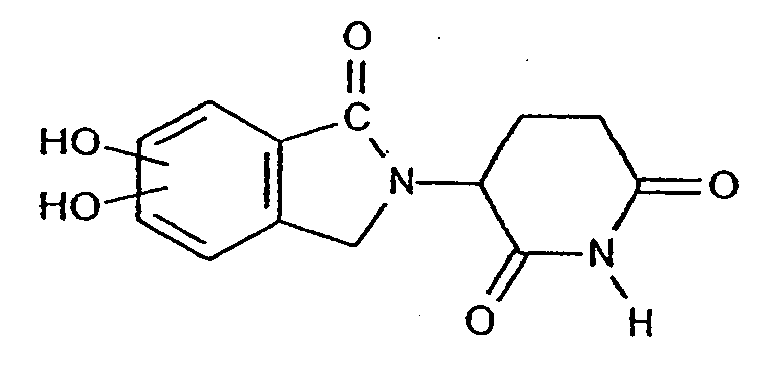


- All of these compounds are contemplated in this disclosure. Preferred embodiments of the invention include 1-Oxo-and 1,3 dioxo-2-(2,6-dioxopiperidin-3-yl) isoindolines substituted with amino in the benzo ring as described in Reexamined United States Patent No.
B 5,635,517 Certificate issued June 29,1999 for United States Patent No-5,635,517 originally issued June 3, 1997. These compounds have the structure:
- Particularly preferred compounds include:
- 1-oxo-2-(2,6-dioxopiperidin-3-yl)-5-aminoisoindoline
- 1-oxo-2-(2,6-dioxopiperidin-3-yl)-4-aminoisoindoline
- 1-oxo-2-(2,6-dioxopiperidin-3-yl)-6-aminoisoindoline
- 1-oxo-2-(2,6-dioxopiperidin-3-yl)-5-aminoisoindoline
- 1,3dioxo-2-(2,6-dioxopiperidin-3-yl)-4-aminosoindoline
- 1,3dioxo-2-(2,6-dioxopiperidin-3-yl)-5-aminoisoindoline
-
- n has a value of 1, 2, or 3;
- R5 is o-phenylene, unsubstituted or substituted with 1 to 4 substituents each selected independently from the group consisting of nitro, cyano, trifluoromethyl, carbethoxy, carbomethoxy, carbopropoxy, acetyl, carbamoyl, acetoxy, carboxy, hydroxy, amino, alkylamino, dialkylamino, acylamino, alkyl of 1 to 10 carbon atoms, alkyl of 1 to 10 carbon atoms, and halo;
- R7 is (i) phenyl or phenyl substituted with one or more substituents each selected independently of the other from the group consisting of nitro, cyano, trifluoromethyl, carbethoxy, carbomethoxy, carbopropoxy, acetyl, carbamoyl, acetoxy, carboxy, hydroxy, amino, alkyl of 1 to 10 carbon atoms, aloxy of 1 to 10 carbon atoms, and halo, (ii) benzyl unsubstituted or substituted with 1 to 3 substituents selected from the group consisting of nitro, cyano, trifluoromethyl, carbothoxy, carbomethoxy, carbopropoxy, acetyl, carbamoyl, acetoxy, carboxy, hydroxy, amino, alkyl of 1 to 10 carbon atoms, alkoxy of 1 to 10 carbon atoms, and halo, (iii) naphthyl, and (iv) benzyloxy;
- R12 is ---OH, alkoxy of 1 to 12 carbon atoms, or

- R8 is hydrogen or alkyl of 1 to 10 carbon atoms; and
- R9 is hydrogen, alkyl of 1 to 10 carbon atoms, ---COR10, or ---SO2R10 in which
- R10 is hydrogen, alkyl of 1 to 10 carbon atoms, or phenyl,
- Specific preferred compounds of this class include but are not limited to:
- 3-phenyl-2-(1-oxoisoindolin-2-yl)propionic acid;
- 3-phenyl-2-(1-oxoisoindolin-2-yl)propionamide;
- 3-phenyl-3-(1-oxoisoindolin-2-yl)propionic acid;
- 3-phenyl-3-(1-oxoisoindolin-2-yl)propionamide;
- 3-(4-methoxyphenyl)-3-(1-oxisoindolin-yl)propionic acid;
- 3-(4-methoxyphenyl)-3-(1-oxisoindolin-yl)propionamide;
- 3-(3,4-dimethoxyphenyl)-3-(1-oxisoindolin-2-yl)propionic acid;
- 3-(3,4-dimethoxyphenyl)-3-(1-oxisoindolin-2-yl)propionamide;
- 3-(3,4-diethoxyphenyl)-3-(1-oxoisoindolin-yl)propionic acid;
- methyl 3-(1-oxoisoindolin-2-yl)-3-(3-ethoxy-4-methoxyphenyl)propionate;
- 3-(1-oxoisoindolin-2-yl)-3-(3-ethoxy-4-methoxyphenyl)propionic acid;
- 3-(1-oxoisoindolin-2-yl)-3-(3-propoxy-4-methoxyphenyl)propionic acid;
- 3-(1-oxoisoixidolin-2-yl)-3-(3-butoxy-4-methoxyphenyl)propionic acid;
- 3-(1-oxoisoindolin-2-yl)-3-(3-propoxy-4-methoxyphenyl)propionamide;
- 3-(1-oxoisoindolin-2-yl)-3-(3-butoxy-4-methoxyphenyl)propionamide;
- methyl 3-(1-oxoisoindolin-2-yl)-3-(3-butoxy-4-methoxyphenyl)propionate; and
- methyl 3-(1-oxoisoindolin-2-yl)-3-(3-propoxy-4-methoxyphenyl)propionate.
- Other preferred compounds for use in the invention include the imido and amido substituted alkanohydroxamic acids found in
WO 99/06041 
- each of R1 and R2, when taken independently of each other, is hydrogen, lower alkyl, or R1 and R2, when taken together, together with the depicted carbon atoms to which each is bound, is o-phenylene, o-naphthylene, or cyclohexene-1,2-diyl, unsubstituted or substituted with 1 to 4 substituents each selected independently from the group consisting of nitro, cyano, trifluoromethyl, carbethoxy, carbomethoxy, carbopropoxy, acetyl,
- carbamoyl, acetoxy, carboxy, hydroxy, amino, alkylamino, dialkylamino, acylamino, alkyl of 1 to 10 carbon atoms, alkoxy of 1 to 10 carbon atoms, and halo;
- R3 is phenyl substituted with from one to four substituents selected from the group consisting of nitro, cyano, trifluoromethyl, carbethoxy, carbomethoxy, carbopropoxy, acetyl, carbamoyl, acetoxy, carboxy, hydroxy, amino, alkyl of 1 to 10 carbon atoms, alkoxy of 1 to 10 carbon atoms, alkylthio of 1 to 10 carbon atoms, benzyloxy, cycloalkoxy of 3 to 6 carbon atoms, C4-C6-cycloalkylidenemethyl, C3-C10-alkylidenemethyl, indanyloxy, and halo;
- R4 is hydrogen, alkyl of 1 to 6 carbon atoms, phenyl, or benzyl;
- R4' is hydrogen or alkyl of 1 to 6 carbon atoms;
- R5 is -CH2-, -CH2-CO-,-SO2-,-S-, or -NHCO-; and
- n has a value of 0, 1, or 2; and
- (b) the acid addition salts of said compounds which contain a nitrogen atom capable of being protonated.
- Particularly preferred compounds include but are not limited to:
- 3-(3-ethoxy-4-methoxyphenyl)-N-hydroxy-3-(1-oxoisoindolinyl)propionamide;
- 3-(3-ethoxy-4-methoxyphenyl)-N-methoxy-3-(1-oxoisoindolinyl)propionamide;
- N-benzyloxy-3-(3-ethoxy-4-methoxyphenyl)-3-phthalimidopropionamide;
- N-benzyloxy-3-(3-ethoxy-4-methoxyphenyl)-3-(3-nitrophthalimido)propionamide;
- N-benzyloxy-3-(3-ethoxy-4-methoxyphenyl)-3-(1-oxoisoindolinyl)propionamide;
- 3-(3-ethoxy-4-methoxyphenyl)-N-hydroxy-3-phthalimidopropionamide;
- N-hydroxy-3-(3,4-dimethoxyphenyl)-3-phthalimidopropionamide;
- 3-(3-ethoxy-4-methoxyphenyl)-N-hydroxy-3-(3-nitrophthalimido)propionamide;
- N-hydroxy-3-(3,4-dimethoxyphenyl)-3-(1-oxoisoindolinyl)propionamide;
- 3-(3-ethoxy-4-methoxyphenyl)-N-hydroxy-3-(4-methyl-phthalimido)propionamide;
- 3-(3-cyclopentyloxy-4-methoxyphenyl)-N-hydroxy-3-phthalimidopropionamide;
- 3-(3-ethoxy-4-methoxyphenyl)-N-hydroxy-3-(1,3-dioxo-2,3-dihydro-1H-benzol f]isoindol-2-yl)propionamide;
- N-hydroxy-3-{3-9(2-propoxy)-4-methoxyphenyl}-3-phthalimidopropionamide;
- 3-(3-ethoxy-4-methoxyphenyl)-3-(3,6-difluorophthalimido)-N-hydroxypropionamide;
- 3-(4-aminophthalimido)-3-(3-ethoxy-4-methoxyphenyl)-N-hydroxypropionamide;
- 3-(3-aminophthalimido)-3-(3-ethoxy-4-methoxyphenyl)-N-hydroxypropionamide;
- N-hydroxy-3-(3,4-dimethoxyphenyl)-3-(1-oxoisoindolinyl)propionamide;
- 3-(3-cyclopentyloxy-4-methoxyphenyl)-N-hydroxy-3-(1-oxoisoindolinyl)propionamide; and
- N-benzyloxy-3-(3-ethoxy-4-methoxyphenyl)-3-(3-nitrophthalimido)propionamide.
- Additional preferred compounds are inhibitors of nuclear factor κB (NFκB). NFκB has been implicated as a transcriptional activator in a variety of disease and inflammatory states and is thought to regulate cytokine levels including but not limited to TNF-α and also to be an activator of HIV transcription (Dbaibo, et al., J. Biol. Chem. 1993, 17762-66; Duh et al., Proc. Natl. Acad. Sci. 1989, 86, 5974-78; Bachelerie et al., Nature 1991, 350, 709-12; Suzuki et al., Biochem And Biophys. Res. Comm. 1993, 193, 277-83). Such preferred compounds include the substituted phenethylsulfones substituted to the phenyl group with a oxoisoindine group such as those found in pending United States Patent Application No.
09/183,049 
the carbon atom designated * constitutes a center of chirality;
Y is C=O, CH2, SO2, or CH2C=O;
each of R1, R2, R3, and R4, independently of the others, is hydrogen, halo, alkyl of 1 to 4 carbon atoms, alkoxy of 1 to 4 carbon atoms, nitro, cyano, hydroxy, or - NR8R9; or any two of R1, R2, R3, and R4 on adjacent carbon atoms, together with the depicted phenylene ring are naphthylidene;
each of R5 and R6, independently of the other, is hydrogen, alkyl of 1 to 4 carbon atoms, alkoxy of 1 to 4 carbon atoms, cyano, or cycloalkoxy of up to 18 carbon atoms;
R7 is hydroxy, alkyl of 1 to 8 carbon atoms, phenyl, benzyl, or NR8'R9';
each of R8 and R9 taken independently of the other is hydrogen, alkyl of 1 to 8 carbon atoms, phenyl, or benzyl, or one of R8 and R9 is hydrogen and the other is -COR10 or -SO2R10, or R8 and R9 taken together are tetramethylene, pentamethylene, hexamethylene, or -CH2CH2X1H2CH2- in which X1 is -O-, -S- or -NH-; and
each of R8' and R9' taken independently of the other is hydrogen, alkyl of 1 to 8 carbon atoms, phenyl, or benzyl, or one of R8' and R9' is hydrogen and the other is -COR10' or -SO2R10', or R8' and R9' taken together are tetramethylene, pentamethylene, hexamethylene, or -CH2CH2X2CH2CH2- in which X2 is -O-, -S-, or -NH-. - It will be appreciated that while for convenience the above compounds are identified as phenethylsulfones, they include sulfonamides when R7 is NR8'R9'.
- Preferred groups of such compounds are those in which Y is C=O; and
Y is CH2. - A further preferred group of such compounds are those in which each of R1, R2, R3, and R4 independently of the others, is hydrogen, halo, methyl, ethyl, methoxy, ethoxy, nitro, cyano, hydroxy, or -NR8R9 in which each of R8 and R9 taken independently of the other is hydrogen or methyl or one of R8 and R9 is hydrogen and the other is -COCH3.
- A further preferred group of such compounds are those in which one of R1, R2, R3, and R4 is -NH, and the remaining of R1, R2, R3, and R4 are hydrogen.
- A further preferred group of such compounds are those in which one of R1, R2, R3 and R4 is -NHCOCH3 and the remaining of R1, R2, R3, and R4 are hydrogen.
- A further preferred group of such compounds are those in which one of R1, R2, R3 and R4 is -N(CH3)2 and the remaining of R1, R2, R3, and R4 are hydrogen.
- A further preferred group of such compounds are those in which one of R1, R2, R3, and R4 is methyl and the remaining of R1, R2, R3, and R4 are hydrogen.
- A further preferred group of such compounds are those in which one of R1, R2, R3, and R4 is fluoro and the remaining of R1, R2, R3, and R4 are hydrogen.
- A further preferred group of such compounds are those in which each of R5 and R6, independently of the other, is hydrogen, methyl, ethyl, propyl, methoxy, ethoxy, propoxy, cyclopentoxy, or cyclohexoxy.
- A further preferred group of such compounds are those in which R5 is methoxy and R6 is monocycloalkoxy, polycycloalkoxy, and benzocycloalkoxy.
- A further preferred group of such compounds are those in which R5 is methoxy and R6 is ethoxy.
- A further preferred group of such compounds are those in which R7 is hydroxy, methyl, ethyl, phenyl, benzyl, or NR8'R9' in which each of R8' and R9' taken independently of the other is hydrogen or methyl.
- A further preferred group of such compounds are those in which R7 is methyl, ethyl, phenyl, benzyl or NR8'R9' in which each of R8' and R9' taken independently of the other is hydrogen or methyl.
- A further preferred group of such compounds are those in which R7 is methyl.
- A further preferred group of such compounds are those in which R7 is NR8'R9' in which each of R8' and R9' taken independently of the other is hydrogen or methyl. Specific preferred compounds of this class include but are not limited to:
- 2-[1(-3-ethoxy-4-methoxyphenyl)-2-methyl-sulfonylethyl]isoindolin-1-one,
- 2-[1-(3-ethoxy-4-methoxyphenyl)-2-(N,N-dimethyl-aminosulfonyl)ethyl]isoindolin-1-one,
- 2-[1-(3-ethoxy-4-methoxyphenyl)-2-methyl-sulfonylethyl]isoindoline-1,3-dione,
- 2-[1-(3-ethoxy-4-methoxyphenyl)-2-methyl-sulfonylethyl]-5-nitro-isoindoline-1,3-dione,
- 2-[1-(3-ethoxy-4-methoxyphenyl)-2-methyl-sulfonylethyl]-4-nitroisoindoline-1,3-dione,
- 2-[1-(3-ethoxy-4-methoxyphenyl)-2-methylsulfonylethyl]-4-aminoisoindoline-1,3-dione,
- 2-[1-(3-ethoxy-4-methoxyphenyl)-2-methylsulfonylethyl]-5-methylisoindoline-1,3-dione,
- 2-[1-(3-ethoxy-4-methoxyphenyl)-2-methylsulfonylethyl]-5-acetamidoisoindoline-1,3-dione,
- 2-[1-(3-ethoxy-4-methoxyphenyl)-2-methylsulfonylethyl]-4-dimethylaminoisondoline-1,3-dione,
- 2-[1-(3-ethoxy-4-methoxyphenyl)-2-methylsulfonylethyl]-5-dimethylaminoisoindoline-1,3-dione,
- 2-[1-(3-ethoxy-4-methoxyphenyl)-2-methylsulfonylethyl]benzo[e]isoindoline-1,3-dione,
- 2-[1-(3-ethoxy-4-methoxyphenyl)-2-methylsulfonylethyl]-4-methoxylsoindoline-1,3-dione,
- 1-(3-cyclopentyloxy-4-methoxyphenyl)-2-methylsulfonylethyl-amine,
- 2-[1-(3-cyclopentyloxy-4-methoxyphenyl)-2-methylsulfonylethyl]isoindoline-1,3-dione, and
- 2-[1-(3-cyclopentyloxy-4-methoxyphenyl)-2-methylsulfonylethyl]-4-dimethylaminoisoindoline-1,3-dione.
- Many of the described compounds can be enriched in optically active enantiomers of the compounds specified above using standard resolution or asymetric synthesis known in the art. Blaschke, for example, has reported that the S enantiomers may be disproportionately responsible for the dismelia-producing effect of thalidomide and its analogs. See, generally Blaschke, Arzneimittelforschung 29:1640-1642 (1979)- Procedures to obtain optically active preparations of the compounds of interest can be found in the literature. See, e.g., Shealy et al., Chem. Indus. 1030 (1965); and Casini et al., Farmaco Ed. Sci. 19:563 (1964).
- The present invention also pertains to the physiologically acceptable non-toxic acid addition salts of the compounds thereof. Such salts include those derived from organic and inorganic acids or bases know in the art: such acids include for example, hydrochloric acid, hydrobromic acid, phosphoric acid, sulfuric acid, methanesulphonic acid, acetic acid, tartaric acid, lactic acid, succinic acid, citric acid, malic acid, maleic acid, sorbic acid, aconitic acid, salicylic acid, phthalic acid, embolic acid, enanthic acid, and the like.
- Compounds of the invention that are acidic in nature are capable of forming salts with various pharmaceutically acceptable bases. The bases that can be used to prepare pharmaceutically acceptable base addition salts of such acidic compounds of the invention are those that form non-toxic base addition salts, i.e., salts containing pharmacologically acceptable cations such as, but not limited to, alkali metal or alkaline earth metal salts and the calcium, magnesium, sodium or potassium salts in particular. Suitable organic bases include, but are not limited to, N,N-dibenzylethylenediamine, chloroprocaine, choline, diethanolamine, ethylenediamine, meglumaine (N-methylglucamine), lysine, and procaine.
- Certain of these compounds, such as thalidomide are commercially available (Thalomid™, Celgene, Inc., Warren, New Jersey). Other above compounds can be made by methods known in the art, including those disclosed in the patents cited above.
- The compounds described above can be provided as pharmaceutically acceptable formulations using formulation methods known to those of ordinary skill in the art. Administration as used in the invention includes those suitable for oral, ophthalmic, (including intravitreal or intracameral), topical, mucosal (including buccal, rectal, vaginal, nasal and sublingual), transdermal or parenteral (including subcutaneous, intramuscular, intravenous, bolus injection, intradermal, intratracheal, and epidural) administration. In addition, the combinations may be incorporated into biodegradable polymers allowing for sustained release of the compound, the polymers being implanted in the vicinity of where drug delivery is desired. Biodegradable polymers and their use are described, for example, in detail in Brem et al., J. Neurosurg. 74:441-446 (1991).
- The formulations include those suitable for oral, rectal, ophthalmic, (including intravitreal or intracameral) nasal, topical (including buccal and sublingual), vaginal or parenteral (including subcutaneous, intramuscular, intravenous, intradermal, intratracheal, and epidural) administration. The formulations may conveniently be presented in unit dosage form and may be prepared by conventional pharmaceutical techniques. Such techniques include the step of bringing into association the active ingredient and the pharmaceutical carrier(s) or excipient(s). In general, the formulations are prepared by uniformly and intimately bringing into associate the active ingredient with liquid carriers or finely divided solid carriers or both, and then, if necessary, shaping the product.
- Formulations of the present invention suitable for oral administration may be presented as discrete units such as capsules, cachets or tablets each containing a predetermined amount of the active ingredient; as a powder or granules; as a solution or a suspension in an aqueous liquid or a non-aqueous liquid; or as an oil-in-water liquid emulsion or a water-in-oil emulsion and as a bolus, etc.
- A tablet may be made by compression or molding, optionally with one or more accessory ingredients. Compressed tablets may be prepared by compressing, in a suitable machine, the active ingredient in a flee-flowing form such as a powder or granules, optionally mixed with a binder, lubricant, inert diluent, preservative, surface active or dispersing agent. Molded tablets may be made by molding, in a suitable machine, a mixture of the powdered compound moistened with an inert liquid diluent. The tablets may be optionally coated or scored and may be formulated so as to provide a slow or controlled release of the active ingredient therein.
- Formulations suitable for topical administration in the mouth include lozenges comprising the ingredients in a flavored basis, usually sucrose and acacia or tragacanth; pastilles comprising the active ingredient in an inert basis such as gelatin and glycerin, or sucrose and acacia; and mouthwashes comprising the ingredient to be administered in a suitable liquid carrier.
- Formulations suitable for topical administration to the skin may be presented as ointments, creams, gels and pastes comprising the ingredient to be administered in a pharmaceutical acceptable carrier. A preferred topical delivery system is a transdermal patch containing the ingredient to be administered.
- Formulations for rectal administration may be presented as a suppository with a suitable base comprising, for example, cocoa butter or a salicylate.
- Formulations suitable for nasal administration, wherein the carrier is a solid, include a coarse powder having a particle size, for example, in the range of 20 to 500 microns which is administered in the manner in which snuff is administered, i.e., by rapid inhalation through the nasal passage from a container of the powder held close up to the nose. Suitable formulations, wherein the carrier is a liquid, for administration, as for example, a nasal spray or as nasal drops, include aqueous or oily solutions of the active ingredient.
- Formulations suitable for vaginal administration may be presented as pessaries, tamports, creams, gels, pastes, foams or spray formulations containing in addition to the active ingredient such carriers as are known in the art to be appropriate.
- Formulations suitable for parenteral administration include aqueous and non-aqueous sterile injection solutions which may contain anti-oxidants, buffers, bacteriostats and solutes which render the formulation isotonic with the blood of the intended recipient; and aqueous and non-aqueous sterile suspensions which may include suspending agents and thickening agents. The formulations may be presented in unit-dose or multi-dose containers, for example, sealed ampules and vials, and may be stored in a freeze-dried (lyophilized) conditions requiring only the addition of the sterile liquid carrier, for example, water for injections, immediately prior to use. Extemporaneous injection solutions and suspensions may be prepared from sterile powders, granules and tablets of the kind previously described.
- Preferred unit dosage formulations are those containing a daily dose or unit, daily sub-dose, as herein above recited, or an appropriate fraction thereof, of the administered ingredient.
- It should be understood that in addition to the ingredients, particularly mentioned above, the formulations of the present invention may include other agents conventional in the art having regard to the type of formulation in question, for example, those suitable for oral administration may include flavoring agents.
- Oral dosage forms include tablets, capsules, dragees, and similar shaped, compressed pharmaceutical forms containing from about 1 ng to 300 mg of drug per unit dosage. Isotonic saline solutions can be used for parenteral administration which includes intramuscular, intrathecal, intravenous and intra-arterial routes of administration. Rectal administration can be effected through the use of suppositories formulated from conventional carriers such as cocoa butter.
- Pharmaceutical compositions thus comprise one or more compounds described above and are associated with at least one pharmaceutically acceptable carrier, diluent or excipient. In preparing such compositions, the active ingredients are usually mixed with or diluted by an excipient or enclosed within such a carrier which can be in the form of a capsule or sachet. When the excipient serves as a diluent, it may be a solid, semisolid, or liquid material which acts as a vehicle, carrier, or medium for the active ingredient. Thus, the compositions can be in the form of tablets, pills, powders, elixirs, suspensions, emulsions, solutions, syrups, soft and hard gelatin capsules, suppositories, sterile injectable solutions and sterile packaged powders. Examples of suitable excipients, include but are not limited to lactose, dextrose, sucrose, sorbitol, mannitol, starch, gum acacia, calcium silicate, microcrystalline cellulose, polyvinlypyrrolidinone, cellulose, water, syrup, and methyl cellulose, the formulations can additionally include lubricating agents such as talc, magnesium stearate and mineral oil, wetting agents, emulsifying and suspending agents, preserving agents such as methyl- and propylhydroxybenzoates, sweetening agents or flavoring agents.
- The compositions preferably are formulated in unit dosage form, meaning physically discrete units suitable as a unitary dosage, or a predetermined fraction of a unitary dose to be administered in a single or multiple dosage regimen to human subjects and other mammals, each unit containing a predetermined quantity of active material calculated to produce the desired therapeutic effect in association with a suitable pharmaceutical excipient. The compositions can be formulated so as to provide an immediate, sustained or delayed release of active ingredient after administration to the patient by employing procedures well known in the art.
- In additional to the common dosage forms set out above, the compounds can also be administered by controlled release means or delivery devices that are well known to those of ordinary skill in the art, such as those described in
U.S. Patent No. 3,845,770 ;3,916,899 ;3,536,809 ;3,598,123 ;4,008,719 ;5,674,533 ;5,059,595 ;5,591,767 ;5,120,548 ;5,073,543 ;5,639,476 ;5,354,556 ; and5,733,566 . These dosage forms can be used to provide slow or controlled-release of one or more active ingredients using, for example, hydropropylmethyl cellulose, other polymer matrices, gels, permeable membranes, osmotic systems, multilayer coatings, microparticles, liposomes, or microspheres or a combination thereof to provide the desired release profile in varying proportions. Suitable controlled-release formulations known to those of ordinary skill in the art, including those described herein, can be readily selected fro use with the pharmaceutical compositions of the invention. The invention thus encompasses single unit dosage forms suitable for oral administration such as, but not limited to, tablets, capsules, gelcaps, and caplets that are adapted for controlled-release. - All controlled-release pharmaceutical products have a common goal of improving drug therapy over that achieved by their non-controlled counterparts. Ideally, the use of an optimally designed controlled-release preparation in medical treatment is characterized by a minimum of drug substance being employed to cure or control the condition in a minimum amount of time. Advantages of controlled-release formulations include extended activity of the drug. In addition, controlled-release formulations can be used to affect the time of onset of action or other characteristics, such as blood levels of the drug, and thus can affect the occurrence of side effects.
- Most controlled-release formulations are designed to initially release an amount of drug that promptly produces the desired therapeutic effect, and gradually and continually release of other amounts of drug to maintain this level of therapeutic effect over an extended period of time. In order to maintain this constant level of drug in the body, the drug must be released from the dosage form at a rate that will replace the amount of drug being metabolized and excreted from the body. Controlled-release of an active ingredient can be stimulated by various inducers, including, but not limited to, pH, temperature, enzymes, water, or other physiological conditions or compounds.
- Those at high risk, having for example, a number of the risk factors described above in the background section, may be appropriate candidates for the therapies of the invention.
- The compounds may be used to inhibit or treat all forms of conditions involving atherosclerosis. In a preferred embodiment the invention includes a therapy to reduce or prevent the degree of restenosis after vascular intervention such as angioplasty, stenting, atherectomy and grafting. All forms of vascular intervention are contemplated by the invention including diseases of the cardiovascular and renal system. The following chart provides a listing of the major systemic arteries that may be in need of treatment, all of which are contemplated by the invention:
TABLE I Major Systemic Arteries Artery Body Areas Supplied Axillary Shoulder and axilla Brachial Upper arm Brachiocephalic Head, neck, and arm Celiac Divides into left gastric, splenic, and hepatic arteries Common carotid Neck Common iliac Divides into external and internal iliac arteries Coronary Heart Deep femoral Thigh Digital Fingers Dorsalis pedis Foot External carotid Neck and external head regions External iliac Femoral artery Femoral Thigh Gastric Stomach Hepatic Liver, gallbladder, pancreas, and duodenum Inferior mesenteric Descending colon, rectum, and pelvic wall Internal carotid Neck and internal head regions Internal iliac Rectum, urinary bladder, external genitalia, buttocks muscles, uterus and vagina Left gastric Esophagus and stomach Middle sacral Sacrum Ovarian Ovaries Palmar arch Hand Peroneal Calf Popliteal Knee Posterior tibial Calf Pulmonary Lungs Radial Forearm Renal Kidney Splenic Stomach, pancreas, and spleen Subclavian Shoulder Superior mesenteric Pancreas, small intestine, ascending and transverse colon Testicular Testes Ulnar Forearm - The optimal dosage to be administered will be readily determined by those skilled in the art and will vary on the condition being treated, the particular TNF-α inhibitor and mode of administration. Other factors include the weight and condition of the human or animal. It is to be understood that the present invention has application for both human and veterinary use. For oral administration to humans, a dosage of between approximately 0.01 to 300 mg/kg/day.
- In this embodiment, the compound or composition such as a thalidomide composition is administered orally to a patient at risk for complications caused by atherosclerosis. Typically, those at risk include those having one or more of the following conditions: abnormal serum lipid levels, hypertension, cigarette smoking, diabetes mellitus, obesity, physical inactivity, hyperhomocysteinemia and chlamydia pneumoniae infection. The compound is thus administered prophylactically to prevent serious complications or to avoid the need for surgical intervention.
- Macrophage appear to infiltrate restenotic lesions of coronary arteries. For example, in one study macrophage areas, but neither smooth muscle cell nor tissue factor areas, were significantly larger in primary lesions that develop restenosis when compared to primary lesions that did not develop into restenosis after coronary atherectomy. Moreno et al., Macrophage Infiltration Predicts Restenosis After Coronary Intervention in Patients with Unstable Angina, 1996, Circulation 94(12):3098-3102.
- Further, it has been suggested the level of macrophage colony stimulating factor (M-CSF) in the atherectomy tissue can indicate, or predict the likelihood or degree of restenosis in post vascular intervention tissue. Takano et al., High levels of circulating Macrophage Colony Stimulating Factor (M-CSF) Predict Restenosis After Primary Angioplasty in Patients With Acute Myocardial Infraction, 1998 Circulation, 98 (17, Supp): 4437.
- Thus, the invention encompasses the use of the compounds of the invention in patients having abnormally high levels of circulating macrophage colony stimulating factor (M-CSF) prior to vascular intervention. This treatment may avoid the need for or facilitate vascular intervention.
- All forms of vascular intervention are contemplated by the invention, including for example, renal angioplasty, percutaneous coronary intervention (PCI), percutaneous transluminal coronary angioplasty (PTCA); carotid percutaneous transluminal angioplasty (PTA); coronary by-pass grafting, angioplasty with stent implantation, peripheral percutaneous transluminal intervention of the iliac, femoral or popliteal arteries, surgical intervention using impregnated artificial grafts and the like.
- The magnitude of a therapeutic dose of the compound will vary with the severity of the condition being treated, the route of administration and the particular compound being administered. Additionally, the dose, and dose frequency will also vary according to the age, body weight and general condition of the individual patient. In general, the administration will begin just prior to (-12 hours) or during the angioplasty and will typically continue for 4 to 12 weeks. The daily dose range of the compound administered orally is between 0.01 to 300 mg/kg/day.
- A dosage regime following angioplasty may be desired and may be necessary in the case of emergency vascular intervention. The dosage would be similar to the pre-angioplasty dosage and would typically be completed by about four to twelve weeks after the angioplasty. Thus, the invention encompasses the treatment or prevention of restenosis in patients after surgical intervention by the administration of thalidomide or an analogue, metabolite or prodrug thereof.
- In another embodiment, stent or other devices used in surgical procedures such as angioplasty are coated with thalidomide or another compound of the invention prior to use in the patient. This coating is designed to prevent restenosis and to otherwise benefit the patient. Systemic administration of thalidomide or another compound of the invention after surgical intervention is also contemplated. It should be recognized that multilayer coatings or releaseable coatings are also encompassed. Releaseable coatings can directly deposit the active compound e.g., thalidomide to the area at risk for restenosis. Alternatively, topical/internal applications can be used.
- In such an embodiment, the compounds of the invention may be coated or scaled on a prosthetic device which is suitable, e.g., for implantation or other use in a subject, preferably a human. Examples of such devices include, but are not limited to, all types of angioplasty devices including a stent or stent/graft, or a commercial synthetic vascular graft or a biologic vascular graft. Any stent, stent/graft or tissue engineered vascular graft ("tubes") known in the art can be coated or sealed with the compounds of the present invention. The tubes can be metallic, or made from a biocompatible polymer, as well as a biodegradable polymer, such as, e.g., dacron polyester, poly(ethylene terephthalate), polycarbonate, polymethylmethacrylate, polypropylene, polyalkylene oxalates, polyvinylchloride, polyurethanes, polysiloxanes, nylons, poly(dimethyl siloxane), polycyanoacrylates, polyphosphazenes, poly(amino acids), ethylene glycol I dimethacrylate, poly(methyl methacrylate), poly(2-hydroxyethyl methacrylate), poly(HEMA), polyhydroxyalkanoates, polytetrafluorethylene, polycarbonate, poly(glycolide-lactide) copolymer, polylactic acid, poly(ε-caprolactone), poly(β-hydroxybutyrate), polydioxanone, poly(γ-ethyl glutamate), polyiminocarbonates, poly(ortho ester), polyanhydrides, alginate, dextran, chitin, cotton, polyglycolic acid, polyurethane, or derivatized versions thereof, i.e., polymers which have been modified to include, for example, attachment sites or crosslinking groups in which the polymers retain their structural integrity while allowing for attachment of molecules, such as proteins, nucleic acids, and the like. The tubes can also be fabric-coated metal structures. The tubes can also be made from combinations of metal and polymer. The tubes can be configured into any desired shape or conformation, such as, for example, linear, tapered, bifurcated, etc., and may be prepared using fiber technology, such as, e.g., crimped, woven, knitted, velour, double velour, with or without coils. The tubes can also be prepared by chemical extrusion, casting or molding using, for example, porous materials having linear or random pores that are circular or geometric in shape.
- There are a variety of methods of manufacture available to provide a prosthetic device, coated on at least one surface with a sufficient amount of a compound of the present invention. The resulting coating is preferably uniform and should be integral so that contact between the device surface(s) and the surrounding tissue is precluded. The compounds can be applied to the device by spraying at least one surface of the device with the compounds in suspension, and allowing the applied surface to dry. In another embodiment, the device can be dipped into such a suspension, or by casting a suspension of the compounds over the device, or by layering a device the a suspension of the compounds over the device, or by impregnating a device with a suspension of the compounds. The compounds may be applied to the inside surface of a tube. By applying the compounds on the inside of the tube, the compounds promote proper reendothelialization of the lumen wall, promote wound healing and prevent or inhibit one or more cardiovascular disease states, such as stenosis, restenosis or intimal and neointimal hyperplasias.
- The particular amount of the preparation to be applied to the device can be easily determined empirically by comparing devices with different amounts of the compound coated thereon and determining the efficacy of each by, for example, measuring. Also, one skilled in the relevant art and who is familiar with standard treatments would also be in a position to easily evaluate the efficacy of a device. Moreover, more than one coat of the compounds, either untreated or crosslinked, can be applied to a device. It is highly desirable to inspect the device once coated to insure that there are no gaps or breaks present in the coating.
-
- In a specific embodiment; a stent coated with the compounds the present invention, is provided. The compounds in or on the stent may be complexed with a drug, such as an antibiotic agent or an antiviral agent, or mixtures thereof, in order to insure against graft rejection. Additional drugs which may be added to the coating include antiplatelets, antithrombins, cytostatic and antiproliferative agents for example. Compounds such as thalidomide may not need protection against graft rejection since thalidomide may have this effect itself.
- The methods used for implanting the coated devices are analogous to those used for the implantation of such devices without the coating, and, of course, depend on the nature of the condition to be modified or corrected. The surgery can be performed under either local or systemic anesthesia and, generally, involves an incision, spacing to accommodate the implant, insertion, and suture.
- The following examples will serve to further typify the nature of this invention but should not be construed as a limitation in the scope thereof, which scope is defined solely by the appended claims.
- Tablets, each containing 50 mg of 1-oxo-2-(2,6-dioxo-piperidin-3y1)-4-amino-isoindoline can be prepared in the following manner:
Constituents (for 1000 tablets) 1-oxo-2-(2,6-dioxo-piperidin-3yl)-4-amino-isoindoline 50.0g lactose 50.7g wheat starch 7.5g polyethylene glycol 6000 5.0g talc 5.0g magnesium stearate 1.8g demineralized water q.s. - The solid ingredients are first forced through a sieve of 0.6 mm mesh width. The active ingredient, lactose, talc, magnesium stearate and half of the starch then are mixed. The other half of the starch is suspended in 40 mL of water and this suspension is added to a boiling solution of the polyethylene glycol in 100 mL of water. The resulting paste is added to the pulverulent substances and the mixture is granulated, if necessary with the addition of water. The granulate is dried overnight at 35°C, forced through a sieve of 1.2 mm mesh width and compressed to form tablets of approximately 6 mm diameter which are concave on both sides.
- A 5% (w/w) solution of silicone solid in tetrahydrofuran (THF) (HPLC grade. Aldrich or EM Science) is prepared by adding the required THF and a crosslinker agent into the silicone mixture. A separate 0.5% (w/w) solution of 1-oxo-2-(2,6-dioxo-piperidin-3y1)-4amino-isoindoline in THF is prepared by adding THF into a beaker containing 1-oxo-2-(2,6-dioxo-piperidin-3y1)-4amino-isoindoline. The ratio of Wdrug/Wsilicone solid is 0.1. The coating of the stent in an expanded state is accomplished by spraying one cycle of silicone solution, waiting for a short period of time (about 30 seconds), and spraying one cycle of solution, waiting for a short period of time (about 30 seconds), and then repeating the spraying sequence. The very last spray cycle is silicone solution. For a coating thickness of 30 microns, about 30 cycles each is applied. The number of spray cycles used depends on the solution viscosity, the droplet size and the flow rate. The coated stent is then moved to a convection oven and cured at 150°C for 45 minutes.

Claims (18)
- A TNF-α inhibitor selected from 1-oxo-2-(2,6-dioxopipexidin-3-yl)-4-aminoisoindoline, 1,3-dioxo-2-(2,6-dioxopiperidin-3-yl)-4-aminoisoindoline and 3-(3,4-dimethoxyphenyl)-3-(1-oxisoindolin-2-yl) propionamide for use as a medicament for treating or preventing atherosclerosis, or inhibiting or preventing restenosis in a mammal.
- Use of a TNF-α inhibitor selected from 1-oxo-2-(2,6-dioxopiperidin-3-yl)-4-aminoisoindoline, 1,3-dioxo-2-(2,6-dioxopiperidin-3-yl)-4-aminoisoindoline and 3-(3,4-dimethoxphenyl)-3-(1-oxisoindolin-2-yl) propionamide, for the manufacture of a medicament for treating or preventing atherosclerosis, or inhibiting or preventing restenosis in a mammal.
- A TNF-α inhibitor as claimed in claim 1; for, or a use as claimed in claim 2, wherein said medicament is for, treating or preventing atherosclerosis and said atherosclerosis is in the aorta, coronary artery, mesenteric arteries, carotid arteries, or renal arteries.
- A TNF-α inhibitor as claimed in claim 1 or 3, or use as claimed in claim 2 or 3, wherein said mammal is human.
- A TNF-α inhibitor as claimed in claim 1, for, or a use as claimed in claim 2, wherein said medicament is for, treating or preventing atherosclerosis and said mammal is a human subject and is at risk for complications of atherosclerosis and has at least one condition or risk factor selected from abnormal serum lipid levels, hypertension, cigarette smoking, diabetes mellitus, obesity, physical inactivity, hyperhomocysteinemia and chlamydia pneumoniae infection.
- A TNF-α inhibitor or a use a claimed in claim 5, wherein the subject has not undergone surgical vascular intervention.
- A TNF-α inhibitor as claimed in claim 1, for, or a use as claimed in claim 2, wherein the medicament is for, administration at a rate of approximately .01 mg/kg to 300 mg/kg, 0.1 mg/kg to 100 mg/kg, 0.5 mg/kg to 50 mg/kg or 1.0 mg/kg to 10 mg/kg of body weight per day.
- A TNF-α inhibitor as claimed in claim 1, for, or a use as claimed in claim 2, wherein the medicament is for, oral administration.
- A TNF-α inhibitor as claimed in claim 1, for, or a use as claimed in claim 2, wherein said medicament is for, inhibiting or preventing restenosis in a mammal and said treatment begins prior to surgical intervention and, optionally is continued for about 4 to 12 weeks after surgical intervention.
- A TNF-α inhibitor or a use as claimed in claim 9, wherein the treatment begins about 12 hours or less prior to scheduled intervention.
- A TNF-α inhibitor or a use as claimed in claim 9, wherein the surgical intervention is percutaneous coronary intervention, percutaneous transluminal coronary angioplasty, carotid percutaneous transluminal angioplasty coronary by-pass grafting, coronary angioplasty with stent implantation, renal angioplasty, peripheral percutaneous transluminal intervention of the iliac, femoral or popliteal arteries, or surgical intervention using impregnated artificial grafts.
- A TNF-α inhibitor as claimed in claim 1, for, or a use according to claim 2, wherein said medicament is for, inhibiting or preventing restenosis in a mammal and said treatment begins at the time of unscheduled surgery and, optionally, is discontinued about 4 to 12 weeks after the surgical intervention.
- A prosthetic device suitable for implantation of use in a mammal wherein said device is coated on at least one surface with a therapeutically effective amount of a composition comprising a compound selected from 1-oxo-2-(2,6-dioxopiperidin-3-yl)-4-aminoisoindoline, 1,3-dioxo-2-(2,6-dioxopiperidin-3-yl)-4-aminoisoindoline and 3-(3,4-dimethoxyphenyl)-3-(1-oxisoindolin-2-yl) propionamide, so that restenosis is prevented or reduced.
- A prosthetic device as claimed in claim 13, wherein the coating comprises a composition, said composition comprising a pharmaceutically acceptable carrier, said carrier being suitable for coating a prosthetic device.
- A device as claimed in claim 13, wherein the device is:a) selected from the group consisting of a stent or stent/graft; and/orb) composed of a nonbiodegradable material.
- A device as claimed in claim 15, wherein said device is composed of a nonbiodegradable material and the nonbiodegradable material is a polyamide, a polyester, a polystyrene, a polypropylene, a polyacrylate, a polyvinyl, a polycarbonate, a polytetrafluorethylene, a polymethylmethacrylate, a polyethylene, a poly(ethylene terephthalate), a polyalkylene oxalate, a polyurethane, a polysiloxane, a poly(dimenthyl siloxane), a polycyanoacrylate, a polyphosphazene, a poly(amino acid), a ethylene glycol I dimethacrylate, a poly(methyl methacrylate), a poly(2-hydroxyethyl methacrylate), a poly(HEMA), or a polyhydroxyalkanoate compound.
- A method for production of a prosthetic device coated with a composition comprising a compound which inhibits TNF-α selected from 1-oxo-2-(2,6-dioxopiperidin-3-yl)-4-aminoisoindoline, 1,3-dioxo-2-(2,6-dioxopiperidin-3-yl)-4-aminoisoindoline and 3-(3,4-dimethoxyphenyl)-3-(1-oxisoindolin-2-yl) propionamide comprising dipping, spraying, casting, layering or impregnating the device with a suspension comprising one of said compounds.
- The method according to claim 17, in which the device is selected from a stent and a stent/graft.
Priority Applications (1)
| Application Number | Priority Date | Filing Date | Title |
|---|---|---|---|
| EP08163144A EP2016942A1 (en) | 1999-12-15 | 2000-12-13 | Methods and compositions for the prevention and treatment of atherosclerosis, restenosis and related disorders |
Applications Claiming Priority (3)
| Application Number | Priority Date | Filing Date | Title |
|---|---|---|---|
| US17082099P | 1999-12-15 | 1999-12-15 | |
| US170820P | 1999-12-15 | ||
| PCT/US2000/033708 WO2001043743A1 (en) | 1999-12-15 | 2000-12-13 | Methods and compositions for the prevention and treatment of atherosclerosis, restenosis and related disorders |
Related Child Applications (1)
| Application Number | Title | Priority Date | Filing Date |
|---|---|---|---|
| EP08163144A Division EP2016942A1 (en) | 1999-12-15 | 2000-12-13 | Methods and compositions for the prevention and treatment of atherosclerosis, restenosis and related disorders |
Publications (2)
| Publication Number | Publication Date |
|---|---|
| EP1242082A1 EP1242082A1 (en) | 2002-09-25 |
| EP1242082B1 true EP1242082B1 (en) | 2009-05-06 |
Family
ID=22621397
Family Applications (2)
| Application Number | Title | Priority Date | Filing Date |
|---|---|---|---|
| EP08163144A Withdrawn EP2016942A1 (en) | 1999-12-15 | 2000-12-13 | Methods and compositions for the prevention and treatment of atherosclerosis, restenosis and related disorders |
| EP00984269A Expired - Lifetime EP1242082B1 (en) | 1999-12-15 | 2000-12-13 | Methods and compositions for the prevention and treatment of atherosclerosis, restenosis and related disorders |
Family Applications Before (1)
| Application Number | Title | Priority Date | Filing Date |
|---|---|---|---|
| EP08163144A Withdrawn EP2016942A1 (en) | 1999-12-15 | 2000-12-13 | Methods and compositions for the prevention and treatment of atherosclerosis, restenosis and related disorders |
Country Status (10)
| Country | Link |
|---|---|
| US (3) | US7182953B2 (en) |
| EP (2) | EP2016942A1 (en) |
| JP (1) | JP2003517012A (en) |
| AT (1) | ATE430568T1 (en) |
| AU (1) | AU782753B2 (en) |
| CA (1) | CA2395474A1 (en) |
| DE (1) | DE60042172D1 (en) |
| ES (1) | ES2326359T3 (en) |
| HK (1) | HK1051316B (en) |
| WO (1) | WO2001043743A1 (en) |
Families Citing this family (83)
| Publication number | Priority date | Publication date | Assignee | Title |
|---|---|---|---|---|
| HU228769B1 (en) * | 1996-07-24 | 2013-05-28 | Celgene Corp | Substituted 2(2,6-dioxopiperidin-3-yl)phthalimides and -1-oxoisoindolines and their use for production of pharmaceutical compositions for mammals to reduce the level of tnf-alpha |
| US5635517B1 (en) * | 1996-07-24 | 1999-06-29 | Celgene Corp | Method of reducing TNFalpha levels with amino substituted 2-(2,6-dioxopiperidin-3-YL)-1-oxo-and 1,3-dioxoisoindolines |
| US7629360B2 (en) * | 1999-05-07 | 2009-12-08 | Celgene Corporation | Methods for the treatment of cachexia and graft v. host disease |
| US6458810B1 (en) | 2000-11-14 | 2002-10-01 | George Muller | Pharmaceutically active isoindoline derivatives |
| CA2430669C (en) * | 2000-11-30 | 2011-06-14 | The Children's Medical Center Corporation | Synthesis of 3-amino-thalidomide and its enantiomers |
| JP3990972B2 (en) * | 2001-11-20 | 2007-10-17 | 有限会社 キック | Vascular restenosis preventing agent and intravascular implant device coated with the preventing agent |
| US7498171B2 (en) * | 2002-04-12 | 2009-03-03 | Anthrogenesis Corporation | Modulation of stem and progenitor cell differentiation, assays, and uses thereof |
| US7393862B2 (en) * | 2002-05-17 | 2008-07-01 | Celgene Corporation | Method using 3-(4-amino-1-oxo-1,3-dihydro-isoindol-2-yl)-piperidine-2,6-dione for treatment of certain leukemias |
| US20100129363A1 (en) * | 2002-05-17 | 2010-05-27 | Zeldis Jerome B | Methods and compositions using pde4 inhibitors for the treatment and management of cancers |
| US7968569B2 (en) | 2002-05-17 | 2011-06-28 | Celgene Corporation | Methods for treatment of multiple myeloma using 3-(4-amino-1-oxo-1,3-dihydro-isoindol-2-yl)-piperidine-2,6-dione |
| EP1556033A4 (en) * | 2002-05-17 | 2006-05-31 | Celgene Corp | Methods and compositions using selective cytokine inhibitory drugs for treatment and management of cancers and other diseases |
| US7323479B2 (en) * | 2002-05-17 | 2008-01-29 | Celgene Corporation | Methods for treatment and management of brain cancer using 1-oxo-2-(2,6-dioxopiperidin-3-yl)-4-methylisoindoline |
| USRE48890E1 (en) | 2002-05-17 | 2022-01-11 | Celgene Corporation | Methods for treating multiple myeloma with 3-(4-amino-1-oxo-1,3-dihydroisoindol-2-yl)-piperidine-2,6-dione after stem cell transplantation |
| US7189740B2 (en) | 2002-10-15 | 2007-03-13 | Celgene Corporation | Methods of using 3-(4-amino-oxo-1,3-dihydro-isoindol-2-yl)-piperidine-2,6-dione for the treatment and management of myelodysplastic syndromes |
| US8404716B2 (en) * | 2002-10-15 | 2013-03-26 | Celgene Corporation | Methods of treating myelodysplastic syndromes with a combination therapy using lenalidomide and azacitidine |
| US8404717B2 (en) * | 2002-10-15 | 2013-03-26 | Celgene Corporation | Methods of treating myelodysplastic syndromes using lenalidomide |
| US11116782B2 (en) | 2002-10-15 | 2021-09-14 | Celgene Corporation | Methods of treating myelodysplastic syndromes with a combination therapy using lenalidomide and azacitidine |
| MXPA05003889A (en) * | 2002-10-15 | 2005-06-22 | Celgene Corp | Selective cytokine inhibitory drugs for treating myelodysplastic syndrome. |
| US20050203142A1 (en) * | 2002-10-24 | 2005-09-15 | Zeldis Jerome B. | Methods of using and compositions comprising immunomodulatory compounds for treatment, modification and management of pain |
| AU2003286660A1 (en) * | 2002-10-25 | 2004-05-13 | Essentia Biosystems, Inc. | Implantable medical devices using zinc |
| US20040091455A1 (en) * | 2002-10-31 | 2004-05-13 | Zeldis Jerome B. | Methods of using and compositions comprising immunomodulatory compounds for treatment and management of macular degeneration |
| WO2004043378A2 (en) | 2002-11-06 | 2004-05-27 | Celgene Corporation | Methods and compositions using selective cytokine inhibitory drugs for treatment and management of cancers and other diseases |
| US7563810B2 (en) * | 2002-11-06 | 2009-07-21 | Celgene Corporation | Methods of using 3-(4-amino-1-oxo-1,3-dihydroisoindol-2-yl)-piperidine-2,6-dione for the treatment and management of myeloproliferative diseases |
| US8034831B2 (en) * | 2002-11-06 | 2011-10-11 | Celgene Corporation | Methods for the treatment and management of myeloproliferative diseases using 4-(amino)-2-(2,6-Dioxo(3-piperidyl)-isoindoline-1,3-dione in combination with other therapies |
| US20040175382A1 (en) * | 2003-03-06 | 2004-09-09 | Schafer Peter H. | Methods of using and compositions comprising selective cytokine inhibitory drugs for the treatment and management of disorders of the central nervous system |
| UA83504C2 (en) | 2003-09-04 | 2008-07-25 | Селджин Корпорейшн | Polymorphic forms of 3-(4-amino-1-oxo-1,3 dihydro-isoindol-2-yl)-piperidine-2,6-dione |
| US20080027113A1 (en) * | 2003-09-23 | 2008-01-31 | Zeldis Jerome B | Methods of Using and Compositions Comprising Immunomodulatory Compounds for Treatment and Management of Macular Degeneration |
| US7612096B2 (en) * | 2003-10-23 | 2009-11-03 | Celgene Corporation | Methods for treatment, modification and management of radiculopathy using 1-oxo-2-(2,6-dioxopiperidin-3yl)-4-aminoisoindoline |
| US20050100529A1 (en) * | 2003-11-06 | 2005-05-12 | Zeldis Jerome B. | Methods of using and compositions comprising immunomodulatory compounds for the treatment and management of asbestos-related diseases and disorders |
| EA200600921A1 (en) * | 2003-11-06 | 2006-10-27 | Селджин Корпорейшн | METHODS AND COMPOSITIONS WITH THE USE OF TALIDOMIDE FOR THE TREATMENT AND MANAGEMENT OF CANCER AND OTHER DISEASES |
| US20050143344A1 (en) * | 2003-12-30 | 2005-06-30 | Zeldis Jerome B. | Methods and compositions using immunomodulatory compounds for the treatment and management of central nervous system disorders or diseases |
| US20050182097A1 (en) * | 2003-12-30 | 2005-08-18 | Zeldis Jerome B. | Methods and compositions using thalidomide for the treatment and management of central nervous system disorders or diseases |
| AU2005226649B2 (en) * | 2004-03-22 | 2010-04-29 | Celgene Corporation | Methods of using and compositions comprising immunomodulatory compounds for the treatment and management of skin diseases or disorders |
| US20050222209A1 (en) * | 2004-04-01 | 2005-10-06 | Zeldis Jerome B | Methods and compositions for the treatment, prevention or management of dysfunctional sleep and dysfunctional sleep associated with disease |
| US20050228473A1 (en) * | 2004-04-05 | 2005-10-13 | David Brown | Device and method for delivering a treatment to an artery |
| US20080213213A1 (en) * | 2004-04-14 | 2008-09-04 | Zeldis Jerome B | Method For the Treatment of Myelodysplastic Syndromes Using (+)-2-[1-(3-Ethoxy-4-Methoxyphenyl)-2-Methylsulfonylethyl]-4-Acetylaminoisoindoline-1,3-Dione |
| JP2007532641A (en) * | 2004-04-14 | 2007-11-15 | セルジーン・コーポレーション | Use of immunomodulatory compounds for the treatment and management of myelodysplastic syndromes and compositions comprising the same |
| WO2005102333A1 (en) * | 2004-04-23 | 2005-11-03 | Celgene Corporation | Methods of using and compositions comprising thalidomide for the treatment and management of pulmonary hypertension |
| BRPI0510110A (en) * | 2004-04-23 | 2007-09-25 | Celgene Corp | method for treating, preventing or controlling pulmonary hypertension, and pharmaceutical composition |
| US20050267556A1 (en) * | 2004-05-28 | 2005-12-01 | Allan Shuros | Drug eluting implants to prevent cardiac apoptosis |
| WO2006019204A1 (en) * | 2004-08-16 | 2006-02-23 | Seoul National University Industry Foundation | Pharmaceutical composition for treating and preventing artery restenosis containing thalidomide |
| US20070190070A1 (en) * | 2004-09-03 | 2007-08-16 | Zeldis Jerome B | Methods of using and compositions comprising selective cytokine inhibitory drugs for the treatment and management of disorders of the central nervous system |
| US20060099235A1 (en) * | 2004-11-11 | 2006-05-11 | Medtronic Vascular, Inc. | Medical devices and compositions useful for treating or inhibiting restenosis |
| CN101102771A (en) * | 2004-11-23 | 2008-01-09 | 细胞基因公司 | Methods and compositions for treating and managing central nervous system injury with immunomodulatory compounds |
| US20060270707A1 (en) * | 2005-05-24 | 2006-11-30 | Zeldis Jerome B | Methods and compositions using 4-[(cyclopropanecarbonylamino)methyl]-2-(2,6-dioxopiperidin-3-yl)isoindole-1,3-dione for the treatment or prevention of cutaneous lupus |
| PL1907373T3 (en) * | 2005-06-30 | 2013-05-31 | Celgene Corp | Processes for the preparation of 4-amino-2-(2,6-dioxopiperidin-3-yl)isoindoline-1,3-dione compounds |
| CA2822094C (en) | 2005-08-31 | 2015-10-27 | Celgene Corporation | Isoindole-imide compounds and compositions comprising and methods of using the same |
| US20080138295A1 (en) * | 2005-09-12 | 2008-06-12 | Celgene Coporation | Bechet's disease using cyclopropyl-N-carboxamide |
| US20070155791A1 (en) * | 2005-12-29 | 2007-07-05 | Zeldis Jerome B | Methods for treating cutaneous lupus using aminoisoindoline compounds |
| WO2007136640A2 (en) * | 2006-05-16 | 2007-11-29 | Celgene Corporation | Processes for the preparation of substituted 2-(2,6-dioxopiperidin-3-yl)isoindole-1,3-dione |
| CL2007002218A1 (en) * | 2006-08-03 | 2008-03-14 | Celgene Corp Soc Organizada Ba | USE OF 3- (4-AMINO-1-OXO-1,3-DIHIDRO-ISOINDOL-2-IL) -PIPERIDINE 2,6-DIONA FOR THE PREPARATION OF A USEFUL MEDICINAL PRODUCT FOR THE TREATMENT OF LAYER CELL LYMPHOMA. |
| US8877780B2 (en) | 2006-08-30 | 2014-11-04 | Celgene Corporation | 5-substituted isoindoline compounds |
| DE102006042313A1 (en) * | 2006-09-06 | 2008-03-27 | Biotronik Vi Patent Ag | Biocorrodible metallic implant with a coating or cavity filling made of gelatin |
| HUE035389T2 (en) | 2006-09-26 | 2018-05-02 | Celgene Corp | 5-substituted quinazolinone derivatives as anti-cancer agents |
| US20110184025A1 (en) * | 2006-10-19 | 2011-07-28 | Hensel Jennifer L | Methods and Compositions Using Immunomodulatory Compounds for the Treatment and Management of Spirochete and Other Obligate Intracellular Bacterial Diseases |
| US7893045B2 (en) | 2007-08-07 | 2011-02-22 | Celgene Corporation | Methods for treating lymphomas in certain patient populations and screening patients for said therapy |
| AU2008305581C1 (en) | 2007-09-26 | 2014-12-11 | Celgene Corporation | 6-, 7-, or 8-substituted quinazolinone derivatives and compositions comprising and methods of using the same |
| CN101909609A (en) * | 2007-11-08 | 2010-12-08 | 细胞基因公司 | Use of immunomodulatory compounds in the treatment of disorders associated with endothelial dysfunction |
| US20090298882A1 (en) * | 2008-05-13 | 2009-12-03 | Muller George W | Thioxoisoindoline compounds and compositions comprising and methods of using the same |
| CA2957226C (en) | 2008-10-29 | 2018-08-14 | Celgene Corporation | Isoindoline compounds for use in the treatment of cancer |
| EP2396312A1 (en) | 2009-02-11 | 2011-12-21 | Celgene Corporation | Isotopologues of lenalidomide |
| EP3351240B1 (en) | 2009-05-19 | 2019-04-10 | Celgene Corporation | Formulations of 4-amino-2-(2,6-dioxopiperidine-3-yl)isoindoline-1,3-dione |
| AU2010333767A1 (en) | 2009-12-22 | 2012-07-05 | Celgene Corporation | (Methylsulfonyl) ethyl benzene isoindoline derivatives and their therapeutical uses |
| SG183257A1 (en) | 2010-02-11 | 2012-09-27 | Celgene Corp | Arylmethoxy isoindoline derivatives and compositions comprising and methods of using the same |
| ES2673114T3 (en) | 2011-01-10 | 2018-06-19 | Celgene Corporation | Phenethylsulfone isoindoline derivatives as PDE 4 and / or cytokine inhibitors |
| RU2611007C2 (en) | 2011-03-11 | 2017-02-17 | Селджин Корпорейшн | Solid forms of 3-(5-amino-2-methyl-4-oxo-4h-quinazolin-3-yl)piperidine-2,6-dione derivatives and their pharmaceutical compositions and use |
| EP2699091B1 (en) | 2011-03-28 | 2017-06-21 | DeuteRx, LLC | 2',6'-dioxo-3'-deutero-piperdin-3-yl-isoindoline compounds |
| WO2012177678A2 (en) | 2011-06-22 | 2012-12-27 | Celgene Corporation | Isotopologues of pomalidomide |
| CA2848493A1 (en) | 2011-09-14 | 2013-03-21 | Celgene Corporation | Formulations of cyclopropanecarboxylic acid {2-[(1s)-1-(3-ethoxy-4-methoxy-phenyl)-2-methanesulfonyl-ethyl]-3-oxo-2,3-dihydro-1h-isoindol-4-yl}-amide |
| AU2012362562B2 (en) | 2011-12-27 | 2017-11-02 | Amgen (Europe) GmbH | Formulations of (+)-2-[1-(3-ethoxy-4-methoxy-phenyl)-2-methanesulfonyl-ethyl]-4-acetyl aminoisoindoline-1,3-dione |
| WO2013149250A1 (en) * | 2012-03-30 | 2013-10-03 | The Regents Of The University Of California | Methods of treatment, diagnosis and monitoring for methamphetamine toxicity which target ceramide metabolic pathways and cellular senescence |
| AU2014205043B2 (en) | 2013-01-14 | 2018-10-04 | Deuterx, Llc | 3-(5-substituted-4-oxoquinazolin-3(4h)-yl)-3-deutero-piperidine-2,6-dione derivatives |
| EP2764866A1 (en) | 2013-02-07 | 2014-08-13 | IP Gesellschaft für Management mbH | Inhibitors of nedd8-activating enzyme |
| ES2765483T3 (en) | 2013-09-18 | 2020-06-09 | Univ Leland Stanford Junior | Modulation of the spherocytosis pathways for the treatment of an atherosclerotic disease |
| EP3142663A1 (en) * | 2014-05-16 | 2017-03-22 | Celgene Corporation | Compositions and methods for the treatment of atherosclerotic cardiovascular diseases with pde4 modulators |
| AU2015305449B2 (en) | 2014-08-22 | 2021-05-06 | Celgene Corporation | Methods of treating multiple myeloma with immunomodulatory compounds in combination with antibodies |
| ES2838925T3 (en) * | 2015-02-27 | 2021-07-02 | Univ Leland Stanford Junior | Combination therapy for the treatment of atherosclerosis |
| SI3313818T1 (en) | 2015-06-26 | 2024-03-29 | Celgene Corporation | Methods for the treatment of kaposi's sarcoma or kshv-induced lymphoma using immunomodulatory compounds, and uses of biomarkers |
| US10093647B1 (en) | 2017-05-26 | 2018-10-09 | Celgene Corporation | Crystalline 4-amino-2-(2,6-dioxopiperidine-3-yl)isoindoline-1,3-dione dihydrate, compositions and methods of use thereof |
| US10093649B1 (en) | 2017-09-22 | 2018-10-09 | Celgene Corporation | Crystalline 4-amino-2-(2,6-dioxopiperidine-3-yl)isoindoline-1,3-dione monohydrate, compositions and methods of use thereof |
| US10093648B1 (en) | 2017-09-22 | 2018-10-09 | Celgene Corporation | Crystalline 4-amino-2-(2,6-dioxopiperidine-3-yl)isoindoline-1,3-dione hemihydrate, compositions and methods of use thereof |
| US10537585B2 (en) | 2017-12-18 | 2020-01-21 | Dexcel Pharma Technologies Ltd. | Compositions comprising dexamethasone |
| AU2019229583B2 (en) | 2018-03-07 | 2024-06-13 | Amgen (Europe) GmbH | Methods and compositions of isoindoline-1,3-dione and isoindole prodrugs useful for treating cancer, ulcerative colitis and related inflammatory diseases |
Family Cites Families (39)
| Publication number | Priority date | Publication date | Assignee | Title |
|---|---|---|---|---|
| US3536809A (en) | 1969-02-17 | 1970-10-27 | Alza Corp | Medication method |
| US3598123A (en) | 1969-04-01 | 1971-08-10 | Alza Corp | Bandage for administering drugs |
| US3845770A (en) | 1972-06-05 | 1974-11-05 | Alza Corp | Osmatic dispensing device for releasing beneficial agent |
| US3916899A (en) | 1973-04-25 | 1975-11-04 | Alza Corp | Osmotic dispensing device with maximum and minimum sizes for the passageway |
| US4008719A (en) | 1976-02-02 | 1977-02-22 | Alza Corporation | Osmotic system having laminar arrangement for programming delivery of active agent |
| IE58110B1 (en) | 1984-10-30 | 1993-07-14 | Elan Corp Plc | Controlled release powder and process for its preparation |
| US5073543A (en) | 1988-07-21 | 1991-12-17 | G. D. Searle & Co. | Controlled release formulations of trophic factors in ganglioside-lipsome vehicle |
| IT1229203B (en) | 1989-03-22 | 1991-07-25 | Bioresearch Spa | USE OF 5 METHYLTHETRAHYDROPHOLIC ACID, 5 FORMYLTHETRAHYDROPHOLIC ACID AND THEIR PHARMACEUTICALLY ACCEPTABLE SALTS FOR THE PREPARATION OF PHARMACEUTICAL COMPOSITIONS IN THE FORM OF CONTROLLED RELEASE ACTIVE IN THE THERAPY OF MENTAL AND ORGANIC DISORDERS. |
| US5120548A (en) | 1989-11-07 | 1992-06-09 | Merck & Co., Inc. | Swelling modulated polymeric drug delivery device |
| US5733566A (en) | 1990-05-15 | 1998-03-31 | Alkermes Controlled Therapeutics Inc. Ii | Controlled release of antiparasitic agents in animals |
| US5580578A (en) | 1992-01-27 | 1996-12-03 | Euro-Celtique, S.A. | Controlled release formulations coated with aqueous dispersions of acrylic polymers |
| US5591767A (en) | 1993-01-25 | 1997-01-07 | Pharmetrix Corporation | Liquid reservoir transdermal patch for the administration of ketorolac |
| US5629327A (en) | 1993-03-01 | 1997-05-13 | Childrens Hospital Medical Center Corp. | Methods and compositions for inhibition of angiogenesis |
| US5605914A (en) | 1993-07-02 | 1997-02-25 | Celgene Corporation | Imides |
| US5698579A (en) | 1993-07-02 | 1997-12-16 | Celgene Corporation | Cyclic amides |
| US5849736A (en) | 1993-11-24 | 1998-12-15 | The Dupont Merck Pharmaceutical Company | Isoxazoline and isoxazole fibrinogen receptor antagonists |
| DE4422237A1 (en) | 1994-06-24 | 1996-01-04 | Gruenenthal Gmbh | Use of lactam compounds as active pharmaceutical ingredients |
| IT1270594B (en) | 1994-07-07 | 1997-05-07 | Recordati Chem Pharm | CONTROLLED RELEASE PHARMACEUTICAL COMPOSITION OF LIQUID SUSPENSION MOGUISTEIN |
| JP3787605B2 (en) | 1994-10-05 | 2006-06-21 | ダーウィン・ディスカバリー・リミテッド | Peptidyl compounds and their therapeutic use as inhibitors of metalloproteases |
| US5637113A (en) | 1994-12-13 | 1997-06-10 | Advanced Cardiovascular Systems, Inc. | Polymer film for wrapping a stent structure |
| US5703098A (en) | 1994-12-30 | 1997-12-30 | Celgene Corporation | Immunotherapeutic imides/amides |
| US5801195A (en) | 1994-12-30 | 1998-09-01 | Celgene Corporation | Immunotherapeutic aryl amides |
| US5837313A (en) | 1995-04-19 | 1998-11-17 | Schneider (Usa) Inc | Drug release stent coating process |
| US5728844A (en) | 1995-08-29 | 1998-03-17 | Celgene Corporation | Immunotherapeutic agents |
| US5728845A (en) | 1995-08-29 | 1998-03-17 | Celgene Corporation | Immunotherapeutic nitriles |
| US5658940A (en) | 1995-10-06 | 1997-08-19 | Celgene Corporation | Succinimide and maleimide cytokine inhibitors |
| US5948786A (en) * | 1996-04-12 | 1999-09-07 | Sumitomo Pharmaceuticals Company, Limited | Piperidinylpyrimidine derivatives |
| US6177447B1 (en) * | 1996-07-15 | 2001-01-23 | Universiteit Van Amsterdam | Deoxynojirimycin derivatives and their uses as glucosylceramidase inhibitors |
| US5635517B1 (en) * | 1996-07-24 | 1999-06-29 | Celgene Corp | Method of reducing TNFalpha levels with amino substituted 2-(2,6-dioxopiperidin-3-YL)-1-oxo-and 1,3-dioxoisoindolines |
| DE69740140D1 (en) * | 1996-07-24 | 2011-04-14 | Celgene Corp | Substituted 2- (2,6-dioxopiperidin-3-yl) -phthalimides and oxoisoindolines and methods for reducing TNF-alpha levels |
| US5798368A (en) | 1996-08-22 | 1998-08-25 | Celgene Corporation | Tetrasubstituted 2-(2,6-dioxopiperidin-3-yl)-1-oxoisoindolines and method of reducing TNFα levels |
| FI990180A7 (en) | 1996-08-12 | 1999-03-08 | Celgene Corp | Novel immunotherapeutic agents and their use to reduce cytokine levels |
| JP2002511052A (en) | 1996-08-29 | 2002-04-09 | メルク エンド カンパニー インコーポレーテッド | Integrin antagonist |
| ES2196592T3 (en) | 1997-07-31 | 2003-12-16 | Celgene Corp | ALCANOHYDROXAMIC ACIDS SUBSTITUTED AND METHOD TO REDUCE THE LEVEL OF TNF-ALFA. |
| US5874448A (en) | 1997-11-18 | 1999-02-23 | Celgene Corporation | Substituted 2-(2,6 dioxo-3-fluoropiperidin-3-yl)-isoindolines and method of reducing TNFα levels |
| JP4204752B2 (en) * | 1998-02-12 | 2009-01-07 | マロッタ、トーマス・アール | Endovascular prosthesis |
| WO1999058096A2 (en) | 1998-05-11 | 1999-11-18 | Entremed, Inc. | Analogs of 2-phthalimidinoglutaric acid and their use as inhibitors of angiogenesis |
| WO2000010552A2 (en) | 1998-08-24 | 2000-03-02 | Global Vascular Concepts, Inc. | Use of anti-angiogenic agents for inhibiting vessel wall injury |
| US6020358A (en) | 1998-10-30 | 2000-02-01 | Celgene Corporation | Substituted phenethylsulfones and method of reducing TNFα levels |
-
2000
- 2000-12-11 US US09/734,460 patent/US7182953B2/en not_active Expired - Fee Related
- 2000-12-13 ES ES00984269T patent/ES2326359T3/en not_active Expired - Lifetime
- 2000-12-13 AT AT00984269T patent/ATE430568T1/en not_active IP Right Cessation
- 2000-12-13 HK HK03102043.0A patent/HK1051316B/en not_active IP Right Cessation
- 2000-12-13 DE DE60042172T patent/DE60042172D1/en not_active Expired - Lifetime
- 2000-12-13 WO PCT/US2000/033708 patent/WO2001043743A1/en not_active Ceased
- 2000-12-13 EP EP08163144A patent/EP2016942A1/en not_active Withdrawn
- 2000-12-13 JP JP2001544881A patent/JP2003517012A/en active Pending
- 2000-12-13 AU AU20916/01A patent/AU782753B2/en not_active Ceased
- 2000-12-13 EP EP00984269A patent/EP1242082B1/en not_active Expired - Lifetime
- 2000-12-13 CA CA002395474A patent/CA2395474A1/en not_active Abandoned
-
2005
- 2005-08-30 US US11/216,950 patent/US7325355B2/en not_active Expired - Fee Related
-
2007
- 2007-12-07 US US12/001,036 patent/US20080096952A1/en not_active Abandoned
Also Published As
| Publication number | Publication date |
|---|---|
| JP2003517012A (en) | 2003-05-20 |
| HK1051316A1 (en) | 2003-08-01 |
| US20060004054A1 (en) | 2006-01-05 |
| AU782753B2 (en) | 2005-08-25 |
| ES2326359T3 (en) | 2009-10-08 |
| US20020054899A1 (en) | 2002-05-09 |
| EP2016942A1 (en) | 2009-01-21 |
| US7182953B2 (en) | 2007-02-27 |
| US7325355B2 (en) | 2008-02-05 |
| US20080096952A1 (en) | 2008-04-24 |
| HK1051316B (en) | 2009-08-21 |
| EP1242082A1 (en) | 2002-09-25 |
| CA2395474A1 (en) | 2001-06-21 |
| DE60042172D1 (en) | 2009-06-18 |
| ATE430568T1 (en) | 2009-05-15 |
| WO2001043743A1 (en) | 2001-06-21 |
| AU2091601A (en) | 2001-06-25 |
Similar Documents
| Publication | Publication Date | Title |
|---|---|---|
| US7182953B2 (en) | Methods and compositions for the prevention and treatment of atherosclerosis restenosis and related disorders | |
| EP1563846B1 (en) | Endogenous repair factor production promoters | |
| US5453436A (en) | Treatment of athereosclerosis using, carbazolyl-(4)-oxypropanolamine compounds | |
| CN1089237C (en) | Method for inhibiting vascular smooth muscle cell migration | |
| JPH069390A (en) | Composition for medical treatment for disease of excessive propagation of blood vessel | |
| MXPA05006999A (en) | Drug-coated stents and methods of use therefor. | |
| PT1505973E (en) | Combinations for treating multiple myeloma | |
| WO2021242970A1 (en) | Methods for improved endovascular thrombectomy using 3,3'-diindolylmethane | |
| JP2010522169A (en) | Reduction of adverse events after percutaneous intervention through the use of thrombin receptor antagonists | |
| JP2011515469A (en) | Psoriasis using cyclopropyl-N- {2-[(1S) -1- (3-ethoxy-4-methoxyphenyl) -2- (methylsulfonyl) ethyl] -3-oxoisoindoline-4-yl} carboxamide Or treatment of psoriatic arthritis | |
| JP4651191B2 (en) | Pharmaceutical composition active in reducing production of MCP-1 protein | |
| CN110339204B (en) | Folic acid-containing composition and application thereof in preparation of cerebral apoplexy drugs | |
| Dandona | Insulin resistance and endothelial dysfunction in atherosclerosis: implications and interventions | |
| JP2007533759A (en) | Composition comprising thalidomide for treatment and management of pulmonary hypertension and method of use thereof | |
| JP2026512647A (en) | Intra-articular injection formulations containing colchicine and anesthetics for the treatment of crystalline and amorphous acute inflammatory arthritis. | |
| RU2147433C1 (en) | Application of carbazolyl -/4-/-oxipropanolamine compounds for inhibiting smooth muscle cells proliferation | |
| EP1218017B1 (en) | Combination of a statin and ex-vivo treated blood for treating atherosclerosis | |
| AU721632B2 (en) | Agent for preventing restenosis | |
| RU2822514C1 (en) | Long-acting controlled-release subcutaneous polymer implant of pharmacological pre-concentrated substance for treatment of erectile dysfunction and benign prostatic hyperplasia | |
| JP4394882B2 (en) | Adhesion formation inhibition method | |
| HUP0004936A2 (en) | The use of Bendazac for the production of a medicinal product that reduces the formation of MCP-1 protein | |
| JPH11255647A (en) | Drugs for diseases caused by smooth muscle dedifferentiation | |
| JP2009507890A (en) | Pyridylsulfonamidyl-pyrimidines for the prevention of vascular graft dysfunction | |
| HUP0104491A2 (en) | Use of amtolmetin guacyl for the production of anti-inflammatory drugs for intestinal inflammations |
Legal Events
| Date | Code | Title | Description |
|---|---|---|---|
| PUAI | Public reference made under article 153(3) epc to a published international application that has entered the european phase |
Free format text: ORIGINAL CODE: 0009012 |
|
| 17P | Request for examination filed |
Effective date: 20020710 |
|
| AK | Designated contracting states |
Kind code of ref document: A1 Designated state(s): AT BE CH CY DE DK ES FI FR GB GR IE IT LI LU MC NL PT SE TR |
|
| AX | Request for extension of the european patent |
Free format text: AL;LT;LV;MK;RO;SI |
|
| 17Q | First examination report despatched |
Effective date: 20040806 |
|
| RAP1 | Party data changed (applicant data changed or rights of an application transferred) |
Owner name: CELGENE CORPORATION |
|
| 17Q | First examination report despatched |
Effective date: 20040806 |
|
| GRAP | Despatch of communication of intention to grant a patent |
Free format text: ORIGINAL CODE: EPIDOSNIGR1 |
|
| GRAS | Grant fee paid |
Free format text: ORIGINAL CODE: EPIDOSNIGR3 |
|
| GRAA | (expected) grant |
Free format text: ORIGINAL CODE: 0009210 |
|
| AK | Designated contracting states |
Kind code of ref document: B1 Designated state(s): AT BE CH CY DE DK ES FI FR GB GR IE IT LI LU MC NL PT SE TR |
|
| REG | Reference to a national code |
Ref country code: GB Ref legal event code: FG4D |
|
| REG | Reference to a national code |
Ref country code: CH Ref legal event code: EP |
|
| REG | Reference to a national code |
Ref country code: IE Ref legal event code: FG4D |
|
| REF | Corresponds to: |
Ref document number: 60042172 Country of ref document: DE Date of ref document: 20090618 Kind code of ref document: P |
|
| REG | Reference to a national code |
Ref country code: HK Ref legal event code: GR Ref document number: 1051316 Country of ref document: HK |
|
| REG | Reference to a national code |
Ref country code: ES Ref legal event code: FG2A Ref document number: 2326359 Country of ref document: ES Kind code of ref document: T3 |
|
| PG25 | Lapsed in a contracting state [announced via postgrant information from national office to epo] |
Ref country code: PT Free format text: LAPSE BECAUSE OF FAILURE TO SUBMIT A TRANSLATION OF THE DESCRIPTION OR TO PAY THE FEE WITHIN THE PRESCRIBED TIME-LIMIT Effective date: 20090906 Ref country code: FI Free format text: LAPSE BECAUSE OF FAILURE TO SUBMIT A TRANSLATION OF THE DESCRIPTION OR TO PAY THE FEE WITHIN THE PRESCRIBED TIME-LIMIT Effective date: 20090506 Ref country code: AT Free format text: LAPSE BECAUSE OF FAILURE TO SUBMIT A TRANSLATION OF THE DESCRIPTION OR TO PAY THE FEE WITHIN THE PRESCRIBED TIME-LIMIT Effective date: 20090506 |
|
| NLV1 | Nl: lapsed or annulled due to failure to fulfill the requirements of art. 29p and 29m of the patents act | ||
| PG25 | Lapsed in a contracting state [announced via postgrant information from national office to epo] |
Ref country code: NL Free format text: LAPSE BECAUSE OF FAILURE TO SUBMIT A TRANSLATION OF THE DESCRIPTION OR TO PAY THE FEE WITHIN THE PRESCRIBED TIME-LIMIT Effective date: 20090506 Ref country code: SE Free format text: LAPSE BECAUSE OF FAILURE TO SUBMIT A TRANSLATION OF THE DESCRIPTION OR TO PAY THE FEE WITHIN THE PRESCRIBED TIME-LIMIT Effective date: 20090806 |
|
| PG25 | Lapsed in a contracting state [announced via postgrant information from national office to epo] |
Ref country code: DK Free format text: LAPSE BECAUSE OF FAILURE TO SUBMIT A TRANSLATION OF THE DESCRIPTION OR TO PAY THE FEE WITHIN THE PRESCRIBED TIME-LIMIT Effective date: 20090506 |
|
| PGFP | Annual fee paid to national office [announced via postgrant information from national office to epo] |
Ref country code: ES Payment date: 20091228 Year of fee payment: 10 |
|
| PG25 | Lapsed in a contracting state [announced via postgrant information from national office to epo] |
Ref country code: BE Free format text: LAPSE BECAUSE OF FAILURE TO SUBMIT A TRANSLATION OF THE DESCRIPTION OR TO PAY THE FEE WITHIN THE PRESCRIBED TIME-LIMIT Effective date: 20090506 |
|
| PLBE | No opposition filed within time limit |
Free format text: ORIGINAL CODE: 0009261 |
|
| STAA | Information on the status of an ep patent application or granted ep patent |
Free format text: STATUS: NO OPPOSITION FILED WITHIN TIME LIMIT |
|
| 26N | No opposition filed |
Effective date: 20100209 |
|
| PGFP | Annual fee paid to national office [announced via postgrant information from national office to epo] |
Ref country code: FR Payment date: 20100106 Year of fee payment: 10 Ref country code: GB Payment date: 20091229 Year of fee payment: 10 |
|
| PGFP | Annual fee paid to national office [announced via postgrant information from national office to epo] |
Ref country code: IT Payment date: 20091229 Year of fee payment: 10 |
|
| PGFP | Annual fee paid to national office [announced via postgrant information from national office to epo] |
Ref country code: DE Payment date: 20091230 Year of fee payment: 10 |
|
| PG25 | Lapsed in a contracting state [announced via postgrant information from national office to epo] |
Ref country code: MC Free format text: LAPSE BECAUSE OF NON-PAYMENT OF DUE FEES Effective date: 20100701 |
|
| REG | Reference to a national code |
Ref country code: CH Ref legal event code: PL |
|
| REG | Reference to a national code |
Ref country code: IE Ref legal event code: MM4A |
|
| PG25 | Lapsed in a contracting state [announced via postgrant information from national office to epo] |
Ref country code: IE Free format text: LAPSE BECAUSE OF NON-PAYMENT OF DUE FEES Effective date: 20091213 Ref country code: GR Free format text: LAPSE BECAUSE OF FAILURE TO SUBMIT A TRANSLATION OF THE DESCRIPTION OR TO PAY THE FEE WITHIN THE PRESCRIBED TIME-LIMIT Effective date: 20090807 Ref country code: CH Free format text: LAPSE BECAUSE OF NON-PAYMENT OF DUE FEES Effective date: 20091231 Ref country code: LI Free format text: LAPSE BECAUSE OF NON-PAYMENT OF DUE FEES Effective date: 20091231 |
|
| PG25 | Lapsed in a contracting state [announced via postgrant information from national office to epo] |
Ref country code: LU Free format text: LAPSE BECAUSE OF NON-PAYMENT OF DUE FEES Effective date: 20091213 |
|
| GBPC | Gb: european patent ceased through non-payment of renewal fee |
Effective date: 20101213 |
|
| PG25 | Lapsed in a contracting state [announced via postgrant information from national office to epo] |
Ref country code: TR Free format text: LAPSE BECAUSE OF FAILURE TO SUBMIT A TRANSLATION OF THE DESCRIPTION OR TO PAY THE FEE WITHIN THE PRESCRIBED TIME-LIMIT Effective date: 20090506 |
|
| REG | Reference to a national code |
Ref country code: FR Ref legal event code: ST Effective date: 20110831 |
|
| PG25 | Lapsed in a contracting state [announced via postgrant information from national office to epo] |
Ref country code: CY Free format text: LAPSE BECAUSE OF FAILURE TO SUBMIT A TRANSLATION OF THE DESCRIPTION OR TO PAY THE FEE WITHIN THE PRESCRIBED TIME-LIMIT Effective date: 20090506 |
|
| PG25 | Lapsed in a contracting state [announced via postgrant information from national office to epo] |
Ref country code: FR Free format text: LAPSE BECAUSE OF NON-PAYMENT OF DUE FEES Effective date: 20110103 |
|
| PG25 | Lapsed in a contracting state [announced via postgrant information from national office to epo] |
Ref country code: DE Free format text: LAPSE BECAUSE OF NON-PAYMENT OF DUE FEES Effective date: 20110701 Ref country code: GB Free format text: LAPSE BECAUSE OF NON-PAYMENT OF DUE FEES Effective date: 20101213 |
|
| REG | Reference to a national code |
Ref country code: DE Ref legal event code: R119 Ref document number: 60042172 Country of ref document: DE Effective date: 20110701 |
|
| PG25 | Lapsed in a contracting state [announced via postgrant information from national office to epo] |
Ref country code: IT Free format text: LAPSE BECAUSE OF NON-PAYMENT OF DUE FEES Effective date: 20101213 |
|
| REG | Reference to a national code |
Ref country code: ES Ref legal event code: FD2A Effective date: 20120206 |
|
| PG25 | Lapsed in a contracting state [announced via postgrant information from national office to epo] |
Ref country code: ES Free format text: LAPSE BECAUSE OF NON-PAYMENT OF DUE FEES Effective date: 20101214 |