EP1241636A2 - Coin discriminator for coin made of plural materials - Google Patents
Coin discriminator for coin made of plural materials Download PDFInfo
- Publication number
- EP1241636A2 EP1241636A2 EP02076007A EP02076007A EP1241636A2 EP 1241636 A2 EP1241636 A2 EP 1241636A2 EP 02076007 A EP02076007 A EP 02076007A EP 02076007 A EP02076007 A EP 02076007A EP 1241636 A2 EP1241636 A2 EP 1241636A2
- Authority
- EP
- European Patent Office
- Prior art keywords
- coin
- detection sensor
- discriminating
- metal piece
- type detection
- Prior art date
- Legal status (The legal status is an assumption and is not a legal conclusion. Google has not performed a legal analysis and makes no representation as to the accuracy of the status listed.)
- Granted
Links
- 239000000463 material Substances 0.000 title claims abstract description 89
- 238000001514 detection method Methods 0.000 claims abstract description 84
- 229910052751 metal Inorganic materials 0.000 claims abstract description 62
- 239000002184 metal Substances 0.000 claims abstract description 62
- 230000005540 biological transmission Effects 0.000 claims abstract description 33
- 239000004020 conductor Substances 0.000 claims abstract description 10
- 230000005284 excitation Effects 0.000 claims abstract description 10
- 230000005291 magnetic effect Effects 0.000 claims description 63
- 239000000919 ceramic Substances 0.000 claims description 20
- 238000005299 abrasion Methods 0.000 claims description 17
- 239000002344 surface layer Substances 0.000 claims description 10
- 239000000696 magnetic material Substances 0.000 claims description 6
- 230000033228 biological regulation Effects 0.000 claims description 3
- 239000002131 composite material Substances 0.000 claims description 3
- 230000010355 oscillation Effects 0.000 claims description 2
- 239000011162 core material Substances 0.000 description 30
- 230000004907 flux Effects 0.000 description 19
- 238000010586 diagram Methods 0.000 description 18
- MCMNRKCIXSYSNV-UHFFFAOYSA-N Zirconium dioxide Chemical compound O=[Zr]=O MCMNRKCIXSYSNV-UHFFFAOYSA-N 0.000 description 14
- 230000005611 electricity Effects 0.000 description 13
- 239000010410 layer Substances 0.000 description 13
- 230000003068 static effect Effects 0.000 description 13
- XEEYBQQBJWHFJM-UHFFFAOYSA-N Iron Chemical compound [Fe] XEEYBQQBJWHFJM-UHFFFAOYSA-N 0.000 description 11
- 230000000694 effects Effects 0.000 description 11
- 238000000034 method Methods 0.000 description 11
- 102220418944 c.46C>A Human genes 0.000 description 10
- 230000005684 electric field Effects 0.000 description 8
- PNEYBMLMFCGWSK-UHFFFAOYSA-N aluminium oxide Inorganic materials [O-2].[O-2].[O-2].[Al+3].[Al+3] PNEYBMLMFCGWSK-UHFFFAOYSA-N 0.000 description 5
- 239000003302 ferromagnetic material Substances 0.000 description 5
- 230000035699 permeability Effects 0.000 description 5
- 229910000570 Cupronickel Inorganic materials 0.000 description 4
- 230000007423 decrease Effects 0.000 description 3
- 238000007599 discharging Methods 0.000 description 3
- 230000002500 effect on skin Effects 0.000 description 3
- 229910052742 iron Inorganic materials 0.000 description 3
- 230000005389 magnetism Effects 0.000 description 3
- 230000005415 magnetization Effects 0.000 description 3
- 229910003336 CuNi Inorganic materials 0.000 description 2
- 239000002889 diamagnetic material Substances 0.000 description 2
- 150000002739 metals Chemical class 0.000 description 2
- 239000000203 mixture Substances 0.000 description 2
- 239000012811 non-conductive material Substances 0.000 description 2
- 230000001105 regulatory effect Effects 0.000 description 2
- NAWXUBYGYWOOIX-SFHVURJKSA-N (2s)-2-[[4-[2-(2,4-diaminoquinazolin-6-yl)ethyl]benzoyl]amino]-4-methylidenepentanedioic acid Chemical compound C1=CC2=NC(N)=NC(N)=C2C=C1CCC1=CC=C(C(=O)N[C@@H](CC(=C)C(O)=O)C(O)=O)C=C1 NAWXUBYGYWOOIX-SFHVURJKSA-N 0.000 description 1
- 229910000831 Steel Inorganic materials 0.000 description 1
- 229910052782 aluminium Inorganic materials 0.000 description 1
- XAGFODPZIPBFFR-UHFFFAOYSA-N aluminium Chemical group [Al] XAGFODPZIPBFFR-UHFFFAOYSA-N 0.000 description 1
- 230000002238 attenuated effect Effects 0.000 description 1
- 230000002301 combined effect Effects 0.000 description 1
- 239000010949 copper Substances 0.000 description 1
- 238000000151 deposition Methods 0.000 description 1
- 230000002542 deteriorative effect Effects 0.000 description 1
- 230000005294 ferromagnetic effect Effects 0.000 description 1
- 239000012212 insulator Substances 0.000 description 1
- 238000010030 laminating Methods 0.000 description 1
- 229910052759 nickel Inorganic materials 0.000 description 1
- 238000005121 nitriding Methods 0.000 description 1
- 238000004806 packaging method and process Methods 0.000 description 1
- 230000002093 peripheral effect Effects 0.000 description 1
- 238000003825 pressing Methods 0.000 description 1
- 230000035945 sensitivity Effects 0.000 description 1
- 229910001220 stainless steel Inorganic materials 0.000 description 1
- 239000010959 steel Substances 0.000 description 1
Images





Classifications
-
- G—PHYSICS
- G07—CHECKING-DEVICES
- G07D—HANDLING OF COINS OR VALUABLE PAPERS, e.g. TESTING, SORTING BY DENOMINATIONS, COUNTING, DISPENSING, CHANGING OR DEPOSITING
- G07D5/00—Testing specially adapted to determine the identity or genuineness of coins, e.g. for segregating coins which are unacceptable or alien to a currency
- G07D5/08—Testing the magnetic or electric properties
-
- G—PHYSICS
- G07—CHECKING-DEVICES
- G07F—COIN-FREED OR LIKE APPARATUS
- G07F1/00—Coin inlet arrangements; Coins specially adapted to operate coin-freed mechanisms
- G07F1/06—Coins specially adapted to operate coin-freed mechanisms
Definitions
- the present invention relates to a discriminating apparatus of metal piece formed of plural materials, and more particularly relates to a discriminating apparatus of metal piece formed of plural materials of very high reliability capable of securely discriminating clad coins or bicolor coins which are metal pieces formed of plural materials, being suited to coin processing machines such as coin sorting machine, coin-depositing machine and coin packaging machine.
- the present invention relates to an abrasion resistant member and a coin discriminating sensor for preventing occurrence of noise caused by static electricity, suitable for a coin processing apparatus employing a coin discriminating method of discriminating coins while sliding and conveying coins on a path by a transporting belt, and particularly coin processors.
- a coin discriminating apparatus As an apparatus for discriminating a coin which is a metal piece, hitherto, a coin discriminating apparatus as disclosed in Japanese Patent No. 2567654 B2 has been known.
- This coin discriminating apparatus excites an oscillation coil at high frequency or low frequency, sums up the attenuated output at each frequency yield by a receiving coil, and discriminates a coin on the basis of the fact that different outputs are obtained between a clad coin(bimetal coin) both of which surfaces arew of the same material, and a single structure coin.
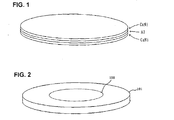
- a clad coin is, for example, a three-layer coin as shown in FIG.
- the clad coin is intended to be discriminated by making use of the fact that the signal output level is different between the output of an ordinary white copper coin and the output of a clad coin made of white copper only for the surface.
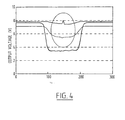
- the metal of a central core portion 100 and the metal of a peripheral ring portion 101 are different from each other, and no reliable means for discriminating a bicolor coin has been known yet.
- a clad coin cannot be discriminated securely by the above-mentioned conventional apparatus. It is because there may be a coin of other single material having the same output level as a clad coin, of which surface only is white copper, has.
- Japanese Patent Application No. 2,539,521 B2 discloses an example of a coin conveyance device of a coin processor, in which a mirror-finished iron metal member is described as a coin path member. The outline of the device will be described hereinbelow with reference to FIG. 3.
- Coins M are conveyed from a hopper 201 along a path face 204a of a coin path 204 by a belt 207 and a rubber roller 208 looped over pulleys 205 and 206 on the coin path 204 and reach the side of a coin path 211.
- the coin path 211 has a coin rail 223 projected from the path face 211a, and a plurality of windows(coin assorting holes) 222(222a to 222f). Dimensions 221(221a to 221f) of each from the outer face of the rail 223 to the outer side of the windows 222 correspond to the outer diameters of coins.
- a conveyance belt 215 that runs between a driving pulley 213 and a driven pulley 214 is provided in a tensioned state over the windows 222.
- presser rollers 251 each having a truncated cone shape are disposed.
- the coins M are conveyed while being slid in a state where the coins M are pressed against the conveyance belt 215 on the path face 211a of the coin path 211, so that the coins M drop from the corresponding windows 222 and housed in a housing portion(not shown) disposed below the windows 222.
- the coins M slide along the coin path faces 224a and 211a in a pressed state by the conveyance belts 207 and 215.
- a rolled steel plate bright member as a mirror-finished iron metal member is used as a path member of each of the coin paths 204 and 211.
- the surface of the member is subjected to a salting-in nitriding process to form a surface hardened layer and, after that, the surface hardened layer is polished, thereby obtaining a smoothed surface hardened layer.
- the path faces 204a and 211a are made of an iron metal member having a smooth surface hardened layer.
- an abrasion resistant plate made of an iron material can be used for the path portion other than a discriminating section in the conventional device, in the case of using a magnetic type coin sensor, if an iron material is used, the magnetic flux is shielded. Consequently, the iron material cannot be used for the path member in the path section in which a coin sensor is positioned.
- a plate of ceramics(insulator) is provided in a tensioned manner on the path face.
- a magnetic sensor for discriminating coins is disposed in the coin conveying path section, ceramics having high abrasion resistance is attached to an object passing portion so as to be easily detached, and the portion is used as a part of the conveyance path. Consequently, coins slide on the coin path.
- coins made of metal slide on the ceramics at high speed, so that static electricity is charged in the coins and often discharged in some places. Due to the discharging of the static electricity, noise(circled portion) occurs in sensor sensed data as shown in FIG. 4, and a problem such as identification precision is not improved occurs.
- the present invention is devised in the light of such background, and it is hence an object of the present invention to present a discriminating apparatus of metal piece formed of plural materials high in reliability which is capable of discriminating securely clad coin, other coin, or metal piece formed of plural materials.
- Another object of the present invention is to provide an abrasion resistant member in a coin conveying path and a coin discriminating sensor capable of preventing occurrence of static electricity.
- the present invention relates to a discerning apparatus of metal piece formed of plural materials, and the object of the present invention is achieved by, in a first aspect of the invention, comprising a reflection type detection sensor disposed at a sliding surface side of a passage of a metal piece formed of plural materials, and discriminating means for discriminating the metal piece on the basis of an output of the metal piece detection sensor, in which excitation signals of plural frequencies are supplied to a primary coil of the reflection type detection sensor, and the discriminating means discerns the metal piece passing the passage on the basis of an output of a secondary coil of the reflection type detection sensor.
- the object of the present invention is by, in a second aspect of the invention, comprising a reflection type detection sensor disposed at a sliding surface side of a passage of a metal piece formed of plural materials, a metal piece detection sensor composed of a first transmission type detection sensor disposed so as to hold one end of the passage and a second transmission type detection sensor disposed so as to hold other end of the passage, and discriminating means for discriminating the metal piece on the basis of an output of the metal piece detection sensor, in which excitation signals of plural frequencies are supplied to a primary coil of the reflection type detection sensor, a primary coil of the first transmission type detection sensor, and a primary coil of the second transmission type detection sensor, and the discriminating means discriminate the metal piece passing the passage on the basis of an output of a secondary coil of the reflection type detection sensor, an output of a secondary coil of the first transmission type detection sensor, and an output of a secondary coil of the second transmission type detection sensor.
- the present invention relates to an abrasion resistant member in a coin conveyance path for discriminating coins and the object of the present invention is achieved by a conductive material in a thin plate shape adhered so as to cover a path face faced by a magnetic sensor provided so as to face the under face of the coin conveyance path or to cover both path guides for path regulation provided on both right and left sides in the travel direction of coins, in the coin conveyance path having a coin discriminating sensor for discriminating the kind of each of coins conveyed one by one with a spacing therebetween along a sliding face.
- Another invention relates to a coin discriminating sensor and the object of the present invention is realized by a coin discriminating sensor including a coin path portion, a reflection type sensor disposed so as to face the under face of the coin path portion, a first transmission type sensor disposed so as to sandwich one lateral end of the path, and a second transmission type sensor disposed so as to sandwich the other lateral end of the path, and the coin path portion of the coin discriminating sensor is made of a conductive material.
- the two inventions are more effectively achieved by using conductive ceramics as the conductive material and by using conductive alumina or conductive zirconia as the conductive ceramics.
- the present invention realizes a discriminating apparatus for detecting securely a metal piece formed of plural materials such as clad coin or bicolor coin, by exciting a metal piece sensor(primary coil) at three frequencies, high frequency, medium frequency, and low frequency, and processing the output signals and judging coins from the output signals.
- conductive ceramics (conductive alumina or conductive zirconia) is adhered to the coin sliding face of a magnetic sensor.
- the conductive ceramics is conductive and does not cause an eddy current so much. Since the resistivity of conductive ceramics is about 1000 times as high as a general metal, occurrence of an eddy current is about 1/10 3 (0.01%). Consequently, the conductive ceramics does not exert an influence on the quality of a magnetic signal, nor cause a problem of abrasion at the time of conveyance of coins, but has durability.
- FIG. 5 is a partial sectional perspective view of a structure of a coin detection sensor 10 of the present invention
- FIG. 6 is its sectional view.
- the coin detection sensor 10 is shaped in a pi-form having a clearance for detaching and attaching a conveying belt(not shown) in its upper part, and a central rectangular bottom space forms a passage 11 of coin, and a shield plate 12 for shielding external magnetism laminated on the outer circumference.
- the coin detection sensor 10 has a U-letter shape having, in its upper portion, a gap for attaching the conveyance belt(not shown).
- the bottom portion of a rectangular space in the center portion serves as a path 11.
- a shield plate 12 for shielding external magnetism is formed on the outer surface.
- side sensors 20 and 30 of transmission detection type are disposed each so as to sandwich an end portion of the path 11, and a cylindrical-shaped center sensor 40 of a reflection detection type is disposed below the path 11.
- the side sensors 20 and 30 are symmetric with respect to the center of the detection sensor 10.
- a primary coil 21 and a secondary coil 23 are wound around upper and lower portions, respectively, of a side core 22 having a U-letter shape which opens on the right side
- a primary coil 31 and a secondary coil 33 are wound around upper and lower portions, respectively, of a side core 32 having a U-letter shape which opens on the left side.
- the center sensor 40 has a cylindrical pot core 41.
- a primary coil 42 is wound around the pot core 41, and a secondary coil 43 is wound on the inner groove of the pot core 41 and buried.
- a coin(not shown) for a temperature sensor is provided.
- abrasion resistant plate made of zirconia which is a non-conductive material is conventionally used as the material of the path 11, in the present invention, conductive ceramics(conductive alumina or conductive zirconia) is used.
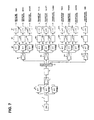
- an exciting and signal-detecting process is performed with a circuit configuration shown in FIG. 7 on the coin detection sensor 10.
- an ocillation signal from an oscillator 1 is frequency-divided by a frequency divider 2 into a low frequency(4 kHz), an intermediate frequency(16 kHz) and a high frequency(250 kHz) which are modulated(added) by an adder 4 via band pass filters(BPFs) 3L, 3M and 3H for the low, intermediate and high frequencies, respectively.
- BPFs band pass filters
- the resultant is applied to the primary coils 21, 32 and 42 of a coin detection sensor 10 via a current amplifier 5. That is, a composite excited signal of the low, intermediate and high frequencies is supplied to the primary coils 21 and 31 of the side sensors 20 and 30 and to the primary coil 42 of the center sensor 40 via the current amplifier 5.
- Outputs of the secondary coils 23, 33 and 43 are detected as output through amplifiers 44, 44L and 44R, respectively, and are passed to band pass filters, full wave rectifiers and low pass filters, thereby obtaining a reflected 4KHz signal R4S, a reflected 16KHz signal R16S, a reflected 250KHz signal R250S, a transmitted L4KHz signal TL4S, a transmitted L16KHz signal TL16S, a transmitted L250KHz signal TL250S, a transmitted R4KHz signal TR4S, a transmitted R16KHz signal TR16S, and a transmitted R250KHz signal TR250S.
- an output of the secondary coil 43 of the center sensor 40 is frequency-divided by band-pass filters(BPFs) 451 to 453 via an amplifier 44 into low, intermediate and high frequencies which pass through full wave rectifiers 461 to 463 and low pass filters(LPFs) 471 to 473.
- a reflected 4KHz signal R4S, a reflected 16KHz signal R16S, and a reflected 250KHz signal R250S are thereby obtained.
- the center sensor 40 takes the form of an eddy current loss type magnetic sensor by the primary coil 42 and the secondary coil 43.
- An output of the secondary coil 23 of the side sensor 20 passes through an amplifier 44L and is frequency-divided by band pass filters(BPFs) 45L1 to 45L3 into low, intermediate and high frequencies, respectively, which are further passed to the full wave rectifiers 46L1 to 46L3 and low pass filters 47L1 to 47L3.
- the transmitted L4KHz signal TL4S, transmitted L16KHz signal TL16S, and transmitted L250KHz signal TL250S are thereby obtained.
- An output of the secondary coil 33 of the side sensor 30 passes through an amplifier 44R and is frequency-divided by band pass filters(BPFs) 45R1 to 45R3 into low, intermediate and high frequencies, respectively, which are further passed to the full wave rectifiers 46R1 to 46R3 and low pass filers(LPFs) 47R1 to 47R3.
- the transmitted R4KHz signal TR4S, transmitted R16KHz signal TR16S, and transmitted R250KHz signal TR250S are thereby obtained.
- an output of the secondary coil of the temperature sensor passes through an amplifier 481, a BPF 482, a full wave rectifier 483, and an LPF 484 and is outputted as a temperature monitor signal THS.
- the reflected 4KHz signal R4S, reflected 16KHz signal R16S, reflected 250KHz signal R250S, transmitted L4KHz signal TL4S, transmitted L16KHz signal TL16S, transmitted L250KHz signal TL250S, transmitted R4KHz signal TR4S, transmitted R16KHz signal TR16S, transmitted R250KHz signal TR250S, and temperature monitor signal THS are respectively inputted to discriminating means(not shown) for discriminating a coin, and a discriminating process and judgement are executed.
- the discriminating means compares each feature quantity with a coin acceptance window predetermined in each coin, and discriminates a counterfeit.
- a signal difference depending on material is small, but the attenuation factor is determined by the material of the surface layer, and at low frequency, there is an effect also on the material of the intermediate layer, and therefore by comparing the attenuation factor at each frequency with the predetermined criterion, the coin can be discriminated.
- the coin is conveyed shifted to the flank of a side sensor 20.
- the magnetic of the electric field E depends on the depth z from the surface, and does not depend on component y at right angle to component x. According to Maxwell's equation, supposing the electric field to be E(component x only), the magnetic flux density to be B, the magnetic field to be H(component y only), and the magnetic permeability to be ⁇ , the following formula (1) is established.
- the magnetic sensor of the present invention is capable of obtaining signals depending on the internal material, aside from the surface portion and entire section.
- FIG. 9 shows its principle schematically.
- the sensor output is determined by the magnetic flux getting into the secondary coil as shown in the following formula (17), and the magnetic flux passing through a non-magnetic medium attenuates, and hence the sensor output decreases.
- the magnetic flux may increase, and it is known that the sensor output increases.
- a reflection 4 kHz signal R4S from a center sensor 40 is utilized in detection of material and is also used as discriminating information for coin section material and magnetic or non-magnetic material
- a reflected 16 kHz signal R16S is utilized to detect intermediate section material of the coin and is also used as discriminating information for material from the surface of coin to the vicinity of center. That is, the reflected 16 kHz signal R16S is used for detection of a clad coin.
- a reflected 250 kHz signal R250S is utilized in detection of surface material and composition of coin and is also used for discriminating the material of surface layer of the coin, and it is utilized as the information showing the feature in the waveform of the ring/core boundary.
- the reflected 250 kHz signal R250S is used for detection of a bicolor coin.
- a transmitted L4 kHz signal TL4S and a transmitted R4 kHz signal TR4S are utilized as information of material x thickness
- a transmitted L250 kHz signal TL250S and a transmitted R250 kHz signal TR250S are utilized in detection of coin shape, and used as information of material x thickness x diameter.
- transmitted L15 kHz signal and transmitted R16 kHz signal are not utilized in detection of coin.
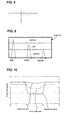
- FIG. 10 shows actual detected signals of reflected signals. From the upper side of the feature curve, the reflection 4 kHz signal, reflection 16 kHz signal and reflection 250 kHz signal are shown.
- 250 kHz is used as high frequency, but not limited to this, it is enough in a frequency band showing small difference in signal output depending on the quality of the non-magnetic material(Al and CuNi, etc.) to be detected, and preferably it is several hundreds of kHz or more.
- the intermediate frequency is 16 kHz, and it may be anywhere in a frequency band showing a signal output difference depending on the material from the surface to the vicinity of center of the object of detection, and the frequency band is in an order of tens of kHz.
- the low frequency is 4 kHz, but it may be in any frequency band in which the output signal difference appears prominently depending on the material(conductivity) of the entire object to be detected, and a frequency band of DC to several kHz is preferred.
- each signal in the center of a coin passing over the coin detection sensor 10 is used in judging process as feature quantity.
- the trigger method when a passing sensor is installed, an approximate position is detected on the basis of the signal from the passing sensor, and the central part of the coin is searched.
- the passing signal When passing sensor is not installed, the passing signal attenuates regardless of the material(magnetic or non-magnetic), and the attenuation quantity is larger as the frequency is higher, and when the coin is conveyed facing guide surface of coin-passage, the portion of the coin which covers the core disposed in the shifted position is the same regardless of the coin diameter, and on the basis of this fact, the minimum position(maximum attenuation position) of transmitted L(signal in shifted position) is regarded as nearly coinciding with the coin center, and each signal value at this position may be used as the feature quantity.
- FIG. 11A shows reflection 4 kHz signal R4S of 5 Pf coin of Germany(Cu-Zn25 clad Fe), and FIG. 11B is reflection 4 kHz signal R4S of 1 cent coin used in the USA(Cu/Zn5).
- the signal increases(A1), whereas in the USA 1 cent coin of non-magnetic material in FIG. 11B, the signal decreases(A2), and the difference of both signals is evident.
- FIG. 12 shows characteristics of Al uniform coin sample, in which B1, B2, B3 show reflection signals at 4 kHz, 16 kHz and 250 kHz, respectively, in the case of Al only.
- B1, B2, B3 show reflection signals at 4 kHz, 16 kHz and 250 kHz, respectively, in the case of Al only.
- FIG. 13 shows characteristics of Al/CuZnNi/Al clad coin sample, in which B4 is reflected 250 kHz signal R250S showing the feature of surface layer Al(thickness ⁇ 0.5t), B5 is reflected 16 kHz signal R16S showing the feature of surface layer Al(0.5t) + inner layer CuZnNi( ⁇ 1.0t), and B6 is reflected 4 kHz signal R4S showing the feature of all layers of CuZnNi(0.5t) + Al(1.0t) + CuZnNi(0.5t).
- FIG. 14 shows characteristics of CuZnNi uniform coin sample, in which B7, B8, B9 show reflected signals at 4 kHz, 16 kHz and 250 kHz, respectively, in the case of CuZnNi only.
- FIG. 15 shows characteristics of CuZnNi/Al/CuZnNi clad coin sample, in which B10 is reflected 250 kHz signal R250S showing the feature of surface layer of CuZnNi( ⁇ 0.5t), B11 is reflected 16 kHz signal R16S showing the feature of surface layer and inner layer of CuZnNi(0.5t) + Al( ⁇ 1.0t), and B12 is reflection 4 kHz signal R4S showing the feature of all layers of CuZnNi(0.5t) + Al(1.0t) + CuZnNi(0.5t).
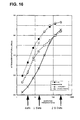
- FIG. 16 shows frequency characteristics of reflected signals in stationary state in the same samples as shown in FIG. 12 to FIG.15, in which the graph shows the attenuation factor calculated by measuring the outputs by the center sensor 40 when excited at high frequency, medium frequency and low frequency, using Al uniform coin sample, CuZnNi uniform coin sample, Al/CuZnNi/Al clad coin sample and CuZnNi/Al/CuZnNi clad coin sample.
- the attenuation factor In high frequency region, the magnetic flux can get only into the surface layer due to skin effect, and the attenuation factor is large. In low frequency region, the skin effect is small, and the magnetic flux penetrates through the coin and the attenuation factor is small. In medium frequency region, the attenuation factor is somewhere between the low frequency and high frequency regions. The following facts are found from these characteristics.
- the reflected 16 kHz signal R16S differs with the core material(B2 ⁇ B5, B8 ⁇ B11), and if the surface and core materials are the same, the reflected 16 kHz signal R16S differs with each thickness (B5 ⁇ B11).
- the material at surface depth of (0.5 mm + ⁇ ) begins to have an effect on the reflected signal, and at about 10 to 30 kHz, the effect of the materials core and surface on the sensor side is significant.
- the magnetic flux penetrates through the section of the object, and the signal having combined effects of all materials is obtained as reflected signal.
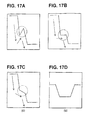
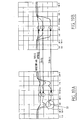
- a reflected 250 kHz signal has a point of inflection in the signal of coin edge portion as shown in FIG. 17A to 17D, and its inclination is inverted(FIG. 17A), the inclination becomes zero(FIG. 17B), or the inclination becomes moderate(FIG. 17C). If the coin is not bicolor, point of inflection does not occur as shown in FIG. 17D.
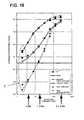
- FIG. 18 shows a frequency characteristic of reflected signal about bicolor coin, and at low frequency, the spread of the magnetic flux from the center sensor extends not only to the core but also to the ring, and hence a difference as shown in part C occurs.
- the attenuation factor is smaller than the attenuation factor of a coin sample composed of core member only.
- the attenuation factor is larger than in CuZnNi uniform coin sample ( ⁇ ). This is because Al is higher in conductivity than CuZnNi.
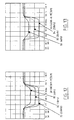
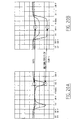
- the 4 kHz signal of the core has an effect of the ring material, and there is a difference between the bicolor coin sample and uniform material coin sample as shown at the left side in FIGs. 19A and 19B, and point of inflection D1 is a feature of the bicolor metal boundary.
- FIG. 19A shows a bicolor coin sample composed of Al ring and CuZnNi core
- FIG. 19B is a uniform coin sample of CuZnNi
- FIG. 20A shows characteristics of a pierced coin sample of CuZnNi ring and a hollow core
- FIG. 20B shows characteristics of a uniform coin sample of CuZnNI.
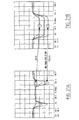
- FIG. 21A shows a bicolor clad coin sample composed of Al ring and CuZnNi/Ni/CuZnNi core
- FIG. 21B is a bicolor clad coin sample composed of CuZnNi ring and CuZnNi/Ni/CuZnNi core.
- a preamplifier may be built in the coin detection sensor.
- the output of one oscillator is divided, and excitation signals of low frequency, medium frequency and high frequency are obtained, but oscillators may be provided individually for each frequency.
- the coin is explained as an example, but the present invention may be applicable to any other metal piece composed of plural metals.
- FIG. 22 shows the structure of coin feeding, conveying, and discriminating portions of a coin processing apparatus including: a coin feeder 101 which takes the form of a turntable, a conveyance path 102 for conveying coins 100 one by one, a conveyance belt 103 for conveying coins while pressing the coins against the slide face, regulating guides 104a and 104b for guiding conveyance of coins, a diameter sensor 110 for detecting data of the diameter of a coin by a sensor for discriminating coins, material and thickness sensors 111 and 112 for detecting the material and thickness of each coin, and a path 105 of the discriminating path.
- a coin feeder 101 which takes the form of a turntable
- a conveyance path 102 for conveying coins 100 one by one
- a conveyance belt 103 for conveying coins while pressing the coins against the slide face
- regulating guides 104a and 104b for guiding conveyance of coins
- a diameter sensor 110 for detecting data of the diameter of a coin by a sensor for discriminating coins
- a thin plate of conductive ceramics is adhered to the portion of the discriminating area 105 in the coin path portion, and a coin sliding face is provided so as to be smoothly connected to the front and rear paths 102.
- An abrasion resistant plate conventionally made of zirconia which is a non-conductive material is conventionally used as the material of the path member material for the discriminating sensor area 105 of the coin path portion. In the present invention, however, conductive ceramics(conductive alumina or conductive zirconia) is used.
- the conductive ceramics is also adhered to an identification portion path regulation guide 106a with which the rim of a coin comes into contact.
- the thickness of the conductive ceramics portion is 0.5 mm. The reason why the conductive ceramics is applied also to a path regulating guide 106 is to prevent a signal from becoming different from a normal signal due to leakage of an eddy current generated in the coin to the outside via path side walls.
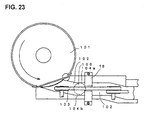
- a second embodiment shown in FIG. 23 is characterized by a coin detection sensor 10 having a configuration similar to that of FIG. 22 except that all of magnetic sensors are integrated and built in a casing shown in FIG. 5.
- an exciting and signal-detecting process is performed with a circuit configuration shown in FIG. 7 on the coin discriminating sensor 120.
- the discriminating means identifies, for example, as an object to be identified, a coin made of a plurality of metals, which is called a clad coin made of three kinds of metal layers.
- the discriminating means compares a characteristic amount with a determination frame preliminarily provided for each coin to discriminate whether the coin is true or false.
- a determination frame preliminarily provided for each coin to discriminate whether the coin is true or false.
- an attenuation factor is determined by the material of a surface layer.
- an influence is exerted also on the material of an intermediate layer. Consequently, by comparing the attenuation factor at each frequency with a predetermined determination reference, a coin can be identified.
- a coin is conveyed along the side sensor 20 side.
- the shape of the path guide 104a is formed so that the coin is conveyed upward by the conveyance belt 103 along one side.
- the discriminating means performs a signal process and detection as described in Japanese Patent Application Laid-open No. 9-245214 A.
- the path 11 of the coin sensor 10 is made of conductive ceramics(conductive alumina or conductive zirconia), so that static electricity is not charged in a coin conveyed for discrimination. Consequently, a noise-free characteristic is achieved as shown by detection signals of the reflected 4KHz signal R4S(upper signal waveform), reflected 16KHz signal R16S(intermediate signal waveform), and reflected 250KHz signal R250S(lower signal waveform) as outputs of the center sensor 40 shown in FIG. 10.
- coins are not charged, and noise due to static electricity does not occur, so that coins can be accurately discriminated without taking countermeasures by software.
- the metal piece detection sensor of the present invention detects not only excitation frequencies for obtaining feature signals by the entire coin and coin surface material used in the conventional coin discriminating method, but also frequencies of feature signals depending on materials from the coin surface to the vicinity of the center, and therefore the coin sectional structure which is the feature of a clad coin can be estimated. Further, by capturing electric connection or disconnection in the bicolor coin junction as increase or decrease signal of surface current, a bicolor coin can be discriminated. In the case of non-magnetic coins distributed in Japan, the signal attenuates only, but in the case of a magnetic coin, the signal increases. By corresponding to an increasing signal in sensor signal processing, the material of magnetic coin and magnetic clad structure coin can be distinguished.
- abrasion-resistant conductive ceramics is provided, so that occurrence of static electricity can be prevented, and software for eliminating noise caused by static electricity which is conventionally necessary becomes unnecessary.
- the electrical resistivity of the conductive ceramics and that of a metal are different from each other by three digits, an amount of an eddy current is small, and an influence on a magnetic signal is hardly exerted.
Landscapes
- Physics & Mathematics (AREA)
- General Physics & Mathematics (AREA)
- Testing Of Coins (AREA)
- Investigating Or Analyzing Materials By The Use Of Magnetic Means (AREA)
- Noodles (AREA)
- Photoreceptors In Electrophotography (AREA)
- Detergent Compositions (AREA)
Abstract
Description
- The present invention relates to a discriminating apparatus of metal piece formed of plural materials, and more particularly relates to a discriminating apparatus of metal piece formed of plural materials of very high reliability capable of securely discriminating clad coins or bicolor coins which are metal pieces formed of plural materials, being suited to coin processing machines such as coin sorting machine, coin-depositing machine and coin packaging machine.
- Further, the present invention relates to an abrasion resistant member and a coin discriminating sensor for preventing occurrence of noise caused by static electricity, suitable for a coin processing apparatus employing a coin discriminating method of discriminating coins while sliding and conveying coins on a path by a transporting belt, and particularly coin processors.
- As an apparatus for discriminating a coin which is a metal piece, hitherto, a coin discriminating apparatus as disclosed in Japanese Patent No. 2567654 B2 has been known. This coin discriminating apparatus excites an oscillation coil at high frequency or low frequency, sums up the attenuated output at each frequency yield by a receiving coil, and discriminates a coin on the basis of the fact that different outputs are obtained between a clad coin(bimetal coin) both of which surfaces arew of the same material, and a single structure coin. Herein, a clad coin is, for example, a three-layer coin as shown in FIG. 1, of which core is aluminum(Al) with white copper(CuNi) on both layer surfaces, and the clad coin is intended to be discriminated by making use of the fact that the signal output level is different between the output of an ordinary white copper coin and the output of a clad coin made of white copper only for the surface.
- As for the structure of a bicolor coin, as shown in FIG. 2, the metal of a central core portion 100 and the metal of a peripheral ring portion 101 are different from each other, and no reliable means for discriminating a bicolor coin has been known yet.
- A clad coin, however, cannot be discriminated securely by the above-mentioned conventional apparatus. It is because there may be a coin of other single material having the same output level as a clad coin, of which surface only is white copper, has.
- Hitherto, there has been no sensor or discriminating apparatus capable of discriminating a coin having a composite material structure such as clad coin or bicolor coin.
- Further, Japanese Patent Application No. 2,539,521 B2 discloses an example of a coin conveyance device of a coin processor, in which a mirror-finished iron metal member is described as a coin path member. The outline of the device will be described hereinbelow with reference to FIG. 3.
- Coins M are conveyed from a hopper 201 along a path face 204a of a coin path 204 by a belt 207 and a rubber roller 208 looped over pulleys 205 and 206 on the coin path 204 and reach the side of a coin path 211. The coin path 211 has a coin rail 223 projected from the path face 211a, and a plurality of windows(coin assorting holes) 222(222a to 222f). Dimensions 221(221a to 221f) of each from the outer face of the rail 223 to the outer side of the windows 222 correspond to the outer diameters of coins. A conveyance belt 215 that runs between a driving pulley 213 and a driven pulley 214 is provided in a tensioned state over the windows 222. On the inside of the conveyance belt 215, presser rollers 251 each having a truncated cone shape are disposed. The coins M are conveyed while being slid in a state where the coins M are pressed against the conveyance belt 215 on the path face 211a of the coin path 211, so that the coins M drop from the corresponding windows 222 and housed in a housing portion(not shown) disposed below the windows 222. As described above, the coins M slide along the coin path faces 224a and 211a in a pressed state by the conveyance belts 207 and 215.
- As a path member of each of the coin paths 204 and 211, a rolled steel plate bright member as a mirror-finished iron metal member is used. The surface of the member is subjected to a salting-in nitriding process to form a surface hardened layer and, after that, the surface hardened layer is polished, thereby obtaining a smoothed surface hardened layer. The path faces 204a and 211a are made of an iron metal member having a smooth surface hardened layer.
- Although an abrasion resistant plate made of an iron material can be used for the path portion other than a discriminating section in the conventional device, in the case of using a magnetic type coin sensor, if an iron material is used, the magnetic flux is shielded. Consequently, the iron material cannot be used for the path member in the path section in which a coin sensor is positioned.
- Conventionally, therefore, a plate of ceramics(insulator) is provided in a tensioned manner on the path face. Specifically, a magnetic sensor for discriminating coins is disposed in the coin conveying path section, ceramics having high abrasion resistance is attached to an object passing portion so as to be easily detached, and the portion is used as a part of the conveyance path. Consequently, coins slide on the coin path. In environments of low temperature and low moisture, coins made of metal slide on the ceramics at high speed, so that static electricity is charged in the coins and often discharged in some places. Due to the discharging of the static electricity, noise(circled portion) occurs in sensor sensed data as shown in FIG. 4, and a problem such as identification precision is not improved occurs.
- As a countermeasure against static electricity, conventionally, a signal waveform is traced by software and a portion in which the sudden change occurs is not used for a discriminating process, thereby preventing an influence of static electricity noise is required. The occurrence of noise is not prevented even by performing a noise eliminating process by software. When noise which is not expected by the noise eliminating software occurs, a failure may occur. It is therefore necessary to prevent occurrence itself of noise.
- The present invention is devised in the light of such background, and it is hence an object of the present invention to present a discriminating apparatus of metal piece formed of plural materials high in reliability which is capable of discriminating securely clad coin, other coin, or metal piece formed of plural materials.
- Further, another object of the present invention is to provide an abrasion resistant member in a coin conveying path and a coin discriminating sensor capable of preventing occurrence of static electricity.
- The present invention relates to a discerning apparatus of metal piece formed of plural materials, and the object of the present invention is achieved by, in a first aspect of the invention, comprising a reflection type detection sensor disposed at a sliding surface side of a passage of a metal piece formed of plural materials, and discriminating means for discriminating the metal piece on the basis of an output of the metal piece detection sensor, in which excitation signals of plural frequencies are supplied to a primary coil of the reflection type detection sensor, and the discriminating means discerns the metal piece passing the passage on the basis of an output of a secondary coil of the reflection type detection sensor.
- The object of the present invention is by, in a second aspect of the invention, comprising a reflection type detection sensor disposed at a sliding surface side of a passage of a metal piece formed of plural materials, a metal piece detection sensor composed of a first transmission type detection sensor disposed so as to hold one end of the passage and a second transmission type detection sensor disposed so as to hold other end of the passage, and discriminating means for discriminating the metal piece on the basis of an output of the metal piece detection sensor, in which excitation signals of plural frequencies are supplied to a primary coil of the reflection type detection sensor, a primary coil of the first transmission type detection sensor, and a primary coil of the second transmission type detection sensor, and the discriminating means discriminate the metal piece passing the passage on the basis of an output of a secondary coil of the reflection type detection sensor, an output of a secondary coil of the first transmission type detection sensor, and an output of a secondary coil of the second transmission type detection sensor.
- The present invention relates to an abrasion resistant member in a coin conveyance path for discriminating coins and the object of the present invention is achieved by a conductive material in a thin plate shape adhered so as to cover a path face faced by a magnetic sensor provided so as to face the under face of the coin conveyance path or to cover both path guides for path regulation provided on both right and left sides in the travel direction of coins, in the coin conveyance path having a coin discriminating sensor for discriminating the kind of each of coins conveyed one by one with a spacing therebetween along a sliding face.
- Another invention relates to a coin discriminating sensor and the object of the present invention is realized by a coin discriminating sensor including a coin path portion, a reflection type sensor disposed so as to face the under face of the coin path portion, a first transmission type sensor disposed so as to sandwich one lateral end of the path, and a second transmission type sensor disposed so as to sandwich the other lateral end of the path, and the coin path portion of the coin discriminating sensor is made of a conductive material.
- Further, the two inventions are more effectively achieved by using conductive ceramics as the conductive material and by using conductive alumina or conductive zirconia as the conductive ceramics.
- In the accompanying drawings:
- FIG. 1 is a schematic representation showing structure of clad coin;
- FIG. 2 is a schematic representation showing structure of bicolor coin;
- FIG. 3 is a diagram for explaining a conventional coin path member;
- FIG. 4 is a sensor output waveform on which noise is multiplexed in the case where the conventional path member is used;
- FIG. 5 is a partial sectional perspective structural view showing an example of coin detection sensor used in the present invention;
- FIG. 6 is a sectional structural view of the coin detection sensor used in the present invention;
- FIG. 7 is a block diagram showing a processing system of excitation and detection signal of coin detection sensor;
- FIG. 8 is a diagram explaining the operating principle of the present invention;
- FIG. 9 is a diagram schematically explaining the operating principle of the present invention;
- FIG. 10 is a characteristic diagram showing an example of detection signal of coin detection sensor;
- FIGs. 11A and 11B are characteristic diagrams showing the magnetic or non-magnetic feature of coil;
- FIG. 12 is a characteristic diagram of Al uniform coin;
- FIG. 13 is a characteristic diagram of Al/CuZnNi/Al clad coin;
- FIG. 14 is a characteristic diagram of CuZnNi uniform coin;
- FIG. 15 is a characteristic diagram of CuZnNi/Al/CuZnNi clad coin;
- FIG. 16 is a diagram showing an example of reflection frequency characteristic in a stationary state of clad coin sample on a center sensor;
- FIGs. 17A to 17D are diagrams explaining judgement of bicolor coin;
- FIG. 18 is a diagram showing an example of reflection frequency characteristic in a stationary state of bicolor coin on a center sensor;
- FIG. 19 is a diagram showing characteristic examples (bicolor coin sample at left, uniform coin sample at right) used in judgement of bicolor coin;
- FIG. 20 is a diagram showing characteristic examples (bicolor coin sample at left, uniform coin sample at right) used in judgement of bicolor coin;
- FIG. 21 is a diagram showing characteristic examples (bicolor coin sample at left, uniform coin sample at right) used in judgement of bicolor coin;
- FIG. 22 is a structural diagram showing an example of the configuration of a first coin path according to the present invention; and
- FIG. 23 is a structural diagram showing an example of the configuration of a second coin path according to the present invention.
-
- The present invention realizes a discriminating apparatus for detecting securely a metal piece formed of plural materials such as clad coin or bicolor coin, by exciting a metal piece sensor(primary coil) at three frequencies, high frequency, medium frequency, and low frequency, and processing the output signals and judging coins from the output signals.
- Further, in the present invention, to prevent charging with static electricity a conveyed coin and to provide a path member having excellent abrasion resistance without deteriorating magnetic detection sensitivity, conductive ceramics(conductive alumina or conductive zirconia) is adhered to the coin sliding face of a magnetic sensor. The conductive ceramics is conductive and does not cause an eddy current so much. Since the resistivity of conductive ceramics is about 1000 times as high as a general metal, occurrence of an eddy current is about 1/103 (0.01%). Consequently, the conductive ceramics does not exert an influence on the quality of a magnetic signal, nor cause a problem of abrasion at the time of conveyance of coins, but has durability. In case of making the surface on which coins slide of a coin path of a magnetic sensor of a conductive material to eliminate noise caused by discharging of static electricity or discharging the static electricity charged on the ground(earth portion), it is feared that the signal attenuates and cannot be used for discrimination because the kind of a metal piece is discriminated by detecting an eddy current loss which occurs in coins. According to the present invention, however, there are no such problems.
- A preferred embodiment of the present invention is described below with the accompanying drawings. In this embodiment, example of a coin and a coin sample having the same metal and structure as the coin, and examples of coin discriminating apparatus are explained as metal pieces and as the discriminating apparatus respectively.
- FIG. 5 is a partial sectional perspective view of a structure of a coin detection sensor 10 of the present invention, and FIG. 6 is its sectional view. The coin detection sensor 10 is shaped in a pi-form having a clearance for detaching and attaching a conveying belt(not shown) in its upper part, and a central rectangular bottom space forms a passage 11 of coin, and a shield plate 12 for shielding external magnetism laminated on the outer circumference. The coin detection sensor 10 has a U-letter shape having, in its upper portion, a gap for attaching the conveyance belt(not shown). The bottom portion of a rectangular space in the center portion serves as a path 11. On the outer surface, a shield plate 12 for shielding external magnetism is formed.
- In the coin detection sensor 10, side sensors 20 and 30 of transmission detection type, each having a rectangular parallelepiped shape, are disposed each so as to sandwich an end portion of the path 11, and a cylindrical-shaped center sensor 40 of a reflection detection type is disposed below the path 11. The side sensors 20 and 30 are symmetric with respect to the center of the detection sensor 10. As for the side sensor 20, a primary coil 21 and a secondary coil 23 are wound around upper and lower portions, respectively, of a side core 22 having a U-letter shape which opens on the right side, and a primary coil 31 and a secondary coil 33 are wound around upper and lower portions, respectively, of a side core 32 having a U-letter shape which opens on the left side. The center sensor 40 has a cylindrical pot core 41. A primary coil 42 is wound around the pot core 41, and a secondary coil 43 is wound on the inner groove of the pot core 41 and buried. Further, a coin(not shown) for a temperature sensor is provided.
- Although an abrasion resistant plate made of zirconia which is a non-conductive material is conventionally used as the material of the path 11, in the present invention, conductive ceramics(conductive alumina or conductive zirconia) is used.
- In the present invention, an exciting and signal-detecting process is performed with a circuit configuration shown in FIG. 7 on the coin detection sensor 10. Specifically, an ocillation signal from an oscillator 1 is frequency-divided by a frequency divider 2 into a low frequency(4 kHz), an intermediate frequency(16 kHz) and a high frequency(250 kHz) which are modulated(added) by an adder 4 via band pass filters(BPFs) 3L, 3M and 3H for the low, intermediate and high frequencies, respectively. The resultant is applied to the primary coils 21, 32 and 42 of a coin detection sensor 10 via a current amplifier 5. That is, a composite excited signal of the low, intermediate and high frequencies is supplied to the primary coils 21 and 31 of the side sensors 20 and 30 and to the primary coil 42 of the center sensor 40 via the current amplifier 5.
- Outputs of the secondary coils 23, 33 and 43 are detected as output through amplifiers 44, 44L and 44R, respectively, and are passed to band pass filters, full wave rectifiers and low pass filters, thereby obtaining a reflected 4KHz signal R4S, a reflected 16KHz signal R16S, a reflected 250KHz signal R250S, a transmitted L4KHz signal TL4S, a transmitted L16KHz signal TL16S, a transmitted L250KHz signal TL250S, a transmitted R4KHz signal TR4S, a transmitted R16KHz signal TR16S, and a transmitted R250KHz signal TR250S. Specifically, an output of the secondary coil 43 of the center sensor 40 is frequency-divided by band-pass filters(BPFs) 451 to 453 via an amplifier 44 into low, intermediate and high frequencies which pass through full wave rectifiers 461 to 463 and low pass filters(LPFs) 471 to 473. A reflected 4KHz signal R4S, a reflected 16KHz signal R16S, and a reflected 250KHz signal R250S are thereby obtained. The center sensor 40 takes the form of an eddy current loss type magnetic sensor by the primary coil 42 and the secondary coil 43.
- An output of the secondary coil 23 of the side sensor 20 passes through an amplifier 44L and is frequency-divided by band pass filters(BPFs) 45L1 to 45L3 into low, intermediate and high frequencies, respectively, which are further passed to the full wave rectifiers 46L1 to 46L3 and low pass filters 47L1 to 47L3. The transmitted L4KHz signal TL4S, transmitted L16KHz signal TL16S, and transmitted L250KHz signal TL250S are thereby obtained. An output of the secondary coil 33 of the side sensor 30 passes through an amplifier 44R and is frequency-divided by band pass filters(BPFs) 45R1 to 45R3 into low, intermediate and high frequencies, respectively, which are further passed to the full wave rectifiers 46R1 to 46R3 and low pass filers(LPFs) 47R1 to 47R3. The transmitted R4KHz signal TR4S, transmitted R16KHz signal TR16S, and transmitted R250KHz signal TR250S are thereby obtained. Further, an output of the secondary coil of the temperature sensor passes through an amplifier 481, a BPF 482, a full wave rectifier 483, and an LPF 484 and is outputted as a temperature monitor signal THS.
- The reflected 4KHz signal R4S, reflected 16KHz signal R16S, reflected 250KHz signal R250S, transmitted L4KHz signal TL4S, transmitted L16KHz signal TL16S, transmitted L250KHz signal TL250S, transmitted R4KHz signal TR4S, transmitted R16KHz signal TR16S, transmitted R250KHz signal TR250S, and temperature monitor signal THS are respectively inputted to discriminating means(not shown) for discriminating a coin, and a discriminating process and judgement are executed.
- The discriminating means compares each feature quantity with a coin acceptance window predetermined in each coin, and discriminates a counterfeit. At high frequency, a signal difference depending on material is small, but the attenuation factor is determined by the material of the surface layer, and at low frequency, there is an effect also on the material of the intermediate layer, and therefore by comparing the attenuation factor at each frequency with the predetermined criterion, the coin can be discriminated. In this embodiment, the coin is conveyed shifted to the flank of a side sensor 20.
- Herein, the operating principle of the present invention is explained. In both reflection type detection sensor and transmission type detection sensor, the magnetic flux varies depending on the medium placed between the coils, and the transmission magnetic flux is explained below.
- In the relation between electric field and current shown in FIG. 8, x is the flow direction of current i, and since i = σ E, the electric field E has a component of x only, where the conductivity is σ = 1/ ρ. The magnetic of the electric field E depends on the depth z from the surface, and does not depend on component y at right angle to component x. According to Maxwell's equation, supposing the electric field to be E(component x only), the magnetic flux density to be B, the magnetic field to be H(component y only), and the magnetic permeability to be µ, the following formula (1) is established.
- Supposing the magnetic flux density to be D and the dielectric constant to be ε, the following formula (2) is established.
- Accordingly, the following formula (3) is established, and further since I = σ E and D = ε E, the formula (3) is transformed into formula (4).
- Hence, the following formula (5) is established.
- Eliminating the magnetic field H from the above formula (1) and formula (5), the following formula (6) is established as an equation of electric field E.
- Then, eliminating the electric field E, the following formula (7) is established as an equation of magnetic field H.
- Herein, assuming E ∝ ejωt (where ω = 2 π f), the following formula (8) is established as an equation of attenuating vibration.
- In the case of a general nonmagnetic metal, it is known that ε ≒ εo ≒ 8.8542 × 10⁻¹² F/m, and hence σ = 1/ ρ ≒ 1/10-8 to 10-7, and approximately ε ω/σ ≒ 10-18. Besides, since " ω2 ε µ" can be ignored as compared with " j ω σ µ" unless ω is very large, the relation can be expressed in the following formula (9).
- Accordingly, the following formula (10) is established, where δ shows the depth of skin effect.
- Further in the formula (11), at a depth of z = δ from the surface, the electric field E attenuates to 1/e.

- Herein, at z = 0, assuming A = Eo if E = Eo, the above formula (11) is rewritten as in formula (12).
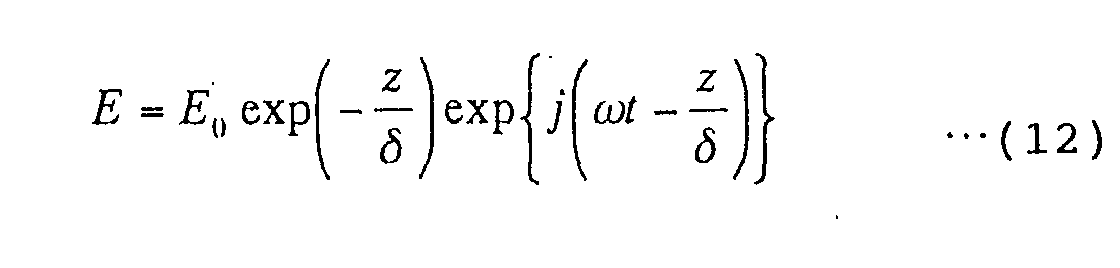
- From the formula (2), the magnetic field H is expressed as in the following formula (13).
- Hence, the following formula (14) is established.
- From the above formula (12) and formula (14), it is known that the magnetic field H and electric field E attenuate at depth (z) from the surface. The attenuation occurs at a shallower position when the excitation frequency f(in the above formula, angular frequency ω = 2 π f) is higher.
- Owing to this difference in frequency, the magnetic sensor of the present invention is capable of obtaining signals depending on the internal material, aside from the surface portion and entire section. FIG. 9 shows its principle schematically.
- Suppose to use a ferromagnetic material such as Fe or Ni. When considering a ferromagnetic material, the magnetic flux density B is noticed as shown in the following formula (15).
- The relative magnetic permeability κ is κ = µ/µo = 1 + χm. Hence,
- 1) In the case of diamagnetic material, χm<0, µ<µo
- 2) In the case of non-magnetic material, χm>0, µ>µo
- 3) In the case of ferromagnetic material, χm>1, µ>µo
-
- Among ferromagnetic materials, however, in the case of chromium steel, for example, the corresponding values are χm >> 1, µ >> µo, and therefore if ω is large, the effect of µ is large, and the magnetic flux increases. In the case of a medium completely free from magnetism(diamagnetic material), it is known that µ < µo(the effect of conductivity σ is more dominant than that of magnetic permeability µ), and there is no effect of magnetization M, and hence the magnetic flux density is determined by the magnetic field H. In the case of a ferromagnetic material, however, it is known that µ > µo, and the effect of the magnetic permeability µ is strong. The magnetic flux density is dominated by the magnetization M(B = >> µoH, hence B ≒ M). It suggests possibility of increase of magnetic flux.
- On the other hand, the sensor output is determined by the magnetic flux getting into the secondary coil as shown in the following formula (17), and the magnetic flux passing through a non-magnetic medium attenuates, and hence the sensor output decreases. On the other hand, in the case of a ferromagnetic medium, the magnetic flux may increase, and it is known that the sensor output increases.
- In the discriminating means, a reflection 4 kHz signal R4S from a center sensor 40 is utilized in detection of material and is also used as discriminating information for coin section material and magnetic or non-magnetic material, and a reflected 16 kHz signal R16S is utilized to detect intermediate section material of the coin and is also used as discriminating information for material from the surface of coin to the vicinity of center. That is, the reflected 16 kHz signal R16S is used for detection of a clad coin. A reflected 250 kHz signal R250S is utilized in detection of surface material and composition of coin and is also used for discriminating the material of surface layer of the coin, and it is utilized as the information showing the feature in the waveform of the ring/core boundary. That is, the reflected 250 kHz signal R250S is used for detection of a bicolor coin. As being detected by the side sensor 20, a transmitted L4 kHz signal TL4S and a transmitted R4 kHz signal TR4S are utilized as information of material x thickness, and a transmitted L250 kHz signal TL250S and a transmitted R250 kHz signal TR250S are utilized in detection of coin shape, and used as information of material x thickness x diameter. In this embodiment, transmitted L15 kHz signal and transmitted R16 kHz signal are not utilized in detection of coin.
- The relation of detection by the present invention is summarized in Table 1.
Signal Information Description Core Frequency Reflection 4kHz Material Coin section material, magnetic/non-magnetic information 16kHz Intermediat e section material Material from coin surface to vicinity of center 250kHz Surface material, composition Coin surface layer material, feature appearing in waveform of ring/core boundary Transmission L (shifted) 4kHz Material Signal of material x thickness (mainly transmitting L core signal used) 16kHz (not used) - 250kHz Shape Signal of material x thickness x diameter Transmission R (non-shifted) 4kHz Material Signal of material x thickness 16kHz (not used) - 250kHz Shape Signal of material x thickness x diameter(mainly transmitting R core signal used) - FIG. 10 shows actual detected signals of reflected signals. From the upper side of the feature curve, the reflection 4 kHz signal, reflection 16 kHz signal and reflection 250 kHz signal are shown.
- In this embodiment, 250 kHz is used as high frequency, but not limited to this, it is enough in a frequency band showing small difference in signal output depending on the quality of the non-magnetic material(Al and CuNi, etc.) to be detected, and preferably it is several hundreds of kHz or more. The intermediate frequency is 16 kHz, and it may be anywhere in a frequency band showing a signal output difference depending on the material from the surface to the vicinity of center of the object of detection, and the frequency band is in an order of tens of kHz. The low frequency is 4 kHz, but it may be in any frequency band in which the output signal difference appears prominently depending on the material(conductivity) of the entire object to be detected, and a frequency band of DC to several kHz is preferred.
- In the present invention, each signal in the center of a coin passing over the coin detection sensor 10 is used in judging process as feature quantity. In the trigger method, when a passing sensor is installed, an approximate position is detected on the basis of the signal from the passing sensor, and the central part of the coin is searched. When passing sensor is not installed, the passing signal attenuates regardless of the material(magnetic or non-magnetic), and the attenuation quantity is larger as the frequency is higher, and when the coin is conveyed facing guide surface of coin-passage, the portion of the coin which covers the core disposed in the shifted position is the same regardless of the coin diameter, and on the basis of this fact, the minimum position(maximum attenuation position) of transmitted L(signal in shifted position) is regarded as nearly coinciding with the coin center, and each signal value at this position may be used as the feature quantity.
- The discriminating operation of the discriminating means is explained.
- First, to judge whether a coin is magnetic or non-magnetic, signal features of magnetic coin are as follows: (1) the magnetic flux at reflected low frequency signal is increased, and the signal increases; and (2) by passing low frequency signal, the magnetic flux converges in the edge area of coin, and hence the waveform is inflected. The increase of reflected signal appears prominently as the above feature (1), the coin can be judged to be magnetic or non-magnetic by detecting this feature. FIG. 11A shows reflection 4 kHz signal R4S of 5 Pf coin of Germany(Cu-Zn25 clad Fe), and FIG. 11B is reflection 4 kHz signal R4S of 1 cent coin used in the USA(Cu/Zn5). In the German 5 Pf coin of magnetic material in FIG. 11A, the signal increases(A1), whereas in the USA 1 cent coin of non-magnetic material in FIG. 11B, the signal decreases(A2), and the difference of both signals is evident.
- Explaining the difference of signals due to clad structure by laminating different metal plates, FIG. 12 shows characteristics of Al uniform coin sample, in which B1, B2, B3 show reflection signals at 4 kHz, 16 kHz and 250 kHz, respectively, in the case of Al only. FIG. 13 shows characteristics of Al/CuZnNi/Al clad coin sample, in which B4 is reflected 250 kHz signal R250S showing the feature of surface layer Al(thickness < 0.5t), B5 is reflected 16 kHz signal R16S showing the feature of surface layer Al(0.5t) + inner layer CuZnNi(<1.0t), and B6 is reflected 4 kHz signal R4S showing the feature of all layers of CuZnNi(0.5t) + Al(1.0t) + CuZnNi(0.5t). FIG. 14 shows characteristics of CuZnNi uniform coin sample, in which B7, B8, B9 show reflected signals at 4 kHz, 16 kHz and 250 kHz, respectively, in the case of CuZnNi only. Further, FIG. 15 shows characteristics of CuZnNi/Al/CuZnNi clad coin sample, in which B10 is reflected 250 kHz signal R250S showing the feature of surface layer of CuZnNi(<0.5t), B11 is reflected 16 kHz signal R16S showing the feature of surface layer and inner layer of CuZnNi(0.5t) + Al(<1.0t), and B12 is reflection 4 kHz signal R4S showing the feature of all layers of CuZnNi(0.5t) + Al(1.0t) + CuZnNi(0.5t).
- FIG. 16 shows frequency characteristics of reflected signals in stationary state in the same samples as shown in FIG. 12 to FIG.15, in which the graph shows the attenuation factor calculated by measuring the outputs by the center sensor 40 when excited at high frequency, medium frequency and low frequency, using Al uniform coin sample, CuZnNi uniform coin sample, Al/CuZnNi/Al clad coin sample and CuZnNi/Al/CuZnNi clad coin sample. In high frequency region, the magnetic flux can get only into the surface layer due to skin effect, and the attenuation factor is large. In low frequency region, the skin effect is small, and the magnetic flux penetrates through the coin and the attenuation factor is small. In medium frequency region, the attenuation factor is somewhere between the low frequency and high frequency regions. The following facts are found from these characteristics.
- In the surface area(0.5 mm or lower from the surface), if the surface material is the same, the reflected 250 kHz signal R250S is also the same(B3 = B4, B9 = B10), and at a frequency of about 60 to 70 kHz or more, the effect of the material is significant up to the surface depth of about 0.5 mm in the reflected signal. From the surface to the core(about 1.5 mm or shallower from the surface), if the surface material is the same, the reflected 16 kHz signal R16S differs with the core material(B2 ≠ B5, B8 ≠ B11), and if the surface and core materials are the same, the reflected 16 kHz signal R16S differs with each thickness (B5 ≠ B11). At a frequency of about 30 to 60 kHz, the material at surface depth of (0.5 mm + α) begins to have an effect on the reflected signal, and at about 10 to 30 kHz, the effect of the materials core and surface on the sensor side is significant.
- On the other hand, in the entire section, provided the surface material is the same, if the thickness of total material comprising the both surface and core is different, the reflected 4 kHz signals R4S are different(B1 ≠ B6, B7 ≠ B12), and provided the surface material is different, if the thickness of total material forming the both surface and core is the same, the reflected 4 kHz signals R4S are the same(B4 = B12). At a frequency of about 6 to 8 kHz, the magnetic flux penetrates through the section of the object, and the signal having combined effects of all materials is obtained as reflected signal.
- This is to explain discrimination of bicolor coin composed of ring and core of different materials.
- In a bicolor coin, for example, a reflected 250 kHz signal has a point of inflection in the signal of coin edge portion as shown in FIG. 17A to 17D, and its inclination is inverted(FIG. 17A), the inclination becomes zero(FIG. 17B), or the inclination becomes moderate(FIG. 17C). If the coin is not bicolor, point of inflection does not occur as shown in FIG. 17D. A bicolor coin is judged by making use of such characteristics. FIG. 18 shows a frequency characteristic of reflected signal about bicolor coin, and at low frequency, the spread of the magnetic flux from the center sensor extends not only to the core but also to the ring, and hence a difference as shown in part C occurs. When the conductivity of the ring is lower than the conductivity of the core, the attenuation factor is smaller than the attenuation factor of a coin sample composed of core member only. For example, in the case of Al ring and CuZnNi core member (), the attenuation factor is larger than in CuZnNi uniform coin sample (×). This is because Al is higher in conductivity than CuZnNi.
- The 4 kHz signal of the core has an effect of the ring material, and there is a difference between the bicolor coin sample and uniform material coin sample as shown at the left side in FIGs. 19A and 19B, and point of inflection D1 is a feature of the bicolor metal boundary. FIG. 19A shows a bicolor coin sample composed of Al ring and CuZnNi core, and FIG. 19B is a uniform coin sample of CuZnNi. FIG. 20A shows characteristics of a pierced coin sample of CuZnNi ring and a hollow core, and FIG. 20B shows characteristics of a uniform coin sample of CuZnNI.
- Further, as shown in FIGs. 21A and 21B, the core 4 kHz signal of the bicolor clad structure also has an effect of ring material. As a result, the 16 kHz signal for detection of clad coin seems to be free from effect of the ring. FIG. 21A shows a bicolor clad coin sample composed of Al ring and CuZnNi/Ni/CuZnNi core, and FIG. 21B is a bicolor clad coin sample composed of CuZnNi ring and CuZnNi/Ni/CuZnNi core.
- To stabilize the detected signal, meanwhile, a preamplifier may be built in the coin detection sensor. In the foregoing description, the output of one oscillator is divided, and excitation signals of low frequency, medium frequency and high frequency are obtained, but oscillators may be provided individually for each frequency. Herein, the coin is explained as an example, but the present invention may be applicable to any other metal piece composed of plural metals.
- Embodiments of the present invention(abrasion resistant member in coin conveyance path and coin discriminating sensor) will be described hereinbelow with reference to the drawings.
- FIG. 22 shows the structure of coin feeding, conveying, and discriminating portions of a coin processing apparatus including: a coin feeder 101 which takes the form of a turntable, a conveyance path 102 for conveying coins 100 one by one, a conveyance belt 103 for conveying coins while pressing the coins against the slide face, regulating guides 104a and 104b for guiding conveyance of coins, a diameter sensor 110 for detecting data of the diameter of a coin by a sensor for discriminating coins, material and thickness sensors 111 and 112 for detecting the material and thickness of each coin, and a path 105 of the discriminating path.
- A thin plate of conductive ceramics is adhered to the portion of the discriminating area 105 in the coin path portion, and a coin sliding face is provided so as to be smoothly connected to the front and rear paths 102. An abrasion resistant plate conventionally made of zirconia which is a non-conductive material is conventionally used as the material of the path member material for the discriminating sensor area 105 of the coin path portion. In the present invention, however, conductive ceramics(conductive alumina or conductive zirconia) is used. The conductive ceramics is also adhered to an identification portion path regulation guide 106a with which the rim of a coin comes into contact. The thickness of the conductive ceramics portion is 0.5 mm. The reason why the conductive ceramics is applied also to a path regulating guide 106 is to prevent a signal from becoming different from a normal signal due to leakage of an eddy current generated in the coin to the outside via path side walls.
- A second embodiment shown in FIG. 23 is characterized by a coin detection sensor 10 having a configuration similar to that of FIG. 22 except that all of magnetic sensors are integrated and built in a casing shown in FIG. 5.
- In the present invention, an exciting and signal-detecting process is performed with a circuit configuration shown in FIG. 7 on the coin discriminating sensor 120.
- The discriminating means identifies, for example, as an object to be identified, a coin made of a plurality of metals, which is called a clad coin made of three kinds of metal layers. The discriminating means compares a characteristic amount with a determination frame preliminarily provided for each coin to discriminate whether the coin is true or false. At high frequencies, although a signal difference according to materials is small, an attenuation factor is determined by the material of a surface layer. At low frequencies, an influence is exerted also on the material of an intermediate layer. Consequently, by comparing the attenuation factor at each frequency with a predetermined determination reference, a coin can be identified. In the example, a coin is conveyed along the side sensor 20 side.
- Referring again to FIGs. 22 and 23, the shape of the path guide 104a is formed so that the coin is conveyed upward by the conveyance belt 103 along one side. In such a configuration, the discriminating means performs a signal process and detection as described in Japanese Patent Application Laid-open No. 9-245214 A.
- In the present invention, the path 11 of the coin sensor 10 is made of conductive ceramics(conductive alumina or conductive zirconia), so that static electricity is not charged in a coin conveyed for discrimination. Consequently, a noise-free characteristic is achieved as shown by detection signals of the reflected 4KHz signal R4S(upper signal waveform), reflected 16KHz signal R16S(intermediate signal waveform), and reflected 250KHz signal R250S(lower signal waveform) as outputs of the center sensor 40 shown in FIG. 10. In the present invention, coins are not charged, and noise due to static electricity does not occur, so that coins can be accurately discriminated without taking countermeasures by software.
- As described herein, the metal piece detection sensor of the present invention detects not only excitation frequencies for obtaining feature signals by the entire coin and coin surface material used in the conventional coin discriminating method, but also frequencies of feature signals depending on materials from the coin surface to the vicinity of the center, and therefore the coin sectional structure which is the feature of a clad coin can be estimated. Further, by capturing electric connection or disconnection in the bicolor coin junction as increase or decrease signal of surface current, a bicolor coin can be discriminated. In the case of non-magnetic coins distributed in Japan, the signal attenuates only, but in the case of a magnetic coin, the signal increases. By corresponding to an increasing signal in sensor signal processing, the material of magnetic coin and magnetic clad structure coin can be distinguished.
- Further, in the abrasion resistant member and coin discriminating sensor according to the present invention, abrasion-resistant conductive ceramics is provided, so that occurrence of static electricity can be prevented, and software for eliminating noise caused by static electricity which is conventionally necessary becomes unnecessary. The electrical resistivity of the conductive ceramics and that of a metal are different from each other by three digits, an amount of an eddy current is small, and an influence on a magnetic signal is hardly exerted.
Claims (15)
- A discriminating apparatus of metal piece formed of plural materials comprising a reflection type detection sensor disposed at a sliding surface side of a passage of a metal piece formed of plural materials, and discriminating means for discriminating the metal piece on the basis of an output of said metal piece detection sensor, wherein excitation signals of plural frequencies are supplied to a primary coil of said reflection type detection sensor, and said discriminating means discriminates the metal piece passing the passage on the basis of an output of a secondary coil of said reflection type detection sensor.
- A discriminating apparatus of metal piece formed of plural materials comprising a reflection type detection sensor disposed at a sliding surface side of a passage of a metal piece formed of plural materials, a metal piece detection sensor composed of a first transmission type detection sensor disposed so as to hold one lateral end of the passage and a second transmission type detection sensor disposed so as to hold other lateral end of the passage, and discriminating means for discriminating the metal piece on the basis of an output of said metal piece detection sensor, wherein excitation signals of plural frequencies are supplied to a primary coil of said reflection type detection sensor, a primary coil of said first transmission type detection sensor, and a primary coil of said second transmission type detection sensor, and said discriminating means discriminates the metal piece passing the passage on the basis of an output of a secondary coil of said reflection type detection sensor, an output of a secondary coil of said first transmission type detection sensor, and an output of a secondary coil of said second transmission type detection sensor.
- The discriminating apparatus of metal piece formed of plural materials of claim 1 or 2, wherein the excitation signals of plural frequencies are composite signals of low frequency, medium frequency and high frequency.
- The discriminating apparatus of metal piece formed of plural materials of claim 3, wherein the low frequency, medium frequency and high frequency are formed by dividing an oscillation output signal.
- The discriminating apparatus of metal piece formed of plural materials of claim 3, wherein the low frequency is 4 kHz, the medium frequency is 16 kHz and the high frequency is 250 kHz.
- The discriminating apparatus of metal piece formed of plural materials of claim 1 or 2, wherein the output of the secondary coil of said reflection type detection sensor, the output of the secondary coil of said first transmission type detection sensor, and the output of the secondary coil of said second transmission type detection sensor are respectively divided in frequency, and signals of the low frequency, medium frequency and high frequency are obtained.
- The discriminating apparatus of metal piece formed of plural materials of claim 6, wherein the frequency is divided by a band pass filter.
- The discriminating apparatus of metal piece formed of plural materials of claim 6, wherein the low frequency is 4 kHz, the medium frequency is 16 kHz and the high frequency is 250 kHz.
- The discriminating apparatus of metal piece formed of plural materials of any one of claims 1 to 8, wherein said metal piece is a coin.
- The discriminating apparatus of metal piece formed of plural materials of any one of claims 2 to 8, wherein said metal piece is a coin, the secondary coil output of said reflection type detection sensor of low frequency is for discriminating the coin section material and magnetic or non-magnetic material, the secondary output of said first transmission type detection sensor of low frequency is for discriminating the material × thickness, the secondary output of said second transmission type detection sensor of low frequency is for discerning the material × thickness, the secondary coil output of said reflection type detection sensor of medium frequency is for discriminating the material from the coin surface to the vicinity of the center, the secondary coil output of said reflection type detection sensor of high frequency is for discriminating the coin surface layer material and ring/core boundary, the secondary output of said first transmission type detection sensor of high frequency is for discriminating the material × thickness × diameter, the secondary output of said second transmission type detection sensor of high frequency is for discriminating the material × thickness × diameter.
- An abrasion resistant member in a coin conveyance path, the abrasion resistant member being provided for a coin conveyance path and made of a conductive material in a thin plate shape to be adhered to and cover a path surface faced by a magnetic sensor provided so as to face the under face of said coin conveyance path having a coin discriminating sensor for discriminating the kind of each of coins conveyed one by one with a spacing therebetween along a sliding face.
- An abrasion resistant member in a coin conveyance path, the abrasion resistant member being provided for a coin conveyance path and made of a conductive material in a thin plate shape to cover a path face faced by a magnetic sensor provided so as to face the under face of said coin conveyance path and to be adhered to and cover path guides for path regulation provided on both right and left sides in the travel direction of coins, in the coin conveyance path having a coin discriminating sensor for discriminating the kind of each of coins conveyed one by one with a spacing therebetween along a sliding face.
- The abrasion resistant member according to claim 11 or 12, wherein said conductive material is conductive ceramics.
- A coin discriminating sensor comprising
a coin path portion,
a reflection type sensor disposed so as to face the under face of said coin path portion,
a first transmission type sensor disposed so as to sandwich one lateral end of said path, and
a second transmission type sensor disposed so as to sandwich the other lateral end of said path,
wherein said coin path portion is made of a conductive material. - The coin discriminating sensor according to claim 14, wherein said conductive material is conductive ceramics.
Applications Claiming Priority (4)
| Application Number | Priority Date | Filing Date | Title |
|---|---|---|---|
| JP2001073802A JP3995423B2 (en) | 2001-03-15 | 2001-03-15 | Coin identification sensor |
| JP2001073802 | 2001-03-15 | ||
| JP2001075846A JP3908473B2 (en) | 2001-03-16 | 2001-03-16 | Metal piece identification device made of multiple materials |
| JP2001075846 | 2001-03-16 |
Publications (3)
| Publication Number | Publication Date |
|---|---|
| EP1241636A2 true EP1241636A2 (en) | 2002-09-18 |
| EP1241636A3 EP1241636A3 (en) | 2004-06-30 |
| EP1241636B1 EP1241636B1 (en) | 2009-08-12 |
Family
ID=26611310
Family Applications (1)
| Application Number | Title | Priority Date | Filing Date |
|---|---|---|---|
| EP02076007A Expired - Lifetime EP1241636B1 (en) | 2001-03-15 | 2002-03-13 | Coin processing apparatus |
Country Status (3)
| Country | Link |
|---|---|
| EP (1) | EP1241636B1 (en) |
| AT (1) | ATE439657T1 (en) |
| DE (1) | DE60233285D1 (en) |
Cited By (3)
| Publication number | Priority date | Publication date | Assignee | Title |
|---|---|---|---|---|
| GB2393840A (en) * | 2002-10-01 | 2004-04-07 | Innovative Technology Ltd | Coin validation by measuring reflected magnetic field non-homogeneity |
| EP2626839A1 (en) * | 2012-02-10 | 2013-08-14 | Glory Ltd. | Magnetic sensor for coin recognition |
| EP2040227B1 (en) * | 2007-09-20 | 2019-05-22 | Crane Payment Innovations GmbH | Method for inspecting coins |
Families Citing this family (2)
| Publication number | Priority date | Publication date | Assignee | Title |
|---|---|---|---|---|
| CN106530476B (en) * | 2016-11-28 | 2019-03-05 | 东南大学 | An electromagnetic coin separator and method |
| WO2018183925A1 (en) * | 2017-03-30 | 2018-10-04 | Tidel Engineering L.P. | Systems and methods for coin recycling |
Citations (3)
| Publication number | Priority date | Publication date | Assignee | Title |
|---|---|---|---|---|
| US4086527A (en) | 1975-03-25 | 1978-04-25 | Crouzet | Method and apparatus for monetary articles authentification |
| JP2539521B2 (en) | 1989-11-30 | 1996-10-02 | 富士電機株式会社 | Coin passage of coin processing machine |
| JPH09245214A (en) | 1996-03-08 | 1997-09-19 | Glory Ltd | Coin discrimination device having temperature compensation function for coin processing machine |
Family Cites Families (9)
| Publication number | Priority date | Publication date | Assignee | Title |
|---|---|---|---|---|
| US4317149A (en) * | 1980-06-02 | 1982-02-23 | International Business Machines Corporation | Magnetic head having static discharge means |
| US4737809A (en) * | 1986-11-24 | 1988-04-12 | Canon Kabushiki Kaisha | Static electricity eliminating mechanism for camera |
| US4862316A (en) * | 1988-02-29 | 1989-08-29 | White's Electronics, Inc. | Static charge dissipating housing for metal detector search loop assembly |
| US4928194A (en) * | 1988-09-30 | 1990-05-22 | Eastman Kodak Company | Anti-static support for a cartridge in a disk drive |
| WO1993002431A1 (en) * | 1991-07-16 | 1993-02-04 | C.T. Coin A/S | Method and apparatus for testing and optionally sorting coins |
| JP3384803B2 (en) * | 1991-09-28 | 2003-03-10 | アンリツ株式会社 | Coin discriminator |
| SE512200C2 (en) * | 1998-01-30 | 2000-02-14 | Scan Coin Ind Ab | Apparatus and method for authentication of bimetallic coins |
| JP3660496B2 (en) * | 1998-02-26 | 2005-06-15 | 株式会社日本コンラックス | Method and apparatus for inspecting authenticity of coin |
| EP1104920B1 (en) * | 1999-12-02 | 2006-05-10 | Glory Kogyo Kabushiki Kaisha | Method of and apparatus for identifying a coin |
-
2002
- 2002-03-13 EP EP02076007A patent/EP1241636B1/en not_active Expired - Lifetime
- 2002-03-13 AT AT02076007T patent/ATE439657T1/en not_active IP Right Cessation
- 2002-03-13 DE DE60233285T patent/DE60233285D1/en not_active Expired - Lifetime
Patent Citations (3)
| Publication number | Priority date | Publication date | Assignee | Title |
|---|---|---|---|---|
| US4086527A (en) | 1975-03-25 | 1978-04-25 | Crouzet | Method and apparatus for monetary articles authentification |
| JP2539521B2 (en) | 1989-11-30 | 1996-10-02 | 富士電機株式会社 | Coin passage of coin processing machine |
| JPH09245214A (en) | 1996-03-08 | 1997-09-19 | Glory Ltd | Coin discrimination device having temperature compensation function for coin processing machine |
Cited By (5)
| Publication number | Priority date | Publication date | Assignee | Title |
|---|---|---|---|---|
| GB2393840A (en) * | 2002-10-01 | 2004-04-07 | Innovative Technology Ltd | Coin validation by measuring reflected magnetic field non-homogeneity |
| EP2040227B1 (en) * | 2007-09-20 | 2019-05-22 | Crane Payment Innovations GmbH | Method for inspecting coins |
| EP2626839A1 (en) * | 2012-02-10 | 2013-08-14 | Glory Ltd. | Magnetic sensor for coin recognition |
| CN103258365A (en) * | 2012-02-10 | 2013-08-21 | 光荣株式会社 | Magnetic sensor for coin recognition |
| CN103258365B (en) * | 2012-02-10 | 2016-08-17 | 光荣株式会社 | Magnetic sensor for coin recognition |
Also Published As
| Publication number | Publication date |
|---|---|
| DE60233285D1 (en) | 2009-09-24 |
| ATE439657T1 (en) | 2009-08-15 |
| EP1241636B1 (en) | 2009-08-12 |
| EP1241636A3 (en) | 2004-06-30 |
Similar Documents
| Publication | Publication Date | Title |
|---|---|---|
| US4850468A (en) | Money discriminating apparatus | |
| CA1038055A (en) | Coin arrival sensor using inductive colls | |
| EP1104920B1 (en) | Method of and apparatus for identifying a coin | |
| KR100290690B1 (en) | Method and device for checking confidential documents | |
| KR101032111B1 (en) | Coin identification device | |
| US6216843B1 (en) | Apparatus for taking out information using magnetic sensor and carrying out test of article by using that information | |
| JP4157335B2 (en) | Coin identification device and coin identification sensor used therefor | |
| US20040129771A1 (en) | Device for accepting banknotes | |
| EP1241636B1 (en) | Coin processing apparatus | |
| JP5336900B2 (en) | Coin identification device and coin identification method | |
| JP3908473B2 (en) | Metal piece identification device made of multiple materials | |
| JP2000268224A (en) | Method and apparatus for checking authenticity of banknote | |
| JP2000163620A (en) | Automatic transaction equipment | |
| JP3995423B2 (en) | Coin identification sensor | |
| JP4157320B2 (en) | Coin identification device | |
| US6292579B1 (en) | Document validator having an inductive sensor | |
| JP3363305B2 (en) | Coin identification device with temperature correction function in coin processing machine | |
| JPS6345691A (en) | Coin discriminator | |
| JPH01173189A (en) | Coin discriminating device | |
| JP3363290B2 (en) | Coin identification device in coin processing machine | |
| JP2000076512A (en) | Coin processing equipment | |
| JP4392071B2 (en) | Document validator with inductive sensor | |
| JP2513562B2 (en) | Coin / metal material identification device | |
| JPH0751657Y2 (en) | Coin discriminator | |
| JP3842510B2 (en) | Coin identification method and coin identification sensor used therefor |
Legal Events
| Date | Code | Title | Description |
|---|---|---|---|
| PUAI | Public reference made under article 153(3) epc to a published international application that has entered the european phase |
Free format text: ORIGINAL CODE: 0009012 |
|
| AK | Designated contracting states |
Kind code of ref document: A2 Designated state(s): AT BE CH CY DE DK ES FI FR GB GR IE IT LI LU MC NL PT SE TR |
|
| AX | Request for extension of the european patent |
Free format text: AL;LT;LV;MK;RO;SI |
|
| RIC1 | Information provided on ipc code assigned before grant |
Ipc: 7G 07D 5/08 A |
|
| PUAL | Search report despatched |
Free format text: ORIGINAL CODE: 0009013 |
|
| AK | Designated contracting states |
Kind code of ref document: A3 Designated state(s): AT BE CH CY DE DK ES FI FR GB GR IE IT LI LU MC NL PT SE TR |
|
| AX | Request for extension of the european patent |
Extension state: AL LT LV MK RO SI |
|
| 17P | Request for examination filed |
Effective date: 20041208 |
|
| AKX | Designation fees paid |
Designated state(s): AT BE CH CY DE DK ES FI FR GB GR IE IT LI LU MC NL PT SE TR |
|
| 17Q | First examination report despatched |
Effective date: 20050414 |
|
| RTI1 | Title (correction) |
Free format text: COIN PROCESSING APPARATUS |
|
| GRAP | Despatch of communication of intention to grant a patent |
Free format text: ORIGINAL CODE: EPIDOSNIGR1 |
|
| GRAS | Grant fee paid |
Free format text: ORIGINAL CODE: EPIDOSNIGR3 |
|
| GRAA | (expected) grant |
Free format text: ORIGINAL CODE: 0009210 |
|
| AK | Designated contracting states |
Kind code of ref document: B1 Designated state(s): AT BE CH CY DE DK ES FI FR GB GR IE IT LI LU MC NL PT SE TR |
|
| REG | Reference to a national code |
Ref country code: GB Ref legal event code: FG4D |
|
| REG | Reference to a national code |
Ref country code: CH Ref legal event code: EP |
|
| REG | Reference to a national code |
Ref country code: IE Ref legal event code: FG4D |
|
| REF | Corresponds to: |
Ref document number: 60233285 Country of ref document: DE Date of ref document: 20090924 Kind code of ref document: P |
|
| PG25 | Lapsed in a contracting state [announced via postgrant information from national office to epo] |
Ref country code: AT Free format text: LAPSE BECAUSE OF FAILURE TO SUBMIT A TRANSLATION OF THE DESCRIPTION OR TO PAY THE FEE WITHIN THE PRESCRIBED TIME-LIMIT Effective date: 20090812 Ref country code: ES Free format text: LAPSE BECAUSE OF FAILURE TO SUBMIT A TRANSLATION OF THE DESCRIPTION OR TO PAY THE FEE WITHIN THE PRESCRIBED TIME-LIMIT Effective date: 20091123 Ref country code: FI Free format text: LAPSE BECAUSE OF FAILURE TO SUBMIT A TRANSLATION OF THE DESCRIPTION OR TO PAY THE FEE WITHIN THE PRESCRIBED TIME-LIMIT Effective date: 20090812 Ref country code: SE Free format text: LAPSE BECAUSE OF FAILURE TO SUBMIT A TRANSLATION OF THE DESCRIPTION OR TO PAY THE FEE WITHIN THE PRESCRIBED TIME-LIMIT Effective date: 20090812 |
|
| NLV1 | Nl: lapsed or annulled due to failure to fulfill the requirements of art. 29p and 29m of the patents act | ||
| PG25 | Lapsed in a contracting state [announced via postgrant information from national office to epo] |
Ref country code: NL Free format text: LAPSE BECAUSE OF FAILURE TO SUBMIT A TRANSLATION OF THE DESCRIPTION OR TO PAY THE FEE WITHIN THE PRESCRIBED TIME-LIMIT Effective date: 20090812 |
|
| PG25 | Lapsed in a contracting state [announced via postgrant information from national office to epo] |
Ref country code: PT Free format text: LAPSE BECAUSE OF FAILURE TO SUBMIT A TRANSLATION OF THE DESCRIPTION OR TO PAY THE FEE WITHIN THE PRESCRIBED TIME-LIMIT Effective date: 20091212 |
|
| PG25 | Lapsed in a contracting state [announced via postgrant information from national office to epo] |
Ref country code: DK Free format text: LAPSE BECAUSE OF FAILURE TO SUBMIT A TRANSLATION OF THE DESCRIPTION OR TO PAY THE FEE WITHIN THE PRESCRIBED TIME-LIMIT Effective date: 20090812 |
|
| PLBE | No opposition filed within time limit |
Free format text: ORIGINAL CODE: 0009261 |
|
| STAA | Information on the status of an ep patent application or granted ep patent |
Free format text: STATUS: NO OPPOSITION FILED WITHIN TIME LIMIT |
|
| PG25 | Lapsed in a contracting state [announced via postgrant information from national office to epo] |
Ref country code: BE Free format text: LAPSE BECAUSE OF FAILURE TO SUBMIT A TRANSLATION OF THE DESCRIPTION OR TO PAY THE FEE WITHIN THE PRESCRIBED TIME-LIMIT Effective date: 20090812 |
|
| 26N | No opposition filed |
Effective date: 20100517 |
|
| PG25 | Lapsed in a contracting state [announced via postgrant information from national office to epo] |
Ref country code: GR Free format text: LAPSE BECAUSE OF FAILURE TO SUBMIT A TRANSLATION OF THE DESCRIPTION OR TO PAY THE FEE WITHIN THE PRESCRIBED TIME-LIMIT Effective date: 20091113 Ref country code: MC Free format text: LAPSE BECAUSE OF NON-PAYMENT OF DUE FEES Effective date: 20100331 |
|
| REG | Reference to a national code |
Ref country code: CH Ref legal event code: PL |
|
| PG25 | Lapsed in a contracting state [announced via postgrant information from national office to epo] |
Ref country code: IE Free format text: LAPSE BECAUSE OF NON-PAYMENT OF DUE FEES Effective date: 20100313 |
|
| PG25 | Lapsed in a contracting state [announced via postgrant information from national office to epo] |
Ref country code: LI Free format text: LAPSE BECAUSE OF NON-PAYMENT OF DUE FEES Effective date: 20100331 Ref country code: CH Free format text: LAPSE BECAUSE OF NON-PAYMENT OF DUE FEES Effective date: 20100331 |
|
| PG25 | Lapsed in a contracting state [announced via postgrant information from national office to epo] |
Ref country code: IT Free format text: LAPSE BECAUSE OF FAILURE TO SUBMIT A TRANSLATION OF THE DESCRIPTION OR TO PAY THE FEE WITHIN THE PRESCRIBED TIME-LIMIT Effective date: 20090812 |
|
| PG25 | Lapsed in a contracting state [announced via postgrant information from national office to epo] |
Ref country code: CY Free format text: LAPSE BECAUSE OF FAILURE TO SUBMIT A TRANSLATION OF THE DESCRIPTION OR TO PAY THE FEE WITHIN THE PRESCRIBED TIME-LIMIT Effective date: 20090812 |
|
| PG25 | Lapsed in a contracting state [announced via postgrant information from national office to epo] |
Ref country code: LU Free format text: LAPSE BECAUSE OF NON-PAYMENT OF DUE FEES Effective date: 20100313 |
|
| PG25 | Lapsed in a contracting state [announced via postgrant information from national office to epo] |
Ref country code: TR Free format text: LAPSE BECAUSE OF FAILURE TO SUBMIT A TRANSLATION OF THE DESCRIPTION OR TO PAY THE FEE WITHIN THE PRESCRIBED TIME-LIMIT Effective date: 20090812 |
|
| PGFP | Annual fee paid to national office [announced via postgrant information from national office to epo] |
Ref country code: GB Payment date: 20140319 Year of fee payment: 13 |
|
| GBPC | Gb: european patent ceased through non-payment of renewal fee |
Effective date: 20150313 |
|
| PG25 | Lapsed in a contracting state [announced via postgrant information from national office to epo] |
Ref country code: GB Free format text: LAPSE BECAUSE OF NON-PAYMENT OF DUE FEES Effective date: 20150313 |
|
| REG | Reference to a national code |
Ref country code: FR Ref legal event code: PLFP Year of fee payment: 15 |
|
| REG | Reference to a national code |
Ref country code: FR Ref legal event code: PLFP Year of fee payment: 16 |
|
| PGFP | Annual fee paid to national office [announced via postgrant information from national office to epo] |
Ref country code: DE Payment date: 20170322 Year of fee payment: 16 Ref country code: FR Payment date: 20170322 Year of fee payment: 16 |
|
| REG | Reference to a national code |
Ref country code: DE Ref legal event code: R119 Ref document number: 60233285 Country of ref document: DE |
|
| PG25 | Lapsed in a contracting state [announced via postgrant information from national office to epo] |
Ref country code: DE Free format text: LAPSE BECAUSE OF NON-PAYMENT OF DUE FEES Effective date: 20181002 |
|
| PG25 | Lapsed in a contracting state [announced via postgrant information from national office to epo] |
Ref country code: FR Free format text: LAPSE BECAUSE OF NON-PAYMENT OF DUE FEES Effective date: 20180331 |