EP1241539A1 - Wristwatch case and method of fixing pipe of wrist watch case - Google Patents
Wristwatch case and method of fixing pipe of wrist watch case Download PDFInfo
- Publication number
- EP1241539A1 EP1241539A1 EP01943878A EP01943878A EP1241539A1 EP 1241539 A1 EP1241539 A1 EP 1241539A1 EP 01943878 A EP01943878 A EP 01943878A EP 01943878 A EP01943878 A EP 01943878A EP 1241539 A1 EP1241539 A1 EP 1241539A1
- Authority
- EP
- European Patent Office
- Prior art keywords
- pipe
- wristwatch case
- hole
- heating
- press
- Prior art date
- Legal status (The legal status is an assumption and is not a legal conclusion. Google has not performed a legal analysis and makes no representation as to the accuracy of the status listed.)
- Granted
Links
Images






Classifications
-
- B—PERFORMING OPERATIONS; TRANSPORTING
- B23—MACHINE TOOLS; METAL-WORKING NOT OTHERWISE PROVIDED FOR
- B23K—SOLDERING OR UNSOLDERING; WELDING; CLADDING OR PLATING BY SOLDERING OR WELDING; CUTTING BY APPLYING HEAT LOCALLY, e.g. FLAME CUTTING; WORKING BY LASER BEAM
- B23K20/00—Non-electric welding by applying impact or other pressure, with or without the application of heat, e.g. cladding or plating
- B23K20/002—Non-electric welding by applying impact or other pressure, with or without the application of heat, e.g. cladding or plating specially adapted for particular articles or work
-
- G—PHYSICS
- G04—HOROLOGY
- G04B—MECHANICALLY-DRIVEN CLOCKS OR WATCHES; MECHANICAL PARTS OF CLOCKS OR WATCHES IN GENERAL; TIME PIECES USING THE POSITION OF THE SUN, MOON OR STARS
- G04B37/00—Cases
- G04B37/04—Mounting the clockwork in the case; Shock absorbing mountings
- G04B37/05—Fixed mountings for pocket or wrist watches
-
- B—PERFORMING OPERATIONS; TRANSPORTING
- B23—MACHINE TOOLS; METAL-WORKING NOT OTHERWISE PROVIDED FOR
- B23K—SOLDERING OR UNSOLDERING; WELDING; CLADDING OR PLATING BY SOLDERING OR WELDING; CUTTING BY APPLYING HEAT LOCALLY, e.g. FLAME CUTTING; WORKING BY LASER BEAM
- B23K20/00—Non-electric welding by applying impact or other pressure, with or without the application of heat, e.g. cladding or plating
- B23K20/14—Preventing or minimising gas access, or using protective gases or vacuum during welding
-
- B—PERFORMING OPERATIONS; TRANSPORTING
- B23—MACHINE TOOLS; METAL-WORKING NOT OTHERWISE PROVIDED FOR
- B23K—SOLDERING OR UNSOLDERING; WELDING; CLADDING OR PLATING BY SOLDERING OR WELDING; CUTTING BY APPLYING HEAT LOCALLY, e.g. FLAME CUTTING; WORKING BY LASER BEAM
- B23K20/00—Non-electric welding by applying impact or other pressure, with or without the application of heat, e.g. cladding or plating
- B23K20/16—Non-electric welding by applying impact or other pressure, with or without the application of heat, e.g. cladding or plating with interposition of special material to facilitate connection of the parts, e.g. material for absorbing or producing gas
-
- G—PHYSICS
- G04—HOROLOGY
- G04B—MECHANICALLY-DRIVEN CLOCKS OR WATCHES; MECHANICAL PARTS OF CLOCKS OR WATCHES IN GENERAL; TIME PIECES USING THE POSITION OF THE SUN, MOON OR STARS
- G04B37/00—Cases
- G04B37/0008—Cases for pocket watches and wrist watches
- G04B37/005—Cases for pocket watches and wrist watches with cover or protection device which can be completely removed, either by lifting off or by sliding, or by turning (protection covers, protection cases also against humidity)
-
- G—PHYSICS
- G04—HOROLOGY
- G04B—MECHANICALLY-DRIVEN CLOCKS OR WATCHES; MECHANICAL PARTS OF CLOCKS OR WATCHES IN GENERAL; TIME PIECES USING THE POSITION OF THE SUN, MOON OR STARS
- G04B37/00—Cases
- G04B37/06—Forming the passage for the winding stem through the case; Divided winding stems
-
- G—PHYSICS
- G04—HOROLOGY
- G04B—MECHANICALLY-DRIVEN CLOCKS OR WATCHES; MECHANICAL PARTS OF CLOCKS OR WATCHES IN GENERAL; TIME PIECES USING THE POSITION OF THE SUN, MOON OR STARS
- G04B37/00—Cases
- G04B37/08—Hermetic sealing of openings, joints, passages or slits
- G04B37/081—Complete encasings for wrist or pocket watches also comprising means for hermetic sealing of the winding stem and crown
- G04B37/082—Complete encasings for wrist or pocket watches also comprising means for hermetic sealing of the winding stem and crown without special hermetic sealing pieces
-
- G—PHYSICS
- G04—HOROLOGY
- G04B—MECHANICALLY-DRIVEN CLOCKS OR WATCHES; MECHANICAL PARTS OF CLOCKS OR WATCHES IN GENERAL; TIME PIECES USING THE POSITION OF THE SUN, MOON OR STARS
- G04B37/00—Cases
- G04B37/22—Materials or processes of manufacturing pocket watch or wrist watch cases
-
- G—PHYSICS
- G04—HOROLOGY
- G04B—MECHANICALLY-DRIVEN CLOCKS OR WATCHES; MECHANICAL PARTS OF CLOCKS OR WATCHES IN GENERAL; TIME PIECES USING THE POSITION OF THE SUN, MOON OR STARS
- G04B43/00—Protecting clockworks by shields or other means against external influences, e.g. magnetic fields
- G04B43/002—Component shock protection arrangements
-
- G—PHYSICS
- G04—HOROLOGY
- G04D—APPARATUS OR TOOLS SPECIALLY DESIGNED FOR MAKING OR MAINTAINING CLOCKS OR WATCHES
- G04D3/00—Watchmakers' or watch-repairers' machines or tools for working materials
- G04D3/0002—Watchmakers' or watch-repairers' machines or tools for working materials for mechanical working other than with a lathe
- G04D3/0061—Watchmakers' or watch-repairers' machines or tools for working materials for mechanical working other than with a lathe for components for protecting the mechanism against external influences
-
- Y—GENERAL TAGGING OF NEW TECHNOLOGICAL DEVELOPMENTS; GENERAL TAGGING OF CROSS-SECTIONAL TECHNOLOGIES SPANNING OVER SEVERAL SECTIONS OF THE IPC; TECHNICAL SUBJECTS COVERED BY FORMER USPC CROSS-REFERENCE ART COLLECTIONS [XRACs] AND DIGESTS
- Y10—TECHNICAL SUBJECTS COVERED BY FORMER USPC
- Y10T—TECHNICAL SUBJECTS COVERED BY FORMER US CLASSIFICATION
- Y10T29/00—Metal working
- Y10T29/49—Method of mechanical manufacture
- Y10T29/49579—Watch or clock making
-
- Y—GENERAL TAGGING OF NEW TECHNOLOGICAL DEVELOPMENTS; GENERAL TAGGING OF CROSS-SECTIONAL TECHNOLOGIES SPANNING OVER SEVERAL SECTIONS OF THE IPC; TECHNICAL SUBJECTS COVERED BY FORMER USPC CROSS-REFERENCE ART COLLECTIONS [XRACs] AND DIGESTS
- Y10—TECHNICAL SUBJECTS COVERED BY FORMER USPC
- Y10T—TECHNICAL SUBJECTS COVERED BY FORMER US CLASSIFICATION
- Y10T29/00—Metal working
- Y10T29/49—Method of mechanical manufacture
- Y10T29/49579—Watch or clock making
- Y10T29/49581—Watch or clock making having arbor, pinion, or balance
-
- Y—GENERAL TAGGING OF NEW TECHNOLOGICAL DEVELOPMENTS; GENERAL TAGGING OF CROSS-SECTIONAL TECHNOLOGIES SPANNING OVER SEVERAL SECTIONS OF THE IPC; TECHNICAL SUBJECTS COVERED BY FORMER USPC CROSS-REFERENCE ART COLLECTIONS [XRACs] AND DIGESTS
- Y10—TECHNICAL SUBJECTS COVERED BY FORMER USPC
- Y10T—TECHNICAL SUBJECTS COVERED BY FORMER US CLASSIFICATION
- Y10T29/00—Metal working
- Y10T29/49—Method of mechanical manufacture
- Y10T29/49579—Watch or clock making
- Y10T29/49584—Watch or clock making having case, cover, or back
-
- Y—GENERAL TAGGING OF NEW TECHNOLOGICAL DEVELOPMENTS; GENERAL TAGGING OF CROSS-SECTIONAL TECHNOLOGIES SPANNING OVER SEVERAL SECTIONS OF THE IPC; TECHNICAL SUBJECTS COVERED BY FORMER USPC CROSS-REFERENCE ART COLLECTIONS [XRACs] AND DIGESTS
- Y10—TECHNICAL SUBJECTS COVERED BY FORMER USPC
- Y10T—TECHNICAL SUBJECTS COVERED BY FORMER US CLASSIFICATION
- Y10T29/00—Metal working
- Y10T29/49—Method of mechanical manufacture
- Y10T29/49579—Watch or clock making
- Y10T29/49586—Watch or clock making having crown, stem, or pendent
-
- Y—GENERAL TAGGING OF NEW TECHNOLOGICAL DEVELOPMENTS; GENERAL TAGGING OF CROSS-SECTIONAL TECHNOLOGIES SPANNING OVER SEVERAL SECTIONS OF THE IPC; TECHNICAL SUBJECTS COVERED BY FORMER USPC CROSS-REFERENCE ART COLLECTIONS [XRACs] AND DIGESTS
- Y10—TECHNICAL SUBJECTS COVERED BY FORMER USPC
- Y10T—TECHNICAL SUBJECTS COVERED BY FORMER US CLASSIFICATION
- Y10T29/00—Metal working
- Y10T29/49—Method of mechanical manufacture
- Y10T29/49826—Assembling or joining
- Y10T29/49885—Assembling or joining with coating before or during assembling
-
- Y—GENERAL TAGGING OF NEW TECHNOLOGICAL DEVELOPMENTS; GENERAL TAGGING OF CROSS-SECTIONAL TECHNOLOGIES SPANNING OVER SEVERAL SECTIONS OF THE IPC; TECHNICAL SUBJECTS COVERED BY FORMER USPC CROSS-REFERENCE ART COLLECTIONS [XRACs] AND DIGESTS
- Y10—TECHNICAL SUBJECTS COVERED BY FORMER USPC
- Y10T—TECHNICAL SUBJECTS COVERED BY FORMER US CLASSIFICATION
- Y10T29/00—Metal working
- Y10T29/49—Method of mechanical manufacture
- Y10T29/49826—Assembling or joining
- Y10T29/49945—Assembling or joining by driven force fit
Definitions
- the present invention relates to a wristwatch case and a method of fixing a pipe to a wristwatch case. More particularly, the present invention relates to a titanium or stainless steel wristwatch case and a method of fixing a pipe to such a wristwatch case, and relates to a wristwatch case of simplified structure which exhibits long-term pipe fixing capability, corrosion resistance and waterproof reliability and a method of fixing a pipe to such a wristwatch case.
- Titanium or stainless steel has mainly been used as a material for fabricating a wristwatch case. Especially in recent years, the use of titanium and a titanium alloy, which exhibit excellent characteristics in corrosion resistance, strength, lightness and biocompatibility, in exterior parts of a wristwatch is increasing.
- the above titanium or stainless steel is useful as a material for fabricating a wristwatch case or a pipe for stem fixing fitted in a wristwatch case.
- a wristwatch case having a titanium or stainless steel pipe and a method of fixing a pipe to a wristwatch case now present themes which are important from the viewpoint of a long-term use of wristwatch.
- a through-hole as a prepared hole for passing a stem therethrough, at a desired position of a side of wristwatch case.
- this stem hole for example, it is required that, when a stem furnished with an O-ring is set and fixed, a satisfactory air tightness be realized and maintained at the interface of O-ring and case.
- a titanium alloy such as Ti-6Al-4V with respect to a titanium case and a free-cutting stainless steel containing a minute amount of sulfur component with respect to a stainless steel case as a pipe material of a free-cutting material of high strength.
- through-hole 41a is made at a desired position of wristwatch case 41 constituted of titanium by the use of a drill. This is a hole for inserting therein a stem to be coupled with a main body known as wristwatch module.
- Conventional through-hole has a diameter of about 2 mm.
- the through-hole is made at a side of wristwatch case at 3 o'clock position.
- pipe 42 of a titanium alloy having an outside diameter slightly larger than the diameter of the through-hole is produced and press fitted in the through-hole.
- the waterproofing capability has been ensured by applying adhesive 43 around the gap and thereafter heating at given temperature so as to dry and fix the same.
- the adhesive is often constituted of organic materials and is likely to suffer deterioration or the like with the passage of long time.
- the pipe fixing strength cannot be stably maintained for a prolonged period of time, and further it has been difficult to ensure the waterproofing capability for a prolonged period of time.
- the sealing by the adhesive exhibits high steam permeability, thereby posing such a problem that the moistureproofing capability is poor.
- this method poses such a problem that, because of the need to provide a projection on the pipe, the size of the pipe is increased so as to disenable general employment of the method in wristwatches of ordinary size and, further, high cost is inevitable. Moreover, when it is failed to bring the projection provided on the pipe into contact with the wristwatch case uniformly all round the circumference thereof, there have been such occasions that the current for welding cannot flow uniformly to thereby cause welding operation to be difficult.
- a method wherein brazing is performed has been tried.
- this fixing method first, a through-hole for inserting a stem therein is made at a desired position of a side of wristwatch case.
- a pipe of precision higher than that of the through-hole is provided.
- a silver brazing material Japanese Industrial Standard (JIS) BAg-8 (melting point 780°C) or the like
- JIS Japanese Industrial Standard
- BAg-8 melting point 780°C
- brazing material when heated is liquid and can be satisfactorily penetrated into the interstices between the through-hole and the pipe as long as sat is factory wettability is ensured, thereby enabling realization of high waterproof sealing properties.
- the silver brazing material is generally constituted of a material containing Cu in a high proportion with the result that satisfactory results cannot be obtained in a corrosion resistance test, such as an artificial sweat test, for wristwatch.
- a brazing material of Ti-Cu-Ni is used as a brazing material for titanium member wherein the content of Cu is reduced.
- the melting point of this brazing material is in the vicinity of the transformation point of titanium, so that the brazing material has a drawback in that, with respect to, for example, a titanium wristwatch case having undergone a specular finishing before brazing, the surface condition is changed upon brazing.
- the titanium crystal has a hexagonal closest packing structure at ordinary temperatures but assumes a body-centered cubic structure at 882°C, which is the transformation point, or above.
- heating at the transformation point or above causes the titanium crystal to be coarse. Therefore, when an operation performed at temperature exceeding the transformation point is included in the process for producing a wristwatch case, for example, fixing a pipe to a wristwatch case, the surface condition is changed by this crystal transformation.
- the wristwatch is also appreciated as an ornament, and, with respect to the surface condition, there are various demands, for example, demands for mirror, hairline, honing and matte finishing (satin finishing).
- demands for mirror, hairline, honing and matte finishing for example, demands for mirror, hairline, honing and matte finishing (satin finishing).
- the present invention has been made with a view toward solving the above technological problems of the related art, and an object of the present invention is to provide a wristwatch case which is excellent in waterproofing capability and corrosion resistance and exhibits a long-term reliability regarding a pipe fixing and to provide a method of fixing a pipe to such a wristwatch case.
- a wristwatch case which has excellent waterproofing capability and corrosion resistance and ensures a long-term reliability regarding a pipe fixing can be obtained by a wristwatch case and a method of fixing a pipe to a wristwatch case, wherein the pipe is joined and fixed to a desired position of the wristwatch case and wherein the junction interface of the wristwatch case and pipe is eliminated.
- the present invention (first aspect of the present invention) has been completed on the basis of this finding.
- the inventors have further found that a wristwatch case which has excellent waterproofing capability and corrosion resistance and ensures a long-term reliability regarding a pipe fixing can be obtained by a pipe fixing method wherein the pipe is joined through a specified diffusion layer to a wristwatch case.
- the present invention (second aspect of the present invention) has been completed on the basis of this finding.
- the present invention has the following characteristics.
- a wristwatch case having a pipe joined and fixed thereto, the wristwatch case and the pipe having substantially no junction interface.
- the wristwatch case comprises a material selected from among pure titanium, titanium alloys and stainless steel, and also the pipe comprises a material selected from among pure titanium, titanium alloys and stainless steel. Still preferably, the wristwatch case comprises a material selected from among pure titanium and titanium alloys, and also the pipe comprises a material selected from among pure titanium and titanium alloys.
- the wristwatch case and the pipe may simultaneously comprises stainless steel.
- the method of fixing a pipe to a wristwatch case comprises the steps of:
- the press-fit overlap width is preferably in the range of 0.01 to 0.05 mm, still preferably in the range of 0.015 to 0.03 mm.
- the diameter of the through-hole and the outside diameter of the pipe each exhibit a roundness of 0.01 mm or less.
- the through-hole on its internal surface has a surface roughness maximum (Rmax1) of 5 ⁇ m or less, and/or the pipe on its outside diameter portion has a surface roughness maximum (Rmax2) of 5 ⁇ m or less.
- the heating step it is preferred that, in the heating step, the heating be performed at 600 to 850°C, especially 700 to 800°C.
- the heating step it is preferred that the heating be performed for a period of 5 min or more, especially 30 min to 1 hr.
- the heating be performed at 600 to 900°C.
- the heating is preferably performed for a period of 10 min to 1 hr.
- the use of the above method of fixing a pipe to a wristwatch case according to the first aspect of the present invention enables accomplishing a solid-phase joining of titanium, a titanium alloy or stainless steel.
- the solid-phase joining there occurs a solid dissolution of any natural oxide film (oxygen) in the titanium, titanium alloy or stainless steel, so that the intervening interface can be eliminated to thereby realize a desirable junction.
- the press-fit overlap width refers to the value obtained by subtracting the through-hole diameter from the outside diameter of the pipe (outside diameter of the pipe minus the diameter of the through-hole).
- roundness used herein with respect to the through-hole diameter means the difference between, regarding a through-hole section, through-hole diameter measured in an arbitrary X-direction and through-hole diameter measured in a Y-direction perpendicular thereto.
- roundness used herein with respect to the outside diameter of pipe means the difference between, regarding a pipe section, pipe outside diameter measured in an arbitrary X-direction and pipe outside diameter measured in a Y-direction perpendicular thereto.
- the above roundness as a characteristic of this invention is the maximum among arbitrarily selected roundness values with respect to the through-hole or the pipe.
- the surface roughness maximum (Rmax1) on the internal surface of through-hole, or surface roughness maximum (Rmax2) on the outside diameter portion of pipe refers to the maximum of surface unevenness heights.
- the above roundness can be measured by the use of a projector or through a measuring microscope. Also, the surface roughness maximum on the internal surface of through-hole and the surface roughness maximum on the outside diameter portion of pipe can be measured by the use of a roundness measuring instrument.
- a wristwatch case having a pipe, the wristwatch case and the pipe joined and fixed to each other through a diffusion layer.
- the wristwatch case comprises a material selected from among pure titanium, titanium alloys and stainless steel
- the pipe comprises a material selected from among pure titanium, titanium alloys and stainless steel
- the diffusion layer comprises a layer formed by a solid phase diffusion, the diffusion layer containing at least two metals selected from among Ti, Fe, Cr, Ni, Cu, Al, Pt, Au, Pd and Ag.
- the wristwatch case comprises a material selected from among pure titanium and titanium alloys
- the pipe comprises a material selected from among pure titanium and titanium alloys
- the diffusion layer comprises a layer formed by a solid phase diffusion, the diffusion layer containing at least two metals selected from among Ti, Fe, Cr, Ni, Cu, Al, Pt, Au, Pd and Ag.
- the wristwatch case and the pipe may simultaneously comprise stainless steel, and the diffusion layer may comprise a layer formed by a solid phase diffusion, the diffusion layer containing at least two metals selected from among Ti, Fe, Cr, Ni, Cu, Al, Pt, Au, Pd and Ag.
- the diffusion layer have a thickness of 1 to 100 ⁇ m.
- the method of fixing a pipe to a wristwatch case according to the second aspect of the present invention comprises the steps of:
- the method of fixing a pipe to a wristwatch case according to the second aspect of the present invention may comprise the steps of:
- the press-fit overlap width be in the range of 0 to 0.05 mm, especially 0.01 to 0.03 mm.
- the diameter of the through-hole and the outside diameter of the pipe having its surface furnished with a metallic coating each exhibit a roundness of 0.01 mm or less.
- the through-hole on its internal surface has a surface roughness maximum (Rmax3) of 5 ⁇ m or less
- the pipe having its surface furnished with a metallic coating on its outside diameter portion has a surface roughness maximum (Rmax4) of 5 ⁇ m or less.
- the heating step it is preferred that, in the heating step, the heating be performed at 600 to 850°C, especially 700 to 800°C.
- the heating step the heating be performed at 600 to 900°C. Also, in the heating step, it is preferred that the heating be performed for a period of 10 min to 1 hr.
- the metallic coating comprises a metal selected from among Cu, Ni, Al, Au, Pt, Pd and Ag, or an alloy of a combination thereof, and has a thickness of 0.1 to 20 ⁇ m.
- the plated coating would exhibit plastic flow at the junction interface between the wristwatch case and the pipe so that any gaps can be filled therewith to a certain degree. Further, the metallic coating can be interposed in a depressed state therebetween. Thereafter, by heating at a given temperature in vacuum or other conditions, an element-level solid phase diffusion would be effected among the wristwatch case, the metallic coating and the pipe with the result that joining of the wristwatch case and the pipe to each other through a diffusion layer can be realized.
- a diffusion layer containing elements constituting the wristwatch case, pipe and metallic coating.
- This diffusion layer fills surrounding minute gaps, so that not only can excellent waterproof sealing capability be exhibited at the junction interface but also changes with the passage of time can be suppressed by the joining by solid phase diffusion to thereby ensure a long-term reliability regarding a pipe fixing.
- the press-fit overlap width refers to the value obtained by subtracting the through-hole diameter from the outside diameter of the pipe having its surface furnished with a metallic coating (outside diameter of the pipe having its surface furnished with a metallic coating minus the diameter of the through-hole).
- roundness used herein with respect to the through-hole diameter means the difference between, regarding a through-hole section, through-hole diameter measured in an arbitrary X-direction and through-hole diameter measured in a Y-direction perpendicular thereto.
- roundness used herein with respect to the outside diameter of the pipe having its surface furnished with a metallic coating means the difference between, regarding a pipe section, the outside diameter of pipe having its surface furnished with a metallic coating measured inanarbitrary X-directionandtheoutsidediameter of pipe having its surface furnished with a metallic coating measured in a Y-direction perpendicular thereto.
- the above roundness as a characteristic of this invention is the maximum among arbitrarily selected roundness values with respect to the through-hole or the pipe.
- the surface roughness maximum (Rmax3) on the internal surface of through-hole, or surface roughness maximum (Rmax4) on the outside diameter portion of pipe having its surface furnished with a metallic coating refers to the maximum of surface unevenness heights.
- Fig. 1 is a sectional view of a wristwatch case representing one working mode of the first aspect of the present invention.
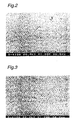
- Fig. 2 is a photograph of SEM image of a longitudinal section of pipe press-fitted portion of wristwatch case having only been subjected to press fitting (press-fit overlap width: 0.03 mm).
- Fig. 3 is a photograph of SEM image of a longitudinal section of pipe press-fitted portion of wristwatch case (press-fit overlap width: 0.01 mm) representing one working mode of the first aspect of the present invention.
- Fig.4 is a photograph of SEM image of a cross section of pipe press-fitted portion of wristwatch case (press-fit overlap width: 0.001 mm) representing one working mode of the first aspect of the present invention.
- Fig. 5 is a photograph of SEM image of an enlarged section of portion B indicated in Fig. 4.
- Fig. 6 is a photograph of SEM image of a cross section of pipe press-fitted portion of wristwatch case (press-fit overlap width: 0.03 mm) representing one working mode of the first aspect of the present invention.
- Fig. 7 is a photograph of SEM image of an enlarged section of portion A indicated in Fig. 6.
- Fig. 8 is a graph showing interrelationships among the press-fit overlap width, pipe fixing strength and waterproof sealing capability with respect to wristwatch cases produced according to the first aspect of the present invention.
- Fig. 9 is a graph showing the interrelationship between heat treatment temperature and pipe fixing strength with respect to wristwatch cases produced according to the first aspect of the present invention.
- Fig . 10 is a graph showing the interrelationshipbetween heat treatment time and pipe fixing strength with respect to wristwatch cases produced according to the first aspect of the present invention.
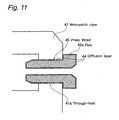
- Fig. 11 is a schematic sectional view of a pipe fixing portion produced by the method of fixing a pipe to a wristwatch case according to one working mode of the second aspect of the present invention.
- Fig. 12 is a schematic sectional view of a pipe fixing portion produced by the method of fixing a pipe to a wristwatch case according to another working mode of the present invention.
- Fig. 13 is a photograph of SEM image of a section of Ti I TiCu diffusion layer I Ti alloy interface junction portion according to one working mode of the present invention.
- Fig. 14 is a graph showing interrelationships among press-fit overlap width, pipe fixing strength, performing or non-performing of heat treatment in vacuum and waterproof test results.
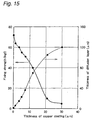
- Fig. 15 is a graph showing interrelationships among thickness of Cu coating, pipe fixing strength and thickness of diffusion layer formed as a result of solid-phase joining.
- Fig. 16 is a sectional view of wristwatch case according to the related art.
- the wristwatch case according to the first aspect of the present invention is one having a pipe joined and fixed thereto, the wristwatch case and the pipe having substantially no junction interface.
- the expression "having substantially no junction interface” used herein means that an interatomic-level diffusion and joining is realized between the surface of through-hole of wristwatch case and the pipe surface to thereby bring about disappearance of junction interface.
- the wristwatch case and pipe for use in this invention can comprise a material selected from among pure titanium, titanium alloys and stainless steel.
- Each of the material for wristwatch case and the material for pipe can be selected independently, and the materials can be identical with or different from each other.
- the wristwatch case and the pipe comprise the same type of metal, for example, simultaneously comprise a titanium metal such as pure titanium or a titanium alloy, or stainless steel.
- a titanium metal it is especially preferred that the wristwatch case and the pipe simultaneously comprise pure titanium, or a titanium alloy.
- use can be made of a combination of different types of metals, for example, a combination of titanium and stainless steel, or a combination of a titanium alloy and stainless steel.
- the method of fixing a pipe to a wristwatch case comprises the steps of providing a wristwatch case with a through-hole; press fitting a pipe exhibiting a through-hole/pipe press-fit overlap width (namely, outside diameter of the pipe minus the diameter of the through-hole) of greater than 0 mm in the through-hole; and heating the wristwatch case after the press fitting.
- Wristwatch case 11 at its side is provided with through-hole 13 for inserting pipe 15 by drilling. After the drilling, reaming is performed for deburring. Separately, pipe 15 is fabricated by cutting. The pipe 15 is so fabricated that the outside diameter of the pipe 15 is slightly larger than the diameter of the through-hole 13 of wristwatch case 11 so as to attain a press-fit overlap width of greater than 0 mm. The thus fabricated pipe 15 is press fitted in the through-hole 13 to thereby accomplish assembly.
- the above press-fit overlap width be in the range of 0.01 to 0.05 mm, especially 0.015 to 0.03 mm.
- the press-fit overlap width falls within the above range, by the solid-phase joining, the through-hole and the pipe can be joined to each other without remaining of any junction interface therebetween.
- excellent waterproof sealing capability be ensured but also excellent pipe fixing strength can be obtained.
- excellent corrosion resistance to artificial sweat, etc. can be exhibited.
- the press-fit overlap width is in the range of 0.015 to 0.03 mm, the influence of dispersion of through-hole and pipe dimensions can be suppressed with greater effectiveness, and the press fitting can be facilitated.
- the press-fit overlap width is less than 0.01 mm, even after the solid-phase joining of the pipe and the wristwatch case, a junction interface may exist between the through-hole of wristwatch case and the pipe to thereby disenable obtaining satisfactory waterproof capability and pipe fixing strength. Further, when the press-fit overlap width is greater than 0.05 mm, it may occur that the pipe is deformed as a result of press fitting thereof, and that the influence of dimensional change with respect to the inside diameter of pipe is serious.
- reaming for deburring is performed after providing the wristwatch case with the through-hole by drilling. It is preferred that the roundness of the diameter of through-hole obtained by the reaming be 0.01 mm or less, especially 0.005 mm or less. In this connection, the roundness of a perfect circle is 0 mm.
- the dispersion thereof be less. Accordingly, it is preferred that the roundness of the pipe outside diameter be 0.01 mm or less, especially 0.005 mm or less. In this connection, the roundness of a perfect circle is 0 mm.
- the through-hole on its internal surface has a surface roughness maximum (Rmax1) of 5 ⁇ m or less, still preferably 3 ⁇ m or less, and/or the pipe on its outside diameter portion has a surface roughness maximum (Rmax2) of 5 ⁇ m or less, still preferably 3 ⁇ m or less.
- Rmax1 surface roughness maximum
- Rmax2 surface roughness maximum
- the junction interface between the wristwatch case and the pipe may not disappear even after the solid phase diffusion joining to thereby disenable obtaining high waterproof capability and pipe fixing strength.
- the heating step the heating be performed at 600 to 850°C, especially 700 to 800°C. Further, in the heating step, it is preferred that the heating be performed for a period of 5 min or more, especially 30 min to 1 hr.
- Excellent pipe fixing strength can be obtained by heating at temperature falling within the above range for a period of 5 min or more.
- the heating step when the wristwatch case and the pipe simultaneously comprise stainless steel, it is preferred that, in the heating step, the heating be performed at 600 to 900°C, especially 700 to 850°C.
- this preferred heating temperature range of 600 to 900°C includes a temperature zone overlapping with the aforementioned sensitization temperature of stainless steel, it has been found that, in the present invention, when the heating time is 1 hr or less, sensitization would not occur and, in particular, such a phenomenon that corrosion resistance is deteriorated would not occur. It is presumed that the reason would be an extremely short heating time. When the heating is performed for a prolonged period of time, however, the above would not apply. Therefore, it is preferred that, at the above heating temperature, the heating be performed for a period of 10 min to 1 hr.
- working mode A1 An instance of pipe joining wherein use is made of titanium or a titaniumalloy (working mode A1) and an instance of pipe joining wherein use is made of stainless steel (working mode A2) will be specified below.
- a pipe of titanium or a titanium alloy was press fitted in a wristwatch case of titanium or a titanium alloy.
- the wristwatch case press fitted with the pipe was placed in a vacuum oven and heated in a vacuum atmosphere at a temperature which was lower than the transformation point of titanium, namely, 882°C. The heating was continued for a given period of time.
- an interatomic diffusion occurred at the junction interface between the through-hole provided in the wristwatch case and the pipe, with the result that the junction interface disappeared to thereby accomplish joining of the wristwatch case and the pipe to each other.
- a pipe of stainless steel was press fitted in a wristwatch case of stainless steel.
- the wristwatch case press fitted with the pipe was placed in a vacuum oven or an oven of reducing gas atmosphere and heated in a vacuum or reducing gas atmosphere at a temperature which was differentiated from the aforementioned temperature of Cr carbide precipitation. The heating was continued for a given period of time.
- an interatomic diffusion occurred at the junction interface between the through-hole provided in the wristwatch case and the pipe, with the result that the junction interface disappeared to thereby accomplish joining of the wristwatch case and the pipe to each other.
- a wristwatch case having a pipe joined and fixed thereto through a diffusion layer.
- Each of the wristwatch case and pipe for use in this second aspect of the present invention can comprise a material selected from among pure titanium, titanium alloys and stainless steel.
- Each of the material for wristwatch case and the material for pipe can be selected independently, and the materials can be identical with or different from each other.
- the wristwatch case and the pipe comprise the same type of metal, for example, simultaneously comprise a titanium metal such as pure titanium or a titanium alloy, or stainless steel.
- a titanium metal it is especially preferred that the wristwatch case and the pipe simultaneously comprise pure titanium, or a titanium alloy.
- use can be made of a combination of different types of metals, for example, a combination of titanium and stainless steel, or a combination of a titanium alloy and stainless steel.
- the diffusion layer through which the wristwatch case and pipe of the above materials are joined to each other comprise preferably a layer formed by a solid phase diffusion, the layer containing at least two metals selected from among Ti, Fe, Cr, Ni, Cu, Al, Pt, Au, Pd and Ag.
- Preferred diffusion layer material differs depending on a combination of wristwatch case material and pipe material.
- the diffusion layer preferably contains at least two metals selected from among Ti, Cu, Ni, Au and Pd, still preferably at least two metals selected from among Ti, Cu, Ni and Au.
- the diffusion layer preferably contains at least two metals selected from among Fe, Cr, Ni, Pt, Pd and Ge, still preferably at least two metals selected from among Fe, Cr, Ni, Pt and Pd.
- the above diffusion layer have a thickness of 1 to 100 ⁇ m, especially 2 to 10 ⁇ m.
- This diffusion layer can be formed by, after press fitting of a metallic coating furnished pipe in the through-hole provided in the wristwatch case, heating them in vacuum or other conditions so as to bring about an element-level solid phase diffusion among the wristwatch case, the metallic coating and the pipe.
- the wristwatch case and the pipe are joined to each other through the thus formed diffusion layer.
- the metallic coating would make plastic deformation between the metallic coating furnished pipe and the through-hole of the wristwatch case so as to fill any gaps and to enable lying in a depressed state therebetween. This enables further enhancing waterproof capability.
- the metallic coating provided on the pipe surface has the same components as those of the diffusion layer and comprises at least two metals selected from among Ti, Fe, Cr, Ni, Cu, Al, Pt, Au, Pd and Ag.
- the above metallic coating have a thickness of 0.1 to 20 ⁇ m, especially 0.5 to 3 ⁇ m.
- the metallic coating can be formed on the pipe surface by, for example, plating, vapor deposition, ion plating or CVD technique.
- the thickness of the diffusion layer depends on the thickness of the metallic coating of the above components provided on the pipe surface. For example, when the thickness of the metallic coating is 0.1 ⁇ m, the thickness of the diffusion layer is 1 ⁇ m. When the thickness of the metallic coating is 20 ⁇ m, the thickness of the diffusion layer is about 100 ⁇ m.
- the thickness of the metallic coating is less than 0.1 ⁇ m, namely, when the thickness of the diffusion layer is less than 1 ⁇ m, the degree of plastic deformation of metallic coating at the press fitting of the pipe may be unsatisfactory to thereby invite deterioration of waterproof capability.
- the thickness of the metallic coating is greater than 20 ⁇ m, namely, when the thickness of the diffusion layer is greater than 100 ⁇ m, the constitution of interface at the junction of pipe and wristwatch case through-hole may be so complex as to form brittle intermetallic compounds, thereby tending toward lowering of pipe fixing strength.
- the method of fixing a pipe to a wristwatch case comprises the steps of providing a wristwatch case with a through-hole; press fitting a pipe having its surface furnished with a metallic coating, which exhibits a through-hole/pipe press-fit overlap width (namely, outside diameter of the pipe having its surface furnished with a metallic coating minus the diameter of the through-hole) of not less than 0 mm, in the through-hole; and heating the wristwatch case after the press fitting in vacuum or a reducing gas.
- the method of fixing a pipe to a wristwatch case according to the second aspect of the present invention may comprise, in addition to the above three steps, the step of removing the metallic coating from the pipe surface at portions other than those wherein the wristwatch case and the metallic coating furnished pipe are in contact with each other.
- the metallic coating at portions other than those wherein the wristwatch case and the metallic coating furnished pipe are in contact with each other is exposed on the pipe surface.
- the components of metallic coating contain, for example, Cu
- the formation of diffusion layer by effecting the solid phase diffusion by heating at the exposed metallic coating portions may cause a surface discoloration. Therefore, this step may be added.
- the step of removing the metallic coating from the pipe surface it is preferred that the removal of the exposed metallic coating from the pipe surface be performed prior to the above heating treatment.
- etching can preferably be used from the viewpoint of capability of selectively removing the metallic coating only.
- the press-fit overlap width (namely, outside diameter of the pipe having its surface furnished with a metallic coating minus the diameter of the through-hole) be in the range of 0 to 0.05 mm, especially 0.01 to 0.03 mm.
- the metallic coating make appropriate plastic deformation at the press fitting of the pipe to thereby fill any gaps between the wristwatch case and the pipe but also the diffusion layer formed by the solid phase diffusion among the wristwatch case, the metallic coating and the pipe can fill any gaps between the through-hole of the wristwatch case and the pipe. Therefore, excellent waterproof capability and pipe fixing strength can be obtained. Further, excellent corrosion resistance to artificial sweat, etc. can be ensured.
- the press-fit overlap width is less than 0, effective plastic deformation would be difficult to thereby fail to completely fill minute gaps between the through-hole of the wristwatch case and the pipe. Thus, satisfactory waterproof capability and pipe fixing strength may not be obtained.
- the press-fit overlap width is greater than 0.05 mm, the press fitting of pipe may cause pipe deformation, and the influence of dimensional change of pipe inside diameter may be unfavorably large.
- reaming for deburring is performed after providing the wristwatch case with the through-hole by drilling. It is preferred that the roundness of the diameter of through-hole obtained by the reaming be 0.01 mm or less, especially 0.005 mm or less. In this connection, the roundness of a perfect circle is 0 mm.
- the dispersion thereof be less. Accordingly, it is preferred that the roundness of the pipe outside diameter be 0.01 mm or less, especially 0.005 mm or less. In this connection, the roundness of a perfect circle is 0 mm.
- the through-hole on its internal surface has a surface roughness maximum (Rmax3) of 5 ⁇ m or less, still preferably 3 ⁇ m or less, and/or the pipe having its surface furnished with a metallic coating (metallic coating furnished pipe) on its outside diameter portion has a surface roughness maximum (Rmax4) of 5 ⁇ m or less, still preferably 3 ⁇ m or less.
- Rmax3 surface roughness maximum
- Rmax4 surface roughness maximum
- any gaps between the wristwatch case and the metallic coating furnished pipe may not be completely filled even after the metallic coating plastic deformation or heat treatment to thereby disenable obtaining high waterproof capability and pipe fixing strength.
- the wrist watch case comprises a material selected from among pure titanium and titanium alloys and the pipe comprises a material selected from among pure titanium and titanium alloys
- the heating step it is preferred that, in the heating step, the heating be performed at 600 to 850°C, especially 700 to 800°C. Further, in the heating step, it is preferred that the heating be performed for a period of 5 min or more, especially 30 min to 1 hr.
- the solid phase diffusion reaction may not satisfactorily proceed to thereby disenable obtaining high pipe fixing strength or to suffer poor waterproof capability. Further, a long time may be needed in the joining, so that it is not practical.
- the heating temperature is higher than 850°C
- the crystal structure may be coarse to thereby suffer such a partial transformation that the surface is roughened to result in fogging of the wristwatch case after specular polishing.
- the transformation point of titanium namely, 882°C is exceeded
- this trend may be strong.
- Excellent pipe fixing strength can be obtained by heating at temperature falling within the above range for a period of 5 min or more.
- the heating step when the wristwatch case and the pipe simultaneously comprise stainless steel, it is preferred that, in the heating step, the heating be performed at 600 to 900°C, especially 700 to 850°C.
- this preferred heating temperature range of 600 to 900°C includes a temperature zone overlapping with the aforementioned sensitization temperature of stainless steel, it has been found that, in the present invention, when the heating time is 1 hr or less, sensitization would not occur and, in particular, such a phenomenon that corrosion resistance is deteriorated would not occur. It is presumed that the reason would be an extremely short heating time. When the heating is performed for a prolonged period of time, however, the above would not apply. Therefore, it is preferred that, at the above heating temperature, the heating be performed for a period of 10 min to 1 hr.
- working mode B1 An instance of pipe joining wherein use is made of titanium or a titanium alloy (working mode B1) and an instance of pipe joining wherein a metallic coating is removed (working mode B2), according to the second aspect of the present invention, will be specified below.
- through-hole 41a was made at a desired position of wristwatch case 41. This was a through-hole for inserting therein a stem to be coupled with a main body known as wristwatch module.
- the hole diameter was 2 mm, and, after drilling for making the through-hole, reaming was performed for also accomplishing deburring.
- pipe 42a of a titanium alloy with an outside diameter slightly larger than the diameter of the through-hole, having its surface entirely covered with a metallic coating, a Pd plating layer in this working mode B1 was produced so that the outside diameter of the pipe at a press fit portion was 2.02 mm in the state of being covered with the Pd plating layer.
- This pipe was press fitted in the through-hole made in the wristwatch case.
- the outside diameter of the pipe was not a perfect circle because of a slight eccentricity attributed to cutting operation employed in the fabrication of the pipe.
- the difference between outside diameter measured in an arbitrary X-direction and outside diameter measured in a Y-direction perpendicular thereto, namely, roundness was about 0.01 mm.
- the wristwatch case after the press fitting was heated at 800°C in a vacuum on the order of 10 -6 torr for about 30 min.
- the Pd coating was present at the interface of case material titanium and pipe material titanium alloy brought into contact to each other at the press fit portion 45 of the wristwatch case, and, at the interface, a solid phase diffusion reaction occurred. It is presumed that the titanium oxide layer which was present on the surface of titanium or titanium alloy at the time of press fitting would be removed as a result of the plastic deformation at press fitting, and that new surfaces would be exposed and brought into contact to each other. Further, it was recognized that, when the heating was effected to about 800°C, a counter diffusion of metals occurred at the interface of titanium and Pd to thereby form diffusion layer 44.
- titanium and Pd were metals having relatively high liability to undergo counter diffusion, and that satisfactory diffusion would occur at temperatures lower than the melting points of the metals. It is presumed that this would relate to the fact that a phase diagram of titanium and Pd shows intermetallic compounds at a wide variety of compositions.
- the external surface of pipe at portions other than the press fit portion was heated in vacuum in the state of being coated with Pd, so that a solid phase diffusion occurred at the external surface.
- the entire surface of the pipe 42a was coated with diffusion layer 44 (intermetallic compound or solid solution) containing titanium and Pd, formed by diffusion of titanium in the surface layer.
- diffusion layer 44 intermetallic compound or solid solution
- this diffusion layer had a metallic color and had an excellent corrosion resistance, so that the change of surface layer posed no problem from the viewpoint of practical use of wristwatch.
- the outside diameter of the pipe at the press fit portion was 2.02 mm in the state of being coated with the Cu plating layer.
- the outside diameter of the pipe was not a perfect circle because of a slight eccentricity attributed to cutting operation employed in the fabrication of the pipe.
- the difference between outside diameter measured in an arbitrary X-direction and outside diameter measured in a Y-direction perpendicular thereto, namely, roundness was about 0.01 mm.
- the step of removing the metallic coating at portions other than the press fit portion was carried out.
- unneeded Cu coating on the surface after the press fitting was removed by the use of a nitrate etchant capable of selectively etching only the Cu coating without corroding the titanium.
- Exposed Cu coating on the pipe surface at portions other than the press fit portion could be etched by immersing the wristwatch case after the pipe press fitting in the etchant.
- the resultant wristwatch case was heated at 800°C in a vacuum on the order of 10 -6 torr for about 30 min. It was recognized that, at the time of heating, a counter diffusion of metals occurred at the interface of titanium and Cu to thereby form a diffusion layer of titanium and Cu. It was found that titanium and Cu were metals having relatively high liability to undergo counter diffusion, and that satisfactory diffusion would occur at temperatures lower than the melting points of the metals. It is presumed that this would relate to the fact that a phase diagram of titanium and Cu shows a multiplicity of intermetallic compounds and solid solutions.
- oxide layer on the titanium or titanium alloy surface be replaced by exposed new surfaces as a result of plastic deformation at the time of press fitting but also oxygen would be dissolved in the titanium during the heating period. Consequently, the diffusion layer would be formed without remaining of oxygen at the interface.
- This working mode B2 is different from the working mode B1 in that the diffusion layer 44 is formed only at the press fit portion 45 so as to join the wristwatch case and the pipe to each other, whilst any diffusion layer is not formed on exposed pipe surfaces.
- FIG. 13 A scanning electron micrograph of a junction interface at which a pipe was fixed to a wristwatch case in accordance with the pipe fixing method of this working mode B2 is shown in Fig. 13.
- the left side shows titanium as a case material
- the right side shows a titanium alloy as a pipe material.
- a Cu plating layer was originally disposed in depressed form at the time of press fitting, but, as a result of heating in vacuum, a diffusion layer mainly composed of titanium and Cu was formed by a solid phase diffusion reaction of titanium and Cu. It was recognized that the pipe was joined and fixed to the wristwatch case through the diffusion layer.
- Fig. 14 plots the press-fit overlap width on the axis of abscissa and the pipe fixing strength on the axis of ordinate. The greater the press-fit overlap width, the greater the pipe deformation. Naturally, the pipe fixing strength increased accordingly.
- Fig. 14 shows a correlation with waterproof test results.
- the waterproof test was performed in the following manner. Aback lid of wristwatch case was detached, and the wristwatch case in open form was placed on a hot plate. The moisture of the inside of the wristwatch case was completely removed. Immediately thereafter, the wristwatch case was sealed with the back lid and fixed, and the resultant wristwatch case was immersed in a water of 10 atm for a given period of time. The wristwatch case was taken out, and the surface water was completely wiped off. Again, the wristwatch case was placed on a hot plate for quite some time. Cold water was applied to the glass surface of the wristwatch case to thereby rapidly cool the same.
- the press-fit overlap width as an important parameter in the second aspect of the present invention must be 0 mm or greater.
- the metals for forming the metallic coating are not limited thereto, and similar results can be attained by the plating layer of any of Al, Au, Pt, Pd and Ag, which are metals capable of realizing a solid phase diffusion with titanium at temperatures of not higher than the transformation point of titanium to thereby form an intermetallic compound, hence enabling interfacial joining.
- the thickness of diffusion layer formed at the interface was 1 ⁇ m when the thickness of original metallic coating was 0.1 ⁇ m and 100 ⁇ m when the thickness of original metallic coating was 20 ⁇ m. Therefore, it was ascertained that it would be desirable for the thickness of diffusion layer to fall within the range of 1 to 100 ⁇ m.
- Each wristwatch case of titanium was provided with a through-hole by drilling.
- the through-hole after drilling was reamed for deburring.
- a pipe of titanium alloy Ti-6Al-4V having an outside diameter of 0.02 to 0 mm smaller than the diameter of through-hole, namely, a press-fit overlap width of -0.02 to 0 mm was produced by cutting.
- a pipe of titanium alloy Ti-6Al-4V having an outside diameter of 0 to 0.055 mm larger than the diameter of through-hole, namely, a press-fit overlap width of 0 to 0.055 mm was produced by cutting.
- a final wristwatch case was produced only by press fitting each of the pipes in the through-hole, and another final wristwatch case was produced by sequentially carrying out the press fitting and a heat treatment in a vacuum atmosphere of 6 ⁇ 10 -6 torr at 700°C for 30 min whereby a solid-phase joining was effected.
- the waterproof test of wristwatch cases produced in the above Example A1 was carried out.
- the waterproof test was performed in the following manner.
- the back lid of each of the wristwatch cases was detached, and the wristwatch case in open form was placed on a hot plate.
- the moisture of the inside of the wristwatch case was completely removed.
- the back lid was again assembled in the wristwatch case, and the resultant wristwatch case was immersed in a water of 10 atm for a given period of time.
- the wristwatch case was taken out, and the surface water was completely wiped off. Again, the wristwatch case was placed undisturbed on a hot plate for quite some time. Cold water was applied to the glass surface of the wristwatch case to thereby rapidly cool the same.
- the moisture condensed on the glass surface, and the glass surface is fogged.
- the wristwatch case whose glass surface is fogged is evaluated as failure in the waterproof test, and the wristwatch case not exhibiting any fogging is evaluated as success in the waterproof test.
- FIG. 2 shows a scanning electron micrograph of a longitudinal section of pipe press-fitted portion of a wristwatch case having only been subjected to the press fitting (press-fit overlap width: 0.03 mm).
- press-fit overlap width 0.03 mm.
- Fig. 3 is a scanning electron micrograph of a longitudinal section of pipe press-fitted portion of a wristwatch case having been subjected to solid-phase joining (press-fit overlap width: 0.01 mm). It is apparent therefrom that the interface between the through-hole and the pipe disappeared to thereby attest to joining and unification. It is presumed that, at that time, the aforementioned oxide film (oxygen) lying in the interface would be solid dissolved in the wristwatch case and the pipe to thereby accomplish desirable joining. Therefore, it has been recognized that, when the press-fit overlap width is 0.01 mm or more, excellent waterproof sealing capability can be ensured without occurrence of waterproof failures.
- the press-fit overlap width was so large that not only the deformation of the pipe but also the influence of dimensional change of pipe inside diameter was unfavorably large. Thus, it has been ascertained that it is desirable to limit the press-fit overlap width within 0.05 mm.
- each wristwatch case having a through-hole press fitted with a pipe was secured by means of a jig, and a load was applied to the pipe.
- the pipe fixing strength was evaluated from the value of load at which the pipe was detached from the wristwatch case.
- the wristwatch case having been subjected to solid-phase joining exhibits a pipe fixing strength strikingly increased over that of the wristwatch case only through the press fitting at the same press-fit overlap width. Therefore, it has become apparent that the pipe fixing strength is strikingly increased by the solid-phase joining.
- the present measurement of pipe fixing strength was performed without application of any adhesive commonly employed for reinforcement.
- the pipe fixing strength of conventional wristwatch cases having the through-hole fitted with the pipe, followed by application of an adhesive was in the range of 20 to 80 kgf, it has been found that the wristwatch case having been subjected to the solid-phase joining can exhibit a pipe fixing strength which is higher than those of conventional wristwatch cases. Further, the wristwatch case having been subjected to the solid-phase joining also gave excellent results in corrosion resistance tests conducted by artificial sweat and saline solution spraying.
- Fig. 4 is a scanning electron micrograph of a cross section of pipe press-fitted portion of a wristwatch case having been subjected to the solid-phase joining (press-fit overlap width: 0.001 mm) .
- Fig. 5 is an enlarged micrograph of portion B indicated in Fig. 4.
- FIG. 6 is a scanning electron micrograph of a cross section of pipe press-fitted portion of a wristwatch case having been subjected to the solid-phase joining (press-fit overlap width: 0.03mm).
- Fig. 7 is an enlarged micrograph of portion A indicated in Fig. 6.
- Each wristwatch case of titanium after specular polishing was provided with a through-holebydrilling.
- the through-hole after drilling was reamed for deburring.
- a pipe of titanium alloy Ti-6Al-4V having an outside diameter of 0.025 mm larger than the diameter of through-hole, namely, a press-fit overlap width of 0.025 mm was produced by cutting.
- a final wristwatch case was produced by press fitting the pipe in the through-hole and effecting a heat treatment in a vacuum oven atmosphere of 6 ⁇ 10 -6 torr at temperatures varied from 500 to 900°C for a fixed period of 30 min whereby a solid-phase joining was effected.
- any high pipe fixing strength was not obtained at 550°C or below. It is apparent that the pipe fixing strength is strikingly increased by performing the solid-phase joining at 600°C or higher heat treatment temperatures.
- the solid-phase joining was effected at 900°C heat treatment temperature, the wristwatch case after specular polishing fogged although the pipe fixing strength was high.
- the reason would be that the crystal structure of titanium has become coarse as a result of heat treatment performed at temperature higher than the transformation point of titanium, 882°C. Although the structure having become coarse can be removed by re-polishing, it would cause the operations to become complex and would bring about other disadvantages.
- Each wristwatch case of titanium after specular polishing was provided with a through-hole by drilling.
- the through-hole after drilling was reamed for deburring.
- a pipe of titanium alloy Ti-6Al-4V having an outside diameter of 0.025 mm larger than the diameter of through-hole, namely, a press-fit overlap width of 0.025 mm was produced by cutting.
- a final wristwatch case was produced by press fitting the pipe in the through-hole and effecting a heat treatment in a vacuum oven atmosphere of 6 ⁇ 10 -6 torr at a fixed temperature of 700°C for a period varied among 1 min, 5 min, 30 min, 60 min, 90 min, 120 min, 150 min and 180 min, whereby a solid-phase joining was effected.
- Each wristwatch case of titanium was provided with a through-hole by drilling.
- the through-hole after drilling was reamed for deburring.
- wristwatch cases whose through-hole roundness and maximum surface roughness Rmax were in the range of 0.005 to 0.02 mm and 0.003 to 0.01 mm, respectively were chosen.
- pipes of titanium having an outside diameter of 0.025 mm larger than the diameter of through-hole, namely, a press-fit overlap width of 0.025 mm were produced by cutting. Pipes whose roundness and maximum surface roughness Rmax were in the range of 0.005 to 0.02 mm and 0.003 to 0.01 mm, respectively were chosen.
- final wristwatch cases were produced by press fitting pipes in through-holes and effecting a heat treatment in a vacuum oven atmosphere of 6 ⁇ 10 -6 torr at 700°C for a period of 30 min whereby a solid-phase joining was effected.
- Each wristwatch case of SUS 304 after specular polishing was provided with a through-hole by drilling.
- the through-hole after drilling was reamed for deburring.
- a pipe of SUS 316F having an outside diameter of 0.02 mm larger than the diameter of through-hole, namely, a press-fit overlap width of 0.02 mm was produced by cutting.
- a final wristwatch case was produced by press fitting the pipe in the through-hole and effecting a heat treatment in a vacuum oven atmosphere of 7 ⁇ 10 -6 torr at 800°C for a period of 30 min.
- Each wristwatch case of SUS 304 after specular polishing was provided with a through-hole by drilling.
- the through-hole after drilling was reamed for deburring.
- a pipe of SUS 316F having an outside diameter of 0.02 mm larger than the diameter of through-hole, namely, a press-fit overlap width of 0.02 mm was produced by cutting.
- a final wristwatch case was produced by press fitting the pipe in the through-hole and effecting a heat treatment in a reducing atmosphere oven at 750°C for a period of 1 hr.
- each pipe was press fitted in the through-hole of wristwatch case and heated in vacuum to thereby effect the solid-phase joining
- this process can be replaced by one comprising furnishing the through-hole with a tapped hole while threading the circumferential portion of pipe, screwing the pipe in the through-hole and heating them in vacuum to thereby effect the solid-phase joining.
- the process may comprise threading the circumferential portion of pipe, bringing the thread on the circumferential portion of pipe into contact with the internal surface of nontapped through-hole and heating them in vacuum to thereby effect the solid-phase joining.
- the process may comprise furnishing the through-hole with a tapped hole, bringing the pipe into contact with the tapped hole portion and heating them in vacuum to thereby effect the solid-phase joining.
- the wristwatch case of the present invention may be constituted of stainless steel.
- SUS 304 is used in the wristwatch case while free-cutting stainless steel SUS 316F is used in the pipe.
- the stainless steel case at a desired position was provided with a through-hole.
- a pipe furnished with a metallic coating, Pt coating in this example, with a thickness of 2 ⁇ m was press fitted in the case through-hole.
- the wristwatch case press fitted with the pipe was passed through an in-line hydrogen flow atmosphere oven at 750°C for 10 min. During this heating, a counter diffusion of Fe, Cr contained in stainless steel and Pt occurred to thereby form at the interface a diffusion layer with which joining was accomplished. It was ascertained that, thus, pipe fixing strength and waterproof sealing capability were excellent.
- the heating for accomplishing the joining and fixing of the stainless steel pipe to the stainless steel case be performed at 600 to 900°C.
- this preferred heating temperature range of 600 to 900°C includes a temperature zone overlapping with the aforementioned sensitization temperature of stainless steel, it has been found that, in the present invention, when the heating time is 1 hr or less, sensitization would not occur and, in particular, such a phenomenon that corrosion resistance is deteriorated would not occur. It is presumed that the reason would be an extremely short heating time. When the heating is performed for a prolonged period of time, however, the above would not apply. Therefore, it has been recognized that, at the above heating temperature, the preferred heating time is in the range of 10 min to 1 hr.
- the pipe fixing method comprising press fitting a pipe in a through-hole provided in a case and heating in vacuum was described in the above working modes and Examples according to the second aspect of the present invention, it is feasible to employ the following method instead.
- the through-hole is provided with a female tapped hole, while the circumferential portion of the pipe is provided with a male tapped hole capable of engaging with the female tapped hole.
- a metallic coating is formed on the outer surface of the pipe, and the pipe is screwed (turned) so as to effect engagement. Thereafter, heating is performed in vacuum to thereby accomplish j joining of the pipe to the case.
- stem pipe With respect to the wall thickness of stem pipe, as long as it is approximately 0.1 mm or more, a satisfactory stress would occur at the interface even after press fitting deformation to thereby ensure the solid-phase joining.
- a wristwatch case having a pipe solid-phase joined thereto with no junction interface therebetween can be obtained, without deterioration of the surface condition of wristwatch case as a result of the joining, by sequentially carrying out press fitting of a pipe in a through-hole provided in a wristwatch case and heat treatment in vacuum or a reducing atmosphere. Consequently, not only high waterproof reliability but also excellent corrosion resistance and satisfactory joining strength, namely, pipe fixing strength can be obtained. Further, adhesives conventionally employed for reinforcement can be unnecessitated.
- a wristwatch case and a pipe are joined and fixed to each other through a specified diffusion layer. Therefore, a wristwatch case which not only has excellent waterproof capability and corrosion resistance but also is ensured for long-term reliability of pipe fixing can be obtained. Further, because of a simple constitution, the invention is advantageous in yield and cost. Still further, pipe fixing can be accomplished without adverse influence on the surface configuration of titanium and stainless steel.
- the applicability of the method of fixing a pipe to a wristwatch case according to the present invention is not limited to the fixing of a pipe for wristwatch stem to a case through-hole, and the method is applicable to constitution of, for example, coupling parts of a push button, a sensor for diver watch, etc.
Landscapes
- Physics & Mathematics (AREA)
- General Physics & Mathematics (AREA)
- Engineering & Computer Science (AREA)
- Mechanical Engineering (AREA)
- Manufacturing & Machinery (AREA)
- Pressure Welding/Diffusion-Bonding (AREA)
Abstract
Description
Claims (31)
- A wristwatch case having a pipe joined and fixed thereto, said wristwatch case and said pipe having substantially no junction interface.
- The wristwatch case as claimed in claim 1, wherein the wristwatch case comprises a material selected from among pure titanium, titanium alloys and stainless steel, and also the pipe comprises a material selected from among pure titanium, titanium alloys and stainless steel.
- The wristwatch case as claimed in claim 1 or 2, wherein the wristwatch case comprises a material selected from among pure titanium and titanium alloys, and also the pipe comprises a material selected from among pure titanium and titanium alloys.
- The wristwatch case as claimed in claim 1 or 2, wherein both the wristwatch case and the pipe comprise stainless steel.
- A method of fixing a pipe to a wristwatch case, comprising the steps of:providing a wristwatch case with a through-hole,press fitting a pipe exhibiting a through-hole/pipe press-fit overlap width (namely, outside diameter of the pipe minus diameter of the through-hole) of greater than 0 mm in the through-hole, andheating the wristwatch case after the press fitting.
- The method as claimed in claim 5, wherein the press-fit overlap width is in the range of 0.01 to 0.05 mm.
- The method as claimed in claim 6, wherein the press-fit overlap width is in the range of 0.015 to 0.03 mm.
- The method as claimed in any of claims 5 to 7, wherein the diameter of the through-hole and the outside diameter of the pipe each exhibit a roundness of 0.01 mm or less.
- The method as claimed in any of claims 5 to 8, wherein the through-hole on its internal surface has a surface roughness maximum (Rmax1) of 5 µm or less, and/or the pipe on its outside diameter portion has a surface roughness maximum (Rmax2) of 5 µm or less.
- The method as claimed in any of claims 5 to 9, wherein the wristwatch case comprises a material selected from among pure titanium and titanium alloys, the pipe comprises a material selected from among pure titanium and titanium alloys, and, in the heating step, the heating is performed at 600 to 850°C.
- The method as claimed in claim 10, wherein, in the heating step, the heating is performed at 700 to 800°C.
- The method as claimed in claim 10 or 11, wherein, in the heating step, the heating is performed for a period of 5 min or more.
- The method as claimed in claim 12, wherein, in the heating step, the heating is performed for a period of 30 min to 1 hr.
- The method as claimed in any of claims 5 to 9, wherein both the wristwatch case and the pipe comprise stainless steel, and, in the heating step, the heating is performed at 600 to 900°C.
- The method as claimed in claim 14, wherein, in the heating step, the heating is performed for a period of 10 min to 1 hr.
- A wristwatch case having a pipe, said wristwatch case and said pipe joined and fixed to each other through a diffusion layer.
- The wristwatch case as claimed in claim 16, wherein the wristwatch case comprises a material selected from among pure titanium, titanium alloys and stainless steel, also the pipe comprises a material selected from among pure titanium, titanium alloys and stainless steel, and the diffusion layer comprises a layer formed by a solid phase diffusion, said diffusion layer containing at least two metals selected from among Ti, Fe, Cr, Ni, Cu, Al, Pt, Au, Pd and Ag.
- The wristwatch case as claimed in claim 16 or 17, wherein the wristwatch case comprises a material selected from among pure titanium and titanium alloys, also the pipe comprises a material selected from among pure titanium and titanium alloys, and the diffusion layer comprises a layer formed by a solid phase diffusion, said diffusion layer containing at least two metals selected from among Ti, Fe, Cr, Ni, Cu, Al, Pt, Au, Pd and Ag.
- The wrist watch case as claimed in claim 16 or 17, wherein both the wristwatch case and the pipe comprise stainless steel, and the diffusion layer comprises a layer formed by a solid phase diffusion, said diffusion layer containing at least two metals selected from among Ti, Fe, Cr, Ni, Cu, Al, Pt, Au, Pd and Ag.
- The wristwatch case as claimed in any of claims 16 to 19, wherein the diffusion layer has a thickness of 1 to 100 µm.
- A method of fixing a pipe to a wristwatch case, comprising the steps of:providing a wristwatch case with a through-hole,press fitting a pipe having its surface furnished with a metallic coating, which exhibits a through-hole/pipe press-fit overlap width (namely, outside diameter of the pipe having its surface furnished with a metallic coating minus diameter of the through-hole) of not less than 0 mm, in the through-hole, andheating the wristwatch case after the press fitting in vacuum or a reducing gas.
- A method of fixing a pipe to a wristwatch case, comprising the steps of:providing a wristwatch case with a through-hole,press fitting a pipe having its surface furnished with a metallic coating, which exhibits a through-hole/pipe press-fit overlap width (namely, outside diameter of the pipe having its surface furnished with a metallic coating minus diameter of the through-hole) of not less than 0 mm, in the through-hole,removing the metallic coating from the pipe surface at portions other than those wherein the wristwatch case and the metallic coating furnished pipe are in contact with each other, andheating the wristwatch case after the press fitting in vacuum or a reducing gas.
- The method as claimed in claim 21 or 22, wherein the press-fit overlap width is in the range of 0 to 0.05 mm.
- The method as claimed in claim 23, wherein the press-fit overlap width is in the range of 0.01 to 0.03 mm.
- The method as claimed in any of claims 21 to 24, wherein the diameter of the through-hole and the outside diameter of the pipe having its surface furnished with a metallic coating each exhibit a roundness of 0.01 mm or less.
- The method as claimed in any of claims 21 to 25, wherein the through-hole on its internal surface has a surface roughness maximum (Rmax3) of 5 µm or less, and/or the pipe having its surface with a metallic coating on its outside diameter portion has a surface roughness maximum (Rmax4) of 5 µm or less.
- The method as claimed in any of claims 21 to 26, wherein the wristwatch case comprises a material selected from among pure titanium and titanium alloys, the pipe comprises a material selected from among pure titanium and titanium alloys, and, in the heating step, the heating is performed at 600 to 850°C.
- The method as claimed in claim 27, wherein, in the heating step, the heating is performed at 700 to 800°C.
- The method as claimed in any of claims 21 to 26, wherein both the wristwatch case and the pipe comprise stainless steel, and, in the heating step, the heating is performed at 600 to 900°C.
- The method as claimed in claim 29, wherein, in the heating step, the heating is performed for a period of 10 min to 1 hr.
- The method as claimed in any of claims 21 to 30, wherein the metallic coating comprises a metal selected from among Cu, Ni, Al, Au, Pt, Pd and Ag, or an alloy of a combination thereof, and has a thickness of 0.1 to 20 µm.
Applications Claiming Priority (5)
| Application Number | Priority Date | Filing Date | Title |
|---|---|---|---|
| JP2000277385 | 2000-09-13 | ||
| JP2000277385 | 2000-09-13 | ||
| JP2000293674 | 2000-09-27 | ||
| JP2000293674 | 2000-09-27 | ||
| PCT/JP2001/005648 WO2002023283A1 (en) | 2000-09-13 | 2001-06-29 | Wristwatch case and methos of fixing pipe of wrist watch case |
Publications (3)
| Publication Number | Publication Date |
|---|---|
| EP1241539A1 true EP1241539A1 (en) | 2002-09-18 |
| EP1241539A4 EP1241539A4 (en) | 2007-04-04 |
| EP1241539B1 EP1241539B1 (en) | 2011-09-28 |
Family
ID=26599812
Family Applications (1)
| Application Number | Title | Priority Date | Filing Date |
|---|---|---|---|
| EP01943878A Expired - Lifetime EP1241539B1 (en) | 2000-09-13 | 2001-06-29 | Method of fixing pipe of a wrist watch case |
Country Status (6)
| Country | Link |
|---|---|
| US (1) | US6920692B2 (en) |
| EP (1) | EP1241539B1 (en) |
| JP (1) | JP4588292B2 (en) |
| KR (1) | KR20020060229A (en) |
| CN (1) | CN1394302B (en) |
| WO (1) | WO2002023283A1 (en) |
Cited By (2)
| Publication number | Priority date | Publication date | Assignee | Title |
|---|---|---|---|---|
| WO2005085962A3 (en) * | 2004-03-03 | 2006-01-19 | Joss Laurent | Watch case |
| EP3885842A1 (en) * | 2020-03-26 | 2021-09-29 | Nivarox-FAR S.A. | Non-magnetic timepiece component with improved wear resistance |
Families Citing this family (4)
| Publication number | Priority date | Publication date | Assignee | Title |
|---|---|---|---|---|
| DE60221874T2 (en) | 2001-09-21 | 2008-01-17 | Citizen Holdings Co., Ltd., Nishitokyo | EXTERNAL PART OF A CLOCK AND METHOD FOR PRODUCING THE PART |
| CN102266993B (en) * | 2011-07-13 | 2013-07-17 | 中山源谥真空科技有限公司 | Treatment method for joint between titanium or titanium alloy watch parts |
| WO2013084042A1 (en) * | 2011-12-09 | 2013-06-13 | Cartier Creation Studio S.A. | Method for placing a watch case under protective atmosphere |
| CN103920987B (en) * | 2014-04-23 | 2015-10-28 | 哈尔滨工业大学 | A kind of titanium alloy and the micro-diffusion connection method of stainless vacuum |
Family Cites Families (17)
| Publication number | Priority date | Publication date | Assignee | Title |
|---|---|---|---|---|
| IT990328B (en) * | 1973-08-27 | 1975-06-20 | Uebelhardt R | WRIST CHROLOGY |
| CH609827B (en) * | 1975-09-16 | Ebauchesfabrik Eta Ag | PROCESS FOR PUNCHING A SMALL HOLE IN A FINE MECHANICAL WORKPIECE. | |
| JPS52110063A (en) | 1976-03-12 | 1977-09-14 | Seiko Instr & Electronics Ltd | Securing an arbor pipe to a watch case |
| JPS5386248A (en) * | 1976-11-30 | 1978-07-29 | Citizen Watch Co Ltd | Wrist watch case |
| JPS55161293U (en) * | 1979-05-04 | 1980-11-19 | ||
| JPS5728690A (en) | 1980-07-25 | 1982-02-16 | Hitachi Ltd | Method for joining titanium alloy |
| JPS58128281A (en) | 1982-01-27 | 1983-07-30 | Hitachi Ltd | Diffusion bonding method between cemented carbide and steel |
| JPS60223682A (en) | 1984-04-23 | 1985-11-08 | Mitsubishi Metal Corp | Joining method of au and au alloy blank material and ti and ti alloy blank material |
| JPS61180685A (en) | 1985-02-04 | 1986-08-13 | Yamamoto Seisakusho:Kk | Method of joining accessory parts to base body of facing for decoration |
| JPS62199277A (en) | 1986-02-26 | 1987-09-02 | Sumitomo Metal Ind Ltd | Diffusion joining method for stainless steel |
| JP2733634B2 (en) * | 1991-07-22 | 1998-03-30 | セイコーインスツルメンツ株式会社 | Joint or joining method of titanium or titanium alloy and gold alloy |
| JPH05220849A (en) | 1992-02-17 | 1993-08-31 | Seiko Instr Inc | Joined body and joining method |
| US5831252A (en) * | 1995-02-08 | 1998-11-03 | Daido Tokushuko Kabushiki Kaisha | Methods of bonding titanium and titanium alloy members by high frequency heating |
| JP3186492B2 (en) * | 1995-02-17 | 2001-07-11 | 田中貴金属工業株式会社 | Bushing base plate and manufacturing method thereof |
| BE1009480A3 (en) * | 1995-07-11 | 1997-04-01 | Advanced Materials Tech | Method for fixing to each of two elements, especially links of a metal wrist band. |
| JP3511749B2 (en) * | 1995-08-30 | 2004-03-29 | 大同特殊鋼株式会社 | Method of joining Ti alloy members |
| EP0847826A4 (en) * | 1996-03-29 | 2000-01-12 | Sumitomo Metal Ind | METHOD OF DIFFUSION WELDING OF METAL MATERIALS |
-
2001
- 2001-06-29 EP EP01943878A patent/EP1241539B1/en not_active Expired - Lifetime
- 2001-06-29 KR KR1020027006127A patent/KR20020060229A/en not_active Ceased
- 2001-06-29 US US10/129,857 patent/US6920692B2/en not_active Expired - Lifetime
- 2001-06-29 JP JP2002527870A patent/JP4588292B2/en not_active Expired - Lifetime
- 2001-06-29 WO PCT/JP2001/005648 patent/WO2002023283A1/en not_active Ceased
- 2001-06-29 CN CN018031706A patent/CN1394302B/en not_active Expired - Fee Related
Cited By (3)
| Publication number | Priority date | Publication date | Assignee | Title |
|---|---|---|---|---|
| WO2005085962A3 (en) * | 2004-03-03 | 2006-01-19 | Joss Laurent | Watch case |
| EP3885842A1 (en) * | 2020-03-26 | 2021-09-29 | Nivarox-FAR S.A. | Non-magnetic timepiece component with improved wear resistance |
| US11762338B2 (en) | 2020-03-26 | 2023-09-19 | Nivarox-Far S.A. | Non-magnetic watch component with improved wear resistance |
Also Published As
| Publication number | Publication date |
|---|---|
| EP1241539B1 (en) | 2011-09-28 |
| CN1394302A (en) | 2003-01-29 |
| JP4588292B2 (en) | 2010-11-24 |
| WO2002023283A1 (en) | 2002-03-21 |
| EP1241539A4 (en) | 2007-04-04 |
| US6920692B2 (en) | 2005-07-26 |
| JPWO2002023283A1 (en) | 2004-01-22 |
| CN1394302B (en) | 2010-04-28 |
| HK1050733A1 (en) | 2003-07-04 |
| KR20020060229A (en) | 2002-07-16 |
| US20020185863A1 (en) | 2002-12-12 |
Similar Documents
| Publication | Publication Date | Title |
|---|---|---|
| US4073427A (en) | Lined equipment with triclad wall construction | |
| US6935774B2 (en) | Timepiece external part and method of manufacturing the part | |
| EP2264553B1 (en) | Thermocompensated spring and manufacturing method thereof | |
| US6920692B2 (en) | Wristwatch case and method of fixing pipe to wristwatch case | |
| EP0098795B1 (en) | Time piece and method of manufacturing the same | |
| JP2761694B2 (en) | Clad wire | |
| US5810332A (en) | Valve, in particular expansion valve for refrigeration systems, and a method for the manufacture thereof | |
| HK1050733B (en) | Wristwatch case and method of fixing pipe to wristwatch case | |
| US20220251713A1 (en) | Method for protection against corrosion | |
| JP4754122B2 (en) | Manufacturing method for watch parts | |
| US6789723B2 (en) | Welding process for Ti material and Cu material, and a backing plate for a sputtering target | |
| JPH04122885A (en) | Timepiece case and manufacture thereof | |
| JPS59140914A (en) | Nut and its manufacture | |
| RU2860106C1 (en) | Composite coating for soldering titanium, zirconium and aluminium and method for producing same | |
| JPH0359392B2 (en) | ||
| JPS60228666A (en) | Manufacture of external decorative parts for watch | |
| JP7818101B2 (en) | Rotor parts for X-ray rotating anodes | |
| JPH06286049A (en) | Clad wire material | |
| JPS5984219A (en) | Composite material for spectacles frame | |
| JP2019100628A (en) | Heat pipe and process of manufacture of heat pipe | |
| GB1592737A (en) | Welded joints and methods of forming same | |
| Benninghoff | Chemical nickel and it's future prospects. Experiences with and uses of nickel and nickel alloy coatings | |
| JPH0289589A (en) | Bond for unlike materials having high corrosion resistance and its production | |
| JP2001269795A (en) | Brazing filler metal, metallic member and joining method therefor | |
| JPH01260414A (en) | Titanium composite material and spectacle frame made by using said material |
Legal Events
| Date | Code | Title | Description |
|---|---|---|---|
| PUAI | Public reference made under article 153(3) epc to a published international application that has entered the european phase |
Free format text: ORIGINAL CODE: 0009012 |
|
| 17P | Request for examination filed |
Effective date: 20020613 |
|
| AK | Designated contracting states |
Kind code of ref document: A1 Designated state(s): CH DE FR GB IT LI |
|
| A4 | Supplementary search report drawn up and despatched |
Effective date: 20070306 |
|
| RAP1 | Party data changed (applicant data changed or rights of an application transferred) |
Owner name: CITIZEN HOLDINGS CO., LTD. |
|
| 17Q | First examination report despatched |
Effective date: 20081008 |
|
| GRAP | Despatch of communication of intention to grant a patent |
Free format text: ORIGINAL CODE: EPIDOSNIGR1 |
|
| RTI1 | Title (correction) |
Free format text: METHOD OF FIXING PIPE OF A WRIST WATCH CASE |
|
| GRAS | Grant fee paid |
Free format text: ORIGINAL CODE: EPIDOSNIGR3 |
|
| GRAA | (expected) grant |
Free format text: ORIGINAL CODE: 0009210 |
|
| AK | Designated contracting states |
Kind code of ref document: B1 Designated state(s): CH DE FR GB IT LI |
|
| REG | Reference to a national code |
Ref country code: GB Ref legal event code: FG4D |
|
| REG | Reference to a national code |
Ref country code: CH Ref legal event code: EP Ref country code: CH Ref legal event code: NV Representative=s name: RITSCHER & PARTNER AG |
|
| REG | Reference to a national code |
Ref country code: DE Ref legal event code: R081 Ref document number: 60145379 Country of ref document: DE Owner name: CITIZEN WATCH CO., LTD., NISHITOKYO-SHI, JP Free format text: FORMER OWNER: CITIZEN WATCH CO., LTD., TOKIO/TOKYO, JP |
|
| REG | Reference to a national code |
Ref country code: DE Ref legal event code: R096 Ref document number: 60145379 Country of ref document: DE Effective date: 20111124 |
|
| PLBE | No opposition filed within time limit |
Free format text: ORIGINAL CODE: 0009261 |
|
| STAA | Information on the status of an ep patent application or granted ep patent |
Free format text: STATUS: NO OPPOSITION FILED WITHIN TIME LIMIT |
|
| 26N | No opposition filed |
Effective date: 20120629 |
|
| REG | Reference to a national code |
Ref country code: DE Ref legal event code: R097 Ref document number: 60145379 Country of ref document: DE Effective date: 20120629 |
|
| REG | Reference to a national code |
Ref country code: CH Ref legal event code: PFA Owner name: CITIZEN HOLDINGS CO., LTD., JP Free format text: FORMER OWNER: CITIZEN HOLDINGS CO., LTD., JP |
|
| REG | Reference to a national code |
Ref country code: FR Ref legal event code: PLFP Year of fee payment: 16 |
|
| REG | Reference to a national code |
Ref country code: CH Ref legal event code: PFA Owner name: CITIZEN WATCH CO., LTD., JP Free format text: FORMER OWNER: CITIZEN HOLDINGS CO., LTD., JP |
|
| REG | Reference to a national code |
Ref country code: DE Ref legal event code: R082 Ref document number: 60145379 Country of ref document: DE Representative=s name: EISENFUEHR SPEISER PATENTANWAELTE RECHTSANWAEL, DE Ref country code: DE Ref legal event code: R081 Ref document number: 60145379 Country of ref document: DE Owner name: CITIZEN WATCH CO., LTD., NISHITOKYO-SHI, JP Free format text: FORMER OWNER: CITIZEN HOLDINGS CO., LTD., TOKYO, JP |
|
| REG | Reference to a national code |
Ref country code: FR Ref legal event code: PLFP Year of fee payment: 17 |
|
| REG | Reference to a national code |
Ref country code: FR Ref legal event code: CD Owner name: CITIZEN WATCH CO., LTD., JP Effective date: 20170623 |
|
| REG | Reference to a national code |
Ref country code: FR Ref legal event code: PLFP Year of fee payment: 18 |
|
| PGFP | Annual fee paid to national office [announced via postgrant information from national office to epo] |
Ref country code: CH Payment date: 20180614 Year of fee payment: 18 Ref country code: DE Payment date: 20180619 Year of fee payment: 18 |
|
| PGFP | Annual fee paid to national office [announced via postgrant information from national office to epo] |
Ref country code: FR Payment date: 20180511 Year of fee payment: 18 |
|
| PGFP | Annual fee paid to national office [announced via postgrant information from national office to epo] |
Ref country code: GB Payment date: 20180627 Year of fee payment: 18 Ref country code: IT Payment date: 20180625 Year of fee payment: 18 |
|
| REG | Reference to a national code |
Ref country code: DE Ref legal event code: R119 Ref document number: 60145379 Country of ref document: DE |
|
| REG | Reference to a national code |
Ref country code: CH Ref legal event code: PL |
|
| GBPC | Gb: european patent ceased through non-payment of renewal fee |
Effective date: 20190629 |
|
| PG25 | Lapsed in a contracting state [announced via postgrant information from national office to epo] |
Ref country code: DE Free format text: LAPSE BECAUSE OF NON-PAYMENT OF DUE FEES Effective date: 20200101 Ref country code: IT Free format text: LAPSE BECAUSE OF NON-PAYMENT OF DUE FEES Effective date: 20190629 Ref country code: GB Free format text: LAPSE BECAUSE OF NON-PAYMENT OF DUE FEES Effective date: 20190629 |
|
| PG25 | Lapsed in a contracting state [announced via postgrant information from national office to epo] |
Ref country code: CH Free format text: LAPSE BECAUSE OF NON-PAYMENT OF DUE FEES Effective date: 20190630 Ref country code: LI Free format text: LAPSE BECAUSE OF NON-PAYMENT OF DUE FEES Effective date: 20190630 |
|
| PG25 | Lapsed in a contracting state [announced via postgrant information from national office to epo] |
Ref country code: FR Free format text: LAPSE BECAUSE OF NON-PAYMENT OF DUE FEES Effective date: 20190630 |