TECHNICAL FIELD
The present invention relates to aromatic
diamide derivatives or salts thereof; an agricultural
and horticultural chemical, in particular, an
agricultural and horticultural insecticide, which
contains said compound as an active ingredient; and a
usage of the chemical.
BACKGROUND ART
JP-A-11-240857 discloses a compound analogous
to the aromatic diamide derivative of the present
invention but does not describes working examples,
physical properties and the like with respect to the
compound of the present invention.
DISCLOSURE OF THE INVENTION
The production of agricultural and horticultural
crops and the like is still badly damaged by
insect pests and the like, and the development of a
novel agricultural and horticultural chemical, in
particular, agricultural and horticultural insecticide
is desired because of, for example, the appearance of
insect pests resistant to existing chemicals. In
addition, because of the increased population of aged
farmers, and the like, various labor-saving application
methods are desired and the development of an agricultural
and horticultural chemical having properties
suitable for the application methods is desired.
The present inventors earnestly investigated
in order to develop a novel agricultural and horticultural
chemical, and consequently found that the
aromatic diamide derivative represented by the general
formula (I) of the present invention is a novel
compound not known in any literature, and the present
inventors found a novel use of said derivative as an
agricultural and horticultural chemical, in particular,
an agricultural and horticultural insecticide and their
effective usage, whereby the present invention has been
accomplished.
That is, the present invention relates to an
aromatic diamide derivative represented by the general
formula (I):
MODE FOR CARRYING OUT THE INVENTION
In the definition of the general formula (I)
shown for the aromatic diamide derivative or salt
thereof of the present invention, the term "halogen
atom" means a chlorine atom, a bromine atom, an iodine
atom or a fluorine atom. The term "(C1-C6)alkyl" means
a linear or branched alkyl group of 1 to 6 carbon
atoms, such as methyl, ethyl, n-propyl, i-propyl, n-butyl,
i-butyl, s-butyl, t-butyl, n-pentyl, n-hexyl or
the like. The term "halo(C1-C6)alkyl" means a substituted
and linear or branched alkyl group of 1 to 6
carbon atoms having as the substituent(s) one or more
halogen atoms which may be the same or different. The
term "(C1-C8)alkylene" means a linear or branched
alkylene group of 1 to 8 carbon atoms, such as
methylene, ethylene, propylene, trimethylene, dimethylmethylene,
tetramethylene, isobutylene, dimethylethylene,
octamethylene or the like. As "the 5- to 8-membered
ring which R5 and R6 (or R2 and A1 or R1) form
by their binding to each other, i.e., the 5- to 8-membered
ring that may contain one or two (or one to
three) atoms which may be the same or different and are
selected from oxygen atom, sulfur atom and nitrogen
atom, between adjacent carbon atoms constituting the
ring" or "the 5- to 8-membered ring which R5 (or R6 or
R7) and R4 form by their binding to each other, i.e.,
the 5- to 8-membered ring that may contain two or
three, or three or four atoms which may be the same or
different and are selected from oxygen atom, sulfur
atom and nitrogen atom, between adjacent carbon atoms
constituting the ring", there can be exemplified
azetidine ring, pyrrolidine ring, pyrroline ring,
piperidine ring, imidazolidine ring, imidazoline ring,
oxazolidine ring, thiazolidine ring, isoxazolidine
ring, isothiazolidine ring, tetrahydropyridine ring,
piperazine ring, morpholine ring, thiomorpholine ring,
dioxazine ring, dithiazine ring, etc.
The "heterocyclic group" includes, for
example, pyridyl group, pyridine-N-oxide group,
pyrimidinyl group, furyl group, tetrahydrofuryl group,
thienyl group, tetrahydrothienyl group, tetrahydropyranyl
group, tetrahydrothiopyranyl group, oxazolyl
group, isoxazolyl group, oxadiazolyl group, thiazolyl
group, isothiazolyl group, thiadiazolyl group,
imidazolyl group, triazolyl group and pyrazolyl group.
The "fused ring" includes, for example, naphthalene,
tetrahydronaphthalene, indene, indane, quinoline,
quinazoline, indole, indoline, chroman, isochroman,
benzodioxane, benzodioxole, benzofuran, dihydrobenzofuran,
benzothiophene, dihydrobenzothiophene,
benzoxazole, benzothiazole, benzimidazole and indazole.
The salt of the aromatic diamide derivative
of the general formula (I) of the present invention
includes, for example, inorganic acid salts such as
hydrochloride, sulfate, nitrate, phosphate and the
like; organic acid salts such as acetate, fumarate,
maleate, oxalate, methanesulfonate, benzenesulfonate,
p-toluenesulfonate and the like; salts with a sodium
ion, potassium ion, calcium ion or the like.
The aromatic diamide derivative of the
general formula (I) or salt thereof of the present
invention contains one or more asymmetric carbon atoms
or asymmetric centers in its structural formula in some
cases and has two or more optical isomers and
diastereomers in some cases. The present invention
also includes all of the individual optical isomers and
mixtures consisting of these isomers in any ratio. The
aromatic diamide derivative of the general formula (I)
or salt thereof of the present invention has two
geometrical isomers due to a carbon-carbon double bond
or a carbon-nitrogen double bond in its structural
formula in some cases. The present invention also
includes all of the individual geometrical isomers and
mixtures consisting of these isomers in any ratio. The
present invention also includes hydrates of said
compound, depending on the kind of the compound.
Preferable examples of the aromatic diamide
derivative of the general formula (I) or salt thereof
of the present invention are aromatic diamide derivatives
in which A1 is a (C1-C4)alkylene group, B is -O- or
-N(R4)- (wherein R4 is a hydrogen atom or a (C1-C3)alkyl
group), R1 is a hydrogen atom, a (C1-C3)alkyl group, a
phenyl(C1-C3)alkyl group, a substituted phenyl(C1-C3)alkyl
group, a (C1-C3)alkylcarbonyl group, a halo(C1-C3)alkylcarbonyl
group, a (C1-C3)alkoxycarbonyl group, a
mono (C1-C3)alkylaminocarbonyl group, a di (C1-C3)alkyl-aminocarbonyl
group whose (C1-C3)alkyl groups may be the
same or different, a (C1-C3)alkylsulfonyl group, a
mono (C1-C3)alkylaminosulfonyl group, a di (C1-C3)alkyl-aminosulfonyl
group whose (C1-C3)alkyl groups may be the
same or different, a di(C1-C3)alkoxyphosphono group
whose (C1-C3)alkyl groups may be the same or different,
or a di(C1-C3)alkoxythiophosphono group whose (C1-C3)alkyl
groups may be the same or different, each of R2
and R3 is a hydrogen atom or a (C1-C3)alkyl group, each
of Q1 through Q4 is a carbon atom, X is a halogen atom,
a nitro group, a halo(C1-C6)alkyl group, a halo(C1-C6)alkoxy
group or a halo(C1-C6)alkylthio group, n is an
integer of 0 to 2, Q5 is a carbon atom or a nitrogen
atom, each of Ys, which may be the same or different,
is a halogen atom, a (C1-C3)alkyl group, a halo(C1-C3)
alkyl group, a (C1-C3)alkoxy group, a halo(C1-C3)alkoxy
group, a halo(C1-C3)alkylthio group or a
halo (C1-C3)alkoxyhalo (C1-C3) alkoxy group, m is an integer
of 1 to 3, each of Z1 and Z2 is an oxygen atom; or salts
thereof.
The aromatic diamide derivative of the
general formula (I) or salt thereof of the present
invention can be produced, for example, by the
production process illustrated below. In the present
invention, the production can be carried out also by,
for example, the process disclosed in JP-A-11-240857.
A process for the production, however, is not limited
to these production processes.
Production process 1.
wherein R
1, R
2, R
3, A
1, B, Q
1 through Q
5, X, n, Y, m, Z
1
and Z
2 are as defined above.
An aromatic diamide derivative of the general
formula (I-1) can be obtained by allowing an aromatic
carboxylic acid anhydride derivative of the general
formula (II) to react with an aromatic amine of the
general formula (III) in the presence of an inert
solvent to obtain an aromatic imide derivative of the
general formula (IV), and allowing said aromatic imide
derivative (IV) to react with an amine of the general
formula (V) after or without isolation of the aromatic
imide derivative (IV).
(1). General formula (II) → general formula (IV)
As the inert solvent usable in this reaction,
any inert solvent may be used so long as it does not
markedly inhibit the progress of the reaction. There
can be exemplified inert solvents including aromatic
hydrocarbons such as benzene, toluene, xylene, etc.;
halogenated hydrocarbons such as methylene chloride,
chloroform, carbon tetrachloride, etc.; chlorinated
aromatic hydrocarbons such as chlorobenzene,
dichlorobenzene, etc.; acyclic or cyclic ethers such as
diethyl ether, dioxane, tetrahydrofuran, etc.; esters
such as ethyl acetate, etc.; amides such as dimethylformamide,
dimethylacetamide, etc.; acids such as
acetic acid, etc.; dimethyl sulfoxide; 1,3-dimethyl-2-imdazolidinone;
and the like. These inert solvents may
be used singly or as a mixture thereof.
Since the reaction is an equimolar reaction,
it is sufficient that the reactants are used in
equimolar amounts, though either of them may be used in
excess. If necessary, the reaction may be carried out
under dehydrating conditions.
As to the reaction temperature, the reaction
can be carried out at room temperature to the reflux
temperature of the inert solvent used. Although the
reaction time is varied depending on the scale of
reaction, the reaction temperature, etc., it may be
properly chosen in the range of several minutes to 48
hours.
After completion of the reaction, the desired
compound is isolated from the reaction system containing
the desired compound by a conventional method, and
if necessary, purified by recrystallization, column
chromatography, etc., whereby the desired compound can
be produced. The desired compound can be subjected to
the subsequent reaction step without isolation from the
reaction system.
The aromatic carboxylic acid anhydride
derivative of the general formula (II) can be produced
by any of the processes described in J. Org. Chem., 52,
129 (1987), J. Am. Chem. Soc., 51, 1865 (1 to 29),
ditto 63, 1542 (1941), etc. The aromatic amine of the
general formula (III) can be produced by any of the
processes described in J. Org. Chem., 29, 1 (1964),
Angew. Chem. Int. Ed. Engl., 24, 871 (1985), Synthesis,
1984, 667, Journal of Chemical Society of Japan, 1973,
2351, German Patent Laid-Open DE-2606982, JP-A-1-90163,
etc.
(2). General formula (IV) → general formula (I-1)
As an inert solvent usable in this reaction,
those exemplified as the inert solvent usable in (1)
can be exemplified.
Since the reaction is an equimolar reaction,
it is sufficient that the reactants are used in
equimolar amounts, though the amine of the general
formula (V) may be used in excess.
As to the reaction temperature, the reaction
can be carried out at room temperature to the reflux
temperature of the inert solvent used. Although the
reaction time is varied depending on the scale of
reaction, the reaction temperature, etc., it may be
properly chosen in the range of several minutes to 48
hours.
After completion of the reaction, the desired
compound is isolated from the reaction system containing
the desired compound by a conventional method, and
if necessary, purified by recrystallization, column
chromatography, etc., whereby the desired compound can
be produced.
Production process 2.
wherein R
1, R
2, R
3, A
1, B, Q
1 through Q
5, X, n, Y, m, Z
1
and Z
2 are as defined above.
An aromatic diamide derivative of the general
formula (I) can be produced by allowing an aromatic
carboxylic acid anhydride derivative of the general
formula (II-1) to react with an amine of the general
formula (V) in the presence of an inert solvent to
obtain a phthalamide of the general formula (VI-2), and
treating this aromatic amide (VI-2) as follows after or
without isolation. When R2 of the aromatic amide (VI-2)
is a hydrogen atom, the aromatic amide (VI-2) is
subjected to condensation reaction in the presence of a
condensing agent to obtain a compound of the general
formula (VII-2), which is allowed to react with an
aromatic amine of the general formula (III-1) in the
presence of an inert solvent after or without isolation
of the compound (VII-2). When R2 of the aromatic amide
(VI-2) is other than a hydrogen atom, the aromatic
amide (VI-2) is condensed with an aromatic amine of the
general formula (III-1) in the presence of a condensing
agent.
Alternatively, an aromatic diamide derivative
of the general formula (I) can be produced by allowing
an aromatic carboxylic acid anhydride derivative of the
general formula (II-1) to react with an aromatic amine
of the general formula (III-1) in the presence of an
inert solvent to obtain an aromatic amide of the
general formula (VI-1), and treating the aromatic amide
(VI-1) as follows after or without isolation. When R3
of the aromatic amide (VI-1) is a hydrogen atom, the
aromatic amide (VI-1) is subjected to condensation
reaction in the presence of a condensing agent to
obtain a compound of the general formula (VII-1), which
is allowed to react with an amine of the general
formula (V) in the presence of an inert solvent after
or without isolation of the compound (VII-1). When R3
of the aromatic amide (VI-1) is other than a hydrogen
atom, the aromatic amide (VI-1) is condensed with an
amine of the general formula (V) in the presence of a
condensing agent.
(1). General formula (II-1) → general formula (VI-1),
or general formula (II-1) → general formula (VI-2)
In the case of either of these reactions, the
desired compound can be produced in a manner similar to
that described in production process 1-(2).
(2). General formula (VII-1) or general formula (VII-2)
→ general formula (I)
In the case of this reaction, the desired
compound can be produced in a manner similar to that
described in production process 1-(2).
(3). General formula (VI-1) → general formula (VII-1),
or general formula (VI-2) → general formula (VII-2)
In the case of either of these reactions, the
desired compound can be produced according to the
process described in J. Med. Chem., 10, 982 (1967).
(4). General formula (VI-1) or general formula (VI-2)
→ general formula (I)
The desired compound can be produced by
allowing an aromatic amide derivative of the general
formula (VI-1) or the general formula (VI-2) to react
with an amine of the general formula (V) or the general
formula (III-1), respectively, in the presence of a
condensing agent and an inert solvent. If necessary,
the reaction can be carried out in the presence of a
base.
The inert solvent used in the reaction
includes, for example, tetrahydrofuran, diethyl ether,
dioxane, methylene chloride and chloroform.
As the condensing agent used in the reaction,
any condensing agent used in conventional amide production
may be used. There can be exemplified Mukaiyama
reagent (2-chloro-N-methylpyridinium iodide), DCC (1,3-dicyclohexylcarbodiimide),
CDI (carbonyldiimidazole)
and DEPC (diethyl cyanophosphate). As to the amount of
the condensing agent used, the condensing agent may be
used in an amount properly chosen in the range of 1
mole to excess moles per mole of the aromatic amide
derivative of the general formula (VI-1) or the general
formula (VI-2).
The base usable in the reaction includes, for
example, organic bases such as triethylamine, pyridine,
etc., and inorganic bases such as potassium carbonate,
etc. As to the amount of the base used, the base may
be used in an amount properly chosen in the range of 1
mole to excess moles per mole of the aromatic amide
derivative of the general formula (VI-1) or the general
formula (VI-2).
As to the reaction temperature, the reaction
can be carried out at 0°C to the boiling point of the
inert solvent used. Although the reaction time is
varied depending on the scale of reaction, the reaction
temperature, etc., it ranges from several minutes to 48
hours.
After completion of the reaction, the desired
compound is isolated from the reaction system containing
the desired compound by a conventional method, and
if necessary, purified by recrystallization, column
chromatography, etc., whereby the desired compound can
be produced.
Table 3 shows
1H-NMR data of compounds having
a physical property expressed by the word "amorphous"
in Table 1.
| No. | 1H-NMR[CDCl3/TMS, δ values (ppm)] |
| 80 | 1.33(d,3H), 2.37(s,3H), 3.91(dd,1H), 3.96(dd,1H), 4.55(m,1H), 6.32(d,1H), 6.78(d,2H), 6.94(dd,1H), 7.22(m,3H), 7.39(d,1H), 7.41(s,1H), 7.81(d,1H), 7.99(d,1H), 8.21(d,1H), 8.41(s,1H). |
| 98 | 1.17(d,3H), 1.75-1.90(m,4H), 2.40(s,3H), 3.10-3.42(m,4H), 4.02(dd,1H), 4.22(dd,1H), 4.32(m,1H), 6.89(d,1H), 7.22(dd,1H), 7.42(s,1H), 7.44(d,1H), 7.81(d,1H), 7.97(d,1H), 8.34(d,1H), 8.48(s,1H). |
| 117 | 1.26(dt,6H), 1.28(d,3H), 2.38(s,3H), 4.08(m,6H), 4.39(s,1H), 6.79(d,1H), 7.23(dd,1H), 7.41(s,1H), 7.43(d,1H), 7.81(d,1H), 7.99(d,1H), 8.31(d,1H), 8.42(s,1H). |
Agricultural and horticultural chemicals, in
particular, agricultural and horticultural insecticides,
which contain as an active ingredient the
aromatic diamide derivative of the general formula (I)
or salt thereof of the present invention are suitable
for controlling various insect pests such as agricultural
insect pests, forest insect pests, horticultural
insect pests, stored grain insect pests,
sanitary insect pests, nematodes, etc., which are
injurious to paddy rice, fruit trees, vegetables, other
crops, flowers and ornamental plants, and the like.
They have a powerful insecticidal effect, for example,
on LEPIDOPTERA including summer fruit tortrix
(Adoxophyes orana fasciata), smaller tea tortrix
(Adoxophyes sp.), Manchurian fruit moth (Grapholita
inopinata), oriental fruit moth (Grapholita molesta),
soybean pod borer (Leguminivora glycinivorella),
mulberry leafroller (Olethreutes mori), tea leafroller
(Caloptilia thevivora), Caloptilia sp. (Caloptilia
zachrysa), apple leafminer (Phyllonorycter
ringoniella), pear barkminer (Spulerrina astaurota),
common white (Piers rapae crucivora), tabacco budworm
(Heliothis sp.), codling moth (Laspey resia pomonella),
diamondback moth (Plutella xylostella), apple fruit
moth (Argyresthia conjugella), peach fruit moth
(Carposina niponensis), rice stem borer (Chilo
suppressalis), rice leafroller (Cnaphalocrocis
medinalis), tabacco moth (Ephestia elutella), mulberry
pyralid (Glyphodes pyloalis), yellow rice borer
(Scirpophaga incertulas), rice skipper (Parnara
guttata), rice armyworm (Pseudaletia separata), pink
borer (Sesamia inferens), common cutworm (Spodoptera
litura), beet armyworm (Spodoptera exigua), etc.;
HEMIPTERA including aster leafhopper (Macrosteles
fascifrons), green rice leafhopper (Nephotettix
cincticeps), brown rice planthopper (Nilaparvata
lugens), whitebacked rice planthopper (Sogatella
furcifera), citrus psylla (Diaphorina citri), grape
whitefly (Aleurolobus taonabae), sweetpotato whitefly
(Bemisia tabaci), greenhouse whitefly (Trialeurodes
vaporariorum), turnip aphid (Lipaphis erysimi), green
peach aphid (Myzus persicae), Indian wax scale
(Ceroplastes ceriferus), cottony citrus scale
(Pulvinaria aurantii), camphor scale (Pseudaonidia
duplex), San Jose scale (Comstockaspis perniciosa),
arrowhead scale (Unaspis yanonensis), etc.; COLEOPTERA
including root-lesion nematode (Pratylenchus sp.),
soybean beetle (Anomala rufocuprea), Japanese beetle
(Popillia japonica), tobacco beetle (Lasioderma
serricorne), powderpost beetle (Lyctus brunneus),
twenty-eight-spotted ladybird (Epilachna vigintiocto-punctata),
adzuki bean weevil (Callosobruchus
chinensis), vegetable weevil (Listroderes costiro-stris),
maize weevil (Sitophilus zeamais), boll weevil
(Anthonomus gradis gradis), rice water weevil
(Lissorhoptrus oryzophilus), cucurbit leaf beetle
(Aulacophora femoralis), rice leaf beetle (Oulema
oryzae), striped flea beetle (Phyllotreta striolata),
pine shoot beetle (Tomicus piniperda), Colorado potate
beetle (Leptinotarsa decemlineata), Mexican beetle
(Epilachna varivestis), corn rootworm (Diabrotica sp.),
etc.; DIPTERA including melon fly (Dacus(Zeugodacus)
cucurbitae), oriental fruit fly (Dacus(Bactrocera)
dorsalis), rice leafminer (Agromyza oryzae), onion
maggot (Delia antiqua), seedcorn maggot (Delia
platura), soybean pod gall midge (Asphondylia sp.),
muscid fly (Musca domestica), house mosquito (Culex
pipiens pipiens), etc.; and TYLENCHIDA including coffee
root-lesion nematode (Pratylenchus coffeae), potato
cyst nematode (Globodera rostochiensis), root-knot
nematode (Meloidogyne sp.), citrus nematode
(Tylenchulus semipenetrans), Aphelenchus sp.
(Aphelenchus avenae), chrysanthemum foliar nematode
(Aphelenchoides ritzemabosi), etc.
The agricultural and horticultural chemical,
in particular, agricultural and horticultural
insecticide, which contains as an active ingredient the
aromatic diamide derivative of the general formula (I)
or salt thereof of the present invention has a marked
insecticidal effect on the above-exemplified insect
pests injurious to paddy field crops, upland crops,
fruit trees, vegetables, other crops, flowers and
ornamental plants, and the like. Therefore, the
desired effect of the agricultural and horticultural
chemical, in particular, agricultural and horticultural
insecticide of the present invention can be obtained by
applying the agricultural and horticultural chemical to
the paddy field water, stalks and leaves of fruit
trees, vegetables, other crops, flowers and ornamental
plants, soil, etc., at a season at which the insect
pests are expected to appear, before their appearance
or at the time when their appearance is confirmed.
The agricultural and horticultural chemical
of the present invention is generally prepared into
conveniently usable forms according to an ordinary
manner for preparation of agrochemicals.
That is, the aromatic diamide derivative of
the general formula (I) or a salt thereof and,
optionally, an adjuvant are blended with a suitable
inert carrier in a proper proportion and prepared into
a suitable preparation form such as a suspension,
emulsifiable concentrate, soluble concentrate, wettable
powder, granules, dust, tablets or the like through
dissolution, dispersion, suspension, mixing, impregnation,
adsorption or sticking.
The inert carrier usable in the present
invention may be either solid or liquid. As a material
usable as the solid carrier, there can be exemplified
soybean flour, cereal flour, wood flour, bark flour,
saw dust, powdered tobacco stalks, powdered walnut
shells, bran, powdered cellulose, extraction residue of
vegetables, powdered synthetic polymers or resins,
clays (e.g. kaolin, bentonite, and acid clay), talcs
(e.g. talc and pyrophyllite), silica powders or flakes
(e.g. diatomaceous earth, silica sand, mica and white
carbon [synthetic, high-dispersion silicic acid, also
called finely divided hydrated silica or hydrated
silicic acid, some of commercially available products
contain calcium silicate as the major component]),
activated carbon, powdered sulfur, pumice, calcined
diatomaceous earth, ground brick, fly ash, sand,
calcium carbonate, calcium phosphate and other
inorganic or mineral powders, chemical fertilizers
(e.g. ammonium sulfate, ammonium phosphate, ammonium
nitrate, urea and ammonium chloride), and compost.
These carriers may be used alone or as a mixture
thereof.
A material usable as the liquid carrier is
selected from materials that have solubility in
themselves or which are without such solubility but are
capable of dispersing an active ingredient with the aid
of an adjuvant. The following are typical examples of
the liquid carrier and can be used alone or as a
mixture thereof: water, alcohols (e.g. methanol,
ethanol, isopropanol, butanol and ethylene glycol),
ketones (e.g. acetone, methyl ethyl ketone, methyl
isobutyl ketone, diisobutyl ketone and cyclohexanone),
ethers (e.g. ethyl ether, dioxane, Cellosolve, dipropyl
ether and tetrahydrofuran), aliphatic hydrocarbon (e.g.
kerosene and mineral oils), aromatic hydrocarbons (e.g.
benzene, toluene, xylene, solvent naphtha and alkylnaphthalenes),
halogenated hydrocarbons (e.g. dichloroethane,
chloroform, carbon tetrachloride and chlorobenzene),
esters (e.g. ethyl acetate, diisopropyl
phthalate, dibutyl phthalate and dioctyl phthalate),
amides (e.g. dimethylformamide, diethylformamide and
dimethylacetamide), nitriles (e.g. acetonitrile), and
dimethyl sulfoxide.
The following are typical examples of the
adjuvant, which are used depending upon purposes and
used alone or in combination is some cases, or need not
to be used at all.
To emulsify, disperse, dissolve and/or wet a
compound as active ingredient, a surfactant is used.
As the surfactant, there can be exemplified polyoxyethylene
alkyl ethers, polyoxyethylene alkylaryl
ethers, polyoxyethylene higher fatty acid esters,
polyoxyethylene resonates, polyoxyethylene sorbitan
monolaurate, polyoxyethylene sorbitan monooleate,
alkylarylsulfonates, naphthalene sulfonic acid
condensation products, ligninsulfonates and higher
alcohol sulfate esters.
Further, to stabilize the dispersion of a
compound as active ingredient, tackify it and/or bind
it, the adjuvants exemplified below may also be used,
namely, there may also be used adjuvants such as
casein, gelatin, starch, methyl cellulose, carboxymethyl
cellulose, gum arabic, poly(vinyl alcohol)s,
turpentine, bran oil, bentonite and ligninsulfonates.
To improve the flowability of a solid
product, the following adjuvants may also be used,
namely, there may be used adjuvants such as waxes,
stearates, alkyl phosphates, etc.
Adjuvants such as naphthalenesulfonic acid
condensation products and polycondensates of phosphates
may be used as a peptizer for dispersible products.
Adjuvants such as silicone oils may also be
used as a defoaming agent.
The content of the compound as active
ingredient may be varied as required, and the compound
as active ingredient may be used in a proportion
properly chosen in the range of 0.01 to 90 parts by
weight per 100 parts of the agricultural and horticultural
insecticide. For example, in dusts or
granules, the suitable content of the compound as
active ingredient is from 0.01 to 50 % by weight. In
emulsifiable concentrates or flowable wettable powders,
it is also from 0.01 to 50 % by weight.
The agricultural and horticultural chemical,
in particular, agricultural and horticultural insecticide
of the present invention is used to control a
variety of insect pests in the following manner: it is
applied to a crop on which the insect pests are
expected to appear, or a site where appearance or
growth of the insect pests is undesirable, as it is or
after being properly diluted with or suspended in water
or the like, in an amount effective for control of the
insect pests.
The applying dosage of the agricultural and
horticultural insecticide of the present invention is
varied depending upon various factors such as a
purpose, insect pests to be controlled, a growth state
of a plant, tendency of insect pests appearance,
weather, environmental conditions, a preparation form,
an application method, an application site and
application time. It may be properly chosen in the
range of 0.001 g to 10 kg, preferably 0.01 g to 1 kg,
(in terms of the compound as active ingredient) per 10
ares depending upon purposes.
The agricultural and horticultural chemical,
in particular, agricultural and horticultural insecticide
of the present invention may be used in admixture
with other agricultural and horticultural insecticides,
acaricides, nematicides, fungicides, biotic pesticides
or the like in order to expand both spectrum of
controllable insect pest species and the period of time
when effective application are possible or to reduce
the dosage. Furthermore, the agricultural and
horticultural chemical of the present invention may be
used in admixture with herbicides, plant growth
regulators, fertilizers or the like, depending upon
application situations.
As the other agricultural and horticultural
insecticides, acaricides and nematicides, which are
used for the above purpose, there can be exemplified
agricultural and horticultural insecticides, acaricides
and nematicides, such as Ethion, Trichlorfon,
Metamidophos, Acephate, Dichlorvos, Mevinphos,
Monocrotophos, Malathion, Dimethoate, Formothion,
Mecarbam, Vamidothion, Thiometon, Disulfoton,
Oxydeprofos, Naled, Methylpatathion, Fenitrothion,
Cyanophos, Propaphos, Fenthion, Prothiofos, Profenofos,
Isofenphos, Temephos, Phenthoate, Dimethylvinphos,
Chlorfenvinphos, Tetrachlorvinphos, Phoxim, Isoxathion,
Pyraclofos, Methidathion, Chlorpyrifos, Chlorpyrifos-methyl,
Pyridaphenthion, Diazinon, Pirimiphosmethyl,
Phosalone, Phosmet, Dioxabenzophos, Quinalphos,
Terbuphos, Ethoprophos, Cadusafos, Mesulfenfos, DPS
(NK-0795), Phosphocarb, Fenamiphos, Isoamidophos,
Fosthiazate, Isazophos, Ethoprophos, Fostietane,
Dichlofenthion, Thionazin, Sulprofos, Fensulfothion,
Diamidafos, Pyrethrin, Allethrin, Prallethrin,
Resmethrin, Permethrin, Tefluthrin, Bifenthrin,
Fenpropathrin, Cypermethrin, α-Cypermethrin,
Cyhalothrin, λ-Cyhalothrin, Deltamethrin, Acrinathrin,
Fenvalerate, Esfenvalerate, Flucythrinate, Fluvalinate,
Cycloprothrin, Ethofenprox, Halfenprox, Silafluofen,
Fluvalinate, Methomyl, Oxamyl, Thiodicarb, Aldicarb,
Alanycarb, Cartap, Metolcarb, Xylylcarb, Propoxur,
Phenoxycarb, Fenobucarb, Ethiophencarb, Fenothiocarb,
Bifenazate, BPMC, Carbaryl, Pirimicarb, Carbofuran,
Carbosulfan, Furathiocarb, Benfuracarb, Aldoxycarb,
Diafenthiuron, Diflubenzuron, Teflubenzuron,
Hexaflumuron, Novaluron, Lufenuron, Flufenoxuron,
Chlorfluazuron, Fenbutatin oxide, tricyclohexyltin
hydroxide, sodium oleate, potassium oleate, Methoprene,
Hydroprene, Binapacryl, Amitraz, Dicofol, Chroro-benzilate,
Bromopropylate, Tetradifon, Bensultap,
Benzoximate, Tebufenozide, Methoxyfenozide,
Chromafenozide, Propargite, Acequinosyl, Endosulfan,
Diofenolan, Chlorfenapyl, Fenpyroximate, Tolfenpyrad,
Fipronil, Tebufenpyrad, Triazamate, Etoxazole,
Hexythiazox, nicotine sulfate, Nitenpyram, Acetamiprid,
Thiacloprid, Imidacloprid, Thiamethoxam, Clothianidin,
Nidinotefuran, Fluazinam, Pyriproxyfen, Hydramethylnon,
Pyrimidifen, Pyridaben, Cyromazin, TPIC (tripropyl
isocyanurate), Pymetrozin, Clofentezin, Buprofedin,
Thiocyclam, Fenazaquin, Chinomethionate, Indoxacarb,
Polynactin complexes, Milbemectin, Abamectin,
Emamectin-benzoate, Spinosad, BT (Bacillus
thuringiensis), Azadirachtin, Rotenone, hydroxypropyl
starch, Levamisole hydrochloride, Metam-sodium,
Morantel tartrate, Dazomet, Trichlamide, Pasteuria
penetrans, Monacrosporium-phymatophagum, etc. As the
agricultural and horticultural fungicides used for the
same purpose as above, there can be exemplified
agricultural and horticultural fungicides such as
sulfur, lime sulfur, copper sulfate basic, Iprobenfos,
Edifenfos, Tolclofos-methyl, Thiram, Polycarbamate,
Zineb, Maneb, Mancozeb, Propineb, Thiophanate,
Thiophanate methyl, Benomyl, Iminoctadin acetate,
Iminocutadin albecylate, Mepronil, Flutolanil,
Pencycuron, Furametpyl, Thifluzamide, Metalaxyl,
Oxadixyl, Carpropamid, Dichlofluanid, Flusulfamide,
Chlorothalonil, Kresoxim-methyl, Fenoxanil (NNF-9425),
Himexazol, Etridiazol, Fluoroimide, Procymidone,
Vinclozolin, Iprodione, Triadimefon, Triflumizole,
Bitertanol, Ipconazole, Fluconazole, Propiconazole,
Diphenoconazole, Myclobutanil, Tetraconazole,
Hexaconazole, Tebuconazole, Imibenconazole, Prochloraz,
Pefurazoate, Cyproconazole, Isoprothiolane, Fenarimol,
Pyrimetanil, Mepanipyrim, Pyrifenox, Fluazinam,
Triforine, Diclomezine, Azoxystrobin, Thiadiazin,
Captan, Probenazole, Acibenzolar-S-methyl (CGA-245704),
Fthalide, Tricyclazole, Pyroquilon,
Chinomethionat, Oxolinic acid, Dithianon, Kasugamycin,
Validamycin, Polyoxin, Blasticidin, Streptomycin, etc.
Similarly, as the herbicides, there can be exemplified
herbicides such as Glyphosate, Sulfosate, Glyfosinate,
Bialaphos, Butamifos, Esprocarb, Prosulcarb,
Benthiocarb, Pyributycarb, Asulam, Linulon, Dymron,
Bensulfuron methyl, Cyclosulfamuron, Cinosulfuron,
Pyrazosulfuron ethyl, Azimsulfuron, Imazosulfuron,
Tenylchlor, Alachlor, Pretilachlor, Clomeprop,
Etobenzanid, Mefenacet, Pendimethalin, Bifenox,
Acifluorfen, Lactfen, Cyhalofop-butyl, Ioxynil,
Bromobutide, Alloxydim, Setoxydim, Napropamide,
Indanofan, Pyrazolate, Benzofenap, Pyraflufen-ethyl,
Imazapyl, Sulfentrazone, Cafenstrole, Bentoxazon,
Oxadiazon, Paraquat, Diquat, Pyriminobac, Simazine,
Atrazine, Dimethametryn, Triazyflam, Benflesate,
Flutiacet-methyl, Quizalofop-ethyl, Bentazon, calcium
peroxide, etc.
As to the biotic pesticides, the same effect
as above can be expected by using the agricultural and
horticultural chemical of the present invention in
admixture with, for example, viral formulations
obtained from nuclear polyhedrosis virus (NPV),
granulosis virus (GV), cytoplasmic polyhedrosis virus
(CPV), entomopox virus (EPV), etc.; microbial pesticides
utilized as insecticides or nematicides, such as
Monacrosporium phymatophagum, Steinernema carpocapsae,
Steinernema kushidai, Pasteuria penetrans, etc.;
microbial pesticides utilized as fungicides, such as
Trichoderma lignorum, Agrobacterium radiobactor,
nonpathogenic Erwinia carotovora, Bacillus subtilis,
etc.; and biotic pesticides utilized as herbicides,
such as Xanthomonas campestris, etc.
In addition, the agricultural and horticultural
chemical of the present invention can be used
in combination with biotic pesticides including natural
enemies such as Parasitic wasp (Encarsia formosa),
Parasitic wasp (Aphidius colemani), Gall-mildge
(Aphidoletes aphidimyza), Parasitic wasp (Diglyphus
isaea), Parasitic mite (Dacnusa sibirica), Predatory
mite (Phytoseiulus persimilis), Predatory mite
(Amblyseius cucumeris), Predatory bug (Orius sauteri),
etc.; microbial pesticides such as Beauveria
brongniartii, etc.; and pheromones such as (Z)-10-tetradecenyl=acetate·
(E,Z)-4,10-tetradecadienyl=
acetate·(Z)-8-dodecenyl=acetate·(Z)-11-tetradecenyl=
acetate·(Z)-13-icosen-10-one, (Z)-8-dodecenyl=
acetate·(Z)-11-tetradecenyl=acetate (Z)-13-icosen-10-one·14-methyl-1-octadecene,
etc.
Typical examples of the present invention are
described below but they should not be construed as
limiting the scope of the invention.
EXAMPLES
Production Example 1
(1-1). Production of 3-iodo-N-(4-heptafluoroisopropyl-2-methylphenyl)phthalamic
acid
A solution of 3.5 g of 4-heptafluoro-isopropyl-2-methylaniline
in 3 ml of acetonitrile was
slowly dropped into a suspension of 3.5 g of 1-iodophthalic
anhydride in 30 ml of acetonitrile under
ice-cooling. After completion of the dropwise
addition, the reaction was carried out with stirring at
room temperature for 3 hours. After completion of the
reaction, the crystals precipitated were collected by
filtration and washed with a small volume of acetonitrile
to obtain 4.0 g of the desired compound.
Physical property: m.p. 174 - 181°C. Yield: 57%.
(1-2). Production of 3-iodo-N-(4-heptafluoroisopropyl-2-methylphenyl)phthalisoimide
To a suspension of 2.0 g of 3-iodo-N-(4-heptafluoroisopropyl-2-methylphenyl)phthalamic
acid in
10 ml of toluene was added 1.1 g of trifluoroacetic
anhydride, and the reaction was carried out with
stirring at room temperature for 30 minutes. After
completion of the reaction, the solvent was distilled
off under reduced pressure to obtain 2.0 g of a crude
product as the desired product. The desired product
obtained was used in the subsequent reaction without
purification.
1H-NMR [CDCl3/TMS, δ values (ppm)]
2.4(s, 3H), 7.3(d, 1H), 7.4(m, 2H), 7.5(t,
1H), 8.1(d, 1H), 8.2(d, 1H)
(1-3). Production of 3-iodo-N1-(4-heptafluoroisopropyl-2-methylphenyl)-N2-[1-methyl-2-(N,N-dimethyl
sulfamoylamino)ethyl]phthalamide
(compound No. 45)
In 30 ml of acetonitrile was dissolved 0.4 g
of 3-iodo-N-(4-heptafluoroisopropyl-2-methylphenyl)-phthalisoimide,
followed by adding thereto 0.2 g of
N,N-dimethylamino-N'-(2-aminopropyl)sulfonamide, and
the resulting mixture was stirred at room temperature
for 5 hours. After completion of the reaction, the
reaction mixture was poured into ice water, followed by
extraction with ethyl acetate. The organic layer was
washed with an aqueous sodium chloride solution, dried
over anhydrous magnesium sulfate and then distilled
under reduced pressure to remove the solvent, and the
resulting residue was purified by silica gel column
chromatography to obtain 0.2 g of the desired compound.
Physical property: m.p. 95°C. Yield: 40%.
Production Example 2
Production of 3-iodo-N1-(4-heptafluoroisopropyl-2-methylphenyl)-N2-[1-methyl-2-(ethylaminocarbonyloxy)ethyl]phthalamide
(compound No. 96)
In 30 ml of acetonitrile was dissolved 0.55 g
of 6-iodo-N-[1-methyl-2-(ethylaminocarbonyloxy)ethyl]-phthalisoimide,
followed by adding thereto 0.38 g of 4-heptafluoroisopropyl-2-methylaniline,
and the resulting
mixture was stirred at room temperature for 3 hours.
After completion of the reaction, the reaction mixture
was poured into ice water, followed by extraction with
ethyl acetate. The organic layer was washed with an
aqueous sodium chloride solution, dried over anhydrous
magnesium sulfate and then distilled under reduced
pressure to remove the solvent, and the resulting
residue was purified by silica gel column chromatography
to obtain 0.36 g of the desired compound.
Physical property: m.p. 185°C. Yield: 38%.
Production Example 3
(3-1). Production of 3-iodo-N-(4-heptafluoroisopropyl-2-methylphenyl)phthalimide
To a suspension of 2.7 g of 3-iodophthalic
anhydride in 30 ml of acetic acid was added 2.7 g of 4-heptafluoroisopropyl-2-methylaniline,
and the resulting
mixture was heated under reflux for 3 hours.
After completion of the reaction, the solvent
was distilled off under reduced pressure from the
reaction mixture, and the resulting residue was
purified by silica gel column chromatography to obtain
4.8 g of the desired compound.
Yield: 89%.
(3-2). Production of 3-iodo-N1-(4-heptafluoroisopropyl-2-methylphenyl)-N2-[3-t-butoxycarbonyl
aminopropyl)phthalamide (compound No.
20)
In 20 ml of dioxane was dissolved 0.5 g of 3-iodo-N-(4-heptafluoroisopropyl-2-methylphenyl)-phthalimide,
followed by adding thereto 0.25 g of t-butyl
N-(3-aminopropyl)carbamate and two drops of
trifluoroacetic acid, and the resulting mixture was
stirred at room temperature for 10 hours. After
completion of the reaction, the reaction mixture was
poured into ice water, followed by extraction with
ethyl acetate. The organic layer was washed with an
aqueous sodium chloride solution, dried over anhydrous
magnesium sulfate and then distilled under reduced
pressure to remove the solvent, and the resulting
residue was purified by silica gel column chromatography
to obtain 0.2 g of the desired compound.
Physical property: m.p. 145°C. Yield: 30%.
Typical formulation examples and test
examples of the present invention are described below
but they should not be construed as limiting the scope
of the invention.
In the formulation examples, parts are all by
weight.
Formulation Example 1
| Each compound listed in Table 1 or Table 2 |
50 parts |
| Xylene |
40 parts |
| Mixture of polyoxyethylene nonylphenyl ether and calcium alkylbenzenesulfonate |
10 parts |
An emulsifiable concentrate was prepared by
mixing uniformly the above ingredients to effect
dissolution.
Formulation Example 2
| Each compound listed in Table 1 or Table 2 |
3 parts |
| Clay powder |
82 parts |
| Diatomaceous earth powder |
15 parts |
A dust was prepared by mixing uniformly and
grinding the above ingredients.
Formulation Example 3
| Each compound listed in Table 1 or Table 2 |
5 parts |
| Mixed powder of bentonite and clay |
90 parts |
| Calcium lignin sulfonate |
5 parts |
Granules were prepared by mixing the above
ingredients uniformly, and kneading the resulting
mixture together with a suitable amount of water,
followed by granulation and drying.
Formulation Example 4
| Each compound listed in Table 1 or Table 2 |
20 parts |
| Mixture of kaolin and synthetic, high-dispersion silicic acid |
75 parts |
| Mixture of polyoxyethylene nonylphenyl ether and calcium alkylbenzenesulfonate |
5 parts |
A wettable powder was prepared by mixing
uniformly and grinding the above ingredients.
Test Example 1
Insecticidal effect on diamondback moth (Plutella
xylostella)
Adult diamondback moths were released and
allowed to oviposit on a Chinese cabbage seedling. Two
days after the release, the seedling having eggs
deposited thereon was immersed for about 30 seconds in
a liquid chemical prepared by diluting a preparation
containing each compound listed in Table 1 or Table 2,
as an active ingredient to adjust the concentration to
50 ppm. After air-drying, the seedling was allowed to
stand in a room thermostated at 25°C.
Six days after the immersion in the liquid
chemical, the hatched insects were counted and the
mortality was calculated according to the following
equation, whereby the insecticidal effect was judged
according to the criterion shown below. The test was
carried out with three replications of 10 insects.
As a result of the above test, it was found
that the following compounds had an insecticidal
activity rated B or higher: compound Nos. 1 to 122, 127
to 130, 133 to 136, 139, 140, 142 to 145, 148, 149,
152, 153, 157, 161, 165, 167 to 173, 182 to 185, 194,
198, 199, 204, 205, 210 to 212, 214 to 216, 222, 223,
229, 230, 235, 236, 243, 247, 259, 260, 263 to 272,
274, 275, 278 to 280, 284 to 290, 293, 297, 308, 311,
312, 317 to 322, 2-3, 2-5, 2-11, 2-13, 2-28, 2-29, 2-32,
2-33, 2-35, 2-39, 2-47 to 2-52, 2-72, 2-73 and 2-74.
Test Example 2
Insecticidal effect on common cutworm (Spodoptera
litura)
A piece of cabbage leaf (cultivar: Shikidori)
was immersed for about 30 seconds in a liquid chemical
prepared by diluting a preparation containing each
compound listed in Table 1 or Table 2, as an active
ingredient to adjust the concentration to 50 ppm.
After air-drying, the piece was placed in a plastic
Petri dish with a diameter of 9 cm and inoculated with
second-instar larvae of common cutworm, after which the
dish was closed and then allowed to stand in a room
thermostated at 25°C. Eight days after the inoculation,
the dead and alive were counted and the mortality was
calculated according to the following equation, whereby
the insecticidal effect was judged according to the
criterion shown in Test Example 1. The test was
carried out with three replications of 10 insects.
As a result of the above test, it was found
that the following compounds had an activity rated B or
higher: compound Nos. 1, 2, 6 to 9, 12 to 16, 19, 22,
28, 29, 33 to 36, 38 to 45, 48, 50, 51, 54 to 57, 59,
62 to 72, 74, 76 to 78, 81 to 86, 88, 90 to 113, 116,
117, 129, 130, 133, 134, 139, 142, 144, 148, 152, 153,
172, 184, 229, 247, 272, 274, 279, 286, 287, 289, 290,
2-32, 2-35, 2-39, 2-47, 2-49 to 2-51, 2-72 and 2-73.
Test Example 3
Insecticidal effect on smaller tea tortrix
(Adoxophyes sp.)
Tea leaves were immersed for about 30 seconds
in a liquid chemical prepared by diluting a preparation
containing each compound listed in Table 1 or Table 2,
as an active ingredient to adjust the concentration to
50 ppm. After air-drying, the tea leaves were placed
in a plastic Petri dish with a diameter of 9 cm and
inoculated with larvae of smaller tea tortrix, after
which the dish was allowed to stand in a room thermostated
at 25°C and having a humidity of 70%. Eight days
after the inoculation, the dead and alive were counted
and the insecticidal effect was judged according to the
criterion shown in Test Example 1. The test was
carried out with three replications of 10 insects.
As a result of the above test, it was found
that the following compounds had an activity rated B or
higher: compound Nos. 1 to 4, 6 to 10, 12 to 16, 19 to
26, 28 to 45, 48 to 51, 54 to 60, 62 to 72, 74 to 78,
80 to 117, 129, 130, 133 to 136, 139, 140, 142, 144,
145, 148, 149, 152, 153, 170, 182, 184, 210, 247, 265,
272, 274, 279, 284, 286, 287, 289, 290, 317, 322, 2-32,
2-35, 2-39, 2-47, 2-49 to 2-51, 2-72 and 2-73.


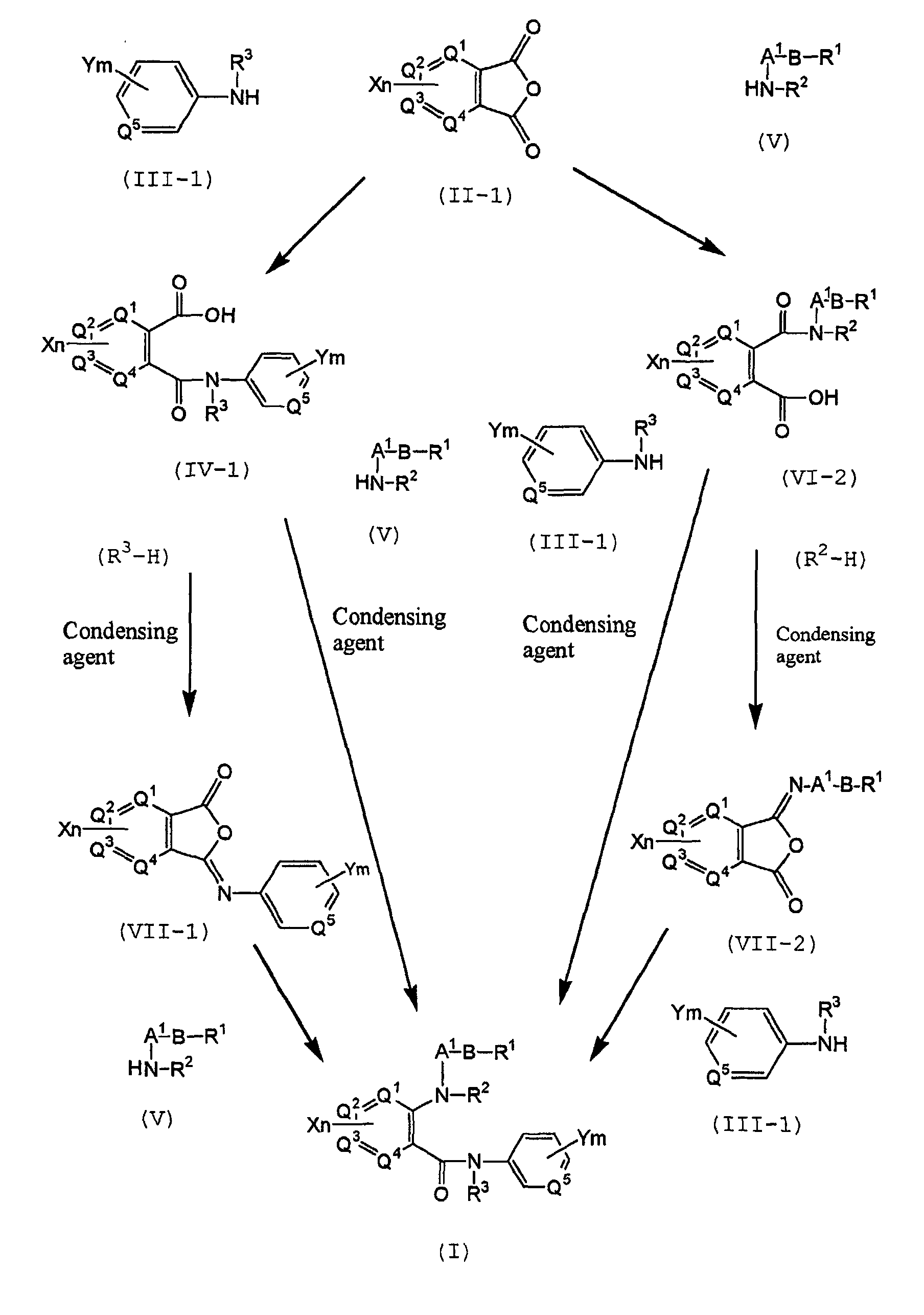

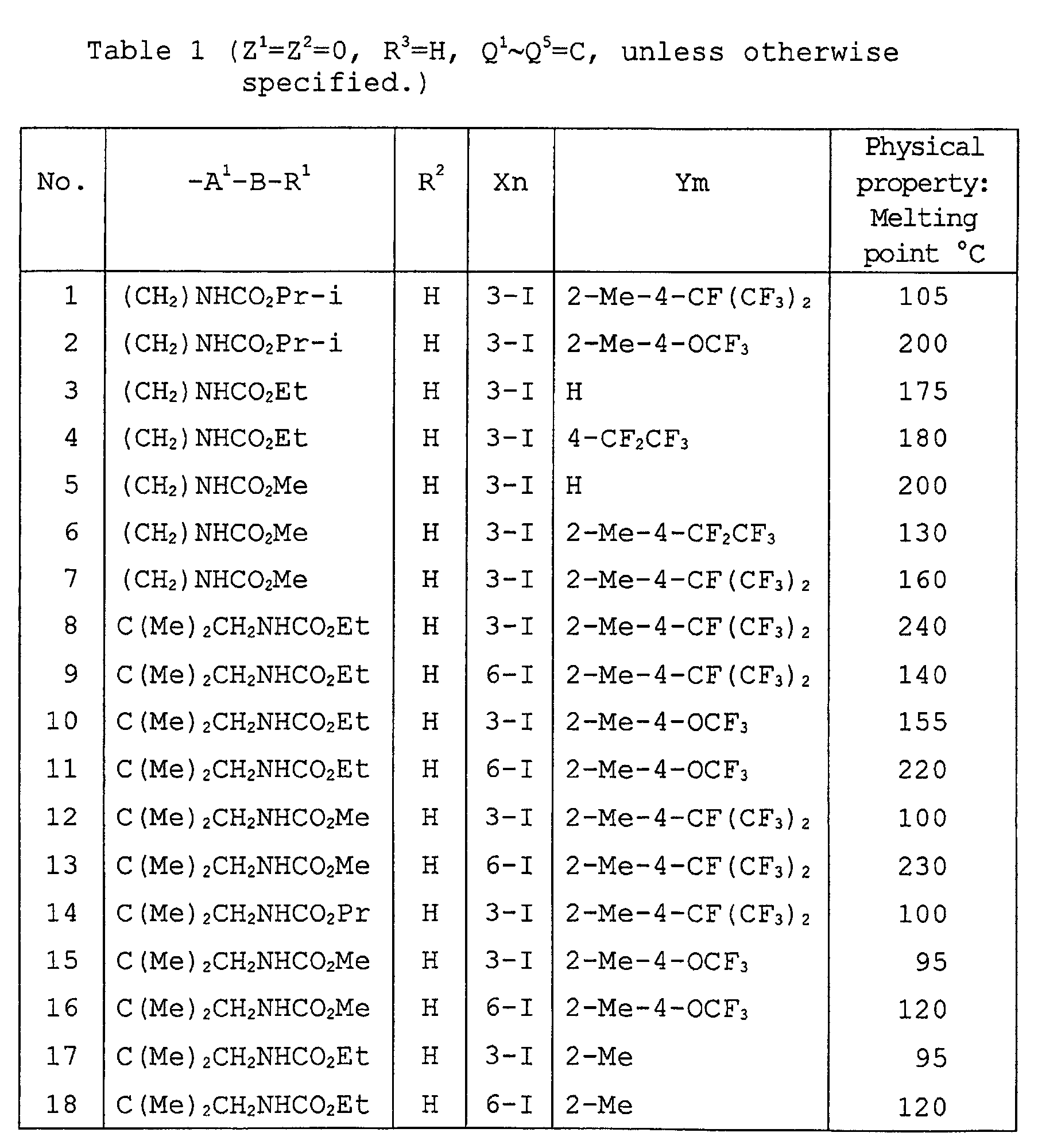


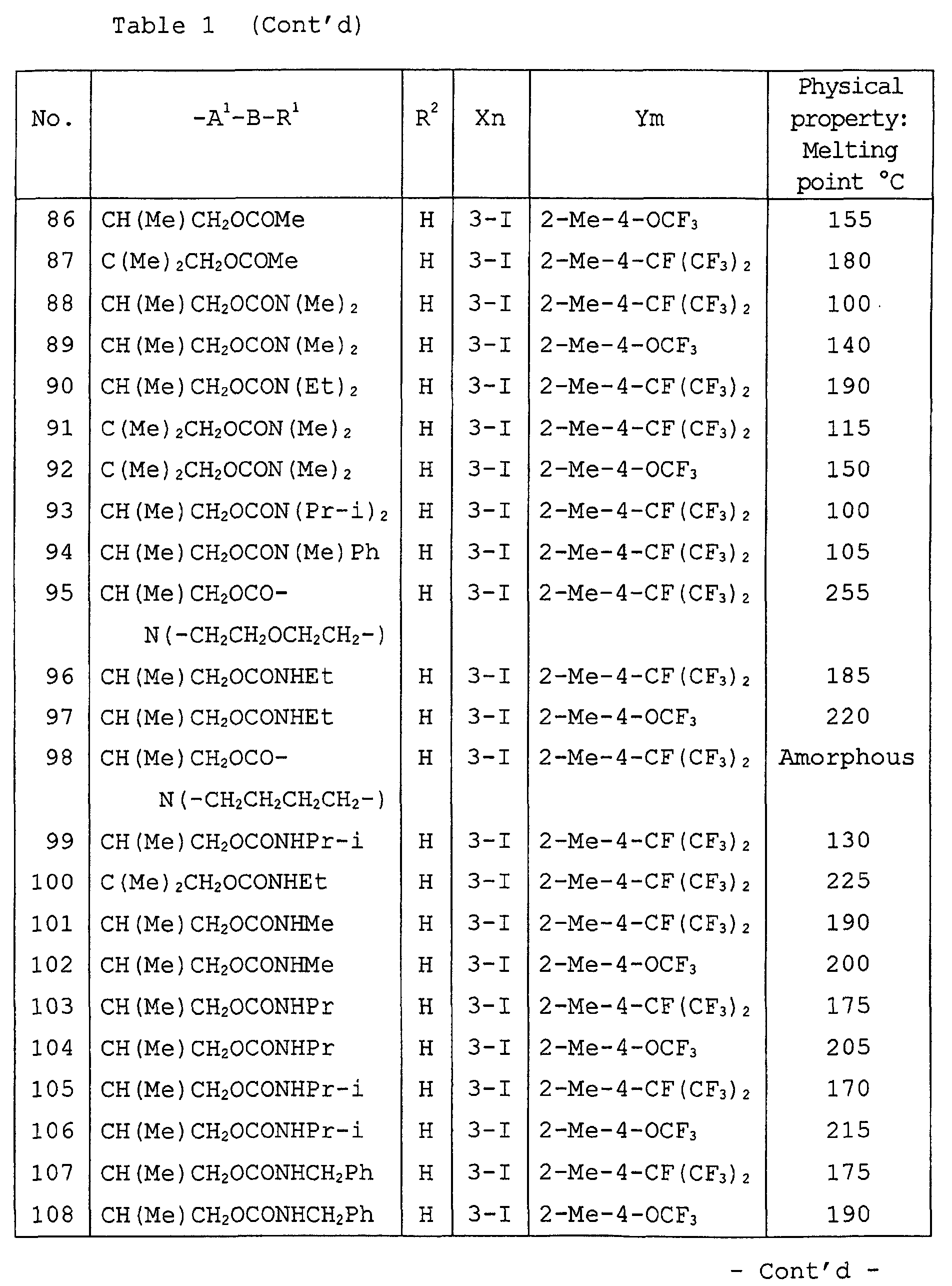
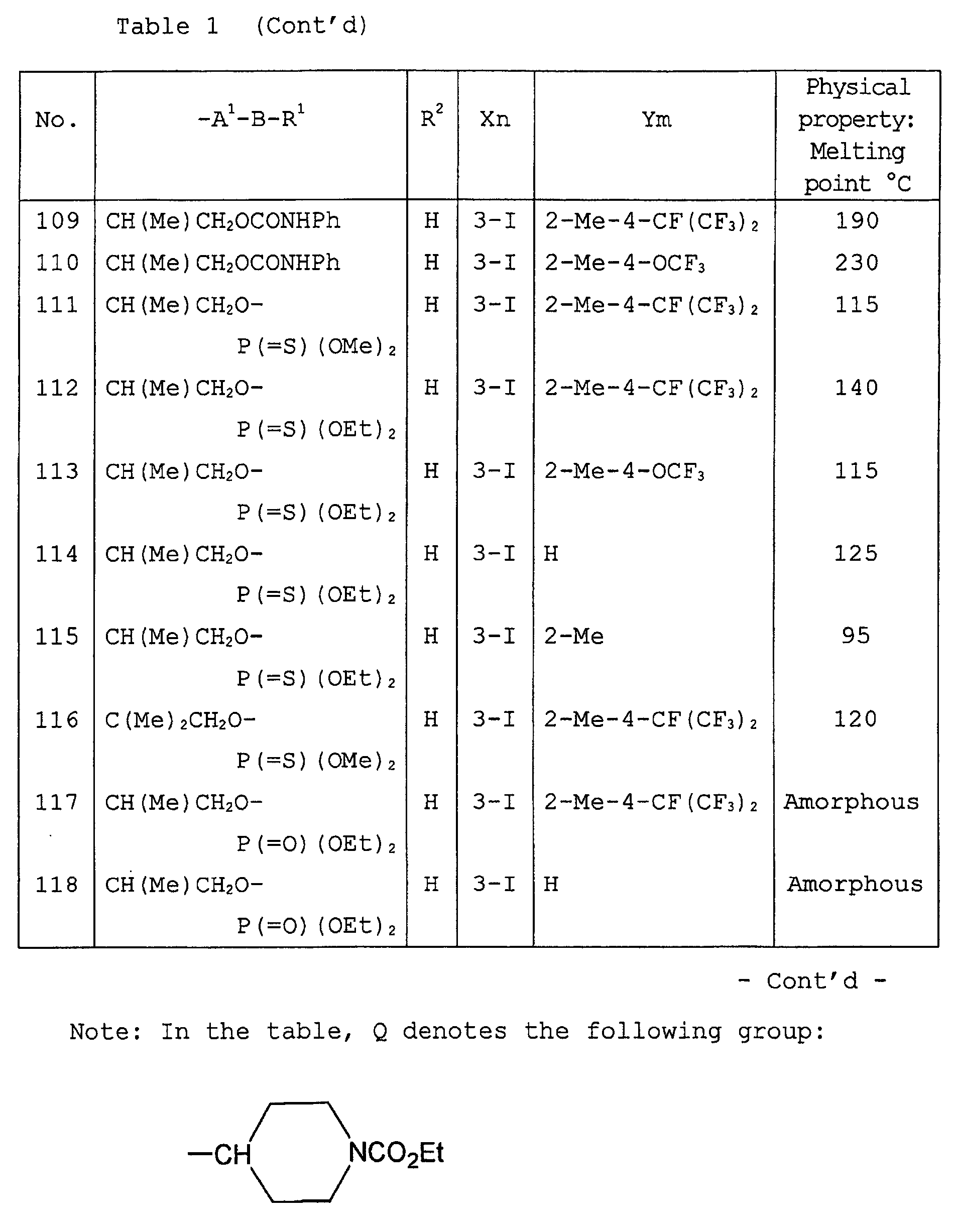
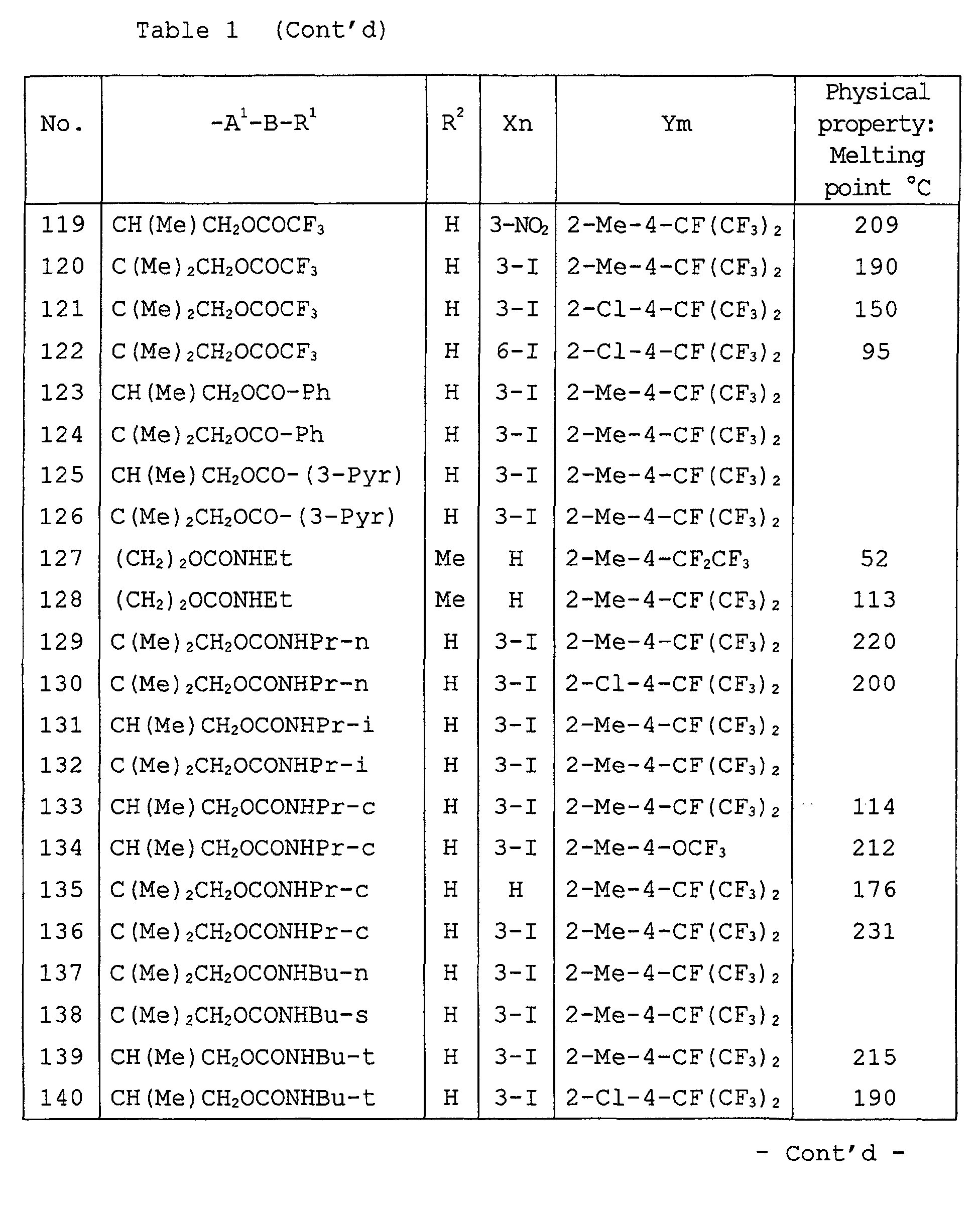


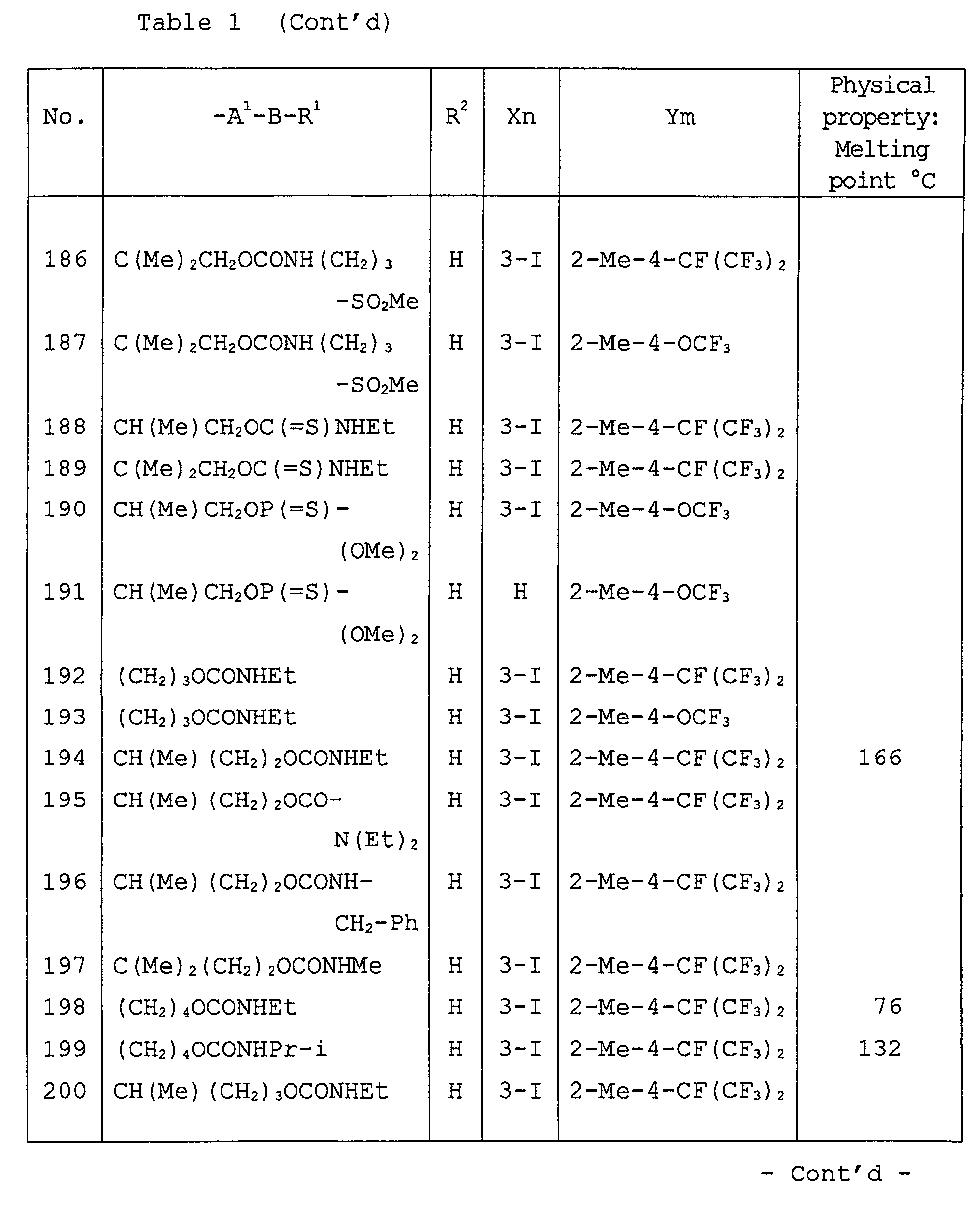


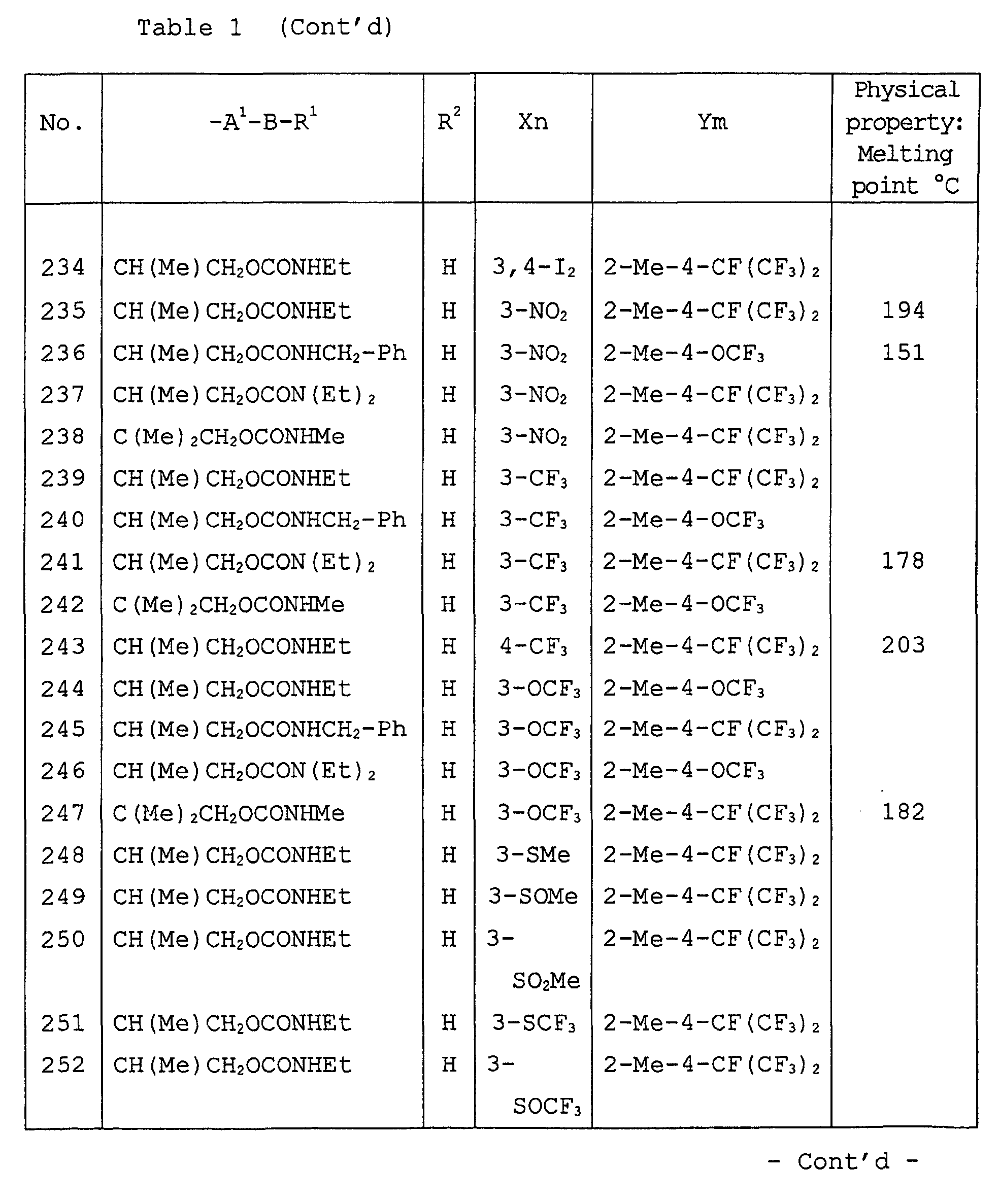


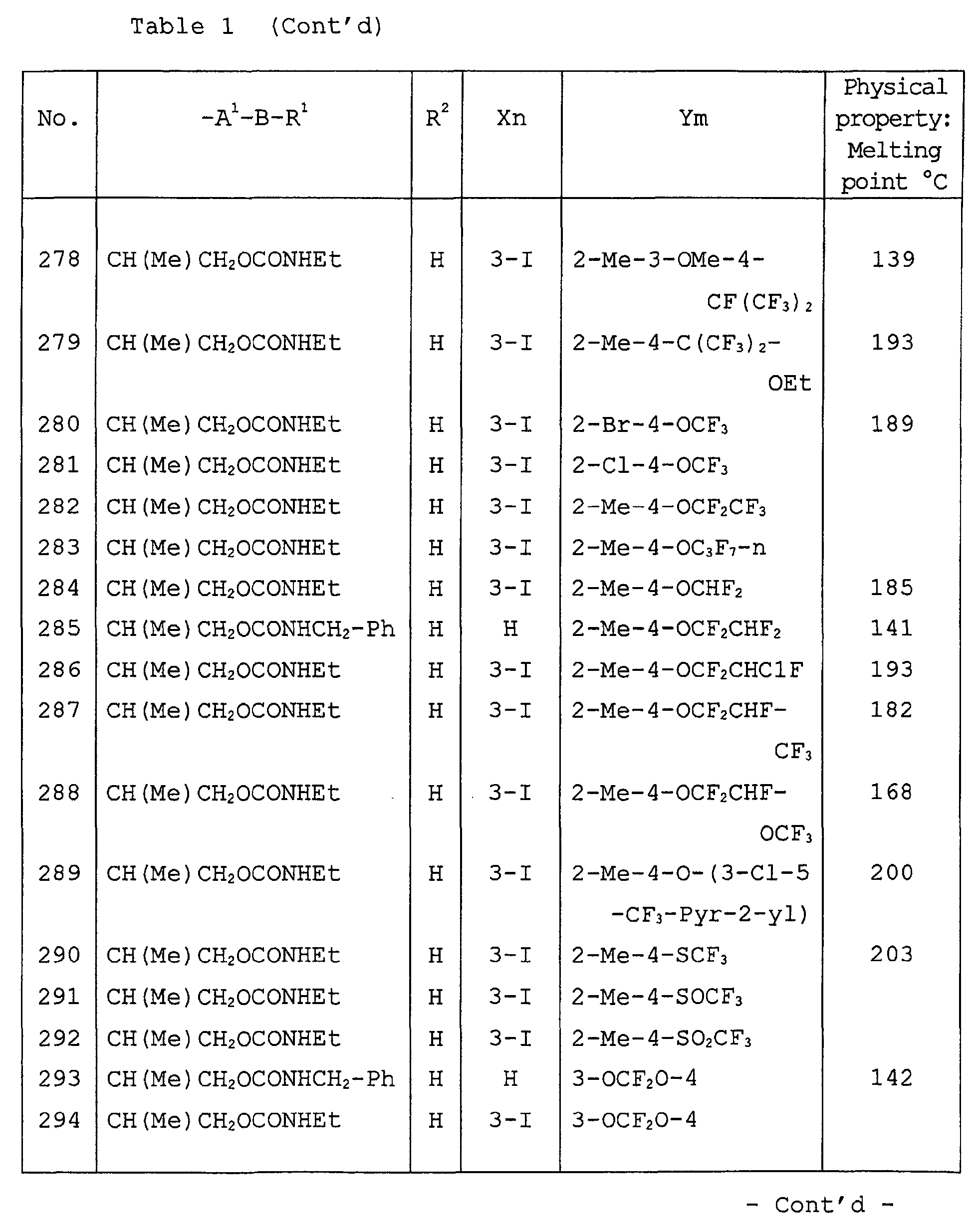

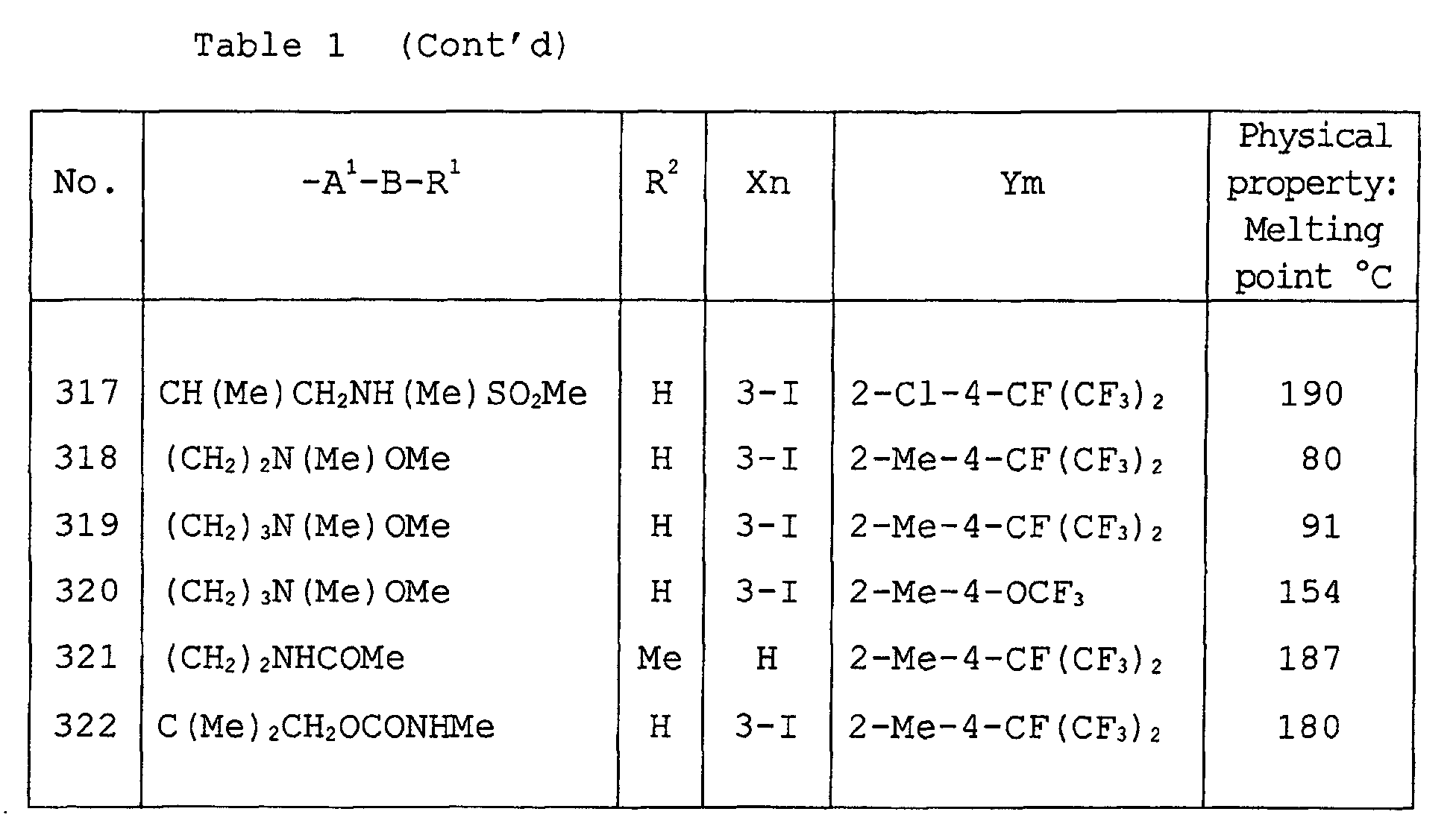

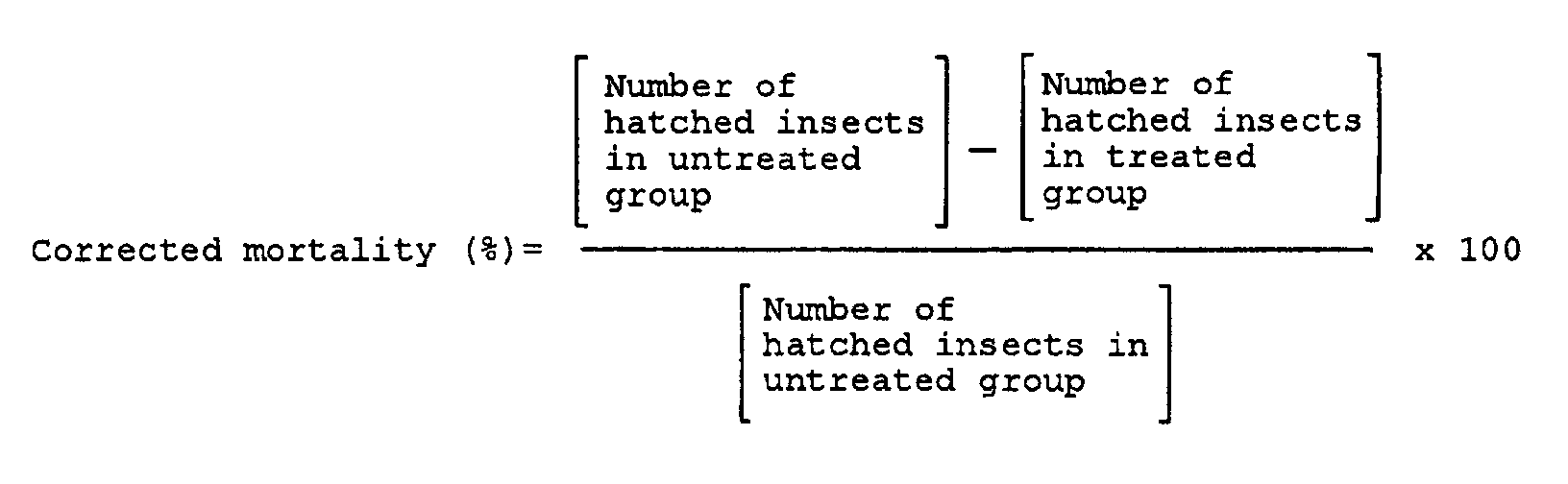
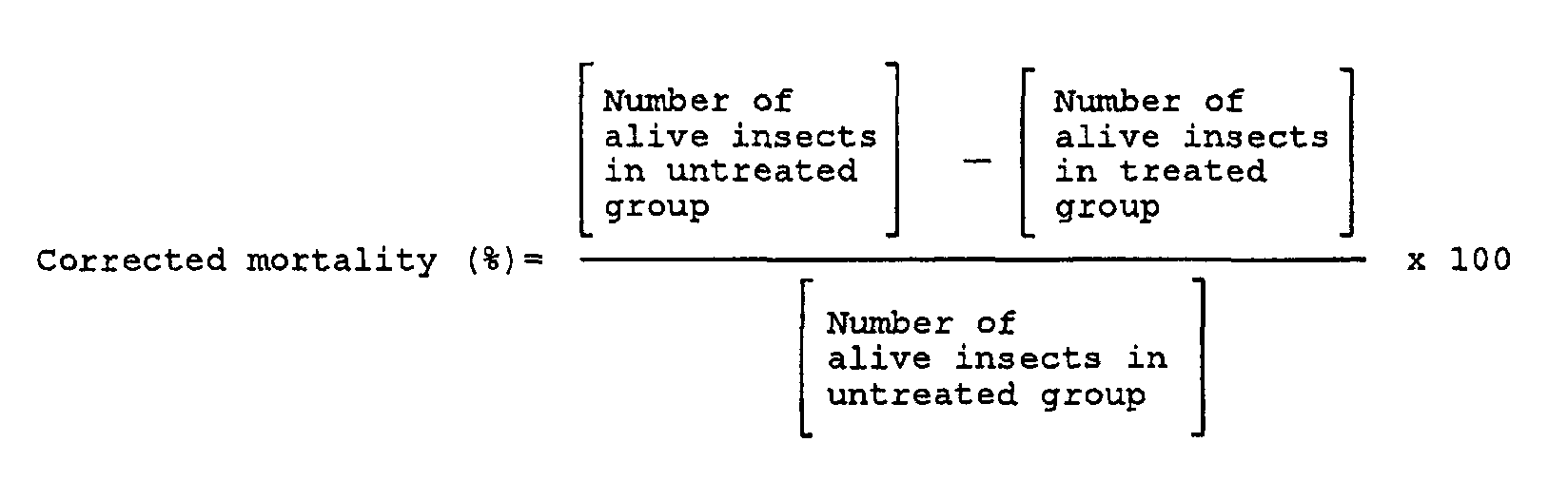
 (wherein A1 is a (C1-C8)alkylene group; a substituted (C1-C8)alkylene group having one or more substituents which may be the same or different and are selected from halogen atoms, cyano group, nitro group, halo(C1-C6)alkyl groups, (C1-C6)alkoxy groups, halo(C1-C6)alkoxy groups, (C1-C6)alkylthio groups, halo(C1-C6)alkylthio groups, (C1-C6)alkylsulfinyl groups, halo (C1-C6)alkylsulfinyl groups, (C1-C6)alkylsulfonyl groups, halo (C1-C6)alkylsulfonyl groups, (C1-C6)alkylthio(C1-C6)alkyl groups, (C1-C6)alkoxycarbonyl groups and phenyl group; a (C3-C8)alkenylene group; a substituted (C3-C8)alkenylene group having one or more substituents which may be the same or different and are selected from halogen atoms, cyano group, nitro group, halo(C1-C6)alkyl groups, (C1-C6)alkoxy groups, halo(C1-C6)alkoxy groups, (C1-C6)alkylthio groups, halo (C1-C6)alkylthio groups, (C1-C6)alkylsulfinyl groups, halo (C1-C6)alkylsulfinyl groups, (C1-C6)alkylsulfonyl groups, halo(C1-C6)alkylsulfonyl groups, (C1-C6)alkylthio(C1-C6)alkyl groups, (C1-C6)alkoxycarbonyl groups and phenyl group; a (C3-C8)alkynylene group; or a substituted (C3-C8)alkynylene group having one or more substituents which may be the same or different and are selected from halogen atoms, cyano group, nitro group, halo(C1-C6)alkyl groups, (C1-C6)alkoxy groups, halo(C1-C6)alkoxy groups, (C1-C6)alkylthio groups, halo (C1-C6)alkylthio groups, (C1-C6)alkylsulfinyl groups, halo (C1-C6)alkylsulfinyl groups, (C1-C6)alkylsulfonyl groups, halo (C1-C6)alkylsulfonyl groups, (C1-C6)alkylthio (C1-C6)alkyl groups, (C1-C6)alkoxycarbonyl groups and phenyl group,any of the saturated carbon atoms in the above-mentioned (C1-C8)alkylene group, substituted (C1-C8)alkylene group, (C3-C8)alkenylene group, substituted (C3-C8)alkenylene group, (C3-C8)alkynylene group or substituted (C3-C8)alkynylene group being able to have a (C2-C5)alkylene group bonded thereto as a substituent, to form a (C3-C6)cycloalkane ring, and any two of the carbon atoms in the above-mentioned (C1-C8)alkylene group, substituted (C1-C8)alkylene group, (C3-C8)alkenylene group and substituted (C3-C8)alkenylene group being able to form a (C3-C6)cycloalkane ring or a (C3-C6)cycloalkene ring together with an alkylene group or an alkenylene group,B is -O- or -N(R4)- (wherein R4 is a hydrogen atom; a (C1-C6)alkyl group; a halo(C1-C6)alkyl group; a (C3-C6) alkenyl group; a halo (C3-C6) alkenyl group; a (C3-C6)alkynyl group; a (C3-C6)cycloalkyl group; a (C1-C6)alkylcarbonyl group; a halo(C1-C6)alkylcarbonyl group; a (C1-C6)alkoxycarbonyl group; a phenylcarbonyl group; a substituted phenylcarbonyl group having on the ring one or more substituents which may be the same or different and are selected from halogen atoms, cyano group, nitro group, (C1-C6)alkyl groups, halo(C1-C6)alkyl groups, (C1-C6)alkoxy groups, halo (C1-C6)alkoxy groups, (C1-C6)alkylthio groups, halo (C1-C6)alkylthio groups, (C1-C6)alkylsulfinyl groups, halo(C1-C6)alkylsulfinyl groups, (C1-C6)alkylsulfonyl groups, halo(C1-C6)alkylsulfonyl groups, mono (C1-C6)alkylamino groups, and di (C1-C6)alkylamino groups whose (C1-C6)alkyl groups may be the same or different; a phenyl(C1-C4)alkoxycarbonyl group; a substituted phenyl(C1-C4)alkoxycarbonyl group having on the ring one or more substituents which may be the same or different and are selected from halogen atoms, cyano group, nitro group, (C1-C6)alkyl groups, halo(C1-C6)alkyl groups, (C1-C6)alkoxy groups, halo (C1-C6)alkoxy groups, (C1-C6)alkylthio groups, halo(C1-C6)alkylthio groups, (C1-C6)alkylsulfinyl groups, halo (C1-C6)alkylsulfinyl groups, (C1-C6)alkylsulfonyl groups, halo (C1-C6)alkylsulfonyl groups, mono(C1-C6)alkylamino groups, and di(C1-C6)alkylamino groups whose (C1-C6)alkyl groups may be the same or different; a phenyl(C1-C4)alkyl group; or a substituted phenyl(C1-C4)alkyl group having on the ring one or more substituents which may be the same or different and are selected from halogen atoms, cyano group, nitro group, (C1-C6)alkyl groups, halo(C1-C6)alkyl groups, (C1-C6)alkoxy groups, halo (C1-C6)alkoxy groups, (C1-C6)alkylthio groups, halo (C1-C6)alkylthio groups, (C1-C6)alkylsulfinyl groups, halo (C1-C6)alkylsulfinyl groups, (C1-C6)alkylsulfonyl groups, halo (C1-C6)alkylsulfonyl groups, mono (C1-C6)alkylamino groups, di (C1-C6)alkylamino groups whose (C1-C6)alkyl groups may be the same or different, and (C1-C6)alkoxycarbonyl groups),R1 is a hydrogen atom; a (C1-C6)alkyl group; a halo(C1-C6)alkyl group; a (C1-C4)alkoxy (C1-C4)alkyl group; a (C1-C4)alkylthio(C1-C4)alkyl group; a (C2-C6)alkenyl group; a halo(C2-C6)alkenyl group; a (C3-C6)alkynyl group; a halo(C3-C6)alkynyl group; a (C3-C6)cycloalkyl group; a halo(C3-C6)cycloalkyl group; a phenyl group; a substituted phenyl group having one or more substituents which may be the same or different and are selected from halogen atoms, cyano group, nitro group, (C1-C6)alkyl groups, halo(C1-C6)alkyl groups, (C1-C6)alkoxy groups, halo(C1-C6)alkoxy groups, (C1-C6)alkylthio groups, halo(C1-C6)alkylthio groups, (C1-C6)alkylsulfinyl groups, halo(C1-C6)alkylsulfinyl groups, (C1-C6)alkylsulfonyl groups, halo(C1-C6)alkylsulfonyl groups, mono (C1-C6)alkylamino groups, di (C1-C6)alkylamino groups whose (C1-C6)alkyl groups may be the same or different, and (C1-C6)alkoxycarbonyl groups; a phenyl (C1-C4)alkyl group; a substituted phenyl(C1-C4)alkyl group having on the ring one or more substituents which may be the same or different and are selected from halogen atoms, cyano group, nitro group, (C1-C6)alkyl groups, halo(C1-C6)alkyl groups, (C1-C6)alkoxy groups, halo (C1-C6)alkoxy groups, (C1-C6)alkylthio groups, halo (C1-C6)alkylthio groups, (C1-C6)alkylsulfinyl groups, halo (C1-C6)alkylsulfinyl groups, (C1-C6)alkylsulfonyl groups, halo (C1-C6)alkylsulfonyl groups, mono(C1-C6)alkylamino groups, di(C1-C6)alkylamino groups whose (C1-C6)alkyl groups may be the same or different, and (C1-C6)alkoxycarbonyl groups; a heterocyclic group; a substituted heterocyclic group having one or more substituents which may be the same or different and are selected from halogen atoms, cyano group, nitro group, (C1-C6)alkyl groups, halo(C1-C6)alkyl groups, (C1-C6)alkoxy groups, halo (C1-C6)alkoxy groups, (C1-C6)alkylthio groups, halo (C1-C6)alkylthio groups, (C1-C6)alkylsulfinyl groups, halo (C1-C6)alkylsulfinyl groups, (C1-C6)alkylsulfonyl groups, halo(C1-C6)alkylsulfonyl groups, mono(C1-C6)alkylamino groups, di(C1-C6)alkylamino groups whose (C1-C6)alkyl groups may be the same or different, and (C1-C6)alkoxycarbonyl groups; -P(=W1) (-OR5) (-OR6) (wherein W1 is an oxygen atom or a sulfur atom, and each of R5 and R6, which may be the same or different, is a hydrogen atom; a (C1-C6)alkyl group; a halo(C1-C6)alkyl group; a (C1-C4)alkoxy(C1-C4)alkyl group; a (C1-C4)alkylthio(C1-C4)alkyl group; a phenyl group; a substituted phenyl group having one or more substituents which may be the same or different and are selected from halogen atoms, cyano group, nitro group, (C1-C6)alkyl groups, halo (C1-C6)alkyl groups, (C1-C6)alkoxy groups, halo (C1-C6)alkoxy groups, (C1-C6)alkylthio groups, halo(C1-C6)alkylthio groups, (C1-C6)alkylsulfinyl groups, halo(C1-C6)alkylsulfinyl groups, (C1-C6)alkylsulfonyl groups, halo (C1-C6)alkylsulfonyl groups, mono (C1-C6)alkylamino groups, di (C1-C6)alkylamino groups whose (C1-C6)alkyl groups may be the same or different, and (C1-C6)alkoxycarbonyl groups; a phenyl(C1-C4)alkyl group; a substituted phenyl(C1-C4)alkyl group having on the ring one or more substituents which may be the same or different and are selected from halogen atoms, cyano group, nitro group, (C1-C6)alkyl groups, halo(C1-C6)alkyl groups, (C1-C6) alkoxy groups, halo (C1-C6) alkoxy groups, (C1-C6) alkylthio groups, halo (C1-C6) alkylthio groups, (C1-C6) alkylsulfinyl groups, halo (C1-C6) alkylsulfinyl groups, (C1-C6) alkylsulfonyl groups, halo (C1-C6) alkylsulfonyl groups, mono(C1-C6)alkylamino groups, di(C1-C6)alkylamino groups whose (C1-C6)alkyl groups may be the same or different, and (C1-C6)alkoxycarbonyl groups; a heterocyclic group; or a substituted heterocyclic group having one or more substituents which may be the same or different and are selected from halogen atoms, cyano group, nitro group, (C1-C6)alkyl groups, halo(C1-C6)alkyl groups, (C1-C6)alkoxy groups, halo (C1-C6)alkoxy groups, (C1-C6)alkylthio groups, halo (C1-C6)alkylthio groups, (C1-C6)alkylsulfinyl groups, halo (C1-C6)alkylsulfinyl groups, (C1-C6)alkylsulfonyl groups, halo (C1-C6)alkylsulfonyl groups, mono(C1-C6)alkylamino groups, di(C1-C6)alkylamino groups whose (C1-C6)alkyl groups may be the same or different, and (C1-C6)alkoxycarbonyl groups,further, R5 being able to bind to R6 to form a 5- to 8-membered ring that may contain one or two atoms which may be the same or different and are selected from oxygen atom, sulfur atom and nitrogen atom, between adjacent carbon atoms constituting the ring); -C(=W1)-N(R5)(R6) (wherein W1, R5 and R6 are as defined above, R5 being able to bind to R6 to form a 5- to 8-membered ring that may contain one or two atoms which may be the same or different and are selected from oxygen atom, sulfur atom and nitrogen atom, between adjacent carbon atoms constituting the ring, and R5 being able to bind to R4 to form a 5- to 8-membered ring that may contain two or three atoms which may be the same or different and are selected from oxygen atom, sulfur atom and nitrogen atom, between adjacent carbon atoms constituting the ring); -C(=W1)-R5 (wherein W1 and R5 are as defined above); -C(=W1)-W1-R7 (wherein W1s, which may be the same or different, are as defined above, and R7 is a (C1-C6)alkyl group; a halo(C1-C6)alkyl group; a (C1-C4)alkoxy(C1-C4)alkyl group; a (C1-C4)alkylthio(C1-C4)alkyl group; a phenyl group; a substituted phenyl group having one or more substituents which may be the same or different and are selected from halogen atoms, cyano group, nitro group, (C1-C6)alkyl groups, halo (C1-C6)alkyl groups, (C1-C6)alkoxy groups, halo(C1-C6)alkoxy groups, (C1-C6)alkylthio groups, halo(C1-C6)alkylthio groups, (C1-C6)alkylsulfinyl groups, halo (C1-C6)alkylsulfinyl groups, (C1-C6)alkylsulfonyl groups, halo (C1-C6)alkylsulfonyl groups, mono(C1-C6)alkylamino groups, di (C1-C6)alkylamino groups whose (C1-C6)alkyl groups may be the same or different, and (C1-C6)alkoxycarbonyl groups; a phenyl (C1-C4)alkyl group; a substituted phenyl(C1-C4)alkyl group having on the ring one or more substituents which may be the same or different and are selected from halogen atoms, cyano group, nitro group, (C1-C6)alkyl groups, halo(C1-C6)alkyl groups, (C1-C6)alkoxy groups, halo(C1-C6)alkoxy groups, (C1-C6)alkylthio groups, halo(C1-C6)alkylthio groups, (C1-C6)alkylsulfinyl groups, halo(C1-C6)alkylsulfinyl groups, (C1-C6)alkylsulfonyl groups, halo(C1-C6)alkylsulfonyl groups, mono(C1-C6)alkylamino groups, di(C1-C6)alkylamino groups whose (C1-C6)alkyl groups may be the same or different, and (C1-C6)alkoxycarbonyl groups; a heterocyclic group; or a substituted heterocyclic group having one or more substituents which may be the same or different and are selected from halogen atoms, cyano group, nitro group, (C1-C6)alkyl groups, halo(C1-C6)alkyl groups, (C1-C6)alkoxy groups, halo (C1-C6)alkoxy groups, (C1-C6)alkylthio groups, halo (C1-C6)alkylthio groups, (C1-C6)alkylsulfinyl groups, halo (C1-C6)alkylsulfinyl groups, (C1-C6)alkylsulfonyl groups, halo (C1-C6)alkylsulfonyl groups, mono (C1-C6)alkylamino groups, di (C1-C6)alkylamino groups whose (C1-C6)alkyl groups may be the same or different, and (C1-C6)alkoxycarbonyl groups); -SO2-R7 (wherein R7 is as defined above); -SO2-N(R5)(R6) (wherein R5 and R6 are as defined above, R5 being able to bind to R6 to form a 5- to 8-membered ring that may contain one or two atoms which may be the same or different and are selected from oxygen atom, sulfur atom and nitrogen atom, between adjacent carbon atoms constituting the ring, and R5 being able to bind to R4 to form a 5- to 8-membered ring that may contain three or four atoms which may be the same or different and are selected from oxygen atom, sulfur atom and nitrogen atom, between adjacent carbon atoms constituting the ring); -N(R5)(R6) (wherein R5 and R6 are as defined above, R5 being able to bind to R6 to form a 5- to 8-membered ring that may contain one or two atoms which may be the same or different and are selected from oxygen atom, sulfur atom and nitrogen atom, between adjacent carbon atoms constituting the ring, and R5 being able to bind to R4 to form a 5- to 8-membered ring that may contain two or three atoms which may be the same or different and are selected from oxygen atom, sulfur atom and nitrogen atom, between adjacent carbon atoms constituting the ring); or -N=C(R5)R6 (wherein R5 and R6 are as defined above, R5 being able to bind to R6 to form a 5-to 8-membered ring that may contain one or two atoms which may be the same or different and are selected from oxygen atom, sulfur atom and nitrogen atom, between adjacent carbon atoms constituting the ring); in the case of B being -N(R4)-, R1 being able to be -OR5 (wherein R5 is as defined above), -C(W2)-N(R5)R6 (wherein W2 is =CH-NO2, =N-NO2 or =N-CN, and R5 and R6 are as defined above, R5 or R6 being able to bind to R4 to form a 5- to 8-membered ring that may contain two or three atoms which may be the same or different and are selected from oxygen atom, sulfur atom and nitrogen atom, between adjacent carbon atoms constituting the ring) or -C(W2)-W1-R7 (wherein W1, W2 and R7 are as defined above, R7 being able to bind to R4 to form a 5-to 8-membered ring that may contain two or three atoms which may be the same or different and are selected from oxygen atom, sulfur atom and nitrogen atom, between adjacent carbon atoms constituting the ring), and R1 being able to bind to A1 to form a 5- to 8-membered ring that may contain one or two atoms which may be the same or different and are selected from oxygen atom, sulfur atom and nitrogen atom, between adjacent carbon atoms constituting the ring,each of R2 and R3, which may be the same or different, is a hydrogen atom, a (C3-C6)cycloalkyl group or -A2-R8 (wherein A2 is -C(=O)-, -C(=S)-, -C(=NR9)-(wherein R9 is a hydrogen atom, a (C1-C6)alkyl group, a (C1-C6)alkoxy group, a mono(C1-C6)alkylamino group, a di(C1-C6)alkylamino group whose (C1-C6)alkyl groups may be the same or different, a (C1-C6)alkoxycarbonyl group, a phenyl group, or a substituted phenyl group having one or more substituents which may be the same or different and are selected from halogen atoms, cyano group, nitro group, (C1-C6)alkyl groups, halo(C1-C6)alkyl groups, (C1-C6)alkoxy groups, halo (C1-C6)alkoxy groups, (C1-C6)alkylthio groups, halo (C1-C6)alkylthio groups, (C1-C6)alkylsulfinyl groups, halo (C1-C6)alkylsulfinyl groups, (C1-C6)alkylsulfonyl groups, halo (C1-C6)alkylsulfonyl groups, mono(C1-C6)alkylamino groups, di(C1-C6)alkylamino groups whose (C1-C6)alkyl groups may be the same or different, and (C1-C6)alkoxycarbonyl groups), a (C1-C8)alkylene group, a halo (C1-C8)alkylene group, a (C3-C6)alkenylene group, a halo(C3-C6)alkenylene group, a (C3-C6)alkynylene group or a halo(C3-C6)alkynylene group,(1) in the case of A2 being -C(=O)-, -C(=S)-or -C(=NR9)- (wherein R9 is as defined above), R8 is a hydrogen atom; a (C1-C6)alkyl group; a halo(C1-C6)alkyl group; a (C3-C6)cycloalkyl group; a halo(C3-C6)cycloalkyl group; a phenyl group; a substituted phenyl group having one or more substituents which may be the same or different and are selected from halogen atoms, cyano group, nitro group, (C1-C6)alkyl groups, halo(C1-C6)alkyl groups, (C1-C6)alkoxy groups, halo (C1-C6)alkoxy groups, (C1-C6)alkylthio groups, halo (C1-C6)alkylthio groups, (C1-C6)alkylsulfinyl groups, halo (C1-C6)alkylsulfinyl groups, (C1-C6)alkylsulfonyl groups, halo (C1-C6)alkylsulfonyl groups, mono(C1-C6)alkylamino groups, di(C1-C6)alkylamino groups whose (C1-C6)alkyl groups may be the same or different, and (C1-C6)alkoxycarbonyl groups; a heterocyclic group; a substituted heterocyclic group having one or more substituents which may be the same or different and are selected from halogen atoms, cyano group, nitro group, (C1-C6)alkyl groups, halo(C1-C6)alkyl groups, (C1-C6)alkoxy groups, halo (C1-C6)alkoxy groups, (C1-C6)alkylthio groups, halo (C1-C6)alkylthio groups, (C1-C6)alkylsulfinyl groups, halo (C1-C6)alkylsulfinyl groups, (C1-C6)alkylsulfonyl groups, halo (C1-C6)alkylsulfonyl groups, mono(C1-C6)alkylamino groups, di(C1-C6)alkylamino groups whose (C1-C6)alkyl groups may be the same or different, and (C1-C6)alkoxycarbonyl groups; or -A3-R10 (wherein A3 is -O-, -S- or -N(R11)- (wherein R11 is a hydrogen atom; a (C1-C6)alkylcarbonyl group; a halo(C1-C6)alkylcarbonyl group; a (C1-C6)alkoxycarbonyl group; a phenylcarbonyl group; a substituted phenylcarbonyl group having one or more substituents which may be the same or different and are selected from halogen atoms, cyano group, nitro group, (C1-C6)alkyl groups, halo(C1-C6)alkyl groups, (C1-C6)alkoxy groups, halo(C1-C6)alkoxy groups, (C1-C6)alkylthio groups, halo (C1-C6)alkylthio groups, (C1-C6)alkylsulfinyl groups, halo (C1-C6)alkylsulfinyl groups, (C1-C6)alkylsulfonyl groups, halo(C1-C6)alkylsulfonyl groups, mono(C1-C6)alkylamino groups, di(C1-C6)alkylamino groups whose (C1-C6)alkyl groups may be the same or different, and (C1-C6)alkoxycarbonyl groups; a phenyl(C1-C4)alkoxycarbonyl group; or a substituted phenyl(C1-C4)alkoxycarbonyl group having on the ring one or more substituents which may be the same or different and are selected from halogen atoms, cyano group, nitro group, (C1-C6)alkyl groups, halo(C1-C6)alkyl groups, (C1-C6)alkoxy groups, halo(C1-C6)alkoxy groups, (C1-C6)alkylthio groups, halo(C1-C6)alkylthio groups, (C1-C6)alkylsulfinyl groups, halo (C1-C6)alkylsulfinyl groups, (C1-C6)alkylsulfonyl groups, halo (C1-C6)alkylsulfonyl groups, mono(C1-C6)alkylamino groups, di(C1-C6)alkylamino groups whose (C1-C6)alkyl groups may be the same or different, and (C1-C6)alkoxycarbonyl groups), and R10 is a (C1-C6)alkyl group; a halo(C1-C6)alkyl group; a (C3-C6)alkenyl group; a halo(C3-C6)alkenyl group; a (C3-C6)alkynyl group; a halo(C3-C6)alkynyl group; a (C3-C6)cycloalkyl group; a halo(C3-C6)cycloalkyl group; a (C1-C6)alkylcarbonyl group; a halo (C1-C6)alkylcarbonyl group; a (C1-C6)alkoxycarbonyl group; a phenyl group; a substituted phenyl group having one or more substituents which may be the same or different and are selected from halogen atoms, cyano group, nitro group, (C1-C6)alkyl groups, halo (C1-C6)alkyl groups, (C1-C6)alkoxy groups, halo (C1-C6)alkoxy groups, (C1-C6)alkylthio groups, halo(C1-C6)alkylthio groups, (C1-C6)alkylsulfinyl groups, halo(C1-C6)alkylsulfinyl groups, (C1-C6)alkylsulfonyl groups, halo(C1-C6)alkylsulfonyl groups, mono (C1-C6)alkylamino groups, di (C1-C6)alkylamino groups whose (C1-C6)alkyl groups may be the same or different, and (C1-C6)alkoxycarbonyl groups; a phenyl (C1-C4)alkyl group; a substituted phenyl(C1-C4)alkyl group having one or more substituents which may be the same or different and are selected from halogen atoms, cyano group, nitro group, (C1-C6)alkyl groups, halo(C1-C6)alkyl groups, (C1-C6)alkoxy groups, halo(C1-C6)alkoxy groups, (C1-C6)alkylthio groups, halo(C1-C6)alkylthio groups, (C1-C6)alkylsulfinyl groups, halo (C1-C6)alkylsulfinyl groups, (C1-C6)alkylsulfonyl groups, halo(C1-C6)alkylsulfonyl groups, mono (C1-C6)alkylamino groups, di (C1-C6) alkylamino groups whose (C1-C6)alkyl groups may be the same or different, and (C1-C6)alkoxycarbonyl groups; a heterocyclic group; or a substituted heterocyclic group having one or more substituents which may be the same or different and are selected from halogen atoms, cyano group, nitro group, (C1-C6)alkyl groups, halo(C1-C6)alkyl groups, (C1-C6)alkoxy groups, halo (C1-C6)alkoxy groups, (C1-C6)alkylthio groups, halo (C1-C6)alkylthio groups, (C1-C6)alkylsulfinyl groups, halo (C1-C6)alkylsulfinyl groups, (C1-C6)alkylsulfonyl groups, halo (C1-C6)alkylsulfonyl groups, mono (C1-C6)alkylamino groups, di (C1-C6)alkylamino groups whose (C1-C6)alkyl groups may be the same or different, and (C1-C6)alkoxycarbonyl groups),(2) in the case of A2 being a (C1-C8)alkylene group, a halo(C1-C8)alkylene group, a (C3-C6)alkenylene group, a halo(C3-C6)alkenylene group, a (C3-C6)alkynylene group or a halo(C3-C6)alkynylene group, R8 is a hydrogen atom; a halogen atom; a cyano group; a nitro group; a (C3-C6)cycloalkyl group; a halo (C3-C6)cycloalkyl group; a (C1-C6)alkoxycarbonyl group; a phenyl group; a substituted phenyl group having one or more substituents which may be the same or different and are selected from halogen atoms, cyano group, nitro group, (C1-C6)alkyl groups, halo (C1-C6)alkyl groups, (C1-C6)alkoxy groups, halo (C1-C6)alkoxy groups, (C1-C6)alkylthio groups, halo (C1-C6)alkylthio groups, (C1-C6)alkylsulfinyl groups, halo (C1-C6)alkylsulfinyl groups, (C1-C6)alkylsulfonyl groups, halo(C1-C6)alkylsulfonyl groups, mono (C1-C6)alkylamino groups, di(C1-C6)alkylamino groups whose (C1-C6)alkyl groups may be the same or different, and (C1-C6)alkoxycarbonyl groups; a heterocyclic group; a substituted heterocyclic group having one or more substituents which may be the same or different and are selected from halogen atoms, cyano group, nitro group, (C1-C6)alkyl groups, halo(C1-C6)alkyl groups, (C1-C6)alkoxy groups, halo (C1-C6)alkoxy groups, (C1-C6)alkylthio groups, halo(C1-C6)alkylthio groups, (C1-C6)alkylsulfinyl groups, halo(C1-C6)alkylsulfinyl groups, (C1-C6)alkylsulfonyl groups, halo(C1-C6)alkylsulfonyl groups, mono (C1-C6)alkylamino groups, di (C1-C6)alkylamino groups whose (C1-C6)alkyl groups may be the same or different, and (C1-C6)alkoxycarbonyl groups; or -A4-R12 (wherein A4 is -O-, -S-, -SO-, -SO2-, -N(R11)- (wherein R11 is as defined above), -C(=O)-, or -C(=N-OR13) (wherein R13 is a hydrogen atom, a (C1-C6)alkyl group, a halo(C1-C6)alkyl group, a (C3-C6)alkenyl group, a halo(C3-C6)alkenyl group, a (C3-C6)alkynyl group, a halo (C3-C6) alkynyl group, a (C3-C6)cycloalkyl group, a phenyl (C1-C4)alkyl group, or a substituted phenyl(C1-C4)alkyl group having on the ring one or more substituents which may be the same or different and are selected from halogen atoms, cyano group, nitro group, (C1-C6)alkyl groups, halo(C1-C6)alkyl groups, (C1-C6)alkoxy groups, halo (C1-C6)alkoxy groups, (C1-C6)alkylthio groups, halo (C1-C6)alkylthio groups, (C1-C6)alkylsulfinyl groups, halo (C1-C6)alkylsulfinyl groups, (C1-C6)alkylsulfonyl groups, halo(C1-C6)alkylsulfonyl groups, mono(C1-C6)alkylamino groups, di(C1-C6)alkylamino groups whose (C1-C6)alkyl groups may be the same or different, and (C1-C6)alkoxycarbonyl groups),(i) in the case of A4 being -O-, -S-, -SO-, -SO2- or -N(R11)- (wherein R11 is as defined above), R12 is a hydrogen atom; a (C1-C6)alkyl group; a halo(C1-C6)alkyl group; a (C3-C6)alkenyl group; a halo(C3-C6)alkenyl group; a (C3-C6)alkynyl group; a halo(C3-C6)alkynyl group; a (C3-C6)cycloalkyl group; a halo(C3-C6)cycloalkyl group; a (C1-C6)alkylcarbonyl group; a halo (C1-C6)alkylcarbonyl group; a (C1-C6)alkoxycarbonyl group; a phenyl group; a substituted phenyl group having one or more substituents which may be the same or different and are selected from halogen atoms, cyano group, nitro group, (C1-C6)alkyl groups, halo(C1-C6)alkyl groups, (C1-C6)alkoxy groups, halo (C1-C6)alkoxy groups, (C1-C6)alkylthio groups, halo(C1-C6)alkylthio groups, (C1-C6)alkylsulfinyl groups, halo(C1-C6)alkylsulfinyl groups, (C1-C6)alkylsulfonyl groups, halo(C1-C6)alkylsulfonyl groups, mono (C1-C6)alkylamino groups, di (C1-C6)alkylamino groups whose (C1-C6)alkyl groups may be the same or different, and (C1-C6)alkoxycarbonyl groups; a phenyl (C1-C4)alkyl group; a substituted phenyl(C1-C4)alkyl group having on the ring one or more substituents which may be the same or different and are selected from halogen atoms, cyano group, nitro group, (C1-C6)alkyl groups, halo(C1-C6)alkyl groups, (C1-C6)alkoxy groups, halo (C1-C6) alkoxy groups, (C1-C6)alkylthio groups, halo (C1-C6) alkylthio groups, (C1-C6) alkylsulfinyl groups, halo (C1-C6) alkylsulfinyl groups, (C1-C6) alkylsulfonyl groups, halo (C1-C6) alkylsulfonyl groups, mono(C1-C6)alkylamino groups, di(C1-C6)alkylamino groups whose (C1-C6)alkyl groups may be the same or different, and (C1-C6)alkoxycarbonyl groups; a heterocyclic group; or a substituted heterocyclic group having one or more substituents which may be the same or different and are selected from halogen atoms, cyano group, nitro group, (C1-C6)alkyl groups, halo(C1-C6)alkyl groups, (C1-C6)alkoxy groups, halo (C1-C6)alkoxy groups, (C1-C6)alkylthio groups, halo (C1-C6)alkylthio groups, (C1-C6)alkylsulfinyl groups, halo (C1-C6)alkylsulfinyl groups, (C1-C6)alkylsulfonyl groups, halo (C1-C6)alkylsulfonyl groups, mono(C1-C6)alkylamino groups, di(C1-C6)alkylamino groups whose (C1-C6)alkyl groups may be the same or different, and (C1-C6)alkoxycarbonyl groups,(ii) in the case of A4 being -C(=O)- or -C(=NOR13) (wherein R13 is as defined above), R12 is a hydrogen atom; a (C1-C6)alkyl group; a halo(C1-C6)alkyl group; a (C2-C6)alkenyl group; a halo(C2-C6)alkenyl group; a (C3-C6)cycloalkyl group; a halo(C3-C6)cycloalkyl group; a (C1-C6)alkoxy group; a halo (C1-C6) alkoxy group; a (C1-C6)alkylthio group; a halo(C1-C6)alkylthio group; a mono (C1-C6) alkylamino group; a di (C1-C6) alkylamino group whose (C1-C6)alkyl groups may be the same or different; a phenyl group; a substituted phenyl group having one or more substituents which may be the same or different and are selected from halogen atoms, cyano group, nitro group, (C1-C6)alkyl groups, halo (C1-C6)alkyl groups, (C1-C6)alkoxy groups, halo (C1-C6)alkoxy groups, (C1-C6)alkylthio groups, halo(C1-C6)alkylthio groups, (C1-C6)alkylsulfinyl groups, halo(C1-C6)alkylsulfinyl groups, (C1-C6)alkylsulfonyl groups, halo(C1-C6)alkylsulfonyl groups, mono (C1-C6)alkylamino groups, di (C1-C6)alkylamino groups whose (C1-C6)alkyl groups may be the same or different, and (C1-C6)alkoxycarbonyl groups; a phenylamino group; a substituted phenylamino group having on the ring one or more substituents which may be the same or different and are selected from halogen atoms, cyano group, nitro group, (C1-C6)alkyl groups, halo(C1-C6)alkyl groups, (C1-C6)alkoxy groups, halo (C1-C6)alkoxy groups, (C1-C6)alkylthio groups, halo (C1-C6)alkylthio groups, (C1-C6)alkylsulfinyl groups, halo(C1-C6)alkylsulfinyl groups, (C1-C6)alkylsulfonyl groups, halo(C1-C6)alkylsulfonyl groups, mono (C1-C6)alkylamino groups, di (C1-C6)alkylamino groups whose (C1-C6)alkyl groups may be the same or different, and (C1-C6)alkoxycarbonyl groups; a phenyloxy group; a substituted phenyloxy group having on the ring one or more substituents which may be the same or different and are selected from halogen atoms, cyano group, nitro group, (C1-C6)alkyl groups, halo(C1-C6)alkyl groups, (C1-C6)alkoxy groups, halo (C1-C6) alkoxy groups, (C1-C6) alkylthio groups, halo (C1-C6)alkylthio groups, (C1-C6)alkylsulfinyl groups, halo(C1-C6)alkylsulfinyl groups, (C1-C6)alkylsulfonyl groups, halo(C1-C6)alkylsulfonyl groups, mono (C1-C6)alkylamino groups, di (C1-C6)alkylamino groups whose (C1-C6)alkyl groups may be the same or different, and (C1-C6)alkoxycarbonyl groups; a phenylthio group; a substituted phenylthio group having on the ring one or more substituents which may be the same or different and are selected from halogen atoms, cyano group, nitro group, (C1-C6)alkyl groups, halo(C1-C6)alkyl groups, (C1-C6)alkoxy groups, halo (C1-C6)alkoxy groups, (C1-C6)alkylthio groups, halo(C1-C6)alkylthio groups, (C1-C6)alkylsulfinyl groups, halo (C1-C6)alkylsulfinyl groups, (C1-C6)alkylsulfonyl groups, halo(C1-C6)alkylsulfonyl groups, mono (C1-C6)alkylamino groups, di(C1-C6)alkylamino groups whose (C1-C6)alkyl groups may be the same or different, and (C1-C6)alkoxycarbonyl groups; a heterocyclic group; or a substituted heterocyclic group having one or more substituents which may be the same or different and are selected from halogen atoms, cyano group, nitro group, (C1-C6)alkyl groups, halo(C1-C6)alkyl groups, (C1-C6)alkoxy groups, halo (C1-C6)alkoxy groups, (C1-C6)alkylthio groups, halo(C1-C6)alkylthio groups, (C1-C6)alkylsulfinyl groups, halo(C1-C6)alkylsulfinyl groups, (C1-C6)alkylsulfonyl groups, halo(C1-C6)alkylsulfonyl groups, mono (C1-C6)alkylamino groups, di (C1-C6)alkylamino groups whose (C1-C6)alkyl groups may be the same or different, and (C1-C6)alkoxycarbonyl groups)),further, R2 being able to bind to A1 or R1 to form a 5- to 8-membered ring that may contain one to three atoms which may be the same or different and are selected from oxygen atom, sulfur atom and nitrogen atom, between adjacent carbon atoms constituting the ring, each of Q1 through Q5 is a carbon atom or a nitrogen atom,each of Xs, which may be the same or different, is a halogen atom; a cyano group; a nitro group; a (C3-C6)cycloalkyl group; a halo(C3-C6)cycloalkyl group; a (C1-C6)alkoxycarbonyl group; a phenyl group; a substituted phenyl group having one or more substituents which may be the same or different and are selected from halogen atoms, cyano group, nitro group, (C1-C6)alkyl groups, halo (C1-C6)alkyl groups, (C1-C6)alkoxy groups, halo (C1-C6)alkoxy groups, (C1-C6)alkylthio groups, halo(C1-C6)alkylthio groups, (C1-C6)alkylsulfinyl groups, halo(C1-C6)alkylsulfinyl groups, (C1-C6)alkylsulfonyl groups, halo(C1-C6)alkylsulfonyl groups, mono(C1-C6)alkylamino groups, di(C1-C6)alkylamino groups whose (C1-C6)alkyl groups may be the same or different, and (C1-C6)alkoxycarbonyl groups; a heterocyclic group; a substituted heterocyclic group having one or more substituents which may be the same or different and are selected from halogen atoms, cyano group, nitro group, (C1-C6)alkyl groups, halo (C1-C6)alkyl groups, (C1-C6)alkoxy groups, halo (C1-C6)alkoxy groups, (C1-C6)alkylthio groups, halo(C1-C6)alkylthio groups, (C1-C6)alkylsulfinyl groups, halo(C1-C6)alkylsulfinyl groups, (C1-C6)alkylsulfonyl groups, halo(C1-C6)alkylsulfonyl groups, mono (C1-C6)alkylamino groups, di (C1-C6)alkylamino groups whose (C1-C6)alkyl groups may be the same or different, and (C1-C6)alkoxycarbonyl groups; or -A5-R14 (wherein A5 is -O-, -S-, -SO-, -SO2-, -C(=O)-, -C(=NOR13) (wherein R13 is as defined above), a (C1-C6)alkylene group, a halo(C1-C6)alkylene group, a (C2-C6)alkenylene group, a halo(C2-C6)alkenylene group, a (C2-C6)alkynylene group or a halo(C3-C6)alkynylene group,(1) in the case of A5 being -O-, -S-, -SO- or -SO2-, R14 is a halo(C3-C6)cycloalkyl group; a halo(C3-C6)cycloalkenyl group; a phenyl group; a substituted phenyl group having one or more substituents which may be the same or different and are selected from halogen atoms, cyano group, nitro group, (C1-C6)alkyl groups, halo(C1-C6)alkyl groups, (C1-C6)alkoxy groups, halo(C1-C6)alkoxy groups, (C1-C6)alkylthio groups, halo(C1-C6)alkylthio groups, (C1-C6)alkylsulfinyl groups, halo (C1-C6)alkylsulfinyl groups, (C1-C6)alkylsulfonyl groups, halo (C1-C6)alkylsulfonyl groups, mono(C1-C6)alkylamino groups, di(C1-C6)alkylamino groups whose (C1-C6)alkyl groups may be the same or different, and (C1-C6)alkoxycarbonyl groups; a heterocyclic group; a substituted heterocyclic group having one or more substituents which may be the same or different and are selected from halogen atoms, cyano group, nitro group, (C1-C6)alkyl groups, halo (C1-C6)alkyl groups, (C1-C6)alkoxy groups, halo (C1-C6)alkoxy groups, (C1-C6)alkylthio groups, halo(C1-C6)alkylthio groups, (C1-C6)alkylsulfinyl groups, halo(C1-C6)alkylsulfinyl groups, (C1-C6)alkylsulfonyl groups, halo(C1-C6)alkylsulfonyl groups, mono (C1-C6)alkylamino groups, di (C1-C6)alkylamino groups whose (C1-C6)alkyl groups may be the same or different, and (C1-C6)alkoxycarbonyl groups; or -A6-R15 (wherein A6 is a (C1-C6)alkylene group, a halo(C1-C6)alkylene group, a (C3-C6)alkenylene group, a halo(C3-C6)alkenylene group, a (C3-C6)alkynylene group or a halo(C3-C6)alkynylene group, and R15 is a hydrogen atom; a halogen atom; a (C3-C6)cycloalkyl group; a halo(C3-C6)cycloalkyl group; a (C1-C6)alkoxycarbonyl group; a phenyl group; a substituted phenyl group having one or more substituents which may be the same or different and are selected from halogen atoms, cyano group, nitro group, (C1-C6)alkyl groups, halo(C1-C6)alkyl groups, (C1-C6)alkoxy groups, halo (C1-C6)alkoxy groups, (C1-C6)alkylthio groups, halo (C1-C6)alkylthio groups, (C1-C6)alkylsulfinyl groups, halo (C1-C6)alkylsulfinyl groups, (C1-C6)alkylsulfonyl groups, halo(C1-C6)alkylsulfonyl groups, mono (C1-C6)alkylamino groups, di (C1-C6)alkylamino groups whose (C1-C6)alkyl groups may be the same or different, and (C1-C6)alkoxycarbonyl groups; or -A7-R16 (wherein A7 is -O-, -S-, -SO- or -SO2-, and R16 is a (C1-C6)alkyl group; a halo(C1-C6)alkyl group; a (C3-C6)alkenyl group; a halo(C3-C6)alkenyl group; a (C3-C6)alkynyl group; a halo(C3-C6)alkynyl group; a (C3-C6)cycloalkyl group; a halo(C3-C6)cycloalkyl group; a phenyl group; a substituted phenyl group having one or more substituents which may be the same or different and are selected from halogen atoms, cyano group, nitro group, (C1-C6)alkyl groups, halo (C1-C6)alkyl groups, (C1-C6)alkoxy groups, halo (C1-C6)alkoxy groups, (C1-C6)alkylthio groups, halo (C1-C6)alkylthio groups, (C1-C6)alkylsulfinyl groups, halo (C1-C6)alkylsulfinyl groups, (C1-C6)alkylsulfonyl groups, halo(C1-C6)alkylsulfonyl groups, mono (C1-C6)alkylamino groups, di (C1-C6)alkylamino groups whose (C1-C6)alkyl groups may be the same or different, and (C1-C6)alkoxycarbonyl groups; a heterocyclic group; or a substituted heterocyclic group having one or more substituents which may be the same or different and are selected from halogen atoms, cyano group, nitro group, (C1-C6)alkyl groups, halo(C1-C6)alkyl groups, (C1-C6)alkoxy groups, halo (C1-C6)alkoxy groups, (C1-C6)alkylthio groups, halo(C1-C6)alkylthio groups, (C1-C6)alkylsulfinyl groups, halo(C1-C6)alkylsulfinyl groups, (C1-C6)alkylsulfonyl groups, halo (C1-C6)alkylsulfonyl groups, mono (C1-C6)alkylamino groups, di (C1-C6)alkylamino groups whose (C1-C6)alkyl groups may be the same or different, and (C1-C6)alkoxycarbonyl groups),(2) in the case of A5 being -C(=O)- or -C(=NOR13)- (wherein R13 is as defined above), R14 is a (C1-C6)alkyl group; a halo (C1-C6)alkyl group; a (C2-C6)alkenyl group; a halo(C2-C6)alkenyl group; a (C3-C6)cycloalkyl group; a halo(C3-C6)cycloalkyl group; a (C1-C6)alkoxy group; a (C1-C6)alkylthio group; a mono (C1-C6)alkylamino group; a di(C1-C6)alkylamino group whose (C1-C6)alkyl groups may be the same or different; a phenyl group; a substituted phenyl group having one or more substituents which may be the same or different and are selected from halogen atoms, cyano group, nitro group, (C1-C6)alkyl groups, halo (C1-C6)alkyl groups, (C1-C6)alkoxy groups, halo (C1-C6)alkoxy groups, (C1-C6)alkylthio groups, halo(C1-C6)alkylthio groups, (C1-C6)alkylsulfinyl groups, halo (C1-C6)alkylsulfinyl groups, (C1-C6)alkylsulfonyl groups, halo (C1-C6)alkylsulfonyl groups, mono (C1-C6)alkylamino groups, di (C1-C6)alkylamino groups whose (C1-C6)alkyl groups may be the same or different, and (C1-C6)alkoxycarbonyl groups; a phenylamino group; a substituted phenylamino group having on the ring one or more substituents which may be the same or different and are selected from halogen atoms, cyano group, nitro group, (C1-C6)alkyl groups, halo(C1-C6)alkyl groups, (C1-C6)alkoxy groups, halo (C1-C6)alkoxy groups, (C1-C6)alkylthio groups, halo(C1-C6)alkylthio groups, (C1-C6)alkylsulfinyl groups, halo(C1-C6)alkylsulfinyl groups, (C1-C6)alkylsulfonyl groups, halo(C1-C6)alkylsulfonyl groups, mono (C1-C6)alkylamino groups, di (C1-C6)alkylamino groups whose (C1-C6)alkyl groups may be the same or different, and (C1-C6)alkoxycarbonyl groups; a heterocyclic group; or a substituted heterocyclic group having one or more substituents which may be the same or different and are selected from halogen atoms, cyano group, nitro group, (C1-C6)alkyl groups, halo (C1-C6)alkyl groups, (C1-C6)alkoxy groups, halo (C1-C6)alkoxy groups, (C1-C6)alkylthio groups, halo(C1-C6)alkylthio groups, (C1-C6)alkylsulfinyl groups, halo (C1-C6)alkylsulfinyl groups, (C1-C6)alkylsulfonyl groups, halo(C1-C6)alkylsulfonyl groups, mono (C1-C6)alkylamino groups, di (C1-C6)alkylamino groups whose (C1-C6)alkyl groups may be the same or different, and (C1-C6)alkoxycarbonyl groups,(3) in the case of A5 being a (C1-C6)alkylene group, a halo(C1-C6)alkylene group, a (C2-C6)alkenylene group, a halo(C2-C6)alkenylene group, a (C2-C6)alkynylene group or a halo(C3-C6)alkynylene group, R14 is a hydrogen atom; a halogen atom; a (C3-C6)cycloalkyl group; a halo (C3-C6)cycloalkyl group; a (C1-C6)alkoxycarbonyl group; a phenyl group; a substituted phenyl group having one or more substituents which may be the same or different and are selected from halogen atoms, cyano group, nitro group, (C1-C6)alkyl groups, halo(C1-C6)alkyl groups, (C1-C6)alkoxy groups, halo (C1-C6)alkoxy groups, (C1-C6)alkylthio groups, halo(C1-C6)alkylthio groups, (C1-C6)alkylsulfinyl groups, halo(C1-C6)alkylsulfinyl groups, (C1-C6)alkylsulfonyl groups, halo (C1-C6)alkylsulfonyl groups, mono(C1-C6)alkylamino groups, di(C1-C6)alkylamino groups whose (C1-C6)alkyl groups may be the same or different, and (C1-C6)alkoxycarbonyl groups; a heterocyclic group; a substituted heterocyclic group having one or more substituents which may be the same or different and are selected from halogen atoms, cyano group, nitro group, (C1-C6)alkyl groups, halo(C1-C6)alkyl groups, (C1-C6)alkoxy groups, halo (C1-C6)alkoxy groups, (C1-C6)alkylthio groups, halo (C1-C6)alkylthio groups, (C1-C6)alkylsulfinyl groups, halo (C1-C6)alkylsulfinyl groups, (C1-C6)alkylsulfonyl groups, halo (C1-C6)alkylsulfonyl groups, mono (C1-C6)alkylamino groups, di (C1-C6)alkylamino groups whose (C1-C6)alkyl groups may be the same or different, and (C1-C6)alkoxycarbonyl groups; or -A8-R17 (wherein A8 is -O-, -S-, -SO- or -SO2-, and R17 is a (C3-C6)cycloalkyl group; a halo(C3-C6)cycloalkyl group; a phenyl group; a substituted phenyl group having one or more substituents which may be the same or different and are selected from halogen atoms, cyano group, nitro group, (C1-C6)alkyl groups, halo(C1-C6)alkyl groups, (C1-C6)alkoxy groups, halo (C1-C6)alkoxy groups, (C1-C6)alkylthio groups, halo (C1-C6)alkylthio groups, (C1-C6)alkylsulfinyl groups, halo(C1-C6)alkylsulfinyl groups, (C1-C6)alkylsulfonyl groups, halo(C1-C6)alkylsulfonyl groups, mono (C1-C6)alkylamino groups, di (C1-C6)alkylamino groups whose (C1-C6)alkyl groups may be the same or different, and (C1-C6)alkoxycarbonyl groups; a heterocyclic group; a substituted heterocyclic group having one or more substituents which may be the same or different and are selected from halogen atoms, cyano group, nitro group, (C1-C6)alkyl groups, halo (C1-C6)alkyl groups, (C1-C6)alkoxy groups, halo (C1-C6)alkoxy groups, (C1-C6)alkylthio groups, halo(C1-C6)alkylthio groups, (C1-C6)alkylsulfinyl groups, halo (C1-C6) alkylsulfinyl groups, (C1-C6)alkylsulfonyl groups, halo(C1-C6)alkylsulfonyl groups, mono (C1-C6) alkylamino groups, di (C1-C6) alkylamino groups whose (C1-C6)alkyl groups may be the same or different, and (C1-C6)alkoxycarbonyl groups; or -A9-R18 (wherein A9 is a (C1-C6)alkylene group, a halo(C1-C6)alkylene group, a (C2-C6)alkenylene group, a halo(C2-C6)alkenylene group, a (C2-C6)alkynylene group or a halo(C3-C6)alkynylene group, and R18 is a hydrogen atom; a halogen atom; a (C3-C6)cycloalkyl group; a halo(C3-C6)cycloalkyl group; a (C1-C6)alkoxy group; a halo(C1-C6)alkoxy group; a (C1-C6)alkylthio group; a halo(C1-C6)alkylthio group; a (C1-C6)alkylsulfinyl group; a halo(C1-C6)alkylsulfinyl group; a (C1-C6) alkylsulfonyl group; a halo (C1-C6) alkylsulfonyl group; a phenyl group; a substituted phenyl group having one or more substituents which may be the same or different and are selected from halogen atoms, cyano group, nitro group, (C1-C6)alkyl groups, halo(C1-C6)alkyl groups, (C1-C6)alkoxy groups, halo (C1-C6) alkoxy groups, (C1-C6)alkylthio groups, halo (C1-C6) alkylthio groups, (C1-C6)alkylsulfinyl groups, halo(C1-C6)alkylsulfinyl groups, (C1-C6)alkylsulfonyl groups, halo (C1-C6)alkylsulfonyl groups, mono(C1-C6)alkylamino groups, di(C1-C6)alkylamino groups whose (C1-C6)alkyl groups may be the same or different, and (C1-C6)alkoxycarbonyl groups; a phenyloxy group; a substituted phenyloxy group having one or more substituents which may be the same or different and are selected from halogen atoms, cyano group, nitro group, (C1-C6)alkyl groups, halo(C1-C6)alkyl groups, (C1-C6)alkoxy groups, halo (C1-C6)alkoxy groups, (C1-C6)alkylthio groups, halo (C1-C6)alkylthio groups, (C1-C6)alkylsulfinyl groups, halo (C1-C6)alkylsulfinyl groups, (C1-C6)alkylsulfonyl groups, halo (C1-C6)alkylsulfonyl groups, mono(C1-C6)alkylamino groups, di(C1-C6)alkylamino groups whose (C1-C6)alkyl groups may be the same or different, and (C1-C6)alkoxycarbonyl groups; a phenylthio group; a substituted phenylthio group having one or more substituents which may be the same or different and are selected from halogen atoms, cyano group, nitro group, (C1-C6)alkyl groups, halo(C1-C6)alkyl groups, (C1-C6)alkoxy groups, halo (C1-C6)alkoxy groups, (C1-C6)alkylthio groups, halo (C1-C6)alkylthio groups, (C1-C6)alkylsulfinyl groups, halo (C1-C6)alkylsulfinyl groups, (C1-C6)alkylsulfonyl groups, halo (C1-C6)alkylsulfonyl groups, mono (C1-C6)alkylamino groups, di (C1-C6)alkylamino groups whose (C1-C6)alkyl groups may be the same or different, and (C1-C6)alkoxycarbonyl groups; a heterocyclic group; or a heterocyclic group having one or more substituents which may be the same or different and are selected from halogen atoms, cyano group, nitro group, (C1-C6)alkyl groups, halo(C1-C6)alkyl groups, (C1-C6)alkoxy groups, halo (C1-C6)alkoxy groups, (C1-C6)alkylthio groups, halo(C1-C6)alkylthio groups, (C1-C6)alkylsulfinyl groups, halo(C1-C6)alkylsulfinyl groups, (C1-C6)alkylsulfonyl groups, halo(C1-C6)alkylsulfonyl groups, mono (C1-C6)alkylamino groups, di (C1-C6)alkylamino groups whose (C1-C6)alkyl groups may be the same or different, and (C1-C6)alkoxycarbonyl groups)), n is an integer of 0 to 4,further, two adjacent Xs on the aromatic ring being able to be taken together to represent a fused ring that may have one or more substituents which may be the same or different and are selected from halogen atoms, cyano group, nitro group, (C1-C6)alkyl groups, halo(C1-C6)alkyl groups, (C1-C6)alkoxy groups, halo(C1-C6)alkoxy groups, (C1-C6)alkylthio groups, halo (C1-C6)alkylthio groups, (C1-C6)alkylsulfinyl groups, halo (C1-C6)alkylsulfinyl groups, (C1-C6)alkylsulfonyl groups, halo (C1-C6)alkylsulfonyl groups, mono(C1-C6)alkylamino groups, di(C1-C6)alkylamino groups whose (C1-C6)alkyl groups may be the same or different, and (C1-C6)alkoxycarbonyl groups,each of Ys, which may be the same or different, is a halogen atom; a cyano group; a nitro group; a (C3-C6)cycloalkyl group; a halo(C3-C6)cycloalkyl group; a phenyl group; a substituted phenyl group having one or more substituents which may be the same or different and are selected from halogen atoms, cyano group, nitro group, (C1-C6)alkyl groups, halo(C1-C6)alkyl groups, (C1-C6)alkoxy groups, halo (C1-C6)alkoxy groups, (C1-C6)alkylthio groups, halo (C1-C6)alkylthio groups, (C1-C6)alkylsulfinyl groups, halo (C1-C6)alkylsulfinyl groups, (C1-C6)alkylsulfonyl groups, halo (C1-C6)alkylsulfonyl groups, mono (C1-C6)alkylamino groups, di(C1-C6)alkylamino groups whose (C1-C6)alkyl groups may be the same or different, and (C1-C6)alkoxycarbonyl groups; a heterocyclic group; a substituted heterocyclic group having one or more substituents which may be the same or different and are selected from halogen atoms, cyano group, nitro group, (C1-C6)alkyl groups, halo(C1-C6)alkyl groups, (C1-C6)alkoxy groups, halo (C1-C6)alkoxy groups, (C1-C6)alkylthio groups, halo (C1-C6)alkylthio groups, (C1-C6)alkylsulfinyl groups, halo (C1-C6)alkylsulfinyl groups, (C1-C6)alkylsulfonyl groups, halo (C1-C6)alkylsulfonyl groups, mono(C1-C6)alkylamino groups, di(C1-C6)alkylamino groups whose (C1-C6)alkyl groups may be the same or different, and (C1-C6)alkoxycarbonyl groups; or -A5-R14 (wherein A5 and R14 are as defined above),further, two adjacent Ys on the aromatic ring being able to be taken together to represent a fused ring that may have one or more substituents which may be the same or different and are selected from halogen atoms; (C1-C6)alkyl groups; halo(C1-C6)alkyl groups; (C1-C6)alkoxy groups; halo(C1-C6)alkoxy groups; (C1-C6)alkylthio groups; halo(C1-C6)alkylthio groups; (C1-C6)alkylsulfinyl groups; halo (C1-C6)alkylsulfinyl groups; (C1-C6)alkylsulfonyl groups; halo(C1-C6)alkylsulfonyl groups; phenyl group; substituted phenyl groups having one or more substituents which may be the same or different and are selected from halogen atoms, cyano group, nitro group, (C1-C6)alkyl groups, halo(C1-C6)alkyl groups, (C1-C6)alkoxy groups, halo (C1-C6)alkoxy groups, (C1-C6)alkylthio groups, halo(C1-C6)alkylthio groups, (C1-C6)alkylsulfinyl groups, halo(C1-C6)alkylsulfinyl groups, (C1-C6)alkylsulfonyl groups, halo(C1-C6)alkylsulfonyl groups, mono (C1-C6)alkylamino groups, di (C1-C6)alkylamino groups whose (C1-C6)alkyl groups may be the same or different, and (C1-C6)alkoxycarbonyl groups; heterocyclic groups; and substituted heterocyclic groups having one or more substituents which may be the same or different and are selected from halogen atoms, cyano group, nitro group, (C1-C6)alkyl groups, halo(C1-C6)alkyl groups, (C1-C6)alkoxy groups, halo (C1-C6)alkoxy groups, (C1-C6)alkylthio groups, halo(C1-C6)alkylthio groups, (C1-C6)alkylsulfinyl groups, halo(C1-C6)alkylsulfinyl groups, (C1-C6)alkylsulfonyl groups, halo(C1-C6)alkylsulfonyl groups, mono(C1-C6)alkylamino groups, di(C1-C6)alkylamino groups whose (C1-C6)alkyl groups may be the same or different, and (C1-C6)alkoxycarbonyl groups,m is an integer of 1 to 5, and each of Z1 and Z2 is an oxygen atom or a sulfur atom} or a salt thereof.