EP1238975A1 - Difluoromethyltriazolone compounds, use of the same and intermediates for the production thereof - Google Patents
Difluoromethyltriazolone compounds, use of the same and intermediates for the production thereof Download PDFInfo
- Publication number
- EP1238975A1 EP1238975A1 EP00979060A EP00979060A EP1238975A1 EP 1238975 A1 EP1238975 A1 EP 1238975A1 EP 00979060 A EP00979060 A EP 00979060A EP 00979060 A EP00979060 A EP 00979060A EP 1238975 A1 EP1238975 A1 EP 1238975A1
- Authority
- EP
- European Patent Office
- Prior art keywords
- alkyl
- methyl
- alkoxy
- compound
- carbonyl
- Prior art date
- Legal status (The legal status is an assumption and is not a legal conclusion. Google has not performed a legal analysis and makes no representation as to the accuracy of the status listed.)
- Withdrawn
Links
- PMCOWOCKUQWYRL-UHFFFAOYSA-N Cc1nc(C)ncc1 Chemical compound Cc1nc(C)ncc1 PMCOWOCKUQWYRL-UHFFFAOYSA-N 0.000 description 2
- NLGVTMNACISSOW-UHFFFAOYSA-N Cc(c(CN)c1)ccc1-c1ccccc1 Chemical compound Cc(c(CN)c1)ccc1-c1ccccc1 NLGVTMNACISSOW-UHFFFAOYSA-N 0.000 description 1
- GNYSCXATUGEYET-UHFFFAOYSA-N Cc1cnc(C)nc1C Chemical compound Cc1cnc(C)nc1C GNYSCXATUGEYET-UHFFFAOYSA-N 0.000 description 1
- LSBIUXKNVUBKRI-UHFFFAOYSA-N Cc1ncnc(C)c1 Chemical compound Cc1ncnc(C)c1 LSBIUXKNVUBKRI-UHFFFAOYSA-N 0.000 description 1
Classifications
-
- A—HUMAN NECESSITIES
- A01—AGRICULTURE; FORESTRY; ANIMAL HUSBANDRY; HUNTING; TRAPPING; FISHING
- A01N—PRESERVATION OF BODIES OF HUMANS OR ANIMALS OR PLANTS OR PARTS THEREOF; BIOCIDES, e.g. AS DISINFECTANTS, AS PESTICIDES OR AS HERBICIDES; PEST REPELLANTS OR ATTRACTANTS; PLANT GROWTH REGULATORS
- A01N43/00—Biocides, pest repellants or attractants, or plant growth regulators containing heterocyclic compounds
- A01N43/64—Biocides, pest repellants or attractants, or plant growth regulators containing heterocyclic compounds having rings with three nitrogen atoms as the only ring hetero atoms
- A01N43/647—Triazoles; Hydrogenated triazoles
- A01N43/653—1,2,4-Triazoles; Hydrogenated 1,2,4-triazoles
-
- C—CHEMISTRY; METALLURGY
- C07—ORGANIC CHEMISTRY
- C07C—ACYCLIC OR CARBOCYCLIC COMPOUNDS
- C07C211/00—Compounds containing amino groups bound to a carbon skeleton
- C07C211/01—Compounds containing amino groups bound to a carbon skeleton having amino groups bound to acyclic carbon atoms
- C07C211/26—Compounds containing amino groups bound to a carbon skeleton having amino groups bound to acyclic carbon atoms of an unsaturated carbon skeleton containing at least one six-membered aromatic ring
- C07C211/27—Compounds containing amino groups bound to a carbon skeleton having amino groups bound to acyclic carbon atoms of an unsaturated carbon skeleton containing at least one six-membered aromatic ring having amino groups linked to the six-membered aromatic ring by saturated carbon chains
-
- C—CHEMISTRY; METALLURGY
- C07—ORGANIC CHEMISTRY
- C07C—ACYCLIC OR CARBOCYCLIC COMPOUNDS
- C07C281/00—Derivatives of carbonic acid containing functional groups covered by groups C07C269/00 - C07C279/00 in which at least one nitrogen atom of these functional groups is further bound to another nitrogen atom not being part of a nitro or nitroso group
- C07C281/06—Compounds containing any of the groups, e.g. semicarbazides
-
- C—CHEMISTRY; METALLURGY
- C07—ORGANIC CHEMISTRY
- C07C—ACYCLIC OR CARBOCYCLIC COMPOUNDS
- C07C309/00—Sulfonic acids; Halides, esters, or anhydrides thereof
- C07C309/63—Esters of sulfonic acids
- C07C309/64—Esters of sulfonic acids having sulfur atoms of esterified sulfo groups bound to acyclic carbon atoms
- C07C309/65—Esters of sulfonic acids having sulfur atoms of esterified sulfo groups bound to acyclic carbon atoms of a saturated carbon skeleton
- C07C309/66—Methanesulfonates
-
- C—CHEMISTRY; METALLURGY
- C07—ORGANIC CHEMISTRY
- C07D—HETEROCYCLIC COMPOUNDS
- C07D249/00—Heterocyclic compounds containing five-membered rings having three nitrogen atoms as the only ring hetero atoms
- C07D249/02—Heterocyclic compounds containing five-membered rings having three nitrogen atoms as the only ring hetero atoms not condensed with other rings
- C07D249/08—1,2,4-Triazoles; Hydrogenated 1,2,4-triazoles
- C07D249/10—1,2,4-Triazoles; Hydrogenated 1,2,4-triazoles with hetero atoms or with carbon atoms having three bonds to hetero atoms with at the most one bond to halogen, e.g. ester or nitrile radicals, directly attached to ring carbon atoms
- C07D249/12—Oxygen or sulfur atoms
Definitions
- the present invention relates to triazolone compounds, use thereof and production intermediates thereof.
- WO99/07687 describes that a certain kind of triazolone compounds has a fungicidal activity.
- the present invention provides compounds having a fungicidal activity, particularly an excellent fungicidal activity on fungi causing plant diseases and useful for controlling plant diseases.
- the present invention provides a triazolone compound of the formula [I] (hereinafter, referred to as the compound of the invention): wherein,
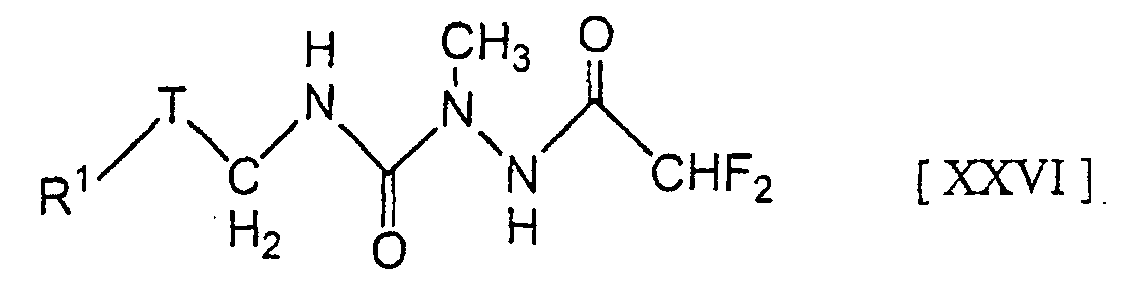
- the present invention provides also 5-difluoromethyl-2-methyl-2,4-dihydro-3H-1,2,4-triazol-3-o ne of the formula [L]: ; a difluoroacetyl semicarbazide compound of the formula [XXVI] : wherein R 1 and T have the same meanings as described above; a semicarbazide compound of the formula [VII]: wherein R 1 and T have the same meanings as described above; 2-methyl-5-phenylbenzylamine of the formula [XVI-1]: , inorganic acid salt (for example, hydrochloric acid addition salt, hydrobromic acid addition salt, sulfuric acid addition salt) and sulfonic acid salt (for example, methanesulfonic acid addition salt) of 2-methyl-5-phenylbenzylamine; 2-methyl-5-phenylbenzyl chloride of the formula [XIII-1] : ,a sulfonate compounds of the formula [XIII-2]: wherein R 9 represents
- C 1 -C 10 alkyl represented by A 1 and A 2 for example, methyl, ethyl, propyl, isopropyl, butyl, isobutyl, 1-methylpropyl, pentyl, 1-methylbutyl, 1-ethylbutyl, 2-methylbutyl, 3-methylbutyl, 2,2-dimethylpropyl, 1,2-dimethylpropyl, 1,1-dimethylpropyl, hexyl, 1-methylpentyl, 1-ethylpentyl, 3,3-dimethylbutyl, heptyl, 3, 7-dimethyloctyl and the like are listed; as the C 2 -C 10 alkenyl represented by A 1 and A 2 , for example, vinyl, allyl, 1-methyl-2-propenyl, 2-methyl-2-propenyl, 2-butenyl, 2-pentenyl, 3-methyl-2-butenyl and the like are listed; as the C 2 -C 10 alken
- the alkyl, the alkenyl, the alkynyl, the cycloalkyl, the cycloalkylalkyl, the cycloalkenyl and the cycloalkenylalkyl represented by A 1 and A 2 may optionally be each substituted by one or more substituents selected from the group consisting of halogen atom (s) (fluorine atom, chlorine atom, bromine atom, iodine atom), cyano, nitro, C 1 -C 10 alkoxy, C 1 -C 10 haloalkoxy, C 1 -C 10 alkylthio, C 1 -C 10 haloalkylthio, (C 1 -C 9 alkyl) carbonyl, (C 1 -C 9 alkoxy) carbonyl, (C 1 -C 9 alkyl) carbonylamino, phenyl, phenoxy, benzyloxyandtri (C 1 -C 10 alkyl) silyl; and
- the phenyl, the naphthyl, the benzene ring in the phenylalkyl, the naphthalene ring in the phenylnaphthyl, the heterocyclic group, and the heterocyclic ring in the methyl substituted by a heterocylic group, represented by A 1 and A 2 may optionally be each substituted by one or more substituents selected from the group consisting of halogen atom(s) (fluorine atom, chlorine atom, bromine atom, iodine atom), cyano, nitro, C 1 -C 10 alkyl, C 1 -C 10 haloalkyl, C 3 -C 10 cycloalkyl, C 1 -C 10 alkoxy, C 1 -C 10 haloalkoxy, C 1 -C 10 alkylthio, C 1 -C 10 haloalkylthio, (C 1 -C 9 alkyl) carbonyl, (C 1 -
- the m -phenylene, m -azaphenylene and m -diazaphenylene, bonded to R 1 and to CH 2 each via a carbon atom, represented by T may optionally be substituted by halogen atoms (fluorine atom, chlorine atom, bromine atom, iodine atom), cyano, nitro, C 1 -C 6 alkyl, C 1 -C 6 haloalkyl, C 1 -C 6 alkoxy, C 1 -C 6 haloalkoxy, C 1 -C 6 alkylthio, C 1 -C 6 haloalkylthio or (C 1 -C 5 alkoxy) carbonyl; and as the alkyl, for example, methyl, ethyl and the like are listed; as the haloalkyl, for example, fluoromethyl, difluoromethyl, trifluoromethyl, chloromethyl and the like are listed; as the alkoxy, for example, meth
- the compounds in which R 1 is optionally substituted phenyl are preferable because of an excellent fungicidal effect.
- R 1 is optionally substituted phenyl
- T is m -phenylene or substituted m -phenylene
- the preferable substituents include methyl, fluorine atom, chlorine atom and trifluoromethyl.
- the compound of the invention can be produced according to the following Production Method A to Production Method G.
- a desired R 1 can be introduced or structured last (for example, Production Method H).
- a protective group can be used for protecting a functional group from reaction, if necessary.
- the compound of the invention of the formula [I] can be produced from a formyl compound of the formula [II] by, for example, a method shown in the following chemical reaction formula: wherein, R 1 and T have the same meanings as described above.
- the reaction temperature of the reaction of obtaining the compound of the invention of the formula [I] from the formyl compound of the formula [II] is usually in the range from -20 °C to 100°C, and the reaction time is usually in the range from 10 minutes to 10 hours.
- the ratio of diethylaminosulfur trifluoride used for this reaction is usually 1 to 20 mol per mol of the formyl compound of the formula [II].
- the reaction is conducted usually in a solvent, and as the solvent used, for example, halogenated hydrocarbons such as chloroform, chlorobenzene and the like, ethers such as 1,4-dioxane, tetrehydrofuran, diethyl ether and the like, aliphatic hydrocarbons such as hexane, petroleum ether and the like, aromatic hydrocarbons such as toluene, xylene and the like, and mixtures thereof are listed.
- halogenated hydrocarbons such as chloroform, chlorobenzene and the like
- ethers such as 1,4-dioxane, tetrehydrofuran, diethyl ether and the like
- aliphatic hydrocarbons such as hexane, petroleum ether and the like
- aromatic hydrocarbons such as toluene, xylene and the like, and mixtures thereof are listed.
- reaction solution after completion of the reaction is subjected to post treatments such as, for example, washing with a sodium bicarbonate solution before concentration of the organic layer, and the like, giving isolation of the intended compound.
- This intended compound can also be purified by re-crystallization, chromatography and the like.
- the formyl compound of the formula [II] can be produced, for example, according to the following scheme.
- L 2 represents a leaving group such as a chlorine atom, bromine atom, iodine atom, p-toluenesulfonyloxy, methanesulfonyloxy, trifluoromethanesulfonyloxy and the like
- R 5 represents a C 1 -C 5 alkyl (for example, methyl, ethyl and the like), phenyl or trihaloethyl (for example, trichloroethyl and the like).
- a semicarbazide compound of the formula [VII] can be produced by reacting an isocyanate compound of the formula [III] with methylhydrazine.
- the reaction temperature of the reaction is usually in the range from -20°C to 50°C, and the reaction time is usually in the range from 1 to 100 hours.
- the ratio of methylhydrazine used for this reaction is usually 1 to 10 mol per mol of the isocyanate compound of the formula [III].
- the reaction is usually conducted in a solvent, and as the solvent used, for example, ethers such as 1,4-dioxane, tetrehydrofuran, diethyl ether and the like, halogenated hydrocarbons such as chloroform, chlorobenzene and the like, aliphatic hydrocarbons such as hexane, petroleum ether and the like, aromatic hydrocarbons such as toluene, xylene and the like, amides such as N,N-dimethylformamide and the like, dimethylsulfoxide and the like, and mixtures thereof are listed.
- ethers such as 1,4-dioxane, tetrehydrofuran, diethyl ether and the like
- halogenated hydrocarbons such as chloroform, chlorobenzene and the like
- aliphatic hydrocarbons such as hexane, petroleum ether and the like
- aromatic hydrocarbons such as toluene, xylene and the like
- a semicarbazide compound of the formula [VIII] can be produced by reacting the isocyanate compound of the formula [III] with 1-methyl-2-hydroxyacetylhydrazine in the same manner as described above.
- a semicarbazide compound of the formula [IV] can also be produced by reacting the isocyanate compound of the formula [III] with hydroxyacetylhydrazine in the same manner as described above.
- a compound of the formula [V] can be obtained by reacting the semicarbazide compound of the formula [IV] with a base, and for example, can be obtained by treating the compound of the formula [V] with an aqueous potassium hydroxide solution.
- a compound of the formula [VI] can be obtained by reacting the semicarbazide compound of the formula [VIII] with a base, and for example, can be obtained by treating the compound of the formula [VI] with an aqueous potassium hydroxide solution.
- a compound of the formula [VI] can be obtained by reacting the compound of the formula [V] with a base, and as the base used, for example, potassium carbonate is mentioned.
- the compound of the formula [II] can be obtained by oxidizing the compound of the formula [VI], and as the oxidizing agent used, for example, manganese dioxide is mentioned.
- the isocyanate compound of the formula [III] can be produced, for example, according to the following scheme-. wherein, R 1 , L 2 and T have the same meanings as described above, R 6 represents a C 1 -C 4 alkyl (for example, methyl, ethyl and the like), M 1 represents silver or sodium, DIBAL represents diisobutyl aluminum hydride, BuLi represents butyllithium and DMF represents N,N-dimethylformamide.
- reaction of reacting an amine compound of the formula [XVI] with triphosgene, diphosgene or phosgene to obtain the isocyanate compound of the formula [III] can be conducted, for example, by a method described in J. Org. Chem. 61, 3883-3884 (1996) or by a method described in Intermediate Production Example 3 described later.
- the reaction of reducing a nitrile compound of the formula [XV] to obtain the amine compound of the formula [XVI] can be conducted, for example, by a method of reduction using aluminum lithium hydride (LiAlH 4 ), by a method of hydrogenating the nitrile compound of the formula [XV] in the presence of a catalyst, and by the like manner; as the catalyst used in hydrogenation, for example, Raney nickel, palladium and the like are listed. Regarding the method of using Raney nickel, JP-A No. 8-291116 can be refered, and regarding the method of using pallaridum, J. Am. Chem. Soc., 50, 3370 (1928) can be refered, respectively.
- reaction of obtaining a compound of the formula [XIII] wherein L 2 represents a p-toluenesulfonyloxy, methanesulfonyloxy or trifluoromethanesulfonyloxy from an alcohol compound of the formula [XII] can be conducted, for example, according to a method described in Intermediate Production Example 12 described later.
- the reaction of obtaining a compound of the formula [XIII] wherein L 2 represents a chlorine atom from the alcohol compound of the formula [XII] can be conducted, for example, by a method of reacting CCl 4 -PPh 3 to the alcohol compound of the formula [XII] (specifically, method described in Intermediate Production Example 9 described later), by a method of reacting conc. Hydrochloric acid to the alcohol compound of the formula [XII] (see, Org. Synth., IV, 576 (1967)), and by the like manner.
- the similar methods are applicable to the compound which L2 is bromine atom or iodine atom.
- reaction of obtaining an amine compound of the formula [XVI] from a compound of the formula [XIII] can be conducted, for example, according to a method described in J. Org. Chem., 58, 270 (1993).
- An alcohol compound of the formula [XII] wherein T is the formula: can also be produced from a benzyl chloride compound of the formula [XVII] according to the following chemical reaction formula: wherein, R 10 represents a substituent inactive in Grignard reaction among substituents defined for R 1 .
- This reaction is conducted in a solvent, and as the solvent used, ethers such as diethyl ether, tetrahydrofuran, diglyme, triglyme and the like, and mixed solvents of these ethers with aromatic hydrocarbons such as toluene, xylene and the like. If necessary, for example, J. Am. Chem. Soc., 73, 3237 (1951) can be refered.
- 2-methyl-5-phenylbenzyl chloride of the formula [XIII-1] can also be produced according to the following scheme. wherein, L 2 has the same meaning as described above, and R 11 represents a C 1 -C 4 alkyl group (for example, methyl, ethyl and the like) or vinyl.
- reaction of obtaining a compound of the formula [LIII] from a compound of the formula [LII] can be conducted, for example, according to a method described in Tetrahedron, 50, 13697 (1994).
- the reaction of obtaining N,N-dimethyl-(2-methyl-5-phenylbenzyl)amine of the formula [LI] from a compound of the formula [LIII] can be conducted, for example, according to a method described in Organic Reactions, 18, 403-464 (1970).
- As the base used for this reaction sodium hydride, potassium hydride, sodiumamide, potassiumamide, phenyllithium, butyllithium and the like are listed.
- the compound of the invention of the formula [I] can be produced from a triazolone compound of the formula [XIX] according to the following chemical reaction formula. wherein, R 1 , L 2 and T have the same meanings as described above.
- the reaction is conducted usually in the presence of a base, and as the base used, for example, inorganic bases such as sodium hydride, sodium hydroxide, potassium hydroxide, sodium carbonate, potassium carbonate, and the like are listed.
- the reaction temperature of the reaction of obtaining the compound of the invention of the formula [I] from a triazolone compound of the formula [XIX] is usually in the range from -20 °C to 100°C, and the reaction time is usually in the range from 1 to 100 hours.
- the ratio of a methylating agent of the formula [IX] is 1 to 5 mol and the ratio of the base is 1 to 10 mol, per mol of the triazolone compound of the formula [XIX].
- ethers such as 1, 4-dioxane, tetrehydrofuran, ethylene glycol dimethyl ether, diethylene glycol dimethyl ether, t-butyl methyl ether and the like, aliphatic hydrocarbons such as hexane, heptane, ligroin, petroleum ether and the like, aromatic hydrocarbons such as toluene, xylene and the like, organic bases such as pyridine, triethylamine, N-methylaniline, N,N-dimethylaniline, N,N-diethylaniline and the like, nitriles such as acetonitrile, isobutylonitrile and the like, N,N-dimethylformamide, dimethyl sulfoxide, water and the like, and mixtures thereof are listed. These solvents are selected depending on the kind of a base used.
- reaction solution after completion of the reaction is subjected to usual post treatments such as extraction with an organic solvent, concentration and the like, giving isolation of the intended compound.
- This intended compound can also be purified by re-crystallization, chromatography and the like.
- the triazolone compound of the formula [XIX] can be produced, for example, according to the following scheme. wherein, R 1 , L 2 and T have the same meanings as described above, and M 2 represents sodium or potassium.
- An isothiocyanate compound of the formula [XXI] can be produced by reacting a compound of the formula [XIII] with a compound of the formula [XX].
- a thiosemicarbazide compound of the formula [XXII] can be produced by reacting the isothiocyanate compound of the formula [XXI] with hydrazine (anhydrous hydrazine or water-containing hydrazine).
- a triazolinethion compound of the formula [XXIII] can be produced by reacting the thiosemicarbazide compound of the formula [XXII] with difluoroacetic acid.
- a sulfonic acid compound of the formula [XXIV] can be produced by oxidizing the triazolinethion compound of the formula [XXIII] using an oxidizing agent (for example, hydrogen peroxide).
- the triazolone compound of the formula [XIX] can be produced by hydrolyzing the sulfonic acid compound of the formula [XXIV] using an acid (for example, hydrochloric acid).
- JP-A No. 7-196630 can be referred.
- reaction solution after completion of the reaction is subjected to usual post treatments such as extraction with an organic solvent, concentration and the like, giving isolation of the intended compound.
- This intended compound can also be purified by re-crystallization, chromatography and the like.
- the compound of the invention of the formula [I] can be produced from a semicarbazide compound of the formula [VII], for example, according to the following chemical reaction formula. wherein, R 1 and T have the same meanings as described above.
- reaction temperature of the above-mentioned reaction of obtaining the compound of the invention of the formula [I] from a semicarbazide compound of the formula [VII] is usually in the range from -20°C to 100°C, and the reaction time is usually in the range from 1 to 100 hours.
- the ratio of a difluoroacetic anhydride is usually 1 to 5 mol per mol of the semicarbazide compound of the formula [VII].
- the reaction is usually conducted in a solvent, and as the solvent used, for example, aromatic hydrocarbons such as toluene, xylene and the like, ethers such as 1,4-dioxane, tetrehydrofuran, diethyl ether and the like, aliphatic hydrocarbons such as hexane, petroleum ether and the like, and mixtures thereof are listed.
- aromatic hydrocarbons such as toluene, xylene and the like
- ethers such as 1,4-dioxane, tetrehydrofuran, diethyl ether and the like
- aliphatic hydrocarbons such as hexane, petroleum ether and the like, and mixtures thereof are listed.
- a difluoroacetyl semicarbazide compound of the formula [XXVI] described later is formed as a by-product in some cases, however, it can be separated off by purifying the intended compound by chromatography and the like.
- the separated difluoroacetyl semicarbazide compound of the formula [XXVI] can be utilized as a starting material for Production Method F described later.
- the reaction solution after completion of the reaction can be, for example after decomposition of excess difluoroacetic anhydride by a base such as an aqueous sodium hydroxide solution and the like, subjected to post treatment operations such as extraction with an organic solvent, concentration and the like, giving isolation of the intended compound.
- a base such as an aqueous sodium hydroxide solution and the like
- post treatment operations such as extraction with an organic solvent, concentration and the like, giving isolation of the intended compound.
- This intended compound can also be purified by re-crystallization, chromatography and the like.
- the compound of the invention of the formula [I] can be produced from the semicarbazide compound of the formula [VII], for example, according to the following chemical reaction formula. wherein, R 1 and T have the same meanings as described above, and R 7 represents a C 1 -C 4 alkyl (for example, methyl, ethyl and the like).
- reaction temperature of the above-mentioned reaction of obtaining the compound of the invention of the formula [I] from the semicarbazide compound of the formula [VII] is usually in the range from -20°C to 100°C, and the reaction time is usually in the range from 1 to 100 hours.
- the ratio of a compound of the formula [XXV] is usually 1 to 100 mol per mol of the semicarbazide compound of the formula [VII].
- the reaction is conducted in the presence of a base, and as the base used, for example, metal alkoxides such as sodium methoxide, sodium ethoxide, potassium t-butoxide and the like, alkali metal hydroxides such as sodium hydroxide, potassium hydroxide and the like, alkaline earth metal hydroxides such as calcium hydroxide, magnesium hydroxide and the like, and organic bases such as triethylamine, pyridine and the like are listed, and the ratio of a base is usually 0.1 to 3 mol per mol of the semicarbazide compound of the formula [VII]
- the reaction is conducted in a solvent if necessary, and as the solvent used, for example, alcohols such as methanol, ethanol and the like, ethers such as 1,4-dioxane, tetrehydrofuran, diethyl ether and the like, aliphatic hydrocarbons such as hexane, petroleum ether and the like, aromatic hydrocarbons such as toluene, xylene and the like, amides such as N,N-dimethylformamide and the like, dimethylsulfoxide and the like, and mixtures thereof are listed.
- alcohols such as methanol, ethanol and the like
- ethers such as 1,4-dioxane, tetrehydrofuran, diethyl ether and the like
- aliphatic hydrocarbons such as hexane, petroleum ether and the like
- aromatic hydrocarbons such as toluene, xylene and the like
- amides such as N,N-dimethyl
- a difluoroacetyl semicarbazide compound of the formula [XXVI] described later is formed as a by-product in some cases, however, it can be separated off by purifying the intended compound by chromatography and the like.
- the separated difluoroacetyl semicarbazide compound of the formula [XXVI] can be utilized as a starting material for Production Method F described later.
- reaction solution after completion of the reaction can be, after neutralization or concentration if necessary, subjected to post treatment operations such as extraction with an organic solvent, concentration and the like, giving isolation of the intended compound.
- This intended compound can also be purified by re-crystallization, chromatography and the like.
- the compound of the invention of the formula [I] can be produced from a semicarbazide compound of the formula [VII], for example, according to the following chemical reaction formula. wherein, R 1 and T have the same meanings as described above.
- reaction temperature of the above-mentioned reaction of obtaining the compound of the invention of the formula [I] from the semicarbazide compound of the formula [VII] is usually in the range from 20°C to 100°C, and the reaction time is usually in the range from 1 to 100 hours.
- the ratio of difluoroacetic acid is usually 1 to 100 mol per mol of the semicarbazide compound of the formula [VII].
- the reaction is conducted in a solvent if necessary, and as the solvent used, for example, aromatic hydrocarbons such as toluene, xylene and the like, aliphatic hydrocarbons such as hexane, petroleum ether and the like, ethers such as 1, 4-dioxane, tetrahydrofuran and the like, and mixtures thereof are listed.
- aromatic hydrocarbons such as toluene, xylene and the like
- aliphatic hydrocarbons such as hexane, petroleum ether and the like
- ethers such as 1, 4-dioxane, tetrahydrofuran and the like, and mixtures thereof are listed.
- the difluoroacetyl semicarbazide compound of the formula [XXVI] described later is formed as a by-product in some cases, however, it can be separated off by purifying the intended compound by chromatography and the like.
- the separated difluoroacetyl semicarbazide compound of the formula [XXVI] can be utilized as a starting material for Production Method F described later.
- reaction solution after completion of the reaction can be, after neutralization or concentration if necessary, subjected to post treatment operations such as extraction with an organic solvent, concentration and the like, giving isolation of the intended compound.
- This intended compound can also be purified by re-crystallization, chromatography and the like.
- the compound of the invention of the formula [I] can be produced from the difluoroacetyl semicarbazide compound of the formula [XXVI], for example, according to the following chemical reaction formula. wherein, R 1 and T have the same meanings as described above.
- reaction temperature of the reaction of obtaining the compound of the invention of the formula [I] from the difluoroacetyl semicarbazide compound of the formula [XXVI] is usually in the range from 20°C to 100°C, and the reaction time is usually in the range from 10 minutes to 10 hours.
- the reaction is conducted in the presence of a base or acid, and as the base used, for example, metal alkoxides such as sodium methoxide, sodium ethoxide, potassium t-butoxide and the like, alkali metal hydroxides such as sodium hydroxide, potassium hydroxide and the like, alkaline earth metal hydroxides such as calcium hydroxide, magnesium hydroxide and the like, and organic bases such as triethylamine, pyridine and the like are listed.
- the ratio of the base used is usually 0.1 to 10 mol per mol of a difluoroacetyl semicarbazide compound of the formula [XXVI].
- the acid used for example, organic acids such as difluoroacetic acid, trifluoroacetic acid and the like are listed, and the ratio of the acid used is usually 1 to 100 mol per mol of the difluoroacetyl semicarbazide compound of the formula [XXVI].
- the reaction is conducted in a solvent if necessary, and as the solvent used, for example, alcohols such as methanol, ethanol and the like, ethers such as 1,4-dioxane, tetrahydrofuran, diethyl ether and the like, aliphatic hydrocarbons such as hexane, petroleum ether and the like, aromatic hydrocarbons such as toluene, xylene and the like, amides such as N,N-dimethylformamide and the like, sulfoxides such as dimethyl sulfoxide and the like, water and mixtures thereof are listed.
- solvents are selected and used depending on the kinds of an acid and base used.
- reaction solution after completion of the reaction can be, after neutralization or concentration if necessary, subjected to post treatment operations such as extraction with an organic solvent, concentration and the like, giving isolation of the intended compound.
- This intended compound can also be purified by re-crystallization, chromatography and the like.
- the difluoroacetyl semicarbazide compound of the formula [XXVI] can also be obtained as a by-product in Production Methods C, D and E, however, can be produced, for example, according to the following scheme. wherein, R 1 and T have the same meanings as described above.
- the reaction temperature in obtaining the difluoroacetyl semicarbazide compound of the formula [XXVI] from the isocyanate compound of the formula [III] is usually in the range from 0 °C to 100°C, and the reaction time is usually in the range from 1 to 10 hours.
- the ratio of N'-methyl-difluoroacetohydrazide used for the reaction is usually 1 to 10 mol per mol of the isocyanate compound of the formula [III].
- the reaction is conducted in a solvent if necessary, and as the solvent used, for example, alcohols such as methanol, ethanol and the like, ethers such as 1,4-dioxane, tetrahydrofuran, diethyl ether and the like, halogenated hydrocarbons such as chloroform, chlorobenzene and the like, aliphatic hydrocarbons such as hexane, petroleum ether and the like, aromatic hydrocarbons such as toluene, xylene and the like, amides such as N,N-dimethylformamide and the like, dimethyl sulfoxide and the like, and mixtures thereof are listed.
- alcohols such as methanol, ethanol and the like
- ethers such as 1,4-dioxane, tetrahydrofuran, diethyl ether and the like
- halogenated hydrocarbons such as chloroform, chlorobenzene and the like
- aliphatic hydrocarbons such as
- reaction solution after completion of the reaction is subjected, after concentration, to post treatment operations such as extraction with an organic solvent, concentration and the like, giving isolation of the intended compound.
- This intended compound can also be purified by re-crystallization, chromatography and the like.
- the compound of the invention of the formula [I] can be produced from a compound of the formula [XIII] and a triazolone compound of the formula [L], for example, according to the following chemical reaction formula. wherein, R 1 , L 2 and T have the same meanings as described above.
- the reaction is conducted in the presence of a base, and as the base used, inorganic bases such as lithium hydroxide, lithium hydride, sodium hydroxide, sodium hydride, potassium hydroxide, potassium hydride, sodium carbonate, potassium carbonate, and the like are listed.
- the reaction temperature is usually in the range from 0°C to 100°C, and the reaction time is usually in the range from 1 to 100 hours.
- the ratio of the triazolone compound of the formula [L] is usually 1 to 5 mol and the ratio of a base is usually from 1 to 10 mol per mol of the compound of the formula [XIII].
- the reaction is conducted in a solvent if necessary, and as the solvent used, for example, alcohols such as methanol, ethanol and the like, ethers such as 1, 4-dioxane, ethylene glycol dimethyl ether, diethylene glycol dimethyl ether and the like, aromatic hydrocarbons such as toluene, xylene and the like, organic bases such as pyridine, triethylamine, N-methylaniline, N,N-dimethylaniline, N,N-diethylaniline and the like, nitriles such as acetonitrile, isobutylonitrile and the like, N,N-dimethylformamide, dimethyl sulfoxide, water and the like, and mixtures thereof are listed. These solvents are selected depending on the kinds of a base used.
- alcohols such as methanol, ethanol and the like
- ethers such as 1, 4-dioxane, ethylene glycol dimethyl ether, diethylene glycol dimethyl ether and the
- reaction solution after completion of the reaction is subjected to post treatment operations such as extraction with an organic solvent, concentration and the like, giving isolation of the intended compound.
- This intended compound can also be purified by re-crystallization, chromatography and the like.
- the triazoline compound of the formula [L] can be produced, for example, according to the following chemical reaction formula.
- the reaction temperature in obtaining the triazolone compound of the formula [L] from 2-methyl semicarbazide is usually in the range from 50°C to 150°C, and the reaction time is usually in the range from 1 to 100 hours.
- the ratio of difluoroacetic acid used for the reaction is usually 1 to 100 mol per mol of 2-methyl semicarbazide.
- the reaction is conducted in a solvent if necessary, and as the solvent used, for example, aromatic hydrocarbons such as toluene, xylene and the like, aliphatic hydrocarbons such as hexane, petroleum ether and the like, ethers such as 1,4-dioxane, tetrahydrofuran and the like, and mixtures thereof are listed.
- aromatic hydrocarbons such as toluene, xylene and the like
- aliphatic hydrocarbons such as hexane, petroleum ether and the like
- ethers such as 1,4-dioxane, tetrahydrofuran and the like, and mixtures thereof are listed.
- 1-difluoroacetyl-2-methyl semicarbazide is formed as a by-product in some cases, however, it can be separated off by purification by chromatography and the like.
- reaction solution after completion of the reaction can be, after neutralization or concentration if necessary, subjected to post treatment operations such as extraction with an organic solvent, concentration and the like, giving isolation of the intended compound.
- This intended compound can also be purified by re-crystallization, chromatography and the like.
- the triazolone compound of the formula [L] can be shown as tautomers described below.
- 2-methyl semicarbazide can be produced, for example, according to the following chemical reaction formula. wherein, M 3 represents sodium or potassium.
- This reaction is conducted usually in an acidic aqueous solution (for example, hydrochloric acid).
- an acidic aqueous solution for example, hydrochloric acid
- Trimethylsilyl isocyanate of the above-mentioned formula in which M 3 represents a trimethylsilyl is reacted with methylhydrazine, then, the reaction product is reacted with methanol.
- 2-methyl semicarbazide can be produced.
- Production can be effected by the following methods (H-1) to (H-6).
- a borate compound of the formula [XXVIII] can be produced by reacting a compound of the formula [I-1] with bis(pinacolate)diboron in an organic solvent (for example, dimethyl sulfoxide, dimethylformamide) in the presence of a base (for example, potassium acetate, potassium carbonate) and a palladium catalyst (for example, dichloromethane complex of [bis(diphenylphosphino)ferrocene]dichloropalladium (II), tetrakistriphenylphosphinepalladium).
- an organic solvent for example, dimethyl sulfoxide, dimethylformamide
- a base for example, potassium acetate, potassium carbonate
- a palladium catalyst for example, dichloromethane complex of [bis(diphenylphosphino)ferrocene]dichloropalladium (II), tetrakistriphenylphosphinepalladium.
- reaction solution after completion of the reaction can be added to water, then, subjected to post treatments such as extraction with an organic solvent, concentration and the like, giving isolation of the intended compound.
- This intended compound can also be purified by chromatography and the like.
- the compound of the invention of the formula [I-2] can be produced by reacting the borate compound of the formula [XXVIII] with a compound of the general formula R 8 Z in an organic solvent (for example, dimethoxyethane) in the presence of a base (for example, potassium phosphate, potassium carbonate) and a palladium catalyst (for example, dichloromethane complex of [bis(diphenylphosphino)ferrocene]dichloropalladium (II), palladium acetate (II), tetrakistriphenylphosphinepalladium, mixtures thereof).
- an organic solvent for example, dimethoxyethane
- a base for example, potassium phosphate, potassium carbonate
- a palladium catalyst for example, dichloromethane complex of [bis(diphenylphosphino)ferrocene]dichloropalladium (II), palladium acetate (II), tetrakistriphenylpho
- a solvent in the reaction solution after completion of the reaction is distilled off, for example, then, the residue is subjected to chromatography, or the reaction solution after completion of the reaction is subjected to post treatments such as extraction with an organic solvent, concentration and the like.
- the intended compound can be obtained.
- This intended compound can also be purified by re-crystallization, chromatography and the like.
- a 3 -C ⁇ C represents a C 2 -C 10 alkynyl optionally substituted having a triple bond at the end.
- This alkynyl may optionally be substituted by one or more substituents selected from the group consisting of halogen atoms, cyano, nitro, C 1 -C 10 alkoxy, C 1 -C 10 haloalkoxy, C 1 -C 10 alkylthio, C 1 -C 10 haloalkylthio, (C 1 -C 9 alkyl) carbonyl, (C 1 -C 9 alkoxy) carbonyl, (C 1 -C 9 alkyl) carbonylamino, phenyl, phenoxy, benzyloxy and C 3 -C 20 trialkylsilyl; and T and X are the same as described above.
- the reaction of obtaining a compound of the invention of the formula [I-3] from a compound of the formula [I-1] can be conducted, for example, in an aprotic polar solvent (for example, acetonitrile, N,N-dimethylformamide) in the presence of abase (for example, secondary amine such as diisopropylamine and the like, tertiary amine such as triethylamine and the like) and a catalyst (for example, combination of triphenylphosphine, copper iodide (I) and palladium catalyst such as bis(triphenylphosphine)dichloropalladium ⁇ PdCl 2 (PPh 3 ) 2 ⁇ and the like).
- aprotic polar solvent for example, acetonitrile, N,N-dimethylformamide
- abase for example, secondary amine such as diisopropylamine and the like, tertiary amine such as triethylamine and the
- reaction solution after completion of the reaction can be subjected to post treatment operations such as extraction with an organic solvent, concentration and the like, to obtain the intended compound.
- This intended compound can also be purified by re-crystallization, chromatography and the like.
- the reaction of obtaining the compound of the invention of the formula [I-2] from a compound of the formula [I-1] can be conducted, for example, in a mixed solvent of water and diethoxyethane in the presence of a base (for example, inorganic base such as sodium bicarbonate) and a catalyst (for example, tetrakis(triphenyl)phosphinepalladium ⁇ Pd(PPh 3 ) 4 ⁇ ) (If necessary, see description in WO96/35669, to 2), or in a solvent in the presence of tetrabutylammonium bromide, base (for example, inorganic base such as potassium carbonate) and catalyst (for example, palladium acetate).
- a base for example, inorganic base such as sodium bicarbonate
- a catalyst for example, tetrakis(triphenyl)phosphinepalladium ⁇ Pd(PPh 3 ) 4 ⁇
- base for example, inorganic base such as potassium carbonate
- reaction solution after completion of the reaction can be subjected to post treatment operations such as extraction with an organic solvent, concentration and the like, to obtain the intended compound.
- This intended compound can also be purified by re-crystallization, chromatography and the like. If necessary, J. Org. Chem., 62, 7170-7173 (1997) can be referred, for example.
- a 4 represents a phenyl, naphthyl or heterocyclic group, and the phenyl, naphthyl or heterocyclic group may optionally each be substituted by one or more substituents selected from the group consisting of halogen atoms, cyano, nitro, C 1 -C 10 alkyl, C 1 -C 10 haloalkyl, C 3 -C 10 cycloalkyl, C 1 -C 10 alkoxy, C 1 -C 10 haloalkoxy, C 1 -C 10 alkylthio, C 1 -C 10 haloalkylthio, (C 1 -C 9 alkyl) carbonyl, (C 1 -C 9 alkoxy) carbonyl, (C 1 -C 9 alkyl) carbonylamino, phenyl, phenoxy, benzyloxy, C 3 -C 20 trialkylsilyl, methylenedi
- the reaction of obtaining a compound of the invention of the formula [I-5] from a compound of the formula [I-4] can be conducted in an organic solvent (for example, methylene chloride) in the presence of a base (for example, organic base such as triethylamine and the like, inorganic base such as sodium bicarbonate and the like) and a catalyst (for example, copper acetate (II)).
- a base for example, organic base such as triethylamine and the like, inorganic base such as sodium bicarbonate and the like
- a catalyst for example, copper acetate (II)
- the reaction of obtaining a compound of the invention of the formula [I-5] from a compound of the formula [I-1] can be conducted in an organic solvent (for example, toluene, ethyl acetate) in the presence of a base (for example, organic base such as triethylamine and the like, inorganic base such as potassium carbonate, cesium carbonate and the like) and a catalyst (for example, copper iodide (I)).
- a base for example, organic base such as triethylamine and the like, inorganic base such as potassium carbonate, cesium carbonate and the like
- a catalyst for example, copper iodide (I)
- the reaction solution after completion of the reaction can be subjected to post treatment operations such as extraction with an organic solvent, concentration and the like, to obtain the intended compound.
- This intended compound can also be purified by re-crystallization, chromatography and the like.
- the reaction of obtaining a compound of the invention of the formula [I-5] from a compound of the formula [XXVIII] can be conducted in an organic solvent (for example, methylene chloride) in the presence of a base (for example, organic base such as triethylamine and the like, inorganic base such as sodium bicarbonate and the like) and a catalyst (for example, copper acetate(II)).
- a base for example, organic base such as triethylamine and the like, inorganic base such as sodium bicarbonate and the like
- a catalyst for example, copper acetate(II)
- a 5 represents a group other than a hydrogen atom among represented-by A 1 , and L 2 , A 2 and T have the same meanings as described above.
- a 1 , A 2 , L 2 and T have the same meanings as described above.
- the compound of the invention When used as an active ingredient of a fungicidal composition, it may be used itself without adding any other components, however, it is usually mixed with solid carriers, liquid carriers, surfactants and other adjuvants, to prepare emulsifiable concentrates, wettable powders, water dispersible granules, emulsion formulation, flowables, dust formulation, granules and the like, to be used. These formulations contain the compound of the invention as an active ingredient in an amount of usually from 0.1 to 90 wt%.
- the solid carrier to be used in the formulation may include, for example, the following materials in fine powder or granule form: mineral materials (e.g., kaolinite clay, attapulgite clay, bentonite clay, montmorillonite clay, acid clay, pyrophyllite, talc, diatomaceous earth, calcite), natural organic materials (e.g., stalks of corn, powder of wallnut-shell), synthetic organic materials (e.g., urea), salts (e.g., calcium carbonate, ammonium sulfate) and synthetic inorganic materials (e.g., synthetic hydrated silicon oxide).
- mineral materials e.g., kaolinite clay, attapulgite clay, bentonite clay, montmorillonite clay, acid clay, pyrophyllite, talc, diatomaceous earth, calcite
- natural organic materials e.g., stalks of corn, powder of wallnut-shell
- synthetic organic materials e.g., urea
- the liquid carrier may include, for example, aromatic hydrocarbons (e.g., xylene, alkylbenzene, methylnaphthalene), alcohols (e.g., isopropyl alcohol, ethylene glycol, propylene glycol, ethylene glycol mono-ethyl ether), ketones (e.g., acetone, cyclohexanone, isophorone), vegetable oils (e.g., soybean oil, cotton seed oil), petroleum aliphatic hydrocarbons, esters, dimethyl sulufoxide, acetonitrile and water.
- aromatic hydrocarbons e.g., xylene, alkylbenzene, methylnaphthalene
- alcohols e.g., isopropyl alcohol, ethylene glycol, propylene glycol, ethylene glycol mono-ethyl ether
- ketones e.g., acetone, cyclohexanone, isophorone
- vegetable oils e.g.
- the surfactant may include, for example, anionic surfactants (e.g., alkylsulfate ester salts, alkyl(aryl)sulfonic acid salts, dialkylsulfosuccinic acid salts, phosphate salts of polyoxyethylenealkyl aryl ether, lignin sulfonic acid salts, naphthalenesulfonic acid formaldehyde condensations), nonionic surfactants (e.g., polyoxyethylene alkyl aryl ethers, polyoxyethylene propylene block copolymer, sorbitan fatty acid esters).
- anionic surfactants e.g., alkylsulfate ester salts, alkyl(aryl)sulfonic acid salts, dialkylsulfosuccinic acid salts, phosphate salts of polyoxyethylenealkyl aryl ether, lignin sulfonic acid salts, naphthalenesul
- the other adjuvants may include, for example, water-soluble polymers (e.g., polyvinyl alcohol, polyvinylpyrrolidone), polysaccharides (e.g., gum arabic, alginic acid and their salts, CMC (carboxy methyl cellulose), xanthan gum), inorganic materials (aluminum magnesium silicate, alumina sol), preservatives, coloringagents, PAP (isopropyl acid phosphate), BHT.
- water-soluble polymers e.g., polyvinyl alcohol, polyvinylpyrrolidone
- polysaccharides e.g., gum arabic, alginic acid and their salts
- CMC carboxy methyl cellulose
- xanthan gum xanthan gum
- inorganic materials aluminum magnesium silicate, alumina sol
- preservatives coloringagents
- coloringagents e.g., PAP (isopropyl acid phosphate
- the method of the application of the compound of the invention is concretely carried out, for example, by a foliar treatment, by a soil treatment, by a seed treatment and the like, also it is carried out by any method which is usually a person in the art uses.
- the application amount of the active ingredient is usually 1 to 5,000 g per hectare, preferably 5 to 1,000 g per hectare.
- emulsifiable concentrates, wettable powders, flowables and the like they are usually applied after diluted with water, usually at a concentration of 0.0001 to 3% by weight, preferably at a concentration of 0.0005 to 1% by weight as active ingredients of the invention.
- dust formulations, granules and the like they are usually applied as it is without diluting.
- the compound of the invention can be used as a agricultural and horticultural antifungal agent in agricultural fields, paddy fields, orchards, tea plantations, grasslands, lawns and the like. Increasing of the antifungal effect may be expected by using the compound of the invention with other agricultural and horticultural antifungal agent(s).
- Example of the other agricultural and horticultural antifungal agents include: azole antifungal compound such as propiconazole, triadimenol, prochloraz, penconazole, tebuconazole, flusilazole, diniconazole, bromoconazole, epoxyconazole, difenoconazole, cyproconazole, metconazole, triflumizole, tetraconazole, myclobutanil, fenbuconazole, hexaconazole, fluquinconazole, triticonazole, bitertanol, ipconazole, imibenconazole, imazalil, flutriafol and the like; cyclic amine antifungal compound such as fenpropimorph, tridemorph, fenpropidin and the like; benzimidazole antifungal compound such as carbendazim, benomyl, thiabendazole, thiophan
- the ratio of the compound of the invention to azole antifungal compound as the active ingredients is not limited to specific ratio; but when the ratio of azole antifungal compound to the compound of the invention by weight is 0.25 to 4, the excellent synergic effect can be achieved.
- the ratio of the compound of the invention to cyclic amine antifungal compound as the active ingredients is not limited to specific ratio; but when the ratio of cyclic amine antifungal compound to the compound of the invention by weight is 1 to 8, the excellent synergic effect can be achieved.
- the ratio of the compound of the invention to quinoxyfen as the active ingredients is not limited to specific ratio; but when the ratio of quinoxyfen to the compound of the invention by weight is 0.25 to 2, the excellent synergic effect can be achieved.
- the ratio of the compound of the invention to spiroxamine as the active ingredients is not limited to specific ratio; but when the ratio of spiroxamine to the compound of the invention by weight is 1 to 8, the excellent synergic effect can be achieved.
- the ratio of the compound of the invention to ethylen bis (dithiocarbamate) compound as the active ingredients is not limited to specific ratio; but when the ratio of ethylen bis (dithiocarbamate) compound to the compound of the invention by weight is 1 to 20, the excellent synergic effect can be achieved.
- the ratio of the compound of the invention to phthalimide compound as the active ingredients is not limited to specific ratio; but when the ratio of phthalimide compound to the compound of the invention by weight is 1 to 20, the excellent synergic effect can be achieved.
- the ratio of the compound of the invention to inorganic copper or organic copper as the active ingredients is not limited to specific ratio; but when the ratio of inorganic copper or organic copper to the compound of the invention by weight is 1 to 20, the excellent synergic effect can be achieved.
- the ratio of the compound of the invention to 6-iodo-3--propyl-2-propoxy-4(3H)-quinazolinone or (Z)-N-( ⁇ -cyclopropylmethoxyimino--2,3-difluoro-6-(trifluoromethyl)benzyl)-2-phenylacetamide as the active ingredients is not limited to specific ratio; when the ratio of 6-iodo-3--propyl-2-propoxy-4 (3H) -quinazolinone or (Z)-N-( ⁇ --cyclopropylmethoxyimino-2,3-difluoro-6-(trifluoromethyl)b enzyl)-2-phenylacetamide as the active ingredients is not limited to specific ratio; when the ratio of 6-iodo-3--propyl-2-propoxy-4 (3H) -quinazolinone or (Z)-N-( ⁇ --cyclopropylmethoxyimino-2,3-difluor
- 6-Iodo-3-propyl-2-propoxy-4(3H)-quinazolinone is a compound described in WO94/26722
- (Z)-N-( ⁇ -cyclopropylmethoxyimino-2,3-difluoro-6--(trifluoromethyl)benzyl)-2-phenylacetamide is a compound described in WO96/1944
- 2-chloro-N-(4'-chloro-(1,1'--biphenyl)-2-yl)-3-piridinecarboxamide is a compound described in EP545099A
- N-[2-(1,3-dimethylbutyl)-3-thienyl]-3-trifluoromethyl-1-me thylpyrazole-4-carboxamide are compounds JP-H09-235282-A.
- the compound of the invention can be applied after mixed with other agricultural and horticultural insecticidal agent (s), acaricidal agent(s), nematocidal agent (s), herbicidal agent (s), plant growth controlling agent (s) or fertilizer (s). And also the compound of the invention can be applied at the same time without mixing it beforehand.
- insecticides and acaricides include: organophosphorus compounds such as fenitrothion [O,O-dimethyl O-(3-methyl-4-nitrophenyl) phosphorothioate], fenthion [O,O-dimethyl O-(3-methyl-4-(methythio)phenyl) phosphorothioate], diazinon [O,O-diethyl O-2-isopropyl--6-methylpyrimidin-4-yl phosphorothioate], chlorpyrifos [O,O-diethyl O-3,5,6-trichloro-2-pyridyl phosphorothioate], acephate [0,S-dimethyl acetylphosphoramidothioate], methidathion [S-2,3-dihydro-5-methoxy-2-oxo-1,3,4--thiadiazol-3-ylmethyl O,O-dimethylphosphorodithioate],
- the compound of the invention can control a variety of plant diseases, examples are described below: Blast (Pyricularia oryzae), Helminthosporium leaf spot (Cochliobolus miyabeanus) and sheath blight (Rhizoctonia solani) of rice plant; powdery mildew (Erysiphe graminis), scab (Gibberella zeae), rust (Puccinia striiformis, P. graminis, P. recondita, P. hordei), snow blight (Typhula sp., Micronectriella nivalis), loose smut (Ustilago tritici, U.
- kidney bean anthracnose Cold-totrichum lindemthianum
- early leaf spot Cercospora personata
- leaf spot Cercospora arachidicola
- pea powdery mildew Erysiphe pisi
- early blight Alternaria solani
- late blight Phytophthora infestans
- strawberry powdery mildew Sphaerotheca humuli
- net blister blight Exobasidium reticulatum
- white scab Elsinoe leucospila
- brown spot Alternaria longipes
- powdery mildew Erysiphe cichoracearum
- anthracnose Coldy mildew
- Peronospora tabacina and (Phytophthora nicotianae) of tobacco
- beet leaf spot Cercospora bet
- the mixture was cooled to room temperature, water added to this, and the mixture was extracted with ethyl acetate.
- the organic layer was washed with water, washed with saturated saline, and dried over anhydrous magnesium sulfate, then, a small amount of hexane was added to this and the mixture was left at 0°C for 3 days.
- reaction solution was cooled to 0°C, and water was added slowly, the mixture was extracted with ethyl acetate. The organic layer was washed with water, saturated sodium bicarbonate solution and saturated saline sequentially, dried over anhydrous magnesium sulfate, then, concentrated.
- the resulted crystal was dissolved in a mixture of 2 ml of ethanol and 0.5 ml of water, and to this solution was 0.2 ml of concentrated hydrochloric acid, and the mixture was stirred at room temperature overnight, then, concentrated. To the residue was added a 2N sodium hydroxide aqueous solution, and the mixture was extracted with t-butyl methyl ether. The organic layer was washed with saturated saline, dried over anhydrous magnesium sulfate, then, the mixture was concentrated to obtain 97 mg of crude 2-methyl-5-phenylbenzylamine.
- Test Examples 1 to 6 are tests using a large amount (about 2000 L/ha) of spray on plants, and the extent of spraying is so that the whole surface of a plant body is completely wet and the sprayed liquid drips.
- Test Examples 7 and 8 are tests using a small amount (corresponding 200 L/ha) of spray on plants, in which fine small liquid drops of a spray are uniformly adhere to the surface of a plant body and the extent of spraying is insufficient to for complete wetting of the surface of a plant body.
- Controlling on a wheat disease in a field is so conducted in some cases that the spray liquid amount is about 200 L/ha.
- the amount of the sprayed liquid is insufficient for wetting of the whole plant body, and the sprayed liquid is adheres on a plant as fine liquid drops.
- suitable physicochemical properties such as permeation transfer property, volatility and the like are required in addition to a basic effect.
- Test Example 1 Pyricularia oryzae control test
- Sand loam was compacted in a plastic pot, a rice (NIHONBARE) was seeded and grown in a green house for 20 days. Then, the Compounds 1, 3, 4, 6, 7, 9, 18, 19, 20, 24, 47, 104, 105, 113, 117, 118, 120, 294, 326, 329, 343 and 345 were formulated into flowable formulations according the Formulation Example 6, then, diluted with water to provide given concentration, and these were sprayed onto stems and leaves so as to give sufficient adhesion on the surface of rice leaves. After spraying, the plant was air-dried, and a suspension of Pyricularia oryzae was inoculated by spraying. After inoculation, the plant was left for 6 days at 28°C under high humidity, then, the control effect was checked.
- the lesion areas on plants in the 500 ppm treatment districts and 200 ppm treatment districts using compound 1 of the invention were not more than 10% of the lesion area of a non-treatment district.
- the lesion areas on the plant in the 200 ppm treatment districts of the Compounds 3, 4, 6, 7, 9, 18, 19, 20, 24, 47, 104, 105, 113, 117, 118, 120, 294, 326, 329, 343 and 345 were not more than 10% of the lesion area of a non-treatment district.
- Test Example 2 Erysiphe graminis control test
- the lesion areas on plants in the 500 ppm treatment districts and 200 ppm treatment districts using compound 1 of the invention were not more than 10% of the lesion area of a non-treatment district.
- the lesion areas on the plant in the 200 ppm treatment districts of the Compounds 3, 4, 6, 7, 9, 18, 19, 20, 24, 47, 104, 105, 113, 117, 118, 120, 277, 294, 326, 329, 343 and 345 were not more than 10% of the lesion area of a non-treatment district.
- the lesion areas on plants in the 500 ppm treatment districts and 200 ppm treatment districts using compound 1 of the invention were not more than 10% of the lesion area of a non-treatment district.
- the lesion areas on the plant in the 200 ppm treatment districts of the Compounds 3, 4, 6, 7, 9, 18, 19, 20, 24, 47, 104, 105, 113, 117, 118, 120, 277, 294, 326, 329, 343 and 345 were not more than 10% of the lesion area of a non-treatment district.
- Test Example 4 Leptosphaeria nodorum control test
- the lesion areas on plants in the 500 ppm treatment districts and 200 ppm treatment districts using compound 1 of the invention were not more than 10% of the lesion area of a non-treatment district.
- the lesion areas on the plant in the 200 ppm treatment districts of the Compounds 3, 4, 6, 7, 9, 18, 19, 20, 24, 47, 104, 105, 113, 118, 120, 277, 329, 343 and 345 were not more than 10% of the lesion area of a non-treatment district.
- Sand loam was compacted in a plastic pot, a grape (Berry A) was seeded and grown in a green house for 40 days. Then, the Compounds 1, 3, 4, 6, 7, 9, 18, 19, 20, 24, 47, 104, 105, 113, 117, 118, 120, 277, 294, 326, 329, 343 and 345 were formulated into flowable formulations according the Formulation Example 6, then, diluted with water to provide given concentration (200 ppm), and these were sprayed onto stems and leaves so as to give sufficient adhesion on the surface of wheat leaves. After spraying, the plant was air-dried, and a suspension of zoosporangiua of Plasmopara viticola was inoculated by spraying. After inoculation, the plant was first left for 1 day at 23 °C under high humidity, then, further left for 6 days at room temperature, then, the control effect was checked.
- the lesion areas on plants in the treatment districts using the Compounds 1, 3, 4, 6, 7, 9, 18, 19, 20, 24, 47, 104, 105, 113, 117, 118, 120, 277, 294, 326, 329, 343 and 345 were not more than 10% of the lesion area of a non-treatment district.
- the lesion area on plants in the treatment district using the Compound 1 was not more than 10% of the lesion area of a non-treatment district.
- Sand loam was compacted in a plastic pot, a wheat (NORIN No. 73) was seeded and grown in a green house for 10 days. Then, the Compound 1 was fomulated into emulsifiable formulation according the Formulation Example 7, then, diluted with water to provide given concentration (1000 ppm), and this was sprayed onto stems and leaves at a spraying liquid amount corresponding to 200 L/ha over wheat seedling carrying a spread second leaf. After spraying, the plant was air-dried, and one day after, Erysiphe graminis spores were inoculated by falling. After inoculation, the plant was placed under illumination at 23 °C for 7 days, then, the control effect was checked.
- Sand loam was compacted in a plastic pot, a wheat (NORIN No. 73) was seeded and grown in a green house for 10 days. Then, the Compound 1 was formulated into emulsifiable formulation according the Formulation Example 7, then, diluted with water to provide given concentration (1000 ppm), and this was sprayed onto stems and leaves at a spraying liquid amount corresponding to 200 L/ha over wheat seedling carrying a spread second leaf. After spraying, the plant was air-dried, and Puccinia striiformis spores were inoculated. After inoculation, the plant was placed in dark high humidity atmosphere at 23°C for 1 day, further, for 6 days under illumination, then, the control effect was checked.
- the compound of the invention has a excellent fungicidal activity.
Landscapes
- Chemical & Material Sciences (AREA)
- Organic Chemistry (AREA)
- Life Sciences & Earth Sciences (AREA)
- Agronomy & Crop Science (AREA)
- Pest Control & Pesticides (AREA)
- Plant Pathology (AREA)
- Health & Medical Sciences (AREA)
- Engineering & Computer Science (AREA)
- Dentistry (AREA)
- General Health & Medical Sciences (AREA)
- Wood Science & Technology (AREA)
- Zoology (AREA)
- Environmental Sciences (AREA)
- Agricultural Chemicals And Associated Chemicals (AREA)
- Nitrogen Condensed Heterocyclic Rings (AREA)
- Plural Heterocyclic Compounds (AREA)
- Organic Low-Molecular-Weight Compounds And Preparation Thereof (AREA)
Abstract
A triazolone compound of the formula [I]:
 wherein;
R1 represents optionally substituted phenyl or the like, T represents m-phenylene optionally substituted by methyl or the like;
and a fungicidal composition containing it as an active ingredient.
R1 represents optionally substituted phenyl or the like, T represents m-phenylene optionally substituted by methyl or the like;
and a fungicidal composition containing it as an active ingredient.
Description
- The present invention relates to triazolone compounds, use thereof and production intermediates thereof.
- WO99/07687 describes that a certain kind of triazolone compounds has a fungicidal activity.
- The present invention provides compounds having a fungicidal activity, particularly an excellent fungicidal activity on fungi causing plant diseases and useful for controlling plant diseases.
- Namely, the present invention provides a triazolone compound of the formula [I] (hereinafter, referred to as the compound of the invention):wherein,

- R1 represents a A1-L1-, A1-ON=CA2-, A1-ON=C(Me)CH2ON=CA2-,
A1-C(A2)=N-OCH2-, A1S-C(A2)=N-, A1-C(=S)NH-, A1S-C(=S)NH-,
A1S-C(SA2)=N-, A1-ON=C(CN)-, A1-ON=C(Me)CH2ON=C(CN)-,
A1-C(CN)=N-OCH2-, halogen atom, nitro or cyano;
wherein, L1 represents single bond, oxygen atom, sulfur atom, carbonyl, -OCH2-, -SCH2-, -C(=O)O-, -OC(=O)-, -C(=O)OCH2-, -NH- or C1-C6 alkylimino;
A1 and A2, which are the same or different, represent hydrogen atom, C1-C10 alkyl, C2-C10 alkenyl, C2-C10 alkynyl, C3-C10 cycloalkyl, (C3-C10 cycloalkyl) C1-C10 alkyl, C5-C10 cycloalkenyl, (C5-C10 cycloalkenyl) C1-C10 alkyl, phenyl, naphthyl, phenyl C1-C10 alkyl, naphtyl C1-C10 alkyl, 5- or 6-membered heterocyclic group optionally condensed with a benzene ring, or methyl substituted by 5- or 6-membered heterocyclic group optionally condensed with a benzene ring;
the alkyl, the alkenyl, the alkynyl, the cycloalkyl, the cycloalkylalkyl, the cycloalkenyl and the cycloalkenylalkyl, represented by A1 and A2, may optionally be each substituted by one or more substituents selected from the group consisting of halogen atom (s), cyano, nitro, C1-C10 alkoxy, C1-C10 haloalkoxy, C1-C10 alkylthio, C1-C10 haloalkylthio, (C1-C9 alkyl) carbonyl, (C1-C9 alkoxy) carbonyl, (C1-C9 alkyl) carbonylamino, phenyl, phenoxy, benzyloxy and tri(C1-C10 alkyl.) silyl;
the phenyl, the naphthyl, the benzene ring in the phenylalkyl, the naphthalene ring in the phenylnaphthyl, the heterocyclic group, and the heterocyclic ring in the methyl substituted by heterocylic group, represented by A1 and A2, may optionally be each substituted by one or more substituents selected from the group consisting of halogen atom(s), cyano, nitro, C1-C10 alkyl, C1-C10 haloalkyl, C3-C10 cycloalkyl, C1-C10 alkoxy, C1-C10 haloalkoxy, C1-C10 alkylthio, C1-C10 haloalkylthio, (C1-C9 alkyl) carbonyl, (C1-C9 alkoxy) carbonyl, (C1-C9 alkyl) carbonylamino, phenyl, phenoxy, benzyloxy, tri(C1-C10 alkyl)silyl, methylenedioxy and difluoromethylenedioxy;
with the proviso, when L1 is single bond, A1 is not a hydrogen atom; - T represents optionally substituted m-phenylene, optionally
substituted m-azaphenylene (m-pyridinediyl) or optionally
substituted m-diazaphenylene (m-diazinediyl, namely,
m-pyridazinediyl, m-pyrimidinediyl or m-pyrazinediyl) bonded
to R1 and to CH2 each via a carbon atom;
wherein the substituents are one or more substituents selected from the group consisting of halogen atoms, cyano, nitro, C1-C6 alkyl, C1-C6 haloalkyl, C1-C6 alkoxy, C1-C6 haloalkoxy, C1-C6 alkylthio, C1-C6 haloalkylthio and (C1-C5 alkoxy) carbonyl;
and a fungicidal composition containing this compound as an
active ingredient. -
- The present invention provides also
5-difluoromethyl-2-methyl-2,4-dihydro-3H-1,2,4-triazol-3-o ne of the formula [L]:; a difluoroacetyl semicarbazide compound of the formula [XXVI] : wherein R1 and T have the same meanings as described above; a semicarbazide compound of the formula [VII]:
 wherein R1 and T have the same meanings as described above; 2-methyl-5-phenylbenzylamine of the formula [XVI-1]:
 , inorganic acid salt (for example, hydrochloric acid addition salt, hydrobromic acid addition salt, sulfuric acid addition salt) and sulfonic acid salt (for example, methanesulfonic acid addition salt) of 2-methyl-5-phenylbenzylamine;
2-methyl-5-phenylbenzyl chloride of the formula [XIII-1] :,a sulfonate compounds of the formula [XIII-2]: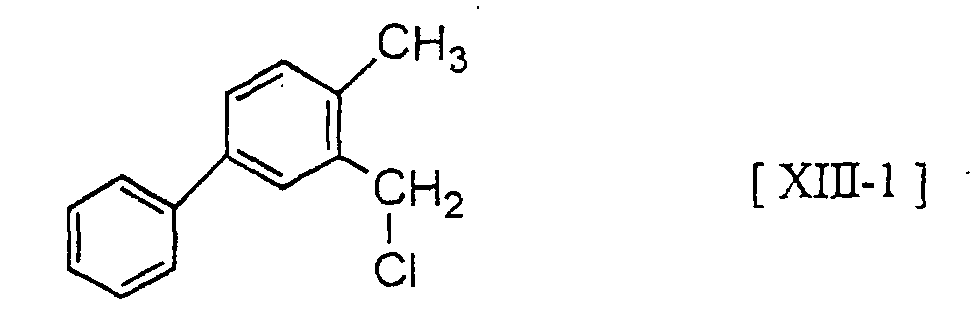 wherein R9 represents a methyl or p-tolyl;
N,N-dimethyl-(2-methyl-5-phenylbenzyl)amine of the formula [LI]:,inorganic acid salt (for example, hydrochloric acid addition salt, hydrobromic acid addition salt, sulfuric acid addition salt) and sulfonic acid salt (for example, methanesulfonic acid addition salt) of N,N-dimethyl-(2-methyl-5-phenylbenzyl)-amine, useful as a production intermediate for a compound of the invention.
- In the present invention;
as the C1-C10 alkyl represented by A1 and A2, for example, methyl, ethyl, propyl, isopropyl, butyl, isobutyl, 1-methylpropyl, pentyl, 1-methylbutyl, 1-ethylbutyl, 2-methylbutyl, 3-methylbutyl, 2,2-dimethylpropyl, 1,2-dimethylpropyl, 1,1-dimethylpropyl, hexyl, 1-methylpentyl, 1-ethylpentyl, 3,3-dimethylbutyl, heptyl, 3, 7-dimethyloctyl and the like are listed; as the C2-C10 alkenyl represented by A1 and A2, for example, vinyl, allyl, 1-methyl-2-propenyl, 2-methyl-2-propenyl, 2-butenyl, 2-pentenyl, 3-methyl-2-butenyl and the like are listed; as the C2-C10 alkynyl represented by A1 and A2, for example, ethynyl, propargyl, 1-methyl-2-propynyl, 2-butynyl and the like are listed; as the C3-C10 cycloalkyl represented by A1 and A2, for example, cyclopropyl, cyclopentyl, cyclohexyl and the like are listed; as the (C3-C10 cycloalkyl) alkyl represented by A1 and A2, for example, cyclopropylmethyl, cyclopentylmethyl, 2-cyclopentylethyl, cyclohexylmethyl and the like are listed; as the C5-C10 cycloalkenyl represented by A1 and A2, for example, cyclopentenyl, cyclohexenyl and the like are listed; as the (C5-C10 cycloalkenyl) alkyl represented by A1 and A2, for example, cyclopenten-1-ylmethyl, cyclohexen-1-ylmethyl and the like are listed; as the phenyl C1-C10 alkyl represented by A1 and A2, for example, phenylmethyl, 2-phenylethyl, 3-phenylpropyl, 4-phenylbutyl and the like are listed; as the naphthyl C1-C10 alkyl represented by A1 and A2, for example, α-naphthylmethyl, β-naphthylmethyl and the like are listed; as the 5- or 6-membered heterocyclic group optionally condensed with a benzene ring represented by A1 and A2, for example, 2-pyridyl, 3-pyridyl, 4-pyridyl, 2-pyrimidinyl, 4-pyrimidinyl, 5-pyrimidinyl, 2-pyrazinyl, 3-pyridazinyl, 4-pyridazinyl, 2-thienyl, 3-thienyl, 2-furyl, 3-furyl, pyrrol-1-yl, pyrrol-2-yl, pyrrol-3-yl, 1-pyrazolyl, 3-pyrazolyl, 4-pyrazolyl, 2-thiazolyl, 4-thiazolyl, 5-thiazolyl, 3-isothiazolyl, 4-isothiazolyl, 5-isothiazolyl, 2-oxazolyl, 4-oxazolyl, 5-oxazolyl, 3-isooxazolyl, 4-isooxazolyl, 5-isooxazolyl, 1-imidazolyl, 2-imidazolyl, 4-imidazolyl, 5-imidazolyl, 1-(1,2,4-triazolyl), 3-(1,2,4-triazolyl), 4-(1,2,4-triazolyl), 2-benzothienyl, 3-benzothienyl, benzothiazol-2-yl, 2-quinolyl and the like are listed; and as the methyl substituted by a 5- or 6-membered heterocyclic group optionally condensed with a benzene ring represented by A1 and A2, for example, 2-pyridylmethyl, 4-pyridylmethyl, 2-pyrimidinylmethyl, 4-pyrimidinylmethyl, 3-pyrazolylmethyl, 2-thiazolylmethyl, 2-imidazolylmethyl, 3-(1,2,4--triazolyl)methyl, 2-quinolylmethyl and the like are listed. - Here, the alkyl, the alkenyl, the alkynyl, the cycloalkyl, the cycloalkylalkyl, the cycloalkenyl and the cycloalkenylalkyl represented by A1 and A2 may optionally be each substituted by one or more substituents selected from the group consisting of halogen atom (s) (fluorine atom, chlorine atom, bromine atom, iodine atom), cyano, nitro, C1-C10 alkoxy, C1-C10 haloalkoxy, C1-C10 alkylthio, C1-C10 haloalkylthio, (C1-C9 alkyl) carbonyl, (C1-C9 alkoxy) carbonyl, (C1-C9 alkyl) carbonylamino, phenyl, phenoxy, benzyloxyandtri (C1-C10 alkyl) silyl; andas the alkoxy, for example, a methoxy, ethoxy, propoxy, isopropoxy, butoxy, sec-butoxy, isobutoxy, pentyloxy and the like are listed; as the haloalkoxy, for example, a trifluoromethoxy, difluoromethoxy, bromodifluoromethoxy, chlorodifluoromethoxy, fluoromethoxy, 2,2,2-trifluoroethoxy, 1,1,2,2-tetrafluoroethoxy and the like are listed; as the alkylthio, for example, a methylthio, ethylthio, propylthio, butylthio, isobutylthio, sec-butylthio, pentylthio, hexylthio and the like are listed, as the haloalkylthio, for example, a trifluoromethylthio, difluoromethylthio, bromodifluoromethylthio, chlorodifluoromethylthio, fluoromethylthio, 2,2,2-trifluoroethylthio, 1,1,2,2-tetrafluoroethylthio and the like are listed; as the alkylcarbonyl, for example, an acetyl, propanoyl, butanoyl, 3-methylbutanoyl and the like are listed; as the alkoxycarbonyl, for example, a methoxycarbonyl, ethoxycarbonyl, propoxycarbonyl, isopropoxycarbonyl, butoxycarbonyl, isobutoxycarbonyl, sec-butoxycarbonyl, pentyloxycarbonyl, hexyloxycarbonyl and the like are listed; as the alkylcarbonylamino, for example, an acetylamino, propanylamino, butanoylamino, 3-methylbutanoylamino and the like; and as the C3-C20 trialkylsilyl, for example, a trimethylsilyl, triethylsilyl and the like are listed.
- Further, the phenyl, the naphthyl, the benzene ring in the phenylalkyl, the naphthalene ring in the phenylnaphthyl, the heterocyclic group, and the heterocyclic ring in the methyl substituted by a heterocylic group, represented by A1 and A2, may optionally be each substituted by one or more substituents selected from the group consisting of halogen atom(s) (fluorine atom, chlorine atom, bromine atom, iodine atom), cyano, nitro, C1-C10 alkyl, C1-C10 haloalkyl, C3-C10 cycloalkyl, C1-C10 alkoxy, C1-C10 haloalkoxy, C1-C10 alkylthio, C1-C10 haloalkylthio, (C1-C9 alkyl) carbonyl, (C1-C9 alkoxy) carbonyl, (C1-C9 alkyl) carbonylamino, phenyl, phenoxy, benzyloxy, tri(C1-C10 alkyl) silyl, methylenedioxy and difluoromethylenedioxy; and as the alkoxy, the haloalkoxy, the alkylthio, the haloalkylthio, the alkylcarbonyl, the alkoxycarbonyl, the alkylcarbonylamino and the trialkylsilyl, the same substituents as described above are listed; as the alkyl, for example, methyl, ethyl, propyl, isopropyl, butyl, isobutyl, 1-methylpropyl, pentyl, 1-methylbutyl, 1-ethylbutyl, 2-methylbutyl, 3-methylbutyl, 2,2-dimethylpropyl, 1,2-dimethylpropyl, 1,1-dimethylpropyl, hexyl, 1-methylpentyl, 1-ethylpentyl, 3,3-dimethylbutyl, heptyl, 3,7-dimethyloctyl and the like are listed; as the haloalkyl, for example, trifluoromethyl, 2,2,2-trifluoroethyl, 1,1,2,2-tetrafluoroethyl and the like are listed; and as the cycloalkyl, for example, cyclopropyl, cyclopentyl, cyclohexyl and the like are listed; and the methylenedioxy and the difluoromethylenedioxy are each substituted on adjacent two carbon atoms in a benzene ring, naphthalene ring or heterocyclic ring.
- The m-phenylene, m-azaphenylene and m-diazaphenylene, bonded to R1 and to CH2 each via a carbon atom, represented by T may optionally be substituted by halogen atoms (fluorine atom, chlorine atom, bromine atom, iodine atom), cyano, nitro, C1-C6 alkyl, C1-C6 haloalkyl, C1-C6 alkoxy, C1-C6 haloalkoxy, C1-C6 alkylthio, C1-C6 haloalkylthio or (C1-C5 alkoxy) carbonyl; and as the alkyl, for example, methyl, ethyl and the like are listed; as the haloalkyl, for example, fluoromethyl, difluoromethyl, trifluoromethyl, chloromethyl and the like are listed; as the alkoxy, for example, methoxy, ethoxy and the like are listed; as the haloalkoxy, for example, trifluoromethoxy, difluoromethoxy, bromodifluoromethoxy, chlorodifluoromethoxy, fluoromethoxy, 2,2,2-trifluoroethoxy, 1,1,2,2-tetrafluoroethoxy and the like are listed; as the alkylthio, for example, methylthio, ethylthio and the like are listed; as the haloalkylthio, for example, a trifluoromethylthio, difluoromethylthio, bromodifluoromethylthio, chlorodifluoromethylthio, fluoromethylthio, 2,2,2-tri-fluoroethylthio, 1,1,2,2-tetrafluoroethylthioandthelikeare listed; and as the alkoxycarbonyl, for example, methoxycarbonyl, ethoxycarbonyl and the like are listed.
- As more specific examples of T, groups of the following formulae:


 are listed.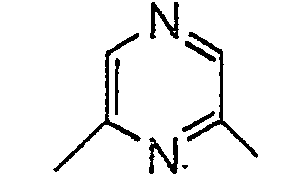
- Among the compounds of the invention, the compounds in which R1 is optionally substituted phenyl (namely, R1 is a A1-L1-, L1 is single bond, and A1 is optionally substituted phenyl) are preferable because of an excellent fungicidal effect. Further, the compounds in which T is m-phenylene or substituted m-phenylene are preferable because of an excellent fungicidal effect, and the preferable substituents include methyl, fluorine atom, chlorine atom and trifluoromethyl.
- Particularly, the compounds of the following formula [LX] in which R1 is optionally substituted phenyl and T is methylphenylene described below are preferable because of an excellent fungicidal effect.As the specific example of such compounds,

5-difluoromethyl-2-methyl-4- (2-methyl-5-phenylbenzyl)-2,4-dihydro-3H-1,2,4-triazol-3-one [Compound 1] of the formula:is mentioned.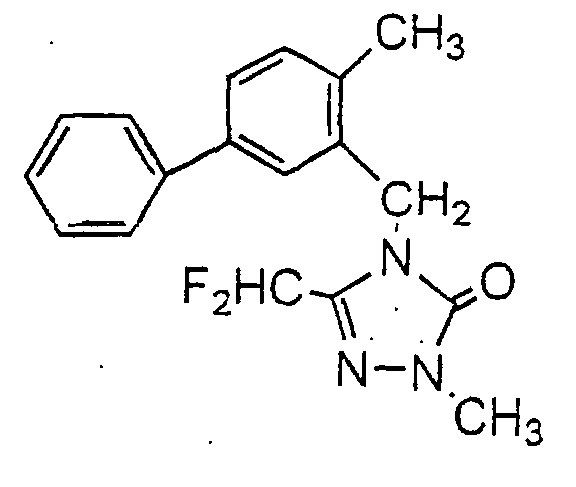
- The compound of the invention can be produced according to the following Production Method A to Production Method G. Depending on the definition of R1, a desired R1 can be introduced or structured last (for example, Production Method H). In these Production Methods, a protective group can be used for protecting a functional group from reaction, if necessary.
- The compound of the invention of the formula [I] can be produced from a formyl compound of the formula [II] by, for example, a method shown in the following chemical reaction formula:wherein, R1 and T have the same meanings as described above.
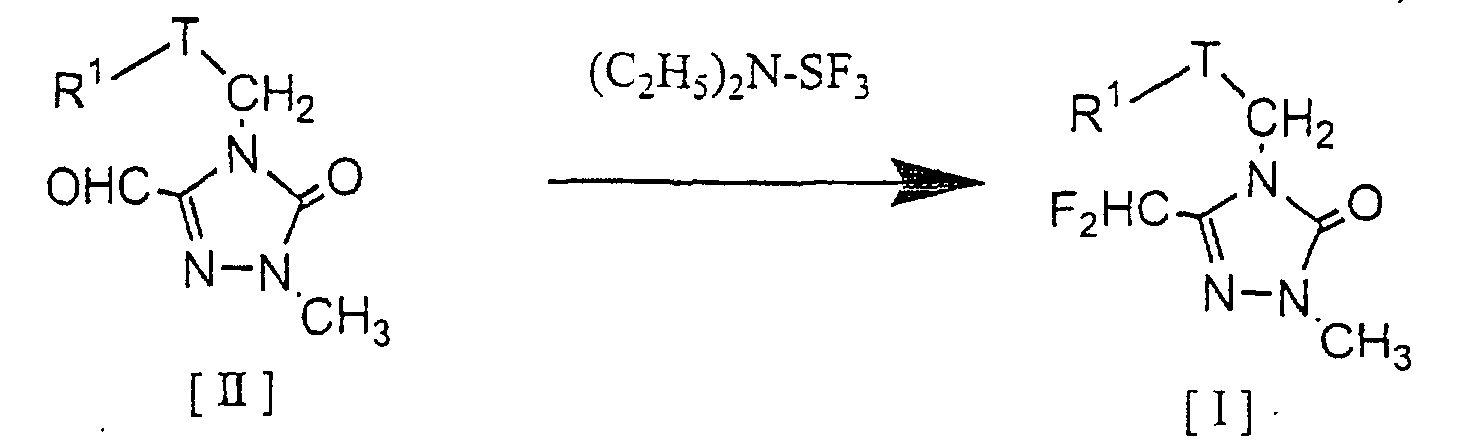
- The reaction temperature of the reaction of obtaining the compound of the invention of the formula [I] from the formyl compound of the formula [II] is usually in the range from -20 °C to 100°C, and the reaction time is usually in the range from 10 minutes to 10 hours. The ratio of diethylaminosulfur trifluoride used for this reaction is usually 1 to 20 mol per mol of the formyl compound of the formula [II].
- The reaction is conducted usually in a solvent, and as the solvent used, for example, halogenated hydrocarbons such as chloroform, chlorobenzene and the like, ethers such as 1,4-dioxane, tetrehydrofuran, diethyl ether and the like, aliphatic hydrocarbons such as hexane, petroleum ether and the like, aromatic hydrocarbons such as toluene, xylene and the like, and mixtures thereof are listed.
- The reaction solution after completion of the reaction is subjected to post treatments such as, for example, washing with a sodium bicarbonate solution before concentration of the organic layer, and the like, giving isolation of the intended compound. This intended compound can also be purified by re-crystallization, chromatography and the like.
- The formyl compound of the formula [II] can be produced, for example, according to the following scheme.wherein, R1 and T have the same meanings as described above, L2 represents a leaving group such as a chlorine atom, bromine atom, iodine atom, p-toluenesulfonyloxy, methanesulfonyloxy, trifluoromethanesulfonyloxy and the like, and R5 represents a C1-C5 alkyl (for example, methyl, ethyl and the like), phenyl or trihaloethyl (for example, trichloroethyl and the like).
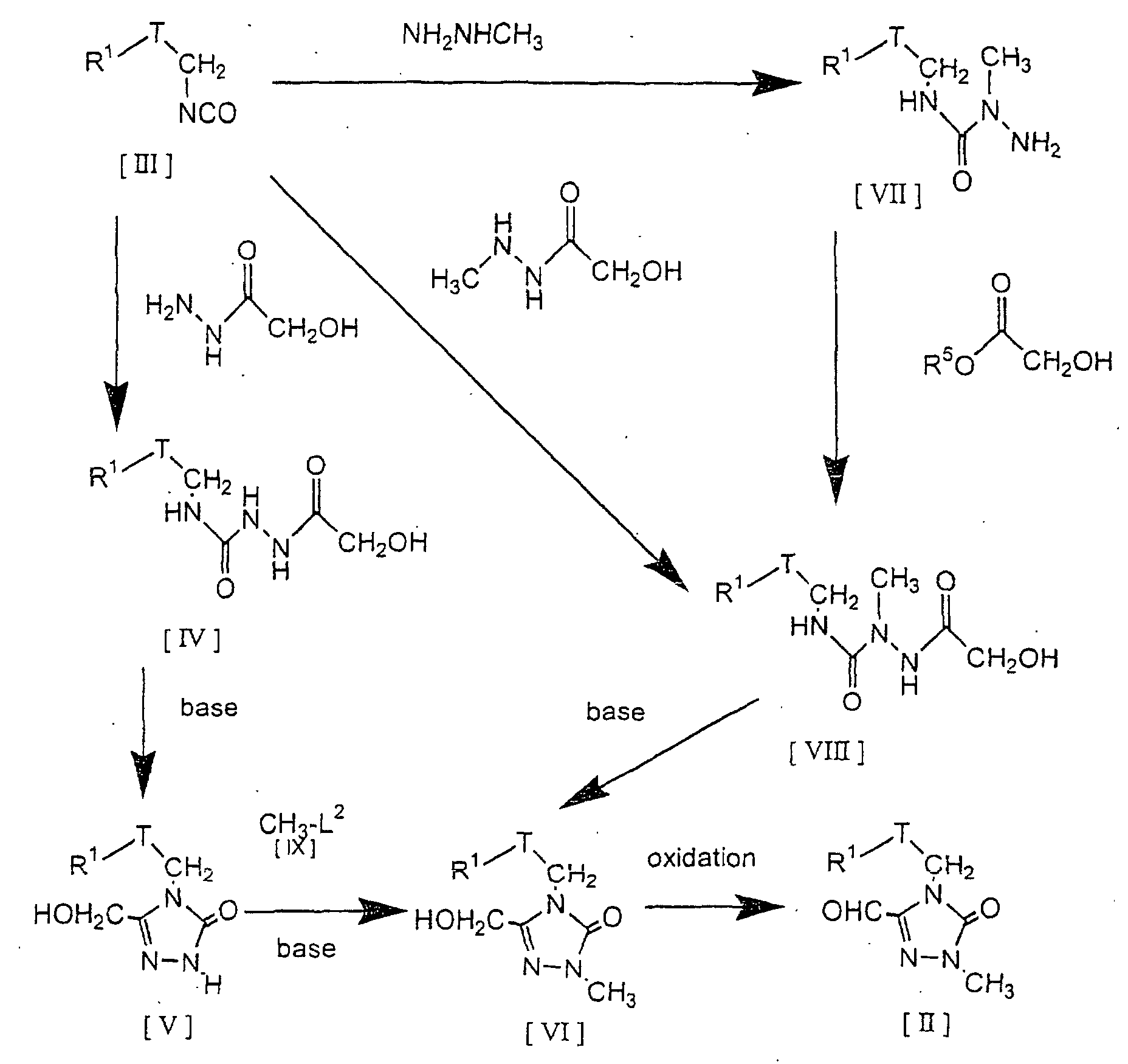
- A semicarbazide compound of the formula [VII] can be produced by reacting an isocyanate compound of the formula [III] with methylhydrazine. The reaction temperature of the reaction is usually in the range from -20°C to 50°C, and the reaction time is usually in the range from 1 to 100 hours. The ratio of methylhydrazine used for this reaction is usually 1 to 10 mol per mol of the isocyanate compound of the formula [III]. The reaction is usually conducted in a solvent, and as the solvent used, for example, ethers such as 1,4-dioxane, tetrehydrofuran, diethyl ether and the like, halogenated hydrocarbons such as chloroform, chlorobenzene and the like, aliphatic hydrocarbons such as hexane, petroleum ether and the like, aromatic hydrocarbons such as toluene, xylene and the like, amides such as N,N-dimethylformamide and the like, dimethylsulfoxide and the like, and mixtures thereof are listed. The reaction solution after completion of the reaction is subjected to post treatments such as concentration, and the like, giving isolation of the intended compound. This intended compound can also be purified by re-crystallization, chromatography and the like. A semicarbazide compound of the formula [VIII] can be produced by reacting the isocyanate compound of the formula [III] with 1-methyl-2-hydroxyacetylhydrazine in the same manner as described above. A semicarbazide compound of the formula [IV] can also be produced by reacting the isocyanate compound of the formula [III] with hydroxyacetylhydrazine in the same manner as described above.
- A compound of the formula [V] can be obtained by reacting the semicarbazide compound of the formula [IV] with a base, and for example, can be obtained by treating the compound of the formula [V] with an aqueous potassium hydroxide solution.
- A compound of the formula [VI] can be obtained by reacting the semicarbazide compound of the formula [VIII] with a base, and for example, can be obtained by treating the compound of the formula [VI] with an aqueous potassium hydroxide solution.
- A compound of the formula [VI] can be obtained by reacting the compound of the formula [V] with a base, and as the base used, for example, potassium carbonate is mentioned.
- The compound of the formula [II] can be obtained by oxidizing the compound of the formula [VI], and as the oxidizing agent used, for example, manganese dioxide is mentioned.
- The isocyanate compound of the formula [III] can be produced, for example, according to the following scheme-.wherein, R1, L2 and T have the same meanings as described above, R6 represents a C1-C4 alkyl (for example, methyl, ethyl and the like), M1 represents silver or sodium, DIBAL represents diisobutyl aluminum hydride, BuLi represents butyllithium and DMF represents N,N-dimethylformamide.

- The reaction of reacting an amine compound of the formula [XVI] with triphosgene, diphosgene or phosgene to obtain the isocyanate compound of the formula [III] can be conducted, for example, by a method described in J. Org. Chem. 61, 3883-3884 (1996) or by a method described in Intermediate Production Example 3 described later.
- The reaction of reducing a nitrile compound of the formula [XV] to obtain the amine compound of the formula [XVI] can be conducted, for example, by a method of reduction using aluminum lithium hydride (LiAlH4), by a method of hydrogenating the nitrile compound of the formula [XV] in the presence of a catalyst, and by the like manner; as the catalyst used in hydrogenation, for example, Raney nickel, palladium and the like are listed. Regarding the method of using Raney nickel, JP-A No. 8-291116 can be refered, and regarding the method of using pallaridum, J. Am. Chem. Soc., 50, 3370 (1928) can be refered, respectively.
- The reaction of obtaining a compound of the formula [XIII] wherein L2 represents a p-toluenesulfonyloxy, methanesulfonyloxy or trifluoromethanesulfonyloxy from an alcohol compound of the formula [XII] can be conducted, for example, according to a method described in Intermediate Production Example 12 described later.
- The reaction of obtaining a compound of the formula [XIII] wherein L2 represents a chlorine atom from the alcohol compound of the formula [XII] can be conducted, for example, by a method of reacting CCl4-PPh3 to the alcohol compound of the formula [XII] (specifically, method described in Intermediate Production Example 9 described later), by a method of reacting conc. Hydrochloric acid to the alcohol compound of the formula [XII] (see, Org. Synth., IV, 576 (1967)), and by the like manner. The similar methods are applicable to the compound which L2 is bromine atom or iodine atom.
- The reaction of obtaining an amine compound of the formula [XVI] from a compound of the formula [XIII] can be conducted, for example, according to a method described in J. Org. Chem., 58, 270 (1993).
- Other methods in the above-mentioned scheme can be conducted by ordinary methods.
- An alcohol compound of the formula [XII] wherein T is the formula:can also be produced from a benzyl chloride compound of the formula [XVII] according to the following chemical reaction formula:
 wherein, R10 represents a substituent inactive in Grignard reaction among substituents defined for R1.
- This reaction is conducted in a solvent, and as the solvent used, ethers such as diethyl ether, tetrahydrofuran, diglyme, triglyme and the like, and mixed solvents of these ethers with aromatic hydrocarbons such as toluene, xylene and the like. If necessary, for example, J. Am. Chem. Soc., 73, 3237 (1951) can be refered.
- Among the compounds of the formula [XIII], 2-methyl-5-phenylbenzyl chloride of the formula [XIII-1] can also be produced according to the following scheme.wherein, L2 has the same meaning as described above, and R11 represents a C1-C4 alkyl group (for example, methyl, ethyl and the like) or vinyl.
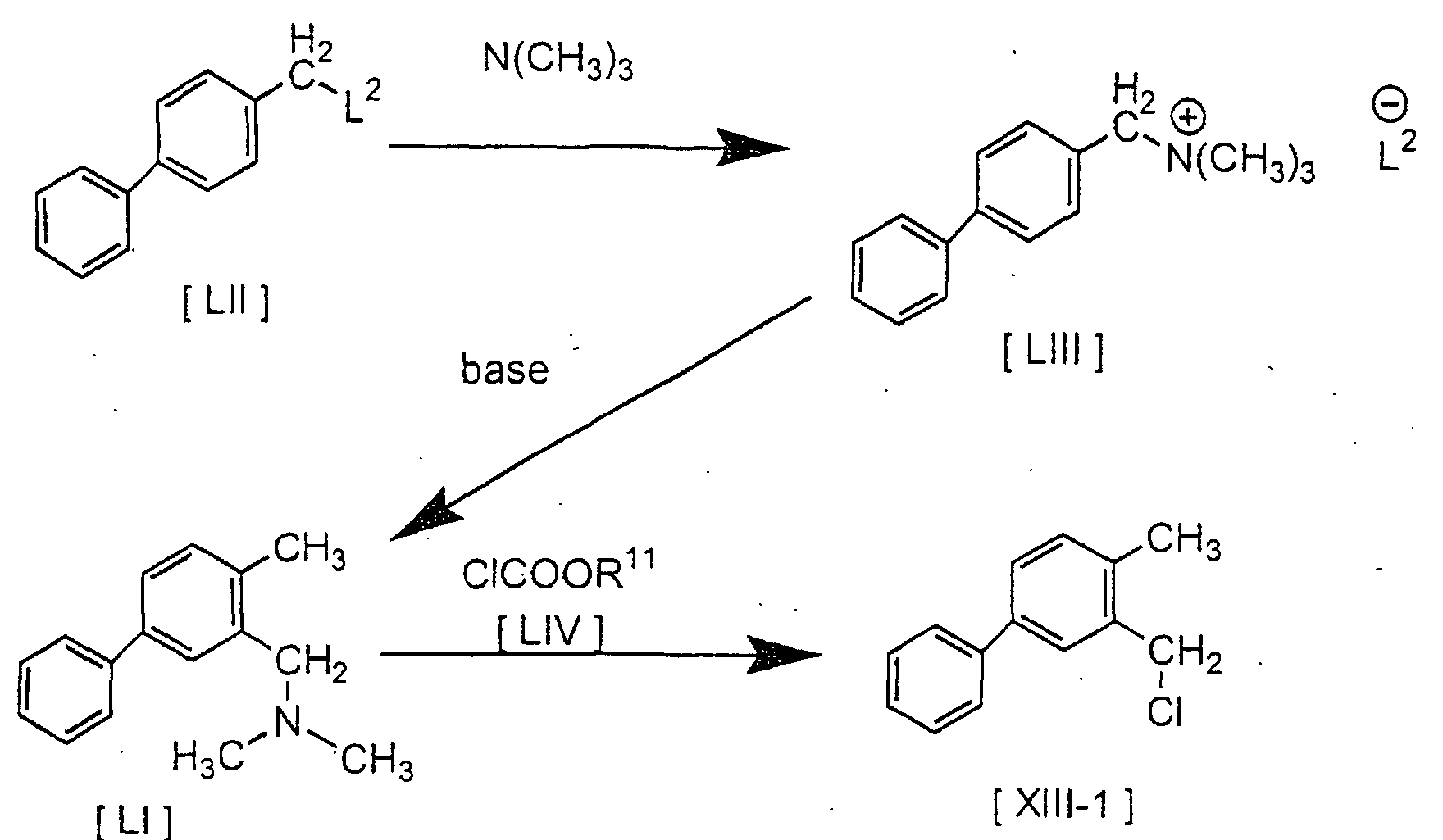
- The reaction of obtaining a compound of the formula [LIII] from a compound of the formula [LII] can be conducted, for example, according to a method described in Tetrahedron, 50, 13697 (1994).
- The reaction of obtaining N,N-dimethyl-(2-methyl-5-phenylbenzyl)amine of the formula [LI] from a compound of the formula [LIII] (Sommelet-Hauser rearrangement) can be conducted, for example, according to a method described in Organic Reactions, 18, 403-464 (1970). As the base used for this reaction, sodium hydride, potassium hydride, sodiumamide, potassiumamide, phenyllithium, butyllithium and the like are listed.
- The reaction of obtaining 2-methyl-5-phenylbenzyl chloride of the formula [XIII-1] from N, N-dimethyl- (2-methyl-5-phenyl)benzylamine can be conducted, for example, according to a method described in Tetrahedron Lett., 24, 3233 (1983).
- The compound of the invention of the formula [I] can be produced from a triazolone compound of the formula [XIX] according to the following chemical reaction formula.wherein, R1, L2 and T have the same meanings as described above.
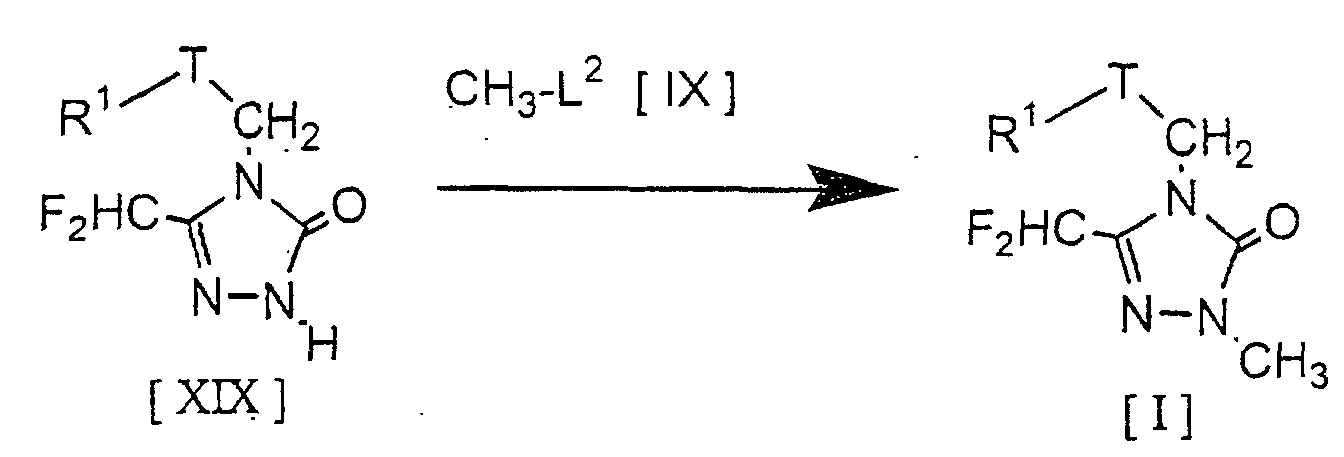
- The reaction is conducted usually in the presence of a base, and as the base used, for example, inorganic bases such as sodium hydride, sodium hydroxide, potassium hydroxide, sodium carbonate, potassium carbonate, and the like are listed.
- The reaction temperature of the reaction of obtaining the compound of the invention of the formula [I] from a triazolone compound of the formula [XIX] is usually in the range from -20 °C to 100°C, and the reaction time is usually in the range from 1 to 100 hours.
- Regarding the amounts of reagents used for the reaction, the ratio of a methylating agent of the formula [IX] is 1 to 5 mol and the ratio of the base is 1 to 10 mol, per mol of the triazolone compound of the formula [XIX].
- The reaction is conducted in a solvent if necessary, and as the solvent used, for example, ethers such as 1, 4-dioxane, tetrehydrofuran, ethylene glycol dimethyl ether, diethylene glycol dimethyl ether, t-butyl methyl ether and the like, aliphatic hydrocarbons such as hexane, heptane, ligroin, petroleum ether and the like, aromatic hydrocarbons such as toluene, xylene and the like, organic bases such as pyridine, triethylamine, N-methylaniline, N,N-dimethylaniline, N,N-diethylaniline and the like, nitriles such as acetonitrile, isobutylonitrile and the like, N,N-dimethylformamide, dimethyl sulfoxide, water and the like, and mixtures thereof are listed. These solvents are selected depending on the kind of a base used.
- The reaction solution after completion of the reaction is subjected to usual post treatments such as extraction with an organic solvent, concentration and the like, giving isolation of the intended compound. This intended compound can also be purified by re-crystallization, chromatography and the like.
- The triazolone compound of the formula [XIX] can be produced, for example, according to the following scheme.wherein, R1, L2 and T have the same meanings as described above, and M2 represents sodium or potassium.

- An isothiocyanate compound of the formula [XXI] can be produced by reacting a compound of the formula [XIII] with a compound of the formula [XX]. A thiosemicarbazide compound of the formula [XXII] can be produced by reacting the isothiocyanate compound of the formula [XXI] with hydrazine (anhydrous hydrazine or water-containing hydrazine). A triazolinethion compound of the formula [XXIII] can be produced by reacting the thiosemicarbazide compound of the formula [XXII] with difluoroacetic acid. A sulfonic acid compound of the formula [XXIV] can be produced by oxidizing the triazolinethion compound of the formula [XXIII] using an oxidizing agent (for example, hydrogen peroxide). The triazolone compound of the formula [XIX] can be produced by hydrolyzing the sulfonic acid compound of the formula [XXIV] using an acid (for example, hydrochloric acid). In conducting processes starting from a thiosemicarbazide compound of the formula [XXII] to a triazolone compound of the formula [XIX], for example, JP-A No. 7-196630 can be referred.
- The reaction solution after completion of the reaction is subjected to usual post treatments such as extraction with an organic solvent, concentration and the like, giving isolation of the intended compound. This intended compound can also be purified by re-crystallization, chromatography and the like.
- The compound of the invention of the formula [I] can be produced from a semicarbazide compound of the formula [VII], for example, according to the following chemical reaction formula.wherein, R1 and T have the same meanings as described above.

- The reaction temperature of the above-mentioned reaction of obtaining the compound of the invention of the formula [I] from a semicarbazide compound of the formula [VII] is usually in the range from -20°C to 100°C, and the reaction time is usually in the range from 1 to 100 hours.
- Regarding the amounts of reagents used for the reaction, the ratio of a difluoroacetic anhydride is usually 1 to 5 mol per mol of the semicarbazide compound of the formula [VII].
- The reaction is usually conducted in a solvent, and as the solvent used, for example, aromatic hydrocarbons such as toluene, xylene and the like, ethers such as 1,4-dioxane, tetrehydrofuran, diethyl ether and the like, aliphatic hydrocarbons such as hexane, petroleum ether and the like, and mixtures thereof are listed.
- In this reaction, a difluoroacetyl semicarbazide compound of the formula [XXVI] described later is formed as a by-product in some cases, however, it can be separated off by purifying the intended compound by chromatography and the like. The separated difluoroacetyl semicarbazide compound of the formula [XXVI] can be utilized as a starting material for Production Method F described later.
- The reaction solution after completion of the reaction can be, for example after decomposition of excess difluoroacetic anhydride by a base such as an aqueous sodium hydroxide solution and the like, subjected to post treatment operations such as extraction with an organic solvent, concentration and the like, giving isolation of the intended compound. This intended compound can also be purified by re-crystallization, chromatography and the like.
- The compound of the invention of the formula [I] can be produced from the semicarbazide compound of the formula [VII], for example, according to the following chemical reaction formula.wherein, R1 and T have the same meanings as described above, and R7 represents a C1-C4 alkyl (for example, methyl, ethyl and the like).

- The reaction temperature of the above-mentioned reaction of obtaining the compound of the invention of the formula [I] from the semicarbazide compound of the formula [VII] is usually in the range from -20°C to 100°C, and the reaction time is usually in the range from 1 to 100 hours.
- Regarding the amounts of reagents used for the reaction, the ratio of a compound of the formula [XXV] is usually 1 to 100 mol per mol of the semicarbazide compound of the formula [VII].
- The reaction is conducted in the presence of a base, and as the base used, for example, metal alkoxides such as sodium methoxide, sodium ethoxide, potassium t-butoxide and the like, alkali metal hydroxides such as sodium hydroxide, potassium hydroxide and the like, alkaline earth metal hydroxides such as calcium hydroxide, magnesium hydroxide and the like, and organic bases such as triethylamine, pyridine and the like are listed, and the ratio of a base is usually 0.1 to 3 mol per mol of the semicarbazide compound of the formula [VII]
- The reaction is conducted in a solvent if necessary, and as the solvent used, for example, alcohols such as methanol, ethanol and the like, ethers such as 1,4-dioxane, tetrehydrofuran, diethyl ether and the like, aliphatic hydrocarbons such as hexane, petroleum ether and the like, aromatic hydrocarbons such as toluene, xylene and the like, amides such as N,N-dimethylformamide and the like, dimethylsulfoxide and the like, and mixtures thereof are listed.
- In this reaction, a difluoroacetyl semicarbazide compound of the formula [XXVI] described later is formed as a by-product in some cases, however, it can be separated off by purifying the intended compound by chromatography and the like. The separated difluoroacetyl semicarbazide compound of the formula [XXVI] can be utilized as a starting material for Production Method F described later.
- The reaction solution after completion of the reaction can be, after neutralization or concentration if necessary, subjected to post treatment operations such as extraction with an organic solvent, concentration and the like, giving isolation of the intended compound. This intended compound can also be purified by re-crystallization, chromatography and the like.
- The compound of the invention of the formula [I] can be produced from a semicarbazide compound of the formula [VII], for example, according to the following chemical reaction formula.wherein, R1 and T have the same meanings as described above.
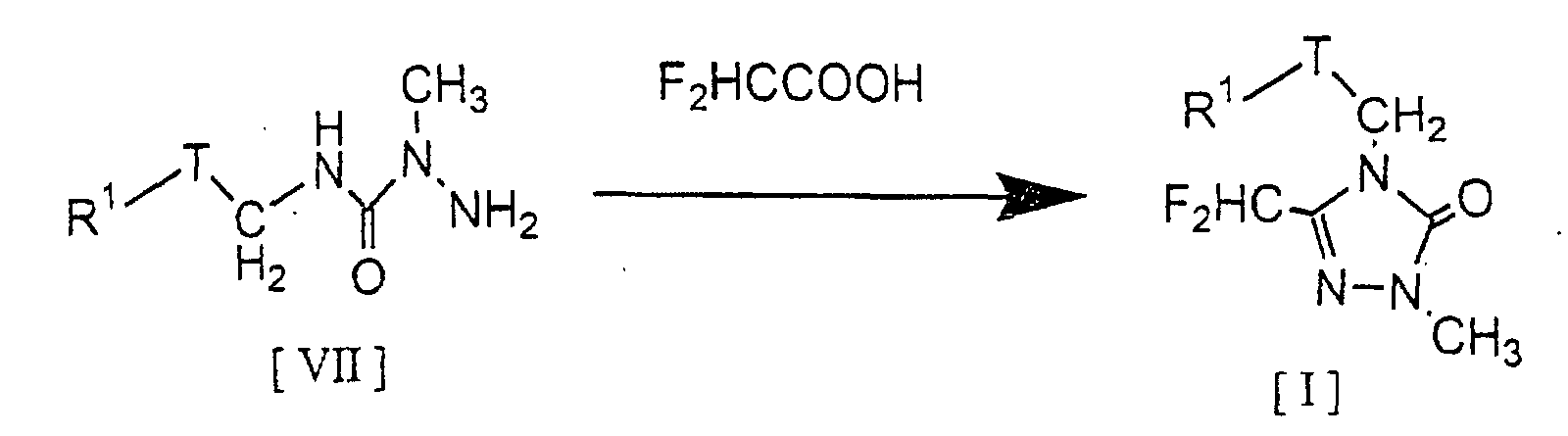
- The reaction temperature of the above-mentioned reaction of obtaining the compound of the invention of the formula [I] from the semicarbazide compound of the formula [VII] is usually in the range from 20°C to 100°C, and the reaction time is usually in the range from 1 to 100 hours.
- Regarding the amounts of reagents used for the reaction, the ratio of difluoroacetic acid is usually 1 to 100 mol per mol of the semicarbazide compound of the formula [VII].
- The reaction is conducted in a solvent if necessary, and as the solvent used, for example, aromatic hydrocarbons such as toluene, xylene and the like, aliphatic hydrocarbons such as hexane, petroleum ether and the like, ethers such as 1, 4-dioxane, tetrahydrofuran and the like, and mixtures thereof are listed.
- In this reaction, the difluoroacetyl semicarbazide compound of the formula [XXVI] described later is formed as a by-product in some cases, however, it can be separated off by purifying the intended compound by chromatography and the like. The separated difluoroacetyl semicarbazide compound of the formula [XXVI] can be utilized as a starting material for Production Method F described later.
- The reaction solution after completion of the reaction can be, after neutralization or concentration if necessary, subjected to post treatment operations such as extraction with an organic solvent, concentration and the like, giving isolation of the intended compound. This intended compound can also be purified by re-crystallization, chromatography and the like.
- The compound of the invention of the formula [I] can be produced from the difluoroacetyl semicarbazide compound of the formula [XXVI], for example, according to the following chemical reaction formula.wherein, R1 and T have the same meanings as described above.

- The reaction temperature of the reaction of obtaining the compound of the invention of the formula [I] from the difluoroacetyl semicarbazide compound of the formula [XXVI] is usually in the range from 20°C to 100°C, and the reaction time is usually in the range from 10 minutes to 10 hours.
- The reaction is conducted in the presence of a base or acid, and as the base used, for example, metal alkoxides such as sodium methoxide, sodium ethoxide, potassium t-butoxide and the like, alkali metal hydroxides such as sodium hydroxide, potassium hydroxide and the like, alkaline earth metal hydroxides such as calcium hydroxide, magnesium hydroxide and the like, and organic bases such as triethylamine, pyridine and the like are listed. The ratio of the base used is usually 0.1 to 10 mol per mol of a difluoroacetyl semicarbazide compound of the formula [XXVI]. As the acid used, for example, organic acids such as difluoroacetic acid, trifluoroacetic acid and the like are listed, and the ratio of the acid used is usually 1 to 100 mol per mol of the difluoroacetyl semicarbazide compound of the formula [XXVI].
- The reaction is conducted in a solvent if necessary, and as the solvent used, for example, alcohols such as methanol, ethanol and the like, ethers such as 1,4-dioxane, tetrahydrofuran, diethyl ether and the like, aliphatic hydrocarbons such as hexane, petroleum ether and the like, aromatic hydrocarbons such as toluene, xylene and the like, amides such as N,N-dimethylformamide and the like, sulfoxides such as dimethyl sulfoxide and the like, water and mixtures thereof are listed. These solvents are selected and used depending on the kinds of an acid and base used.
- The reaction solution after completion of the reaction can be, after neutralization or concentration if necessary, subjected to post treatment operations such as extraction with an organic solvent, concentration and the like, giving isolation of the intended compound. This intended compound can also be purified by re-crystallization, chromatography and the like.
- The difluoroacetyl semicarbazide compound of the formula [XXVI] can also be obtained as a by-product in Production Methods C, D and E, however, can be produced, for example, according to the following scheme.wherein, R1 and T have the same meanings as described above.

- The reaction temperature in obtaining the difluoroacetyl semicarbazide compound of the formula [XXVI] from the isocyanate compound of the formula [III] is usually in the range from 0 °C to 100°C, and the reaction time is usually in the range from 1 to 10 hours.
- The ratio of N'-methyl-difluoroacetohydrazide used for the reaction is usually 1 to 10 mol per mol of the isocyanate compound of the formula [III].
- The reaction is conducted in a solvent if necessary, and as the solvent used, for example, alcohols such as methanol, ethanol and the like, ethers such as 1,4-dioxane, tetrahydrofuran, diethyl ether and the like, halogenated hydrocarbons such as chloroform, chlorobenzene and the like, aliphatic hydrocarbons such as hexane, petroleum ether and the like, aromatic hydrocarbons such as toluene, xylene and the like, amides such as N,N-dimethylformamide and the like, dimethyl sulfoxide and the like, and mixtures thereof are listed.
- The reaction solution after completion of the reaction is subjected, after concentration, to post treatment operations such as extraction with an organic solvent, concentration and the like, giving isolation of the intended compound. This intended compound can also be purified by re-crystallization, chromatography and the like.
- The compound of the invention of the formula [I] can be produced from a compound of the formula [XIII] and a triazolone compound of the formula [L], for example, according to the following chemical reaction formula.wherein, R1, L2 and T have the same meanings as described above.

- The reaction is conducted in the presence of a base, and as the base used, inorganic bases such as lithium hydroxide, lithium hydride, sodium hydroxide, sodium hydride, potassium hydroxide, potassium hydride, sodium carbonate, potassium carbonate, and the like are listed. The reaction temperature is usually in the range from 0°C to 100°C, and the reaction time is usually in the range from 1 to 100 hours.
- Regarding the amounts of reagents used for the reaction, the ratio of the triazolone compound of the formula [L] is usually 1 to 5 mol and the ratio of a base is usually from 1 to 10 mol per mol of the compound of the formula [XIII].
- The reaction is conducted in a solvent if necessary, and as the solvent used, for example, alcohols such as methanol, ethanol and the like, ethers such as 1, 4-dioxane, ethylene glycol dimethyl ether, diethylene glycol dimethyl ether and the like, aromatic hydrocarbons such as toluene, xylene and the like, organic bases such as pyridine, triethylamine, N-methylaniline, N,N-dimethylaniline, N,N-diethylaniline and the like, nitriles such as acetonitrile, isobutylonitrile and the like, N,N-dimethylformamide, dimethyl sulfoxide, water and the like, and mixtures thereof are listed. These solvents are selected depending on the kinds of a base used.
- The reaction solution after completion of the reaction is subjected to post treatment operations such as extraction with an organic solvent, concentration and the like, giving isolation of the intended compound. This intended compound can also be purified by re-crystallization, chromatography and the like.
- The triazoline compound of the formula [L] can be produced, for example, according to the following chemical reaction formula.
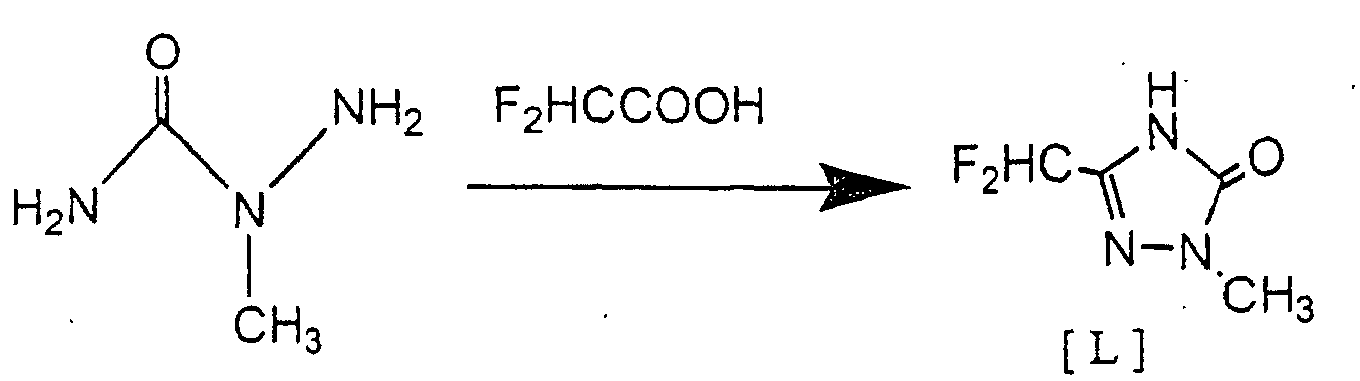
- The reaction temperature in obtaining the triazolone compound of the formula [L] from 2-methyl semicarbazide is usually in the range from 50°C to 150°C, and the reaction time is usually in the range from 1 to 100 hours.
- The ratio of difluoroacetic acid used for the reaction is usually 1 to 100 mol per mol of 2-methyl semicarbazide.
- The reaction is conducted in a solvent if necessary, and as the solvent used, for example, aromatic hydrocarbons such as toluene, xylene and the like, aliphatic hydrocarbons such as hexane, petroleum ether and the like, ethers such as 1,4-dioxane, tetrahydrofuran and the like, and mixtures thereof are listed.
- In this reaction, 1-difluoroacetyl-2-methyl semicarbazide is formed as a by-product in some cases, however, it can be separated off by purification by chromatography and the like.
- The reaction solution after completion of the reaction can be, after neutralization or concentration if necessary, subjected to post treatment operations such as extraction with an organic solvent, concentration and the like, giving isolation of the intended compound. This intended compound can also be purified by re-crystallization, chromatography and the like.
- The triazolone compound of the formula [L] can be shown as tautomers described below.

- 2-methyl semicarbazide can be produced, for example, according to the following chemical reaction formula.wherein, M3 represents sodium or potassium.
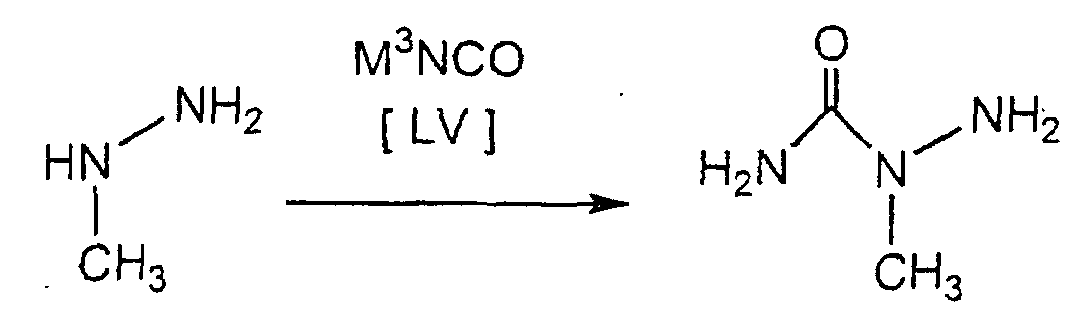
- This reaction is conducted usually in an acidic aqueous solution (for example, hydrochloric acid).
- Trimethylsilyl isocyanate of the above-mentioned formula in which M3 represents a trimethylsilyl is reacted with methylhydrazine, then, the reaction product is reacted with methanol. Thus, 2-methyl semicarbazide can be produced.
- Production can be effected by the following methods (H-1) to (H-6).
- wherein, R8 represents phenyl, naphthyl or heterocyclic group, and the phenyl, naphthyl or heterocyclic group may optionally be each substituted by one or more substituents selected from the group consisting of halogen atoms, cyano, nitro, C1-C10 alkyl, C1-C10 haloalkyls C3-C10 cycloalkyl, C1-C10 alkoxy, C1-C10 haloalkoxy, C1-C10 alkylthio, C1-C10 haloalkylthio, (C1-C9 alkyl) carbonyl, (C1-C9 alkoxy) carbonyl, (C1-C9 alkyl) carbonylamino, phenyl, phenoxy, benzyloxy, C3-C20 trialkylsilyl, methylenedioxy and difluoromethylenedioxy; X and Z are the same or different and represent a chlorine atom, bromine atom, iodine atom or trifluoromethanesulfonyloxy; and T has the same meaning as described above.
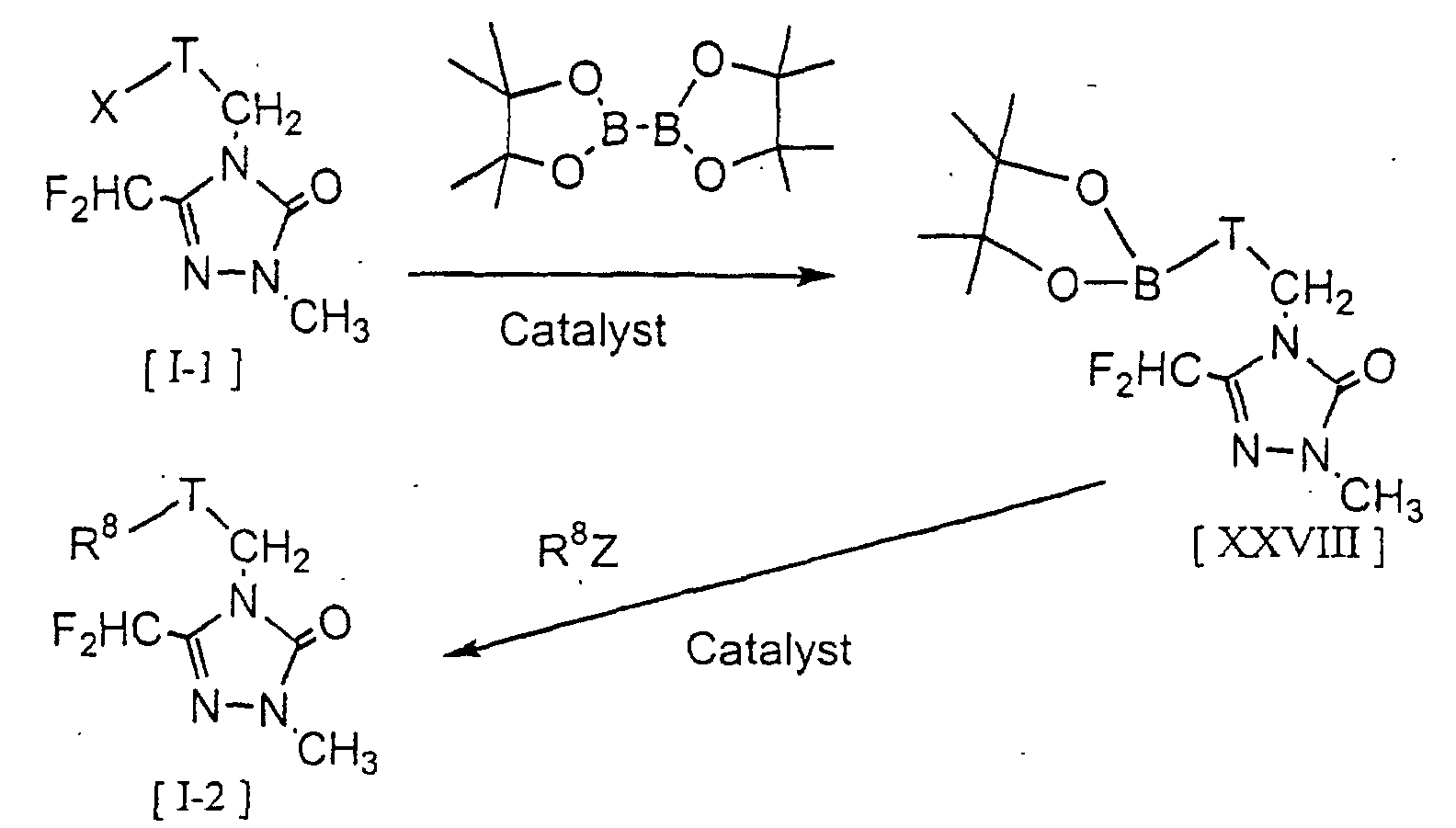
- A borate compound of the formula [XXVIII] can be produced by reacting a compound of the formula [I-1] with bis(pinacolate)diboron in an organic solvent (for example, dimethyl sulfoxide, dimethylformamide) in the presence of a base (for example, potassium acetate, potassium carbonate) and a palladium catalyst (for example, dichloromethane complex of [bis(diphenylphosphino)ferrocene]dichloropalladium (II), tetrakistriphenylphosphinepalladium).
- The reaction solution after completion of the reaction can be added to water, then, subjected to post treatments such as extraction with an organic solvent, concentration and the like, giving isolation of the intended compound. This intended compound can also be purified by chromatography and the like.
- In this reaction, J. Org. Chem., 60, 7508-7510 (1995) can be refered, if necessary.
- The compound of the invention of the formula [I-2] can be produced by reacting the borate compound of the formula [XXVIII] with a compound of the general formula R8Z in an organic solvent (for example, dimethoxyethane) in the presence of a base (for example, potassium phosphate, potassium carbonate) and a palladium catalyst (for example, dichloromethane complex of [bis(diphenylphosphino)ferrocene]dichloropalladium (II), palladium acetate (II), tetrakistriphenylphosphinepalladium, mixtures thereof).
- A solvent in the reaction solution after completion of the reaction is distilled off, for example, then, the residue is subjected to chromatography, or the reaction solution after completion of the reaction is subjected to post treatments such as extraction with an organic solvent, concentration and the like. Thus the intended compound can be obtained. This intended compound can also be purified by re-crystallization, chromatography and the like.
- In this reaction, Tetrahedron Lett., 38, 7645-7648 (1997) can be refered, if necessary.
- wherein, A3-C≡C represents a C2-C10 alkynyl optionally substituted having a triple bond at the end. This alkynyl may optionally be substituted by one or more substituents selected from the group consisting of halogen atoms, cyano, nitro, C1-C10 alkoxy, C1-C10 haloalkoxy, C1-C10 alkylthio, C1-C10haloalkylthio, (C1-C9 alkyl) carbonyl, (C1-C9 alkoxy) carbonyl, (C1-C9 alkyl) carbonylamino, phenyl, phenoxy, benzyloxy and C3-C20 trialkylsilyl; and T and X are the same as described above.

- The reaction of obtaining a compound of the invention of the formula [I-3] from a compound of the formula [I-1] can be conducted, for example, in an aprotic polar solvent (for example, acetonitrile, N,N-dimethylformamide) in the presence of abase (for example, secondary amine such as diisopropylamine and the like, tertiary amine such as triethylamine and the like) and a catalyst (for example, combination of triphenylphosphine, copper iodide (I) and palladium catalyst such as bis(triphenylphosphine)dichloropalladium {PdCl2(PPh3)2} and the like). If necessary, WO98/03464, Example 1, Tetrahedron Lett., 16, 4467-4470 (1975), Synthesis, 1980, 627-630, or J. Org. Chem., 64, 2070-2079 (1999) can be referred.
- The reaction solution after completion of the reaction can be subjected to post treatment operations such as extraction with an organic solvent, concentration and the like, to obtain the intended compound. This intended compound can also be purified by re-crystallization, chromatography and the like.
- wherein, R8, T and X are the same as described above.
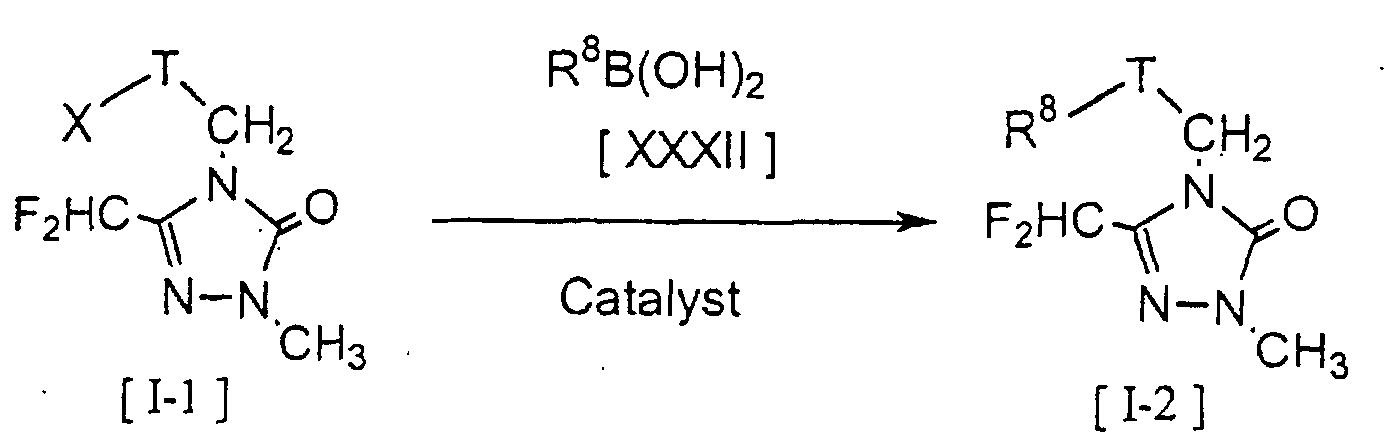
- The reaction of obtaining the compound of the invention of the formula [I-2] from a compound of the formula [I-1] can be conducted, for example, in a mixed solvent of water and diethoxyethane in the presence of a base (for example, inorganic base such as sodium bicarbonate) and a catalyst (for example, tetrakis(triphenyl)phosphinepalladium {Pd(PPh3)4}) (If necessary, see description in WO96/35669, Beispiel 2), or in a solvent in the presence of tetrabutylammonium bromide, base (for example, inorganic base such as potassium carbonate) and catalyst (for example, palladium acetate). The reaction solution after completion of the reaction can be subjected to post treatment operations such as extraction with an organic solvent, concentration and the like, to obtain the intended compound. This intended compound can also be purified by re-crystallization, chromatography and the like. If necessary, J. Org. Chem., 62, 7170-7173 (1997) can be referred, for example.
- wherein, X and T have the same meanings as described above, and A4 represents a phenyl, naphthyl or heterocyclic group, and the phenyl, naphthyl or heterocyclic group may optionally each be substituted by one or more substituents selected from the group consisting of halogen atoms, cyano, nitro, C1-C10alkyl, C1-C10 haloalkyl, C3-C10 cycloalkyl, C1-C10 alkoxy, C1-C10 haloalkoxy, C1-C10 alkylthio, C1-C10 haloalkylthio, (C1-C9 alkyl) carbonyl, (C1-C9 alkoxy) carbonyl, (C1-C9 alkyl) carbonylamino, phenyl, phenoxy, benzyloxy, C3-C20 trialkylsilyl, methylenedioxy and difluoromethylenedioxy.
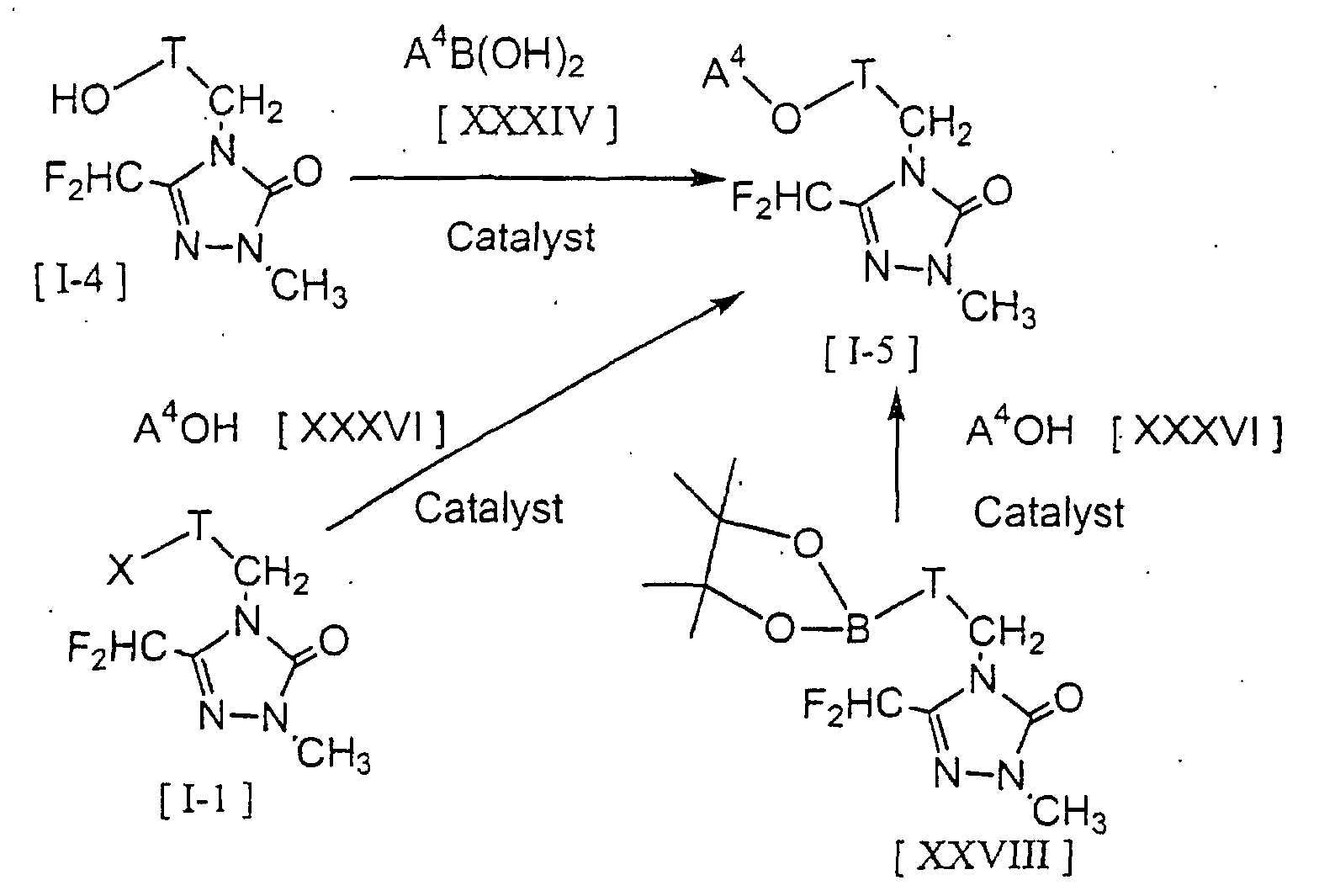
- The reaction of obtaining a compound of the invention of the formula [I-5] from a compound of the formula [I-4] can be conducted in an organic solvent (for example, methylene chloride) in the presence of a base (for example, organic base such as triethylamine and the like, inorganic base such as sodium bicarbonate and the like) and a catalyst (for example, copper acetate (II)). If necessary, Tetrahedron Lett., 39, 2937-2940 (1998) can be refered.
- The reaction of obtaining a compound of the invention of the formula [I-5] from a compound of the formula [I-1] can be conducted in an organic solvent (for example, toluene, ethyl acetate) in the presence of a base (for example, organic base such as triethylamine and the like, inorganic base such as potassium carbonate, cesium carbonate and the like) and a catalyst (for example, copper iodide (I)). The reaction solution after completion of the reaction can be subjected to post treatment operations such as extraction with an organic solvent, concentration and the like, to obtain the intended compound. This intended compound can also be purified by re-crystallization, chromatography and the like.
- In this reaction, if necessary, descriptions in J. Amer. Chem. Soc., 119, 10539-10540 (1997), J. Amer. Chem. Soc., 121, 3224-3225 (1999) and J. Amer. Chem. Soc., 121, 4369-4378 (1999) can be refered.
- The reaction of obtaining a compound of the invention of the formula [I-5] from a compound of the formula [XXVIII] can be conducted in an organic solvent (for example, methylene chloride) in the presence of a base (for example, organic base such as triethylamine and the like, inorganic base such as sodium bicarbonate and the like) and a catalyst (for example, copper acetate(II)). If necessary, descriptions in Tetrahedron Lett., 39, 2937-2940 (1998) can be referred.
- wherein, A5 represents a group other than a hydrogen atom among represented-by A1, and L2, A2 and T have the same meanings as described above.

- Compounds of the formula [I-7] in which A2 is a methyl can be produced from a compound of the formula [I-6] according to a method described in J. Org. Chem., 57, 1481-1486 (1992). Other compounds can also be produced by ordinary methods according to the above-mentioned scheme.
- wherein, A1, A2, L2 and T have the same meanings as described above.
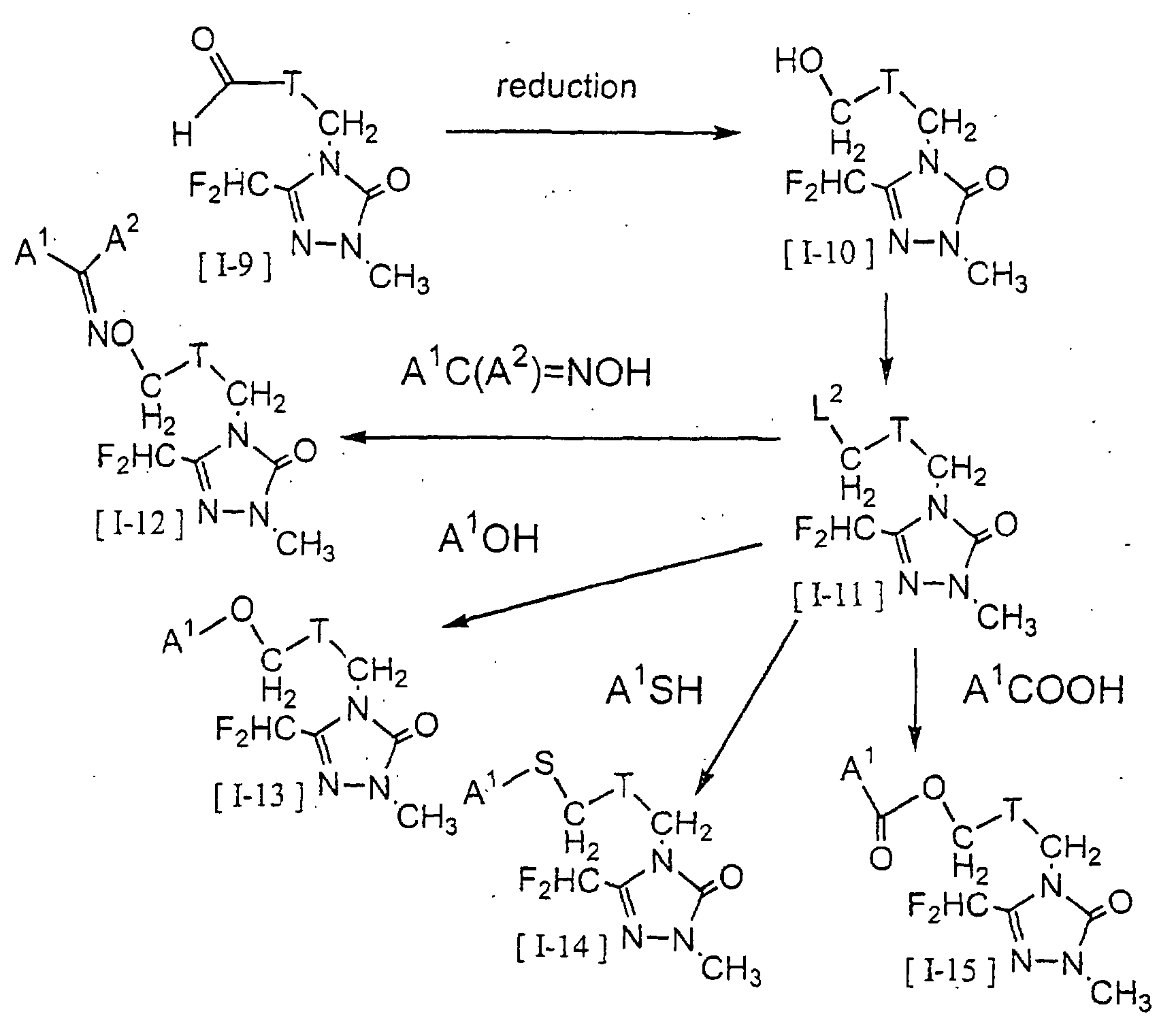
- Each process in the above-mentioned scheme can be conducted according to an ordinary method.
- When the compound of the invention is used as an active ingredient of a fungicidal composition, it may be used itself without adding any other components, however, it is usually mixed with solid carriers, liquid carriers, surfactants and other adjuvants, to prepare emulsifiable concentrates, wettable powders, water dispersible granules, emulsion formulation, flowables, dust formulation, granules and the like, to be used. These formulations contain the compound of the invention as an active ingredient in an amount of usually from 0.1 to 90 wt%.
- The solid carrier to be used in the formulation may include, for example, the following materials in fine powder or granule form: mineral materials (e.g., kaolinite clay, attapulgite clay, bentonite clay, montmorillonite clay, acid clay, pyrophyllite, talc, diatomaceous earth, calcite), natural organic materials (e.g., stalks of corn, powder of wallnut-shell), synthetic organic materials (e.g., urea), salts (e.g., calcium carbonate, ammonium sulfate) and synthetic inorganic materials (e.g., synthetic hydrated silicon oxide). The liquid carrier may include, for example, aromatic hydrocarbons (e.g., xylene, alkylbenzene, methylnaphthalene), alcohols (e.g., isopropyl alcohol, ethylene glycol, propylene glycol, ethylene glycol mono-ethyl ether), ketones (e.g., acetone, cyclohexanone, isophorone), vegetable oils (e.g., soybean oil, cotton seed oil), petroleum aliphatic hydrocarbons, esters, dimethyl sulufoxide, acetonitrile and water. The surfactant may include, for example, anionic surfactants (e.g., alkylsulfate ester salts, alkyl(aryl)sulfonic acid salts, dialkylsulfosuccinic acid salts, phosphate salts of polyoxyethylenealkyl aryl ether, lignin sulfonic acid salts, naphthalenesulfonic acid formaldehyde condensations), nonionic surfactants (e.g., polyoxyethylene alkyl aryl ethers, polyoxyethylene propylene block copolymer, sorbitan fatty acid esters). The other adjuvants may include, for example, water-soluble polymers (e.g., polyvinyl alcohol, polyvinylpyrrolidone), polysaccharides (e.g., gum arabic, alginic acid and their salts, CMC (carboxy methyl cellulose), xanthan gum), inorganic materials (aluminum magnesium silicate, alumina sol), preservatives, coloringagents, PAP (isopropyl acid phosphate), BHT.
- The method of the application of the compound of the invention is concretely carried out, for example, by a foliar treatment, by a soil treatment, by a seed treatment and the like, also it is carried out by any method which is usually a person in the art uses.
- When the compound of the invention is applied as the active ingredient of the fungicidal composition, the application amount of the active ingredient; although it may vary with a variety of plants (crops) to be protected, a variety of plant diseases to be controlled, a extent of disease damage, a formulation type, an application type, application times, weather condition and the like; is usually 1 to 5,000 g per hectare, preferably 5 to 1,000 g per hectare. In the case of emulsifiable concentrates, wettable powders, flowables and the like, they are usually applied after diluted with water, usually at a concentration of 0.0001 to 3% by weight, preferably at a concentration of 0.0005 to 1% by weight as active ingredients of the invention. In the case of dust formulations, granules and the like, they are usually applied as it is without diluting.
- The compound of the invention can be used as a agricultural and horticultural antifungal agent in agricultural fields, paddy fields, orchards, tea plantations, grasslands, lawns and the like. Increasing of the antifungal effect may be expected by using the compound of the invention with other agricultural and horticultural antifungal agent(s).
- Example of the other agricultural and horticultural antifungal agents include:
azole antifungal compound such as propiconazole, triadimenol, prochloraz, penconazole, tebuconazole, flusilazole, diniconazole, bromoconazole, epoxyconazole, difenoconazole, cyproconazole, metconazole, triflumizole, tetraconazole, myclobutanil, fenbuconazole, hexaconazole, fluquinconazole, triticonazole, bitertanol, ipconazole, imibenconazole, imazalil, flutriafol and the like; cyclic amine antifungal compound such as fenpropimorph, tridemorph, fenpropidin and the like; benzimidazole antifungal compound such as carbendazim, benomyl, thiabendazole, thiophanate-methyl and the like; ethylen bis(dithiocarbamate) compound such as maneb, zineb, mancozeb and the like; phthalimide compound such as captan, folpet and the like; inorganic copper such as basic copper chloride, basic copper sulfate, copper sulfate, copper hydroxide and the like; organic copper such as copper-oxinate., copper-nonylphenol-sulfonate and the like; procymidone, cyprodinil, pyrimethanil, diethofencarb, thiuram, fluazinam, iprodione, vinclozolin, chlorothalonil, mepanipyrim, fenpiclonil, fludioxonil, dichlofluanid, folpet, kresoxim-methyl, azoxystrobin, trifloxystrobin, picoxystrobin, N-methyl-α-methoxyimino-2-[(2,5-dimethyl-phenoxy)methyl]phenylacetamide, spiroxamine, quinoxyfen, fenhexamid, famoxadone, fenamidone (RP-407213), iprovalicarb, iminoctadine-triacetate, iminoctadine-albesilate, 6-iodo-3-propyl-2-propoxy-4(3H)-quinazolinone, (Z)-N-(α-cyclopropylmethoxyimino-2,3-difluoro-6-(trifluoro methyl)benzyl)-2-phenylacetamide, 2-chloro-N-(4'-chloro--(1,1'-biphenyl)-2-yl)-3-piridinecarboxamide, N-[2-(1,3--dimethylbutyl)-3-thienyl]-2,4-dimethylthiazole-5--carboxamide, N-[2-(1,3-dimethylbutyl)-3-thienyl]-3--trifluoromethyl-l-methylpyrazole-4-carboxamide and the like. - In the case of using the mixture of the compound of the invention and azole antifungal compound, the ratio of the compound of the invention to azole antifungal compound as the active ingredients is not limited to specific ratio; but when the ratio of azole antifungal compound to the compound of the invention by weight is 0.25 to 4, the excellent synergic effect can be achieved. In the case of using the mixture of the compound of the invention and cyclic amine antifungal compound, the ratio of the compound of the invention to cyclic amine antifungal compound as the active ingredients is not limited to specific ratio; but when the ratio of cyclic amine antifungal compound to the compound of the invention by weight is 1 to 8, the excellent synergic effect can be achieved. In the case of using the mixture of the compound of the invention and quinoxyfen, the ratio of the compound of the invention to quinoxyfen as the active ingredients is not limited to specific ratio; but when the ratio of quinoxyfen to the compound of the invention by weight is 0.25 to 2, the excellent synergic effect can be achieved. In the case of using the mixture of the compound of the invention and spiroxamine, the ratio of the compound of the invention to spiroxamine as the active ingredients is not limited to specific ratio; but when the ratio of spiroxamine to the compound of the invention by weight is 1 to 8, the excellent synergic effect can be achieved. In the case of using the mixture of the compound of the invention and ethylen bis (dithiocarbamate) compound, the ratio of the compound of the invention to ethylen bis (dithiocarbamate) compound as the active ingredients is not limited to specific ratio; but when the ratio of ethylen bis (dithiocarbamate) compound to the compound of the invention by weight is 1 to 20, the excellent synergic effect can be achieved. In the case of using the mixture of the compound of the invention and phthalimide compound, the ratio of the compound of the invention to phthalimide compound as the active ingredients is not limited to specific ratio; but when the ratio of phthalimide compound to the compound of the invention by weight is 1 to 20, the excellent synergic effect can be achieved. In the case of using the mixture of the compound of the invention and inorganic copper or organic copper, the ratio of the compound of the invention to inorganic copper or organic copper as the active ingredients is not limited to specific ratio; but when the ratio of inorganic copper or organic copper to the compound of the invention by weight is 1 to 20, the excellent synergic effect can be achieved. In the case of using the mixture of the compound of the invention and 6-iodo-3-propyl-2-propoxy--4(3H)-quinazolinone or (Z)-N-(α-cyclopropylmethoxyimino--2,3-difluoro-6-(trifluoromethyl)benzyl)-2-phenylacetamide, the ratio of the compound of the invention to 6-iodo-3--propyl-2-propoxy-4(3H)-quinazolinone or (Z)-N-(α--cyclopropylmethoxyimino-2,3-difluoro-6-(trifluoromethyl)b enzyl)-2-phenylacetamide as the active ingredients is not limited to specific ratio; when the ratio of 6-iodo-3--propyl-2-propoxy-4 (3H) -quinazolinone or (Z)-N-(α--cyclopropylmethoxyimino-2,3-difluoro-6-(trifluoromethyl)b enzyl)-2-phenylacetamide to the compound of the invention by weight is 0.1 to 4, the excellent synergic effect can be achieved. In the case of using the mixture of the compound of the invention and 2-chloro-N-(4'-chloro-(1,1'-biphenyl)-2-yl)-3--piridinecarboxamide, N-[2-(1,3-dimethylbutyl)-3-thienyl]--2,4-dimethylthiazole-5-carboxamide or N-[2-(1,3--dimethylbutyl)-3-thienyl]-3-trifluoromethyl-1--methylpyrazole-4-carboxamide, the ratio of the compound of the invention to 2-chloro-N-(4'-chloro-(1,1'-biphenyl)-2--yl)-3-piridinecarboxamide, N-[2- (1, 3-dimethylbutyl) -3--thienyl]-2,4-dimethylthiazole-5-carboxamide or N-[2-(1,3-dimethylbutyl)-3-thienyl]-3-trifluoromethyl-1--methylpyrazole-4-carboxamide as the active ingredients is not limited to specific ratio; but when the ratio of 2-chloro-N-(4'-chloro-(1,1'-biphenyl)-2-yl)-3-piridinecarboxamide, N-[2-(1,3-dimethylbutyl)-3-thienyl]-2,4--dimethylthiazole-5-carboxamide or N-[2-(1,3-dimethylbutyl)--3-thienyl]-3-trifluoromethyl-1-methylpyrazole-4--carboxamide to the compound of the invention by weight is 0.2 to 5, the excellent synergic effect can be achieved.
- 6-Iodo-3-propyl-2-propoxy-4(3H)-quinazolinone is a compound described in WO94/26722, (Z)-N-(α-cyclopropylmethoxyimino-2,3-difluoro-6--(trifluoromethyl)benzyl)-2-phenylacetamide is a compound described in WO96/19442, 2-chloro-N-(4'-chloro-(1,1'--biphenyl)-2-yl)-3-piridinecarboxamide is a compound described in EP545099A, N-[2-(1,3-dimethylbutyl)-3-thienyl]--2,4-dimethylthiazole-5-carboxamide and N-[2-(1,3-dimethylbutyl)-3-thienyl]-3-trifluoromethyl-1-me thylpyrazole-4-carboxamide are compounds JP-H09-235282-A.
- The compound of the invention can be applied after mixed with other agricultural and horticultural insecticidal agent (s), acaricidal agent(s), nematocidal agent (s), herbicidal agent (s), plant growth controlling agent (s) or fertilizer (s). And also the compound of the invention can be applied at the same time without mixing it beforehand.
- Examples of the insecticides and acaricides include:
organophosphorus compounds such as fenitrothion [O,O-dimethyl O-(3-methyl-4-nitrophenyl) phosphorothioate], fenthion [O,O-dimethyl O-(3-methyl-4-(methythio)phenyl) phosphorothioate], diazinon [O,O-diethyl O-2-isopropyl--6-methylpyrimidin-4-yl phosphorothioate], chlorpyrifos [O,O-diethyl O-3,5,6-trichloro-2-pyridyl phosphorothioate], acephate [0,S-dimethyl acetylphosphoramidothioate], methidathion [S-2,3-dihydro-5-methoxy-2-oxo-1,3,4--thiadiazol-3-ylmethyl O,O-dimethylphosphorodithioate], disulfoton[O,O-diethyl S-2-ethylthioethylphosphorothioate], DDVP [2,2-dichlorovinyl dimethyl phosphate], Sulprofos [O-ethyl O-4-(methylthio)phenyl S-propyl phosphorodithioate], cyanophos [O-4-cyanophenyl O,O-dimethyl phosphorothioate], dioxabenzofos [2-methoxy-4H-1,3,2-benzodioxaphosphinine--2-sulfide], dimethoate [O,O-dimethyl S-(N-methylcarbamoylmethyl) dithiophosphate], phenthoate [ethyl 2-dimethoxyphosphinothioylthio(phenyl)acetate], malathion [diethyl (dimethoxyphosphinothioylthio) succinate], trichlorfon [dimethyl 2,2,2-trichloro-1-hydroxyethylphosphonate], azinphos-methyl [S-3,4-dihydro-4-oxo-1,2,3--benzotriazin-3-ylmethyl O,O-dimethyl phosphorodithioate], monocrotophos [dimethyl (E)-1-methyl-2-(methylcarbamoyl)-vinylphosphate], ethion [O,O,O',O'-tetraethyl S,S'-methylenebis(phosphorodithioate)], phosphothiazate [N-(O-methyl-S-sec-butyl)phosphorylthiazolidine-2-one] and the like; carbamate compounds such as BPMC (2-sec-butylphenyl methylcarbamate), benfracarb [ethyl N-[2,3-dihydro-2,2--dimethylbenzofuran-7-yloxycarbonyl (methyl)aminothio]--N-isopropyl-β-alaninate], propoxur [2-isopropoxyphenyl N-methylcarbamate], Carbosulfan [2,3-dihydro-2,2-dimethyl--7-benzo[b]furanyl N-dibutylaminothio-N-methylcarbamate], carbaryl [1-naphthyl-N-methylcarbamate], methomyl [S-methyl-N-[(methylcarbamoyl)oxy]thioacetimidate], ethiofencarb [2-(ethylthiomethyl)phenylmethylcarbamate], aldicarb [2-methyl-2-(methylthio)propionaldehyde O-methylcarbamoyloxime], oxamyl [N,N-dimethyl-2-methylcarbamoyloxyimino-2-(methylthio)acetamide], fenothiocarb [S-4-phenoxybutyl-N,N-dimethylthiocarbamate] and the like; pyrethroid compounds such as etofenprox [2-(4-ethoxyphenyl)--2-methylpropyl-3-phenoxybenzyl ether], fenvalerate [(RS)-α-cyano-3-phenoxybenzyl (RS)-2-(4-chlorophenyl)-3-methylbutyrate], esfenvalerate [(S)-α-cyano-3-phenoxybenzyl (S)-2-(4-chlorophenyl)-3- methylbutyrate], fenpropathrin [(RS)-α-cyano-3-phenoxybenzyl 2,2,3,3-tetramethylcyclopropanecarboxylate], cypermethrin [(RS)-α-cyano--3-phenoxybenzyl (1RS)-cis,trans-3-(2,2-dichlorovinyl)--2,2-dimethylcyclopropane- carboxylate], permethrin [3-phenoxybenzyl (1RS)-cis,trans-3-(2,2-dichlorovinyl)--2,2-dimethylcyclopropanecarboxylate], cyhalothrin [(RS)-α -cyano-3-phenoxybenzyl (Z)-(1RS)-cis-3-(2-chloro-3,3,3--trifluoroprop-1-enyl)-2,2-dimethylcyclopropanecarboxylate ], deltamethrin [(S)-α-cyano-3-phenoxybenzyl (1R)-cis-3-- (2,2-dibromovinyl)-2,2-dimethylcyclopropanecarboxylate], cycloprothrin [(RS)-α-cyano-3-phenoxybenzyl (RS)-2,2--dichloro-1-(4- ethoxyphenyl)cyclopropanecarboxylate], fluvalinate [α-cyano-3-phenoxybenzyl N-(2-chloro-α,α,α -trifluoro-p-tolyl)-D-valinate], bifenthrin [2-methylbiphenyl-3-ylmethyl (Z)-(1RS)-cis-3-(2-chloro-3,3,3-trifluoroprop-1-enyl)-2,2-dimethyl-cyclopropanecarboxylate], acrinathrin [cyano-(3-phenoxyphenyl)methyl [1R-{1α(S*)-3α(Z)}]-2,2-dimethyl-3-[3-oxo-3-(2,2,2-trifluoro-1-(trifluoromethyl)ethoxy-1-propenyl)cyclopropanecarboxylate], 2-methyl-2-(4-bromodifluoromethoxyphenyl)propyl 3-phenoxybenzyl ether, tralomethrin [(S)-α-cyano-3-phenoxybenzyl (1R-cis)-3-{(1RS) (1,2,2,2-tetrabromoethyl)}-2,2-dimethylcyclopropanecarboxylate], silafluofen [(4-ethoxyphenyl)-{3-(4-fluoro-3-phenoxyphenyl)propyl} dimethylsilane] and the like; thiadiazine deribatives such as buprofezin [2-tert--butylimino-3-isopropyl-5-phenyl-1,3,5-triaziazinane--4-one]; nitroimidazolidine derivatives;
nereistoxin derivatives such as cartap [S,S'-(2-dimethylaminotrimethylene) bis (thiocarbamate)], thiocyclam [N,N-dimethyl-1,2,3-trithian-5-ylamine], bensultap [S,S'-2-dimethylaminotrimethylene di(benzenethiosulfonate)] and the like;
N-cyanoamidine derivatives such as N-cyano-N'-methyl-N'--(6-chloro-3- pyridylmethyl)acetamidine and the like; , chlorinated hydrocarbons such as endosulfan [6,7,8,9,10,10-hexachloro-1,5,5a,6,9,9a-hexahydro-6,9--methano-2,4,3-benzodioxathiepine oxide], γ-BHC [1,2,3,4,5,6-hexachlorocyclohexane], 1,1-bis(chlorophenyl)-2,2,2-trichloroethanol and the like; benzoylphenylurea compounds such as chlorfluazuron [1-(3,5-dichloro-4-(3-chloro-5-trifluoromethylpyridyn-2--yloxy)phenyl)-3-(2,6-difluorobenzoyl)urea], teflubenzuron [1-(3,5-dichloro-2,4-difluorophenyl)-3-(2,6-difluorobenzoyl)urea], flufenoxuron [1-(4-(2-chloro-4-trifluoromethylphenoxy)-2-fluorophenyl)-3-(2,6-difluorobenzoyl)urea ] and the like;
formamizine derivatives such as amitraz [N,N'-[(methylimino)dimethylidine]-di-2,4-xylidine], chlordimeform [N'-(4-chloro-2-methylphenyl)-N,N-dimethylmethinimidamide] and the like; thiourea derivatives such as diafenthiuron [N-(2,6-diisopropyl-4-phenoxyphenyl)-N'--tert-butylcarbodiimide] and the like; phenylpyrazole derivatives; tebfenozide [N-tert-butyl-N'-(4-ethylbenzoyl)-3,5-dimethylbenzohydrazide], bromopropylate [isopropyl 4,4'-dibromobenzylate], tetradifon [4-chlorophenyl 2,4,5-trichlorophenylsulfone], quinomethionate [S,S-6-methylquinoxaline-2,3-diyldithiocarbonate], propargate [2-(4-tert-butylphenoxy)cyclohexylprop-2-yl sulfite], fenbutatin oxide [bis[tris(2-methyl--2-phenylpropyl)tin]oxide], hexythiazox [(4RS,5RS)-5-(4--chlorophenyl)-N-chlorohexyl-4-methyl-2-oxo-1,3-thiazolidin e-3-carboxamide], chlofentezine [3,6-bis(2-chlorophenyl)--1,2,4,5-tetrazine], pyridathioben [2-tert-butyl-5-(4--tert-butylbenzylthio)-4-chloropyridazine-3(2H)-one], fenpyroximate [tert-butyl (E)-4-[(1,3-dimethyl-5-phenoxypyrazol-4-yl)methyleneaminooxymethyl]-benzoate], tebfenpyrad [N-4-tert-butylbenzyl]-4-chloro-3-ethyl--1-methyl-5-pyrazolecarboxamide], polynactin complex [tetranactin, dinactin, trinactin], milbemectin, avermectin, ivermectin, azadilactin [AZAD], pyrimidifen [5-chloro-N-- [2-{4-(2-ethoxyethyl)-2,3-dimethylphenoxy)ethyl]--6-ethylpyrimidine-4-amine], pymetrozine [2,3,4,5--tetrahydro-3-oxo-4-[(pyridin-3-yl)methyleneamino]--6-methyl-1,2,4-triazine] and the like. - The compound of the invention can control a variety of plant diseases, examples are described below:
Blast (Pyricularia oryzae), Helminthosporium leaf spot (Cochliobolus miyabeanus) and sheath blight (Rhizoctonia solani) of rice plant; powdery mildew (Erysiphe graminis), scab (Gibberella zeae), rust (Puccinia striiformis, P. graminis, P. recondita, P. hordei), snow blight (Typhula sp., Micronectriella nivalis), loose smut (Ustilago tritici, U. nuda), bunt (Tilletia caries), eyespot (Pseudocercosporella herpotrichoides), scald (Rhynchosporium secalis), leaf blight (Septoria tritici) and glume blotch (Leptosphaeria nodorum) of barley, wheat, oats and rye; melanose (Diaporthe citri), scab (Elsinoe fawcetti) and pencillium rot (Penicillium digitatum, P. italicum) of citrus; blossom blight (Sclerotinla mali), canker' (Valsa mali), powdery mildew (Podosphaera leucotricha), Alternaria leaf spot (Alternaria mali) and scab (Venturia inaequalis) of apple; scab (Venturia nashicola, V. pirina), black spot (A1ternaria kikuchiana) and rust (Gymnosporangium haraeanum) of pear; brown rot (Sclerotinia cinerea), scab (Cladosporium carpophilum) and Phomopsis rot (Phomopsis sp.) of peach; anthracnose (Elsinoe ampelina), ripe rot (Glomerella cingulata), powdery mildew (Uncinula necator), rust (Phakopsora ampelopsidis), black rot (Guignardia bidwellii) and downy mildew (Plasmopara viticola) of grape; anthracnose (Gloeosporium kaki) and leaf spot (Cercospora kaki, Mycosphaerella nawae) of Japanese persimmon; anthracnose (Colletotrichum lagenarium), powdery mildew (Sphaerotheca fuliginea), gummy stem blight (Mycosphaerella melonis), stem rot (Fusarium oxysporum), downy mildew (Pseudoperonospora cubensis), late bright (Phytophthora sp.) and damping-off (Pythium sp.) of melons and cucumbers; early blight (Alternaria solani), leaf mold (Cladosporium fulvum) and late blight (Phytophthora infestans) of tomato; brown spot(Phomopsis vexans) and powdery mildew (Erysiphe cichoracearum) of eggplant; altenaria leaf spot (Alternaria japonica) and white spot (Cercosporella brassicae) of vegetables of Cruciferae; Welsh onion rust (Puccinia allii); purple stain (Cercospora kikuchii), Sphaceloma scab (Elsinoe glycines) and pod and stem blight (Diaporthe phaseolorum var. sojae) of soybean; kidney bean anthracnose (Colletotrichum lindemthianum); early leaf spot (Cercospora personata) and leaf spot (Cercospora arachidicola) of peanut; pea powdery mildew (Erysiphe pisi); early blight (Alternaria solani) and late blight (Phytophthora infestans) of potato; strawberry powdery mildew (Sphaerotheca humuli) ; net blister blight (Exobasidium reticulatum) and white scab (Elsinoe leucospila) of tea plant; brown spot (Alternaria longipes), powdery mildew (Erysiphe cichoracearum) , anthracnose (Colletotrichum tabacum), downy mildew (Peronospora tabacina) and (Phytophthora nicotianae) of tobacco; beet leaf spot (Cercospora beticola); black spot (Diplocarpon rosae) and powdery mildew (Sphaerotheca pannosa) of rose; leaf spot (Septoria chrysanthemi-indici) and white rust (Puccinia horiana) of chrysanthemum; gray mold (Botrytis cinerea) and stem rot (Sclerotinia sclerotiorum) of various crops and the like. - The following production examples, formulation examples and test examples and the like describe the invention further in detail below, but do not limit the scope of the invention.
- First, production examples of compounds of the invention and production examples of intermediates for the production are shown by Production Examples, Reference Production Examples and Intermediate Production Examples. The numbers of compounds of the invention are indicated by compound numbers described in Tables 1 to 17 described below.
- 0.50 g (1.63 mmol) of 5-formyl-2-methyl-4-(2--methyl-5-phenylbenzyl)-2,4-dihydro-3H-1,2,4-triazol-3-one (produced by the same manner as in Reference Production Example 1) was added to 4 ml of chloroform, and to this was added 0.79 g (4.91 mmol) of diethylaminosulfur trifluoride under ice cooling. Then, the mixture was stirred at room temperature overnight. The reaction solution was washed with a 5 wt% sodium bicarbonate solution, then, the organic layer was dried over anhydrous magnesium sulfate, and concentrated to obtain 0.54 g (1.63 mmol) of 5-difluoromethyl-2-methyl-4-(2-methyl--5-phenylbenzyl)-2,4-dihydro-3H-1,2,4-triazol-3-one (Compound 1) having a melting point of 72.7°C.
1H-NMR(CDCl3, TMS)
δ (ppm) : 7.15-7.55 (8H, m), 6.33 (1H, t), 5.04 (2H, s), 3.54 (3H, s), 2.40 (3H, s) -
- (1) 117 g (998 mmol) of 2-methylbenzonitrile was dropped
to 1000 g of a Na-X type zeolite dried powder (Zeolam type F-9
manufactured by Toyo Corp.; 100 mesh or less) while stirring
under air cooling. The resulted mixed was allowed to cool,
and after cooled to 50°C or lower, to this was added 213 g (1.33
mol) of bromine, and the mixture was stirred at 80 to 85°C for
1.5 hours, then, cooled to 15°C or lower. This was added into
mixture of 100 g of potassium carbonate, 500 ml of water and
2 L of methanol at 10°C or lower. The mixture was stirred for
0.5 hours, then, filtrated. The filtrated residue, zeolite
powder was washed with 90% methanol water (2.2 L×2), the filtrate
and washed solution were combined, and concentrated until the
total liquid quality reached 750 ml. The resulted while crystal
was filtrated, and the crystal was washed with water to obtain
162 g (826 mmol) of 5-bromo-2-methylbenzonitrile.
1H-NMR(CDCl3, TMS)
δ (ppm) :7.68 (1H, d), 7.59 (1H, dd), 7.20 (1H, d), 2.50 (3H, s) - (2) A mixture of 27.4 g (140 mmol) of 5-bromo-2--methylbenzonitrile,
19.5 g (160 mmol) of dihydroxyphenylborane,
629 mg (2.8 mmol) of palladium acetate (II), 45.1 g (140 mmol)
of tetrabutylammonium bromide, 48.4 g (350 mmol) of potassium
'carbonate and 280 ml of water was stirred at 75°C for 11 hours
under nitrogen flow. To the reaction solution was added
chloroform, the organic layer was washed with water, dried over
anhydrous magnesium sulfate, then, concentrated. The residue
was re-crystallized from methanol to give 19.9 g (99.9 mmol)
of 2-methyl-5-phenylbenzonitrile.
1H-NMR(CDCl3, TMS)
δ (ppm) : 7.35-7.78 (8H, m), 2.59 (3H, s) - (3) Under nitrogen atmosphere, 126 g (650 mmol) of
2-methyl-5-phenylbenzonitrile was dissolved in 700 ml of
anhydrous toluene, and to the resulted solution was dropped
780 ml of a toluene solution of diisobutyl aluminum hydride
(1.0 M solution; 780 mmol) at -10 to 0°C, and the mixture was
stirred at room temperature overnight. To the reaction solution
was dropped 25 ml of ethyl acetate, and this was poured into
a mixture of 2.5 L of ice water and 270 ml of concentrated
hydrochloric acid. After stirring at 70 to 75°C for 1 hour,
the mixture was cooled to room temperature, and separated. The
organic layer was washed with water, saturated sodium
bicarbonate solution, then, water, and concentrated to obtain
123 g of 2-methyl-5-phenylbenzaldehyde.
1H-NMR(CDCl3, TMS)
δ (ppm) : 10.36 (1H, s), 7.30-8.08 (8H, m), 2.72 (3H, s) - (4) 123 g (625 mmol) of 2-methyl-5-phenylbenzaldehyde was
dissolved in a mixture of 1.1 L of tetrahydrofuran and 110 ml
of water, and to the resulted solution was dropped, at 15 to
20°C, a solution prepared by dissolving 7.7 g (203 mmol) of
sodium boron hydride in 70 ml of a 0.1 wt% sodium hydroxide
aqueous solution. After completion of dropping, the mixture
was stirred for 4 hours at 15 to 20°C. To this reaction solution
was dropped 10 g of glacial acetic acid at 20°C or lower, and
this was poured into ice water. The reaction solution was
extracted with t-butyl methyl ether, the organic layer was washed
with water, saturated sodium bicarbonate solution, then,
saturated saline, dried over anhydrous magnesium sulfate, then,
concentrated to obtain 121 g of 2-methyl-5-phenylbenzyl
alcohol.
1H-NMR (CDCl3, TMS)
δ (ppm) :7.20-7.65 (8H, m), 4.74 (2H, s), 2.38 (3H, s), 1.71 (1H, br) - (5) 14.9 g (75.0 mmol) of 2-methyl-5-phenylbenzyl alcohol
was dissolved in 100 ml of anhydrous diethyl ether, and to the
resulted solution was dropped 8.12 g (30.0 mmol) of phosphorus
tribromide under ice cooling. The mixture was stirred further
for 3 hours under ice cooling, then, to the reaction solution
was added ice water and t-butyl methyl ether, the mixture was
stirred for 30 minutes, then, separated. The organic layer
was washed with an about 5 wt% sodium bicarbonate solution and
water sequentially, dried over anhydrous magnesium sulfate,
then, concentrated to obtain 19.2 g (73.7 mmol) of 2-methyl-5--phenylbenzyl
bromide.
1H-NMR(CDCl3, TMS)
δ (ppm) : 7.20-7.65 (8H, m), 4.57 (2H, s), 2.45 (3H, s) - (6) 7.83 g (30 mmol) of 2-methyl-5-phenylbenzyl bromide was
dissolved in 90 ml of anhydrous tetrahydrofuran, and to this
was added 5.84 g (39 mmol) of silver cyanide, and the mixture
was heated under reflux for 2 hours. The reaction solution
was filtrated, and the filtrate was concentrated to obtain 7.11
g of crude 2-methyl-5-phenylbenzyl isocyanate.
1H-NMR (CDCl3, TMS)
δ (ppm) : 7.25-7.65 (8H, m), 4.53 (2H, s), 2.37 (3H, s) - (7) 14.9 g of crude 2-methyl-5-phenylbenzyl isocyanate was
added to 50 ml of toluene, and to the resulted suspension was
added 6.01 g (66.7 mmol) of 2-hydroxyacetohydrazide, and the
mixture was stirred at 60°C for 1 hour. After cooling to room
temperature, the reaction solution was concentrated, and to
the residue was added ethanol to precipitate a crystal, obtaining
13.8 g (44.0 mmol) of 1-hydroxyacetyl-4-(2-methyl-5--phenylbenzyl)
semicarbazide.
1H-NMR (DMSO-d6)
δ (ppm) : 9.47 (1H, br), 7.10-7.90 (8H, m), 6.83 (1H, br), 5.32 (1H, br), 4.26 (2H, d), 3.91 (2H, d), 2.29 (3H, s) - (8) 13.8 g (44.0 mmol) of 1-hydroxyacetyl-4-(2-methyl--5-phenylbenzyl)
semicarbazide was added to 100 ml of a 2 wt%
potassium hydroxide aqueous solution, and the mixture was
stirred at 90°C for 2 hours. After cooling to room temperature,
the reaction solution was extracted with ethyl acetate, the
organic layer was washed with water, dried over anhydrous
magnesium sulfate, then, concentrated. The residue was
subjected to silica gel column chromatography (eluant: ethyl
acetate), to obtain 12.0 g (40.6 mmol) of 5-hydroxymethyl--4-(2-methyl-5-phenylbenzyl)-2,4-dihydro-3H-1,2,4-triazol--3-one.
1H-NMR(CDCl3, TMS)
δ (ppm) : 7.15-7.60 (8H, m), 5.17 (1H, t), 5.02 (2H, s), 4.28 (2H, d), 2.40 (3H, s) - (9) 6.29 g (21.3 mmol) of 5-hydroxymethyl-4-(2-methyl--5-phenylbenzyl)-2,4-dihydro-3H-1,2,4-triazol-3-one,
3.53 g
(25.6 mmol) of potassium carbonate and 3.63 g (25.6 mmol) of
methyl iodide were stirred for 4 hours at 60°C in 38 mol of
anhydrous N,N-dimethylformamide. To the reaction solution was
added 200 ml of a 5 wt% hydrochloric acid aqueous solution,
and this was extracted with ethyl acetate. The organic layer
was washed with water, 5 wt% sodium bicarbonate solution, then,
saturated saline, dried over anhydrous magnesium sulfate, then,
concentrated. The residue was subjected to silica gel column
chromatography (eluant: hexane/ethyl acetate = 1/1 (v/v) , then,
ethyl acetate), to obtain 6.52 g (21.2 mmol) of
5-hydroxymethyl-2-methyl-4-(2-methyl-5-phenylbenzyl)-2,4--dihydro-3H-1,2,4-triazol-3-one.
1H-NMR(CDCl3, TMS)
δ (ppm) : 7.20-7.65 (8H, m) , 5.00 (2H, s), 4.29 (2H, d) , 3.48 (3H, s), 2.37 (3H, s) - (10) 6.52 g (21.2 mmol) of 5-hydroxymethyl-2-methyl-4--(2-methyl-5-phenylbenzyl-)2,4-dihydro-3H-1,2,4-triazol-3-o
ne and 14 g of active manganese dioxide were stirred for 6 hours
in nitrogen atmosphere under reflux with heating in 63 ml of
chloroform. The reaction solution was filtrated through celite,
and the filtrate was concentrated. The residue was subjected
to silica gel column chromatography (eluant: hexane:ethyl
acetate = 1:1), to obtain 4.32 g (14.1 mmol) of 5-formyl--2-methyl-4-(2-methyl-5-phenylbenzyl)-2,4-dihydro-3H--1,2,4-triazol-3-one.
1H-NMR(CDCl3, TMS)
δ (ppm) : 9.49 (1H, s), 7.10-7.52 (8H, m), 5.25 (2H, s), 3.63 (3H, s), 2.47 (3H, s) -
- 5.04 g (16.2 mmol) of 4-(5-bromo-2-methylbenzyl)-5-formyl-2-methyl-2,4-dihydro-3 H-1,2,4-triazol-3-one (produced in the same manner as in Reference Production Example 2) was dissolved in 40 ml of chloroform, to this was added 7.8 g (48.4 mmol) of diethylaminosulfur trifluoride under ice cooling. Then, the mixture was stirred at room temperature overnight. The reaction solution was washed with a 5 wt% sodium bicarbonate solution, then, the organic layer was dried over anhydrous magnesium sulfate, and concentrated. The residue was subjected to silica gel column chromatography (eluant: hexane/ethyl acetate = 1/2 (v/v)), to obtain 5.04 g (15.2 mmol) of 4-(5-bromo--2-methylbenzyl)-5-difluoromethyl-2-methyl-2,4-dihydro--3H-1,2,4-triazol-3-one (Compound 40) having a melting point of 107.6°C.
1H-NMR(CDCl3, TMS)
δ (ppm) : 7.32 (1H, dd), 7.06 (1H, brs), 7.05 (1H, d), 6.36 (1H, t), 4.94 (2H, s), 3.55 (3H, s), 2.32 (3H, s) -
- (1) 81.7 g (417 mmol) of 5-bromo-2-methylbenzonitrile
(produced in the same manner as in (1) of Reference Production
Example 1) was dissolved in 500 ml of anhydrous toluene under
nitrogen atmosphere, to the resulted solution was dropped 500
ml (500 mmol) of toluene solution (1.0M) of diisobutyl aluminum
hydride at from -10 to 0°C, and the mixture was stirred atom
room temperature overnight. To the reaction solution was
dropped ethyl acetate, and this was poured into a mixture of
2 L of ice water and 170 ml of concentrated hydrochloric acid.
After stirring at 70 to 75°C for 1 hour, then, the mixture was
cooled to room temperature, and separated. The organic layer
was washed with water, saturated sodium bicarbonate solution,
then, water, and concentrated to obtain 80.4 g of
5-bromo-2-methylbenzaldehyde.
1H-NMR(CDCl3, TMS)
δ (ppm) : 10.2 (1H, s), 7.91 (1H, d), 7.58 (1H, dd), 7.15 (1H, d), 2.62 (3H, s) - (2) 161.2 g (810 mmol) of 5-bromo-2-methylbenzaldehyde was
dissolved in 1.5 L of tetrahydrofuran and 150 ml of water, and
to the resulted solution was dropped, at 15 to 20°C, a solution
prepared by dissolving 10.0 g (264 mmol) of sodium boron hydride
in 100 ml of a 0.1 wt% sodium hydroxide aqueous solution. After
completion of dropping, the mixture was stirred at 15 to 20
°C for 4 hours. To the reaction solution was dropped 12.0 g
of glacial acetic acid at 20°C or lower, then, this was poured
into ice water. The reaction solution was extracted with
t-butyl methyl ether, the organic layer was washed with water,
further washed twice with a saturated sodium bicarbonate
solution, then, washed with saturated saline, and dried over
anhydrous magnesium sulfate, then, concentrated to obtain 168
g of 5-bromo-2-methylbenzyl alcohol.
1H-NMR(COCl3, TMS)
δ (ppm) : 7.50 (1H, d), 7.30 (1H, dd), 7.00 (1H, d), 4.62 (2H, d), 2.25 (3H, s), 2.08 (1H, t) - (3) 24.4 g (121 mmol) of 5-bromo-2-methylbenzyl alcohol was
dissolved in 200 ml of anhydrous diethyl ether, and to the
resulted solution was dropped 16.4 g (60.7 mmol) of phosphorus
tribromide under ice cooling. The mixture was stirred further
for 3 hours under ice cooling, then, the reaction solution was
poured into ice water, then, separated. The organic layer was
washed with water, saturated sodium bicarbonate solution and
saline sequentially, dried over anhydrous magnesium sulfate,
then, concentrated to obtain 29.1 g (110 mmol) of
5-bromo-2-methylbenzyl bromide in the form of brown solid.
1H-NMR(CDCl3, TMS)
δ (ppm) : 7.44 (1H, d), 7.33 (1H, dd), 7.05 (1H, d), 4.43 (2H, s), 2.35 (3H, s) - (4) 23.4 g (88.8 mmol) of 5-bromo-2-methylbenzyl bromide
was dissolved in 100 ml of anhydrous tetrahydrofuran, and to
this was added 16.0 g (106 mmol) of silver cyanide, and the
mixture was heated under reflux for 2 hours. The reaction
solution was filtrated, and the filtrate was concentrated to
obtain crude 5-bromo-2-methylbenzyl isocyanate. This was
mixed with 100 ml of toluene and 8.0 g (88.8 mmol) of
2-hydroxyacetohydrazide, and the mixture was stirred at 60
°C for 2 hours. After cooling to the room temperature, the
reaction solution was concentrated, to the residue was added
ethanol to precipitate a crystal, obtaining 18.1 g (57.2 mmol)
of 4-(5-bromo-2-methylbenzyl)-1-hydroxyacetyl semicarbazide.
1H-NMR(DMSO-d6)
δ (ppm) :9.46 (1H, br), 7.85 (1H, br), 7.02-7.65 (3H, m), 6.85 (1H, br), 5.30 (1H, br), 4.16 (2H, d), 3.90 (2H, d), 2.20 (3H, s) - (5) 18.0 g (56.9 mmol) of 4-(5-bromo-2-methylbenzyl)--1-hydroxyacetyl
semicarbazide was added to 170 ml of a 2 wt%
potassium hydroxide aqueous solution, and the mixture was
stirred at 90°C for 2 hours. 'After cooling to the room
temperature, the reaction solution was made acidic by addition
of hydrochloric acid, and the solution was filtrated to obtain
white solid. The filtrate was extracted with ethyl acetate,
the organic layer was washed with water, dried over anhydrous
magnesium sulfate, then, concentrated to obtain white solid.
This was combined with the previously obtained white solid and
dried under reduced pressure, to obtain 12.3 g (41.2 mmol) of
4-(5-bromo-2-methylbenzyl)-5-hydroxymethyl-2,4-dihydro--3H-1,2,4-triazol-3-one.
1H-NMR (DMSO-d6)
δ (ppm) : 7.34 (1H, dd), 7.16 (1H, d), 6.95 (1H, d), 5.53 (1H, br), 4.81(2H, s), 4.20 (2H, br), 2.27 (3H, s) - (6) 7.16 g (24.0 mmol) of 4-(5-bromo-2-methylbenzyl)--5-hydroxymethyl-2,4-dihydro-3H-1,2,4-triazol-3-one,
3.98 g
(28.8 mmol) of potassium carbonate and 4.09 g (28.8 mmol) of
methyl iodide were stirred at 60°C for 4 hours in 45 mml of
anhydrous N,N-dimethylformamide. To the reaction solution,
300 ml of a 5 wt% hydrochloric acid aqueous solution was added,
and the mixture was extracted with ethyl acetate. The organic
layer was washed with water, 5 wt% sodium bicarbonate solution,
then, saturated saline, and dried over anhydrous magnesium
sulfate, then, concentrated to obtain 7.46 g (23.9 mmol) of
4-(5-bromo-2-methylbenzyl)-5-hydroxymethyl-2-methyl--2,4-dihydro-3H-1,2,4-triazol-3-one.
1H-NMR(CDCl3, TMS)
δ (ppm) : 7.33 (1H, dd), 7.11 (1H, d), 7.05 (1H, d), 4.91 (2H, s), 4.32 (2H, s), 3.49 (3H, s), 2.62 (1H, br), 2.29 (3H, s) - (7) 7.46 g (23.9 mmol) of 4-(5-bromo-2-methylbenzyl)--5-hydroxymethyl-2-methyl-2,4-dihydro-3H-1,2,4-triazol--3-one
and 15.8 g of active manganese dioxide were stirred for
3 hours in nitrogen atmosphere under reflux with heating in
71 ml of chloroform. The reaction solution was filtrated
through celite, and the filtrate was concentrated. The residue
was subjected to silica gel column chromatography (eluant:
hexane/ethyl acetate = 1/2 (v/v)), to obtain 5.04 g (16.3 mmol)
of 4-(5-bromo-2-methylbenzyl)-5-formyl-2-methyl--2,4-dihydro-3H-1,2,4-triazol-3-one
having a melting point of
107.5°C.
1H-NMR(CDCl3, TMS)
δ (ppm) : 9.49 (1H, s), 7.28 (1H, dd), 7.04 (1H, d), 6.97 (1H, d), 5.15 (2H, s), 3.66 (3H, s), 2.38 (3H, s) -
- 0.16 g (1.18 mmol) of 4-methylphenylboronic acid, 355 mg (1.07 mmol) of 4-(5-bromo-2-methylbenzyl)-5-difluoromethyl-2-methyl-2,4-dihydro-3H-1,2,4-triazol-3-one (Compound 40; produced by the same method as in Production Example 2), 2 mg (0.008 mmol) of palladium acetate, 0.37 g (2.68 mmol) of potassium carbonate and 0.34 g (1.07 mmol) of tetrabutylammonium bromide were suspended in 5 ml of water, and stirred vigorously under nitrogen flow, then, reacted at a bath temperature of 75°C for 1 hour under nitrogen atmosphere. Water was added the reaction mixture which was then extracted with ethyl acetate, the organic layer was dried over anhydrous magnesium sulfate, then, concentrated. 0.39 g of the residue was subjected to silica gel thin layer chromatography (eluant: toluene/ethyl'acetate = 4/1 (v/v), to obtain 0.33 g of 4-{2-methyl-5-(4-methylphenyl)benzyl)-5-difluoromethyl-2--metyl-2,4-dihydro-3H-1,2,4-triazol-3-one (Compound 4) in the form of oil.
1H-NMR(CDCl3, TMS)
δ (ppm):7.1-7.5 (7H, m), 6.32 (1H, t) 5.03 (2H, s), 3.53 (3H, s), 2.39(3H, s), 2.38 (3H, s) - 175 mg (1.29 mmol) of 2-fluorophenylboronic acid, 285 mg (0.859 mmol) of 4-(5-bromo-2-methylbenzyl)-5-difluoromethyl-2-methyl-2,4--dihydro-3H-1,2,4-triazol-3-one (Compound 40; produced in the same manner as in Production Example 2), 1.06 g of tripotassium phosphate hydrate and 35 mg (0.043 mmol) of [1,1'--bis(diphenylphosphono)ferrocene]dichloropalladium (II) methylene chloride complex were suspended in 10 ml of 1,2-dimethoxyethane, and stirred for 2 hours in nitrogen atmosphere under reflux with heating. Ethyl acetate was added to the reaction solution and the mixture was filtrated through celite, then, the filtrate was concentrated. 0.43 g of the residue was subjected to silica gel thin layer chromatography (eluant: toluene/ethyl acetate = 4/1 (v/v)), to obtain 0.29 g of 5-difluoromethyl-4-{5-(2-fluorophenyl)-2-methylbenzyl}--2-methyl-2,4-dihydro-3H-1,2,4-triazol-3-one (Compound 18) in the form of oil.
1H-NMR(CDCl3, TMS)
δ (ppm) : 7.05-7.45 (7H, m), 6.34 (1H, t), 5.03 (2H, s), 3.54 (3H, s), 2.40 (3H, s) - 175 mg (1.29 mmol) of 3-fluorophenylboronic acid, 285 mg (0.859 mmol) of 4-(5-bromo-2-methylbenzyl)-5--difluoromethyl-2-methyl-2,4-dihydro-3H-1,2,4-triazol--3-one (Compound 40; produced in the same manner as in Production Example 2), 1.06 g of tripotassium phosphate hydrate and 35 mg (0.043 mmol) of [1,1'-bis(diphenylphosphono)ferrocene]-dichloropalladium (II) methylene chloride complex were suspended in 10 ml of 1,2-dimethoxyethane, and stirred for 2 hours in nitrogen atmosphere under reflux with heating. Ethyl acetate was added to the reaction mixture and the mixture was filtrated through celite, then, the filtrate was concentrated. 0.43 g of the residue was subjected to silica gel thin layer chromatography (eluant: toluene/ethyl acetate = 4/1 (v/v)), to obtain 0.28 g of 5-difluoromethyl-4-{5-(3-fluorophenyl)-2-methylbenzyl}-2-methyl-2,4-dihydro-3H-1,2,4--triazol-3-one (Compound 19) in the form of oil.
1H-NMR(CDCl3, TMS)
δ (ppm) : 7.15-7.45 (6H, m), 7.00 (1H, dt), 6.36 (1H, t), 5.04 (2H, s), 3.55 (3H, s), 2.41 (3H, s) - 175 mg (1.29 mmol) of 4-fluorophenylboronic acid, 285 mg (0.859 mmol) of 4-(5-bromo-2-methylbenzyl)-5-difluoromethyl-2-methyl-2,4--dihydro-3H-1,2,4-triazol-3-one (Compound 40; produced in the same manner as in Production Example 2), 1.06 g of tripotassium phosphate hydrate and 35 mg (0.043 mmol) of [1,1'--bis(diphenylphosphono)ferrocene]dichloropalladium (II) methylene chloride complex were suspended in 10 ml of 1,2-dimethoxyethane, and stirred for 2 hours in nitrogen atmosphere under reflux with heating. Ethyl acetate was added to the reaction mixture and the mixture was filtrated through celite, then, the filtrate was concentrated. 0.43 g of the residue was subjected to silica gel thin layer chromatography (eluant: toluene/ethyl acetate = 4/1 (v/v)), to obtain 0.29 g of 5-difluoromethyl-4-{5-(4-fluorophenyl)-2-methylbenzyl}--2-methyl-2,4-dihydro-3H-1,2,4-triazol-3-one (Compound 20) in the form of oil.
1H-NMR(CDCl3, TMS)
δ (ppm) : 7.05-7.5 (7H, m), 6.36 (1H, t) , 5.03 (2H, s), 3.54 (3H, s), 2.40 (3H, s) - 200 mg (0.527 mmol) of 5-difluoromethyl-2-methyl--4-{2-methyl-5-(4,4,5,5-tetramethyl-1,3,2-dioxobororan--2-yl)benzyl}-2,4-dihydro-3H-1,2,4-triazol-3-one (produced in the same manner as in Reference Production Example 3), 124 mg (0.683 mmol) of 2-chloro-6-trifluoromethylpyridine, 560 mg (2.64 mmol) of tripotassium phosphate hydrate, 22 mg (0.027 mmol) of {1,1'-bis(diphenylphosphino)ferrocene}-dichloropalladium (II) methylene chloride complex and 3.0 ml of ethylene glycol dimethyl ether were mixed and stirred at 80°C for 3 hours. The mixture was cooled, then, ethyl acetate was added to this and the mixture was filtrated through a glass filter precoated with celite. The solvent of the filtrate was distilled off under reduced pressure, and the residue was subjected to silica gel thin layer chromatography {eluant: hexane/ethyl acetate = 1/1 (v/v, addition of 1 vol% methanol)}, to obtain 183 mg of 5-difluoromethyl-2-methyl-4-{2-methyl--5-(6-trifluoromethyl-2-pyrodyl)benzyl-2,4-dihydro-3H--1,2,4-triazol-3-one (Compound 329) in the form of pale yellow powder.
1H-NMR(CDCl3, TMS)
δ (ppm): 7.8-7.9 (3H, m), 7.72 (1H, s), 7.56 (1H, d), 7.42 (1H, d), 6.36 (1H, t), 5.06 (2H, s), 3.55 (3H, s), 2.44 (3H, s) - 1.00 g (3.01 mmol) of 4-(5-bromo-2-methylbenzyl)-5--difluoromethyl-2-methyl-2,4-dihydro-3H-1,2,4-triazol-3-on e (Compound 40; produced in the same manner as in Production Example 2), 0.99 g (3.90 mmol) of bis(pinacolate)diboron, 0.12 g (0.15 mmol) of {1,1'-bis(diphenylphosphino)ferrocene}-dichloropalladium (II) methylene chloride complex, 0.89g (9.07 mmol) of potassium acetate and 20 ml of dimethyl sulfoxide were mixed, and stirred at 80°C for 8 hours. The mixture was cooled to room temperature, water added to this, and the mixture was extracted with ethyl acetate. The organic layer was washed with water, washed with saturated saline, and dried over anhydrous magnesium sulfate, then, a small amount of hexane was added to this and the mixture was left at 0°C for 3 days. The precipitated crystal was ground, then, filtrated, and washed with hexane, to obtain 1.12 g of 5-difluoromethyl-2--methyl-4-{2-methyl-5-(4,4,5,5-tetramethyl-1,3,2--dioxobororan-2-yl)benzyl}-2,4-dihydro-3H-1,2,4-triazol--3-one in the form of brown powder.
1H-NMR (CDCl3, TMS)
δ (ppm) : 7.66 (1H, d), 7.45 (1H, s), 7.19 (1H, d), 6.21 (1H, t), 4.98 (2H, s), 3.55 (3H, s), 2.34 (3H, s), 1.31 (12H, s) - 200 mg (0.527 mmol) of 5-difluoromethyl-2-methyl--4-{2-methyl-5-(4,4,5,5-tetramethyl-1,3,2-dioxobororan--2-yl)benzyl}-2,4-dihydro-3H-1,2,4-triazol-3-one (produced in the same manner as in Reference Production Example 3), 98 mg (0.683 mmol) of 2-chloro-6-methoxypyridine, 560 mg (2.64 mmol) of tripotassium phosphate hydrate, 22 mg (0.027 mmol) of {1,1'-bis(diphenylphosphino)ferrocene}dichloropalladium (II) methylene chloride complex and 3.0 ml of ethylene glycol dimethyl ether were mixed, then stirred at 80°C for 3 hours. The mixture was cooled, then, ethyl acetate was added to this and the mixture was filtrated through a glass filter precoated with celite. The solvent of the filtrate was distilled off under reduced pressure, and the residue was subjected to silica gel thin layer chromatography {eluant: hexane/ethyl acetate = 1/1 (v/v, addition of 1 vol% methanol)}, to obtain 170 mg of 5-difluoromethyl-2-methyl-4-{2-methyl-5-(6-methoxy--2-pyridyl)benzyl}-2,4-dihydro-3H-1,2,4-triazol-3-one (Compound 120) in the form of pale yellow liquid.
1H-NMR(CDCl3, TMS)
δ (ppm) : 7.90 (1H, dd), 7.77 (1H, s), 7.58 (1H, t), 7.2-7.3 (2H, m), 6.65 (1H, d), 6.35 (1H, t), 5.05 (2H, s), 3.98 (3H, s), 3.54 (3H, s), 2.42 (3H, s). - 200 mg (0.527 mmol) of 5-difluoromethyl-2-methyl--4-{2-methyl-5-(4,4,5,5-tetramethyl-1,3,2-dioxobororan-2--yl)benzyl}-2,4-dihydro-3H-1,2,4-triazol-3-one (produced in the same manner as in Reference Production Example 3), 112 mg (0.687 mmol) of 3-bromo-thiophene, 560 mg (2.64 mmol) of tripotassium phosphate hydrate, 22 mg (0.027 mmol) of {1,1'-bis(diphenylphosphino)ferrocene}dichloropalladium (II) methylene chloride complex and 3.0 ml of ethylene glycol dimethyl ether were mixed, and stirred at 80°C for 2 hours. The mixture was cooled, then, ethyl acetate was added to this and the mixture was filtrated through a glass filter precoated with celite. The solvent of the filtrate was distilled off under reduced pressure, and the residue was subjected to silica gel thin layer chromatography {eluant: hexane/ethyl acetate = 1/1 (v/v, addition of 1 vol% methanol)}, to obtain 146 mg of 5-difluoromethyl-2-methyl-4-{2-methyl-5-(3-thienyl)benzyl} -2,4-dihydro-3H-1,2,4-triazol-3-one (Compound 105) in the form of white powder.
1H-NMR(CDCl3, TMS)
δ (ppm) : 7.42 (1H, dd), 7.2-7.4 (5H, m), 6.33 (1H, t), 5.02 (2H, s), 3.55 (3H, s), 2.38 (3H, s) - 200 mg (0.527 mmol) of 5-difluoromethyl-2-methyl--4-{2-methyl-5-(4,4,5,5-tetramethyl-1,3,2-dioxobororan--2-yl)benzyl}-2,4-dihydro-3H-1,2,4-triazol-3-one (produced in the same manner as in Reference Production Example 3), 107 mg (0.793 mmol) of 2-bromo-bis-2-butene, 560 mg (2.64 mmol) of tripotassium phosphate hydrate, 22 mg (0.027 mmol) of {1,1'-bis(diphenylphosphino)ferrocene}dichloropalladium (II) methylene chloride complex and 3.0 ml of ethylene glycol dimethyl ether were mixed, then stirred at 70°C for 2 hours. The mixture was cooled, then, ethyl acetate was added to this and the mixture was filtrated through a glass filter precoated with celite. The solvent of the filtrate was distilled off under reduced pressure, and the residue was subjected to silica gel thin layer chromatography {eluant: hexane/ethyl acetate = 1/1 (v/v, addition of 1 vol% methanol)}, to obtain 123 mg of 5-difluoromethyl-2-methyl-4-{2-methyl-5-((E)-1-methyl--1-propenyl)benzyl}-2,4-dihydro-3H-1,2,4-triazol-3-one (Compound 47) in the form of pale yellow powder.
1H-NMR(CDCl3, TMS)
δ (ppm) : 7.19-7.21 (1H, m), 7.10 (1H, d), 7.00 (1H, s), 6.27 (1H, t), 5.72-7.78 (1H, m), 4.97 (2H,s), 3.54 (3H, s), 2.33 (3H, s), 1.95 (3H, s),1.76 (3H, d). - 200 mg (0.527 mmol) of 5-difluoromethyl-2-methyl--4-{2-methyl-5-(4,4,5,5-tetramethyl-1,3,2-dioxobororan--2-yl)benzyl}-2,4-dihydro-3H-1,2,4-triazol-3-one (produced in the same manner as in Reference Production Example 3), 117 mg (0.676 mmol) of 2-bromo-4-methylpyrimidine, 560 mg (2.64 mmol) of tripotassium phosphate hydrate, 22 mg (0.027 mmol) of {1,1'-bis(diphenylphosphino)ferrocene}dichloropalladium (II) methylene chloride complex and 3.0 ml of ethylene glycol dimethyl ether were mixed, then stirred at 80°C for 3 hours. The mixture was cooled, then, ethyl acetate was added to this and the mixture was filtrated through a glass filter precoated with celite. The solvent of the filtrate was distilled off under reduced pressure, and the residue was subjected to silica gel thin layer chromatography (eluant: hexane/ethyl acetate = 1/1 (v/v, addition of 1 vol% methanol)}, to obtain 144 mg of 5-difluoromethyl-2-methyl-4-{2-methyl-5-(4-methyl--2-pyrimidinyl)benzyl}-2,4-dihydro-3H-1,2,4-triazol-3-one (Compound 343) in the form of pale yellow solid.
1H-NMR(CDCl3, TMS)
δ (ppm) : 8.59 (1H, d), 8.30 (1H, dd), 8.16 (1H, s), 7.30 (1H, d), 7.01(1H, d), 6.29 (1H, t), 5.06 (2H, s), 3.56 (3H, s), 2.55 (3H, s), 2.41 (3H, s) - 200 mg (0.527 mmol) of 5-difluoromethyl-2-methyl--4-{2-methyl-5-(4,4,5,5-tetramethyl-1,3,2-dioxobororan--2-yl)benzyl}-2,4-dihydro-3H-1,2,4-triazol-3-one (produced in the same manner as in Reference Production Example 3), 156 mg (0.743 mmol) of 2-iodothiophene, 560 mg (2.64 mmol) of tripotassium phosphate hydrate, 22 mg (0.027 mmol) of {1,1'-bis(diphenylphosphino)ferrocene}dichloropalladium (II) methylene chloride complex and 3.0 ml of ethylene glycol dimethyl ether were mixed, then stirred at 80°C for 2 hours. The mixture was cooled, then, ethyl acetate was added to this and the mixture was filtrated through a glass filter precoated with celite. The solvent of the filtrate was distilled off under reduced pressure, and the residue was subjected to silica gel thin layer chromatography {eluant: hexane/ethyl acetate = 1/1 (v/v, addition of 1 vol% methanol)}, to obtain 149 mg of 5-difluoromethyl-2-methyl-4-{2-methyl-5-(2--thienyl}benzyl}-2,4-dihydro-3H-1,2,4-triazol-3-one (Compound 104) in the form of white powder.
1H-NMR(CDCl3, TMS)
δ (ppm) : 7.44 (1H, dd), 7.2-7.3 (4H, m), 7.03-7.06 (1H, m), 6.34 (1H, t), 5.01 (2H, s), 3.55 (3H, s), 2.38 (3H, s) - 200 mg (0.527 mmol) of 5-difluoromethyl-2-methyl--4-{2-methyl-5-(4,4,5,5-tetramethyl-1,3,2-dioxobororan--2-yl)benzyl}-2,4-dihydro-3H-1,2,4-triazol-3-one (produced in the same manner as in Reference Production Example 3), 112 mg (0.683 mmol) of 2-bromothiazole, 560 mg (2.64 mmol) of tripotassium phosphate hydrate, 22 mg (0.027 mmol) of {1,1'-bis(diphenylphosphino)ferrocene}dichloropalladium (II) methylene chloride complex and 3.0 ml of ethylene glycol dimethyl ether were mixed, then stirred at 80°C for 2 hours. The mixture was cooled, then, ethyl acetate was added to this and the mixture was filtrated through a glass filter precoated with celite. The solvent of the filtrate was distilled off under reduced pressure, and the residue was subjected to silica gel thin layer chromatography {eluant: hexane/ethyl acetate = 1/1 (v/v, addition of 1 vol% methanol)}, to obtain 120 mg of 5-difluoromethyl-2-methyl-4-{2-methyl-5-(2--thiazolyl)benzyl}-2,4-dihydro-3H-1,2,4-triazol-3-one (Compound 113) of pale yellow appearance.
1H-NMR(CDCl3, TMS)
δ (ppm) : 7.78-7.83 (2H, m), 7.63 (1H, s), 7.25-7.29 (2H, m), 6.35 (1H, t), 5.03 (2H, s), 3.56 (3H, s), 2.41 (3H, s) - 332 mg (1.00 mmol) of 4-(5-bromo-2-methylbenzyl)-5-difluoromethyl-2-methyl-2,4--dihydro-3H-1,2,4-triazol-3-one (Compound 40), 378 mg (3.00mmol) of3-ethyl-3-methoxy-l-pentine, 14 mg (0.020 mmol) of PdCl2(PPh3)2, 9.5 mg (0.050 mmol) of copper iodide (I), 15.7 mg (0.060 mmol) of triphenylphosphine and 0.5 ml of triethylamine were added to 4.0 ml of acetonitrile, and the mixture was heated under reflux for 5 hours in nitrogen atmosphere. After cooling to room temperature, t-butyl methyl ether was added to the reaction solution, and the mixture was washed with water and dried over anhydrous magnesium sulfate, then, concentrated under reduced pressure. The residue was subjected to silica gel column chromatography (eluant: hexane/ethyl acetate = 2/1 (v/v)), to obtain 319 mg of 5-difluoromethyl-4-{5-(3-ethyl-3-methoxy-1-pentynyl)--2-methylbenzyl}-2-methyl-2,4-dihydro-3H-1,2,4-triazol--3-one (Compound 277).
1H-NMR(CDCl3, TMS)
δ (ppm) : 7.28(1H, d), 7.12 (1H, d), 7.02 (1H, s), 6.34 (1H, t), 4.95 (2H, s), 3.56 (3H, s), 3.36 (3H, s), 2.36 (3H, s), 1.75 (4H, q), 0.97 (6H, t) - 332 mg (1.00 mmol) of 4-(5-bromo-2-methylbenzyl)-5-difluoromethyl-2-methyl-2,4--dihydro-3H-1,2,4-triazol-3-one (Compound 40), 332 mg (1.0 mmol) of 3,3-dimethyl-1-butine, 14 mg (0.020 mmol) of PdCl2(PPh3)2, 9.5 mg (0.050 mmol) of copper iodide (I), 15.7 mg (0.060 mmol) of triphenylphosphine and 0.5 ml of triethylamine were added to 4.0 ml of acetonitrile, and the mixture was heated at 40°C for 8 hours in nitrogen atmosphere. After cooling to room temperature, t-butyl methyl ether was added to the reaction solution, and the mixture was washed with water and dried over anhydrous magnesium sulfate, then, concentrated under reduced pressure. The residue was subjected to silica gel column chromatography (eluant: hexane/ethyl acetate=2/1 (v/v)), then to silica gel thin layer chromatography (4 times with hexane:ethyl acetate = 2:1) to obtain 40 mg (0.13 mmol) of 5-difluoromethyl-4-{5-(3,3-dimethyl-1-butynyl)-2-methylben zyl}-2-methyl-2,4-dihydro-3H-1,2,4-triazol-3-one (Compound 294).
1H-NMR(CDCl3, TMS)
δ (ppm) : 7.22 (1H, d), 7.08 (1H, d), 6.97 (1H, s), 6.31 (1H, t), 4.93 (2H, s), 3.56 (3H, s), 2.33 (3H, s), 1.29 (9H, s) - 664 mg (2.0 mmol) of 4-(5-bromo-2-methylbenzyl)-5-difluoromethyl-2-methyl-2,4--dihydro-3H-1,2,4-triazol-3-one (Compound 40), 1.00g (11.9mmol) of2-methyl-3-butyn-2-ol, 70.2mg (0.10 mmol) of PdCl2(PPh3)2, 57.1 mg (0.30 mmol) of copper iodide, 78.7 mg (0.30 mmol) of triphenylphosphine, 1.0 ml of triethylamine and 10 ml of acetonitrile were mixed, and the mixture was heated under reflux for 5 hours in nitrogen atmosphere. After cooling to room temperature, t-butyl methyl ether was added to the reaction solution, and the mixture was filtrated through celite; then, concentrated under reduced pressure. The residue was subjected to silica gel column chromatography (eluant: hexane/ethyl acetate = 2/1 (v/v)) to obtain 400 mg of 5-difluoromethyl-4-{5-(3-hydroxyl-3-methyl-1-butynyl)-2--methylbenzyl}-2-methyl-2,4-dihydro-3H-1,2,4-triazol-3-one (Compound 290).
- 3.0 ml of pyridine was added to 400 mg (1.19 mmol) of 5-difluoromethyl-4-{5-(3-hydroxyl-3-methyl-1-butynyl)-2--methylbenzyl}-2-methyl-2,4-dihydro-3H-1,2,4-triazol-3-one (Compound 290), then, 286 mg (2.8 mmol) of acetic anhydride and 12.2 mg (0.10 mmol) of N,N-dimethylaniline were further added. The mixed solution was heated for 7 hours at a bath temperature of 80°C. This mixture was cooled to room temperature, then, poured into a dilute hydrochloric acid-ice mixture. The resulted mixture was extracted twice with ethyl acetate, the organic layer was washed with water, then, with saturated saline, dried over anhydrous magnesium sulfate, then, concentrated under reduced pressure. Hexane was added to the residue and the mixture was stirred, then, filtrated to obtain 295 mg (0.78 mmol) of 4-{5-(3-acetoxy-3-methyl-1-butynyl)-2--methylbenzyl)-5-difluoromethyl-2-methyl-2,4-dihydro-3H--1,2,4-triazol-3-one (Compound 306).
1H-NMR(CDCl3, TMS)
δ (ppm) :7.27 (1H, d), 7.12 (1H, d), 7.03 (1H, s), 6.32 (1H, t), 4.94 (2H, s), 3.57 (3H, s), 2.36 (3H, s), 2.07 (3H, s), 1.53) - 498 mg (1.5 mmol) of 4-(5-bromo-2-methylbenzyl)-5--difluoromethyl-2-methyl-2,4-dihydro-3H-1,2,4-triazol--3-one (Compound 40), 378 mg (1.2 mmol) of 3-methyl--3-methoxy-1-butine, 21.1mg (0.030 mmol) of PdCl2(PPh3)2, 19.0 mg (0.050 mmol) of copper iodide, 39.3 mg (0.15 mmol) of triphenylphosphine, 607 mg of triethylamine and 6.0 ml of acetonitrile were mixed, and the mixture was heated under reflux for 4.5 hours in nitrogen atmosphere. After cooling to room temperature, t-butyl methyl ether was added to the reaction solution, and the mixture was filtrated through celite, then, concentrated under reduced pressure. The residue was subjected to silica gel column chromatography (eluant: hexane/ethyl acetate = 2/1 (v/v)) to obtain 360 mg of 5-difluoromethyl--2-methyl-4-(2-methyl-5-(3-methyl-methoxy-1-butynyl)-benzyl}-2,4-dihydro-3H-1,2,4-triazol-3-one (Compound 326).
1H-NMR(CDCl3, TMS)
δ (ppm) : 7.27 (1H, d), 7.12 (1H, d), 7.01 (1H, s), 6.33 (1H, t), 4.95 (2H, s),3.40 (3H, s), 2.36 (3H, s), 1.52 (6H, s) - 150 mg (0.396 mmol) of 5-difluoromethyl-2-methyl--4-{2-methyl-5-(4,4,5,5-tetramethyl-1,3,2-dioxobororan--2-yl)benzyl}-2,4-dihydro-3H-1,2,4-triazol-3-one (produced in the same manner as in Reference Production Example 3), 89 mg (0.517 mmol) of 2-bromo-6-methylpyridine, 420 mg (1.98 mmol) of tripotassium phosphate hydrate, 16 mg (0.020 mmol) of {1,1'-bis(diphenylphosphino)ferrocene}dichloropalladium (II) methylene chloride complex and 2.0 ml of ethylene glycol dimethyl ether were mixed, then stirred at 80°C for 3 hours. The mixture was cooled, then, ethyl acetate was added to this and the mixture was filtrated through a glass filter precoated with celite. The solvent of the filtrate was distilled off under reduced pressure, and the residue was subjected to silica gel thin layer chromatography {eluant: hexane/ethyl acetate = 1/1 (v/v, addition of 1 vol% methanol)}, to obtain 115 mg of 5-difluoromethyl-2-methyl-4-{2-methyl-5-(6-methyl-2--pyridyl)benzyl}-2,4-dihydro-3H-1,2,4-triazol-3-one (Compound 117).
1H-NMR(CDCl3, TMS)
δ (ppm) : 7.84 (1H, d), 7.57-7.34 (2H, m), 7.41 (1H, d), 7.26-7.29 (1H,m), 7.06 (1H, d), 6.30 (1H, t), 5.05 (2H, s), 3.55 (3H, s), 2.59 (3H, s), 2.50 (3H, s) - 150 mg (0.396 mmol) of 5-difluoromethyl-2-methyl-4--{2-methyl-5-(4,4,5,5-tetramethyl-1,3,2-dioxobororan-2-yl) benzyl}-2,4-dihydro-3H-1,2,4-triazol-3-one (produced in the same manner as in Reference Production Example 3), 88 mg (0.595 mmol) of 2,6-dichloropyridine, 420 mg (1.98 mmol) of tripotassium phosphate hydrate, 16 mg (0.020 mmol) of {1,1'-bis(diphenylphosphino)ferrocene}dichloropalladium (II) methylene chloride complex and 2.0 ml of ethylene glycol dimethyl ether were mixed, then stirred at 80°C for 3 hours. The mixture was cooled, then, ethyl acetate was added to this and the mixture was filtrated through a glass filter precoated with celite. The solvent of the filtrate was distilled off under reduced pressure, and the residue was subjected to silica gel thin layer chromatography {eluant: hexane/ethyl acetate = 1/1 (v/v, addition of 1 vol% methanol)), to obtain 103 mg of 4-{5-(6-chloro-2-pyridyl)-2-methylbenzyl}-5--difluoromethyl-2-methyl-2,4-dihydro-3H-1,2,4-triazol-3--one (Compound 118).
1H-NMR(CDCl3, TMS)
δ (ppm): 7.89 (1H, dd), 7.64-7.70(2H, m), 7.54 (1H, dd), 7.21-7.31 (2H, m), 6.33 (1H, t), 5.05 (2H, s), 3.56 (3H, t), 2.42 (3H, s) - 150 mg (0.396 mmol) of 5-difluoromethyl-2-methyl--4-{2-methyl-5-(4,4,5,5-tetramethyl-1,3,2-dioxobororan--2-yl)benzyl}-2,4-dihydro-3H-1,2,4-triazol-3-one (produced in the same manner as in Reference Production Example 3), 94 mg (0.515 mmol) of 2-chloro-4-trifluoromethylpyrimidine, 420 mg (1.98 mmol) of tripotassium phosphate hydrate, 16 mg (0.020 mmol) of {1,1'-bis(diphenylphosphino)ferrocene}-dichloropalladium (II) methylene chloride complex and 2.0 ml of ethylene glycol dimethyl ether were mixed, then stirred at 80°C for 3 hours. The mixture was cooled, then, ethyl acetate was added to this and the mixture was filtrated through a glass filter precoated with celite. The solvent of the filtrate was distilled off under reduced pressure, and the residue was subjected to silica gel thin layer chromatography {eluant: hexane/ethyl acetate = 1/1 (v/v, addition of 1 vol% methanol)), to obtain 132 mg of 5-difluoromethyl-2-methyl-4-{2-methyl--5-(4-trifluoromethyl-2-pyrimidinyl)benzyl}-2,4-dihydro--3H-1,2,4-triazol-3-one (Compound 345).
1H-NMR(CDCl3, TMS)
δ (ppm): 8.99 (1H, d), 8.36 (1H, dd), 8.14 (1H, s), 7.46 (1H, d), 7.34(1H, d), 6.35 (1H, t), 5.07 (2H, s), 3.57 (3H, s), 2.25 (3H, s) - 150 mg (0.396 mmol) of 5-difluoromethyl-2-methyl--4-{2-methyl-5-(4,4,5,5-tetramethyl-1,3,2-dioxobororan--2-yl)benzyl}-2,4-dihydro-3H-1,2,4-triazol-3-one (produced in the same manner as in Reference Production Example 3), 116 mg (0.516mmol) of 3-bromo-benzotrifluoride, 420 mg (1.98 mmol) of tripotassium phosphate hydrate, 16 mg (0.020 mmol) of {1,1'-bis(diphenylphosphino)ferrocene}dichloropalladium (II) methylene chloride complex and 2.0 ml of ethylene glycol dimethyl ether were mixed, then stirred at 80°C for 3 hours. The mixture was cooled, then, ethyl acetate was added to this and the mixture was filtrated through a glass filter precoated with celite. The solvent of the filtrate was distilled off under reduced pressure, and the residue was subjected to silica gel thin layer chromatography {eluant: hexane/ethyl acetate = 1/1 (v/v, addition of 1 vol% methanol)}, to obtain 126 mg of 5-difluoromethyl-2-methyl-4-{2-methyl-5-(3--trifluoromethylphenyl)benzyl}-2,4-dihydro-3H-1,2,4--triazol-3-one (Compound 24).
1H-NMR(CDCl3, TMS)
δ (ppm): 7.73 (1H, s), 7.65-7.67 (1H, m), 7.49-7.59 (2H, m), 7.43 (1H, dd), 7.27-7.30 (1H, m), 7.19 (1H, s), 6.36 (1H, t), 5.05 (2H, s), 3.55 (3H, s), 2.42 (3H, s) - 150 mg (0.396 mmol) of 5-difluoromethyl-2-methyl-4-{2-methyl-5-(4,4,5,5-tetramethyl-1,3,2-dioxobororan-2-yl)benzyl}-2,4-dihydro-3H-1,2, 4-triazol-3-one (produced in the same manner as in Reference Production Example 3), 114 mg (0.595 mmol) of 3-bromochlorobenzene, 420 mg (1.98 mmol) of tripotassium phosphate hydrate, 16 mg (0.020 mmol) of {1,1'-bis(diphenylphosphino)ferrocene}dichloropalladium (II) methylene chloride complex and 2.0 ml of ethylene glycol dimethyl ether were mixed, then stirred at 80°C for 3 hours. The mixture was cooled, then, ethyl acetate was added to this and the mixture was filtrated through a glass filter precoated with celite. The solvent of the filtrate was distilled off under reduced pressure, and the residue was subjected to silica gel thin layer chromatography (eluant: hexane/ethyl acetate = 1/1 (v/v, addition of 1 vol% methanol)}, to obtain 118 mg of 4-{5-(3-chlorophenyl)-2-methylbenzyl}-5-difluoromethyl--2-methyl-2,4-dihydro-3H-1,2,4-triazol-3-one (Compound 6).
1H-NMR(CDCl3, TMS)
δ (ppm): 7.47 (1H, s), 7.25-7.41 (5H, m), 7.15 (1H, s), 6.35 (1H, t), 5.04 (2H, s), 3.55 (3H, s), 2.41 (3H, s) - 150 mg (0.396 mmol) of 5-difluoromethyl-2-methyl--4-{2-methyl-5-(4,4,5,5-tetramethyl-1,3,2-dioxobororan--2-yl)benzyl}-2,4-dihydro-3H-1,2,4-triazol-3-one (produced in the same manner as in Reference Production Example 3), 101 mg (0.591 mmol) of 3-bromo-toluene, 420 mg (1.98 mmol) of tripotassium phosphate hydrate, 16 mg (0.020 mmol) of {1,1'-bis(diphenylphosphino)ferrocene}dichloropalladium (II) methylene chloride complex and 2.0 ml of ethylene glycol dimethyl ether were mixed, then stirred at 80°C for 3 hours. The mixture was cooled, then, ethyl acetate was added to this and the mixture was filtrated through a glass filter precoated with celite. The solvent of the filtrate was distilled off under reduced pressure, and the residue was subjected to silica gel thin layer chromatography (eluant: hexane/ethyl acetate = 1/1 (v/v, addition of 1 vol% methanol)}, to obtain 106 mg of 5-difluoromethyl-2-methyl-4-(2-methyl-5-(3--methylphenyl)benzyl}-2,4-dihydro-3H-1,2,4-triazol-3-one (Compound 3).
1H-NMR(CDCl3, TMS)
δ (ppm) : 7.41 (1H, dd), 7.23-7.33 (4H, m) , 7.13-7.18 (2H, m), 6.32 (1H, t), 5.04 (2H, s), 3.54 (3H, s), 2.40 (2H, s) - 150 mg (0.396 mmol) of 5-difluoromethyl-2-methyl--4-{2-methyl-5-(4,4,5,5-tetramethyl-1,3,2-dioxobororan--2-yl)benzyl)-2,4-dihydro-3H-1,2,4-triazol-3-one (produced in the same manner as in Reference Production Example 3), 114 mg (0.596 mmol) of 4-bromochlorobenzene, 420 mg (1.98 mmol) of tripotassium phosphate hydrate, 16 mg (0.020 mmol) of {1,1'-bis(diphenylphosphino)ferrocene}dichloropalladium (II) methylene chloride complex and 2.0 ml of ethylene glycol dimethyl ether were mixed, then stirred at 80°C for 3 hours. The mixture'was cooled, then, ethyl acetate was added to this and the mixture was filtrated through a glass filter precoated with celite. The solvent of the filtrate was distilled off under reduced pressure, and the residue was subjected to silica gel thin layer chromatography {eluant: hexane/ethyl acetate = 1/1 (v/v, addition of 1 vol% methanol)}, to obtain 120 mg of 4-{5-(4-chlorophenyl)-2-methylbenzyl}-5-difluoromethyl--2-methyl-2,4-dihydro-3H-1,2,4-triazol-3-one (Compound 7).
1H-NMR(CDCl3, TMS)
δ (ppm): 7.35-7.43 (5H, m), 7.24-7.27 (1H, m), 7.15 (1H, s), 6.35 (1H, t), 5.04 (2H, s), 3.54 (3H, s), 2.40 (1H, s) - 300 mg (1.11 mmol) of 2-methyl-4-(2-methyl-5--phenylbenzyl) semicarbazide (produced in the same manner as in Intermediate Production Example 4) was dissolved in 2 ml of methanol, and to this solution was added, in nitrogen atmosphre, 180 ml (1.45 mmol) of ethyl difluoroacetate and 0.23 ml (1.11 mmol) of a 28% sodium methoxide methanol solution. The mixture was stirred for 9 hours while heating under reflux, cooled to room temperature, then, 20 ml of water was added to the reaction solution, then, 2N hydrochloric acid was added to control pH to 1, and extracted with ethyl acetate. The organic layer was washed with a saturated sodium bicarbonate solution, then with saturated saline, and dried over anhydrous magnesium sulfate, then, concentrated. The residue was subjected to silica gel column chromatography (eluant: hexane/ethyl acetate = 4/1, 2/1, then, 1/2 (v/v)) to obtain 279 mg of 5-difluoromethyl--2-methyl-4-(2-methyl-5-phenylbenzyl)-2,4-dihydro-3H-1,2,4 -triazol-3-one (Compound 1) and 88 mg of 1-difluoroacetyl-2-methyl-4-(2-methyl-5-phenylbenzyl) semicarbazide.
1-difluoroacetyl-2-methyl-4-(2-methyl-5-phenylbenzyl) semicarbazide:
1H-NMR(CDCl3, TMS)
δ (ppm): 8.96 (1H, s), 7.60-7.12 (8H, m), 5.82 (1H, t), 5.45 (1H, t), 4.34 (2H, d), 3.04 (3H, s), 2.26 (3H, s). - 265 mg (0.984 mmol) of 2-methyl-4-(2-methyl-5--phenylbenzyl) semicarbazide (produced in the same manner as in Intermediate Production Example 4) was mixed with 0.5 ml (7.95 mmol) of difluoroacetic acid, and the mixture was stirred at 70°C for 6.5 hours. The reaction solution was cooled to room temperature, then, 5 ml of water was added, and extracted with ethyl acetate. The organic layer was washed with a sodium bicarbonate solution, then, with saturated saline, and dried over anhydrous magnesium sulfate. The residue was subjected to silica gel column chromatography (eluant: hexane/ethyl acetate = 1/1 (v/v), then ethyl acetate) to obtain 19 mg of 5-difluoromethyl-2-methyl-4-(2-methyl-5-phenylbenzyl)--2,4-dihydro-3H-1,2,4-triazol-3-one (Compound 1) and 297 mg of 1-difluoroacetyl-2-methyl-4-(2-methyl-5-phenylbenzyl) semicarbazide.
- 146 mg (0.420 mmol) of 1-difluoroacetyl-2-methyl--4-(2-methyl-5-phenylbenzyl) semicarbazide (produced in the same manner as in Intermediate Production Example 27) was added to 2 ml of a 2 wt% potassium hydroxide aqueous solution, and the mixture was stirred while heating under reflux for 3 hours. The reaction solution was cooled to room temperature, then, pH was controlled to 3 by addition of 2 N hydrochloric acid, and extracted with ethyl acetate. The organic layer was washed with a sodiumbicarbonate solution, then, with saturated saline, and dried over anhydrous magnesium sulfate, then, concentrated to obtain 133 mg of 5-difluoromethyl-2-methyl-4-(2-methyl--5-phenylbenzyl)-2,4-dihydro-3H-1,2,4-triazol-3-one
- 100 mg (0.371 mmol) of 2-methyl-4-(2-methyl-5-phenylbenzyl) semicarbazide (produced in the same manner as in Intermediate Production Example 4) and 53 mg (0.557 mmol) of difluoroacetic acid were added to 3.7 ml of toluene, the mixture was stirred at 100°C for 3 hours, then, stirred for 5 hours under reflux with heating. The reaction solution was cooled to room temperature, then, washed with a saturated sodium bicarbonate solution, then with saturated saline, and dried over anhydrous magnesium sulfate, then, concentrated. The residue was subjected to silica gel thin layer chromatography (eluant: hexane/ethyl acetate = 2/1 (v/v)) to obtain 98 mg of 5-difluoromethyl-2-methyl-4--(2-methyl-5-phenylbenzyl)-2,4-dihydro-3H-1,2,4-triazol--3-one (Compound 1) and 14 mng of N-(2-methyl-5-phenylbenzyl)-difluoroacetoamide. N-(2-methyl-5-phenylbenzyl)-difluoroacetoamide:
1H-NMR(CDCl3, TMS)
δ (ppm) : 7.19-7.60 (8H,m), 6.57 (1H,br), 5.91 (1H,t), 4.55 (2H,d), 2.35 (3H,s) - 91 mg (0.60 mmol) of 3-methoxyphenylboronic acid, 143 mg (0.43 mmol) of 4-(5-bromo-2-methylbenzyl)-5-difluoromethyl-2-methyl-2,4-dihydro-3H-1,2,4-triazol-3-one (Compound 40; produced in the same manner as in Production Example 2), 0.54 g of tripotassium phosphate hydrate and 18 mg (0.022 mmol) of [1,1'-bis(diphenylphosphono)ferrocene]-dichloropalladium (II) methylene chloride complex were suspended in 8 ml of 1,2-dimethoxyethane, and stirred for 2 hours in nitrogen atmosphere under reflux with heating. Ethyl acetate was added to the reaction solution and the mixture was filtrated through celite, then, the filtrate was concentrated. The residue (0.19 g) was subjected to silica gel thin layer chromatography (eluant: toluene/ethyl acetate = 4/1 (v/v)), to obtain 0.11 g of 5-difluoromethyl-4-{5-(3-methoxyphenyl)--2-methylbenzyl}-2-methyl-2,4-dihydro-3H-1,2,4-triazol--3-one (Compound 9) in the form of oil.
1H-NMR(CDCl3, TMS)
δ (ppm) : 6.85-7.45 (7H, m), 6.33 (1H, t), 5.03 (2H, s), 3.84 (3H, s), 3.53 (3H, s), 2.40 (3H, s) - 100 mg (0.671 mmol) of 5-difluoromethyl-2-methyl--2,4-dihydro-3H-1,2,4-triazol-3-one (produced in the same manner as in Intermediate Production Example 1) and 175 mg (0.671 mmol) of 2-methyl-5-phenylbenzyl bromide (produced in the same manner as in Reference Production Example 1 (5)) were dissolved in 2ml of N,N-dimethylformamide and the solution was cooled to 0°C, and to this was added 40 mg of sodium hydride (1.00 mmol, 60% in oil) slowly. The resulted suspension was allowed to cool to room temperature, and stirred for 2 hours. The reaction solution was cooled to 0°C, and water was added slowly, the mixture was extracted with ethyl acetate. The organic layer was washed with water, saturated sodium bicarbonate solution and saturated saline sequentially, dried over anhydrous magnesium sulfate, then, concentrated. The residue was subjected to silica gel thin layer chromatography (eluant: hexane/ethyl acetate = 2/1 (v/v)), to obtain 98 mg of 5-difluoromethyl-2-methyl-4-(2-methyl-5-phenylbenzyl)-2,4--dihydro-3H-1,2,4-triazol-3-one (Compound 1) and 77 mg of 3-difluoromethyl-5-(2-methyl-5-phenylbenzyl)-1-methyl--1H-1,2,4-triazole as a by-product.
3-difluoromethyl-5-(2-methyl-5-phenylbenzyl)-1-methyl-1H--1,2,4-triazole:
1H-NMR(CDCl3, TMS)
δ (ppm) : 7.28-7.70 (8H, m), 6.54 (1H, t), 5.55 (2H, s), 3.65 (3H, s), 2.45 (3H, s) - 5-difluoromethyl-2-methyl-2,4-dihydro-3H-1,2,4--triazol-3-one (produced in the same manner as in Intermediate Production Example 1) and 2-methyl-5-phenylbenzyl chloride (produced in the same manner as in Intermediate Production Example 9) were dissolved in N,N-dimethylformamide and the solution was cooled to 0°C, and to this was sodium hydride slowly. The resulting suspension was allowed to cool to room temperature, and stirred. The reaction solution was cooled to 0°C, and water was added slowly, the mixture was extracted with ethyl acetate. The organic layer was washed with water, saturated sodium bicarbonate solution and saturated saline sequentially, dried over anhydrous magnesium sulfate, then, concentrated. The residue was subjected to silica gel thin layer chromatography to obtain 5-difluoromethyl-2-methyl-4-(2-methyl-5--phenylbenzyl)-2,4-dihydro-3H-1,2,4-triazol-3-one (Compound 1).
- A mixed suspension of 203 mg (1.36 mmol) of 5-difluoromethyl-2-methyl-2,4-dihydro-3H-1,2,4-triazol-3--one (produced in the same manner as in Intermediate Production Example 1), 35 mg (1.46 mmol) of lithium hydroxide and 5 ml of toluene was stirred for 2 hours while heating under reflux. Toluene was distilled off under reduced pressure, 3 ml of anhydrous 1,4-dioxane was added to the residue under nitrogen atmosphere, then, 368mg (1.33 mmol) of2-methyl-5-phenylbenzyl methanesulfonate (produced in the same manner as in Intermediate Production Example 11) was added. The reaction solution was stirred for 2 hours while heating under reflux, then, concentrated. Ethyl acetate was added to the residue, the mixture was washed with water, washed with saturated saline, and dried over anhydrous magnesium sulfate, then, concentrated. The residue was subjected to silica gel thin layer chromatography (eluant: hexane/ethyl acetate = 4/1, then 2/1 (v/v)), to obtain 385 mg of 5-difluoromethyl-2-methyl-4-(2-methyl-5--phenylbenzyl)-2,4-dihydro-3H-1,2,4-triazol-3-one (Compound 1) and 31 mg of 3-difluoromethyl-1-methyl-5-(2-methyl-5--phenylbenzyloxy)-1H-1,2,4-triazole as a by-product.
- A mixed suspension of 69 mg (0.461 mmol) of 5-difluoromethyl-2-methyl-2,4-dihydro-3H-1,2,4-triazol-3--one (produced in the same manner as in Intermediate Production Example 1), 12 mg (0.508 mmol) of lithium hydroxide, 14 mg (0.092 mmol) of sodium iodide and 3 ml of toluene was stirred for 2 hours while heating under reflux. Toluene was distilled off under reduced pressure, 3 ml of anhydrous 1,4-dioxane was added to the residue under nitrogen atmosphere, then, 100 mg (0.461 mmol) of 2-methyl-5-phenylbenzyl chloride was added. The reaction solution was stirred for 18 hours while heating under reflux, then, concentrated. Ethyl acetate was added to the residue, the mixture was washed with water, then, washed with saturated saline, and dried over anhydrous magnesium sulfate, then, concentrated. The residue was subjected to silica gel thin layer chromatography (eluant: hexane/ethyl acetate = 3/1 (v/v)), to obtain 61 mg of 5-difluoromethyl-2-methyl-4-(2--methyl-5-phenylbenzyl)-2,4-dihydro-3H-1,2,4-triazol-3-one (Compound 1) and 11 mg of 3-difluoromethyl-1-methyl-5-(2--methyl-5-phenylbenzyloxy)-1H-1,2,4-triazole as a by-product.
- 944 mg (3.35 mmol) of 2-chloro-5-phenylbenzyl bromide (produced in the same manner as in Reference Production Example 5) was dissolved in 10 ml of 1,4-dioxane, and cooled to 0°C . To this solution was added 500 mg (3.35 mmol) of 5-difluoromethyl-2-methyl-2,4-dihydro-3H-1,2,4-triazol-3-o ne (produced in the same manner as in Intermediate Production Example 1) and 40 mg (5.03 mmol) of lithium hydroxide. The mixture was stirred for 30 hours under reflux with heating, then allowed to cool to room temperature. To this mixture was added 6 ml of anhydrous N,N-dimethylformamide, and 180 mg (1.21 mmol) of 5-difluoromethyl-2-methyl-2,4-dihydro-3H-1,2,4--triazol-3-one and 200 mg (5.00 mmol, 60%, in oil) of sodium hydride were added, and the mixture was stirred at room temperature for 1 hour, then, a saturated ammonium chloride aqueous solution was added, and extracted with ethyl acetate. The organic layer was washed with a saturated sodium hydrogen carbonate aqueous solution and saturated saline sequentially, dried over anhydrous magnesium sulfate, then, concentrated. The residue was subjected to silica gel column chromatography (eluant: hexane/ethyl acetate = 4/1, then ,2/1 (v/v)) to obtain 824 mg of 5-difluoromethyl-2-methyl-4-(2-chloro-5--phenylbenzyl)-2,4-dihydro-3H-1,2,4-triazol-3-one (Compound 377).
1H-NMR(CDCl3, TMS)
δ (ppm) : 7.17-7.51 (8H,m), 6.42 (1H,t), 5.18 (2H,s), 3.54 (3H,s) -
- (1) A mixture of 5.00 g (24.3 mmol) of 5-bromo-2--chlorotoluene,
3.56 g (29.2 mmol) of dihydroxyphenylborane,
546 mg (2.43 mmol) of palladium acetate (II), 9.41 g (29.2 mmol)
of tetrabutylammonium bromide, 8.40 g (60.8 mmol) of potassium
carbonate and 50 ml of water was stirred for 5 hours at 80
°C under nitrogen flow. The reaction solution was filtrated
through celite, and the filtrate was extracted with ethyl acetate
The organic layer was washed with saturated saline, dried over
anhydrous magnesium sulfate, then, concentrated. The residue
was subjected to silica gel column chromatography (eluant:
hexane) to obtain 3.92 g of 4-chloro-3-methylbiphenyl.
1H-NMR(CDCl3, TMS)
δ (ppm) : 7.30-7.60 (8H,m), 2.44 (3H,s) - (2) 3.90 g (19.2 mmol) of 4-chloro-3-methylbiphenyl was
dissolved in 100 ml of carbon tetrachloride and to this solution
was added 632 mg (3.85 mmol) of 2,2'-azobisisobutylonitrile,
and the mixture was stirred at room temperature for 15 minutes.
To this solution was added 3.43 g (19.2 mmol) of
N-bromosuccinimide, and the mixture was stirred for 3.5 hours
while heating under reflux. To the reaction solution was
further added 632 mg (3.85 mmol) of 2,2'-azobisisobutyronitrile
and 300 mg (1.69 mmol) of N-bromosuccinimide, and the mixture
was stirred for 2 hours under reflux with heating. The reaction
mixture was filtrated, and the filtrate was concentrated. The
residue was subjected to silica gel column chromatography
(eluant: hexane) to obtain 4.69 g of 2-chloro-5-phenylbenzyl
bromide in the form of colorless transparent oil.
1H-NMR(CDCl3, TMS)
δ (ppm): 7.31-7.69 (8H,m), 4.64 (2H,s) -
- Next, examples of producing intermediates of the invention are described.
- First, the production example of 5-difluoromethyl--2-methyl-2,4-dihydro-3H-1,2,4-triazol-3-one of the formula [L] is shown below.
- 20 ml of toluene was added to 500 mg (5.61 mmol) of 2-methyl semicarbazide (produced in the same manner as in Reference Production Example 6), and to this mixture was added 808 mg (8.41 mmol) of difluoroacetic acid, and the mixture was stirred for 10 hours under reflux with heating. The reaction solution was cooled to room temperature, then, concentrated, and the residue was subjected to silica gel thin layer chromatography (eluant: chloroform/methanol = 9/1 (v/v)), to obtain 305 mg of 5-difluoromethyl-2-methyl-2,4-dihydro-3H-1,2,4-triazol--3-one having a melting point of 141.2°C in the form of colorless solid.
1H-NMR(CDCl3, TMS)
δ (ppm): 12.2 (1H,br), 6.46 (1H,t), 3.52 (3H,s) - Next, the production example of difluoroacetyl semicarbazide of the formula [XXVI] is shown below.
- 1.00 g of crude 2-methyl-5-phenylbenzyl isocyanate was added to 5 ml of toluene, and to the resulted suspension was added 556 mg of N'-methyl-difluoroacetohydrazide, and the mixture was stirred at 60°C. The reaction solution was concentrated, and the residue was subjected to silica gel column chromatography, to obtain 1-difluoroacetyl-2-methyl-4-(2--methyl-5-phenylbenzyl) semicarbazide.
- Next, the production example of a semicarbazide compound of the formula [VII] is shown below.
-
- (1) 2.5 g (12.6 mmol) of diphosgene, 0.40 g of activated
carbon and 30 ml of toluene were mixed, and allowed to left
overnight, and to this solution was slowly dropped at room
temperature a solution prepared by dissolving 1.00 g (5.07 mmol)
of 2-methyl-5-phenylbenzylamine (produced in the same manner
as in Intermediate Production Example 6) in 5 ml of toluene.
The reaction mixture turned to white suspension directly after
the dropping. The white suspension was stirred at room
temperature for 1 hour, further stirred for 5 hours under reflux
with heating, then, concentrated under reduced pressure to
obtain 1.13 g of 2-methyl-5-phenybenzyl isocyanate.
1H-NMR(CDCl3, TMS)
δ (ppm): 7.22-7.65 (8H,m), 4.54 (2H,s), 2.38 (3H,s) - (2) 254 mg (5.52 mmol) of methylhydrazine was dissolved in
10 ml of anhydrous toluene, and the mixture was cooled to 0
°C. Tot this solution was slowly dropped while stirring a
solution prepared by dissolving 1.12 g (5.02 mmol) of
2-methyl-5-phenylbenzyl isocyanate in 20 ml of anhydrous
toluene. In this operation, the temperature of the reaction
solution was controlled in the range from 0 to 5°C. After
completion of dropping, the solution was stirred at 0°C for 1
hour, further, stirring was continued for 2 hours at room
temperature. The reaction solution was concentrated, and the
residue was subjected to silica gel column chromatography
(eluant: hexane/ethyl acetate = 1/1, then, 1/2 (v/v), then only
ethyl acetate), to obtain 1.28 g (4.75 mmol) of 2-methyl--4-(2-methyl-5-phenylbenzyl)
semicarbazide having a melting
point of 91.6°C.
1H-NMR(CDCl3, TMS)
δ (ppm) : 7.18-7.64 (8H,m), 6.68 (1H,br), 4.45 (2H,d), 3.56 (2H,s), 3.16 (3H,s), 2.38 (3H,s) -
- 3.0 g (11.6 mmol) of 2-methyl-5-phenylbenzyl bromide (produced in the same manner as in Reference Production Example 1 (5)) was dissolved in 5 ml of anhydrous N,N-dimethylformamide, and to this solution was added 1.13 g (17.3 mmol) of sodium cyanide, and the mixture was stirred for 3 hours at 100°C, to obtain a 2-methyl-5-phenylbenzyl isocyanate solution. To this solution was added 5 ml of toluene, then, the solution was cooled to 0°C, and to this was slowly dropped 550 mg (11.9 mmol) of methylhydrazine. Further, the mixture was stirred for 3 hours at room temperature, and to this reaction mixture was added water, and the mixture was extracted with chloroform. The organic layer was washed with saturated saline, then, dried over anhydrous magnesium sulfate, and concentrated. The residue was subjected to silica gel column chromatography (eluant: ethyl acetate/methanol = 9/1 (v/v)), to obtain 1.24 g of 2-methyl-4-(2-methyl-5-phenylbenzyl) semicarbazide.
- 1.0 g (4.61 mmol) of 2-methyl-5-phenylbenzyl chloride (produced in the same manner as in Intermediate Production Example 10) was dissolved in 2 ml of anhydrous N,N-dimethylformamide, and to this solution was added 450 mg (6.92 mmol) of sodium cyanide, and the mixture was stirred at 100°C. Subsequently, 2 ml of toluene was added to the reaction solution and the mixture was cooled to 0°C, to this was added 213 mg (4.61 mmol) of methylhydrazine, the mixture was stirred at room temperature, then, to this was added water, and the mixture was extracted with chloroform. The organic layer was washed with saturated saline, and dried over anhydrous magnesium sulfate, and concentrated to obtain 2-methyl-4-(2-methyl-5-phenylbenzyl) semicarbazide.
- Next, the production example of 2-methyl-5-phenylbenzylamine of the formula [XVI-1] is shown below.
- 1.0 g (5.17 mmol) of 2-methyl-5-phenylbenzonitrile (produced in the same manner as in the above-mentioned Reference Production Example 1 (2)) was dissolved in a mixed solvent of 8 ml of 1,4-dioxane and 8 ml of ethanol, and to this solution was added 1.0 g of a suspension of 2 ml of 28 wt% ammonia water and Raney nickel W2 (manufactured by Aldrich; 50 wt% in water) . This mixture was stirred for 8 hours at room temperature under hydrogen atmosphere, then, filtrated through celite, and the celite was washed with ethanol and water. The filtrate and washed solution was combined and concentrated under reduced pressure, and the residue was distilled by using Kugelrohl distillation apparatus (0.5 mmHg, set temperature: 216°C), to obtain 842 mg (4.27 mmol) of 2-methyl-5-phenylbenzylamine.
1H-NMR(CDCl3, TMS)
δ (ppm) : 7.20-7.66 (8H, m), 3.92 (2H, s), 2.38 (3H, s), 1.47 (2H, brs) - 4.46g (23.1 mmol) of 2-methyl-5-phenylbenzonitrile was dissolved in 26 ml of 1,4-dioxane and to this was added 5 ml of ethanol. To this solution was added 9 ml of 28 wt% ammonia water, and 3 g of a suspension of Raney nickel W2 (manufactured by Aldrich; 50 wt% in water). This mixture was stirred for 8 hours at room temperature under hydrogen atmosphere. To this mixture was further added 2 g of a suspension of Raney nickel W2 (manufactured by Aldrich; 50 wt% in water), 8 ml of 28 wt% ammonia water and 20 ml of ethanol, and the mixture was stirred for 4.5 hours at room temperature under hydrogen atmosphere. The reaction mixed was filtrated through celite, and the filtrate was concentrated. The residue was distilled by using Kugelrohl distillation apparatus (0.5 mmHg, set temperature: 216°C), to obtain 4.25 g of 2-methyl-5-phenylbenzylamine.
- 100 mg (0.461 mmol) of 2-methyl-5-phenylbenzyl chloride (produced in the same manner as in Intermediate Production Example 9) was dissolved in 100 ml of chloroform, and to this solution was added 65 mg (0.461 mmol) of hexamethyltetramine, and the mixture was stirred for 15 hours under reflux with heating, then, 32 mg (0.228 mmol) of hexamethyltetramine was further added, and stirring was continued for 10 hours under reflux with heating. The resulted crystal was filtrated, and the crystal was washed with t-butyl methyl ether. The resulted crystal was dissolved in a mixture of 2 ml of ethanol and 0.5 ml of water, and to this solution was 0.2 ml of concentrated hydrochloric acid, and the mixture was stirred at room temperature overnight, then, concentrated. To the residue was added a 2N sodium hydroxide aqueous solution, and the mixture was extracted with t-butyl methyl ether. The organic layer was washed with saturated saline, dried over anhydrous magnesium sulfate, then, the mixture was concentrated to obtain 97 mg of crude 2-methyl-5-phenylbenzylamine.
- Next, the production example of 2-methyl-5-phenylbenzyl chloride of the formula [XIII-1] is shown below.
- 500 mg (2.52 mmol) of 2-methyl-5-phenylbenzyl alcohol (produced in the same manner as in Reference Production Example 1 (4)) was dissolved in 2 ml of carbon tetrachloride, and to this solution was added 1.0 g (3.28 mmol) of triphenylphosphine under nitrogen atmosphere. The reaction mixture was stirred for 1.5 hours under reflux with heating, cooled to room temperature, then, concentrated. The residue was subjected to silica gel column chromatography (eluant: hexane/ethyl acetate = 10/1 (v/v)), to obtain 508 mg of 2-methyl-5--phenylbenzyl chloride.
1H-NMR (CDCl3, TMS)
δ (ppm) : 7.19-7.63 (8H, m), 4.67 (2H, s), 2.46 (3H, s) - 315 mg (1.40 mmol) of N,N-dimethyl-(2-methyl-5--phenylbenzyl)amine (produced in the same manner as in Intermediate Production Example 12) was dissolved in 3 ml of toluene, and to this solution was added 370 mg (3.92 mmol) of methyl chlorocarbonate at room temperature. Directly after addition, the reaction mixture tuned to white suspension. This while suspension was stirred at room temperature for 7 hours, then, washed with 1 N hydrochloric acid, saturated sodium bicarbonate water, and saturated saline, sequentially, and dried over anhydrous magnesium sulfate, then, concentrated. The residue was subjected to silica gel column chromatography (eluant: hexane, then, hexane/ethyl acetate = 10/1 (v/v)), to obtain 282 mg of 2-methyl-5-phenylbenzyl chloride.
- The production method of a compound of the formula [XIII-2] in which R9 is a methyl is described below.
- 2.00 g (10.1 mmol) of 2-methyl-5-phenylbenzyl alcohol was dissolved in 100 ml of ethyl acetate, and to this solution was added 4.2 ml (30.3 mmol) of triethylamine and the mixture was cooled to 0°C. To the reaction mixture was slowly dropped 1.73g (15.1 mmol) of methanesulfonyl chloride, and the reaction mixture was controlled to room temperature. After stirring for 1 hours at room temperature, the reaction mixture was made acidic by addition of 1 N hydrochloric acid, and the mixture was extracted with ethyl acetate. The organic layer was washed with a saturated sodium bicarbonate solution and saturated 'saline sequentially, dried over anhydrous magnesium sulfate, then, concentrated. The residue was subjected to silica gel column chromatography (eluant: hexane/ethyl acetate = 4/1 (v/v)), to obtain 2.79 g of 2-methyl-5-phenylbenzyl methanesulfonate.
1H-NMR(CDCl3, TMS)
δ (ppm): 7.25-7.68 (8H,m), 5.34 (2H,s), 2.93 (3H, s), 2.45 (3H, s) - Next, the production example of N-dimethyl-(2-methyl-5-phenylbenzyl)amine is shown below. Intermediate Production Example 12
- (1) A mixture of 3.0 g (14.8 mmol) of 4-phenylbenzyl
chloride, 10 ml of toluene and 5.6 ml (26.6 mmol) of a 30 wt%
trimethylamine aqueous solution was stirred for 3.7 hours at
60°C. The reaction solution was separated, and the resulted
aqueous layer was washed with t-butyl methyl ether. The aqueous
layer was filtrated through celite, and the filtrate was
concentrated to obtain 4.07 g of (4-methylbenzyl)-trimethylammonium
chloride having a melting point of 204.8
°C.
1H-NMR(DMSO-d6, TMS)
δ (ppm): 7.35-7.87 (9H,m), 4.72 (2H,s), 3.11 (9H,s) - (2) 500 mg (1.91 mmol) of (4-phenylbenzyl)-trimethylammonium
chloride was dissolved in 20 ml of anhydrous
dimethyl sulfoxide, and to the resulted solution was added 153
mg (3.82 mmol, 60% in oil) of sodium hydride at room temperature
under nitrogen atmosphere, and the mixture was stirred for 8
hours. To the reaction solution was added 180 ml of saturated
saline, and extracted twice with each 70 ml of t-butyl methyl
ether. The organic layer was washed with saturated saline,
then, dried over anhydrous magnesium sulfate, and concentrated
to obtain 452 mg of N,N-dimethyl-(2-methyl-5--phenylbenzyl)amine.
1H-NMR(CDCl3, TMS)
δ (ppm): 7.20-7.66 (8H,m), 3.43 (2H,s), 2.40 (3H,s), 2.27 (6H,s) -
- Next, the production example of producing a benzyl alcohol compound of the formula [XIII-2] from a benzyl chloride compound of the formula [XVII] is shown below.
- 264 mg of magnesium and 0.5 ml of anhydrous diethyl ether were charged into a 4-necked round bottomed flask filled with nitrogen, then, small pieces of iodine were placed. After left for a while, the color of iodine disappeared, then, to this was dropped slowly a solution prepared by dissolving 2.0 g (9.87 mmol) of 4-phenylbenzyl chloride in 15 ml of anhydrous diethyl ether. After completion of dropping, the mixture was stirred until most of magnesium was dissolved. Into the resulted brown solution, formaldehyde obtained by thermal decomposition at 200°C of 1.48 g (49.4 mmol) of para-formaldehyde sufficiently dried was blown over 1 hour at gas layer part of the reaction vessel together with nitrogen flow. After completion of blowing, stirring was further continued for 2 hours at room temperature, and a saturated ammonium chloride aqueous solution was added. The resulted solution was extracted with t-butyl methyl ether, washed with saturated saline, and concentrated. The residue was subjected to silica gel column chromatography (eluant: hexane/ethyl acetate = 10/1, then 4:1 (v/v)), to obtain 787 mg of 2-methyl-5-phenylbenzyl alcohol.
1H-NMR (CDCl3, TMS)
δ (ppm) : 7.21-7.63 (8H, m), 4.77 (2H, d), 2.40 (3H, s), 1.56 (1H, dd) - Next, the production example of producing 2-methyl semicarbazide from methylhydrazine is shown below.
- 6.0 g (130 mmol) of methylhydrazine was dissolved in 25 ml of tetrahydrofuran and cooled to 0°C, to the resulted solution was slowly dropped 11.5 g (100 mmol) of trimethylsilyl isocyanate. After completion of dropping, the mixture was stirred for further 1 hour. Then, 20 ml of methanol was added to the reaction solution, the mixture was stirred for 5 hours at 40°C, and concentrated to obtain 7.77 g of 2-methyl semicarbazide in the form of pale yellow solid.
1H-NMR(CDCl3, TMS)
δ (ppm) : 5.61 (2H, br), 3.80 (2H, brs), 3.15 (3H, s) - 1.3 g (200 mmol) of sodium cyanate, 9.67 g (210 mmol) of methylhydrazine and 100 ml of water were mixed, and the mixture was cooled to 0°C. To the resulted suspension, 18.3 ml (210 mmol) of concentrated hydrochloric acid was dropped over 20 minutes, the reaction mixture was controlled to room temperature, then, stirred for 3 hours. Then, the reaction mixture was filtrated, and the filtrate was concentrated to obtain 10.8 g of crude 2-methyl semicarbazide.
- Next, examples of the compounds of the invention are shown with Compound Number.
- The compound of the invention of the formula [I-a] (Table 1 to 15)

Compound Number R1 1 phenyl 2 2-methylphenyl 3 3-methylphenyl 4 4-methylphenyl 5 2-chlorophenyl 6 3-chlorophenyl 7 4-chlorophenyl 8 2-methoxyphenyl 9 3-methoxyphenyl 10 4-methoxyphenyl 11 2,4-dimethylphenyl 12 3,4-dimethylphenyl 13 2,4-dichlorophenyl 14 3,4-dichlorophenyl 15 4-tert-butylphenyl 16 3-bromophenyl 17 4-bromophenyl 18 2-fluorophenyl 19 3-fluorophenyl 20 4-fluorophenyl 21 4-ethylphenyl 22 3-isopropylphenyl 23 2-trifluoromethylphenyl 24 3-trifluoromethylphenyl 25 4-trifluoromethylphenyl Compound R1 26 3-acetylphenyl 27 4-acetylphenyl 28 3-acetoaminophenyl 29 methyl 30 formyl 31 acetyl 32 butyl 33 tert-butyl 34 hexyl 35 cyclohexyl 36 cyano 37 chloromethyl 38 bromomethyl 39 chloro 40 bromo 41 iodo 42 nitoro 43 amino 44 vinyl 45 2-methylpropenyl 46 1,2-dimethylpropenyl 47 (E)-1-methylpropenyl 48 methoxycarbonyl 49 1-pentenyl 50 1-heptenyl Compound R1 51 1-octenyl 52 3-phenylpropenyl 53 benzyl 54 stylyl 55 phenoxy 56 phenylthio 57 2-methylphenoxy 58 3-methylphenoxy 59 4-methylphenoxy 60 2-ethylphenoxy 61 phenoxymethyl 62 phenylthiomethyl 63 benzyloxy 64 benzylthio 65 2-methylphenylthio 66 3-methylphenylthio 67 4-methylphenylthio 68 2-methylbenzyloxy 69 3-methylbenzyloxy 70 4-methylbenzyloxy 71 2-methylbenzylthio 72 3-methylbenzylthio 73 4-methylbenzylthio 74 2-chlorophenoxy 75 3-chlorophenoxy Compound R1 76 4-chlorophenoxy 77 2-chlorophenylthio 78 3-chlorophenylthio 79 4-chlorophenylthio 80 2-methoxyphenylthio 81 3-methoxyphenylthio 82 4-methoxyphenylthio 83 phenoxymethyl 84 2-methylphenoxymethyl 85 3-methylphenoxymethyl 86 4-methylphenoxymethyl 87 3,3-diethylpropynyl 88 2-(trimethylsilyl)ethynyl 89 2-(cyclohexyl)ethynyl 90 3,3-dimethyl 3-phenoxypropenyl 91 hydroxymethyl 92 4-nitrophenyl 93 4-cyanophenyl 94 3-cyanophenyl 95 2-cyanophenyl 96 4-ethoxyphenyl 97 4-phenoxyphenyl 98 3-phenoxyphenyl 99 4-trifluoromethoxyphenyl 100 hydroxy Compound R1 101 2-pyridyl 102 3-pyridyl 103 4-pyridyl 104 2-thienyl 105 3-thienyl 106 2-furyl 107 3-furyl 108 2-benzothienyl 109 3-benzothienyl 110 2-pyrimidinyl 111 4-pyrimidinyl 112 1-pyrazolyl 113 2-thiazolyl 114 5-oxazolyl 115 2-quinolyl 116 pyrrol-1-yl 117 6-methyl-2-pyridyl 118 6-chloro-2-pyridyl 119 3-chloro-2-pyridyl 120 6-methoxy2-pyridyl 121 5-methoxy2-pyridyl 122 3-methyl2-pyridyl 123 benzothiazol-2-ylthio 124 3-chloro-5-trifluoromethyl-2-pyridyl 125 2-pyridyloxy Compound R1 126 3-chloro-5-trifluoromethyl-2-pyridyloxy 127 5-trifluoromethyl-2-pyridyloxy 128 4-pyrimidinyloxy 129 2-pyrimidinyloxy 130 6-chloro-4-pyrimidinyloxy 131 5-chloro-2-pyridyloxy 132 allyloxy 133 propargyloxy 134 cyclopropylmethoxy 135 isopropoxy 136 tert-buthoxy 137 N-methylbenzylamino 138 3-chloro-5-trifluoromethyl-2-pyridylamino 139 5-trifluoromethyl-2-pyridylamino 140 4-pyrimidinylthio 141 2-pyrimidinylthio 142 2-pyridylthio 143 5-trifluoromethyl-2-pyridylthio 144 3-chloro5-trifluoromethyl-2-pyridylthio 145 propylthio 146 tert-butylthio 147 5-methoxy2-pyridylthio 148 propargylthio 149 cyclopropylmethylthio 150 3,4-dimethylphenylthio Compound R1 151 CH3ON=C(CH3) 152 C2H5ON=C(CH3) 153 CH3CH2CH2ON=C(CH3) 154 (CH3)2CHON=C(CH3) 155 CH3CH2CH2CH2ON=C(CH3) 156 (CH3)2CHCH2ON=C(CH3) 157 C2H5(CH3)CHON=C(CH3) 158 CH3CH2CH2CH2CH2ON=C(CH3) 159 CH3CH2CH2CH2CH2CH2ON=C(CH3) 160 (CH3)3CON=C(CH3) 161 1-(cyclopropylmethoxyimino)ethyl 162 1-(cyclopentylmethoxyimino)ethyl 163 (CH3)3CCH2ON=C(CH3) 164 C6H5CH2ON=C(CH3) 165 4-CH3C6H4CH2ON=C(CH3) 166 3-CH3C6H4CH2ON=C(CH3) 167 2-CH3C6H4CH2ON=C(CH3) 168 3,4-(CH3)2C6H3CH2ON=C(CH3) 169 2,5-(CH3)2C6H3CH2ON=C(CH3) 170 2-ClC6H4CH2ON=C(CH3) 171 3-ClO6H4CH2ON=C(CH3) 172 4-ClC6H4CH2ON=C(CH3) 173 3, 4-Cl2C6H3CH2ON=C(CH3) 174 HC≡CCH2ON=C(CH3) 175 H2C=CCH2ON=C(CH3) Compound R1 176 CH3OCH2CH2ON=C(CH3) 177 C2H5OCH2CH2ON=C(CH3) 178 C6H5CH2CH2ON=C(CH3) 179 2,4-Cl2C6H3CH2ON=C(CH3) 180 C6H5OCH2CH2ON=C(CH3) 181 C6H5O(CH2)3ON=C(CH3) 182 4-CH3C6H4CH2CH2ON=C(CH3) 183 2-CH3C6H4CH2CH2ON=C(CH3) 184 C6H5O(CH2)4ON=C(CH3) 185 4-CH3C6H4OCH2CH2ON=C(CH3) 186 2-CH3C6H4OCH2CH2ON=C(CH3) 187 4-ClC6H4CH2CH2ON=C(CH3) 188 2-ClC6H4CH2CH2ON=C(CH3) 189 4-CH3C6H4CH(CH3)ON=C(CH3) 190 2-CH3C6H4CH(CH3)ON=C(CH3) 191 C6H5CH(CH3)ON=C(CH3) 192 4-(CH3)3CC6H4CH2ON=C(CH3) 193 CH3ON=C(CH3)CH2ON=C(CH3) 194 C6H5ON=C(CH3)CH2ON=C(CH3) 195 C6H5CH(CN)ON=C(CH3) 196 C6H5CH(CH3O)ON=C(CH3) 197 C6H5C(=O)O 198 HON=C(CH3) 199 C6H5CH2ON=CH 200 5-chloro-2-thienyl Compound R1 201 CH3SC(CH3)=N 202 CH3C(=S)NH 203 cyclopropyl-C(=S)NH 204 CH3(CH2)3SC(CH3)=N 205 CH3SC(C2H5)=N 206 CH3SC(CH3CH2CH2) =N 207 CH3SC(cyclopropyl)=N 208 C6H5CH2SC(CH3)=N 209 C6H5CH2SC(C2H5)=N 210 C2H5SC(C6H5)=N 211 CH3SC(SCH3)=N 212 C6H5SC(SCH3)=N 213 C6H5CH2SC(SCH3)=N 214 C2H5SC(SC2H5)=N 215 C6H5CH2SC(SC2H5)=N 216 CH3SC(=S)NH 217 C6H5CH2SC(=S)NH 218 4-CH3C6H4CH2SC (cyclopropyl) =N 219 CH3SC(cyclopentyl)=N 220 CH3SC(cyclohexyl)=N 221 4-CH3OC6H4CH2SC(cyclopropyl)=N 222 4-ClC6H4CH2SC(cyclopropyl)=N 223 C6H5CH2SC(cyclopentyl)=N 224 4-CH3C6H4CH2SC(CH3)=N 225 4-ClC6H4CH2SC(CH3)=N Compound R1 226 4-CH3OC6H4CH2SC(CH3)=N 227 CH3CH2CH2SC(C6H5)=N 228 (CH3)2CHCH2SC(CH3)=N 229 C6H5CH2SC(cyclopropyl)=N 230 4-CH3OC6H4CH2SC(SCH3)=N 231 4-ClC6H4CH2SC(SCH3)=N 232 4-CH3C6H4CH2SC(SCH3)=N 233 4-CF3C6H4CH2SC (SCH3)=N 234 4-CF3OC6H4CH2SC (SCH3) =N 235 CH3CH2CH2CH2SC (SCH3) =N 236 4-ClC6H4CH2SC (=S) NH 237 4-CH3C6H4CH2SC (=S) NH 238 4-CF3C6H4CH2SC (=S) NH 239 2-CH3C6H4CH2SC (SCH3) =N 240 4-C2H5C6H4CH2SC (SCH3) =N 241 4-ClC6H4CH2SC (S-cyclopropyl) =N 242 4-CH3C6H4CH2SC (S-cyclopropyl) =N 243 4-CF3C6H4CH2SC (S-cyclopropyl) =N 244 4-CF3OC6H4CH2SC (S-cyclopropyl) =N 245 4-CH3OC6H4CH2SC (S-cyclopropyl) =N 246 CH3OCH2CH=C(CH3) 247 C2H5OCH2CH=C (CH3) 248 C6H5CH=C (CH3) 249 C6H5CH2OCH=C (CH3) 250 4-CH3C6H5CH2OCH=C (CH3) Compound R1 251 (C2H5)3SiC≡C 252 [(CH3)2CH]3SiC≡C 253 (CH3) 3CSi (CH3) 2C≡C 254 C2H5Si(CH3)2C≡C 255 (CH3)2CHSi(CH3)2C≡C 256 CH3Si (C2H5)2C≡C 257 (CH3)2CHSi (C2H5)2C≡C 258 cyclo-C3H5C≡C 259 cyclopentylC≡C 260 2-ClC6H4OC(CH3) 2C≡C 261 3-ClC6H4OC(CH3)2C≡C 262 4-ClC6H4OC(CH3) 2C≡C 263 2-CH3C6H4OC (CH3)2C≡C 264 3-CH3C6H4OC (CH3)2C≡C 265 4-CH3C6H4OC (CH3) 2C≡C 266 2-CH3OC6H4OC (CH3) 2C≡C 267 3-CH3OC6H4OC(CH3)2C≡C 268 4-CH3OC6H4OC(CH3) 2C≡C 269 C2H5C(CH3)2C≡C 270 CH3CH2CH2C (CH3)2C≡C 271 (CH3)2CHC(CH3)2C≡C 272 CH3CH2CH2CH2C (CH3) 2C≡C 273 (CH3) 2CHCH2C(CH3) 2C≡C 274 C2H5CH(CH3)C(CH3)2C≡C 275 CH3CH2CH2CH2CH2C(CH3) 2C≡C Compound R1 276 CH3C(C2H5)2C≡C 277 CH3OC(C2H5)2C≡C 278 C2H5OC(C2H5)2C≡C 279 C6H5C(CH3)2C≡C 280 2-CH3C6H4C(CH3)2C≡C 281 3-CH3C6H4C(CH3)2C≡C 282 4-CH3C6H4C(CH3)2C≡C 283 2-ClC6H4C(CH3)2C≡C 284 3-ClC6H4C(CH3)2C≡C 285 4-ClC6H4C(CH3)2C≡C 286 C6H5C≡C 287 2-CH3C6H4C≡C 288 2-ClC6H4C≡C 289 2-CH3OC6H4C≡C 290 HOC(CH3)2C≡C 291 C6H5CH2C≡C 292 C6H5(CH2)2C≡C 293 C6H5(CH2)3C≡C 294 (CH3)3CC≡C 295 (CH3)3SiCH2C≡C 296 (C2H5)3SiCH2C≡C 297 1-hexynyl 298 C2H5OSi(CH3)2C≡C 299 4-methyll-pentynyl 300 3-methyll-pentynyl Compound R1 301 C6H5Si(CH3)2CH2ON=C(CH3) 302 4-CH3C6H4Si(CH3)2CH2ON=C(CH3) 303 2-CH3OC6H4Si(CH3)2CH2ON=C(CH3) 304 2-ClOC6H4Si(CH3)2CH2ON=C(CH3) 305 C6H5(CH2)2Si(CH3)2CH2ON=C(CH3) 306 CH3COOC(CH3)2C≡C 307 1-cyclohexenyl 308 3-methyl-1-cyclohexenyl 309 CH3O(CH2)5C≡C 310 C2H5O(CH2)5C≡C 311 CH3O(CH2)4C≡C 312 C2H5O(CH2)4C≡C 313 CH3O(CH2)3C≡C 314 C2H5O(CH2)3C≡C 315 cyclo-C3H5O(CH2)3C≡C 316 cyclo-C3H5C(CH3)(CH3O)C≡C 317 cyclo-C3H5C(CH3)(C2H5O)C≡C 318 cyclo-C3H5OC(CH3)(cyclo-C3H5) C≡C 319 C2H5C(CH3)(CH3O)C≡C 320 C2H5C (CH3) (C2H5O)C≡C 321 cyclo-C3H5OC(CH3) (C2H5) C≡C 322 cyclo-C3H5OC(CH3) 2C≡C 323 3-NO2C6H5 324 4-NO2C6H5 325 3-(CH3)2CHOC6H5 Compound R1 326 (CH3)2C(CH3O)C≡C 327 cyclo-C4H7C≡C 328 2-cyclopentyl-2-methyl-1-ethynyl 329 6-trifluoromethyl-2-pyridyl 330 6-phenoxy-2-pyridyl 331 6-benzyloxy-2-pyridyl 332 6-ethyl-2-pyridyl 333 6-propyl-2-pyridyl 334 6-isopropyl-2-pyridyl 335 6-butyl-2-pyridyl 336 6-isobutyl-2-pyridyl 337 6-sec-butyl-2-pyridyl 338 6-tert-butyl-2-pyridyl 339 2-cyclopentyl-2-ethyl-1-ethynyl 340 4-phenyl2-pyrimidinyl 341 4-phenoxy2-pyrimidinyl 342 4-benzyloxy-2-pyrimidinyl 343 4-methyl-2-pyrimidinyl 344 4-ethyl-2-pyrimidinyl 345 4-trifluoromethyl-2-pyrimidinyl 346 4-methoxy2-pyrimidinyl 347 4-cyano-2-pyrimidinyl 348 4-propyl-2-pyrimidinyl 349 4-isopropyl-2-pyrimidinyl 350 4-sec-butyl2-pyrimidinyl Compound R1 351 4-butyl-2-pyrimidinyl 352 4-isobutyl-2-pyrimidinyl 353 4-tert-butyl-2-pyrimidinyl 354 4-pentyl-2-pyrimidinyl 355 4-hexyl-2-pyrimidinyl 356 4-cyclopropyl-2-pyrimidinyl 357 6-methyl-4-pyrimidinyl 358 6-ethyl-4-pyrimidinyl 359 6-propyl-4-pyrimidinyl 360 6-isopropyl-4-pyrimidinyl 361 6-butyl-4-pyrimidinyl 362 6-methoxy-4-pyrimidinyl 363 6-phenoxy-4-pyrimidinyl 364 6-benzyloxy-4-pyrimidinyl 365 6-ethoxy-4-pyrimidinyl 366 6-propoxy-4-pyrimidinyl 367 6-pentyl-2-pyridyl 368 6-hexyl-2-pyridyl 369 2-pyrazinyl 370 6-methyl-2-pyrazinyl 371 6-ethyl-2-pyrazinyl 372 6-propyl-2-pyrazinyl 373 6-butyl-2-pyrazinyl 374 6-phenoxy-2-pyrazinyl 375 6-benzyloxy-2-pyrazinyl - The compound of the invention of the formula [I-b] (Table 16 to 17)

Compound R1 Ra 376 phenyl F 377 phenyl Cl 378 phenyl CF3 379 4-chlorophenyl F 380 4-chlorophenyl Cl 381 4-chlorophenyl CF3 382 (CH3)3CC≡C F 383 (CH3)3CC≡C Cl 384 (CH3)3CC≡C CF3 385 2-methylphenoxy Cl 386 3-methylphenoxy Cl 387 4-methylphenoxy Cl 388 2-methylphenoxymethyl Cl 389 3-methylphenoxymethyl Cl 390 4-methylphenoxymethyl Cl 391 2-methylbenzyloxy Cl 392 3-methylbenzyloxy Cl 393 4-methylbenzyloxy Cl 394 2-pyrazinyl Cl 395 2-pyrimidinyl Cl 396 4-pyrimidinyl Cl 397 1-pyrazolyl Cl 398 CH3ON=C(CH3) Cl 399 C2H5ON=C(CH3) Cl 400 6-benzyloxy-2-pyrazinyl Cl Compound R1 Ra 401 4-CH3C6H4CH2ON=C(CH3) Cl 402 3-CH3C6H4CH2ON=C(CH3) Cl 403 2-CH3C6H4CH2ON=C(CH3) Cl 404 3,4-(CH3)2C6H4CH2ON=C(CH3) Cl 405 2,5-(CH3)2C6H4CH2ON=C(CH3) Cl 406 6-trifluoromethyl-2-pyridyl Cl 407 6-phenoxy-2-pyridyl Cl 408 6-benzyloxy-2-pyridyl Cl 409 6-ethyl-2-pyridyl Cl 410 6-propyl-2-pyridyl Cl 411 6-isopropyl-2-pyridyl Cl 412 6-butyl-2-pyridyl Cl 413 6-isobutyl-2-pyridyl Cl 414 6-sec-butyl-2-pyridyl Cl 415 6-tert-butyl-2-pyridyl Cl 416 4-methyl-2-pyrimidinyl Cl 417 4-ethyl-2-pyrimidinyl Cl 418 4-trifluoromethyl-2-pyrimidinyl Cl 419 4-methoxy-2-pyrimidinyl Cl 420 6-methyl-2-pyrazinyl Cl 421 6-ethyl-2-pyrazinyl Cl 422 6-propyl-2-pyrazinyl Cl 423 6-butyl-2-pyrazinyl Cl 424 6-phenoxy-2-pyrazinyl Cl 425 6-benzyloxy-2-pyrazinyl Cl - The compound of the invention of formula [I-c] (Table 18)

Compound Y E G Z 426 CH CH CH N 427 CH CH N CH 428 CH N CH CH 429 N CH CH CH 430 CCH3 CH CH N 431 CCH3 CH N CH 432 CCH3 N CH CH 433 CH CH N N 434 CH N CH N 435 N CH CH N 436 N CH N CH 437 CH N N CH 438 CCH3 CH N N - Next, examples of the formulation are shown. In these examples, "part(s)" represents "part(s) by weight", the compounds of the invention are represented by Compound Numbers in Table 1 to 18.
- Fifty (50) parts of each of the Compounds 1 to 438, 3 parts of calcium ligninsulfonate, 2 parts of sodium laurylsulfate, and 45 parts of synthetic hydrated silica are well pulverized and mixed, to separately obtain wettable powders of each compound.
- Twenty (20) parts of each of the Compounds 1 to 438, 1.5 parts of sorbitan trioleate and 28.5 parts of an aqueous solution including 2 parts of polyvinyl alcohol are well mixed and wet pulverized. Then 40 parts of an aqueous solution including 0.05 part of xanthan gum and 0.1 part of aluminum magnesium silicate are added to the mixture, and 10 parts of propylene glycol are added, and the mixture is well mixed to give separately a flowable of each compound.
- Two (2) parts of each of the Compounds 1 to 438, 88 parts of kaolinite clay and 10 parts of talc are well pulverized and mixed to give separately a dust formulation of each compound.
- Five (5) parts of each of the Compounds 1 to 438, 14 parts of polyoxyethylenestyryl phenyl ether, 6 parts of calcium dodecylbenzenesulfonate, and 75 parts of xylene are well mixed to give separately an emulsifiable concentrates of each compound.
- Two (2) parts of each of the Compounds 1 to 438, 1 part of synthetic hydrated silicon oxide, 2 parts of calcium lignin sulfonate, 30 parts of bentonite, and 63.5 parts of kaolinite clay are well pulverized, and water is added Then the mixture is well kneaded and granulated and dried to give separately a granule of each compound.
- Ten (10) parts of each of the Compounds 1 to 438, 35 parts of white carbons including 50% of ammonium polyoxyethlenealkylethersulfate salts and 55 parts of water are well mixed and wet pulverized to give separately a flowable of each compound.
- Ten (10) parts of each of the Compounds 1 to 438, 5 parts of Sorpol 1200 (surfactant produced by Toho Chemical Co., Ltd.), 47 parts of dimethylsulfoxide and 38 parts of xylene are well mixed to give separately an emulsifiable concentrates of each compound.
- Next, usefulness of the compounds of the invention as an active ingredient of an agricultural and horticultural fungicidal composition is shown by Test Examples.
- Test Examples 1 to 6 are tests using a large amount (about 2000 L/ha) of spray on plants, and the extent of spraying is so that the whole surface of a plant body is completely wet and the sprayed liquid drips.
- Test Examples 7 and 8 are tests using a small amount (corresponding 200 L/ha) of spray on plants, in which fine small liquid drops of a spray are uniformly adhere to the surface of a plant body and the extent of spraying is insufficient to for complete wetting of the surface of a plant body.
- Controlling on a wheat disease in a field is so conducted in some cases that the spray liquid amount is about 200 L/ha. In this case, the amount of the sprayed liquid is insufficient for wetting of the whole plant body, and the sprayed liquid is adheres on a plant as fine liquid drops. For exerting high control effect on the subject diseases even under such spray condition, suitable physicochemical properties such as permeation transfer property, volatility and the like are required in addition to a basic effect.
- In the following tests, compounds of the invention are represented by compound numbers described in Tables 1 to 8. The control effect of a compound of the invention was evaluated by visually observing the area of a lesion on a sample plant in investigation and comparing the area of a lesion in a non-treatment district and the area of a lesion in a districts treated with the compound of the invention.
- Sand loam was compacted in a plastic pot, a rice (NIHONBARE) was seeded and grown in a green house for 20 days. Then, the Compounds 1, 3, 4, 6, 7, 9, 18, 19, 20, 24, 47, 104, 105, 113, 117, 118, 120, 294, 326, 329, 343 and 345 were formulated into flowable formulations according the Formulation Example 6, then, diluted with water to provide given concentration, and these were sprayed onto stems and leaves so as to give sufficient adhesion on the surface of rice leaves. After spraying, the plant was air-dried, and a suspension of Pyricularia oryzae was inoculated by spraying. After inoculation, the plant was left for 6 days at 28°C under high humidity, then, the control effect was checked.
- As a result, the lesion areas on plants in the 500 ppm treatment districts and 200 ppm treatment districts using compound 1 of the invention were not more than 10% of the lesion area of a non-treatment district. The lesion areas on the plant in the 200 ppm treatment districts of the Compounds 3, 4, 6, 7, 9, 18, 19, 20, 24, 47, 104, 105, 113, 117, 118, 120, 294, 326, 329, 343 and 345 were not more than 10% of the lesion area of a non-treatment district.
- Sand loam was compacted in a plastic pot, a wheat (NORIN No. 73) was seeded and grown in a green house for 10 days. Then, the Compounds 1, 3, 4, 6, 7, 9, 18, 19, 20, 24, 47, 104, 105, 113, 117, 118, 120, 277, 294, 326, 329, 343 and 345 were formulated into flowable formulations according the Formulation Example 6, then, diluted with water to provide given concentration, and these were sprayed onto stems and leaves so as to give sufficient adhesion on the surface of wheat leaves of wheat seedling carrying a spread second leaf. After spraying, the plant was air-dried, and one day after, Erysiphe graminis spores were inoculated by falling. After inoculation, the plant was placed under illumination at 23°C for 7 days, then, the control effect was checked.
- As a result, the lesion areas on plants in the 500 ppm treatment districts and 200 ppm treatment districts using compound 1 of the invention were not more than 10% of the lesion area of a non-treatment district. The lesion areas on the plant in the 200 ppm treatment districts of the Compounds 3, 4, 6, 7, 9, 18, 19, 20, 24, 47, 104, 105, 113, 117, 118, 120, 277, 294, 326, 329, 343 and 345 were not more than 10% of the lesion area of a non-treatment district.
- Sand loam was compacted in a plastic pot, a wheat (NORIN No. 73) was seeded and grown in a green house for 10 days. Then, the Compounds 1, 3, 4, 6, 7; 9, 18, 19, 20, 24, 47, 104, 105, 113, 117, 118, 120, 277, 294, 326, 329, 343 and 345 were formulated into flowable formulations according the Formulation Example 6, then, diluted with water to provide given concentration, and these were sprayed onto stems and leaves so as to give sufficient adhesion on the surface of wheat leaves. After spraying, the plant was air-dried, and Erysiphe graminis spores were inoculated. After inoculation, the plant was first left for 1 day at 23°C in dark high humidity atmosphere, then, further left for 6 days under illumination, then, the control effect was checked.
- As a result, the lesion areas on plants in the 500 ppm treatment districts and 200 ppm treatment districts using compound 1 of the invention were not more than 10% of the lesion area of a non-treatment district. The lesion areas on the plant in the 200 ppm treatment districts of the Compounds 3, 4, 6, 7, 9, 18, 19, 20, 24, 47, 104, 105, 113, 117, 118, 120, 277, 294, 326, 329, 343 and 345 were not more than 10% of the lesion area of a non-treatment district.
- Sand loam was compacted in a plastic pot, a wheat (NORIN No. 73) was seeded and grown in a green house for 10 days. Then, the Compounds 1, 3, 4, 6, 7, 9, 18, 19, 20, 24, 47, 104, 105, 113, 118, 120, 277, 329, 343 and 345 were formulated into flowable formulations according the Formulation Example 6, then, diluted with water to provide given concentration, and these were sprayed onto stems and leaves so as to give sufficient adhesion on the surface of wheat leaves. After spraying, the plant was air-dried, and a suspension of Leptosphaeria nodorum spores was inoculated by spraying. After inoculation, the plant was first left for 4 days at 15°C in dark high humidity atmosphere, then, further left for 7 days under illumination, then, the control effect was checked.
- As a result, the lesion areas on plants in the 500 ppm treatment districts and 200 ppm treatment districts using compound 1 of the invention were not more than 10% of the lesion area of a non-treatment district. The lesion areas on the plant in the 200 ppm treatment districts of the Compounds 3, 4, 6, 7, 9, 18, 19, 20, 24, 47, 104, 105, 113, 118, 120, 277, 329, 343 and 345 were not more than 10% of the lesion area of a non-treatment district.
- Sand loam was compacted in a plastic pot, a grape (Berry A) was seeded and grown in a green house for 40 days. Then, the Compounds 1, 3, 4, 6, 7, 9, 18, 19, 20, 24, 47, 104, 105, 113, 117, 118, 120, 277, 294, 326, 329, 343 and 345 were formulated into flowable formulations according the Formulation Example 6, then, diluted with water to provide given concentration (200 ppm), and these were sprayed onto stems and leaves so as to give sufficient adhesion on the surface of wheat leaves. After spraying, the plant was air-dried, and a suspension of zoosporangiua of Plasmopara viticola was inoculated by spraying. After inoculation, the plant was first left for 1 day at 23 °C under high humidity, then, further left for 6 days at room temperature, then, the control effect was checked.
- As a result, the lesion areas on plants in the treatment districts using the Compounds 1, 3, 4, 6, 7, 9, 18, 19, 20, 24, 47, 104, 105, 113, 117, 118, 120, 277, 294, 326, 329, 343 and 345 were not more than 10% of the lesion area of a non-treatment district.
- Sand loam was compacted in a plastic pot, a cucumber (SAGAMI HANJIRO) was seeded and grown in a green house for 12 days. Then, the Compound 1 was formulated into flowable fomulation according the Formulation Example 6, then, diluted with water to provide given concentration (200 ppm), and this was sprayed onto stems and leaves so as to give sufficient adhesion on the surface of cucumber leaves. After spraying, the plant was air-dried, and Sphaerotheca fuliginea spores were inoculated. After inoculation, the plant was first left for 12 days at 23°C, then, the control effect was checked.
- As a result, the lesion area on plants in the treatment district using the Compound 1 was not more than 10% of the lesion area of a non-treatment district.
- Sand loam was compacted in a plastic pot, a wheat (NORIN No. 73) was seeded and grown in a green house for 10 days. Then, the Compound 1 was fomulated into emulsifiable formulation according the Formulation Example 7, then, diluted with water to provide given concentration (1000 ppm), and this was sprayed onto stems and leaves at a spraying liquid amount corresponding to 200 L/ha over wheat seedling carrying a spread second leaf. After spraying, the plant was air-dried, and one day after, Erysiphe graminis spores were inoculated by falling. After inoculation, the plant was placed under illumination at 23 °C for 7 days, then, the control effect was checked.
- As a result, no lesion was recognized at all in the treatment district using the Compound 1.
- Sand loam was compacted in a plastic pot, a wheat (NORIN No. 73) was seeded and grown in a green house for 10 days. Then, the Compound 1 was formulated into emulsifiable formulation according the Formulation Example 7, then, diluted with water to provide given concentration (1000 ppm), and this was sprayed onto stems and leaves at a spraying liquid amount corresponding to 200 L/ha over wheat seedling carrying a spread second leaf. After spraying, the plant was air-dried, and Puccinia striiformis spores were inoculated. After inoculation, the plant was placed in dark high humidity atmosphere at 23°C for 1 day, further, for 6 days under illumination, then, the control effect was checked.
- As a result, no lesion was recognized at all in the treatment district using the Compound 1.
- The compound of the invention has a excellent fungicidal activity.
Claims (23)
- A triazolone compound of the formula [I]:wherein,
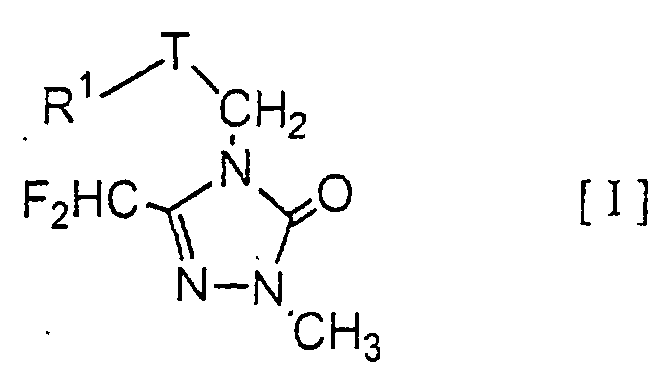 wherein the substituent(s) are one or more substituents selected from the group consisting of halogen atom(s), cyano, nitro, C1-C6 alkyl, C1-C6 haloalkyl, C1-C6 alkoxy, C1-C6 haloalkoxy, C1-C6 alkylthio, C1-C6 haloalkylthio and (C1-C5 alkoxy) carbonyl.R1 represents A1-L1-, A1-ON=CA2-, A1-ON=C(Me)CH2ON=CA2-, A1-C(A2)=N-OCH2-, A1S-C(A2)=N-, A1-C(=S)NH-, A1S-C(=S)NH-, A1S-C(SA2)=N-, A1-ON=C(CN)-, A1-ON=C(Me)CH2ON=C(CN)-, A1-C(CN)=N-OCH2-, halogen atom, nitro or cyano;
wherein, L1 represents single bond, oxygen atom, sulfur atom, carbonyl, -OCH2-, -SCH2-, -C(=O)O-, -OC(=O)-, -C(=O)OCH2-, -NH- or C1-C6 alkylimino;
A1 and A2, which are the same or different, represent hydrogen atom, C1-C10 alkyl, C2-C10 alkenyl, C2-C10 alkynyl, C3-C10 cycloalkyl, (C3-C10 cycloalkyl) alkyl, C5-C10 cycloalkenyl, (C5-C10 cycloalkenyl) alkyl, phenyl, naphthyl, phenyl C1-C10 alkyl, naphtyl C1-C10 alkyl, 5- or 6-membered heterocyclic group optionally condensed with a benzene ring, or methyl substituted by a 5- or 6-membered heterocyclic group optionally condensed with a benzene ring;
the alkyl, the alkenyl, the alkynyl, the cycloalkyl, the cycloalkylalkyl, the cycloalkenyl and the cycloalkenylalkyl, represented by A1 and A2, may optionally be each substituted by one or more substituents selected from the group consisting of halogen atom(s), cyano, nitro, C1-C10 alkoxy, C1-C10 haloalkoxy, C1-C10 alkylthio, C1-C10 haloalkylthio, (C1-C9 alkyl) carbonyl, (C1-C9 alkoxy) carbonyl, (C1-C9 alkyl) carbonylamino, phenyl, phenoxy, benzyloxy and tri(C1-C10 alkyl) silyl;
the phenyl, the naphthyl, the benzene ring in the phenylalkyl, the naphthalene ring in the phenylnaphthyl, the heterocyclic group, and the heterocyclic ring in the methyl substituted by a heterocylic group, represented by A1 and A2, may optionally be each substituted by one or more substituents selected from the group consisting of halogen atom(s), cyano, nitro, C1-C10 alkyl, C1-C10 haloalkyl, C3-C10 cycloalkyl, C1-C10 alkoxy, C1-C10 haloalkoxy, C1-C10 alkylthio, C1-C10 haloalkylthio, (C1-C9 alkyl) carbonyl, (C1-C9 alkoxy) carbonyl, (C1-C9 alkyl) carbonylamino, phenyl, phenoxy, benzyloxy, tri(C1-C10 alkyl) silyl, methylenedioxy and difluoromethylenedioxy; with the proviso, when L1 is single bond, A1 is not a hydrogen atom;T represents optionally substituted m-phenylene, optionally substituted m-azaphenylene or optionally substituted m-diazaphenylene bonded to R1 and to CH2 each via a carbon atom; - The triazolone compound according to claim 1, wherein T is optionally substituted m-phenylene;
wherein the substituent(s) are one or more substituents selected from the group of halogen atom(s), cyano, nitro, C1-C6 alkyl, C1-C6 haloalkyl, C1-C6 alkoxy, C1-C6 haloalkoxy, C1-C6 alkylthio, C1-C6 haloalkylthio and (C1-C5 alkoxy)carbonyl. - The triazolone compound according to claim 1, wherein T is optionally substituted m-azaphenylene or optionally substituted m-diazaphenylene bonded to R1 and to CH2 each via a carbon atom;
wherein the substituent (s) are one or more substituents selected from the group of halogen atom(s), cyano, nitro, C1-C6alkyl, C1-C6 haloalkyl, C1-C6 alkoxy, C1-C6 haloalkoxy, C1-C6 alkylthio, C1-C6 haloalkylthio and (C1-C5 alkoxy)carbonyl. - The triazolone compound according to claim 1, wherein T is optionally substituted m-phenylene;
wherein the substituent (s) are halogen atom (s) or methyl; R1 is optionally substituted phenyl;
wherein the substituent(s) are one or more substituents selected from the group consisting of halogen atom(s), cyano, nitro, C1-C10 alkyl, C1-C10 haloalkyl, C3-C10 cycloalkyl, C1-C10 alkoxy, C1-C10 haloalkoxy, C1-C10 alkylthio, C1-C10 haloalkylthio, (C1-C9 alkyl) carbonyl, (C1-C9 alkoxy) carbonyl, (C1-C9 alkyl) carbonylamino, phenyl, phenoxy, benzyloxy, tri(C1-C10 alkyl) silyl, methylenedioxy and difluoromethylenedioxy. - The triazolone compound according to claim 1, which is represented by the formula [LX]:wherein;

R1 is optionally substituted phenyl;
wherein the substituent(s) are one or more substituents selected from the group consisting of halogen atom(s), cyano, nitro, C1-C10 alkyl, C1-C10 haloalkyl, C3-C10 cycloalkyl, C1-C10 alkoxy, C1-C10 haloalkoxy, C1-C10 alkylthio, C1-C10 haloalkylthio, (C1-C9 alkyl) carbonyl, (C1-C9 alkoxy) carbonyl, (C1-C9 alkyl) carbonylamino, phenyl, phenoxy, benzyloxy, tri(C1-C10 alkyl) silyl, methylenedioxy and difluoromethylenedioxy. - 5-Difluoromethyl-2-methyl-4-(2-methyl-5--phenylbenzyl)-2,4-dihydro-3H-1,2,4-triazol-3-one; which is the triazolone compound according to claim 4, wherein R1 is phenyl.
- A fungicidal composition containing the triazolone compound according to claim 1 as an active ingredient, and an inactive carrier.
- The fungicidal composition according to claim 6, which is containing 5-difluoromethyl-2-methyl-4-(2-methyl-5--phenylbenzyl)-2,4-dihydro-3H-1,2,4-triazol-3-one as an active ingredient, and an inactive carrier.
- 5-Difluoromethyl-2-methyl-2,4-dihydro-3H-1, 2,4--triazol-3-one of the formula [L]:

- A difluoroacetyl semicarbazide compound of the formula [XXVI]:wherein,
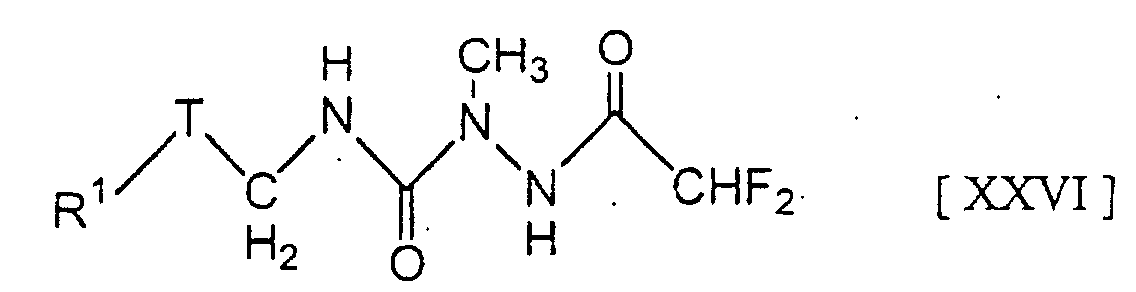 wherein the substituent (s) are one or more substituents selected from the group consisting of halogen atom(s), cyano, nitro, C1-C6 alkyl, C1-C6 haloalkyl, C1-C6 alkoxy, C1-C6 haloalkoxy, C1-C6 alkylthio, C1-C6 haloalkylthio and (C1-C5 alkoxy) carbonyl.R1 represents A1-L1-, A1-ON=CA2-, A1-ON=C(Me)CH2ON=CA2-, A1-C(A2)=N-OCH2-, A1S-C(A2)=N-, A1-C(=S)NH-, A1S-C(=S)NH-, A1S-C(SA2)=N-, A1-ON=C(CN)-, A1-ON=C(Me)CH2ON=C(CN)-, A1-C(CN)=N-OCH2-, halogen atom, nitro or cyano;
wherein L1 represents single bond, oxygen atom, sulfur atom, carbonyl, -OCH2-, -SCH2-, -C(=O)O-, -OC(=O)-, -C(=O)OCH2-, -NH- or C1-C6 alkylimino;
A1 and A2, which are the same or different, represent hydrogen atom, C1-C10 alkyl, C2-C10 alkenyl, C2-C10 alkynyl, C3-C10 cycloalkyl, (C3-C10 cycloalkyl) alkyl, C5-C10 cycloalkenyl, (C5-C10 cycloalkenyl) alkyl, phenyl, naphthyl, phenyl C1-C10 alkyl, naphtyl C1-C10 alkyl, 5-or 6-membered heterocyclic group optionally condensed with a benzene ring, or methyl substituted by a 5- or 6-membered heterocyclic group optionally condensed with a benzene ring;
the alkyl, the alkenyl, the alkynyl, the cycloalkyl, the cycloalkylalkyl, the cycloalkenyl and the cycloalkenylalkyl represented by A1 and A2, may optionally be each substituted by one or more substituents selected from the group consisting of halogen atom(s), cyano, nitro, C1-C10 alkoxy, C1-C10 haloalkoxy, C1-C10 alkylthio, C1-C10 haloalkylthio, (C1-C9 alkyl) carbonyl, (C1-C9 alkoxy) carbonyl, (C1-C9 alkyl) carbonylamino, phenyl, phenoxy, benzyloxy and tri(C1-C10 alkyl) silyl;
the phenyl, the naphthyl, the benzene ring in the phenylalkyl, the naphthalene ring in the phenylnaphthyl, the heterocyclic group, and the heterocyclic ring in the methyl substituted by a heterocylic group, represented by A1 and A2, may optionally be each substituted by one or more substituents selected from the group consisting of halogen atoms, cyano, nitro, C1-C10 alkyl, C1-C10 haloalkyl, C3-C10 cycloalkyl, C1-C10 alkoxy, C1-C10 haloalkoxy, C1-C10 alkylthio, C1-C10 haloalkylthio, (C1-C9 alkyl) carbonyl, (C1-C9 alkoxy) carbonyl, (C1-C9 alkyl) carbonylamino, phenyl, phenoxy, benzyloxy, tri(C1-C10 alkyl) silyl, methylenedioxy and difluoromethylenedioxy; with the proviso, when L1 is single bond, A1 is not a hydrogen atom;T represents optionally substituted m-phenylene, optionally substituted m-azaphenylene or optionally substituted m-diazaphenylene bonded to R1 and to CH2 each via a carbon atom; - The difluoroacetyl semicarbazide compound according to claim 10, wherein T is optionally substituted m-phenylene;
wherein the substituent (s) are one or more substituents selected from the group of halogen atoms, cyano, nitro, C1-C6 alkyl, C1-C6 haloalkyl, C1-C6 alkoxy, C1-C6 haloalkoxy, C1-C6 alkylthio, C1-C6 haloalkylthio and (C1-C5 alkoxy)carbonyl. - The difluoroacetyl semicarbazide compound according to claim 10, wherein T is optionally substituted m-azaphenylene or optionally substituted m-diazaphenylene bonded to R1 and to CH2 each via a carbon atom;
wherein the substituent (s) are one or more substituents selected from the group of halogen atom(s), cyano, nitro, C1-C6 alkyl, C1-C6 haloalkyl, C1-C6 alkoxy, C1-C6 haloalkoxy, C1-C6 alkylthio, C1-C6 haloalkylthio and (C1-C5 alkoxy)carbonyl. - The difluoroacetyl semicarbazide compound according to claim 10, wherein T is optionally substituted m-phenylene;
wherein the substituent (s) are halogen atom(s) or methyl. - 1-Difluoroacetyl-2-methyl-4-(2-methyl-5--phenylbenzyl)semicarbazide; which is the difluoroacetyl semicarbazide compound according to claim 10.
- A semicarbazide compound of the formula [VII]:wherein;
 wherein the substituent(s) are one or more substituents selected from the group consisting of halogen atom(s), cyano, nitro, C1-C6 alkyl, C1-C6 haloalkyl, C1-C6 alkoxy, C1-C6 haloalkoxy, C1-C6 alkylthio, C1-C6 haloalkylthio and (C1-C5 alkoxy) carbonyl.R1 represents A1-L1-, A1-ON=CA2-, A1-ON=C(Me)CH2ON=CA2-, A1-C(A2)=N-OCH2-, A1S-C(A2)=N-, A1-C(=S)NH-, A1S-C(=S)NH-, A1S-C(SA2)=N-, A1-ON=C(CN)-, A1-ON=C(Me)CH2ON=C(CN)-, A1-C(CN)=N-OCH2-, halogen atom, nitro or cyano;
wherein, L1 represents single bond, oxygen atom, sulfur atom, carbonyl, -OCH2-, -SCH2-, -C(=O)O-, -OC(=O)-, -C(=O)OCH2-, -NH- or C1-C6 alkylimino;
A1 and A2, which are the same or different, represent hydrogen atom, C1-C10 alkyl, C2-C10 alkenyl, C2-C10 alkynyl, C3-C10 cycloalkyl, (C3-C10 cycloalkyl) alkyl, C5-C10 cycloalkenyl, (C5-C10 cycloalkenyl) alkyl, phenyl, naphthyl, phenyl C1-C10 alkyl, naphtyl C1-C10 alkyl, 5- or 6-membered heterocyclic group optionally condensed with a benzene ring, or methyl substituted by a 5- or 6-membered heterocyclic group optionally condensed with a benzene ring;
the alkyl, the alkenyl, the alkynyl, the cycloalkyl, the cycloalkylalkyl, the cycloalkenyl and the cycloalkenylalkyl, represented by A1 and A2, may optionally be each substituted by one or more substituents selected from the group consisting of halogen atom(s), cyano, nitro, C1-C10 alkoxy, C1-C10 haloalkoxy, C1-C10 alkylthio, C1-C10 haloalkylthio, (C1-C9 alkyl) carbonyl, (C1-C9 alkoxy) carbonyl, (C1-C9 alkyl) carbonylamino, phenyl, phenoxy, benzyloxy and tri(C1-C10 alkyl) silyl;
the phenyl, the naphthyl, the benzene ring in the phenylalkyl, the naphthalene ring in the phenylnaphthyl, the heterocyclic group, and the heterocyclic ring in the methyl substituted by a heterocylic group, represented by A1 and A2, may optionally be each substituted by one or more substituents selected from the group consisting of halogen atom(s), cyano, nitro, C1-C10 alkyl, C1-C10 haloalkyl, C3-C10 cycloalkyl, C1-C10 alkoxy, C1-C10 haloalkoxy, C1-C10 alkylthio, C1-C10 haloalkylthio, (C1-C9 alkyl) carbonyl, (C1-C9 alkoxy) carbonyl, (C1-C9 alkyl) carbonylamino, phenyl, phenoxy, benzyloxy, tri(C1-C10 alkyl) silyl, methylenedioxy and difluoromethylenedioxy; with the proviso, when L1 is single bond, A1 is not a hydrogen atom;T represents optionally substituted m-phenylene, optionally substituted m-azaphenylene or optionally substituted m-diazaphenylene bonded to R1 and to CH2 each via a carbon atom; - The semicarbazide compound according to claim 15, wherein T is optionally substituted m-phenylene;
wherein the substituent(s) are one or more substituents selected from the group of halogen atom(s), cyano, nitro, C1-C6 alkyl, C1-C6 haloalkyl, C1-C6 alkoxy, C1-C6 haloalkoxy, C1-C6 alkylthio, C1-C6 haloalkylthio and (C1-C5 alkoxy)carbonyl. - The semicarbazide compound according to claim 15, wherein T is optionally substituted m-azaphenylene or optionally substituted m-diazaphenylene bonded to R1 and to CH2 each via a carbon atom;
wherein the substituent(s) are one or more substituents selected from the group of halogen atom(s), cyano, nitro, C1-C6 alkyl, C1-C6 haloalkyl, C1-C6 alkoxy, C1-C6 haloalkoxy, C1-C6 alkylthio, C1-C6 haloalkylthio and (C1-C5 alkoxy)carbonyl. - The semicarbazide compound according to claim 15, wherein T is optionally substituted m-phenylene;
wherein the substituent (s) are halogen atom(s) or methyl. - 2-Methyl-4-(2-methyl-5-phenylbenzyl)semicarbazide; which is the semicarbazide compound according to claim 15.
- 2-Methyl-5-phenylbenzylamine of the formula [XVI-1]:, its inorganic acid salt or its sulfonic acid salt.
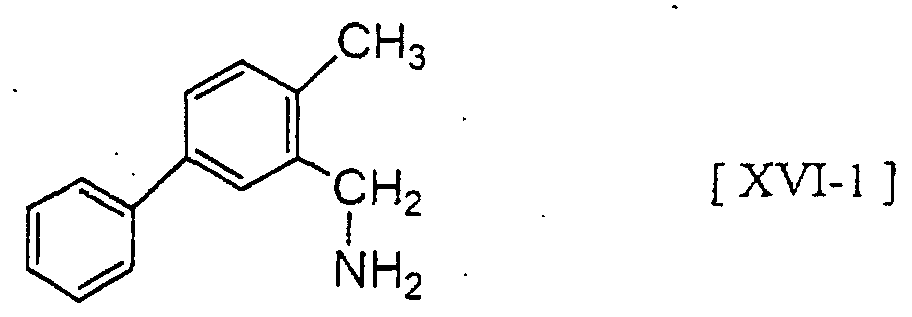
- 2-Methyl-5-phenylbenzyl chloride of the formula [XIII-1]:

- A sulfonate ester compound of the formula [XIII-2]:wherein R9 represents methyl or p-tolyl.
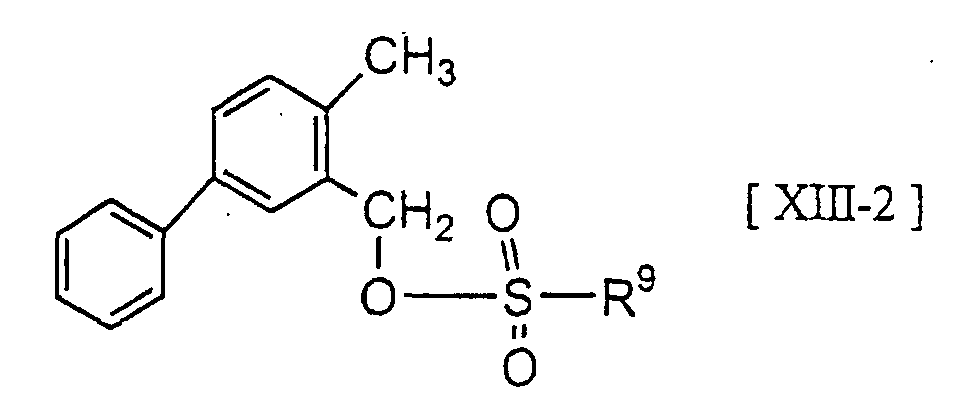
- N,N-Dimethyl-(2-methyl-5-phenylbenzyl)amine of the formula [LI]:its inorganic acid salt or its sulfonic acid salt.
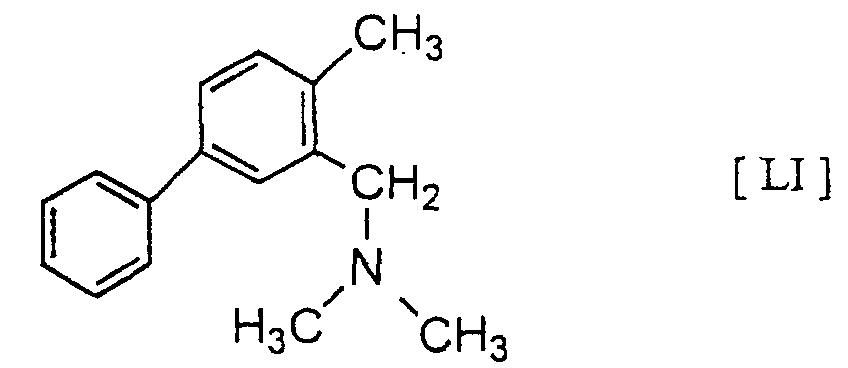
Applications Claiming Priority (9)
| Application Number | Priority Date | Filing Date | Title |
|---|---|---|---|
| JP34888499 | 1999-12-08 | ||
| JP34888499 | 1999-12-08 | ||
| JP2000110682 | 2000-04-12 | ||
| JP2000110682 | 2000-04-12 | ||
| JP2000164223 | 2000-06-01 | ||
| JP2000164223 | 2000-06-01 | ||
| JP2000240866 | 2000-08-09 | ||
| JP2000240866A JP2002053561A (en) | 1999-12-08 | 2000-08-09 | Difluoromethyltriazolone compound, its use and its production intermediate |
| PCT/JP2000/008558 WO2001042227A1 (en) | 1999-12-08 | 2000-12-01 | Difluoromethyltriazolone compounds, use of the same and intermediates for the production thereof |
Publications (1)
| Publication Number | Publication Date |
|---|---|
| EP1238975A1 true EP1238975A1 (en) | 2002-09-11 |
Family
ID=27480694
Family Applications (1)
| Application Number | Title | Priority Date | Filing Date |
|---|---|---|---|
| EP00979060A Withdrawn EP1238975A1 (en) | 1999-12-08 | 2000-12-01 | Difluoromethyltriazolone compounds, use of the same and intermediates for the production thereof |
Country Status (5)
| Country | Link |
|---|---|
| US (2) | US6762197B2 (en) |
| EP (1) | EP1238975A1 (en) |
| JP (1) | JP2002053561A (en) |
| AU (1) | AU1651001A (en) |
| WO (1) | WO2001042227A1 (en) |
Cited By (5)
| Publication number | Priority date | Publication date | Assignee | Title |
|---|---|---|---|---|
| WO2008077625A1 (en) * | 2006-12-22 | 2008-07-03 | Laboratorios Del Dr. Esteve, S.A. | Heterocyclyl-substituted-ehylamino-phenyl derivatives, their preparation and use as medicaments |
| WO2009158011A1 (en) * | 2008-06-26 | 2009-12-30 | Amgen Inc. | Alkynyl alcohols as kinase inhibitors |
| WO2014207052A1 (en) * | 2013-06-27 | 2014-12-31 | Basf Se | Strobilurin type compounds for combating phytopathogenic fungi |
| WO2015191382A1 (en) * | 2014-06-11 | 2015-12-17 | E. I. Du Pont De Nemours And Company | Fungicidal tetrazolinones |
| EP2928472A4 (en) * | 2012-12-05 | 2016-09-14 | Merck Sharp & Dohme | PROCESS FOR PREPARING INVERSE TRANSCRIPTASE INHIBITORS |
Families Citing this family (4)
| Publication number | Priority date | Publication date | Assignee | Title |
|---|---|---|---|---|
| JP2006076990A (en) * | 2004-03-12 | 2006-03-23 | Bayer Cropscience Ag | Insecticidal benzenedicarboxamide compounds |
| EP3708562B1 (en) * | 2018-06-12 | 2022-08-17 | Tokuyama Corporation | Method for producing semicarbazide compound |
| AR115870A1 (en) | 2018-07-31 | 2021-03-10 | Sumitomo Chemical Co | METHOD FOR CONTROLLING SOYBEAN ROY FUNGUS THAT HAS RESISTANCE TO SITE INHIBITOR Qₒ |
| US12439917B2 (en) | 2020-01-31 | 2025-10-14 | Sumitomo Chemical Company, Limited | Method for controlling phakopsora pachyrhizi having resistance against QoI fungicide |
Family Cites Families (9)
| Publication number | Priority date | Publication date | Assignee | Title |
|---|---|---|---|---|
| US4473709A (en) | 1980-07-14 | 1984-09-25 | Fmc Corporation | Pyrethroid intermediates and process |
| US5428037A (en) * | 1993-04-09 | 1995-06-27 | Syntex Pharmaceuticals, Ltd. | Heterocyclic derivatives in the treatment of Ischaemia and related diseases |
| DE4339412A1 (en) | 1993-11-18 | 1995-05-24 | Bayer Ag | Process and new intermediates for the production of triazolinones |
| DE4342190A1 (en) | 1993-12-10 | 1995-06-14 | Bayer Ag | Process and new intermediates for the production of triazolinones |
| JPH1045754A (en) | 1996-08-01 | 1998-02-17 | Otsuka Chem Co Ltd | 1,2,4-triazole derivative and herbicide containing the same |
| GB9716446D0 (en) | 1997-08-05 | 1997-10-08 | Agrevo Uk Ltd | Fungicides |
| DE69829574T2 (en) * | 1997-08-26 | 2005-09-15 | Kumiai Chemical Industry Co., Ltd. | BIARYL ALKYLENE CARBOXIC ACID DERIVATIVES AND FUNGICIDES FOR AGRICULTURE AND GARDENING |
| DE19834557A1 (en) | 1998-07-31 | 2000-02-03 | Basf Ag | New (hetero)aryl 1,2,4-triazole or isoxazole derivatives useful as fungicides, insecticides, acaricides and nematocides |
| US6489487B1 (en) * | 1998-08-03 | 2002-12-03 | Sumitomo Chemical Company, Limited | Triazolone derivatives, use thereof, and intermediates therefor |
-
2000
- 2000-08-09 JP JP2000240866A patent/JP2002053561A/en active Pending
- 2000-12-01 US US10/149,034 patent/US6762197B2/en not_active Expired - Fee Related
- 2000-12-01 EP EP00979060A patent/EP1238975A1/en not_active Withdrawn
- 2000-12-01 WO PCT/JP2000/008558 patent/WO2001042227A1/en not_active Ceased
- 2000-12-01 AU AU16510/01A patent/AU1651001A/en not_active Abandoned
-
2004
- 2004-02-20 US US10/781,988 patent/US20040167193A1/en not_active Abandoned
Non-Patent Citations (1)
| Title |
|---|
| See references of WO0142227A1 * |
Cited By (7)
| Publication number | Priority date | Publication date | Assignee | Title |
|---|---|---|---|---|
| WO2008077625A1 (en) * | 2006-12-22 | 2008-07-03 | Laboratorios Del Dr. Esteve, S.A. | Heterocyclyl-substituted-ehylamino-phenyl derivatives, their preparation and use as medicaments |
| WO2009158011A1 (en) * | 2008-06-26 | 2009-12-30 | Amgen Inc. | Alkynyl alcohols as kinase inhibitors |
| AU2009263037B2 (en) * | 2008-06-26 | 2011-10-06 | Amgen Inc. | Alkynyl alcohols as kinase inhibitors |
| EP2928472A4 (en) * | 2012-12-05 | 2016-09-14 | Merck Sharp & Dohme | PROCESS FOR PREPARING INVERSE TRANSCRIPTASE INHIBITORS |
| US9663490B2 (en) | 2012-12-05 | 2017-05-30 | Merck Sharp & Dohme Corp. | Process for making reverse transcriptase inhibitors |
| WO2014207052A1 (en) * | 2013-06-27 | 2014-12-31 | Basf Se | Strobilurin type compounds for combating phytopathogenic fungi |
| WO2015191382A1 (en) * | 2014-06-11 | 2015-12-17 | E. I. Du Pont De Nemours And Company | Fungicidal tetrazolinones |
Also Published As
| Publication number | Publication date |
|---|---|
| US20040167193A1 (en) | 2004-08-26 |
| US20030119670A1 (en) | 2003-06-26 |
| WO2001042227A1 (en) | 2001-06-14 |
| US6762197B2 (en) | 2004-07-13 |
| JP2002053561A (en) | 2002-02-19 |
| AU1651001A (en) | 2001-06-18 |
Similar Documents
| Publication | Publication Date | Title |
|---|---|---|
| JP2001302605A (en) | Biphenyl compounds and their uses | |
| US20080275050A1 (en) | Pyridazine Compound and Use Thereof | |
| US6762197B2 (en) | Difluoromethyltriazolone compounds, use of the same and intermediates for the production thereof | |
| EP1431299A1 (en) | IMIDAZO(1,2-a)PYRIMIDINES AND FUNGICIDE COMPOSITIONS CONTAINING THE SAME | |
| JPWO2001034568A1 (en) | Oxime O-ether compounds and agricultural and horticultural fungicides | |
| US6489487B1 (en) | Triazolone derivatives, use thereof, and intermediates therefor | |
| US5563159A (en) | Dithiocarbonimide derivatives useful as acaricidal, fungicidal, and insecticidal agents | |
| JP4306206B2 (en) | Imidazo [1,2-a] pyrimidine, its use and production intermediate | |
| KR20000075703A (en) | Oxime ether compounds, their use and intermediates for preparations of the same | |
| JP2001064237A (en) | Acrylic acid derivatives, their uses and intermediates for their production | |
| JP2002308879A (en) | 5-haloalkylazolopyrimidine compound, production method, and harmful organism control agent | |
| US6762321B2 (en) | Amide compounds and use thereof | |
| JPH0995486A (en) | Triazolone derivative, its use and its production intermediate | |
| JPWO1999003824A1 (en) | Disease or pest control agent containing alkoxyimino-substituted bicyclic derivative as an active ingredient | |
| JP2001114737A (en) | Oxime derivatives and their uses | |
| WO2000018727A1 (en) | Intermediates in the production of oxime ether compounds | |
| JP2000239261A (en) | Triazolone derivatives, their uses and intermediates for their production | |
| JP4529537B2 (en) | Imidazole compounds and uses thereof | |
| JP2000001460A (en) | Acrylic acid derivatives and their uses | |
| JPH08208621A (en) | Plant disease control agent | |
| WO1996038425A1 (en) | Triazolone derivatives, use thereof, and intermediates for the preparation thereof | |
| JP2000103773A (en) | Acrylic acid derivatives and their uses | |
| JP2000247962A (en) | Isoxazolone derivatives and uses thereof | |
| JPH05194398A (en) | Acrylic acid derivative, production method thereof and plant disease controlling agent containing the same as an active ingredient | |
| JP2989462B2 (en) | Agricultural and horticultural fungicides |
Legal Events
| Date | Code | Title | Description |
|---|---|---|---|
| PUAI | Public reference made under article 153(3) epc to a published international application that has entered the european phase |
Free format text: ORIGINAL CODE: 0009012 |
|
| 17P | Request for examination filed |
Effective date: 20020703 |
|
| AK | Designated contracting states |
Kind code of ref document: A1 Designated state(s): AT BE CH CY DE DK ES FI FR GB GR IE IT LI LU MC NL PT SE TR |
|
| AX | Request for extension of the european patent |
Free format text: AL;LT;LV;MK;RO;SI |
|
| RBV | Designated contracting states (corrected) |
Designated state(s): DE FR GB |
|
| RAP1 | Party data changed (applicant data changed or rights of an application transferred) |
Owner name: SUMITOMO CHEMICAL COMPANY, LIMITED |
|
| STAA | Information on the status of an ep patent application or granted ep patent |
Free format text: STATUS: THE APPLICATION HAS BEEN WITHDRAWN |
|
| 18W | Application withdrawn |
Effective date: 20050512 |